




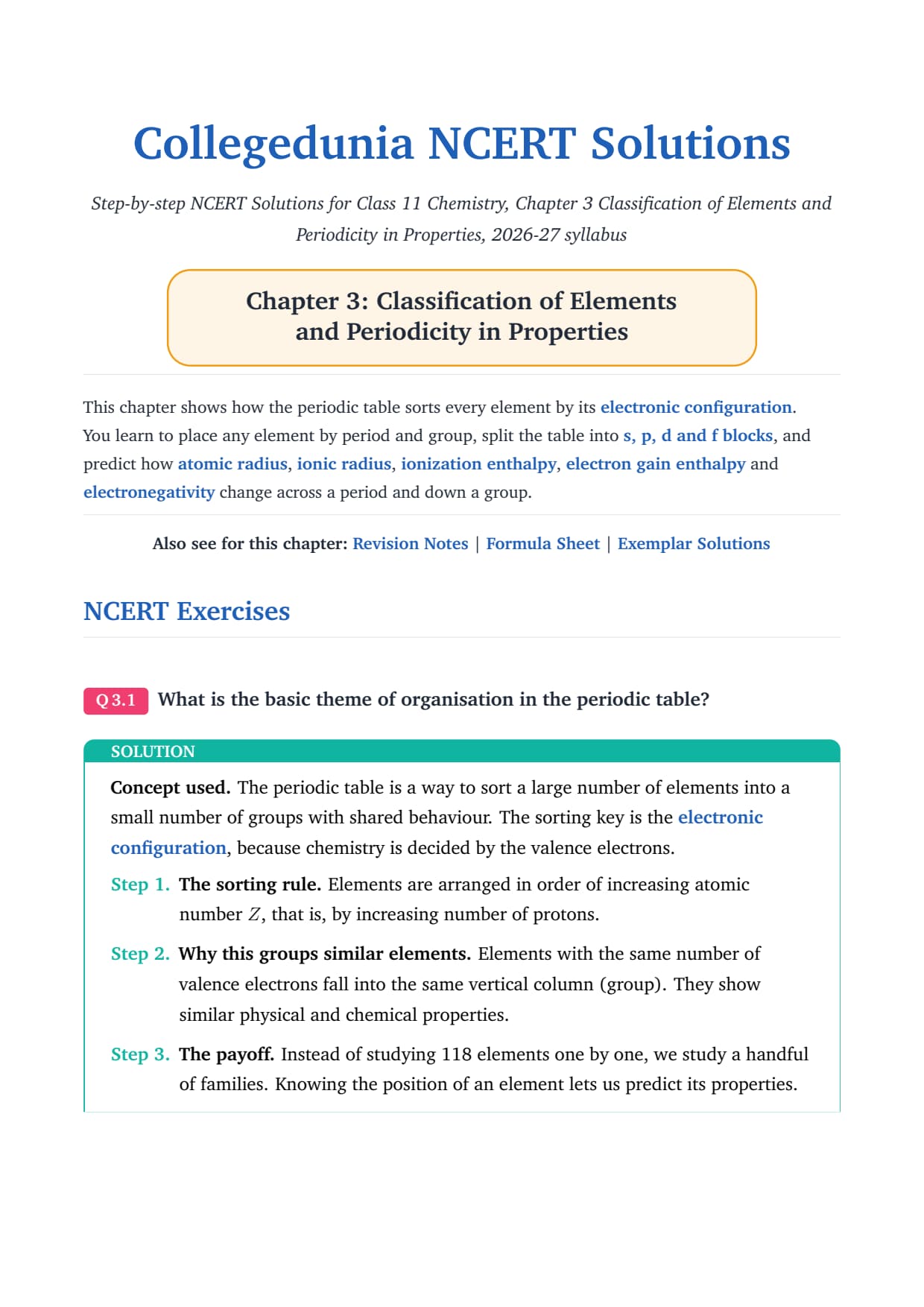
The class 11 chemistry NCERT solutions chapter 3 Classification of Elements and Periodicity in Properties cover every intext and back-exercise question, according to the latest 2026-27 CBSE syllabus, and help students prepare for the CBSE Boards, JEE Main, JEE Advanced, NEET and CUET. Each answer is worked step by step, from the genesis of periodic classification to the modern periodic law and the trends that run across every row and column of the table.
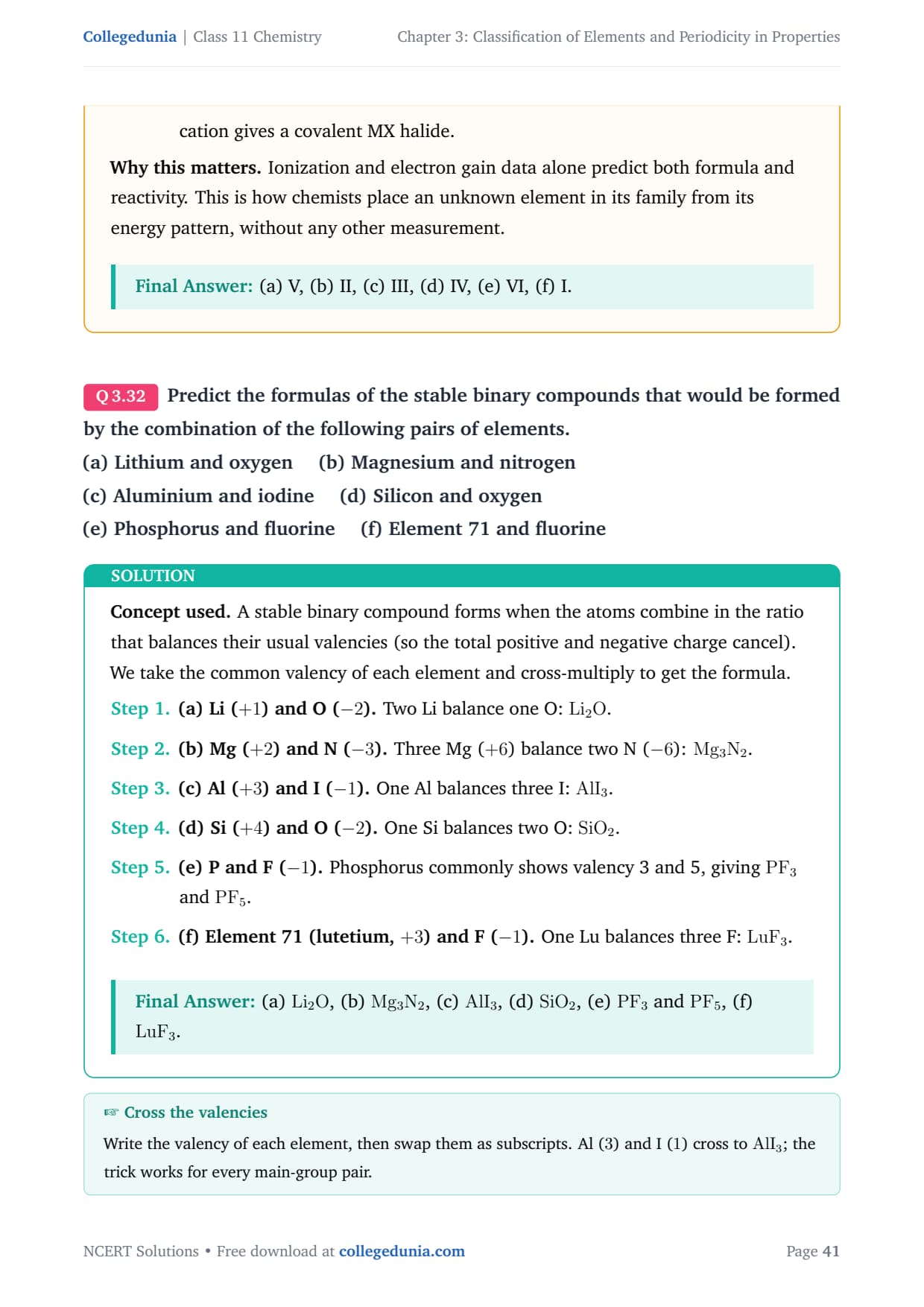
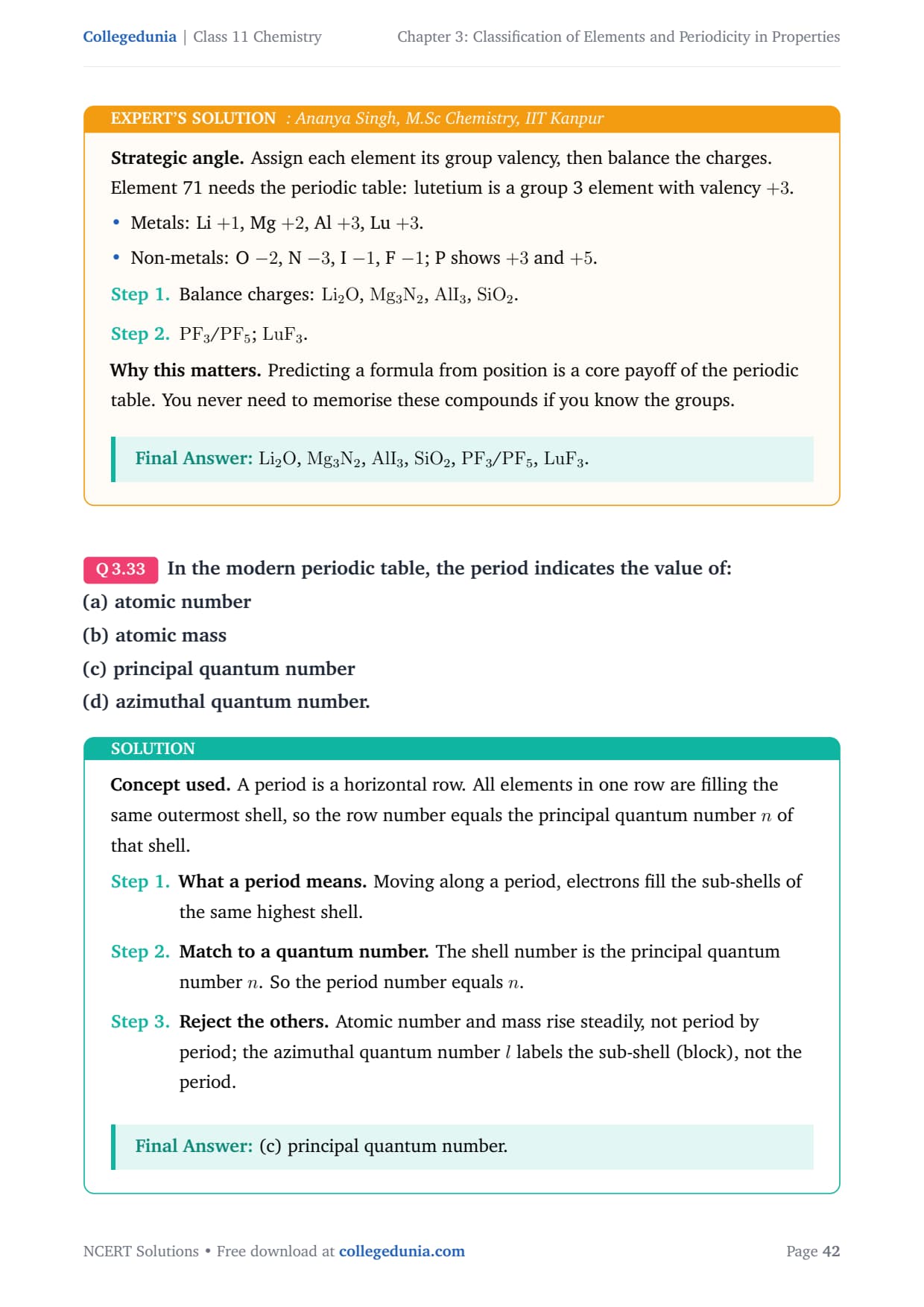
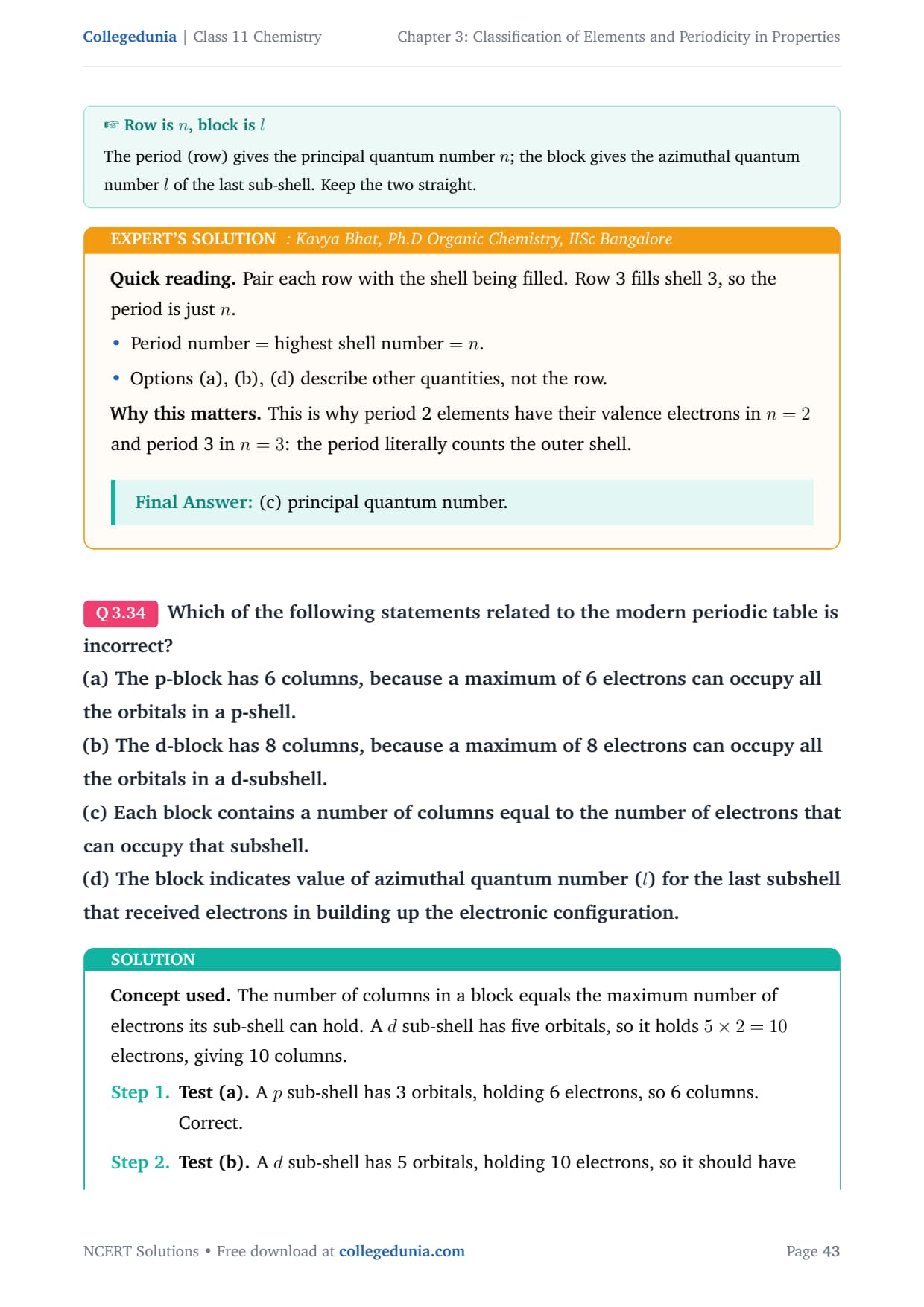
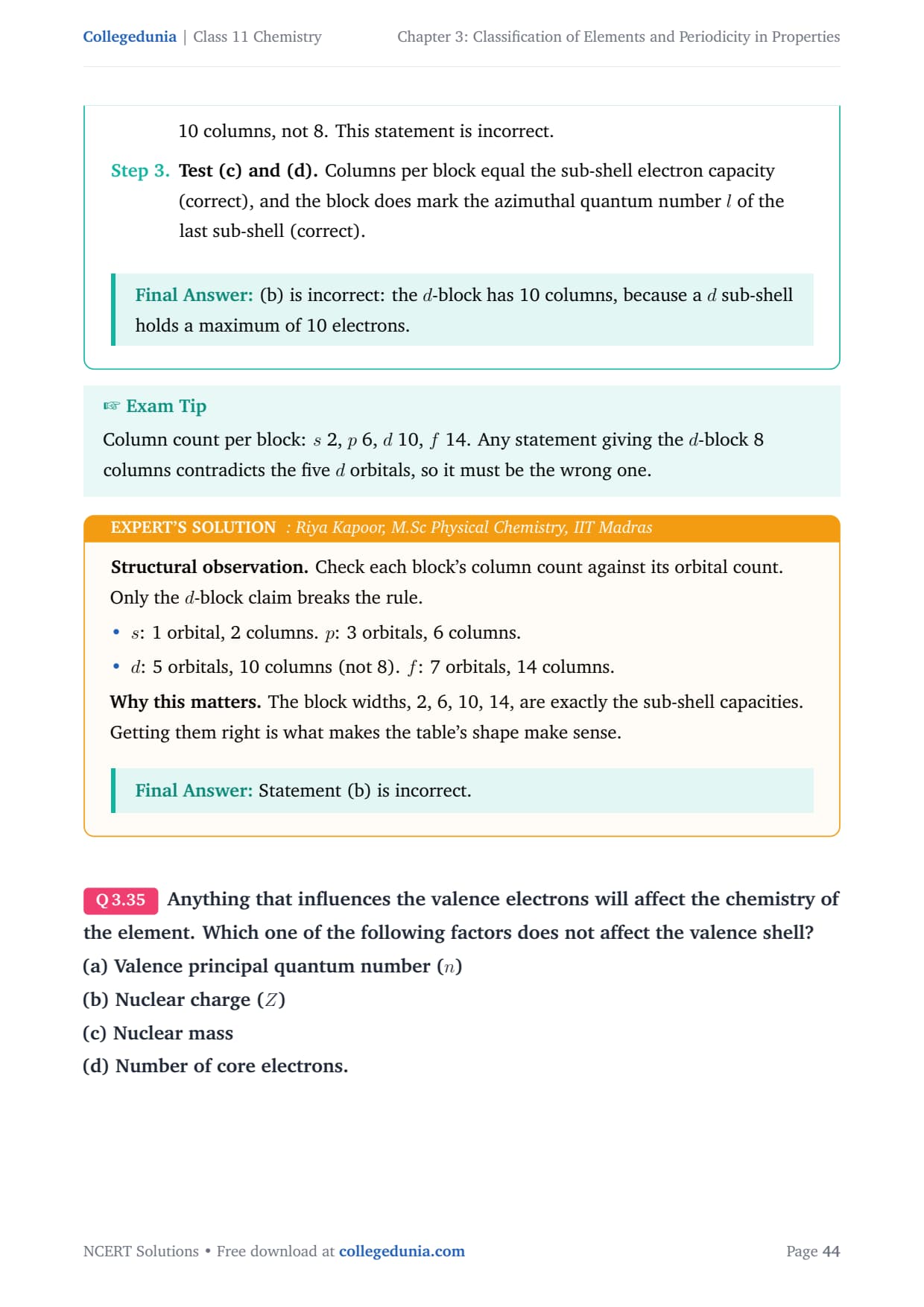
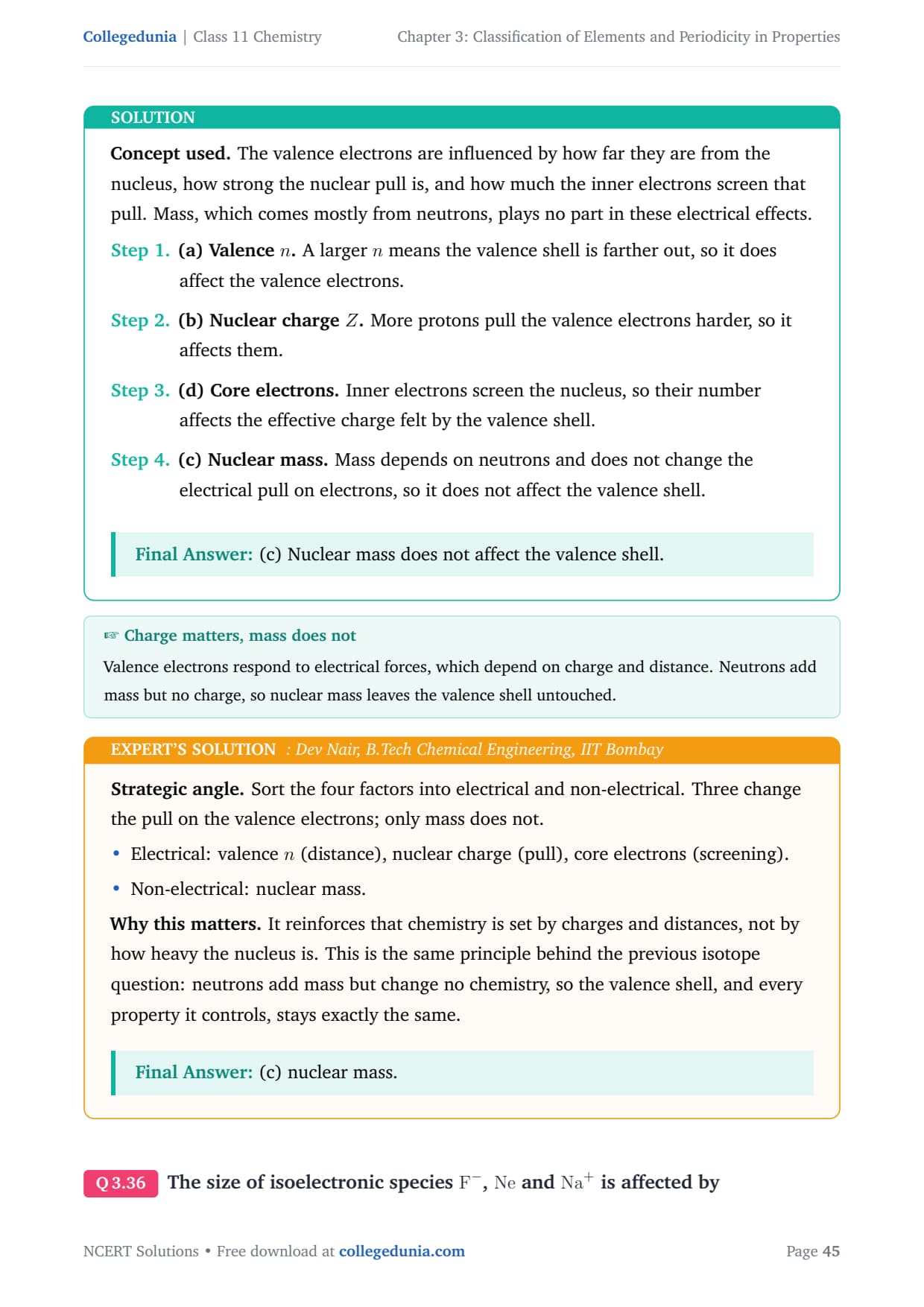
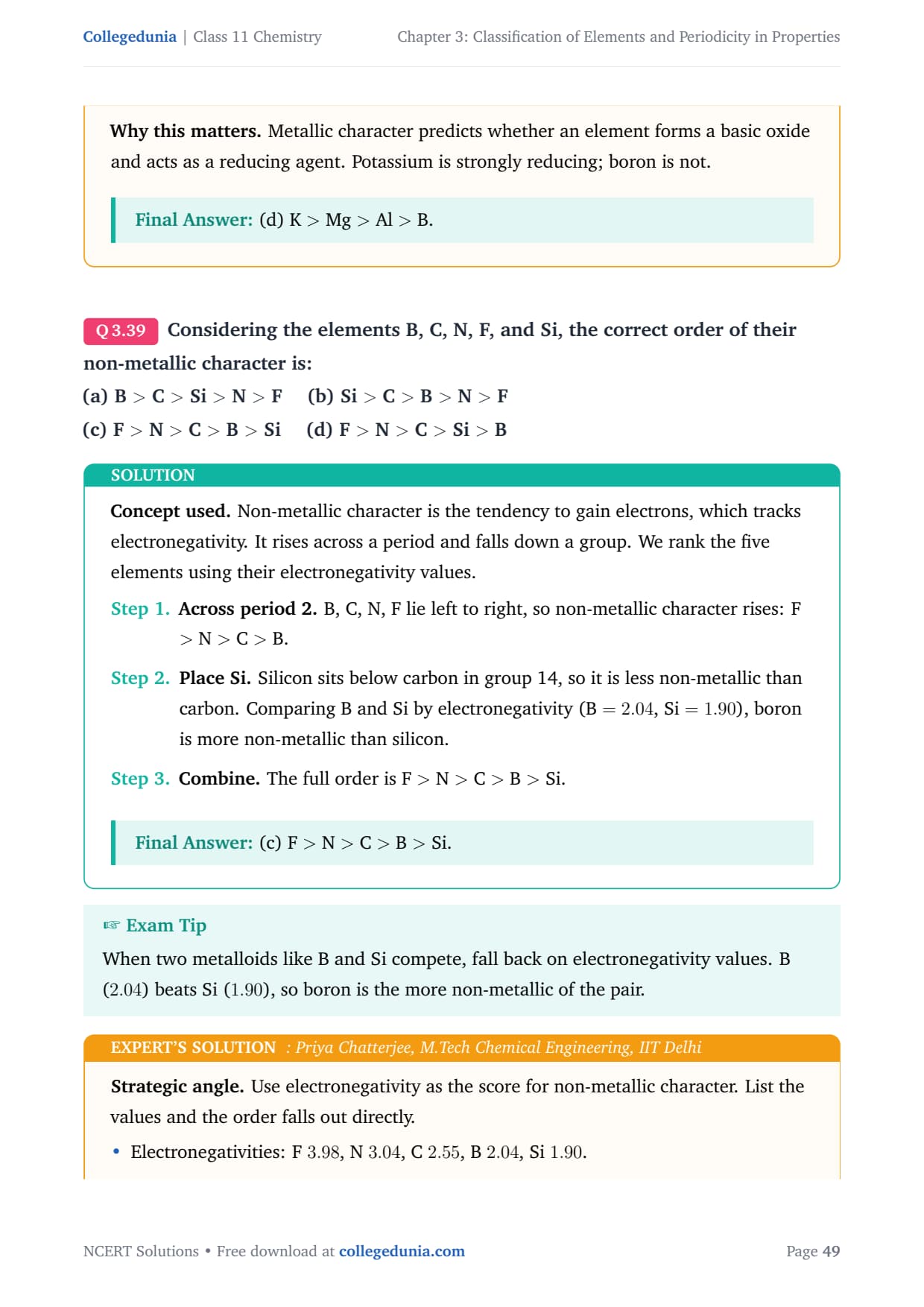
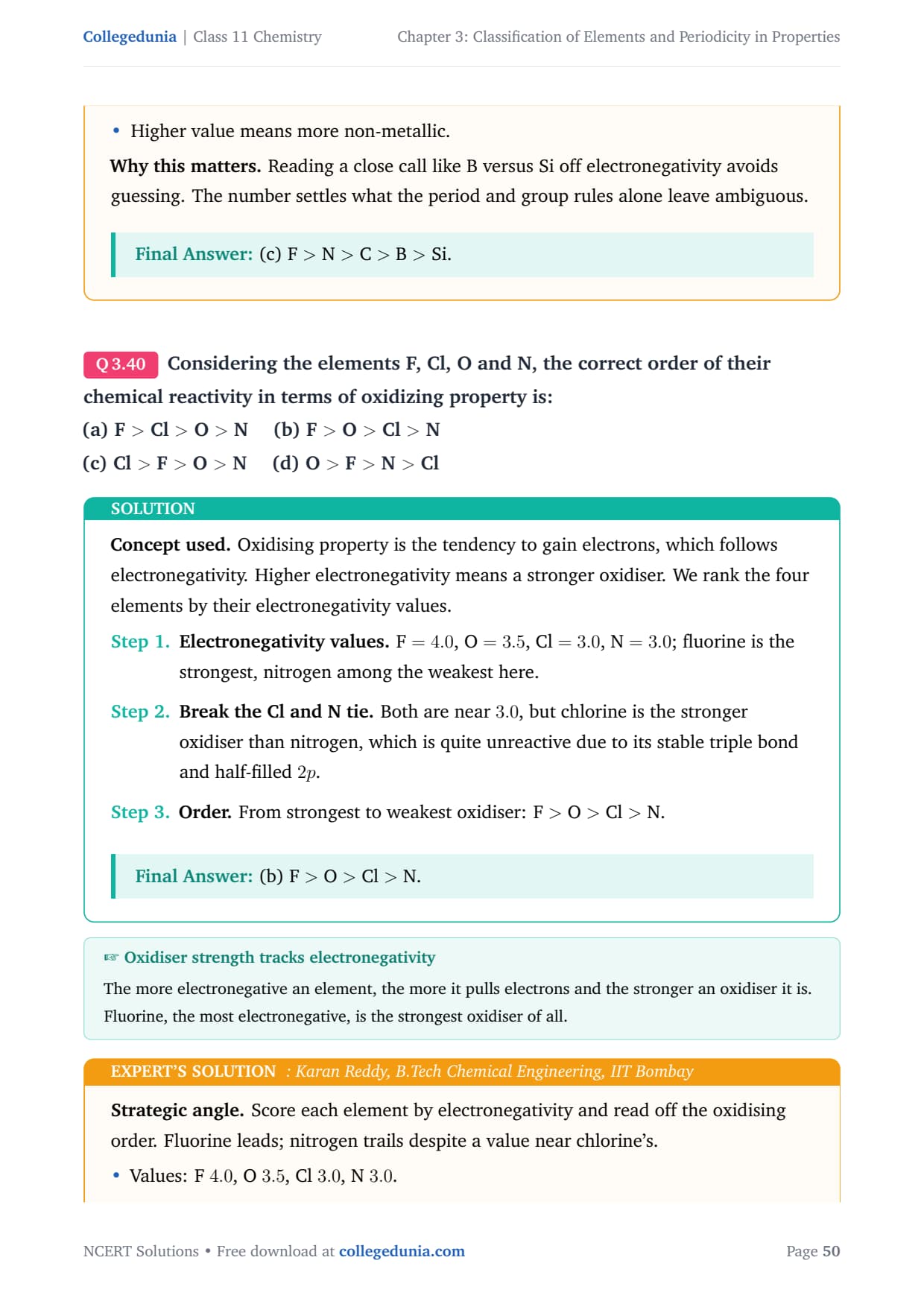
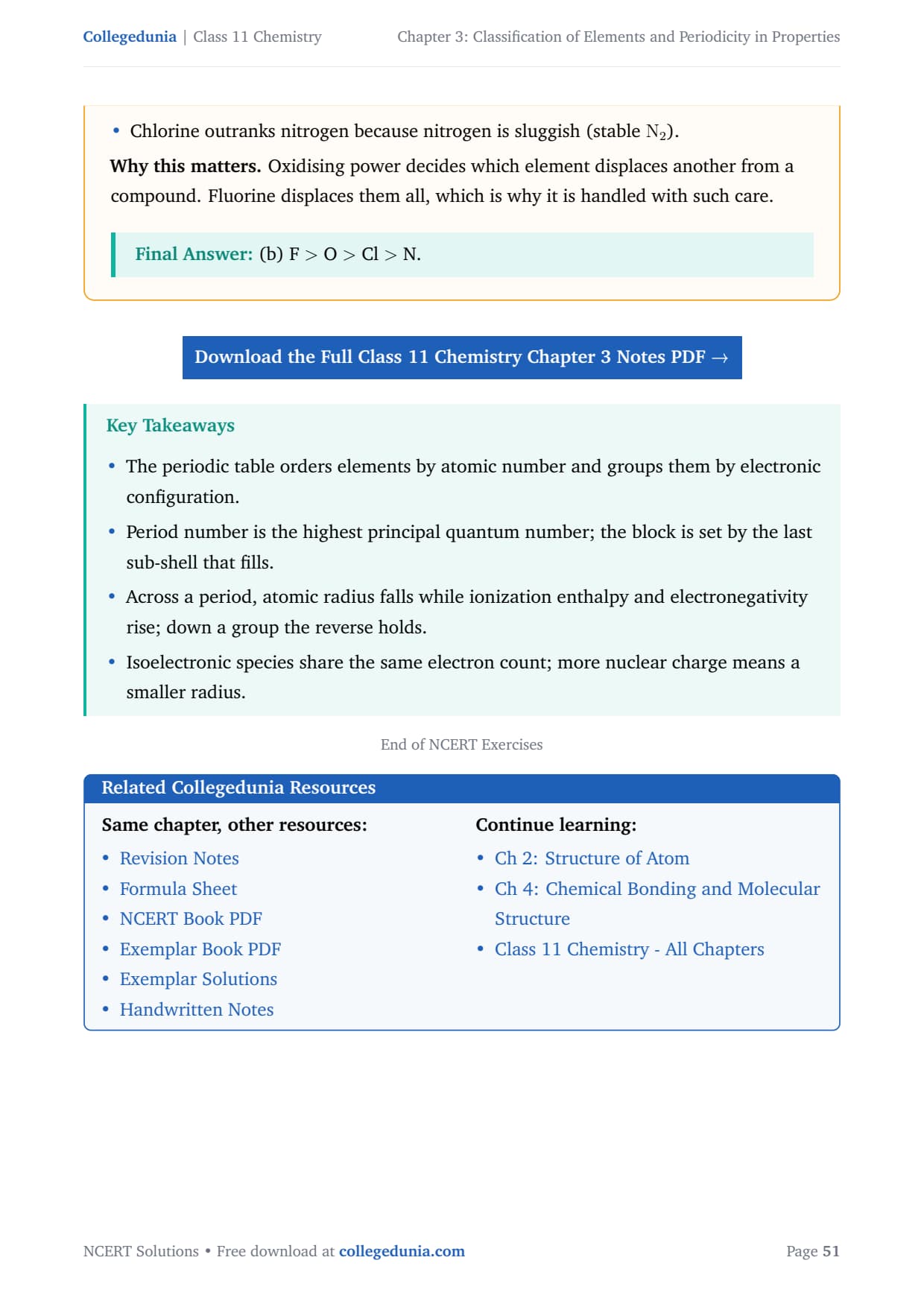
This chapter turns a long list of elements into a pattern you can predict, so the properties you learn here explain the bonding, blocks and reactions in the rest of Class 11 Chemistry.
- CBSE Weightage: 6 to 7 marks, a scoring theory chapter with steady one-mark and reasoning questions.
- Topics covered: genesis of classification, modern periodic law, long form table, s, p, d and f blocks, and periodic trends.
- Exercise count: 40 back-exercise questions plus intext questions, most of them reasoning and trend based.
These class 11 chemistry NCERT solutions chapter 3 Classification of Elements and Periodicity in Properties are curated by subject experts, based on the 2026-27 NCERT textbook, and checked against the last five years of CBSE Board, JEE Main and NEET papers.
Why the Periodic Table Matters and What Classification of Elements Covers
There are more than a hundred elements, and remembering each one alone would be impossible. The periodic table sorts them by their electron arrangement, so elements in the same column behave alike. Learn the pattern once and you can predict how an element reacts without memorising it.
- Everyday role: the table guides which metals make alloys, which elements form medicines, and which gases stay inert.
- Core skill: using an element's position to predict its size, its charge, and how easily it loses or gains electrons.
- Why it matters: the periodic trends here explain bonding, acidity and reactivity in every later chapter.
Position in the table tells you almost everything about an element's chemistry. That is why students who understand the trends early stop mugging up isolated facts. The class 11 chemistry NCERT solutions chapter 3 Classification of Elements and Periodicity in Properties below follow the same order as the NCERT textbook.
Genesis of Periodic Classification from Dobereiner to Mendeleev
The modern table did not appear at once. It grew from a series of attempts to group elements by their properties, and NCERT expects you to know each step and its flaw. These early ideas are a common source of one-mark and match-the-column questions.
| Attempt | Main idea and limitation |
|---|---|
| Dobereiner's triads | Groups of three where the middle atomic mass is the average of the other two; worked for very few elements. |
| Newlands' law of octaves | Every eighth element repeated properties like musical notes; failed after calcium. |
| Lothar Meyer's curve | Plotted atomic volume against atomic mass and found repeating peaks; less complete than Mendeleev's. |
| Mendeleev's periodic law | Properties are a periodic function of atomic mass; left gaps and predicted undiscovered elements. |
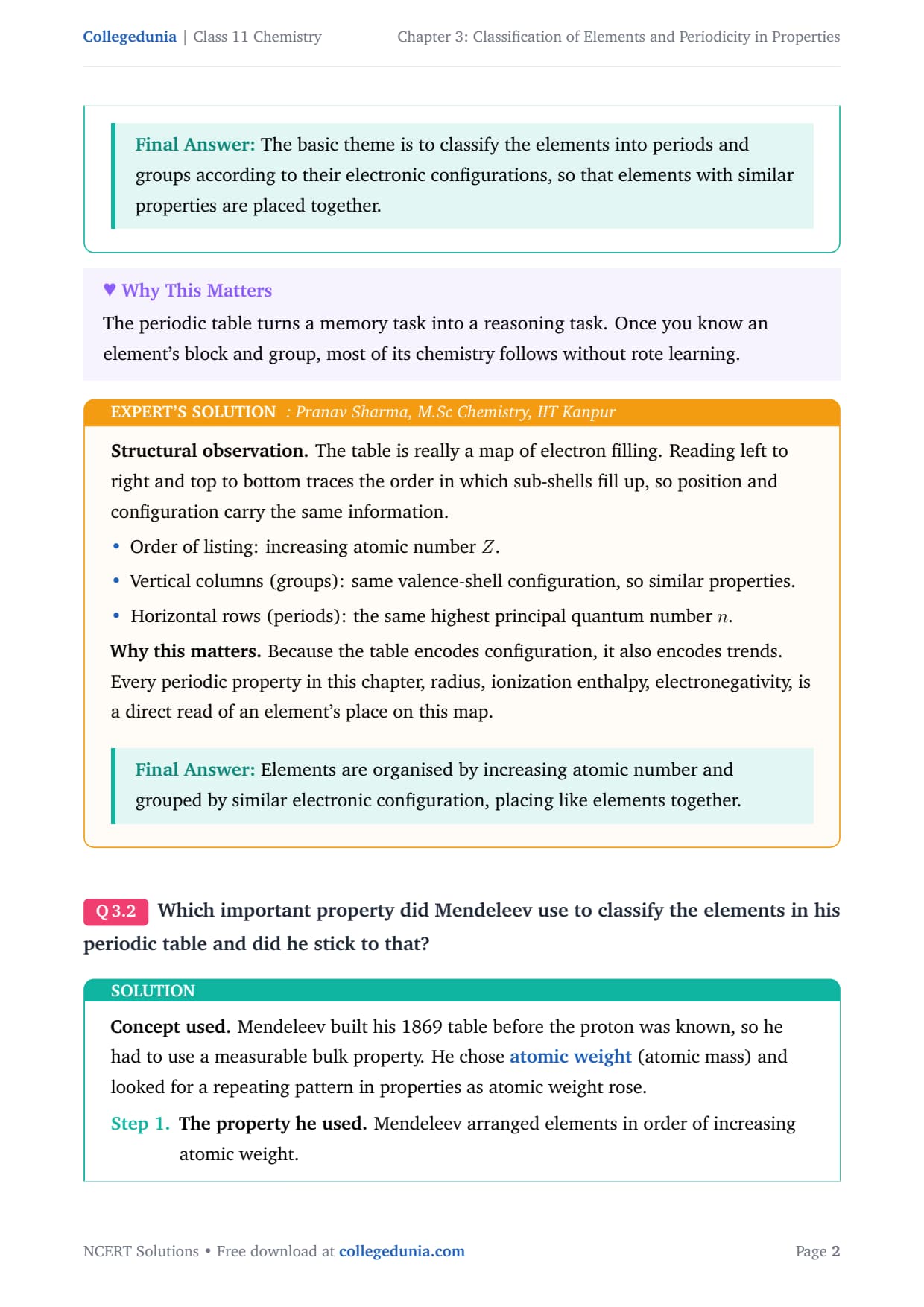
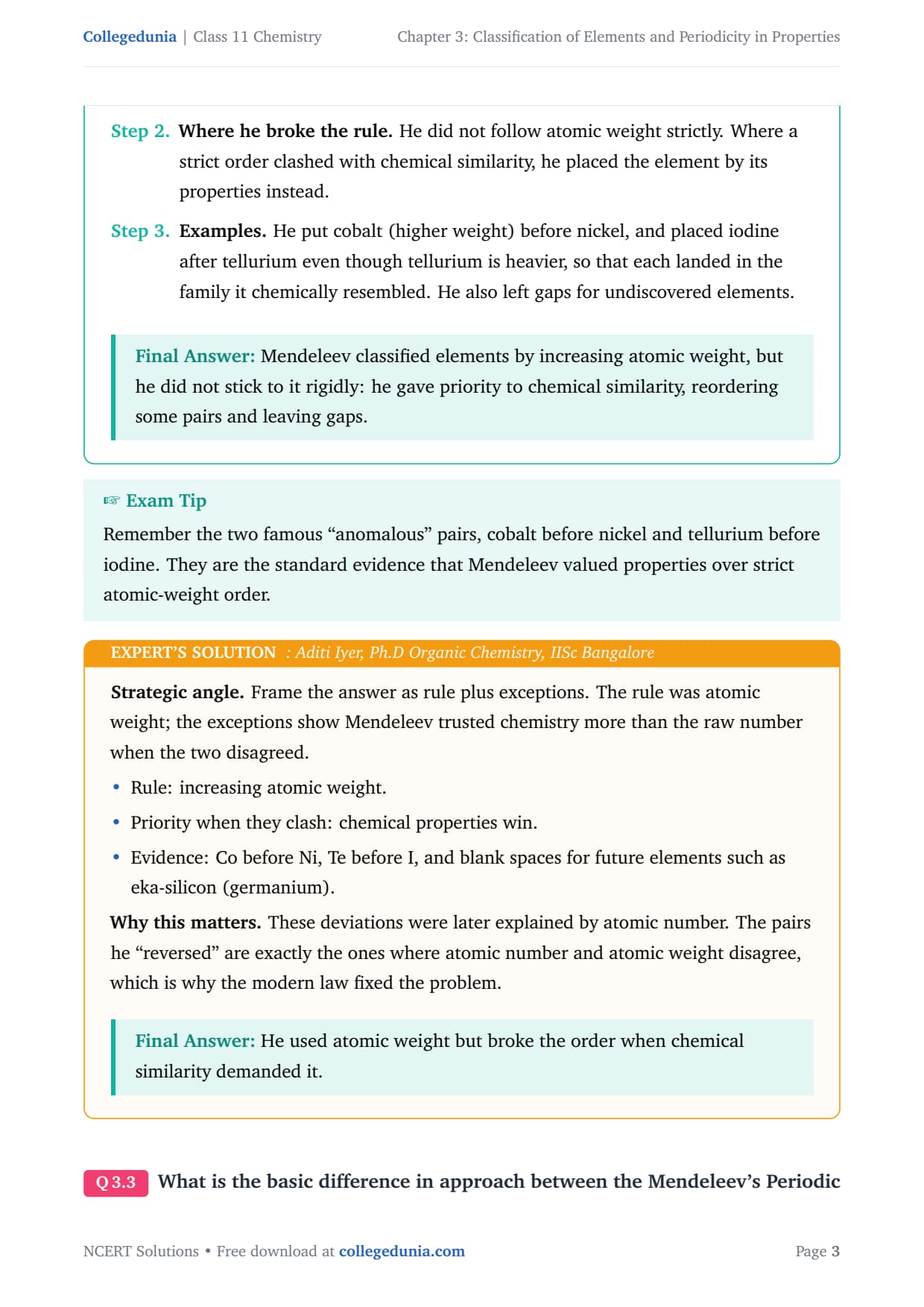
Mendeleev boldly left blank spaces for elements not yet found. He predicted eka-aluminium and eka-silicon, later discovered as gallium and germanium, and their measured properties matched his forecast closely. His only real problem was a few pairs, like argon and potassium, that sat out of order by mass. That single flaw pointed straight to the modern law.
Modern Periodic Law and the Long Form Periodic Table
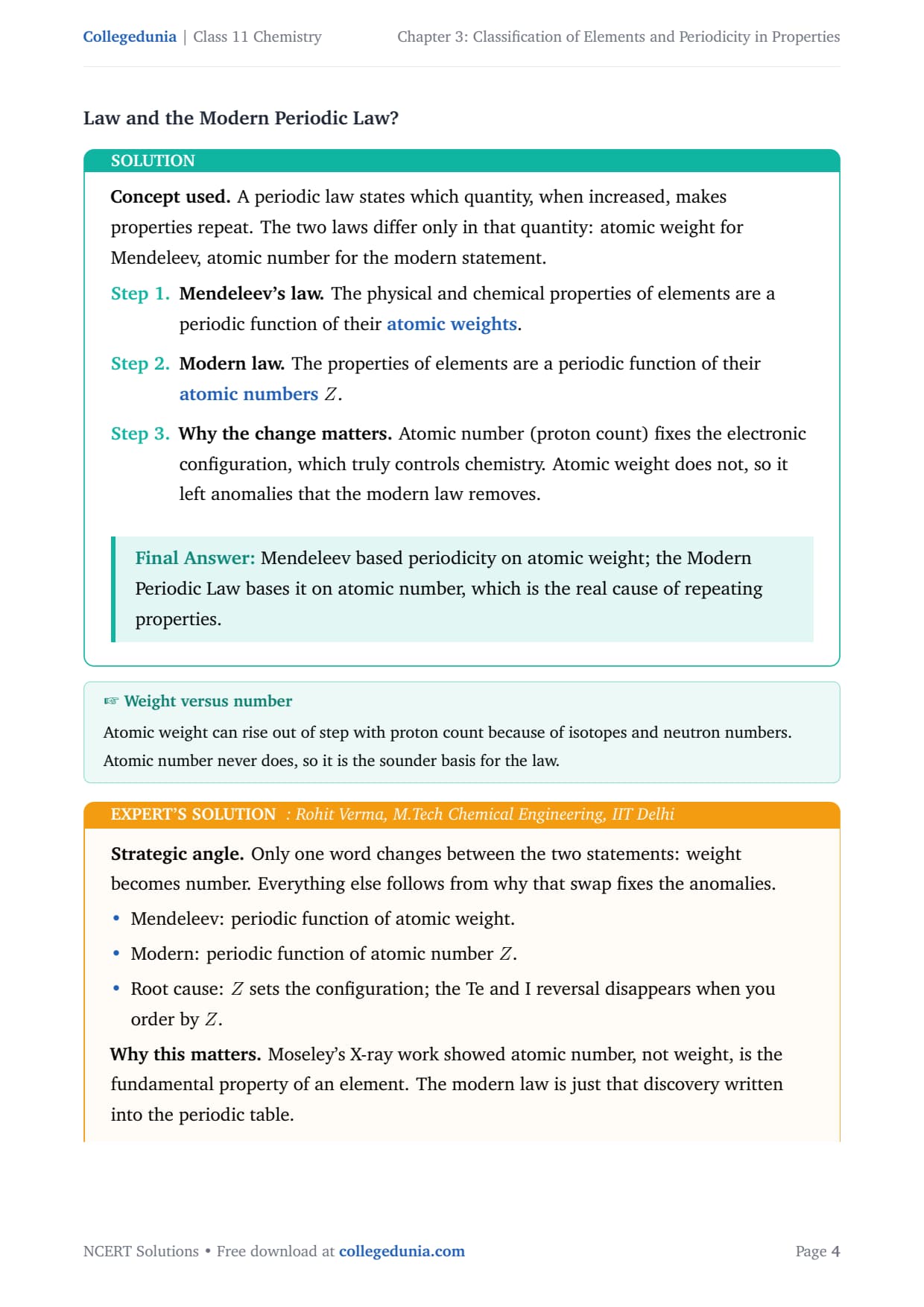
Henry Moseley's work on X-rays showed that atomic number, not atomic mass, is the true basis of order. This fixed the odd pairs in Mendeleev's table and gave us the modern periodic law, the rule the whole chapter now rests on.
- Modern periodic law: the physical and chemical properties of elements are a periodic function of their atomic numbers.
- Periods: the 7 horizontal rows; the period number equals the highest principal quantum number of that row.
- Groups: the 18 vertical columns; elements in a group share the same outer electron configuration.
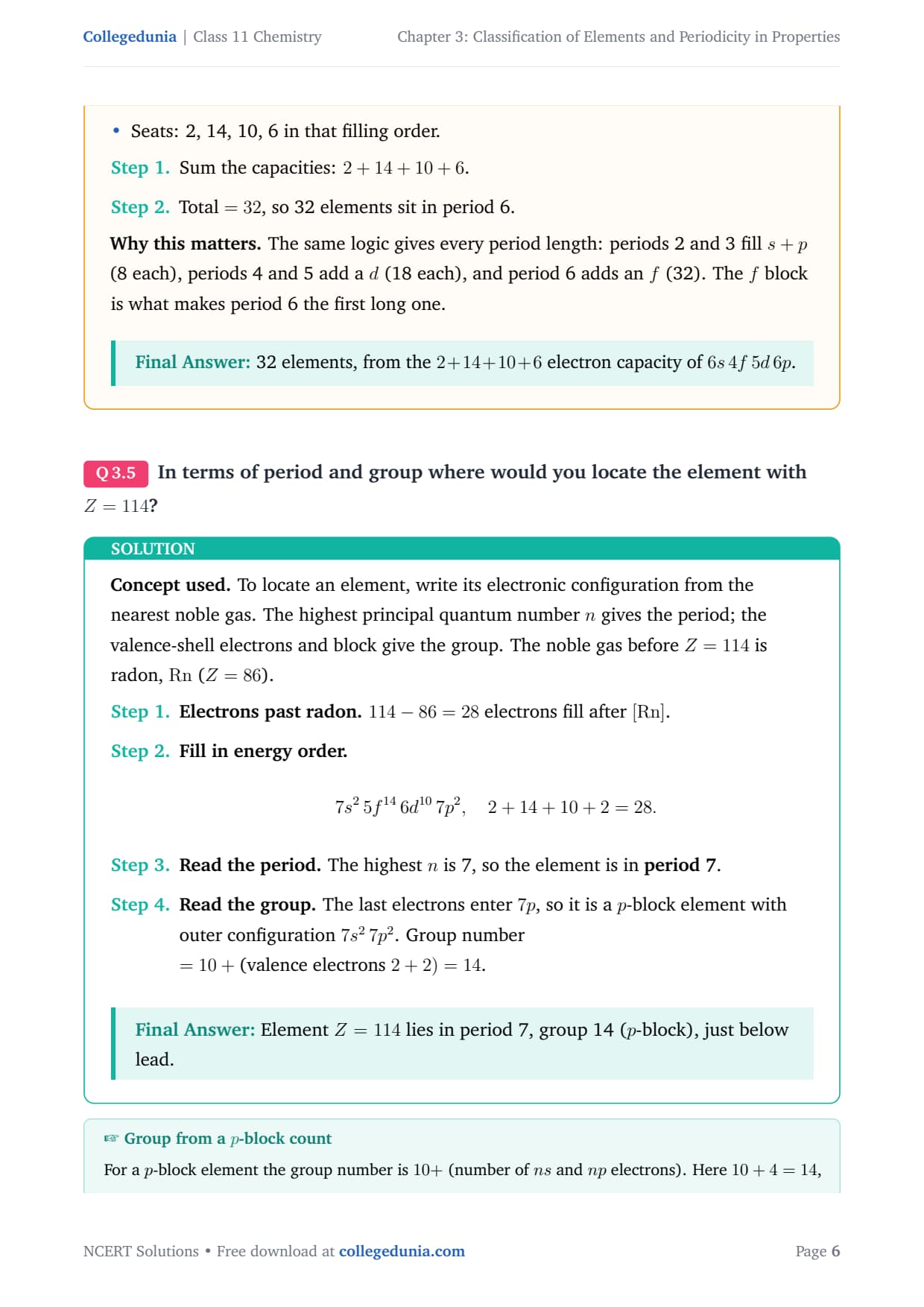
The long form table places elements in order of rising atomic number, and elements with similar valence-shell configurations line up in the same group. A new period begins each time a new shell starts to fill. Because members of a group have the same number of valence electrons, they show similar chemistry, such as the alkali metals in group 1 all forming +1 ions. This link between electron configuration and position is the idea most exercise questions test.
s, p, d and f Blocks of the Periodic Table
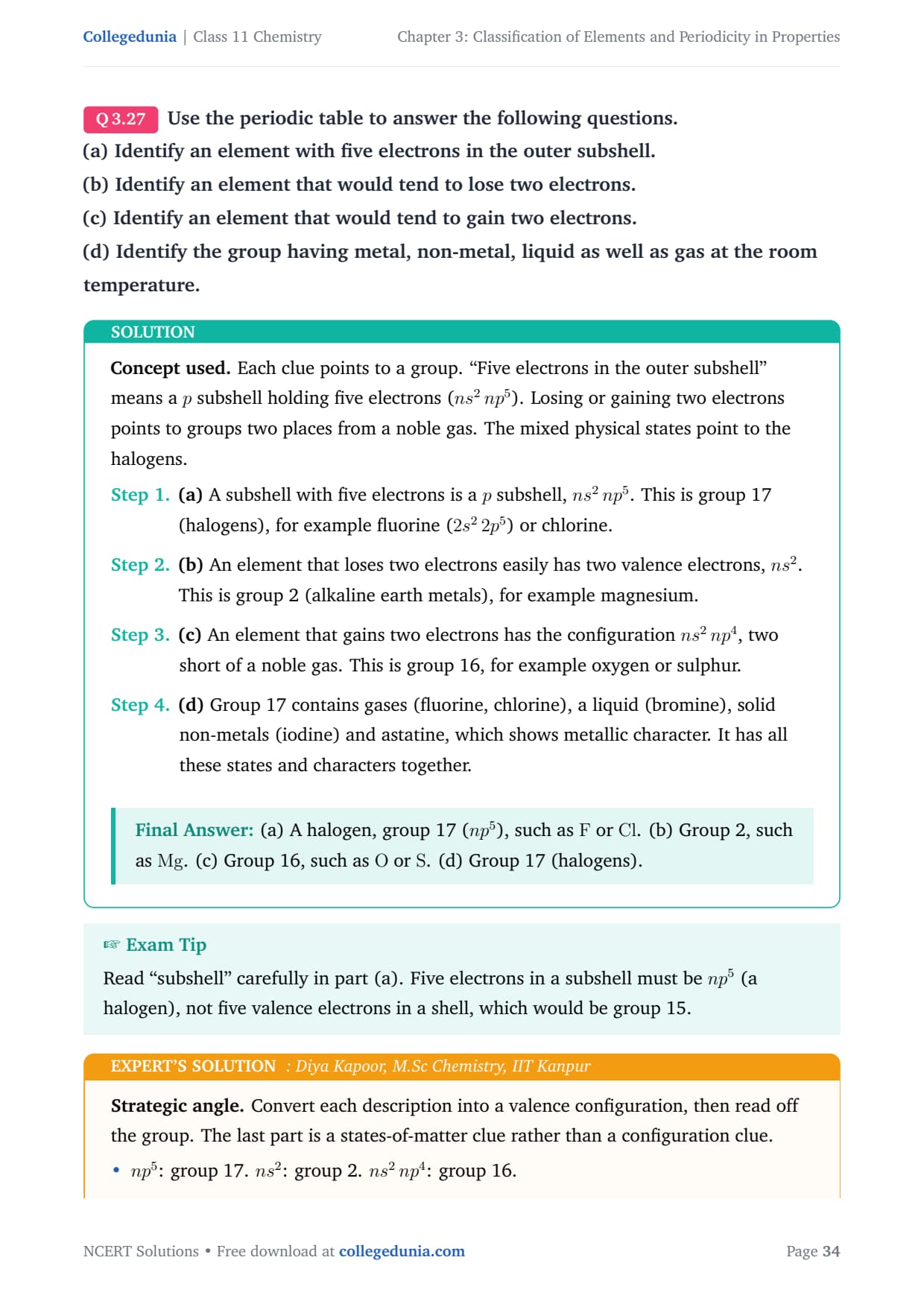
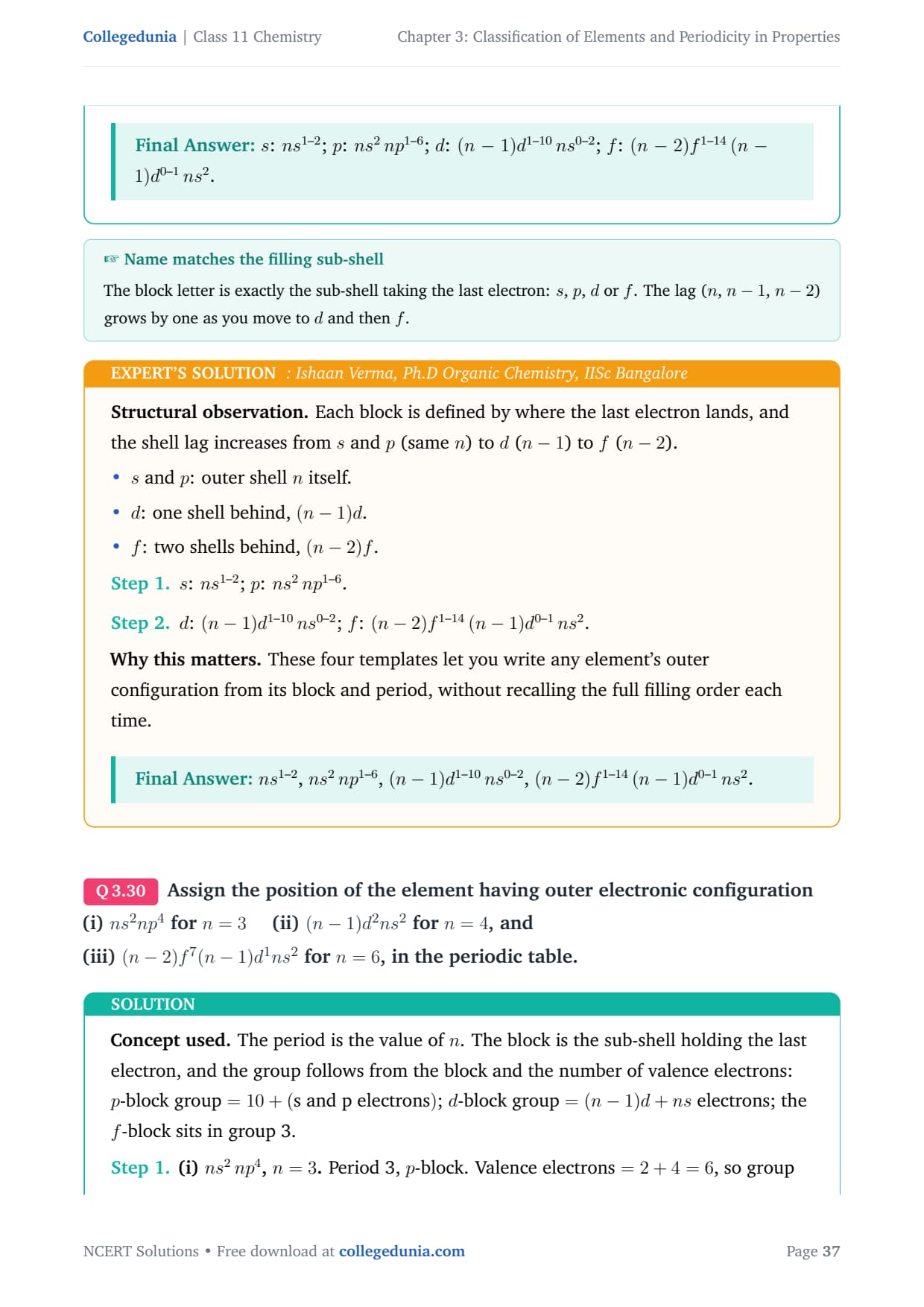
The table splits into four blocks named after the subshell that receives the last electron. Knowing the block of an element tells you its outer configuration and its general behaviour at a glance.
| Block | Groups and outer configuration | Character |
|---|---|---|
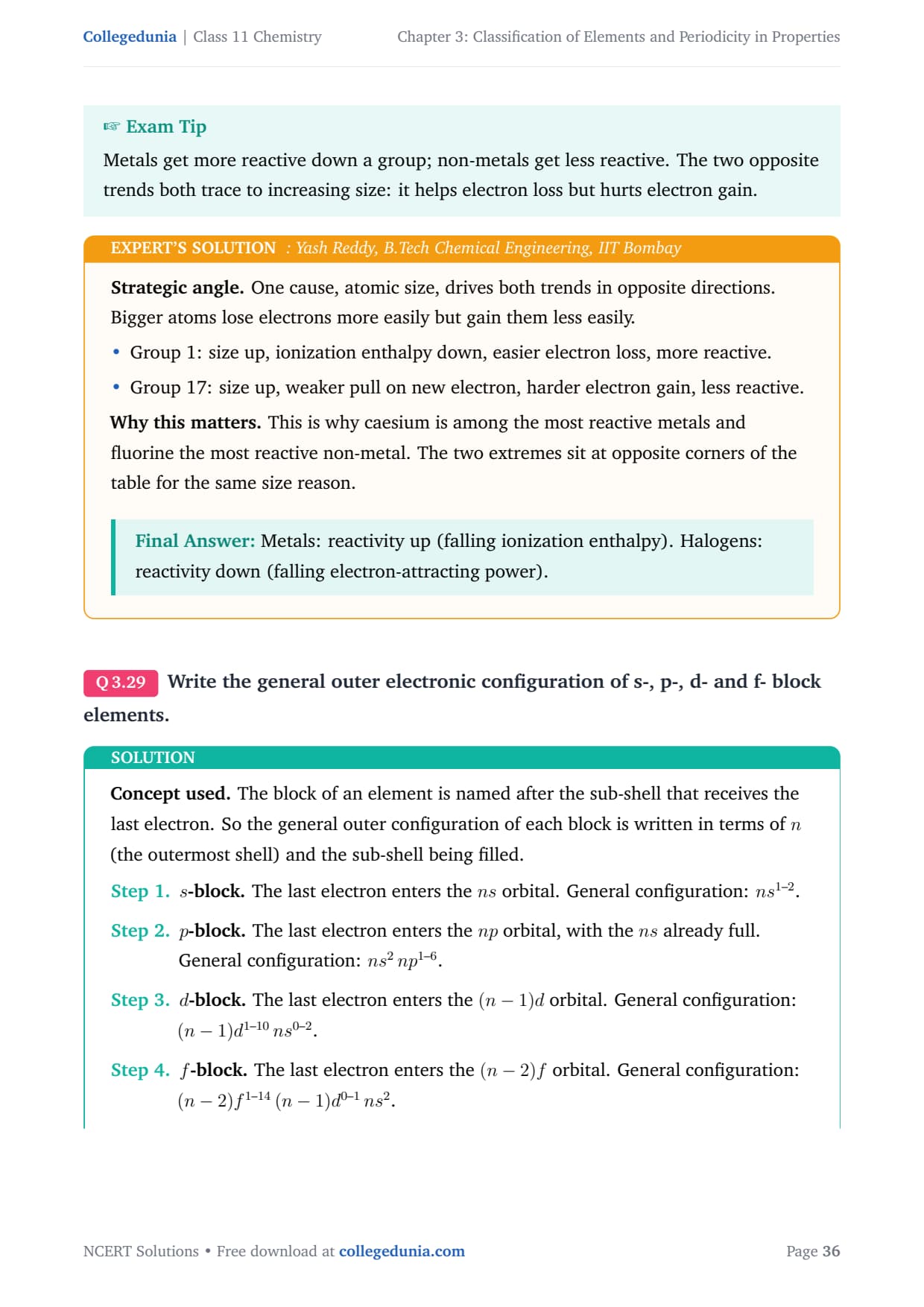
| s-block | Groups 1 and 2; ns1 to ns2 | Reactive metals, form ionic compounds |
| p-block | Groups 13 to 18; ns2np1 to ns2np6 | Metals, non-metals and metalloids |
| d-block | Groups 3 to 12; (n-1)d1-10ns0-2 | Transition metals, variable valence |
| f-block | Lanthanoids and actinoids; (n-2)f1-14 | Inner transition, placed below the table |
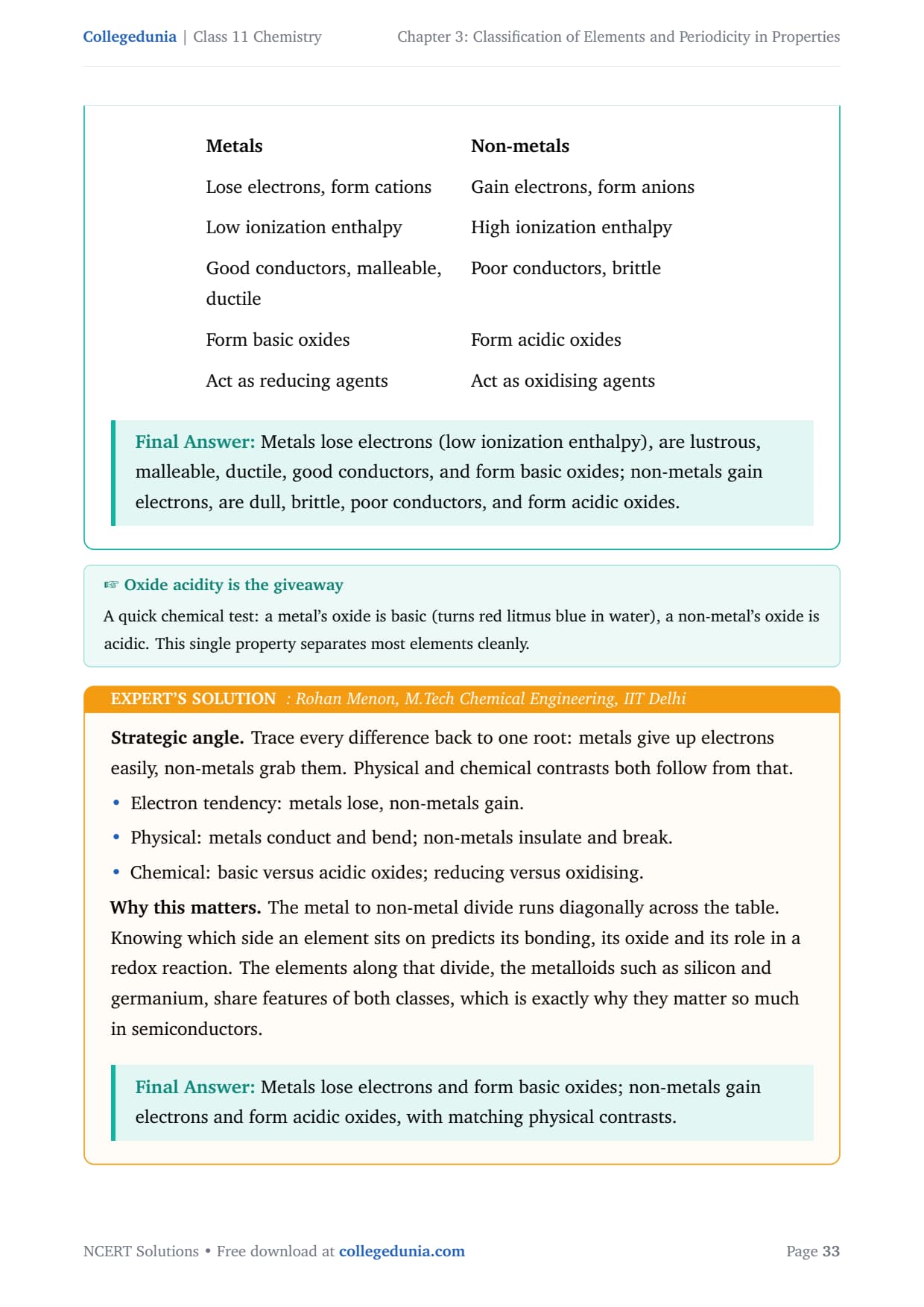
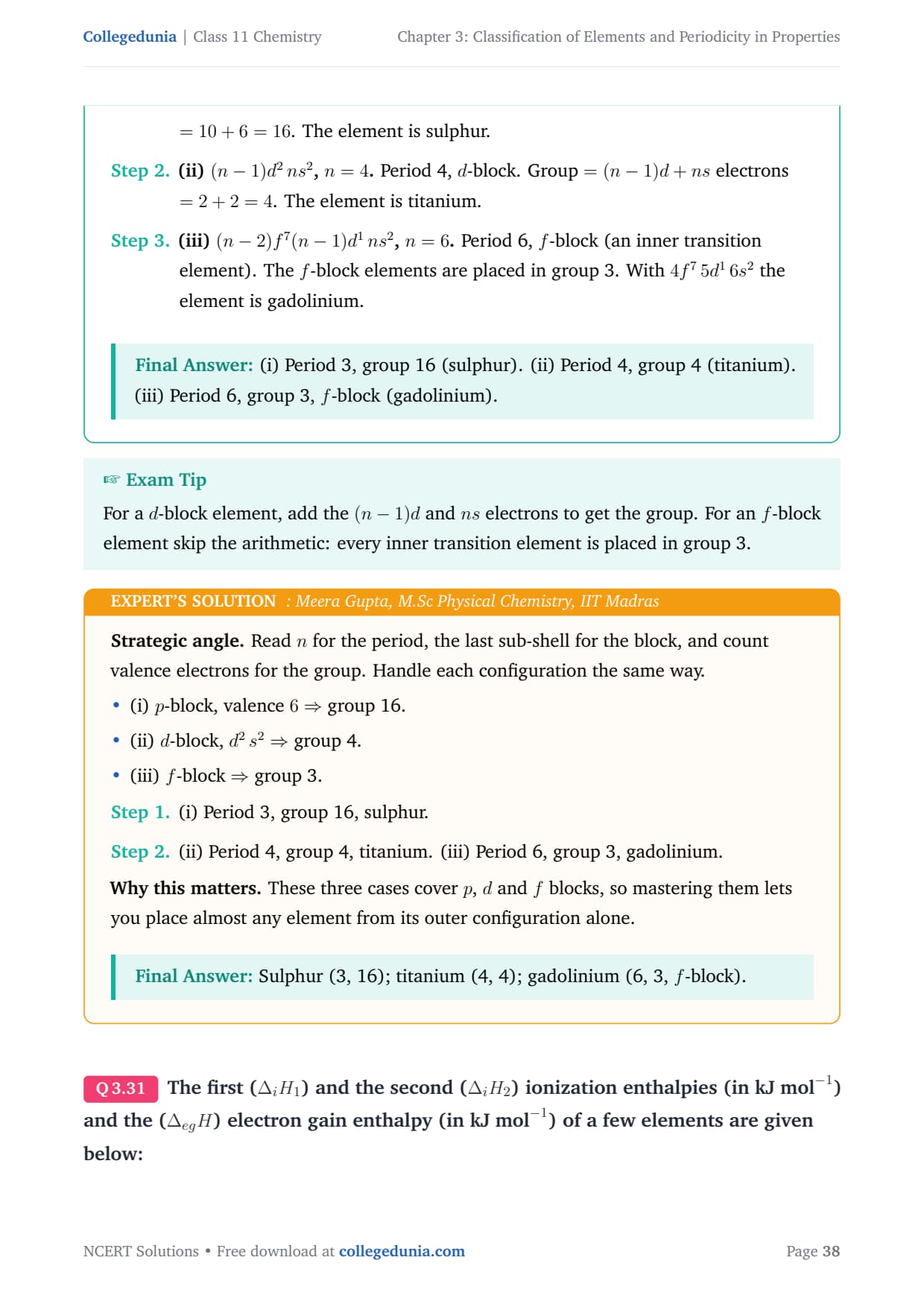
The s-block and p-block together are the representative elements, where the outer shell fills in a regular way. The d-block sits between them as the transition metals, and the f-block, the inner transition metals, is shown separately to keep the table compact. Group 18, the noble gases, have a full outer shell and are the least reactive. A quick way to check the block is to write the electron configuration and see which subshell holds the last electron.
Atomic and Ionic Radius Trends Across the Periodic Table
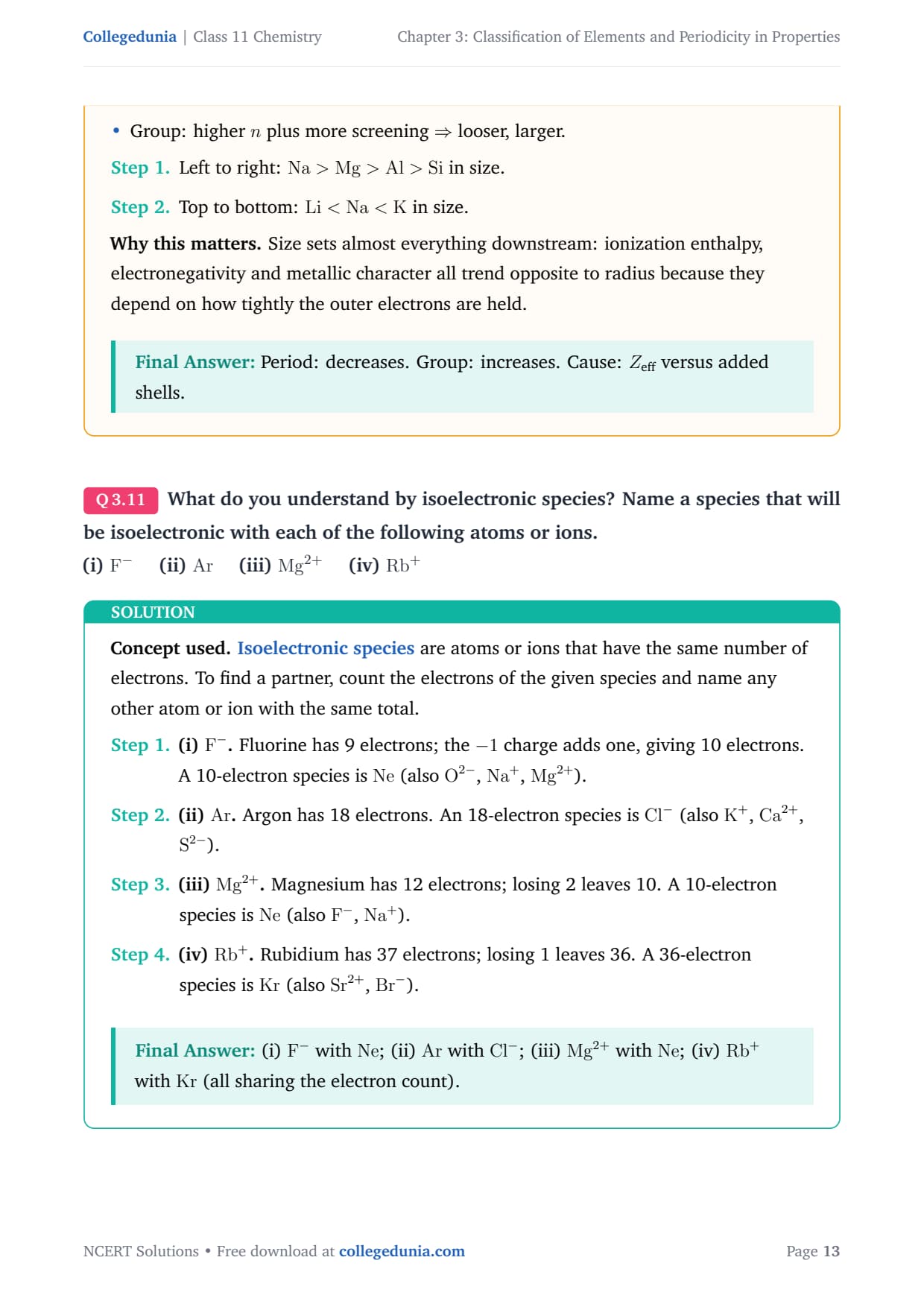
Size is the first periodic trend, and it drives most of the others. The atomic radius is roughly the distance from the nucleus to the outermost electron. Its change follows two clear rules that you should be able to explain with reasons.
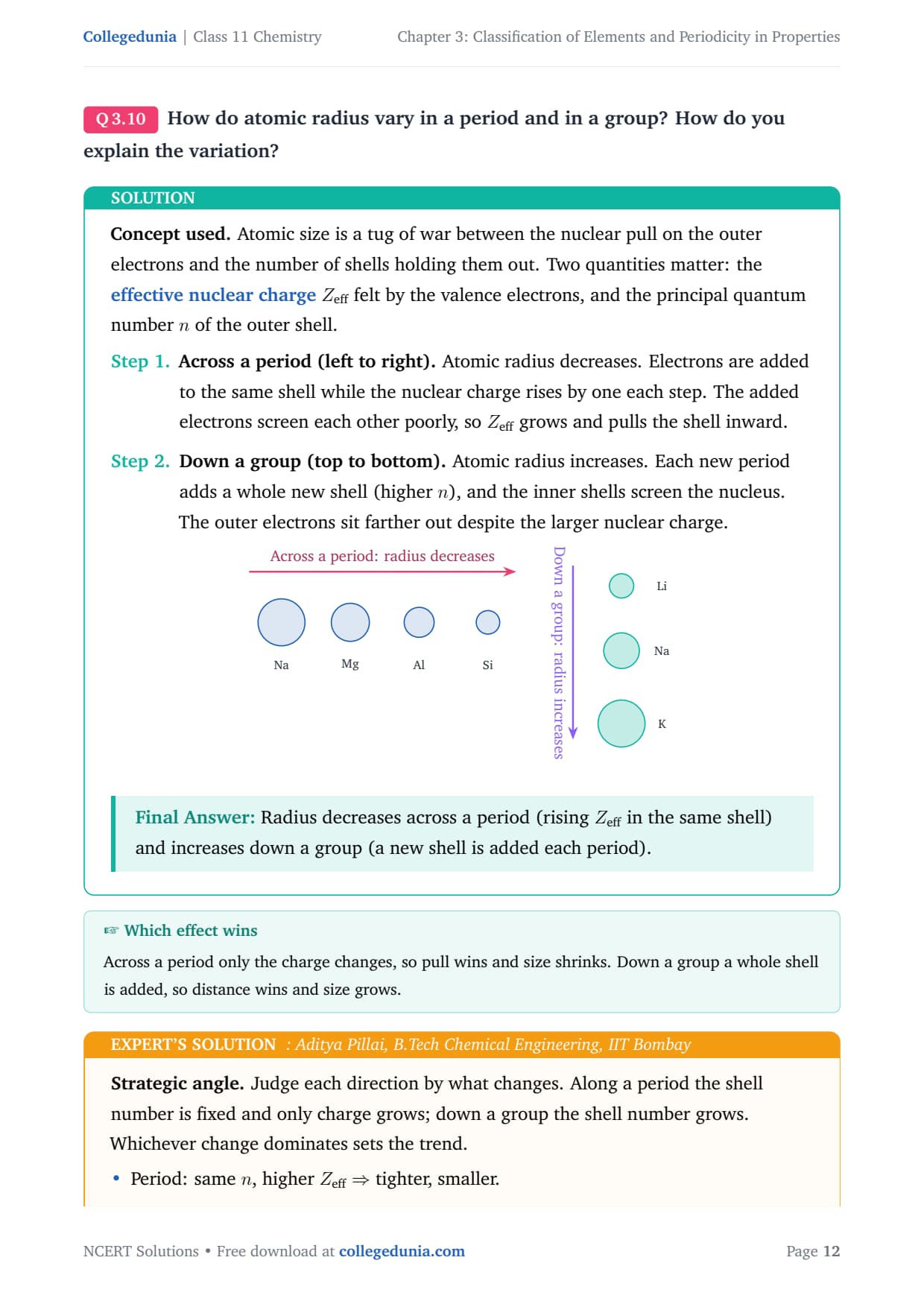
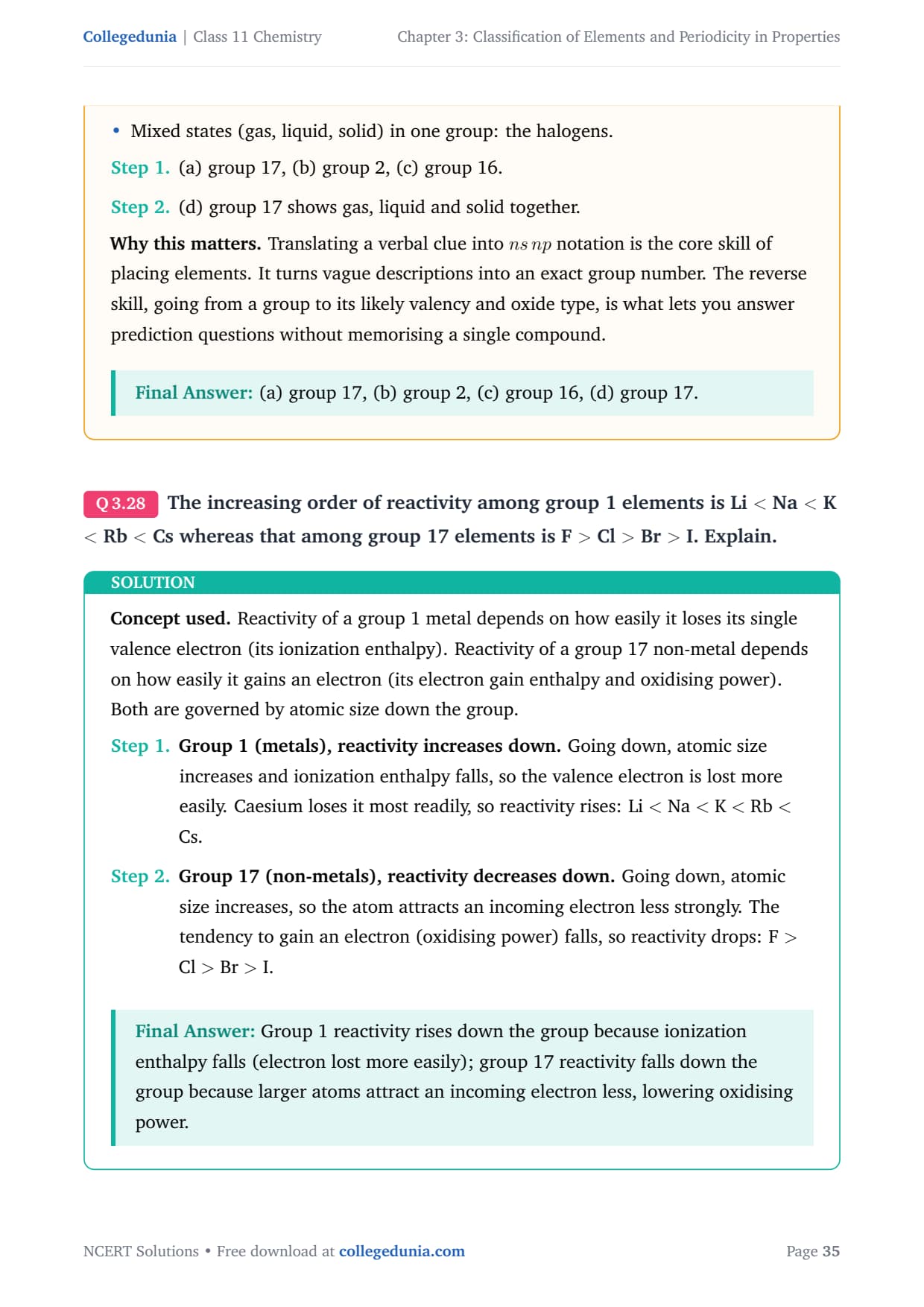
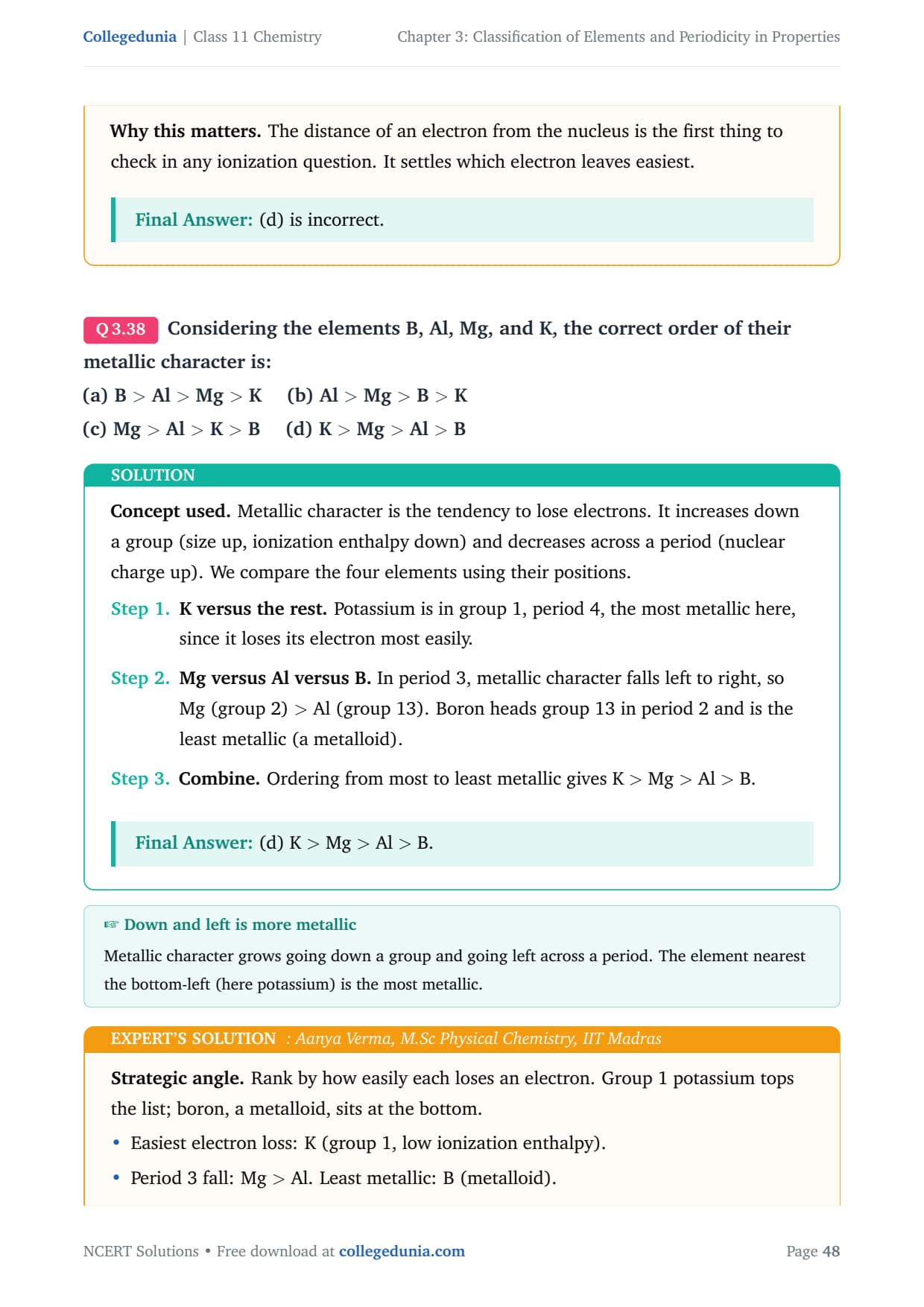
- Across a period: atomic radius decreases as nuclear charge rises and pulls the same shell inward.
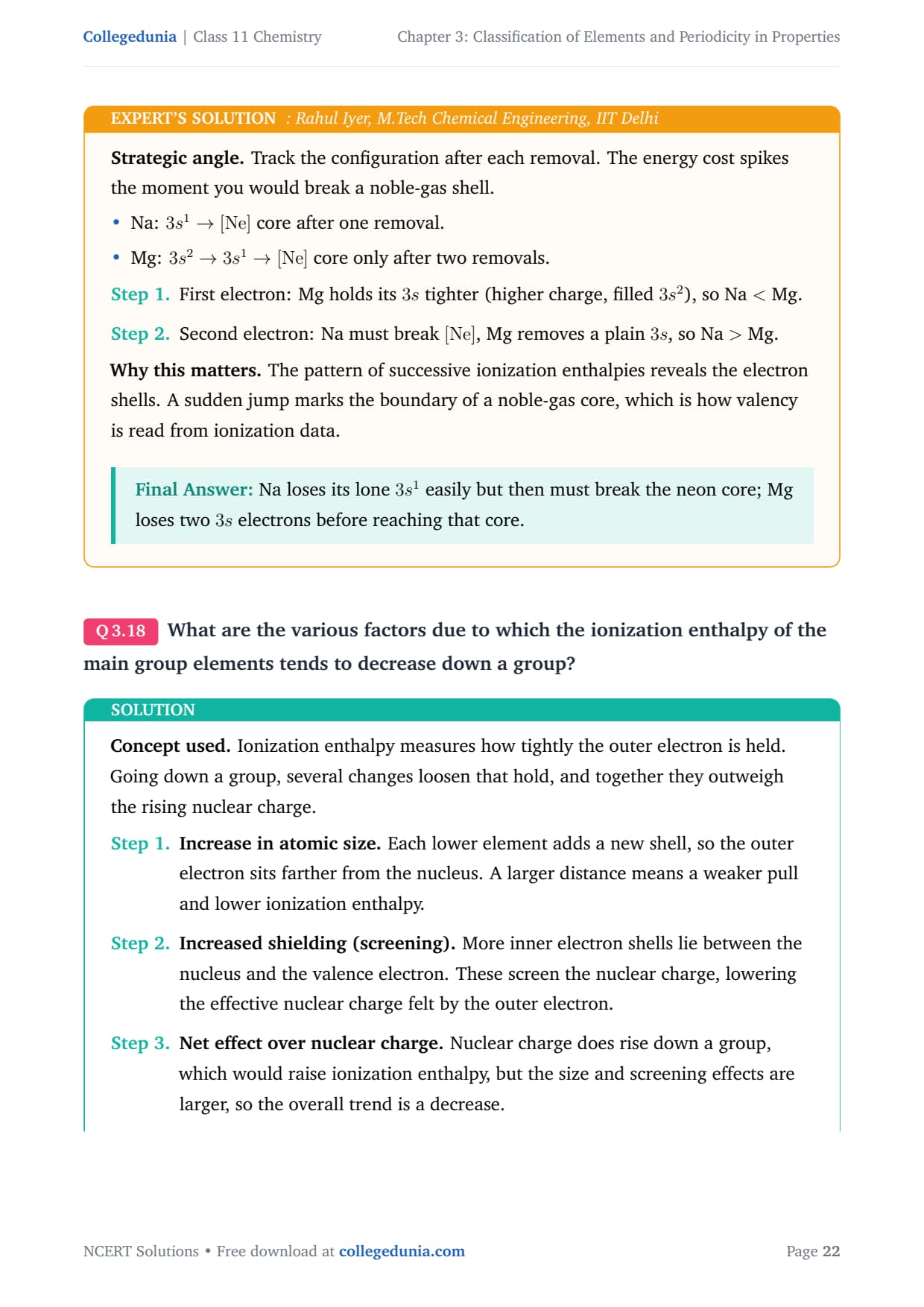
- Down a group: atomic radius increases as each new shell is added further from the nucleus.
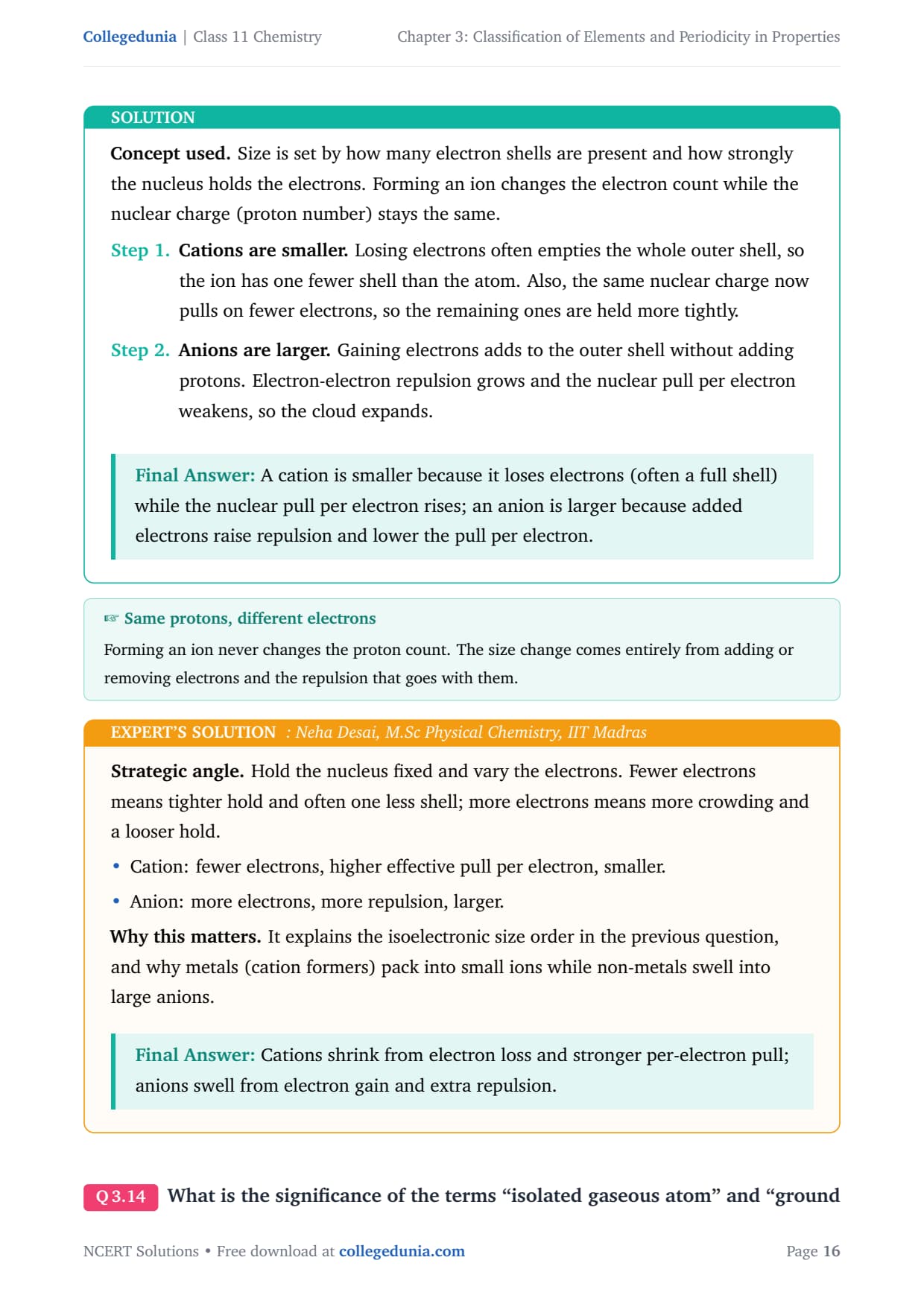
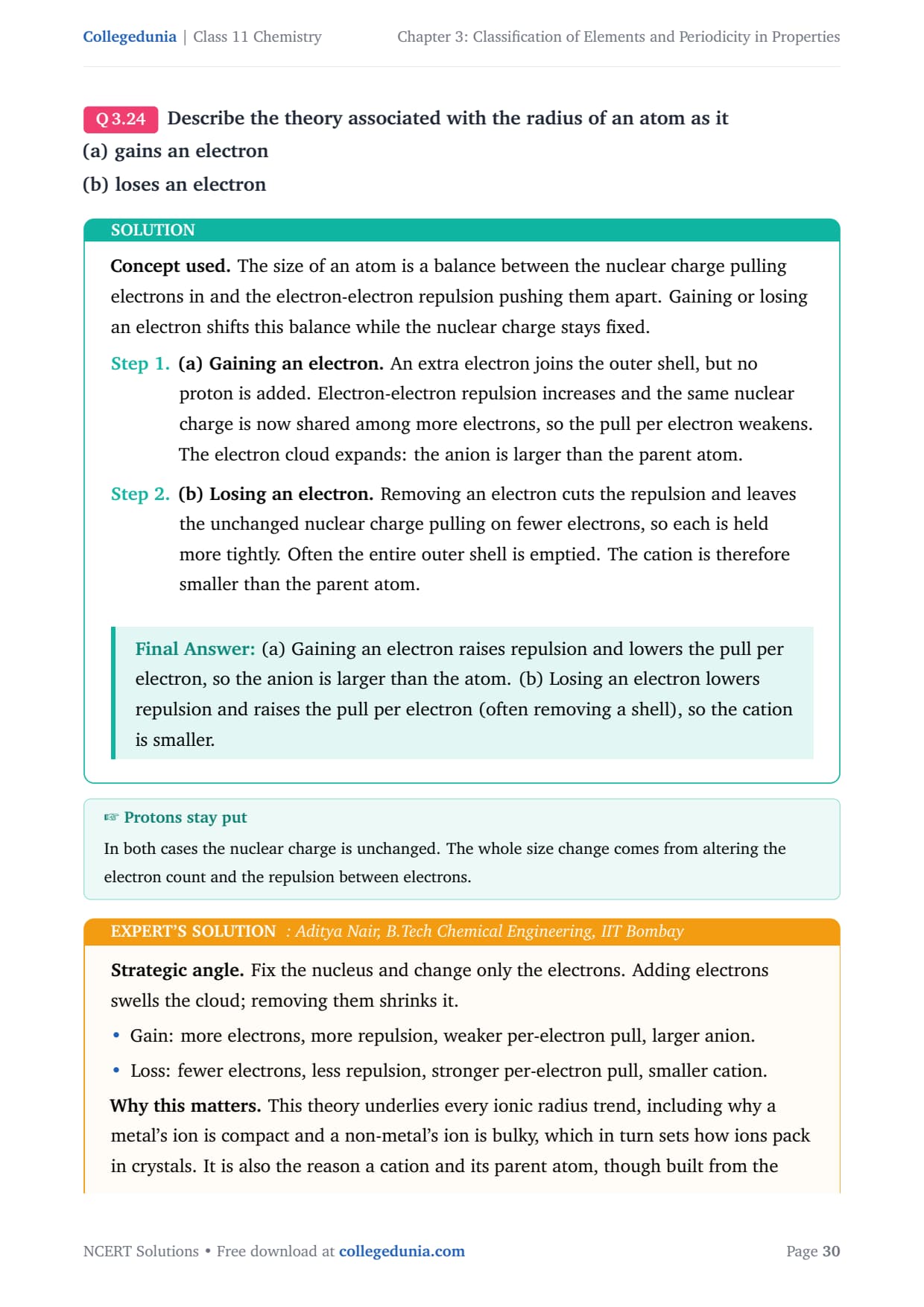
- Cations: a positive ion is smaller than its parent atom because it loses a shell or feels a stronger pull.
- Anions: a negative ion is larger than its parent atom because added electrons increase repulsion.
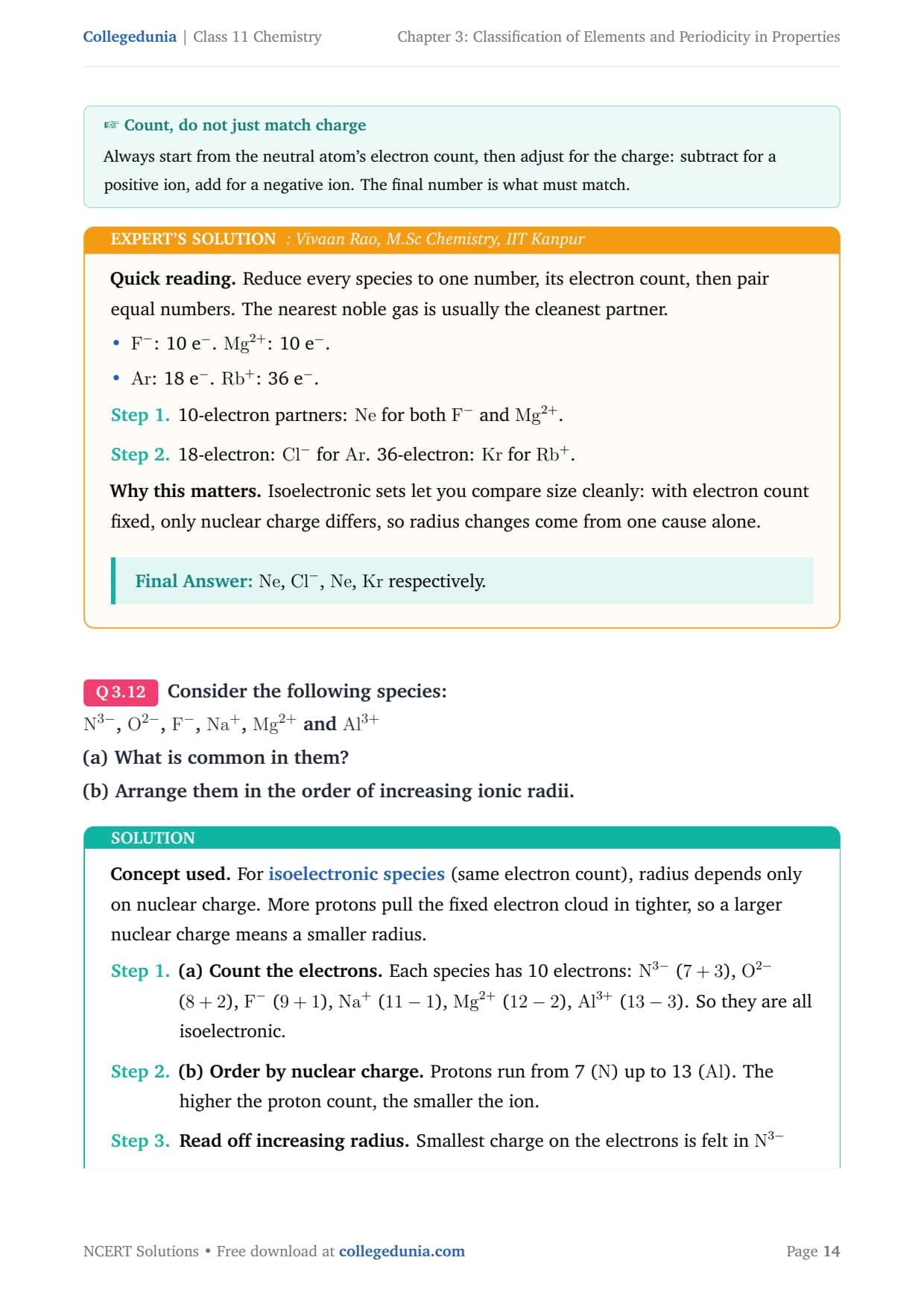
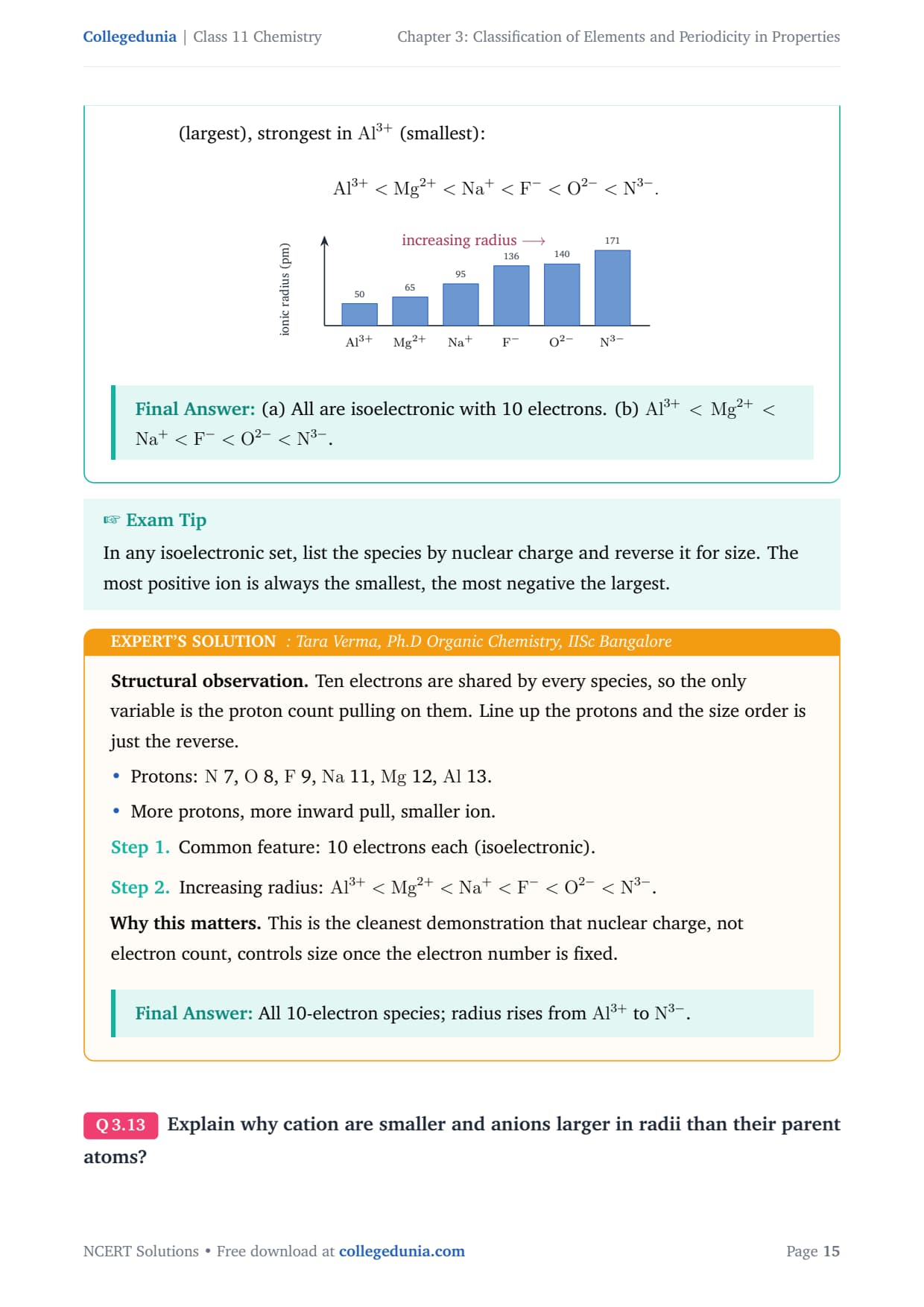
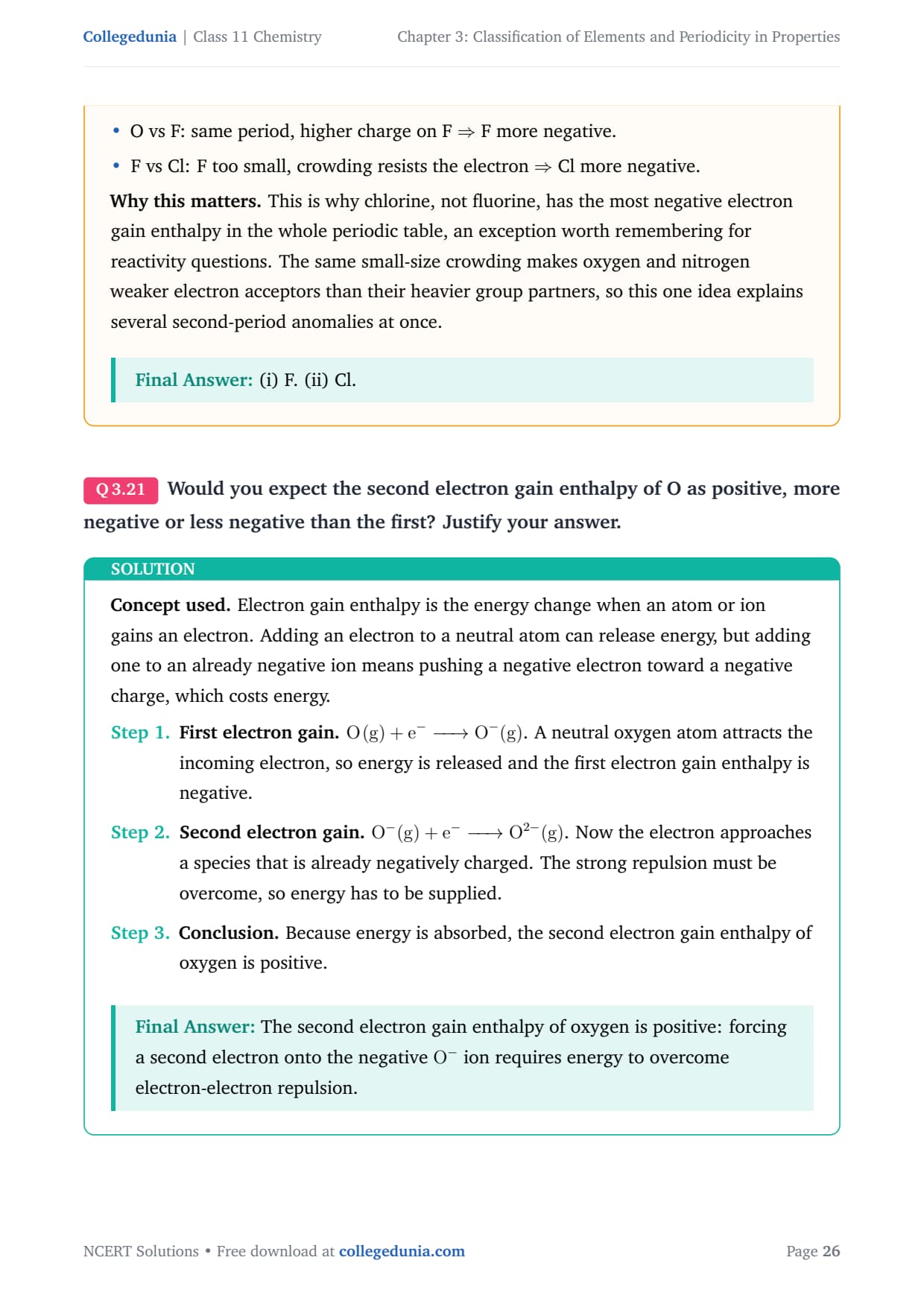
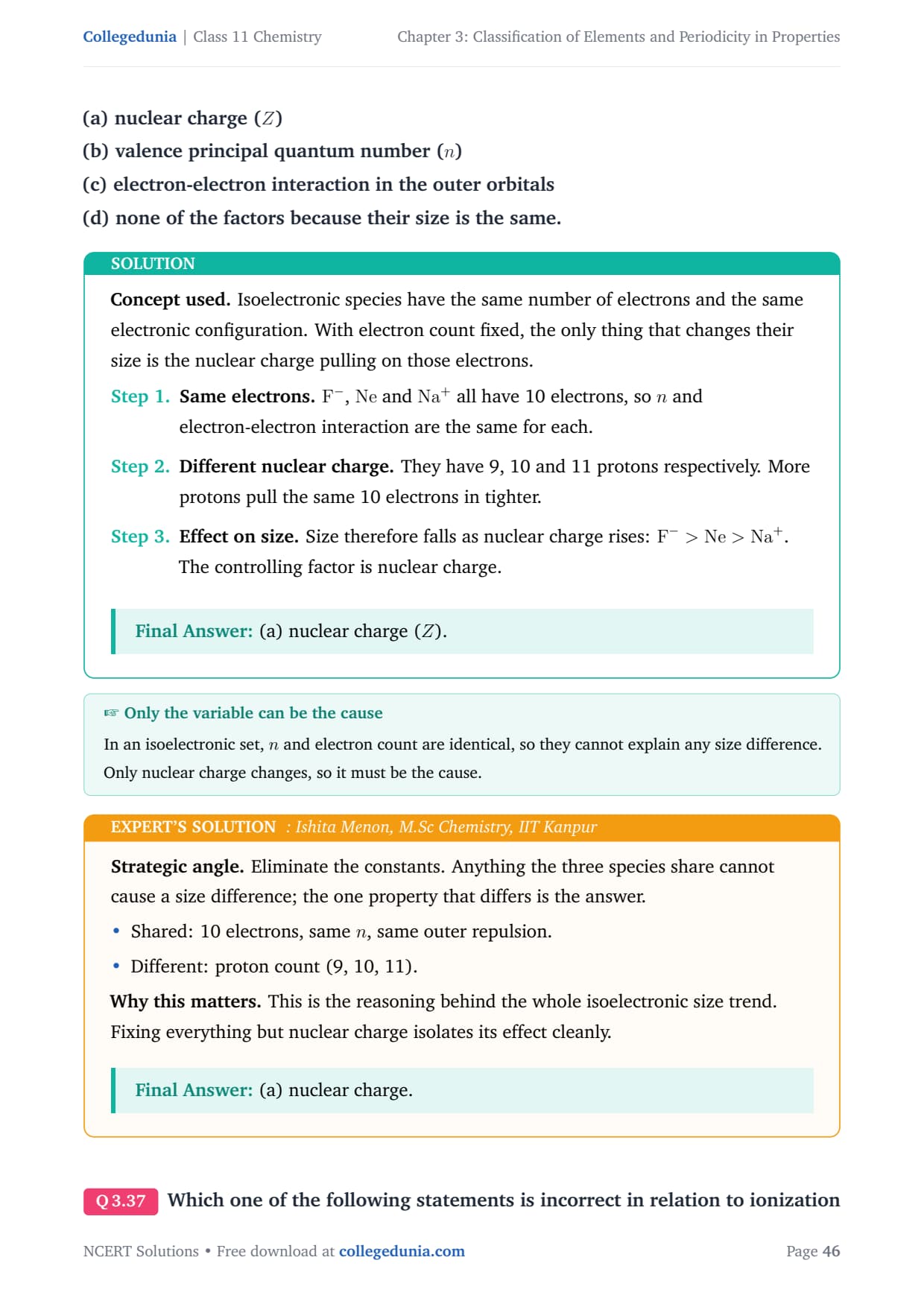
For isoelectronic species, the one with the highest nuclear charge is the smallest. Na+, Mg2+ and Al3+ all have 10 electrons, so Al3+ is the smallest and O2- the largest of that set. This isoelectronic comparison is a favourite reasoning question, so practise ordering such species by nuclear charge.
Ionization Enthalpy Trends Every Class 11 Student Must Know
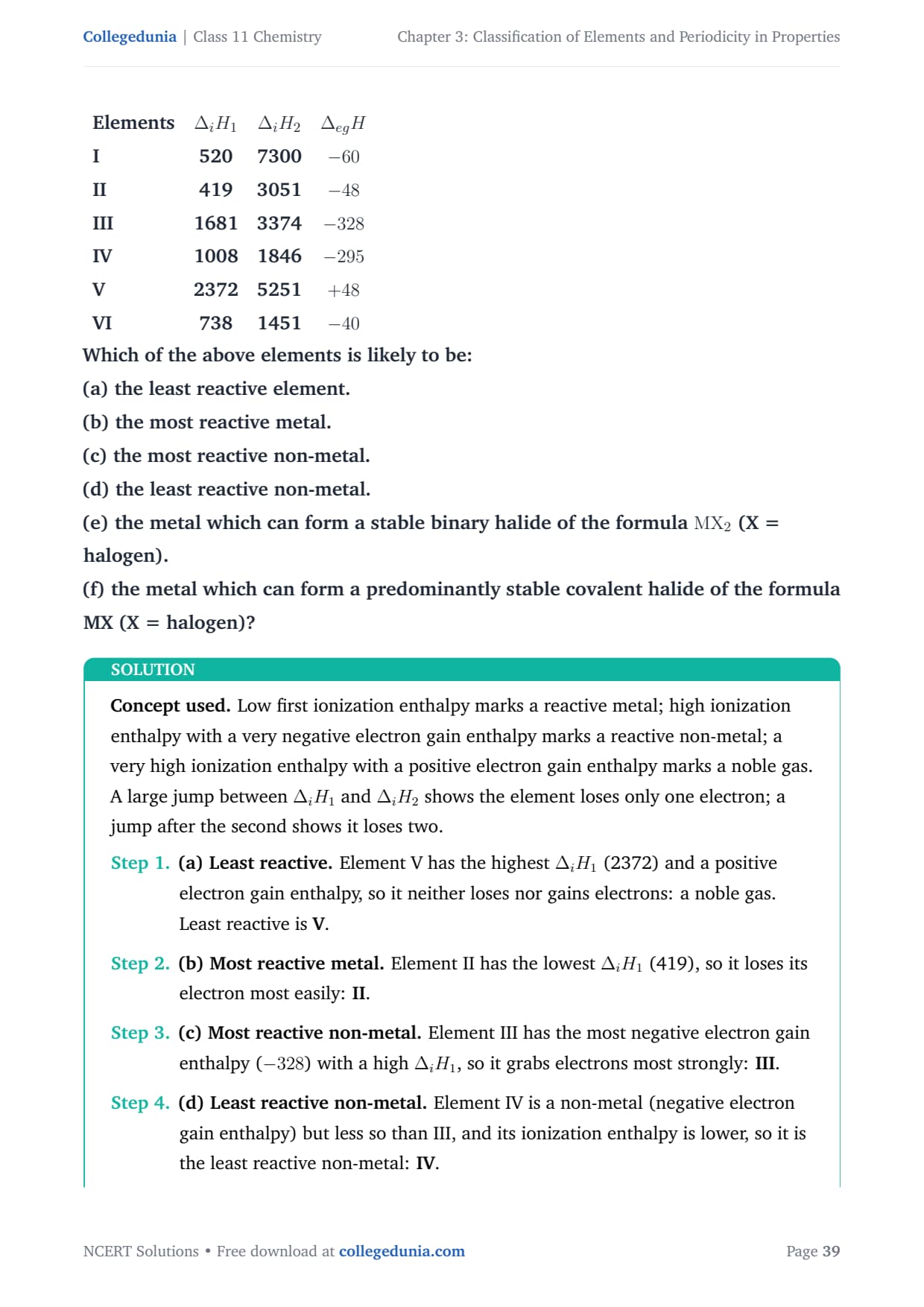
The ionization enthalpy is the energy needed to remove the most loosely held electron from one mole of gaseous atoms. A high value means the atom holds its electrons tightly. This property is one of the most tested trends in the chapter.
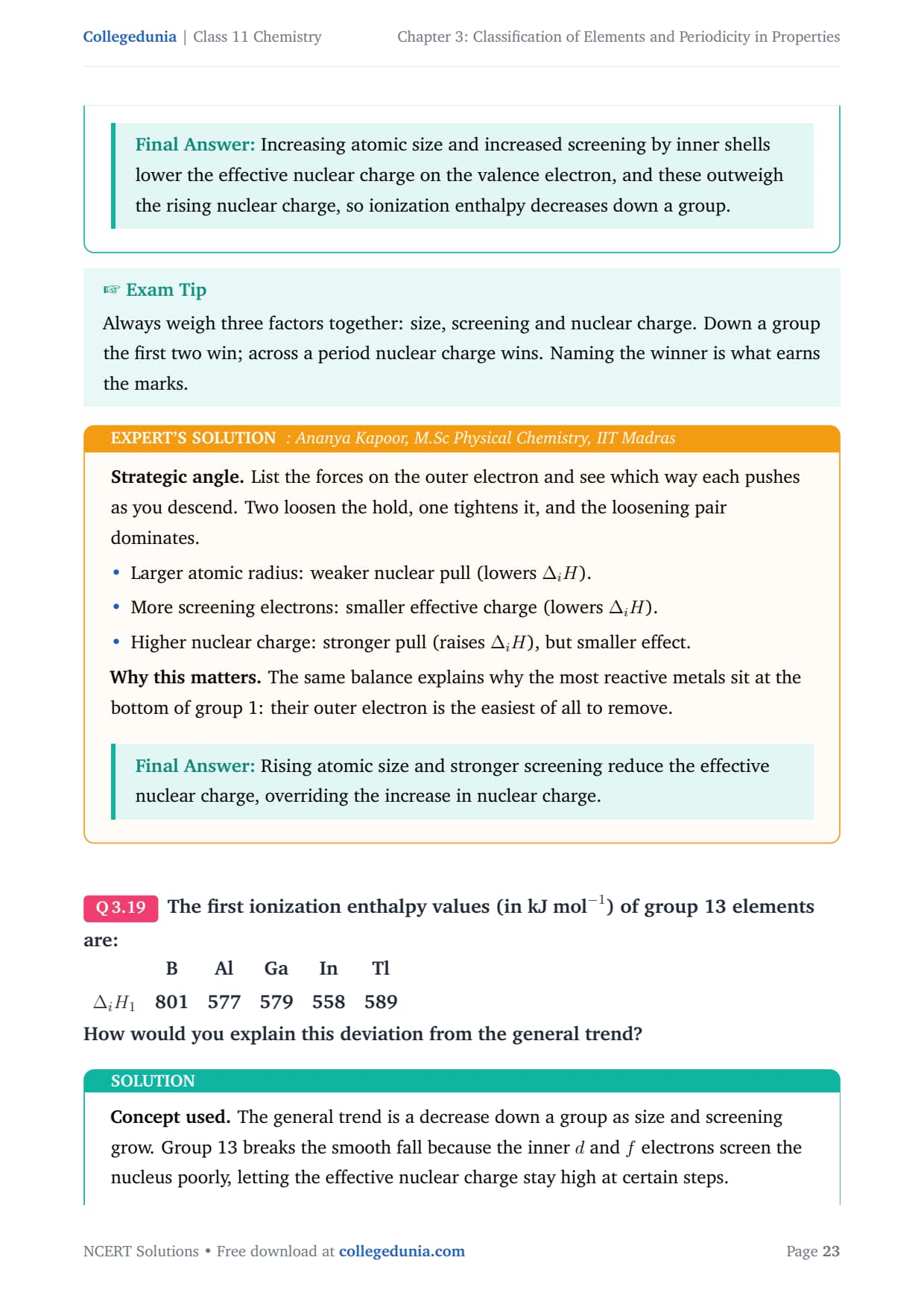
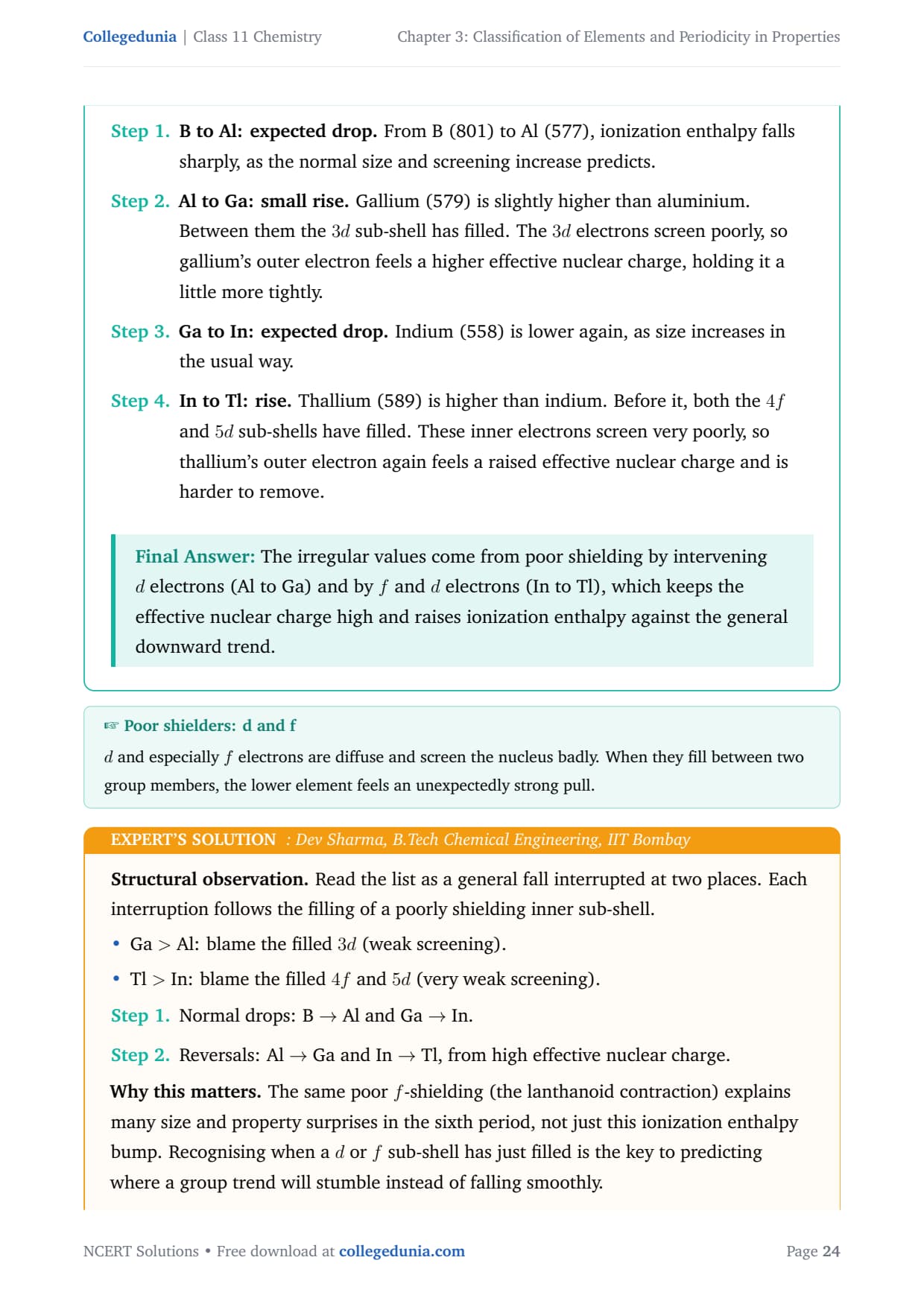
- Across a period: ionization enthalpy generally increases as nuclear charge grows and size shrinks.
- Down a group: ionization enthalpy decreases as the outer electron moves further from the nucleus.
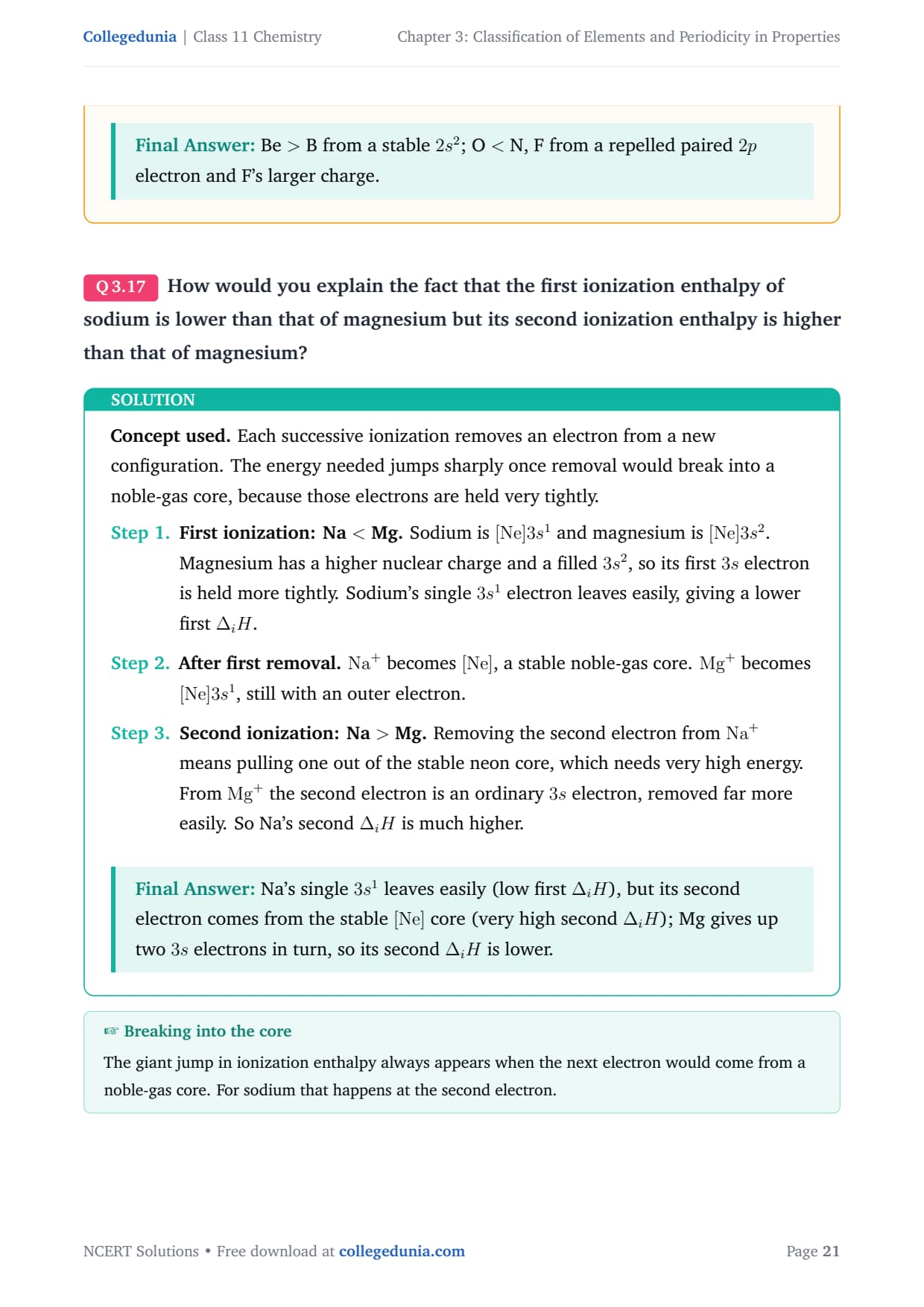
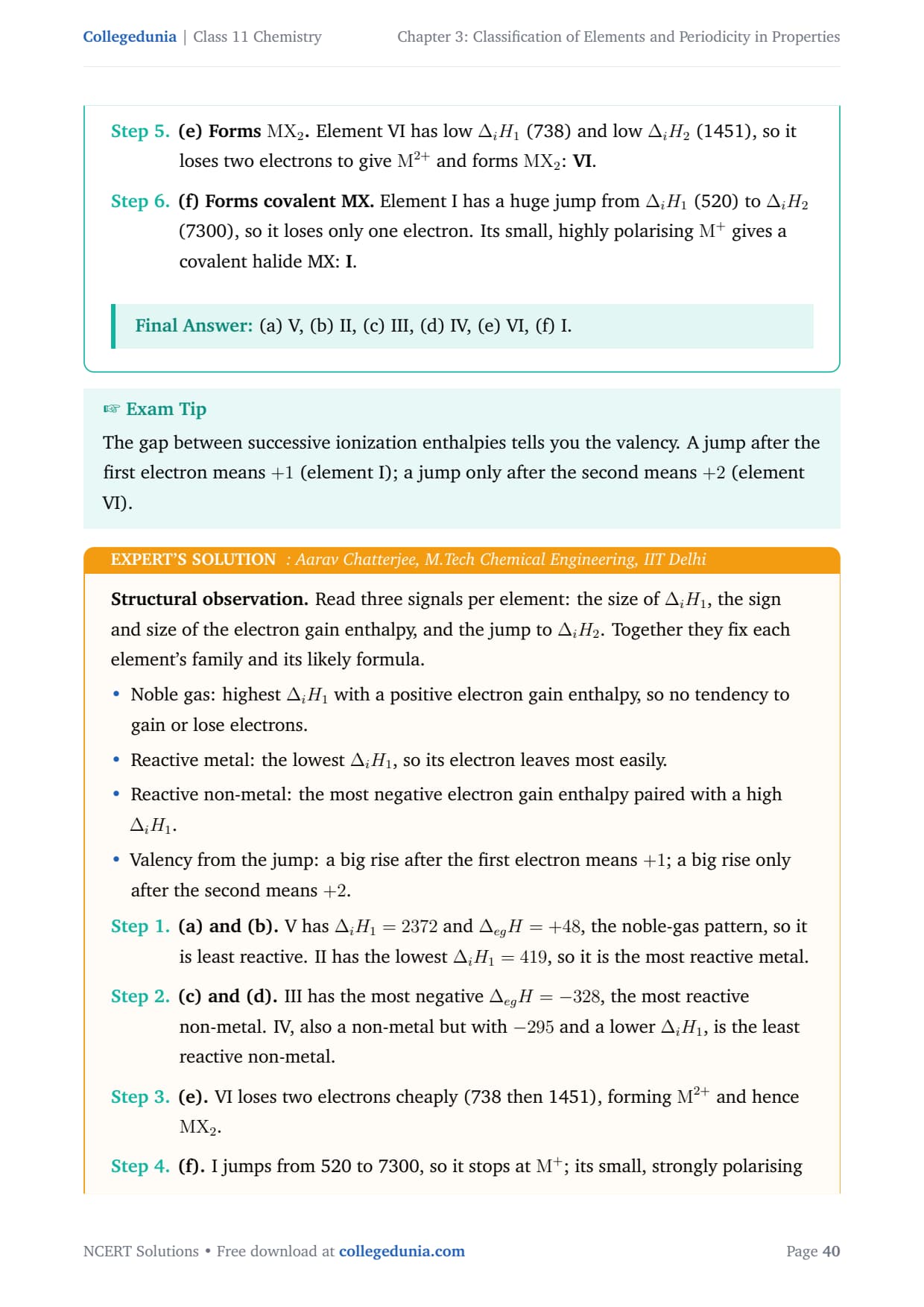
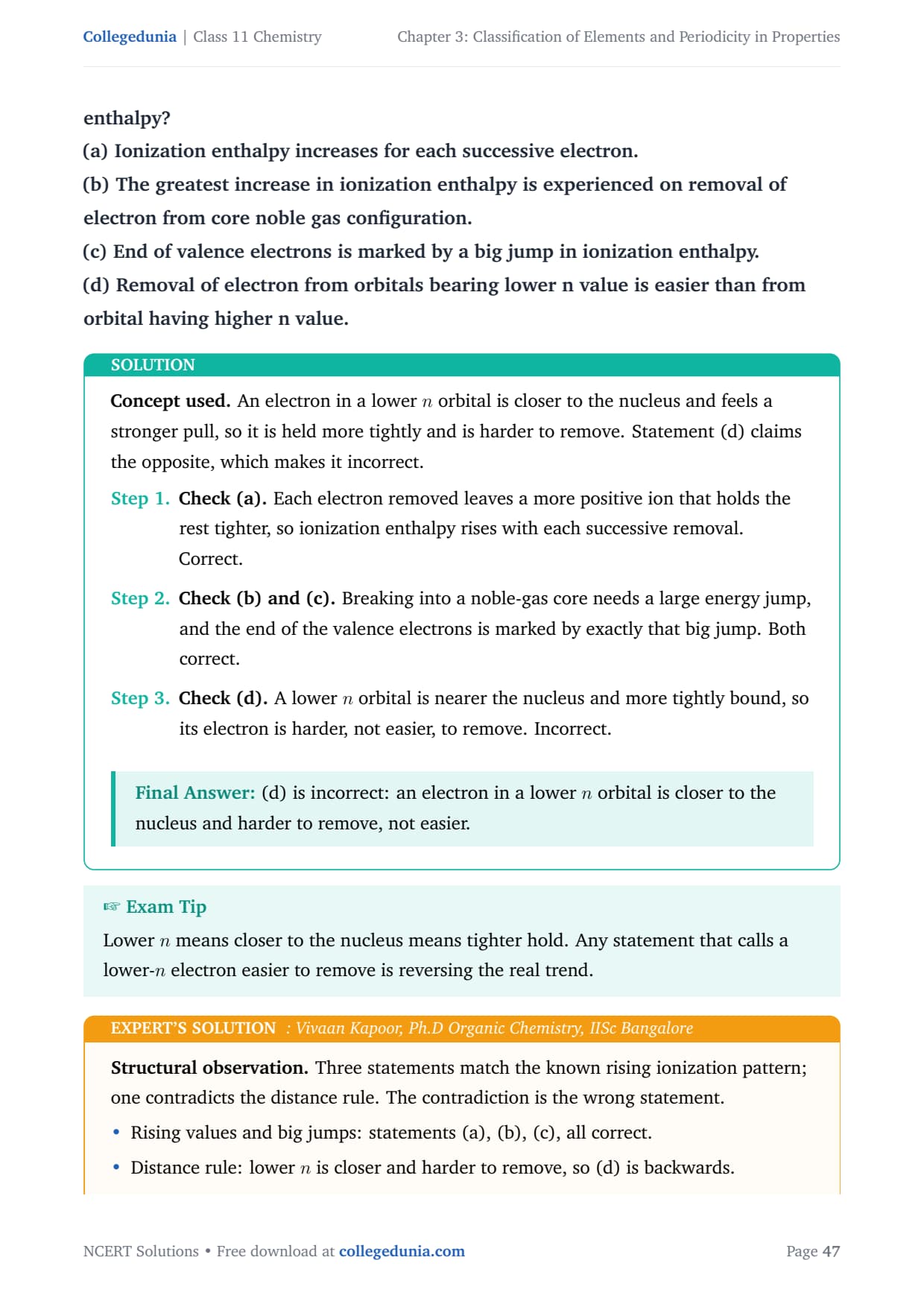
- Successive values: the second ionization enthalpy is always larger than the first for the same element.
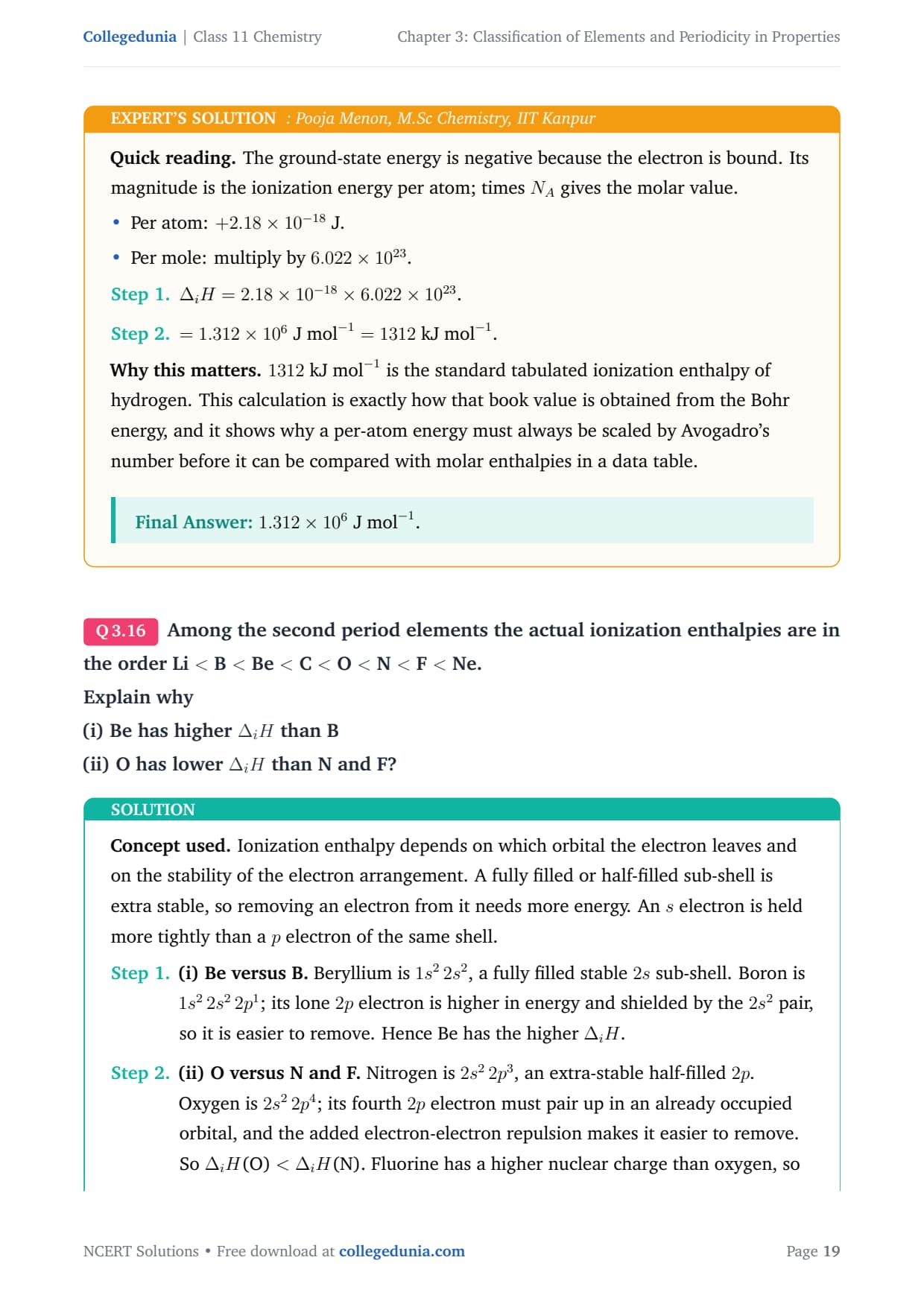
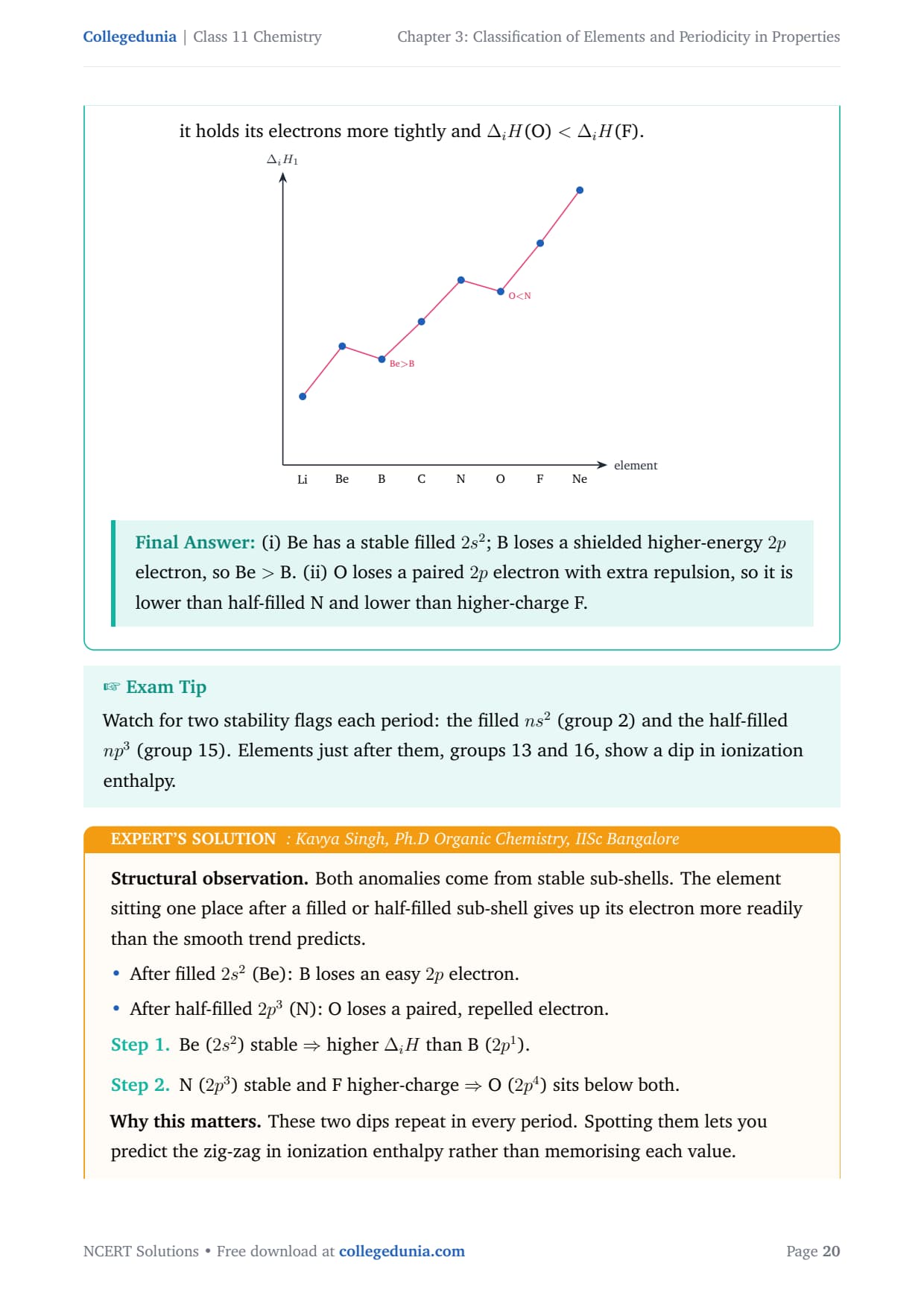
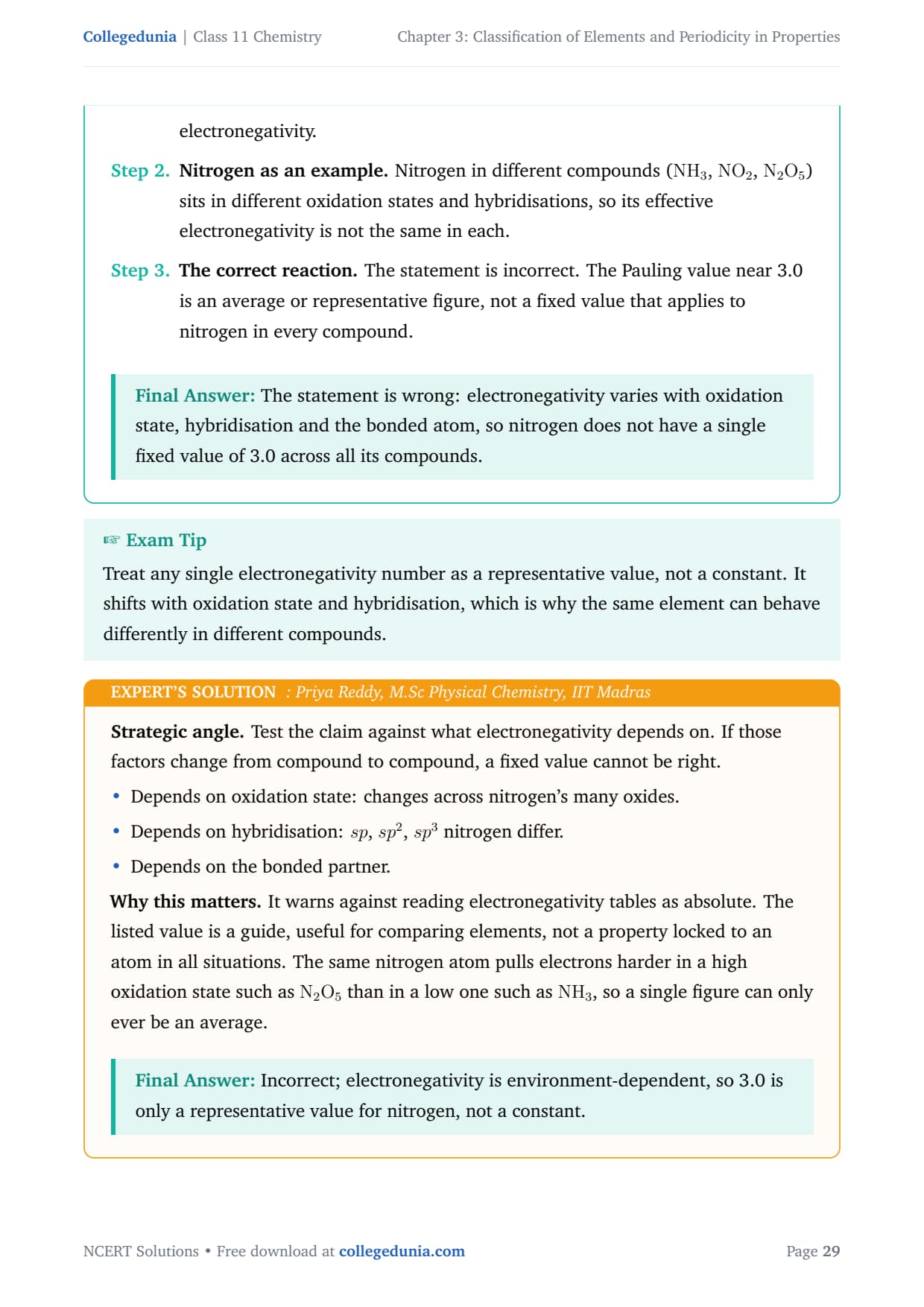
Two exceptions in the second period trip students up, and NCERT asks about both. Boron has a lower value than beryllium because its 2p electron is easier to remove than a paired 2s electron. Nitrogen has a higher value than oxygen because its half-filled 2p3 set is extra stable. Always explain such dips using stability of filled and half-filled subshells, not just nuclear charge.
Electron Gain Enthalpy and Electronegativity Periodic Trends
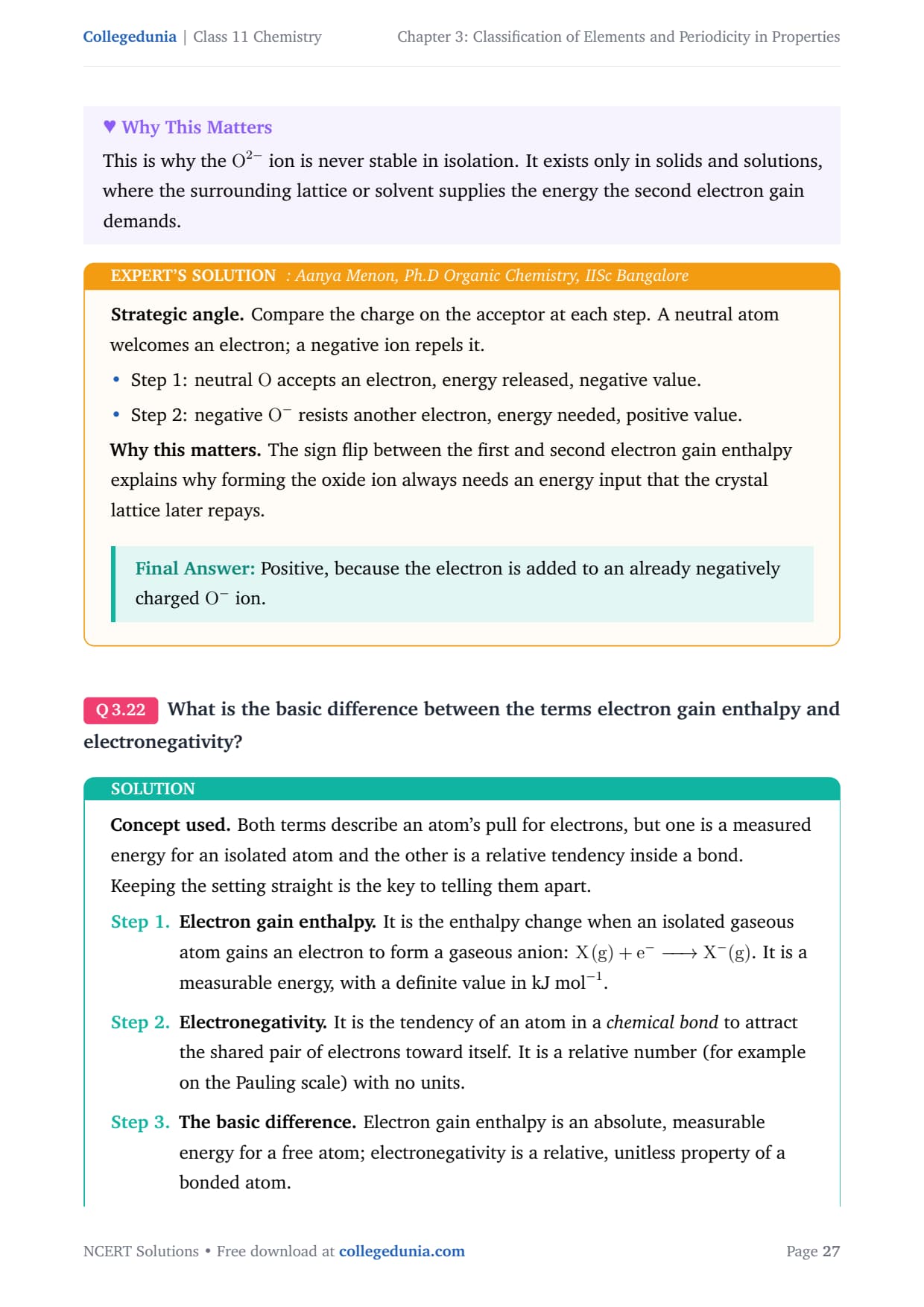
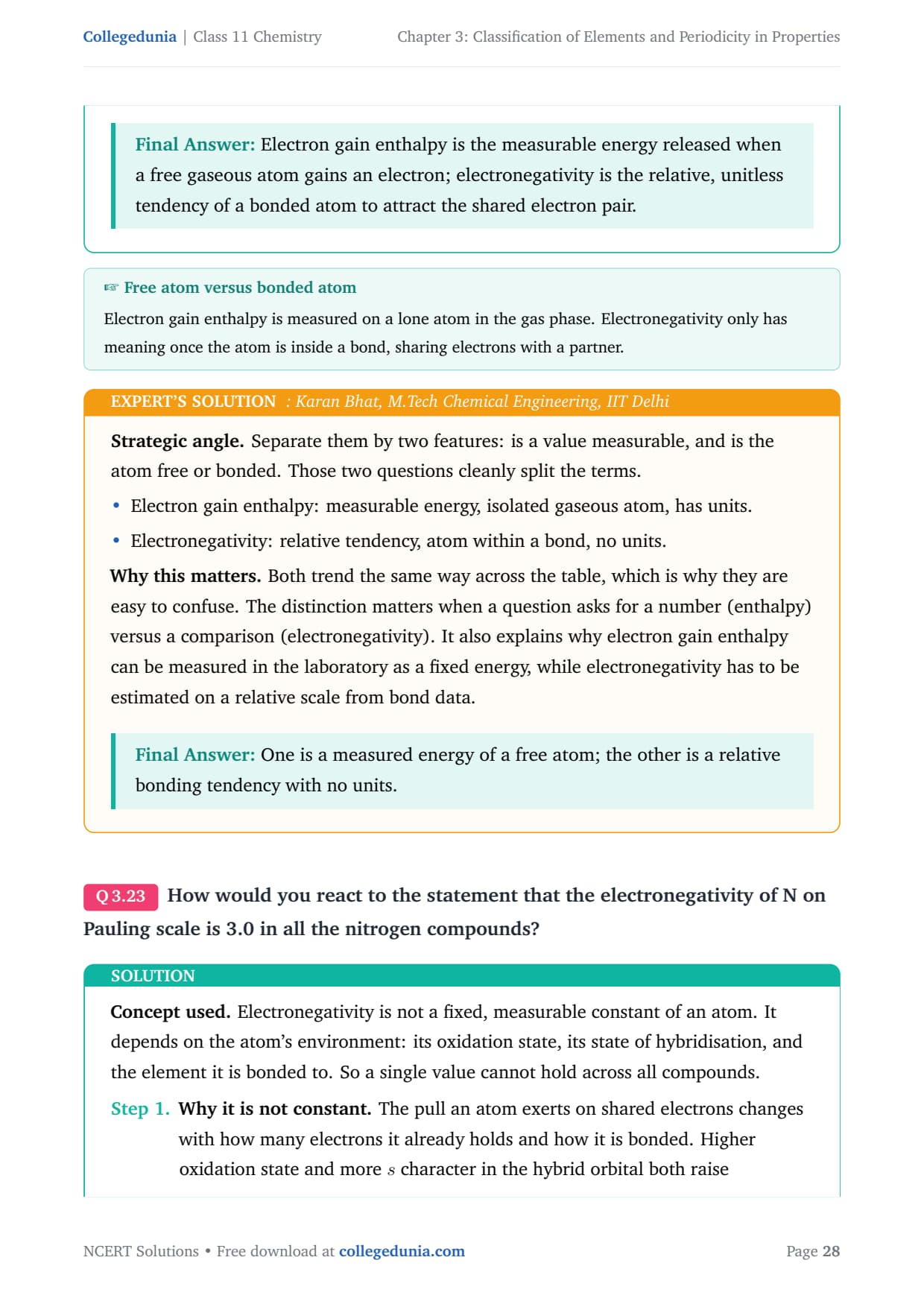
Two more trends measure how strongly an atom pulls electrons. The electron gain enthalpy is the energy change when an atom gains an electron, while electronegativity is the tendency of a bonded atom to attract shared electrons.
| Property | Across a period | Down a group |
|---|---|---|
| Electron gain enthalpy | Becomes more negative | Becomes less negative |
| Electronegativity | Increases | Decreases |
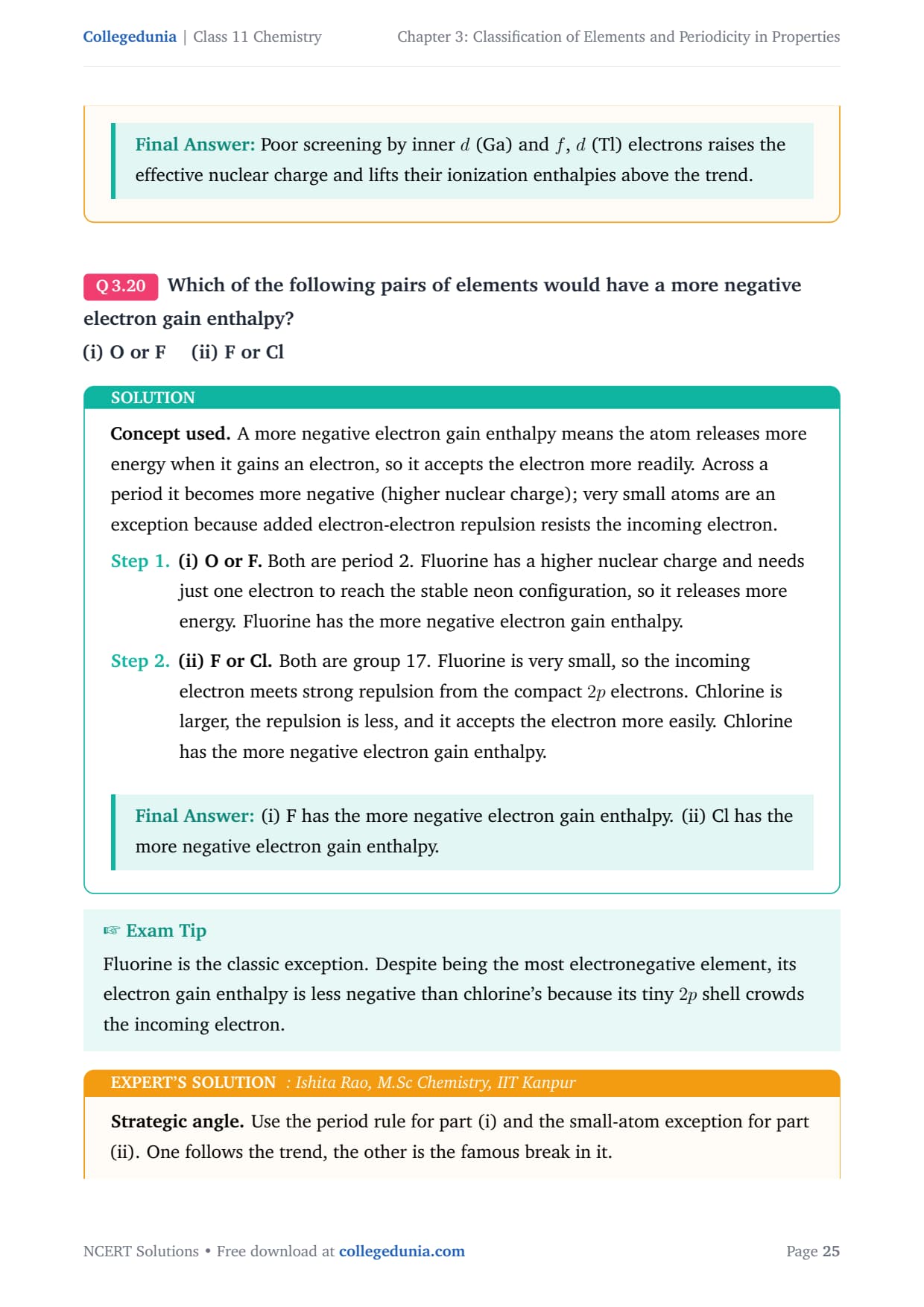
Chlorine has a more negative electron gain enthalpy than fluorine. Fluorine is so small that adding an electron brings strong repulsion in its compact 2p shell, so chlorine releases more energy. On the Pauling scale, fluorine is the most electronegative element, and electronegativity rises to the top right of the table. These two properties explain why non-metals form anions and why bonds between unlike atoms are polar, ideas you will reuse in the bonding chapter.
Periodicity of Valence and Nomenclature of Elements with Z Greater Than 100
The last part of the chapter links valence to position and gives a naming system for very heavy elements. Valence is decided by the number of valence electrons, so it repeats in a periodic way across the table.
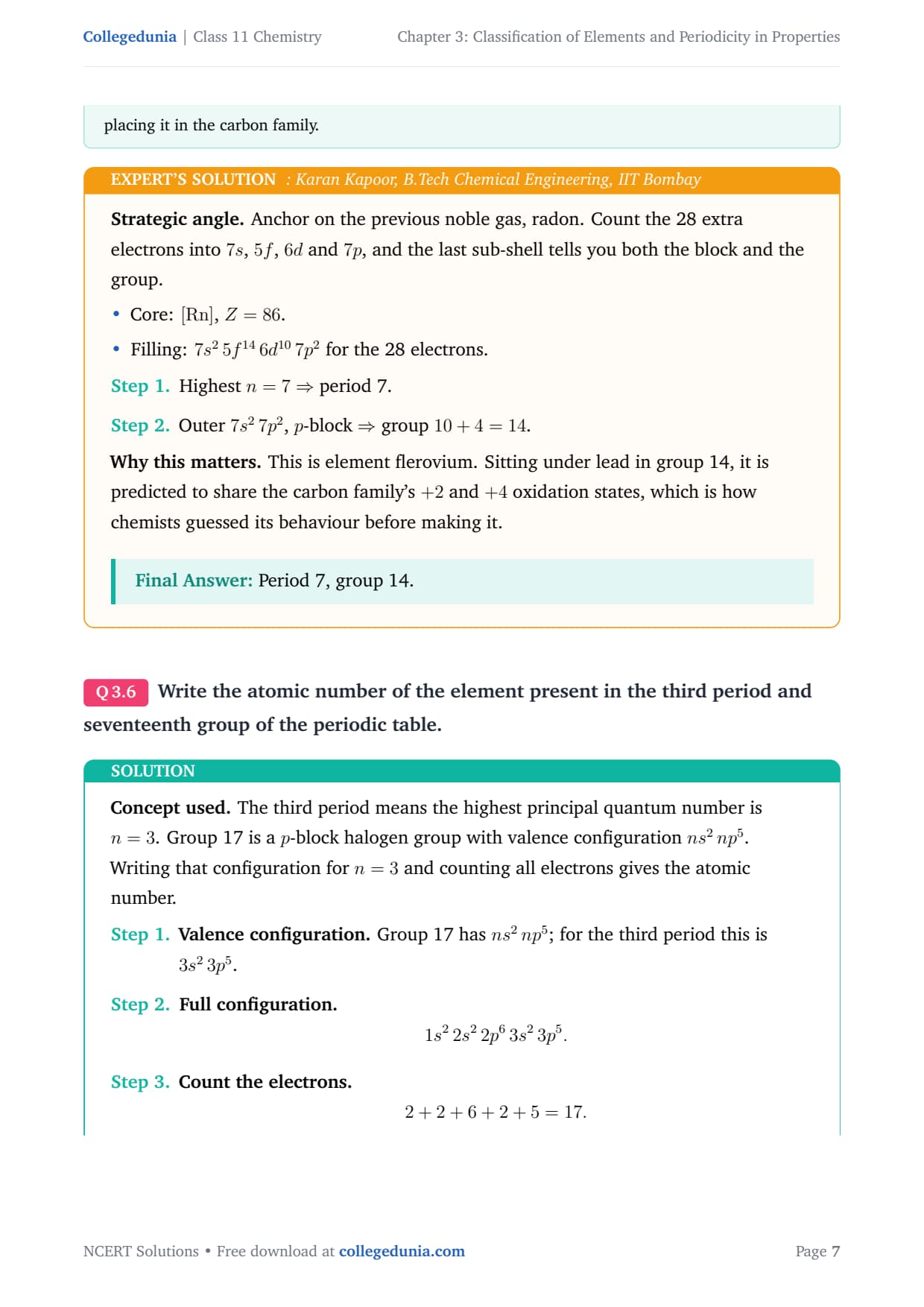
- For representative elements the valence equals the group's outer electrons or eight minus that number.
- Elements in the same group share the same valence, which is why their formulas look alike.
- Many p-block and d-block elements show more than one oxidation state, giving variable valence.
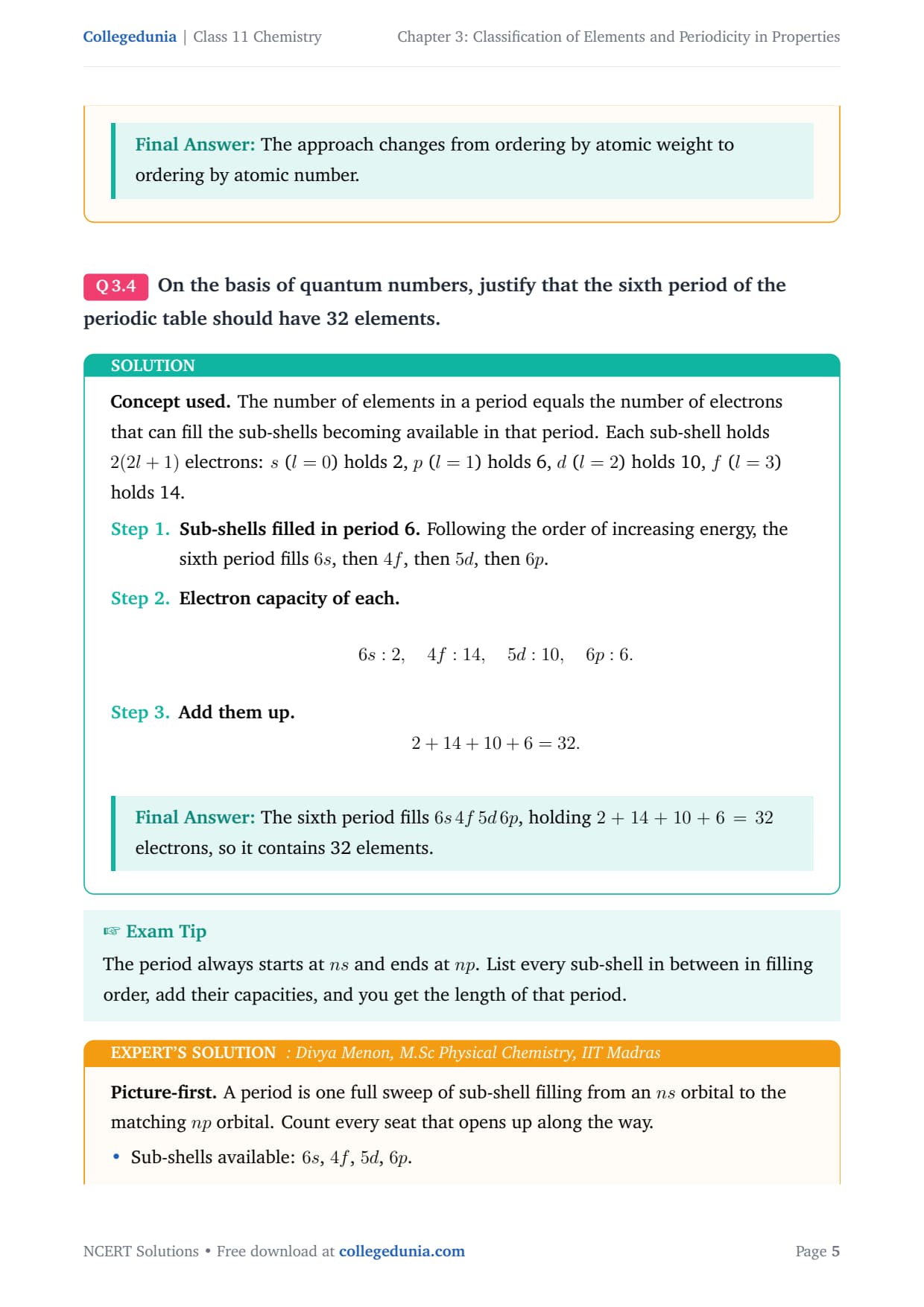
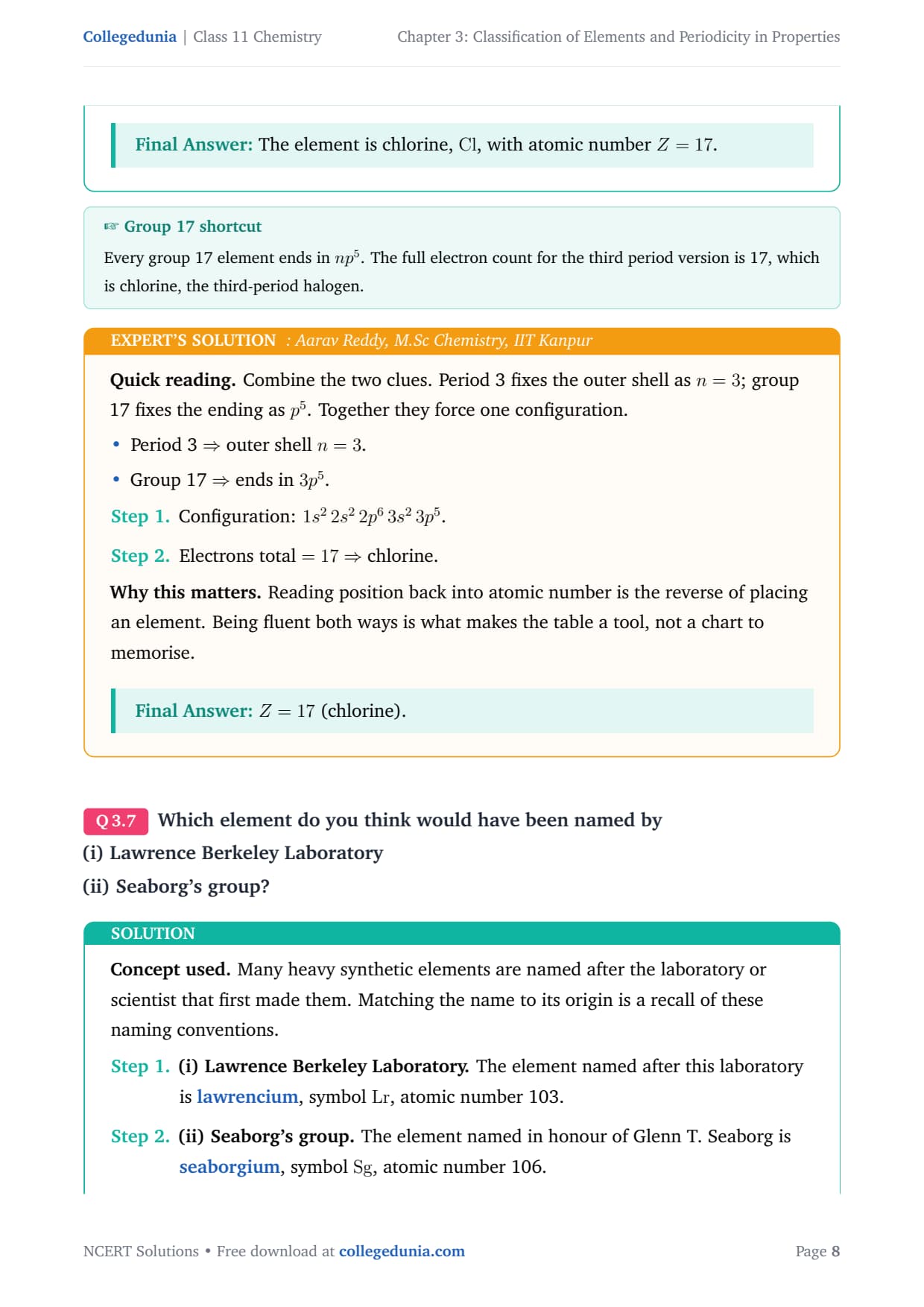
For elements with atomic number above 100, IUPAC uses numerical roots for each digit, then adds -ium. The roots are nil (0), un (1), bi (2), tri (3), quad (4), pent (5), hex (6), sept (7), oct (8) and enn (9). So element 101 is named unnilunium, symbol Unu. Learn the roots as a set, since the exam gives you a number and asks for the name or the reverse. This system avoids disputes until a permanent name is agreed.
Classification of Elements and Periodicity in Properties Exercise-wise Breakdown
The NCERT back exercise has 40 questions, and most ask you to explain or predict a trend rather than calculate. The intext questions test the same ideas in shorter form. The table below maps the question blocks to their topics so you can plan your practice.
| Question block | What it tests |
|---|---|
| Q 3.1 to 3.10 | Genesis of classification, modern periodic law, and periods and groups. |
| Q 3.11 to 3.20 | Electronic configuration, blocks, and position from atomic number. |
| Q 3.21 to 3.30 | Atomic and ionic radius, isoelectronic species, and size comparisons. |
| Q 3.31 to 3.40 | Ionization enthalpy, electron gain enthalpy, electronegativity, and valence. |
The intext questions before the exercise are shorter and check one idea each, such as naming the block of an element or ordering ions by size. Solve the intext set first, then the back exercise. Every question in the class 11 chemistry NCERT solutions chapter 3 Classification of Elements and Periodicity in Properties PDF is solved with each step and reason shown, so you can compare your working line by line.
Practice the solved questions: Work through the full question bank with step-by-step answers and expert tips.
Classification of Elements and Periodicity in Properties Class 11 Solved Practice Questions
Common Mistakes Students Make in the Classification of Elements Chapter
Most marks here are lost on reasoning, not on facts. Each slip below costs 1 to 2 marks, so watch for them at the exact step.
Mistake 1: Forgetting the ionization enthalpy dips at boron and oxygen. Explain them using half-filled and filled subshell stability.
Mistake 2: Saying fluorine has the most negative electron gain enthalpy. It is chlorine, because fluorine's small size adds repulsion.
Mistake 3: Comparing ionic sizes without checking electrons. For isoelectronic ions, higher nuclear charge means a smaller ion.
Mistake 4: Mixing up period and group trends for radius. Radius falls across a period but rises down a group.
Student Feedback on the Classification of Elements Solutions
What 12,860 students told us about their Classification of Elements and Periodicity preparation:
- 61% of students rated the ionization enthalpy exceptions as the trickiest part of the chapter.
- Most-skipped step: explaining the chlorine over fluorine electron gain enthalpy result, missed by about 3 in 10 students.
- Students who learned the trend reasons instead of the values said the reasoning questions became easy marks.
Source: 2026-27 Class 11 Chemistry student poll. Sample of 12,860 students from CBSE schools across 15 states, conducted before the 2026 boards.
Other Classification of Elements Class 11 Chemistry Resources
Pair these solutions with the revision notes and the NCERT textbook PDF for the same chapter.
| Resource | Link |
|---|---|
| NCERT Notes | Classification of Elements and Periodicity in Properties Class 11 Notes |
| NCERT Book PDF | Classification of Elements and Periodicity in Properties Class 11 Book PDF |
NCERT Solutions for Class 11 Chemistry: All Chapters
Jump to the step-by-step solutions for any other Class 11 Chemistry chapter below.
| Chapter | NCERT Solutions |
|---|---|
| Chapter 1 | Some Basic Concepts of Chemistry |
| Chapter 2 | Structure of Atom |
| Chapter 3 | Classification of Elements and Periodicity in Properties |
| Chapter 4 | Chemical Bonding and Molecular Structure |
| Chapter 5 | Thermodynamics |
| Chapter 6 | Equilibrium |
| Chapter 7 | Redox Reactions |
| Chapter 8 | Organic Chemistry Some Basic Principles and Techniques |
| Chapter 9 | Hydrocarbons |
FAQs on Classification of Elements and Periodicity in Properties Class 11 NCERT Solutions
Classification of Elements and Periodicity in Properties NCERT Solutions - Frequently Asked Questions
Ques. What do the class 11 chemistry NCERT solutions chapter 3 Classification of Elements and Periodicity in Properties cover?
Ans. These solutions cover all 40 back-exercise questions and the intext questions, including the genesis of periodic classification, the modern periodic law, the long form table, the s, p, d and f blocks, atomic and ionic radius, ionization enthalpy, electron gain enthalpy, electronegativity, valence, and the naming of elements with atomic number above 100. Every question is solved with reasons.
Ques. What is the modern periodic law?
Ans. The modern periodic law states that the physical and chemical properties of elements are a periodic function of their atomic numbers. Henry Moseley showed that atomic number, not atomic mass, is the correct basis for order. This corrected the few misplaced pairs in Mendeleev's table, such as argon and potassium.
Ques. Why is the ionization enthalpy of nitrogen higher than that of oxygen?
Ans. Nitrogen has the configuration 2p3, a stable half-filled set, so removing an electron needs extra energy. Oxygen has 2p4, where the paired electrons repel each other, making one electron easier to remove. This extra stability of the half-filled subshell is why nitrogen has the higher first ionization enthalpy.
Ques. Why is the electron gain enthalpy of chlorine more negative than that of fluorine?
Ans. Fluorine is a very small atom, so its 2p subshell is compact. Adding an electron there brings strong repulsion between electrons, which lowers the energy released. Chlorine is larger, so the incoming electron faces less repulsion, and chlorine has the more negative electron gain enthalpy of the two.
Ques. How does atomic radius change across a period and down a group?
Ans. Across a period the nuclear charge rises while electrons enter the same shell, so the pull increases and the radius decreases. Down a group a new shell is added at each step, so the outer electrons sit further from the nucleus and the radius increases. For isoelectronic species, the ion with the highest nuclear charge is the smallest.
Ques. How are elements with atomic number greater than 100 named?
Ans. IUPAC assigns a root to each digit: nil (0), un (1), bi (2), tri (3), quad (4), pent (5), hex (6), sept (7), oct (8) and enn (9). The roots for the digits of the atomic number are joined and end with -ium. For example, element 101 is unnilunium with the symbol Unu, until a permanent name is approved.



Comments