




The class 11 biology NCERT solutions chapter 3 Plant Kingdom cover every back-exercise question, according to the latest 2026-27 CBSE syllabus, and help students prepare for the CBSE Boards, NEET and CUET. Each answer is worked step by step, from the basis of classifying algae to alternation of generations, heterospory and the naked seed of the gymnosperms.
This chapter walks through the five great groups of plants, and one thread runs through all of them: how a plant carries its gametes to water, and then stops needing water at all.
- CBSE Weightage: 3 to 4 marks, part of the Diversity of Living Organisms unit that opens the Class 11 course.
- Topics covered: classification of algae, bryophytes, pteridophytes, gymnosperms and angiosperms, alternation of generations, ploidy, heterospory and the seed habit.
- Exercise count: 11 back-exercise questions, mostly descriptive, with one ploidy question and one matching question.
These class 11 biology NCERT solutions chapter 3 Plant Kingdom are curated by subject experts, based on the 2026-27 NCERT textbook, and checked against the last five years of CBSE Board and NEET papers.
Why Plant Kingdom Matters and What the Chapter Covers
Chapter 2 placed all plants in Kingdom Plantae. This chapter divides that kingdom into five groups, algae, bryophytes, pteridophytes, gymnosperms and angiosperms, and it reads as one long answer to a single question: how does a plant stop needing water to reproduce? Every group is a step further from the pond, ending in the seed plants that colonised dry land.
- Everyday role: this classification is how a botanist places a new specimen, how a forester tells a conifer from a flowering tree, and how a student reads the life history of moss on a wall.
- Core skill: tracking the two generations of a plant, the haploid gametophyte and the diploid sporophyte, and saying which one is dominant.
- Why it matters for NEET: ploidy, alternation of generations and heterospory are asked almost every year, and they all rest on the ideas built here.
Which generation is dominant is not trivia; it fixes the ploidy of everything you can see on the plant. A moss leaf is haploid while a fern leaf is diploid, and getting that right is the difference between a full-mark script and a lost one. The class 11 biology NCERT solutions chapter 3 Plant Kingdom below follow the same order as the NCERT textbook so students can check their working line by line.
How Algae Are Classified: Pigments, Food and Flagella
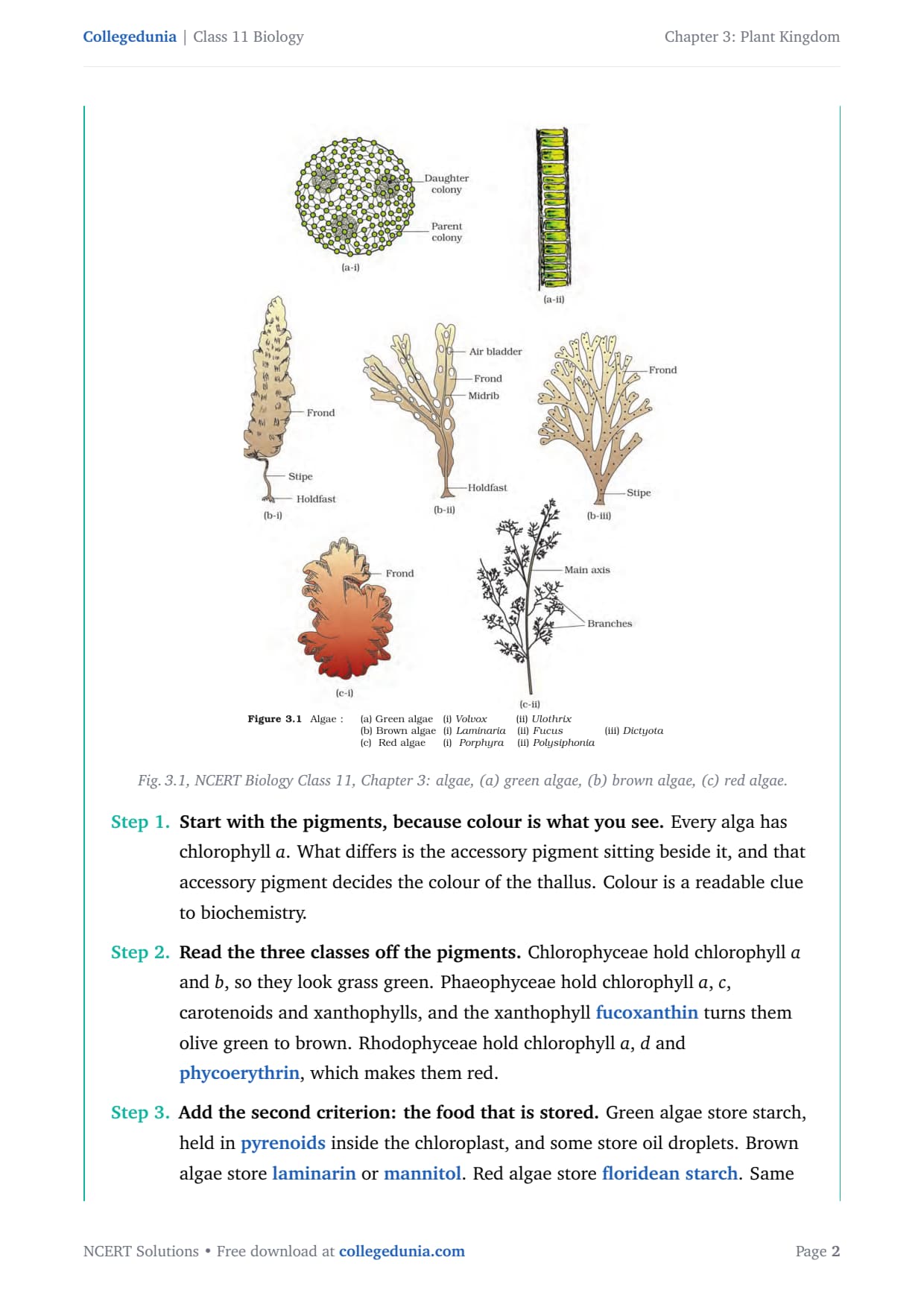
Algae are chlorophyll-bearing, simple, thalloid, autotrophic and largely aquatic organisms. The first exercise question asks for the basis of their classification, and NCERT states the dividing rule in one line: depending on the type of pigment possessed and the type of stored food, algae fall into three classes. Two further characters, the cell wall material and the number and position of the flagella, are used alongside these.
| Class | Pigments | Stored food | Flagella |
|---|---|---|---|
| Chlorophyceae (green) | Chlorophyll a, b | Starch, in pyrenoids | 2 to 8 equal, apical |
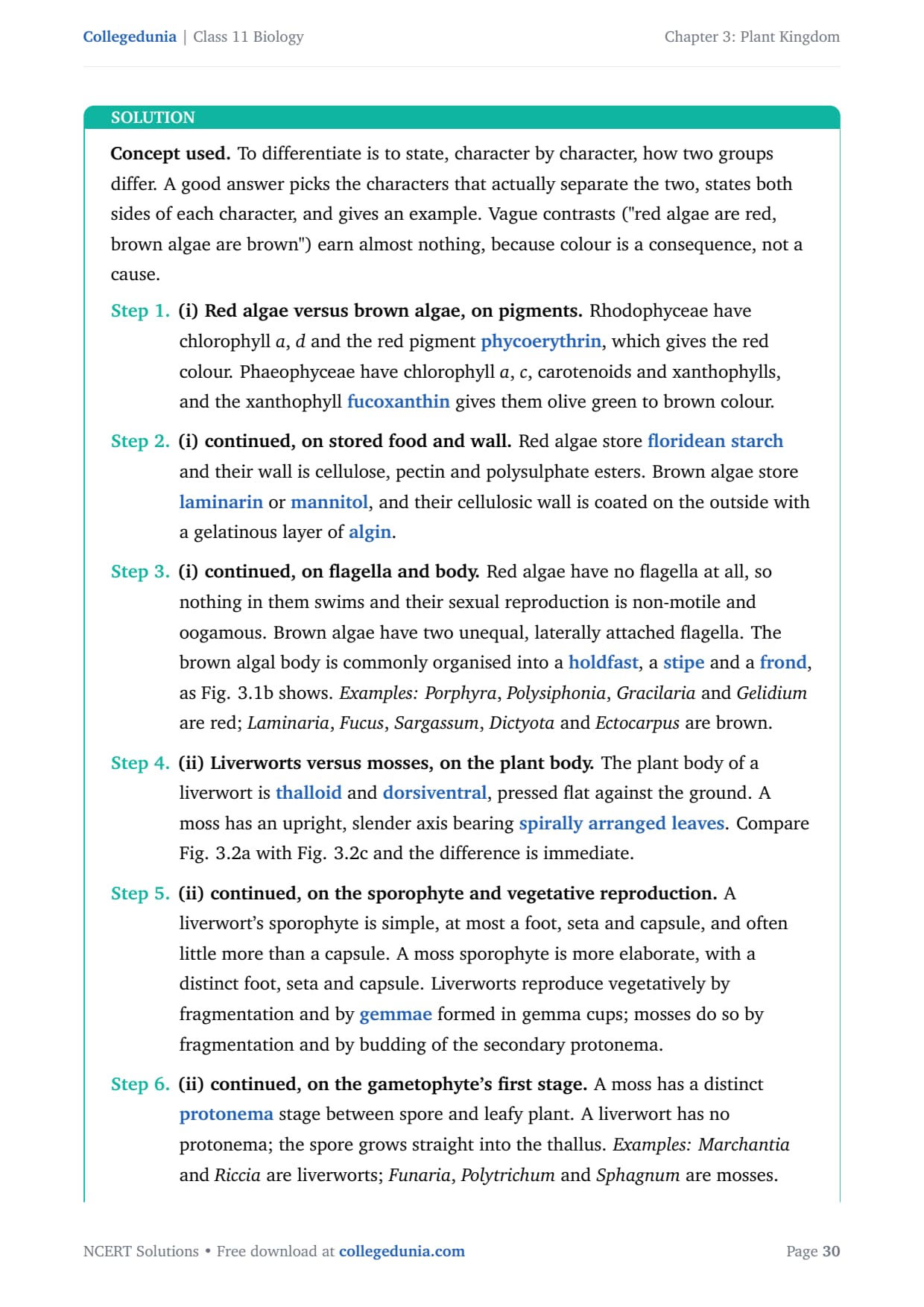
| Phaeophyceae (brown) | Chlorophyll a, c, fucoxanthin | Laminarin or mannitol | 2 unequal, lateral |
| Rhodophyceae (red) | Chlorophyll a, d, phycoerythrin | Floridean starch | None |
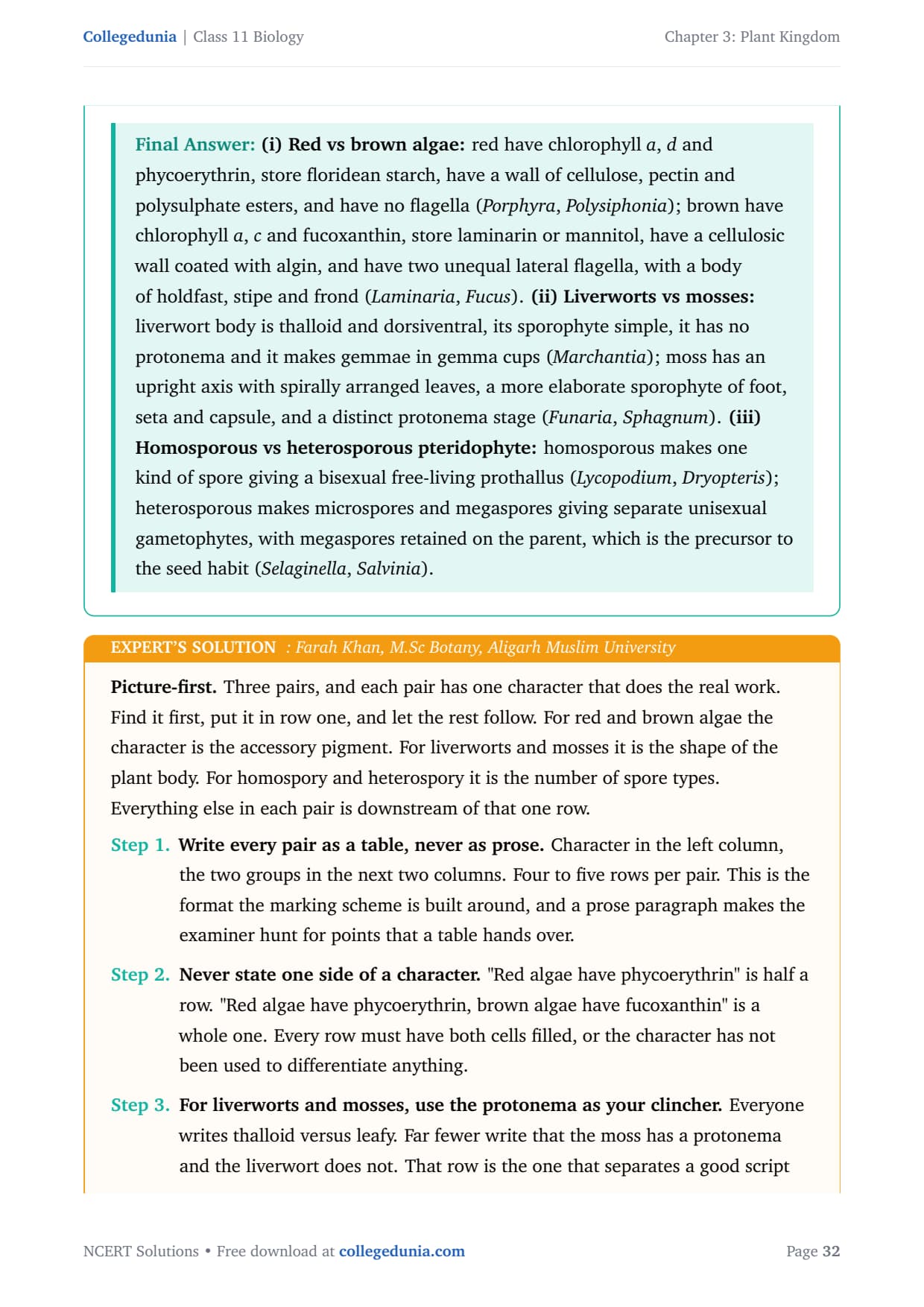
The exercise also asks students to differentiate red algae from brown algae, and the table above answers it directly, since red algae have no flagella while brown algae have two unequal lateral ones and a body of holdfast, stipe and frond. All three classes have chlorophyll a, so the difference is in the accessory pigments, not in whether chlorophyll is present. Do not separate the classes by colour alone: a brown alga low in fucoxanthin can look olive green, and colour is a symptom of the pigment rather than the character itself. Pigment even has an ecological consequence, since red algae carry phycoerythrin and grow deepest, where only blue-green light reaches.
Bryophytes and the Archegoniate Life Cycle
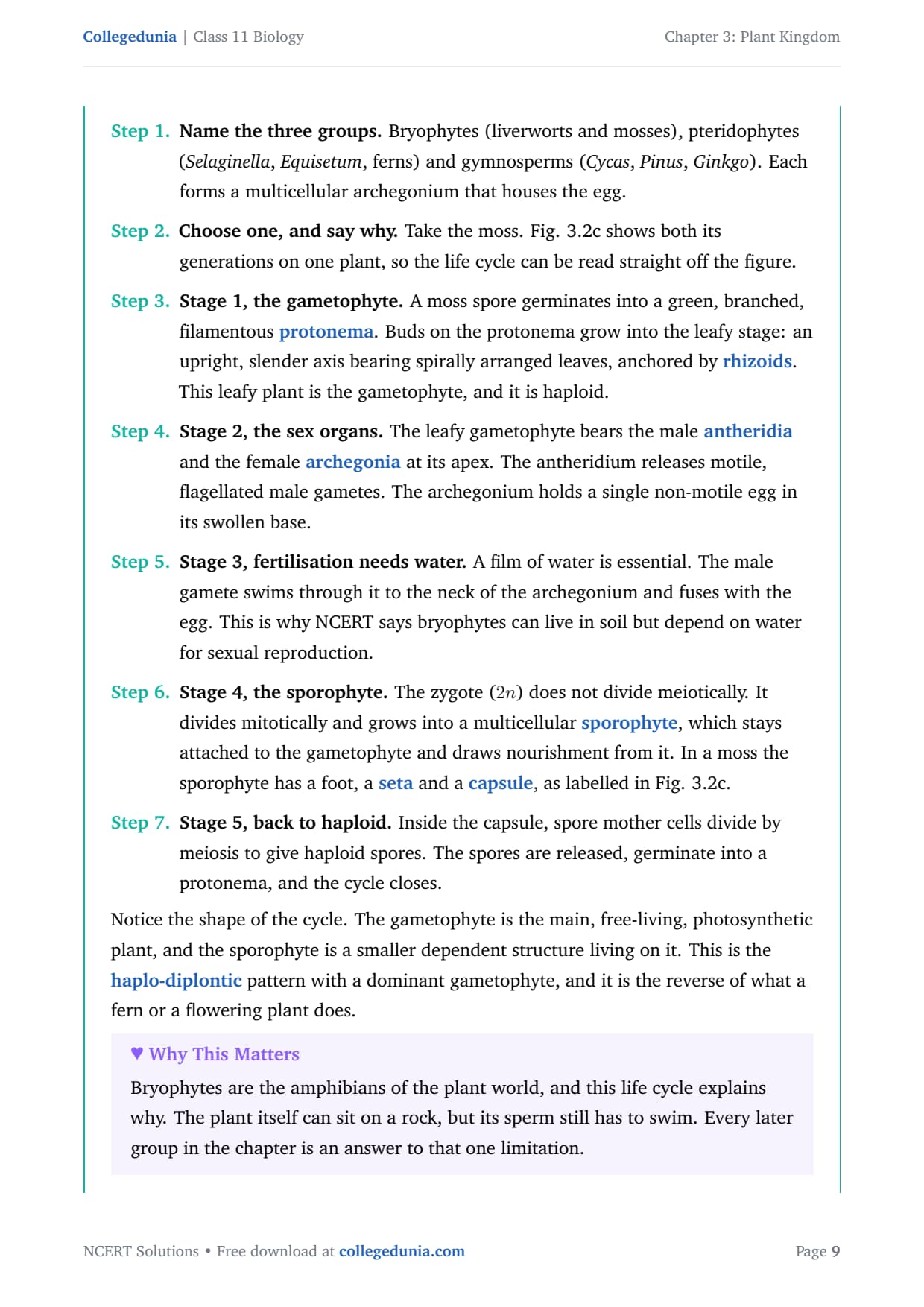
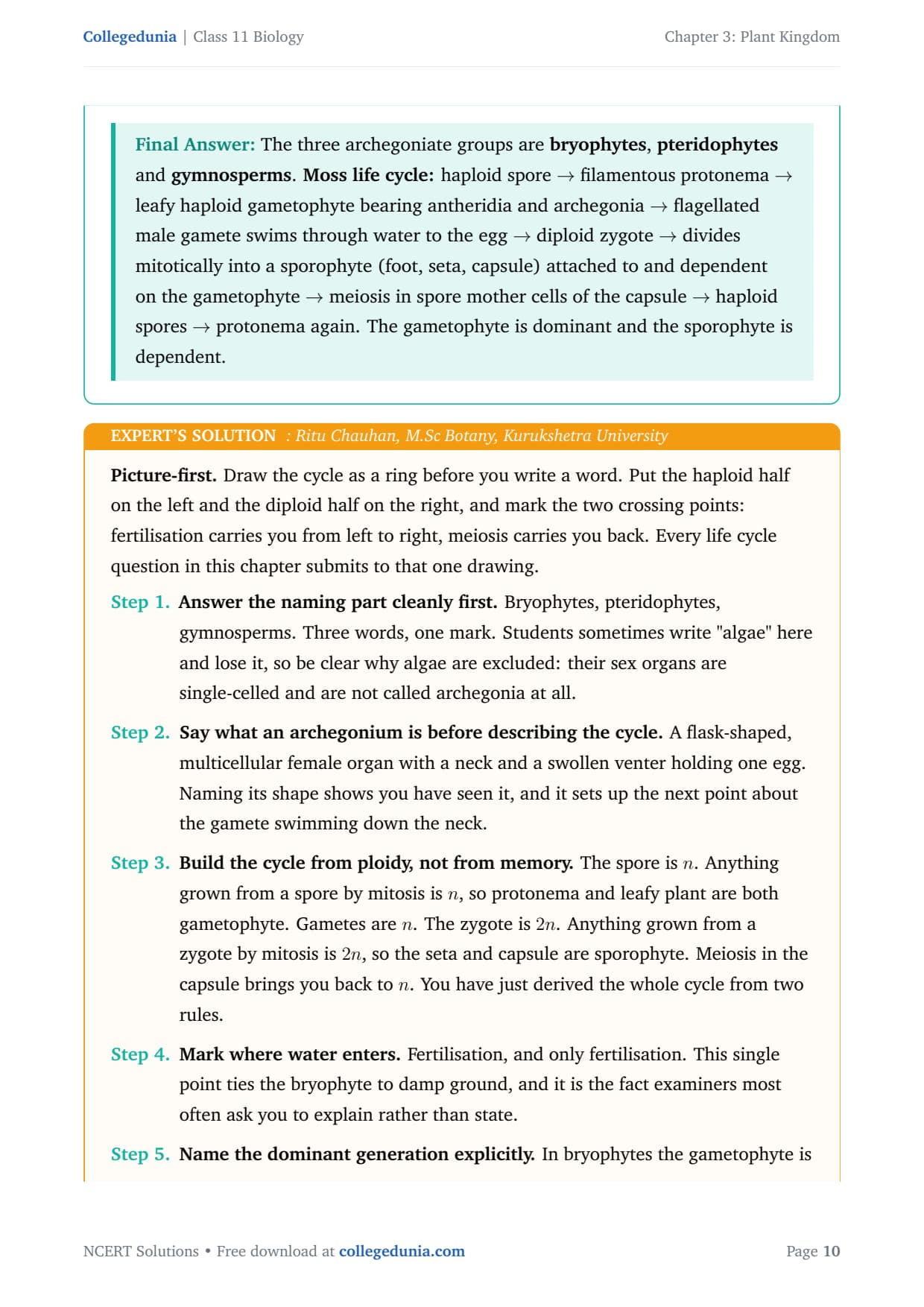
Three groups of the plant kingdom bear the flask-shaped female organ called the archegonium: bryophytes, pteridophytes and gymnosperms. Algae do not, because their sex organs are single-celled, and angiosperms do not, because the archegonium is lost and the egg sits inside the embryo sac. The exercise asks students to name these three groups and describe one life cycle, and the moss is the clearest choice.
- Gametophyte: a moss spore germinates into a green, branched, filamentous protonema; buds on it grow into the leafy, haploid gametophyte anchored by rhizoids.
- Fertilisation: the leafy plant bears antheridia and archegonia at its apex, and a flagellated male gamete swims through a film of water to the egg.
- Sporophyte: the diploid zygote divides mitotically into a sporophyte of foot, seta and capsule, which stays attached to and dependent on the gametophyte.
- Back to haploid: spore mother cells inside the capsule divide by meiosis to give haploid spores, and the cycle closes.
The shape of this cycle is the haplo-diplontic pattern with a dominant gametophyte, the reverse of what a fern or a flowering plant does. Bryophytes are the amphibians of the plant world: the plant itself can sit on a rock, but its sperm still has to swim. The exercise also asks students to differentiate liverworts from mosses, and the sharpest points are the body shape (a liverwort is thalloid and dorsiventral, a moss has an upright axis with spirally arranged leaves) and the protonema, which the moss has and the liverwort does not. Both, however, are bryophytes, so both need water for fertilisation, and writing that one does and the other does not is a costly error.
Reduction Division and Ploidy Across the Plant Kingdom
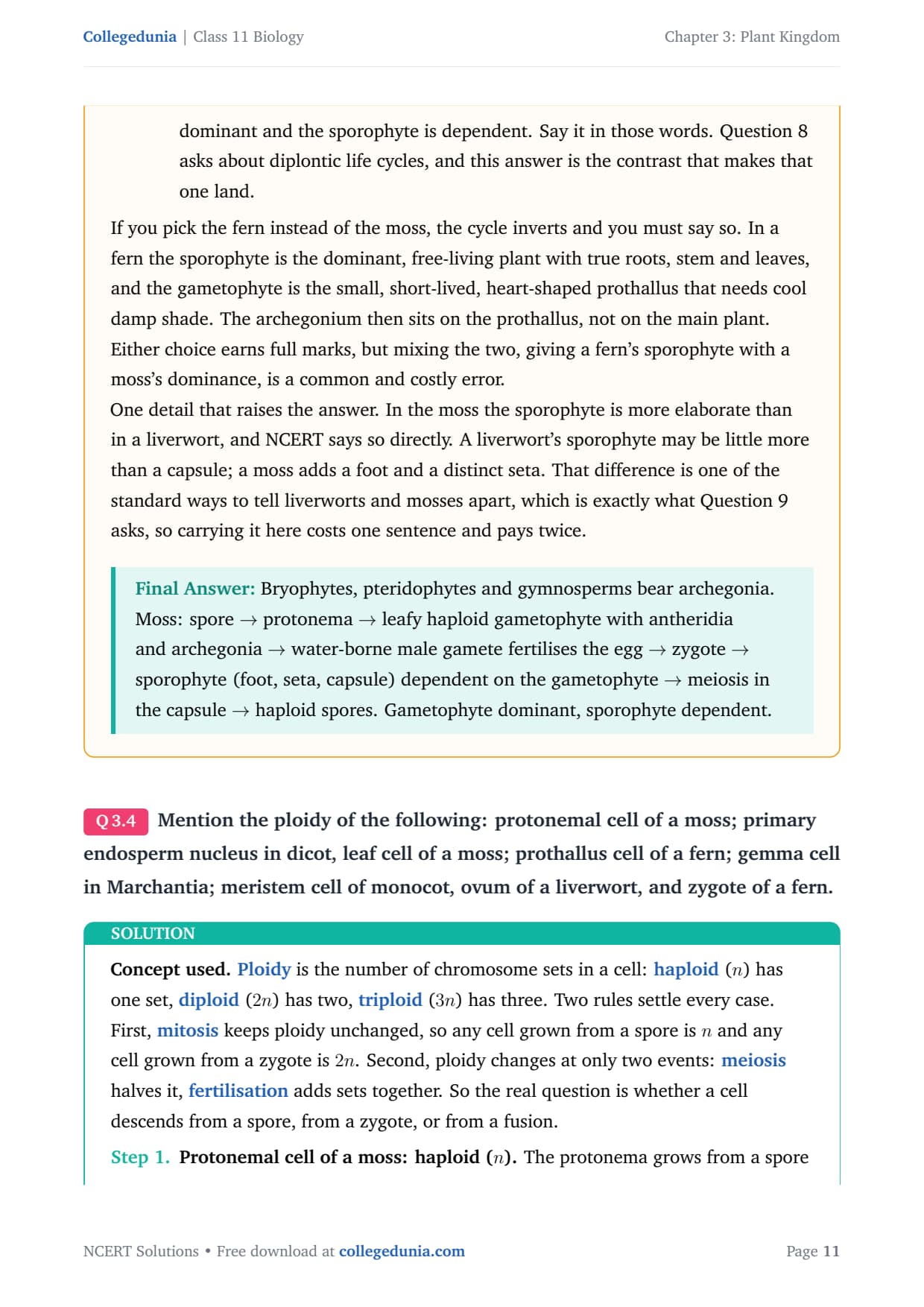
Two exercise questions test where meiosis happens and what ploidy each cell carries, and both submit to a two-rule engine. Mitosis never changes ploidy, so a cell grown from a spore is haploid and a cell grown from a zygote is diploid. Ploidy changes only at two events: meiosis halves it and fertilisation adds sets together. So the real question is always whether a cell descends from a spore, from a zygote, or from a fusion.
Reduction division therefore sits at exactly one place in every plant life cycle: at the end of the sporophytic generation, in the spore mother cells, at the moment spores are formed. The answer to Exercise Q2 is that only the location moves from group to group: the capsule in a liverwort and moss, the sporangia on the leaves of a fern, and the microsporangia and megasporangia on the sporophylls of gymnosperms and angiosperms.
| Cell | Ploidy |
|---|---|
| Protonemal cell of a moss | Haploid (n) |
| Leaf cell of a moss | Haploid (n) |
| Prothallus cell of a fern | Haploid (n) |
| Gemma cell in Marchantia | Haploid (n) |
| Ovum of a liverwort | Haploid (n) |
| Meristem cell of a monocot | Diploid (2n) |
| Zygote of a fern | Diploid (2n) |
| Primary endosperm nucleus in a dicot | Triploid (3n) |
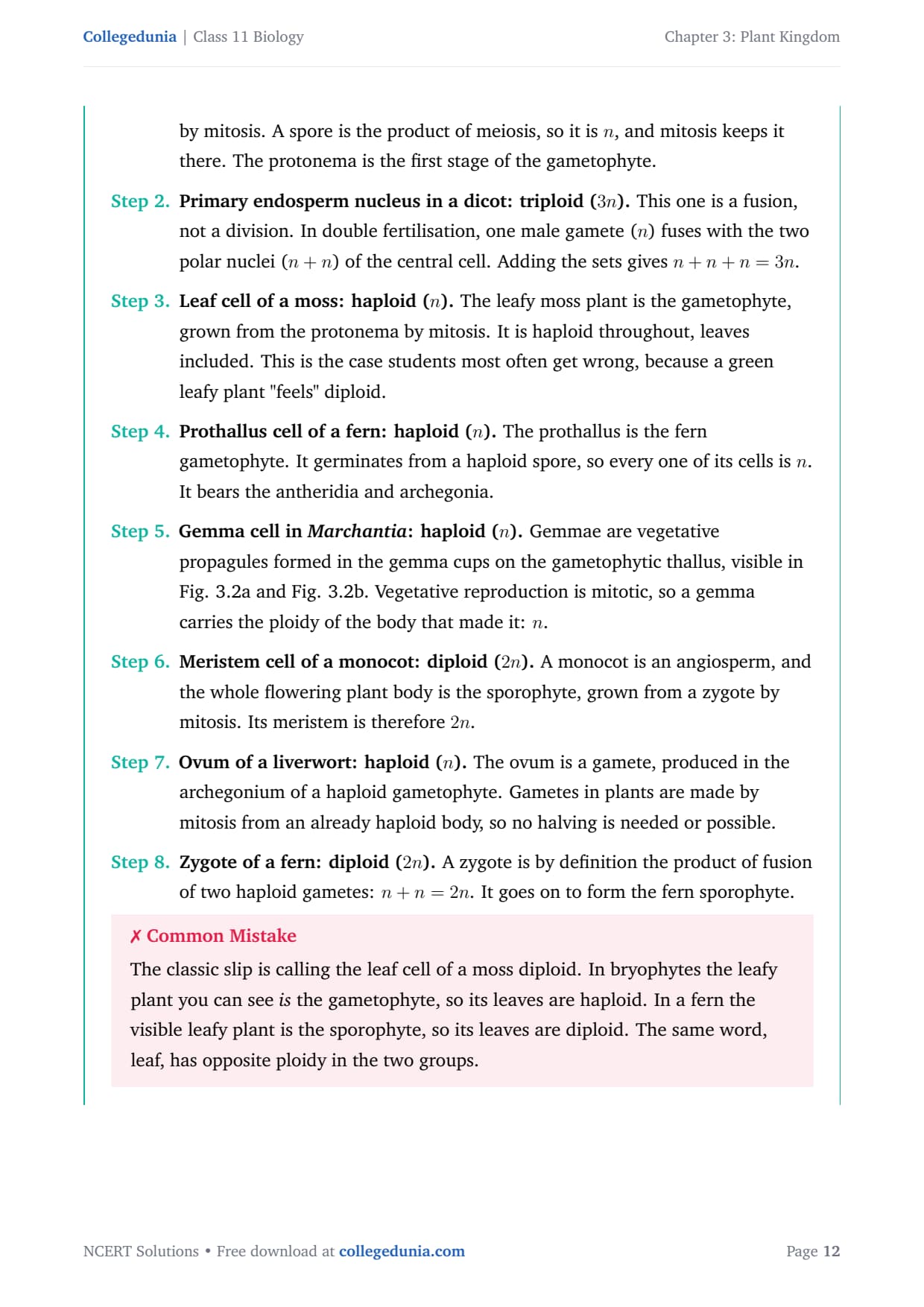
The classic slip is calling the leaf cell of a moss diploid, because a green leafy plant feels diploid. In bryophytes the leafy plant you can see is the gametophyte, so its leaves are haploid, while in a fern the visible leafy plant is the sporophyte, so its leaves are diploid. The one triploid cell is the primary endosperm nucleus, formed when a male gamete fuses with the two polar nuclei during double fertilisation, so one plus two makes three sets. Fertilisation doubles the number and meiosis halves it, so a zygote is never the product of meiosis.
Pteridophytes, Heterospory and the Road to the Seed
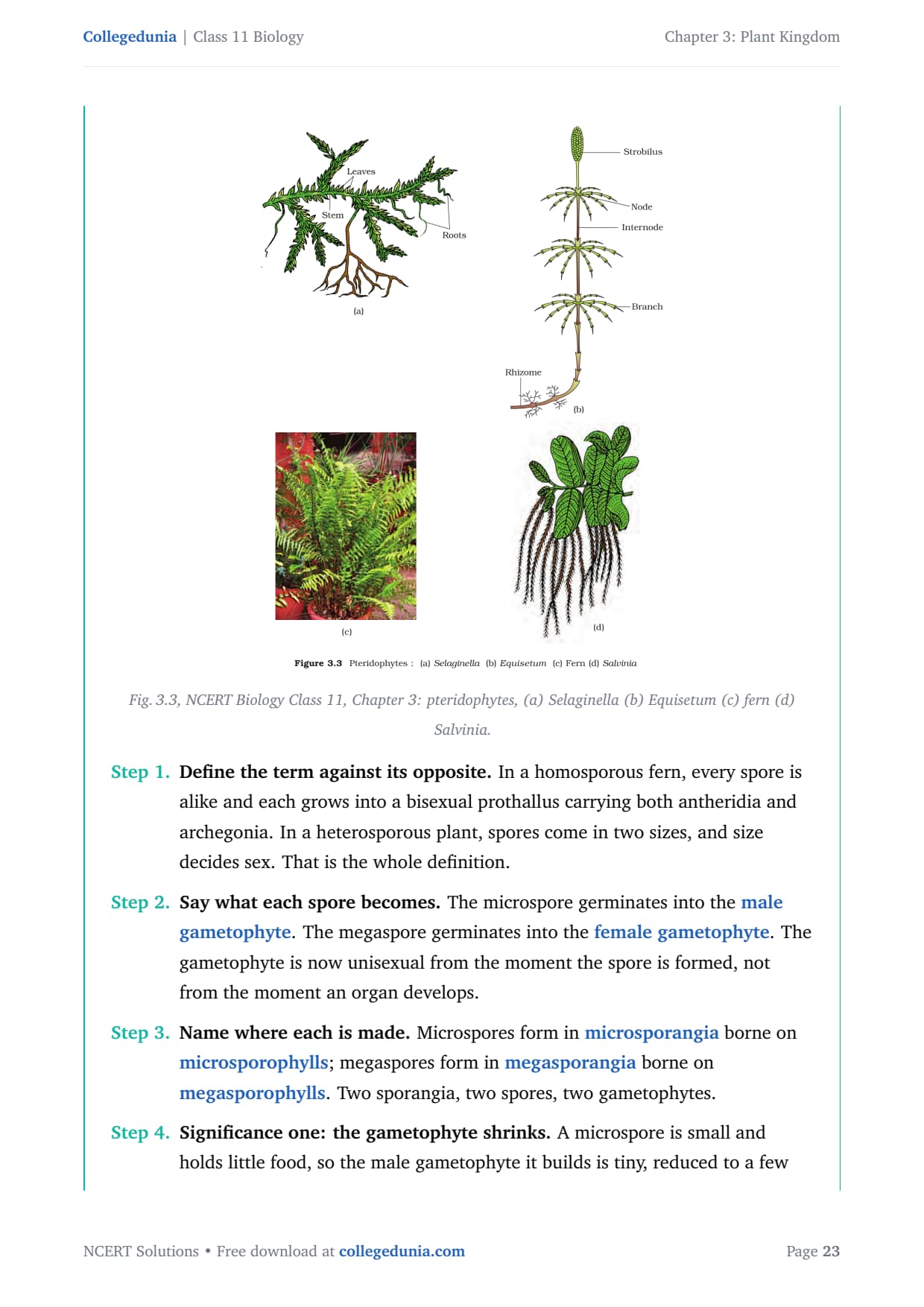
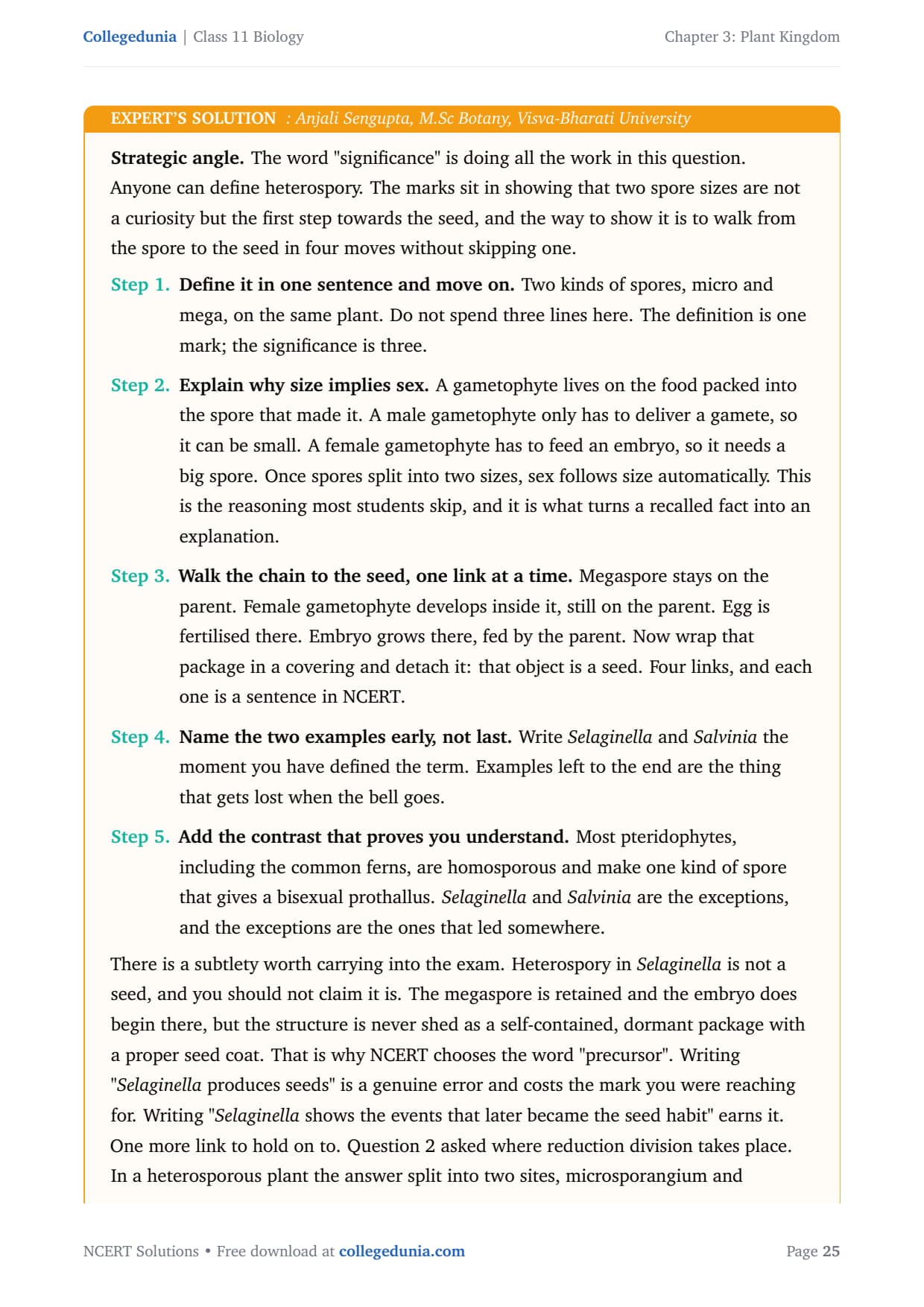
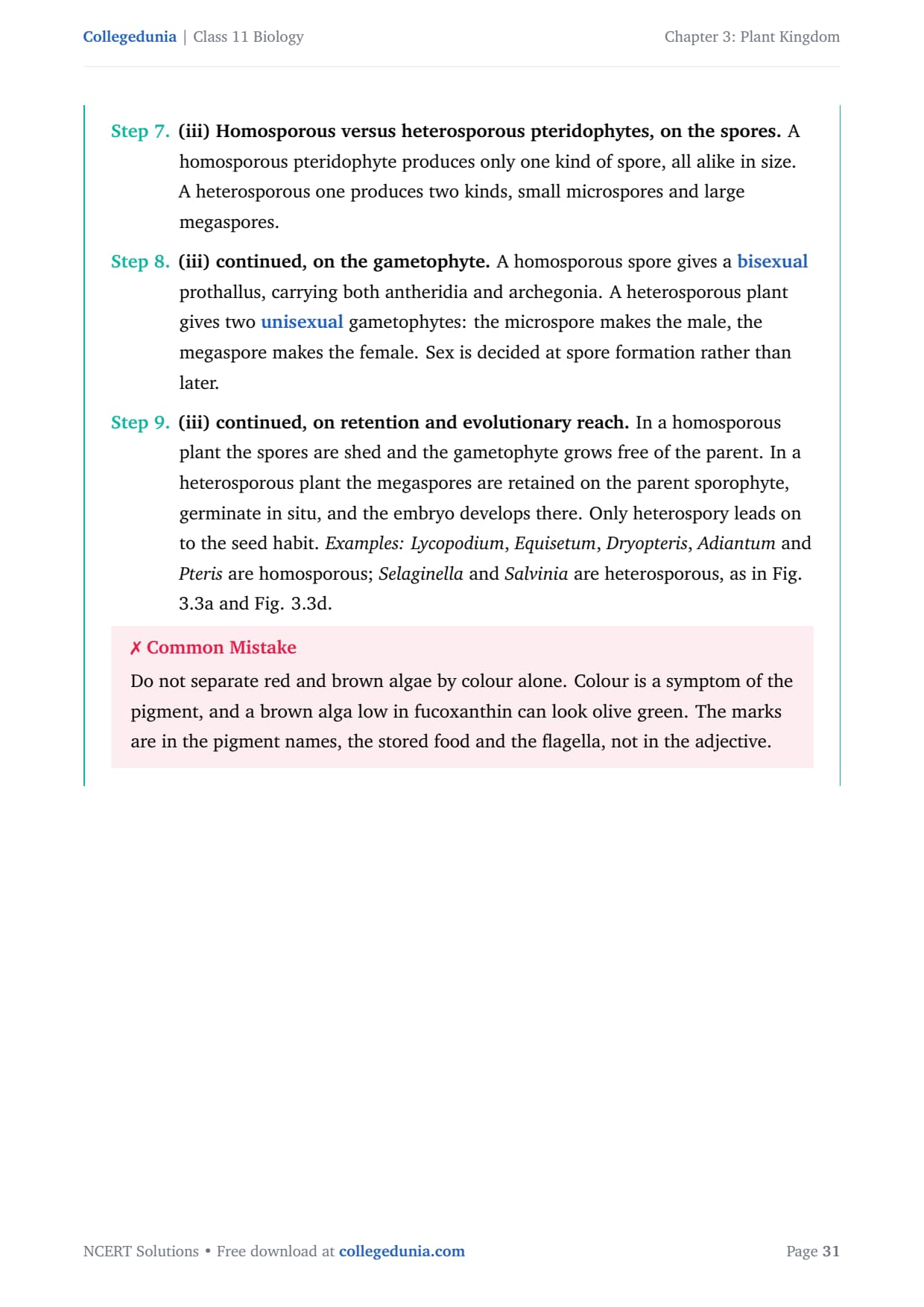
Pteridophytes are the first plants with true roots, stem and leaves and with well-differentiated vascular tissue. Most are homosporous, making one kind of spore that grows into a bisexual prothallus, but a few are heterosporous, and heterospory is the hinge of the whole chapter. It is the production of two kinds of spores, small microspores and large megaspores, by the same plant, with Selaginella and Salvinia as the named examples.
- Two gametophytes: the microspore forms the male gametophyte and the megaspore the female, so sex is decided at spore formation, not later.
- The megaspore is retained: it is not shed, but germinates and develops into a female gametophyte while still on the parent sporophyte, an event NCERT calls in situ germination.
- The embryo develops in place: the egg is fertilised there and the zygote grows into a young embryo inside the female gametophyte, already fed and sheltered.
Retained megaspore, plus female gametophyte kept on the parent, plus embryo formed inside it, plus a protective covering, is precisely what a seed is. NCERT calls these events the precursors to the seed habit, an important step in evolution that leads to gymnosperms and angiosperms. Why does size imply sex? A gametophyte lives on the food packed into its spore: a male gametophyte only has to deliver a gamete, so it can be small, but a female gametophyte has to feed an embryo, so it needs a big spore. One caution protects the mark: Selaginella shows the events that later became the seed habit, but it does not itself produce seeds, which is why NCERT chooses the word precursor.
Gymnosperms: Naked Seeds and the Pollen Tube
The gymnosperms are the plants in which ovules are not enclosed by any ovary wall and remain exposed both before and after fertilisation, so the seeds are uncovered, which is why they are called naked-seeded plants. The exercise asks students to describe their important characteristics, and a good answer is organised around the naked ovule rather than being a random list, because every other feature either explains that fact or follows from it.
- Habit and roots: medium to tall trees and shrubs, including Sequoia, the giant redwood; generally tap roots, with mycorrhiza in Pinus and coralloid roots holding nitrogen-fixing cyanobacteria in Cycas.
- Heterospory and cones: microspores and megaspores form in sporangia on sporophylls arranged spirally into male and female cones or strobili.
- Reduced gametophytes: the male gametophyte is a pollen grain and the female is multicellular with two or more archegonia; neither is free-living, both being retained on the sporophyte.
- Fertilisation without water: pollen is carried by air currents to the ovule, and a pollen tube delivers the male gametes to the archegonium, so no standing water is needed.
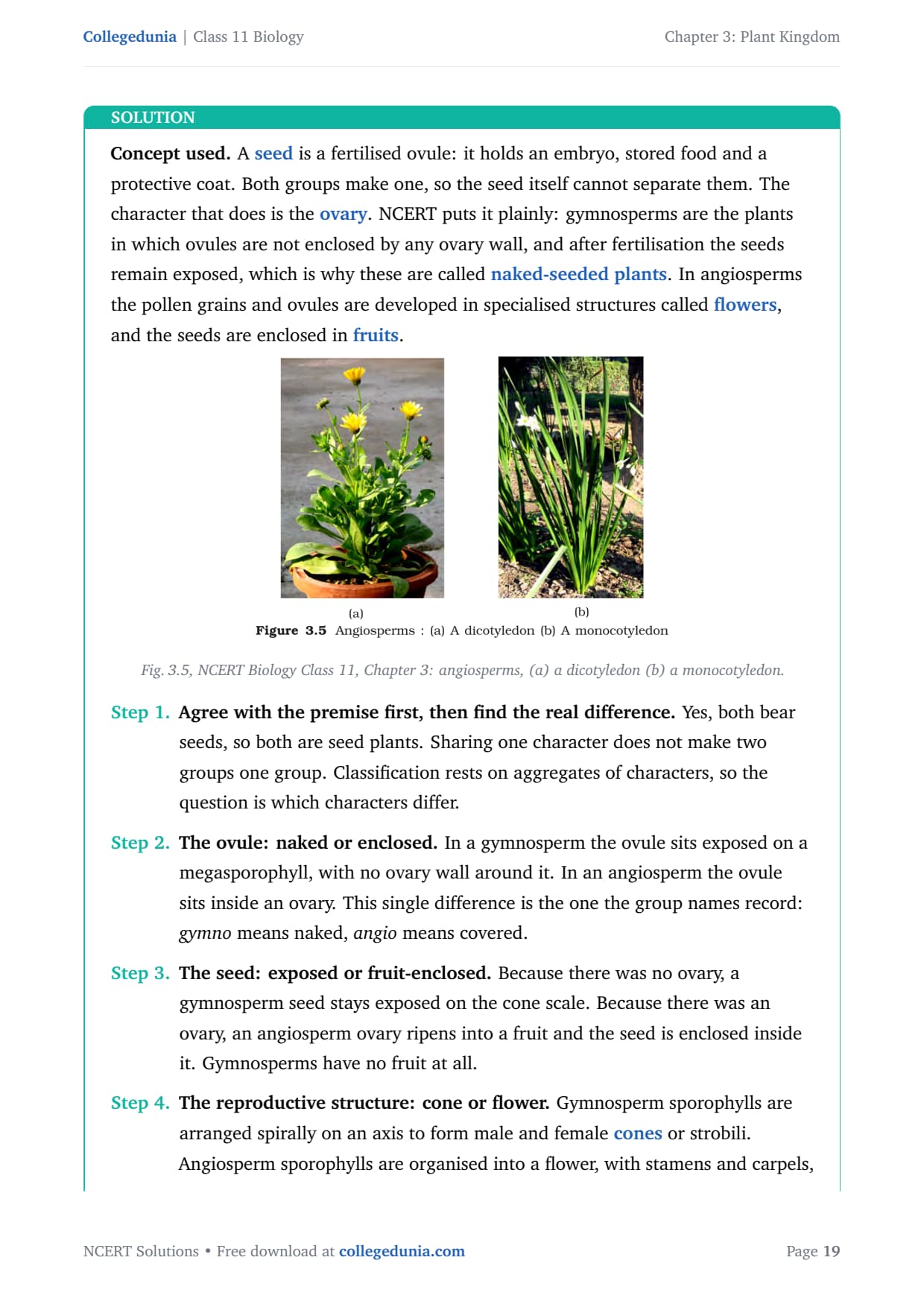
This group solved the problem that had trapped every plant before it, since bryophytes and pteridophytes both need a film of water for their gametes to meet, and the pollen tube ended that dependence. That answers the other exercise question too, why gymnosperms and angiosperms are classified separately despite both bearing seeds. Sharing one character does not make two groups one, and every other reproductive character differs. In a gymnosperm the ovule is naked and the seed exposed with no fruit, there is single fertilisation, and archegonia are present; in an angiosperm the ovule lies in an ovary inside a flower, the seed is enclosed in a fruit, there is double fertilisation giving a triploid endosperm, and an embryo sac replaces the archegonium. A gymnosperm seed is naked but not unprotected, since it keeps a seed coat formed from the integument; naked means no fruit wall, nothing more.
Key Terms and the Economic Importance of Plants
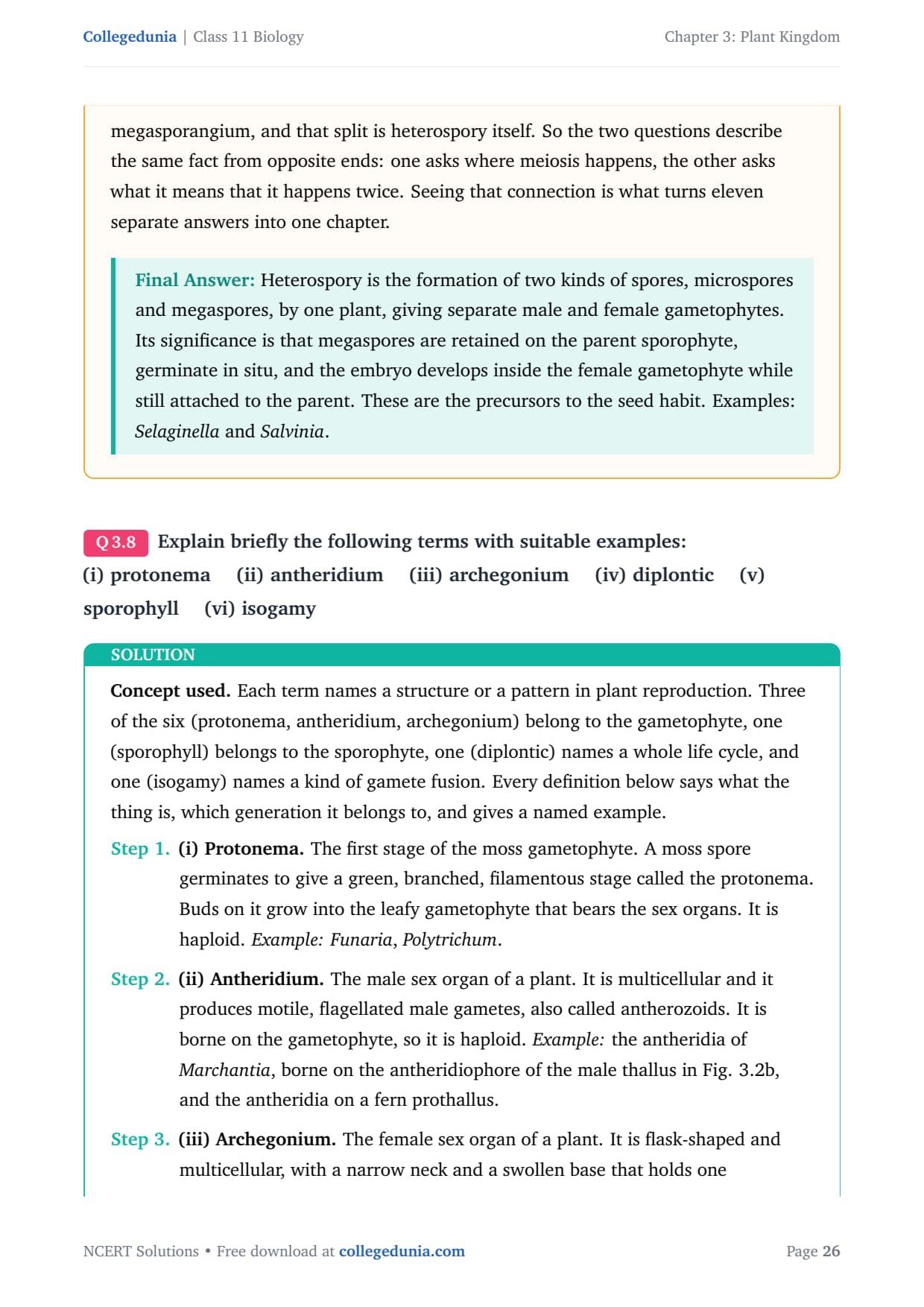
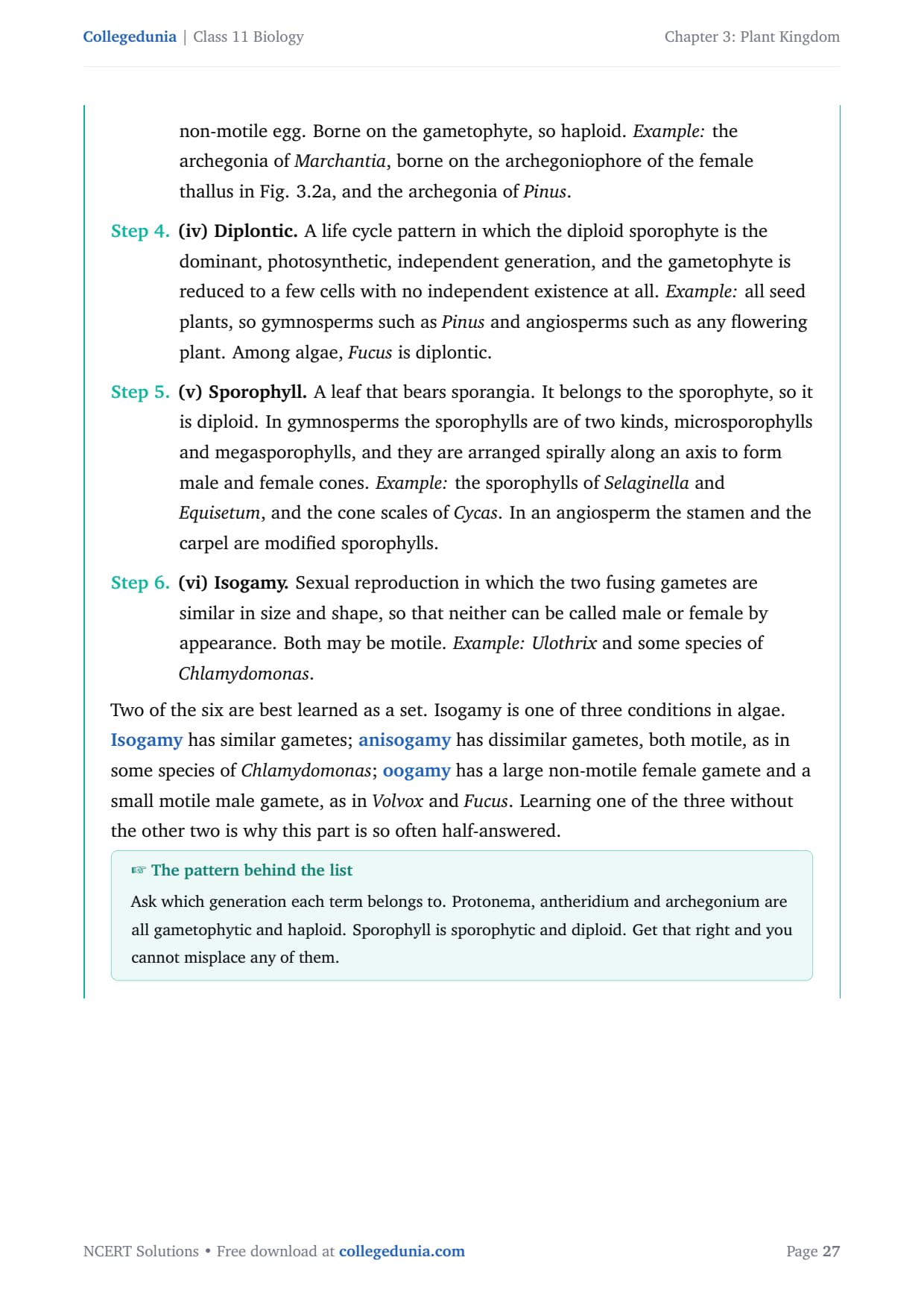
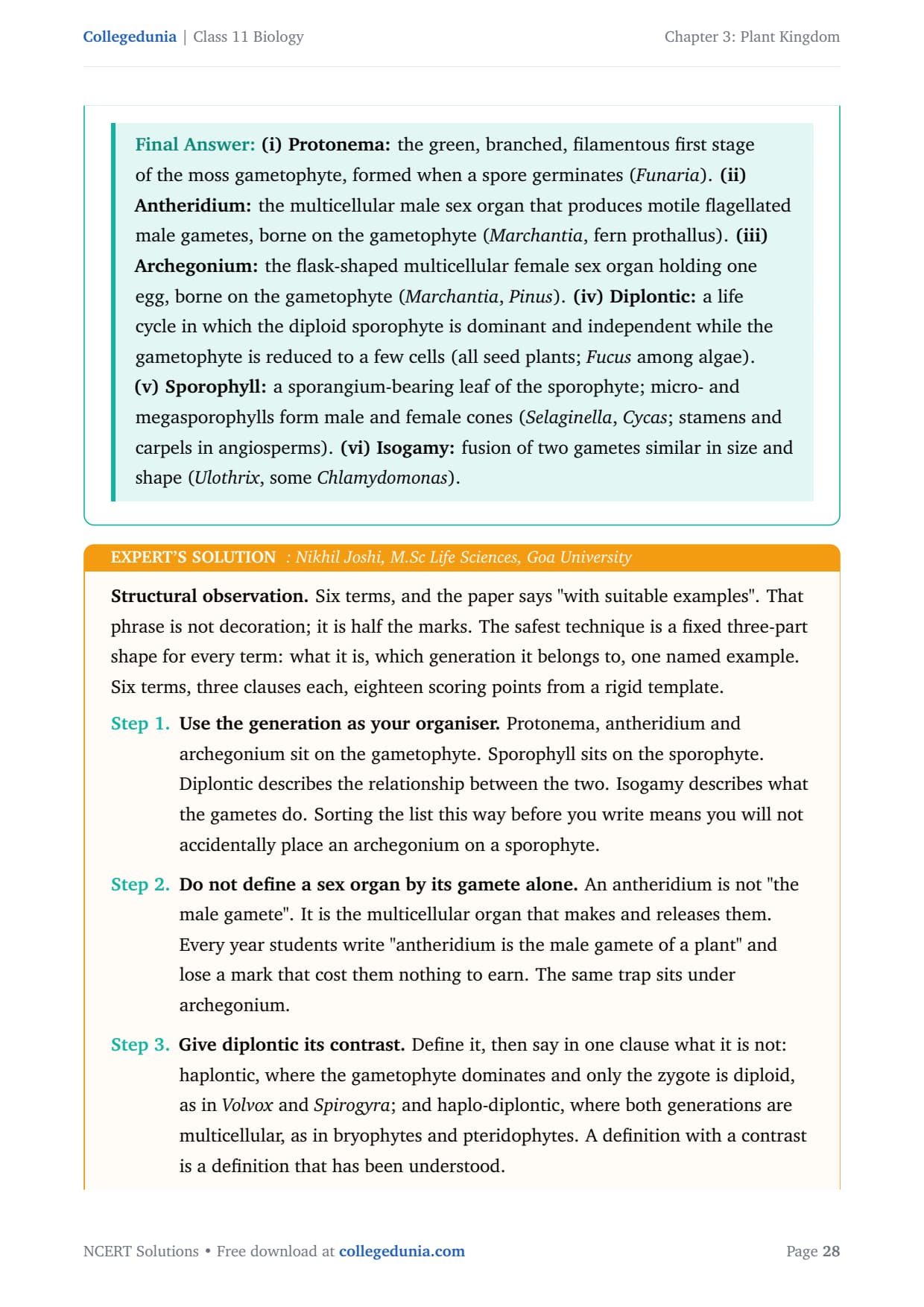
One exercise question asks students to explain six terms with examples, and the safest technique is a fixed three-part shape for every term: what it is, which generation it belongs to, and one named example. Sorting the list by generation first means an archegonium is never accidentally placed on a sporophyte.
| Term | Meaning and example |
|---|---|
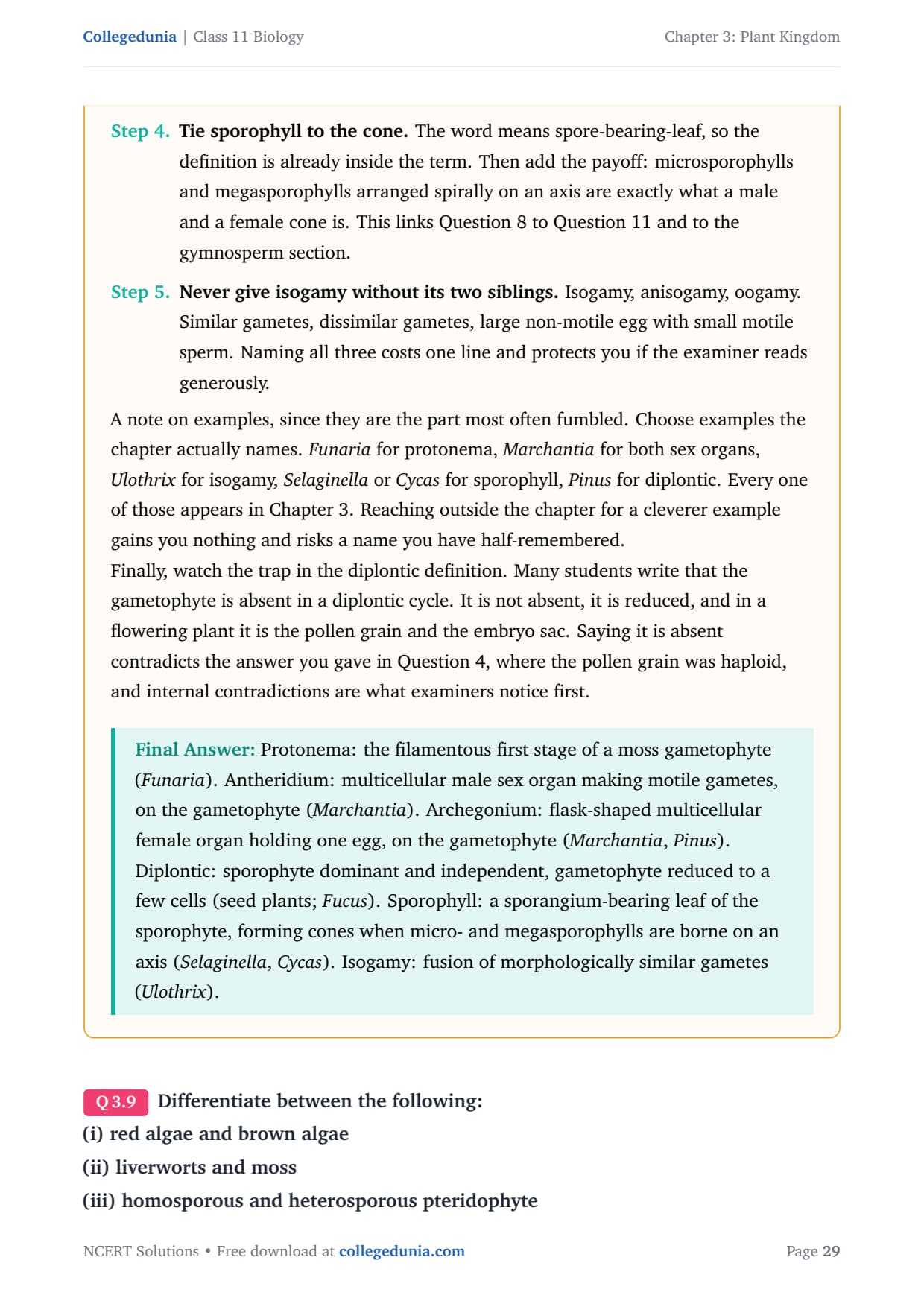
| Protonema | The green, branched, filamentous first stage of the moss gametophyte (Funaria). |
| Antheridium | The multicellular male sex organ producing motile flagellated gametes, on the gametophyte (Marchantia). |
| Archegonium | The flask-shaped multicellular female organ holding one egg, on the gametophyte (Marchantia, Pinus). |
| Diplontic | A life cycle in which the diploid sporophyte is dominant and the gametophyte is reduced to a few cells (all seed plants; Fucus among algae). |
| Sporophyll | A sporangium-bearing leaf of the sporophyte; micro- and megasporophylls form cones (Selaginella, Cycas). |
| Isogamy | Fusion of two gametes similar in size and shape (Ulothrix, some Chlamydomonas). |
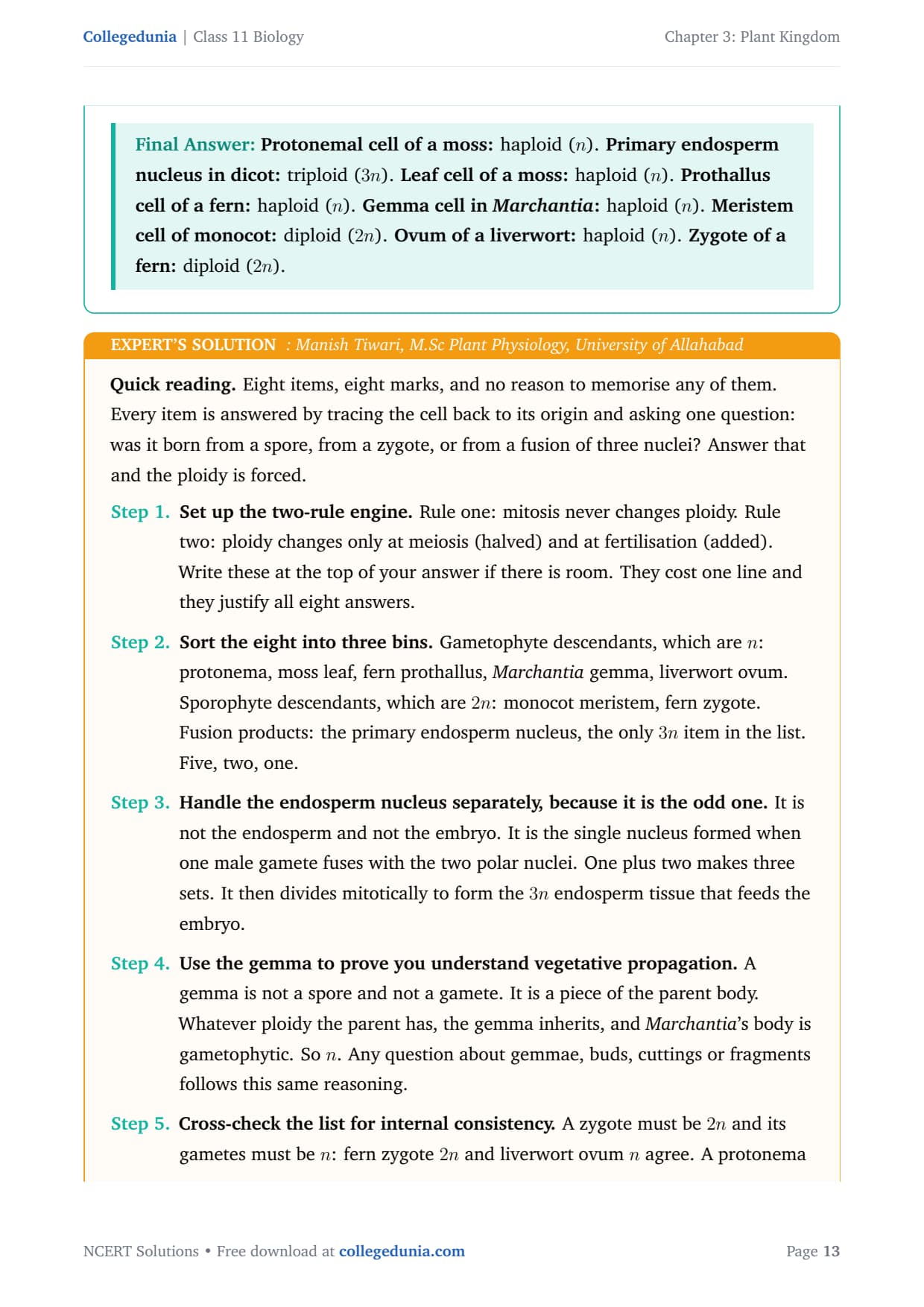
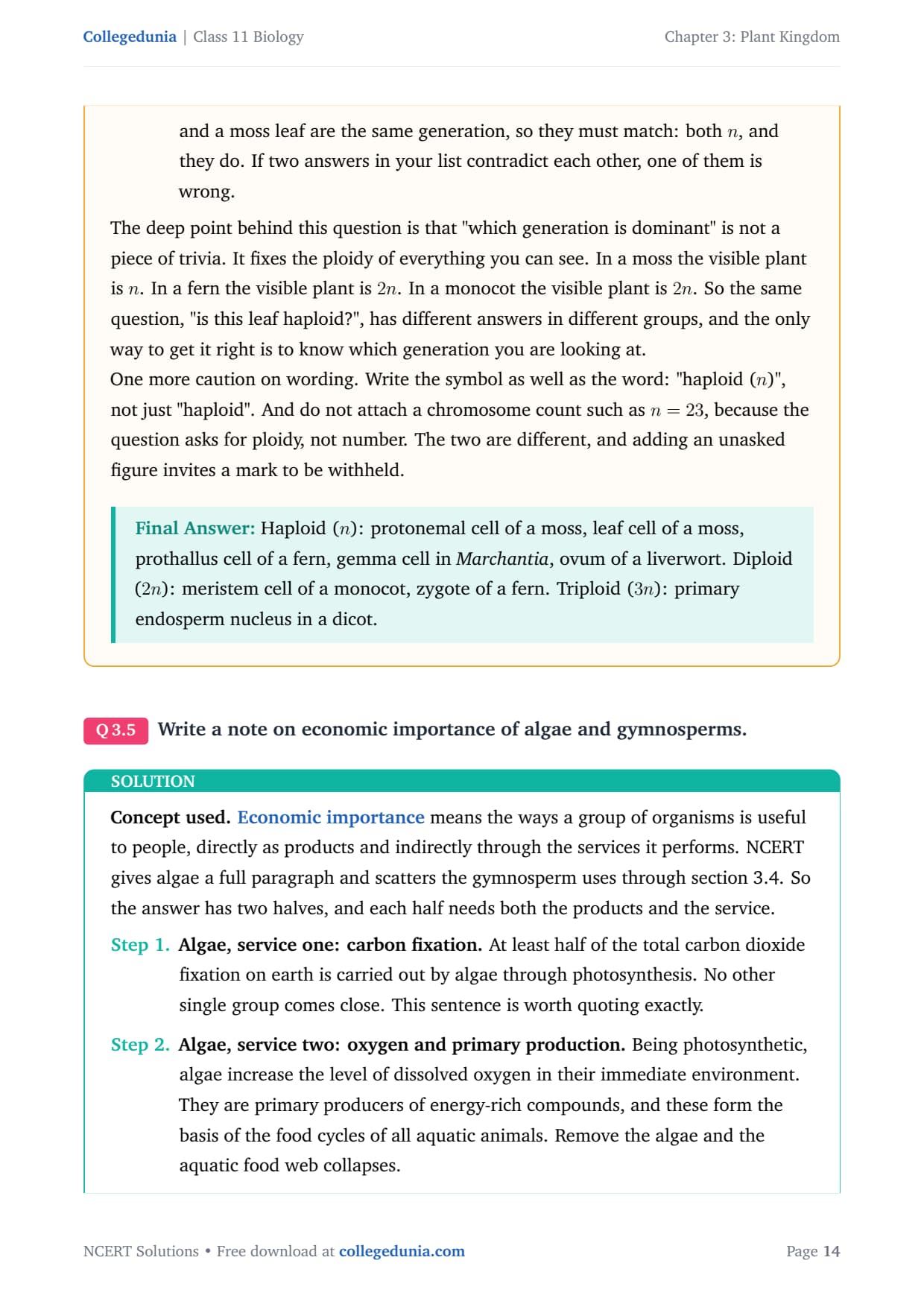
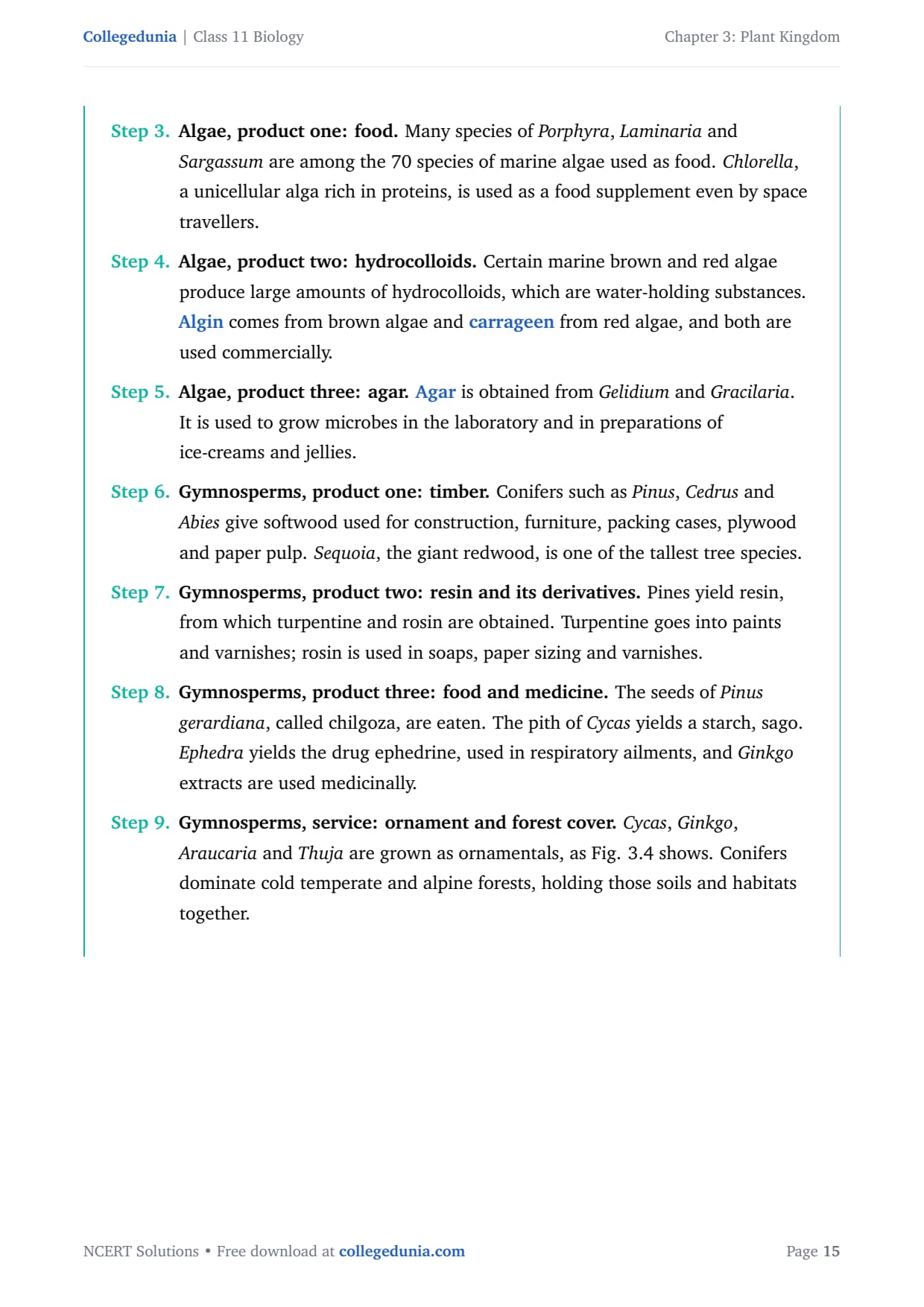
The chapter also asks for the economic importance of algae and gymnosperms, and the strongest opening fact is that algae carry out at least half of all carbon dioxide fixation on earth, besides raising dissolved oxygen and acting as the primary producers behind every aquatic food cycle. They yield food (Porphyra, Laminaria, protein-rich Chlorella), the hydrocolloids algin from brown algae and carrageen from red algae, and agar from Gelidium and Gracilaria. Gymnosperms give softwood timber (Pinus, Cedrus, Abies), resin yielding turpentine and rosin, edible chilgoza seeds of Pinus gerardiana, sago from Cycas pith, and the drug ephedrine from Ephedra. A matching question rounds off the exercise, pairing Chlamydomonas with algae, Cycas with gymnosperm, Selaginella with pteridophyte and Sphagnum with moss, all settled by asking a single question: does it have vascular tissue?
Plant Kingdom Exercise-wise Breakdown
The NCERT back exercise has 11 questions, most descriptive with one ploidy question and one matching question. The table below maps the question blocks to their topics so students can plan their practice group by group.
| Question block | What it tests |
|---|---|
| Q 1, Q 9(i) | Basis of algal classification and the difference between red and brown algae. |
| Q 3, Q 9(ii) | The archegoniate groups, the moss life cycle, and liverworts versus mosses. |
| Q 2, Q 4 | Where reduction division occurs, and the ploidy of eight named cells. |
| Q 7, Q 9(iii) | Heterospory, its significance, and homosporous versus heterosporous pteridophytes. |
| Q 6, Q 11 | Characteristics of gymnosperms and why they are separated from angiosperms. |
| Q 5, Q 8, Q 10 | Economic importance, six key terms with examples, and the matching question. |
Because most questions are descriptive, the marks sit in clean definitions, ploidy reasoning and named examples rather than in calculation. Learn which generation is dominant in each group, and the ploidy and life-cycle answers fall out automatically. Every question in the class 11 biology NCERT solutions chapter 3 Plant Kingdom PDF is solved with each step of reasoning shown, so students can compare their answers against the model working.
Practice the solved questions: Work through the full question bank with step-by-step answers and expert tips.
Common Mistakes Students Make in Plant Kingdom
Most marks in this chapter are lost on ploidy slips and half-stated comparisons, not on hard ideas. Each mistake below costs 1 to 2 marks, so watch for it at the exact step.
Mistake 1: Calling the leaf cell of a moss diploid. In a bryophyte the visible leafy plant is the gametophyte, so its leaves are haploid; only in a fern is the leafy plant diploid.
Mistake 2: Writing that Selaginella produces seeds. It shows the events that led to the seed habit, but the structure is never shed as a proper dormant seed, so NCERT calls it a precursor.
Mistake 3: Separating red and brown algae by colour alone. The marks are in the pigment names, the stored food and the flagella, not the adjective.
Mistake 4: Saying gymnosperm seeds have no covering at all. They lack a fruit wall, but keep a seed coat formed from the integument of the ovule.
Student Feedback on Plant Kingdom Solutions
What 13,120 students told us about their Plant Kingdom preparation:
- 64% of students said the ploidy question was the one they revised most, because a single wrong generation flips several answers.
- Most-missed link: that heterospory in Question 7 and the naked seed in Question 11 are the same evolutionary story told twice, noticed by fewer than half of students.
- Students who drew each life cycle as a ring, with meiosis and fertilisation as the two crossing points, said the descriptive answers became far quicker to write.
Source: 2026-27 Class 11 Biology student poll. Sample of 13,120 students from CBSE schools across 17 states, conducted before the 2026 boards.
Other Plant Kingdom Class 11 Biology Resources
Pair these solutions with the revision notes, formula sheet and NCERT textbook PDF for the same chapter.
| Resource | Link |
|---|---|
| NCERT Notes | Plant Kingdom Class 11 Notes |
| Formula Sheet | Plant Kingdom Class 11 Formula Sheet |
| Exemplar Solutions | Plant Kingdom Class 11 Exemplar Solutions |
| NCERT Book PDF | Plant Kingdom Class 11 Book PDF |
NCERT Solutions for Class 11 Biology: All Chapters
Jump to the step-by-step solutions for any other Class 11 Biology chapter below.
| Chapter | NCERT Solutions |
|---|---|
| Chapter 1 | The Living World |
| Chapter 2 | Biological Classification |
| Chapter 3 | Plant Kingdom |
| Chapter 4 | Animal Kingdom |
| Chapter 5 | Morphology of Flowering Plants |
| Chapter 6 | Anatomy of Flowering Plants |
| Chapter 7 | Structural Organisation in Animals |
| Chapter 8 | Cell: The Unit of Life |
| Chapter 9 | Biomolecules |
| Chapter 10 | Cell Cycle and Cell Division |
| Chapter 11 | Photosynthesis in Higher Plants |
| Chapter 12 | Respiration in Plants |
| Chapter 13 | Plant Growth and Development |
| Chapter 14 | Breathing and Exchange of Gases |
| Chapter 15 | Body Fluids and Circulation |
| Chapter 16 | Excretory Products and their Elimination |
| Chapter 17 | Locomotion and Movement |
| Chapter 18 | Neural Control and Coordination |
| Chapter 19 | Chemical Coordination and Integration |
FAQs on Plant Kingdom Class 11 NCERT Solutions
Plant Kingdom NCERT Solutions - Frequently Asked Questions
Ques. What do the class 11 biology NCERT solutions chapter 3 Plant Kingdom cover?
Ans. These solutions cover every back-exercise question, including the basis of algal classification, where reduction division occurs, the archegoniate groups and the moss life cycle, the ploidy of eight cells, the economic importance of algae and gymnosperms, why gymnosperms and angiosperms are classified separately, heterospory, six key terms with examples, three differentiation pairs, a matching question, and the characteristics of gymnosperms. Every question is solved step by step.
Ques. What is the basis of classification of algae?
Ans. Algae are classified chiefly on their photosynthetic pigments and their stored food, supported by cell wall composition and the number and position of flagella. This gives three classes: Chlorophyceae (chlorophyll a, b; starch), Phaeophyceae (fucoxanthin; laminarin or mannitol) and Rhodophyceae (phycoerythrin; floridean starch, no flagella).
Ques. What is heterospory and why is it important?
Ans. Heterospory is the formation of two kinds of spores, small microspores and large megaspores, by the same plant, giving separate male and female gametophytes. Its significance is that megaspores are retained on the parent sporophyte, germinate in situ, and the embryo develops inside the female gametophyte while still attached to the parent. These events are the precursors to the seed habit. Examples: Selaginella and Salvinia.
Ques. Why are gymnosperms and angiosperms classified separately if both bear seeds?
Ans. A taxon rests on an aggregate of characters, not one. In gymnosperms the ovules are naked with no ovary wall, so the seed stays exposed and no fruit forms, there is single fertilisation, and archegonia are present. In angiosperms the ovules lie in an ovary inside a flower, the seed is enclosed in a fruit, there is double fertilisation giving a triploid endosperm, and an embryo sac replaces the archegonium.
Ques. Why is the leaf cell of a moss haploid?
Ans. In bryophytes the dominant, visible plant is the gametophyte, grown from a haploid spore by mitosis, so every cell including the leaf is haploid. In a fern the visible leafy plant is the sporophyte, grown from a zygote, so its leaves are diploid. The same word, leaf, therefore has opposite ploidy in the two groups.
Ques. What is the weightage of Plant Kingdom in CBSE Class 11 Biology?
Ans. Plant Kingdom carries about 3 to 4 marks in the CBSE Class 11 Biology paper, mostly through short-answer and differentiation questions on the five groups, ploidy and heterospory. It is also frequently tested in NEET, where alternation of generations, the seed habit and the classification of algae appear regularly.



Comments