




The class 11 biology NCERT solutions chapter 19 Chemical Coordination and Integration cover every back-exercise question, according to the latest 2026-27 CBSE syllabus, and help students prepare for the CBSE Boards, NEET and CUET. Each answer is worked step by step, from the difference between exocrine and endocrine glands, through which gland makes which hormone and what its deficiency causes, to how a hormone acts on its target cell through a receptor.
This is the closing chapter of Class 11 Biology, and it pairs with the neural chapter before it: the two together are how the body coordinates itself, one system fast and short-lived, the other slower and wider.
- CBSE Weightage: 4 to 5 marks, one of the highest-scoring chapters in the Human Physiology unit.
- Topics covered: exocrine and endocrine glands, the hormone definition, the endocrine glands and their hormones, hormone functions, deficiency and excess disorders, and the mechanism of hormone action.
- Exercise count: 9 back-exercise questions, mostly define, list, short-note, fill-in-the-blank and match tasks that reward exact recall.
These class 11 biology NCERT solutions chapter 19 Chemical Coordination and Integration are curated by subject experts, based on the 2026-27 NCERT textbook, and checked against the last five years of CBSE Board and NEET papers.
Why Chemical Coordination and Integration Matters and What the Chapter Covers
Nerves carry signals in milliseconds, but the effect is brief and the reach is narrow. The body needs a second control system that is slower to act but longer-lasting and body-wide, and that system is chemical coordination through hormones. This chapter names the endocrine glands, lists the hormone each one makes, explains what happens when a gland secretes too little or too much, and shows how a hormone changes a target cell without necessarily entering it.
- Everyday role: the rise in heart rate before an exam, the control of blood sugar after a meal, and the changes of puberty are all driven by hormones.
- Core skill: matching each hormone to its source gland, its target and its function, and reading a hormone's name for the clue to what it does.
- Why it matters for NEET: the gland-hormone-function lists, the deficiency disorders and the two mechanisms of hormone action are among the most heavily tested topics in the unit.
Almost every question in this chapter is answered from one framework: gland, hormone, target and function, held together by a few antagonist pairs that keep the blood in balance. Students who build that framework can answer the list, function and disorder questions from the same base. The class 11 biology NCERT solutions chapter 19 Chemical Coordination and Integration below follow the same order as the NCERT textbook so students can check their working line by line.
Exocrine and Endocrine Glands and What a Hormone Is
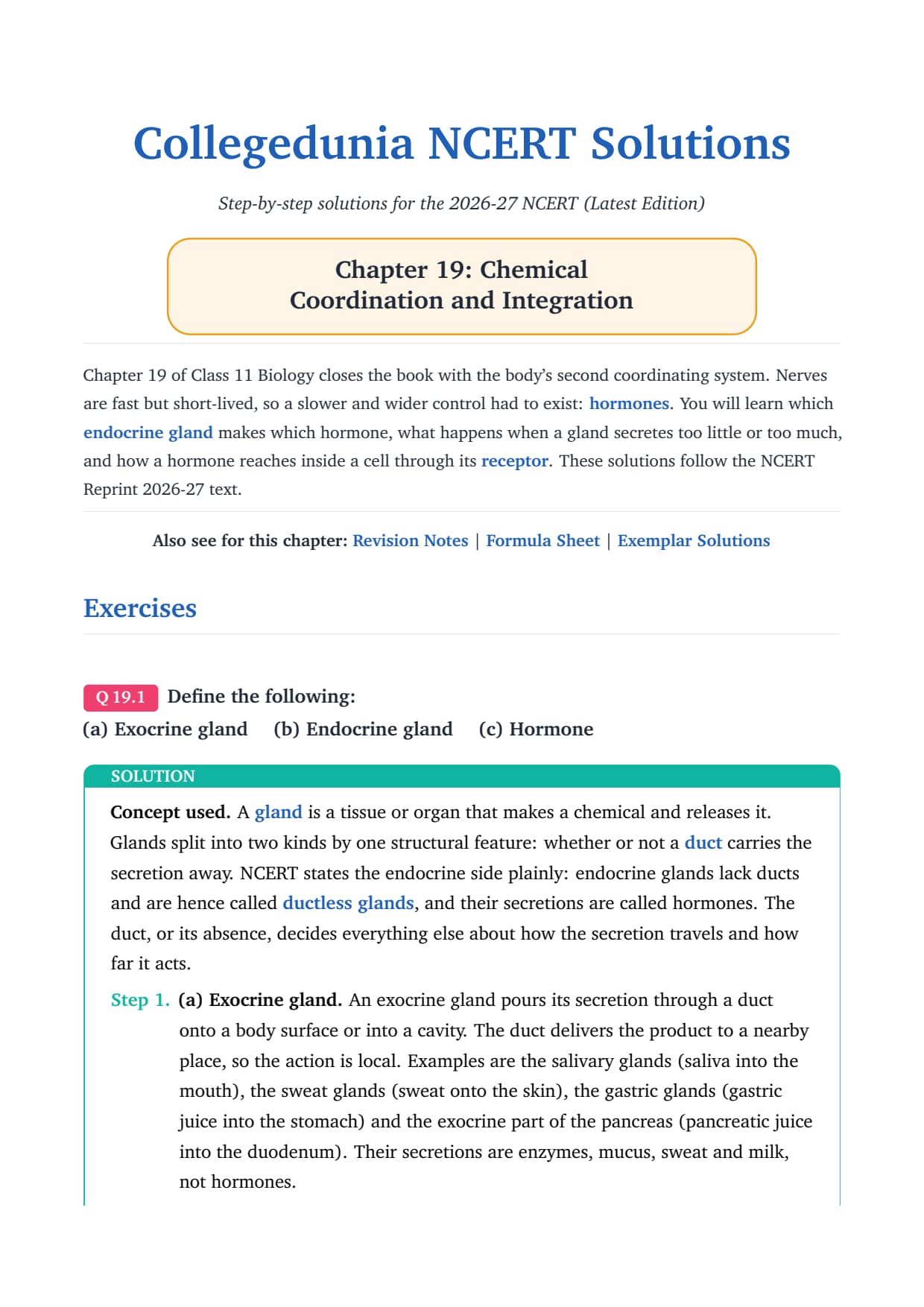
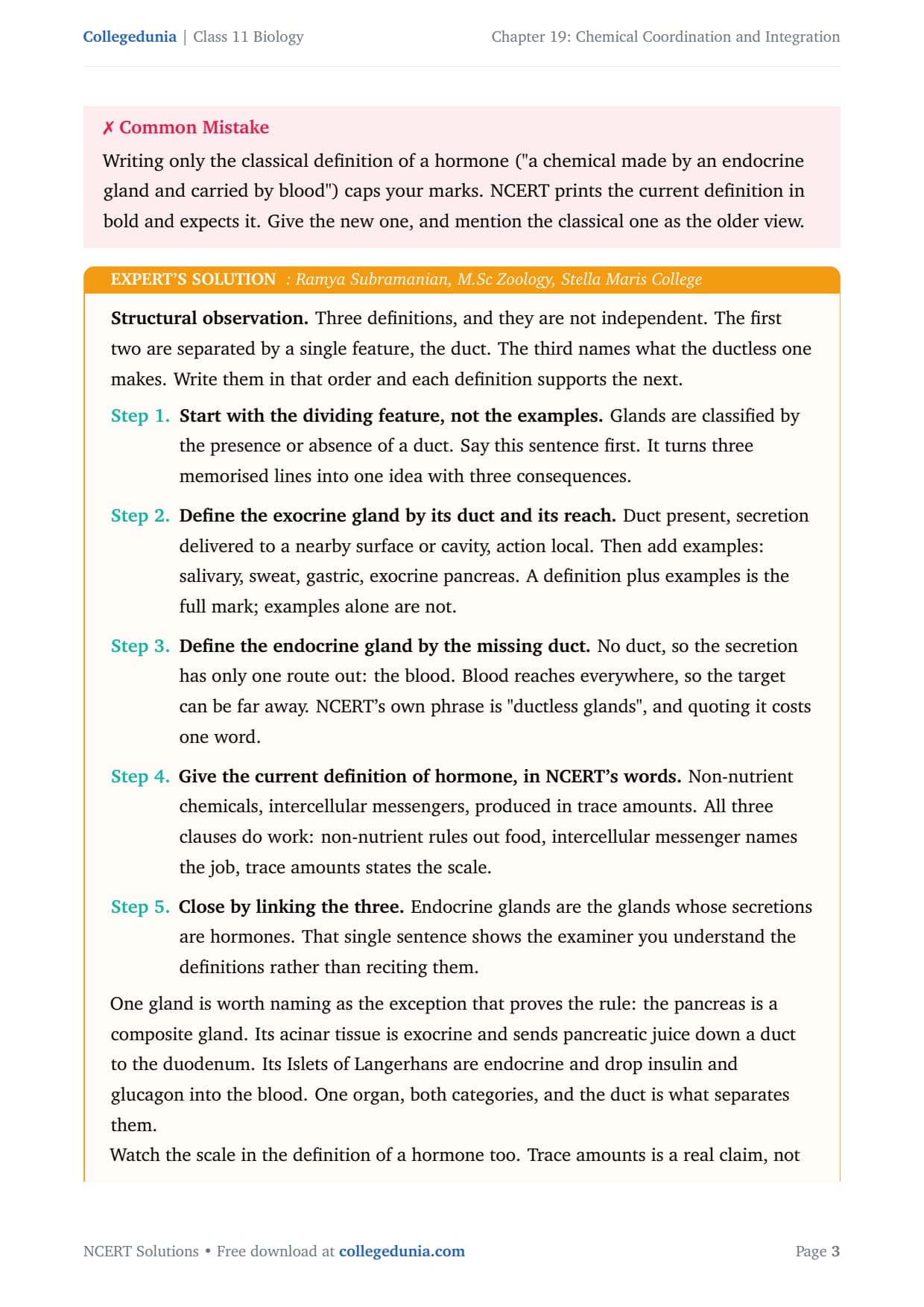
Glands are classified by one structural feature: whether or not a duct carries the secretion away. An exocrine gland pours its secretion through a duct onto a surface or into a cavity, so it acts locally, and its products are enzymes, mucus, sweat or milk. An endocrine gland has no duct, so NCERT calls these ductless glands; it releases its secretion straight into the blood, which carries it to a distant target. The definitions in Exercise Q1 all follow from this single duct-or-no-duct split.
| Feature | Exocrine gland | Endocrine gland |
|---|---|---|
| Duct | Present | Absent (ductless) |
| Route of secretion | Duct to a surface or cavity | Directly into the blood |
| Reach of action | Local, nearby | Distant target organs |
| Examples | Salivary, sweat, gastric glands | Pituitary, thyroid, adrenal, pancreas (islets) |
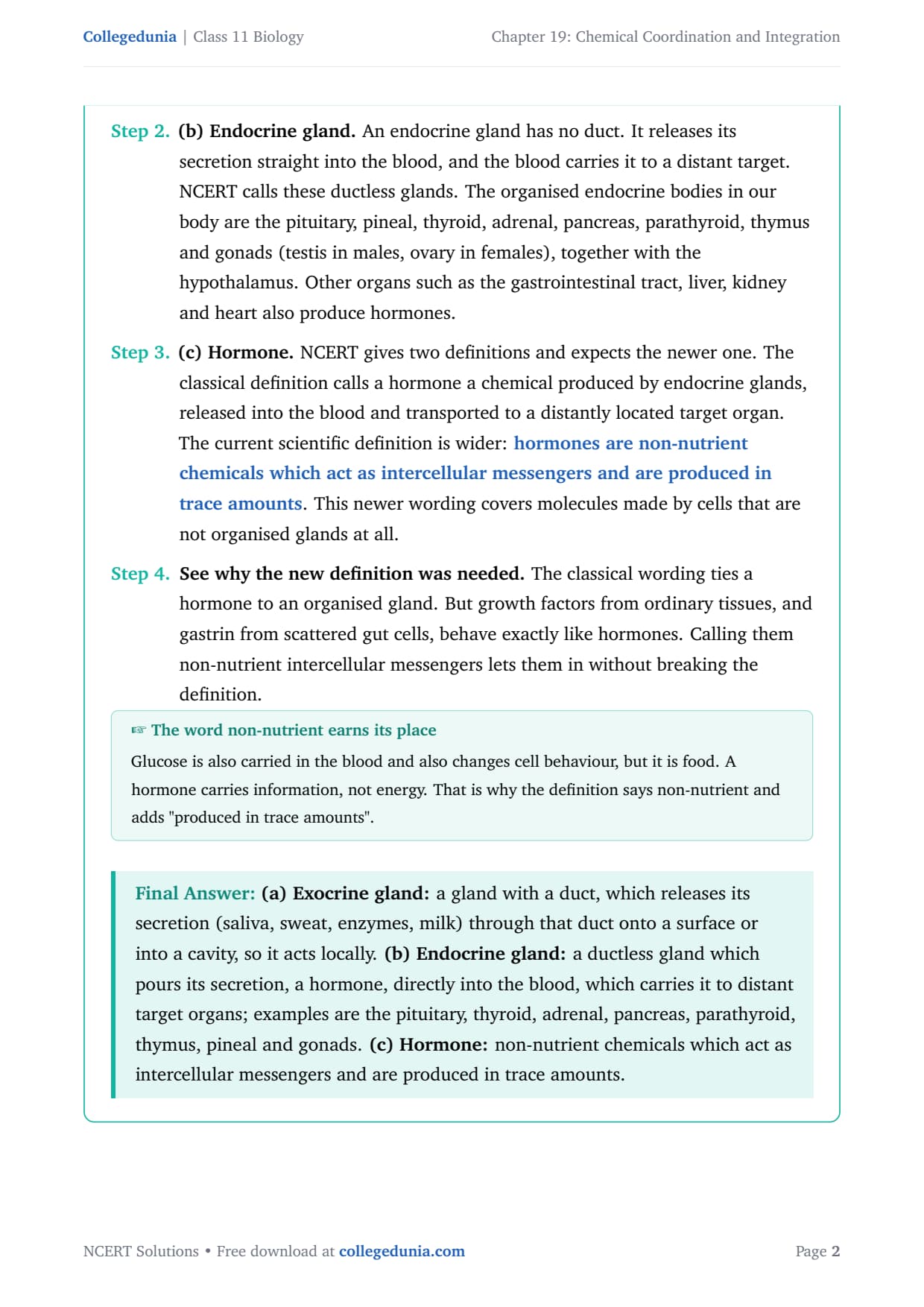
A hormone has two definitions and NCERT expects the newer one. The classical definition calls a hormone a chemical made by an endocrine gland, released into the blood and carried to a distant target. The current definition is wider: hormones are non-nutrient chemicals which act as intercellular messengers and are produced in trace amounts. The word non-nutrient earns its place, because glucose is also carried in the blood and also changes cell behaviour, but it is food; a hormone carries information, not energy. The pancreas proves the rule that the duct decides everything: its acinar tissue is exocrine and sends juice down a duct, while its Islets of Langerhans are endocrine and drop insulin and glucagon into the blood.
The Endocrine Glands and Where They Sit
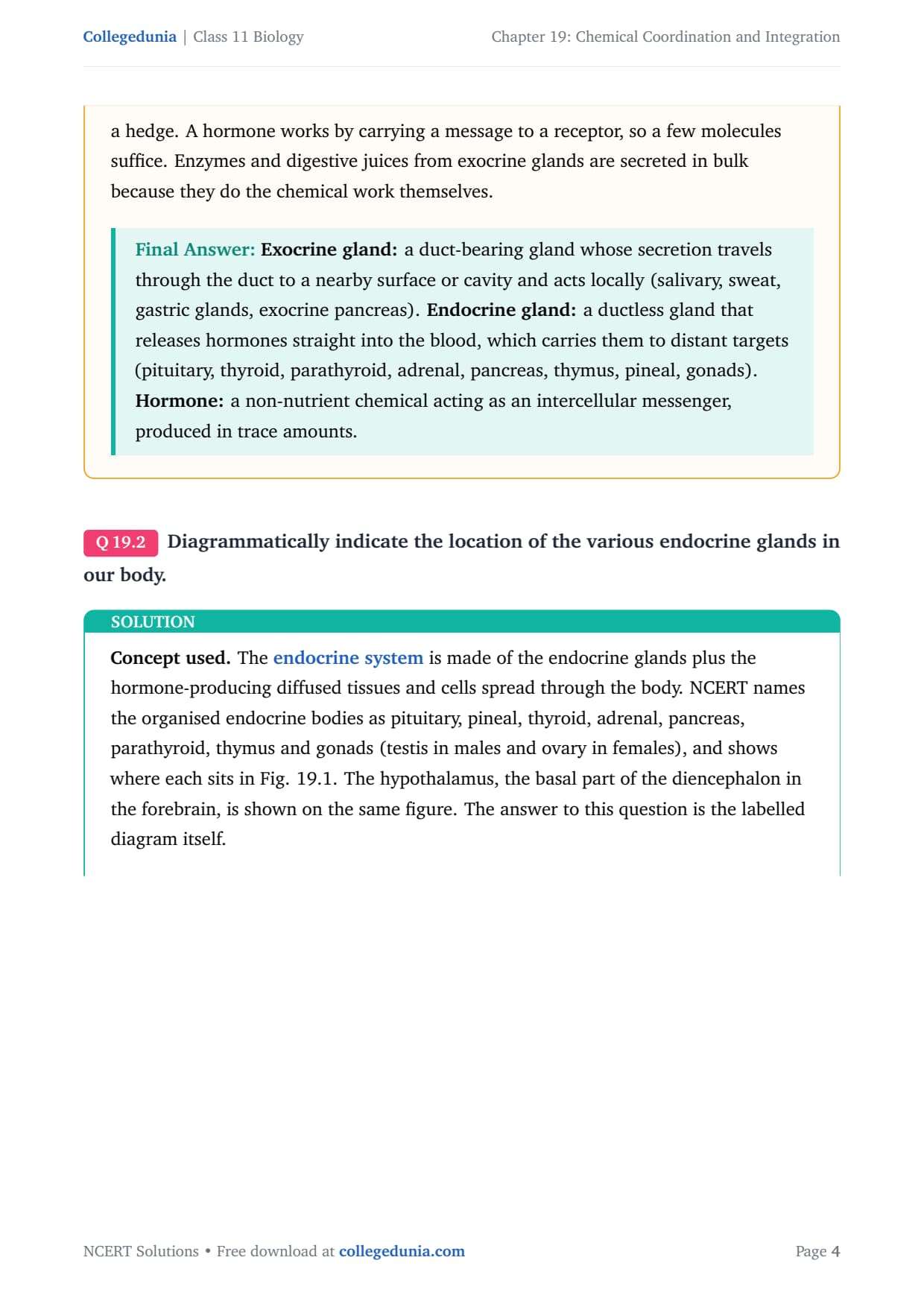
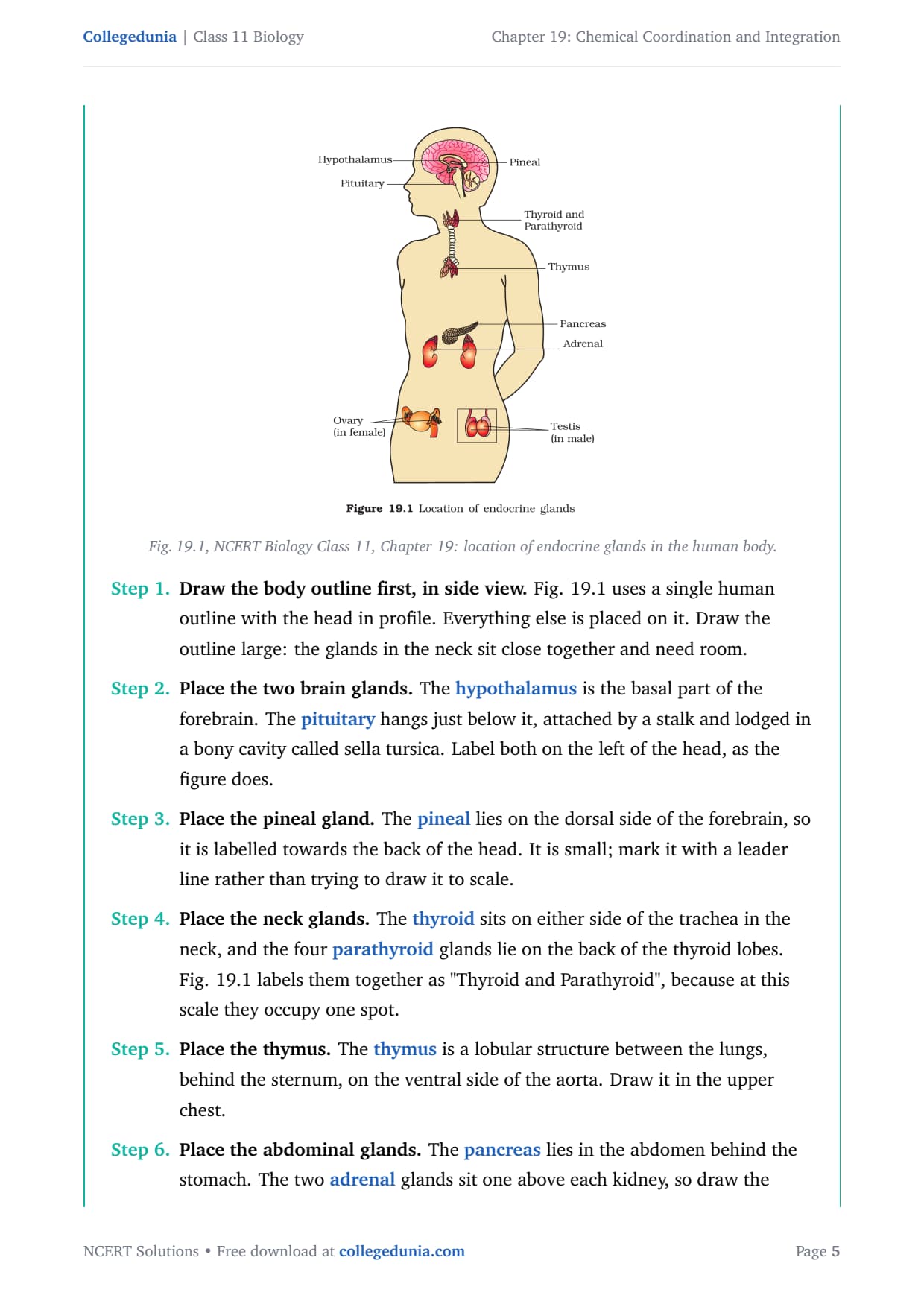
The endocrine system is made of the organised endocrine glands plus hormone-producing tissues scattered through the body. NCERT names the organised glands as the pituitary, pineal, thyroid, parathyroid, adrenal, pancreas, thymus and gonads, together with the hypothalamus, and shows where each sits on a single body outline. Drawing that labelled diagram is the whole answer to Exercise Q2, where the marks are in the labels rather than the artistry.
- Head: the hypothalamus at the base of the forebrain, the pituitary hanging just below it in a bony cavity, and the pineal on the dorsal side of the forebrain.
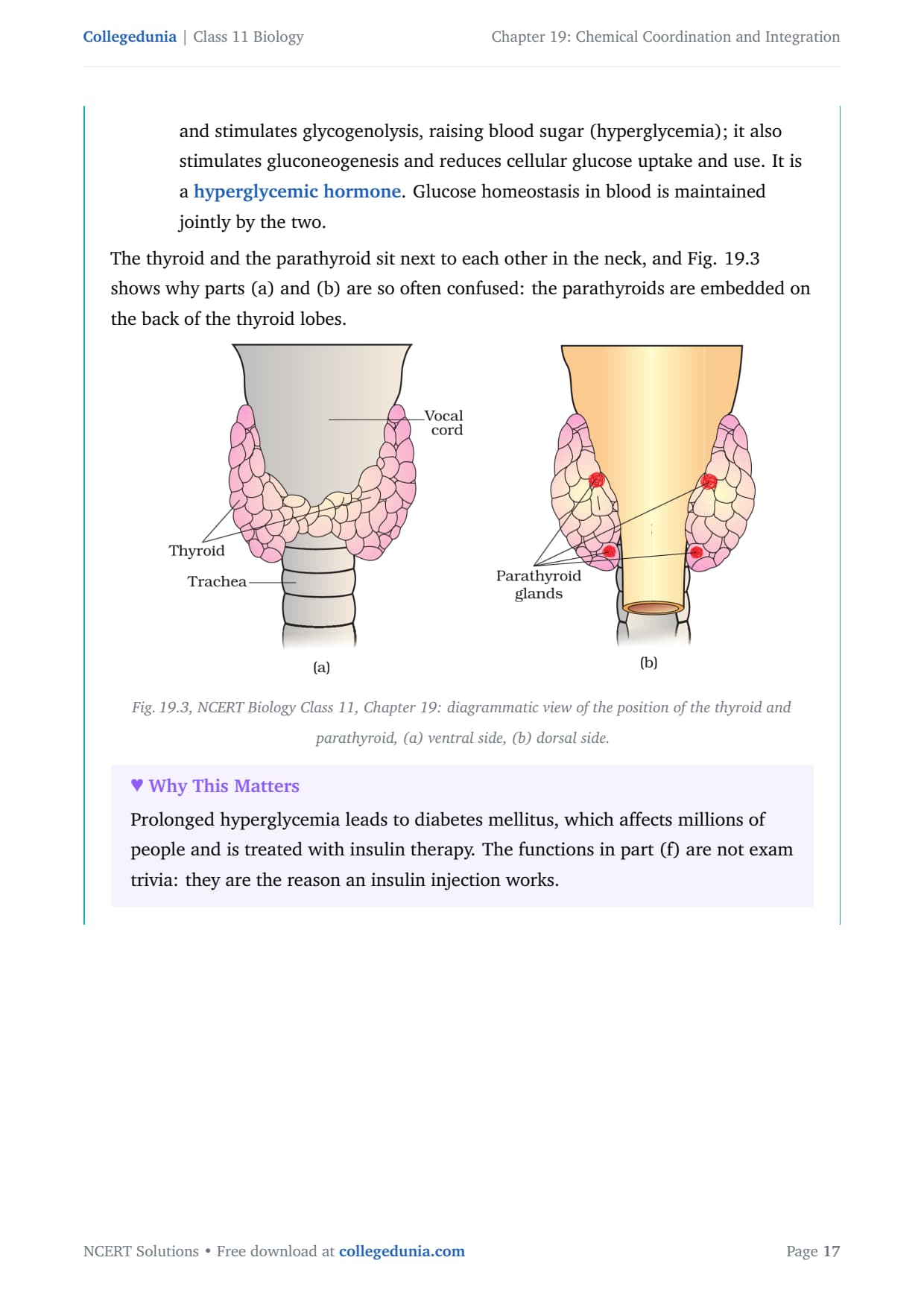
- Neck: the thyroid on either side of the trachea, with the four parathyroid glands on the back of the thyroid lobes.
- Chest: the thymus behind the sternum, between the lungs.
- Abdomen and pelvis: the pancreas behind the stomach, an adrenal gland capping each kidney, and the gonads (ovary in the female abdomen, testis in the male scrotal sac).
The gastrointestinal tract, liver, kidney and heart also produce hormones, but they are not organised endocrine bodies, so they are mentioned in a line rather than drawn on the location diagram. The hypothalamus belongs on the diagram even though NCERT's list of organised glands does not name it, because it contains neurosecretory cells that produce hormones and it controls much of the rest of the system. Labelling on both sides of the outline keeps the leader lines from crossing, which is the commonest reason a correct label gets read as wrong.
Hormones of the Major Endocrine Glands
Each gland has a fixed secretion list, and NCERT gives them gland by gland. The list question in Exercise Q3 is worth close to twelve marks, so coverage matters more than depth: write each gland as a heading and its hormones as a short list, and split every gland that has parts. The pituitary and the adrenal are the two that punish a single list.
| Gland | Hormones |
|---|---|
| Hypothalamus | Releasing hormones (e.g. GnRH) and inhibiting hormones (e.g. somatostatin) |
| Pituitary | GH, PRL, TSH, ACTH, LH, FSH (pars distalis); MSH (pars intermedia); oxytocin and vasopressin (pars nervosa) |
| Thyroid | Thyroxine (T4), triiodothyronine (T3), thyrocalcitonin (TCT) |
| Parathyroid | Parathyroid hormone (PTH) |
| Adrenal | Adrenaline and noradrenaline (medulla); glucocorticoids and mineralocorticoids (cortex) |
| Pancreas | Insulin (β-cells) and glucagon (α-cells) |
| Gonads | Androgens (testis); estrogen and progesterone (ovary) |
| Others | Thymosins (thymus); ANF (atrium); erythropoietin (kidney); gastrin, secretin, CCK, GIP (GI tract) |
Two cautions save the most marks here. The anterior pituitary (pars distalis) makes exactly six trophic hormones, and the one students most often drop is prolactin, so count to six before moving on. Oxytocin and vasopressin are stored and released by the posterior pituitary but synthesised by the hypothalamus, so if a question asks who secretes them the answer is the posterior pituitary, and if it asks who makes them the answer is the hypothalamus. The thyroid's third hormone, thyrocalcitonin, is the one that vanishes from answers, and it matters because it is the opposite number to PTH in calcium balance. Naming the cell where NCERT names it, such as the Leydig cells for androgens, earns a free extra mark.
Hormone Functions and the Antagonist Pairs
A hormone's function is the set of changes it produces in its target tissue, and the sharpest way to hold this section is to notice that several hormones work in opposing pairs to keep one blood variable steady. That paired opposition is homeostasis, and it is what the short-note question in Exercise Q5 is really testing. Read a functional name for its clue: hyper means the blood level goes up and hypo means it goes down, and the -emia ending means in the blood.
- Calcium pair: PTH is hypercalcemic and raises blood calcium by bone resorption, renal reabsorption and gut absorption; thyrocalcitonin lowers it.
- Glucose pair: glucagon from the α-cells is hyperglycemic and drives glycogenolysis and gluconeogenesis; insulin from the β-cells is hypoglycemic and drives glucose uptake and glycogenesis.
- Thyroid hormones: regulate the basal metabolic rate, support red blood cell formation, control the metabolism of carbohydrates, proteins and fats, and maintain water and electrolyte balance.
- Sex steroids: androgens and estrogens each build the accessory sex organs, bring on the secondary sex characters, drive gamete or follicle development, and shape sexual behaviour; thymosins drive T-lymphocyte differentiation and antibody production.
Hyper and hypo name the state of the blood, not the gland, so a hypoglycemic hormone makes blood glucose low, which is why insulin is hypoglycemic. Students who read hypoglycemic as low insulin get the answer exactly backwards. In each antagonist pair the raiser is the hormone the body reaches for when it is short, and it works by taking the substance out of storage: bone for calcium, glycogen for glucose. Learn one sex steroid column and the other is its mirror, with testosterone giving facial hair and a low pitch of voice and estrogen giving mammary development and a high pitch of voice.
Hormonal Disorders: Deficiency and Excess
A deficiency disorder appears when a gland secretes too little of its hormone, a state NCERT calls hyposecretion, so the process that hormone drives stops running. An excess, or hypersecretion, drives the opposite disorder. The deficiency question in Exercise Q7 turns on just two hormones, insulin and thyroxine, because two of its three disorders come from the same thyroid deficiency and differ only in the age at which it strikes.
| Disorder | Hormone involved | Cause |
|---|---|---|
| Diabetes mellitus | Insulin | Deficiency of insulin and/or insulin resistance; blood glucose stays high |
| Goitre | Thyroid hormones (T4, T3) | Dietary iodine shortage causes hypothyroidism and thyroid enlargement |
| Cretinism | Thyroid hormones | Hypothyroidism during pregnancy and infancy; stunted growth and low IQ |
| Exophthalmic goitre | Thyroid hormones (excess) | Hyperthyroidism, with protruding eyeballs (Graves' disease) |
Iodine deficiency is a dietary cause, not a hormonal one, so for goitre name the thyroid hormones first and then add that a shortage of dietary iodine is what made them run low. The other frequent slip is confusing diabetes mellitus with diabetes insipidus: mellitus is an insulin problem that spills glucose in the urine, while insipidus is an ADH (vasopressin) problem that spills water. Excess disorders complete the picture: too much growth hormone gives gigantism in children and acromegaly in adults, and too little adrenal cortex hormone gives Addison's disease.
Mechanism of Hormone Action
A hormone acts only where a matching receptor exists, because NCERT's rule is that hormones bind specific proteins called hormone receptors located in the target tissues only, and each receptor is specific to one hormone. Where the receptor sits decides the whole mechanism, which is why the FSH question in Exercise Q8 begins by classifying the hormone as a protein.
| Feature | Membrane-bound receptor | Intracellular receptor |
|---|---|---|
| Receptor location | On the cell membrane | Inside the cell |
| Hormone type | Protein and peptide hormones (FSH, insulin) | Steroids and iodothyronines |
| Does the hormone enter the cell? | No | Yes |
| How the effect is produced | Second messengers such as cyclic AMP | Regulation of gene expression |
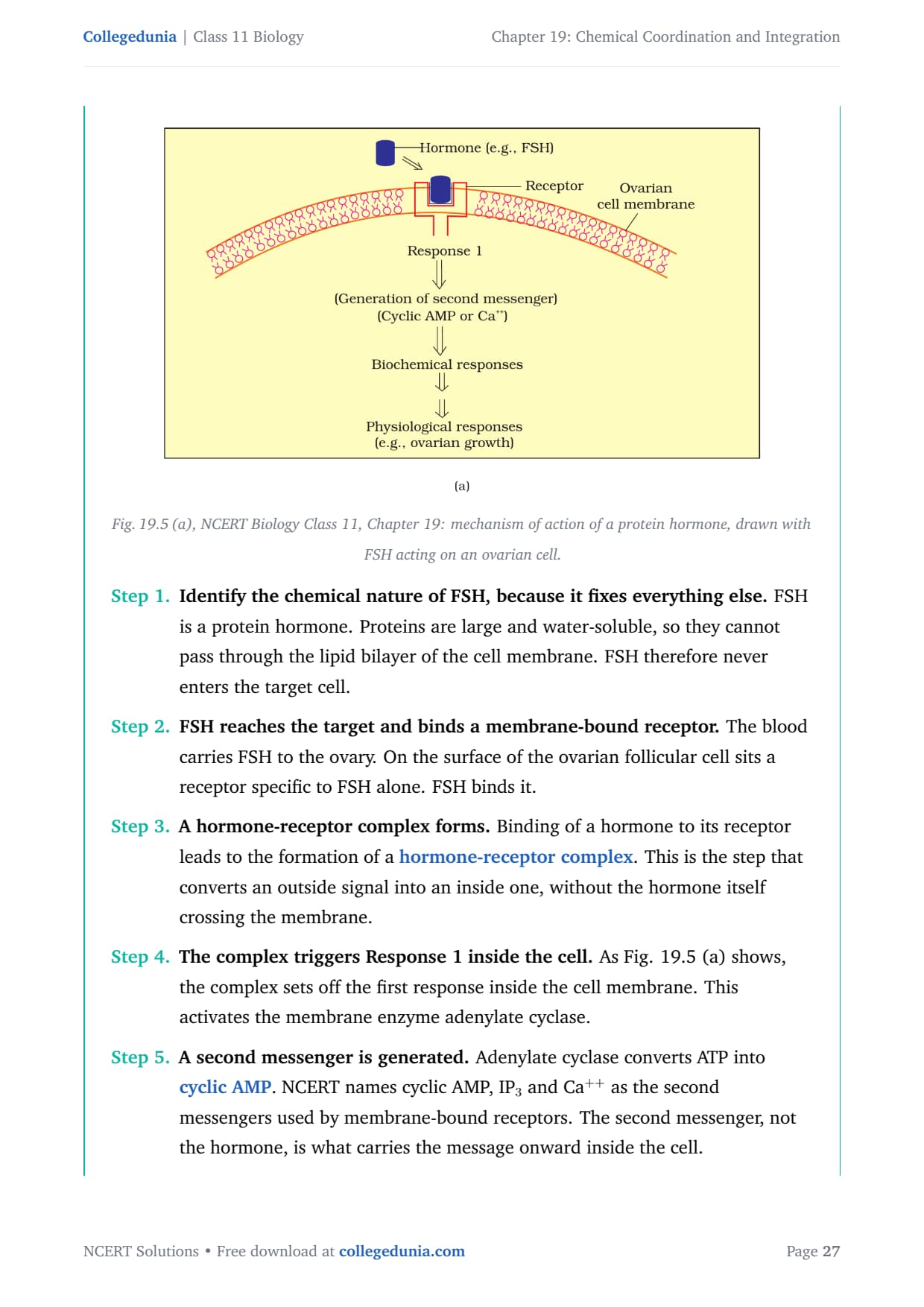
FSH is a protein hormone, so it cannot cross the lipid cell membrane and must use the membrane-bound route. It binds a specific receptor on the ovarian follicular cell and forms a hormone-receptor complex, which activates the enzyme adenylate cyclase, which converts ATP into the second messenger cyclic AMP. Cyclic AMP, not the hormone, carries the message onward inside the cell, regulating metabolism and producing the biochemical responses whose sum is the physiological response: growth of the ovarian follicles and secretion of estrogen. The whole chain in one line is FSH → membrane receptor → hormone-receptor complex → adenylate cyclase → cyclic AMP → biochemical responses → follicle growth. A steroid such as estrogen takes the other door, crossing the membrane to bind an intracellular receptor and acting on the genome. Same destination, different route.
Chemical Coordination and Integration Exercise-wise Breakdown
The NCERT back exercise has 9 questions, and they are mostly recall tasks: define, list, fill in the blank, write short notes, give examples and match. The table below maps the question blocks to their topics so students can plan their practice by theme.
| Question block | What it tests |
|---|---|
| Q 1 and Q 2 | Defining exocrine and endocrine glands and hormones, and the location diagram of the endocrine glands. |
| Q 3 | Listing the hormones secreted by twelve glands and tissues. |
| Q 4 and Q 9 | Matching hormones to their target gland and to their source gland. |
| Q 5 and Q 6 | Short notes on hormone functions, and examples of hormones named by their effect. |
| Q 7 and Q 8 | The deficiency disorders diabetes, goitre and cretinism, and the mechanism of action of FSH. |
The chapter rewards exact recall and clean labelled diagrams rather than calculation. Learn the glands as a framework of source, hormone, target and function, and read every hormone name for the clue it hides about what it does. Every question in the class 11 biology NCERT solutions chapter 19 Chemical Coordination and Integration PDF is solved with each step of reasoning shown, so students can compare their answers against the model working.
Practice the solved questions: Work through the full question bank with step-by-step answers and expert tips.
Chemical Coordination and Integration Class 11 Solved Practice Questions
Common Mistakes Students Make in Chemical Coordination and Integration
Most marks in this chapter are lost on small slips of naming and direction, not on hard ideas. Each mistake below costs 1 to 2 marks, so watch for it at the exact step.
Mistake 1: Giving only the classical definition of a hormone. NCERT prints the current definition in bold, non-nutrient intercellular messengers produced in trace amounts, and expects it.
Mistake 2: Answering iodine deficiency for goitre. Iodine is a dietary cause; the question asks for the hormonal deficiency, which is of the thyroid hormones.
Mistake 3: Reading hypoglycemic as low insulin. Hyper and hypo name the blood level, so a hypoglycemic hormone lowers blood glucose, which is exactly what insulin does.
Mistake 4: Answering adrenal instead of adrenal cortex for ACTH. ACTH drives only the cortex; the medulla is under neural control, so a bare adrenal loses the half-mark.
Student Feedback on Chemical Coordination and Integration Solutions
What 11,980 students told us about their Chemical Coordination and Integration preparation:
- 64% of students said remembering the full pituitary and adrenal hormone lists, without dropping prolactin or MSH, was the trickiest part of the chapter.
- Most-skipped detail: naming the thyroid's third hormone, thyrocalcitonin, when listing thyroid hormones, missed by about 4 in 10 students.
- Students who learned the antagonist pairs, PTH against TCT and glucagon against insulin, said the function and disorder questions became far easier.
Source: 2026-27 Class 11 Biology student poll. Sample of 11,980 students from CBSE schools across 15 states, conducted before the 2026 boards.
Other Chemical Coordination and Integration Class 11 Biology Resources
Pair these solutions with the revision notes, formula sheet and NCERT textbook PDF for the same chapter.
| Resource | Link |
|---|---|
| NCERT Notes | Chemical Coordination and Integration Class 11 Notes |
| Formula Sheet | Chemical Coordination and Integration Class 11 Formula Sheet |
| NCERT Book PDF | Chemical Coordination and Integration Class 11 Book PDF |
NCERT Solutions for Class 11 Biology: All Chapters
Jump to the step-by-step solutions for any other Class 11 Biology chapter below.
| Chapter | NCERT Solutions |
|---|---|
| Chapter 1 | The Living World |
| Chapter 2 | Biological Classification |
| Chapter 3 | Plant Kingdom |
| Chapter 4 | Animal Kingdom |
| Chapter 5 | Morphology of Flowering Plants |
| Chapter 6 | Anatomy of Flowering Plants |
| Chapter 7 | Structural Organisation in Animals |
| Chapter 8 | Cell: The Unit of Life |
| Chapter 9 | Biomolecules |
| Chapter 10 | Cell Cycle and Cell Division |
| Chapter 11 | Photosynthesis in Higher Plants |
| Chapter 12 | Respiration in Plants |
| Chapter 13 | Plant Growth and Development |
| Chapter 14 | Breathing and Exchange of Gases |
| Chapter 15 | Body Fluids and Circulation |
| Chapter 16 | Excretory Products and their Elimination |
| Chapter 17 | Locomotion and Movement |
| Chapter 18 | Neural Control and Coordination |
| Chapter 19 | Chemical Coordination and Integration |
FAQs on Chemical Coordination and Integration Class 11 NCERT Solutions
Chemical Coordination and Integration NCERT Solutions - Frequently Asked Questions
Ques. What do the class 11 biology NCERT solutions chapter 19 Chemical Coordination and Integration cover?
Ans. These solutions cover all 9 back-exercise questions, including defining exocrine and endocrine glands and hormones, the location of the endocrine glands, listing the hormones of twelve glands and tissues, matching hormones to their target and source glands, hormone functions, the deficiency disorders diabetes, goitre and cretinism, and the mechanism of action of FSH. Every question is solved step by step.
Ques. What is the difference between an exocrine and an endocrine gland?
Ans. An exocrine gland has a duct that carries its secretion, such as saliva or sweat, to a nearby surface or cavity, so it acts locally. An endocrine gland is ductless and releases its secretion, a hormone, straight into the blood, which carries it to distant target organs. The pancreas is both: its acinar tissue is exocrine and its Islets of Langerhans are endocrine.
Ques. What is the current definition of a hormone in NCERT?
Ans. NCERT gives the current definition of a hormone as non-nutrient chemicals which act as intercellular messengers and are produced in trace amounts. This is wider than the classical definition, which tied a hormone to an organised endocrine gland, because it also covers messengers made by scattered cells such as gastrin from the gut. Non-nutrient rules out food molecules like glucose.
Ques. Which hormonal deficiency causes goitre and cretinism?
Ans. Goitre and cretinism both come from a deficiency of the thyroid hormones, thyroxine (T4) and triiodothyronine (T3), following a shortage of iodine in the diet. Goitre is the enlargement of the thyroid in an adult, while cretinism is the stunted growth and low IQ that follow the same deficiency during pregnancy and infancy. The difference is the timing, not the hormone.
Ques. What is the mechanism of action of a protein hormone such as FSH?
Ans. FSH is a protein hormone, so it cannot enter the target cell. It binds a membrane-bound receptor on the ovarian follicular cell to form a hormone-receptor complex, which activates adenylate cyclase and generates the second messenger cyclic AMP. Cyclic AMP regulates cellular metabolism and produces the physiological response: growth of the ovarian follicles and secretion of estrogen.
Ques. What is the weightage of Chemical Coordination and Integration in CBSE Class 11 Biology?
Ans. Chemical Coordination and Integration carries about 4 to 5 marks in the CBSE Class 11 Biology paper, through list, short-note, fill-in-the-blank and match questions from the Human Physiology unit. It is also heavily tested in NEET, where the gland-hormone lists, the deficiency disorders and the two mechanisms of hormone action appear regularly.



Comments