




The class 11 biology NCERT solutions chapter 18 Neural Control and Coordination cover every back-exercise question, according to the latest 2026-27 CBSE syllabus, and help students prepare for the CBSE Boards, NEET and CUET. Each answer is worked step by step, from how a neuron is built and why its membrane is polarised, to how a sodium influx creates an action potential, how the impulse crosses a synapse, and how the human brain is divided into three parts.
This chapter opens the coordination unit of Class 11 Biology, and the vocabulary of the neuron and the nerve impulse that students learn here carries directly into Chapter 19 on chemical coordination.
- CBSE Weightage: 3 to 5 marks, part of the Human Physiology unit that also carries the highest marks in the Class 11 paper.
- Topics covered: the neuron, neural system organisation, resting potential, action potential and the role of sodium, transmission across a synapse, and the human brain and its three divisions.
- Exercise count: 10 back-exercise questions, mostly descriptive, with several diagram-drawing and compare-and-distinguish questions.
These class 11 biology NCERT solutions chapter 18 Neural Control and Coordination are curated by subject experts, based on the 2026-27 NCERT textbook, and checked against the last five years of CBSE Board and NEET papers.
Why Neural Control and Coordination Matters and What the Chapter Covers
The body is a team of organs, and a team needs a way to talk to itself in milliseconds. That is what the neural system provides. Coordination is the process through which two or more organs interact and complement one another's functions, and the neural system does this through an organised network of point-to-point connections that carry signals almost instantly. This chapter builds the language of that network, from the single neuron to the whole brain.
- Everyday role: when students run, the energy demand rises, so heart rate, breathing and blood flow rise together, then wind down once the exercise stops. That whole adjustment is neural coordination at work.
- Core skill: tracing a signal from a stimulus, along the axon as a nerve impulse, across a synapse, and on to the next cell.
- Why it matters for NEET: the resting potential, action potential and synapse are among the most frequently tested topics in the Human Physiology unit.
Almost every question in this chapter comes back to one idea: a charged membrane that flips its polarity and hands the flip on to the next cell. Students who understand that single mechanism can answer the polarisation, depolarisation, action-potential and synapse questions from the same base. The class 11 biology NCERT solutions chapter 18 Neural Control and Coordination below follow the same order as the NCERT textbook so students can check their working line by line.
The Neuron and How the Neural System Is Organised
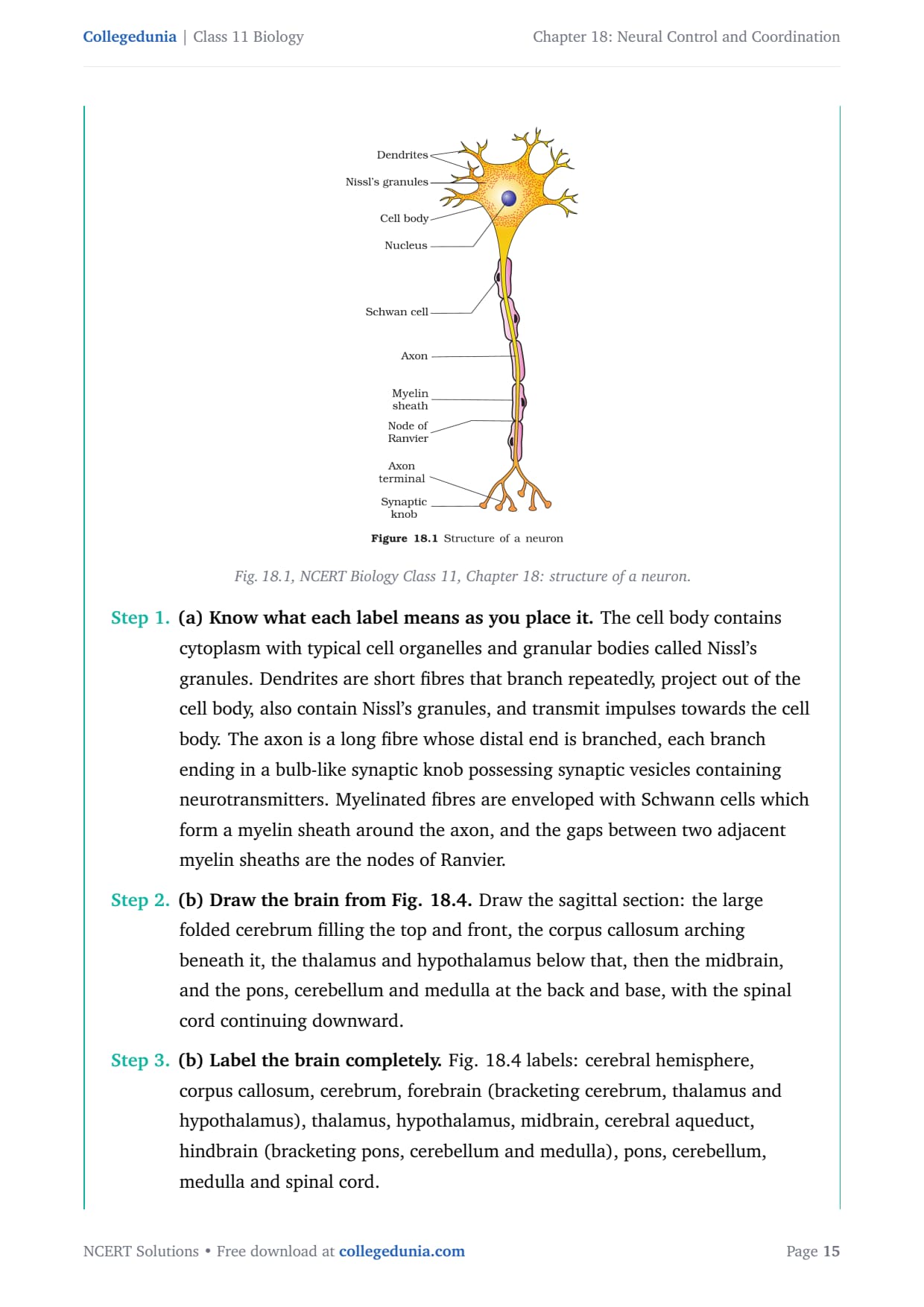
A neuron is a microscopic cell built for signalling, and it has three parts: a cell body, dendrites and an axon. The cell body holds cytoplasm with the usual organelles and granular bodies called Nissl's granules. Dendrites are short branching fibres that carry impulses towards the cell body, and the axon is a long fibre whose branched end carries the impulse away to the next cell through bulb-like synaptic knobs that store neurotransmitters.
- Myelinated fibres: the axon is wrapped by Schwann cells that form a myelin sheath, with gaps between adjacent sheaths called nodes of Ranvier; these fibres are found in spinal and cranial nerves.
- Non-myelinated fibres: the axon is enclosed by a Schwann cell but has no myelin sheath, and these are common in the autonomic and somatic systems.
- Two divisions: the human neural system is split into the central neural system (CNS) and the peripheral neural system (PNS).
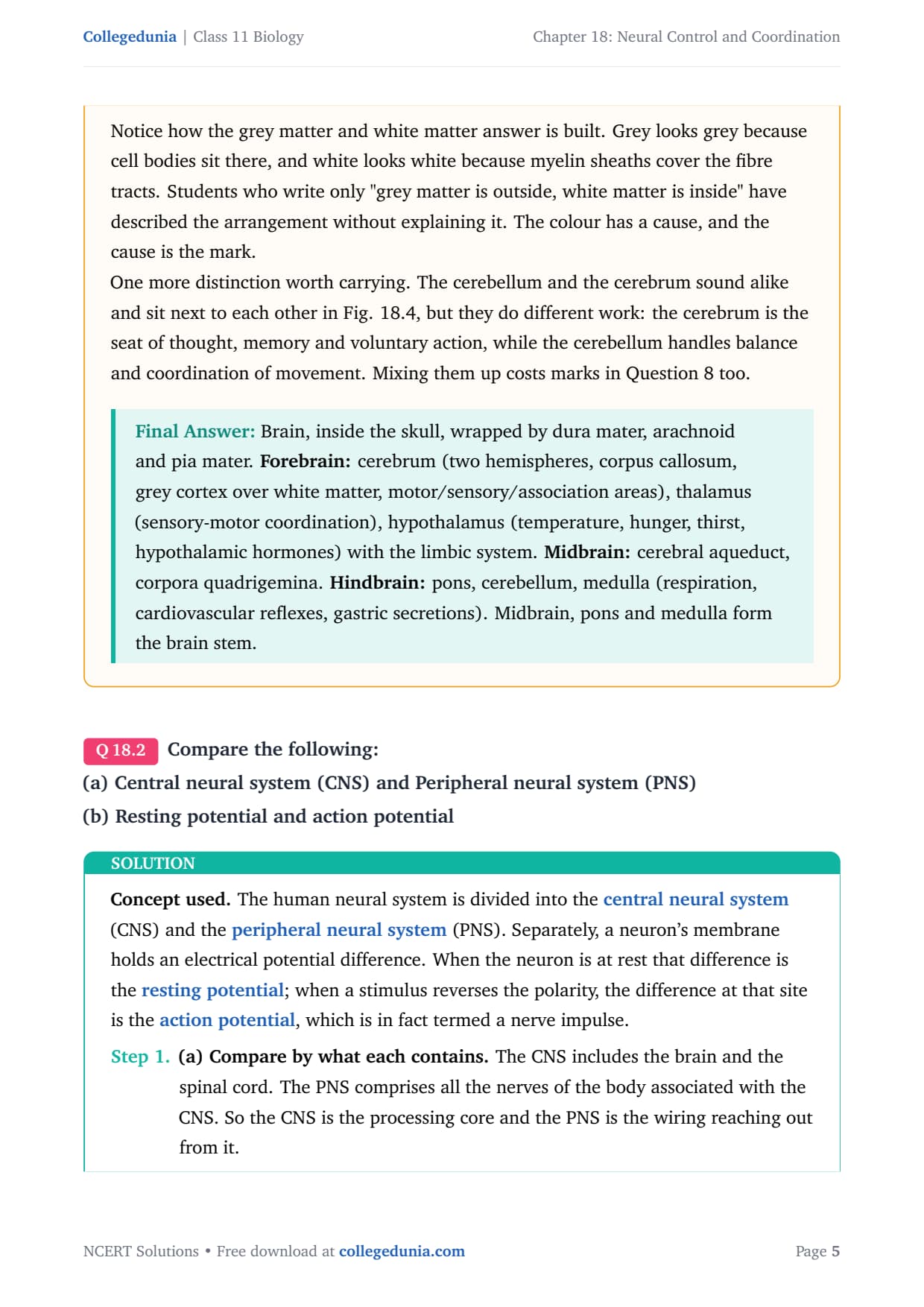
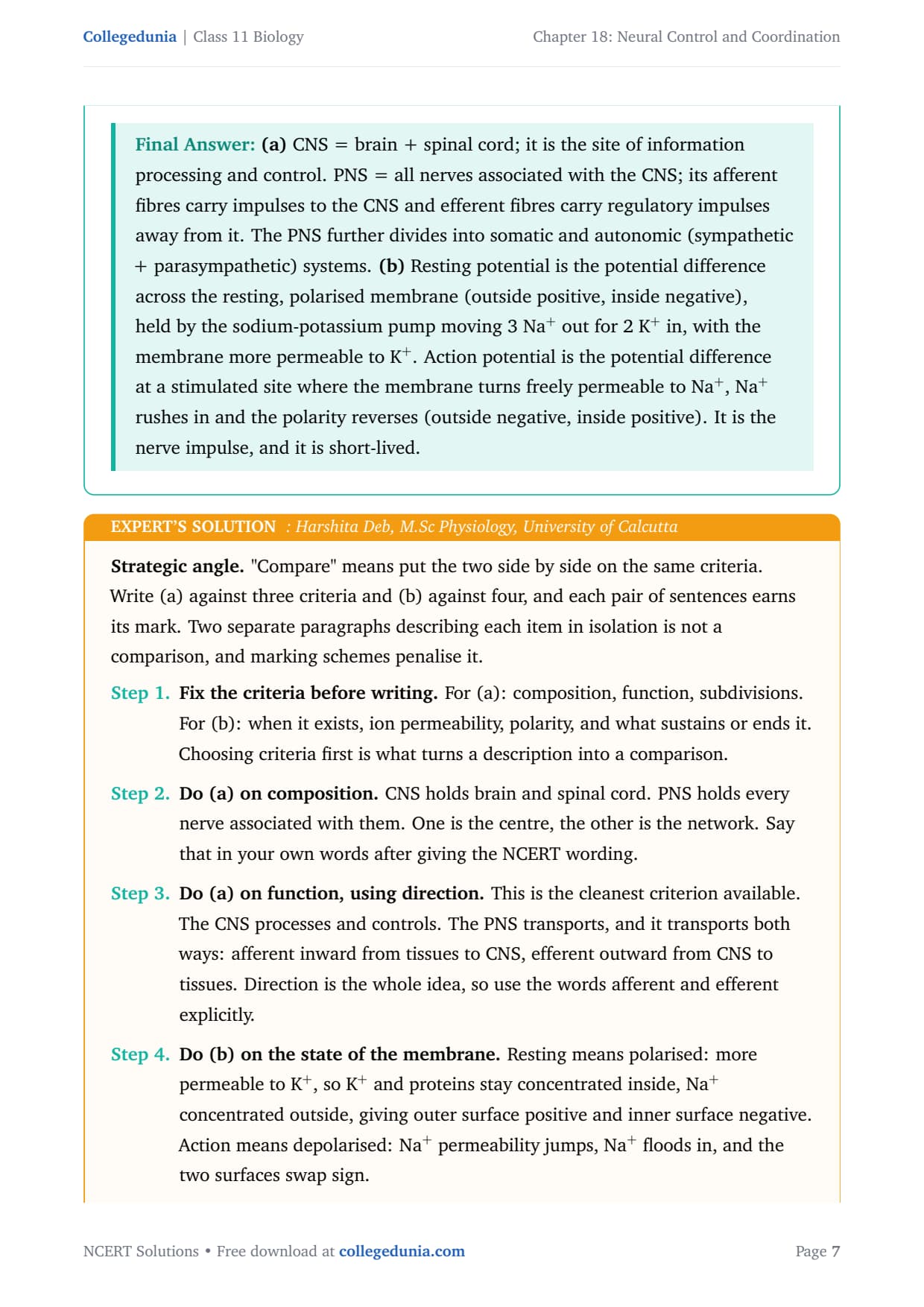
The CNS includes the brain and the spinal cord and is the site of information processing and control. The PNS comprises all the nerves associated with the CNS, and its fibres run in two directions: afferent fibres carry impulses from tissues and organs to the CNS, while efferent fibres carry regulatory impulses from the CNS out to the tissues. The PNS is further divided into the somatic neural system, which relays impulses to skeletal muscles, and the autonomic neural system, which reaches the involuntary organs and splits into sympathetic and parasympathetic parts. See Exercise Q2 and Q10 for the full comparison of the CNS with the PNS and of afferent with efferent neurons.
Resting Potential and the Sodium-Potassium Pump
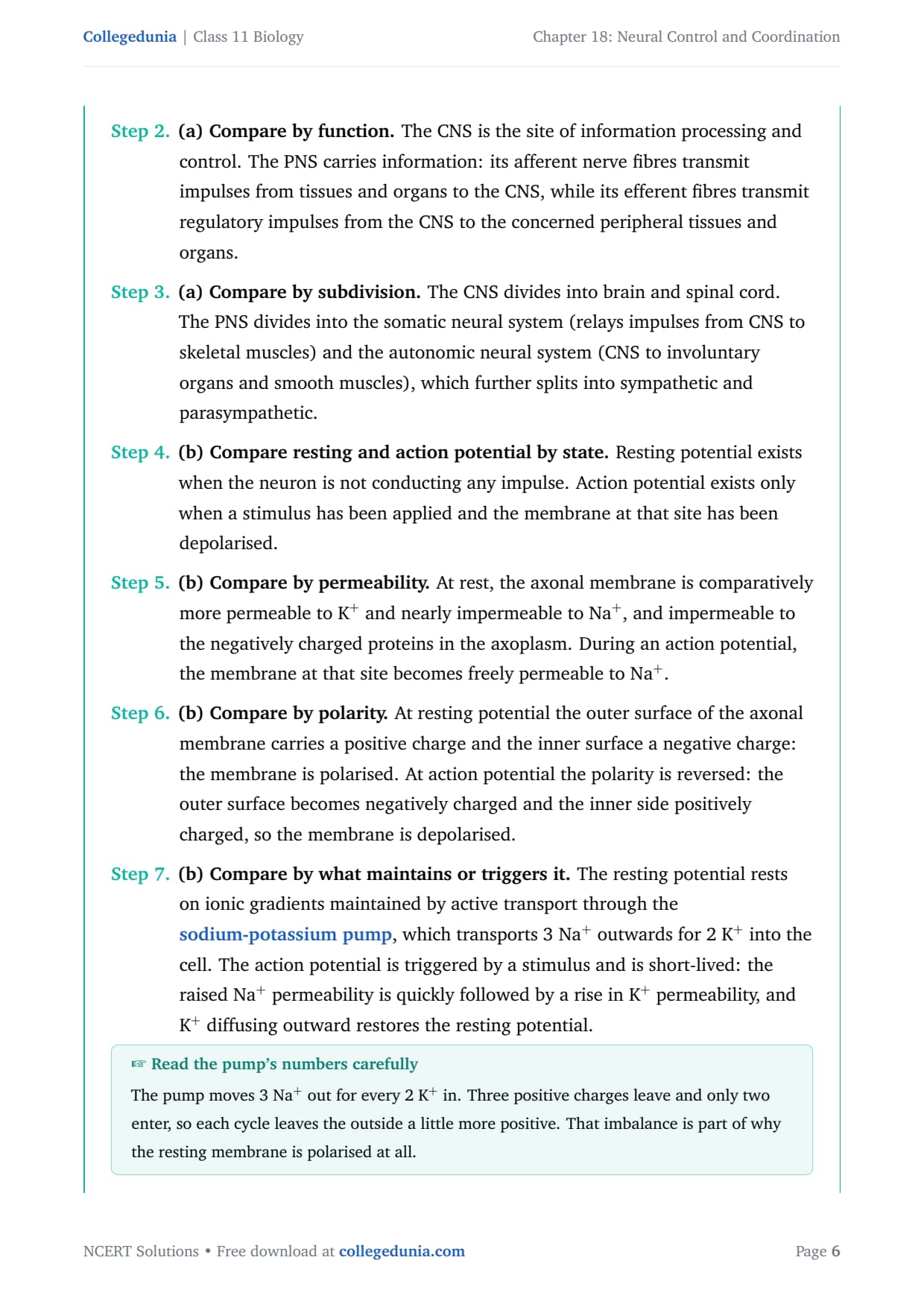
When a neuron is not conducting an impulse, its membrane is not neutral: it holds a resting potential. This exists because the axonal membrane is selectively permeable. At rest it is comparatively more permeable to potassium ions (K+) and nearly impermeable to sodium ions (Na+), and it will not let the negatively charged proteins in the axoplasm leave at all. That selective permeability sets up an uneven distribution of ions across the membrane.
- Inside the axon: high K+ and negatively charged proteins, and low Na+.
- Outside the axon: low K+ and high Na+, giving a concentration gradient across the membrane.
- The pump that holds it: the sodium-potassium pump actively transports 3 Na+ outwards for every 2 K+ it brings in.
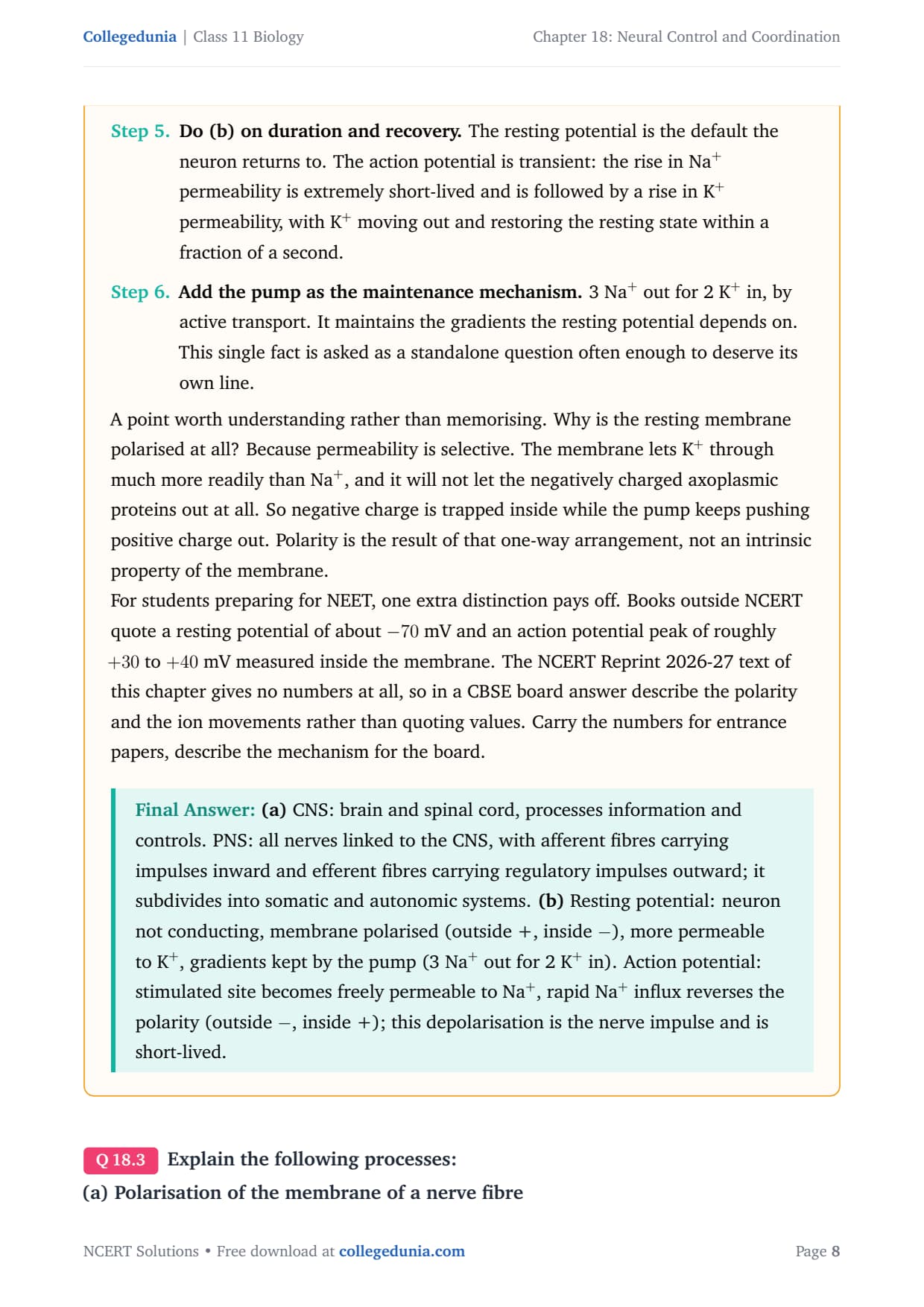
Because three positive charges leave for every two that enter, each cycle of the pump leaves the outer surface a little more positive. The result is a polarised membrane: the outer surface carries a positive charge and the inner surface a negative charge, and the potential difference across it is the resting potential. Books outside NCERT quote a value near -70 mV, but the NCERT Reprint 2026-27 text gives no numbers, so a board answer should describe the polarity and the ion movements rather than quoting a value. Students should keep the numbers for entrance papers and the mechanism for the boards.
Action Potential and the Role of Sodium
An action potential is the potential difference across the membrane at a stimulated site where the resting polarity has been reversed, and it is in fact the nerve impulse itself. NCERT states plainly that this reversal follows a rapid influx of Na+, so sodium is not one contributor among many here: it is the ion whose sudden movement creates the signal. This is exactly what Exercise Q7 asks students to explain.
| Feature | Resting potential | Action potential |
|---|---|---|
| State of neuron | Not conducting any impulse | Stimulated and depolarised at that site |
| Membrane permeability | More permeable to K+, nearly impermeable to Na+ | Freely permeable to Na+ at the stimulated site |
| Outer surface charge | Positive | Negative |
| Inner surface charge | Negative | Positive |
| Maintained or triggered by | Sodium-potassium pump (3 Na+ out, 2 K+ in) | A stimulus, and short-lived rise in Na+ permeability |
When a stimulus is applied, the membrane at that site becomes freely permeable to Na+, and the rapid influx reverses the polarity so the outer surface turns negative and the inner surface positive. This depolarisation is the action potential. A charge difference now exists between the stimulated site and the resting site just ahead, so local current flows and depolarises the next site, and the sequence repeats along the axon. The raised Na+ permeability is very short-lived and is quickly followed by a rise in K+ permeability; K+ diffuses outward and restores the resting potential within a fraction of a second, so the fibre becomes ready to fire again. Crucially, the sodium that enters at one site is not carried along the axon, which is why the impulse does not weaken however long the fibre.
Transmission of a Nerve Impulse Across a Synapse
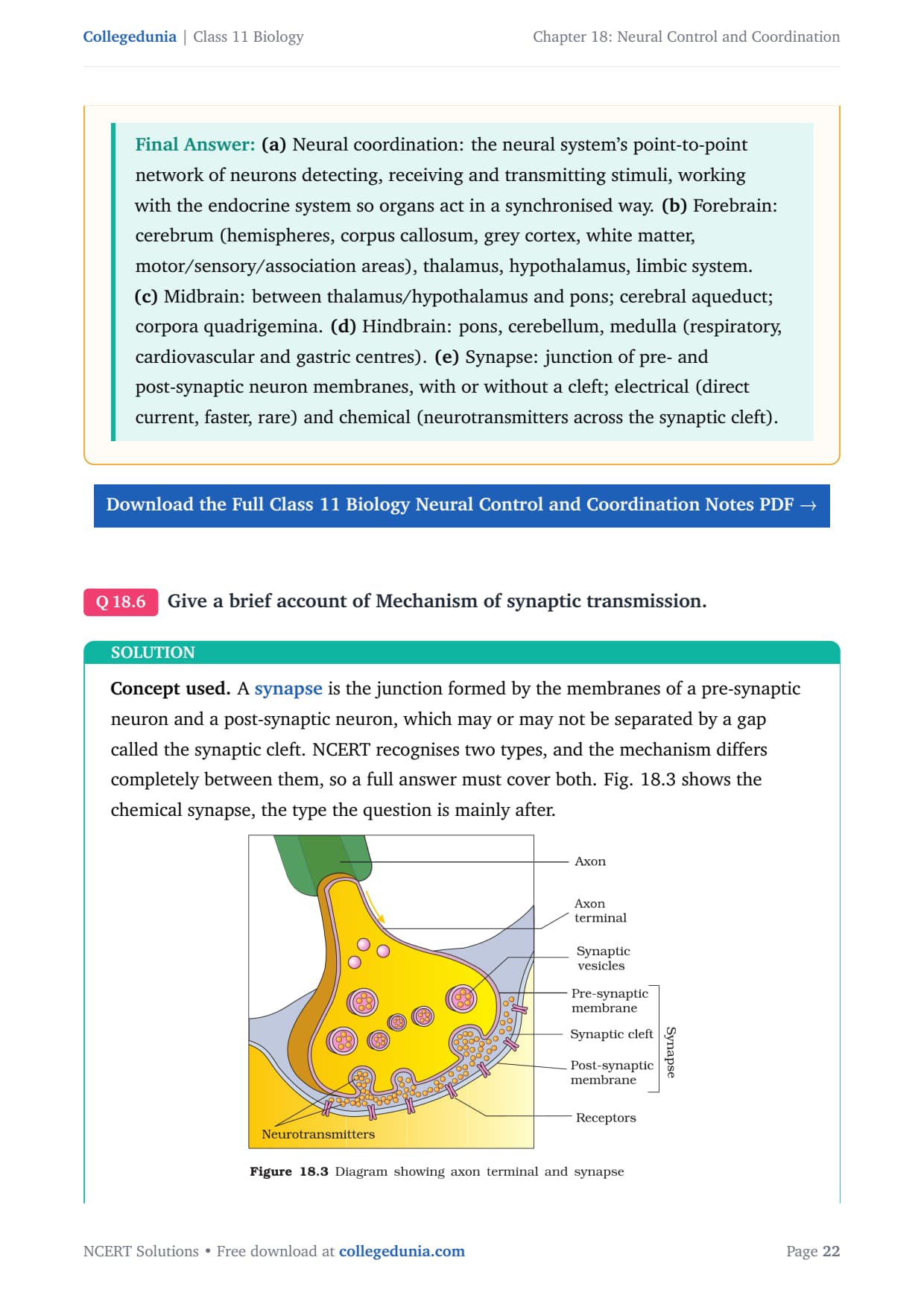
A nerve impulse passes from one neuron to the next across a junction called a synapse, formed by the membranes of a pre-synaptic neuron and a post-synaptic neuron. NCERT recognises two types, and the mechanism differs completely between them, so a full answer to Exercise Q3 and Q6 must cover both.
- Electrical synapse: the two membranes lie in very close proximity, current flows directly from one neuron to the other much as it does along a single axon, transmission is always faster than at a chemical synapse, and these are rare in our system.
- Chemical synapse: the membranes are separated by a fluid-filled gap called the synaptic cleft, and chemicals called neurotransmitters carry the signal across it.
At a chemical synapse the impulse changes form twice. When an action potential arrives at the axon terminal, it drives the synaptic vesicles to move to the plasma membrane and fuse with it, releasing their neurotransmitters into the synaptic cleft. The neurotransmitters then bind to specific receptors on the post-synaptic membrane, and this binding opens ion channels whose entering ions generate a new potential in the post-synaptic neuron. The new potential may be either excitatory or inhibitory, which is why the chemical synapse is a decision point rather than a plain relay. Because vesicles sit only in the pre-synaptic terminal and receptors only on the post-synaptic membrane, the signal can travel one way only. The nervous system trades the speed of the electrical synapse for the direction and control of the chemical one.
The Human Brain and Its Three Divisions
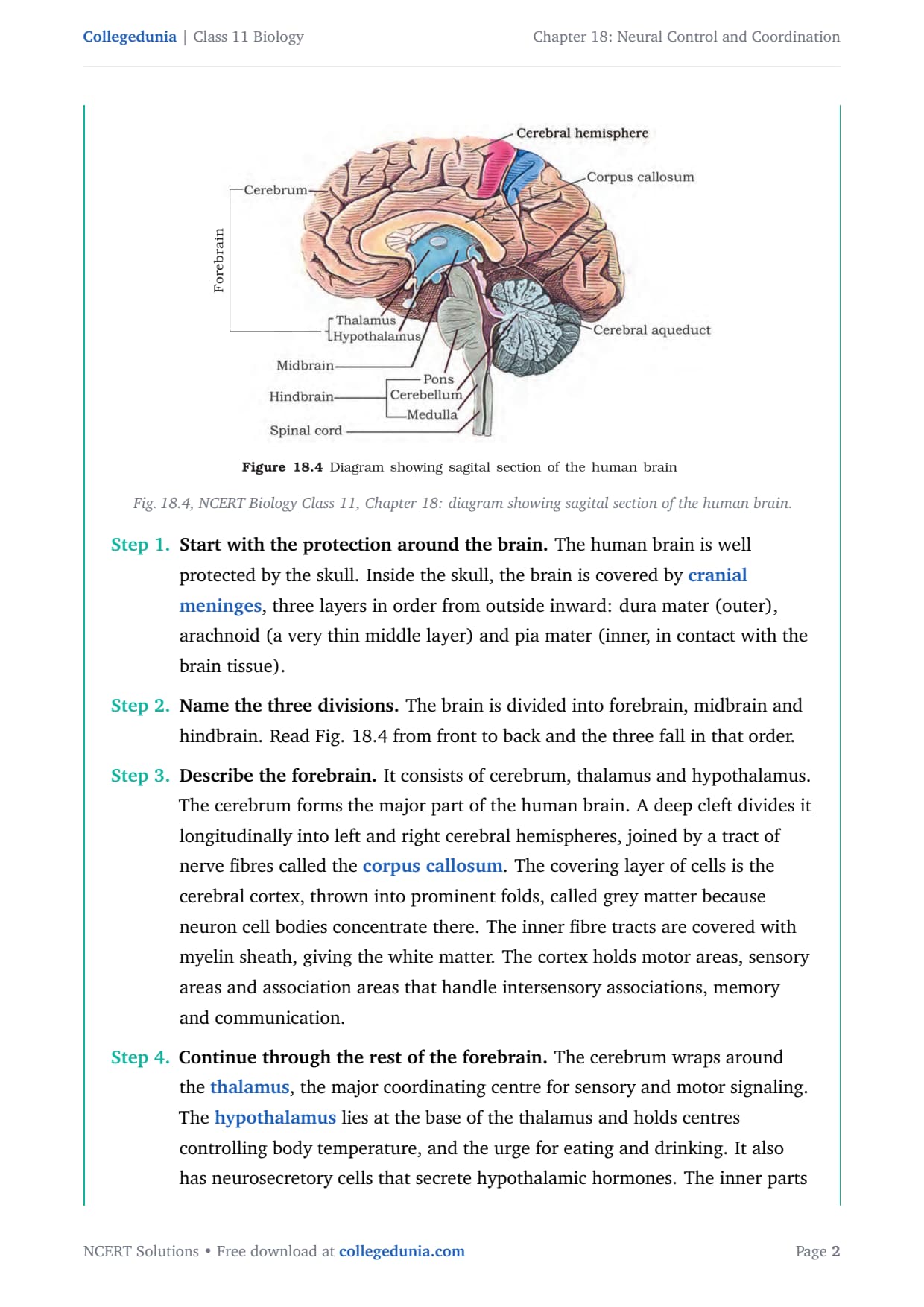
The brain is the central information processing organ of the body and, with the spinal cord, forms the CNS. It lies inside the skull, wrapped in three cranial meninges: dura mater on the outside, the thin arachnoid in the middle, and pia mater in contact with the brain tissue. NCERT divides the brain into forebrain, midbrain and hindbrain, and questions on the brain appear in Exercise Q1, Q4, Q8 and Q9.
| Division | Parts | Key functions |
|---|---|---|
| Forebrain | Cerebrum, thalamus, hypothalamus | Thought, memory and voluntary action (cerebrum); sensory-motor coordination (thalamus); temperature, hunger, thirst and hypothalamic hormones (hypothalamus) |
| Midbrain | Cerebral aqueduct, corpora quadrigemina | Passes and integrates visual, tactile and auditory inputs; part of the brain stem |
| Hindbrain | Pons, cerebellum, medulla | Fibre tracts between brain regions (pons); balance and coordination (cerebellum); respiration, cardiovascular reflexes and gastric secretions (medulla) |
The cerebrum forms the major part of the human brain and is its most developed region. A deep cleft divides it into left and right hemispheres joined by a band of fibres called the corpus callosum. Its outer layer, the cerebral cortex, is thrown into folds and is called grey matter because neuron cell bodies concentrate there, while the inner myelinated tracts form the white matter. The hypothalamus, at the base of the thalamus, controls body temperature, eating and drinking, and it also acts as the body's master clock for the daily circadian rhythm. The midbrain, pons and medulla together form the brain stem, which connects the brain to the spinal cord. Students should be careful not to confuse the cerebrum, the seat of thought, with the cerebellum, which handles balance and coordination, since both names appear together in the distinguishing questions.
Neural Control and Coordination Exercise-wise Breakdown
The NCERT back exercise has 10 questions, and they mix descriptive answers, diagram drawing and compare-or-distinguish tasks. The table below maps the question blocks to their topics so students can plan their practice by theme.
| Question block | What it tests |
|---|---|
| Q 1 and Q 4 | Structure of the brain and labelled diagrams of the neuron and the brain. |
| Q 2 | Comparing CNS with PNS, and resting potential with action potential. |
| Q 3 and Q 7 | Polarisation, depolarisation and the role of Na+ in the action potential. |
| Q 5 and Q 6 | Short notes on brain parts and the synapse, and the mechanism of synaptic transmission. |
| Q 8 to Q 10 | Differentiating axons, dendrites and brain parts, and distinguishing afferent from efferent neurons and cranial from spinal nerves. |
The chapter rewards precise wording and clean diagrams rather than calculation. Learn the polarity of the resting and action potentials as a matched pair, and practise the neuron and brain diagrams until the labels come automatically. Every question in the class 11 biology NCERT solutions chapter 18 Neural Control and Coordination PDF is solved with each step of reasoning shown, so students can compare their answers against the model working.
Practice the solved questions: Work through the full question bank with step-by-step answers and expert tips.
Neural Control and Coordination Class 11 Solved Practice Questions
Common Mistakes Students Make in Neural Control and Coordination
Most marks in this chapter are lost on small slips of direction and wording, not on hard ideas. Each mistake below costs 1 to 2 marks, so watch for it at the exact step.
Mistake 1: Getting the pump numbers backwards. The sodium-potassium pump moves 3 Na+ out for 2 K+ in, not the reverse. The net loss of positive charge is why the outside stays positive.
Mistake 2: Describing the resting membrane as positive inside. At rest the outer surface is positive and the inner surface negative; the signs only swap during depolarisation.
Mistake 3: Confusing the cerebrum with the cerebellum. The cerebrum handles thought, memory and voluntary action, while the cerebellum handles balance and coordination of movement.
Mistake 4: Describing only the chemical synapse when asked about synaptic transmission. NCERT gives both electrical and chemical synapses, and the electrical one is a quick two-mark addition.
Student Feedback on Neural Control and Coordination Solutions
What 12,540 students told us about their Neural Control and Coordination preparation:
- 61% of students said keeping the polarity of the resting and action potentials straight was the trickiest part of the chapter.
- Most-skipped detail: adding the electrical synapse when the mechanism of synaptic transmission is asked, missed by about 4 in 10 students.
- Students who practised the neuron and brain diagrams first said the labelled-diagram questions became the easiest marks in the paper.
Source: 2026-27 Class 11 Biology student poll. Sample of 12,540 students from CBSE schools across 16 states, conducted before the 2026 boards.
Other Neural Control and Coordination Class 11 Biology Resources
Pair these solutions with the revision notes, formula sheet, exemplar solutions and NCERT textbook PDF for the same chapter.
| Resource | Link |
|---|---|
| NCERT Notes | Neural Control and Coordination Class 11 Notes |
| Formula Sheet | Neural Control and Coordination Class 11 Formula Sheet |
| Exemplar Solutions | Neural Control and Coordination Class 11 Exemplar Solutions |
| NCERT Book PDF | Neural Control and Coordination Class 11 Book PDF |
NCERT Solutions for Class 11 Biology: All Chapters
Jump to the step-by-step solutions for any other Class 11 Biology chapter below.
| Chapter | NCERT Solutions |
|---|---|
| Chapter 1 | The Living World |
| Chapter 2 | Biological Classification |
| Chapter 3 | Plant Kingdom |
| Chapter 4 | Animal Kingdom |
| Chapter 5 | Morphology of Flowering Plants |
| Chapter 6 | Anatomy of Flowering Plants |
| Chapter 7 | Structural Organisation in Animals |
| Chapter 8 | Cell: The Unit of Life |
| Chapter 9 | Biomolecules |
| Chapter 10 | Cell Cycle and Cell Division |
| Chapter 11 | Photosynthesis in Higher Plants |
| Chapter 12 | Respiration in Plants |
| Chapter 13 | Plant Growth and Development |
| Chapter 14 | Breathing and Exchange of Gases |
| Chapter 15 | Body Fluids and Circulation |
| Chapter 16 | Excretory Products and their Elimination |
| Chapter 17 | Locomotion and Movement |
| Chapter 18 | Neural Control and Coordination |
| Chapter 19 | Chemical Coordination and Integration |
FAQs on Neural Control and Coordination Class 11 NCERT Solutions
Neural Control and Coordination NCERT Solutions - Frequently Asked Questions
Ques. What do the class 11 biology NCERT solutions chapter 18 Neural Control and Coordination cover?
Ans. These solutions cover all 10 back-exercise questions, including the structure of the brain, comparing the CNS with the PNS, polarisation and depolarisation of the nerve membrane, the role of Na+ in the action potential, transmission across a synapse, labelled diagrams of the neuron and brain, and distinguishing afferent from efferent neurons. Every question is solved step by step.
Ques. What is the role of sodium in the generation of an action potential?
Ans. At rest the membrane is nearly impermeable to Na+. When a stimulus is applied, the membrane at that site becomes freely permeable to Na+, so Na+ rushes in. This influx reverses the polarity, making the outer surface negative and the inner surface positive. That reversal is the action potential, which is the nerve impulse itself.
Ques. How does the sodium-potassium pump maintain the resting potential?
Ans. The sodium-potassium pump uses active transport to move 3 Na+ outwards for 2 K+ inwards. This keeps Na+ high outside and K+ high inside, maintaining the concentration gradients that leave the outer surface positive and the inner surface negative. The potential difference across this polarised resting membrane is the resting potential.
Ques. How is a nerve impulse transmitted across a chemical synapse?
Ans. When an impulse reaches the axon terminal, synaptic vesicles move to the plasma membrane, fuse with it and release neurotransmitters into the synaptic cleft. These bind specific receptors on the post-synaptic membrane, opening ion channels whose entering ions generate a new potential in the post-synaptic neuron. The new potential may be excitatory or inhibitory.
Ques. What are the three divisions of the human brain?
Ans. The brain is divided into the forebrain (cerebrum, thalamus and hypothalamus), the midbrain (cerebral aqueduct and corpora quadrigemina) and the hindbrain (pons, cerebellum and medulla). The midbrain, pons and medulla together form the brain stem, which connects the brain to the spinal cord. The cerebrum is the most developed part of the human brain.
Ques. What is the weightage of Neural Control and Coordination in CBSE Class 11 Biology?
Ans. Neural Control and Coordination carries about 3 to 5 marks in the CBSE Class 11 Biology paper, through diagram, short-answer and distinguish-type questions from the Human Physiology unit. It is also heavily tested in NEET, where the resting potential, action potential, synapse and brain regions appear regularly.



Comments