




The class 11 biology NCERT solutions chapter 15 Body Fluids and Circulation cover every back-exercise question, according to the latest 2026-27 CBSE syllabus, and help students prepare for the CBSE Boards, NEET and CUET. Each answer is worked step by step, from what blood is made of and why it is a connective tissue, to the four-chambered heart, the cardiac cycle, the ECG and double circulation.
This chapter sits at the heart of the Human Physiology unit, and the transport of the gases you met in Breathing and Exchange of Gases is completed here by the blood and the heart that move them.
- CBSE Weightage: about 3 to 4 marks, part of the Human Physiology unit that carries the largest share of the Class 11 Biology paper.
- Topics covered: blood and its components, plasma proteins, blood groups, lymph, the structure of the heart, double circulation, the cardiac cycle and cardiac output, heart sounds, the ECG, and the conducting system.
- Exercise count: 14 back-exercise questions, a mix of descriptive answers, one match-the-column, several distinguish-between parts, and one numerical on cardiac output.
These class 11 biology NCERT solutions chapter 15 Body Fluids and Circulation are curated by subject experts, based on the 2026-27 NCERT textbook, and checked against the last five years of CBSE Board and NEET papers.
Why Body Fluids and Circulation Matters and What the Chapter Covers
Blood carries nutrients and oxygen to every cell and takes waste away, and this chapter explains both what blood is made of and how it is moved around the body along one fixed route. It is one of the most heavily weighted chapters for NEET, and its facts, the formed elements, the blood groups, the conducting system and the cardiac numbers, are asked year after year in both the Boards and entrance papers.
- Everyday role: the same physiology explains a blood transfusion, an ECG in a hospital, and why a doctor listens to heart sounds with a stethoscope.
- Core skill: linking a structure, such as the AVN or a heart valve, to the exact function it performs in the cardiac cycle.
- Why it is central: the double circulation described here delivers the oxygen loaded in Breathing and Exchange of Gases and collects the wastes filtered in Excretory Products and their Elimination.
Most marks in this chapter come from clean definitions and matched pairs, such as which valve makes which heart sound or which node fires fastest. Students who learn those pairings early find the reasoning questions fall into place. The class 11 biology NCERT solutions chapter 15 Body Fluids and Circulation below follow the same order as the NCERT textbook so students can check their working line by line.
Blood: A Special Connective Tissue and Its Components
NCERT opens the chapter by calling blood a special connective tissue made of a fluid matrix, plasma, and formed elements. It is classified as a connective tissue because it fits every criterion of that group: it arises from the mesoderm, it has an extracellular matrix, its cells are suspended rather than packed together, and it performs the connecting role of transport. The word "special" is used because its matrix is a liquid rather than a solid.
| Formed element | Count | Major function |
|---|---|---|
| Erythrocytes (RBCs) | 5 to 5.5 million per mm3 | Transport of respiratory gases through haemoglobin; life span about 120 days. |
| Leucocytes (WBCs) | 6000 to 8000 per mm3 | Defence of the body and immunity; neutrophils most abundant, basophils least. |
| Platelets (thrombocytes) | 1,50,000 to 3,50,000 per mm3 | Release factors involved in the coagulation or clotting of blood. |
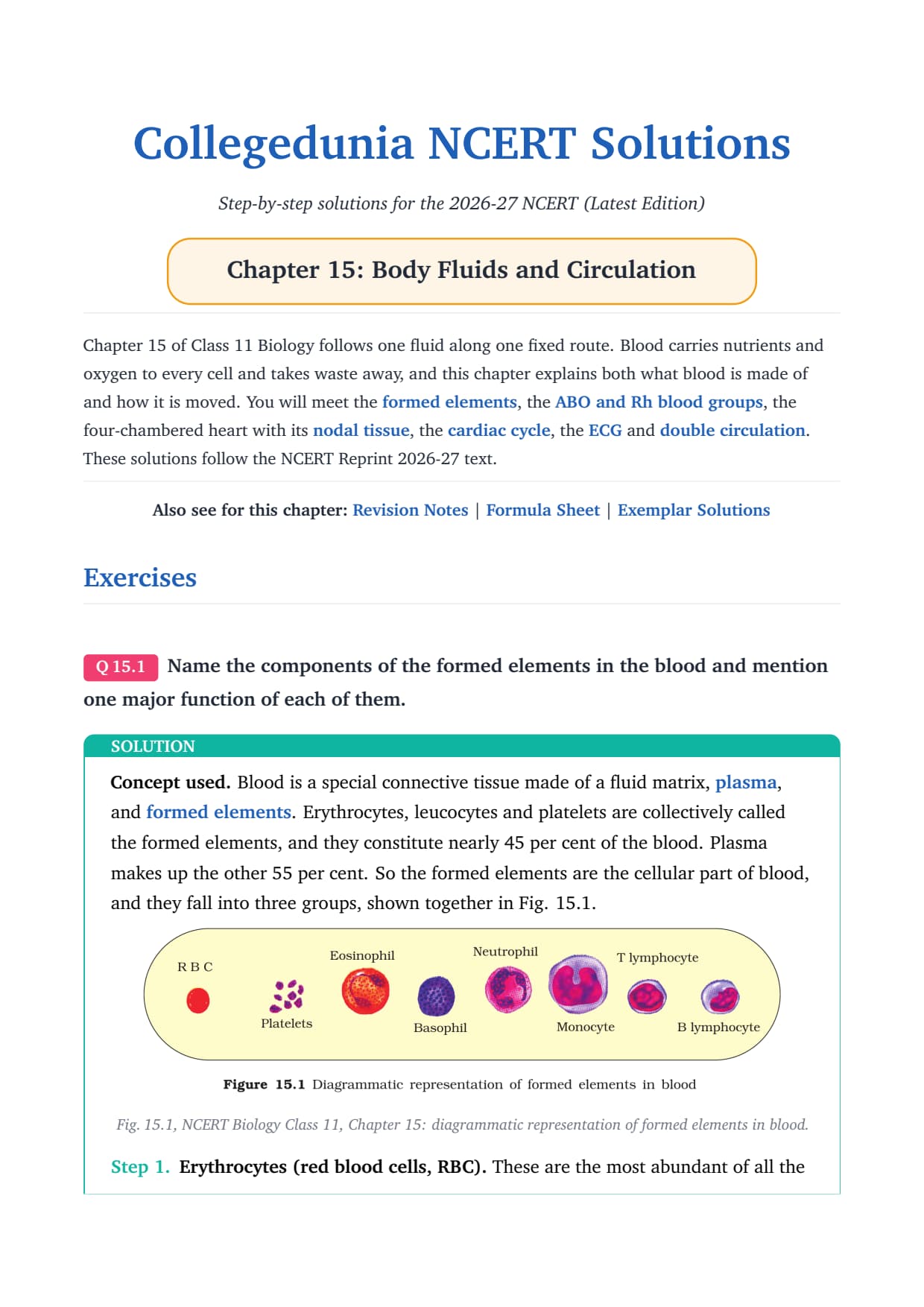
The formed elements make up nearly 45 per cent of blood and plasma the other 55 per cent. Platelets are not cells but cell fragments budded from megakaryocytes in the bone marrow, and RBCs are enucleate in most mammals. Within the leucocytes, neutrophils (60 to 65 per cent) and monocytes (6 to 8 per cent) are phagocytic, basophils (0.5 to 1 per cent) secrete histamine, serotonin and heparin, eosinophils (2 to 3 per cent) resist infections and act in allergy, and lymphocytes (20 to 25 per cent) are the B and T cells responsible for immune responses. See Exercise Q1 and Q4 for the full working.
Plasma Proteins and Their Functions
Plasma is a straw-coloured, viscous fluid making up nearly 55 per cent of blood, of which 90 to 92 per cent is water and 6 to 8 per cent is protein. NCERT names three major plasma proteins and assigns each a distinct job, so the safest shape for the answer is a matched set of three. A missing protein is a missing mark.
- Fibrinogen: needed for the clotting or coagulation of blood, converted by the enzyme thrombin into fibrin threads that build the mesh of the clot.
- Globulins: primarily involved in the defence mechanisms of the body, acting as antibodies produced in response to antigens.
- Albumins: help maintain the osmotic balance of the blood, holding water inside the vessels by osmotic pressure.
Plasma stripped of its clotting factors is called serum, so the clotting factors, which are proteins, are exactly what separates plasma from serum. Plasma also carries small amounts of minerals such as Na+, Ca2+, Mg2+, HCO3- and Cl-, along with glucose, amino acids and lipids in transit, but these are not proteins and belong in a separate sentence. The albumin role is why, when plasma protein levels fall, water leaves the capillaries and the tissues swell, as detailed in Exercise Q2.
Lymph, Blood Groups and How the Fluids Differ
As blood passes through the capillaries, some water and small water-soluble substances move out into the spaces between the cells, leaving the larger proteins and most formed elements behind. That escaped fluid is the interstitial or tissue fluid, and the fluid collected by the lymphatic system is lymph. So lymph is derived from blood, and every difference between them follows from that one filtration step.
| Parameter | Blood | Lymph |
|---|---|---|
| Colour | Red, from haemoglobin in RBCs | Colourless, RBCs absent |
| Cells present | RBCs, all types of WBCs, platelets | Only specialised lymphocytes |
| Protein content | Protein rich, 6 to 8 per cent | Lower protein content |
| Function | Transports respiratory gases, nutrients and wastes | Absorbs fats via the lacteals of the intestinal villi, gives immunity |
The ABO blood groups rest on antigens A and B on the RBCs and the corresponding antibodies in the plasma. Group O has no antigens on its cells, so it is the universal donor, while group AB has no antibodies in its plasma, so it is the universal recipient. The Rh factor adds a further layer: an Rh-negative mother carrying an Rh-positive foetus can make anti-Rh antibodies after the first delivery, which in later pregnancies destroy foetal RBCs and cause erythroblastosis foetalis, prevented by giving the mother anti-Rh antibodies just after the first delivery. Note that lymph has less protein, not zero protein, and that fat absorption through the lacteals is the one transport job lymph does that blood cannot.
The Heart, Double Circulation and the Evolutionary Trend
Double circulation means the blood passes through the heart twice in one complete round of the body, because two separate pathways exist. In birds and mammals the oxygenated and deoxygenated blood received by the left and right atria pass to the ventricles of the same sides, and the ventricles pump it out without any mixing. The inter-atrial and inter-ventricular septa are the structures that keep the two sides separate.
- Pulmonary circulation: the right ventricle pumps deoxygenated blood through the pulmonary artery to the lungs, and the oxygenated blood returns by the pulmonary veins to the left atrium.
- Systemic circulation: the left ventricle pumps oxygenated blood into the aorta to all the tissues, and the deoxygenated blood returns through venules, veins and the vena cava to the right atrium.
- Significance: the two kinds of blood never mix, so tissues receive fully oxygenated blood, and the blood is re-pressurised at the heart on every circuit.
The evolutionary trend runs from two chambers to four, with rising separation of the two bloods. Fishes have a 2-chambered heart with single circulation, amphibians and reptiles other than crocodiles have a 3-chambered heart with incomplete double circulation because the single ventricle mixes the blood, and crocodiles, birds and mammals have a 4-chambered heart with complete double circulation. The pulmonary artery carries deoxygenated blood and the pulmonary veins carry oxygenated blood, the one place in the body where artery and vein swap their usual cargo. These pathways are traced in Exercise Q6 and Q8.
The Conducting System and Why the Heart Is Myogenic
Our heart is called myogenic because the heartbeat originates in the heart's own muscle, the specialised nodal tissue, rather than in a nerve. The nodal musculature is autoexcitable, meaning it can generate action potentials without any external stimuli, so the origin of the beat is muscular. A neural centre in the medulla oblongata, the autonomic nervous system and adrenal medullary hormones only moderate the rate and force, they do not start the beat.
- Sino-atrial node (SAN): a patch of nodal tissue in the right upper corner of the right atrium, it generates the maximum number of action potentials, 70 to 75 per minute, so it sets the pace and is called the pacemaker.
- Atrio-ventricular node (AVN): in the lower left corner of the right atrium, it picks up the atrial impulse and conducts it onward, delaying it so the atria finish filling the ventricles first.
- AV bundle and purkinje fibres: the AV bundle (bundle of His) is the only conducting bridge across the non-conducting atrio-ventricular septum, and its branches carry the impulse through the ventricular musculature.
The SAN is the pacemaker because it is the fastest, not merely because it is autoexcitable, and its impulses reach the slower tissues before they can fire on their own. The observed heart rate of about 72 beats per minute is simply the SAN's own firing rate. The AVN's slow conduction delays the impulse so that atrial systole raises ventricular filling by about 30 per cent before the ventricles contract, which is why a heart contracts in the right order rather than all at once. This conducting system is explained in Exercise Q9, Q10 and Q11.
The Cardiac Cycle, Cardiac Output, Heart Sounds and ECG
A cardiac cycle is the sequential event in the heart that is cyclically repeated, made of the systole (contraction) and diastole (relaxation) of both the atria and the ventricles. Starting from joint diastole, the atria contract, then the ventricles contract while the atria relax, then the ventricles relax, and the sequence repeats. At 72 beats per minute one cycle lasts 60 / 72 = 0.8 seconds.
- Cardiac output: the volume of blood pumped out by each ventricle per minute. Cardiac output = stroke volume × heart rate = 70 mL × 72 = 5040 mL per minute, about 5 litres per minute in a healthy individual.
- Heart sounds: the first sound "lub" is the closure of the tricuspid and bicuspid valves at the start of ventricular systole, and the second sound "dub" is the closure of the semilunar valves at the end of ventricular systole. Both are valves closing, not muscle contracting.
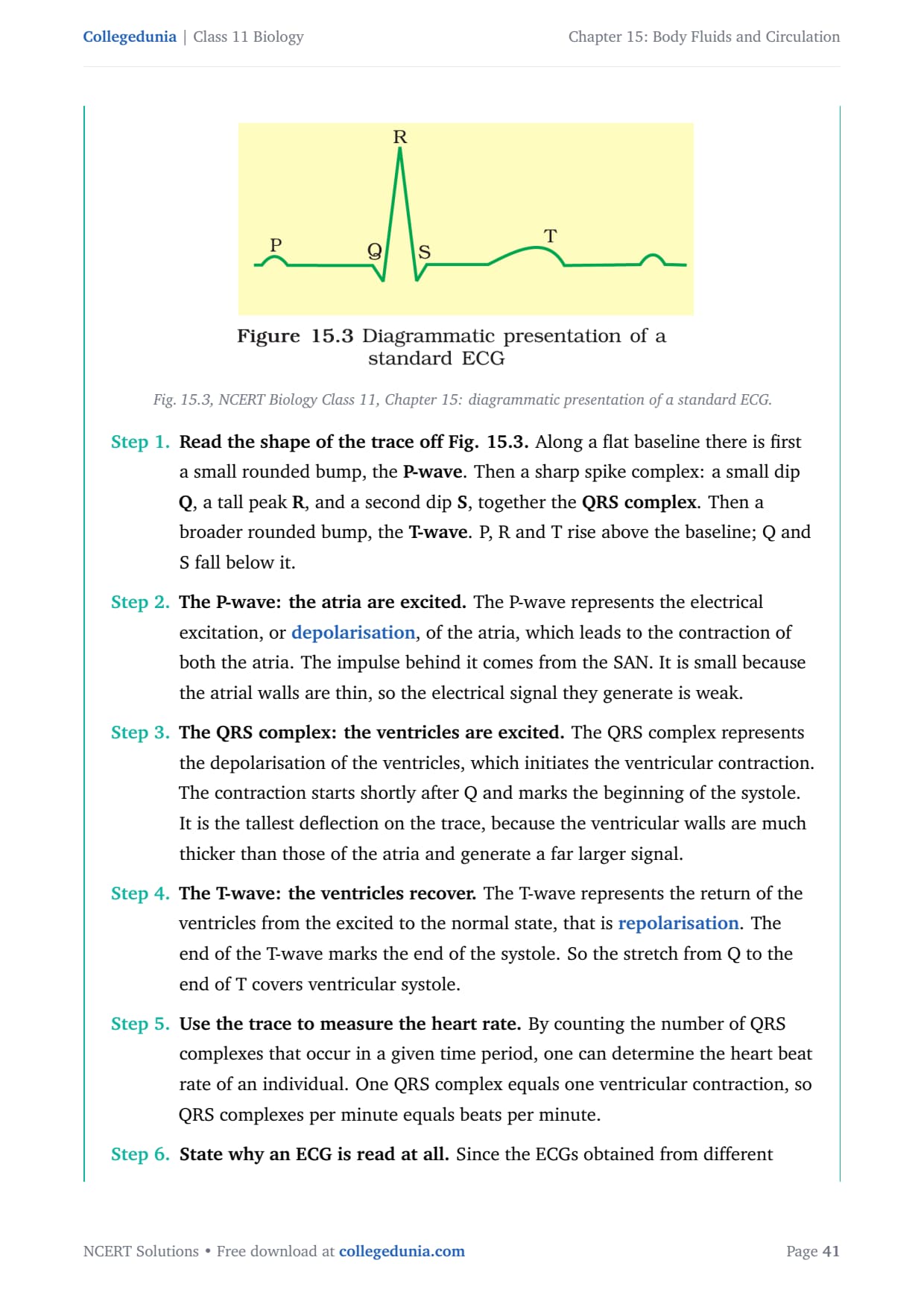
- ECG: the P-wave is atrial depolarisation, the QRS complex is ventricular depolarisation (systole begins shortly after Q), and the T-wave is ventricular repolarisation (its end marks the end of systole).
The 5 litres per minute is not a fact to memorise on its own, it is simply 70 × 72 rounded, so a different stroke volume or heart rate is substituted into the same formula. Counting the QRS complexes in a given time gives the heart rate, and because a standard ECG has roughly the same shape in every healthy person, any deviation from that shape signals a possible abnormality, which is why the ECG is of great clinical significance. The numerical and both diagrams are worked in Exercise Q12, Q13 and Q14.
Body Fluids and Circulation Exercise-wise Breakdown
The NCERT back exercise has 14 questions, blending descriptive answers, one match-the-column, several distinguish-between parts and one numerical. The table below maps the question blocks to their topics so students can plan practice by theme.
| Question block | What it tests |
|---|---|
| Q 1 to Q 3 | The formed elements and their functions, the importance of plasma proteins, and matching blood terms with their roles. |
| Q 4 to Q 5 | Why blood is a connective tissue, and the differences between lymph and blood. |
| Q 6 to Q 8 | Double circulation and its significance, differences between key pairs, and the evolutionary change in the vertebrate heart. |
| Q 9 to Q 11 | Why the heart is myogenic, the SAN as pacemaker, and the significance of the AVN and AV bundle. |
| Q 12 to Q 14 | The cardiac cycle and cardiac output, heart sounds, and drawing and explaining a standard ECG. |
Because many questions are "distinguish between" or "match", the marks are awarded for paired contrasts on the same parameter, not for two unrelated descriptions. Answer these in short tables with a parameter column, and give the definition and the mechanical consequence for each term. Every question in the class 11 biology NCERT solutions chapter 15 Body Fluids and Circulation PDF is solved with each step shown, so students can compare their working against the model answer.
Practice the solved questions: Work through the full question bank with step-by-step answers and expert tips.
Body Fluids and Circulation Class 11 Solved Practice Questions
Common Mistakes Students Make in Body Fluids and Circulation
Most marks in this chapter are lost on small slips of naming and on describing instead of contrasting. Each mistake below costs 1 to 2 marks, so watch for it at the exact step.
Mistake 1: Writing that the heart sounds are the ventricles contracting and relaxing. Muscle contraction is silent, and both sounds are valves closing, "lub" the tricuspid and bicuspid, "dub" the semilunar.
Mistake 2: Calling the SAN the pacemaker only because it is autoexcitable. All nodal tissue is autoexcitable, and the SAN sets the pace because it fires fastest, at 70 to 75 per minute.
Mistake 3: Saying lymph has no proteins. Lymph has less protein than blood, because the larger proteins could not cross the capillary wall.
Mistake 4: Writing that the P-wave is the contraction of the atria. The P-wave is the depolarisation of the atria, and the contraction follows a moment later.
Student Feedback on Body Fluids and Circulation Solutions
What 13,150 students told us about their Body Fluids and Circulation preparation:
- 61% of students said the conducting system, the SAN, AVN and AV bundle, was the part they most often mixed up before revising the diagram.
- Most-skipped detail: naming which valves close for "lub" and "dub", missed by about 3 in 10 students.
- Students who learned the cardiac output formula as 70 times 72 said the numerical stopped feeling like memory work.
Source: 2026-27 Class 11 Biology student poll. Sample of 13,150 students from CBSE schools across 16 states, conducted before the 2026 boards.
Other Body Fluids and Circulation Class 11 Biology Resources
Pair these solutions with the revision notes, formula sheet and NCERT textbook PDF for the same chapter.
| Resource | Link |
|---|---|
| NCERT Notes | Body Fluids and Circulation Class 11 Notes |
| Formula Sheet | Body Fluids and Circulation Class 11 Formula Sheet |
| NCERT Book PDF | Body Fluids and Circulation Class 11 Book PDF |
NCERT Solutions for Class 11 Biology: All Chapters
Jump to the step-by-step solutions for any other Class 11 Biology chapter below.
| Chapter | NCERT Solutions |
|---|---|
| Chapter 1 | The Living World |
| Chapter 2 | Biological Classification |
| Chapter 3 | Plant Kingdom |
| Chapter 4 | Animal Kingdom |
| Chapter 5 | Morphology of Flowering Plants |
| Chapter 6 | Anatomy of Flowering Plants |
| Chapter 7 | Structural Organisation in Animals |
| Chapter 8 | Cell: The Unit of Life |
| Chapter 9 | Biomolecules |
| Chapter 10 | Cell Cycle and Cell Division |
| Chapter 11 | Photosynthesis in Higher Plants |
| Chapter 12 | Respiration in Plants |
| Chapter 13 | Plant Growth and Development |
| Chapter 14 | Breathing and Exchange of Gases |
| Chapter 15 | Body Fluids and Circulation |
| Chapter 16 | Excretory Products and their Elimination |
| Chapter 17 | Locomotion and Movement |
| Chapter 18 | Neural Control and Coordination |
| Chapter 19 | Chemical Coordination and Integration |
FAQs on Body Fluids and Circulation Class 11 NCERT Solutions
Body Fluids and Circulation NCERT Solutions - Frequently Asked Questions
Ques. What do the class 11 biology NCERT solutions chapter 15 Body Fluids and Circulation cover?
Ans. These solutions solve every back-exercise question, including the formed elements and their functions, plasma proteins, blood groups, why blood is a connective tissue, the differences between lymph and blood, double circulation, the evolutionary change in the vertebrate heart, the myogenic heart and its conducting system, the cardiac cycle and cardiac output, heart sounds and the ECG. Every answer is worked step by step.
Ques. Why is the sino-atrial node called the pacemaker of the heart?
Ans. All nodal tissue is autoexcitable, but the SAN, a patch of nodal tissue in the right upper corner of the right atrium, fires fastest at 70 to 75 per minute. Its impulses reach the slower tissues before they can fire on their own, so the SAN's rhythm imposes itself on the entire heart. The observed heart rate of about 72 beats per minute equals the SAN's own rate, so it is called the pacemaker.
Ques. How do you calculate cardiac output in Class 11 Biology?
Ans. Cardiac output is the volume of blood pumped out by each ventricle per minute. It is the product of the stroke volume, about 70 mL per beat, and the heart rate, 72 beats per minute, so cardiac output = 70 × 72 = 5040 mL per minute, roughly 5 litres per minute in a healthy individual. The body can change the stroke volume and the heart rate, and so the cardiac output.
Ques. Why is blood considered a connective tissue?
Ans. Blood fits every criterion of a connective tissue. It arises from the mesoderm, its cells (the formed elements, about 45 per cent) are suspended rather than packed in an extracellular matrix, that matrix is the fluid plasma (about 55 per cent), and it performs the connecting role by transporting nutrients, gases and wastes between all organs. Because its matrix is a liquid, NCERT calls it a special connective tissue.
Ques. What causes the two heart sounds?
Ans. Both heart sounds are made by valves closing, not by muscle contracting. The first sound, "lub", is the closure of the tricuspid and bicuspid valves at the start of ventricular systole. The second sound, "dub", is the closure of the semilunar valves at the end of ventricular systole. The sounds are of clinical diagnostic significance, because an abnormal sound points to a faulty valve.
Ques. What is the weightage of Body Fluids and Circulation in CBSE Class 11 Biology?
Ans. Body Fluids and Circulation carries about 3 to 4 marks in the CBSE Class 11 Biology paper, through short-answer, diagram and numerical questions on blood, the heart and the ECG. It is one of the highest-yield chapters for NEET, where questions on blood groups, the conducting system, the cardiac cycle and double circulation appear almost every year.



Comments