




The class 11 biology NCERT solutions chapter 10 Cell Cycle and Cell Division cover every back-exercise question, according to the latest 2026-27 CBSE syllabus, and help students prepare for the CBSE Boards, NEET and CUET. Each answer is worked step by step, from the 24-hour mammalian cell cycle and the three phases of interphase to why mitosis is equational, why meiosis is reductional, and how chromosome number and DNA content change at every stage.

This chapter sits in the Cell: Structure and Function unit, and the way a cell copies its genome and shares it out is one of the most heavily tested ideas in the whole of Class 11 Biology.
- CBSE Weightage: 3 to 4 marks, part of the Cell: Structure and Function unit and a high-frequency NEET topic.
- Topics covered: the cell cycle and its phases, interphase (G1, S, G2), the G0 quiescent phase, mitosis and karyokinesis, cytokinesis in plant and animal cells, meiosis and prophase I, chromosome number and DNA content, and the significance of meiosis.
- Exercise count: 16 back-exercise questions, a mix of definitions, distinctions, a graph-free numerical on N and C, and diagram-based answers on synapsis and chiasmata.
These class 11 biology NCERT solutions chapter 10 Cell Cycle and Cell Division are curated by subject experts, based on the 2026-27 NCERT textbook, and checked against the last five years of CBSE Board and NEET papers.
Why Cell Cycle and Cell Division Matters and What the Chapter Covers
Every organism that grows, heals a wound or makes gametes does so by cell division, and this chapter is where students first learn the rules that keep the process orderly. It follows one cell as it becomes two, then explains how a second kind of division halves the chromosome number so that sexual reproduction does not double it every generation. The vocabulary set here carries straight into reproduction and genetics later in the course.
- Everyday role: mitosis replaces the epidermis, gut lining and blood cells that the body loses constantly, while meiosis makes the eggs and sperm that carry heredity.
- Core skill: tracking two separate quantities, the chromosome number (N) and the DNA content (C), through every stage of the cycle without merging them.
- Why it is tested so often: the equational-versus-reductional contrast and the five sub-stages of prophase I are staple NEET questions that reward exact wording.
The single most valuable habit in this chapter is writing the 2n and 2C values beside each stage as you describe it. That one line converts a descriptive answer into one that also answers the numerical version of the same question. The class 11 biology NCERT solutions chapter 10 Cell Cycle and Cell Division below follow the same order as the NCERT textbook so students can check their working line by line.
The Cell Cycle and Its Two Basic Phases
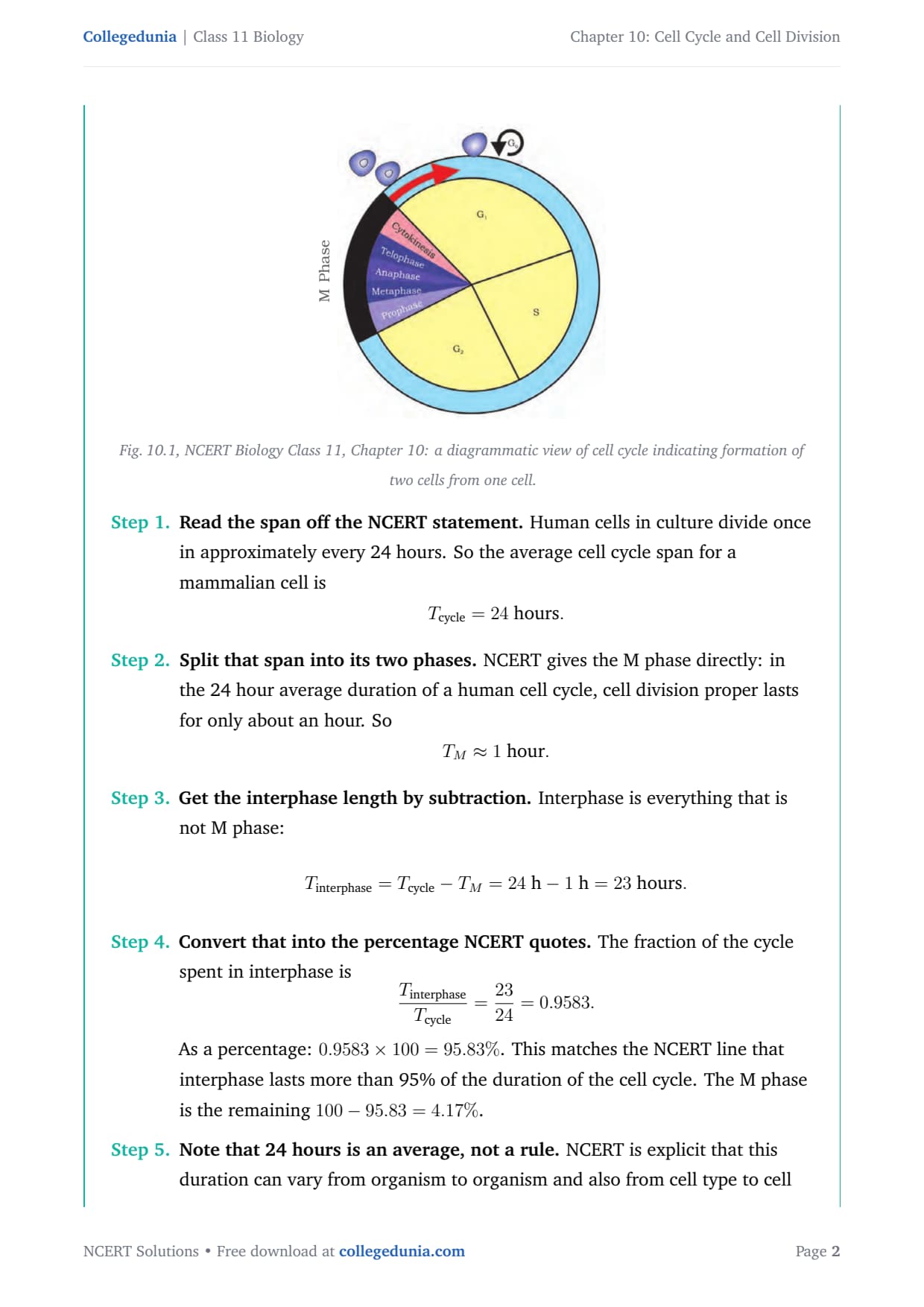
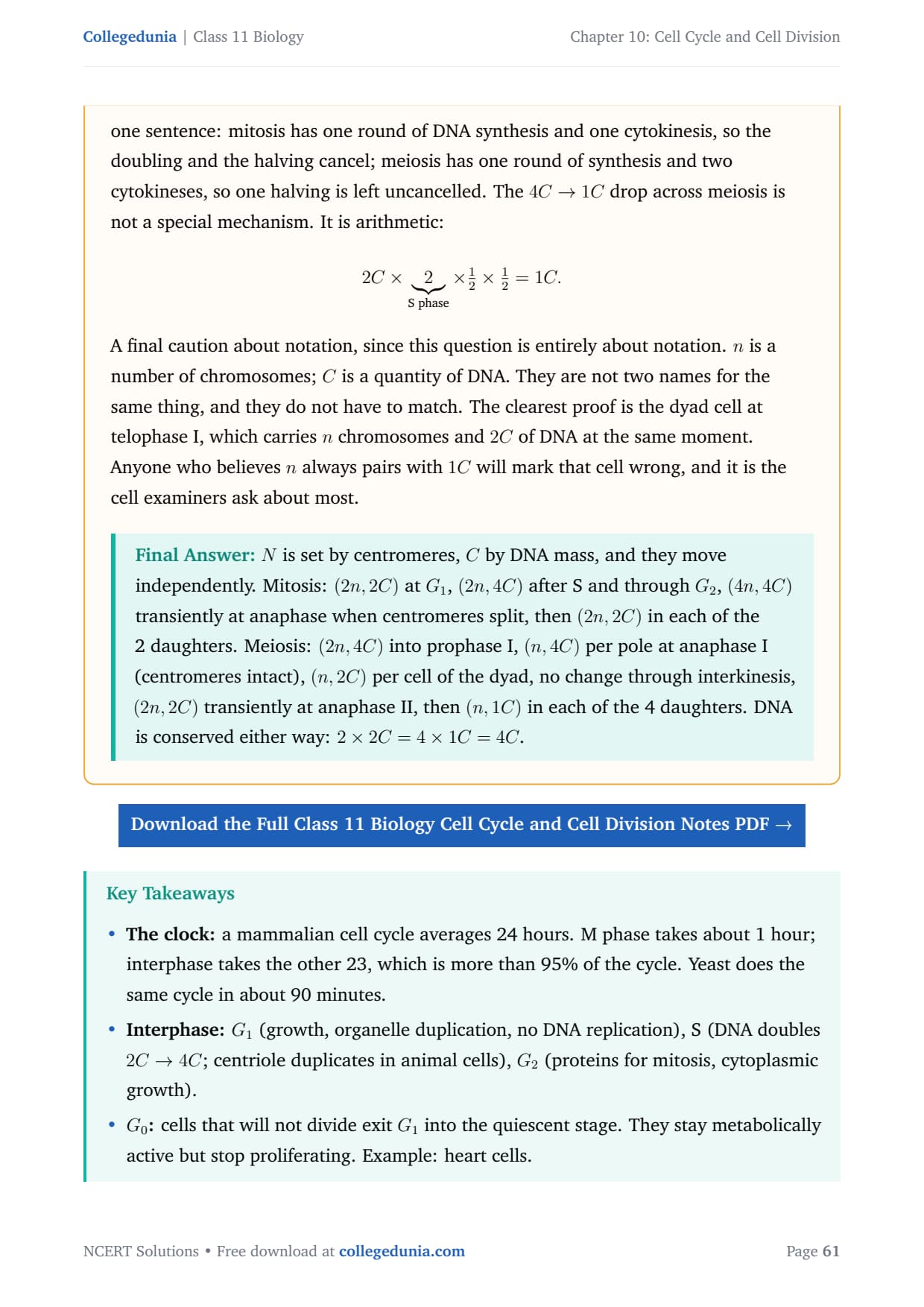
The cell cycle is the sequence of events by which a cell duplicates its genome, synthesises the other constituents of the cell and finally divides into two daughter cells. NCERT illustrates it with human cells in culture, which divide once in approximately every 24 hours. The cycle splits into two basic phases, and the exercise opens by asking for the average span and how it is shared out.
- Interphase: the long preparation period, occupying more than 95% of the cycle, during which the cell grows and copies its DNA.
- M phase (mitosis phase): the actual division, which in a 24-hour human cycle lasts only about an hour.
- The arithmetic: 24 hours minus the 1-hour M phase leaves about 23 hours of interphase, and 23 ÷ 24 gives 0.9583, so interphase is about 95.83% of the cycle.
The 24-hour figure is an average, not a rule, and NCERT is explicit that it varies from organism to organism and from cell type to cell type. Yeast, for example, completes a cycle in only about 90 minutes, which is roughly 16 times faster than the human cell. Because interphase is so long, it was once wrongly called the resting phase, when in fact it is the busiest part of the cycle. Refer to Exercise Q1 for the full step-by-step split of the 24-hour span.
Interphase: The G1, S and G2 Sub-phases
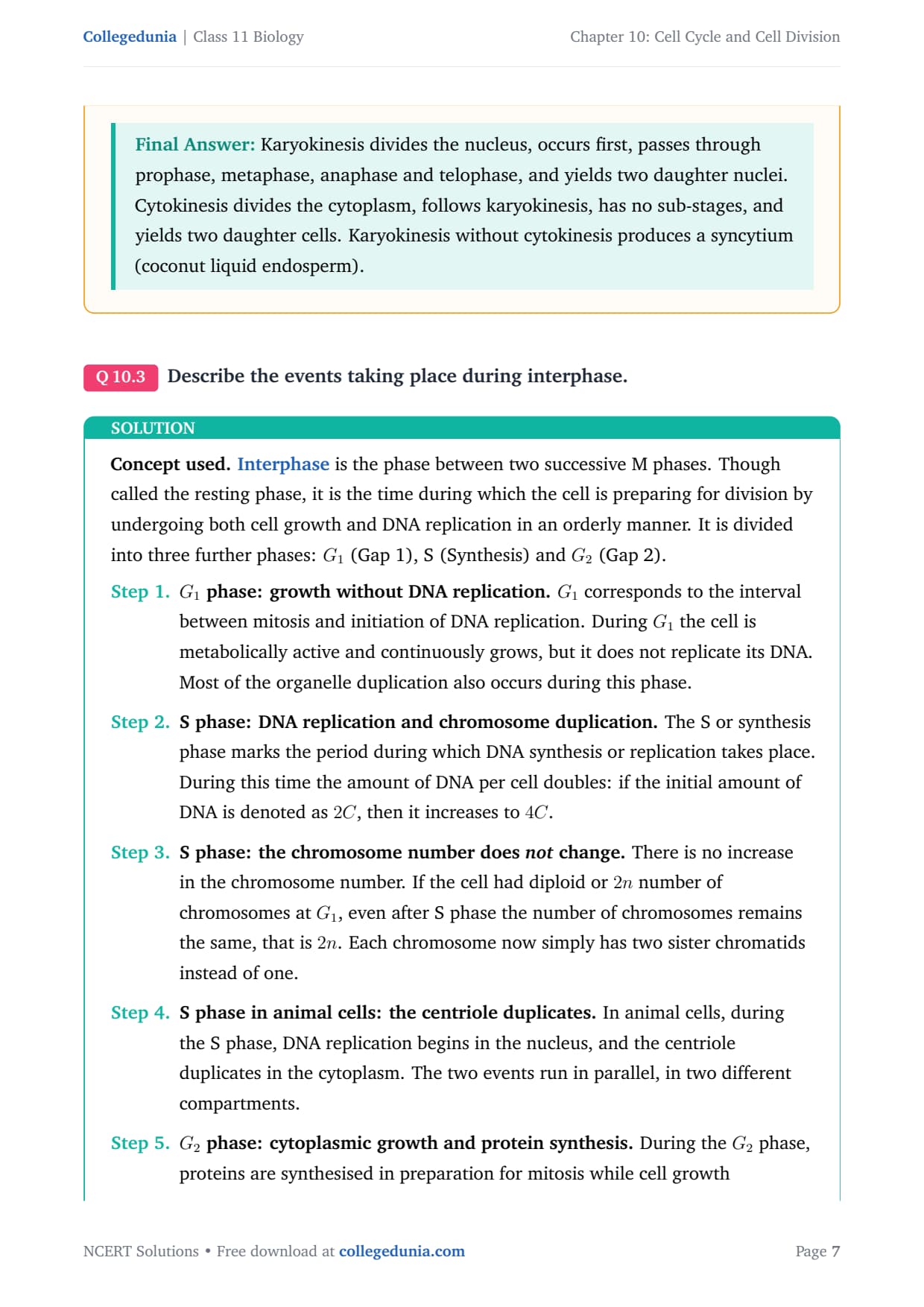
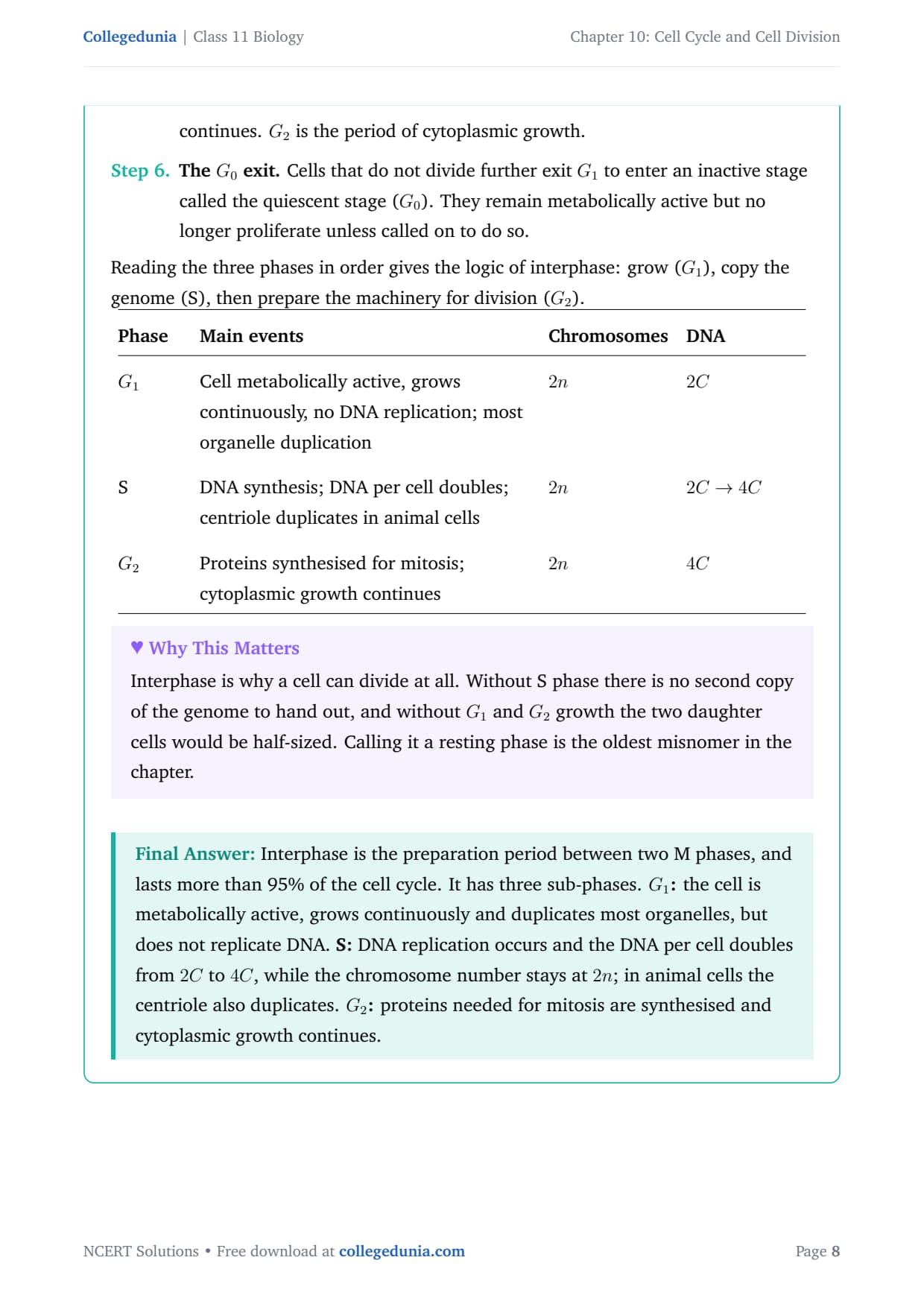
Interphase is not a single block but three sub-phases, and describing the events of each is a common short-answer question. The logic runs in order: grow first (G1), copy the genome next (S), then assemble the machinery for division (G2). Each sub-phase hands the next one its raw material, which is why the order cannot be shuffled.
| Phase | Main events | Chromosomes | DNA |
|---|---|---|---|
| G1 | Cell metabolically active, grows continuously, no DNA replication; most organelle duplication happens here. | 2n | 2C |
| S | DNA synthesis; DNA per cell doubles; centriole duplicates in animal cells. | 2n | 2C → 4C |
| G2 | Proteins synthesised for mitosis; cytoplasmic growth continues. | 2n | 4C |
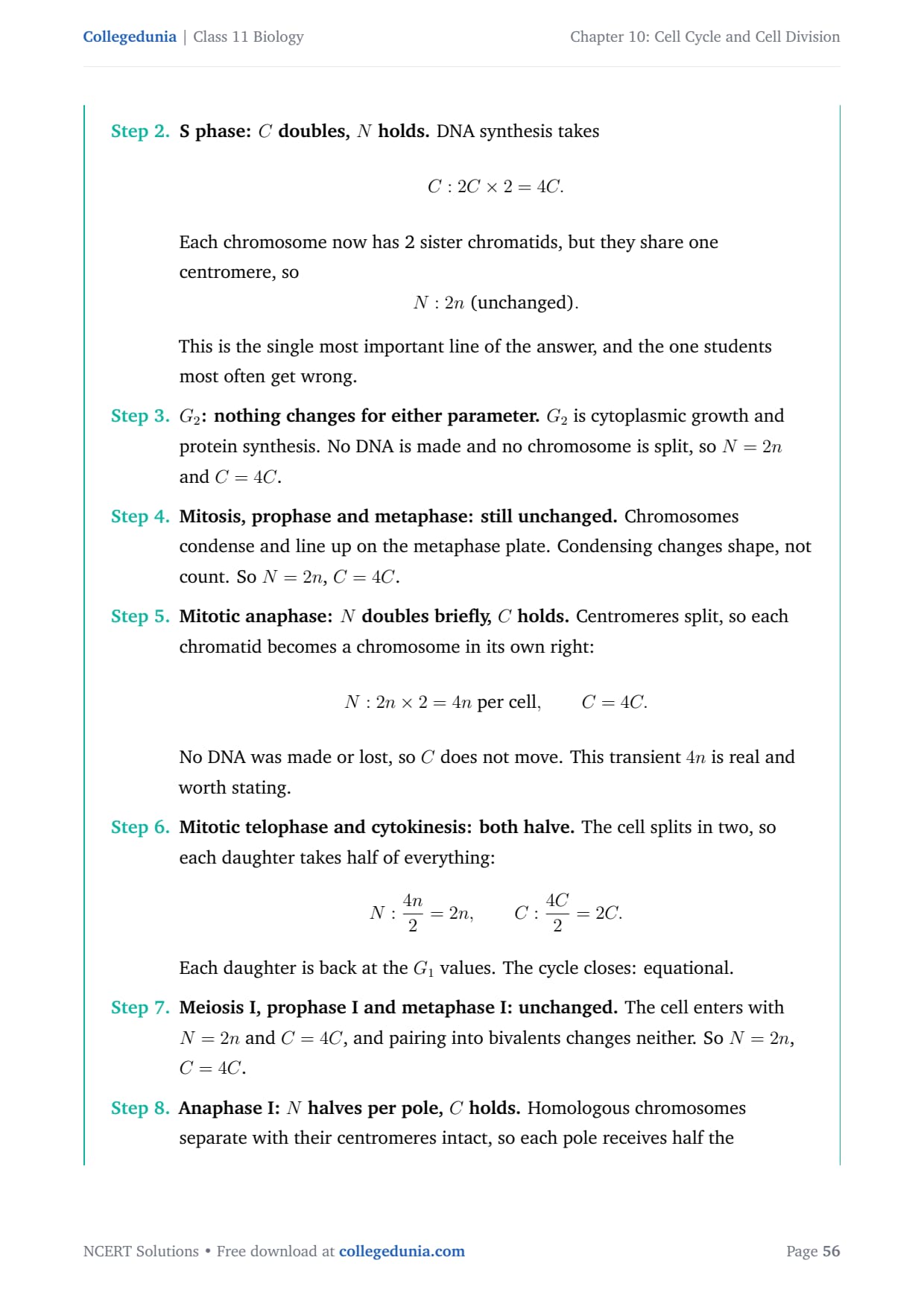
The key trap is the S phase: the DNA doubles from 2C to 4C, but the chromosome number stays at 2n, because each chromosome simply gains a second sister chromatid and the two chromatids share one centromere. A chromosome is counted by its centromere, so twice the DNA still means the same count. Centriole duplication in S phase is an animal-cell event only, since plant cells lack centrioles and still build a spindle. Precision about that one word, animal, separates the top band from the middle in the NEET version of this question.
The G0 Quiescent Phase
Some cells in adult animals do not appear to divide, and NCERT gives them a name and a place. Cells that will not divide further exit the G1 phase and enter an inactive stage called the quiescent stage, or G0. The word quiescent means quiet, not dead, and the whole answer hinges on that one contrast: metabolically active, but no longer proliferating.
- Where it is entered from: a cell steps into G0 by exiting G1, not from S, G2 or M, because G1 is the interval before DNA replication is committed to.
- What continues: normal cell function goes on, so a heart muscle cell keeps contracting and a nerve cell keeps conducting.
- What stops: there is no DNA replication and no M phase, so the cell makes no daughter cells unless called on to do so.
The exit is reversible: cells replacing tissue lost to injury or cell death are recalled from G0 and divide only occasionally, as needed. This is why adult tissues differ so much in their ability to repair. Skin, gut lining and blood cells are replaced constantly, so few of their cells sit in G0, while heart and nerve cells largely do, which is why those tissues recover so poorly after damage. The zero in G0 records that the cell is at zero progress through the cycle, having left the sequence rather than advancing along it.
Mitosis, Karyokinesis and Why It Is Equational
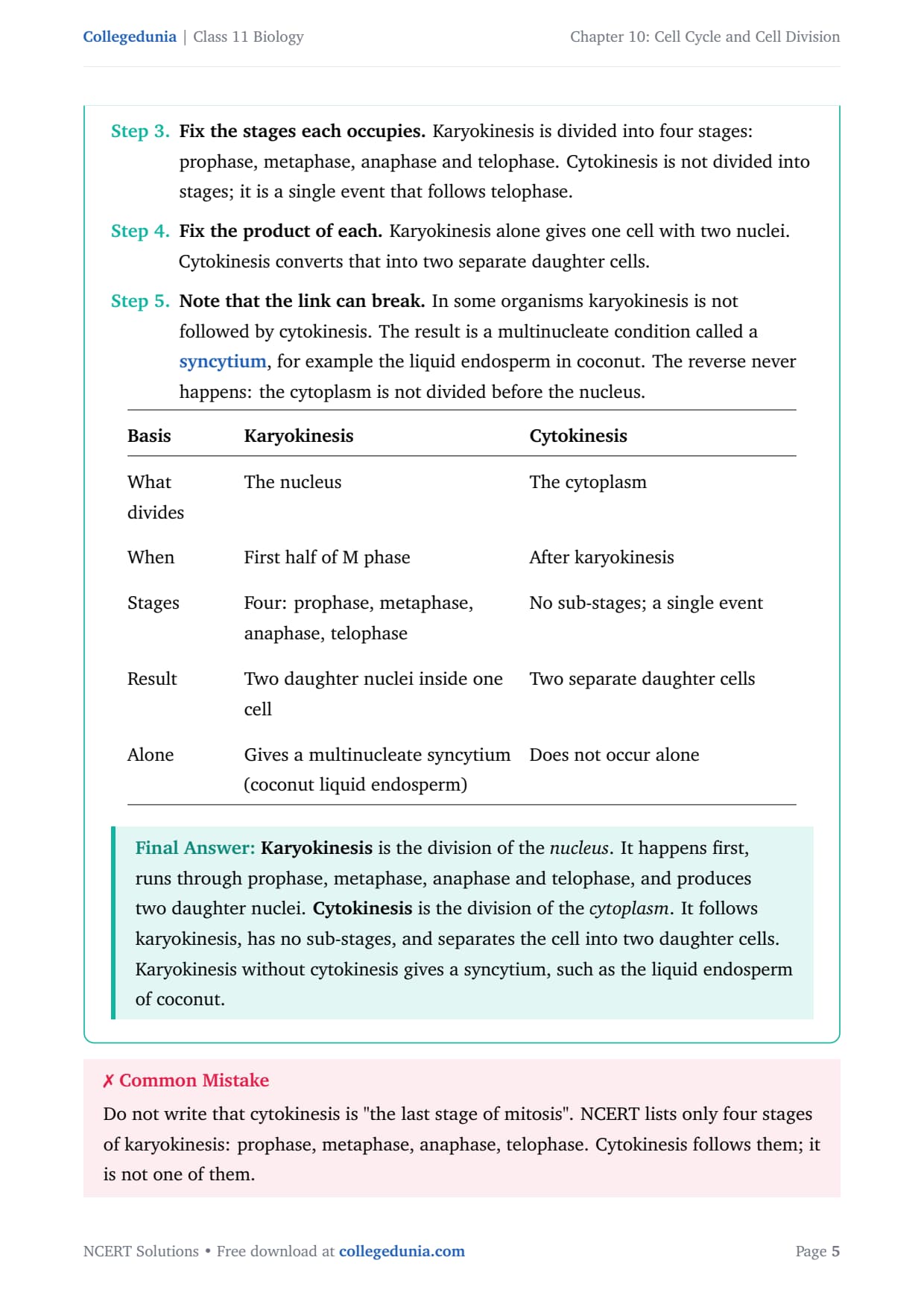
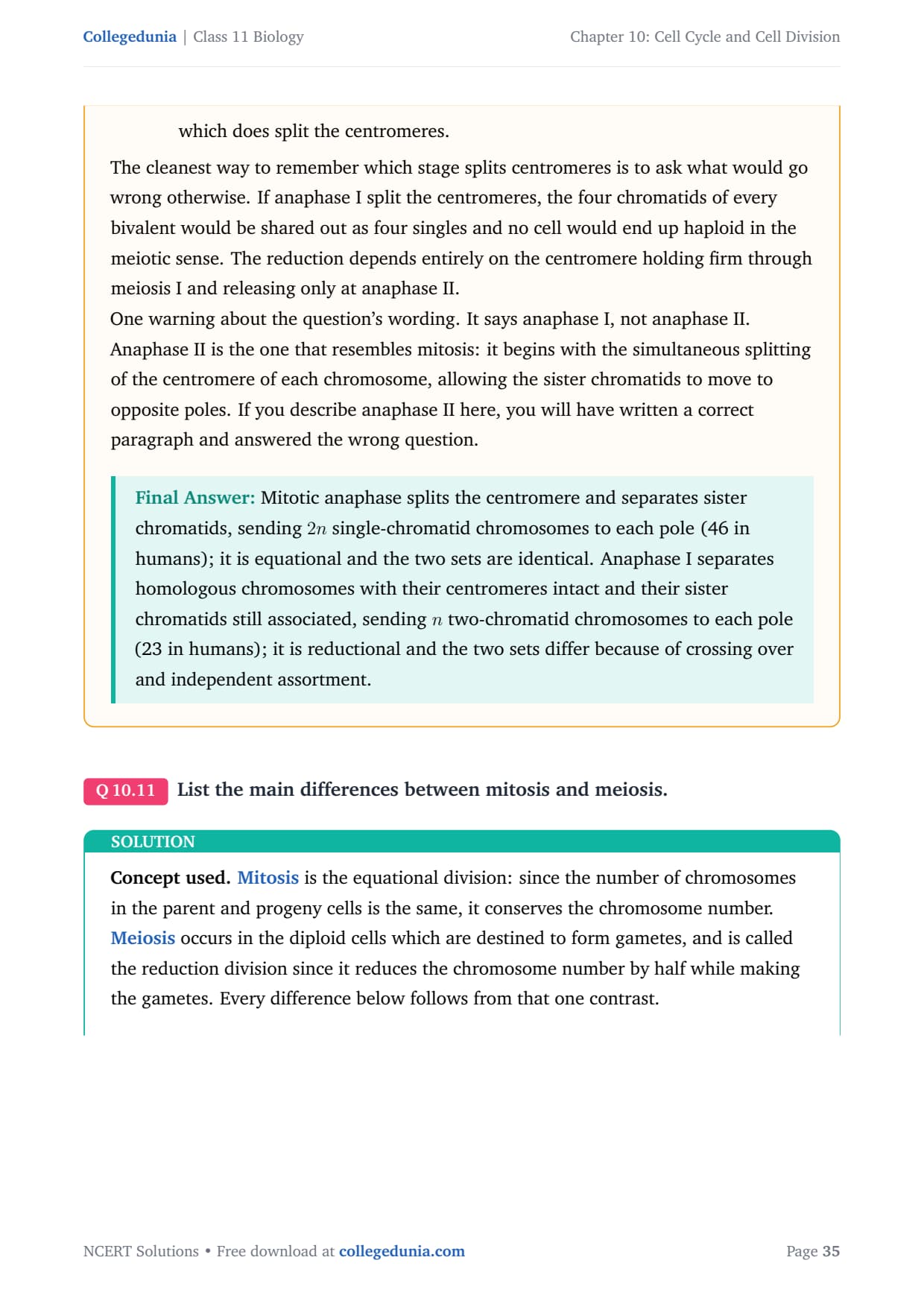
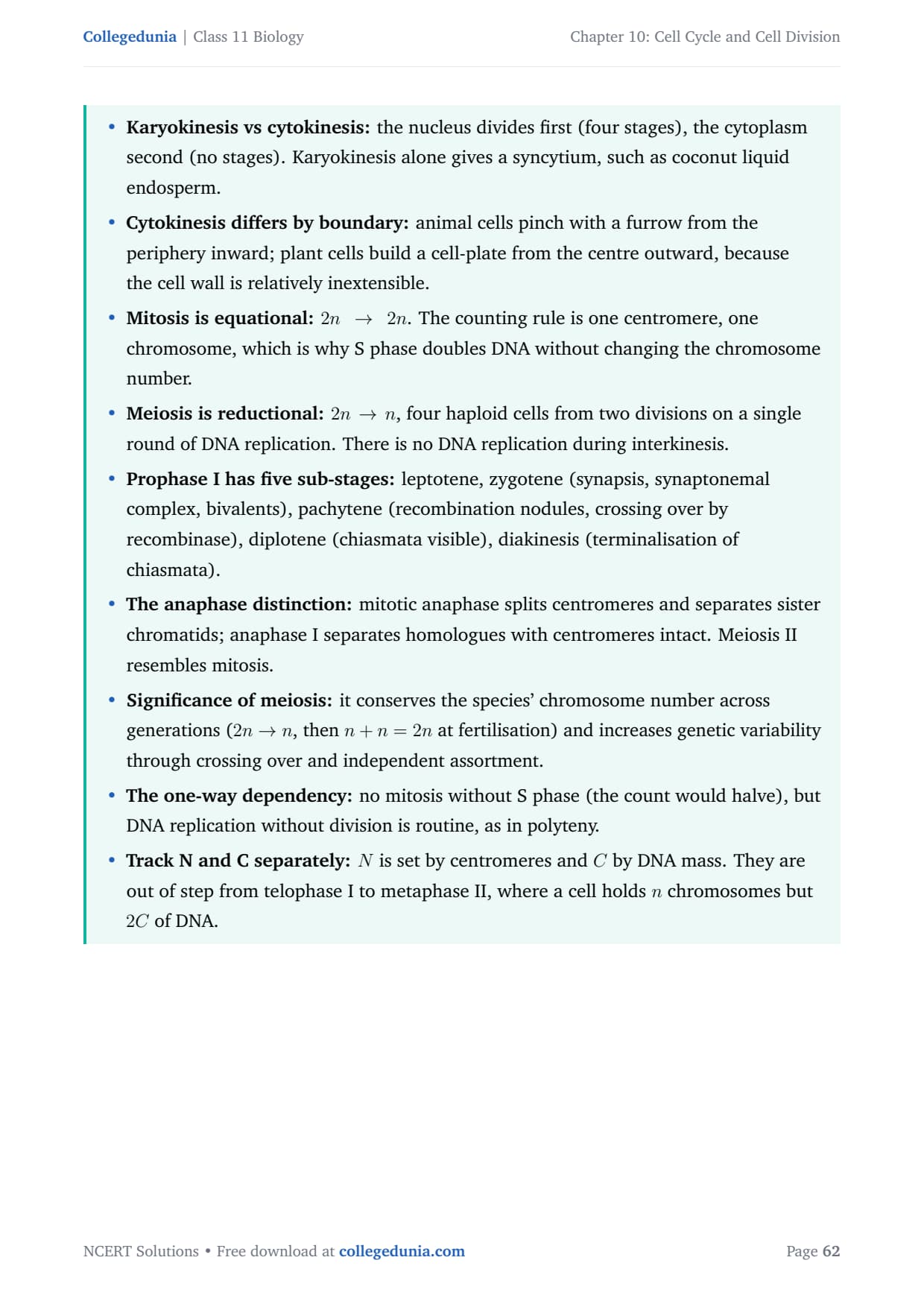
The M phase begins with nuclear division, called karyokinesis, and usually ends with division of the cytoplasm, called cytokinesis. Karyokinesis runs through four stages, and NCERT is strict that cytokinesis is not one of them. Mitosis is described as the equational division because the number of chromosomes in the parent and progeny cells is the same.
| Stage of karyokinesis | Key event |
|---|---|
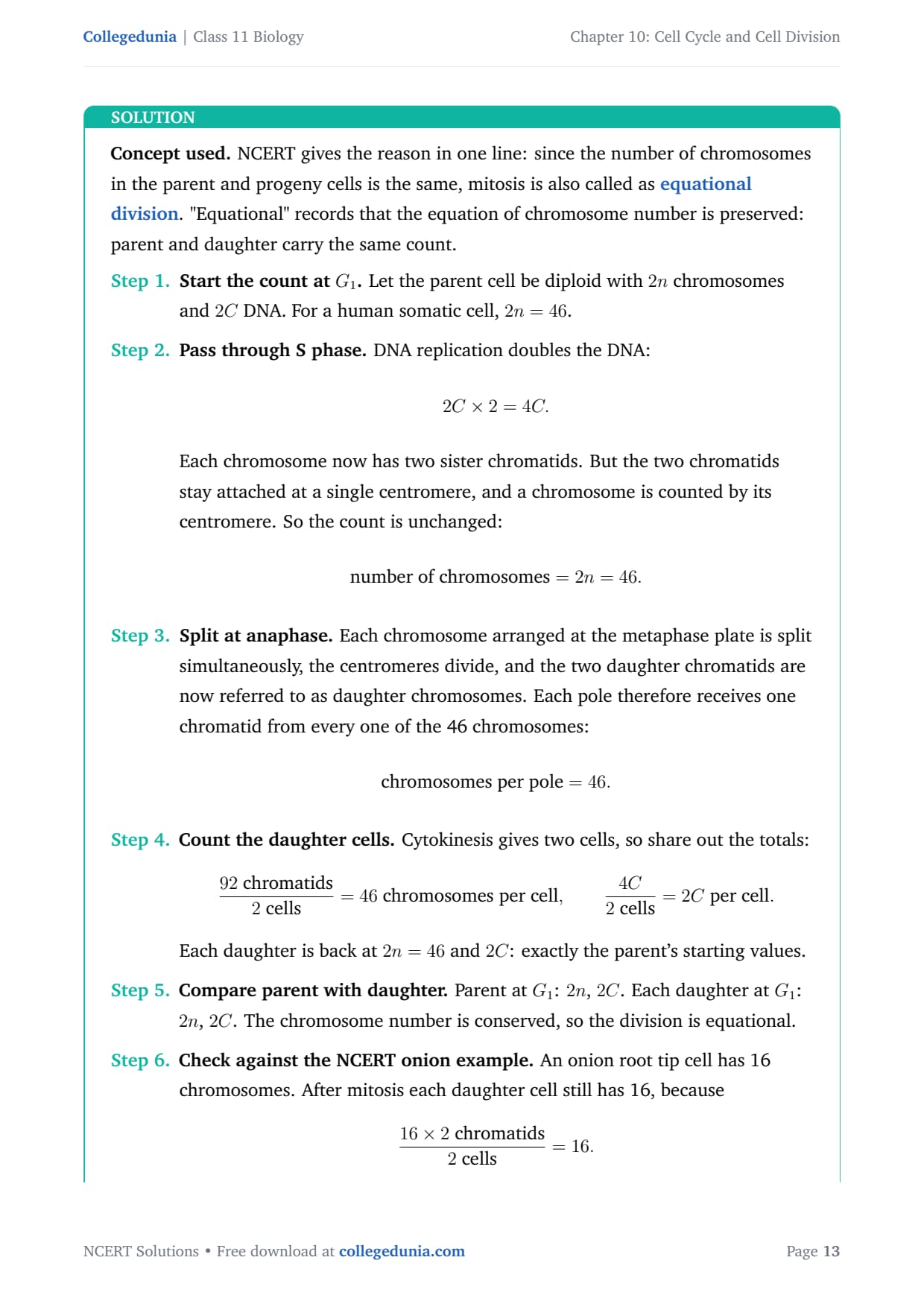
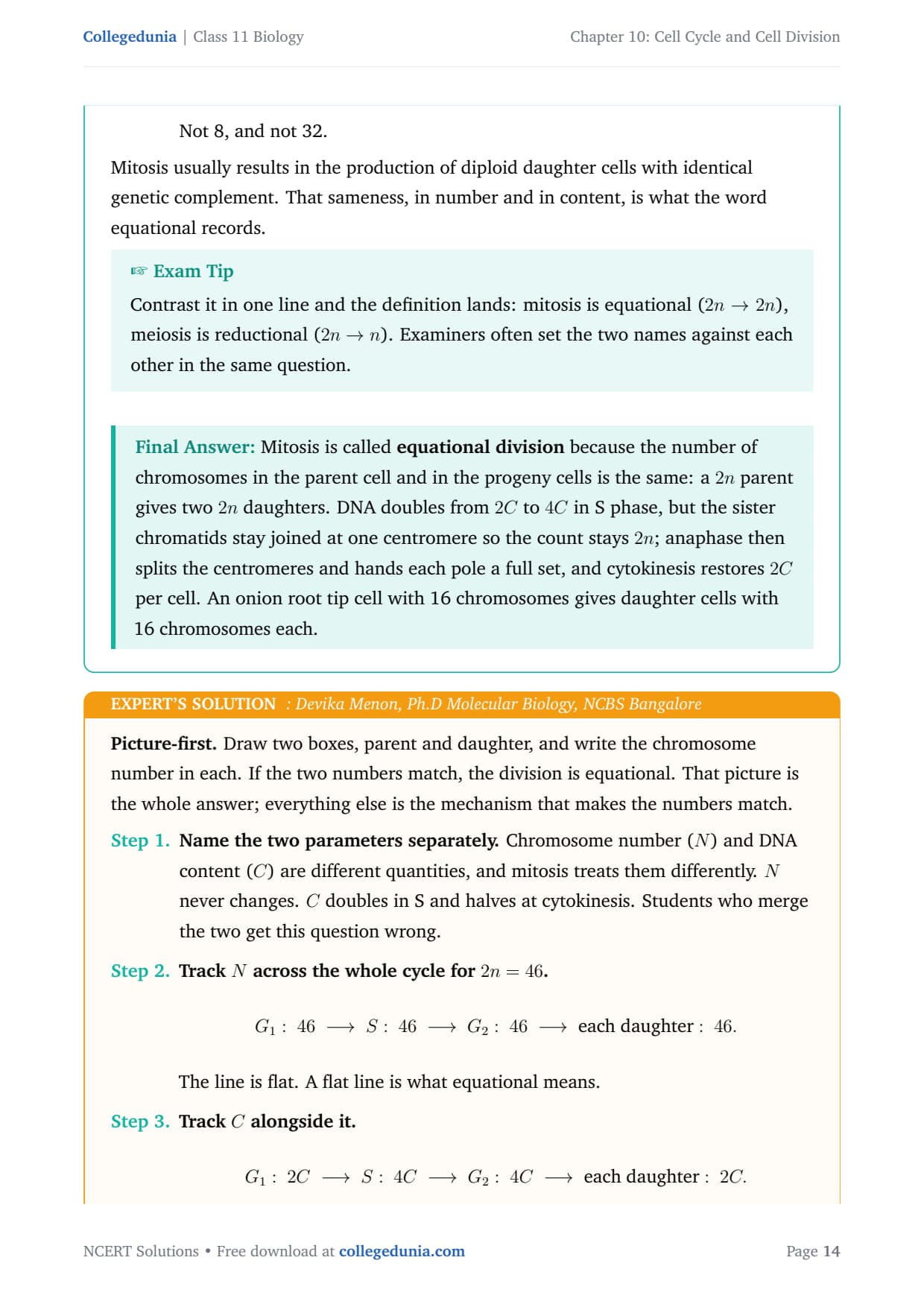
| Prophase | Chromosomes condense; the spindle begins to form; the nuclear envelope starts to disappear. |
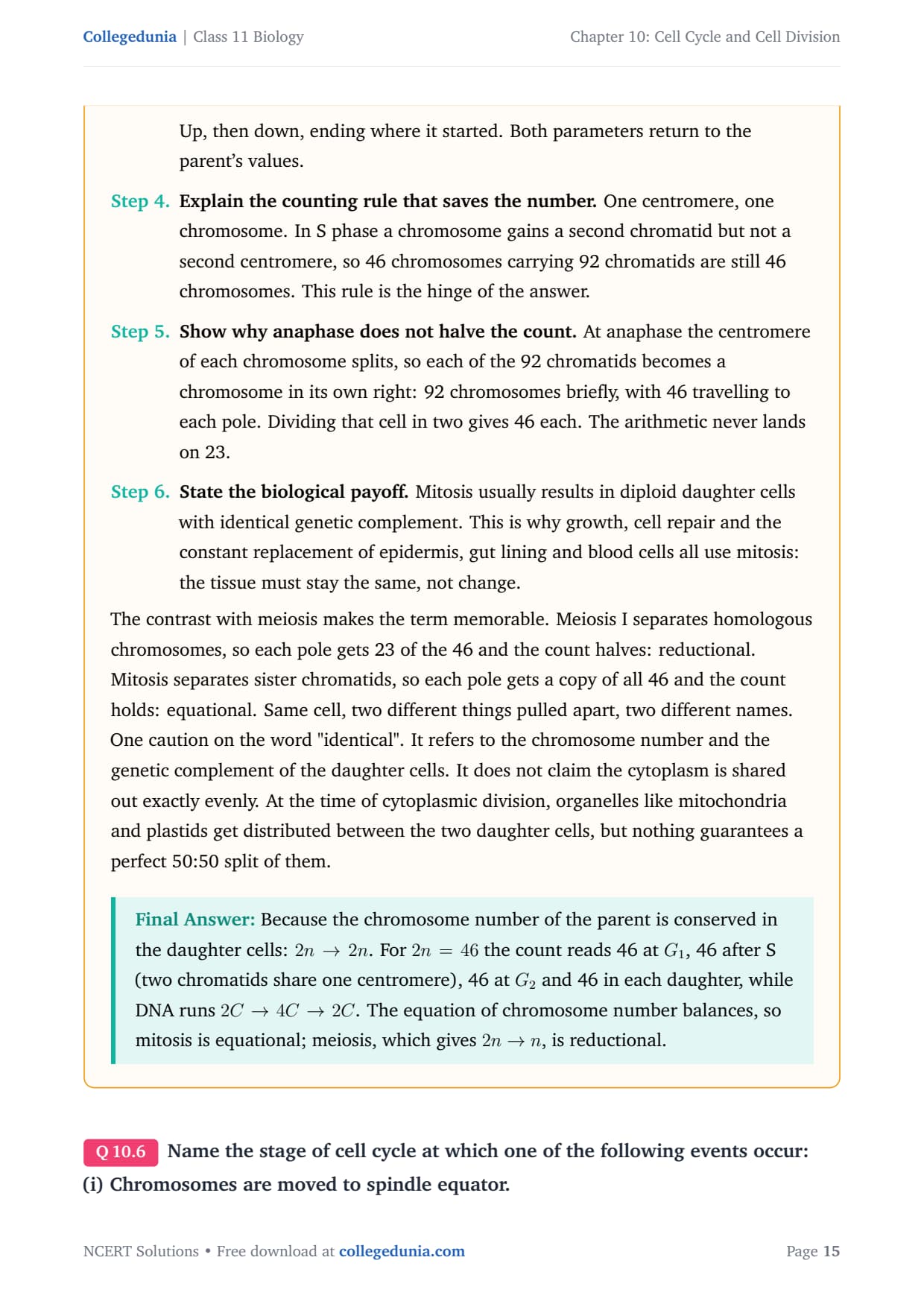
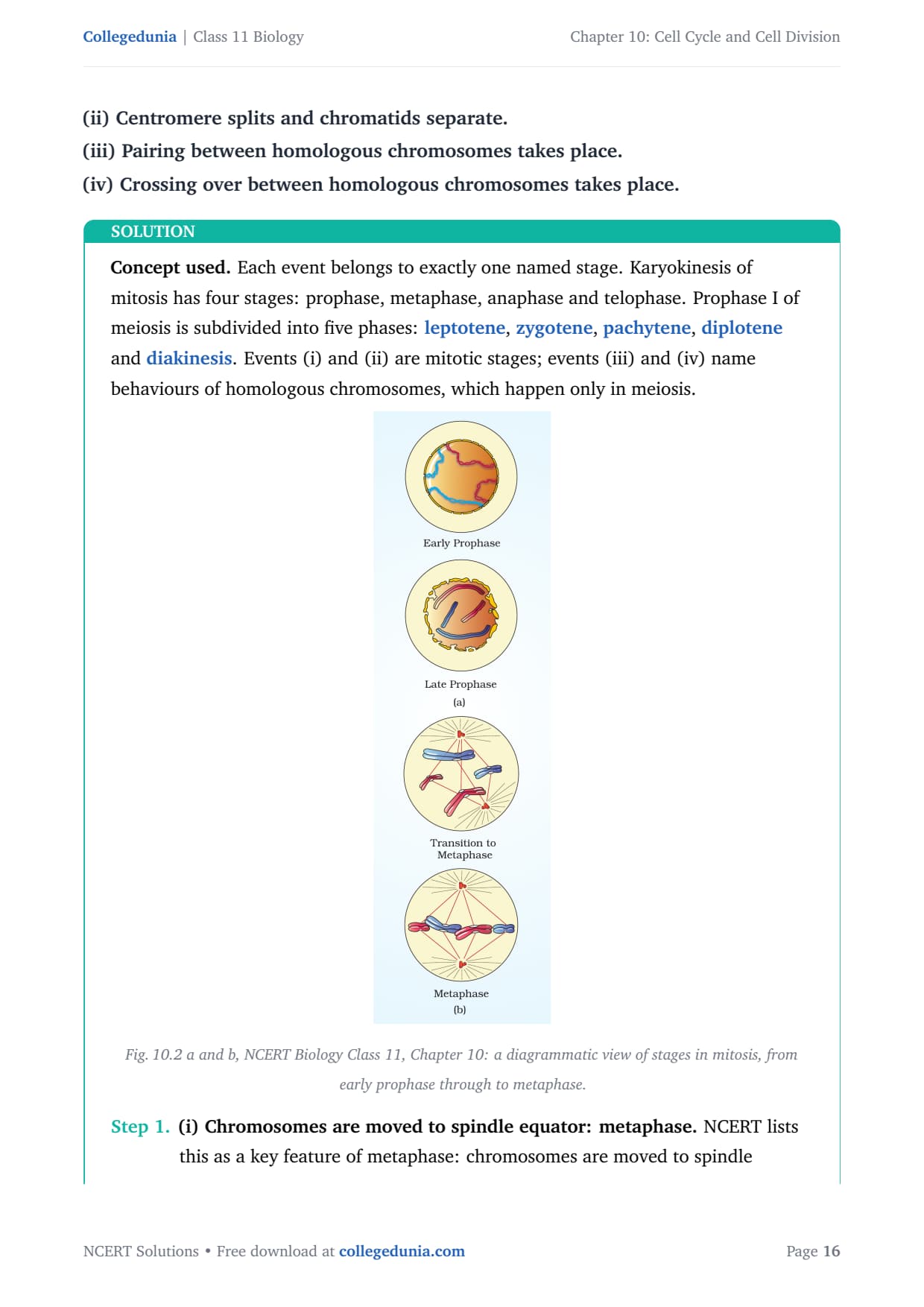
| Metaphase | Chromosomes are moved to the spindle equator and align on the metaphase plate. |
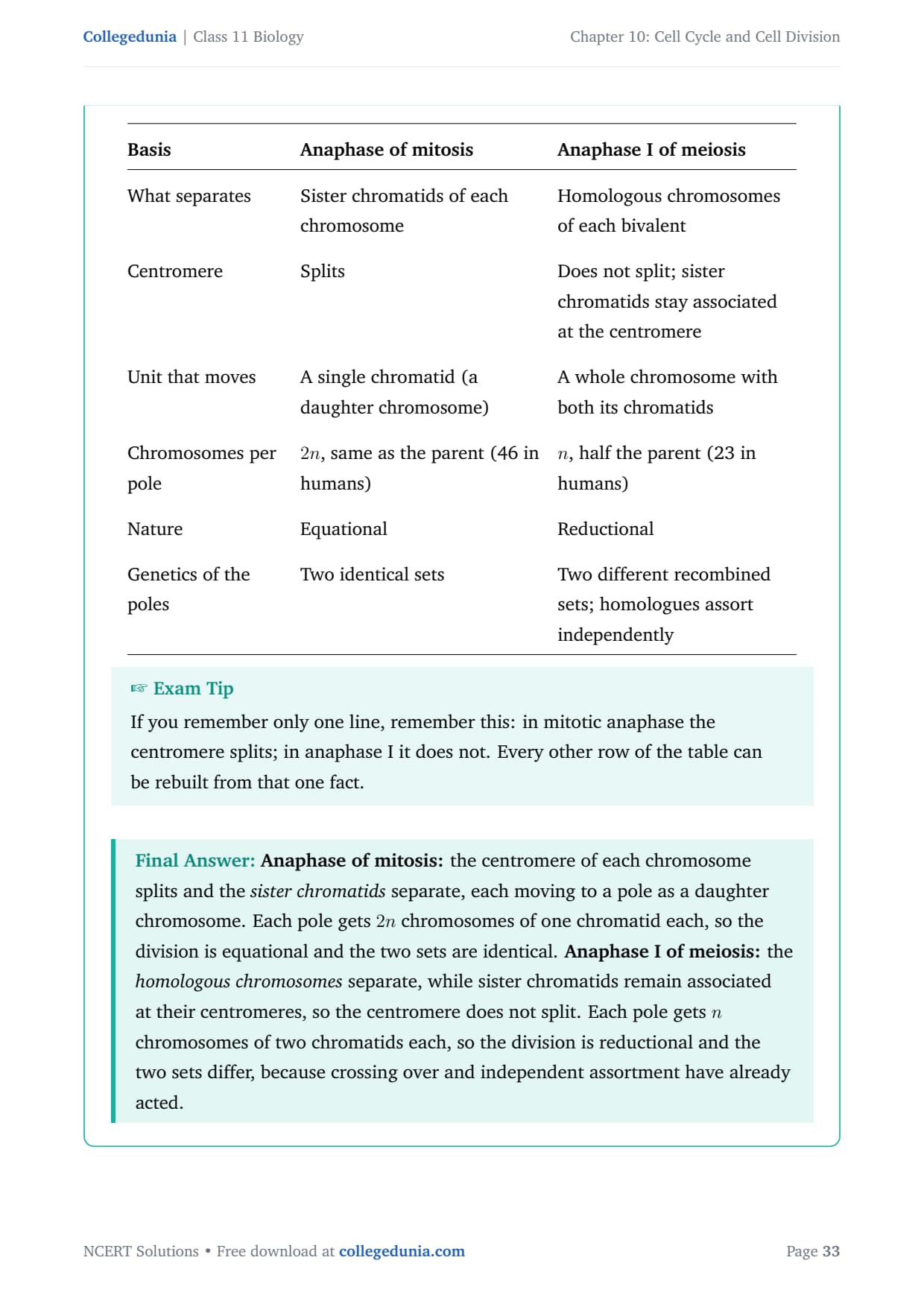
| Anaphase | Centromeres split and sister chromatids separate, moving to opposite poles as daughter chromosomes. |
| Telophase | Chromosomes reach the poles, decondense, and nuclear envelopes re-form around the two daughter nuclei. |
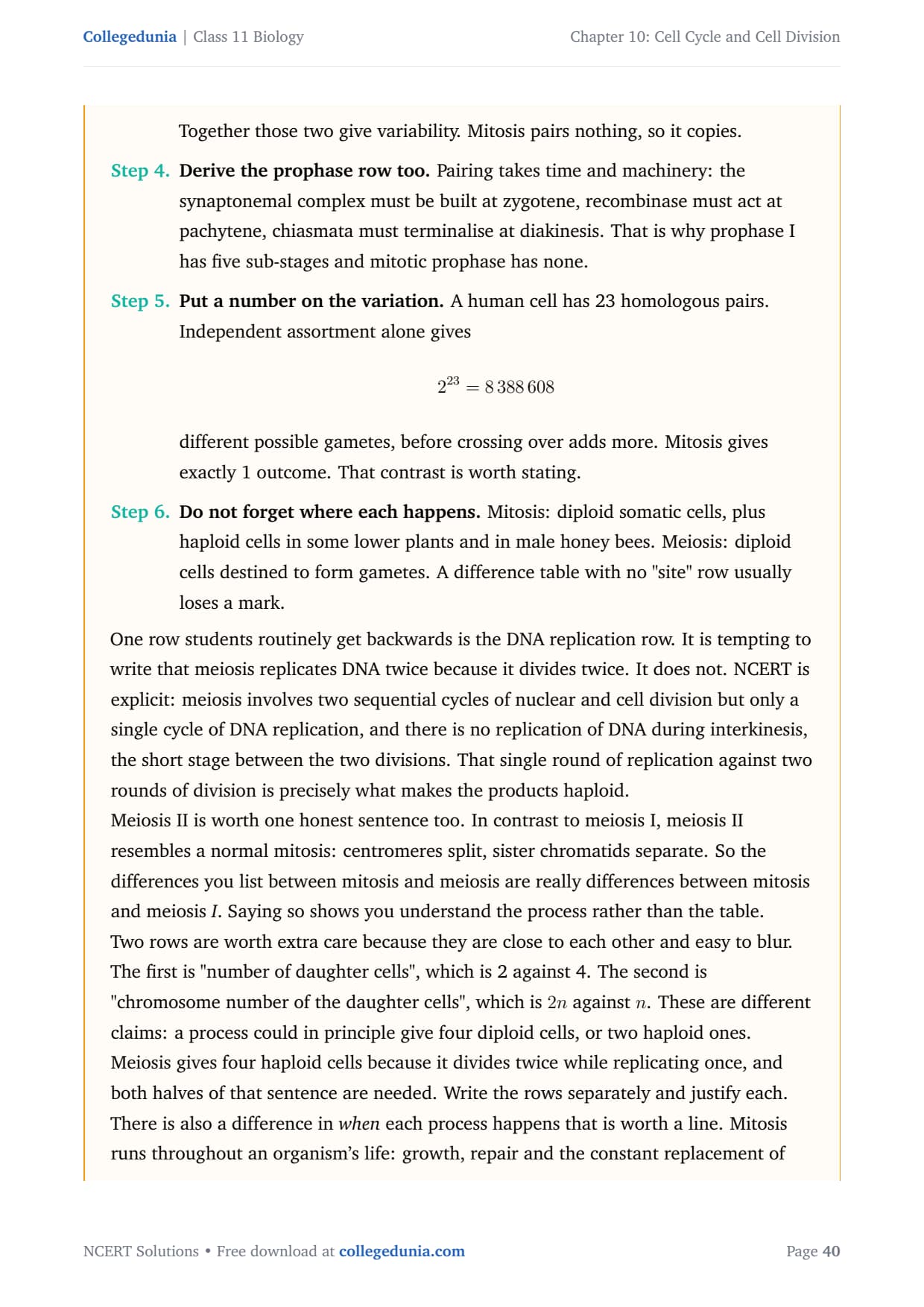
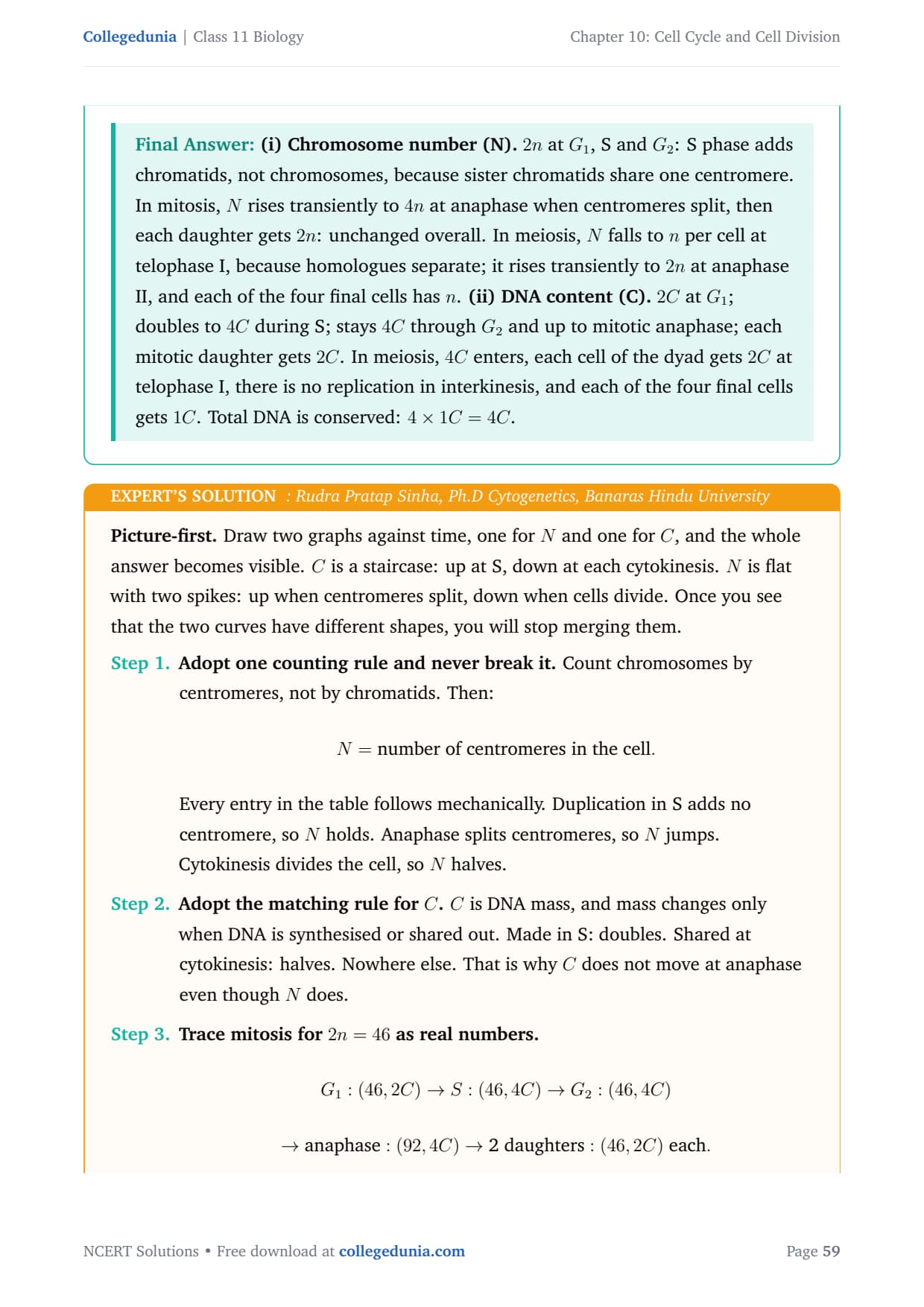
Tracking a human cell where 2n = 46 shows why the count holds: 46 at G1, 46 after S (two chromatids share one centromere), 46 at G2, and 46 in each daughter, while the DNA runs 2C → 4C → 2C. An onion root tip cell with 16 chromosomes therefore gives daughter cells with 16 chromosomes each, not 8 and not 32. Contrast it in one line and the definition lands: mitosis is equational (2n → 2n), meiosis is reductional (2n → n). Work through Exercise Q5 for the full chromosome-count reasoning.
Cytokinesis in Plant Cells Versus Animal Cells
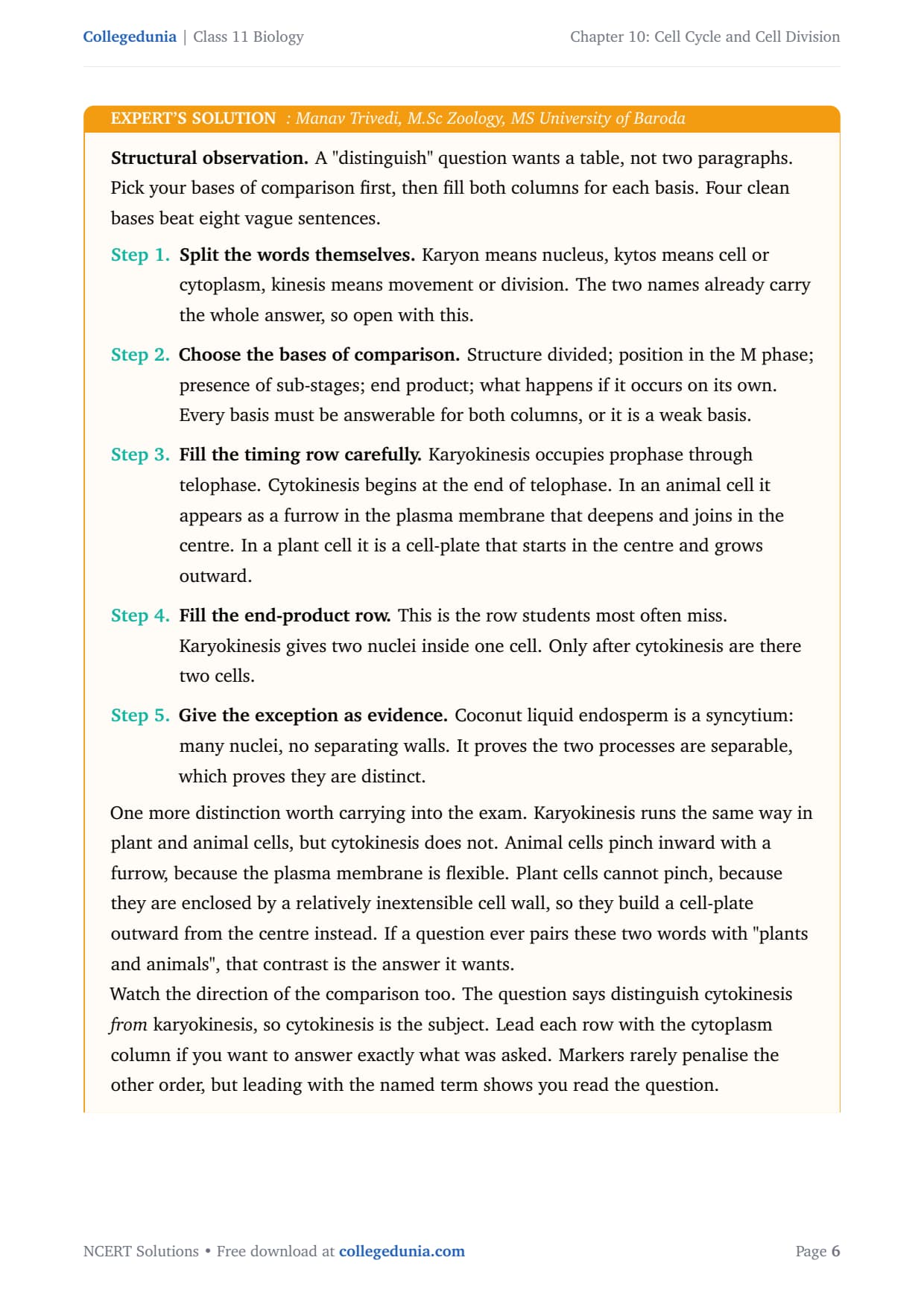
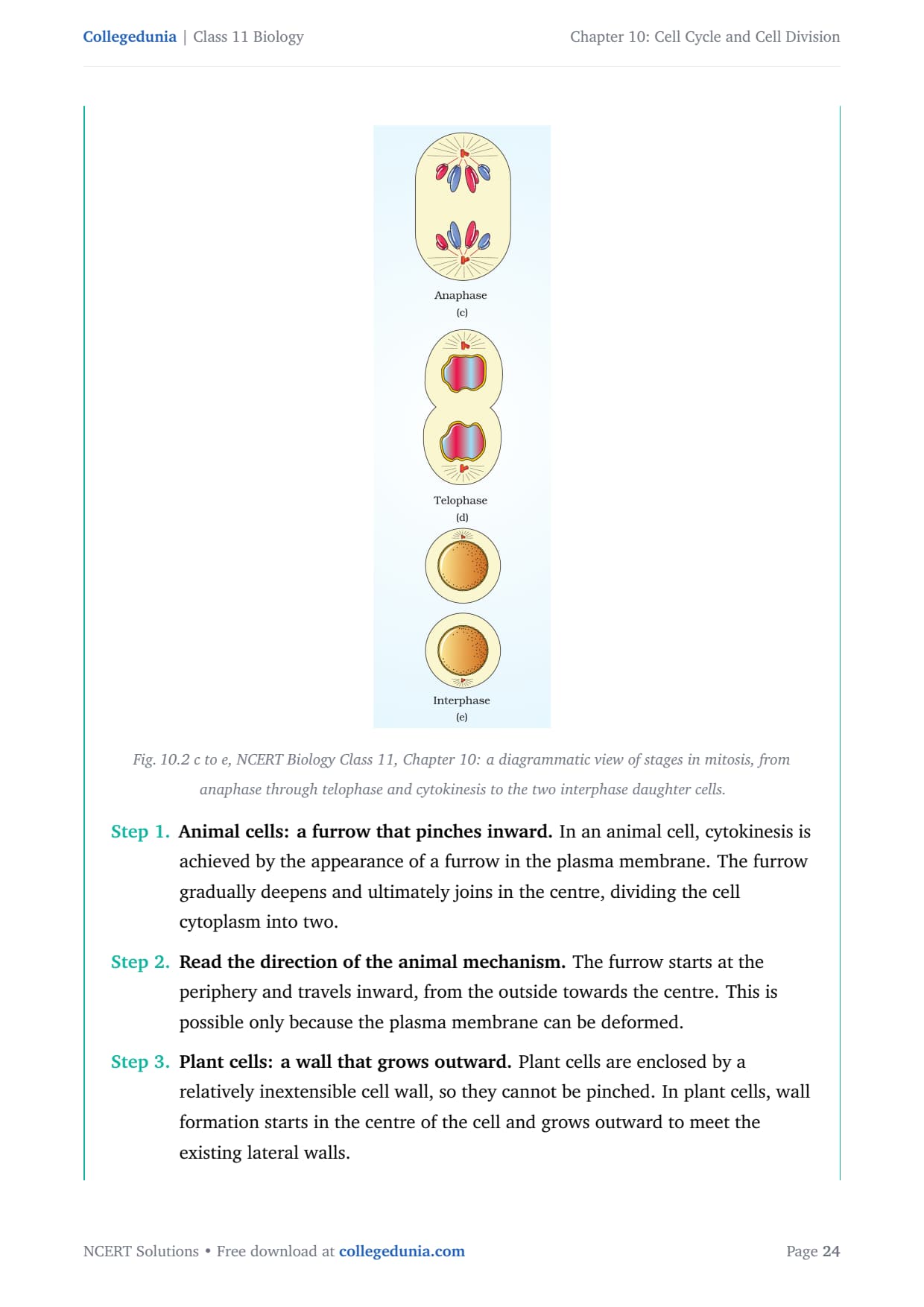
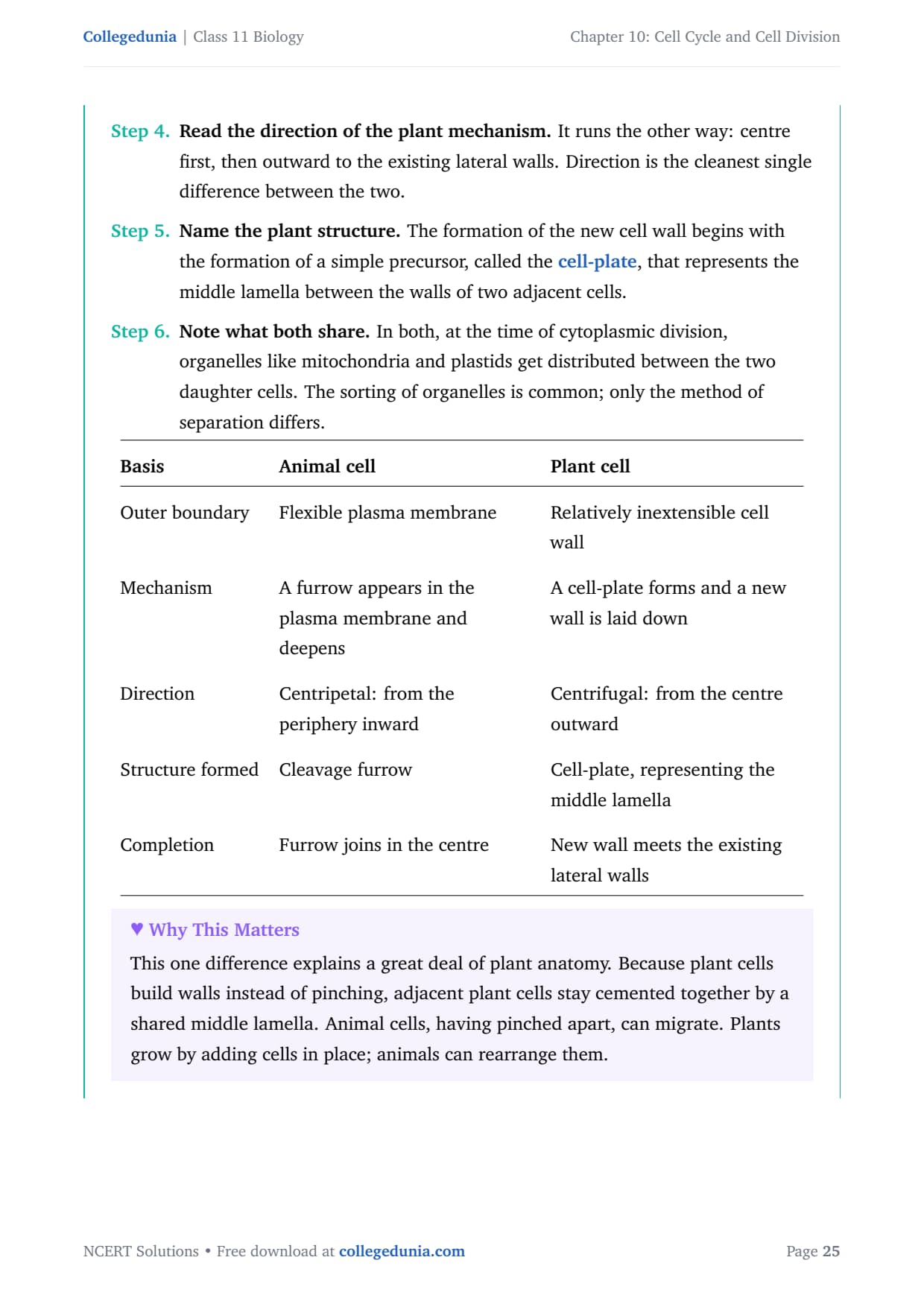
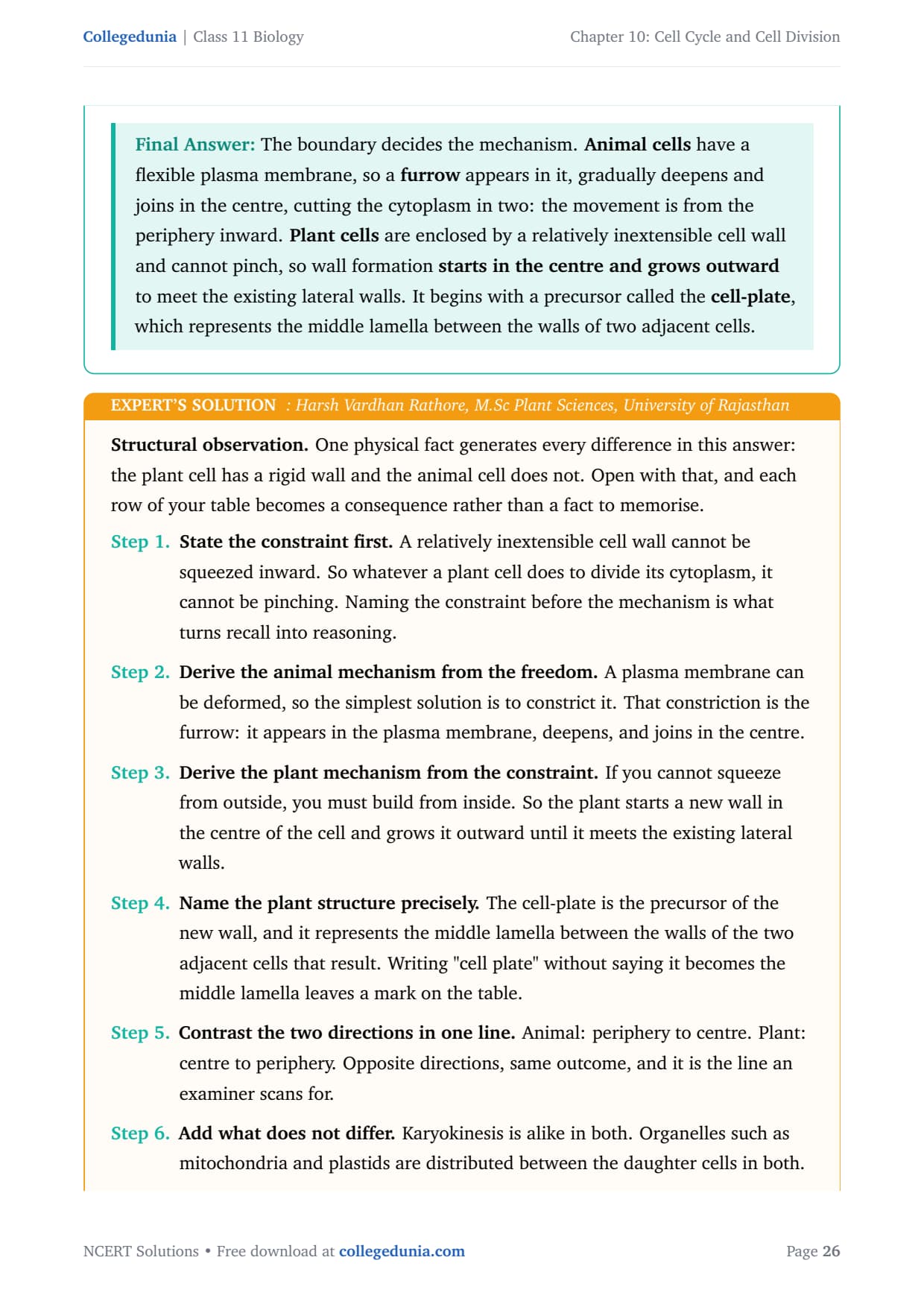
Karyokinesis runs the same way in plant and animal cells, but cytokinesis does not, because the cell's outer boundary forces the mechanism. An animal cell is bounded by a flexible plasma membrane, so it can be pinched, while a plant cell is enclosed by a relatively inextensible cell wall and cannot be. This is one of the cleanest distinguish questions in the chapter, and it rewards a table.
| Basis | Animal cell | Plant cell |
|---|---|---|
| Outer boundary | Flexible plasma membrane | Relatively inextensible cell wall |
| Mechanism | A furrow appears in the membrane and deepens until it joins in the centre | A cell-plate forms and a new wall is laid down |
| Direction | From the periphery inward | From the centre outward to the existing lateral walls |
| Structure formed | Cleavage furrow | Cell-plate, which becomes the middle lamella |
Direction is the single cleanest difference: the animal furrow moves inward from the outside, while the plant cell-plate grows outward from the centre. What both share is that at the time of cytoplasmic division, organelles like mitochondria and plastids get distributed between the two daughter cells, though nothing guarantees a perfect 50:50 split. Karyokinesis without cytokinesis produces a multinucleate syncytium, the classic NCERT example being the liquid endosperm of coconut. The reverse never happens, since the cytoplasm is not divided before the nucleus.
Meiosis and the Five Sub-stages of Prophase I
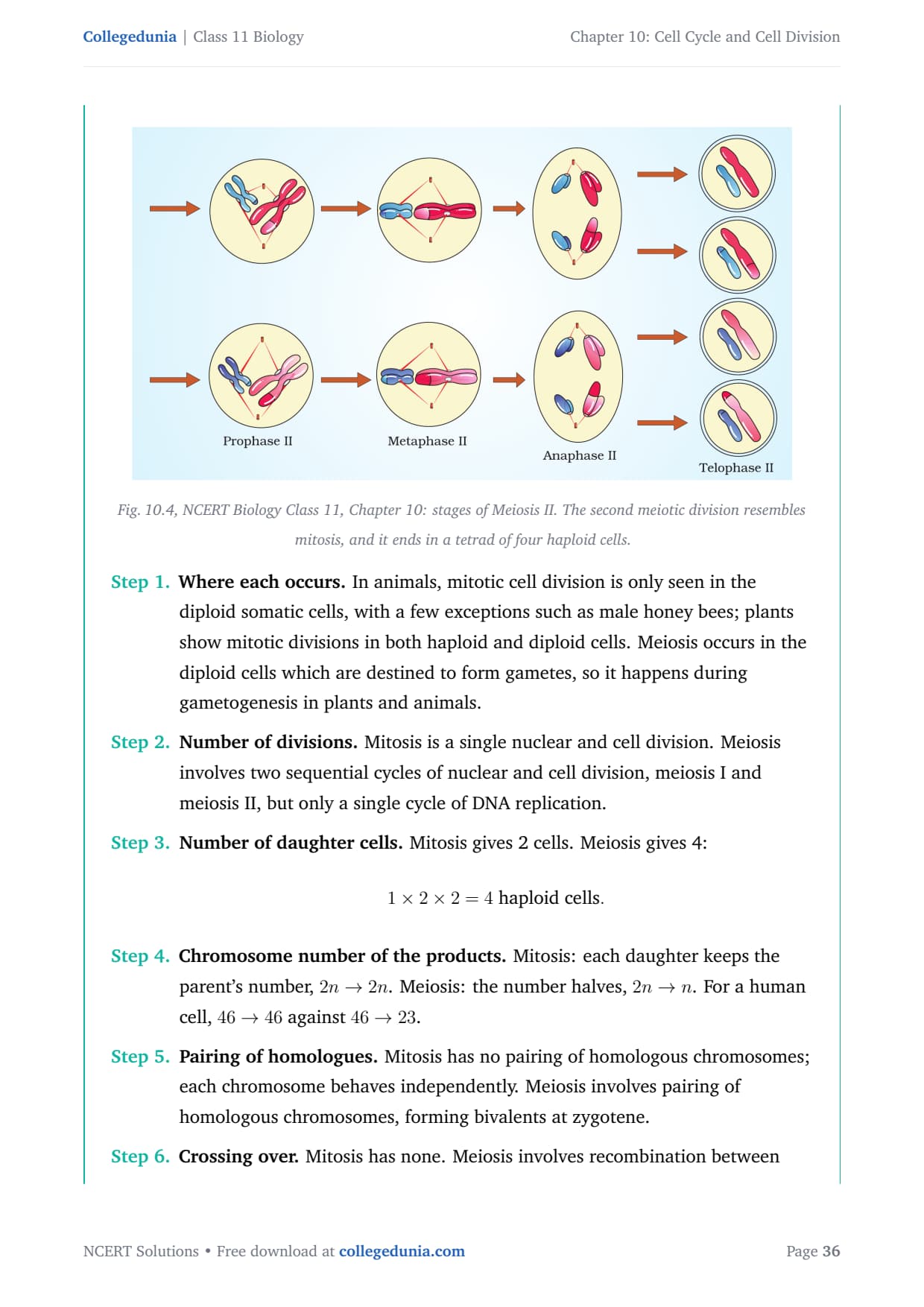
Meiosis is two divisions on a single round of DNA replication, and it is reductional because it takes a diploid cell to four haploid cells (2n → n). The heart of the process is prophase I, the longest and most complex prophase, subdivided into five sub-stages that carry the events NEET asks about most. Three key terms, synapsis, bivalent and chiasmata, all belong here.
| Sub-stage of prophase I | Defining event |
|---|---|
| Leptotene | Chromosomes become gradually visible as long threads. |
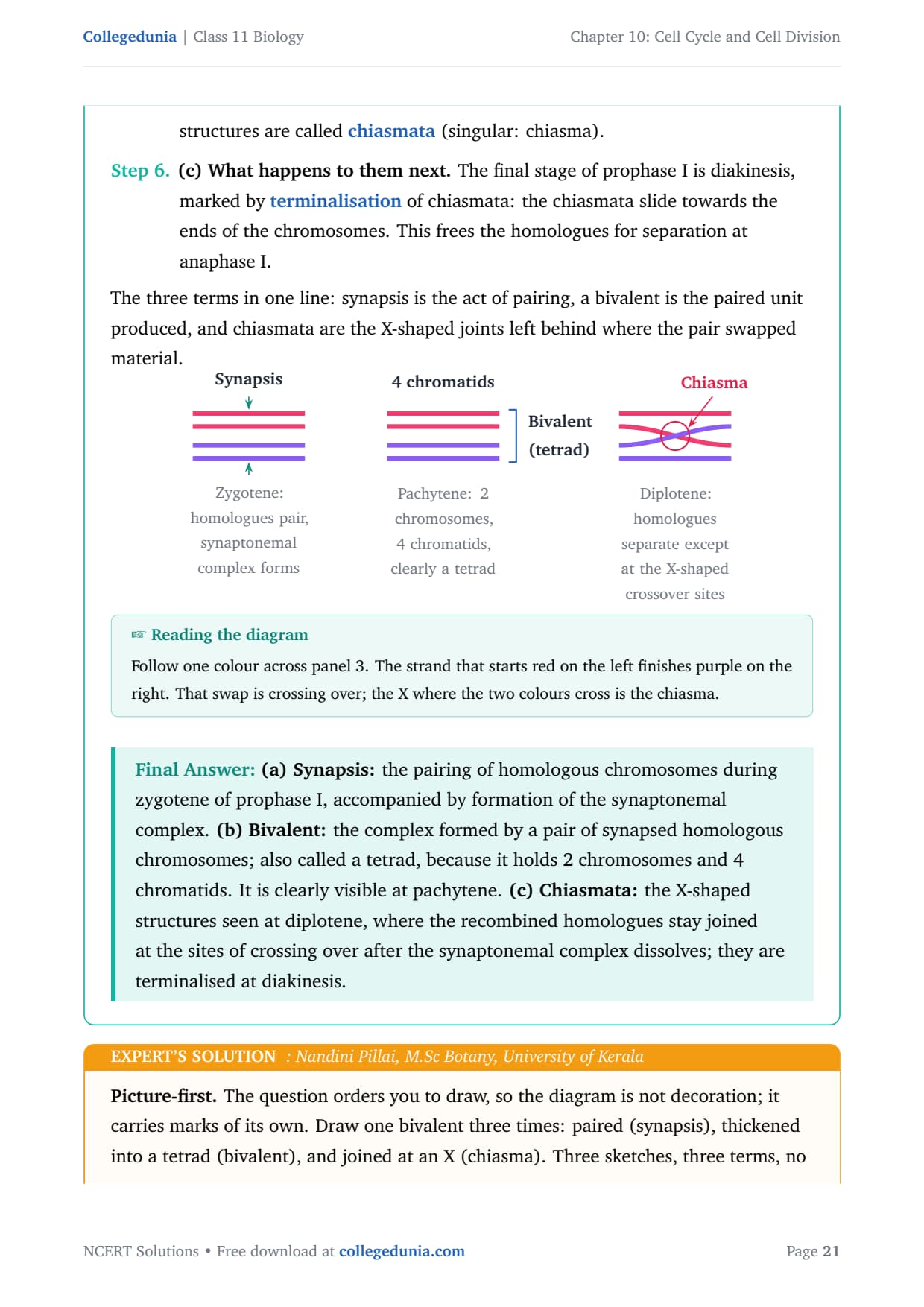
| Zygotene | Homologous chromosomes pair (synapsis); the synaptonemal complex forms. |
| Pachytene | Bivalents appear clearly as tetrads; crossing over occurs at recombination nodules via recombinase. |
| Diplotene | The synaptonemal complex dissolves; homologues stay joined at X-shaped chiasmata. |
| Diakinesis | Chiasmata undergo terminalisation, sliding to the chromosome ends. |
The three terms in one line: synapsis is the pairing of homologous chromosomes, a bivalent (or tetrad) is the paired unit produced, holding 2 chromosomes and 4 chromatids, and chiasmata are the X-shaped joints left where the pair swapped material. A chiasma is not where crossing over happens now; it is the visible evidence, one stage later, of an exchange already completed by the end of pachytene. Crossing over occurs only between non-sister chromatids of the homologous chromosomes, so drawing the sister chromatids crossing is a costly error in Exercise Q7.
Tracking Chromosome Number (N) and DNA Content (C)
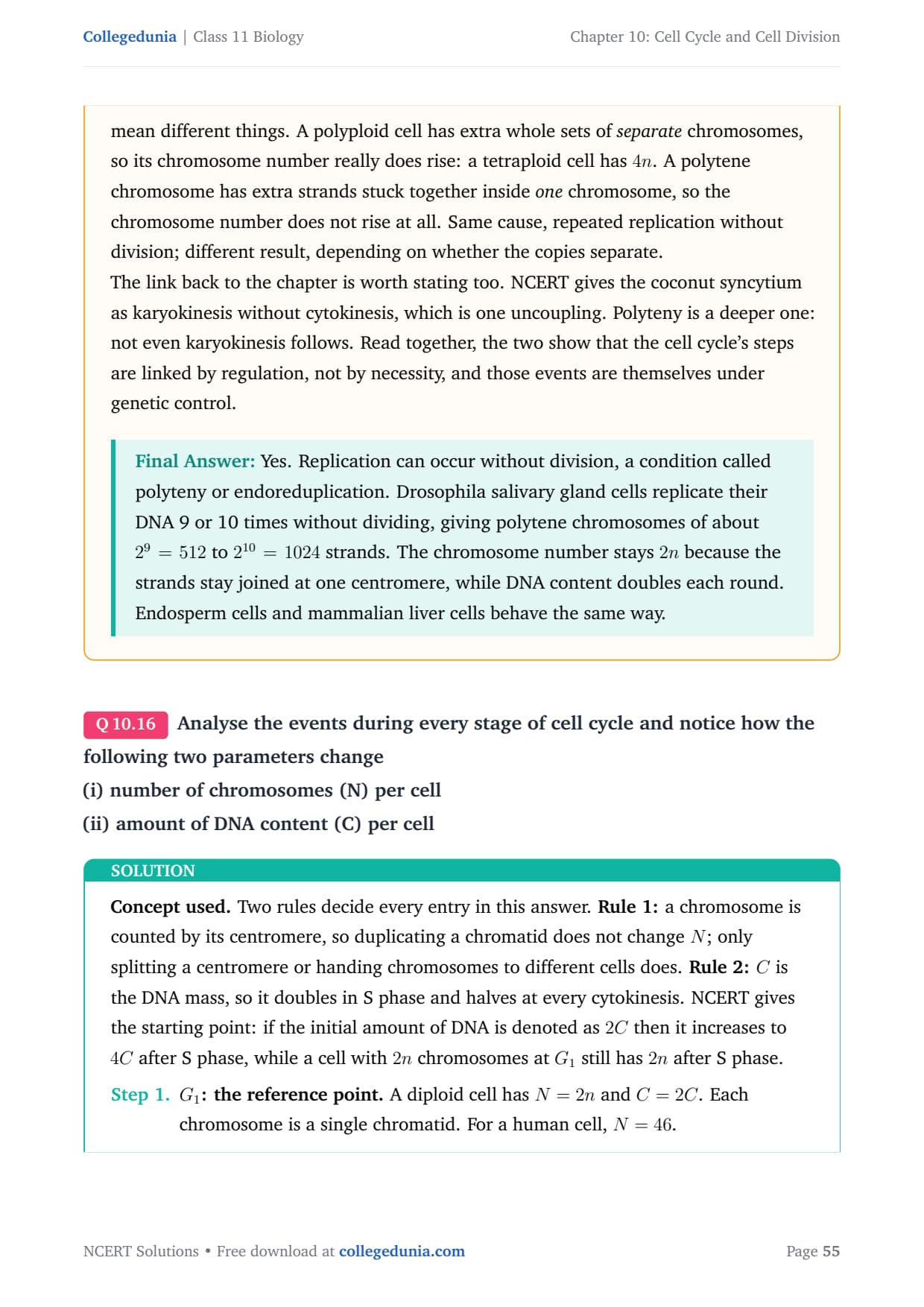
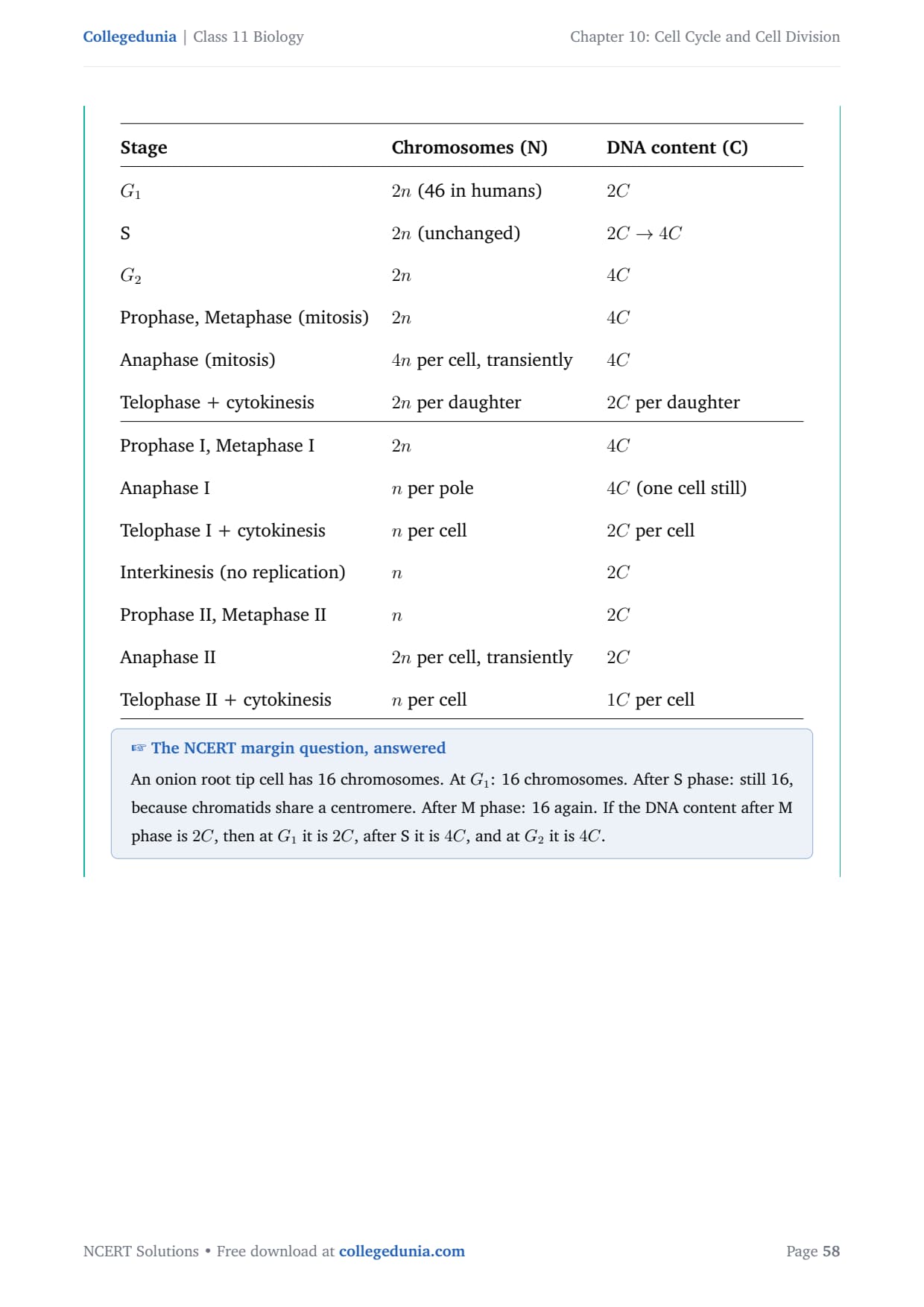
The final exercise question asks students to follow two parameters, the number of chromosomes (N) and the amount of DNA (C) per cell, across the whole cycle. The trap that catches most students is treating them as one quantity. They move independently: S phase adds chromatids, not chromosomes, so it doubles C while leaving N unchanged.
- Chromosome number (N): stays 2n through G1, S and G2; in mitosis it rises transiently to 4n at anaphase when centromeres split, then each daughter gets 2n.
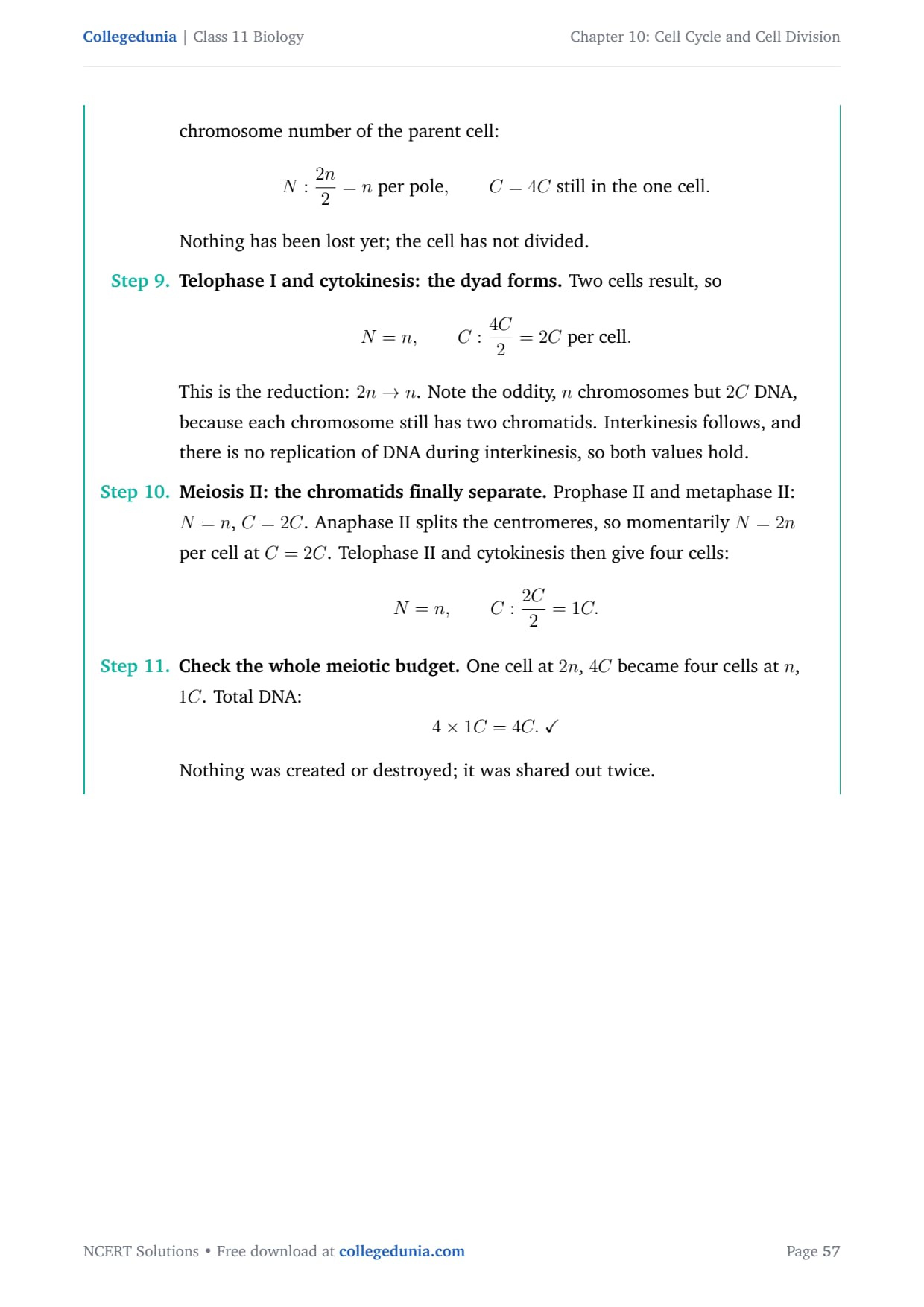
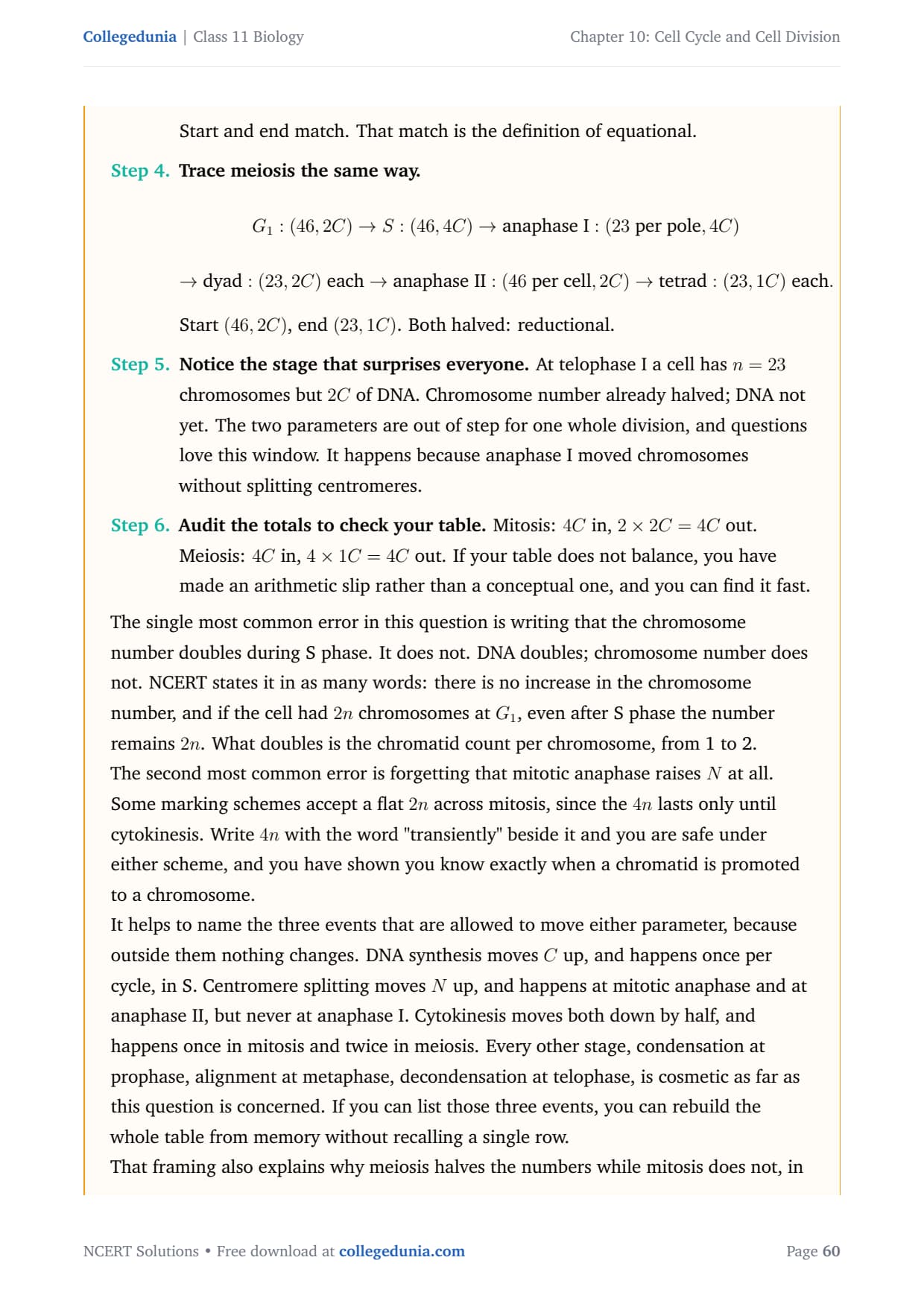
- In meiosis: N falls to n per cell at telophase I as homologues separate, rises transiently to 2n at anaphase II, and each of the four final cells ends at n.
- DNA content (C): 2C at G1, doubles to 4C during S, stays 4C through G2; each mitotic daughter gets 2C, and each of the four meiotic products gets 1C.
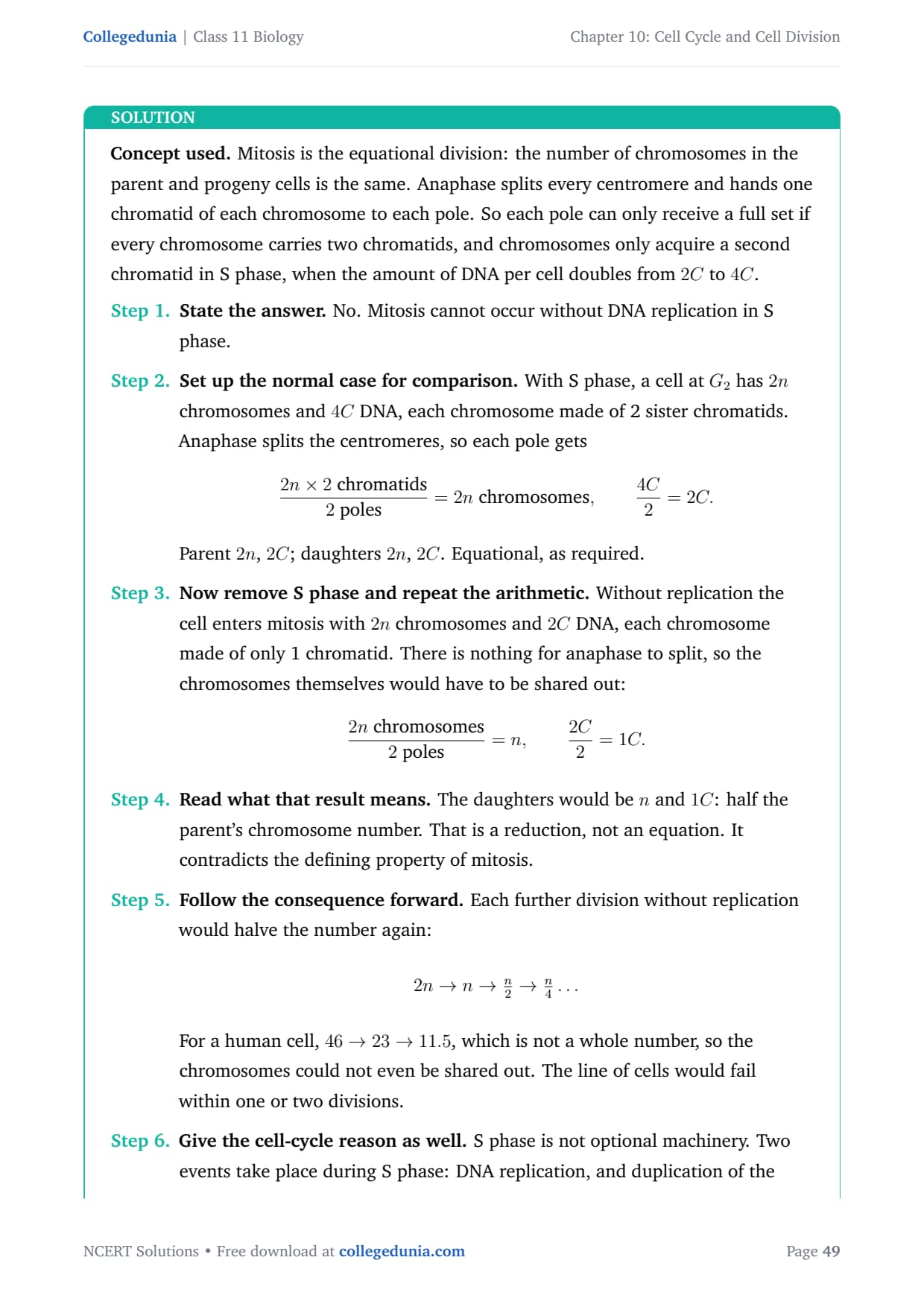
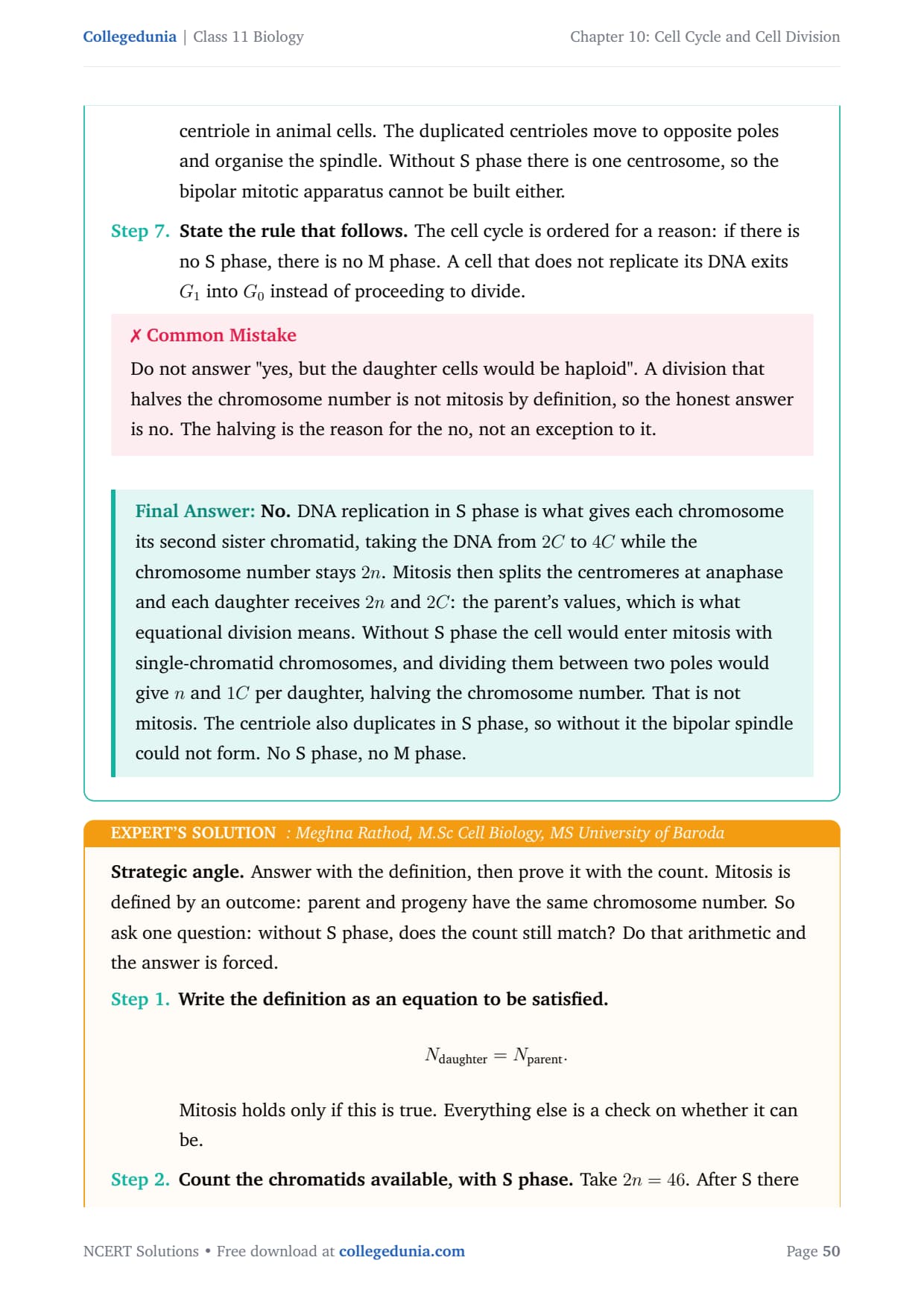
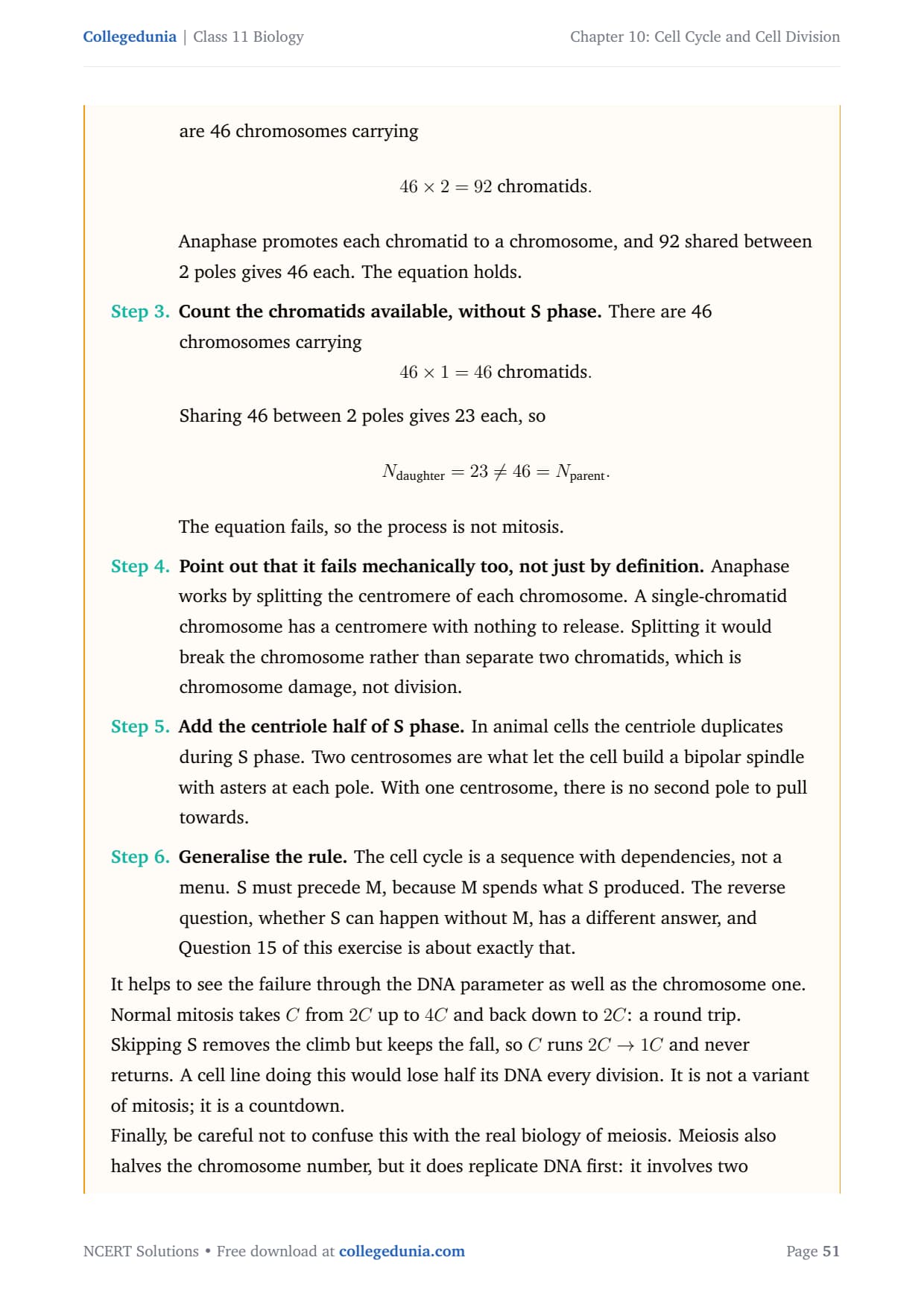
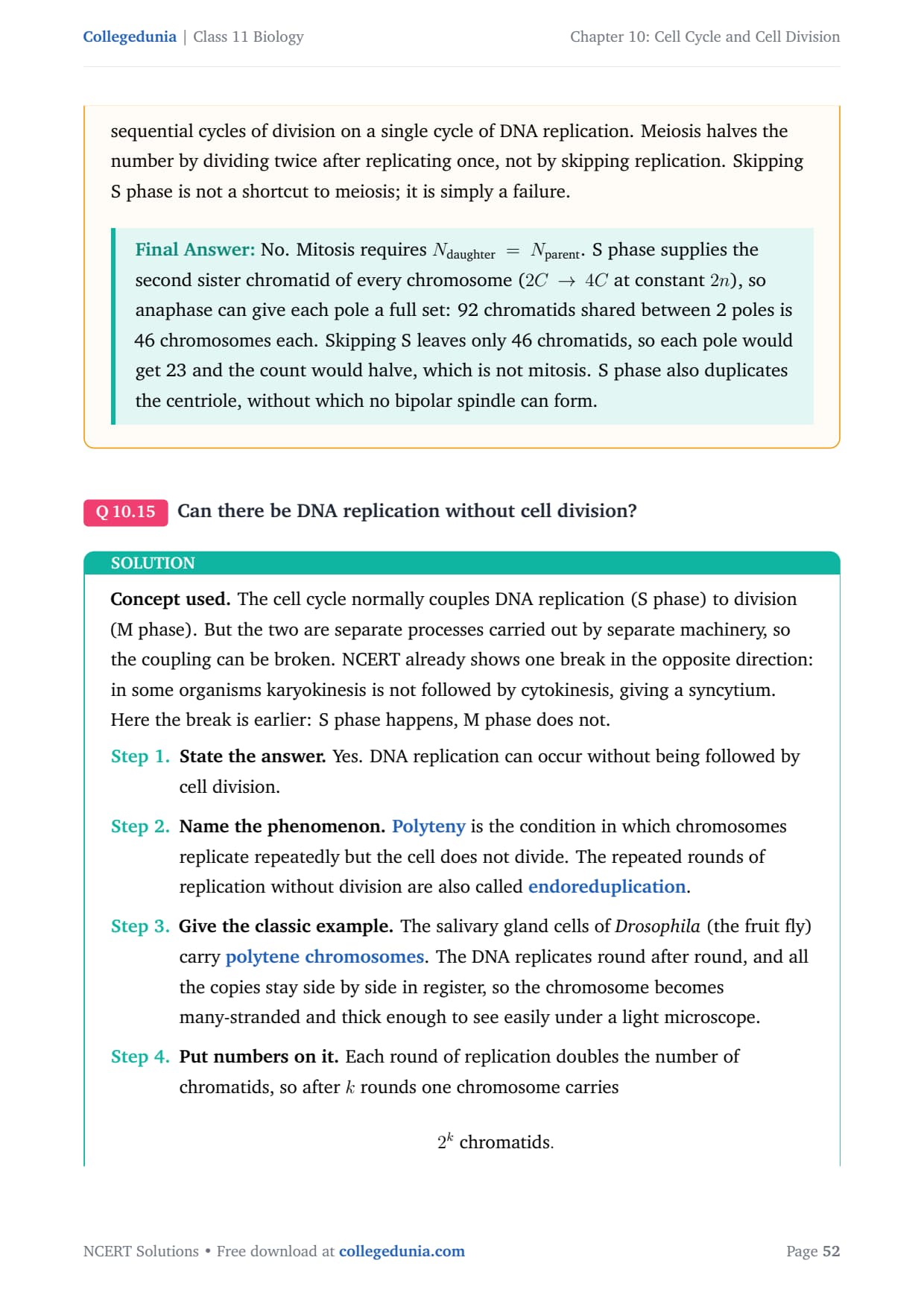
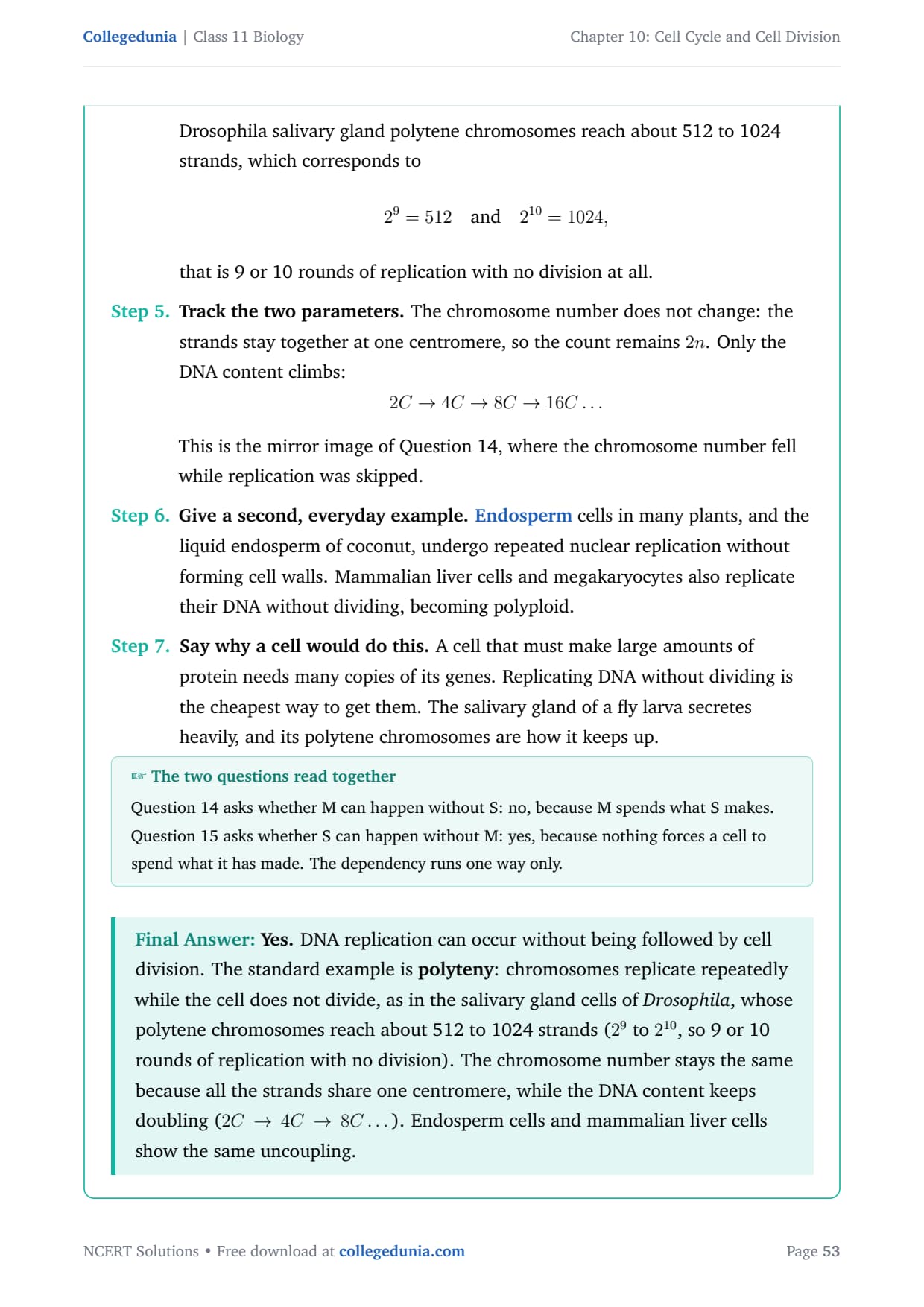
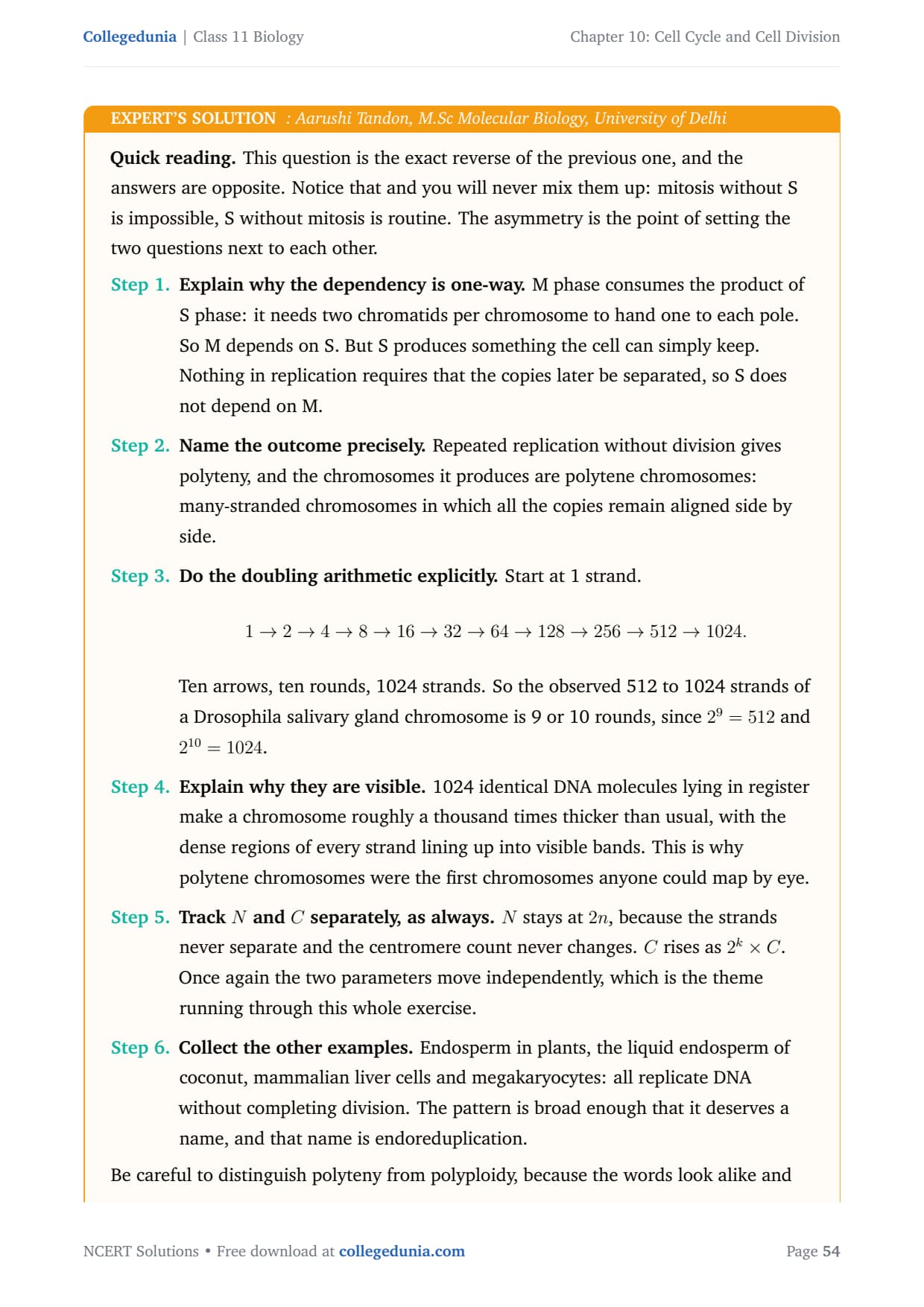
Two related what-if questions test the same idea from the sides. Mitosis cannot happen without S phase, because a cell entering mitosis with single-chromatid chromosomes would hand each daughter only n and 1C, halving the number. DNA replication, however, can happen without cell division: in polyteny, the salivary gland chromosomes of Drosophila replicate to about 512 to 1024 strands (29 to 210) with no division, so C keeps doubling while N holds because all strands share one centromere. These two answers together prove that N and C are uncoupled quantities.
The Significance of Meiosis and Equal Versus Unequal Daughter Cells
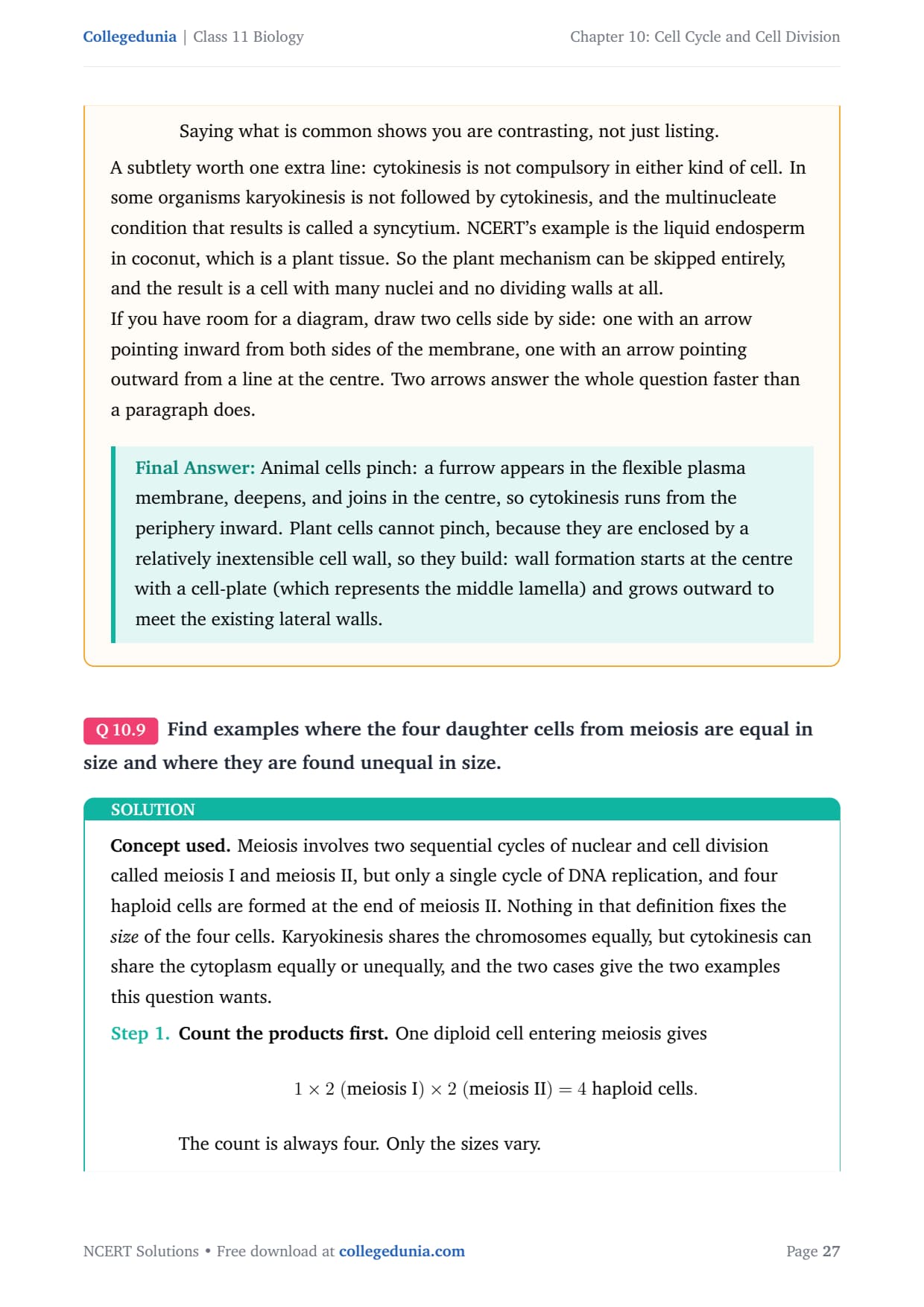
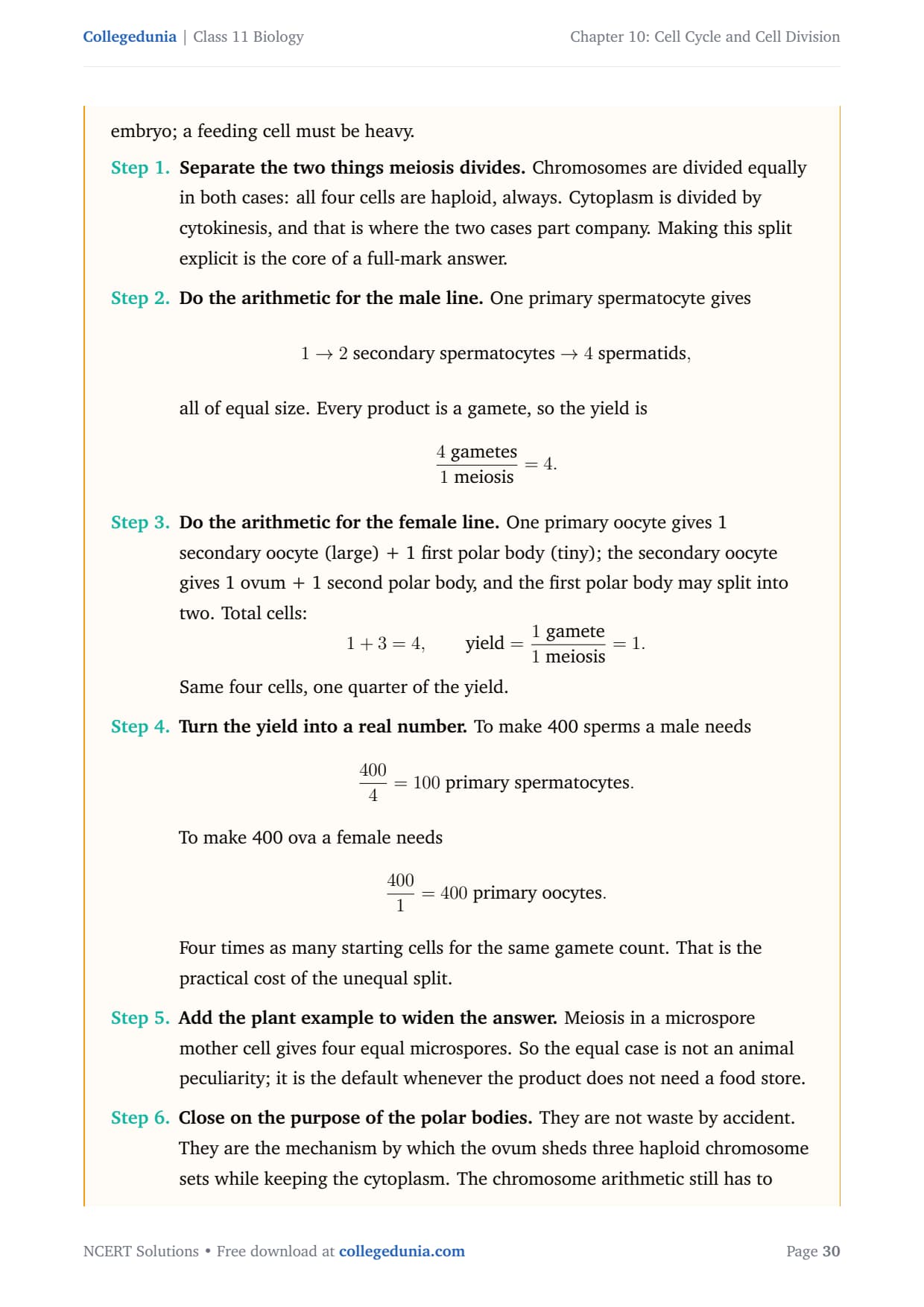
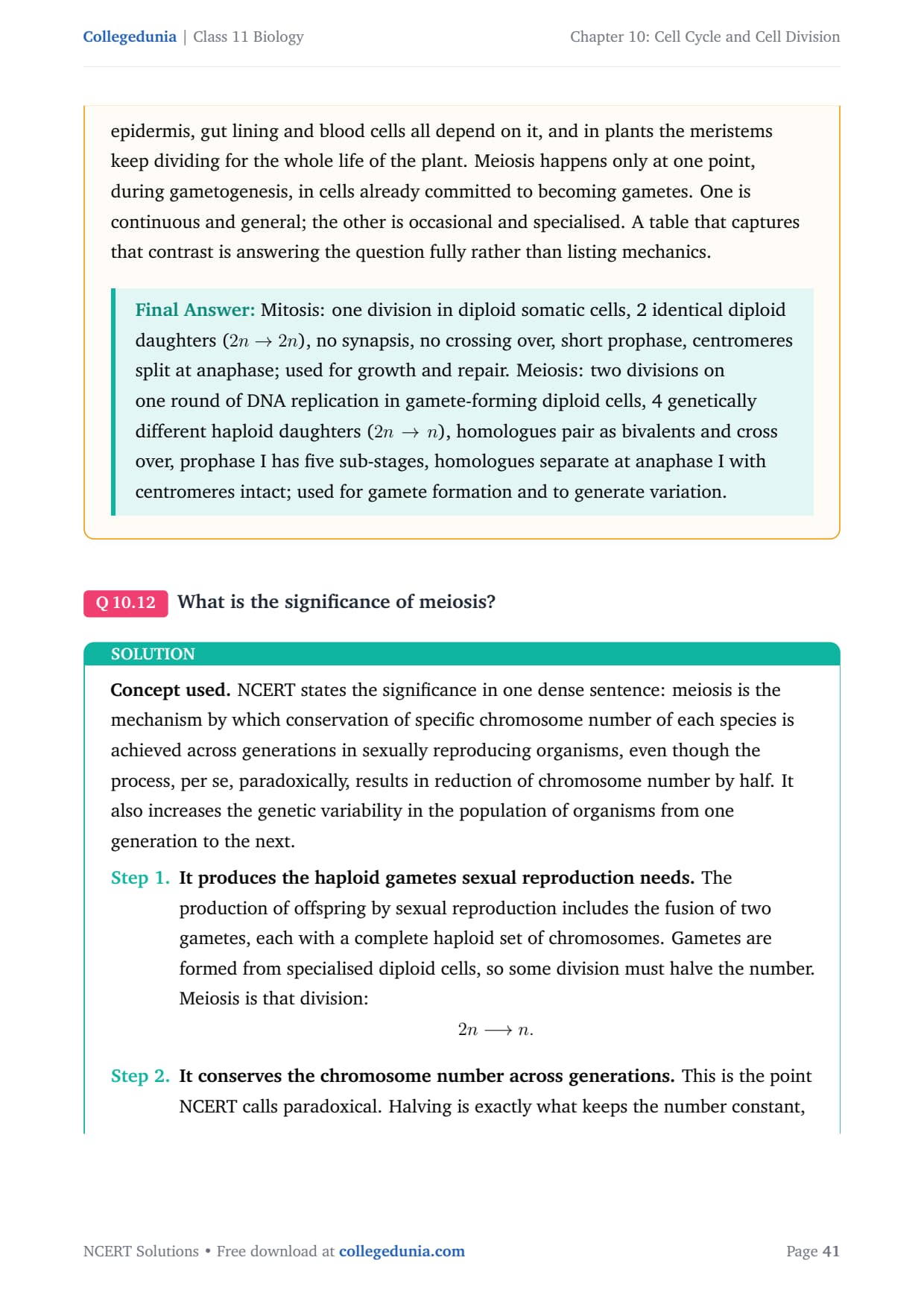
Meiosis matters for two reasons the exercise draws out. First, it conserves the chromosome number of a species: it makes haploid gametes, and fertilisation restores the diploid number (n + n = 2n), so the number does not double each generation. Second, it generates variation, through crossing over and the independent assortment of homologues, so every gamete is genetically different. The chapter also asks where the four meiotic products are equal or unequal in size.
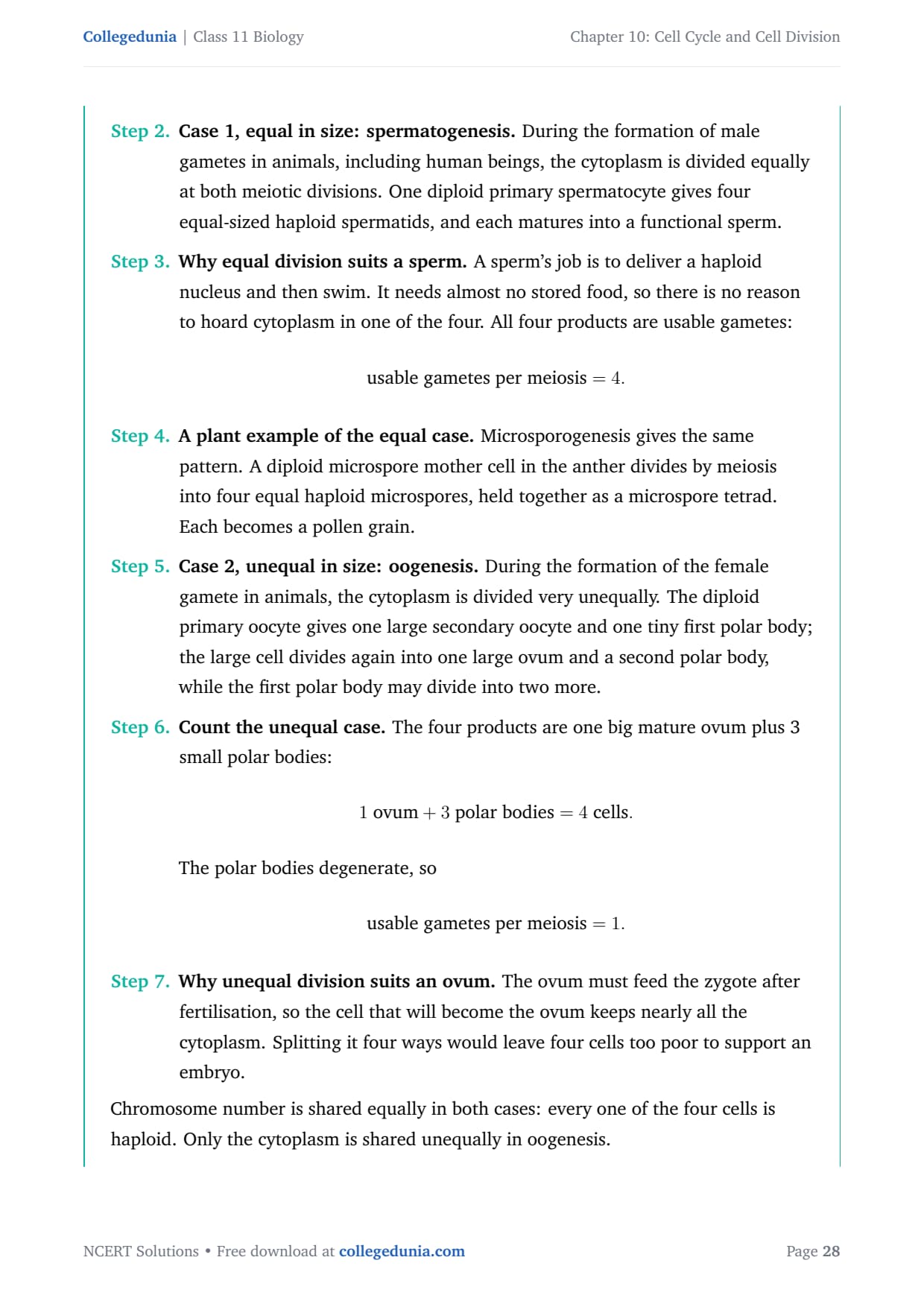
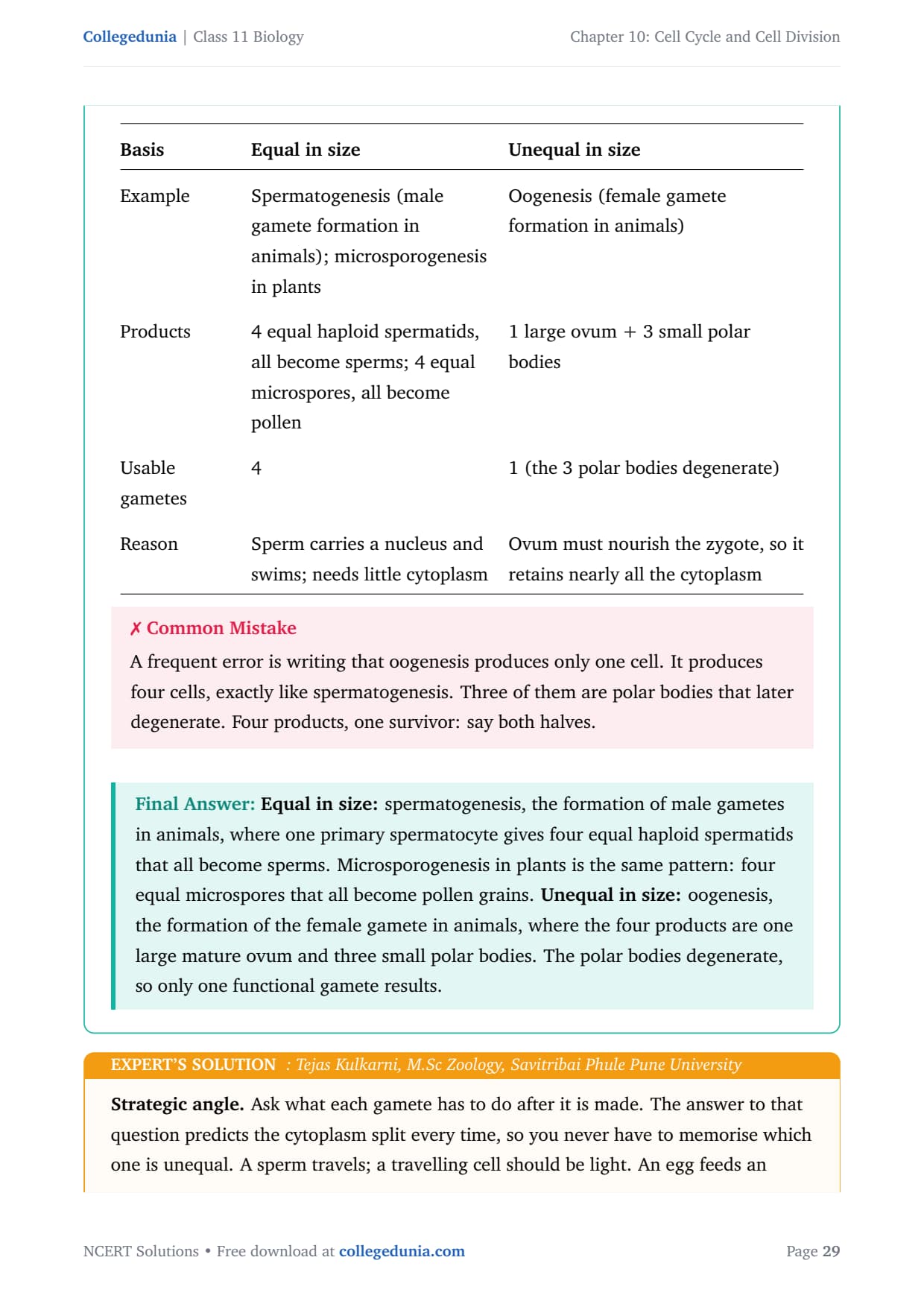
- Equal in size: spermatogenesis in animals gives four equal haploid spermatids, and microsporogenesis in plants gives four equal microspores.
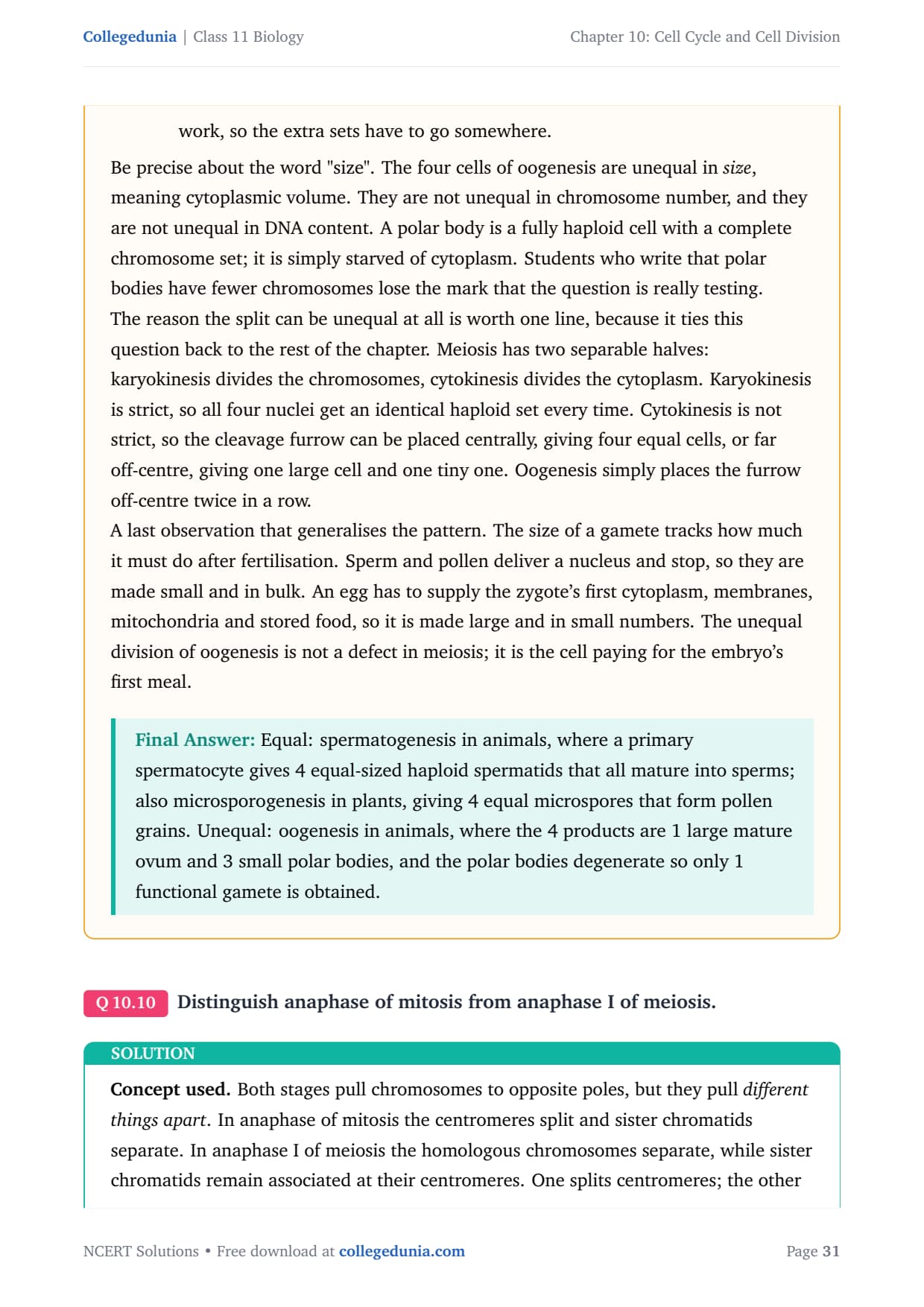
- Unequal in size: oogenesis gives one large ovum and three small polar bodies that degenerate, so only one functional gamete results.
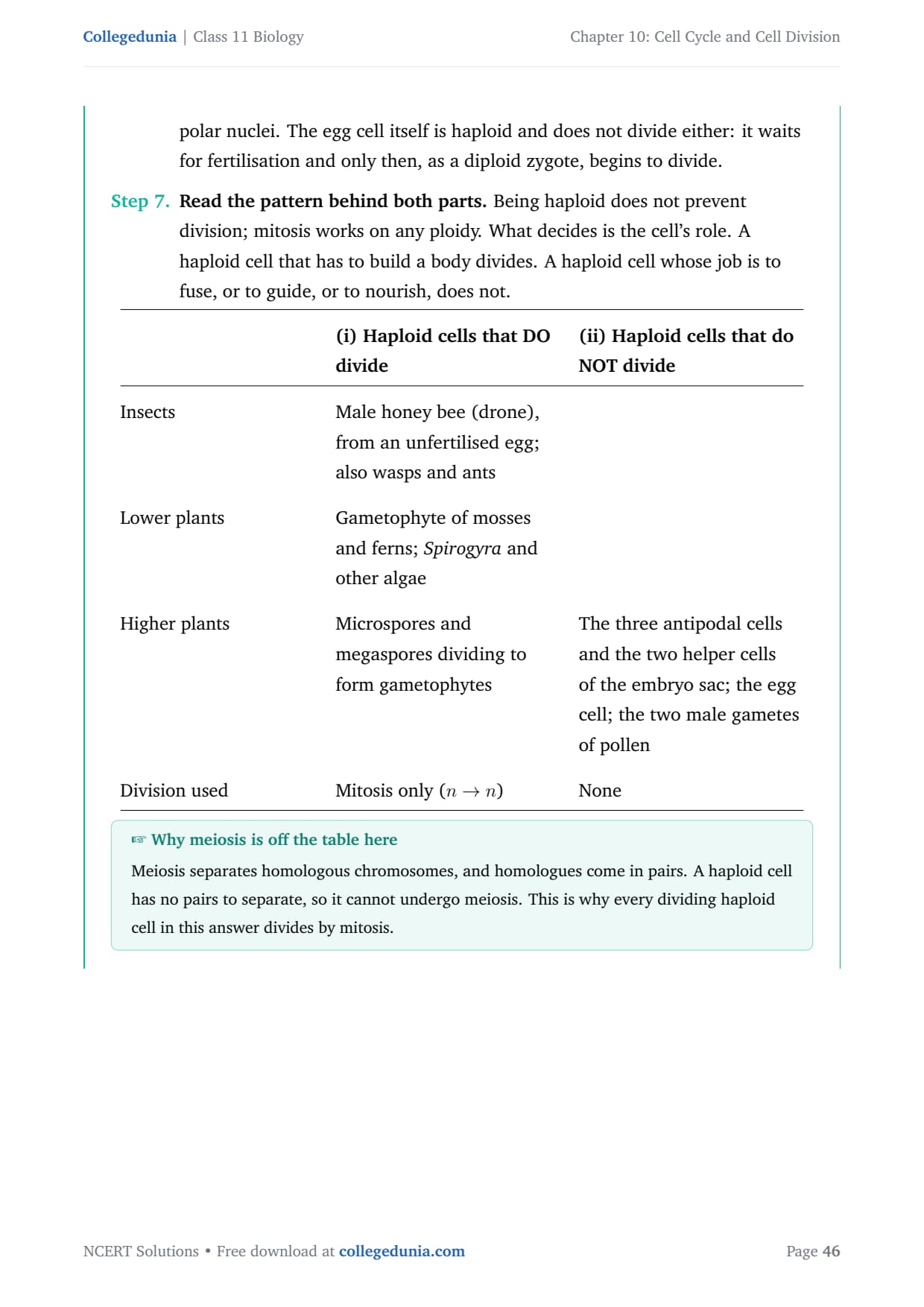
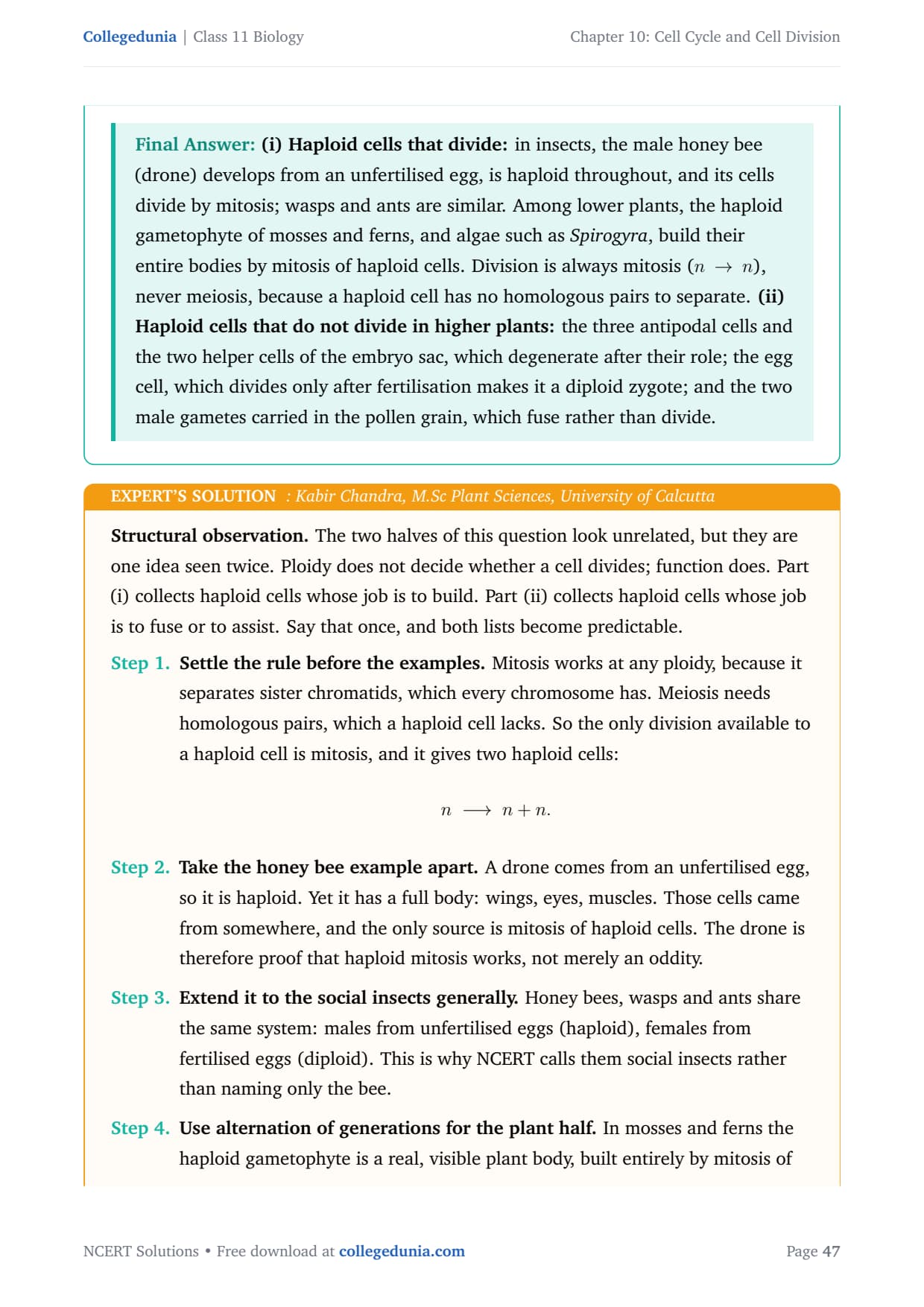
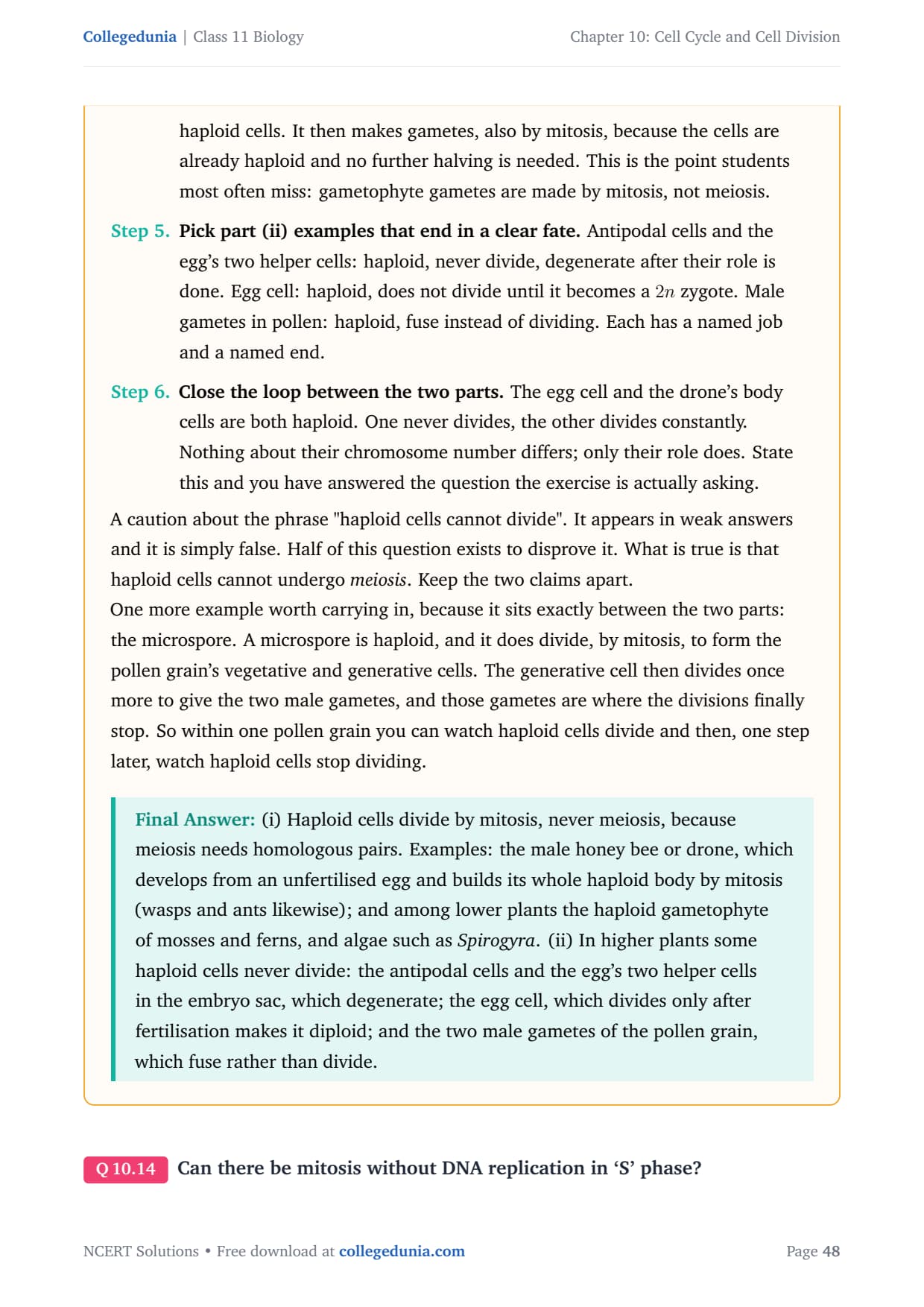
- Haploid cells that still divide: the male honey bee (drone) develops from an unfertilised egg and its cells divide by mitosis (n → n), never meiosis, since a haploid cell has no homologous pairs to separate.
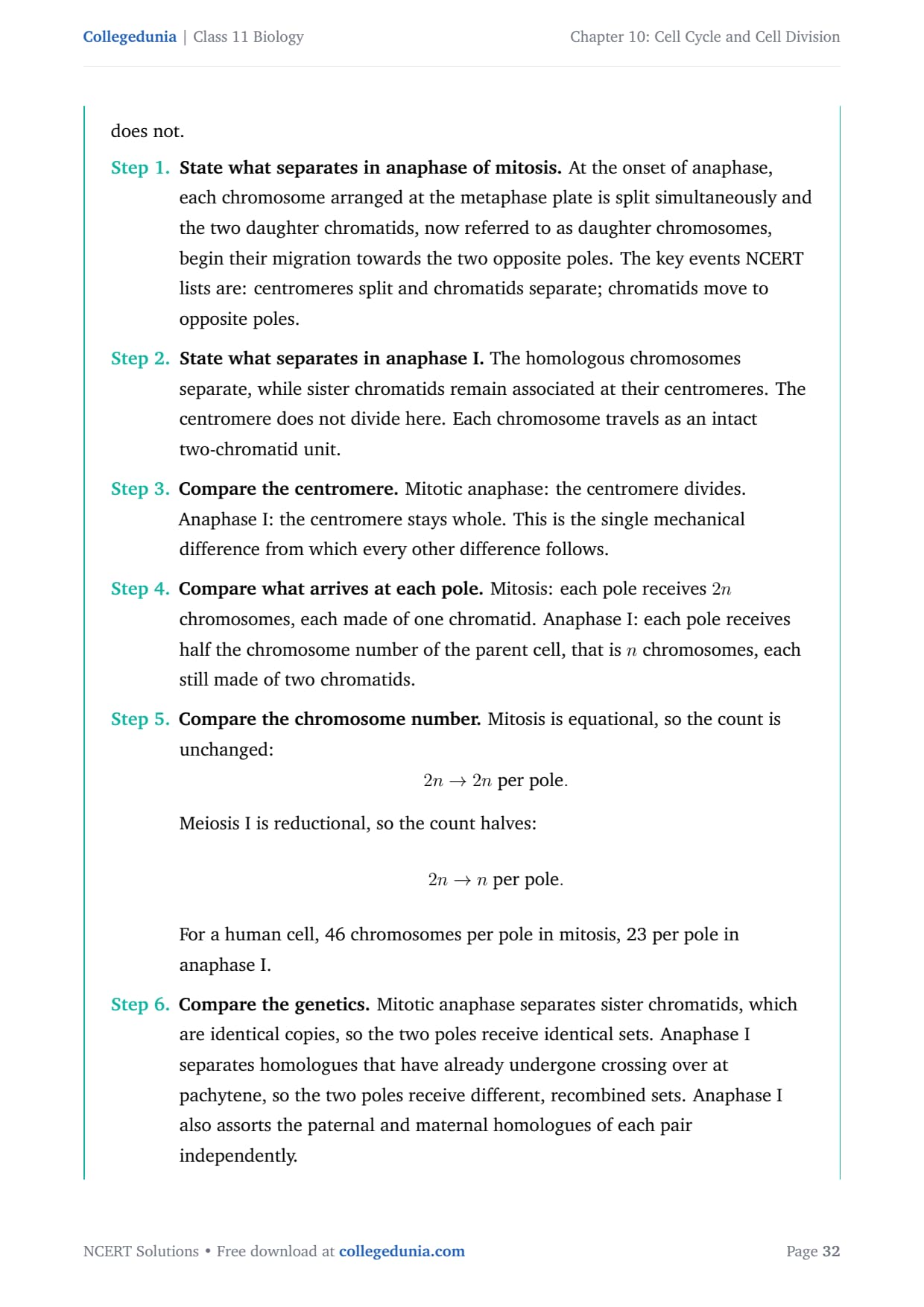
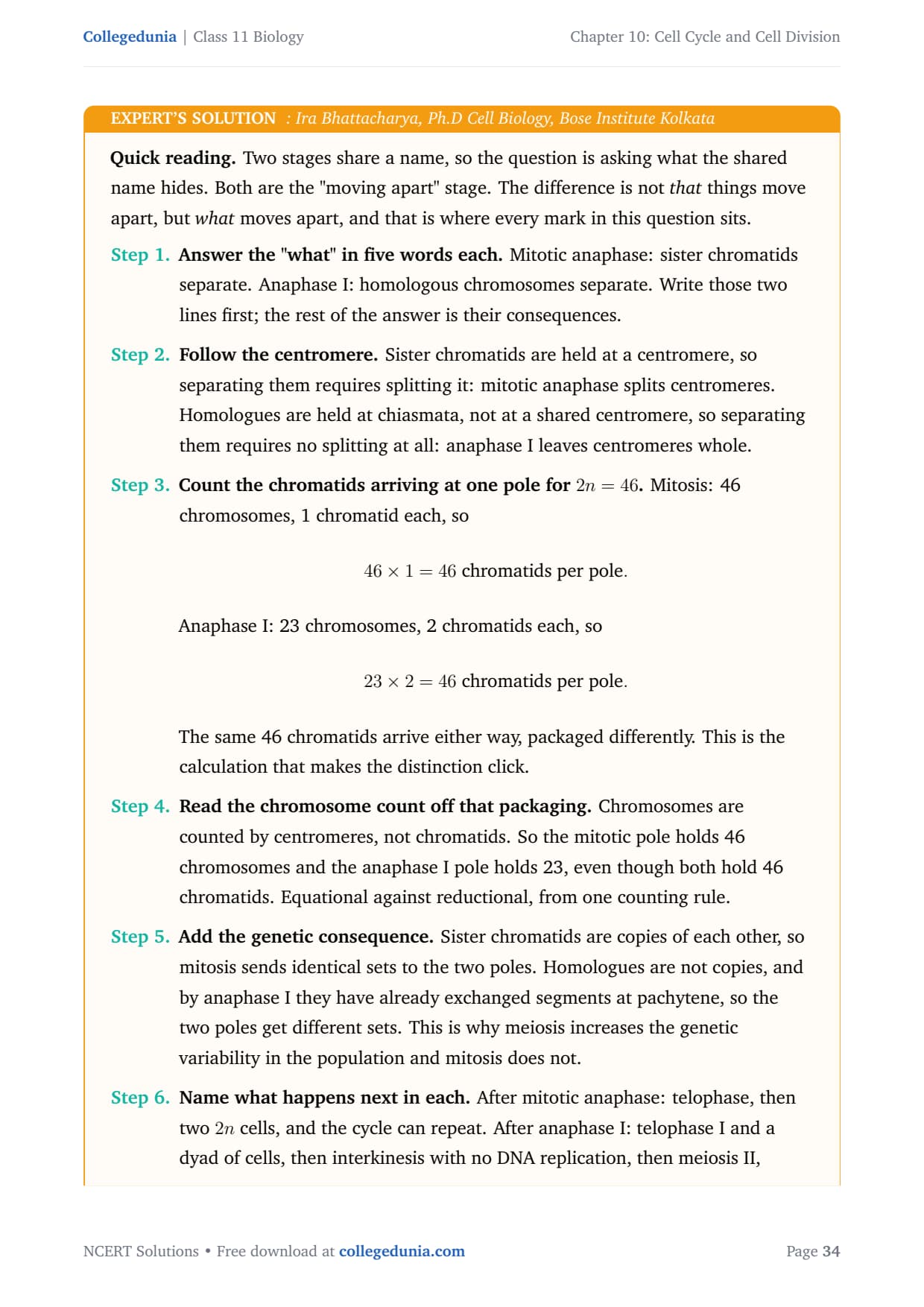
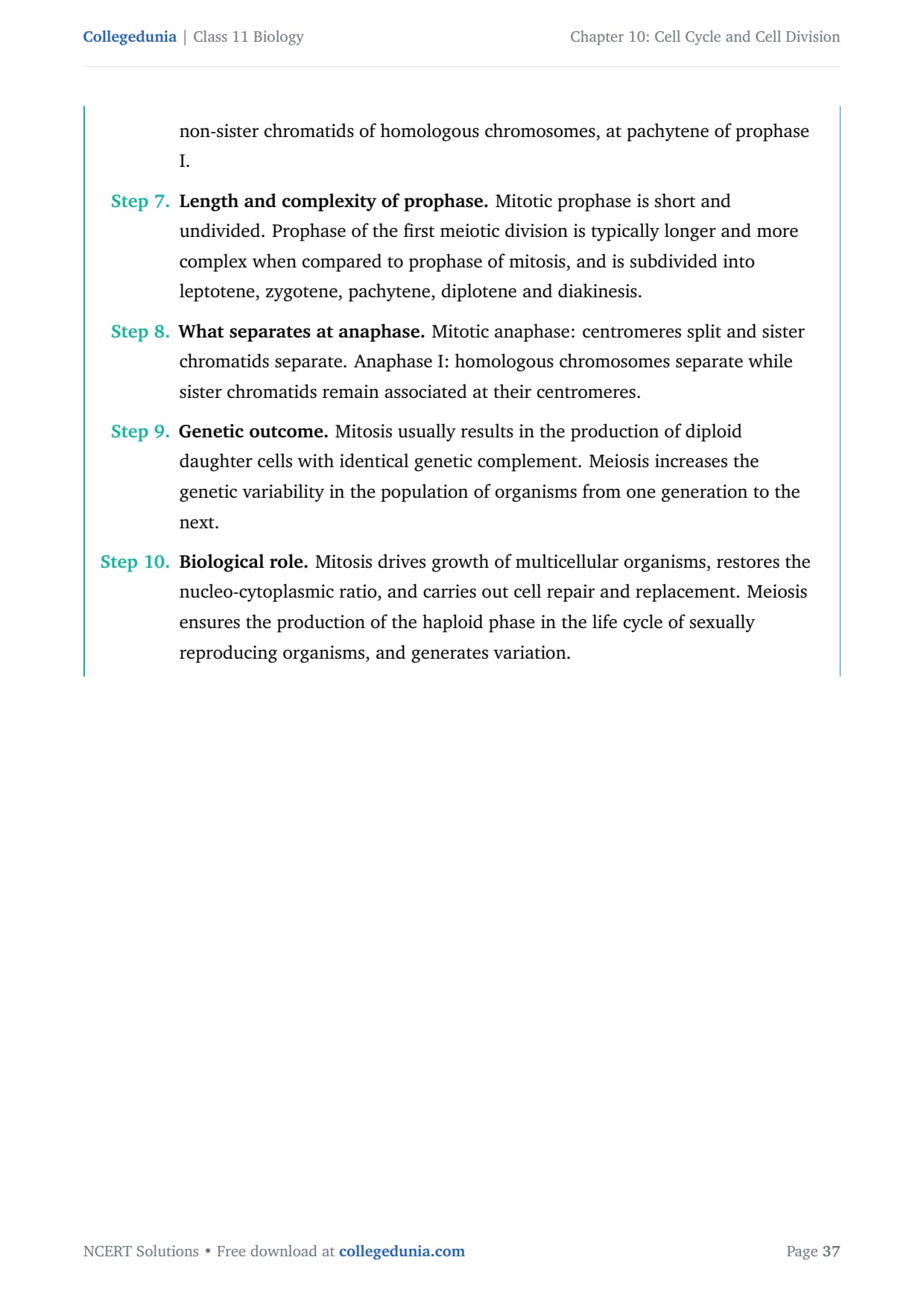
Anaphase is where the equational and reductional labels are earned. In anaphase of mitosis the centromere splits and sister chromatids separate, so each pole gets 2n. In anaphase I of meiosis the whole homologous chromosomes separate while sister chromatids stay attached, the centromere does not split, and each pole gets n chromosomes of two chromatids each. Splitting sisters gives identical sets and holds the number; separating homologues gives varied sets and halves it. Same cell, two different things pulled apart, two different outcomes.
Cell Cycle and Cell Division Exercise-wise Breakdown
The NCERT back exercise has 16 questions, ranging from one-word stage names to a full analysis of how N and C change across the cycle. The table below maps the question blocks to their topics so students can plan their practice and revise by theme.
| Question block | What it tests |
|---|---|
| Q 1 to Q 4 | Cell cycle span, karyokinesis versus cytokinesis, interphase events and the G0 quiescent phase. |
| Q 5 to Q 6 | Why mitosis is equational, and naming the stage for the equator, centromere split, synapsis and crossing over. |
| Q 7 to Q 8 | Synapsis, bivalent and chiasmata with a diagram, and cytokinesis in plant versus animal cells. |
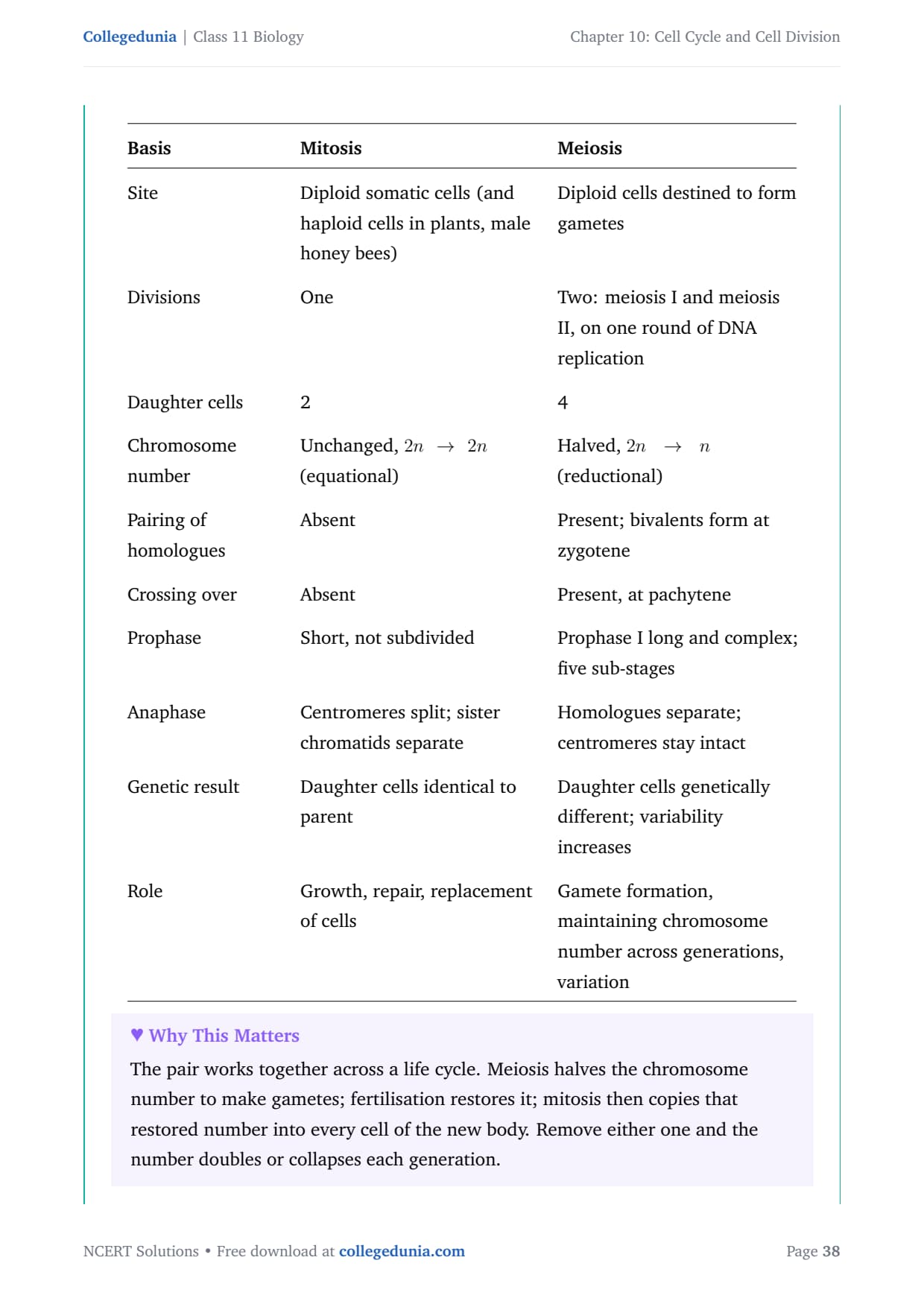
| Q 9 to Q 12 | Equal and unequal meiotic products, anaphase mitosis versus anaphase I, mitosis versus meiosis, and the significance of meiosis. |
| Q 13 to Q 16 | Haploid division cases, mitosis without S phase, DNA replication without division (polyteny), and tracking N and C. |
The marks in this chapter sit in exact stage names, clean distinctions and correctly tracked numbers rather than in long descriptions. Learn the five sub-stages of prophase I in order and the 2n, 2C values at each stage, then attach a named example. Every question in the class 11 biology NCERT solutions chapter 10 Cell Cycle and Cell Division PDF is solved with each step of reasoning shown, so students can compare their answers against the model working.
Practice the solved questions: Work through the full question bank with step-by-step answers and expert tips.
Cell Cycle and Cell Division Class 11 Solved Practice Questions
Common Mistakes Students Make in Cell Cycle and Cell Division
Most marks in this chapter are lost on small slips of counting and naming, not on hard ideas. Each mistake below costs 1 to 2 marks, so watch for it at the exact step.
Mistake 1: Saying the chromosome number doubles in S phase. Only the DNA doubles, from 2C to 4C; the number stays 2n, because sister chromatids share one centromere.
Mistake 2: Listing cytokinesis as the last stage of mitosis. Karyokinesis has only four stages, prophase, metaphase, anaphase and telophase; cytokinesis follows them.
Mistake 3: Answering pairing of homologues with pachytene. Pairing (synapsis) starts at zygotene; pachytene is when the bivalents are clearly visible as tetrads and crossing over occurs.
Mistake 4: Writing that anaphase I splits the centromere. It is the homologues that separate at anaphase I, with the centromere intact; the centromere splits only at anaphase II and at mitotic anaphase.
Student Feedback on Cell Cycle and Cell Division Solutions
What 12,940 students told us about their Cell Cycle and Cell Division preparation:
- 64% of students said tracking the chromosome number and DNA content through meiosis was the hardest part of the chapter.
- Most-skipped detail: that centriole duplication in S phase is an animal-cell event only, missed by about 4 in 10 students.
- Students who learned the sequence leptotene, zygotene, pachytene, diplotene, diakinesis as a chant said the prophase I questions became automatic.
Source: 2026-27 Class 11 Biology student poll. Sample of 12,940 students from CBSE schools across 17 states, conducted before the 2026 boards.
Other Cell Cycle and Cell Division Class 11 Biology Resources
Pair these solutions with the revision notes, formula sheet and NCERT textbook PDF for the same chapter.
| Resource | Link |
|---|---|
| NCERT Notes | Cell Cycle and Cell Division Class 11 Notes |
| Formula Sheet | Cell Cycle and Cell Division Class 11 Formula Sheet |
| Exemplar Solutions | Cell Cycle and Cell Division Class 11 Exemplar Solutions |
| NCERT Book PDF | Cell Cycle and Cell Division Class 11 Book PDF |
NCERT Solutions for Class 11 Biology: All Chapters
Jump to the step-by-step solutions for any other Class 11 Biology chapter below.
| Chapter | NCERT Solutions |
|---|---|
| Chapter 1 | The Living World |
| Chapter 2 | Biological Classification |
| Chapter 3 | Plant Kingdom |
| Chapter 4 | Animal Kingdom |
| Chapter 5 | Morphology of Flowering Plants |
| Chapter 6 | Anatomy of Flowering Plants |
| Chapter 7 | Structural Organisation in Animals |
| Chapter 8 | Cell: The Unit of Life |
| Chapter 9 | Biomolecules |
| Chapter 10 | Cell Cycle and Cell Division |
| Chapter 11 | Photosynthesis in Higher Plants |
| Chapter 12 | Respiration in Plants |
| Chapter 13 | Plant Growth and Development |
| Chapter 14 | Breathing and Exchange of Gases |
| Chapter 15 | Body Fluids and Circulation |
| Chapter 16 | Excretory Products and their Elimination |
| Chapter 17 | Locomotion and Movement |
| Chapter 18 | Neural Control and Coordination |
| Chapter 19 | Chemical Coordination and Integration |
FAQs on Cell Cycle and Cell Division Class 11 NCERT Solutions
Cell Cycle and Cell Division NCERT Solutions - Frequently Asked Questions
Ques. What do the class 11 biology NCERT solutions chapter 10 Cell Cycle and Cell Division cover?
Ans. These solutions cover all 16 back-exercise questions, including the 24-hour cell cycle, the events of interphase, the G0 quiescent phase, why mitosis is equational, cytokinesis in plant versus animal cells, synapsis, bivalent and chiasmata, anaphase of mitosis versus anaphase I of meiosis, the significance of meiosis, and the tracking of chromosome number and DNA content. Every question is solved step by step.
Ques. Why is mitosis called equational division and meiosis reductional?
Ans. Mitosis is equational because the parent and each daughter cell have the same chromosome number: a 2n parent gives two 2n daughters, since anaphase splits the centromeres and separates sister chromatids. Meiosis is reductional because homologues separate at anaphase I, so a 2n cell gives four haploid (n) cells. Fertilisation later restores the diploid number.
Ques. What are the five sub-stages of prophase I of meiosis?
Ans. Prophase I runs through leptotene (chromosomes become visible), zygotene (synapsis and synaptonemal complex), pachytene (bivalents as tetrads and crossing over), diplotene (synaptonemal complex dissolves, chiasmata appear) and diakinesis (terminalisation of chiasmata). Pairing begins at zygotene and crossing over occurs at pachytene, so the two must not be swapped.
Ques. How does cytokinesis differ in plant and animal cells?
Ans. An animal cell has a flexible plasma membrane, so a cleavage furrow appears and deepens from the periphery inward until it joins in the centre. A plant cell is enclosed by a relatively inextensible cell wall, so it cannot pinch; instead a cell-plate forms in the centre and grows outward to meet the existing lateral walls, becoming the middle lamella.
Ques. Can there be DNA replication without cell division?
Ans. Yes. In polyteny the DNA replicates many times without division, as in the salivary gland cells of Drosophila, whose polytene chromosomes reach about 512 to 1024 strands. The DNA content keeps doubling while the chromosome number stays the same, because all the strands share a single centromere. Endosperm and mammalian liver cells show the same uncoupling of replication from division.
Ques. What is the weightage of Cell Cycle and Cell Division in CBSE Class 11 Biology?
Ans. Cell Cycle and Cell Division carries roughly 3 to 4 marks in the CBSE Class 11 Biology paper, through short-answer and diagram questions on the phases of the cycle, mitosis and meiosis. It is also a high-yield NEET chapter, where the equational-versus-reductional contrast and the sub-stages of prophase I appear almost every year.



Comments