




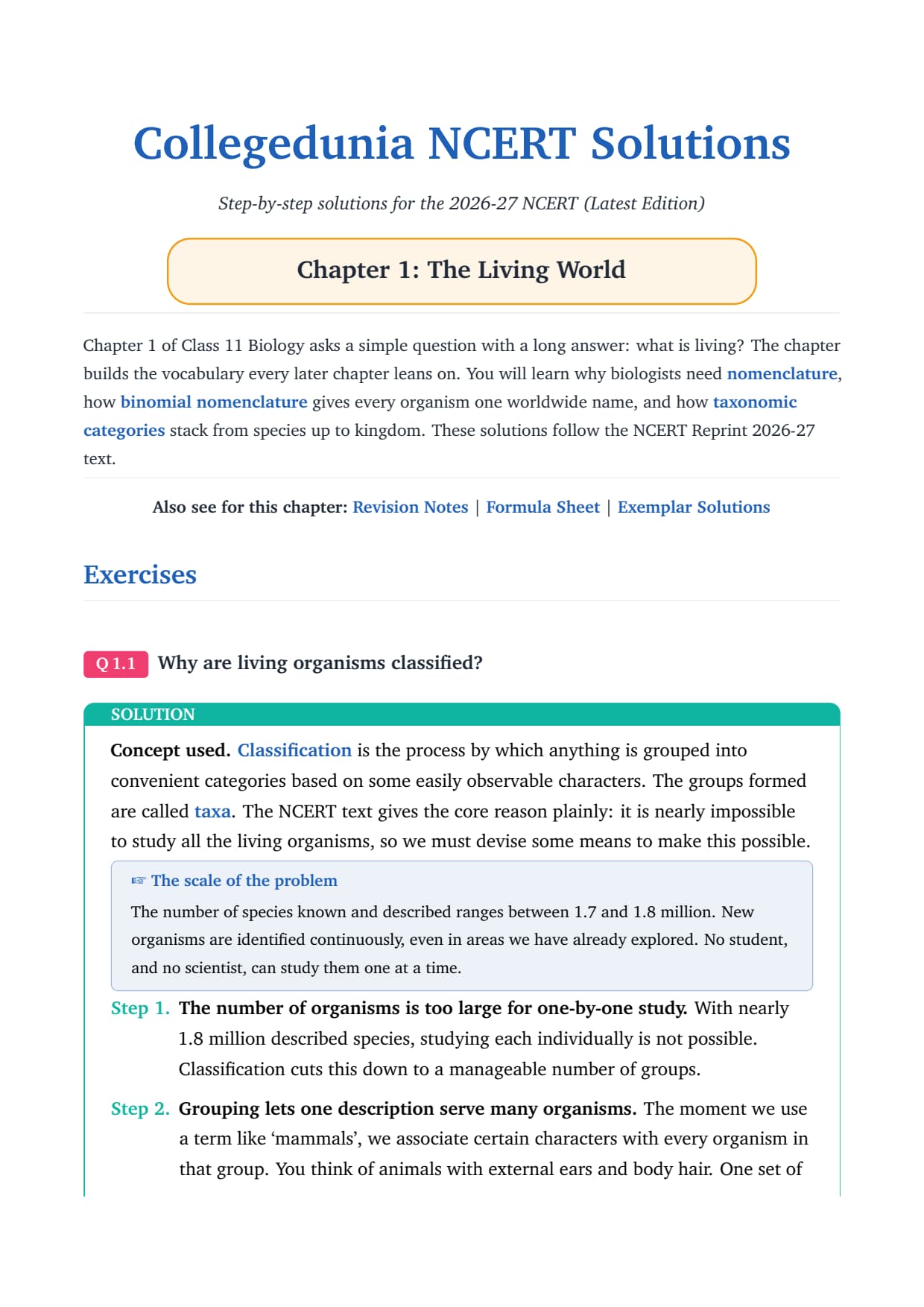
The class 11 biology NCERT solutions chapter 1 The Living World cover every back-exercise question, according to the latest 2026-27 CBSE syllabus, and help students prepare for the CBSE Boards, NEET and CUET. Each answer is worked step by step, from why living organisms are classified to the rules of binomial nomenclature and the taxonomic hierarchy that the whole of the classification unit is built on.
This is the opening chapter of the NCERT textbook, and the vocabulary of taxonomy you learn here carries into every classification chapter that follows.
- CBSE Weightage: 2 to 3 marks, part of the Diversity of Living Organisms unit that opens the Class 11 course.
- Topics covered: characteristics of life, classification and taxonomy, the four basic processes, binomial nomenclature, taxonomic categories and hierarchy, taxon and the species concept.
- Exercise count: 10 back-exercise questions, all descriptive, testing definitions, reasoning and the naming rules.
These class 11 biology NCERT solutions chapter 1 The Living World are curated by subject experts, based on the 2026-27 NCERT textbook, and checked against the last five years of CBSE Board and NEET papers.
Why The Living World Matters and What the Chapter Covers
Biology is the study of living organisms, and this first chapter asks a deceptively simple question: what is living? It then builds the language that biologists use to name, sort and study the 1.7 to 1.8 million species that have been described so far. Get these terms right and the rest of Class 11 Biology becomes far easier to follow.
- Everyday role: classification is how a doctor names a pathogen, a farmer identifies a crop pest, and a conservationist counts a species.
- Core skill: placing any organism into a hierarchy of ranks, from species up to kingdom, using its shared characters.
- Why it is first: the ideas of taxonomy and nomenclature introduced here are used in Chapters 2 to 4, where whole kingdoms are classified.
Almost every naming and grouping question in the classification unit traces back to this chapter. That is why students who master The Living World early tend to find biological classification lighter for the rest of the year. The class 11 biology NCERT solutions chapter 1 The Living World below follow the same order as the NCERT textbook so students can check their working line by line.
What Is Living? The Features That Define Life
Before organisms can be classified, biology must decide what counts as living. NCERT answers this with a set of defining features, and it is careful to separate the features that all living things share from the ones that only some show. This distinction is a common short-answer question in the Boards and NEET.
| Feature | What it means |
|---|---|
| Growth | Increase in mass and number of cells; in living things it happens from inside the body. |
| Reproduction | Producing new individuals of the same kind; absent in some organisms such as sterile worker bees. |
| Metabolism | The sum of all chemical reactions in the body; the defining feature, since no non-living object shows it. |
| Cellular organisation | All living things are made of one or more cells; the basis of their structure. |
| Consciousness | The ability to sense the surroundings and respond to stimuli; the most reliable defining property. |
Growth and reproduction can be absent in some living organisms, so they are not defining features on their own. Metabolism, however, is shown by every living thing and by nothing that is non-living, which is why it is treated as the defining property. Consciousness, the ability to respond to the environment, is the most reliable feature in higher organisms. Students should be able to list these features and say which are exclusive to life.
Why Living Organisms Are Classified and Why Systems Keep Changing
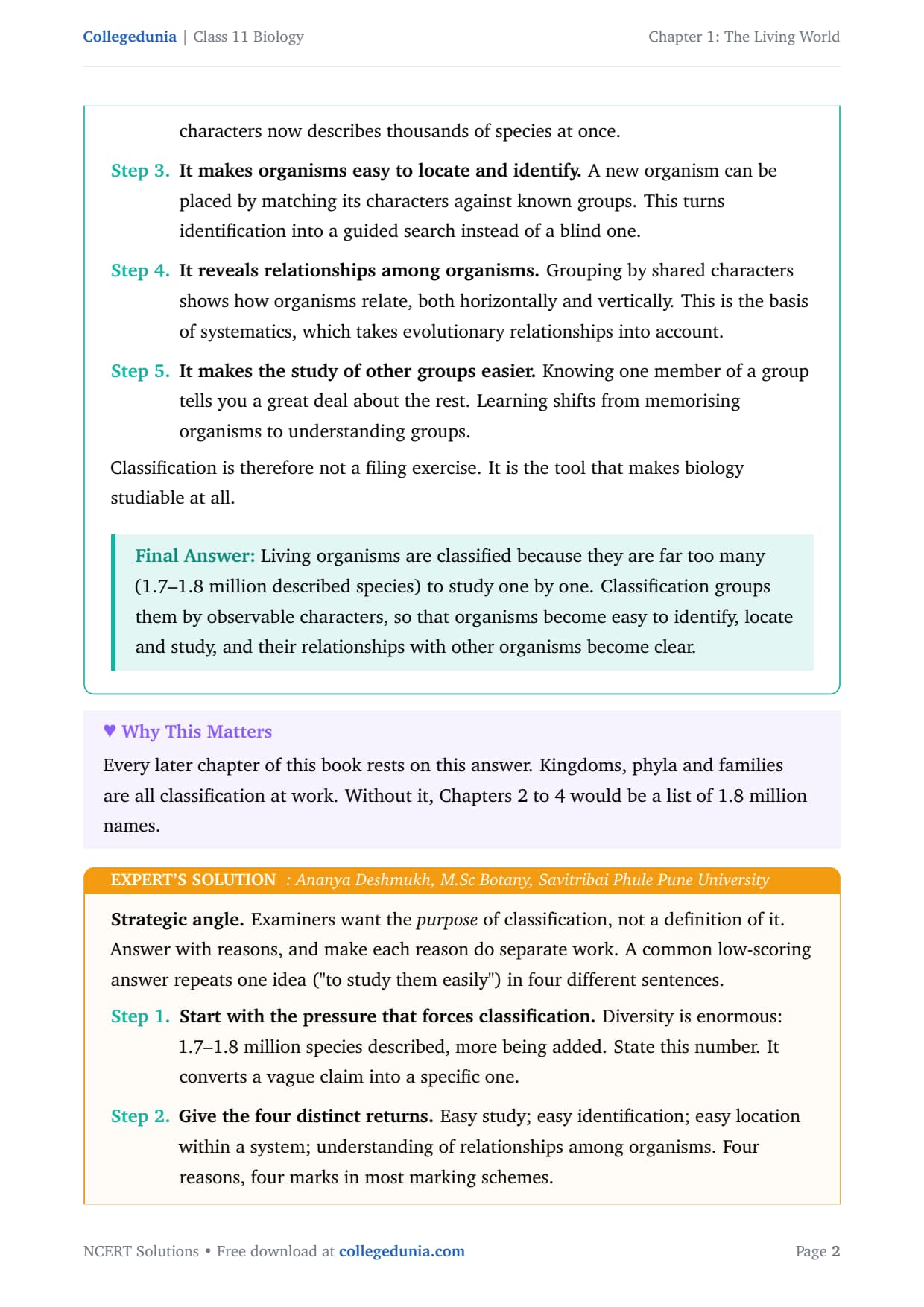
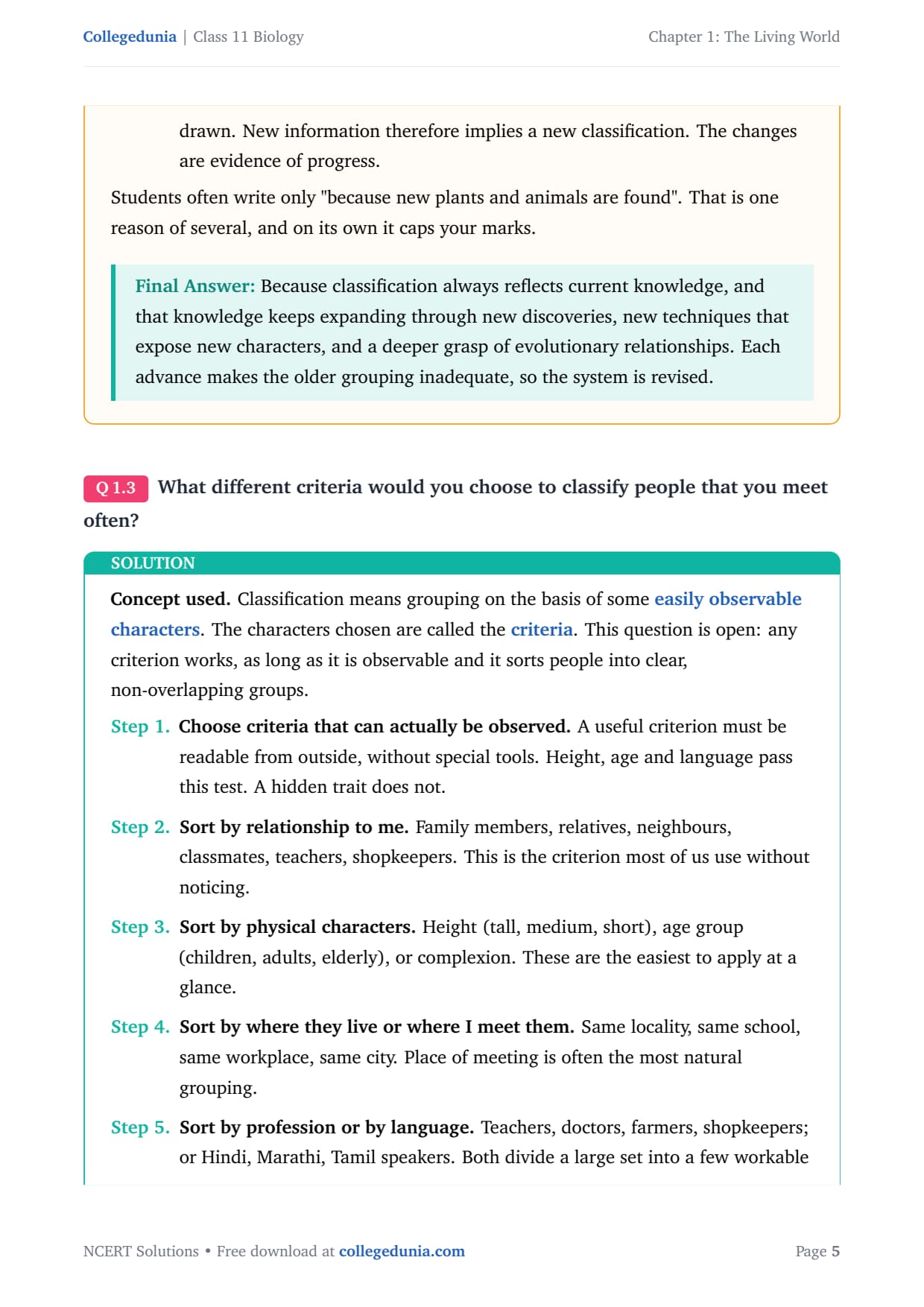
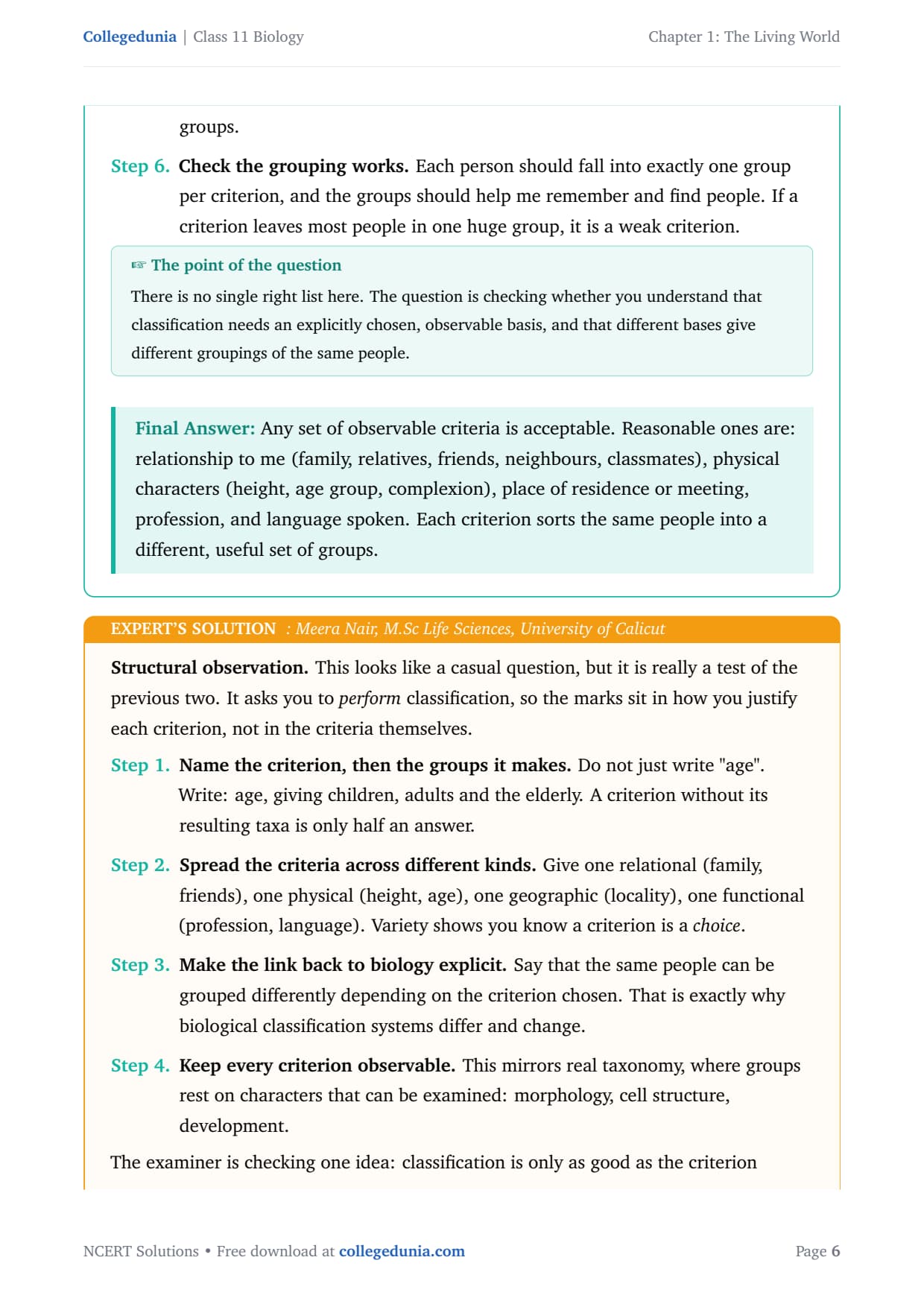
The first two exercise questions ask why classification is needed and why classification systems keep changing. The answer to both is the same idea seen from two sides: there are far too many organisms to study one at a time, and our knowledge of them keeps growing. Classification is the process of grouping organisms into convenient categories, called taxa, on the basis of easily observable characters.
- Too many to study one by one: with 1.7 to 1.8 million described species, grouping is the only way to make the study of life manageable.
- One description serves many: the moment a group such as mammals is named, a set of characters describes thousands of species at once.
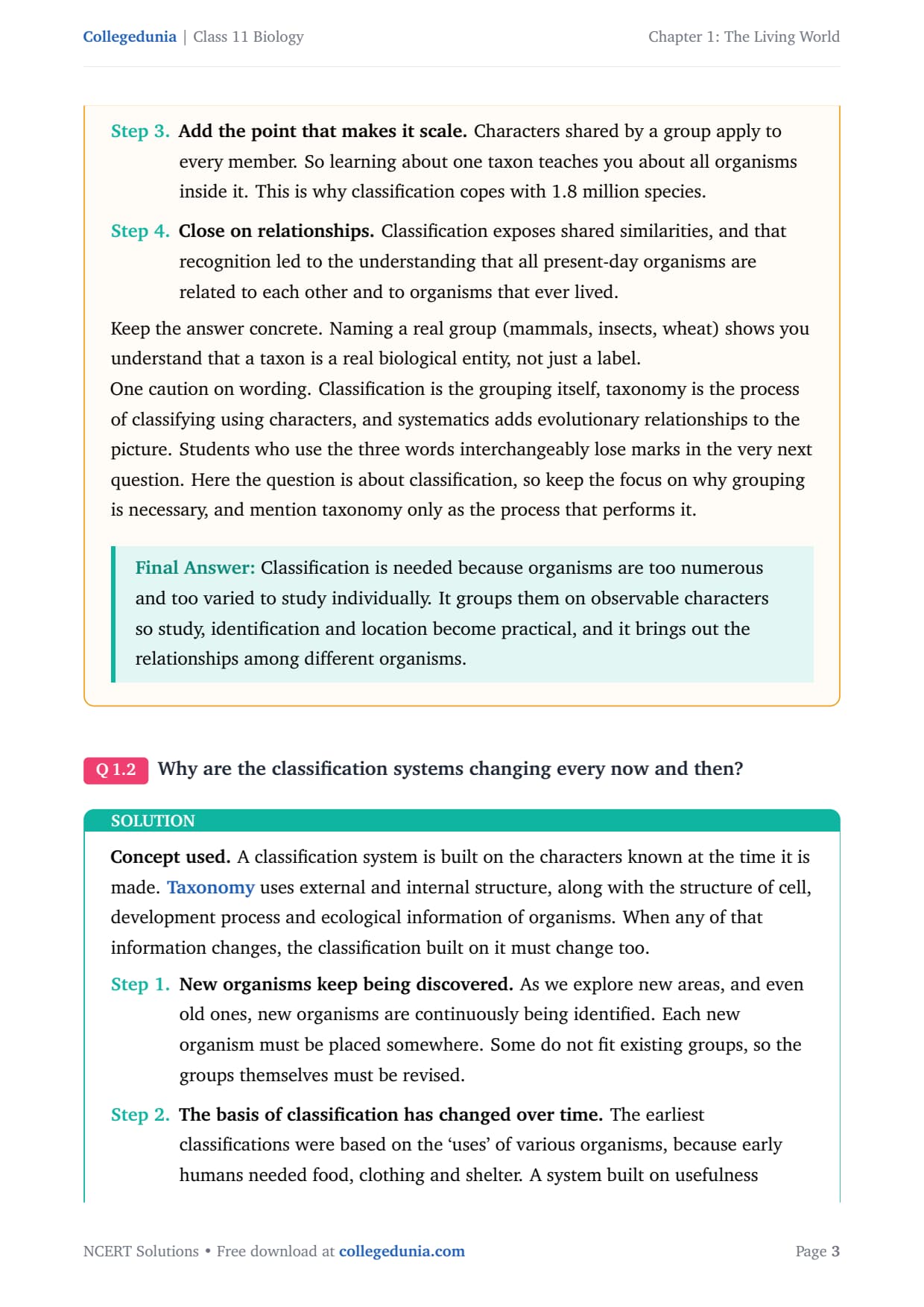
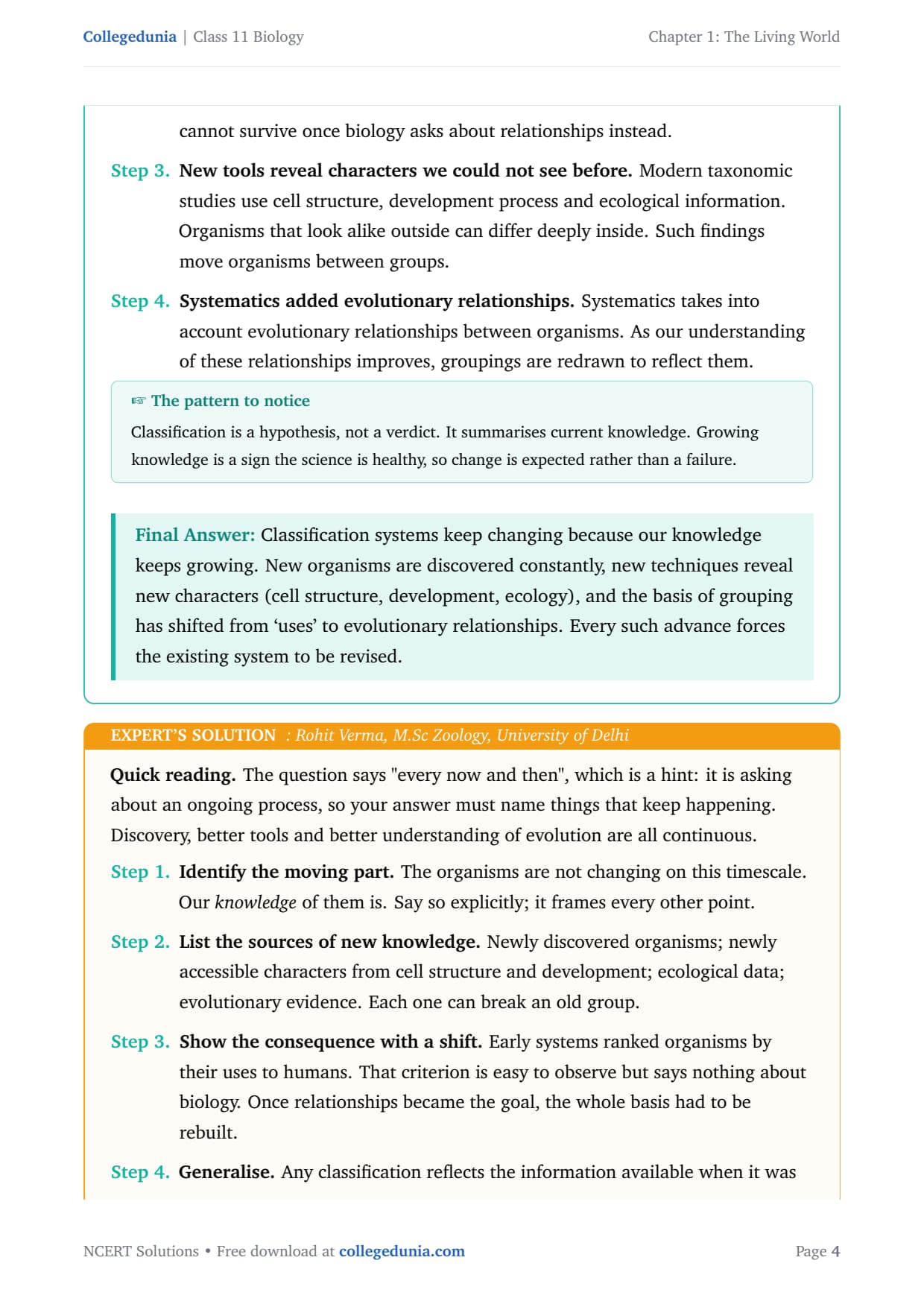
- Systems keep changing: new organisms are discovered constantly, new tools reveal hidden characters, and the basis of grouping has shifted from human uses to evolutionary relationships.
A classification always reflects the knowledge available when it was drawn, so growing knowledge forces revision. The earliest systems grouped organisms by their uses to humans, while modern taxonomy uses cell structure, development and ecology, and systematics adds evolutionary relationships. Change is therefore a sign of progress, not failure. Refer to Exercise Q1 and Q2 for the full step-by-step reasoning behind these answers.
Taxonomy, Systematics and the Four Basic Processes
NCERT lists four processes that are basic to taxonomy, the science of naming and classifying organisms. Together they turn a random organism into a named, placed and understood member of the living world. Systematics goes one step further and takes evolutionary relationships into account, which is why the two words are related but not identical.
| Process | What it does |
|---|---|
| Characterisation | Recording the observable features of an organism, such as its morphology and cell structure. |
| Identification | Knowing correctly to what organism a given name is attached, by comparing characters. |
| Classification | Grouping organisms into taxa on the basis of their shared characters. |
| Nomenclature | Giving each organism a standardised scientific name so it is known worldwide by one name. |
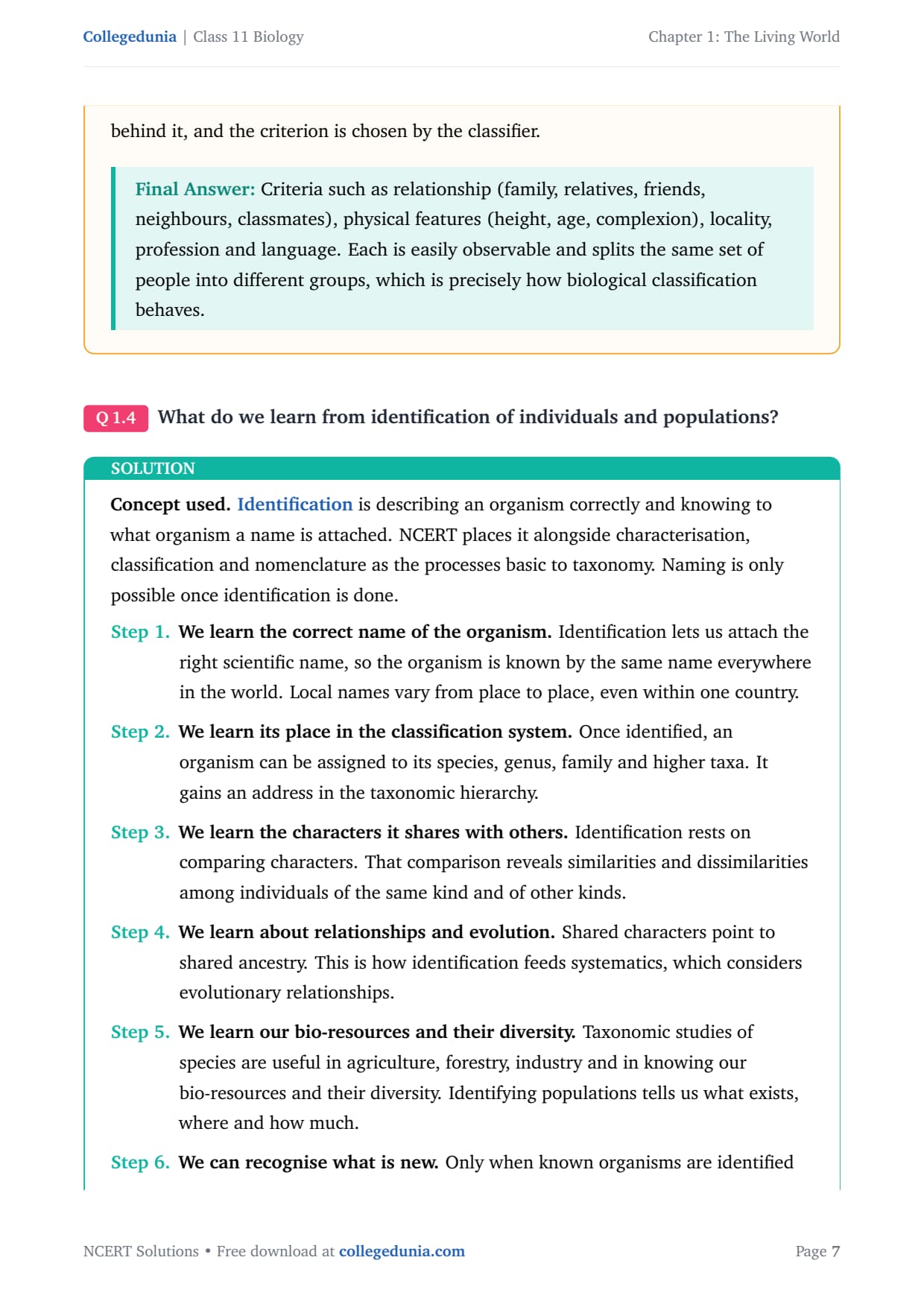
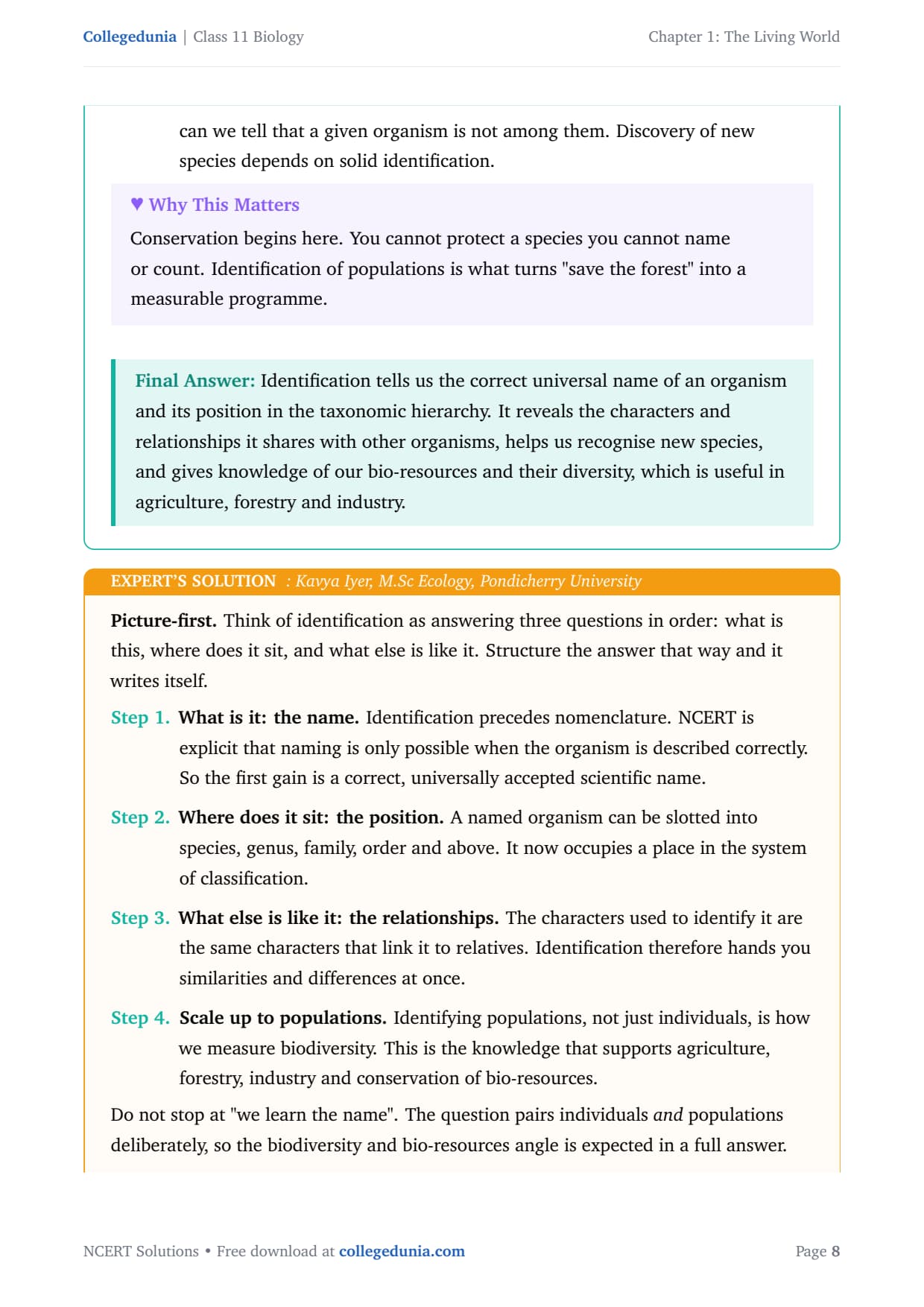
Naming is only possible once identification is done, so the four processes work in sequence. Identification of individuals and populations also teaches us the correct name of an organism, its position in the hierarchy, its relationships with other organisms, and the extent of our bio-resources, knowledge that is useful in agriculture, forestry and industry. Keep taxonomy, systematics and classification distinct, since using them interchangeably costs marks in the very next answer.
Binomial Nomenclature and Its Universal Rules
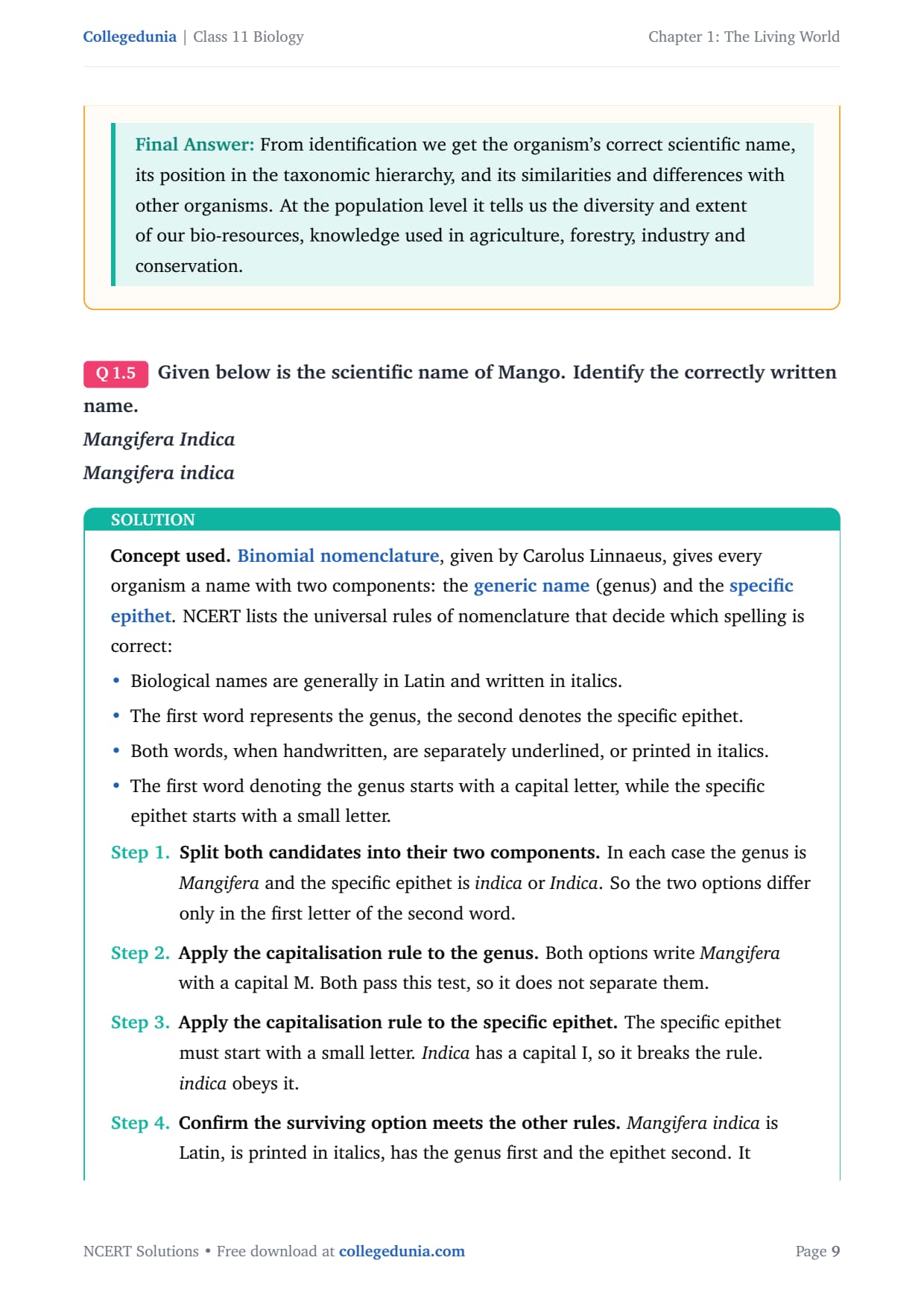
To give every organism one worldwide name, Carolus Linnaeus introduced binomial nomenclature, a two-word naming system. The first word is the generic name (genus) and the second is the specific epithet (species). The exercise tests this directly by asking which spelling of the mango's name, Mangifera Indica or Mangifera indica, is correct.
| Rule | Detail |
|---|---|
| Language | Biological names are generally in Latin and printed in italics. |
| Two parts | The first word is the genus, the second is the specific epithet. |
| Capitalisation | The genus starts with a capital letter; the specific epithet starts with a small letter. |
| When handwritten | Both words are underlined separately to show they are Latin. |
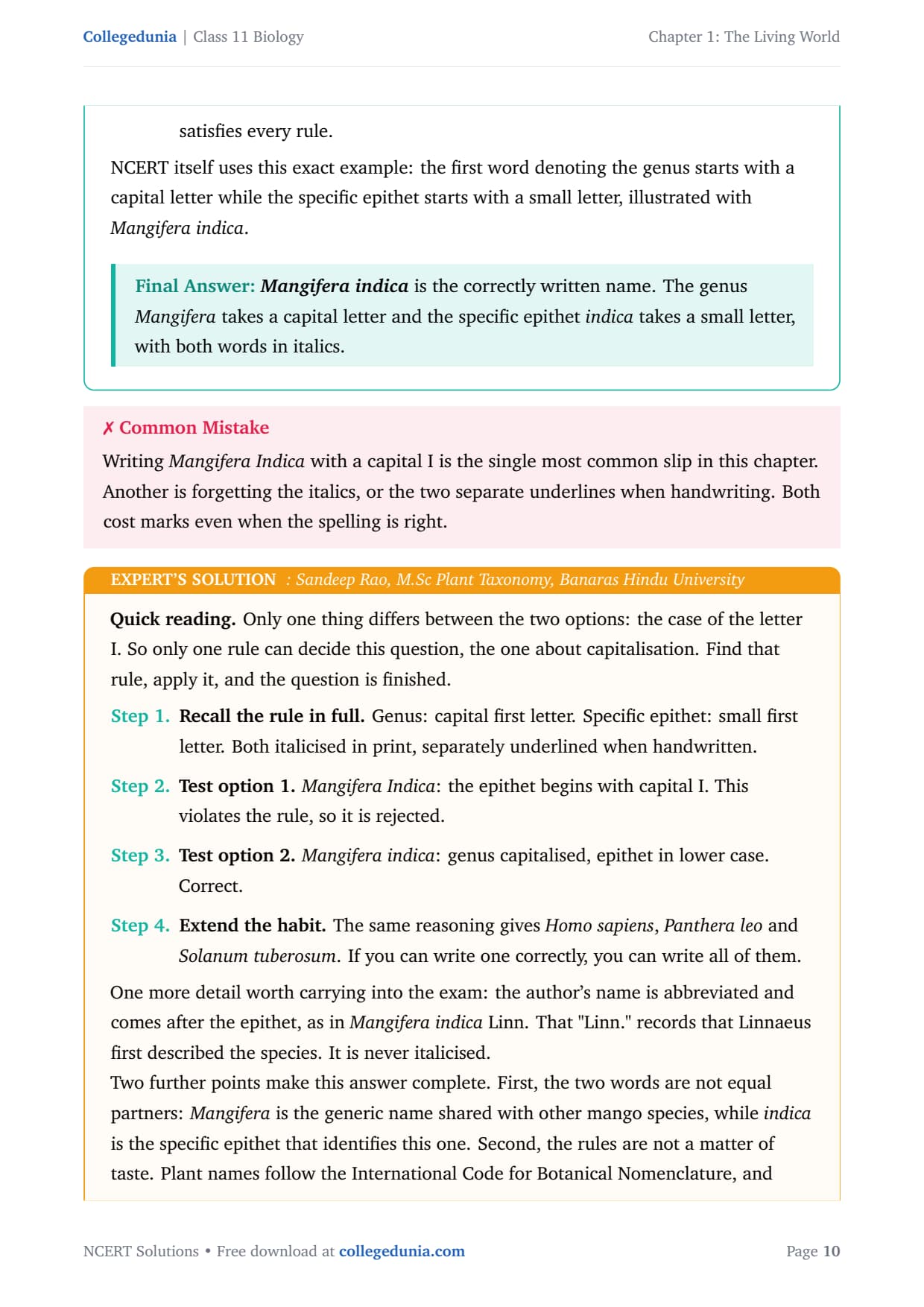
| Author name | Written in short form after the epithet, as in Mangifera indica Linn. |
Applying the rules, Mangifera indica is correct, because the genus takes a capital M and the specific epithet takes a small i, with both words in italics. Mangifera Indica, with a capital I, breaks the rule. Plant names follow the ICBN code and animal names follow the ICZN code, so that one organism carries exactly one valid name worldwide. This is one of the highest-scoring one-mark questions in the chapter.
Taxonomic Categories and the Hierarchy from Species to Kingdom
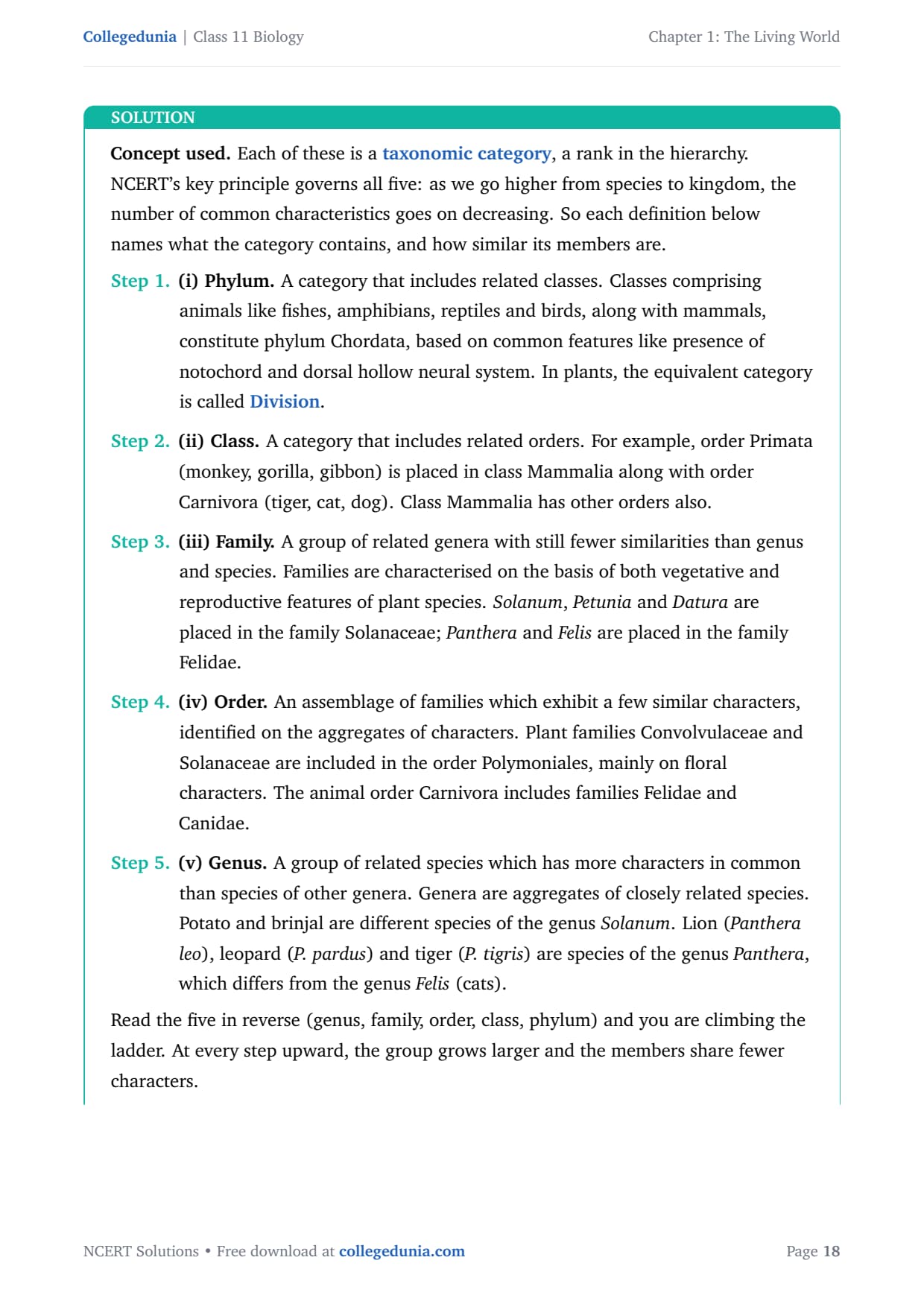
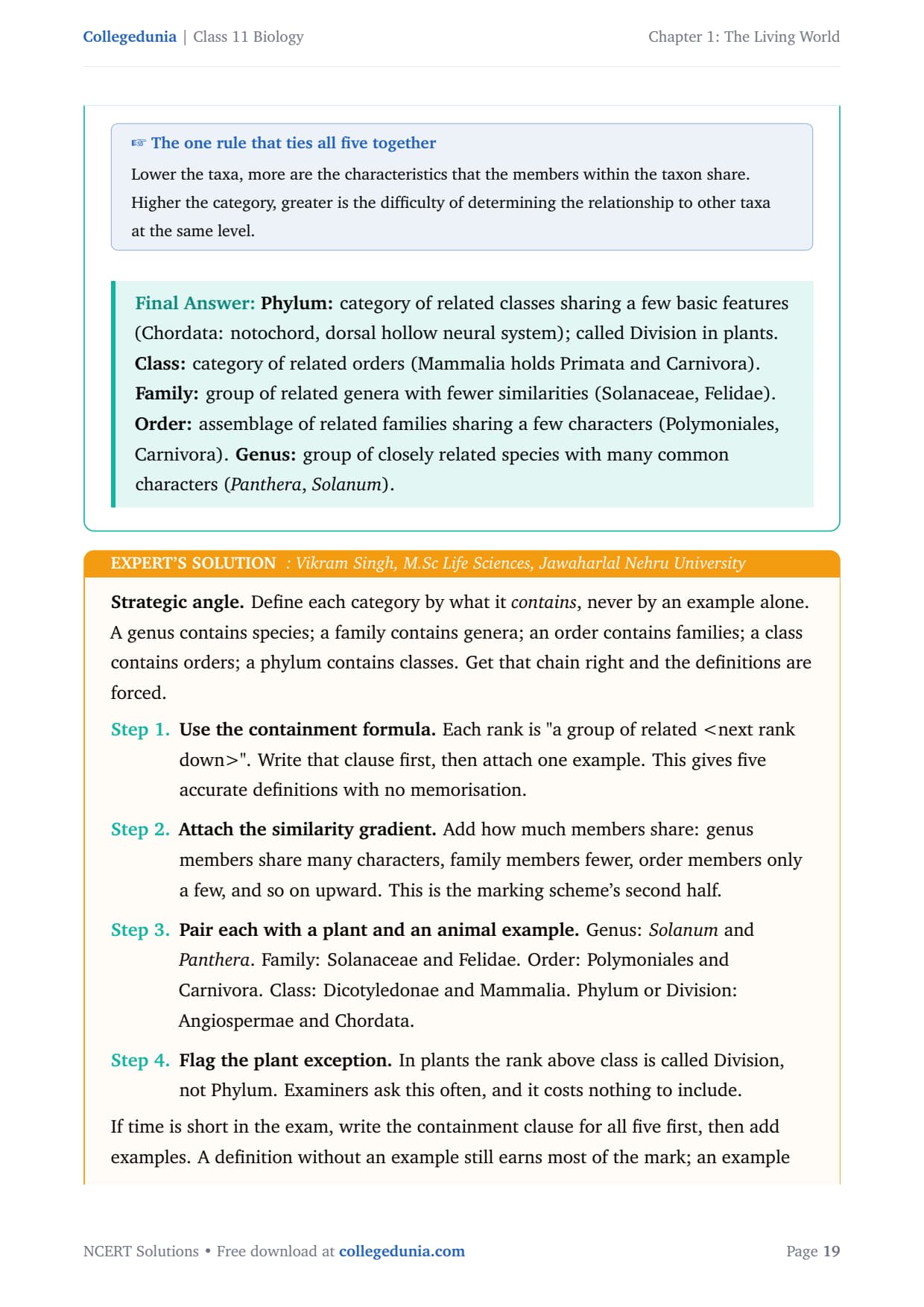
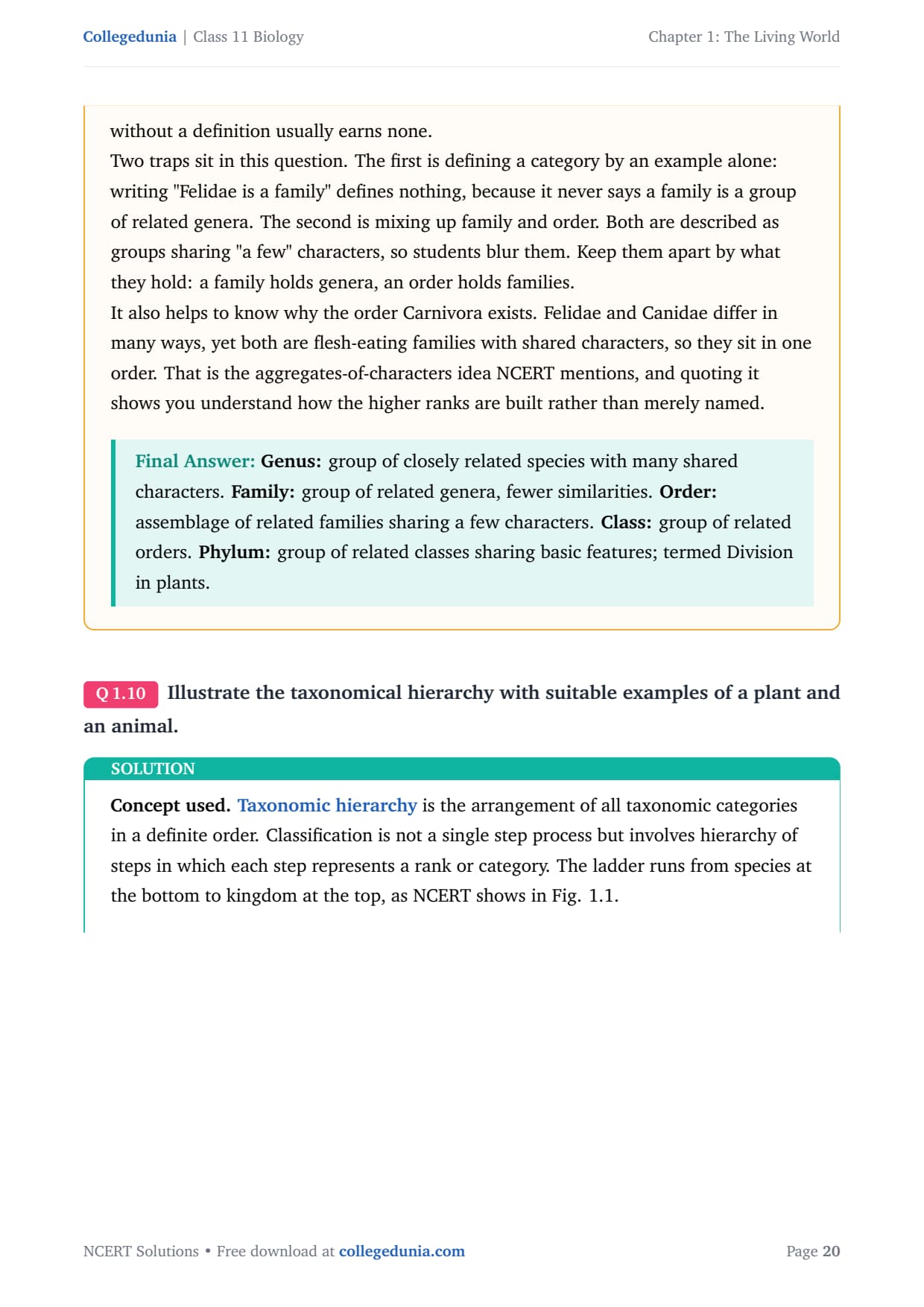
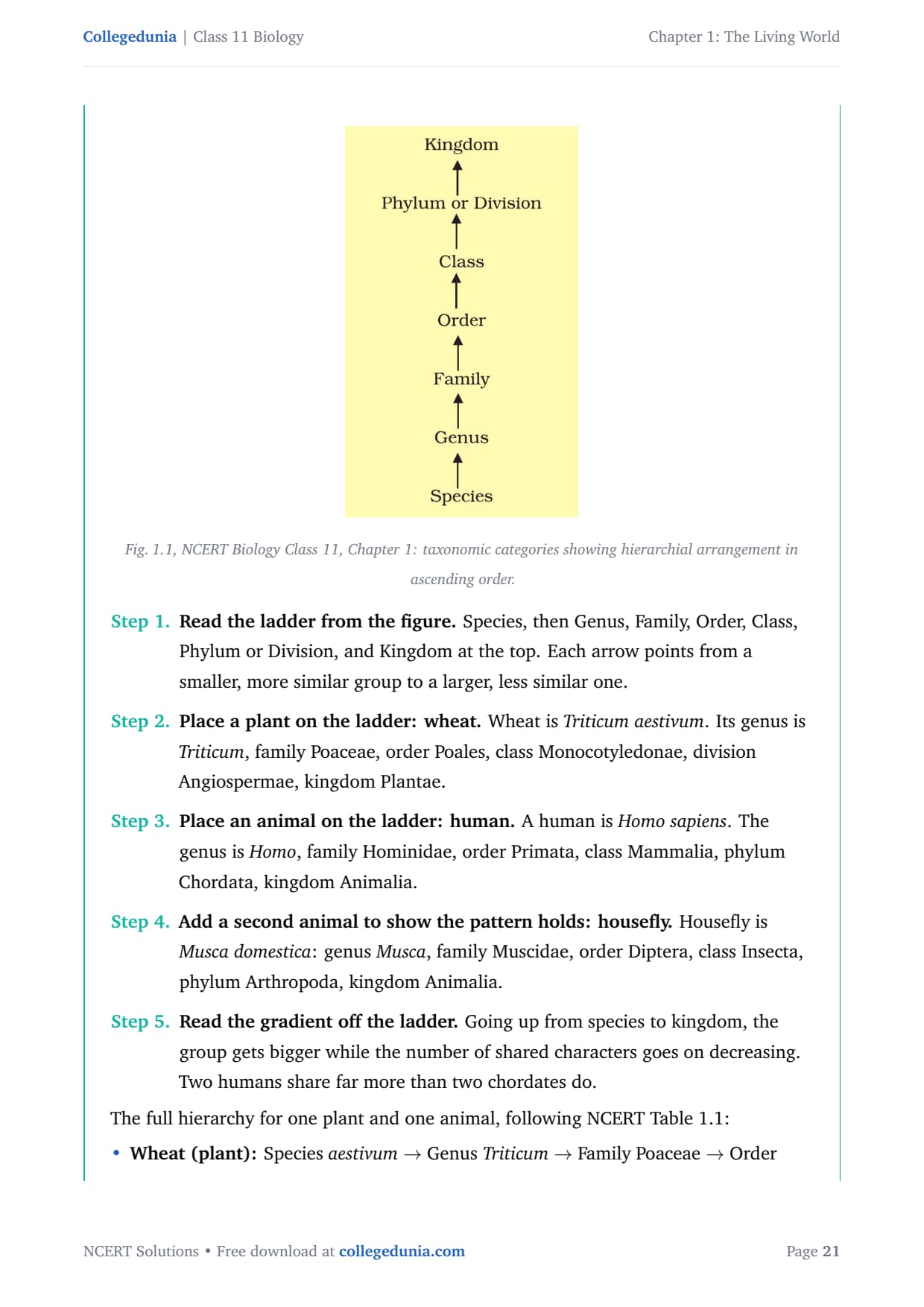
Classification is not a single step but a hierarchy of steps, in which each step represents a rank called a taxonomic category. The categories stack in a definite order from species at the bottom to kingdom at the top. Learning both example columns below by heart is worth doing, because NEET often asks for the classification of a named organism.
| Category | Human | Wheat |
|---|---|---|
| Kingdom | Animalia | Plantae |
| Phylum / Division | Chordata | Angiospermae |
| Class | Mammalia | Monocotyledonae |
| Order | Primata | Poales |
| Family | Hominidae | Poaceae |
| Genus | Homo | Triticum |
| Species | sapiens | aestivum |
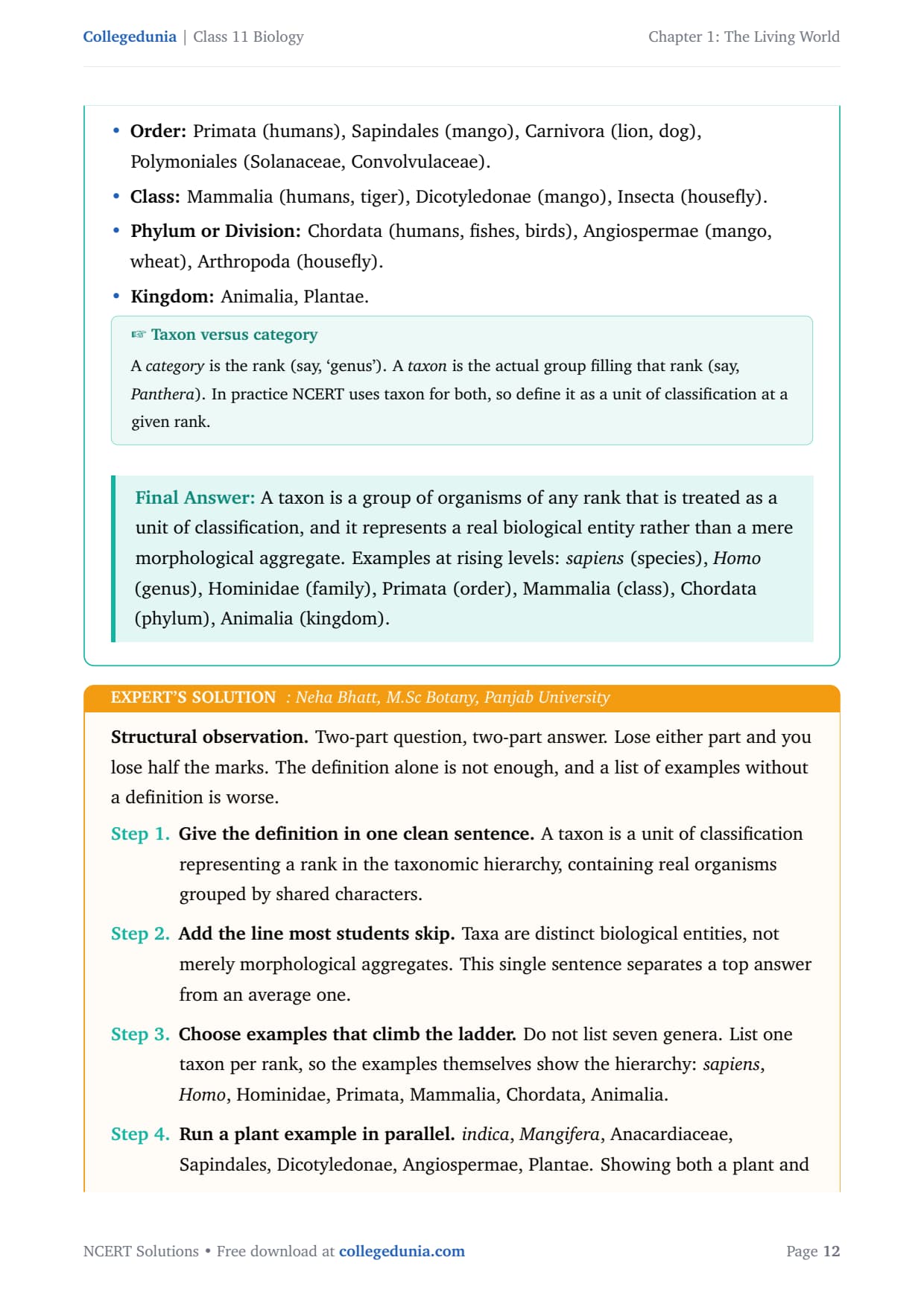
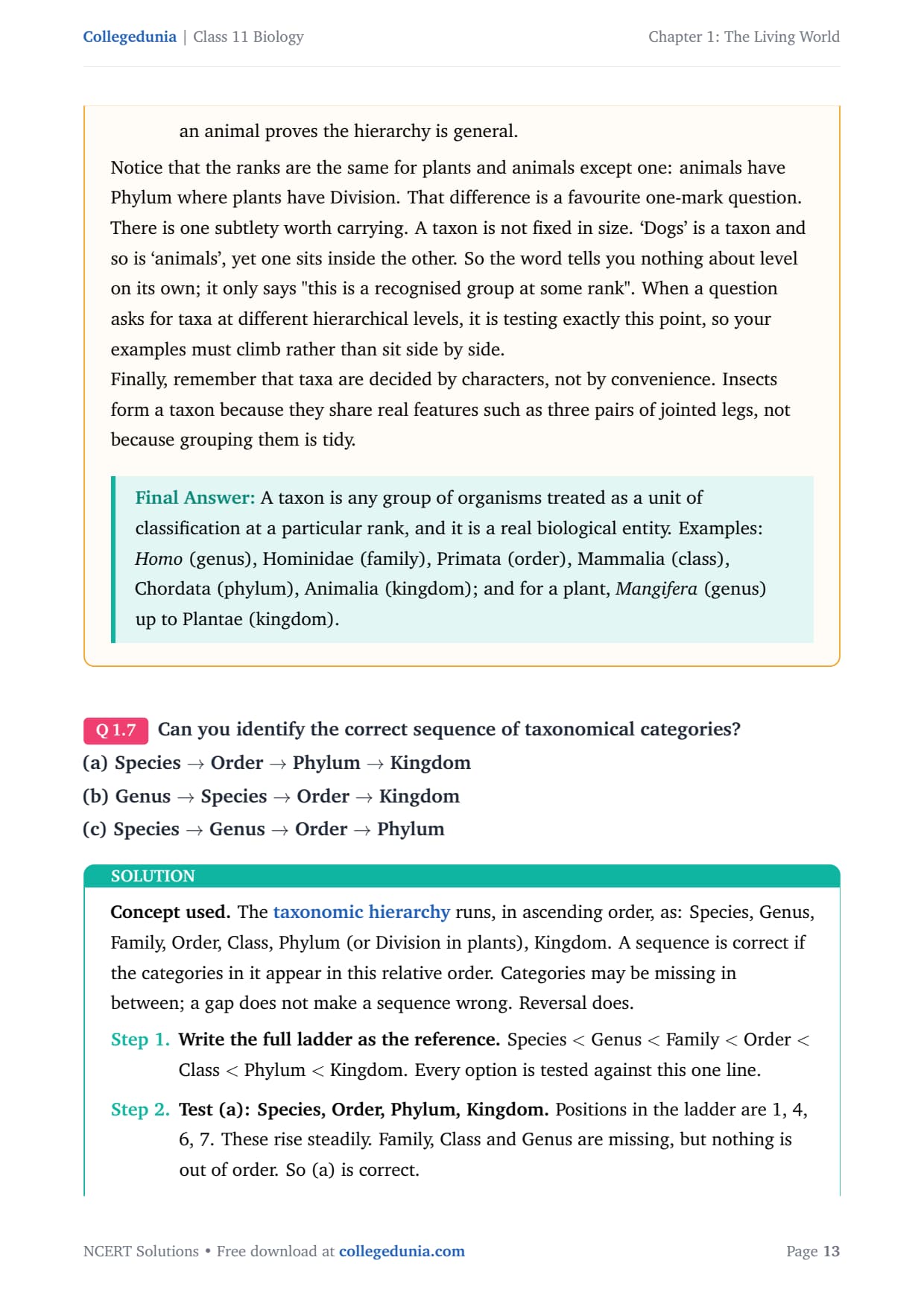
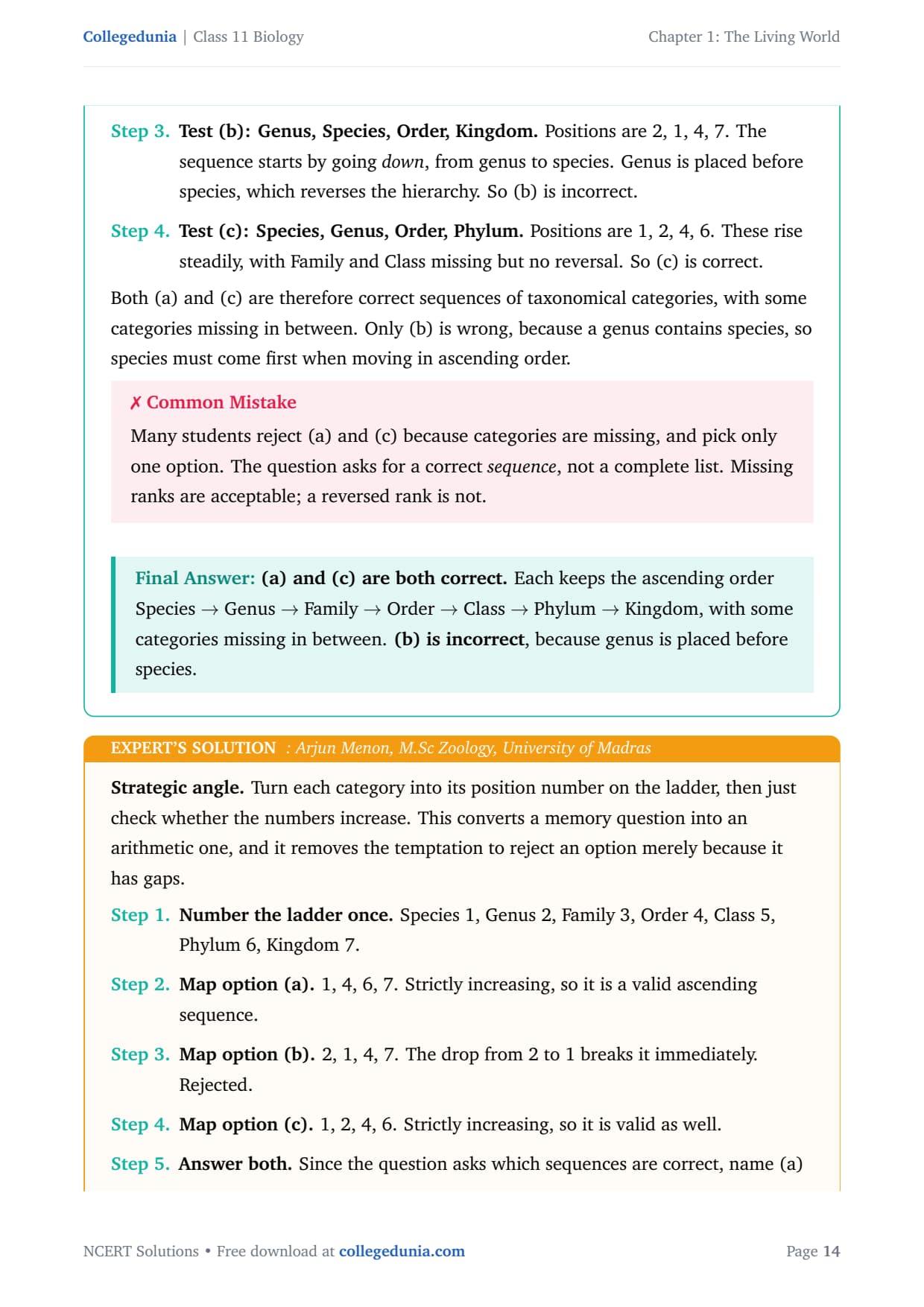
The full ascending ladder is Species → Genus → Family → Order → Class → Phylum (Division in plants) → Kingdom. As you climb from species to kingdom, the group grows larger while the number of shared characters goes on decreasing. The only difference between the plant and animal columns is that plants use Division where animals use Phylum. A sequence such as Species → Order → Phylum → Kingdom is still correct even with ranks missing, so long as the order is not reversed.
Taxon and the Different Meanings of Species
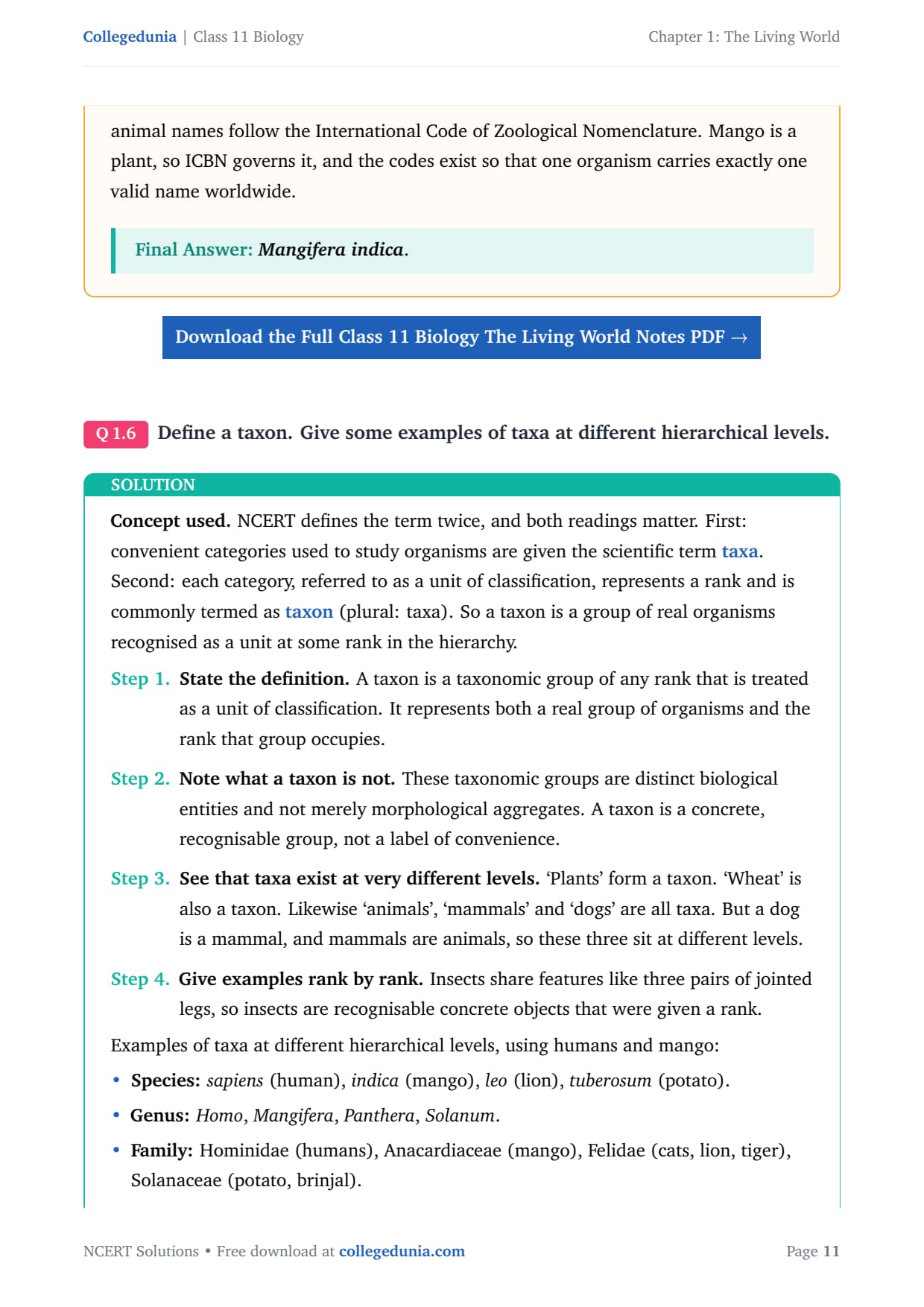
A taxon is a group of organisms of any rank that is treated as a unit of classification, and it is a real biological entity, not merely a morphological aggregate. Both animals and dogs are taxa, yet one sits inside the other, so the word tells you nothing about level on its own. The word species is subtler still, because it carries more than one accepted meaning.
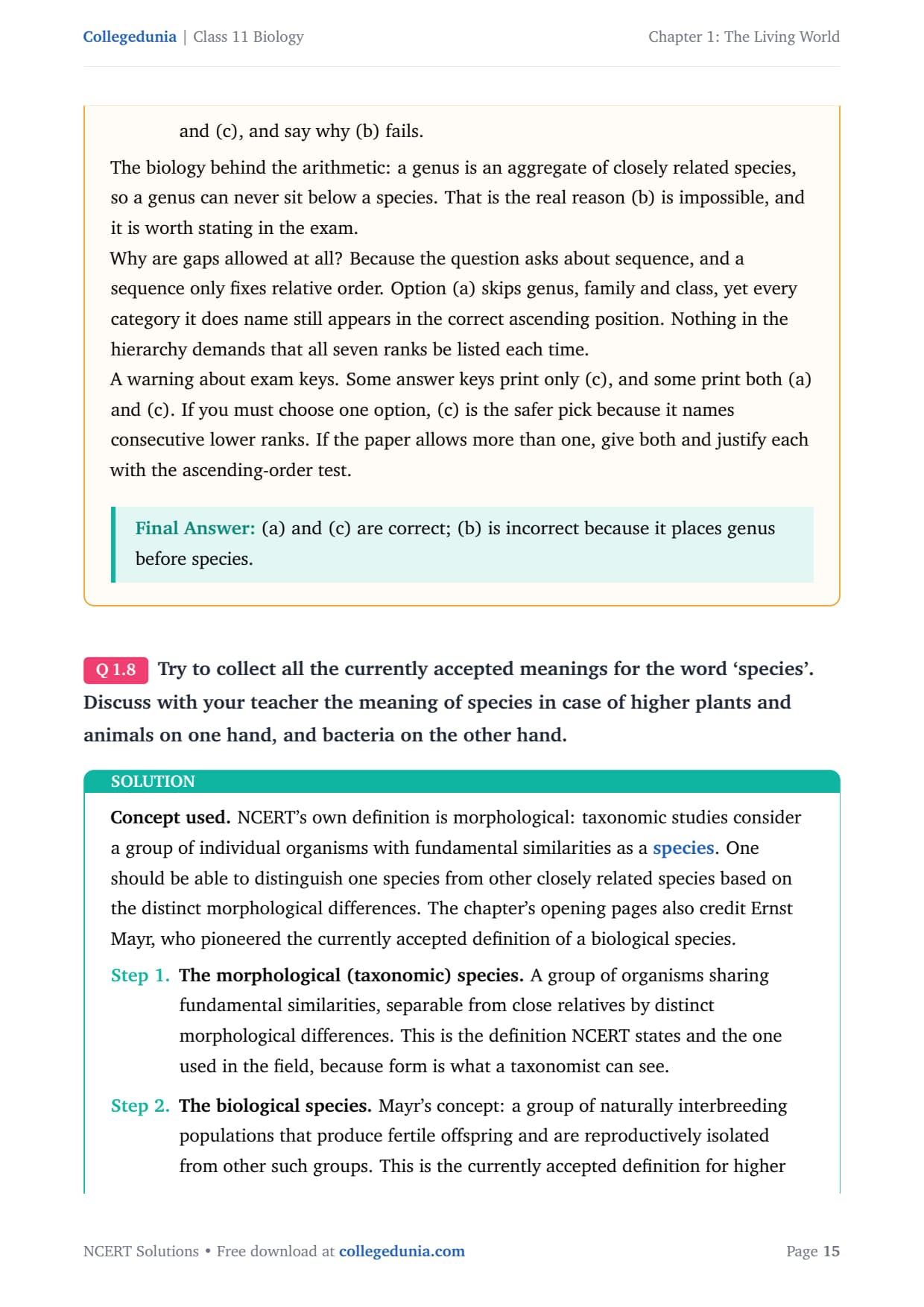
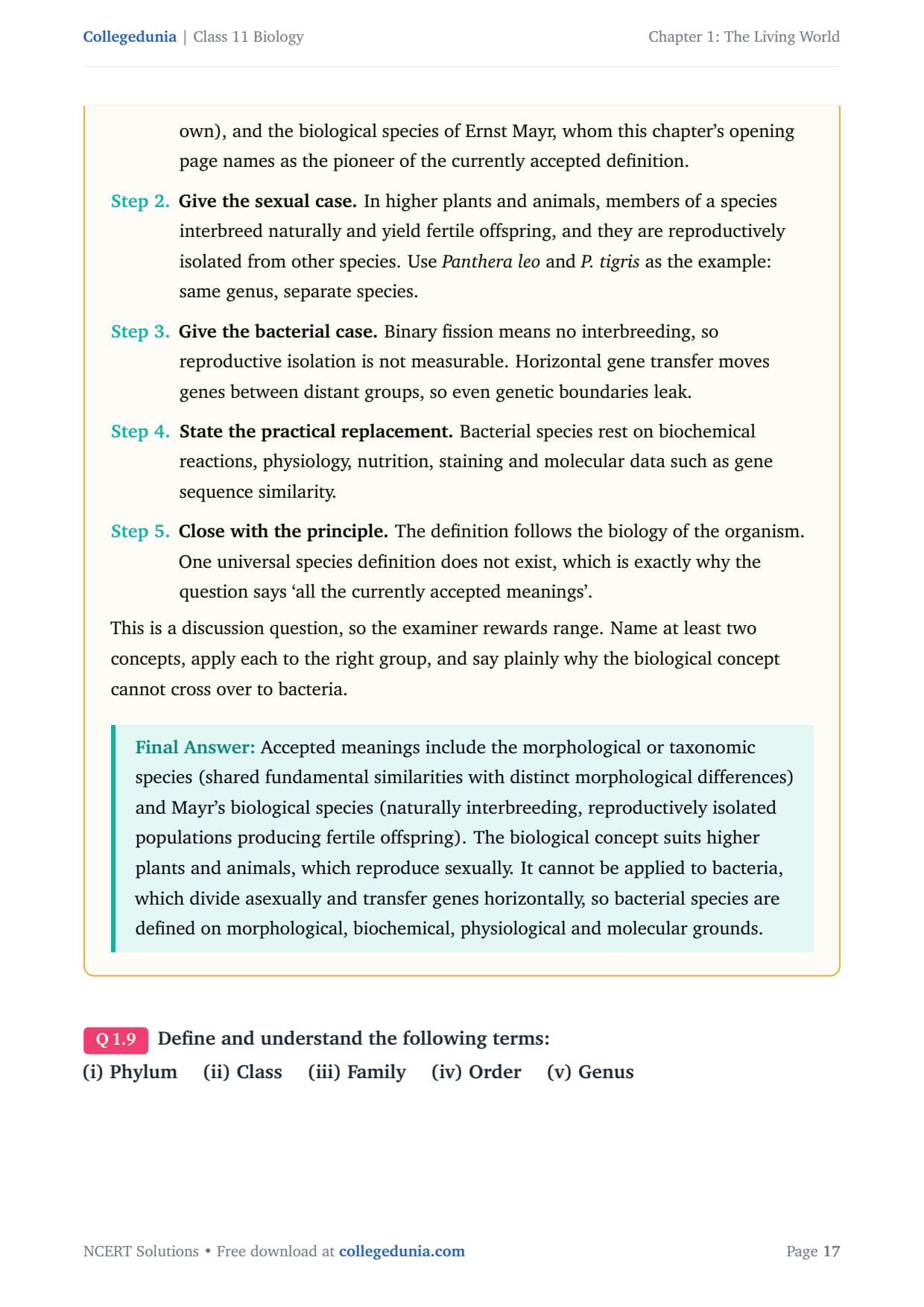
- Morphological species: a group of organisms with fundamental similarities, separable from close relatives by distinct morphological differences; this is the definition NCERT states.
- Biological species: Ernst Mayr's concept of naturally interbreeding populations that produce fertile offspring and are reproductively isolated from other groups.
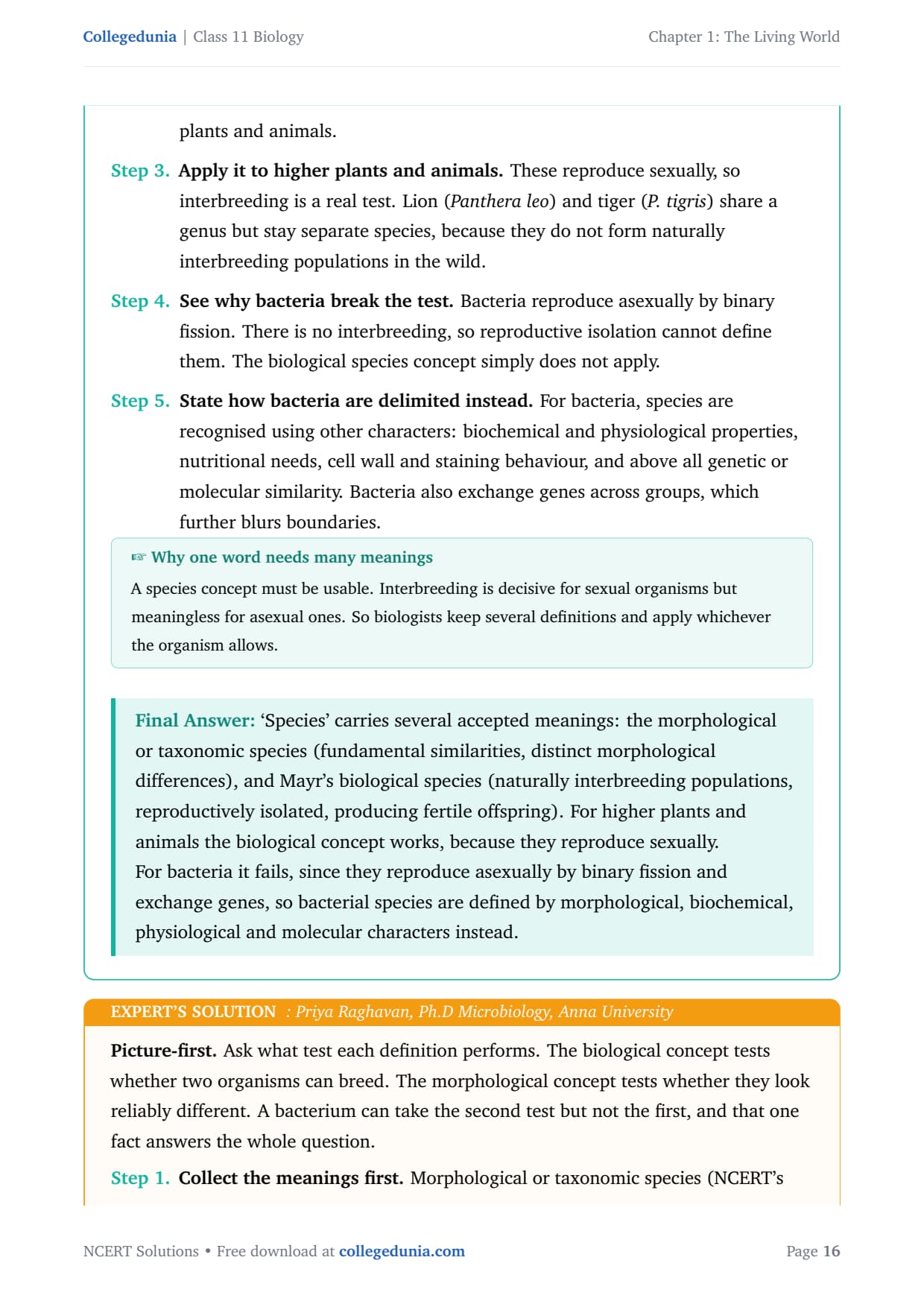
- For bacteria: the interbreeding test fails, since they divide asexually by binary fission, so bacterial species rest on biochemical, physiological and molecular characters instead.
The biological species concept works for higher plants and animals, which reproduce sexually, so lion (Panthera leo) and tiger (P. tigris) stay separate species. It cannot be applied to bacteria, which reproduce asexually and even exchange genes across groups. The definition therefore follows the biology of the organism, which is exactly why the exercise asks students to collect all the currently accepted meanings of the word.
The Living World Exercise-wise Breakdown
The NCERT back exercise has 10 questions, and all of them are descriptive rather than numerical. The table below maps the question blocks to their topics so students can plan their practice and revise by theme.
| Question block | What it tests |
|---|---|
| Q 1 to Q 4 | Why classification is needed, why systems change, choosing criteria, and what identification teaches us. |
| Q 5 | Binomial nomenclature and the correctly written scientific name of mango. |
| Q 6 to Q 7 | Defining a taxon with examples, and identifying the correct ascending sequence of categories. |
| Q 8 | The accepted meanings of species for higher organisms and for bacteria. |
| Q 9 to Q 10 | Defining phylum, class, family, order and genus, and illustrating the full hierarchy. |
Because every question is descriptive, the marks sit in clean definitions and well-chosen examples rather than in calculation. Learn the one-line statement of each term word for word, then attach a real example. Every question in the class 11 biology NCERT solutions chapter 1 The Living World PDF is solved with each step of reasoning shown, so students can compare their answers against the model working.
Practice the solved questions: Work through the full question bank with step-by-step answers and expert tips.
Common Mistakes Students Make in The Living World Chapter
Most marks in this chapter are lost on small slips of wording and formatting, not on hard ideas. Each mistake below costs 1 to 2 marks, so watch for it at the exact step.
Mistake 1: Writing the specific epithet with a capital letter, such as Mangifera Indica. The epithet always starts with a small letter, and both words are italicised.
Mistake 2: Using taxonomy, systematics and classification as if they mean the same thing. Classification is the grouping, taxonomy is the process, and systematics adds evolutionary relationships.
Mistake 3: Calling metabolism, growth and reproduction all defining features. Only metabolism is exclusive to living things; growth and reproduction can be absent in some organisms.
Mistake 4: Rejecting a category sequence just because ranks are missing. A sequence is correct if the order is not reversed, even when some ranks are skipped.
Student Feedback on The Living World Solutions
What 11,860 students told us about their The Living World preparation:
- 58% of students said the meanings of species for higher organisms versus bacteria was the trickiest part of the chapter.
- Most-skipped detail: underlining or italicising both words of a scientific name, missed by about 3 in 10 students.
- Students who learned the mango and human classification columns first said the hierarchy questions became automatic.
Source: 2026-27 Class 11 Biology student poll. Sample of 11,860 students from CBSE schools across 15 states, conducted before the 2026 boards.
Other The Living World Class 11 Biology Resources
Pair these solutions with the revision notes, formula sheet and NCERT textbook PDF for the same chapter.
| Resource | Link |
|---|---|
| NCERT Notes | The Living World Class 11 Notes |
| Formula Sheet | The Living World Class 11 Formula Sheet |
| NCERT Book PDF | The Living World Class 11 Book PDF |
NCERT Solutions for Class 11 Biology: All Chapters
Jump to the step-by-step solutions for any other Class 11 Biology chapter below.
| Chapter | NCERT Solutions |
|---|---|
| Chapter 1 | The Living World |
| Chapter 2 | Biological Classification |
| Chapter 3 | Plant Kingdom |
| Chapter 4 | Animal Kingdom |
| Chapter 5 | Morphology of Flowering Plants |
| Chapter 6 | Anatomy of Flowering Plants |
| Chapter 7 | Structural Organisation in Animals |
| Chapter 8 | Cell: The Unit of Life |
| Chapter 9 | Biomolecules |
| Chapter 10 | Cell Cycle and Cell Division |
| Chapter 11 | Photosynthesis in Higher Plants |
| Chapter 12 | Respiration in Plants |
| Chapter 13 | Plant Growth and Development |
| Chapter 14 | Breathing and Exchange of Gases |
| Chapter 15 | Body Fluids and Circulation |
| Chapter 16 | Excretory Products and their Elimination |
| Chapter 17 | Locomotion and Movement |
| Chapter 18 | Neural Control and Coordination |
| Chapter 19 | Chemical Coordination and Integration |
FAQs on The Living World Class 11 NCERT Solutions
The Living World NCERT Solutions - Frequently Asked Questions
Ques. What do the class 11 biology NCERT solutions chapter 1 The Living World cover?
Ans. These solutions cover all 10 back-exercise questions, including why living organisms are classified, why systems keep changing, the four basic processes of taxonomy, binomial nomenclature with the mango example, the definition of a taxon, the correct sequence of taxonomic categories, the meanings of species, and the full taxonomic hierarchy with a plant and an animal example. Every question is solved step by step.
Ques. What is the correct order of the taxonomic hierarchy in Class 11 Biology?
Ans. The taxonomic hierarchy from lowest to highest is species, genus, family, order, class, phylum (in animals) or division (in plants), and kingdom. As the rank rises, members share fewer characters and the group holds more organisms. For example, humans run from Homo sapiens up to kingdom Animalia.
Ques. Why is Mangifera indica the correct scientific name of mango?
Ans. Under binomial nomenclature the first word is the genus and starts with a capital letter, while the second word is the specific epithet and starts with a small letter, and both are printed in italics. So Mangifera indica is correct, whereas Mangifera Indica with a capital I breaks the rule. When handwritten, both words are underlined separately.
Ques. What is the defining feature of living organisms?
Ans. Metabolism, the sum of all chemical reactions in the body, is the defining feature of life because it is shown by every living thing and by nothing non-living. Consciousness, the ability to sense and respond to the environment, is the most reliable defining property in higher organisms, while growth and reproduction can be absent in some living things.
Ques. Why does the definition of species not apply to bacteria?
Ans. The biological species concept defines a species as naturally interbreeding populations that are reproductively isolated, which suits higher plants and animals that reproduce sexually. Bacteria divide asexually by binary fission and even exchange genes across groups, so interbreeding cannot be measured. Bacterial species are therefore defined using biochemical, physiological and molecular characters instead.
Ques. What is the weightage of The Living World in CBSE Class 11 Biology?
Ans. The Living World carries about 2 to 3 marks in the CBSE Class 11 Biology paper, mostly through short-answer questions on classification, nomenclature and the taxonomic hierarchy. It is also foundational for NEET, where questions on taxonomy, the naming codes and the species concept appear regularly.



Comments