The NCERT Solutions for Class 10 Science Chapter 9 Light - Reflection and Refraction solve all 31 questions (14 in-text and 17 end-of-chapter exercises) for the latest 2026-27 CBSE syllabus.
Every answer follows the textbook flow: the laws of reflection, ray diagrams for concave and convex mirrors and lenses, the mirror formula, the lens formula, magnification, refractive index and the power of a lens.
All 31 NCERT questions solved with the New Cartesian Sign Convention, full step-by-step working, and an Expert Solution per question for board-exam strategy.
Complete coverage of spherical mirrors, refraction, refractive index, spherical lenses, the lens formula and the power of a lens as tested in the CBSE Class 10 board paper.
Answers written in plain English for the 2026-27 CBSE syllabus, useful for the board exam and school unit tests.
Solved by Collegedunia Science Experts
These NCERT Solutions for Class 10 Science Chapter 9 Light - Reflection and Refraction are checked against the latest 2026-27 NCERT textbook and refined against the last five years of CBSE board papers. Each of the 31 questions gives a Check Solution for the clean board answer and an Expert Solution for extra marks.
What the NCERT Solutions for Class 10 Science Chapter 9 Light - Reflection and Refraction Cover
This chapter answers one question: how does light behave when it bounces off a mirror or bends through a lens? These solutions follow the NCERT order while filling the gaps students hit in the exam.
Reflection and spherical mirrors: laws of reflection, concave and convex mirrors, ray diagrams by object position.
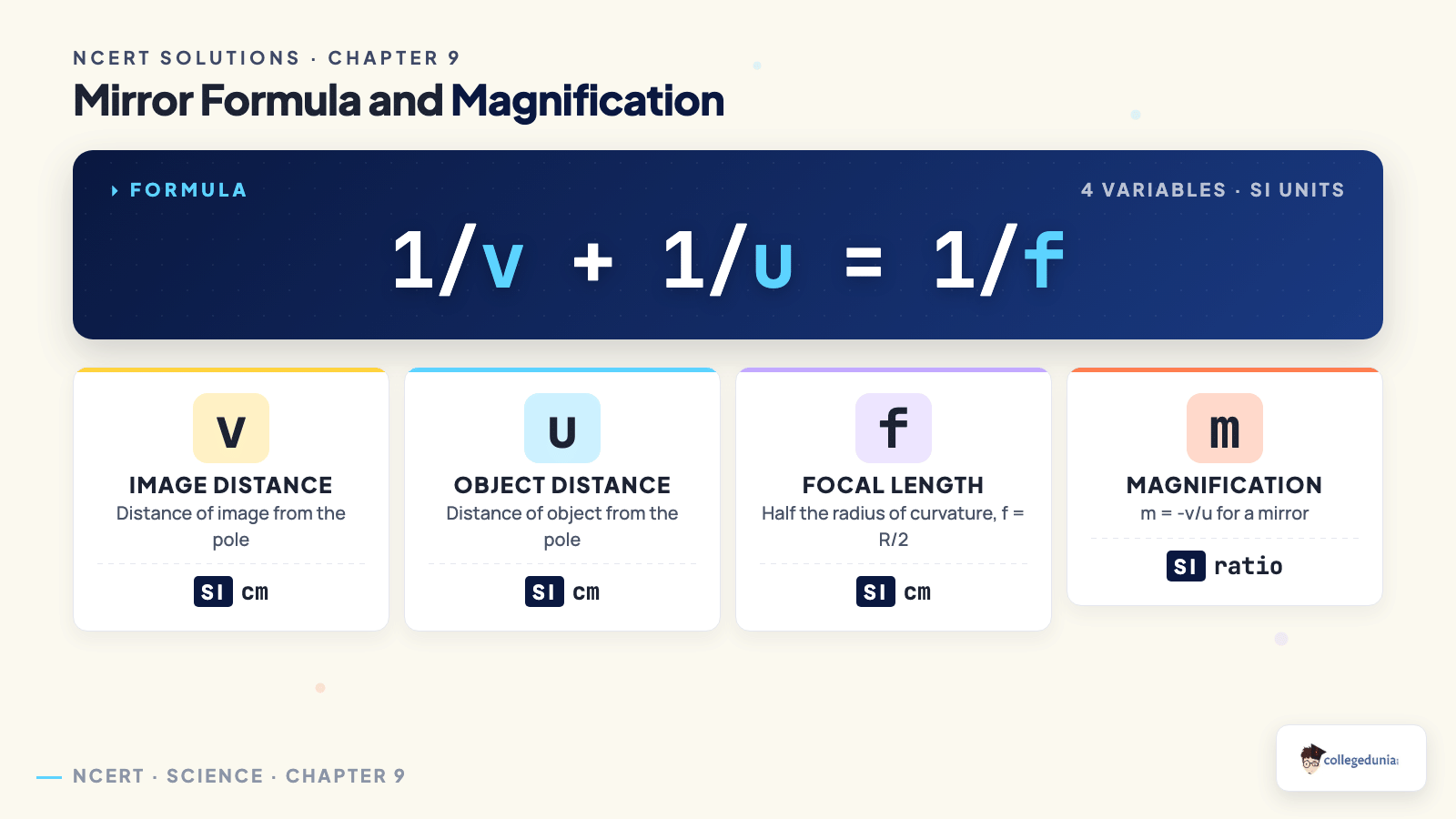
Mirror formula and magnification: 1/v + 1/u = 1/f, m = -v/u, and the New Cartesian Sign Convention.
Refraction and refractive index: why light bends, the rarer-to-denser rule, and n = c/v.
Lenses and power: convex and concave lenses, lens formula 1/v - 1/u = 1/f, and power P = 1/f in dioptres.
Light - Reflection and Refraction Class 10 Science Video Solutions
Question Breakdown of the Light - Reflection and Refraction Chapter NCERT Solutions
Chapter 9 carries 14 in-text questions and 17 end-of-chapter exercise questions. The table maps each section to its topic, the answer style CBSE rewards, and the typical mark weight.
Section
Topic covered
Typical marks
Reflection & mirrors
Principal focus, focal length, image nature by position
1 to 3
Mirror numericals
Mirror formula, magnification, screen position
3 to 5
Refraction
Bending towards/away from normal, refractive index
2 to 3
Lenses
Convex and concave lens images, lens formula
3 to 5
Power of a lens
P = 1/f in dioptres, lens type from sign
1 to 2
The mirror and lens numericals and the ray-diagram questions carry the heaviest marks. Writing the data with signs, showing every line of the formula, and drawing a neat labelled diagram scores full marks.
Reflection of Light and Spherical Mirrors
Light travels in straight lines, and when it hits a smooth surface it bounces back. This is reflection, and it follows two laws: the angle of incidence equals the angle of reflection, and the incident ray, reflected ray and normal lie in one plane. A curved mirror cut from a sphere is a spherical mirror, of two kinds.
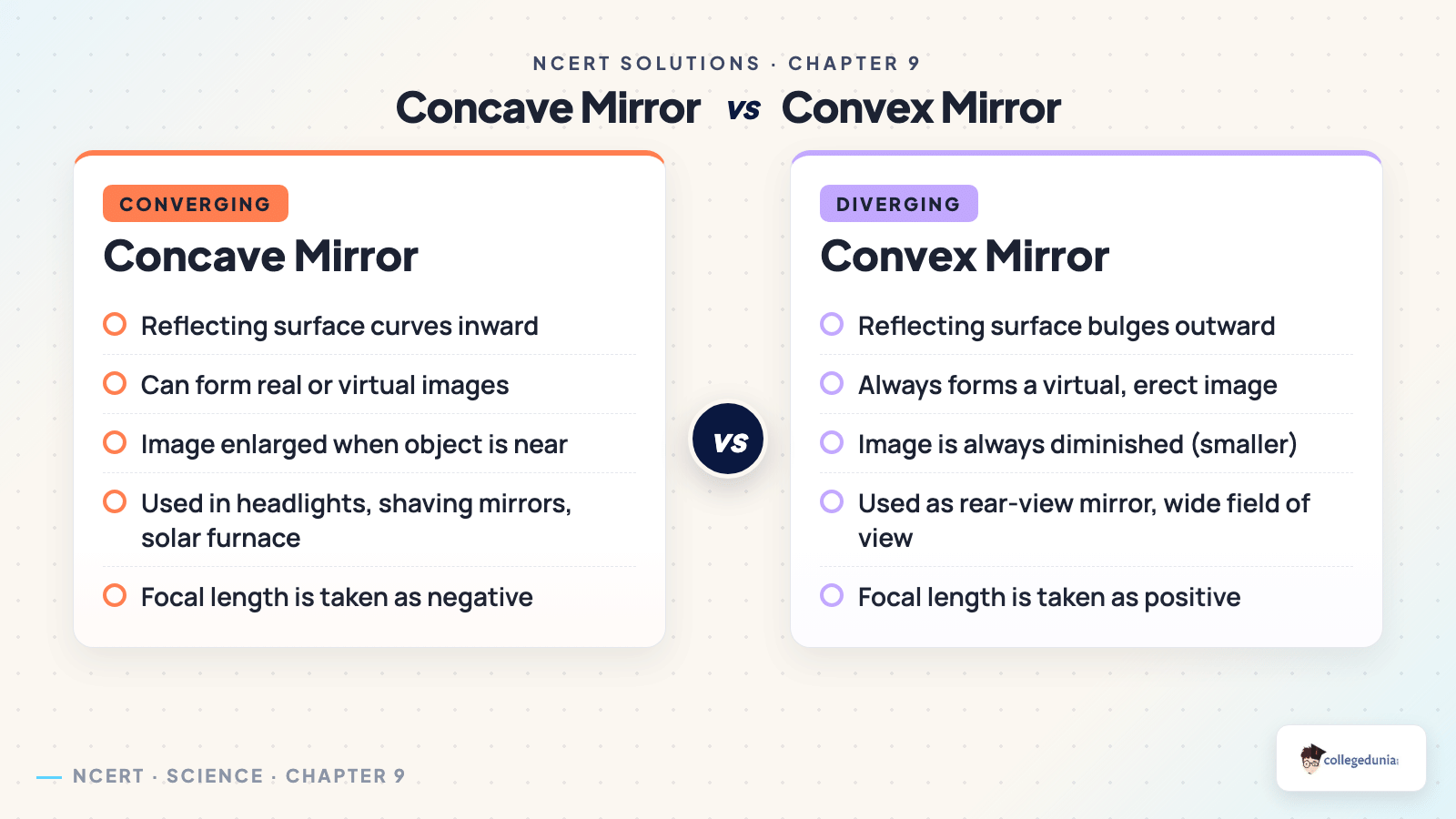
Concave mirror: curves inward (like a spoon's inside); a converging mirror with a real focus in front.
Convex mirror: bulges outward; a diverging mirror with a virtual focus behind.
Principal focus (F): where rays parallel to the axis meet (concave) or appear to meet (convex) after reflection.
Focal length (f): pole-to-focus distance, half the radius of curvature, f = R/2.
The big idea is that a concave mirror can form many kinds of image, while a convex mirror always forms a virtual, erect, diminished image. The object's position in front of a concave mirror decides whether the image is real or virtual, large or small, upright or inverted, which is why it works both as a shaving mirror up close and as a real-image former when the object is far away.
Quick Tip: Learn the concave-mirror image by object position: beyond C gives a small real image, at C an equal real image, between C and F an enlarged real image, and between P and F a virtual erect enlarged image.
Mirror Formula and Magnification with the Sign Convention
Most numericals here need just one formula and the right signs. The mirror formula links image distance v, object distance u and focal length f, while magnification gives the size and orientation of the image.
Quantity
Mirror
Lens
What the sign means
Formula
1/v + 1/u = 1/f
1/v - 1/u = 1/f
+ for mirrors, - for lenses
Magnification
m = -v/u
m = v/u
+ erect, - inverted
Focal length
concave -, convex +
convex +, concave -
Set by sign convention
The New Cartesian Sign Convention ties it together: distances measured against the incident light (to the left) are negative, those in the same direction (to the right) are positive. So u is always negative, a real image distance is negative for a mirror but positive for a lens, and heights above the axis are positive.
Watch Out: A real image is always inverted, so its magnification must be negative. Writing "three times magnified real" as m = +3 instead of m = -3 is the most common mistake in the chapter.
Refraction of Light and Refractive Index
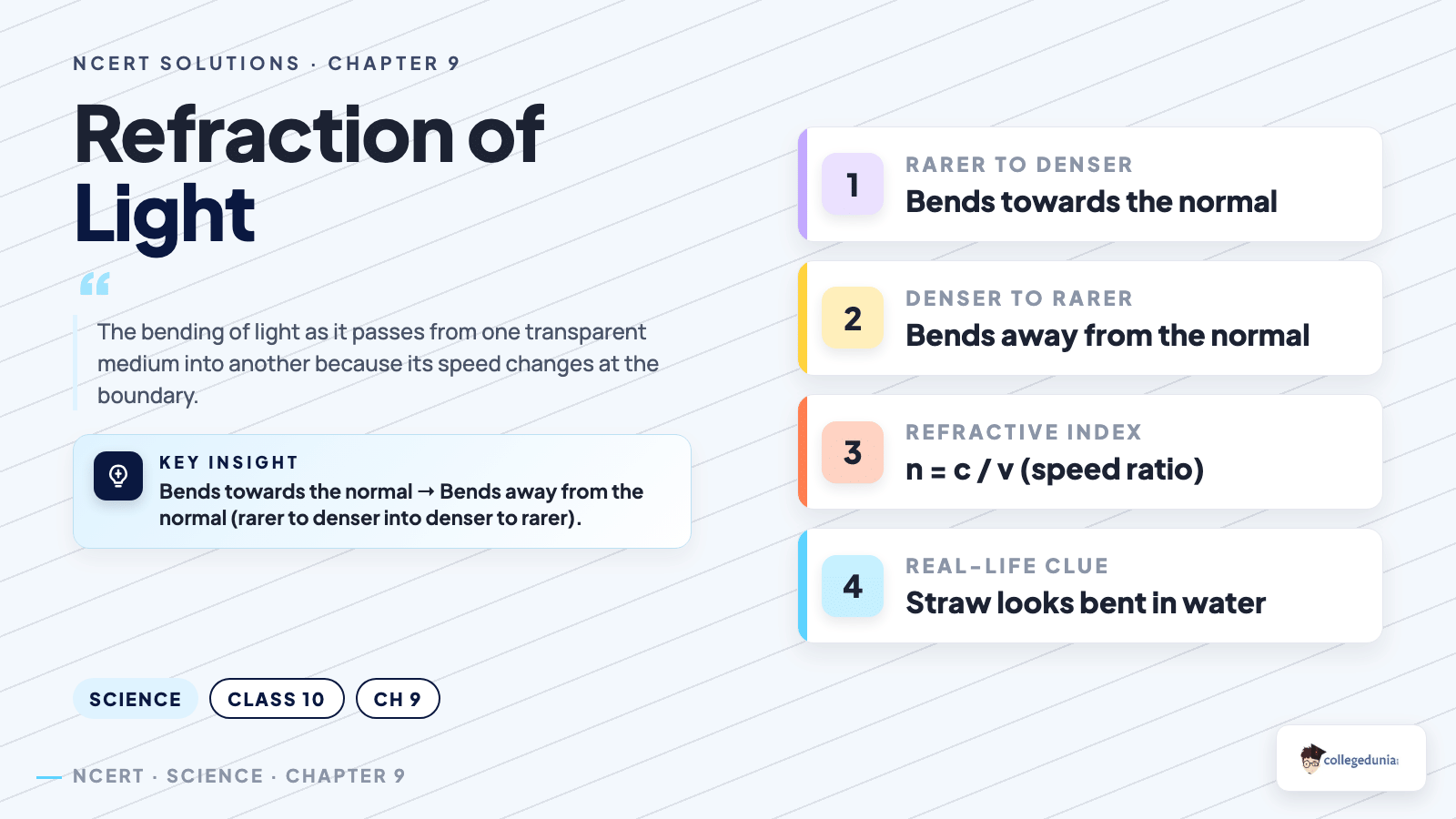
When light passes from one transparent medium into another, it changes speed and bends at the boundary. This is refraction, and it explains a straw looking broken in water and a pool looking shallower than it is. The direction of bending depends on whether the new medium is optically denser or rarer.
Rarer to denser: light slows and bends towards the normal (air into water or glass).
Denser to rarer: light speeds up and bends away from the normal (glass into air).
Refractive index: n = c/v, speed in vacuum over speed in the medium; larger n means slower light and a denser medium.
The refractive index is the key number for the whole topic. From Table 9.3 in the NCERT book, diamond has the highest optical density (n = 2.42) and air the lowest (n = 1.0003). Because v = c/n, light is fastest in the medium with the smallest refractive index. Optical density is about how much a medium slows light, not how heavy it is, so never decide "denser" by weight. In a reason, always state the speed change: "light slows going from rarer air to denser water, so it bends towards the normal."
Spherical Lenses, the Lens Formula and Power of a Lens
A lens has two refracting surfaces. A convex (converging) lens is thicker in the middle and brings light to a focus; a concave (diverging) lens is thinner in the middle and spreads light out. Lens problems use the lens formula and magnification, with the same sign convention as mirrors.
Lens formula: 1/v - 1/u = 1/f (note the minus sign, unlike the mirror formula).
Lens magnification: m = h'/h = v/u.
Signature image: a convex lens gives a real, inverted, same-size image only when the object is at 2F.
Power of a lens: P = 1/f with f in metres, measured in dioptres (D); convex lens has positive power, concave lens negative.
Object position (convex lens)
Image
Nature
Beyond 2F
Between F and 2F
Real, inverted, diminished
At 2F
At 2F
Real, inverted, same size
Between F and 2F
Beyond 2F
Real, inverted, enlarged
Between optical centre and F
Same side as object
Virtual, erect, enlarged (magnifying glass)
Power is the reciprocal of the focal length in metres, so a strong lens has a short focal length and a high power. +1.5 D means a convex lens of focal length 0.667 m, and -2.0 D means a concave lens of -0.5 m. This is what an optician writes on a spectacle prescription: positive for long-sight, negative for short-sight.
Common Mistakes Students Make in the Light Chapter
The repeat-offender mistakes in board answers are: wrong sign on the focal length (concave mirror and concave lens are both negative f, convex both positive); using the mirror plus sign in the lens formula or vice versa; and forgetting that P = 1/f needs f in metres, so a 50 cm lens is 0.5 m, giving P = +2 D.
How to Use the Light - Reflection and Refraction NCERT Solutions PDF for Board Prep
This chapter is formula-heavy but very scoring once the sign convention clicks. Work in two passes. First learn the two image tables (concave mirror by position, convex lens by position), the refraction rule and the four sign rules, drawing each standard ray diagram once by hand. Then work the numericals on paper, always writing the data with signs first, then the formula, the arithmetic, and the nature of the image, and check each line against these solutions, watching the sign of the focal length and keeping f in metres for the power formula. The board paper reliably gives one or two formula numericals, a ray-diagram question and short reason-based refraction questions, where a neat labelled diagram and full working separate a full-mark answer from a near miss.
Other Resources for Class 10 Science Chapter 9 Light - Reflection and Refraction
Pair this NCERT Solutions PDF with the matching revision notes, handwritten notes and the official NCERT book chapter. All resources for Class 10 Science Chapter 9 Light - Reflection and Refraction are linked below.
Resource
What it covers
Open
NCERT Solutions
Step-by-step answers to all 31 questions, with an Expert Solution for each.
You are here
Notes
Concept-first revision notes on reflection, mirrors, refraction, lenses and power.
74% of Class 10 students said the hardest part of Light - Reflection and Refraction was getting the signs right in the mirror and lens formulas. 3 out of 5 students told us they lost marks by writing a real image with a positive magnification or by forgetting that a concave mirror has a negative focal length.
Toppers found that writing the data with signs first and drawing a neat ray diagram added 1 to 2 marks on the numerical questions, and the average student spent 5 to 6 hours on this chapter across the first read and exercise practice.
Source: 2026-27 Class 10 Science student poll. Sample of 9,800 students from CBSE schools across 13 states, conducted before the 2026 boards.
NCERT Solutions for Class 10 Science: All Chapters
Related Links: Use the table below to open the NCERT Solutions for the other chapters of Class 10 Science. Every chapter ships with the same step-by-step answer style, full PDF download, and revision FAQ.
All NCERT Solutions for Class 10 Science Chapter 9 Light - Reflection and Refraction with Step-by-Step Solutions
Tap Check Solution for the clean board answer and Expert Solution for the extra-mark strategy on each of the 31 questions below.
Q 1
Define the principal focus of a concave mirror.
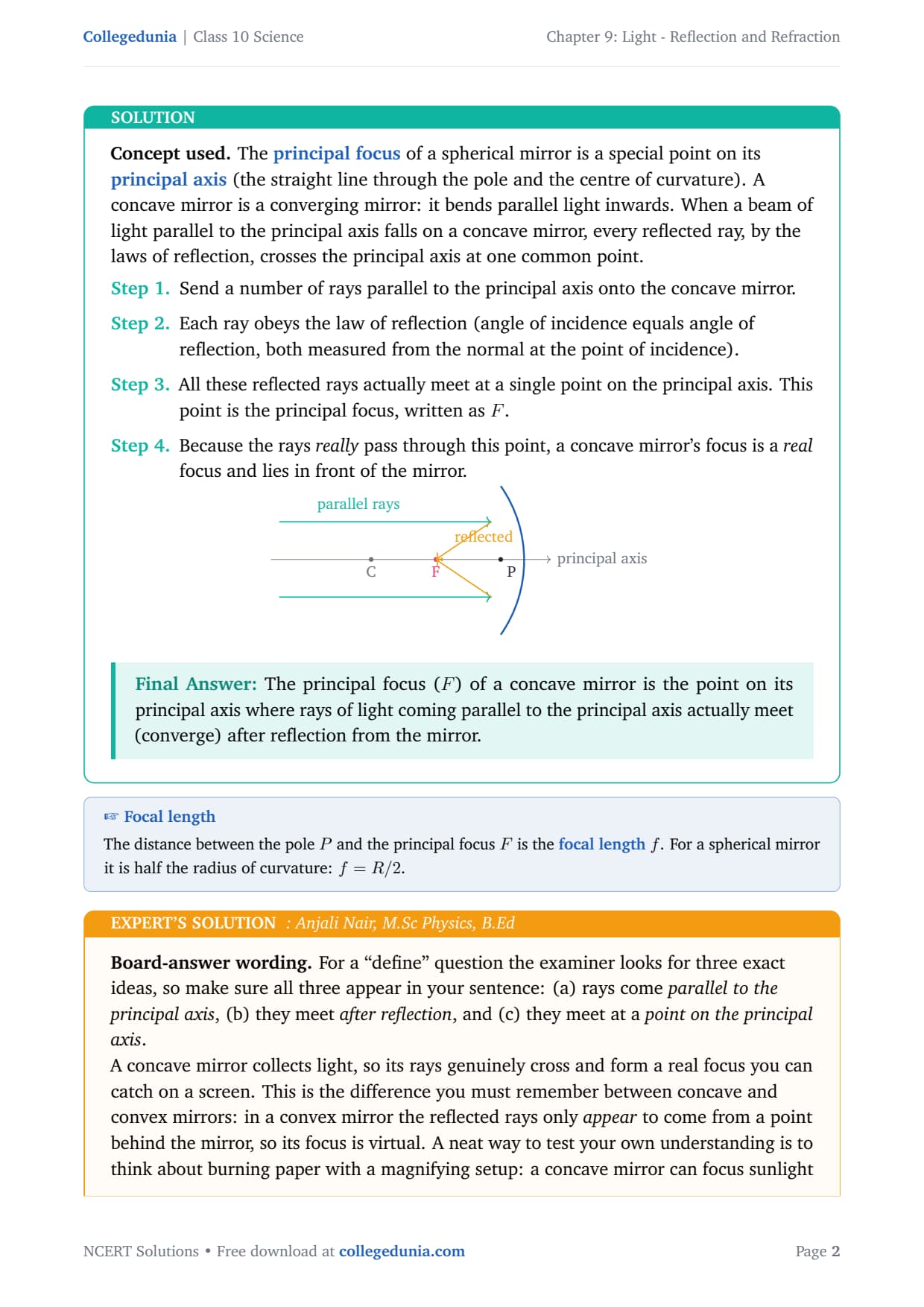
A concave mirror is a converging mirror: it bends parallel light inwards. The principal axis is the straight line through the pole and the centre of curvature. When a beam of light parallel to the principal axis falls on the mirror, every reflected ray obeys the laws of reflection and crosses the axis at one common point.
Send several rays parallel to the principal axis onto the concave mirror.
Each ray reflects so that the angle of incidence equals the angle of reflection.
All the reflected rays actually meet at a single point on the principal axis, called the principal focus F.
Because the rays really pass through this point, the concave mirror's focus is a real focus, lying in front of the mirror.
Answer: The principal focus (F) of a concave mirror is the point on its principal axis where rays of light coming parallel to the principal axis actually meet after reflection from the mirror.
AN
Anjali Nair
M.Sc Physics, B.Ed
Verified Expert
For a "define" question the examiner looks for three exact ideas, so make sure all three appear in your sentence: rays come parallel to the principal axis, they meet after reflection, and they meet at a point on the principal axis.
A concave mirror collects light, so its rays genuinely cross and form a real focus you can catch on a screen.
In a convex mirror the reflected rays only appear to come from a point behind the mirror, so its focus is virtual. State which type you mean.
Always draw the small ray sketch alongside the definition; most CBSE marking schemes give a separate mark for a correct labelled diagram.
Answer: Point F on the principal axis where parallel rays meet after reflection from a concave mirror (a real focus, in front of the mirror).
Q 2
The radius of curvature of a spherical mirror is 20 cm. What is its focal length?
For a spherical mirror, the focal length is exactly half of the radius of curvature, because the principal focus lies midway between the pole and the centre of curvature: f = R/2.
Write the relation: f = R/2.
Substitute the given radius of curvature, R = 20 cm: f = 20/2.
Do the arithmetic: f = 10 cm.
Answer: The focal length of the mirror is 10 cm.
RM
Rohan Mehta
M.Sc Physics, IIT Roorkee
Verified Expert
This is the simplest mirror result, so fix it firmly: focal length is half the radius of curvature, f = R/2, and the reverse R = 2f is equally useful.
Halving 20 cm gives 10 cm and the work is done.
In a full numerical you would also attach a sign: concave makes f negative (-10 cm), convex makes it positive (+10 cm). As the mirror type is not named here, 10 cm is the complete answer.
A common follow-up reverses the problem: a focal length of 15 cm gives R = 2f = 30 cm.
Answer: f = R/2 = 10 cm.
Q 3
Name a mirror that can give an erect and enlarged image of an object.
The nature of the image made by a concave mirror depends on where the object is kept. Only a converging mirror can magnify, and it gives an erect image in one special position: when the object is placed between the pole and the principal focus.
A convex mirror always gives a virtual, erect but diminished image, so it cannot enlarge.
A plane mirror always gives a same-size image, so it cannot enlarge either.
A concave mirror enlarges the image when the object is between the pole P and the focus F. The image is then virtual, erect and larger (the shaving-mirror position).
Answer: A concave mirror gives an erect and enlarged image when the object is placed between its pole and its principal focus.
SK
Sneha Kapoor
M.Sc Physics, B.Ed
Verified Expert
Read "erect and enlarged" as a position cue, not just a mirror cue. Among the three mirrors, only the concave mirror can make an image bigger than the object, and only when the object sits between the pole and the focus.
Slide the object past the focus and the same mirror flips to a real, inverted image, so the word "erect" pins the object inside the focal length.
A convex mirror is tempting because its image is erect too, but it is always smaller, so it fails the "enlarged" part.
Answer: Concave mirror (object placed between pole and focus).
Q 4
Why do we prefer a convex mirror as a rear-view mirror in vehicles?
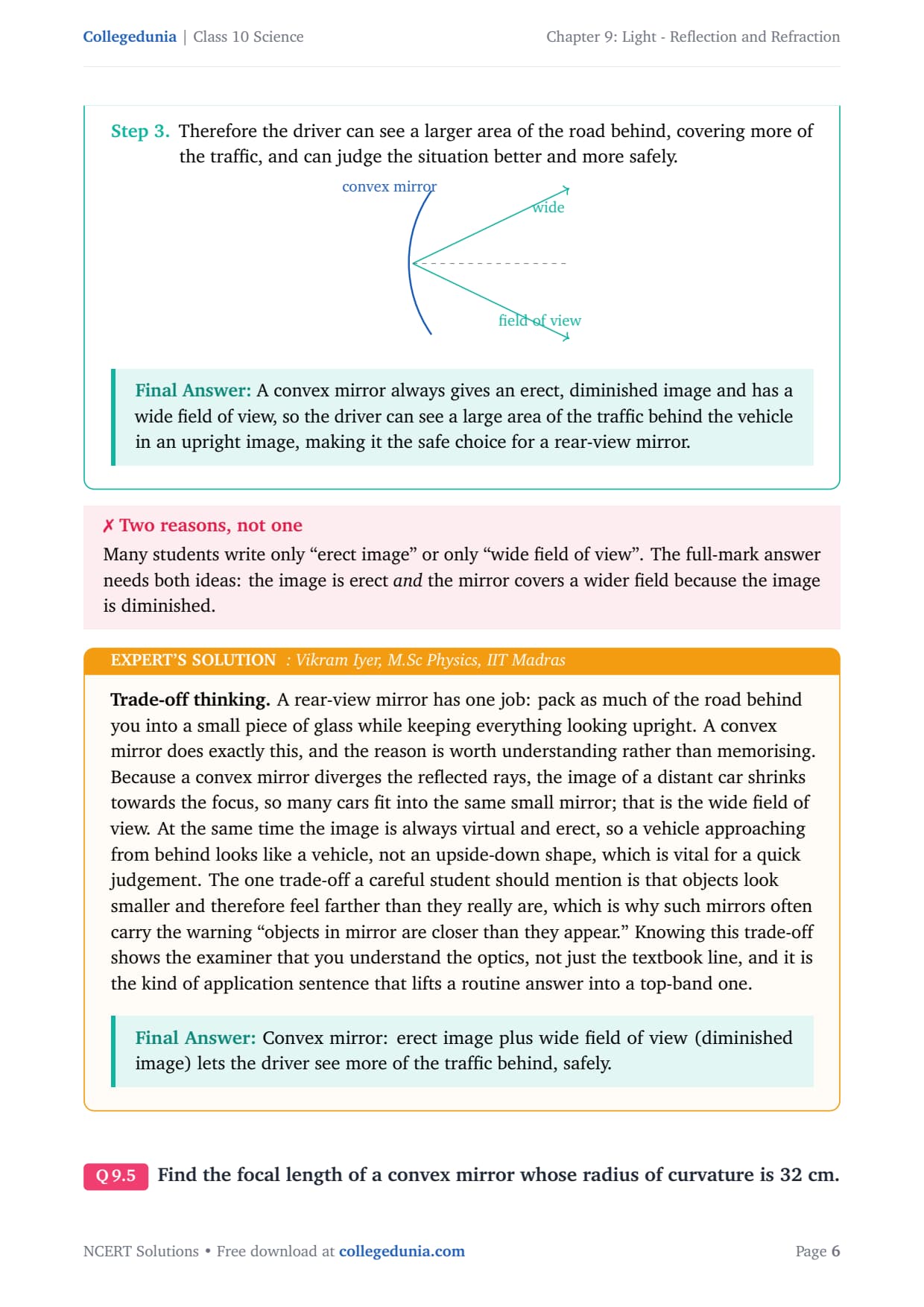
A convex mirror is a diverging mirror. It always forms a virtual, erect and diminished image whatever the object position. Because the image is small, a single mirror can show a much larger region behind the vehicle, giving a wide field of view.
A convex mirror always gives an erect (upright) image, so the driver sees vehicles the right way up.
The image is always diminished, so a lot of traffic is shrunk to fit into a small mirror, widening the field of view.
The driver can therefore see a larger area of the road behind and judge the situation more safely.
Answer: A convex mirror gives an erect, diminished image with a wide field of view, so the driver sees a large area of traffic behind in an upright image, making it the safe choice for a rear-view mirror.
VI
Vikram Iyer
M.Sc Physics, IIT Madras
Verified Expert
A rear-view mirror has one job: pack as much of the road behind you into a small piece of glass while keeping everything upright. A convex mirror does exactly this.
Because a convex mirror diverges the reflected rays, distant cars shrink towards the focus, so many fit into the same small mirror: the wide field of view.
The image is always virtual and erect, so a vehicle behind looks like a vehicle, not an upside-down shape.
The one trade-off worth mentioning is that objects look smaller and feel farther than they are, hence the warning "objects in mirror are closer than they appear."
Answer: Convex mirror: erect image plus a wide field of view (diminished image) lets the driver see more of the traffic behind, safely.
Q 5
Find the focal length of a convex mirror whose radius of curvature is 32 cm.
For any spherical mirror the focal length is half the radius of curvature, f = R/2. For a convex mirror the principal focus lies behind the mirror, so by the New Cartesian Sign Convention both R and f are positive.
Write the relation: f = R/2.
Substitute R = 32 cm (positive for a convex mirror): f = +32/2.
Do the arithmetic: f = +16 cm.
Answer: The focal length of the convex mirror is 16 cm (taken as +16 cm because the focus is behind a convex mirror).
AR
Aditya Rao
M.Sc Physics, IIT Roorkee
Verified Expert
Compute the size of the focal length from f = R/2 first, then attach the correct sign from the type of mirror.
Half of 32 cm is 16 cm; that fixes the magnitude in one division.
Because the mirror is convex, the focus is behind the surface, so the sign convention makes f positive: f = +16 cm.
If the mirror were concave, the same magnitude would carry a minus sign, f = -16 cm.
Answer: f = R/2 = +16 cm (convex mirror, focus behind).
Q 6
A concave mirror produces three times magnified (enlarged) real image of an object placed at 10 cm in front of it. Where is the image located?
Magnification links image distance v and object distance u: m = -v/u. A real image made by a concave mirror is inverted, so its magnification is negative. "Three times enlarged real" means m = -3. By the sign convention the object is in front, so u = -10 cm.
Data with signs: u = -10 cm, m = -3.
Rearrange the magnification formula: m = -v/u ⇒ v = -m×u.
Substitute: v = -(-3) × (-10).
Do the arithmetic: v = -30 cm.
The negative sign means the image is in front of the mirror, on the same side as the object, which is where a real image forms.
Answer: The image is located 30 cm in front of the mirror (v = -30 cm), real and inverted.
PS
Priya Sharma
M.Sc Physics, B.Ed
Verified Expert
The trap is hidden in one word. "Real" tells you the image is inverted, which fixes the sign of the magnification before you touch a formula.
So m = -3, u = -10 cm, and m = -v/u rearranges to v = -mu = -(-3)(-10) = -30 cm.
The final minus sign confirms the image is on the same side as the object, consistent with a real image.
Cross-check with the mirror formula 1/v + 1/u = 1/f: with v = -30 and u = -10, f = -7.5 cm, so the object lies between f and 2f, the standard region for an enlarged, inverted, real image.
Answer: v = -mu = -30 cm; the image is 30 cm in front of the mirror, real and inverted.
Q 7
A ray of light travelling in air enters obliquely into water. Does the light ray bend towards the normal or away from the normal? Why?
Refraction is the bending of light when it passes from one transparent medium to another because its speed changes. The rule: going from an optically rarer medium to an optically denser medium, light slows down and bends towards the normal; denser to rarer, it speeds up and bends away.
Air is optically rarer (light is faster) and water is optically denser (light is slower); water's refractive index (1.33) is greater than air's (1.00).
Light therefore slows down as it crosses from air into water.
Slowing down (rarer to denser) makes the ray bend towards the normal, so the angle of refraction is smaller than the angle of incidence.
Answer: The light ray bends towards the normal, because it passes from optically rarer air into optically denser water, where it slows down.
KM
Kavya Menon
M.Sc Physics, B.Ed
Verified Expert
The bending of light follows directly from the change in speed. Tie your reasoning to speed and the direction of bending becomes automatic.
Air is rarer and water is denser, so light moves faster in air and slower in water.
When the ray crosses obliquely into the slower medium, the wavefront pivots towards the normal, giving an angle of refraction smaller than the angle of incidence.
Everyday proofs: a straw looks bent in a glass of water, and a swimming pool looks shallower than it is.
Answer: Bends towards the normal (rarer air to denser water; light slows down).
Q 8
Light enters from air to glass having refractive index 1.50. What is the speed of light in the glass? The speed of light in vacuum is 3 × 10⁸ m s-1.
The refractive index of a medium tells us how much slower light travels in it compared with vacuum: n = c/v, where c is the speed in vacuum and v the speed in the medium. Rearranging gives v = c/n.
Make v the subject: n = c/v ⇒ v = c/n.
Substitute c = 3 × 10⁸ m s-1 and n = 1.50: v = (3 × 10⁸) / 1.50.
Do the arithmetic: v = 2 × 10⁸ m s-1.
Answer: The speed of light in the glass is 2 × 10⁸ m s-1.
AD
Arjun Desai
M.Sc Physics, IIT Roorkee
Verified Expert
This is a one-step application of the definition of refractive index. Because n = c/v, a larger refractive index always means a smaller speed inside the medium.
v = c/n = (3 × 10⁸) / 1.50 = 2 × 10⁸ m s-1.
Sanity check: the answer must be less than c. If a result ever exceeds c, you divided the wrong way.
Note the frequency does not change on refraction, only the speed and wavelength, so the colour stays the same.
Answer: v = c/n = 2 × 10⁸ m s-1.
Q 9
Find out, from Table 9.3, the medium having highest optical density. Also find the medium with lowest optical density.
Optical density is measured by the refractive index: the higher the refractive index, the higher the optical density (and the slower light travels). So we read the table and pick the largest and smallest refractive index. Table 9.3 lists, among others, diamond at n = 2.42 and air at n = 1.0003.
The quantity that measures optical density is the refractive index n.
The largest n is diamond, n = 2.42, so it is optically densest.
The smallest n is air, n = 1.0003, so it is optically rarest.
"Optical density" is captured entirely by the refractive index column, so the largest and smallest entries answer the question at a glance.
Diamond's high refractive index (2.42) is also why a cut diamond bends and traps light so strongly and sparkles.
Air sits at the other end (1.0003), almost the same as vacuum, so it is optically the rarest.
Note that optical density and ordinary mass density are different ideas; for example kerosene is optically denser than water in some tables even though it floats on water.
Answer: Diamond is optically densest (n = 2.42); air is optically rarest (n = 1.0003).
Q 10
You are given kerosene, turpentine and water. In which of these does the light travel fastest? Use the information given in Table 9.3.
Light travels fastest in the medium with the lowest refractive index, because v = c/n: a smaller n gives a larger speed v. From Table 9.3 the refractive indices are kerosene 1.44, turpentine 1.47 and water 1.33.
Recall: v = c/n ⇒ smaller n means larger v.
Compare: kerosene 1.44, turpentine 1.47, water 1.33.
The smallest refractive index is water (1.33), so light has its highest speed in water.
Answer: Light travels fastest in water, because it has the lowest refractive index (1.33) of the three, and a lower refractive index means a higher speed.
SR
Sanjana Rao
M.Sc Physics, B.Ed
Verified Expert
The whole question turns on one inverse relation: speed in a medium is the speed in vacuum divided by the refractive index, so the smaller the index, the faster the light.
Water 1.33 is the lowest, so light is fastest in water.
Verify if you wish: v = c/1.33 ≈ 2.26 × 10⁸ m s-1 for water, higher than ≈ 2.08 for kerosene and ≈ 2.04 for turpentine.
Comparing speeds across media is the same as comparing refractive indices in reverse order.
Answer: Water (lowest refractive index, 1.33, so highest speed).
Q 11
The refractive index of diamond is 2.42. What is the meaning of this statement?
The refractive index of a medium with respect to vacuum is the ratio of the speed of light in vacuum to the speed of light in that medium: n = c/v. A value of 2.42 is this ratio for diamond.
From the definition: ndiamond = c / vdiamond = 2.42.
In words: the speed of light in vacuum is 2.42 times the speed of light in diamond.
Equivalently, light travels 2.42 times slower in diamond, so vdiamond = c/2.42 ≈ 1.24 × 10⁸ m s-1.
Answer: It means the speed of light in vacuum is 2.42 times the speed of light in diamond, i.e. light slows down by a factor of 2.42 on entering diamond (v ≈ 1.24 × 10⁸ m s-1).
NS
Nikhil Sharma
M.Sc Physics, IIT Madras
Verified Expert
Refractive index questions ask you to translate a bare number into a statement about speed, so read n aloud as "c divided by the speed in the medium."
For diamond, n = 2.42 means c/v = 2.42, so light slows to about 1.24 × 10⁸ m s-1 inside it.
This high refractive index gives a small critical angle, so most light entering is totally internally reflected and bounces around, producing the sparkle.
Answer: n = 2.42 means c is 2.42 times the speed of light in diamond (light slows by a factor of 2.42).
Q 12
Define 1 dioptre of power of a lens.
The power of a lens measures how strongly it converges or diverges light, and is the reciprocal of its focal length in metres: P = 1/f (f in metres). Its SI unit is the dioptre (D).
Write the definition: P = 1/f, with f in metres.
Set P = 1 D: 1 = 1/f.
Solve: f = 1 m. So 1 dioptre is the power of a lens of focal length 1 metre.
Answer: 1 dioptre (1 D) is the power of a lens whose focal length is 1 metre.
DN
Divya Nair
M.Sc Physics, B.Ed
Verified Expert
To remember the unit, set the defining quantity to one and read off the result. Power is the reciprocal of focal length in metres, so one dioptre corresponds to a focal length of one metre.
Putting P = 1 D forces f = 1 m.
A convex lens has positive power and a concave lens negative power, so the sign of the dioptre value also tells you the lens type.
Remember "metres, not centimetres": a lens of focal length 50 cm = 0.5 m has power P = 1/0.5 = +2 D.
Answer: 1 D is the power of a lens of focal length 1 m (P = 1/f).
Q 13
A convex lens forms a real and inverted image of a needle at a distance of 50 cm from it. Where is the needle placed in front of the convex lens if the image is equal to the size of the object? Also, find the power of the lens.
A convex lens forms a real, inverted image of the same size as the object only when the object is at twice the focal length (2F); the image also forms at 2F on the other side. For a lens, magnification m = v/u; an equal-size, real, inverted image has m = -1.
The image is real and on the far side, so v = +50 cm. Equal-size inverted means m = v/u = -1, so u = -v = -50 cm. The needle is 50 cm in front of the lens.
Apply the lens formula: 1/v - 1/u = 1/f.
Substitute: 1/50 - 1/(-50) = 1/f.
Simplify: 1/50 + 1/50 = 2/50 = 1/25, so f = +25 cm = +0.25 m.
Power: P = 1/f = 1/0.25 = +4 D.
Answer: The needle is placed 50 cm in front of the lens (at 2F); the focal length is 25 cm and the power is P = +4 D.
RV
Rahul Verma
M.Sc Physics, IIT Roorkee
Verified Expert
"Real, inverted, equal in size" is a fingerprint. For a convex lens it can only happen when the object sits at 2F and the image forms at 2F on the other side.
Image real so v = +50 cm; equal size inverted means m = v/u = -1, giving u = -50 cm.
Lens formula: 1/50 - 1/(-50) = 2/50 = 1/25, so f = +25 cm = 0.25 m, and P = 1/0.25 = +4 D.
Check: v and |u| are both 50 cm = 2f, exactly the 2F condition predicted.
Answer: Object (needle) at 50 cm = 2F; f = +25 cm, P = +4 D.
Q 14
Find the power of a concave lens of focal length 2 m.
The power of a lens is the reciprocal of its focal length in metres, P = 1/f. A concave (diverging) lens has a negative focal length, so its power is negative.
Apply the sign convention: a concave lens is diverging, so f = -2 m.
Write the formula: P = 1/f.
Substitute: P = 1/(-2).
Do the arithmetic: P = -0.5 D.
Answer: The power of the concave lens is -0.5 D (the negative sign shows it is a diverging lens).
PI
Pooja Iyer
M.Sc Physics, B.Ed
Verified Expert
For lens power the sign is not decoration; it tells whether the lens converges or diverges light, so attach it deliberately from the start.
A concave lens diverges light, so f = -2 m, and P = 1/(-2) = -0.5 D follows immediately.
The magnitude 0.5 D shows it is a weak lens (a long focal length means a small power).
Read the answer back: a negative power must pair with a concave lens.
Answer: P = 1/f = 1/(-2) = -0.5 D (diverging lens).
Q 15
Which one of the following materials cannot be used to make a lens? (a) Water (b) Glass (c) Plastic (d) Clay
A lens works by refraction: light must pass through it and bend. So a lens can be made only from a transparent material. Any opaque material cannot form a lens.
Water is transparent and can act as a lens (a water drop magnifies).
Glass is transparent and is the usual lens material; plastic is also transparent and is used for cheap lenses and spectacles.
Clay is opaque: light cannot pass through it, so it cannot refract light and cannot make a lens.
Answer: (d) Clay, because it is opaque and light cannot pass through it, so it cannot refract light to form a lens.
AR
Ananya Reddy
M.Sc Physics, B.Ed
Verified Expert
This MCQ reduces to a single property: transparency. A lens must transmit and bend light, so the moment a material is opaque it is disqualified.
Water (raindrops magnify), glass (the classic lens material) and clear plastic (lightweight spectacle lenses) are all transparent.
Even a perfectly ground biconvex piece of clay would block the light instead of refracting it.
Answer: (d) Clay (opaque, so it cannot transmit and refract light).
Q 16
The image formed by a concave mirror is observed to be virtual, erect and larger than the object. Where should be the position of the object? (a) Between the principal focus and the centre of curvature (b) At the centre of curvature (c) Beyond the centre of curvature (d) Between the pole of the mirror and its principal focus.
A concave mirror gives a virtual, erect and magnified image in only one situation: when the object lies between the pole P and the principal focus F. In every other position the image is real and inverted.
Object beyond C, at C, or between C and F all give real, inverted images, so (a), (b) and (c) are ruled out.
Only when the object is between P and F does the mirror form a virtual, erect, enlarged image (the shaving-mirror position).
This matches option (d).
Answer: (d) Between the pole of the mirror and its principal focus.
KM
Karan Malhotra
M.Sc Physics, IIT Madras
Verified Expert
Match the words "virtual, erect, larger" to a position, because each description belongs to exactly one region of object space.
A concave mirror makes a real, inverted image for every object beyond the focus, so "virtual and erect" means the object is inside the focus, between P and F: option (d).
The image there is also enlarged, matching "larger than the object," so all three clues agree.
Answer: (d) Between the pole and the principal focus.
Q 17
Where should an object be placed in front of a convex lens to get a real image of the size of the object? (a) At the principal focus of the lens (b) At twice the focal length (c) At infinity (d) Between the optical centre of the lens and its principal focus.
A convex lens forms a real, inverted image of the same size as the object only when the object is placed at twice the focal length (2F). The image then forms at 2F on the other side.
Object at infinity gives a point image at F (c wrong); object at F gives an image at infinity (a wrong); object between optical centre and F gives a virtual, erect, enlarged image (d wrong).
Object at 2F gives a real, inverted image of the same size at 2F on the other side.
So the correct position is at twice the focal length, option (b).
Answer: (b) At twice the focal length (2F).
IG
Ishaan Gupta
M.Sc Physics, IIT Roorkee
Verified Expert
The 2F position is symmetric: put the object at 2F and the image lands at 2F on the far side, same size and inverted.
The other options each describe a different case (focus → image at infinity, infinity → point image, inside focus → magnifying glass), none of which is "real and same size."
Confirm with the lens formula at u = -2f: it gives v = +2f and m = v/u = -1.
Answer: (b) At 2F (twice the focal length).
Q 18
A spherical mirror and a thin spherical lens have each a focal length of -15 cm. The mirror and the lens are likely to be (a) both concave. (b) both convex. (c) the mirror is concave and the lens is convex. (d) the mirror is convex, but the lens is concave.
The sign of the focal length tells us the type of mirror or lens. A concave mirror has a negative focal length, and a concave lens also has a negative focal length. So f = -15 cm means concave for both.
For mirrors: a concave mirror's focus is in front, so f is negative; a convex mirror's f is positive. Here f = -15 cm, so the mirror is concave.
For lenses: a concave (diverging) lens has a negative focal length; a convex (converging) lens has a positive one. Here f = -15 cm, so the lens is concave.
Both are concave, which is option (a).
Answer: (a) Both concave (a negative focal length means a concave mirror and a concave lens).
TJ
Tanvi Joshi
M.Sc Physics, B.Ed
Verified Expert
Fix the four rules in memory: concave mirror negative, convex mirror positive, convex lens positive, concave lens negative. Read the sign, name the optic.
f = -15 cm for both, so the mirror is concave and the lens is concave: option (a).
Caution: the two "concave" optics behave differently. The concave mirror converges light while the concave lens diverges it, yet both share a negative focal length.
Answer: (a) Both concave.
Q 19
No matter how far you stand from a mirror, your image appears erect. The mirror is likely to be (a) only plane. (b) only concave. (c) only convex. (d) either plane or convex.
We need the mirror that gives an erect image for every object distance. A plane mirror always gives an erect, virtual, same-size image; a convex mirror always gives an erect, virtual, diminished image. A concave mirror gives an erect image only when the object is very close (inside the focus).
Concave mirror: for objects beyond the focus it forms a real, inverted image, so it fails the "always erect" test. Rule out (b).
Plane mirror: erect image at all distances. It works.
Convex mirror: erect image at all distances. It works too.
Since both plane and convex mirrors always give an erect image, the answer is "either plane or convex," option (d).
Answer: (d) Either plane or convex (both give an erect image for every object distance).
AK
Aarav Khanna
M.Sc Physics, IIT Madras
Verified Expert
The phrase to lock onto is "no matter how far you stand." That demands a mirror whose image stays erect for every object position.
A concave mirror fails: beyond its focus the image flips to inverted.
Both plane and convex mirrors pass, so the only complete answer is "either plane or convex," option (d).
Read quantifier words like "always" and "no matter" carefully; they often mean the correct option is a combined one.
Answer: (d) Either plane or convex.
Q 20
Which of the following lenses would you prefer to use while reading small letters found in a dictionary? (a) A convex lens of focal length 50 cm. (b) A concave lens of focal length 50 cm. (c) A convex lens of focal length 5 cm. (d) A concave lens of focal length 5 cm.
To read small letters we need a magnifying glass, which is a convex lens used with the object inside its focus. A concave lens always makes things smaller, so it is useless for reading. Among convex lenses, a shorter focal length gives a higher magnification.
Reject the concave lenses (b) and (d): a concave lens always diminishes.
The magnifying power of a simple magnifier increases as the focal length decreases (roughly m = 1 + D/f, with D ≈ 25 cm).
The convex lens of focal length 5 cm gives much more magnification than the 50 cm one, so it is the better choice, option (c).
Answer: (c) A convex lens of focal length 5 cm, because a convex lens of short focal length gives the greatest magnification for reading small print.
RS
Riya Sharma
M.Sc Physics, B.Ed
Verified Expert
This MCQ asks two things: which type of lens magnifies, and which focal length magnifies more. Settle them in that order.
Only a convex lens can act as a magnifying glass, so (b) and (d) are gone immediately.
Among convex lenses, m = 1 + D/f rises as f falls: a 5 cm lens gives m = 1 + 25/5 = 6 while a 50 cm lens gives only m = 1 + 25/50 = 1.5.
Answer: (c) Convex lens of focal length 5 cm.
Q 21
We wish to obtain an erect image of an object, using a concave mirror of focal length 15 cm. What should be the range of distance of the object from the mirror? What is the nature of the image? Is the image larger or smaller than the object? Draw a ray diagram to show the image formation in this case.
A concave mirror gives an erect image only when the object lies between the pole and the principal focus (inside the focal length). The image is then virtual, erect and enlarged, formed behind the mirror. The focal length here is 15 cm.
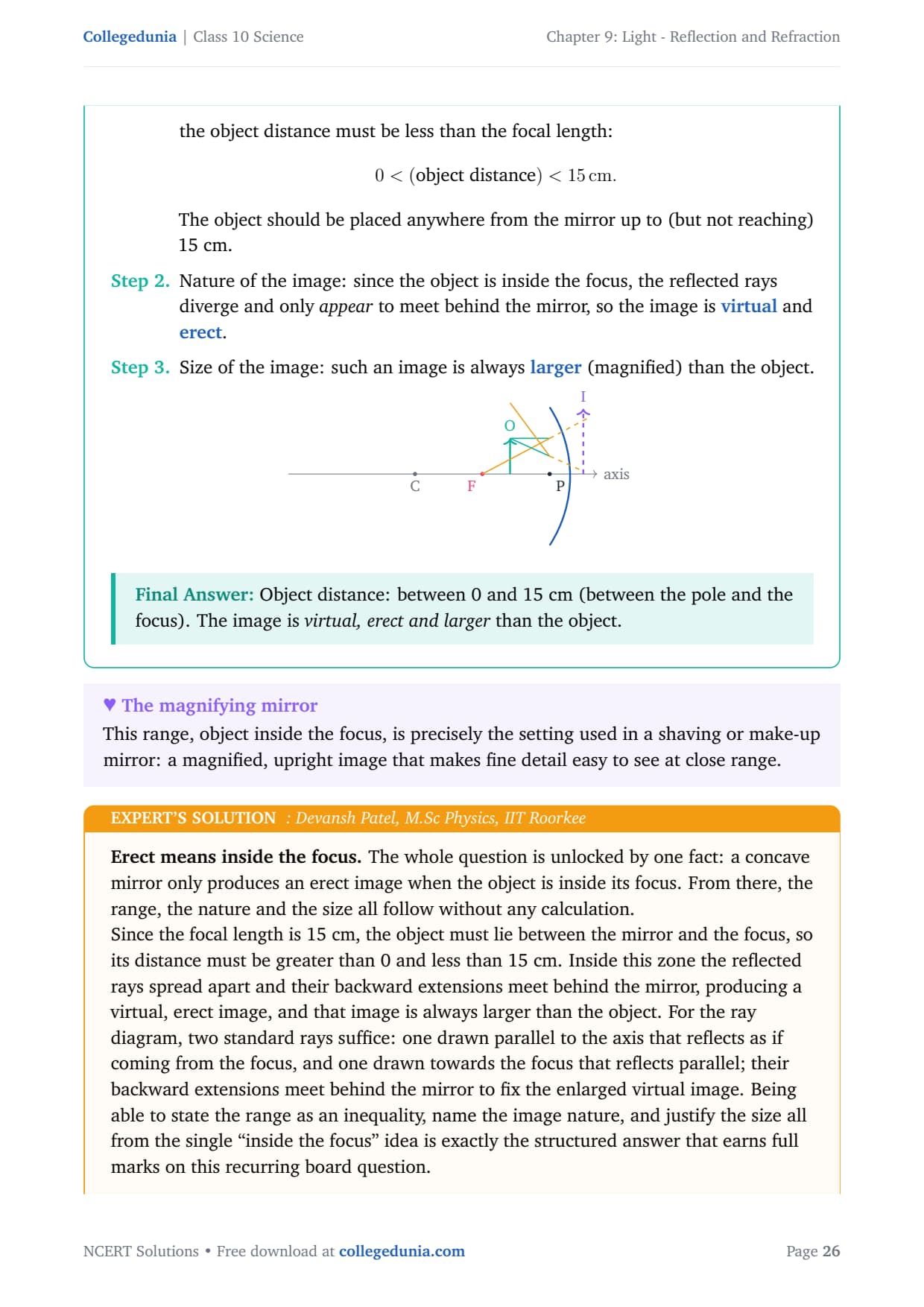
For an erect image the object must be between the pole P and the focus F, so the object distance must be less than the focal length: 0 < object distance < 15 cm.
Nature of the image: the reflected rays only appear to meet behind the mirror, so the image is virtual and erect.
Size: such an image is always larger (magnified) than the object.
For the ray diagram, draw one ray parallel to the axis (reflecting as if from F) and one ray towards F (reflecting parallel); their backward extensions meet behind the mirror to fix the enlarged virtual image.
Answer: Object distance: between 0 and 15 cm (between the pole and the focus). The image is virtual, erect and larger than the object.
DP
Devansh Patel
M.Sc Physics, IIT Roorkee
Verified Expert
The whole question is unlocked by one fact: a concave mirror only produces an erect image when the object is inside its focus.
With focal length 15 cm, the object distance must be greater than 0 and less than 15 cm.
Inside this zone the reflected rays spread apart and their backward extensions meet behind the mirror, giving a virtual, erect, enlarged image.
This is the shaving-mirror / make-up-mirror setting.
Answer: Object between 0 and 15 cm from the mirror; image virtual, erect and enlarged.
Q 22
Name the type of mirror used in the following situations. (a) Headlights of a car. (b) Side/rear-view mirror of a vehicle. (c) Solar furnace. Support your answer with reason.
The choice of mirror depends on what the situation needs: a concave mirror can make a strong parallel beam (source at its focus) or concentrate light to a hot spot, while a convex mirror gives an erect, diminished image over a wide field of view.
(a) Headlights: concave mirror. The bulb is at the focus; light reflects as a strong parallel beam that travels far.
(b) Side/rear-view mirror: convex mirror. It always gives an erect, diminished image and a wide field of view.
(c) Solar furnace: concave mirror. A large concave mirror focuses parallel sunlight to a single point, producing intense heat.
Answer: (a) Concave mirror (strong parallel beam from a source at its focus). (b) Convex mirror (erect, diminished image with a wide field of view). (c) Concave mirror (concentrates sunlight to a hot focus).
NV
Nisha Verma
M.Sc Physics, B.Ed
Verified Expert
Each use is chosen for a specific optical property, so state the property the situation needs, then name the mirror that supplies it.
A headlight needs a strong, far-reaching parallel beam → concave.
A rear-view mirror needs an upright image and the widest possible view → convex.
A solar furnace needs to concentrate sunlight into a tiny, very hot spot → concave.
Pattern: "produce or concentrate a beam" calls for concave; "view a wide area uprightly" calls for convex.
Answer: (a) Concave. (b) Convex. (c) Concave.
Q 23
One-half of a convex lens is covered with a black paper. Will this lens produce a complete image of the object? Verify your answer experimentally. Explain your observations.
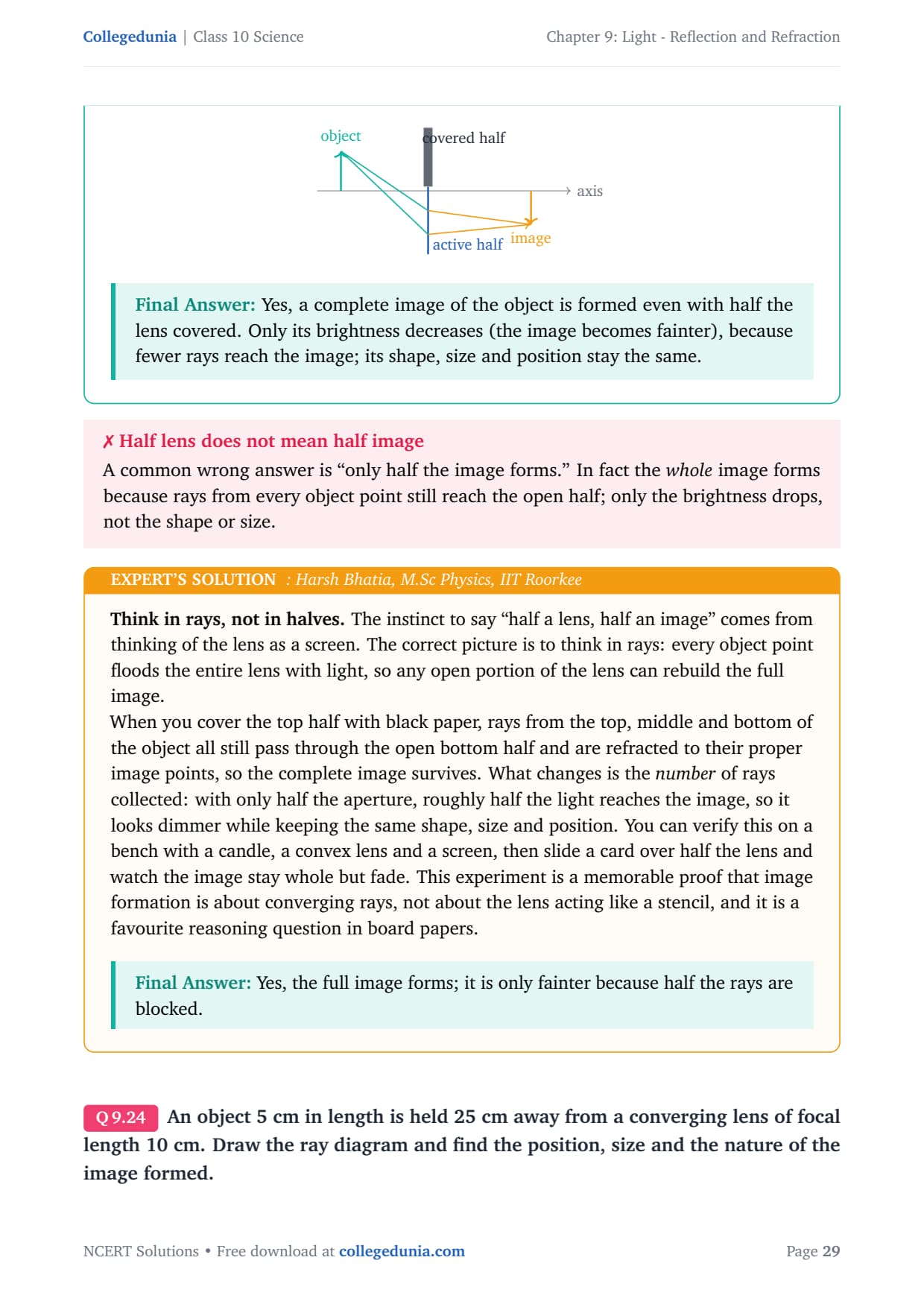
Every point of an object sends out rays in all directions, and these rays strike the whole surface of a lens. A convex lens bends all of them to meet at the image point, so each part of the lens, by itself, can still form a complete image, just with fewer rays.
Cover the upper (or lower) half with black paper; only the uncovered half now refracts.
Rays from every point of the object still reach the uncovered half and bend to the correct image point, so a complete image of the whole object is still formed.
Because only half the lens collects light, the image is less bright (fainter), but its shape, size and position are unchanged.
Verify on a bench with a candle, a convex lens and a screen, then slide a card over half the lens and watch the image stay whole but fade.
Answer: Yes, a complete image is formed even with half the lens covered. Only its brightness decreases (it becomes fainter), because fewer rays reach the image; its shape, size and position stay the same.
HB
Harsh Bhatia
M.Sc Physics, IIT Roorkee
Verified Expert
The instinct to say "half a lens, half an image" comes from thinking of the lens as a screen. Think in rays: every object point floods the entire lens with light, so any open portion can rebuild the full image.
With the top half covered, rays from the top, middle and bottom of the object all still pass through the open bottom half and refract to their proper image points.
What changes is the number of rays: with half the aperture, roughly half the light reaches the image, so it looks dimmer while keeping the same shape, size and position.
Answer: Yes, the full image forms; it is only fainter because half the rays are blocked.
Q 24
An object 5 cm in length is held 25 cm away from a converging lens of focal length 10 cm. Draw the ray diagram and find the position, size and the nature of the image formed.
A converging lens is a convex lens. Use the lens formula 1/v - 1/u = 1/f and the lens magnification m = h'/h = v/u. By the sign convention u = -25 cm; the lens is convex, so f = +10 cm; object height h = +5 cm.
Make 1/v the subject: 1/v = 1/f + 1/u.
Substitute: 1/v = 1/10 + 1/(-25).
Common denominator: 1/v = 5/50 - 2/50 = 3/50.
Invert: v = 50/3 = +16.7 cm. Positive, so the image is on the far side: real.
Magnification: m = v/u = 16.7/(-25) = -0.67.
Image height: h' = m×h = (-0.67) × 5 = -3.3 cm. Negative means inverted; size 3.3 cm (smaller).
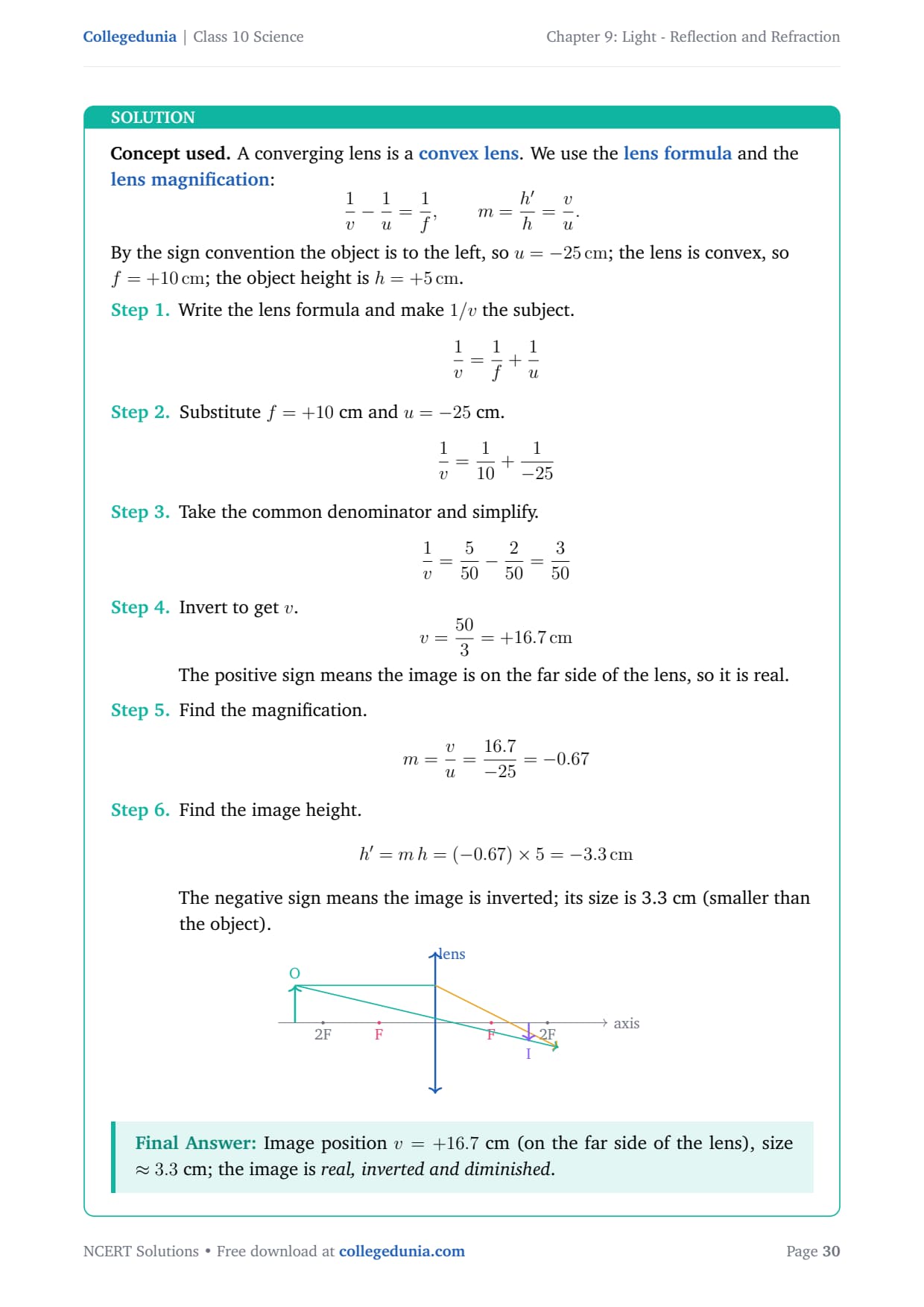
For the ray diagram, draw one ray parallel to the axis (refracting through F) and one ray through the optical centre (going straight); they meet to fix the small inverted image between F and 2F.
Answer: Image position v = +16.7 cm (on the far side of the lens), size ≈ 3.3 cm; the image is real, inverted and diminished.
AS
Aman Saxena
M.Sc Physics, IIT Madras
Verified Expert
Predict the answer from the object position first: 25 cm is beyond 2F (which is 20 cm here), and that region always gives a real, inverted, diminished image between F and 2F.
1/v = 1/10 - 1/25 = 5/50 - 2/50 = 3/50, so v = +16.7 cm (real).
m = v/u = 16.7/(-25) = -0.67, so h' = mh = -0.67 × 5 = -3.3 cm (inverted, diminished).
Both the sign and the size agree with the prediction.
Answer: v = +16.7 cm, h' = -3.3 cm; real, inverted, diminished image.
Q 25
A concave lens of focal length 15 cm forms an image 10 cm from the lens. How far is the object placed from the lens? Draw the ray diagram.
A concave lens is diverging and always forms a virtual, erect, diminished image on the same side as the object. So both the focal length and the image distance are negative: f = -15 cm and v = -10 cm. Use the lens formula to find u.
Make 1/u the subject: 1/v - 1/u = 1/f ⇒ 1/u = 1/v - 1/f.
Substitute: 1/u = 1/(-10) - 1/(-15).
Common denominator: 1/u = -3/30 + 2/30 = -1/30.
Invert: u = -30 cm. The negative sign means the object is 30 cm in front of the lens.
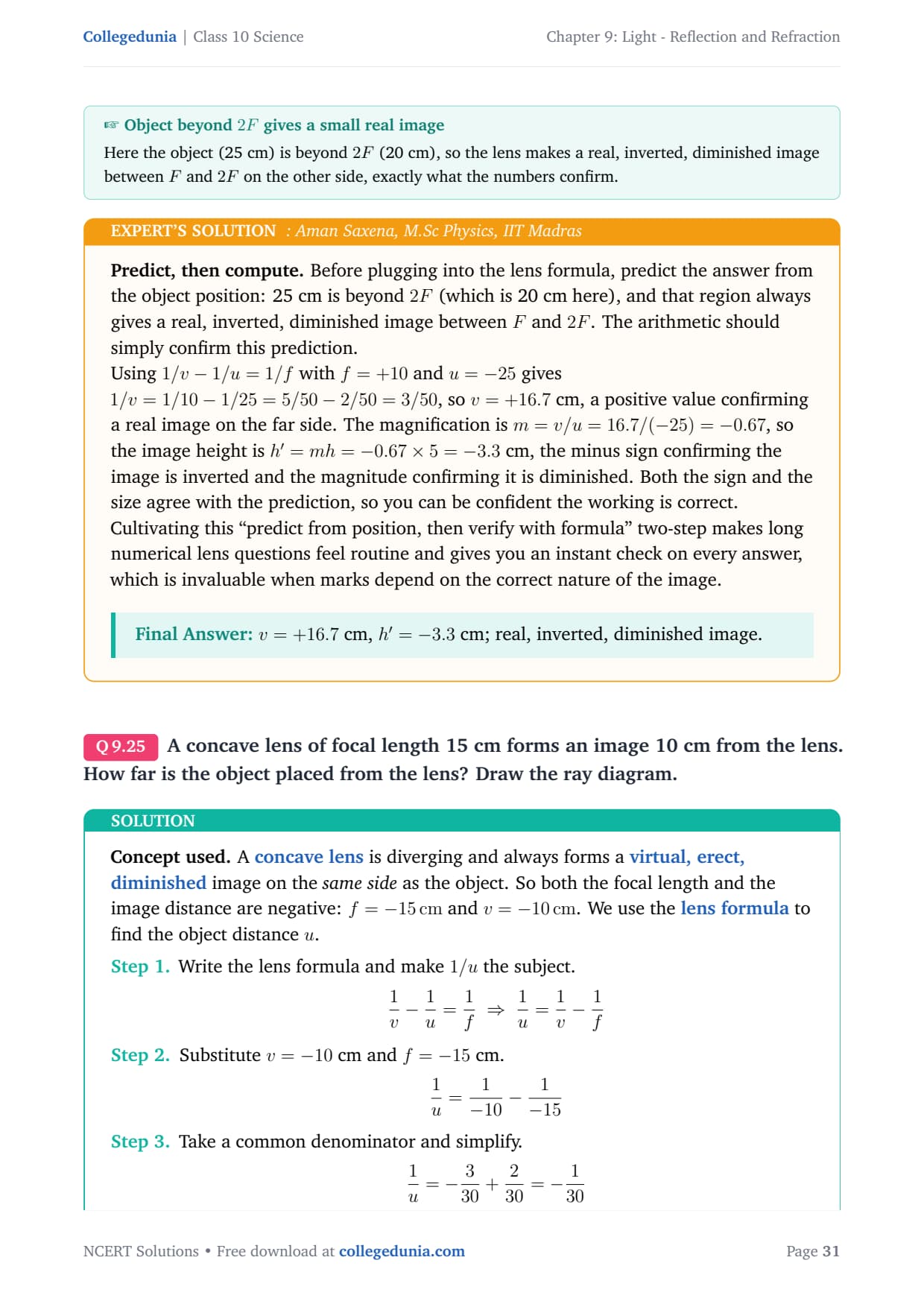
For the ray diagram, draw one ray parallel to the axis (diverging as if from the focus on the object side) and one ray through the optical centre; their backward extensions meet to give the small upright virtual image.
Answer: The object is placed 30 cm in front of the lens (u = -30 cm).
SN
Shreya Nair
M.Sc Physics, B.Ed
Verified Expert
Write the sign of each quantity before any algebra, because a diverging lens forces both f and v negative for a real object.
f = -15 cm and v = -10 cm, so 1/u = 1/(-10) - 1/(-15) = -3/30 + 2/30 = -1/30, giving u = -30 cm.
The image at 10 cm lies between the object and the lens, exactly the virtual, erect, diminished image a concave lens always produces.
Answer: u = -30 cm; the object is 30 cm in front of the concave lens.
Q 26
An object is placed at a distance of 10 cm from a convex mirror of focal length 15 cm. Find the position and nature of the image.
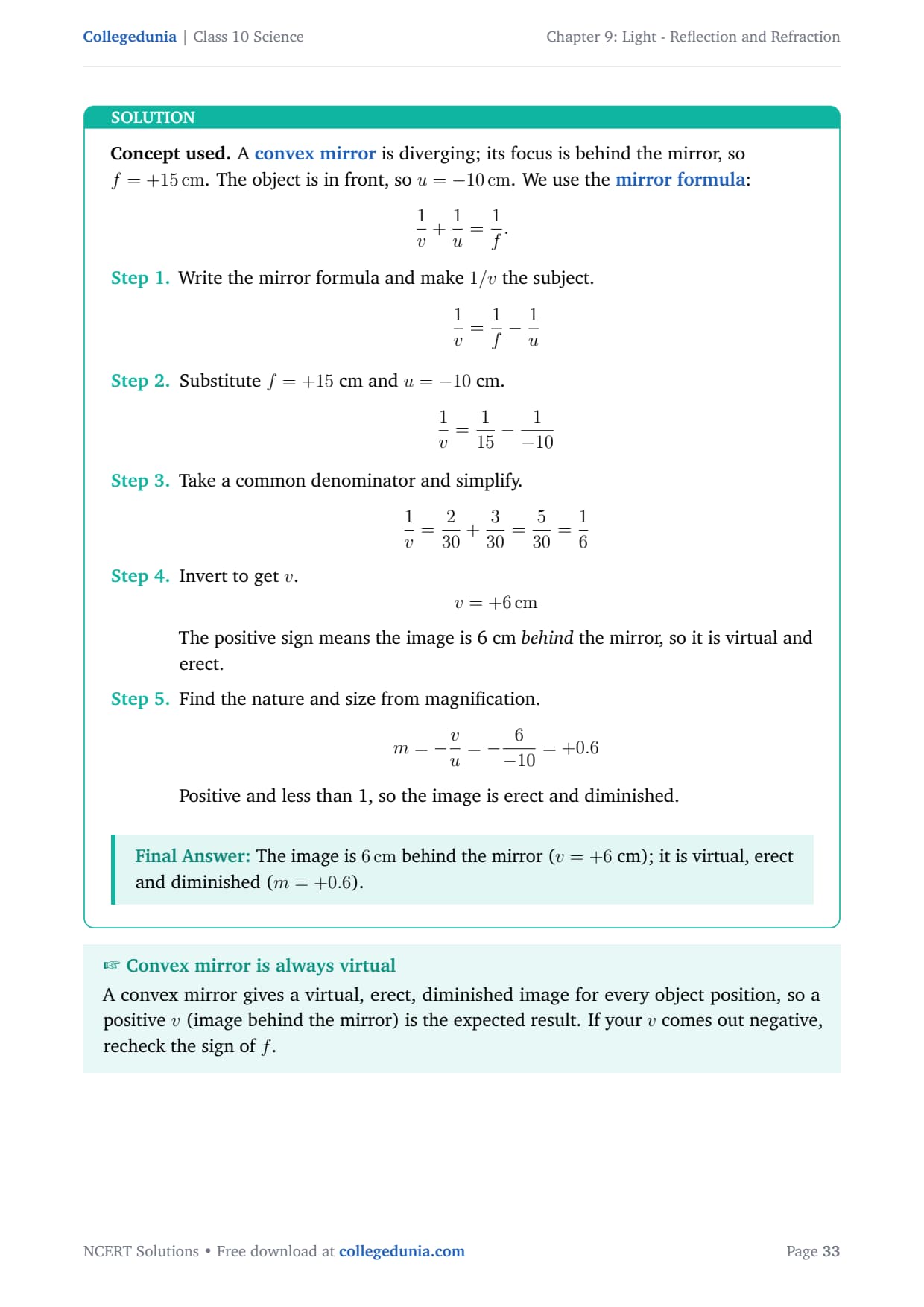
A convex mirror is diverging; its focus is behind the mirror, so f = +15 cm. The object is in front, so u = -10 cm. Use the mirror formula 1/v + 1/u = 1/f.
Invert: v = +6 cm. Positive, so the image is 6 cm behind the mirror: virtual and erect.
Magnification: m = -v/u = -6/(-10) = +0.6. Positive and less than 1, so erect and diminished.
Answer: The image is 6 cm behind the mirror (v = +6 cm); it is virtual, erect and diminished (m = +0.6).
VK
Varun Khanna
M.Sc Physics, IIT Roorkee
Verified Expert
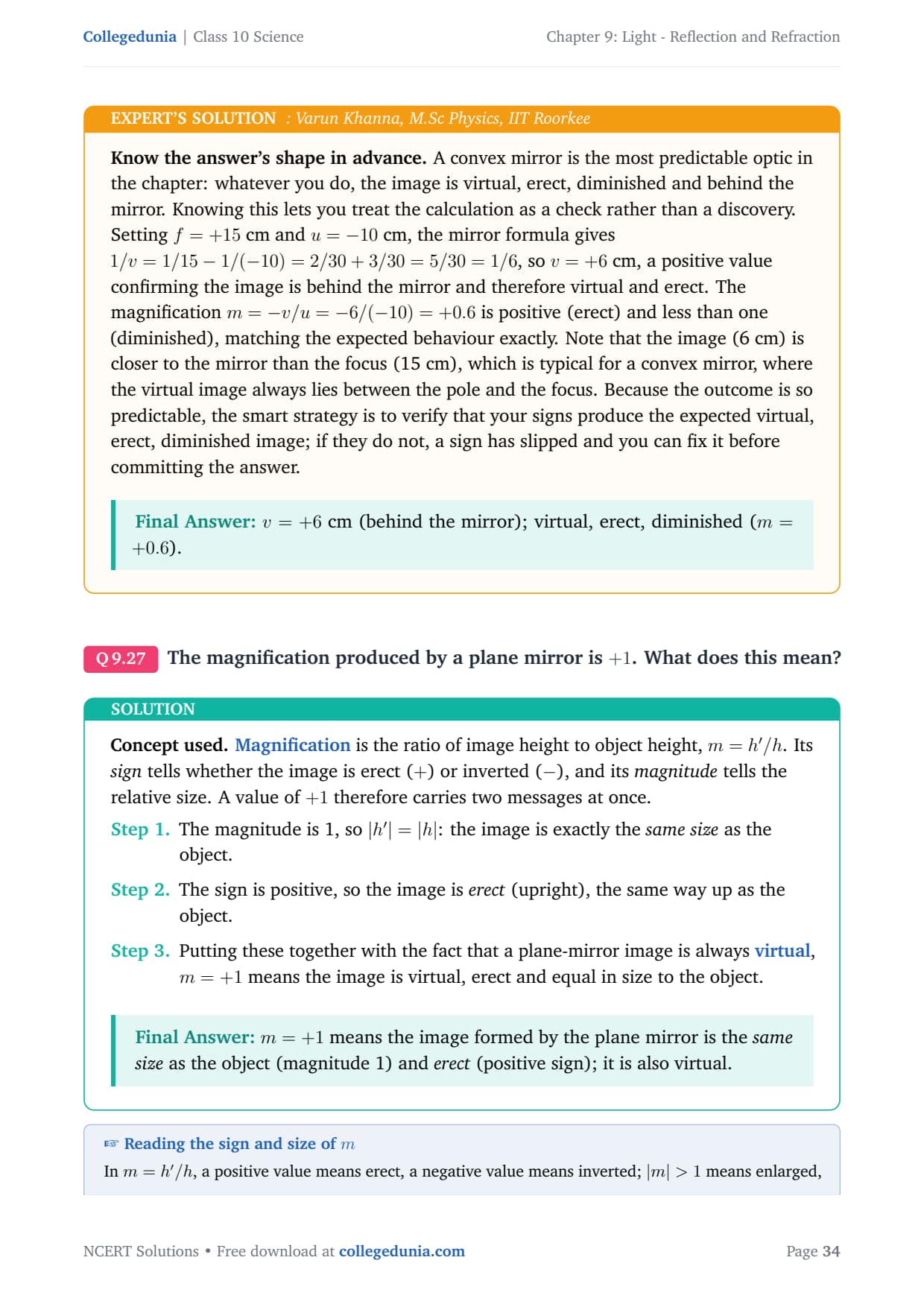
A convex mirror is the most predictable optic: whatever you do, the image is virtual, erect, diminished and behind the mirror. Treat the calculation as a check.
1/v = 1/15 - 1/(-10) = 2/30 + 3/30 = 5/30 = 1/6, so v = +6 cm (behind, virtual, erect).
m = -v/u = -6/(-10) = +0.6 (erect and diminished).
The image (6 cm) lies between the pole and the focus (15 cm), typical for a convex mirror.
Answer: v = +6 cm (behind the mirror); virtual, erect, diminished (m = +0.6).
Q 27
The magnification produced by a plane mirror is +1. What does this mean?
Magnification is the ratio of image height to object height, m = h'/h. Its sign tells whether the image is erect (+) or inverted (-), and its magnitude tells the relative size. A value of +1 carries two messages at once.
Magnitude 1, so |h'| = |h|: the image is exactly the same size as the object.
Sign positive, so the image is erect (upright), the same way up as the object.
A plane-mirror image is always virtual, so m = +1 means virtual, erect and equal in size.
Answer: m = +1 means the image formed by the plane mirror is the same size as the object (magnitude 1) and erect (positive sign); it is also virtual.
LM
Lakshya Mehra
M.Sc Physics, B.Ed
Verified Expert
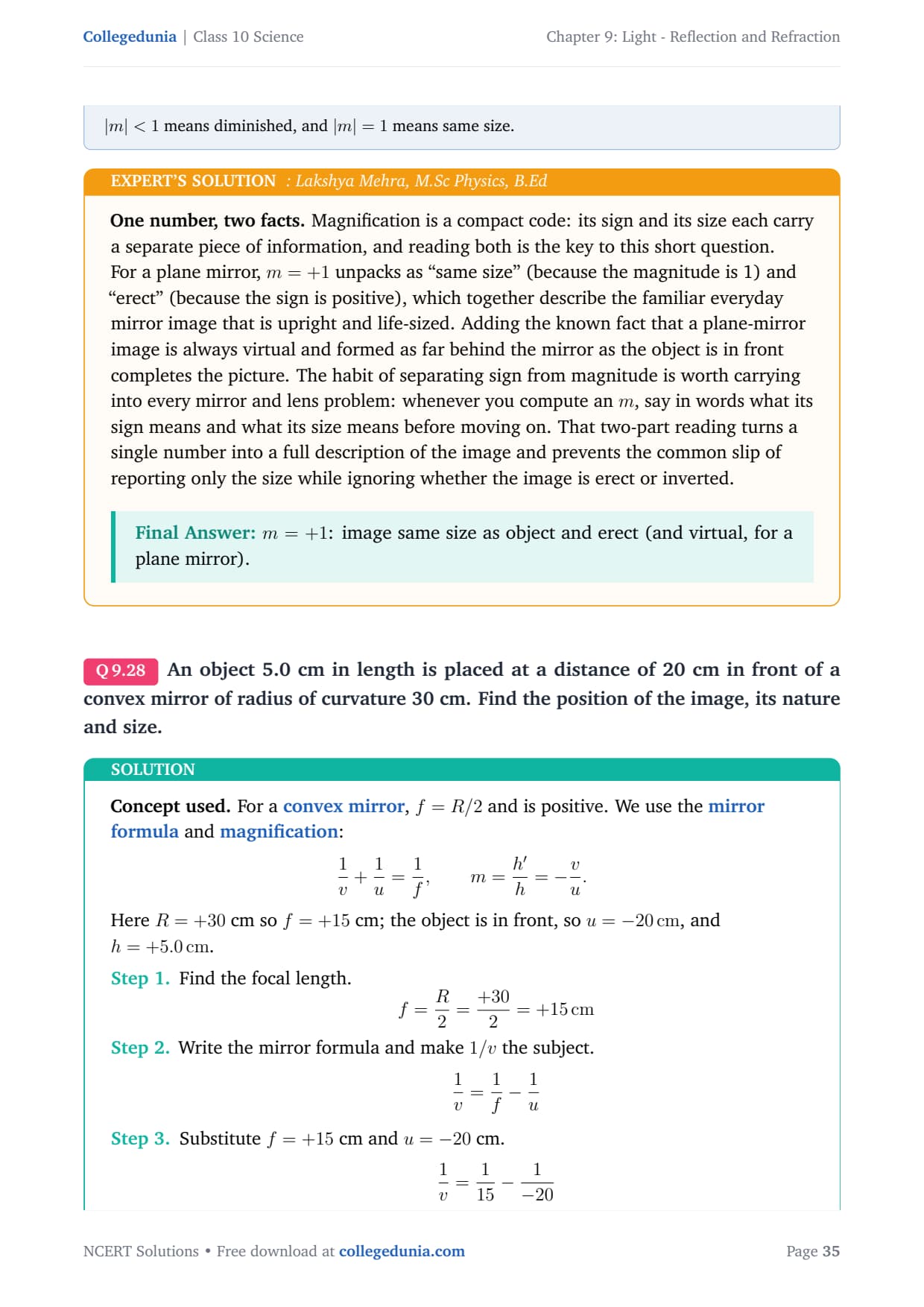
Magnification is a compact code: its sign and its size each carry a separate piece of information, and reading both is the key.
m = +1 unpacks as "same size" (magnitude 1) and "erect" (positive sign), the familiar everyday mirror image.
Add the known fact that a plane-mirror image is always virtual and as far behind the mirror as the object is in front.
Answer: m = +1: image same size as object and erect (and virtual, for a plane mirror).
Q 28
An object 5.0 cm in length is placed at a distance of 20 cm in front of a convex mirror of radius of curvature 30 cm. Find the position of the image, its nature and size.
For a convex mirror, f = R/2 and is positive. Use the mirror formula 1/v + 1/u = 1/f and magnification m = -v/u. Here R = +30 cm so f = +15 cm; u = -20 cm; h = +5.0 cm.
Focal length: f = R/2 = +30/2 = +15 cm.
Make 1/v the subject: 1/v = 1/f - 1/u.
Substitute: 1/v = 1/15 - 1/(-20).
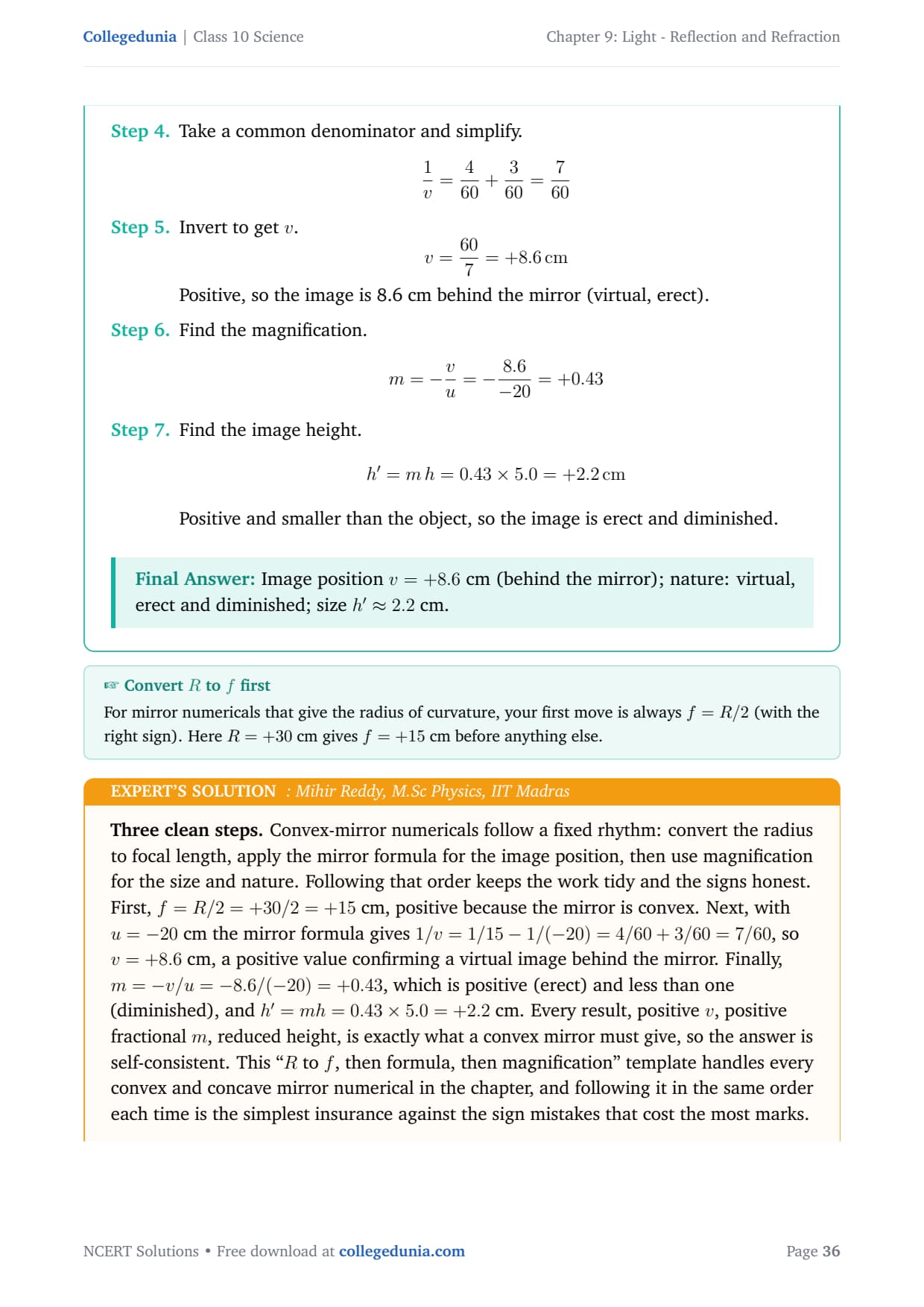
Common denominator: 1/v = 4/60 + 3/60 = 7/60.
Invert: v = 60/7 = +8.6 cm. Positive, so 8.6 cm behind the mirror (virtual, erect).
Answer: Image position v = +8.6 cm (behind the mirror); nature: virtual, erect and diminished; size h' ≈ 2.2 cm.
MR
Mihir Reddy
M.Sc Physics, IIT Madras
Verified Expert
Convex-mirror numericals follow a fixed rhythm: convert the radius to focal length, apply the mirror formula, then use magnification for size and nature.
f = R/2 = +30/2 = +15 cm.
1/v = 1/15 - 1/(-20) = 4/60 + 3/60 = 7/60, so v = +8.6 cm (virtual, behind).
m = -v/u = -8.6/(-20) = +0.43, so h' = 0.43 × 5.0 = +2.2 cm (erect, diminished).
Answer: v = +8.6 cm behind the mirror; virtual, erect, diminished; h' ≈ 2.2 cm.
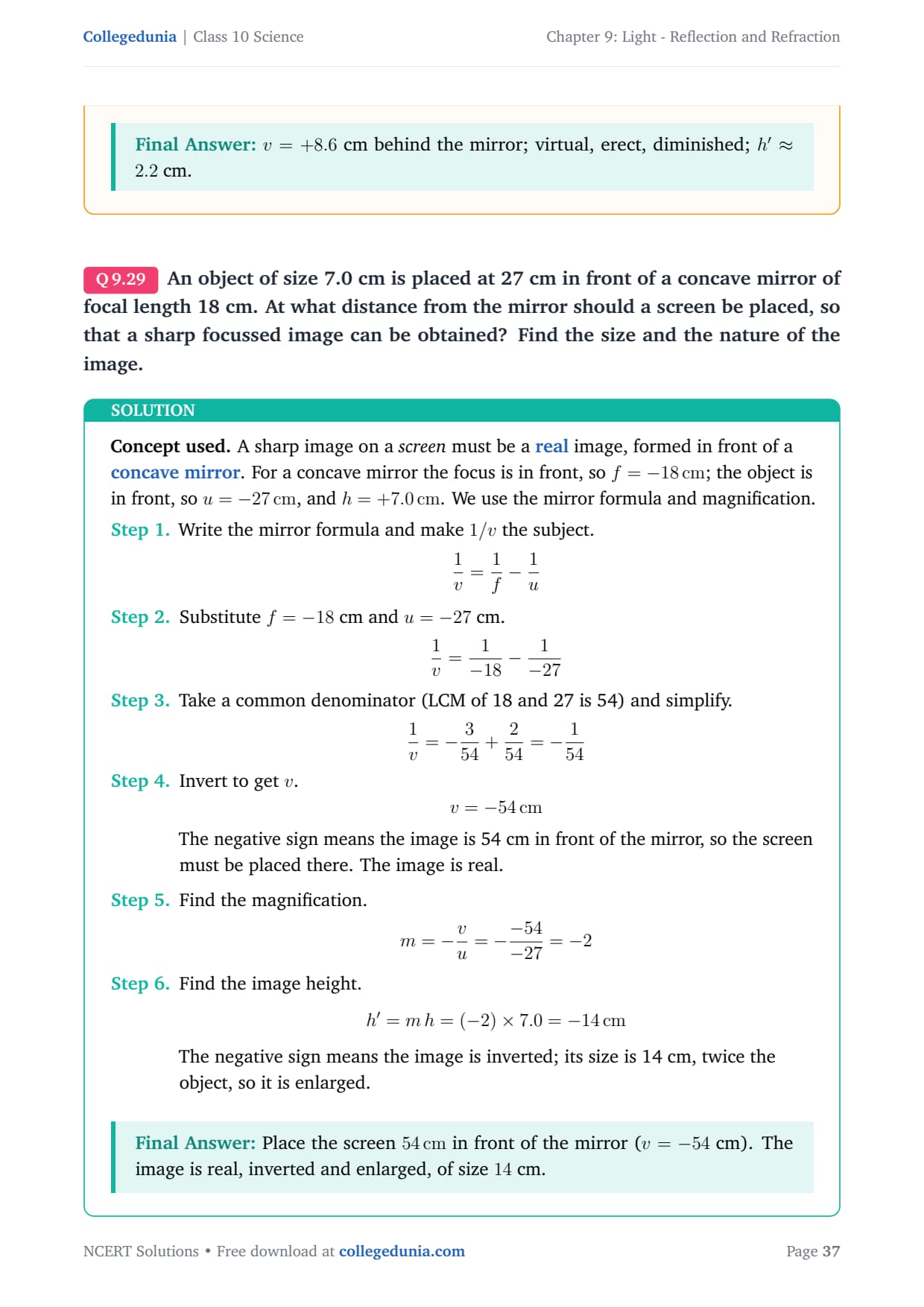
Q 29
An object of size 7.0 cm is placed at 27 cm in front of a concave mirror of focal length 18 cm. At what distance from the mirror should a screen be placed, so that a sharp focussed image can be obtained? Find the size and the nature of the image.
A sharp image on a screen must be a real image, formed in front of a concave mirror. For a concave mirror f = -18 cm; u = -27 cm; h = +7.0 cm. Use the mirror formula and magnification.
Invert: v = -54 cm. The negative sign means the image is 54 cm in front of the mirror, so the screen goes there. The image is real.
Magnification: m = -v/u = -(-54)/(-27) = -2.
Image height: h' = m×h = (-2) × 7.0 = -14 cm. Inverted; size 14 cm (twice the object, so enlarged).
Answer: Place the screen 54 cm in front of the mirror (v = -54 cm). The image is real, inverted and enlarged, of size 14 cm.
SV
Sahil Verma
M.Sc Physics, IIT Roorkee
Verified Expert
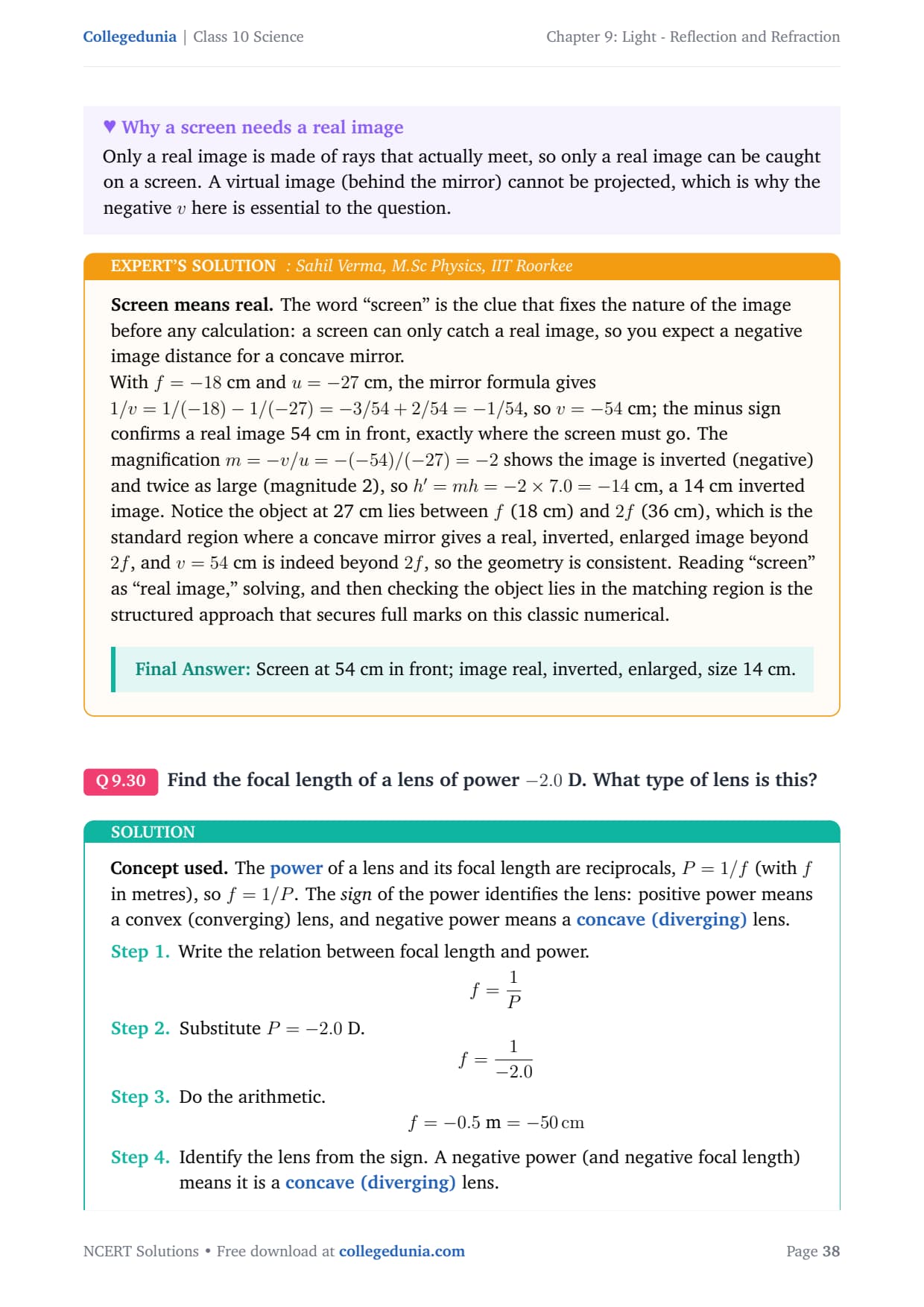
The word "screen" fixes the nature before any calculation: a screen can only catch a real image, so you expect a negative image distance for a concave mirror.
1/v = 1/(-18) - 1/(-27) = -3/54 + 2/54 = -1/54, so v = -54 cm (real, in front).
m = -v/u = -(-54)/(-27) = -2, so h' = -2 × 7.0 = -14 cm (inverted, enlarged).
Check: the object at 27 cm lies between f (18 cm) and 2f (36 cm), the region that gives a real, inverted, enlarged image beyond 2f, and v = 54 cm is indeed beyond 2f.
Answer: Screen at 54 cm in front; image real, inverted, enlarged, size 14 cm.
Q 30
Find the focal length of a lens of power -2.0 D. What type of lens is this?
The power of a lens and its focal length are reciprocals, P = 1/f (f in metres), so f = 1/P. The sign of the power identifies the lens: positive means a convex (converging) lens, negative means a concave (diverging) lens.
Write the relation: f = 1/P.
Substitute P = -2.0 D: f = 1/(-2.0).
Do the arithmetic: f = -0.5 m = -50 cm.
A negative power (and negative focal length) means a concave (diverging) lens.
Answer: The focal length is -0.5 m (-50 cm), and the lens is a concave (diverging) lens (shown by the negative power).
NK
Naina Kapoor
M.Sc Physics, B.Ed
Verified Expert
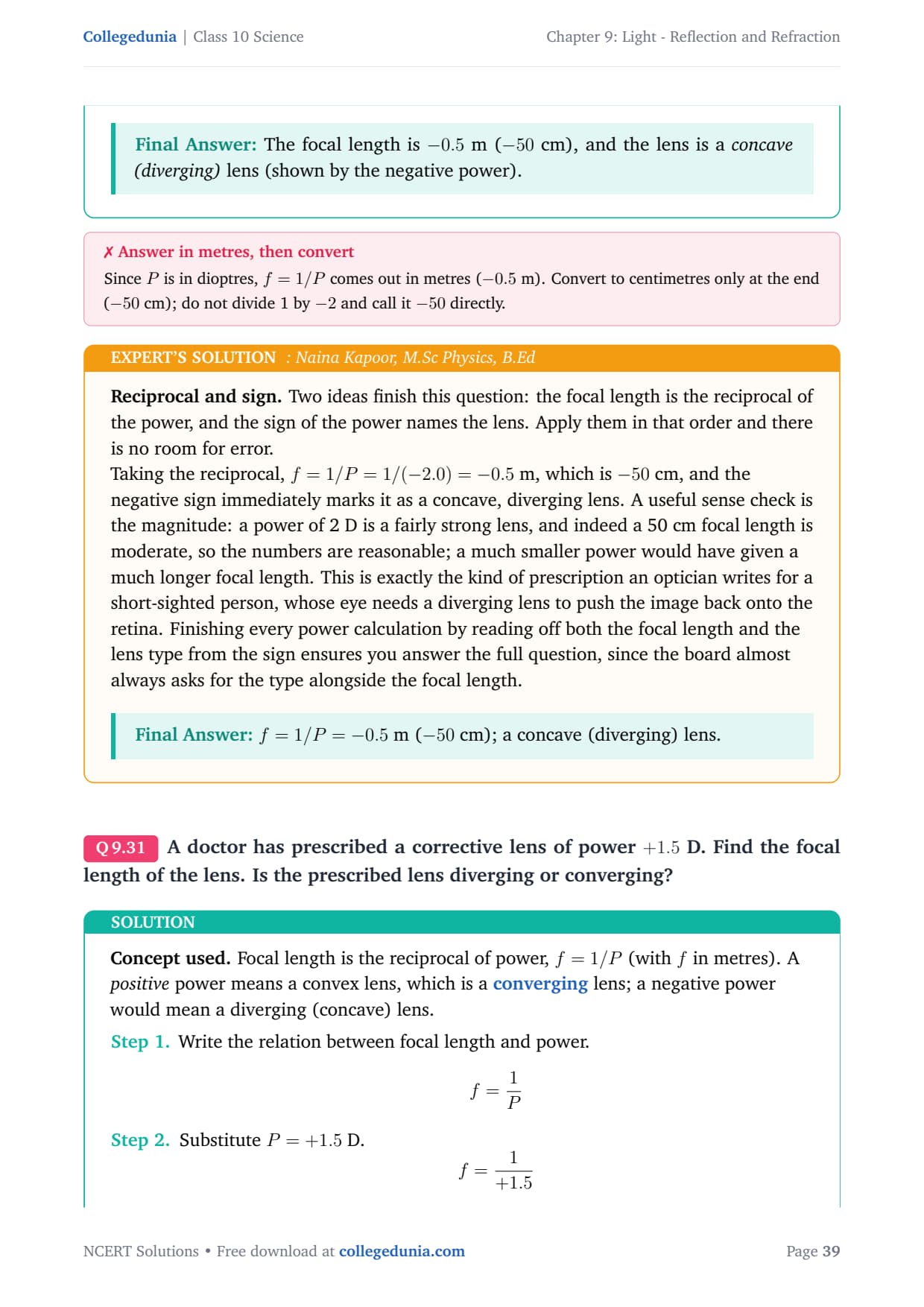
Two ideas finish this: the focal length is the reciprocal of the power, and the sign of the power names the lens.
f = 1/P = 1/(-2.0) = -0.5 m = -50 cm, and the negative sign marks it as a concave, diverging lens.
Sense check: a power of 2 D is fairly strong, and a 50 cm focal length is moderate, so the numbers are reasonable.
This is the kind of prescription an optician writes for a short-sighted person.
Answer: f = 1/P = -0.5 m (-50 cm); a concave (diverging) lens.
Q 31
A doctor has prescribed a corrective lens of power +1.5 D. Find the focal length of the lens. Is the prescribed lens diverging or converging?
Focal length is the reciprocal of power, f = 1/P (f in metres). A positive power means a convex lens, which is a converging lens; a negative power would mean a diverging (concave) lens.
Write the relation: f = 1/P.
Substitute P = +1.5 D: f = 1/(+1.5).
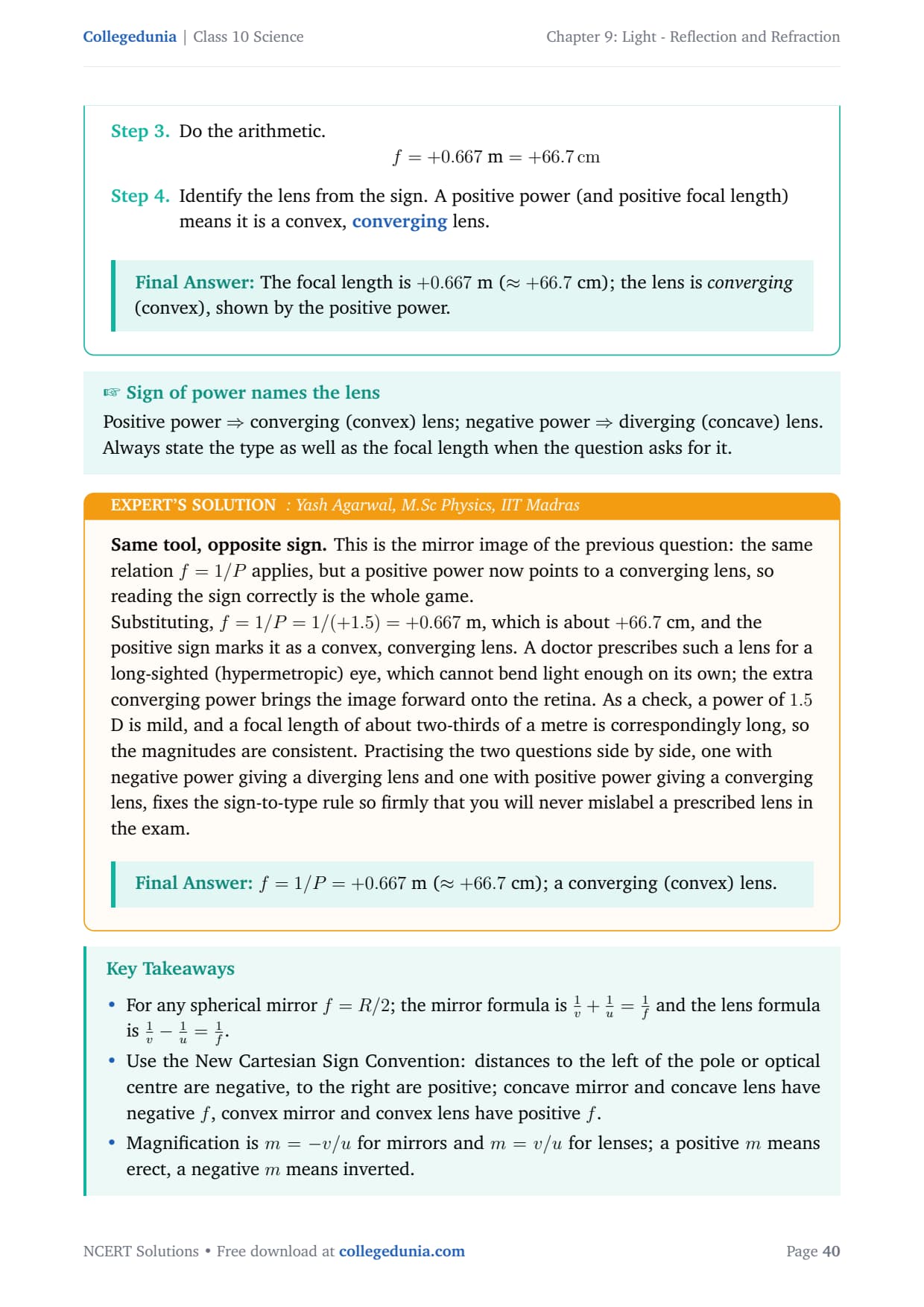
Do the arithmetic: f = +0.667 m = +66.7 cm.
A positive power (and positive focal length) means a convex, converging lens.
Answer: The focal length is +0.667 m (≈ +66.7 cm); the lens is converging (convex), shown by the positive power.
YA
Yash Agarwal
M.Sc Physics, IIT Madras
Verified Expert
The same relation f = 1/P applies, but a positive power now points to a converging lens, so reading the sign correctly is the whole game.
f = 1/P = 1/(+1.5) = +0.667 m ≈ +66.7 cm, marking it as a convex, converging lens.
A doctor prescribes such a lens for a long-sighted (hypermetropic) eye, which cannot bend light enough on its own.
Check: a power of 1.5 D is mild, and a focal length of about two-thirds of a metre is correspondingly long.
Answer: f = 1/P = +0.667 m (≈ +66.7 cm); a converging (convex) lens.
NCERT Solutions Class 10 Science Chapter 9 Light - Reflection and Refraction FAQs
Ques. How many questions are there in NCERT Class 10 Science Chapter 9 Light - Reflection and Refraction?
Ans. There are 31 questions in NCERT Class 10 Science Chapter 9 Light - Reflection and Refraction: 14 in-text questions in the boxes inside the chapter and 17 end-of-chapter exercise questions. All 31 are solved with a step-by-step Check Solution and an Expert Solution. The exercise set includes six MCQs and numerical questions on the mirror formula, the lens formula, magnification and the power of a lens, along with ray-diagram and reason-based questions on reflection and refraction.
Ques. What is the difference between the mirror formula and the lens formula?
Ans. The mirror formula is 1/v + 1/u = 1/f, with a plus sign, while the lens formula is 1/v - 1/u = 1/f, with a minus sign. In both, v is the image distance, u the object distance and f the focal length, all measured from the pole of the mirror or the optical centre of the lens using the New Cartesian Sign Convention. The only difference to remember is the sign joining the two terms on the left, so be careful not to swap the formulas in a numerical.
Ques. Why does light bend towards the normal when it enters water from air?
Ans. Air is optically rarer and water is optically denser, which means light travels faster in air and slower in water. When a ray of light crosses obliquely from air into water it slows down, and a ray that slows down on entering a denser medium bends towards the normal, so the angle of refraction is smaller than the angle of incidence. The correct board answer always names the speed change as the reason, not just the fact that water is denser.
Ques. What does a refractive index of 1.5 mean for glass?
Ans. The refractive index is n = c/v, the speed of light in vacuum divided by its speed in the medium. A refractive index of 1.5 for glass means the speed of light in vacuum is 1.5 times its speed in glass, so light slows down by a factor of 1.5 on entering the glass. Using v = c/n with c = 3 × 10 to the power 8 metres per second gives a speed of 2 × 10 to the power 8 metres per second in the glass. A larger refractive index means a slower speed and a denser medium.
Ques. What is the power of a lens and what is its unit?
Ans. The power of a lens measures how strongly it converges or diverges light, and it is the reciprocal of the focal length in metres, P = 1/f. Its SI unit is the dioptre, written D, and one dioptre is the power of a lens of focal length one metre. A convex (converging) lens has a positive power and a concave (diverging) lens has a negative power, so the sign of the power tells you the type of lens. Remember that the focal length must be in metres before you take the reciprocal.
Ques. Why is the magnification of a real image negative?
Ans. Magnification is m = h'/h, and its sign shows whether the image is erect or inverted: a positive sign means erect and a negative sign means inverted. A real image formed by a concave mirror or a convex lens is always inverted, so its magnification is negative. This is why "three times magnified real image" must be written as m = -3, not m = +3. Using a positive magnification for a real image is the most common sign mistake in this chapter and it wrongly turns the image into a virtual one.
Ques. How many pages is the Class 10 Science Light - Reflection and Refraction NCERT Solutions PDF?
Ans. The Light - Reflection and Refraction NCERT Solutions PDF covers all 31 questions (14 in-text and 17 exercise) with step-by-step Check Solutions, labelled ray diagrams of mirrors and lenses, full sign-convention working, and an Expert Solution for each question. It is free to download for the 2026-27 session and is built for the CBSE Class 10 board exam.
Ques. Is the NCERT Solutions for Class 10 Science Chapter 9 aligned with the 2026-27 syllabus?
Ans. Yes. This page reflects the current 2026-27 CBSE syllabus for Class 10 Science. Every answer follows the NCERT textbook flow for Light - Reflection and Refraction, covering reflection and spherical mirrors, the mirror formula and magnification, refraction and refractive index, spherical lenses and the lens formula, and the power of a lens. The solutions are written in plain English for board exam students and are useful for both the CBSE board exam and school unit tests.








Comments