Chemistry Mentor, Daulat Ram College | Updated 3+ months ago
The NCERT Solutions for Class 10 Science Chapter 8 Heredity cover all 10 questions (6 in-text and 4 exercise), written for the 2026-27 CBSE syllabus.
They span variation, Mendel's pea-plant experiments, dominant and recessive traits, monohybrid and dihybrid crosses, and how the X and Y chromosomes fix a child's sex.
All 10 NCERT questions solved with clear steps, Punnett squares, and an Expert Solution per question.
Full coverage of dominant and recessive traits, the 3 : 1 and 9 : 3 : 3 : 1 ratios, blood-group inheritance, and XX/XY sex determination.
Aligned with the 2026-27 CBSE Class 10 Science syllabus, in plain English for board students.
Solved by Collegedunia Science Experts
These NCERT Solutions for Class 10 Science Chapter 8 Heredity are checked against the latest 2026-27 NCERT textbook and refined against the last five years of CBSE board papers. Each of the 10 questions gives a Check Solution for the clean board answer and an Expert Solution for extra marks.
What the NCERT Solutions for Class 10 Science Chapter 8 Heredity Cover
This chapter answers one question: how do features pass from parents to children? These solutions follow the NCERT order and fill the gaps students hit:
Variation helps a species survive a changing environment.
Mendel's rules: traits are dominant (one copy) or recessive (two copies).
Crosses: the 3 : 1 and 9 : 3 : 3 : 1 ratios.
Genes and sex: XX girls, XY boys, and the father's sperm decides the sex.
Question Breakdown of the Heredity Chapter NCERT Solutions
Chapter 8 carries 6 in-text questions and 4 exercise questions. The table below maps each topic to its mark weight.
Topic
What it tests
Typical marks
Variation
Older trait in an asexual population; survival value
2 to 3 marks
Dominant vs recessive
How F1 and F2 reveal the dominant trait
3 marks
Independent inheritance
Dihybrid cross and new F2 combinations
3 to 5 marks
Blood-group / eye-colour reasoning
Whether one child proves dominance
3 marks
Sex determination
XX/XY and who decides the baby's sex
2 to 3 marks
Exercise MCQ
Reading parent genotype from progeny ratios
1 mark
The cross and reasoning questions carry the heaviest marks. Write the cross as P, F1 and F2 with a clear Punnett square and the right ratio for full marks.
Variation and Why It Helps a Species, Not the Individual
No two offspring are exactly alike. These small differences, called variations, come from tiny errors when DNA is copied. The chapter asks two things about them:
Older trait in an asexual population: a trait spreads only by copying, so the one in more individuals (60% vs 10%) is usually older.
Survival value: in a varied population some members suit new conditions. Heat-tolerant bacteria survive a heat wave; identical ones die.
Species, not individual: variation is long-term insurance for the species over many generations, not one organism in one lifetime.
Mendel's Experiments: How Traits Become Dominant or Recessive
Mendel crossed pure-breeding pea plants and counted the offspring; the numbers prove dominance. Every plant carries two copies of each gene, one from each parent.
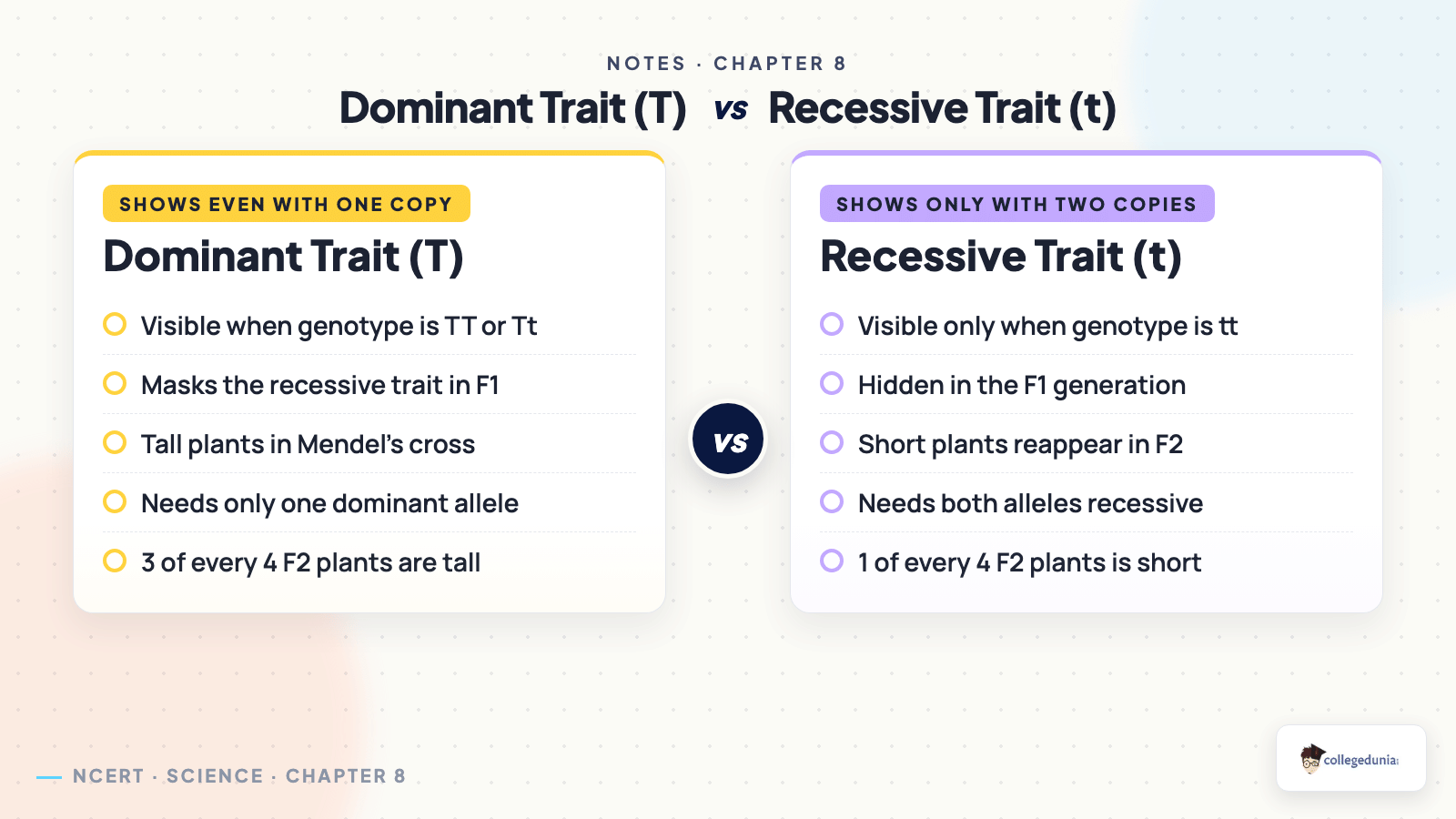
Dominant trait (T): shows with one copy. Tall plants (Tt) look tall despite a shortness copy.
Recessive trait (t): shows only with two copies (tt). Hidden in F1, returns in F2.
Genotype vs phenotype: genotype is the gene make-up (TT, Tt, tt); phenotype is the visible feature. Mixing these up is the most common slip.
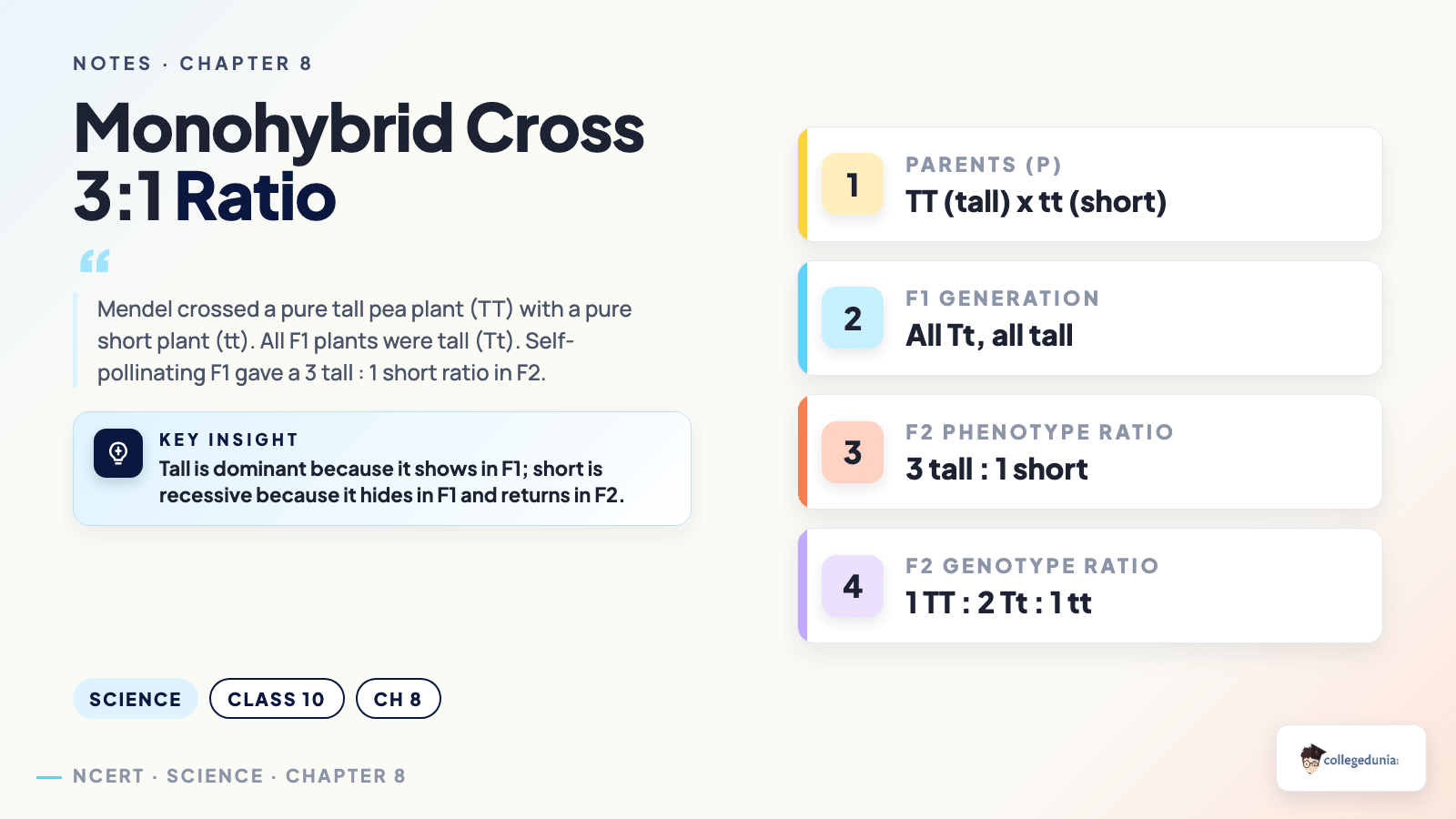
Crossing a pure tall (TT) with a pure short (tt) plant gave all-tall F1 (Tt), so tall is dominant. Self-pollinating F1 brought shortness back in a quarter of F2, so short is recessive. The recessive trait is hidden, not erased; it reappears in the next generation.
Monohybrid and Dihybrid Crosses: The 3:1 and 9:3:3:1 Ratios
A monohybrid cross follows one trait; a dihybrid cross follows two. Each gives a fixed F2 ratio the board paper tests every year.
Monohybrid cross (one trait, 3 : 1)
Crossing two F1 tall plants (Tt × Tt) gives 3 tall : 1 short (genotypes 1 TT : 2 Tt : 1 tt).
Gametes
T
t
T
TT (tall)
Tt (tall)
t
Tt (tall)
tt (short)
Dihybrid cross (two traits, 9 : 3 : 3 : 1)
Following two traits gives four F2 phenotypes in a 9 : 3 : 3 : 1 ratio. The two middle groups are new combinations absent in the parents.
F2 phenotype
Ratio
Meaning
Tall, round
9
Parental type
Tall, wrinkled
3
New combination
Short, round
3
New combination
Short, wrinkled
1
Parental type
So the new combinations in F2 prove traits assort independently.
Genes, Chromosomes and Sex Determination in Humans
Genes are pieces of DNA on threadlike chromosomes, carried in pairs (one from each parent). Germ cells carry half the set; fertilisation restores it.
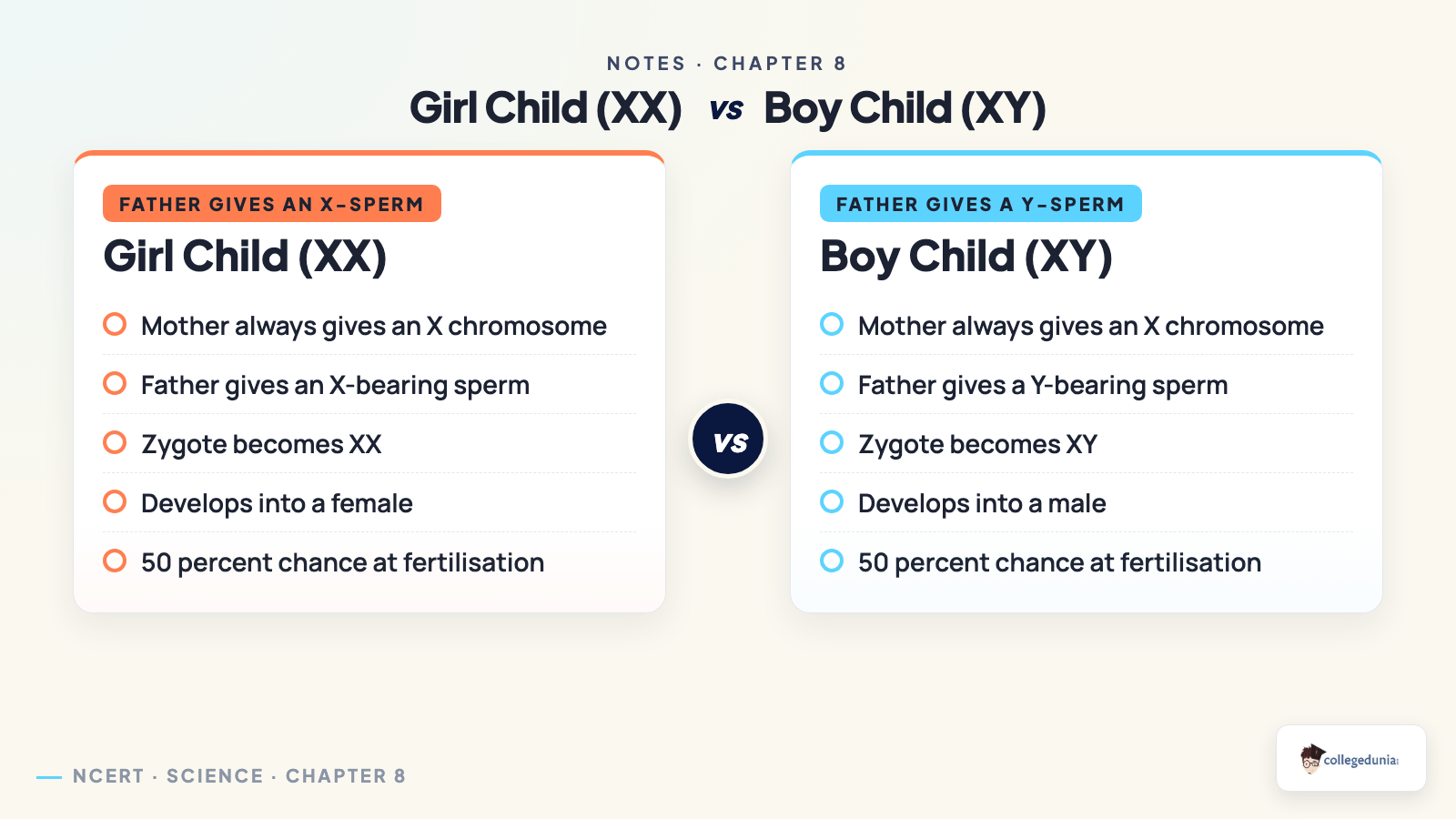
Humans have 23 pairs of chromosomes; one pair is the sex chromosomes. Females are XX, males are XY. Every egg carries an X; sperm are half X, half Y.
Father's sperm
Mother's egg
Child
Sex
X-bearing
X
XX
Girl
Y-bearing
X
XY
Boy
Because the egg always supplies an X, it is the father's sperm (X or Y) that decides the sex of the child, with a 50 : 50 chance of each. The mother is never to blame.
Common Mistakes Students Make in the Heredity Chapter
The repeat-offender mistakes in Heredity board answers:
Genotype vs phenotype: TT and Tt are different genotypes but the same phenotype (tall).
Wrong F2 ratio: one trait gives 3 : 1; two traits give 9 : 3 : 3 : 1.
Judging dominance from one child: a single offspring fits both explanations.
Blaming the mother for the baby's sex: she gives only an X; the father's sperm decides.
How to Use the Heredity NCERT Solutions PDF for Board Prep
Work this chapter in two passes. First, learn the key terms (variation, gene, allele, dominant, recessive, genotype, phenotype, chromosome). Then draw the 3 : 1 and 9 : 3 : 3 : 1 Punnett squares from memory and work the reasoning questions, checking against these solutions. Heredity reliably gives a cross, a reasoning, and a sex-determination question in the board paper.
Other Resources for Class 10 Science Chapter 8 Heredity
Pair this PDF with the notes, handwritten notes and NCERT book below.
Resource
What it covers
Open
NCERT Solutions
Step-by-step answers to all 10 questions, with an Expert Solution for each.
69% of Class 10 students said the hardest part of Heredity was reading a cross and filling a Punnett square correctly, especially the dihybrid 9 : 3 : 3 : 1 case. 3 out of 5 students told us they lost marks by confusing genotype with phenotype, or by writing the wrong F2 ratio.
Toppers found that drawing a neat Punnett square and labelling dominant and recessive alleles added 1 to 2 marks on the long-answer questions, and the average student spent 3 to 4 hours on this chapter across the first read and exercise practice.
Source: 2026-27 Class 10 Science student poll. Sample of 9,800 students from CBSE schools across 13 states, conducted before the 2026 boards.
NCERT Solutions for Class 10 Science: All Chapters
Related Links: Open the NCERT Solutions for the other Class 10 Science chapters below.
All NCERT Solutions for Class 10 Science Chapter 8 Heredity with Step-by-Step Solutions
Tap Check Solution for the clean board answer and Expert Solution for the extra-mark strategy on each of the 10 questions below.
Q 1
If a trait A exists in 10% of a population of an asexually reproducing species and a trait B exists in 60% of the same population, which trait is likely to have arisen earlier?
In asexual reproduction the offspring is almost an exact copy of the single parent. A new trait can only show up when a small variation (a copying error in the DNA) occurs. Once a variation appears, it is passed on copy after copy, so it slowly spreads to more and more individuals over many generations.
Compare how common the two traits are. Trait B is present in 60% of the population, while trait A is present in only 10%.
A trait found in more individuals has had more generations to copy itself and spread; a trait found in very few individuals is likely a recent change.
Trait B (60%) is far more widespread than trait A (10%), so trait B must have appeared earlier and trait A later.
Answer: Trait B is likely to have arisen earlier, because a higher frequency (60%) means it has had more generations to copy and spread through the population.
AI
Ananya Iyer
M.Sc Botany, University of Delhi
Verified Expert
Read the percentage like a clock. In an asexual population, treat a higher percentage as older, because that trait had more generations to spread.
Picture the population as a family tree of clones that grows downward. The first individual to carry a trait sits at the top of a branch; every copy below it inherits that trait, so a wider branch means an earlier start.
Because trait B is six times more common than trait A, trait B has clearly been around for longer. A brand-new variation, even a useful one, always starts off rare.
Answer: Trait B, the more common one (60%), arose earlier than trait A (10%).
Q 2
How does the creation of variations in a species promote survival?
Variations are the small differences between individuals of the same species. The environment is not fixed: temperature, food, water and diseases keep changing. Natural selection means that when conditions change, the individuals whose variation suits the new conditions survive and reproduce, while others may die out.
No two individuals are exactly alike; reproduction keeps adding small differences.
When the environment changes suddenly, for example a heat wave, some individuals already carry a variation that lets them tolerate heat.
Those heat-tolerant individuals survive and pass the helpful variation to their offspring, while individuals without it may not survive.
Even if many individuals die, the species as a whole continues because at least some variants were suited to the new conditions.
For example, bacteria that can withstand heat survive better in a heat wave. If all the bacteria were identical and none could tolerate heat, a single heat wave could wipe out the entire population.
Answer: Variation gives a species a range of forms, so that when the environment changes, at least some individuals are suited to the new conditions and survive, keeping the species alive.
RM
Rohan Mehta
Ph.D Genetics, IISc Bangalore
Verified Expert
Think of variation as a species not putting all its eggs in one basket. A varied population is like a team with many skills: whatever challenge appears, someone can handle it.
If every individual were identical, the whole population would react to a new threat (a disease, a cold spell, a new predator) in exactly the same way, and one bad change could end the species.
Because individuals differ, a harsh change removes only the unsuited ones and leaves the suited ones, who rebuild the population. Over many such events the species becomes better matched to its surroundings, which is the basis of evolution by natural selection.
Answer: Variation lets some individuals match changing conditions, so the species survives environmental changes that uniform populations could not.
Q 3
How do Mendel's experiments show that traits may be dominant or recessive?
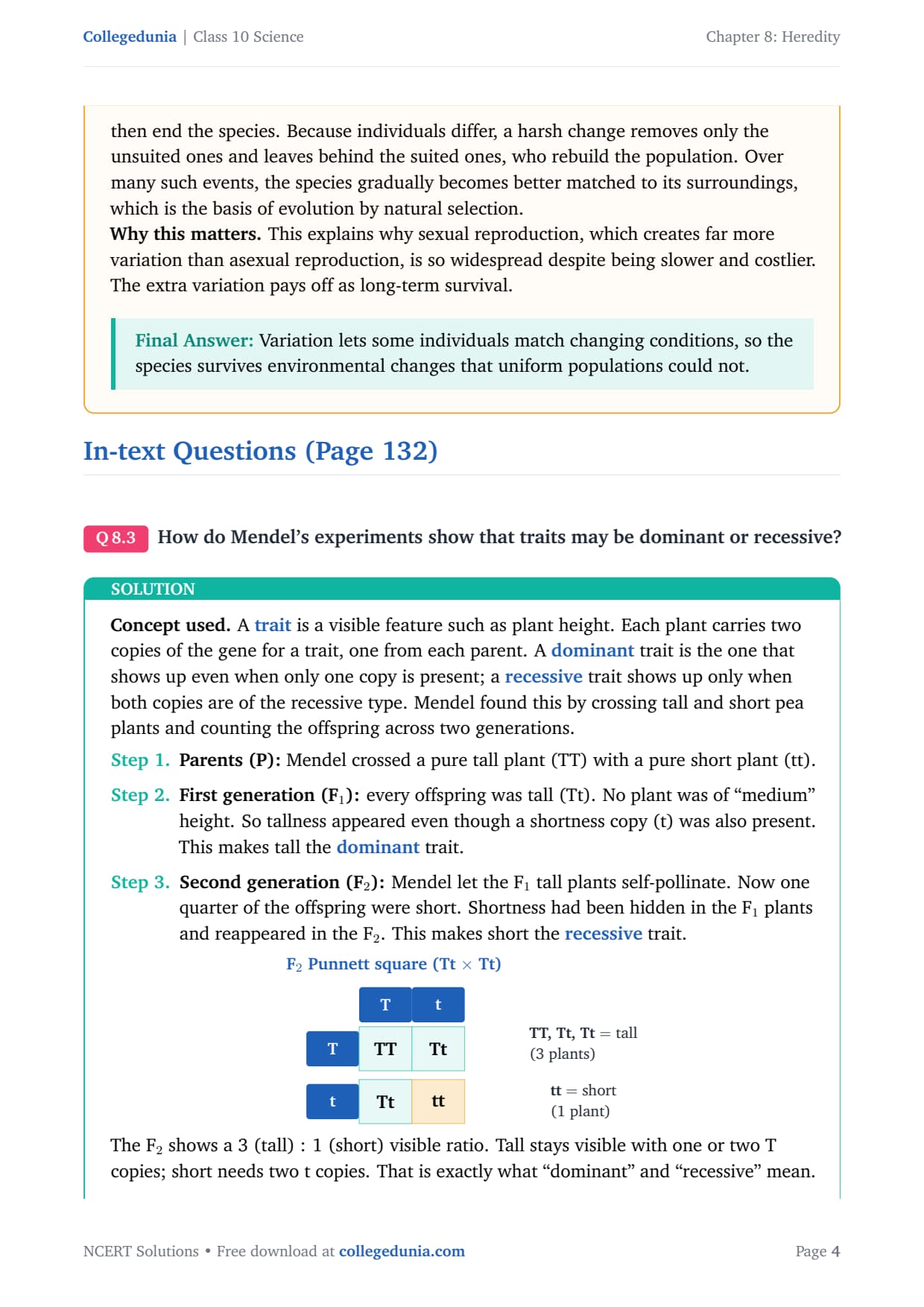
A trait is a visible feature such as plant height. Each plant carries two copies of the gene for a trait, one from each parent. A dominant trait shows up even when only one copy is present; a recessive trait shows up only when both copies are of the recessive type. Mendel found this by crossing tall and short pea plants and counting the offspring across two generations.
Parents (P): Mendel crossed a pure tall plant (TT) with a pure short plant (tt).
First generation (F1): every offspring was tall (Tt). No plant was of medium height, so tallness appeared even though a shortness copy (t) was present. This makes tall the dominant trait.
Second generation (F2): Mendel let the F1 tall plants self-pollinate. One quarter of the offspring were short. Shortness had been hidden in F1 and reappeared in F2, which makes short the recessive trait.
F2 Punnett square (Tt × Tt)
T
t
T
TT (tall)
Tt (tall)
t
Tt (tall)
tt (short)
The F2 shows a 3 tall : 1 short visible ratio. Tall stays visible with one or two T copies; short needs two t copies. That is exactly what dominant and recessive mean.
Answer: In F1, tall plants (Tt) appeared even though a shortness copy was present, so tall is dominant. In F2, the hidden shortness reappeared in one quarter of plants (3 : 1 ratio), so short is recessive.
SR
Sanjana Rao
M.Sc Life Sciences, University of Hyderabad
Verified Expert
Mendel's real breakthrough was that he counted the plants instead of just describing them. The numbers, not the looks, prove dominance and recessiveness.
A tall parent crossed with a short parent gives only tall offspring. If neither trait dominated, you would expect some in-between plants, but there are none, so tall must mask short.
When the F1 tall plants self-pollinate, short plants come back in about one out of every four offspring. A trait that can hide and then reappear is recessive; the trait that hides it is dominant.
The 3 : 1 ratio is the single most tested idea from this chapter. Whenever you see a 3 : 1 split, name the rarer one as recessive.
Answer: All-tall F1 shows tall is dominant; the return of short plants in the 3 : 1 F2 ratio shows short is recessive.
Q 4
How do Mendel's experiments show that traits are inherited independently?
Independent inheritance means that the gene for one trait is passed on without being tied to the gene for another trait. Mendel tested this with a dihybrid cross, where two different traits (here height and seed shape) are followed at the same time. If the traits travel together, no new combinations appear; if they travel independently, new mixed types show up in F2.
Parents: cross a tall plant with round seeds (TTRR) with a short plant with wrinkled seeds (ttrr).
F1: all offspring are tall with round seeds (TtRr), showing tall and round are dominant.
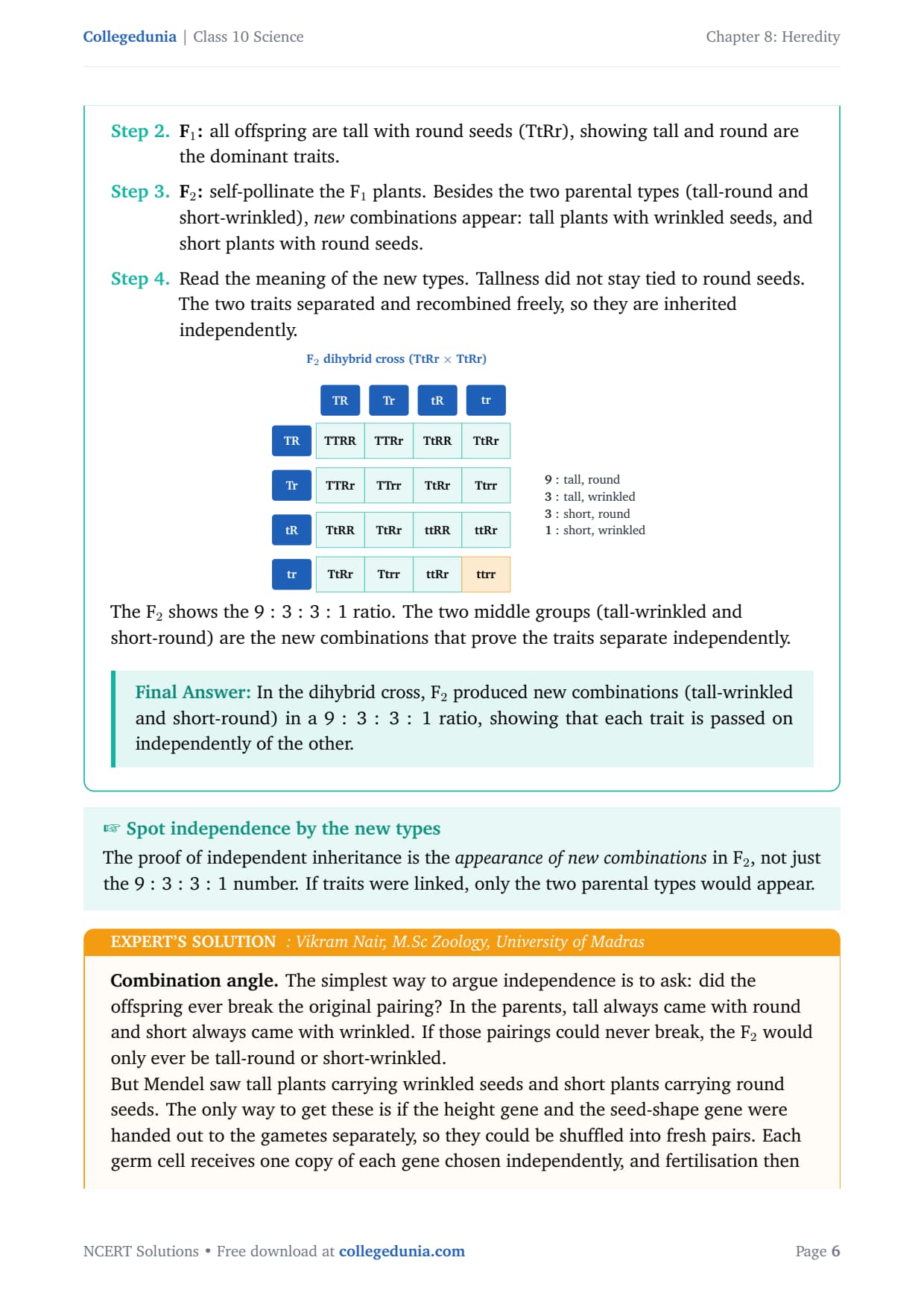
F2: self-pollinate the F1 plants. Besides the two parental types, new combinations appear: tall plants with wrinkled seeds, and short plants with round seeds.
Tallness did not stay tied to round seeds, so the two traits separated and recombined freely. They are inherited independently.
F2 phenotype
Ratio
Type
Tall, round
9
Parental
Tall, wrinkled
3
New combination
Short, round
3
New combination
Short, wrinkled
1
Parental
Answer: In the dihybrid cross, F2 produced new combinations (tall-wrinkled and short-round) in a 9 : 3 : 3 : 1 ratio, showing that each trait is passed on independently of the other.
VN
Vikram Nair
M.Sc Zoology, University of Madras
Verified Expert
The simplest way to argue independence is to ask: did the offspring ever break the original pairing? In the parents, tall always came with round and short always came with wrinkled.
Mendel saw tall plants carrying wrinkled seeds and short plants carrying round seeds. The only way to get these is if the height gene and the seed-shape gene were handed to the gametes separately, so they could be shuffled into fresh pairs.
The proof of independence is the appearance of new combinations in F2, not just the 9 : 3 : 3 : 1 number. If traits were linked, only the two parental types would appear.
This free shuffling is why brothers and sisters look so different even with the same parents.
Answer: New mixed types (tall-wrinkled, short-round) in F2 prove the two traits assort independently, giving the 9 : 3 : 3 : 1 ratio.
Q 5
A man with blood group A marries a woman with blood group O and their daughter has blood group O. Is this information enough to tell you which of the traits, blood group A or O, is dominant? Why or why not?
Blood group is decided by two copies of a gene. Blood group A can be one of two genotypes: AA (two A copies) or AO (one A and one O copy). Blood group O has only one genotype: OO (two O copies). To call a trait dominant or recessive, we must see how it behaves when both copies are present, and one child does not give us enough of that information.
The daughter is O, so she is OO. She must get one O from each parent, so the father, though group A, carries a hidden O; his genotype is AO.
Work out the cross: father AO × mother OO. The children can be AO (group A) or OO (group O), in a 1 : 1 ratio.
The daughter is OO, so she shows blood group O whether O is dominant or recessive. Her single result fits both possibilities.
From the father we can reason that A behaves as dominant and O as recessive (his A copy masks his O copy), but the daughter alone does not prove it; we would need to see more children.
Answer: No, this single daughter is not enough. She is OO and shows group O in either case. The cross AO × OO can give both A and O children, so one child cannot fix which trait is dominant.
PK
Priya Krishnan
M.D Pathology, AIIMS New Delhi
Verified Expert
The trick here is that blood group A hides two different genotypes. When a question gives you only the visible group (the phenotype), consider every genotype it could stand for.
Group O is always OO, so the daughter carried one O from the mother and one O from the father, which tells us the group-A father is secretly AO, not AA.
The daughter is OO, so she would look like group O no matter which trait is dominant; her result does not separate the two options. A single child cannot confirm a ratio.
In real genetic counselling, doctors never judge dominance from one person. They build a family tree (pedigree) across several children and generations before deciding.
Answer: Not enough information: the OO daughter looks like group O under either rule; deciding dominance needs the pattern across many offspring.
Q 6
How is the sex of the child determined in human beings?
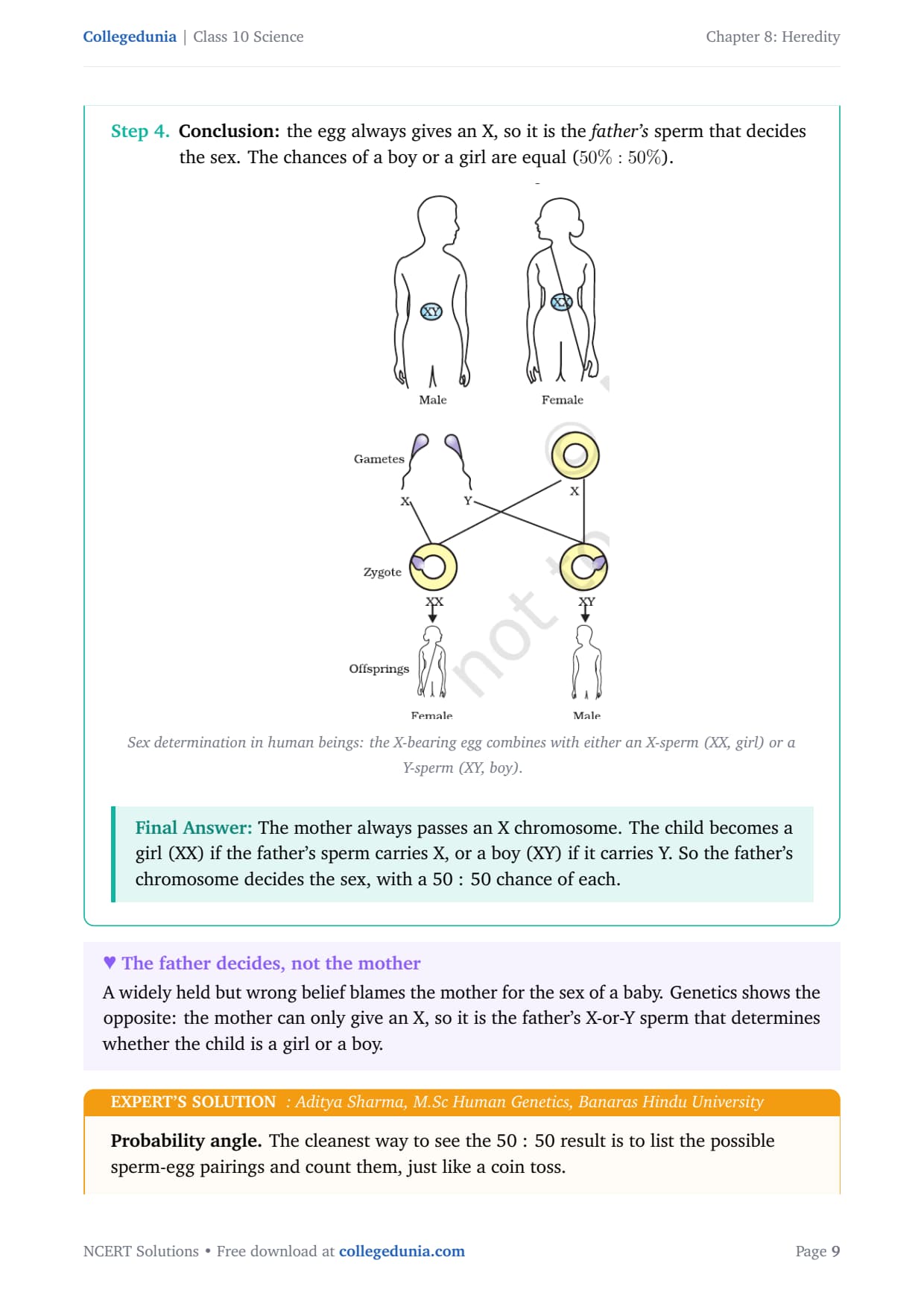
Humans have 23 pairs of chromosomes. Of these, one pair is the sex chromosomes. Females have two X chromosomes (XX) and males have one X and one Y (XY). Each germ cell (egg or sperm) carries only one sex chromosome, and the combination formed at fertilisation decides the sex of the child.
Mother's eggs: since the mother is XX, every egg she makes carries an X chromosome.
Father's sperm: since the father is XY, half his sperm carry an X and half carry a Y.
Fertilisation: if an X-sperm fertilises the egg, the child is XX (a girl); if a Y-sperm fertilises the egg, the child is XY (a boy).
The egg always gives an X, so it is the father's sperm that decides the sex. The chances of a boy or a girl are equal (50% : 50%).
Answer: The mother always passes an X chromosome. The child becomes a girl (XX) if the father's sperm carries X, or a boy (XY) if it carries Y. So the father's chromosome decides the sex, with a 50 : 50 chance of each.
AS
Aditya Sharma
M.Sc Human Genetics, Banaras Hindu University
Verified Expert
The cleanest way to see the 50 : 50 result is to list the possible sperm-egg pairings and count them, just like a coin toss.
The mother offers only one option, an X egg, so she cannot change the outcome. The father offers two equally likely options: an X sperm or a Y sperm.
Pairing the X egg with an X sperm gives XX (a girl); pairing it with a Y sperm gives XY (a boy). Since X and Y sperm are made in equal numbers, the two outcomes are equally likely.
This corrects a deep social misconception: the mother can only give an X, so it is the father's X-or-Y sperm that determines whether the child is a girl or a boy.
Answer: Father's sperm (X or Y) decides the sex; mother always gives X. Girl = XX, boy = XY, each with a 50% chance.
Q 7
A Mendelian experiment consisted of breeding tall pea plants bearing violet flowers with short pea plants bearing white flowers. The progeny all bore violet flowers, but almost half of them were short. This suggests that the genetic make-up of the tall parent can be depicted as (a) TTWW (b) TTww (c) TtWW (d) TtWw
We read two clues from the offspring. For each trait, the offspring ratio tells us the parent's genotype. If a cross gives all dominant offspring for a trait, the dominant parent was homozygous (two same copies). If a cross gives a 1 : 1 split for a trait, the dominant parent was heterozygous (one of each copy). Here T = tall, t = short, W = violet, w = white.
Flower colour clue: all progeny are violet (none white). The short parent is white (ww) and can only give a w, so for every offspring to be violet the tall parent must supply a W to each one, which means it is WW.
Height clue: almost half the progeny are short. The short parent is tt, giving only t. To get short (tt) offspring, the tall parent must also be able to give a t. A 1 : 1 tall-to-short split means the tall parent is Tt.
Combine the two clues: tall parent is Tt for height and WW for colour, so its genotype is TtWW, which matches option (c).
Answer: Correct option: (c) TtWW. The all-violet progeny forces WW for colour, and the half-short progeny forces Tt for height.
MP
Meera Pillai
M.Sc Botany, Savitribai Phule Pune University
Verified Expert
In an MCQ like this you can rule out wrong choices quickly by testing each against the two offspring clues.
Because no white progeny appear, the tall parent cannot carry a w; that throws out (b) TTww and (d) TtWw, since both could pass a w and produce white offspring with the white (ww) parent.
Because almost half the progeny are short (tt), the tall parent must donate a t; that throws out (a) TTWW, which can only give T. The only choice that survives both tests is (c) TtWW.
Working backward from offspring to parent genotype is a standard board skill. Always treat each trait on its own before combining.
Answer: Option (c) TtWW is the only genotype that gives all-violet and half-short progeny.
Q 8
A study found that children with light-coloured eyes are likely to have parents with light-coloured eyes. On this basis, can we say anything about whether the light eye colour trait is dominant or recessive? Why or why not?
Dominance describes how a trait behaves when both forms of the gene are present in the same individual, not how common the trait is in a family or population. A trait can run in a family whether it is dominant or recessive, so seeing that light-eyed children have light-eyed parents does not reveal dominance.
The study shows a correlation, a tendency for light-eyed parents to have light-eyed children. It does not tell us the genotypes of the family members.
If light eye colour were recessive, light-eyed parents would both be homozygous recessive and could only have light-eyed children, which matches the observation.
If light eye colour were dominant, light-eyed parents could still pass it on and have many light-eyed children, which also fits the observation.
Since the data agree with both possibilities, the study is not enough to decide dominance. We would need to track how the trait passes across more crosses and generations.
Answer: No. The study only shows that the trait runs in families (a correlation), which can happen for either a dominant or a recessive trait. Deciding dominance needs data on how the trait segregates across generations.
KR
Kavya Reddy
Ph.D Molecular Biology, University of Hyderabad
Verified Expert
The key is to judge whether the evidence can separate the two competing explanations. Good genetic evidence must give different results for dominant and recessive; this study does not.
Under the recessive story, two light-eyed parents are both homozygous recessive and must have only light-eyed children, so the pattern fits.
Under the dominant story, light-eyed parents carry the dominant allele and can easily have light-eyed children too, so the pattern fits here as well. Because both stories predict the same observation, it cannot tell them apart.
This is a lesson in scientific reasoning that goes beyond genetics: data that agree with every hypothesis prove none of them. To break the tie you would follow families with one dark-eyed and one light-eyed parent.
Answer: Not enough information; the family pattern fits both a dominant and a recessive explanation, so dominance cannot be decided from it.
Q 9
Outline a project which aims to find the dominant coat colour in dogs.
To find which coat colour is dominant, we cross dogs of two pure (true-breeding) colours and read the colour of the F1 offspring. The colour that appears in all the F1 puppies is the dominant one; the colour that disappears in F1 and returns in F2 is recessive. This is the same logic Mendel used for peas.
Pick pure-breeding parents: choose dogs that breed true for two colours, for example a pure black dog and a pure brown dog.
Make the first cross (P): mate the black dog with the brown dog and record the coat colour of every puppy in the F1 litter.
Read the F1 result: if all F1 puppies are black, black is dominant; if all are brown, brown is dominant.
Confirm with the F2: mate two F1 dogs. If the recessive colour reappears in about one quarter of the F2 puppies (a 3 : 1 ratio), it confirms the conclusion.
Repeat for reliability: use several litters and count the puppies so the result is based on numbers, not one chance litter.
Answer: Cross pure dogs of two coat colours; the colour seen in all F1 puppies is dominant. Confirm by mating F1 dogs and checking that the recessive colour returns in about 1 of every 4 F2 puppies (3 : 1).
AD
Arjun Desai
M.V.Sc Animal Genetics, ICAR-IVRI Bareilly
Verified Expert
Treat this like a fair test: control the starting material, vary one thing, and count the results across two generations.
Begin by securing genetic purity, because a project that starts with mixed-ancestry dogs cannot give a clean answer. A single coat colour filling the entire F1 litter points straight to the dominant trait.
The clever part is the second generation: mating two F1 dogs lets the hidden recessive colour resurface, and finding it in roughly a quarter of the F2 puppies both names the recessive trait and double-checks the F1 verdict.
The same two-generation design is used in real animal breeding, and it shows why careful record-keeping and large samples matter in any biological study.
Answer: Cross pure black and brown dogs; the all-one-colour F1 names the dominant colour, and the 3 : 1 return of the other colour in F2 confirms it.
Q 10
How is the equal genetic contribution of male and female parents ensured in the progeny?
Body cells carry chromosomes in pairs, one of each pair from the mother and one from the father. Special cells called germ cells (the egg and the sperm) are made by a division that halves the chromosome number, so each germ cell carries only one chromosome from every pair. When egg and sperm join at fertilisation, the pairs are restored, half from each parent.
Start with the parent's body cells, which have two copies of every chromosome (one maternal, one paternal).
During the making of germ cells, this number is halved, so each egg and each sperm receives exactly one chromosome from every pair.
At fertilisation, the egg (with one set) fuses with the sperm (with one set), and the child's cells now have two sets again, one full set from each parent.
Because each parent supplies one complete set of chromosomes, and chromosomes carry the genes, both parents contribute equally to the genetic material of the child.
If germ cells kept the full double set, the child would end up with four sets of chromosomes. Halving the number in germ cells keeps the chromosome count of the species stable from one generation to the next.
Answer: Each germ cell carries only one chromosome from every pair, so it holds half the genetic material. At fertilisation, the egg and sperm combine to give the child two sets, one full set from each parent, ensuring an equal contribution.
NB
Neha Bhatt
Ph.D Cell Biology, Jawaharlal Nehru University
Verified Expert
The neatest way to see equality is to track the chromosome count like an accountant: full set in the parent, half in the germ cell, full set again in the child, with each parent paying in exactly half.
The process that makes eggs and sperm deliberately splits each pair, so a germ cell leaves with just one chromosome from every pair, that is, a single complete set rather than a double one.
Fertilisation then adds the mother's single set to the father's single set, rebuilding the matched pairs. Neither parent can dominate the count; their genetic shares are equal by design.
Equal genetic input from both parents is the foundation of all the Mendelian rules: dominance, recessiveness and independent inheritance all assume each trait has one copy from each parent.
Answer: Halving the chromosomes when germ cells form, then restoring the pairs at fertilisation, gives the child one full set from each parent, an equal genetic contribution.
NCERT Solutions Class 10 Science Chapter 8 Heredity FAQs
Ques. How many questions are there in NCERT Class 10 Science Chapter 8 Heredity?
Ans. There are 10 questions in NCERT Class 10 Science Chapter 8 Heredity: 6 in-text questions in the boxes inside the chapter and 4 end-of-chapter exercise questions. All 10 are solved with a step-by-step Check Solution and an Expert Solution. The set includes questions on variation, Mendel's dominant and recessive traits, the dihybrid cross, blood-group and eye-colour reasoning, the dominant coat-colour project, and sex determination in humans.
Ques. What is the difference between dominant and recessive traits in Class 10?
Ans. A dominant trait shows up even when only one copy of the gene is present, so a plant with genotype TT or Tt looks tall. A recessive trait shows up only when both copies are of the recessive type, so a plant must be tt to look short. In Mendel's cross, tall is dominant because the F1 plants (Tt) are all tall, and short is recessive because it stays hidden in F1 and reappears in one quarter of the F2 plants, giving the 3 : 1 ratio.
Ques. What is the F2 ratio in a monohybrid and a dihybrid cross?
Ans. In a monohybrid cross (one trait, Tt × Tt) the F2 generation shows a 3 : 1 phenotype ratio, that is, 3 dominant to 1 recessive, with a 1 : 2 : 1 genotype ratio (1 TT : 2 Tt : 1 tt). In a dihybrid cross (two traits, TtRr × TtRr) the F2 generation shows a 9 : 3 : 3 : 1 ratio across four phenotypes. The two middle groups in the dihybrid ratio are new combinations not present in the parents, and they prove that the two traits are inherited independently.
Ques. How is the sex of a child determined in human beings?
Ans. Humans have 23 pairs of chromosomes, and one pair is the sex chromosomes. Females are XX and males are XY. The mother's eggs all carry an X chromosome, while the father's sperm are half X and half Y. If an X-bearing sperm fertilises the egg, the child is XX, a girl; if a Y-bearing sperm fertilises the egg, the child is XY, a boy. So the egg always supplies an X and it is the father's sperm that decides the sex, with an equal 50 : 50 chance of a boy or a girl.
Ques. Why can one child not tell us which trait is dominant?
Ans. Dominance is a statement about how two different alleles behave when they are together in one individual, not about how common a trait is. A single child shows only one outcome, which usually fits both a dominant and a recessive explanation. For example, an OO daughter of a group-A father and a group-O mother looks like group O whether O is dominant or recessive. To decide dominance you need the pattern across several offspring or a full family tree (pedigree), not just one child.
Ques. How many pages is the Class 10 Science Heredity NCERT Solutions PDF?
Ans. The Heredity NCERT Solutions PDF covers all 10 questions (6 in-text and 4 exercise) with step-by-step Check Solutions, labelled Punnett squares for the monohybrid and dihybrid crosses, a sex-determination diagram, and an Expert Solution for each question. It is free to download for the 2026-27 session and is built for the CBSE Class 10 board exam.
Ques. Is the NCERT Solutions for Class 10 Science Chapter 8 aligned with the 2026-27 syllabus?
Ans. Yes. This page reflects the current 2026-27 CBSE syllabus for Class 10 Science. Every answer follows the NCERT textbook flow for Heredity, covering variation and inheritance, Mendel's experiments on dominant and recessive traits, monohybrid and dihybrid crosses, genes and chromosomes, and sex determination in humans. The solutions are written in plain English for board exam students and are useful for both the CBSE board exam and school unit tests.








Comments