Chemistry Mentor, Daulat Ram College | Updated 3+ months ago
The NCERT Solutions for Class 10 Science Chapter 5 Life Processes cover all 34 questions (21 in-text and 13 exercise questions), written for the 2026-27 CBSE syllabus.
Every answer follows the textbook flow: the four life processes, nutrition and photosynthesis, respiration, transportation in humans and plants, and excretion through the nephron.
All 34 NCERT questions solved with clear steps, labelled diagrams, and an Expert Solution per question that adds board-exam strategy.
Full coverage of autotrophic and heterotrophic nutrition, aerobic and anaerobic respiration, double circulation, xylem and phloem, and the structure of the nephron that the CBSE board paper tests directly.
Answers are aligned with the 2026-27 CBSE Class 10 Science syllabus, written in plain English for board exam students.
Solved by Collegedunia Science Experts
These NCERT Solutions for Class 10 Science Chapter 5 Life Processes are checked against the latest 2026-27 NCERT textbook and refined against the last five years of CBSE board papers. Each of the 34 questions gives a Check Solution for the clean board answer and an Expert Solution for extra marks.
What the NCERT Solutions for Class 10 Science Chapter 5 Life Processes Cover
This chapter answers one big question: what does a living body have to do, every moment, just to stay alive? The NCERT book groups these jobs into four life processes, and these solutions stay faithful to the textbook order while filling the gaps students hit in the exam.
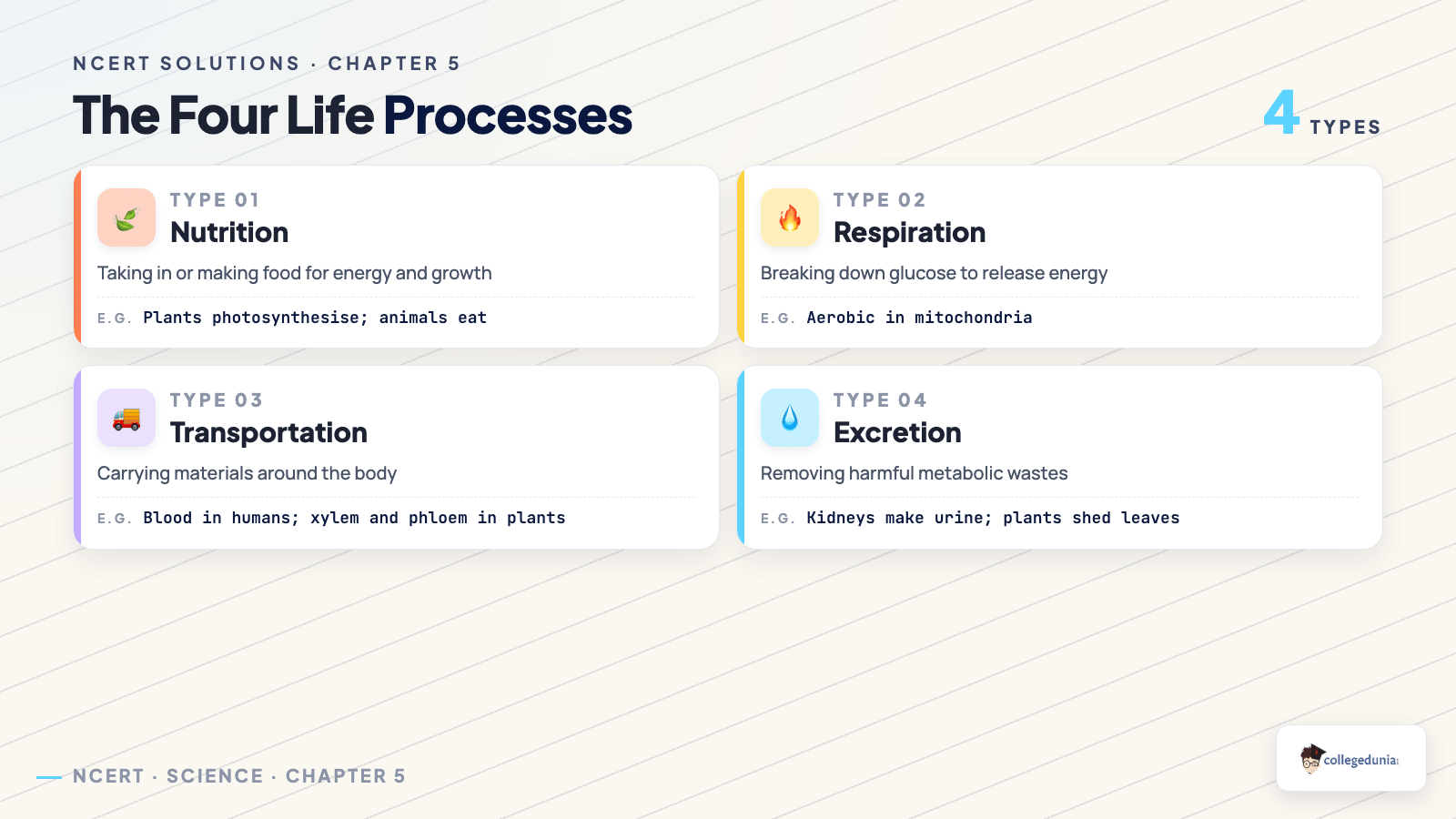
Nutrition: how plants make their own food (photosynthesis) and how the human digestive system breaks down food.
Respiration: how glucose is broken down to release energy, by the aerobic route (with oxygen) and the anaerobic route (without oxygen).
Transportation: the human heart, blood and vessels with double circulation, and the xylem and phloem in plants.
Excretion: how the nephron filters blood to make urine, and how plants get rid of their wastes.
Question Breakdown of the Life Processes Chapter NCERT Solutions
Chapter 5 carries 21 in-text questions and 13 exercise questions. The table maps each section to its topic, the answer style CBSE rewards, and the typical mark weight.
Section
Topic covered
Answer style
Typical marks
Life processes
Why diffusion is not enough; the four essential processes
Reasoned points, surface-to-volume logic
1 to 3 marks
Nutrition
Autotrophic vs heterotrophic, photosynthesis, digestion
Difference table; word equation; labelled diagram
3 to 5 marks
Respiration
Glucose oxidation; aerobic vs anaerobic; alveoli
Branching flow; four-point table
3 to 5 marks
Transportation
Heart, blood, vessels, double circulation; xylem and phloem
Labelled heart diagram; comparison table
3 to 5 marks
Excretion
Nephron structure and function; urine; plant excretion
Labelled nephron; three-step process
3 to 5 marks
Exercise MCQs
Kidney, xylem, autotrophs, pyruvate breakdown
One option with a one-line reason
1 mark each
The diagram questions (nephron, alveoli, double circulation) and the difference questions carry the heaviest marks. A neat labelled diagram and a comparison table score full marks.
The Four Life Processes and Why Diffusion Is Not Enough
A life process is a basic job the body must keep doing to stay alive. NCERT names four: nutrition (food for energy and growth), respiration (breaking food down to release energy), transportation (carrying food, oxygen and waste between cells), and excretion (removing harmful waste).
Why can a big body not rely on diffusion? In a single cell, oxygen reaches every part quickly, but in a large body most cells lie deep inside, so diffusion is too slow. This is the surface-to-volume problem: as a body grows, its volume rises much faster than its surface area, so a dedicated transport system becomes a must.
Quick Tip: For "why is diffusion not enough", state both points: it is too slow over long distances, and inner cells are too far from the surface.
Nutrition: Autotrophic, Heterotrophic and Human Digestion
In autotrophic nutrition the organism makes its own food from simple inorganic materials, as green plants do by photosynthesis. In heterotrophic nutrition the organism depends on others, as animals and fungi do.
Photosynthesis and its raw materials
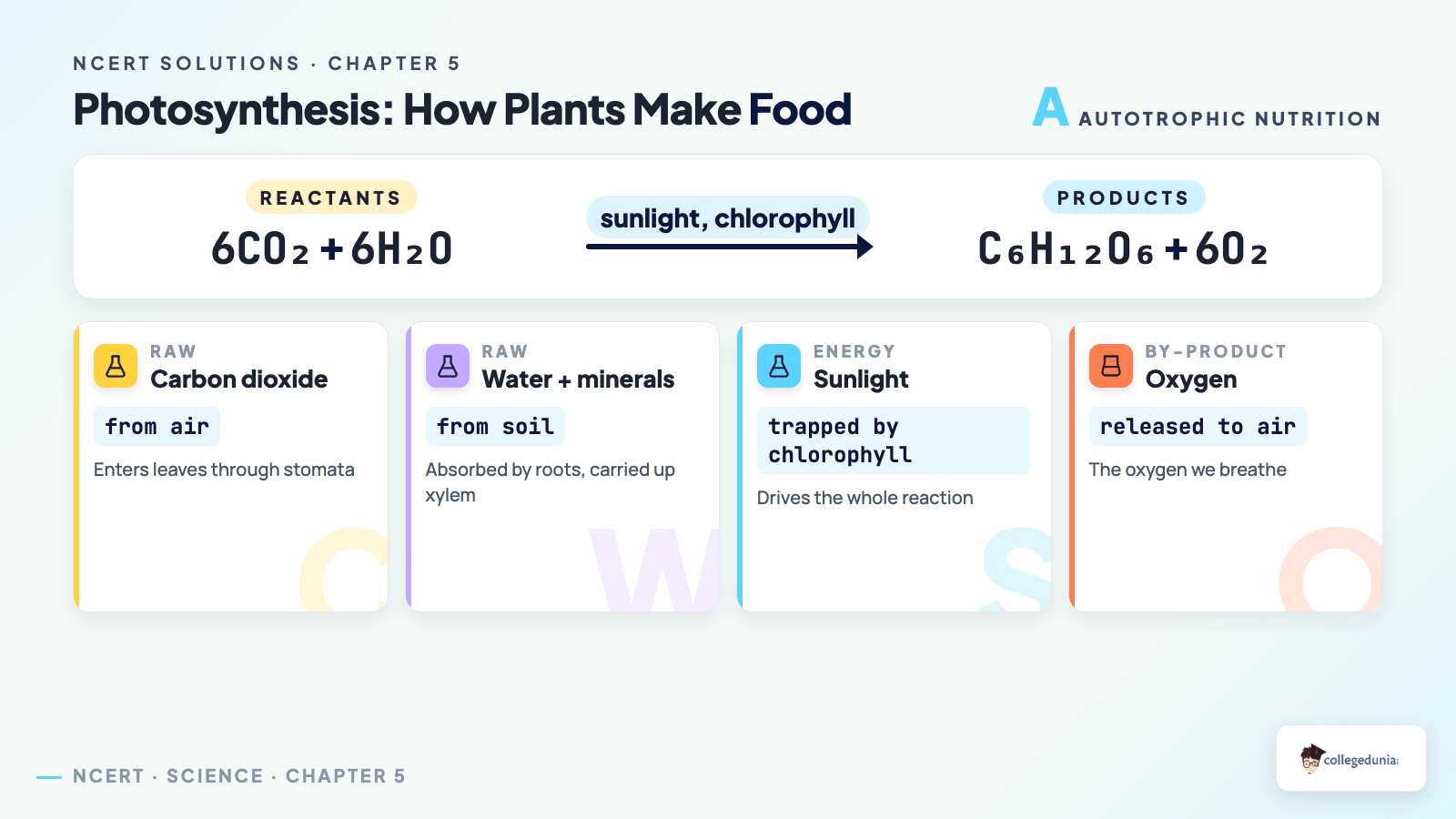
Photosynthesis needs four things: carbon dioxide (from the air, through the stomata), water and minerals (from the soil, through the roots and up the xylem), chlorophyll (the green pigment that traps light) and sunlight (the energy source). The food made is glucose, and the main by-product is oxygen, the oxygen we breathe.
Human digestion
Digestion breaks large food molecules into small, absorbable ones. The table below pairs each helper with its job.
Where
Helper
What it does
Mouth
Saliva (salivary amylase)
Wets food and starts digesting starch into sugar
Stomach
HCl + pepsin
Acid makes the medium acidic for pepsin; pepsin digests proteins; acid kills germs
Small intestine
Bile + lipase
Bile emulsifies fats into droplets; lipase digests them into fatty acids and glycerol
Small intestine wall
Villi
Millions of finger-like villi with a rich blood supply absorb the digested food
Remember: Bile is not an enzyme. It only emulsifies large fat globules into droplets; the enzyme lipase does the digesting. State both for full marks.
Respiration: Aerobic and Anaerobic Oxidation of Glucose
In respiration, glucose is broken down to release energy. The first step is the same in every cell: glucose (6 carbon) is broken in the cytoplasm into two molecules of pyruvate (3 carbon). What happens next depends on whether oxygen is present.
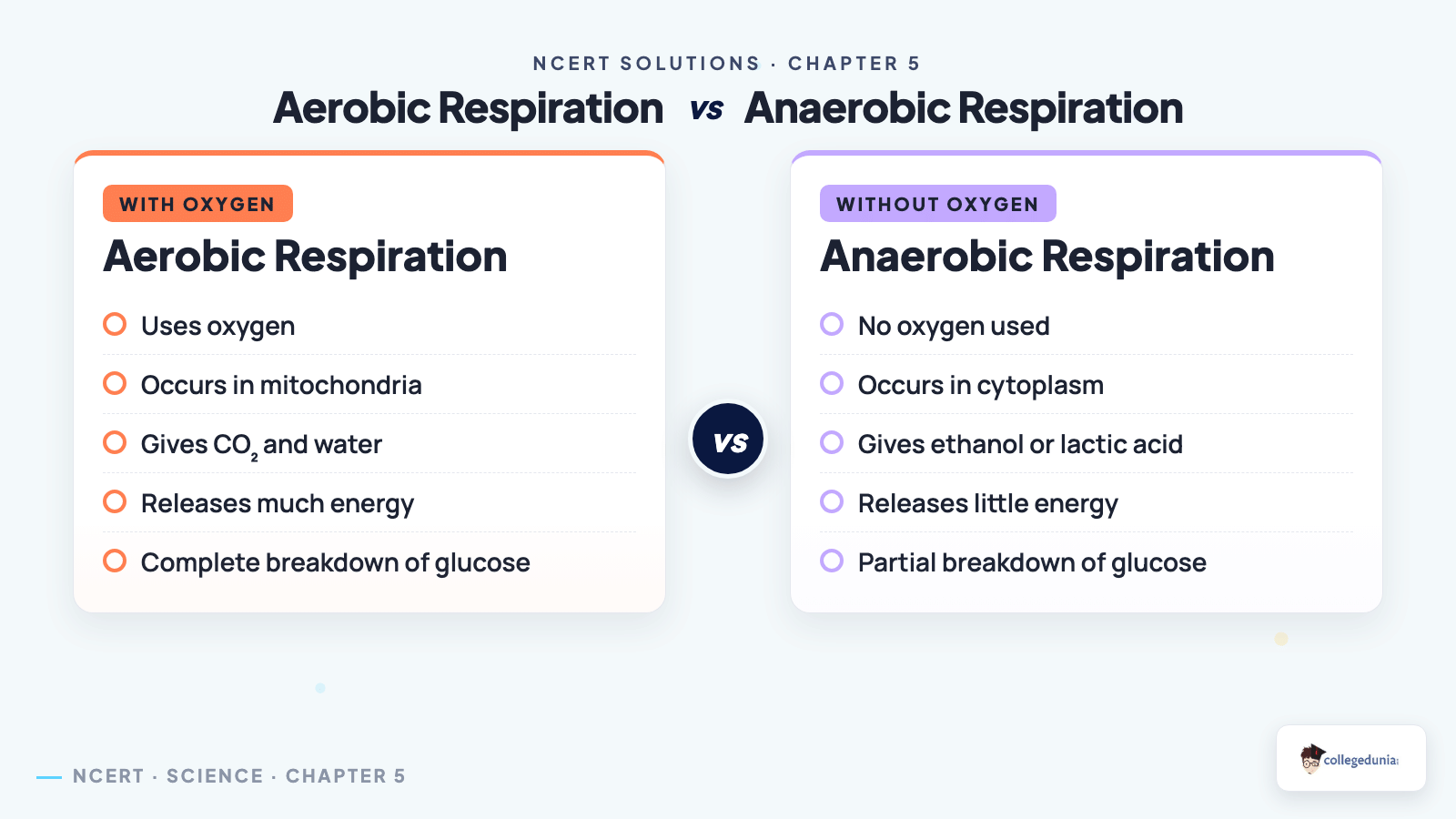
Aerobic (with oxygen): pyruvate enters the mitochondria and is fully broken into carbon dioxide and water, releasing much energy.
Anaerobic in yeast (no oxygen): pyruvate becomes ethanol and carbon dioxide. This is fermentation.
Anaerobic in our muscles (lack of oxygen): during heavy exercise, pyruvate becomes lactic acid, which causes cramps.
For gas exchange, the lungs are built around millions of balloon-like alveoli. Their thin walls give a huge surface area, and each is wrapped in fine blood vessels, so oxygen passes into the blood quickly. Air holds about 21% oxygen, far more than water, which is why a fish must keep pumping water over its gills.
Transportation in Humans and Plants
The human transport system is the circulatory system: the heart (pump), the blood (carrier) and the blood vessels (arteries away from the heart, veins back, capillaries exchange materials). Oxygen is carried by haemoglobin in red blood cells; carbon dioxide travels dissolved in the plasma.
Double circulation
In humans the blood passes through the heart twice per round. The right side pumps deoxygenated blood to the lungs (pulmonary circuit), the left side pumps oxygenated blood to the body (systemic circuit). The two sides are fully separated, so oxygen-rich and oxygen-poor blood never mix, keeping the oxygen supply high and efficient.
Transport in plants
Plants use two pipelines. The table below contrasts them on the three points the marking scheme wants.
Point
Xylem
Phloem
Carries
Water and minerals
Food (sugar)
Direction
Mostly upward (roots to leaves)
Any direction (where food is needed)
Energy
Little; uses root pressure and transpiration pull
Uses energy (ATP) to load food, called translocation
Watch Out: A very common slip is swapping the two pipelines. Xylem carries water up; phloem carries food in any direction. Keep this one-line link ready and the xylem and phloem questions become instant.
Excretion: The Nephron, Urine and Plant Wastes
Excretion removes the harmful waste made by the body's chemical reactions. In humans the main organ is the kidney, and its filtering unit is the nephron. Each nephron works as a three-stage machine.
Filtration: blood enters the glomerulus (a ball of capillaries inside Bowman's capsule) under pressure; water, glucose, salts and urea are filtered out, while blood cells and large proteins stay behind.
Selective reabsorption: as the filtrate flows along the tubule, useful substances (glucose, most water, amino acids, some salts) are taken back into the blood.
Urine formation: the leftover urea, extra salts and water form urine, which drains through the collecting ducts to the bladder.
Urine volume is regulated by how much water the kidney reabsorbs; on a hot day the body saves water, so you pass concentrated urine. Plants, having no excretory organ, release gases through stomata, store wastes in vacuoles or as gum and resin, and shed leaves and bark.
Common Mistakes Students Make in the Life Processes Chapter
Repeat-offender mistakes in Life Processes board answers:
Swapping xylem and phloem: xylem carries water up; phloem carries food in any direction.
Mixing aerobic and anaerobic: aerobic is in mitochondria with oxygen (much energy); anaerobic is in the cytoplasm without oxygen (little energy).
Saying bile digests fat: bile only emulsifies fat; the enzyme lipase digests it.
Skipping the labelled diagram: for the nephron, alveoli and double circulation, a neat diagram carries one or two marks.
How to Use the Life Processes NCERT Solutions PDF for Board Prep
Life Processes is long but scoring, since the same diagram and difference questions repeat every year. Use two passes: first read and note the four processes, the photosynthesis raw materials, the respiration branches, the xylem/phloem split, and the three nephron stages; then practise drawing the nephron, alveoli and double-circulation circuits, and write the difference tables from memory before checking against these solutions. Expect a long-answer question on the heart, nephron or photosynthesis, plus short answers on respiration and transport.
Other Resources for Class 10 Science Chapter 5 Life Processes
Pair this NCERT Solutions PDF with the matching revision notes, handwritten notes and the official NCERT book chapter. All resources for Class 10 Science Chapter 5 Life Processes are linked below.
Resource
What it covers
Open
NCERT Solutions
Step-by-step answers to all 34 questions, with an Expert Solution for each.
You are here
Notes
Concept-first revision notes on nutrition, respiration, transportation and excretion.
71% of Class 10 students said Life Processes felt long because it packs nutrition, respiration, transportation and excretion into one chapter. 3 out of 5 students told us they lost marks by mixing up xylem and phloem, or aerobic and anaerobic respiration.
Toppers found that drawing a labelled diagram (nephron, alveoli or the heart) added 1 to 2 marks on the long-answer questions, and the average student spent 4 to 5 hours on this chapter across the first read and exercise practice.
Source: 2026-27 Class 10 Science student poll. Sample of 10,800 students from CBSE schools across 14 states, conducted before the 2026 boards.
NCERT Solutions for Class 10 Science: All Chapters
Related Links: Use the table below to open the NCERT Solutions for the other chapters of Class 10 Science. Every chapter ships with the same step-by-step answer style, full PDF download, and revision FAQ.
All NCERT Solutions for Class 10 Science Chapter 5 Life Processes with Step-by-Step Solutions
Q 1
Why is diffusion insufficient to meet the oxygen requirements of multicellular organisms like humans?
Diffusion is the slow movement of molecules from a higher to a lower concentration. It works well only across very short distances, like a single cell. In a large multicellular body, many cells lie deep inside, far from the surface.
In a one-celled organism, every part touches the surroundings, so oxygen reaches all of it quickly by diffusion.
In a big body like a human, most cells lie deep inside; diffusion is far too slow to carry enough oxygen to them in time.
Different parts also need different amounts of oxygen, and plain diffusion cannot supply this fast, uneven demand.
Answer: Diffusion is too slow and reaches only cells near the surface, so a large body needs a dedicated transport system to carry oxygen to deep-lying cells.
SR
Sunita Rao
M.Sc Zoology, B.Ed
Verified Expert
The clean way to remember this is the surface-to-volume idea. When an organism gets larger, the number of cells inside (its volume) grows fast, but the outer surface for gases grows much more slowly. So the supply route cannot keep up with demand.
Diffusion is fast over a few micrometres but extremely slow over centimetres. In an amoeba, oxygen crosses only one cell; in a human, it could never diffuse to a toe cell in time.
A complex body also has a division of labour, so a working organ needs oxygen on demand, which a passive process cannot deliver.
Answer: Because inner cells are too far from the surface and diffusion over such distances is far too slow, a large body needs an active circulatory system.
Q 2
What criteria do we use to decide whether something is alive?
Living things carry out certain life processes that non-living things do not. The most easily seen sign is some kind of movement, but other signs together confirm life.
Movement. Most living things move in some way. In plants and tiny organisms the movements are slow or hidden, so we cannot always see them.
Molecular movements. Even in a still or sleeping body, controlled movements of molecules keep going inside the cells to keep the body in order.
Other processes. Living things also take in food, respire, grow, respond to changes, remove waste and reproduce.
Answer: We use life processes as the test: movement (visible or molecular), nutrition, respiration, growth, response and reproduction together tell us something is alive.
MK
Meena Krishnan
M.Sc Botany, B.Ed
Verified Expert
Start with the everyday picture the textbook uses. We say a dog is alive because we see it move. But how do we know a plant, or a sleeping animal, is alive when we see no movement? That is the trap here.
Movement is not always visible. Plants make slow movements and small organisms move in ways we cannot see, so a lack of visible movement does not mean a thing is dead.
The deeper, surer test is molecular movement, which goes on even at rest and needs energy, which is why the body keeps respiring.
Answer: Something is alive if it shows life processes: some movement (often only molecular), nutrition, respiration, growth, response and reproduction.
Q 3
What are outside raw materials used for by an organism?
An organism takes in raw materials from outside (food, water, oxygen, minerals) and uses them to run its life processes: to release energy, to grow, and to build and repair its own body.
To get energy. Food and oxygen are used in respiration to release the energy the body needs, even at rest.
To grow and build. Materials are used to make new substances such as proteins, needed to grow and to build new cells.
To repair and maintain. The same raw materials replace worn-out or damaged parts and keep the body in order.
Answer: Outside raw materials are used to release energy (respiration), to grow and make new substances like proteins, and to repair and maintain the body.
AI
Arvind Iyer
M.Sc Zoology, M.Ed
Verified Expert
Split the use of raw materials into three clear purposes: energy, growth and repair.
Energy: glucose and oxygen combine in respiration to release the energy that keeps the body in an ordered, living state.
Growth: raw materials supply the carbon, nitrogen and other blocks needed to make proteins for new cells.
Repair: cells wear out, and the body constantly replaces them using materials from food.
Because needs differ (a plant takes in carbon dioxide and minerals; an animal takes in complex food), the textbook stresses that the exact raw materials depend on how the organism is built.
Answer: Raw materials are used for three purposes: producing energy by respiration, building new material for growth, and repairing and maintaining the body.
Q 4
What processes would you consider essential for maintaining life?
The basic jobs a body must do to stay alive are called life processes. The four main ones are nutrition, respiration, transportation and excretion.
Nutrition. Taking in food (or making it, as plants do) for energy and building materials.
Respiration. Breaking down food, usually with oxygen, to release usable energy.
Transportation. Carrying food, oxygen, water and waste from one part of the body to another.
Excretion. Removing the harmful waste made during the body's reactions.
Answer: The essential life processes are nutrition, respiration, transportation and excretion.
RP
Rajesh Pillai
M.Sc Zoology, B.Ed
Verified Expert
Group the answer around one idea: a body must take in what it needs, use it, move it about and throw out the waste. Each step matches one life process.
Take in and use: nutrition supplies food and respiration breaks it down for energy.
Move and remove: transportation carries materials to every cell while excretion clears the harmful by-products.
Some books also count control and coordination and reproduction, but the four named here are the ones this chapter treats as essential for keeping one individual alive day to day.
Answer: Nutrition, respiration, transportation and excretion are the essential life processes; together they supply, use, move and clear materials.
Q 5
What are the differences between autotrophic nutrition and heterotrophic nutrition?
In autotrophic nutrition the organism makes its own food from simple inorganic materials. In heterotrophic nutrition it cannot make food and depends on food made by others.
Point
Autotrophic
Heterotrophic
Food
Makes its own food
Takes ready-made food
Raw materials
CO₂, water, minerals
Complex food (carbohydrates, proteins, fats)
Energy
Sunlight via chlorophyll
Chemical energy in food
Examples
Green plants
Humans, animals, fungi
Answer: Autotrophs make their own food from CO₂, water and minerals using sunlight (green plants); heterotrophs depend on ready-made food from others (animals, fungi).
LM
Lakshmi Menon
M.Sc Botany, B.Ed
Verified Expert
The two words tell you the answer. "Auto" means self, so autotrophs are self-feeders. "Hetero" means other, so heterotrophs feed on food built by others.
An autotroph like a green plant joins simple molecules (carbon dioxide, water, minerals) into glucose using sunlight trapped by chlorophyll. This is photosynthesis.
A heterotroph cannot do this, so it takes in complex food already made and breaks it down for energy and materials.
The two are linked: heterotrophs ultimately depend on autotrophs, the original food makers. Compare food source, raw materials, energy source and one example for full marks.
Answer: Autotrophic nutrition makes its own food from simple inorganic materials using sunlight; heterotrophic nutrition depends on ready-made food from other organisms.
Q 6
Where do plants get each of the raw materials required for photosynthesis?
Photosynthesis needs carbon dioxide, water and minerals, plus sunlight as the energy source. The plant collects each from a different place.
Carbon dioxide from the air, entering through tiny pores called stomata.
Water from the soil, absorbed by the roots and carried up the xylem.
Minerals such as nitrogen and iron, also taken from the soil through the roots.
Sunlight, absorbed by the green pigment chlorophyll in the leaves.
Answer: Carbon dioxide comes from air through stomata; water and minerals come from the soil through the roots; energy comes from sunlight absorbed by chlorophyll.
GR
Geeta Reddy
M.Sc Botany, M.Ed
Verified Expert
Pair every raw material with the exact part of the plant and the place it comes from.
Carbon dioxide enters from the air through the stomata; oxygen made in photosynthesis diffuses out the same way.
Water comes from the soil through the roots and root hairs, then travels up the xylem to the leaves.
Minerals such as nitrogen, magnesium and iron come from the soil through the roots; they make chlorophyll, enzymes and proteins.
Sunlight provides the energy; chlorophyll absorbs it to convert CO₂ and water into glucose.
Answer: CO₂ from air via stomata; water and minerals from soil via roots; and light energy from the Sun absorbed by chlorophyll.
Q 7
What is the role of the acid in our stomach?
The stomach releases hydrochloric acid (HCl). It creates an acidic medium that helps the protein-digesting enzyme pepsin work, and it also acts on the food.
Creates an acidic medium. Pepsin can only work in acidic conditions, which HCl provides.
Kills harmful microbes. The strong acid kills many germs that come in with the food.
Mucus protection. Because the acid is strong, the stomach wall makes mucus to protect its own lining.
Answer: The acid (HCl) makes the stomach medium acidic so pepsin can digest proteins, and it also kills germs in the food.
AB
Anita Bhatt
M.Sc Biochemistry, B.Ed
Verified Expert
See stomach acid as the helper that sets up the right conditions for digestion, rather than something that digests food itself.
Pepsin is inactive unless its surroundings are acidic. HCl turns the contents acidic and switches pepsin on to break proteins.
Food carries microbes from outside; the strong acid kills most of them, a simple line of defence.
Cells in the lining secrete a thick mucus that shields the wall; if it breaks down, the acid can cause an ulcer.
Answer: Stomach acid provides the acidic medium pepsin needs to digest proteins and kills germs in food; mucus protects the lining.
Q 8
What is the function of digestive enzymes?
Digestive enzymes are proteins that speed up the breakdown of large, complex food molecules into small, simple ones that can be absorbed.
They break down complex food. Carbohydrates, proteins and fats are too big to absorb as they are.
Each enzyme has its own target. Amylase breaks starch into sugar, pepsin and trypsin break proteins into amino acids, and lipase breaks fats into fatty acids and glycerol.
They make absorption possible. After they act, the food is simple and soluble enough to pass into the blood.
Answer: Digestive enzymes break large food molecules (carbohydrates, proteins, fats) into small, simple, soluble molecules the body can absorb.
SP
Sneha Pillai
M.Sc Biochemistry, B.Ed
Verified Expert
Think of each digestive enzyme as a pair of scissors that cuts one kind of food molecule into smaller pieces, very fast.
Carbohydrates are long sugar chains, proteins are long amino-acid chains, fats are fatty acids and glycerol joined together. None can pass through the gut wall as they are.
Amylase turns starch into glucose, pepsin and trypsin turn proteins into amino acids, lipase turns fats into fatty acids and glycerol. Each enzyme is specific.
Answer: Digestive enzymes act as biological catalysts that break complex food into simple, soluble forms (sugars, amino acids, fatty acids) that the body can absorb.
Q 9
How is the small intestine designed to absorb digested food?
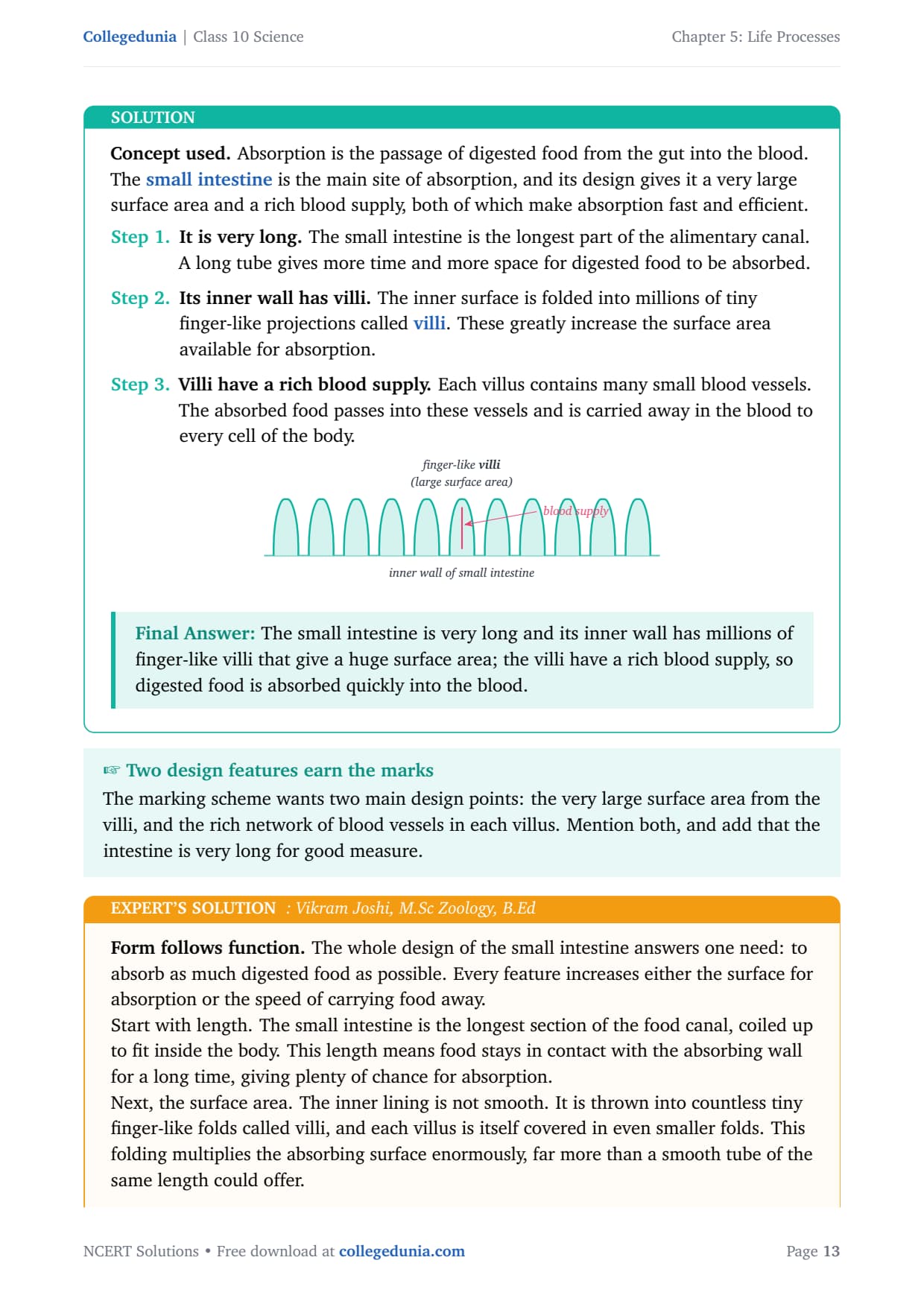
The small intestine is the main site of absorption. Its design gives a very large surface area and a rich blood supply.
It is very long. The longest part of the food canal, giving more time and space for absorption.
Its inner wall has villi. Millions of finger-like projections called villi greatly increase the surface area.
Villi have a rich blood supply. Each villus contains many blood vessels, so absorbed food is carried away quickly.
Answer: The small intestine is very long and its inner wall has millions of finger-like villi with a rich blood supply, so digested food is absorbed quickly into the blood.
VJ
Vikram Joshi
M.Sc Zoology, B.Ed
Verified Expert
The whole design answers one need: to absorb as much digested food as possible. Every feature increases either the surface or the speed of carrying food away.
Length: the long, coiled tube keeps food in contact with the wall for a long time.
Surface area: the lining is folded into countless villi, multiplying the absorbing surface far beyond a smooth tube.
Blood supply: each villus is packed with fine blood vessels, and its thin wall keeps the diffusion distance short.
Answer: Its great length, villi-covered inner wall (huge surface area) and rich blood supply in each villus make the small intestine ideal for absorbing digested food.
Q 10
What advantage over an aquatic organism does a terrestrial organism have about obtaining oxygen for respiration?
Terrestrial (land) organisms breathe oxygen from the air, while aquatic (water) organisms use the oxygen dissolved in water. Air contains far more oxygen than water.
Air contains about 21% oxygen, a large and steady supply. Water contains only a small amount of dissolved oxygen.
Because oxygen is plentiful in air, a land organism does not have to breathe very fast to get enough.
An aquatic organism must pass large amounts of water over its gills and breathe faster to get the oxygen it needs.
Answer: Air has much more oxygen (about 21%) than water, so a land organism gets oxygen more easily and does not need to breathe as fast as an aquatic organism.
DN
Deepa Nair
M.Sc Zoology, M.Ed
Verified Expert
The cleanest comparison is the amount of oxygen available, because that decides how easy breathing is.
Air is rich in oxygen, about one part in five, so a land organism is bathed in oxygen and gets it easily.
Only a small amount of oxygen dissolves in water, and even less in warm or still water, so an aquatic organism has much less to draw on.
To make up for this, an aquatic organism moves a large volume of water across its gills and breathes faster. The land organism's advantage is simply a richer, more reliable oxygen source.
Answer: A terrestrial organism gets oxygen from air, which is far richer in oxygen than water, so it obtains oxygen more easily and breathes more slowly.
Q 11
What are the different ways in which glucose is oxidised to provide energy in various organisms?
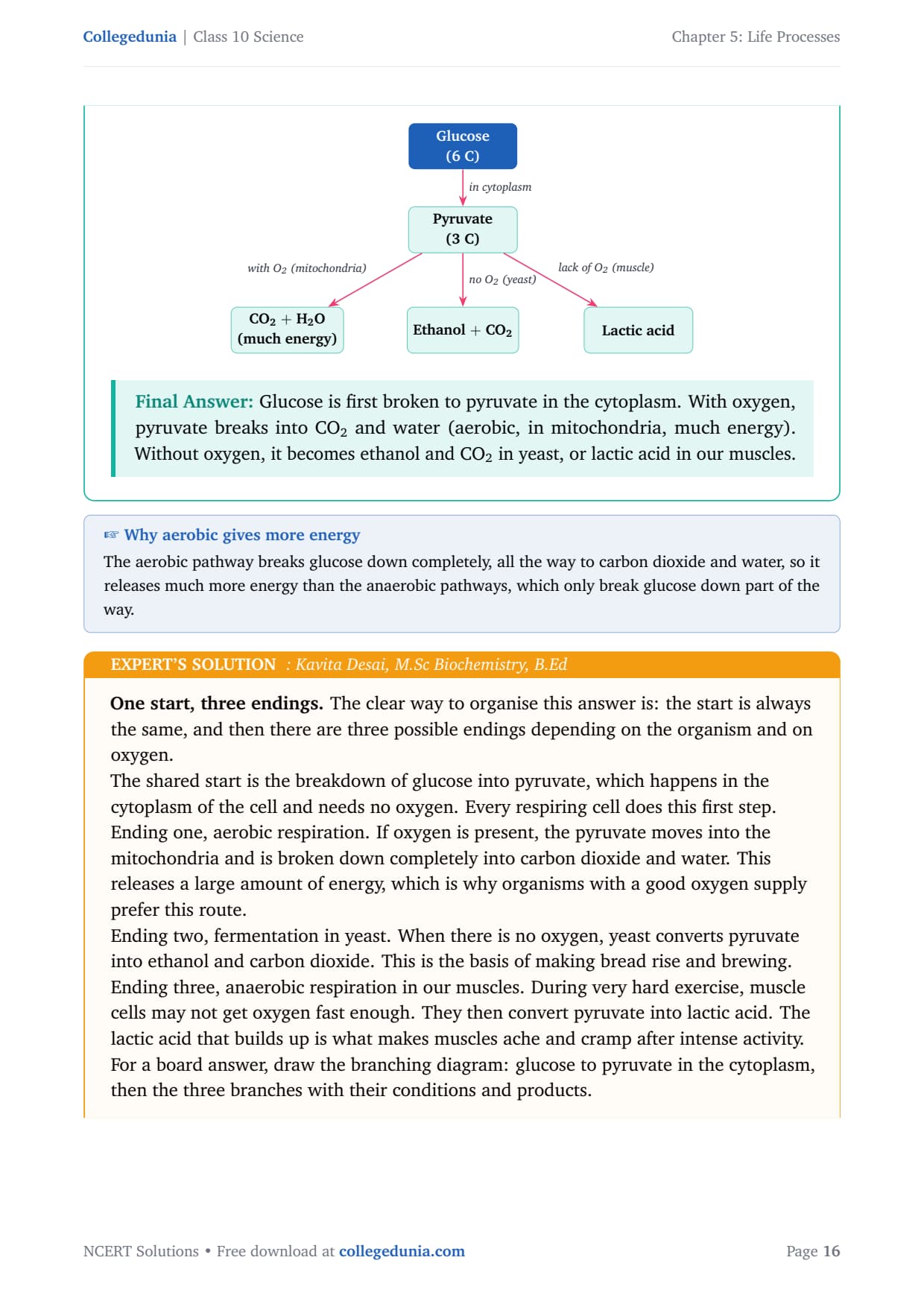
In respiration, glucose is broken down to release energy. The first step is the same in all cells: glucose (6 carbon) is broken in the cytoplasm into two molecules of pyruvate (3 carbon). After that, the path depends on oxygen.
Common first step. In the cytoplasm, glucose breaks into pyruvate; no oxygen needed.
Aerobic (with oxygen). Pyruvate goes into the mitochondria and breaks into carbon dioxide and water, releasing much energy.
Anaerobic in yeast (no oxygen). Pyruvate becomes ethanol and carbon dioxide (fermentation).
Anaerobic in muscles (lack of oxygen). During heavy exercise, pyruvate becomes lactic acid, which causes cramps.
Answer: Glucose first breaks to pyruvate in the cytoplasm. With oxygen it breaks into CO₂ and water (aerobic, mitochondria, much energy); without oxygen it becomes ethanol and CO₂ in yeast, or lactic acid in muscles.
KD
Kavita Desai
M.Sc Biochemistry, B.Ed
Verified Expert
Organise the answer as: one start, three endings.
The shared start is glucose to pyruvate in the cytoplasm, with no oxygen, in every respiring cell.
Aerobic: with oxygen, pyruvate breaks completely into CO₂ and water in the mitochondria, releasing a lot of energy.
Fermentation in yeast: with no oxygen, pyruvate becomes ethanol and CO₂.
Anaerobic in muscles: in oxygen-starved muscle, pyruvate becomes lactic acid, which makes muscles ache.
Answer: Glucose to pyruvate (cytoplasm) is common; then pyruvate goes to CO₂ + water with oxygen, to ethanol + CO₂ in yeast, or to lactic acid in oxygen-starved muscles.
Q 12
How is oxygen and carbon dioxide transported in human beings?
Both gases are carried by the blood. Oxygen is mostly carried by a red pigment in the red blood cells, while carbon dioxide, which dissolves easily, is mostly carried dissolved in the plasma.
Oxygen transport. The red blood cells contain haemoglobin, which has a high attraction for oxygen. It picks up oxygen in the lungs and releases it at the tissues.
Carbon dioxide transport. Carbon dioxide is much more soluble in water, so most of it is carried dissolved in the plasma from the tissues back to the lungs.
Answer: Oxygen is carried mainly by haemoglobin in red blood cells from the lungs to the tissues; carbon dioxide, being more soluble, is carried mostly dissolved in the plasma back to the lungs.
SM
Suresh Menon
M.Sc Biochemistry, B.Ed
Verified Expert
The interesting point is that the two gases are carried differently, and the reason lies in how well each dissolves in water.
Oxygen does not dissolve well, so red blood cells are packed with haemoglobin, which binds oxygen tightly in the lungs and unloads it in the tissues.
Carbon dioxide is much more soluble, so most of it simply dissolves into the plasma and is carried back to the lungs to be breathed out.
Answer: Oxygen is transported by haemoglobin in red blood cells; carbon dioxide, being more soluble, is transported mostly dissolved in the plasma.
Q 13
How are the lungs designed in human beings to maximise the area for exchange of gases?
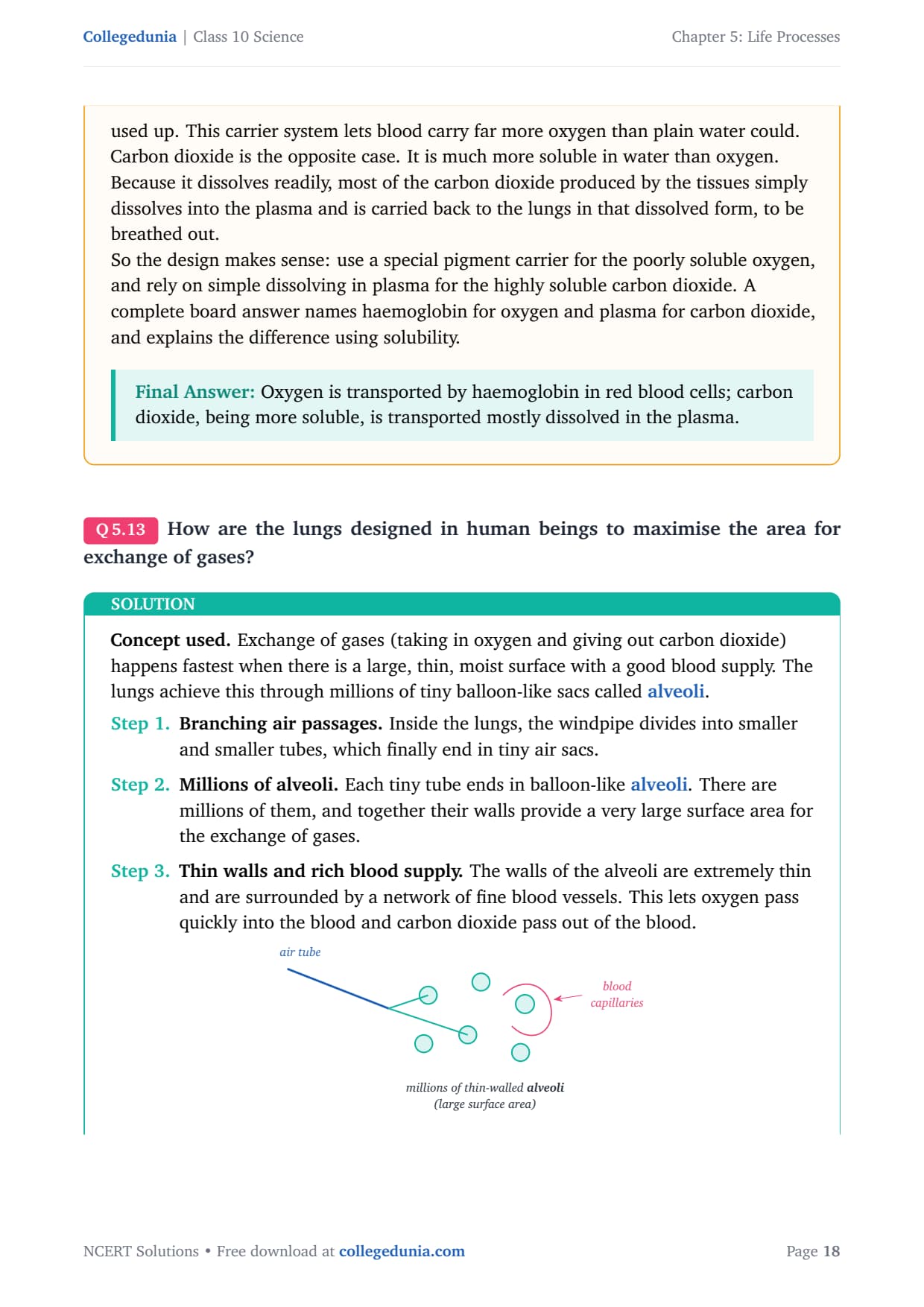
Gas exchange is fastest with a large, thin, moist surface that has a good blood supply. The lungs achieve this through millions of tiny balloon-like sacs called alveoli.
Branching air passages. The windpipe divides into smaller and smaller tubes ending in tiny air sacs.
Millions of alveoli. Each tube ends in balloon-like alveoli, whose walls together give a very large surface area.
Thin walls and rich blood supply. The alveoli walls are very thin and surrounded by fine blood vessels, so gases pass quickly.
Answer: The lungs hold millions of tiny thin-walled alveoli that give a very large surface area, each surrounded by fine blood vessels, so gases are exchanged quickly.
RG
Ramesh Gupta
M.Sc Zoology, B.Ed
Verified Expert
Three design features work together for one goal: large surface area, thin walls and a rich blood supply.
Surface area: the air tubes end in millions of alveoli whose total wall area is enormous.
Thin walls: each alveolus wall is about one cell thick, so the diffusion distance is tiny.
Blood supply: each alveolus is wrapped in a dense net of vessels, keeping the concentration difference high.
Answer: Branching air tubes end in millions of thin-walled alveoli that give a huge surface area, and a rich blood supply around them makes the exchange efficient.
Q 14
What are the components of the transport system in human beings? What are the functions of these components?
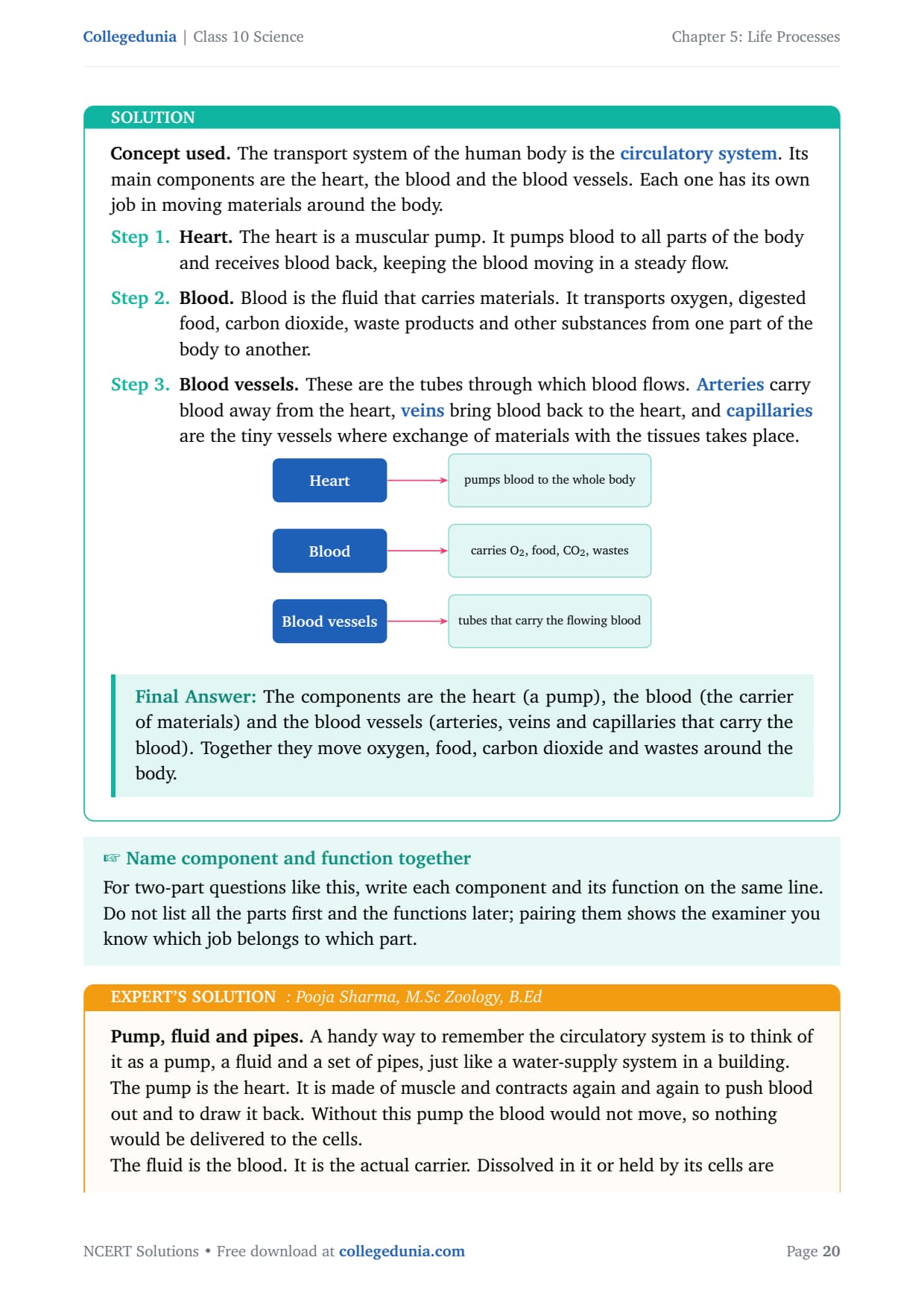
The transport system is the circulatory system. Its main components are the heart, the blood and the blood vessels.
Heart. A muscular pump that pumps blood to all parts of the body and receives it back.
Blood. The fluid that carries oxygen, digested food, carbon dioxide, wastes and other substances.
Blood vessels. Arteries carry blood away from the heart, veins bring it back, and capillaries are where exchange with the tissues happens.
Answer: The components are the heart (pump), the blood (carrier) and the blood vessels (arteries, veins, capillaries). Together they move oxygen, food, carbon dioxide and wastes around the body.
PS
Pooja Sharma
M.Sc Zoology, B.Ed
Verified Expert
Think of the circulatory system as a pump, a fluid and a set of pipes, like a water supply in a building.
The pump is the heart, made of muscle, which contracts to push blood out and draw it back.
The fluid is the blood, the actual carrier of oxygen, food, hormones, CO₂ and wastes.
The pipes are the vessels: thick-walled arteries away from the heart, veins back to it, and thin capillaries where the real exchange happens.
Answer: Heart (muscular pump), blood (fluid carrier) and blood vessels (arteries, veins, capillaries) circulate oxygen, food, carbon dioxide and wastes through the body.
Q 15
Why is it necessary to separate oxygenated and deoxygenated blood in mammals and birds?
Mammals and birds are warm-blooded: they have a high energy need and must keep a constant body temperature. Keeping oxygenated and deoxygenated blood separate makes the oxygen supply most efficient.
If the two kinds of blood mixed, the blood going to the body would carry less oxygen than the cells need.
Mammals and birds use a lot of energy to stay warm and active, so their cells need a steady, full supply of oxygen.
Keeping the blood apart means fully oxygenated blood always reaches the tissues.
Answer: Separating the two kinds of blood prevents mixing, so the body always receives fully oxygenated blood, which warm-blooded mammals and birds need for their high energy use and constant temperature.
AK
Anil Kulkarni
M.Sc Zoology, B.Ed
Verified Expert
Connect the heart design to the warm-blooded way of life.
Birds and mammals stay warm and active, so their cells respire fast and need a constant, generous oxygen supply.
If oxygenated and deoxygenated blood mixed, the body would get only partly oxygenated blood and could not keep up its energy or temperature.
So their hearts have a complete partition: oxygenated blood goes to the body, deoxygenated blood goes to the lungs, and the two never mix.
Answer: Because warm-blooded mammals and birds need a high, steady oxygen supply, keeping oxygenated and deoxygenated blood separate ensures fully oxygen-rich blood always reaches the body.
Q 16
What are the components of the transport system in highly organised plants?
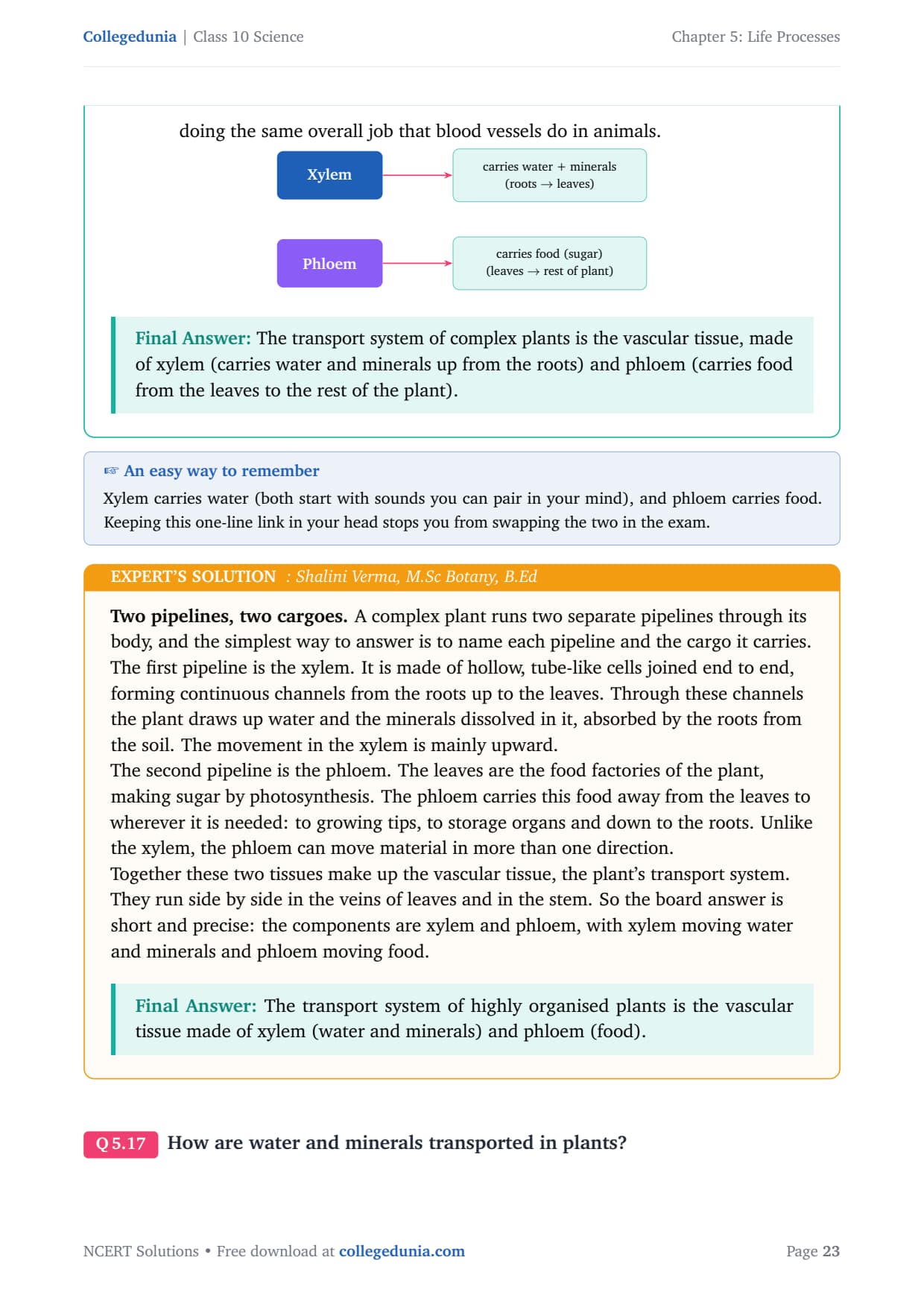
Highly organised plants have a special vascular tissue for transport, made of two conducting tissues: xylem and phloem.
Xylem. Carries water and dissolved minerals upward from the roots to the stem and leaves.
Phloem. Carries food (mainly sugar) made in the leaves to all other parts of the plant.
Together they form the transport system, doing the job that blood vessels do in animals.
Answer: The transport system of complex plants is the vascular tissue, made of xylem (carries water and minerals up) and phloem (carries food to the rest of the plant).
SV
Shalini Verma
M.Sc Botany, B.Ed
Verified Expert
A complex plant runs two separate pipelines, so name each pipeline and the cargo it carries.
The xylem is made of hollow tube-like cells from roots to leaves, drawing up water and dissolved minerals, mainly upward.
The phloem carries the sugar made in the leaves to growing tips, storage organs and roots, and can move in more than one direction.
Answer: The transport system of highly organised plants is the vascular tissue made of xylem (water and minerals) and phloem (food).
Q 17
How are water and minerals transported in plants?
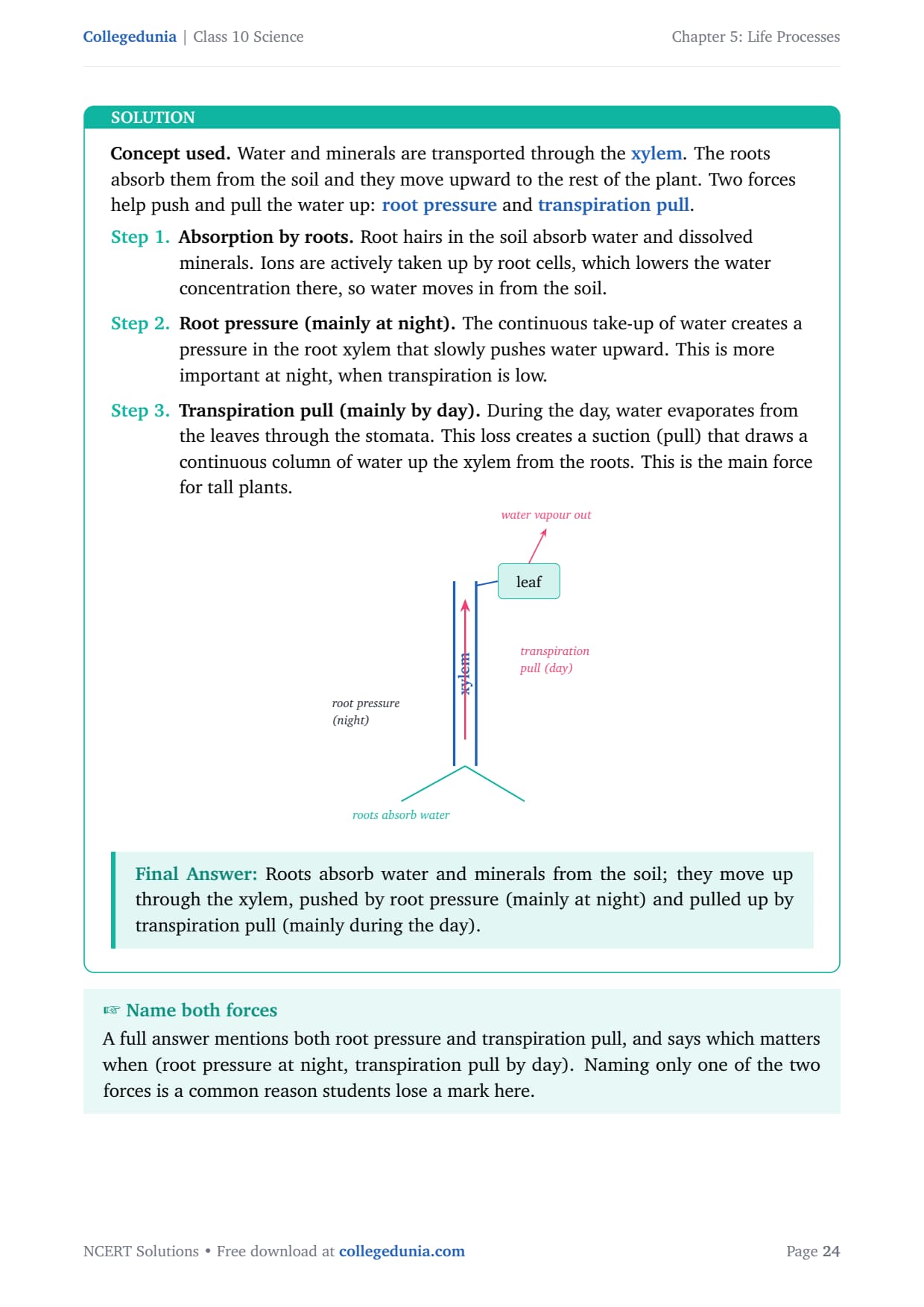
Water and minerals are transported through the xylem, upward from the roots. Two forces help: root pressure and transpiration pull.
Absorption by roots. Root hairs absorb water and minerals; ions are actively taken up, so water moves in from the soil.
Root pressure (mainly at night). The continuous take-up of water creates a pressure that slowly pushes water up the xylem.
Transpiration pull (mainly by day). Water evaporates from the leaves through the stomata, creating a suction that draws water up the xylem; the main force in tall plants.
Answer: Roots absorb water and minerals; they move up the xylem, pushed by root pressure (mainly at night) and pulled up by transpiration pull (mainly by day).
MR
Manish Rao
M.Sc Botany, M.Ed
Verified Expert
Picture a push from the roots combined with a pull from the leaves, both acting on the water in the xylem.
Root cells actively take in ions, so water flows in by osmosis, building up root pressure that pushes water up, best at night.
By day, water evaporating from the leaves tugs on the water column (because water molecules stick together), pulling a continuous thread of water up even to the top of a tall tree.
Answer: Roots absorb water and minerals, which rise through the xylem; root pressure pushes water up at night, and transpiration pull draws it up during the day, the main force in tall plants.
Q 18
How is food transported in plants?
Food made in the leaves is transported by the phloem. This movement is called translocation, it uses energy, and it can move food in any direction.
Where it starts. Food (mainly sugar) is made in the leaves and must reach growing tips, fruits, seeds and roots.
Loading with energy. Food is loaded into the phloem using energy from ATP, raising the food concentration.
Movement by pressure. Water then enters the phloem, raising the pressure, which pushes the food to areas of lower pressure where it is needed.
Any direction. Because it uses energy and pressure, food can move up, down or sideways.
Answer: Food (sugar) is transported through the phloem by translocation: it is loaded using ATP, water enters and raises the pressure, and this pressure pushes the food in any required direction.
RP
Rekha Pillai
M.Sc Botany, B.Ed
Verified Expert
Food transport differs from water transport in one big way: it needs energy, so make the active nature clear.
The plant uses ATP to load sugar into the phloem, which makes the sugar concentration high.
Water then moves in by osmosis, raising the pressure, which pushes the sugary fluid from high pressure (near leaves) to low pressure (where food is used or stored).
Because the system is driven by energy and pressure, food can travel up to a shoot or down to the roots.
Answer: Food is transported in the phloem by translocation: sugar is loaded using ATP, water enters and raises the pressure, and this pressure drives the food in any direction.
Q 19
Describe the structure and functioning of nephrons.
A nephron is the basic filtering unit of the kidney. Each kidney has very many nephrons. A nephron filters blood, takes back useful substances, and turns the rest into urine.
Structure. Each nephron has a cup-shaped Bowman's capsule holding a bunch of capillaries called the glomerulus, leading to a long coiled tubule.
Filtration. Blood enters the glomerulus under pressure; water, glucose, salts and urea are filtered into Bowman's capsule, while blood cells and large proteins stay behind.
Selective reabsorption. As the filtrate flows along the tubule, useful substances (glucose, most water, amino acids, some salts) are reabsorbed into the blood.
Urine formation. The leftover urea, extra salts and water form urine, which flows to the ureter and bladder.
Answer: A nephron is the kidney's filtering unit: a Bowman's capsule holding a glomerulus, joined to a long tubule. Blood is filtered in the glomerulus, useful substances are reabsorbed in the tubule, and the remaining waste leaves as urine.
HI
Harish Iyer
M.Sc Zoology, B.Ed
Verified Expert
Learn the nephron as a three-stage machine: filter, recover, drain.
Filtration: blood at high pressure in the glomerulus pushes small molecules (water, glucose, amino acids, salts, urea) into Bowman's capsule; cells and proteins are too big and stay in the blood.
Selective reabsorption: along the tubule, nearly all glucose, most water, amino acids and useful salts are taken back into the blood.
Urine formation: what remains (mainly urea, excess salts and water) is urine, draining to the ureter and bladder.
For full marks, draw a labelled nephron and describe these three stages.
Answer: Each nephron filters blood in the glomerulus, recovers useful substances along the tubule by selective reabsorption, and drains the leftover urea, salts and water as urine.
Q 20
What are the methods used by plants to get rid of excretory products?
Plants have no special excretory system. They make less harmful waste and remove it slowly by several simple methods.
Gaseous wastes. Oxygen and carbon dioxide are removed through the stomata and root surfaces.
Storage in cells. Many wastes are stored in cell vacuoles, where they do no harm.
As gum and resin. Some wastes are stored as gums and resins, often in old xylem.
In falling parts. Wastes are also removed when the plant sheds leaves or old bark.
Into the soil. Some waste products are released from the roots into the soil.
Answer: Plants remove gaseous wastes through stomata and roots, store other wastes in vacuoles or as gum and resin, shed leaves and bark, and release some wastes into the soil.
SB
Sneha Banerjee
M.Sc Botany, B.Ed
Verified Expert
A plant has no single excretory organ, so the answer is a short list with a one-line reason for each method.
Gases: carbon dioxide and oxygen diffuse out through stomata and root surfaces.
Storage: many wastes are locked away in the large vacuoles of plant cells.
Gums and resins: some wastes are deposited in old xylem, like the resin of pine trees.
Shedding: a plant loses waste when it drops old leaves and bark.
Into soil: some wastes are released from the roots.
Answer: Plants remove wastes by diffusing out gases, storing wastes in vacuoles or as gum and resin, shedding leaves and bark, and releasing some wastes into the soil.
Q 21
How is the amount of urine produced regulated?
The amount of urine depends on how much water needs to be removed and how much dissolved waste is present. The body adjusts it by controlling how much water is reabsorbed in the kidney tubules.
Depends on water in the body. Plenty of water means less reabsorption and more dilute urine; little water means more reabsorption and a small amount of concentrated urine.
Depends on dissolved wastes. The amount of waste, such as urea, to be flushed out also affects urine volume.
Control by reabsorption. The tubule decides how much water to take back, and so regulates the urine volume.
Answer: The kidney regulates urine through how much water it reabsorbs, based on the excess water and dissolved waste the body has to remove; more reabsorption gives less, concentrated urine.
VS
Vivek Saxena
M.Sc Zoology, B.Ed
Verified Expert
The kidney does not just remove waste; it manages the body's water, and the urine volume is the result.
Two factors set the volume: how much water the body has, and how much dissolved waste (mainly urea) must leave dissolved in water.
Control happens in the tubule: reabsorbing a lot of water gives a small amount of concentrated urine; reabsorbing little water gives a large amount of dilute urine.
This is why you pass less, darker urine on a hot day, when the body holds on to water.
Answer: The kidney regulates urine volume by adjusting how much water it reabsorbs from the filtrate, based on the body's excess water and dissolved waste.
Q 22
The kidneys in human beings are a part of the system for
Excretion is the removal of harmful waste made by the body's chemical activities. We must identify which life process the kidneys belong to.
The kidneys filter the blood and remove the waste urea (with extra salts and water) as urine.
Removing waste is the life process called excretion.
So the kidneys are part of the excretory system.
Answer: (c) excretion.
NR
Neha Reddy
M.Sc Zoology, B.Ed
Verified Expert
Test each option against what the kidney actually does.
Nutrition is food intake and digestion, not the kidney, so (a) is out.
Respiration is the job of lungs and mitochondria, so (b) is out.
Transportation is the job of the heart, blood and vessels, so (d) is out.
That leaves excretion: the kidney filters blood and removes urea as urine, which is the definition of excretion.
Answer: (c) excretion, because the kidneys remove the nitrogenous waste urea from the blood as urine.
Q 23
The xylem in plants are responsible for
(a) transport of water. (b) transport of food. (c) transport of amino acids. (d) transport of oxygen.
The xylem is one of the two conducting tissues. We recall what the xylem carries, as against the phloem.
The xylem carries water and dissolved minerals upward from the roots to the leaves.
The phloem, not the xylem, carries food (sugar), so options (b) and (c) belong to the phloem.
Plants have no blood-like system to carry oxygen, so (d) is wrong.
Answer: (a) transport of water.
AK
Asha Krishnan
M.Sc Botany, B.Ed
Verified Expert
This MCQ tests whether you can sort the plant's two pipelines by what they carry.
The xylem is the water pipeline: it moves water and dissolved minerals upward, pointing to option (a).
Transport of food and amino acids (b and c) is the work of the phloem, not the xylem.
Transport of oxygen (d) does not apply, because plants have no oxygen-carrying tissue.
Remember the rule: xylem equals water and minerals, phloem equals food.
Answer: (a) transport of water, since the xylem carries water and minerals upward while food is carried by the phloem.
Q 24
The autotrophic mode of nutrition requires
(a) carbon dioxide and water. (b) chlorophyll. (c) sunlight. (d) all of the above.
Autotrophic nutrition is the making of food by photosynthesis. We list everything this process needs.
Photosynthesis needs raw materials: carbon dioxide and water, so (a) is needed.
It needs chlorophyll to trap light energy, so (b) is needed.
It needs sunlight as the energy source, so (c) is needed.
Since all three are required, no single one is the complete answer.
Answer: (d) all of the above.
SP
Sanjay Patel
M.Sc Botany, M.Ed
Verified Expert
Recall the photosynthesis recipe and test each option against it. The word equation is: carbon dioxide plus water, with chlorophyll and sunlight, gives glucose and oxygen.
Option (a) gives the raw materials, needed but not the whole story.
Option (b) gives chlorophyll, needed but not enough alone.
Option (c) gives sunlight, the energy source, again needed but not by itself.
Since each of the first three is required and none is complete alone, the only fully correct choice is all of the above.
Answer: (d) all of the above, because photosynthesis needs carbon dioxide, water, chlorophyll and sunlight together.
Q 25
The breakdown of pyruvate to give carbon dioxide, water and energy takes place in
The complete breakdown of pyruvate into carbon dioxide and water, releasing much energy, is part of aerobic respiration. We recall where it happens.
Glucose is first broken into pyruvate in the cytoplasm (so (a) is only the earlier step).
The further breakdown of pyruvate, using oxygen, happens in the mitochondria, the powerhouse of the cell.
Chloroplasts do photosynthesis and the nucleus controls the cell; neither breaks down pyruvate.
Answer: (b) mitochondria.
PM
Priya Menon
M.Sc Biochemistry, B.Ed
Verified Expert
Respiration happens in two locations, so place each step where it belongs and read the question carefully.
Glucose to pyruvate happens in the cytoplasm without oxygen, which makes (a) a tempting distractor, but it is not the step asked about.
The breakdown of pyruvate to CO₂ and water with energy needs oxygen and happens in the mitochondria, matching (b).
Chloroplasts (c) make food, and the nucleus (d) does not respire.
Answer: (b) mitochondria, where pyruvate is completely broken down with oxygen into carbon dioxide and water, releasing energy.
Q 26
How are fats digested in our bodies? Where does this process take place?
Fats are large molecules that do not mix with water, so they are hard to digest. They are first broken into droplets (emulsification) by bile, then broken down by the enzyme lipase. This happens in the small intestine.
Fats reach the small intestine from the stomach.
Bile emulsifies the fats. Bile from the liver breaks large fat globules into tiny droplets, giving a larger surface for enzymes.
Lipase digests the fats. Lipase from pancreatic and intestinal juice breaks the droplets into fatty acids and glycerol.
Answer: Fats are first emulsified into small droplets by bile from the liver, then broken down by lipase into fatty acids and glycerol, all in the small intestine.
AB
Arun Bhat
M.Sc Biochemistry, B.Ed
Verified Expert
Fats need special treatment because they do not dissolve in water.
In the small intestine, the food contains large fat globules. A big globule has a small surface, so an enzyme alone would work slowly.
Bile (made by the liver, stored in the gall bladder) is not an enzyme; it emulsifies the globules into tiny droplets, greatly increasing the surface area.
Lipase then breaks the emulsified fat into fatty acids and glycerol, small enough to be absorbed.
The sequence is: bile emulsifies, then lipase digests, all in the small intestine.
Answer: Bile from the liver emulsifies fats into tiny droplets and lipase then digests them into fatty acids and glycerol, in the small intestine.
Q 27
What is the role of saliva in the digestion of food?
Saliva is the watery liquid made by the salivary glands. It contains the enzyme salivary amylase (ptyalin) and it also wets the food. It begins the digestion of starch.
Moistens and softens food. Saliva wets the food so it can be chewed and swallowed easily.
Begins starch digestion. Salivary amylase breaks down starch into sugar (maltose) while the food is still in the mouth.
Helps mixing. By wetting and mixing, saliva forms a soft ball of food (bolus) that moves easily down the food pipe.
Answer: Saliva moistens and softens the food and, with its enzyme salivary amylase, begins digesting starch into sugar in the mouth.
DN
Divya Nair
M.Sc Biochemistry, B.Ed
Verified Expert
Many students think digestion begins in the stomach, but chemical digestion of carbohydrates starts right in the mouth, thanks to saliva.
The physical role: saliva wets and softens dry food and helps roll it into a soft ball that slides down easily.
The chemical role: salivary amylase (ptyalin) acts on starch and breaks it into the simpler sugar maltose, finishing part of carbohydrate digestion before the food leaves the mouth.
This is why bread or rice begins to taste sweet if you chew it for a long time.
Answer: Saliva moistens and softens food for easy swallowing and, through salivary amylase, begins digesting starch into sugar in the mouth.
Q 28
What are the necessary conditions for autotrophic nutrition and what are its byproducts?
Autotrophic nutrition is the making of food by photosynthesis. Certain conditions must be present, and the process gives out certain by-products.
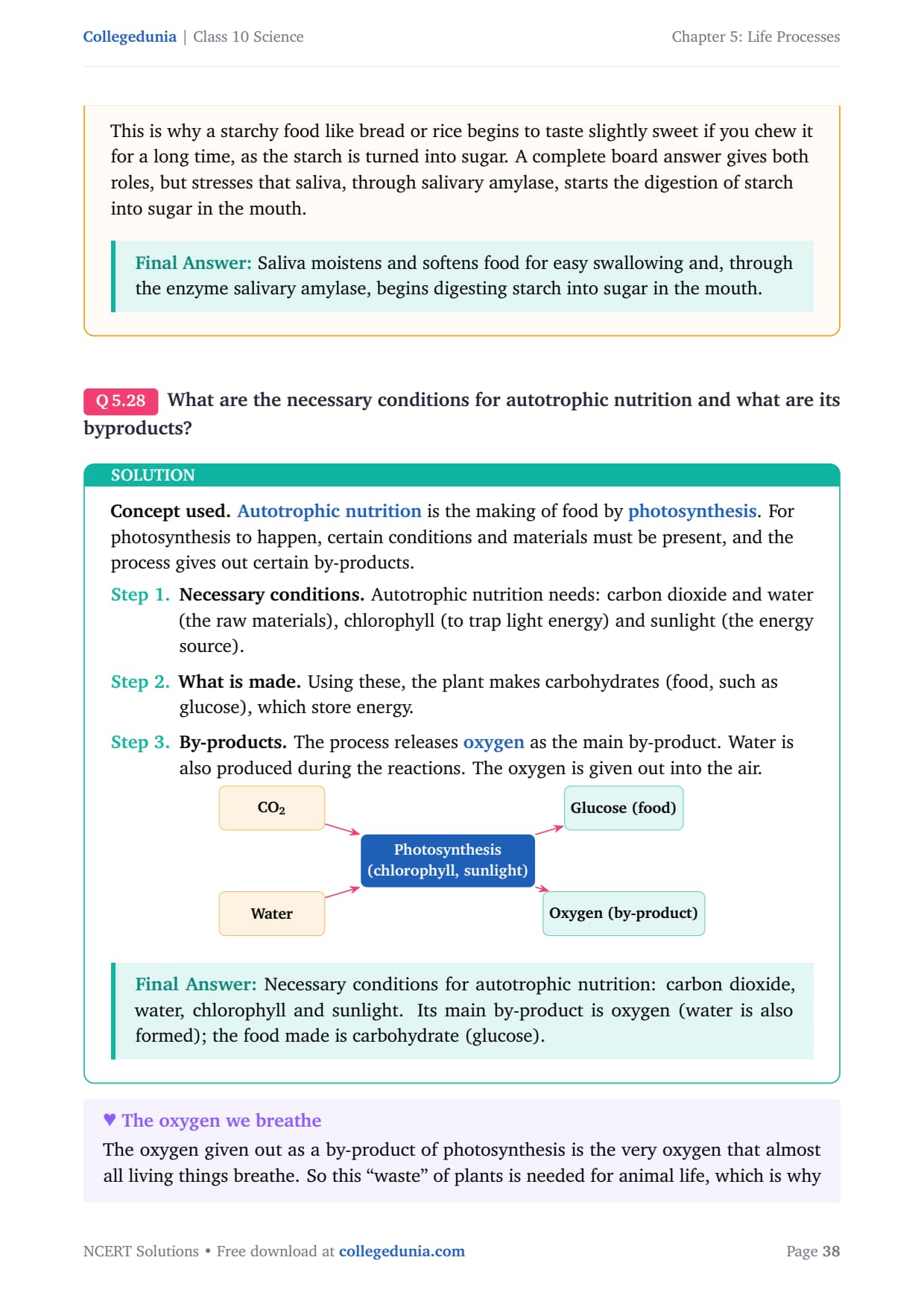
Necessary conditions. Carbon dioxide and water (raw materials), chlorophyll (to trap light) and sunlight (the energy source).
What is made. The plant makes carbohydrates (food, such as glucose), which store energy.
By-products. The main by-product is oxygen, released into the air; water is also produced during the reactions.
Answer: Necessary conditions: carbon dioxide, water, chlorophyll and sunlight. The main by-product is oxygen (water is also formed); the food made is carbohydrate.
MR
Mohan Reddy
M.Sc Botany, M.Ed
Verified Expert
The question has two halves, conditions and by-products, so split the answer cleanly.
Conditions: the raw materials carbon dioxide (from air) and water (from soil); chlorophyll, which captures light; and sunlight, the energy. If any one is missing, the plant cannot make food.
By-products: the chief one is oxygen, released through the stomata as water is split; water is also formed in the later reactions.
The useful product made is carbohydrate (glucose), which stores chemical energy.
Answer: Conditions: carbon dioxide, water, chlorophyll and sunlight. By-products: oxygen (released into the air) and water; the food formed is carbohydrate.
Q 29
What are the differences between aerobic and anaerobic respiration? Name some organisms that use the anaerobic mode of respiration.
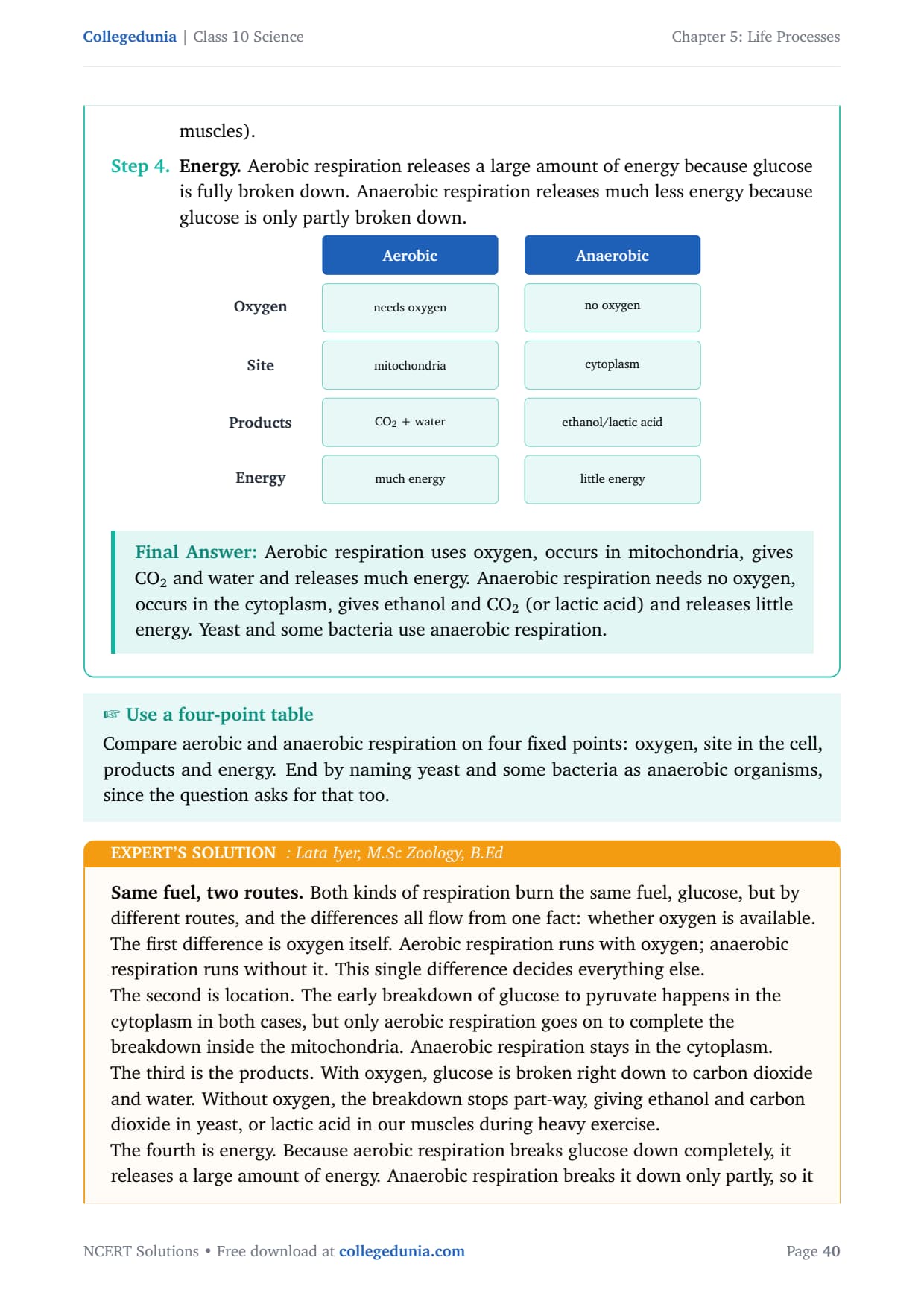
Aerobic respiration breaks food down using oxygen, while anaerobic respiration breaks it down without oxygen. They differ on four points.
Point
Aerobic
Anaerobic
Oxygen
Needs oxygen
No oxygen
Site
Mitochondria
Cytoplasm
Products
CO₂ + water
Ethanol + CO₂ (yeast) or lactic acid (muscles)
Energy
Much energy
Little energy
Answer: Aerobic respiration uses oxygen, occurs in mitochondria, gives CO₂ and water and releases much energy. Anaerobic respiration needs no oxygen, occurs in the cytoplasm, gives ethanol and CO₂ (or lactic acid) and releases little energy. Yeast and some bacteria use anaerobic respiration.
LI
Lata Iyer
M.Sc Zoology, B.Ed
Verified Expert
Both kinds burn the same fuel, glucose, but by different routes, and the differences flow from one fact: whether oxygen is available.
Oxygen: aerobic runs with oxygen, anaerobic without it.
Location: aerobic completes the breakdown in the mitochondria; anaerobic stays in the cytoplasm.
Products: with oxygen, CO₂ and water; without it, ethanol and CO₂ in yeast, or lactic acid in muscles.
Energy: aerobic releases much more because glucose is fully broken down.
Anaerobic respiration is used by yeast and by certain bacteria that live where there is no oxygen.
Answer: Aerobic: with oxygen, in mitochondria, gives CO₂ + water, much energy. Anaerobic: without oxygen, in cytoplasm, gives ethanol or lactic acid, little energy. Anaerobic organisms include yeast and some bacteria.
Q 30
How are the alveoli designed to maximise the exchange of gases?
Alveoli are the tiny air sacs at the ends of the smallest air tubes in the lungs. Gas exchange is fastest with a large, thin surface and a good blood supply, and the alveoli provide exactly this.
Balloon-like shape and large numbers. Each alveolus is a tiny balloon-like sac, and there are millions of them, giving a very large surface area.
Very thin walls. The walls are only one cell thick, so oxygen and carbon dioxide pass through quickly.
Rich blood supply. Each alveolus is wrapped in fine blood vessels, bringing blood very close to the air.
Answer: The alveoli are millions of tiny, thin-walled, balloon-like sacs that give a very large surface area, each surrounded by fine blood vessels, so gas exchange is fast and efficient.
KS
Kiran Shah
M.Sc Zoology, B.Ed
Verified Expert
Gas exchange across the alveoli happens by diffusion, so the whole design aims to make diffusion as fast as possible. Three features do this.
Large surface area: millions of tiny sacs together have a huge wall area, far more than a smooth bag of the same size.
Thin walls: a one-cell-thick wall keeps the diffusion distance tiny.
Rich blood supply: fresh blood keeps arriving, keeping the concentration difference high so diffusion stays strong.
Answer: Millions of balloon-like alveoli give a large surface area, their one-cell-thick walls keep the diffusion distance short, and their rich blood supply keeps gas exchange fast.
Q 31
What would be the consequences of a deficiency of haemoglobin in our bodies?
Haemoglobin is the red pigment in red blood cells that carries oxygen. If there is too little, the blood cannot carry enough oxygen, which harms the whole body.
Less oxygen is carried. With less haemoglobin, the blood carries less oxygen to the tissues.
Cells get less energy. With less oxygen, cells release less energy by respiration, so the body becomes weak and tired.
Symptoms appear. The person feels weak, tired and breathless, and the skin may look pale. This is called anaemia.
Answer: A deficiency of haemoglobin means the blood carries less oxygen, so cells get less energy and the person becomes weak, tired and breathless, a condition called anaemia.
NG
Nisha Gupta
M.Sc Biochemistry, B.Ed
Verified Expert
Follow a chain: less haemoglobin leads to less oxygen, which leads to less energy, which leads to the symptoms.
Haemoglobin is the oxygen carrier of the blood; the oxygen the blood can carry depends directly on how much haemoglobin it has.
With less of it, the tissues get less oxygen even if breathing and blood flow are normal.
Cells then release less energy, so the body tires easily and feels breathless, and the skin looks pale.
This condition is anaemia. Since haemoglobin is built using iron, doctors advise iron-rich foods.
Answer: Too little haemoglobin means the blood carries less oxygen, cells release less energy, and the person becomes weak, tired, breathless and pale, the condition called anaemia.
Q 32
Describe double circulation of blood in human beings. Why is it necessary?
Double circulation means the blood passes through the heart twice in one complete round. There are two circuits: heart to lungs, and heart to body.
Pulmonary circulation (heart to lungs). Deoxygenated blood enters the right side of the heart and is pumped to the lungs, where it picks up oxygen.
Systemic circulation (heart to body). Oxygenated blood returns to the left side of the heart, which pumps it to all parts of the body.
Two passes per round. The blood goes through the heart once for the lungs and again for the body, so it passes through twice.
Why necessary. The two sides are fully separated, so oxygenated and deoxygenated blood do not mix, giving a high, efficient oxygen supply needed by warm-blooded humans.
Answer: In double circulation the blood passes through the heart twice per round, once on the heart-lung circuit and once on the heart-body circuit. It is necessary to keep oxygenated and deoxygenated blood separate, so the body always gets a high, efficient oxygen supply.
RV
Rohit Verma
M.Sc Zoology, B.Ed
Verified Expert
Follow one drop of blood around its full journey and count how many times it passes through the heart.
Deoxygenated blood from the body enters the right side; the heart pumps it to the lungs. That is the first pass. In the lungs it takes up oxygen.
This oxygen-rich blood returns to the left side; the heart pumps it to the whole body. That is the second pass.
So in one round the blood goes through the heart twice. Because the heart is fully divided, the two streams never mix, so the body always gets fully oxygenated blood, which warm-blooded humans need to stay warm and active.
Answer: Blood passes through the heart twice each round, once for the lungs and once for the body. This keeps oxygenated and deoxygenated blood from mixing, giving the body the high, efficient oxygen supply that warm-blooded humans need.
Q 33
What are the differences between the transport of materials in xylem and phloem?
Xylem and phloem are the two conducting tissues of a plant. They differ in what they carry, the direction, and whether they use energy.
Point
Xylem
Phloem
Carries
Water and minerals
Food (sugar)
Direction
Mostly upward
Any direction
Energy
Little (physical forces)
Uses energy (ATP)
Answer: Xylem carries water and minerals mostly upward, using physical forces (root pressure, transpiration pull) with little energy. Phloem carries food in any direction and uses energy (ATP) to do so.
SD
Sunita Desai
M.Sc Botany, M.Ed
Verified Expert
The two transport tissues differ in three clear ways, so set the answer out as three contrasts.
Cargo: the xylem is the water tissue (water and minerals); the phloem is the food tissue (sugar from the leaves).
Direction: the xylem flows mainly upward, where water evaporates; the phloem can go in any direction, to tips above and roots below.
Energy: the xylem is driven by physical forces (root pressure, transpiration pull) with little energy; the phloem actively uses ATP to load food.
Answer: Xylem carries water and minerals upward using mostly physical forces and little energy; phloem carries food in any direction and uses ATP energy to do so.
Q 34
Compare the functioning of alveoli in the lungs and nephrons in the kidneys with respect to their structure and functioning.
Alveoli are the tiny air sacs where gases are exchanged, and nephrons are the tiny filtering units of the kidney. They do different jobs but share a similar design.
Similarities. Both have very thin walls and a rich blood supply, and both are present in very large numbers; in both, materials are exchanged with the blood through thin walls.
Alveoli. Each is a thin balloon-like sac surrounded by blood vessels; its job is the exchange of gases (oxygen in, carbon dioxide out).
Nephron. Each has Bowman's capsule with a glomerulus and a long tubule; its job is the filtration of blood and forming urine.
Main difference. Alveoli carry out gas exchange for respiration, while nephrons filter blood for excretion.
Answer: Both alveoli and nephrons are tiny, thin-walled, richly supplied with blood and present in large numbers, which makes exchange efficient. Alveoli exchange gases (respiration), while nephrons filter blood and form urine (excretion).
AK
Aravind Kumar
M.Sc Zoology, B.Ed
Verified Expert
The neat insight is that the body uses the same design idea for two very different tasks.
Shared design: both are tiny units built in huge numbers, with very thin walls and a rich net of blood vessels, which lets each organ handle a large amount of material efficiently.
Structures: an alveolus is a thin balloon-like air sac; a nephron is more elaborate, a Bowman's capsule with a glomerulus leading into a long coiled tubule.
Jobs: the alveolus exchanges gases (respiration); the nephron filters waste, reabsorbs the useful materials and forms urine (excretion).
Answer: Alveoli and nephrons are both many, thin-walled and richly supplied with blood, making exchange efficient; but alveoli exchange gases for respiration while nephrons filter blood for excretion.
NCERT Solutions Class 10 Science Chapter 5 Life Processes FAQs
Ques. How many questions are there in NCERT Class 10 Science Chapter 5 Life Processes?
Ans. There are 34 questions in NCERT Class 10 Science Chapter 5 Life Processes: 21 in-text questions in the boxes inside the chapter and 13 end-of-chapter exercise questions. All 34 are solved with a step-by-step Check Solution and an Expert Solution. The exercise set includes four MCQs (on the kidney, xylem, autotrophic nutrition and pyruvate breakdown) and long-answer questions on fat digestion, double circulation and the nephron.
Ques. What are the four life processes in Class 10 Science Chapter 5?
Ans. The four essential life processes are nutrition, respiration, transportation and excretion. Nutrition takes in or makes food, respiration breaks the food down to release energy, transportation carries materials around the body, and excretion removes the harmful wastes made by the body's reactions. Together they supply, use, move and clear materials, which is why a living body needs all four working at once.
Ques. What is the difference between aerobic and anaerobic respiration?
Ans. Aerobic respiration uses oxygen, takes place in the mitochondria, gives carbon dioxide and water, and releases a lot of energy. Anaerobic respiration takes place without oxygen, in the cytoplasm, gives ethanol and carbon dioxide in yeast or lactic acid in our muscles, and releases much less energy. The first step, glucose breaking into pyruvate in the cytoplasm, is the same for both. Yeast and some bacteria use the anaerobic mode of respiration.
Ques. How do xylem and phloem differ in Class 10 Science?
Ans. Xylem carries water and dissolved minerals upward from the roots to the leaves, using physical forces (root pressure and transpiration pull) with little energy. Phloem carries food, mainly sugar made in the leaves, in any direction the plant needs, and uses energy from ATP to load the food, a process called translocation. The simple way to remember it is: xylem carries water up, phloem carries food in any direction.
Ques. Describe the structure and functioning of a nephron.
Ans. A nephron is the filtering unit of the kidney. It has a cup-shaped Bowman's capsule holding a ball of capillaries called the glomerulus, joined to a long coiled tubule. It works in three stages: filtration (blood is filtered in the glomerulus under pressure, leaving cells and proteins behind), selective reabsorption (useful substances like glucose and most water are taken back into the blood along the tubule), and urine formation (the leftover urea, salts and water leave as urine). Drawing a labelled nephron earns extra marks.
Ques. Why is double circulation necessary in human beings?
Ans. Double circulation means the blood passes through the heart twice in one complete round, once on the heart-lung circuit and once on the heart-body circuit. It is necessary because the two sides of the heart are fully separated, so oxygenated and deoxygenated blood never mix. This keeps the oxygen supply to the body high and efficient, which warm-blooded humans need because they use a lot of energy and must keep a constant body temperature.
Ques. How many pages is the Class 10 Science Life Processes NCERT Solutions PDF?
Ans. The Life Processes NCERT Solutions PDF covers all 34 questions (21 in-text and 13 exercise) with step-by-step Check Solutions, labelled diagrams of the nephron, alveoli and heart, and an Expert Solution for each question. It is free to download for the 2026-27 session and is built for the CBSE Class 10 board exam.
Ques. Is the NCERT Solutions for Class 10 Science Chapter 5 aligned with the 2026-27 syllabus?
Ans. Yes. This page reflects the current 2026-27 CBSE syllabus for Class 10 Science. Every answer follows the NCERT textbook flow for Life Processes, covering nutrition, respiration, transportation and excretion. The solutions are written in plain English for board exam students and are useful for both the CBSE board exam and school unit tests.








Comments