The NCERT Solutions for Class 10 Science Chapter 13 Our Environment cover all 16 questions (7 in-text and 9 exercise questions), written for the 2026-27 CBSE syllabus.
Every answer follows the textbook flow: how an ecosystem is built, how energy moves through food chains and trophic levels, why only about 10% of energy passes to the next level, how biological magnification works, and the two big human problems of ozone-layer damage and waste disposal.
All 16 NCERT questions solved with clear steps, labelled food-chain diagrams, comparison points, and an Expert Solution per question that adds board-exam strategy.
Full coverage of trophic levels, decomposers, the ten percent law, biological magnification, biodegradable and non-biodegradable waste, and the ozone layer (CFCs and the Montreal Protocol) that the CBSE board paper tests directly.
Answers are aligned with the 2026-27 CBSE Class 10 Science syllabus, written in plain English for board exam students.
Solved by Collegedunia Science Experts
These NCERT Solutions for Class 10 Science Chapter 13 Our Environment are checked against the latest 2026-27 NCERT textbook and refined against the last five years of CBSE board papers. Each of the 16 questions gives a Check Solution for the clean board answer and an Expert Solution for extra marks.
What the NCERT Solutions for Class 10 Science Chapter 13 Our Environment Cover
This chapter answers one question: how do living and non-living things work together, and how do human actions disturb that balance? These solutions follow the NCERT order while filling the gaps students hit in exams.
Ecosystem and its parts: an ecosystem is the living (biotic) and non-living (abiotic) things of an area working as one unit, with producers, consumers and decomposers.
Food chains and trophic levels: each feeding step is a trophic level, and many chains link to form a food web.
Energy flow: energy flow is one-way, and only about 10% passes to the next level, which is why food chains are short.
Human impact: biological magnification of non-degradable toxins, damage to the ozone layer by CFCs, and the disposal of biodegradable and non-biodegradable waste.
Question Breakdown of the Our Environment Chapter NCERT Solutions
Chapter 13 carries 7 in-text questions and 9 exercise questions. The table below maps each topic to its answer style and typical mark weight.
Topic
What it tests
Answer style
Typical marks
Trophic levels
Define; give a food chain example
Label each organism with level and role
2 to 3 marks
Decomposers
Role of bacteria and fungi
Cleaning plus nutrient recycling
2 to 3 marks
Biodegradable vs non-biodegradable
Why some matter decays, some does not
Enzyme specificity, one example each
3 marks
Effects of waste
Two effects of each type
One health, one pollution effect
2 marks each
Removing a trophic level
Effect up and down the chain
Starvation above, overpopulation below
3 marks
Biological magnification
Definition; difference by level
Lowest in producers, highest in top consumers
3 marks
Ozone layer
What it is; why damage matters
UV shield, CFCs, Montreal Protocol
3 to 5 marks
The reasoning questions and the long-answer ozone question carry the heaviest marks. Drawing a clear food chain and naming each trophic level scores full marks.
Ecosystem, Producers, Consumers and Decomposers
An ecosystem is all the living organisms (biotic) of an area together with the non-living surroundings (abiotic: soil, water, air, sunlight), working as one unit. Organisms fall into three groups by how they get food.
Producers: green plants and some bacteria that make their own food; the base of every food chain.
Consumers: animals that eat producers or other animals (herbivores, carnivores, omnivores).
Decomposers: bacteria and fungi that break down dead matter and return nutrients to the soil.
So decomposers are nature's recyclers: without them, nutrients would stay locked in dead matter and the soil would lose fertility. The three groups together keep materials cycling.
Quick Tip: When describing decomposers, give both roles: they clean up dead matter and recycle nutrients back to the soil.
Food Chains, Food Webs and Trophic Levels in an Ecosystem
A food chain is a series of organisms where each is eaten by the next, passing food and energy along. Each feeding step is a trophic level. It always starts with a producer, and the arrow points from the eaten to the eater.
T1: producers (green plants).
T2: herbivores (primary consumers), which eat plants.
T3: small carnivores (secondary consumers), which eat herbivores.
T4: large carnivores (tertiary consumers), which eat smaller carnivores.
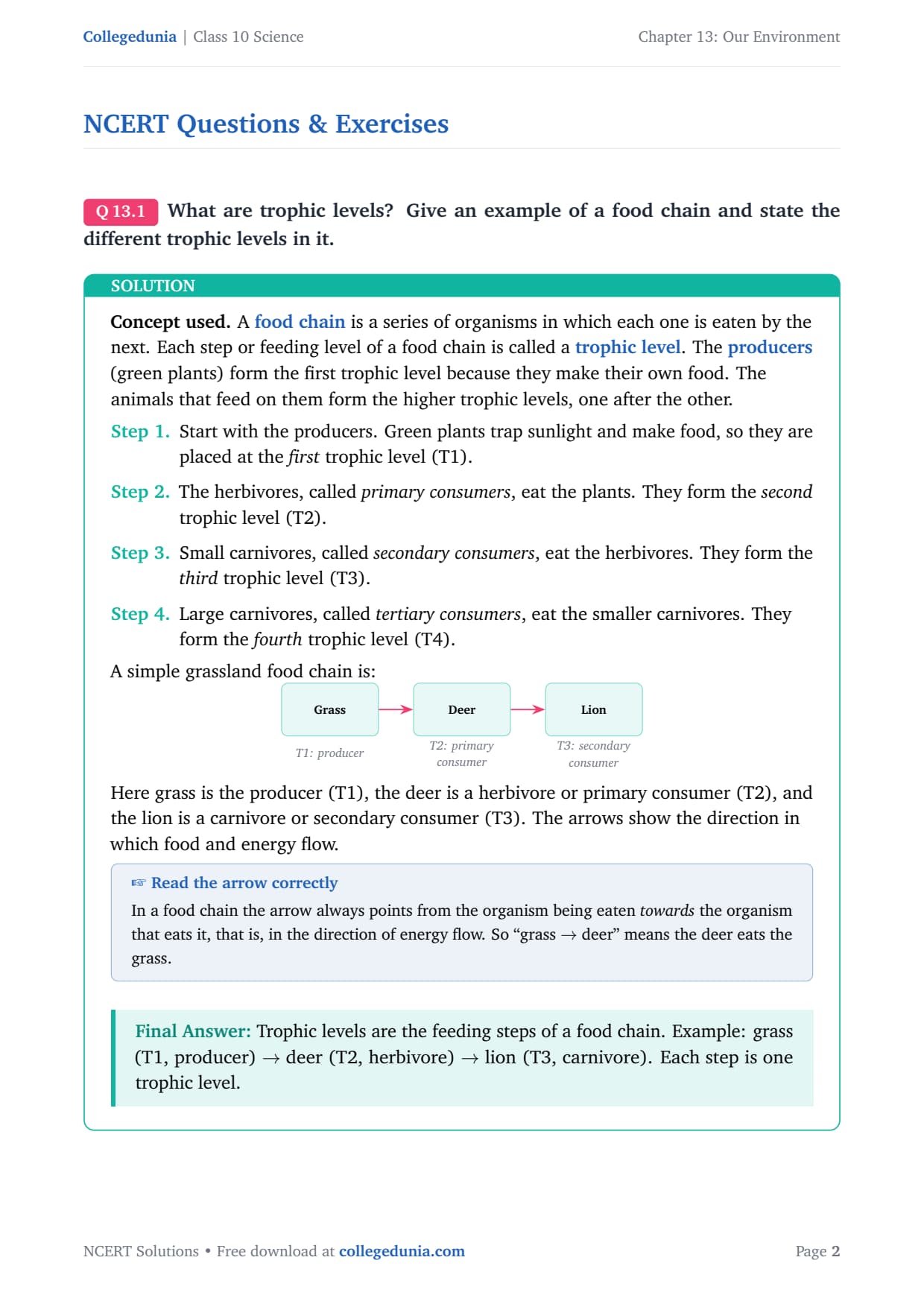
A simple chain is grass (T1) → deer (T2) → lion (T3). Since animals eat varied food, chains cross to form a food web. So a food web is many interconnected food chains, making the ecosystem more stable than a single chain.
Watch Out: A producer is always the first trophic level. If a food chain you write starts with an animal, a producer has been left out by mistake. Every natural food chain must begin with a green plant.
Energy Flow and the Ten Percent Law
Energy enters through producers that trap sunlight, then moves up the food chain. Two rules decide how it behaves, and the board tests both.
Energy flow is one-way
Energy flows one way: Sun to producers to herbivores to carnivores, never back. This is why an ecosystem needs a constant supply of energy from the Sun.
The ten percent law (10% of energy)
Only about 10% of the energy at one level passes to the next; the other 90% is lost as heat during respiration and movement.
Trophic level
Energy available (example)
What happens to the rest
Producers (T1)
10000 J
Base of the chain
Herbivores (T2)
1000 J
90% lost as heat
Small carnivores (T3)
100 J
90% lost again
Top consumers (T4)
10 J
Very little left
So because so much energy is lost at each step, little is left after three or four levels, which is why food chains are short. A fifth trophic level is rare in nature.
Biological Magnification Up the Food Chain
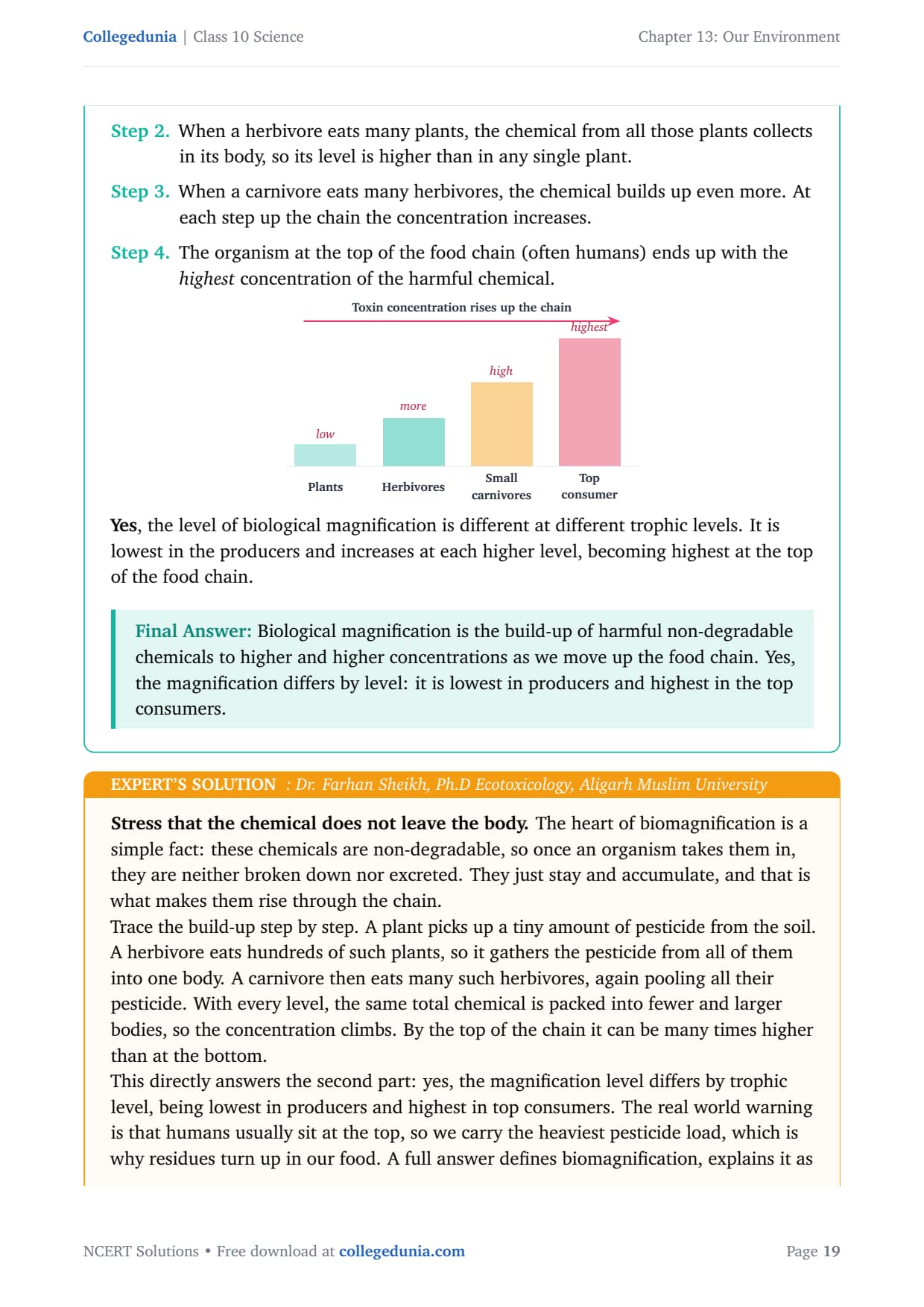
Biological magnification is the rise in concentration of harmful, non-degradable chemicals (such as pesticides) as we move up the trophic levels. Because they are not broken down or excreted, they build up at each higher level.
The build-up runs step by step: plants take in a little pesticide, a herbivore eats many plants and pools it, a carnivore eats many herbivores and pools it again. The top organism, often humans, ends with the highest load.
Trophic level
Toxin concentration
Producers (plants)
Lowest
Herbivores
More
Small carnivores
High
Top consumer (often humans)
Highest
So magnification differs by trophic level: lowest in producers, highest in top consumers. Only non-degradable, fat-soluble chemicals magnify.
Ozone Layer, CFCs and Waste Management
Ozone (O3) high in the atmosphere forms the ozone layer, which absorbs most of the Sun's harmful UV rays. Ozone is harmful to breathe at ground level but life-saving high up.
How ozone forms: UV splits O2 → O + O, and free atoms join O2 → O3.
Why damage matters: more UV causes skin cancer and cataracts, lowers crop yields, and kills ocean plankton.
Cause and cure: man-made CFCs damaged the layer; the 1987 Montreal Protocol cut CFC production.
The second problem is waste disposal. Biodegradable waste (food, paper, wood) is broken down by microbes; non-biodegradable waste (plastic, glass, metal) is not, so it piles up.
Waste type
Examples
Main concern
Biodegradable
Fruit peels, paper, wood
Foul smell, disease, gases in large heaps
Non-biodegradable
Plastic, glass, metal
Pollute soil and water, cause biomagnification
The simplest help is the 3 R's: Reduce, Reuse and Recycle, and always separate biodegradable from non-biodegradable waste.
Common Mistakes Students Make in the Our Environment Chapter
The repeat-offender mistakes in Our Environment board answers:
Not labelling trophic levels: writing only "grass, deer, lion" without the level number and role usually loses a mark. Label every organism.
Calling biodegradable waste fully harmless: in large amounts it still causes smell, disease, methane and oxygen loss in water.
Reversing biological magnification: the toxin is lowest in producers and highest in top consumers, not the other way round.
Forgetting the two faces of ozone: ozone is a poison at ground level but a protective UV shield high in the atmosphere.
Giving vague waste tips: write concrete actions (cloth bag, segregate, compost), not just "keep the environment clean".
How to Use the Our Environment NCERT Solutions PDF for Board Prep
Our Environment is short but reasoning-heavy. Use two passes: one for key terms, one for the reasoning questions by hand.
First pass: the key terms (1 hour)
Note the meaning of ecosystem, producer, consumer, decomposer, trophic level, food chain, food web, biological magnification, ozone, biodegradable and non-biodegradable, one line each.
Second pass: the reasoning questions (1.5 to 2 hours)
Work the "remove a trophic level", biological magnification and ozone questions on paper. Check your reasoning against these solutions, as the exact points (effect up and down the chain, toxin direction, UV harms) decide full marks.
Board exam angle
Our Environment reliably gives a food-chain or trophic-level question, a biological-magnification question, and a long-answer ozone or waste question. The reasoning questions here are exactly what the board reuses.
Other Resources for Class 10 Science Chapter 13 Our Environment
Pair this NCERT Solutions PDF with the matching revision notes, handwritten notes and the official NCERT book chapter. All resources for Class 10 Science Chapter 13 Our Environment are linked below.
Resource
What it covers
Open
NCERT Solutions
Step-by-step answers to all 16 questions, with an Expert Solution for each.
You are here
Notes
Concept-first revision notes on ecosystems, food chains, energy flow, ozone and waste.
71% of Class 10 students said the hardest part of Our Environment was reasoning out what happens when a whole trophic level is removed and getting the direction of biological magnification right. 3 out of 5 students told us they lost marks by swapping overflow ideas, that is, by calling biodegradable waste fully harmless or by mixing up the two faces of ozone.
Toppers found that drawing a labelled food chain (producer to top consumer) and naming each trophic level added 1 to 2 marks on the long-answer questions, and the average student spent 2 to 3 hours on this chapter across the first read and exercise practice.
Source: 2026-27 Class 10 Science student poll. Sample of 10,200 students from CBSE schools across 13 states, conducted before the 2026 boards.
NCERT Solutions for Class 10 Science: All Chapters
Related Links: Use the table below to open the NCERT Solutions for the other chapters of Class 10 Science. Every chapter ships with the same step-by-step answer style, full PDF download, and revision FAQ.
All NCERT Solutions for Class 10 Science Chapter 13 Our Environment with Step-by-Step Solutions
Tap Check Solution for the clean board answer and Expert Solution for the extra-mark strategy on each of the 16 questions below.
Q 1
What are trophic levels? Give an example of a food chain and state the different trophic levels in it.
A food chain is a series of organisms in which each one is eaten by the next. Each step or feeding level of a food chain is called a trophic level. The producers (green plants) form the first trophic level because they make their own food, and the animals that feed on them form the higher levels, one after the other.
First trophic level (T1): producers (green plants), which trap sunlight and make food.
Second trophic level (T2): herbivores or primary consumers, which eat the plants.
Third trophic level (T3): small carnivores or secondary consumers, which eat the herbivores.
Fourth trophic level (T4): large carnivores or tertiary consumers, which eat the smaller carnivores.
A simple grassland food chain is: grass → deer → lion. Here grass is the producer (T1), the deer is a herbivore or primary consumer (T2), and the lion is a carnivore or secondary consumer (T3). The arrow points from the organism being eaten towards the one that eats it, showing the direction of energy flow.
Answer: Trophic levels are the feeding steps of a food chain. Example: grass (T1, producer) → deer (T2, herbivore) → lion (T3, carnivore). Each step is one trophic level.
AV
Dr. Anjali Verma
Ph.D Ecology, University of Delhi
Verified Expert
Always name the level and the role together. Boards award full marks when you give both the position (first, second, third) and the role (producer, primary consumer, secondary consumer) for each organism.
Energy enters a chain only through producers, since they alone capture sunlight and store it as food. So the first level is fixed by who makes the food, and each level after that by who eats whom.
Chains are short because a large part of the energy is lost as heat at every step, so very little is left after three or four levels. That is why a fifth trophic level is rare.
If a question asks you to state the trophic levels, list each organism, write its level number, and give its role, exactly as in the grass-deer-lion example. This three-part labelling is what examiners look for.
Answer: Each feeding step is a trophic level; label every organism with its level number and its role (producer or which order of consumer).
Q 2
What is the role of decomposers in the ecosystem?
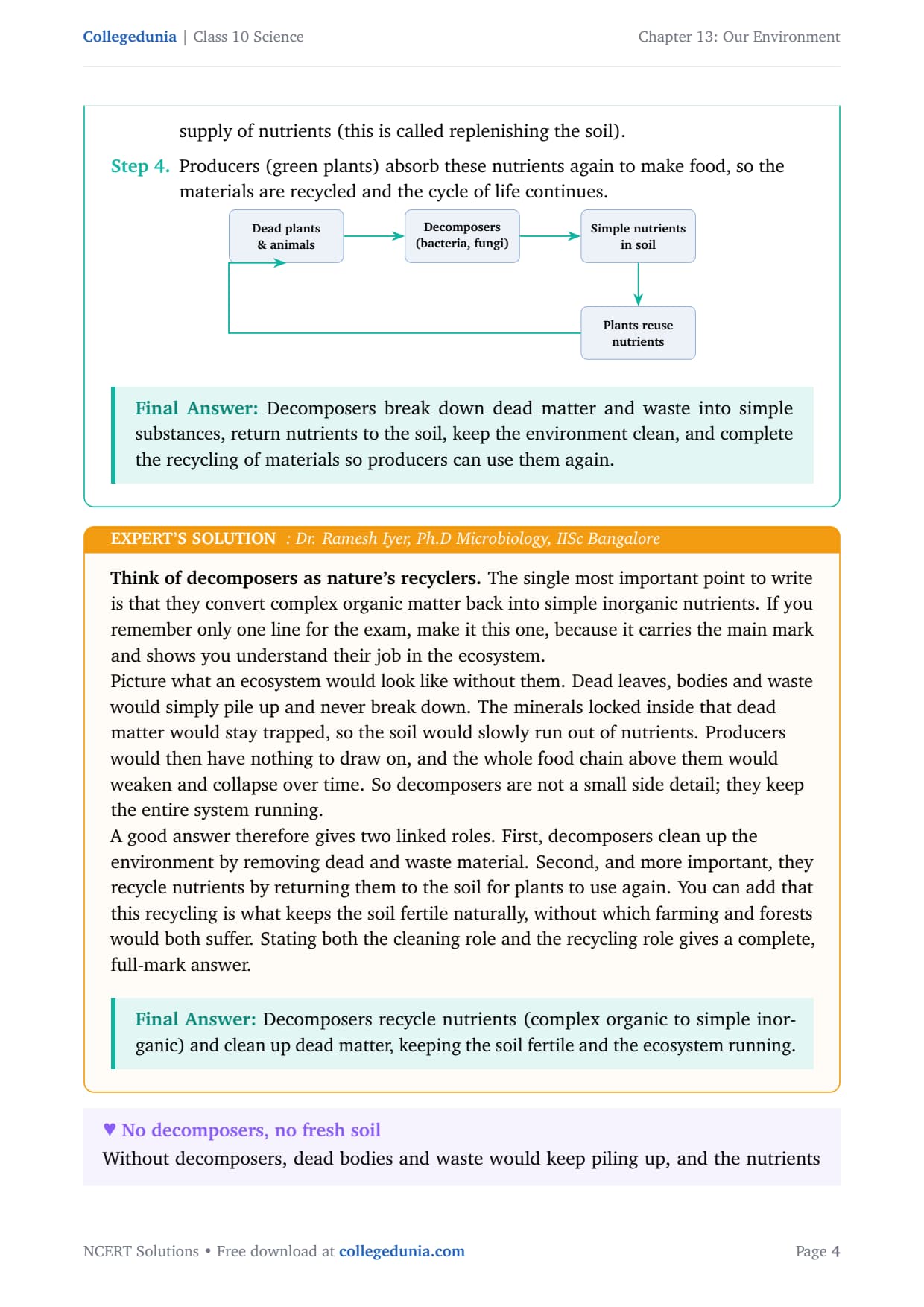
Decomposers are micro-organisms such as bacteria and fungi that break down the dead bodies and waste products of plants and animals. They change complex organic substances into simple inorganic substances, which go back into the soil, water and air for producers to use again.
Decomposers feed on dead remains, fallen leaves and animal droppings, and in doing so they clean up the environment.
They break complex organic matter (proteins, starch, cellulose) into simple inorganic substances such as minerals, carbon dioxide and water.
These simple substances are released back into the soil, restoring its nutrients (replenishing the soil).
Producers absorb these nutrients again to make food, so materials are recycled and the cycle of life continues.
Answer: Decomposers break down dead matter and waste into simple substances, return nutrients to the soil, keep the environment clean, and complete the recycling of materials so producers can use them again.
RI
Dr. Ramesh Iyer
Ph.D Microbiology, IISc Bangalore
Verified Expert
Think of decomposers as nature's recyclers. The single most important point to write is that they convert complex organic matter back into simple inorganic nutrients, because that carries the main mark.
Without them, dead leaves, bodies and waste would pile up and never break down, and the minerals locked inside would stay trapped, so the soil would slowly run out of nutrients.
Producers would then have nothing to draw on, and the whole food chain above them would weaken. So decomposers keep the entire system running, not just tidy it up.
A good answer gives two linked roles: decomposers clean up the environment, and, more important, they recycle nutrients back to the soil for plants to use again, which keeps the soil fertile naturally.
Answer: Decomposers recycle nutrients (complex organic to simple inorganic) and clean up dead matter, keeping the soil fertile and the ecosystem running.
Q 3
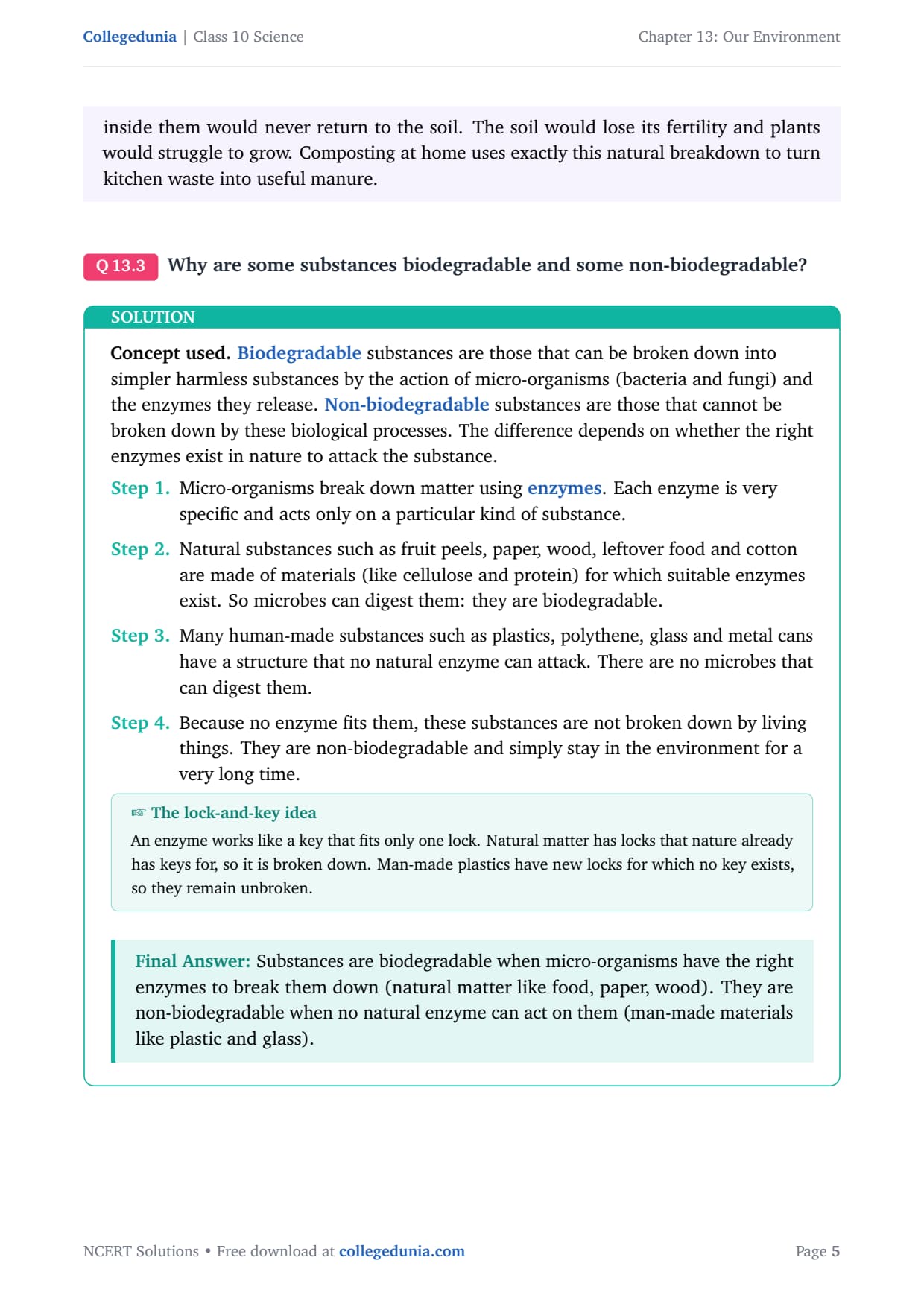
Why are some substances biodegradable and some non-biodegradable?
Biodegradable substances can be broken down into simpler harmless substances by micro-organisms (bacteria and fungi) and the enzymes they release. Non-biodegradable substances cannot be broken down by these biological processes. The difference depends on whether the right enzyme exists in nature to attack the substance.
Micro-organisms break down matter using enzymes, and each enzyme is very specific, acting only on a particular kind of substance.
Natural substances such as fruit peels, paper, wood, food and cotton are made of materials (cellulose, protein) for which suitable enzymes exist, so microbes can digest them. They are biodegradable.
Many man-made substances such as plastics, polythene, glass and metal cans have a structure that no natural enzyme can attack.
Because no enzyme fits them, these substances are not broken down by living things, so they stay in the environment for a very long time. They are non-biodegradable.
Answer: Substances are biodegradable when micro-organisms have the right enzymes to break them down (natural matter like food, paper, wood). They are non-biodegradable when no natural enzyme can act on them (man-made materials like plastic and glass).
SR
Dr. Sunita Rao
Ph.D Environmental Science, IIT Bombay
Verified Expert
Tie the answer to enzyme specificity. An enzyme works like a key that fits only one lock: natural matter has locks that nature already has keys for, while man-made plastics have new locks for which no key exists.
A banana peel in a pit disappears in weeks because soil bacteria and fungi have enzymes that match its natural materials.
A plastic bag in the same pit looks unchanged after years, because its long man-made chains match no enzyme in nature. The only real difference is whether a matching enzyme exists.
This is why so many modern materials are a problem: as packaging shifts from natural to synthetic, more waste becomes non-biodegradable and keeps building up. State the rule, give one example of each type, and link the difference to the presence of a matching enzyme.
Answer: Biodegradable matter matches natural enzymes and is broken down; non-biodegradable matter (man-made) matches no enzyme, so it persists.
Q 4
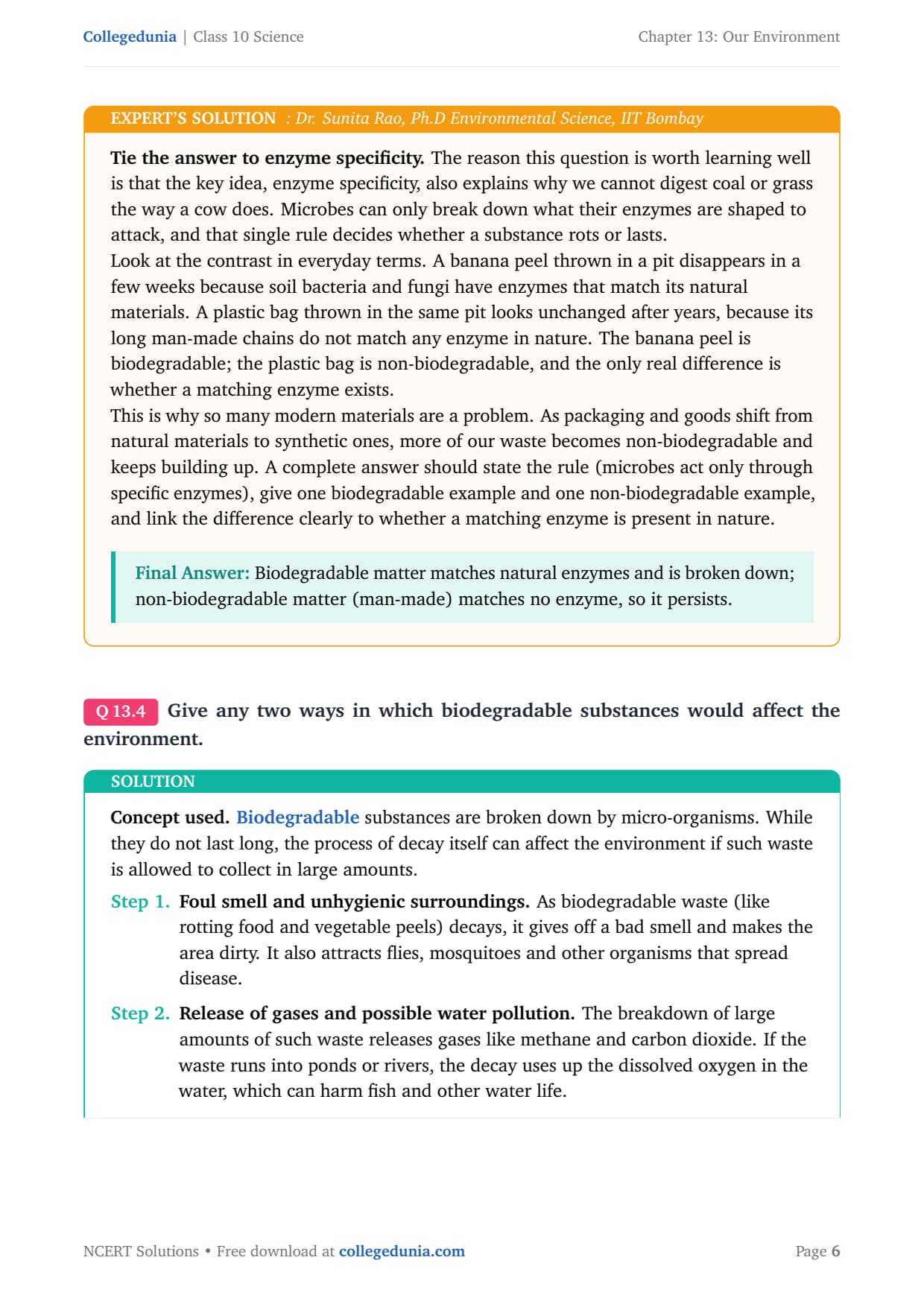
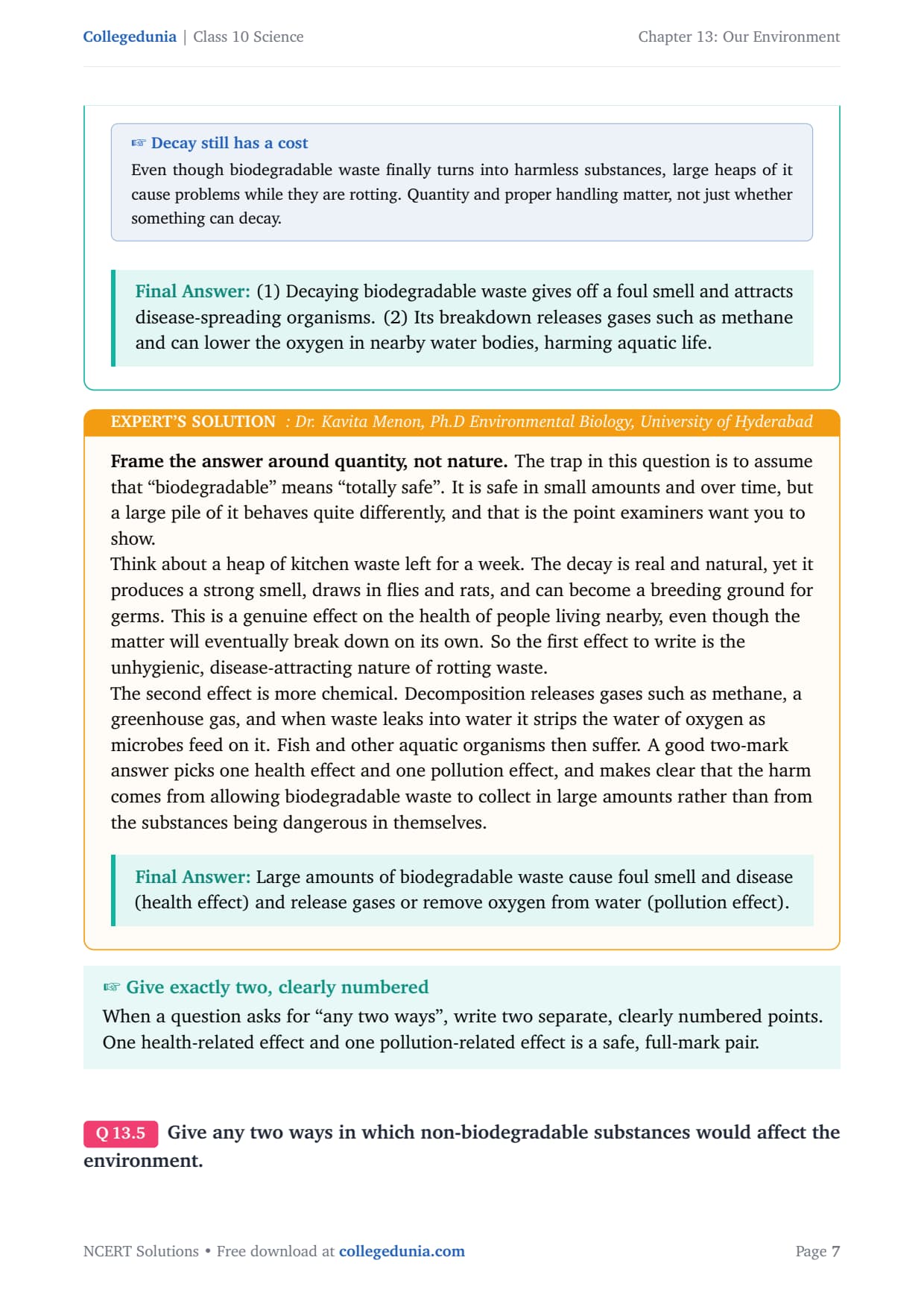
Give any two ways in which biodegradable substances would affect the environment.
Biodegradable substances are broken down by micro-organisms. While they do not last long, the process of decay itself can affect the environment if such waste is allowed to collect in large amounts.
Foul smell and unhygienic surroundings: as biodegradable waste (rotting food and vegetable peels) decays, it gives off a bad smell and makes the area dirty. It also attracts flies, mosquitoes and other organisms that spread disease.
Release of gases and possible water pollution: the breakdown of large amounts releases gases like methane and carbon dioxide. If the waste runs into ponds or rivers, the decay uses up the dissolved oxygen in the water, which can harm fish and other water life.
Answer: (1) Decaying biodegradable waste gives off a foul smell and attracts disease-spreading organisms. (2) Its breakdown releases gases such as methane and can lower the oxygen in nearby water bodies, harming aquatic life.
KM
Dr. Kavita Menon
Ph.D Environmental Biology, University of Hyderabad
Verified Expert
Frame the answer around quantity, not nature. The trap is to assume that biodegradable means totally safe; it is safe in small amounts and over time, but a large pile behaves quite differently.
A heap of kitchen waste left for a week produces a strong smell, draws in flies and rats, and can become a breeding ground for germs, a genuine health effect on people nearby.
Decomposition also releases gases such as methane, a greenhouse gas, and when waste leaks into water it strips the oxygen as microbes feed on it, so fish suffer.
A good two-mark answer picks one health effect and one pollution effect, and makes clear that the harm comes from allowing biodegradable waste to collect in large amounts.
Answer: Large amounts of biodegradable waste cause foul smell and disease (health effect) and release gases or remove oxygen from water (pollution effect).
Q 5
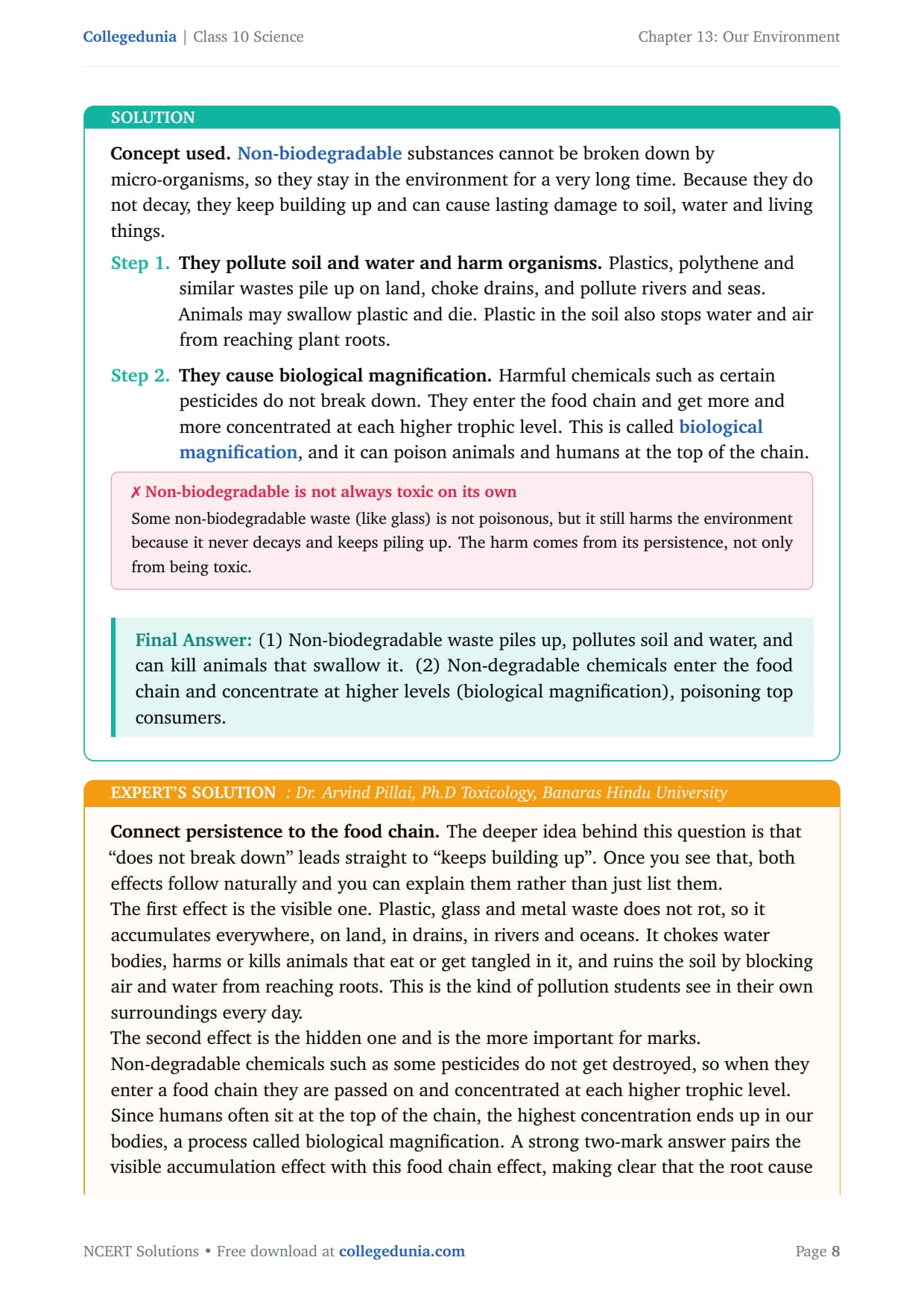
Give any two ways in which non-biodegradable substances would affect the environment.
Non-biodegradable substances cannot be broken down by micro-organisms, so they stay in the environment for a very long time. Because they do not decay, they keep building up and can cause lasting damage to soil, water and living things.
They pollute soil and water and harm organisms: plastics and similar wastes pile up on land, choke drains, and pollute rivers and seas. Animals may swallow plastic and die, and plastic in the soil stops water and air from reaching plant roots.
They cause biological magnification: harmful chemicals such as certain pesticides do not break down. They enter the food chain and get more concentrated at each higher trophic level, poisoning animals and humans at the top.
Answer: (1) Non-biodegradable waste piles up, pollutes soil and water, and can kill animals that swallow it. (2) Non-degradable chemicals enter the food chain and concentrate at higher levels (biological magnification), poisoning top consumers.
AP
Dr. Arvind Pillai
Ph.D Toxicology, Banaras Hindu University
Verified Expert
Connect persistence to the food chain. The deeper idea is that does not break down leads straight to keeps building up, and once you see that, both effects follow naturally.
The visible effect: plastic, glass and metal waste does not rot, so it accumulates on land, in drains and in oceans, chokes water bodies, harms animals, and ruins soil by blocking air and water from roots.
The hidden effect, more important for marks: non-degradable chemicals like pesticides pass up the food chain and concentrate at each higher level, with the highest load in top consumers, often humans (biological magnification).
A strong two-mark answer pairs the visible accumulation effect with the food-chain effect, making clear that the root cause of both is that these substances never break down.
Answer: Persistence causes two harms: accumulation and pollution of soil and water, and biological magnification of non-degradable chemicals up the food chain to top consumers.
Q 6
What is ozone and how does it affect any ecosystem?
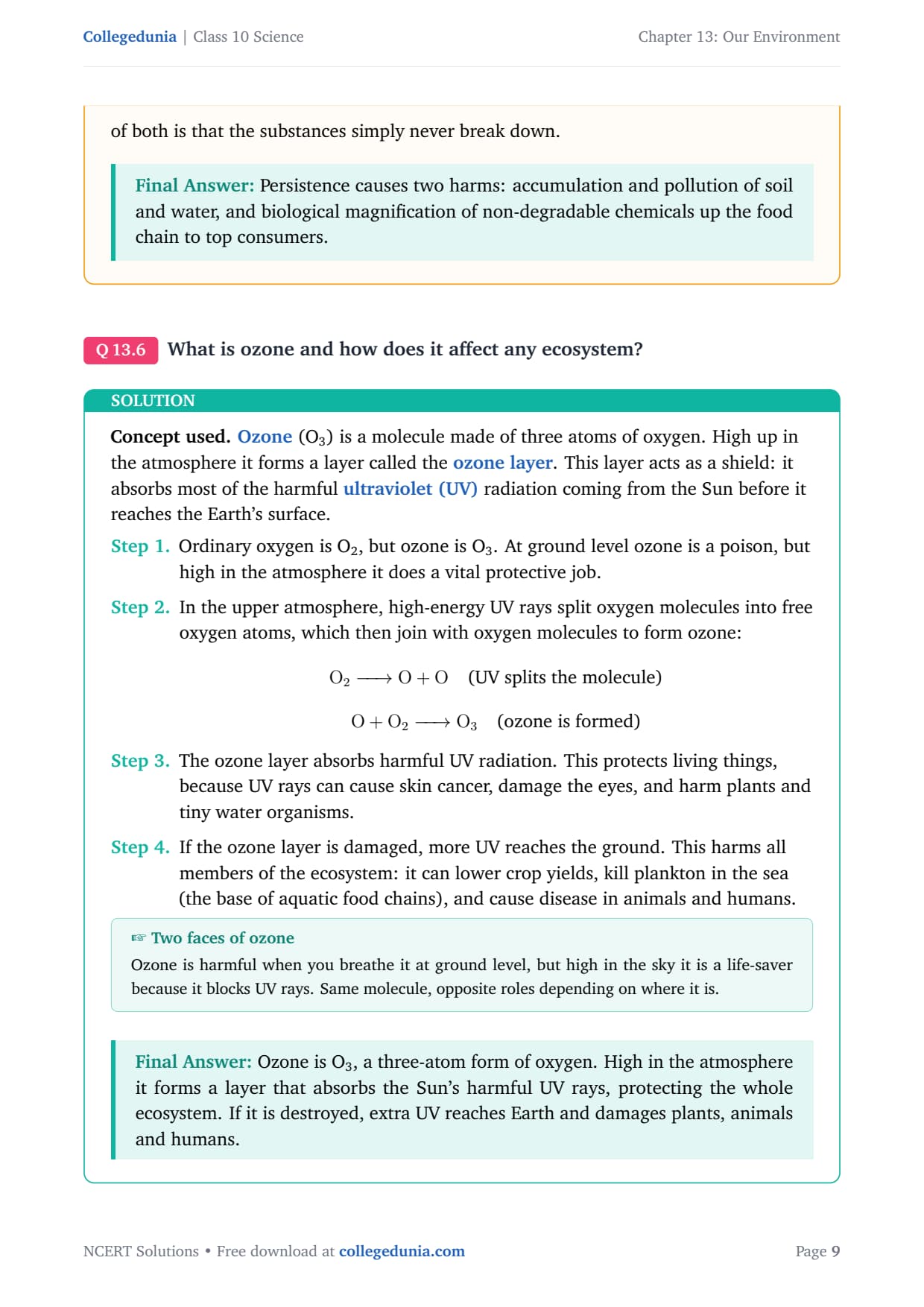
Ozone (O3) is a molecule made of three atoms of oxygen. High up in the atmosphere it forms a layer called the ozone layer, which acts as a shield: it absorbs most of the harmful ultraviolet (UV) radiation coming from the Sun before it reaches the Earth's surface.
Ordinary oxygen is O2, but ozone is O3. At ground level ozone is a poison, but high in the atmosphere it does a vital protective job.
In the upper atmosphere, high-energy UV rays split oxygen molecules into free oxygen atoms (O2 → O + O), which then join with oxygen molecules to form ozone (O + O2 → O3).
The ozone layer absorbs harmful UV radiation, protecting living things, because UV rays can cause skin cancer, damage the eyes, and harm plants and tiny water organisms.
If the ozone layer is damaged, more UV reaches the ground. This harms the whole ecosystem: it can lower crop yields, kill plankton in the sea (the base of aquatic food chains), and cause disease in animals and humans.
Answer: Ozone is O3, a three-atom form of oxygen. High in the atmosphere it forms a layer that absorbs the Sun's harmful UV rays, protecting the whole ecosystem. If it is destroyed, extra UV reaches Earth and damages plants, animals and humans.
NK
Dr. Neha Kulkarni
Ph.D Atmospheric Science, IIT Kanpur
Verified Expert
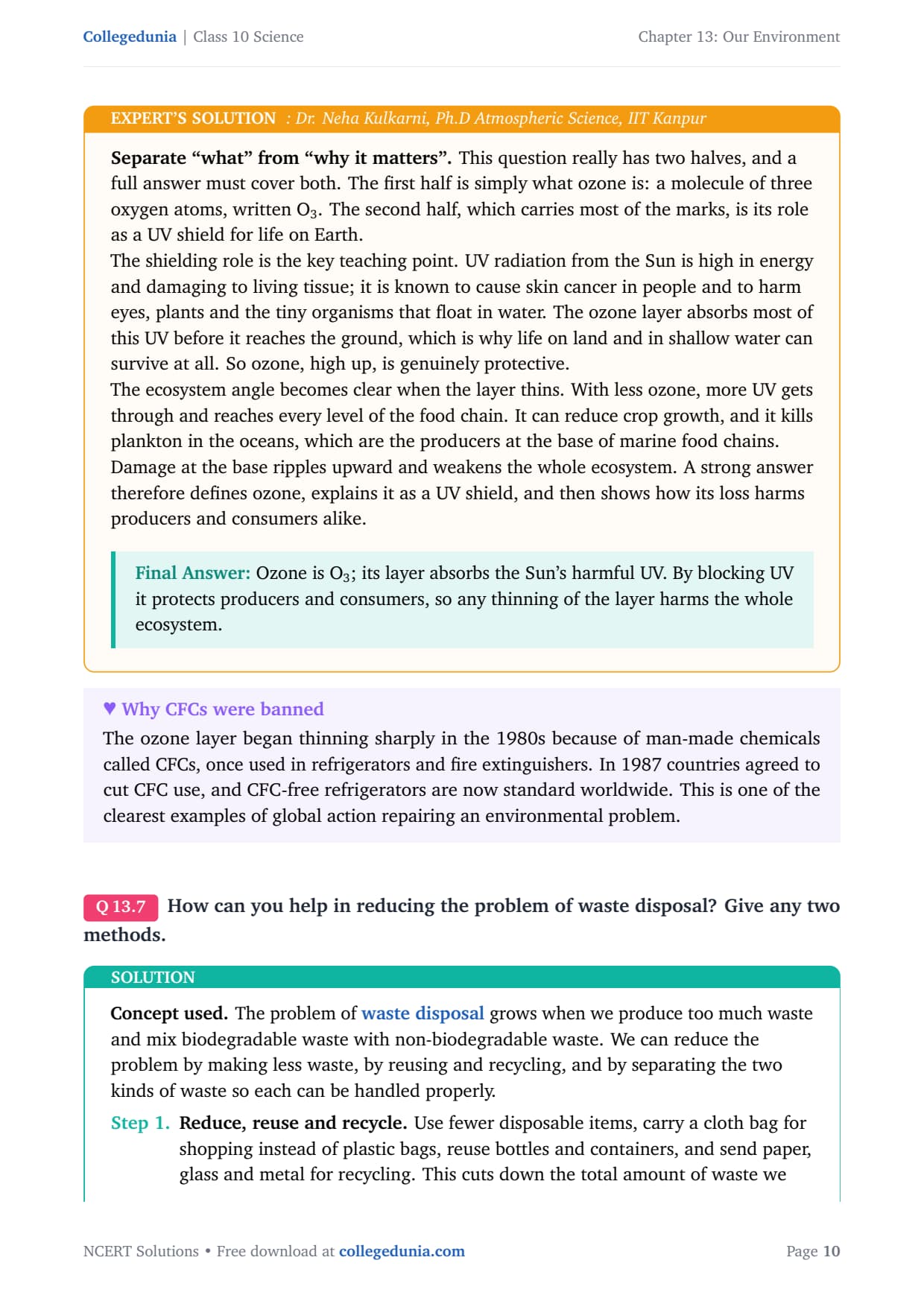
Separate what from why it matters. The first half is simply what ozone is: a molecule of three oxygen atoms, O3. The second half, which carries most of the marks, is its role as a UV shield for life on Earth.
UV radiation is high in energy and damaging to living tissue, causing skin cancer in people and harming eyes, plants and the tiny organisms in water. The ozone layer absorbs most of it before it reaches the ground.
When the layer thins, more UV gets through to every level of the food chain. It can reduce crop growth and kill plankton in the oceans, the producers at the base of marine food chains, and that damage ripples upward.
A strong answer defines ozone, explains it as a UV shield, and then shows how its loss harms producers and consumers alike.
Answer: Ozone is O3; its layer absorbs the Sun's harmful UV. By blocking UV it protects producers and consumers, so any thinning of the layer harms the whole ecosystem.
Q 7
How can you help in reducing the problem of waste disposal? Give any two methods.
The problem of waste disposal grows when we produce too much waste and mix biodegradable with non-biodegradable waste. We can reduce the problem by making less waste, by reusing and recycling, and by separating the two kinds so each can be handled properly.
Reduce, reuse and recycle: use fewer disposable items, carry a cloth bag instead of plastic bags, reuse bottles and containers, and send paper, glass and metal for recycling. This cuts down the total amount of waste we throw away.
Separate the waste and compost it: keep biodegradable waste (kitchen and garden waste) apart from non-biodegradable waste (plastic, glass, metal). Turn the biodegradable part into compost or manure, and send the non-biodegradable part for proper recycling or safe disposal.
Answer: (1) Reduce, reuse and recycle: make less waste, carry cloth bags, reuse containers, and recycle paper, glass and metal. (2) Separate biodegradable from non-biodegradable waste, and compost the biodegradable part.
SJ
Dr. Sameer Joshi
Ph.D Waste Management, TERI School of Advanced Studies
Verified Expert
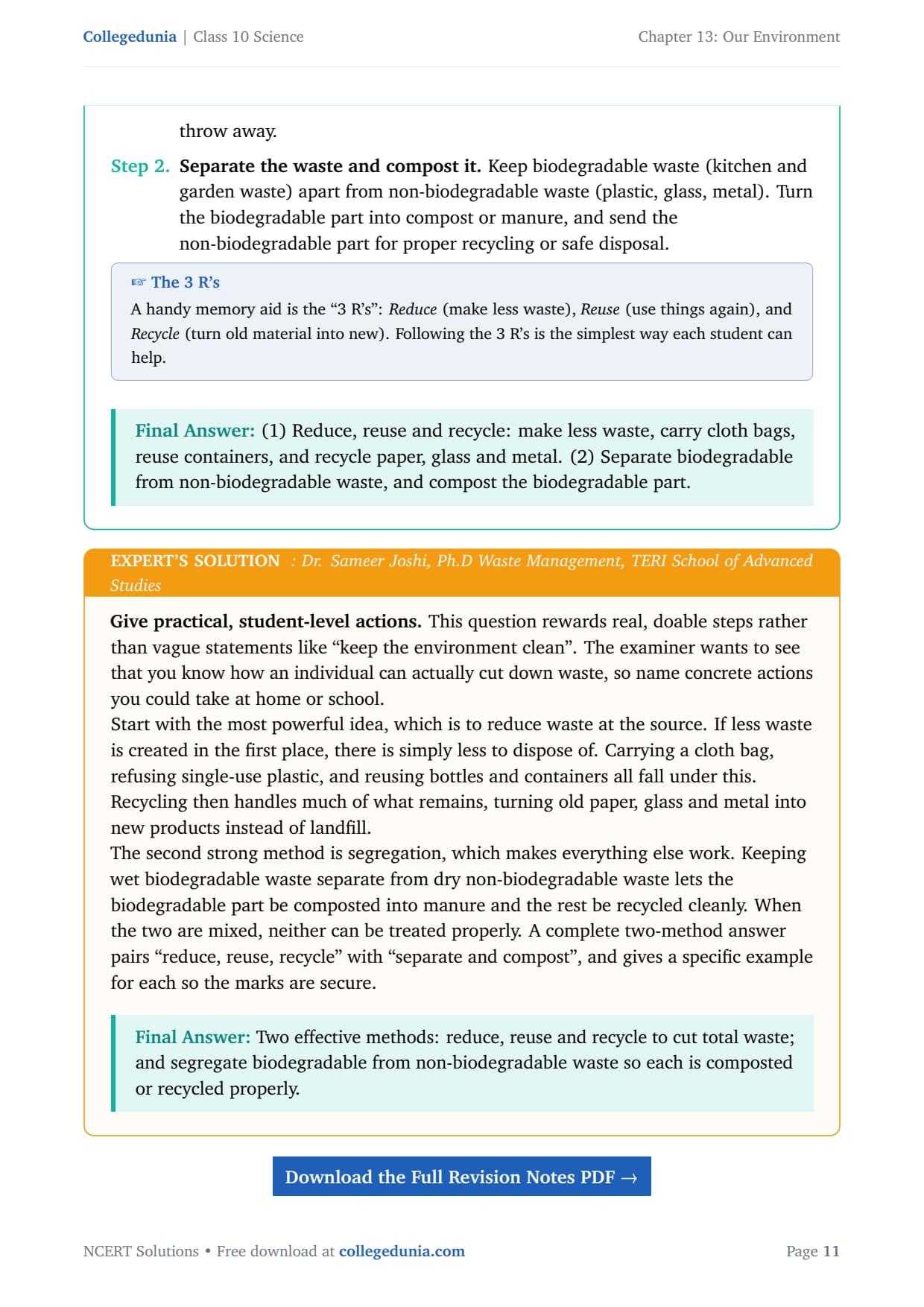
Give practical, student-level actions. This question rewards real, doable steps rather than vague statements like keep the environment clean, so name concrete things you could do at home or school.
Start with reducing waste at the source, because if less waste is created there is simply less to dispose of. Carrying a cloth bag, refusing single-use plastic, and reusing containers all fall under this; recycling then handles much of what remains.
The second strong method is segregation, which makes everything else work: keeping wet biodegradable waste separate lets it be composted while the rest is recycled cleanly. When the two are mixed, neither can be treated properly.
A complete two-method answer pairs reduce, reuse, recycle with separate and compost, and gives a specific example for each so the marks are secure.
Answer: Two effective methods: reduce, reuse and recycle to cut total waste; and segregate biodegradable from non-biodegradable waste so each is composted or recycled properly.
Q 8
Which of the following groups contain only biodegradable items? (a) Grass, flowers and leather (b) Grass, wood and plastic (c) Fruit-peels, cake and lime-juice (d) Cake, wood and grass
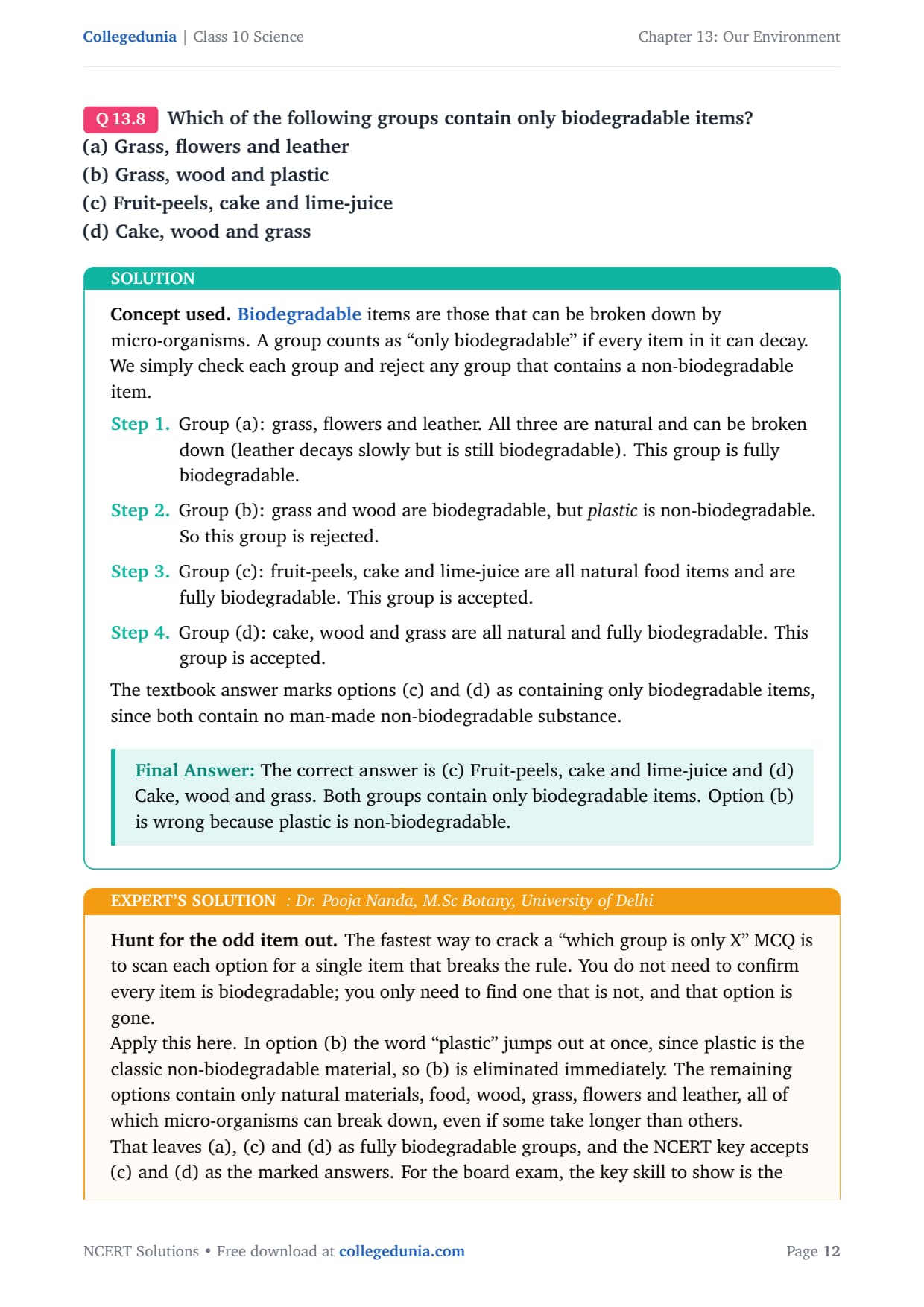
Biodegradable items can be broken down by micro-organisms. A group counts as only biodegradable if every item in it can decay, so we check each group and reject any that contains a non-biodegradable item.
Group (a): grass, flowers and leather are all natural and can be broken down (leather decays slowly but is still biodegradable). Fully biodegradable.
Group (b): grass and wood are biodegradable, but plastic is non-biodegradable, so this group is rejected.
Group (c): fruit-peels, cake and lime-juice are all natural food items and are fully biodegradable. Accepted.
Group (d): cake, wood and grass are all natural and fully biodegradable. Accepted.
The textbook marks options (c) and (d) as containing only biodegradable items, since both contain no man-made non-biodegradable substance.
Answer: The correct answer is (c) Fruit-peels, cake and lime-juice and (d) Cake, wood and grass. Both groups contain only biodegradable items. Option (b) is wrong because plastic is non-biodegradable.
PN
Dr. Pooja Nanda
M.Sc Botany, University of Delhi
Verified Expert
Hunt for the odd item out. The fastest way to crack a which group is only X MCQ is to scan each option for a single item that breaks the rule; you only need to find one non-biodegradable item and that option is gone.
In option (b) the word plastic jumps out at once, since plastic is the classic non-biodegradable material, so (b) is eliminated immediately.
The remaining options contain only natural materials, food, wood, grass, flowers and leather, all of which micro-organisms can break down, even if some take longer.
That leaves (a), (c) and (d) as fully biodegradable, and the NCERT key accepts (c) and (d) as the marked answers. The skill to show is the elimination logic: identify the non-biodegradable item, strike out its option, and confirm the rest are natural.
Answer: Eliminate any group with a man-made item; plastic removes (b). Marked answers: (c) and (d).
Q 9
Which of the following constitute a food-chain? (a) Grass, wheat and mango (b) Grass, goat and human (c) Goat, cow and elephant (d) Grass, fish and goat
A food chain must start with a producer and then move through organisms in a who eats whom order, so that each organism is food for the next. We check which option follows this producer-to-consumer order.
Group (a): grass, wheat and mango are all producers (plants). One plant does not eat another, so they cannot form a chain. Rejected.
Group (b): grass (producer) → goat (herbivore eats grass) → human (eats the goat). This follows the correct eating order, so it is a valid food chain.
Group (c): goat, cow and elephant are all herbivores. None eats the other, so there is no chain. Rejected.
Group (d): grass, fish and goat do not form a feeding sequence (a goat does not eat fish), so this is rejected.
Answer: The correct answer is (b) Grass, goat and human, because it follows the order producer (grass) → herbivore (goat) → consumer (human), with each organism eaten by the next.
RD
Dr. Rohan Desai
Ph.D Zoology, University of Pune
Verified Expert
Test for producer first, then who eats whom. Every valid food chain must begin with a producer, and each later organism must actually eat the one before it.
In (a) all three are plants, so nothing is eating anything; in (c) all three are herbivores, so again none eats the other. Both break the who eats whom rule.
In (d) a goat is a land herbivore and will not eat fish, so the listed organisms do not form a real eating sequence. Only (b) passes: grass is a producer, the goat eats the grass, and the human eats the goat.
For the exam, show this two-rule check: confirm the first member is a producer, then confirm each step is a genuine eating relationship. That rules out all-plant or all-herbivore groups instantly.
Answer: Use producer first, then who eats whom; only (b) grass → goat → human satisfies both rules.
Q 10
Which of the following are environment-friendly practices? (a) Carrying cloth-bags to put purchases in while shopping (b) Switching off unnecessary lights and fans (c) Walking to school instead of getting your mother to drop you on her scooter (d) All of the above
An environment-friendly practice is any habit that reduces pollution, saves energy or cuts down waste. We check each option to see whether it helps the environment.
Option (a): carrying a cloth bag reduces the use of plastic bags, which are non-biodegradable. Environment-friendly.
Option (b): switching off unnecessary lights and fans saves electricity, and saving energy reduces the burning of fuels and pollution. Environment-friendly.
Option (c): walking to school instead of using a scooter saves fuel and avoids the smoke and gases a vehicle gives out. Environment-friendly.
Since all three habits help the environment, the correct choice is all of the above.
Answer: The correct answer is (d) All of the above. Carrying cloth bags, switching off unnecessary lights and fans, and walking to school are all environment-friendly practices.
MK
Dr. Meera Krishnan
Ph.D Environmental Studies, JNU New Delhi
Verified Expert
When each option clearly helps, choose all of the above. The safe method is to test each smaller option on its own; if every individual option is correct, then the combined choice has to be the answer.
A cloth bag cuts plastic use, switching off unused lights and fans saves electricity (and most power still comes from burning fuels), and walking avoids burning petrol and exhaust gases.
Each habit, taken alone, is a genuine help, so (d) all of the above is correct, with no reason to pick just one.
The wider lesson is that small daily choices add up: saving energy, cutting plastic and reducing vehicle use are exactly the personal actions this chapter encourages.
Answer: Each option is a real eco-friendly habit, so the combined choice (d) All of the above is correct.
Q 11
What will happen if we kill all the organisms in one trophic level?
In a food chain, every trophic level depends on the levels above and below it. The level below is its food; the level above feeds on it. Removing one whole level breaks these links and upsets the balance of the whole ecosystem.
The organisms in the level just above the killed level lose their food. They will starve and their numbers will fall.
The organisms in the level just below the killed level are no longer eaten. Their numbers will rise sharply (overpopulation), and they may strip away their own food and damage the environment.
These changes pass on along the whole chain, so the balance of the entire ecosystem is disturbed.
For example, in the chain grass → deer → lion, if all the deer are killed, the grass grows out of control because nothing eats it, while the lions starve because they have lost their prey.
Answer: Killing all organisms in one trophic level starves the level above (it loses its food) and lets the level below overpopulate (nothing eats it). This breaks the food chain and disturbs the whole ecosystem.
VR
Dr. Vikram Reddy
Ph.D Wildlife Biology, Wildlife Institute of India
Verified Expert
Answer in two directions: up and down. A complete answer must look both ways from the removed level, because the effect is different above and below.
Looking upward, the level just above loses its only food supply, so it starves and its population falls, and the shortage can pass on to still higher levels.
Looking downward, the level just below is suddenly free of the organism that ate it, so it multiplies rapidly and may overgraze or exhaust its own resources, damaging the habitat.
The grass-deer-lion example makes both directions concrete: kill all the deer, and the lions above starve while the grass below grows wild. The disturbance then spreads through the whole chain.
Answer: The level above starves while the level below overpopulates; the imbalance spreads through the chain and disturbs the whole ecosystem.
Q 12
Will the impact of removing all the organisms in a trophic level be different for different trophic levels? Can the organisms of any trophic level be removed without causing any damage to the ecosystem?
Different trophic levels play different roles, so removing one level does not always cause the same amount of damage. The producers are the base of every food chain, while the top consumers sit at the end. Removing the base is far more serious than removing the top.
Yes, the impact is different for different levels. Producers are the most important, because they make the food for everyone else. If all producers are removed, the entire ecosystem collapses, since no other organism can survive without food.
Removing herbivores would leave producers without control (they overgrow) and carnivores without food (they starve). The damage is large, but not as complete as removing producers.
Removing the top carnivores causes the least damage at first, but the herbivores below them may then increase too much and overgraze the plants.
No level can be removed without some damage, because every trophic level is linked to the others, so removing any one disturbs the balance in some way.
Answer: Yes, the impact is different: removing producers is the most damaging (the whole ecosystem collapses), while removing top carnivores does less harm at first. But no trophic level can be removed without causing some disturbance, because all levels are linked.
LN
Dr. Lakshmi Nair
Ph.D Ecosystem Science, Pondicherry University
Verified Expert
Rank the levels by how much depends on them. The more an ecosystem leans on a level, the more damage its removal causes, and that single idea organises the whole answer.
Producers come first: every consumer depends on the food they make, so wiping them out brings the entire system down. Herbivores are next, connecting producers to carnivores.
Top carnivores depend on the most levels but have the fewest depending on them, so losing them does the least immediate harm, though even that lets herbivores below run out of control.
This ranking answers both parts: yes, the impact differs (producers most critical, top consumers least), and no, no level can be removed cleanly, because each one is woven into the others.
Answer: Damage scales with how many organisms depend on a level: producers are most critical, top carnivores least; but removing any level still disturbs the ecosystem.
Q 13
What is biological magnification? Will the levels of this magnification be different at different levels of the ecosystem?
Biological magnification is the increase in the concentration of harmful, non-degradable chemicals (such as certain pesticides) in the bodies of organisms as we move up the trophic levels of a food chain. Because these chemicals are not broken down or thrown out, they keep building up at each higher level.
Harmful chemicals like pesticides enter the soil and water, and from there are taken in by plants (producers) in small amounts.
When a herbivore eats many plants, the chemical from all those plants collects in its body, so its level is higher than in any single plant.
When a carnivore eats many herbivores, the chemical builds up even more. At each step up the chain the concentration increases.
The organism at the top of the food chain (often humans) ends up with the highest concentration of the harmful chemical.
Yes, the level of biological magnification is different at different trophic levels. It is lowest in the producers and increases at each higher level, becoming highest at the top of the food chain.
Answer: Biological magnification is the build-up of harmful non-degradable chemicals to higher and higher concentrations as we move up the food chain. Yes, the magnification differs by level: it is lowest in producers and highest in the top consumers.
FS
Dr. Farhan Sheikh
Ph.D Ecotoxicology, Aligarh Muslim University
Verified Expert
Stress that the chemical does not leave the body. The heart of biomagnification is that these chemicals are non-degradable, so once an organism takes them in, they are neither broken down nor excreted; they just stay and accumulate.
A plant picks up a tiny amount of pesticide from the soil. A herbivore eats hundreds of such plants, gathering the pesticide from all of them into one body. A carnivore then eats many herbivores, pooling it again.
With every level, the same total chemical is packed into fewer and larger bodies, so the concentration climbs. By the top it can be many times higher than at the bottom.
This answers the second part: yes, the magnification differs by trophic level, lowest in producers and highest in top consumers. Humans usually sit at the top, so we carry the heaviest load, which is why residues turn up in our food.
Answer: Non-degradable toxins accumulate up the chain; magnification is lowest in producers and highest in top consumers, often humans.
Q 14
What are the problems caused by the non-biodegradable wastes that we generate?
Non-biodegradable wastes (plastics, polythene, glass, metal cans and some chemicals) cannot be broken down by micro-organisms. Because they last for a very long time, they keep building up and cause several lasting problems.
They pile up and pollute: since they do not decay, they accumulate on land and in water. They make surroundings dirty, choke drains and rivers, and pollute the soil so plants grow poorly.
They harm living things: animals may eat plastic by mistake and die, and plastic bags can block drains and cause water-logging, which helps mosquitoes breed and spread disease.
They cause biological magnification: non-degradable chemicals like certain pesticides enter the food chain and get more concentrated at each higher level, finally poisoning the animals and humans at the top.
They are hard to get rid of: burning plastic releases poisonous gases, and burying it pollutes the soil, so disposal itself is a problem.
Answer: Non-biodegradable wastes do not decay, so they pile up and pollute soil and water, harm or kill animals, cause biological magnification of toxins up the food chain, and are very hard to dispose of safely.
AB
Dr. Ananya Bose
Ph.D Environmental Engineering, IIT Kharagpur
Verified Expert
Group the problems into accumulation, harm and disposal. Three headings cover almost everything and make a long answer easy to score.
Under accumulation, the core idea is that these wastes never break down, so they keep collecting year after year, littering land, clogging water and spoiling soil.
Under harm to life, place the animals that swallow plastic, the blocked drains that breed disease, and most importantly biological magnification, where toxins climb the chain to dangerous levels in top consumers, including us.
Under disposal, there is no easy way out: burning releases toxic gases while burying moves the pollution into soil and groundwater. So the very persistence that defines the waste is what makes it so hard to remove.
Answer: Persistence leads to accumulation and pollution, harm to organisms (including biomagnification), and serious disposal problems, since burning and burying both cause further pollution.
Q 15
If all the waste we generate is biodegradable, will this have no impact on the environment?
Biodegradable waste does break down into harmless substances, so it is better than non-biodegradable waste. But biodegradable does not mean no impact. If such waste is produced in very large amounts or not handled properly, the process of decay itself can still affect the environment.
No, it will still have an impact. Even biodegradable waste, in huge amounts, takes time to decay and piles up in the meantime, making surroundings dirty and smelly.
Decaying biodegradable waste gives off a foul smell and attracts flies, rats and germs, which can spread disease.
The breakdown of large amounts releases gases like methane (a greenhouse gas) and carbon dioxide into the air.
If the waste enters ponds or rivers, micro-organisms use up the dissolved oxygen to decompose it, and the fall in oxygen can kill fish and other water organisms.
Answer: No. Even fully biodegradable waste affects the environment if it is in large amounts or poorly managed: it causes foul smell and disease, releases gases like methane, and can remove oxygen from water and kill aquatic life.
SP
Dr. Sneha Patil
Ph.D Aquatic Biology, Savitribai Phule Pune University
Verified Expert
Reject the hidden assumption in the question. It is testing whether you will accept a tempting but wrong idea, that biodegradable equals harmless. The mark-winning move is to say no clearly and then explain why decay still has a cost.
Breaking down takes time and produces by-products. A large rotting heap smells bad, attracts disease-carrying flies and rats, and releases gases including methane, a greenhouse gas.
There is a water angle too: when biodegradable waste washes into a pond, microbes consume oxygen as they break it down, and the drop in dissolved oxygen can suffocate fish and other aquatic life.
So the honest answer is that biodegradable waste is far better than non-biodegradable waste but is not impact-free; the volume produced and the way it is managed still decide how much harm it does.
Answer: No: biodegradable does not mean harmless. In large amounts it causes smell, disease, methane release and oxygen loss in water, so it still impacts the environment.
Q 16
Why is damage to the ozone layer a cause for concern? What steps are being taken to limit this damage?
The ozone layer high in the atmosphere absorbs most of the Sun's harmful ultraviolet (UV) radiation. If this layer is damaged, more UV reaches the Earth, which is dangerous for all living things. The main cause of the damage is man-made chemicals called CFCs (chlorofluorocarbons).
Why it is a concern: a damaged ozone layer lets more UV reach the ground. UV rays cause skin cancer and cataracts (eye damage), weaken the immune system, harm crops, and kill the tiny plankton in the sea that form the base of aquatic food chains.
The cause: the thinning of the ozone layer in the 1980s was linked to CFCs, used in refrigerators, air conditioners, spray cans and fire extinguishers.
Step 1, international agreement: in 1987, countries signed an agreement (through the United Nations Environment Programme) to freeze and then reduce CFC production. This is the Montreal Protocol.
Step 2, CFC-free products: it is now compulsory to make CFC-free refrigerators and air conditioners, and safer chemicals are used in their place all over the world.
Answer: Damage to the ozone layer is a concern because more harmful UV radiation then reaches Earth, causing skin cancer, eye damage and harm to crops and sea life. Steps taken: a global agreement (1987 Montreal Protocol) to cut CFC production, and a worldwide shift to CFC-free refrigerators and other products.
IQ
Dr. Imran Qureshi
Ph.D Atmospheric Chemistry, IIT Madras
Verified Expert
Split the answer into concern and steps. The question clearly asks two things, so structure your answer in two parts and make sure each gets its own points.
For the concern, the strongest points are the health and ecosystem effects of UV: more skin cancer and eye damage in humans, a weaker immune system, lower crop yields, and the death of plankton at the base of ocean food chains, which ripples up.
For the steps, name the cause and the cure together: CFCs from refrigerators, ACs and sprays were the culprit, and the 1987 Montreal Protocol committed countries to freeze and then cut CFC use, after which CFC-free appliances became standard.
This is one of the rare success stories in environmental action, and saying so shows depth. A full answer gives at least two UV harms for the concern and at least two measures, the agreement and CFC-free products, for the steps.
Answer: Concern: extra UV causes skin cancer, eye damage and harm to crops and plankton. Steps: the 1987 Montreal Protocol cutting CFC production, and a global switch to CFC-free appliances.
NCERT Solutions Class 10 Science Chapter 13 Our Environment FAQs
Ques. How many questions are there in NCERT Class 10 Science Chapter 13 Our Environment?
Ans. There are 16 questions in NCERT Class 10 Science Chapter 13 Our Environment: 7 in-text questions in the boxes inside the chapter and 9 end-of-chapter exercise questions. All 16 are solved with a step-by-step Check Solution and an Expert Solution. The set covers trophic levels, decomposers, biodegradable and non-biodegradable waste, food chains, the effect of removing a trophic level, biological magnification, and the ozone layer.
Ques. What are trophic levels in Class 10 Science Chapter 13?
Ans. Trophic levels are the feeding steps of a food chain. The producers (green plants) form the first trophic level because they make their own food, the herbivores (primary consumers) form the second, the small carnivores (secondary consumers) the third, and the large carnivores (tertiary consumers) the fourth. For example, in the food chain grass to deer to lion, grass is T1 (producer), deer is T2 (herbivore) and lion is T3 (carnivore). Always label each organism with its level number and its role for full marks.
Ques. What is the ten percent law of energy flow?
Ans. The ten percent law states that only about 10% of the energy available at one trophic level is passed on to the next level. The remaining 90% is lost mainly as heat during life processes like respiration and movement. Because so much energy is lost at every step, very little is left after three or four levels, which is why most food chains in nature are short and rarely have a fifth trophic level. Energy flow is also one-way, from the Sun to producers to consumers, and never returns.
Ques. What is biological magnification and where is it highest?
Ans. Biological magnification is the increase in the concentration of harmful, non-degradable chemicals (such as certain pesticides) in the bodies of organisms as we move up the trophic levels of a food chain. The chemical is not broken down or thrown out, so it keeps building up at each higher level. It is lowest in the producers and highest in the top consumers of the food chain, which are often humans. This is why pesticide residues can build up to dangerous levels in animals and people at the top of the chain.
Ques. What is the difference between biodegradable and non-biodegradable waste?
Ans. Biodegradable waste can be broken down into simple harmless substances by micro-organisms (bacteria and fungi) using the enzymes they release; examples are fruit peels, paper, wood and leftover food. Non-biodegradable waste cannot be broken down by these biological processes because no natural enzyme can attack it; examples are plastic, polythene, glass and metal cans. The difference depends on whether a matching enzyme exists in nature, which is why natural matter decays and man-made plastics persist for years.
Ques. Why is damage to the ozone layer a cause for concern?
Ans. Ozone (O3) high in the atmosphere absorbs most of the Sun's harmful ultraviolet (UV) rays. When the ozone layer is damaged, more UV reaches the Earth, causing skin cancer and cataracts in humans, weakening the immune system, lowering crop yields, and killing the plankton at the base of ocean food chains. The main cause is man-made CFCs. In 1987 countries signed the Montreal Protocol to cut CFC production, and CFC-free refrigerators and air conditioners are now standard worldwide, so the ozone layer is slowly healing.
Ques. How many pages is the Class 10 Science Our Environment NCERT Solutions PDF?
Ans. The Our Environment NCERT Solutions PDF covers all 16 questions (7 in-text and 9 exercise) with step-by-step Check Solutions, labelled food-chain diagrams, a biological-magnification diagram, and an Expert Solution for each question. It is free to download for the 2026-27 session and is built for the CBSE Class 10 board exam.
Ques. Is the NCERT Solutions for Class 10 Science Chapter 13 aligned with the 2026-27 syllabus?
Ans. Yes. This page reflects the current 2026-27 CBSE syllabus for Class 10 Science. Every answer follows the NCERT textbook flow for Our Environment, covering ecosystems, producers, consumers and decomposers, food chains and trophic levels, the ten percent law of energy flow, biological magnification, the ozone layer and CFCs, and the management of biodegradable and non-biodegradable waste. The solutions are written in plain English for board exam students and are useful for both the CBSE board exam and school unit tests.








Comments