Chemistry Mentor, Daulat Ram College | Updated 3+ months ago
The NCERT Solutions for Class 10 Science Chapter 12 Magnetic Effects of Electric Current solve all 22 questions (13 in-text and 9 end-of-chapter exercises) for the latest 2026-27 CBSE syllabus.
Every answer follows the textbook flow: magnetic field and field lines, the field due to a current, the right-hand thumb rule, the force on a conductor, Fleming's left-hand rule, and domestic circuits with the fuse and earth wire.
All 22 NCERT questions solved with full reasoning, labelled diagrams and an Expert Solution per question.
Complete coverage of magnetic field lines, the right-hand thumb rule, the force on a conductor, Fleming's left-hand rule and electrical safety.
Answers in plain English for the 2026-27 CBSE syllabus, for the board exam and school unit tests.
Solved by Collegedunia Science Experts
These NCERT Solutions for Class 10 Science Chapter 12 Magnetic Effects of Electric Current are checked against the latest 2026-27 NCERT textbook and refined against the last five years of CBSE board papers. Each of the 22 questions gives a Check Solution for the clean board answer and an Expert Solution for extra marks.
What the NCERT Solutions for Class 10 Science Chapter 12 Magnetic Effects of Electric Current Cover
This chapter answers one big idea: an electric current always makes a magnetic field, and a current placed in a magnetic field feels a force. These solutions follow the NCERT order, from field lines to the force on a conductor and domestic wiring.
Magnetic Effects of Electric Current Class 10 Science Video Solutions
Question Breakdown by Section of the Magnetic Effects Chapter NCERT Solutions
Chapter 12 carries 22 questions in total: 13 in-text and 9 end-of-chapter exercises. The table below maps each section to its topic and the marks the CBSE board rewards.
Section
Topic covered
Question type
Typical marks
12.1
Magnetic field, field lines and their properties
Definitions, drawing and reasoning
1 to 3 marks
12.2
Field due to a current (straight wire, loop, solenoid)
Right-hand rule direction questions
2 to 3 marks
12.3
Force on a current-carrying conductor
Fleming's left-hand rule, MCQ and reasoning
2 to 3 marks
12.4
Electric motor and the motor effect
Working and direction reasoning
3 marks
12.5
Domestic electric circuits, fuse and earthing
Safety reasoning and one numerical
2 to 3 marks
Exercises
Mixed MCQ, true or false and short answers
One-mark MCQ to three-mark reasoning
1 to 3 marks
Magnetic Field, Field Lines and Their Properties
A magnetic field is the region around a magnet or a current where its force can be felt. We draw it with magnetic field lines, closed curves that run out of the north pole and into the south pole outside the magnet.
Closed curves: field lines always form complete loops; they never end in empty space.
They never cross: a crossing would give two field directions at one point, which is impossible.
Crowded means strong: lines packed close show a strong field near the poles; spread-out lines show a weak field.
Magnetic Field Due to a Current and the Right-Hand Thumb Rule
Oersted's experiment showed that every electric current produces a magnetic field. Its direction comes from the right-hand thumb rule: grip the wire so the thumb points along the current, and the curled fingers point along the field. The field of a solenoid is uniform inside, like a bar magnet, which is what magnetises a soft-iron core into an electromagnet.
Conductor
Field pattern
Key point
Straight wire
Concentric circles centred on the wire
Field weakens as you move away from the wire
Circular loop
Field threads through the loop, one way inside
More turns add up to a stronger field
Solenoid
Uniform field inside, like a bar magnet
A soft-iron core turns it into an electromagnet
Force on a Current-Carrying Conductor and Fleming's Left-Hand Rule
A current-carrying conductor placed in a magnetic field feels a force. This is the motor effect. Its direction comes from Fleming's left-hand rule: the forefinger gives the field, the middle finger the current, and the thumb the force, all at right angles.
The force is largest when current and field are at right angles, and zero when they are parallel.
The force grows with a larger current, a stronger field, or a longer conductor in the field.
For an electron beam, the current points opposite to the electron motion, so reverse the direction first.
Domestic Electric Circuits, Fuse and Earthing
The mains supply in India is 220 V, 50 Hz, carried by three wires with a fixed colour code: live (red), neutral (black) and earth (green). Two safety devices protect the home.
Electric fuse: a thin, low-melting wire in series in the live wire. If the current rises too high, it melts and breaks the circuit.
Earth wire: a low-resistance green wire that sends any leakage current safely to earth instead of through the user.
Overloading vs short circuit: overloading is too much current; a short circuit is live touching neutral, where the current rises sharply.
A common numerical uses I = P/V. A 2 kW oven on 220 V draws 2000/220 = 9.09 A, far above a 5 A rating, so the fuse blows. The fuse protects the circuit; earthing protects the user.
Common Mistakes Students Make in the Magnetic Effects Chapter
The repeat-offender mistakes in Magnetic Effects of Electric Current board answers:
Using the wrong hand: right hand for the field of a current, left hand for the force. Swapping them reverses the answer.
Forgetting to reverse for electrons: conventional current points opposite to electron motion, so flip it before applying Fleming's rule.
Leaving arrows off field lines: a diagram without arrows or pole labels loses marks even when the curves are correct.
Mixing up the wire colours: live is red, neutral is black, earth is green. Green is never the live wire.
How to Use the Magnetic Effects NCERT Solutions PDF for Board Prep
This chapter is short but direction-heavy, so use two passes. First, read the chapter and note the field-line properties, the right-hand thumb rule, Fleming's left-hand rule, and the domestic wiring facts. Then work the direction questions on paper, drawing the field, current and force every time, and check your answers against these solutions. For the CBSE board, the most repeated questions are field-line properties, the two hand rules, and the function of the fuse and earth wire.
Other Resources for Class 10 Science Chapter 12 Magnetic Effects of Electric Current
Pair this with the other Class 10 Science resources for this chapter, all linked below.
66% of Class 10 students said the hardest part of this chapter was getting the direction right with the right-hand thumb rule and Fleming's left-hand rule. 3 out of 5 students lost marks by using the wrong hand. Toppers found that a clear labelled diagram added 1 to 2 marks on every direction question.
Source: 2026-27 Class 10 Science student poll. Sample of 9,400 students from CBSE schools across 13 states, conducted before the 2026 boards.
NCERT Solutions for Class 10 Science: All Chapters
Related Links: Open the NCERT Solutions for the other chapters of Class 10 Science below.
All NCERT Solutions for Class 10 Science Chapter 12 Magnetic Effects of Electric Current with Step-by-Step Solutions
Tap Check Solution for the board answer and Expert Solution for the extra-mark strategy on each question below.
Q 1
Why does a compass needle get deflected when brought near a bar magnet?
A compass needle is itself a tiny bar magnet that is free to turn. A bar magnet sets up a magnetic field in the region around it, which is the region where the force of a magnet can be felt. When one magnet sits in the field of another, its poles feel forces.
The compass needle has its own north and south poles, and the bar magnet has a north pole and a south pole.
When the compass is brought near the bar magnet, the needle lies inside the magnetic field of the bar magnet.
Like poles (N-N or S-S) repel and unlike poles (N-S) attract, so these forces give the needle a turning effect.
The needle rotates until it lines up along the field direction at that point, and this rotation is the deflection we see.
Answer: A compass needle is a small magnet. Near a bar magnet it lies in the magnet's field, so its poles are attracted and repelled. These forces turn the needle along the field, which we observe as a deflection.
SP
Sneha Patel
B.Tech Electrical Engineering
Verified Expert
In a one or two mark question like this, students lose marks by writing only "because of magnetism." The examiner wants two clear links stated in order: first that a compass needle is a freely pivoted small magnet, and second that a bar magnet produces a field whose forces act on the needle's poles.
A compass does not create anything. It only reports the direction of the magnetic field already there.
Wherever you place it, the needle settles along the local field, with its north pole pointing the way a free north pole would move.
This is why a compass is used all through the chapter to map field lines, both around a bar magnet and around a current-carrying wire.
Answer: The needle (a small magnet) lies in the bar magnet's field; the forces on its poles turn it along the field, which we see as deflection.
Q 2
Draw magnetic field lines around a bar magnet.
Magnetic field lines are imaginary closed curves that show the path a free north pole would take. By convention the lines come out of the north pole, go round the outside, and enter the south pole; inside the magnet they run from south to north. Where the lines are crowded the field is strong; where they are spread out the field is weak.
Mark the north (N) and south (S) poles of the bar magnet.
Draw smooth curves leaving the N pole, looping round the sides, and entering the S pole, with arrows showing the direction (out of N, into S).
Make the lines closest together near the two poles, because the field is strongest there.
Answer: The field lines form closed loops that emerge from the north pole, curve round the magnet, and enter the south pole, crowding together near the poles where the field is strongest.
RS
Rohit Sharma
M.Sc Physics, B.Ed
Verified Expert
Drawing questions are gifts in the board exam if you follow a checklist. First, label the poles N and S clearly, because an unlabelled magnet can lose half the marks. Second, draw at least three or four smooth loops, never sharp kinks, and never let two lines cross. Third, mark the arrowheads pointing out of the north pole and into the south pole.
The lines never stop in empty space, because they are closed curves that continue inside the magnet from S to N.
You do not have to draw the inside loop for this NCERT question, but knowing it stops you drawing lines that simply end at the poles.
Answer: Closed loops out of N and into S, arrows shown, lines crowded at the poles, none crossing.
Q 3
List the properties of magnetic field lines.
A magnetic field line is the path along which a free (hypothetical) north pole would move in a magnetic field; the tangent to the line at any point gives the field direction there. From this definition we can list their fixed properties.
Closed curves: outside the magnet they run from the north pole to the south pole; inside the magnet they run from south to north.
They do not intersect: two lines crossing would mean two field directions at one point, which is impossible.
Crowded where the field is strong (near the poles) and spread out where it is weak, so their closeness shows the relative strength.
The tangent to a field line at any point gives the direction of the magnetic field at that point.
Answer: Field lines are closed curves (out of N, into S outside the magnet); they never cross; they are crowded where the field is strong and spread where it is weak; and the tangent at a point gives the field direction.
AN
Anjali Nair
M.Sc Physics, M.Ed
Verified Expert
Recall the four points in two pairs. The first pair is about shape: the lines are closed curves, and they never cross. The second pair is about strength: the lines are crowded where the field is strong, and the tangent gives the direction at any point.
Pairing them like this is reliable under exam pressure, where a blank mind usually remembers only "closed curves" and "don't cross."
Keep the reason attached to the non-intersection rule: if two lines crossed, a compass at the crossing point would have to point two ways at once, which cannot happen.
Answer: Closed curves; never intersect; crowded where strong and spread where weak; tangent gives field direction.
Q 4
Why don't two magnetic field lines intersect each other?
The direction of the magnetic field at any point is the direction in which the north pole of a compass needle points there, that is, the tangent to the field line at that point. At any single point the field can have only one definite direction.
Suppose two field lines did cross at some point.
At the crossing point we could draw two different tangents, one for each line, so the field would have two directions at the same point.
A compass placed there cannot point in two directions at once; the field at a point is unique.
This is a contradiction, so two field lines can never intersect.
Answer: If two field lines crossed, the field would have two directions at the crossing point, so a compass would have to point two ways at once. Since that is impossible, magnetic field lines never intersect.
VD
Vikram Desai
M.Sc Physics, B.Ed
Verified Expert
This is a classic "prove by assuming the opposite" question. The cleanest two-mark answer states the assumption, the impossible consequence, and the conclusion: assume two lines cross; then at that one point there are two tangents and so two field directions; a compass cannot face two ways; therefore lines cannot cross.
Examiners want to see the link to the compass, because that ties the abstract rule back to a real instrument students have handled.
The same logic explains why electric field lines and streamlines in flowing water also never cross: a single point can carry only one direction.
Answer: Crossing would give two field directions at one point, which is impossible, so field lines never intersect.
Q 5
Consider a circular loop of wire lying in the plane of the table. Let the current pass through the loop clockwise. Apply the right-hand rule to find out the direction of the magnetic field inside and outside the loop.
The right-hand thumb rule gives the field of a current. Grip the wire with the right hand so the thumb points along the current; the curled fingers then point along the magnetic field. Applying this to every part of the loop shows the field threading through it the same way all around.
The loop lies flat on the table and the current goes clockwise when seen from above.
Take any small piece of the loop and grip it with the right hand, thumb along the current; the fingers curl so the field points downward (into the table) on the inside of the loop.
Doing this for every piece gives the same result, so inside the loop the field points into the table (downwards).
Just outside the loop the curled fingers point the other way, so the field comes out of the table (upwards) there.
Answer: Inside the loop the magnetic field is directed into the table (downwards); just outside the loop it is directed out of the table (upwards).
PM
Priya Menon
M.Sc Physics, B.Ed
Verified Expert
For a flat loop with clockwise current viewed from above, the field goes into the page on the inside. A handy hook is "clockwise current, field clocks away from you (into the table); anticlockwise current, field comes toward you (out of the table)." It is the same right-hand thumb rule, just packaged so you do not re-grip the wire under exam stress.
The loop behaves like a tiny magnet: the face into which the field enters is its south pole and the face from which it emerges is its north pole.
So the underside of this loop acts as a north pole and the top as a south pole, which links straight into the later solenoid section.
Answer: Right-hand rule: field into the table inside the loop, out of the table outside it.
Q 6
The magnetic field in a given region is uniform. Draw a diagram to represent it.
A uniform magnetic field has the same magnitude and the same direction at every point of the region. Since the closeness of field lines shows the strength and their direction shows the field direction, a uniform field is drawn as equally spaced parallel straight lines, all pointing the same way.
Draw several straight lines, all parallel to one another.
Keep the gaps between the lines equal, because equal spacing means the field has the same strength everywhere.
Put arrowheads on the lines, all pointing in the same direction, to show the single field direction.
Answer: A uniform field is shown by equally spaced parallel straight lines all pointing the same way (the region between the poles of a U-shaped magnet is a good example).
AR
Arjun Reddy
M.Tech Electrical Engineering
Verified Expert
"Uniform" carries two demands at once, and your diagram has to satisfy both. Same direction everywhere means the lines must be parallel and carry arrows pointing one way. Same strength everywhere means the lines must be equally spaced. Students often nail the parallel part and forget the spacing, and that loses the mark.
A neat real example to mention is the space between the two poles of a horse-shoe (U-shaped) magnet, where the field is very nearly uniform.
If you have time, enclose the lines in a light dashed box labelled "uniform field region" to make the diagram self-explanatory.
Answer: Equally spaced parallel arrows, all the same direction; the gap between a U-magnet's poles is a real example.
Q 7
The magnetic field inside a long straight solenoid-carrying current (a) is zero. (b) decreases as we move towards its end. (c) increases as we move towards its end. (d) is the same at all points.
A solenoid is a long coil of many circular turns of insulated wire wound closely like a cylinder. When current flows, the field lines inside a long solenoid are parallel straight lines. Parallel, equally spaced lines mean a uniform field, so the field has the same value at all interior points.
Inside a long current-carrying solenoid the field lines are parallel and evenly spaced.
Equally spaced parallel lines represent a uniform field, that is, the same magnitude and direction throughout.
Therefore the field is the same at all points inside, so options (a), (b) and (c) are wrong and (d) is correct.
Answer: Option (d): the magnetic field is the same at all points inside a long current-carrying solenoid (it is uniform).
KI
Kavya Iyer
M.Sc Physics, M.Phil
Verified Expert
For an MCQ like this, recall the field-line diagram of a solenoid rather than trying to remember the option letter. Inside, the lines are straight, parallel and equally spaced, which is the textbook signature of a uniform field, so the answer must be "same at all points."
A uniform interior field is exactly what you want for magnetising a soft-iron core to make a strong electromagnet, and for the smooth running of motors and instruments.
The "long" in the question matters: right at the open ends the field does weaken and spread out, but the question asks about the inside.
Answer: (d) The field is uniform (same at all points) inside a long solenoid.
Q 8
Which of the following property of a proton can change while it moves freely in a magnetic field? (There may be more than one correct answer.) (a) mass (b) speed (c) velocity (d) momentum
A moving charge in a magnetic field feels a force that is always perpendicular to its velocity (the same force given by Fleming's left-hand rule for a current). A force at right angles to the motion can change the direction of motion but cannot change the speed, because it does no work along the path.
Mass is a fixed property of the proton; a magnetic field does not change it, so (a) does not change.
Speed is the magnitude of velocity. The force is perpendicular and does no work, so the speed stays the same; (b) does not change.
Velocity includes direction. The perpendicular force keeps turning the proton, so its velocity changes; (c) changes.
Momentum is mass times velocity. Mass and speed are fixed but the direction changes, so the momentum vector changes; (d) changes.
Answer: Options (c) velocity and (d) momentum can change. Mass and speed stay the same because the magnetic force is perpendicular to the motion and does no work.
SK
Suresh Kumar
M.Sc Physics, B.Ed
Verified Expert
The single fact you need is that the magnetic force on a moving charge is always perpendicular to its velocity. From that, work done by the force is zero, so kinetic energy and therefore speed cannot change; mass is intrinsic and never changes either. That rules out (a) and (b).
What the force does change is the direction of travel, bending the proton into a curved (circular) path, so velocity changes and momentum with it.
The neat takeaway: a magnetic field is a direction-changer, never a speed-changer.
Answer: (c) velocity and (d) momentum change; (a) mass and (b) speed do not.
Q 9
In Activity 12.7, how do we think the displacement of rod AB will be affected if (i) current in rod AB is increased; (ii) a stronger horse-shoe magnet is used; and (iii) length of the rod AB is increased?
The force on a current-carrying conductor in a magnetic field grows with three things: the current through the conductor, the strength of the magnetic field, and the length of the conductor lying in the field. A bigger force gives a bigger displacement of the rod.
(i) Current increased. The force is larger when the current is larger, so the displacement of rod AB increases.
(ii) Stronger magnet used. A stronger horse-shoe magnet gives a stronger field, so the force is larger and the displacement increases.
(iii) Length of AB increased. A longer length of conductor in the field feels a larger force, so the displacement increases.
Answer: In every case the force, and hence the displacement of rod AB, increases: more current, a stronger field, or a longer rod each make the force bigger.
MJ
Meera Joshi
M.Sc Physics, M.Ed
Verified Expert
At Class 10 you are not given the equation, but you can still reason that the force rises with each of current, field and length. The higher-class relation, force is proportional to field, current and length (for current perpendicular to the field), makes this exact: double any one quantity and the force doubles, so the rod swings further each time.
To make the swing biggest of all, increase all three together and keep the current exactly perpendicular to the field.
The force is largest when current and field are at right angles, so that is the condition to state.
Answer: The displacement increases in all three cases, since force grows with current, field strength and conductor length.
Q 10
A positively-charged particle (alpha-particle) projected towards west is deflected towards north by a magnetic field. The direction of magnetic field is (a) towards south (b) towards east (c) downward (d) upward
Fleming's left-hand rule gives the force on a positive charge (or conventional current). Stretch the thumb, forefinger and middle finger of the left hand mutually perpendicular: the forefinger points along the magnetic field, the middle finger along the current (positive-charge motion), and the thumb along the force (deflection).
The alpha-particle is positive, so the current is the same as its motion: towards the west (middle finger to the west).
The deflection (force) is towards the north (thumb to the north).
Set the left hand so the middle finger points west and the thumb points north; the forefinger then points upward.
So the magnetic field is directed upward, option (d).
Answer: Option (d): the magnetic field is directed upward.
RG
Rahul Gupta
B.Tech Electronics Engineering
Verified Expert
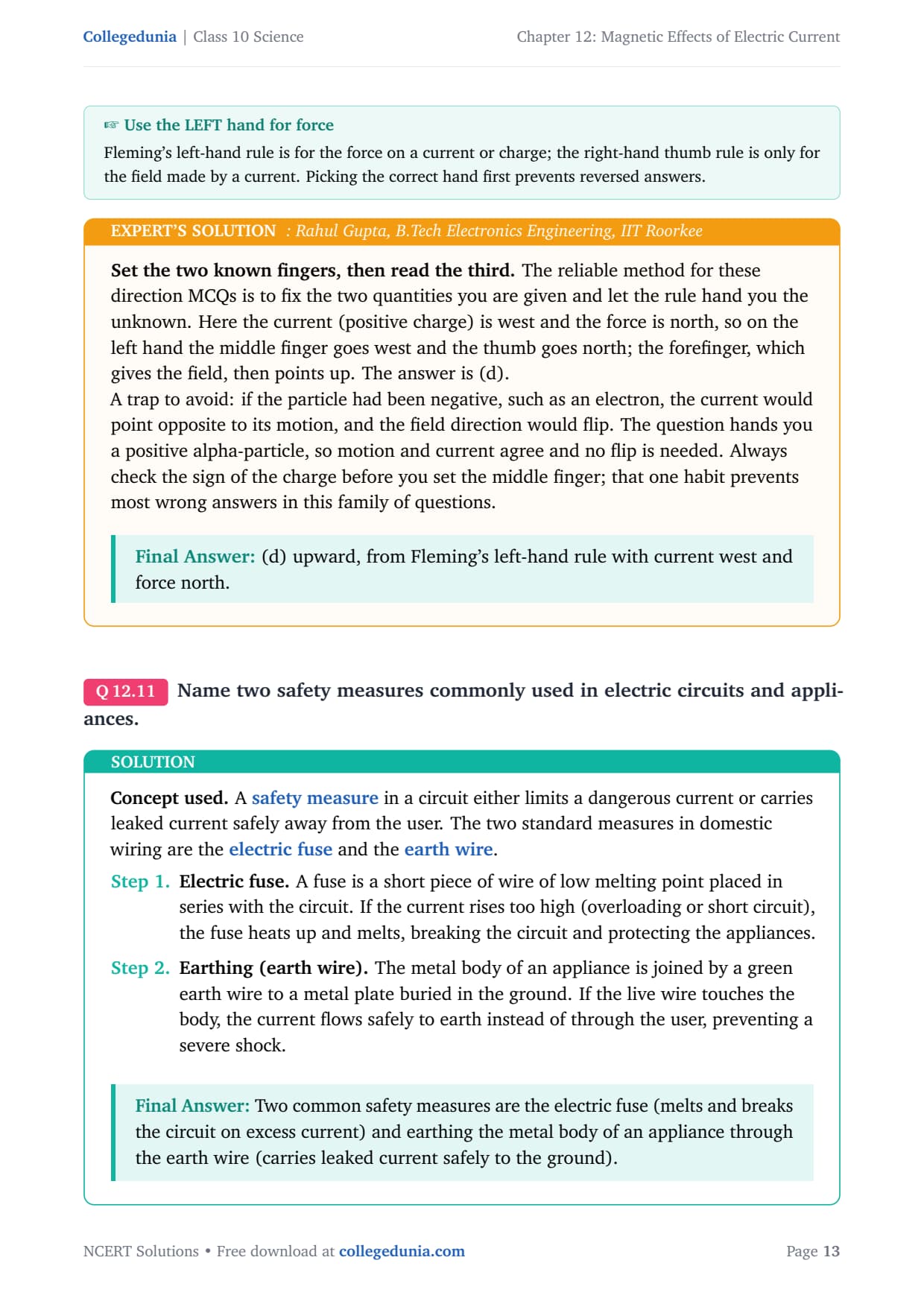
Fix the two quantities you are given and let the rule hand you the unknown. Here the current (positive charge) is west and the force is north, so on the left hand the middle finger goes west and the thumb goes north; the forefinger, which gives the field, then points up. The answer is (d).
If the particle had been negative, such as an electron, the current would point opposite to its motion and the field direction would flip.
Always check the sign of the charge before you set the middle finger; that one habit prevents most wrong answers.
Answer: (d) upward, from Fleming's left-hand rule with current west and force north.
Q 11
Name two safety measures commonly used in electric circuits and appliances.
A safety measure in a circuit either limits a dangerous current or carries leaked current safely away from the user. The two standard measures in domestic wiring are the electric fuse and the earth wire.
Electric fuse. A short piece of wire of low melting point placed in series with the circuit. If the current rises too high (overloading or short circuit), the fuse heats up and melts, breaking the circuit and protecting the appliances.
Earthing (earth wire). The metal body of an appliance is joined by a green earth wire to a metal plate buried in the ground. If the live wire touches the body, the current flows safely to earth instead of through the user.
Answer: Two common safety measures are the electric fuse (melts and breaks the circuit on excess current) and earthing the metal body of an appliance through the earth wire (carries leaked current safely to the ground).
DP
Deepa Pillai
M.Sc Physics, B.Ed
Verified Expert
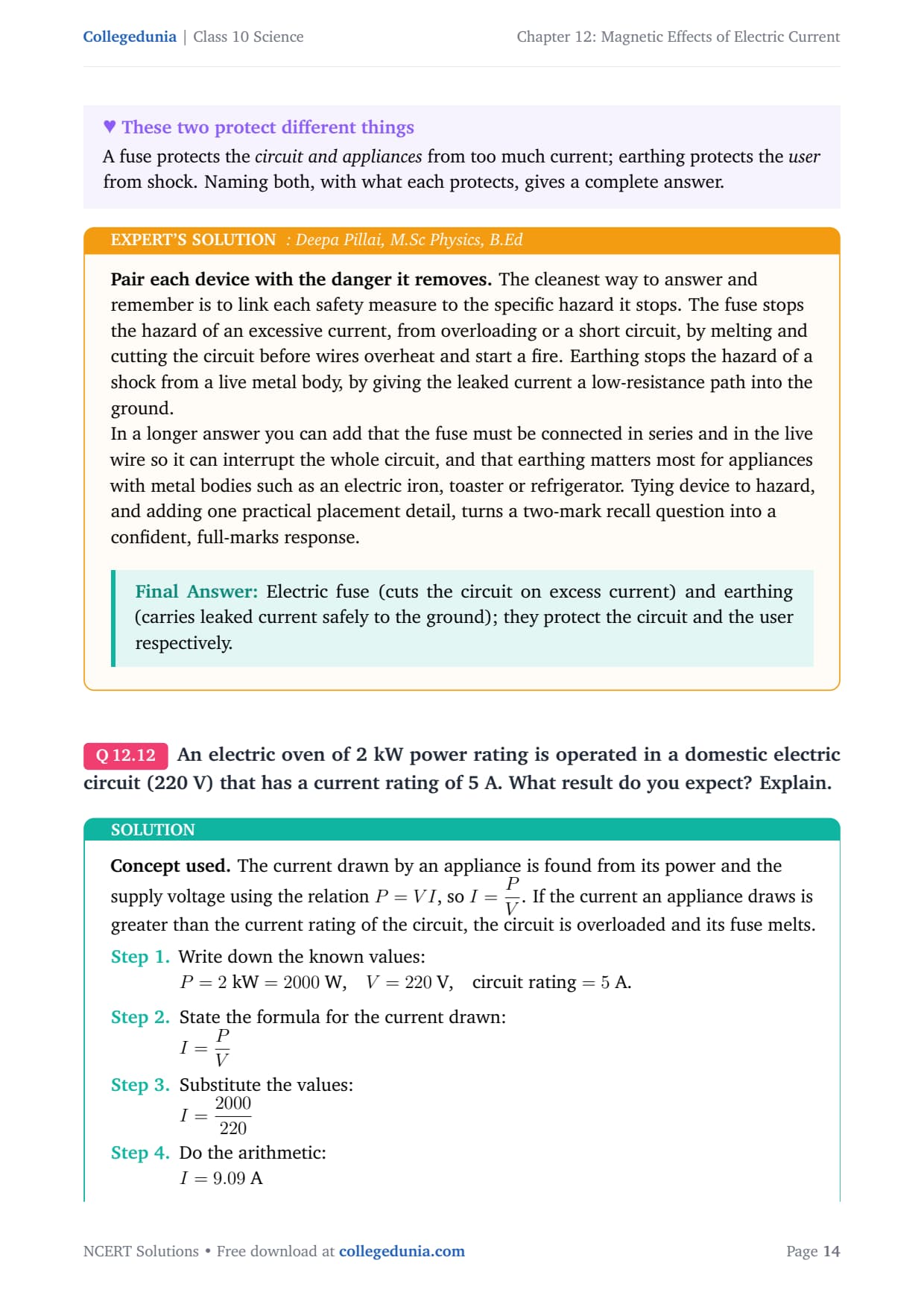
Link each safety measure to the specific hazard it stops. The fuse stops the hazard of an excessive current, from overloading or a short circuit, by melting and cutting the circuit before wires overheat. Earthing stops the hazard of a shock from a live metal body, by giving the leaked current a low-resistance path into the ground.
In a longer answer add that the fuse must be connected in series and in the live wire so it can interrupt the whole circuit.
Earthing matters most for appliances with metal bodies such as an electric iron, toaster or refrigerator.
Answer: Electric fuse (cuts the circuit on excess current) and earthing (carries leaked current safely to the ground); they protect the circuit and the user respectively.
Q 12
An electric oven of 2 kW power rating is operated in a domestic electric circuit (220 V) that has a current rating of 5 A. What result do you expect? Explain.
The current drawn by an appliance is found from its power and the supply voltage using P = VI, so I = P/V. If the current an appliance draws is greater than the current rating of the circuit, the circuit is overloaded and its fuse melts.
Known values: P = 2 kW = 2000 W, V = 220 V, circuit rating = 5 A.
Formula for the current drawn: I = P/V.
Substitute: I = 2000/220.
Arithmetic: I = 9.09 A.
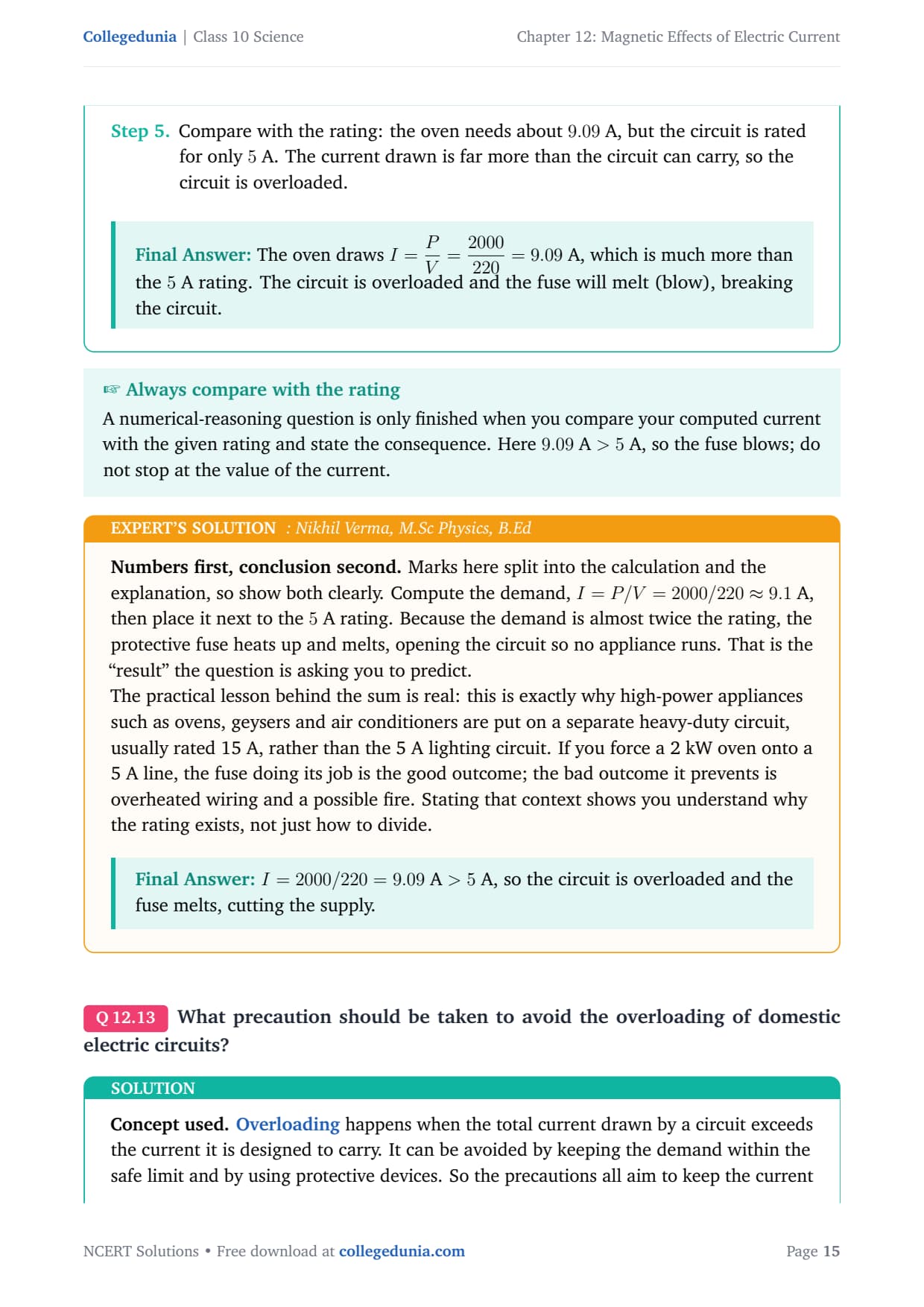
Compare with the rating: the oven needs about 9.09 A but the circuit is rated for only 5 A, so the circuit is overloaded.
Answer: The oven draws I = P/V = 2000/220 = 9.09 A, which is much more than the 5 A rating. The circuit is overloaded and the fuse will melt (blow), breaking the circuit.
NV
Nikhil Verma
M.Sc Physics, B.Ed
Verified Expert
Marks here split into the calculation and the explanation, so show both. Compute the demand, I = P/V = 2000/220, which is about 9.1 A, then place it next to the 5 A rating. Because the demand is almost twice the rating, the protective fuse heats up and melts, opening the circuit.
This is why high-power appliances such as ovens, geysers and air conditioners get a separate heavy-duty circuit, usually rated 15 A.
The fuse blowing is the good outcome; the bad outcome it prevents is overheated wiring and a possible fire.
Answer: I = 2000/220 = 9.09 A, more than 5 A, so the circuit is overloaded and the fuse melts, cutting the supply.
Q 13
What precaution should be taken to avoid the overloading of domestic electric circuits?
Overloading happens when the total current drawn by a circuit exceeds the current it is designed to carry. It is avoided by keeping the demand within the safe limit and by using protective devices, so all the precautions aim to keep the current within the rated value.
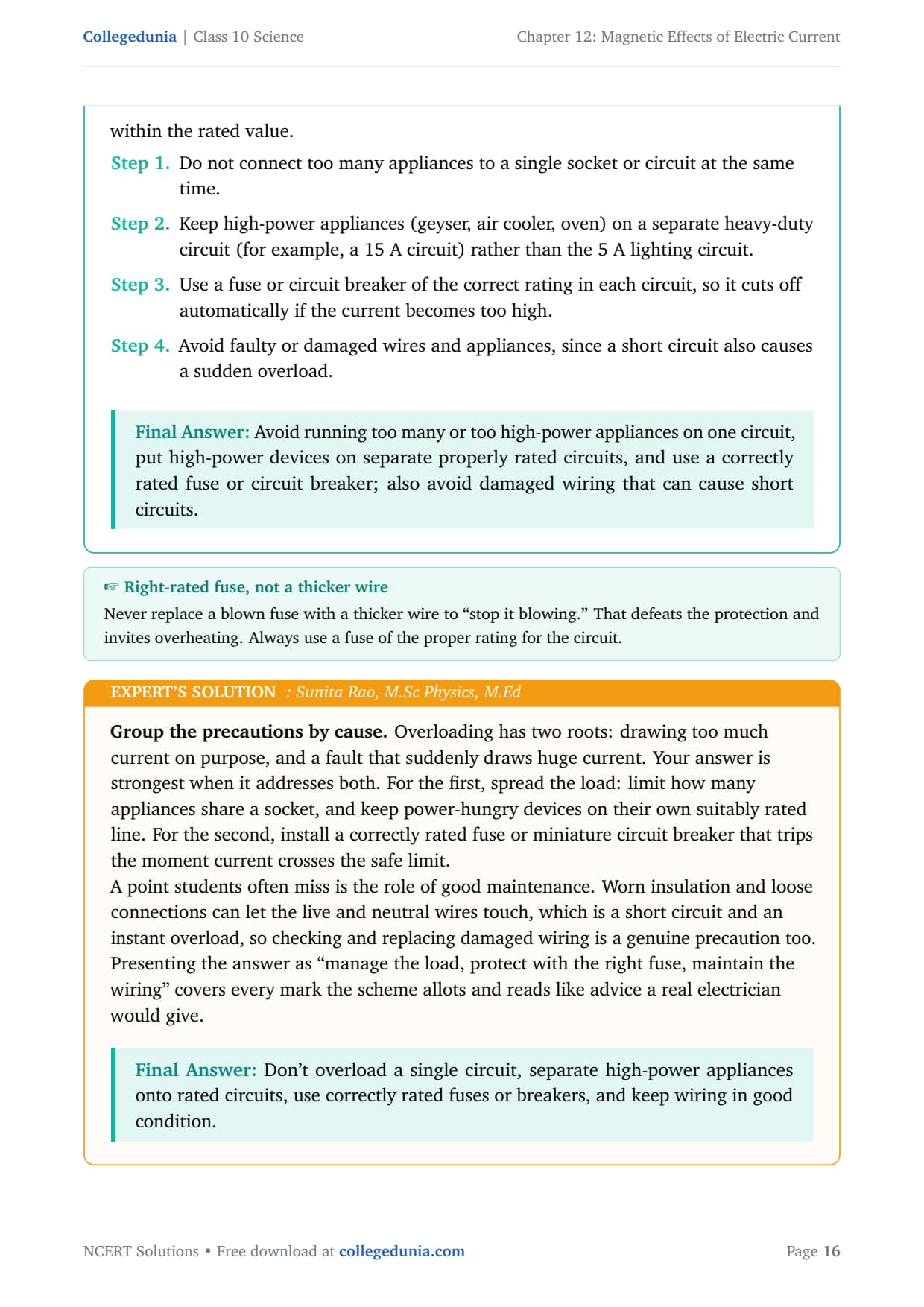
Do not connect too many appliances to a single socket or circuit at the same time.
Keep high-power appliances (geyser, air cooler, oven) on a separate heavy-duty circuit (for example a 15 A circuit) rather than the 5 A lighting circuit.
Use a fuse or circuit breaker of the correct rating in each circuit, so it cuts off automatically if the current becomes too high.
Avoid faulty or damaged wires and appliances, since a short circuit also causes a sudden overload.
Answer: Avoid running too many or too high-power appliances on one circuit, put high-power devices on separate properly rated circuits, and use a correctly rated fuse or circuit breaker; also avoid damaged wiring that can cause short circuits.
SR
Sunita Rao
M.Sc Physics, M.Ed
Verified Expert
Overloading has two roots: drawing too much current on purpose, and a fault that suddenly draws huge current. For the first, spread the load: limit how many appliances share a socket, and keep power-hungry devices on their own rated line. For the second, install a correctly rated fuse or miniature circuit breaker that trips the moment current crosses the safe limit.
Good maintenance counts too: worn insulation and loose connections can let live and neutral wires touch, which is a short circuit and an instant overload.
Think of it as "manage the load, protect with the right fuse, maintain the wiring."
Answer: Don't overload a single circuit, separate high-power appliances onto rated circuits, use correctly rated fuses or breakers, and keep wiring in good condition.
Q 14
Which of the following correctly describes the magnetic field near a long straight wire? (a) The field consists of straight lines perpendicular to the wire. (b) The field consists of straight lines parallel to the wire. (c) The field consists of radial lines originating from the wire. (d) The field consists of concentric circles centred on the wire.
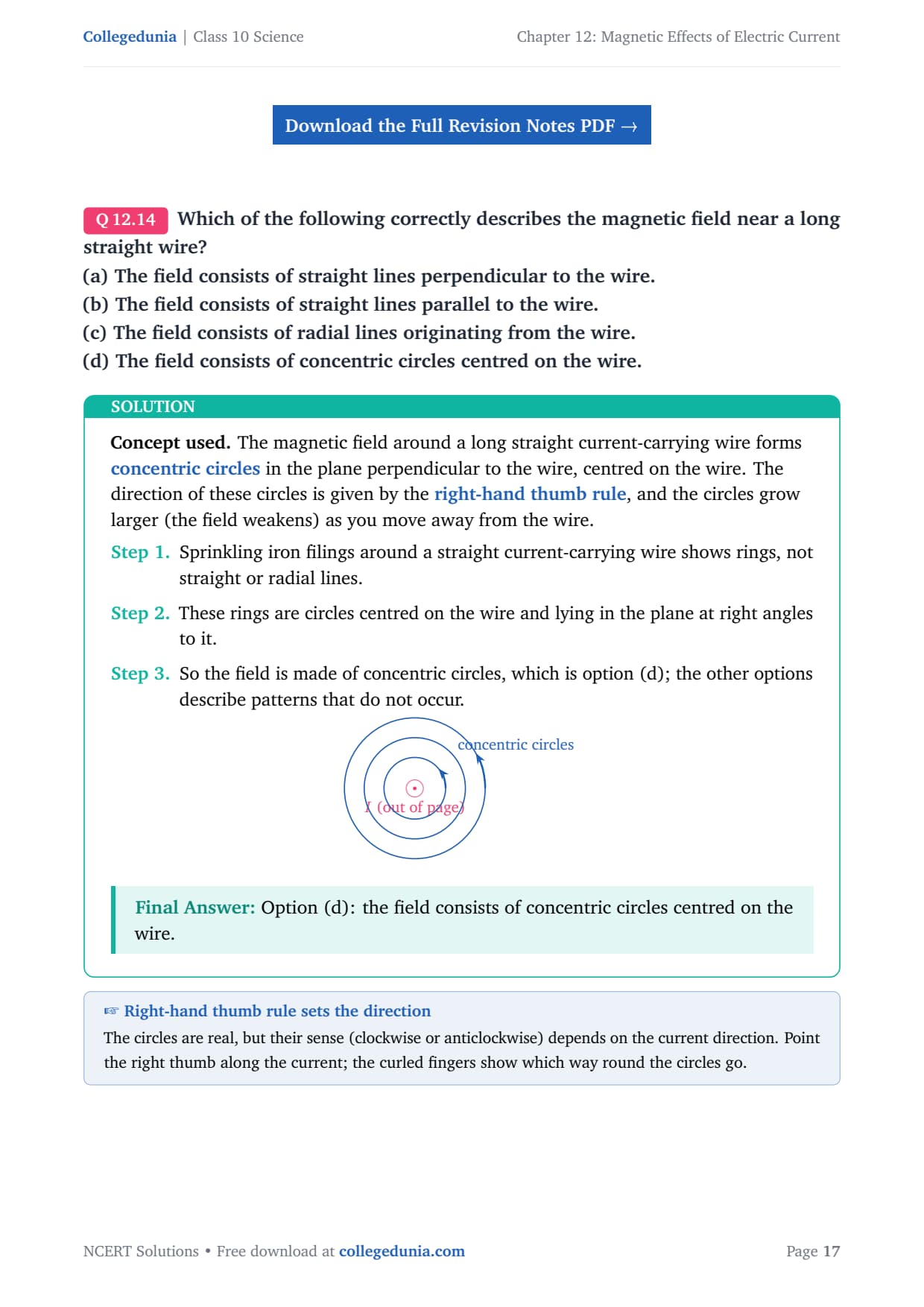
The magnetic field around a long straight current-carrying wire forms concentric circles in the plane perpendicular to the wire, centred on the wire. Their direction is given by the right-hand thumb rule, and the circles grow larger (the field weakens) as you move away from the wire.
Sprinkling iron filings around a straight current-carrying wire shows rings, not straight or radial lines.
These rings are circles centred on the wire and lying in the plane at right angles to it.
So the field is made of concentric circles, which is option (d); the other options describe patterns that do not occur.
Answer: Option (d): the field consists of concentric circles centred on the wire.
AB
Aditya Bose
M.Tech Power Engineering
Verified Expert
Each wrong option describes a pattern you can rule out from the iron-filings activity. Perpendicular straight lines (a) and parallel straight lines (b) never appear around a single straight wire, and radial lines (c) belong to the electric field of a point charge, not a magnetic field. That leaves the concentric circles of (d).
The pattern is circular because of symmetry: every point the same distance from the wire is equivalent, so the field is the same all round at that distance.
Move further out and the circle is larger and the field weaker.
Answer: (d) Concentric circles centred on the wire.
Q 15
At the time of short circuit, the current in the circuit (a) reduces substantially. (b) does not change. (c) increases heavily. (d) vary continuously.
A short circuit occurs when the live and neutral wires touch directly, so the current bypasses the appliances. By Ohm's law, I = V/R: the resistance of this direct path is very small, and a very small R with the same voltage gives a very large current.
In a short circuit the current flows through a path of almost no resistance (live touching neutral).
With V fixed at the mains value and R very small, I = V/R becomes very large.
So the current increases heavily at the moment of a short circuit; option (c) is correct.
Answer: Option (c): the current increases heavily at the time of a short circuit.
LK
Lakshmi Krishnan
M.Sc Physics, B.Ed
Verified Expert
The insulation fails or a fault lets the live and neutral wires meet, creating a path of almost zero resistance straight across the supply. Hold the mains voltage constant and shrink the resistance toward zero in I = V/R, and the current shoots up, which is the "heavy increase" of option (c).
This is precisely the situation a fuse is designed for: the surge produces intense heating and the fuse melts first, breaking the circuit.
The heavy current of a short circuit and the protective melting of a fuse are two halves of the same story.
Answer: (c) The current increases heavily, because the resistance falls to nearly zero and I = V/R.
Q 16
State whether the following statements are true or false. (a) The field at the centre of a long circular coil carrying current will be parallel straight lines. (b) A wire with a green insulation is usually the live wire of an electric supply.
Two facts are tested. First, near the centre of a long circular coil (a solenoid-like coil) the large field circles appear as parallel straight lines, giving a nearly uniform field. Second, by the standard colour code of domestic wiring, the earth wire is green, the live wire is red, and the neutral wire is black.
(a) At the centre of a long circular coil the arcs of the big field circles look like parallel straight lines, so the field there is represented by parallel straight lines. The statement is true.
(b) Green insulation marks the earth wire, not the live wire; the live wire has red insulation. So the statement is false.
Answer: (a) True: the field at the centre of a long circular coil is shown by parallel straight lines. (b) False: a green wire is the earth wire; the live wire is red.
MT
Manoj Tiwari
M.Sc Physics, M.Phil
Verified Expert
True/false questions reward a short reason with each verdict, so judge the two parts separately. For (a), recall the loop section: as the field circles grow toward the centre of a long coil, their arcs flatten into parallel straight lines, so the centre field is uniform and the statement is true. For (b), the colour code is fixed: green is earth, red is live, black is neutral, which makes (b) false.
Adding the correct colour when you mark (b) false lifts the answer, since the examiner sees you know the right fact.
The colour code is a real safety matter: confusing earth and live during wiring is dangerous, which is why it is standardised.
Answer: (a) True. (b) False, green is the earth wire and red is the live wire.
Q 17
List two methods of producing magnetic fields.
A magnetic field can be produced by a magnet or by an electric current, so the two basic methods come from these two sources: a permanent magnet, and a current-carrying conductor (which can be wound into a solenoid to make an electromagnet).
Using a magnet. A permanent magnet, such as a bar magnet, produces a magnetic field in the region around it.
Using an electric current. A current-carrying conductor produces a magnetic field around it (right-hand thumb rule). Winding the wire into a solenoid with a soft-iron core makes a strong electromagnet.
Answer: Two methods are: (1) using a permanent magnet (for example a bar magnet), and (2) passing an electric current through a conductor or solenoid (an electromagnet).
PS
Pooja Shah
M.Sc Physics, B.Ed
Verified Expert
The marking scheme wants two genuinely different methods, so pair a permanent magnet with a current-carrying conductor rather than listing two kinds of magnet. The magnet gives a steady field; the current gives a field you can create and remove at will, and strengthen by adding turns or a soft-iron core.
For a fuller answer, name the shapes a current can take: a straight wire, a circular loop, and a solenoid, each with its own field pattern.
A bar magnet's field is always on, but an electromagnet's field exists only while the current flows, which is why electromagnets are used in motors, bells and cranes.
Answer: (1) A permanent magnet, and (2) an electric current through a conductor or solenoid (electromagnet).
Q 18
When is the force experienced by a current-carrying conductor placed in a magnetic field largest?
The force on a current-carrying conductor in a magnetic field depends on the angle between the current and the field. The force is largest when these two directions are perpendicular (at right angles), and it is zero when they are parallel.
If the current is along the field (parallel), the conductor feels no force.
As the angle between current and field increases, the force grows.
The force is greatest when the current is at 90 degrees to the field, that is, when the current and the magnetic field are mutually perpendicular.
Answer: The force is largest when the current in the conductor is at right angles (90 degrees) to the direction of the magnetic field, that is, when the current and field are mutually perpendicular.
HN
Harish Nair
M.Sc Physics, M.Ed
Verified Expert
Recall Activity 12.7, where the aluminium rod swung most when the current ran across the field rather than along it. That experiment is the evidence behind the one-line rule: maximum force at 90 degrees, zero force at 0 degrees.
The senior-class relation, force is proportional to the sine of the angle between current and field, states the same thing: the sine is largest at 90 degrees and zero at 0 degrees.
You do not need the formula at Class 10, but knowing it confirms why "mutually perpendicular" is the condition for the largest force.
Answer: Largest when the current and the magnetic field are perpendicular (at 90 degrees) to each other.
Q 19
Imagine that you are sitting in a chamber with your back to one wall. An electron beam, moving horizontally from back wall towards the front wall, is deflected by a strong magnetic field to your right side. What is the direction of magnetic field?
Fleming's left-hand rule gives the direction of force. For an electron beam the current direction is opposite to the motion of the electrons, because electrons are negatively charged. With current and force known, the rule fixes the field.
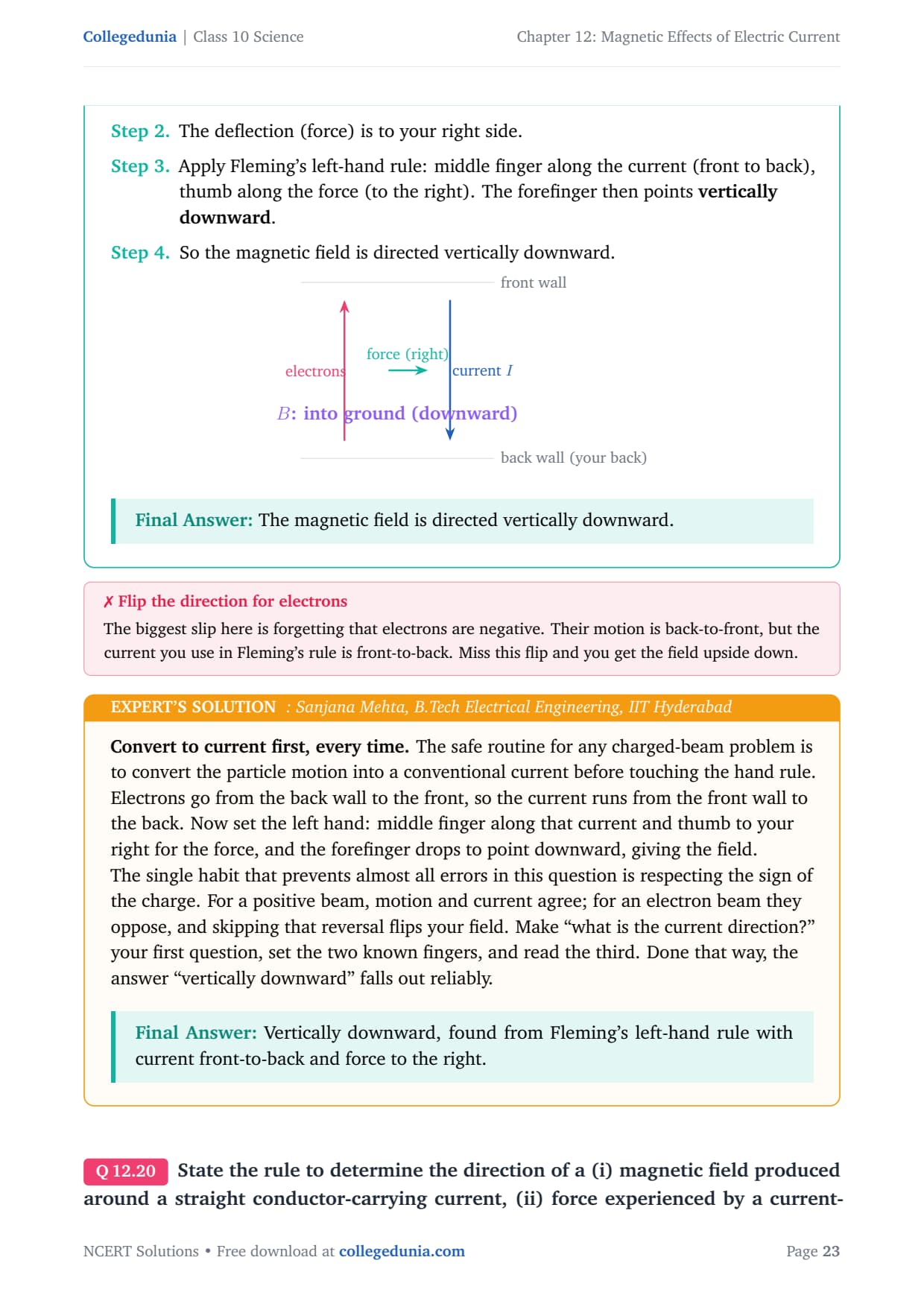
The electrons move from the back wall to the front wall, so the conventional current is from the front wall to the back wall.
The deflection (force) is to your right side.
Apply Fleming's left-hand rule: middle finger along the current (front to back), thumb along the force (to the right); the forefinger then points vertically downward.
So the magnetic field is directed vertically downward.
Answer: The magnetic field is directed vertically downward.
SM
Sanjana Mehta
B.Tech Electrical Engineering
Verified Expert
Convert the particle motion into a conventional current before touching the hand rule. Electrons go from the back wall to the front, so the current runs from the front wall to the back. Now set the left hand: middle finger along that current and thumb to your right for the force, and the forefinger drops to point downward, giving the field.
The single habit that prevents almost all errors here is respecting the sign of the charge: for an electron beam, motion and current oppose.
Make "what is the current direction?" your first question, set the two known fingers, and read the third.
Answer: Vertically downward, found from Fleming's left-hand rule with current front-to-back and force to the right.
Q 20
State the rule to determine the direction of a (i) magnetic field produced around a straight conductor-carrying current, (ii) force experienced by a current-carrying straight conductor placed in a magnetic field which is perpendicular to it, and (iii) current induced in a coil due to its rotation in a magnetic field.
Three different rules answer the three parts. The right-hand thumb rule gives the field of a current; Fleming's left-hand rule gives the force on a current in a field; Fleming's right-hand rule gives the direction of an induced current.
(i) Field around a straight conductor: right-hand thumb rule. Hold the wire in the right hand with the thumb along the current; the curled fingers point along the field lines.
(ii) Force on a conductor in a field: Fleming's left-hand rule. Forefinger = field, middle finger = current, thumb = force (motion), all mutually perpendicular.
(iii) Induced current in a rotating coil: Fleming's right-hand rule. Forefinger = field, thumb = motion of the conductor, middle finger = induced current.
Answer: (i) Right-hand thumb rule; (ii) Fleming's left-hand rule; (iii) Fleming's right-hand rule.
GM
Gaurav Malhotra
M.Sc Physics, B.Ed
Verified Expert
The three parts test whether you can pick the correct rule for the correct situation, so sort them by purpose. Part (i) is a current making a field, the right-hand thumb rule. Part (ii) is a current feeling a force in a field, Fleming's left-hand rule. Part (iii) is motion generating a current, Fleming's right-hand rule.
The common confusion is between the two Fleming rules: the motor effect (current gives motion) uses the left hand; the generator effect (motion gives current) uses the right hand.
"Motor-left, generator-right" is a one-line mnemonic that keeps the two straight.
Answer: (i) Right-hand thumb rule, (ii) Fleming's left-hand rule, (iii) Fleming's right-hand rule.
Q 21
When does an electric short circuit occur?
A short circuit is an accidental low-resistance connection between the live and neutral wires, bypassing the appliance. It occurs when these two wires come into direct contact, usually because the insulation is damaged or an appliance is faulty.
Normally the current flows from the live wire, through the appliance, and back through the neutral wire.
If the insulation of the wires is damaged, or there is a fault, the live wire and the neutral wire touch directly.
This direct contact has almost no resistance, so a very large current flows; this is a short circuit.
Answer: An electric short circuit occurs when the live wire and the neutral wire come into direct contact (for example, due to damaged insulation or a faulty appliance), creating a low-resistance path and a very large current.
RS
Ritika Sen
M.Sc Physics, M.Ed
Verified Expert
Define a short circuit by what physically changes: the current finds a direct path between live and neutral without passing through the appliance. That path has almost no resistance, so by I = V/R the current becomes very large. State the path first and the heavy current second.
Name the everyday causes the examiner expects: worn or melted insulation, loose connections, water ingress, or an internal fault in an appliance.
Linking the short circuit to the fuse closes the loop, because the surge is exactly what melts the fuse and disconnects the supply.
Answer: When the live and neutral wires touch directly (damaged insulation or a fault), giving a near-zero-resistance path and a very large current.
Q 22
What is the function of an earth wire? Why is it necessary to earth metallic appliances?
The earth wire is a low-resistance wire (green insulation) that connects the metal body of an appliance to a metal plate buried deep in the earth. Its job is to provide a safe path for any leakage current, so that the body stays at the potential of the earth (zero) and a person touching it does not get a shock.
The metal body of an appliance is connected by the earth wire to a plate buried in the ground.
If the live wire accidentally touches the metal body, the body would become live and dangerous.
Because the earth wire offers a very low-resistance path, the leakage current flows straight to the earth instead of through a person.
The body is thus kept at earth potential, so a person touching it does not receive a severe electric shock.
Answer: The earth wire provides a low-resistance path that sends any leakage current safely into the ground. Metallic appliances are earthed so that, if the live wire touches the body, the current flows to earth and the body stays at zero potential, protecting the user from a severe shock.
DY
Devendra Yadav
M.Sc Physics, B.Ed
Verified Expert
The question has two parts, so answer them in order. The function of the earth wire is to give leakage current a safe, low-resistance route into the ground. The reason for earthing metal appliances follows: if a damaged live wire touches the metal body, the earth wire drains that current away and holds the body at earth potential, so a person touching it is not shocked.
Low resistance matters because current prefers the easiest path, so almost all of it goes to earth, not through the relatively high-resistance human body.
Naming metal-bodied appliances such as a refrigerator or electric press shows where earthing is essential in real homes.
Answer: The earth wire carries leakage current safely to the ground and keeps an appliance's metal body at earth potential, so earthing metal appliances prevents the user from getting a severe shock if the live wire touches the body.
NCERT Solutions Class 10 Science Chapter 12 Magnetic Effects of Electric Current FAQs
Ques. How many questions are there in NCERT Class 10 Science Chapter 12 Magnetic Effects of Electric Current?
Ans. There are 22 questions in NCERT Class 10 Science Chapter 12 Magnetic Effects of Electric Current: 13 in-text questions spread through the chapter and 9 end-of-chapter exercise questions. All 22 are solved with a clean Check Solution and a detailed Expert Solution in the PDF, covering field-line drawings, the right-hand thumb rule, Fleming's left-hand rule, MCQs, true or false statements and the safety devices used in domestic circuits.
Ques. What is the right-hand thumb rule in Class 10 Science Chapter 12?
Ans. The right-hand thumb rule gives the direction of the magnetic field produced by a current. Hold the current-carrying wire in your right hand so that the thumb points in the direction of the current; the way the fingers curl around the wire then gives the direction of the magnetic field lines. For a straight wire these lines are concentric circles, and for a loop the field threads through the loop the same way all around. It is used only for the field of a current, not for the force on a current.
Ques. What is the difference between the right-hand thumb rule and Fleming's left-hand rule?
Ans. The right-hand thumb rule is used when a current produces a magnetic field, and it gives the direction of that field. Fleming's left-hand rule is used when a current-carrying conductor lies in a magnetic field, and it gives the direction of the force on the conductor. In Fleming's left-hand rule, the forefinger points along the field, the middle finger along the current, and the thumb along the force, with all three at right angles. The simple way to remember it is "left hand for force, right hand for the field of a current."
Ques. Why do magnetic field lines never intersect each other?
Ans. Magnetic field lines never intersect because the magnetic field has only one direction at any single point. If two field lines crossed at a point, you could draw two different tangents there, which would mean the field points in two directions at the same place. A compass needle placed at that point cannot point in two directions at once, so this is impossible. Therefore two magnetic field lines can never cross. This is why a neat field-line diagram always shows smooth, separate curves.
Ques. What is the magnetic field inside a long current-carrying solenoid?
Ans. The magnetic field inside a long current-carrying solenoid is uniform, which means it has the same magnitude and the same direction at every interior point. The field lines inside the solenoid are parallel, equally spaced straight lines, just like the field of a bar magnet. This uniform field is the reason a solenoid is used to magnetise a soft-iron core and make a strong electromagnet. Right at the open ends the field weakens and spreads out, but the interior of a long solenoid stays uniform.
Ques. What is the function of a fuse and an earth wire in a domestic circuit?
Ans. A fuse is a thin wire of low melting point connected in series in the live wire. If the current rises too high because of overloading or a short circuit, the fuse melts and breaks the circuit, protecting the appliances and the wiring. An earth wire is a low-resistance green wire that connects the metal body of an appliance to a metal plate in the ground. If the live wire touches the body, the leakage current flows safely to earth instead of through the user. So the fuse protects the circuit and appliances, while earthing protects the user from a shock.
Ques. How many pages is the Class 10 Science Magnetic Effects of Electric Current NCERT Solutions PDF?
Ans. The Magnetic Effects of Electric Current NCERT Solutions PDF covers all 22 questions with step-by-step reasoning, labelled field-line and hand-rule diagrams, and an Expert Solution for each question. Both Normal and HD versions are available from this page, and both are free to download for the 2026-27 session.
Ques. Is the NCERT Solutions for Class 10 Science Chapter 12 aligned with the 2026-27 syllabus?
Ans. Yes. This page reflects the current 2026-27 CBSE syllabus for Class 10 Science. The Magnetic Effects of Electric Current chapter is unchanged for the current cycle, and every answer follows the NCERT textbook, including the properties of magnetic field lines, the right-hand thumb rule, Fleming's left-hand rule, the force on a conductor, and domestic circuits with the fuse and earth wire. The solutions are written for the CBSE board exam and school unit tests.








Comments