The NCERT Solutions for Class 10 Maths Chapter 10 Circles cover all 17 questions from Exercise 10.1 and 10.2, written for the 2026-27 CBSE syllabus. Each answer uses the chapter's two theorems step by step: the radius is perpendicular to the tangent, and the two tangents from an external point are equal.
All 17 questions solved step by step, with an Expert Solution that adds board-exam strategy and common-error warnings.
Full cover of tangent, secant, point of contact, the radius-tangent right angle, equal tangents, and circumscribing triangles and quadrilaterals.
Aligned with the 2026-27 CBSE Class 10 Maths syllabus, for both school tests and the board exam.
What the NCERT Solutions for Class 10 Maths Chapter 10 Circles Cover
Chapter 10 is about how a straight line can meet a circle. There are three cases, and the chapter builds its two theorems around the tangent case.
Tangent: touches the circle at one point, the point of contact.
Secant: cuts the circle at two points.
Number of tangents: none from inside, one from a point on the circle, two from an external point.
Key Concepts in Circles Chapter 10 for CBSE Class 10 Boards
Chapter 10 is proof-heavy. Two ideas drive almost every answer:
Theorem 10.1: the radius to the contact point is perpendicular to the tangent. This right angle sets up the tangent length formula PT = √(d2 − r2), where d is the external point to centre distance and r is the radius.
Theorem 10.2: the two tangents from one external point are equal, PA = PB. For a quadrilateral around a circle, this gives AB + CD = AD + BC.
Quick Tip: In every proof, first name the contact points. Then write the equal-tangent pairs from each vertex before adding them. This habit prevents most CBSE mark loss in Chapter 10. Each Collegedunia solution follows this exact order.
Exercise 10.1 and 10.2 of Class 10 Circles: Question-wise Overview
Exercise 10.1 has 4 questions on definitions and one tangent calculation. Exercise 10.2 has 13: 5 numerical or short answer, 8 proofs. The proofs carry more marks.
Exercise
Question
What is asked
Key concept
10.1
Q1, Q2
Tangent count; fill in the blanks
Definitions
10.1
Q3
Radius 5 cm, OQ = 12 cm, find PQ
Pythagoras (MCQ)
10.2
Q1, Q6, Q7
Find a radius or chord length
Pythagoras triples
10.2
Q2, Q3, Q10
Find or prove an angle
Supplementary pair
10.2
Q4, Q5, Q9
Prove parallel or perpendicular
Same-line rule
10.2
Q8, Q11, Q13
Prove results for circumscribed figures
Equal tangents
10.2
Q12
Find sides AB and AC
Area = r × s
Q8, Q10, Q11, Q12 and Q13 appear most often in CBSE board papers because they mix two theorems. State the theorem in each step. Examiners give method marks for the reason, not just the algebra.
How to Solve Tangent Problems in Circles for CBSE Class 10
Chapter 10 has two problem types: numerical (find a length or angle) and proof.
Numerical: find the right triangle. A tangent and its radius form a right angle. Know two sides, use Pythagoras for the third.
Angles: use the quadrilateral angle sum. The two tangents, centre, and two contact points form a quadrilateral. Its angles add to 360 degrees, two are 90, so the rest add to 180.
Proofs on figures: write equal-tangent pairs. From each vertex the two tangents are equal. List all pairs first, then add or rearrange.
Parallel or perpendicular proofs: use the same-line rule. Two lines perpendicular to one line are parallel; two perpendiculars at one point are the same line.
Solved Example and Common Mistakes in Circles Chapter 10
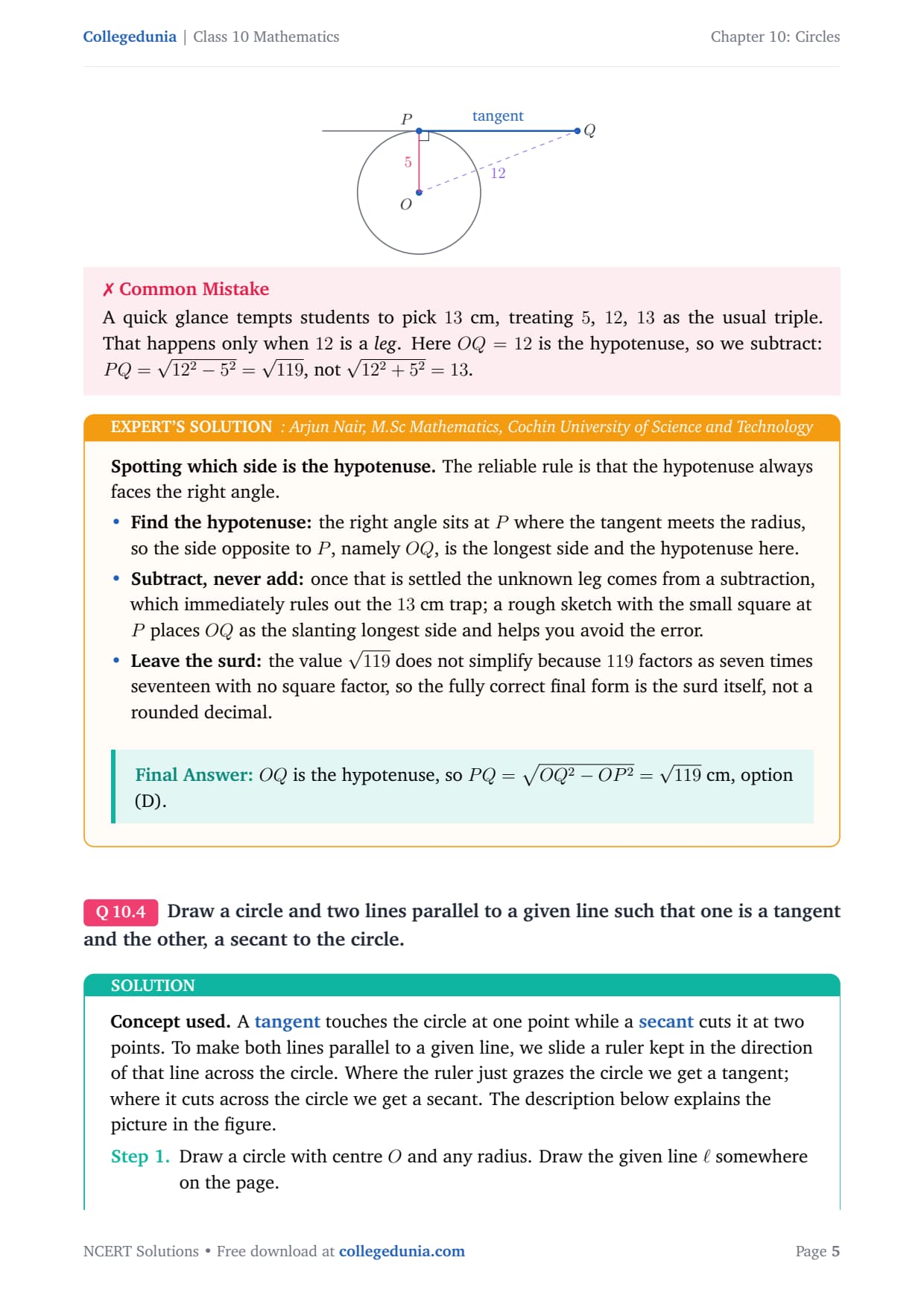
Solved example (Exercise 10.1 Q3). A tangent PQ touches a circle of radius 5 cm at P. The line through the centre O meets it at Q, with OQ = 12 cm. Find PQ.
OP is perpendicular to the tangent, so triangle OPQ has a right angle at P, with OQ as the hypotenuse.
So PQ2 = OQ2 − OP2 = 122 − 52 = 144 − 25 = 119, giving PQ = √119 cm. The trap answer 13 comes from adding instead of subtracting.
Common mistakes in Circles board answers:
Not naming the theorem. Citing "Theorem 10.1" earns the reason mark.
Wrong hypotenuse. The external point to centre distance is the hypotenuse. Subtract, never add.
Skipping "Given" and "To Prove". CBSE gives 1 mark for setting these up.
Not doubling the half-chord. In concentric-circle problems (Q7), multiply by 2 at the end.
Using one tangent pair only. Circumscribed-figure proofs need it at every vertex.
Important Formulas in Circles Class 10 for Quick Revision
Everything follows from the two theorems. The table below is a quick reference.
All NCERT Solutions for Class 10 Maths Chapter 10 Circles with Step-by-Step Solutions
Exercise 10.1
Q 10.1
How many tangents can a circle have?
Concept used. A tangent to a circle is a line that
touches the circle at exactly one point, called the point of contact.
A circle is made up of infinitely many points, and at every single one
of those points exactly one tangent can be drawn. So the total count of
tangents is found by counting the points on the circle.
Pick any point on the circle. By Theorem 10.1 there is one and
only one tangent at that point (the line through the point that
is perpendicular to the radius there).
The circle has infinitely many points on it.
Each point gives its own tangent, so adding them up gives
infinitely many tangents in all.
A circle can have infinitely many tangents (one at each of its infinitely many points).
RD
Rohan Deshmukh
M.Sc Mathematics, Savitribai Phule Pune University
Verified Expert
How to word this in a board answer. State the count and the
reason together, never the bare number on its own.
State the reason: a one-word reply such as ``infinite''
can lose the supporting mark, so write that a circle is an
unlimited set of points and that each point carries its own
unique tangent, which is why the number of tangents is unlimited.
Link to the definition: examiners reward an answer that
ties the count to the definition of a tangent rather than just
quoting a number, so name the touching point in your sentence.
Avoid the trap: do not mix this up with the later
result that from an external point there are exactly two
tangents, since that is a completely different situation; keep
the sentence short and exact.
Infinitely many tangents, because the circle has infinitely many points and each carries one tangent.
Q 10.2
Fill in the blanks:
(i) A tangent to a circle intersects it in 2.2cm0.4pt point(s).
(ii) A line intersecting a circle in two points is called a 2.6cm0.4pt.
(iii) A circle can have 2.2cm0.4pt parallel tangents at the most.
(iv) The common point of a tangent to a circle and the circle is called 2.6cm0.4pt.
Concept used. Each blank is a basic definition from this
chapter. We recall that a tangent touches the circle once, a
secant cuts it in two points, parallel tangents can be drawn
only at the two ends of a diameter, and the touching point is the
point of contact.
(i) A tangent meets the circle at only one place, so it
intersects it in one point.
(ii) A line that cuts the circle at two points is a
secant.
(iii) A pair of parallel tangents touches the circle at
the two ends of one diameter; no third tangent can be parallel
to them, so the most is two.
(iv) The single point where the tangent touches the
circle is the point of contact.
(i) one (ii) secant (iii) two (iv) point of contact.
MK
Meera Krishnan
M.Sc Mathematics, University of Madras
Verified Expert
Why these one-word answers carry full marks. Fill-in-the-blank
items test exact vocabulary, so the marking scheme accepts only the
precise term.
Exact words only: writing ``a line'' for blank (ii)
instead of ``secant'' would not score, and ``meeting point'' for
(iv) instead of ``point of contact'' is also marked wrong, so
copy the textbook wording without paraphrasing it.
Learn the four terms: the safe habit is to memorise the
four key words of this chapter, namely tangent, secant, point of
contact and the two-tangents-from-an-external-point fact.
Mind the count: blank (iii) is the only one that needs
a moment of thought, since students often guess ``infinite''
there, but the diameter picture fixes the number firmly at two.
Use the exact chapter terms: one, secant, two, point of contact.
Q 10.3
A tangent PQ at a point P of a circle of radius 5 cm
meets a line through the centre O at a point Q so that OQ=12 cm.
Length PQ is:
(A) 12 cm (B) 13 cm (C) 8.5 cm (D) √119 cm.
Concept used. By Theorem 10.1 the tangent is
perpendicular to the radius at the point of contact, so
∠ OPQ=90∘. That makes OPQ a right triangle with
the right angle at P. Here OQ is the hypotenuse (it faces the right
angle), OP=r=5 cm is one leg, and PQ is the other leg. We use the
Pythagoras theoremOQ2=OP2+PQ2.
Write the Pythagoras relation for OPQ:
OQ2=OP2+PQ2.
Make PQ2 the subject:
PQ2=OQ2-OP2.
Substitute OQ=12 and OP=5:
PQ2=122-52.
Do the arithmetic step by step:
PQ2=144-25=119.
Take the positive square root (a length is positive):
PQ=√119 cm.
Option (D): PQ=√119 cm.
AN
Arjun Nair
M.Sc Mathematics, Cochin University of Science and Technology
Verified Expert
Spotting which side is the hypotenuse. The reliable rule is
that the hypotenuse always faces the right angle.
Find the hypotenuse: the right angle sits at P where
the tangent meets the radius, so the side opposite to P, namely
OQ, is the longest side and the hypotenuse here.
Subtract, never add: once that is settled the unknown
leg comes from a subtraction, which immediately rules out the
13 cm trap; a rough sketch with the small square at P places
OQ as the slanting longest side and helps you avoid the error.
Leave the surd: the value √119 does not simplify
because 119 factors as seven times seventeen with no square
factor, so the fully correct final form is the surd itself, not
a rounded decimal.
OQ is the hypotenuse, so PQ=√OQ2-OP2=√119 cm, option (D).
Q 10.4
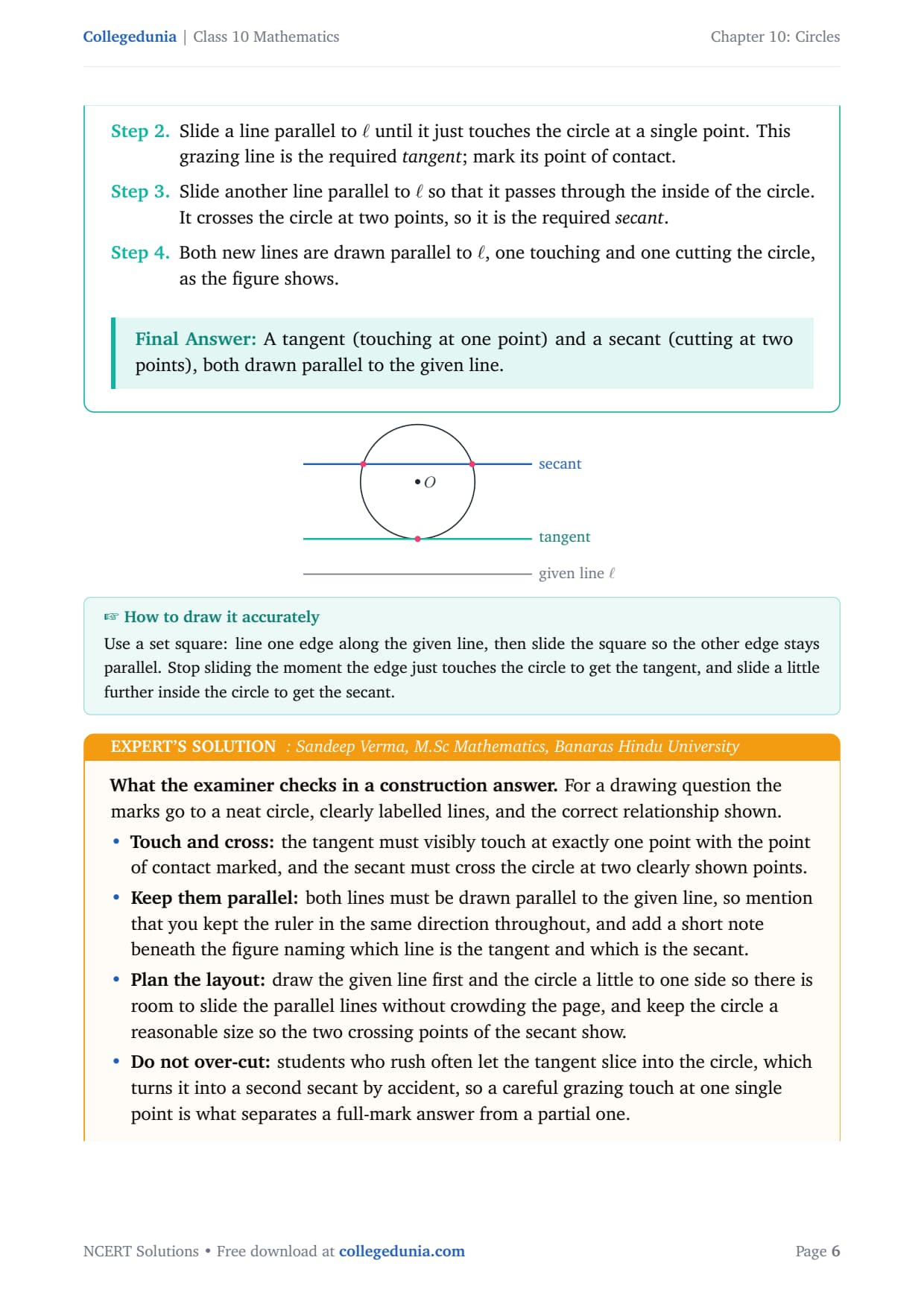
Draw a circle and two lines parallel to a given line such
that one is a tangent and the other, a secant to the circle.
Concept used. A tangent touches the circle at one
point while a secant cuts it at two points. To make both lines
parallel to a given line, we slide a ruler kept in the direction of that
line across the circle. Where the ruler just grazes the circle we get a
tangent; where it cuts across the circle we get a secant. The
description below explains the picture in the figure.
Draw a circle with centre O and any radius. Draw the given
line somewhere on the page.
Slide a line parallel to until it just touches the circle
at a single point. This grazing line is the required
tangent; mark its point of contact.
Slide another line parallel to so that it passes through
the inside of the circle. It crosses the circle at two points,
so it is the required secant.
Both new lines are drawn parallel to , one touching and
one cutting the circle, as the figure shows.
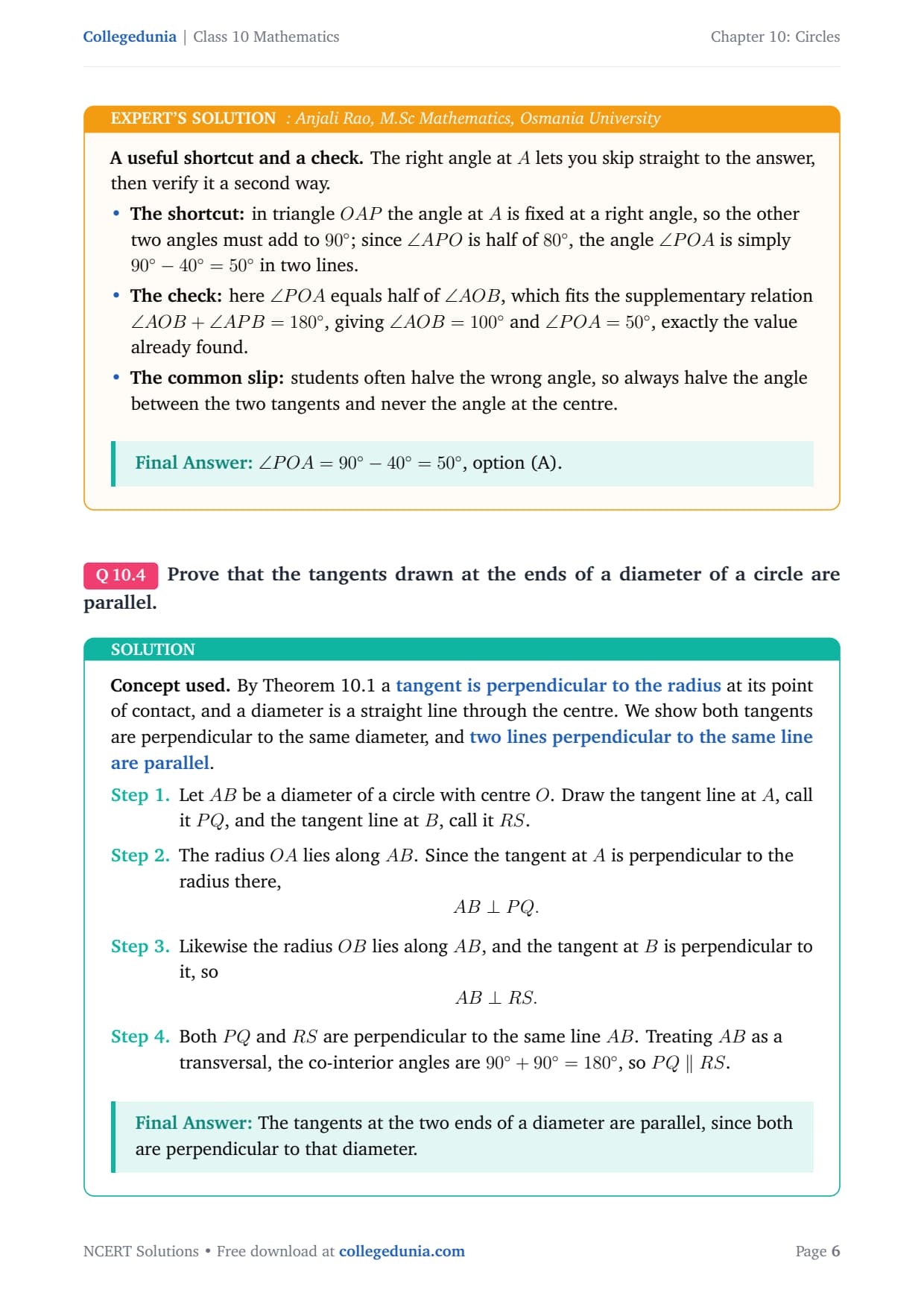
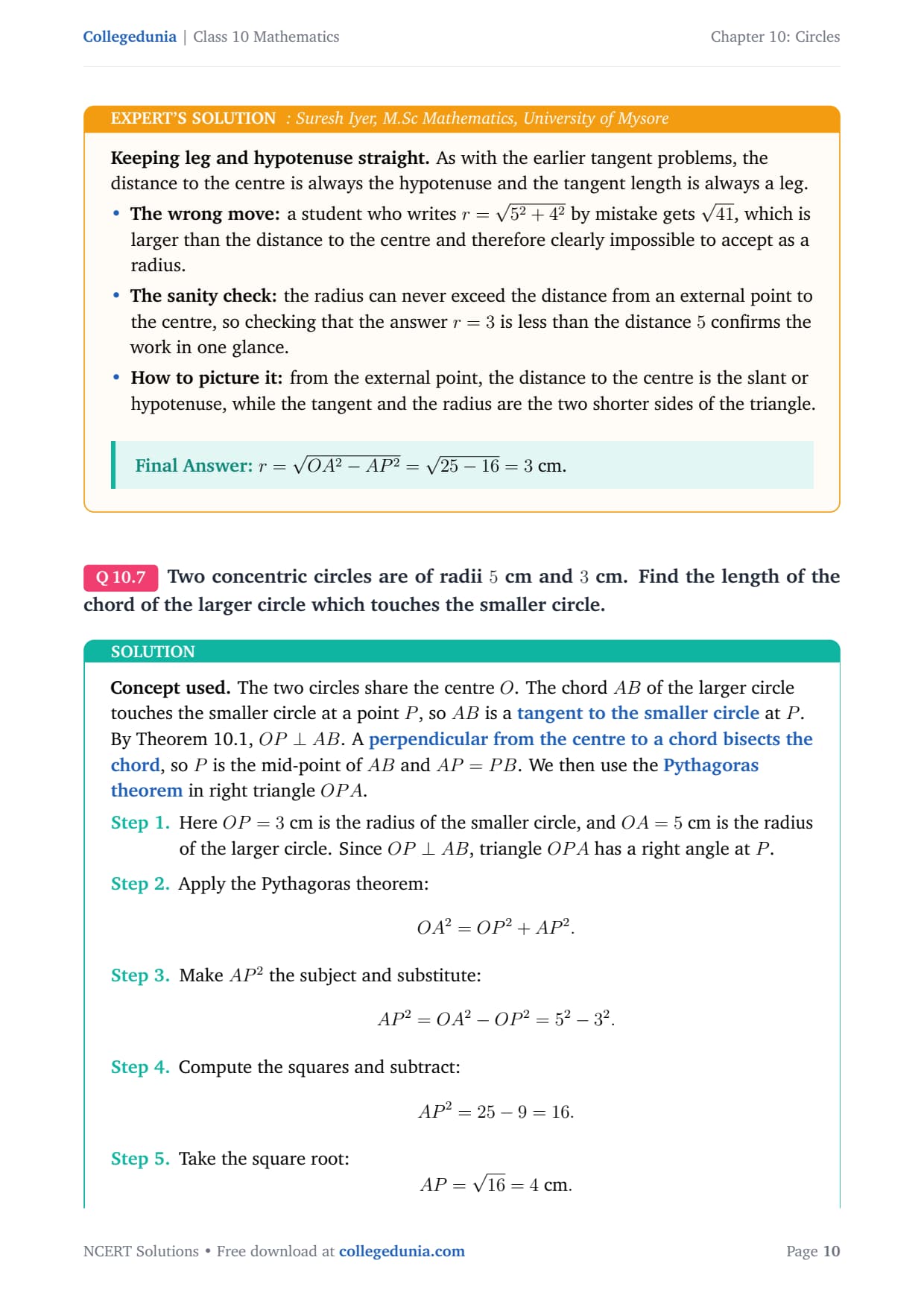
A tangent (touching at one point) and a secant (cutting at two points), both drawn parallel to the given line.
SV
Sandeep Verma
M.Sc Mathematics, Banaras Hindu University
Verified Expert
What the examiner checks in a construction answer. For a
drawing question the marks go to a neat circle, clearly labelled lines,
and the correct relationship shown.
Touch and cross: the tangent must visibly touch at
exactly one point with the point of contact marked, and the
secant must cross the circle at two clearly shown points.
Keep them parallel: both lines must be drawn parallel
to the given line, so mention that you kept the ruler in the same
direction throughout, and add a short note beneath the figure
naming which line is the tangent and which is the secant.
Plan the layout: draw the given line first and the
circle a little to one side so there is room to slide the
parallel lines without crowding the page, and keep the circle a
reasonable size so the two crossing points of the secant show.
Do not over-cut: students who rush often let the
tangent slice into the circle, which turns it into a second
secant by accident, so a careful grazing touch at one single
point is what separates a full-mark answer from a partial one.
One grazing line (tangent) and one cutting line (secant), both parallel to the given line.
NCERT solutions Class 10 Mathematics Chapter 10 Circles
All 13 questions with collapsible Solution and Expert Solution. Tap a button to reveal the working.
Exercise 10.2
Q 10.1
From a point Q, the length of the tangent to a circle is
24 cm and the distance of Q from the centre is 25 cm. The radius
of the circle is
(A) 7 cm (B) 12 cm (C) 15 cm (D) 24.5 cm
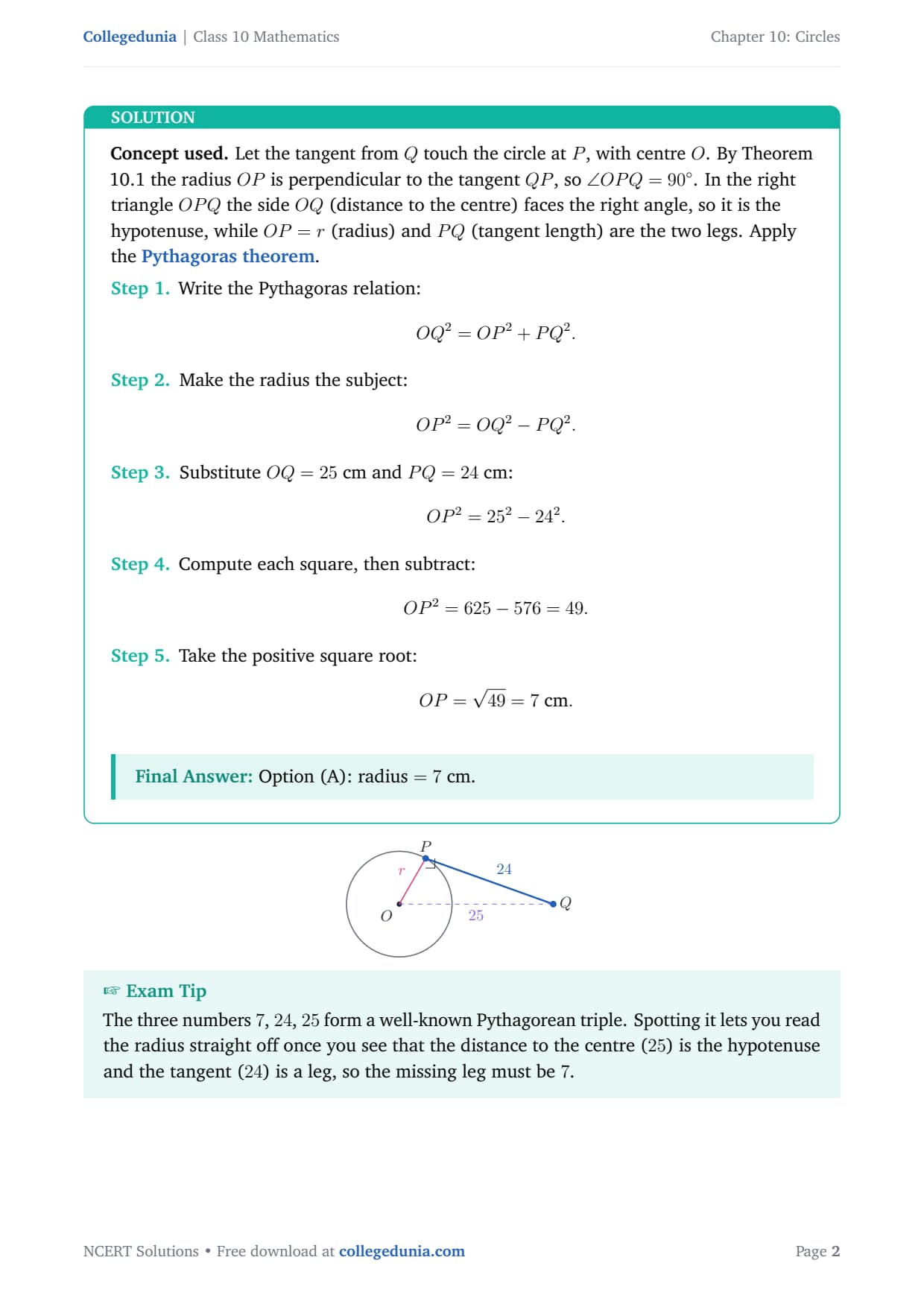
Concept used. Let the tangent from Q touch the circle at P,
with centre O. By Theorem 10.1 the radius OP is perpendicular to the
tangent QP, so ∠ OPQ=90∘. In the right triangle OPQ the
side OQ (distance to the centre) faces the right angle, so it is the
hypotenuse, while OP=r (radius) and PQ (tangent length) are the two
legs. Apply the Pythagoras theorem.
Write the Pythagoras relation:
OQ2=OP2+PQ2.
Make the radius the subject:
OP2=OQ2-PQ2.
Substitute OQ=25 cm and PQ=24 cm:
OP2=252-242.
Compute each square, then subtract:
OP2=625-576=49.
Take the positive square root:
OP=√49=7 cm.
Option (A): radius =7 cm.
PM
Priya Menon
M.Sc Mathematics, University of Calicut
Verified Expert
Reading the question correctly. The wording tells you which
side is which, so decode the two phrases before drawing anything.
Distance to centre: the phrase ``distance of Q from
the centre'' always means the straight line OQ, and since this
line runs from the external point to the centre it is the longest
side and therefore the hypotenuse of the right triangle.
Tangent is a leg: the ``length of the tangent'' is the
segment from the external point to the point of contact, which is
a leg, and mislabelling these two is the only thing that goes
wrong on this question.
Use the triples: once the hypotenuse is the 25 and the
tangent leg is the 24, subtraction gives the radius, and
remembering the triples three-four-five, five-twelve-thirteen and
seven-twenty-four-twenty-five makes such single-step tangent
problems almost instant in the exam.
r=√OQ2-PQ2=√625-576=7 cm, option (A).
Q 10.2
In Fig. 10.11, if TP and TQ are the two tangents to a
circle with centre O so that ∠ POQ=110∘, then ∠ PTQ
is equal to
(A) 60∘ (B) 70∘ (C) 80∘ (D) 90∘
Concept used.TP and TQ are tangents touching at P and
Q, so by Theorem 10.1 the radii are perpendicular to them:
∠ OPT=90∘ and ∠ OQT=90∘. The four points O,
P, T, Q form a quadrilateralOPTQ, and the
angle sum of a quadrilateral is 360∘.
In quadrilateral OPTQ the four interior angles add to
360∘:
∠ OPT+∠ PTQ+∠ TQO+∠ QOP=360∘.
Put in the two right angles and the given angle:
90∘+∠ PTQ+90∘+110∘=360∘.
Add the known angles:
∠ PTQ+290∘=360∘.
Solve for the unknown angle:
∠ PTQ=360∘-290∘=70∘.
Option (B): ∠ PTQ=70∘.
KS
Karthik Subramanian
M.Sc Mathematics, Anna University
Verified Expert
Two clean routes to the same answer. You can reach the answer
in two ways, and which one to write depends on time and marks.
Safe route: the quadrilateral method shown above is the
most reliable, since it only uses the two right angles at the
points of contact and the angle sum of the quadrilateral.
Fast route: the supplementary rule gives the answer
directly as ∠ PTQ=180∘-110∘=70∘, so a
student short of time can quote it, while one wanting full working
should still set up the quadrilateral on paper.
The slip to avoid: never treat ∠ POQ as if it
equalled ∠ PTQ, because the two are supplementary and not
equal, except in the one special case when each of them is a
right angle.
∠ PTQ=180∘-110∘=70∘, option (B).
Q 10.3
If tangents PA and PB from a point P to a circle with
centre O are inclined to each other at angle of 80∘, then
∠ POA is equal to
(A) 50∘ (B) 60∘ (C) 70∘ (D) 80∘
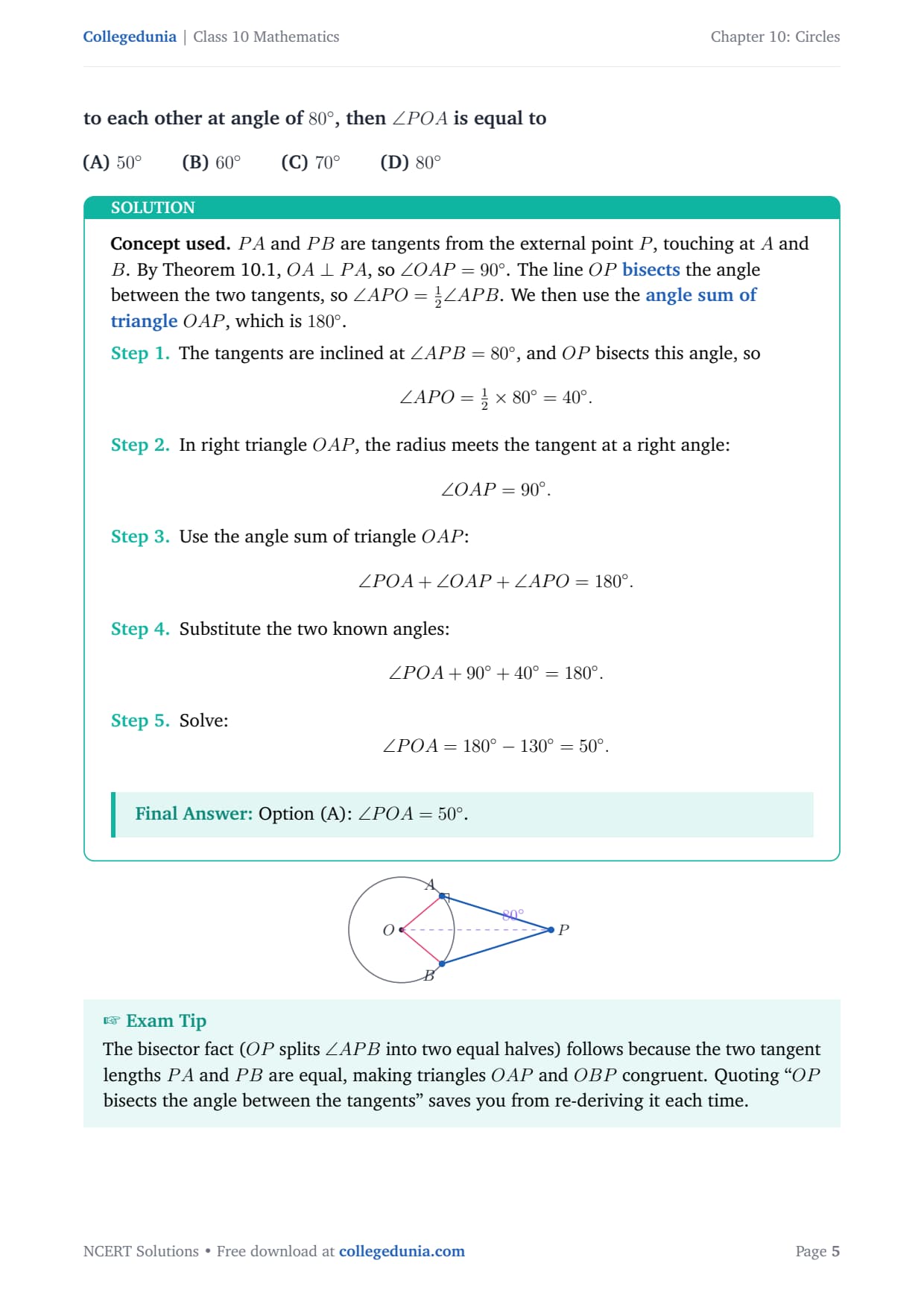
Concept used.PA and PB are tangents from the external
point P, touching at A and B. By Theorem 10.1, OA⊥ PA, so
∠ OAP=90∘. The line OPbisects the angle between
the two tangents, so ∠ APO=12∠ APB. We then use the
angle sum of triangleOAP, which is 180∘.
The tangents are inclined at ∠ APB=80∘, and OP
bisects this angle, so
∠ APO=12× 80∘=40∘.
In right triangle OAP, the radius meets the tangent at a right
angle:
∠ OAP=90∘.
Use the angle sum of triangle OAP:
∠ POA+∠ OAP+∠ APO=180∘.
Substitute the two known angles:
∠ POA+90∘+40∘=180∘.
Solve:
∠ POA=180∘-130∘=50∘.
Option (A): ∠ POA=50∘.
AR
Anjali Rao
M.Sc Mathematics, Osmania University
Verified Expert
A useful shortcut and a check. The right angle at A lets you
skip straight to the answer, then verify it a second way.
The shortcut: in triangle OAP the angle at A is
fixed at a right angle, so the other two angles must add to
90∘; since ∠ APO is half of 80∘, the angle
∠ POA is simply 90∘-40∘=50∘ in two lines.
The check: here ∠ POA equals half of
∠ AOB, which fits the supplementary relation
∠ AOB+∠ APB=180∘, giving ∠ AOB=100∘
and ∠ POA=50∘, exactly the value already found.
The common slip: students often halve the wrong angle,
so always halve the angle between the two tangents and never the
angle at the centre.
∠ POA=90∘-40∘=50∘, option (A).
Q 10.4
Prove that the tangents drawn at the ends of a diameter of a
circle are parallel.
Concept used. By Theorem 10.1 a tangent is
perpendicular to the radius at its point of contact, and a diameter is
a straight line through the centre. We show both tangents are
perpendicular to the same diameter, and two lines perpendicular
to the same line are parallel.
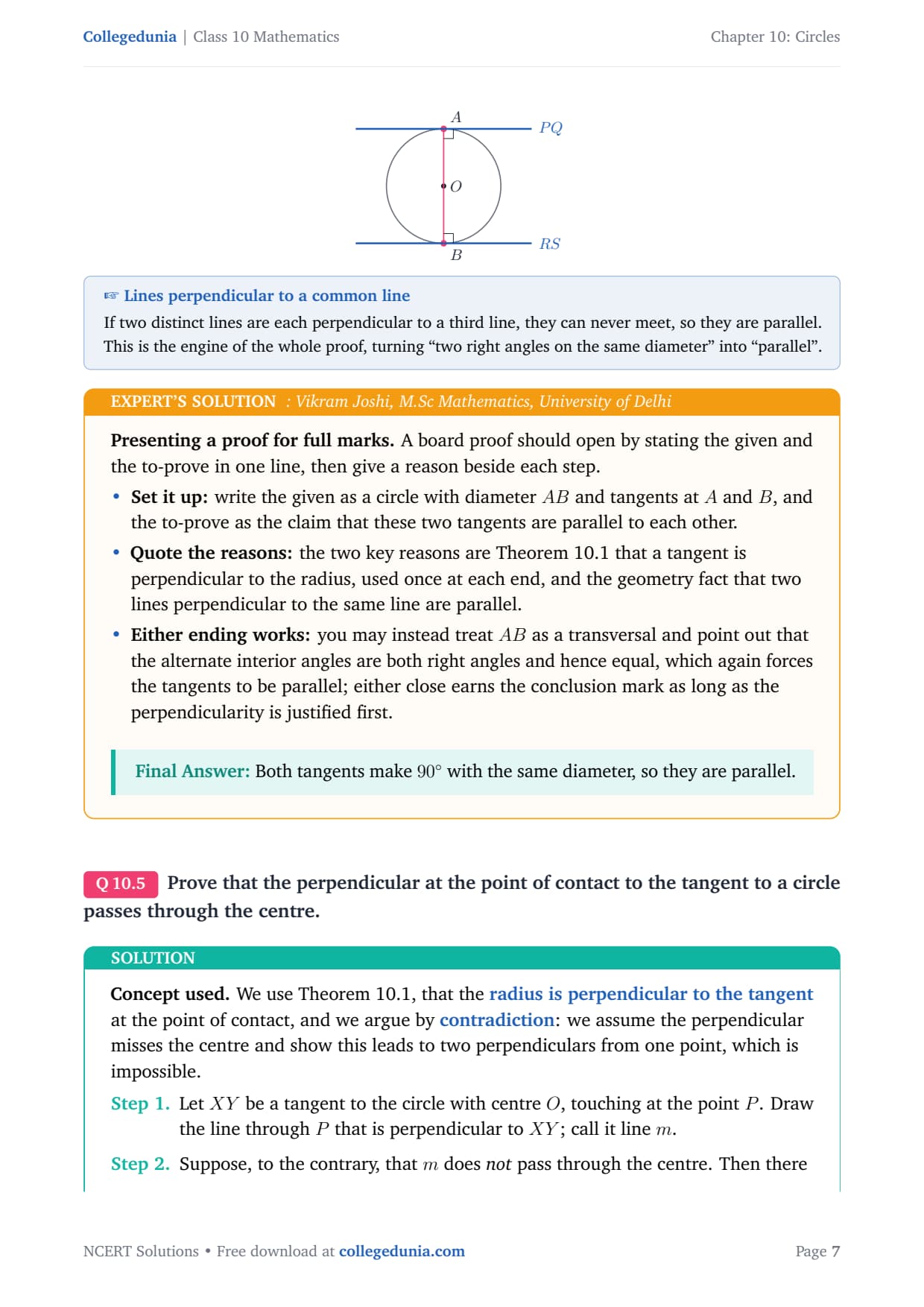
Let AB be a diameter of a circle with centre O. Draw the
tangent line at A, call it PQ, and the tangent line at B,
call it RS.
The radius OA lies along AB. Since the tangent at A is
perpendicular to the radius there,
AB⊥ PQ.
Likewise the radius OB lies along AB, and the tangent at B
is perpendicular to it, so
AB⊥ RS.
Both PQ and RS are perpendicular to the same line AB.
Treating AB as a transversal, the co-interior angles are
90∘+90∘=180∘, so PQ∥ RS.
The tangents at the two ends of a diameter are parallel, since both are perpendicular to that diameter.
VJ
Vikram Joshi
M.Sc Mathematics, University of Delhi
Verified Expert
Presenting a proof for full marks. A board proof should open by
stating the given and the to-prove in one line, then give a reason
beside each step.
Set it up: write the given as a circle with diameter
AB and tangents at A and B, and the to-prove as the claim
that these two tangents are parallel to each other.
Quote the reasons: the two key reasons are Theorem 10.1
that a tangent is perpendicular to the radius, used once at each
end, and the geometry fact that two lines perpendicular to the
same line are parallel.
Either ending works: you may instead treat AB as a
transversal and point out that the alternate interior angles are
both right angles and hence equal, which again forces the
tangents to be parallel; either close earns the conclusion mark
as long as the perpendicularity is justified first.
Both tangents make 90∘ with the same diameter, so they are parallel.
Q 10.5
Prove that the perpendicular at the point of contact to the
tangent to a circle passes through the centre.
Concept used. We use Theorem 10.1, that the radius is
perpendicular to the tangent at the point of contact, and we argue by
contradiction: we assume the perpendicular misses the centre
and show this leads to two perpendiculars from one point, which is
impossible.
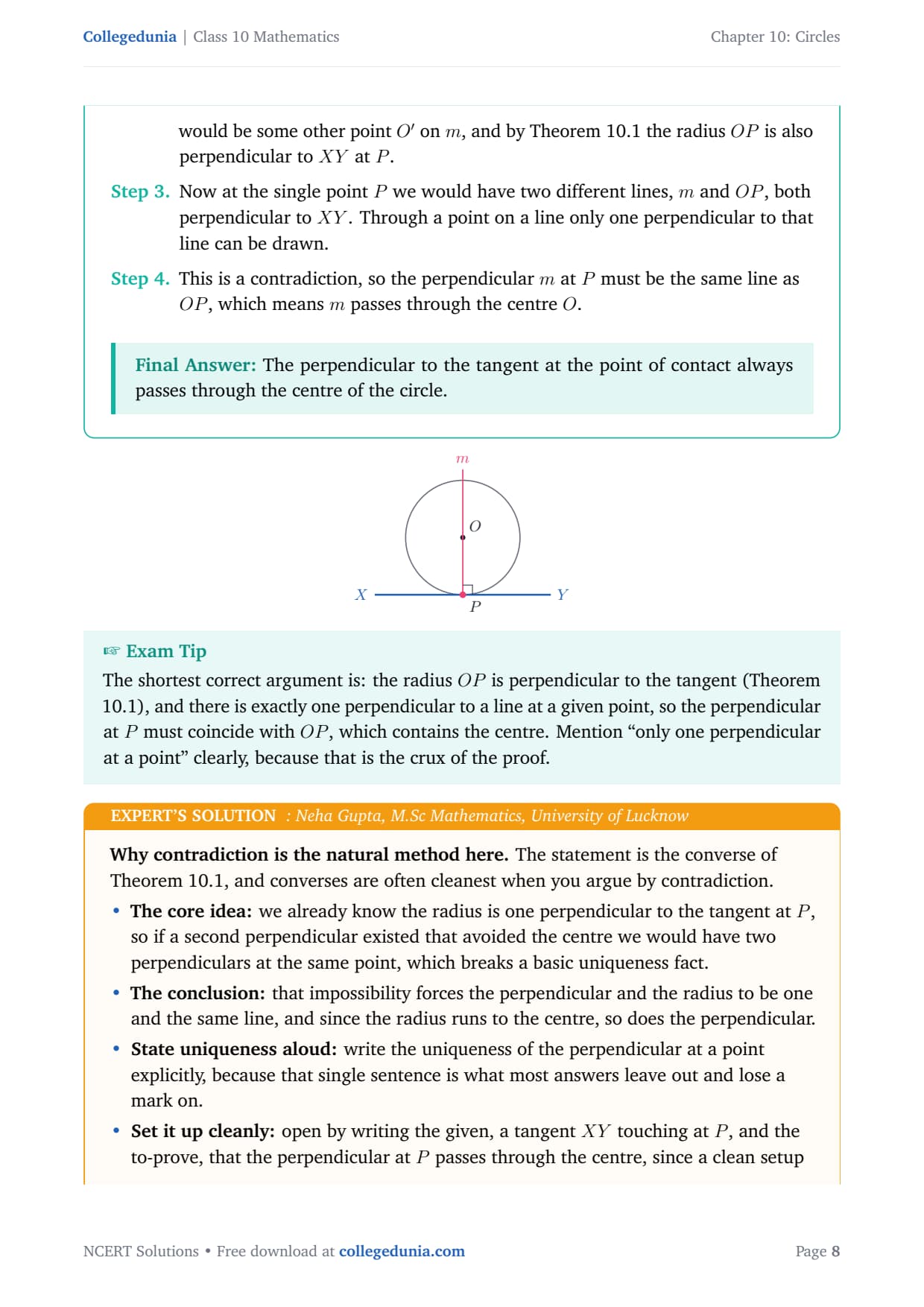
Let XY be a tangent to the circle with centre O, touching at
the point P. Draw the line through P that is perpendicular to
XY; call it line m.
Suppose, to the contrary, that m does not pass through
the centre. Then there would be some other point O' on m, and
by Theorem 10.1 the radius OP is also perpendicular to XY at
P.
Now at the single point P we would have two different lines,
m and OP, both perpendicular to XY. Through a point on a
line only one perpendicular to that line can be drawn.
This is a contradiction, so the perpendicular m at P must be
the same line as OP, which means m passes through the centre
O.
The perpendicular to the tangent at the point of contact always passes through the centre of the circle.
NG
Neha Gupta
M.Sc Mathematics, University of Lucknow
Verified Expert
Why contradiction is the natural method here. The statement is
the converse of Theorem 10.1, and converses are often cleanest when you
argue by contradiction.
The core idea: we already know the radius is one
perpendicular to the tangent at P, so if a second perpendicular
existed that avoided the centre we would have two perpendiculars
at the same point, which breaks a basic uniqueness fact.
The conclusion: that impossibility forces the
perpendicular and the radius to be one and the same line, and
since the radius runs to the centre, so does the perpendicular.
State uniqueness aloud: write the uniqueness of the
perpendicular at a point explicitly, because that single sentence
is what most answers leave out and lose a mark on.
Set it up cleanly: open by writing the given, a tangent
XY touching at P, and the to-prove, that the perpendicular at
P passes through the centre, since a clean setup earns the first
method mark; the direct route is harder to phrase at this level,
so contradiction stays the recommended method here.
Only one perpendicular exists at P; it is the radius OP, which meets the centre, so the perpendicular passes through O.
Q 10.6
The length of a tangent from a point A at distance 5 cm
from the centre of the circle is 4 cm. Find the radius of the circle.
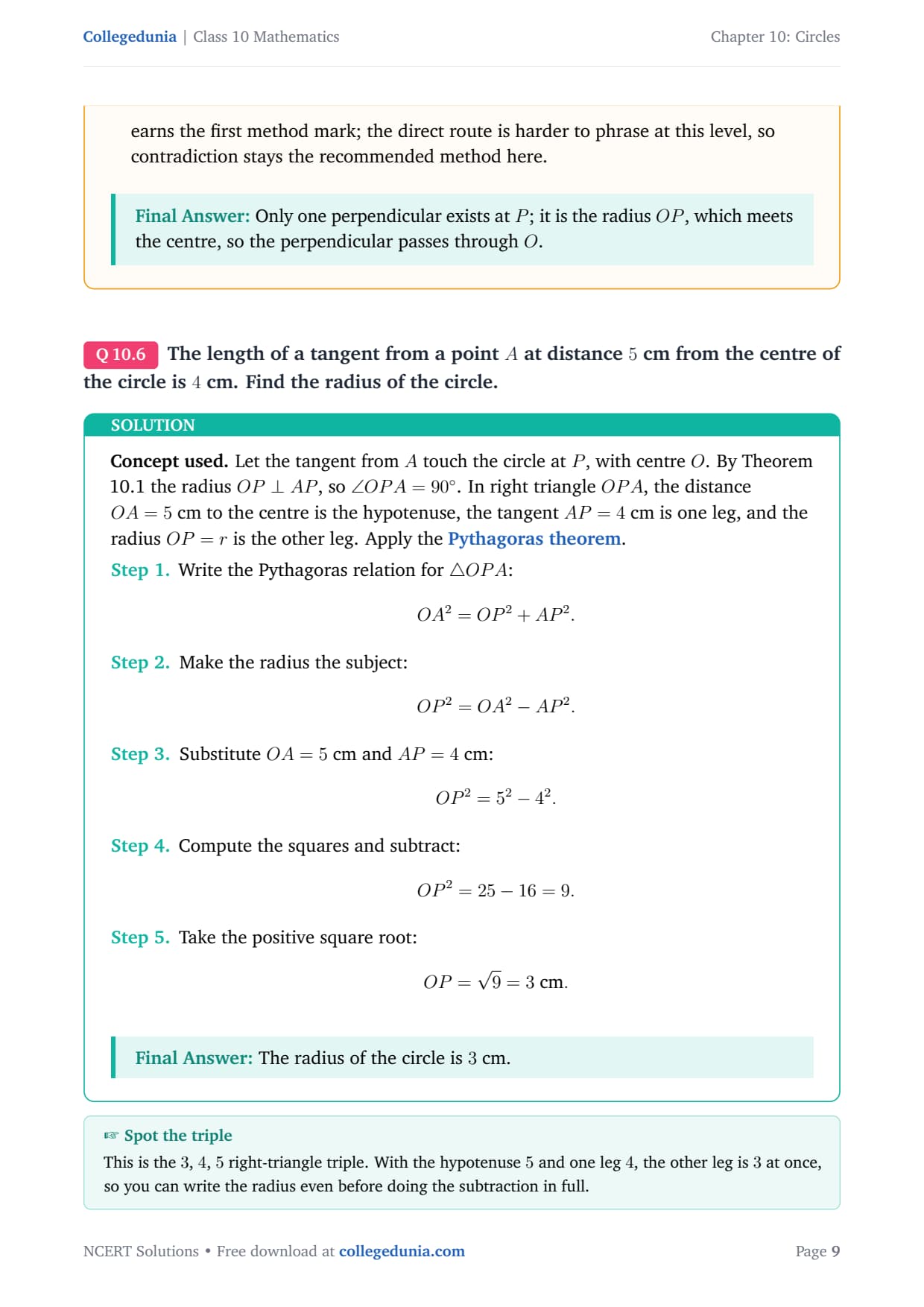
Concept used. Let the tangent from A touch the circle at P,
with centre O. By Theorem 10.1 the radius OP⊥ AP, so
∠ OPA=90∘. In right triangle OPA, the distance OA=5 cm to
the centre is the hypotenuse, the tangent AP=4 cm is one leg, and the
radius OP=r is the other leg. Apply the Pythagoras theorem.
Write the Pythagoras relation for OPA:
OA2=OP2+AP2.
Make the radius the subject:
OP2=OA2-AP2.
Substitute OA=5 cm and AP=4 cm:
OP2=52-42.
Compute the squares and subtract:
OP2=25-16=9.
Take the positive square root:
OP=√9=3 cm.
The radius of the circle is 3 cm.
SI
Suresh Iyer
M.Sc Mathematics, University of Mysore
Verified Expert
Keeping leg and hypotenuse straight. As with the earlier
tangent problems, the distance to the centre is always the hypotenuse
and the tangent length is always a leg.
The wrong move: a student who writes
r=√52+42 by mistake gets √41, which is
larger than the distance to the centre and therefore clearly
impossible to accept as a radius.
The sanity check: the radius can never exceed the
distance from an external point to the centre, so checking that
the answer r=3 is less than the distance 5 confirms the work
in one glance.
How to picture it: from the external point, the
distance to the centre is the slant or hypotenuse, while the
tangent and the radius are the two shorter sides of the triangle.
r=√OA2-AP2=√25-16=3 cm.
Q 10.7
Two concentric circles are of radii 5 cm and 3 cm. Find
the length of the chord of the larger circle which touches the smaller
circle.
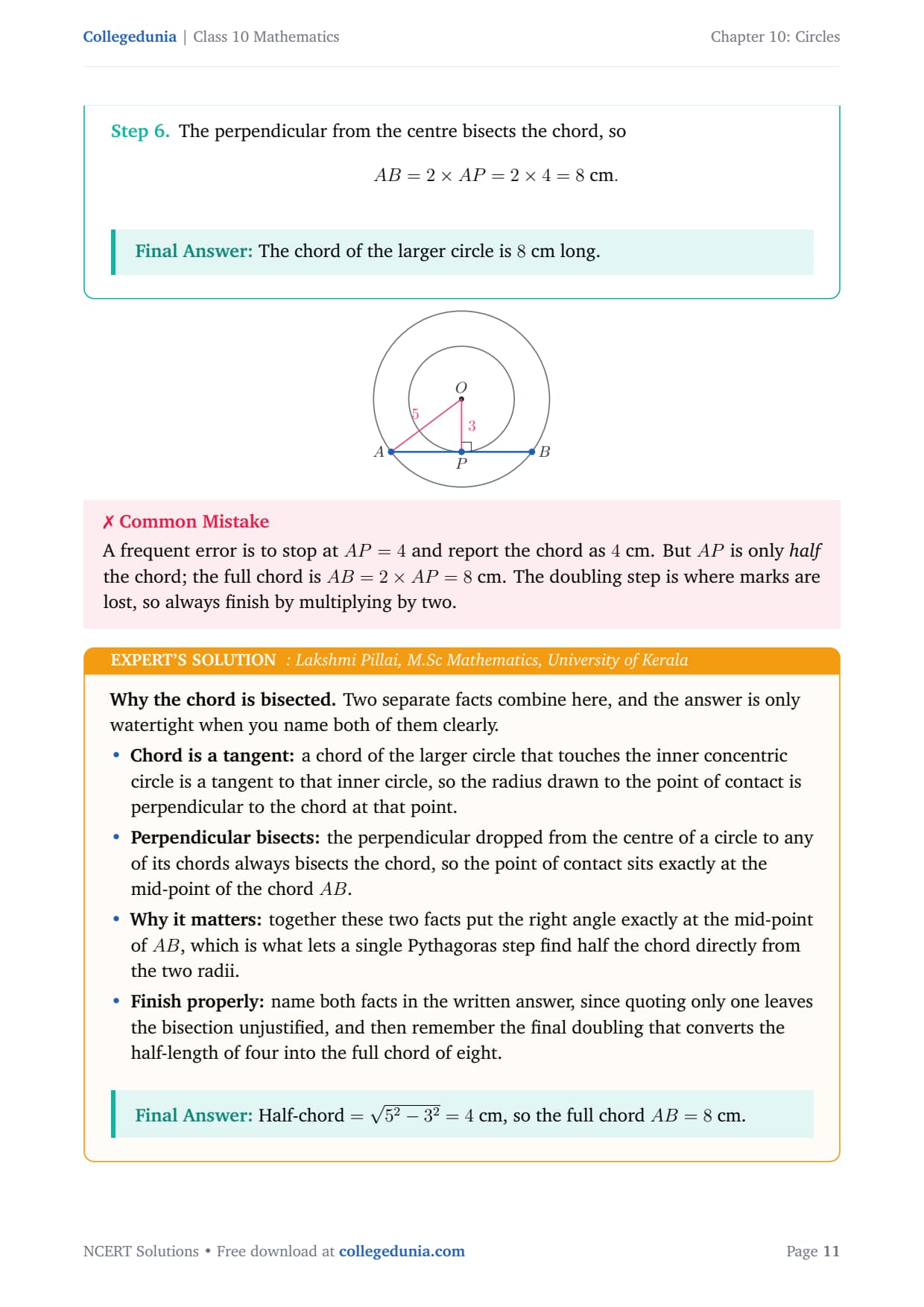
Concept used. The two circles share the centre O. The chord
AB of the larger circle touches the smaller circle at a point P, so
AB is a tangent to the smaller circle at P. By Theorem
10.1, OP⊥ AB. A perpendicular from the centre to a chord
bisects the chord, so P is the mid-point of AB and AP=PB. We then
use the Pythagoras theorem in right triangle OPA.
Here OP=3 cm is the radius of the smaller circle, and
OA=5 cm is the radius of the larger circle. Since OP⊥ AB,
triangle OPA has a right angle at P.
Apply the Pythagoras theorem:
OA2=OP2+AP2.
Make AP2 the subject and substitute:
AP2=OA2-OP2=52-32.
Compute the squares and subtract:
AP2=25-9=16.
Take the square root:
AP=√16=4 cm.
The perpendicular from the centre bisects the chord, so
AB=2× AP=2× 4=8 cm.
The chord of the larger circle is 8 cm long.
LP
Lakshmi Pillai
M.Sc Mathematics, University of Kerala
Verified Expert
Why the chord is bisected. Two separate facts combine here,
and the answer is only watertight when you name both of them clearly.
Chord is a tangent: a chord of the larger circle that
touches the inner concentric circle is a tangent to that inner
circle, so the radius drawn to the point of contact is
perpendicular to the chord at that point.
Perpendicular bisects: the perpendicular dropped from
the centre of a circle to any of its chords always bisects the
chord, so the point of contact sits exactly at the mid-point of
the chord AB.
Why it matters: together these two facts put the right
angle exactly at the mid-point of AB, which is what lets a
single Pythagoras step find half the chord directly from the two
radii.
Finish properly: name both facts in the written answer,
since quoting only one leaves the bisection unjustified, and then
remember the final doubling that converts the half-length of four
into the full chord of eight.
Half-chord =√52-32=4 cm, so the full chord AB=8 cm.
Q 10.8
A quadrilateral ABCD is drawn to circumscribe a circle (see
Fig. 10.12). Prove that AB+CD=AD+BC.
Concept used. By Theorem 10.2, the two tangents drawn
from an external point to a circle are equal in length. Each vertex of
the quadrilateral is an external point from which two tangent segments
reach the circle, so we get four pairs of equal tangents. Let the sides
touch the circle at P (on AB), Q (on BC), R (on CD) and S
(on DA).
Equal tangents from each vertex give:
AP=AS, BP=BQ, CR=CQ, DR=DS.
Add the left sides and the right sides of these four equations:
AP+BP+CR+DR=AS+BQ+CQ+DS.
Group the terms into whole sides. On the left,
AP+BP=AB and CR+DR=CD. On the right, AS+DS=AD and
BQ+CQ=BC:
(AP+BP)+(CR+DR)=(AS+DS)+(BQ+CQ).
Replace each bracket by the side it forms:
AB+CD=AD+BC.
For a quadrilateral circumscribing a circle, AB+CD=AD+BC (the two pairs of opposite sides have equal sums).
DR
Deepa Reddy
M.Sc Mathematics, University of Hyderabad
Verified Expert
A result worth memorising. The conclusion says the sums of
opposite sides of a tangential quadrilateral are equal, and it is a
standard tool in many later problems.
Clean layout: label the four points of contact first,
then write the four equal tangent pairs, and only then add the
equations together to reach the result.
Cite the theorem: students sometimes lose a mark by not
stating which tangent pairs are equal and why, so always quote
Theorem 10.2 as the reason each pair is equal.
Where it returns: this property is exactly why a
parallelogram that circumscribes a circle must be a rhombus, the
very next result in Q15, because there the equal opposite-side
sums force all four sides to be equal in length.
Adding the four equal-tangent pairs from the vertices gives AB+CD=AD+BC.
Q 10.9
In Fig. 10.13, XY and X'Y' are two parallel tangents to a
circle with centre O and another tangent AB with point of contact
C intersecting XY at A and X'Y' at B. Prove that
∠ AOB=90∘.
Concept used. Let the parallel tangents touch the circle at P
(on XY) and Q (on X'Y'), and let the slant tangent AB touch at
C. From the external point A the tangents AP and AC are equal, so
OAbisects∠ PAC; from B the tangents BQ and BC
are equal, so OB bisects ∠ QBC. Because XY∥ X'Y' with
AB as a transversal, the co-interior angles∠ PAB and
∠ QBA add to 180∘. We combine these to get ∠ AOB.
Tangents from A: AP=AC, so triangles OPA and OCA are
congruent and OA bisects ∠ PAC. Hence
∠ OAC=12∠ PAB.
Tangents from B: BQ=BC, so OB bisects ∠ QBC. Hence
∠ OBC=12∠ QBA.
Since XY∥ X'Y' and AB is a transversal, the
co-interior angles satisfy
∠ PAB+∠ QBA=180∘.
Halving the whole equation:
12∠ PAB+12∠ QBA=90∘,
∠ OAC+∠ OBC=90∘.
In triangle AOB, the angle sum is 180∘:
∠ AOB=180∘-(∠ OAC+∠ OBC)=180∘-90∘.
Therefore
∠ AOB=90∘.
∠ AOB=90∘.
RB
Ramesh Babu
M.Sc Mathematics, Sri Venkateswara University
Verified Expert
Reading the angle bisectors correctly. The heart of the proof
is that OA and OB are angle bisectors, and everything else follows
from that one observation.
The key step: once a student sees that
∠ OAB+∠ OBA is half of ∠ PAB+∠ QBA, and
that this second sum is 180∘ from the parallel lines, the
answer simply drops out of the triangle angle sum.
Justify the bisector: a common gap is forgetting to say
why OA bisects the angle; the reason is the congruence of the
two right triangles sharing OA, and stating that congruence
keeps the proof watertight and earns the full marks.
Label first: name the three points of contact, P on
the top tangent, Q on the bottom and C on the slant tangent,
before writing any equation, because the equal-tangent pairs
AP=AC and BQ=BC are what make the bisectors appear.
Optional confirm: drawing the line OC and noting it is
perpendicular to AB confirms the picture, even though the angle
answer does not strictly need it, and the final algebra is only a
single halving and one subtraction inside the triangle.
OA, OB bisect a co-interior pair summing to 180∘, so ∠ AOB=180∘-90∘=90∘.
Q 10.10
Prove that the angle between the two tangents drawn from an
external point to a circle is supplementary to the angle subtended by
the line-segment joining the points of contact at the centre.
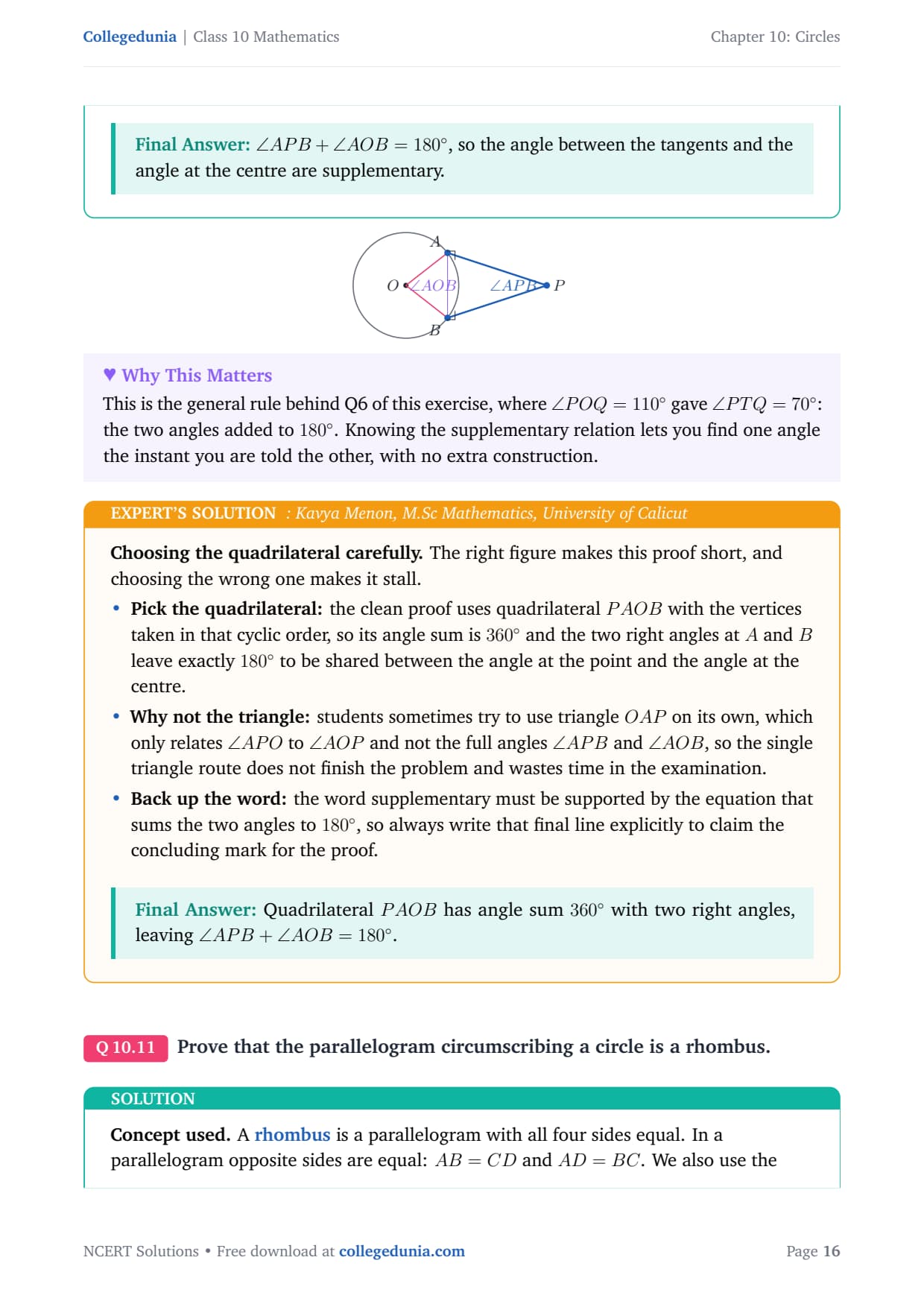
Concept used. Let PA and PB be the two tangents from an
external point P, touching the circle (centre O) at A and B. The
``angle between the tangents'' is ∠ APB, and the ``angle
subtended at the centre'' by the segment AB is ∠ AOB. By
Theorem 10.1 the radii are perpendicular to the tangents, so
∠ OAP=∠ OBP=90∘. We use the angle sum of the
quadrilateralPAOB, which is 360∘. Supplementary means
the two angles add to 180∘.
The four points P, A, O, B form quadrilateral PAOB,
whose interior angles sum to 360∘:
∠ APB+∠ PAO+∠ AOB+∠ OBP=360∘.
Put in the two right angles ∠ PAO=∠ OBP=90∘:
∠ APB+90∘+∠ AOB+90∘=360∘.
Combine the constants:
∠ APB+∠ AOB+180∘=360∘.
Subtract 180∘ from both sides:
∠ APB+∠ AOB=180∘.
∠ APB+∠ AOB=180∘, so the angle between the tangents and the angle at the centre are supplementary.
KM
Kavya Menon
M.Sc Mathematics, University of Calicut
Verified Expert
Choosing the quadrilateral carefully. The right figure makes
this proof short, and choosing the wrong one makes it stall.
Pick the quadrilateral: the clean proof uses
quadrilateral PAOB with the vertices taken in that cyclic
order, so its angle sum is 360∘ and the two right angles
at A and B leave exactly 180∘ to be shared between the
angle at the point and the angle at the centre.
Why not the triangle: students sometimes try to use
triangle OAP on its own, which only relates ∠ APO to
∠ AOP and not the full angles ∠ APB and
∠ AOB, so the single triangle route does not finish the
problem and wastes time in the examination.
Back up the word: the word supplementary must be
supported by the equation that sums the two angles to 180∘,
so always write that final line explicitly to claim the
concluding mark for the proof.
Quadrilateral PAOB has angle sum 360∘ with two right angles, leaving ∠ APB+∠ AOB=180∘.
Q 10.11
Prove that the parallelogram circumscribing a circle is a
rhombus.
Concept used. A rhombus is a parallelogram with all
four sides equal. In a parallelogram opposite sides are equal:
AB=CD and AD=BC. We also use the result of Q12, that for a
quadrilateral circumscribing a circle the sums of opposite
sides are equal: AB+CD=AD+BC. Combining these forces all four sides
to be equal.
Let ABCD be a parallelogram circumscribing a circle. As a
parallelogram,
AB=CD AD=BC.
Since ABCD circumscribes the circle, by the tangential
quadrilateral property (Q12),
AB+CD=AD+BC.
Replace CD by AB and BC by AD using step 1:
AB+AB=AD+AD, .e. 2 AB=2 AD.
Divide by 2:
AB=AD.
Now AB=AD, and with AB=CD, AD=BC this gives
AB=BC=CD=DA.
All four sides are equal, so the parallelogram is a rhombus.
A parallelogram that circumscribes a circle has all sides equal, so it is a rhombus.
MA
Manish Agarwal
M.Sc Mathematics, University of Rajasthan
Verified Expert
Building on an earlier result. The smartest answer reuses a
result already proved instead of starting from scratch.
Quote the lemma: cite the tangential-quadrilateral
property AB+CD=AD+BC from Q12 rather than re-deriving it with
equal tangents, since quoting it saves time and shows that you
command the structure of the whole chapter.
Then pure algebra: from there it is only algebra, as you
substitute the two parallelogram equalities into that relation
and watch all four sides collapse to a single common length.
The slow alternative: a student who instead redraws all
four points of contact and writes eight tangent equations will
still reach the answer but spends far longer, so the lesson is to
recognise when a proved lemma can be used directly to turn a long
argument into four short lines.
Using AB=CD, AD=BC in AB+CD=AD+BC gives AB=AD, so all sides are equal: a rhombus.
Q 10.12
A triangle ABC is drawn to circumscribe a circle of radius
4 cm such that the segments BD and DC into which BC is divided
by the point of contact D are of lengths 8 cm and 6 cm
respectively (see Fig. 10.14). Find the sides AB and AC.
Concept used. The incircle touches BC at D, CA at E and
AB at F. By Theorem 10.2 the tangents from each vertex are
equal: BD=BF, CD=CE, AF=AE. Let AF=AE=x. We find x using the
area relation for a triangle with an incircle, Area=rs,
where r is the inradius and s is the semi-perimeter, and
we compute the area separately by Heron's formula.
Name the equal tangents. With BD=8 and DC=6:
BF=BD=8, CE=CD=6, AF=AE=x.
Write the three sides:
BC=BD+DC=8+6=14, AB=AF+FB=x+8, AC=AE+EC=x+6.
Find the semi-perimeter:
s=AB+BC+CA2=(x+8)+14+(x+6)2=2x+282=x+14.
Area by Heron's formula uses s-a, s-b, s-c. Taking
a=BC=14, b=CA=x+6, c=AB=x+8:
s-a=x, s-b=8, s-c=6. Area=√s(s-a)(s-b)(s-c)=√(x+14) x· 8· 6=√48x(x+14).
Area also equals rs with r=4:
Area=4(x+14).
Set the two area expressions equal and square both sides:
4(x+14)=√48x(x+14), 16(x+14)2=48x(x+14).
Divide both sides by 16(x+14) (which is positive):
x+14=3x.
Solve for x:
14=2x ⇒ x=7.
Substitute back:
AB=x+8=7+8=15 cm, AC=x+6=7+6=13 cm.
AB=15 cm and AC=13 cm.
PS
Pooja Sharma
M.Sc Mathematics, University of Delhi
Verified Expert
The reliable area method. Two area formulas drive this
question, and matching them turns a hard problem into one equation.
Match two areas: the incircle form Area=rs
and Heron's formula in terms of the sides both describe the same
triangle, so setting them equal gives one equation in the single
unknown x, which is the cleanest route to the sides.
Cancel safely: the factor (x+14) appears on both
sides after squaring, so cancelling it avoids a messy quadratic,
but justify that this factor is not zero first, since a side
length is always positive.
Label at the start: naming the equal tangents
AF=AE=x is essential, because without one variable for the
third vertex the sides cannot be written down and the method
stalls before it begins.
Picture and finish: the contact point D splits the
base into eight and six, and the same tangent lengths reappear at
the other two vertices, so the whole triangle is built from just
three tangent lengths; once x is found every side is a simple
sum, and the written answer should still show the squaring and
the cancelling so no method mark is lost.
Tangent length x=7, so AB=x+8=15 cm and AC=x+6=13 cm.
Q 10.13
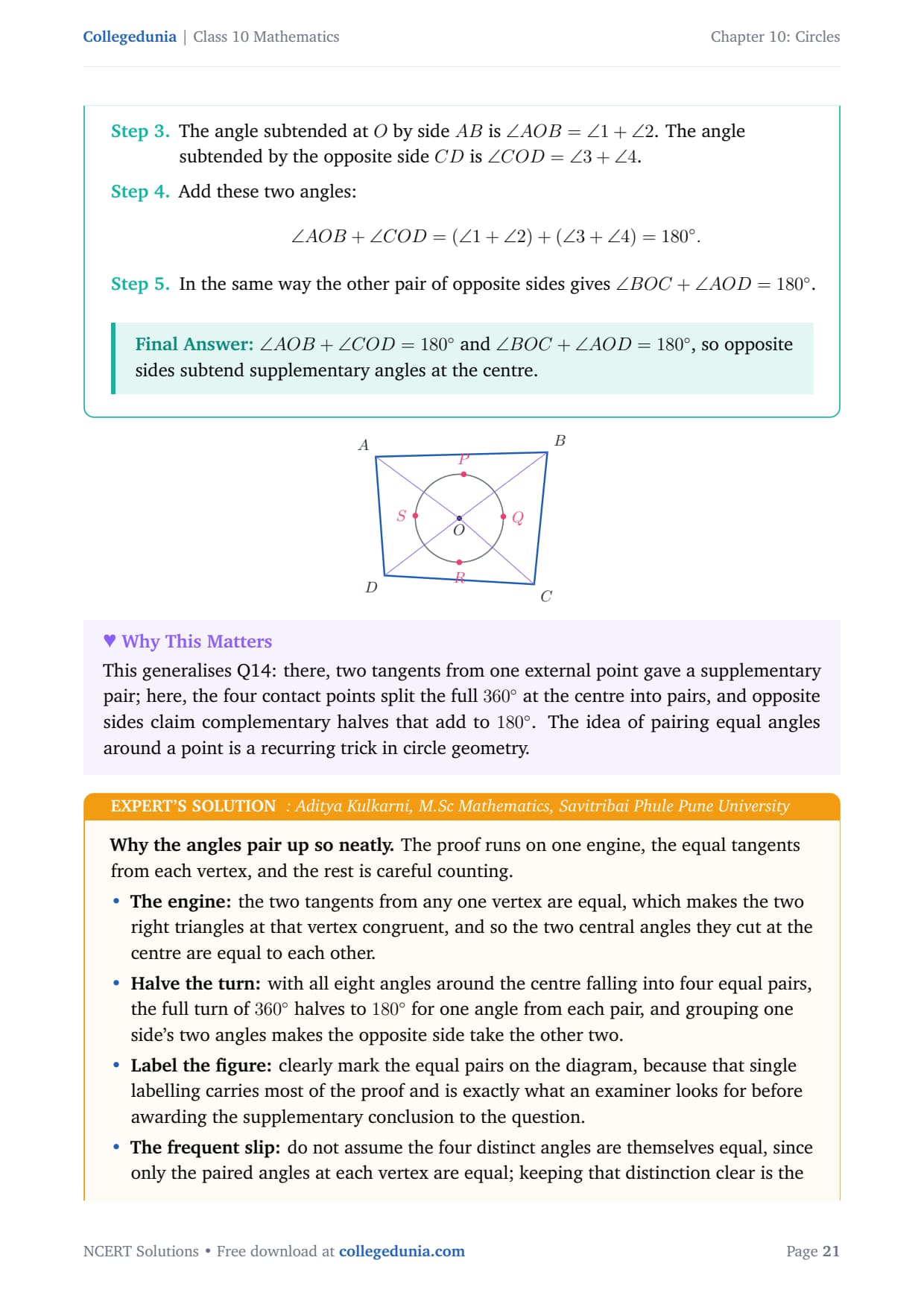
Prove that opposite sides of a quadrilateral circumscribing a
circle subtend supplementary angles at the centre of the circle.
Concept used. Let the quadrilateral ABCD circumscribe a circle
with centre O, touching the sides at P (on AB), Q (on BC), R
(on CD) and S (on DA). Join O to each contact point and to each
vertex. By Theorem 10.2, the two tangents from each vertex are
equal, which makes the two triangles at each vertex congruent,
so the two angles they make at O are equal. The total angle
around the centreO is 360∘. We must show that the angle
subtended by side AB plus the angle subtended by the opposite side
CD equals 180∘.
Label the angles at O in order around the centre:
∠ AOP=∠ AOS=∠ 1, ∠ BOP=∠ BOQ=∠ 2, ∠ COQ=∠ COR=∠ 3, ∠ DOR=∠ DOS=∠ 4.
Each pair is equal because the two tangents from that vertex give
congruent triangles.
These eight angles fill the full turn about O:
2∠ 1+2∠ 2+2∠ 3+2∠ 4=360∘,
so
∠ 1+∠ 2+∠ 3+∠ 4=180∘.
The angle subtended at O by side AB is
∠ AOB=∠ 1+∠ 2. The angle subtended by the
opposite side CD is ∠ COD=∠ 3+∠ 4.
Add these two angles:
∠ AOB+∠ COD=(∠ 1+∠ 2)+(∠ 3+∠ 4)=180∘.
In the same way the other pair of opposite sides gives
∠ BOC+∠ AOD=180∘.
∠ AOB+∠ COD=180∘ and ∠ BOC+∠ AOD=180∘, so opposite sides subtend supplementary angles at the centre.
AK
Aditya Kulkarni
M.Sc Mathematics, Savitribai Phule Pune University
Verified Expert
Why the angles pair up so neatly. The proof runs on one engine,
the equal tangents from each vertex, and the rest is careful counting.
The engine: the two tangents from any one vertex are
equal, which makes the two right triangles at that vertex
congruent, and so the two central angles they cut at the centre
are equal to each other.
Halve the turn: with all eight angles around the centre
falling into four equal pairs, the full turn of 360∘
halves to 180∘ for one angle from each pair, and grouping
one side's two angles makes the opposite side take the other two.
Label the figure: clearly mark the equal pairs on the
diagram, because that single labelling carries most of the proof
and is exactly what an examiner looks for before awarding the
supplementary conclusion to the question.
The frequent slip: do not assume the four distinct
angles are themselves equal, since only the paired angles at each
vertex are equal; keeping that distinction clear is the
difference between a complete proof and one that quietly assumes
the result, so draw the joins to both vertices and contact points
first to keep the counting honest.
Equal central-angle pairs from each vertex make opposite sides subtend angles that add to 180∘.
Student Feedback
69% of Class 10 students said the hardest part of Circles was picking the right theorem for a figure drawn around a circle, and 3 out of 5 students told us they lost marks for skipping a clear Given and To Prove before the proof.
Students who first marked the radius and point of contact on the diagram reported scoring full marks on the tangent questions, and the average student spent 1 to 2 hours on this exercise across the first read and final revision.
Source: 2026-27 Class 10 Maths student poll, 9,600 students from CBSE schools in 14 states, before the 2026 boards.
NCERT Solutions Class 10 Maths Chapter 10 Circles FAQs
Ques. How many exercises are there in NCERT Class 10 Maths Chapter 10 Circles?
Ans. There are two. Exercise 10.1 has 4 questions on definitions. Exercise 10.2 has 13: 5 numerical or short answer, and 8 proofs. The proofs carry more marks. All 17 are solved step by step here, with an Expert Solution each.
Ques. What are the two main theorems in Chapter 10 Circles?
Ans. Theorem 10.1: the tangent at any point is perpendicular to the radius to that point, so ∠OTP = 90°, with O the centre and T the contact point. Theorem 10.2: the two tangents from one external point are equal, so PA = PB. Both are used across Exercise 10.2.
Ques. What is the tangent length formula in Class 10 Circles?
Ans. For an external point P at distance d from the centre O of a circle of radius r, the tangent length is PT = √(d2 − r2). It comes from Pythagoras in the right triangle OTP. Common triples are 3-4-5 (Q6) and 7-24-25 (Q1).
Ques. How do you prove the angle between two tangents is supplementary to the angle at the centre?
Ans. Let PA and PB be tangents from P, touching the circle (centre O) at A and B. By Theorem 10.1, ∠OAP = ∠OBP = 90°. The quadrilateral PAOB has angles adding to 360 degrees, so ∠APB + ∠AOB = 180°. The two angles are supplementary.
Ques. Which questions in Chapter 10 come in CBSE board exams most often?
Ans. Exercise 10.2 Q8, Q10, Q11, Q12, and Q13 appear most often. Q8, Q10, and Q11 are proofs seen across recent board papers, and Q12 (triangle sides with an incircle) is a popular 4-mark question. Prepare all proofs in the "Given", "To Prove", step-by-step format that CBSE rewards.
Ques. Are these NCERT Solutions aligned with the 2026-27 CBSE syllabus?
Ans. Yes. These Collegedunia solutions follow the 2026-27 NCERT textbook for Class 10 Maths. Chapter 10 Circles stays fully in the syllabus with no deletions. Both exercises are covered in full, in the step-by-step proof format CBSE marking schemes reward.







Comments