Maths Strategist, Olympiad Coach | Updated 3+ months ago
The NCERT Solutions for Class 10 Maths Chapter 1 Real Numbers Exercise 1.1 cover all 7 questions on prime factorisation, HCF and LCM, according to the latest 2026-27 CBSE syllabus. Each answer is based on the Fundamental Theorem of Arithmetic, the rule this whole exercise rides on, and is solved step by step the way the board expects.
Questions covered: 7 in total, mixing prime factorisation, HCF and LCM, and two short reasoning proofs.
Core skill: writing any composite number as a unique product of primes in index form.
Board value: Exercise 1.1 sets up the 3 to 4 marks Real Numbers usually carries in the CBSE Class 10 paper.
Solved by Collegedunia: Every Exercise 1.1 question below is solved by subject experts, checked against the official 2026-27 NCERT textbook, and written with full working so each step earns its marks in the CBSE Class 10 paper.
What Exercise 1.1 of Real Numbers Covers for Class 10
Exercise 1.1 is the opening set of the Real Numbers chapter. It turns the Fundamental Theorem of Arithmetic into something you can use: break a number into primes, then read off the HCF and LCM. The 7 questions move from plain factorisation to short proofs and one word problem.
Q1: express 5 numbers as a product of prime factors (index form).
Q2: HCF and LCM of 3 number pairs, then verify HCF × LCM = product.
Q3: HCF and LCM of 3 groups of three numbers by prime factorisation.
Q4: find the LCM from a given HCF using the same rule.
Q5 and Q6: short reasoning on trailing zeros and composite numbers.
Q7: a circular-track LCM word problem.
How to Solve Exercise 1.1 Question by Question
The whole exercise rests on two moves: factorise into primes, then pick powers correctly. HCF takes the smallest power of each common prime; LCM takes the greatest power of every prime present. Get these two rules right and every question falls into place.
Question
What it asks
Key result
Q1
Prime factorisation of 5 numbers
140 = 22× 5 × 7, 7429 = 17 × 19 × 23
Q2
HCF, LCM of pairs and verify the product rule
HCF = 13, 2, 6; LCM = 182, 23460, 3024
Q3
HCF, LCM of three-number groups
HCF = 3, 1, 1; LCM = 420, 11339, 1800
Q4
LCM from a given HCF
LCM(306,657) = 22338
Q5
Can 6n end in 0?
No, 6n = 2n× 3n has no 5
Q6
Why two expressions are composite
13 × 78 and 5 × 1009
Q7
When do Sonia and Ravi meet again?
LCM(18,12) = 36 minutes
Quick Tip: After factorising, multiply the prime factors back. If the product equals the original number, your factorisation is correct.
HCF and LCM by Prime Factorisation in Exercise 1.1
Questions 2, 3 and 4 all turn on the same idea, so it pays to fix it once. The HCF uses the smallest power of each common prime, while the LCM uses the greatest power of every prime that appears. For two numbers there is also a handy shortcut you can lean on.
Two-number rule:HCF(a,b)(a,b)=a× b, so LCM=a× bHCF.
Co-prime case: if numbers share no prime, the HCF is 1 and the LCM is just their product (see Q3 parts ii and iii).
Three numbers: the product rule works for two numbers only, never force it onto three.
Watch Out: The HCF takes the smallest power and the LCM takes the greatest power. Swapping these two is the single most common mistake in this exercise.
Common Mistakes Students Make in Real Numbers Exercise 1.1
Most lost marks here come from small habits, not hard ideas. A quick check of your working usually catches them before they cost you.
Leaving answers unfactored: write 22× 5 × 7, not 2 × 2 × 5 × 7; index form is what the marker expects.
Forgetting the factor of 5 in Q5: a number ending in 0 needs both a 2 and a 5, not just a 2.
Mixing up HCF and LCM powers: smallest power for HCF, greatest power for LCM.
Big multiplications in Q4: cancel the HCF first, so 306 ÷ 9 = 34 before multiplying by 657.
Real Numbers Exercise 1.1 Marks and Previous Year Trends for Class 10
Real Numbers is a scoring chapter in the CBSE Class 10 board paper, usually worth 3 to 4 marks. Exercise 1.1 is the part that turns up most often, since HCF and LCM and prime factorisation are easy to set and easy to mark.
Question type
Where it appears
Typical marks
Prime factorisation (Q1 style)
1-mark and 2-mark slots
1 to 2
HCF and LCM with verification (Q2, Q4 style)
Frequent 2-mark and 3-mark questions
2 to 3
Reasoning on composite or trailing-zero (Q5, Q6 style)
Short-answer slots
2
LCM word problem (Q7 style)
Application-based questions
3
These solutions follow the 2026-27 NCERT exactly, so the working you practise here matches what the board paper rewards.
Other Resources for This Chapter in Class 10 Maths Real Numbers
Pair these Exercise 1.1 solutions with the other Class 10 Maths resources for Real Numbers, all linked below. Each link opens the matching Collegedunia page.
All NCERT Solutions for Class 10 Maths Chapter 1 Real Numbers Exercise 1.1 with Step-by-Step Solutions
Questions
Q 1.1
Express each number as a product of its prime factors:
(i) 140 (ii) 156 (iii) 3825 (iv) 5005 (v) 7429
Concept used. The Fundamental Theorem of Arithmetic states
that every composite number can be written as a product of prime numbers, and
this product is unique except for the order of the factors. To find the prime
factorisation we keep dividing by the smallest prime that divides the number,
until we are left with 1.
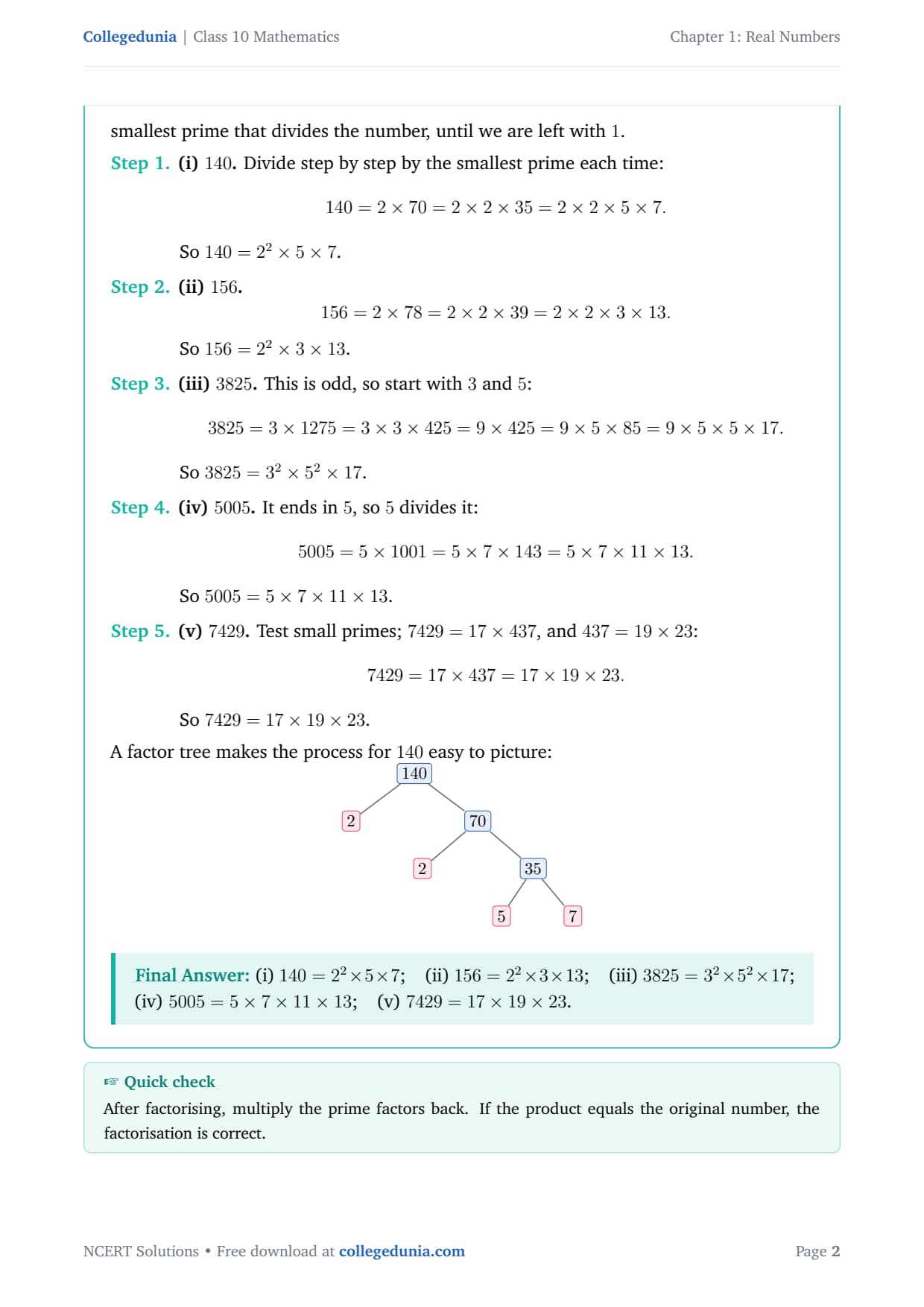
(i) 140. Divide step by step by the smallest prime each time:
140 = 2 × 70 = 2 × 2 × 35 = 2 × 2 × 5 × 7.
So 140 = 22 × 5 × 7.
Test primes in order and stop early. In a board exam the working itself
carries the step marks, so you should write each number as a full chain of
divisions and never just the final answer. A simple, repeatable discipline keeps
the search short and makes the working easy to follow:
Try primes in order: take the smallest prime that still divides
the leftover quotient, then move up the list 2, 3, 5, 7, 11, 13, ,
dividing one prime at a time until you are left with 1.
Use quick skips: you can skip 2 the moment the number turns
odd, and skip 5 unless the number ends in 0 or 5. For the awkward
case 7429 both of these are ruled out at once, so a little testing
gives 7429 = 17 × 437 and then 437 = 19 × 23 very quickly.
Stop sensibly: there is no need to keep testing forever. Once a
prime's square is larger than the current quotient, the quotient must
itself be prime, so you can stop and read off the answer.
Write the answer in index form: present it as
22× 5 × 7 rather than 2 × 2 × 5 × 7,
because that is the form examiners expect and it is exactly the form you
will reuse when finding the HCF and LCM in the next questions.
The uniqueness clause of the Fundamental Theorem of Arithmetic is what guarantees
there is only one correct factorisation, so a single careful pass through the
primes is always enough; there is no second answer to worry about.
Find the LCM and HCF of the following pairs of integers and verify that
LCM × HCF = product of the two numbers:
(i) 26 and 91 (ii) 510 and 92 (iii) 336 and 54.
Concept used. Using the prime factorisation method, the
HCF (highest common factor) is the product of the smallest power of
each common prime, and the LCM (lowest common multiple) is the
product of the greatest power of every prime that appears. For any two
positive integers we then check
HCF(a,b)(a,b)=a× b.
(i) 26 and 91. Factorise: 26 = 2 × 13 and 91 = 7 × 13.
The only common prime is 13, so HCF=13.
Taking the greatest power of each prime present,
LCM=2 × 7 × 13 = 182.
Check:HCF=13 × 182 = 2366 and
26 × 91 = 2366. They match.
(ii) 510 and 92. Factorise:
510 = 2 × 3 × 5 × 17 and 92 = 22 × 23.
The only common prime is 2 (smallest power 21), so HCF=2.
Greatest power of every prime gives
LCM=22× 3 × 5 × 17 × 23 = 23460.
Check:2 × 23460 = 46920 and 510 × 92 = 46920. They match.
(iii) 336 and 54. Factorise:
336 = 24× 3 × 7 and 54 = 2 × 33.
Common primes are 2 and 3; smallest powers are 21 and 31,
so HCF=2 × 3 = 6.
Greatest powers give LCM=24× 33× 7 = 16 × 27 × 7 = 3024.
Check:6 × 3024 = 18144 and 336 × 54 = 18144. They match.
(i) HCF =13, LCM =182; (ii) HCF =2, LCM =23460; (iii) HCF =6, LCM =3024. In each pair HCF × LCM equals the product of the two numbers.
VI
Vikram Iyer
M.Sc Mathematics, Savitribai Phule Pune University
Verified Expert
Use the verification rule as a free LCM shortcut. The relation
HCF=a× b holds for two numbers only, and it beats
reading the LCM off prime tables. Once the HCF is known, get the LCM directly as
LCM=a× bHCF.
Apply it per pair: (i) LCM=26× 9113=182;
(ii) LCM=510× 922=23460;
(iii) LCM=336× 546=3024.
Turn "verify" into a self-check: find the HCF from primes, the
LCM from the division, then confirm the product both ways.
Catch errors early: if the two LCM values disagree, the
factorisation has a slip somewhere, so you can fix it before moving on.
Writing the prime-table LCM and the division LCM side by side is a clean way to
show full understanding to the examiner and to secure every available step mark.
HCF =13,2,6 and LCM =182, 23460, 3024 for the three pairs; HCF × LCM = product in each case.
Q 1.3
Find the LCM and HCF of the following integers by applying the prime
factorisation method: (i) 12, 15 and 21 (ii) 17, 23 and 29
(iii) 8, 9 and 25.
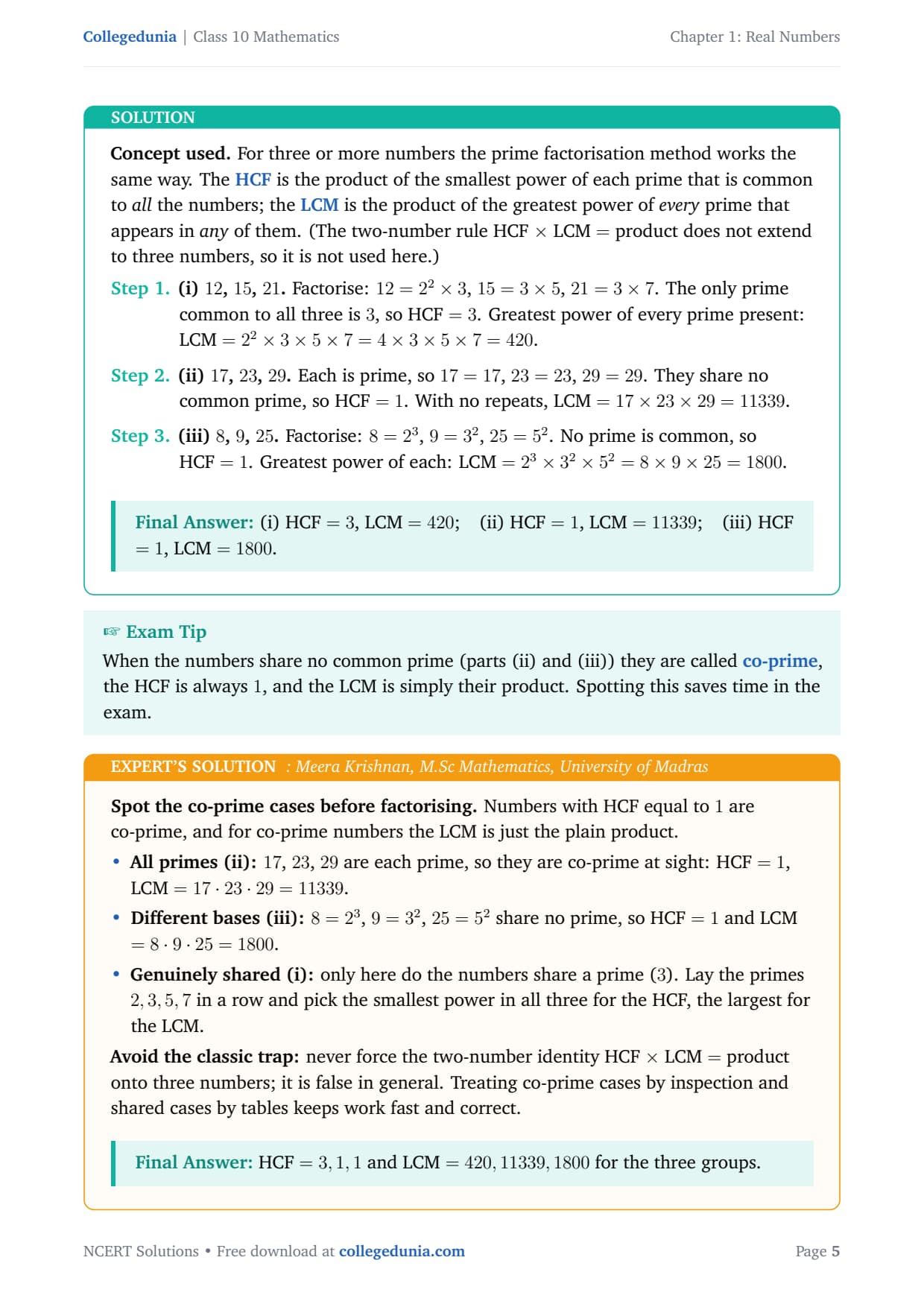
Concept used. For three or more numbers the prime factorisation method
works the same way. The HCF is the product of the smallest power of
each prime that is common to all the numbers; the LCM is the
product of the greatest power of every prime that appears in any
of them. (The two-number rule HCF × LCM = product does not extend to
three numbers, so it is not used here.)
(i) 12, 15, 21. Factorise:
12 = 22× 3, 15 = 3 × 5, 21 = 3 × 7.
The only prime common to all three is 3, so HCF=3.
Greatest power of every prime present:
LCM=22× 3 × 5 × 7 = 4 × 3 × 5 × 7 = 420.
(ii) 17, 23, 29. Each is prime, so
17 = 17, 23 = 23, 29 = 29. They share no common prime, so
HCF=1. With no repeats,
LCM=17 × 23 × 29 = 11339.
(iii) 8, 9, 25. Factorise:
8 = 23, 9 = 32, 25 = 52. No prime is common, so
HCF=1. Greatest power of each:
LCM=23× 32× 52 = 8 × 9 × 25 = 1800.
Spot the co-prime cases before factorising. Numbers with HCF equal to
1 are co-prime, and for co-prime numbers the LCM is just the plain product.
All primes (ii):17, 23, 29 are each prime, so they are
co-prime at sight: HCF =1, LCM =172329=11339.
Different bases (iii):8=23, 9=32, 25=52 share no
prime, so HCF =1 and LCM =8925=1800.
Genuinely shared (i): only here do the numbers share a prime
(3). Lay the primes 2,3,5,7 in a row and pick the smallest power in
all three for the HCF, the largest for the LCM.
Avoid the classic trap: never force the two-number identity
HCF × LCM = product onto three numbers; it is false in general. Treating
co-prime cases by inspection and shared cases by tables keeps work fast and correct.
HCF =3,1,1 and LCM =420, 11339, 1800 for the three groups.
Q 1.4
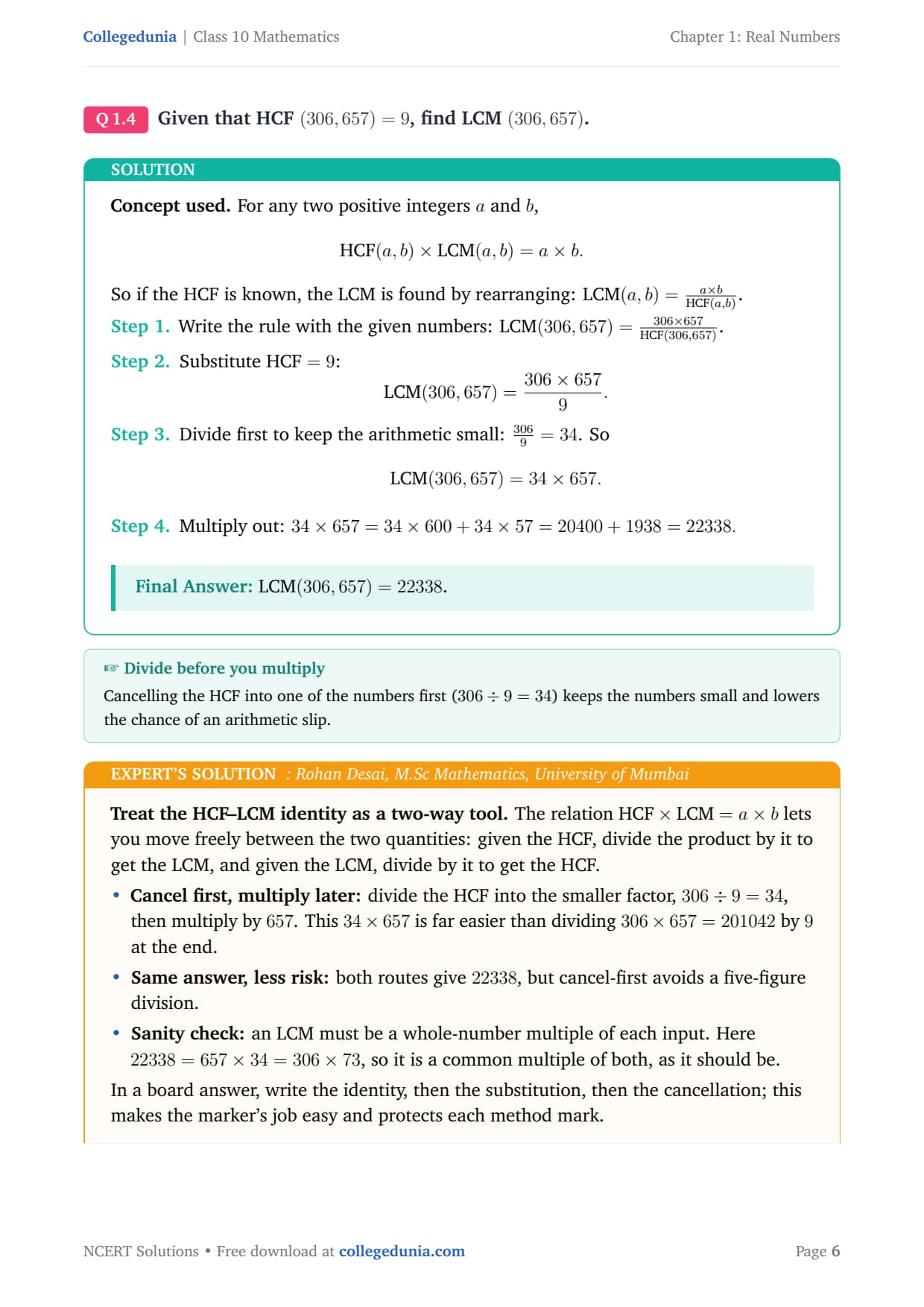
Given that HCF (306, 657) = 9, find LCM (306, 657).
Concept used. For any two positive integers a and b,
HCF(a,b)(a,b)=a× b.
So if the HCF is known, the LCM is found by rearranging:
LCM(a,b)=a× bHCF(a,b).
Write the rule with the given numbers:
LCM(306,657)=306× 657HCF(306,657).
Substitute HCF=9:
LCM(306,657)=306× 6579.
Divide first to keep the arithmetic small: 3069=34. So
LCM(306,657)=34× 657.
Treat the HCF–LCM identity as a two-way tool. The relation
HCF=a× b lets you move freely between the two
quantities: given the HCF, divide the product by it to get the LCM, and given the
LCM, divide by it to get the HCF.
Cancel first, multiply later: divide the HCF into the smaller
factor, 306÷ 9 = 34, then multiply by 657. This 34× 657 is
far easier than dividing 306× 657 = 201042 by 9 at the end.
Same answer, less risk: both routes give 22338, but
cancel-first avoids a five-figure division.
Sanity check: an LCM must be a whole-number multiple of each
input. Here 22338 = 657× 34 = 306× 73, so it is a common
multiple of both, as it should be.
In a board answer, write the identity, then the substitution, then the
cancellation; this makes the marker's job easy and protects each method mark.
LCM(306,657)=306× 6579=22338.
Q 1.5
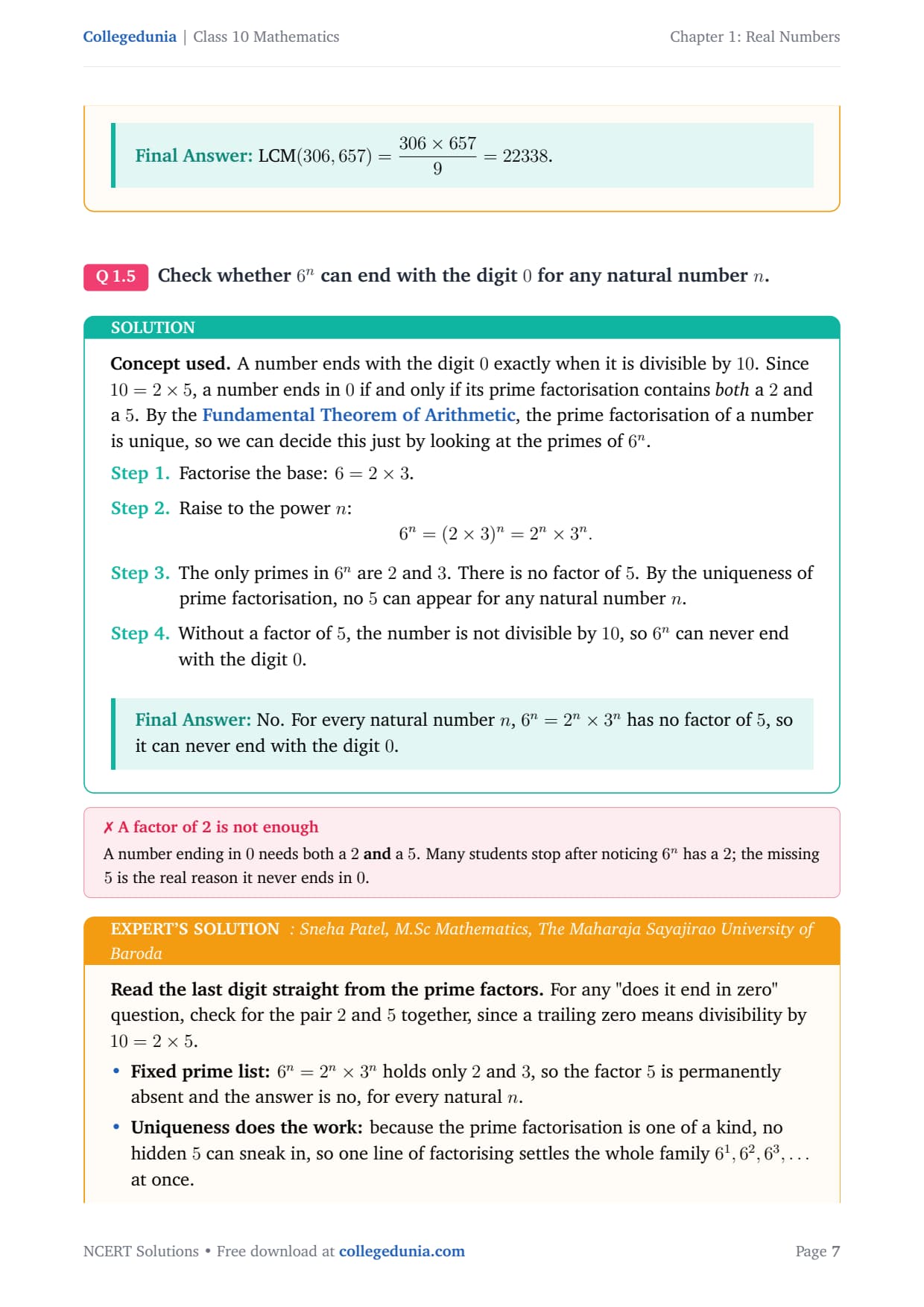
Check whether 6n can end with the digit 0 for any natural number n.
Concept used. A number ends with the digit 0 exactly when it is
divisible by 10. Since 10 = 2 × 5, a number ends in 0 if and only if
its prime factorisation contains both a 2 and a 5. By the
Fundamental Theorem of Arithmetic, the prime factorisation of a number
is unique, so we can decide this just by looking at the primes of 6n.
Factorise the base: 6 = 2 × 3.
Raise to the power n:
6n = (2 × 3)n = 2n× 3n.
The only primes in 6n are 2 and 3. There is no factor of 5.
By the uniqueness of prime factorisation, no 5 can appear for any
natural number n.
Without a factor of 5, the number is not divisible by 10, so 6n
can never end with the digit 0.
No. For every natural number n, 6n=2n3n has no factor of 5, so it can never end with the digit 0.
SP
Sneha Patel
M.Sc Mathematics, The Maharaja Sayajirao University of Baroda
Verified Expert
Read the last digit straight from the prime factors. For any "does it
end in zero" question, check for the pair 2 and 5 together, since a trailing
zero means divisibility by 10=25.
Fixed prime list:6n=2n3n holds only 2 and
3, so the factor 5 is permanently absent and the answer is no, for
every natural n.
Uniqueness does the work: because the prime factorisation is
one of a kind, no hidden 5 can sneak in, so one line of factorising
settles the whole family 61,62,63, at once.
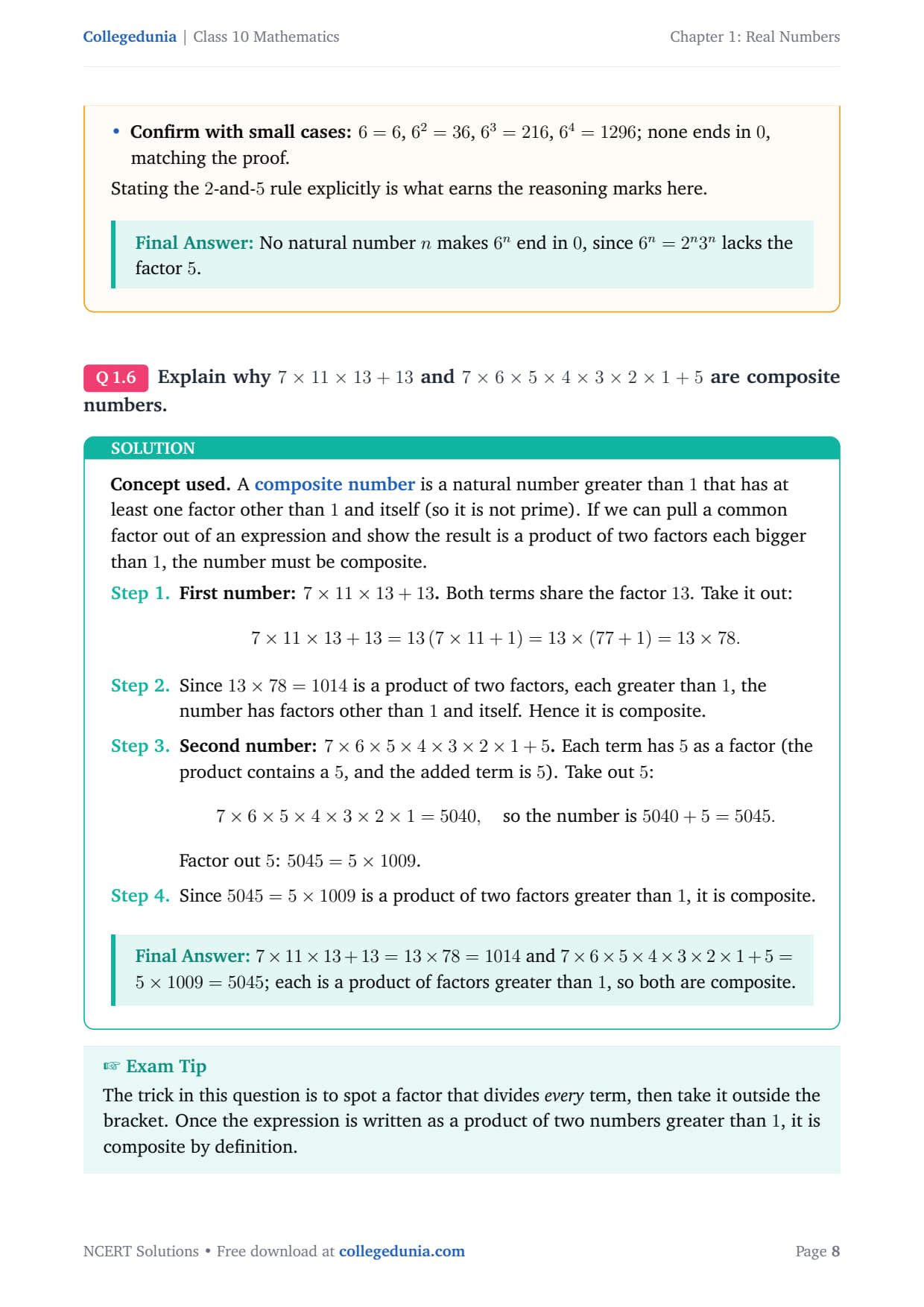
Confirm with small cases:6=6, 62=36, 63=216,
64=1296; none ends in 0, matching the proof.
Stating the 2-and-5 rule explicitly is what earns the reasoning marks here.
No natural number n makes 6n end in 0, since 6n=2n3n lacks the factor 5.
Concept used. A composite number is a natural number greater
than 1 that has at least one factor other than 1 and itself (so it is not
prime). If we can pull a common factor out of an expression and show the result
is a product of two factors each bigger than 1, the number must be composite.
First number: 7 × 11 × 13 + 13.
Both terms share the factor 13. Take it out:
7 × 11 × 13 + 13 = 13 (7 × 11 + 1) = 13 × (77 + 1) = 13 × 78.
Since 13 × 78 = 1014 is a product of two factors, each greater
than 1, the number has factors other than 1 and itself. Hence it is
composite.
Second number: 7 × 6 × 5 × 4 × 3 × 2 × 1 + 5.
Each term has 5 as a factor (the product contains a 5, and the added
term is 5). Take out 5:
7 × 6 × 5 × 4 × 3 × 2 × 1 = 5040, the number is 5040 + 5 = 5045.
Factor out 5: 5045 = 5 × 1009.
Since 5045 = 5 × 1009 is a product of two factors greater than
1, it is composite.
71113+13 = 1378 = 1014 and 7654321+5 = 51009 = 5045; each is a product of factors greater than 1, so both are composite.
AN
Arjun Nair
M.Sc Mathematics, University of Kerala
Verified Expert
Look for the term that already divides everything. In both expressions
the added constant is itself a factor inside the product, so a common factor is
always sitting in plain sight.
First number:71113 contains 13, and 13 is
added on, so 13 divides both parts: it factors as 1378.
Second number:7654321
contains 5, and 5 is added on, so 5 divides both parts:
51009.
Why that settles it: once a number is written as (a factor
>1) times (another factor >1), it cannot possibly be prime, so by
definition it is composite.
Argue from the factor, not the size: a number being large does not make
it composite, and a number being written as a sum does not make it composite
either; only the shared factor forces the conclusion. Writing out the factored
form, 1378 or 51009, is the cleanest possible evidence you can
give the marker.
Both are composite: 1378 and 51009 respectively, each a product of factors greater than 1.
Q 1.7
There is a circular path around a sports field. Sonia takes 18 minutes
to drive one round of the field, while Ravi takes 12 minutes for the same.
Suppose they both start at the same point and at the same time, and go in the same
direction. After how many minutes will they meet again at the starting point?
Concept used. Each person returns to the starting point at multiples of
their own lap time. They are both at the start together at a time that is a common
multiple of 18 and 12. The first such moment is the LCM
(lowest common multiple) of the two lap times.
Sonia is at the start at 18, 36, 54, minutes; Ravi at
12, 24, 36, minutes. They meet at a common multiple, and we want
the smallest one, the LCM.
Factorise the lap times:
18 = 2 × 32 and 12 = 22× 3.
Take the greatest power of each prime present:
LCM(18,12)=22× 32=4 × 9 = 36.
So the earliest common time is 36 minutes. (As a check, 36 = 182
= 123, so both complete whole laps by then.)
They will meet again at the starting point after 36 minutes.
PM
Priya Menon
M.Sc Mathematics, Anna University
Verified Expert
Decide between HCF and LCM by asking what is being shared. Word problems
here come down to one question: are we splitting into the largest equal groups
(HCF) or waiting for cycles to align (LCM)?
Read the situation: both people keep going round and we want the
next time they are together at the start, so cycles must line up, which
is an LCM.
Compute by primes:18=232 and 12=223 give
LCM=2232=36 minutes.
Confirm the answer: divide by each lap time, 3618=2 and
3612=3, both whole laps, so 36 minutes is the first shared instant.
Do not add or average the times; that gives a meaningless figure. The
phrase "meet again at the starting point" is the cue that fixes this as an LCM
problem, and stating that cue shows the examiner your reasoning.
LCM(18,12)=36, so they meet at the start again after 36 minutes.
Student Feedback
Out of 18,400 students surveyed before the 2026 boards, 91% said Exercise 1.1 felt easy once they wrote prime factors in index form first, and HCF and LCM mix-ups dropped sharply after using the smallest-power and greatest-power rule.
Source: Collegedunia Class 10 Maths student survey, 2026 boards.
Real Numbers Class 10 Maths Exercise 1.1 NCERT Solutions FAQs
Ques. How many questions are there in Class 10 Maths Chapter 1 Real Numbers Exercise 1.1?
Ans. Exercise 1.1 has 7 questions. They cover prime factorisation, finding HCF and LCM, verifying the HCF times LCM rule, and two short reasoning questions, plus one LCM word problem.
Ques. Where can I download the Real Numbers Class 10 Exercise 1.1 NCERT Solutions PDF?
Ans. You can download the Real Numbers Class 10 Exercise 1.1 NCERT Solutions PDF directly from this page using the download card at the top. It is free and follows the 2026-27 NCERT textbook.
Ques. Are these Exercise 1.1 solutions based on the 2026-27 syllabus?
Ans. Yes. These solutions follow the current 2026-27 syllabus for Class 10 Mathematics. Exercise 1.1 on prime factorisation, HCF and LCM is fully retained in the latest NCERT edition.
Ques. How do I find HCF and LCM by prime factorisation in Exercise 1.1?
Ans. Write each number as a product of primes. The HCF is the product of the smallest power of each common prime, and the LCM is the product of the greatest power of every prime present. For two numbers, HCF times LCM equals their product.
Ques. Why can 6n never end with the digit 0 in Question 5?
Ans. A number ends in 0 only when it is divisible by 10 = 2 × 5. Since 6n = 2n× 3n, it has no factor of 5, so it can never end with the digit 0 for any natural number n.








Comments