




About 15 to 20 marks of the Class 10 Social Science board paper come from Geography, and Water Resources is one of its most asked chapters.
Chapter3WaterResourcesSolutions.pdf?page=1&dpi=150)
Chapter3WaterResourcesSolutions.pdf?page=2&dpi=150)
Chapter3WaterResourcesSolutions.pdf?page=3&dpi=150)
Chapter3WaterResourcesSolutions.pdf?page=4&dpi=150)
Chapter3WaterResourcesSolutions.pdf?page=5&dpi=150)
Chapter3WaterResourcesSolutions.pdf?page=6&dpi=150)
Chapter3WaterResourcesSolutions.pdf?page=7&dpi=150)
Chapter3WaterResourcesSolutions.pdf?page=8&dpi=150)
Chapter3WaterResourcesSolutions.pdf?page=9&dpi=150)
Chapter3WaterResourcesSolutions.pdf?page=10&dpi=150)
Chapter3WaterResourcesSolutions.pdf?page=11&dpi=150)
Chapter3WaterResourcesSolutions.pdf?page=12&dpi=150)
Chapter3WaterResourcesSolutions.pdf?page=13&dpi=150)
Chapter3WaterResourcesSolutions.pdf?page=14&dpi=150)
The NCERT Solutions Class 10 Geography Chapter 3 Water Resources cover every textbook question for the 2026-27 CBSE syllabus. Each answer names the place, project and practice the NCERT text uses, from the Indira Gandhi Canal and the tankas of Rajasthan to Tamil Nadu's rooftop rainwater harvesting law.
- 8 NCERT questions solved: 3 MCQ-style items, 3 short (30-word) and 2 long (120-word) answers, each step by step.
- This chapter is a regular source of 3 and 5 mark questions in the Class 10 board paper.
- Free PDF download in Normal and HD, plus a Hindi-medium read of every answer.
Every answer in this water resources class 10 solution set is written by Collegedunia subject experts, checked against the 2026-27 NCERT textbook, and refined using the last five years of CBSE board papers.
What This Class 10 Geography Chapter Covers for the Boards
This chapter studies why water, though renewable, runs short, and how India stores and conserves it. It explains water scarcity, multi-purpose river projects and rainwater harvesting, from the hydrological cycle to the tankas of the Thar desert, so the water resources class 10 solution keeps every name, project and place you need.
- Water scarcity and its causes: shortage of water relative to demand, driven by over-use, growing population and pollution.
- Water as a renewable resource: how the hydrological cycle continually recharges surface water and groundwater.
- Multi-purpose river projects: the benefits of dams and their costs, from the Narmada to the Tehri debates.
- Rainwater harvesting: traditional tankas, khadins and johads, plus modern rooftop systems.
- Conservation in practice: Gendathur in Karnataka, Shillong in Meghalaya, and Tamil Nadu's compulsory harvesting law.
Water Resources Class 10 Explained in Simple Language
Source: Magnet Brains on YouTube
Water Resources Class 10 Question Answer: MCQ Section
The first three NCERT items are multiple-choice and "correct the false statement" questions. They test quick recall of scarcity, multi-purpose projects and rooftop harvesting, and are common 1-mark picks. Below is what each answer should carry.
| Question | What a full-mark answer must include |
|---|---|
| Classify each situation as suffering or not suffering from water scarcity | (a) not suffering, (b) suffering, (c) suffering, (d) not suffering. Scarcity depends on quantity, quality and access, not rainfall alone. |
| Which statement is not an argument in favour of multi-purpose river projects? | Answer is (c): large-scale displacement and loss of livelihood is a disadvantage, not a benefit. |
| Correct the three false statements | Dense urban growth over-exploits water; damming does affect river and sediment flow; rooftop harvesting in Rajasthan is declining due to the Indira Gandhi Canal. |
Tip: in the multi-purpose MCQ, underline the word "not" before you choose. Three options are benefits; only displacement is a cost, so it is the answer.
Water Resources Important Question: Descriptive Section
The five descriptive questions carry the main marks. Each asks you to define a term or explain a process, so a well-set answer needs a clear definition, named examples and a short close. The solutions give you exactly that structure.
- How water becomes a renewable resource (30 words): the hydrological cycle evaporates, condenses, precipitates and recharges surface and groundwater endlessly.
- What water scarcity is and its causes (30 words): shortage relative to demand, caused by over-exploitation, unequal access and pollution.
- Advantages and disadvantages of multi-purpose river projects (30 words): irrigation, power and flood control against submergence, displacement and ecological harm.
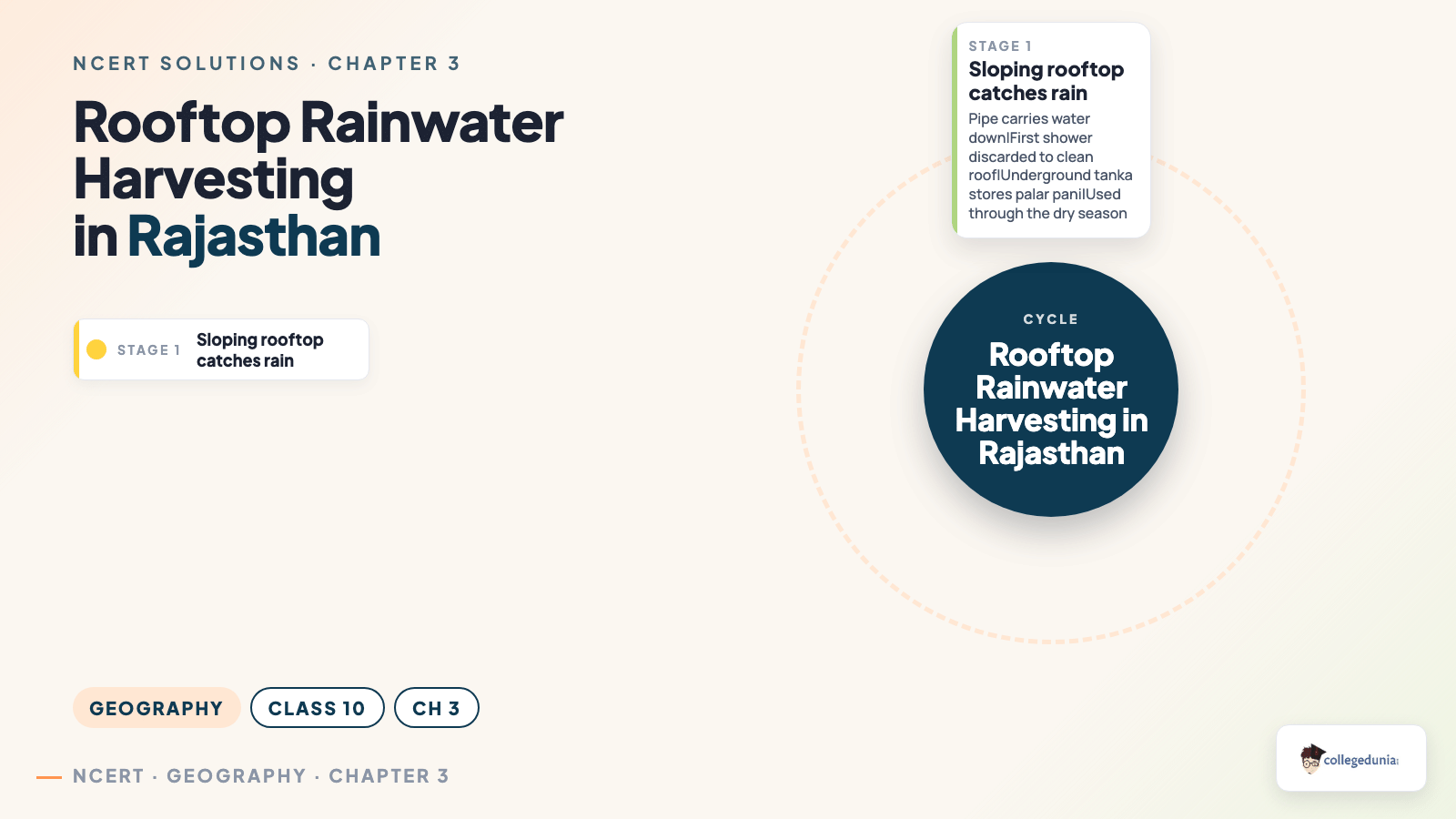
- Rainwater harvesting in semi-arid Rajasthan (120 words): underground tankas, rooftop pipes, the discarded first shower, and palar pani.
- Modern adaptations of rainwater harvesting (120 words): Gendathur, Shillong, PVC-pipe filters, recharge wells, and Tamil Nadu's law.
Memorise the Indira Gandhi Canal and Tamil Nadu's compulsory rooftop rainwater harvesting law, because rainwater harvesting questions appear most years.
Multi-purpose River Projects Every Class 10 Student Must Know
India built large dams as "temples of modern India" to serve many uses at once. Knowing both the benefits and the costs makes the compare question easy.
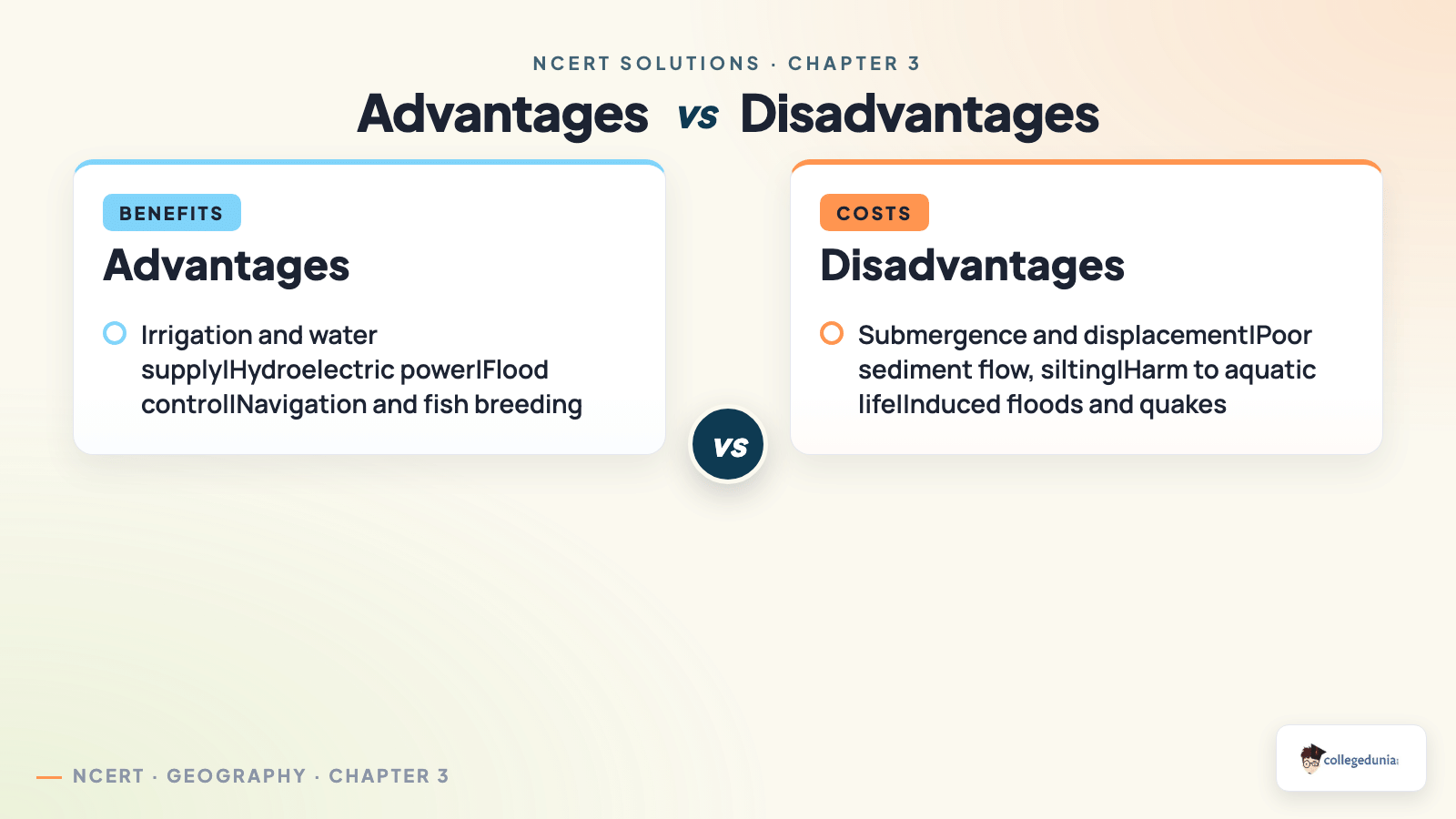
| Advantages | Disadvantages |
|---|---|
| Irrigation and steady water supply for farms, homes and industry. | Submergence of land and large-scale displacement of people. |
| Hydroelectric power and flood control downstream. | Poor sediment flow, erosion, and silting of the reservoir. |
| Navigation, recreation and inland fish breeding. | Harm to aquatic life and induced floods, quakes and soil salinisation. |
A multi-purpose river project integrates many uses of impounded water, while a perennial canal like the Indira Gandhi Canal carries water year round.
How Communities Harvest and Conserve Water in India
The 120-word rainwater harvesting question is a board favourite. The solution uses named examples with place names, because the board rewards facts over general lines.
| Example | What the community did |
|---|---|
| Bikaner, Phalodi, Barmer (Rajasthan) | Built underground tankas fed by rooftop pipes to store palar pani for the dry season. |
| Gendathur, Karnataka | Nearly 200 houses fitted rooftop systems, collecting about 50,000 litres per house a year. |
| Shillong, Meghalaya | Almost every household has rooftop harvesting that meets 15-25% of its water needs. |
| Tamil Nadu | Became the first state to make rooftop rainwater harvesting compulsory, with penalties for defaulters. |
A tanka is an underground storage tank, and a khadin is a Rajasthani embankment that holds run-off for farming. Naming the place with each example, like Gendathur or Shillong, lifts a plain answer to a full-mark one.
Student Feedback on this Class 10 Geography Chapter
What 11,420 students told us about studying this chapter before the 2026 boards.
- 61% of students rated the 120-word rainwater harvesting question as the one they most often answered without enough place names.
- 54% of students said they wrote only the advantages of multi-purpose projects and forgot the disadvantages.
- Most-skipped topic in revision: the causes of water scarcity, left for last by about 31% of students.
Source: 2026-27 Class 10 Geography student poll. Sample of 11,420 students from CBSE schools across 14 states.
Common Mistakes Students Make in this Class 10 Geography Chapter
A few slips lose easy marks every year. Fix these before the exam.
- Saying a region with high rainfall can never face scarcity. Scarcity also depends on population, pollution and access.
- Listing only the benefits of dams. The board answer must also name submergence, displacement, sedimentation and ecological harm.
- Writing the rainwater harvesting answer with no place names. Always name tankas, Gendathur, Shillong and Tamil Nadu.
- Forgetting that rooftop harvesting in Rajasthan is declining because of the perennial Indira Gandhi Canal.
How to Use the NCERT Solutions Class 10 Geography Chapter 3 Page
Use the solution in three short blocks so revision stays focused: read the chapter, attempt the questions yourself, then compare and fix the gaps.
- Read and list: read the NCERT chapter and note every project, place and practice.
- Attempt first: answer all 8 questions on your own before opening the solutions.
- Compare and flag: match your answer with the step-by-step solution and mark the missing fact-lines.
For long-answer practice, write the rainwater harvesting and modern adaptations answers in full at least once. The set mirrors the board's 5-mark pattern, and each solution doubles as a model answer for revision.
Practice All NCERT Solutions for this Class 10 Geography Chapter with Step-by-Step Solutions
Open the question bank below to attempt all 8 solved questions with collapsible Solution and Expert Solution tabs. Every answer is mapped to the NCERT text, so each one reads the way a board examiner expects.
All Solved Questions for this Class 10 Geography Chapter
Practise every MCQ and descriptive question with step-by-step solutions and an expert version for board marks.
Class 10 Geography Other Resources for this Chapter
Pair these solutions with the other Class 10 Geography resources for the same chapter, linked below.
| Resource | Best used for |
|---|---|
| Water Resources Class 10 Notes | Quick concept recap before the exam |
| Water Resources Class 10 Handwritten Notes | Last-minute scanned revision |
| Water Resources Class 10 NCERT Book PDF | Reading the original chapter text |
All Chapters NCERT Solutions for Class 10 Geography (Contemporary India II)
Browse the full set of ncert solutions for class 10 geography chapter by chapter below.
| Chapter | NCERT Solutions |
|---|---|
| Chapter 1 | Resources and Development Class 10 NCERT Solutions |
| Chapter 2 | Forest and Wildlife Resources Class 10 NCERT Solutions |
| Chapter 3 | Water Resources Class 10 NCERT Solutions |
| Chapter 4 | Agriculture Class 10 NCERT Solutions |
| Chapter 5 | Minerals and Energy Resources Class 10 NCERT Solutions |
| Chapter 6 | Manufacturing Industries Class 10 NCERT Solutions |
| Chapter 7 | Lifelines of National Economy Class 10 NCERT Solutions |
Ques. Where can I download the NCERT Solutions Class 10 Geography Chapter 3 Water Resources PDF?
Ans. You can download the water resources class 10 solution PDF directly from this page. Both the Normal and HD versions are free, and a Hindi-medium read is available too.
Ques. How many questions are solved in water resources class 10 question answer?
Ans. All 8 NCERT questions are solved: three MCQ-style items, three 30-word answers and two 120-word answers, each with a step-by-step solution and an expert version for the long-answer marks.
Ques. Is this NCERT Solutions page aligned with the 2026-27 syllabus?
Ans. Yes. This page reflects the current 2026-27 syllabus for Class 10 Geography, and every answer is checked against the latest NCERT edition of Contemporary India II.
Ques. How does water become a renewable resource in Class 10 Geography?
Ans. Water is renewable because the hydrological cycle keeps evaporating, condensing and precipitating water, which recharges surface water and groundwater. Used within limits, this freshwater supply is constantly replenished and does not run out.
Ques. What are the advantages and disadvantages of multi-purpose river projects?
Ans. Advantages include irrigation, hydel power, water supply, flood control and navigation. Disadvantages include disturbed river and sediment flow, submergence, displacement of people, harm to aquatic life, and induced floods, earthquakes and soil salinisation.
Ques. How is rainwater harvesting done in semi-arid Rajasthan?
Ans. Rainwater is collected from sloping rooftops through pipes into underground tankas built in the house or courtyard. The first shower is discarded to clean the roof, and later showers are stored as palar pani for drinking through the dry season.
Ques. What are modern adaptations of rainwater harvesting in this water resources class 10 solution?
Ans. Modern systems use PVC pipes, sand-and-brick filters and recharge wells. Gendathur in Karnataka and Shillong in Meghalaya show successful adaptation, while Tamil Nadu made rooftop rainwater harvesting compulsory by law.



Comments