




The ncert solutions class 10 economics chapter 5 Consumer Rights answer every back-exercise question, according to the latest 2026-27 CBSE syllabus.
Chapter5ConsumerRightsSolutions.pdf?page=1&dpi=150)
Chapter5ConsumerRightsSolutions.pdf?page=2&dpi=150)
Chapter5ConsumerRightsSolutions.pdf?page=3&dpi=150)
Chapter5ConsumerRightsSolutions.pdf?page=4&dpi=150)
Chapter5ConsumerRightsSolutions.pdf?page=5&dpi=150)
Chapter5ConsumerRightsSolutions.pdf?page=6&dpi=150)
Chapter5ConsumerRightsSolutions.pdf?page=7&dpi=150)
Chapter5ConsumerRightsSolutions.pdf?page=8&dpi=150)
Chapter5ConsumerRightsSolutions.pdf?page=9&dpi=150)
Chapter5ConsumerRightsSolutions.pdf?page=10&dpi=150)
Chapter5ConsumerRightsSolutions.pdf?page=11&dpi=150)
Chapter5ConsumerRightsSolutions.pdf?page=12&dpi=150)
Chapter5ConsumerRightsSolutions.pdf?page=13&dpi=150)
Chapter5ConsumerRightsSolutions.pdf?page=14&dpi=150)
Chapter5ConsumerRightsSolutions.pdf?page=15&dpi=150)
Chapter5ConsumerRightsSolutions.pdf?page=16&dpi=150)
Chapter5ConsumerRightsSolutions.pdf?page=17&dpi=150)
Chapter5ConsumerRightsSolutions.pdf?page=18&dpi=150)
Chapter5ConsumerRightsSolutions.pdf?page=19&dpi=150)
Chapter5ConsumerRightsSolutions.pdf?page=20&dpi=150)
Chapter5ConsumerRightsSolutions.pdf?page=21&dpi=150)
Chapter5ConsumerRightsSolutions.pdf?page=22&dpi=150)
Chapter5ConsumerRightsSolutions.pdf?page=23&dpi=150)
Each answer is built on the chapter's core idea, that an individual buyer is weak against powerful sellers, so the wording matches what the board examiner expects.
- 13 NCERT questions solved: 2 objective-type (match, true/false) and 11 short and long discussion answers, each step-by-step.
- This chapter is a regular source of 1, 3 and 5 mark questions in the Class 10 Social Science board paper.
- Free PDF download in Normal and HD, plus a quick-revision read of every answer.
Every answer in these consumer rights class 10 ncert solutions is written by Collegedunia subject experts, checked against the 2026-27 NCERT textbook, and refined using the last five years of CBSE board papers.
What Class 10 Economics Chapter 5 Consumer Rights Covers for the Boards
This chapter explains how buyers can be exploited in the marketplace and how the law protects them. It covers the consumer movement in India, the six consumer rights under the Consumer Protection Act (COPRA), 1986, the three-tier Redressal Commissions, and the quality marks (ISI, Agmark, Hallmark) that signal safe products.
- Marketplace rules: why an individual buyer is weak and why regulations are needed.
- Consumer movement: the factors that gave it birth and how it grew into COPRA.
- Six consumer rights: Safety, Information, Choice, Redressal, Representation, Education.
- Redressal Commissions: the District, State and National three-tier system.
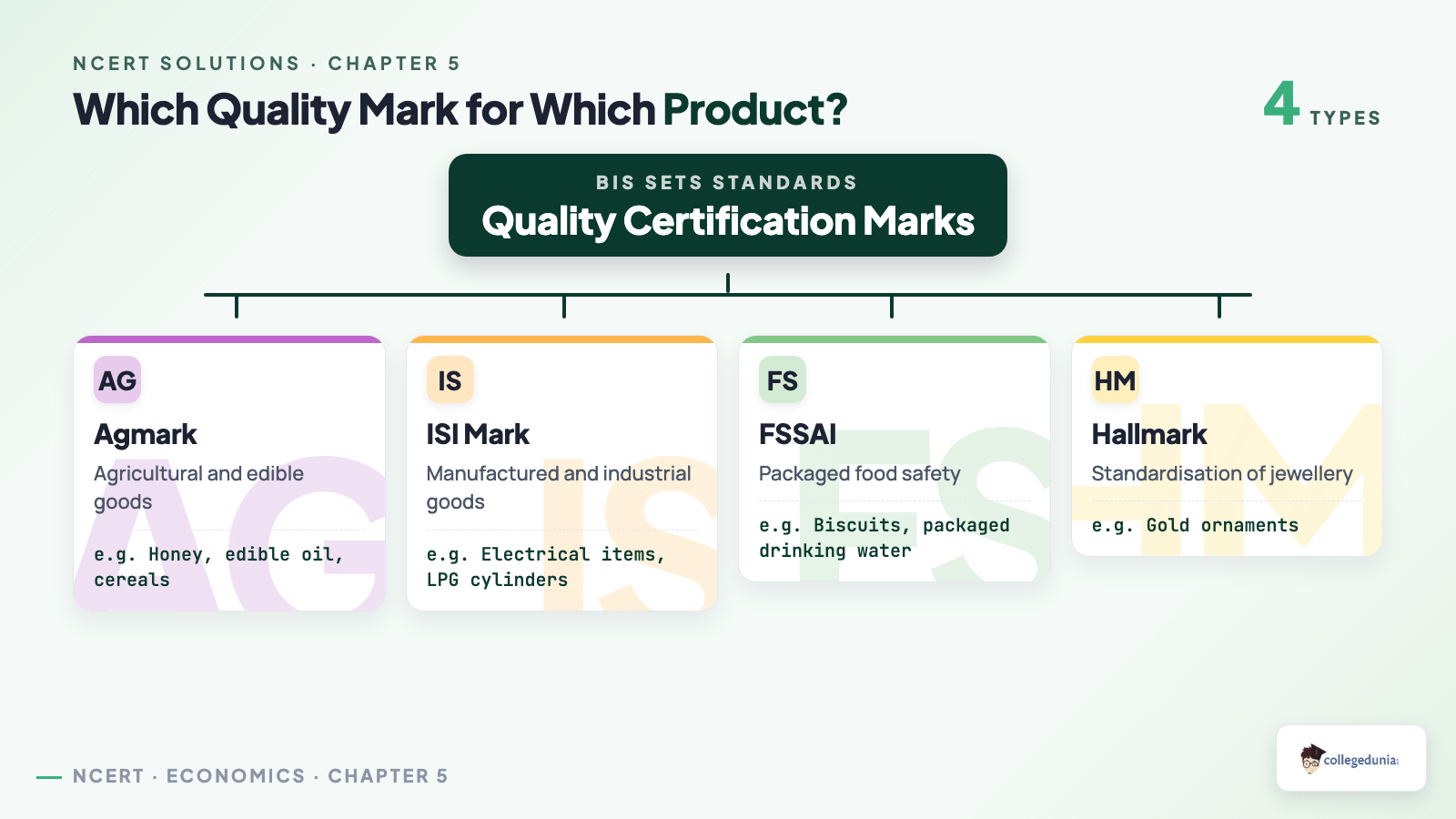
- Quality marks: Agmark, ISI, FSSAI and Hallmark, and which product needs which.
Consumer Rights Class 10 Explained in Simple Language
A short video helps you see how the consumer movement, the six rights and COPRA connect into one chapter before you attempt the answers.
Source: Magnet Brains on YouTube
Why Rules Are Needed in the Marketplace: Class 10 Economics Chapter 5
NCERT opens this chapter by asking why rules are required at all. The answer is unequal bargaining power: sellers are few, large and powerful, while buyers are scattered and weak.
| Reason for rules | What the chapter wants you to remember |
|---|---|
| Unequal bargaining power | A lone buyer is weak; the seller tries to shift all blame after the sale. Rules force the seller to share responsibility. |
| Stop unfair trade practices | Underweighing, hidden charges and adulteration are blocked by weighing standards and accurate billing. |
| Curb powerful firms | The false "powder milk better than mother's milk" claim and the tobacco-cancer case both needed rules and courts to correct. |
| Protect health and safety | LPG cylinders, medicines and pressure-cooker valves can injure if defective, so quality and labelling are made mandatory. |
A handy rule: the law acts as the consumer's proxy inspector, checking a global supply chain the buyer can never inspect alone. Naming the law as inspector and enforcer answers most "why do we need consumer rules" questions.
The Consumer Movement and COPRA 1986 in Class 10 Economics
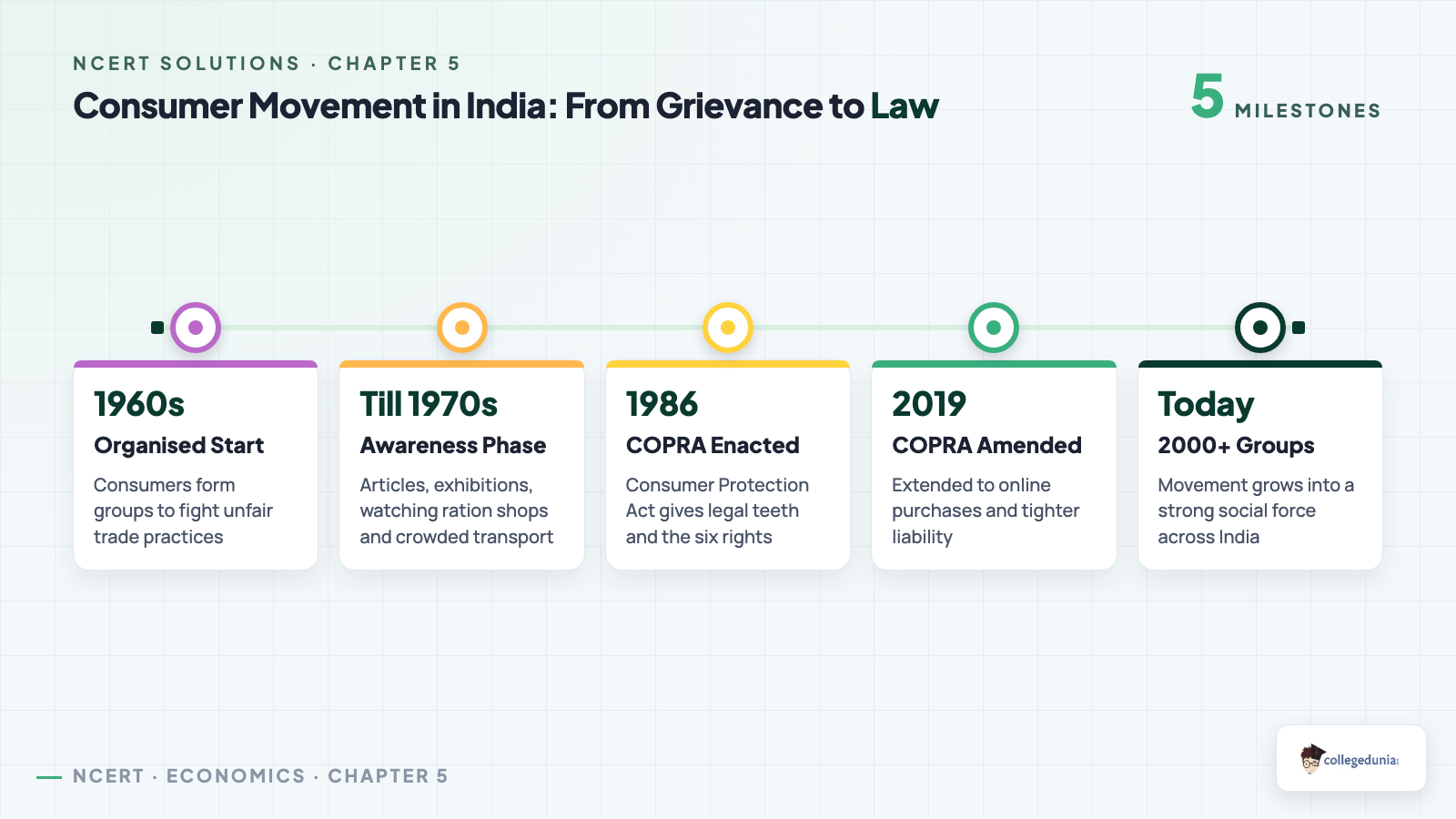
The chapter then traces how scattered buyers became an organised social force. Food shortages, hoarding, black marketing and adulteration, with no law to protect a cheated buyer, gave birth to the consumer movement. The ncert solutions class 10 economics chapter 5 Consumer Rights present this as a dated timeline that examiners reward.
| Stage | What it adds to the board answer |
|---|---|
| Causes | Shortages, hoarding, black marketing and adulteration, with no legal remedy, pushed consumers to organise. |
| 1960s: organised start | The movement took an organised form to fight unfair trade practices. |
| Till the 1970s: awareness | Articles, exhibitions, and watching ration shops and crowded transport. |
| 1986 onward: legal teeth | COPRA enacted in 1986, amended in 2019, and a jump to over 2000 consumer groups today. |
A memory rule for any "trace its evolution" answer: grievance leads to organisation, which leads to law. Anchor the dates, 1960s, 1970s, 1986 and 2019, and the consumer rights class 10 ncert solutions answer writes itself.
The Six Consumer Rights Under COPRA: Class 10 Economics Chapter 5
The heart of class 10 economics chapter 5 consumer rights is the six rights every Indian buyer has under COPRA. Each right protects the consumer at a different stage of buying and using a product, so a full-mark answer names all six in order.
| Right | What it protects (one fact line) |
|---|---|
| Right to Safety | Protection from goods hazardous to life and property, such as faulty pressure-cooker valves or unsafe medicines. |
| Right to Information | The right to know ingredients, price, batch number, manufacture and expiry dates, and the maker's address. |
| Right to Choose | Freedom to choose what to buy; no seller can force an extra product as a condition of sale. |
| Right to Seek Redressal | The right to compensation, depending on the degree of damage suffered, against unfair trade practices. |
| Right to Represent | The right to present your own case before a Consumer Disputes Redressal Commission. |
| Right to Consumer Education | The right to gain the knowledge and skill to stay a well-informed consumer for life. |
Remember the six rights with the mnemonic "SICRRE": Safety, Information, Choice, Redressal, Representation, Education. They line up with the life cycle of a purchase, decide, buy, remedy and learn, so you never drop one in the exam.
Redressal Commissions and Quality Marks: Class 10 Economics Chapter 5
When a buyer is cheated, COPRA gives a cheap three-tier complaint system, and quality marks help avoid the problem before it starts. The ncert solutions class 10 economics chapter 5 Consumer Rights keep both the claim-value table and the right mark for each product.
| Idea | What it means for the board answer |
|---|---|
| District Commission | Hears claims up to Rs 1 crore; the first level for most small consumer cases. |
| State Commission | Hears claims of Rs 1 crore to Rs 10 crore, and appeals from the District level. |
| National Commission | Hears claims above Rs 10 crore, and appeals from the State level. |
| Quality marks | Agmark for agricultural and edible goods (honey, oil), ISI/FSSAI for manufactured food, Hallmark for gold jewellery; BIS sets the standards. |
A memory rule: claim value decides the level, and product type decides the mark. National Consumers' Day is observed on 24 December. Mixing up Agmark and BIS, or the claim-value bands, is the slip that loses easy marks.
Consumer Rights Class 10 Chapter 5 Objective Questions: Match and True or False
The objective questions in consumer rights class 10 chapter 5 test marks, agencies and the structure of redressal. In this consumer rights class 10 chapter 5 question answer set, read each item against the chapter section it summarises, then lift the exact fact. Each item below rewards one clean line.
| Question | Answer and the one fact that proves it |
|---|---|
| Match the following (Q12) | (i)-(e), (ii)-(c), (iii)-(a), (iv)-(b), (v)-(g), (vi)-(f), (vii)-(d). Sort the items into rights, agencies/marks and food ideas first; Agmark is (c) edible certification, BIS is (d) the standard-setter. |
| True or False (Q13) | (i) F, (ii) T, (iii) F, (iv) F, (v) T, (vi) F, (vii) T. The trap words "only", "must" and "quick" flip a statement to False; COPRA covers goods and services, and redressal is slow. |
Tip: in the true/false set, "COPRA applies only to goods" is False because it covers services and online purchases too, and "redressal is simple and quick" is False because the chapter calls it cumbersome, expensive and time consuming. In the ncert solutions class 10 economics chapter 5 Consumer Rights, those two lines carry the most marks.
Student Feedback on This Class 10 Economics Chapter
What 12,140 students told us about studying this chapter before the 2026 boards.
- 61% of students rated matching the quality marks (Agmark vs ISI vs Hallmark) to the right product as the part they confused the most.
- 57% of students said the three-tier claim-value bands (Rs 1 crore / Rs 1-10 crore / above Rs 10 crore) were the single fact they most often got wrong.
- Most-skipped topic in revision: the consumer movement timeline, left for last by about 38% of students.
Source: 2026-27 Class 10 Economics student poll. Sample of 12,140 students from CBSE schools across 15 states.
Common Mistakes Students Make in This Class 10 Economics Chapter
A few slips lose easy marks every year. Fix these before the exam.
- Confusing Agmark with BIS. Agmark certifies agricultural and edible goods; BIS is the agency that develops standards and issues the ISI mark and Hallmark.
- Saying COPRA applies only to goods. It covers goods and services, and online purchases after the 2019 amendment.
- Calling the redressal process simple and quick. The chapter clearly calls it cumbersome, expensive and time consuming.
- Reversing the claim-value bands. District is up to Rs 1 crore, State is Rs 1-10 crore, National is above Rs 10 crore.
How to Use the NCERT Solutions Class 10 Economics Chapter 5 Page
Use the ncert solutions class 10 economics chapter 5 Consumer Rights in three short blocks so revision stays focused. First read the chapter, then attempt the questions, then compare and fix the gaps.
- Read and list: read the NCERT chapter and note every keyword (COPRA, consumer movement, the six rights, Agmark, Hallmark) and its example.
- Attempt first: answer all 13 questions on your own before opening the solutions.
- Compare and flag: match your answer with the step-by-step solution and mark the missing fact-lines.
For long-answer practice, write the "six consumer rights", "consumer movement evolution" and "critically examine the movement" answers in full at least once. The consumer rights class 10 ncert solutions set mirrors the board's 5-mark pattern, and each consumer rights question answer doubles as a model answer.
Practice All NCERT Solutions for This Class 10 Economics Chapter with Step-by-Step Solutions
Open the question bank below to attempt all 13 solved questions with collapsible Solution and Expert Solution tabs. Every answer in the ncert solutions class 10 economics chapter 5 Consumer Rights set is mapped to the NCERT text, so each consumer rights question answer reads exactly the way a board examiner expects.
All Solved Questions for this Class 10 Economics Chapter
Practise every match, true/false and discussion question with step-by-step solutions and an expert version for board marks.
Class 10 Economics Other Resources for This Chapter
Pair these solutions with the other Class 10 Economics resources for the same chapter. The notes give a quick recap, the handwritten notes help last-minute revision, and the NCERT book PDF is the source text.
| Resource | Best used for |
|---|---|
| Consumer Rights Class 10 Notes | Quick concept recap before the exam |
| Consumer Rights Class 10 Handwritten Notes | Last-minute scanned revision |
| Consumer Rights Class 10 NCERT Book PDF | Reading the original chapter text |
All Chapters NCERT Solutions for Class 10 Economics (Understanding Eco Dev)
Browse the full set of ncert solutions for class 10 economics chapter by chapter. Each link opens the solved questions for that chapter.
| Chapter | NCERT Solutions |
|---|---|
| Chapter 1 | Development Class 10 NCERT Solutions |
| Chapter 2 | Sectors of the Indian Economy Class 10 NCERT Solutions |
| Chapter 3 | Money and Credit Class 10 NCERT Solutions |
| Chapter 4 | Globalisation and the Indian Economy Class 10 NCERT Solutions |
| Chapter 5 | Consumer Rights Class 10 NCERT Solutions |
Consumer Rights Class 10 Economics NCERT Solutions FAQs
Ques. Where can I download the ncert solutions class 10 economics chapter 5 Consumer Rights PDF?
Ans. You can download the consumer rights class 10 ncert solutions PDF directly from this page. Both the Normal and HD versions are free, and a quick-revision read of every answer is available too.
Ques. How many questions are solved in consumer rights class 10 chapter 5 question answer?
Ans. All 13 NCERT exercise questions are solved, including the match-the-following and true/false questions and the longer discussion questions, each with a step-by-step solution and an expert version.
Ques. Is this NCERT Solutions page aligned with the 2026-27 syllabus?
Ans. Yes. This page reflects the current 2026-27 syllabus for Class 10 Economics, and every answer is checked against the latest NCERT edition of Understanding Economic Development.
Ques. What are the six consumer rights in Class 10 Economics Chapter 5?
Ans. The six consumer rights under COPRA are the Right to Safety, Right to Information, Right to Choose, Right to Seek Redressal, Right to Represent and Right to Consumer Education. The mnemonic "SICRRE" helps you recall all six in order.
Ques. What is COPRA 1986 and why was it enacted?
Ans. COPRA is the Consumer Protection Act of 1986, enacted to give consumers a law against exploitation. It set up a three-tier District, State and National redressal system and guaranteed the six consumer rights. It was amended in 2019 to also cover online purchases and tighten liability.
Ques. Which logo should I look for when buying honey and a biscuit packet?
Ans. For the honey, which is an agricultural product, look for the Agmark. For the biscuit packet, a processed food, look for the ISI or FSSAI mark. These marks certify quality and safety so the consumer is assured without testing the product.
Ques. What is the three-tier consumer redressal system?
Ans. Disputes are settled at three levels by claim value: the District Commission for claims up to Rs 1 crore, the State Commission for Rs 1 crore to Rs 10 crore, and the National Commission for claims above Rs 10 crore, with appeal allowed to the next higher level.



Comments