




The Class 9 Science NCERT Book PDF Chapter 5 Exploring Mixtures and their Separation is the exact chapter from the new Exploration textbook for the 2026-27 syllabus. This page lets students download the full chapter PDF free and shows what is inside it, from types of mixtures to methods like crystallization, distillation and chromatography. Read the summary first, then open the book PDF to study every section, figure and exercise in the original NCERT wording.
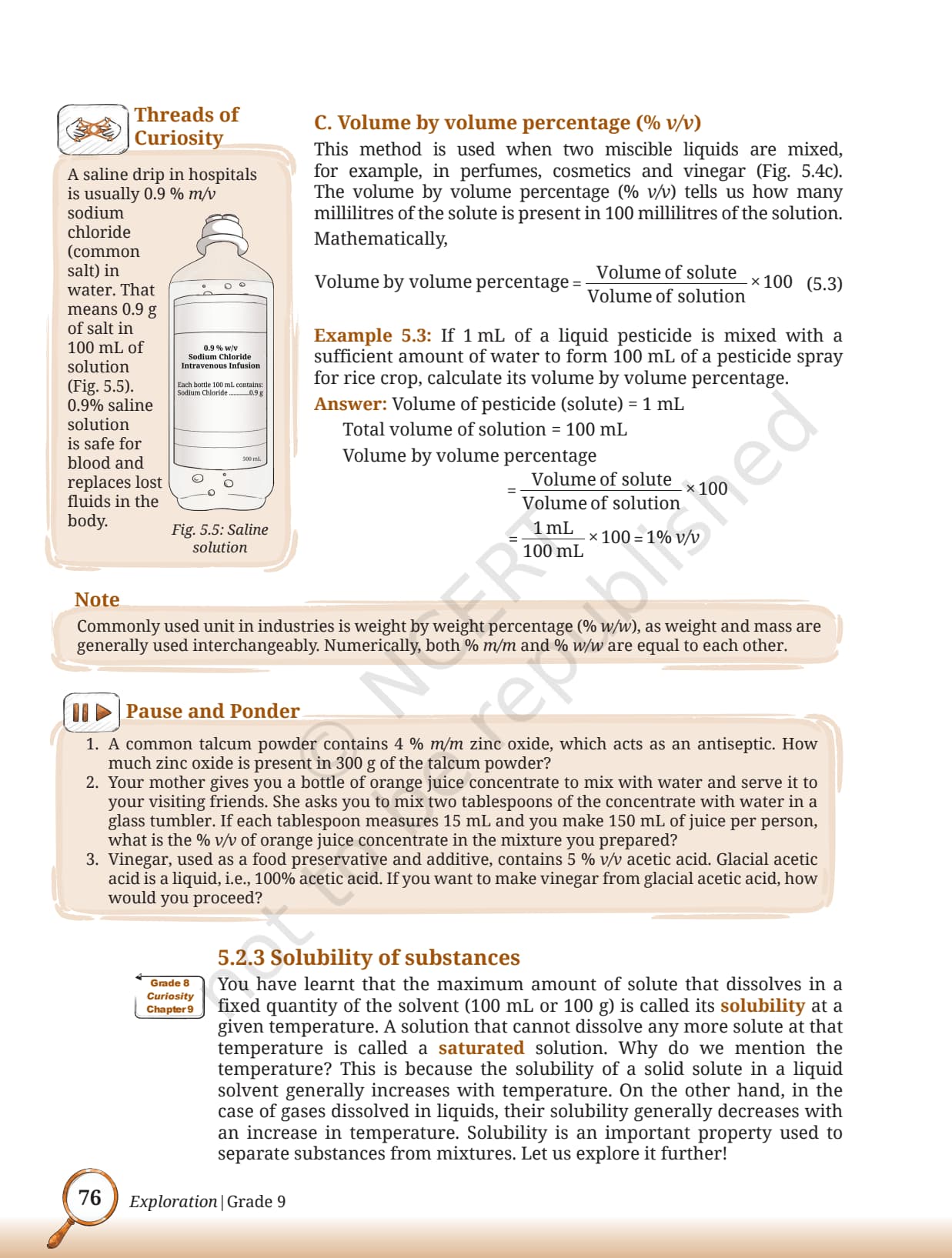
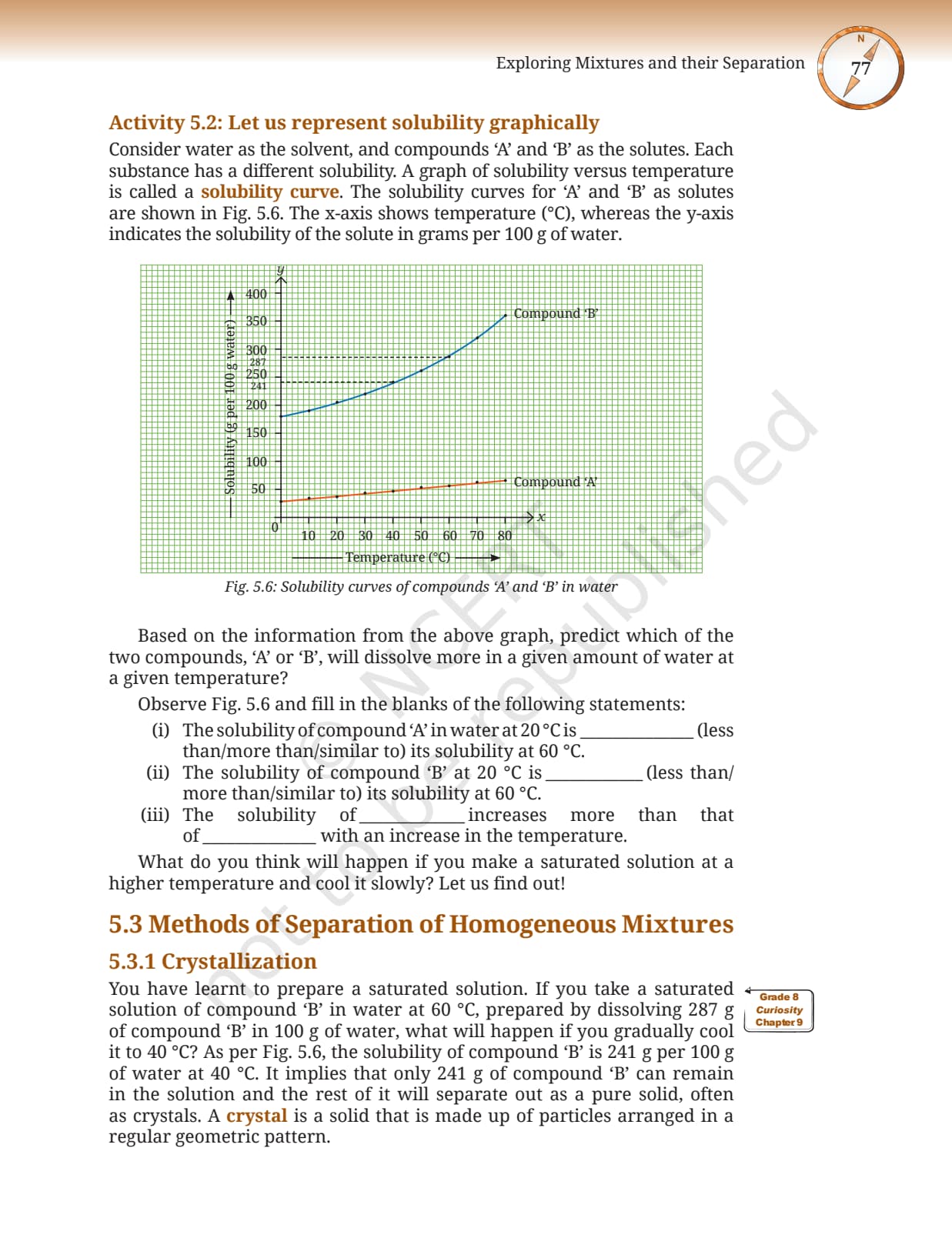
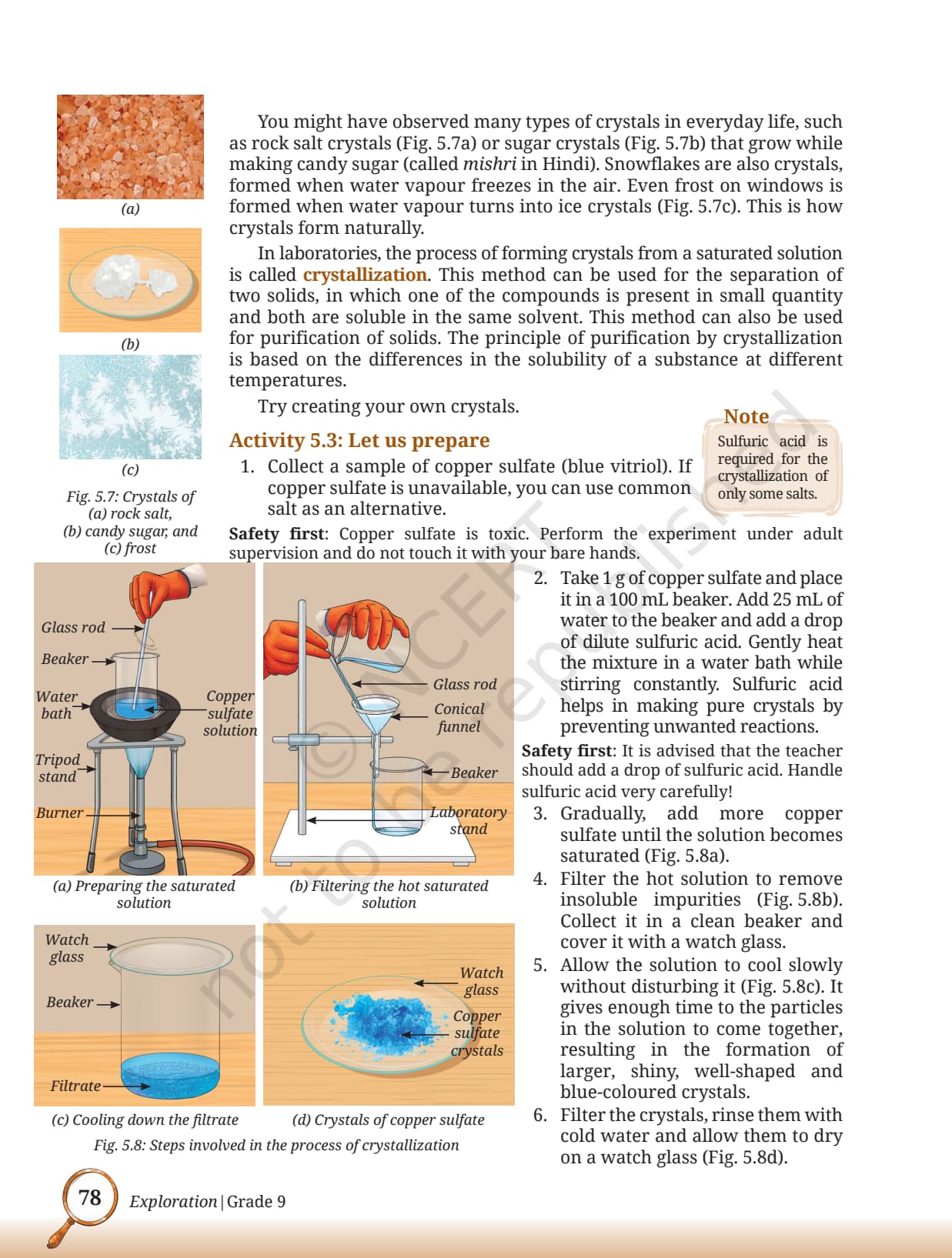
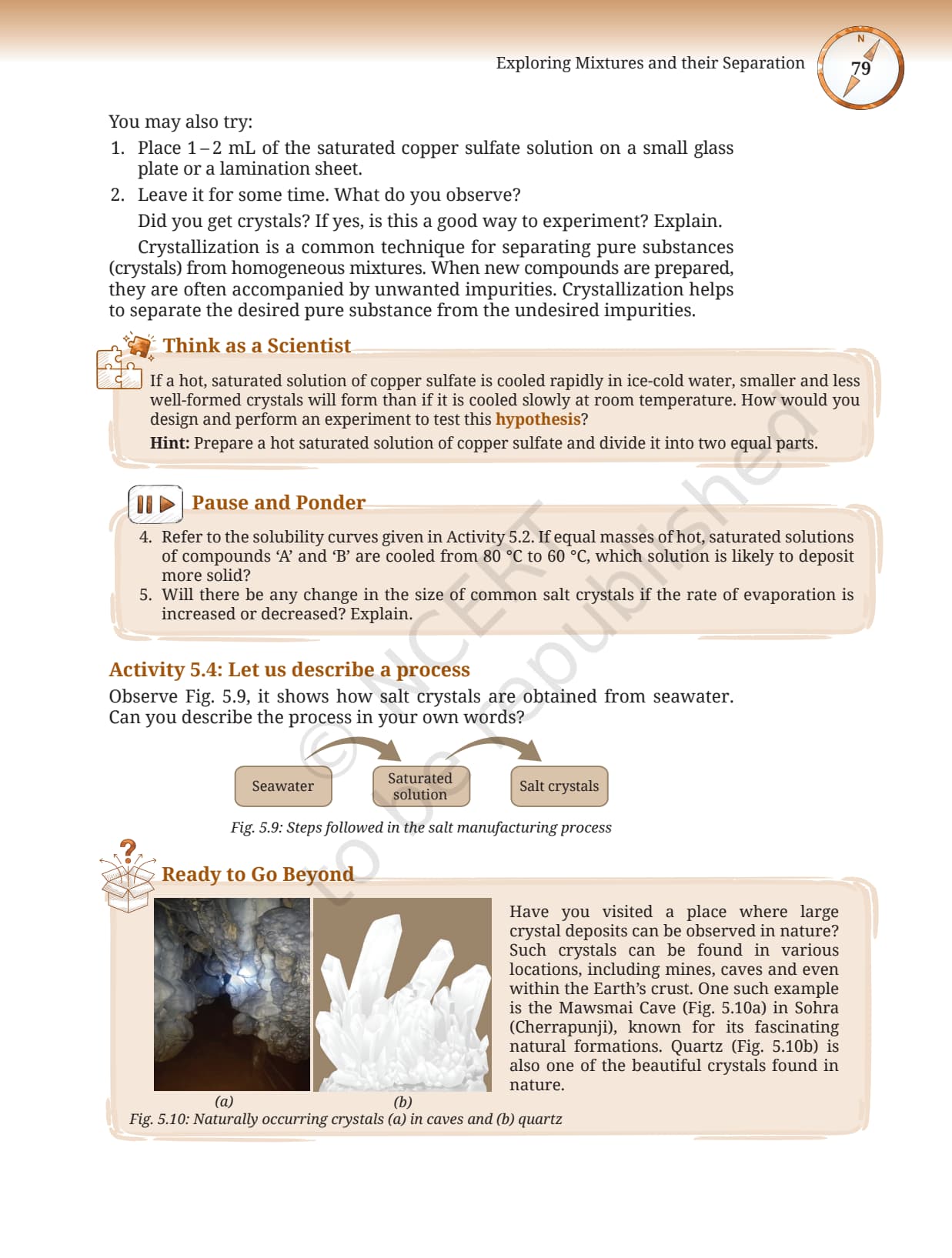
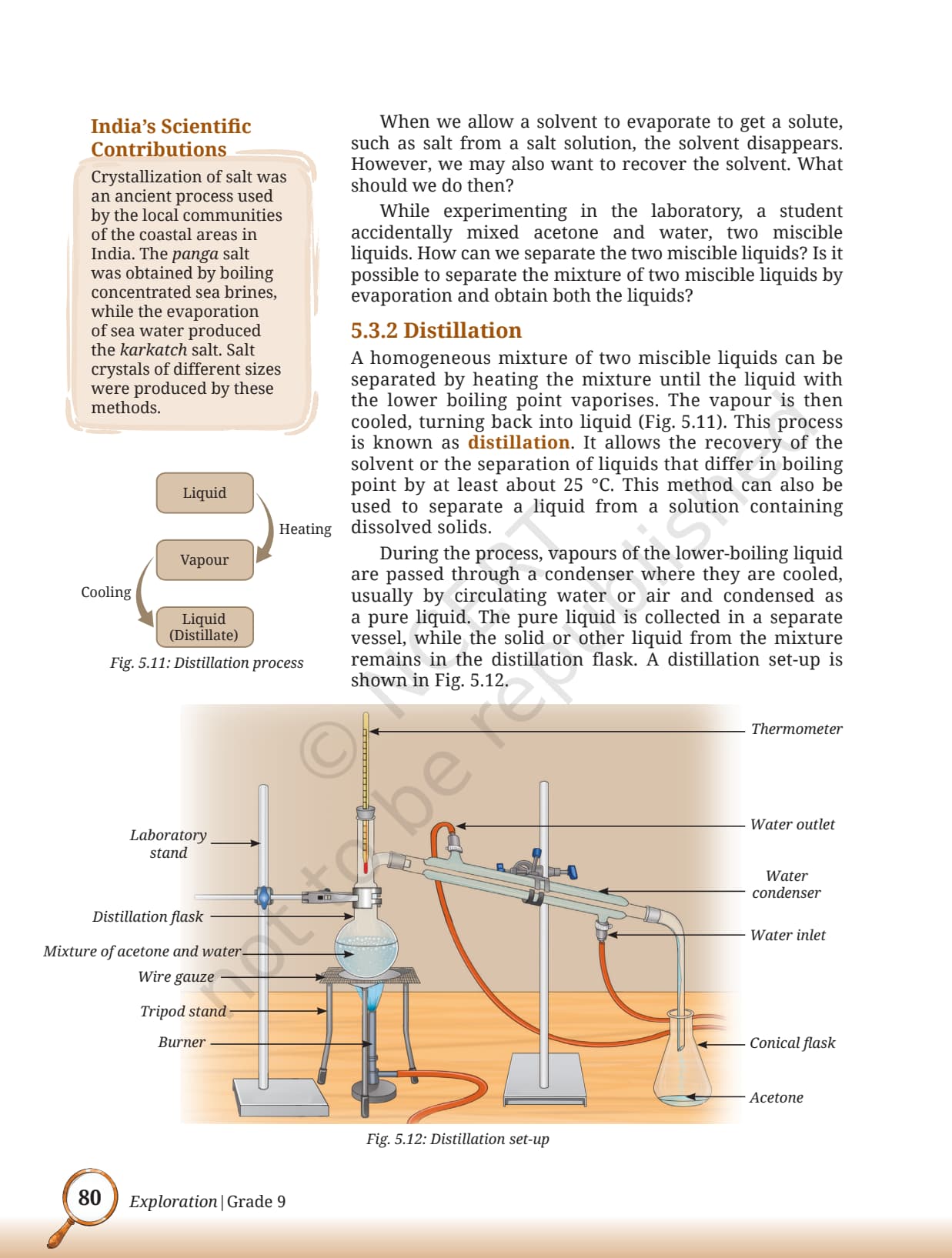
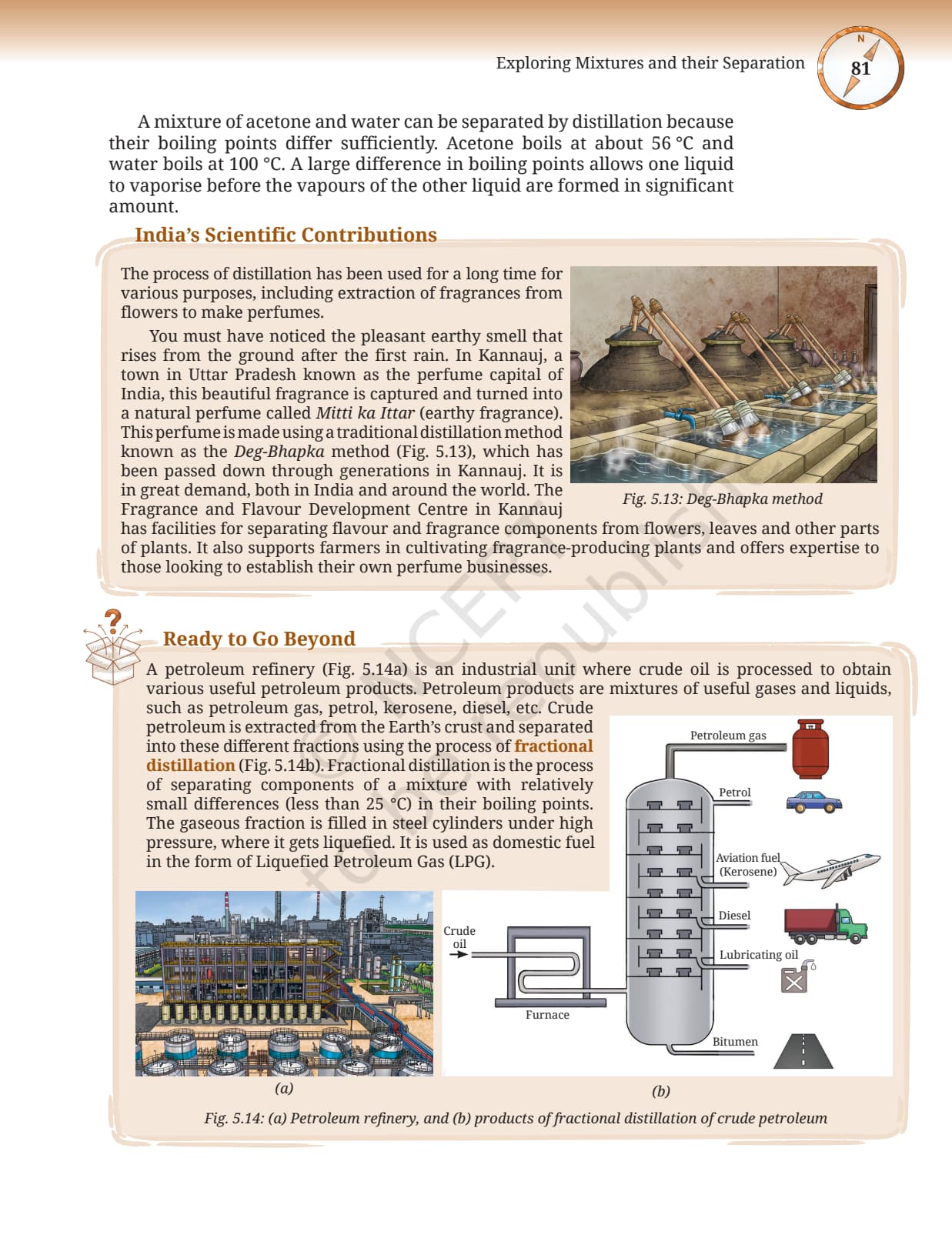
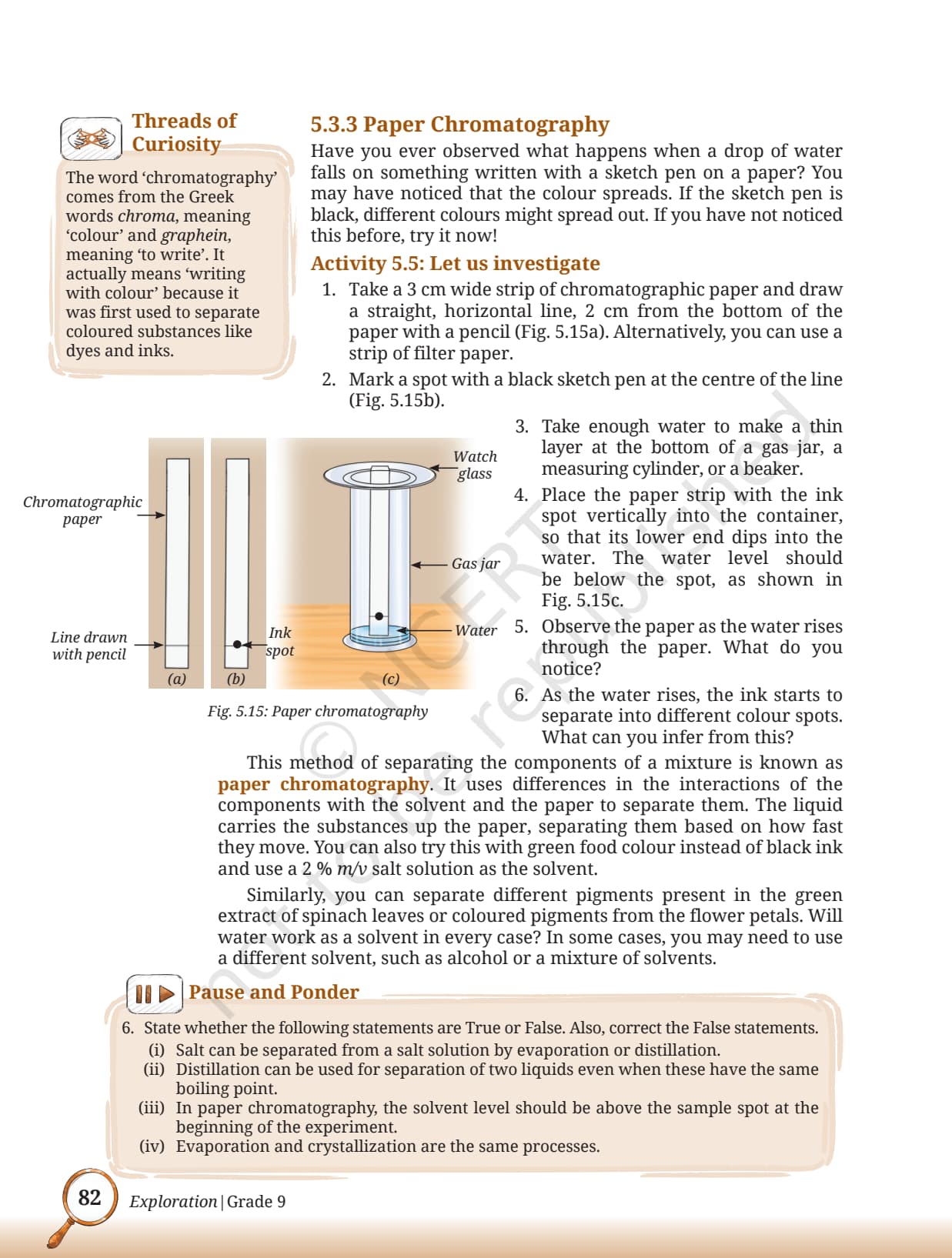
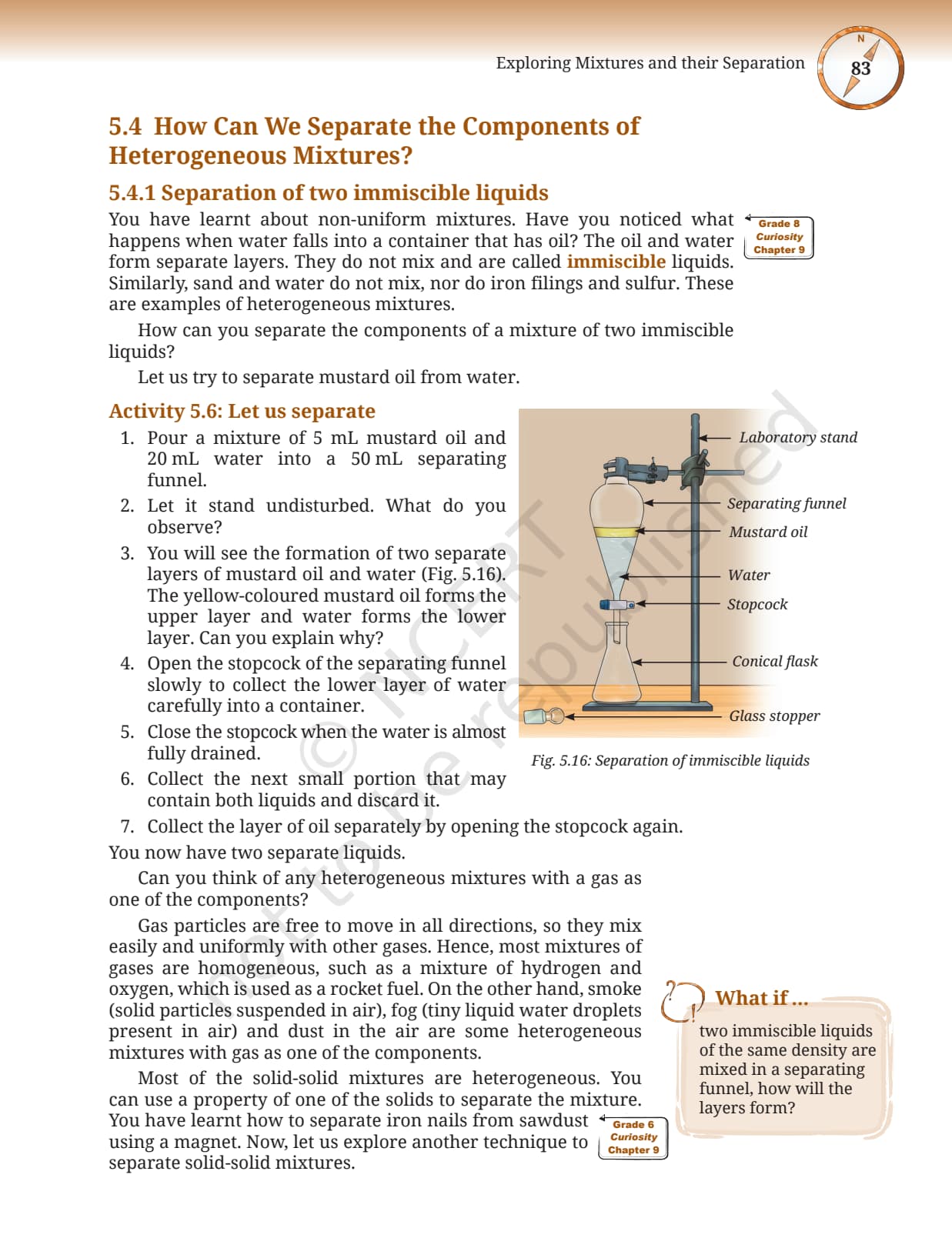
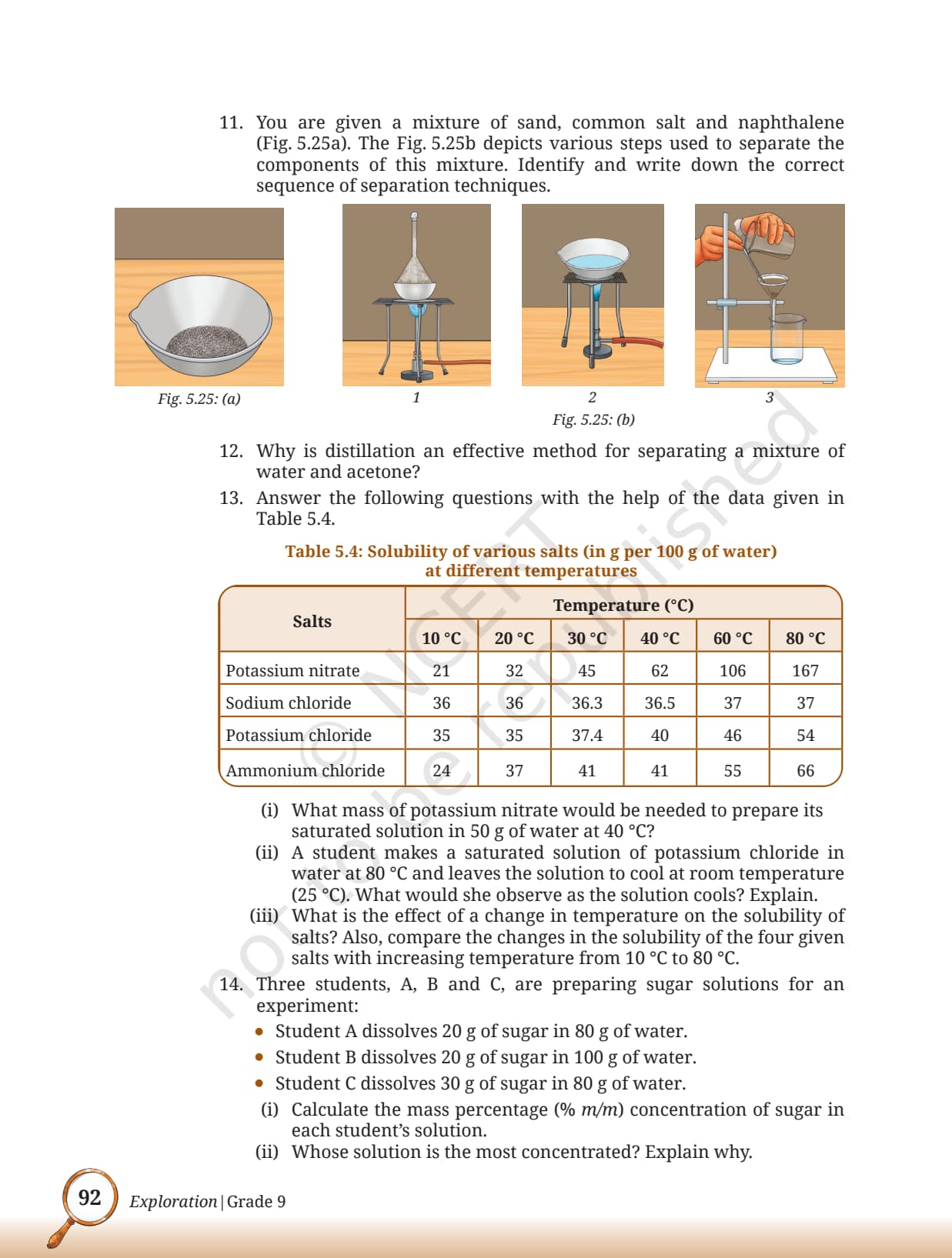
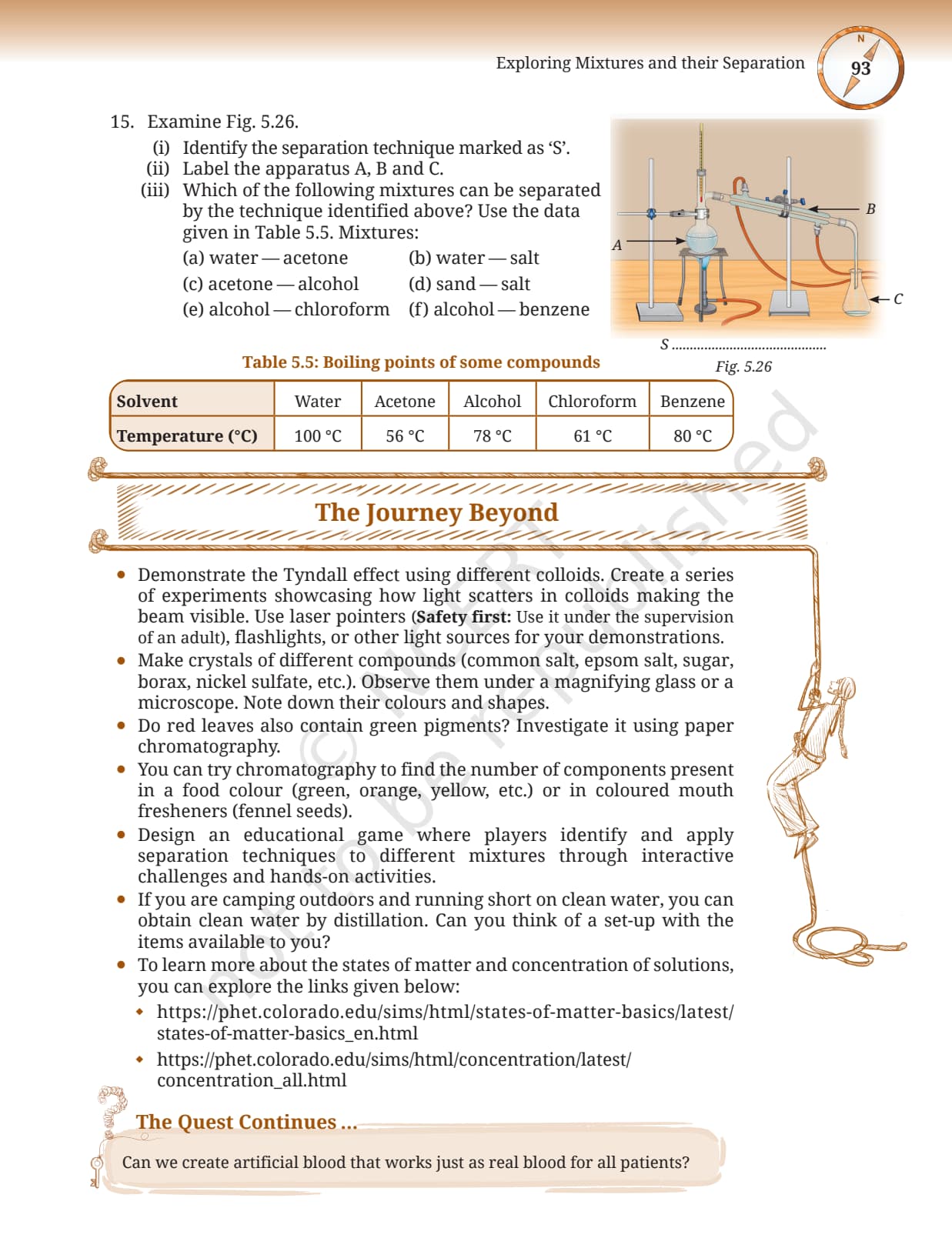
- What you get: the complete Chapter 5 PDF with all five sections, labelled figures, solved examples and the Revise, Reflect, Refine exercise.
- Topics inside: homogeneous and heterogeneous mixtures, solutions, concentration, solubility, crystallization, distillation, chromatography, colloids and the Tyndall effect.
- Exam link: a base Chemistry chapter that supports later CBSE, JEE and NEET questions on solutions, separation techniques and colloids.
Student Feedback
In a Collegedunia survey of 10,980 Class 9 students taken before the 2026 boards, 81% said they preferred studying separation methods from the original NCERT Book PDF alongside short notes rather than notes alone. About 4 out of 5 rated the labelled distillation and separating-funnel figures in Chapter 5 the most useful part of the book, and many said reading the exact textbook wording helped them answer definition questions in the exam.
Exploring Mixtures and their Separation Class 9 Explained in a Short Video
Source: Magnet Brains on YouTube
What the Exploring Mixtures and their Separation Class 9 NCERT Book PDF Covers
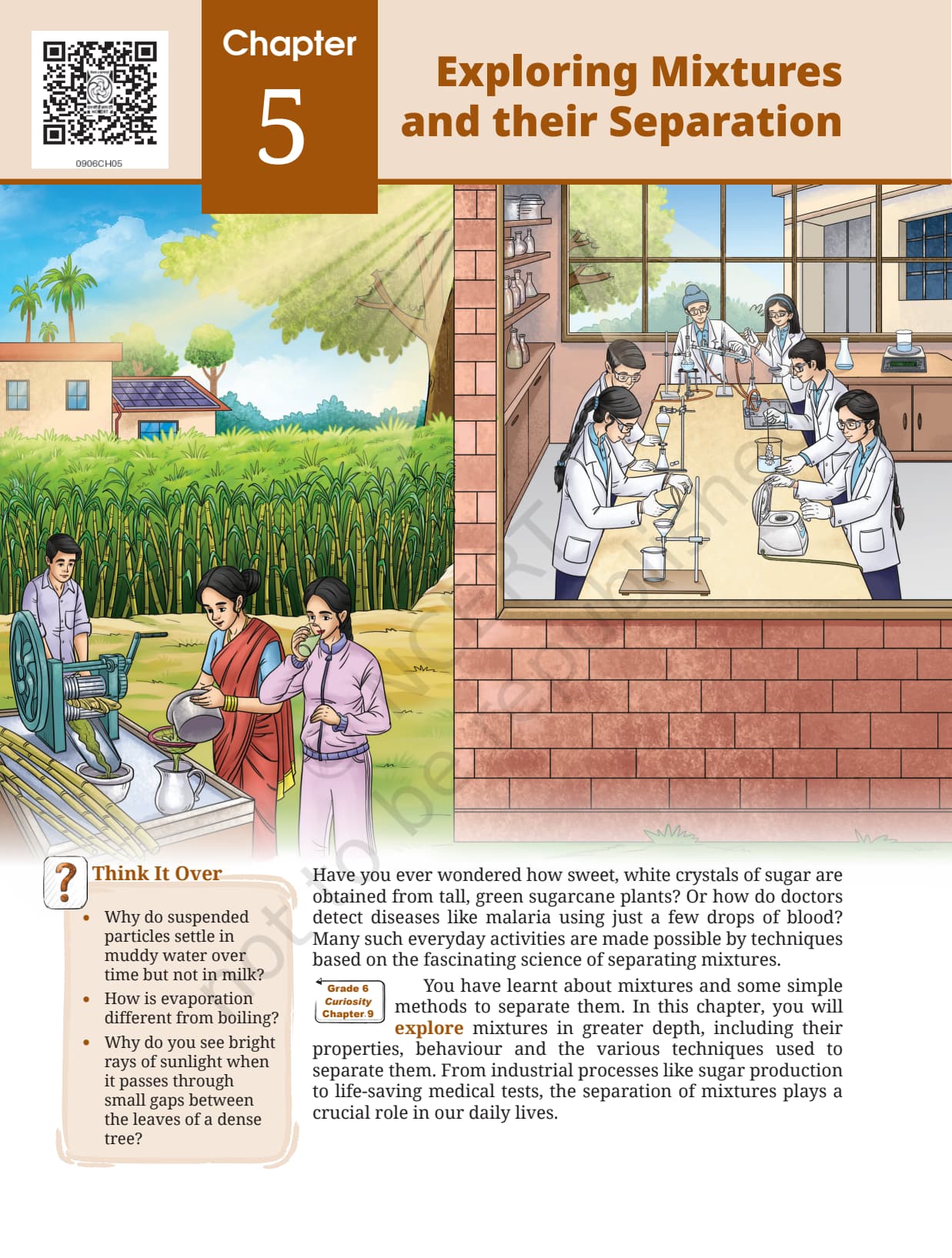
Most things around us, from air and milk to sea water and blood, are mixtures rather than pure substances. Chapter 5 of the new Exploration textbook teaches students to classify these mixtures and then separate them using the right technique. The Class 9 Science NCERT Book PDF Chapter 5 Exploring Mixtures and their Separation begins with how we sort mixtures, moves to solutions and concentration, and then covers separation methods for both homogeneous and heterogeneous mixtures before ending with the Tyndall effect.
- Types of mixtures: homogeneous mixtures (solutions) and heterogeneous mixtures such as sand in water.
- Solutions: solute, solvent, concentration by percentage and the solubility of substances.
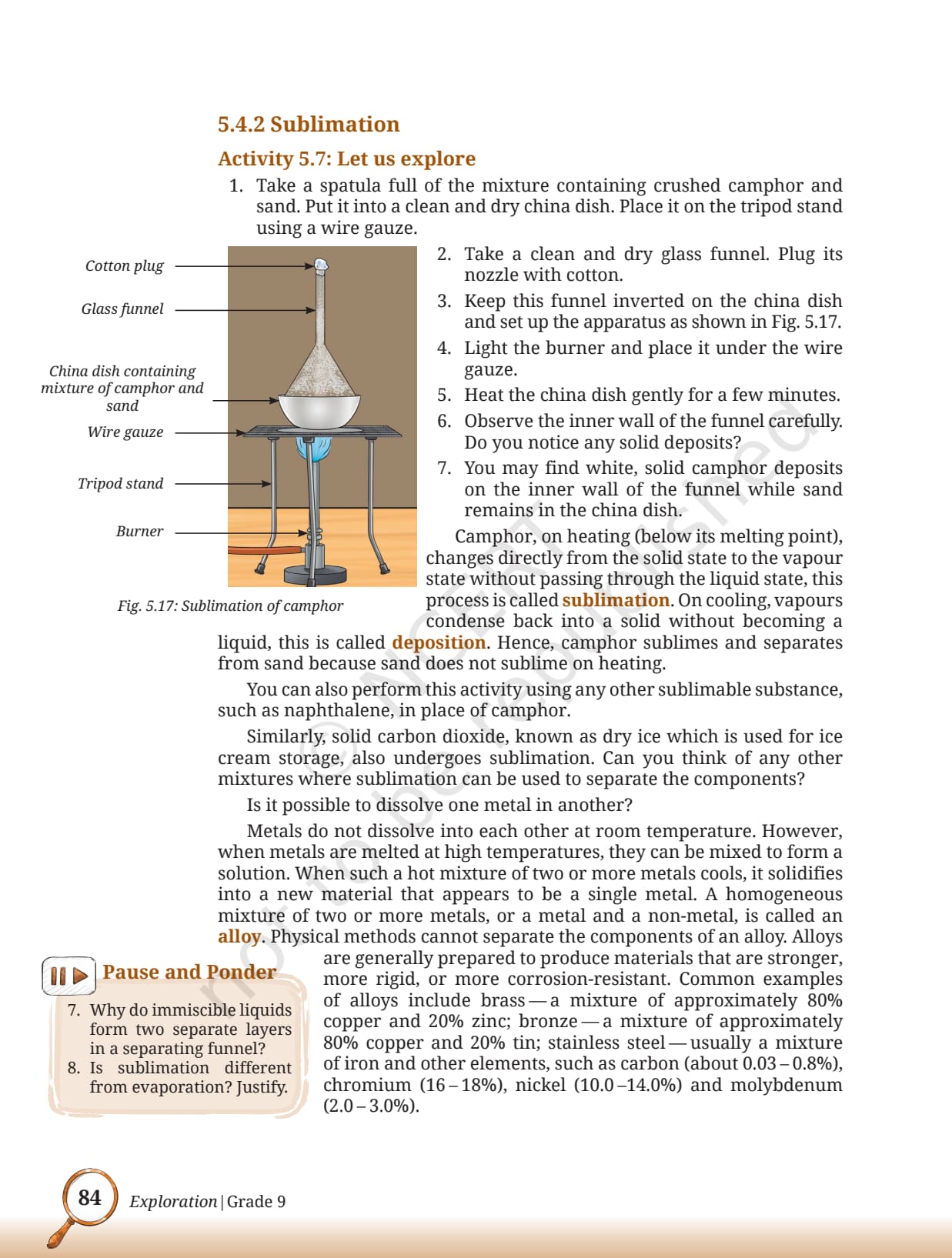
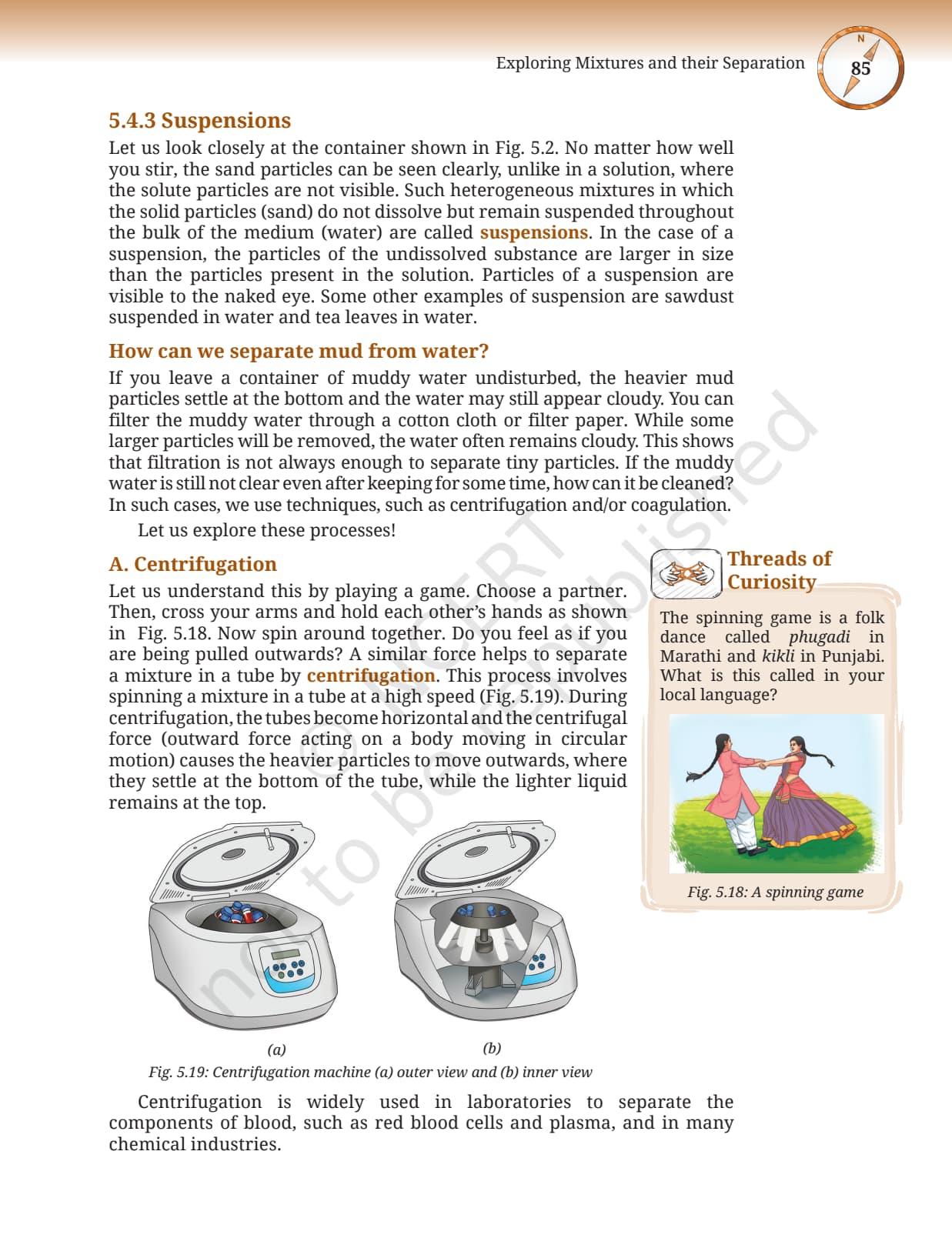
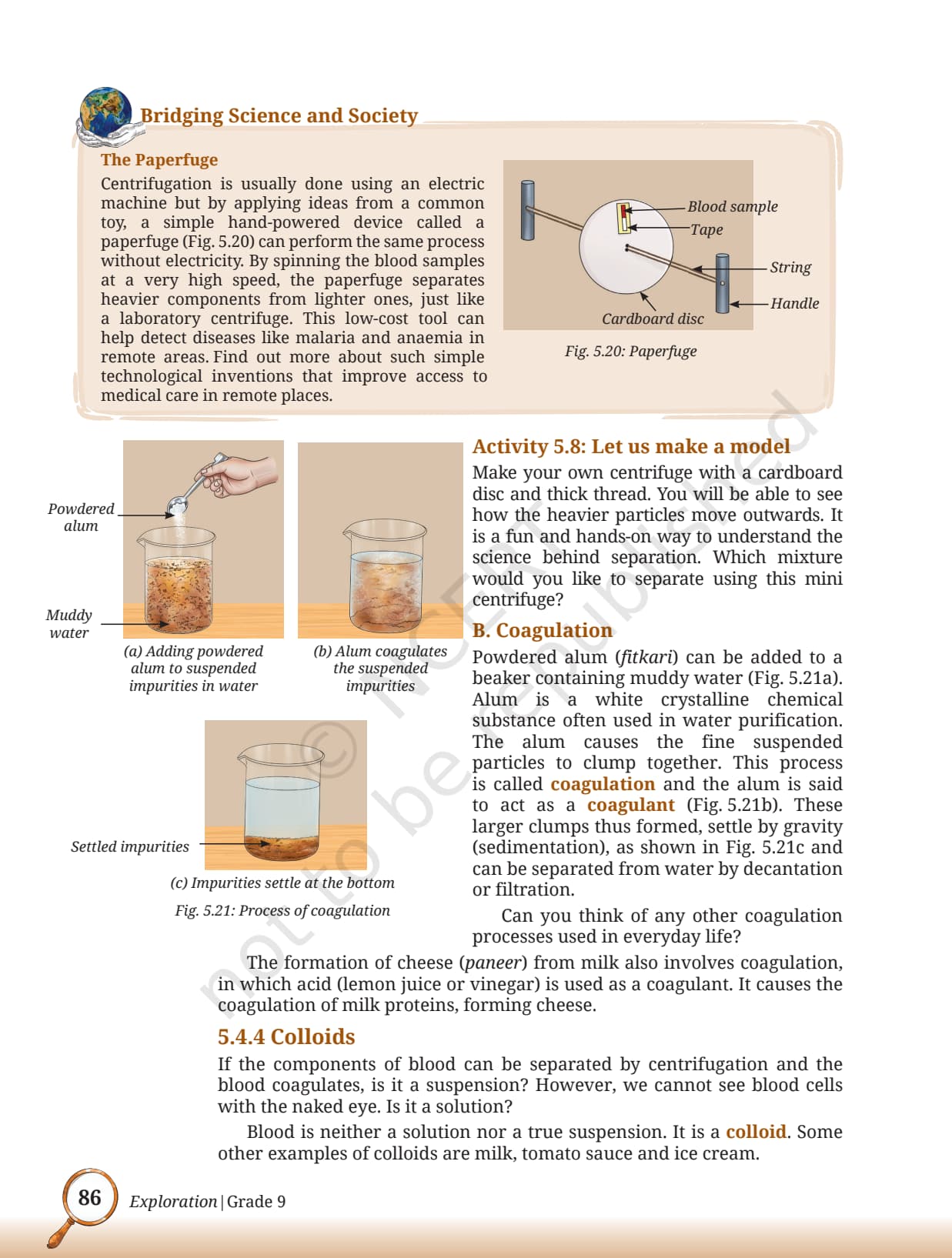
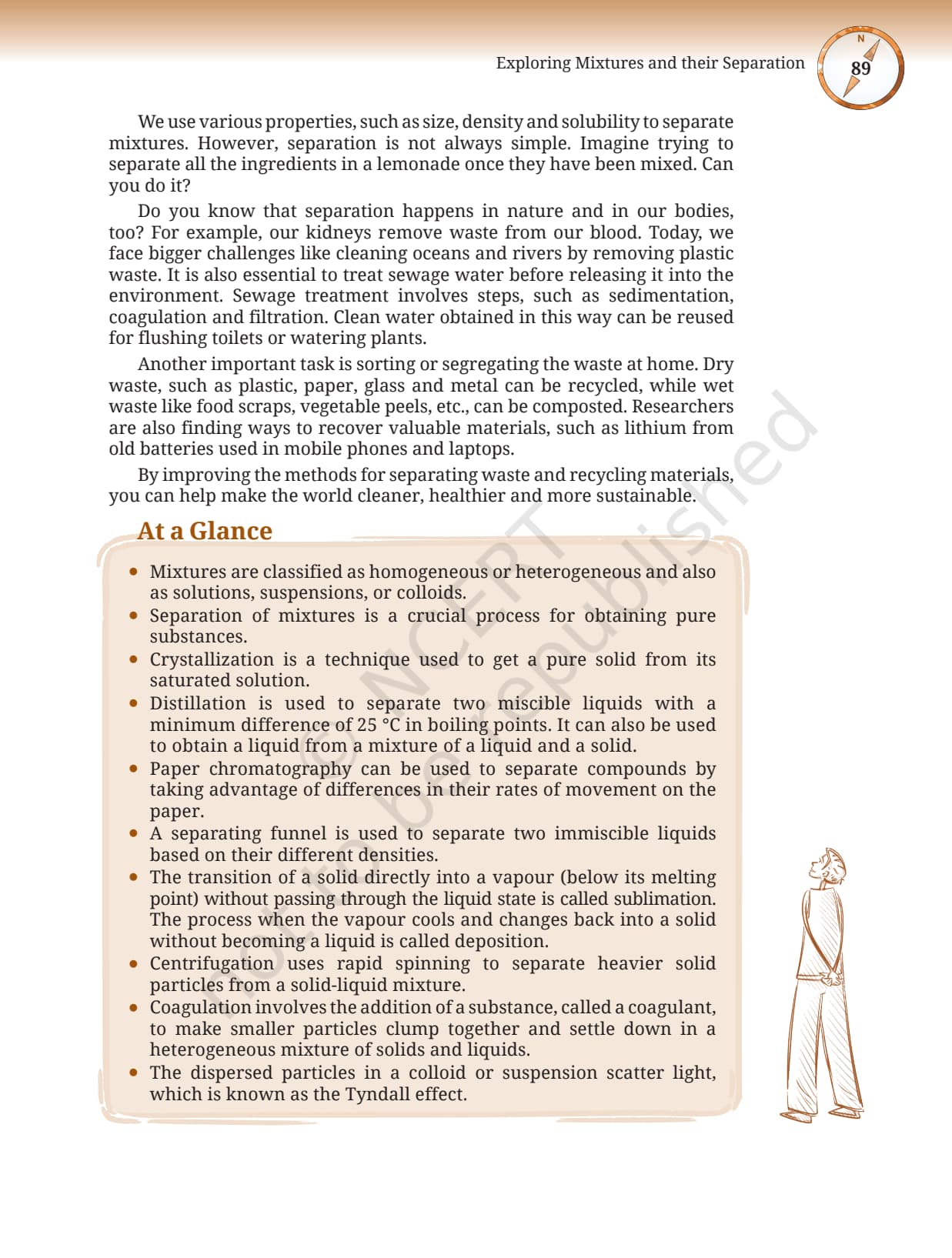
- Separation methods: crystallization, distillation, chromatography, using a separating funnel, sublimation, centrifugation and coagulation.
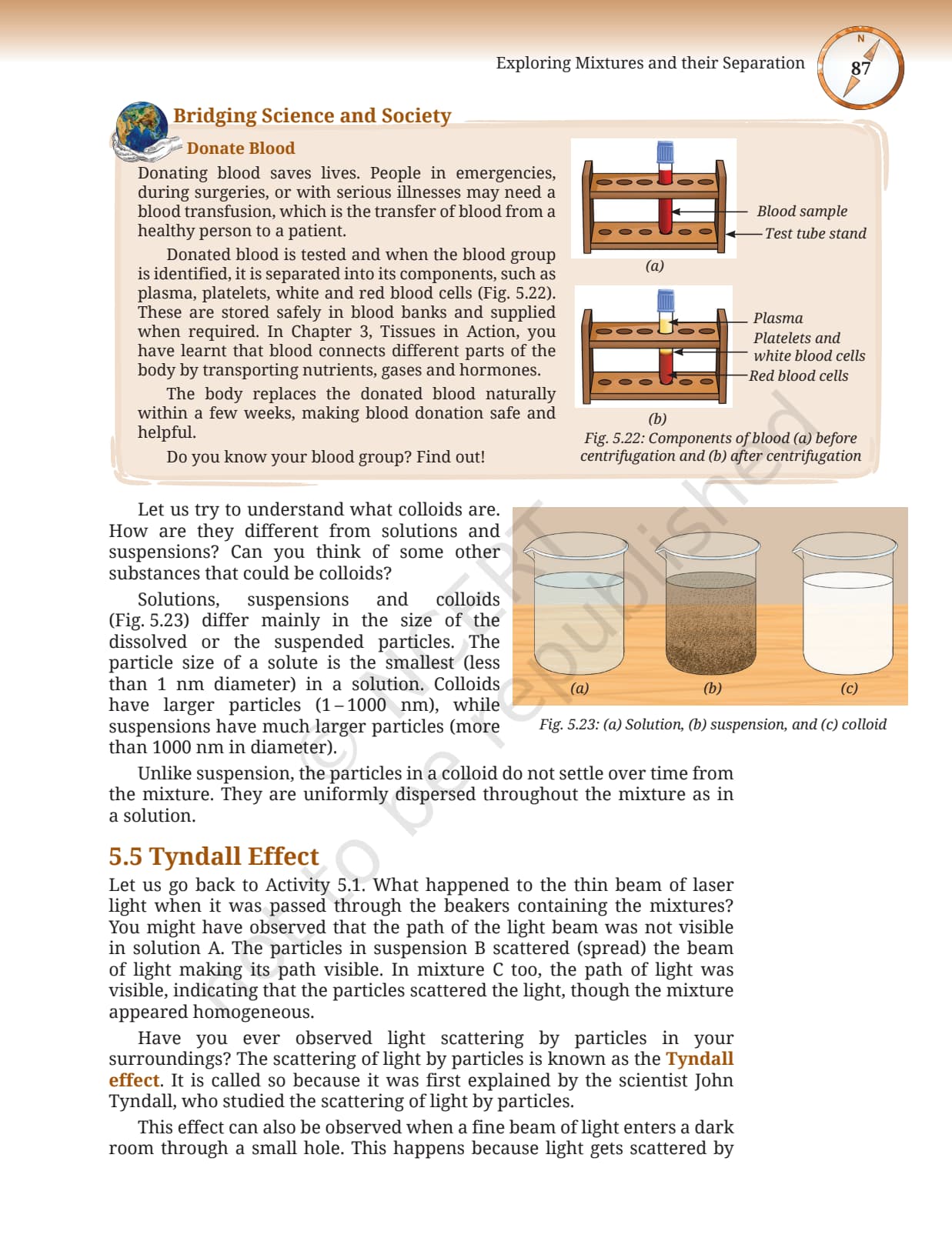
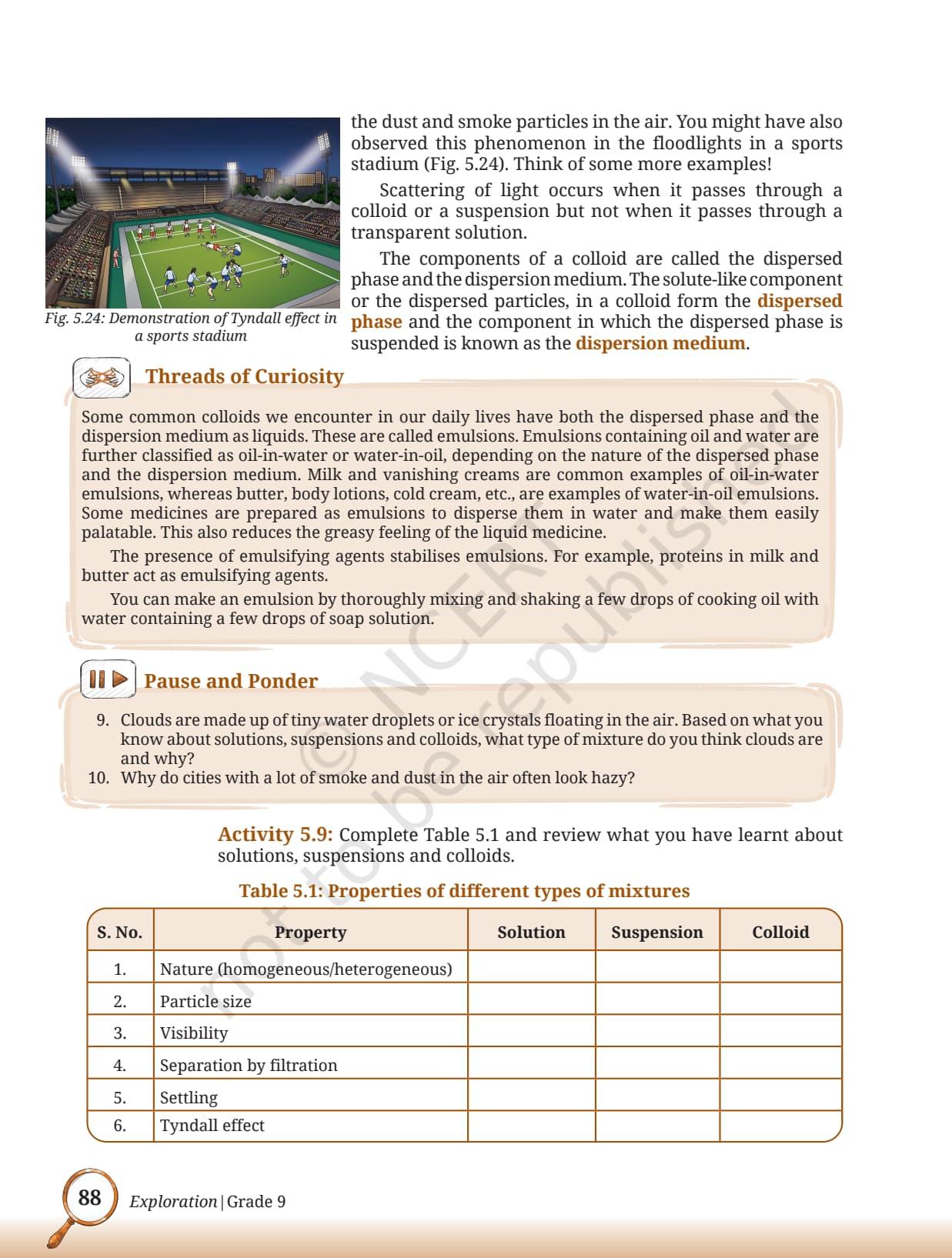
- Colloids and light: what makes a colloid different from a solution and a suspension, and how the Tyndall effect reveals it.
This chapter carries steady weight in Class 9 Science exams because it mixes definitions, small numericals on concentration and diagram-based questions on separation. Separation of mixtures is one of the most-tested Chemistry chapters in Class 9. Studying it from the original book PDF helps students learn the exact wording examiners look for.
Section-by-Section Inside the Class 9 Science Chapter 5 PDF
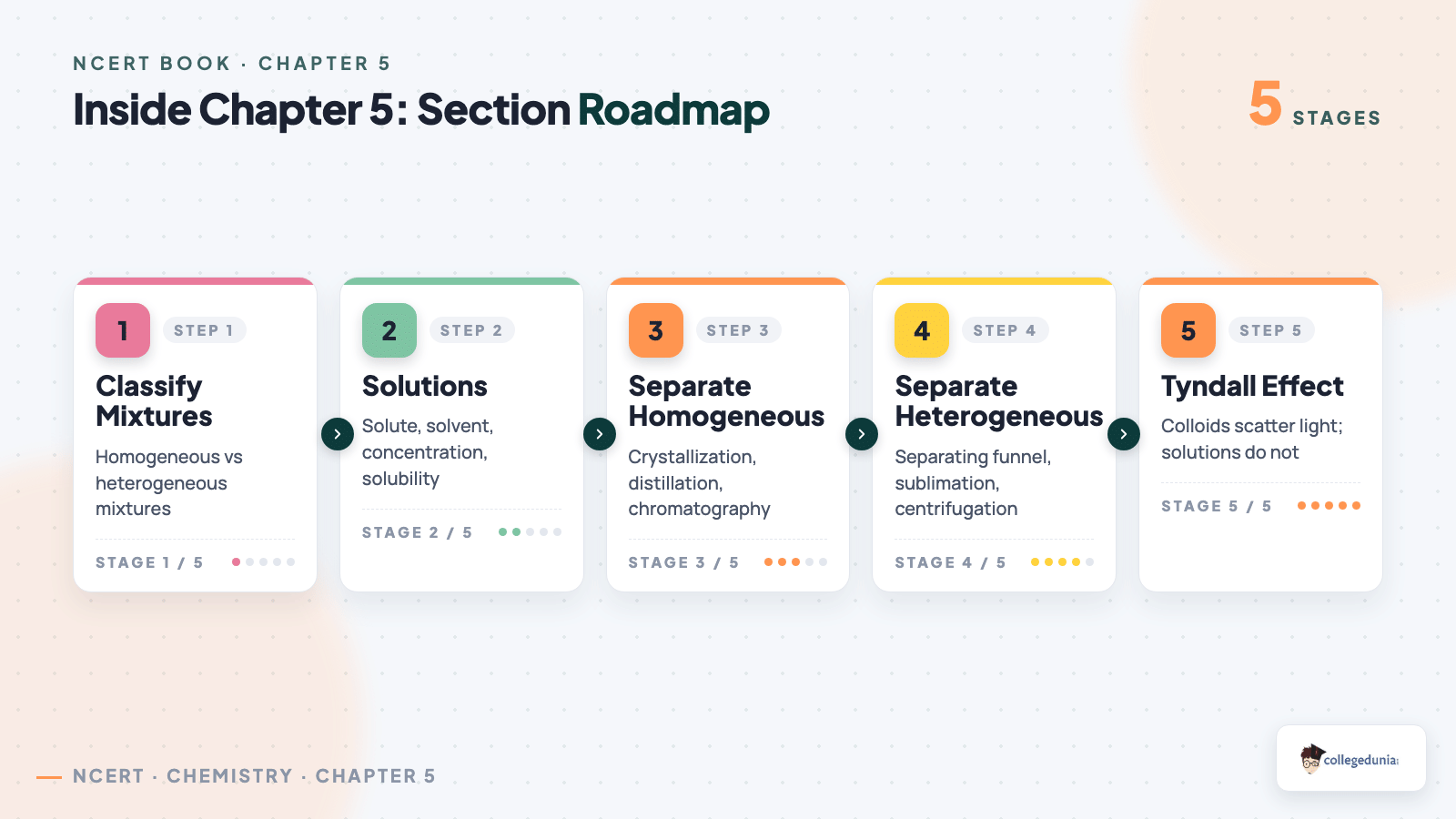
The book PDF is organised into five numbered sections, each building on the one before. The roadmap below shows the order in which the chapter develops, so students know what to expect as they scroll through the download.
| Section | Title | What it teaches |
|---|---|---|
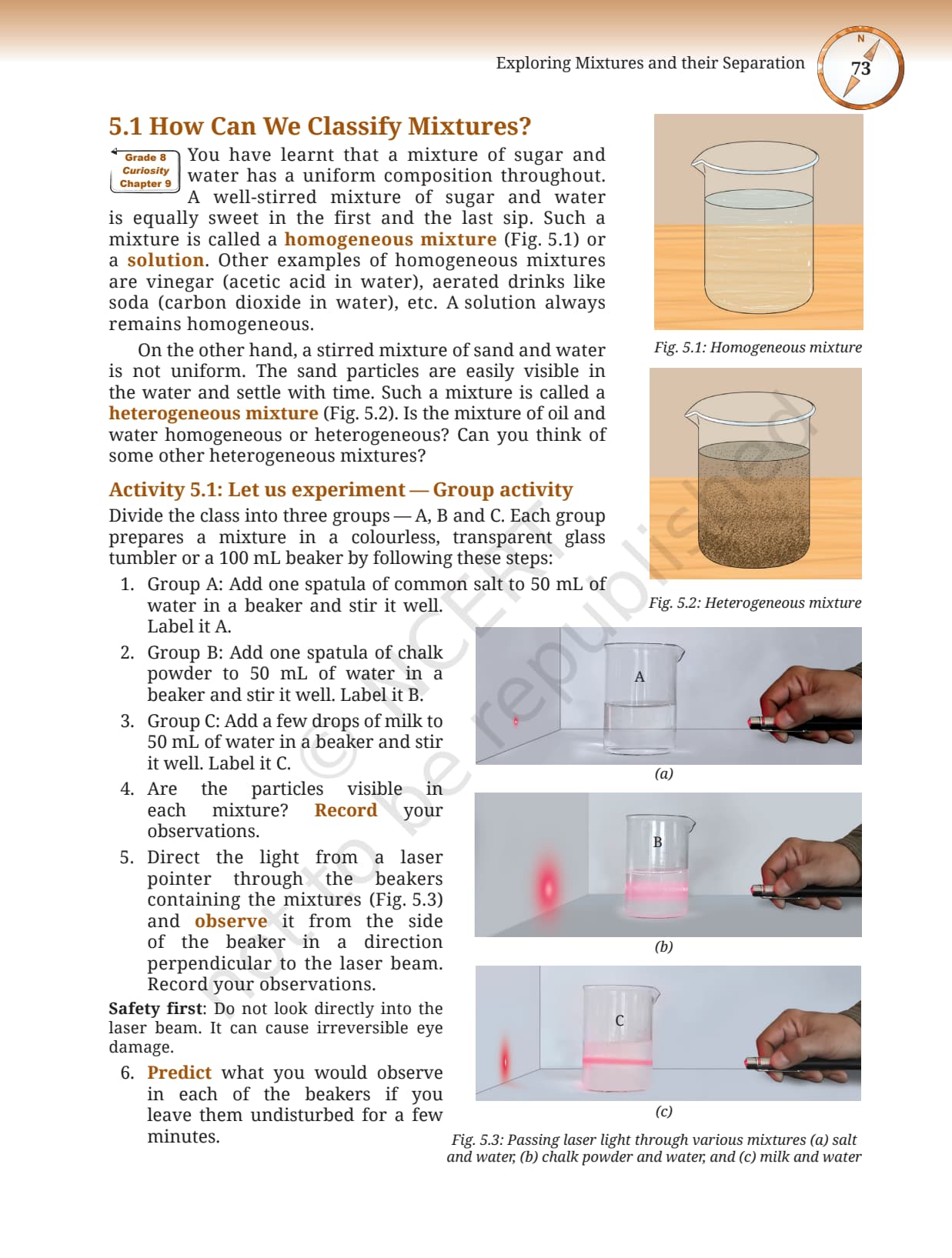
| 5.1 | How Can We Classify Mixtures? | Homogeneous and heterogeneous mixtures, with the salt, chalk and milk activity. |
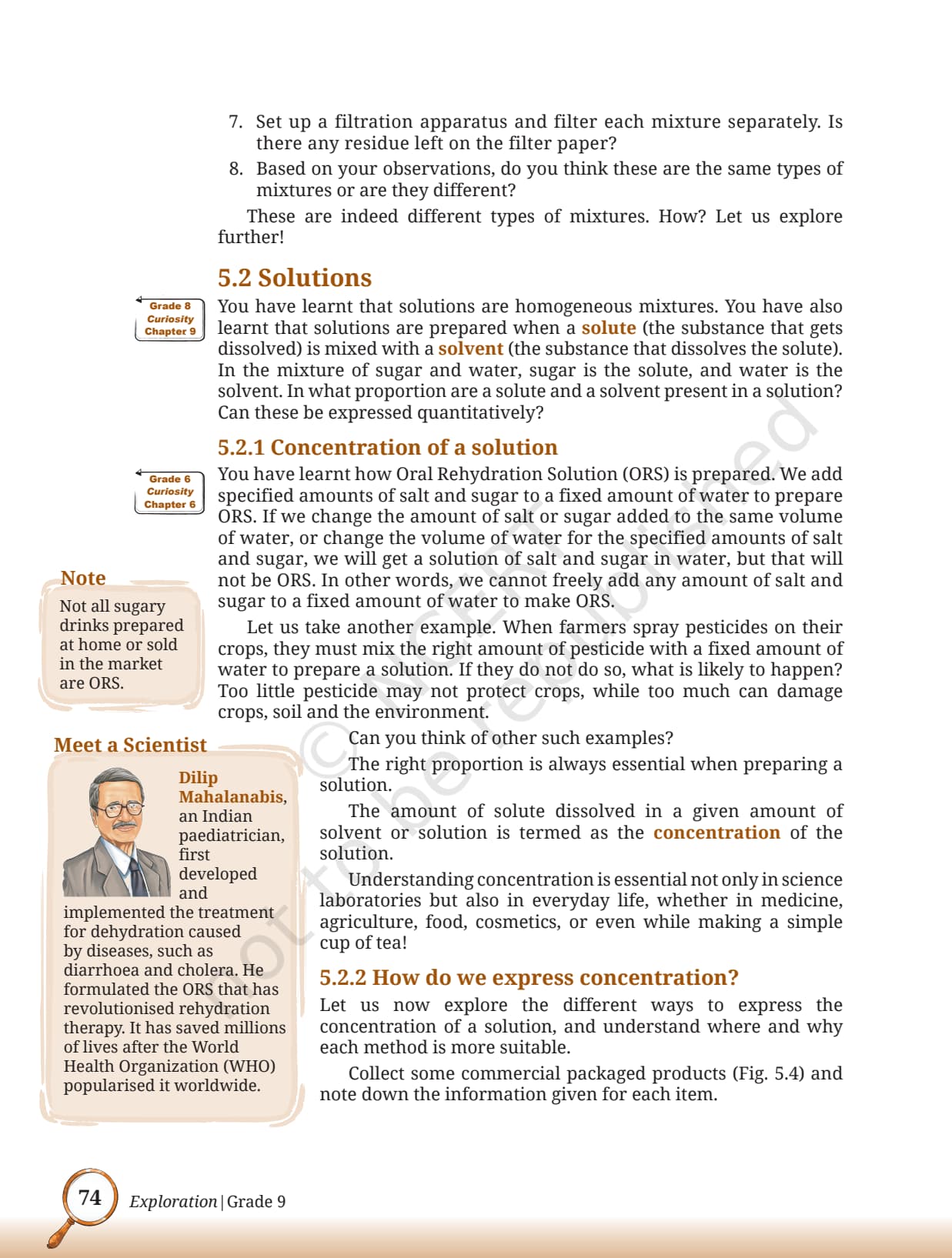
| 5.2 | Solutions | Solute, solvent, concentration by percentage and solubility of substances. |
| 5.3 | Methods of Separation of Homogeneous Mixtures | Crystallization, distillation and paper chromatography. |
| 5.4 | Separating Heterogeneous Mixtures | Separating funnel, sublimation, centrifugation, coagulation and colloids. |
| 5.5 | Tyndall Effect | Why colloids and suspensions scatter a beam of light while true solutions do not. |
Each section in the PDF carries labelled figures and one or two solved examples, so students can follow the method straight from the textbook. A true solution never scatters light, but a colloid always shows the Tyndall effect. Small facts like this appear right where the book introduces them, which makes the PDF easy to revise from.
Key Terms and Formulas in the Exploring Mixtures and their Separation Chapter
The heart of Chapter 5 is a set of separation techniques plus three simple ways to express the concentration of a solution. The book PDF defines each term clearly and shows how each formula is used with a worked example.
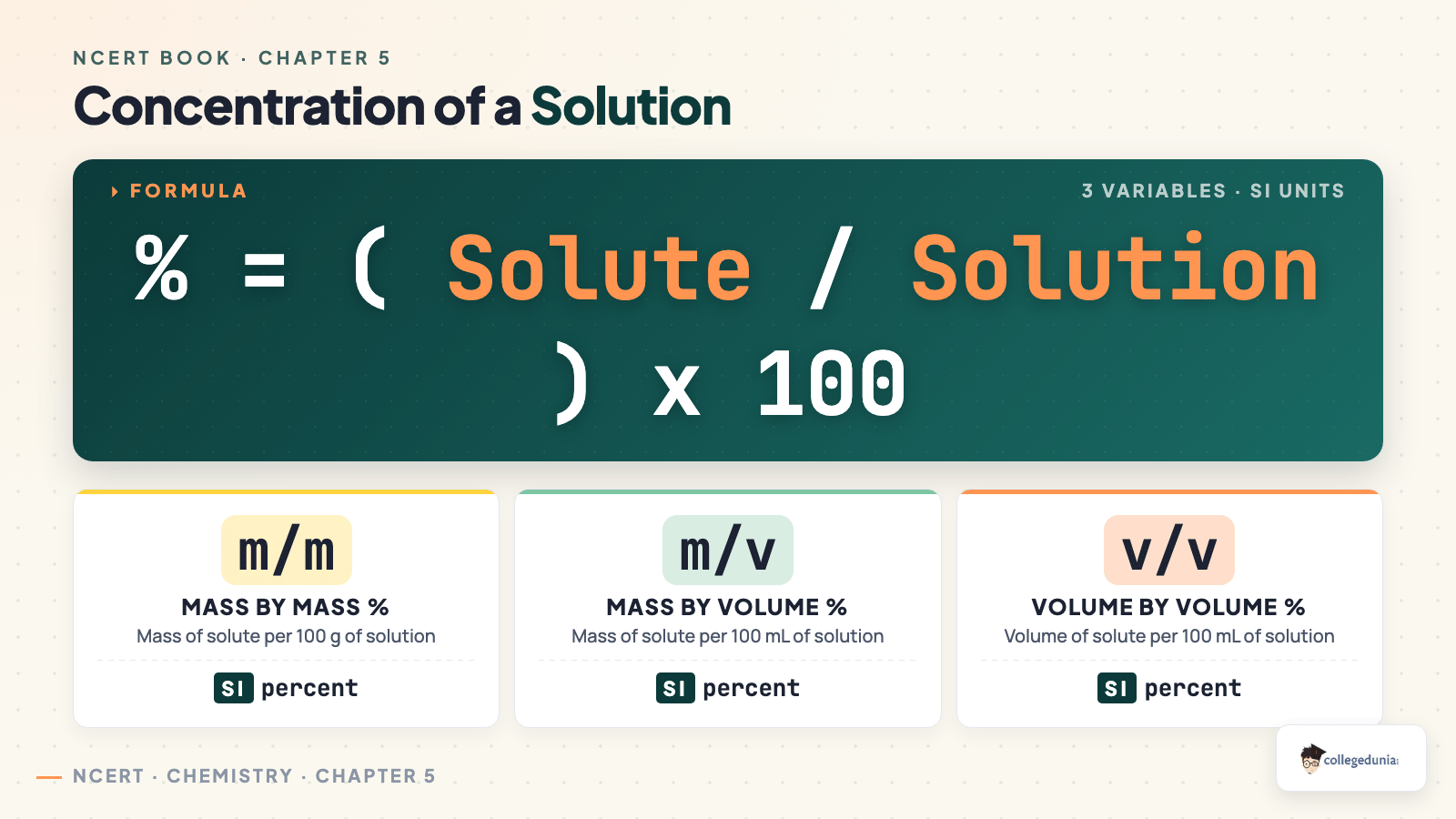
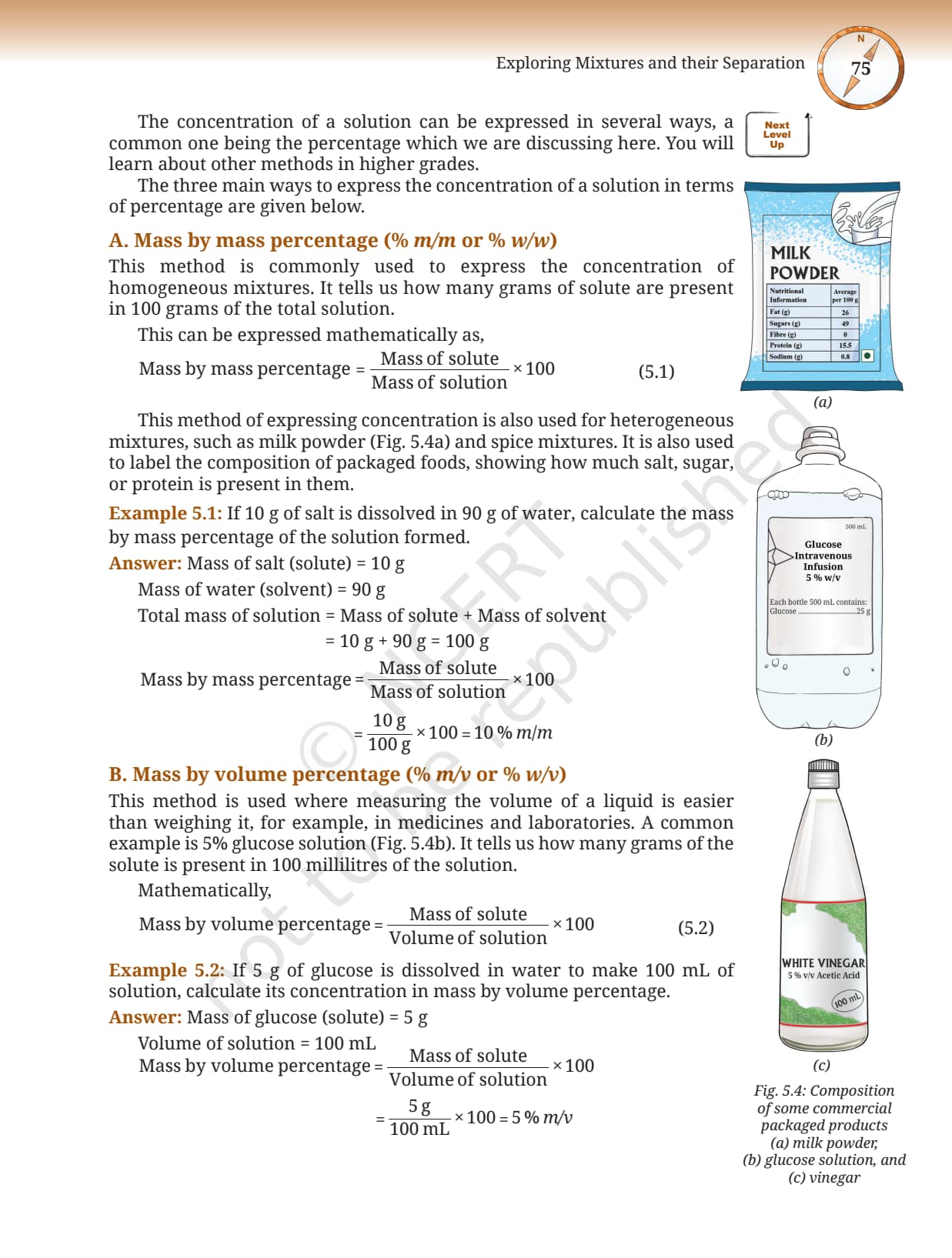
- Mass by mass percentage: (Mass of solute ÷ Mass of solution) × 100, used for solids like a salt solution or milk powder.
- Mass by volume percentage: (Mass of solute ÷ Volume of solution) × 100, used in medicines such as 5% glucose.
- Volume by volume percentage: (Volume of solute ÷ Volume of solution) × 100, used when two liquids mix, such as vinegar.
Along with these formulas, students must learn the key terms that name each method. Distillation separates two miscible liquids whose boiling points differ by at least 25 degrees Celsius. Other terms to know are solute, solvent, saturated solution, solubility, crystallization, sublimation, immiscible liquids, centrifugation, coagulation, colloid, suspension, dispersed phase and dispersion medium.
In-Text Features and Exercises in the Class 9 Science Chapter 5 Book
The Exploration textbook does more than state facts. Chapter 5 is built around short prompts and hands-on activities that make students stop and think, plus a full end-of-chapter exercise. Downloading the book PDF gives students access to all of these in the original layout.
- Think It Over: opening questions, such as why suspended particles settle in muddy water but not in milk.
- Pause and Ponder: quick checks that ask students to reason about concentration, crystallization or colloids before moving on.
- Activities: hands-on tasks, like passing a laser beam through salt, chalk and milk mixtures or growing copper sulfate crystals, that link theory to real separation.
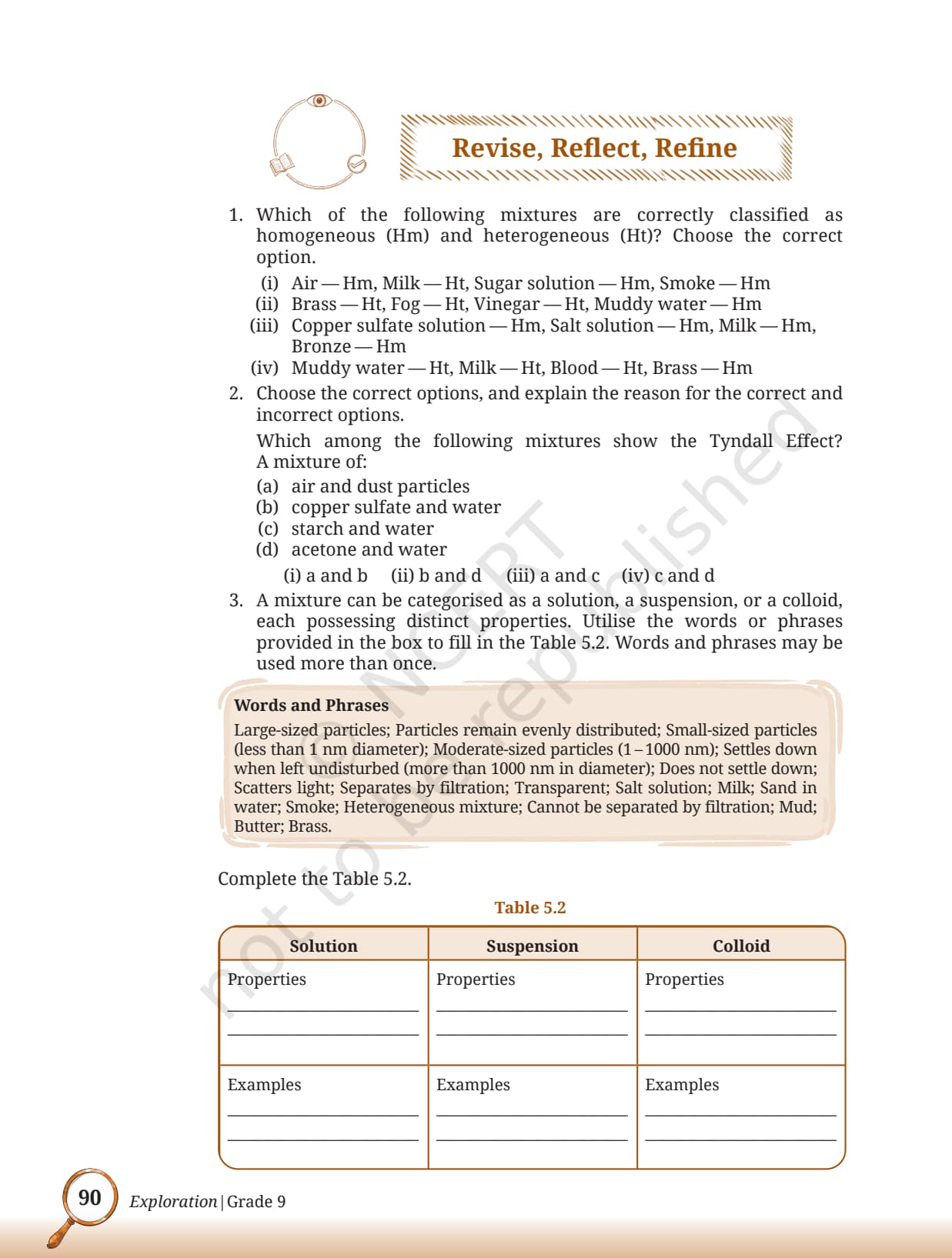
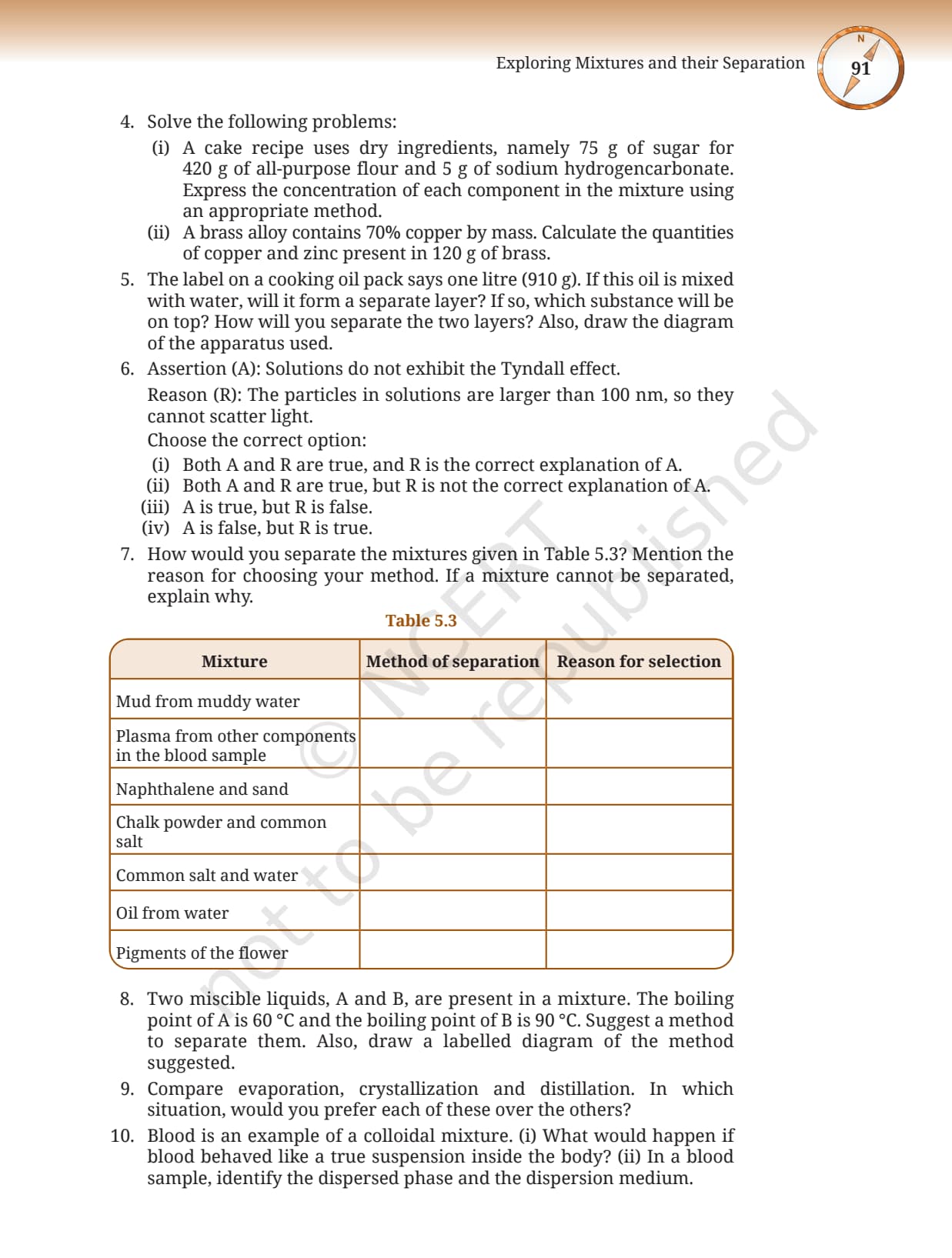
- Revise, Reflect, Refine: the end-of-chapter exercise with classification questions, reasoning items, numericals and a method-selection table.
Students who work through the Revise, Reflect, Refine questions from the PDF cover the exact style of questions the exam uses. For fully worked answers to these, pair the book with the NCERT Solutions linked lower on this page.
Why Download the Exploring Mixtures and their Separation Class 9 NCERT Book PDF
Notes and solutions are quick, but the original textbook is still the source every exam is set from. Keeping the Class 9 Science Chapter 5 NCERT Book PDF on your device gives students the complete, correct chapter to study offline.
- Exact wording: definitions of solution, saturated solution, colloid and the Tyndall effect in the words the exam expects.
- All figures: the labelled distillation set-up, separating funnel, chromatography and centrifugation diagrams that summary notes often leave out.
- Offline study: read the whole chapter without internet, on a phone, tablet or printout.
- 2026-27 ready: the current first-edition Exploration chapter, matched to what schools teach this session.
Because the PDF is the real chapter, students can highlight, print and annotate it just like the printed book. This makes it the best single file to revise from before a class test or the final exam.
How to Use the Exploring Mixtures and their Separation NCERT Book PDF with Notes and Solutions
The book PDF works best as one part of a set. Students revise fastest when they read the chapter, learn from short notes, drill the questions and recap from a formula sheet, each resource doing its own job.
- Read the book PDF first to meet every concept, figure and example in the original NCERT order.
- Move to the NCERT Notes for short, exam-ready explanations of mixtures, concentration, separation methods and colloids.
- Practise with the NCERT Solutions to solve every Revise, Reflect, Refine question with full steps.
- Recap with the Formula Sheet for a one-page list of the three concentration formulas and every separation technique.
Together these four resources cover Chapter 5 for the 2026-27 session. The book explains in full, the notes condense, the solutions drill, and the formula sheet gives the final quick revision.
More Exploring Mixtures and their Separation Class 9 Science Resources
| Resource | Open |
|---|---|
| NCERT Book PDF | Exploring Mixtures and their Separation Class 9 NCERT Book PDF |
| NCERT Solutions | Exploring Mixtures and their Separation Class 9 NCERT Solutions |
| Revision Notes | Exploring Mixtures and their Separation Class 9 Notes |
| Handwritten Notes | Exploring Mixtures and their Separation Class 9 Handwritten Notes |
| Formula Sheet | Exploring Mixtures and their Separation Class 9 Formula Sheet |
NCERT Book PDF for Class 9 Science: All Chapters
Use the table below to download the NCERT Book PDF for any other chapter of the new Class 9 Science Exploration textbook.
| Chapter | NCERT Book PDF |
|---|---|
| Chapter 1 | Exploration Entering the World of Secondary Science |
| Chapter 2 | Cell The Building Block of Life |
| Chapter 3 | Tissues in Action |
| Chapter 4 | Describing Motion Around Us |
| Chapter 5 | Exploring Mixtures and their Separation |
| Chapter 6 | How Forces Affect Motion |
| Chapter 7 | Work, Energy, and Simple Machines |
| Chapter 8 | Journey Inside the Atom |
| Chapter 9 | Atomic Foundations of Matter |
| Chapter 10 | Sound Waves Characteristics and Applications |
| Chapter 11 | Reproduction How Life Continues |
| Chapter 12 | Patterns in Life Diversity and Classification |
| Chapter 13 | Earth as a System Energy, Matter, and Life |
Exploring Mixtures and their Separation Class 9 Science NCERT Book PDF FAQs
Ques. Where can I download the Class 9 Science NCERT Book PDF Chapter 5 Exploring Mixtures and their Separation?
Ans. You can download the Exploring Mixtures and their Separation Class 9 NCERT Book PDF free from this page. It is the complete Chapter 5 from the 2026-27 Exploration textbook, with all sections, figures and the Revise, Reflect, Refine exercise.
Ques. What topics are covered in Class 9 Science Chapter 5?
Ans. Chapter 5 covers types of mixtures, solutions and concentration, solubility, and separation methods like crystallization, distillation, chromatography, using a separating funnel, sublimation, centrifugation and coagulation. It ends with colloids and the Tyndall effect.
Ques. Which book is Chapter 5 Exploring Mixtures and their Separation from?
Ans. It is Chapter 5 of the new Exploration textbook of Science for Grade 9, the first-edition book for the 2026-27 syllabus. It replaces the older Class 9 Science book and uses the Revise, Reflect, Refine exercise format.
Ques. What are the three ways to express concentration in Chapter 5?
Ans. The three ways are mass by mass percentage, mass by volume percentage and volume by volume percentage. Each divides the amount of solute by the amount of solution and multiplies by 100, and each suits a different kind of mixture.
Ques. Is the Exploring Mixtures and their Separation PDF enough to prepare the chapter?
Ans. The book PDF gives the full chapter and is the main source. For fast revision and full answers, pair it with the Class 9 Science Chapter 5 Notes, NCERT Solutions and Formula Sheet linked on this page.
Ques. What is the Tyndall effect in Class 9 Science Chapter 5?
Ans. The Tyndall effect is the scattering of a beam of light by the particles of a colloid or a suspension, which makes the path of the light visible. A true solution does not show this effect because its particles are too small to scatter light.



Comments