




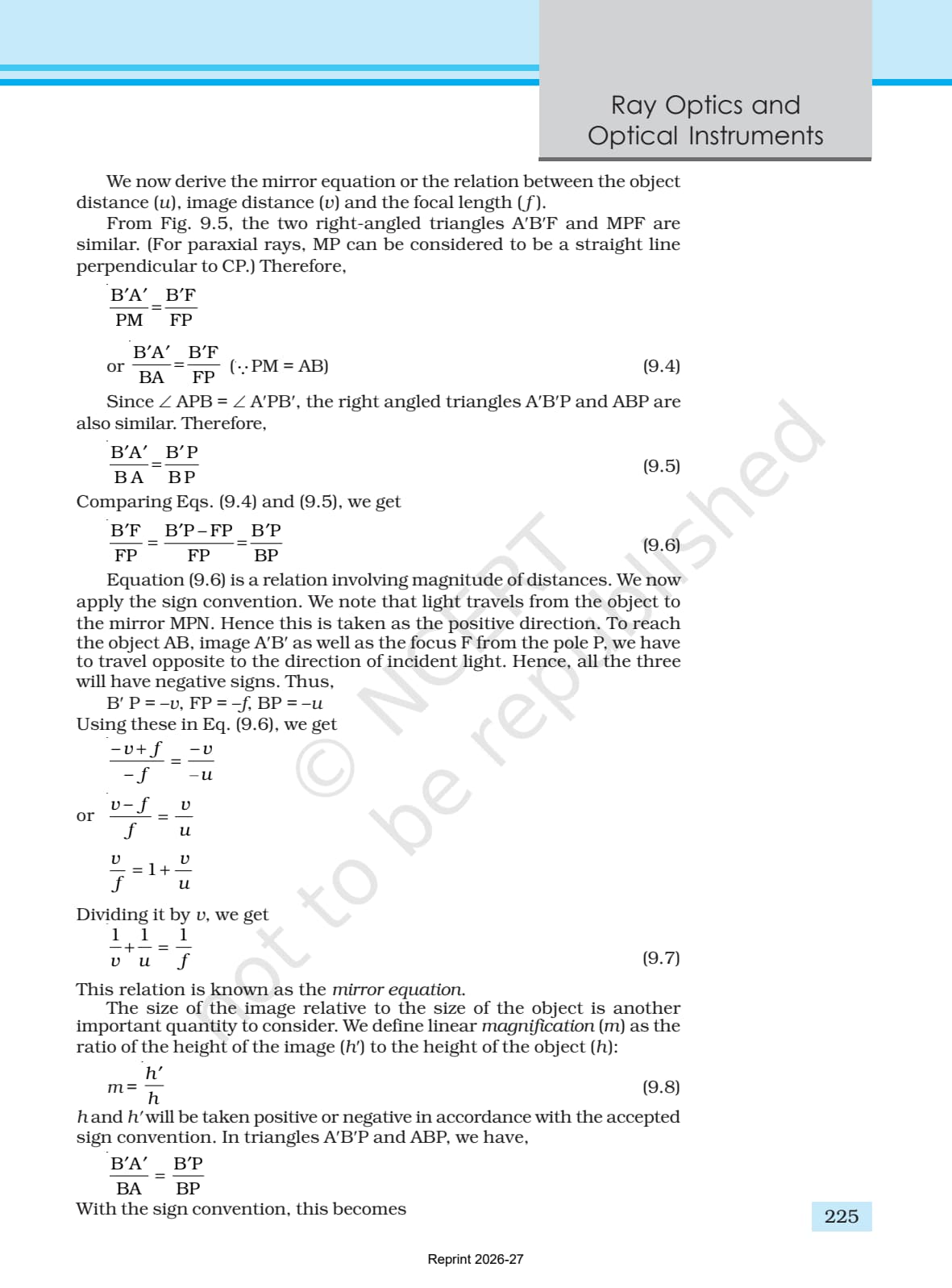
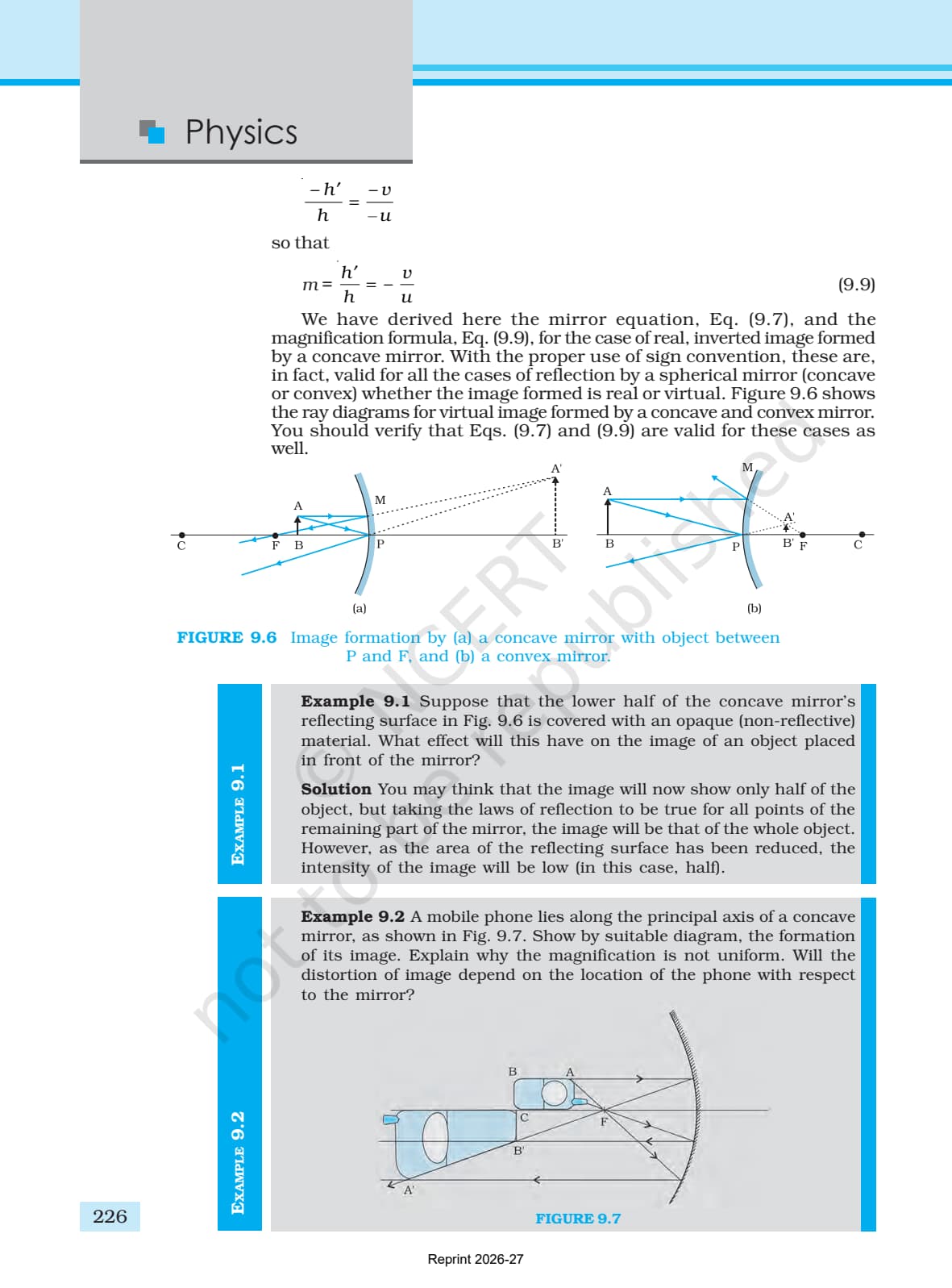
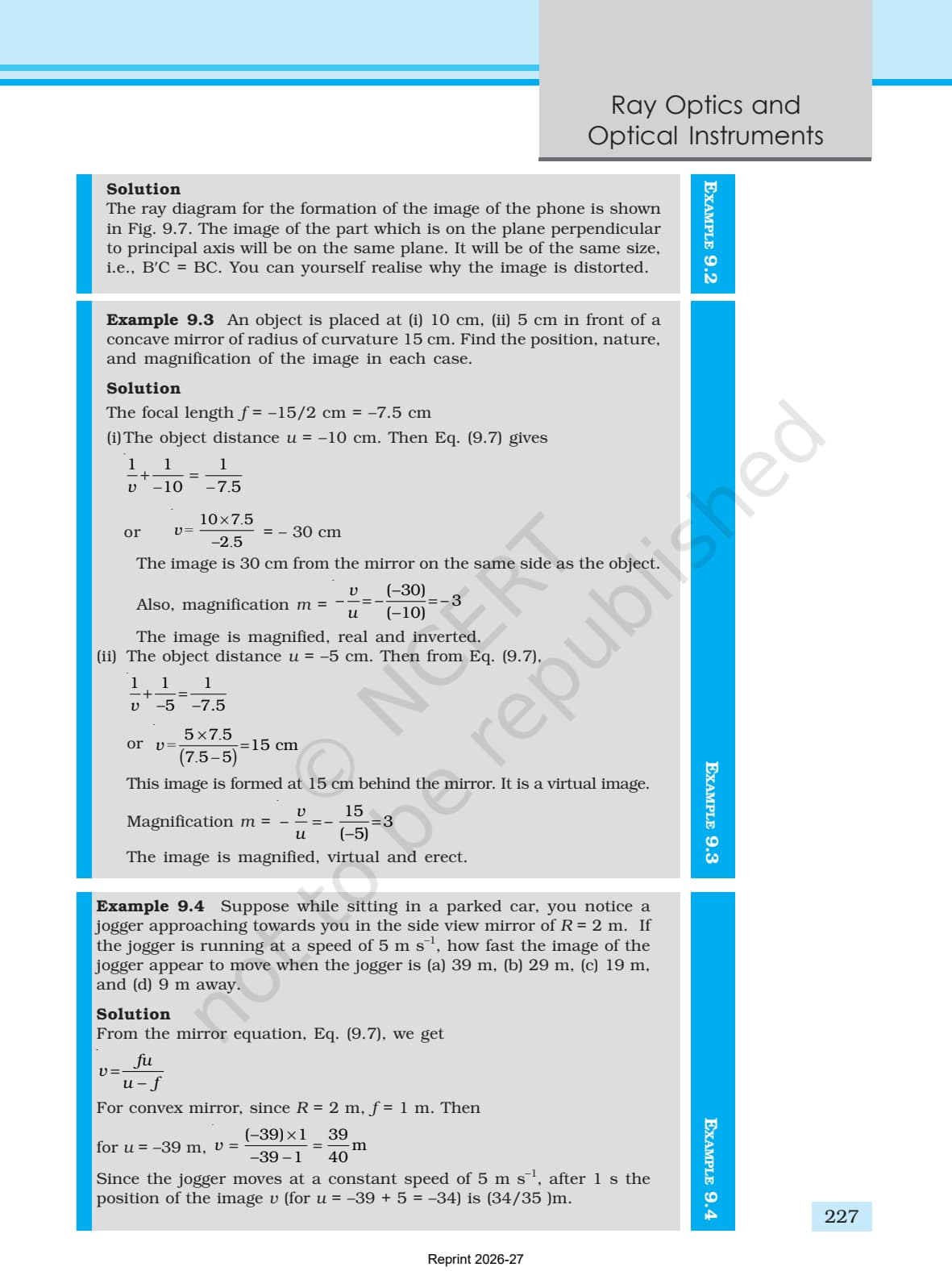
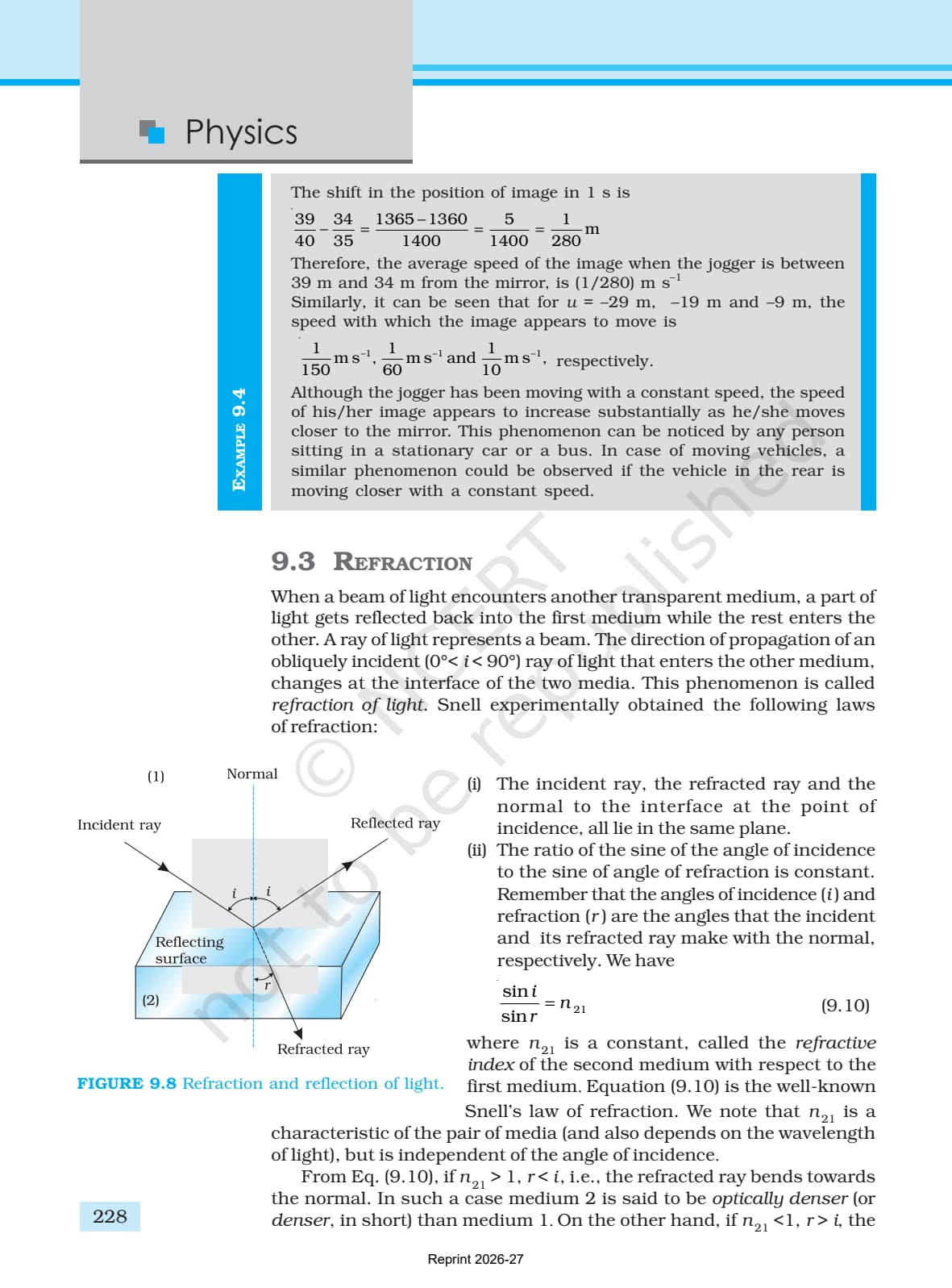
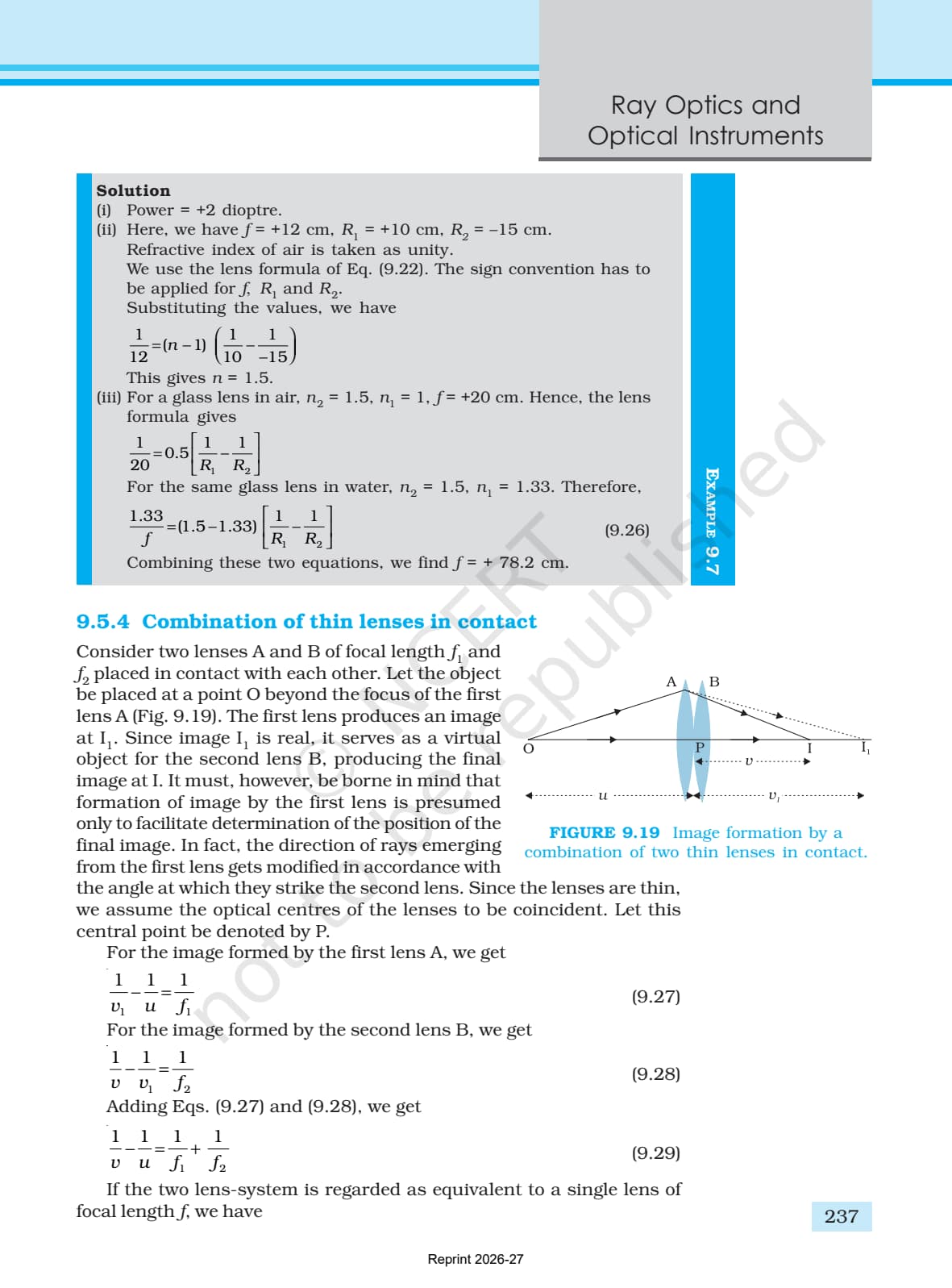
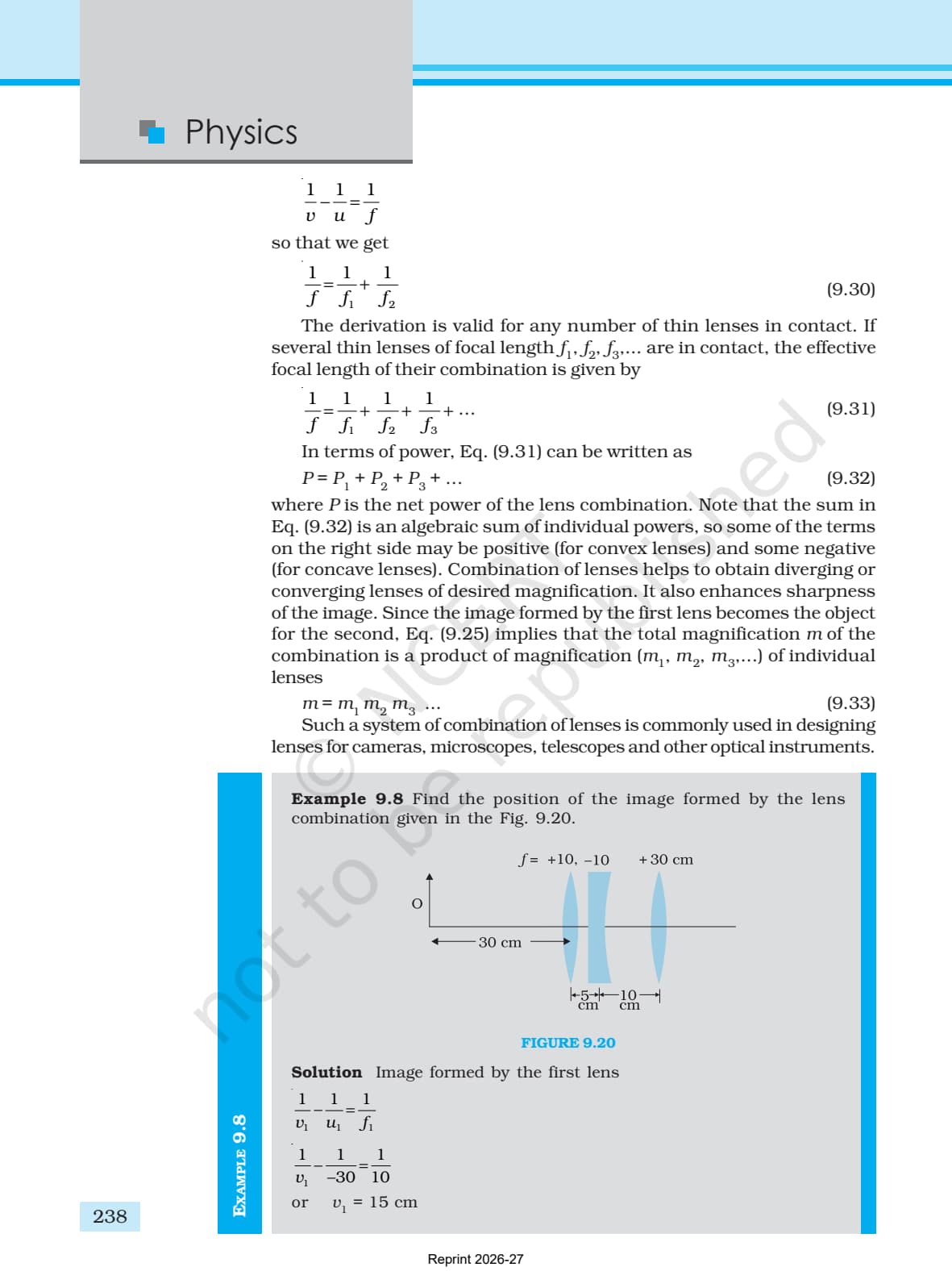
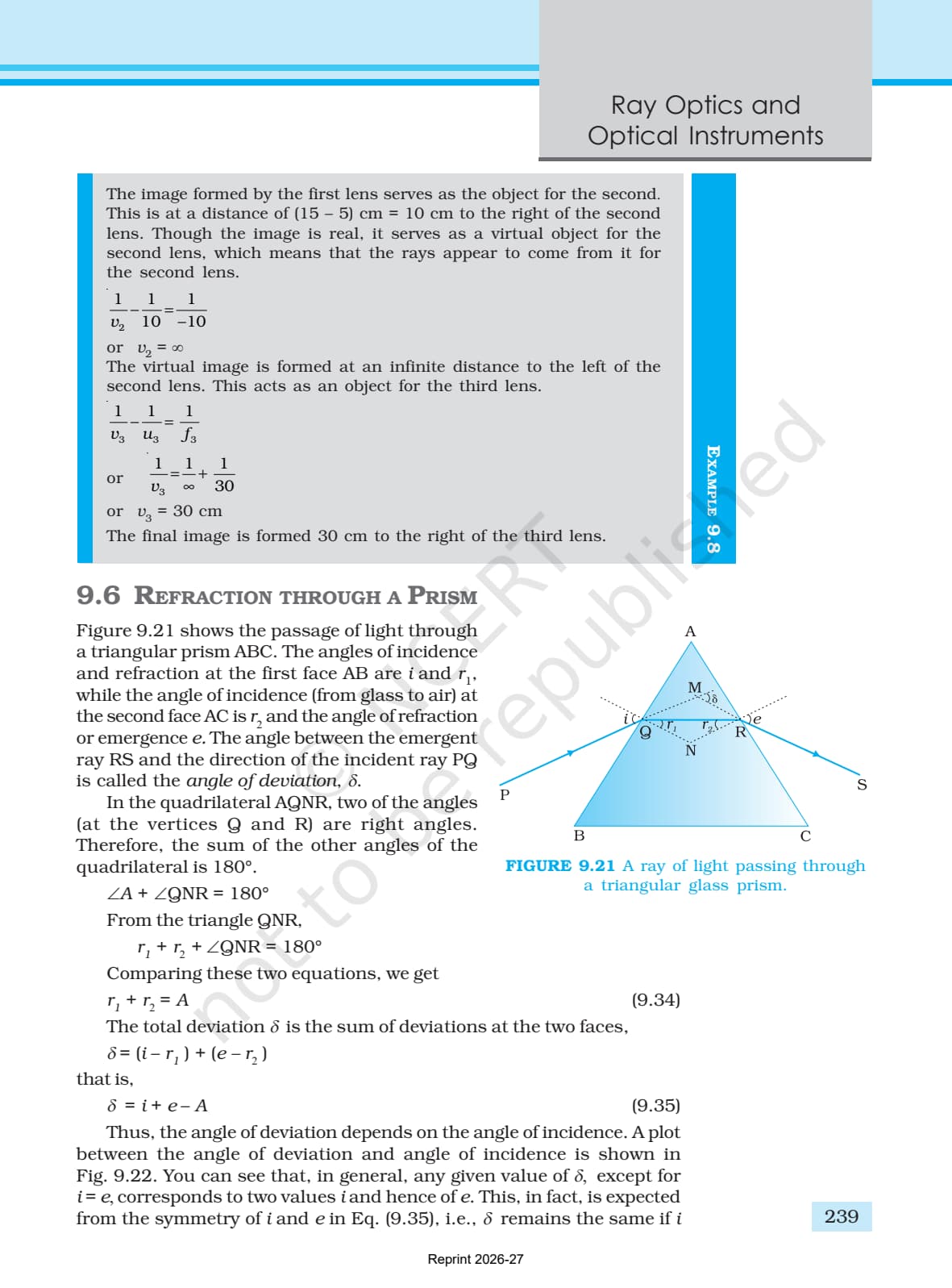
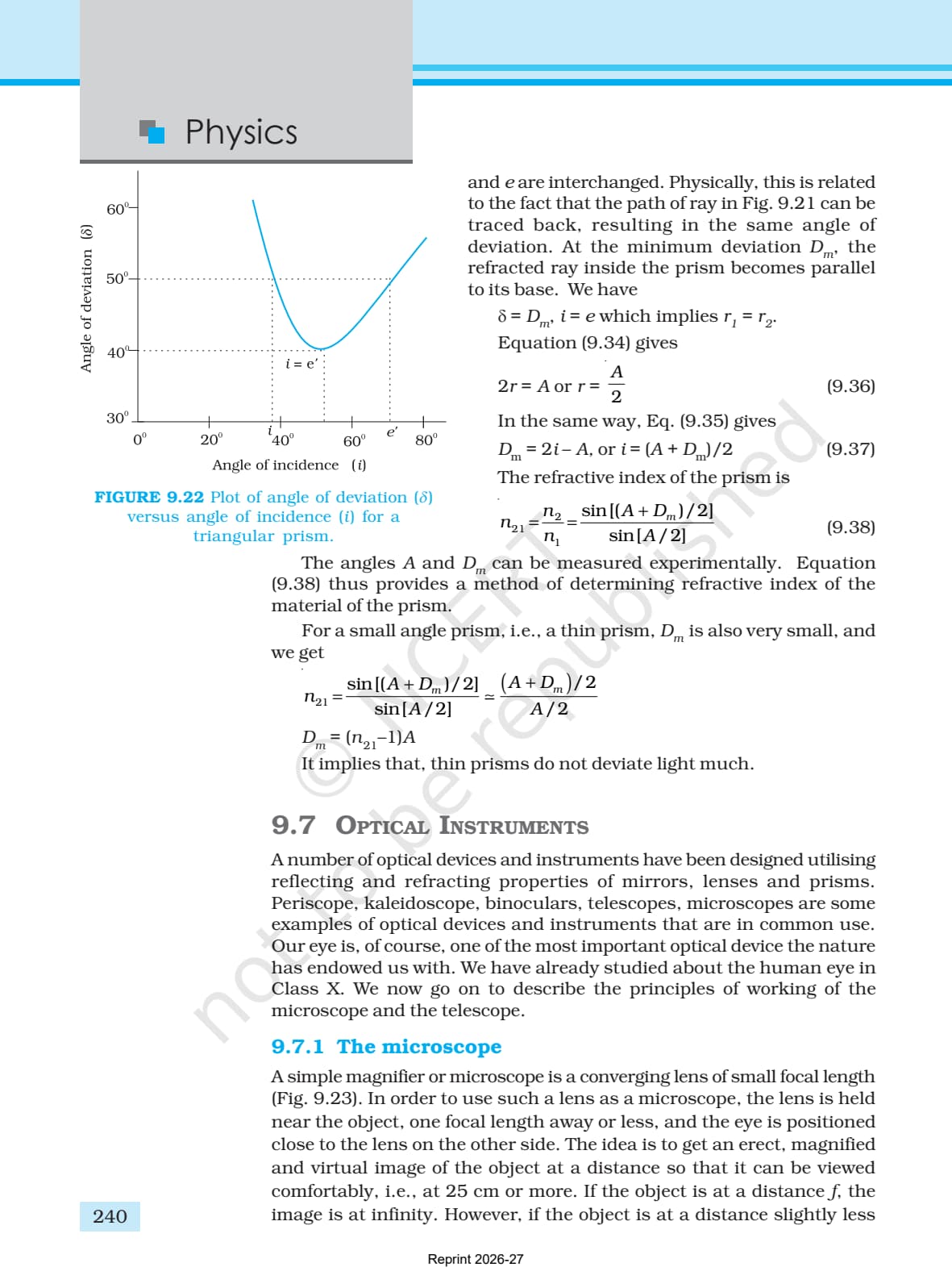
Download the Ray Optics NCERT PDF free from this page, sourced from the official 2026-27 NCERT print for Class 12 Physics Chapter 9 Ray Optics and Optical Instruments. The Ray Optics NCERT PDF on this page is the same Part-II chapter your school prescribes, with a section index and example map added below the download. Use the Ray Optics NCERT PDF for offline study, classroom reference and exam-day revision.
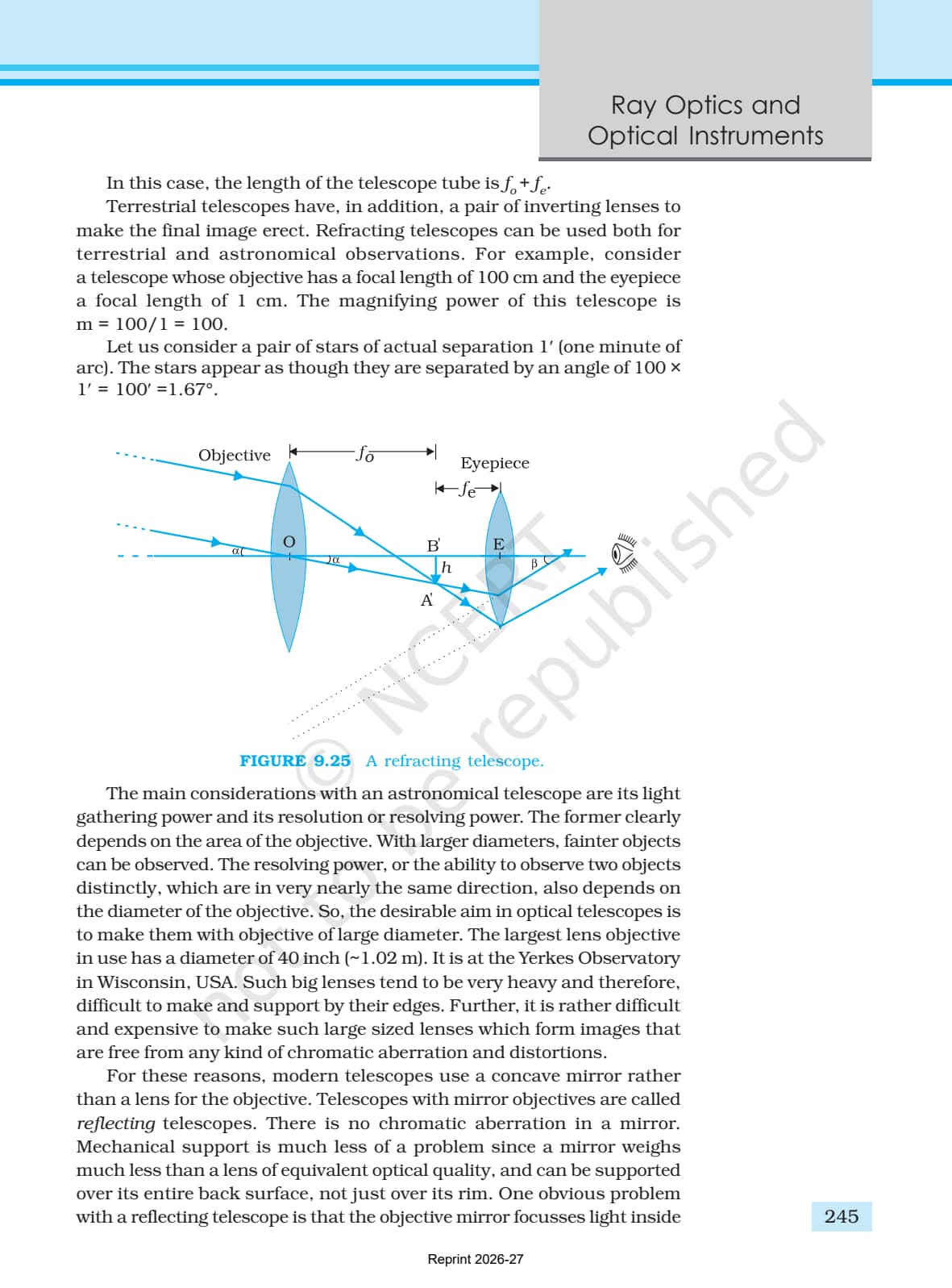
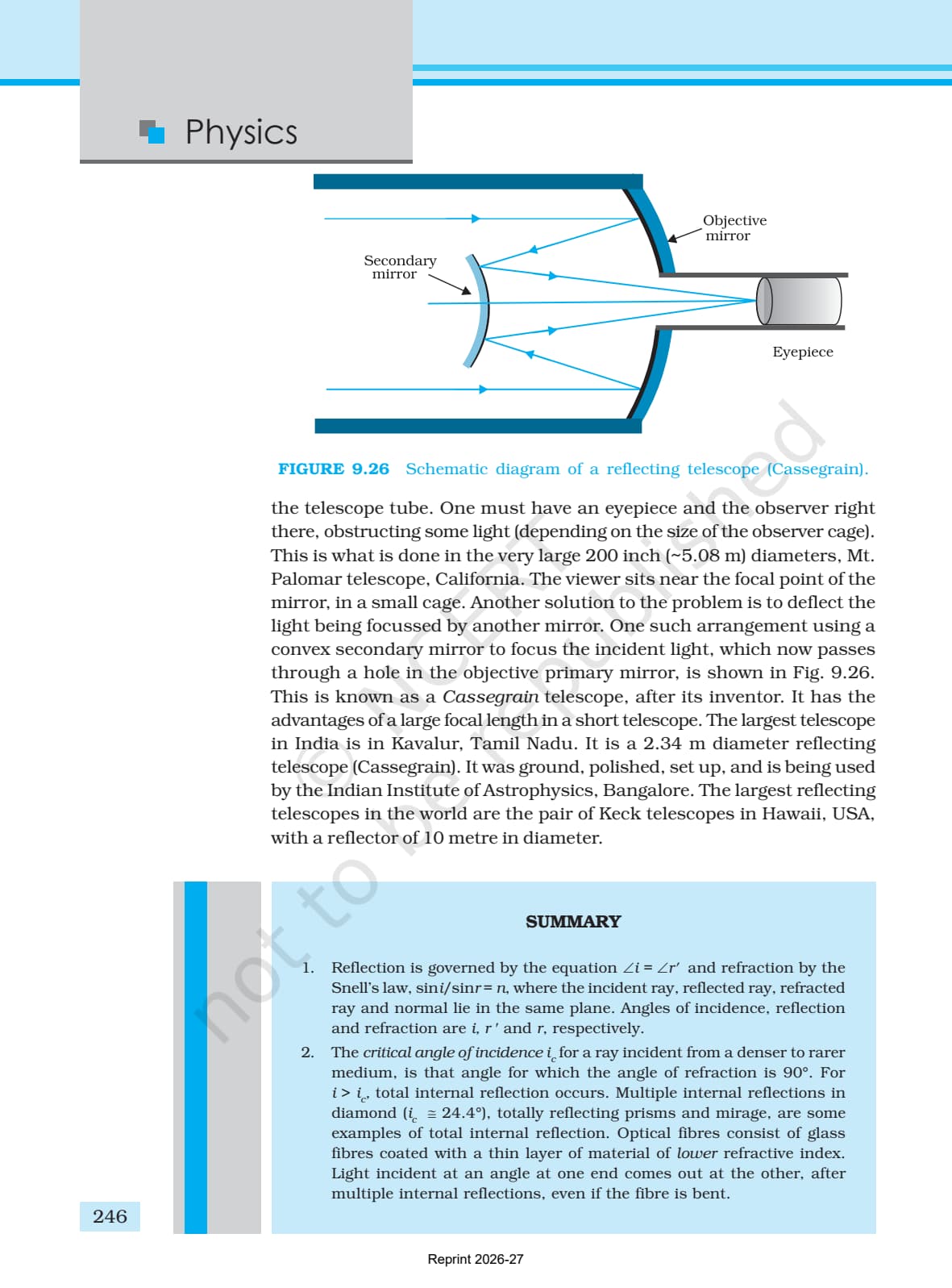
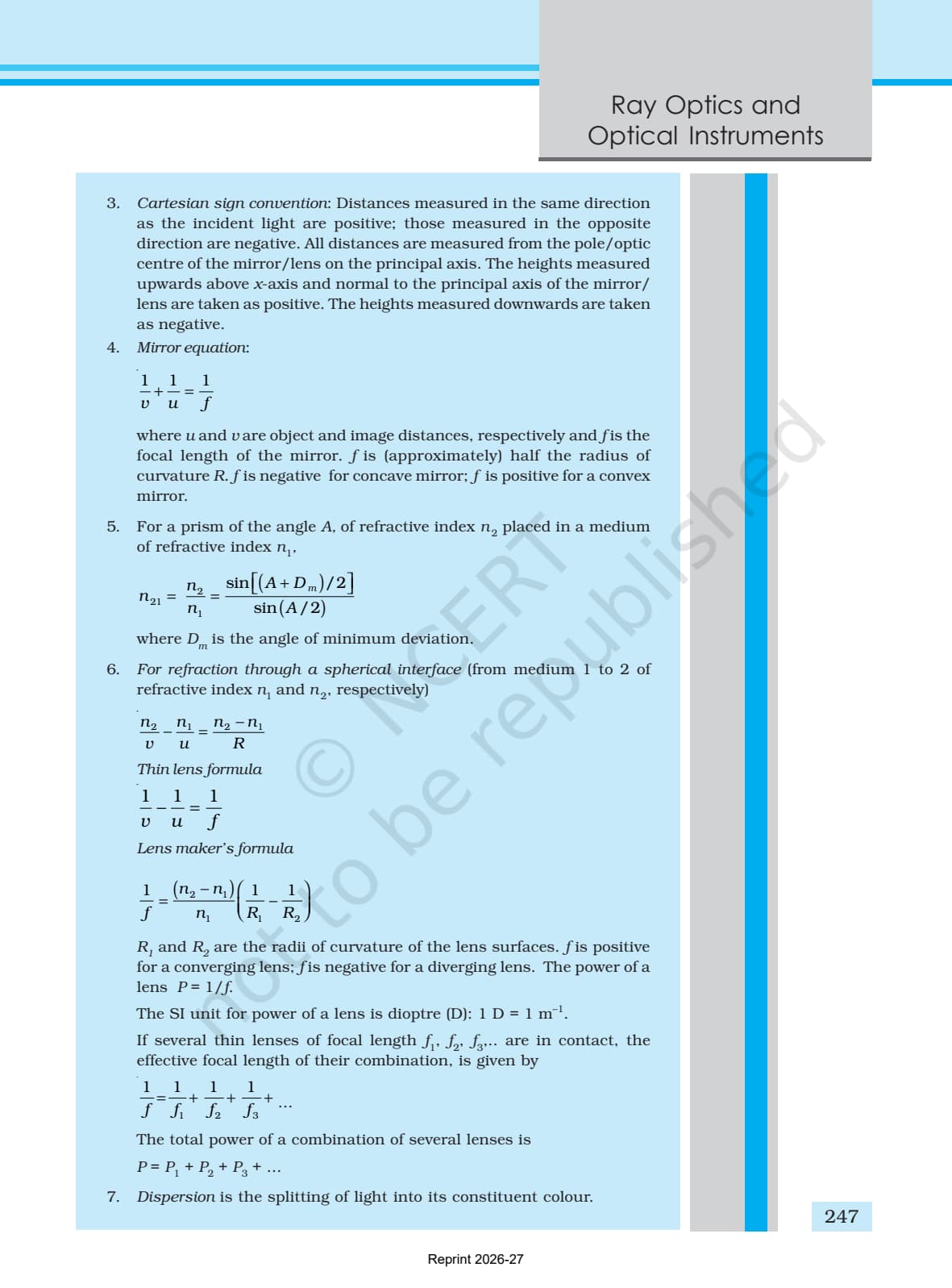
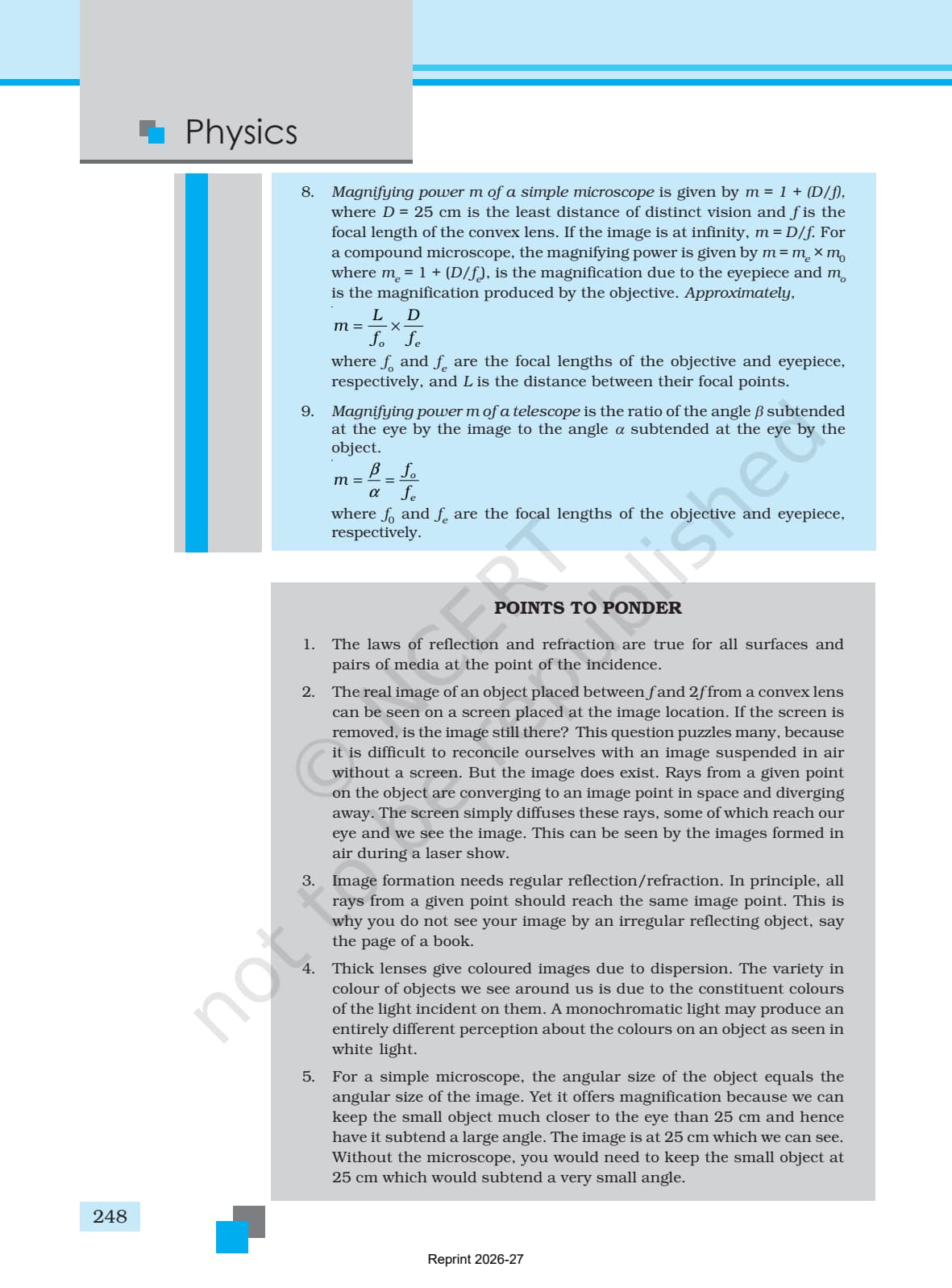
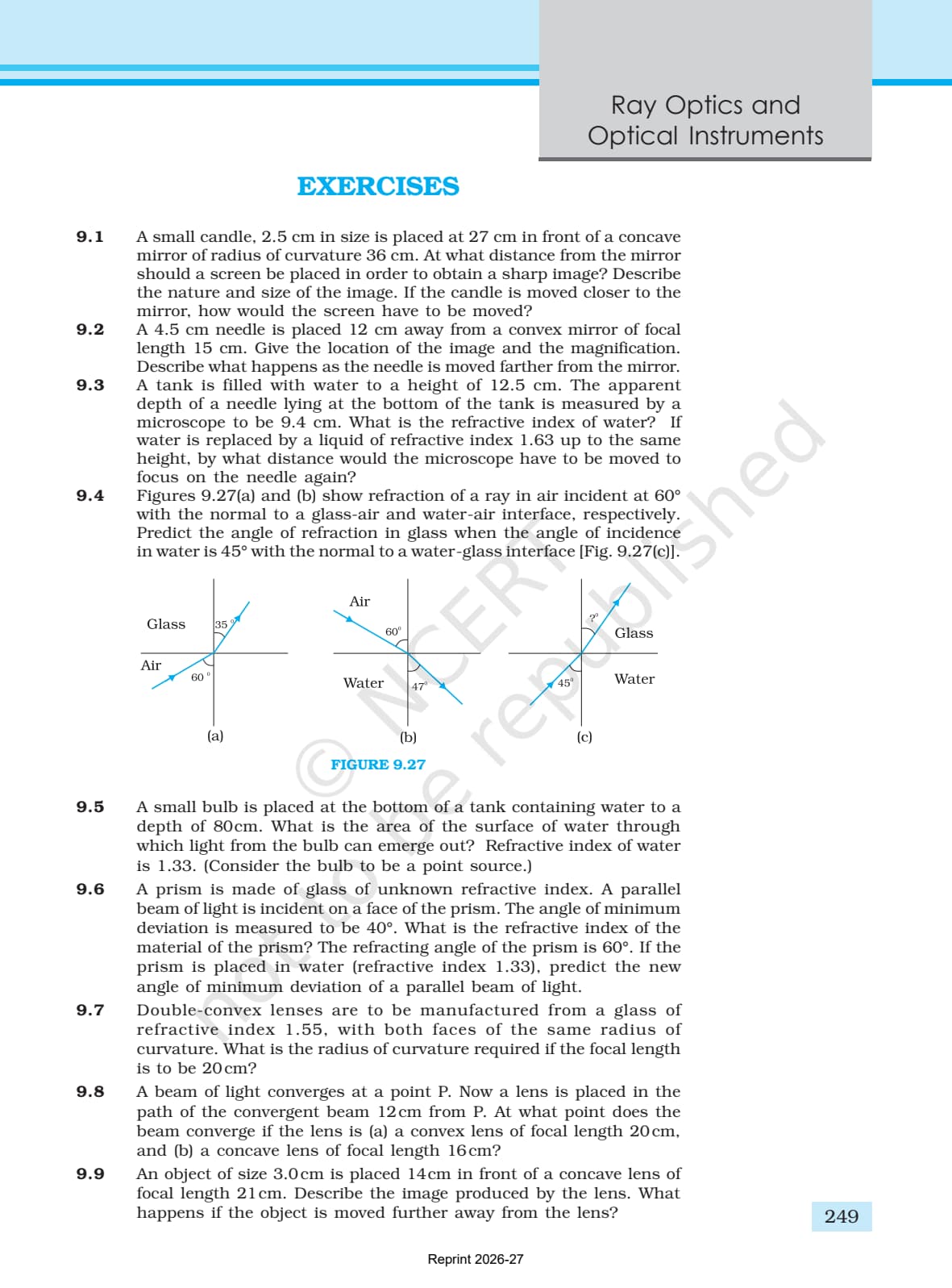
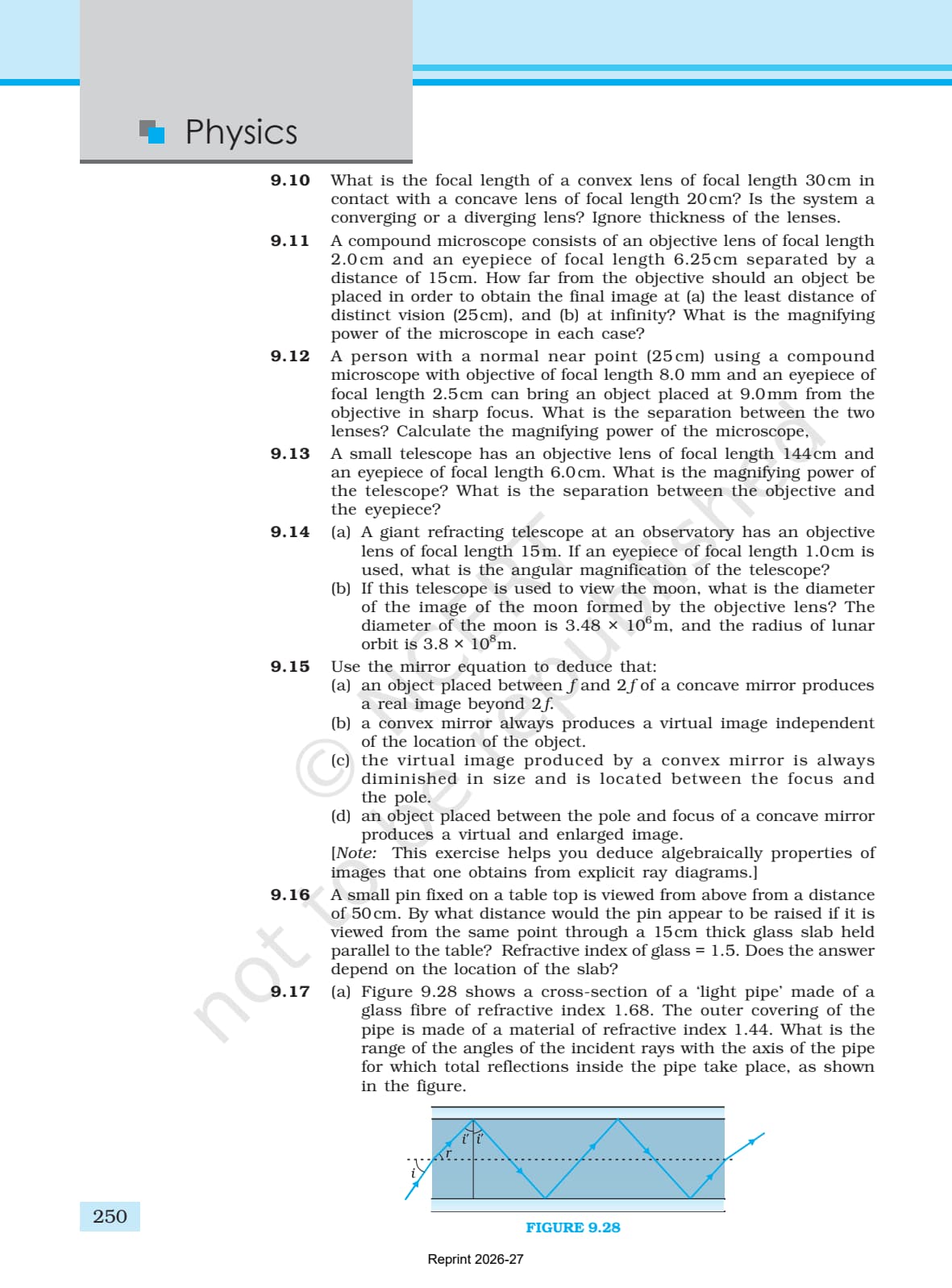
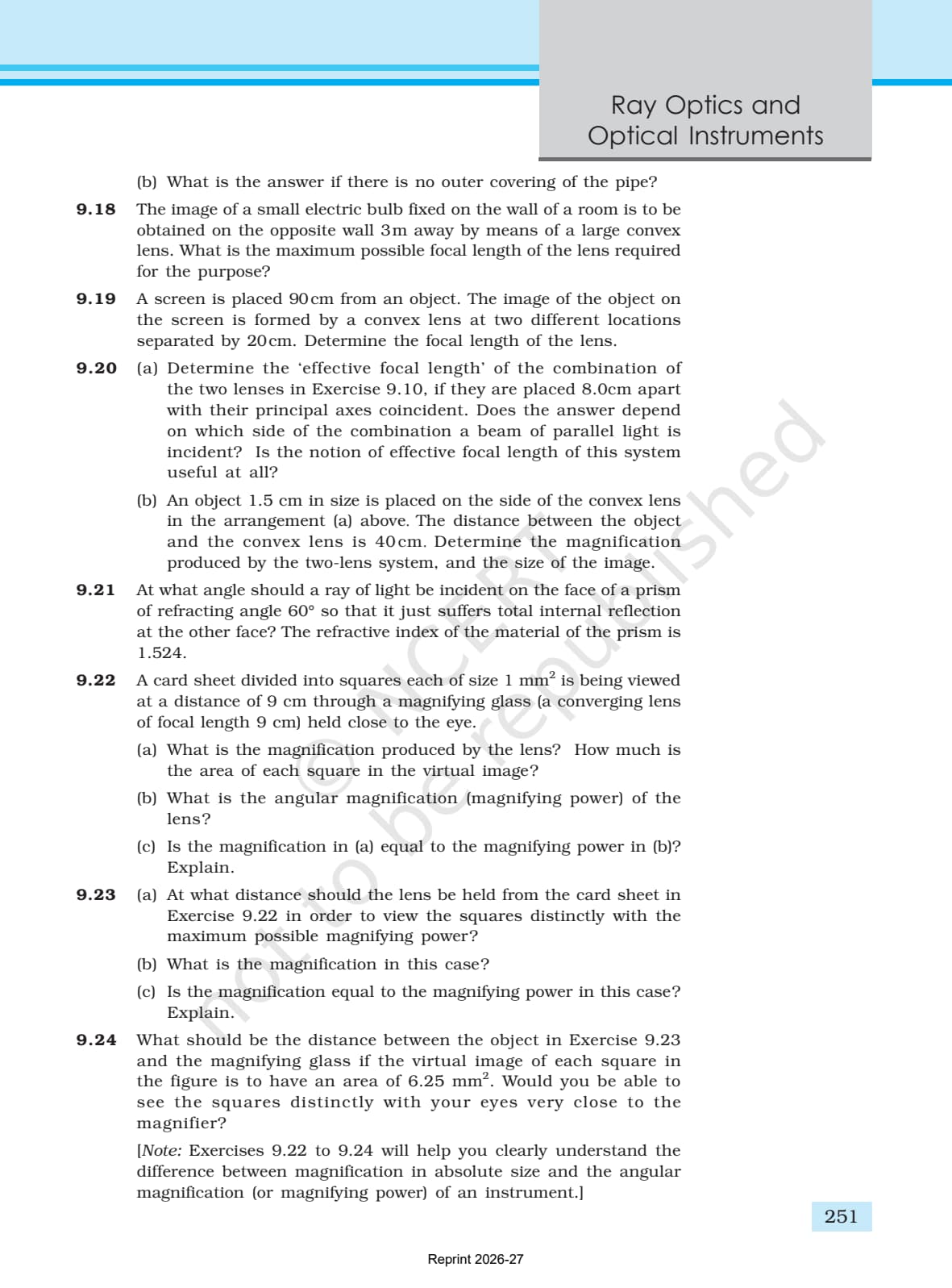
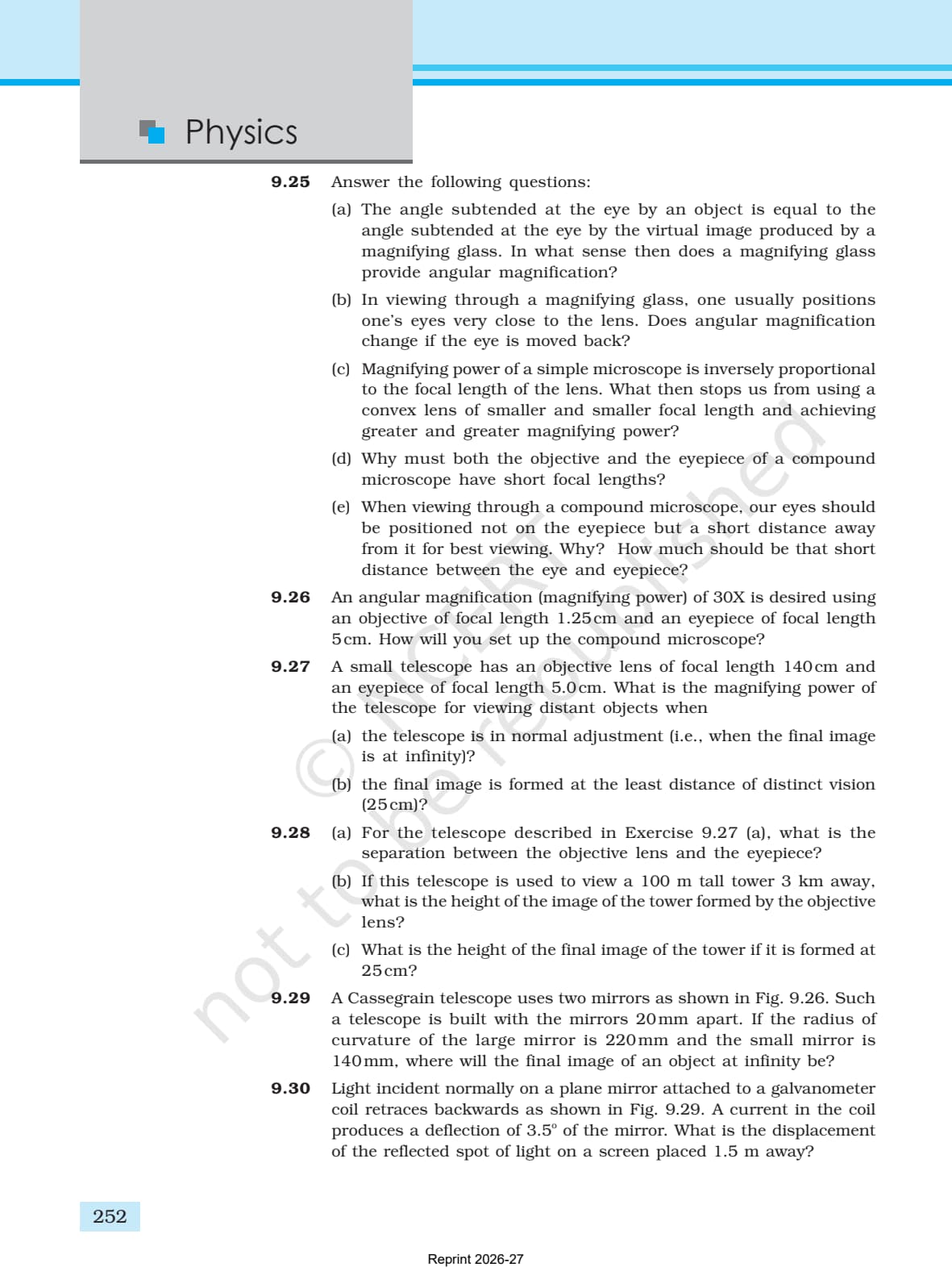
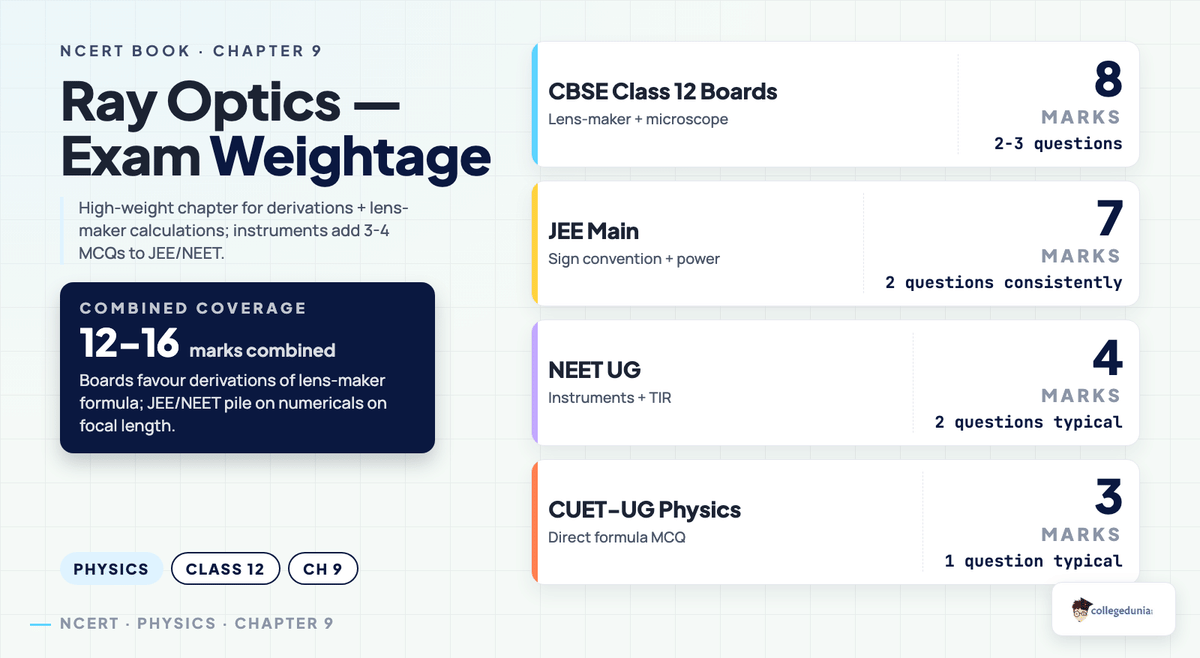
- CBSE Weightage: 7 to 9 marks (highest in Class 12 Physics)
- JEE Main Weightage: 4 to 5% (2 to 3 questions per paper)
- NEET Weightage: 3 to 4 questions per year
What's Inside the Ray Optics NCERT PDF
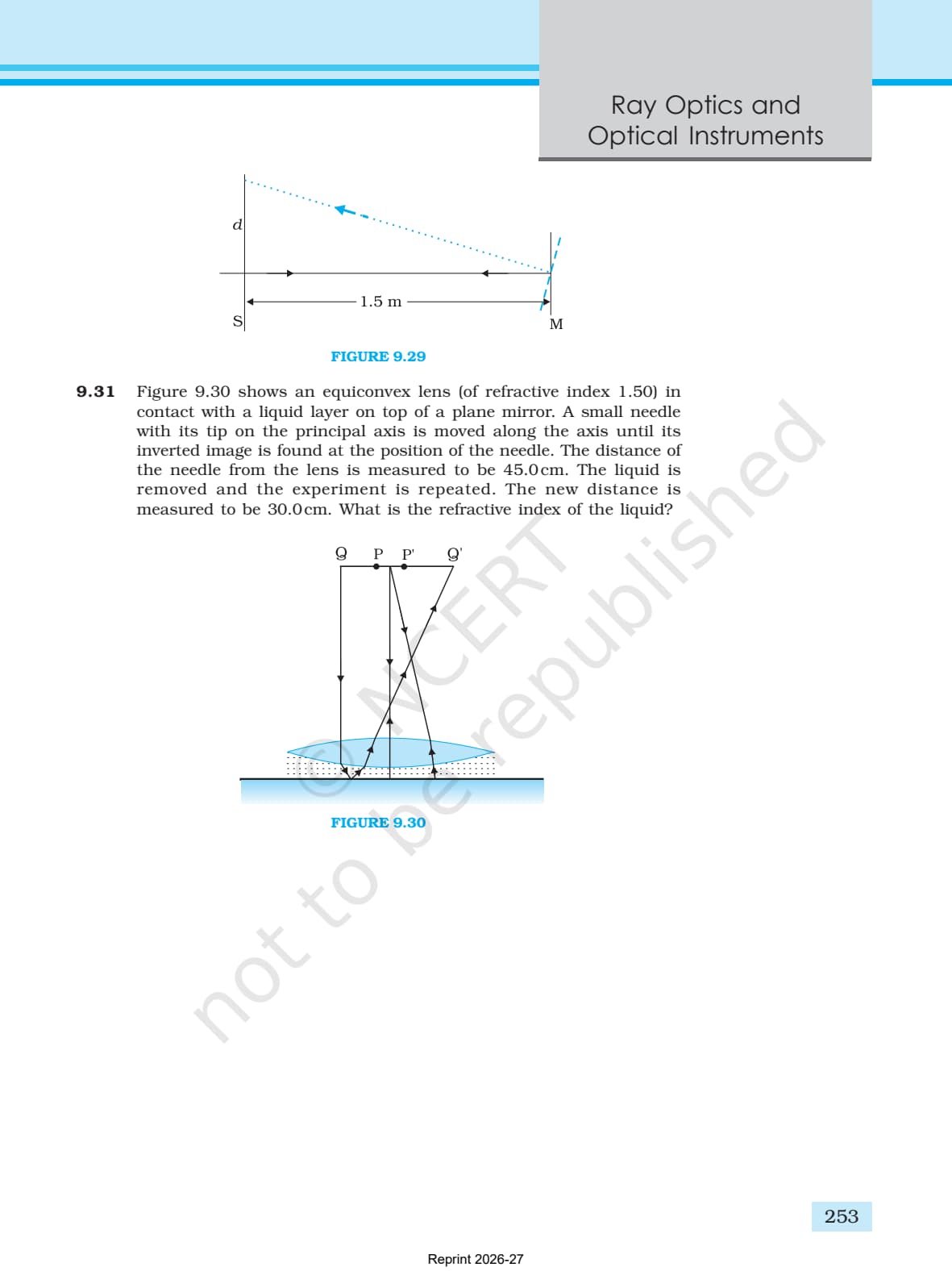
The NCERT chapter is the longest in the Class 12 Physics textbook at roughly 52 pages. It carries 8 numbered sections, 13 intext Examples, 37 end-of-chapter Exercises, a Summary, Points to Ponder, and three Appendices.
Ray Optics and Optical Instruments Class 12 Physics - Video Lecture
Source: NCERT Wallah on YouTube
Ray Optics and Optical Instruments NCERT Section-by-Section Breakdown
The table splits Chapter 9 into 8 numbered sections with page ranges. Sections 9.5 and 9.8 are the two longest and also the two highest scoring for CBSE and JEE Main.
| Section | Title | Approx. Pages | Core Idea Covered |
|---|---|---|---|
| 9.1 | Introduction | 1 to 2 | Nature of light, laws of reflection and refraction |
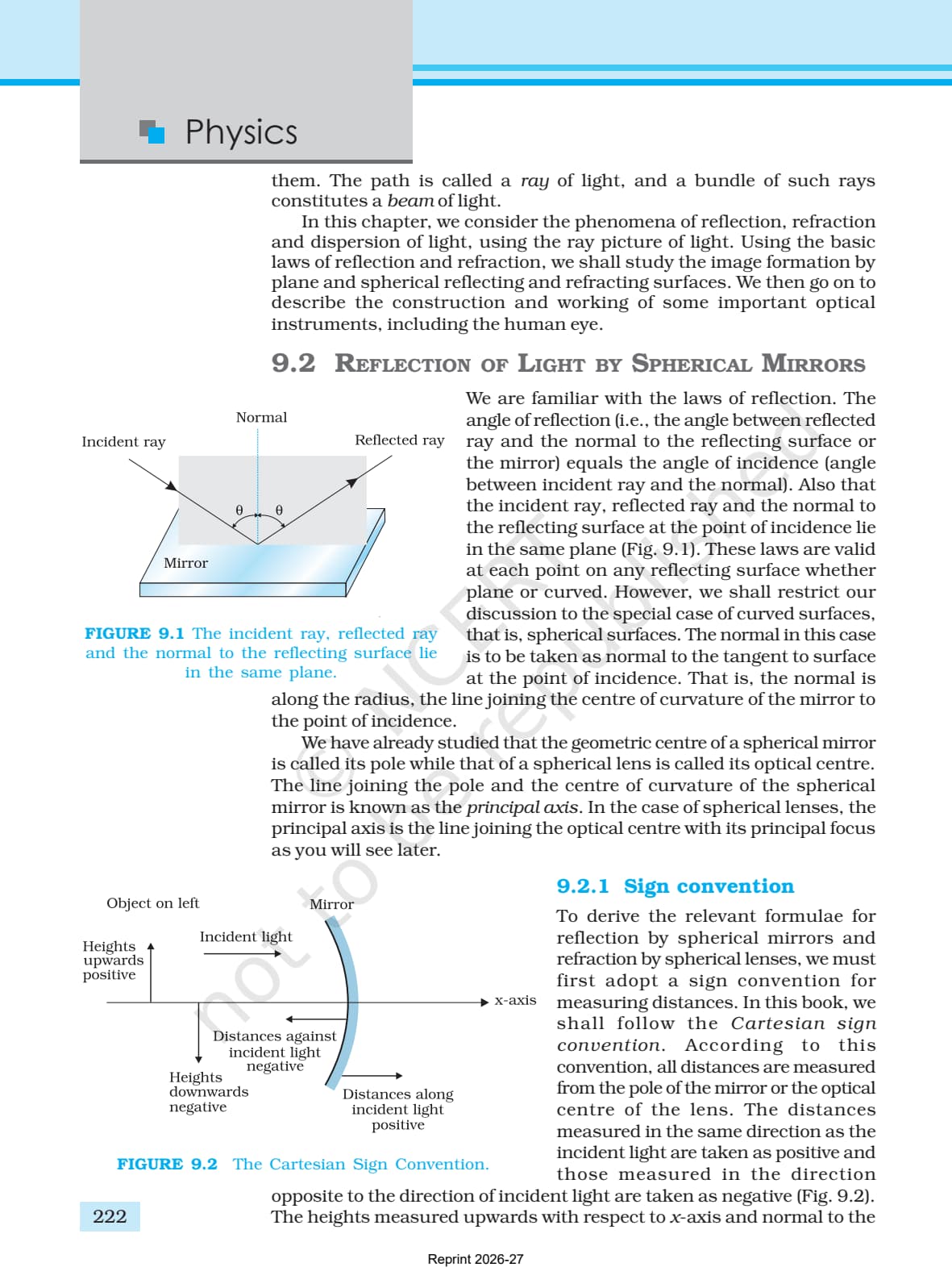
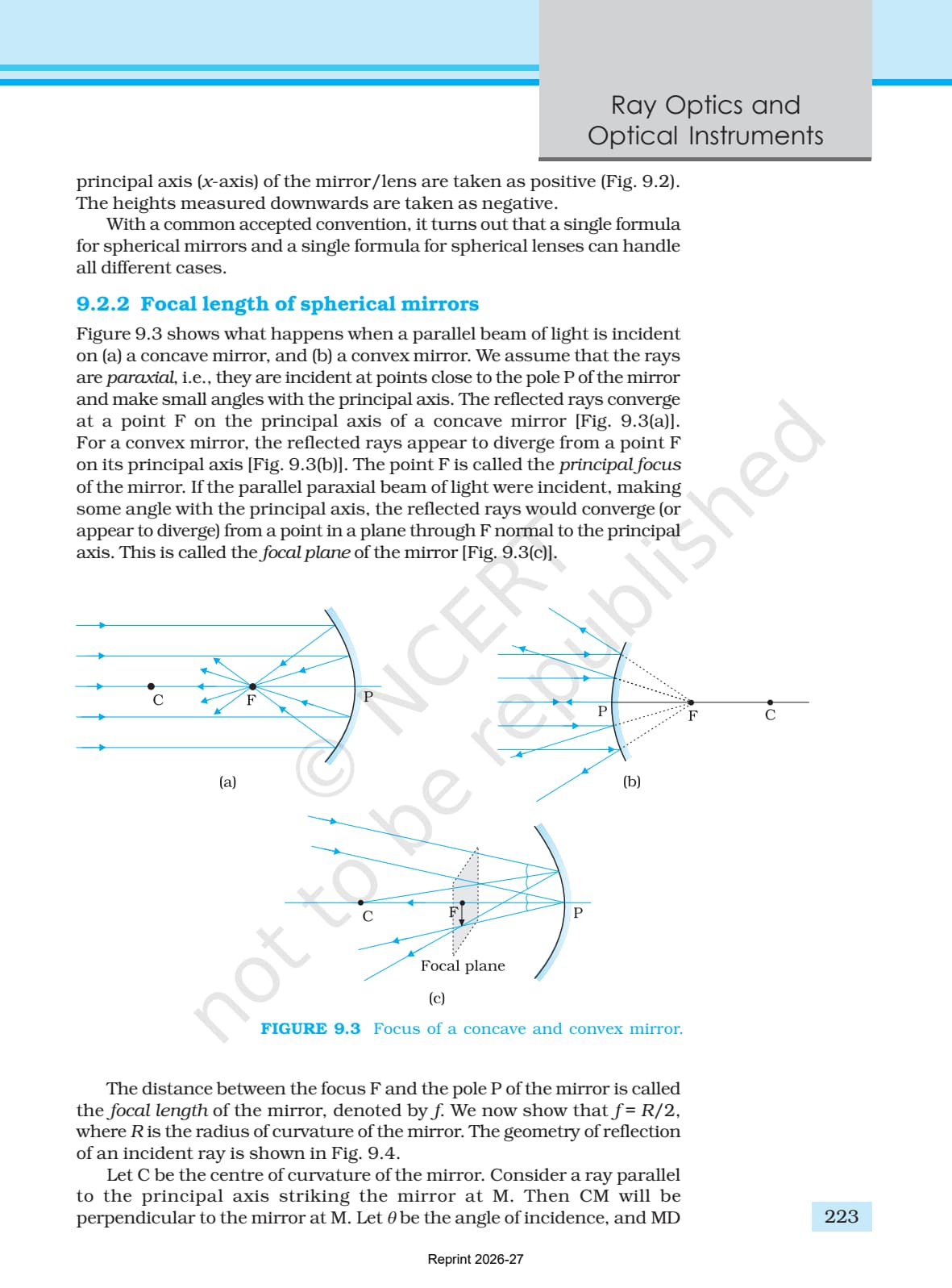
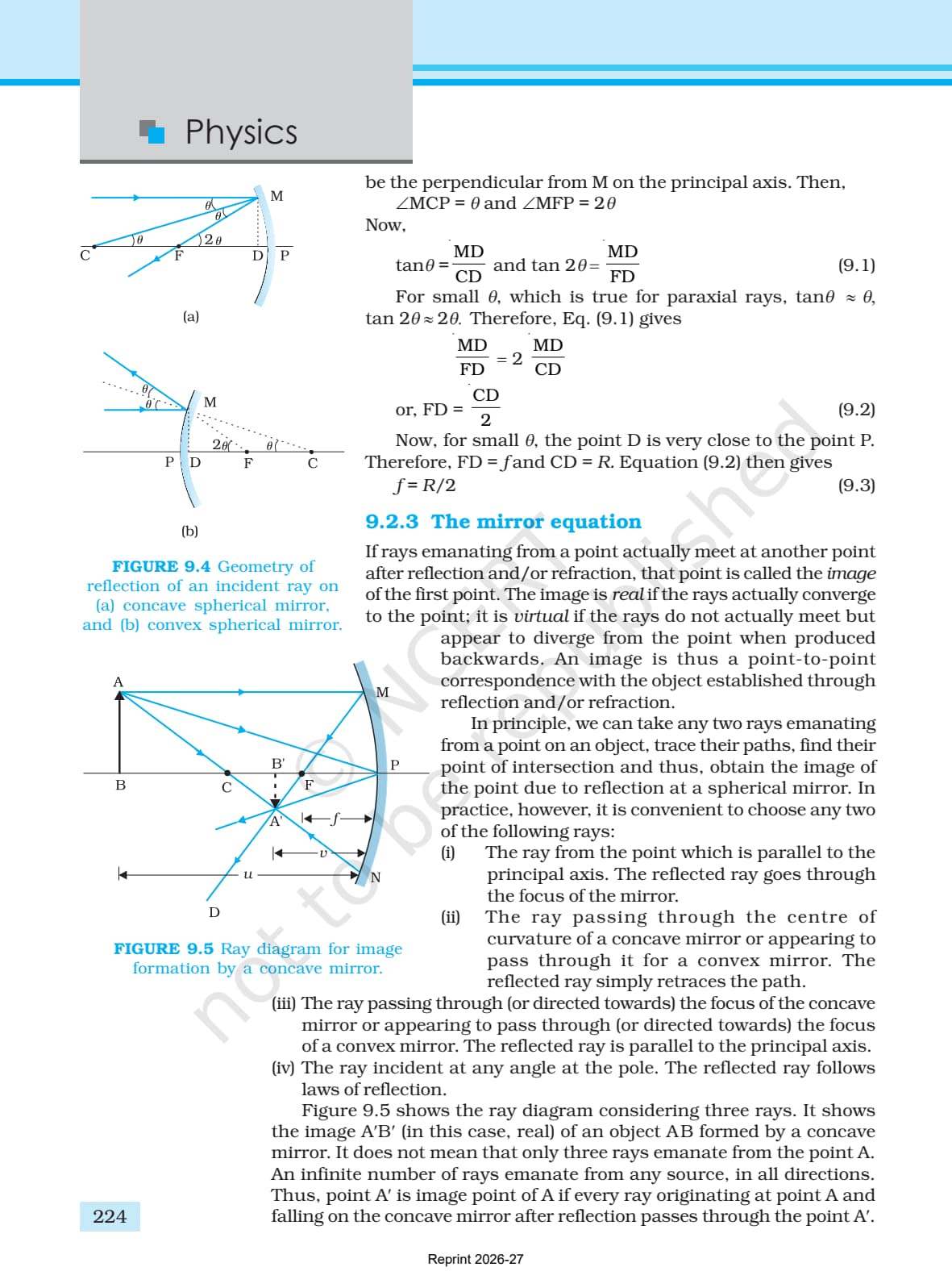
| 9.2 | Reflection by Spherical Mirrors | 2 to 9 | Sign convention, focal length, mirror formula |
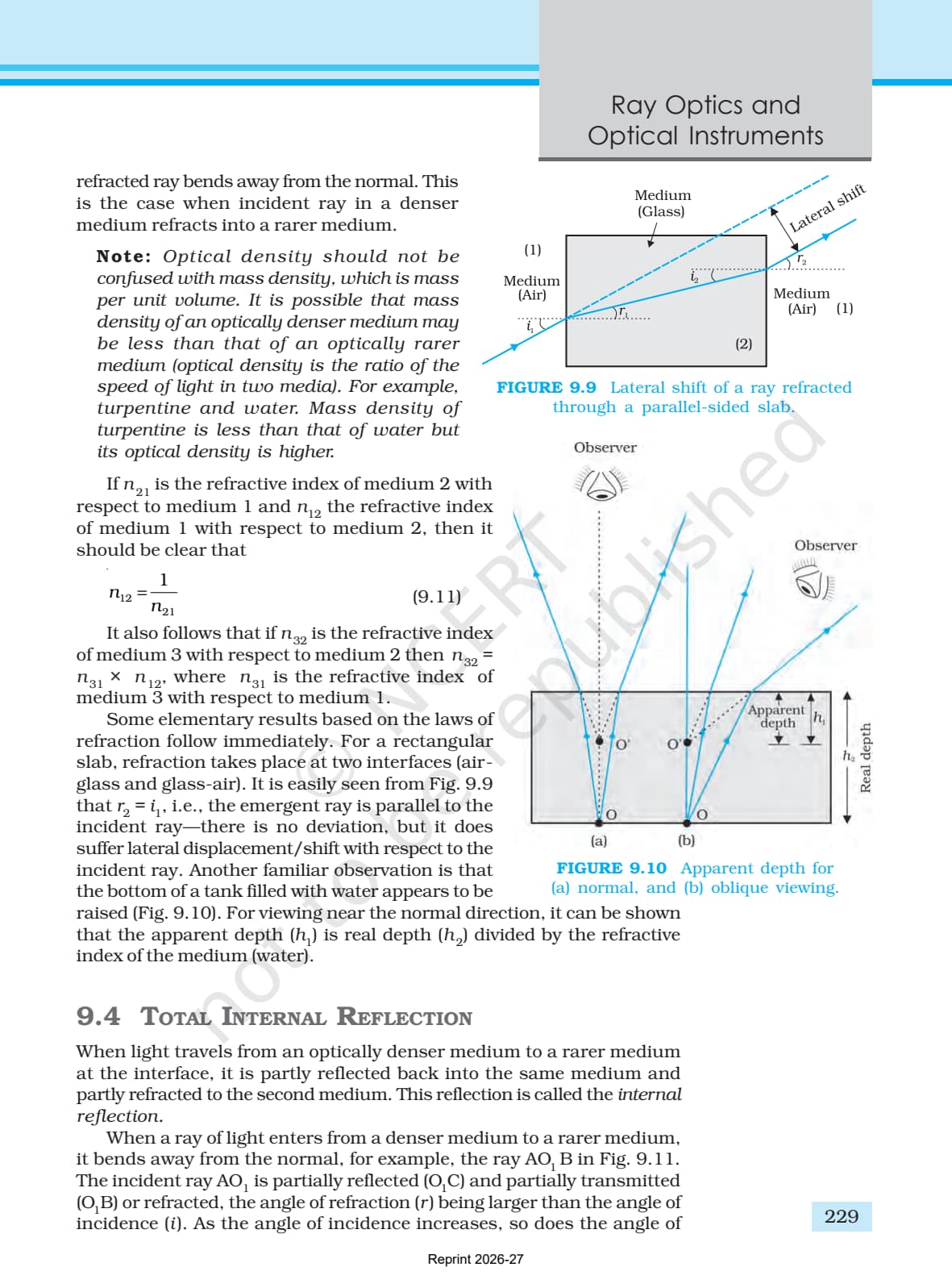
| 9.3 | Refraction | 9 to 14 | Snell's Law, apparent depth, lateral shift |
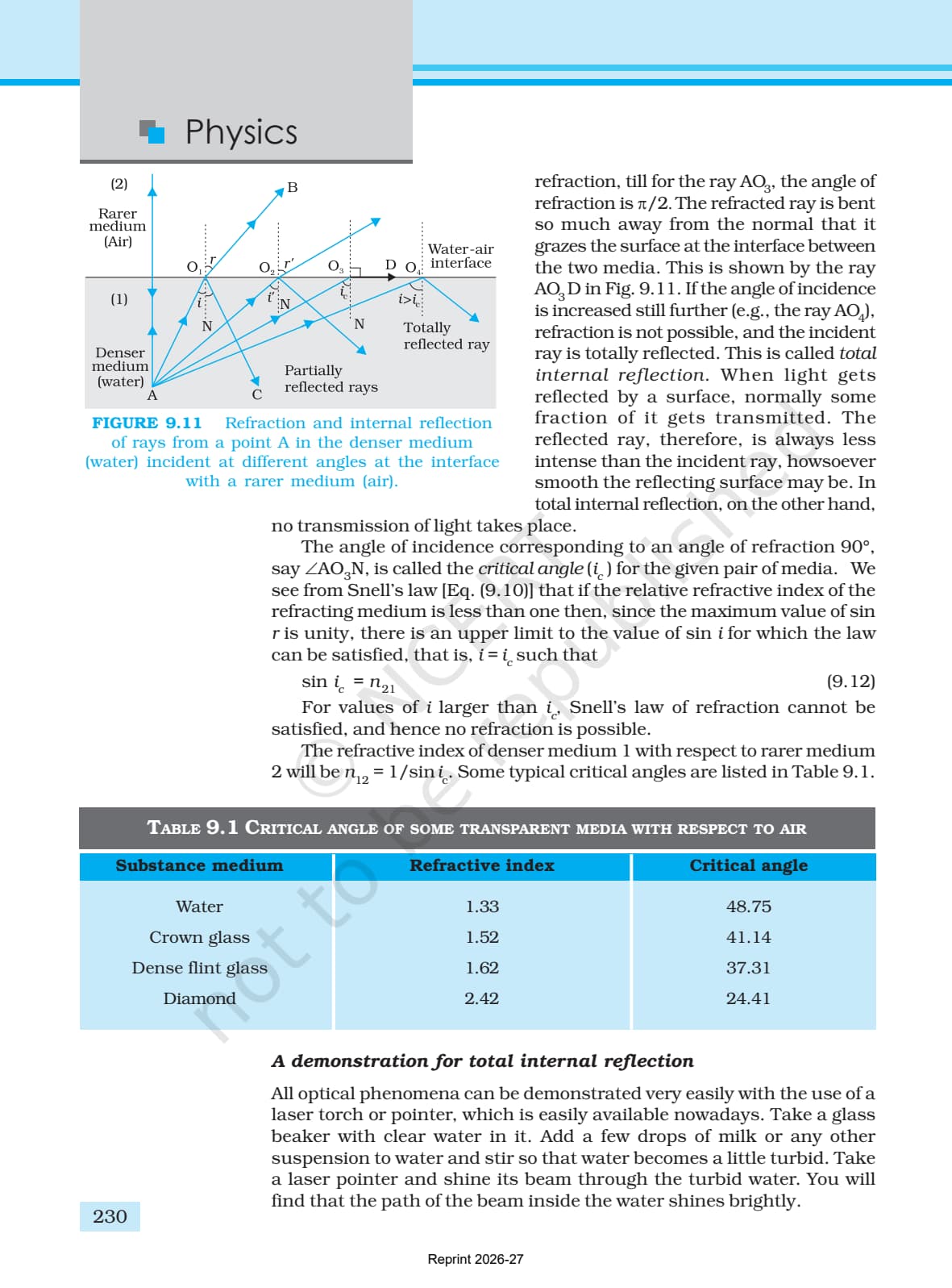
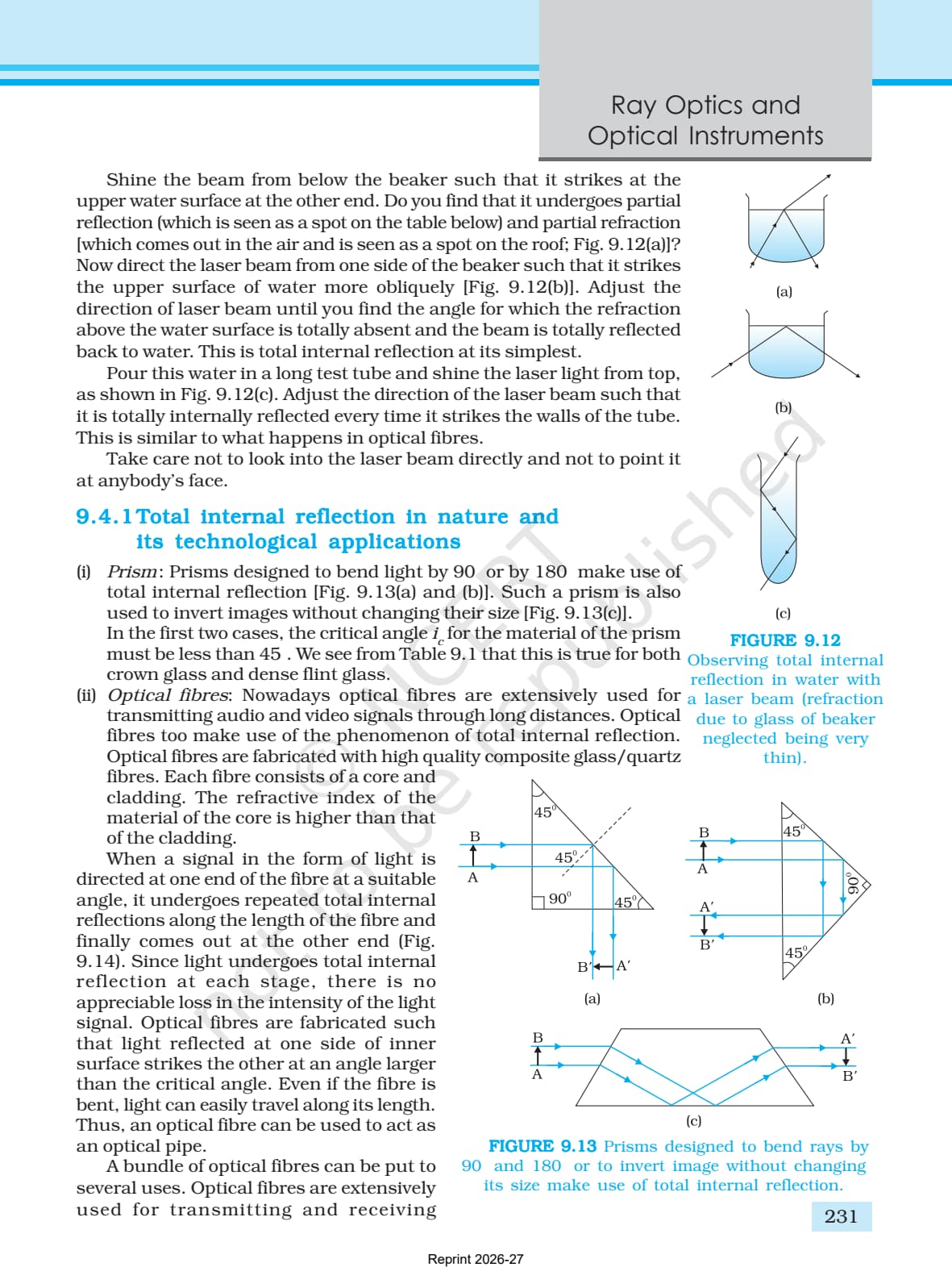
| 9.4 | Total Internal Reflection | 14 to 20 | Critical angle, optical fibre, diamond brilliance |
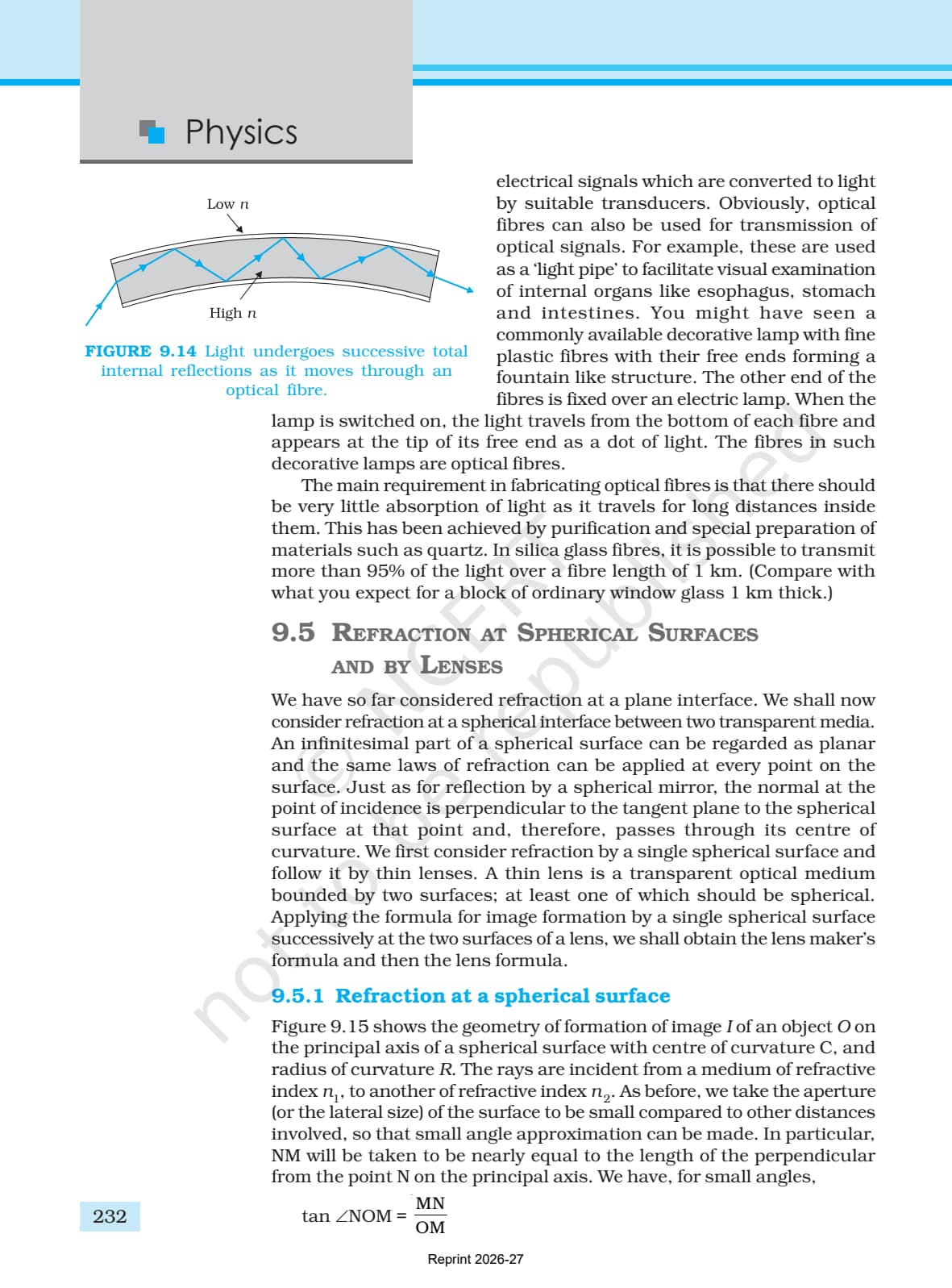
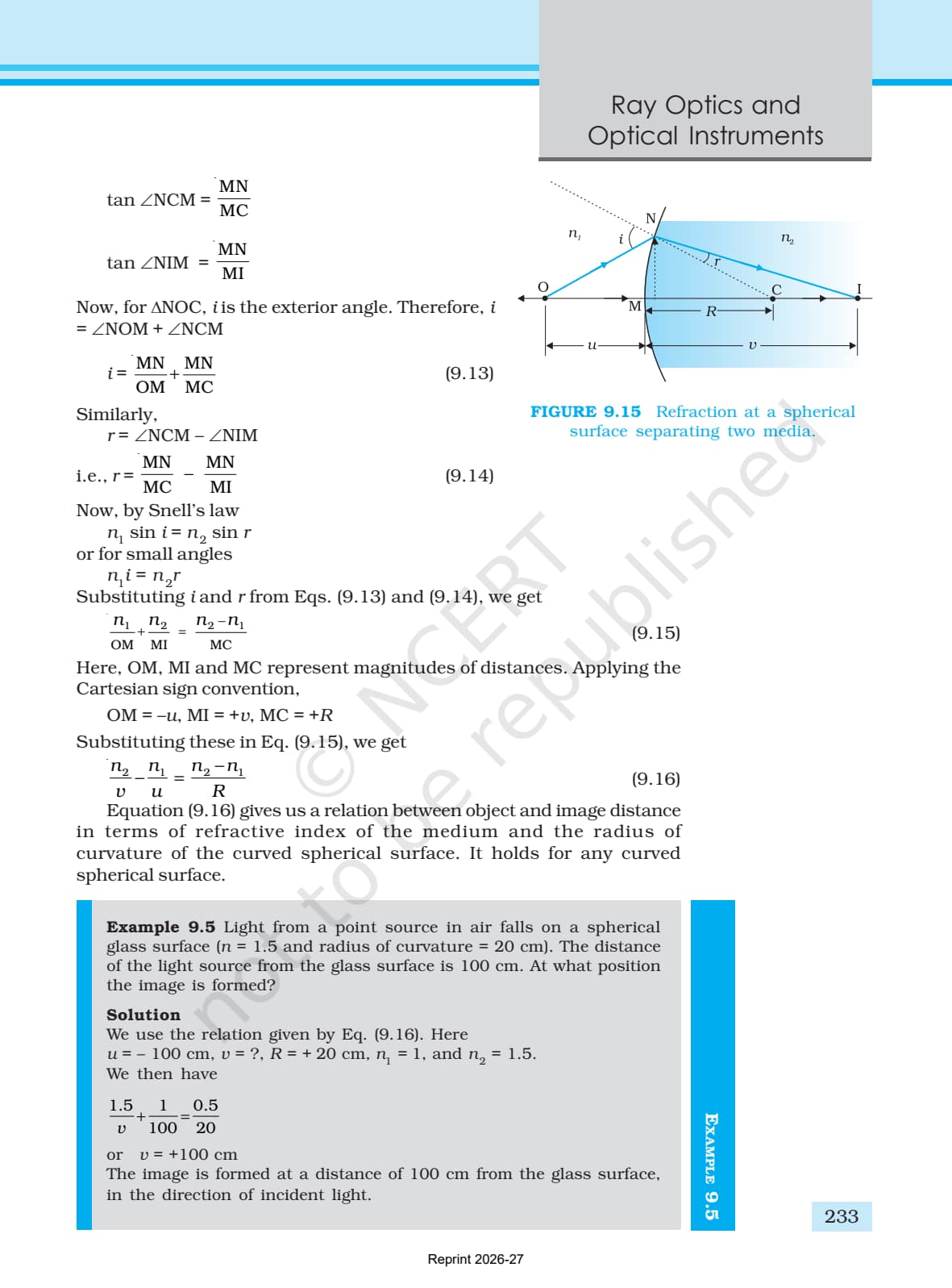
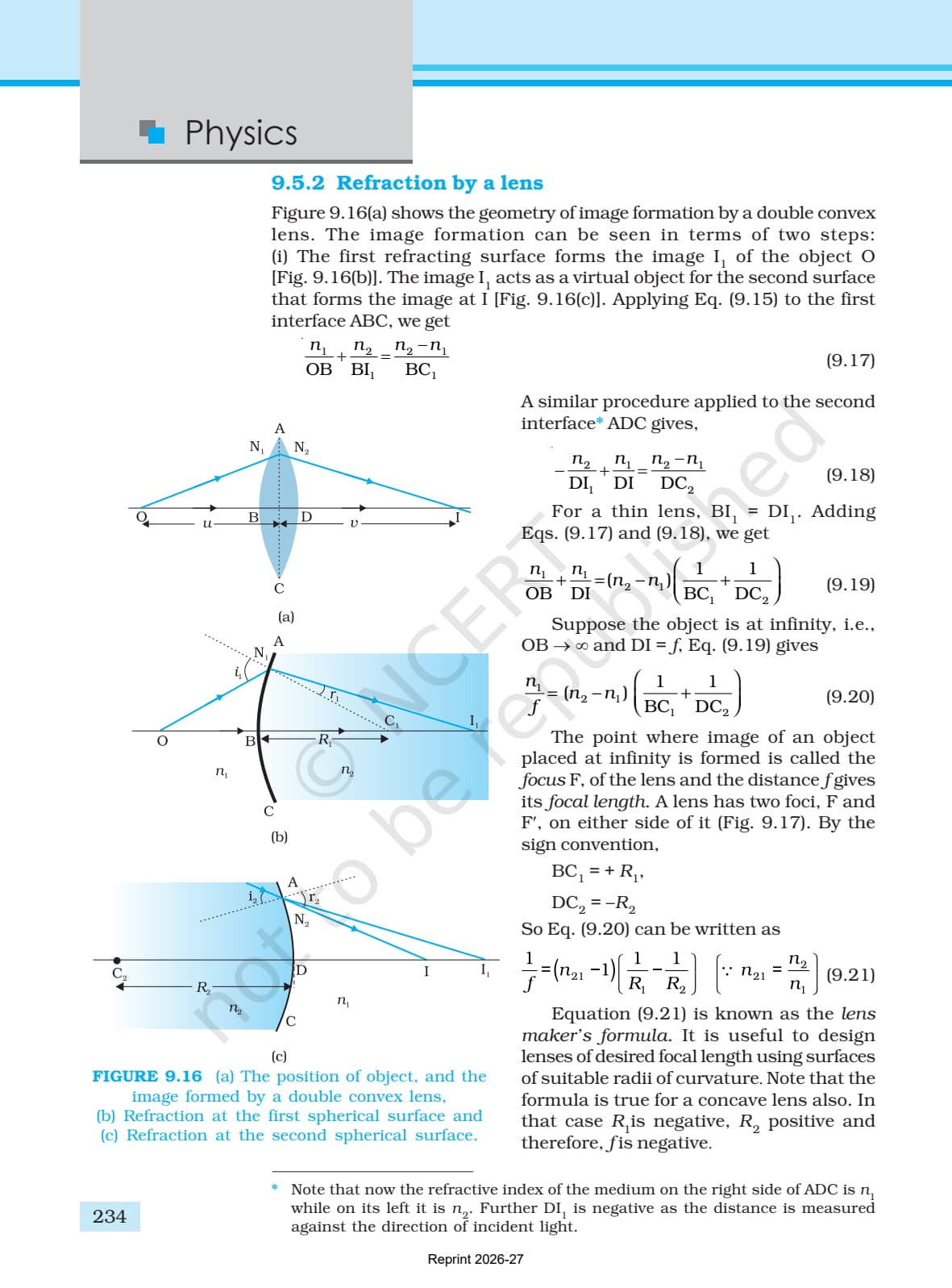
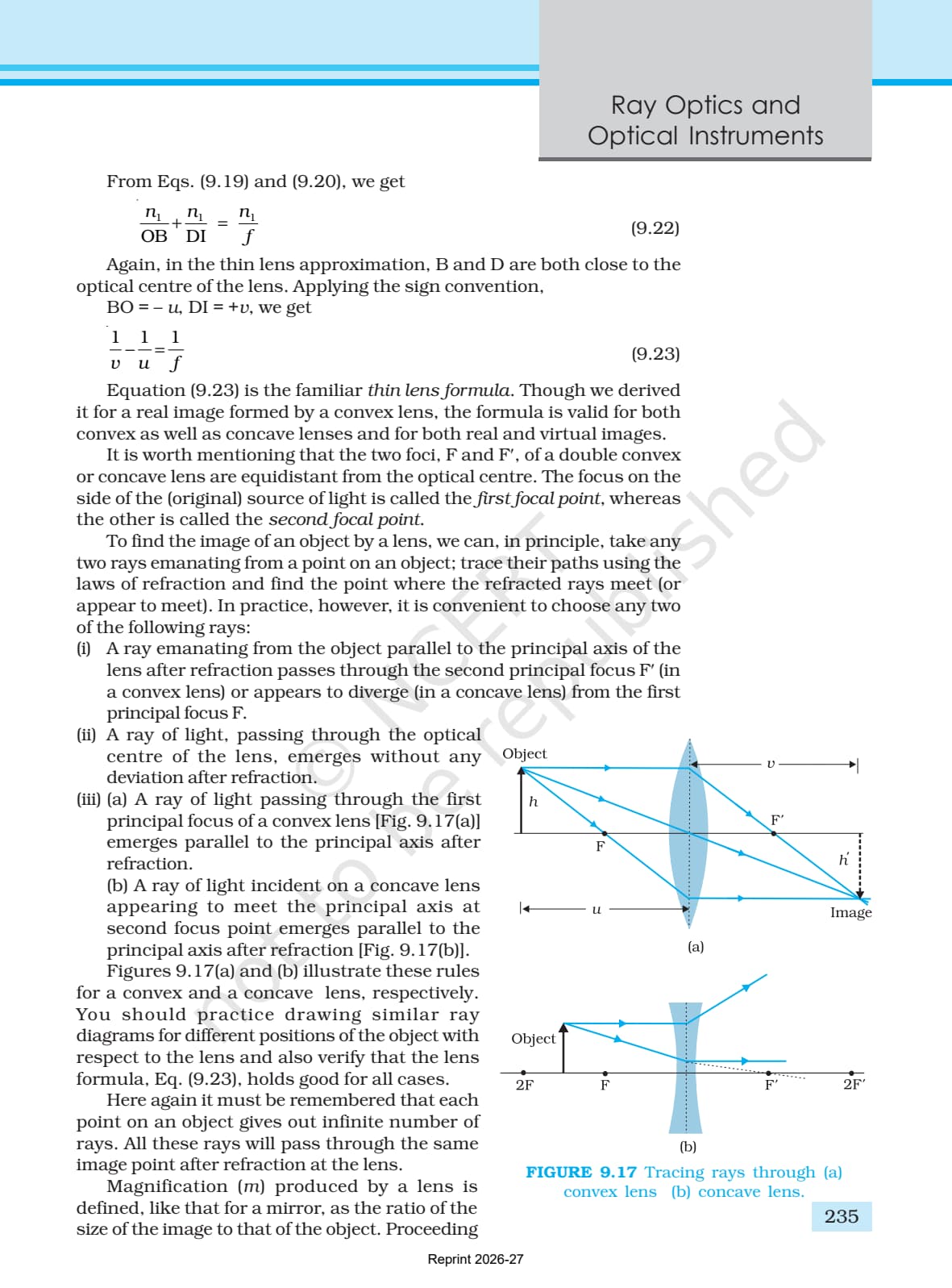
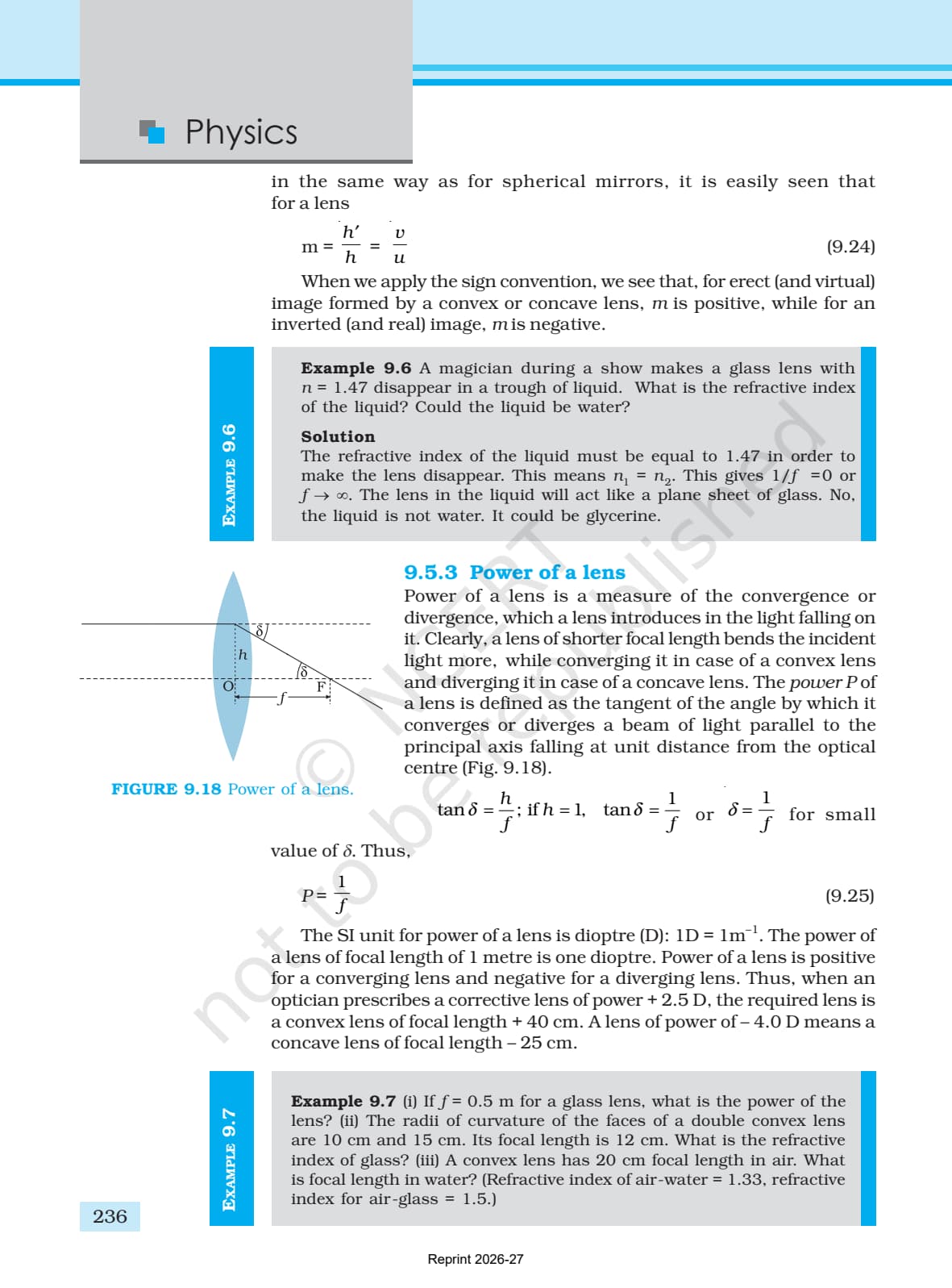
| 9.5 | Spherical Surfaces and Lenses | 20 to 32 | Single surface, lens maker, thin lens, power |
| 9.6 | Refraction Through a Prism | 32 to 38 | Deviation, minimum deviation, prism formula |
| 9.7 | Natural Phenomena due to Sunlight | 38 to 42 | Rainbow, scattering, blue sky, red sunset |
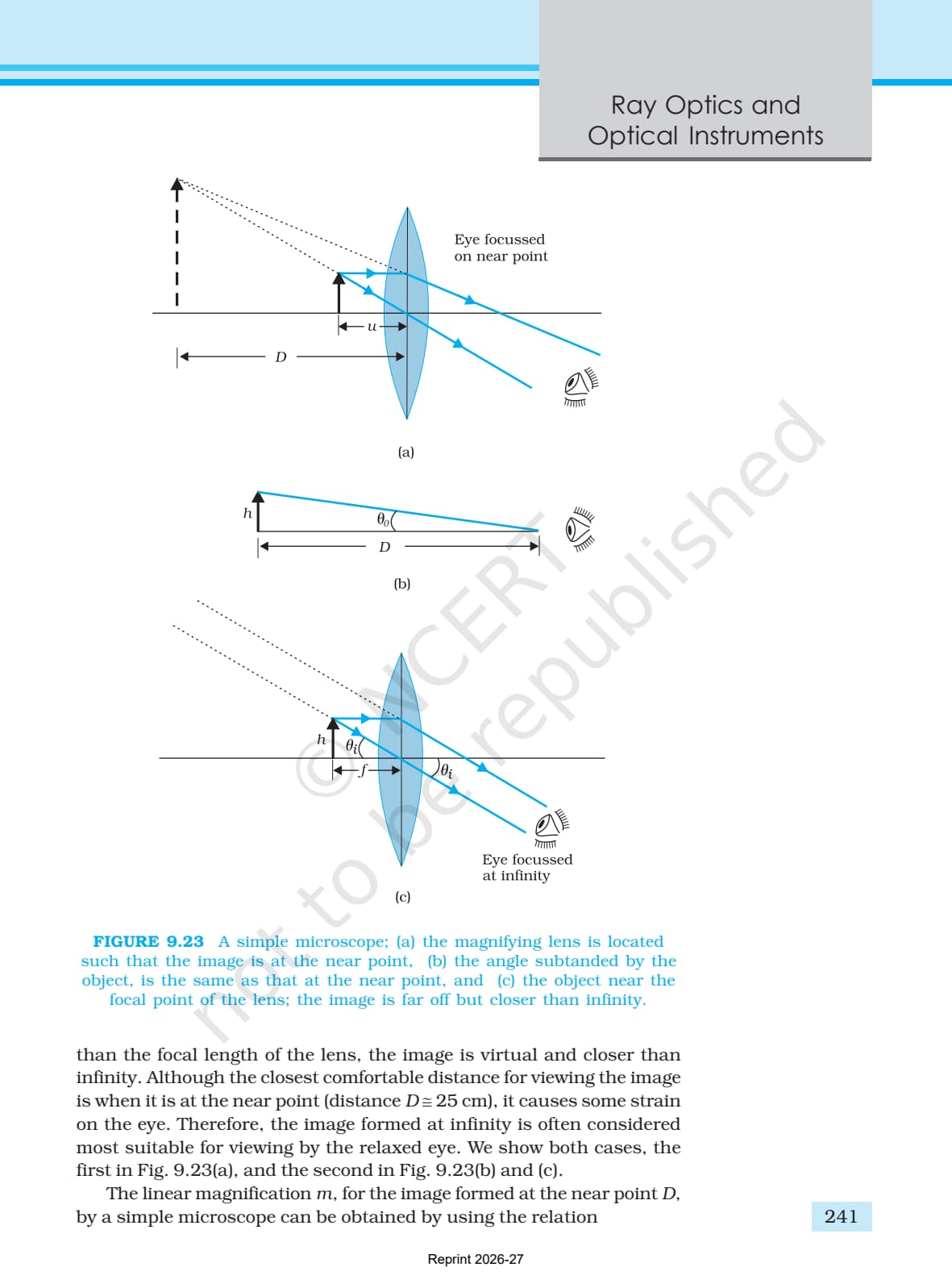
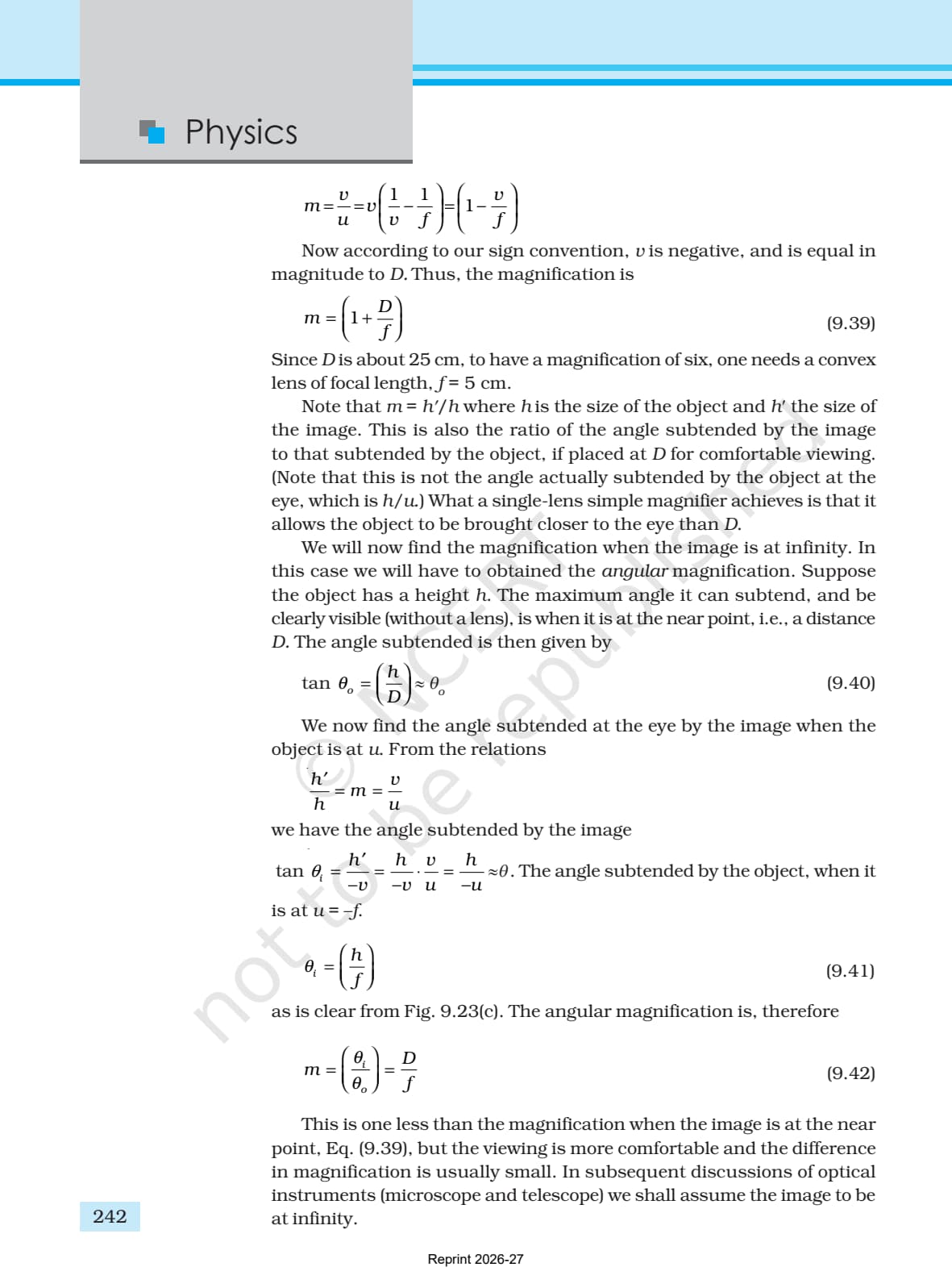
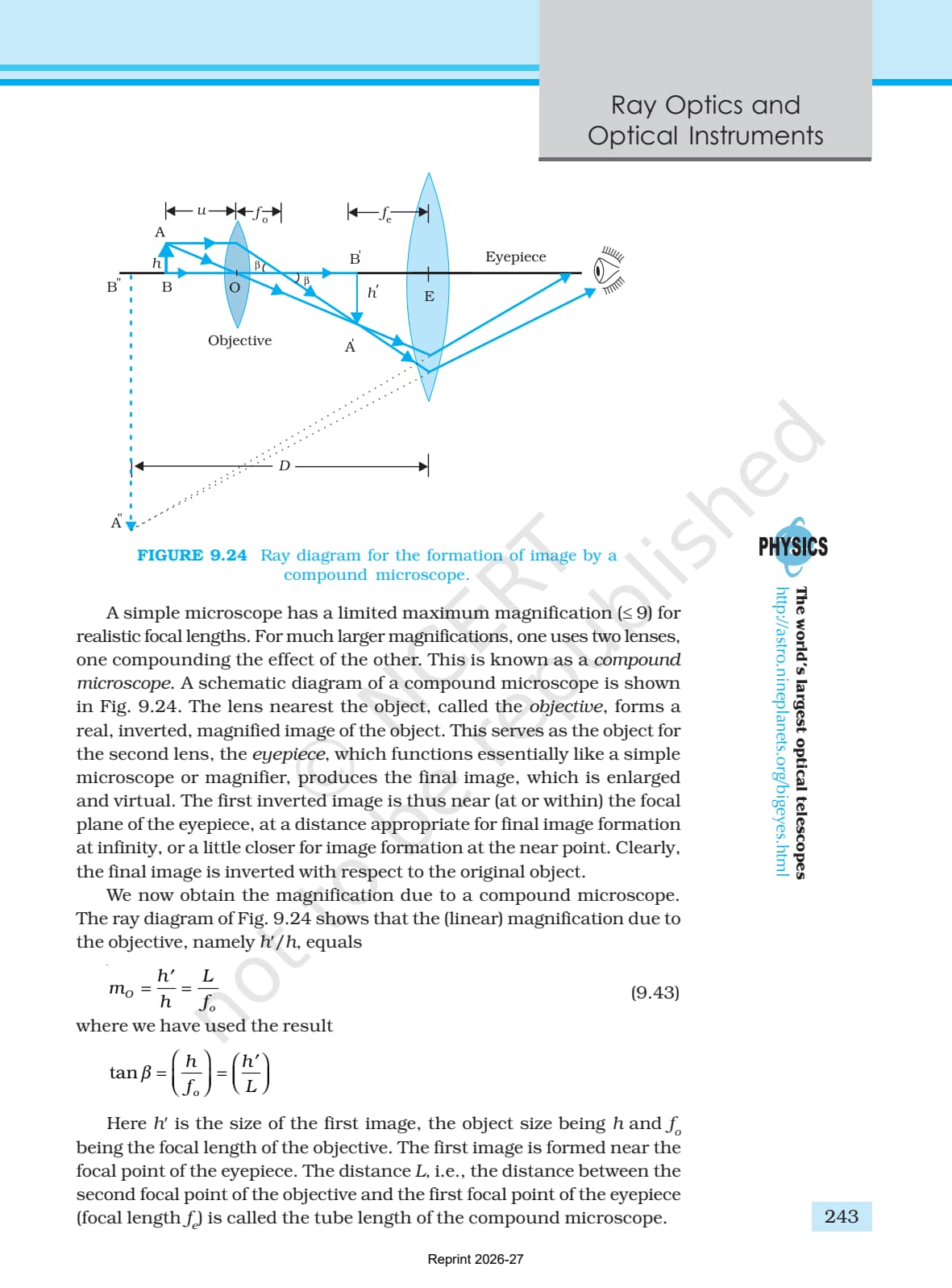
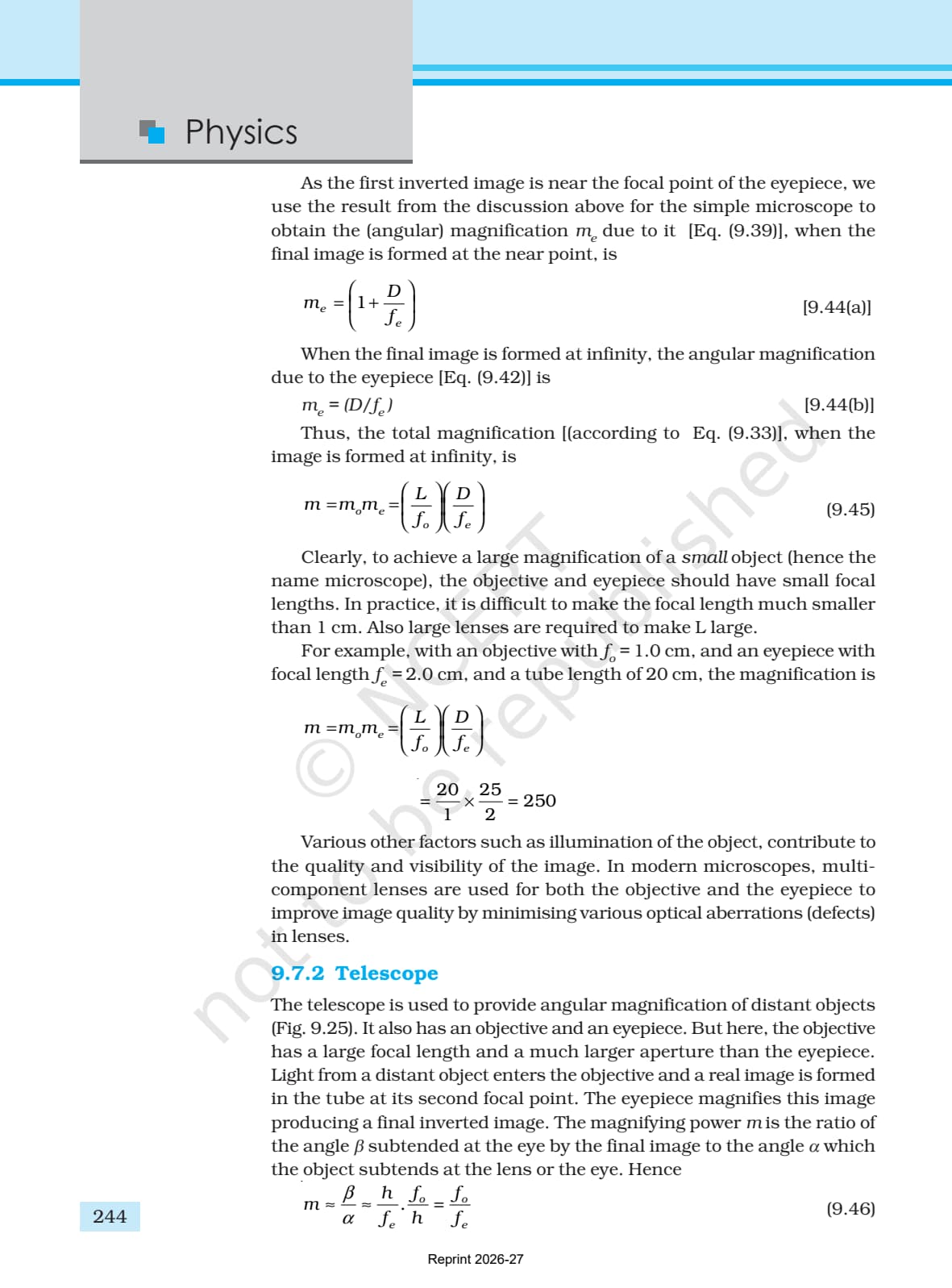
| 9.8 | Optical Instruments | 42 to 52 | Eye, microscope, telescope |
Ray Optics Intext Example Inventory (Example 9.1 to 9.13)
Every NCERT intext Example is a likely Board or JEE Main question stem. The list below tags each of the 13 solved examples to its sub-topic and skill.
| Example | Sub-Topic | What it Covers |
|---|---|---|
| 9.1 | Concave mirror image | Mirror formula, sign convention |
| 9.2 | Convex rear-view mirror | Magnification of distant car |
| 9.3 | Rotating mirror | Rotation of mirror vs ray |
| 9.4 | Apparent depth in water | Snell's Law at normal incidence |
| 9.5 | TIR in a prism | Critical angle glass-air |
| 9.6 | Image by a glass slab | Lateral shift through slab |
| 9.7 | Single spherical surface | Single-surface refraction |
| 9.8 | Biconvex lens focal length | Lens maker's formula |
| 9.9 | Lenses in contact | 1/F = 1/f1 + 1/f2 |
| 9.10 | Minimum deviation prism | Prism formula for mu |
| 9.11 | Simple microscope | Angular magnification at D |
| 9.12 | Compound microscope | Two-lens magnification chain |
| 9.13 | Astronomical telescope | Magnification, tube length |
About 7 of the 13 Examples mirror standard CBSE 2-mark or 3-mark questions; 5 mirror JEE Main numericals on lens-mirror combinations.
How to Read the Ray Optics and Optical Instruments NCERT PDF
Use a three-pass method: skim all 52 pages first, then derive each formula on paper, then attempt the 13 Examples and 37 Exercises cold.
5-Day Multi-Day Study Plan for the 52-Page Ray Optics Chapter
Because this is the longest chapter, reading it in one sitting is impractical. The plan splits the 52 pages across five focused study days of about 10 pages each, with matching Examples and Exercises, sized for a 90 to 120 minute slot.
| Day | NCERT Pages | Topics to Read | Examples | Exercises |
|---|---|---|---|---|
| Day 1 | 1 to 10 | 9.1 Intro, 9.2 Spherical Mirrors, mirror formula | 9.1 to 9.3 | 9.1 to 9.5 |
| Day 2 | 10 to 20 | 9.3 Refraction, 9.4 TIR, optical fibres | 9.4, 9.5 | 9.6 to 9.12 |
| Day 3 | 20 to 32 | 9.5 Lenses, lens maker, combinations, prism start | 9.6 to 9.9 | 9.13 to 9.22 |
| Day 4 | 32 to 42 | 9.6 Prism, 9.7 Sunlight, 9.8 Eye and Microscope | 9.10, 9.11 | 9.23 to 9.30 |
| Day 5 | 42 to 52 | 9.8 Telescope, Summary, mixed PYQ practice | 9.12, 9.13 | 9.31 to 9.37 |
The cycle gives a student roughly ten pages and five to seven problems each day and leaves Day 5 free for revision of the optical-instruments block, the chapter's most frequent PYQ generator.
Ray Optics Chapter Weightage Bar Chart Across Class 12 Physics
The visual below maps the typical CBSE Class 12 Physics marks distribution across all 14 chapters of the NCERT book, averaged over the last five board papers.
Ray Optics 2026-27 NCERT Edition Note
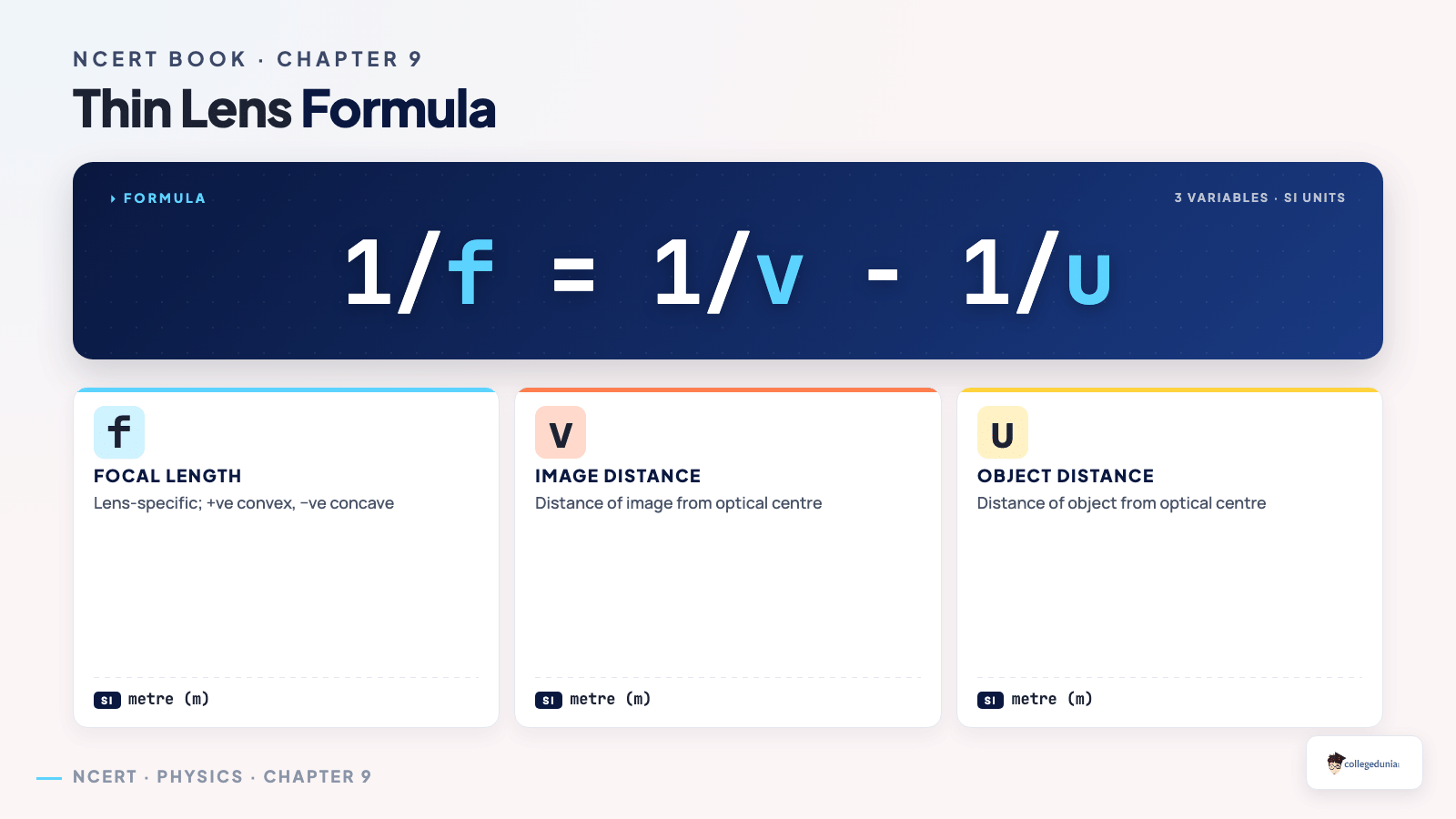
The current 2026-27 NCERT edition keeps all five hero formulae intact: mirror formula 1/v + 1/u = 1/f, lens maker's formula, thin lens formula, prism formula mu = sin((A + deltam)/2)/sin(A/2), and the microscope and telescope magnifications. The reflecting telescope description in Section 9.8 was tightened and a few Example numbers refreshed.
Full version: Ray Optics 2026-27 Notes
Ray Optics Top 5 Formulae from the NCERT Chapter
The five formulae below drive every numerical in Chapter 9 across CBSE Board, JEE Main, and NEET. The full master table with dimensional checks and a decision tree sits on the Formula Sheet page.
| Concept | Formula | NCERT Section |
|---|---|---|
| Mirror formula with sign convention | 1/v + 1/u = 1/f | 9.2 |
| Lens maker's formula | 1/f = (n - 1)(1/R1 - 1/R2) | 9.5 |
| Prism at minimum deviation | mu = sin((A + deltam)/2) / sin(A/2) | 9.6 |
| Compound microscope (image at D) | M = (L/fo)(1 + D/fe) | 9.8 |
| Astronomical telescope (normal adjustment) | M = fo/fe, L = fo + fe | 9.8 |
Full master table: Ray Optics Class 12 Physics Formula Sheet
Ray Optics Class 12th Physics Previous Year Question Trends
Three trends define the PYQ pattern in Chapter 9 over the last three years. The full year-wise PYQ map across CBSE, JEE Main, and NEET sits on the NCERT Solutions page.
- Lens maker and lens combinations: CBSE 2025 (5-mark long answer) and JEE Main 2025 numerical-value type.
- Prism angle of minimum deviation: CBSE 2024 (3-mark) and NEET 2024.
- Microscope and Telescope formulae: CBSE 2023 (5-mark derivation), JEE Main 2023, and NEET 2023.
Student Feedback
"The section-wise page map helped me find the TIR part in under a minute during revision." - Class 12 student, Delhi
"I used the 5-day plan and finished the chapter without feeling overwhelmed. Section 9.8 finally made sense." - NEET aspirant
"The formula table in this page is a quick reference I keep open during practice." - JEE Main student
Other Resources for Ray Optics and Optical Instruments Class 12 Physics
| Resource | Link |
|---|---|
| NCERT Book PDF | Ray Optics and Optical Instruments |
| NCERT Solutions | Ray Optics and Optical Instruments NCERT Solutions |
| Notes | Ray Optics and Optical Instruments Notes |
| Formula Sheet | Ray Optics and Optical Instruments Formula Sheet |
NCERT Book PDF for Class 12 Physics: All Chapters
Other Class 12 Physics NCERT Book PDFs you can grab as free downloads:
| Chapter | Resource |
|---|---|
| Chapter 1 | Electric Charges and Fields NCERT PDF |
| Chapter 2 | Electrostatic Potential and Capacitance NCERT PDF |
| Chapter 3 | Current Electricity NCERT PDF |
| Chapter 4 | Moving Charges and Magnetism NCERT PDF |
| Chapter 5 | Magnetism and Matter NCERT PDF |
| Chapter 6 | Electromagnetic Induction NCERT PDF |
| Chapter 7 | Alternating Current NCERT PDF |
| Chapter 8 | Electromagnetic Waves NCERT PDF |
| Chapter 9 | Ray Optics and Optical Instruments NCERT PDF |
| Chapter 10 | Wave Optics NCERT PDF |
| Chapter 11 | Dual Nature of Radiation and Matter NCERT PDF |
| Chapter 12 | Atoms NCERT PDF |
| Chapter 13 | Nuclei NCERT PDF |
| Chapter 14 | Semiconductor Electronics NCERT PDF |
Ray Optics NCERT PDF - Frequently Asked Questions
Ques. Where can I download the Ray Optics NCERT PDF for free?
Ans. You can download the Ray Optics Ncert Pdf directly from this page. Both the Normal and HD versions are available, and both are free.
Ques. Is this Ray Optics NCERT PDF aligned with the 2026-27 CBSE syllabus?
Ans. Yes. The PDF on this page reflects the current 2026-27 syllabus for Class 12 Physics. All eight sections from 9.1 Introduction to 9.8 Optical Instruments, the 13 intext Examples, and the 37 end-of-chapter Exercises are retained in the new NCERT edition.
Ques. How many pages is the Class 12th Physics Ray Optics and Optical Instruments NCERT Book PDF?
Ans. The NCERT Book PDF runs approximately 52 pages, making it the longest chapter in the Class 12 Physics textbook. It covers eight numbered sections, 13 intext Examples, 37 end-of-chapter Exercises, a Summary, and three Appendices.
Ques. Why is Chapter 9 the highest weightage chapter in Class 12 Physics?
Ans. Chapter 9 carries 7 to 9 marks in the CBSE Board paper, around 4 to 5 percent of JEE Main, and 3 to 4 NEET questions per year. Section 9.5 on lenses and Section 9.8 on optical instruments together drive most of those marks through lens maker, prism, microscope, and telescope problems.
Ques. How should a student plan the 52-page Ray Optics chapter?
Ans. The recommended approach is a 5-day plan of roughly 10 pages each day: Day 1 spherical mirrors, Day 2 refraction and total internal reflection, Day 3 lenses and lens maker's formula, Day 4 prism and the microscope, Day 5 telescope plus mixed PYQ and Exemplar practice.
Ques. Which section of Chapter 9 is asked most often in CBSE and JEE?
Ans. Section 9.8 Optical Instruments is the most frequent PYQ generator. The compound microscope and the astronomical telescope appear in almost every Board cycle as a 3-mark or 5-mark question, and their angular magnification formulae must be memorised in both image-at-D and image-at-infinity forms.
Ques. Is the Class 12 Physics Chapter 9 PDF enough for JEE Main and NEET?
Ans. The NCERT chapter is essential but not sufficient on its own for JEE Main, where lens-mirror combination problems demand additional Exemplar and PYQ practice. For NEET, the NCERT alone is usually adequate, as 3 to 4 questions per year are drawn directly from the text.
Ques. How many Examples and Exercises are in Chapter 9?
Ans. There are 13 in-text Examples (Example 9.1 to 9.13) interspersed through the eight sections and 37 numbered Exercises at the end of the chapter. The end-of-chapter set mixes conceptual questions, ray diagrams, prism numericals, and standard microscope and telescope problems.



Comments