




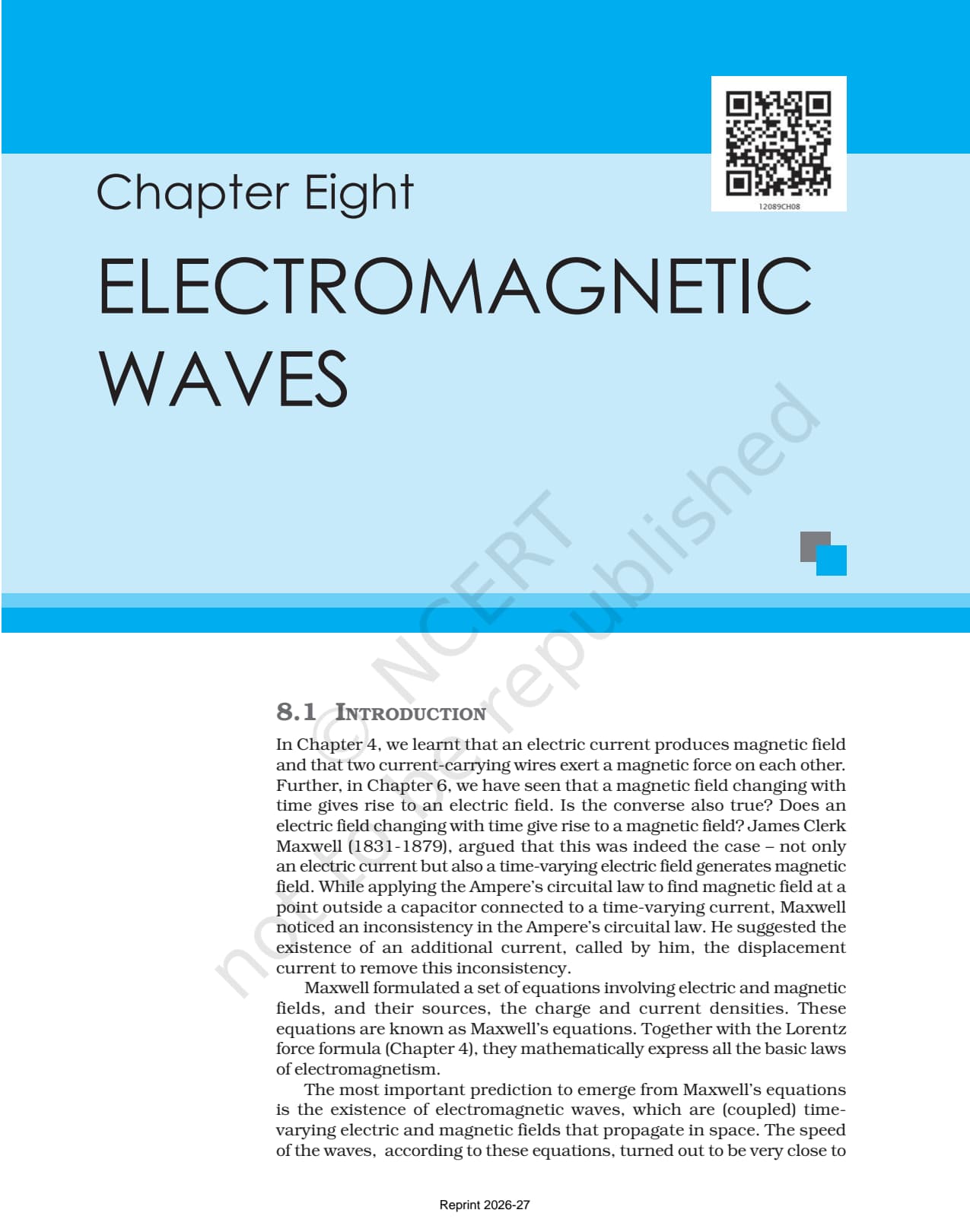
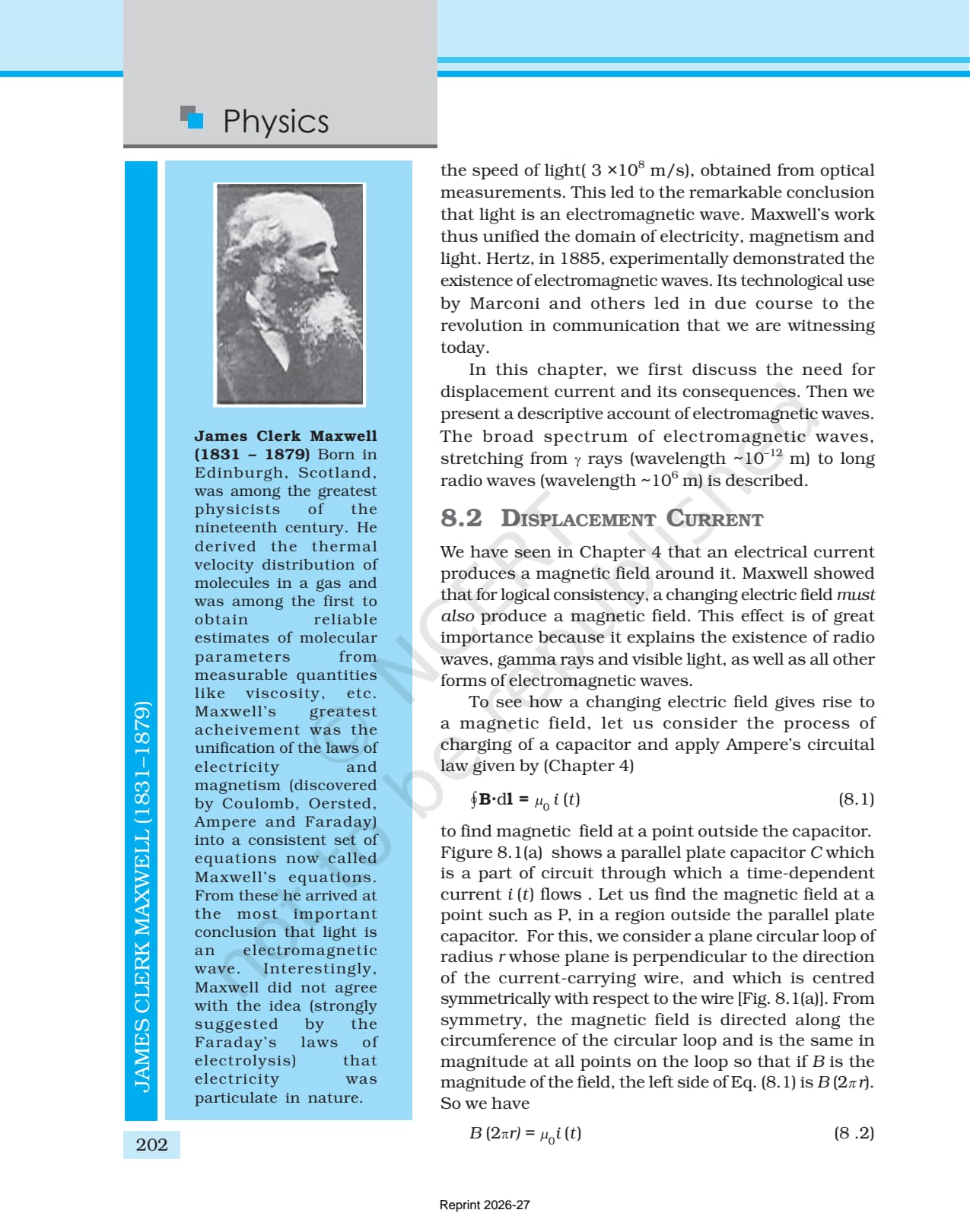
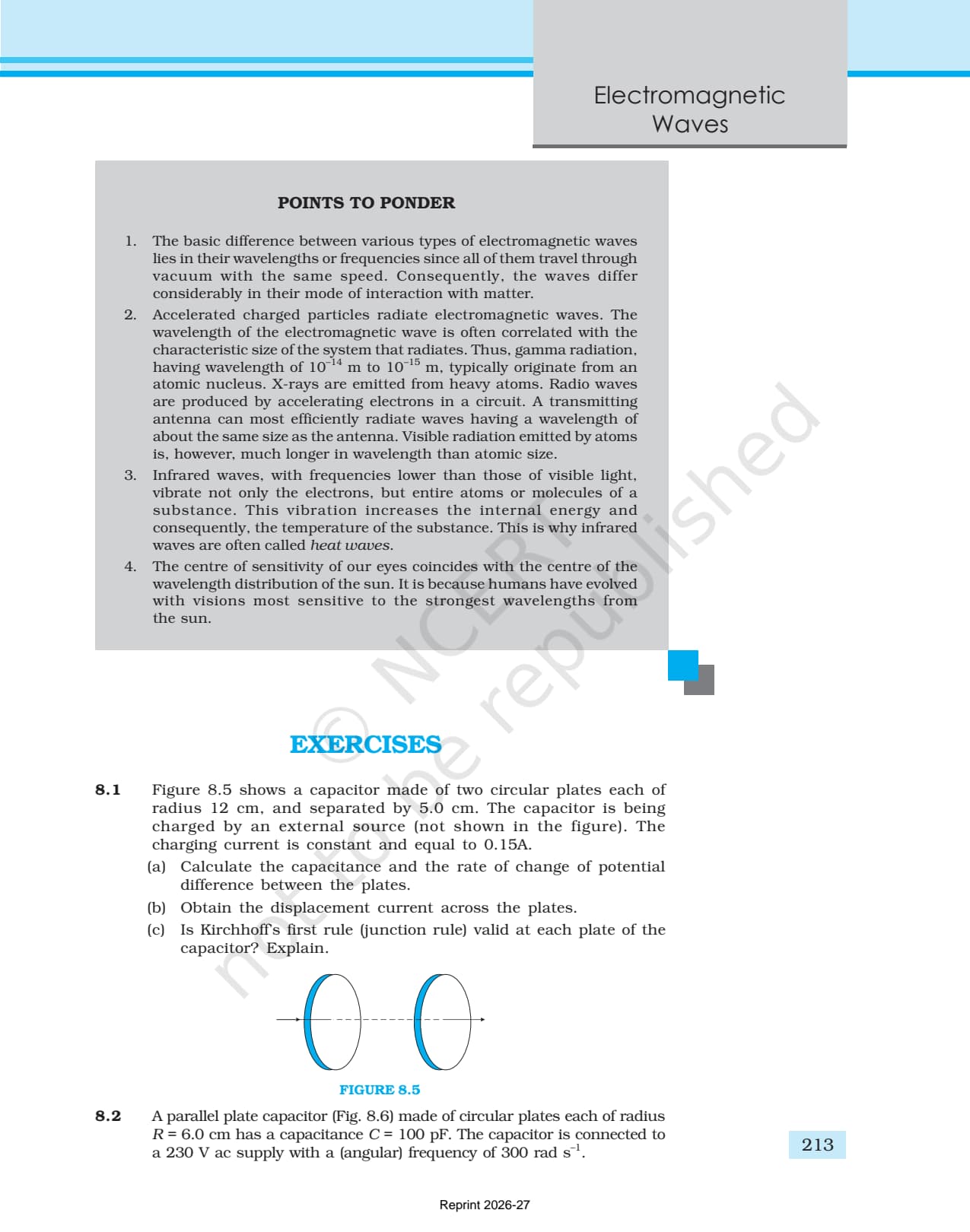
Class 12 Physics Chapter 8 covers how Maxwell completed electromagnetism and predicted the existence of EM waves. The 2026-27 NCERT edition runs just 16 pages - short by textbook standards but packed with exam content. Download the free PDF below or flip through it page by page in the viewer.
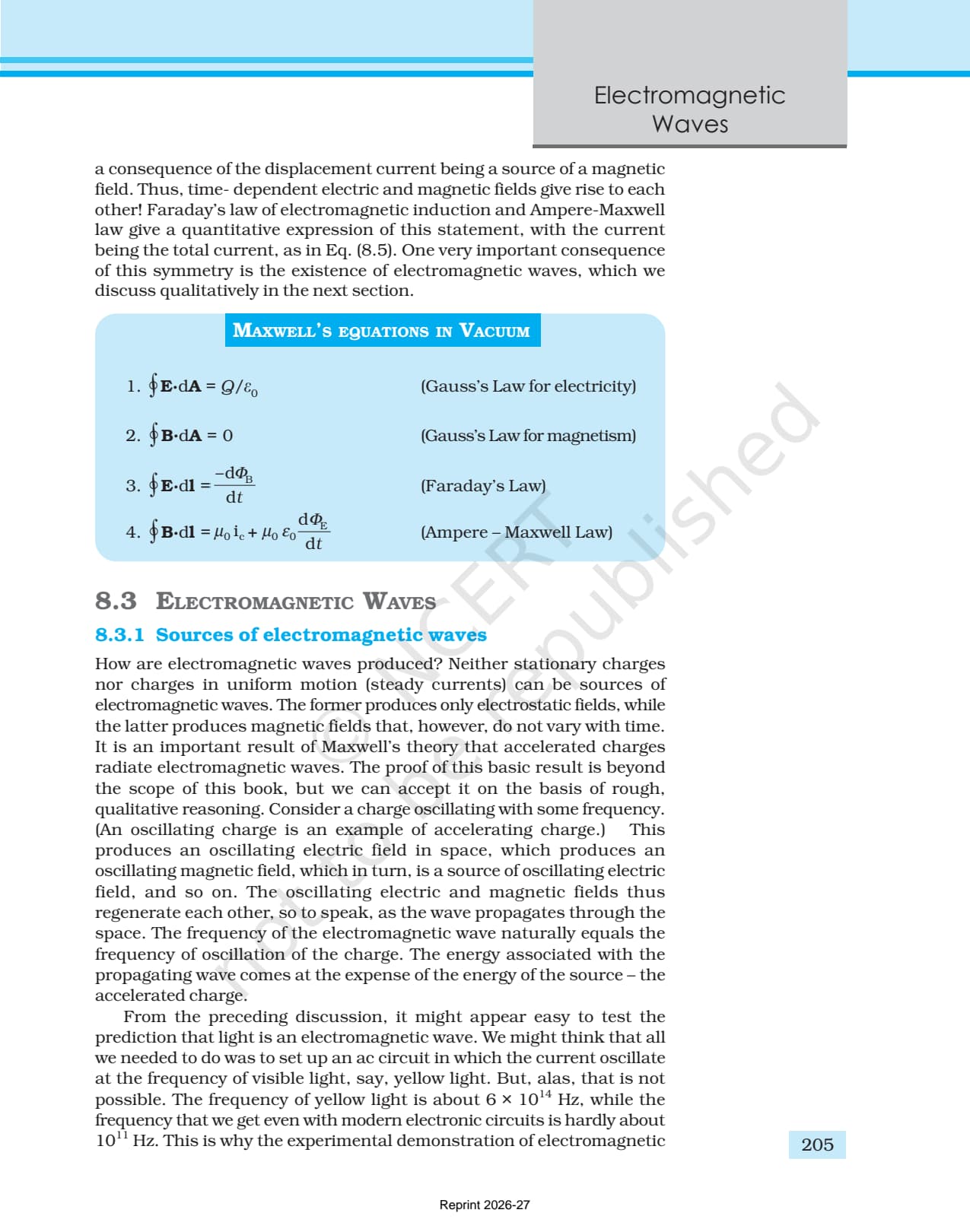
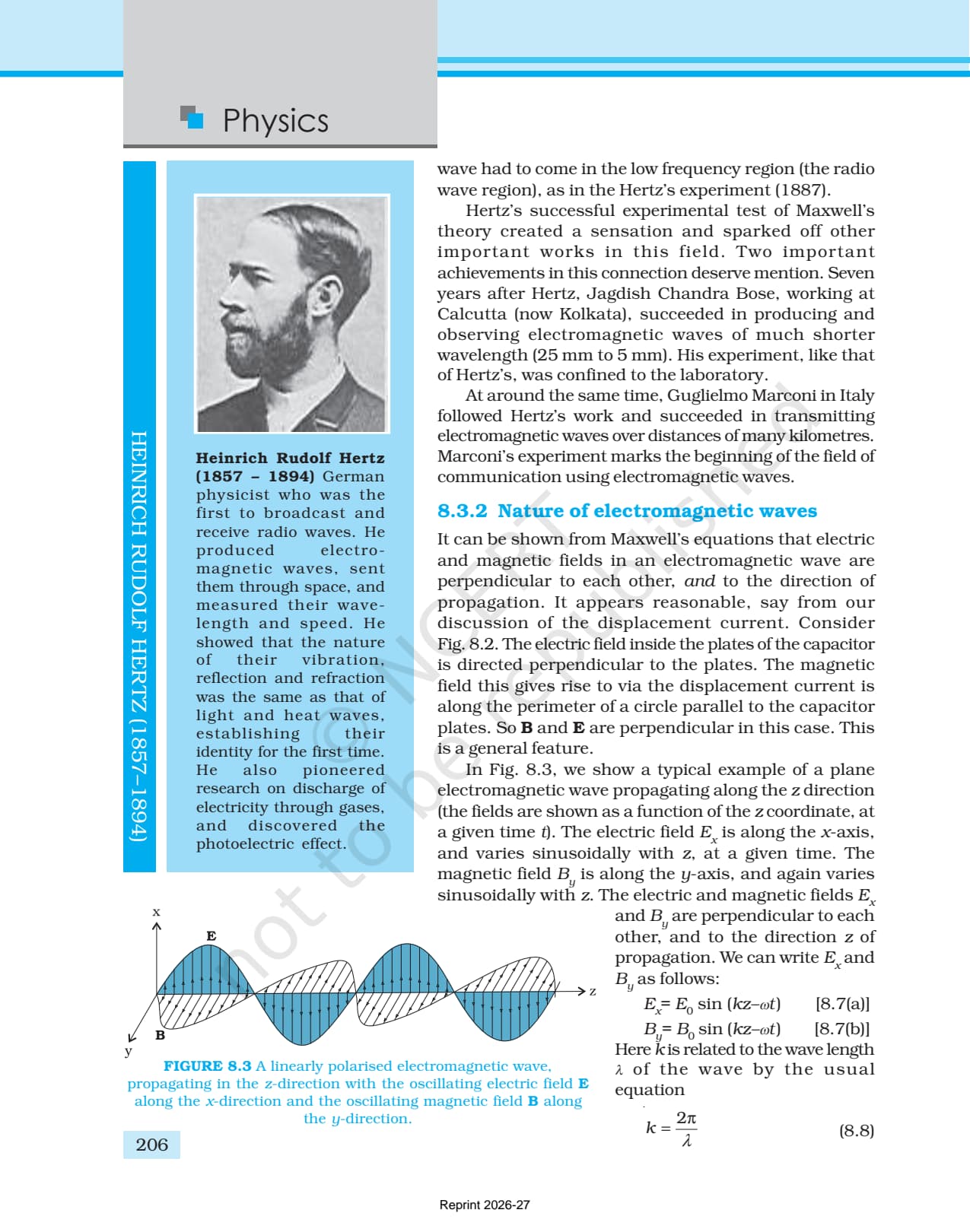
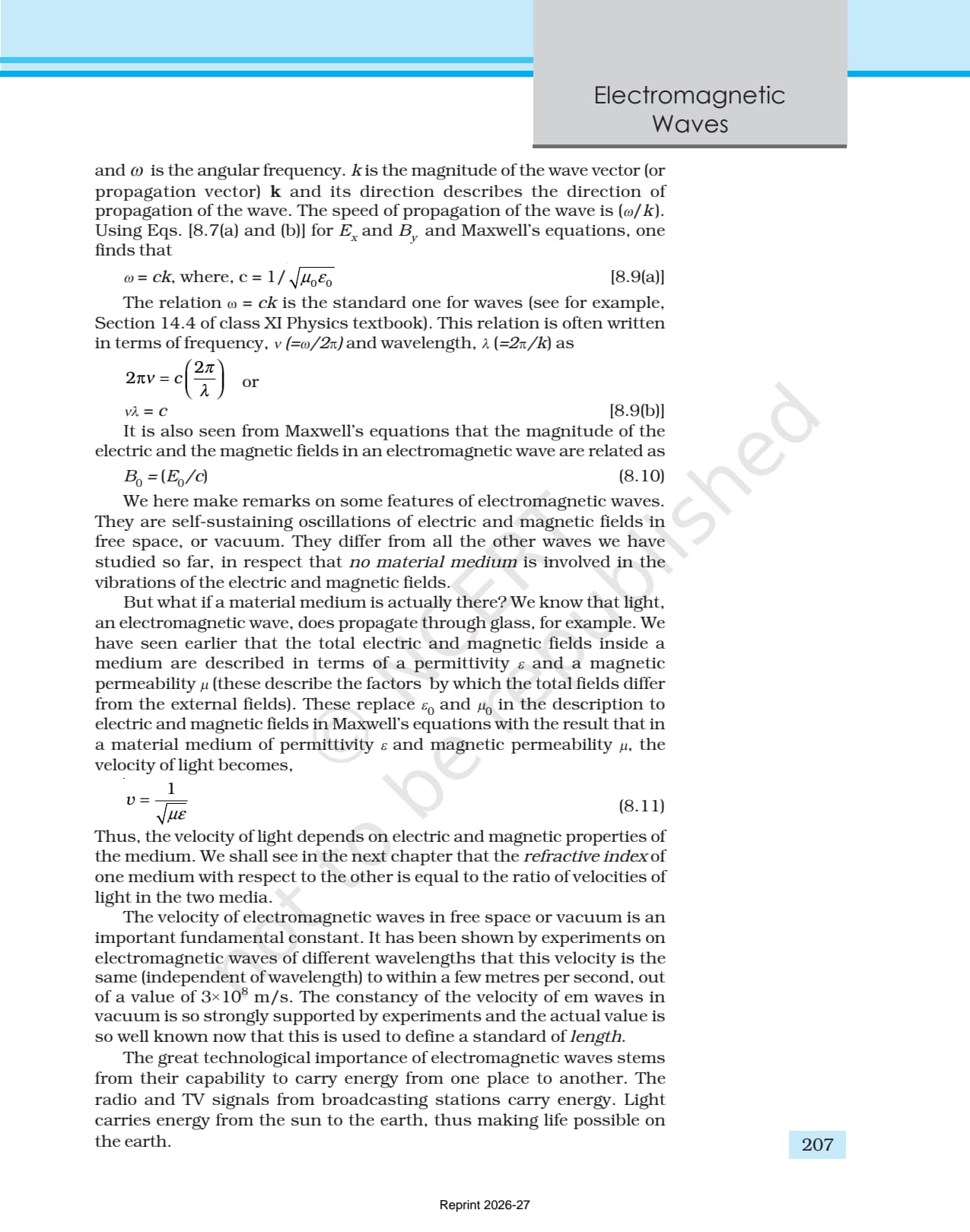
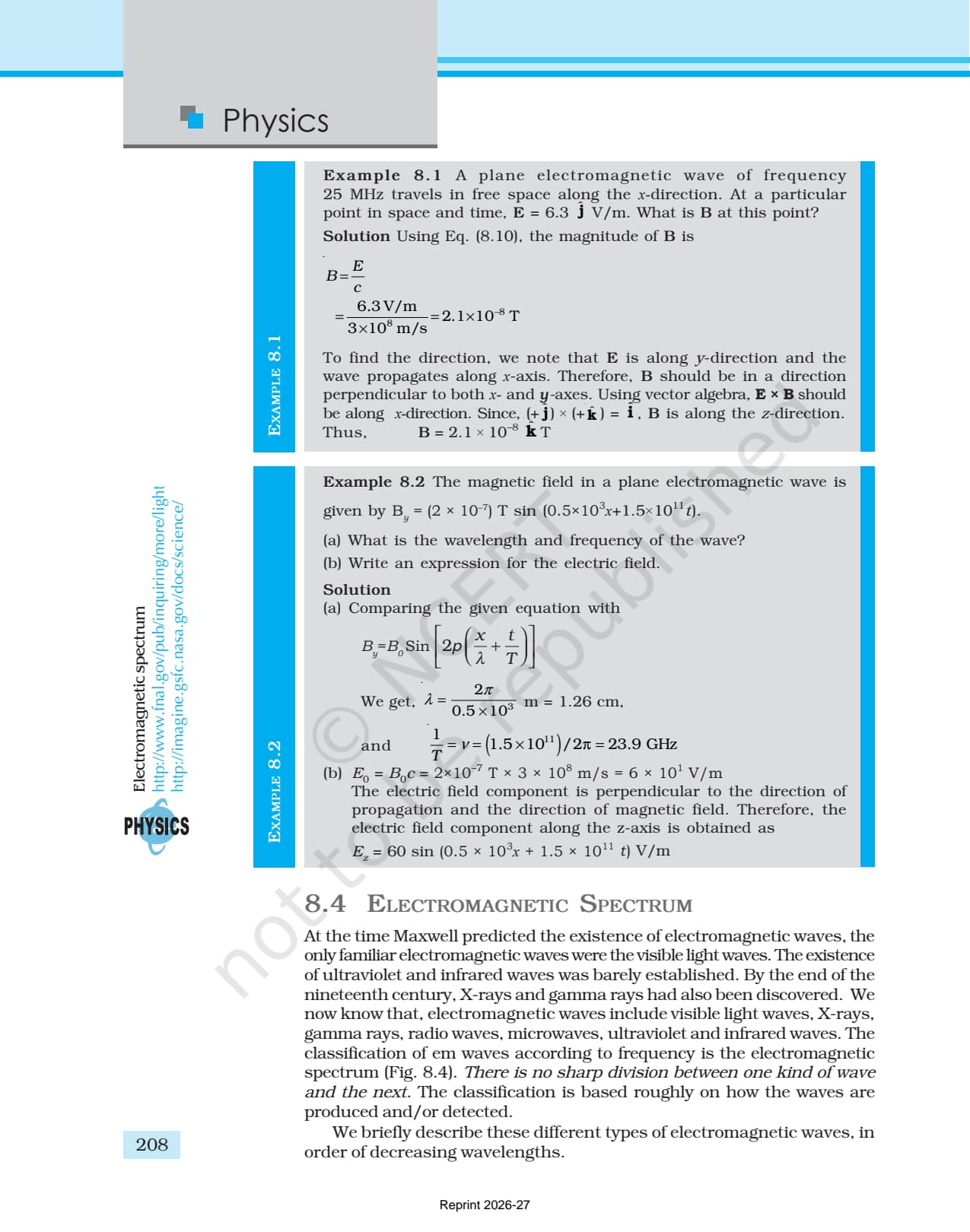
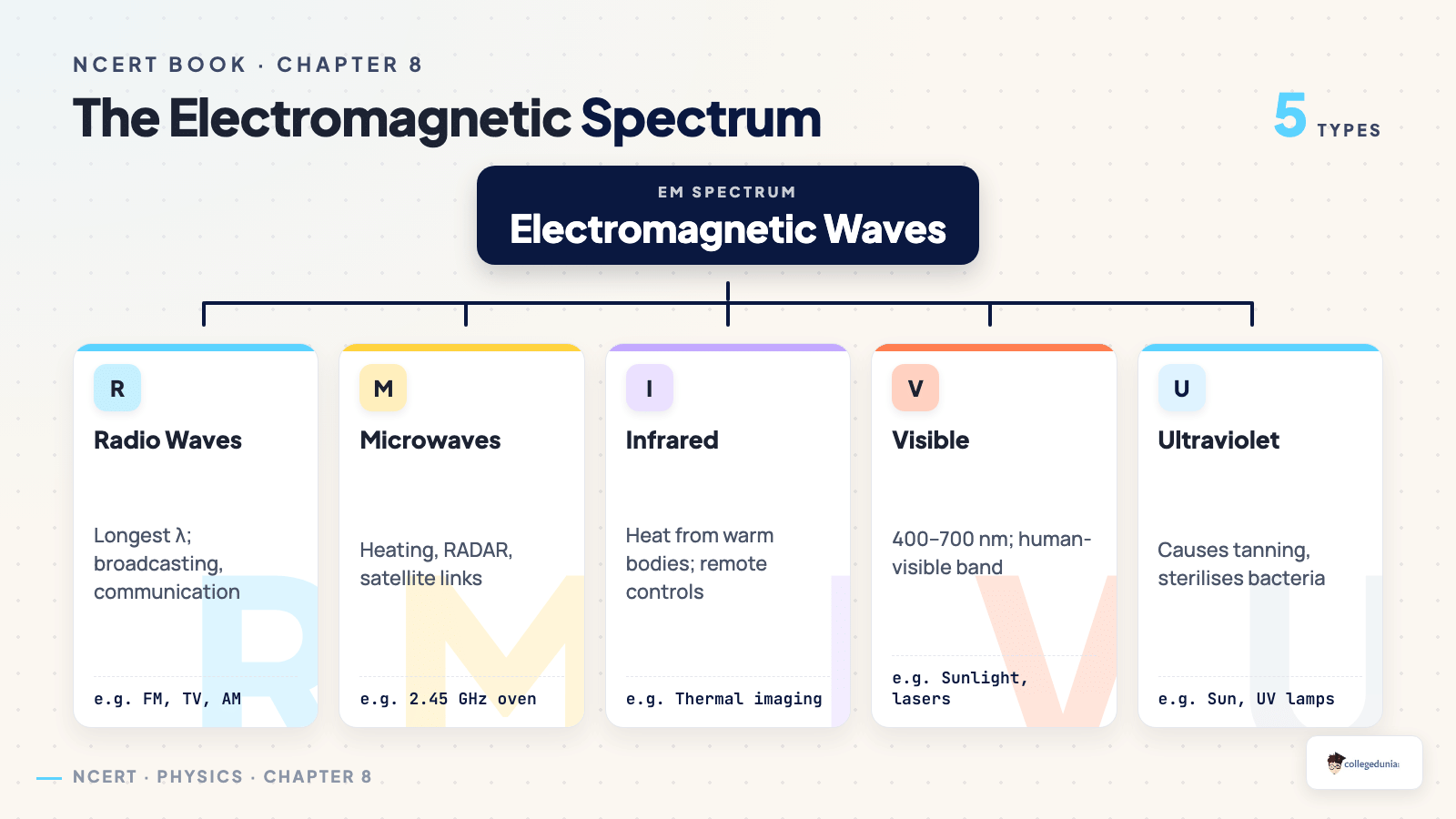
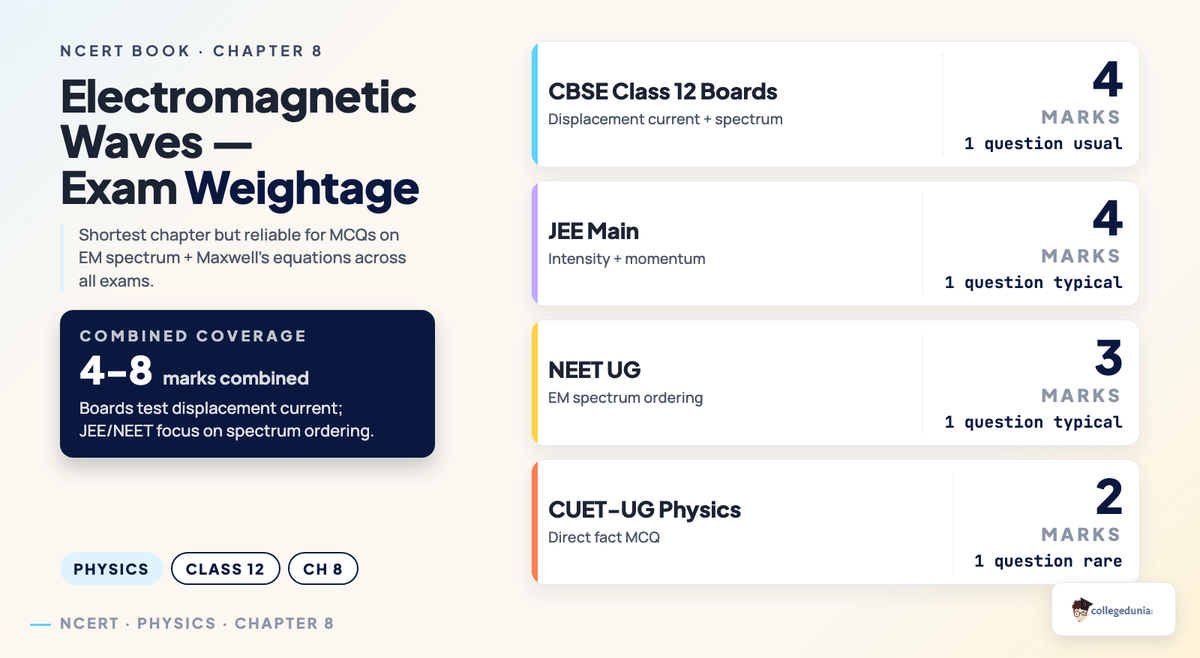
- CBSE Weightage: 2-3 marks (MCQ-heavy, low prose weight)
- JEE Main Weightage: 1-2% - roughly 1 question per paper
- NEET Weightage: 1 question per year, usually EM spectrum or displacement current
This NCERT Book PDF page is curated by subject experts, mapped to the 2026-27 NCERT edition, and refined against the last five years of CBSE Board, JEE Main, and NEET papers.
How the Electromagnetic Waves NCERT PDF on Collegedunia Helps You
Chapter 8 is short but dense with definitions and band data examiners love to test. Here is what this page gives you on top of the PDF itself.
- 2026-27 NCERT Alignment: Section, example, and exercise counts match the current NCERT print.
- Single-Sitting Plan: One-day plan tailored to the chapter's small size.
- PYQ-Anchored Reading: Each section tagged with the exam it most frequently appears in.
Electromagnetic Waves Video Lecture - Class 12 Physics Chapter 8
Source: NCERT Wallah on YouTube
NCERT Section-by-Section Breakdown for Class 12 Physics Chapter 8
The chapter divides into four sections that run from Maxwell's original correction to the full EM spectrum. The table shows the page range for each in the official PDF.
| Section | Title | Page Range | What it Covers |
|---|---|---|---|
| 8.1 | Introduction | 1-2 | Maxwell's unification of electricity and magnetism. |
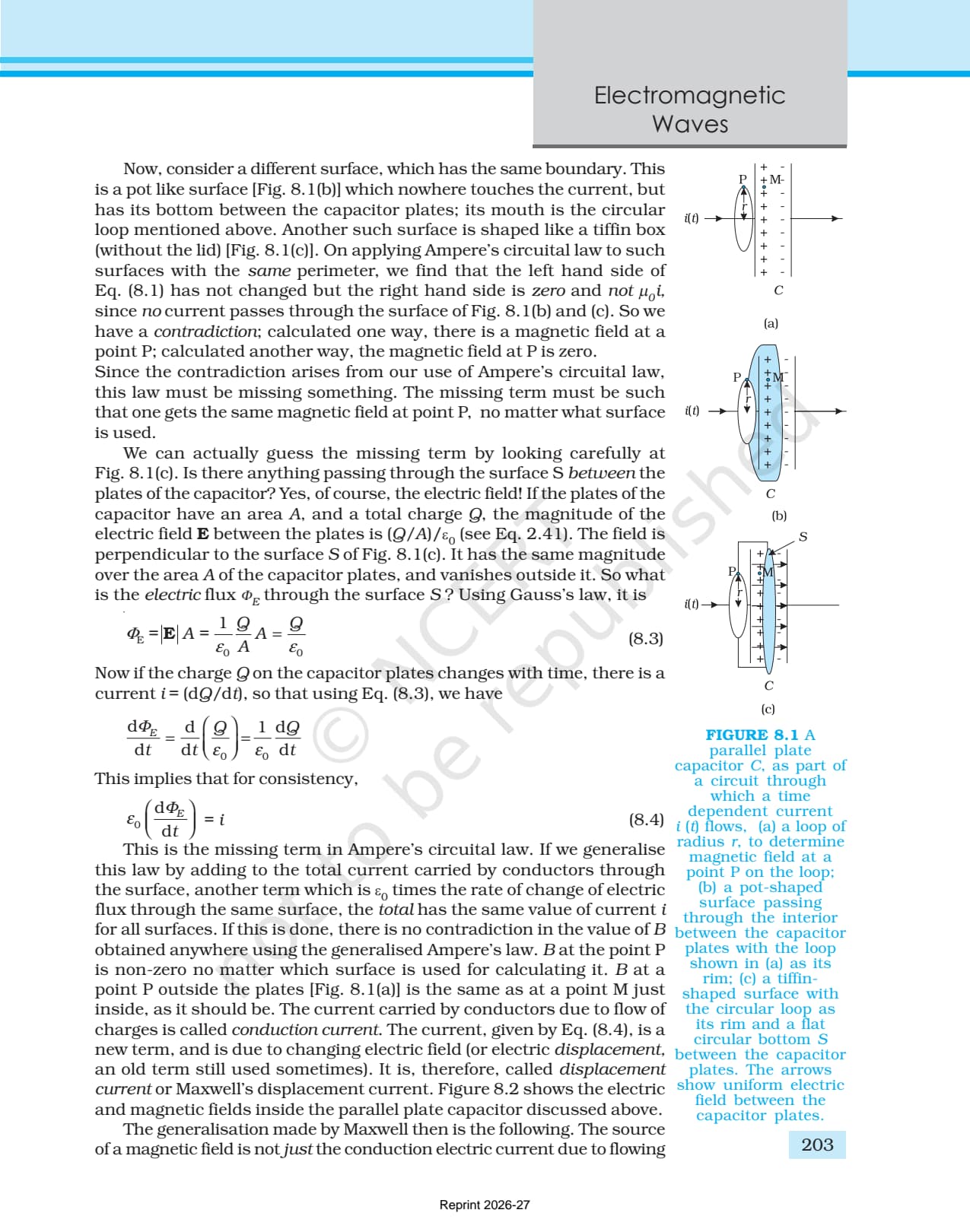
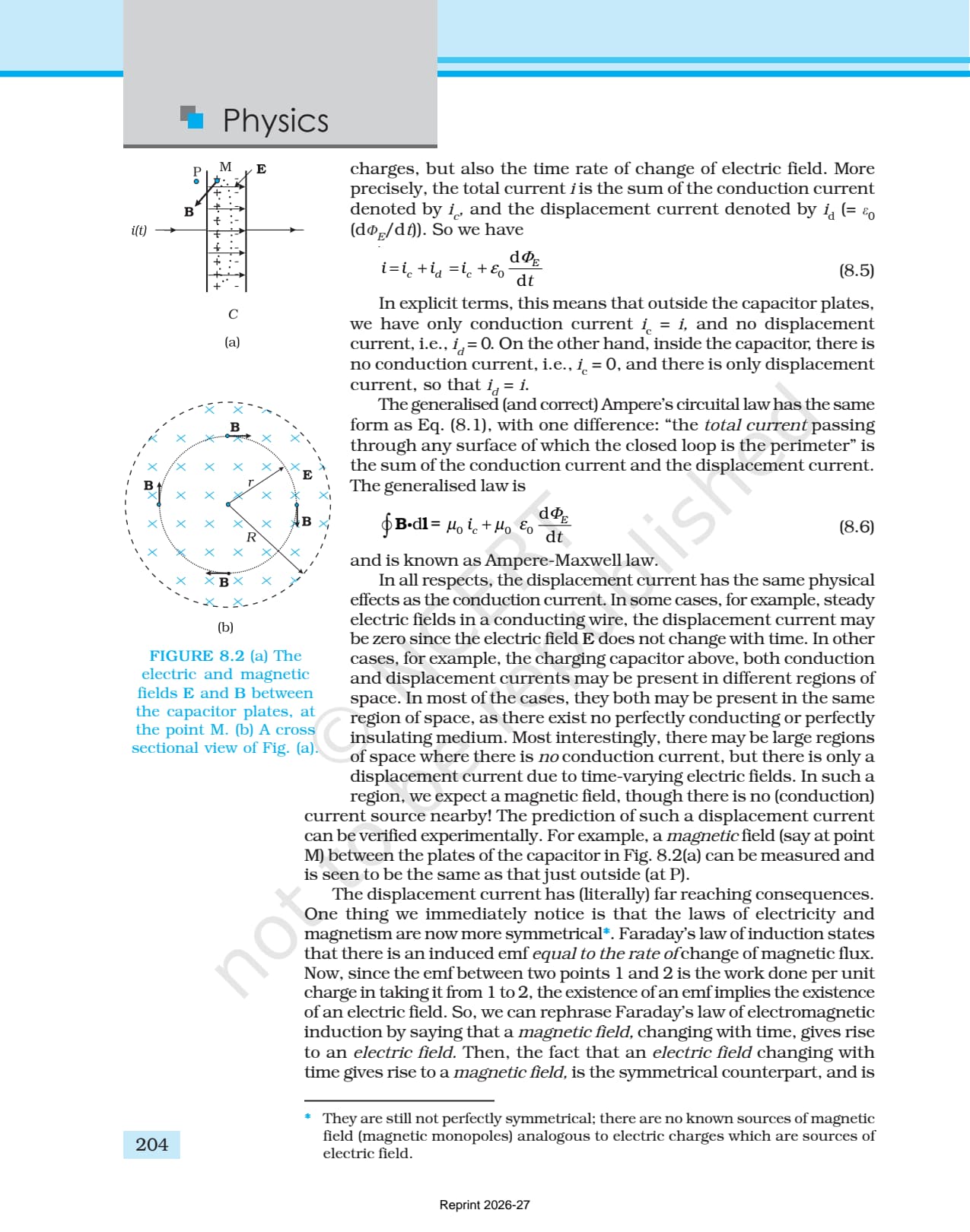
| 8.2 | Displacement Current | 3-6 | Capacitor-charging inconsistency, definition of Id, Ampere-Maxwell law. |
| 8.3 | Electromagnetic Waves | 7-11 | Transverse nature, speed c, energy density, momentum, intensity. |
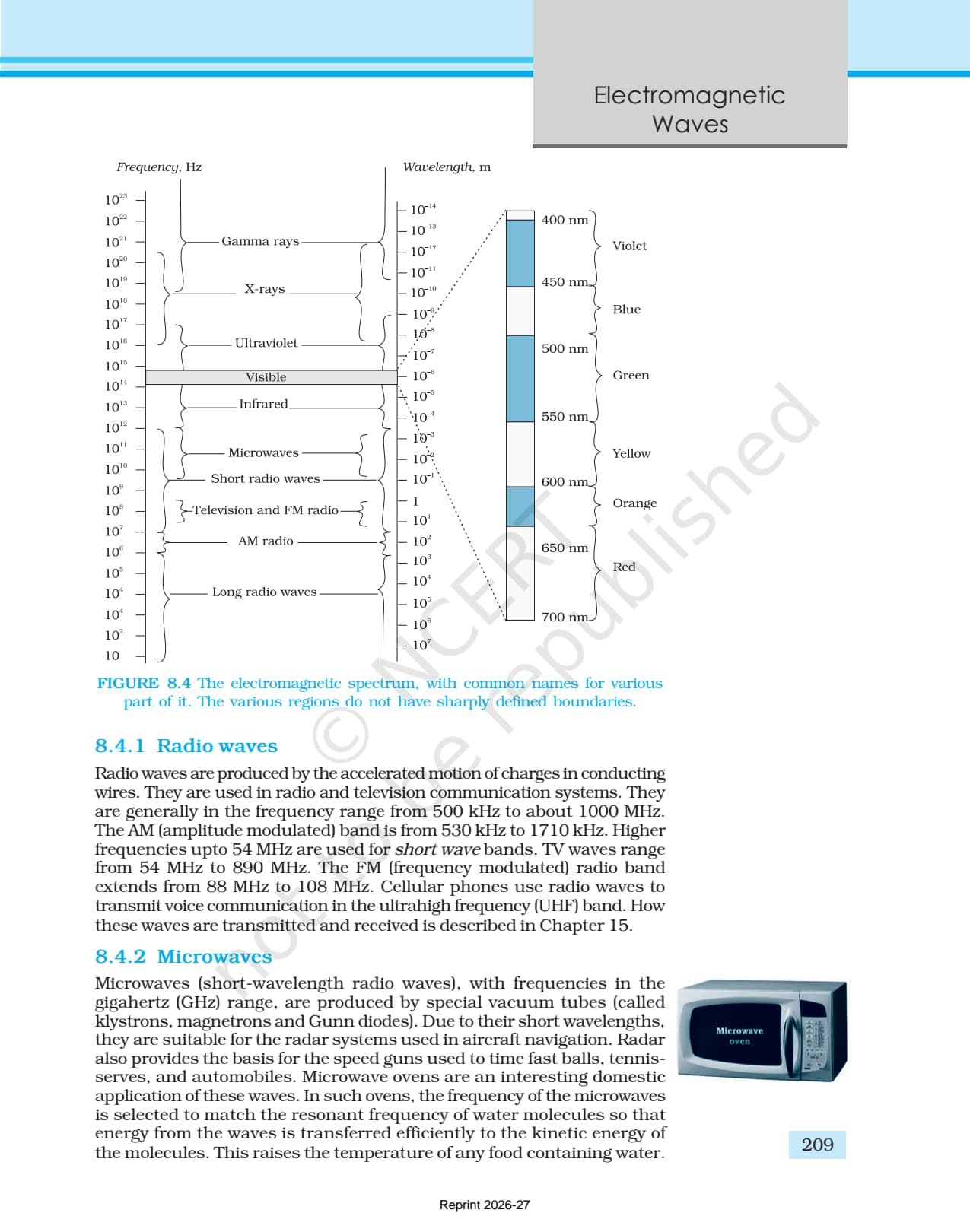
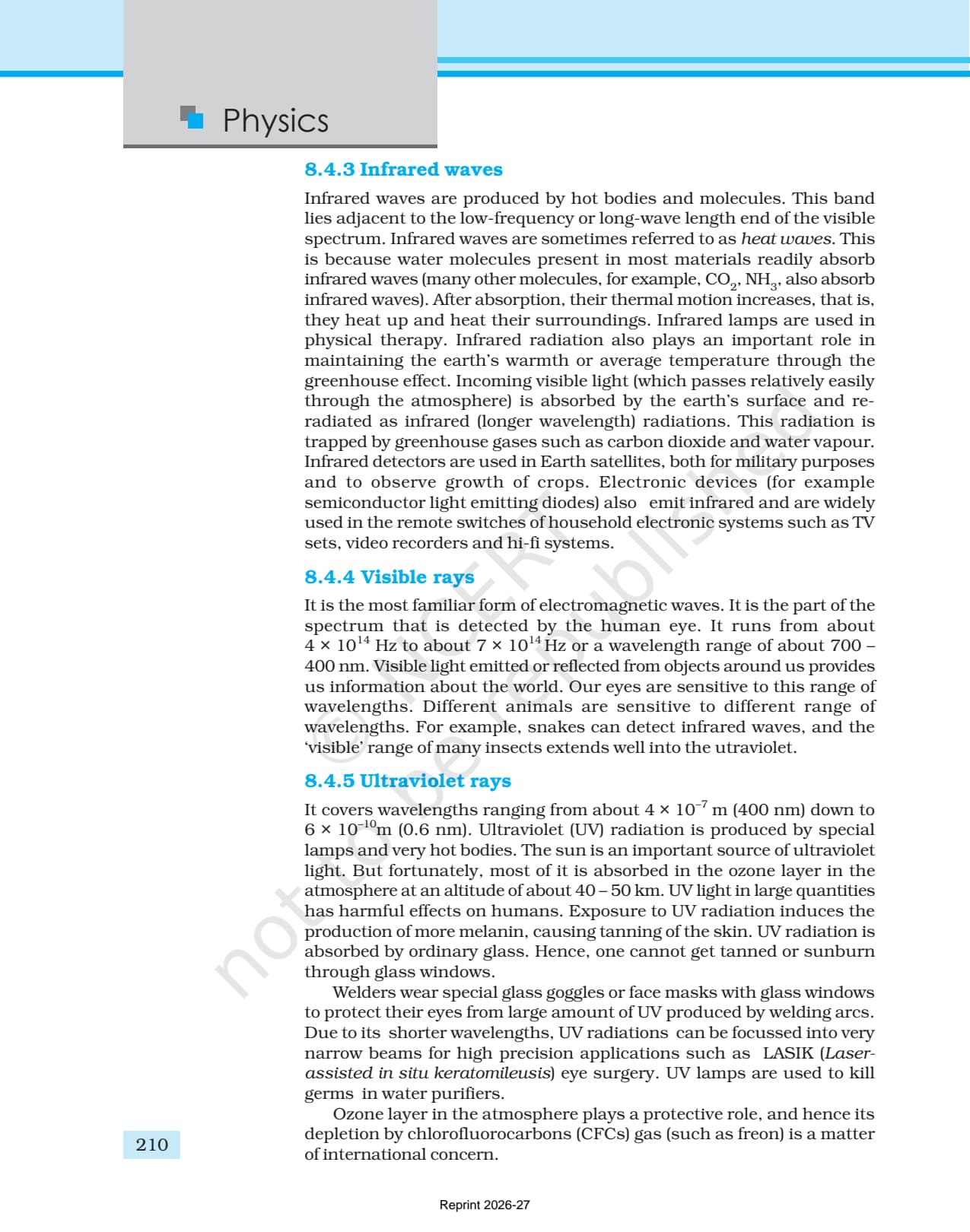
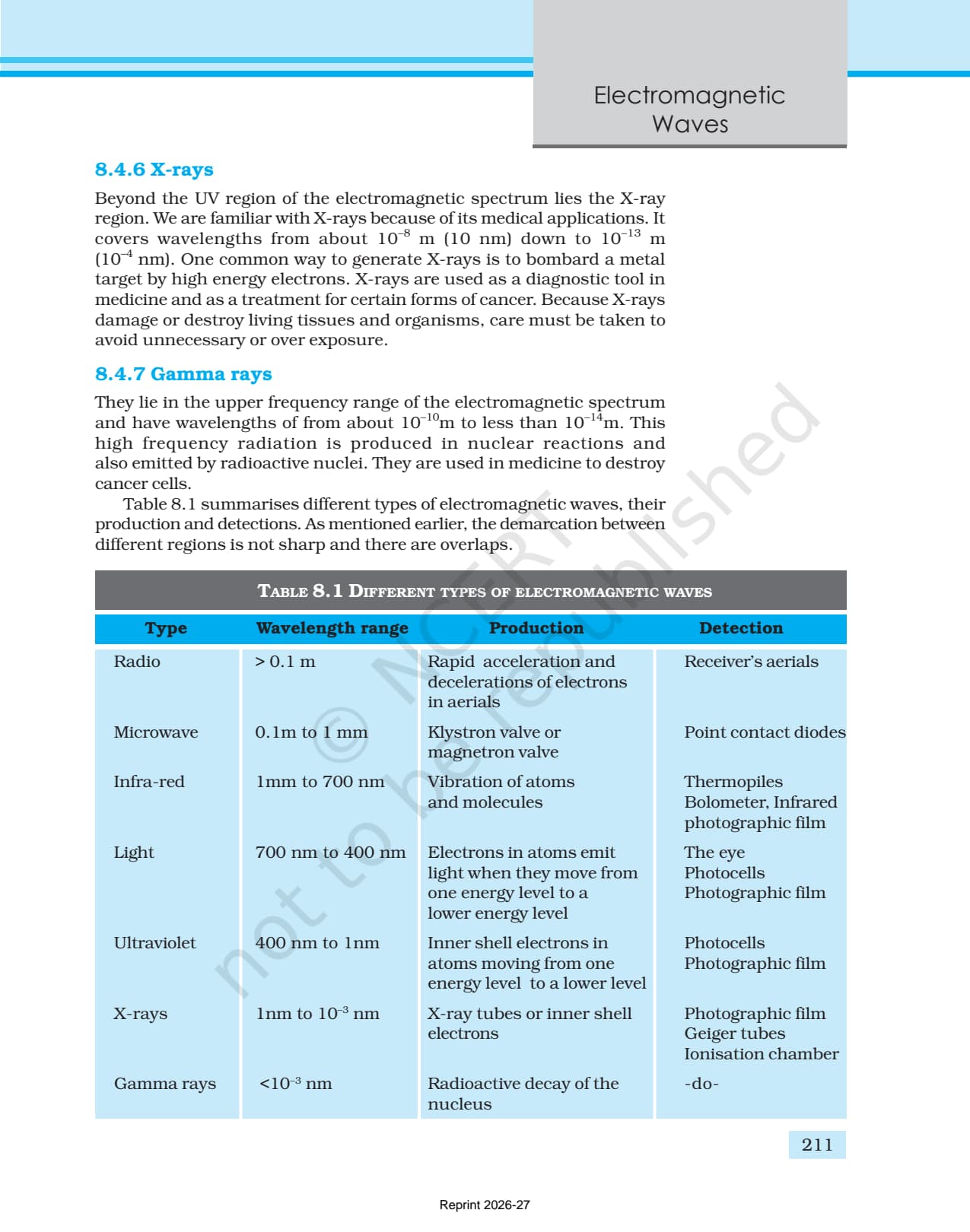
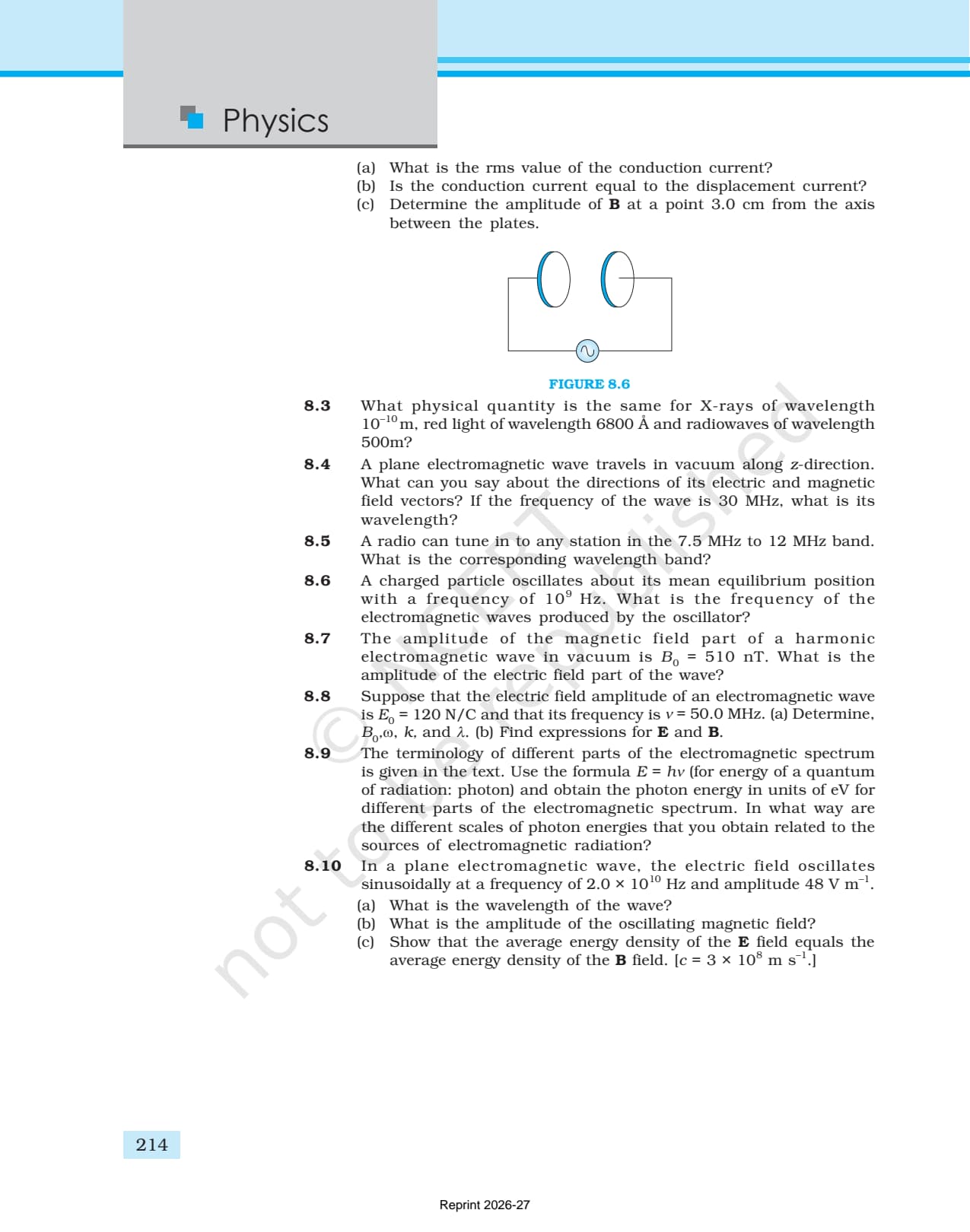
| 8.4 | Electromagnetic Spectrum | 12-16 | Seven bands with sources, wavelength ranges, and uses. |
Sections 8.2 and 8.4 carry the bulk of the exam weight. Treat them as primary reads, with Sections 8.1 and 8.3 as supporting material.
Intext Example Inventory for Electromagnetic Waves Chapter 8
The chapter has three intext examples that cover the three core formulae. Solving each once is enough to handle the matching CBSE 2-mark question type.
| Example | Sub-topic | What it Covers |
|---|---|---|
| Example 8.1 | Displacement Current in a Parallel Plate Capacitor | Calculating Id from dE/dt and capacitor geometry. |
| Example 8.2 | Magnetic Field Inside the Capacitor Gap | Applying Ampere-Maxwell law to a region with no conduction current. |
| Example 8.3 | EM Wave Parameters from E0 | Computing B0, wavelength, and frequency from a given electric-field amplitude. |
Together with 15 end-of-chapter exercises, students get 18 worked or solvable problems across just 16 pages.
How to Study Electromagnetic Waves Class 12 Physics Chapter 8
Use a three-pass approach: skim, deep read, then practise. Total time is about 5-6 hours, which makes this chapter ideal for a single study day.
- Pass 1 (45 min): Skim all four sections. Mark every defined term in pencil without solving anything yet.
- Pass 2 (2 hours): Deep-read Sections 8.2 and 8.3. Derive Id and c on paper alongside the text.
- Pass 3 (2 hours): Work through Examples 8.1-8.3, then Exercises 8.1-8.15. Check answers only after attempting each one.
- Final pass (1 hour): Memorise the seven-band EM spectrum. Write wavelength range and one use per band on a single flashcard.
Single-Day Study Plan for the 16-Page Electromagnetic Waves PDF
The entire NCERT material fits in one focused day. This plan gives students six hours from first read to PYQ practice.
| Hour | Block | Tasks | Output |
|---|---|---|---|
| Hour 1 | Read Sections 8.1-8.4 | Skim every paragraph once. Mark defined terms in pencil. | One-page concept skeleton |
| Hour 2 | Intext Examples 8.1-8.3 | Solve each example without looking at the answer first. Compare after. | 3 solved examples |
| Hour 3 | Exercises 8.1-8.8 | Numerical-heavy first half. Focus on capacitor Id and wave parameters. | 8 exercise answers |
| Hour 4 | Exercises 8.9-8.15 | Conceptual second half. Verify against NCERT solutions after attempting. | 15 exercise answers |
| Hour 5 | EM Spectrum Memorisation | Memorise band order both ways. Write wavelength range + source + one use per band. | Spectrum flashcard |
| Hour 6 | PYQ Practice | Attempt 6 PYQs across CBSE/JEE/NEET. 90 sec per MCQ, 3 min per 2-marker. | 6 PYQs solved |
Keep to the schedule and the chapter is fully covered by evening. A second pass before the exam needs only the spectrum flashcard and the formula box.
2026-27 Syllabus Changes for Class 12 Physics Electromagnetic Waves
The current 2026-27 edition changed very little in this chapter. The three key points are below.
- Kept: Displacement current derivation, the full Ampere-Maxwell statement, the seven-band EM spectrum, energy density and momentum formulae.
- Trimmed: Some historical narrative around Hertz's experiment was condensed but not removed.
- Removed: No major topic removed from this chapter in the 2026-27 NCERT print.
Top 5 Formulae from Electromagnetic Waves Class 12 Physics Chapter 8
These five formulae cover every numerical asked from this chapter across CBSE, JEE Main, and NEET.
| Quantity | Formula |
|---|---|
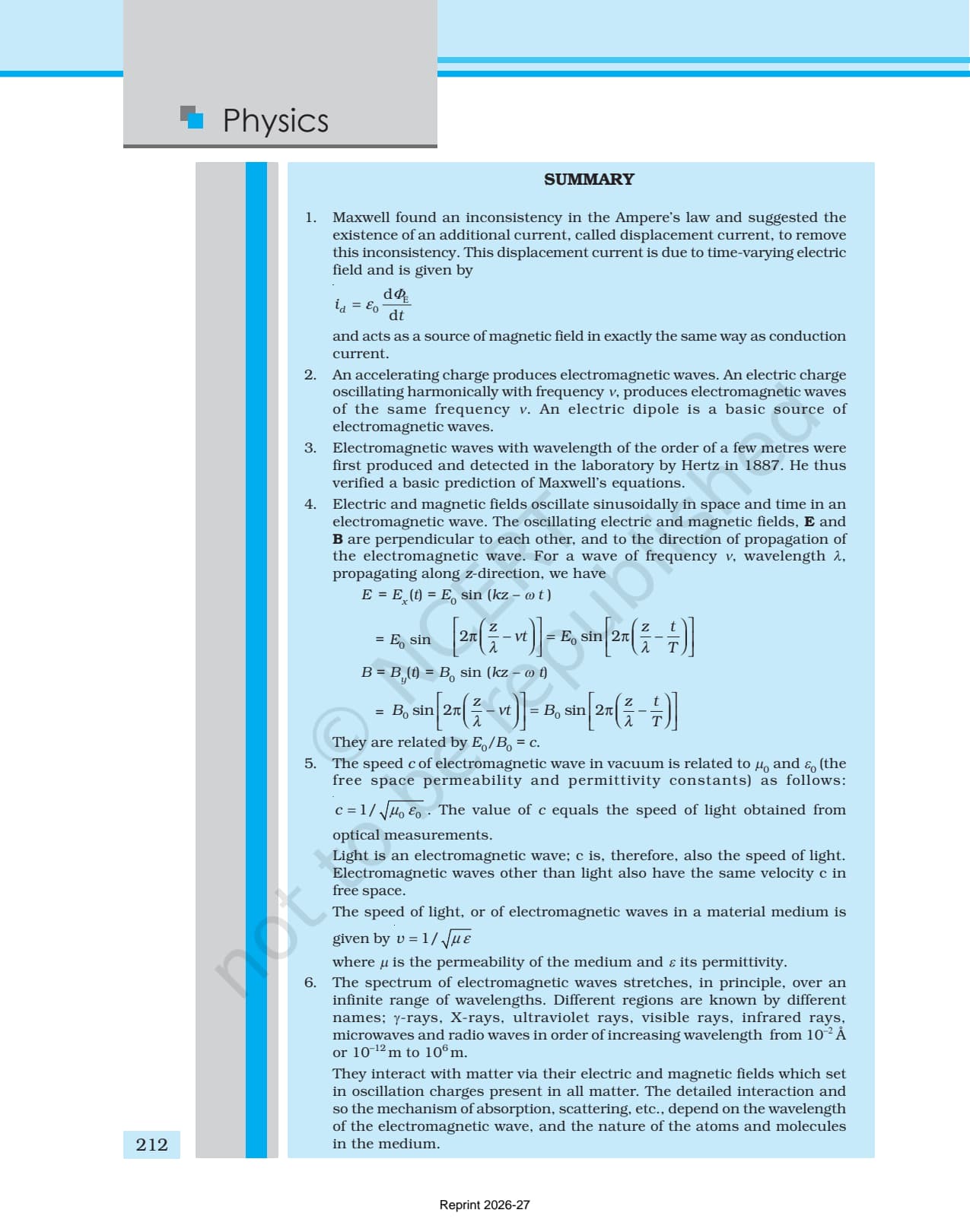
| Displacement current | Id = ε0 (dΦE/dt) |
| Speed of EM wave (vacuum) | c = 1/√(μ0ε0) = 3 × 10⁸ m/s |
| Field amplitude relation | E0 = c B0 |
| Energy density | u = ½ ε0 E2 + B2/(2μ0) |
| Intensity / Momentum | I = ½ c ε0 E02; p = U/c |
Full master table: Electromagnetic Waves Class 12 Physics Formula Sheet
3 Recurring PYQ Trends for Electromagnetic Waves Chapter 8
These three question templates appear almost every year across CBSE, JEE Main, and NEET.
- EM Spectrum band order and uses - NEET 2024, NEET 2023, CBSE 2025. The single most recurring template.
- Displacement current concept and expression - CBSE 2024, JEE Main 2024.
- E and B perpendicular relation, E0 = c B0 - JEE Main 2025.
Full PYQ map: Electromagnetic Waves Class 12 Physics NCERT Solutions
Student Feedback
"The single-day study plan here helped me cover Chapter 8 completely. Displacement current confused me earlier, but the section breakdown made it click." - Priya, Class 12, Delhi
"I used this page the night before my CBSE board and scored full marks on the EM spectrum question. The band-order mnemonic is a lifesaver." - Rahul, Class 12, Mumbai
NCERT Book PDF for Class 12 Physics: All Chapters
Other Class 12 Physics NCERT Book PDFs available as free downloads:
| Chapter | Resource |
|---|---|
| Chapter 1 | Electric Charges and Fields NCERT PDF |
| Chapter 2 | Electrostatic Potential and Capacitance NCERT PDF |
| Chapter 3 | Current Electricity NCERT PDF |
| Chapter 4 | Moving Charges and Magnetism NCERT PDF |
| Chapter 5 | Magnetism and Matter NCERT PDF |
| Chapter 6 | Electromagnetic Induction NCERT PDF |
| Chapter 7 | Alternating Current NCERT PDF |
| Chapter 8 | Electromagnetic Waves NCERT PDF |
| Chapter 9 | Ray Optics and Optical Instruments NCERT PDF |
| Chapter 10 | Wave Optics NCERT PDF |
| Chapter 11 | Dual Nature of Radiation and Matter NCERT PDF |
| Chapter 12 | Atoms NCERT PDF |
| Chapter 13 | Nuclei NCERT PDF |
| Chapter 14 | Semiconductor Electronics NCERT PDF |
Other Resources for Electromagnetic Waves - Class 12 Physics Chapter 8
| Resource Type | Chapter 8 Link |
|---|---|
| NCERT Book PDF | Electromagnetic Waves NCERT Book PDF |
| NCERT Solutions | Electromagnetic Waves Class 12 NCERT Solutions |
| Notes | Electromagnetic Waves Class 12 Notes |
| Formula Sheet | Electromagnetic Waves Class 12 Formula Sheet |
Electromagnetic Waves NCERT PDF - Frequently Asked Questions
Ques. Where can I download the Electromagnetic Waves NCERT PDF for free?
Ans. You can download the PDF directly from this page. The flipbook viewer is also available above so students can read it without downloading.
Ques. Is this Electromagnetic Waves NCERT PDF aligned with the 2026-27 CBSE syllabus?
Ans. Yes. This page reflects the current 2026-27 syllabus. The chapter retains all four sections (8.1 to 8.4), the displacement current derivation, and the full seven-band EM spectrum.
Ques. How many pages is the Class 12 Physics Electromagnetic Waves NCERT chapter?
Ans. The chapter runs about 16 pages, making it the shortest in the Class 12 Physics textbook. It has 3 intext examples and 15 end-of-chapter exercises.
Ques. What is the correct order of the electromagnetic spectrum?
Ans. In order of increasing wavelength: gamma rays, X-rays, ultraviolet, visible light, infrared, microwaves, and radio waves. Reverse the list for increasing frequency.
Ques. Is the NCERT chapter sufficient for NEET and JEE on this topic?
Ans. For NEET the NCERT chapter alone is sufficient - questions almost always cover EM spectrum or displacement current. For JEE Main, add 5-10 PYQs on energy density and momentum numericals.



Comments