



Download the NCERT Physics Class 12 PDF for Chapter 14 Semiconductor Electronics free from this page. The file is the unmodified 2026-27 NCERT print with no third-party watermarks or edits. Use the section index below to plan your reading.
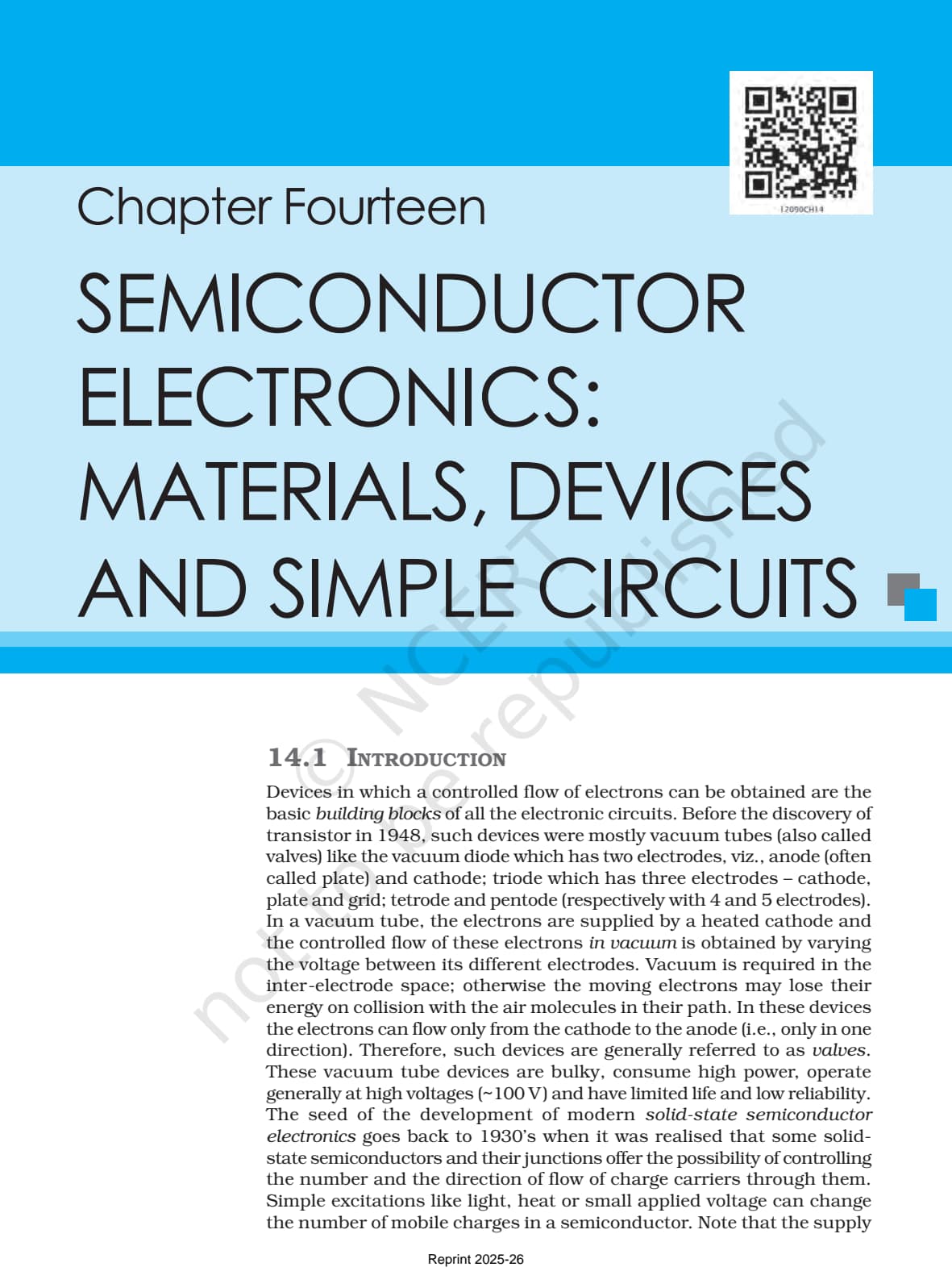
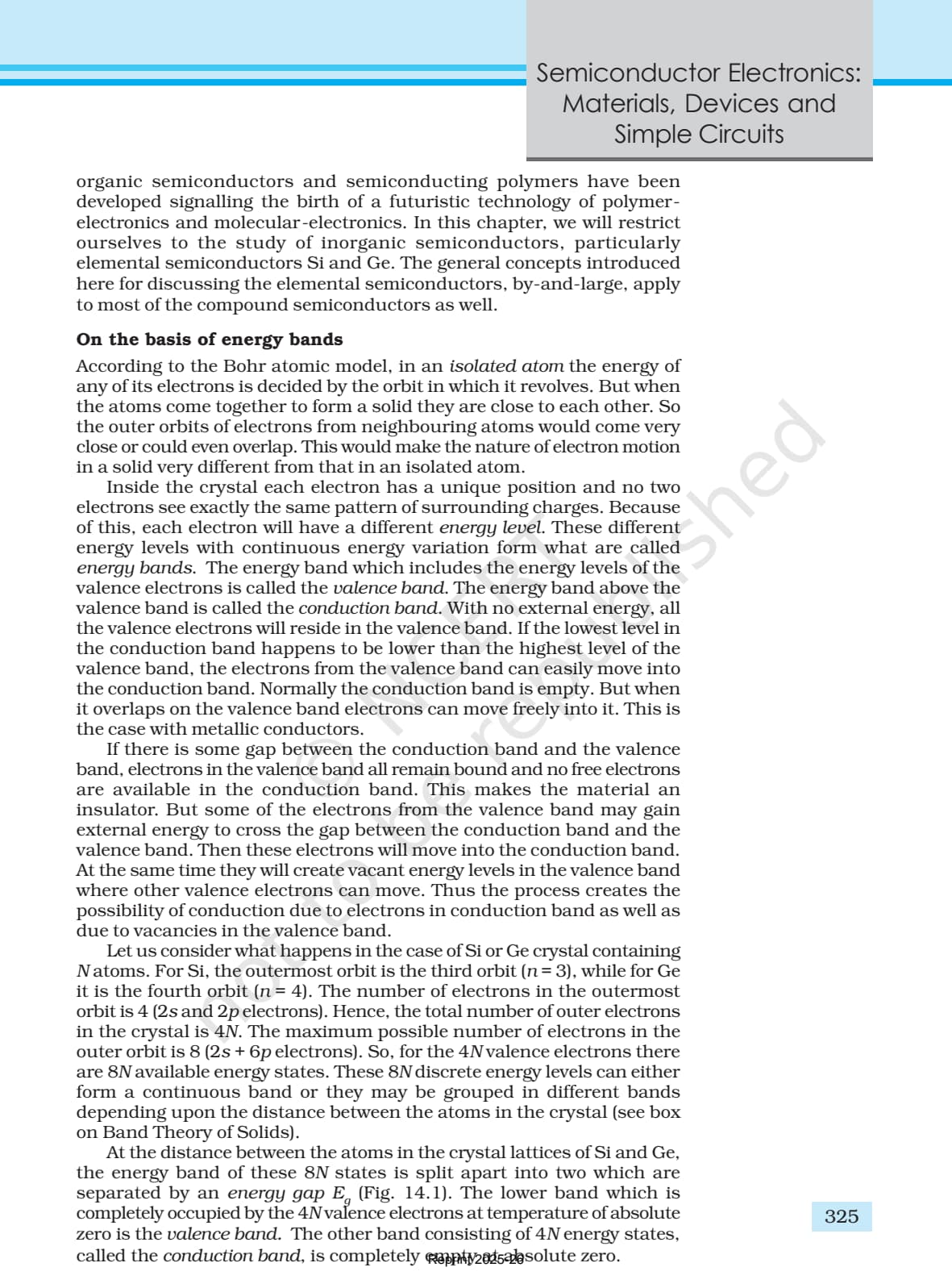
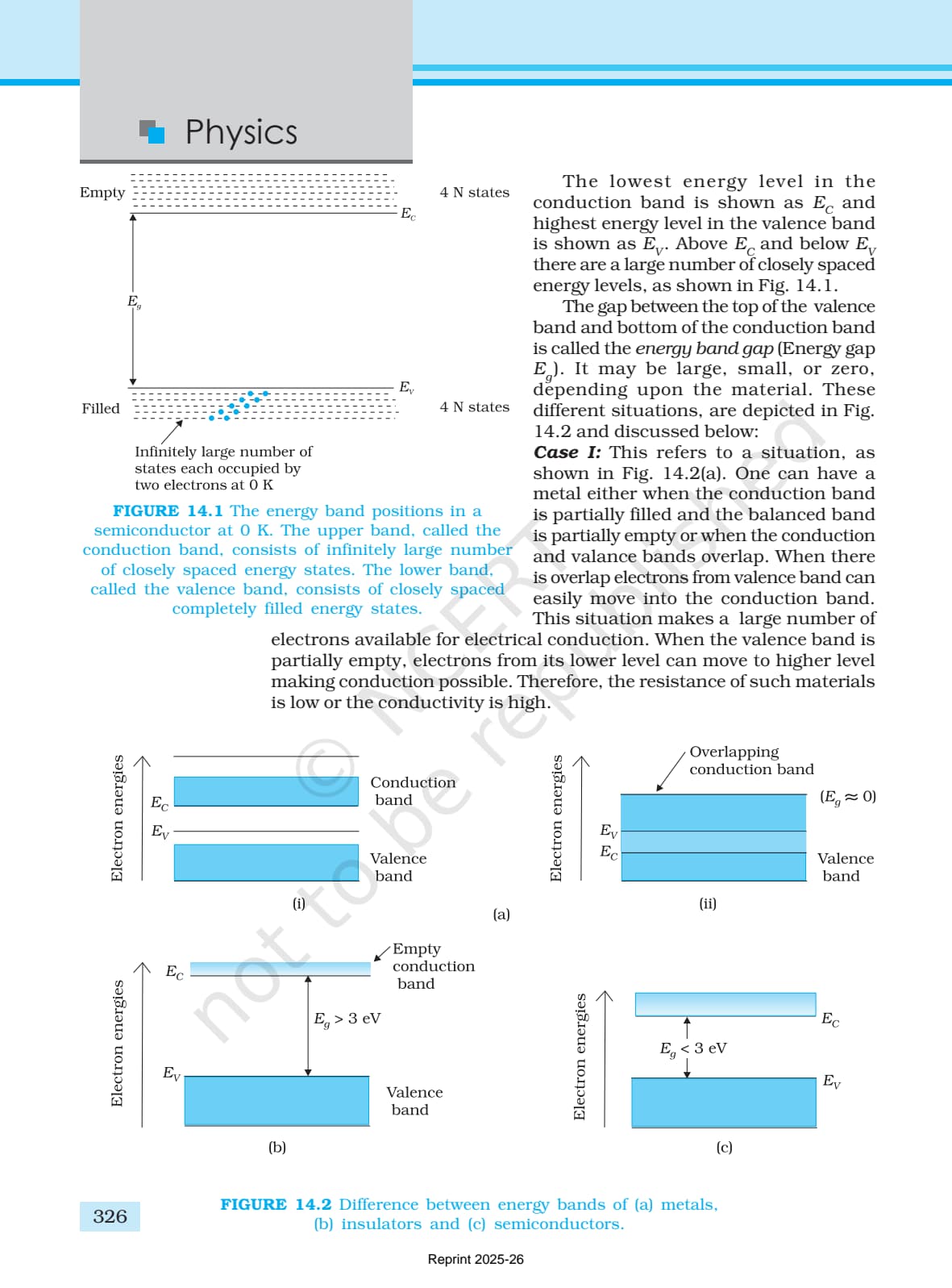
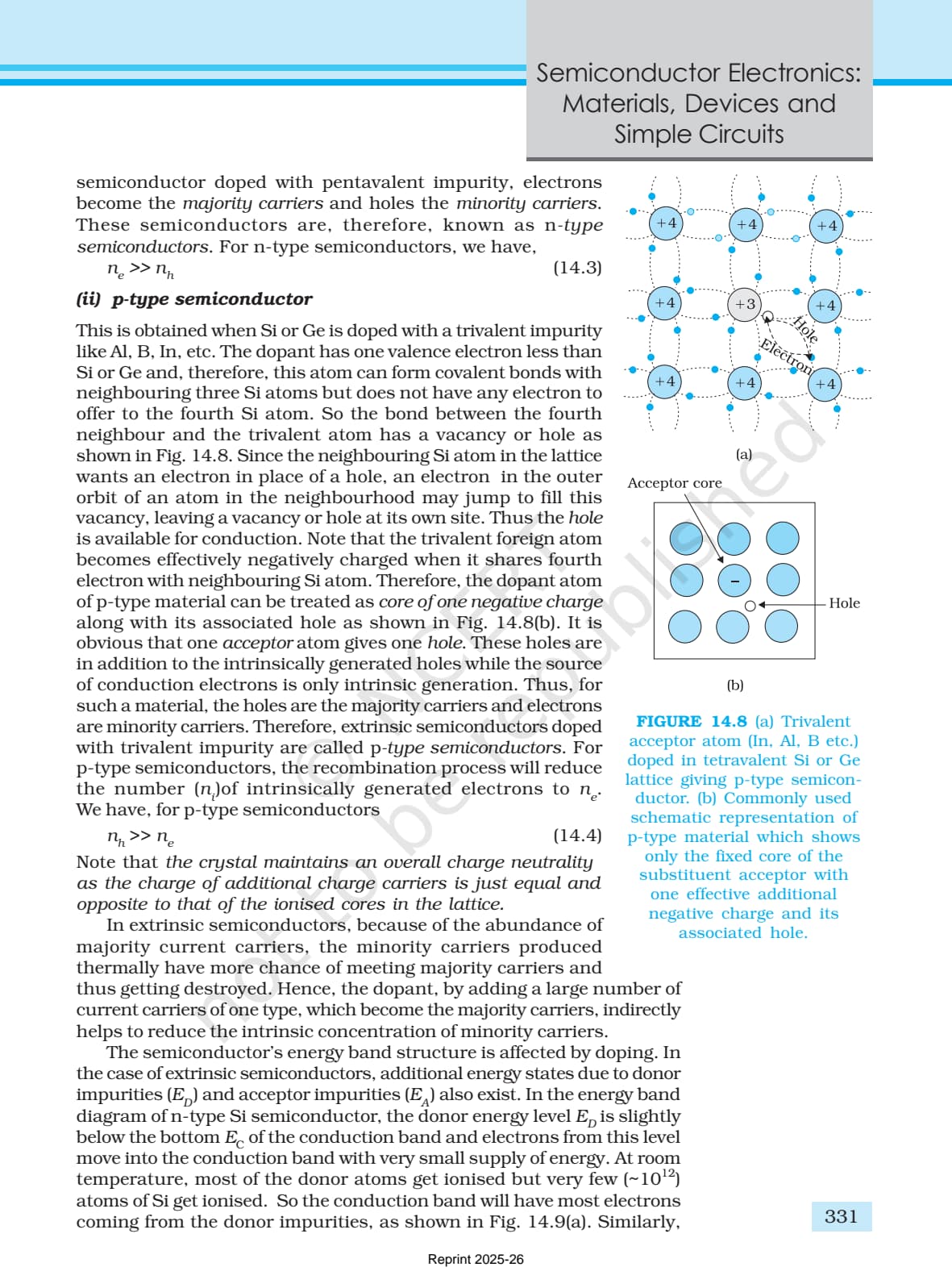
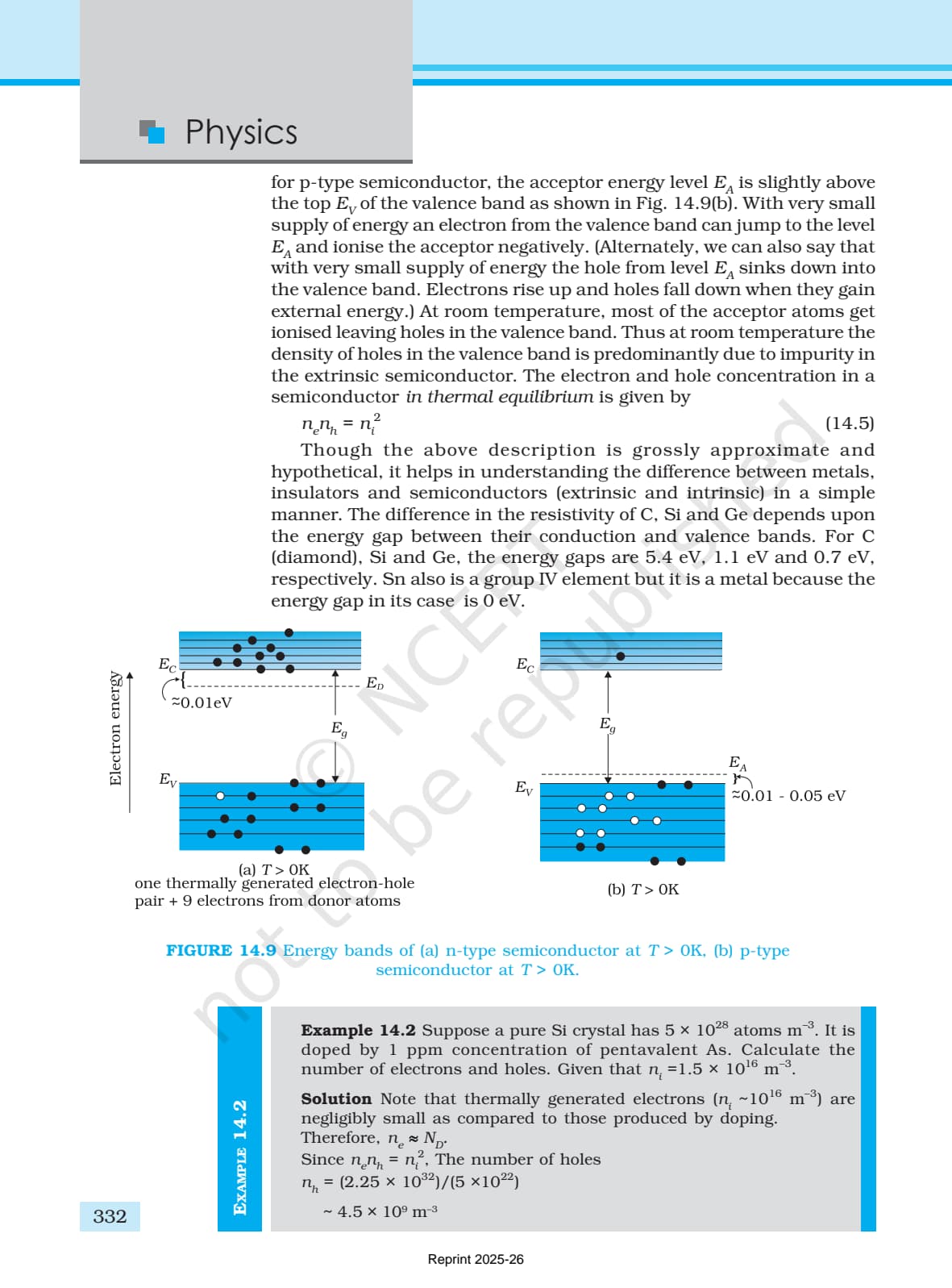

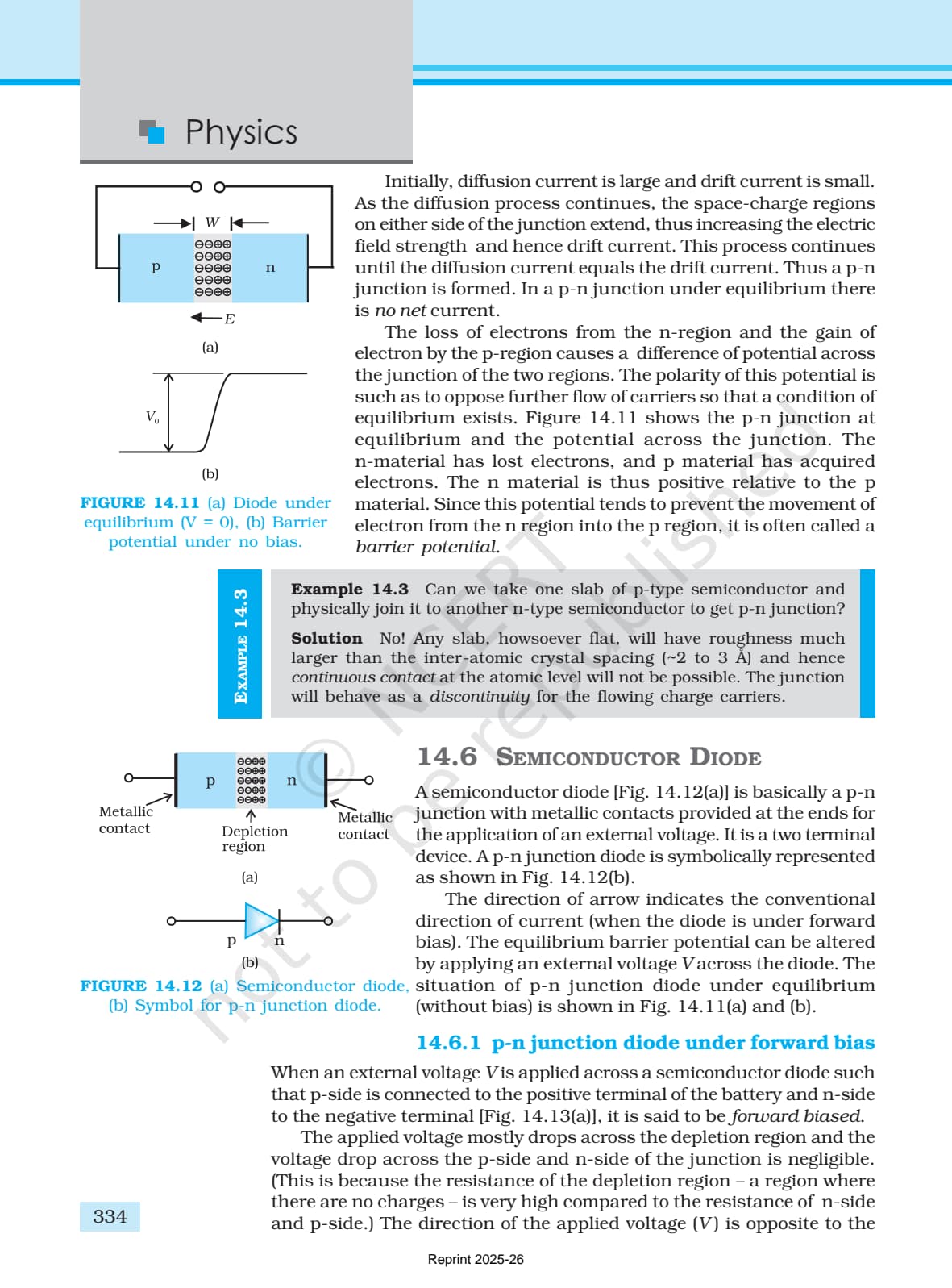
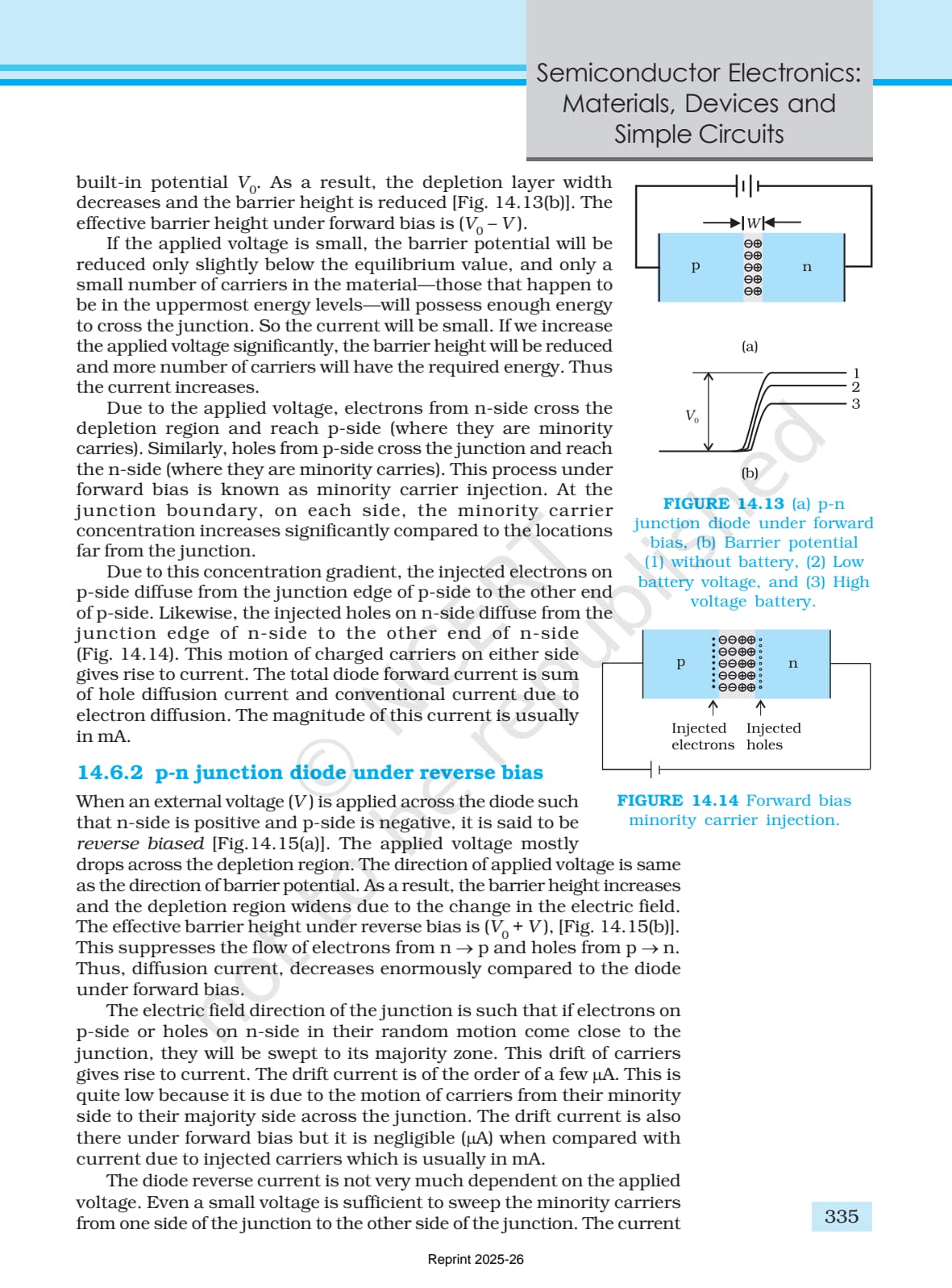

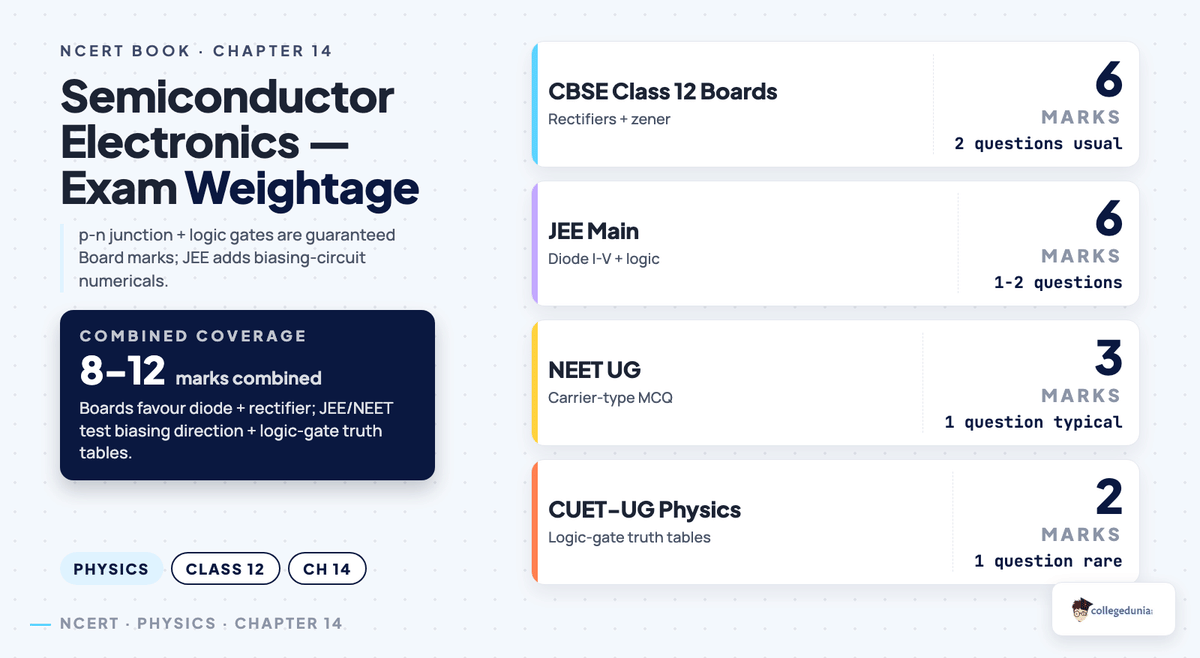
- CBSE Weightage: 5-7 marks
- JEE Main Weightage: 2-3% (1-2 questions per paper)
- NEET Weightage: 2-3 questions per year
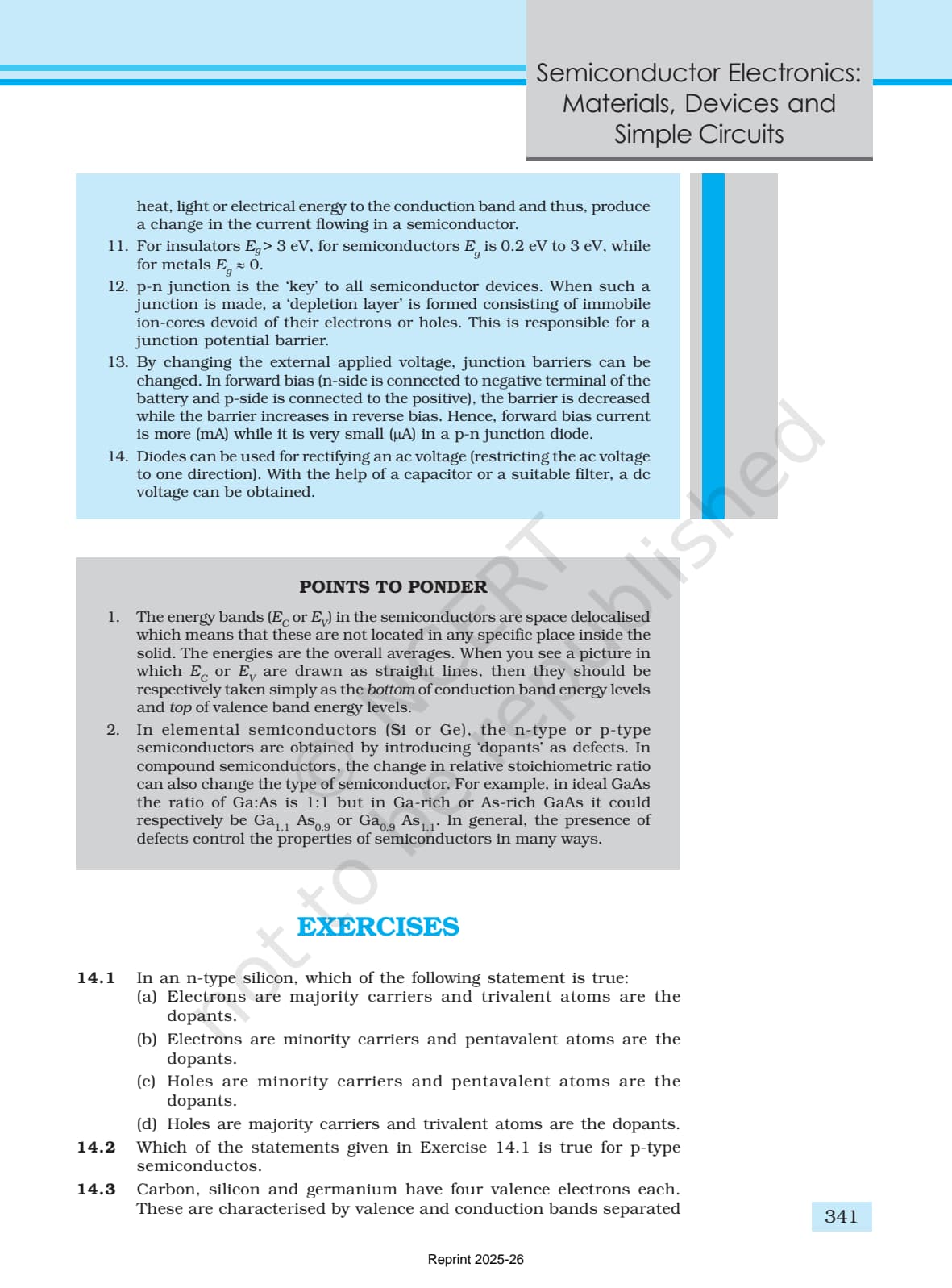
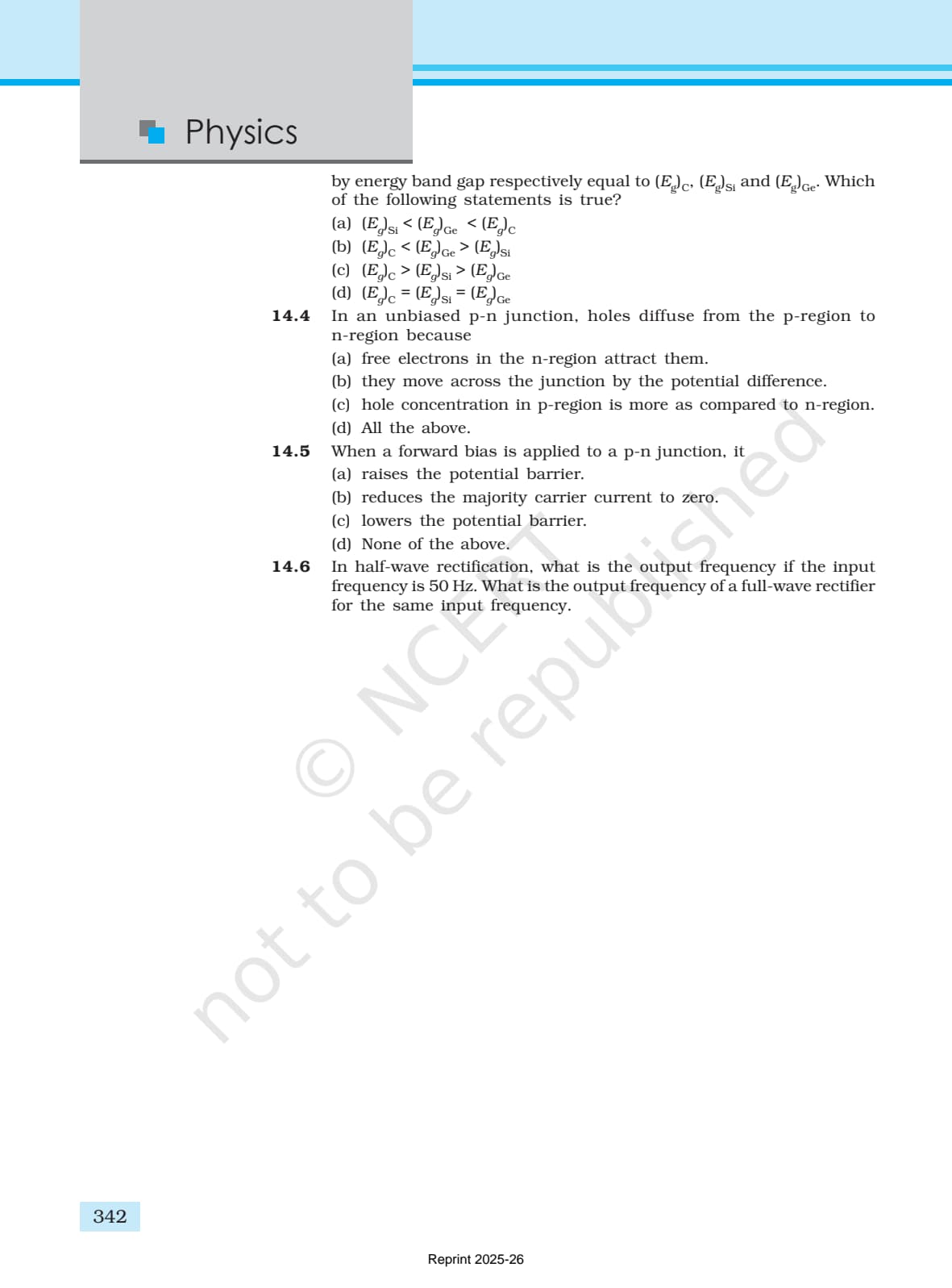
The PDF covers all 14 intext Examples, all 13 end-of-chapter Exercises, and the 2026-27 rationalisation map. Use the index below to track your progress section by section.
How This Page Helps You Study Semiconductor Electronics Class 12 Physics
Chapter 14 has the highest MCQ-per-page density in the Class 12 Physics book. Here is what this page adds beyond the raw PDF.
- 2026-27 NCERT Alignment: Section breakdown, page ranges, and example inventory match the current print. Removed content is flagged so you skip it.
- 3-Day Reading Plan: A timed split for the 34-page PDF so you finish in three focused sessions.
- Cross-Chapter Anchors: The exact prerequisite slices from Chapters 11 and 12 to revise before opening Chapter 14.
- Logic-Gate PYQ Tilt: About 40% of past Chapter 14 questions target NAND or NOR. The plan front-loads Section 14.10.
Semiconductor Electronics Video Lecture - Class 12 Physics Chapter 14
Source: NCERT Wallah on YouTube
Section-by-Section Breakdown of Class 12 Physics Chapter 14 Semiconductor Electronics
The table maps each of the ten NCERT sections to its page range and the single most exam-relevant idea. Use it as a checklist while reading the PDF.
| Section | Title | Pages | Take Away |
|---|---|---|---|
| 14.1 | Introduction | 1-2 | Vacuum tube to solid state shift, why Si and Ge |
| 14.2 | Classification of Metals, Conductors and Semiconductors | 3-5 | Band picture, Eg values, three-class rule |
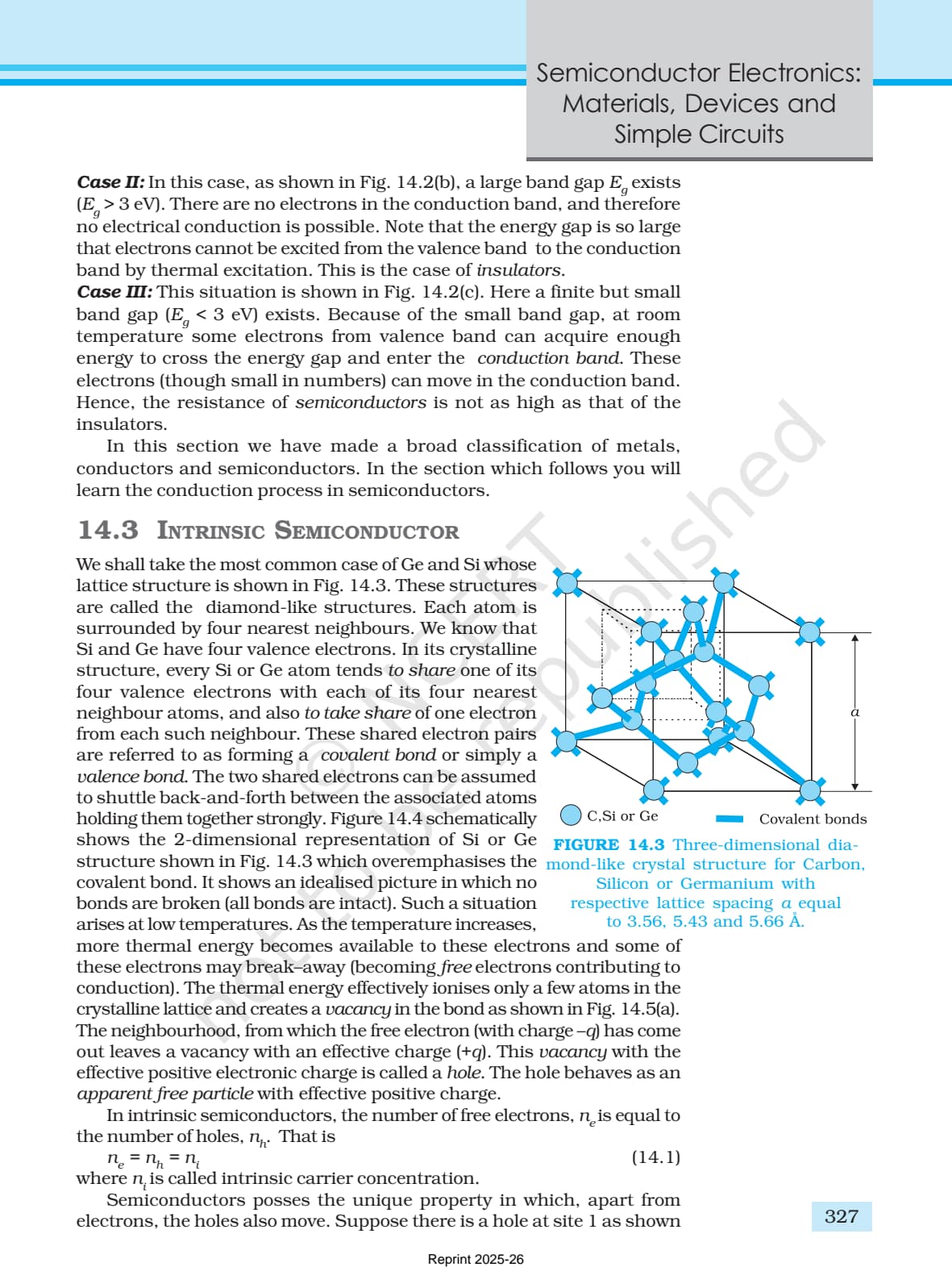
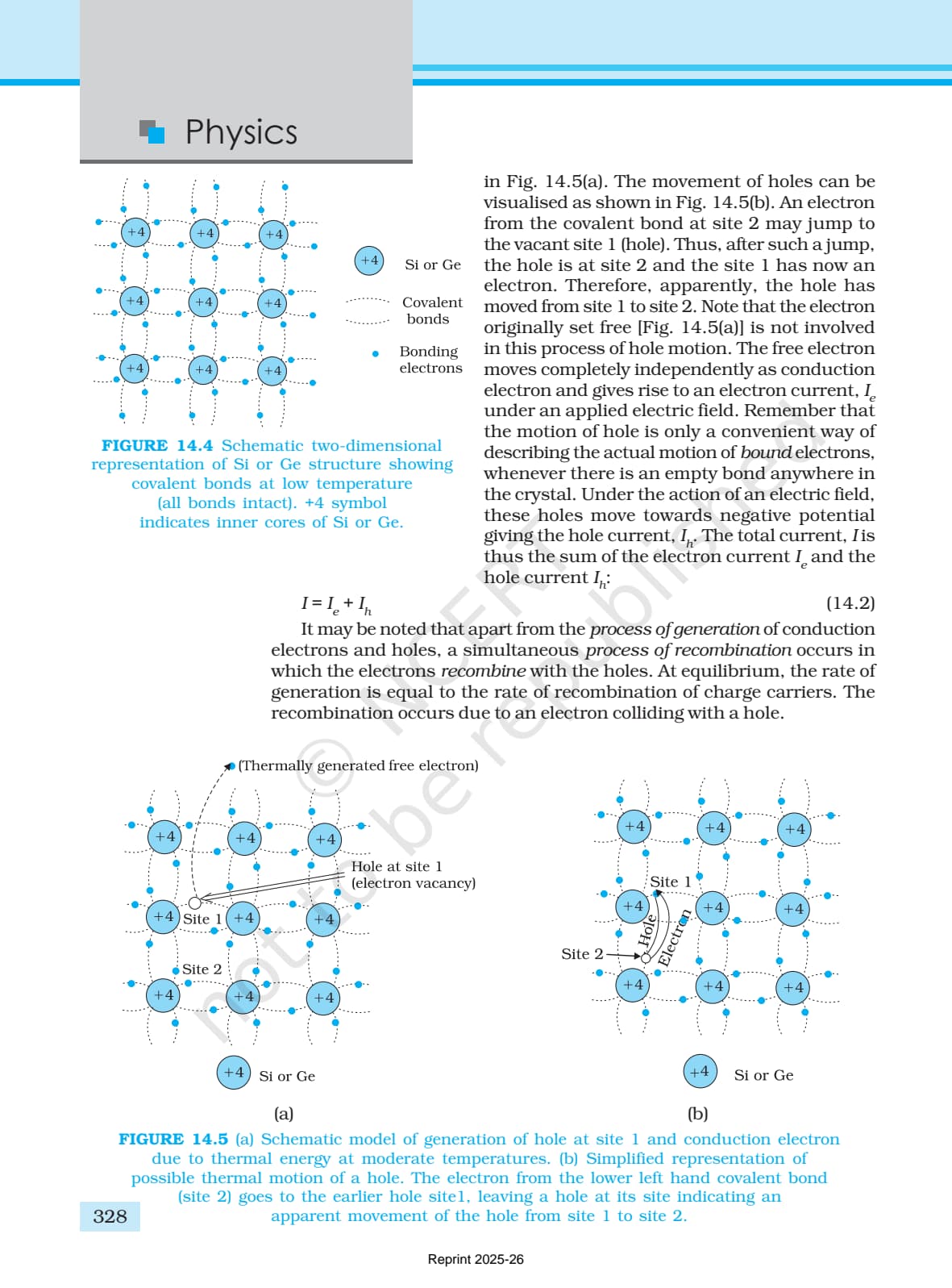
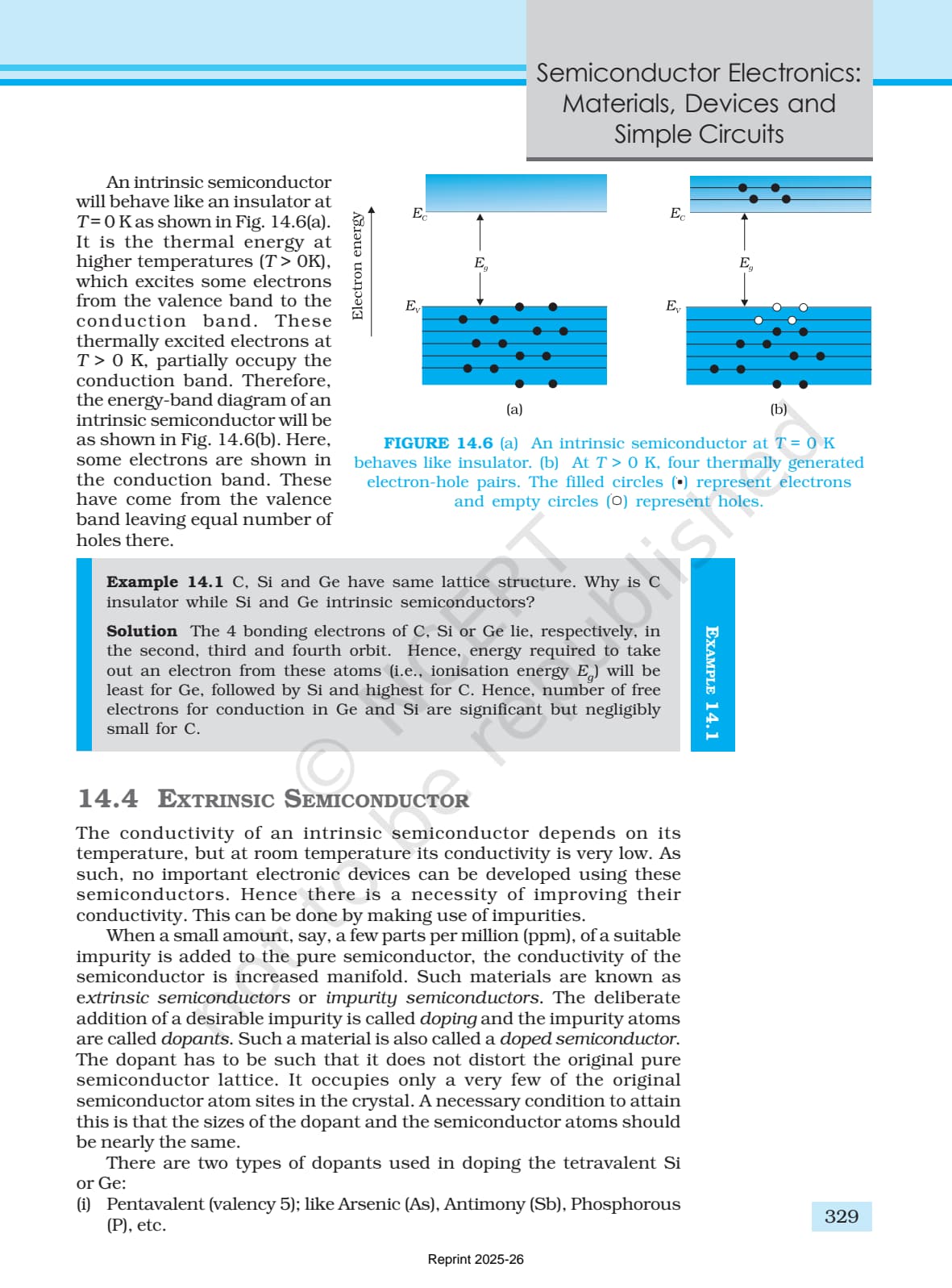
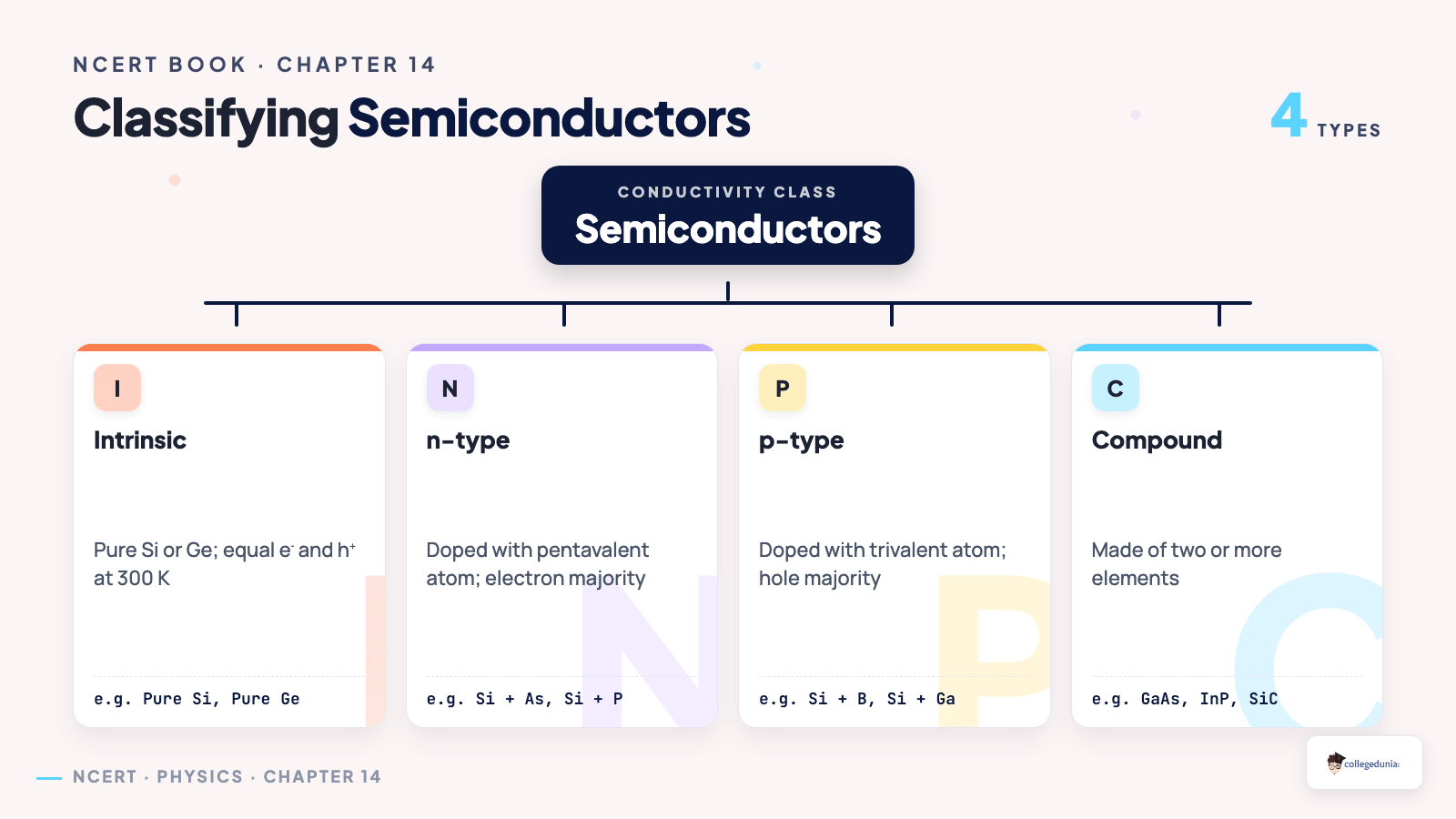
| 14.3 | Intrinsic Semiconductor | 6-8 | Electron-hole pair generation, ne = nh = ni |
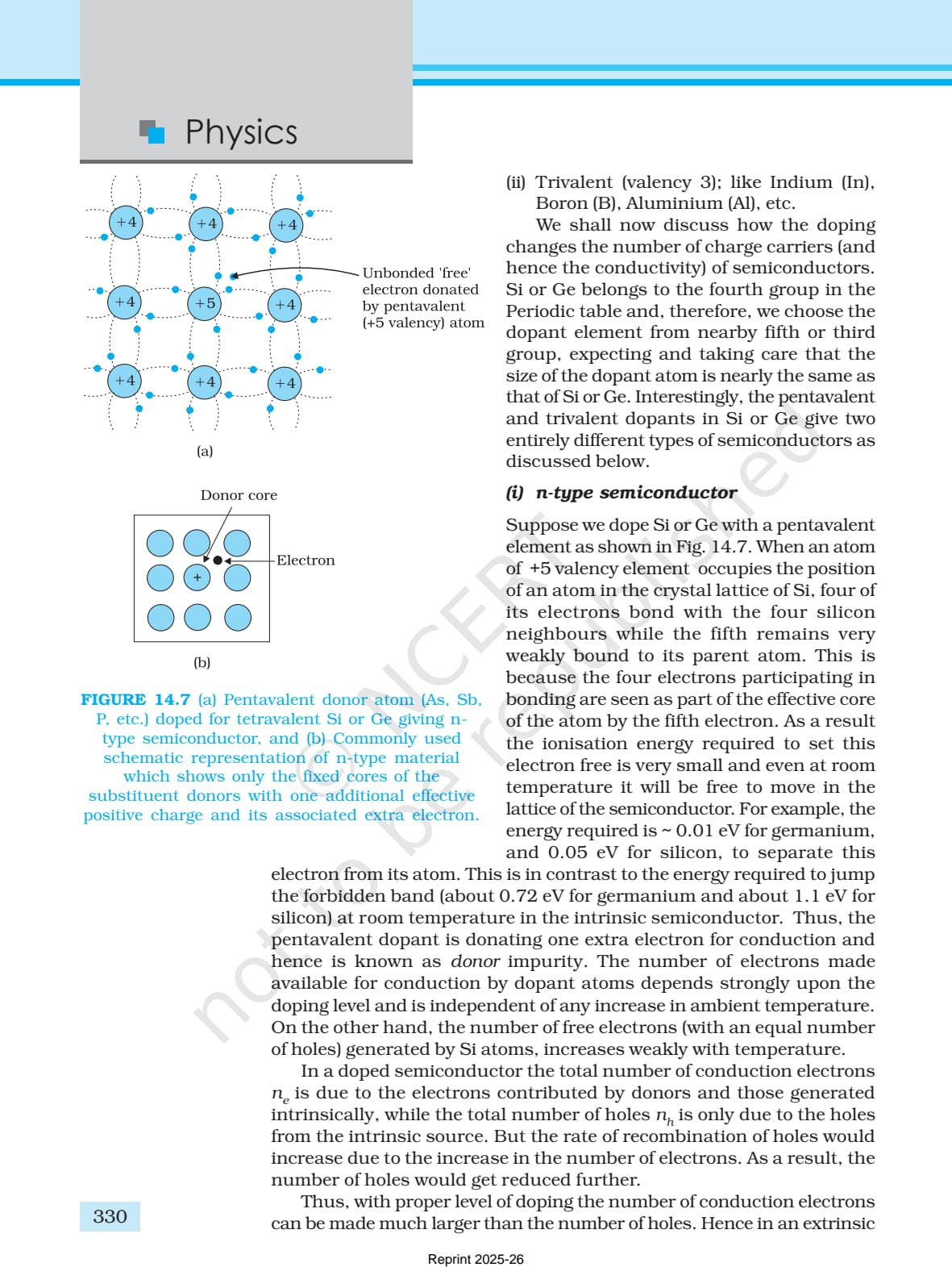
| 14.4 | Extrinsic Semiconductor | 9-12 | n-type and p-type doping, mass-action law |
| 14.5 | p-n Junction | 13-15 | Depletion region, barrier potential, drift vs diffusion |
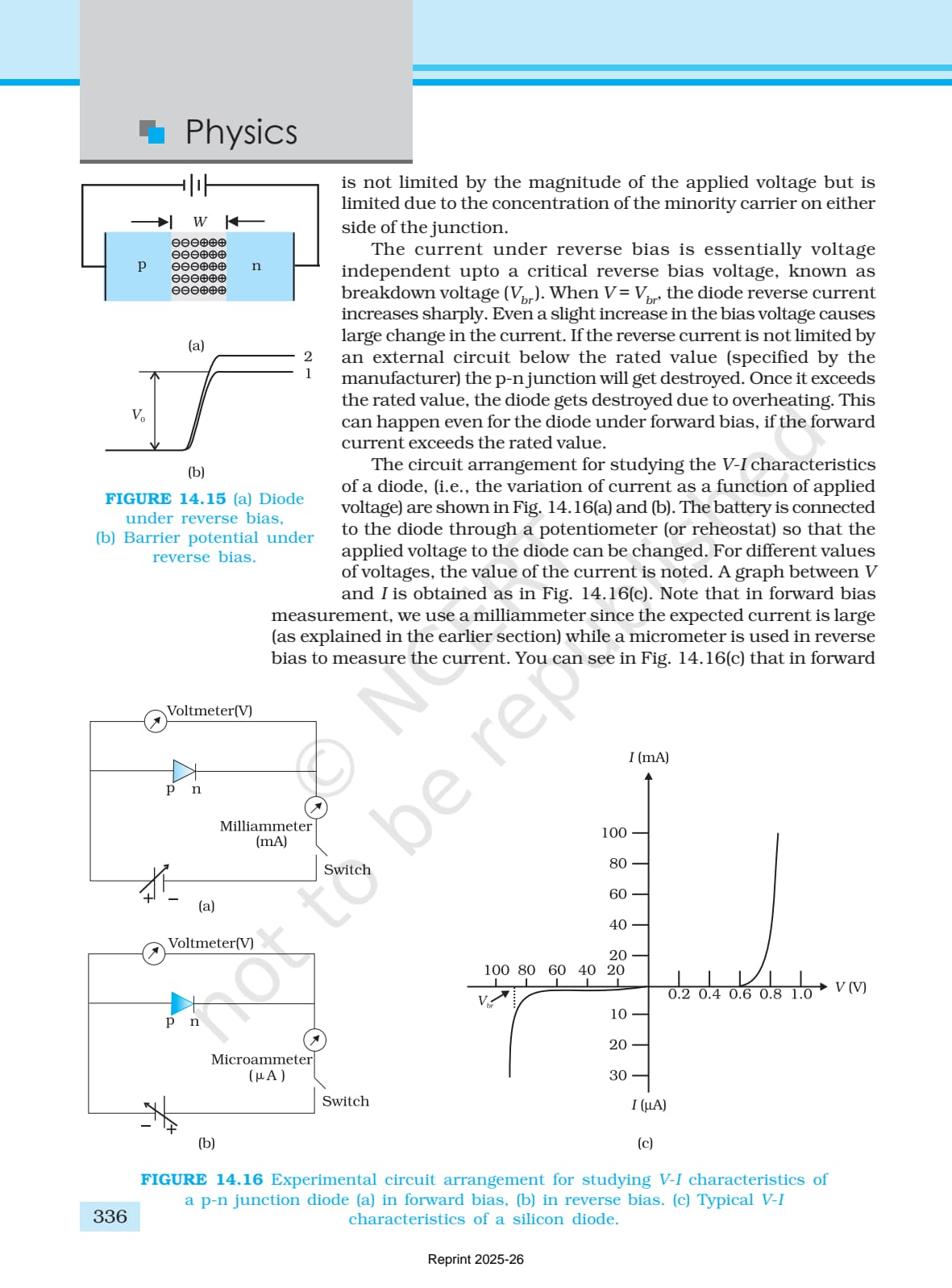
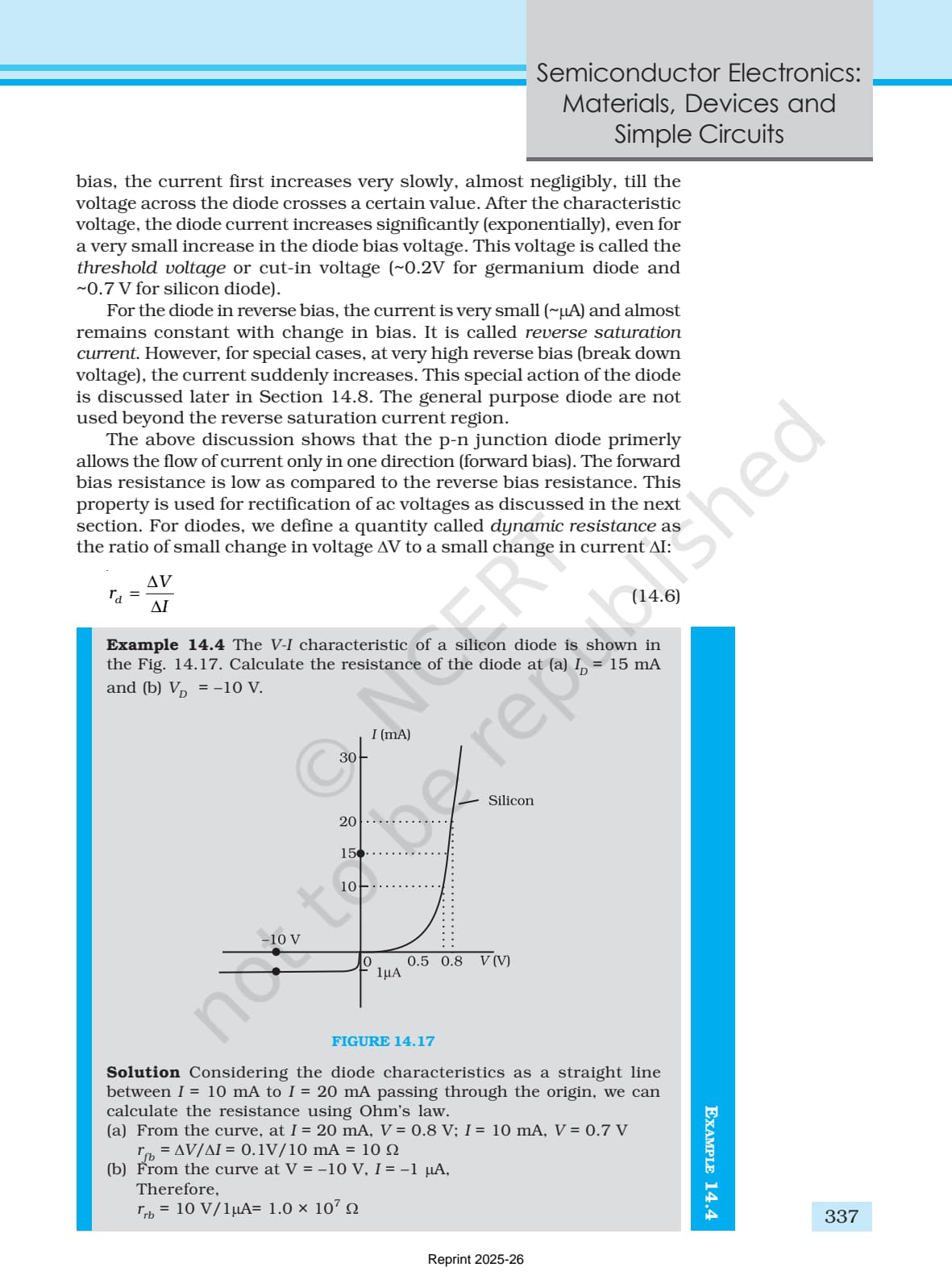
| 14.6 | Semiconductor Diode | 16-18 | Forward and reverse I-V, knee voltage, dynamic resistance |
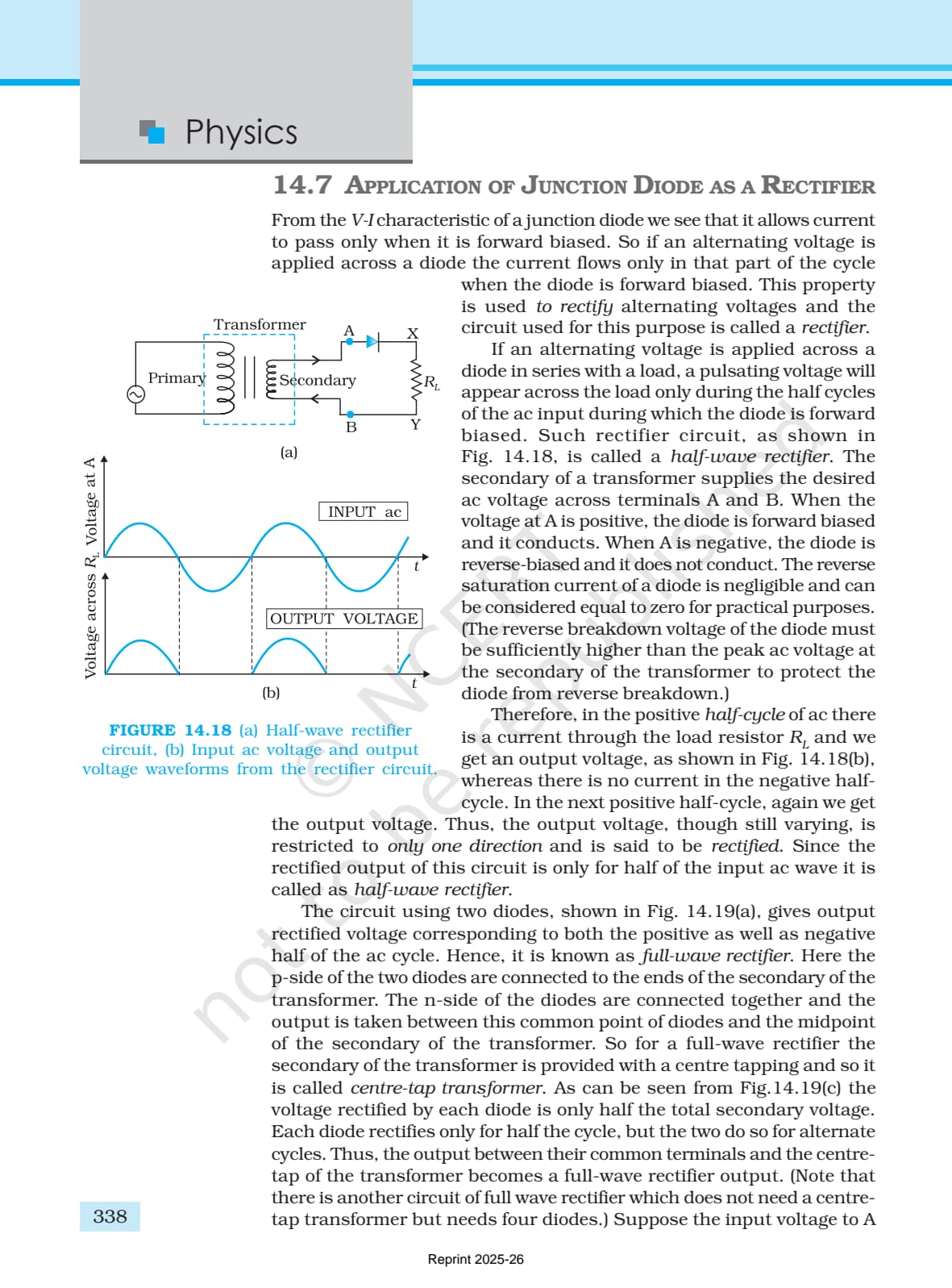
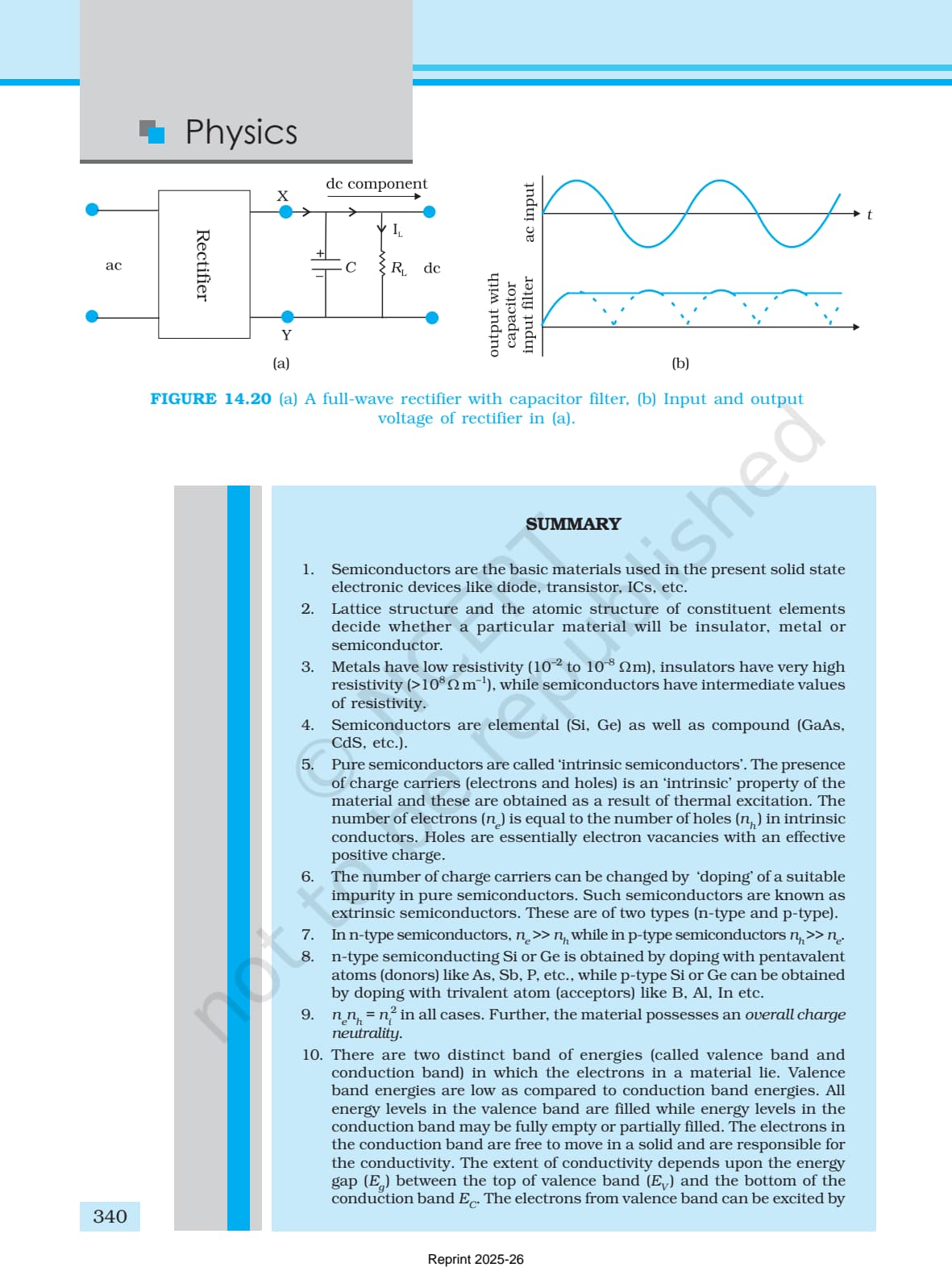
| 14.7 | Application of Junction Diode as a Rectifier | 19-21 | Half-wave vs full-wave, output frequency rule |
| 14.8 | Special Purpose p-n Junction Diodes | 22-25 | Zener regulator, LED, photodiode, solar cell |
| 14.9 | Junction Transistor | 26-29 | CE configuration, α and β , amplifier and switch |
| 14.10 | Digital Electronics and Logic Gates | 30-32 | Five gates, NAND and NOR as universal |
| - | Summary, Exercises 14.1-14.13 | 33-34 | 13 problems, mostly conceptual + 2 numerical |
Intext Example Inventory for Class 12 Physics Chapter 14 Semiconductor Electronics
Chapter 14 has 14 intext Examples spread across diode, transistor, and gate sections. The table tags each by sub-topic and the skill it tests.
| Example | Sub-topic | What it Covers |
|---|---|---|
| 14.1 | Intrinsic carrier concentration | Mass-action law numerical |
| 14.2 | n-type doping | Identify majority and minority carriers |
| 14.3 | p-n junction at equilibrium | Drift-diffusion balance |
| 14.4-14.5 | Diode I-V | Read knee voltage and dynamic resistance off graph |
| 14.6 | Half-wave rectifier | Output waveform sketch |
| 14.7 | Zener voltage regulator | Current sharing across Zener and load |
| 14.8-14.9 | Photodiode and solar cell | Photo-generated current direction |
| 14.10-14.11 | Transistor gain | Compute α , β , and convert between them |
| 14.12 | CE amplifier voltage gain | Apply Av = β · RL / Rin |
| 14.13-14.14 | Logic gates | Truth table completion + universal-gate construction |
2026-27 Rationalisation: What NCERT Kept and What it Dropped in Chapter 14
For the 2026-27 print, NCERT continued the rationalisation begun in 2023-24. The standalone chapter on Communication Systems is no longer in the syllabus. The deep IC-fabrication box inside Chapter 14 was trimmed. The universal-gate treatment of NAND and NOR is retained, despite contradictory online claims.
| Status | Topic | Action |
|---|---|---|
| Retained | All ten sections 14.1 to 14.10 | Read in full |
| Retained | NAND and NOR as universal gates | Practice construction of NOT, AND, OR using only NAND |
| Trimmed | IC fabrication deep-dive box | Skim, do not memorise |
| Removed | Former Chapter 15 Communication Systems | Do not study from older PDFs |
3-Day Study Plan for Class 12 Physics Chapter 14 Semiconductor Electronics
A 34-page applied chapter sits between concept and circuit. Splitting it across three days makes the load manageable and puts logic gates last so the freshest practice is the highest-yield topic.
| Day | Sections | Focus | Time |
|---|---|---|---|
| Day 1 | 14.1 to 14.5 | Bands, intrinsic and extrinsic carriers, p-n junction, mass-action law | 2.5 hours |
| Day 2 | 14.6 to 14.9 | Diode I-V, rectifiers, special diodes, BJT and CE amplifier | 3 hours |
| Day 3 | 14.10 + all Exercises | Five gates, universal-gate constructions, full exercise set | 2.5 hours |
Use three passes inside each day: a quick skim of headings and figure captions, a detailed read working through each intext Example before checking the solution, then an exercise attempt at the end of Day 3.
Cross-Chapter Reading Order for Semiconductor Electronics Class 12
Chapter 14 draws on two earlier quantum chapters. Read these slices first to remove the only conceptual friction in the chapter.
- Chapter 11 Dual Nature of Radiation and Matter: Revise photon energy E = hf . You need it for LED colour, photodiode response, and solar-cell threshold.
- Chapter 12 Atoms: Revise discrete energy levels. The energy-band picture in 14.2 is what happens when 1023 atoms bring their levels together.
- Chapter 3 Current Electricity: Revise Ohm's law and series-parallel rules. You need them for the rectifier load and CE amplifier output.
Top 5 Formulae for Class 12 Physics Chapter 14 Semiconductor Electronics Quick Recall
These five relations cover almost every numerical asked from this chapter across CBSE Board, JEE Main, and NEET.
| Quantity | Formula |
|---|---|
| Mass-action law | ne · nh = ni2 |
| Transistor current relation | IE = IB + IC |
| CE current gain | β = IC / IB |
| α - β link | α = β / β + 1 |
| CE voltage gain | Av = β · RL / Rin |
Full formula table: Semiconductor Electronics Class 12 Physics Formula Sheet
Top PYQ Trends for Semiconductor Electronics in Class 12 Boards and JEE
Three patterns dominate the last five years of papers. The full year-wise PYQ map is on the Collegedunia NCERT Solutions page.
- Logic gate truth tables (NAND or NOR universal): CBSE 2025, NEET 2024, NEET 2023 all carried this. About 40% of all Chapter 14 PYQs target NAND or NOR.
- Diode I-V under forward and reverse bias: JEE Main 2025 and CBSE 2024 both tested knee voltage and dynamic resistance reading.
- Transistor CE amplifier: CBSE 2023 and 2022 both carried 3-mark questions on β and voltage gain.
Full year-wise PYQ map: Semiconductor Electronics Class 12 Physics NCERT Solutions
Student Feedback
"The section breakdown table helped me know exactly which pages to revise for logic gates before my CBSE boards. Finished the chapter in three days using the study plan." - Class 12 student, 2025 batch
"The rationalisation note saved me from studying Communication Systems from an old PDF. Really helpful to know what is and is not in the current syllabus." - JEE Main 2025 aspirant
Other Resources for Semiconductor Electronics Class 12 Physics
| Resource | Link |
|---|---|
| NCERT Book PDF | Semiconductor Electronics NCERT Book PDF (Class 12) |
| NCERT Solutions | Semiconductor Electronics Class 12 Physics NCERT Solutions |
| Notes | Semiconductor Electronics Class 12 Physics Notes |
| Formula Sheet | Semiconductor Electronics Class 12 Physics Formula Sheet |
NCERT Book PDF for Class 12 Physics: All Chapters
Other Class 12 Physics NCERT Book PDFs available as free downloads:
| Chapter | Resource |
|---|---|
| Chapter 1 | Electric Charges and Fields NCERT PDF |
| Chapter 2 | Electrostatic Potential and Capacitance NCERT PDF |
| Chapter 3 | Current Electricity NCERT PDF |
| Chapter 4 | Moving Charges and Magnetism NCERT PDF |
| Chapter 5 | Magnetism and Matter NCERT PDF |
| Chapter 6 | Electromagnetic Induction NCERT PDF |
| Chapter 7 | Alternating Current NCERT PDF |
| Chapter 8 | Electromagnetic Waves NCERT PDF |
| Chapter 9 | Ray Optics and Optical Instruments NCERT PDF |
| Chapter 10 | Wave Optics NCERT PDF |
| Chapter 11 | Dual Nature of Radiation and Matter NCERT PDF |
| Chapter 12 | Atoms NCERT PDF |
| Chapter 13 | Nuclei NCERT PDF |
| Chapter 14 | Semiconductor Electronics NCERT PDF |
NCERT Physics Class 12 PDF - Frequently Asked Questions
Ques. Where can I download Semiconductor Electronics Class 12 Physics NCERT Book PDF?
Ans. You can download the NCERT Physics Class 12 PDF directly from this page. The file is free and updated for the 2026-27 syllabus.
Ques. Is the Class 12 Physics Chapter 14 NCERT Book aligned with the 2026-27 syllabus?
Ans. Yes. This page reflects the current 2026-27 syllabus for Class 12 Physics. The chapter retains all ten sections from 14.1 to 14.10 including the universal-gate treatment, and the former chapter on Communication Systems is no longer part of the syllabus.
Ques. What are the most important topics in Semiconductor Electronics for CBSE Class 12 Boards?
Ans. The p-n junction (Section 14.5), the half-wave and full-wave rectifier (Section 14.7), the transistor as amplifier or switch in CE configuration (Section 14.9), and the five logic gates with NAND and NOR as universal (Section 14.10) carry the highest CBSE Board weight.
Ques. How is Chapter 14 weighted for JEE Main and NEET 2026?
Ans. JEE Main typically carries 2 to 3 percent of the paper from Chapter 14, usually one or two MCQs on diode circuits, Zener regulator, or logic-gate combinations. NEET carries 2 to 3 questions per year, with logic gate truth tables and intrinsic vs extrinsic carriers as the most repeated stems.
Ques. Why are NAND and NOR called universal gates in the Class 12 NCERT?
Ans. Any Boolean function such as NOT, AND, or OR can be built using only NAND gates, or using only NOR gates. Tying both inputs of a NAND together gives a NOT gate. A NAND followed by a NAND-as-NOT gives an AND gate. The Class 12 NCERT explicitly retains this result in Section 14.10.



Comments