




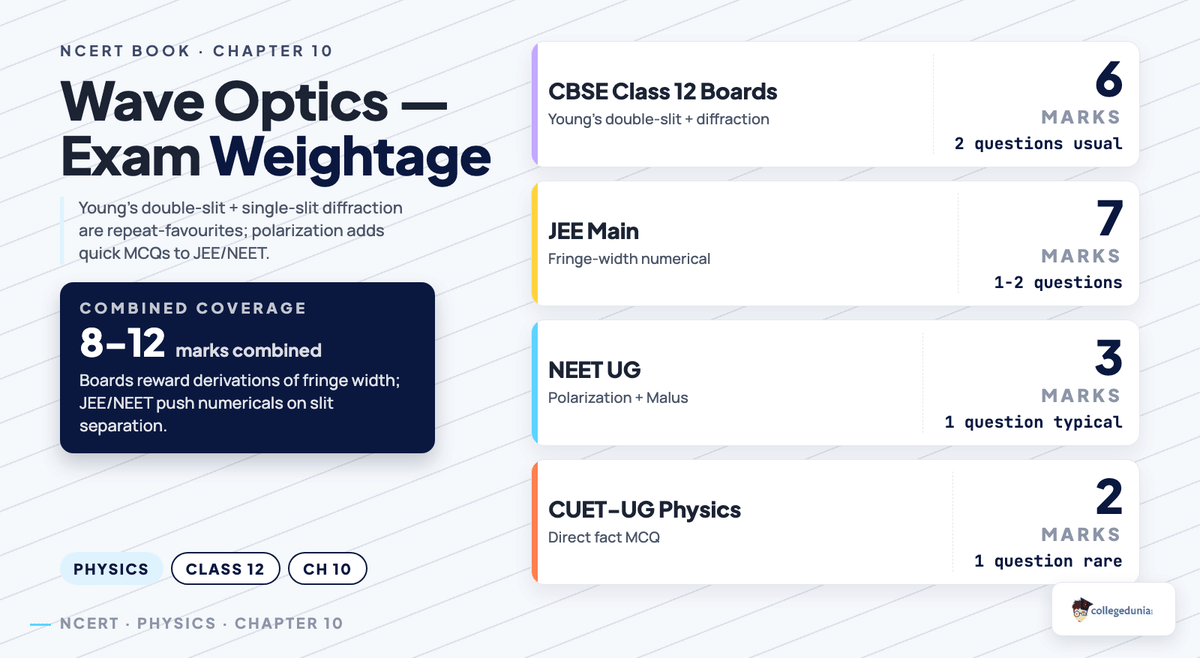
The Wave Optics NCERT PDF hosted below is the 2026-27 NCERT edition of Class 12 Physics Chapter 10 Wave Optics. CBSE Boards drop 5 marks from this chapter and JEE Main pulls about 3% of its Physics paper from it, which is why the Wave Optics NCERT PDF is the first resource teachers prescribe. The Wave Optics NCERT PDF carries every section, example and end-of-chapter exercise printed in the official book.
- CBSE Weightage: 4-6 marks
- JEE Main Weightage: 3-4% (1-2 questions per paper)
- NEET Weightage: 2-3 questions per year
Both downloads of the Wave Optics NCERT PDF on this page are free and updated for the 2026-27 NCERT syllabus.
This page is curated by subject experts, mapped to the 2026-27 NCERT print, and checked against the last five years of CBSE, JEE Main, and NEET papers.
Also Check:
Wave Optics NCERT Section-by-Section Breakdown for Class 12 Physics
The Class 12 Wave Optics PDF runs seven numbered sections, an end-of-chapter Summary, Points to Ponder, and the Exercises. The table below lists each section with its page range and a one-line description so students can plan reading time accurately.
| Section | Title | Pages | What It Covers |
|---|---|---|---|
| 10.1 | Introduction | 2 | Historical sequence from corpuscular to wave to electromagnetic models of light |
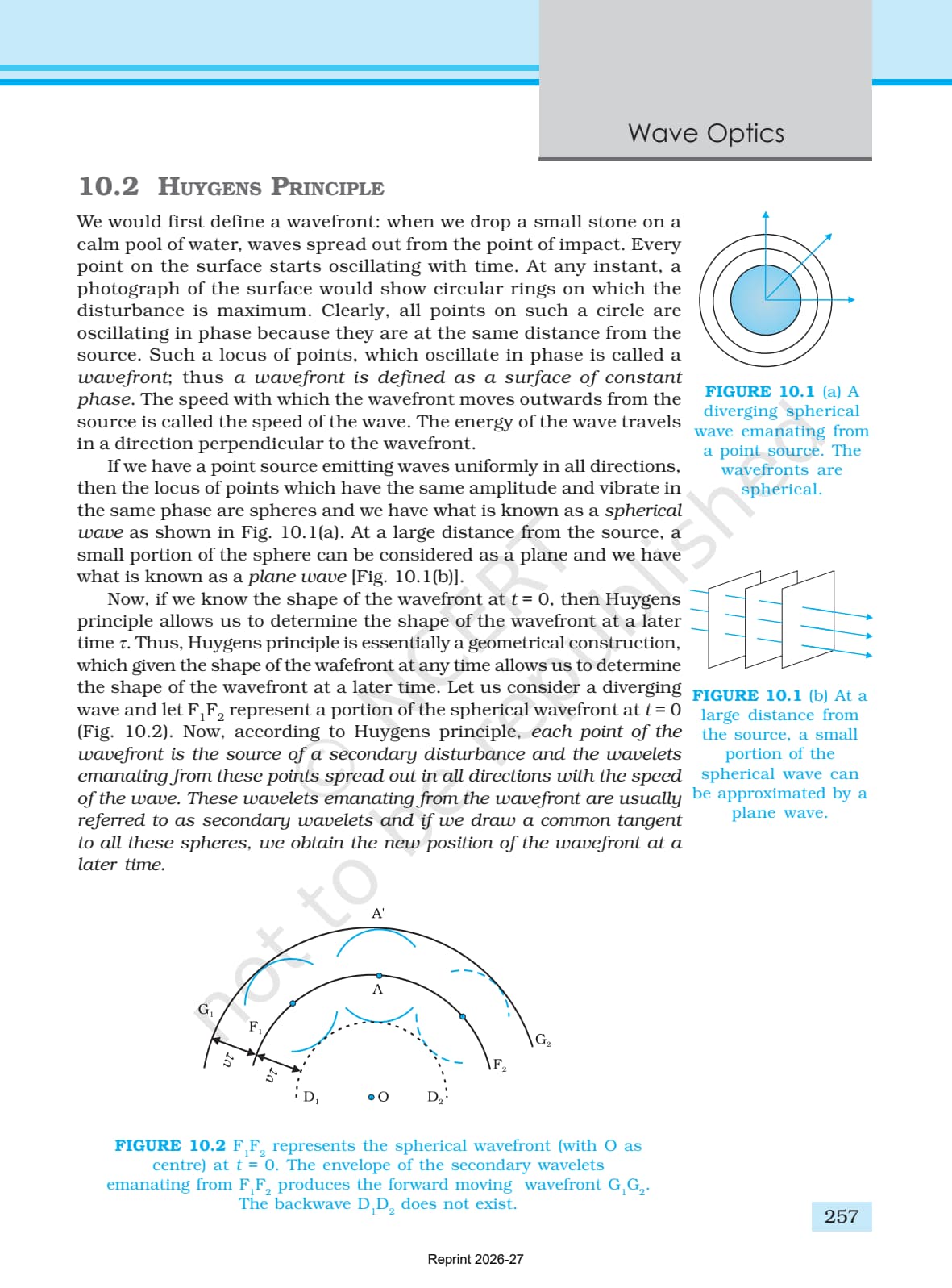
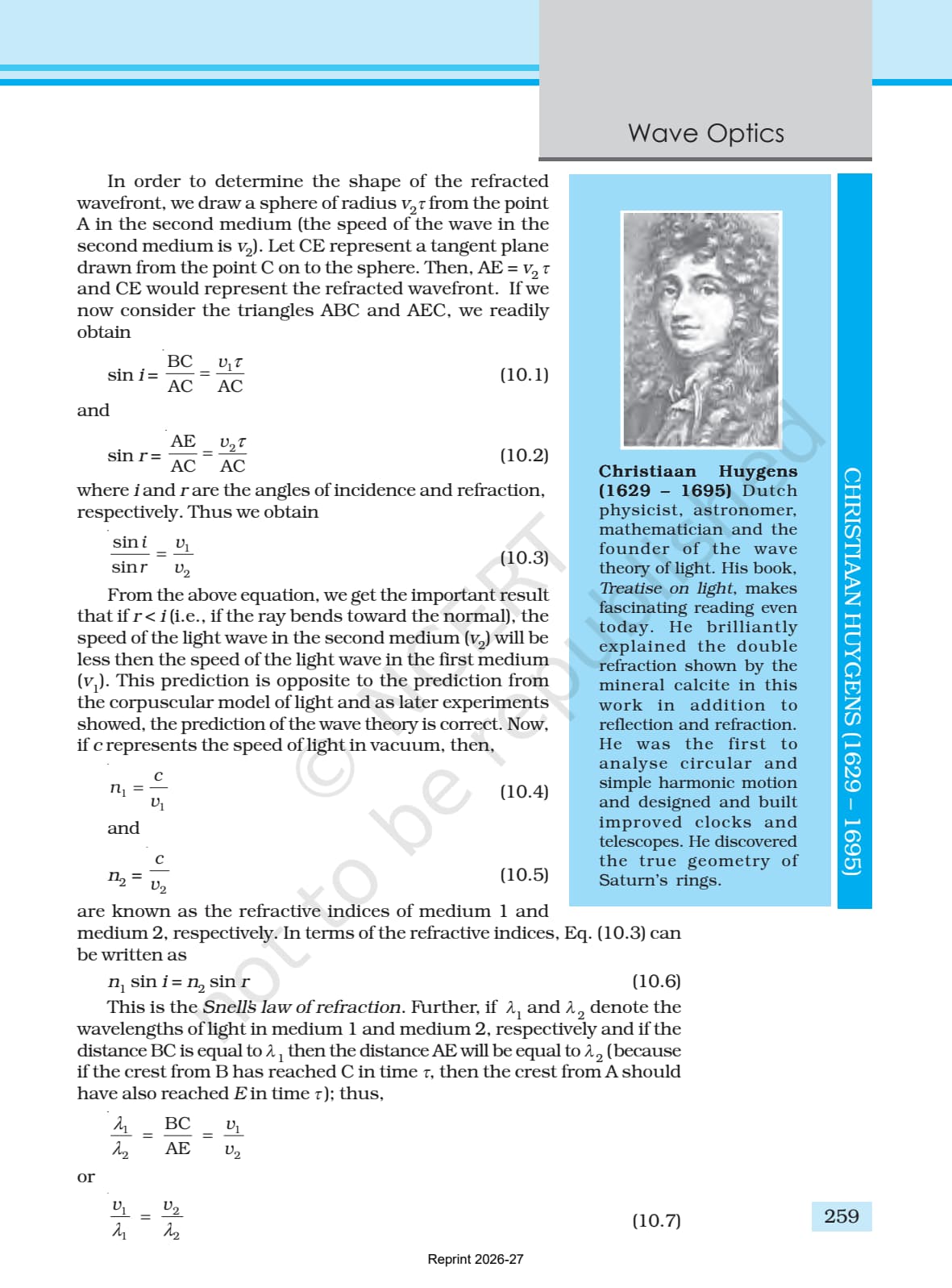
| 10.2 | Huygens' Principle | 3 | Wavefront definition, secondary wavelets, envelope construction for plane and spherical fronts |
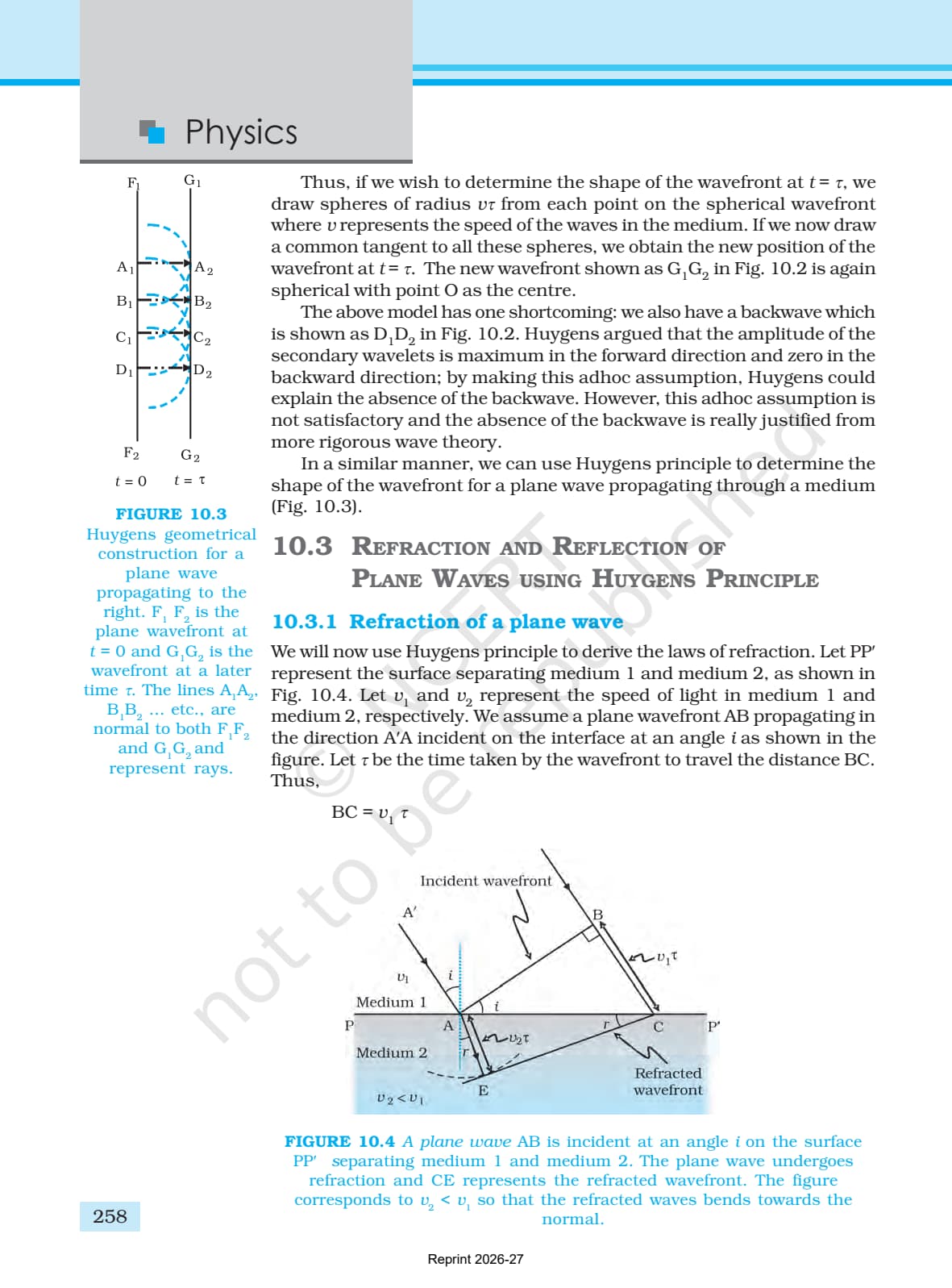
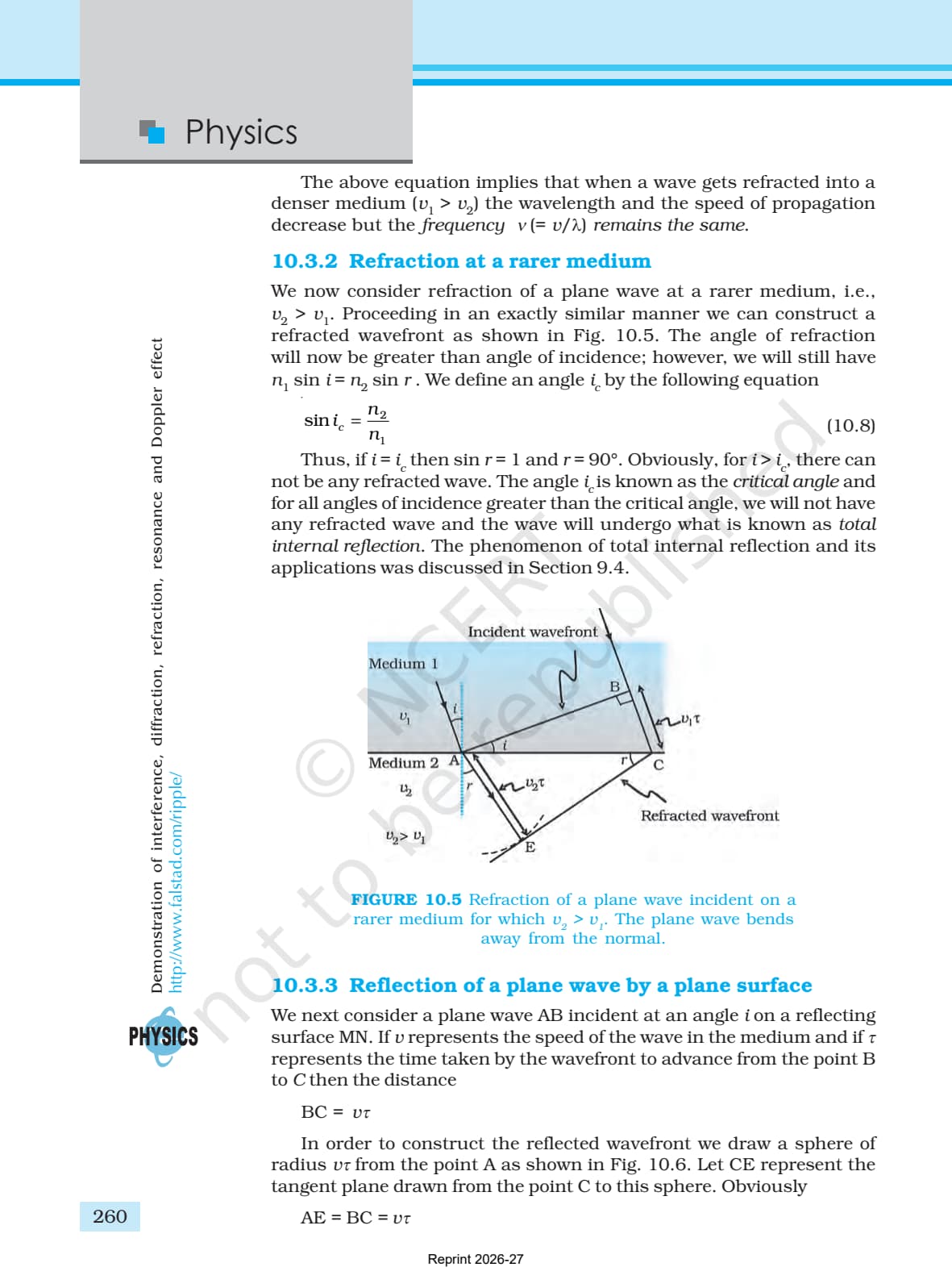
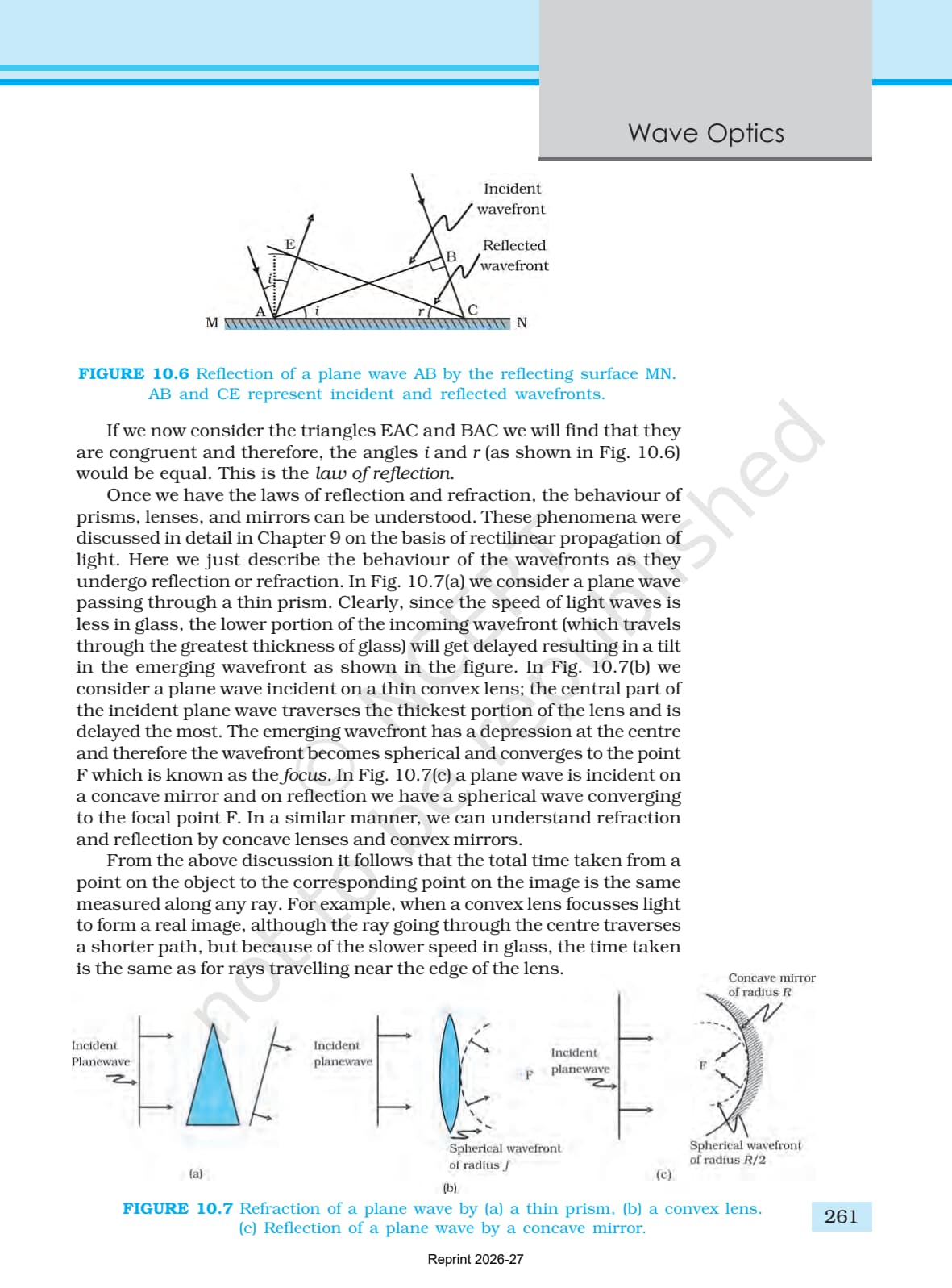
| 10.3 | Refraction and Reflection of Plane Waves Using Wave Theory | 5 | Snell's law derivation from Huygens construction; reflection law; frequency invariance |
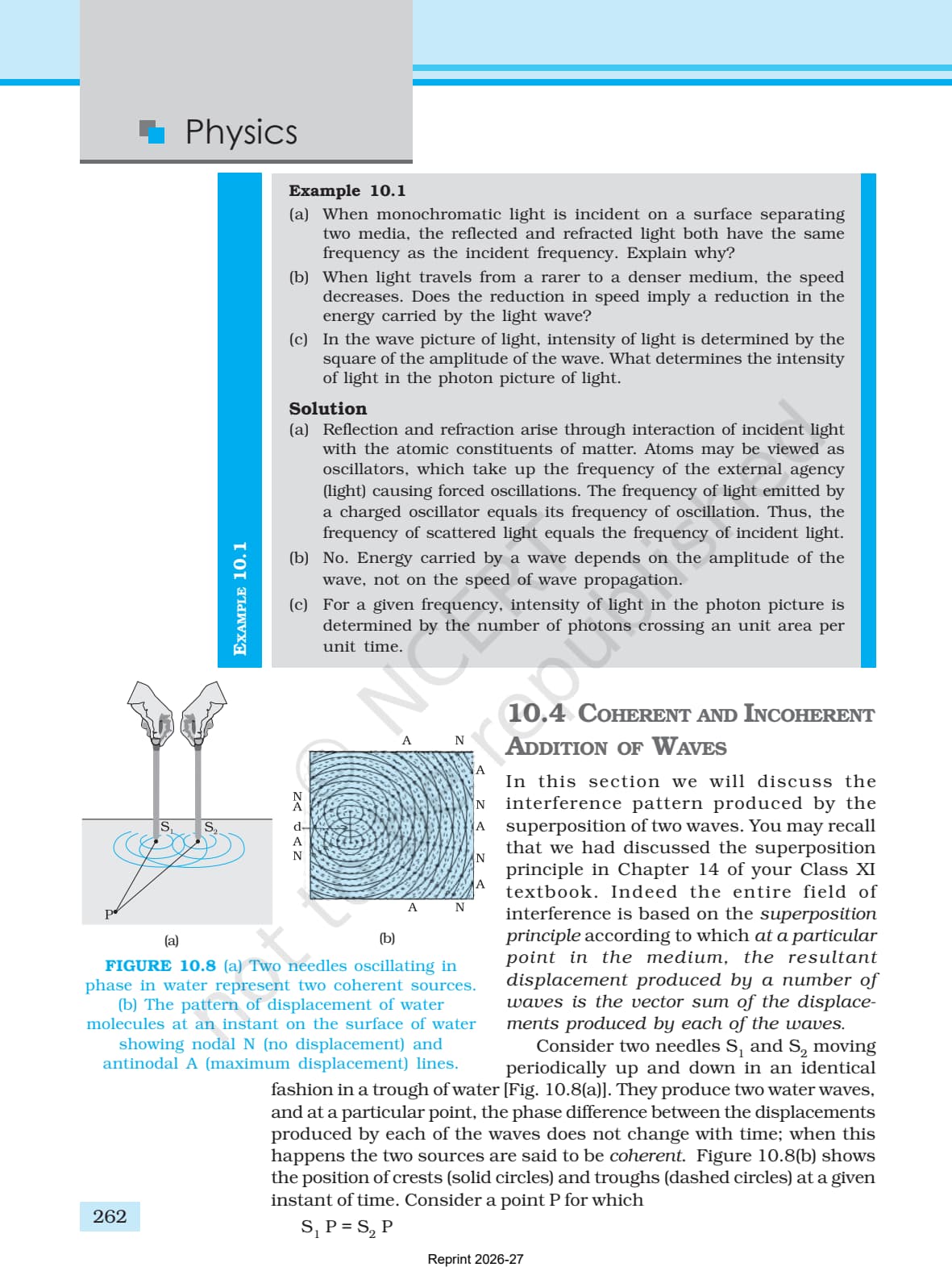
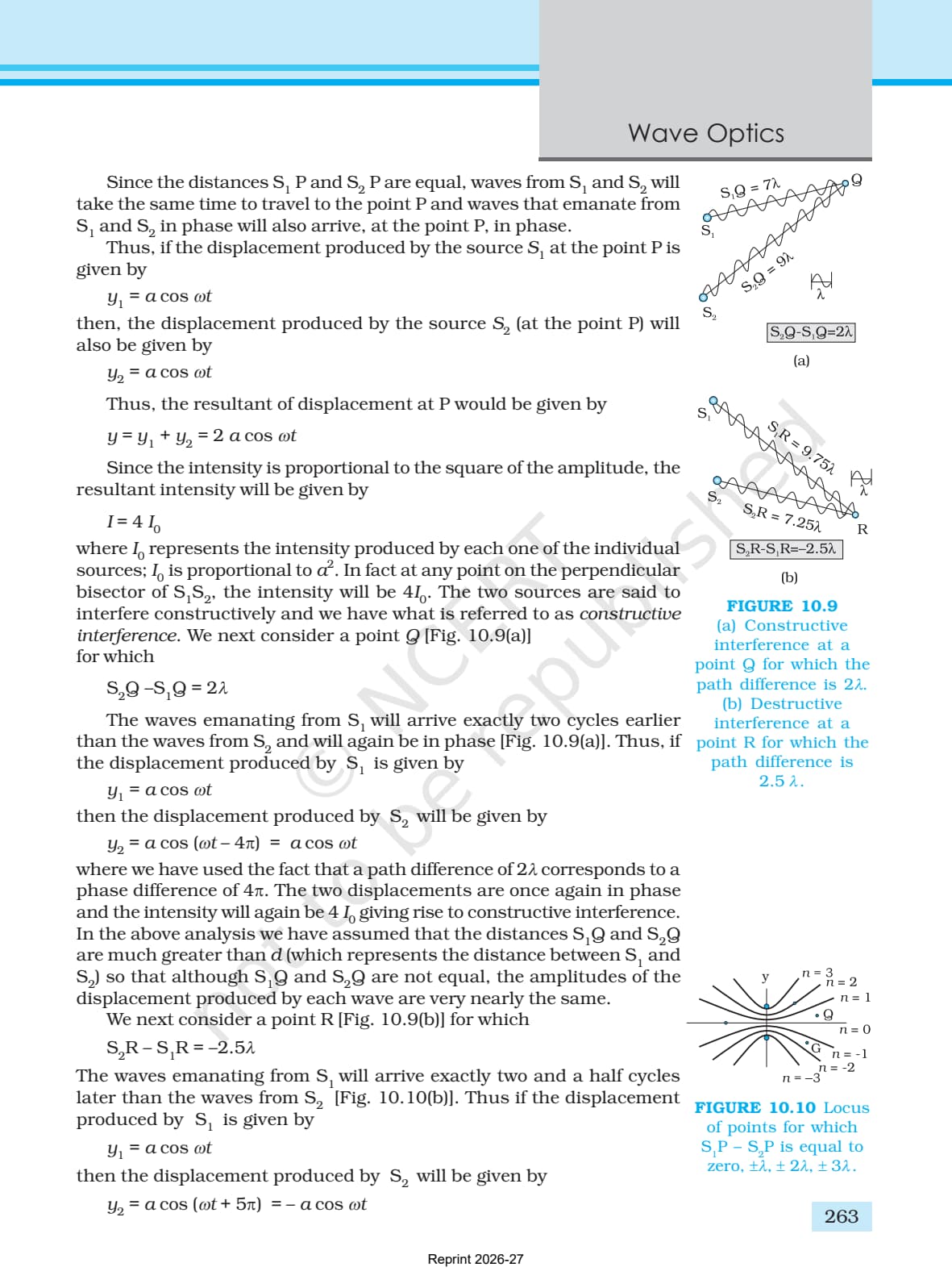
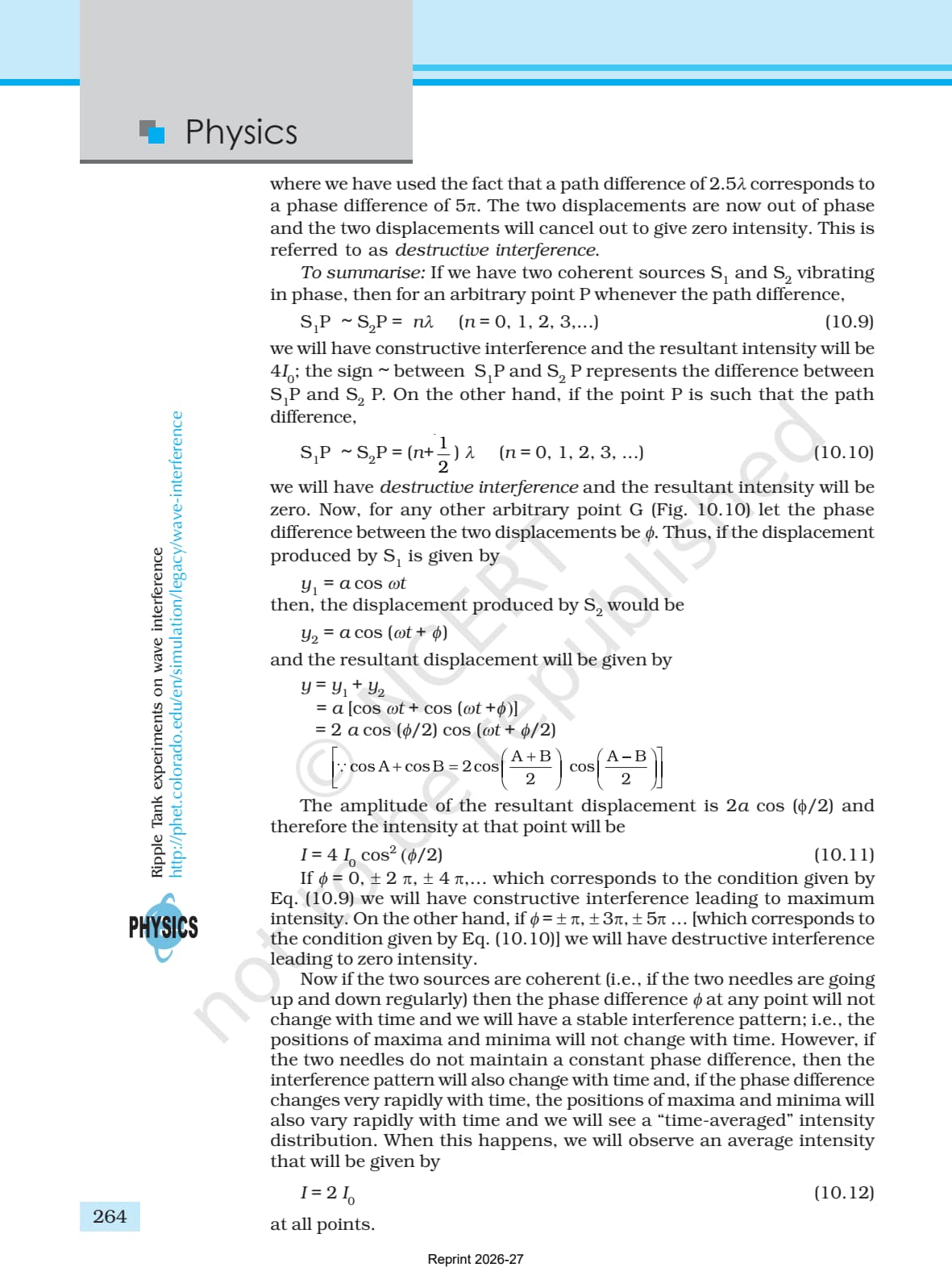
| 10.4 | Coherent and Incoherent Addition of Waves | 3 | Superposition principle, phase difference, resultant intensity for coherent vs incoherent sources |
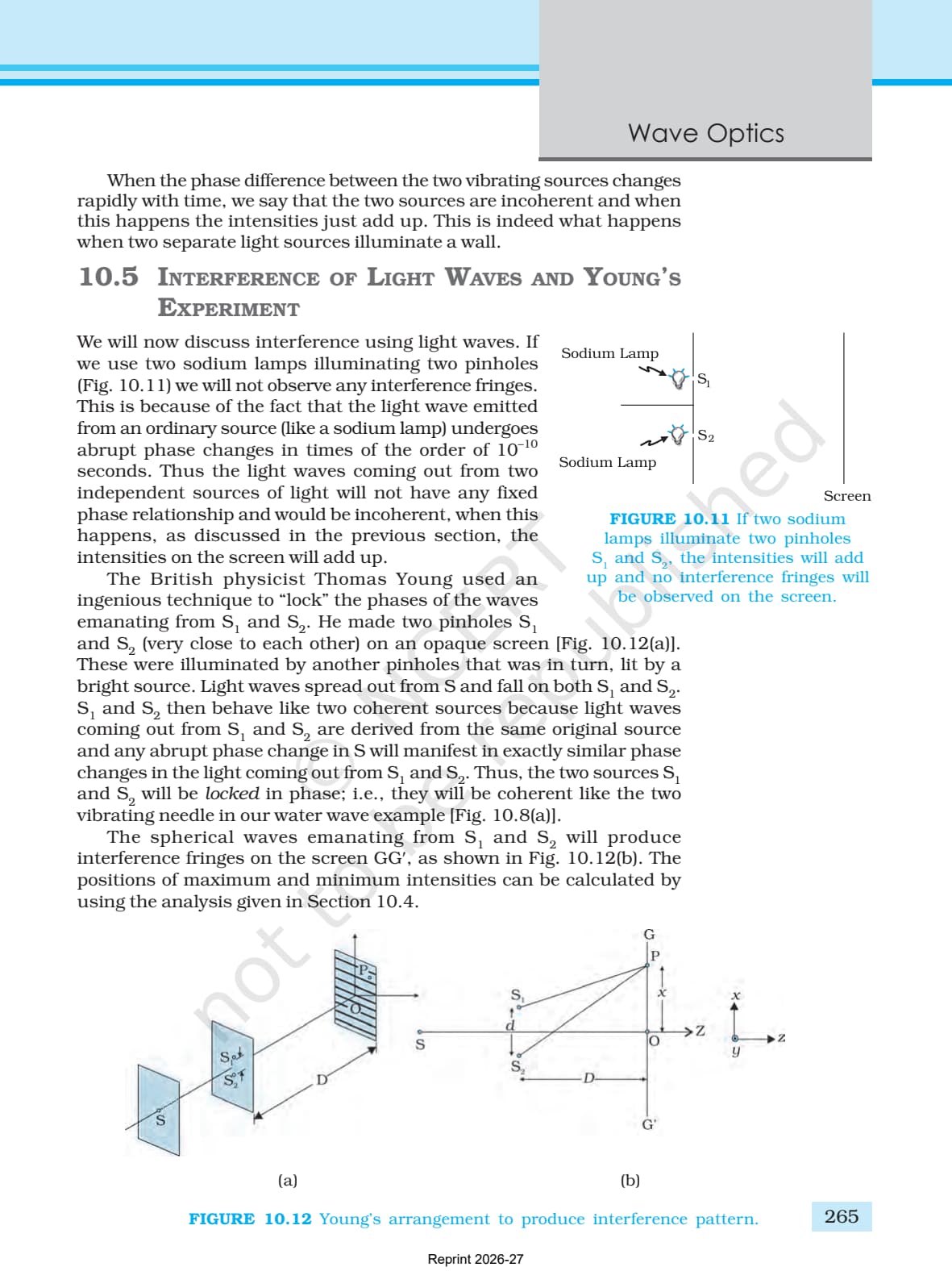
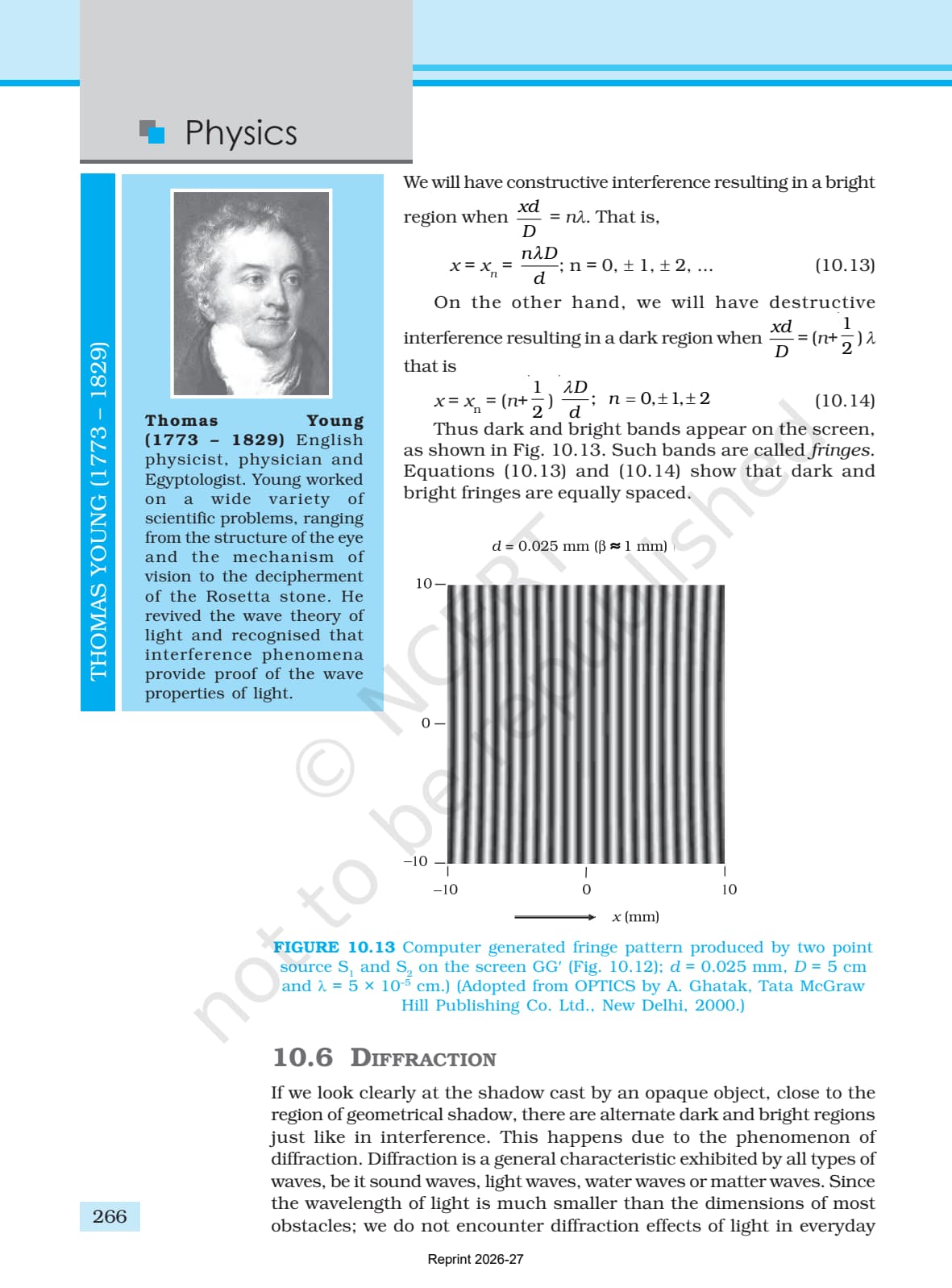
| 10.5 | Interference of Light Waves and Young's Experiment | 6 | YDSE setup, path difference, fringe width derivation, both intext Examples |
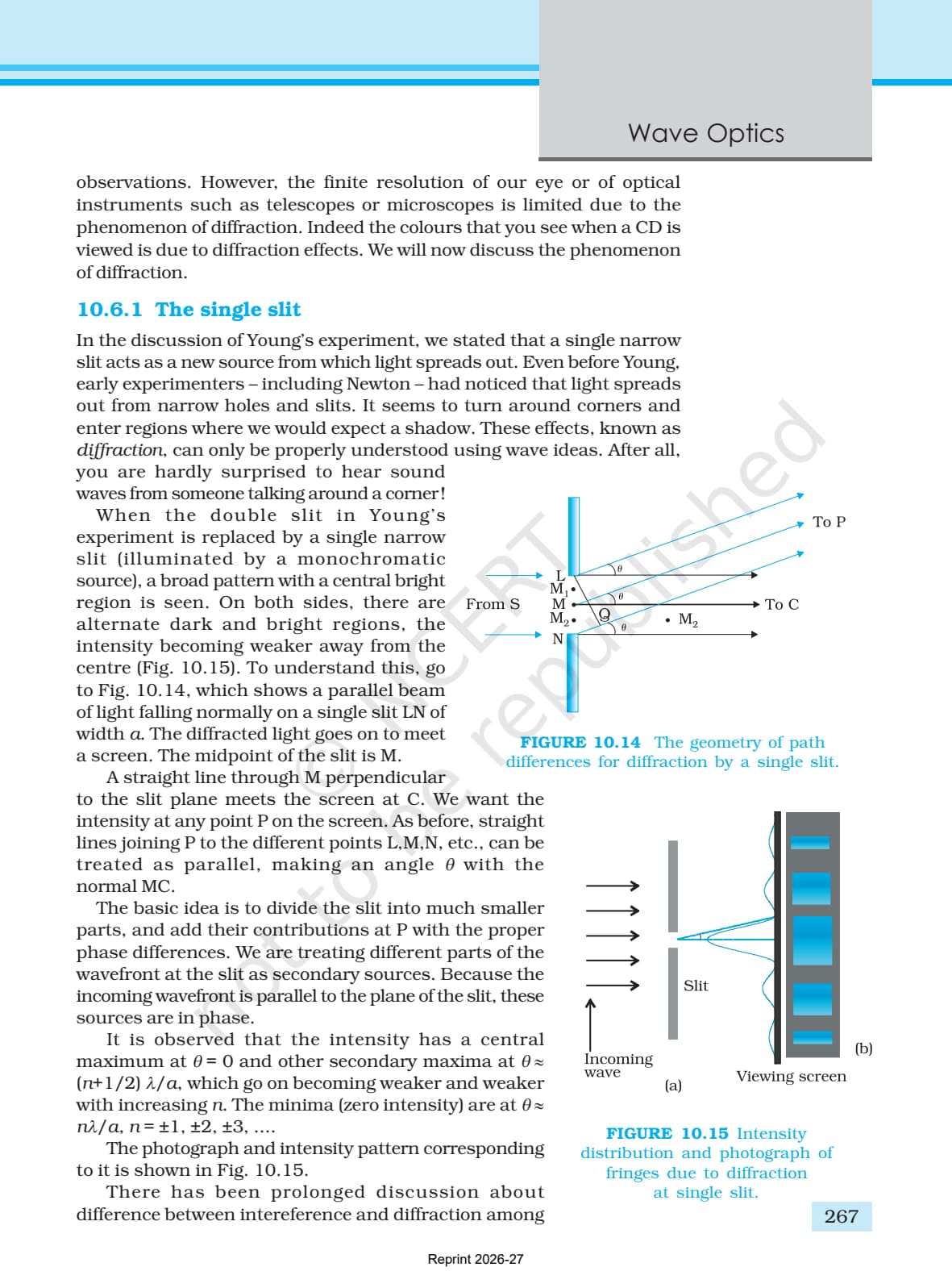
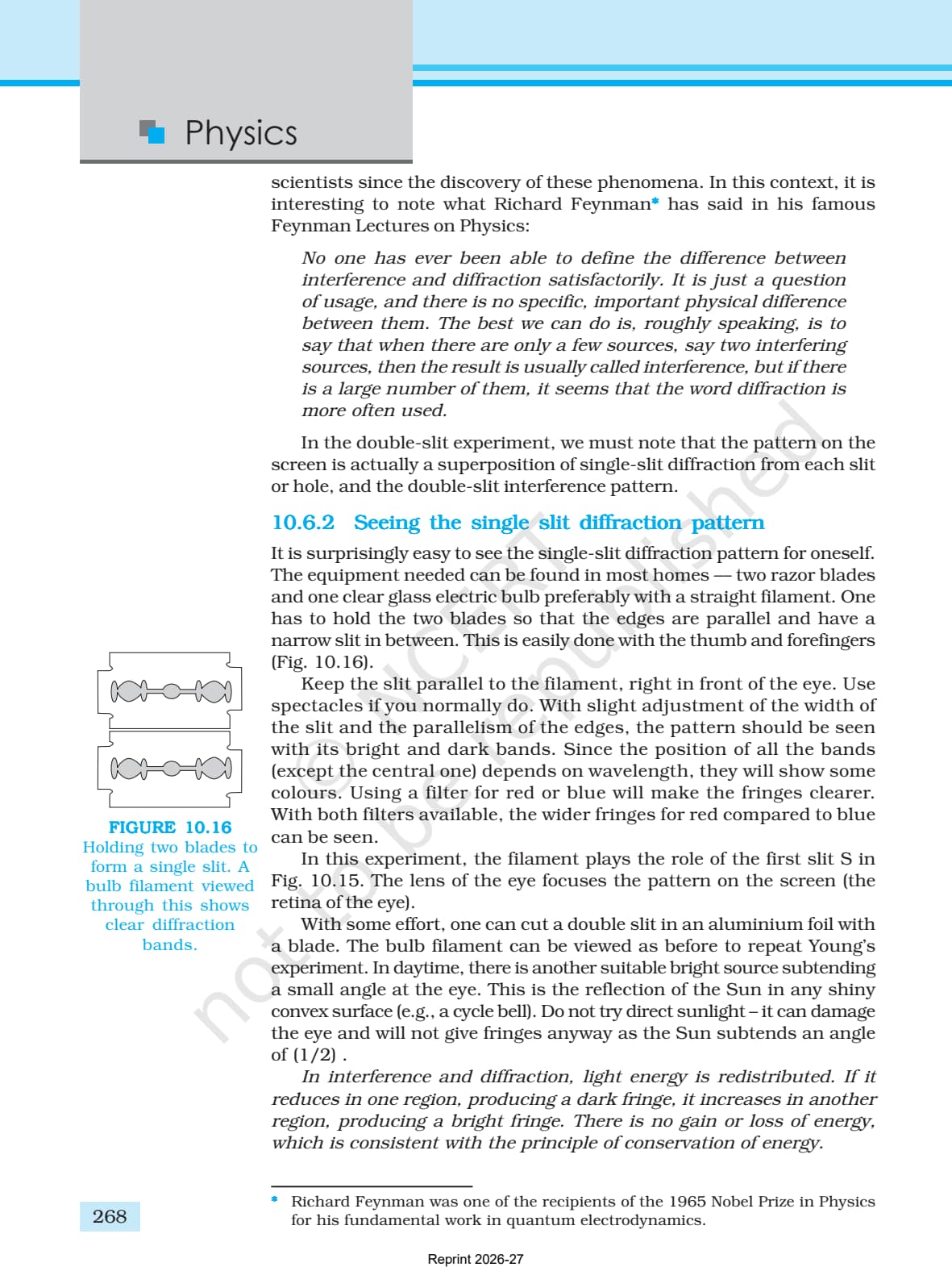
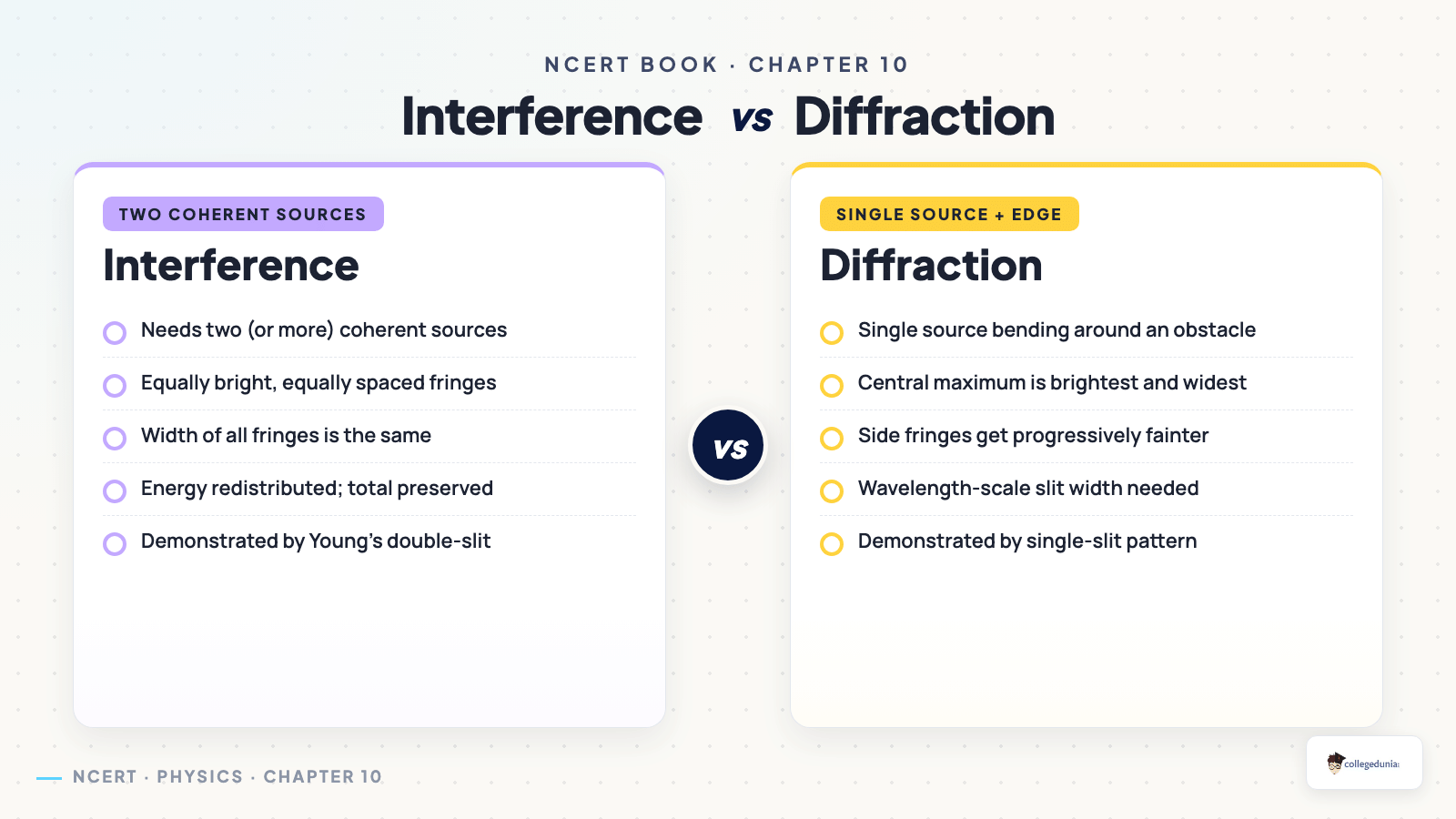
| 10.6 | Diffraction | 5 | Single-slit pattern, central maximum width, Fresnel distance, resolving power |
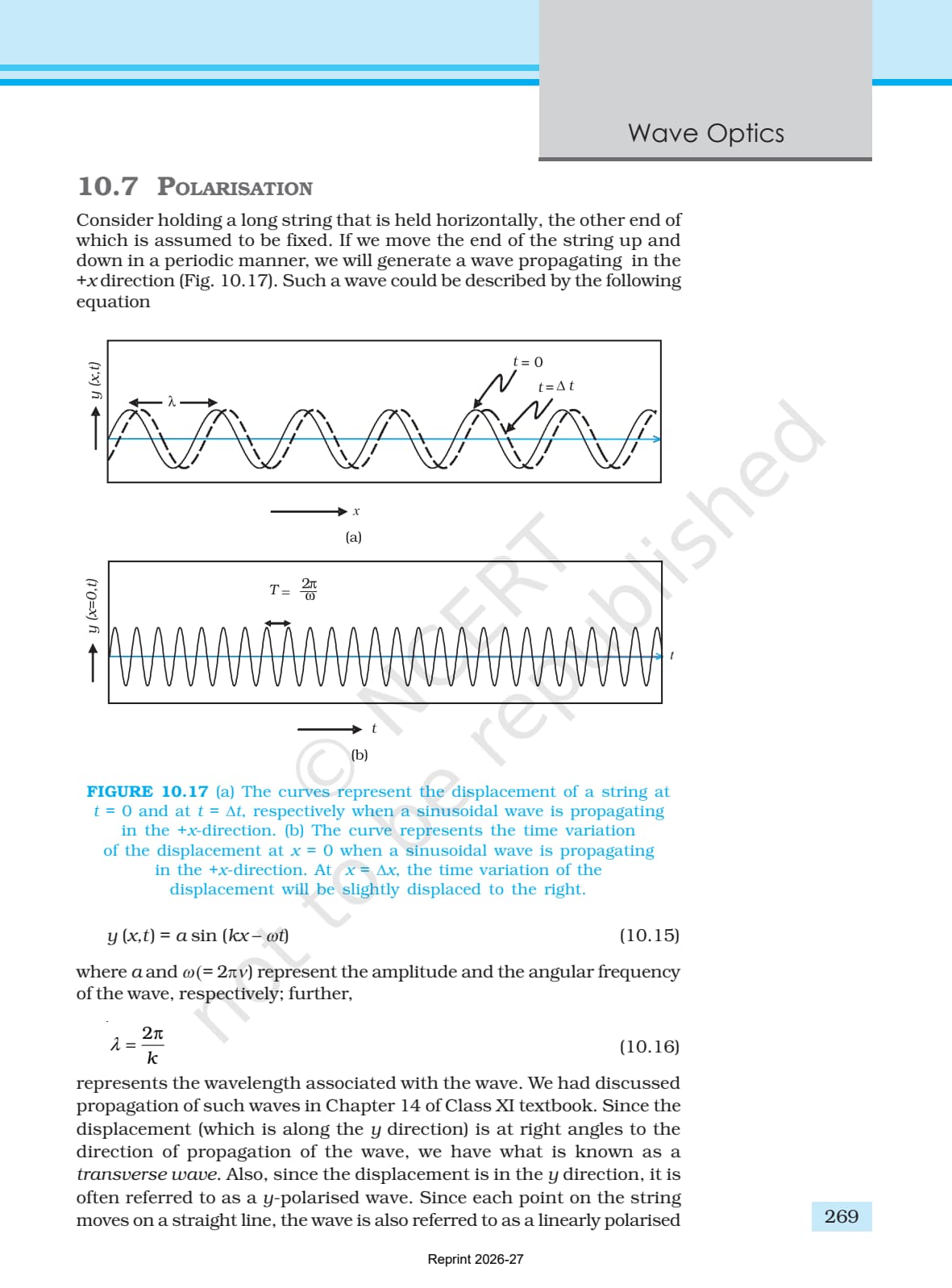
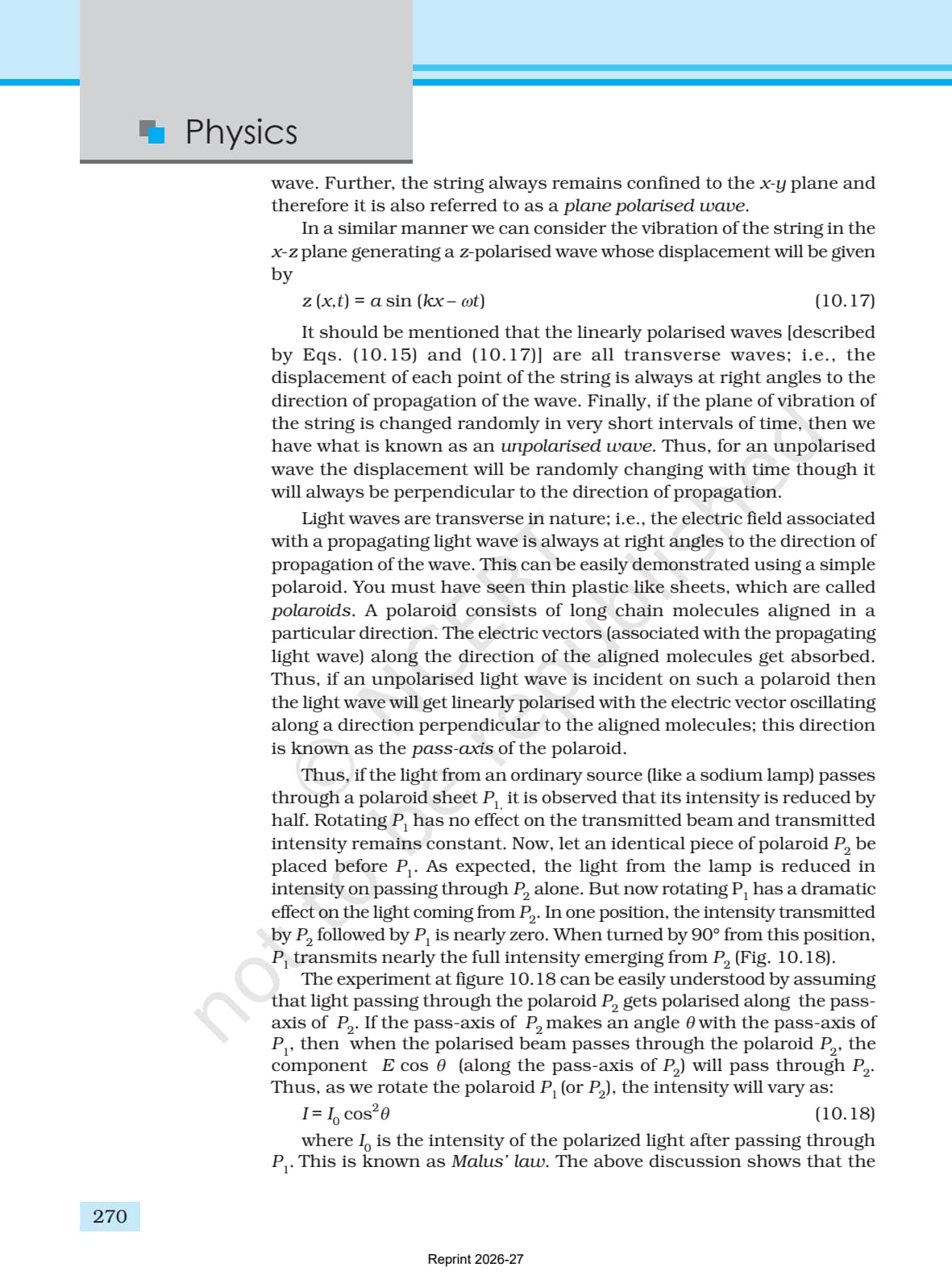
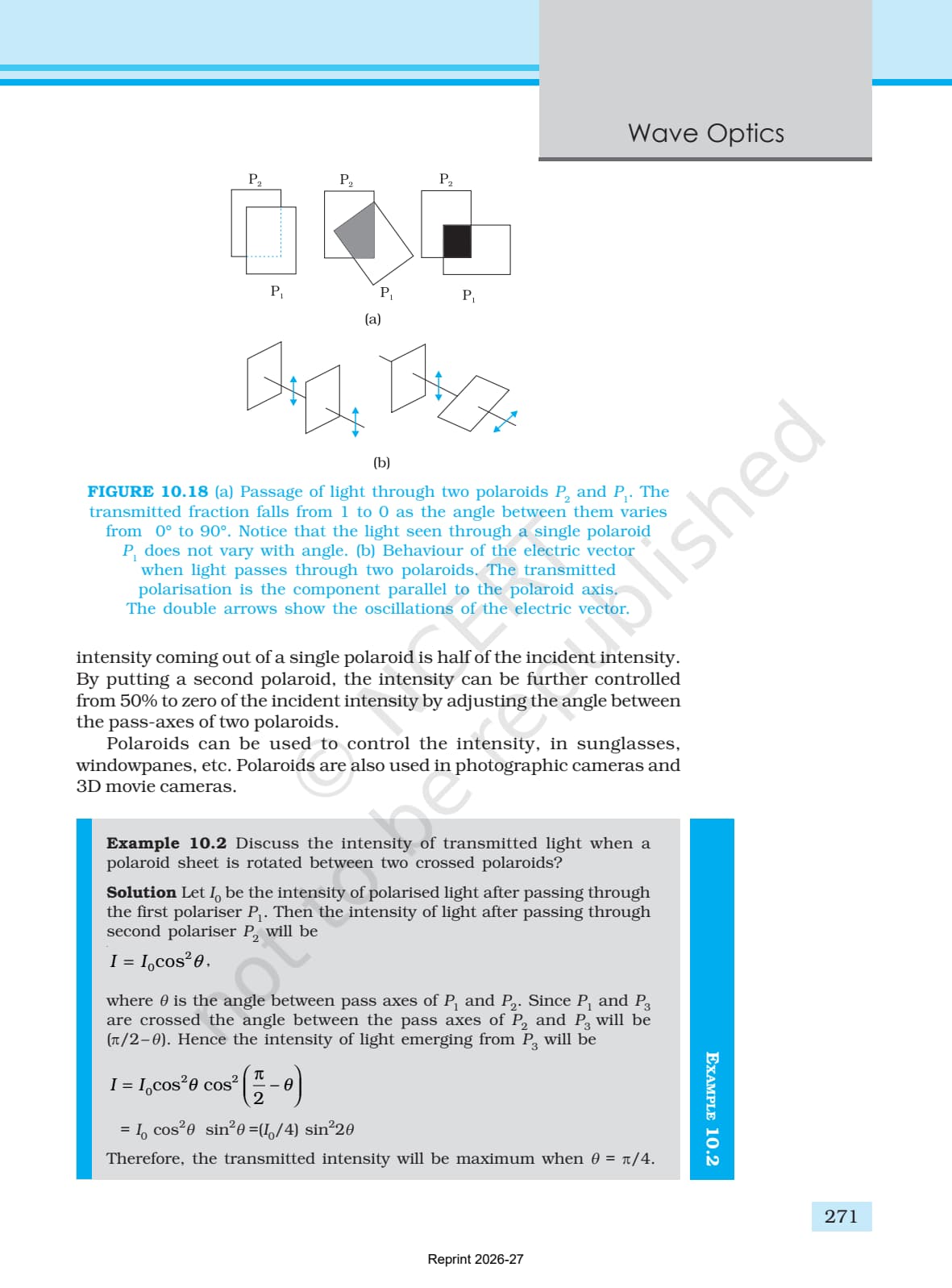
| 10.7 | Polarisation | 4 | Transverse nature of light, Malus's law, Brewster's law, polaroids |
| End | Summary, Points to Ponder, Exercises | 2 | Chapter recap and 10 numerical/conceptual exercises |
Sections 10.5, 10.6, and 10.7 together carry roughly 80% of the chapter's PYQ marks.
Wave Optics Video Chapter Walkthrough
Source: NCERT Wallah on YouTube
Wave Optics Intext Example Inventory for Class 12 Physics
Chapter 10 carries only 2 intext Examples, both inside Section 10.5 on YDSE. The inventory below maps each Example to the sub-topic it tests and the skill it builds.
| Example | Section | Sub-topic | What it Covers |
|---|---|---|---|
| Example 10.1 | 10.5 | YDSE fringe width | Direct application of β = λ D / d |
| Example 10.2 | 10.5 | Position of n-th bright fringe | Linking fringe order to slit-screen geometry |
Both Examples reappear in NEET 2025 and CBSE 2024 in slightly twisted form. Students should solve them, then attempt the matched PYQ on the Collegedunia NCERT Solutions page.
How to Read the Wave Optics Class 12th NCERT Chapter
The chapter rewards a three-pass approach. Pass one skims, pass two drills derivations, pass three locks the numericals.
- Pass 1 (45 min) - Skim: Read Sections 10.1 and 10.2 fully; glance over figures in 10.3 and 10.5 without algebra.
- Pass 2 (90 min) - Drill derivations: Reproduce Snell's law from Huygens (10.3), the YDSE fringe-width derivation (10.5), and the single-slit minima condition (10.6) on paper.
- Pass 3 (75 min) - Numericals: Solve Examples 10.1 and 10.2, then Exercises 10.1 to 10.10 in order. Flag any exercise that took more than 6 minutes.
Wave Optics 2026-27 NCERT Syllabus Note (What Stayed, What Was Trimmed)
The current 2026-27 NCERT print kept Chapter 10 substantially intact. The chapter sits in Unit VI Optics and continues to follow Chapter 9 Ray Optics. The rationalised edition trimmed the older treatment of Doppler effect for light and the detailed Fresnel/Fraunhofer classification, while keeping every CBSE-examinable formula. Polarisation by scattering is mentioned briefly without derivation.
No high-weightage topic was dropped. YDSE, single-slit diffraction, Brewster's law, and Malus's law all remain in the syllabus.
Wave Optics Multi-Day Study Plan for Class 12 Physics
The chapter splits over three days. Each day pairs reading with problem solving.
| Day | NCERT Sections | Problems | Time |
|---|---|---|---|
| Day 1 | 10.1, 10.2, 10.3 | Exercises 10.2, 10.3 | 2 hours |
| Day 2 | 10.4, 10.5 | Examples 10.1, 10.2; Exercises 10.1, 10.4, 10.5 | 2.5 hours |
| Day 3 | 10.6, 10.7 | Exercises 10.6, 10.7, 10.8, 10.9, 10.10 | 2.5 hours |
Day 2 is the heaviest - YDSE carries the largest numerical weight. Use the Day 3 evening to re-attempt any flagged exercise.
Cross-Chapter Reading Order: Ray Optics to Wave Optics to Dual Nature
Wave Optics builds on Chapter 9 Ray Optics and leads into Chapter 11 Dual Nature of Radiation and Matter. Read the three in sequence to follow the thread from particles to waves to quanta.
- Read Chapter 9 first: Ray Optics gives you Snell's law and the geometry of lenses. Wave Optics re-derives Snell's law from Huygens, so the wave proof lands faster.
- Then Chapter 10: The wave model handles interference, diffraction, and polarisation, using the same screen-distance geometry as the lens formula.
- Then Chapter 11: Dual Nature reintroduces the photon model and the photoelectric effect, which the wave picture cannot explain.
Related Links:
- Ray Optics and Optical Instruments Class 12 Physics Notes
- Dual Nature of Radiation and Matter Class 12 Physics Notes
Wave Optics Top 5 Formulae You Will See in PYQs
These five formulae cover every numerical type from CBSE, JEE Main, and NEET in the last five years. The complete table with units is on the Formula Sheet page.
| Quantity | Formula |
|---|---|
| YDSE fringe width | β = λ D / d |
| Two-wave intensity | I = I1 + I2 + 2√I1 I2 cosφ |
| Single-slit minimum | a sinθ = nλ |
| Central maximum full width | 2λ D / a |
| Brewster's law and Malus's law | tan ip = μ ; I = I0 cos2θ |
Full master table: Wave Optics Class 12 Physics Formula Sheet
Wave Optics PYQ Trends (CBSE, JEE Main, NEET 2024-2026)
Three question patterns dominate this chapter. The full year-wise PYQ map is on the NCERT Solutions page.
- YDSE fringe-width numerical: CBSE 2025 set a 3-mark numerical with given d, D, lambda; JEE Main 2024 set a fringe-shift variant with a glass slab.
- Brewster's law and polarisation by reflection: CBSE 2024 asked for the Brewster angle for glass with mu = 1.5; NEET 2024 paired Brewster with a refractive-index MCQ.
- Single-slit diffraction central maximum: JEE Main 2025 tested angular width for a = 1 micron; NEET 2023 set a resolving-power MCQ on the same formula.
Full PYQ year-map: Wave Optics Class 12 Physics NCERT Solutions
How the Wave Optics NCERT PDF on Collegedunia Helps You
- 2026-27 NCERT Alignment: The PDF matches the current edition, with the trimmed Doppler-effect note flagged.
- Section-by-Section Reading Plan: The breakdown table and the three-day plan turn 30 pages into a paced schedule.
- Cross-Chapter Map: The Chapter 9 to Chapter 10 to Chapter 11 reading order is mapped so students keep continuity.
- Linked Resources: One-click access to NCERT Solutions, Notes, and the Formula Sheet.
Student Feedback
"The section breakdown table made it easy to plan my three-day revision. I covered YDSE on Day 2 and cracked a JEE Main 2024 fringe-shift question the same evening." - Priya, Class 12, Delhi
"I kept getting the Brewster's angle formula wrong. The formula table on this page fixed it in one read." - Arjun, Class 12, Pune
Other Resources for Wave Optics Class 12 Physics Chapter 10
| Resource | Link |
|---|---|
| NCERT Book PDF | Wave Optics NCERT Book PDF |
| NCERT Solutions | Wave Optics Class 12 Physics NCERT Solutions |
| Notes | Wave Optics Class 12 Physics Notes |
| Formula Sheet | Wave Optics Class 12 Physics Formula Sheet |
NCERT Book PDF for Class 12 Physics: All Chapters
Other Class 12 Physics NCERT Book PDFs you can grab as free downloads:
| Chapter | Resource |
|---|---|
| Chapter 1 | Electric Charges and Fields NCERT PDF |
| Chapter 2 | Electrostatic Potential and Capacitance NCERT PDF |
| Chapter 3 | Current Electricity NCERT PDF |
| Chapter 4 | Moving Charges and Magnetism NCERT PDF |
| Chapter 5 | Magnetism and Matter NCERT PDF |
| Chapter 6 | Electromagnetic Induction NCERT PDF |
| Chapter 7 | Alternating Current NCERT PDF |
| Chapter 8 | Electromagnetic Waves NCERT PDF |
| Chapter 9 | Ray Optics and Optical Instruments NCERT PDF |
| Chapter 10 | Wave Optics NCERT PDF |
| Chapter 11 | Dual Nature of Radiation and Matter NCERT PDF |
| Chapter 12 | Atoms NCERT PDF |
| Chapter 13 | Nuclei NCERT PDF |
| Chapter 14 | Semiconductor Electronics NCERT PDF |
Wave Optics NCERT PDF: available above as a free PDF download, fully aligned to the 2026-27 NCERT release.
Wave Optics NCERT PDF - Frequently Asked Questions
Ques. Where can I download the Wave Optics NCERT PDF for free?
Ans. You can download the Wave Optics NCERT PDF directly from this page. Both the Normal and HD versions are available, and both are free for the 2026-27 session.
Ques. Is this Wave Optics NCERT PDF aligned with the 2026-27 CBSE syllabus?
Ans. Yes. This page hosts the current 2026-27 NCERT print for Class 12 Physics Chapter 10. The new edition retains all CBSE-examinable derivations on YDSE, single-slit diffraction, Brewster's law, and Malus's law; only the older Doppler-for-light note and the detailed Fresnel/Fraunhofer classification have been trimmed.
Ques. How many pages is the Class 12th Physics Wave Optics NCERT Book PDF?
Ans. The Wave Optics NCERT PDF chapter PDF runs approximately 30 pages and covers seven numbered sections, two intext Examples on YDSE, and ten end-of-chapter Exercises on interference, diffraction, and polarisation.
Ques. How many intext Examples and Exercises does Chapter 10 contain?
Ans. Chapter 10 contains 2 intext Examples, both inside Section 10.5 on Young's Double Slit Experiment, and 10 end-of-chapter Exercises covering wavelength, fringe spacing, refractive index, intensity ratios, single-slit diffraction, resolving power, Brewster's law, and Malus's law.
Ques. Which sections of Wave Optics carry the most marks in CBSE Class 12?
Ans. Sections 10.5 (YDSE), 10.6 (Diffraction), and 10.7 (Polarisation) together carry roughly 80% of the chapter's CBSE marks. Section 10.3 on refraction using wave theory is a recurring 2-3 mark derivation. Sections 10.1, 10.2, and 10.4 supply conceptual grounding but rarely appear as standalone numerical questions.
Ques. In what order should I read Chapters 9, 10, and 11 of Class 12 Physics?
Ans. Read Chapter 9 Ray Optics first to lock the geometric optics base, then Chapter 10 Wave Optics NCERT PDF for the wave model and YDSE, then Chapter 11 Dual Nature of Radiation and Matter for the photon model. The three chapters trace the historical wave-versus-particle debate and reinforce each other.
Ques. How many days should I spend on the Wave Optics NCERT chapter?
Ans. Three focused study days are enough for the full chapter, totalling roughly 7 hours of reading plus problem solving. Day 1 covers Sections 10.1 to 10.3, Day 2 handles 10.4 and 10.5 with both intext Examples, and Day 3 finishes 10.6 and 10.7 with Exercises 10.6 to 10.10.
Ques. Is the NCERT Wave Optics chapter alone enough for the CBSE board exam?
Ans. Yes. The NCERT chapter is sufficient for CBSE Class 12 Physics if both intext Examples and all 10 Exercises are practised along with the derivations in Sections 10.3, 10.5, and 10.6. Students should pair this with the linked NCERT Solutions page for PYQ-style drills.



Comments