




The Class 12 Geography Chapter 3 Human Development textbook PDF is the official NCERT source for every board question on the Human Development Index, the four pillars of human development, and the approaches to measuring development. It carries about 4 to 5 marks in the CBSE board exam and is a key chapter for CUET and UPSC Geography as well.
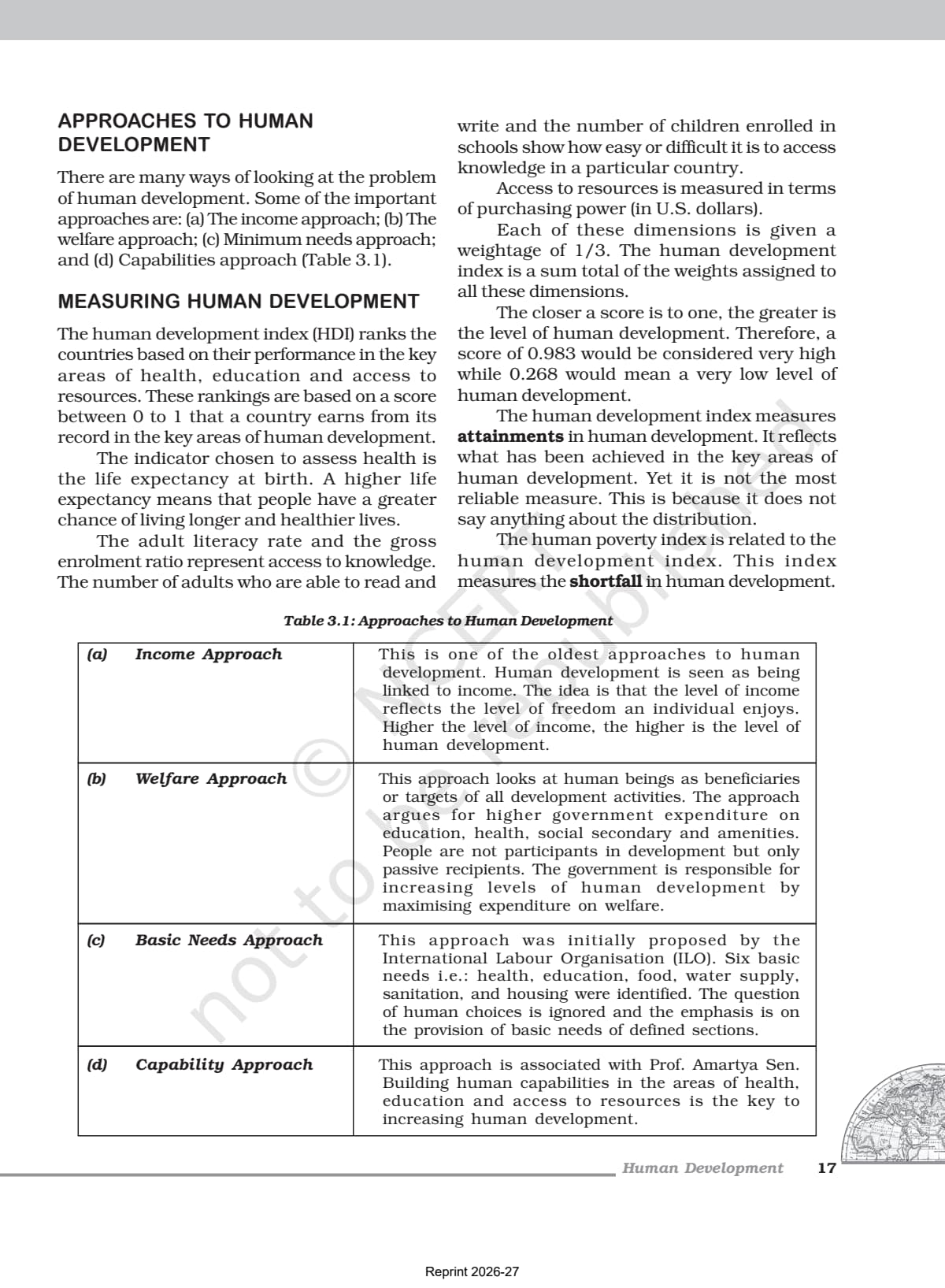
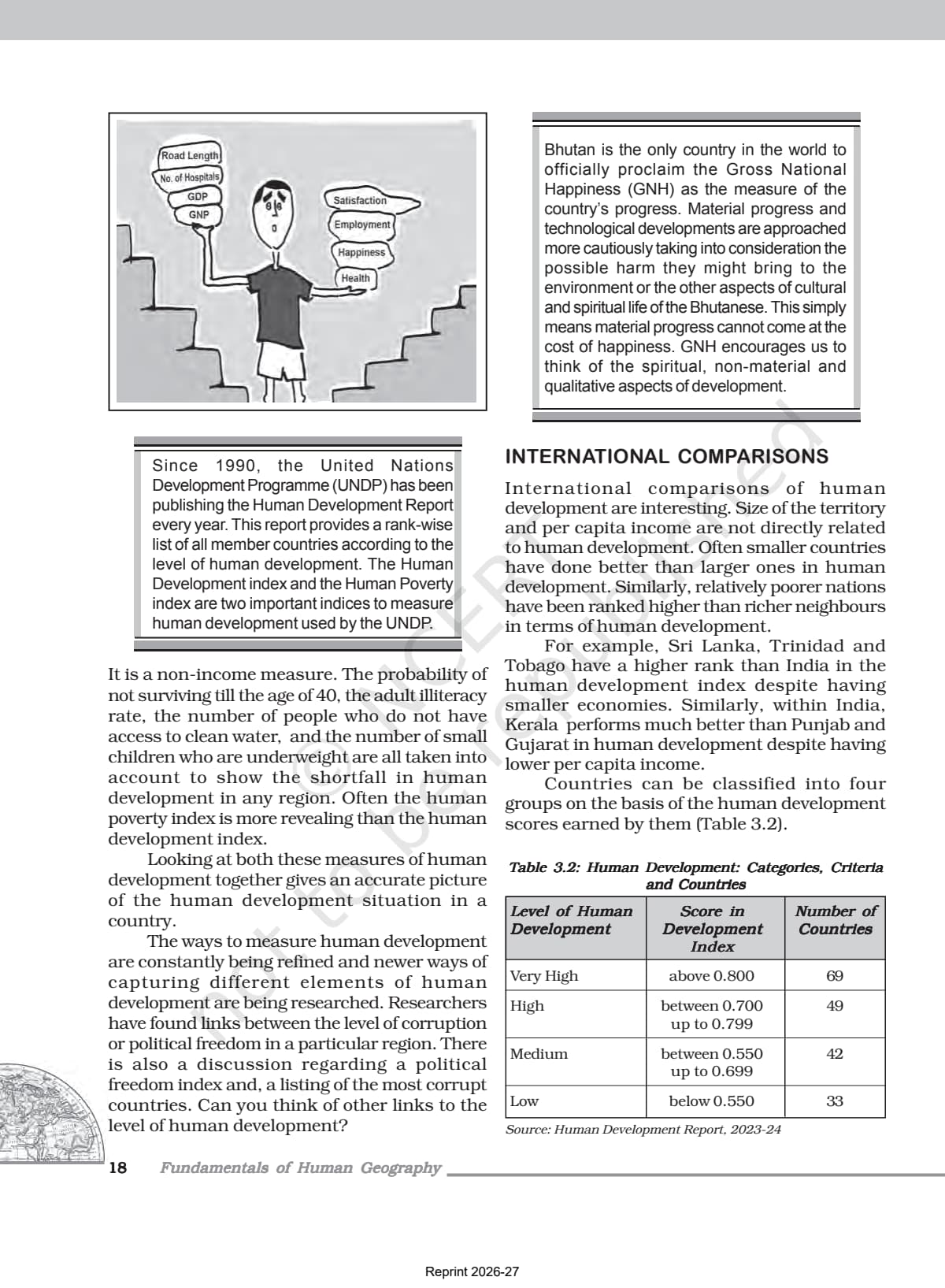
- Official NCERT Fundamentals of Human Geography Class 12 Chapter 3 PDF covering growth vs development, HDI, four pillars (equity, sustainability, productivity, empowerment), and global HDI rankings.
- 4-5 marks CBSE board-paper weightage for Chapter 3; the official textbook is the only source CBSE references when it sets definition and short-answer questions on human development.
- Pair with the matching NCERT Solutions, Notes and Handwritten Notes for full chapter coverage.
Student Feedback
In a 2026 Collegedunia poll of 8,700 Class 12 Geography students, 80% said reading the NCERT chapter PDF directly helped them answer board questions on the HDI and the four pillars more accurately than any guide book. Students who read the full PDF averaged 4.5 out of 5 marks on this chapter.
What This Chapter Covers in the NCERT Class 12 Book
The human development class 12 geography chapter explains why development is more than economic growth. The official NCERT PDF is the document CBSE references for definition and short-answer questions here, so read it before any guide book for the 2026-27 paper. It moves from growth versus development to the concept of human development introduced by Dr Mahbub-ul-Haq and Prof Amartya Sen, then the four pillars, the four approaches, and finally the Human Development Index and global rankings.
Source: Humanities Wallah - Class 12th on YouTube
Topics in the Chapter (Section-Wise Map of the NCERT PDF)
The PDF is organised into numbered sub-sections. The table below maps each sub-topic to its concept and exam angle.
| Section | NCERT Sub-topic | Dominant Exam Concept |
|---|---|---|
| 3.1 | Growth and Development | Growth is quantitative and value-neutral; development is qualitative and always value-positive |
| 3.2 | What Is Human Development? | Dr Mahbub-ul-Haq's definition; enlarging people's choices; meaningful life |
| 3.3 | Four Pillars of Human Development | Equity, sustainability, productivity, empowerment |
| 3.4 | Approaches to Human Development | Income approach, welfare approach, minimum needs approach, capabilities approach |
| 3.5 | Measuring Human Development | HDI components: life expectancy, literacy/GER, purchasing power; score 0-1 |
| 3.6 | Human Poverty Index | Measures shortfall in human development; contrasts with HDI |
| 3.7 | International Comparisons | Countries grouped into high, medium, and low HDI categories |
Section 3.3 on the four pillars and Section 3.5 on the HDI together carry the majority of board-paper questions from this chapter, because both are rich in definitions and named concepts that examiners can frame as short answers or MCQs.
Key Concepts From the NCERT Class 12 Geography Textbook
Reproducing the NCERT's exact phrasing is the fastest route to full marks on theory questions. The four concept blocks below are taken from the chapter.
Growth vs Development
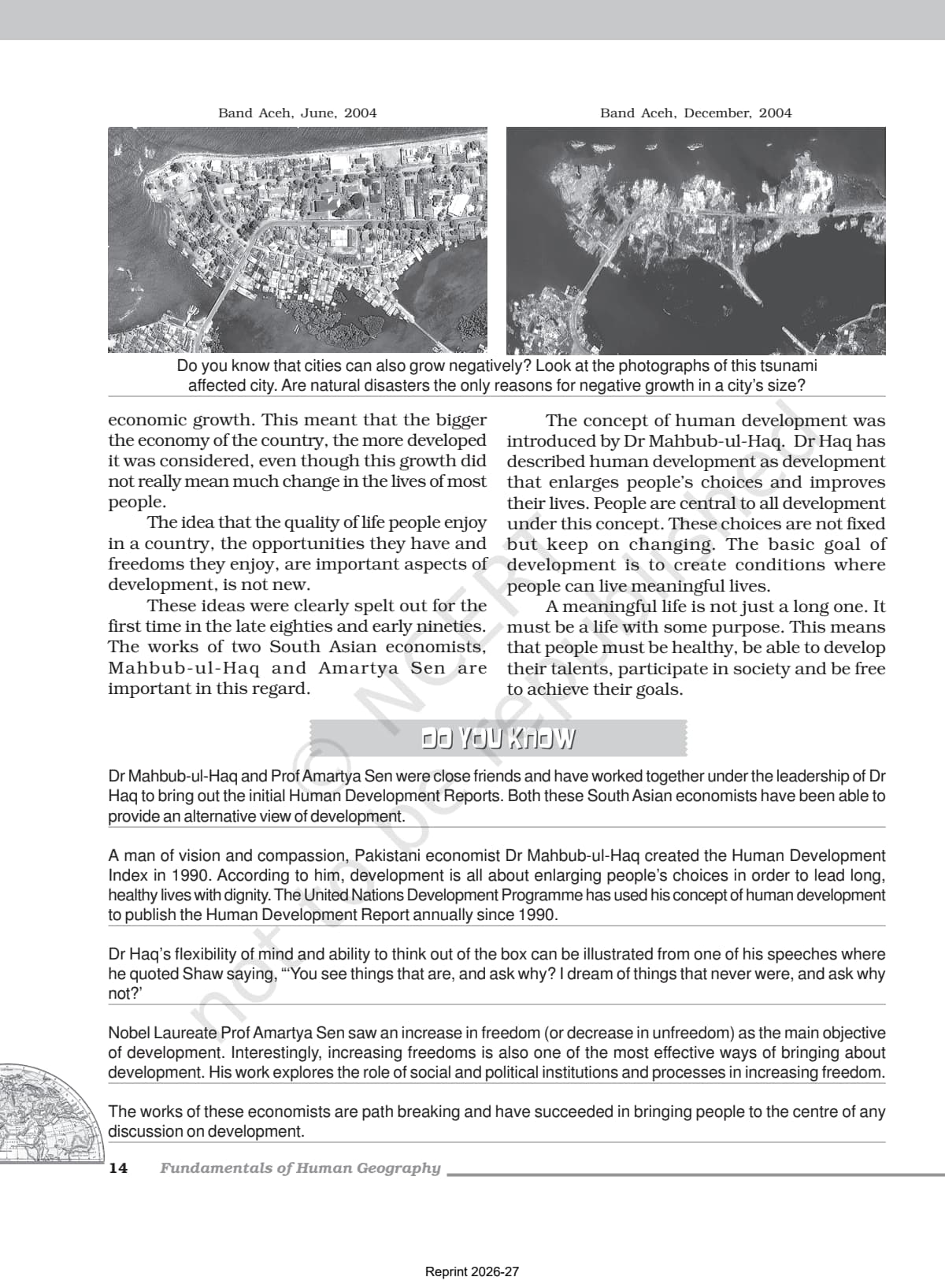
Growth is quantitative and value-neutral: it can be positive (a city that adds population) or negative (a city hit by a tsunami). Development is qualitative and always value-positive; it happens only when there is a positive change in quality. Positive growth does not always lead to development. This distinction is examined as a one-mark MCQ or two-mark short answer almost every year.
The Concept of Human Development
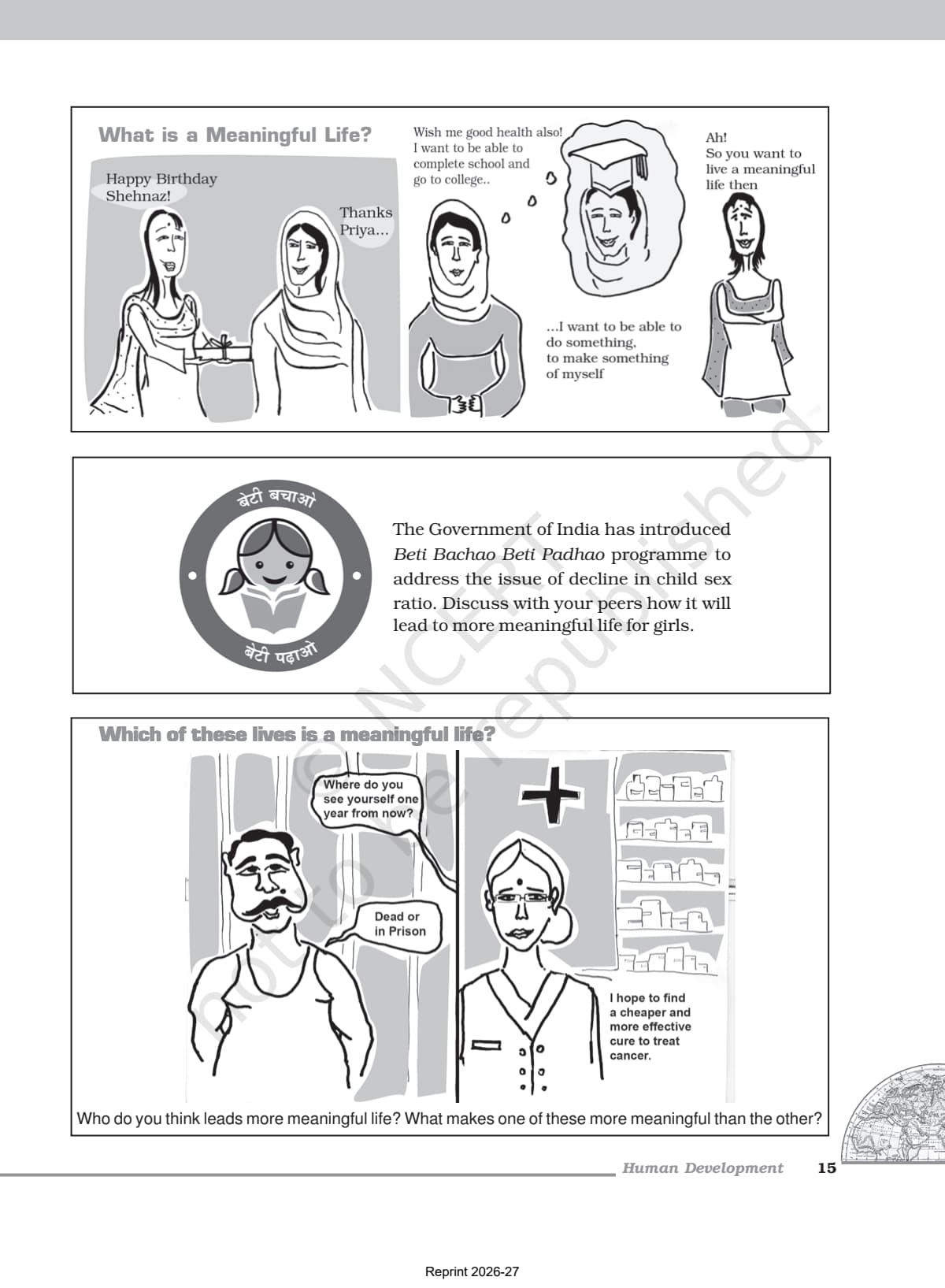
Dr Mahbub-ul-Haq introduced human development as "development that enlarges people's choices and improves their lives." People are central, and the goal is to create conditions for meaningful lives, so people are healthy, can develop their talents, participate in society, and are free to reach their goals. Prof Amartya Sen added that increasing freedom is the main objective. Building capabilities in health, education, and access to resources is how choices get enlarged.
The Four Pillars of Human Development
The chapter introduces four pillars that support all human development thinking. Equity means equal access to opportunities regardless of gender, race, income, or caste. Sustainability means each generation must have the same opportunities - environmental, financial, and human resources must not be misused. Productivity means human labour productivity, enriched by building capabilities in people through knowledge and better health. Empowerment means having the power to make choices, which comes from freedom, good governance, and people-oriented policies. Questions regularly ask students to define any one or two of these pillars with an example, so knowing all four from the textbook is non-negotiable.
Measuring Human Development: The HDI
The Human Development Index ranks countries based on performance in three areas: health (measured by life expectancy at birth), education (measured by adult literacy rate and gross enrolment ratio), and access to resources (measured by purchasing power in US dollars). Each dimension gets a weight of 1/3. The HDI score lies between 0 and 1. A score of 0.983 means very high human development; a score of 0.268 means very low. Countries are grouped into high, medium, and low HDI categories.
Previous Year Question Trends From This Chapter
This chapter has contributed 3 to 5 marks across recent board papers, mostly through definition, short-answer, and one conceptual long-answer question. Expect a similar distribution for 2026-27.
| Year | Marks | Question Types | Most Common Topic |
|---|---|---|---|
| 2025 | 4 | 1 MCQ + 1 short answer + 1 definition | Definition of human development / four pillars |
| 2024 | 5 | 1 MCQ + 1 short answer + 1 long answer | Distinguish growth from development; HDI components |
| 2023 | 3 | 1 MCQ + 1 short answer | HDI and its indicators |
| 2022 | 4 | 2 short answers + 1 MCQ | Four pillars: equity and sustainability |
| 2020 | 5 | 1 long answer + 1 MCQ | Approaches to human development |
The most repeated question asks students to explain the four pillars with examples, or to describe the HDI components. Both need textbook phrasing.
Connecting This Chapter to the Rest of Fundamentals of Human Geography
This chapter builds on the population concepts in Chapter 2 and sets up why primary and secondary activities vary so much across countries. Roughly 20 to 25% of the Fundamentals of Human Geography paper depends on ideas introduced here, since the HDI is a recurring lens for economic activities and trade.
| Later Chapter | Concept Inherited From Chapter 3 |
|---|---|
| Chapter 4: Primary Activities | Countries with low HDI depend heavily on primary activities (gathering, shifting cultivation) |
| Chapter 5: Secondary Activities | Industrialisation raises HDI by increasing productivity and access to resources |
| Chapter 6: Tertiary and Quaternary Activities | High-HDI countries are service economies; knowledge-based work is the capabilities approach in action |
| Chapter 8: International Trade | Low-HDI countries export primary goods; terms of trade link to development gaps |
Quick Glossary From the NCERT Chapter
Students should be able to define each term in a single line for one-mark MCQs and two-mark short answers. The glossary below lists the most testable terms.
- Growth: Quantitative change over time; value-neutral; can be positive or negative.
- Development: Qualitative change; always value-positive; occurs only when there is an increment to existing conditions.
- Human development: Development that enlarges people's choices and improves their lives; coined by Dr Mahbub-ul-Haq.
- Equity: Making equal access to opportunities available regardless of gender, race, income, or caste.
- Sustainability: Continuity in the availability of opportunities; each generation must have the same chances as the previous one.
- Productivity: Human labour productivity, enriched by investments in knowledge and health.
- Empowerment: Having the power to make choices, derived from freedom, good governance, and people-oriented policies.
- Human Development Index (HDI): A composite index ranking countries on health (life expectancy), education (literacy + GER), and access to resources (purchasing power); scored 0 to 1.
- Human Poverty Index: Measures the shortfall in human development; related to but different from the HDI.
Also Explore Other Resources for Class 12 Geography Chapter 3
| Resource | Link |
|---|---|
| NCERT Solutions | Class 12 Geography Chapter 3 NCERT Solutions |
| Revision Notes | Class 12 Geography Chapter 3 Notes |
| Handwritten Notes | Class 12 Geography Chapter 3 Handwritten Notes |
| Subject Hub | Class 12 Geography All Chapters |
All Chapters: Class 12 Geography NCERT Book PDF (Fundamentals of Human Geography)
| Chapter | NCERT Book PDF |
|---|---|
| Chapter 1 | Human Geography: Nature and Scope NCERT Book PDF |
| Chapter 2 | The World Population: Distribution, Density and Growth NCERT Book PDF |
| Chapter 3 | Human Development NCERT Book PDF (You are here) |
| Chapter 4 | Primary Activities NCERT Book PDF |
| Chapter 5 | Secondary Activities NCERT Book PDF |
| Chapter 6 | Tertiary and Quaternary Activities NCERT Book PDF |
| Chapter 7 | Transport and Communication NCERT Book PDF |
| Chapter 8 | International Trade NCERT Book PDF |
Frequently Asked Questions on Class 12 Geography Chapter 3 NCERT Book PDF
Ques. Where can students download the official NCERT Class 12 Geography Chapter 3 PDF?
Ans. Students can download the official human development class 12 NCERT book PDF directly from the download card at the top of this page. The PDF is the single-chapter file from the Fundamentals of Human Geography textbook, aligned to the 2026-27 CBSE syllabus.
Ques. What is the difference between growth and development according to the NCERT Class 12 Geography textbook?
Ans. According to the NCERT textbook, growth is a quantitative and value-neutral change - it can be positive or negative. Development is a qualitative change and is always value-positive, meaning it only occurs when there is an increment or addition to existing conditions. Positive growth does not always lead to development; development requires a positive change in quality.
Ques. Who introduced the concept of human development and how is it defined in the NCERT textbook?
Ans. The concept of human development was introduced by Dr Mahbub-ul-Haq. He described human development as "development that enlarges people's choices and improves their lives." People are central to all development. The basic goal is to create conditions where people can live meaningful lives - healthy lives, with the freedom to develop their talents, participate in society, and achieve their goals. Prof Amartya Sen added that increasing freedom is the main objective of development.
Ques. What are the four pillars of human development according to the NCERT Class 12 Geography chapter?
Ans. The four pillars are: (1) Equity - equal access to opportunities regardless of gender, race, income, or caste; (2) Sustainability - each generation must have the same opportunities; resources must not be misused; (3) Productivity - human labour productivity enriched by investments in knowledge and health; (4) Empowerment - the power to make choices, derived from freedom, good governance, and people-oriented policies.
Ques. What are the four approaches to human development described in the NCERT Class 12 textbook?
Ans. Table 3.1 of the NCERT textbook lists four approaches: (1) Income approach - links human development to the level of income; higher income means higher development; (2) Welfare approach - sees people as beneficiaries of development; argues for higher government spending on social sectors; (3) Minimum needs approach - focuses on providing minimum needs like food, shelter, and health to all; (4) Capabilities approach - focuses on building human capabilities in health, education, and access to resources.
Ques. How is the Human Development Index calculated according to the NCERT Chapter 3?
Ans. The HDI is calculated using three dimensions, each given a weight of 1/3. The health dimension is measured by life expectancy at birth. The education dimension is measured by adult literacy rate and gross enrolment ratio (GER). The access to resources dimension is measured by purchasing power in US dollars. The HDI score lies between 0 and 1 - a score closer to 1 means higher human development.
Ques. What is the difference between the Human Development Index and the Human Poverty Index?
Ans. The Human Development Index (HDI) measures attainments in human development - what a country has achieved in health, education, and access to resources. It does not reflect the distribution within the country. The Human Poverty Index (HPI) is related to the HDI but measures the shortfall in human development - what a country has failed to achieve. Both are important for understanding where a country stands on human development.
Ques. How are countries classified based on HDI scores in the NCERT Class 12 textbook?
Ans. Countries are grouped into three categories. The high human development group has 49 countries that have invested heavily in education and healthcare and have good governance. The medium human development group is the largest, with 42 countries, mostly post-Second World War nations that are still developing. The low human development group has 33 countries, many of which face political turmoil, civil war, famine, or a high incidence of disease.
Ques. Why is government expenditure more important than culture in determining HDI, according to the NCERT chapter?
Ans. Section 3.7 of the NCERT textbook cautions against blaming low HDI on a country's culture or religion, calling such statements misleading. Instead, the textbook argues that countries with high HDI invest more in the social sector (education, health), have equitable resource distribution, and are generally free from political turmoil. Countries with low HDI tend to spend more on defence and have not been able to initiate accelerated economic development. The pattern of government expenditure, not culture, explains HDI differences.
Ques. Is the Class 12 Geography syllabus changing for 2026-27?
Ans. No major changes have been announced. The Fundamentals of Human Geography textbook chapter structure remains the same for 2026-27, and the official NCERT PDF available on this page is aligned to the 2026-27 CBSE syllabus. CBSE marking schemes continue to reward textbook phrasing in theory questions from this chapter.
Ques. What is the best order to use the NCERT PDF, Notes, and Solutions for Class 12 Geography Chapter 3?
Ans. Read the NCERT PDF cold first, marking unfamiliar terms like HDI, HPI, and purchasing power parity. Then open the Class 12 Geography Chapter 3 Notes alongside the PDF and write the four pillars in your own words. Attempt all exercise questions and verify them against the NCERT Solutions. Use the handwritten notes for last-mile revision the night before the exam.
Ques. How does CUET test Class 12 Geography Chapter 3 Human Development?
Ans. CUET Geography tests this chapter through MCQs on definitions (growth vs development, human development), the four pillars (equity, sustainability, productivity, empowerment), the HDI components and their indicators, and the classification of countries by HDI category. All questions are drawn from the NCERT textbook, so reading the official PDF is the most effective preparation for both CUET and the CBSE board exam.



Comments