




The Class 12 Geography Chapter 2 Human Settlements textbook PDF is the official NCERT source for every board question on how people live in villages and cities across India, why settlements form where they do, and how Indian towns have evolved over centuries. It carries about 4 to 5 marks in the CBSE board exam and is a key chapter for CUET Geography and UPSC aspirants.
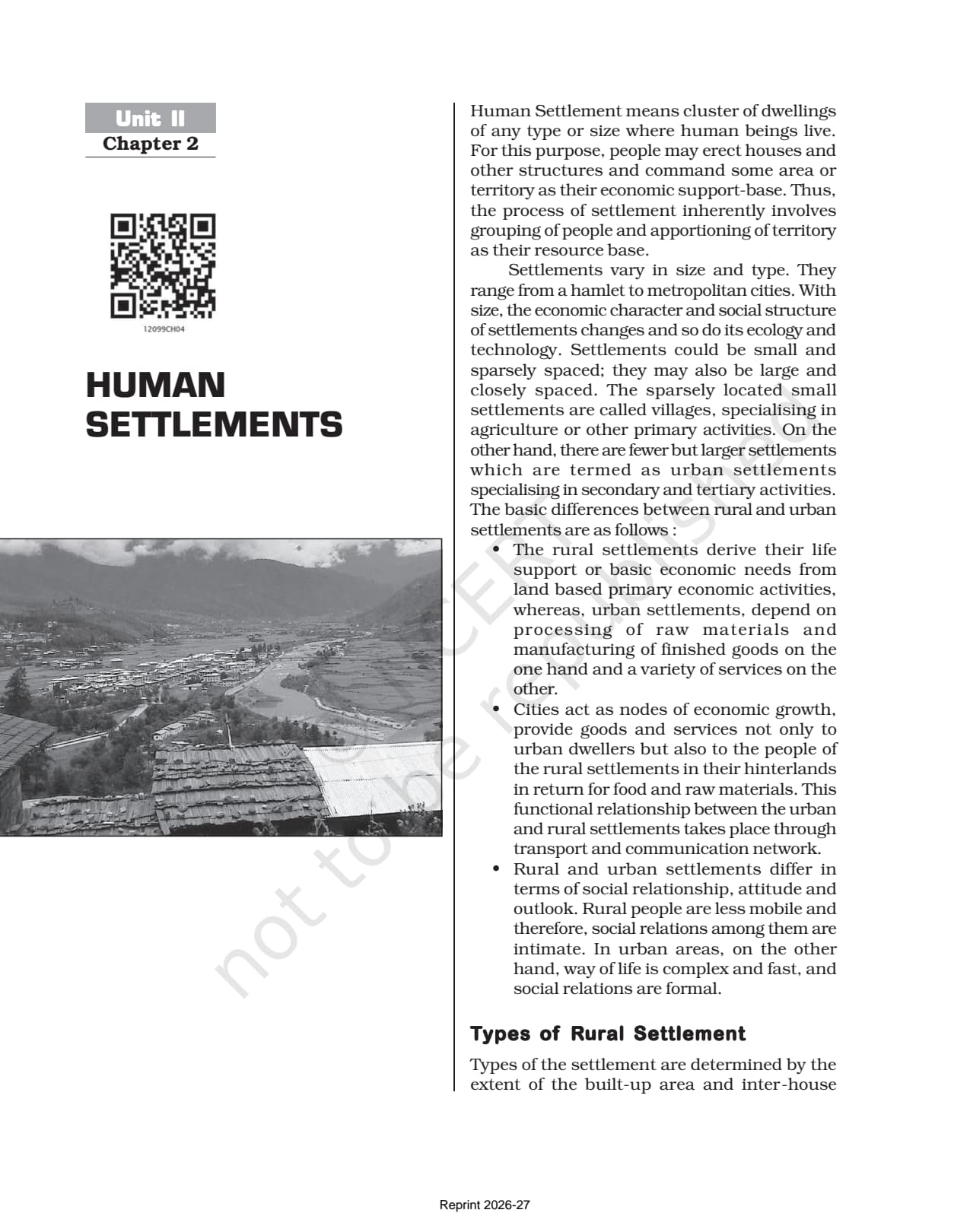
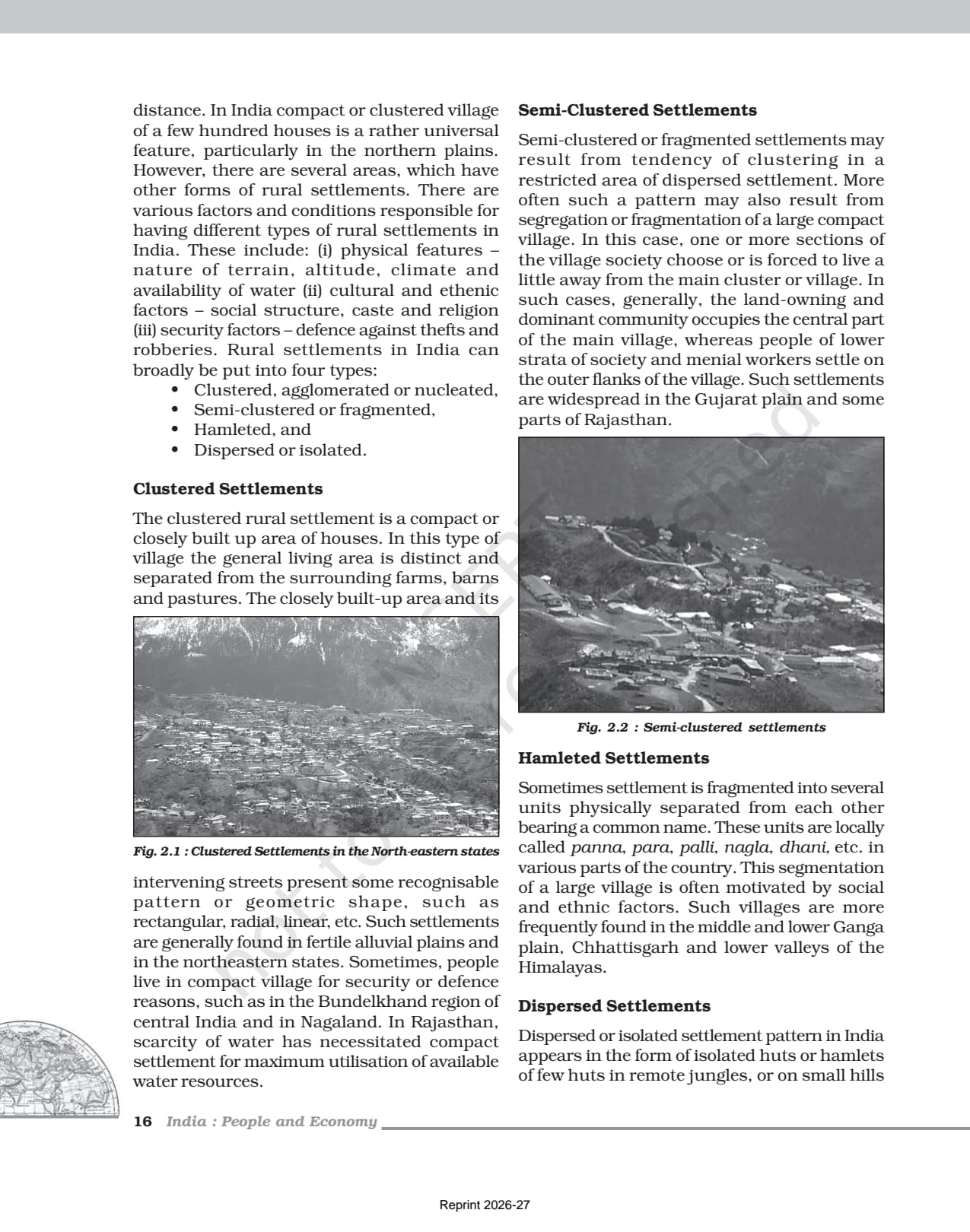
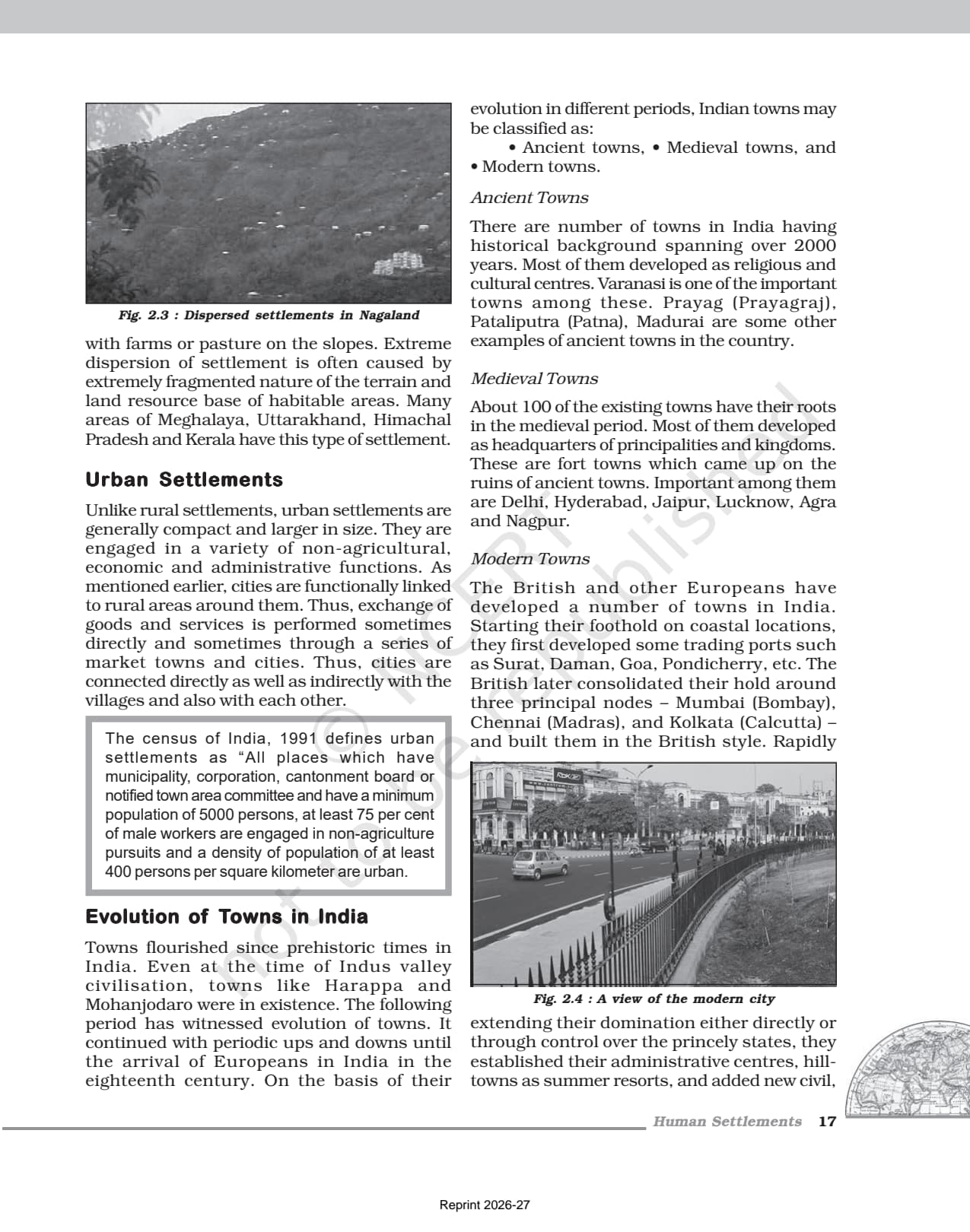
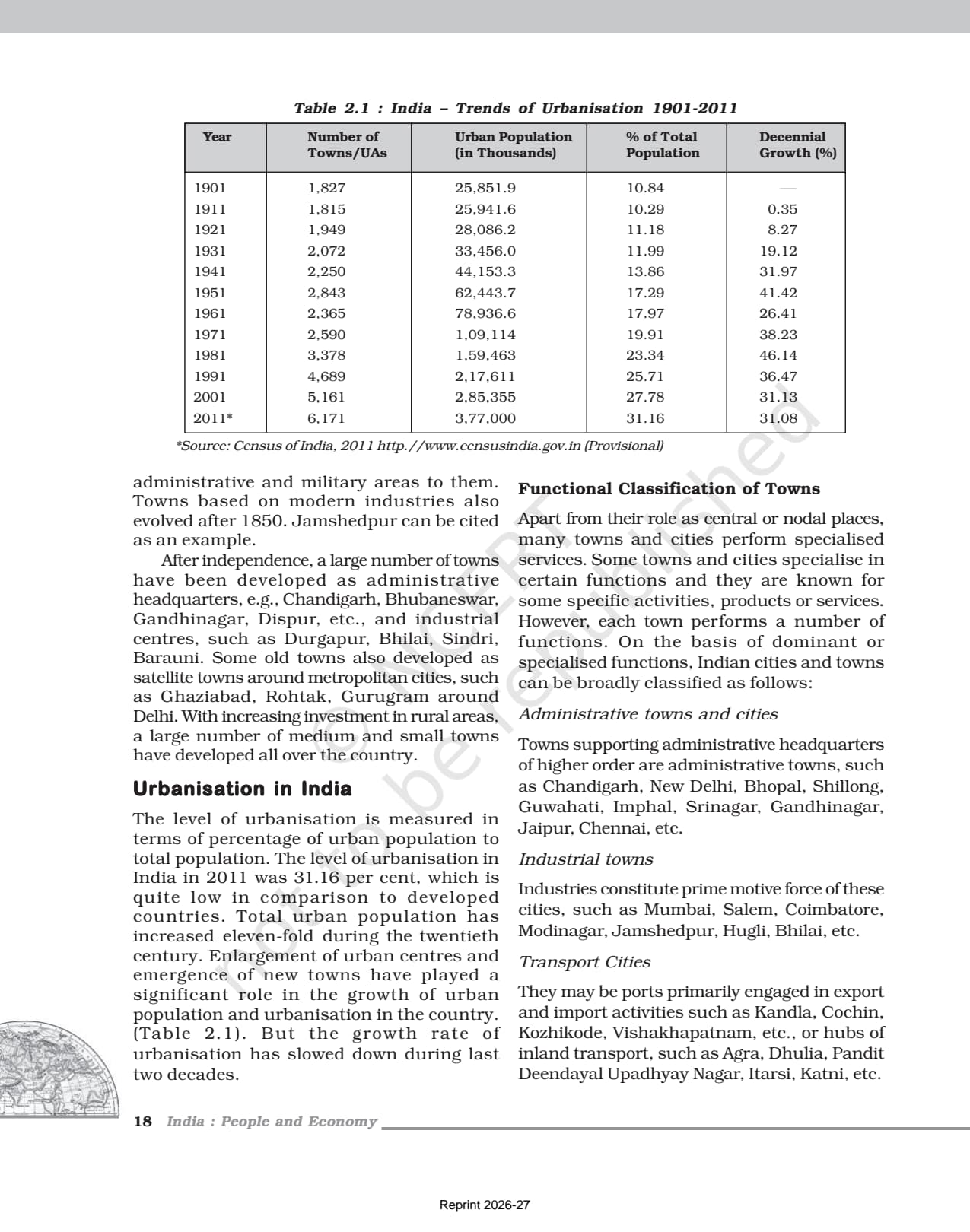
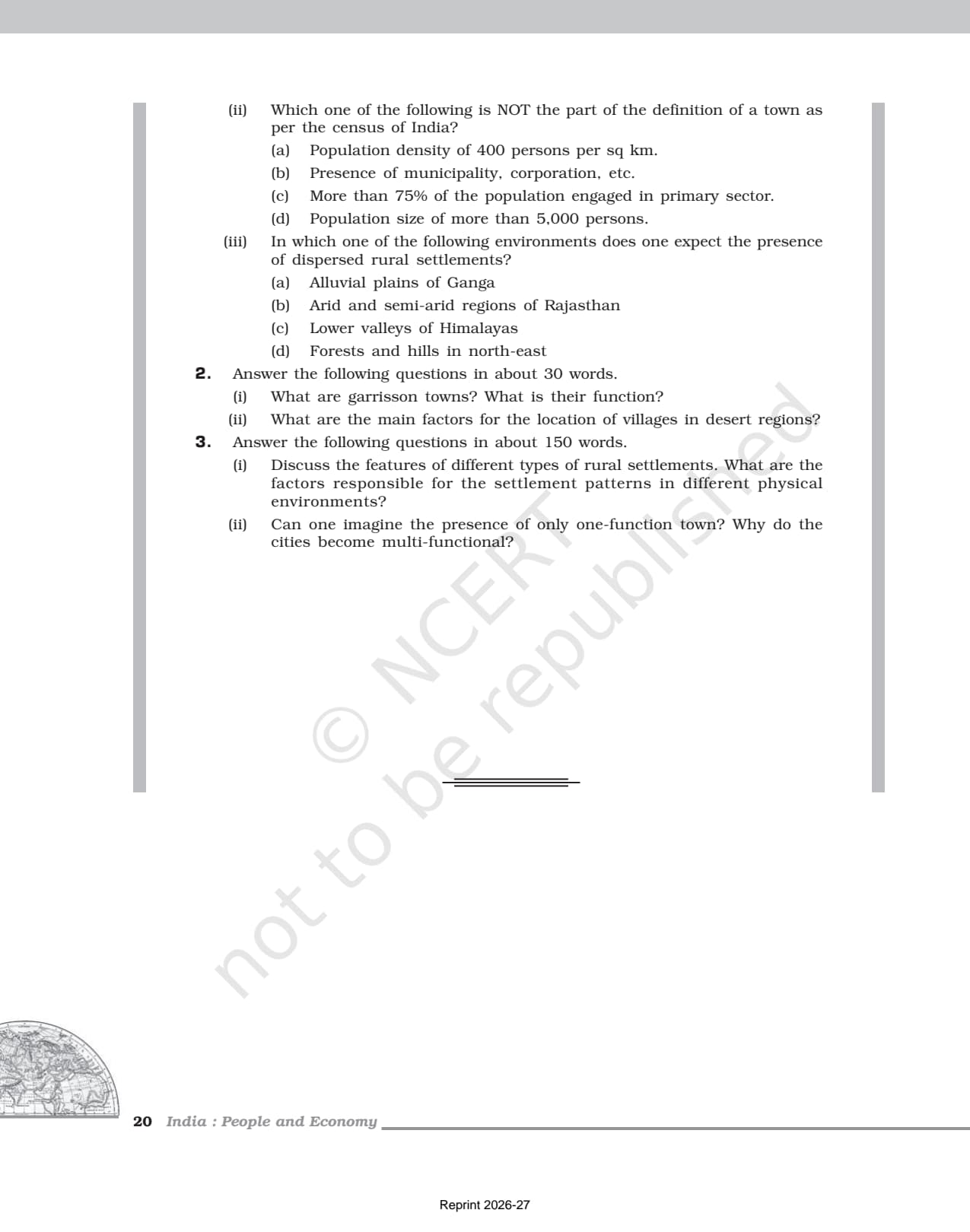
- Official NCERT India: People and Economy Class 12 Chapter 2 PDF covering rural settlement types, urban settlements, the Census definition of a town, evolution of Indian towns, functional classification of cities, and the Smart Cities Mission.
- 4-5 marks CBSE board-paper weightage for Chapter 2; the official textbook is the only source CBSE references when setting definition, map-based, and classification questions on human settlements.
- Pair with the matching NCERT Solutions, Notes and Handwritten Notes for full chapter coverage.
Student Feedback
In a 2026 Collegedunia poll of 9,800 Class 12 Geography students, 81% said reading the NCERT chapter PDF directly helped them answer board-paper questions on rural settlement types and the functional classification of cities better than any guide book. Students who read the full PDF averaged 4.4 out of 5 marks on questions from this chapter.
What This Chapter Covers in the NCERT Class 12 Book
The human settlements class 12 geography chapter explains how and why people settle where they do, and how Indian towns grew from ancient times to today. It moves from the idea of a settlement, through the four rural settlement types, to the Census definition of a town and the evolution and functional classification of cities. This is the text CBSE references for definition, classification, and functional-type questions, so read it before any guide book for the 2026-27 paper. It also covers the Smart Cities Mission and Census urbanisation data.
Topics in the Chapter (Section-Wise Map of the NCERT PDF)
The PDF has two broad parts: rural settlements and urban settlements. The table below maps each section to the exam concept students should extract.
| Section | NCERT Sub-topic | Dominant Exam Concept |
|---|---|---|
| 2.1 | Types of Rural Settlements | Four types: clustered, semi-clustered, hamleted, dispersed; factors determining type |
| 2.1.1 | Clustered Settlements | Compact nucleated villages; alluvial plains; security and water scarcity reasons |
| 2.1.2 | Semi-Clustered Settlements | Fragmented pattern; Gujarat plains; caste/social segregation |
| 2.1.3 | Hamleted Settlements | Locally called panna, para, palli, nagla, dhani; middle and lower Ganga plain |
| 2.1.4 | Dispersed Settlements | Isolated huts; Meghalaya, Uttarakhand, Himachal Pradesh, Kerala; fragmented terrain |
| 2.2 | Urban Settlements and Census Definition | Census 1991: 5,000 population + 75% male non-agriculture + 400 persons/sq km density |
| 2.3 | Evolution of Indian Towns | Ancient, medieval, modern; Varanasi, Delhi, Mumbai classification |
| 2.4 | Functional Classification of Towns | Administrative, industrial, transport, commercial, mining, garrison, educational, religious, tourist towns |
The four rural settlement types and the Census definition of an urban area are the most tested topics here, appearing in MCQs, short answers, and three-mark questions almost every year.
Key Concepts From the NCERT Class 12 Geography Textbook
Reproducing the NCERT's exact phrasing is the fastest route to full marks on theory questions. The four concept blocks below are taken from the chapter.
The Four Types of Rural Settlements
The NCERT classifies rural settlements into four types by built-up area and inter-house distance. Clustered (nucleated) settlements are compact villages with geometric shapes, common in fertile alluvial plains, often formed for security or to share scarce water. Semi-clustered (fragmented) settlements form when one section of the community lives apart from the main cluster, usually for caste or social reasons, as in the Gujarat plains and Rajasthan. Hamleted settlements are physically separated units of one village sharing a common name (panna, para, palli, nagla, dhani), common in the middle and lower Ganga plain and Chhattisgarh. Dispersed (isolated) settlements are isolated huts on fragmented terrain, typical of Meghalaya, Uttarakhand, Himachal Pradesh, and Kerala.
The Census Definition of an Urban Settlement
The Census of India 1991 calls a place urban only when it meets all conditions at once: a municipality, corporation, cantonment board, or notified town area committee; a minimum population of 5,000; at least 75 per cent of male workers in non-agriculture pursuits; and a density of at least 400 persons per square kilometre. The 75% non-agriculture threshold is the most frequently tested part in CBSE MCQs.
The Evolution of Indian Towns
The chapter groups Indian towns by the period in which they evolved. Ancient towns have over 2,000 years of history and grew as religious and cultural centres, such as Varanasi, Prayagraj, Patna, and Madurai. Medieval towns, about 100 in number, developed as headquarters or fort towns of principalities, such as Delhi, Hyderabad, Jaipur, Lucknow, Agra, and Nagpur. Modern towns were built by the British and Europeans, from trading ports like Surat, Goa, and Pondicherry to the three main nodes of Mumbai, Chennai, and Kolkata.
The Functional Classification of Towns
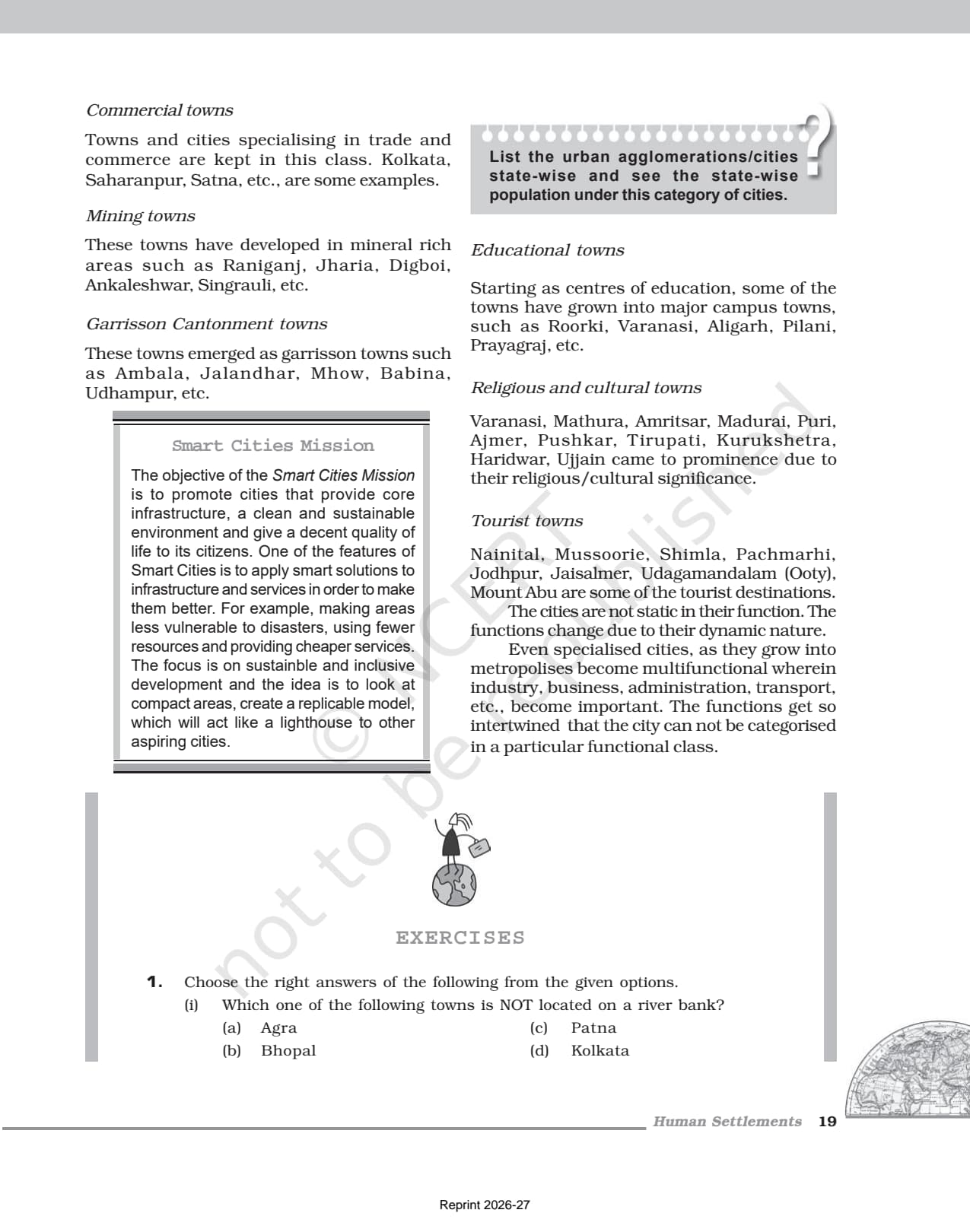
The chapter classifies towns by their dominant economic function: administrative (Chandigarh, New Delhi, Bhopal, Shillong), industrial (Mumbai, Jamshedpur, Bhilai, Coimbatore), transport (ports like Kandla and Kochi, hubs like Agra and Itarsi), commercial (Kolkata, Saharanpur), mining (Raniganj, Jharia, Digboi), garrison (Ambala, Jalandhar, Mhow), educational (Roorkee, Aligarh), religious and cultural (Varanasi, Mathura, Amritsar, Puri, Haridwar, Tirupati), and tourist (Nainital, Mussoorie, Shimla, Jodhpur). The NCERT notes that as cities grow into metropolises they turn multifunctional, so a city can rarely sit in a single class.
Previous Year Question Trends From This Chapter
This chapter has contributed 4 to 5 marks across recent board papers, usually through one MCQ, one short-answer, and one three or five-mark question. Expect a similar distribution for 2026-27.
| Year | Marks | Question Types | Most Common Topic |
|---|---|---|---|
| 2025 | 4 | 1 MCQ + 1 short answer + 1 three-mark | Types of rural settlements and factors |
| 2024 | 5 | 2 MCQs + 1 short answer + 1 three-mark | Census definition of a town; functional classification |
| 2023 | 4 | 1 MCQ + 1 three-mark + 1 short answer | Clustered vs dispersed settlements; examples |
| 2022 | 5 | 1 MCQ + 1 short answer + 1 five-mark | Evolution of Indian towns; ancient, medieval, modern |
| 2020 | 4 | 2 MCQs + 1 three-mark | Urban settlement definition; garrison towns |
The most repeated question asks students to describe any two rural settlement types with examples, or to state the Census criteria for a town. Both need NCERT phrasing.
Connecting This Chapter to the Rest of India: People and Economy
This chapter links to the population data from Chapter 1: India's rural-urban split (68.8% rural, 31.16% urban) explains why Chapter 2 spends more time on rural settlement types. The location of settlements also explains the demand for land, water, minerals, and transport, which are covered in Chapters 3 through 9.
| Later Chapter | Concept Inherited From Chapter 2 |
|---|---|
| Chapter 3: Land Resources and Agriculture | Clustered settlement in fertile plains links to high agricultural land use and population pressure on cultivable area |
| Chapter 4: Water Resources | Compact settlements in arid Rajasthan developed around water sources; dispersed settlements in hilly areas reflect groundwater dependence |
| Chapter 5: Mineral and Energy Resources | Mining towns (Raniganj, Jharia, Digboi) show direct settlement-resource linkage |
| Chapter 7: Transport and Communication | Transport cities like Kandla and Agra illustrate how trade routes shaped urban growth |
| Chapter 6: Planning and Sustainable Development | Smart Cities Mission from Chapter 2 is the urban planning policy context for sustainable development goals |
Quick Glossary From the NCERT Chapter
Students should be able to define each term in a single line for one-mark MCQs and two-mark short answers. The glossary below lists the most testable terms.
- Human settlement: A cluster of dwellings of any type or size where human beings live and command some area or territory as their economic support base.
- Clustered settlement: A compact or closely built-up area of houses with a distinct living area separated from surrounding farms, barns, and pastures.
- Semi-clustered settlement: A pattern where one or more sections of a village society live a little apart from the main cluster due to social or caste factors.
- Hamleted settlement: A village fragmented into physically separated units (panna, para, palli, nagla, dhani) that share a common name.
- Dispersed settlement: Isolated huts or hamlets of a few huts in remote or hilly areas, caused by extremely fragmented terrain.
- Urban agglomeration: A continuous urban spread comprising a city or town and its adjoining urban outgrowths or two or more physically contiguous towns.
- Garrison town: A town that emerged as a military settlement, such as Ambala, Jalandhar, Mhow, and Babina.
- Smart Cities Mission: A government initiative to promote cities that provide core infrastructure, a clean and sustainable environment, and a decent quality of life through smart solutions applied to compact areas.
Also Explore Other Resources for Class 12 Geography Chapter 2
| Resource | Link |
|---|---|
| NCERT Solutions | Class 12 Geography Chapter 2 NCERT Solutions |
| Revision Notes | Class 12 Geography Chapter 2 Notes |
| Handwritten Notes | Class 12 Geography Chapter 2 Handwritten Notes |
| Subject Hub | Class 12 Geography All Chapters |
All Chapters: Class 12 Geography NCERT Book PDF (India: People and Economy)
| Chapter | NCERT Book PDF |
|---|---|
| Chapter 1 | Population: Distribution, Density, Growth and Composition NCERT Book PDF |
| Chapter 2 | Human Settlements NCERT Book PDF (You are here) |
| Chapter 3 | Land Resources and Agriculture NCERT Book PDF |
| Chapter 4 | Water Resources NCERT Book PDF |
| Chapter 5 | Mineral and Energy Resources NCERT Book PDF |
| Chapter 6 | Planning and Sustainable Development NCERT Book PDF |
| Chapter 7 | Transport and Communication NCERT Book PDF |
| Chapter 8 | International Trade NCERT Book PDF |
| Chapter 9 | Geographical Perspective on Selected Issues NCERT Book PDF |
Frequently Asked Questions on Class 12 Geography Chapter 2 NCERT Book PDF
Ques. Where can students download the official NCERT Class 12 Geography Chapter 2 PDF?
Ans. Students can download the official human settlements class 12 NCERT book PDF directly from the download card at the top of this page. The PDF is the single-chapter file from the India: People and Economy textbook, aligned to the 2026-27 CBSE syllabus.
Ques. What are the four types of rural settlements in India according to the NCERT Class 12 Geography chapter?
Ans. The four types are: Clustered (nucleated) settlements - compact, closely built-up villages found in fertile plains; Semi-clustered (fragmented) settlements - where one section of the community lives apart from the main cluster due to social factors, common in Gujarat; Hamleted settlements - physically separated units of the same village sharing a common name, known as panna, para, palli, nagla, or dhani; and Dispersed (isolated) settlements - isolated huts in areas of fragmented terrain, typical of Meghalaya, Uttarakhand, Himachal Pradesh, and Kerala.
Ques. What is the Census of India definition of an urban settlement?
Ans. The Census of India 1991 defines an urban settlement as a place that has: (1) a municipality, corporation, cantonment board, or notified town area committee; (2) a minimum population of 5,000 persons; (3) at least 75% of male workers engaged in non-agriculture pursuits; and (4) a population density of at least 400 persons per square kilometre. All four conditions must be met simultaneously.
Ques. What are the three periods of evolution of Indian towns described in the NCERT chapter?
Ans. The NCERT classifies Indian towns into three historical periods: Ancient towns - with a history spanning over 2,000 years, developed as religious and cultural centres (e.g., Varanasi, Prayagraj, Patna, Madurai); Medieval towns - about 100 towns that developed as administrative headquarters or fort towns of principalities (e.g., Delhi, Hyderabad, Jaipur, Lucknow, Agra, Nagpur); and Modern towns - developed by the British as trading ports and administrative centres (e.g., Mumbai, Chennai, Kolkata, Surat, Pondicherry, Goa).
Ques. What is the difference between clustered and dispersed rural settlements?
Ans. A clustered settlement is a compact, closely built-up area where houses are grouped together with a distinct living area separated from surrounding fields; it is common in fertile alluvial plains and formed for reasons of security or to share scarce water resources, as in Rajasthan. A dispersed settlement consists of isolated huts or tiny hamlets scattered over a wide area due to extremely fragmented terrain and limited habitable land; it is typical of Meghalaya, Uttarakhand, Himachal Pradesh, and Kerala. The key difference is the degree of physical clustering of the houses.
Ques. What is a garrison town and which towns are examples?
Ans. A garrison town is a town that emerged primarily as a military settlement to house armed forces. According to the NCERT chapter, examples of garrison cantonment towns in India include Ambala, Jalandhar, Mhow, Babina, and Udhampur. These towns developed around military cantonments established during the British period and continue to serve defence functions even today.
Ques. Why do clustered settlements form in Rajasthan according to the NCERT textbook?
Ans. According to the NCERT chapter, clustered settlements in Rajasthan formed due to the scarcity of water. Compact settlement allows the community to make the maximum utilisation of available water resources by locating houses close to shared water sources like wells, tanks, and ponds. Additionally, security reasons and the need for collective defence against thefts also contributed to the clustered pattern in the arid and semi-arid regions of Rajasthan.
Ques. What is the Smart Cities Mission and why does the NCERT chapter discuss it?
Ans. The Smart Cities Mission is a government initiative aimed at promoting cities that provide core infrastructure, a clean and sustainable environment, and a decent quality of life to citizens. One of its key features is applying smart solutions to infrastructure and services to make areas less vulnerable to disasters, use fewer resources, and provide cheaper services. The NCERT chapter includes it because it represents India's contemporary policy response to the challenges of rapid urbanisation discussed throughout Chapter 2.
Ques. What are hamleted settlements and which states have them?
Ans. Hamleted settlements are villages fragmented into several physically separated units that bear a common name. These units are called panna, para, palli, nagla, dhani, etc., in various parts of the country. This segmentation is often motivated by social and ethnic factors. Hamleted settlements are most common in the middle and lower Ganga plain, Chhattisgarh, and the lower valleys of the Himalayas, as per the NCERT chapter.
Ques. Is the Class 12 Geography syllabus changing for 2026-27?
Ans. No major changes have been announced. The India: People and Economy textbook chapter structure remains the same for 2026-27, and the official NCERT PDF available on this page is aligned to the 2026-27 CBSE syllabus. CBSE marking schemes continue to reward textbook phrasing in theory questions and the Census 2011 data where applicable.
Ques. What is the best order to use the NCERT PDF, Notes, and Solutions for Class 12 Geography Chapter 2?
Ans. Read the NCERT PDF cold first, marking the names of all four settlement types and the three Census town criteria as you go. Then open the Class 12 Geography Chapter 2 Notes alongside the PDF and copy the settlement type table and town evolution periods into your own notebook. Attempt all exercise questions and verify them against the NCERT Solutions. Use the handwritten notes for last-mile revision the night before the exam.



Comments