




John Keats's Flamingo Poetry: A Thing of Beauty is the opening of his long narrative poem Endymion, Book I (1818), with the 2026-27 NCERT print retaining the full twenty-four-line extract and the seven "Think it out" questions intact. This page hosts the ncert class 12 english book pdf chapter 9 Flamingo Poetry: A Thing of Beauty, a unit-by-unit reading map, and the latest 2026-27 rationalisation note for English Core.
- CBSE Weightage: 8 marks, typically one extract-based question plus one long answer on theme, imagery or the fountain image
- CUET (UG) Relevance: 1 to 2 questions on poetic devices, the heroic couplet, and the catalogue of beauty in Section IA English
- Extract Length: 24 lines in rhymed heroic couplets, iambic pentameter (AA BB CC...)
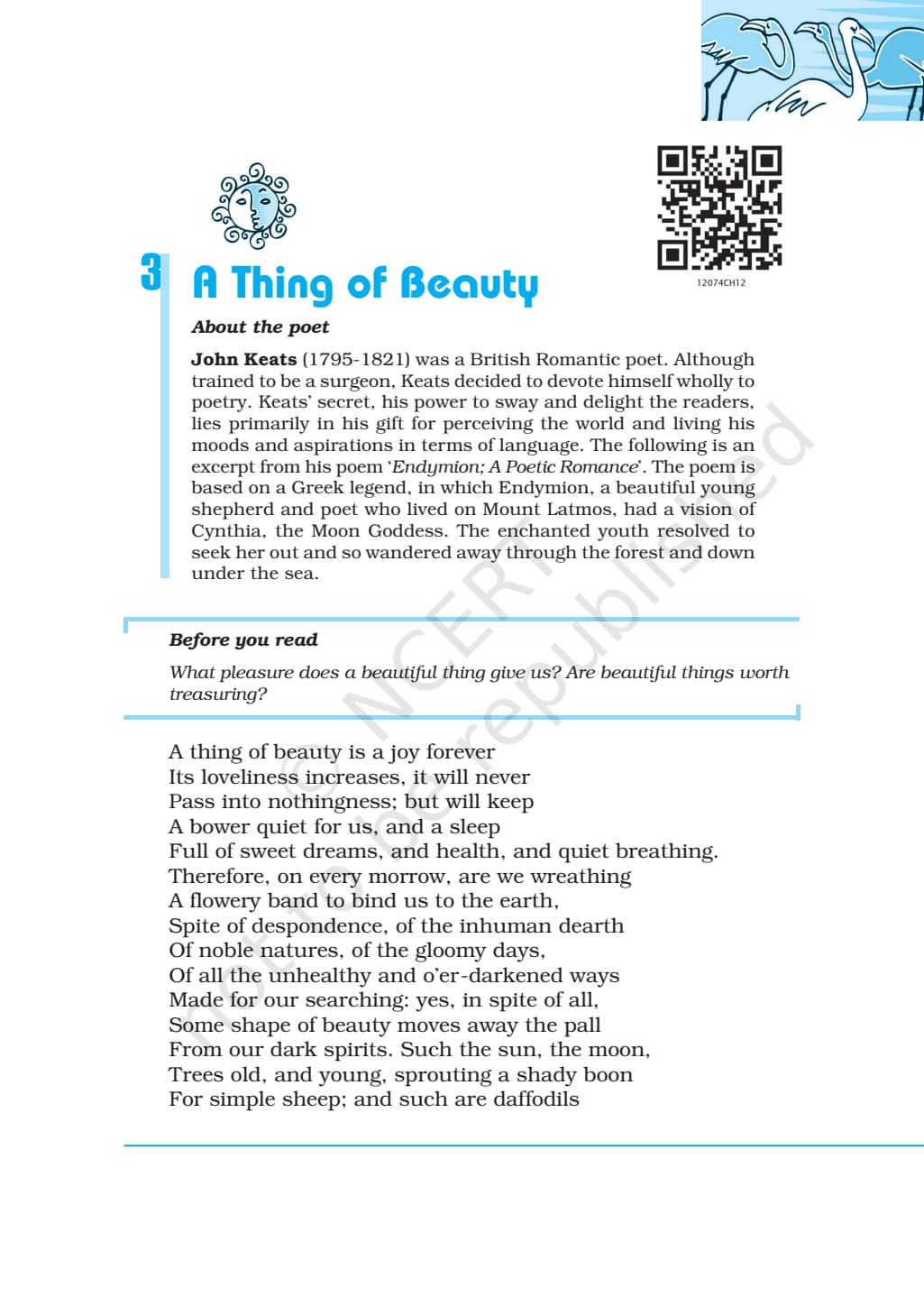
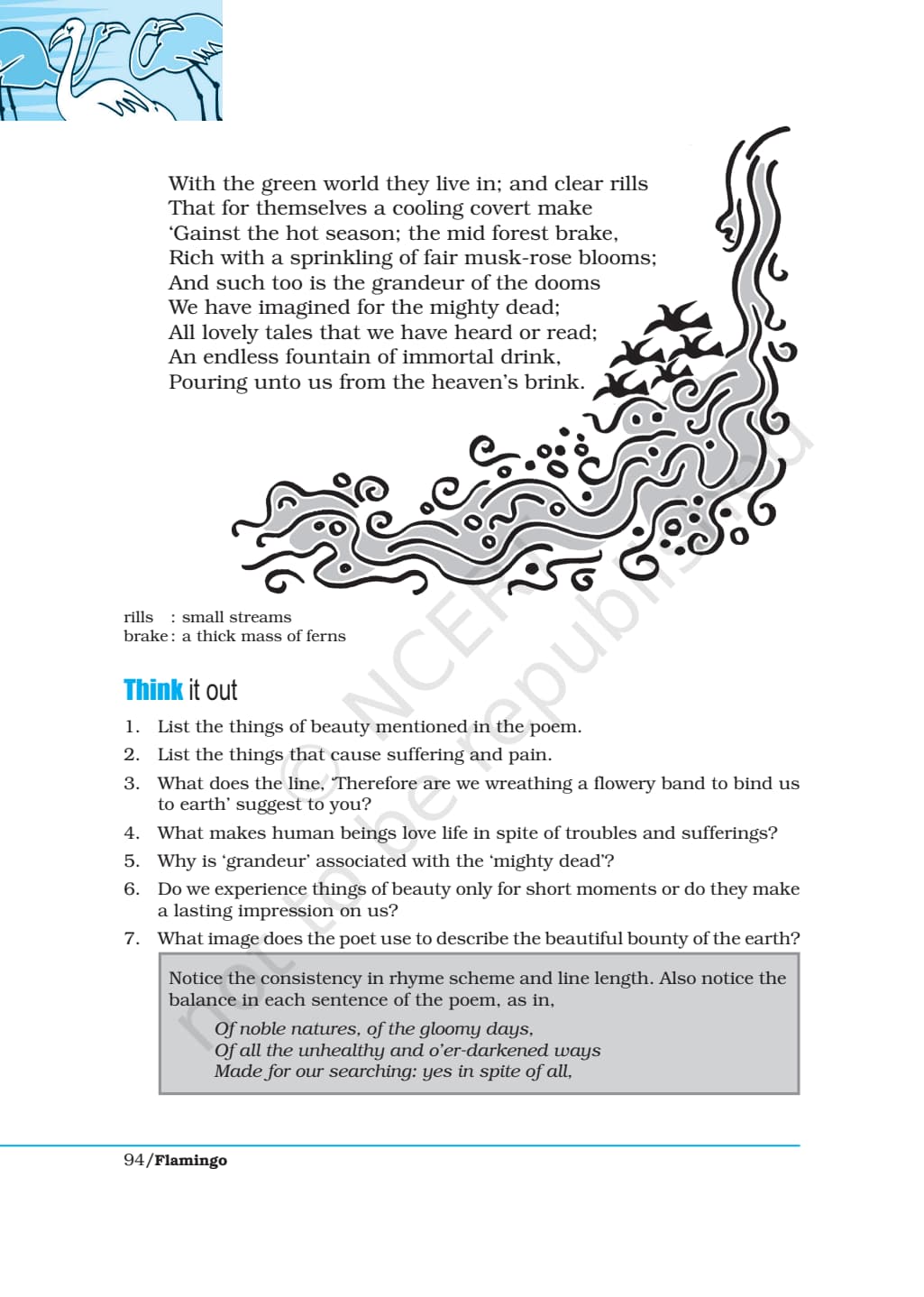
The two-page extract is the only Romantic-era poem in Class 12 Flamingo, so the reading effort goes into Keats's thesis ("a thing of beauty is a joy for ever"), the wreath metaphor, and the closing fountain image; the page below maps every block in print order. Students often save the ncert class 12 english book pdf chapter 9 Flamingo Poetry: A Thing of Beauty for offline revision before the boards.
This ncert class 12 english book pdf chapter 9 Flamingo Poetry: A Thing of Beauty is the official NCERT print, served by Collegedunia in both Normal and HD format, aligned with the 2026-27 rationalised syllabus for Class 12 English Core.
Also Check:
A Thing of Beauty NCERT Print - What's Inside Chapter 9
The extract opens the Poetry section of Flamingo as the third poem in the sequence. The print runs across two pages with the extract on page 1 and the four end-of-chapter prompts on page 2. The "Think it out" section is labelled exactly as in the print; you can use it to map your answers to the textbook order.
| Section in Print | Pages | What it covers |
|---|---|---|
| The extract (Endymion, Book I, lines 1-24) | Page 1 | The famous opening line, the catalogue of beauty (sun, moon, trees, daffodils, streams, musk-roses, mighty dead, lovely tales), and the closing fountain image |
| Think it out (7 questions) | Page 2 | Items of beauty (Q1), items of suffering (Q2), the wreath line (Q3), what makes us love life (Q4), grandeur of mighty dead (Q5), beauty's duration (Q6), the closing image (Q7) |
| Note on John Keats | Page 2 | Brief biographical note: born 1795, died 1821, source poem Endymion (1818) |
Flamingo Poetry a Thing of Beauty Video Chapter Walkthrough
Source: Magnet Brains on YouTube
Class 12 English Flamingo Chapter 9 PDF - Why Download the NCERT Print
Most teachers will tell you to read poetry chapters from the official NCERT print, not from a third-party summary, because exam extracts are quoted in the exact line-break sequence of the textbook. Downloading the ncert class 12 english book pdf chapter 9 Flamingo Poetry: A Thing of Beauty preserves that line-break sequence and the original punctuation.
- Verbatim extract-based questions: The CBSE paper quotes lines exactly as they appear in the print. Reading from the PDF locks in the correct line-breaks for "Therefore, on every morrow, are we wreathing / A flowery band to bind us to the earth..."
- Heroic-couplet recognition: The rhyme pairs are visible at a glance when each couplet sits on a single visual line; the PDF preserves that layout exactly.
- Spelling of "for ever": The print uses the two-word "for ever". A digital summary often runs them together as "forever", which the board paper marks as wrong.
- 2026-27 rationalisation: The current print is the rationalised 2026-27 edition; the chapter is retained in full with no deletions.
About John Keats
John Keats was born in London in October 1795 and died in Rome in February 1821, aged only twenty-five. He trained briefly as a surgeon's apprentice before turning to poetry full-time. His major works include Endymion (1818, the opening of which is the Flamingo extract), the great odes of 1819 ("Ode on a Grecian Urn", "Ode to a Nightingale", "To Autumn"), and the romance The Eve of St Agnes. He is one of the second-generation English Romantic poets, alongside Shelley and Byron.
Related Links:
More A Thing of Beauty English Class 12 Resources
A Thing of Beauty Class 12 NCERT Book PDF FAQs
Ques. How many pages is A Thing of Beauty Chapter 9 in the Flamingo print?
Ans. The chapter runs over 2 pages in the NCERT Flamingo print - the extract on page 1 and the "Think it out" prompts plus a short note on Keats on page 2.
Ques. Is A Thing of Beauty in the 2026-27 CBSE Class 12 English syllabus?
Ans. Yes. A Thing of Beauty is Chapter 9 in the Flamingo textbook of the 2026-27 CBSE Class 12 English Core syllabus. The full twenty-four-line extract from Endymion Book I and all seven "Think it out" questions are retained in the rationalised current print.
Ques. Why is A Thing of Beauty called an extract and not a complete poem?
Ans. The lines you read in Flamingo are the opening twenty-four lines of John Keats's long narrative poem Endymion, which runs to four Books and several thousand lines. The Flamingo selection treats the twenty-four-line opening as a stand-alone meditation, but technically it is an extract from Book I.
Ques. What is the form of A Thing of Beauty?
Ans. The extract is in rhymed heroic couplets in iambic pentameter (AA BB CC...). Each line has five iambic feet (ten syllables) and the rhymes come in pairs.
Ques. Can I download the official NCERT PDF of A Thing of Beauty?
Ans. Yes. The free official NCERT print of A Thing of Beauty (Class 12 Flamingo Chapter 9) is available on this page. Both Normal and HD versions are free and match the 2026-27 NCERT rationalised print exactly.
Ques. Who is the author of A Thing of Beauty?
Ans. The poem is by John Keats (1795-1821), an English Romantic poet. The extract anthologised in Flamingo is the opening of his long narrative poem Endymion, Book I, first published in 1818.



Comments