




The NCERT Book PDF for Class 12 Fine Arts Chapter 5 The Bengal School and Cultural Nationalism brings together every artist, painting and Swadeshi argument that the CBSE Fine Arts theory paper actually tests. It is the official chapter from An Introduction to Indian Art Part 2, Reprint 2026-27, printed page for page as the board prescribes it.
- Covers Company Painting, Raja Ravi Varma, the Bengal School, Shantiniketan, pan-Asianism and the 1922 Bauhaus exhibition in Calcutta.
- Names to spell right: Abanindranath Tagore, E. B. Havell, Nandalal Bose, Jamini Roy, Gaganendranath Tagore, Kshitindranath Majumdar and Abdul Rehman Chughtai.
- Ends with 5 exercise questions and 7 full page painting appreciations across 14 printed pages.
This Bengal School and Cultural Nationalism chapter PDF is the unedited NCERT text page for page, checked against the Reprint 2026-27 print run, and paired here with a painting by painting appreciation index written by Collegedunia Fine Arts teachers.
What the Bengal School and Cultural Nationalism Class 12 PDF Contains
This chapter is an argument, not a list of courts. It starts with what the British wanted from Indian artists, shows why that taste was rejected, and ends with two competing ideas of what modern Indian art should look like. Read it in the printed order and the seven appreciation plates at the back fall into place on their own.
| Section in the PDF | What it covers | Question type it feeds |
|---|---|---|
| Company Painting | Why English officers commissioned local artists, the migrant painters from Murshidabad, Lucknow and Delhi, close observation replacing memory and rule books | 2 marks and 3 marks |
| Raja Ravi Varma | Photography ending the Company style, academic oil painting in the colonial art schools, oleographs and calendar images | 3 marks and 5 marks |
| The Bengal School | Why the name is not fully accurate, Calcutta as the origin, the Swadeshi link, Abanindranath Tagore and E. B. Havell | 5 marks, the core question |
| Abanindranath Tagore and E. B. Havell | The year 1896, the Government Art School at Calcutta, the Indianised curriculum, Partha Mitter's line, the Indian Society of Oriental Art | 5 marks |
| Shantiniketan, early modernism | Nandalal Bose at Kala Bhavana, folk art forms, Bengali primers with woodcuts, the Haripura Posters of 1937, K. Venkatappa, Jamini Roy | 5 marks, appreciation |
| Pan-Asianism and Modernism | The Partition of Bengal in 1905, Ananda Coomaraswamy, Kakuzo Okakura, the wash technique, the Bauhaus exhibition of 1922, Gaganendranath Tagore | 3 marks and 5 marks |
| Different Concepts of Modernism | Anglicists against orientalists, Benoy Sarkar, Havell's position, Amrita Sher-Gil, internationalism against the indigenous | 5 marks |
| Seven appreciation plates | Tiller of the Soil, Rasa-Lila, Radhika, City in the Night, Rama Vanquishing the Pride of the Ocean, Woman with Child, Journey's End | Picture based questions |
One planning note before you start. This is the only chapter in the book where the argument matters more than the dates. The examiner wants to know why a style was accepted or rejected, not just who painted what. Keep a two column sheet titled Indian taste and European taste, and drop every name from the chapter into one of the two columns as you read.
Company Painting and Why the British Commissioned Indian Artists
The chapter opens by reminding you what art in India was for before the British came. It could be seen as statues on temple walls, as miniature paintings that often illustrated manuscripts, and as decoration on the walls of mud houses in villages. That one sentence is a ready made two mark answer, so learn it first.
- What charmed the English: the different manners and customs of people of all ranks, the tropical flora and fauna, and the varying locales of India.
- Why they commissioned art: partly for documentation and partly for artistic reasons, so that officers could get a better idea of the natives.
- Who painted: local artists working largely on paper, some of whom had migrated from the erstwhile courts of Murshidabad, Lucknow or Delhi.
- The change forced on them: to please their new patrons they had to rely more on close observation, a striking feature of European art, rather than on memory and rule books as in traditional art.
- The definition: this mixture of traditional and European style of painting came to be known as the Company School of Painting.
- Where it sold: it was popular among the British in India and in Britain too, where albums consisting of a set of paintings were much in demand.
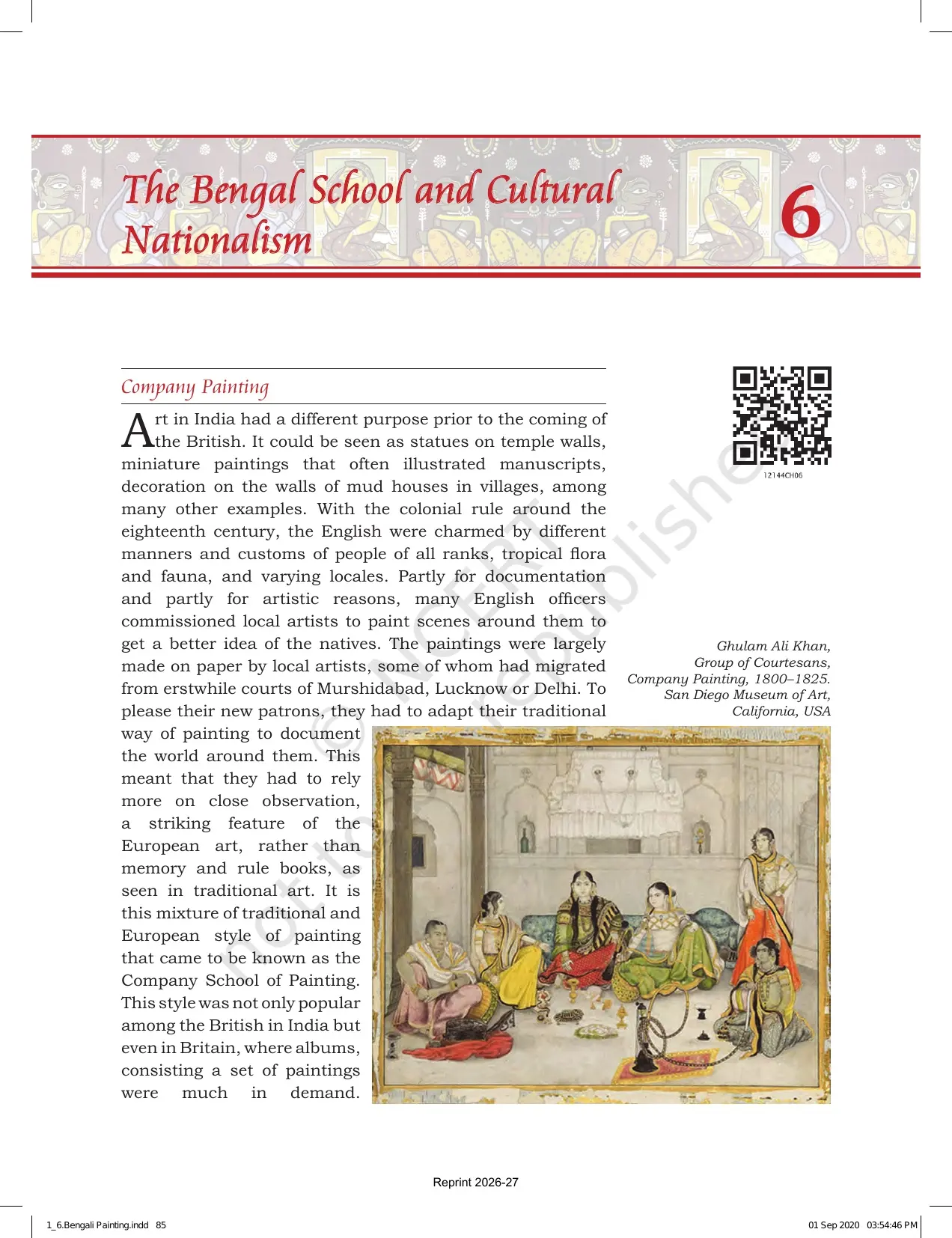
The plate printed with this section is Group of Courtesans by Ghulam Ali Khan, a Company Painting of 1800 to 1825, held at the San Diego Museum of Art in California. It is the only Company School plate in the chapter, so tag it in your notes as the answer to any picture question on this style.
The style declined with the entry of photography in India in the mid nineteenth century, because the camera offered a better way of documentation. Write that cause and effect in one line and you have secured the mark. Students who only write that the style faded away lose it.
Raja Ravi Varma, Academic Realism and Why Nationalists Turned Against It
What survived in the art schools set up by the British was the academic style of oil painting, which used a European medium to show Indian subject matter. The chapter makes a sharp point here. The most successful examples of this painting were found away from those schools, in the work of a self taught artist.
| About Raja Ravi Varma | What the book says |
|---|---|
| Training | A self taught artist of the Travancore Court in Kerala |
| How he learned | By imitating copies of European paintings that were popular in Indian palaces |
| What he mastered | Academic realism, used to depict scenes from popular epics like the Ramayana and the Mahabharata |
| How his work spread | Many paintings were copied as oleographs and sold in the market, and they entered people's homes as calendar images |
| Why he was rejected | With the rise of nationalism by the end of the nineteenth century, his academic style was looked down upon as foreign and too western to show Indian myths and history |
That last row is the hinge of the whole chapter. It is amidst such nationalist thinking that the Bengal School of Art emerged in the first decade of the twentieth century. If a five mark question asks how the Bengal School came about, this sentence is your opening line.
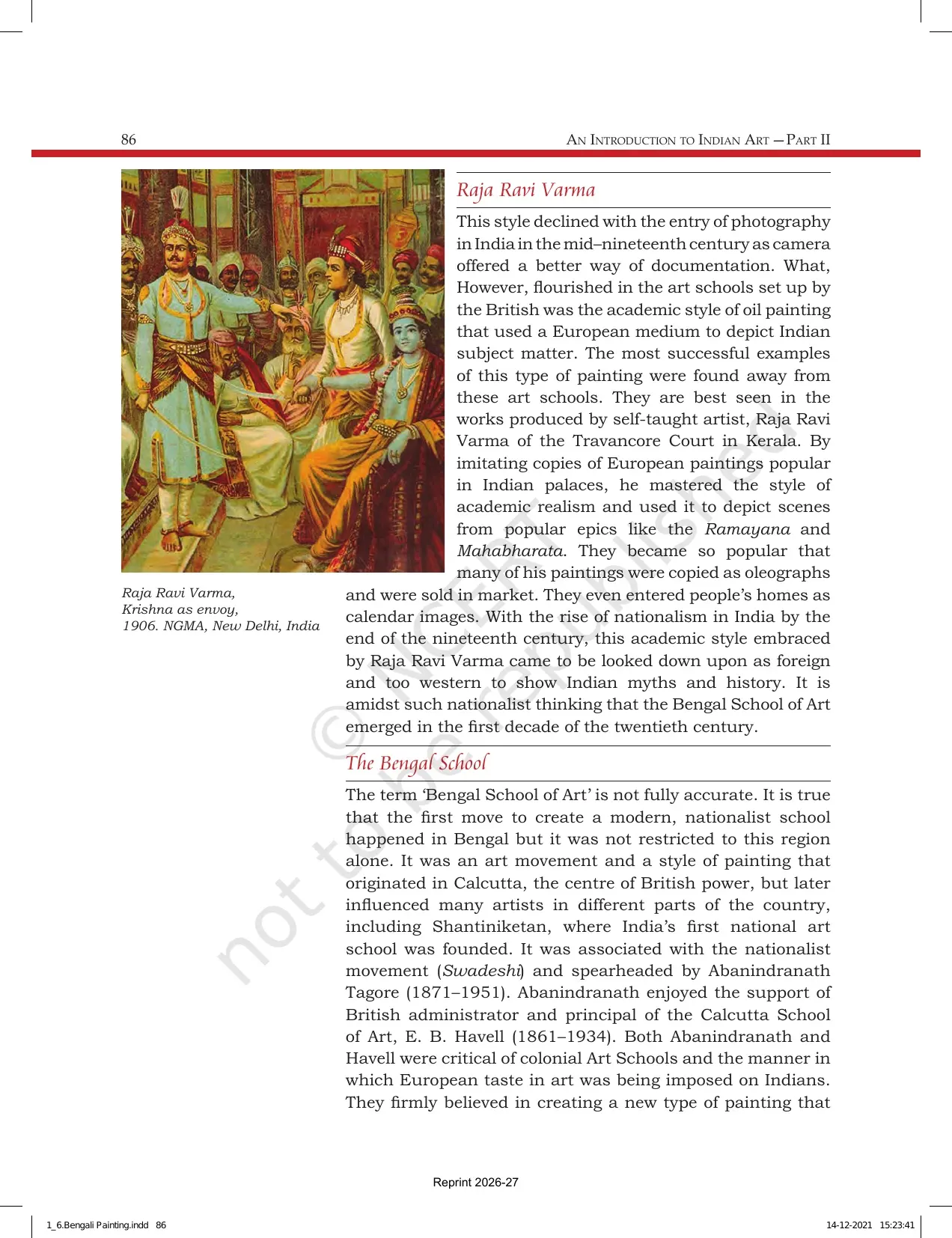
The plate printed here is Krishna as envoy, dated 1906, in the National Gallery of Modern Art, New Delhi. A second Ravi Varma work, Rama Vanquishing the Pride of the Ocean, gets a full page appreciation at the back of the chapter and is covered separately below.
The Bengal School of Art and Why the Name Itself Is Not Fully Accurate
The book opens this section with a warning that students almost always skip. The term Bengal School of Art is not fully accurate. The first move to create a modern, nationalist school did happen in Bengal, but it was not restricted to that region alone.
- What it actually was: an art movement and a style of painting that originated in Calcutta, the centre of British power.
- How far it travelled: it later influenced many artists in different parts of the country, including Shantiniketan, where India's first national art school was founded.
- Its political link: it was associated with the nationalist movement, that is, Swadeshi.
- Who led it: Abanindranath Tagore, 1871 to 1951, spearheaded the movement.
- Who backed him: E. B. Havell, 1861 to 1934, a British administrator and principal of the Calcutta School of Art.
- What both objected to: the colonial art schools and the manner in which European taste in art was being imposed on Indians.
Their positive programme is stated just as plainly. They firmly believed in creating a new type of painting that was Indian not only in subject matter but also in style. Ravi Varma had already painted Indian subjects, so the second half of that phrase is what separates the Bengal School from him.
For Abanindranath and Havell, Mughal and Pahari miniatures were the more important sources of inspiration, rather than the Company School of Painting or the academic style taught in the colonial art schools. That single line answers exercise question 4 on its own, and it links this chapter straight back to the miniature chapters you have already studied.
Bengal School of Painting Explained with Notes and Chapter Questions
Source: Study Box on YouTube
Abanindranath Tagore and E. B. Havell: The Year 1896 and Indianised Art Education
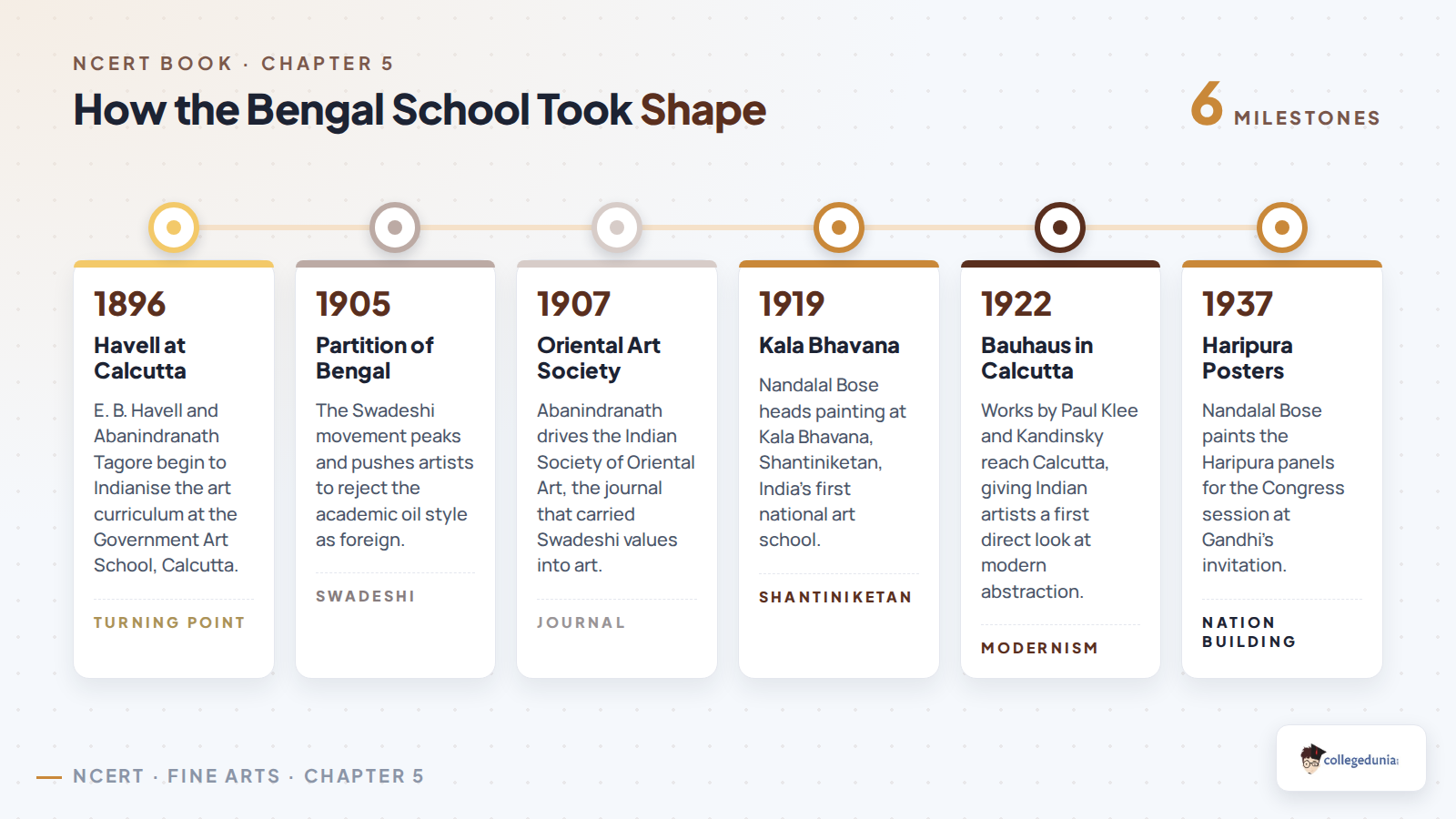
The chapter fixes one date for the whole reform and it is worth memorising. The year 1896 was important in the Indian history of visual arts, because Havell and Abanindranath Tagore saw a need to Indianise art education in the country.
| Detail | What to write in the answer |
|---|---|
| Where the reform began | The Government Art School, Calcutta, now the Government College of Art and Craft, Kolkata |
| The other colonial schools | Similar schools at Lahore, Bombay and Madras, whose primary focus was on crafts like metalwork, furniture and curios |
| Why Calcutta was different | It was more inclined towards fine arts than crafts |
| What the two men did | Designed a curriculum to include and encourage technique and themes drawn from Indian art traditions |
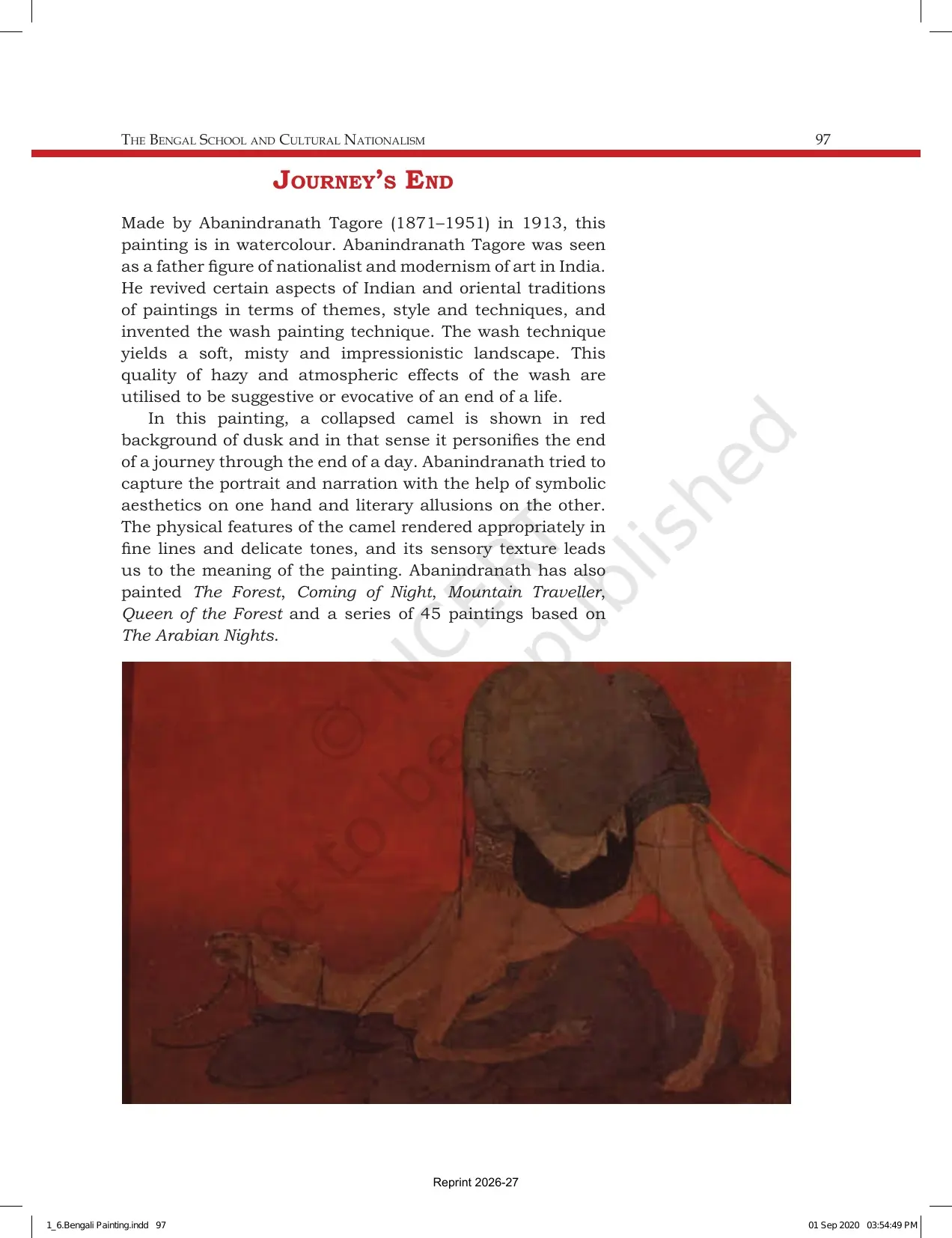
| The painting that proves it | Journey's End, which shows the influence of Mughal and Pahari miniatures and Abanindranath's desire to create an Indian style in painting |
The chapter then quotes the art historian Partha Mitter. He writes that the first generation of the students of Abanindranath engaged in recovering the lost language of Indian art. Quote that line inside inverted commas and credit Mitter, because a named quotation lifts a five mark answer noticeably.
- The journal: Abanindranath was the main artist and creator of an important journal, the Indian Society of Oriental Art, meant to show that modern Indians could benefit from this rich past.
- His larger claim: he was the first major supporter of Swadeshi values in Indian art, which best manifested in the creation of the Bengal School of Art.
- What it led to: the school set the stage for the development of modern Indian painting.
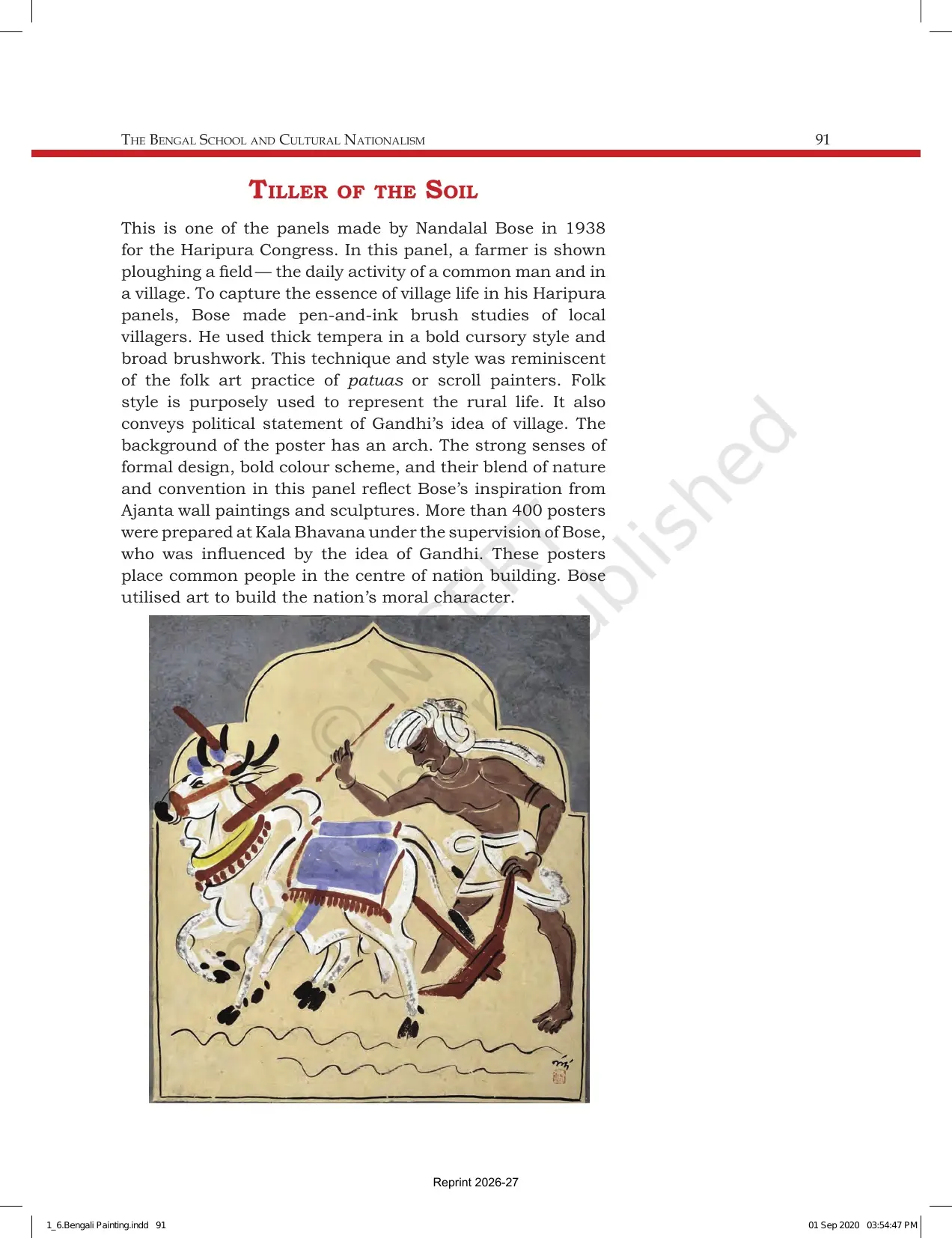
- Who followed him: younger artists such as Kshitindranath Majumdar, who painted Rasa-Lila, and M. R. Chughtai, who painted Radhika.
Shantiniketan and Kala Bhavana: Nandalal Bose and Early Modernism
This is the section that carries the phrase early modernism, and the institution at its centre is easy to describe in three lines. Nandalal Bose, a student of Abanindranath Tagore, was invited by the poet and philosopher Rabindranath Tagore to head the painting department in the newly established Kala Bhavana.
- What Kala Bhavana was: India's first national art school.
- Where it sat: inside the Visva-Bharati University founded by Rabindranath Tagore at Shantiniketan.
- What Nandalal built there: the intellectual and artistic milieu needed to create an Indian style in art.
- Where he looked for it: in the folk art forms he saw around him in Shantiniketan, which turned his attention to the language of art itself.
- His work in education: he illustrated primers in Bengali with woodcuts, and understood the role of art in teaching new ideas.
- What the institution became: a training ground for many artists who went on to teach art in different parts of the country, K. Venkatappa in South India being a prominent example.
The aim of these artists was to make art reach a wider public rather than only the elite, anglicised class of people. That sentence is the link between the Shantiniketan section and the Jamini Roy section, and examiners often set a question that spans both.
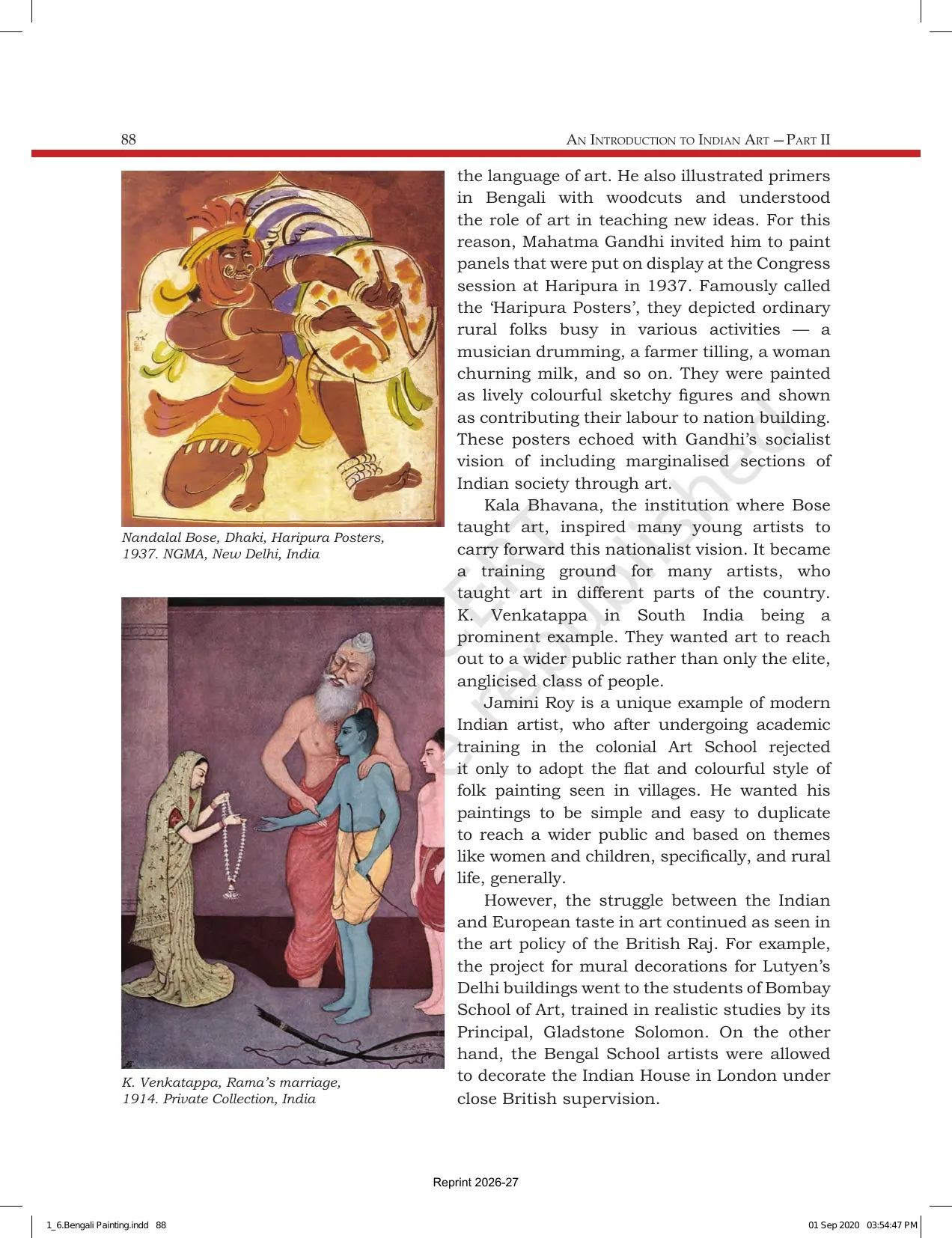
The Venkatappa plate printed here is Rama's marriage, dated 1914, in a private collection in India. Note the date, because it is the only fixed point the chapter gives you for Venkatappa.
The Haripura Posters of 1937 and Gandhi's Idea of the Village
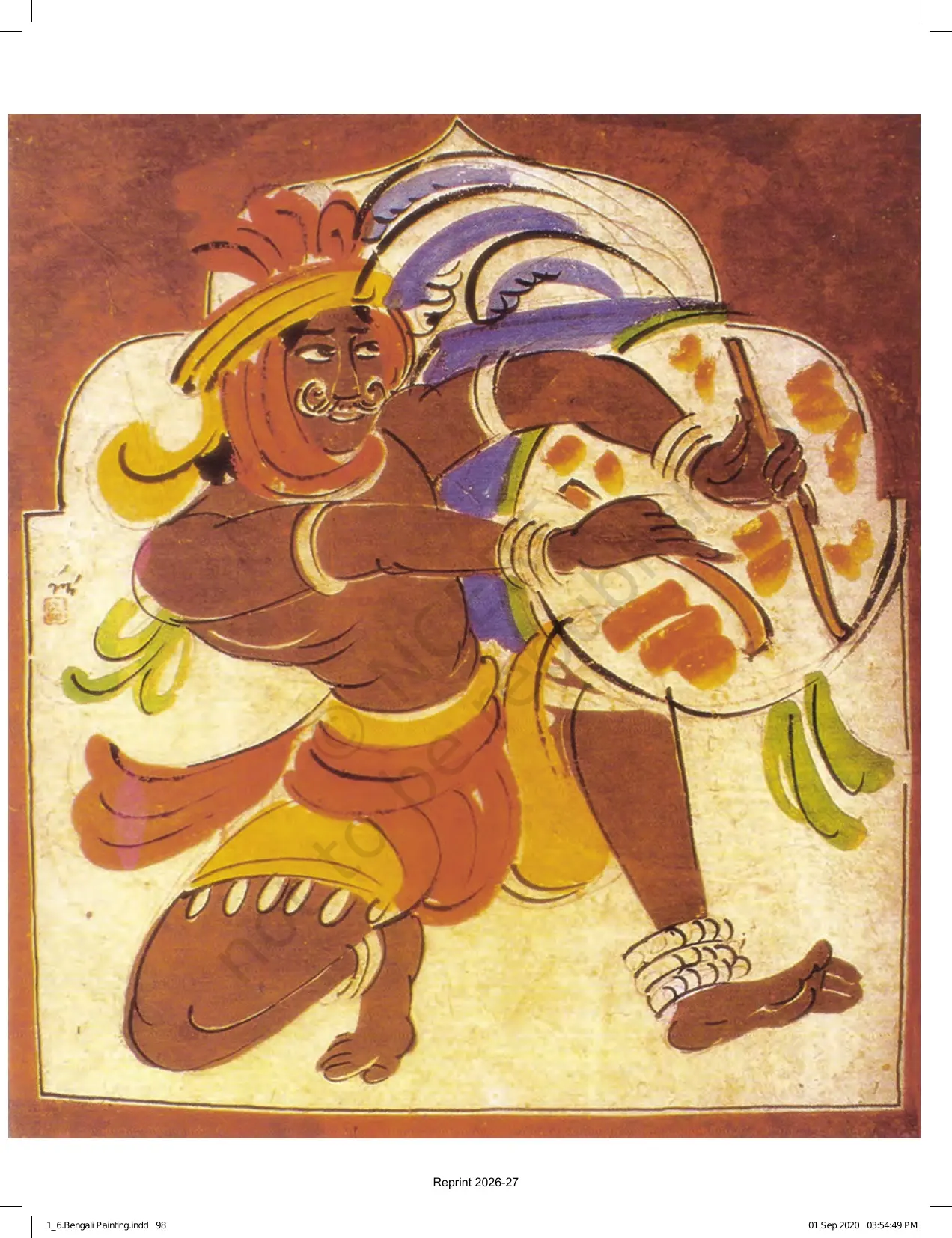
Because Nandalal Bose understood the role of art in teaching new ideas, Mahatma Gandhi invited him to paint panels for display at the Congress session at Haripura in 1937. These are the famous Haripura Posters, and they appear twice in the chapter, once in the main text and once as a full page appreciation.
| Feature of the Haripura Posters | What the book says |
|---|---|
| Subject matter | Ordinary rural folk busy in various activities, such as a musician drumming, a farmer tilling and a woman churning milk |
| Treatment | Painted as lively colourful sketchy figures |
| The message | They are shown as contributing their labour to nation building |
| The politics | They echoed Gandhi's socialist vision of including marginalised sections of Indian society through art |
| Scale of the project | More than 400 posters were prepared at Kala Bhavana under the supervision of Bose |
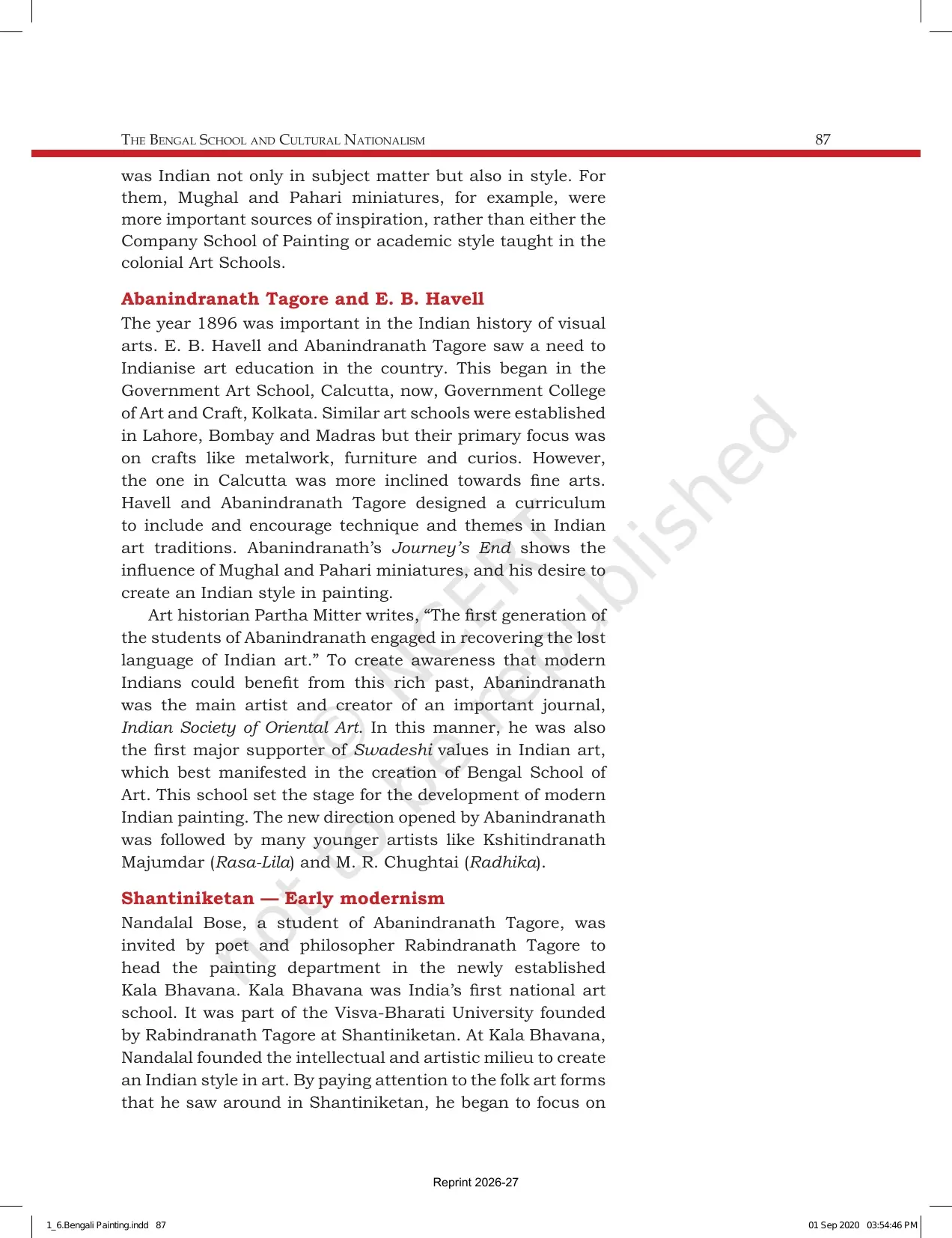
The plate in the main text is Dhaki, from the Haripura Posters of 1937, in the National Gallery of Modern Art, New Delhi. Dhaki means a drummer, which is why the musician appears first in the book's own list of activities.
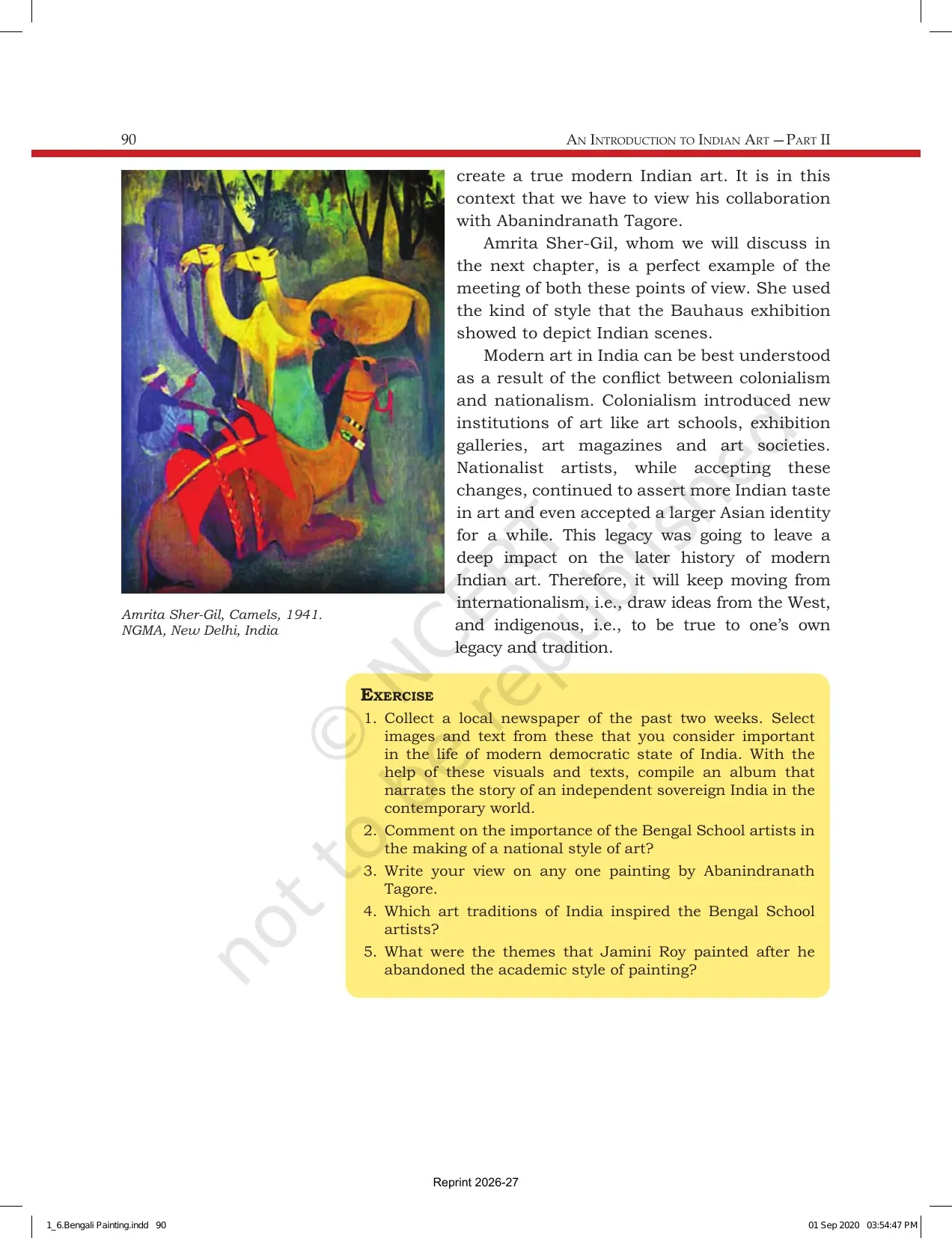
Two dates sit close together here and students mix them up every year. The Congress session at Haripura was in 1937, but the panel called Tiller of the Soil is dated 1938 in the appreciation section. Write both dates the way the book prints them and do not try to make them agree.
Jamini Roy and the Folk Renaissance in Modern Indian Art
Jamini Roy is called a unique example of a modern Indian artist, and the reason is a reversal. He went through academic training in the colonial art school and then rejected it, only to adopt the flat and colourful style of folk painting seen in villages.
- What he wanted: paintings that were simple and easy to duplicate, so they could reach a wider public.
- His themes: women and children specifically, and rural life generally.
- His title: the appreciation section calls him the father of the folk renaissance in India, who created an alternative vision of modern Indian identity.
- His fieldwork: in the mid 1920s he travelled to the countryside of Bengal to collect folk paintings, called pats, and to learn from folk artisans.
- What he learned from them: the expressive power of their lines.
The chapter closes this passage with the reminder that the struggle between Indian and European taste continued, and it proves the point with the art policy of the British Raj. The project for mural decorations in the Lutyen's Delhi buildings went to students of the Bombay School of Art, trained in realistic studies by its principal Gladstone Solomon. The Bengal School artists, by contrast, were allowed to decorate the Indian House in London under close British supervision.
That contrast is a clean three mark answer. One commission went to the realists without conditions, the other went to the nationalists with supervision attached.
Pan-Asianism, the Wash Technique and the Swadeshi Movement After 1905
The colonial art policy had created a divide between those who liked the European academic style and those who favoured the Indian style. The chapter then gives the political trigger that widened it. Following the Partition of Bengal in 1905, the Swadeshi movement was at its peak and it reflected in ideas about art.
| Person or idea | What the chapter credits to them |
|---|---|
| Ananda Coomaraswamy | An important art historian who wrote about Swadeshi in art |
| Kakuzo Okakura | A Japanese nationalist visiting Rabindranath Tagore in Calcutta, who brought his ideas about pan-Asianism |
| Pan-Asianism | The wish to unite India with other eastern nations and fight against western imperialism |
| The two Japanese artists | They accompanied Okakura to Calcutta and went to Shantiniketan to teach the wash technique of painting to Indian students |
| Why the wash technique mattered | It was offered as an alternative to western oil painting |
The wash technique is the single most examinable term in this chapter. The appreciation of Journey's End says Abanindranath Tagore invented it, and that it yields a soft, misty and impressionistic landscape whose hazy and atmospheric quality can suggest or evoke the end of a life.
- Who invented it: Abanindranath Tagore, as part of reviving Indian and oriental traditions in themes, style and technique.
- Who taught it at Shantiniketan: the two Japanese artists who came with Okakura.
- Who carried it forward with deviations: Kshitindranath Majumdar, one of the early students of Abanindranath.
- Who experimented with it: Abdul Rehman Chughtai, who combined wash and tempera and added a calligraphic line.
- The effect to describe: soft, misty, impressionistic, hazy and atmospheric.
The Bauhaus Exhibition of 1922 and Gaganendranath Tagore's Cubism
While pan-Asianism was gaining popularity, ideas about modern European art also travelled to India. The chapter fixes the moment precisely. The year 1922 may be regarded as a remarkable one, because an important exhibition of works by Paul Klee, Kandinsky and other artists of the Bauhaus School in Germany travelled to Calcutta.
- Why Swadeshi artists liked them: these European artists had rejected academic realism, exactly as the Bengal School had.
- What their language looked like: a more abstract art made of squares, circles, lines and colour patches.
- Why it was a first: Indian artists and the public had a direct encounter with modern art of this kind for the first time.
- Who absorbed it: Gaganendranath Tagore, brother of Abanindranath Tagore, in whose paintings the influence of the modern western style is clearly seen.
- What he painted: several works in the Cubist style, in which building interiors were created out of geometric patterns.
- His second interest: caricatures, in which he often made fun of rich Bengalis blindly following the European style of living.
Do not confuse the two brothers in an answer. Abanindranath founded the Bengal School and invented the wash technique. Gaganendranath brought Cubism into Indian painting and drew caricatures. Both are Tagores, and both appear in the same two pages, which is exactly why the paper can set a question separating them.
Anglicists and Orientalists: Two Different Concepts of Modernism
The final section of the main text is the most argued page in the chapter, and it opens with a correction. The divide between anglicists and orientalists was not based on race. The book proves that with two examples that point in opposite directions.
| Person | Which side they took | The detail the examiner wants |
|---|---|---|
| Benoy Sarkar | A Bengali intellectual who sided with the anglicists | Considered the modernism growing in Europe as authentic in his article The Futurism of Young Asia, and called the Oriental Bengal School of Art regressive and anti-modern |
| E. B. Havell | An Englishman who favoured a return to native art | Wanted a return to native art in order to create a true modern Indian art, which is the context for his collaboration with Abanindranath Tagore |
| Amrita Sher-Gil | The meeting point of both views | Used the kind of style the Bauhaus exhibition showed to depict Indian scenes; she is discussed in the next chapter |
The chapter then states its own verdict, and it is the best five mark closing paragraph in the book. Modern art in India can be best understood as a result of the conflict between colonialism and nationalism. Colonialism introduced new institutions of art such as art schools, exhibition galleries, art magazines and art societies.
Nationalist artists accepted those changes but continued to assert a more Indian taste in art, and even accepted a larger Asian identity for a while. The legacy left a deep impact on the later history of modern Indian art, which keeps moving between internationalism, meaning drawing ideas from the West, and the indigenous, meaning being true to one's own legacy and tradition.
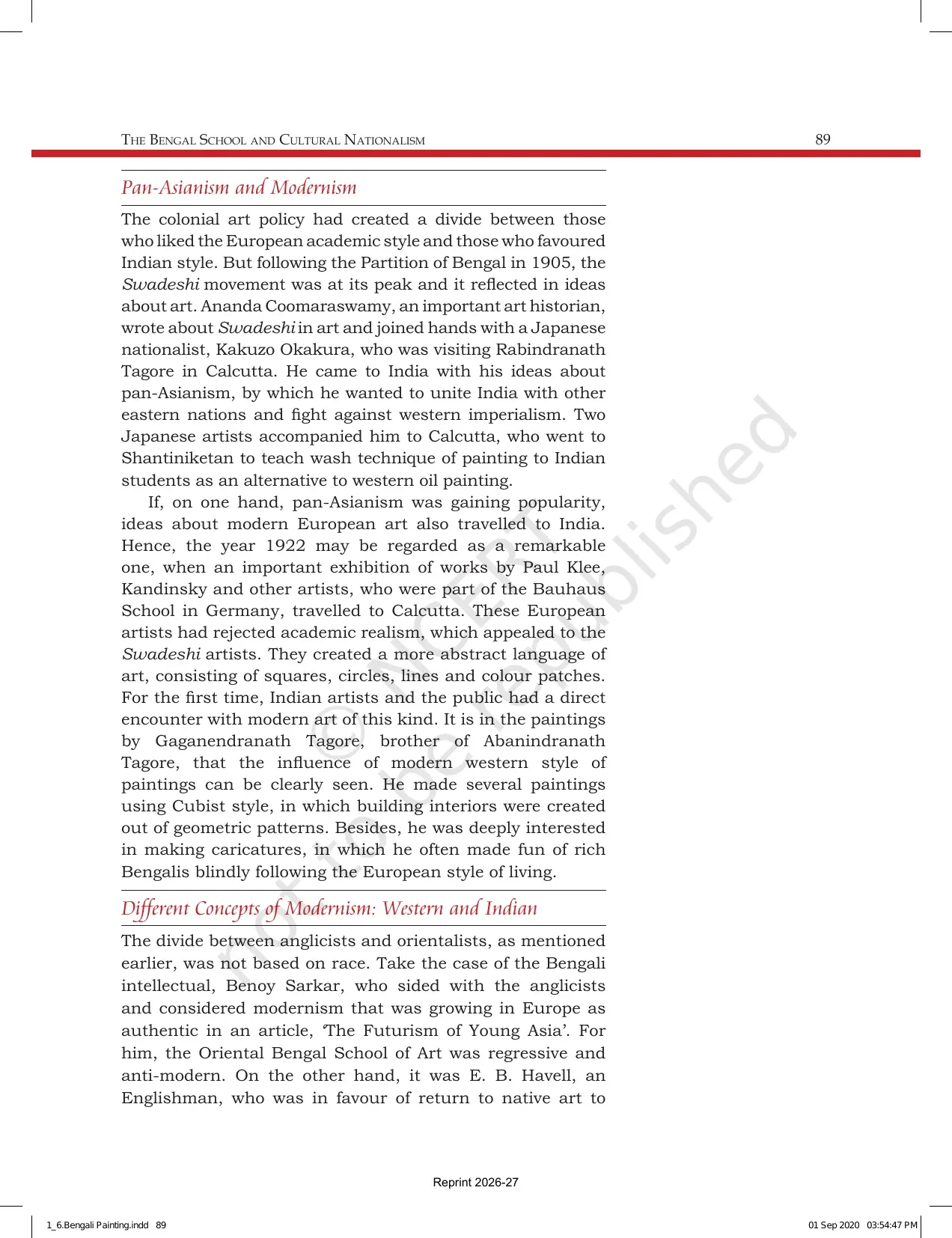
The Amrita Sher-Gil plate printed with this section is Camels, dated 1941, in the National Gallery of Modern Art, New Delhi. She belongs to the next chapter, so use her here only as the bridge between the two positions.
The Seven Painting Appreciations Printed at the End of the Chapter
Fine Arts picture questions are drawn from the plates the book describes in full, and this chapter carries seven of them. Each appreciation gives you the artist, the medium, the date and a set of style points. Prepare them as fixed blocks and you can answer any picture question in the paper.
- Tiller of the Soil by Nandalal Bose, one of the panels made in 1938 for the Haripura Congress. A farmer ploughs a field, the daily activity of a common man in a village. Bose made pen and ink brush studies of local villagers, then used thick tempera in a bold cursory style with broad brushwork, reminiscent of the folk practice of patuas or scroll painters. The background carries an arch. The strong sense of formal design, the bold colour scheme and the blend of nature and convention reflect his inspiration from Ajanta wall paintings and sculptures. Bose used art to build the nation's moral character.
- Rasa-Lila by Kshitindranath Majumdar, 1891 to 1975, a watercolour in wash technique showing the divine life of Sri Krishna. His stylistic features are rustic, thin, slender figures, modest gestures, idyllic settings and delicate watercolours. Krishna dances with Radha and the sakhis against a background of trees that creates a simple village atmosphere, as in the Bhagvata Purana and the Gita Govinda. Krishna and the gopis are drawn in the same proportion, so humans and God are brought to the same level. His other works are Man Bhanjan of Radha, Sakhi and Radha, Lakshmi and Birth of Sri Chaitanya, and he was a follower of the Bhakti Marga.
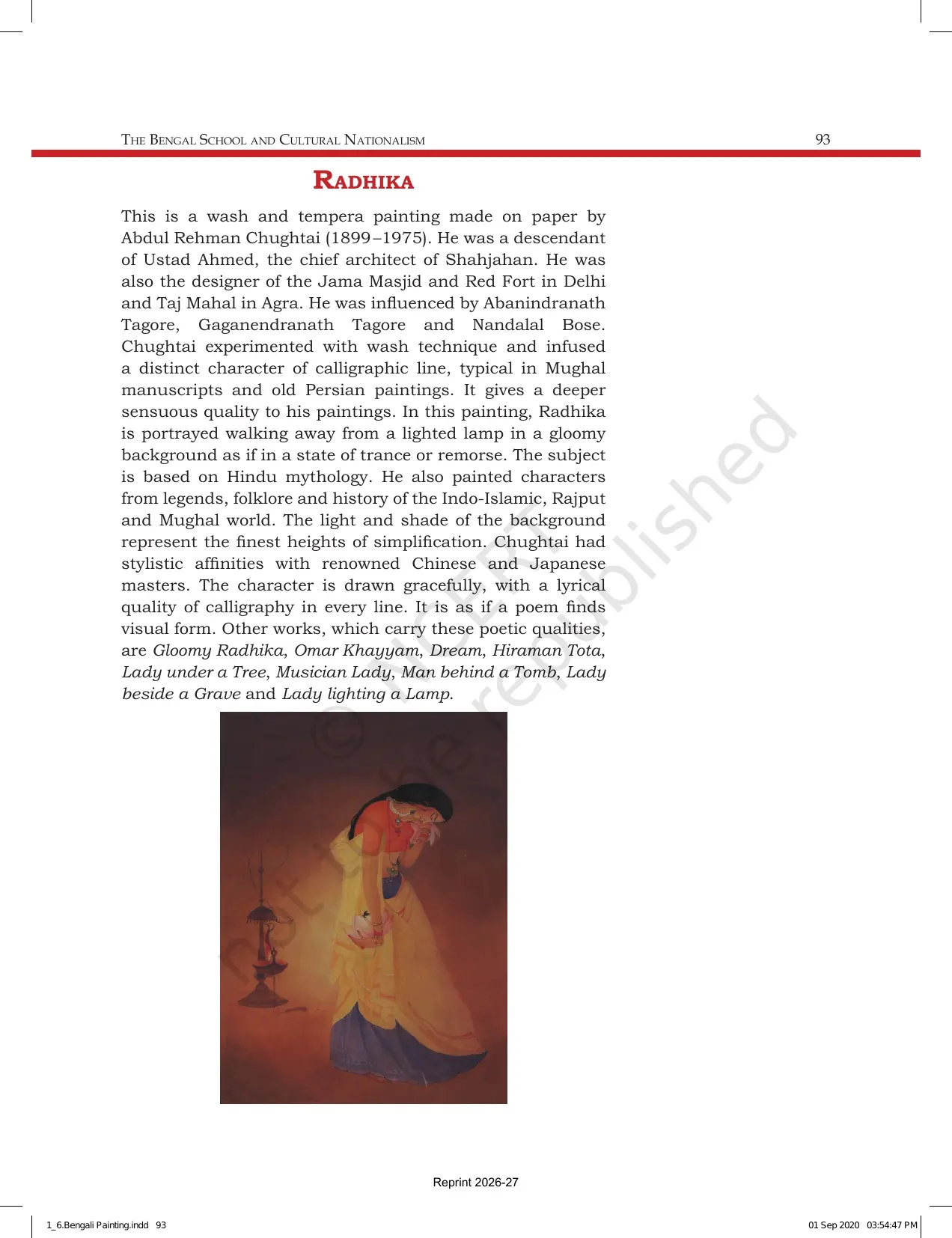
- Radhika by Abdul Rehman Chughtai, 1899 to 1975, a wash and tempera painting on paper. He was a descendant of Ustad Ahmed, the chief architect of Shahjahan and the designer of the Jama Masjid and Red Fort in Delhi and the Taj Mahal in Agra. Influenced by Abanindranath Tagore, Gaganendranath Tagore and Nandalal Bose, he infused the wash technique with a distinct calligraphic line typical of Mughal manuscripts and old Persian paintings. Radhika walks away from a lighted lamp in a gloomy background, as if in a state of trance or remorse. Other works include Gloomy Radhika, Omar Khayyam, Dream, Hiraman Tota, Lady under a Tree, Musician Lady, Man behind a Tomb, Lady beside a Grave and Lady lighting a Lamp.
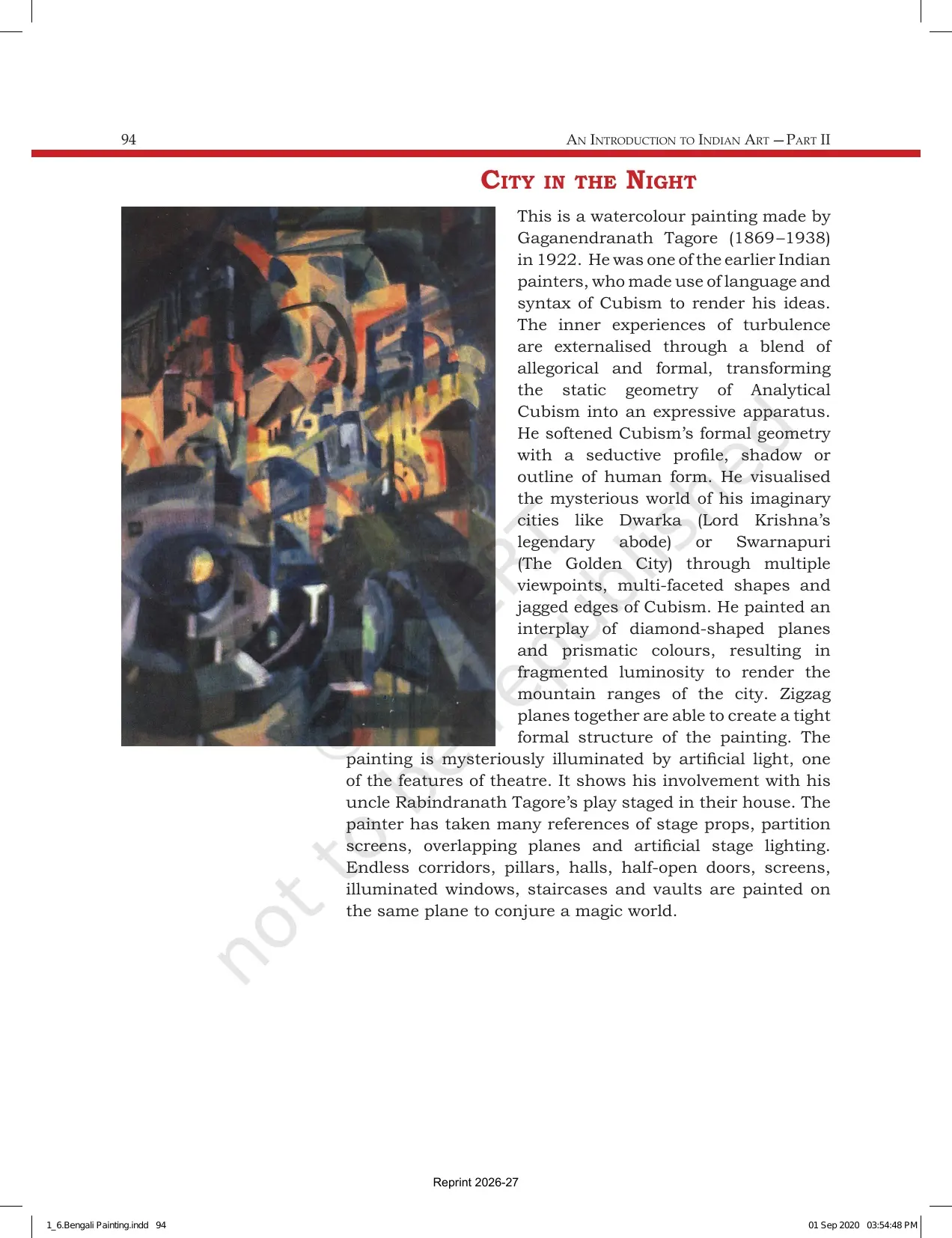
- City in the Night by Gaganendranath Tagore, 1869 to 1938, a watercolour of 1922. He used the language and syntax of Cubism to render his ideas, softening its formal geometry with a profile, shadow or outline of the human form. He visualised imaginary cities such as Dwarka and Swarnapuri through multiple viewpoints, multi faceted shapes and jagged edges, with an interplay of diamond shaped planes and prismatic colours. The painting is mysteriously illuminated by artificial light, one of the features of theatre, which reflects his involvement with his uncle Rabindranath Tagore's plays staged in their house. Look for endless corridors, pillars, halls, half open doors, screens, illuminated windows, staircases and vaults painted on the same plane.
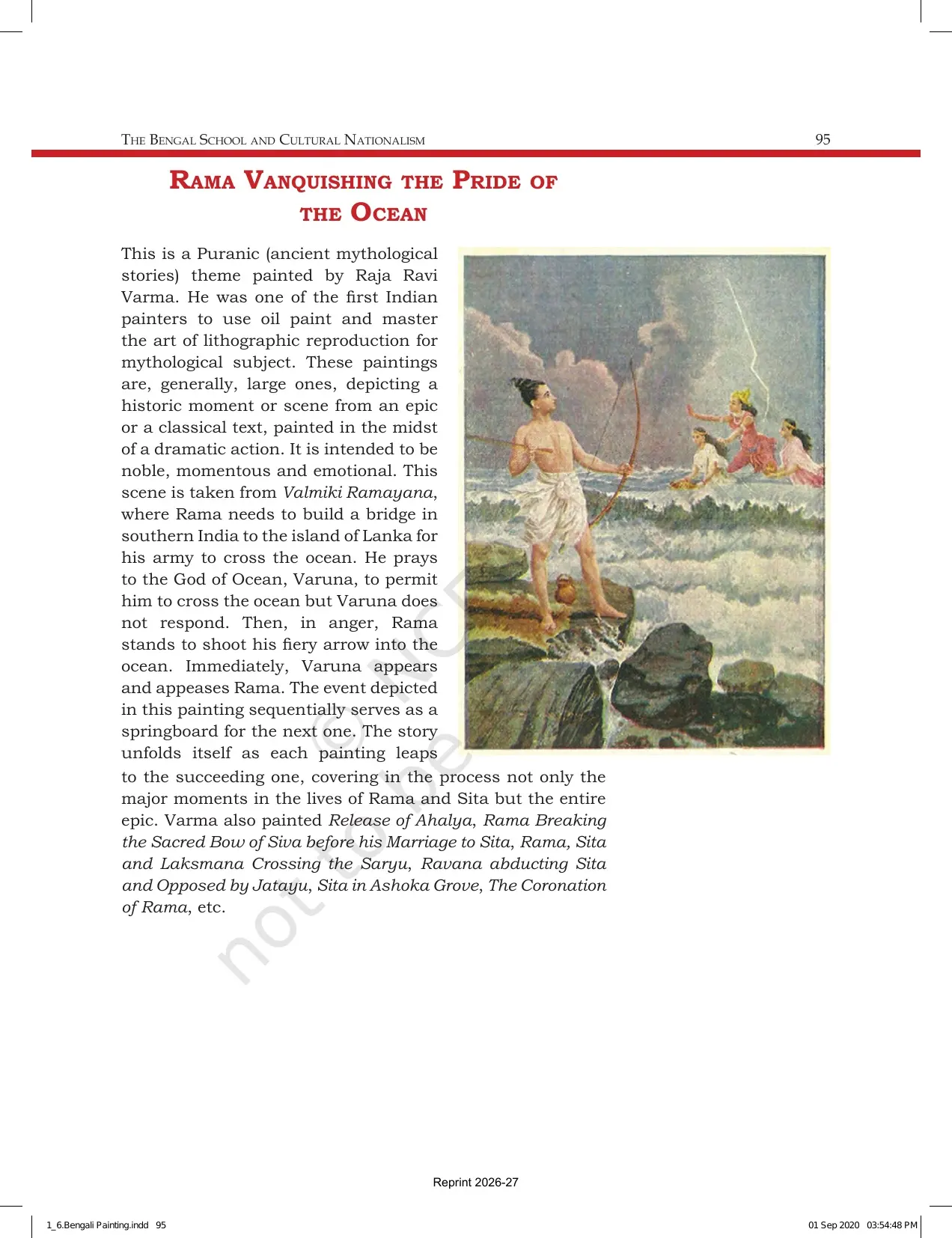
- Rama Vanquishing the Pride of the Ocean by Raja Ravi Varma, a Puranic theme. He was one of the first Indian painters to use oil paint and to master lithographic reproduction for mythological subjects. The scene comes from the Valmiki Ramayana: Rama needs a bridge to Lanka, prays to Varuna, the God of the Ocean, gets no reply, and in anger stands to shoot his fiery arrow into the ocean, at which Varuna appears and appeases him. His other works are Release of Ahalya, Rama Breaking the Sacred Bow of Siva before his Marriage to Sita, Rama, Sita and Laksmana Crossing the Saryu, Ravana abducting Sita and Opposed by Jatayu, Sita in Ashoka Grove and The Coronation of Rama.
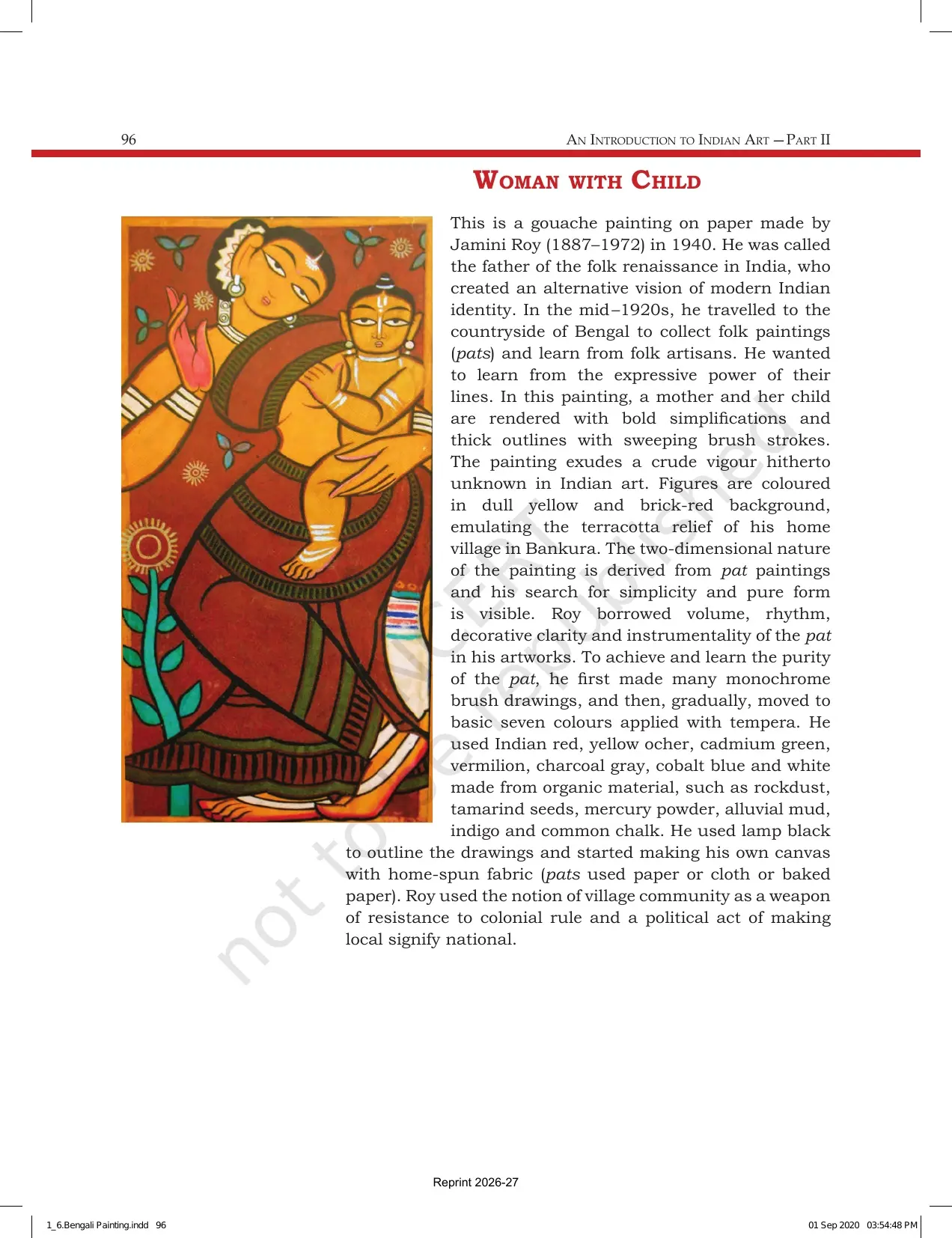
- Woman with Child by Jamini Roy, 1887 to 1972, a gouache on paper of 1940. A mother and child are rendered with bold simplifications and thick outlines in sweeping brush strokes, coloured in dull yellow with a brick red background that emulates the terracotta relief of his home village in Bankura. The two dimensional quality comes from pat paintings. He first made monochrome brush drawings, then moved to seven basic colours applied with tempera: Indian red, yellow ocher, cadmium green, vermilion, charcoal gray, cobalt blue and white, made from organic material such as rockdust, tamarind seeds, mercury powder, alluvial mud, indigo and common chalk. He used lamp black for outlines and made his own canvas with home spun fabric.
- Journey's End by Abanindranath Tagore, 1871 to 1951, a watercolour of 1913. He is seen as a father figure of nationalism and modernism in Indian art, and he invented the wash technique. A collapsed camel is shown against a red background of dusk, so it personifies the end of a journey through the end of a day. He worked with symbolic aesthetics on one side and literary allusions on the other, rendering the camel in fine lines and delicate tones. His other works are The Forest, Coming of Night, Mountain Traveller, Queen of the Forest and a series of 45 paintings based on The Arabian Nights.
Every one of the seven appreciations names the medium in its first line. Watercolour, wash, wash and tempera, gouache, oil and thick tempera all appear, and stating the correct medium is usually the first mark in a picture based answer.
Named Paintings, Artists and Collections You Must Be Able to Quote
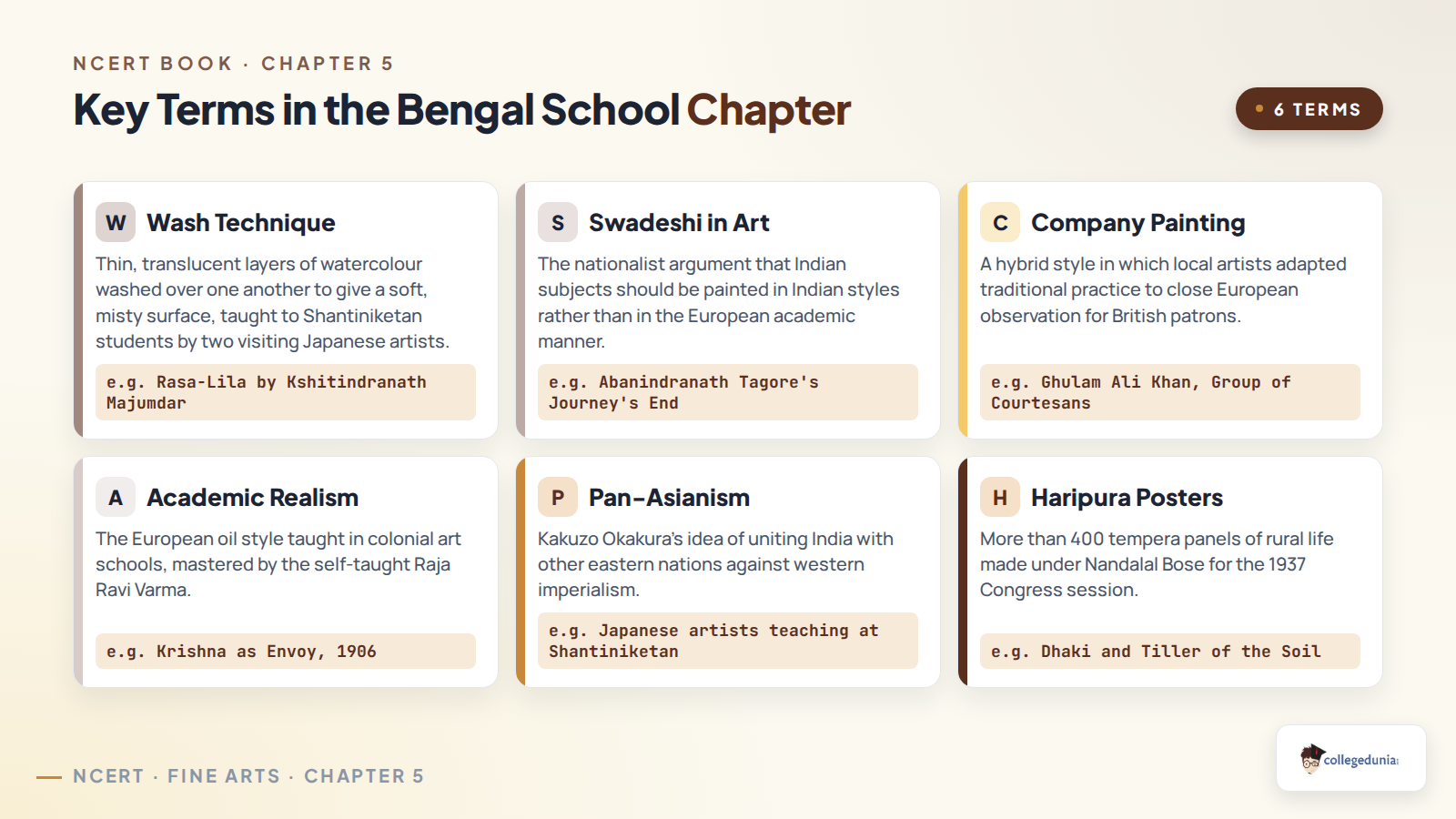
Build this table once and revise from it. If the paper reproduces any plate from the chapter, you will be able to give the artist, the date and the collection without opening the book again.
| Painting | Artist and date | Where it is held |
|---|---|---|
| Group of Courtesans, Company Painting | Ghulam Ali Khan, 1800 to 1825 | San Diego Museum of Art, California, United States |
| Krishna as envoy | Raja Ravi Varma, 1906 | National Gallery of Modern Art, New Delhi |
| Dhaki, Haripura Posters | Nandalal Bose, 1937 | National Gallery of Modern Art, New Delhi |
| Rama's marriage | K. Venkatappa, 1914 | Private Collection, India |
| Camels | Amrita Sher-Gil, 1941 | National Gallery of Modern Art, New Delhi |
| Tiller of the Soil, Haripura panel | Nandalal Bose, 1938 | Full page appreciation in the chapter |
| Rasa-Lila | Kshitindranath Majumdar | Full page appreciation in the chapter |
| Radhika | Abdul Rehman Chughtai | Full page appreciation in the chapter |
| City in the Night | Gaganendranath Tagore, 1922 | Full page appreciation in the chapter |
| Rama Vanquishing the Pride of the Ocean | Raja Ravi Varma | Full page appreciation in the chapter |
| Woman with Child | Jamini Roy, 1940 | Full page appreciation in the chapter |
| Journey's End | Abanindranath Tagore, 1913 | Full page appreciation in the chapter |
Five of these are printed inside the main text and seven come with a written appreciation at the back. The seven with appreciations are the likeliest picture questions, so give them the extra revision time.
The Five Exercise Questions at the End of the Bengal School Chapter
This chapter closes with five exercise questions, one more than the painting chapters before it. Only one of them is a practical activity, so four are written answers you should prepare in advance.
| Question | What it asks | Where the answer sits in the PDF |
|---|---|---|
| 1 | Collect a local newspaper of the past two weeks, select images and text you consider important in the life of a modern democratic India, and compile an album narrating the story of an independent sovereign India | A practical activity, not a written answer |
| 2 | Comment on the importance of the Bengal School artists in the making of a national style of art | The Bengal School section plus the Abanindranath and Havell section |
| 3 | Write your view on any one painting by Abanindranath Tagore | The Journey's End appreciation at the back of the chapter |
| 4 | Which art traditions of India inspired the Bengal School artists | The single line naming Mughal and Pahari miniatures as the sources of inspiration |
| 5 | What were the themes that Jamini Roy painted after he abandoned the academic style | The Jamini Roy passage plus the Woman with Child appreciation |
Question 3 is the safest mark in the paper if you prepare Journey's End properly. Write the date, the medium, the wash technique, the collapsed camel, the red dusk background and the reading that it personifies the end of a journey through the end of a day. That is six scoring points from one plate.
Common Mistakes Students Make in the Bengal School Chapter
Watch out for these seven:
- Writing that Bharat Mata is the plate studied in this chapter. That painting is not printed here at all. The Abanindranath work the book describes in full is Journey's End of 1913.
- Mixing up the two Tagore brothers. Abanindranath led the Bengal School and invented the wash technique. Gaganendranath painted in the Cubist style and drew caricatures.
- Calling Raja Ravi Varma a Bengal School artist. He is the academic realist whose style the nationalists rejected as too western, and he was self taught at the Travancore Court.
- Saying the Company School died out on its own. It declined with the entry of photography in the mid nineteenth century, because the camera documented better.
- Treating the anglicist and orientalist divide as a divide between Indians and Englishmen. Benoy Sarkar was an Indian anglicist and E. B. Havell was an English orientalist.
- Crediting the wash technique to the Japanese artists. They taught it at Shantiniketan, but the book says Abanindranath Tagore invented it.
- Confusing the two institutions. The reform of 1896 happened at the Government Art School, Calcutta. Kala Bhavana at Shantiniketan is the separate national art school inside Visva-Bharati University.
Student Feedback on the Bengal School and Cultural Nationalism Chapter
What 13,240 students told us about this chapter
- 68% of the students surveyed said the anglicist and orientalist argument is the hardest part to write in an answer, because it has no dates to hold on to.
- Only 31% could name all seven appreciation plates with their artists after a first reading.
- Students who wrote a two column sheet of Indian taste against European taste reported the fastest recall in the five mark questions.
- Most skipped passage: the paragraph on the Bombay School mural commission and the Indian House in London, left unread by about 2 in 5 students, even though it is a ready made three mark contrast.
Source: Collegedunia Class 12 Fine Arts student survey taken before the 2026-27 board exams. Sample of 13,240 students from CBSE schools across 15 states.
How to Revise the Bengal School Chapter in a Three Block Plan
This chapter is shorter than the miniature chapters but harder to write from, because the marks sit in arguments rather than in lists. About two focused hours makes it board ready, and the printed order gives you the sequence for free.
- Block 1, 35 minutes. Read Company Painting and Raja Ravi Varma. Write, from memory, why the Company style declined and why the academic style was later called too western.
- Block 2, 45 minutes. Read the Bengal School, the 1896 reform and the Shantiniketan pages. Draw one chart linking Havell, Abanindranath, Nandalal Bose, Kala Bhavana and the Haripura Posters.
- Block 3, 40 minutes. Read pan-Asianism, the Bauhaus passage and the closing argument, then write all seven appreciation plates as six line blocks with artist, date, medium and two style points each.
Repeat Block 3 a week before the paper. Plate dates and mediums fade fastest, and they are the cheapest marks in the Fine Arts theory paper for both the CBSE Class 12 board exam and the CUET general test.
How the Bengal School Chapter PDF Works with the Fine Arts Revision Notes
The chapter PDF gives you the official text and every plate exactly as printed. What it does not give you is a compressed recall sheet you can read in ten minutes before the paper. That sits on the sister page for the same chapter, and running the two together is faster than reading either one alone.
| Resource | What it adds beyond this chapter PDF | Link |
|---|---|---|
| Revision Notes | The Swadeshi timeline, the anglicist against orientalist chart and the seven plate index condensed for a last read before the paper | The Bengal School and Cultural Nationalism Class 12 Notes |
Also Check: read the Pahari chapter before this one. Havell and Abanindranath named Mughal and Pahari miniatures as their sources of inspiration, so exercise question 4 assumes you already know what those two traditions look like.
All 8 Chapters of Class 12 Fine Arts with NCERT Book PDFs
The Class 12 Fine Arts course runs across eight chapters. Every link below opens the official NCERT chapter PDF for the 2026-27 session.
| Chapter | NCERT Book PDF |
|---|---|
| Chapter 1 | The Mughal School of Miniature Painting Class 12 PDF |
| Chapter 2 | The Deccan Schools of Painting Class 12 PDF |
| Chapter 3 | The Rajasthani Schools of Painting Class 12 PDF |
| Chapter 4 | The Pahari Schools of Painting Class 12 PDF |
| Chapter 5 | The Bengal School and Cultural Nationalism Class 12 PDF |
| Chapter 6 | Modern Indian Art Class 12 PDF |
| Chapter 7 | The Company School Class 12 PDF |
| Chapter 8 | Living Art Traditions of India Class 12 PDF |
The Bengal School and Cultural Nationalism Class 12 Fine Arts NCERT Book PDF FAQs
Questions Class 12 Students Ask Most About the Bengal School Chapter
Ques. What was the Bengal School of Art?
Ans. The Bengal School of Art was an art movement and a style of painting that originated in Calcutta, the centre of British power, in the first decade of the twentieth century. The book notes that the term itself is not fully accurate, because the movement was not restricted to Bengal alone and later influenced artists in different parts of the country, including Shantiniketan. It was associated with the nationalist Swadeshi movement and was spearheaded by Abanindranath Tagore, who wanted a new type of painting that was Indian not only in subject matter but also in style.
Ques. What is the Company School of Painting?
Ans. It is the mixture of traditional Indian and European styles of painting that grew under colonial rule around the eighteenth century. English officers commissioned local artists, partly for documentation and partly for artistic reasons, to paint the manners and customs of people of all ranks, the tropical flora and fauna and the varying locales of India. Many of these artists had migrated from the erstwhile courts of Murshidabad, Lucknow or Delhi, and they had to rely more on close observation than on memory and rule books. Albums of such paintings were much in demand in Britain as well.
Ques. Why did the Company School of Painting decline?
Ans. It declined with the entry of photography in India in the mid nineteenth century, because the camera offered a better way of documentation. What continued to flourish in the art schools set up by the British was the academic style of oil painting, which used a European medium to show Indian subject matter.
Ques. Who was Raja Ravi Varma and why was his style criticised?
Ans. Raja Ravi Varma was a self taught artist of the Travancore Court in Kerala. By imitating copies of European paintings popular in Indian palaces, he mastered academic realism and used it to depict scenes from the Ramayana and the Mahabharata. Many of his paintings were copied as oleographs, sold in the market and entered homes as calendar images. With the rise of nationalism by the end of the nineteenth century, his academic style came to be looked down upon as foreign and too western to show Indian myths and history.
Ques. What is the wash technique in painting?
Ans. The wash technique is the painting method invented by Abanindranath Tagore as part of his revival of Indian and oriental traditions in theme, style and technique. It yields a soft, misty and impressionistic landscape, and the book explains that these hazy and atmospheric effects are used in Journey's End to suggest the end of a life. Two Japanese artists who came to Calcutta with Kakuzo Okakura went to Shantiniketan to teach the wash technique to Indian students as an alternative to western oil painting.
Ques. What role did E. B. Havell play in the Bengal School?
Ans. E. B. Havell, who lived from 1861 to 1934, was a British administrator and the principal of the Calcutta School of Art. In 1896 he and Abanindranath Tagore saw a need to Indianise art education in the country, and together they designed a curriculum that included techniques and themes from Indian art traditions at the Government Art School, Calcutta, now the Government College of Art and Craft, Kolkata. Havell is also the book's proof that the anglicist and orientalist divide was not based on race, since he was an Englishman who favoured a return to native art to create a true modern Indian art.
Ques. Which art traditions of India inspired the Bengal School artists?
Ans. Mughal and Pahari miniatures. For Abanindranath Tagore and E. B. Havell these were more important sources of inspiration than either the Company School of Painting or the academic style taught in the colonial art schools. Abanindranath's Journey's End is the painting the chapter offers as evidence, since it shows the influence of Mughal and Pahari miniatures along with his desire to create an Indian style in painting. This is the direct answer to exercise question 4.
Ques. Who was Nandalal Bose and what did he do at Kala Bhavana?
Ans. Nandalal Bose was a student of Abanindranath Tagore who was invited by Rabindranath Tagore to head the painting department at the newly established Kala Bhavana, India's first national art school, inside Visva-Bharati University at Shantiniketan. There he founded the intellectual and artistic milieu needed to create an Indian style in art, paid close attention to the folk art forms around Shantiniketan, and illustrated primers in Bengali with woodcuts because he understood the role of art in teaching new ideas.
Ques. What are the Haripura Posters?
Ans. They are the panels Nandalal Bose painted at the invitation of Mahatma Gandhi for display at the Congress session at Haripura in 1937. They showed ordinary rural folk busy in various activities, such as a musician drumming, a farmer tilling and a woman churning milk, painted as lively colourful sketchy figures contributing their labour to nation building. More than 400 posters were prepared at Kala Bhavana under the supervision of Bose, and they echoed Gandhi's socialist vision of including marginalised sections of Indian society through art.
Ques. What themes did Jamini Roy paint after he abandoned the academic style?
Ans. After rejecting the academic training he received in the colonial art school, Jamini Roy adopted the flat and colourful style of folk painting seen in villages. He painted women and children specifically and rural life generally, and he wanted his paintings to be simple and easy to duplicate so they could reach a wider public. In the mid 1920s he travelled to the countryside of Bengal to collect folk paintings called pats and to learn the expressive power of the folk artisans' lines. This is the answer to exercise question 5.
Ques. What is pan-Asianism and who brought it to India?
Ans. Pan-Asianism was the idea of uniting India with other eastern nations to fight against western imperialism. It was brought to India by Kakuzo Okakura, a Japanese nationalist who was visiting Rabindranath Tagore in Calcutta. Following the Partition of Bengal in 1905 the Swadeshi movement was at its peak, and the art historian Ananda Coomaraswamy, who wrote about Swadeshi in art, joined hands with Okakura. Two Japanese artists came with him and taught the wash technique at Shantiniketan.
Ques. Why is the year 1922 important in this chapter?
Ans. In 1922 an important exhibition of works by Paul Klee, Kandinsky and other artists of the Bauhaus School in Germany travelled to Calcutta. These European artists had rejected academic realism, which appealed to the Swadeshi artists, and they worked in a more abstract language made of squares, circles, lines and colour patches. It was the first time Indian artists and the public had a direct encounter with modern art of this kind. Gaganendranath Tagore, the brother of Abanindranath, is the painter in whom this influence is most clearly seen.
Ques. How did Gaganendranath Tagore use Cubism?
Ans. He made several paintings in the Cubist style in which building interiors were created out of geometric patterns, and he softened the formal geometry of Analytical Cubism with a profile, shadow or outline of the human form. In City in the Night, a watercolour of 1922, he visualised imaginary cities such as Dwarka and Swarnapuri through multiple viewpoints, multi faceted shapes and jagged edges, with diamond shaped planes and prismatic colours. The painting is lit by artificial light, a feature of theatre, which reflects his involvement with the plays staged in the family house. He was also deeply interested in caricatures that made fun of rich Bengalis blindly following the European style of living.
Ques. What is the difference between the anglicists and the orientalists?
Ans. The anglicists considered the modernism growing in Europe as the authentic one, while the orientalists favoured a return to Indian art. The book stresses that the divide was not based on race. Benoy Sarkar, a Bengali intellectual, sided with the anglicists and called the Oriental Bengal School of Art regressive and anti-modern in his article The Futurism of Young Asia. E. B. Havell, an Englishman, favoured a return to native art to create a true modern Indian art. Amrita Sher-Gil is offered as the meeting point of both views, since she used the style shown at the Bauhaus exhibition to depict Indian scenes.
Ques. How do I download the Bengal School and Cultural Nationalism NCERT Book PDF?
Ans. Use the PDF viewer at the top of this page. It carries the official NCERT chapter across all 14 printed pages exactly as issued, with every plate, caption, appreciation and the five exercise questions, so you can read the whole chapter online or save it for offline revision before the 2026-27 board exams. No sign up is needed.



Comments