




Inside the NCERT Book PDF for Class 12 Fine Arts Chapter 4 The Pahari Schools of Painting you will find the Basohli beetle wing technique, the Guler workshop of Pandit Seu and his sons, and the full Kangra story of Raja Sansar Chand. It is the official chapter from An Introduction to Indian Art Part 2, Reprint 2026-27, printed exactly as the board prescribes it.



- Covers the hill centres of Basohli, Guler, Kangra, Kullu, Chamba, Mankot, Nurpur, Mandi, Bilaspur and Jammu, from the seventeenth to the nineteenth century.
- Names to spell right: Pandit Seu, Manaku, Nainsukh, Khushala, Fattu, Gaudhu, Purkhu, Devida and Molaram.
- Ends with 4 exercise questions and 3 full page painting appreciations.
This Pahari Schools of Painting chapter PDF is the unedited NCERT text page for page, checked against the Reprint 2026-27 print run, and paired here with a centre by centre painting index written by Collegedunia Fine Arts teachers.
What the Pahari Schools of Painting Class 12 PDF Contains
The chapter is built as a single story that moves through three stages, not as a list of nine independent courts. Basohli comes first, Guler turns the style around in the middle, and Kangra closes it. Read it in the printed order and the smaller centres fall into place at the end.
| Section in the PDF | What it covers | Question type it feeds |
|---|---|---|
| Opening on the term Pahari | The meaning of Pahari, the list of hill centres, the classification problem, the theories of origin | 1 mark and 2 marks |
| B. N. Goswamy on family as the basis of style | The Pandit Seu family argument, why regional attribution misleads, the shift from Basohli to Kangra | 3 marks and 5 marks |
| Basohli School | Kirpal Pal, primary colours, warm yellows, beetle wing emeralds, the Rasamanjari series by Devida | 5 marks, appreciation |
| The Shangri Ramayana passages | Two Kullu folios described in detail, the Basohli and Bilaspur influence, the animals in the forest | Picture based questions |
| Guler School | Govardhan Chand, Pandit Seu, Manaku, Nainsukh, the Gita Govinda of 1730, the Balwant Singh portraits | 5 marks, appreciation |
| Kangra School | Sansar Chand, Tira Sujanpur, Alampur, Nadaun, the straight nose profile, Fattu, Purkhu and Khushala | 5 marks, appreciation |
| Ashta Nayikas and Baramasa | The eight heroines, the Abhisarika folio, the twelve month Baramasa cycle from Keshav Das | 3 marks and 5 marks |
| The other hill centres | Chamba, Kullu, Nurpur, Mankot, Jasrota, Mandi, Bilaspur, Jammu, Kashmir and Garhwal | 2 marks and 3 marks |
| Three appreciation plates | Awaiting Krishna and the Hesitant Radha, Balwant Singh looking at a Painting with Nainsukh, Nanda Yashoda and Krishna | Picture based questions |
One planning note before you start. The book gives a broad classification of only three styles, Basohli, Guler and Kangra. Every other name in the chapter, including Kullu, Nurpur, Mankot, Jasrota, Mandi and Bilaspur, is a centre where one of those three styles travelled. Getting that hierarchy right is worth more marks than memorising every town.
What Pahari Means and Why These Paintings Resist Territorial Classification
The opening page is a definition question and examiners set it almost every year. Pahari denotes hilly or mountainous in origin. The Pahari Schools of Painting include towns in the hills of the western Himalayas that emerged as centres of painting from the seventeenth to the nineteenth century.
- The towns named: Basohli, Guler, Kangra, Kullu, Chamba, Mankot, Nurpur, Mandi, Bilaspur, Jammu and others.
- The arc of the style: it begins at Basohli with a coarsely flamboyant style and blossoms into the most exquisite and sophisticated style of Indian painting, the Kangra School, through the Guler or pre-Kangra phase.
- The problem: unlike the Mughal, Deccani and Rajasthani Schools, Pahari paintings show real difficulty in territorial classification.
- Why: each centre did craft individual characteristics, through the depiction of nature, architecture, figural types, facial features, costumes and a preference for particular colours, yet none of them developed as an independent school with a distinctive style of its own.
- The evidence gap: a paucity of dated material, colophons and inscriptions prevents informed categorisation.
The origin question is treated just as cautiously. The emergence of the Pahari School remains unclear and scholars have only proposed theories. It is widely accepted that Mughal and Rajasthani styles were known in the hills, probably through examples of the Provincial Mughal style and through family relationships between the hill Rajas and the royal courts of Rajasthan.
Even so, the flamboyantly bold Basohli style is generally understood to be the earliest prevailing pictorial language in the hills. Learn that sentence in the book's own wording, because a one mark question on the earliest Pahari idiom is easy to set and easy to score.
B. N. Goswamy and the Family of Pandit Seu as the Basis of Style
This is the most argued page in the chapter and the one students skim past. B. N. Goswamy is named as one of the most significant scholars of the Pahari Schools of Painting. He attributed the shaping of the Pahari style, from the simplicity of Basohli to the poetic lyricism and refinement of Kangra, to the ingenuity of a single family of artists.
- The central argument: the family of Pandit Seu, also written Shiv, was chiefly responsible for the course of Pahari paintings.
- The objection to regions: identifying Pahari paintings on the basis of regions could be misleading, because political boundaries in the hills were always fluid.
- Why it also applies to Rajasthan: attribution merely by region creates vagueness there too, and several disparities stay unexplained.
- The gain: if a family of artists is treated as the style bearer, multiple strands of one style can be justified inside the same region and school.
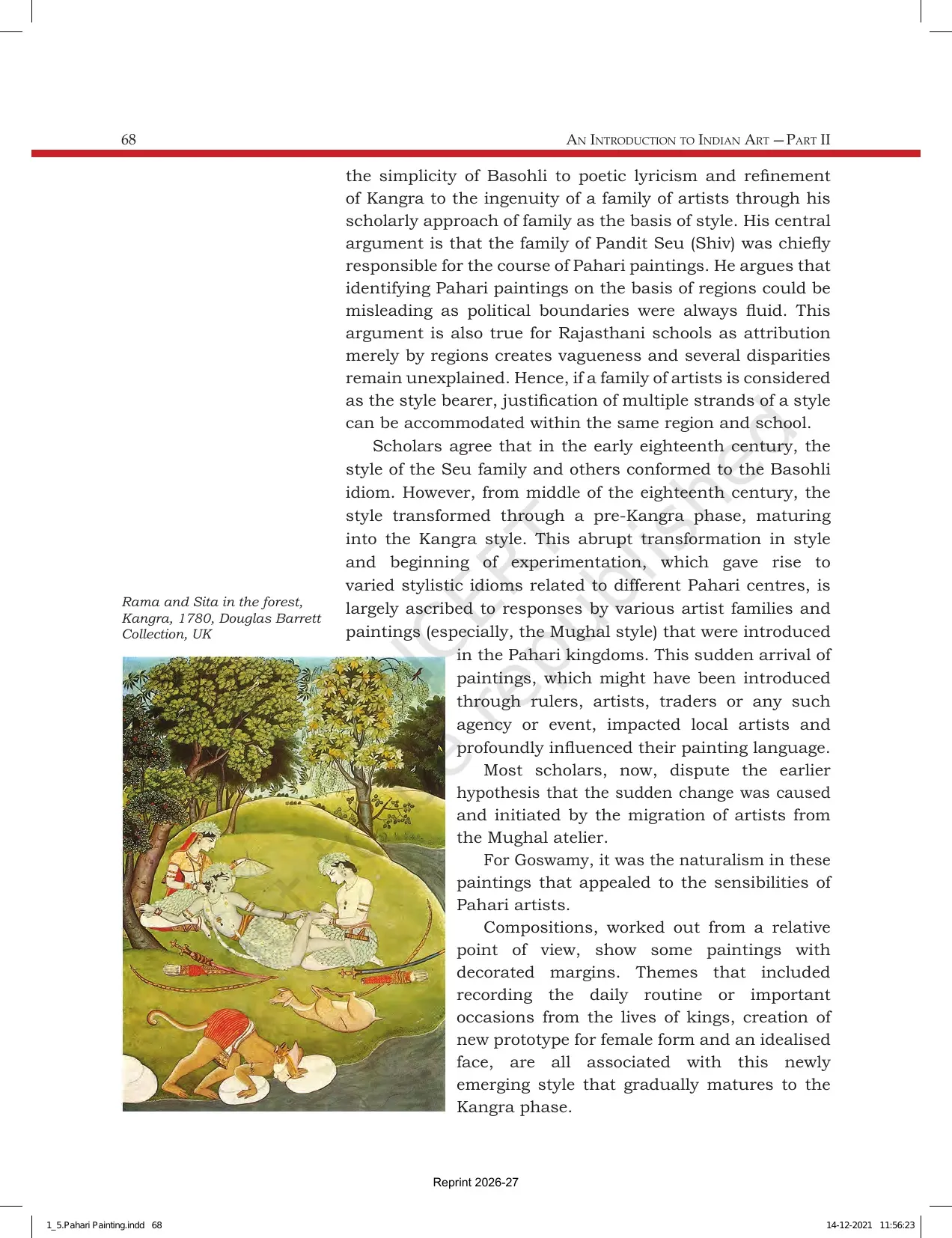
The timeline that follows the argument carries marks on its own. Scholars agree that in the early eighteenth century the style of the Seu family and others conformed to the Basohli idiom. From the middle of the eighteenth century the style transformed through a pre-Kangra phase and matured into the Kangra style.
That abrupt transformation is the part the examiner wants explained, not just dated. The book ascribes it largely to the responses of various artist families to paintings, especially in the Mughal style, that were suddenly introduced into the Pahari kingdoms. Those paintings might have arrived through rulers, artists, traders or any similar agency, and they profoundly influenced the language of local artists.
Most scholars now dispute the older hypothesis that the change was caused by the migration of artists from the Mughal atelier. For Goswamy it was the naturalism inside these paintings that appealed to the sensibilities of Pahari artists. Write the disputed theory and the accepted one side by side and the five mark answer writes itself.
Three features of the new pictorial language are listed at the end of that passage. Compositions were worked out from a relative point of view, some paintings carry decorated margins, and the themes shift towards recording the daily routine or important occasions in the lives of kings. Alongside that came a new prototype for the female form and an idealised face, both of which mature fully in the Kangra phase.
Pahari Schools of Painting Explained for the Class 12 Board Answer
Source: Study Box on YouTube
Basohli School of Painting: Beetle Wing Emeralds and the Rasamanjari of Kirpal Pal
Basohli is where the chapter starts and where most picture based questions begin. The first and most dramatic example of work from the hill states is from Basohli. From 1678 to 1695 the state was ruled by Kirpal Pal, described in the book as an enlightened prince, and under him Basohli developed a distinctive and magnificent style.
| Feature of the Basohli style | What to write in the answer |
|---|---|
| Colour | A strong use of primary colours and warm yellows that fill the background and the horizon |
| Vegetation | A stylised, not naturalistic, treatment of trees and foliage |
| Ornament | Raised white paint used to imitate the representation of pearls in jewellery |
| The signature device | Small, shiny green particles of beetle wings laid in to delineate jewellery and simulate the effect of emeralds |
| Wider affinity | In palette and elegance it shares the aesthetics of the Chaurpanchashika group of paintings of Western India |
The beetle wing inlay is the single most identifiable feature of Basohli painting and the most reliable one mark question in the chapter. If a question asks how emeralds were simulated in a hill painting, that is the answer, and the same device reappears later in Manaku's Gita Govinda at Guler.
The theme list is short and worth learning as a set. The most popular theme of Basohli painters was the Rasamanjari of Bhanu Datta. In 1694 to 1695 an artist named Devida, a tarkhan or carpenter painter, did a magnificent series of it for his patron Kirpal Pal.
- Other popular themes: the Bhagvata Purana and the Ragamala.
- Portrait subjects: local kings with their consorts, courtiers, astrologers, mendicants, courtesans and others.
- The spread: artist ateliers from Basohli gradually moved to other hill states such as Chamba and Kullu, giving rise to local variations of the Basohli kalam.
- The handover: a new style came into vogue between the 1690s and the 1730s, referred to as the Guler to Kangra phase, in which artists experimented and improvised until the Kangra style took shape.
- The full route: originating in Basohli, the style spread to Mankot, Nurpur, Kullu, Mandi, Bilaspur, Chamba, Guler and Kangra.
The dated plate printed with this section is a Rasamanjari folio of 1720 in the British Museum, London. Pair it in your notes with the opening plate of the chapter, Krishna steals butter from the Bhagvata Purana of 1750, in the N. C. Mehta Collection at Ahmedabad, so you have one Basohli theme and one Krishna theme ready for any appreciation question.
The Shangri Ramayana of Kullu: Two Folios the Book Describes in Detail
The Sanskrit epic Ramayana was one of the favourite texts of the hill artists at Basohli as well as at Kullu. The Shangri Ramayana set takes its name from Shangri, the place of residence of a branch of the Kullu royal family who were its patrons and its former possessors. These Kullu works were influenced in varying degrees by the styles of Basohli and Bilaspur.
The first folio the book describes is Rama gives away his possessions, from the Ayodhya Kanda, dated 1690 to 1700 and held at the Los Angeles County Museum of Art. Rama has learnt of his exile and is preparing to leave Ayodhya with Sita and Lakshmana. Keeping equanimity of mind, he performs his last acts of giving.
- The composition: the two princes and Sita are set apart on the left, standing on a carpet, with a crowd of recipients moving towards them.
- The types the painter introduces: recluses, Brahmins, courtiers, commoners and servants of the royal household.
- The gifts shown: a pile of gold coins and garments on the carpet, and cows and calves looking at Rama with necks stretched, gazes fixed and mouths wide open.
- The expressions: a serene but gently smiling Rama, a curious Lakshmana, an apprehensive Sita, Brahmins willing to receive but with no pleasure, and others showing disbelief and gratitude.
- The fine effects: the transparency of the garment Rama holds out, the stippled beard on the cheek and chin of the Brahmins, tilak marks, jewellery and weapons.
The second folio is Rama and Lakshmana following sage Vishvamitra to the forest, from the Bala Kanda, dated 1680 to 1688 and held in the Raja Raghbir Singh Collection at Shangri in the Kullu Valley. The princes are going to defeat the demons who distressed the hermits by disturbing their meditative practices and contaminating their rituals.
The examinable detail here is the fragmentary animals. A wolf is shown partly hidden on the left and a tiger on the right, prowling stealthily behind trees in heavy outgrowth. That device does two things at once. It characterises the forest as a thick impenetrable jungle full of ferocious animals, and it adds emotive value about the extraordinary courage of the two young princes. The fractional treatment also adds mystery, since the animals may be demons in disguise.
Guler School of Painting: Pandit Seu, Manaku and Nainsukh Change the Course
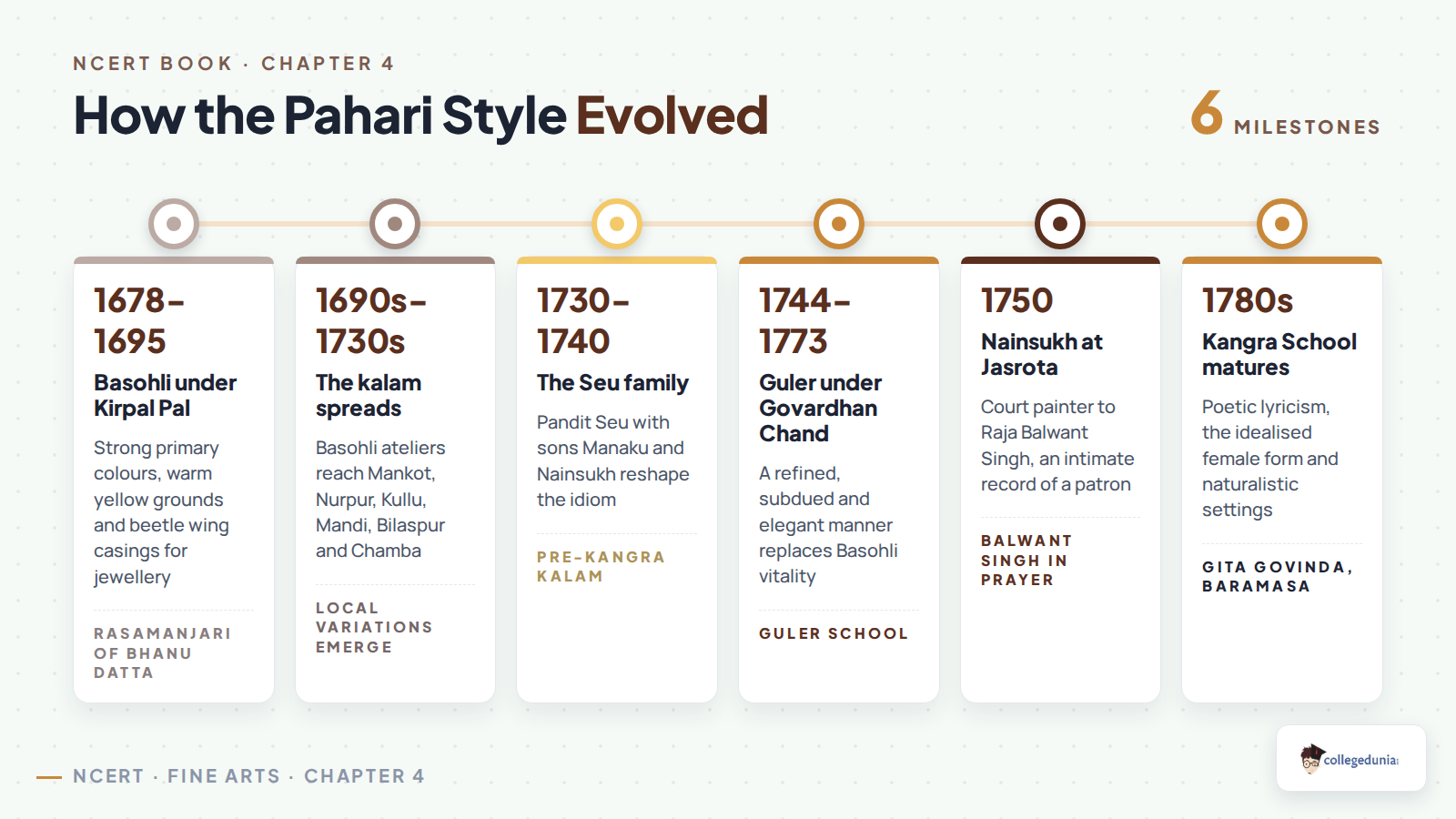
The first quarter of the eighteenth century saw a complete transformation in the Basohli style, and that transformation is the Guler to Kangra phase. It first appeared at Guler, a high ranking branch of the Kangra royal family, under the patronage of Raja Govardhan Chand, who ruled from 1744 to 1773.
| Artist | Relationship | What the book credits to them |
|---|---|---|
| Pandit Seu | The father, a Guler artist | Head of the family that Goswamy calls the style bearer of Pahari painting |
| Manak, also called Manaku | Elder son | Initiated the new style around 1730 to 1740; painted the Gita Govinda set of 1730; did many portraits of Govardhan Chand and his family |
| Nainsukh | Younger son | Court painter to Raja Balwant Singh of Jasrota; shaped the Guler School emphatically; master of individual portraiture |
| Khushala, Fattu and Gaudhu | Sons of Manaku and Nainsukh | Worked in the court of Prakash Chand and later at Kangra; responsible for the finest examples of Pahari painting |
The style itself is defined by contrast. The pre-Kangra or Guler to Kangra kalam is more refined, subdued and elegant compared with the bold vitality of the Basohli style. Its most matured version entered Kangra during the 1780s and developed there into the Kangra School, while the offshoots of Basohli carried on in Chamba and Kullu.
Guler also has the longest painting tradition of any Pahari school, and the book proves it with dates. Artists were working at Haripur to Guler from the reign of Dalip Singh, 1695 to 1743. Portraits of Dalip Singh and of his son Bishan Singh survive from earlier than the 1730s, that is, before the Guler to Kangra phase even began. Bishan Singh died during his father's lifetime, so the younger brother Govardhan Chand took the throne, and the change in painting style happened in his reign.
Manaku's most outstanding work is his set of Gita Govinda painted in 1730 at Guler. It keeps some elements of the Basohli style, most strikingly the lavish use of beetle's wing casings, which is why the set sits so neatly between the two phases. The Guler plate printed in the chapter, Krishna embracing gopis from a Gita Govinda of 1760 to 1765, is in the N. C. Mehta Collection at Ahmedabad.
Nainsukh of Jasrota and the Visual Diary of Balwant Singh
Nainsukh gets his own passage because exercise question 4 asks for a critique of his work. He appears to have left his hometown in Guler and moved to Jasrota. He is believed to have worked first for Mian Zoravar Singh, whose son and successor Balwant Singh of Jasrota became his greatest patron.
- What makes the Balwant Singh pictures unique: the kind of visual record they offer of the patron's own life, occasion by occasion.
- The activities painted: performing puja, surveying a building site, sitting in a camp wrapped in a quilt because of the cold weather, and so on.
- The relationship: the artist gratified his patron's obsession by painting him on every possible occasion.
- His special gift: individual portraiture, which then became a salient feature of the later Pahari style.
- His palette: delicate pastel shades with daring expanses of white or grey.
- His style label: the style of Nainsukh is also referred to as the Guler to Kangra style, and Jasrota is therefore counted as a centre of the Guler School.
The named plate for this section is Balwant Singh in prayer, by Nainsukh, dated 1750, in the Victoria and Albert Museum, London. The second Nainsukh work, the full page appreciation plate Balwant Singh looking at a Painting with Nainsukh, is described separately later in the chapter and is one of the rare pictures in which the artist paints himself alongside his patron.
One line from this passage is worth quoting almost verbatim in a critique answer. Nainsukh led the earlier simple Basohli style to a new sophistication. That single sentence gives the examiner the before, the after and the agent of change in one go.
Kangra School of Painting: Sansar Chand, Tira Sujanpur and the Straight Nose Profile
Painting in the Kangra region blossomed under a remarkable ruler, Raja Sansar Chand, who ruled from 1775 to 1823. The link back to Guler is direct. When Prakash Chand of Guler fell into a grave financial crisis and could no longer maintain his atelier, his master artist Manaku and his sons took service under Sansar Chand of Kangra.
The dynastic background is short but it is set as a two mark question. Sansar Chand came to the throne at the age of 10, after his grandfather Ghamand Chand restored the kingdom to its earlier glory. They belonged to the Katoch dynasty, which had ruled Kangra for a long time until Jahangir conquered their territory in the seventeenth century and made them his vassals.
| Centre | Why the book names it |
|---|---|
| Tira Sujanpur | Founded as the capital by Ghamand Chand on the banks of the river Beas; the most prolific centre of painting under Sansar Chand |
| Alampur | Where an earlier phase of Kangra kalam painting is seen; Alampur along with the river Beas can be recognised in some paintings |
| Nadaun | Where the most matured paintings were made, after Sansar Chand shifted there later in his life |
| Kangra town itself | Fewer paintings were made here, because it stayed under the Mughals till 1786 and later under the Sikhs |
All three working centres sit on the banks of the river Beas, which is the detail that ties the answer together. Sansar Chand's son Aniruddha Chand, 1823 to 1831, was also a generous patron and is often seen painted with his courtiers.
The style description is the highest value paragraph in the chapter. The Kangra style is by far the most poetic and lyrical of Indian styles, marked by serene beauty and delicacy of execution.
- Delicacy of line.
- Brilliance of colour.
- Minuteness of decorative detail.
- The delineation of the female face, with a straight nose in line with the forehead, which came into vogue around the 1790s. The book calls this the most distinctive feature of the style.
The theme list and the painter list both get asked. Popular themes were the Bhagvata Purana, Gita Govinda, Nala Damayanti, Bihari Satsai, Ragamala and Baramasa. A large body of work is a pictorial record of Sansar Chand and his court, showing him sitting by the riverside, listening to music, watching dancers, presiding over festivals, practising tent pegging and archery, and drilling troops. Fattu, Purkhu and Khushala are the important painters named for the Kangra style.
Production under Sansar Chand was far greater than in any other hill state, because he held wide political power and could support a large studio drawing artists from Guler and elsewhere. The style spread from Tira Sujanpur to Garhwal in the east and Kashmir in the west.
The decline is dated precisely and is easy to lose a mark on. Painting activity was severely affected around 1805, when the Gurkhas besieged the Kangra fort and Sansar Chand had to flee to his hill palace at Tira Sujanpur. In 1809, with the help of Ranjit Singh, the Gurkhas were driven away. Sansar Chand kept his atelier going, but the work never again matched the masterpieces of the period 1785 to 1805.
The Bhagvata Purana and Rasa Panchdhyayi Folio Explained Scene by Scene
The chapter spends two full pages on one Bhagvata Purana folio, Re-enacting Krishna's deeds, from Guler to Kangra, dated 1780 to 1785 and in a private collection. The series is called one of the greatest achievements of Kangra artists, remarkable for its effortless naturalism and its deft, vivid rendering of figures in unusual poses. The principal master is believed to have been a descendent of Nainsukh.
The subject comes from Rasa Panchdhyayi, a group of five chapters in the Bhagvata Purana devoted to the philosophical concept of Rasa. Krishna disappears suddenly, and the gopis, utterly devastated in their state of separation, question the deer, the trees and the creepers, who give no answers. With their minds full of Krishna, the gopis begin to recall and act out his lilas.
| Position in the folio | What the gopis are enacting |
|---|---|
| Extreme left | A gopi plays Krishna and bends to suck the bosom of another gopi playing Putana, who raises her hand to her head as if dying |
| Next to them | A gopi plays Yashoda, holding out her garment with others in a gesture of removing the evil eye after Krishna killed Putana |
| Group to the right | One gopi becomes the mortar and another the young Krishna tied to it with a cloth band, while the mother stands holding a stick |
| Adjoining group | A gopi in a turban lifts her piled up odhni in the guise of lifting Mount Govardhan, while others shelter underneath |
| Bottom left | A gopi plays Krishna with the flute, as others dance, sing and crawl towards him, pulling free of their angry mothers in law |
| Bottom right | The finest cameo: a gopi hurls a blue garment edged with gold that takes the form of the hooded serpent Kaliya, and she dances on it like Krishna |
The five lilas recalled in that folio are the killing of Putana, the liberation of Yamala and Arjun after Krishna was tied to a mortar by Yashoda, the lifting of Mount Govardhan to rescue the people of Braj from the downpour and the wrath of Indra, the subduing of the serpent Kaliya, and the intoxicating call of Krishna's flute. Learn those five as a numbered list, because the appreciation question usually asks you to identify two or three of them from the picture.
Two more Kangra plates carry the same theme and are worth tagging in your notes. Kaliya Mardana, from a Bhagvata Purana of 1785, is in the National Museum, New Delhi. Krishna playing Holi with gopis, dated 1800, is also in the National Museum, New Delhi.
Ashta Nayikas Explained: The Eight Heroines and the Abhisarika Folio
Exercise question 4 asks for a critique of the Ashta Nayikas, so this passage has to be learnt as a definition plus examples. The depiction of Ashta Nayikas, or eight heroines, is one of the most painted themes in Pahari painting, and it involves showing women in various dispositions and emotive states.
| Nayika | Her situation as the book defines it |
|---|---|
| Utka | The one who is anticipating the arrival of her beloved and patiently waits for him |
| Svandhinpatika | The one whose husband is subject to her will |
| Vasaksajja | The one who awaits her beloved's return from a voyage and decorates the bed with flowers in welcome |
| Kalahantarita | The one who resists her beloved when he seeks to soften her pride, then repents when he comes late |
| Abhisarika | The one who hastens to meet her beloved braving all hazards; the type treated with the most flair |
The book is explicit that although the Ashta Nayikas stayed a favourite with poets and painters alike, none of them is treated with as much flair as the Abhisarika. The situation conceived for her is full of bizarre and dramatic possibilities, with the passion and steadfastness of the nayika triumphing against the opposing elements of nature.
The plate is Abhisarika Nayika, Kangra, dated 1810 to 1820, in the Government Museum and Art Gallery, Chandigarh. In it a sakhi is recounting how the nayika crossed the woods at night to meet her beloved. The yoga the poet speaks of refers to the single mindedness of purpose with which she moves through the dark forest.
- What is omitted here: the ghouls that usually appear in many versions of the Abhisarika.
- What is painted: the darkness of the night, flashes of lighting, murky clouds, snakes hissing in the dark as they emerge from hollows in the trees, and falling jewellery.
- Why the omission matters: the book notes that the broad iconography of the Abhisarika stays much the same, but painters vary their renderings in some measure, and this folio is the example of that variation.
Baramasa Painting in the Hills and the Month of Jyeshtha
The Baramasa is a short passage but it is a clean three mark answer with a fixed structure. Baramasa paintings consist of 12 folios that illustrate the modes of love or courtship appropriate to each month of the year. They became a popular theme in the hills during the nineteenth century.
- The source text: an account of Baramasa is given by Keshav Das in the tenth chapter of the Kavipriya.
- The month described: Jyeshtha, the hot month, which falls in May and June.
- The painter's method: the artist takes utmost delight in depicting all the analogues exactly as the poet describes them.
- The plate: A couple in the month of Jyestha, Kangra, 1800, National Museum, New Delhi.
Keshav Das is the same poet you met in the Rajasthani chapter, which makes this an easy cross chapter link to show in an answer. Naming him, naming the Kavipriya and giving the count of twelve folios is usually enough to secure the marks even if you cannot describe the plate in detail.
The Smaller Pahari Centres: Chamba, Kullu, Nurpur, Mankot, Mandi and Garhwal
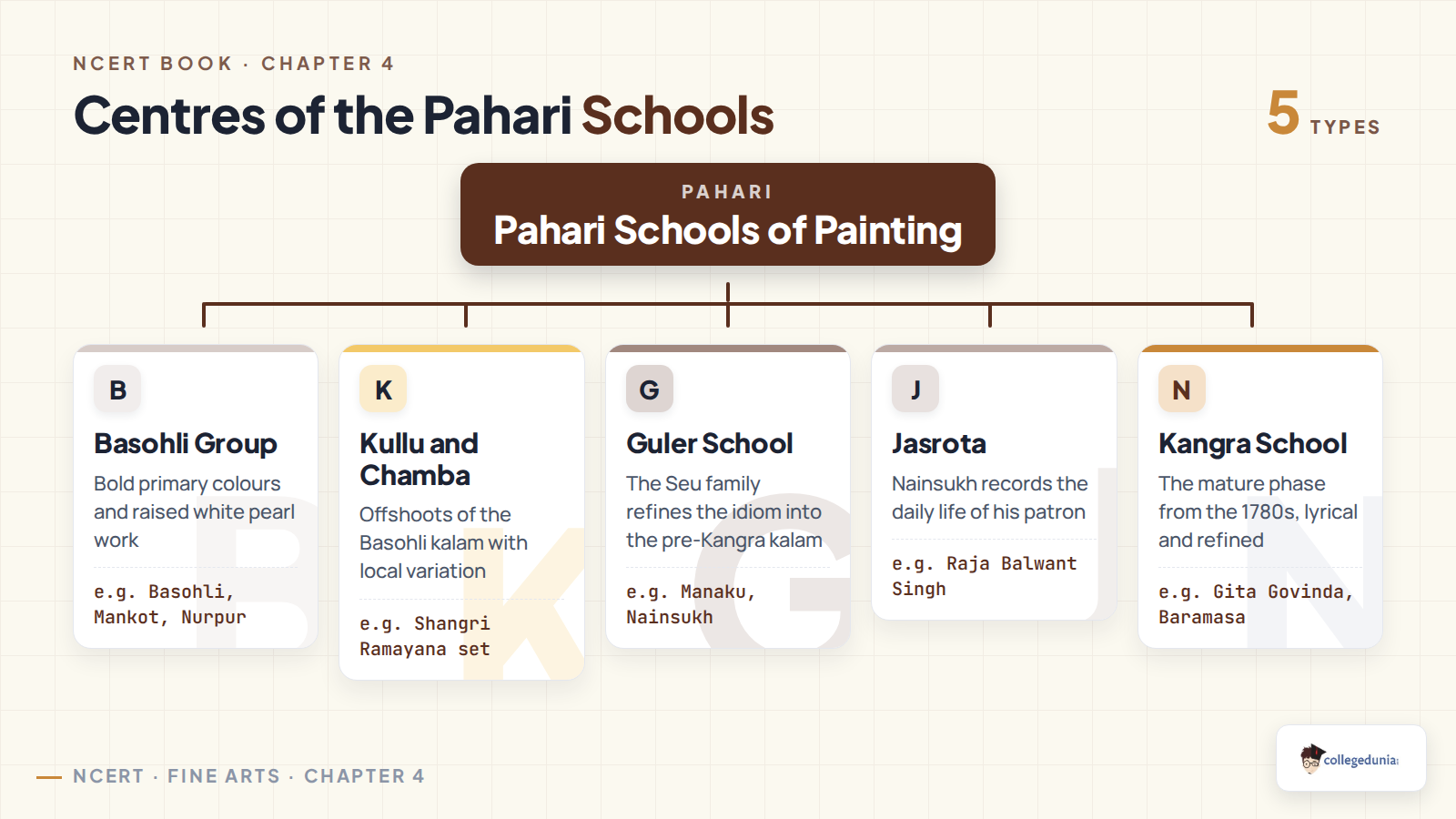
The last page of the chapter runs quickly through the remaining centres, and that page is where most short answer questions are set. Remember the framing first. There is a broad classification of three styles only, Basohli, Guler and Kangra, and scholars may use variant terms for the same three. Everything else is an indicative centre from which a style travelled.
| Centre | What the chapter says about it |
|---|---|
| Jasrota | The Guler style is observed here, so it is categorised under the Guler School with Jasrota as one of its centres; its patron was Balwant Singh and its artist Nainsukh |
| Chamba | Portraits of the rulers of Chamba from the seventeenth and early eighteenth century are in the Basohli style |
| Kullu | A distinctive style with figures having a prominent chin and wide open eyes, and lavish use of grey and terracotta red in the background; home of the Shangri Ramayana of the last quarter of the seventeenth century |
| Nurpur | When the Basohli style had outgrown itself and matured into Kangra, Nurpur artists kept the vibrant colours of Basohli with the dainty figure types of Kangra |
| Mankot | Marital relations between Basohli and Mankot brought a few Basohli artists here, so a similar school of painting developed |
| Mandi | Its rulers were ardent worshippers of Vishnu and Shiva, so besides Krishna Lila themes, Shaivite subjects were also painted |
| Garhwal | Associated with the artist Molaram, several of whose signed paintings have been discovered; the school was influenced by the Kangra style of the Sansar Chand phase |
| Kashmir | Between 1846 and 1885 the Kangra style started a local school of Hindu book illumination there |
Two lines in this passage are commonly misread. First, the Shangri Ramayana folios vary from each other in style, so it is believed they were painted by different sets of artists, not by one hand. Second, the Sikhs eventually employed other Kangra painters, which is how the style survived the collapse of Sansar Chand's patronage.
Bilaspur and Jammu appear in the opening list of hill centres and again in the closing list of places where offshoots of the Basohli style continued. Name them when a question asks you to list the Pahari centres, and do not spend revision time looking for sections on them that the book does not print.
Named Paintings You Must Be Able to Appreciate in the Board Answer
Picture based questions in Fine Arts always draw on the plates printed in the chapter. Build this table once, revise from it, and you can name the school, the date and the collection for any plate the paper reproduces.
| Painting | School and date | Where it is held |
|---|---|---|
| Krishna steals butter, Bhagvata Purana | Pahari, 1750 | N. C. Mehta Collection, Ahmedabad, Gujarat |
| Rama and Sita in the forest | Kangra, 1780 | Douglas Barrett Collection, United Kingdom |
| Rasamanjari folio | Basohli, 1720 | British Museum, London |
| Rama gives away his possessions, Ayodhya Kanda, Shangri Ramayana | Kullu, 1690 to 1700 | Los Angeles County Museum of Art, United States |
| Rama and Lakshmana following sage Vishvamitra, Bala Kanda, Shangri Ramayana | Kullu, 1680 to 1688 | Raja Raghbir Singh Collection, Shangri, Kullu Valley |
| Balwant Singh in prayer, by Nainsukh | Guler to Kangra, 1750 | Victoria and Albert Museum, London |
| Krishna embracing gopis, Gita Govinda | Guler, 1760 to 1765 | N. C. Mehta Collection, Ahmedabad, Gujarat |
| Kaliya Mardana, Bhagvata Purana | Kangra, 1785 | National Museum, New Delhi |
| Krishna playing Holi with gopis | Kangra, 1800 | National Museum, New Delhi |
| Re-enacting Krishna's deeds, Bhagvata Purana | Guler to Kangra, 1780 to 1785 | Private Collection |
| Abhisarika Nayika | Kangra, 1810 to 1820 | Government Museum and Art Gallery, Chandigarh |
| A couple in the month of Jyestha | Kangra, 1800 | National Museum, New Delhi |
Three of these come with a full page written appreciation at the end of the chapter, and those three are the likeliest picture questions of all.
- Awaiting Krishna and the Hesitant Radha. A Guler to Kangra folio from Manaku's Gita Govinda, the poem composed by Jayadeva. Radha is shown shy and hesitant as she approaches the forested area while Krishna waits eagerly. The artist's source was the inscription on the reverse, which tells Radha to abandon her shyness, let her girdle tinkle merrily and go to meet her beloved. Write the philosophical reading too: Radha is the devotee or soul, Krishna the cosmic power in whom she is to be drowned, and the love sport itself is rather human.
- Balwant Singh looking at a Painting with Nainsukh. Prince Balwant Singh of Jasrota studies a painting he holds, while a figure bowing behind him is probably Nainsukh himself, which makes this a rare picture of the artist with his patron. He sits in his palace overlooking a lush green landscape in the early evening, smoking a hukka during a break between work. The clutter free composition itself suggests quietude and tranquillity, and the musicians are placed at the outer edge to show they are playing softly rather than clamouring to be heard.
- Nanda, Yashoda and Krishna. A Bhagvata Purana scene showing Nanda taking his family and relatives to Vrindavan, because Gokul was infested with demons who troubled Krishna. Nanda leads on his bullock cart, followed by a second cart carrying Krishna and Balaram with their mothers Yashoda and Rohini. Look for the tilt of heads as people talk, the downcast eyes of fatigue under a heavy head load, and the taut arms holding a vessel steady. The flush cut composition, resembling a photograph, is what lends the folio its naturalism.
The Four Exercise Questions at the End of the Pahari Schools Chapter
The chapter closes with four exercise questions, and two of them are practical rather than written. Knowing which is which saves you time in revision.
| Question | What it asks | Where the answer sits in the PDF |
|---|---|---|
| 1 | Representation of nature in Pahari miniature paintings is found everywhere. What could be the reasons for this? | An opinion question. Use the hill setting, the Kangra habit of observing landscape naturalistically, and the Baramasa and Ashta Nayika themes that need seasons and forests |
| 2 | Name the major schools of Pahari miniature painting, list their places of expansion, explain how they differed, and mark them on a map | The three style classification plus the closing page on the other centres; the map work is done separately |
| 3 | Select a poem or a story and illustrate it in any style of Pahari miniature painting | A practical studio question, not a written one |
| 4 | Prepare small critiques on Nainsukh, Basohli paintings, the Ashta Nayikas and the Kangra kalam | Four separate short critiques, drawn from the Guler, Basohli, Ashta Nayika and Kangra passages |
Question 4 is effectively four questions in one and it maps directly onto four sections of the chapter. Prepare each critique as a fixed block of about eight lines: what it is, who made it or when it flourished, two style features, and one named example with a date.
Common Mistakes Students Make in the Pahari Schools of Painting Chapter
Watch out for these seven:
- Treating Kullu, Nurpur, Mankot and Mandi as separate schools. The book gives three styles only, Basohli, Guler and Kangra, and calls the rest indicative centres.
- Mixing up the two brothers. Manaku painted the Gita Govinda of 1730 at Guler. Nainsukh went to Jasrota and painted Balwant Singh.
- Confusing the patrons. Govardhan Chand ruled Guler from 1744 to 1773. Sansar Chand ruled Kangra from 1775 to 1823. Balwant Singh was the ruler of Jasrota.
- Saying the Mughal atelier migration caused the change of style. The book says most scholars now dispute that hypothesis and credit the naturalism of the incoming paintings instead.
- Giving the straight nose profile to Basohli. That female face, with the nose in line with the forehead, is Kangra and came in around the 1790s.
- Describing the beetle wing device as paint. They are small shiny green particles of beetle wings, laid in to simulate emeralds, and the pearls are done separately in raised white paint.
- Writing that Kangra town was the main production centre. Most work was made at Tira Sujanpur, Alampur and Nadaun, because Kangra itself stayed under the Mughals till 1786.
Student Feedback on the Pahari Schools of Painting Chapter
What 12,860 students told us about this chapter
- 71% of the students surveyed said the Seu family tree is the hardest part to hold in memory, because four generations of artists share only a few pages.
- Only 26% could place Alampur, Nadaun and Tira Sujanpur correctly without checking the text again.
- Students who drew the family tree of Pandit Seu on one sheet before revising reported the fastest recall in the critique question.
- Most skipped passage: the Goswamy argument on family as the basis of style, left unread by about 2 in 5 students, even though it answers a ready made 5 mark question.
Source: Collegedunia Class 12 Fine Arts student survey taken before the 2026-27 board exams. Sample of 12,860 students from CBSE schools across 14 states.
How to Revise the Pahari Schools Chapter in a Three Block Plan
This chapter is shorter than the Rajasthani one but denser in names, so reading it once is never enough. About two and a half focused hours makes it board ready, and the printed order gives you the sequence for free.
- Block 1, 40 minutes. Read the opening pages and the Goswamy argument. Write the meaning of Pahari, the list of hill centres and the three reasons territorial classification fails, all from memory.
- Block 2, 60 minutes. Read Basohli, the Shangri Ramayana folios and the Guler section. Draw the Pandit Seu family tree and add one dated work beside each name.
- Block 3, 50 minutes. Read Kangra, the Ashta Nayikas, the Baramasa and the closing page on the other centres. Then write the four exercise critiques as eight line blocks.
Repeat Block 3 a week before the paper. Plate dates and collection names fade fastest, and they are the cheapest marks in the Fine Arts theory paper for both the CBSE Class 12 board exam and the CUET general test.
How the Pahari Schools Chapter PDF Works with the Fine Arts Revision Notes
The chapter PDF gives you the official text and every plate exactly as printed. What it does not give you is a compressed recall sheet you can read in ten minutes before the paper. That sits on the sister page for the same chapter, and running the two together is faster than reading either one alone.
| Resource | What it adds beyond this chapter PDF | Link |
|---|---|---|
| Revision Notes | The Pandit Seu family tree, the three style classification and the plate index condensed for a last read before the paper | The Pahari Schools of Painting Class 12 Notes |
Also Check: read the Rajasthani chapter before this one. Keshav Das and the Kavipriya, the Ragamala albums and the Bihari Satsai all appear there first, and the Baramasa passage in this chapter assumes you already know them.
All 8 Chapters of Class 12 Fine Arts with NCERT Book PDFs
The Class 12 Fine Arts course runs across eight chapters. Every link below opens the official NCERT chapter PDF for the 2026-27 session.
| Chapter | NCERT Book PDF |
|---|---|
| Chapter 1 | The Mughal School of Miniature Painting Class 12 PDF |
| Chapter 2 | The Deccan Schools of Painting Class 12 PDF |
| Chapter 3 | The Rajasthani Schools of Painting Class 12 PDF |
| Chapter 4 | The Pahari Schools of Painting Class 12 PDF |
| Chapter 5 | The Bengal School and Cultural Nationalism Class 12 PDF |
| Chapter 6 | Modern Indian Art Class 12 PDF |
| Chapter 7 | The Company School Class 12 PDF |
| Chapter 8 | Living Art Traditions of India Class 12 PDF |
The Pahari Schools of Painting Class 12 Fine Arts NCERT Book PDF FAQs
Questions Class 12 Students Ask Most About the Pahari Schools Chapter
Ques. What are the Pahari Schools of Painting?
Ans. Pahari means hilly or mountainous in origin. The Pahari Schools of Painting include towns such as Basohli, Guler, Kangra, Kullu, Chamba, Mankot, Nurpur, Mandi, Bilaspur and Jammu in the hills of the western Himalayas, which emerged as centres of painting from the seventeenth to the nineteenth century. The style begins at Basohli in a coarsely flamboyant manner and blossoms into the Kangra School, the most exquisite and sophisticated style of Indian painting, through the Guler or pre-Kangra phase.
Ques. Why is it difficult to classify Pahari paintings by territory?
Ans. Unlike the Mughal, Deccani and Rajasthani Schools, the Pahari centres never developed as independent schools with distinctive styles of their own. Each did craft individual characteristics through its treatment of nature, architecture, figural types, facial features, costumes and preferred colours, but those differences are not enough to separate them cleanly. A paucity of dated material, colophons and inscriptions also prevents informed categorisation, so the book classifies only three styles, Basohli, Guler and Kangra.
Ques. Who was B. N. Goswamy and what is his family theory of style?
Ans. B. N. Goswamy is described as one of the most significant scholars of the Pahari Schools of Painting. He argued that the family of Pandit Seu, also written Shiv, was chiefly responsible for the course of Pahari painting, and that identifying these paintings by region is misleading because political boundaries in the hills were always fluid. If a family of artists is treated as the style bearer, multiple strands of one style can be justified inside the same region and school. He also applied the same caution to the Rajasthani schools.
Ques. What are the main features of the Basohli School of Painting?
Ans. Basohli developed its distinctive style under Kirpal Pal, who ruled from 1678 to 1695. Its features are a strong use of primary colours and warm yellows filling the background and horizon, a stylised treatment of vegetation, and raised white paint that imitates pearls in ornaments. Its most significant characteristic is the use of small shiny green particles of beetle wings to delineate jewellery and simulate the effect of emeralds. In palette and elegance it shares the aesthetics of the Chaurpanchashika group of paintings of Western India.
Ques. Which text was the most popular theme of the Basohli painters?
Ans. The Rasamanjari of Bhanu Datta. In 1694 to 1695 an artist named Devida, a tarkhan or carpenter painter, did a magnificent Rasamanjari series for his patron Kirpal Pal. The Bhagvata Purana and the Ragamala were the other popular themes, and Basohli artists also painted portraits of local kings with their consorts, courtiers, astrologers, mendicants and courtesans. A Rasamanjari folio of 1720 in the British Museum, London, is the plate printed in the chapter.
Ques. What is the Shangri Ramayana and where was it painted?
Ans. It is a well known Ramayana set painted in the Kullu Valley in the last quarter of the seventeenth century. It takes its name from Shangri, the residence of a branch of the Kullu royal family who were its patrons and former possessors. The works were influenced in varying degrees by the styles of Basohli and Bilaspur. Its folios vary from each other in style, so it is believed they were painted by different sets of artists.
Ques. Who was Nainsukh and why is he important?
Ans. Nainsukh was the younger son of Pandit Seu of Guler and the brother of Manaku. He left Guler for Jasrota, worked first for Mian Zoravar Singh, and then found his greatest patron in Balwant Singh of Jasrota. His pictures of Balwant Singh are unique for the visual record they offer of the patron's life, showing him performing puja, surveying a building site or sitting in a camp wrapped in a quilt. His genius was for individual portraiture, which became a salient feature of later Pahari painting, and his palette used delicate pastel shades with daring expanses of white or grey.
Ques. What is the Guler to Kangra phase and when did it begin?
Ans. It is the phase in which the Basohli style was completely transformed, starting in the first quarter of the eighteenth century at Guler under Raja Govardhan Chand, who ruled from 1744 to 1773. Pandit Seu with his sons Manak and Nainsukh are credited with changing the course of painting around 1730 to 1740 into this pre-Kangra or Guler to Kangra kalam. The style is more refined, subdued and elegant than the bold vitality of Basohli, and its most matured version entered Kangra during the 1780s.
Ques. What is the most distinctive feature of the Kangra style?
Ans. The delineation of the female face, with a straight nose in line with the forehead, which came into vogue around the 1790s. The Kangra style is also described as the most poetic and lyrical of Indian styles, marked by serene beauty and delicacy of execution, with delicacy of line, brilliance of colour and minuteness of decorative details as its other characteristic features.
Ques. Who was Raja Sansar Chand and what happened to painting under him?
Ans. Sansar Chand of the Katoch dynasty ruled Kangra from 1775 to 1823 and came to the throne at the age of 10. Painting production under him was far greater than in any other hill state, centred at Tira Sujanpur, Alampur and Nadaun on the banks of the river Beas. The style spread from Tira Sujanpur to Garhwal in the east and Kashmir in the west. Around 1805 the Gurkhas besieged the Kangra fort and he fled to Tira Sujanpur; they were driven away in 1809 with the help of Ranjit Singh, but the work never again matched the masterpieces of 1785 to 1805.
Ques. What are Ashta Nayikas in Pahari painting?
Ans. Ashta Nayikas are the eight heroines, one of the most painted themes in Pahari painting, showing women in various dispositions and emotive states. Utka anticipates the arrival of her beloved and waits patiently. Svandhinpatika is the one whose husband is subject to her will. Vasaksajja awaits her beloved's return from a voyage and decorates the bed with flowers. Kalahantarita resists her beloved when he seeks to soften her pride and then repents when he comes late. None of them is treated with as much flair as the Abhisarika, who hastens to meet her beloved braving all hazards.
Ques. What is Baramasa painting?
Ans. Baramasa paintings consist of 12 folios that illustrate the modes of love or courtship appropriate to each month of the year, and they became a popular theme in the hills during the nineteenth century. An account of Baramasa is given by Keshav Das in the tenth chapter of the Kavipriya, where he describes the hot month of Jyeshtha, which falls in May and June. The plate printed in the chapter is A couple in the month of Jyestha, Kangra, 1800, in the National Museum, New Delhi.
Ques. Which painting shows Nainsukh with his own patron?
Ans. Balwant Singh looking at a Painting with Nainsukh. The prince of Jasrota is shown closely observing a painting he holds in his hands, while a figure bowing politely behind him probably represents Nainsukh himself, which makes it a rare work in which the artist paints himself with his patron. Balwant Singh sits in his palace overlooking a lush green landscape in the early evening, smoking a hukka, and the clutter free composition itself suggests the quietude and tranquillity of his temperament.
Ques. How do I download the Pahari Schools of Painting NCERT Book PDF?
Ans. Use the PDF viewer at the top of this page. It carries the official NCERT chapter exactly as printed, with all plates, captions and the four exercise questions, so you can read the whole chapter online or save it for offline revision before the 2026-27 board exams. No sign up is needed.



Comments