




The NCERT Book PDF for Class 12 Fine Arts Chapter 3 The Rajasthani Schools of Painting brings together every court, artist, text and plate that the CBSE board paper actually tests. It is the official chapter from An Introduction to Indian Art Part 2, Reprint 2026-27, covering Mewar, Bundi, Kota, Jaipur, Bikaner, Kishangarh, Jodhpur, Malwa and Sirohi.
- Covers Rajasthani painting from the sixteenth to the early nineteenth century, across princely kingdoms and thikanas.
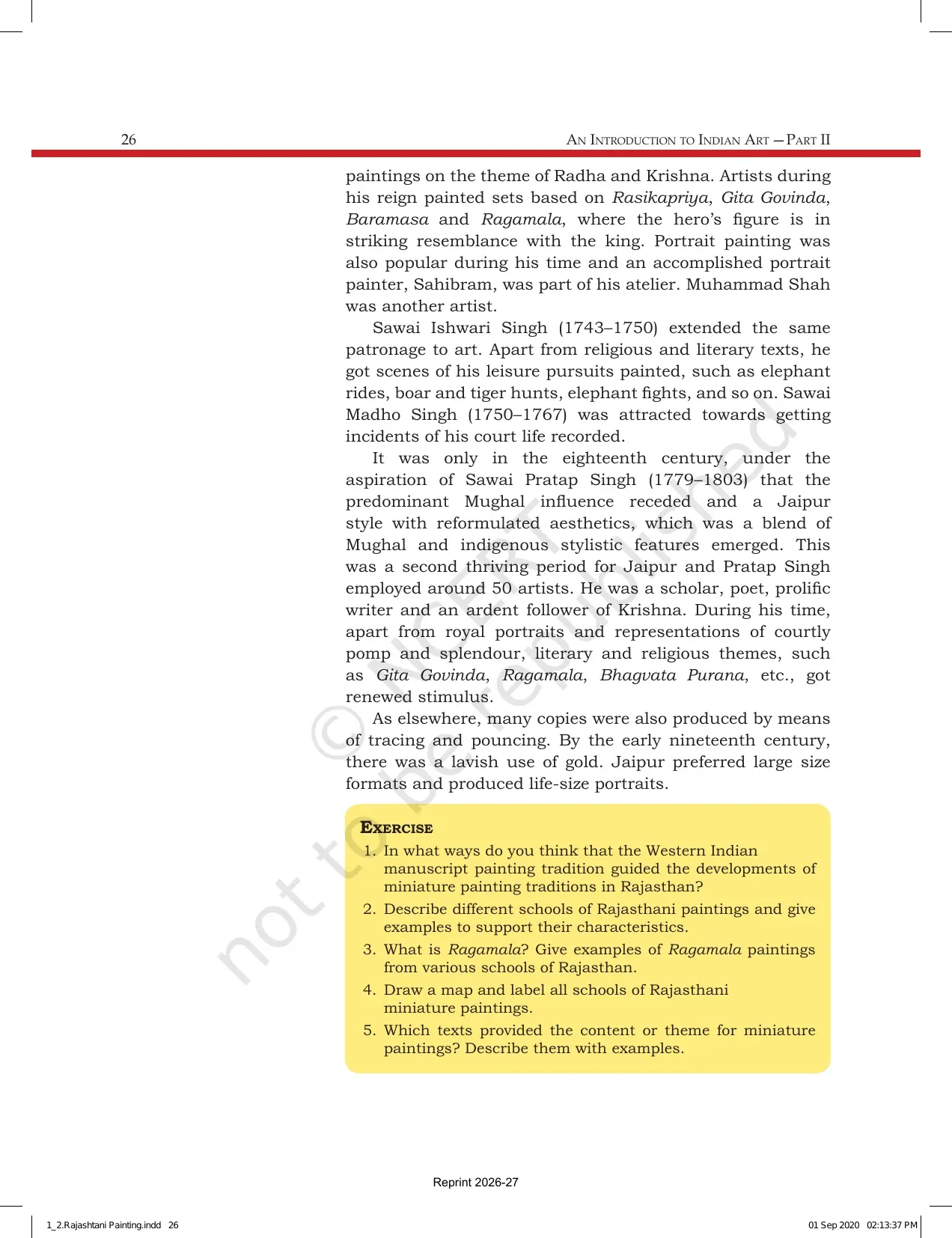
- Names to spell right: Nisardin, Sahibdin, Manohar, Ruknuddin, Nihal Chand, Tulchi Ram, Nuruddin and Guman.
- Ends with 5 exercise questions and 7 full page painting appreciations.
This Rajasthani Schools of Painting chapter PDF is the unedited NCERT text page for page, checked against the Reprint 2026-27 print run, and paired here with a court by court painting index written by Collegedunia Fine Arts teachers.
What the Rajasthani Schools of Painting Class 12 PDF Contains
The chapter is built court by court, not year by year. Read it in the printed order and the nine kingdoms settle into a clean sequence. Every exercise question comes out of one of those court sections or out of the seven appreciation plates that follow them.
| Section in the PDF | What it covers | Question type it feeds |
|---|---|---|
| Opening on the term Rajasthani Schools | The kingdoms covered, Coomaraswamy's 1916 coinage, why Rajput Schools is now obsolete | 1 mark and 2 marks |
| Technique and teamwork | Waslis, mineral pigments, camel and squirrel hair brushes, agate burnishing, the master and pupil workshop | 3 marks |
| Themes of Paintings | Gita Govinda, Rasamanjari, Rasikapriya, Kavipriya, Bihari Satsai, Ragamala, bardic romances | 5 marks, exercise question 5 |
| Malwa School of Painting | Dates 1600 to 1700, two dimensional austerity, the Datia Palace puzzle, Madho Das | 3 marks and 5 marks |
| Mewar School of Painting | Chawand Ragamala of 1605, Jagat Singh I, Sahibdin, Manohar, Jagannath, Nathdwara pichhwais | 5 marks, appreciation |
| Bundi and Kota Schools | Chunar Ragamala, the Hada rulers, lush landscape, the hunt, the double lid eye | 5 marks, appreciation |
| Bikaner, Kishangarh, Jodhpur and Jaipur | Mandi studios, the Bani Thani face, Marwar portraiture, the Suratkhana at Jaipur | 5 marks, appreciation |
| Seven appreciation plates | Bhagvata Purana, Maru Ragini, Raja Aniruddha Singh Hara, Chaugan Players, Krishna Swinging and Radha in Sad Mood, Bani Thani, Rama meets Members of his Family at Chitrakut | Picture based questions |
One planning note before you start. Sirohi is named in the opening list of kingdoms but never gets a section of its own in the chapter. Name it when the question asks you to list the Rajasthani centres, and do not waste revision time hunting for a Sirohi passage that the book does not print.
Why Anand Coomaraswamy's Term Rajput Paintings Is Now Obsolete
The first page of the chapter is a naming argument, and examiners set short questions from it every year. Scholar Anand Coomaraswamy coined the term Rajput Paintings in 1916 because most rulers and patrons of these kingdoms were Rajputs. He wanted a label that separated this group from the far better known Mughal School of Painting.
- What the term originally covered: the Rajasthani courts, Malwa with its princedoms of Central India, and the Pahari Schools of the mountainous Himalayan region of north western India.
- What it meant to him: the indigenous tradition of painting that was already alive in the mainland before the Mughal conquest.
- Why it fell out of use: studies in Indian painting have moved a long way since 1916, so the single umbrella label no longer describes what the pictures actually show.
- What replaced it: the specific categories Rajasthani and Pahari, used separately.
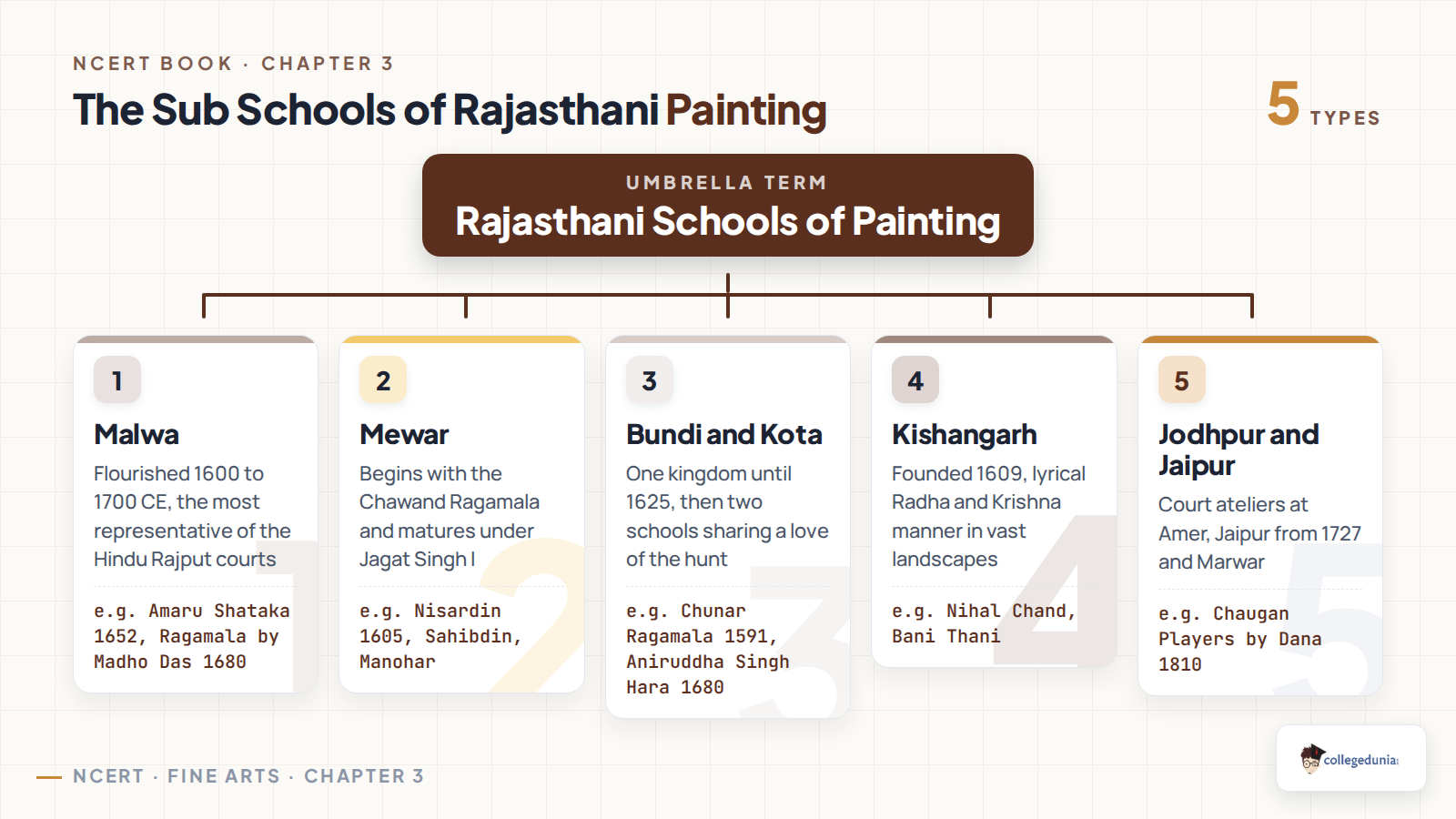
- What the modern term covers: Mewar, Bundi, Kota, Jaipur, Bikaner, Kishangarh, Jodhpur or Marwar, Malwa, Sirohi and other principalities in what is now Rajasthan and parts of Madhya Pradesh.
The date range matters as much as the label. Rajasthani painting runs largely between the sixteenth and the early nineteenth centuries. The chapter also fixes it inside the wider timeline: the Mughal School dominates from the sixteenth century through Delhi, Agra, Fatehpur Sikri and Lahore, the Deccani School flourishes at Ahmednagar, Bijapur, Golconda and Hyderabad from the sixteenth century, the Rajasthani Schools come into prominence in the late sixteenth and early seventeenth century, and the Pahari School follows in the late seventeenth and early eighteenth centuries.
Distance did not make these courts similar. Though separated by short journeys, the styles differ in execution that is either fine or bold, in colour that is either brilliant or gentle, in how architecture, figures and nature are composed, in modes of narration, and in whether a court leaned towards naturalism or towards extreme mannerism.
Rajasthani Schools of Painting Explained in One Shot
Source: Let's Crack UPSC CSE Hindi on YouTube
How a Rajasthani Miniature Was Actually Made on Waslis
This short passage is the most quotable page in the chapter and the easiest 3 mark answer in the paper. Learn it as a five step process and add the workshop structure at the end.
- The support. Paintings were made on waslis, thin layered sheets of handmade paper glued together until the sheet reached the thickness the artist wanted.
- The drawing. The outline was sketched on the wasli in black or brown.
- The colour notes. Colours were fixed on that outline by brief notations or by small sample patches, so the colourist knew what went where.
- The pigments. Colour came mostly from minerals and from precious metals such as gold and silver, mixed with glue as the binding medium. Brushes were made from camel and squirrel hair.
- The finish. The completed painting was burnished with an agate to give it a uniform sheen and an appealing resplendence.
The workshop line is the part students forget. Painting was teamwork, not the work of one hand. The master artist composed the picture and made the preliminary drawings. Pupils and specialists in colouring, portraiture, architecture, landscape and animals then took over and did their own part. The master artist came back at the end for the finishing touches. Finally the scribe wrote the verse into the space that had been left blank for it.
The Texts That Gave Rajasthani Painting Its Themes
Exercise question 5 asks which texts provided the content or theme for miniature painting, and it is the single most predictable long answer in this chapter. The book gives you six named sources with authors, languages and dates, so build the table once and revise from it.
| Text | Author and date | What it deals with |
|---|---|---|
| Gita Govinda | Jayadeva, twelfth century, believed to be court poet of Lakshmana Sen of Bengal | The Song of the Cowherd, a lyrical Sanskrit poem evoking shringara rasa and the mystical love of Radha and Krishna |
| Rasamanjari | Bhanu Datta, a Maithil Brahmin living in Bihar in the fourteenth century | The Bouquet of Delight, a Sanskrit treatise on rasa classifying nayakas and nayikas |
| Rasikapriya | Keshav Das in Brajbhasha, 1591, court poet of Raja Madhukar Shah of Orchha | The Connoisseur's Delight, on love, togetherness, jilt, jealousy, quarrel, separation and anger between Radha and Krishna |
| Kavipriya | Keshav Das, written in honour of Rai Parbin, a celebrated courtesan of Orchha | A tale of love whose tenth chapter, Baramasa, describes the 12 months of the year |
| Bihari Satsai | Bihari Lal, composed around 1662 at the court of Jaipur under Mirza Raja Jai Singh | 700 verses of aphorism and moralising wit, painted largely at Mewar and less often in the Pahari School |
| Ragamala | A painting tradition rather than a single text | Pictorial interpretations of ragas and raginis, arranged in albums |
Two details from the Rasamanjari carry marks on their own. It sorts heroes and heroines by age into baal, taruna and praudha, by physiognomic type into padmini, chitrini, shankhini and hastini, and by emotional state into khandita, vasaksajja, abhisarika and utka. Krishna is never named in the text, yet painters introduced him anyway as the archetypal lover.
Beyond these six, the chapter lists a second layer of favourite subjects. Bardic legends and romantic tales include Dhola-Maru, Sohni-Mahiwal, Mrigavat, Chaurpanchashika and Laurchanda. The Ramayana, Bhagvata Purana, Mahabharata and Devi Mahatmya were favourites with every school. A large body of work also records darbar scenes and historic moments, hunting expeditions, wars and victories, picnics and garden parties, dance and music performances, rituals, festivals and wedding processions, portraits of kings and courtiers, city views, birds and animals.
The religious backdrop explains the choice. By the sixteenth century Vaishnavism in the cults of Rama and Krishna had spread through western, northern and central India as part of the Bhakti movement. Krishna was worshipped as God and cherished as the ideal lover, so love itself became a religious theme. Krishna stands for the creator, and Radha for the human soul offering herself to God.
Ragamala Painting Explained: Six Ragas and Their Ragini Families
Exercise question 3 asks what Ragamala is and wants examples from various schools of Rajasthan. Answer the definition first, then the album structure, then the examples. The definition is short: Ragamala paintings are pictorial interpretations of ragas and raginis.
- Ragas are traditionally envisioned in divine or human form, in romantic or devotional settings, by musicians and poets.
- Each raga is tied to a specific mood, time of the day and season.
- Ragamala paintings are arranged in albums that invariably contain 36 or 42 folios.
- The folios are organised as families. Each family is headed by a male raga with six female consorts called raginis.
- The six main ragas are Bhairava, Malkos, Hindol, Dipak, Megha and Shri.
For the examples half of the question, the chapter hands you one dated Ragamala set from almost every court, which is exactly what the examiner wants to see.
| School | Ragamala example named in the chapter |
|---|---|
| Mewar | The Chawand set of 1605 by Nisardin, and Sahibdin's Ragamala of 1628 from which Maru Ragini comes |
| Bundi | The Chunar Ragamala inscribed 1591, with Raga Dipak and Raginis Khambavati, Bilaval, Malashri, Bhairavi and Patmanjari |
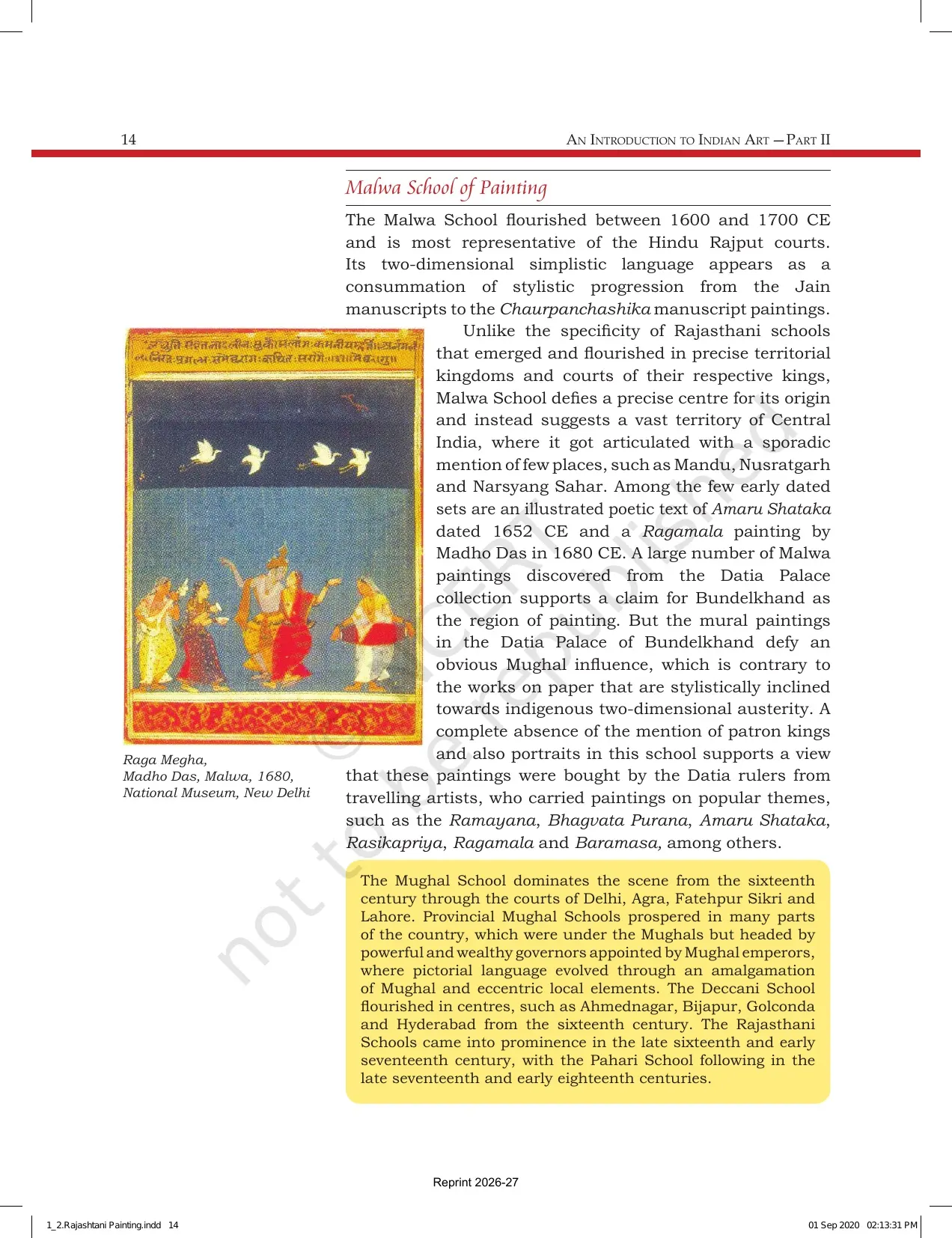
| Malwa | A Ragamala painting by Madho Das in 1680, including Raga Megha in the National Museum, New Delhi |
| Jodhpur | A Ragamala set by the artist Virji, painted at Pali in 1623 |
| Bikaner | Ragamala sets carrying the name of the master artist Ibrahim |
| Jaipur | Ragamala sets painted under Sawai Jai Singh and revived under Sawai Pratap Singh |
Malwa School of Painting: Two Dimensional Austerity and the Datia Palace Puzzle
Malwa is the odd one out and the book says so plainly. Every other Rajasthani school sits inside a named kingdom with a named court. Malwa defies a precise centre of origin and points instead to a vast territory of Central India. Only a few place names surface, and they surface sporadically.
- Dates: the Malwa School flourished between 1600 and 1700 CE and is the most representative of the Hindu Rajput courts.
- Style: a two dimensional simplistic language, read as the end point of a progression from the Jain manuscripts to the Chaurpanchashika manuscript paintings.
- Places mentioned: Mandu, Nusratgarh and Narsyang Sahar.
- Early dated sets: an illustrated poetic text of Amaru Shataka dated 1652 CE and a Ragamala painting by Madho Das in 1680 CE.
- The Bundelkhand claim: a large number of Malwa paintings came out of the Datia Palace collection, which supports Bundelkhand as the region of painting.
The Datia evidence cuts both ways, and that contradiction is the examiner's favourite hook here. The mural paintings inside the Datia Palace show an obvious Mughal influence, while the works on paper lean the other way, towards indigenous two dimensional austerity. There is also a complete absence of any mention of patron kings and no portraits at all in this school.
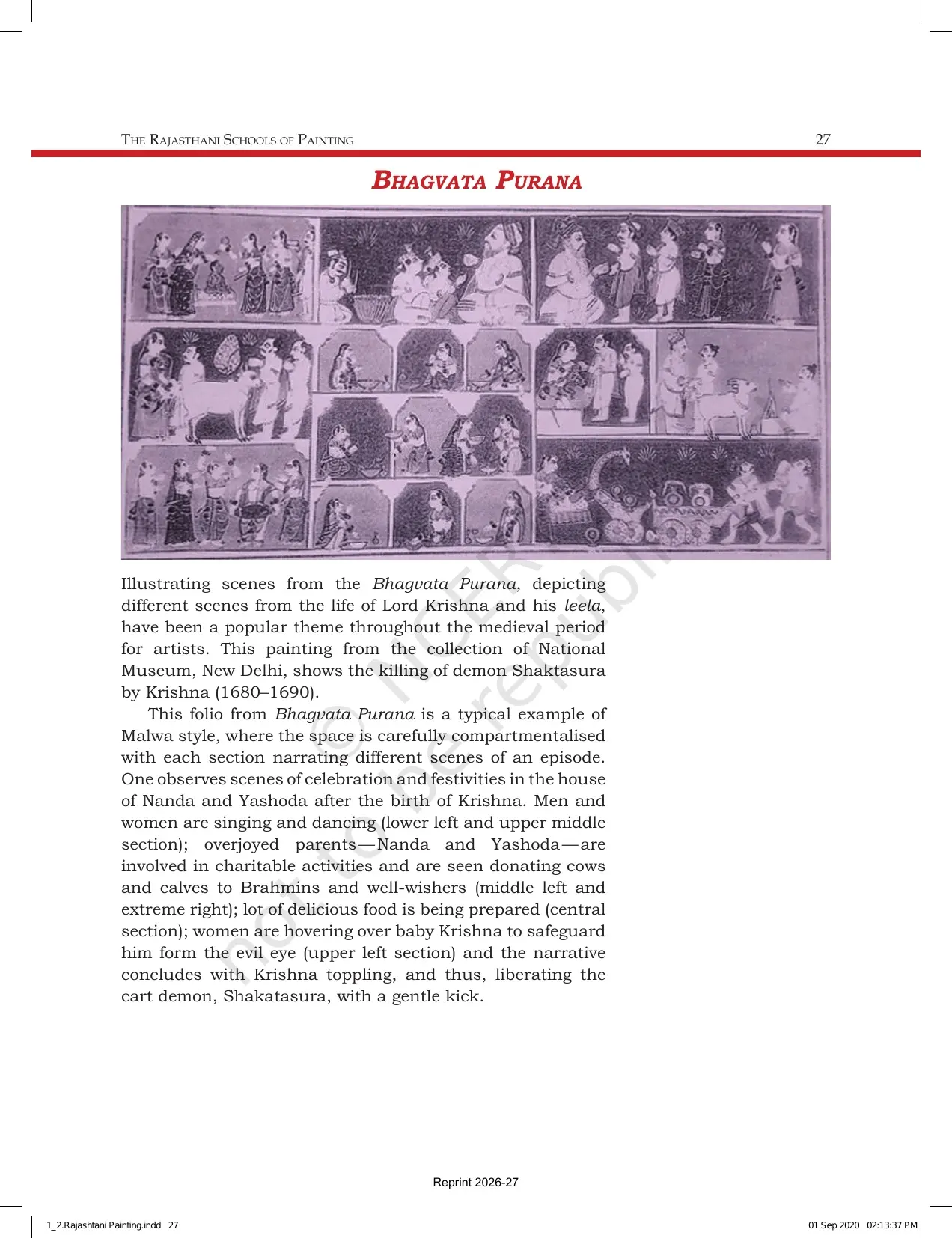
That absence supports a different conclusion. The paintings were probably bought by the Datia rulers from travelling artists who carried work on popular themes such as the Ramayana, Bhagvata Purana, Amaru Shataka, Rasikapriya, Ragamala and Baramasa. The Bhagvata Purana appreciation plate, showing the killing of the demon Shakatasura by Krishna and dated 1680 to 1690, is the chapter's typical example of Malwa style, with the space carefully compartmentalised so each section narrates a different scene of one episode.
Mewar School of Painting: Nisardin at Chawand and Sahibdin's Jagat Singh Ramayana
Mewar is the longest court section in the chapter and the richest in named artists. The book begins with a caution: Mewar is thought to be a significant early centre, but long wars with the Mughals wiped out most early examples, so the continuous stylistic story cannot actually be reconstructed.
What survives instead is a firm starting point. The emergence of the Mewar School is tied to an early dated set of Ragamala paintings painted at Chawand in 1605 by an artist named Nisardin. The set carries a colophon page that records this information. Its aesthetics stay close to pre seventeenth century painting: a direct approach, simpler compositions, only occasional decorative detail and vibrant colour.
| Artist | Work and date | Why it is asked |
|---|---|---|
| Nisardin | Ragamala set, Chawand, 1605 | The dated colophon that anchors the whole school |
| Sahibdin | Ragamala (1628), Rasikapriya, Bhagvata Purana (1648), Yuddha Kanda of Ramayana (1652) | The virtuoso of Jagat Singh I's reign, and the artist of Maru Ragini |
| Manohar | Bal Kanda of Ramayana (1649) | The second virtuoso named alongside Sahibdin |
| Jagannath | Bihari Satsai (1719) | Called a unique contribution of the Mewar School |
The reign of Jagat Singh I, from 1628 to 1652, is the period when Mewar's pictorial aesthetics were reformulated. Sahibdin and Manohar added new vitality to the style and vocabulary. Other texts such as Harivamsha and Sursagar were illustrated in the last quarter of the seventeenth century.
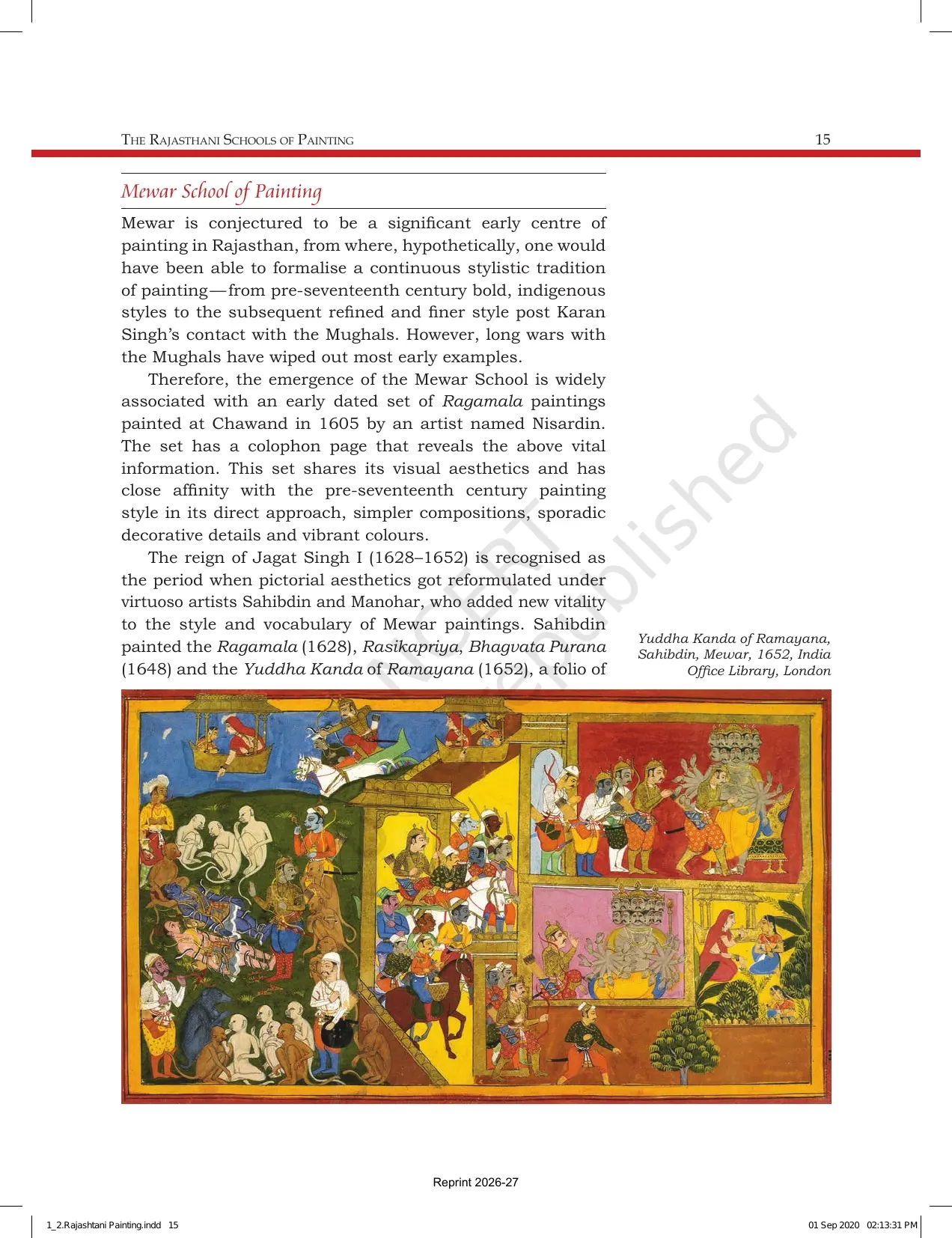
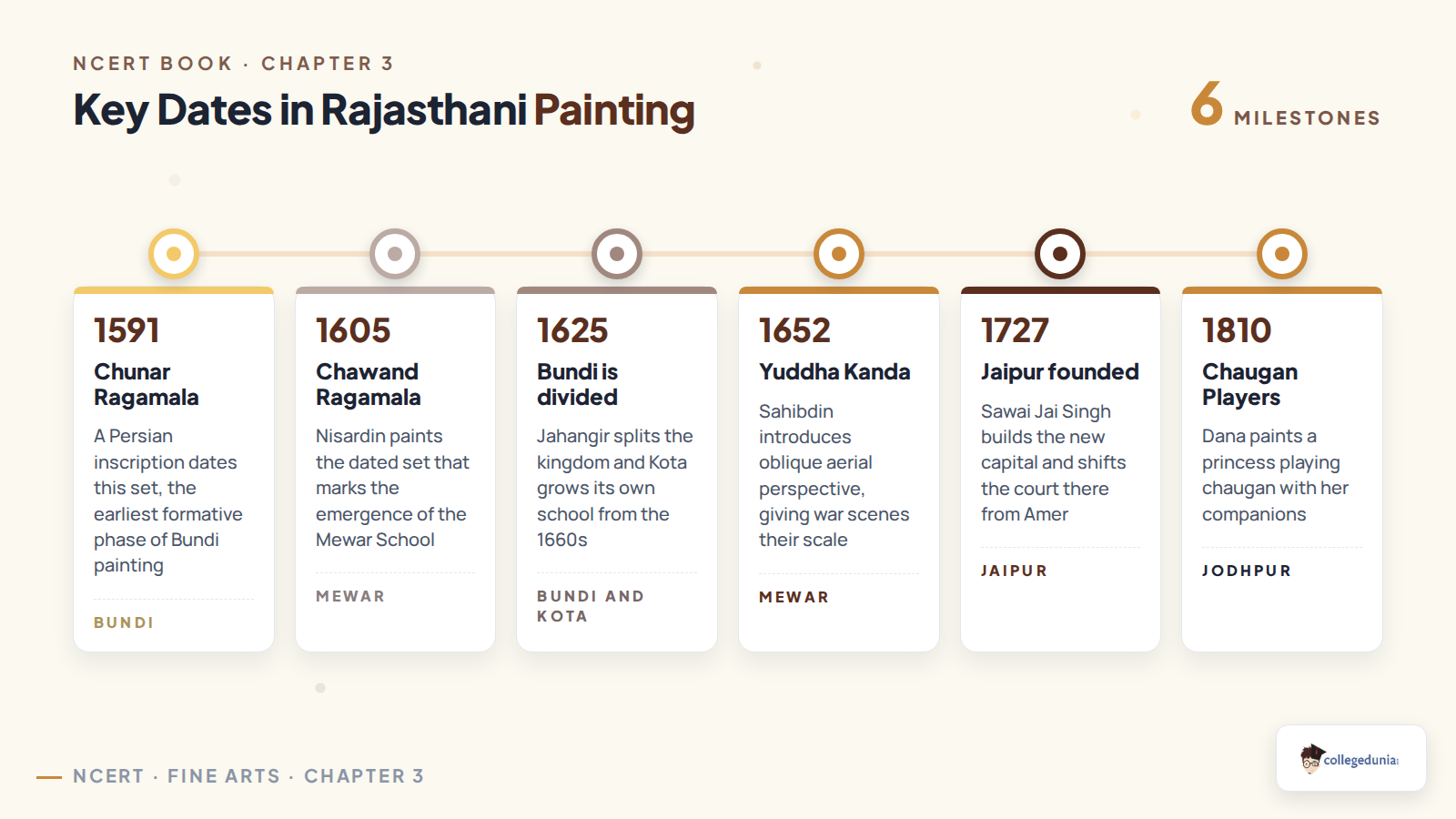
The Yuddha Kanda, the Book of Battles, is the chapter of the Ramayana set popularly called the Jagat Singh Ramayana. Dated 1652 and attributed to Sahibdin, it introduces a new pictorial device, the oblique aerial perspective, which gives credibility to the huge scale that war pictures need. Sahibdin either layers several episodes into a single painting, as he does here, or spreads one episode over more than one folio. The folio reproduced in the book portrays Indrajit's devious tactics and his use of magic weapons in war.
Two later developments close the Mewar section:
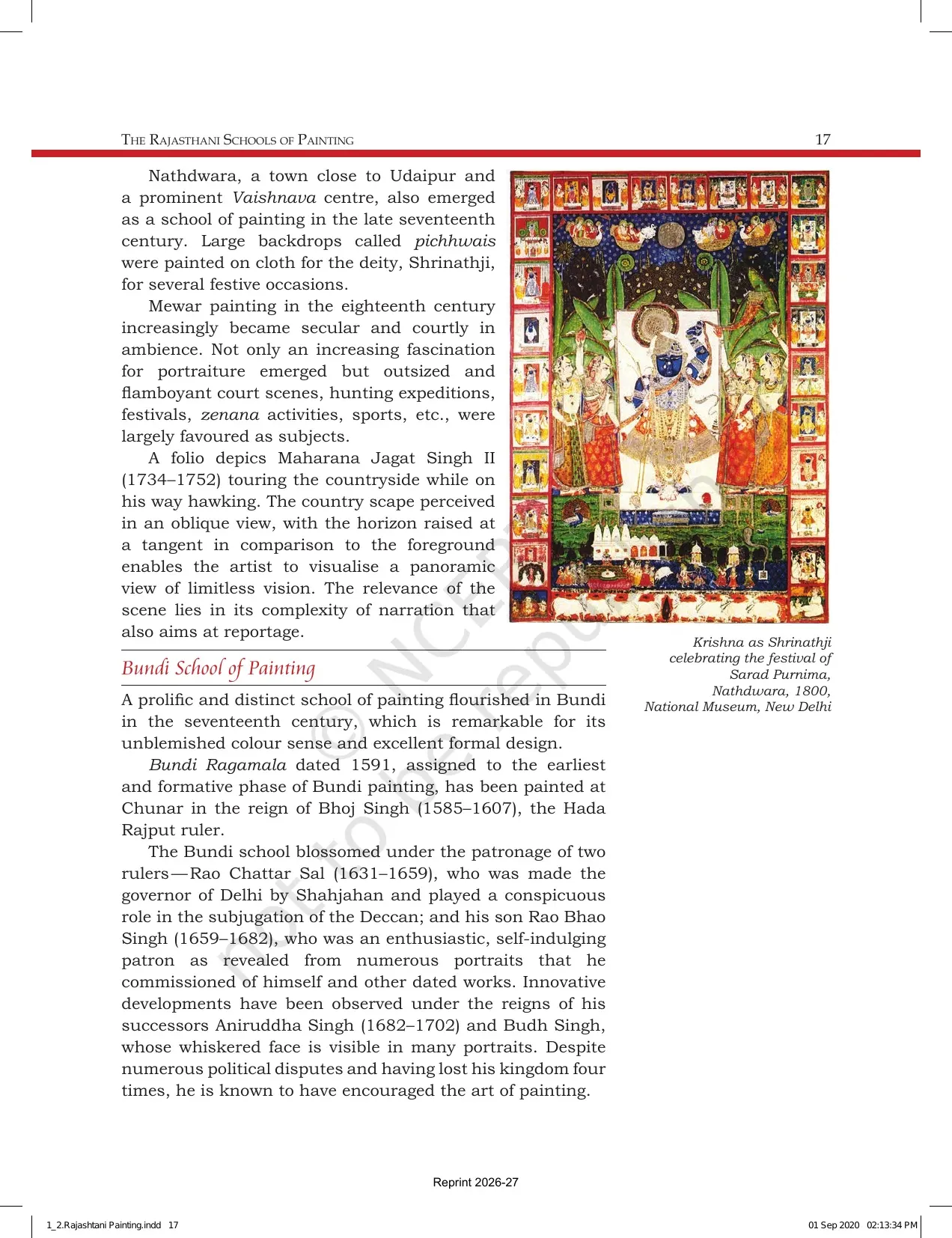
- Nathdwara. A town close to Udaipur and a prominent Vaishnava centre, it emerged as a school of painting in the late seventeenth century. Large cloth backdrops called pichhwais were painted for the deity Shrinathji for festive occasions.
- The secular turn. Eighteenth century Mewar painting slid away from textual subjects towards courtly activity, portraiture, outsized court scenes, hunting expeditions, festivals, zenana activities and sports.
- The palette. Mewar artists generally prefer a bright palette with prominent reds and yellows.
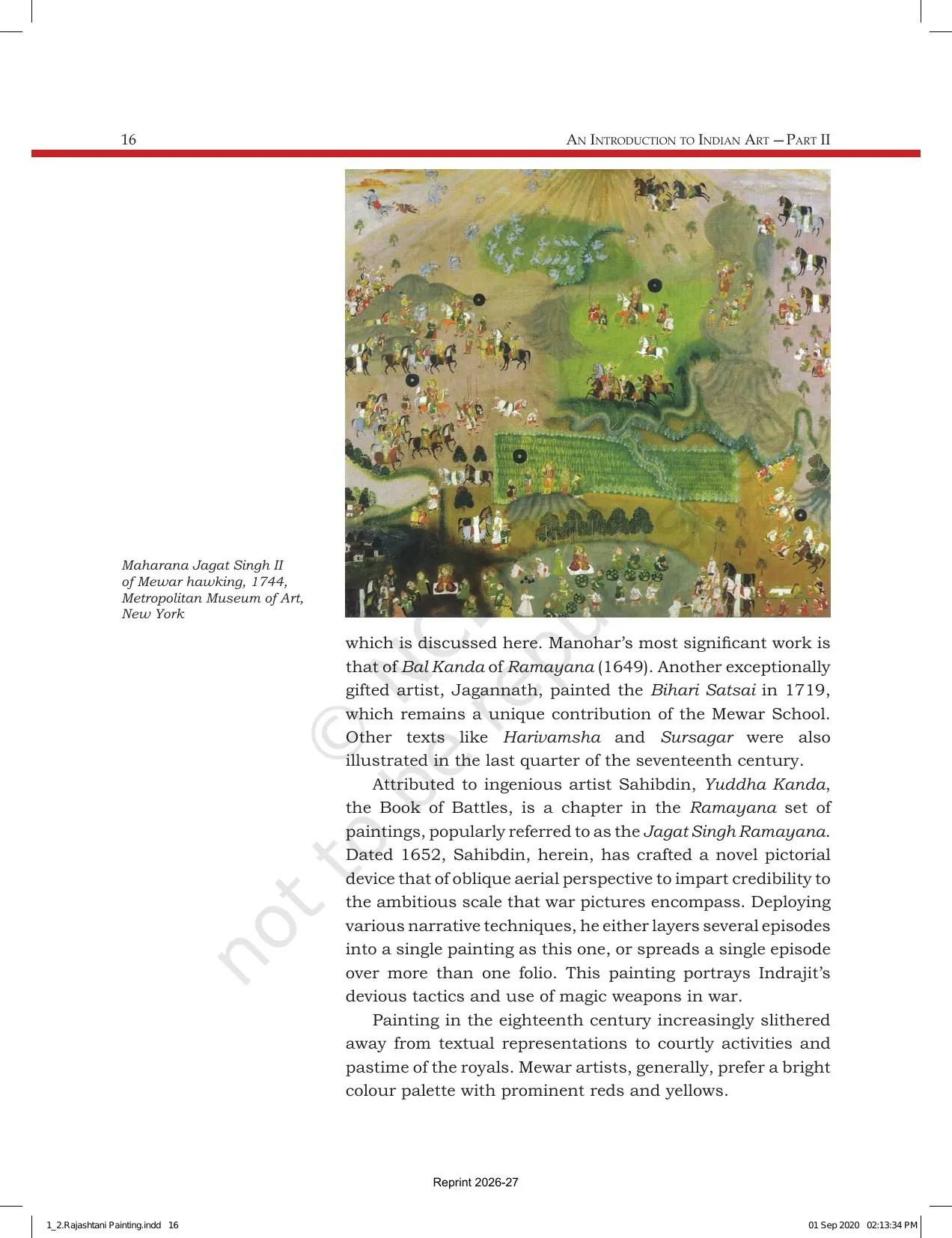
- The hawking folio. A painting of Maharana Jagat Singh II, who ruled from 1734 to 1752, shows him touring the countryside on his way hawking. The countryscape is seen obliquely with the horizon raised at a tangent to the foreground, which lets the artist build a panoramic view of limitless vision aimed at reportage.
Bundi and Kota Schools of Painting: The Chunar Ragamala and the Obsession with the Hunt
Bundi and Kota are taught together because they were one kingdom until 1625. A prolific and distinct school flourished at Bundi in the seventeenth century, remarkable for its unblemished colour sense and excellent formal design. Then Jahangir divided the Bundi empire in 1625 and awarded one part to Madhu Singh, the younger son of Rao Ratan Singh, for his bravery in defending the emperor against Prince Khurram's rebellion in the Deccan.
The Bundi patron list is long and it is worth learning as a chain, because dates of reign are set as one mark fill in the blank questions.
| Ruler | Reign | What happened to painting |
|---|---|---|
| Bhoj Singh | 1585 to 1607 | The Bundi Ragamala of 1591 was painted at Chunar in his reign |
| Rao Chattar Sal | 1631 to 1659 | Made governor of Delhi by Shahjahan, with a conspicuous role in the subjugation of the Deccan |
| Rao Bhao Singh | 1659 to 1682 | A self indulging patron, known from numerous portraits he commissioned of himself |
| Aniruddha Singh | 1682 to 1702 | The subject of the equestrian portrait by Tulchi Ram |
| Budh Singh | Followed Aniruddha Singh | Lost his kingdom four times yet kept encouraging painting; his whiskered face appears in many portraits |
| Umed Singh | 1749 to 1771 | The most accomplished phase, refined in minuteness of detail |
| Bishen Singh | 1771 to 1821 | Ruled for 48 years, a connoisseur of art, keen on hunting |
| Ram Singh | 1821 to 1889 | The chitrashala of the Bundi palace was decorated with murals of processions, hunts and Krishna's story |
The Chunar Ragamala carries an inscription in Persian dated 1591. It names its artists as Shaykh Hasan, Shaykh Ali and Shaykh Hatim, who introduce themselves as pupils of the Mughal court masters Mir Sayyid Ali and Khwaja Abdus Samad. They name Chunar, near Benaras, as the place of origin, where Rao Bhoj Singh and his father Rao Surjan Singh kept a palace. Among the surviving folios are the Raginis Khambavati, Bilaval, Malashri, Bhairavi and Patmanjari.
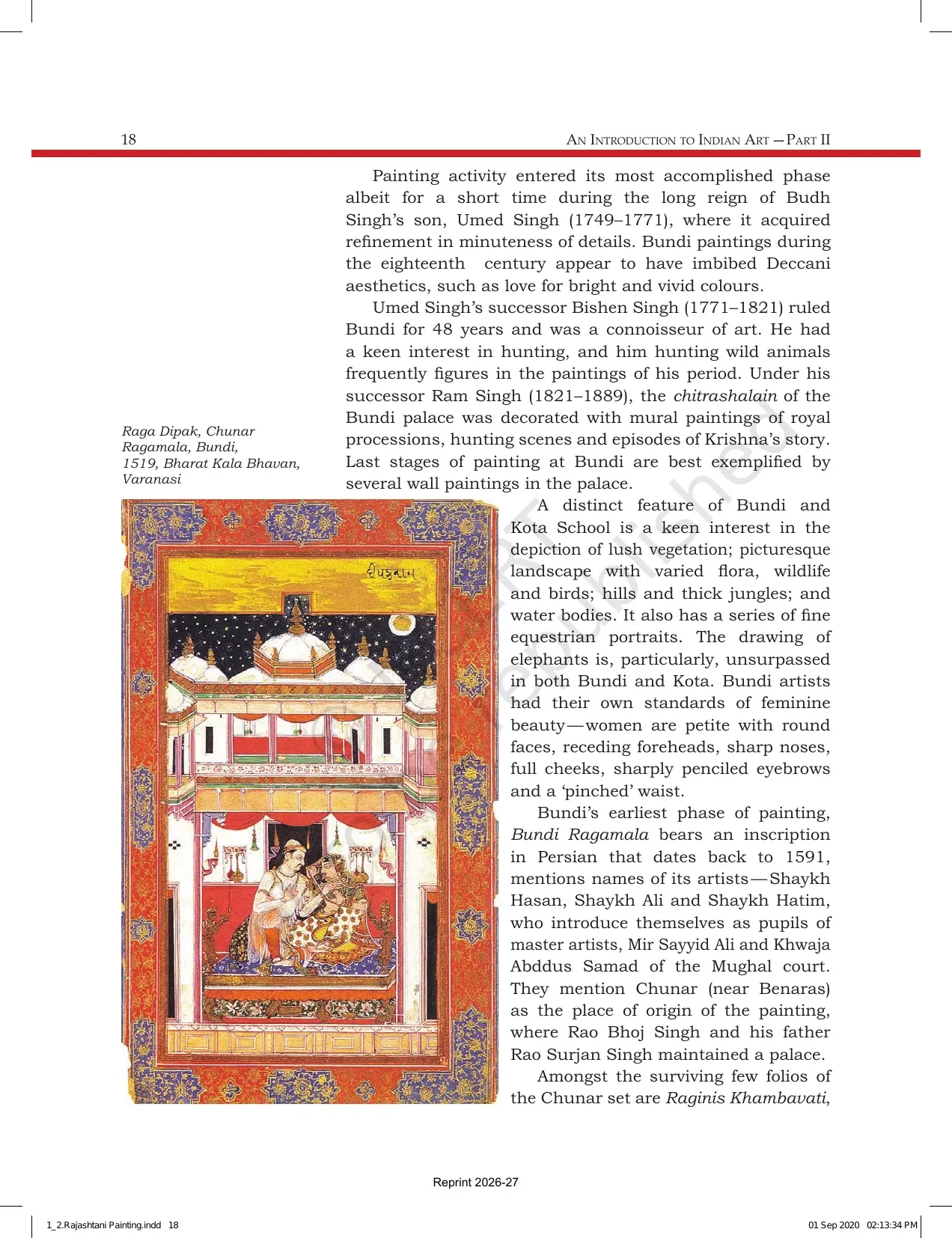
Raga Dipak from that set is the plate to prepare in detail. It is set at night. The raga sits with his beloved in a chamber warmly lit by flames from four lamps, and two of the lamp holders are shaped like ornate human figures. The sky glitters with countless stars and the moon has turned yellow, which tells you the night has progressed and many hours have passed for the couple.
One further detail from Raga Dipak explains the whole workshop process. The finial of the domical palace structure pushes into the yellow patch reserved for writing, and nothing is written there except the label Dipak Raga. The painting was usually finished before it went to the scribe, and in this case the verse was never written at all. The label was only an instruction to the artist about what he should be painting.
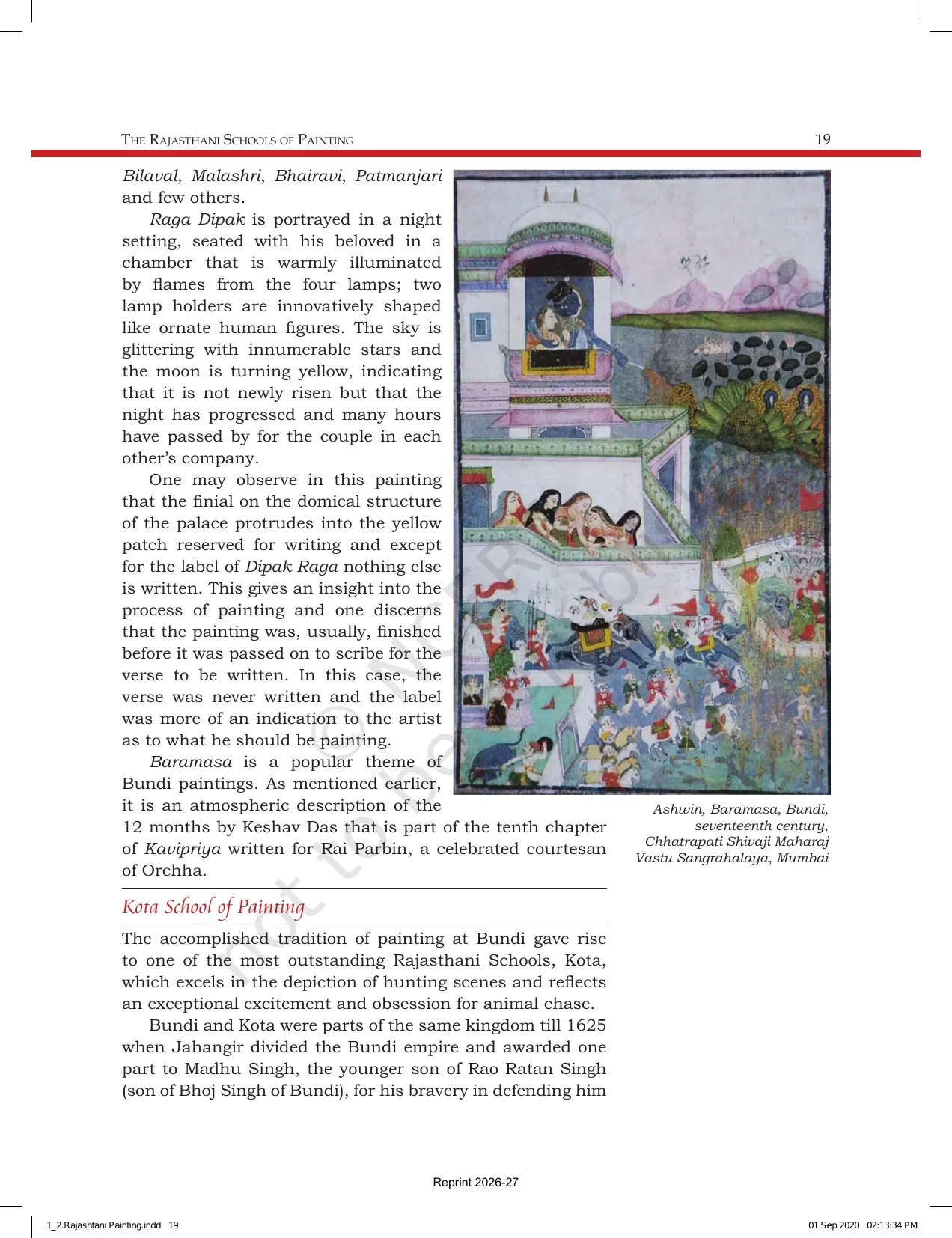
Bundi and Kota share a set of visual habits that the book lists together, and Baramasa, the twelve month cycle from Keshav Das, is a popular Bundi theme.
- A keen interest in lush vegetation and picturesque landscape with varied flora, wildlife and birds.
- Hills, thick jungles and water bodies filling the picture space.
- A series of fine equestrian portraits, with the drawing of elephants unsurpassed in both courts.
- A Bundi standard of feminine beauty: petite women with round faces, receding foreheads, sharp noses, full cheeks, sharply penciled eyebrows and a pinched waist.
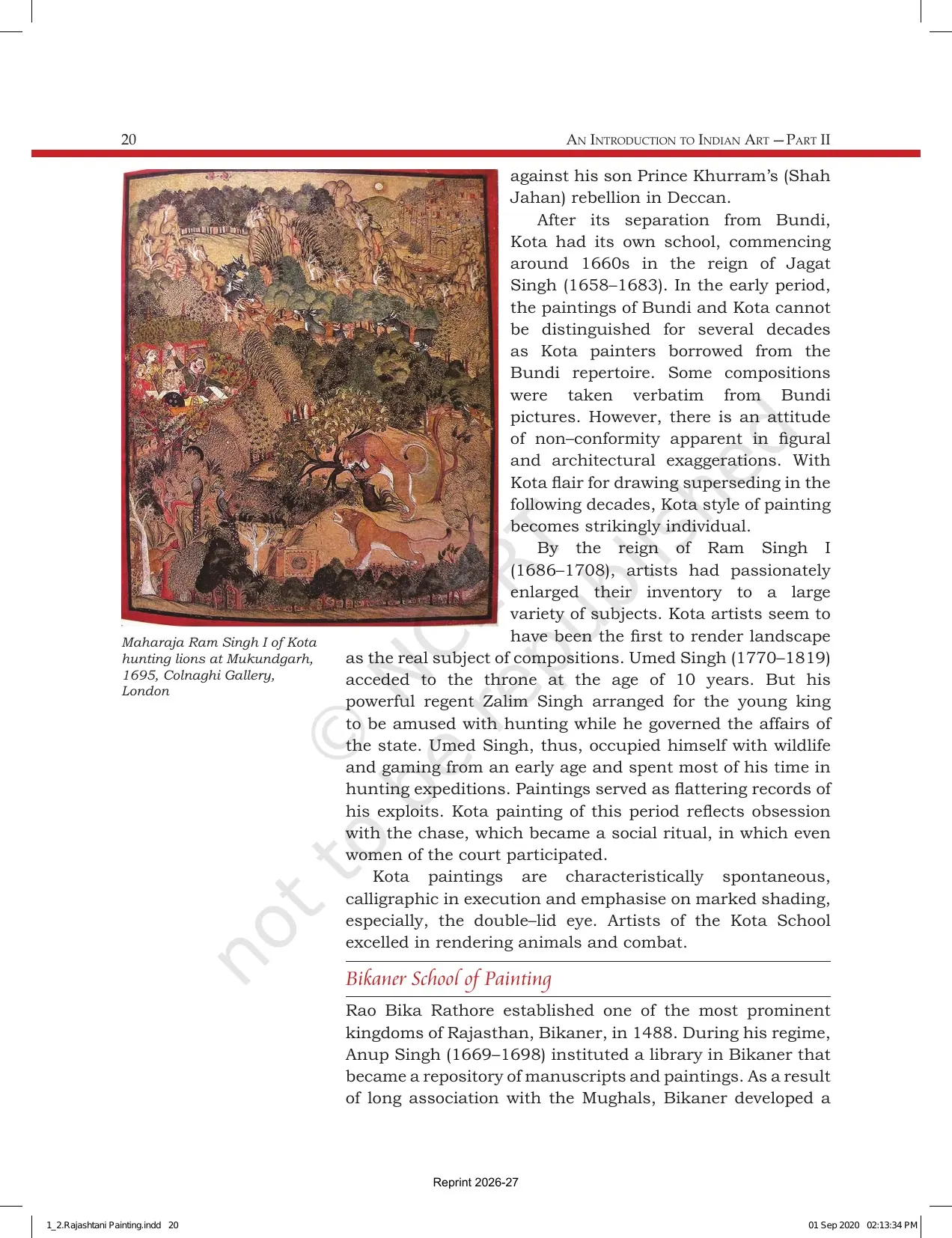
Kota broke away after 1625 and grew its own school from around the 1660s, in the reign of Jagat Singh who ruled from 1658 to 1683. For several decades the two are hard to tell apart, because Kota painters borrowed from the Bundi repertoire and took some compositions verbatim. What gives Kota away is an attitude of non conformity, visible in figural and architectural exaggeration, and Kota's flair for drawing soon made the style strikingly individual.
- By the reign of Ram Singh I, 1686 to 1708, Kota artists had enlarged their inventory to a wide variety of subjects.
- Kota artists seem to have been the first to render landscape as the real subject of a composition.
- Umed Singh, 1770 to 1819, came to the throne at the age of 10. His regent Zalim Singh kept the young king amused with hunting while he ran the state himself.
- Paintings became flattering records of those hunting exploits, and the chase turned into a social ritual in which even women of the court took part.
- Kota work is spontaneous and calligraphic in execution, with marked shading and a signature double lid eye. Its artists excelled at animals and combat.
Bikaner School of Painting: Mandi Studios, Gudarayi and the Best Documented Court
Bikaner is the school to quote whenever a question asks how we know who painted what. Rao Bika Rathore established Bikaner in 1488, and a long association with the Mughals gave the court a distinctive language marked by Mughal elegance and a subdued colour palette.
The record keeping is the point. Accounts from the Bahis, the royal day to day archival diaries, together with the inscriptions on the paintings themselves, make Bikaner one of the best documented schools of painting in India. Inscriptions in Marwari, and occasionally Persian, give names of artists and dates, and sometimes even the place of production and the occasion for which the work was commissioned.
| Term or name | What to write in the answer |
|---|---|
| Ustad Ali Raza | A master painter from Delhi employed by Karan Singh; his earliest work marks the beginning of the Bikaner School around 1650 |
| Anup Singh | Ruled 1669 to 1698 and instituted a library at Bikaner that became a repository of manuscripts and paintings |
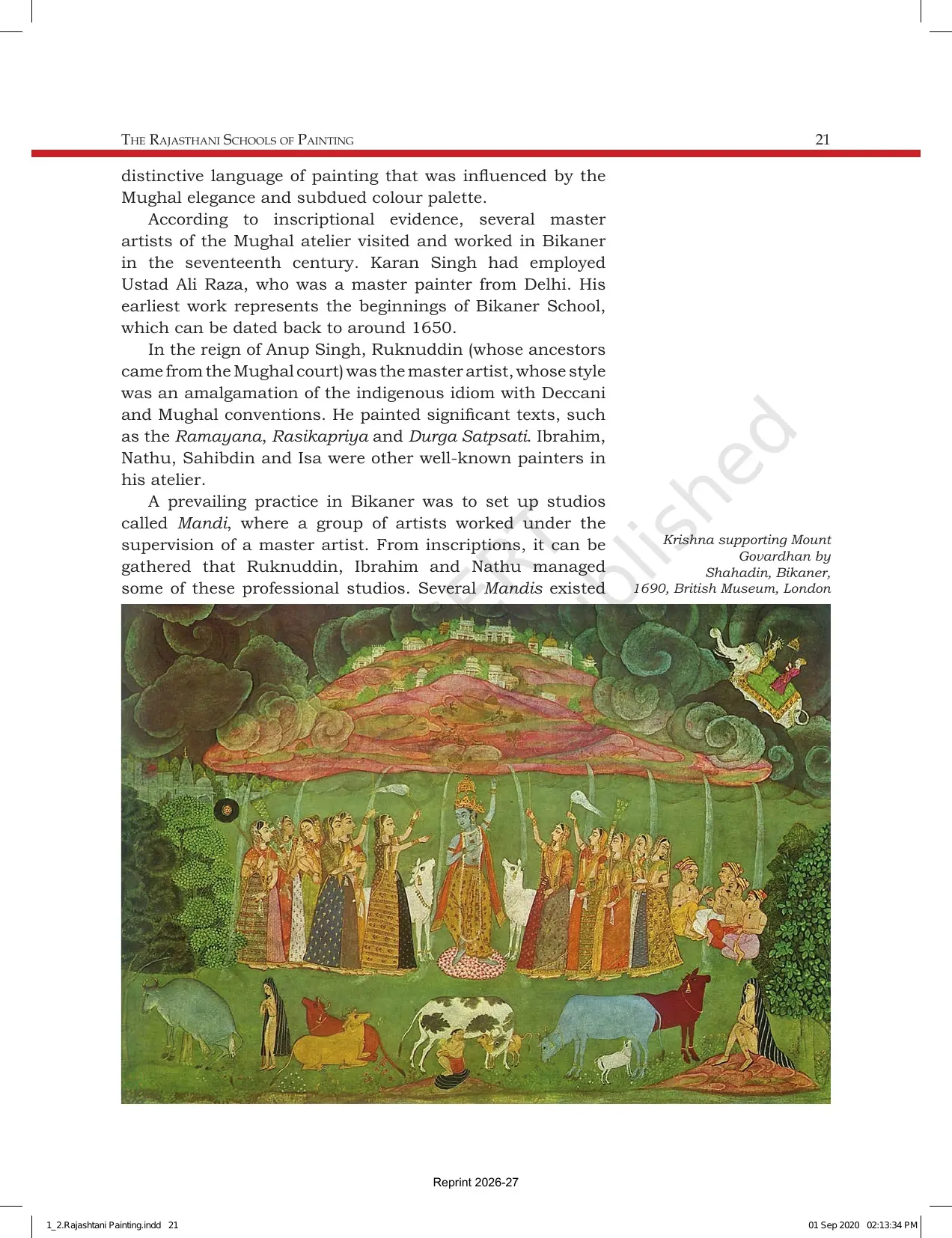
| Ruknuddin | Master artist under Anup Singh, whose ancestors came from the Mughal court; blended the indigenous idiom with Deccani and Mughal conventions; painted the Ramayana, Rasikapriya and Durga Saptsati |
| Mandi | The studios of Bikaner, where a group of artists worked under a master artist; Ruknuddin, Ibrahim and Nathu each managed one |
| Gudarayi | Literally to lift; the term for the finishing touches the master artist put on a pupil's painting |
| Marammat and nakals | Repairing older works and making copies of them, both handled by the same studios |
| Ustas or Ustad | What Bikaner artists were called; the custom of painting portraits of artists is unique to this school |
The archive also created a problem that the book flags. On completion of a painting the court archivist wrote the master artist's name and the date on the back, so the master's name often sits on work painted by his pupils, who may not have painted in his style at all. Ibrahim, Nathu, Sahibdin and Isa were the other well known painters in Ruknuddin's atelier. Ruknuddin himself painted exquisite works in soft colour tones. Ibrahim's works have a misty dreamlike quality, and his figures are dainty with heavily modelled faces; his studio was the most prolific, since his name occurs on different sets of Baramasa, Ragamala and Rasikapriya.
Kishangarh School of Painting: Nihal Chand and the Bani Thani Face
Kishangarh is widely held to be the most stylised of all Rajasthani miniature schools, and it is the school students are asked to identify from a face alone. Learn the facial formula as a list and you will never miss the identification mark.
- Arched eyebrows carried to an exaggerated curve.
- Lotus petal shaped eyes, slightly tinged with pink, with drooping eyelids.
- A sharp slender nose and thin lips.
- A general tendency to elongate the human form.
- Lavish use of green and a penchant for panoramic landscape.
Kishan Singh, one of the sons of the king of Jodhpur, founded the state of Kishangarh in 1609. Artists were already working at the court by the middle of the seventeenth century, under the patronage of Man Singh who ruled from 1658 to 1706. The distinctive style itself evolved by the early eighteenth century during the reign of Raj Singh, 1706 to 1748. Raj Singh was initiated into the Pushtimargiya cult of Vallabhacharya, after which Krishna Lila themes became personal favourites of the Kishangarh rulers and filled a major part of their court art.
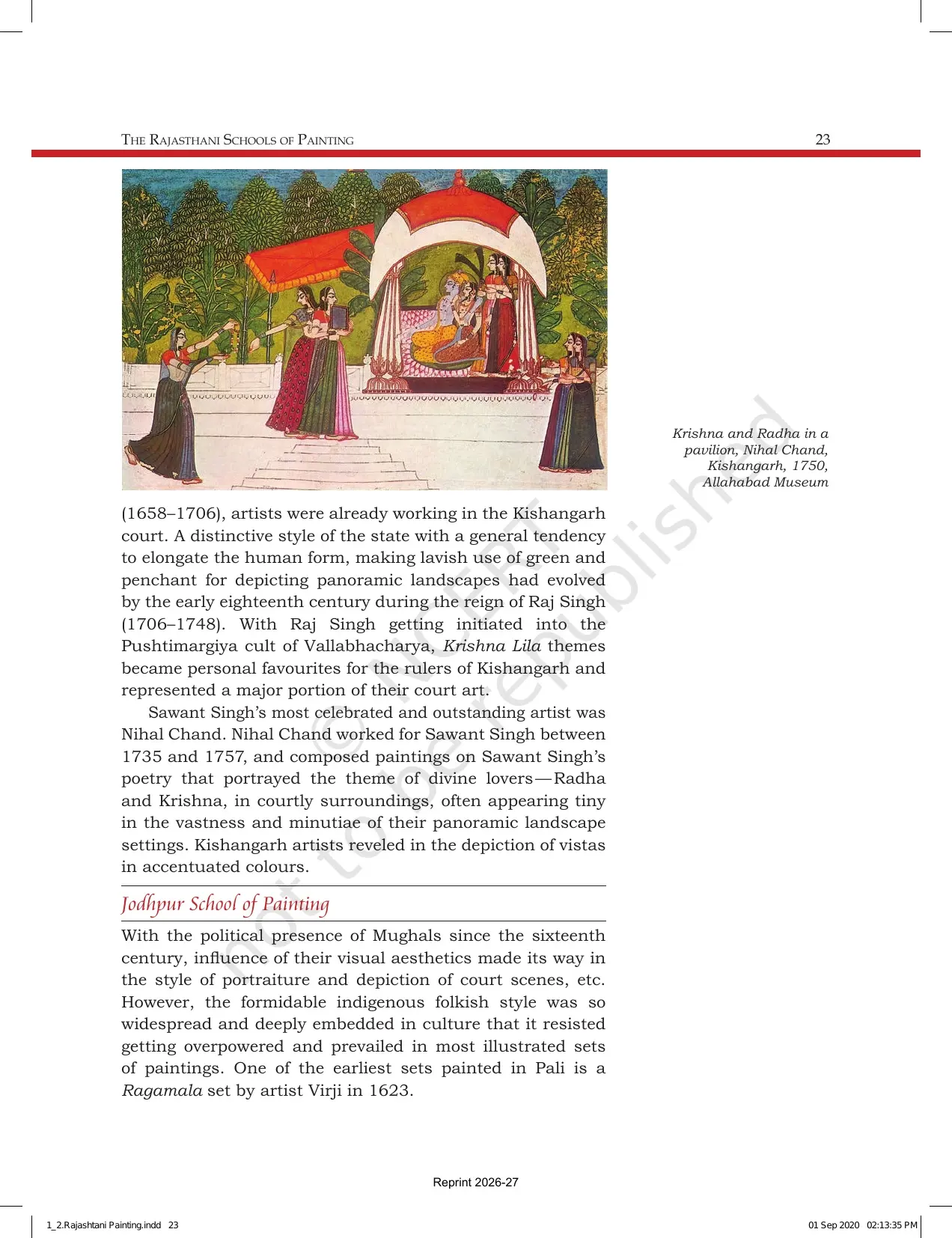
The famous partnership comes next. Nihal Chand worked for Sawant Singh between 1735 and 1757 and composed paintings on Sawant Singh's own poetry, portraying the divine lovers Radha and Krishna in courtly surroundings, often tiny inside the vastness and minutiae of a panoramic landscape. Kishangarh artists revelled in vistas painted in accentuated colours.
The Bani Thani plate ties the poetry and the painting together, and it is the appreciation question this school is set from.
- Sawant Singh wrote devotional poetry on Krishna and Radha in Brajbhasha under the pen name Nagari Das.
- He was said to be passionately in love with a young singer given the title Bani Thani, the bewitching lady of fashion, for her unparalleled beauty and elegance.
- She was an attendant of Raj Singh's wife and was herself a gifted poetess, singer and dancer.
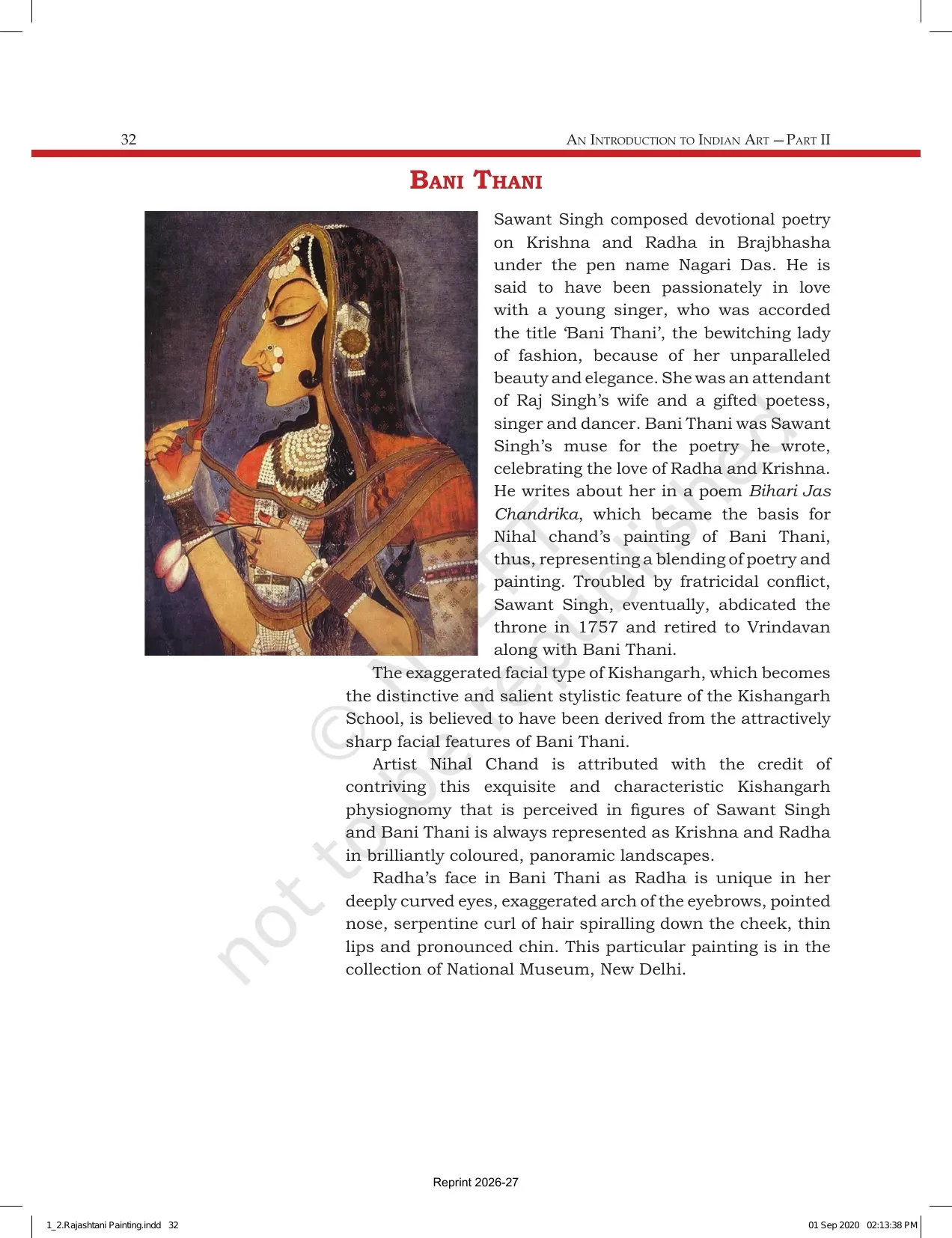
- He wrote about her in the poem Bihari Jas Chandrika, which became the basis for Nihal Chand's painting of Bani Thani, so the plate is a blending of poetry and painting.
- Troubled by fratricidal conflict, Sawant Singh abdicated the throne in 1757 and retired to Vrindavan with Bani Thani.
The exaggerated Kishangarh facial type is believed to derive from Bani Thani's own sharp features, and Nihal Chand is credited with contriving it. In Bani Thani as Radha the face is unique in its deeply curved eyes, the exaggerated arch of the eyebrows, the pointed nose, a serpentine curl of hair spiralling down the cheek, thin lips and a pronounced chin. The painting is in the National Museum, New Delhi.
Jodhpur School of Painting: Marwar Portraiture from Jaswant Singh to Man Singh
Jodhpur, also called Marwar, is the school where the local idiom refused to give way. Mughal political presence from the sixteenth century did shape portraiture and court scenes here. But the indigenous folkish style was so widespread and so deeply embedded in the culture that it resisted being overpowered and survived in most illustrated sets.
| Ruler or artist | Date | What the chapter records |
|---|---|---|
| Virji | 1623 | Painted one of the earliest Marwar sets, a Ragamala made at Pali |
| Maharaja Jaswant Singh | 1638 to 1678 | Ushered in a productive period; documentary painting through portraiture and court life started around 1640; followed the Vallabha cult of Shrinathji and patronised Krishna themes, with the Bhagvata Purana the most prominent |
| Ajit Singh | 1679 to 1724 | Became king after 25 years of war with Aurangzeb, fought by Veer Durgadas Rathore, who recaptured Marwar; Durgadas's equestrian portraits became popular |
| Man Singh | 1803 to 1843 | The last innovative phase; sets of the Ramayana (1804), Dhola-Maru, Panchatantra (1804) and Shiva Purana; a follower of the Nath Sampradaya, with a Nath Charita set painted in 1824 |
Two points here are worth a line each in a long answer. The trend for documentary portraiture stayed prominent until the advent of photography in the nineteenth century, which then replaced painting as the way of recording events. And in the Ramayana set the artist used his own knowledge of Jodhpur to build Rama's Ayodhya, so the painting shows the bazaars, lanes and gateways of the real city. The book adds that this is true of every school, since local architecture, costume and cultural detail always got woven into the stories of Krishna and Rama.
Marwar inscriptions are the opposite of Bikaner's. They reveal very little until the nineteenth century. Dates are seldom inscribed, and the names of artists and the place of painting appear more rarely still.
Jaipur School of Painting: From Amer to the Suratkhana of Sawai Jai Singh
Jaipur was the Rajput court closest to the Mughal capitals, and its section is the story of an influence arriving and then receding. The school originated in the former capital Amer, nearer to Agra and Delhi than any other large Rajput state, so Mughal aesthetics shaped the court early. Raja Bharmal, 1548 to 1575, married his daughter to Akbar, his son Bhagwant Das, 1575 to 1592, was a close friend of Akbar, and Bhagwant Das's son Man Singh was Akbar's most trusted general.
Sawai Jai Singh, who ruled from 1699 to 1743, founded the new capital city of Jaipur in 1727 and shifted there from Amer. The school thrived under him and emerged as a well defined independent school. Court records show that some Mughal painters were brought from Delhi into his atelier. He invited eminent craftsmen and artists to settle in Jaipur and reorganised the Suratkhana, the place where paintings were made and stored.
Jai Singh was drawn to the Vaishnavite sect and commissioned many paintings on Radha and Krishna. His artists painted sets based on Rasikapriya, Gita Govinda, Baramasa and Ragamala, in which the hero's figure carries a striking resemblance to the king himself. Portraiture was popular too, and Sahibram was the accomplished portrait painter of his atelier, with Muhammad Shah another named artist.
- Sawai Ishwari Singh, 1743 to 1750, extended the same patronage and had his leisure pursuits painted: elephant rides, boar and tiger hunts and elephant fights.
- Sawai Madho Singh, 1750 to 1767, preferred to have incidents of his court life recorded.
- Sawai Pratap Singh, 1779 to 1803, presided over the second thriving period, employed around 50 artists, and was himself a scholar, poet, prolific writer and ardent follower of Krishna.
The stylistic turn happened under Pratap Singh. The predominant Mughal influence receded and a reformulated Jaipur style emerged that blended Mughal and indigenous features. Gita Govinda, Ragamala and Bhagvata Purana themes got renewed stimulus alongside royal portraits and courtly pomp. As elsewhere, many copies were produced by tracing and pouncing. By the early nineteenth century gold was used lavishly, and Jaipur preferred large formats, producing life size portraits.
Named Paintings You Must Be Able to Appreciate in the Board Answer
Fine Arts appreciation questions want four things every time: the title, the school or artist, the date, and the collection, followed by two or three lines on what you actually see. The table below sets out the plates the chapter reproduces in exactly that shape.
| Painting | School, artist and date | Collection |
|---|---|---|
| Krishna and gopis in the forest, Gita Govinda | Mewar, 1550 | Chhatrapati Shivaji Maharaj Vastu Sangrahalaya, Mumbai |
| Chaurpanchasika | Mewar, 1500 | N. C. Mehta Collection, Ahmedabad, Gujarat |
| Raga Megha | Madho Das, Malwa, 1680 | National Museum, New Delhi |
| Yuddha Kanda of Ramayana | Sahibdin, Mewar, 1652 | India Office Library, London |
| Maharana Jagat Singh II of Mewar hawking | Mewar, 1744 | Metropolitan Museum of Art, New York |
| Krishna as Shrinathji celebrating the festival of Sarad Purnima | Nathdwara, 1800 | National Museum, New Delhi |
| Raga Dipak, Chunar Ragamala | Bundi | Bharat Kala Bhavan, Varanasi |
| Ashwin, Baramasa | Bundi, seventeenth century | Chhatrapati Shivaji Maharaj Vastu Sangrahalaya, Mumbai |
| Maharaja Ram Singh I of Kota hunting lions at Mukundgarh | Kota, 1695 | Colnaghi Gallery, London |
| Krishna supporting Mount Govardhan | Shahadin, Bikaner, 1690 | British Museum, London |
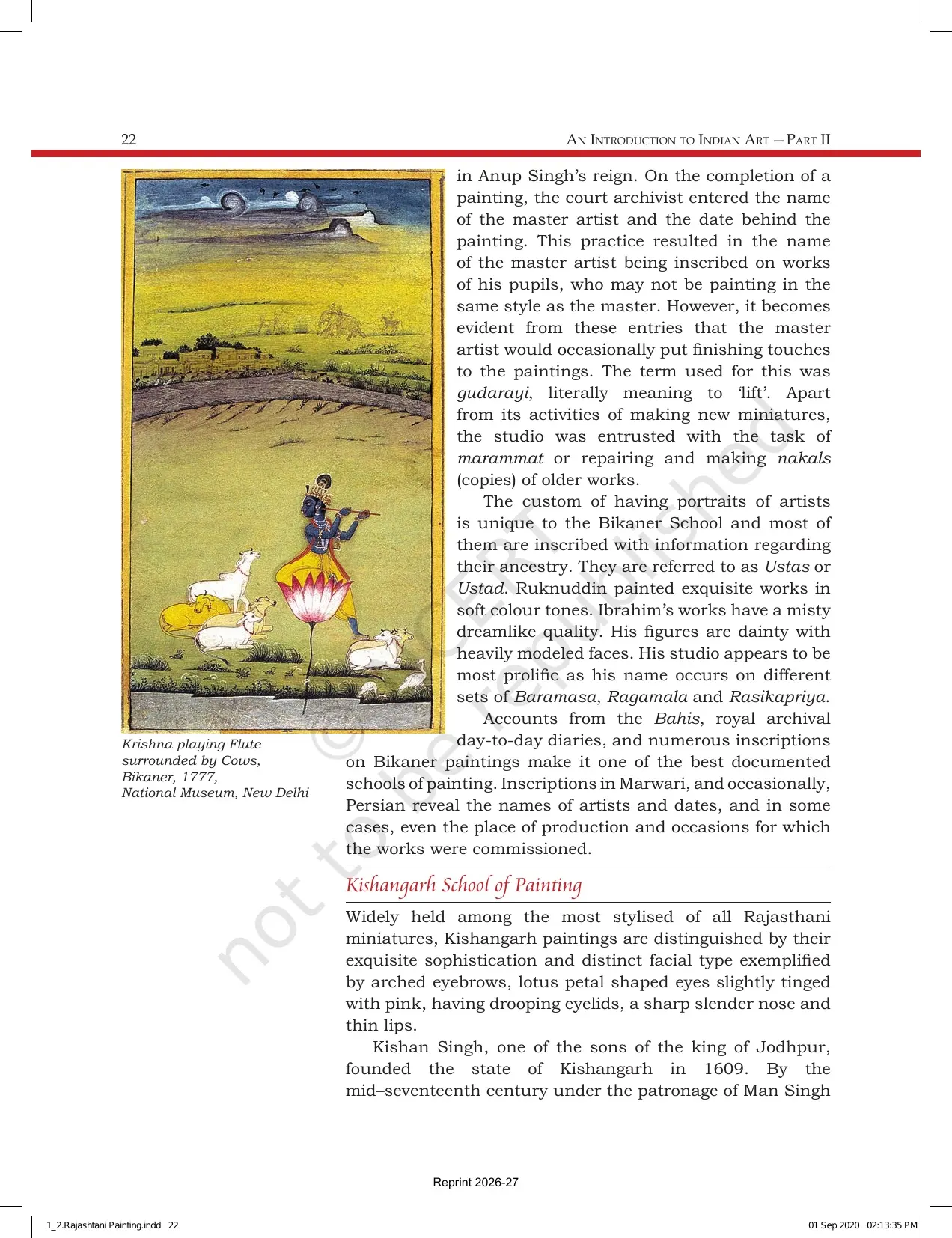
| Krishna playing Flute surrounded by Cows | Bikaner, 1777 | National Museum, New Delhi |
| Krishna and Radha in a pavilion | Nihal Chand, Kishangarh, 1750 | Allahabad Museum |
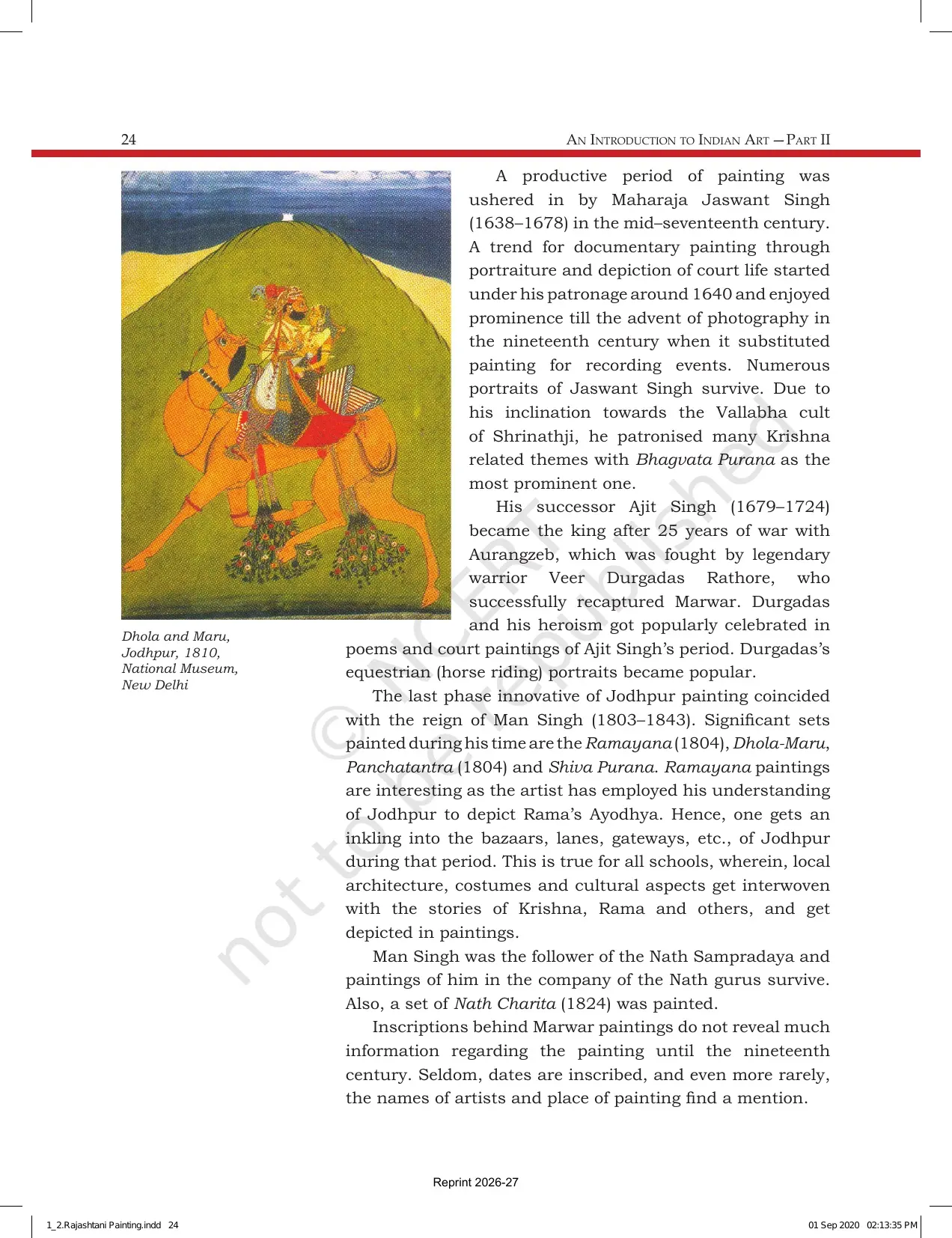
| Dhola and Maru | Jodhpur, 1810 | National Museum, New Delhi |
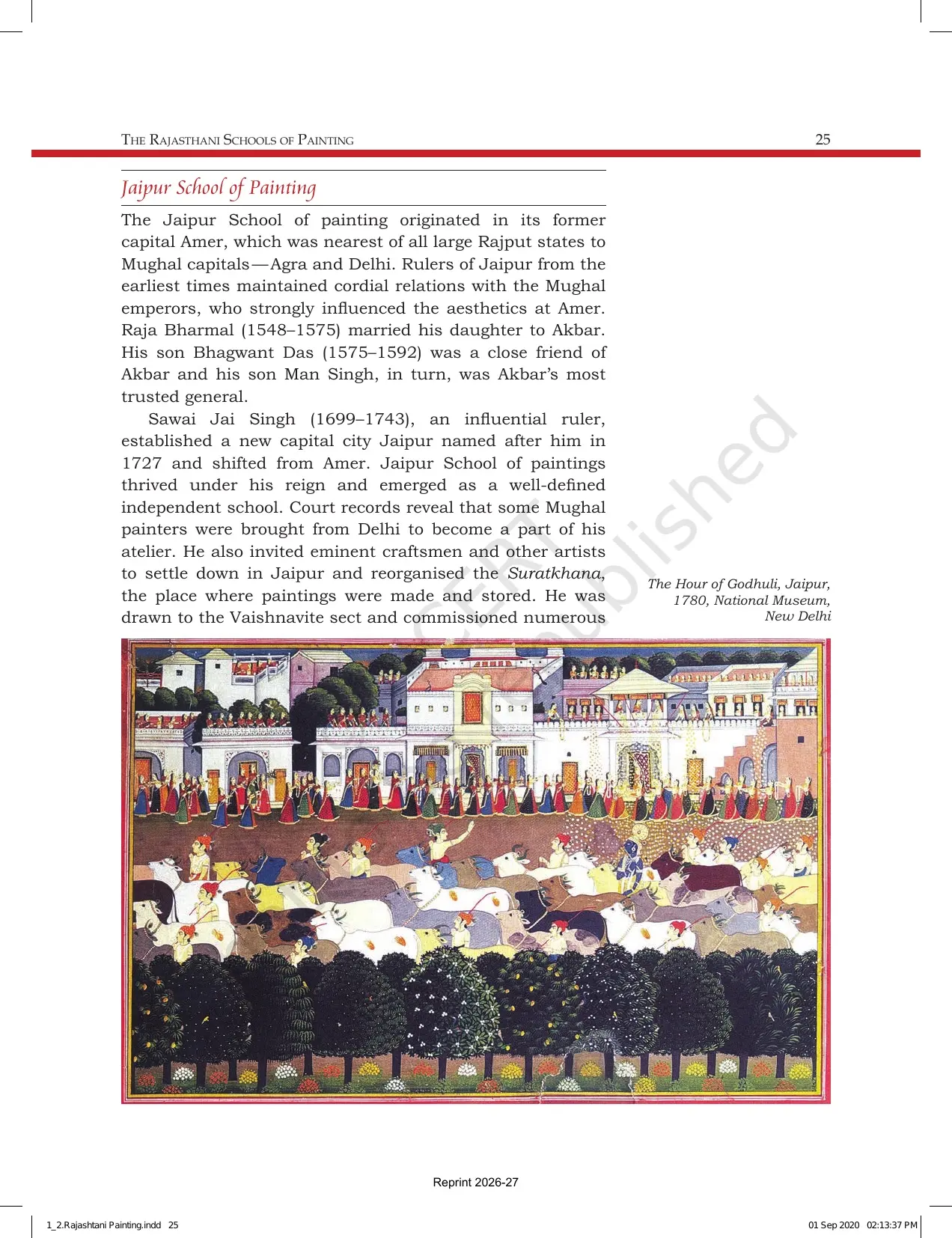
| The Hour of Godhuli | Jaipur, 1780 | National Museum, New Delhi |
Seven plates get a full page of appreciation text of their own, and those are the ones that turn up as picture based questions. Learn one sentence of visual description plus one documentary fact for each.
- Bhagvata Purana: a Malwa folio of 1680 to 1690 in the National Museum, New Delhi, showing the killing of the demon Shakatasura. The space is compartmentalised, with celebration at the house of Nanda and Yashoda, cows and calves donated to Brahmins, women guarding baby Krishna from the evil eye, and the story closing as Krishna topples the cart demon with a gentle kick.
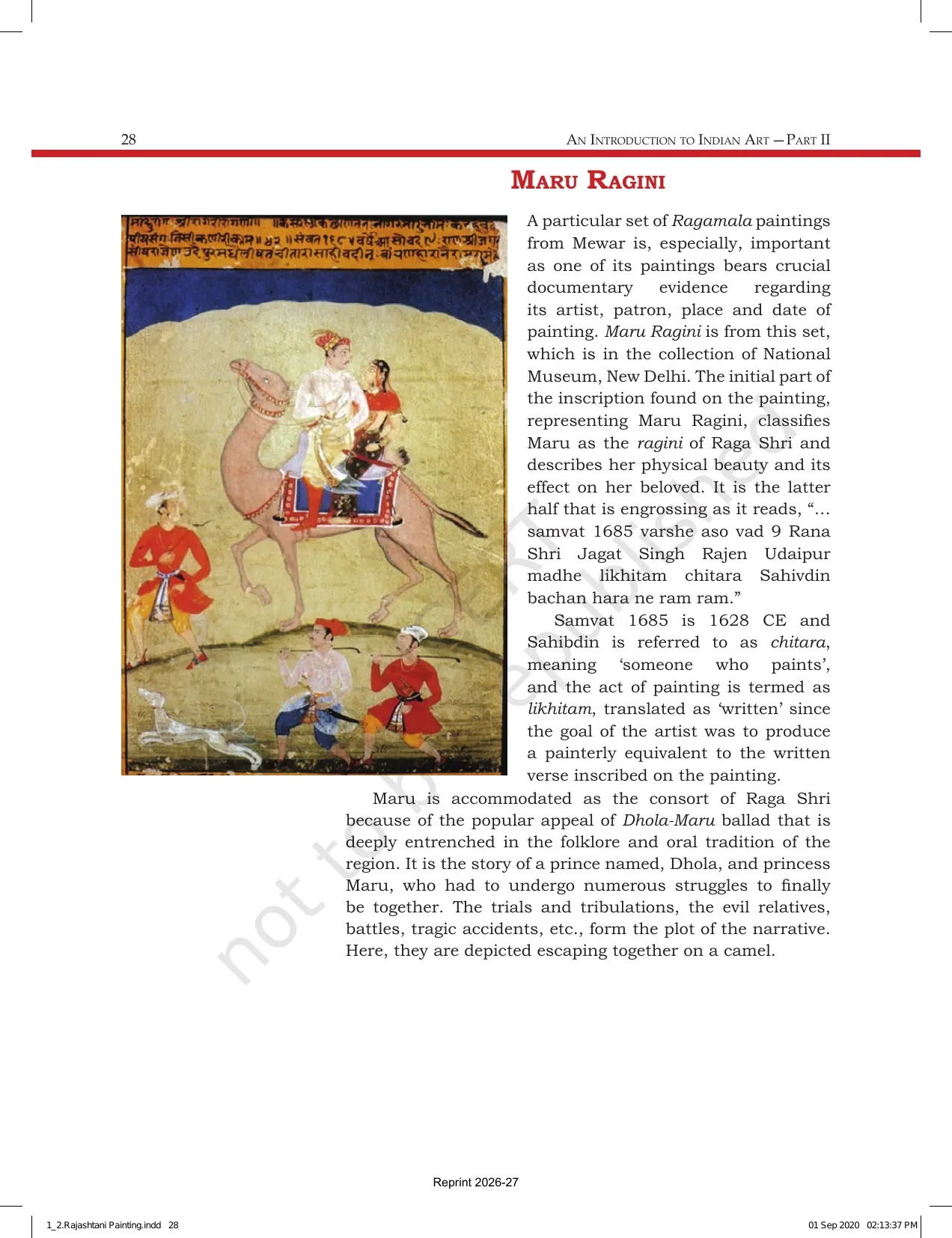
- Maru Ragini: a Mewar Ragamala folio whose inscription reads samvat 1685, which is 1628 CE, naming Rana Shri Jagat Singh at Udaipur and the painter Sahibdin. Sahibdin is called chitara, someone who paints, and the act of painting is called likhitam, written, because the artist's goal was a painterly equivalent of the verse. Maru is the ragini of Raga Shri, and the plate shows Dhola and Maru escaping together on a camel.
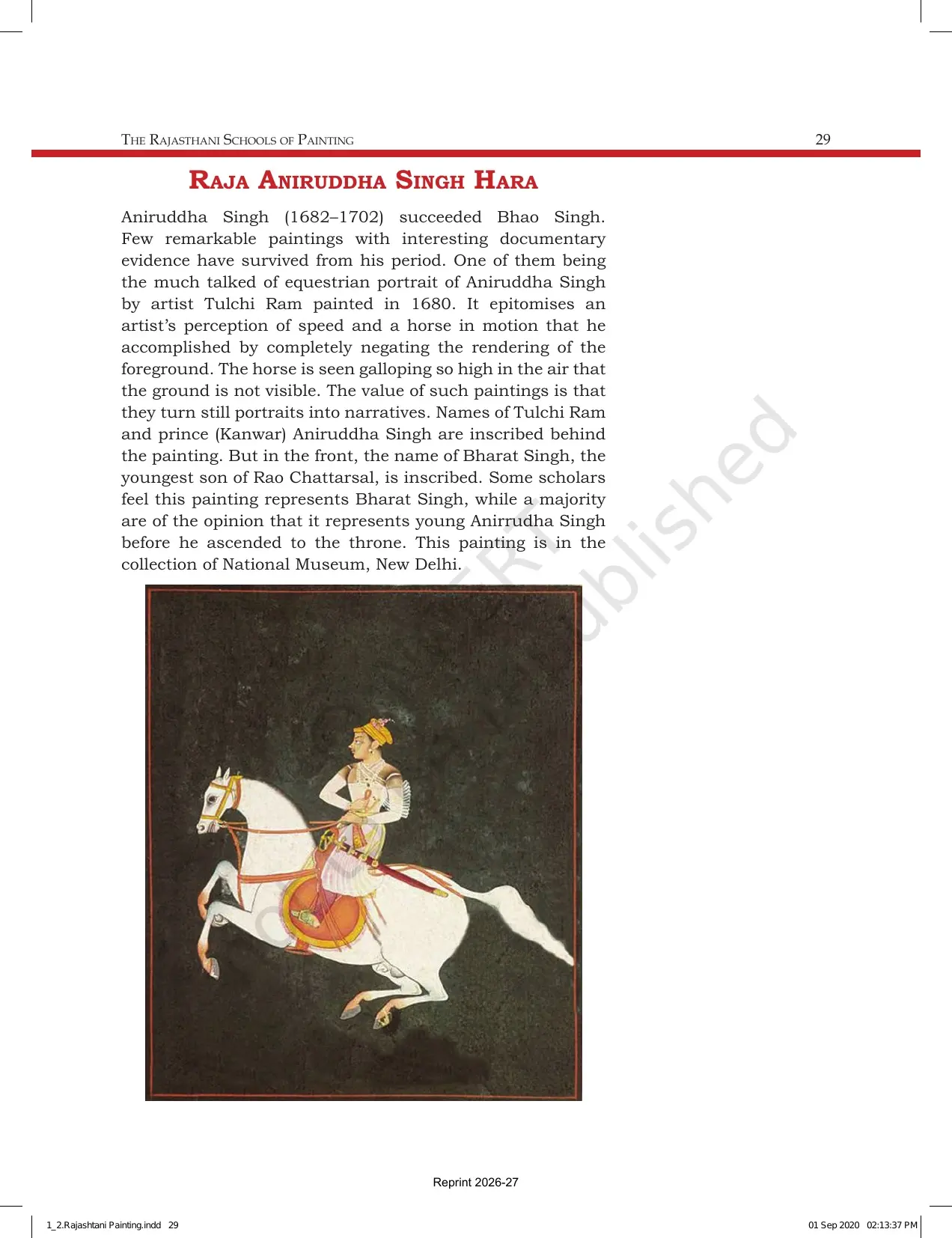
- Raja Aniruddha Singh Hara: an equestrian portrait by Tulchi Ram, painted in 1680. Speed is conveyed by removing the foreground completely, so the horse gallops so high that the ground is not visible. Tulchi Ram and Kanwar Aniruddha Singh are named behind the painting, while Bharat Singh, the youngest son of Rao Chattarsal, is named in front. Most scholars read the sitter as the young Aniruddha Singh.
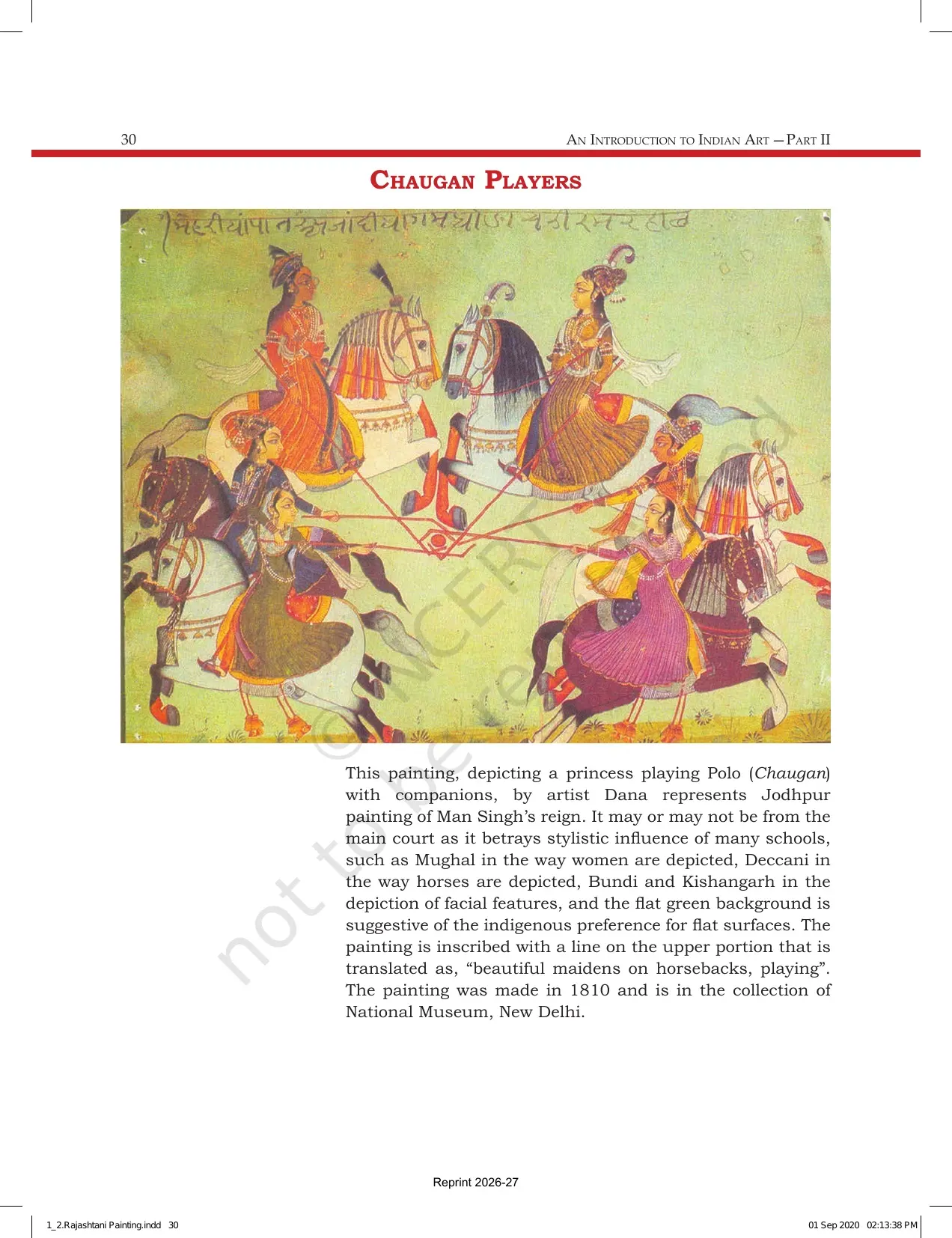
- Chaugan Players: a princess playing chaugan, or polo, with her companions, by the artist Dana, made in 1810 in Man Singh's Jodhpur. It carries influences from several schools at once: Mughal in the women, Deccani in the horses, Bundi and Kishangarh in the facial features, and a flat green background that points to the indigenous liking for flat surfaces.
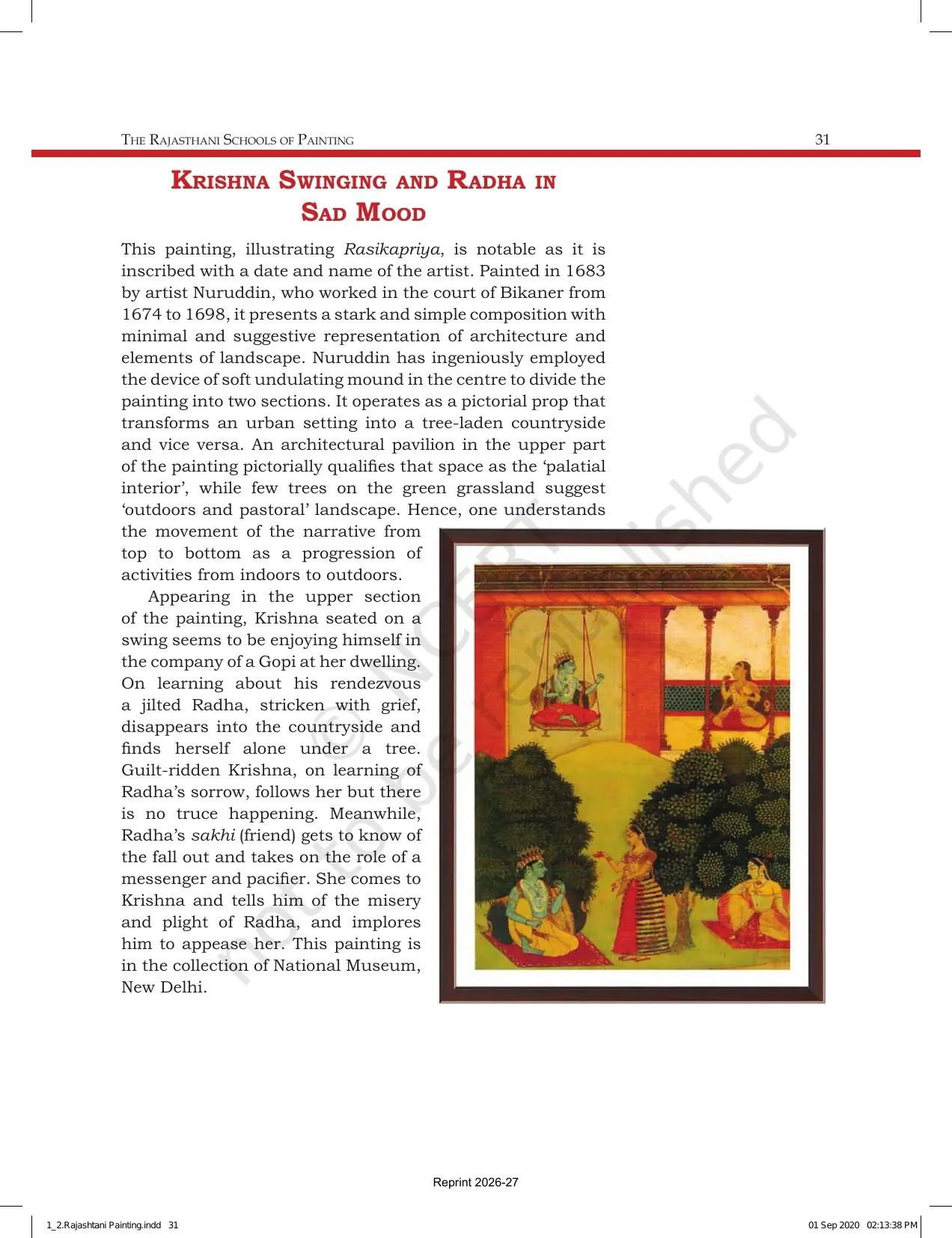
- Krishna Swinging and Radha in Sad Mood: a Rasikapriya illustration painted in 1683 by Nuruddin, who worked at the Bikaner court from 1674 to 1698. A soft undulating mound down the centre splits the picture, turning the upper part into a palatial interior and the lower into pastoral countryside, so the narrative reads from indoors to outdoors.
- Bani Thani: Nihal Chand's Kishangarh plate built on Sawant Singh's poem Bihari Jas Chandrika, and the source of the school's exaggerated facial type.
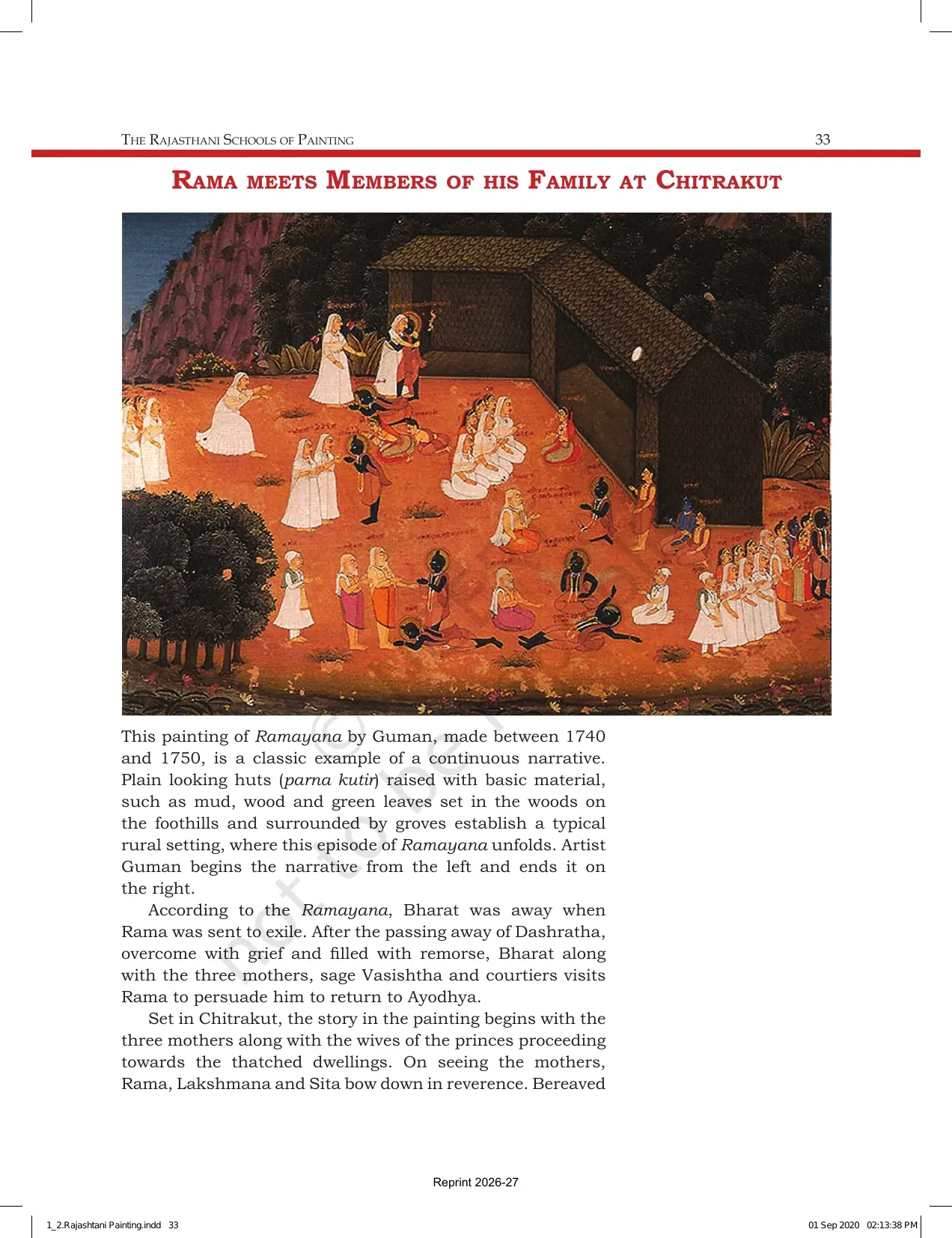
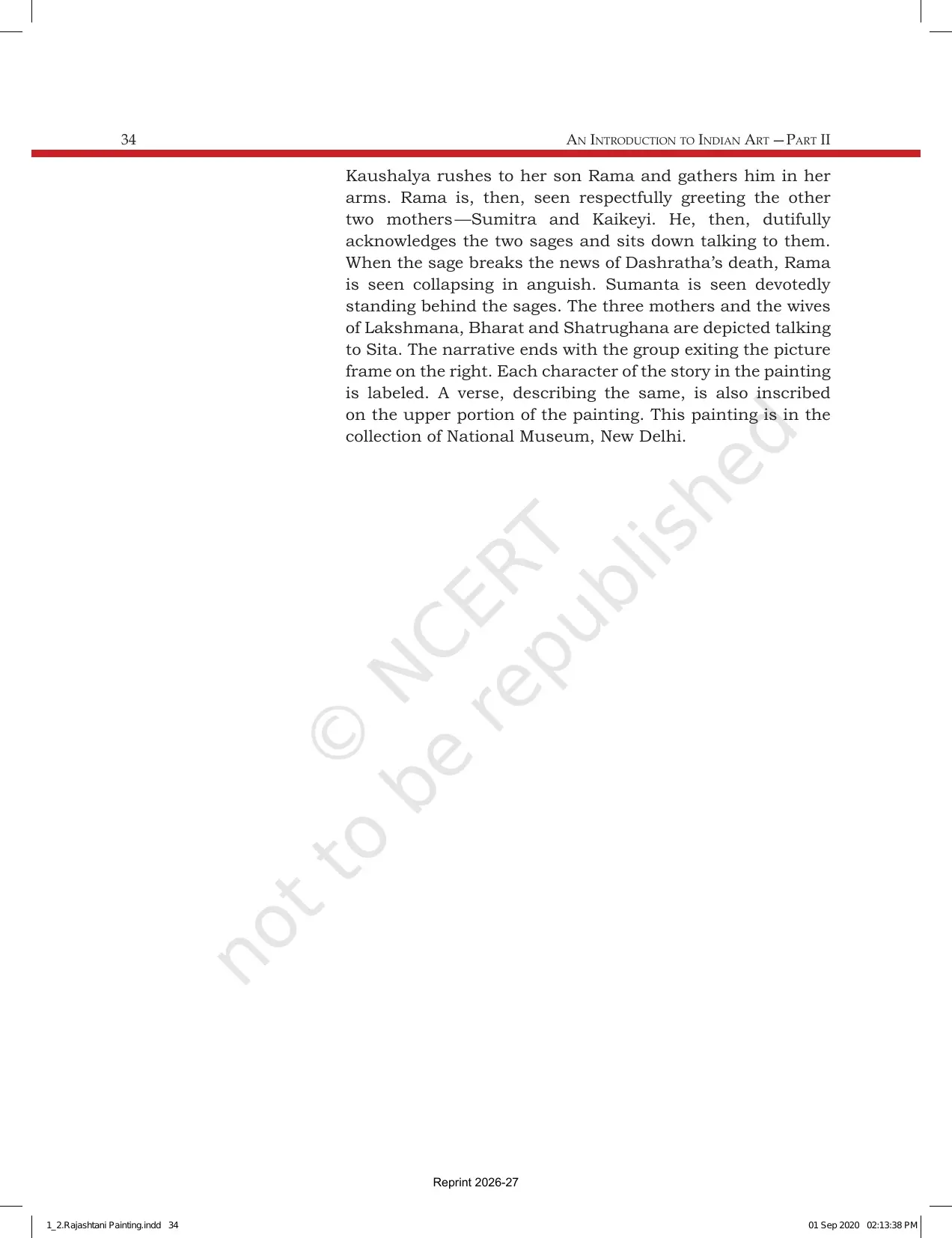
- Rama meets Members of his Family at Chitrakut: a Ramayana painting by Guman, made between 1740 and 1750, and a classic example of continuous narrative. The story runs from left to right through parna kutir huts of mud, wood and green leaves. Bharat, the three mothers, sage Vasishtha and the courtiers arrive to persuade Rama to return, and when the sage breaks the news of Dashratha's death Rama collapses in anguish. Every character is labelled.
The Five Exercise Questions at the End of the Rajasthani Schools Chapter
The chapter closes with five exercise questions. Two of them ask you to produce something rather than recall something, so keep the PDF open beside you while you attempt them.
- In what ways do you think that the Western Indian manuscript painting tradition guided the developments of miniature painting traditions in Rajasthan?
- Describe different schools of Rajasthani paintings and give examples to support their characteristics.
- What is Ragamala? Give examples of Ragamala paintings from various schools of Rajasthan.
- Draw a map and label all schools of Rajasthani miniature paintings.
- Which texts provided the content or theme for miniature paintings? Describe them with examples.
Question 4 is the cheapest mark in the chapter and the one most students lose by leaving blank. The labels come straight from the opening paragraph: Mewar, Bundi, Kota, Jaipur, Bikaner, Kishangarh, Jodhpur or Marwar, Malwa and Sirohi. Add Nathdwara near Udaipur and Chawand for Mewar, and Chunar near Benaras as the place where the earliest Bundi set was painted, and the map answer is complete.
Common Mistakes Students Make in the Rajasthani Schools of Painting Chapter
Watch out for these seven:
- Writing that the schools are called Rajput Paintings. That was Coomaraswamy's 1916 coinage and the book says the term is now obsolete.
- Confusing the two Jagat Singhs. Jagat Singh I of Mewar ruled 1628 to 1652 and patronised Sahibdin. Jagat Singh of Kota ruled 1658 to 1683.
- Confusing the two Umed Singhs. Umed Singh of Bundi ruled 1749 to 1771. Umed Singh of Kota ruled 1770 to 1819 under the regent Zalim Singh.
- Giving Bani Thani to Sawant Singh as the painter. Sawant Singh wrote the poetry as Nagari Das; Nihal Chand painted it.
- Saying Malwa has a single centre. The book says it defies a precise centre and names only Mandu, Nusratgarh and Narsyang Sahar in passing.
- Describing a Ragamala album as having any number of folios. It invariably contains 36 or 42 folios, and each raga family has six raginis.
- Calling the paper support anything other than a wasli, or forgetting that the finished painting was burnished with an agate.
Student Feedback on the Rajasthani Schools of Painting Chapter
What 13,470 students told us about this chapter
- 68% of the students surveyed said the nine courts blur together once reign dates and artist names pile up.
- Only 29% could name Nisardin and the Chawand set of 1605 without looking back at the text.
- Students who built the artist and text tables by hand before revising reported the fastest recall in the appreciation question.
- Most skipped passage: the technique paragraph on waslis and pigments, left unread by roughly 2 in 5 students, even though it is a ready made 3 mark answer.
Source: Collegedunia Class 12 Fine Arts student survey taken before the 2026-27 board exams. Sample of 13,470 students from CBSE schools across 15 states.
How to Revise the Rajasthani Schools Chapter in a Three Block Plan
This is the longest painting chapter in the book, so trying to read it in one sitting is what causes the blurring students report. About three focused hours makes it board ready, and the printed order gives you the sequence for free.
- Block 1, 50 minutes. Read the opening, the technique passage and the Themes of Paintings section. Write the wasli process in five steps and the six text table from memory.
- Block 2, 70 minutes. Read Malwa, Mewar, Bundi and Kota. Build fact cards for Nisardin, Sahibdin, Manohar, Jagannath, the Chunar Ragamala and the 1625 division of Bundi.
- Block 3, 60 minutes. Read Bikaner, Kishangarh, Jodhpur and Jaipur, then all seven appreciation plates. Write the Ragamala definition and the Kishangarh facial formula without looking.
Repeat Block 3 a week before the paper. Plate details and reign dates fade fastest, and they are the cheapest marks in the Fine Arts theory paper for both the CBSE Class 12 board exam and the CUET general test.
How the Rajasthani Schools Chapter PDF Works with the Fine Arts Notes and Solutions
The chapter PDF gives you the official text and every plate exactly as printed. What it does not give you is a compressed recall sheet or model answers to the five exercise questions. Those sit on the sister pages for the same chapter, and running them together is faster than reading any one of them alone.
| Resource | What it adds beyond this chapter PDF | Link |
|---|---|---|
| Revision Notes | The court by court index, the artist table and the Ragamala structure condensed for a last read before the paper | The Rajasthani Schools of Painting Class 12 Notes |
| NCERT Solutions | Model answers to all five exercise questions, including the map question and the texts question | The Rajasthani Schools of Painting Class 12 NCERT Solutions |
| Handwritten Notes | Neatly handwritten recall pages with the reign dates, artist names and plate details colour coded for one shot revision | The Rajasthani Schools of Painting Class 12 Handwritten Notes |
Also Check: read the Mughal chapter before this one. The Bundi artists of the Chunar Ragamala trained under Mir Sayyid Ali and Khwaja Abdus Samad of the Mughal court, and that link only makes sense if you already know the Mughal atelier.
All 8 Chapters of Class 12 Fine Arts with NCERT Book PDFs
The Class 12 Fine Arts course runs across eight chapters. Every link below opens the official NCERT chapter PDF for the 2026-27 session.
| Chapter | NCERT Book PDF |
|---|---|
| Chapter 1 | The Mughal School of Miniature Painting Class 12 PDF |
| Chapter 2 | The Deccan Schools of Painting Class 12 PDF |
| Chapter 3 | The Rajasthani Schools of Painting Class 12 PDF |
| Chapter 4 | The Pahari Schools of Painting Class 12 PDF |
| Chapter 5 | The Bengal School and Cultural Nationalism Class 12 PDF |
| Chapter 6 | Modern Indian Art Class 12 PDF |
| Chapter 7 | The Company School Class 12 PDF |
| Chapter 8 | Living Art Traditions of India Class 12 PDF |
The Rajasthani Schools of Painting Class 12 Fine Arts NCERT Book PDF FAQs
Questions Class 12 Students Ask Most About the Rajasthani Schools Chapter
Ques. What are the Rajasthani Schools of Painting?
Ans. They are the schools of painting that prevailed in the princely kingdoms and thikanas of what is roughly Rajasthan and parts of Madhya Pradesh today. The chapter names Mewar, Bundi, Kota, Jaipur, Bikaner, Kishangarh, Jodhpur or Marwar, Malwa and Sirohi among these principalities. They ran largely between the sixteenth and the early nineteenth centuries and came into prominence in the late sixteenth and early seventeenth century.
Ques. Who coined the term Rajput Paintings and why is it no longer used?
Ans. Scholar Anand Coomaraswamy coined it in 1916, because most rulers and patrons of these kingdoms were Rajputs, and he wanted to separate this group from the much better known Mughal School of Painting. For him the name stood for the indigenous painting tradition alive in the mainland before the Mughal conquest, and it also covered Malwa and the Pahari Schools. Studies in Indian painting have moved on since then, so the term Rajput Schools is obsolete and the specific categories Rajasthani and Pahari are used instead.
Ques. What is a wasli and how was a Rajasthani miniature painted on it?
Ans. A wasli is a support made of thin sheets of handmade paper layered and glued together until it reaches the thickness the artist wants. The outline was sketched on the wasli in black or brown, and colours were then fixed on it through brief notations or small sample patches. Pigments came mainly from minerals and from precious metals such as gold and silver, mixed with glue as the binding medium, and brushes were made from camel and squirrel hair. The finished painting was burnished with an agate to give it a uniform sheen.
Ques. What is Ragamala painting?
Ans. Ragamala paintings are pictorial interpretations of ragas and raginis. Ragas are traditionally envisioned in divine or human form in romantic or devotional contexts by musicians and poets, and each raga carries a specific mood, time of the day and season. The paintings are arranged in albums that invariably contain 36 or 42 folios, organised as families. Each family is headed by a male raga with six female consorts called raginis, and the six main ragas are Bhairava, Malkos, Hindol, Dipak, Megha and Shri.
Ques. Which texts provided the themes for Rajasthani miniature painting?
Ans. The chapter names the Gita Govinda by Jayadeva, the Rasamanjari by Bhanu Datta, the Rasikapriya and the Kavipriya by Keshav Das, and the Bihari Satsai by Bihari Lal, along with the Ragamala tradition. Bardic legends and romances such as Dhola-Maru, Sohni-Mahiwal, Mrigavat, Chaurpanchashika and Laurchanda were also favourites. The Ramayana, Bhagvata Purana, Mahabharata and Devi Mahatmya were popular with every school.
Ques. Who was Sahibdin and what did he paint for Mewar?
Ans. Sahibdin was one of the two virtuoso artists, along with Manohar, who reformulated Mewar's pictorial aesthetics during the reign of Jagat Singh I from 1628 to 1652. He painted the Ragamala of 1628, the Rasikapriya, the Bhagvata Purana of 1648 and the Yuddha Kanda of the Ramayana in 1652. In the Yuddha Kanda he introduced the oblique aerial perspective to handle the scale of war scenes, and the inscription on Maru Ragini calls him chitara, someone who paints.
Ques. Why are the Bundi and Kota Schools studied together?
Ans. Bundi and Kota were parts of the same kingdom until 1625, when Jahangir divided the Bundi empire and awarded one part to Madhu Singh for his bravery in defending the emperor against Prince Khurram's rebellion in the Deccan. Kota then developed its own school from around the 1660s, but for several decades the two cannot be told apart, because Kota painters borrowed from the Bundi repertoire and even took some compositions verbatim. Both courts share a love of lush vegetation, wildlife, water bodies and elephants.
Ques. What is the Chunar Ragamala of Bundi?
Ans. It is the earliest and formative phase of Bundi painting, carrying a Persian inscription dated 1591. It was painted at Chunar near Benaras in the reign of Bhoj Singh, the Hada Rajput ruler, where he and his father Rao Surjan Singh kept a palace. The inscription names the artists Shaykh Hasan, Shaykh Ali and Shaykh Hatim, who describe themselves as pupils of the Mughal court masters Mir Sayyid Ali and Khwaja Abdus Samad. The surviving folios include Raga Dipak and the Raginis Khambavati, Bilaval, Malashri, Bhairavi and Patmanjari.
Ques. Why is the Bikaner School called the best documented school of painting?
Ans. Because of the Bahis, the royal day to day archival diaries, and the many inscriptions on Bikaner paintings. Inscriptions in Marwari and occasionally Persian record the names of artists and dates, and sometimes even the place of production and the occasion for which a work was commissioned. The court archivist wrote the master artist's name and the date on the back of every finished painting, and the studios, called Mandi, were run by masters such as Ruknuddin, Ibrahim and Nathu.
Ques. Who was Bani Thani and who painted her?
Ans. Bani Thani, the bewitching lady of fashion, was a young singer at Kishangarh, an attendant of Raj Singh's wife and a gifted poetess, singer and dancer. Sawant Singh, who wrote devotional poetry under the pen name Nagari Das, was said to be passionately in love with her and wrote about her in the poem Bihari Jas Chandrika. That poem became the basis for the painting by the artist Nihal Chand. Sawant Singh abdicated the throne in 1757 and retired to Vrindavan with her.
Ques. What makes the Kishangarh facial type so easy to identify?
Ans. Kishangarh faces have arched eyebrows, lotus petal shaped eyes slightly tinged with pink, drooping eyelids, a sharp slender nose and thin lips. In Bani Thani as Radha the face adds a serpentine curl of hair spiralling down the cheek and a pronounced chin. The school also elongates the human form, uses green lavishly and sets figures inside panoramic landscapes. Nihal Chand is credited with contriving this physiognomy, which is believed to derive from Bani Thani's own features.
Ques. Which appreciation plate shows a princess playing polo?
Ans. Chaugan Players, painted by the artist Dana in 1810 and representing Jodhpur painting of Man Singh's reign. Chaugan is the other name for polo. The plate carries influence from several schools at once, Mughal in the way the women are depicted, Deccani in the horses, and Bundi and Kishangarh in the facial features, while the flat green background points to the indigenous preference for flat surfaces. It is in the National Museum, New Delhi.
Ques. How do I download the Rajasthani Schools of Painting NCERT Book PDF?
Ans. Use the PDF viewer at the top of this page. It carries the official NCERT chapter exactly as printed, with all plates, captions and the five exercise questions, so you can read the whole chapter online or save it for offline revision before the 2026-27 board exams. No sign up is needed.



Comments