




The NCERT Book PDF for Class 12 Fine Arts Chapter 1 The Mughal School of Miniature Painting brings together every artist name, painting title, collection and technical term that the CBSE Fine Arts theory paper actually asks about. It is the official chapter from An Introduction to Indian Art Part 2, printed for the 2026-27 session, and you can read it here or download it.
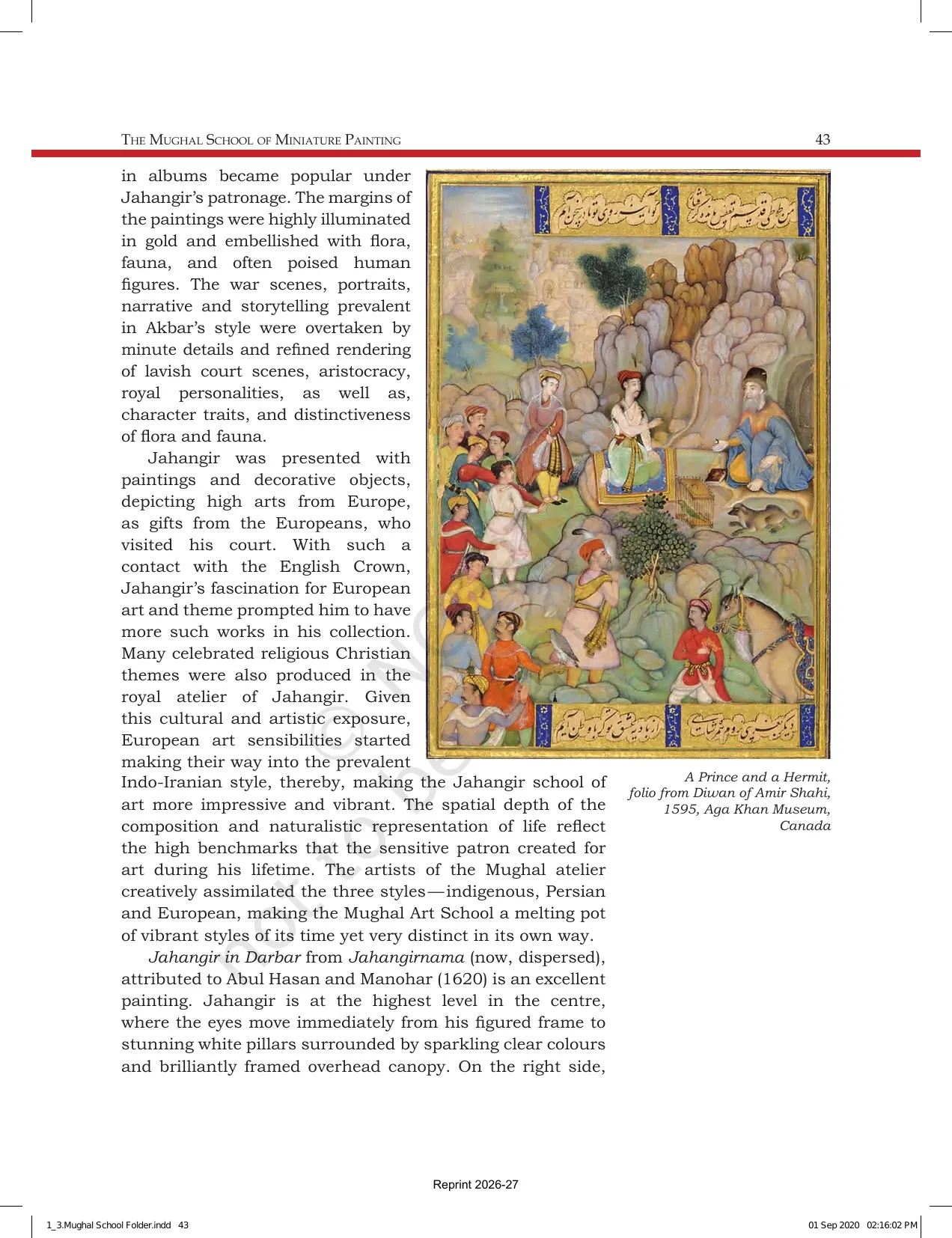


- Covers Mughal painting from Babur in 1526 to Bahadur Shah Zafar in the mid nineteenth century.
- Names you must be able to spell: Mir Sayyid Ali, Abd us Samad, Daswant, Basawan, Miskin, Abul Hasan, Bichitra and Ustad Mansur.
- Ends with 4 exercise questions, 1 student project and 4 painting appreciation plates.
This Mughal School of Miniature Painting chapter PDF is the unedited NCERT text page for page, checked against the Reprint 2026-27 print run, and paired here with an artist and painting index written by Collegedunia Fine Arts teachers.
What the Mughal School of Miniature Painting Class 12 PDF Contains
The chapter runs in a straight line from patron to patron. Read it once in order and the whole Mughal timeline sits in your head. The book breaks the material into five named blocks, and every board question comes out of one of them.
| Section in the PDF | What it covers | Question type it feeds |
|---|---|---|
| Opening on Mughal painting | Definition, dates, and why Mughal style holds a fixed place among Indian schools | 1 mark and 2 marks |
| Influences on Mughal Painting | The blend of indigenous, Persian and European visual culture in one atelier | 5 marks |
| Early Mughal Painting | Babur, Humayun, the two Persian masters, and the Nigaar Khana | 3 marks and 5 marks |
| Akbar, Jahangir, Shah Jahan and after | Hamza Nama, Razm Nama, the muraqqa albums, Padshahnama, Later Mughal decline | 5 marks, appreciation |
| Process, Colours and Technique | Tarh, chiharanama, rangamizi, pigments, brushes and the agate burnish | 3 marks |
After the exercise, the book adds four full page appreciations: Noah's Ark, Krishna Lifts Mount Govardhan, Falcon Perched on a Bird Rest and Zebra. These are the plates examiners pull the picture based questions from, so do not stop reading at the exercise.
Influences on Mughal Painting: How Persian, Indian and European Styles Met in One Studio
The book's central claim is simple. Mughal painting did not grow in a vacuum. It grew because Iranian and Indian artists sat in the same workshop and borrowed from each other, and later because European gifts arrived at court. The peak of Mughal painting is a blend of Islamic, Hindu and European visual culture.
- Indigenous Indian style: flat perspective, strong use of lines, a vivid colour palette, bold modelling of figures and architecture.
- Mughal style: subtlety and finesse, almost three dimensional figures, and what the book calls optical reality.
- Persian arrival: artists brought from Iran into formal court workshops, giving the early years a strong Indo-Iranian character.
- European entry: Christian themes, halos, winged angels and humanist mother and child compositions reaching the atelier through gifts.
- Favourite Mughal subjects: royal court scenes, portraits, and accurate flora and fauna.
The Mughal atelier was staffed by calligraphers, painters, gilders and binders. The paintings were meant for the royal family alone, and they lived inside manuscripts and albums rather than on walls.
Mughal School of Miniature Painting Explained in One Shot
Source: Cafe Pedia on YouTube
Early Mughal Painting Under Babur and Humayun with the Two Persian Masters
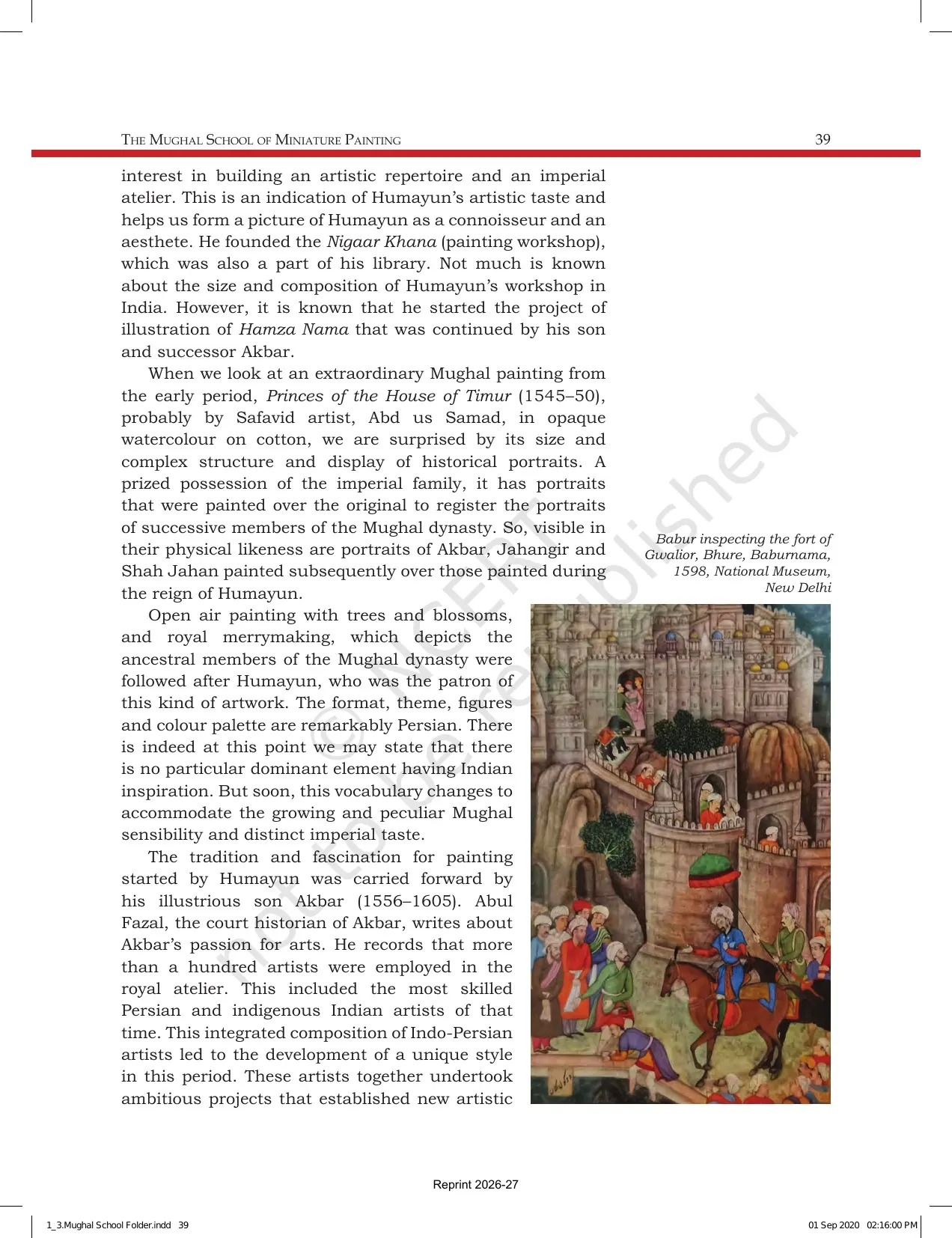
Babur reached India in 1526 from present day Uzbekistan, a descendant of Timur and a Chaghatai Turk. He was a man of letters and a patron of manuscripts, architecture and gardens. His autobiography, Baburnama, started the Mughal habit of keeping memoirs that every successor followed.
- Bihzad, master of the Persian school at Herat, is praised in Babur's memoirs for sophisticated compositions and colour tints, but criticised for lengthening the double chin, the ghab-ghab.
- Shah Muzaffar is named as a painter who excelled at hairstyle.
- Humayun succeeded Babur in 1530, was dethroned by Sher Khan, and took refuge with the Safavid ruler Shah Tahmasp.
- Humayun set up his court at Kabul in 1545 and brought master artists back with him when he regained power.
- He invited Mir Sayyid Ali and Abd us Samad, both respected for portraiture, and founded the Nigaar Khana, a painting workshop inside his library.
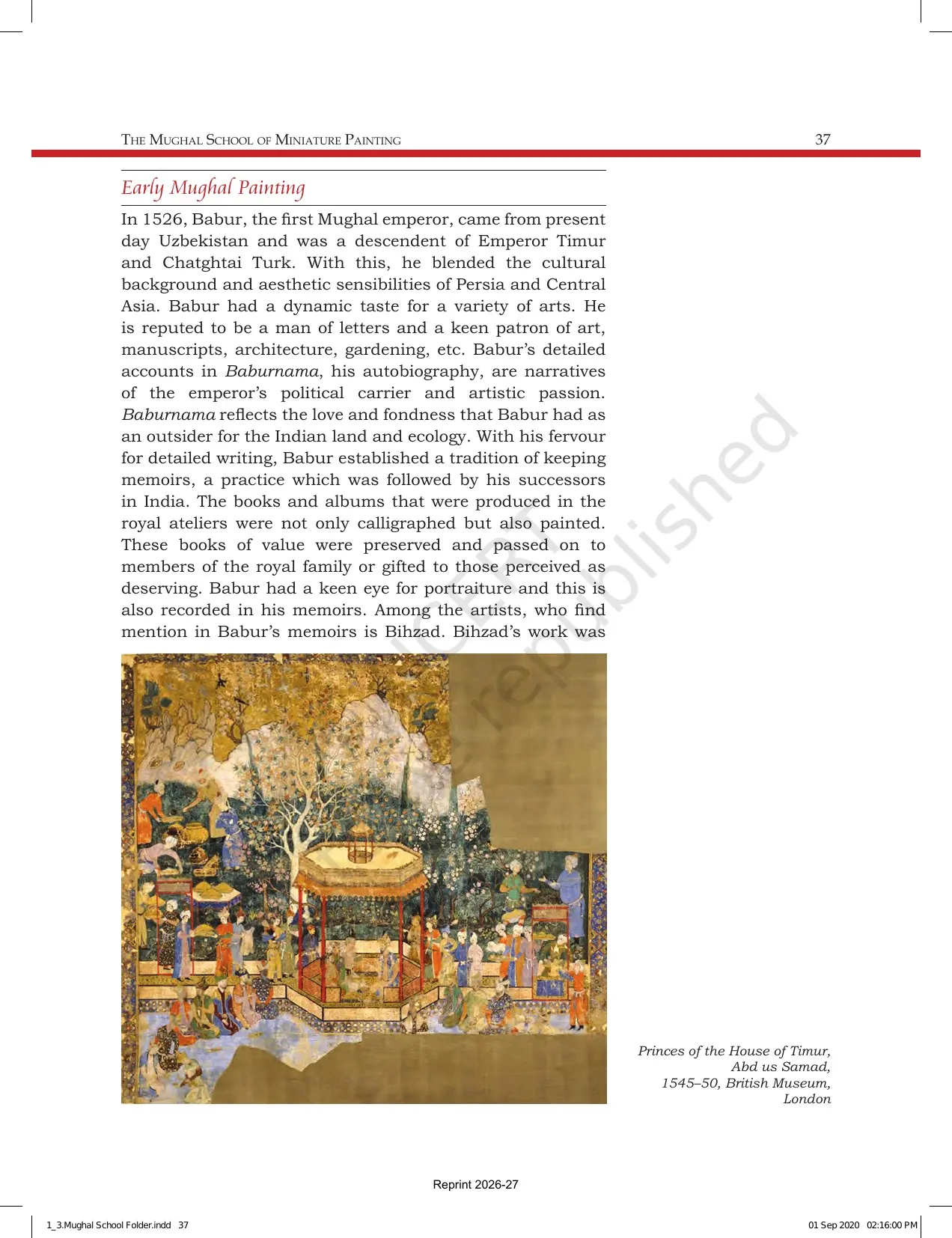
The key early painting is Princes of the House of Timur (1545 to 1550), probably by Abd us Samad, in opaque watercolour on cotton. Later hands repainted heads over the originals, so the faces of Akbar, Jahangir and Shah Jahan sit on a picture begun in Humayun's reign. Humayun also began the Hamza Nama project that his son finished.
Akbar's Atelier: Hamza Nama, Razm Nama and the Artists Who Made Them
Akbar ruled from 1556 to 1605 and turned a workshop into an industry. His court historian Abul Fazal records more than a hundred artists in the royal atelier, Persian and Indian together. The book notes that Akbar is believed to have had dyslexia, which is one reason he pushed illustrated manuscripts so hard.
| Project | Facts to quote | Artists |
|---|---|---|
| Hamza Nama | 14 volumes, 1400 illustrations, about 15 years, dated 1567 to 1582. Large format, cloth base with paper behind, gouache technique. | Supervised by Mir Sayyid Ali and Abd us Samad |
| Razm Nama | Persian translation of the Mahabharata, completed 1589, ornate calligraphy, 169 paintings | Supervised by Daswant |
| Ramayana in Persian | Translated and illustrated around the same years as the Razm Nama | Govardhan and Miskin praised for court scenes |
| Akbar Nama | Detailed account of Akbar's political and personal life, one of his most expensive projects | Team of the imperial atelier |
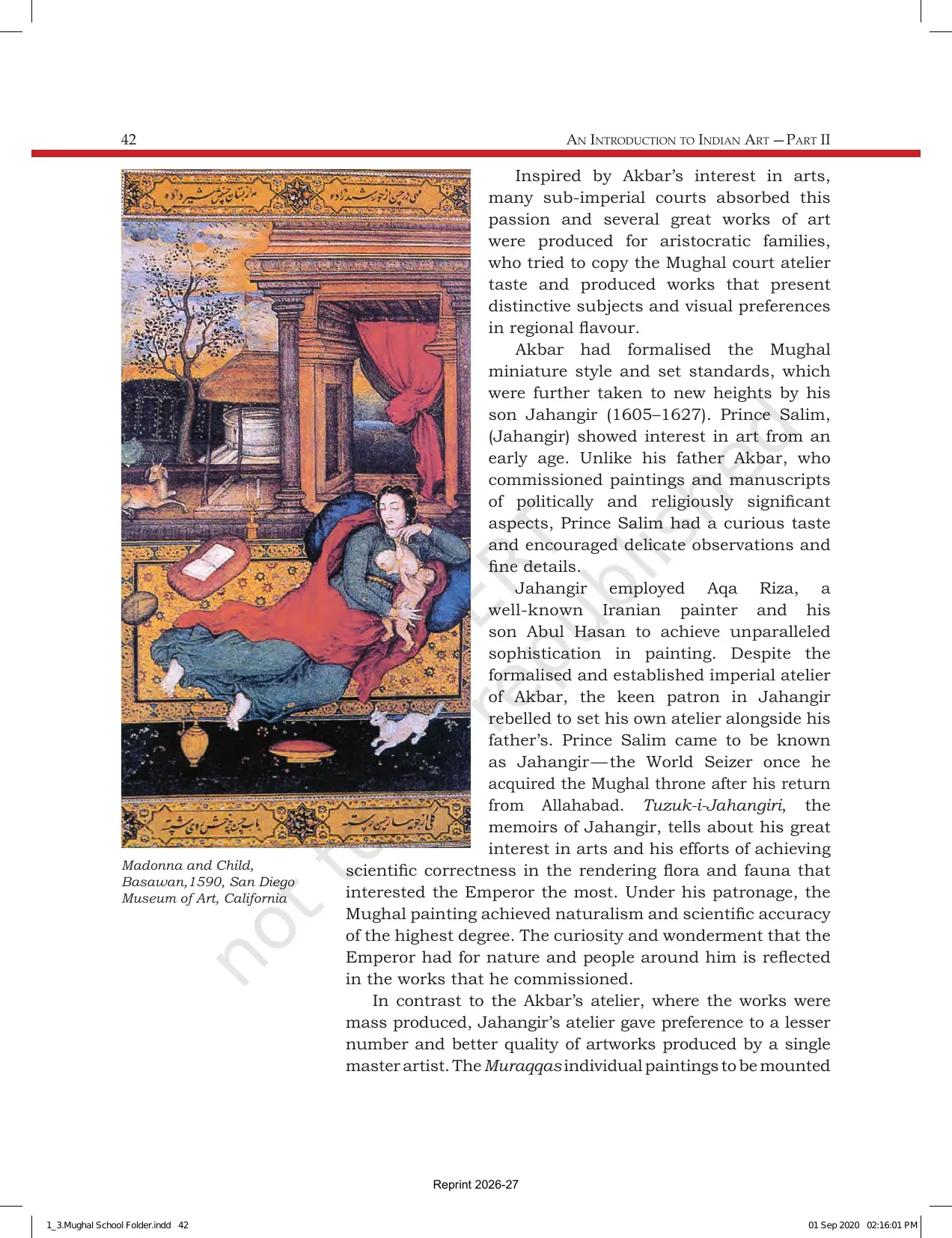
| Madonna and Child | Opaque watercolour on paper, dated 1580 in the text, plate credited to Basawan. Byzantine and Renaissance sources made Indian by the fan and the jewellery. | Basawan |
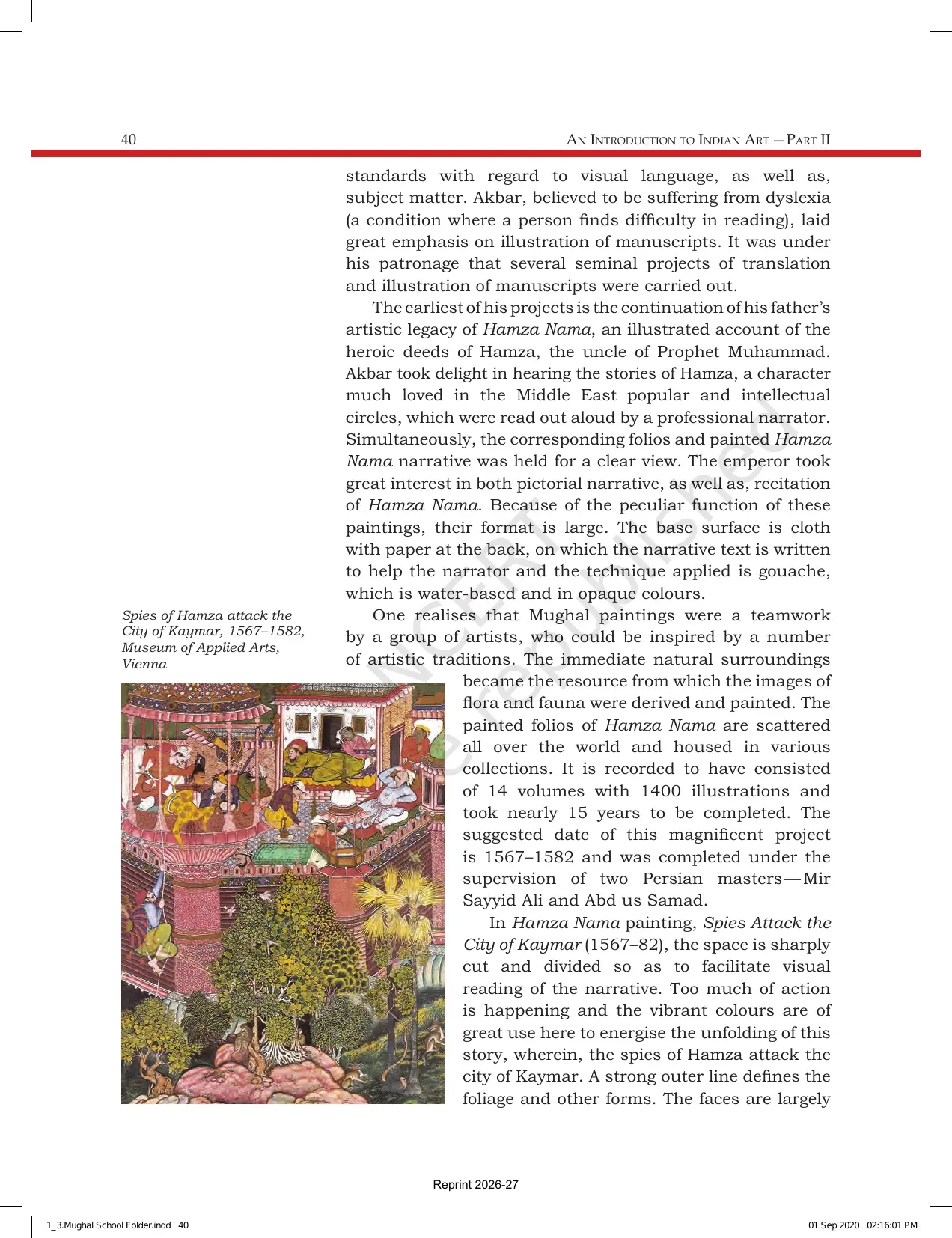
For the picture question, learn Spies of Hamza Attack the City of Kaymar. The space is sharply cut and divided so the story can be read panel by panel. Faces are mostly in profile with some three quarter views. The intricate floor, column and canopy patterns and the four limbed animals come from Persian sources, while the trees, creepers and the palette of pure yellows, reds and browns are Indian.
Jahangir's Naturalism: Ustad Mansur, Abul Hasan and the Muraqqa Albums
Jahangir ruled from 1605 to 1627 and swapped quantity for quality. Where Akbar's studio mass produced narrative folios, Jahangir wanted fewer works, each finished by a single master. His memoirs, the Tuzuk-i-Jahangiri, record his hunger for scientific accuracy in flora and fauna.
- Aqa Riza, an Iranian painter, and his son Abul Hasan were employed by Jahangir, who kept his own atelier alongside his father's.
- Muraqqas, single paintings mounted into albums, became the favoured format, with margins illuminated in gold and filled with flora, fauna and poised figures.
- Jahangir in Darbar (1620), attributed to Abul Hasan and Manohar, places Khurram in attendance with his son Shuja, and even names Father Corsi, a Jesuit priest, in an inscription.
- Jahangir's Dream (1618 to 1622) by Abul Hasan shows the emperor embracing his rival Shah Abbas, standing on a lion while the Persian Shah stands on a sheep, under a golden halo held by two winged angels.
- Jahangir Enthroned on an Hourglass (1625) by Bichitra puts the painter himself in the corner holding his offering, with the Ottoman Sultan and King James I of England on the right.
Abul Hasan carried the title Nadir al Zaman, the Wonder of the Age. Ustad Mansur carried the parallel title Nadir ul Asr. Mixing up the two titles is the single most common slip in this chapter, so fix them now.
Shah Jahan, Dara Shikoh and the Slow Fade of Later Mughal Painting
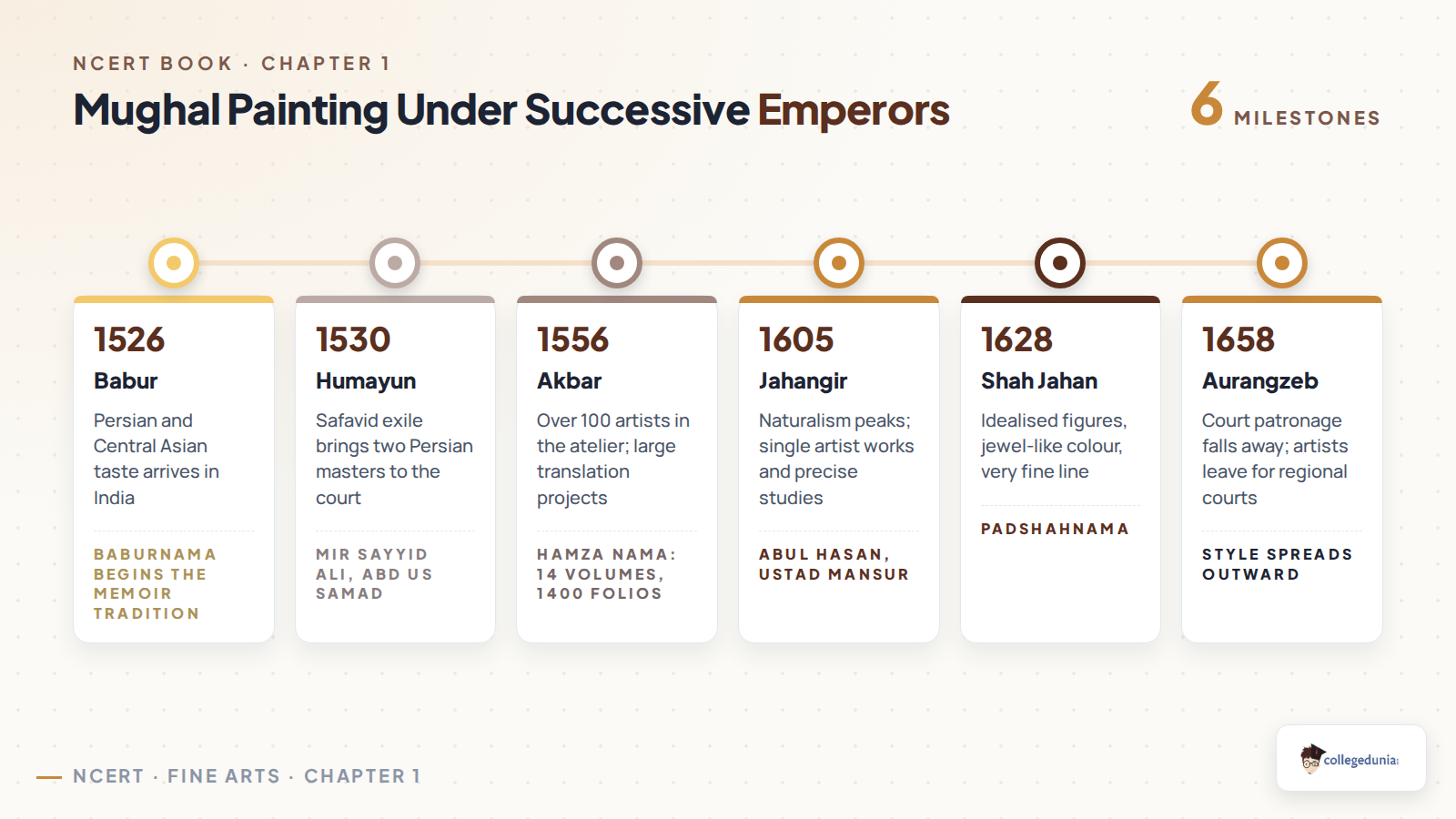
Shah Jahan, born Prince Khurram, ruled from 1628 to 1658. He inherited a stable empire and the finest atelier in Asia, then pushed it away from naturalism. Idealisation and stylisation won over accurate recording, and the paintings turned to jewel like colours and intricate fine lines.
- Padshahnama, The Chronicles of the King, is the flagship project of his reign and the high water mark of Indian miniature painting.
- Rembrandt studied Indian drawings and was deeply influenced by Mughal court painting, which shows how far the style travelled.
- Dara Shikoh with Sages in a Garden (1635) by Bichitra records the Sufi and Vedantic scholar prince who knew Sanskrit and was defeated by Aurangzeb.
- Aurangzeb spent his energy on expansion and did not push the atelier, but the book is clear that the royal workshop was not shut down at once.
- Skilled artists moved to provincial Mughal courts, and the style finally merged into the Provincial and Company Schools.
The last named work is the Bahadur Shah Zafar portrait of 1838, painted about two decades before the last Mughal ruler was exiled to Burma after the failure of the Indian Revolt of 1857. He was a poet and scholar as well as an emperor.
Process, Colours and Technique of Mughal Miniature Painting
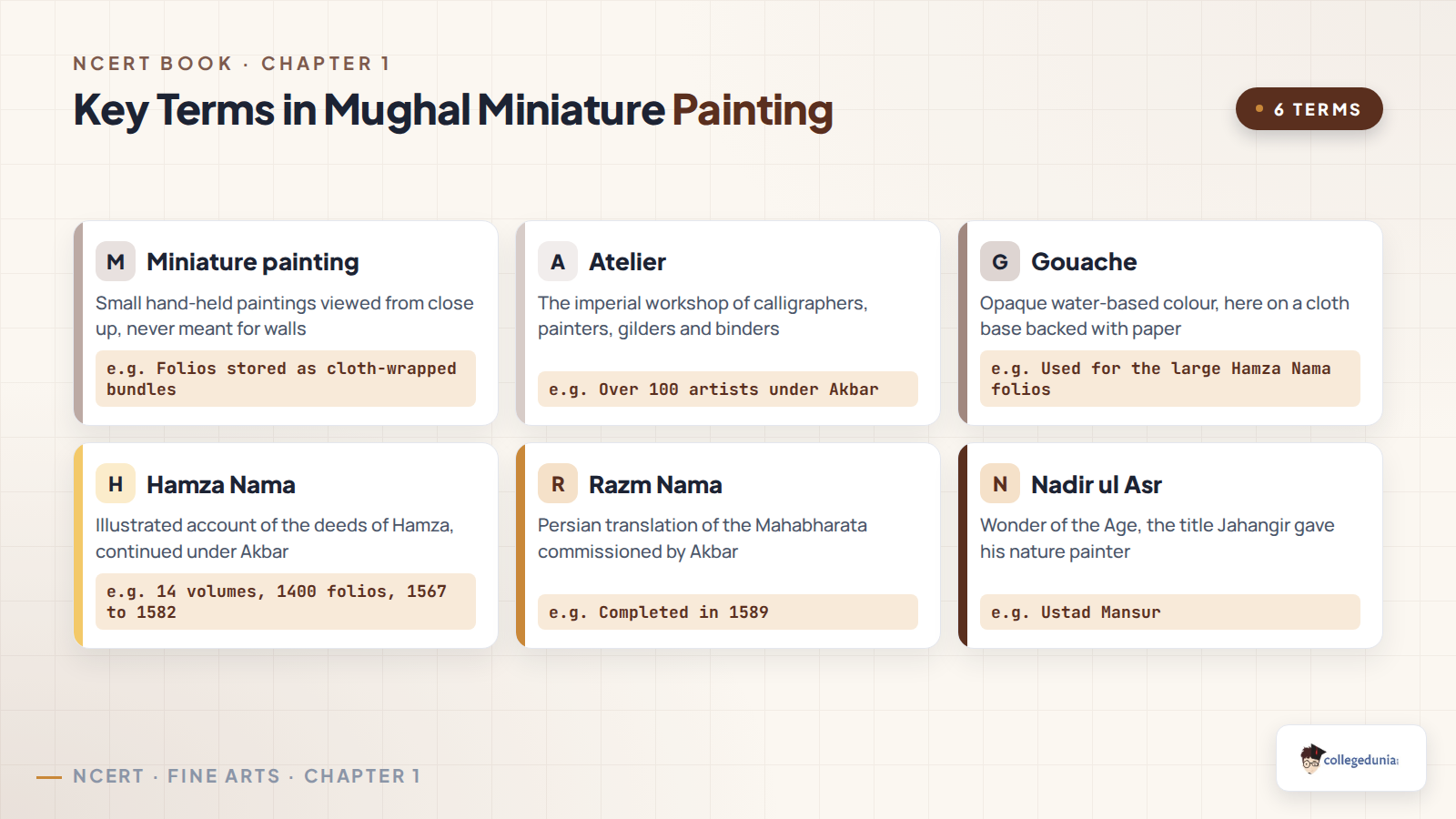
This short section is worth an easy 3 marks and students skip it. The book gives the exact order in which a folio was built, and the exact Persian words for the three stages. Learn the sequence as words, not as a vague idea.
- Handmade paper sheets were prepared and cut to the size of the manuscript.
- Space was left blank for the painting, then the pages were ruled and the text was written in.
- The written page went to the artist, who composed a short visual version of that text.
- Tarh, the composition stage, came first.
- Chiharanama, the portrait stage, came next.
- Rangamizi, the colouring stage, finished the folio.
Colour making was part of the artist's craft. Brushes were made from the hair of squirrels or kittens, and the finished painting was burnished with agate, a gemstone, to set the colours. Work was usually split across a team, with one hand on the draft, another grinding and filling colour and a third adding detail, and artists were paid increments for good work.
| Colour | Source named in the NCERT text |
|---|---|
| Vermilion | Cinnabar |
| Ultramarine | Lapis lazuli |
| Bright yellow | Orpiment |
| White | Ground shells |
| Lampblack | Charcoal |
| Metallic finish | Gold and silver powders mixed in or sprinkled |
Named Paintings You Must Be Able to Appreciate in the Board Answer
Fine Arts appreciation questions want four things every time: title, artist, date and collection, then two or three lines on what you see. The table below is the whole plate list from the chapter in that shape, so you can revise it as flashcards.
| Painting | Artist and date | Collection |
|---|---|---|
| Princes of the House of Timur | Abd us Samad, 1545 to 1550 | British Museum, London |
| Spies of Hamza Attack the City of Kaymar | Akbar's atelier, 1567 to 1582 | Museum of Applied Arts, Vienna |
| Madonna and Child | Basawan | San Diego Museum of Art, California |
| Jahangir in Darbar | Abul Hasan and Manohar, 1620 | Museum of Fine Arts, Boston |
| Jahangir's Dream | Abul Hasan, 1618 to 1622 | Smithsonian Institution, Washington |
| Jahangir Enthroned on an Hourglass | Bichitra, 1625 | Smithsonian Institution, Washington |
| Dara Shikoh with Sages in a Garden | Bichitra, early seventeenth century | Chester Beatty Library, Dublin |
| Noah's Ark | Ascribed to Miskin, from a Divan-i Hafiz manuscript of 1590 | Freer Gallery of Art, Smithsonian Institution |
| Krishna Lifts Mount Govardhan | Attributed to Miskin, 1585 to 1590 | Metropolitan Museum of Art, New York |
| Falcon Perched on a Bird Rest | Ustad Mansur, 1615 | Cleveland Museum of Art, Ohio |
| Bahadur Shah Zafar | Unnamed artist, 1838 | Fogg Museum of Art, Cambridge |
Two extra details score well. Badauni, the orthodox scholar in Akbar's court, translated the Harivamsa Purana into Persian, which is the source of the Krishna painting. The Zebra came from Ethiopia, was presented to Jahangir at Nowruz in March 1621, and was painted by Ustad Mansur before being sent on to Shah Abbas.
The Four Exercise Questions at the End of the Mughal School Chapter
The chapter closes with four exercise questions and one project. None of them can be answered from a summary alone, so keep the PDF open while you write.
- Name two master artists invited to India by Humayun and discuss their masterpieces in detail. Answer with Mir Sayyid Ali and Abd us Samad.
- Pick your favourite Akbar project and explain what you like about it. The Hamza Nama gives you the most facts to quote.
- Make a list of artists in the Mughal court and describe one painting of each in about 100 words.
- Using three paintings, discuss the indigenous Indian, Persian and European elements of the medieval period.
The project asks you to pick five quotations, translate them, and build your own manuscript page with calligraphy and ornate borders in the Mughal manner. Schools often mark this in the practical file, so do not leave it out.
Common Mistakes Students Make in the Mughal School of Miniature Painting Chapter
Watch out for these six:
- Writing that Akbar started the Hamza Nama. Humayun started it, Akbar finished it.
- Swapping the two titles. Abul Hasan is Nadir al Zaman; Ustad Mansur is Nadir ul Asr.
- Calling Razm Nama a translation of the Ramayana. It is the Mahabharata.
- Saying Aurangzeb closed the royal atelier. The book says it was not shut down immediately.
- Giving the Hamza Nama figures loosely. Quote 14 volumes and 1400 illustrations.
- Skipping the collection name in an appreciation answer. Title, artist, date and museum together carry the mark.
Student Feedback on the Mughal School of Miniature Painting Chapter
What 11,540 students told us about this chapter
- 64% of the students surveyed said artist names, not dates, were the hardest thing to hold in the Mughal chapter.
- Only 29% could write the three stage order of tarh, chiharanama and rangamizi correctly on the first try.
- Students who wrote out the plate table by hand twice reported the fastest recall in the appreciation question.
- Most skipped section: Process, Colours and Technique, left unread by roughly 1 in 3 students.
Source: Collegedunia Class 12 Fine Arts student survey taken before the 2026-27 board exams. Sample of 11,540 students from CBSE schools across 14 states.
How to Revise the Mughal School Chapter in a Three Block Plan
This chapter is name heavy but short. About three focused hours makes it board ready, and the order printed in the book gives you the sequence for free.
- Block 1, 60 minutes. Read the opening and the Influences section. Write the indigenous style against the Mughal style in two columns from memory.
- Block 2, 70 minutes. Read Babur through Akbar. Write the Hamza Nama and Razm Nama fact cards, then describe the Kaymar painting in six lines.
- Block 3, 50 minutes. Read Jahangir to Bahadur Shah Zafar plus the technique section. Write the three stages and the six pigment sources without looking, then check.
Repeat Block 3 a week before the paper. The pigment list and the stage names are the cheapest marks in the chapter, and they disappear fastest if you leave them alone.
How the Mughal School Chapter PDF Works with the Fine Arts Revision Notes
The chapter PDF gives you the full official text and every plate. It does not give you a compressed one page recall sheet. That sits on the notes pages for the same subject, and using both together is faster than reading either one alone.
| Resource | What it adds beyond this chapter PDF | Link |
|---|---|---|
| Revision Notes | The artist and painting index, the three stage process and the pigment table condensed for a last read | The Mughal School of Miniature Painting Class 12 Notes |
| Next chapter notes | How the Deccan courts kept their own idiom until the Mughals moved south | The Deccan Schools of Painting Class 12 Notes |
| Comparison partner | The Rajasthani courts that borrowed Mughal finish while keeping indigenous flat colour | The Rajasthani Schools of Painting Class 12 Notes |
Also Check: read the Mughal chapter first and the Deccan chapter straight after. The examiner's comparison question almost always sets one against the other.
All 8 Chapters of Class 12 Fine Arts with NCERT Book PDFs
The Class 12 Fine Arts course runs across eight chapters. Every link below opens the official NCERT chapter PDF for the 2026-27 session.
| Chapter | NCERT Book PDF |
|---|---|
| Chapter 1 | The Mughal School of Miniature Painting Class 12 PDF |
| Chapter 2 | The Deccan Schools of Painting Class 12 PDF |
| Chapter 3 | The Rajasthani Schools of Painting Class 12 PDF |
| Chapter 4 | The Pahari Schools of Painting Class 12 PDF |
| Chapter 5 | The Bengal School and Cultural Nationalism Class 12 PDF |
| Chapter 6 | Modern Indian Art Class 12 PDF |
| Chapter 7 | The Company School Class 12 PDF |
| Chapter 8 | Living Art Traditions of India Class 12 PDF |
The Mughal School of Miniature Painting Class 12 Fine Arts NCERT Book PDF FAQs
Questions Class 12 Students Ask Most About the Mughal School Chapter
Ques. What is the Mughal School of Miniature Painting?
Ans. It is the style of miniature painting that developed in the northern Indian subcontinent in the sixteenth century and continued till the middle of the nineteenth century. It is known for sophisticated technique and a wide range of subjects. Its importance is that it blended indigenous Indian, Persian and later European visual culture into one court style that shaped the schools of painting that came after it.
Ques. Who were the two Persian artists invited to India by Humayun?
Ans. Mir Sayyid Ali and Abd us Samad. Humayun met them during his exile at the court of the Safavid ruler Shah Tahmasp and brought them back when he regained power. Both were respected for portraiture, and both later supervised the Hamza Nama project in Akbar's atelier.
Ques. How many illustrations does the Hamza Nama have?
Ans. The Hamza Nama is recorded as having 14 volumes with 1400 illustrations, and it took nearly 15 years to complete. The suggested date is 1567 to 1582. It illustrates the heroic deeds of Hamza, the uncle of Prophet Muhammad, and was painted in gouache on a cloth base backed with paper so a narrator could read the text from behind.
Ques. What is the Razm Nama?
Ans. The Razm Nama is the Persian translation and illustrated version of the Mahabharata commissioned by Akbar. It was completed in 1589 under the supervision of the master artist Daswant, was scribed in ornate calligraphy, and contains 169 paintings. The Ramayana was translated and illustrated around the same period.
Ques. What are the three stages of making a Mughal painting?
Ans. Tarh, the composition stage, comes first. Chiharanama, the portrait stage, comes second. Rangamizi, the colouring stage, finishes the work. Before any of that, handmade paper was cut to the manuscript size, space was left for the picture, and the text was written in so the artist could compose a visual version of it.
Ques. Which colours were used in Mughal miniature painting and where did they come from?
Ans. The colours were opaque and made from natural sources. Vermilion came from cinnabar, ultramarine from lapis lazuli, bright yellow from orpiment, white from ground shells and lampblack from charcoal. Gold and silver powders were mixed in or sprinkled on. Brushes were made from squirrel or kitten hair, and the finished painting was burnished with agate to set the colours.
Ques. How was painting under Jahangir different from painting under Akbar?
Ans. Akbar's atelier mass produced narrative folios of conquests, court scenes and translated epics. Jahangir preferred fewer works of higher quality finished by a single master artist. Muraqqa albums with gold illuminated margins replaced long manuscripts, and the subjects moved towards portraits, court life and scientifically accurate flora and fauna.
Ques. Who painted Jahangir's Dream and what does it show?
Ans. Abul Hasan painted it between 1618 and 1622. Jahangir embraces the Persian Safavid emperor Shah Abbas, his rival for Qandahar. Jahangir stands on a powerful lion and Shah Abbas on a docile sheep, both on a globe, under a golden halo of the Sun and Moon held by two winged angels. The angels and halo show European motifs entering the Mughal court.
Ques. Who was Ustad Mansur and what did he paint?
Ans. Ustad Mansur was Jahangir's specialist in flora and fauna, given the title Nadir ul Asr, meaning Wonder of the Age. He painted Falcon Perched on a Bird Rest in 1615, now in the Cleveland Museum of Art. He also painted the Zebra brought from Ethiopia and presented to Jahangir during Nowruz in March 1621.
Ques. What happened to Mughal painting after Aurangzeb?
Ans. Patronage weakened, so skilled artists left the imperial atelier and were welcomed by provincial Mughal rulers who wanted their own courts recorded. Some masterworks still appeared under Muhammad Shah Rangila, Shah Alam II and Bahadur Shah Zafar, whose 1838 portrait is the last plate in the chapter. The style eventually merged into the Provincial and Company Schools.
Ques. Is the Mughal School of Miniature Painting part of the 2026-27 Class 12 Fine Arts syllabus?
Ans. Yes. It is part of An Introduction to Indian Art Part 2, the Class 12 Fine Arts textbook, in the Reprint 2026-27 edition. The chapter covers influences on Mughal painting, early Mughal painting, the reigns of Akbar, Jahangir and Shah Jahan, Later Mughal painting, and the process, colours and technique sections, followed by four exercise questions.
Ques. How do I download the Mughal School of Miniature Painting NCERT Book PDF?
Ans. Use the PDF viewer at the top of this page. It carries the official NCERT chapter exactly as printed, with all plates and captions, so you can read the whole chapter online or save it for offline revision before the 2026-27 board exams. No sign up is needed.



Comments