




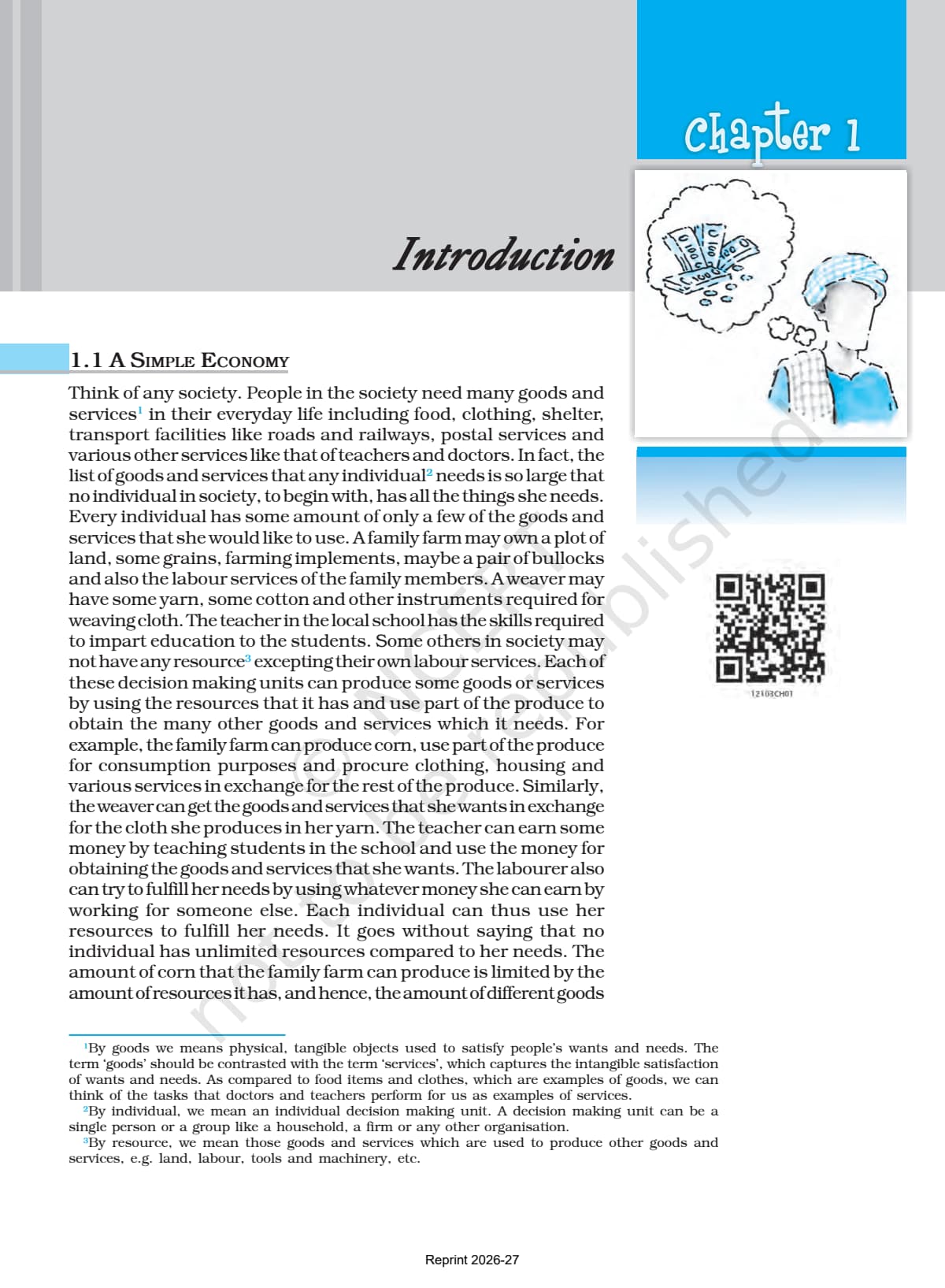
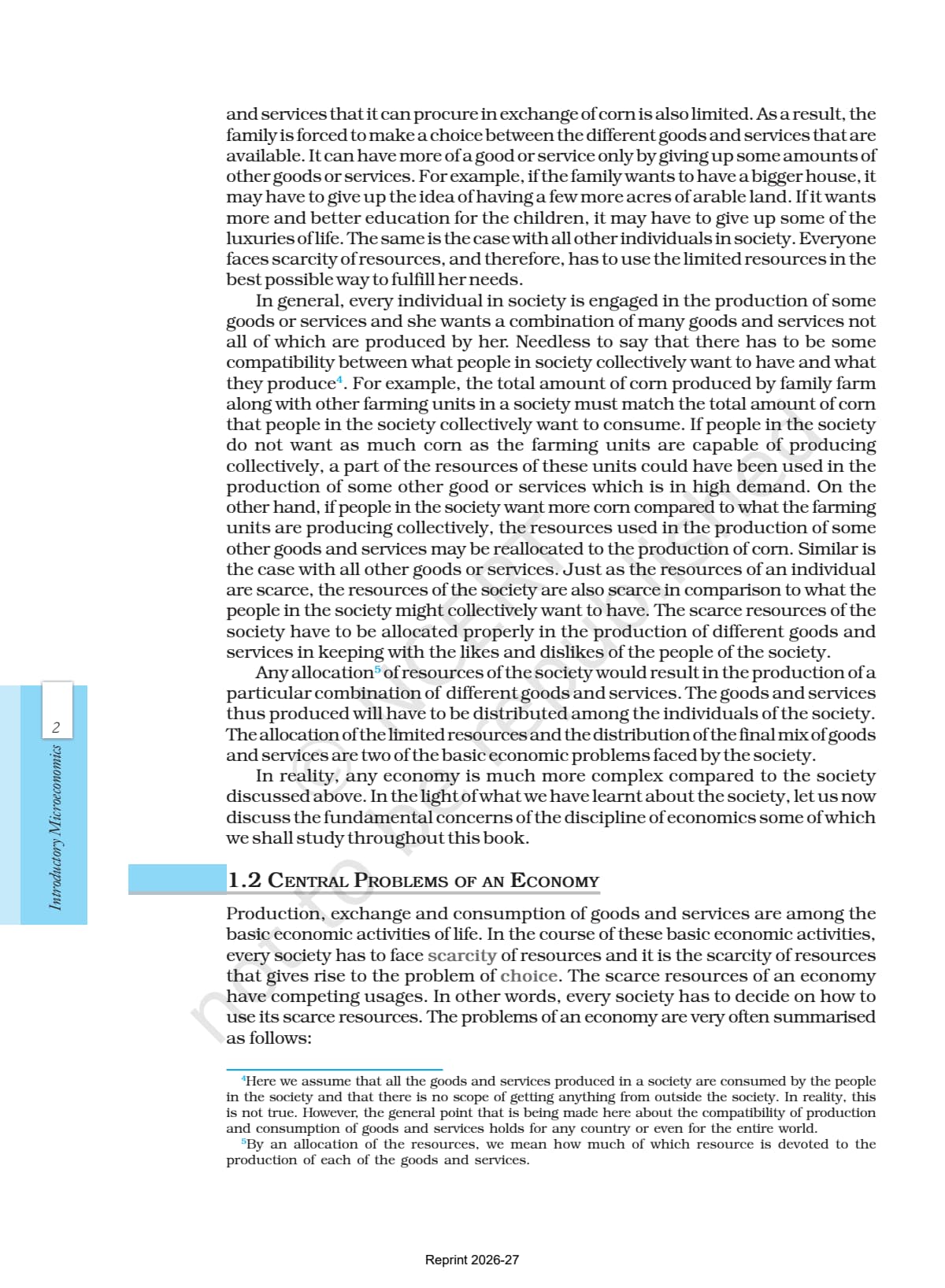
Class 12 Economics Chapter 1 Introduction to Microeconomics is the first chapter of the Introductory Microeconomics book. It covers scarcity, the three central problems, the production possibility frontier, opportunity cost, and the micro versus macro split. This page hosts the official NCERT chapter PDF to read or download free.
Here is what this chapter is worth in the exam:
- CBSE Boards: about 4 to 6 marks, mostly short theory plus one PPF question.
- CUET: 2 to 3 questions each year on the basic concepts.
- File: single-chapter PDF leec201, aligned to the 2026-27 syllabus.
What the NCERT Class 12 Economics Chapter 1 PDF Covers
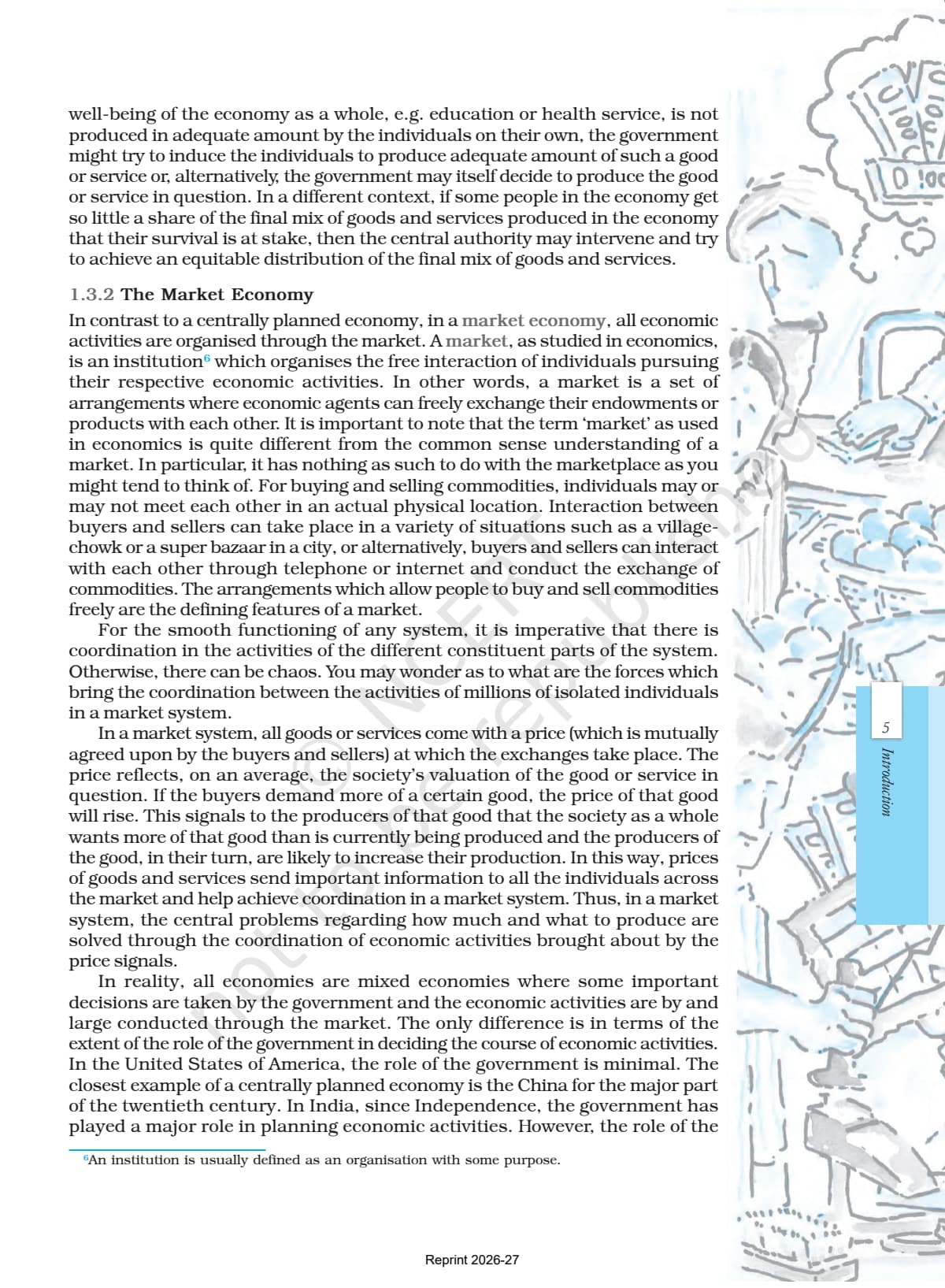
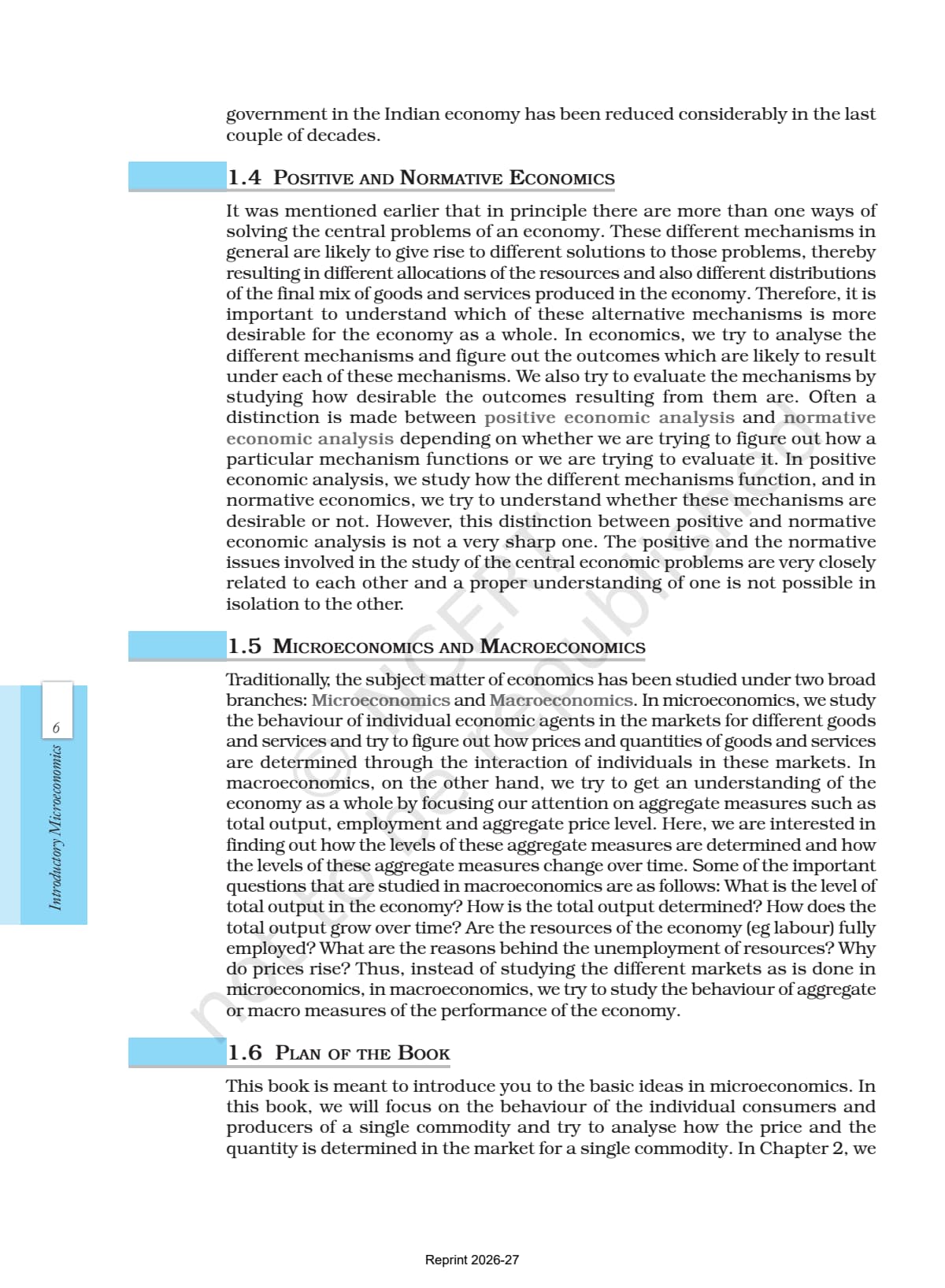
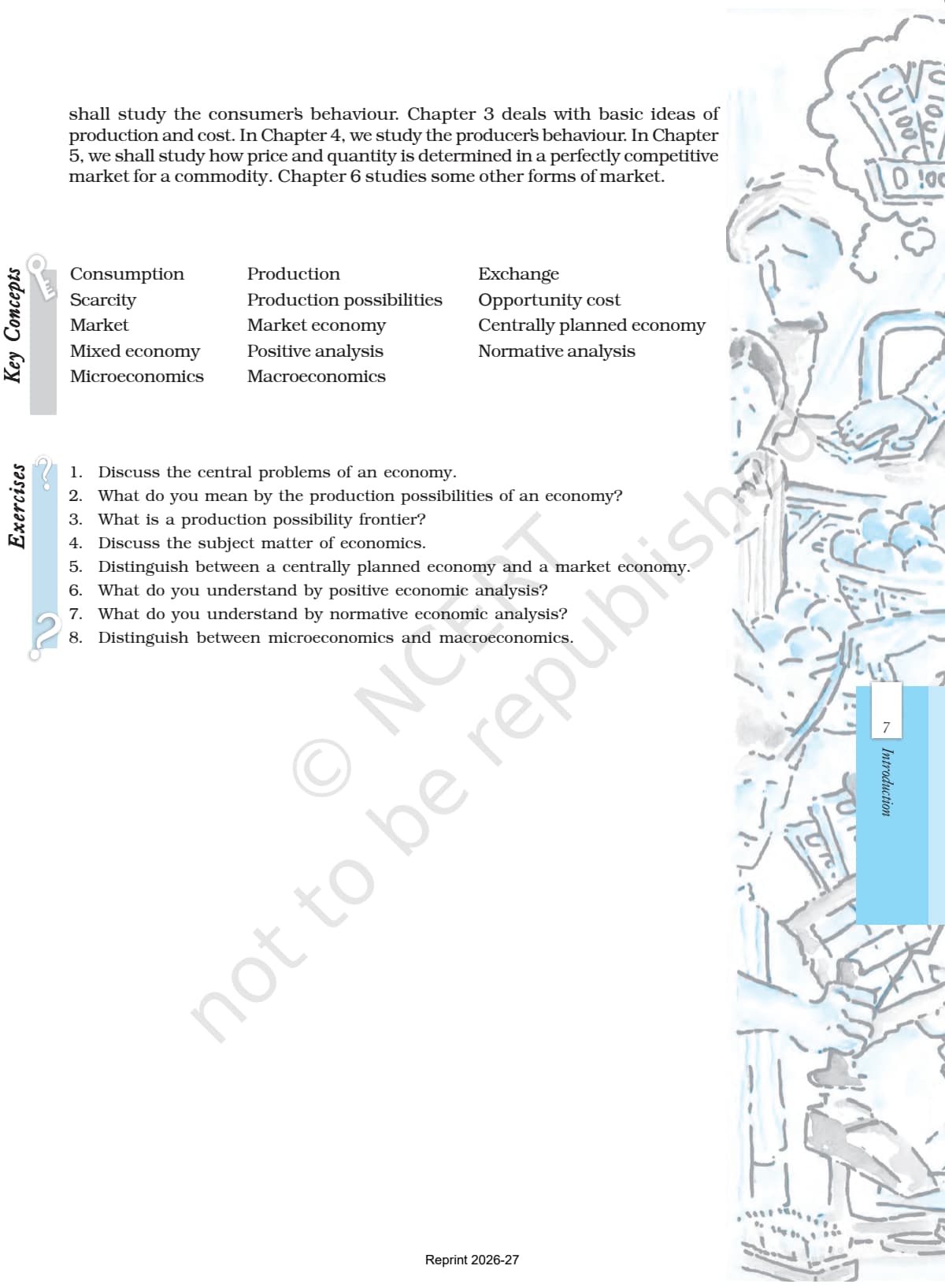
This PDF is the official source text for the chapter. CBSE sets every theory question from its exact wording, so it is the first thing students should read. It moves from a simple economy to the three central problems, then to the PPF, and finally to how an economy organises production.
Read it before any reference book. Books like Sandeep Garg rewrite the chapter and skip parts like the planned versus market versus mixed economy comparison. The official textbook keeps the canonical phrasing that the board marking scheme rewards.
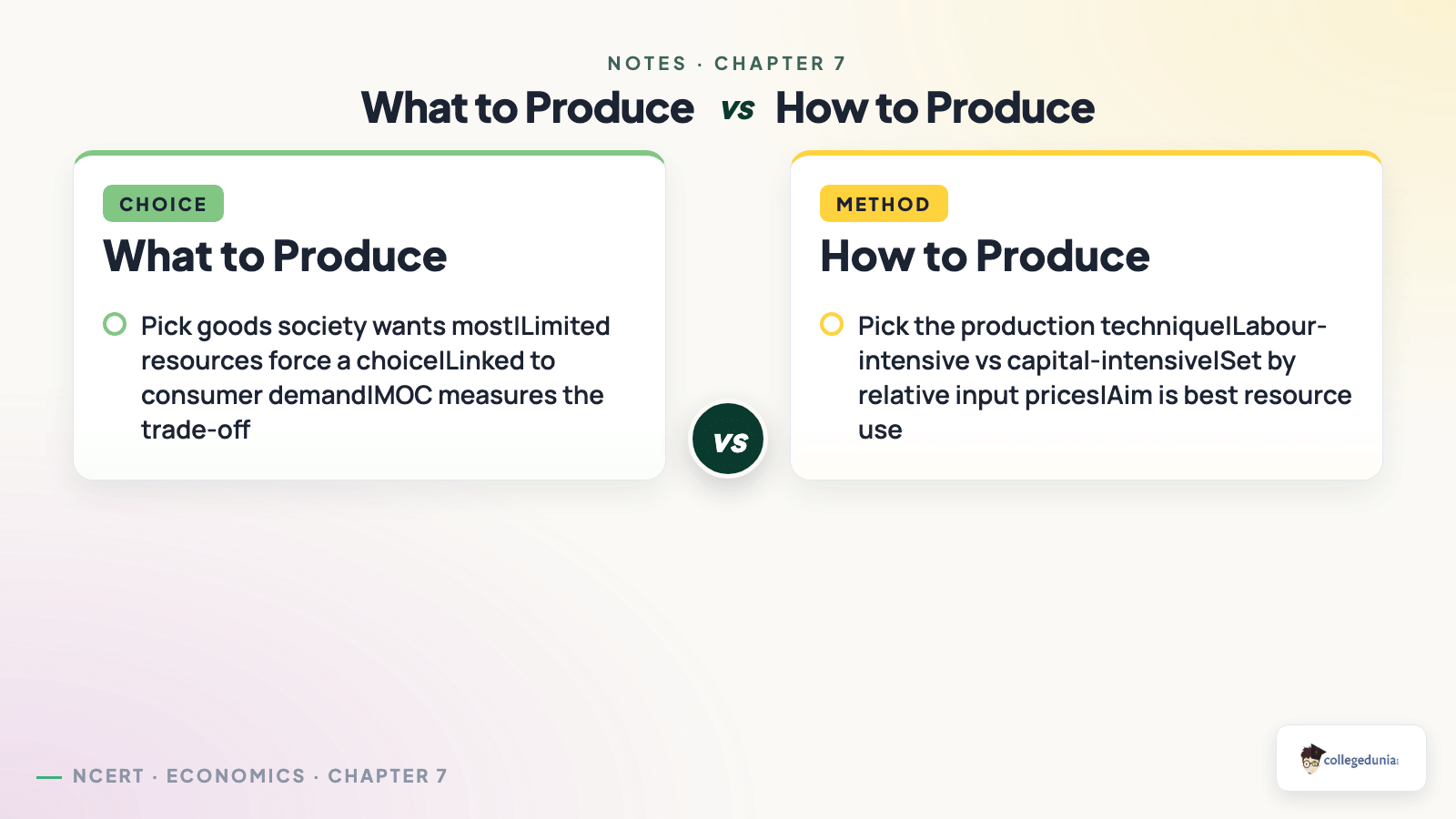
Three Central Problems in Class 12 Economics Chapter 1
Every economy must choose because resources are scarce. The chapter frames this as three questions: what to produce, how to produce, and for whom to produce. Each later chapter of the book is a deeper answer to one of these three.
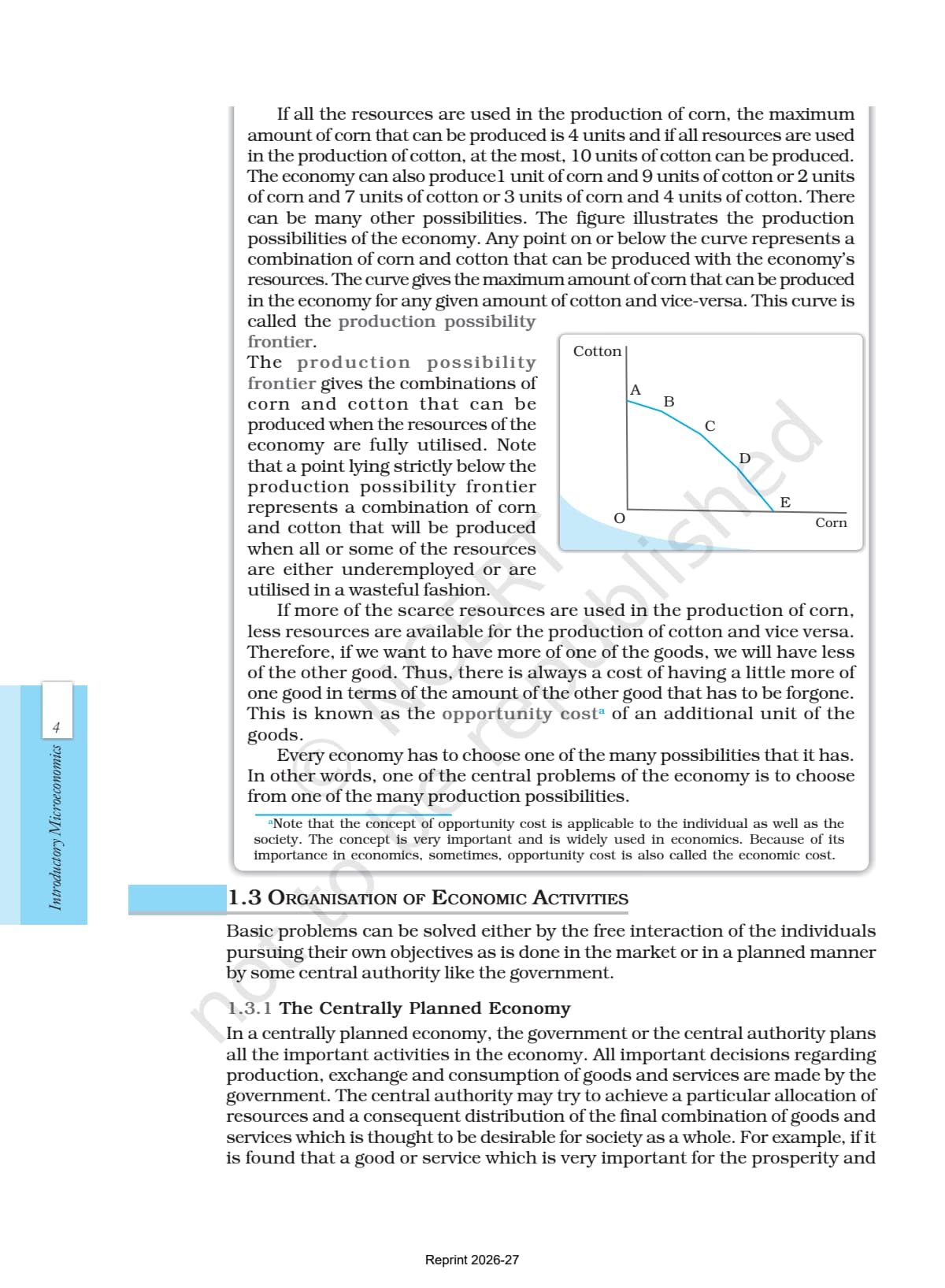
The PDF also explains the three ways to organise these choices. A centrally planned economy lets a central authority decide. A market economy lets prices decide. A mixed economy uses both, and India is one.
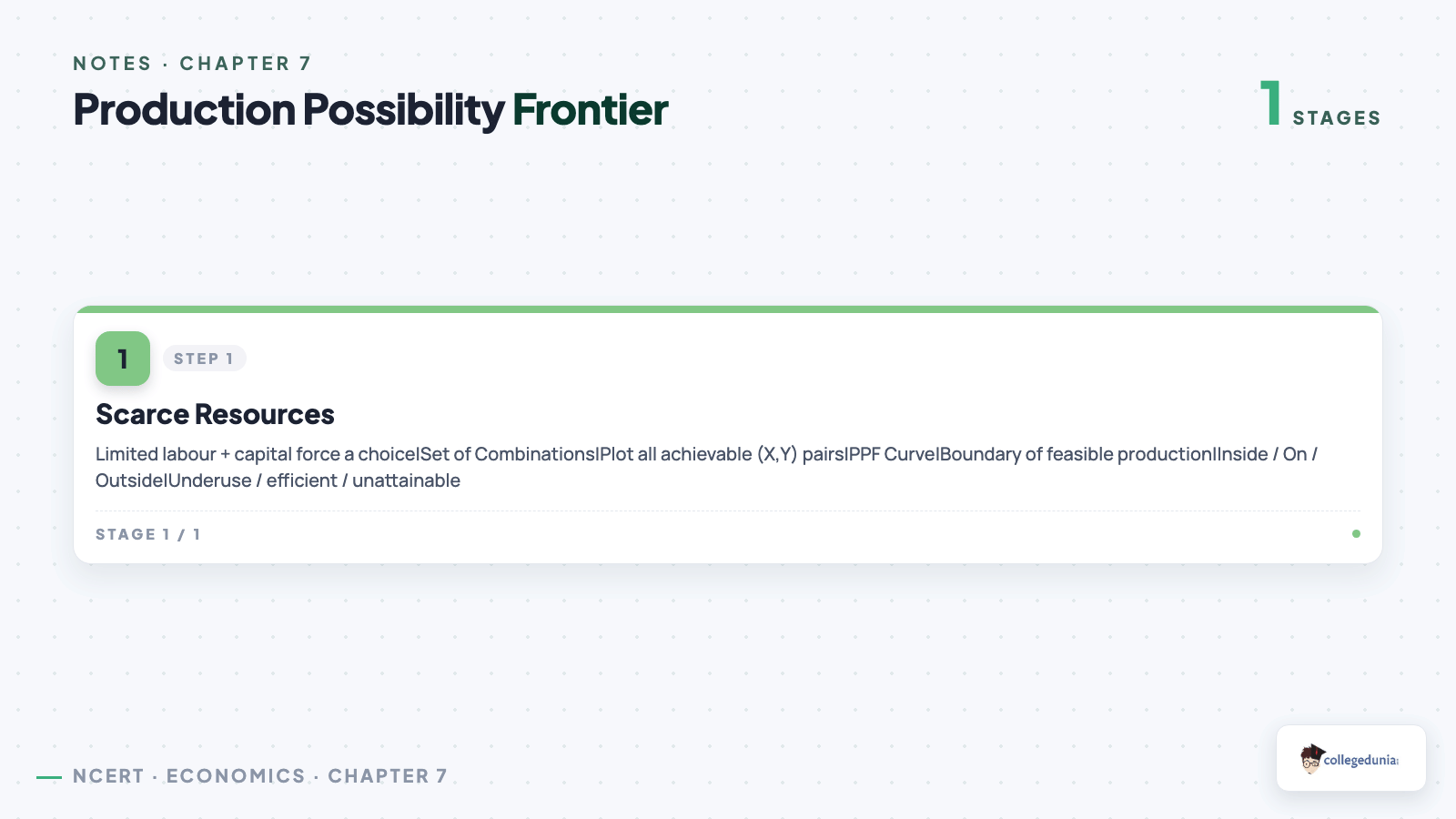
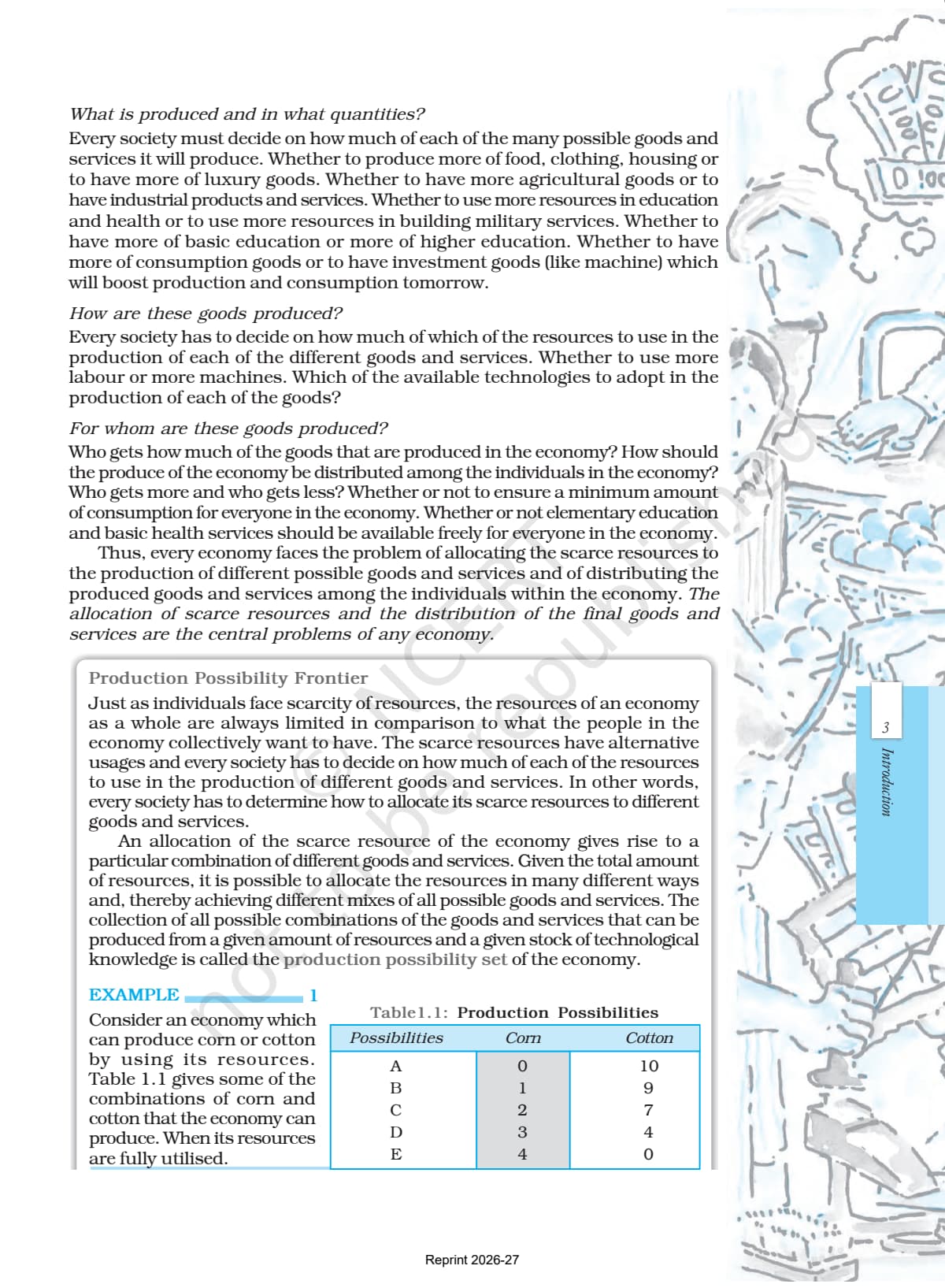
Production Possibility Frontier and Opportunity Cost in Chapter 1
The production possibility frontier shows the largest output of two goods an economy can make when all resources are used fully. Its slope is the opportunity cost, the next-best good given up to make one more unit.
The curve is concave to the origin because resources are not equally good at both goods. So each extra unit of one good costs more of the other. A point inside the curve means idle resources, and a point outside is not possible right now.
Topics in Introduction to Microeconomics Class 12 NCERT Book
The chapter splits into five numbered sections. The table maps each one to its main exam concept so students can match their notes to the PDF.
| Section | NCERT sub-topic | Main exam concept |
|---|---|---|
| 1.1 | A simple economy | Scarcity and factors of production |
| 1.2 | Central problems of an economy | What, how and for whom to produce |
| 1.2.1 | Organisation of economic activities | Planned vs market vs mixed economy |
| 1.3 | Positive and normative economics | Statements of fact vs value |
| 1.4 | Microeconomics and macroeconomics | Single units vs the whole economy |
Introduction to Microeconomics Class 12 Video Lesson
Source: EB Commerce : Edu Aditya on YouTube
Why Read the Introduction to Microeconomics NCERT PDF Directly
The board paper draws its theory questions from the exact phrasing of this chapter, not from any reference book. The planned versus market economy comparison and the positive versus normative split both live only in the NCERT prose, and both show up often in the exam.
The official PPF diagram is also the one printed in the marking scheme. Students who have seen it in the PDF draw cleaner, better-labelled answers than students who only saw a reference-book redraw.
Previous Year Question Trends for Class 12 Economics Chapter 1
The chapter has averaged about 4 marks across recent CBSE papers. The table shows the pattern students should expect for the 2026-27 paper.
| Year | Marks | Question types | Most common topic |
|---|---|---|---|
| 2025 | 4 | 1 MCQ + short answer + PPF sketch | Opportunity cost on the PPF |
| 2024 | 6 | 1 short + 1 long answer | Planned vs market economy |
| 2023 | 4 | 2 MCQs + 1 short answer | Three central problems |
| 2022 | 3 | 1 short answer + 1 MCQ | Micro vs macroeconomics |
Student Feedback
We asked 10,800 Class 12 students about this chapter. 82% said the NCERT PDF was their main study source, and those who paired it with the matching Solutions scored about 1 mark higher on questions from this chapter than students who used a reference book alone.
Other Resources for Class 12 Economics Chapter 1
Pair this PDF with the Solutions, Notes and handwritten notes below for full chapter coverage.
| Resource | What it covers | Open |
|---|---|---|
| NCERT Book PDF | Official NCERT Microeconomics Chapter 1 textbook. | Chapter 1 NCERT Book PDF |
| NCERT Solutions | Step-by-step answers to every exercise question. | Chapter 1 NCERT Solutions |
| Notes | Concept-first revision of the full chapter. | Chapter 1 Notes |
| Handwritten Notes | Scanned notebook pages for last-mile revision. | Chapter 1 Handwritten Notes |
All Chapters: Class 12 Economics NCERT Book PDF
| Chapter | NCERT Book PDF |
|---|---|
| Chapter 1 | Introduction to Microeconomics |
| Chapter 2 | Theory of Consumer Behaviour |
| Chapter 3 | Production and Costs |
| Chapter 4 | Theory of the Firm under Perfect Competition |
| Chapter 5 | Market Equilibrium |
Class 12 Economics Chapter 1 Introduction to Microeconomics NCERT Book PDF FAQs
Ques. Where can students download the NCERT Class 12 Economics Chapter 1 PDF?
Ans. Students can download the official Introduction to Microeconomics PDF from the download card at the top of this page. It is the single-chapter file leec201 from the NCERT Introductory Microeconomics textbook, aligned to the 2026-27 CBSE syllabus.
Ques. What are the three central problems of an economy?
Ans. The three central problems are what to produce, how to produce, and for whom to produce. They arise because resources are scarce relative to wants. The exact NCERT wording sits in Section 1.2 of the chapter, and CBSE rewards this phrasing.
Ques. What is the Production Possibility Frontier in this chapter?
Ans. The PPF is the curve showing every combination of two goods an economy can make when all resources are used fully. Its slope is the opportunity cost, and it is concave because resources are not equally good at both goods.
Ques. What is the difference between microeconomics and macroeconomics?
Ans. Microeconomics studies one unit, like a consumer, a firm or a single market. Macroeconomics studies the whole economy, like national income, prices and jobs. The two branches work together and differ only in scale.
Ques. How much weightage does Chapter 1 carry in the CBSE board paper?
Ans. Across recent CBSE papers the chapter has averaged about 4 marks, from one-mark MCQs to four-mark theory or PPF questions. The most common type asks students to state the three central problems or to sketch the PPF and explain its concave shape.



Comments