




The Class 12 Computer Science Chapter 3 Stack NCERT Book PDF is the official textbook chapter that introduces the stack data structure and the LIFO rule. This page lets students download the original Chapter 3 text, code listings and figures for the 2026-27 CBSE syllabus, so the append() and pop() examples come straight from the source.
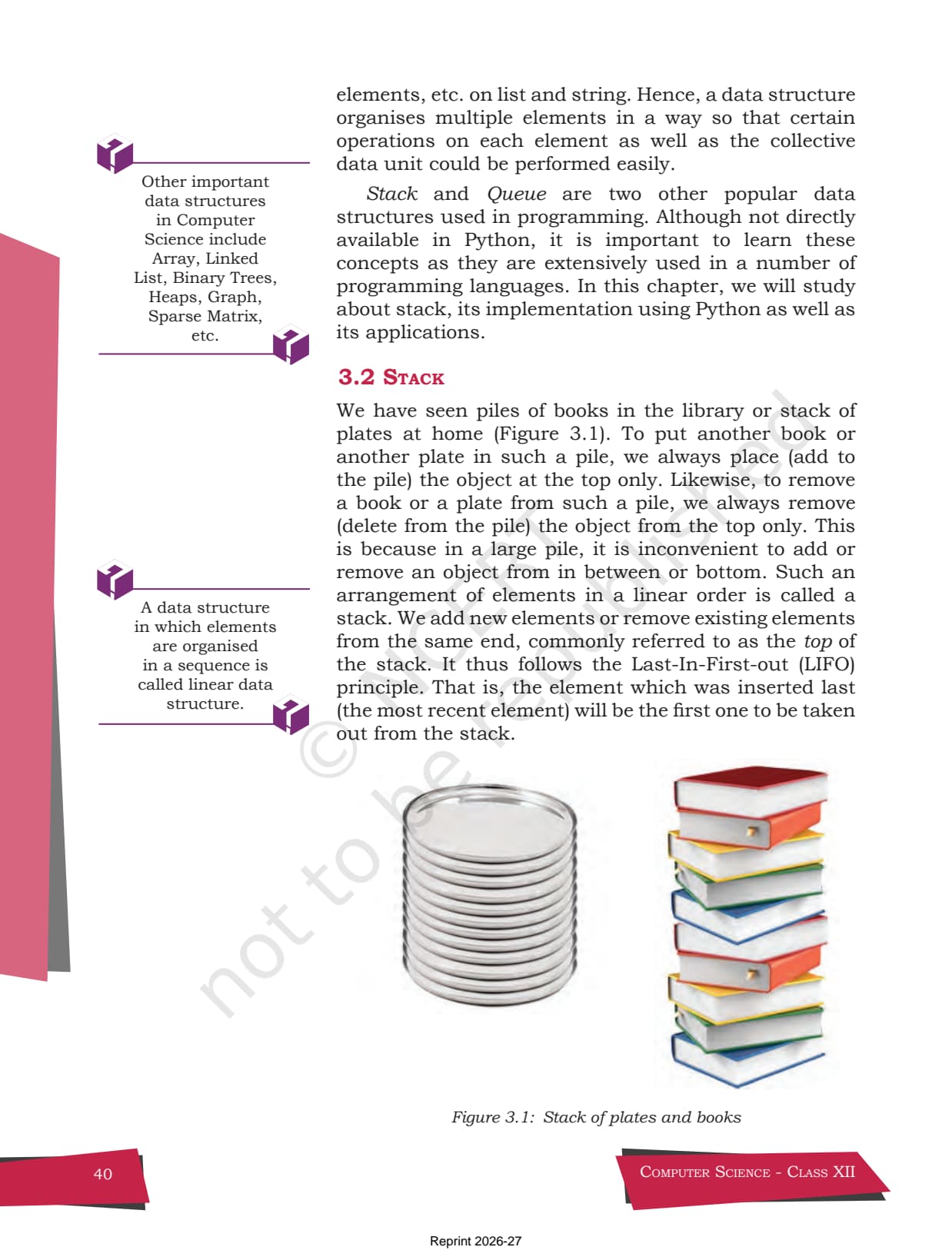
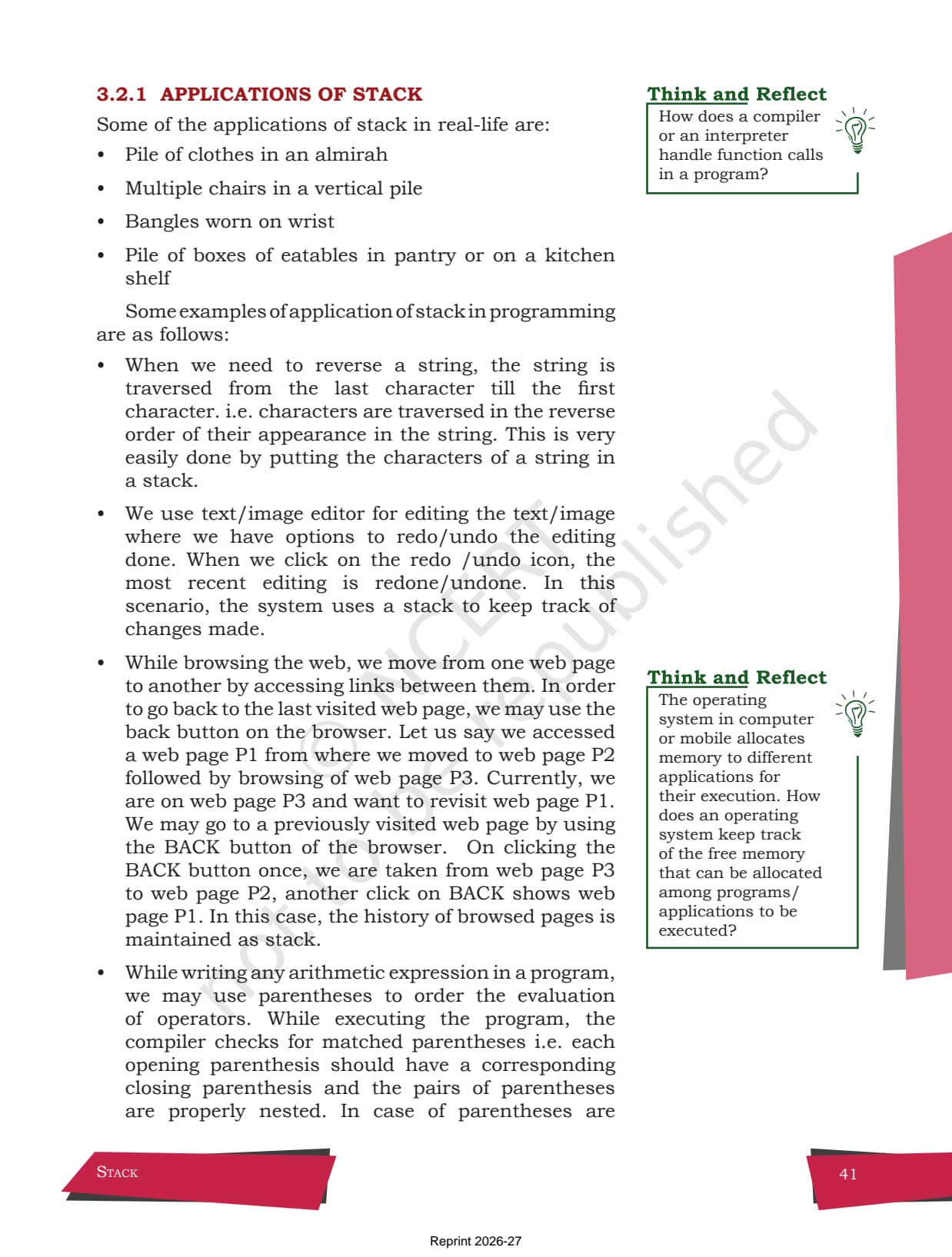
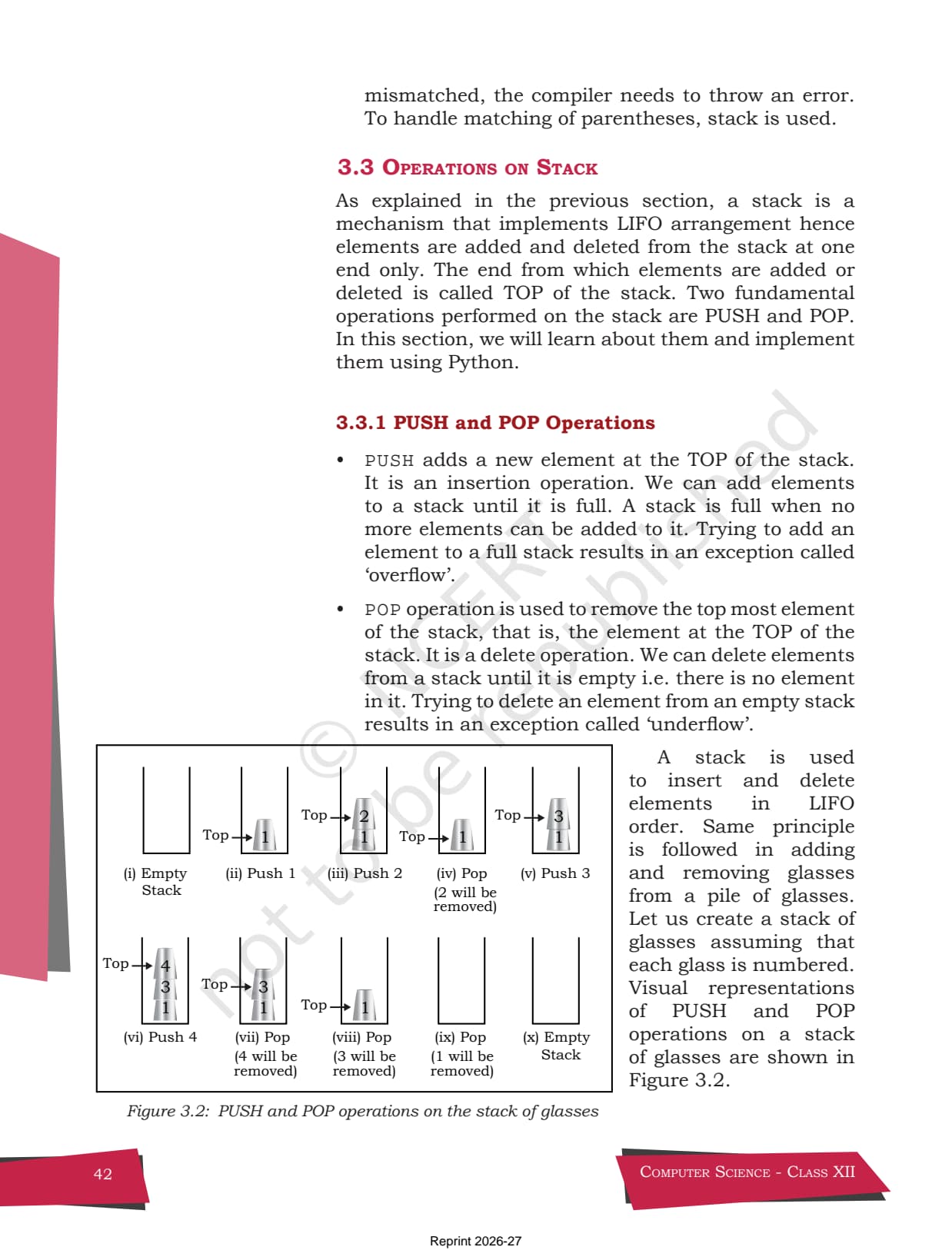
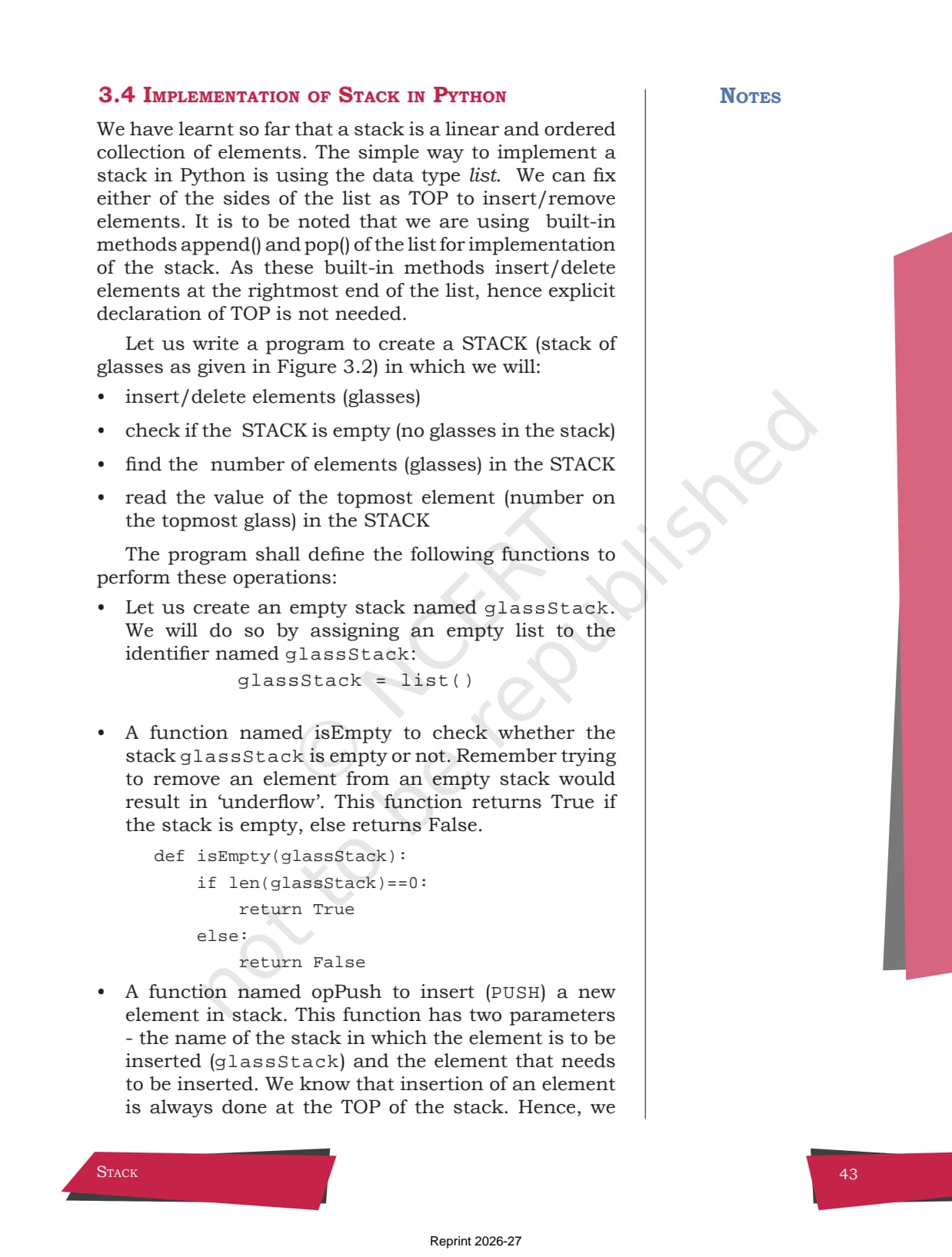
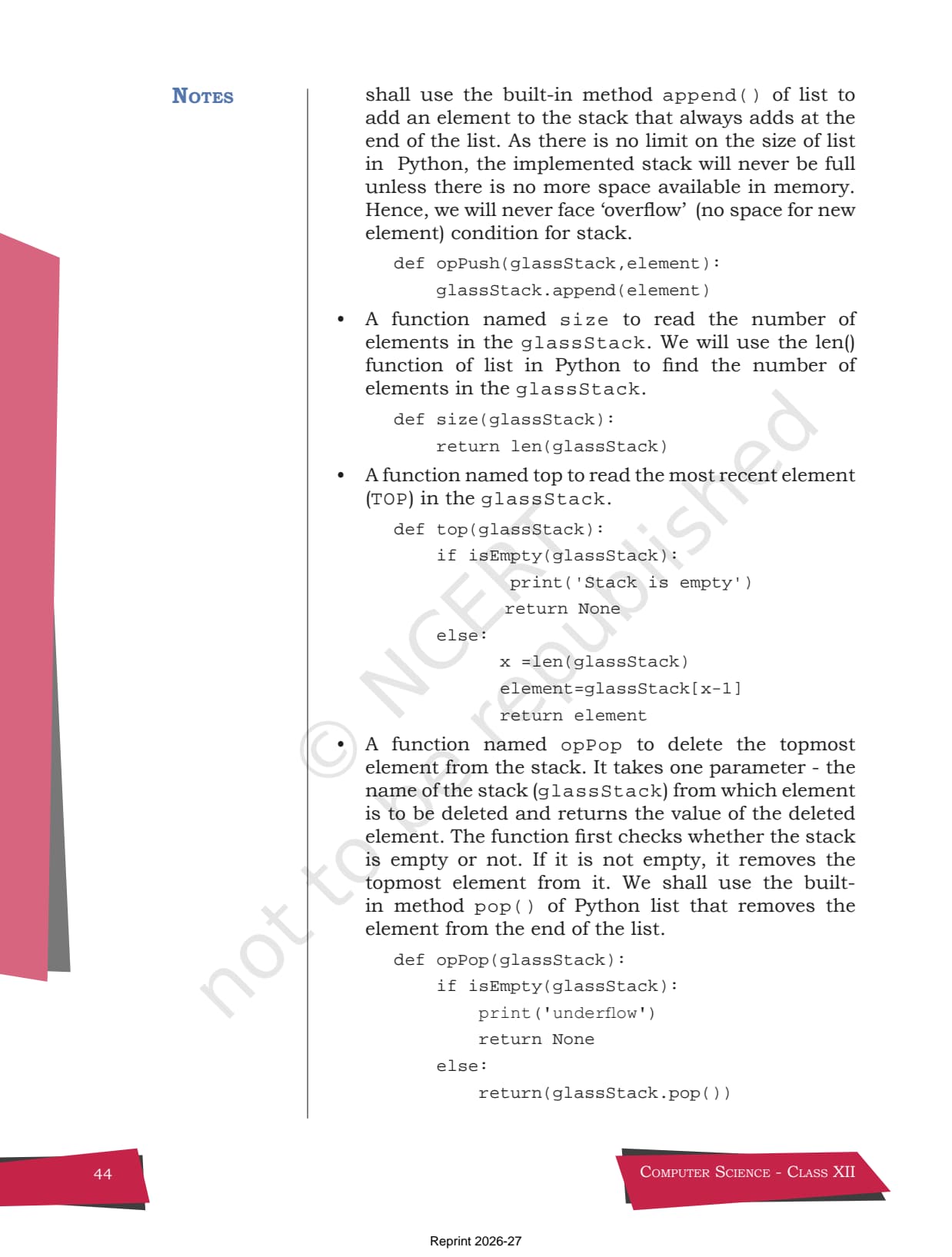
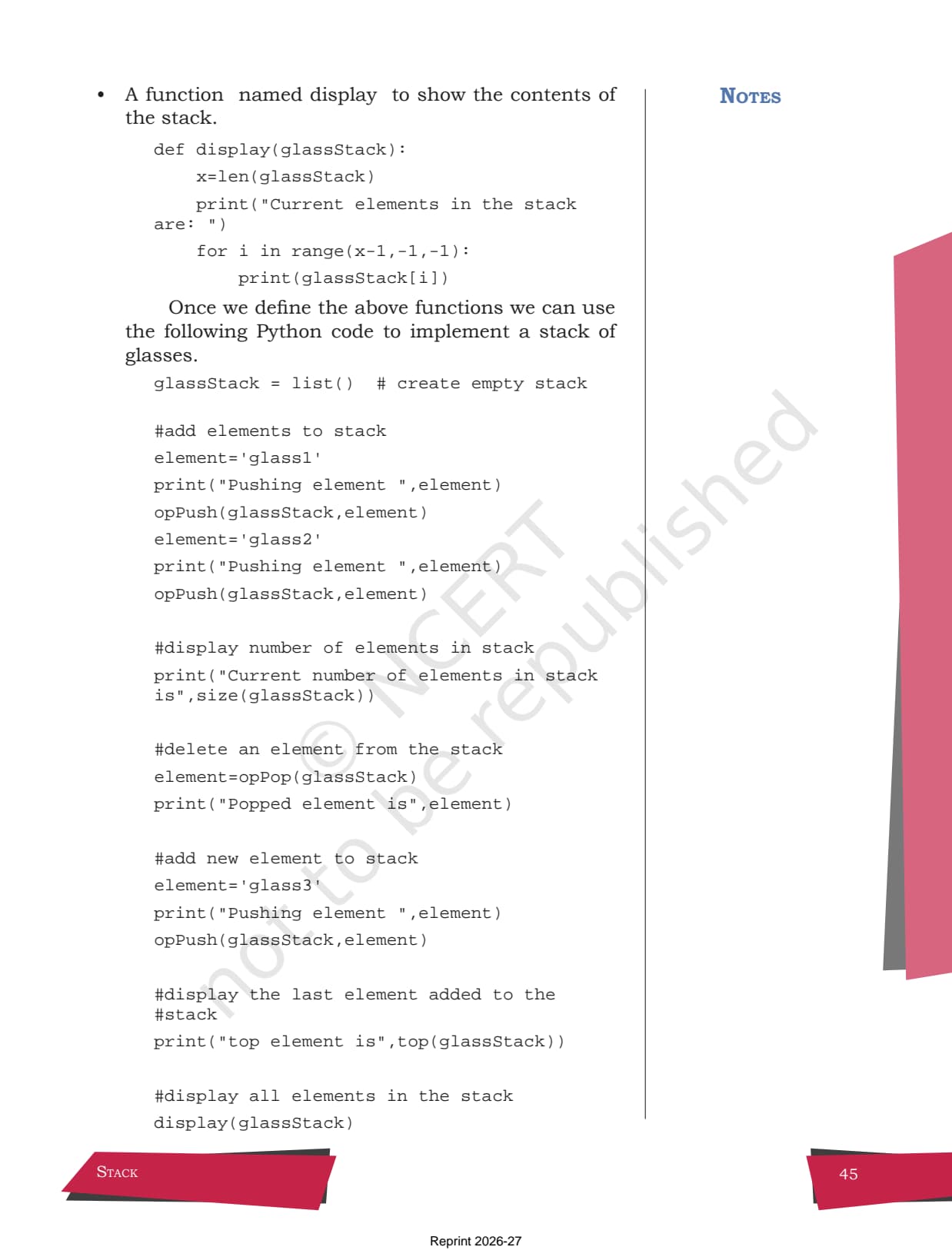
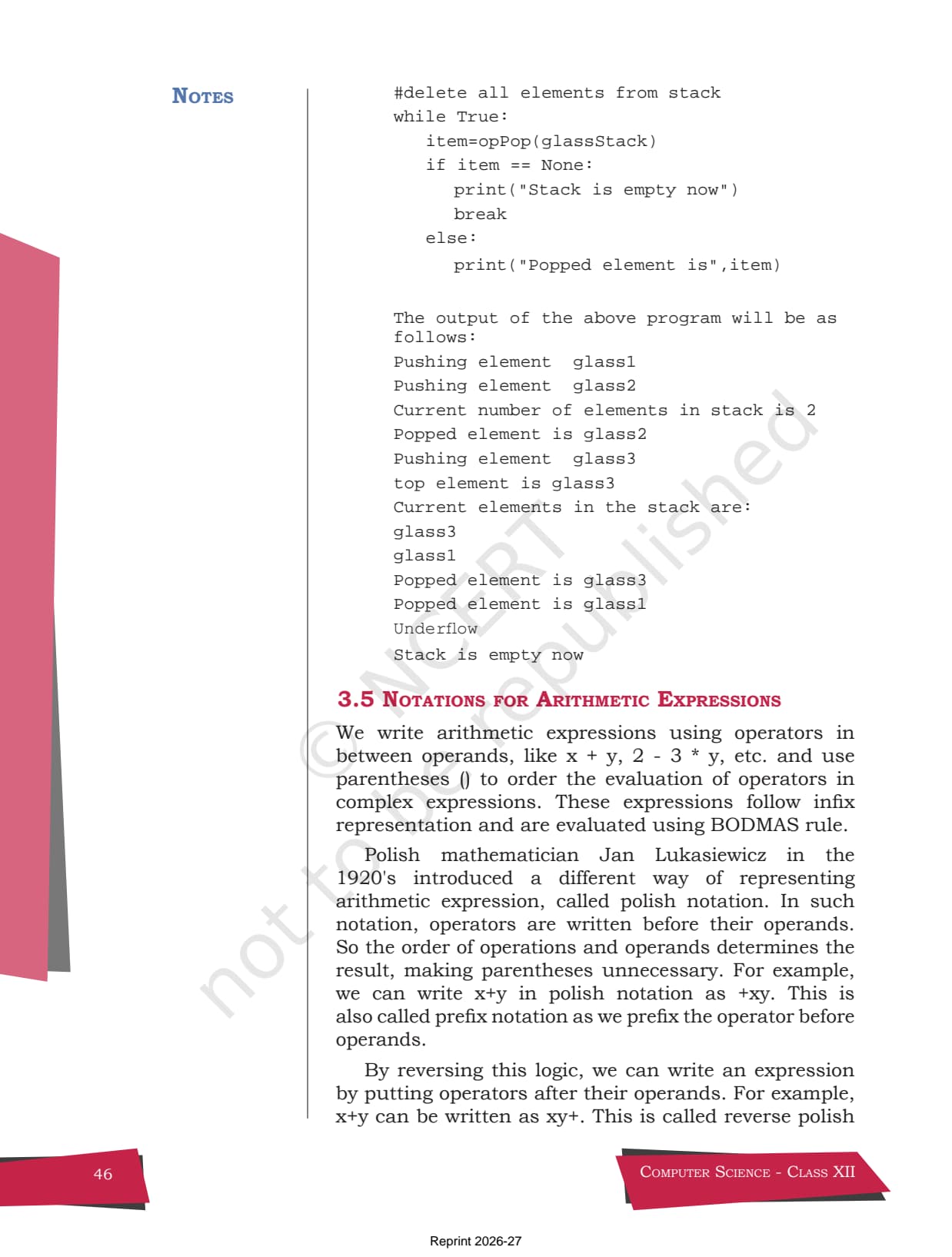
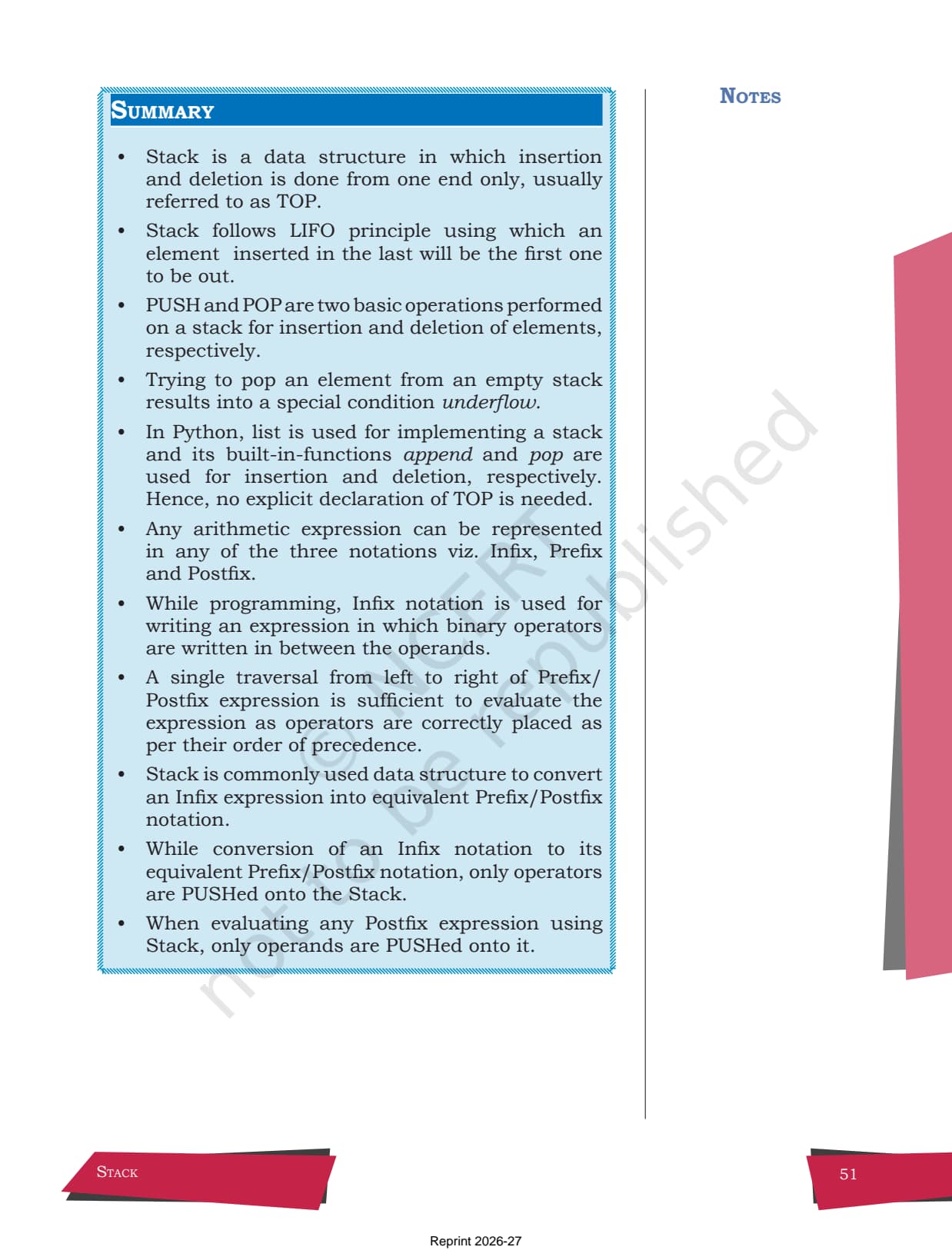
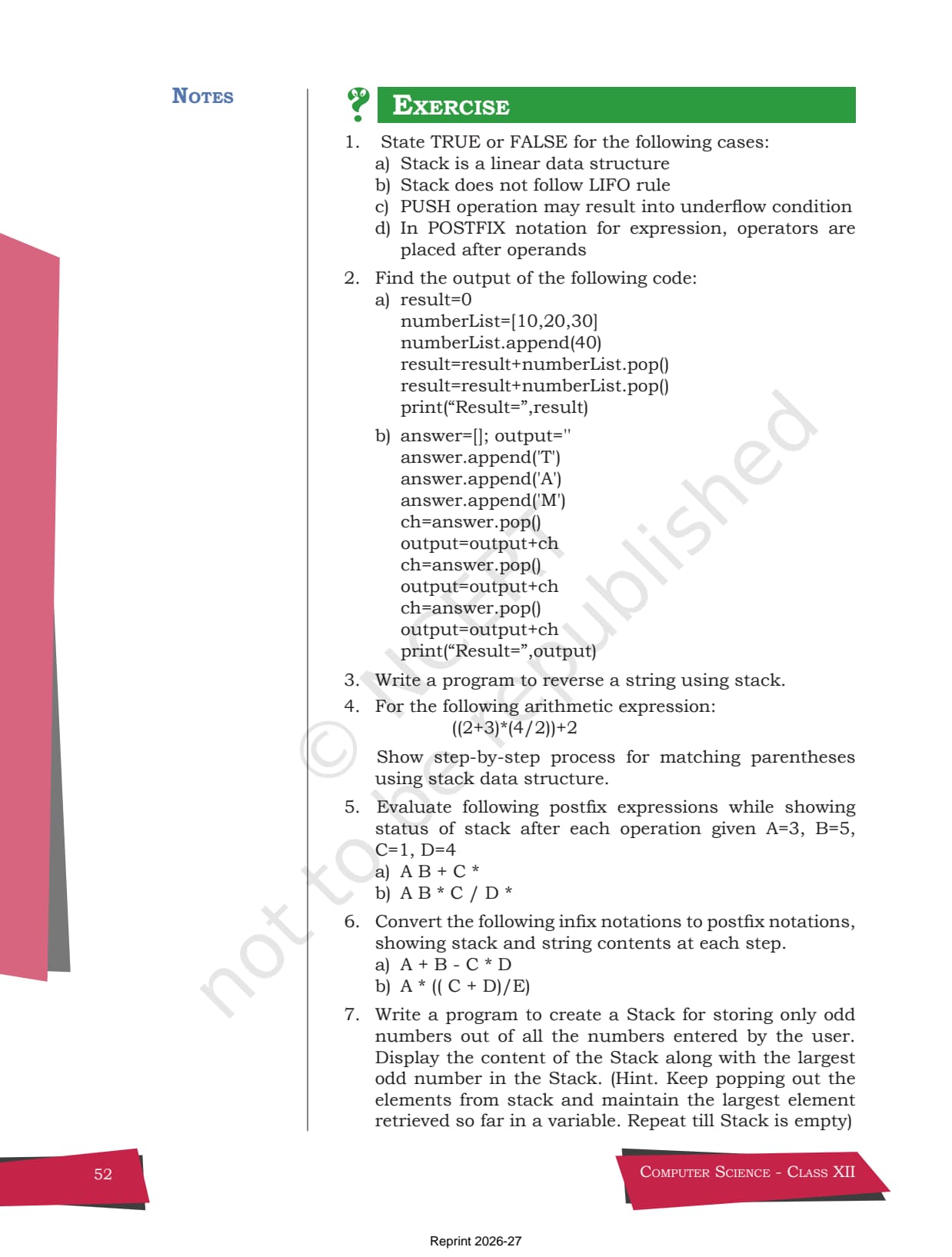
- Official NCERT chapter with the original Python code, the PUSH and POP figures, and both algorithms.
- The Stack chapter usually carries 4 to 6 marks in the Class 12 Computer Science board paper.
- Pairs with the Solutions, Notes and Handwritten Notes linked lower on this page.
This is the official NCERT Stack chapter from the Class 12 Computer Science book, offered for free download in the 2026-27 edition with the original code listings and figures.
Student Feedback: What 9,800 students told us about this chapter PDF
71% of Class 12 students said they kept the official NCERT Stack chapter PDF open while practising the trace questions, because the append() and pop() code and the two algorithms come straight from the chapter. 3 out of 5 students told us the worked examples for infix to postfix were the part they re-read the most.
Toppers reported that revising directly from the source chapter, rather than only from short notes, helped them quote the NCERT wording for definitions and earn 1 to 2 extra marks on the 1-mark questions. The average student spent 2 to 3 hours on the chapter across the first read and exercise practice.
Source: 2026-27 Class 12 Computer Science student poll. Sample of 9,800 students from CBSE schools across 12 states, conducted before the 2026 boards.
Source: Magnet Brains on YouTube
What the Class 12 Computer Science Chapter 3 Stack NCERT Chapter Covers
Stack is the third chapter of the Class 12 Computer Science book and the first of two data-structure chapters, the other being Queue. It answers one question: what is a stack, and how do you use it to solve real problems? The chapter builds the answer in clear blocks, starting from the LIFO idea and ending with full programs.
The chapter is built around three threads, which the NCERT covers in order:
- The concept: a stack, its single open end called the top, and the LIFO rule (Last In, First Out).
- The operations: PUSH and POP, plus the overflow and underflow conditions, all coded with a Python list.
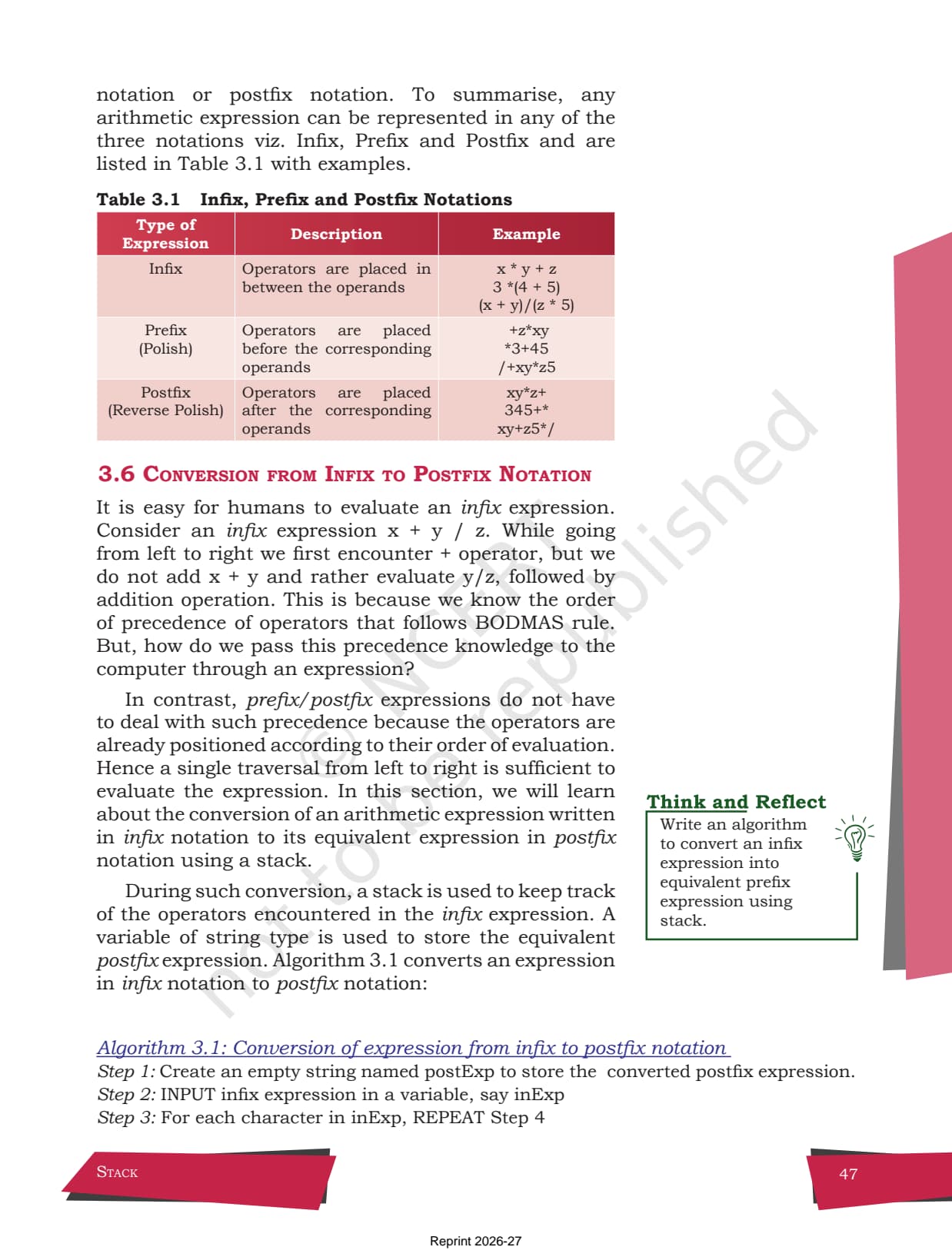
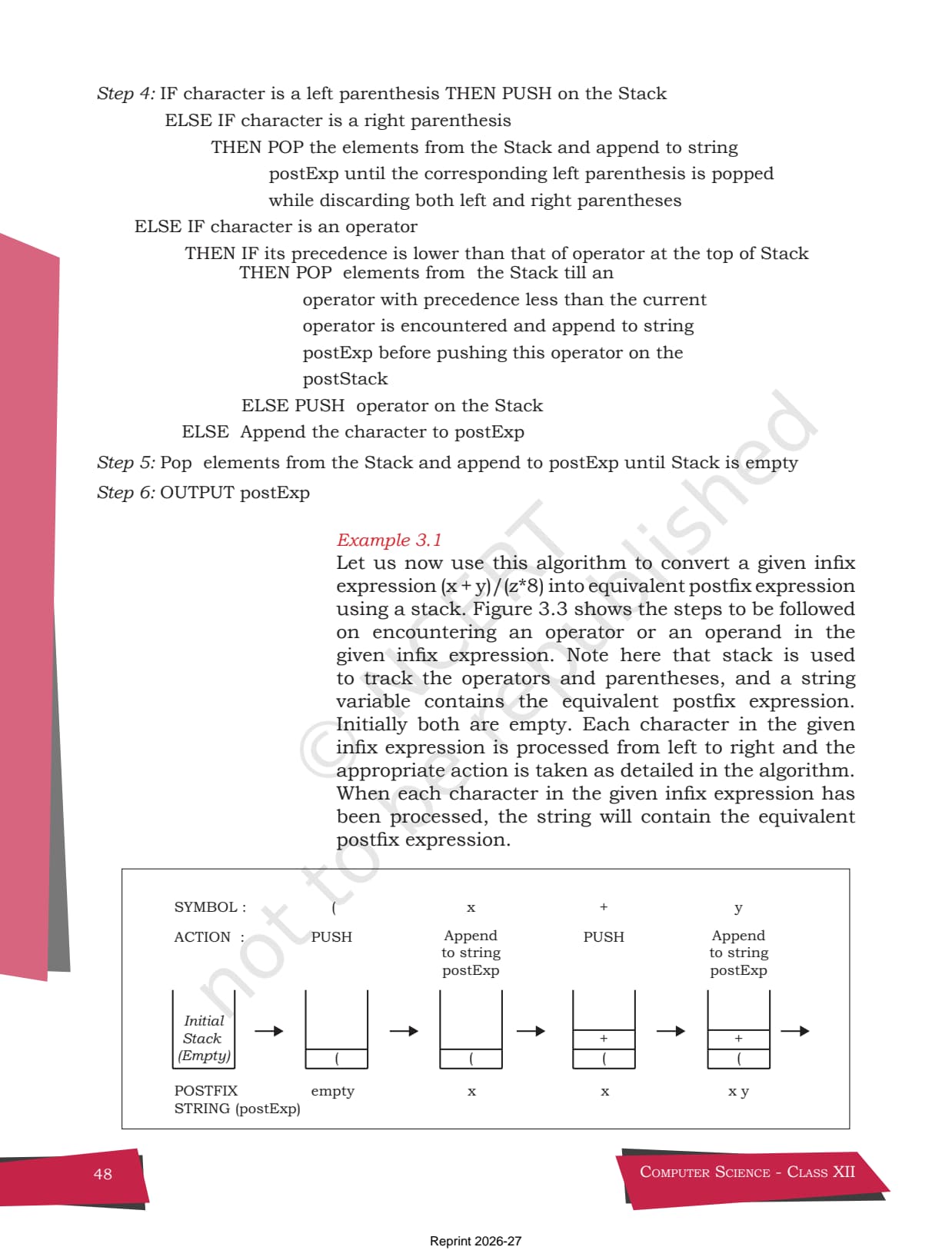
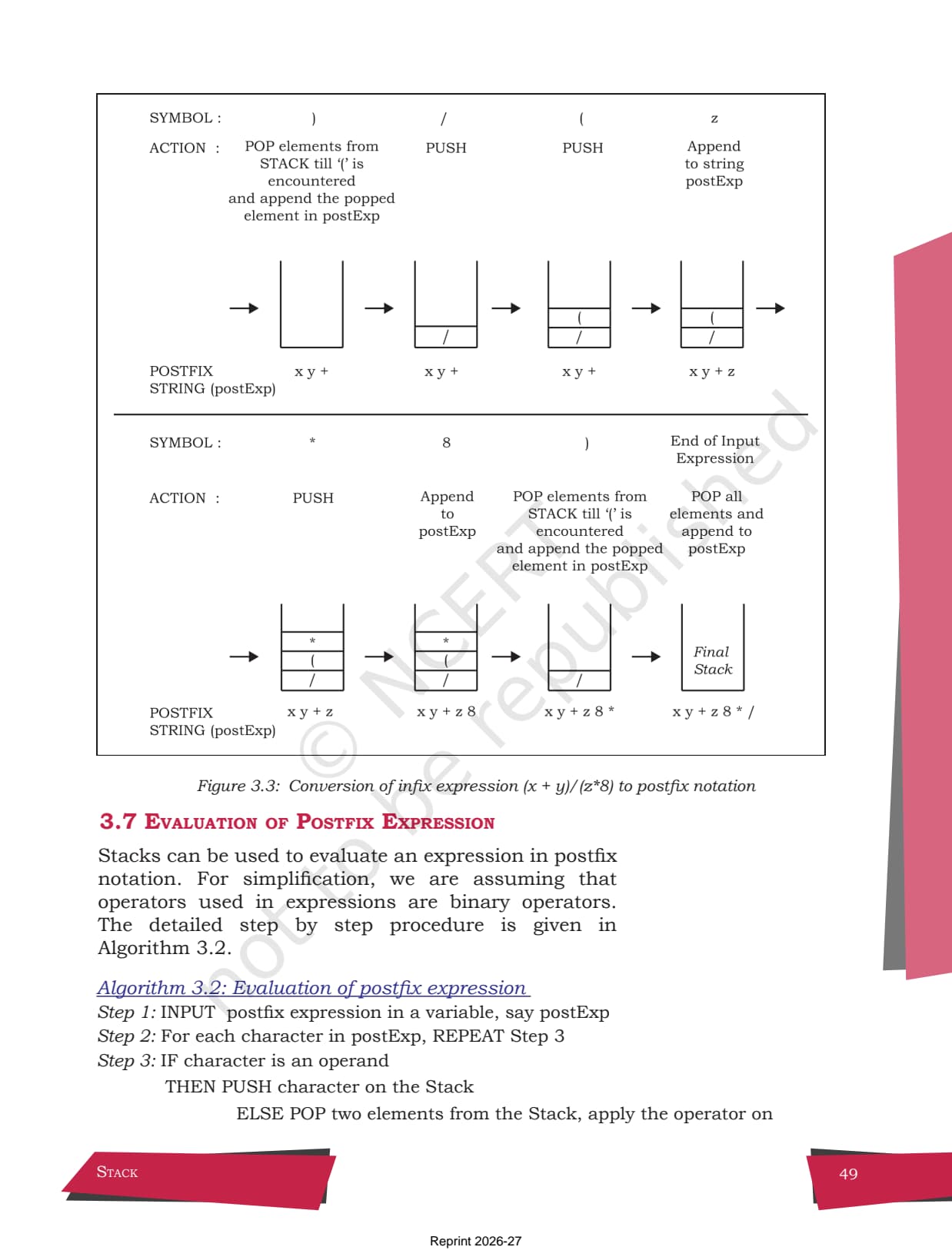
- The applications: reversing a string, matching parentheses, infix to postfix conversion, and postfix evaluation.
Reading the original NCERT text matters because the code listings and the two algorithms in the class 12 computer science chapter 3 stack pdf are exactly what CBSE refers to in the exam. A student who knows the chapter's own examples, such as the numberList trace and the bracket-matching walk, can answer those trace questions with confidence.
Chapter Highlights and Important Topics
The NCERT chapter is rich with code listings, figures and worked examples that the exam often reuses. Knowing what each highlight covers helps students revise quickly from the source. The table below lists the highlights students should study in the original chapter PDF.
| Highlight | Why it matters |
|---|---|
| Definition of a stack and LIFO | The base of every 1-mark definition and the opening TRUE or FALSE question. |
| PUSH and POP operations | Coded with append() and pop() on a Python list, the heart of the chapter. |
| Overflow and underflow | The most common 1-mark trap: PUSH causes overflow, POP causes underflow. |
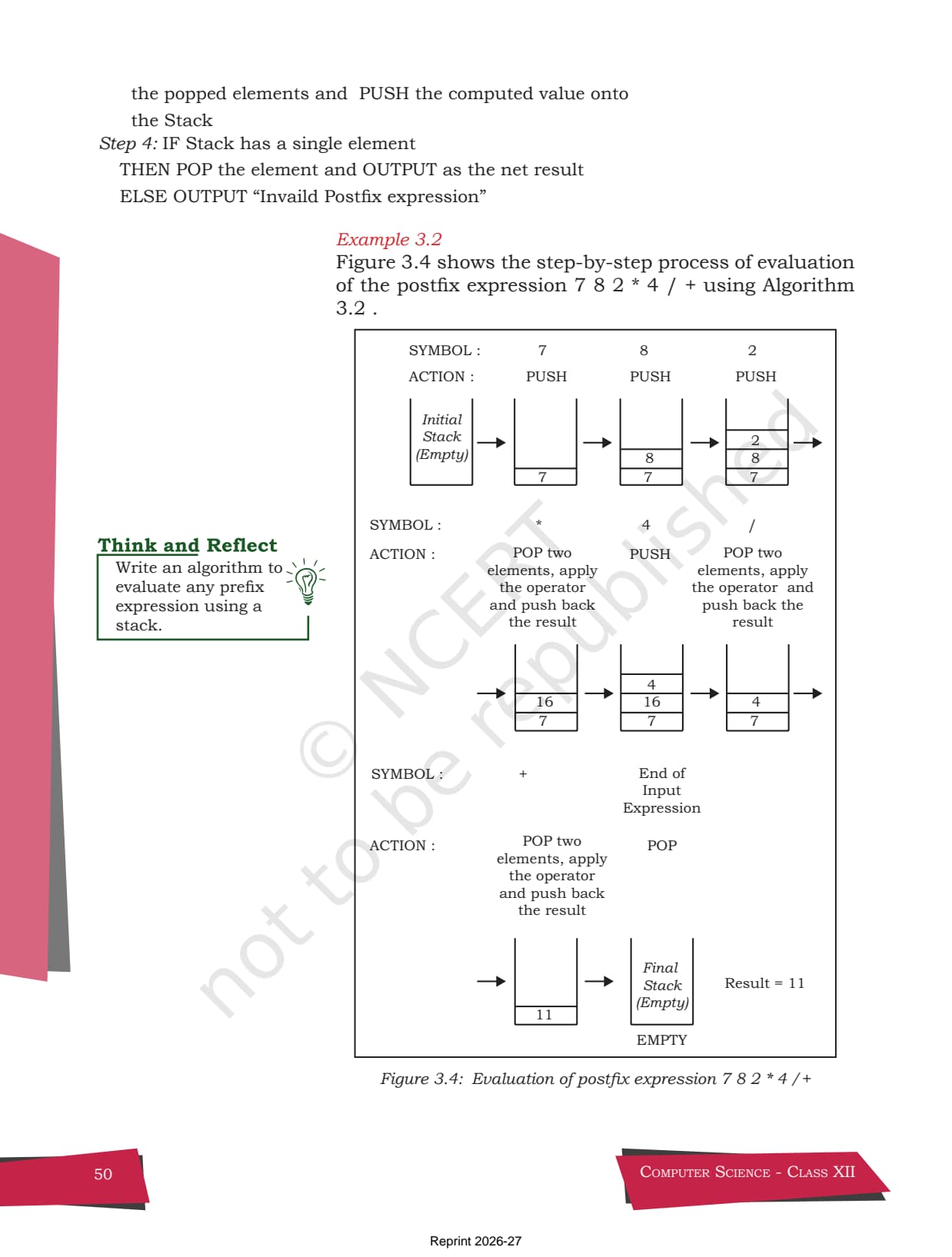
| Algorithm 3.1 and 3.2 | Infix to postfix conversion and postfix evaluation, both heavily tested. |
| Worked examples | String reversal and the bracket-matching walk used in the exercise questions. |
The chapter also shows how a stack is the natural tool for any task that needs reversal or back-tracking. One point students should mark while reading is that a stack hands items back in the opposite order to which they went in, which is why it reverses a string and checks balanced brackets. That single idea ties the whole chapter together.
Stack Operations and Python Code in the Chapter
The chapter teaches the two core operations and codes them with a Python list, so students do not have to build a stack from scratch. Reading the listings in the original NCERT helps students copy the exact style CBSE rewards. The list below shows what the chapter covers under each operation.
- PUSH: add an item to the top of the stack with
stack.append(x). - POP: remove and return the top item with
stack.pop(). - Overflow: trying to PUSH when no space is left, caused only by PUSH.
- Underflow: trying to POP when the stack is empty, caused only by POP.
The NCERT chapter uses a list as both the storage and the stack pointer, where the end of the list acts as the top. The short listing below mirrors the chapter's own style and shows PUSH, POP and the empty test together.
stack = []
stack.append(10)     # PUSH 10  -> [10]
stack.append(20)     # PUSH 20  -> [10, 20]
top = stack.pop()    # POP      -> returns 20, list is [10]
empty = len(stack) == 0   # test for empty stack
Because the last item pushed is the first item popped, a stack reverses a sequence. The chapter proves this with a small trace: pushing 'T', 'A', 'M' and popping returns M, A, T, so the string builds up to MAT. Reading the listings in the chapter 3 computer science class 12 ncert book is the most reliable way to learn this code style.
Expressions and Algorithms in the Chapter
The closing sections of the chapter cover the two expression problems, which is where most students lose marks. These pages carry Algorithm 3.1 for infix to postfix conversion and Algorithm 3.2 for postfix evaluation. Reading them in the source chapter helps students follow each step exactly.
- Parenthesis matching: PUSH each
(and POP one on each); balanced only if the stack ends empty. - Postfix evaluation: PUSH operands, and on each operator POP the top two, apply, then PUSH the result back.
- Infix to postfix: keep an operator stack and an output string, where
*and/outrank+and-.
The chapter is clear that brackets steer the stack but never appear in the postfix answer, and that operand order matters for subtraction and division. The short trace below shows the postfix evaluation idea the chapter uses, evaluating A B + C * with A=3, B=5, C=1.
A   PUSH 3        Stack: 3
B   PUSH 5        Stack: 3 5
+   POP 5, POP 3, PUSH 3+5=8   Stack: 8
C   PUSH 1        Stack: 8 1
*   POP 1, POP 8, PUSH 8x1=8   Stack: 8   -> Answer 8
Because these algorithms are drawn straight from the source chapter, the official PDF is the best place to learn the exact step order, including the rule that equal-precedence operators are popped before the new one is pushed.
How to Download and Use the NCERT Chapter PDF
The chapter PDF is free and works on any device. Students can save it for offline reading and pair it with the solutions and notes. The steps below show how to get the most out of the Stack chapter PDF during revision.
- Download: tap the download card above to save the official Chapter 3 PDF to your device.
- First read: read the chapter once end to end, marking the code listings and the two algorithms.
- Code practice: keep the PDF open while typing the PUSH and POP examples, since the listings come from it.
- Revision: use the chapter with the notes to fix the LIFO rule and the overflow versus underflow pair.
Many students search for the class 12 computer science chapter 3 stack pdf the night before a test so they can revise offline. A saved copy means the code and the algorithms are always at hand. After reading the chapter, move to the solutions to check that your traces match the model answers, then use the notes for a final quick recall before the exam.
How the Book PDF Pairs with the Solutions and Notes
The NCERT Book PDF is the source text. To prepare fully, students should use it with the other resources for the same chapter, all linked in the table below. Read the chapter, fix the ideas with the notes, then test yourself with the solutions.
| Resource | Best used for |
|---|---|
| Stack NCERT Solutions | Step-by-step answers to all 7 exercise questions with Python code |
| Stack Class 12 Notes | Quick chapter summary with LIFO, PUSH and POP, and the four applications |
| Stack Handwritten Notes | Last-minute, one-shot revision in a scanned notebook style |
Tip: read the chapter PDF first, then attempt the solutions on your own, and only then check the model answers. Reading the source text before the answers builds far stronger recall of the code and the algorithms.
All Class 12 Computer Science NCERT Book PDFs by Chapter
The table links the NCERT chapter PDFs for every chapter in Class 12 Computer Science, so students can move across the course in one click. Stack is highlighted.
| Chapter | NCERT Book PDF |
|---|---|
| Chapter 1 | Exception Handling in Python |
| Chapter 2 | File Handling in Python |
| Chapter 3 | Stack (You are here) |
| Chapter 4 | Queue |
| Chapter 5 | Sorting |
| Chapter 6 | Searching |
| Chapter 7 | Understanding Data |
| Chapter 8 | Database Concepts |
| Chapter 9 | Structured Query Language (SQL) |
| Chapter 10 | Computer Networks |
| Chapter 11 | Data Communication |
| Chapter 12 | Security Aspects |
FAQs on Class 12 Computer Science Chapter 3 Stack NCERT Book PDF
Class 12 Computer Science Chapter 3 Stack NCERT Book Common Questions
Ques. Where can I download the Class 12 Computer Science Chapter 3 Stack NCERT Book PDF?
Ans. You can download the official Stack chapter PDF directly from the download card on this page. It is free, follows the 2026-27 NCERT edition, and carries the original text, code listings, figures and the two algorithms of Chapter 3.
Ques. Which book is the Stack chapter from?
Ans. It is the third chapter of the Class 12 Computer Science textbook and the first of the two data-structure chapters, the other being Queue. The chapter introduces the stack, the LIFO rule, the PUSH and POP operations, and four applications of a stack.
Ques. What does the Class 12 Computer Science Stack chapter cover?
Ans. It covers the definition of a stack and the LIFO rule, the PUSH and POP operations coded with a Python list, the overflow and underflow conditions, and four applications: reversing a string, matching parentheses, infix to postfix conversion (Algorithm 3.1), and postfix evaluation (Algorithm 3.2).
Ques. Why should I read the original NCERT Stack chapter PDF?
Ans. Because CBSE draws questions straight from the chapter's own code listings, examples and the two algorithms. Reading the official chapter 3 computer science class 12 PDF gives you the exact code style and wording that score best in the board paper, especially for the output and trace questions.
Ques. How should I use the Stack chapter PDF with the other resources?
Ans. Read the chapter PDF first, fix the ideas with the notes, then test yourself with the solutions. Keeping the PDF open while practising the PUSH and POP code and the postfix traces helps, since the listings and the algorithms come directly from the source chapter.



Comments