




The 2026-27 NCERT keeps Chapter 9 Amines as the second of three named organic-nitrogen units in Class 12 Chemistry. The chapter covers structure, classification, IUPAC nomenclature, preparation routes, and the reactions of amines and diazonium salts tested in CBSE, JEE Main, and NEET papers. This page hosts the latest NCERT Book PDF and a complete reading map.
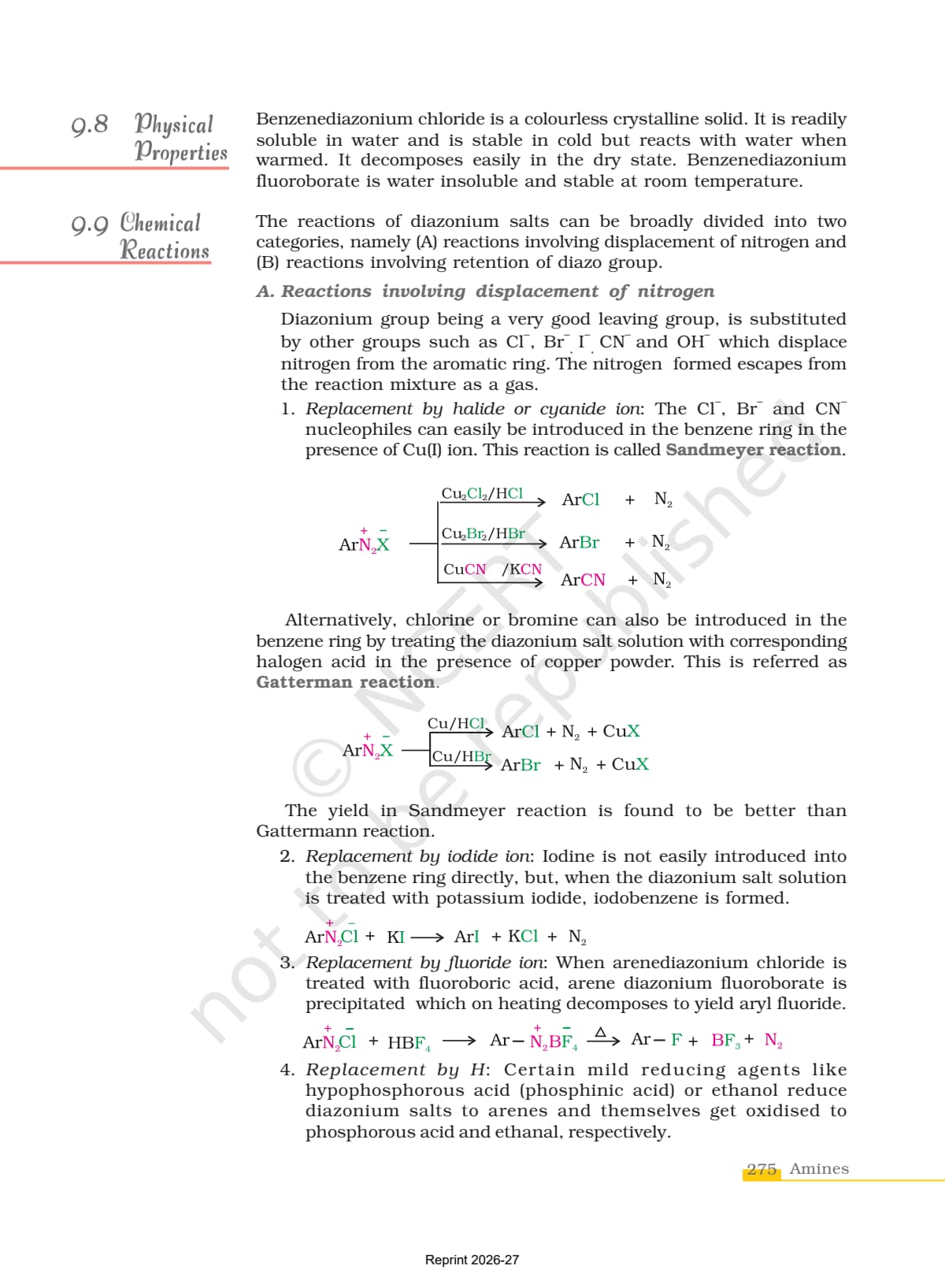
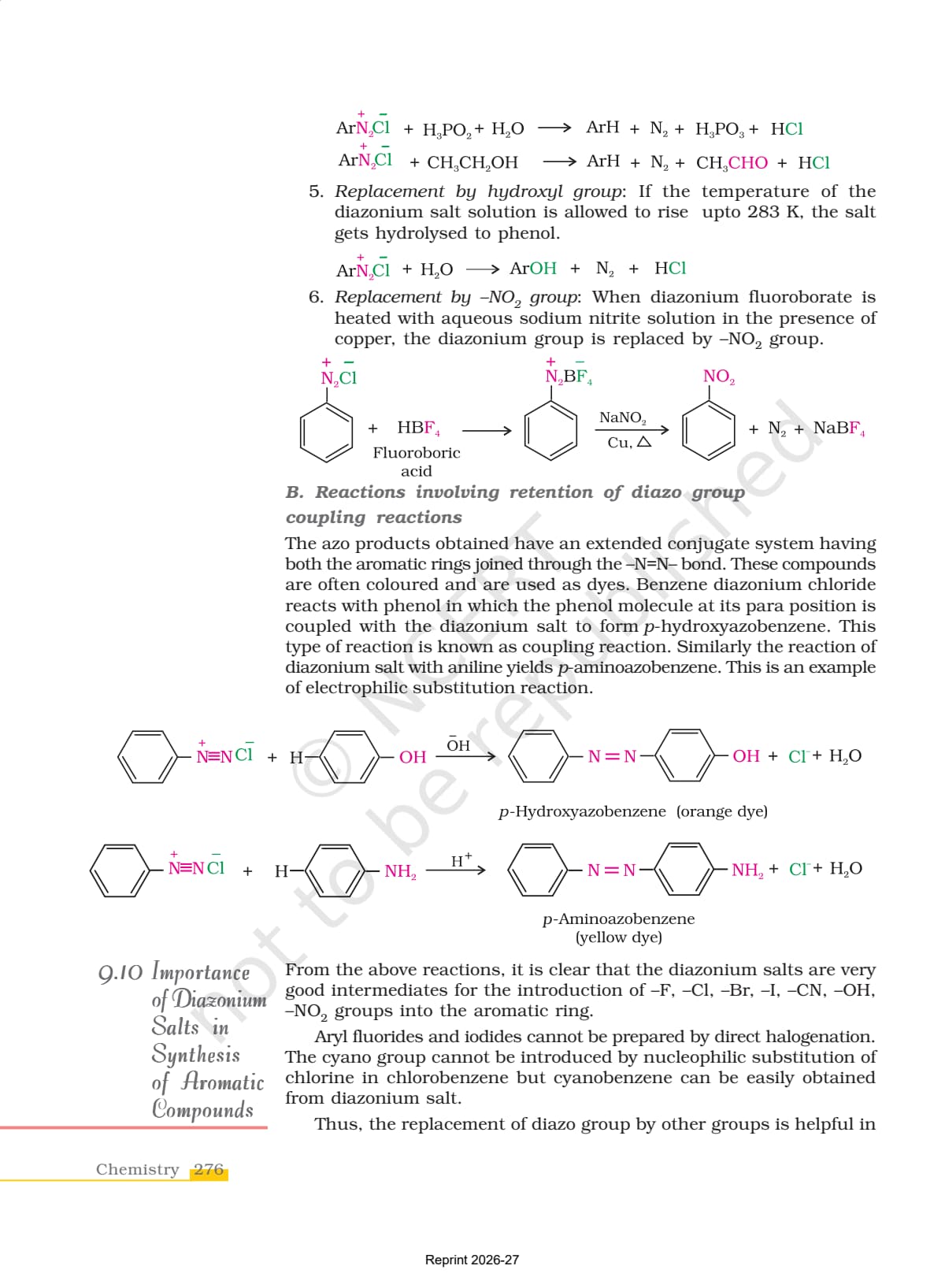
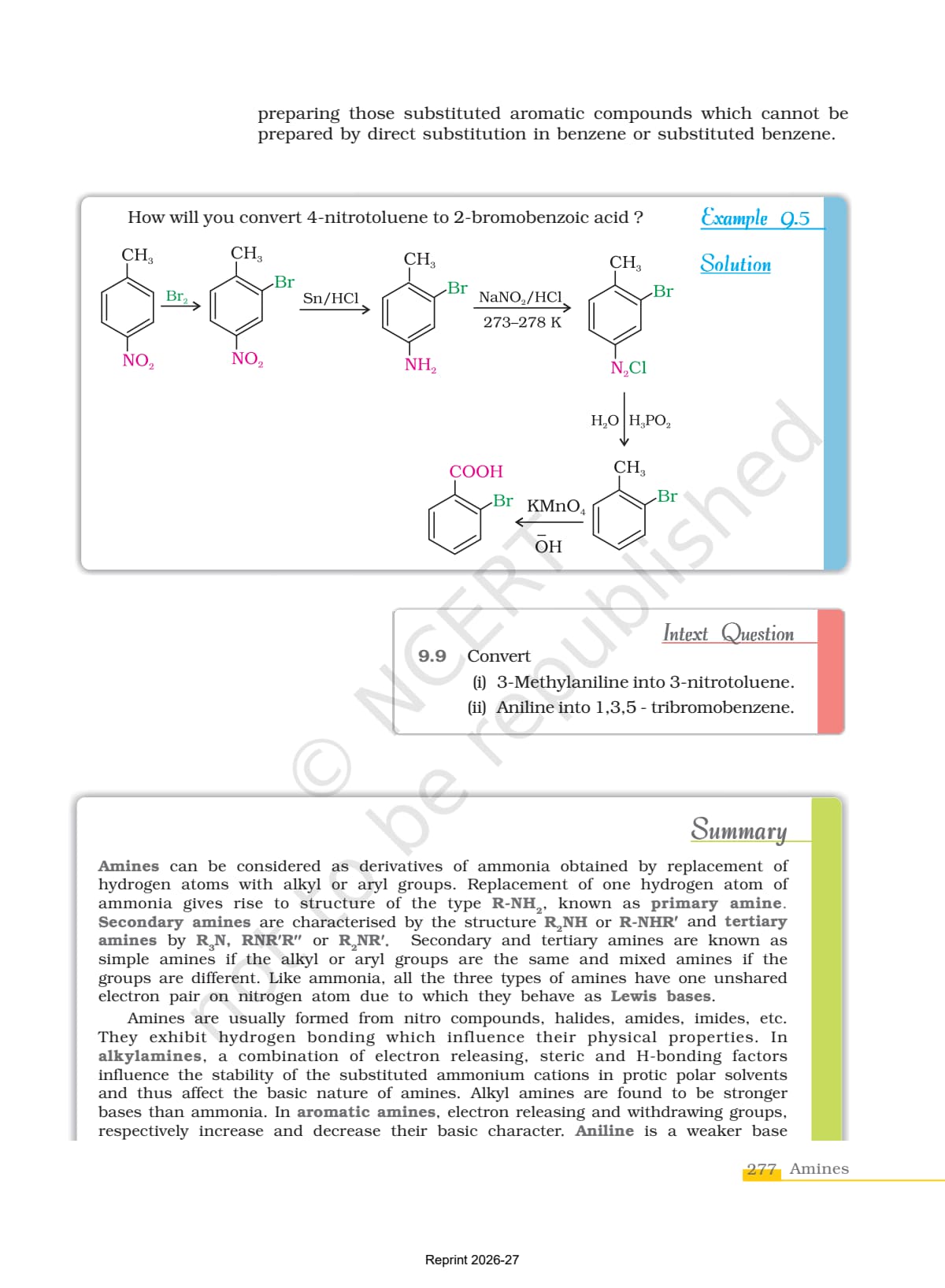
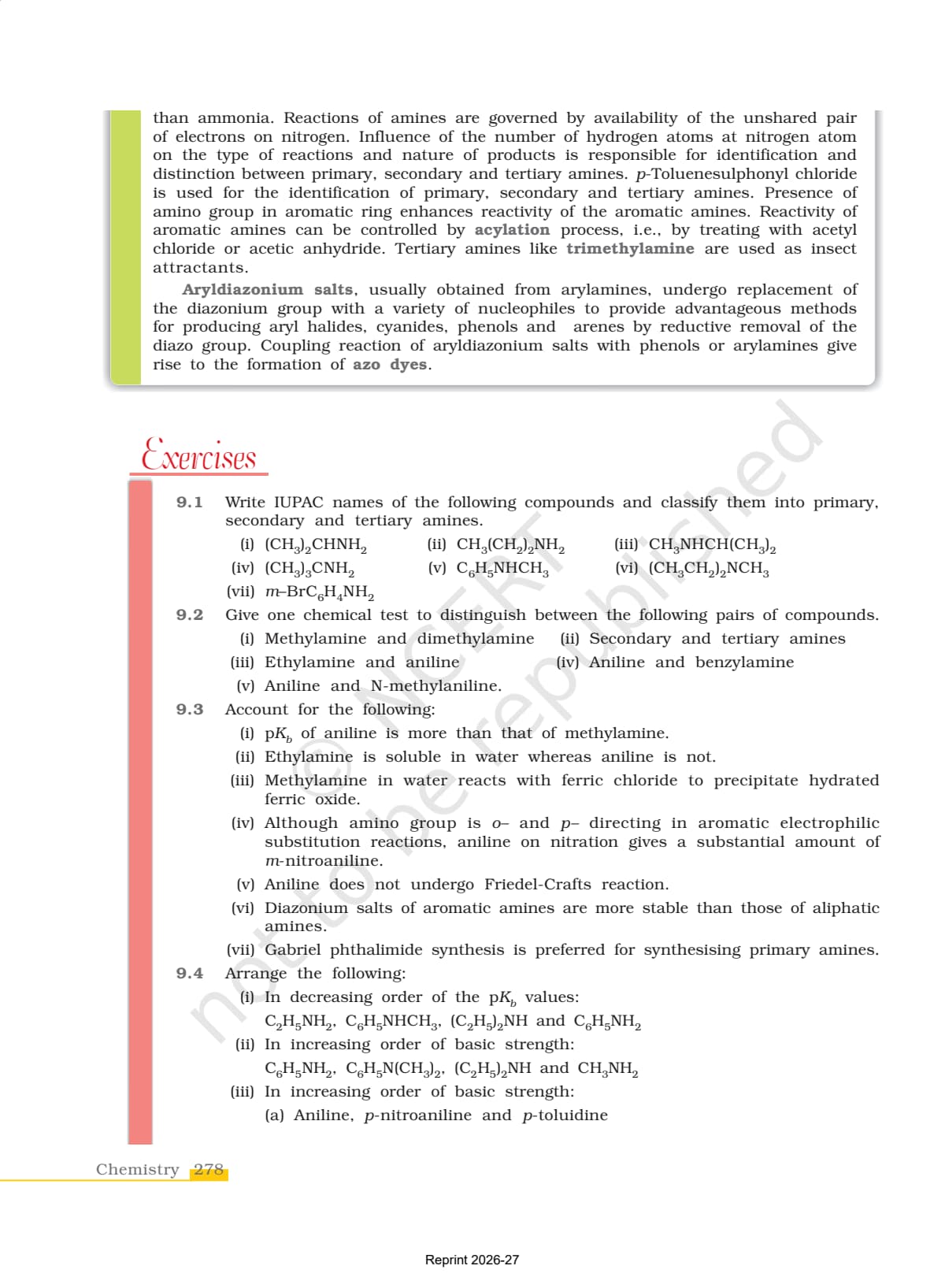
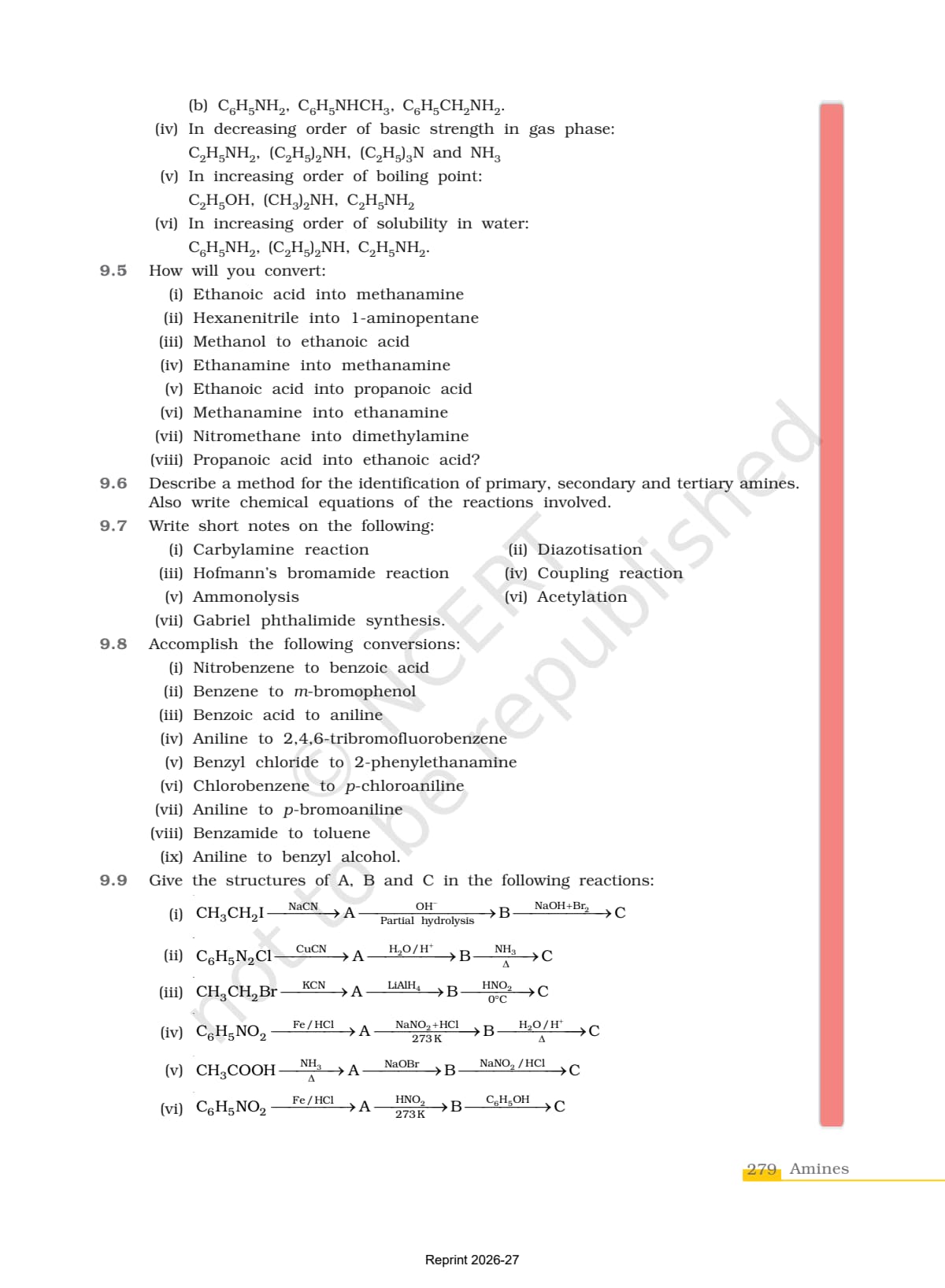
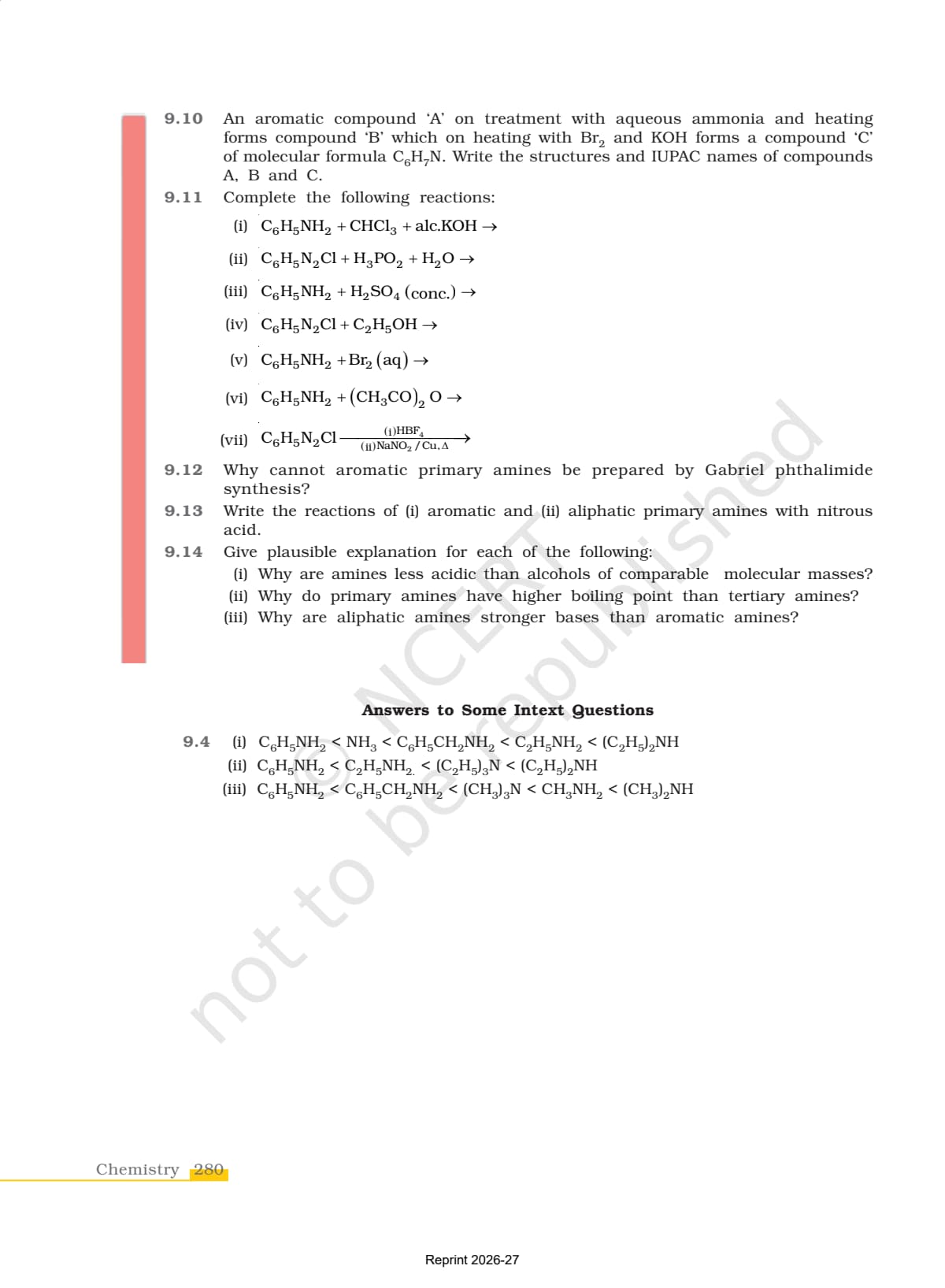
- CBSE Weightage: 4 to 6 marks (usually one 2-mark distinguishing test plus one 3-mark conversion or diazonium-route question)
- JEE Main Weightage: 2 to 3% (typically 1 to 2 questions per shift, mix of basicity ordering, Gabriel synthesis, and Hofmann bromamide degradation)
- NEET Weightage: 1 to 2 questions per year
The PDF above is the official NCERT print for Chapter 9 of the Class 12 Chemistry Part-II book. The reading map, reaction index, and rationalisation notes further down help you decide which sections to study deeply and which to skim.
Sourced from the official NCERT 2026-27 edition and cross-verified against the CBSE Class 12 Chemistry syllabus document for the 2026 Board exam.
Also Check:
- Class 12 Chemistry Chapter 8 Aldehydes, Ketones and Carboxylic Acids NCERT Book PDF
- Class 12 Chemistry Chapter 10 Biomolecules NCERT Book PDF
- CBSE Class 12 Chemistry Syllabus 2026-27
Amines NCERT Intext Examples and Their Sub-Topics
The 2026-27 print of Chapter 9 carries 5 solved intext examples across roughly 18 pages of theory. Each targets one specific skill that recurs in CBSE conversions, basicity ordering, and diazonium-route prompts.
| Example | Sub-topic | Skill tested |
|---|---|---|
| 9.1 | Classification of amines as 1°, 2°, 3° | Identify how many H atoms of NH3 are replaced by R/Ar |
| 9.2 | IUPAC names of substituted amines | Apply alkanamine and N-substituent locant rules |
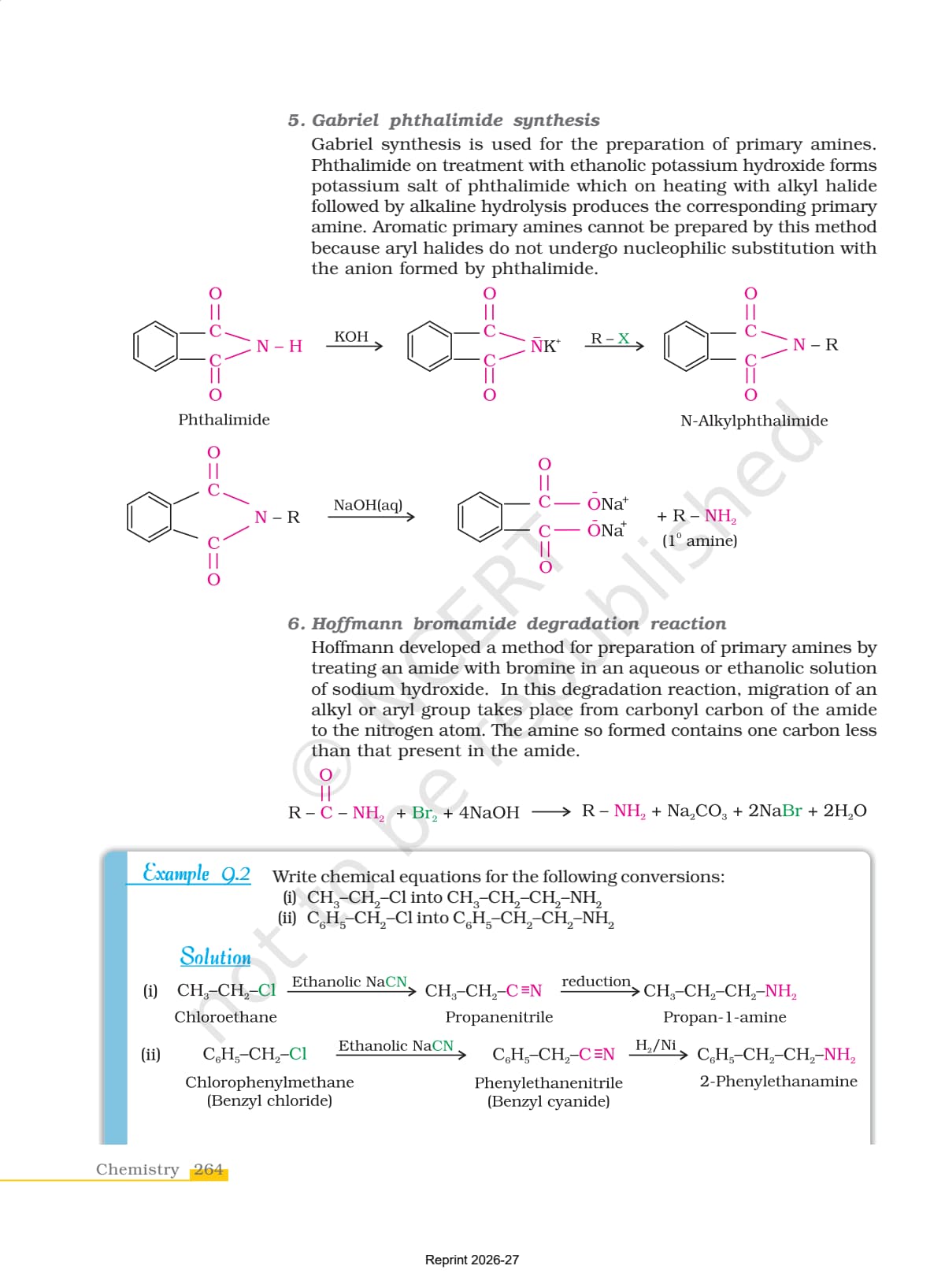
| 9.3 | Conversion routes between amines and adjacent functional groups | Chain ammonolysis, Gabriel synthesis, and Hofmann bromamide steps |
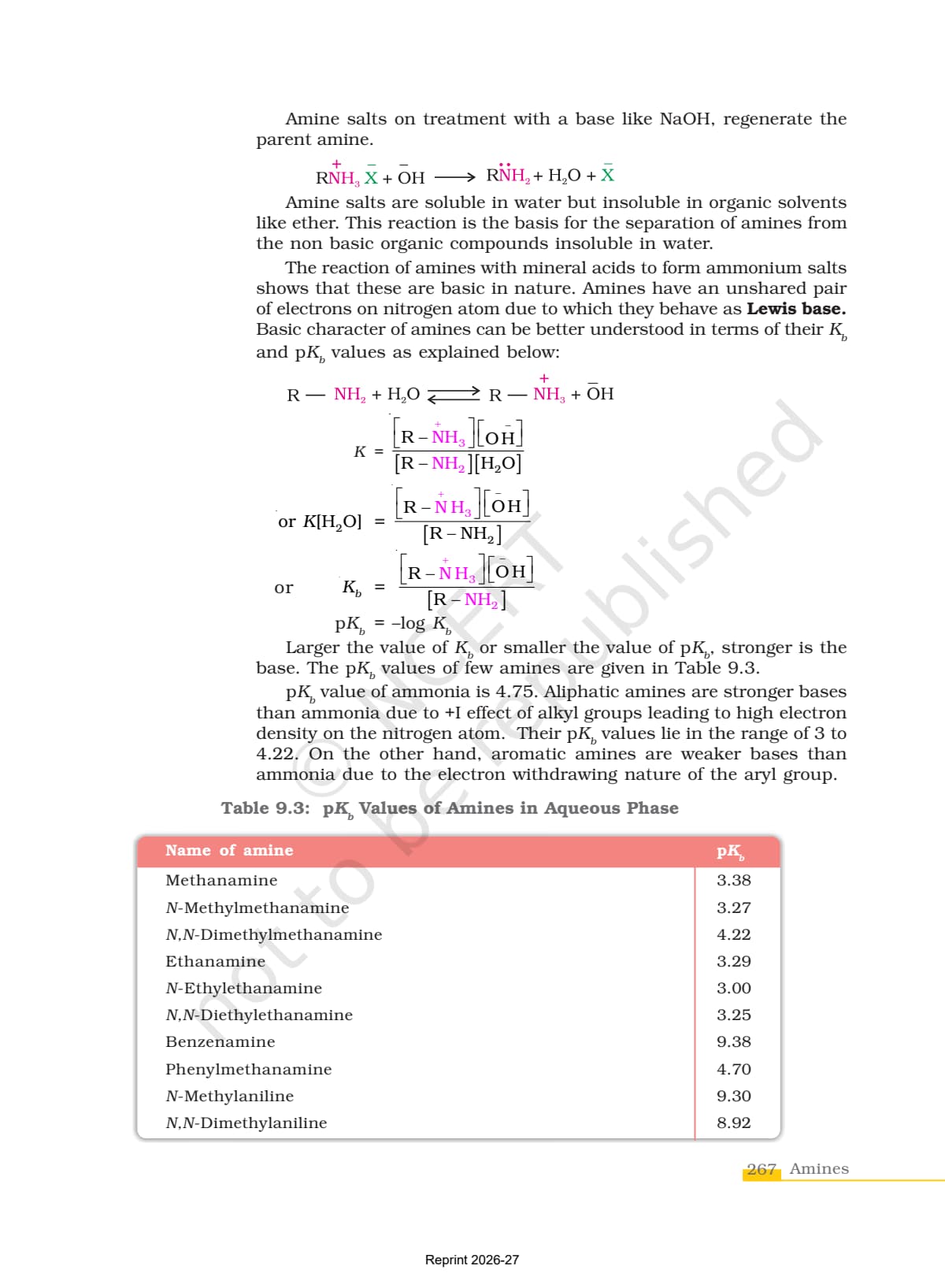
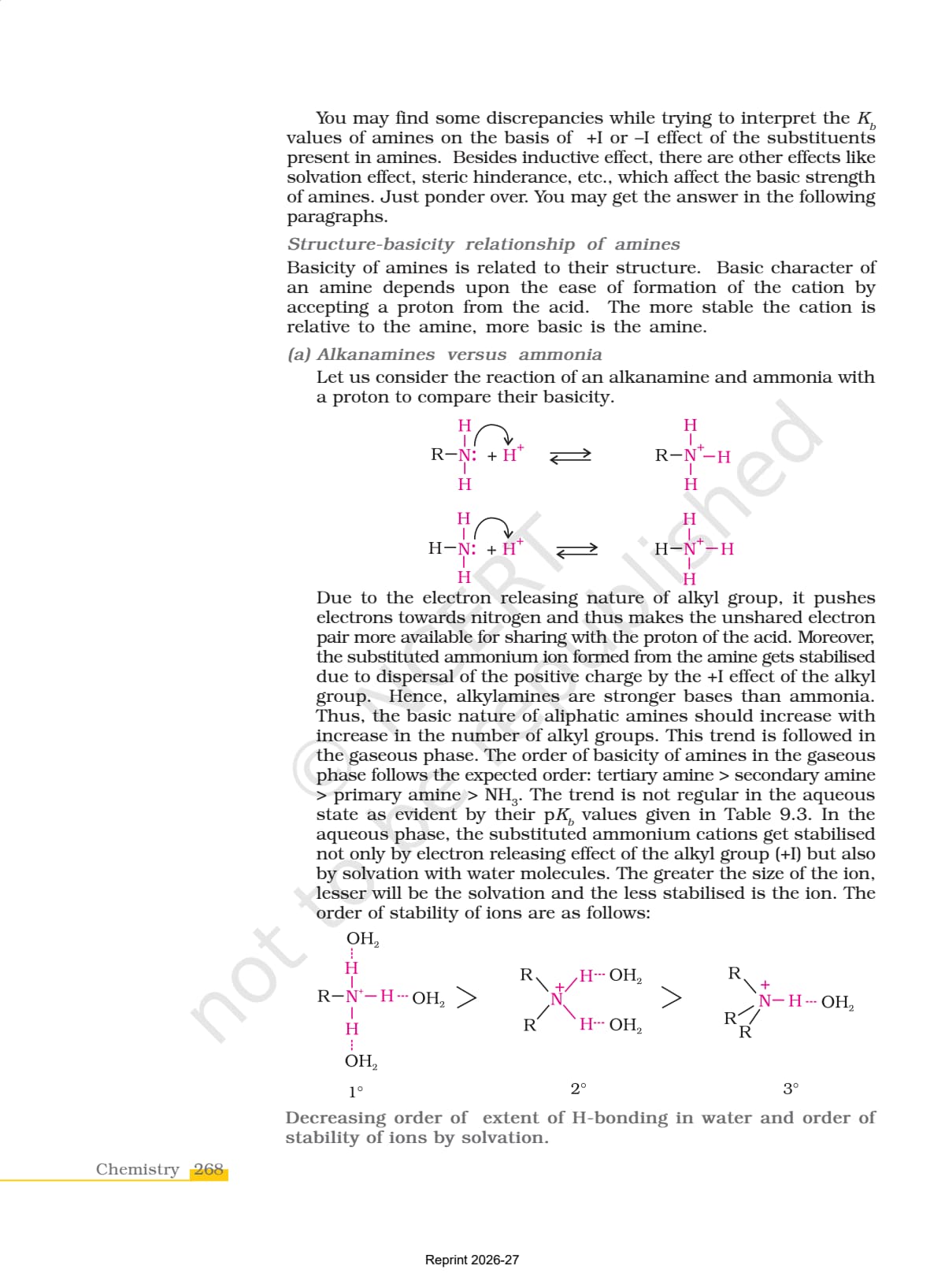
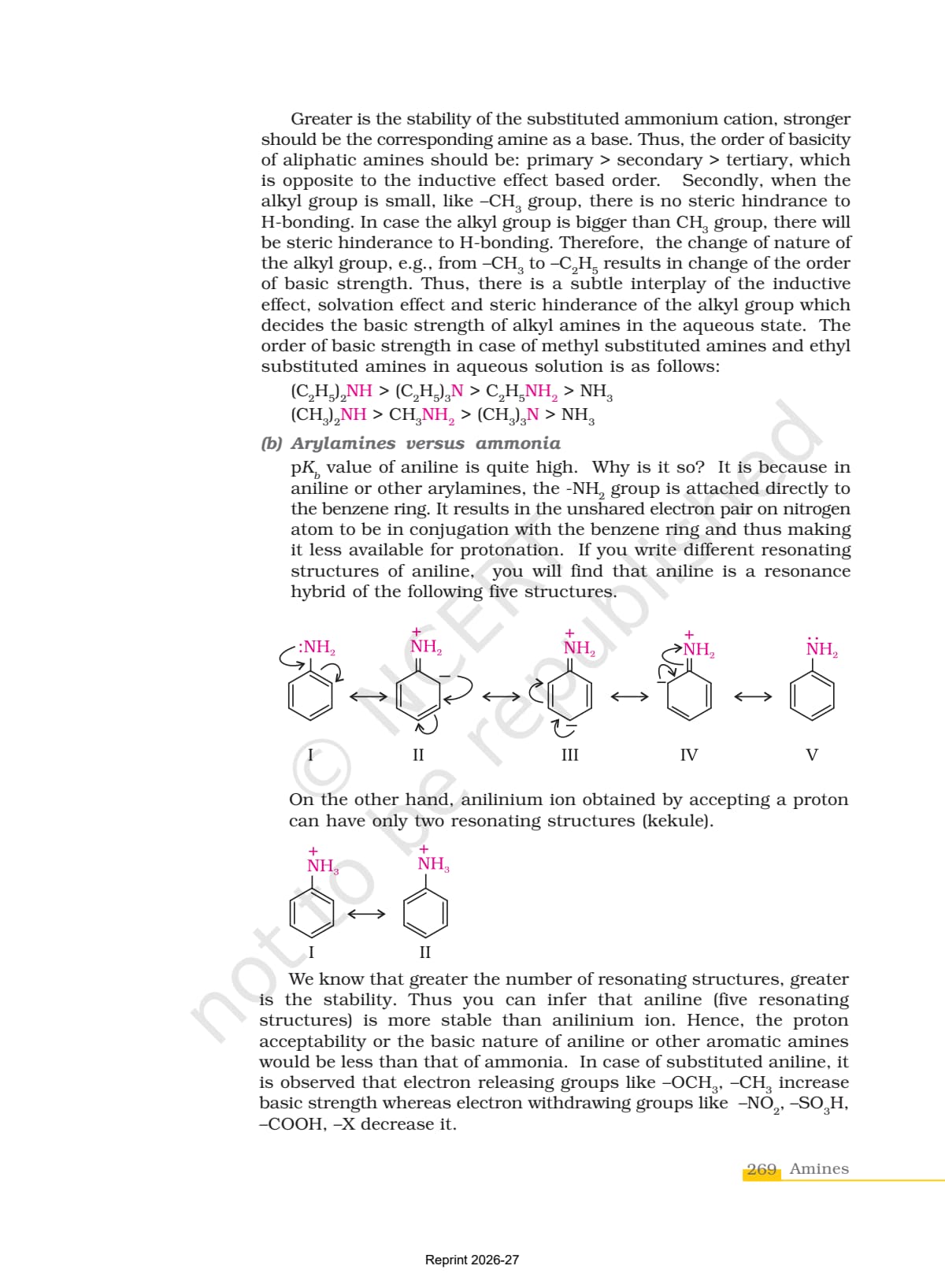
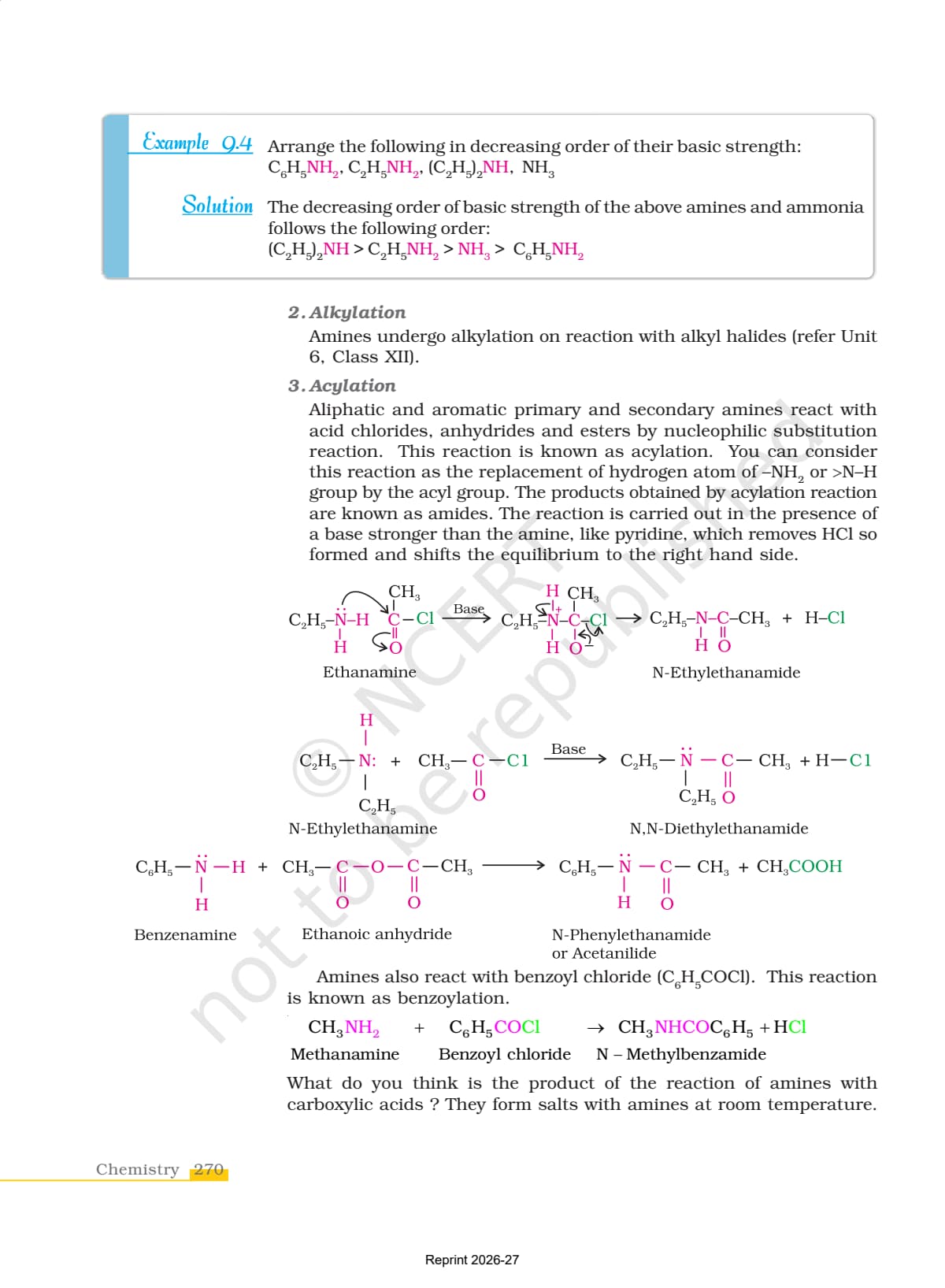
| 9.4 | Basicity comparison of amines in water vs gas phase | Balance inductive, steric, and solvation effects |
| 9.5 | Synthetic conversions using diazonium intermediates | Map ArN2+X- to aryl halides, phenols, arenes via Sandmeyer / Gattermann / hypophosphorous acid |
Amines Video Chapter Walkthrough
Source: NCERT Wallah on YouTube
Amines NCERT Book: Section-by-Section Breakdown with Page Numbers
The chapter has nine numbered sections plus a summary and exercises. Sections 9.4 (preparation of amines) and 9.6 (chemical reactions of amines) together account for more than half of all CBSE marks from this chapter.
| Section | Title | Pages | What it covers |
|---|---|---|---|
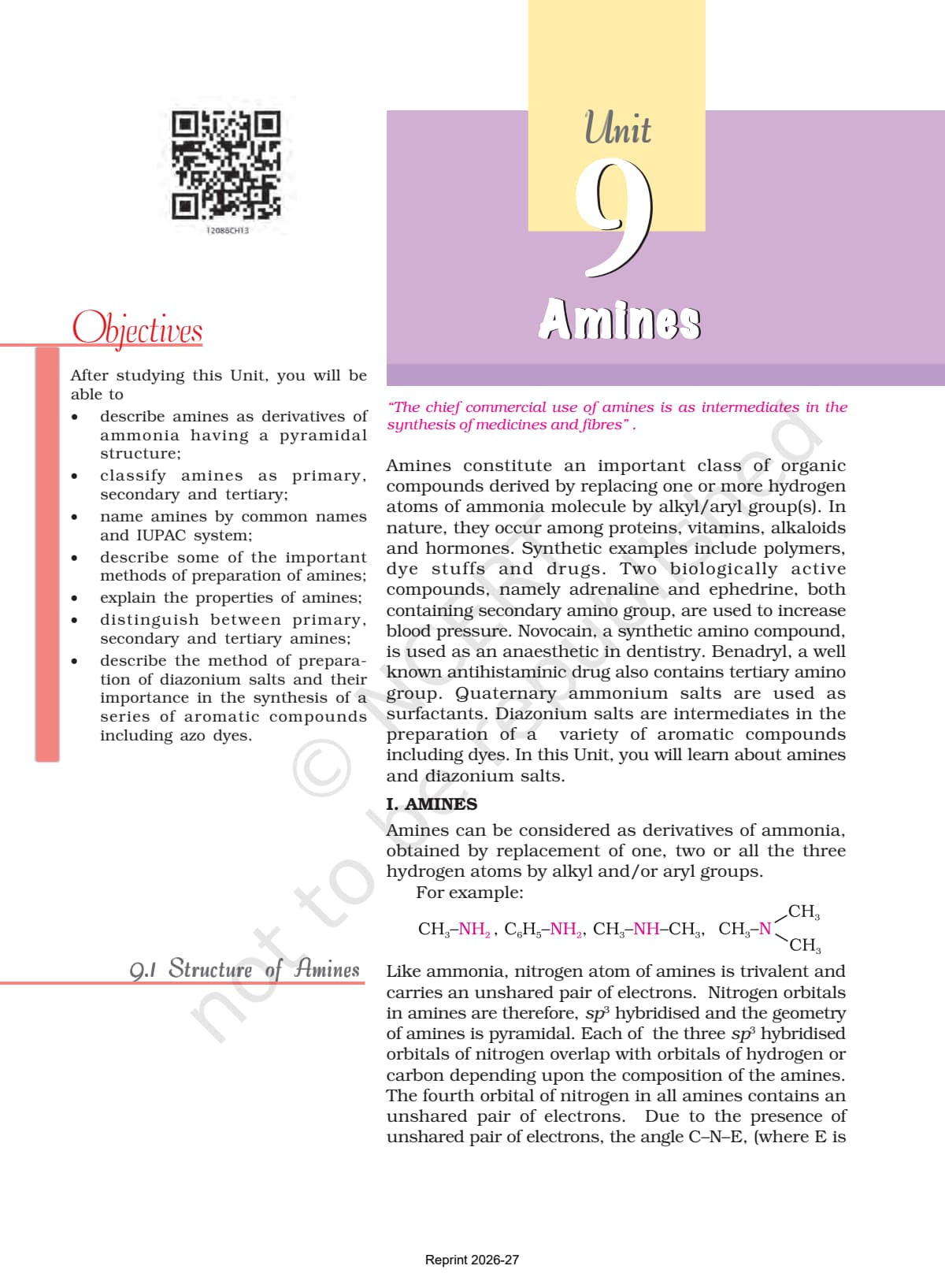
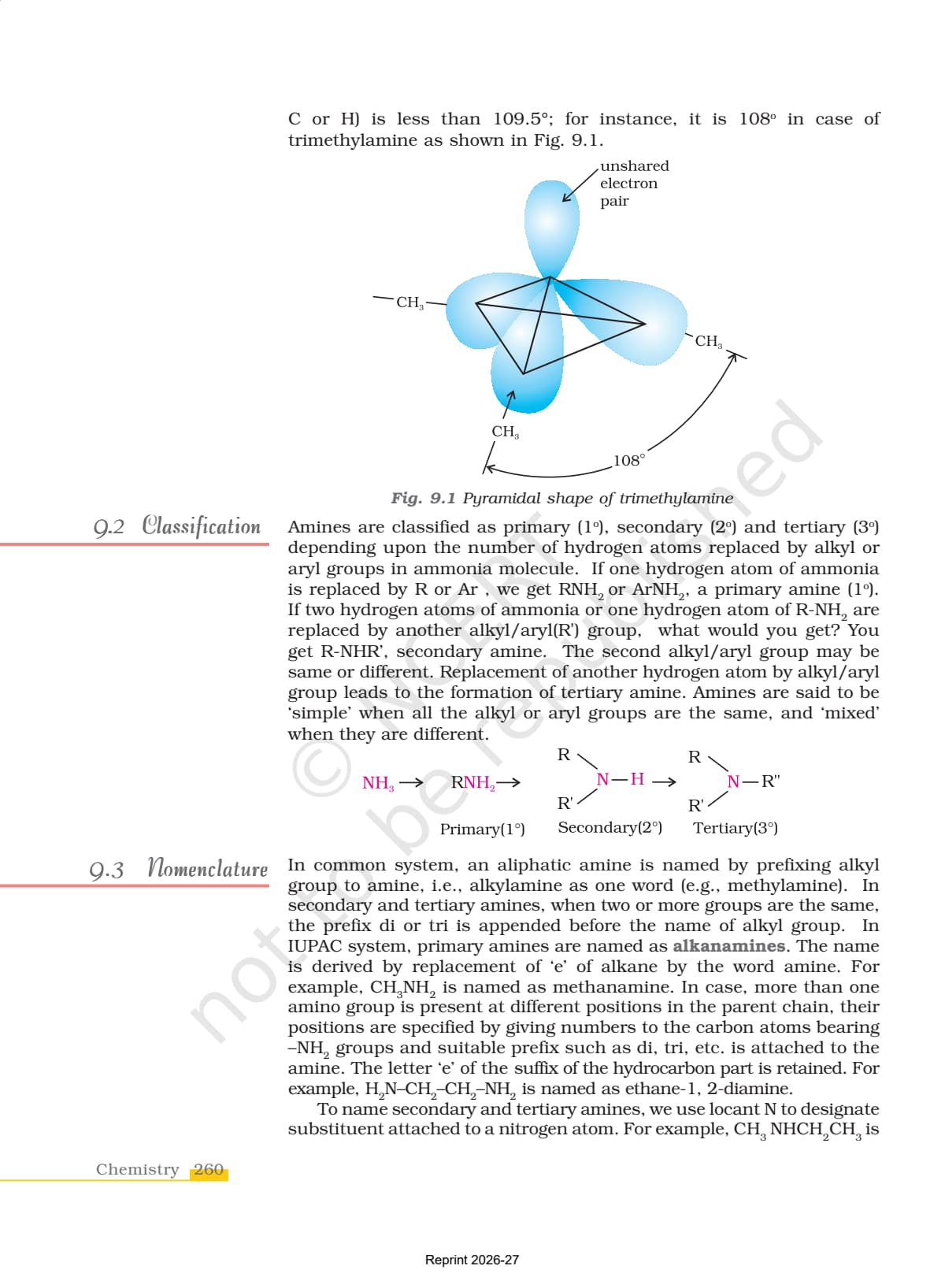
| 9.1 | Structure of Amines | 259-260 | sp3 nitrogen, pyramidal geometry, unshared electron pair, bond angles |
| 9.2 | Classification | 260 | Primary, secondary, tertiary amines; aliphatic vs aromatic; simple vs mixed |
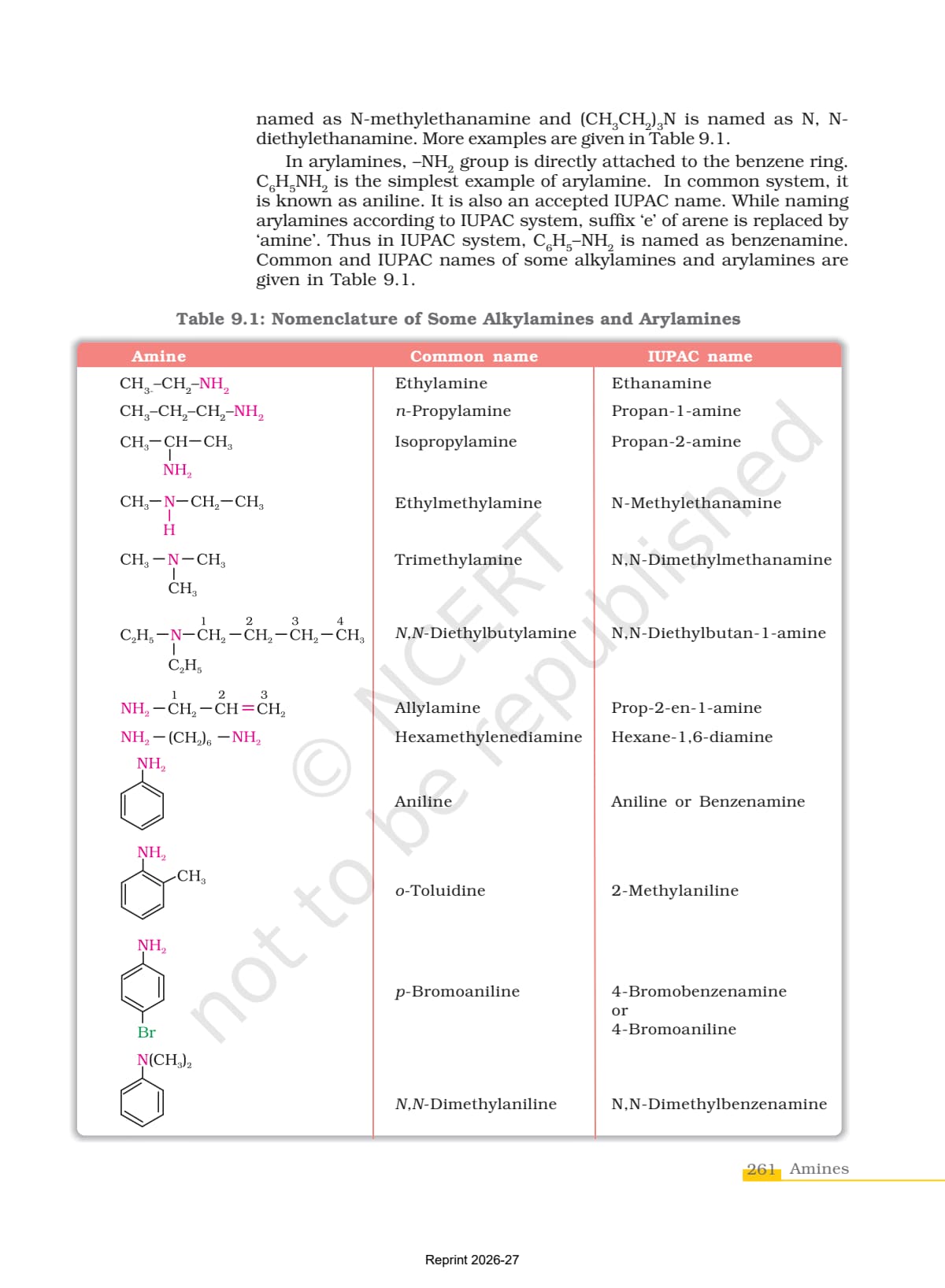
| 9.3 | Nomenclature | 260-262 | Common (alkylamine) and IUPAC (alkanamine) names for aliphatic and aromatic amines |
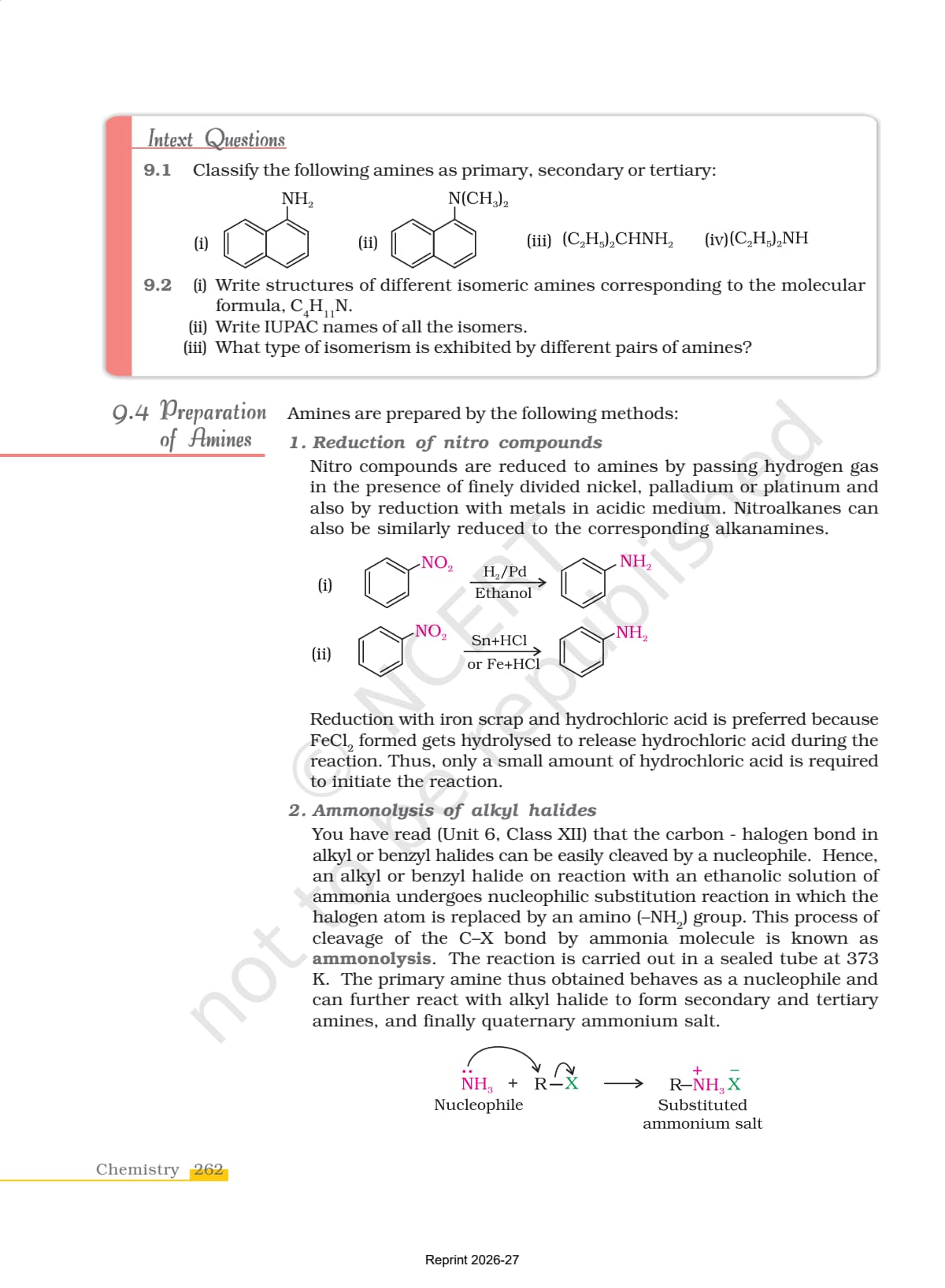
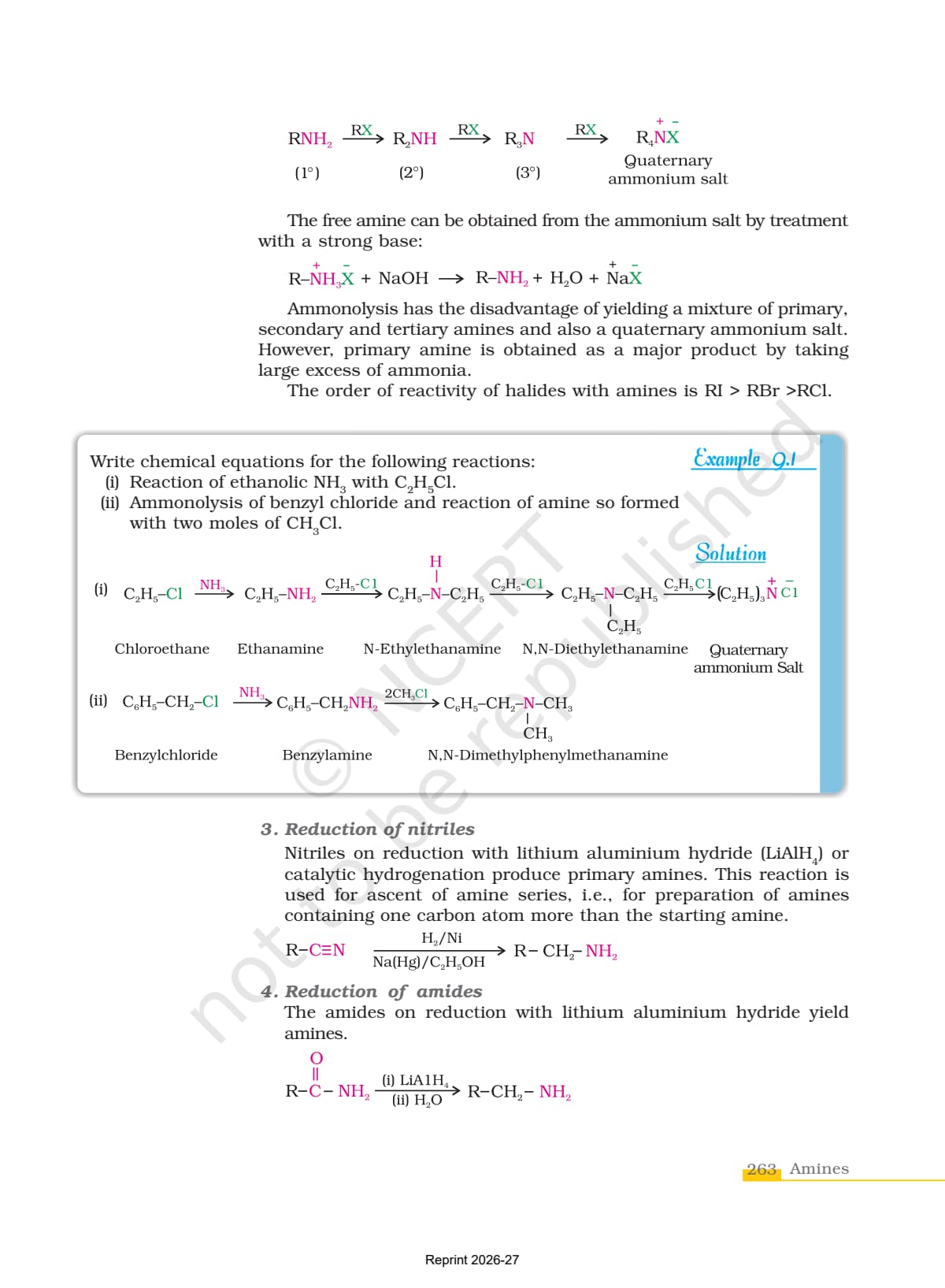
| 9.4 | Preparation of Amines | 262-266 | Reduction of nitro compounds, ammonolysis of alkyl halides, reduction of nitriles and amides, Gabriel phthalimide synthesis, Hofmann bromamide degradation |
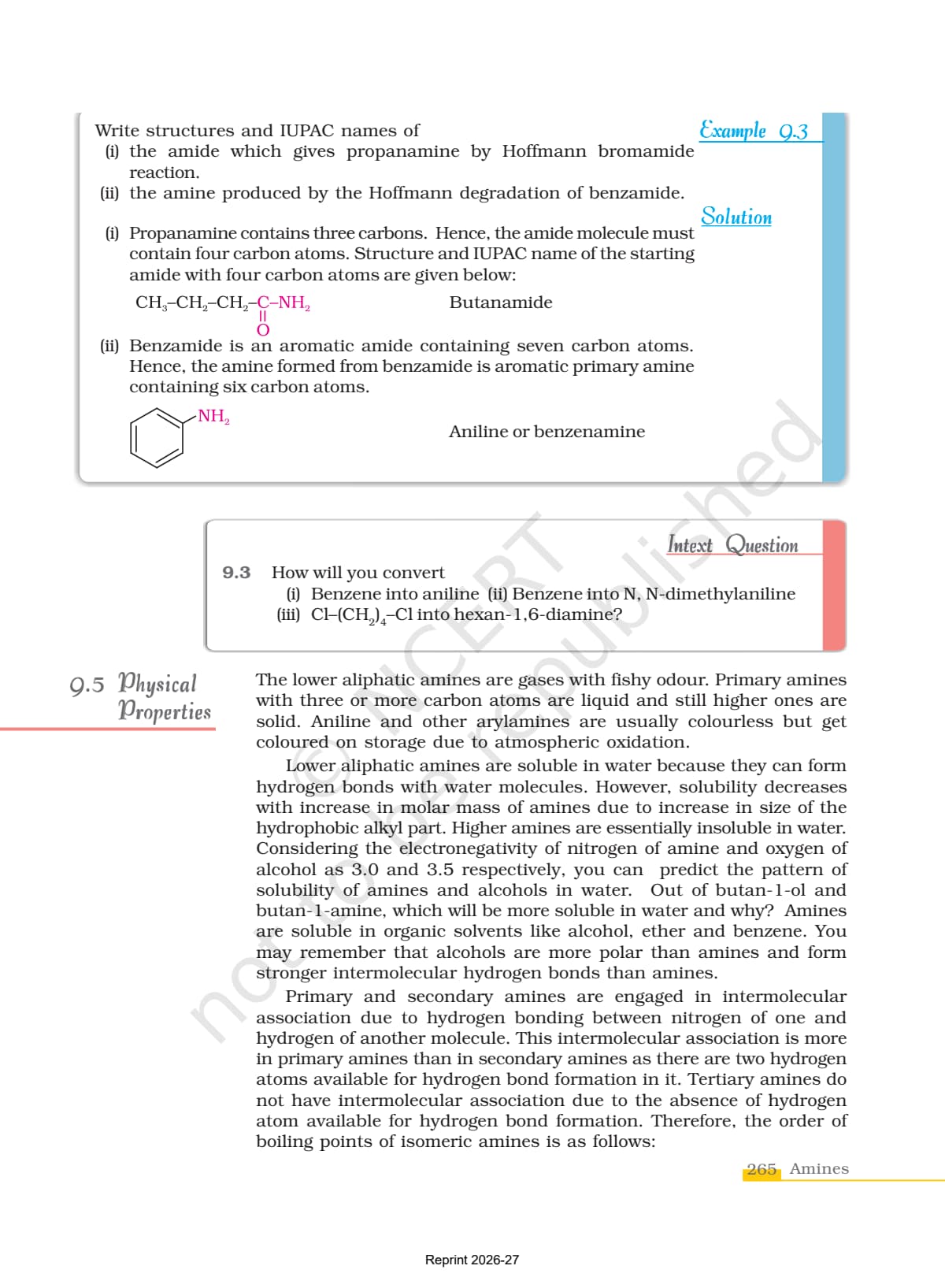
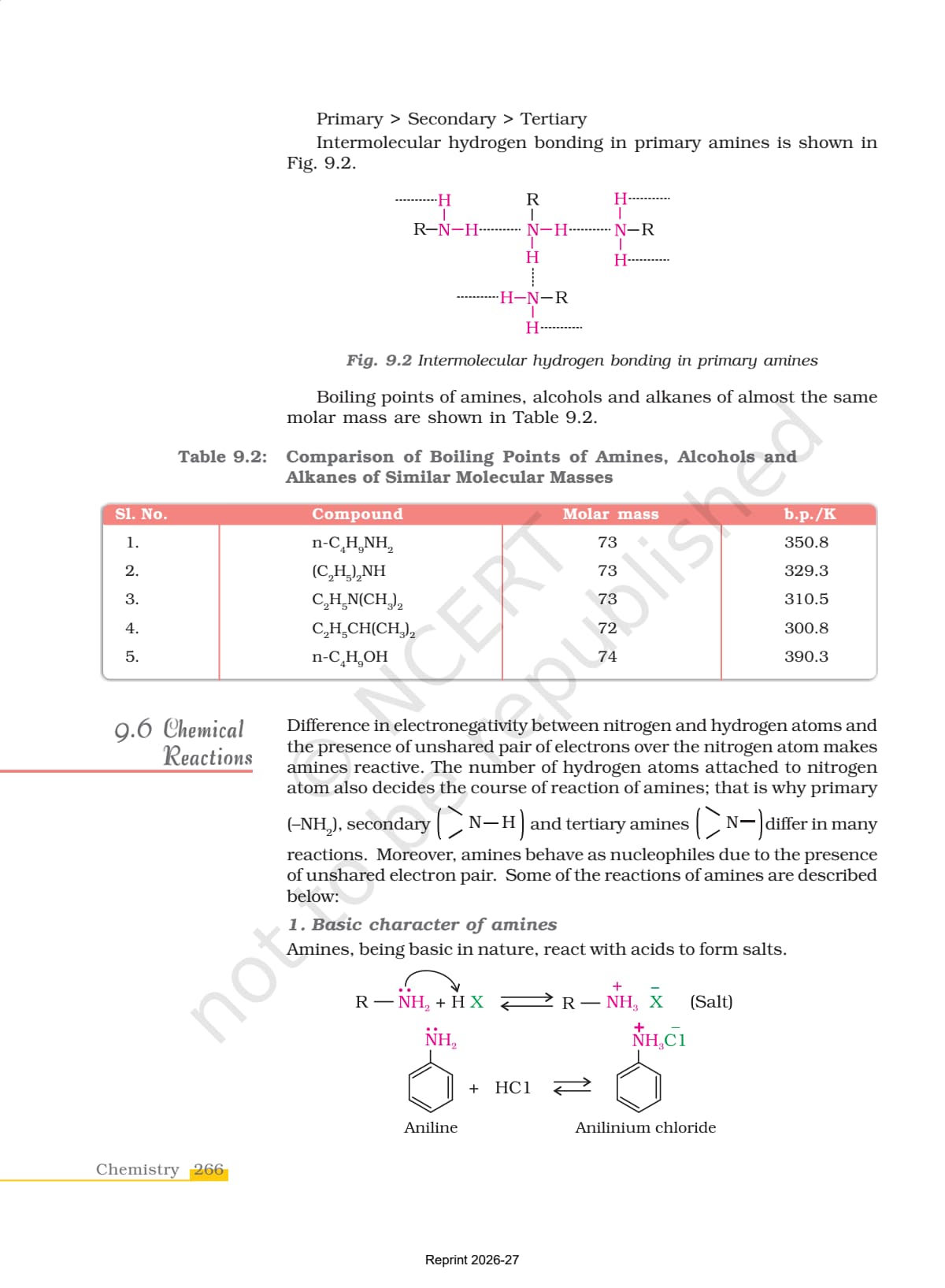
| 9.5 | Physical Properties | 266-267 | Boiling points, solubility, hydrogen bonding in 1° and 2° amines, gas-phase vs aqueous basicity |
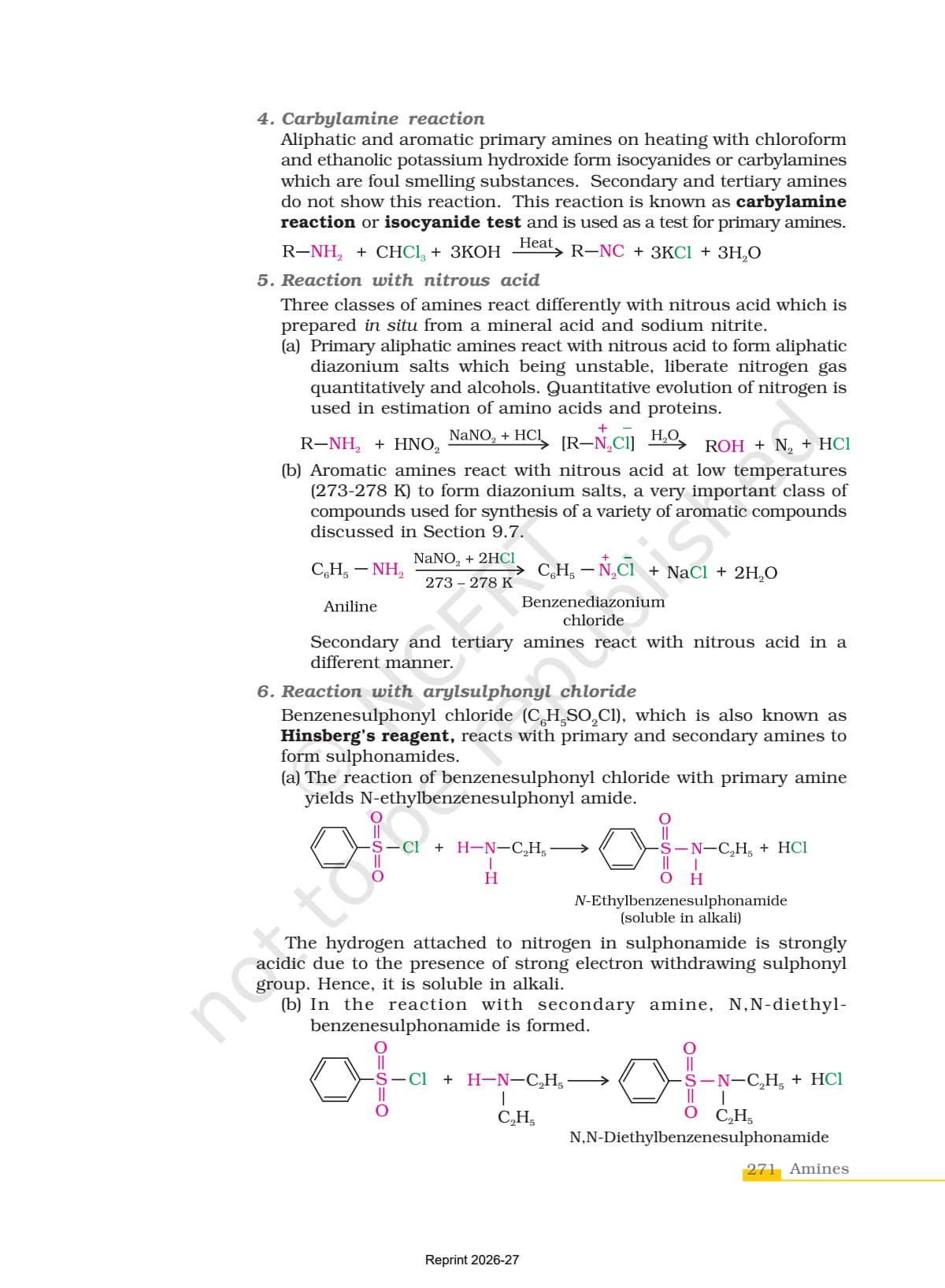
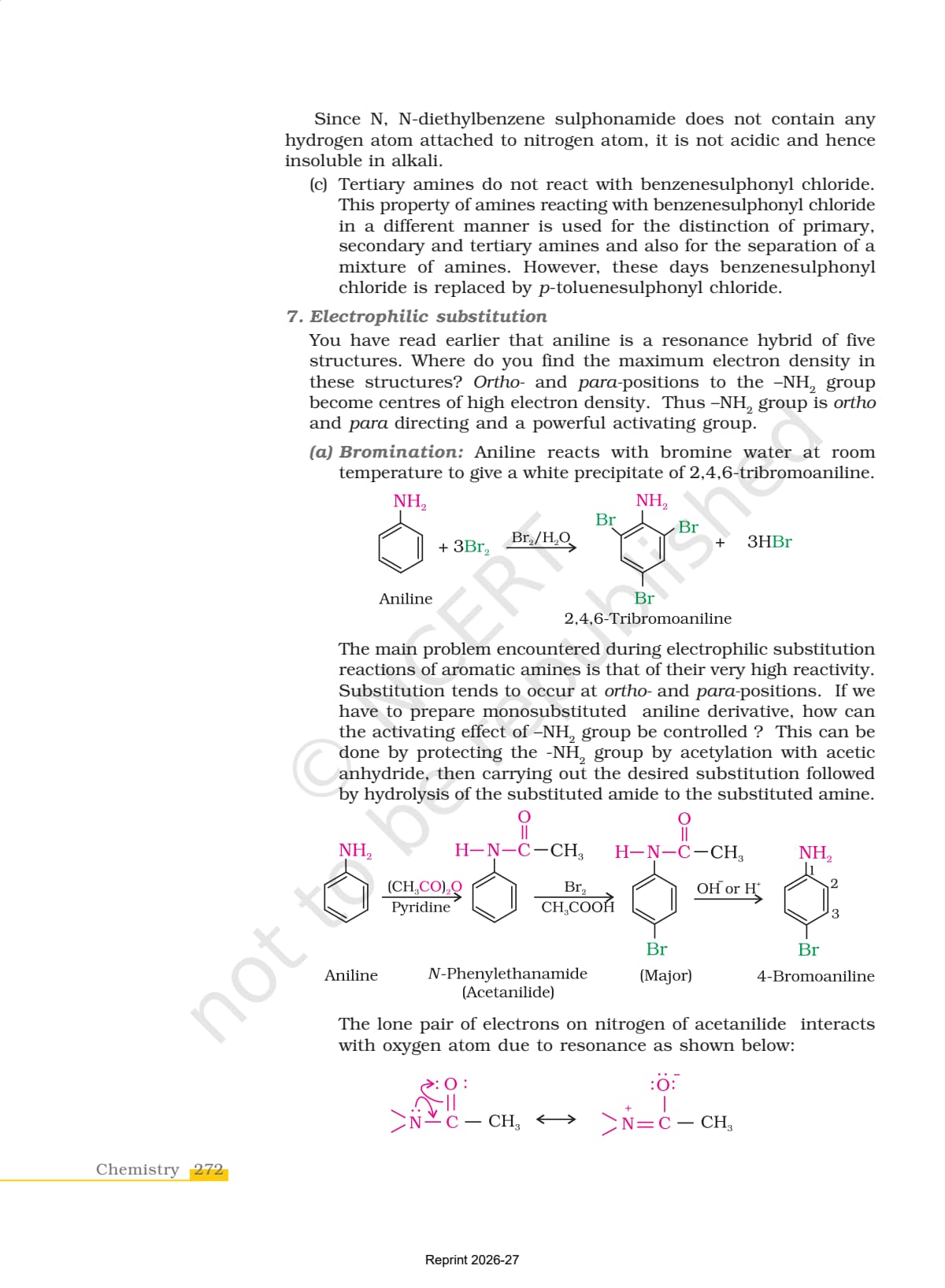
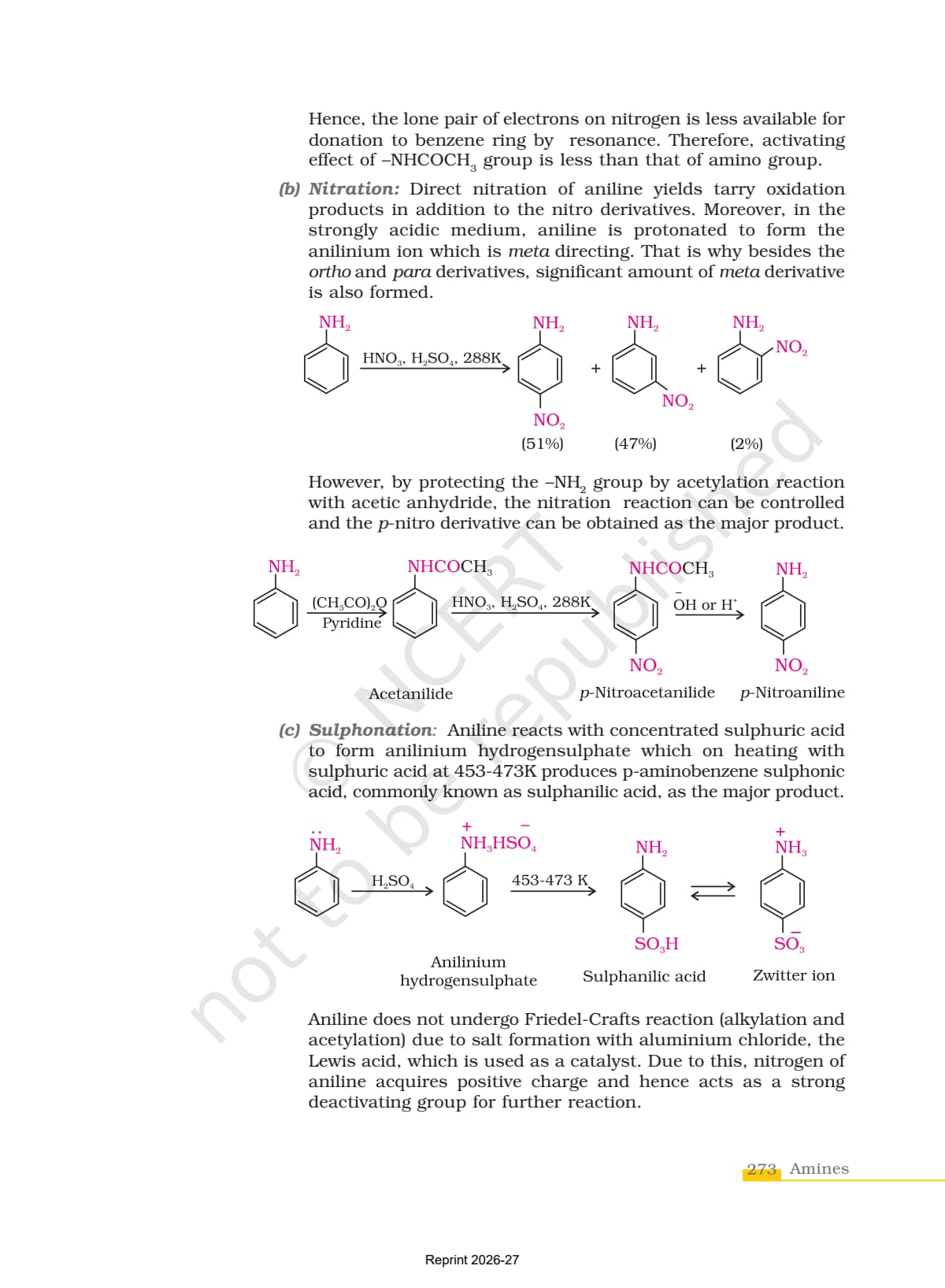
| 9.6 | Chemical Reactions | 267-273 | Basicity (pKb trends), alkylation, acylation, carbylamine reaction, reaction with HNO2, Hinsberg test, electrophilic substitution on aniline |
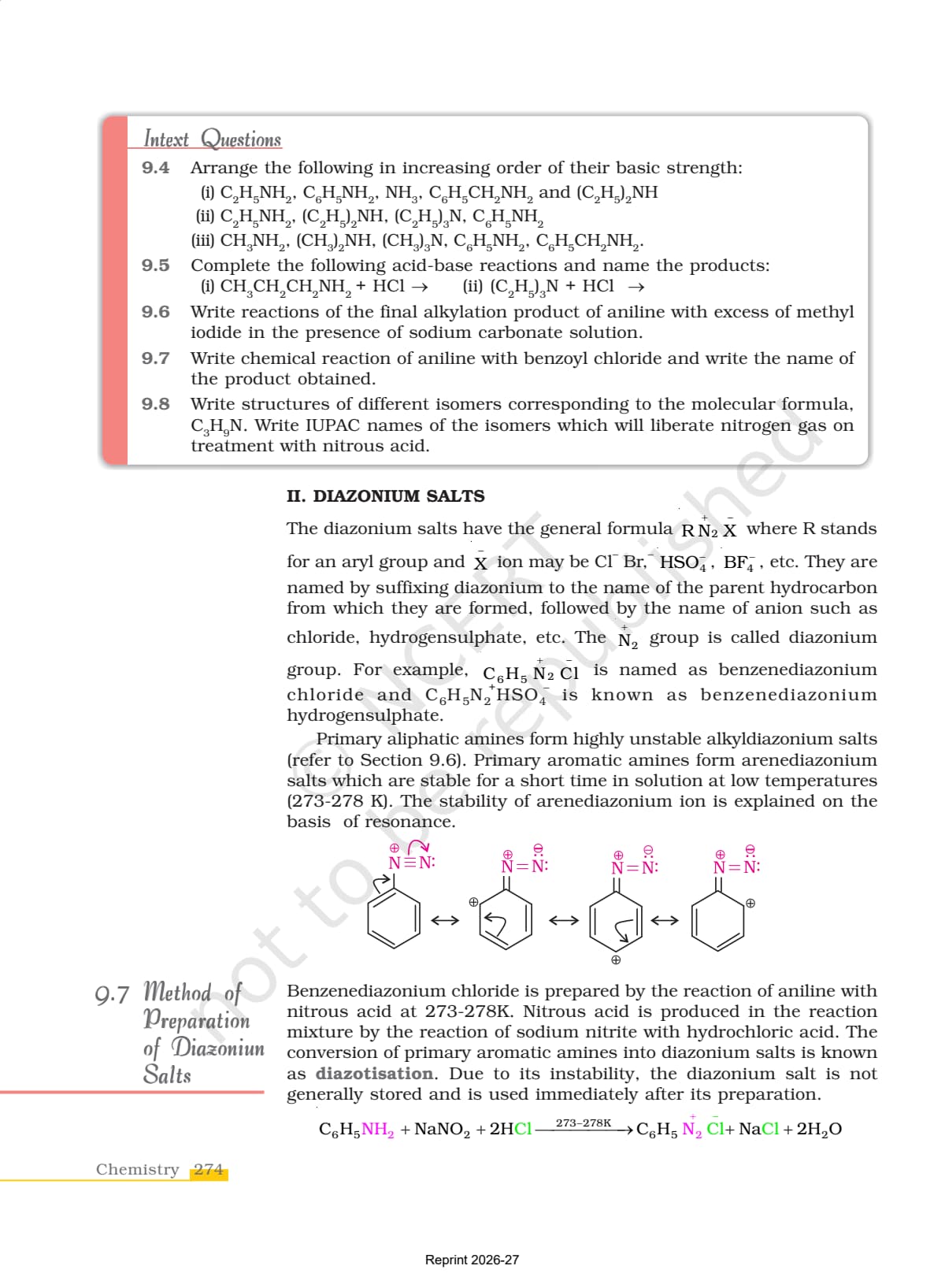
| 9.7 | Method of Preparation of Diazonium Salts | 273-274 | Diazotisation of aromatic primary amines with NaNO2/HCl at 273-278 K |
| 9.8 | Physical and Chemical Properties of Diazonium Salts | 274 | Stability, replacement of -N2+ by Cl, Br, CN, I, F, OH, H; Sandmeyer, Gattermann, balz-Schiemann routes |
| 9.9 | Importance of Diazonium Salts in Synthesis of Aromatic Compounds | 275-277 | Coupling reactions, azo dye preparation, role as synthetic intermediate |
| - | Summary, Exercises (14 Qs) | 277-280 | End-of-chapter problems for board-level practice |
The 14 end-of-chapter exercises split roughly into 3 IUPAC / classification items, 4 reasoning / basicity-ordering items, 5 conversion and named-reaction questions, and 2 mixed mechanism / synthesis questions. The conversion and basicity blocks have shown up most reliably in CBSE Boards.
How will Collegedunia's NCERT Book PDF Help You with Amines?
The official NCERT print is the source of truth for CBSE Boards; this page wraps it with the navigation aids that the raw PDF lacks.
- 2026-27 NCERT Alignment: Latest NCERT print, with every change from the previous edition flagged in the rationalisation section.
- Reaction-by-Reaction Index: Diazonium replacement and named-reaction tables map each reagent (CuCl, CuBr, KI, HBF4, H3PO2) to the exact product CBSE markers want.
- Reading Sequence: The skim-then-deep-dive plan tells you which sections to read first and which intext examples to attempt cold.
- Cross-Reference: Every reaction is mapped to the matching Collegedunia Notes, Formula Sheet, and NCERT Solutions.

Class 12th Chemistry Amines Reading Sequence and Multi-Day Plan
The PDF rewards a three-day plan because of the volume of named reactions (Gabriel, Hofmann, Sandmeyer, Gattermann, Balz-Schiemann, coupling). A single sitting leaks more than half of the reagent-product pairings within a week.
| Day | What to read | What to practise | Time |
|---|---|---|---|
| Day 1 | Sections 9.1 to 9.3 (structure, classification, nomenclature) plus 9.4 (preparation) | Intext examples 9.1 to 9.3 plus exercises 9.1, 9.7 | 2.5 hours |
| Day 2 | Sections 9.5 (physical) and 9.6 (chemical reactions of amines) | Intext example 9.4 plus exercises 9.2, 9.3, 9.4, 9.6, 9.12, 9.13, 9.14 | 3 hours |
| Day 3 | Sections 9.7 to 9.9 (diazonium salts) plus full revision | Intext example 9.5 plus exercises 9.5, 9.8, 9.9, 9.10, 9.11 | 2.5 hours |
What Changed in Amines for 2026-27 NCERT (Rationalisation Note)
The current 2026-27 syllabus retains this unit but renumbered it from legacy Chapter 13 to Chapter 9. The chemistry is almost fully retained; a small number of legacy sub-topics were trimmed.
| Sub-topic | Status in 2026-27 | Notes |
|---|---|---|
| Structure, classification, nomenclature | Kept | Core section, unchanged |
| Preparation of amines (reduction, ammonolysis, Gabriel, Hofmann) | Kept | All five routes retained verbatim |
| Physical properties and basicity (pKb reasoning) | Kept | Gas-phase vs aqueous trends retained |
| Chemical reactions (alkylation, acylation, carbylamine, Hinsberg, HNO2) | Kept | All retained; Hinsberg test still examinable |
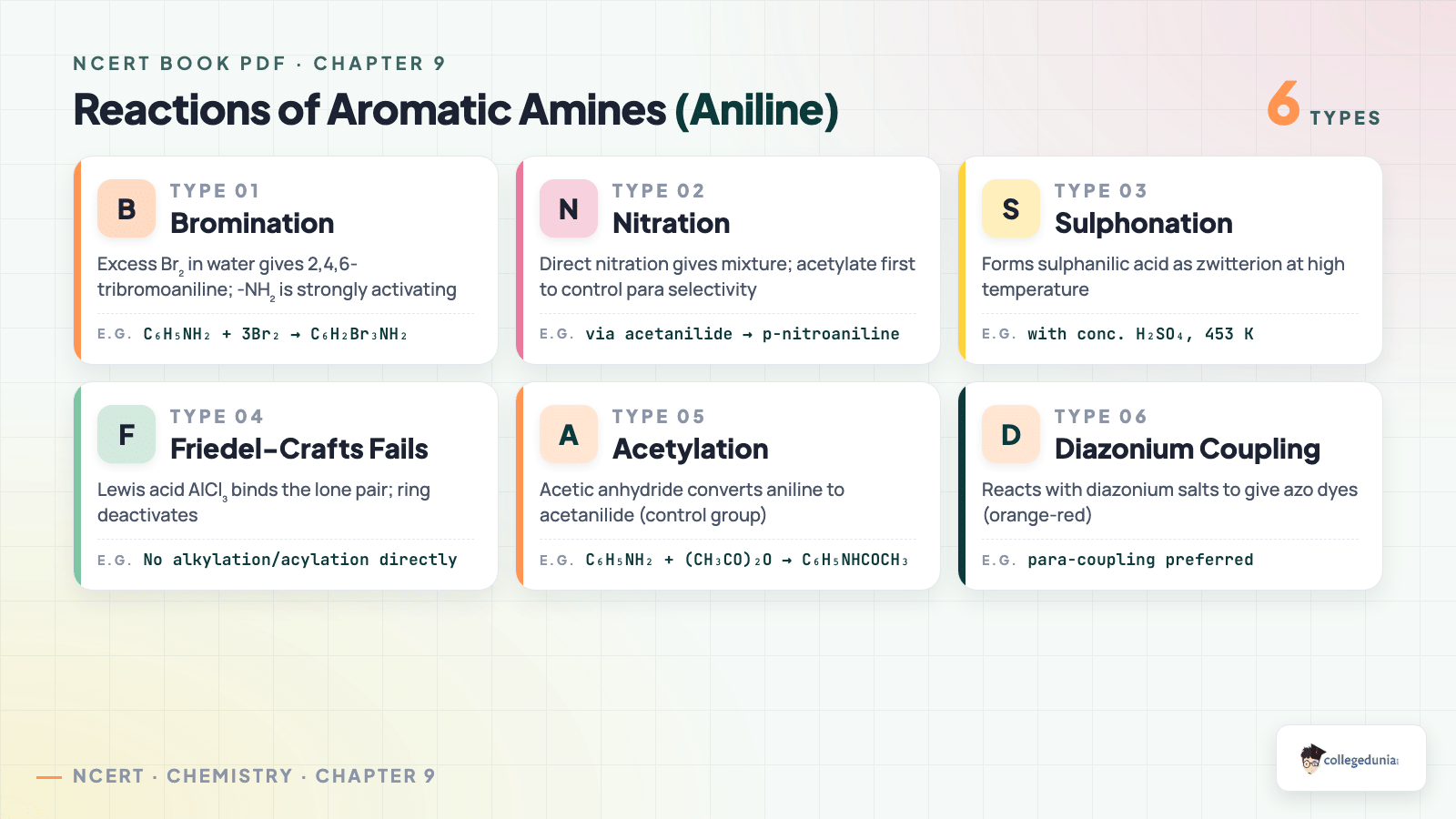
| Electrophilic substitution on aniline (bromination, nitration, sulphonation) | Kept | Activation by -NH2 and protection by acetylation retained |
| Method of preparation of diazonium salts | Kept | Diazotisation conditions (273-278 K, NaNO2/HCl) retained |
| Reactions of diazonium salts (Sandmeyer, Gattermann, Balz-Schiemann, coupling) | Kept | All replacement and coupling routes retained |
| Extended pharmacological discussion of biological amines (adrenaline, ephedrine) | Trimmed | Discussion shortened in the current 2026-27 syllabus to a brief introduction |
Students still using a 2022 copy are studying close to 2 extra pages of trimmed pharmacology, none of which now appears in the Board paper.
Author, Edition and Publisher Information for the Amines NCERT PDF
The PDF on this page is from the official publication, not a third-party reprint. Always study from the latest print.
- Book: Chemistry Part-II, Class 12 (Textbook for Class XII)
- Chapter: 9 - Amines (legacy Chapter 13)
- Publisher: National Council of Educational Research and Training (NCERT)
- Edition: 2026-27 reprint
- Pages: 22
- Languages: English, Hindi (Rasayan Vigyan Bhag-II)
Related Links:
- Class 12 Chemistry NCERT Book PDF (All Chapters)
- CBSE Class 12 Chemistry Sample Papers 2026
- CBSE Class 12 Chemistry Previous Year Question Papers
Student Feedback
In a Collegedunia poll of 900 Class 12 students, 78% said the section-wise page map made the Amines diazonium reactions far easier to revise from the PDF.
Other Resources for Amines Class 12 Chemistry
NCERT Book PDF for Class 12 Chemistry: All Chapters
The table lists every chapter of the Class 12 Chemistry 2026-27 NCERT, each linking to its dedicated Collegedunia NCERT Book PDF page.
| Chapter | Resource |
|---|---|
| Chapter 1 | Solutions NCERT Book PDF |
| Chapter 2 | Electrochemistry NCERT Book PDF |
| Chapter 3 | Chemical Kinetics NCERT Book PDF |
| Chapter 4 | The d- and f-Block Elements NCERT Book PDF |
| Chapter 5 | Coordination Compounds NCERT Book PDF |
| Chapter 6 | Haloalkanes and Haloarenes NCERT Book PDF |
| Chapter 7 | Alcohols, Phenols and Ethers NCERT Book PDF |
| Chapter 8 | Aldehydes, Ketones and Carboxylic Acids NCERT Book PDF |
| Chapter 10 | Biomolecules NCERT Book PDF |
Amines Class 12 Chemistry NCERT Book PDF FAQs
Ques. Where can I download the Class 12 Chemistry Chapter 9 Amines NCERT Book PDF?
Ans. You can download the Amines Class 12 Chemistry NCERT Book PDF directly from this page. Both the Normal and HD versions are available and both are free, with no registration required.
Ques. Is the Amines chapter aligned with the 2026-27 NCERT?
Ans. Yes. The PDF reflects the current 2026-27 syllabus for Class 12 Chemistry. The chapter retains all nine core sections on structure, classification, nomenclature, preparation, physical and chemical properties of amines, and the method, properties, and synthetic importance of diazonium salts; only the extended pharmacology discussion of biological amines has been shortened in the new edition.
Ques. How many pages is the Class 12th Chemistry Amines NCERT Book PDF?
Ans. The chapter runs roughly 22 pages including the 9 numbered sections, 5 intext examples, the summary, and the 14 end-of-chapter exercises.
Ques. How many marks does Amines carry in the CBSE Class 12 Chemistry Board exam?
Ans. Amines typically carries 4 to 6 marks in the Class 12 Chemistry Board exam, sitting in the lower-middle band along with Haloalkanes and Haloarenes. The marks are usually split as one 2-mark distinguishing-test question plus one 3-mark conversion or diazonium-route question.
Ques. Why was the chapter renumbered from 13 to 9?
Ans. The 2026-27 NCERT reduced the Class 12 Chemistry book from 16 chapters (across Parts I and II) to 10 chapters. Amines moved from old Chapter 13 to current Chapter 9 in this consolidation. The chapter content itself is largely retained; only the numbering changed.
Ques. Which intext examples in Amines are most important for Boards?
Ans. Examples 9.3 (conversions involving Hofmann and Gabriel), 9.4 (basicity ordering of amines in gas vs aqueous phase), and 9.5 (diazonium-route synthesis of aryl halides, phenols, and arenes) are the highest-yield. Practise each at least twice before the exam.
Ques. Has any topic been removed from Amines in the latest NCERT edition?
Ans. No major sub-topic was fully removed. The extended pharmacological discussion of biological amines such as adrenaline and ephedrine was trimmed in the 2026-27 print; all nine numbered sections and every named reaction (Gabriel, Hofmann, Sandmeyer, Gattermann, Balz-Schiemann, coupling, Hinsberg, carbylamine) are intact.
Ques. How long should I take to complete the Amines NCERT chapter?
Ans. A three-day plan of about 8 hours total is realistic: one day for structure, classification, nomenclature, and preparation; one for physical and chemical reactions of amines; and one for diazonium salts plus full revision. The Collegedunia multi-day study plan further up on this page breaks the hours down section by section.



Comments