




Class 12 Chemistry Chapter 1 Solutions is a top-scoring Physical Chemistry unit. This page hosts the official 2026-27 NCERT chapter PDF with its section map, intext-example list, and rationalisation notes.
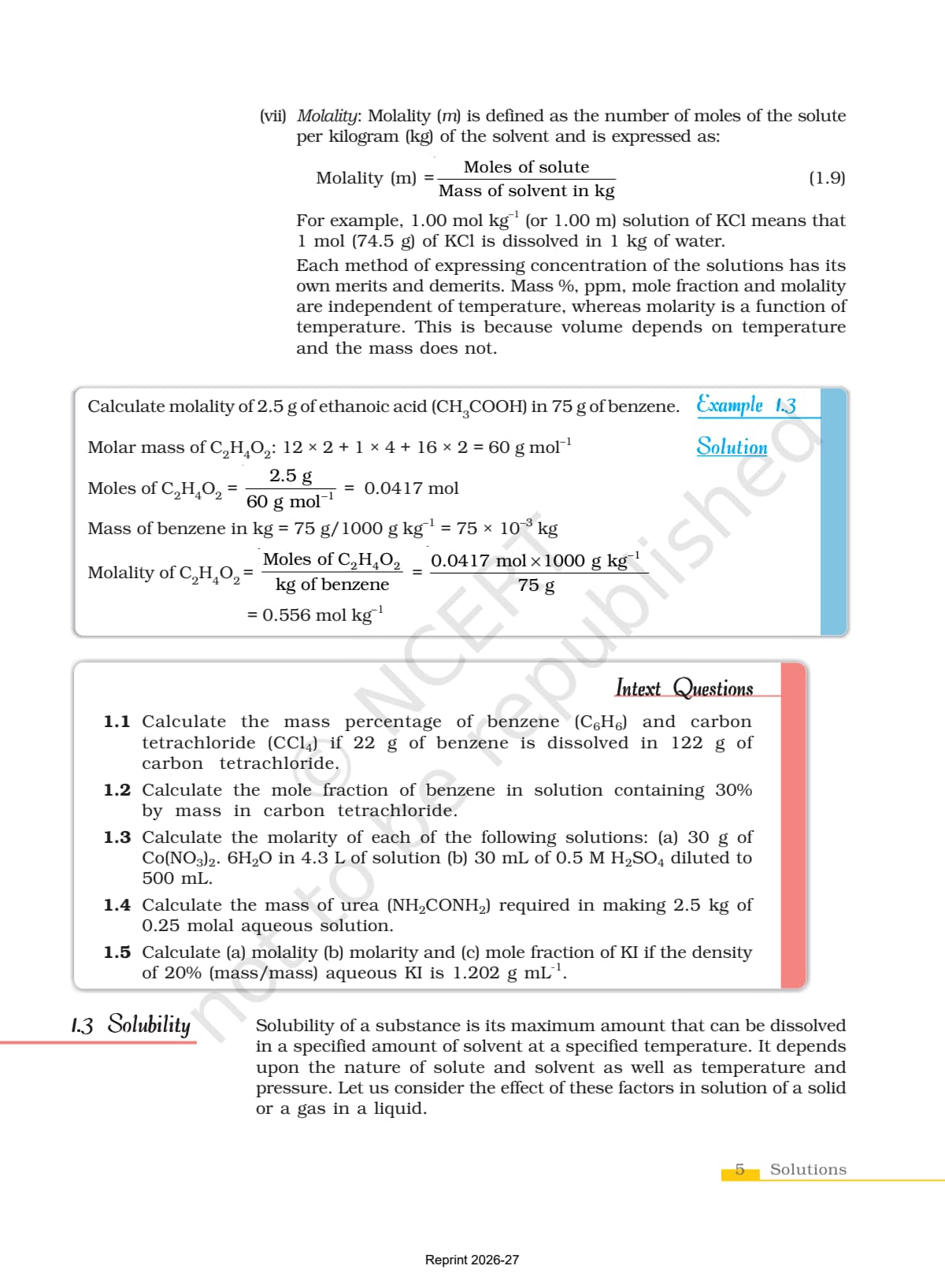
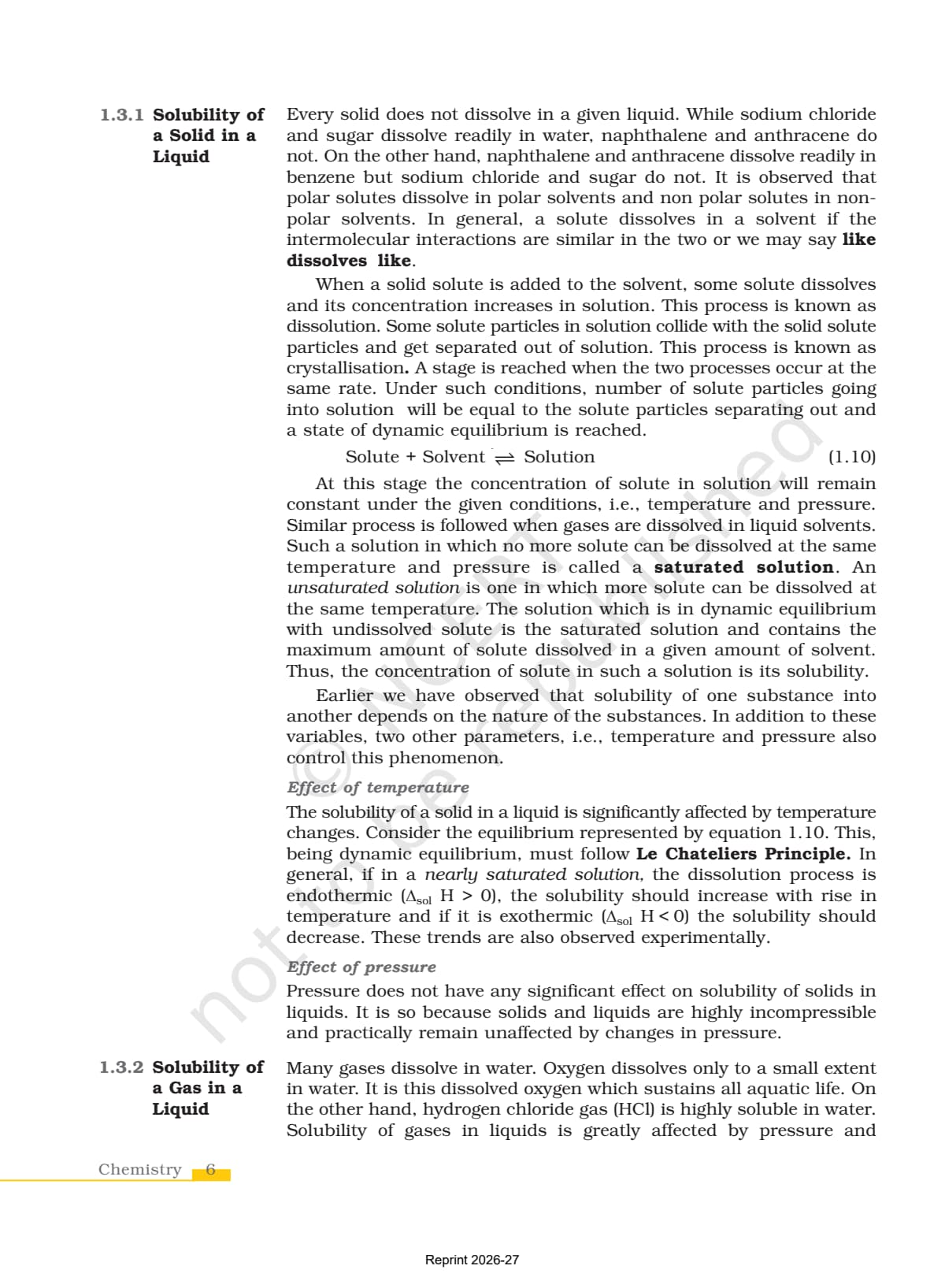
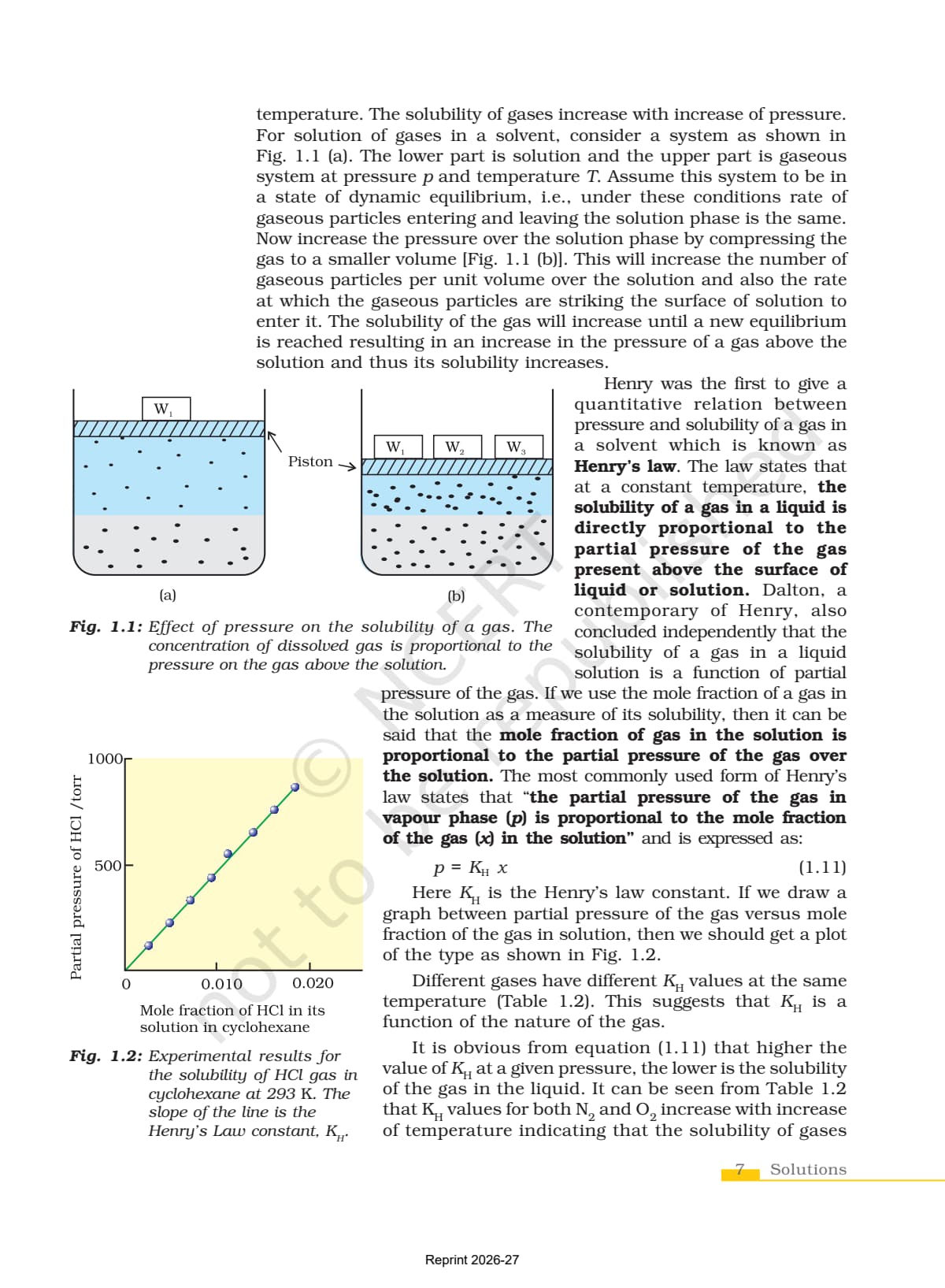
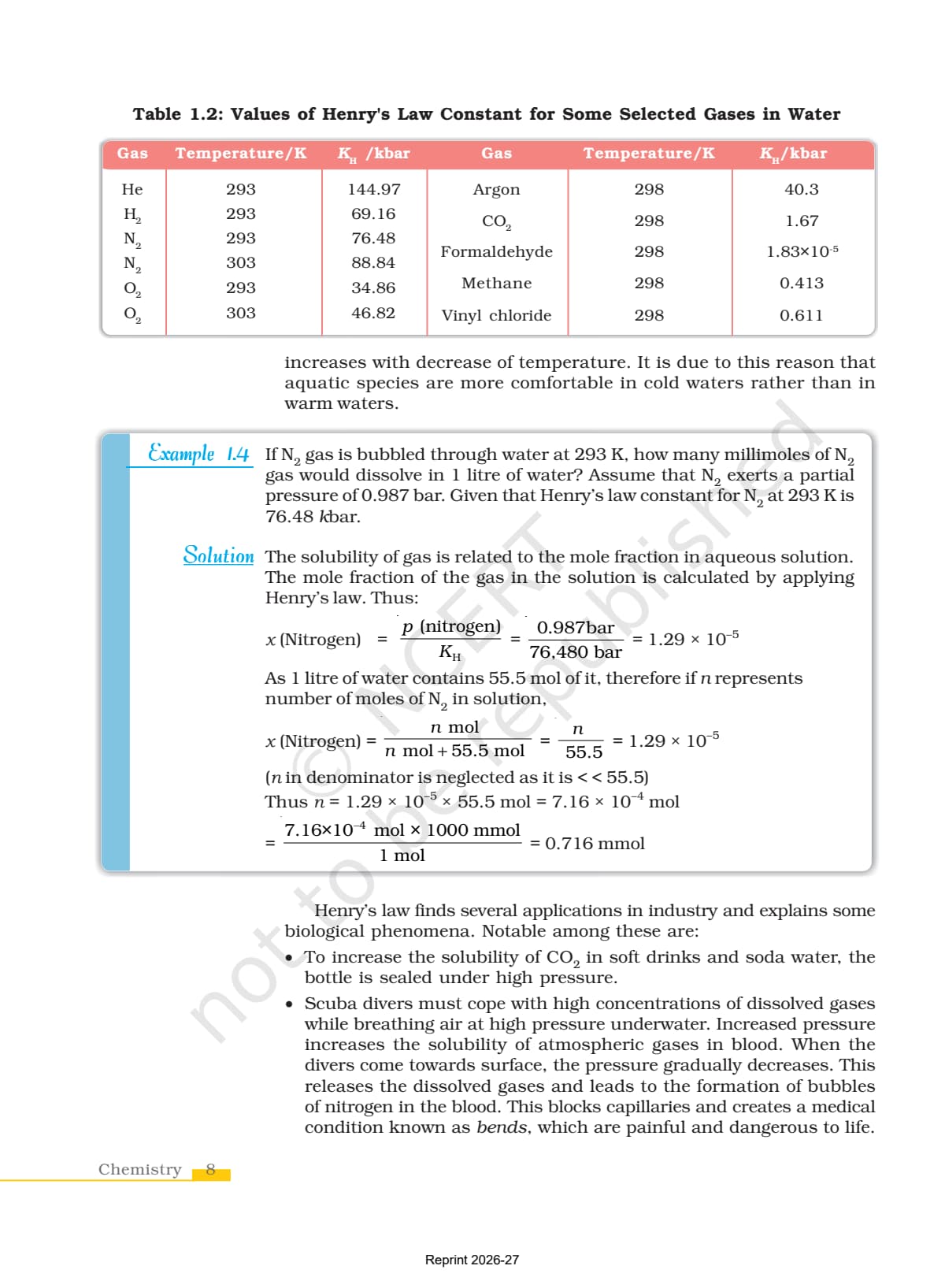
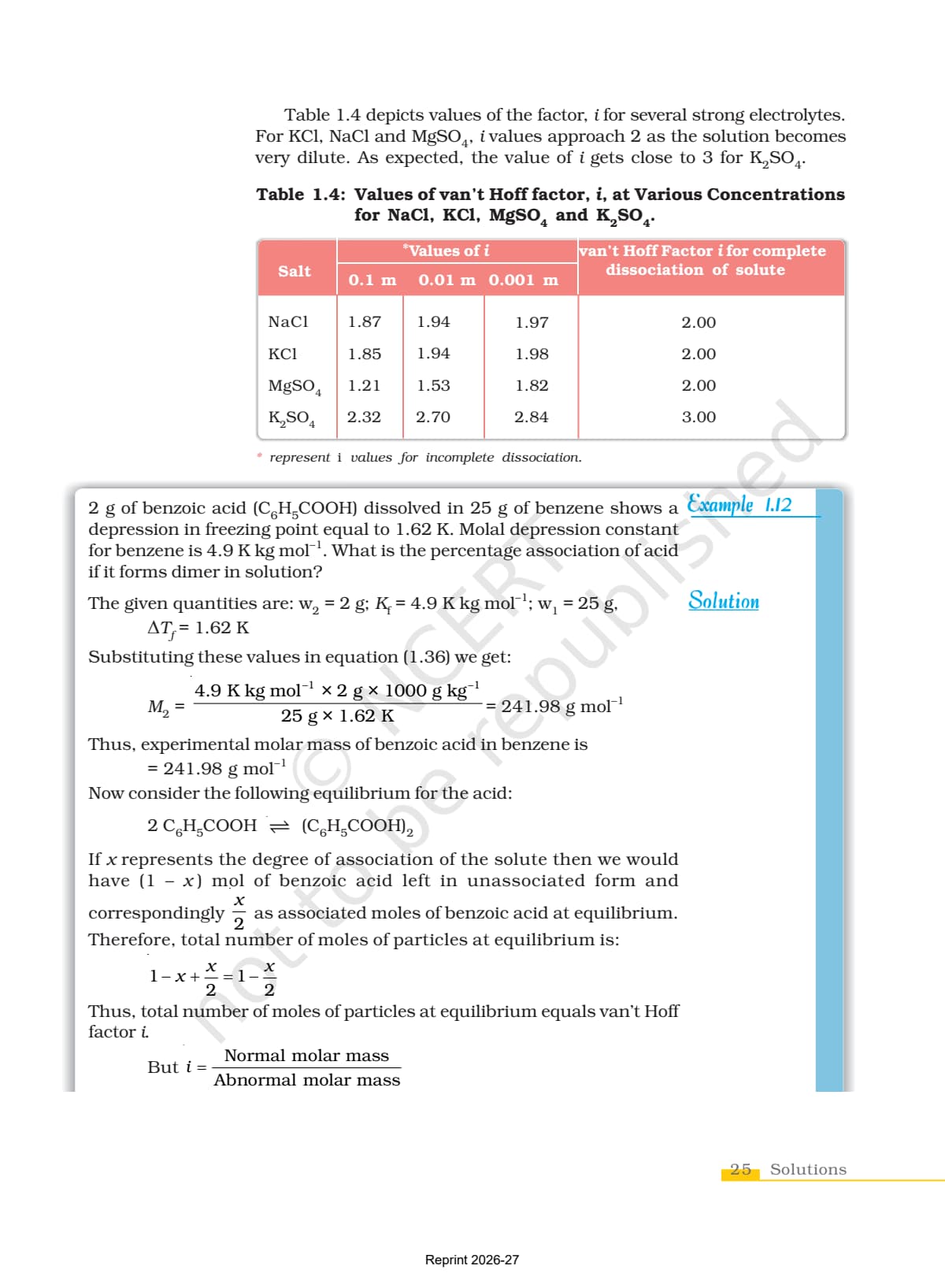
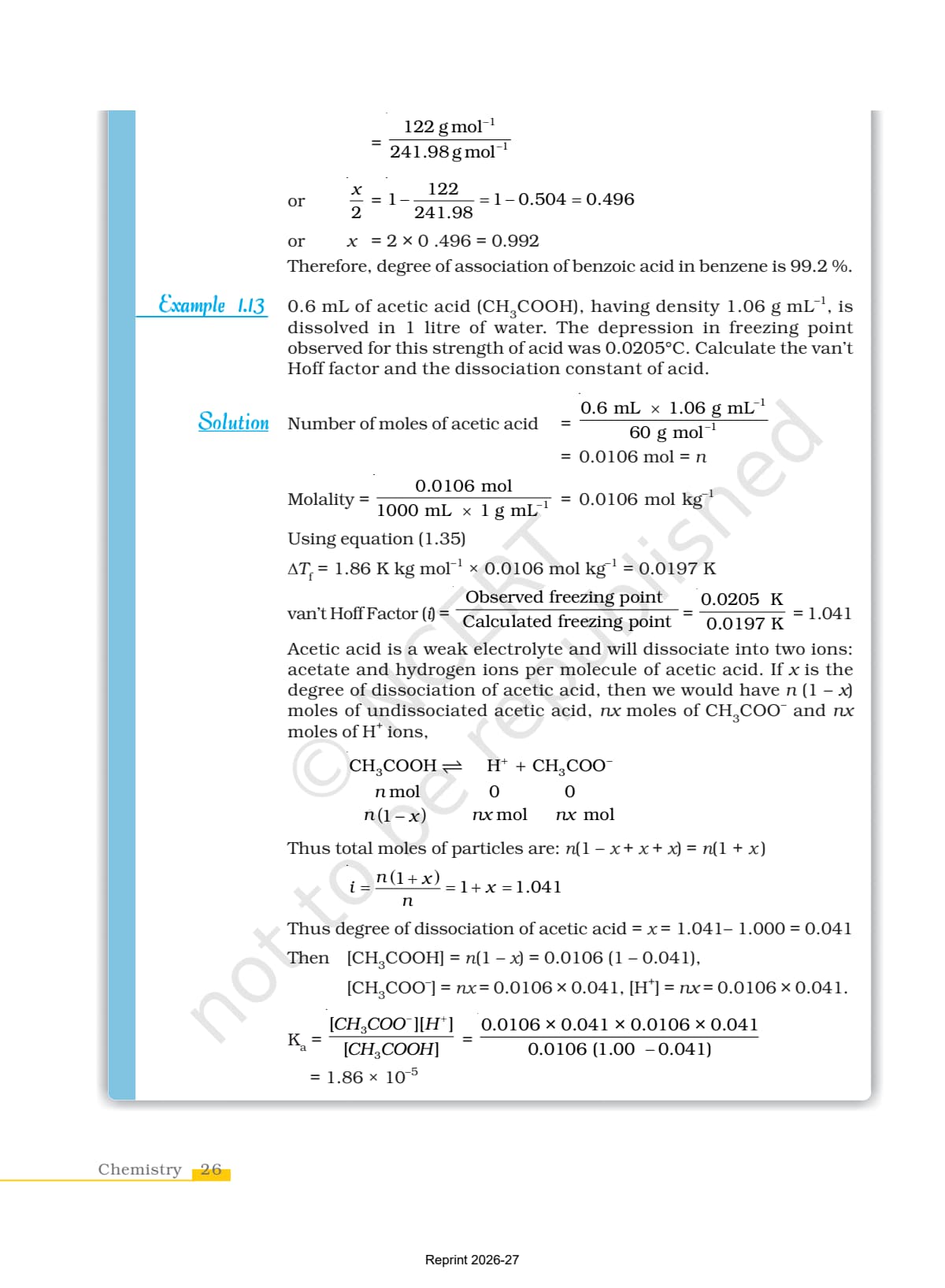
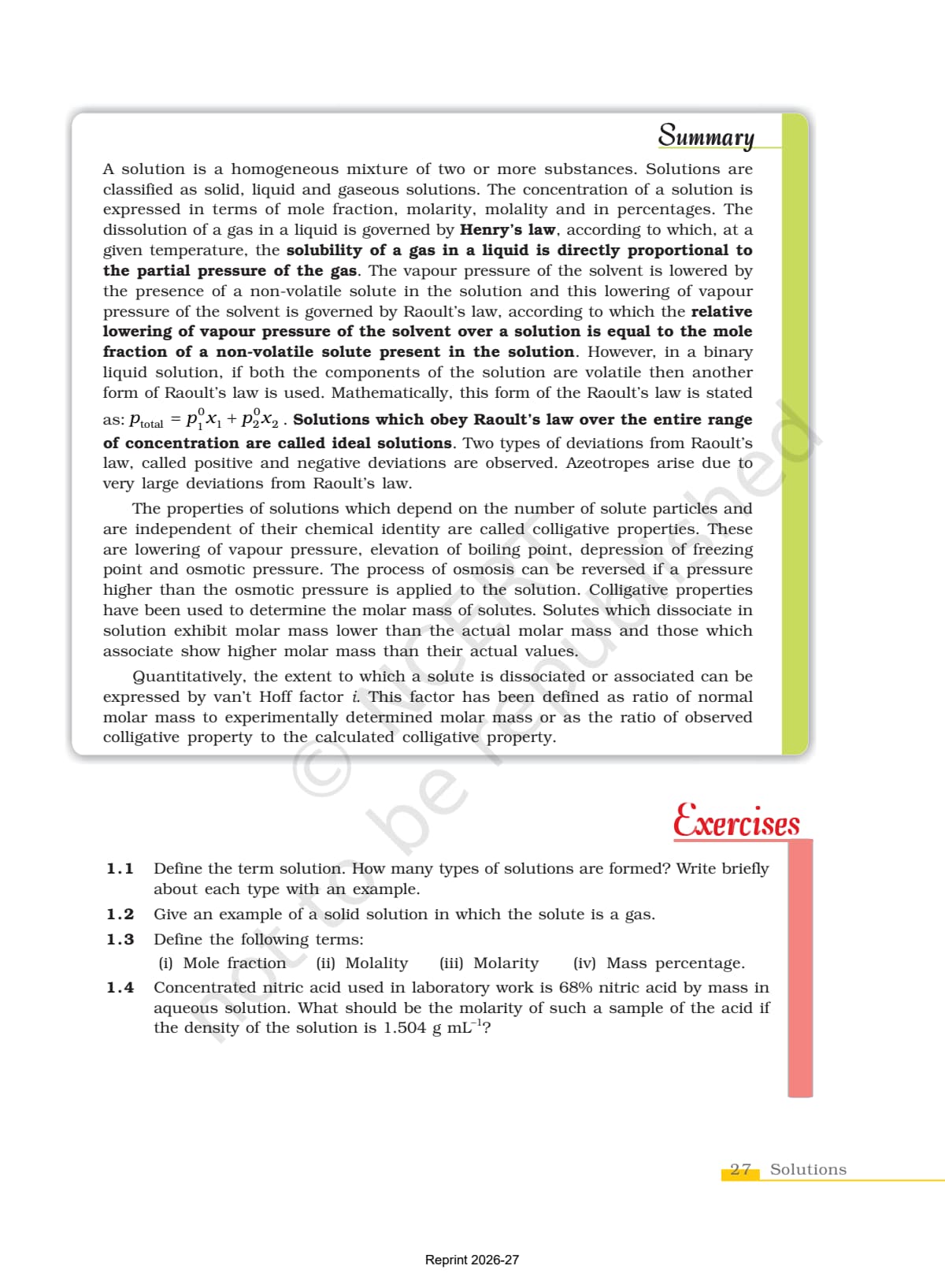
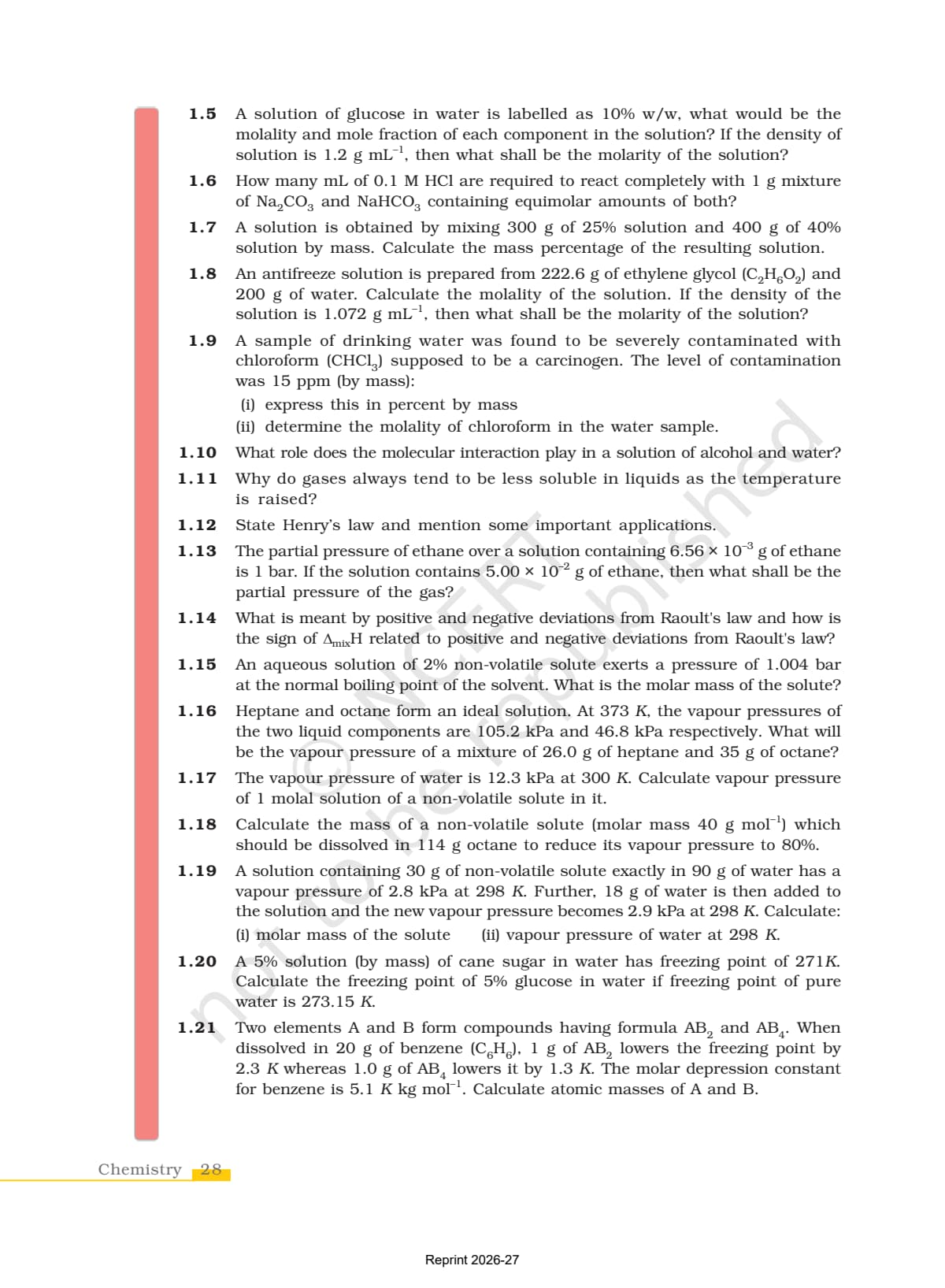
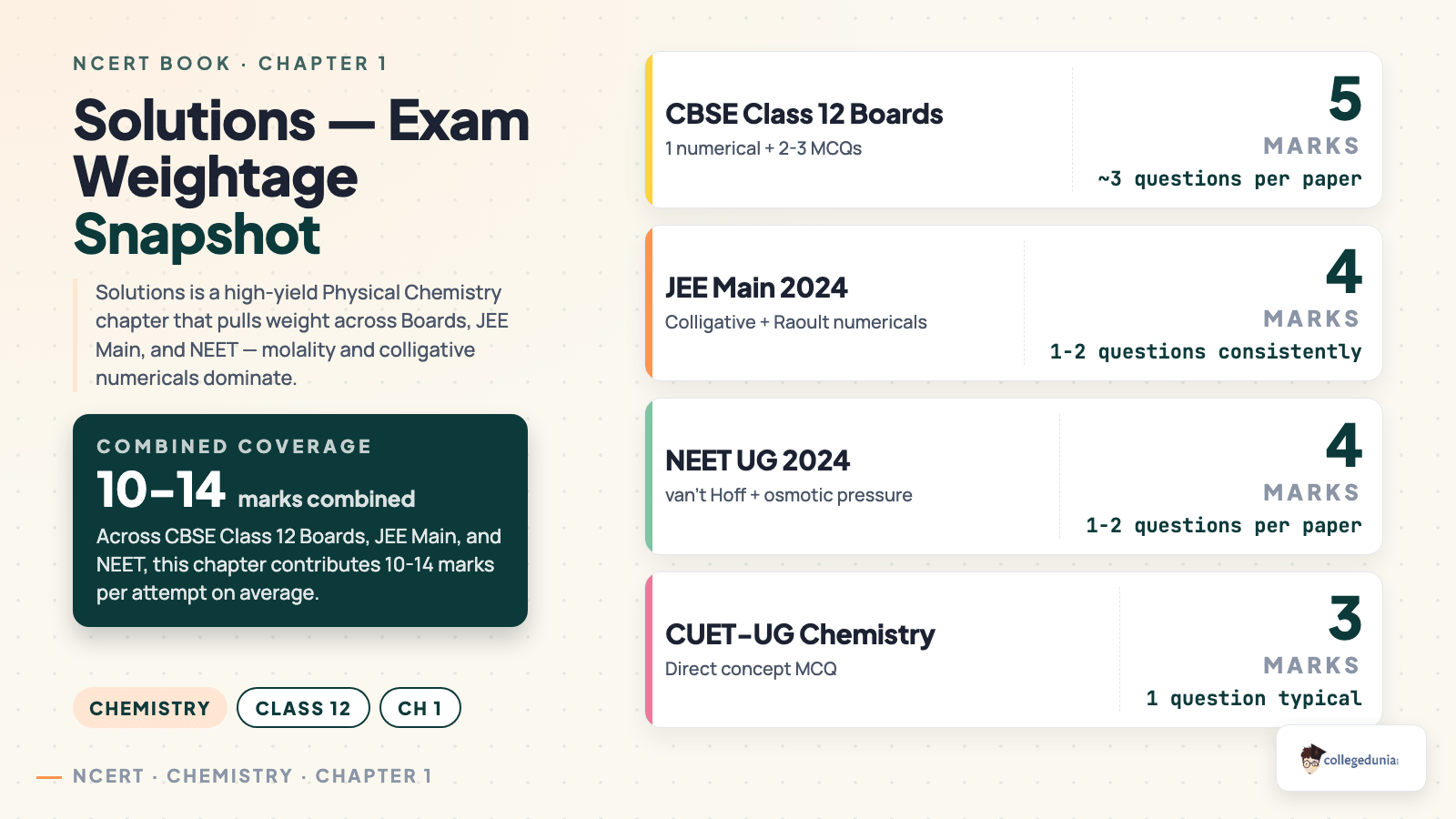
- CBSE Weightage: 6–8 marks
- JEE Main Weightage: 4–5% (2–3 questions per paper)
- NEET Weightage: 2–3 questions per year
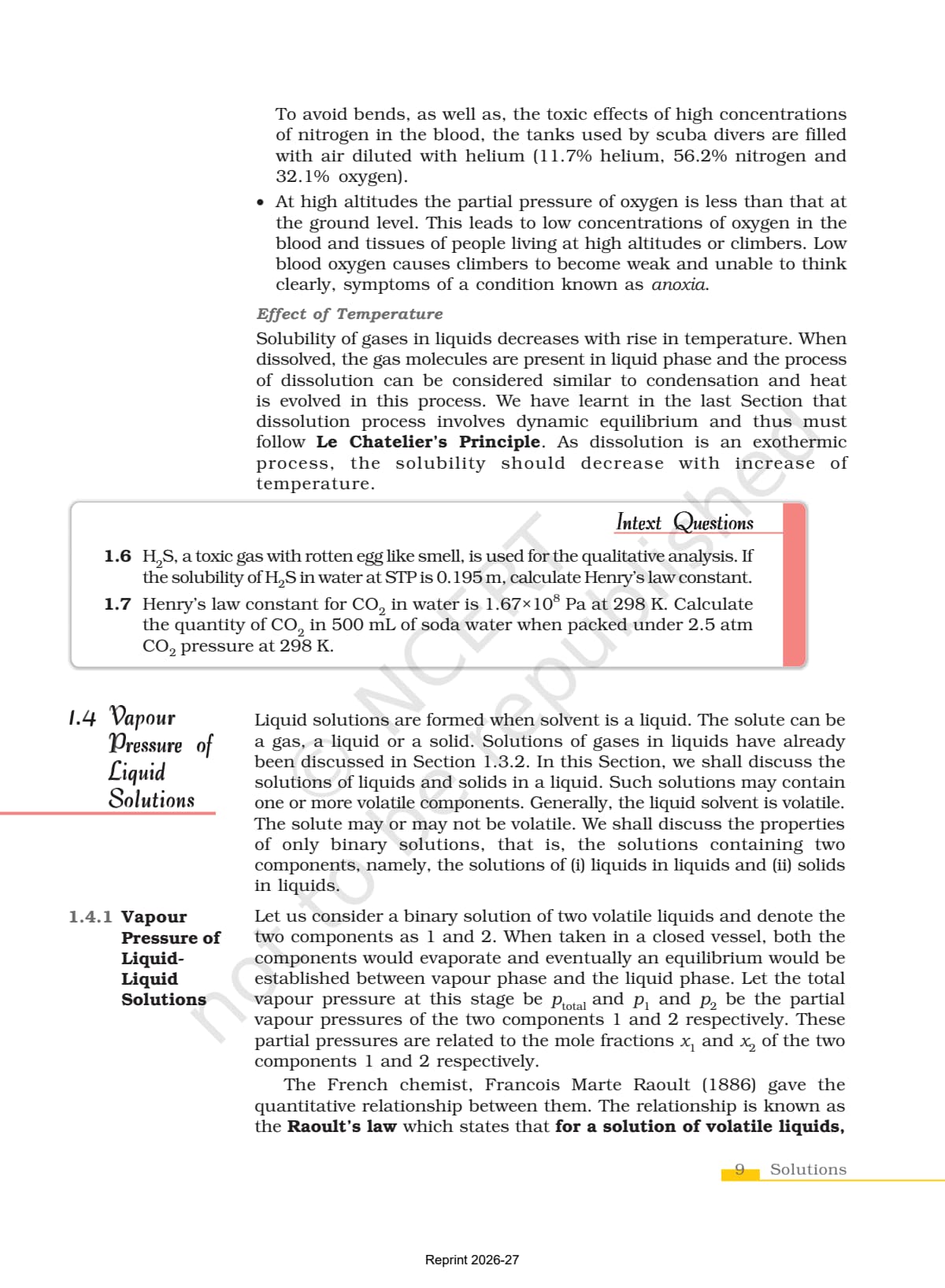
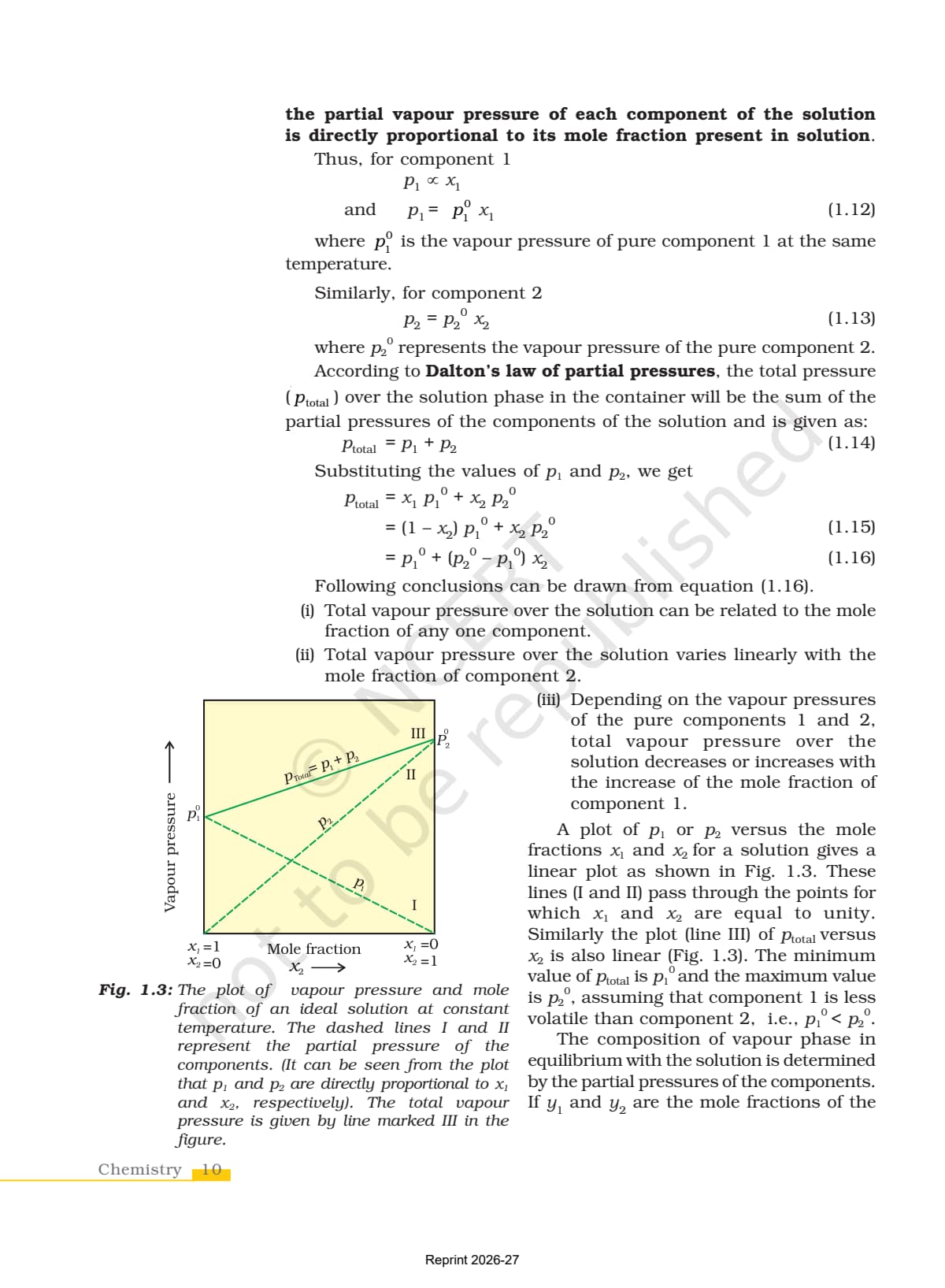
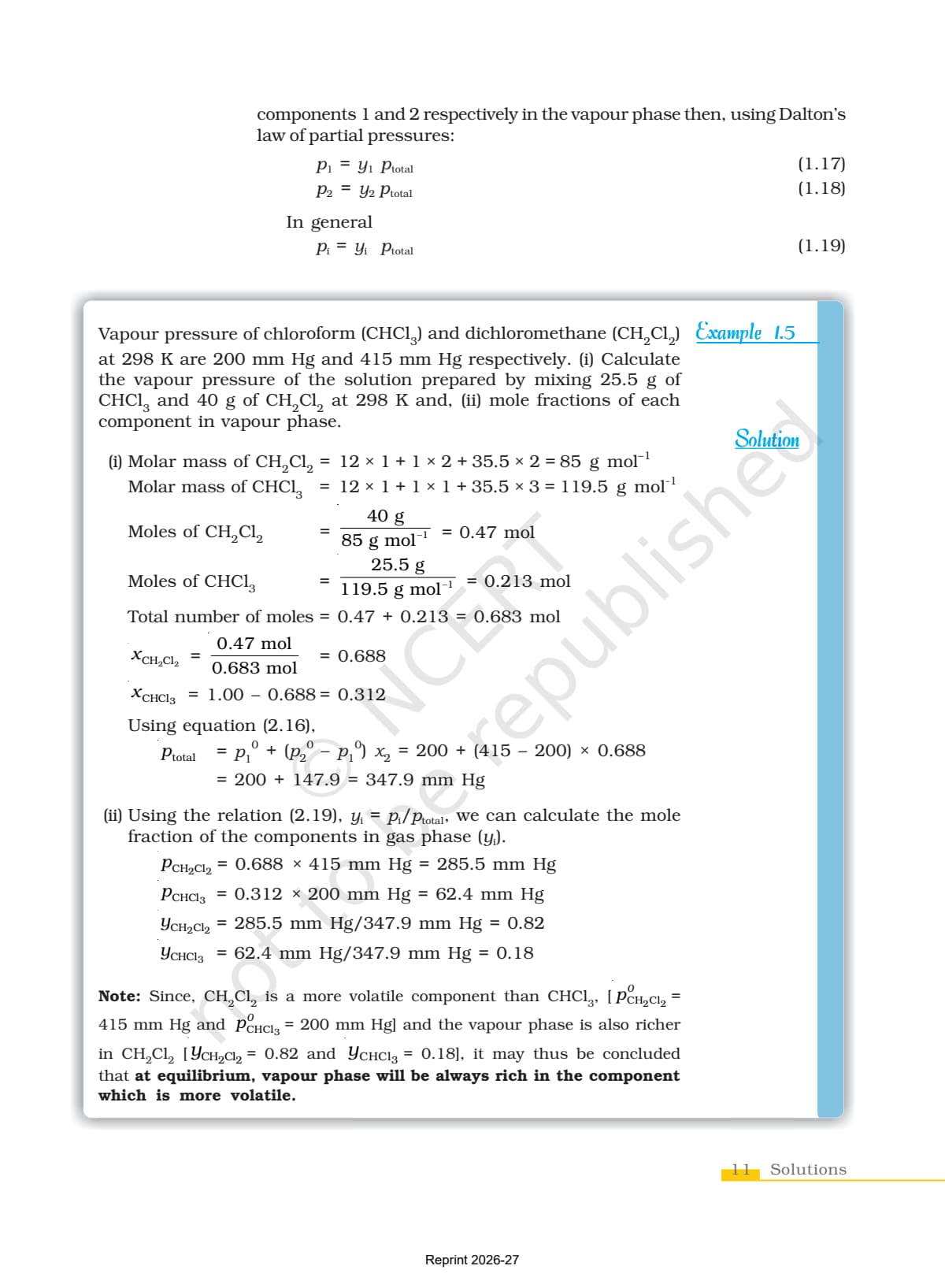
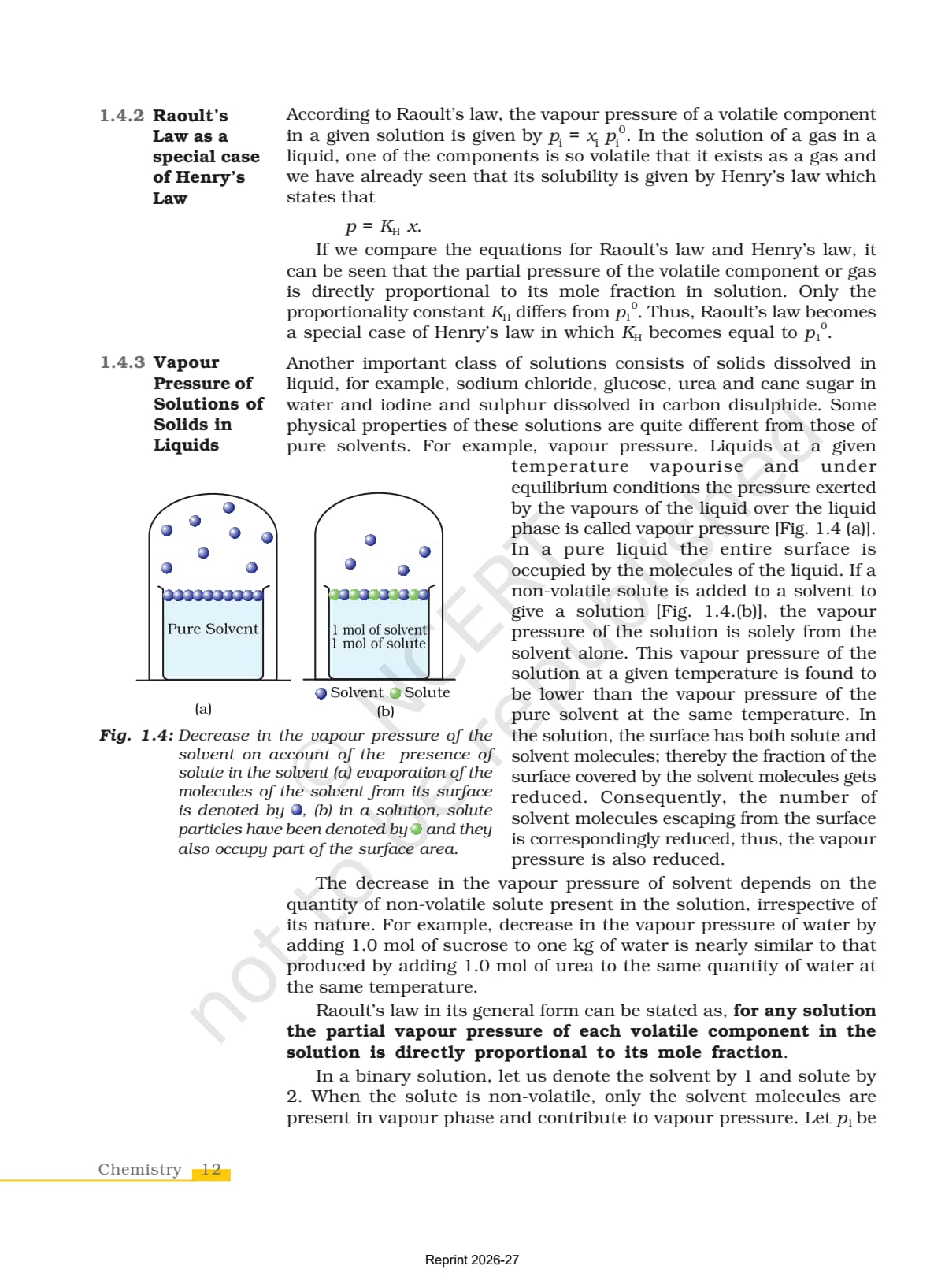
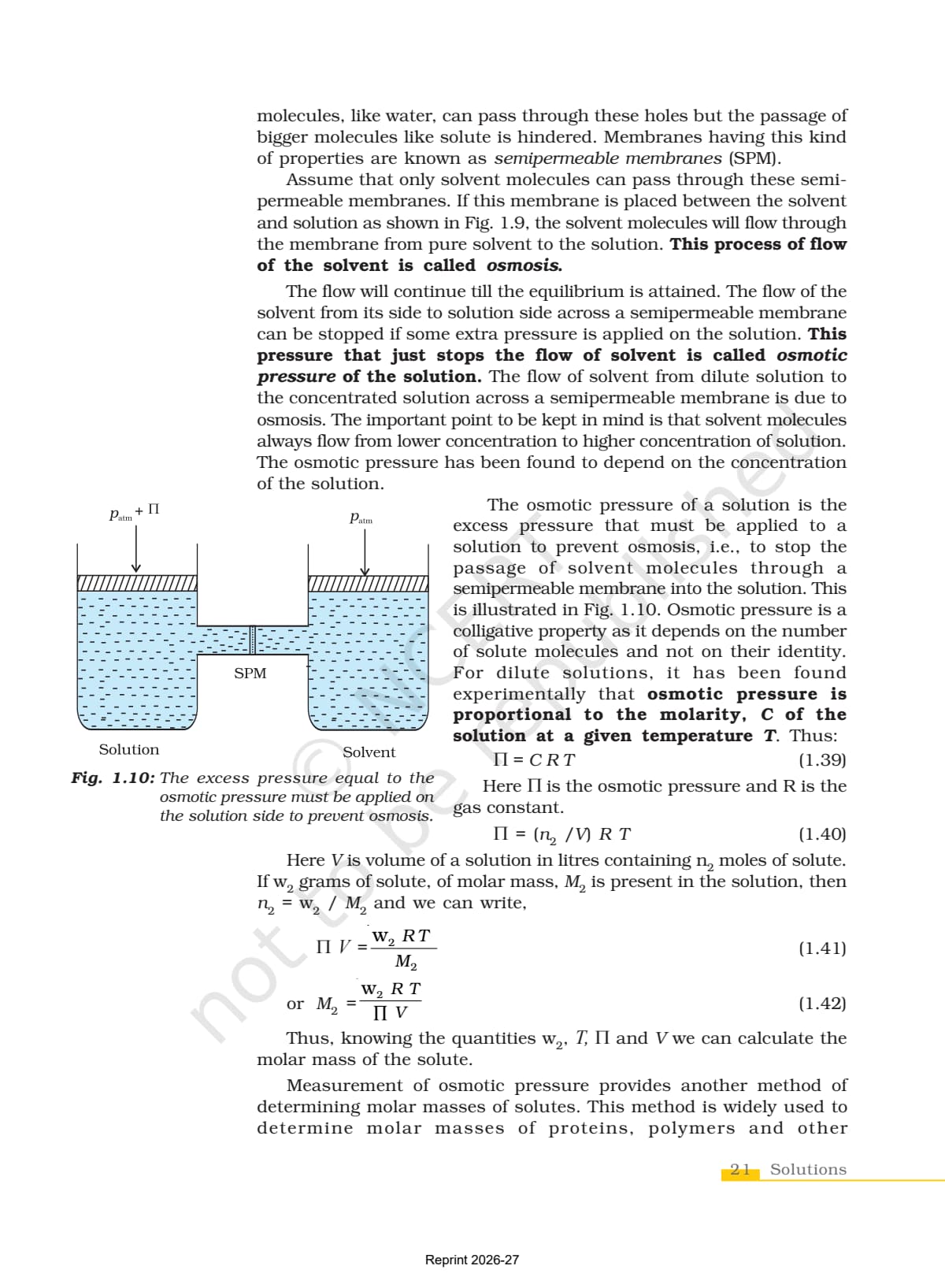
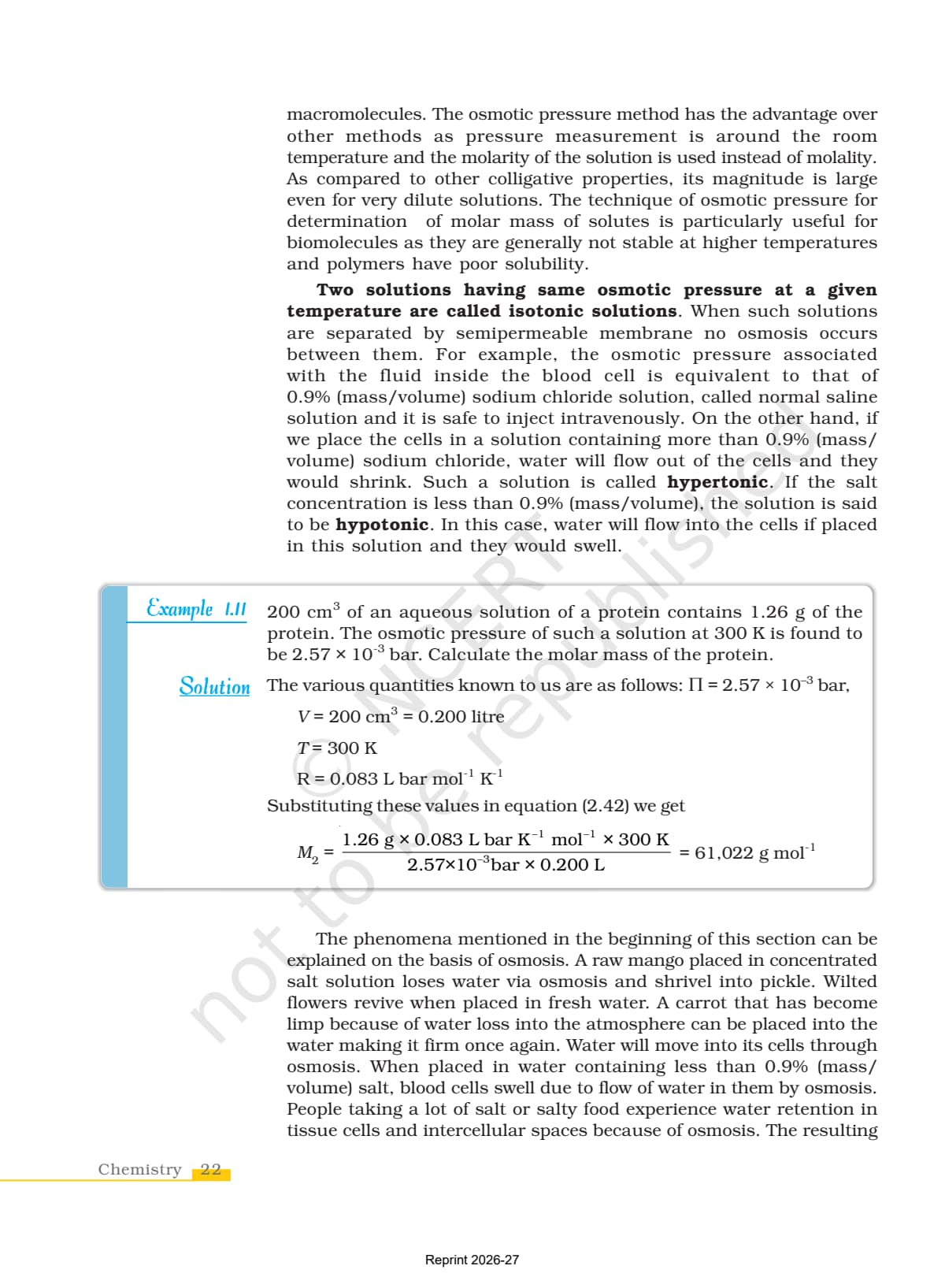
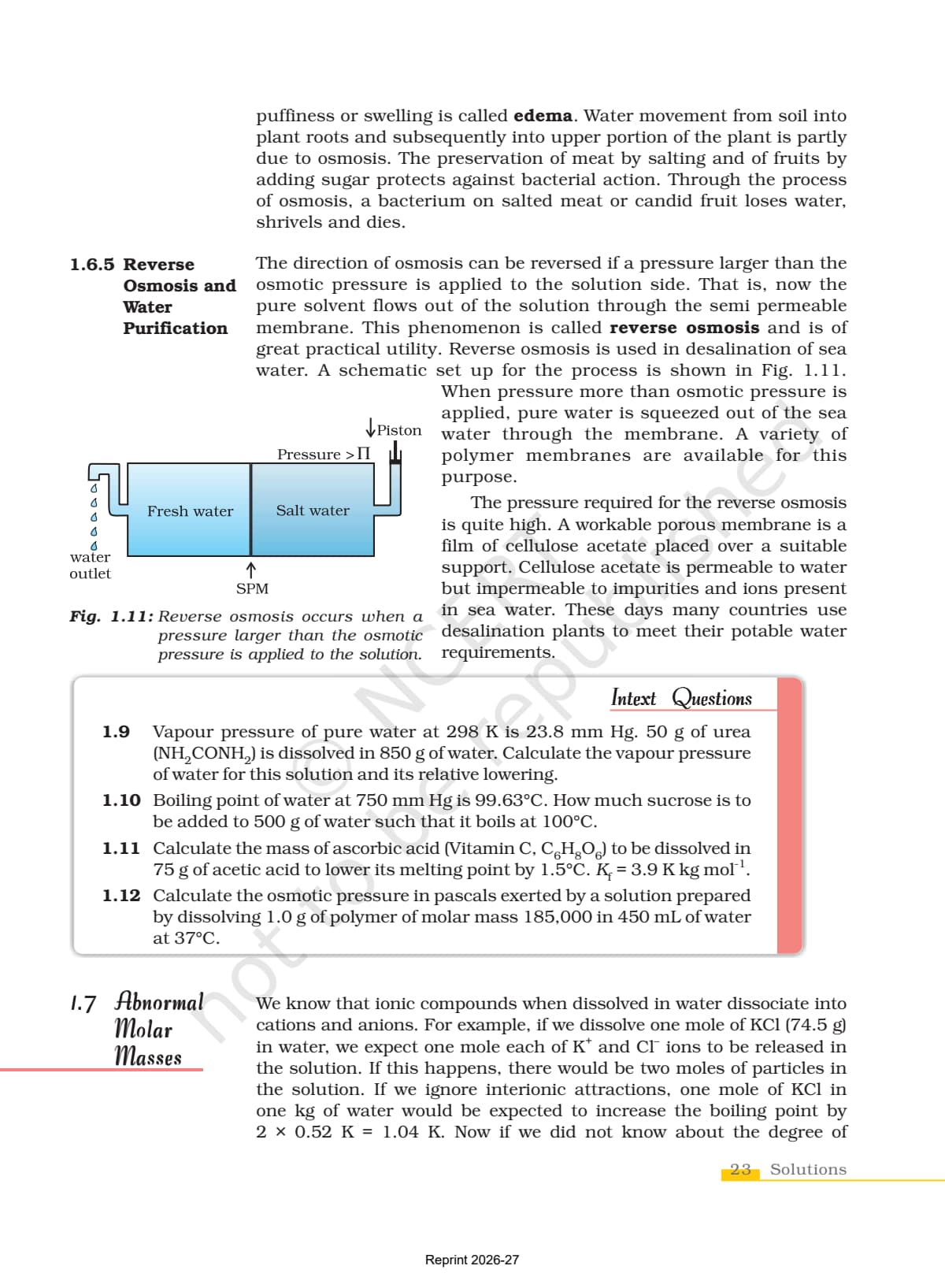
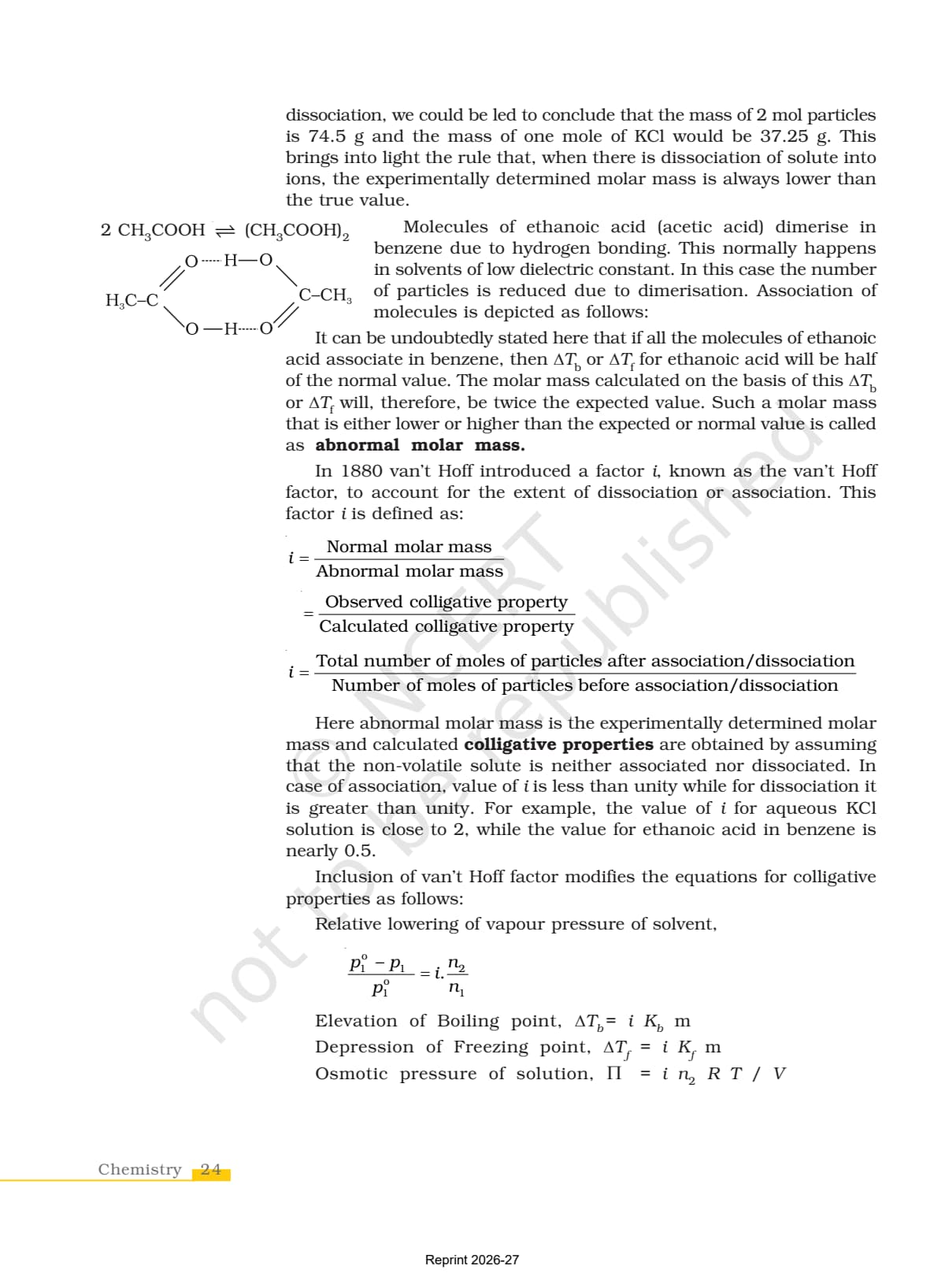
Open the full Chapter 1 Solutions PDF below, with the section map, Henry's law and Raoult's law coverage, and colligative-property templates.
This PDF is sourced from the official ncert.nic.in archive and mapped to the 2026-27 rationalised syllabus.
Also Check:
- Solutions Class 12 Chemistry NCERT Solutions
- Solutions Class 12 Chemistry Notes
- Solutions Class 12 Chemistry Formula Sheet
Solutions NCERT Book: Section-by-Section Breakdown with Page Numbers
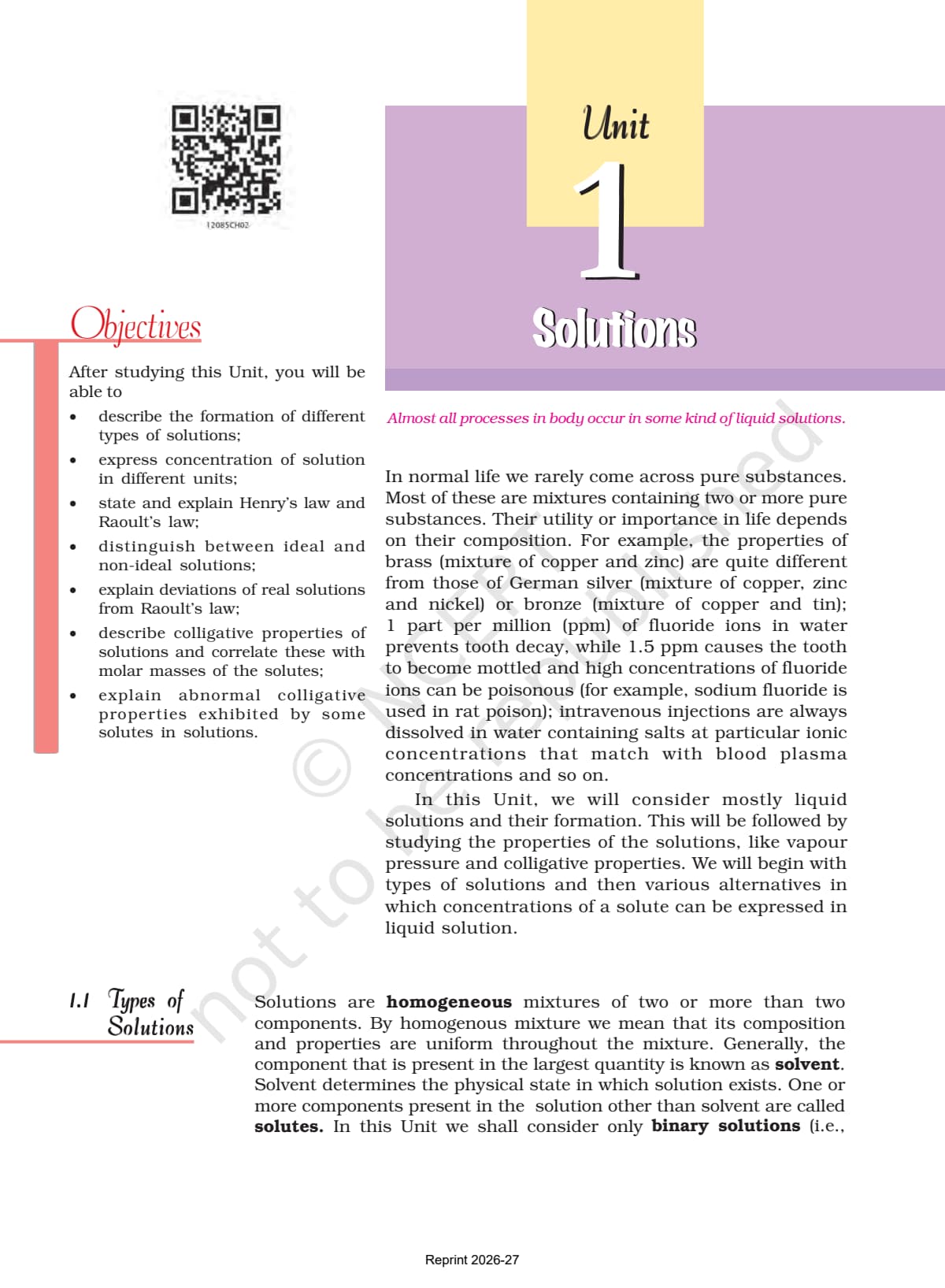
The 2026-27 print runs across 33 pages in nine sub-sections plus a summary and exercise block. The table maps each section to its page range and what it covers.
| Section | Title | Page Range | What It Covers |
|---|---|---|---|
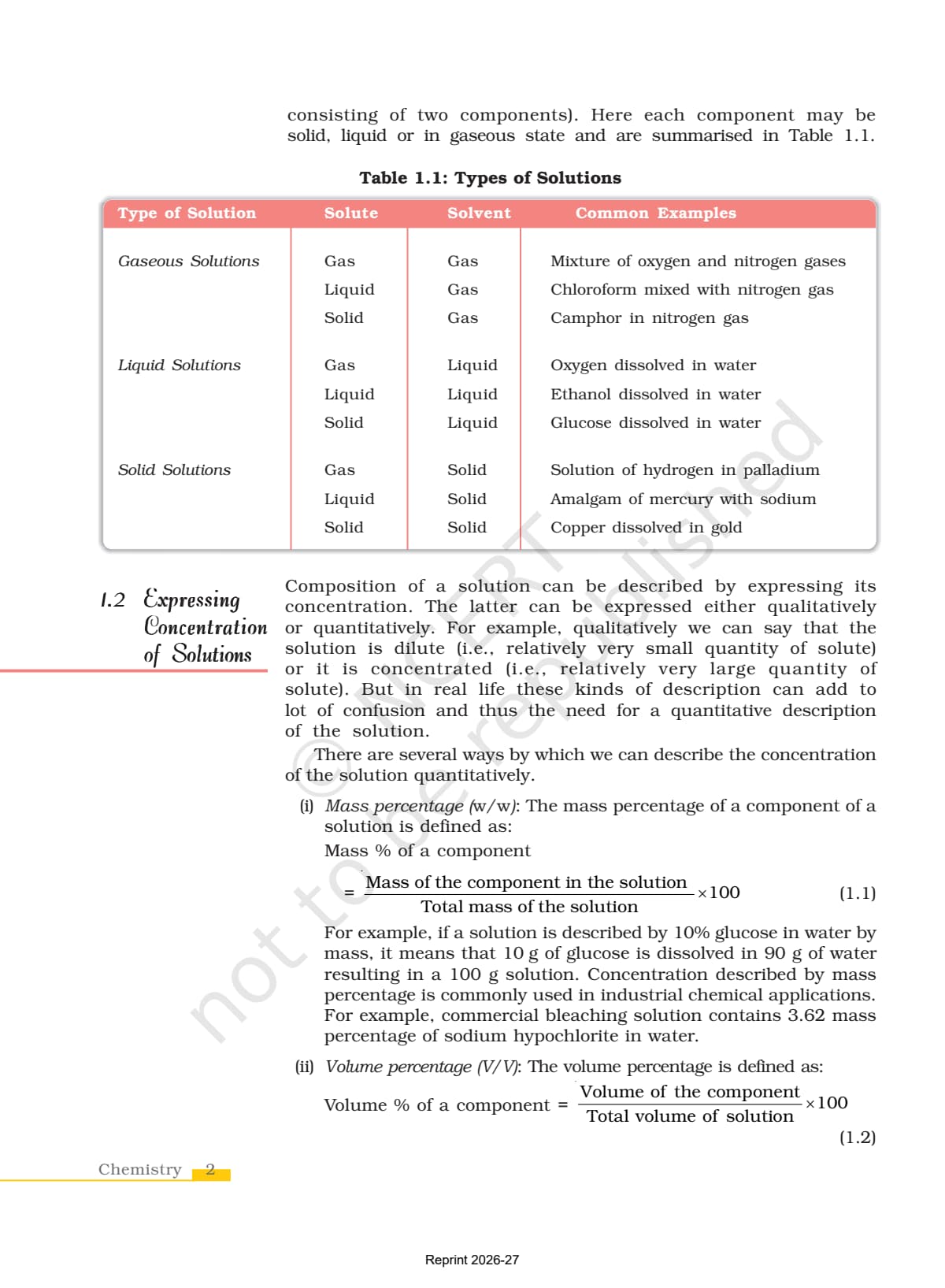
| 1.1 | Types of Solutions | p. 2 – 3 | Solid, liquid, and gaseous solutions classified by phase of solute and solvent |
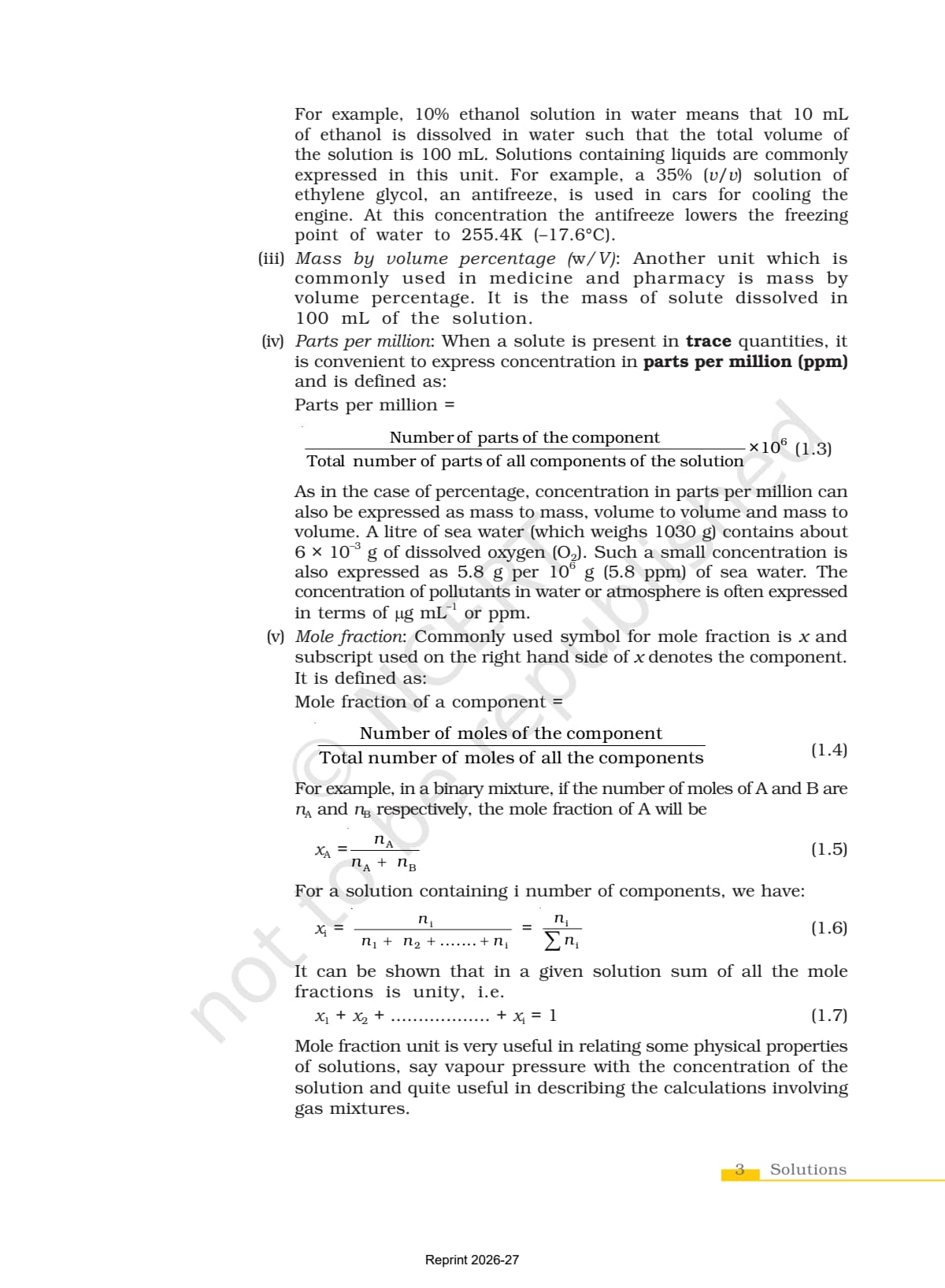
| 1.2 | Expressing Concentration of Solutions | p. 3 – 6 | Mass percent, volume percent, mole fraction, molarity, molality, ppm |
| 1.3 | Solubility | p. 6 – 11 | Solubility of solids and gases in liquids, Henry's law and its applications |
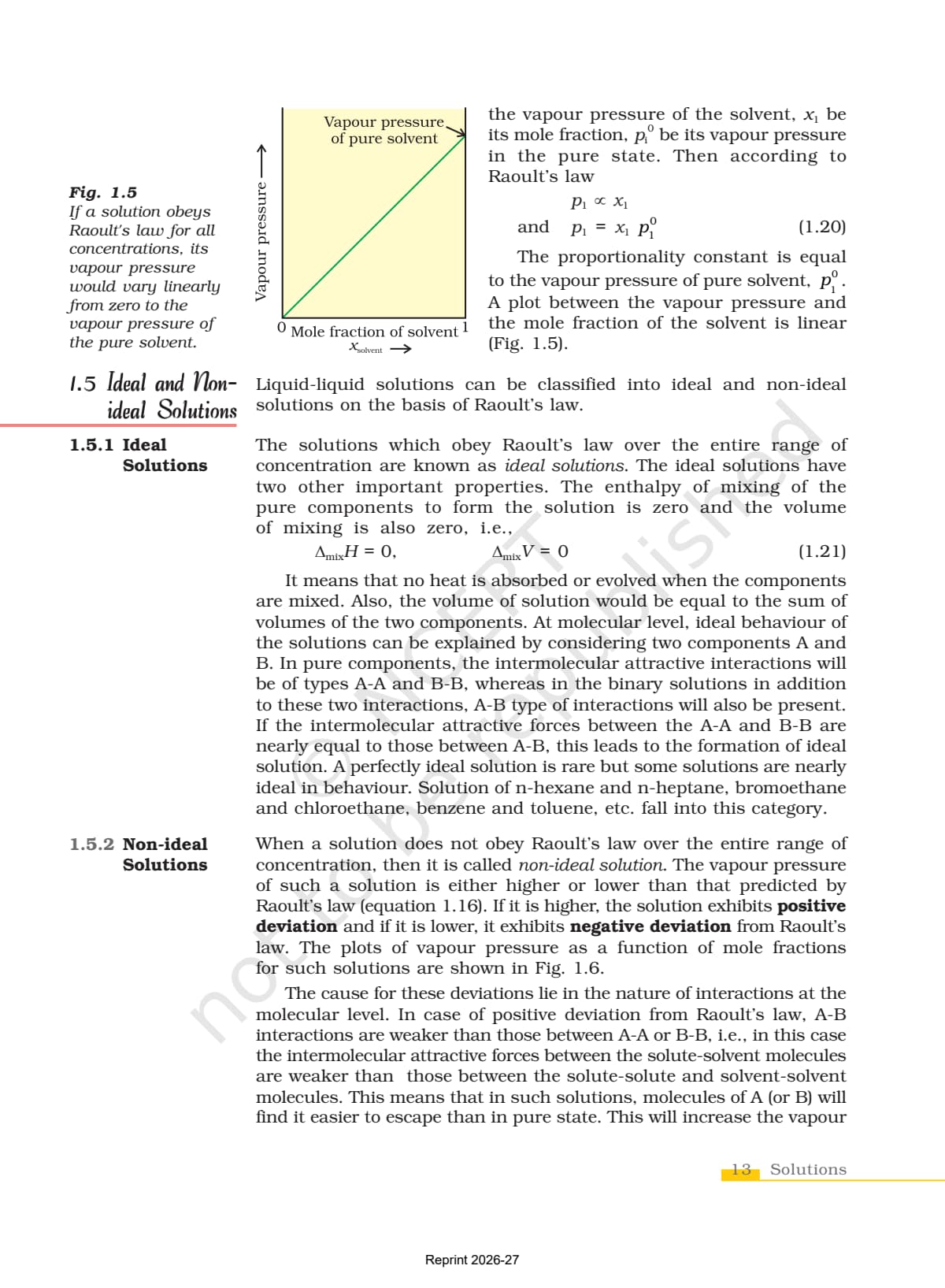
| 1.4 | Vapour Pressure of Liquid Solutions | p. 11 – 17 | Raoult's law for volatile and non-volatile solutes, ideal vs non-ideal behaviour |
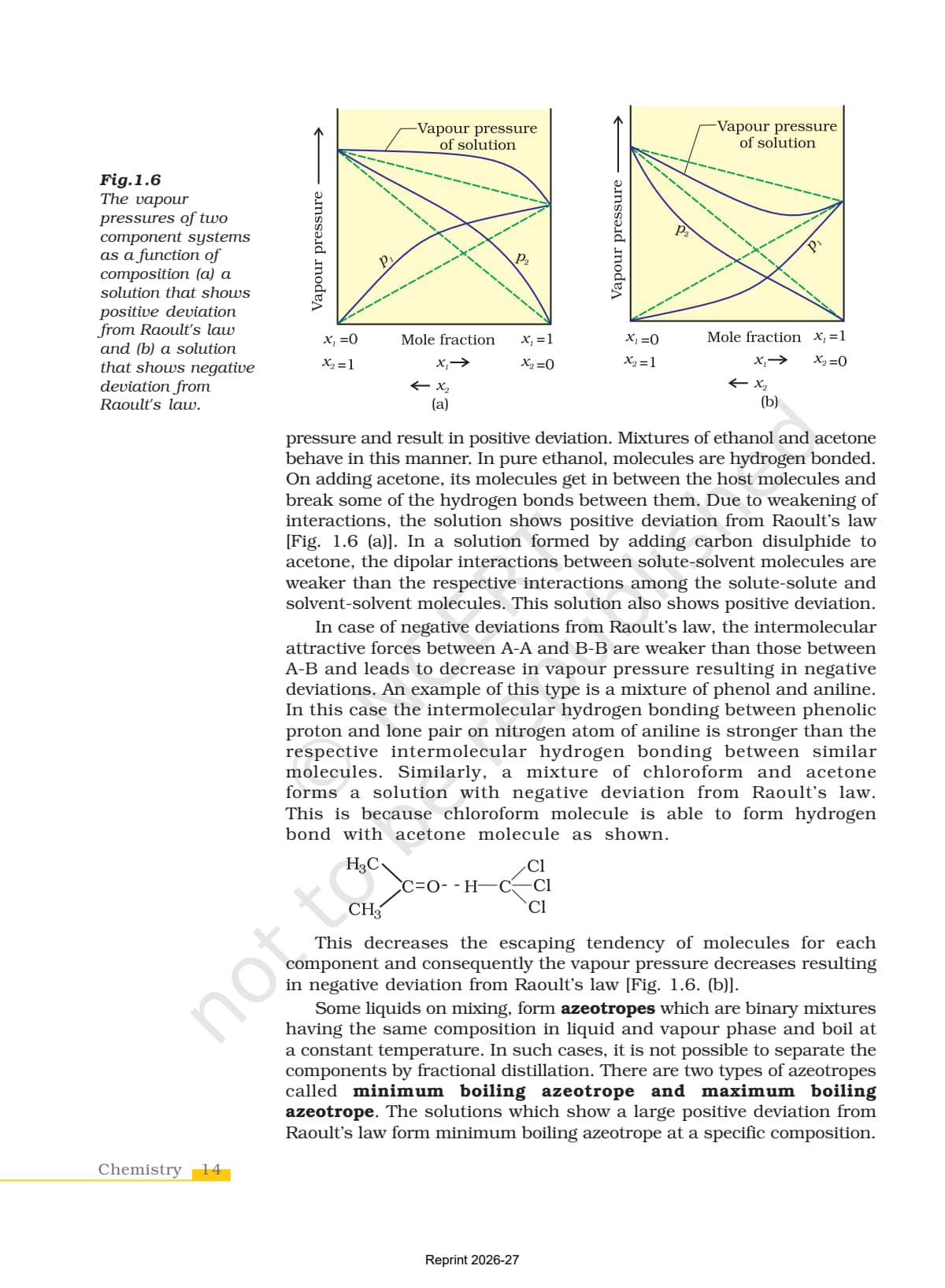
| 1.5 | Ideal and Non-ideal Solutions | p. 17 – 19 | Positive and negative deviations, azeotropes (minimum and maximum boiling) |
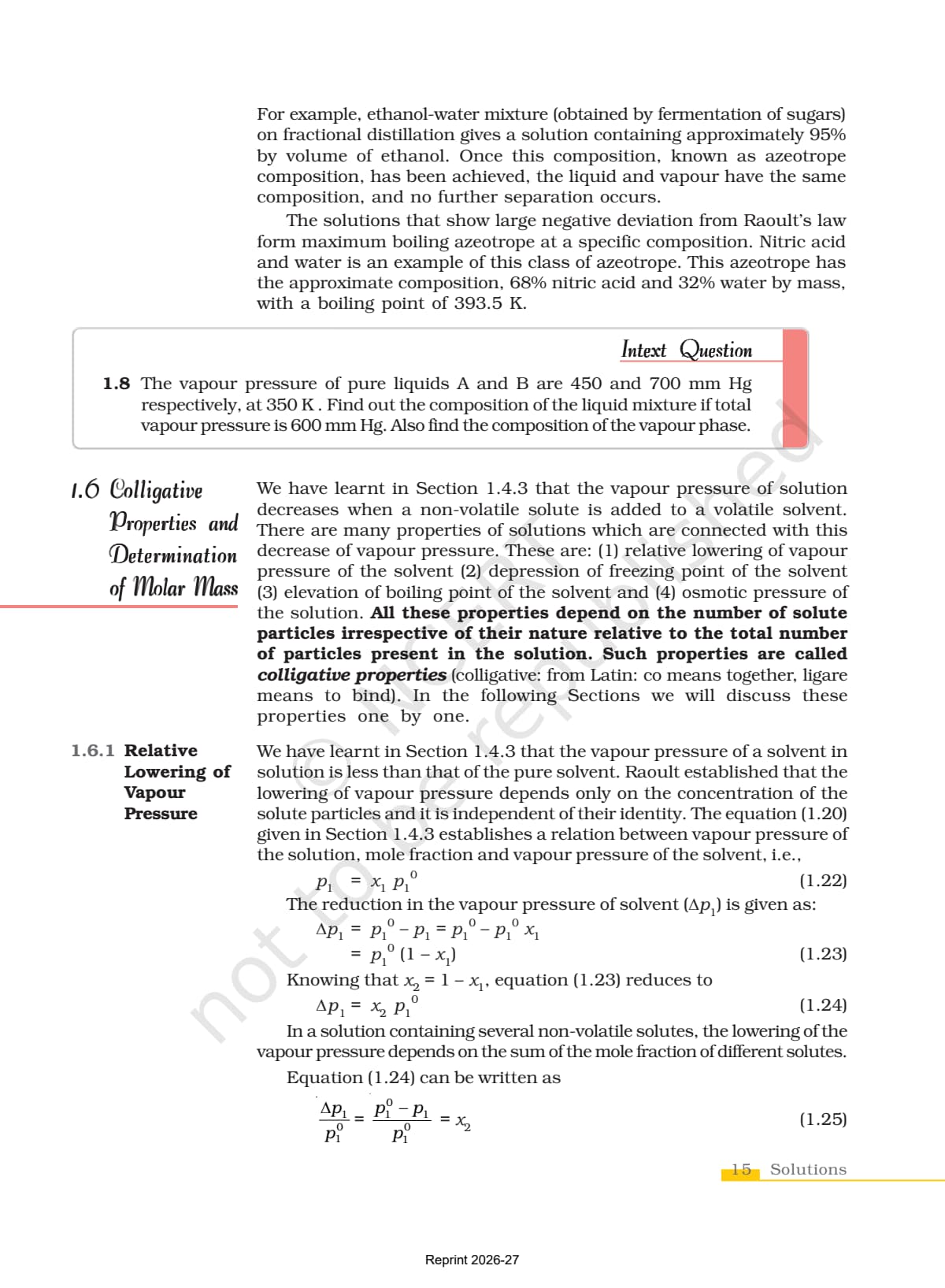
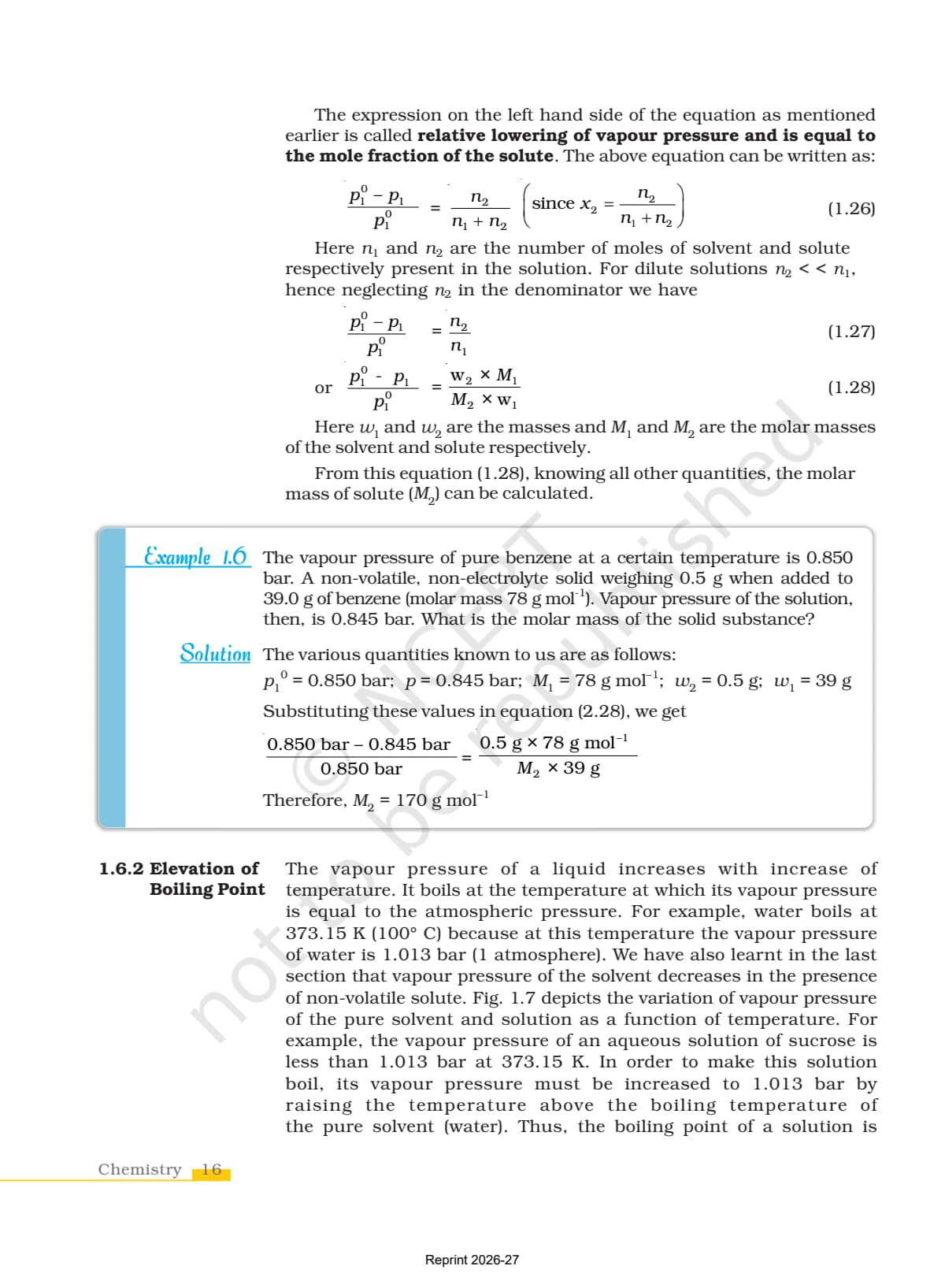
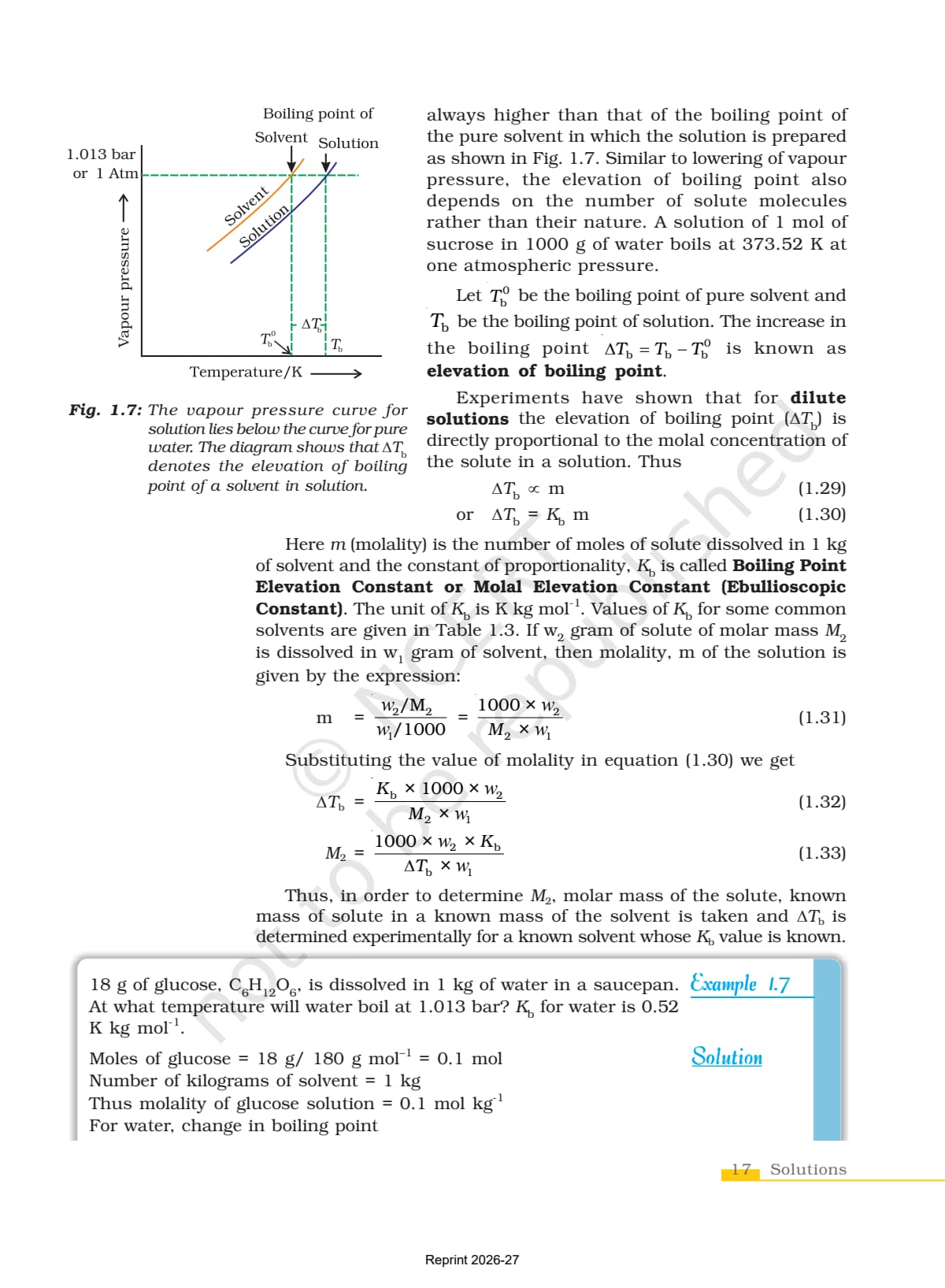
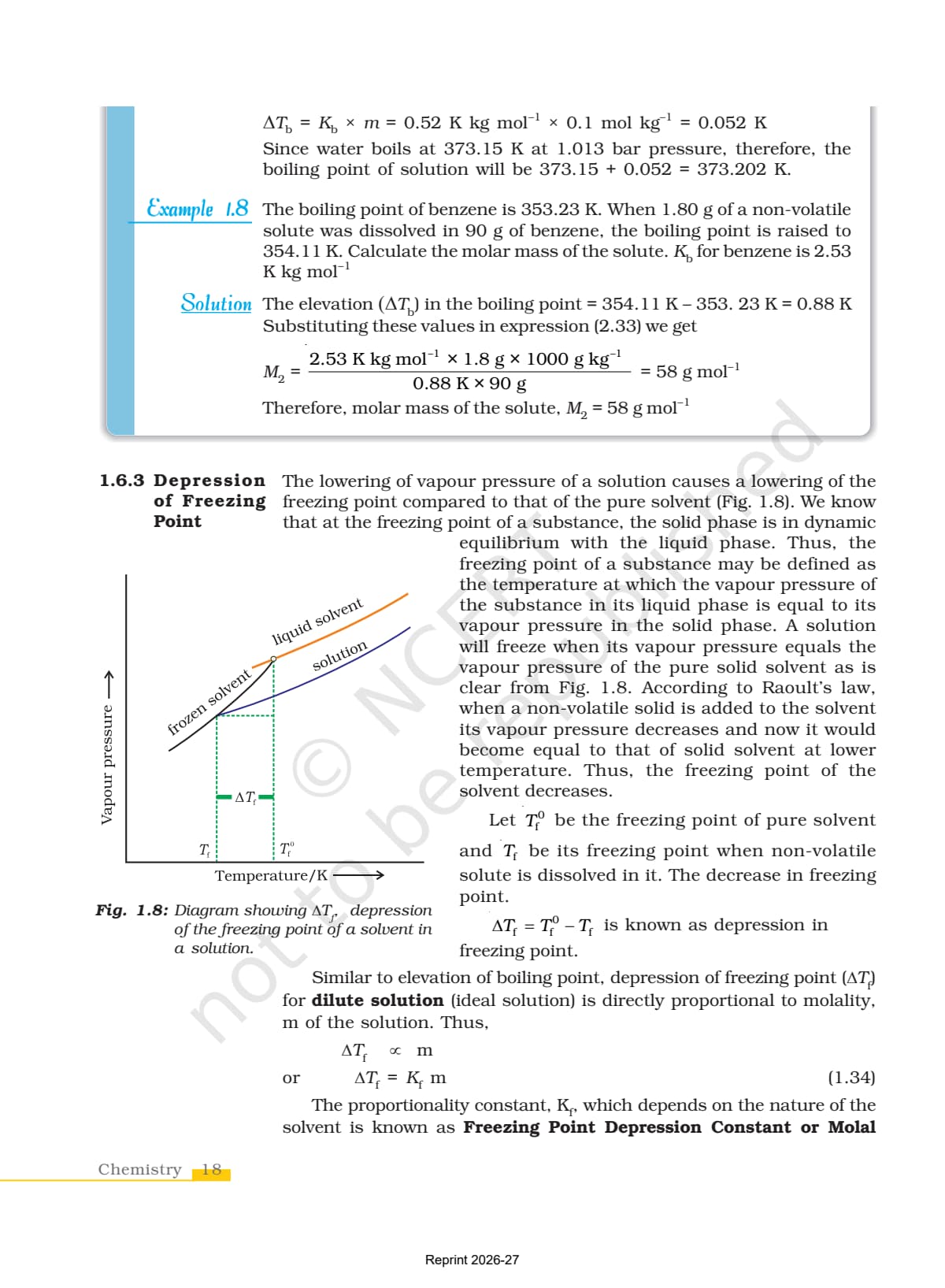
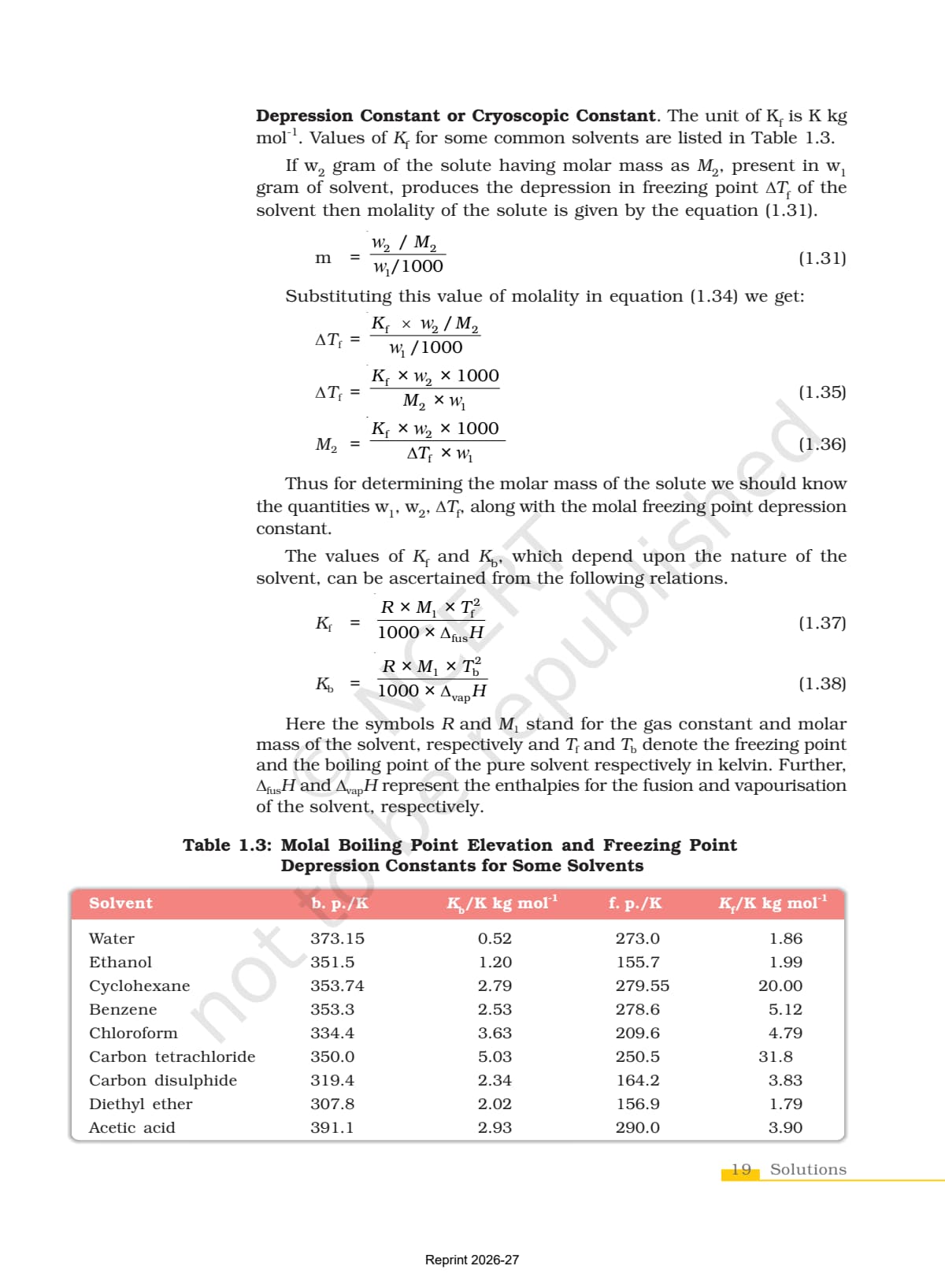
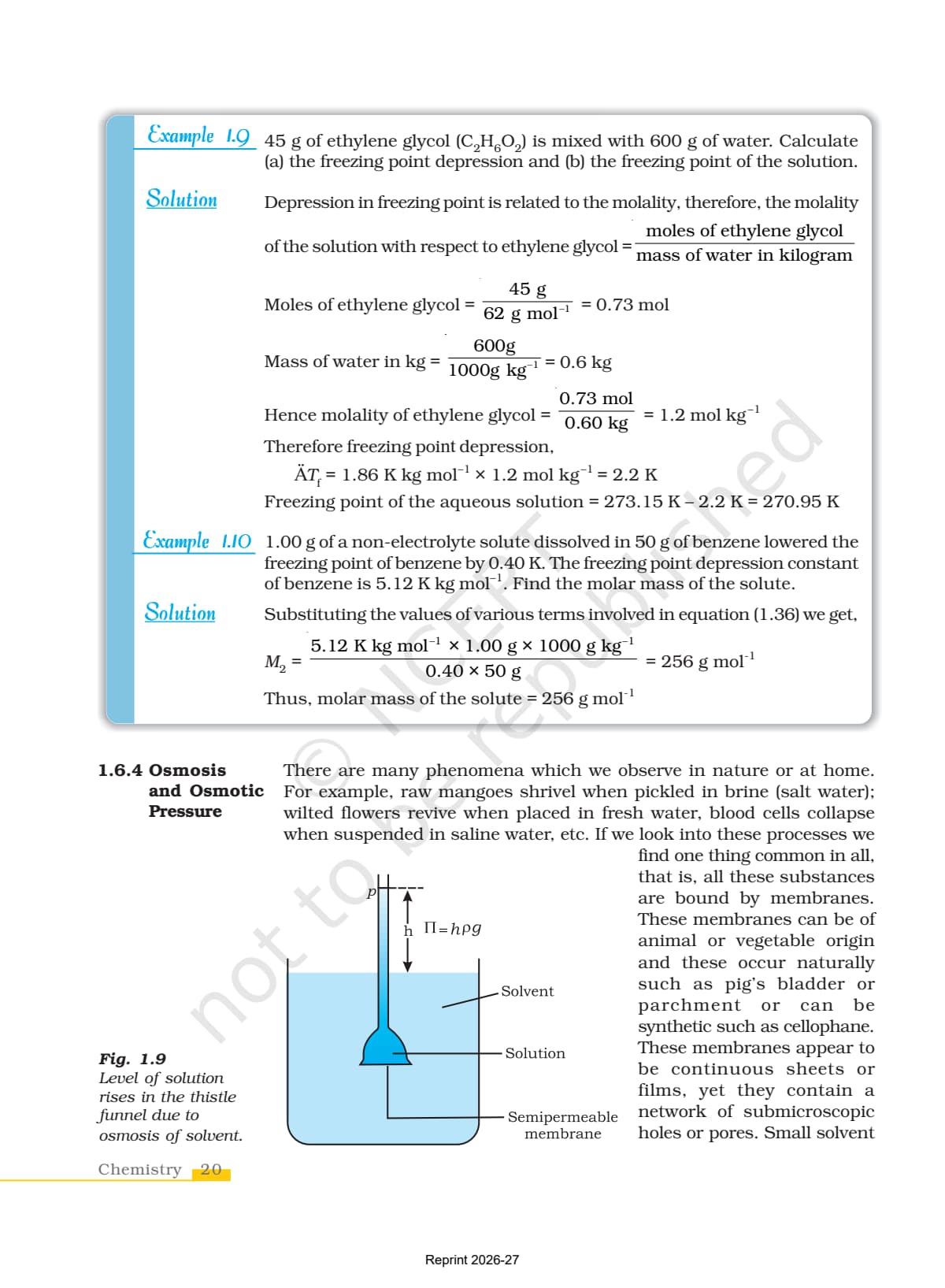
| 1.6 | Colligative Properties and Determination of Molar Mass | p. 19 – 27 | Relative lowering of vapour pressure, elevation of boiling point, depression of freezing point, osmotic pressure |
| 1.7 | Abnormal Molar Masses | p. 27 – 29 | Van't Hoff factor, association and dissociation of solutes |
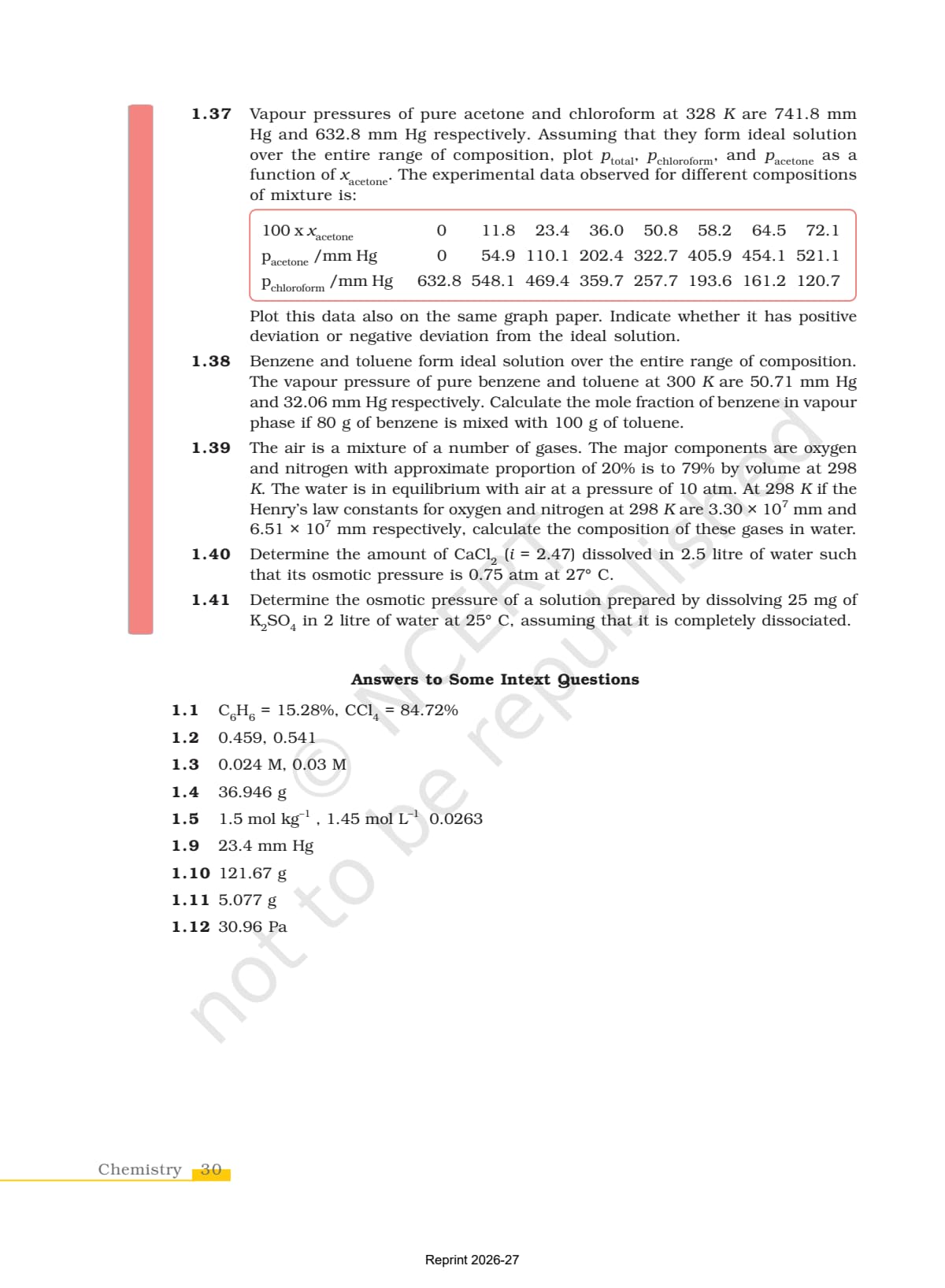
| - | Summary | p. 29 – 30 | One-page bullet recap of every concept; ideal for last-day revision |
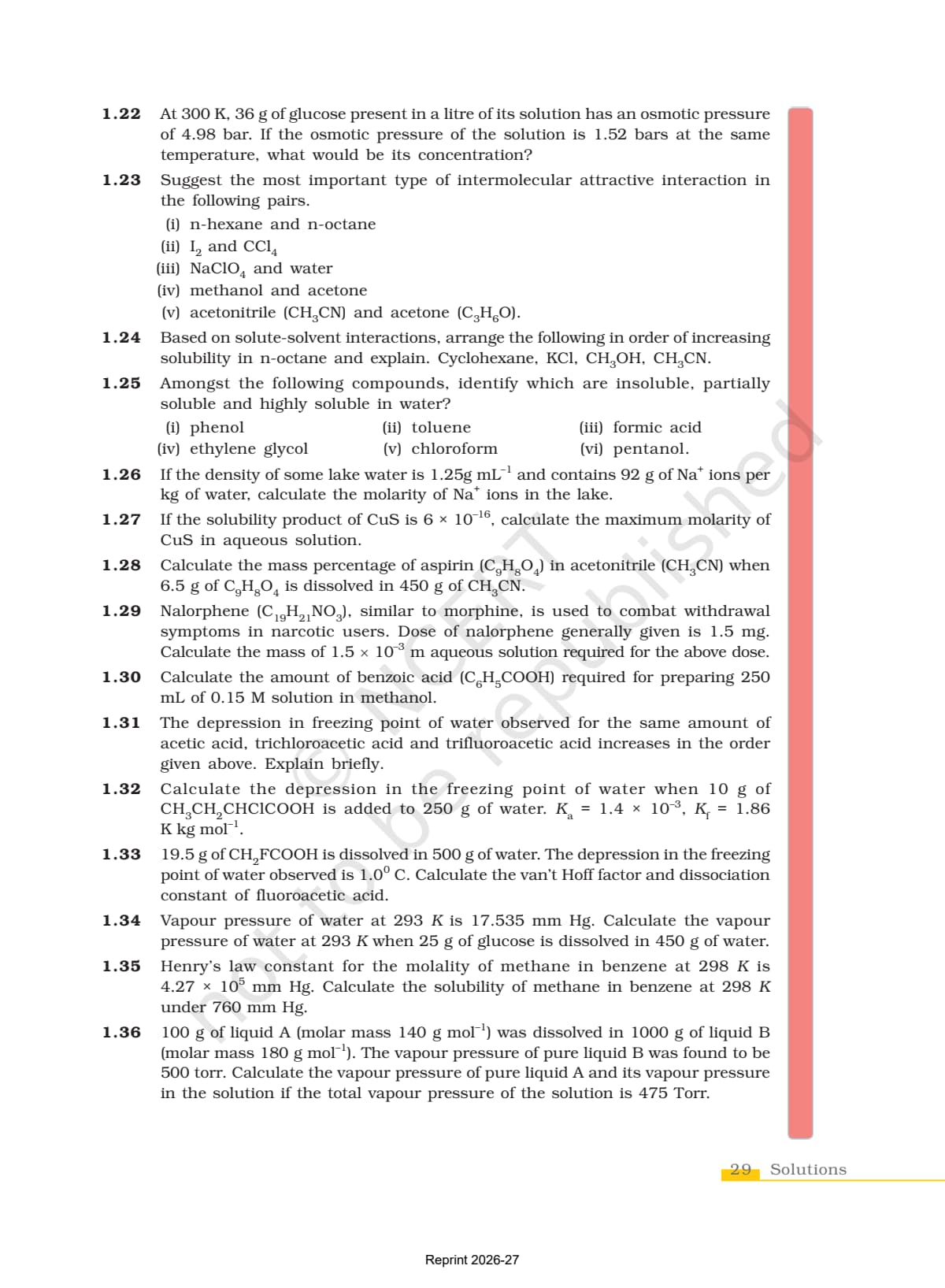
| - | Exercises | p. 30 – 33 | 41 NCERT questions covering all sections (numericals + theory) |
Section 1.6 Colligative Properties is the longest at about 8 pages and the biggest source of CBSE 5-markers. Nearly 40% of Chapter 1 questions in the last five CBSE papers came from it.
Solutions Class 12 Chemistry Explained
Source: Magnet Brains on YouTube
Solutions NCERT Intext Examples and Their Sub-Topics
The NCERT prints nine intext worked examples, one per major formula. Solve them before the back-exercise; they are easier and cover every board template.
| Example | Sub-topic | Skill Tested |
|---|---|---|
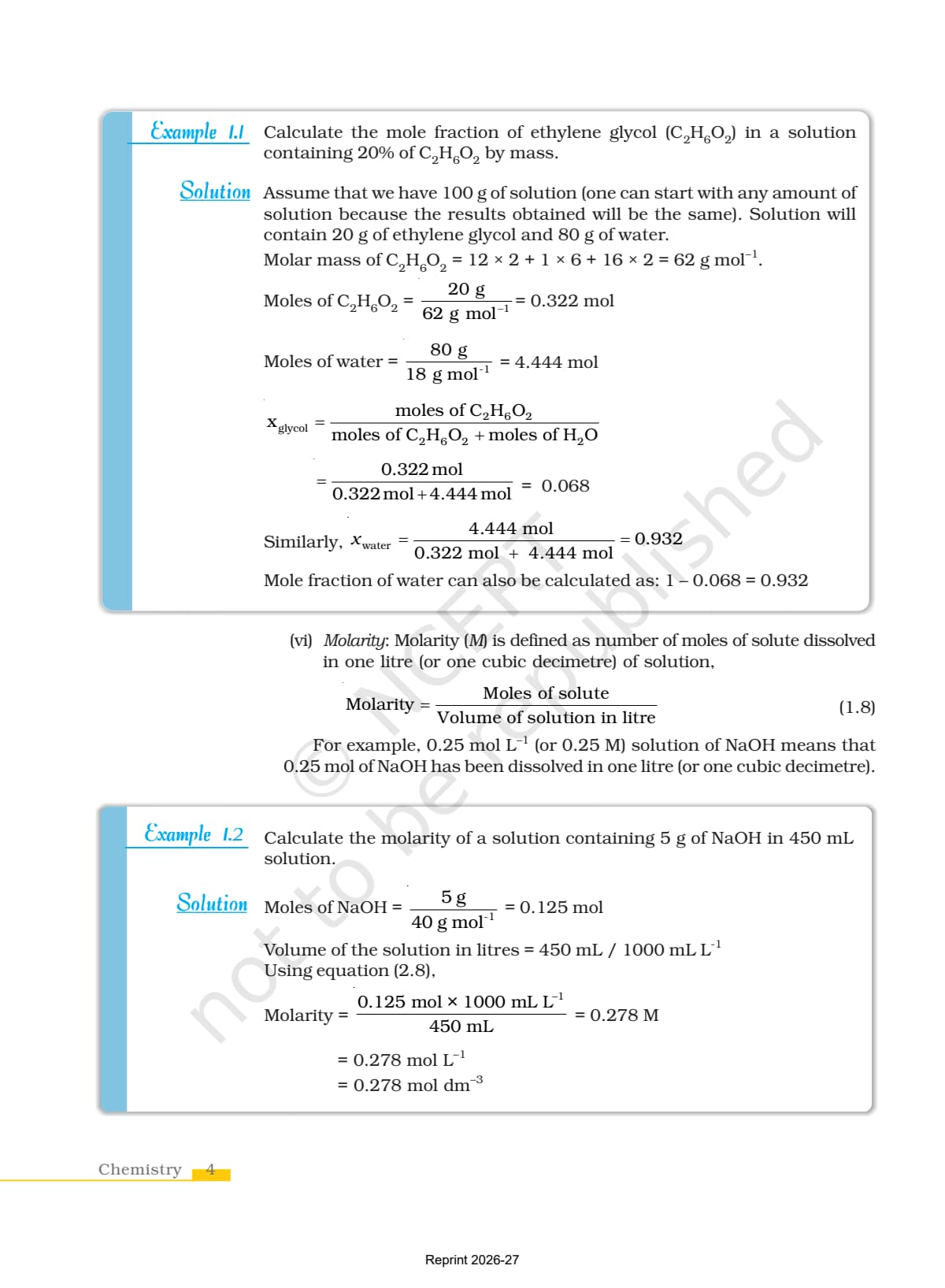
| Example 1.1 | Mass percent | Calculate mass % of ethylene glycol in water |
| Example 1.2 | Molarity | Find molarity of a NaOH solution from mass dissolved |
| Example 1.3 | Molality | Determine molality of a sulfuric acid solution given density |
| Example 1.4 | Henry's law | Compute partial pressure of dissolved gas using Henry's constant |
| Example 1.5 | Raoult's law (binary, volatile) | Vapour-pressure composition of a heptane-octane mixture |
| Example 1.6 | Relative lowering of vapour pressure | Find molar mass of an unknown non-volatile solute |
| Example 1.7 | Elevation of boiling point | Calculate molar mass of solute from observed Δ Tb |
| Example 1.8 | Depression of freezing point | Calculate molar mass from observed Δ Tf |
| Example 1.9 | Van't Hoff factor | Determine degree of dissociation of an electrolyte from i |
How will Collegedunia's NCERT Book PDF Help You with Solutions?
The official NCERT chapter is the source of truth for the board paper. This page adds:
- 2026-27 mapping: section map uses the latest page numbers.
- Both PDF versions: free Normal and HD files from the official archive.
- Section skill map: each section tagged with the exam question it feeds.
- Rationalisation audit: the kept-trimmed table below shows what still counts.
Solutions Top 5 Formulae for Quick Recall
Five formulae cover nearly every numerical in this chapter. Use the mini-table below for a fast recap.
| Quantity | Formula |
|---|---|
| Molarity | M = moles of solutevolume of solution in L |
| Molality | m = moles of solutemass of solvent in kg |
| Henry's law | p = KH · x |
| Relative lowering of vapour pressure | p0 - psp0 = xsolute |
| Osmotic pressure (with Van't Hoff factor) | π = i · C · R · T |
Full master table: Solutions Class 12 Chemistry Formula Sheet
What Changed in Solutions for 2026-27 NCERT (Rationalisation Note)
The 2026-27 NCERT keeps the core physical chemistry intact but trims two sub-topics. Knowing what is no longer asked saves wasted reading.
| Sub-topic | Status in 2026-27 NCERT | Asked in CBSE Boards? |
|---|---|---|
| Types of Solutions (solid / liquid / gas) | Kept | Yes (1-mark MCQ) |
| Concentration expressions (mass %, mole fraction, molarity, molality) | Kept | Yes (2-3 marks) |
| Solubility of solids in liquids | Kept | Yes (theory short answer) |
| Henry's law and applications | Kept | Yes (very frequent) |
| Raoult's law and ideal solutions | Kept | Yes (5-marker numerical) |
| Azeotropes (minimum and maximum boiling) | Kept | Yes (2-mark theory) |
| Four colligative properties | Kept | Yes (every paper) |
| Van't Hoff factor, association, dissociation | Kept | Yes (3-mark numerical) |
| Solubility of gases in liquids: detailed effect of temperature and pressure on aquatic life | Trimmed | Rare (1-mark application) |
| Reverse osmosis (extended treatment, desalination case study) | Trimmed | Brief mention only |
No major topic was fully removed. Old guidebooks are safe for Chapter 1; just skip the aquatic-life and desalination case studies. The eight "Kept" rows carry about 95% of the marks in CBSE Boards 2021 to 2025.
Solutions Recent Previous Year Question Pattern (2026 → 2024)
A three-year snapshot of how CBSE, JEE Main, and NEET phrased Chapter 1 recently.
| Year | CBSE Board | JEE Main | NEET |
|---|---|---|---|
| 2026 | Colligative properties (5-marker) | Henry's law, Van't Hoff factor | Pending (exam rescheduled) |
| 2025 | Raoult's law deviation (3-marker) | Osmotic pressure, molarity | Depression of freezing point, dissociation |
| 2024 | Van't Hoff factor numerical (3-marker) | Mole fraction, Henry's law | Boiling-point elevation |
Full year-wise PYQ map: Solutions Class 12 Chemistry NCERT Solutions
Related Links:
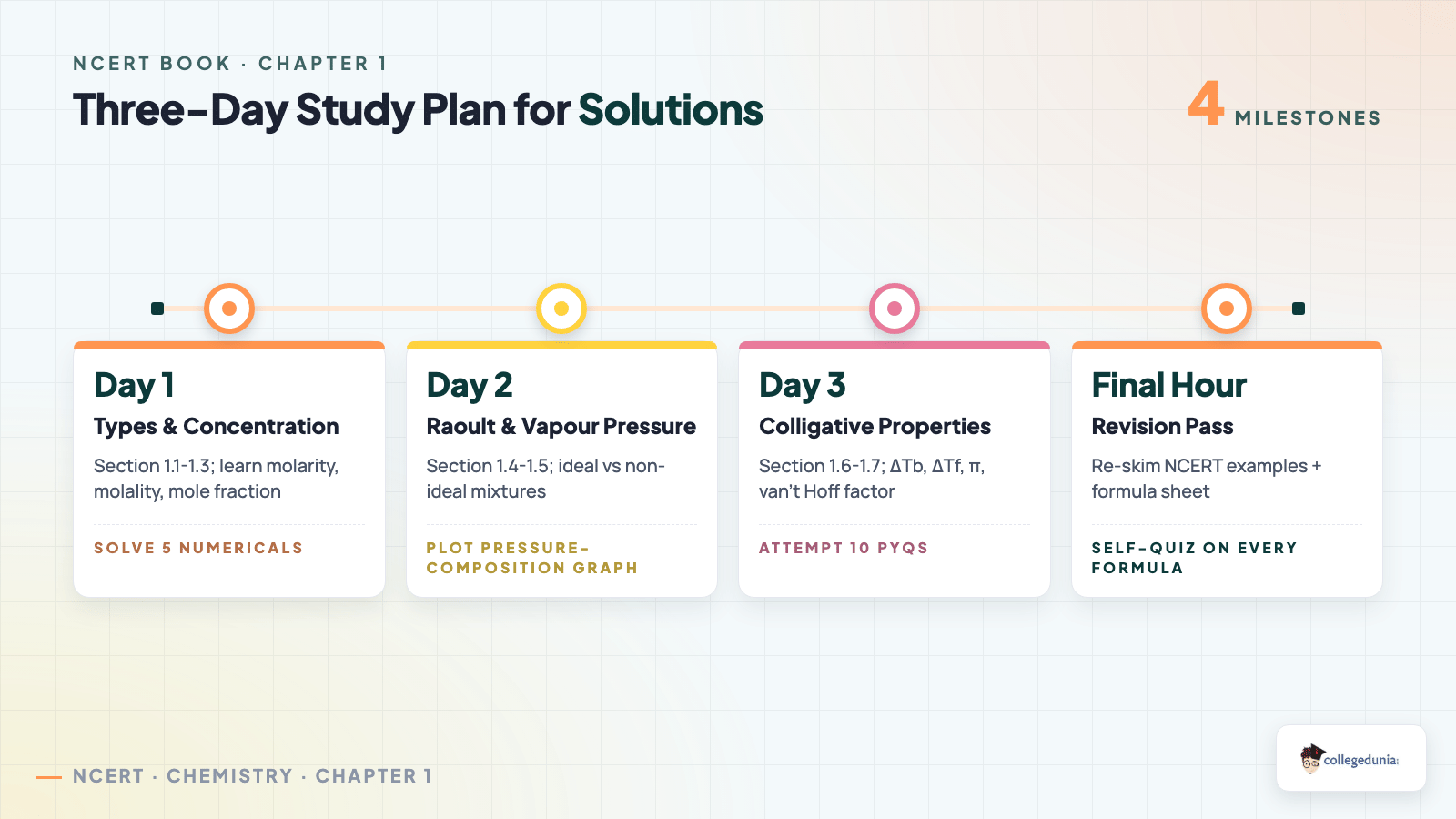
Solutions Three-Day Study Plan for This PDF
The chapter splits across three short sessions: Day 1 light theory, Day 2 the formula-heavy core, Day 3 exercise drill.
- Day 1 (60 minutes): Sections 1.1, 1.2, 1.3 - types of solutions, concentration expressions, solubility, Henry's law. Solve Examples 1.1 to 1.4.
- Day 2 (90 minutes): Sections 1.4 to 1.7 - Raoult's law, ideal vs non-ideal solutions, four colligative properties, abnormal molar masses. Solve Examples 1.5 to 1.9. This is the heaviest day.
- Day 3 (75 minutes): Attempt all 41 back-exercise questions. Mark unsolved ones with a sticky tab; return to them after revising the relevant section.
Solutions Weightage Compared Across Class 12 Chemistry Chapters
The visual maps average CBSE marks across all 10 chapters of the 2026-27 Class 12 Chemistry book. Chapter 1 Solutions, in orange, tops the Physical Chemistry block.
Chapter 1 Solutions ties with Chapter 5 Coordination Compounds for the highest CBSE board weightage in the 2026-27 syllabus.
Student Feedback
In a Collegedunia poll of 900 Class 12 students, 78% said solving the nine intext examples before the back-exercise made colligative-property numericals easier in the board exam.
Other Resources for Solutions Class 12 Chemistry
- Solutions Class 12 Chemistry NCERT Book PDF
- Solutions Class 12 Chemistry NCERT Solutions
- Solutions Class 12 Chemistry Notes
- Solutions Class 12 Chemistry Formula Sheet
- Solutions Class 12 Chemistry NCERT Exemplar Book PDF
- Solutions Class 12 Chemistry NCERT Exemplar Solutions
- Solutions Class 12 Chemistry Handwritten Notes
NCERT Book PDF for Class 12 Chemistry: All Chapters
Use the table below to jump to the official NCERT Book PDF page for any other Class 12 Chemistry chapter. Each link opens the full chapter PDF along with its section map and rationalisation note.
| Chapter | Resource |
|---|---|
| Chapter 2 | Electrochemistry NCERT Book PDF |
| Chapter 3 | Chemical Kinetics NCERT Book PDF |
| Chapter 4 | The d- and f-Block Elements NCERT Book PDF |
| Chapter 5 | Coordination Compounds NCERT Book PDF |
| Chapter 6 | Haloalkanes and Haloarenes NCERT Book PDF |
| Chapter 7 | Alcohols, Phenols and Ethers NCERT Book PDF |
| Chapter 8 | Aldehydes, Ketones and Carboxylic Acids NCERT Book PDF |
| Chapter 9 | Amines NCERT Book PDF |
| Chapter 10 | Biomolecules NCERT Book PDF |
Solutions Class 12 Chemistry NCERT Book PDF FAQs
Ques. Where can I download the Solutions Class 12 Chemistry NCERT Book PDF?
Ans. You can download the Class 12 Chemistry Chapter 1 Solutions NCERT Book PDF directly from this page. Both the Normal and HD versions are available, and both are free. The file is the official chapter print sourced from the ncert.nic.in archive.
Ques. Is the Class 12 Chemistry Chapter 1 PDF on this page aligned with the 2026-27 NCERT?
Ans. Yes. This page reflects the current 2026-27 syllabus for Class 12 Chemistry. The new edition keeps every core sub-topic of the chapter (Henry's law, Raoult's law, all four colligative properties, Van't Hoff factor) and only trims the extended aquatic-life and desalination case studies. See the kept-trimmed-removed table above for the full audit.
Ques. How many pages is the Class 12th Chemistry Solutions NCERT Book chapter PDF?
Ans. The official NCERT chapter PDF runs 33 pages. It covers nine numbered sections (1.1 through 1.7 plus Summary and Exercises), 9 intext worked examples, and 41 back-exercise questions.
Ques. How many chapters are in the Class 12 Chemistry NCERT Book for 2026-27?
Ans. The current edition has 10 chapters in total, with Solutions as Chapter 1. The older "Polymers", "Chemistry in Everyday Life", "Surface Chemistry", "p-Block Elements", and "General Principles and Processes of Isolation of Elements" units were dropped during the rationalisation.
Ques. What is the CBSE board exam weightage of Class 12 Chemistry Chapter 1 Solutions?
Ans. Chapter 1 Solutions carries 6 to 8 marks in the CBSE Class 12 Chemistry Board exam, typically split as one 5-mark long-answer question on colligative properties plus one or two short-answer or MCQ items from Henry's law, Raoult's law, or Van't Hoff factor.
Ques. Which section of Class 12 Chemistry Chapter 1 is the most important for JEE Main and NEET?
Ans. Section 1.6 Colligative Properties is the heaviest source of both JEE Main and NEET questions, followed by Section 1.4 Vapour Pressure (Raoult's law) and Section 1.7 Abnormal Molar Masses (Van't Hoff factor). Roughly 4 to 5% of every JEE Main shift includes a Solutions question, and NEET prints 2 to 3 questions per paper from these three sections combined.
Ques. Should I read this chapter linearly or jump to specific sections?
Ans. A three-pass read works best (Skim, Deep with examples, Exercise drill). Sections 1.1 to 1.3 are light theory and can be read in any order; Sections 1.4 to 1.7 build on each other, so read them in sequence. Use the three-day plan above to allocate time.
Ques. Is the Collegedunia version of this PDF different from the official NCERT PDF?
Ans. The PDF file itself is the official NCERT print, unchanged. What Collegedunia adds on this page is the section-by-section map with page numbers, the intext example inventory, the 2026-27 rationalisation audit, the three-day study plan, and cross-links to the matching Notes, Solutions, and Formula Sheet pages.



Comments