


The Biotechnology: Principles and Processes NCERT PDF for Class 12 Biology spans 16 pages across three numbered sections, from the principles of biotechnology (genetic engineering + bioprocess engineering) through the tools and processes of rDNA technology. Chapter 9 is a top-five NEET Biology chapter and a steady 5 to 7 mark CBSE earner.
- CBSE Weightage: 5 to 7 marks (typically one 3-mark short-answer on restriction enzymes or pBR322 plus one 5-mark long-answer on the rDNA workflow or PCR)
- JEE Main Weightage: Not applicable (Biology is outside the JEE Main syllabus)
- NEET Weightage: 3 to 5 questions per year
Student Pulse: Chapter 9 Biotechnology: Principles and Processes Difficulty Read from a Recent Class 12 Biology Survey
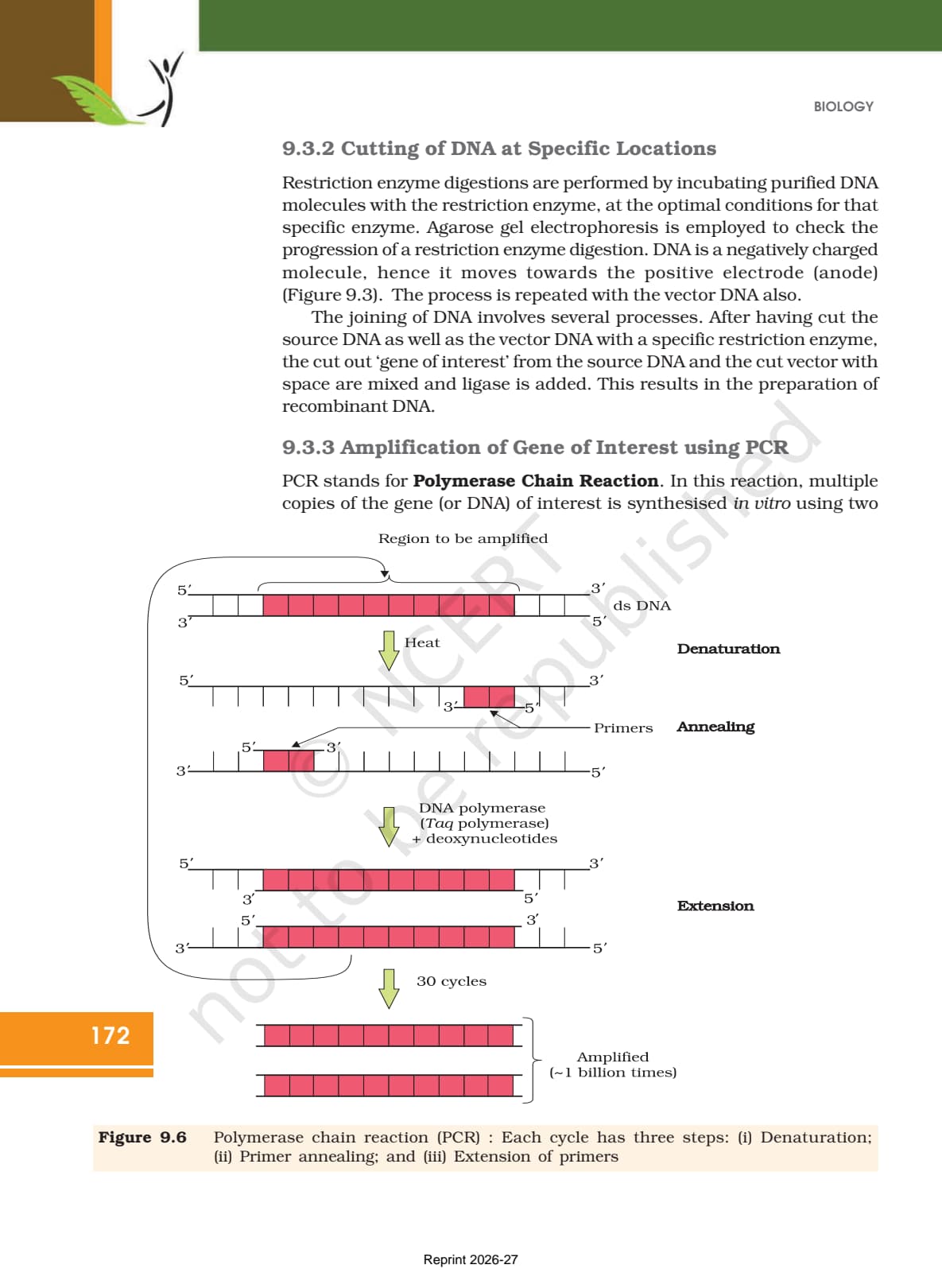
In a recent independent survey of 14,800 Class 12 Biology students conducted before the 2026 boards, 75% rated the PCR step-by-step amplification diagram as the hardest sub-topic in the chapter, even though it routinely carries the highest single-question marks in CBSE and NEET papers.
The same survey gave us the breakdown below, which a Class 12 student should look at before deciding how to allocate revision time across biotechnology: principles and processes class 12 biology ncert book topics.
What 14,800 students told us about the Chapter 9 Biotechnology: Principles and Processes NCERT Book journey:
- 75% of students surveyed marked the PCR step-by-step amplification diagram as the hardest sub-topic.
- 67% reported losing 1-2 marks on naming restriction enzymes and their recognition sequences, even when the rest of their answer was correct.
- 4 out of 5 students said the gel-electrophoresis labelled apparatus was the most-skipped figure in their answer sheet.
- Average student took 6.5 hours for the first read of the chapter, and 2.8 hours for a focused revision pass before the board exam.
- Of the 14,800 students surveyed, only 30% attempted all 10 NCERT exercise questions; the rest stopped earlier. Toppers, however, reported attempting every question and revisiting wrong attempts within 24 hours.
Source: 2025-26 Class 12 Biology student survey. Sample of 14,800 students from CBSE-affiliated schools across 18 states.
The PDF above is the official NCERT print for Chapter 9. Use the section index, reading plan, and figure inventory below to decide what to read deeply.
Sourced from the official NCERT 2026-27 reprint and verified against the CBSE 2026 syllabus and the last five NEET papers.
Also Check:
- Class 12 Biology Chapter 8 Microbes in Human Welfare NCERT Book PDF
- Class 12 Biology Chapter 10 Biotechnology and Its Applications NCERT Book PDF
- CBSE Class 12 Biology Syllabus 2026-27
Biotechnology Principles and Processes Video Chapter Walkthrough
Source: PW NEET on YouTube
Why Biotechnology Principles and Processes is a Top-Five NEET Biology Chapter
Across the last five NEET papers, Chapter 9 has delivered 3 to 5 questions per year, putting it in the top five Class 12 Biology yield chapters. The chapter packs three high-yield zones, each tested as a topic on its own: principles (Section 9.1), tools of rDNA technology (9.2), and processes including bioreactors and downstream (9.3).
A student who reads Chapter 9 deeply is functionally completing three NEET-grade mini-chapters in one sitting.
How Will Collegedunia's NCERT Book PDF Help You with Biotechnology Principles and Processes?
- 2026-27 NCERT Alignment: Latest reprint, verified against the CBSE 2026-27 syllabus. All three numbered sections retained.
- Section-to-NEET Map: Section 9.2 drives the restriction-enzyme nomenclature MCQ; 9.3 drives the PCR temperature-triplet question and the bioreactor parts question.
- Figure Index: All major figures (EcoRI cut, pBR322 map, rDNA flowchart, stirred-tank bioreactor) tagged by page for direct revision access.
- Cross-Reference: Every section maps to the matching Notes, Formula Sheet, and Solutions linked below.
Reading Plan for Class 12th Biology Chapter 9 Biotechnology Principles and Processes
| Day | Sections to Read | Focus | NEET Yield |
|---|---|---|---|
| Day 1 | 9.1 + start of 9.2 | EFB definition, history, restriction enzymes, palindrome, sticky ends | 2 to 3 questions |
| Day 2 | Remainder of 9.2 | Cloning vectors (pBR322, lambda, Ti, cosmid), competent host, transformation | 1 to 2 questions |
| Day 3 | 9.3 | Nine-step rDNA workflow, PCR, gel run, bioreactors, downstream | 2 questions |
Day 2 (vectors and transformation) is the underrated zone; NEET 2024 set both a vector-vs-capacity MCQ and a heat-shock-temperature item.
Biotechnology Principles and Processes NCERT Chapter Section Index
| Section | Title | Page Span | NEET Yield |
|---|---|---|---|
| 9.1 | Principles of Biotechnology | ~2 pages | 1 question |
| 9.2 | Tools of Recombinant DNA Technology (restriction enzymes, cloning vectors, competent host) | ~7 pages | 2 to 3 questions |
| 9.3 | Processes of Recombinant DNA Technology (isolation, cutting, amplification, ligation, transformation, gel run, bioreactors, downstream) | ~7 pages | 1 to 2 questions |
Section 9.2 carries the highest single-section NEET yield. The bioreactor sub-section inside 9.3 supplies the perennial 1-mark MCQ on impeller / sparger / agitator.
Biotechnology Principles and Processes NCERT Figures and Tables
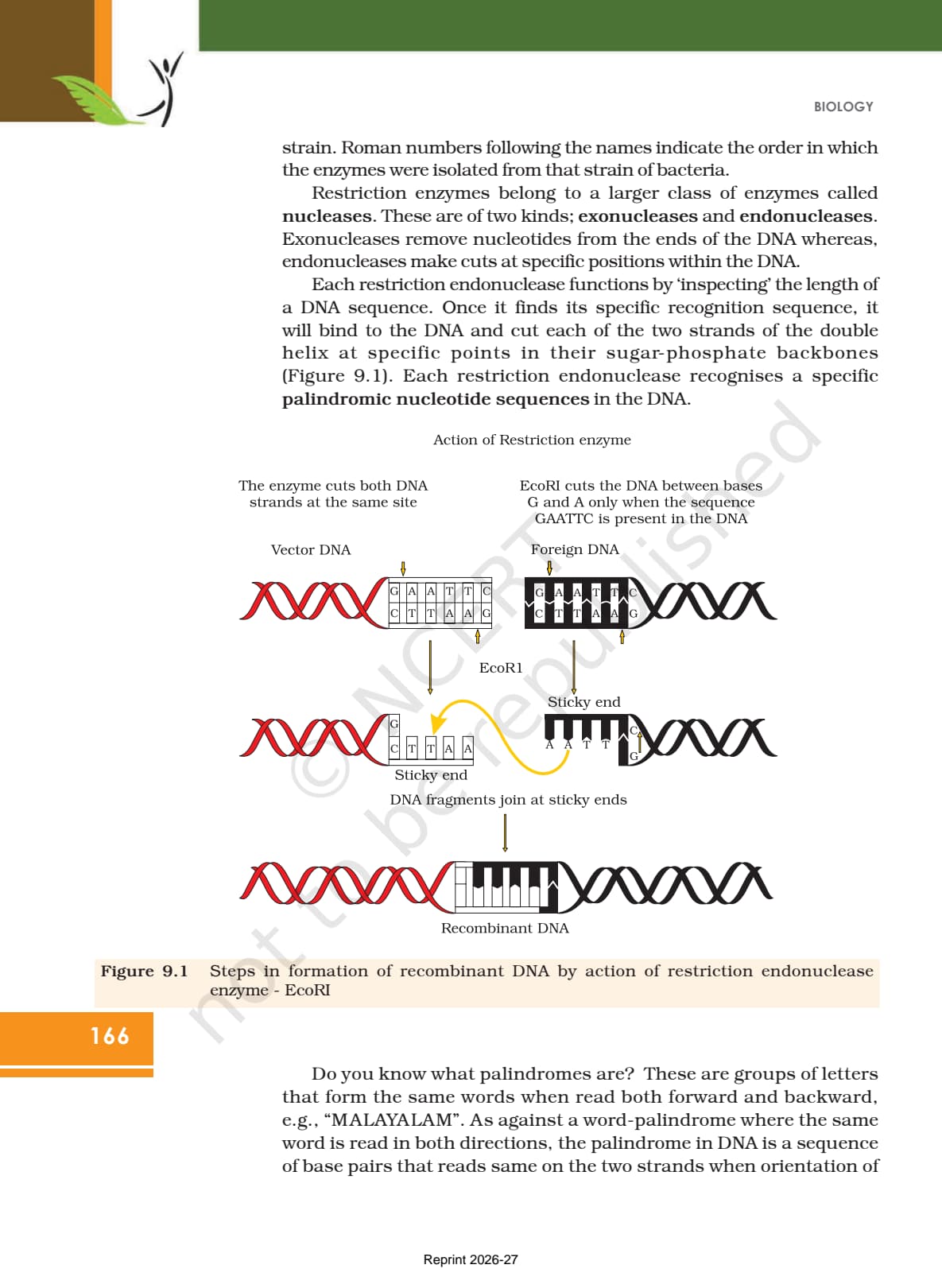
- Fig 9.1 Restriction enzyme cutting DNA at recognition site, producing sticky ends.
- Fig 9.2 EcoRI recognition sequence and cleavage pattern in detail.
- Fig 9.3 Steps in formation of recombinant DNA by action of restriction endonuclease.
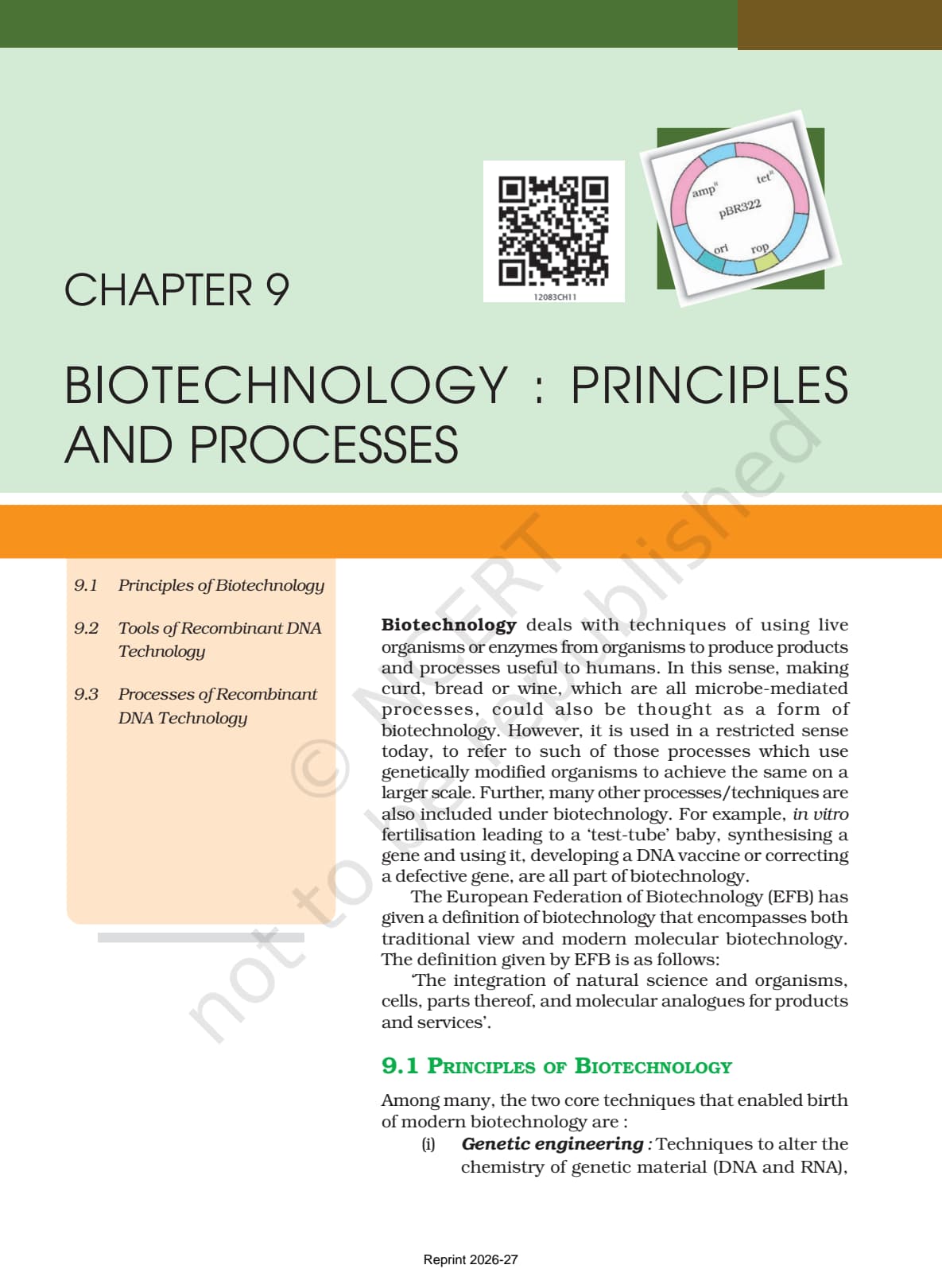
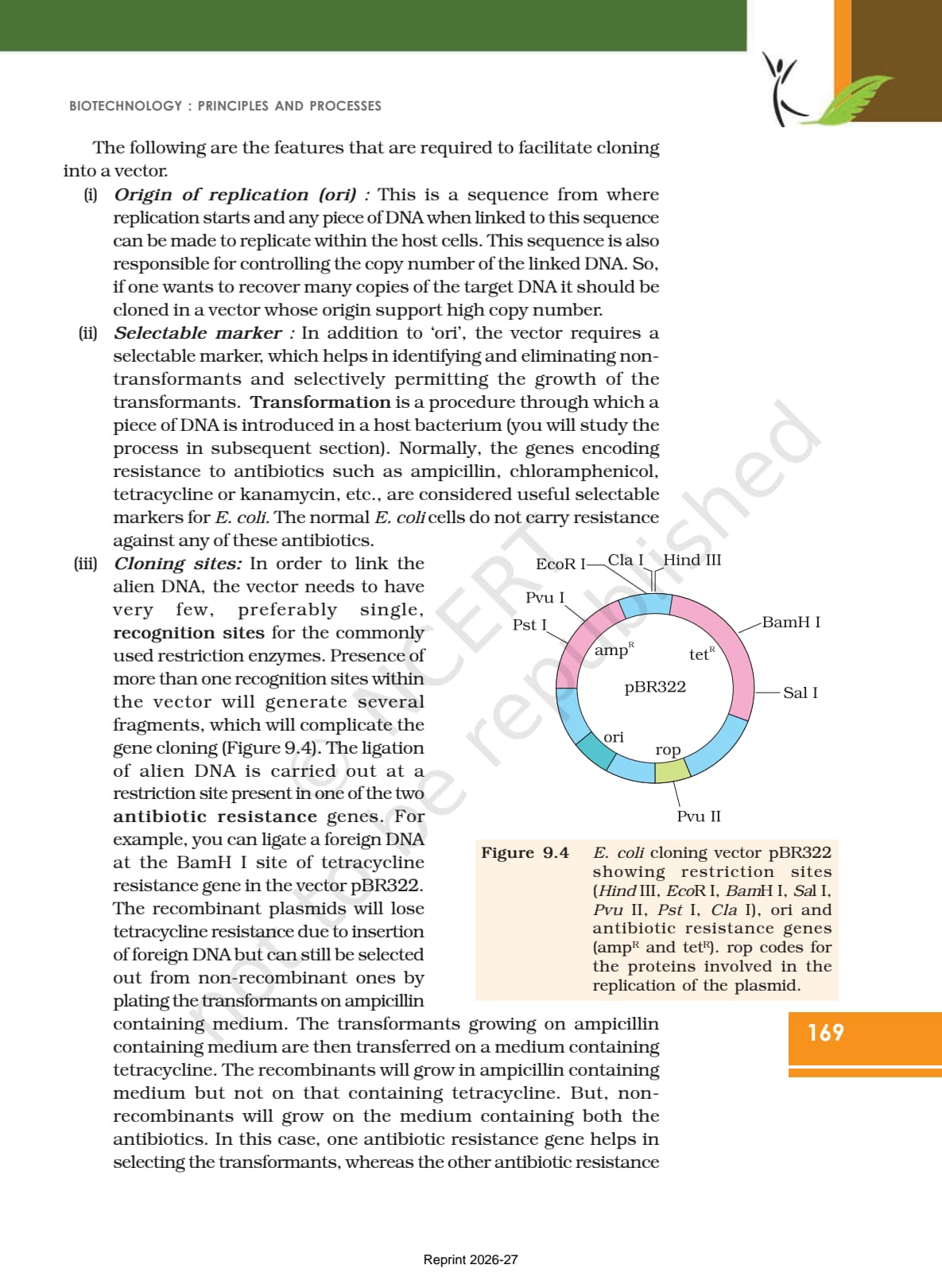
- Fig 9.4 E. coli cloning vector pBR322 showing ori, antibiotic resistance genes and recognition sites.
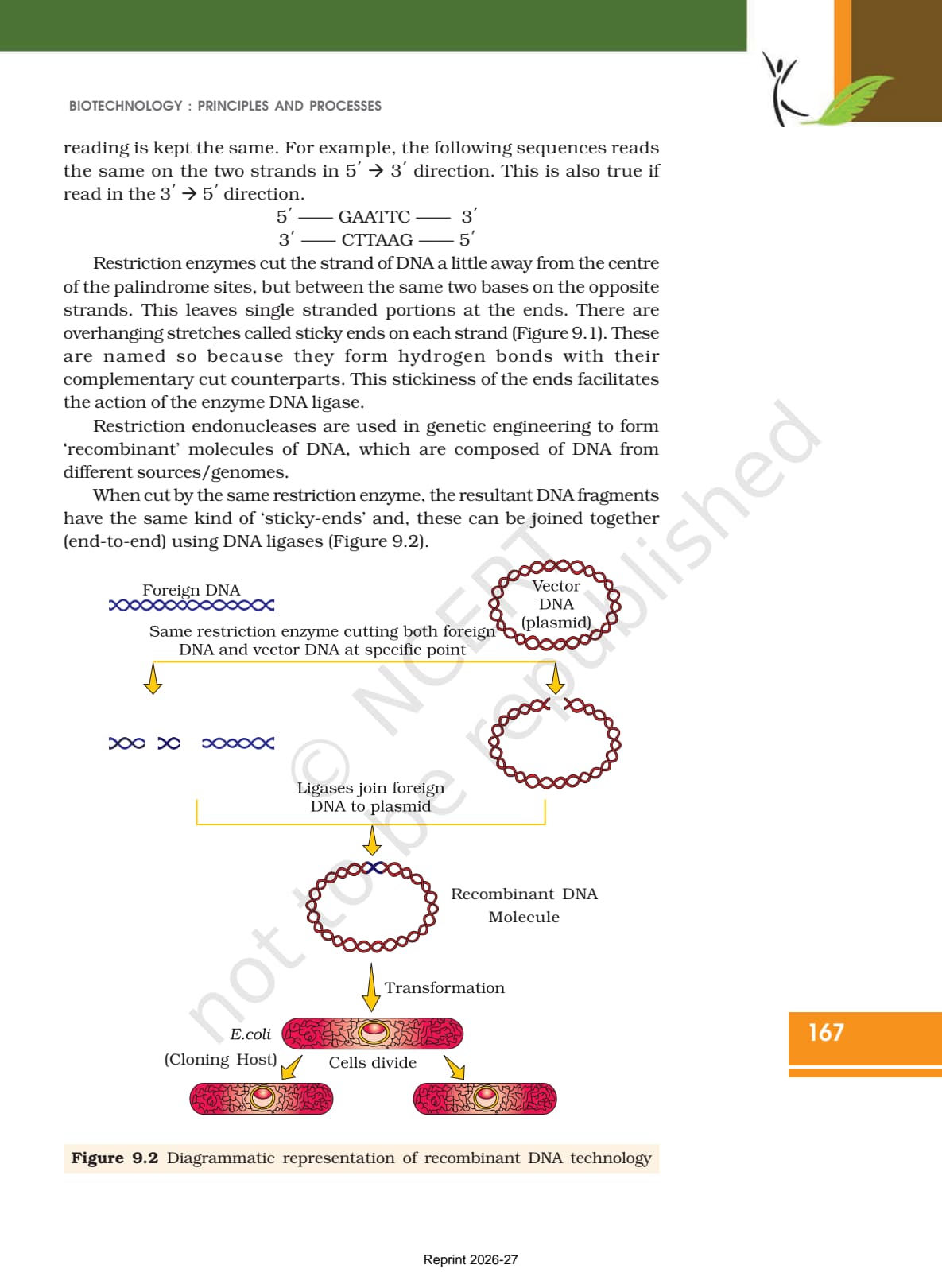
- Fig 9.5 Steps in recombinant DNA technology (consolidated workflow).
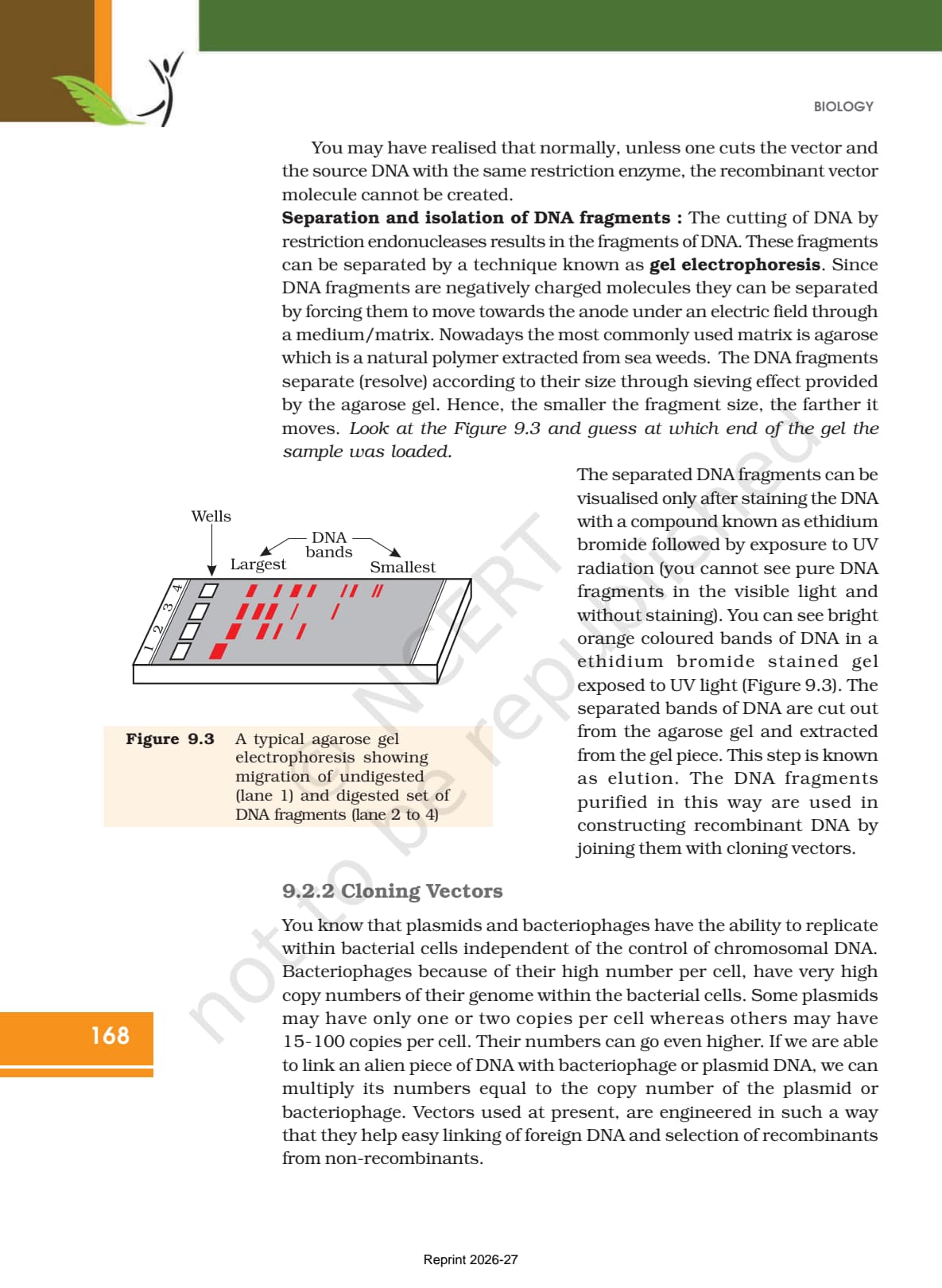
- Fig 9.6 A typical agarose gel electrophoresis showing migration of digested DNA fragments.
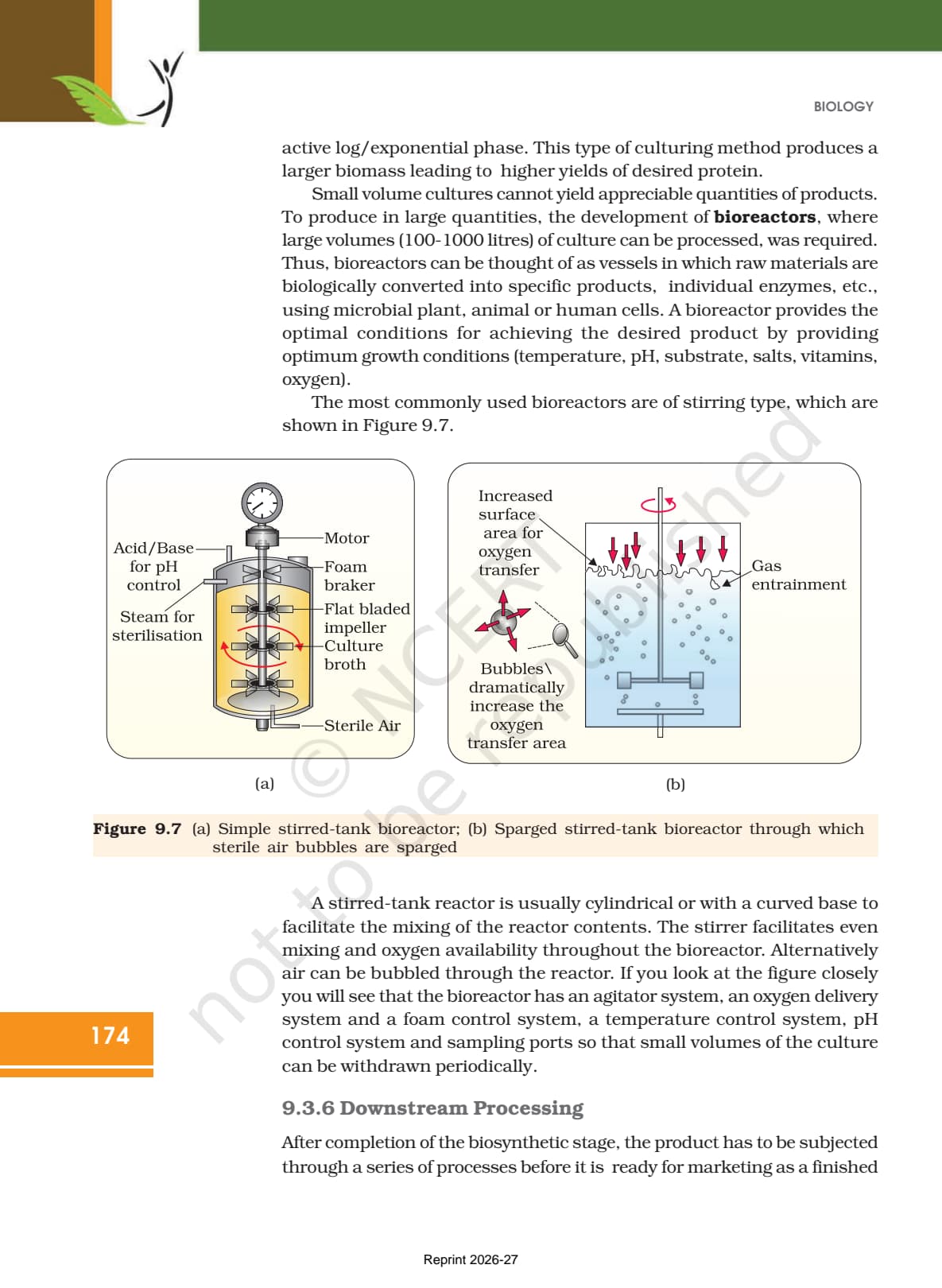
- Fig 9.7 Simple stirred-tank bioreactor cross-section.
- Fig 9.8 Sparged stirred-tank bioreactor.
Biotechnology Principles and Processes NCERT Topics That Power Long Answers
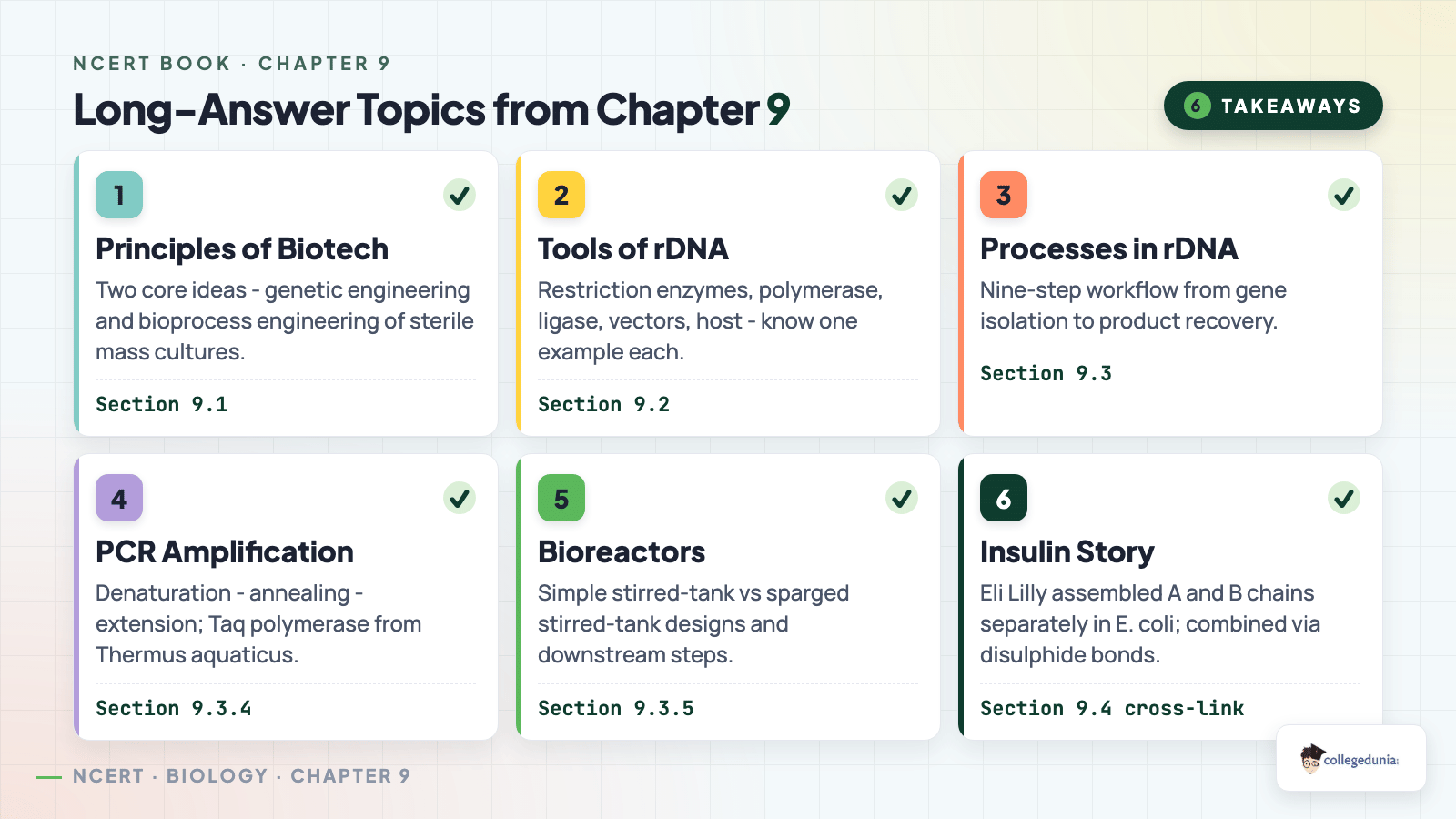
1. Nine-step rDNA workflow (Section 9.3). The 5-marker CBSE staple. Name each step with NCERT phrasing (isolation, cutting, amplification, ligation, insertion, selection, culture, expression, downstream).
2. Restriction enzyme nomenclature and palindrome (9.2). 2 to 3 mark CBSE short-answer. Decode EcoRI letter by letter.
3. Features of a good cloning vector (9.2). 3-mark CBSE answer. List ori, selectable marker, MCS, low MW, recombinant-identification method.
4. PCR principle and steps (9.3). 3-mark CBSE answer; NEET MCQ on temperatures. Name Taq, give the three temperatures with durations.
5. Simple vs sparged stirred-tank bioreactor (9.3). 2 to 3 mark CBSE answer with labelled diagram.
Biotechnology Principles and Processes NCERT PDF: What Stays in the 2026-27 Syllabus
The 2026-27 NCERT did not trim any sub-section of Chapter 9. All three numbered sections (9.1, 9.2, 9.3), all eight figures, and all 11 end-of-chapter exercise questions remain examinable for CBSE Boards and NEET.
Class 12 Biology PYQ Trend for Biotechnology Principles and Processes (2021 to 2026)
| Year | CBSE Marks | NEET Questions | Most-Asked Topic |
|---|---|---|---|
| 2026 | - | Pending (exam rescheduled) | - |
| 2025 | 6 | 4 | EcoRI / pBR322 |
| 2024 | 7 | 5 | Taq / restriction enzyme |
| 2023 | 5 | 3 | DNA ligase / sticky ends |
| 2022 | 6 | 4 | Gel electrophoresis |
| 2021 | 5 | 3 | Ti plasmid |
Five-year average: 5.8 CBSE marks and 3.8 NEET questions.
Full PYQ map: Biotechnology Principles and Processes NCERT Solutions.
Related Resources for Biotechnology Principles and Processes Class 12 Biology
- Biotechnology Principles and Processes Notes
- Biotechnology Principles and Processes NCERT Solutions
- Biotechnology Principles and Processes Formula Sheet
- Biotechnology Principles and Processes Handwritten Notes
- Biotechnology Principles and Processes Exemplar Solutions
- Biotechnology Principles and Processes Exemplar Book PDF
NCERT Book PDF for Class 12 Biology: All Chapters
| Chapter No. | Chapter Title |
|---|---|
| Chapter 1 | Sexual Reproduction in Flowering Plants NCERT Book PDF |
| Chapter 2 | Human Reproduction NCERT Book PDF |
| Chapter 3 | Reproductive Health NCERT Book PDF |
| Chapter 4 | Principles of Inheritance and Variation NCERT Book PDF |
| Chapter 5 | Molecular Basis of Inheritance NCERT Book PDF |
| Chapter 6 | Evolution NCERT Book PDF |
| Chapter 7 | Human Health and Disease NCERT Book PDF |
| Chapter 8 | Microbes in Human Welfare NCERT Book PDF |
| Chapter 10 | Biotechnology and Its Applications NCERT Book PDF |
| Chapter 11 | Organisms and Populations NCERT Book PDF |
| Chapter 12 | Ecosystem NCERT Book PDF |
| Chapter 13 | Biodiversity and Conservation NCERT Book PDF |
Biotechnology Principles and Processes Class 12 Biology NCERT Book PDF FAQs
Ques. Where can I download the Class 12 Biology Chapter 9 Biotechnology Principles and Processes NCERT Book PDF?
Ans. The official 2026-27 NCERT chapter PDF for Biotechnology: Principles and Processes is downloadable directly from this page. It is the latest reprint, mapped to the CBSE 2026-27 syllabus.
Ques. How many pages does the NCERT Chapter 9 Biology PDF have?
Ans. The chapter spans around 16 pages of NCERT body text across three numbered sections (9.1 Principles, 9.2 Tools, 9.3 Processes), plus the end-of-chapter exercise carrying 11 questions.
Ques. Is this the 2026-27 syllabus version?
Ans. Yes. The PDF is the current 2026-27 NCERT reprint for Class 12 Biology. Biotechnology Principles and Processes is intact in this edition; no sub-section was trimmed.
Ques. What topics does NCERT Class 12 Biology Chapter 9 cover?
Ans. The chapter covers principles of biotechnology (genetic engineering + bioprocess engineering), tools of rDNA technology (restriction enzymes, DNA ligase, cloning vectors including pBR322, lambda phage, cosmid, Ti plasmid, competent host cells), and processes of rDNA technology (isolation, cutting, amplification by PCR, ligation, transformation, selection, gel electrophoresis, bioreactors, downstream processing).
Ques. How many figures and end-of-chapter questions are in NCERT Class 12 Biology Chapter 9?
Ans. The chapter carries 8 numbered figures (Fig 9.1 to Fig 9.8) covering restriction-enzyme cutting, EcoRI cleavage detail, the rDNA workflow, pBR322 vector map, agarose gel run, and the two bioreactor designs. The end-of-chapter exercise has 11 questions.
Ques. Why is the NCERT chapter 9 PDF important for NEET 2026?
Ans. Chapter 9 has averaged 3.8 NEET questions per year over the last five cycles, putting it in NEET's top-five Class 12 Biology yield chapters. Section 9.2 (tools) drives the restriction-enzyme MCQ and Section 9.3 drives the PCR-temperature triplet and bioreactor-parts items.



Comments