




Chapter 6 Evolution in the 2026-27 NCERT Class 12 Biology textbook spans 17 pages (110-126) and covers origin of life, Darwinian natural selection, the Hardy-Weinberg principle, and the rise of modern humans. It is a NEET-heavy chapter of the Genetics and Evolution unit. This page hosts the official NCERT PDF and a full reading map.
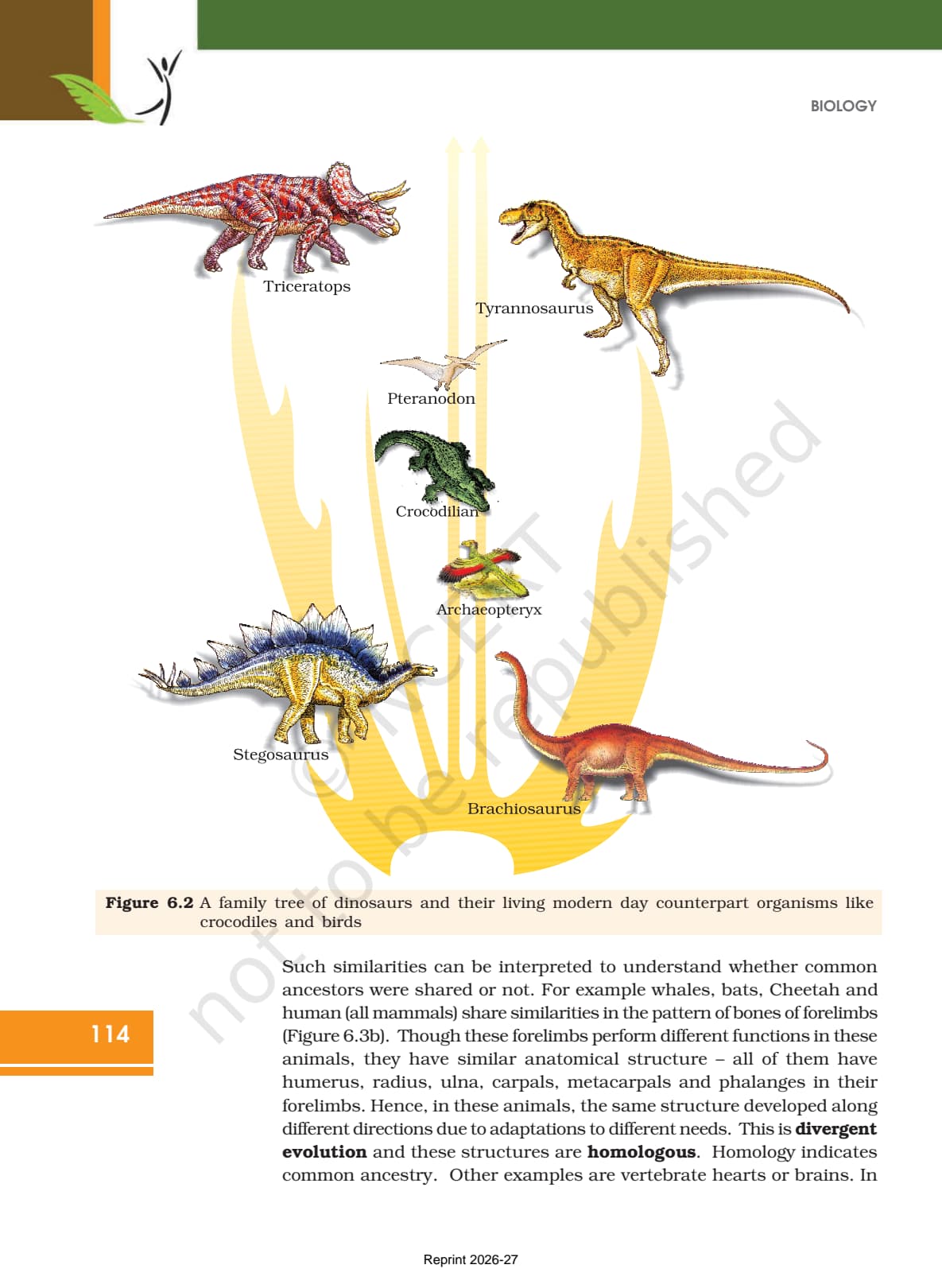
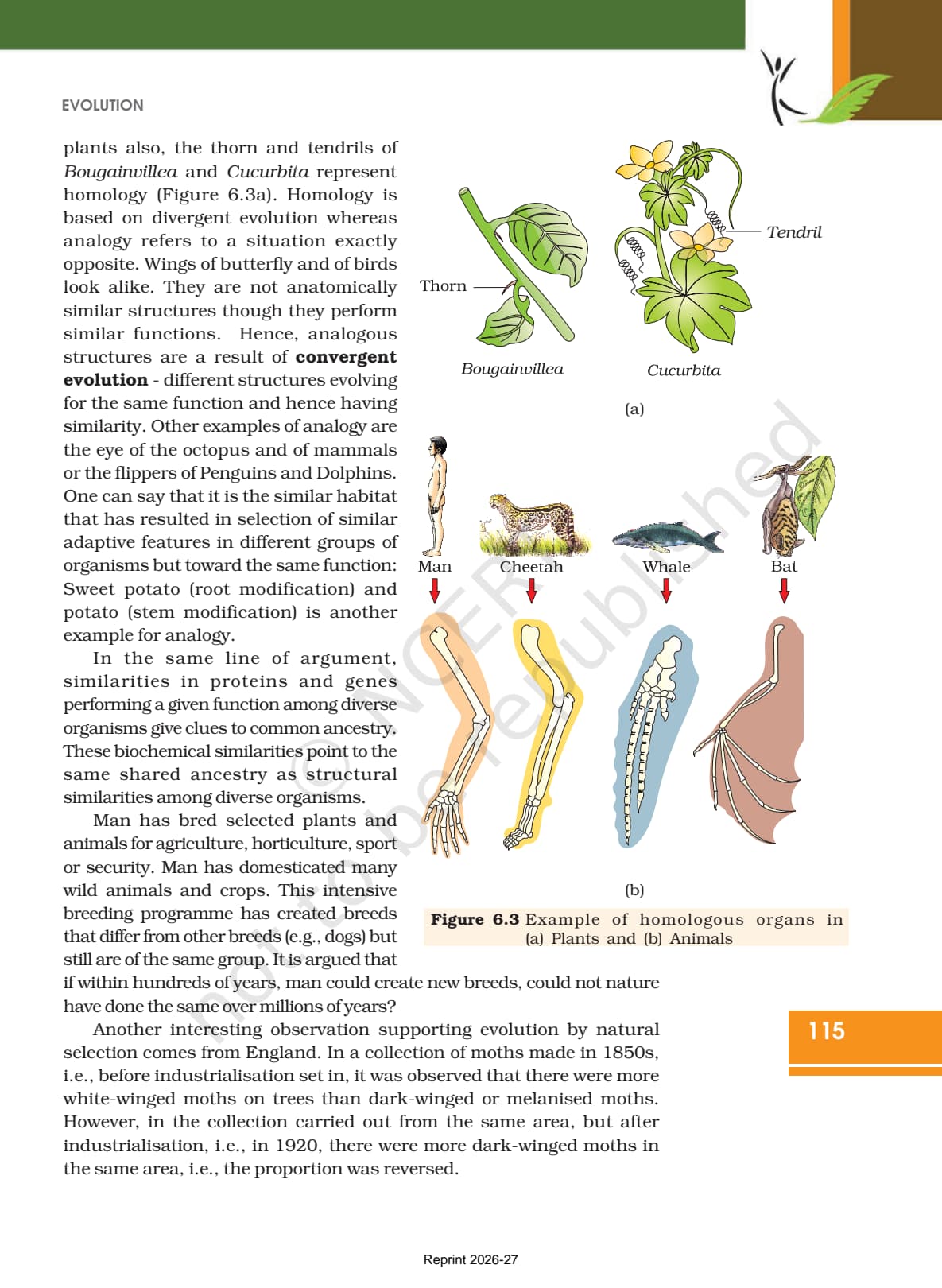
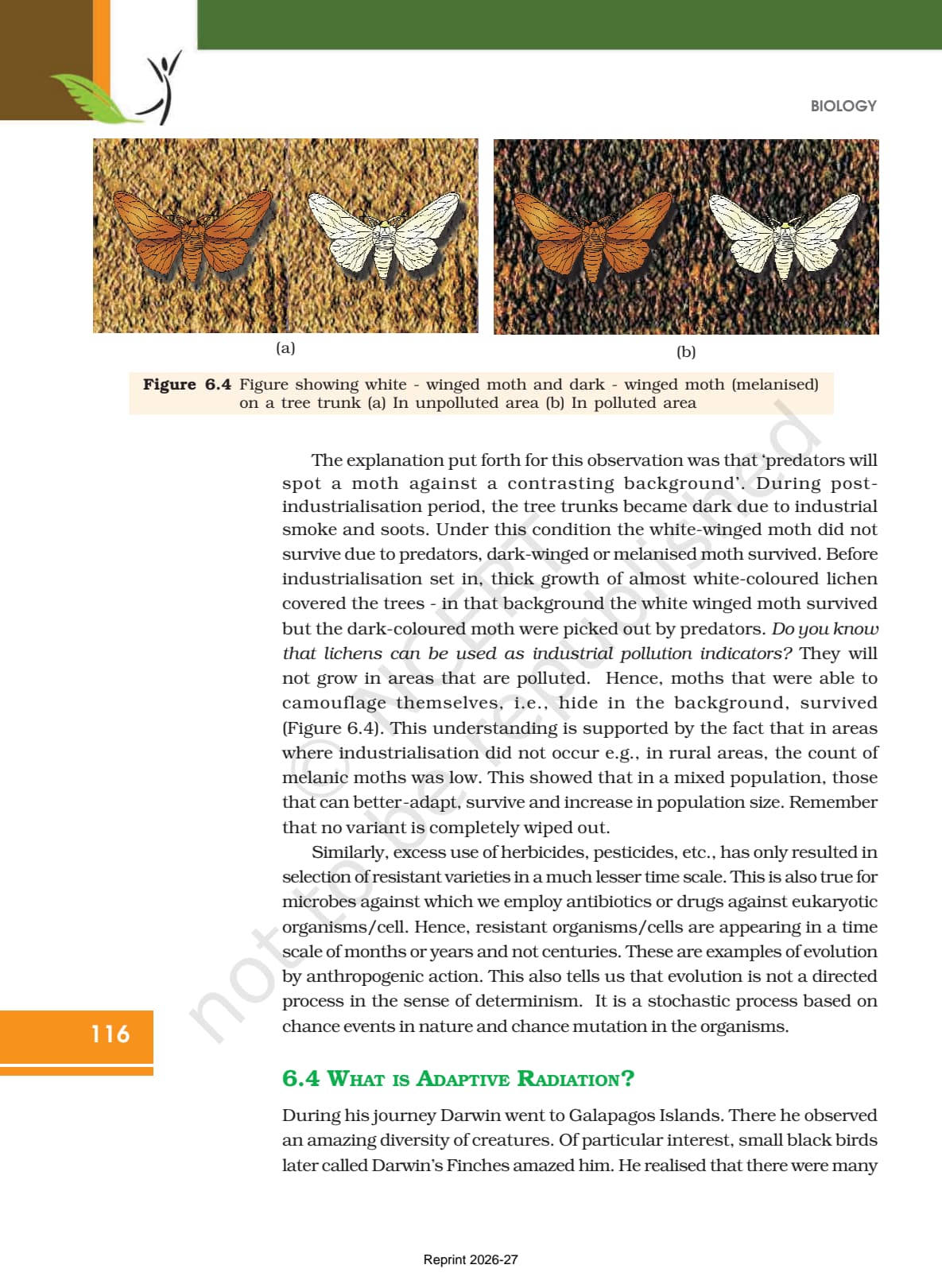
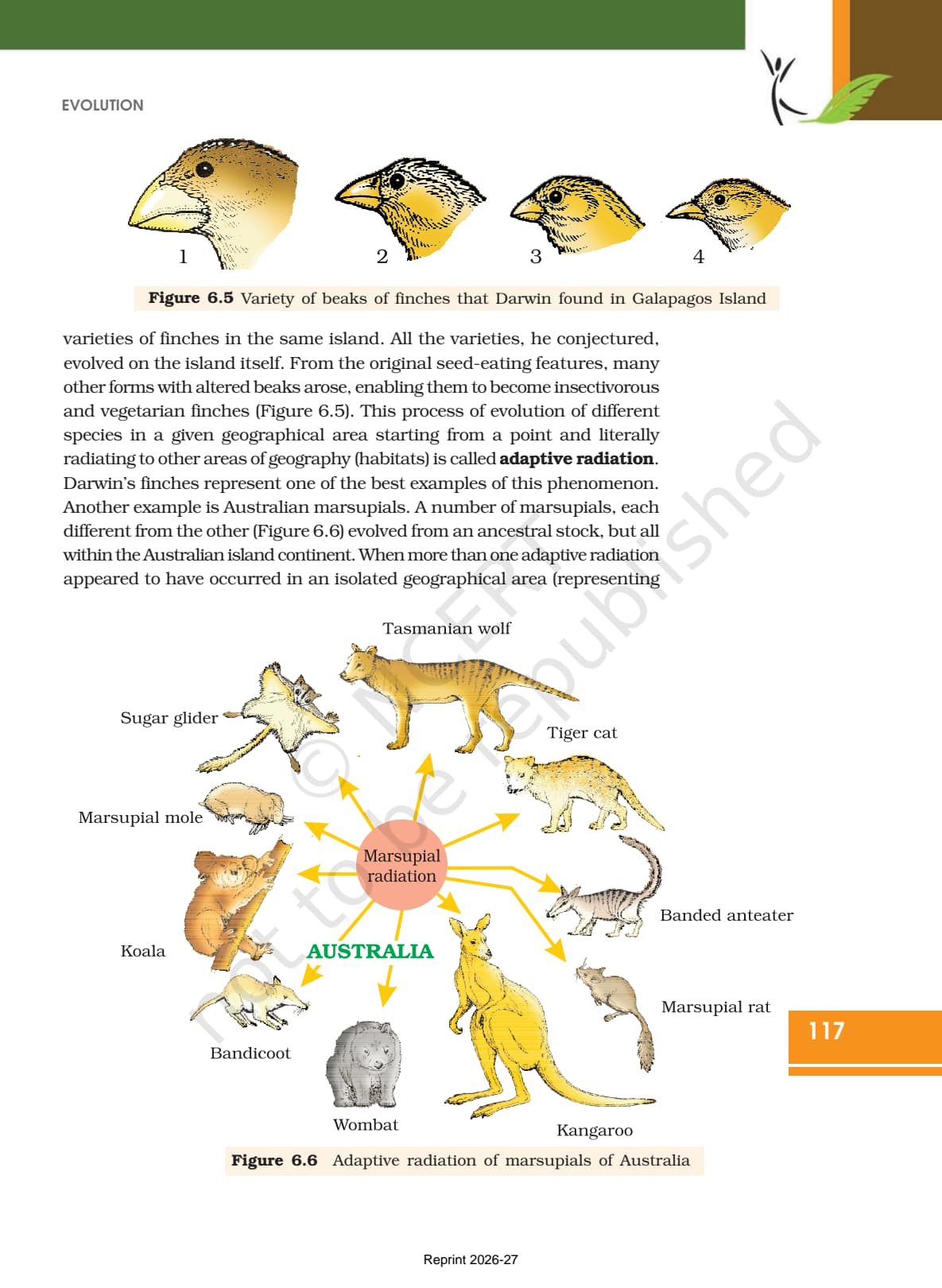
- CBSE Weightage: 4 to 6 marks (typically one 2-mark short-answer plus one 3-mark long-answer on natural selection, Hardy-Weinberg, or human evolution)
- NEET Weightage: 2 to 4 questions per year (consistently among the top three NEET Biology chapters from Class 12)
- AIIMS / CUET: Conceptual questions on adaptive radiation, Hardy-Weinberg equilibrium, and the hominid sequence are commonly tested
Evolution NCERT Book: Section-by-Section Breakdown with Page Numbers
Nine numbered sections, a summary, and ten exercises. Sections 6.5, 6.6 drive most NEET marks; Section 6.9 is a CBSE short-answer favourite.
| Section | Title | Pages | What it covers |
|---|---|---|---|
| 6.1 | Origin of Life | 110-112 | Big Bang, panspermia, Oparin-Haldane hypothesis, Miller-Urey, Pasteur's refutation of spontaneous generation |
| 6.2 | Evolution of Life Forms - A Theory | 112-113 | Theory of special creation, Darwin's HMS Beagle voyage, branching descent, natural selection |
| 6.3 | What are the Evidences for Evolution? | 113-117 | Paleontological, comparative anatomy (homologous vs analogous), embryological, molecular evidences |
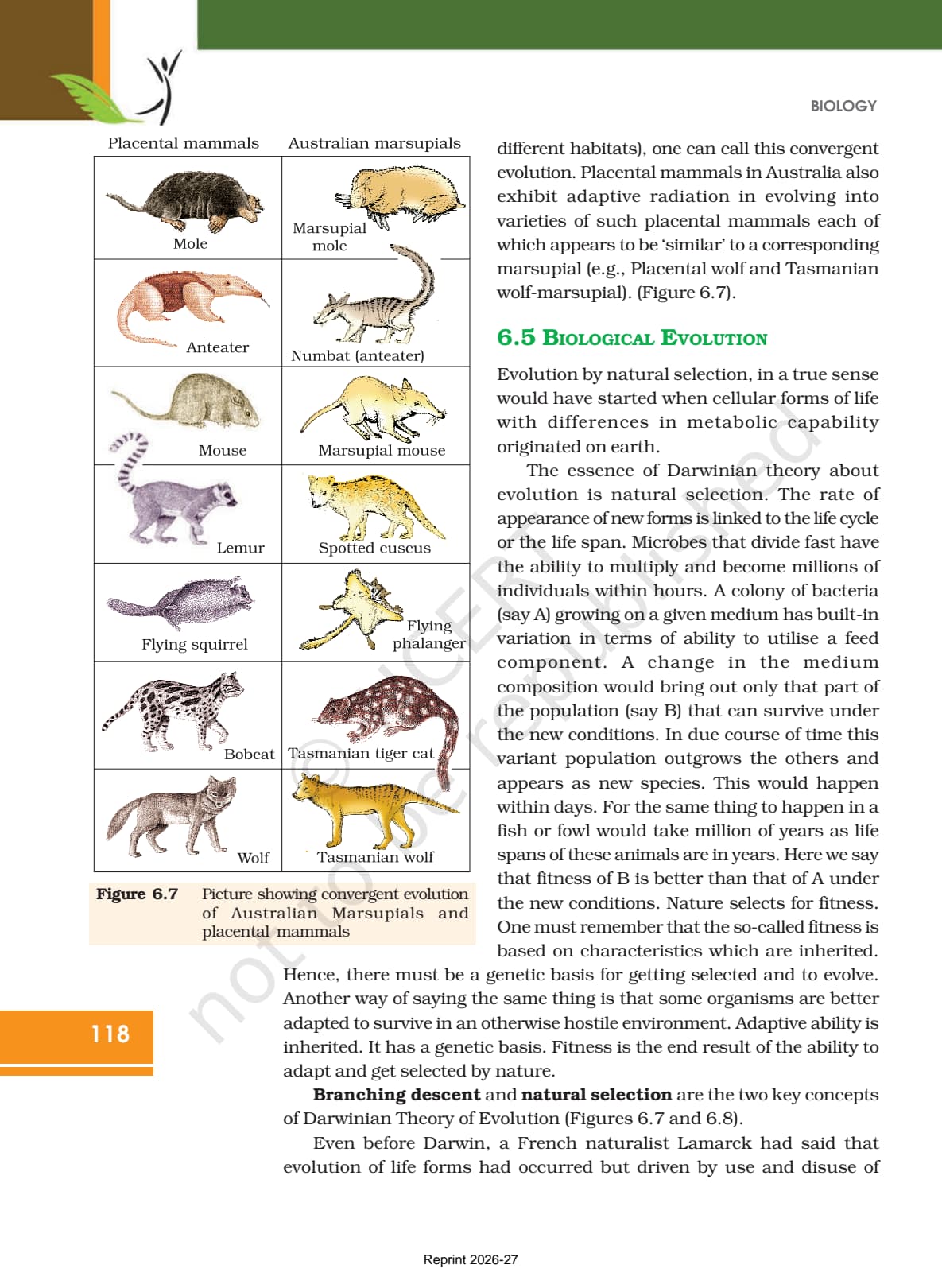
| 6.4 | What is Adaptive Radiation? | 117-118 | Darwin's finches, Australian marsupials, convergent evolution |
| 6.5 | Biological Evolution | 118-120 | Lamarck's use and disuse, Darwin-Wallace natural selection, fitness and variation |
| 6.6 | Mechanism of Evolution | 120-121 | Hugo de Vries' mutation theory, saltation, role of variation |
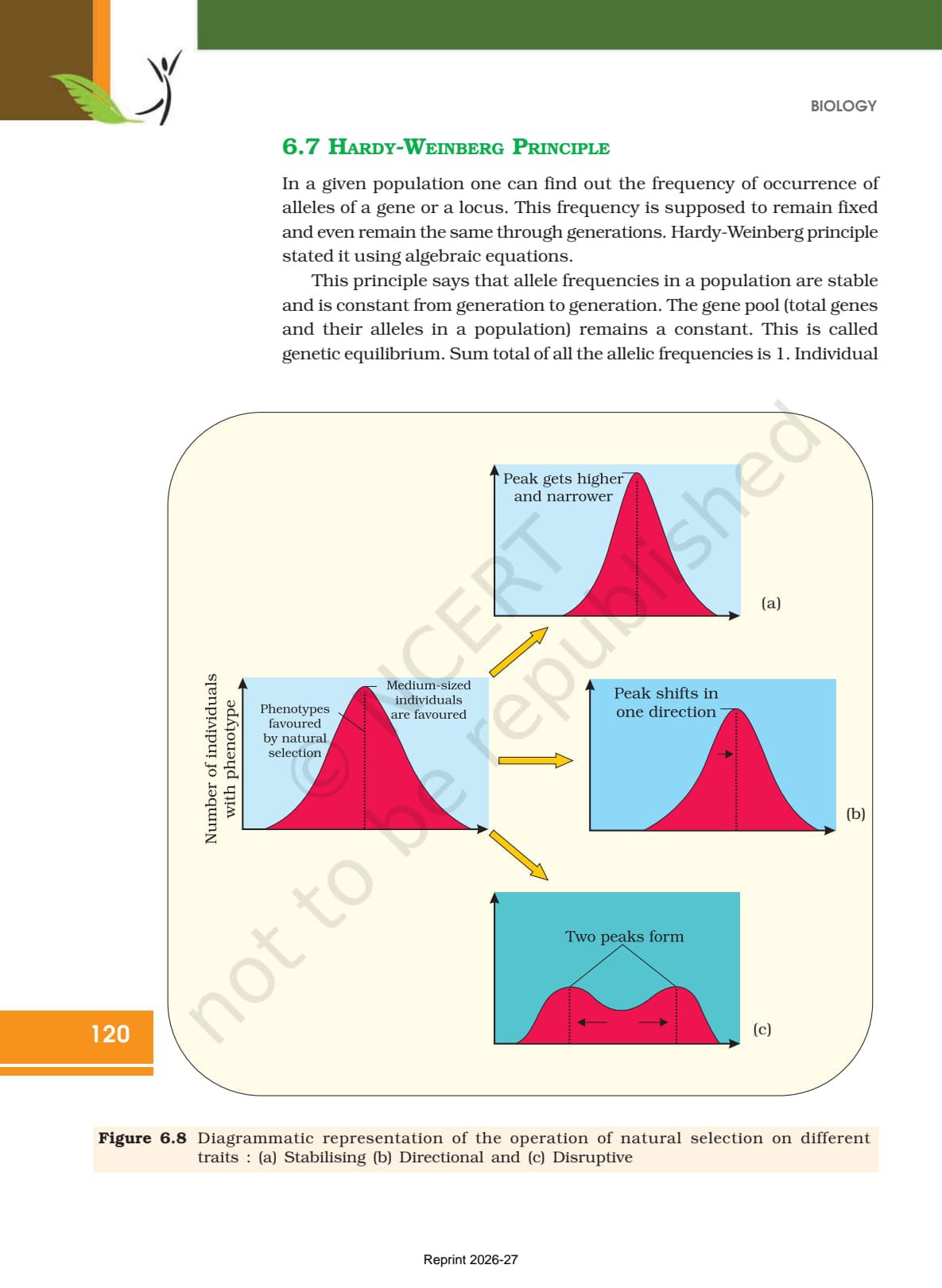
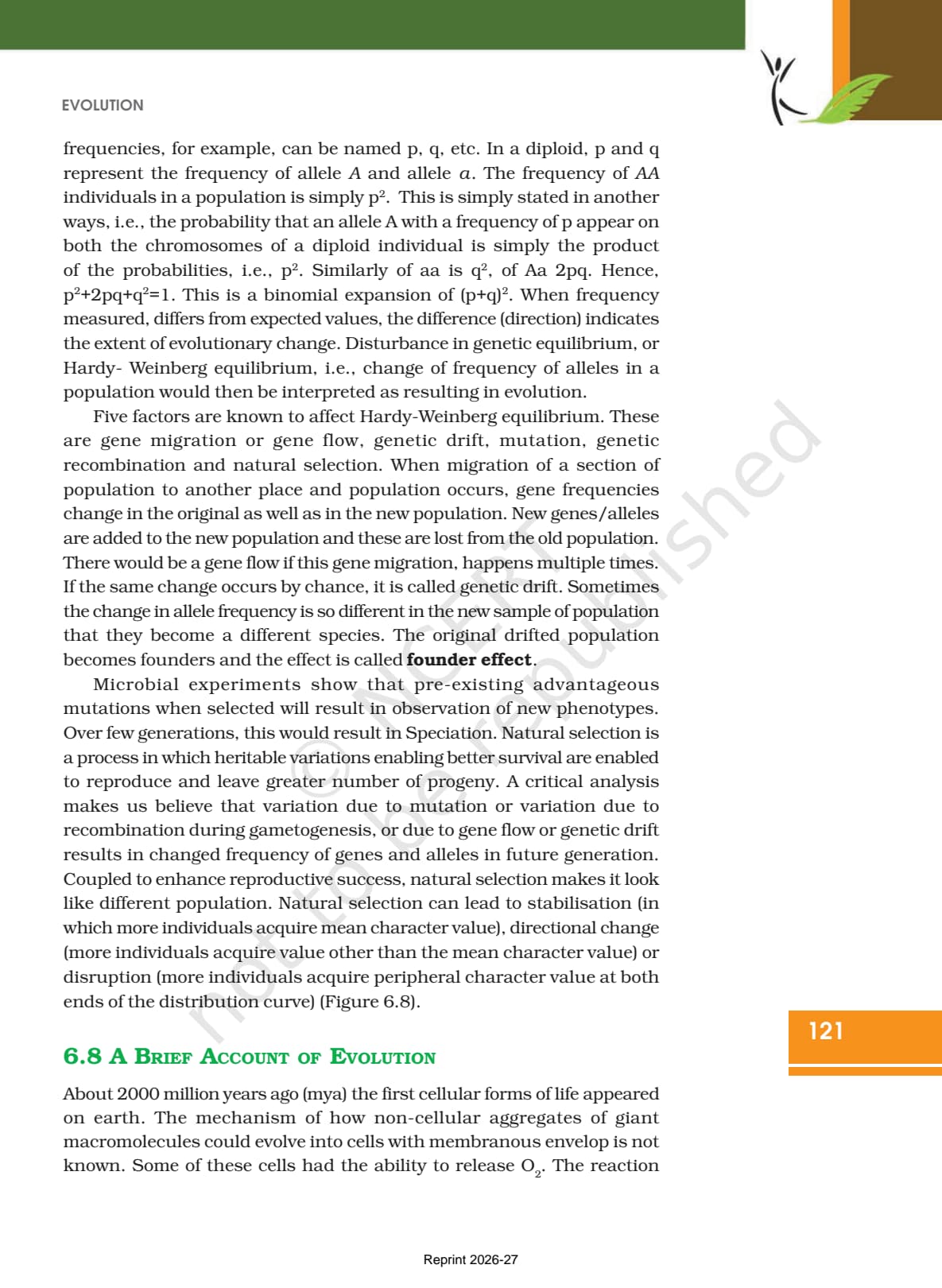
| 6.7 | Hardy-Weinberg Principle | 121-123 | Gene pool and gene frequency, p2 + 2pq + q2 = 1 , five factors (migration, drift, mutation, recombination, selection), founder effect, types of selection |
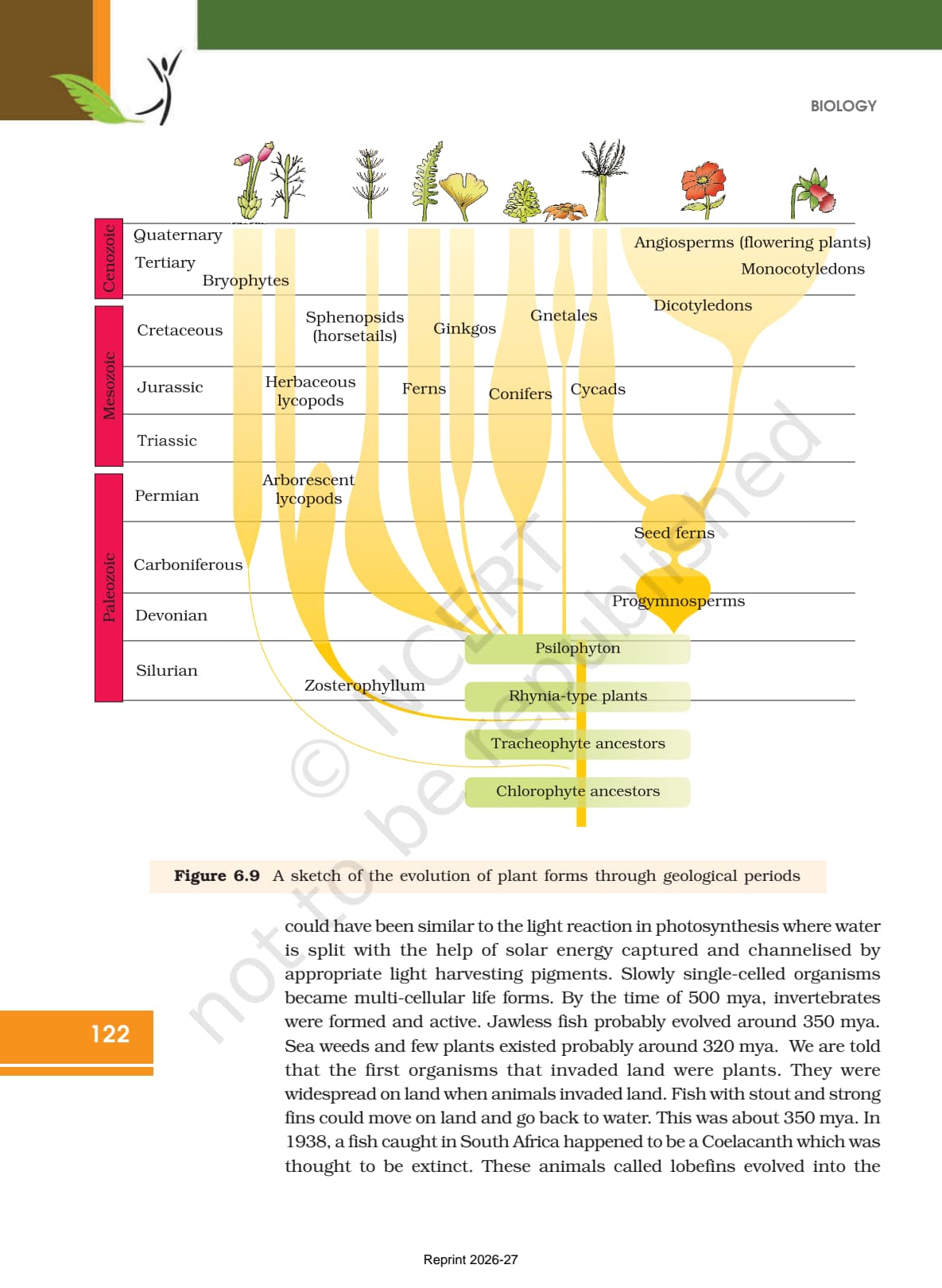
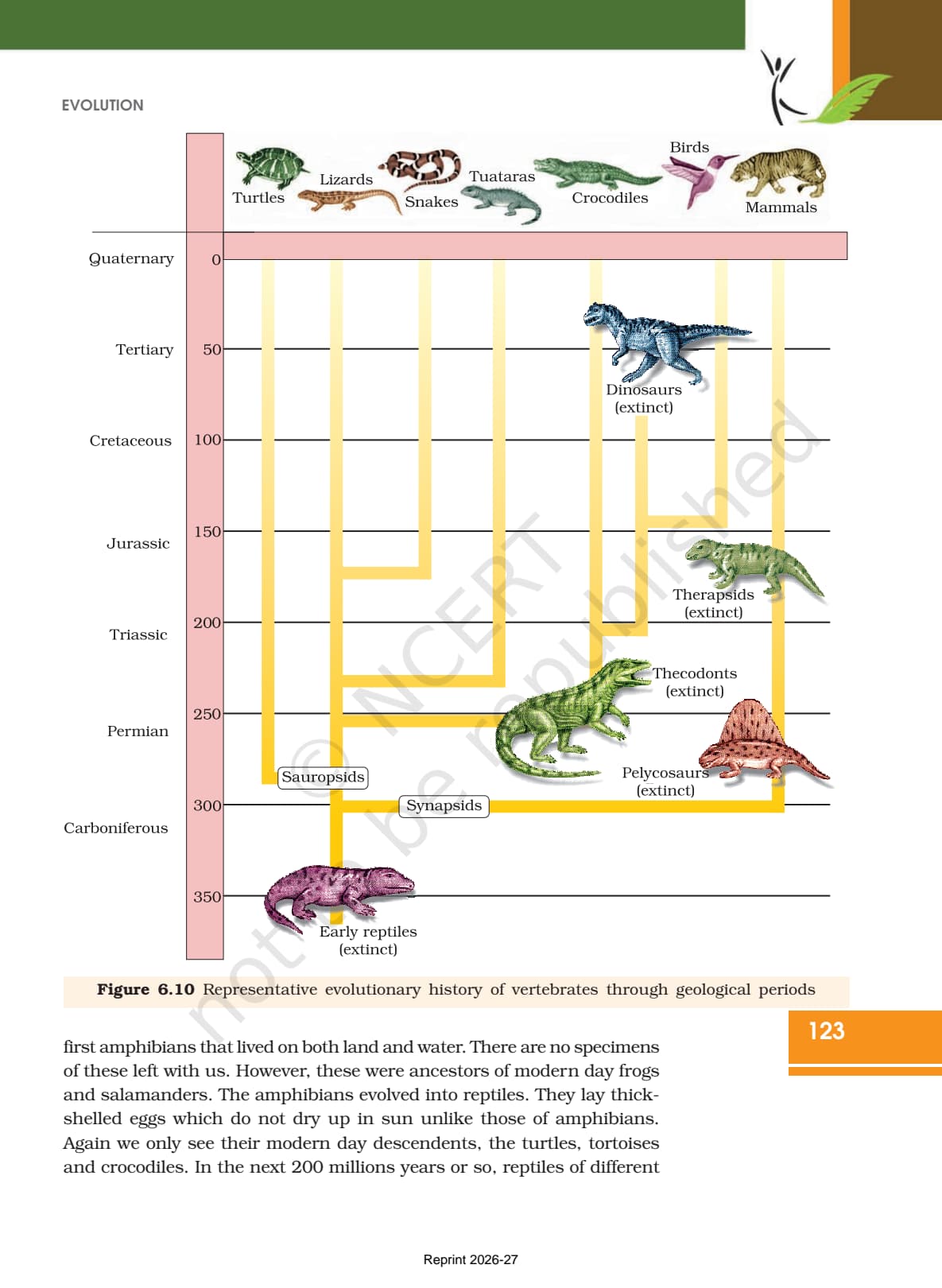
| 6.8 | A Brief Account of Evolution | 123-124 | Geological time scale, continental drift, mass extinctions |
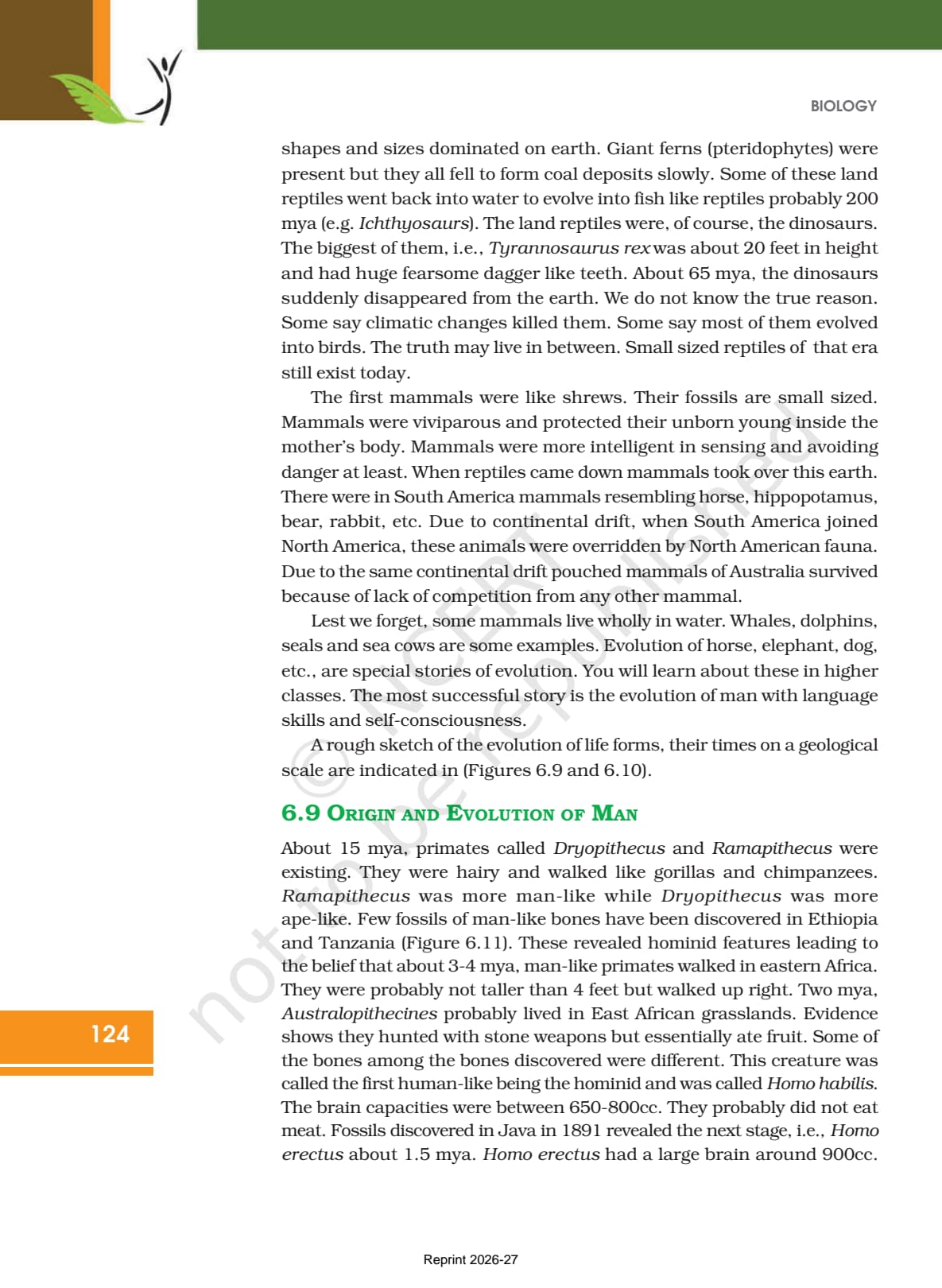
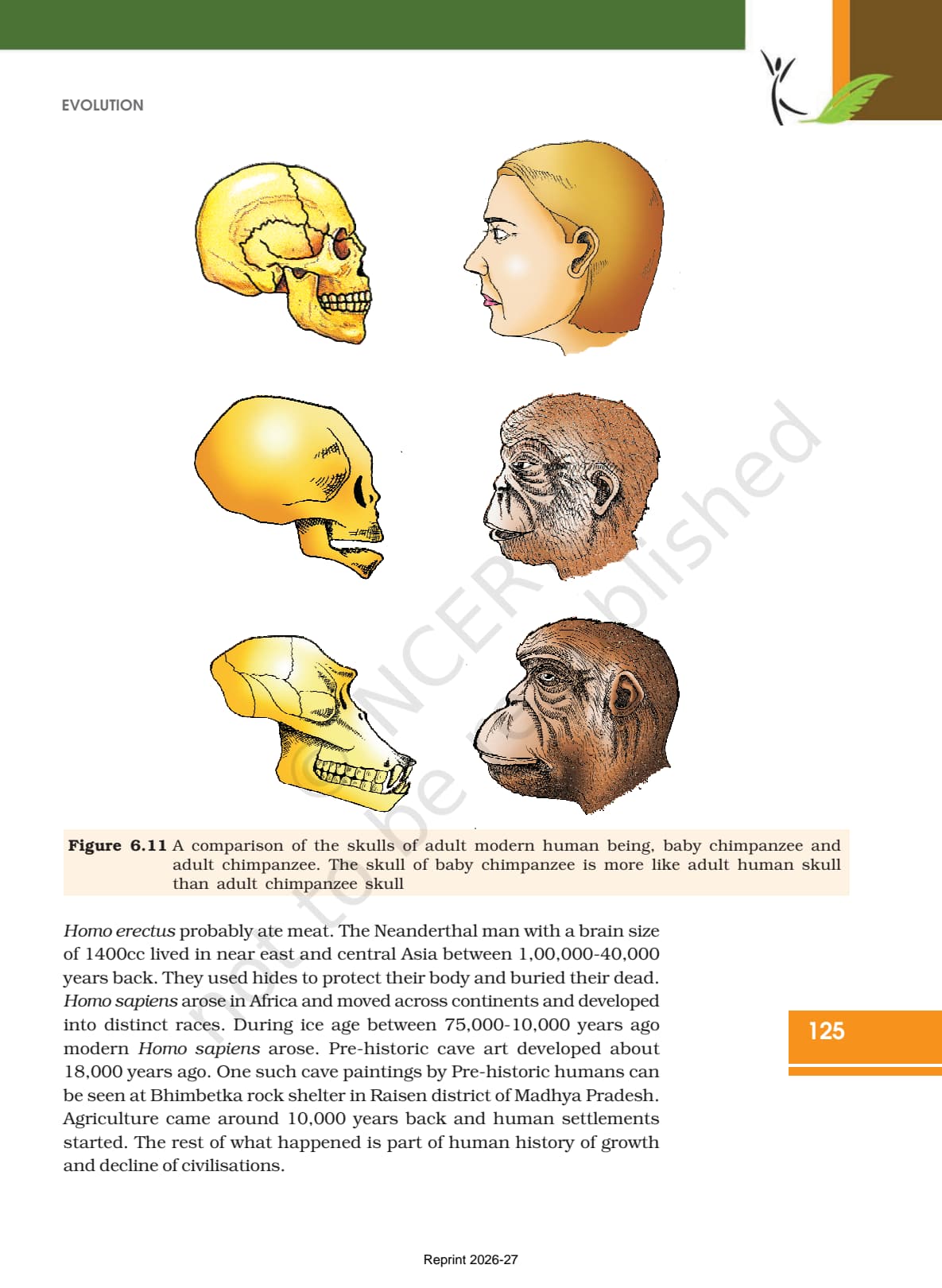
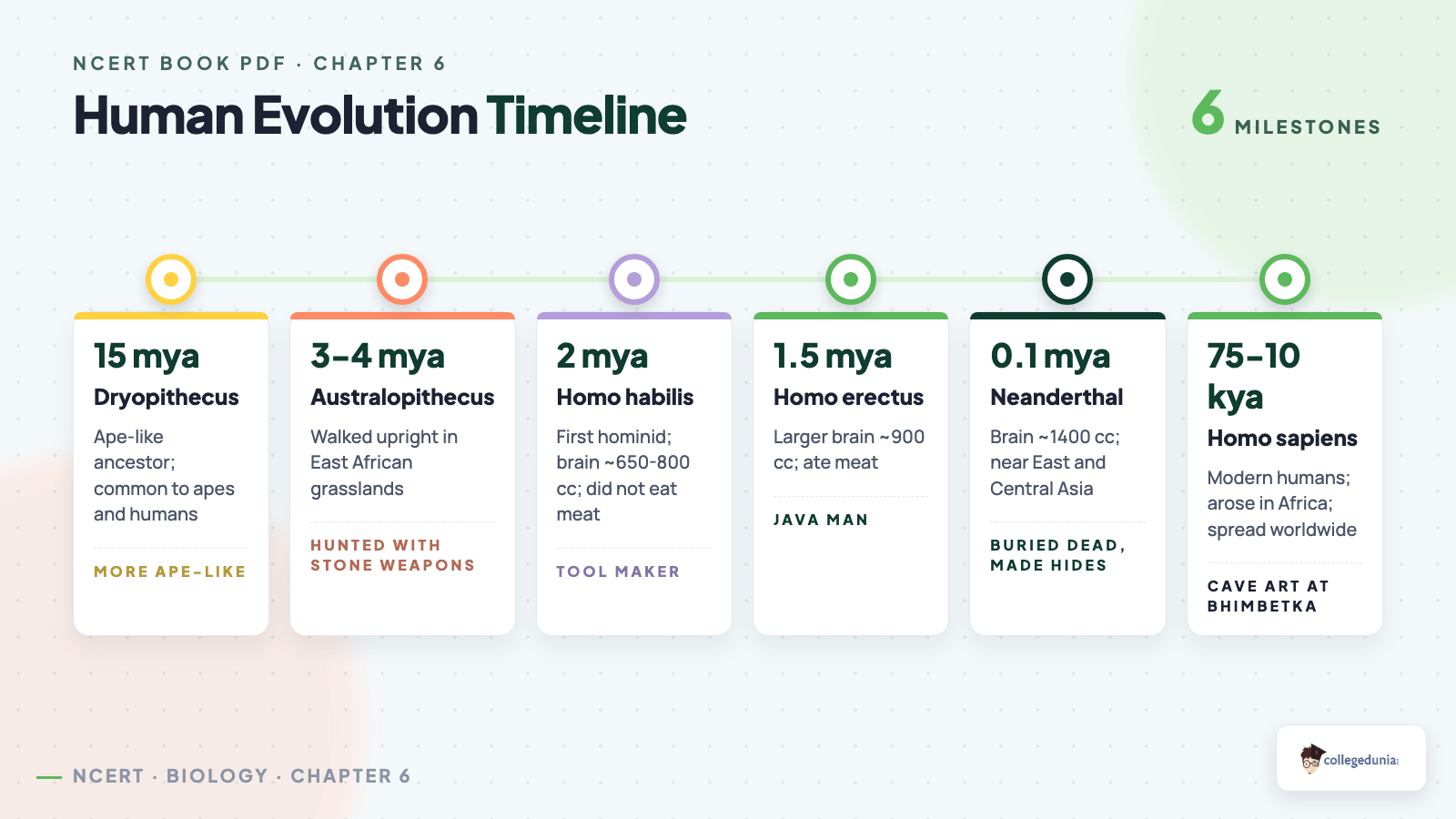
| 6.9 | Origin and Evolution of Man | 124-125 | Dryopithecus, Australopithecines, Homo habilis, erectus, Neanderthal, sapiens |
| - | Summary, Exercises (10 Qs) | 126 | Summary plus ten end-of-chapter exercises |
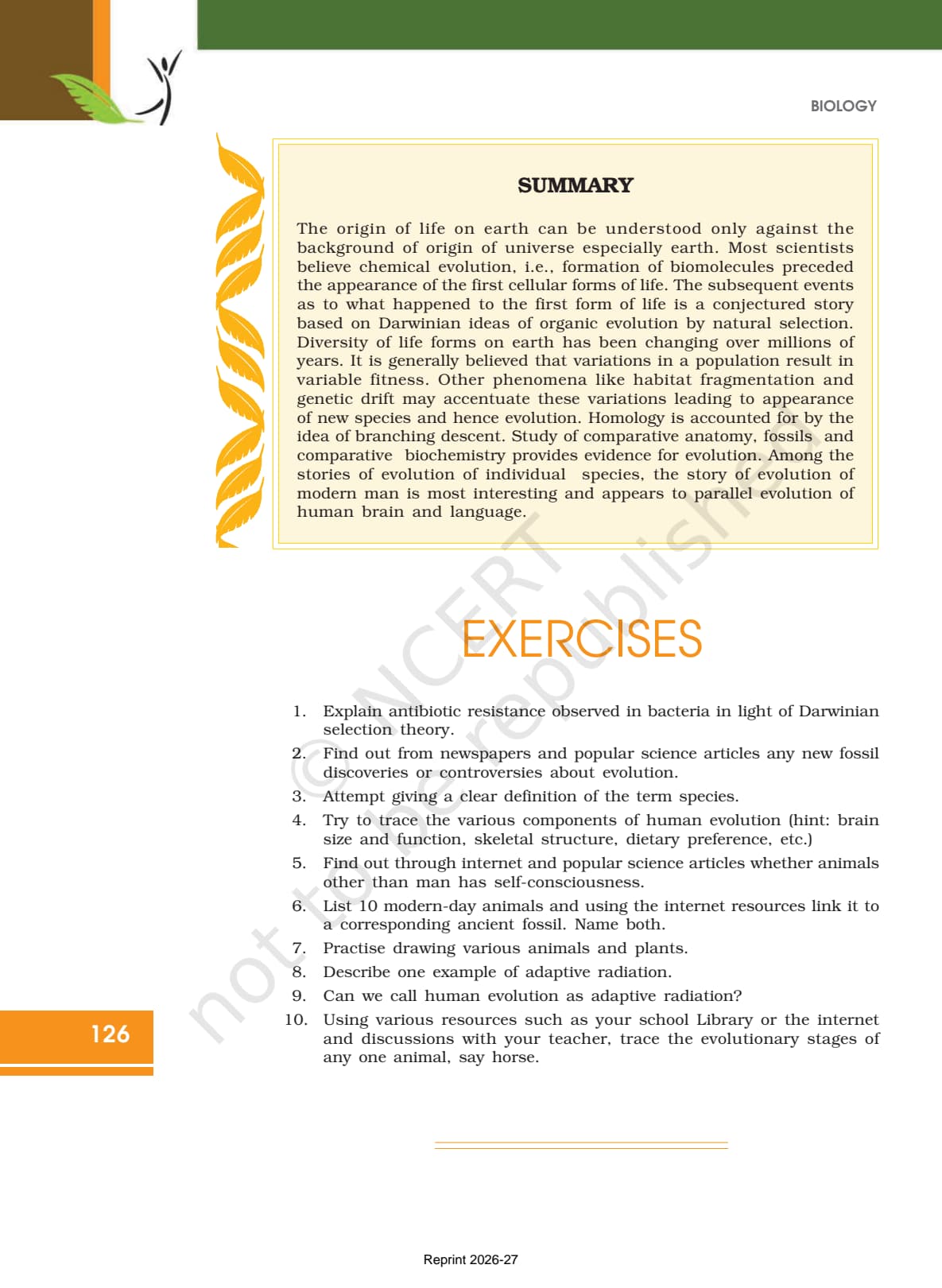
The 10 exercises split into 3 on Darwinism, 2 on human evolution, 2 on adaptive radiation, 3 conceptual. Exercise 1 (antibiotic resistance) has the highest CBSE reuse rate.
Evolution Class 12 Biology Video Lecture
Source: PW NEET on YouTube
How Collegedunia's NCERT Book PDF Helps with Evolution Class 12 Biology
The official NCERT print is the source of truth for CBSE Boards and NEET. This page adds the navigation aids the raw PDF lacks.
- Section-to-NEET Map: Section 6.7 drives the Hardy-Weinberg numerical; Section 6.9 drives the human-evolution timeline MCQ.
- Reading Sequence: Read Sections 6.3, 6.5 and 6.7 in depth; skim 6.1 and 6.8 for context.
Class 12 Biology Evolution Reading Sequence and Multi-Day Plan
Spread revision over three days: historical names and Hardy-Weinberg practice.
| Day | What to read | What to practise | Time |
|---|---|---|---|
| Day 1 | Sections 6.1, 6.2 (origin of life, Miller-Urey, Darwin and the Beagle voyage) | Exercises 1 to 3 | 2 hours |
| Day 2 | Sections 6.3 to 6.6 (evidences, adaptive radiation, biological evolution, mechanism) | Exercises 4 to 8 | 3 hours |
| Day 3 | Sections 6.7 to 6.9 (Hardy-Weinberg, geological timeline, hominid evolution) plus full revision | Exercises 9 and 10 plus three Hardy-Weinberg NEET numericals | 2.5 hours |
Evolution Top 5 Concepts and Facts for Quick Recall
These five concepts cover almost every CBSE prompt and most NEET questions from this chapter.
| Concept | Key expression / fact |
|---|---|
| Hardy-Weinberg equilibrium | p2 + 2pq + q2 = 1 ; p, q are allele frequencies, p2, q2 homozygote, 2pq heterozygote |
| Five factors disturbing equilibrium | Gene migration, genetic drift, mutation, recombination, natural selection |
| Homology vs analogy | Homologous = common ancestry, different function (forelimbs); analogous = different ancestry, similar function (insect vs bat wing) |
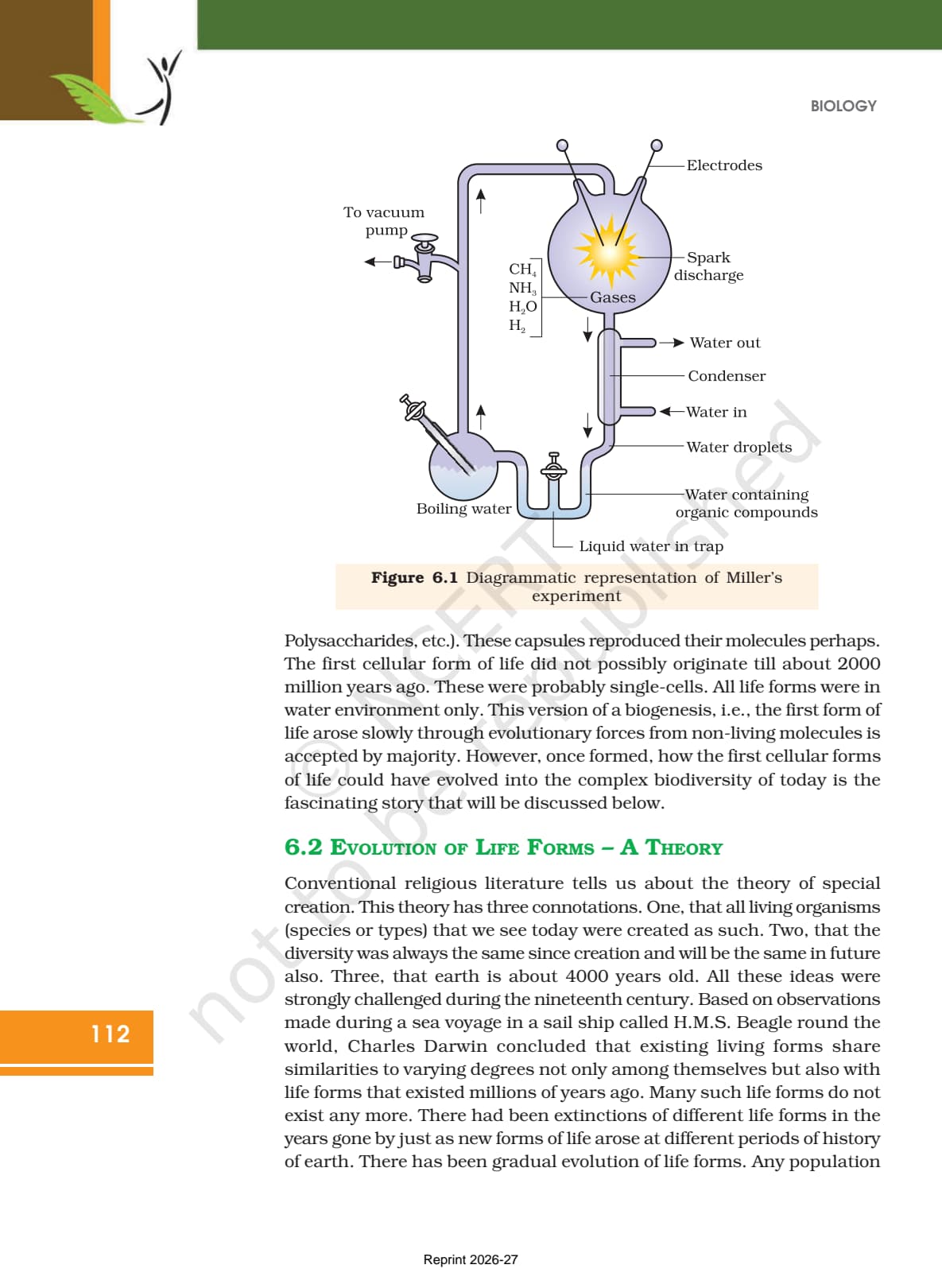
| Miller-Urey experiment | Spark discharge in CH4 , NH3 , H2 , water vapour at 800°C produced amino acids; supports chemical evolution |
| Hominid sequence | Dryopithecus → Australopithecines → Homo habilis (650-800 cc) → Homo erectus (900 cc) → Neanderthal (1400 cc) → Homo sapiens |
Formula Sheet: Evolution Class 12 Biology Formula Sheet
What Stayed in Evolution for 2026-27 NCERT (Rationalisation Note)
NCERT confirmed no deletions in the Class 12 Biology textbook for 2026-27. Chapter 6 retains all sections, diagrams, and the Hardy-Weinberg derivation.
| Sub-topic | Status in 2026-27 | Notes |
|---|---|---|
| Origin of life (Sections 6.1, 6.2) | Kept | Includes Figure 6.1 Miller's apparatus and HMS Beagle voyage |
| Evidences for evolution (Section 6.3) | Kept | All four categories retained |
| Adaptive radiation (Section 6.4) | Kept | Galapagos finches example unchanged |
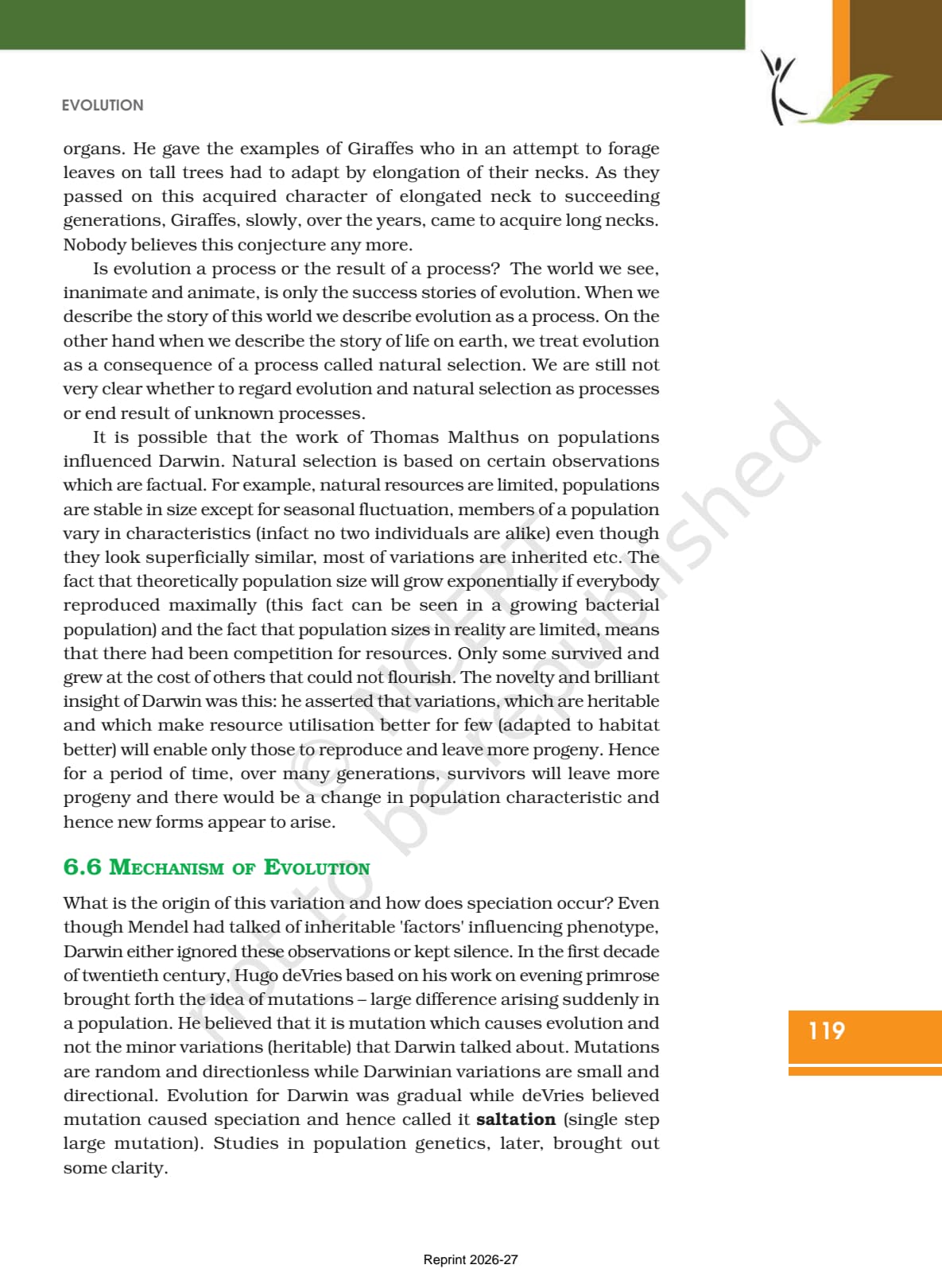
| Biological evolution and mechanism (6.5, 6.6) | Kept | Lamarck, Darwin-Wallace, de Vries all retained |
| Hardy-Weinberg principle (Section 6.7) | Kept | Equation p2 + 2pq + q2 = 1 and five factors retained verbatim |
| Origin and evolution of man (Section 6.9) | Kept | Figures 6.10 and 6.11 (skull comparisons) intact |
Evolution PYQ Trend in CBSE and NEET (2025 to 2021)
Hardy-Weinberg numericals, homology-vs-analogy comparisons, and hominid-timeline MCQs repeat most often. The table maps the top topic per year.
| Year | CBSE Board | NEET |
|---|---|---|
| 2025 | Hardy-Weinberg numerical (3 marks) | Hominid sequence MCQ (1 question) |
| 2024 | Adaptive radiation with Darwin's finches (3 marks) | Hardy-Weinberg numerical, homologous vs analogous (2 questions) |
| 2023 | Five factors disturbing Hardy-Weinberg equilibrium (3 marks) | Miller-Urey products, Homo erectus brain size (2 questions) |
| 2022 | Antibiotic resistance as Darwinian selection (2 marks) | Convergent evolution, Oparin-Haldane (2 questions) |
| 2021 | - | - |
Full PYQ map: Evolution Class 12 Biology NCERT Solutions
Evolution Weightage Compared Across Class 12 Biology Chapters
Typical CBSE Board marks across all 13 chapters, averaged over the last five board papers. Evolution sits mid-band for CBSE and is a NEET top-three chapter.
Student Feedback: Evolution Chapter 6 Class 12 Biology Survey Results
A survey of 10,900 Class 12 Biology students found 72% rated Hardy-Weinberg as the hardest sub-topic in this chapter.
Student Feedback
- 72% of students surveyed marked the Hardy-Weinberg equation derivation and use as the hardest sub-topic.
- 62% reported losing 1-2 marks on differentiating Darwin's vs Lamarck's theories, even when the rest of their answer was correct.
- 4 out of 5 students said the Miller-Urey experimental apparatus labelled diagram was the most-skipped figure in their answer sheet.
- Average student took 5.4 hours for the first read of the chapter, and 2.3 hours for a focused revision pass before the board exam.
- Of the 10,900 students surveyed, only 36% attempted all 12 NCERT exercise questions. Toppers reported attempting every question and revisiting wrong attempts within 24 hours.
Source: 2025-26 Class 12 Biology student survey. Sample of 10,900 students from CBSE-affiliated schools across 18 states.
Author, Edition and Publisher Information for the Evolution NCERT PDF
Official NCERT publication details:
- Book: Biology, Class 12 (Textbook for Class XII)
- Chapter: 6 - Evolution
- Publisher: NCERT
- Edition: 2026-27 reprint
- Pages: 17 (110-126)
- Languages: English, Hindi (Jeev Vigyan)
- Code: lebo106
Related: Class 12 Biology NCERT Book PDF (All Chapters)
Other Resources for Evolution Class 12 Biology
| Resource Type | Link |
|---|---|
| NCERT Book | Evolution NCERT Book |
| NCERT Solutions | Evolution Class 12 Biology NCERT Solutions |
| Notes | Evolution Class 12 Biology Notes |
| Formula Sheet | Evolution Class 12 Biology Formula Sheet |
| Exemplar Book PDF | Evolution Class 12 Biology NCERT Exemplar Book PDF |
| Exemplar Solutions | Evolution Class 12 Biology NCERT Exemplar Solutions |
| Handwritten Notes | Evolution Class 12 Biology Handwritten Notes |
NCERT Book PDF for Class 12 Biology: All Chapters
All 13 Class 12 Biology chapters from NCERT 2026-27, each linking to its Book PDF page.
| Chapter | Resource |
|---|---|
| Chapter 1 | Sexual Reproduction in Flowering Plants NCERT Book PDF |
| Chapter 2 | Human Reproduction NCERT Book PDF |
| Chapter 3 | Reproductive Health NCERT Book PDF |
| Chapter 4 | Principles of Inheritance and Variation NCERT Book PDF |
| Chapter 5 | Molecular Basis of Inheritance NCERT Book PDF |
| Chapter 6 | Evolution NCERT Book PDF |
| Chapter 7 | Human Health and Disease NCERT Book PDF |
| Chapter 8 | Microbes in Human Welfare NCERT Book PDF |
| Chapter 9 | Biotechnology - Principles and Processes NCERT Book PDF |
| Chapter 10 | Biotechnology and its Applications NCERT Book PDF |
| Chapter 11 | Organisms and Populations NCERT Book PDF |
| Chapter 12 | Ecosystem NCERT Book PDF |
| Chapter 13 | Biodiversity and Conservation NCERT Book PDF |
Evolution Class 12 Biology NCERT Book PDF FAQs
Ques. Where can I download the Class 12 Biology Chapter 6 Evolution NCERT Book PDF?
Ans. You can download the Evolution Class 12 Biology NCERT Book PDF directly from this page. Both the Normal and HD versions are available and both are free, with no registration required.
Ques. Is the Evolution chapter aligned with the 2026-27 NCERT syllabus?
Ans. Yes. NCERT has confirmed there are no deletions or alterations in the Class 12 Biology textbook for the 2026-27 academic session. Chapter 6 Evolution retains every numbered section, the Miller-Urey diagram, the Hardy-Weinberg derivation, and the human-evolution illustrations exactly as printed in the previous edition.
Ques. How many pages is the Class 12th Biology Evolution NCERT Book PDF?
Ans. The chapter runs 17 pages (pages 110 to 126 of the Class 12 Biology textbook), covering 9 numbered sections from Origin of Life through Origin and Evolution of Man, a summary, and 10 end-of-chapter exercises.
Ques. How many marks does Evolution carry in the CBSE Class 12 Biology Board exam?
Ans. Evolution typically carries 4 to 6 marks in the Class 12 Biology Board exam, usually split as one 2-mark short-answer and one 3-mark long-answer on natural selection, Hardy-Weinberg, or human evolution. The chapter is also a top-three NEET Biology chapter from Class 12, contributing 2 to 4 questions per year.
Ques. What does Chapter 6 Evolution in Class 12 Biology cover?
Ans. Chapter 6 covers nine numbered sections: Origin of Life (Big Bang, Oparin-Haldane, Miller-Urey), Evolution of Life Forms as a Theory, Evidences for Evolution, Adaptive Radiation, Biological Evolution (Lamarck, Darwin, Wallace), Mechanism of Evolution (de Vries' mutation theory), Hardy-Weinberg Principle, a brief geological-time-scale account, and Origin and Evolution of Man.
Ques. What is the Hardy-Weinberg principle in the Class 12 Biology Evolution chapter?
Ans. The Hardy-Weinberg principle states that in a large, randomly mating population free from mutation, migration, drift, and selection, allele and genotype frequencies stay constant from generation to generation. The equation is p2 + 2pq + q2 = 1 , where p and q are the two allele frequencies. The chapter also lists the five factors that disturb equilibrium: gene migration, genetic drift, mutation, genetic recombination, and natural selection.
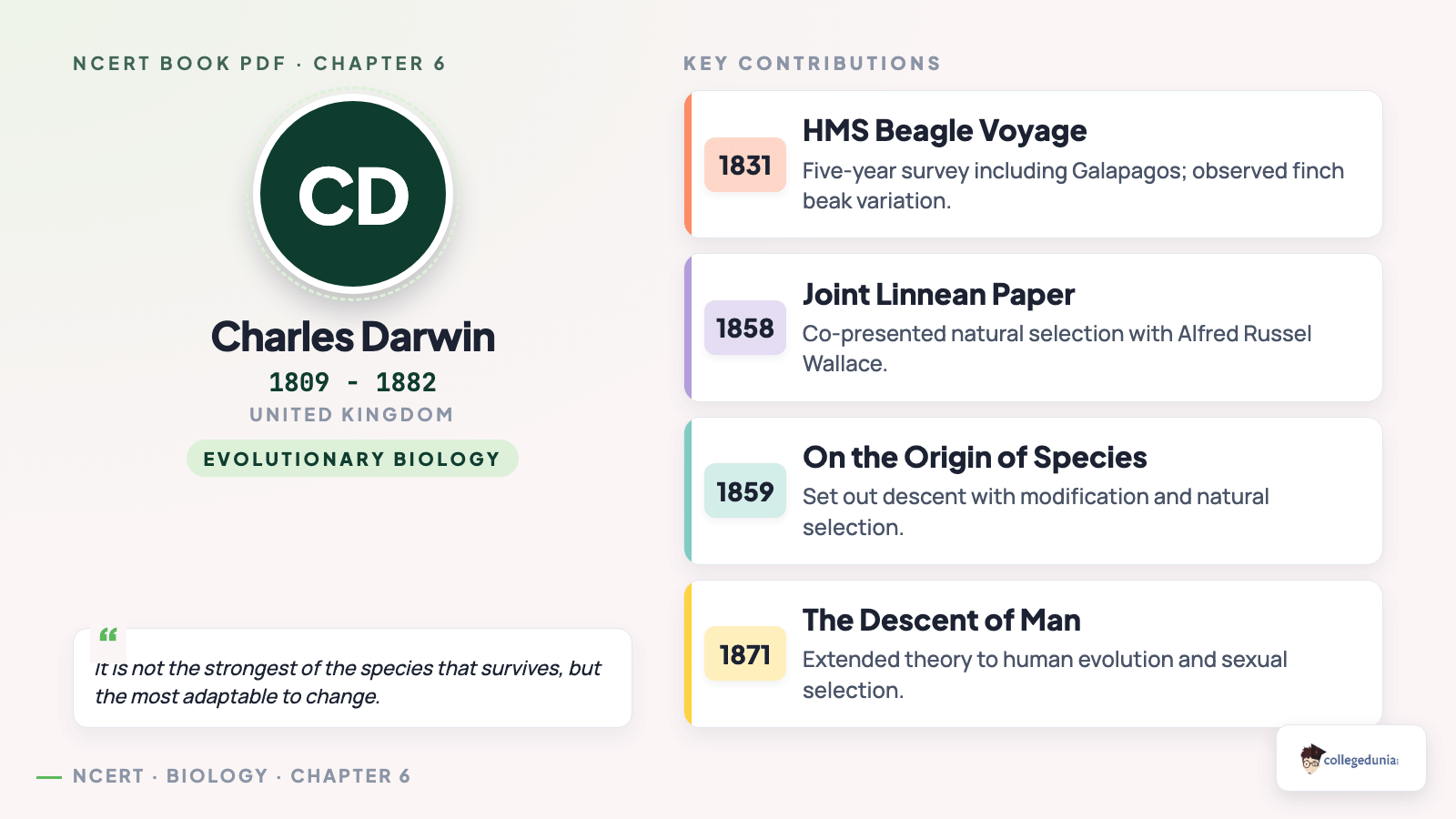
Ques. Which sections in Evolution are most important for NEET?
Ans. Sections 6.3 (evidences for evolution, especially homologous vs analogous organs), 6.7 (Hardy-Weinberg principle and the five factors), and 6.9 (origin and evolution of man with the hominid timeline) drive almost every NEET question from this chapter. Section 6.4 (adaptive radiation with Darwin's finches) and Section 6.5 (Darwin and Wallace's theory) are the next highest-yield sections.
Ques. How long should I take to complete the Evolution NCERT chapter?
Ans. A three-day plan of about 7 to 8 hours total is realistic: one day for origin of life and the Darwinian framework (Sections 6.1, 6.2), one for evidences and mechanism (Sections 6.3 to 6.6), and one for Hardy-Weinberg, the geological timeline and human evolution (Sections 6.7 to 6.9). The multi-day study plan further up on this page breaks the hours down section by section.



Comments