




Organisms and Populations is Chapter 11 of Class 12 Biology and the first chapter of Unit 10 Ecology. It covers abiotic factors, adaptations, population growth models, and six interspecific interactions. This page gives students the verified 2026-27 NCERT Book PDF to read or download free.
- CBSE Weightage: 5-7 marks (commonly clubbed with Ecosystem and Biodiversity in Section A and B).
- NEET Weightage: 3-5 questions consistently across recent NEET papers from the Ecology unit.
- CUET Weightage: 3-4 MCQs typically appear in the Biology domain section.
Organisms and Populations Video Lecture for Class 12 Biology
Source: Competition Wallah on YouTube
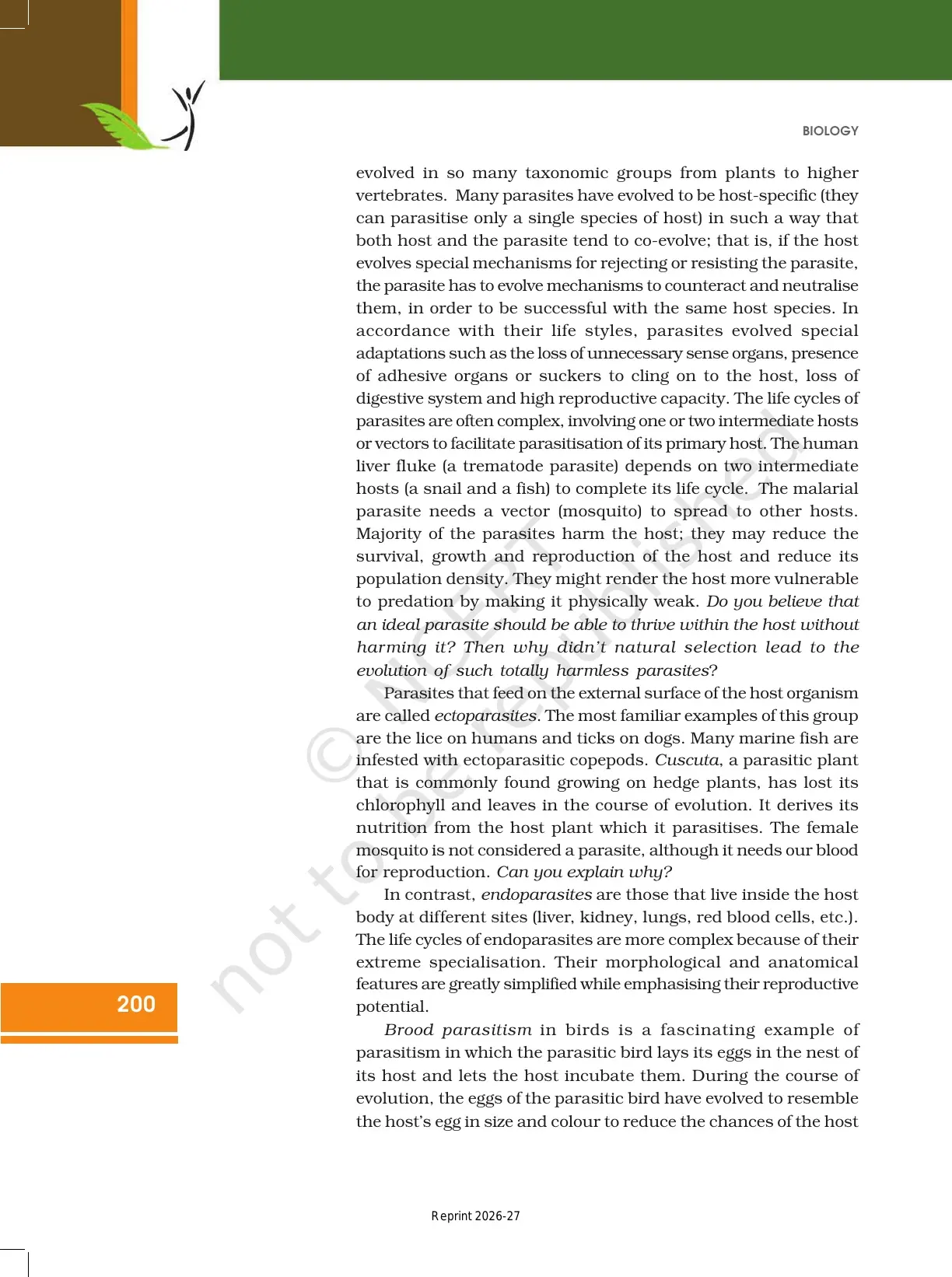
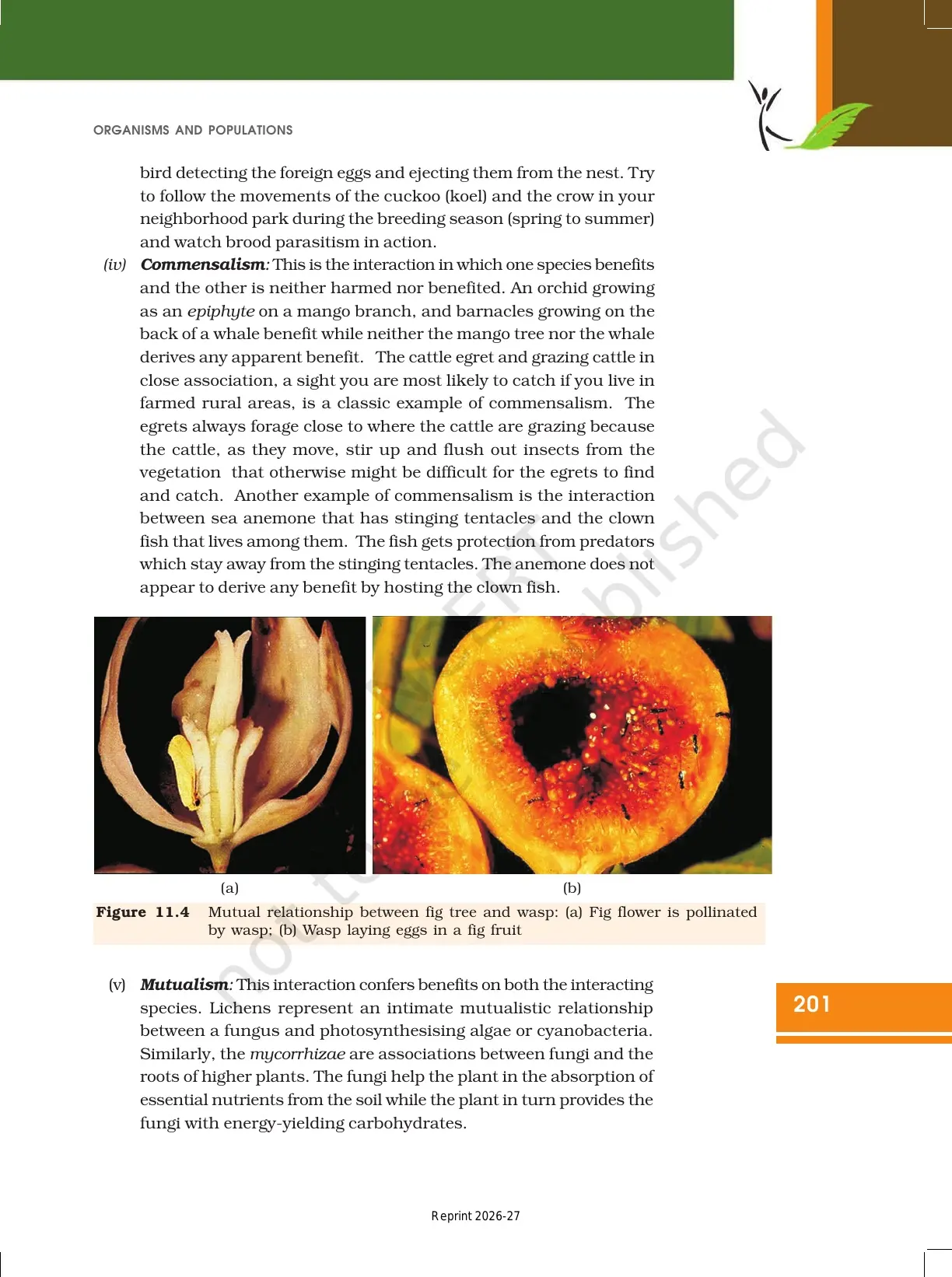
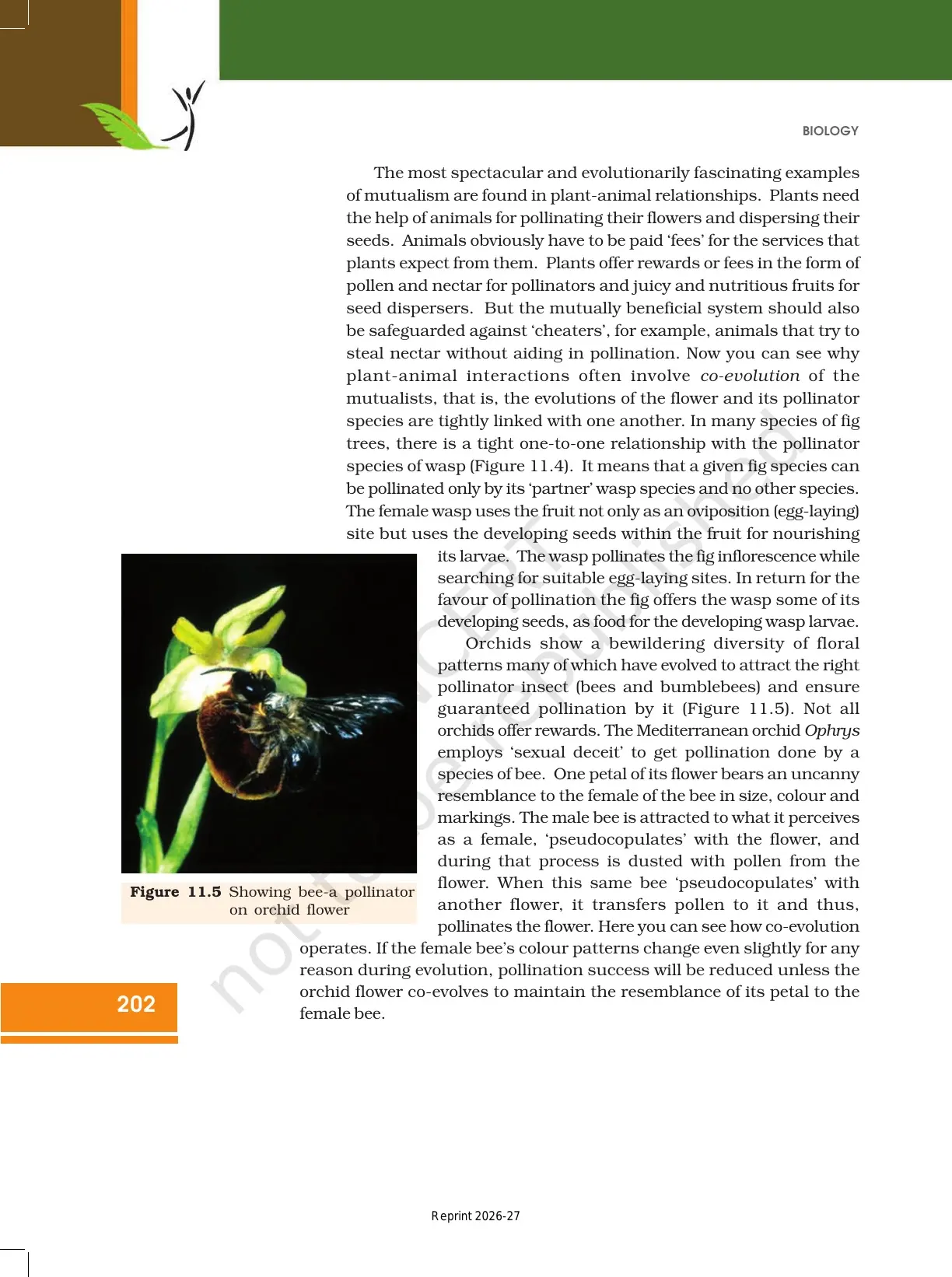
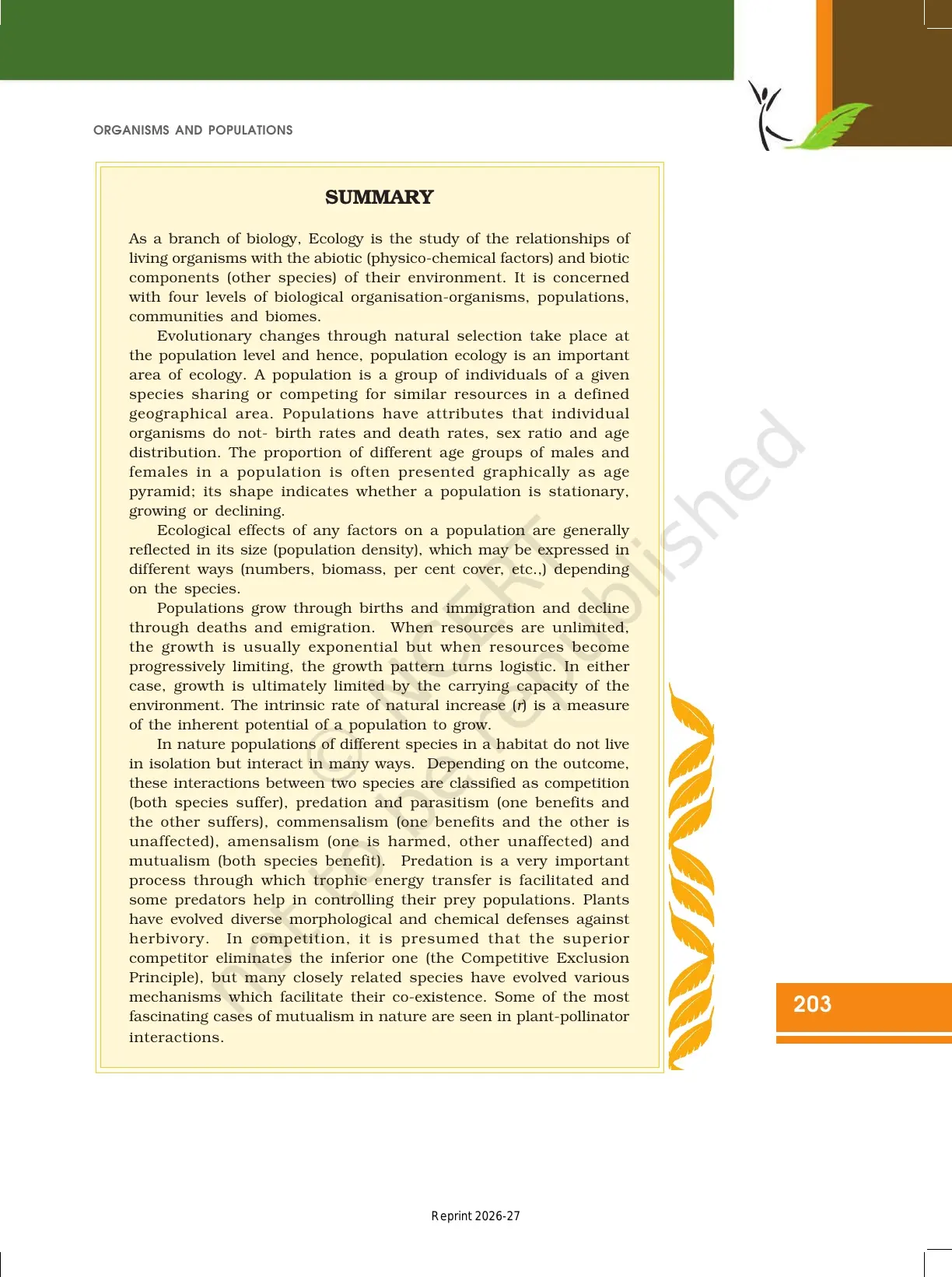
About NCERT Class 12 Biology Chapter 11 Organisms and Populations Book PDF
Chapter 11 runs across roughly 14 pages and belongs to Unit X, Ecology. It is written by the NCERT Biology textbook development team and covers two main sections: organism-environment relationships (Section 11.1) and population dynamics (Section 11.2).
The official NCERT PDF preserves the original figure numbering (Fig. 11.1 to Fig. 11.8), the in-chapter "Do you know?" boxes, and the chapter-end exercises that frequently appear in board papers. The Collegedunia NCERT Book PDF mirrors the ncert.nic.in version with no edits to text or diagrams.
What is Inside the Organisms and Populations NCERT Book Chapter
The chapter is split into two teaching sections with multiple sub-sections each. NEET and CUET examiners regularly pull MCQ stems directly from these sub-section concepts.
| Section | Topic | Key Concepts Discussed |
|---|---|---|
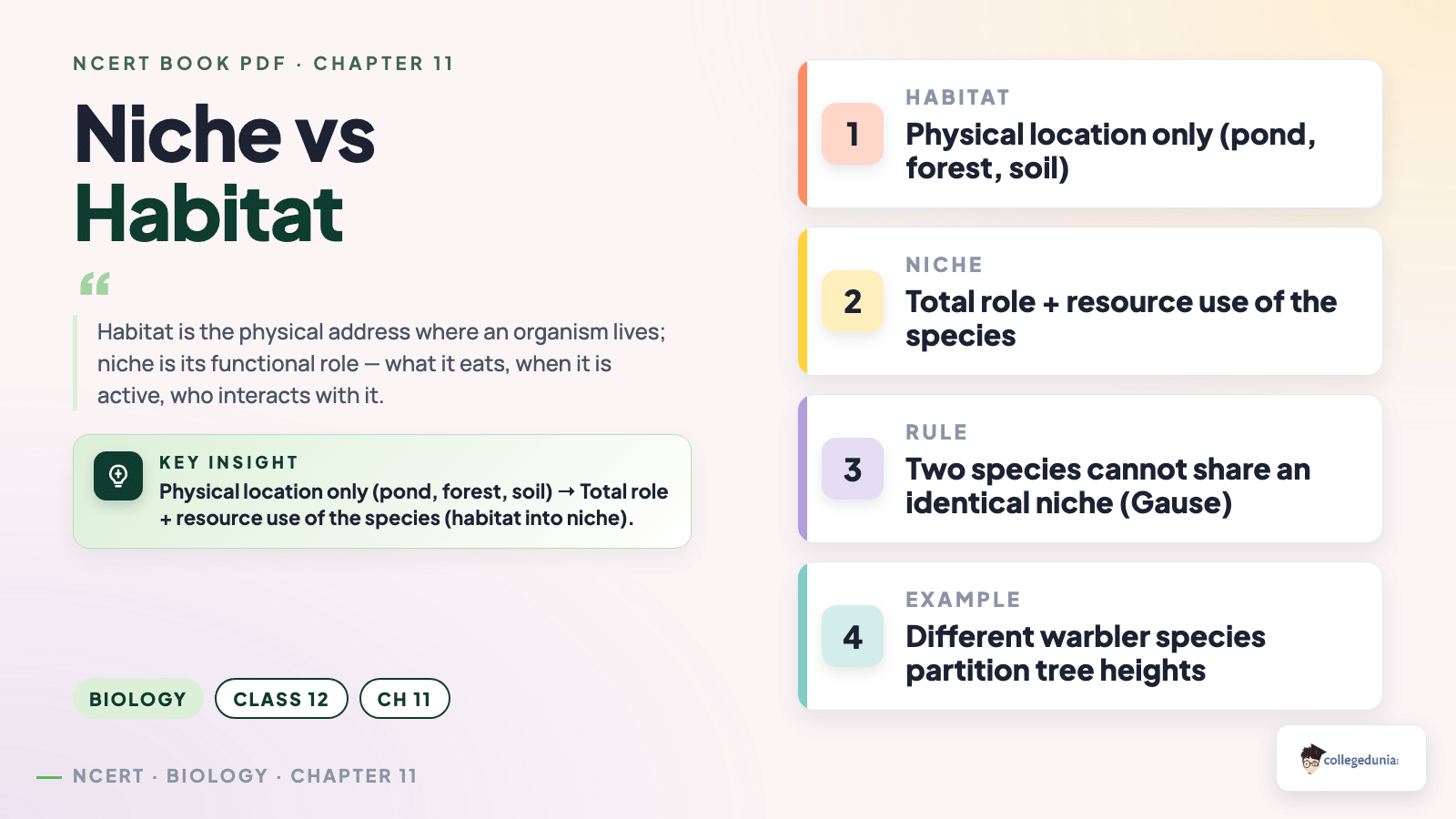
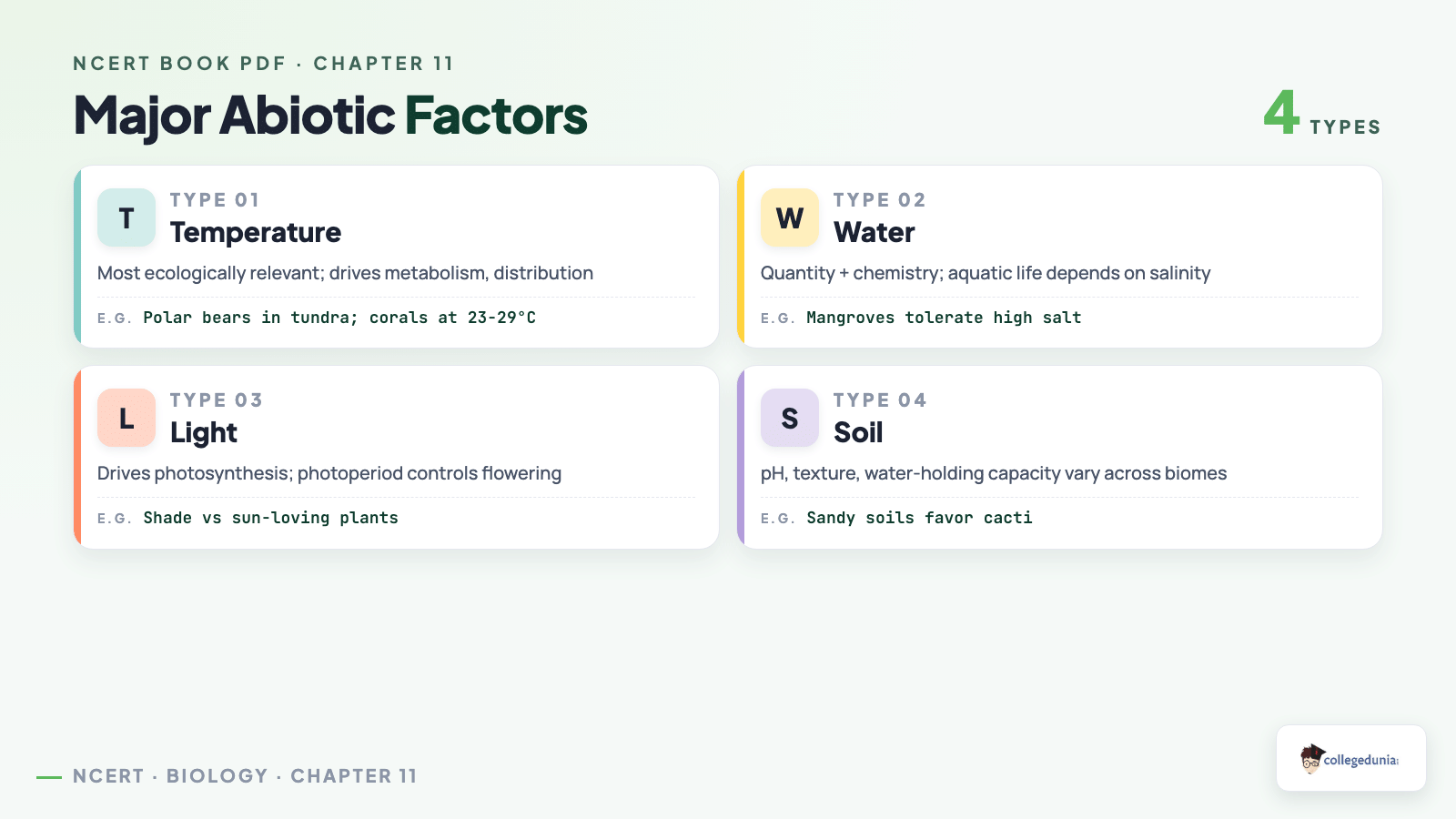
| 11.1.1 | Major Abiotic Factors | Temperature, water, light, soil |
| 11.1.2 | Responses to Abiotic Factors | Regulate, conform, migrate, suspend |
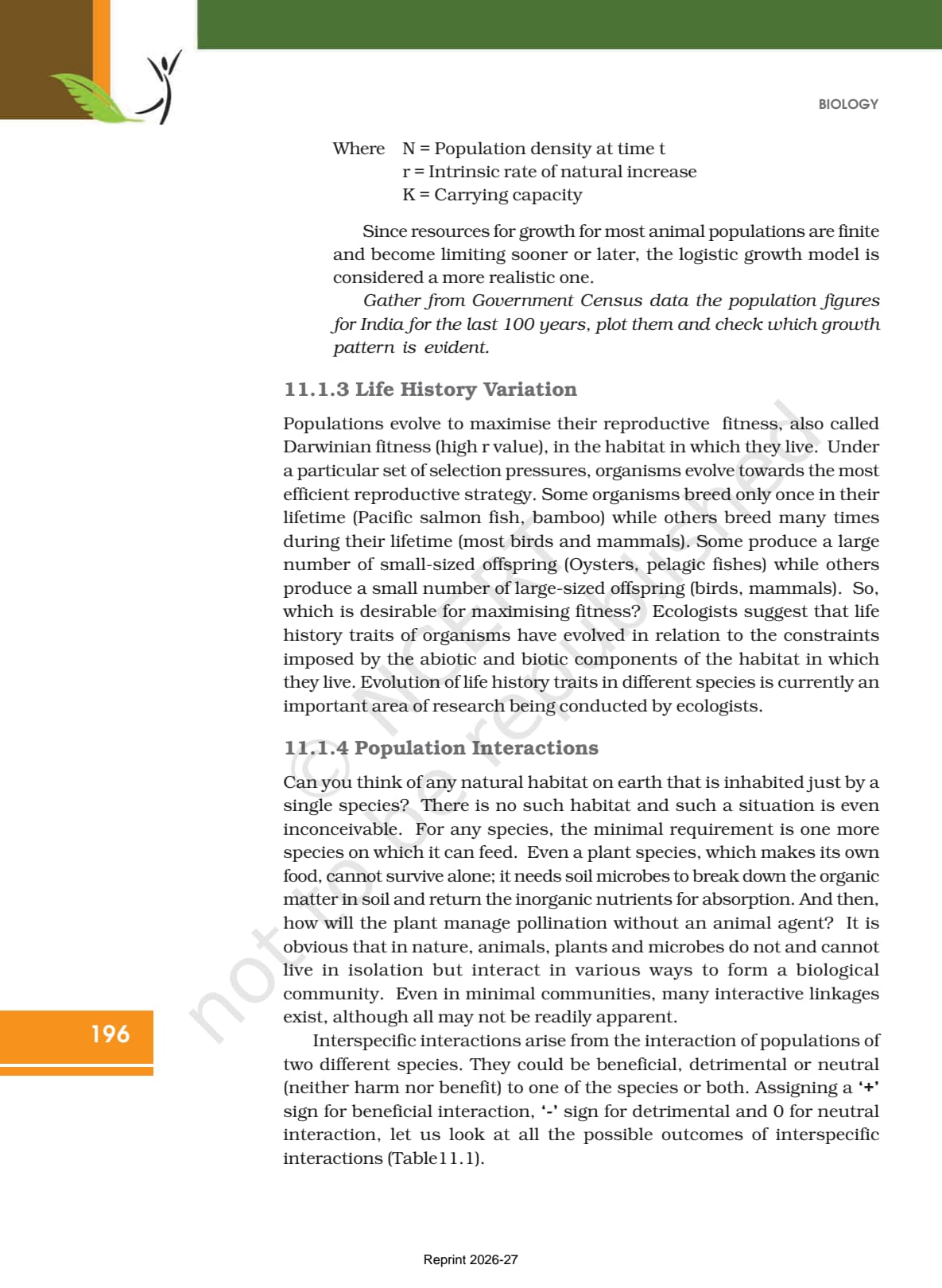
| 11.1.3 | Adaptations | Opuntia, kangaroo rat, high-altitude humans, Allen's rule |
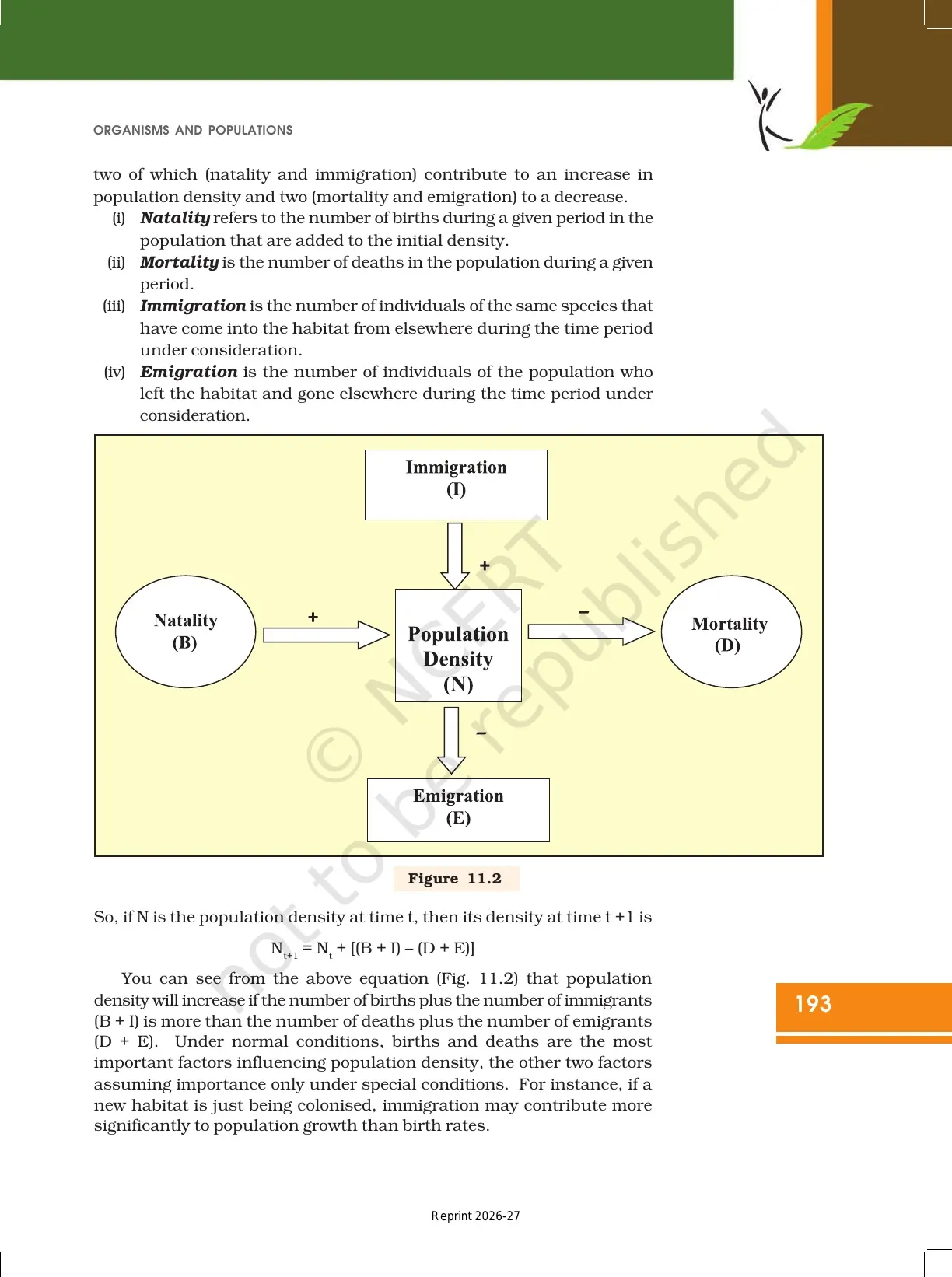
| 11.2.1-11.2.3 | Population Attributes | Density, natality, mortality, sex ratio, age pyramid |
| 11.2.4 | Survivorship Curves | Type I, II, III |
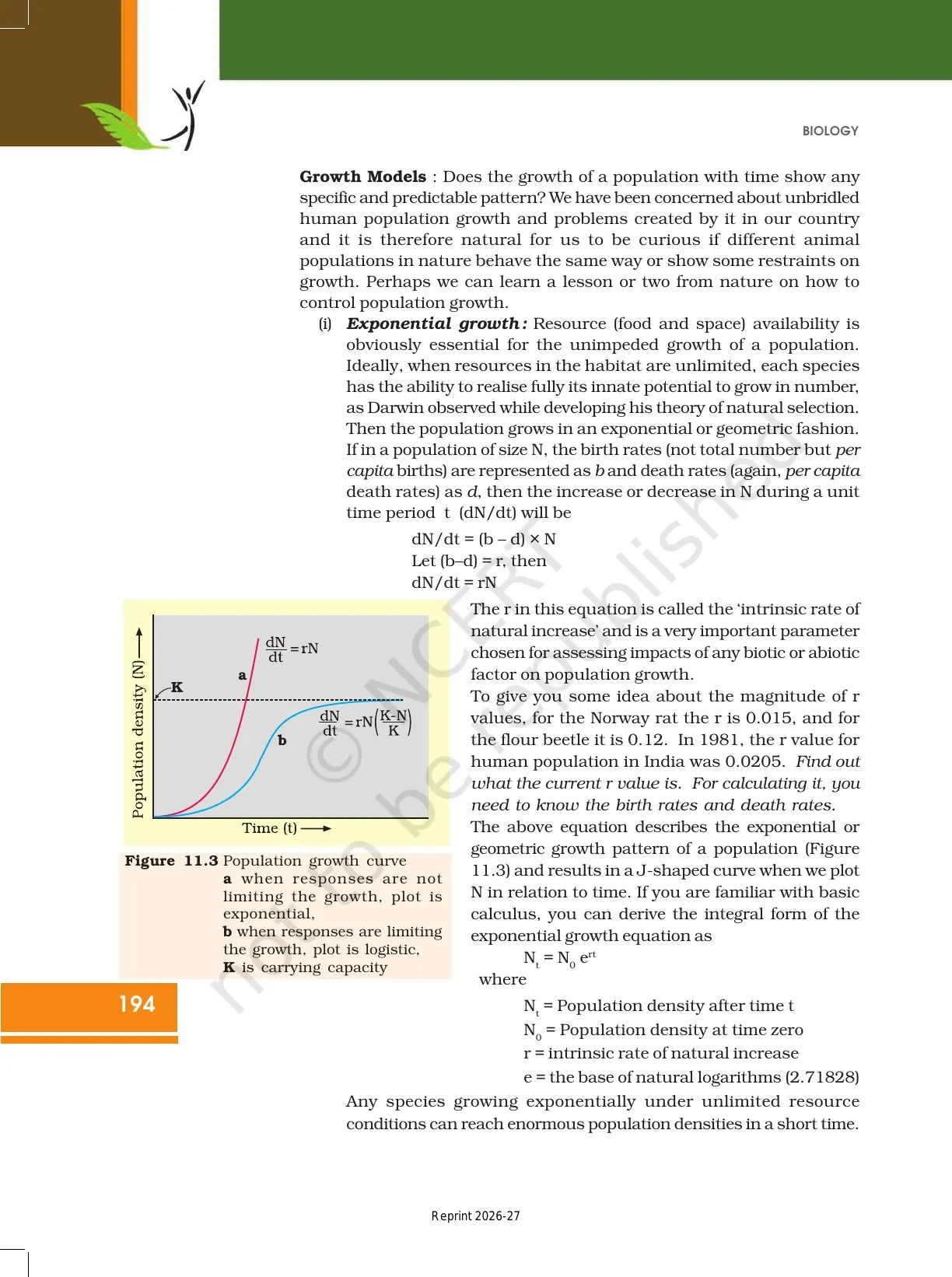
| 11.2.5 | Population Growth | Exponential J-curve, logistic sigmoid, intrinsic rate r, carrying capacity K |
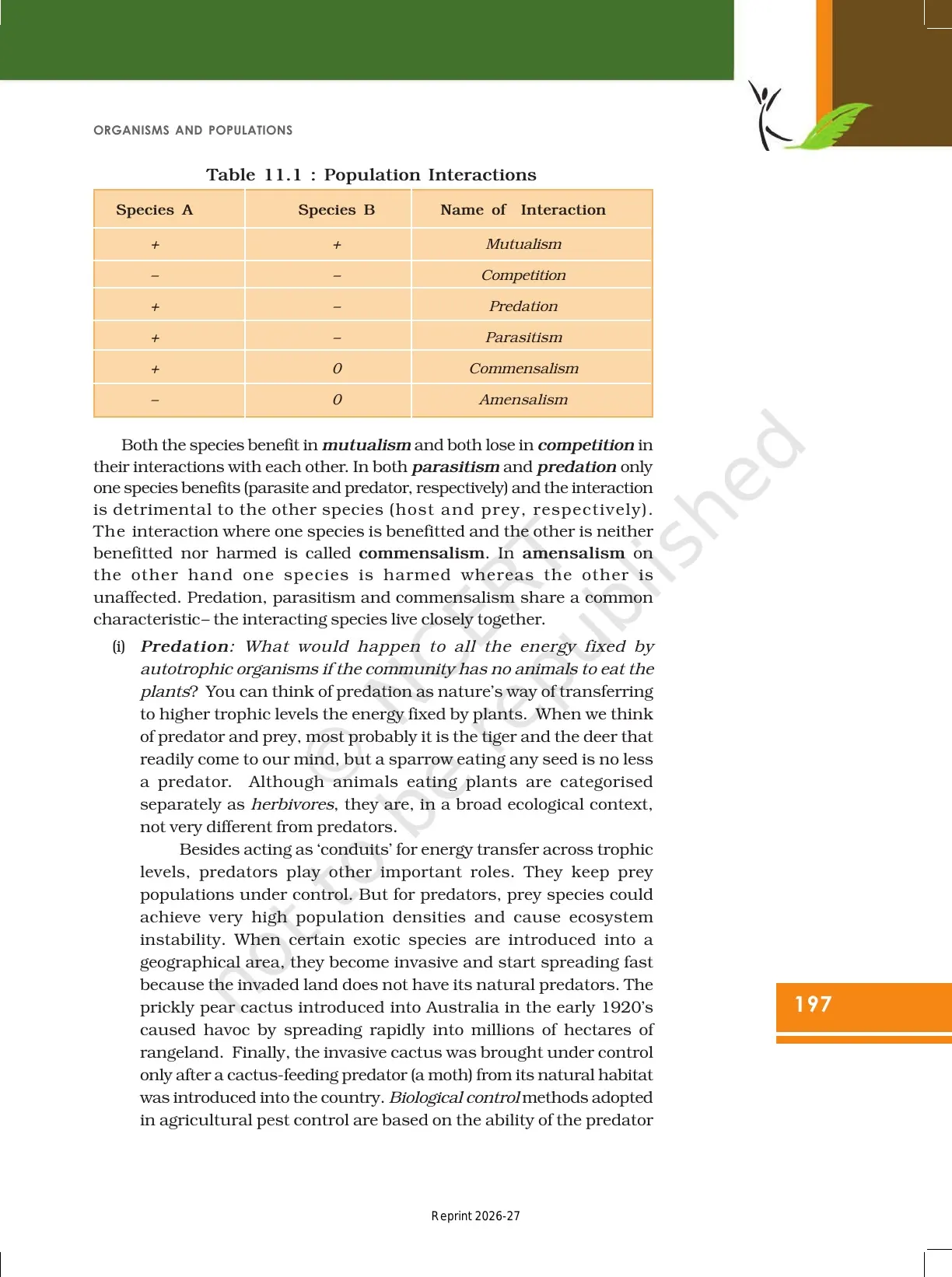
| 11.2.6 | Population Interactions | Mutualism, competition, predation, parasitism, commensalism, amensalism |
The table above follows the heading sequence in the official ncert.nic.in reprint. Students who read the PDF can match section numbers to lectures one to one. Boards routinely set two-mark questions from Sections 11.1.3 (adaptations) and 11.2.5 (logistic growth).
How Collegedunia's NCERT Book PDF Helps Students
The Collegedunia mirror of Class 12 Biology Chapter 11 provides the exact NCERT-published file for 2026-27, not a rewritten copy. CBSE flags NCERT line-for-line phrasing in its marking schemes. NEET and CUET stems are paraphrases of NCERT sentences, so reading the source PDF is non-negotiable.
- Verified 2026-27 reprint, no third-party edits.
- Downloadable for offline revision in low-bandwidth zones.
- Search-friendly text layer so you can Ctrl+F interaction names and equations.
- Cross-linked from the Collegedunia NCERT Solutions and Notes pages for this chapter.
Important Topics in Class 12 Biology Chapter 11 for CBSE Boards and NEET
These five topics from Organisms and Populations appear most often across CBSE Boards, NEET and CUET. Use this list to set revision priority in the final week before your exam.
| Topic | Why it Matters | Frequent Exam Format |
|---|---|---|
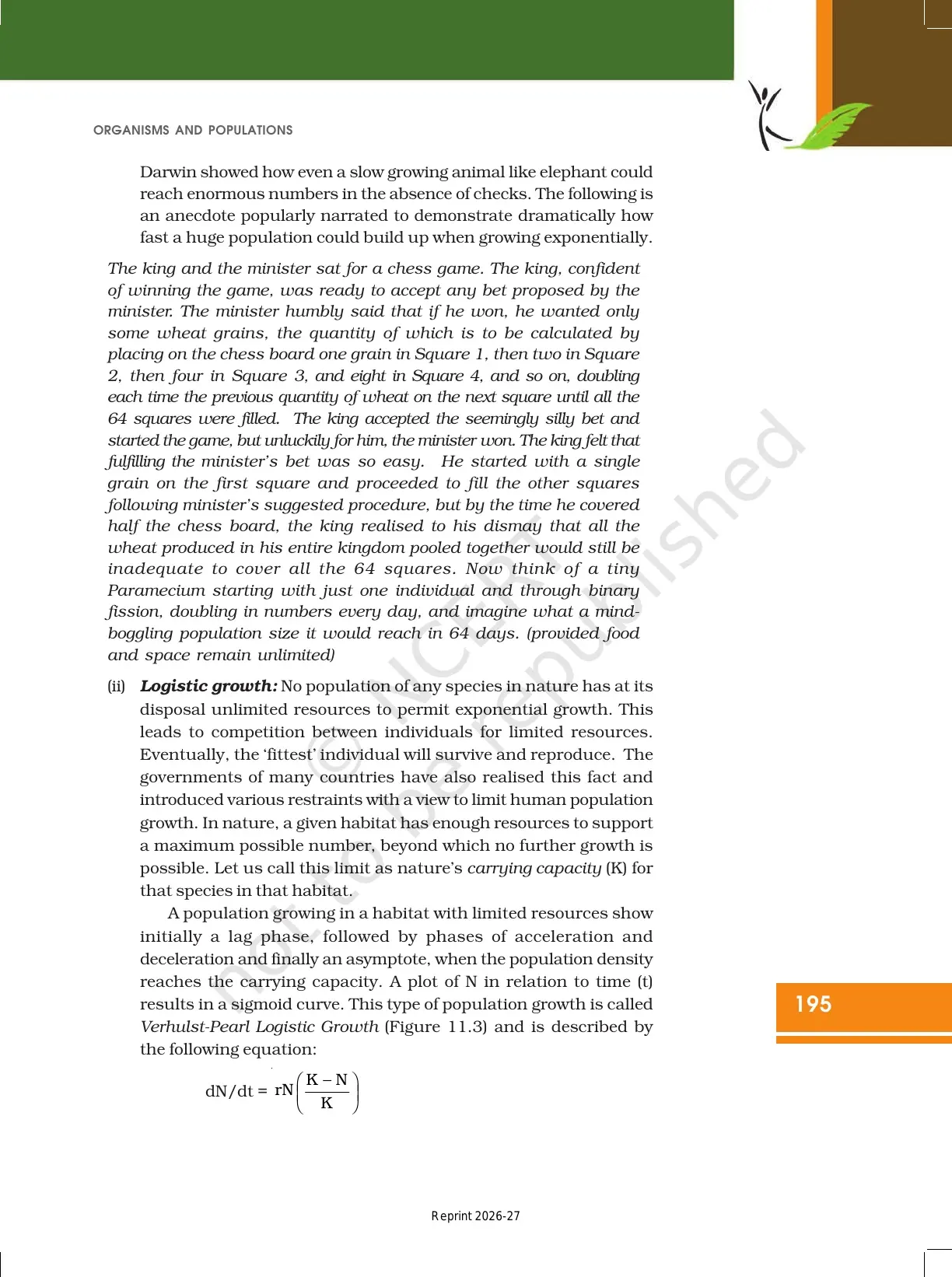
| Logistic growth equation and sigmoid curve | Verhulst-Pearl derivation, carrying capacity | 3-mark short answer + 1-mark MCQ |
| Six interspecific interactions | Sign-pair recall, NCERT examples | 1-mark MCQ / Assertion-Reason |
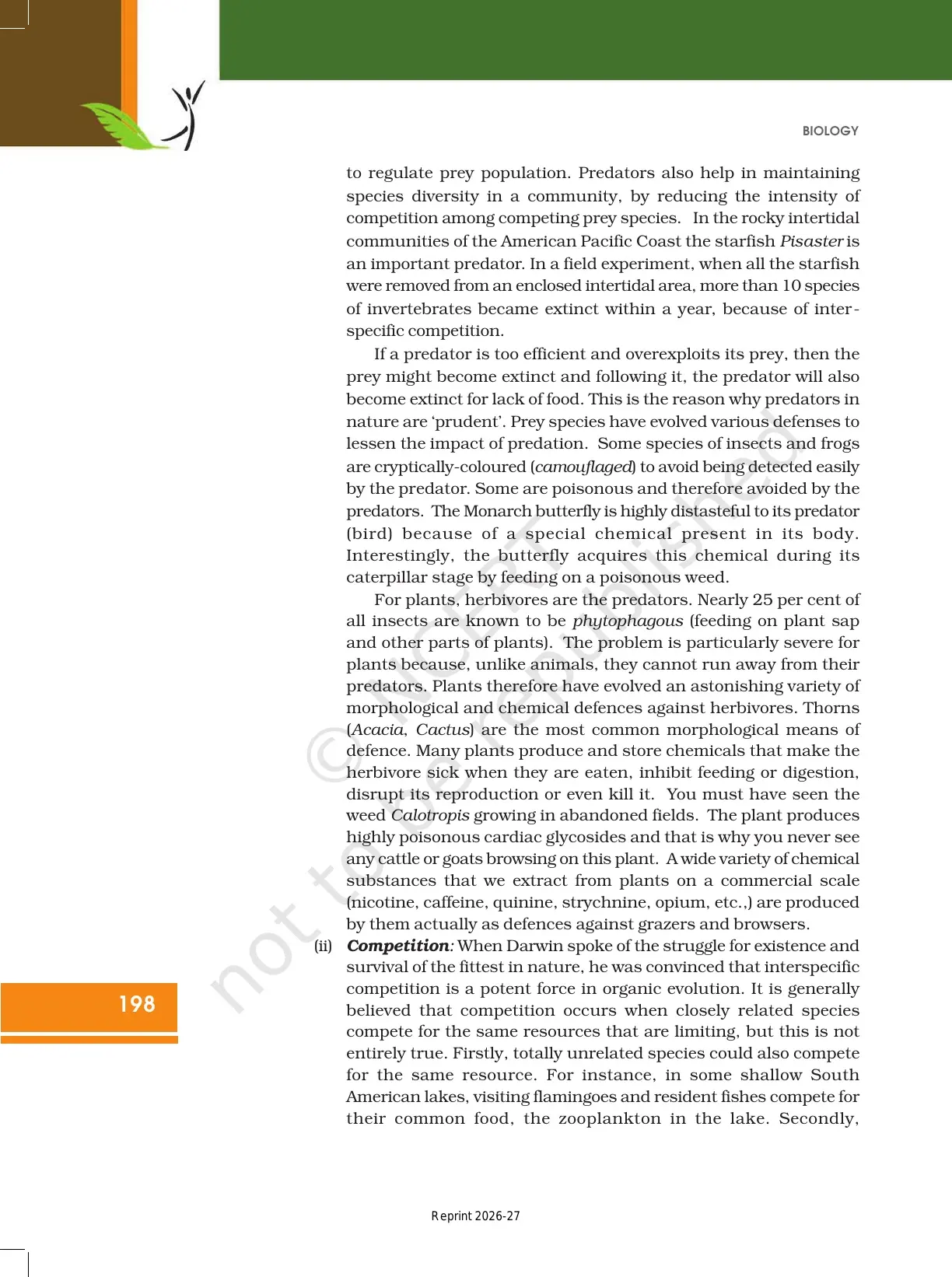
| Adaptations of desert and cold-climate organisms | Opuntia, kangaroo rat, Allen's rule | 3-mark / 5-mark long answer |
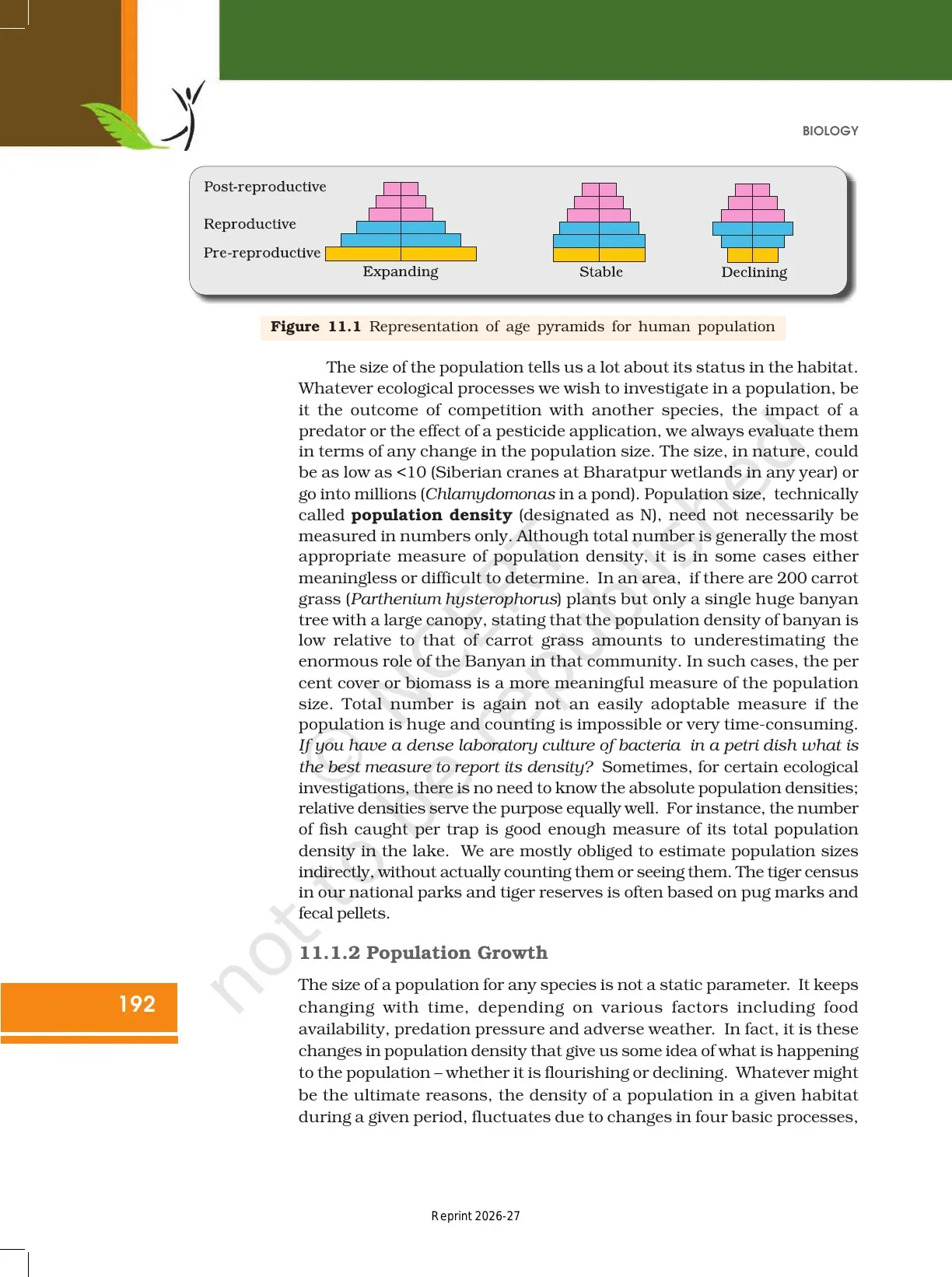
| Population attributes and age pyramids | Expanding / stable / declining shapes | 2-mark labelled diagram |
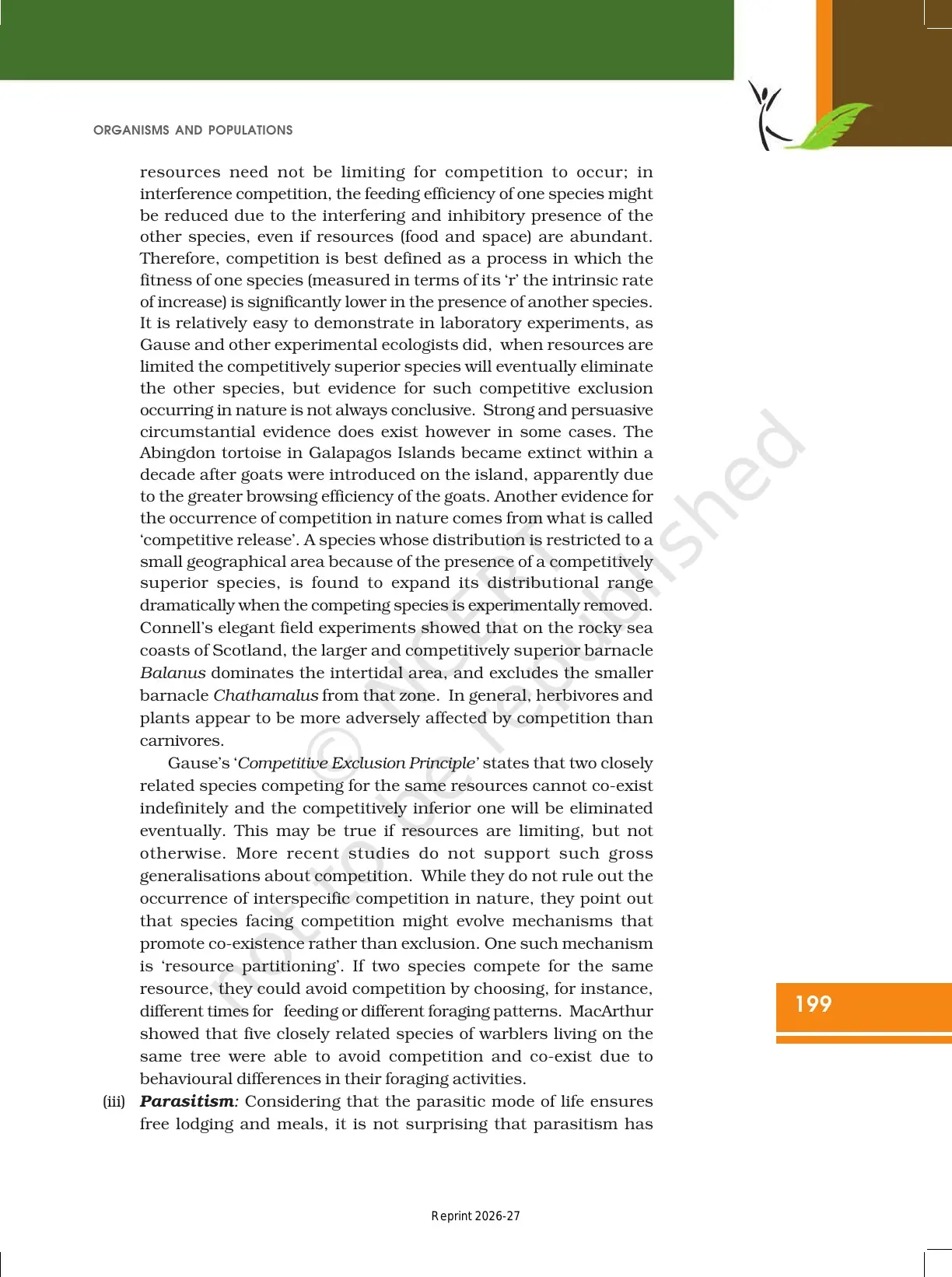
| Gause's competitive exclusion principle | Paramecium classic experiment | NEET MCQ / CUET stem |
In NEET 2025, three of the five Ecology questions came directly from Sections 11.2.5 and 11.2.6. A focused re-read of those two sections takes under 40 minutes and delivers high returns.
Organisms and Populations PYQ Trend across CBSE Boards 2025-2021
The five-year board paper trend shows Chapter 11 as a stable 5 to 7 mark contributor. Long-answer questions on logistic growth and adaptations are common. The chapter is almost always tested through one short answer plus one or two MCQ or assertion-reason pairs.
| Year | Marks Carried | Most-Asked Sub-Topic |
|---|---|---|
| 2025 | 6 | Logistic growth derivation + population interactions |
| 2024 | 7 | Adaptations (Opuntia) + age pyramids |
| 2023 | 5 | Carrying capacity + amensalism example |
| 2022 | 6 | Survivorship curves + Gause's principle |
| 2021 | 5 | Population density measurement methods |
Full year-wise PYQ map: Organisms and Populations Class 12 Notes covers the topic-wise breakup with solved excerpts.
Exam Comparison: How Organisms and Populations Appears across Major Exams
Chapter 11 carries different weightage profiles across CBSE, NEET, and CUET. The table below shows data for the last three held editions of each exam.
| Exam | 2025 | 2024 | 2023 |
|---|---|---|---|
| CBSE Class 12 Biology | 6 marks | 7 marks | 5 marks |
| NEET | 4 questions | 5 questions | 3 questions |
| CUET UG Biology | 4 MCQs | 3 MCQs | 4 MCQs |
The chapter is a NEET favourite because sign-pair matching is a clean MCQ format. CBSE prefers the logistic-growth derivation and labelled-pyramid prompts.
How to Use the NCERT Class 12 Biology Chapter 11 PDF Efficiently
Reading 14 pages cover to cover takes about 50 minutes. The fastest evidence-backed revision sequence used by Collegedunia mentors is:
- Day 1: Read Sections 11.1.1 and 11.1.2. List four major abiotic factors with one example each.
- Day 2: Read Section 11.1.3. Sketch Opuntia, kangaroo rat, and Allen's rule side by side.
- Day 3: Read Sections 11.2.1 to 11.2.4. Draw all three age pyramids and three survivorship curves.
- Day 4: Read Section 11.2.5. Derive the exponential and logistic equations on a blank sheet.
- Day 5: Read Section 11.2.6. Build the six-cell sign-pair matrix from memory.
- Day 6: Solve all 14 NCERT exercises. Cross-check with the Collegedunia solutions page.
- Day 7: Attempt the past 3 years' CBSE board questions and 5 NEET PYQs.
What NCERT Kept and Trimmed in the 2026-27 Edition
The 2026-27 reprint of Class 12 Biology keeps every section of Chapter 11 from the previous edition. The chapter was renumbered from old Chapter 13 to current Chapter 11 as part of the broader Unit reorganisation, but no content was dropped. Students preparing from older PDFs will find the section numbering shifted while the body text is largely identical.
The only minor refresh is the updated figure caption style and a cleaner table on interspecific interactions, which now lists amensalism alongside the canonical five. This matches how the topic appears in CUET UG Biology MCQs.
Survey Data: What Chapter 11 Students Found Hardest in Organisms and Populations
In a pre-board survey of 11,300 Class 12 Biology students, 70% rated the logistic-growth equation derivation as the hardest sub-topic, even though it routinely carries the highest single-question marks in CBSE and NEET papers.
Student Feedback
What 11,300 students told us about the Chapter 11 Organisms and Populations NCERT Book journey:
- 70% of students surveyed marked the logistic-growth equation derivation as the hardest sub-topic.
- 59% reported losing 1-2 marks on classifying mutualism, commensalism, predation, and parasitism examples, even when the rest of their answer was correct.
- 4 out of 5 students said the age-pyramid (expanding / stable / declining) figure was the most-skipped figure in their answer sheet.
- Average student took 5.2 hours for the first read of the chapter, and 2.1 hours for a focused revision pass before the board exam.
- Of the 11,300 students surveyed, only 39% attempted all 16 NCERT exercise questions. Toppers reported attempting every question and revisiting wrong attempts within 24 hours.
Source: 2025-26 Class 12 Biology student survey. Sample of 11,300 students from CBSE-affiliated schools across 18 states.
Other Resources for Organisms and Populations Class 12 Biology
| Resource | Link |
|---|---|
| NCERT Book PDF | Organisms and Populations NCERT Book |
| NCERT Solutions | Organisms and Populations NCERT Solutions |
| Notes | Organisms and Populations Notes |
| Handwritten Notes | Organisms and Populations Handwritten Notes |
| Exemplar Solutions | Organisms and Populations Exemplar Solutions |
| Exemplar Book PDF | Organisms and Populations Exemplar Book PDF |
| Formula Sheet | Organisms and Populations Class 12 Biology Formula Sheet |
NCERT Book PDF for Class 12 Biology: All Chapters
| Chapter | NCERT Book PDF |
|---|---|
| Chapter 1 | Sexual Reproduction in Flowering Plants NCERT Book PDF |
| Chapter 2 | Human Reproduction NCERT Book PDF |
| Chapter 3 | Reproductive Health NCERT Book PDF |
| Chapter 4 | Principles of Inheritance and Variation NCERT Book PDF |
| Chapter 5 | Molecular Basis of Inheritance NCERT Book PDF |
| Chapter 6 | Evolution NCERT Book PDF |
| Chapter 7 | Human Health and Disease NCERT Book PDF |
| Chapter 8 | Microbes in Human Welfare NCERT Book PDF |
| Chapter 9 | Biotechnology Principles and Processes NCERT Book PDF |
| Chapter 10 | Biotechnology and Its Applications NCERT Book PDF |
| Chapter 11 | Organisms and Populations NCERT Book PDF |
| Chapter 12 | Ecosystem NCERT Book PDF |
| Chapter 13 | Biodiversity and Conservation NCERT Book PDF |
FAQs on NCERT Class 12 Biology Chapter 11 Organisms and Populations Book PDF
Q1. Where can I download the NCERT Class 12 Biology Chapter 11 Organisms and Populations PDF for free?
You can download the verified 2026-27 NCERT reprint of Chapter 11 directly from the Collegedunia page above, which mirrors the official ncert.nic.in PDF without any third-party edits.
Q2. Is Chapter 11 Organisms and Populations part of the 2026-27 reduced syllabus?
Yes, Organisms and Populations is retained in full in the current 2026-27 CBSE Class 12 Biology syllabus, renumbered from old Chapter 13. All sections (11.1 and 11.2 with their sub-sections) are examinable in the board paper.
Q3. How many marks does Organisms and Populations carry in the CBSE Class 12 Biology board exam?
The chapter carries between 5 and 7 marks across recent board papers, typically delivered as one short answer on logistic growth or population interactions plus one or two objective questions on adaptations.
Q4. What are the most important topics in Chapter 11 for NEET?
For NEET, focus on the logistic growth equation (Verhulst-Pearl), the six interspecific interactions with sign-pairs (mutualism, competition, predation, parasitism, commensalism, amensalism), Gause's competitive exclusion, Allen's rule for cold-climate mammals, and adaptations of Opuntia and the kangaroo rat.
Q5. How many pages is the NCERT Class 12 Biology Chapter 11 PDF?
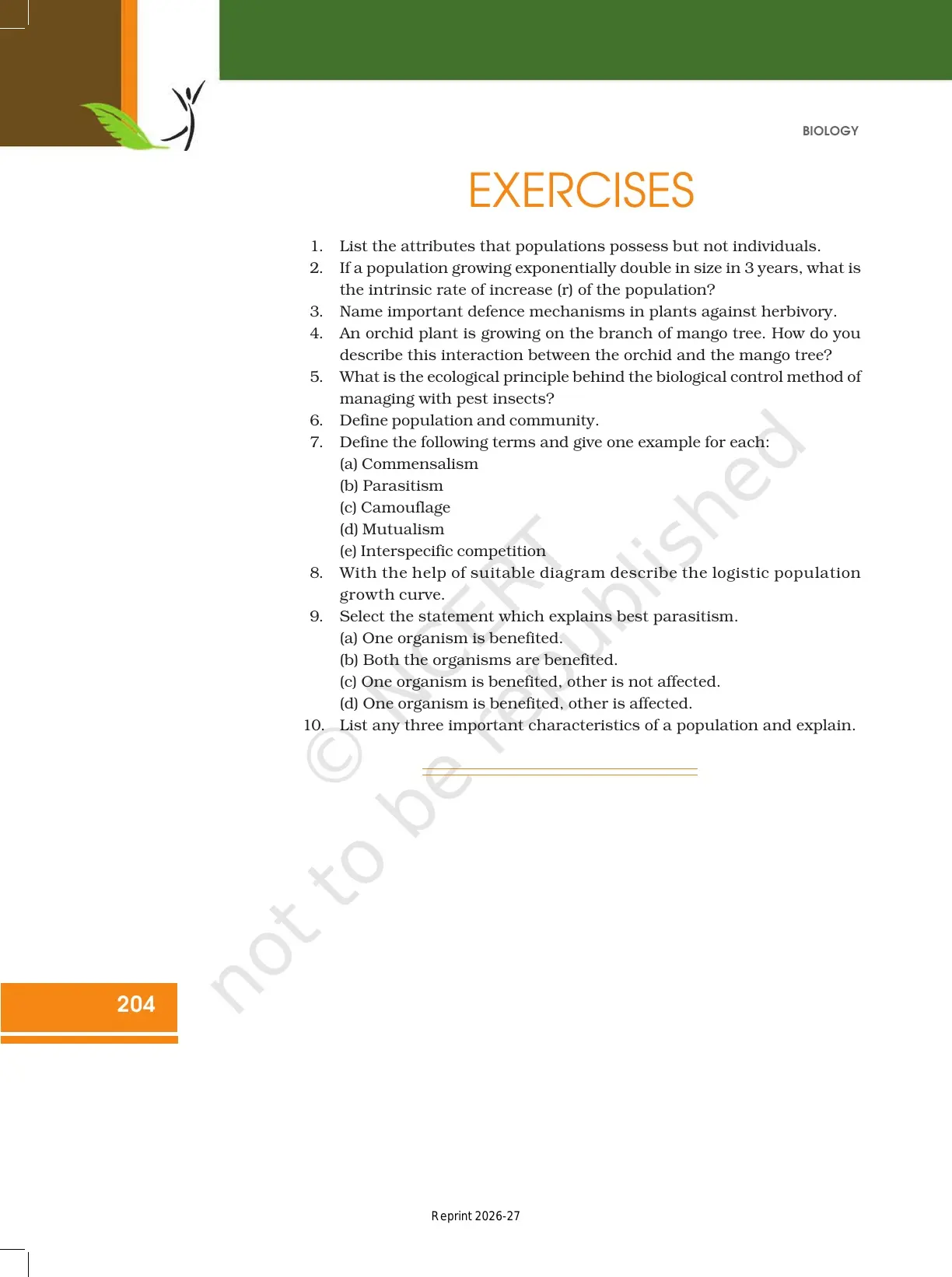
The chapter spans approximately 14 pages in the official NCERT reprint and includes eight figures plus the end-of-chapter exercise set of 14 questions.
Q6. What is the logistic growth equation according to NCERT Chapter 11?
NCERT lists the Verhulst-Pearl logistic equation as dN/dt = rN(K-N)/K, where N is population size, r is the intrinsic rate of natural increase, and K is the carrying capacity. The curve is sigmoid (S-shaped) with an asymptote at N = K.
Q7. Is the NCERT Book PDF enough to prepare Chapter 11 for boards and NEET?
Yes, for CBSE boards the NCERT PDF is sufficient. For NEET, pair the PDF with the NCERT Exemplar Problems and a topic-wise PYQ set, both linked from the Collegedunia NCERT vertical for Class 12 Biology.



Comments