




Inside the NCERT Class 11 History Chapter 7 Paths to Modernisation PDF you will find the full Japan half, from the Tokugawa shoguns to the Meiji Restoration and the post-war recovery, the full China half, from the Opium Wars to Mao Zedong and Deng Xiaoping, and the shorter stories of Taiwan and Korea. It is Theme 7, the last chapter of Themes in World History for the 2026-27 session, and the complete file is available below.
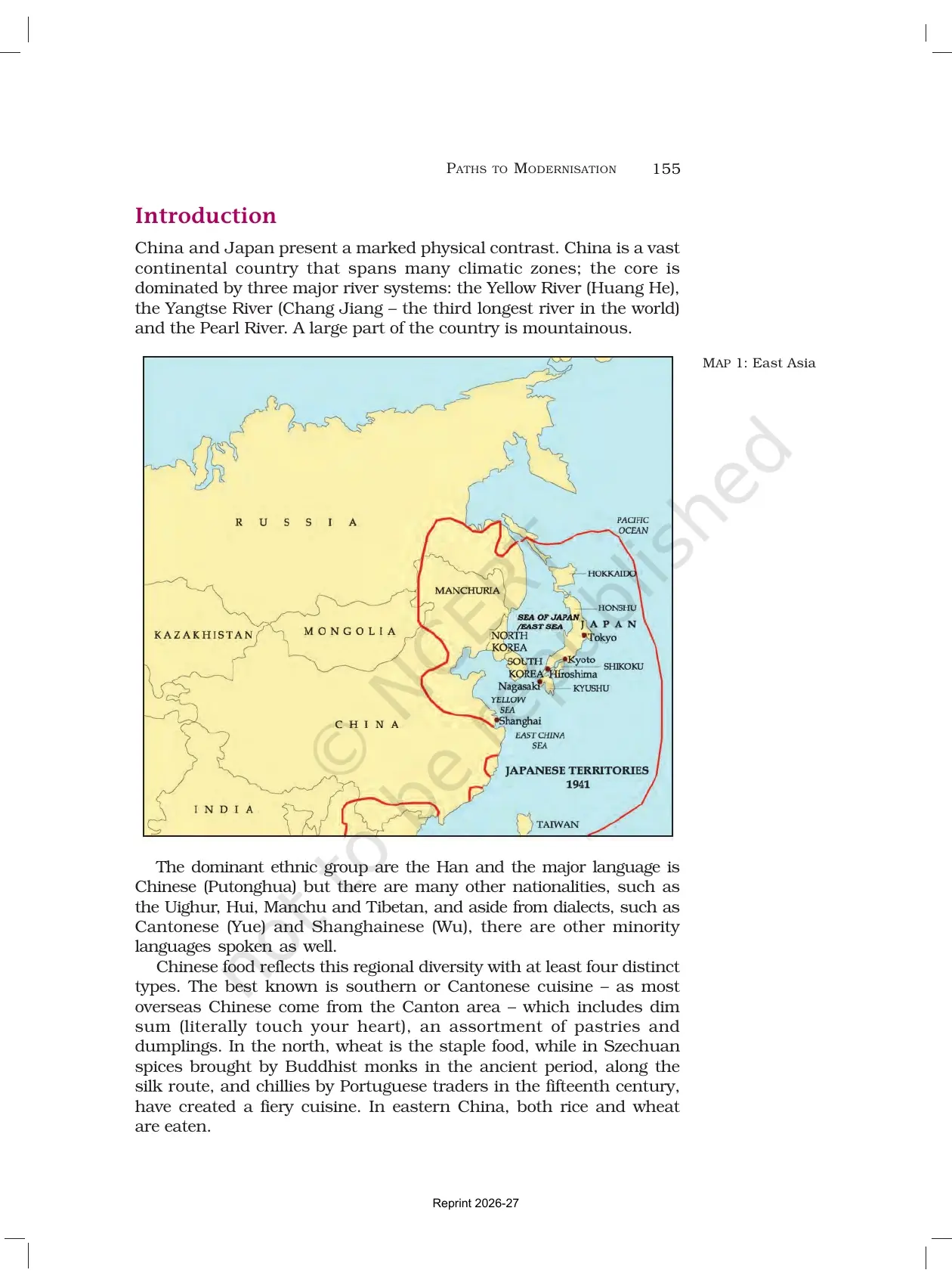


- Paths to Modernisation runs from page 153 to page 181 of the printed book, and the same file carries the Conclusion and the Suggested Reading list up to page 186.
- The chapter covers roughly 1603 to 2017, from the Edo shogunate to the peaceful transfer of power in South Korea.
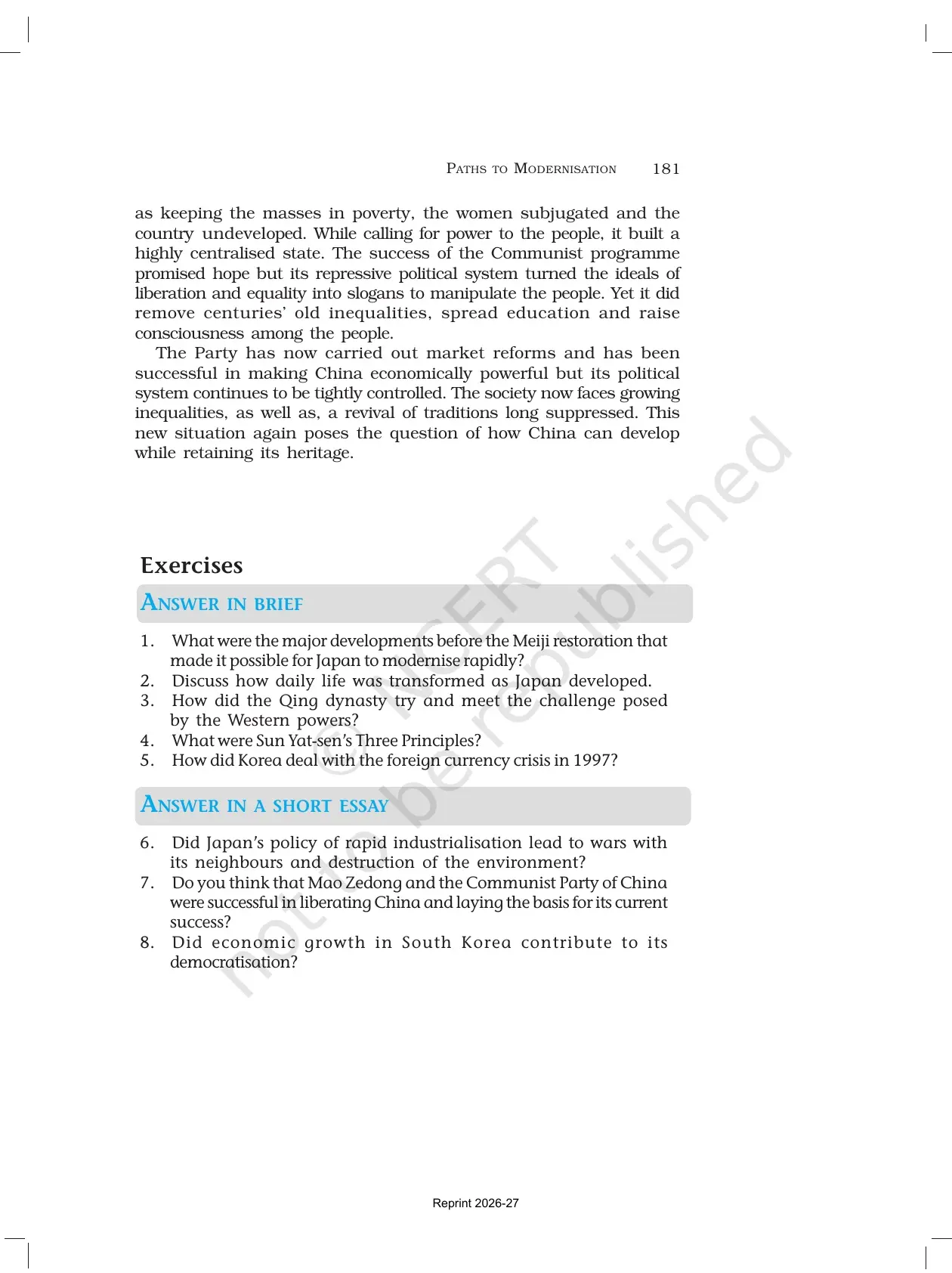
- It carries a two-column Japan and China timeline, two maps, four activities and eight exercise questions, split into Answer in Brief and Answer in a Short Essay.
Every name, date and quotation on this page is taken straight from the official NCERT Paths to Modernisation chapter for the 2026-27 session, checked line by line against the printed reprint.
What the Paths to Modernisation Class 11 PDF Contains, Section by Section
NCERT builds this theme as two long halves with two short appendix stories: Japan first, then China, then Taiwan and Korea. Knowing which half holds which name saves you from rereading twenty-eight pages in the exam hall.
| Section in the chapter | What is printed there | Why it matters in the exam |
|---|---|---|
| Opening pages on writing history | Sima Qian, the Meiji records bureau of 1869, Marco Polo, Mateo Ricci, Luis Frois, Joseph Needham, George Sansom | A ready source for any question on how the history of East Asia has been written |
| Naito Konan box | Shinaron, On China, of 1914 and the Department of Oriental Studies at Kyoto University, 1907 | The one named historian in the theme, easy to quote in an introduction |
| Introduction | The Huang He, the Chang Jiang and the Pearl River, the Han majority, the four Japanese main islands | The physical contrast between the two countries opens most long answers well |
| The Political System | Shoguns, the Tokugawa from 1603 to 1867, over 250 daimyo domains, the samurai, Edo | Directly answers exercise question 1 on developments before the Meiji Restoration |
| The Meiji Restoration | Commodore Perry, the black ships, fukoku kyohei, the emperor system, the school system | The single most asked section in the whole theme |
| Modernising the Economy | The Tokyo to Yokohama railway, banking in 1872, Mitsubishi, Sumitomo, the zaibatsu, Tanaka Shozo | Half of Short Essay 6 on industry and the environment |
| Westernisation and Tradition | Fukuzawa Yukichi, Miyake Setsurei, Ueki Emori and their three competing slogans | The quotation bank of the Japan half |
| Daily Life | The nuclear home, the Moga, the Ginza, radio in 1925, the yen figures for cheap housing | Exercise question 2 sits entirely inside these two pages |
| After Defeat | Article 9, the dismantling of the zaibatsu, the 1964 Olympics, the Shinkansen, Minamata | The recovery half that weak answers leave out |
| China, the Opium Wars and the Qing reformers | Kang Youwei, Liang Qichao, the triangular trade, the examination system | Feeds exercise question 3 on how the Qing met the Western challenge |
| Establishing the Republic | Sun Yat-sen, the Three Principles, the May Fourth Movement, Chiang Kai-shek | Exercise question 4 is a straight lift from these pages |
| The CCP and the reforms | The Long March, New Democracy, the Great Leap Forward, the Cultural Revolution, the Four Modernisations | The whole of Short Essay 7 on Mao Zedong and the CCP |
| Taiwan and Korea | Chiang in Taiwan, land reforms, the Joseon dynasty, Park Chung-hee, the IMF crisis of 1997 | Exercise question 5 and Short Essay 8 come only from here |
How the Chapter Sets China and Japan Against Each Other in Its Opening Pages
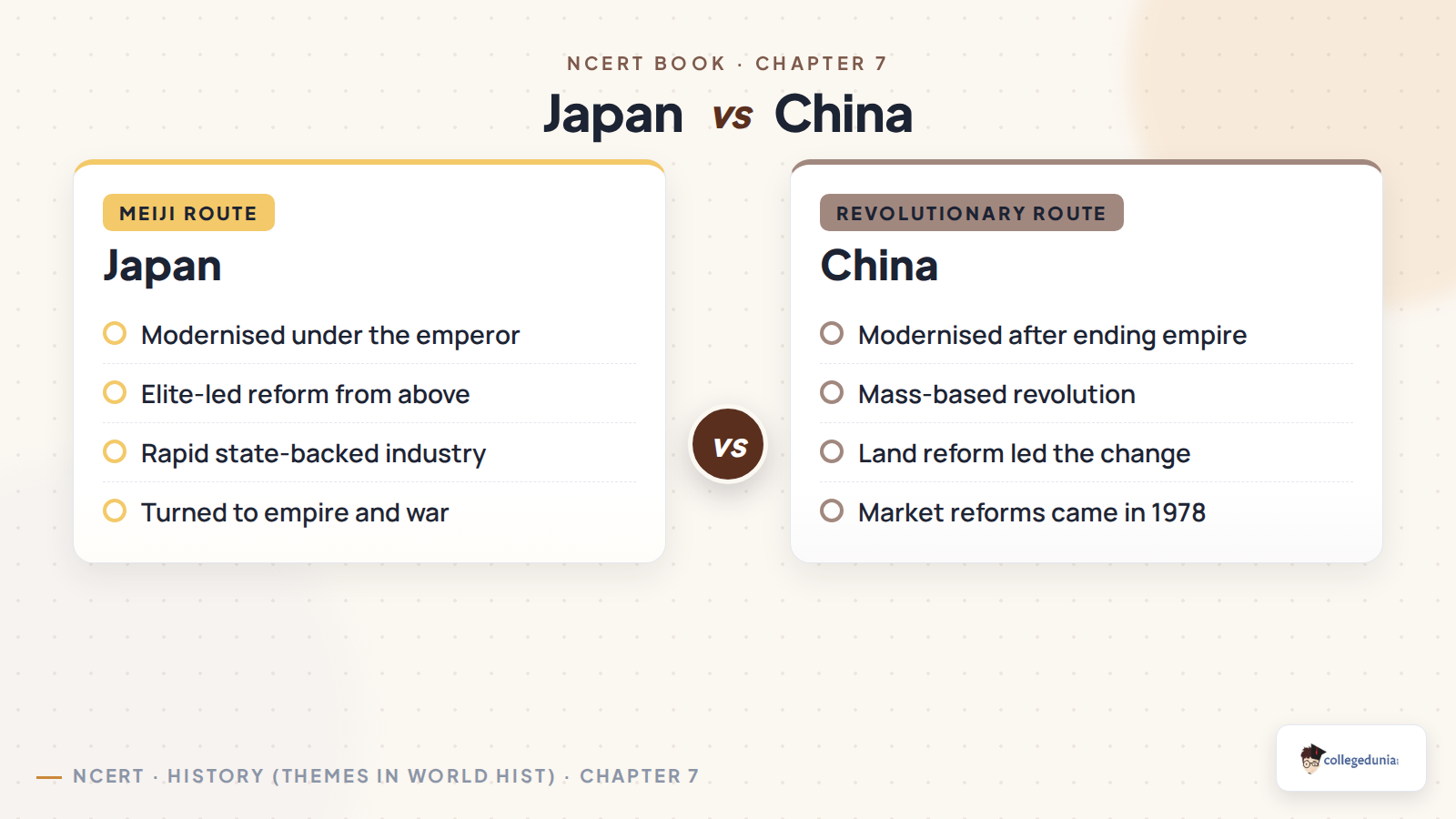
The theme opens with a comparison, not with a date. At the start of the nineteenth century East Asia was dominated by China under the Qing dynasty, while Japan looked like a small island country locked in isolation. Within a few decades the positions had reversed.
- China lost political control, could not reform effectively and was convulsed by civil war. Japan built a modern nation-state, an industrial economy and a colonial empire, taking Taiwan in 1895 and Korea in 1910.
- Japan defeated China, the land that had been the source of its culture and ideals, in 1894, and defeated Russia, a European power, in 1905.
- Both countries had a long tradition of official history writing. Sima Qian, who lived from 145 to 90 BCE, is called the greatest historian of early China, and one of the first acts of the Meiji government was to set up a records bureau in 1869.
- Modern scholarship builds on Chinese and Japanese intellectuals such as Liang Qichao and Kume Kunitake, on European travellers such as Marco Polo and the Jesuit priests Mateo Ricci in China and Luis Frois in Japan, and on later work by Joseph Needham and George Sansom.
- Physically the two are opposites. China is a vast continental country built around the Huang He, the Chang Jiang and the Pearl River. Japan is a string of islands, of which Honshu, Kyushu, Shikoku and Hokkaido are the largest, with more than half the land area mountainous and the whole chain in an active earthquake zone.
The box on Naito Konan, who lived from 1866 to 1934, is worth ten minutes on its own. He helped set up the Department of Oriental Studies at Kyoto University in 1907, and in Shinaron, On China, of 1914 he argued that republican government offered the Chinese a way to end aristocratic control. The chapter adds that he underestimated the power of Chinese nationalism.
Paths to Modernisation Chapter Revision in One Video
Source: Magnet Brains on YouTube
Japan Before Meiji: the Tokugawa Shogunate, the Daimyo and the Castle Towns
An emperor had ruled Japan from Kyoto, but by the twelfth century the imperial court had lost power to the shoguns, who ruled in the emperor's name. Members of the Tokugawa family held the position of shogun from 1603 to 1867. The country was divided into over 250 domains under lords called daimyo.
- The shogun ordered the daimyo to stay at the capital Edo, modern Tokyo, for long periods so that they could not pose a threat, and he controlled the major cities and mines. The samurai were the ruling elite.
- Three changes in the late sixteenth century set the pattern. The peasantry was disarmed and only samurai could carry swords. The daimyo were ordered to live in the capitals of their own domains. Land surveys identified owners and taxpayers and graded productivity.
- By the mid-seventeenth century Japan had the most populated city in the world, Edo, plus Osaka and Kyoto and at least half a dozen castle-towns of over 50,000 people. Most European countries of the time had only one large city.
- A commercial economy followed, with financial and credit systems and a stock market in rice. A person's merit began to be valued more than his status.
- Reading became so common that in Edo a person could rent a book for the price of a bowl of noodles, and gifted writers could earn a living solely by writing.
- Japan imported silk from China and textiles from India. Paying in gold and silver strained the economy, so the Tokugawa restricted the export of precious metals and built up the silk industry at Nishijin in Kyoto, whose silk came to be known as the best in the world.
The chapter also prints a box on the Tale of the Genji, a fictionalised diary of the Heian court written by Murasaki Shikibu. It became the central work of fiction in Japanese literature, and the note that women wrote in the Japanese script while men wrote in the Chinese script is a favourite one-mark question.
The Meiji Restoration of 1868 and the Slogan Fukoku Kyohei
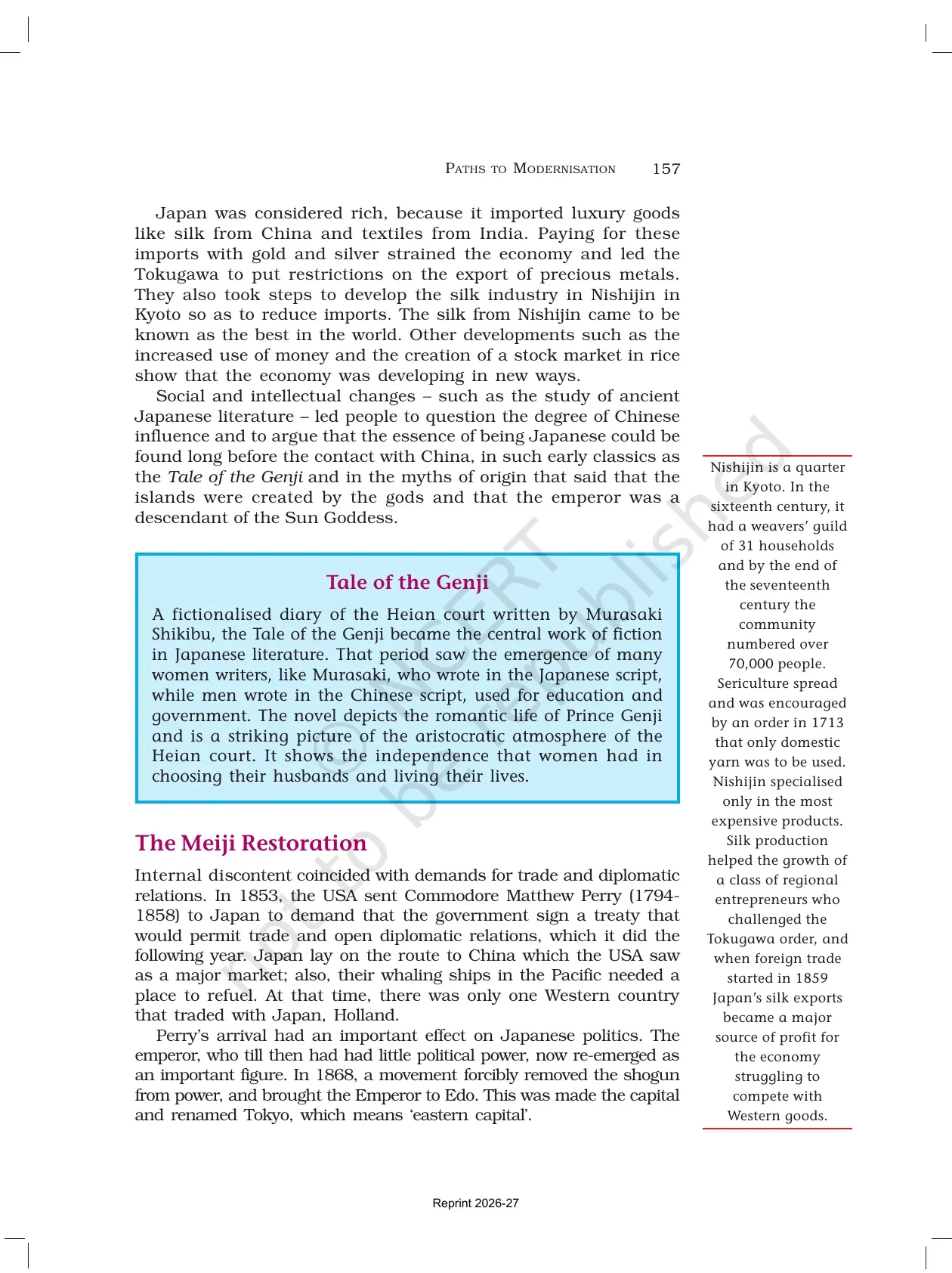
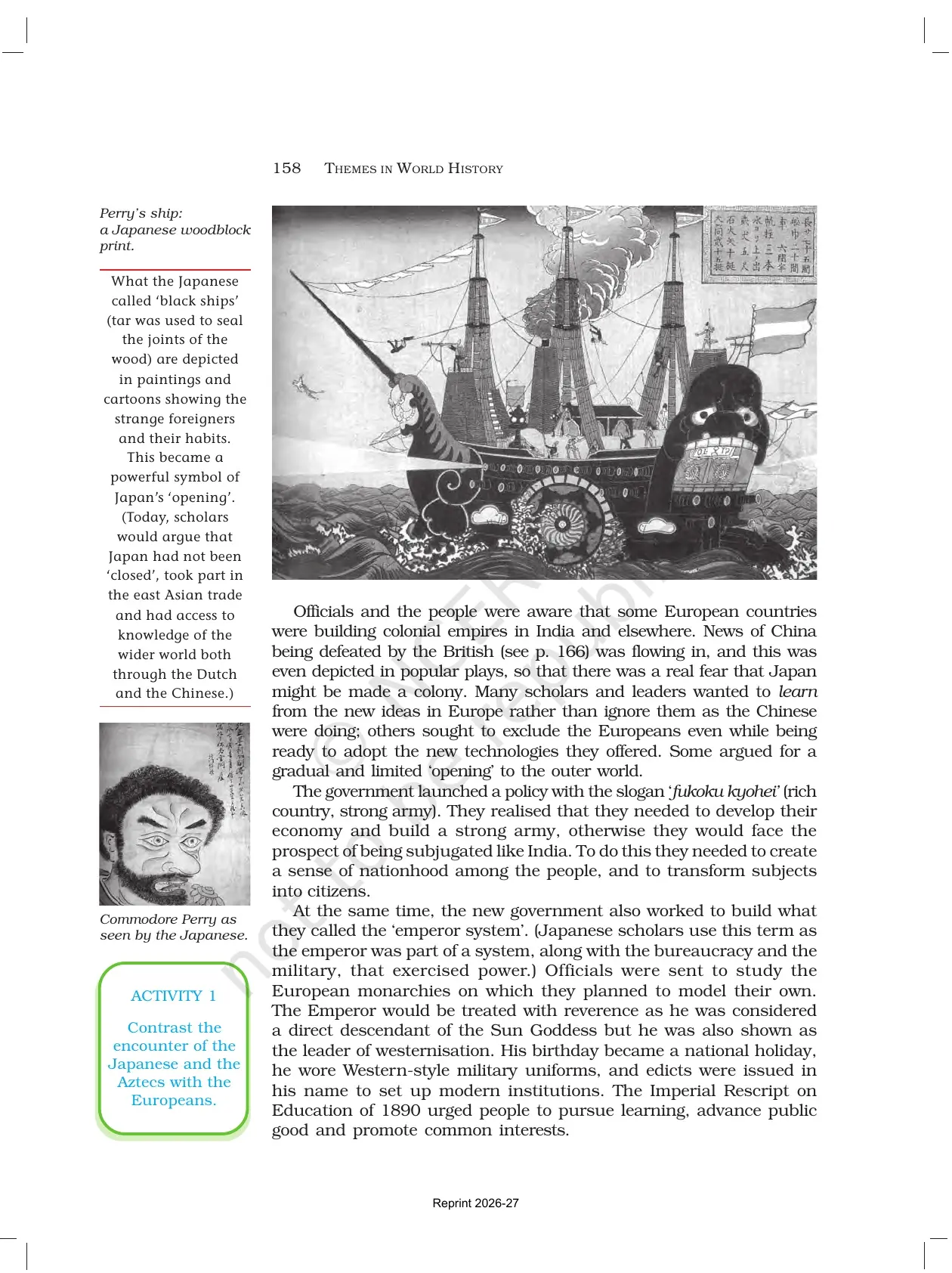
Internal discontent met foreign pressure in the 1850s. In 1853 the USA sent Commodore Matthew Perry to demand a treaty permitting trade and diplomatic relations, which Japan signed the following year. Until then Holland was the only Western country trading with Japan.
- Perry's arrival pushed the emperor, who had held little political power, back to the centre of politics. In 1868 a movement forcibly removed the shogun and brought the emperor to Edo, which was made the capital and renamed Tokyo, meaning eastern capital.
- News of China's defeat by the British was already circulating, even in popular plays, and there was a real fear that Japan might be made a colony like India.
- The government launched a policy under the slogan fukoku kyohei, meaning rich country, strong army. To do this it had to create a sense of nationhood and turn subjects into citizens.
- It also built what Japanese scholars call the emperor system. The emperor was revered as a descendant of the Sun Goddess and shown as the leader of westernisation. His birthday became a national holiday and he wore Western-style military uniforms. The Imperial Rescript on Education of 1890 urged people to pursue learning and advance the public good.
- A new school system began in the 1870s. Schooling was compulsory for boys and girls and almost universal by 1910, with minimal tuition fees and a compulsory course in moral culture.
Village and domain boundaries were redrawn so that each administrative unit could pay for local schools and health facilities and serve as a recruitment centre. All young men over twenty had to do military service. The military and the bureaucracy were placed under the direct command of the emperor, so even after a constitution was enacted they stayed outside the control of the government. That tension between a democratic constitution and an independent army runs through the rest of the Japan half.
Modernising the Japanese Economy: Railways, the Zaibatsu and Industrial Workers
Funds for modernisation were raised by an agricultural tax. The state then imported machinery, hired foreign technicians and sent students abroad. The numbers below are the ones examiners like, because they show the scale of the change in a single generation.
| Measure | What the chapter records |
|---|---|
| First railway line | Tokyo to the port of Yokohama, built in 1870 to 1872 |
| Modern banking | Launched in 1872 |
| Shipbuilding | Mitsubishi and Sumitomo helped by subsidies and tax benefits, so Japanese trade travelled in Japanese ships |
| Zaibatsu | Large business organisations controlled by individual families, dominant till after the Second World War |
| Population | 35 million in 1872, rising to 55 million in 1920 |
| Migration | Encouraged to Hokkaido, home of the Ainu, and then to Hawaii and Brazil |
| Urban share | 21 per cent of the population in cities by 1925, 32 per cent, or 22.5 million, by 1935 |
| Manufacturing workers | 700,000 in 1870, rising to 4 million in 1913 |
| Large factories | Just over 1,000 units with more than a hundred workers in 1909, over 2,000 by 1920, 4,000 by the 1930s |
| Small workshops | Over 550,000 workshops with fewer than five employees even in 1940 |
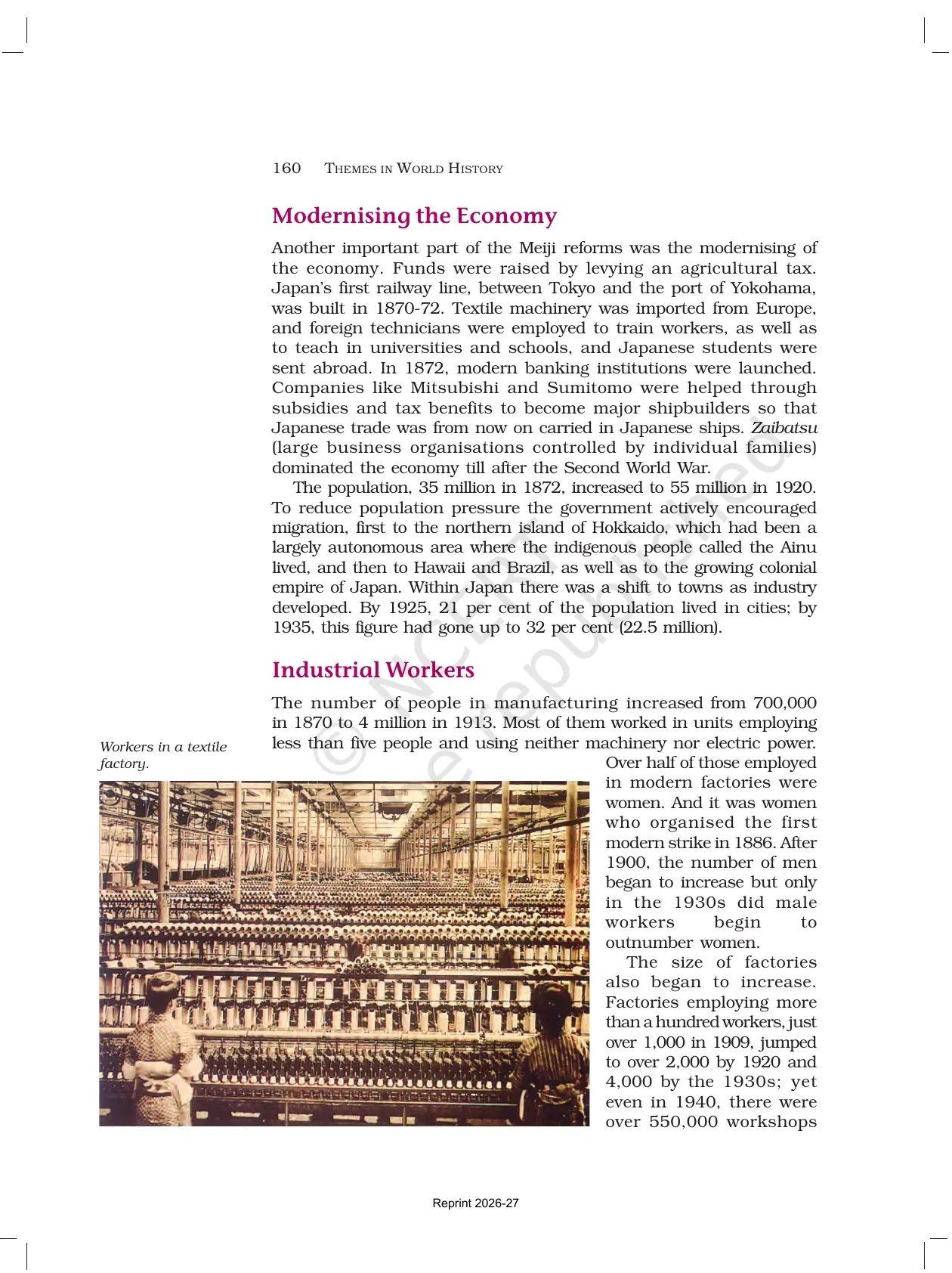
Over half of those employed in modern factories were women, and it was women who organised the first modern strike in 1886. Male workers began to outnumber women only in the 1930s. The survival of tiny workshops sustained a family-centred ideology, just as nationalism was sustained by a patriarchal system under an emperor treated as a family patriarch.
Tip: learn Tanaka Shozo as the environment answer. The self-taught son of a farmer and a member of the first Diet, he launched the first agitation against industrial pollution in 1897 with 800 villagers. The Ashio Mine was polluting the Watarase river, ruining 100 square miles of farmland and affecting a thousand families. The agitation forced pollution-control measures, and by 1904 harvests were normal.
Aggressive Nationalism and the Argument Between Westernisation and Tradition
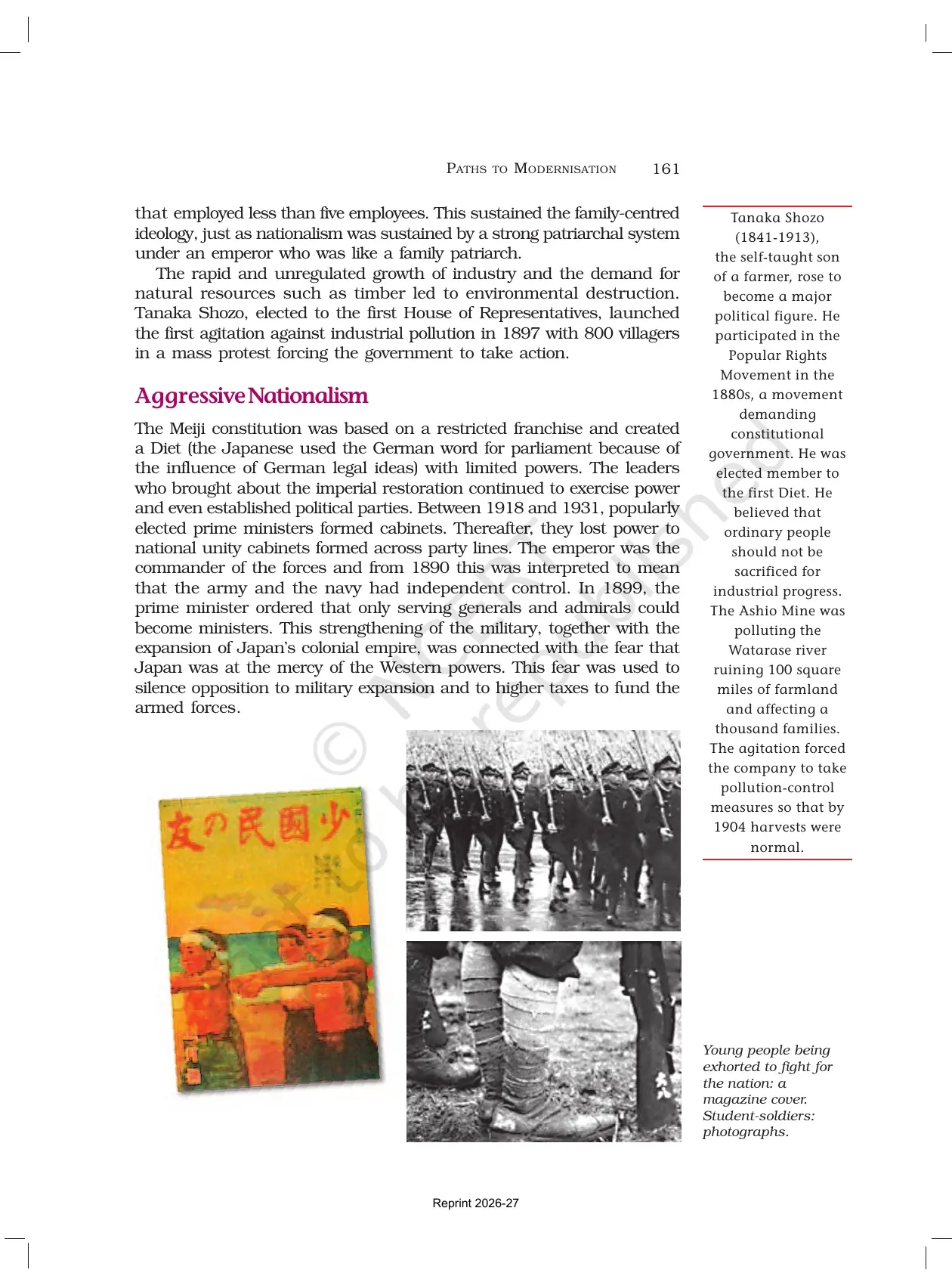
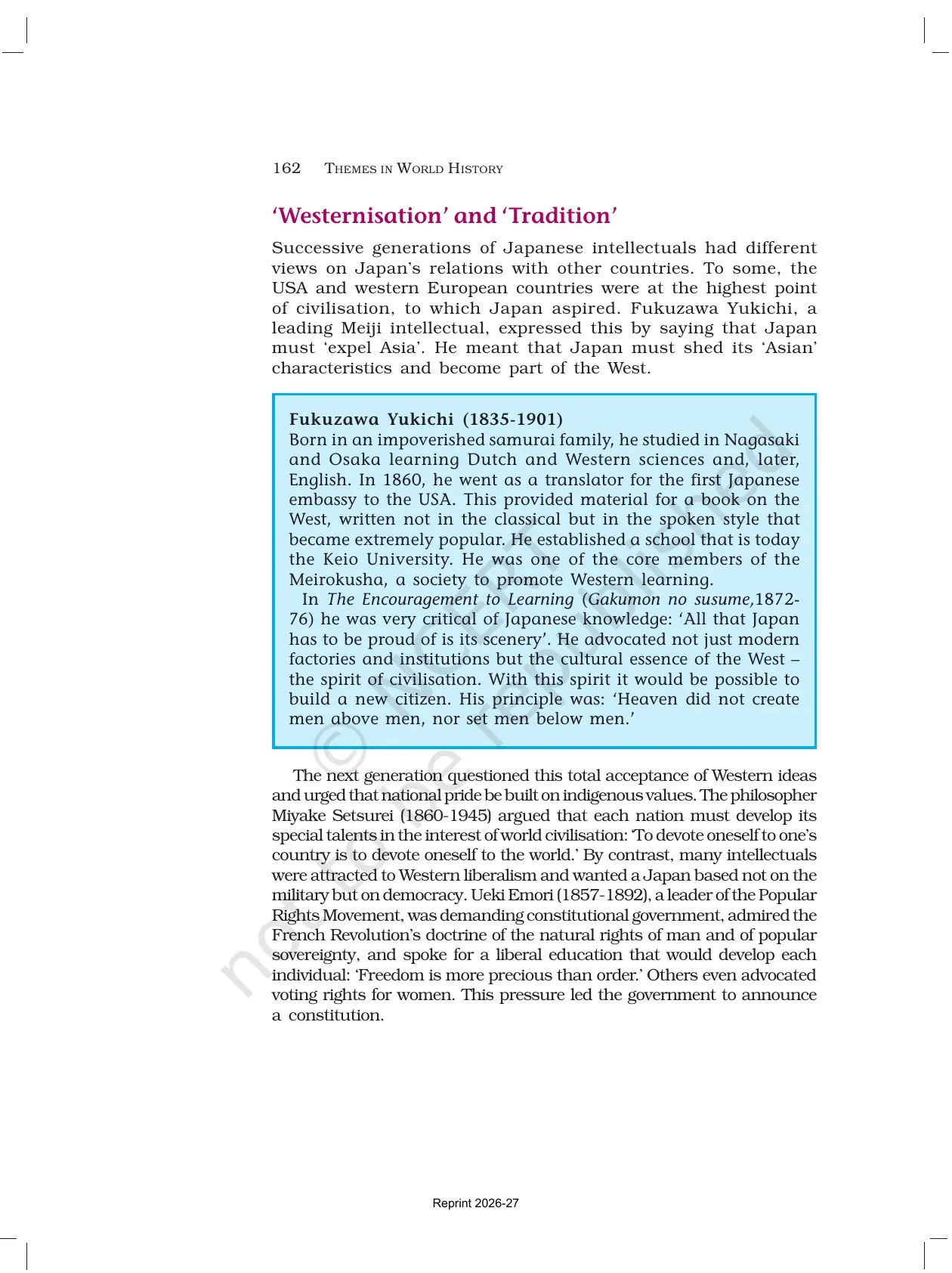
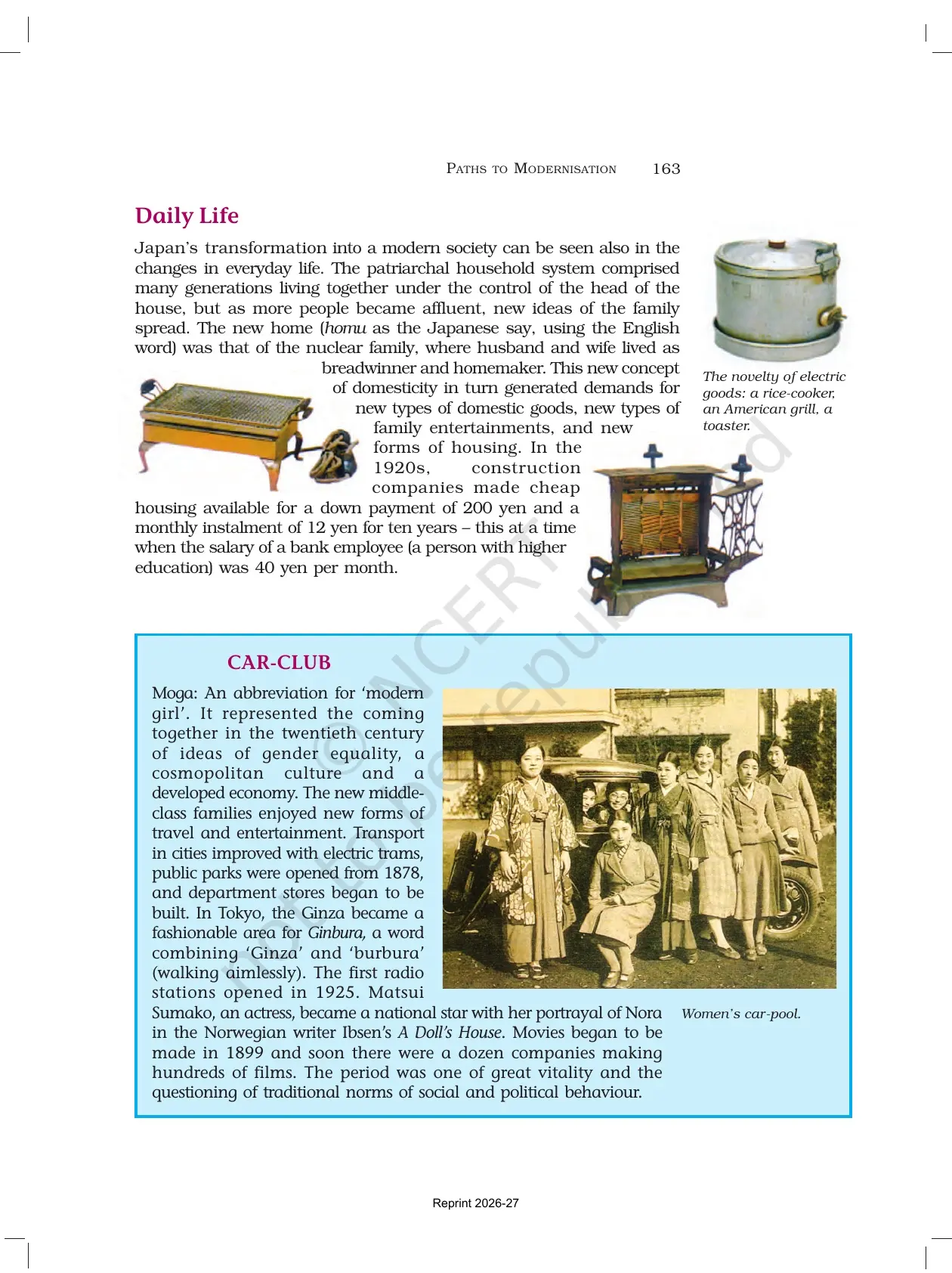
The Meiji constitution rested on a restricted franchise and created a Diet, the German word for parliament, with limited powers. Between 1918 and 1931 popularly elected prime ministers formed cabinets, after which they lost power to national unity cabinets. From 1890 the army and the navy were read as having independent control, and in 1899 the prime minister ordered that only serving generals and admirals could become ministers.
- Fukuzawa Yukichi, who lived from 1835 to 1901, said Japan must expel Asia, meaning shed its Asian characteristics and join the West. Born in a poor samurai family, he learnt Dutch, Western sciences and English, travelled to the USA in 1860 as a translator, founded the school that is today Keio University and belonged to the Meirokusha.
- In The Encouragement to Learning he wrote that all Japan had to be proud of was its scenery, and gave the principle: Heaven did not create men above men, nor set men below men.
- Miyake Setsurei, 1860 to 1945, argued that each nation must develop its special talents for world civilisation: to devote oneself to one's country is to devote oneself to the world.
- Ueki Emori, 1857 to 1892, a leader of the Popular Rights Movement, admired the French Revolution's doctrine of natural rights and said freedom is more precious than order. Some in this group even wanted voting rights for women.
- State-centred nationalism peaked in the 1930s and 1940s. The Overcoming Modernity symposium of 1943 debated how to fight the West while staying modern. The philosopher Nishitani Keiji defined modern as the unity of three streams of Western thought: the Renaissance, the Protestant Reformation and the rise of natural sciences.
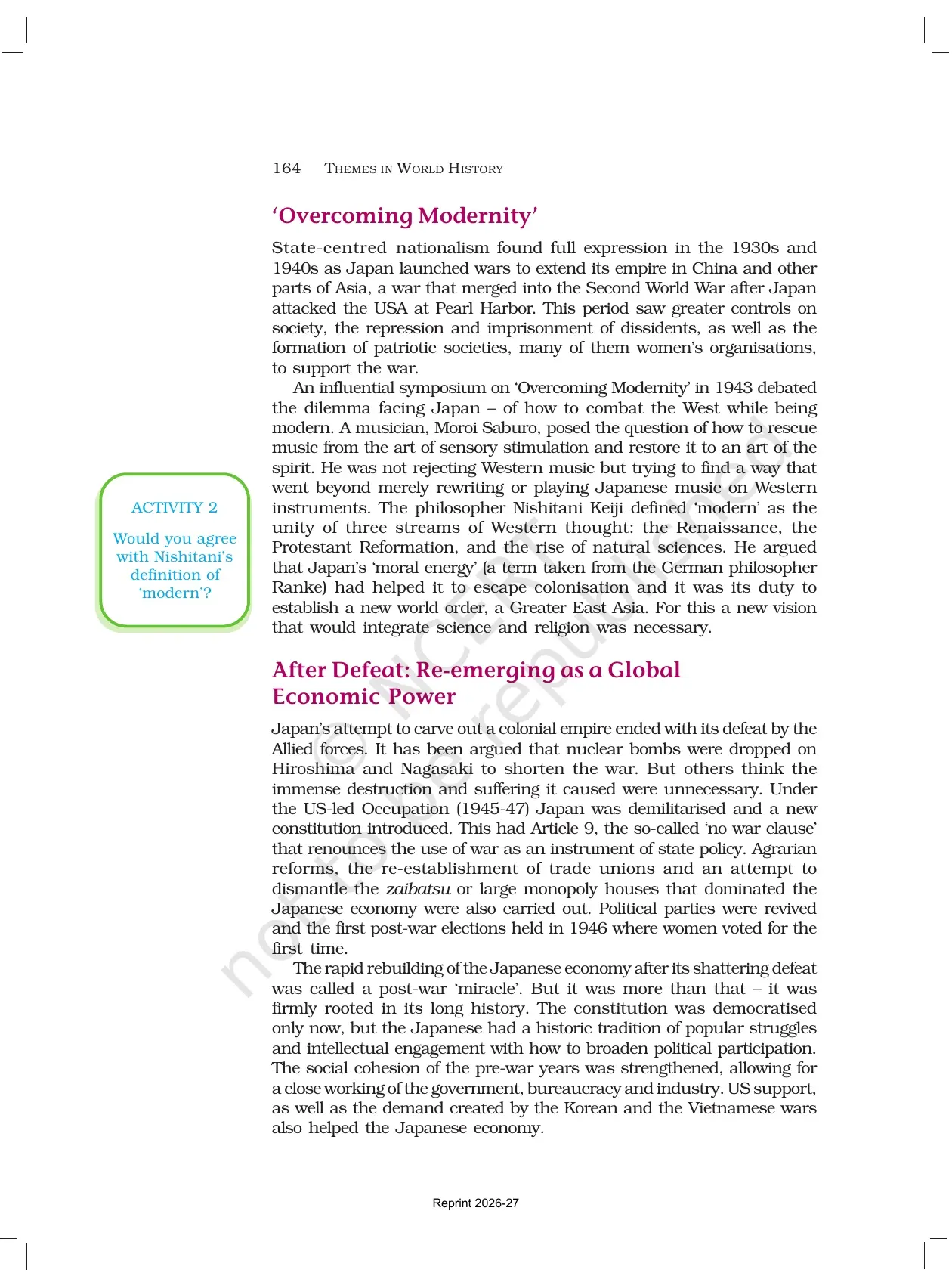
Daily life changed just as fast, and exercise question 2 is answered entirely from this material. The many-generation patriarchal household gave way to the nuclear homu, with husband as breadwinner and wife as homemaker, which created demand for new domestic goods and new housing. In the 1920s construction companies offered cheap housing for a down payment of 200 yen and a monthly instalment of 12 yen for ten years, at a time when a bank employee earned 40 yen a month. Electric trams improved city transport, public parks opened from 1878, department stores appeared, the Ginza became the fashionable place for Ginbura, the first radio stations opened in 1925, and the actress Matsui Sumako became a national star as Nora in Ibsen's A Doll's House. The Moga, short for modern girl, is the single term to memorise here.
After Defeat: How Japan Re-emerged as a Global Economic Power
Japan's drive for empire merged into the Second World War after the attack on Pearl Harbor and ended in defeat by the Allied forces. The chapter notes the argument that nuclear bombs were dropped on Hiroshima and Nagasaki to shorten the war, and the counter-view that the destruction and suffering were unnecessary.
- Under the US-led Occupation Japan was demilitarised and given a new constitution carrying Article 9, the no war clause that renounces war as an instrument of state policy.
- Agrarian reforms were carried out, trade unions were re-established and an attempt was made to dismantle the zaibatsu. Political parties revived, and in the first post-war elections of 1946 women voted for the first time.
- The recovery was called a post-war miracle, but the chapter insists it was rooted in a long history of popular struggles, social cohesion and close working between government, bureaucracy and industry. US support and demand created by the Korean and Vietnamese wars also helped.
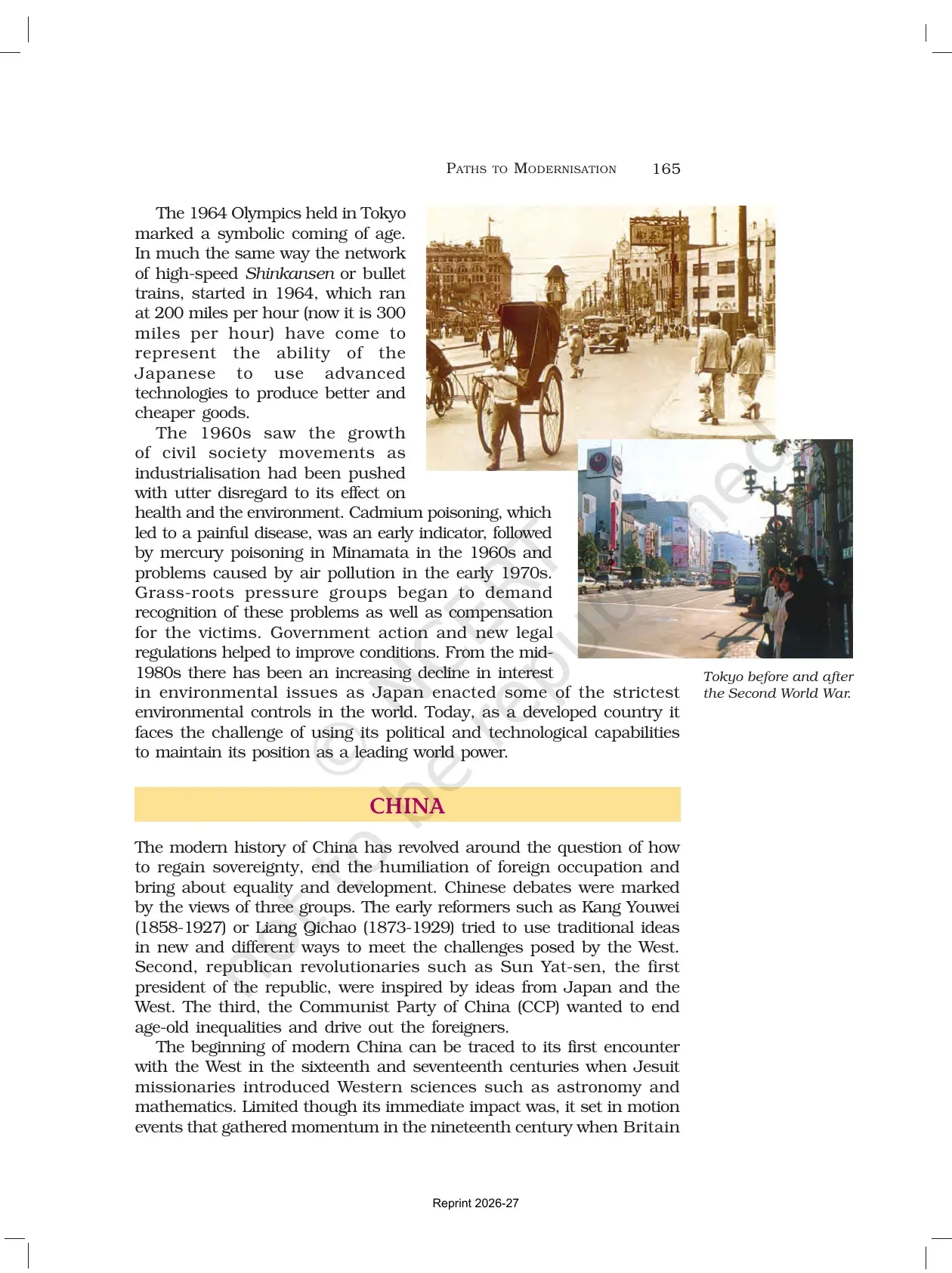
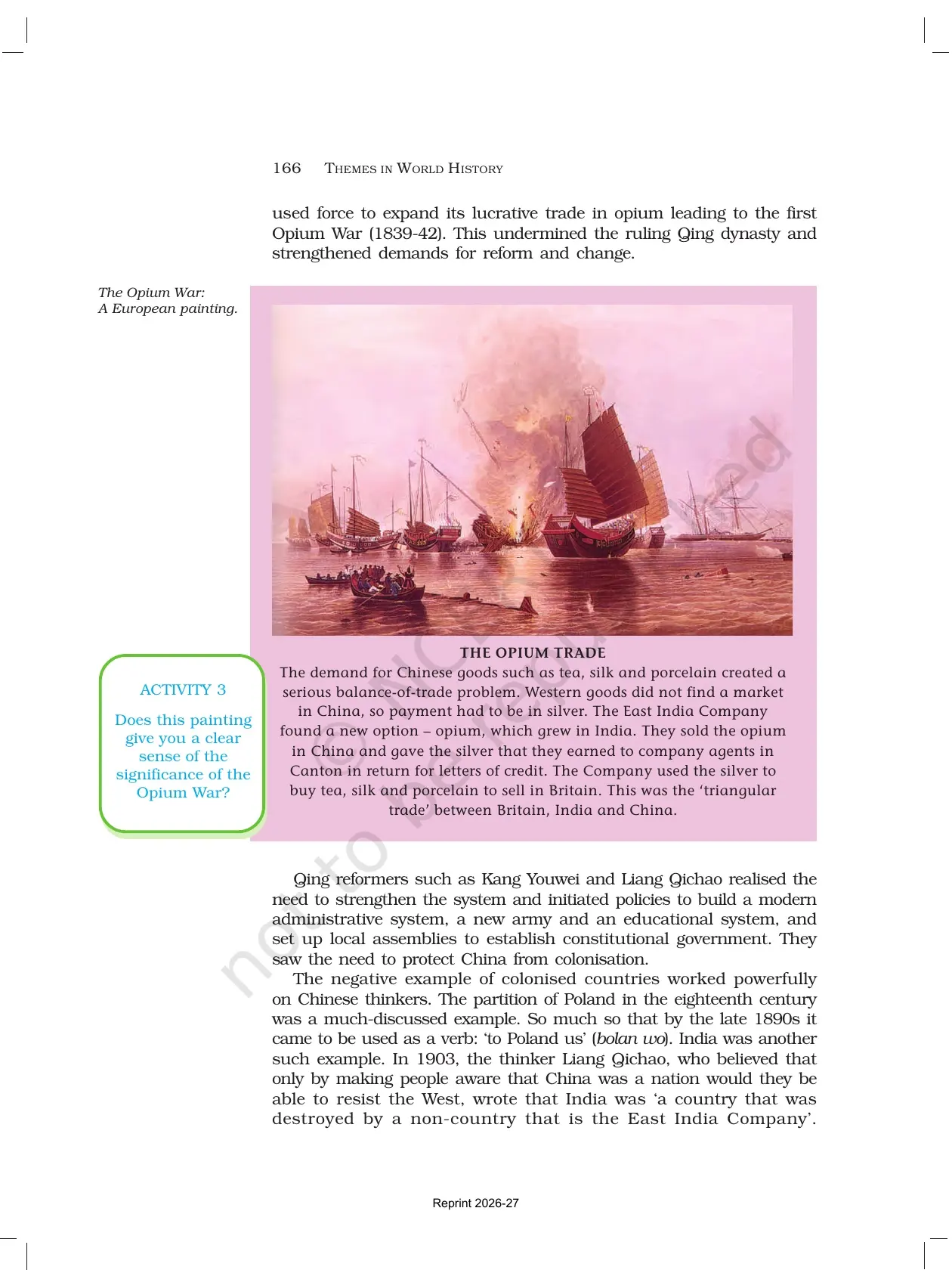
- The 1964 Olympics in Tokyo marked a symbolic coming of age, and the Shinkansen bullet trains, also started in 1964, ran at 200 miles per hour and now run at 300.
- Industrialisation had been pushed with disregard for health and the environment. Cadmium poisoning was an early indicator, followed by mercury poisoning at Minamata in the 1960s and air pollution in the early 1970s. Grass-roots pressure groups demanded recognition and compensation, and Japan went on to enact some of the strictest environmental controls in the world.
China's Search for Sovereignty: the Opium Wars and the Qing Reformers
The modern history of China in this chapter revolves around one question: how to regain sovereignty, end the humiliation of foreign occupation and bring about equality and development. Three groups gave three answers.
| Group | Who | What they wanted |
|---|---|---|
| Early reformers | Kang Youwei, 1858 to 1927, and Liang Qichao, 1873 to 1929 | Use traditional ideas in new ways to meet the challenge posed by the West |
| Republican revolutionaries | Sun Yat-sen, first president of the republic | A republic, inspired by ideas from Japan and the West |
| The Communist Party of China | Founded in 1921, later led by Mao Zedong | End age-old inequalities and drive out the foreigners |
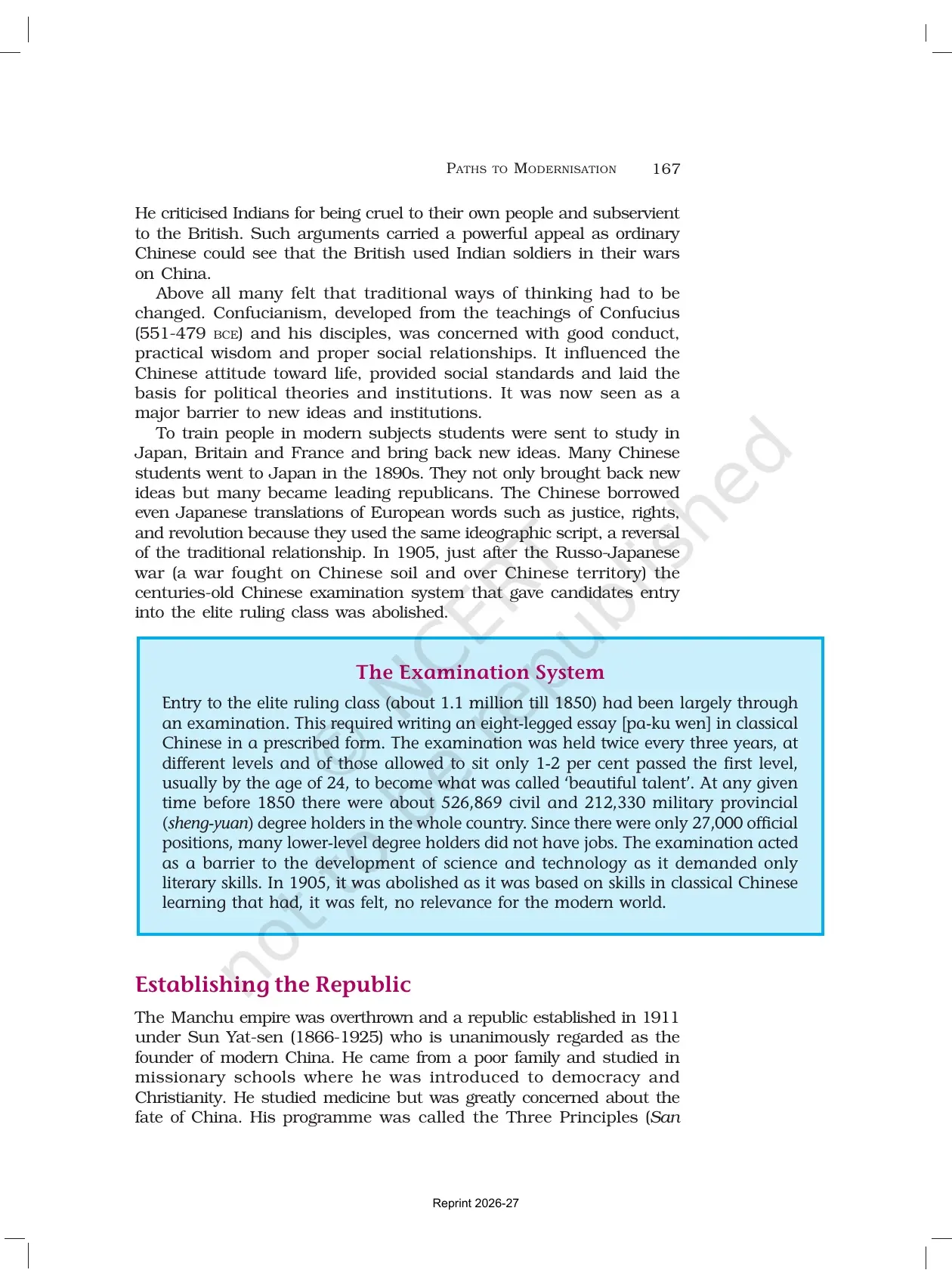
- The first contact came in the sixteenth and seventeenth centuries, when Jesuit missionaries introduced Western astronomy and mathematics. Momentum gathered in the nineteenth century when Britain used force to expand its opium trade, leading to the first Opium War of 1839 to 1842, which undermined the Qing.
- The opium trade box explains the triangular trade. Chinese tea, silk and porcelain had to be paid for in silver because Western goods found no market. The East India Company sold Indian opium in China and used the silver to buy tea, silk and porcelain to sell in Britain.
- Qing reformers built a modern administrative system, a new army and an educational system, and set up local assemblies to move towards constitutional government.
- The partition of Poland was discussed so often that by the late 1890s it became a verb, bolan wo, meaning to Poland us. In 1903 Liang Qichao wrote that India was a country that was destroyed by a non-country, the East India Company.
- Confucianism, developed from the teachings of Confucius, who lived from 551 to 479 BCE, was now seen as a major barrier to new ideas and institutions.
Students were sent to Japan, Britain and France, and many who went to Japan in the 1890s came back as leading republicans. In 1905, just after the Russo-Japanese war, the centuries-old examination system was abolished. The box on it is a common source question: it demanded an eight-legged essay in classical Chinese, was held twice every three years, and only one to two per cent passed the first level. Against about 526,869 civil and 212,330 military provincial degree holders there were only 27,000 official positions, so many degree holders had no jobs at all.
Establishing the Republic: Sun Yat-sen, the May Fourth Movement and the Guomindang
The Manchu empire was overthrown and a republic established in 1911 under Sun Yat-sen, who lived from 1866 to 1925 and is unanimously regarded as the founder of modern China. He came from a poor family, studied in missionary schools and trained in medicine.
- His programme was the Three Principles, San min chui. Nationalism meant overthrowing the Manchu, seen as a foreign dynasty, and the foreign imperialists. Democracy meant establishing democratic government. Socialism meant regulating capital and equalising landholdings. That is the whole answer to exercise question 4.
- On 4 May 1919 an angry demonstration in Beijing protested against the decisions of the post-war peace conference, since China had been on the winning side but did not get back the territories seized from it. The protest became the May Fourth Movement.
- It called for saving China through modern science, democracy and nationalism, and for simple language in writing, an end to foot-binding, equality in marriage and economic development to end poverty.
- The Guomindang, the National People's Party, identified the four great needs as clothing, food, housing and transportation. After Sun's death Chiang Kai-shek, 1887 to 1975, led a military campaign against the warlords and against the communists.
- Chiang wanted a secular, this-worldly Confucianism but also a militarised nation. He told women to cultivate the four virtues of chastity, appearance, speech and work and confine themselves to the household, and even the length of hemlines was prescribed.
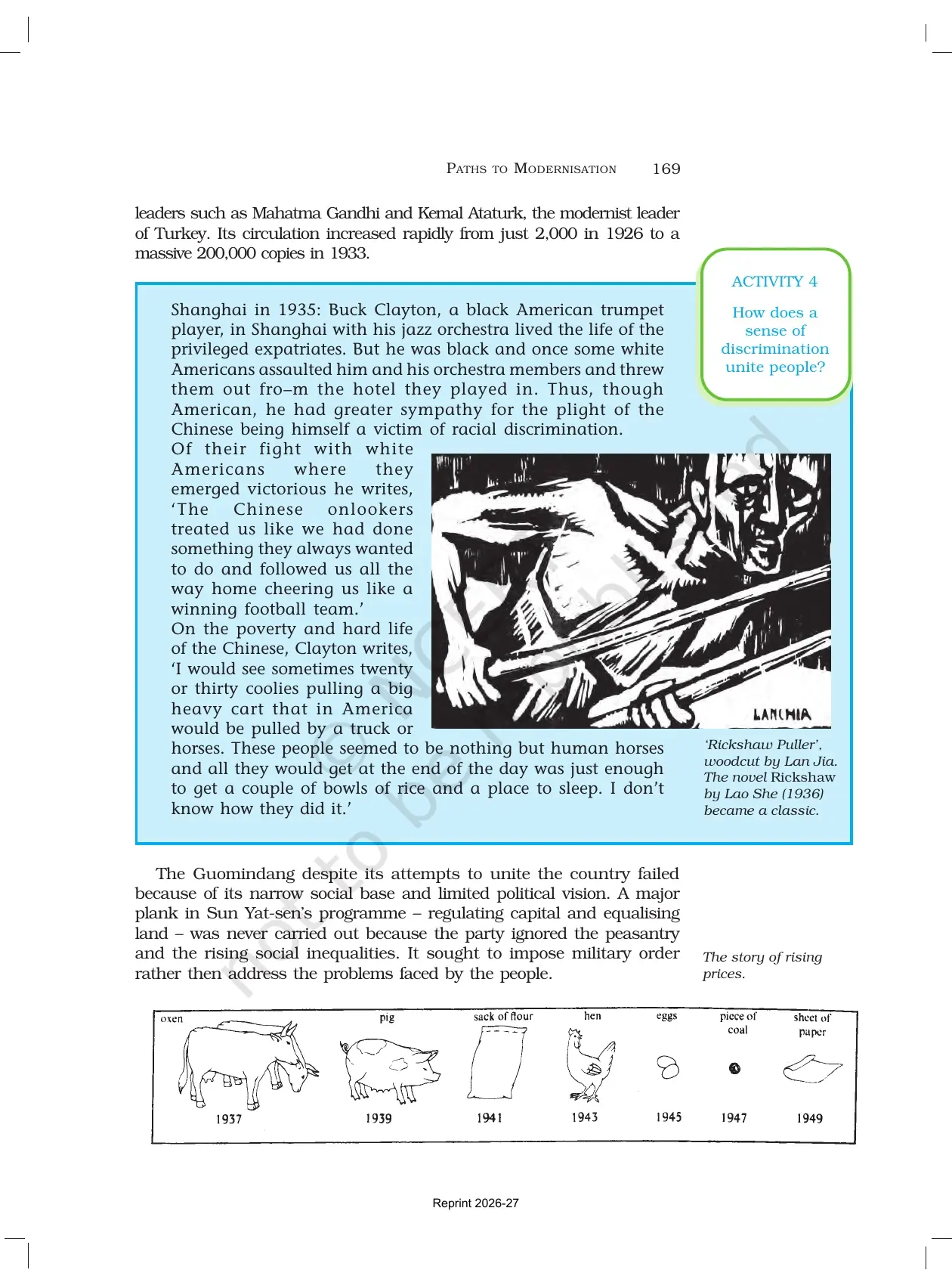
The Guomindang's social base was urban and narrow. Shanghai had an industrial working class of 500,000 by 1919, but most workers were petty urbanites, traders and shopkeepers, and women in particular earned very low wages for long hours. Peking University was established in 1902, and the popular Life Weekly edited by Zao Taofen carried new ideas along with profiles of leaders such as Mahatma Gandhi and Kemal Ataturk, its circulation jumping from 2,000 in 1926 to 200,000 in 1933. The chapter says plainly that the party failed because it ignored the peasantry and imposed military order instead of addressing people's problems.
The Rise of the Communist Party of China, the Long March and Maoism
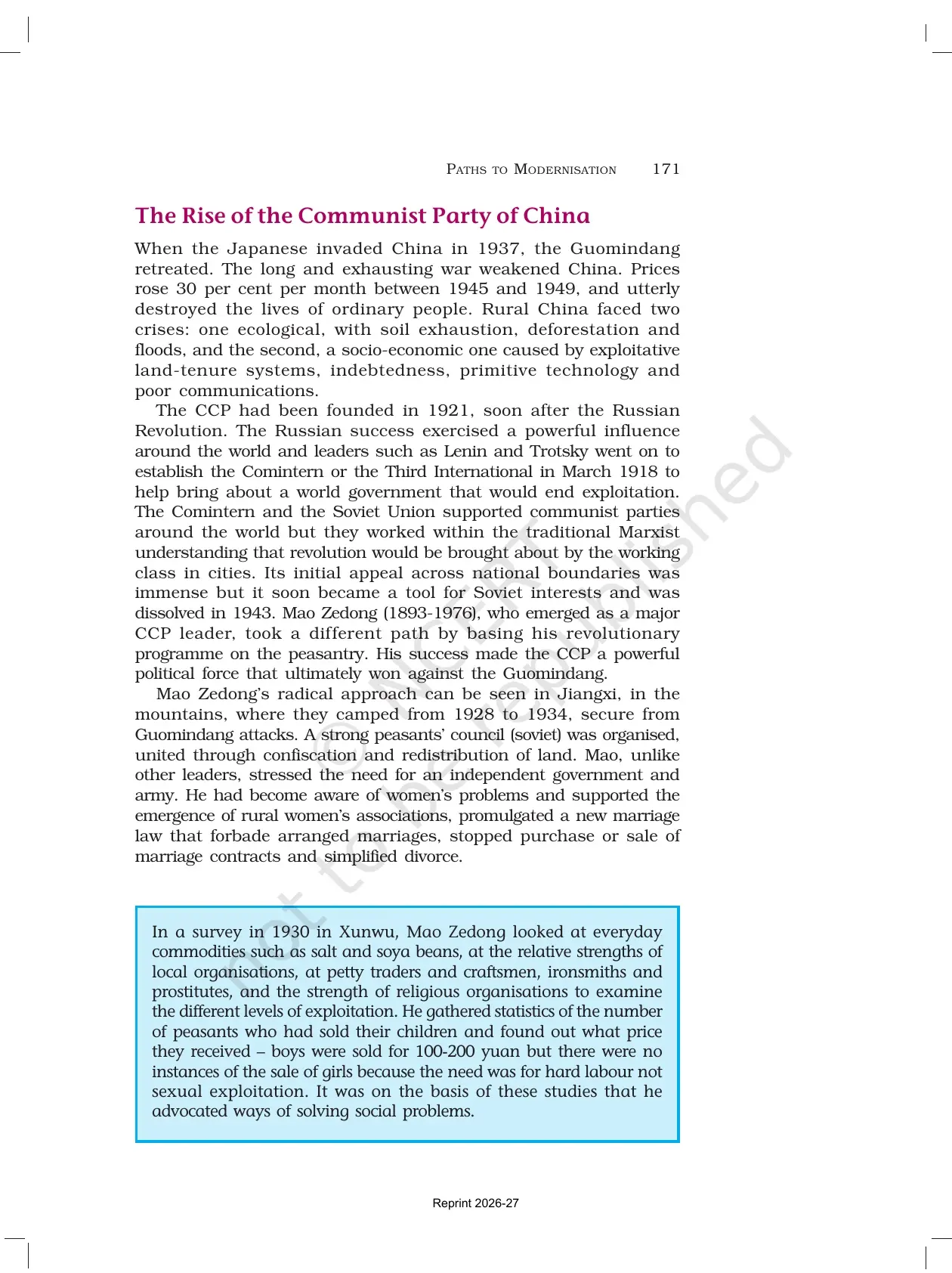
When Japan invaded China in 1937 the Guomindang retreated, and the long war wrecked ordinary life. Prices rose 30 per cent per month between 1945 and 1949. Rural China faced two crises at once: an ecological one of soil exhaustion, deforestation and floods, and a socio-economic one of exploitative land tenure, indebtedness and primitive technology.
- The CCP was founded in 1921, soon after the Russian Revolution. The Comintern supported communist parties worldwide but worked on the Marxist assumption that revolution would come from the urban working class. It was dissolved in 1943.
- Mao Zedong, 1893 to 1976, took a different path by basing his revolutionary programme on the peasantry, and that choice is what made the CCP strong enough to beat the Guomindang.
- In Jiangxi, where the party camped from 1928 to 1934, Mao organised a strong peasants' council, united through confiscation and redistribution of land, and insisted on an independent government and army.
- He supported rural women's associations and a new marriage law that forbade arranged marriages, stopped the purchase or sale of marriage contracts and simplified divorce.
- His Xunwu survey of 1930 examined salt, soya beans, petty traders, ironsmiths and local organisations to measure exploitation, and recorded that boys were sold for 100 to 200 yuan while there were no instances of girls being sold, because the need was for hard labour.
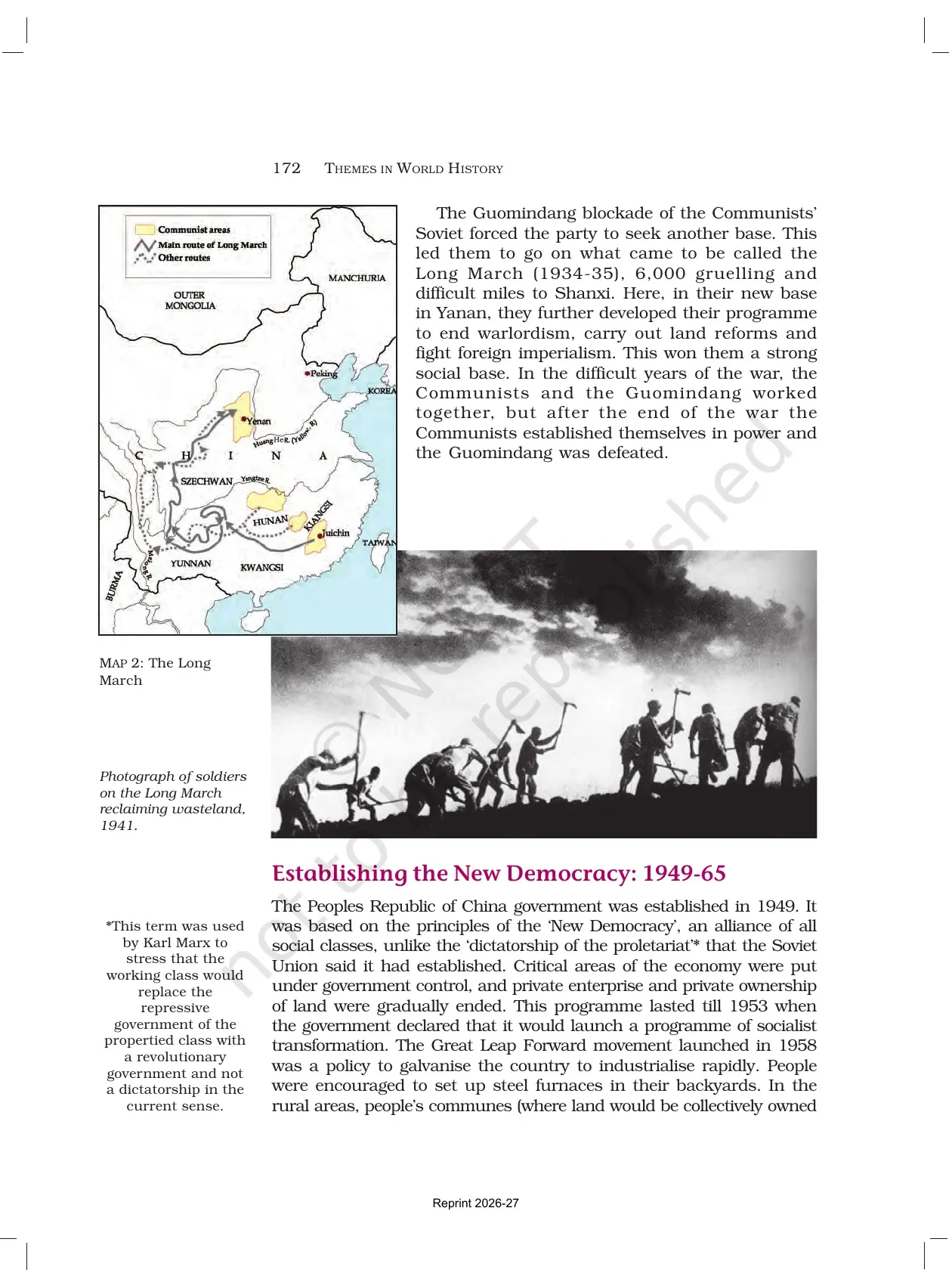
- The Guomindang blockade forced the party out on the Long March of 1934 to 1935, 6,000 gruelling miles to Shanxi. From the new base at Yanan the CCP developed a programme to end warlordism, carry out land reforms and fight foreign imperialism, and that programme won it a strong social base.
New Democracy, the Great Leap Forward and the Cultural Revolution in China
The People's Republic of China was established in 1949 on the principles of the New Democracy, an alliance of all social classes rather than the dictatorship of the proletariat claimed by the Soviet Union. What followed is best learned as a sequence of four phases.
| Years | Phase | What happened |
|---|---|---|
| 1949 to 1953 | New Democracy | Critical areas of the economy put under government control, private enterprise and private ownership of land gradually ended |
| 1958 | Great Leap Forward | People encouraged to set up backyard steel furnaces; 26,000 communes covering 98 per cent of the farm population by 1958 |
| 1965 onwards | Great Proletarian Cultural Revolution | Red Guards, mainly students and the army, campaigned against old culture, customs and habits; students and professionals sent to the countryside |
| 1975 | Turn of the tide | The Party laid emphasis again on social discipline and on building an industrial economy |
| 1978 onwards | Reforms | Deng Xiaoping kept party control strong while introducing a socialist market economy and the Four Modernisations |
- Mao's aim was a socialist man with five loves: fatherland, people, labour, science and public property. Mass organisations were huge, with the All-China Democratic Women's Federation at 76 million members and the All-China Students Federation at 3.29 million.
- Not everyone in the Party agreed. Liu Shaochi and Deng Xiaoping tried to modify the commune system because it was not working efficiently, and the backyard steel was industrially unusable.
- The Cultural Revolution put ideology above professional knowledge, and denunciations and slogans replaced rational debate. It weakened the Party and disrupted the economy and the education system.
- The Four Modernisations declared in 1978 were science, industry, agriculture and defence. Debate was allowed as long as the Party was not questioned.
- On 5 December 1978 a wall poster titled The Fifth Modernisation argued that without democracy the other modernisations would come to nothing. In 1989, on the seventieth anniversary of the May Fourth Movement, student demonstrators at Tiananmen Square were brutally repressed, which was strongly condemned around the world.
The post-reform debate is the closing note of the China half. The dominant view backed by the Party rests on strong political control, economic liberalisation and integration into the world market. Critics point to widening inequalities between social groups, regions and men and women. Alongside both sits a revival of Confucianism and the argument that China can build a modern society on its own traditions rather than by copying the West.
The Story of Taiwan and the Story of Korea in the Final Pages
These two short sections are the most skipped part of the theme, and exercise question 5 and Short Essay 8 come only from here. Both stories make the same point: rapid economic growth first, democracy afterwards.
| Year | Taiwan | Year | Korea |
|---|---|---|---|
| 1949 | Chiang Kai-shek flees with over US$300 million in gold reserves and crates of art treasures, and establishes the Republic of China | 1910 | Imperial Japan annexes Korea, ending the Joseon dynasty of 1392 to 1910 |
| 1947 | Massive demonstrations in February lead the Guomindang to kill a whole generation of leading figures | 1945 | Japanese colonial rule ends after 35 years in August; the peninsula is divided along the 38th parallel |
| 1973 | Land reforms and modernisation give Taiwan a GNP second only to Japan in Asia | 1950 to 1953 | The Korean War runs from June 1950 to the armistice of July 1953, a proxy war of the Cold War era |
| 1987 | Martial law is lifted and opposition parties are legally permitted | 1960 | The April Revolution against a rigged election forces President Syngman Rhee to resign |
| After 1975 | Transformation into a democracy begins slowly after Chiang's death | 1961 to 1979 | Park Chung-hee takes power in a coup, wins the 1963 election and runs an export-oriented economy until his assassination in October 1979 |
- Taiwan had been a Japanese colony after the war of 1894 to 1895. The Cairo Declaration and the Potsdam Proclamation restored sovereignty to China, and Taiwan is still considered part of China, so most countries keep only trade missions there.
- Korea's growth began in the early 1960s when policy shifted from import substitution to exports, first in textiles and garments and then in steel, machinery, shipbuilding, electronics and chemicals.
- The New Village, or Saemaul, Movement of 1970 mobilised the rural population and is still shared with developing countries today.
- The Yusin Constitution of October 1972 made permanent presidency possible and gave the president complete authority over legislation, jurisdiction and administration.
- The Gwangju Democratisation Movement of May 1980 and the June Democracy Movement of 1987 forced a constitutional revision allowing direct elections. Kim Young-sam, elected in December 1992, was the first civilian president after decades of military rule.
- Exercise question 5 is answered here: the foreign currency crisis of 1997 was met with emergency financial support from the International Monetary Fund, while citizens contributed to foreign loan repayment through the Gold Collection Movement.
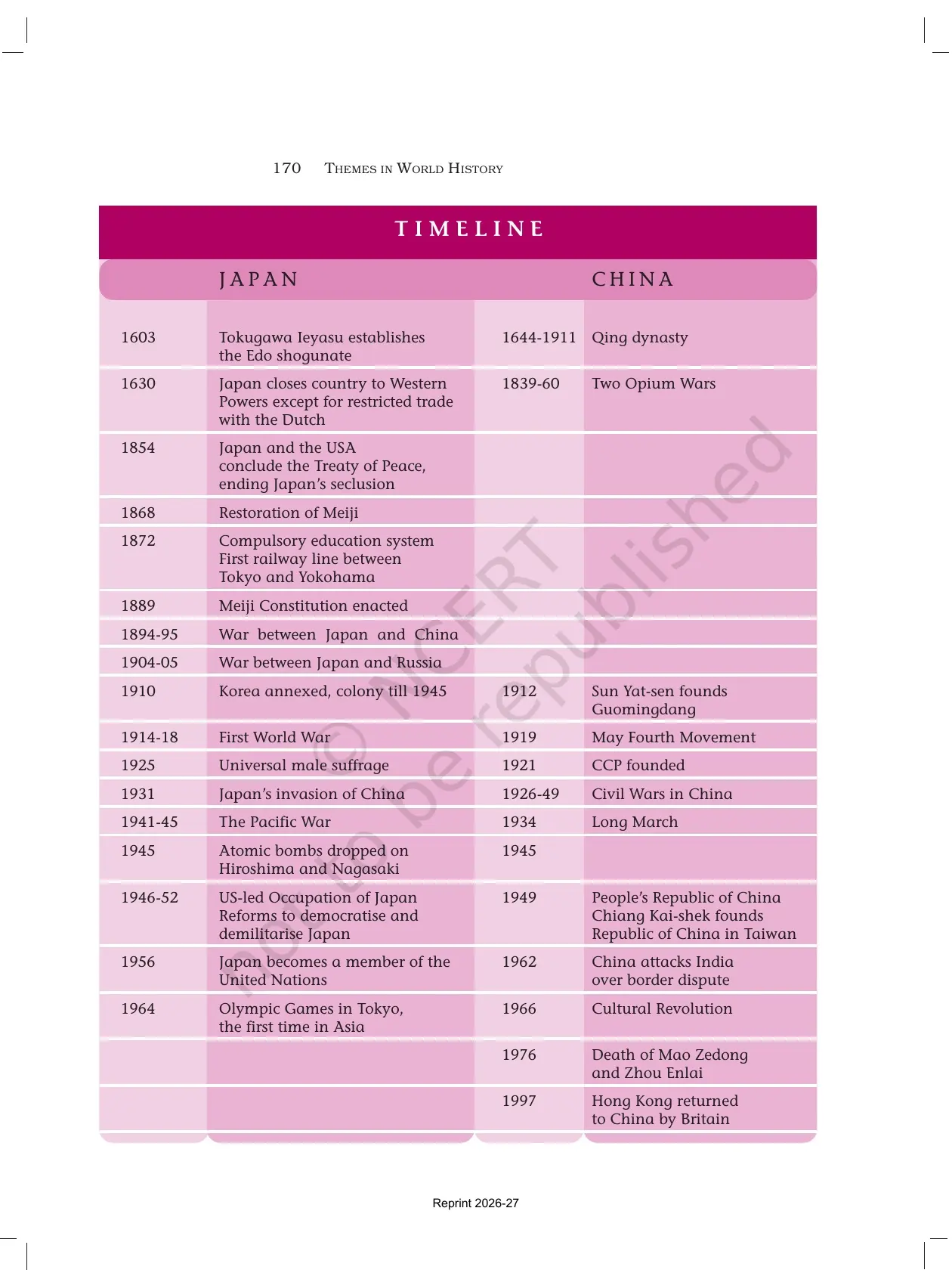
The Japan and China Timeline Printed at the Centre of the Chapter
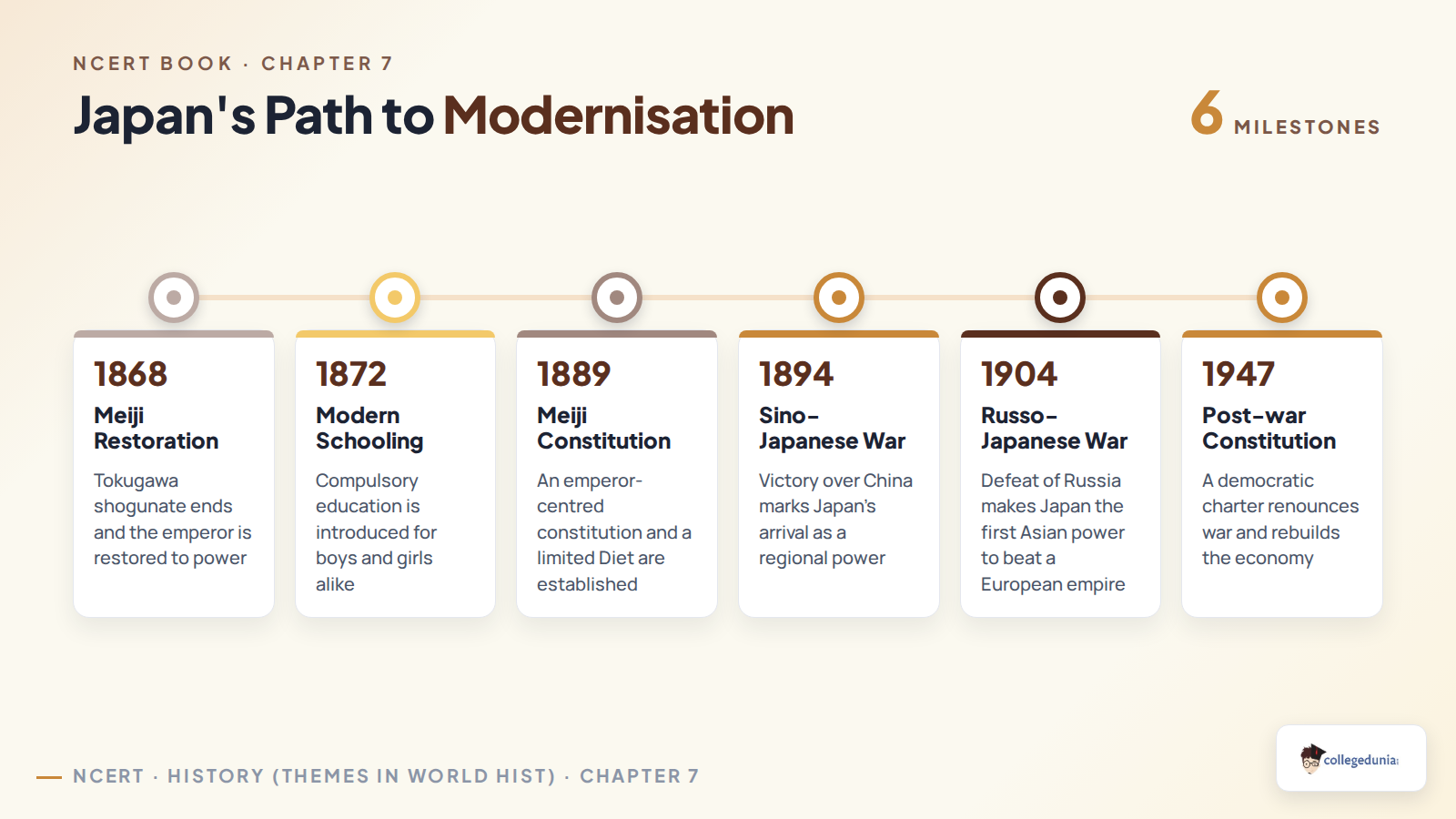
The chapter prints a two-column timeline that is the cheapest set of marks in the theme. Learn it as one block rather than hunting for dates section by section.
| Year | Japan | Year | China |
|---|---|---|---|
| 1603 | Tokugawa Ieyasu establishes the Edo shogunate | 1644 to 1911 | Qing dynasty |
| 1854 | Japan and the USA conclude the Treaty of Peace, ending Japan's seclusion | 1839 to 1860 | Two Opium Wars |
| 1868 | Restoration of Meiji | 1912 | Sun Yat-sen founds the Guomindang |
| 1872 | Compulsory education system and the first railway line, Tokyo to Yokohama | 1919 | May Fourth Movement |
| 1889 | Meiji Constitution enacted | 1921 | CCP founded |
| 1894 to 1895 | War between Japan and China | 1926 to 1949 | Civil wars in China |
| 1904 to 1905 | War between Japan and Russia | 1934 | Long March |
| 1910 | Korea annexed, a colony till 1945 | 1949 | People's Republic of China; Chiang Kai-shek founds the Republic of China in Taiwan |
| 1941 to 1945 | The Pacific War | 1962 | China attacks India over a border dispute |
| 1946 to 1952 | US-led Occupation of Japan, with reforms to democratise and demilitarise | 1966 | Cultural Revolution |
| 1964 | Olympic Games in Tokyo, the first time in Asia | 1997 | Hong Kong returned to China by Britain |
Exercises at the End of Paths to Modernisation and What Each One Tests
Eight questions are printed at the end, five under Answer in Brief and three under Answer in a Short Essay. Four activities sit in the chapter margins. The table below shows where each answer is hiding.
| Question | What it asks | Section to answer it from |
|---|---|---|
| Answer in Brief 1 | Major developments before the Meiji Restoration that made rapid modernisation possible | The Political System, plus the Nishijin silk and castle-town material |
| Answer in Brief 2 | How daily life was transformed as Japan developed | Daily Life, the Moga box and the yen figures for housing and salaries |
| Answer in Brief 3 | How the Qing dynasty tried to meet the challenge posed by the Western powers | The China opening pages, the Opium Trade box and the Examination System box |
| Answer in Brief 4 | Sun Yat-sen's Three Principles | Establishing the Republic, the paragraph on San min chui |
| Answer in Brief 5 | How Korea dealt with the foreign currency crisis of 1997 | Korean Democracy and the IMF Crisis |
| Short Essay 6 | Whether rapid industrialisation led to wars with neighbours and environmental destruction | Modernising the Economy, Aggressive Nationalism, Tanaka Shozo and the Minamata pages |
| Short Essay 7 | Whether Mao Zedong and the CCP succeeded in liberating China and laying the basis for its current success | The Rise of the CCP through to Reforms from 1978 and Two Roads to Modernisation |
| Short Essay 8 | Whether economic growth in South Korea contributed to its democratisation | The whole Korea section, from Park Chung-hee to the candlelight protests |
| Activities 1 to 4 | Contrasting the Japanese and Aztec encounters with Europeans, judging Nishitani's definition of modern, reading the Opium War painting, and how a sense of discrimination unites people | Margin boxes beside the Meiji Restoration, Overcoming Modernity, the Opium Trade and the Buck Clayton passage |
Common Mistakes Students Make in the Paths to Modernisation Chapter
These six slips cost marks in almost every annual paper, and each one is avoidable by reading the chapter once with a pencil.
- Writing that the Meiji Restoration happened in 1853. Perry arrived in 1853 and the treaty was signed in 1854, but the shogun was removed and the emperor brought to Edo in 1868.
- Mixing up the two Chinese parties. The Guomindang is the National People's Party of Sun Yat-sen and Chiang Kai-shek; the CCP is the Communist Party founded in 1921.
- Dating the Long March wrongly. It ran from 1934 to 1935 over 6,000 miles, and it ended at Yanan in Shanxi, not in Jiangxi, which was the base they left.
- Treating the Great Leap Forward and the Cultural Revolution as one event. The Great Leap Forward was launched in 1958 and was about communes and backyard furnaces; the Cultural Revolution was launched in 1965 and was about ideology and the Red Guards.
- Saying Japan was completely closed before Perry. The chapter notes that scholars today argue Japan took part in East Asian trade and had access to knowledge of the wider world through the Dutch and the Chinese.
- Skipping Taiwan and Korea. Two of the eight exercise questions come from those pages alone, so answers that stop at Deng Xiaoping lose easy marks.
Student Feedback on the Paths to Modernisation Chapter
What 12,380 Class 11 History students told us about this theme
Results from a Collegedunia poll run with Class 11 students before the 2026-27 annual exams:
- 68% said the two-column Japan and China timeline was the fastest block of marks in the theme once learned in one sitting.
- 3 out of 5 students could not list all three of Sun Yat-sen's Three Principles on the first attempt.
- 47% rated Short Essay 7, on whether Mao Zedong and the CCP liberated China, as the hardest question in the theme to write.
- Students who read the eight exercise questions before the chapter finished the theme in about 2 hours 30 minutes, against 4 hours for the rest.
Source: 2026-27 Class 11 History student poll. Sample of 12,380 students from CBSE schools across 18 states.
How to Use the Paths to Modernisation PDF in a Three Block Revision Plan
This theme is the longest in the book and carries two country stories plus two shorter ones. The order you read it in matters more than the hours you give it. Three sittings are enough.
- Block 1, about 50 minutes. Read the eight exercise questions first, then read the Japan half from The Political System to Daily Life. Mark every name and date as you go.
- Block 2, about 50 minutes. Read After Defeat, then the whole China half up to Reforms from 1978. Copy the Three Principles and the Four Modernisations out in your own words.
- Block 3, about 40 minutes. Read Taiwan, Korea and Two Roads to Modernisation end to end, write out the two-column timeline by hand, then attempt Answer in Brief 5 without looking back at the PDF.
Tip: keep one quotation ready from each of the three Japanese thinkers, Fukuzawa Yukichi on heaven not creating men above men, Miyake Setsurei on devoting oneself to the world and Ueki Emori on freedom being more precious than order. A single quoted line noticeably lifts a source based answer.
How the Chapter 7 PDF Connects to the Themes Around It
Paths to Modernisation closes the Towards Modernisation section of the book, so it reads best alongside the two chapters printed before it. Both are scheduled as an NCERT Book PDF in exactly the same format as this page.
| Related chapter | Why you should read it alongside | NCERT Book PDF |
|---|---|---|
| Chapter 6, Displacing Indigenous Peoples | The other half of the Towards Modernisation section, and the natural comparison for any question on different routes to the modern world, since it shows settler colonialism where this theme shows self-directed modernisation | Displacing Indigenous Peoples Class 11 NCERT Book PDF |
| Chapter 5, Changing Cultural Traditions | Supplies the Renaissance, Reformation and natural sciences that Nishitani Keiji names in his definition of modern in the Overcoming Modernity symposium | Changing Cultural Traditions Class 11 NCERT Book PDF |
Themes in World History Chapters Available in NCERT Book PDF Format
Every link below opens the official NCERT chapter file for the 2026-27 session, in the same format as the Paths to Modernisation download on this page.
| Chapter | NCERT Book PDF |
|---|---|
| Chapter 1 | Writing and City Life Class 11 NCERT Book PDF |
| Chapter 2 | An Empire Across Three Continents Class 11 NCERT Book PDF |
| Chapter 3 | Nomadic Empires Class 11 NCERT Book PDF |
| Chapter 4 | The Three Orders Class 11 NCERT Book PDF |
| Chapter 5 | Changing Cultural Traditions Class 11 NCERT Book PDF |
| Chapter 6 | Displacing Indigenous Peoples Class 11 NCERT Book PDF |
| Chapter 7 | Paths to Modernisation Class 11 NCERT Book PDF |
Paths to Modernisation Class 11 History Chapter 7 NCERT Book PDF FAQs
Questions Class 11 Students Ask Most About the Paths to Modernisation Chapter PDF
Ques. Where can I download the NCERT Class 11 History Chapter 7 Paths to Modernisation PDF?
Ans. You can download it free from the card at the top of this page. It is the official NCERT chapter file from Themes in World History for the 2026-27 session, and it carries the full chapter text, the Japan and China timeline, both maps, all four activities and the eight exercise questions.
Ques. What is Chapter 7 of Class 11 History Themes in World History about?
Ans. It compares the different routes Japan and China took to becoming modern nations. The Japan half runs from the Tokugawa shoguns through the Meiji Restoration, industrialisation and aggressive nationalism to the post-war recovery. The China half runs from the Opium Wars through Sun Yat-sen's republic and the rise of the Communist Party to Deng Xiaoping's reforms. Shorter sections then cover Taiwan and Korea.
Ques. What was the Meiji Restoration?
Ans. In 1868 a movement forcibly removed the shogun from power and brought the emperor to Edo, which was made the capital and renamed Tokyo. The new government adopted the slogan fukoku kyohei, meaning rich country and strong army, built an emperor system, introduced compulsory schooling from the 1870s and modernised the economy so that Japan would not be colonised as India had been.
Ques. What are Sun Yat-sen's Three Principles?
Ans. The Three Principles, or San min chui, are nationalism, democracy and socialism. Nationalism meant overthrowing the Manchu, who were seen as a foreign dynasty, and the other foreign imperialists. Democracy meant establishing democratic government. Socialism meant regulating capital and equalising landholdings. They became the basis of the political philosophy of the Guomindang.
Ques. What was the Long March and why does it matter?
Ans. The Guomindang blockade of the Communists' base in Jiangxi forced the party to seek another base, so between 1934 and 1935 they marched 6,000 gruelling miles to Shanxi. From their new base at Yanan they developed a programme to end warlordism, carry out land reforms and fight foreign imperialism, which won them a strong social base among the peasantry.
Ques. What was the difference between the Great Leap Forward and the Cultural Revolution?
Ans. The Great Leap Forward was launched in 1958 to industrialise rapidly. People set up steel furnaces in their backyards and rural people's communes were formed, reaching 26,000 communes covering 98 per cent of the farm population. The Great Proletarian Cultural Revolution was launched in 1965 to counter Mao's critics. The Red Guards campaigned against old culture, customs and habits, and ideology was placed above professional knowledge.
Ques. What was the Opium War and what caused it?
Ans. Chinese tea, silk and porcelain were in high demand in Britain, but Western goods found no market in China, so payment had to be made in silver. The East India Company solved this by selling Indian opium in China and using the silver earned to buy Chinese goods, the triangular trade between Britain, India and China. Britain used force to expand this trade, leading to the first Opium War of 1839 to 1842, which undermined the Qing dynasty.
Ques. Why was the Chinese examination system abolished in 1905?
Ans. Entry to the elite ruling class required an eight-legged essay in classical Chinese written in a prescribed form. Only one to two per cent of candidates passed the first level, and against about 526,869 civil and 212,330 military provincial degree holders there were only 27,000 official positions. The system acted as a barrier to science and technology because it tested only literary skills, so it was abolished in 1905 as irrelevant to the modern world.
Ques. How did daily life change in Japan as it modernised?
Ans. The many-generation patriarchal household gave way to the nuclear home, with husband as breadwinner and wife as homemaker, which created demand for new domestic goods and new housing. Electric trams improved transport, public parks opened from 1878, department stores were built, the Ginza became a fashionable area, the first radio stations opened in 1925 and films were being made from 1899. The Moga, short for modern girl, symbolised the change.
Ques. How did Korea deal with the foreign currency crisis of 1997?
Ans. The crisis followed increasing trade deficits, poor management by financial institutions and reckless business operations by conglomerates. It was dealt with through emergency financial support from the International Monetary Fund, along with efforts to improve the country's economic structure. Citizens also contributed towards foreign loan repayment through the Gold Collection Movement.
Ques. Which dates from this chapter are asked most often?
Ans. The frequently asked ones are 1603 for the Edo shogunate, 1853 for Perry's arrival, 1868 for the Meiji Restoration, 1889 for the Meiji Constitution, 1894 to 1895 and 1904 to 1905 for the wars with China and Russia, 1911 for the Chinese republic, 1919 for the May Fourth Movement, 1921 for the founding of the CCP, 1934 to 1935 for the Long March, 1949 for the People's Republic, 1958 for the Great Leap Forward, 1965 for the Cultural Revolution, 1978 for the Four Modernisations and 1997 for the Korean currency crisis.
Ques. How many questions are printed in the exercises of Paths to Modernisation?
Ans. Eight in total. Questions 1 to 5 sit under Answer in Brief and cover developments before the Meiji Restoration, the transformation of daily life, the Qing response to the Western powers, Sun Yat-sen's Three Principles and the Korean currency crisis of 1997. Questions 6 to 8 sit under Answer in a Short Essay and cover industrialisation and the environment, Mao Zedong and the CCP, and economic growth and democratisation in South Korea.
Ques. Is the Class 11 History Chapter 7 PDF enough on its own for the exam?
Ans. For the content, yes. Every name, date, table and quotation the paper can ask about is printed in this file, including the Naito Konan box, the Opium Trade box, the Examination System box and the Xunwu survey. What the file does not give you is a condensed date sheet, so most students write the two-column Japan and China timeline out by hand once while revising.



Comments