




Introduction to Problem Solving is chapter 4 of the Class 11 Computer Science NCERT textbook, sitting between the hardware half of the book and the Python half. The ncert book class 11 computer science chapter 4 introduction to problem solving file on this page is the official NCERT chapter for 2026-27. Download it for the full problem solving cycle, the flowchart symbol table, every worked pseudocode example and all 18 exercise questions.
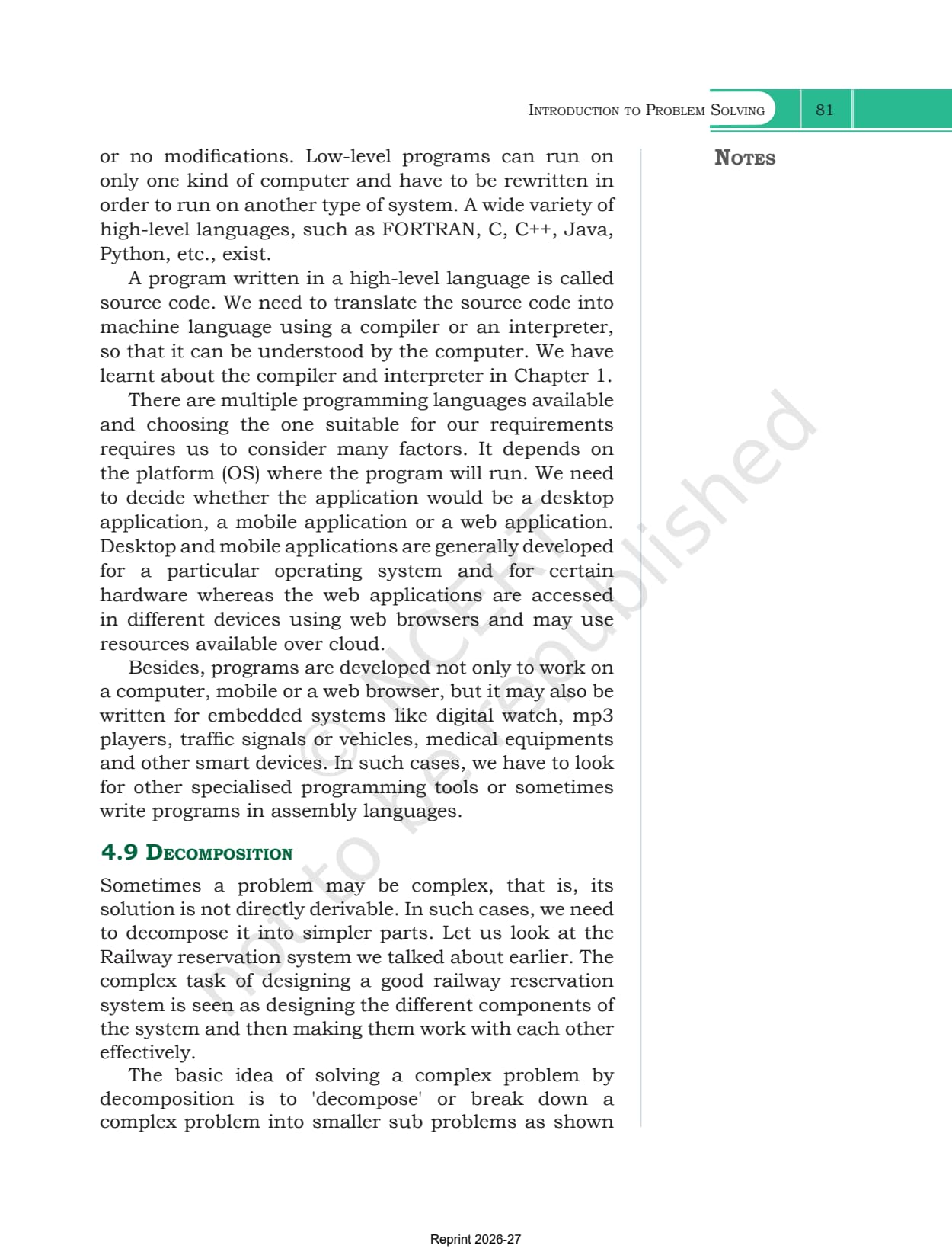
- Chapter: Chapter 4, Introduction to Problem Solving
- Book: Computer Science, the Class 11 NCERT textbook for 2026-27, 11 chapters
- File: 26 pages, printed pages 61 to 86, the complete official chapter
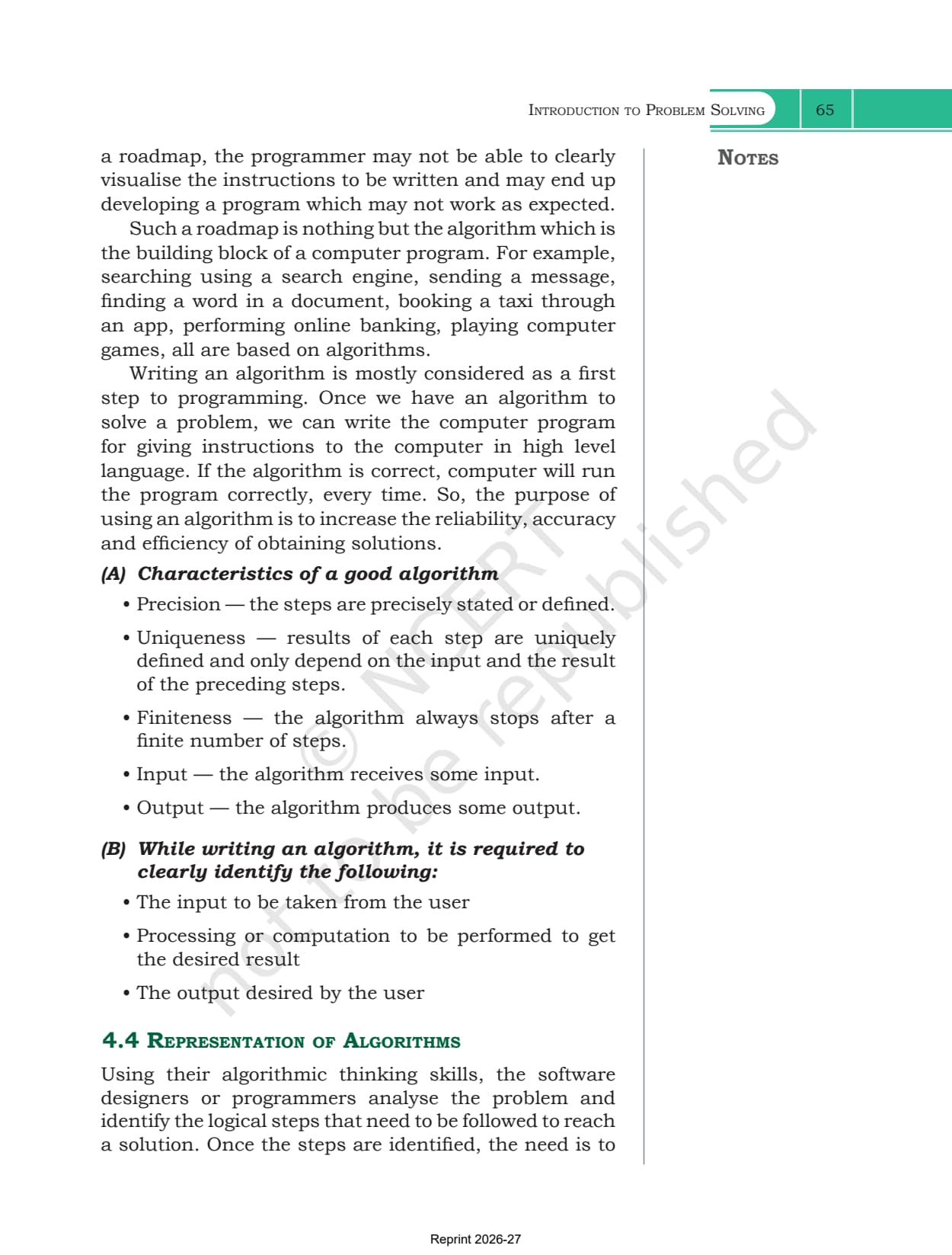
You can page through the flowchart figures, pseudocode blocks and exercise set in the viewer above before downloading.
This is the official NCERT chapter file for the 2026-27 session, hosted by Collegedunia with no pages removed.
How the Introduction to Problem Solving Chapter Is Laid Out
The chapter opens with a line from A. Aho and J. Ullman calling computer science a science of abstraction, then works through nine sections in this order.
| Section | What it covers |
|---|---|
| 4.1 Introduction | the railway reservation example, and why a computer needs precise instructions |
| 4.2 Steps for Problem Solving | analysing, developing an algorithm, coding, testing and debugging |
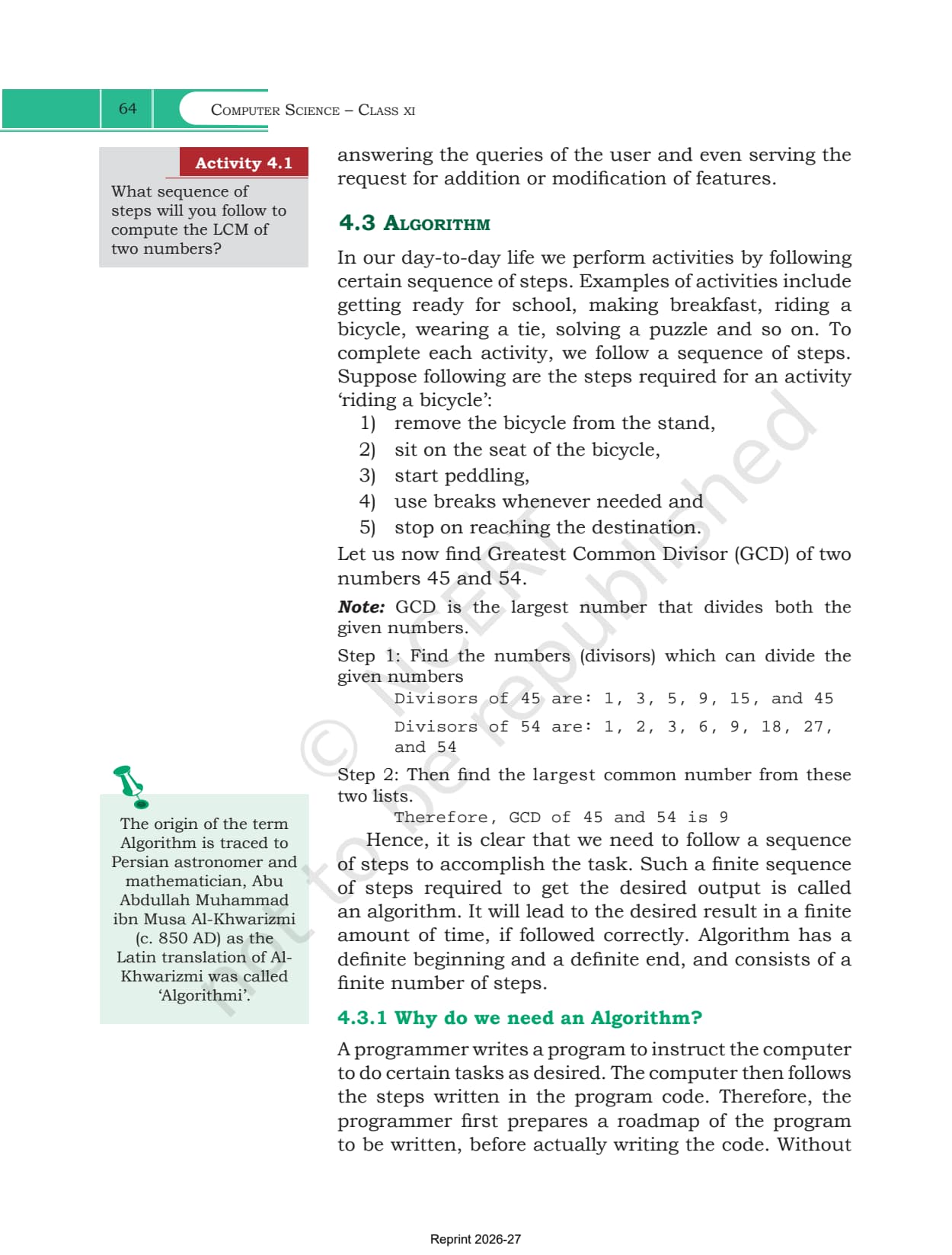
| 4.3 Algorithm | the definition, the GCD of 45 and 54 walkthrough, five characteristics |
| 4.4 Representation of Algorithms | flowcharts with the symbol table, and pseudocode with its keyword list |
| 4.5 Flow of Control | sequence, selection and repetition, with five worked examples |
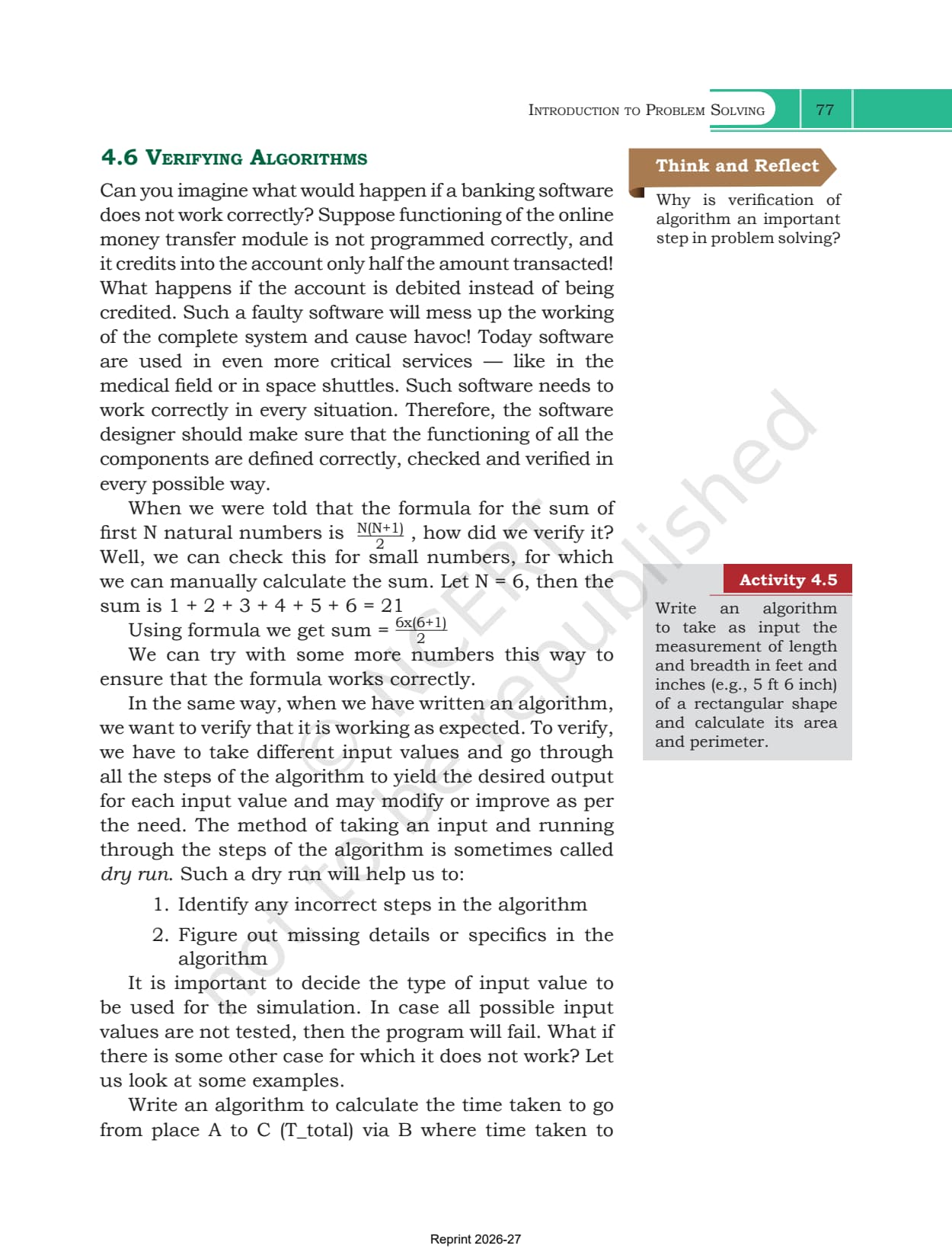
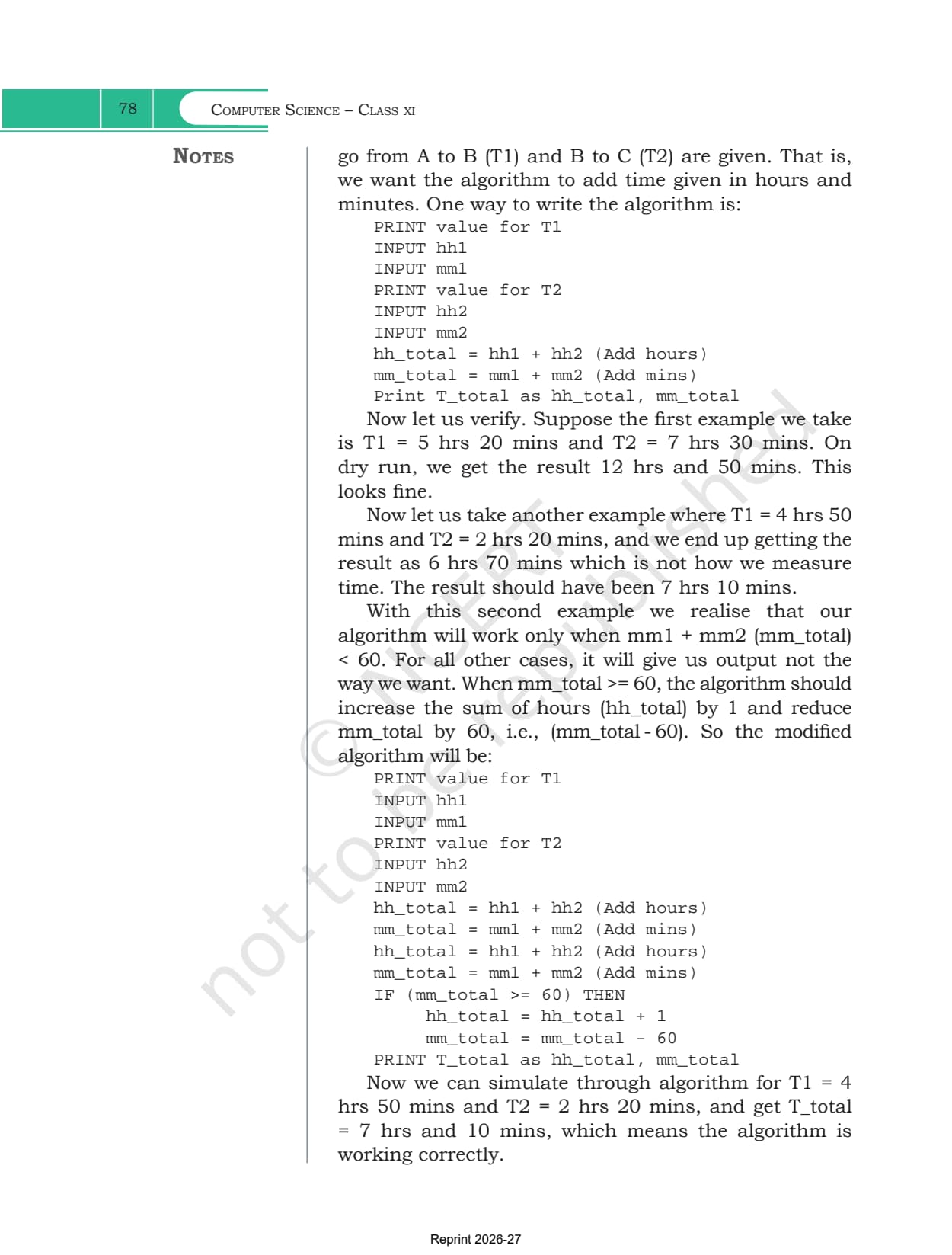
| 4.6 Verifying Algorithms | the dry run method, shown on an hours and minutes addition that fails |
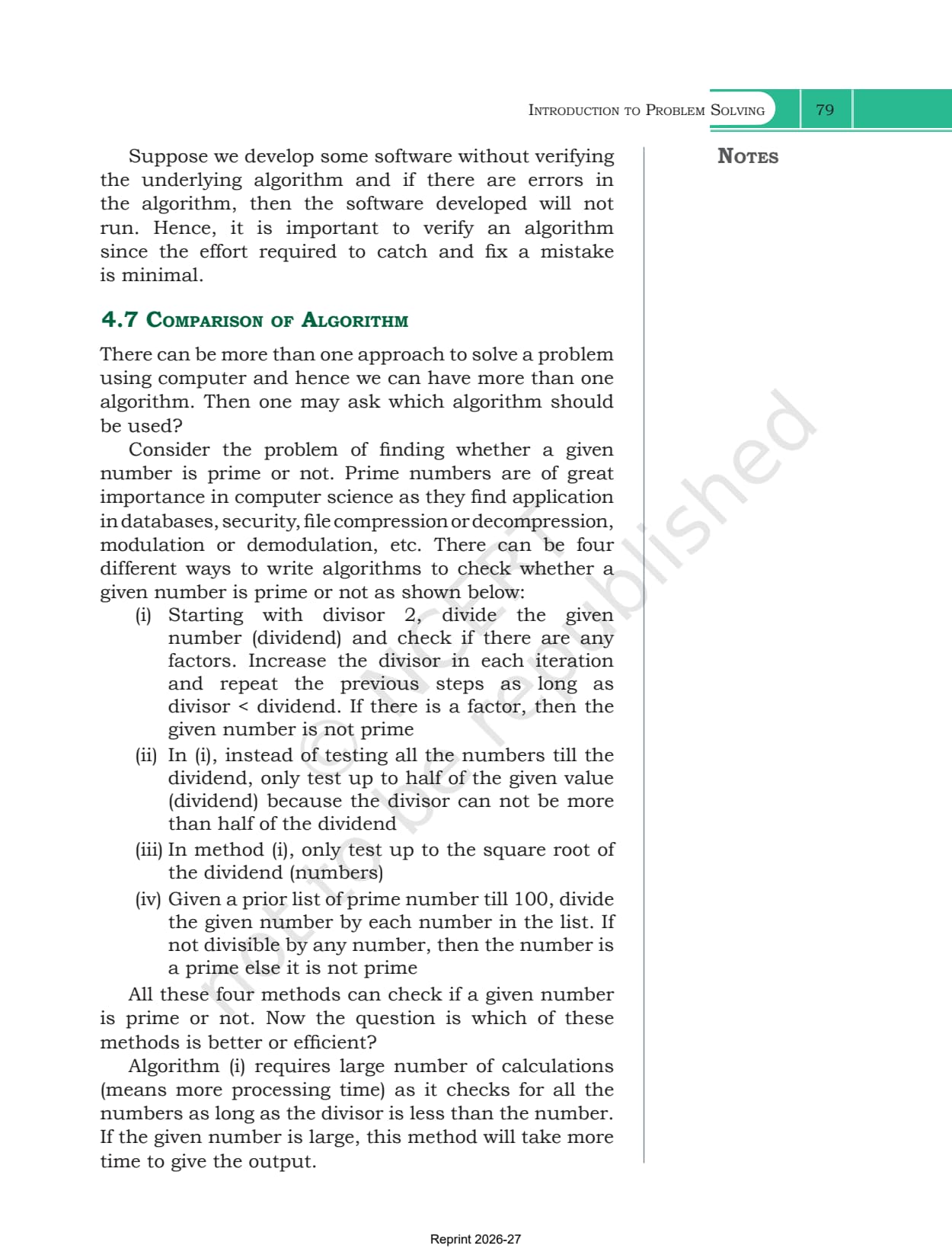
| 4.7 Comparison of Algorithm | four prime tests compared on time complexity and space complexity |
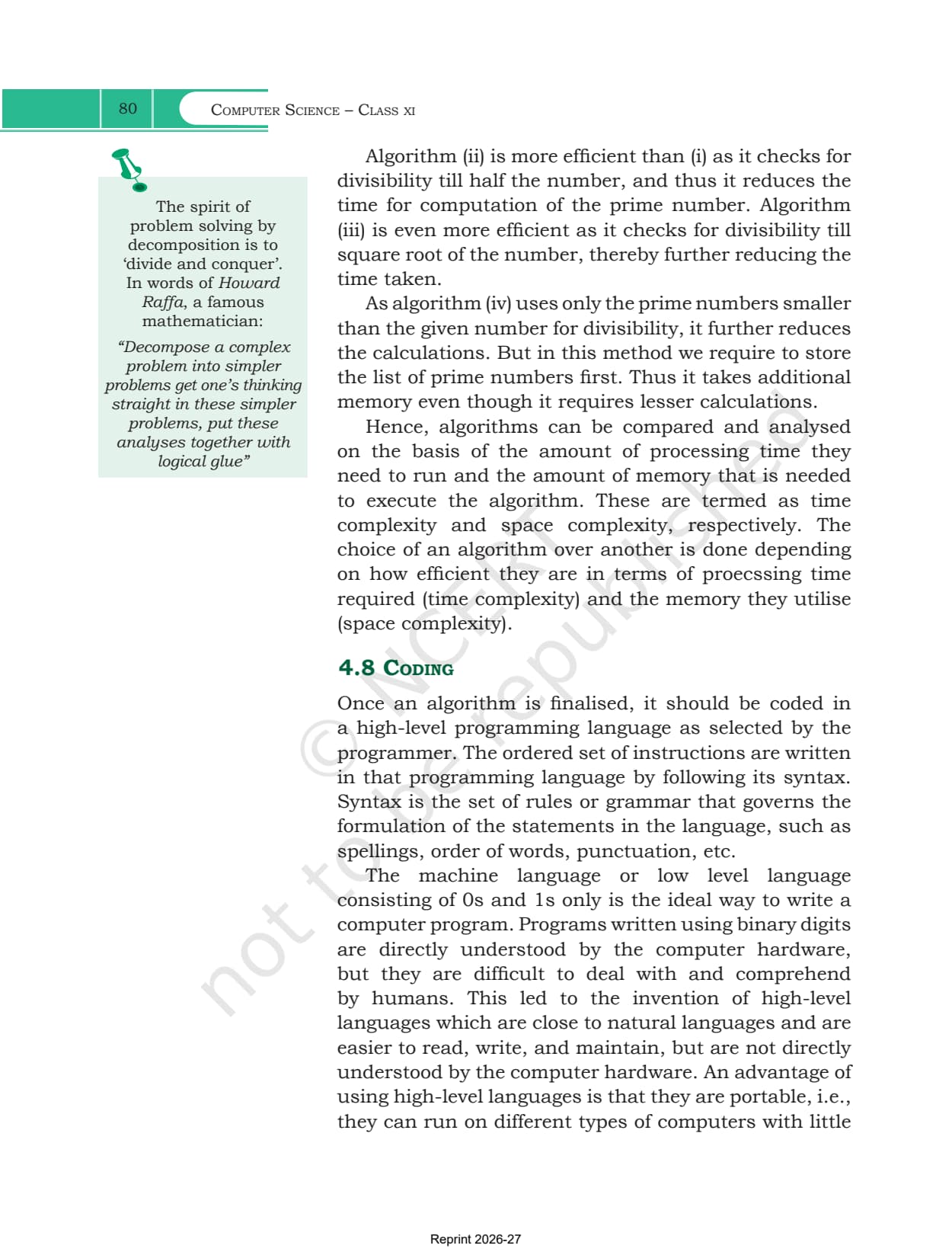
| 4.8 Coding | syntax, low level versus high level languages, and source code |
| 4.9 Decomposition | breaking a complex problem into sub problems |
| Summary and Exercise | a ten point recap followed by 18 exercise questions |
What the Introduction to Problem Solving Chapter PDF Contains
The PDF holds the whole chapter as NCERT printed it, with nothing trimmed.
- All nine sections in full, from the railway booking opener to Figure 4.12
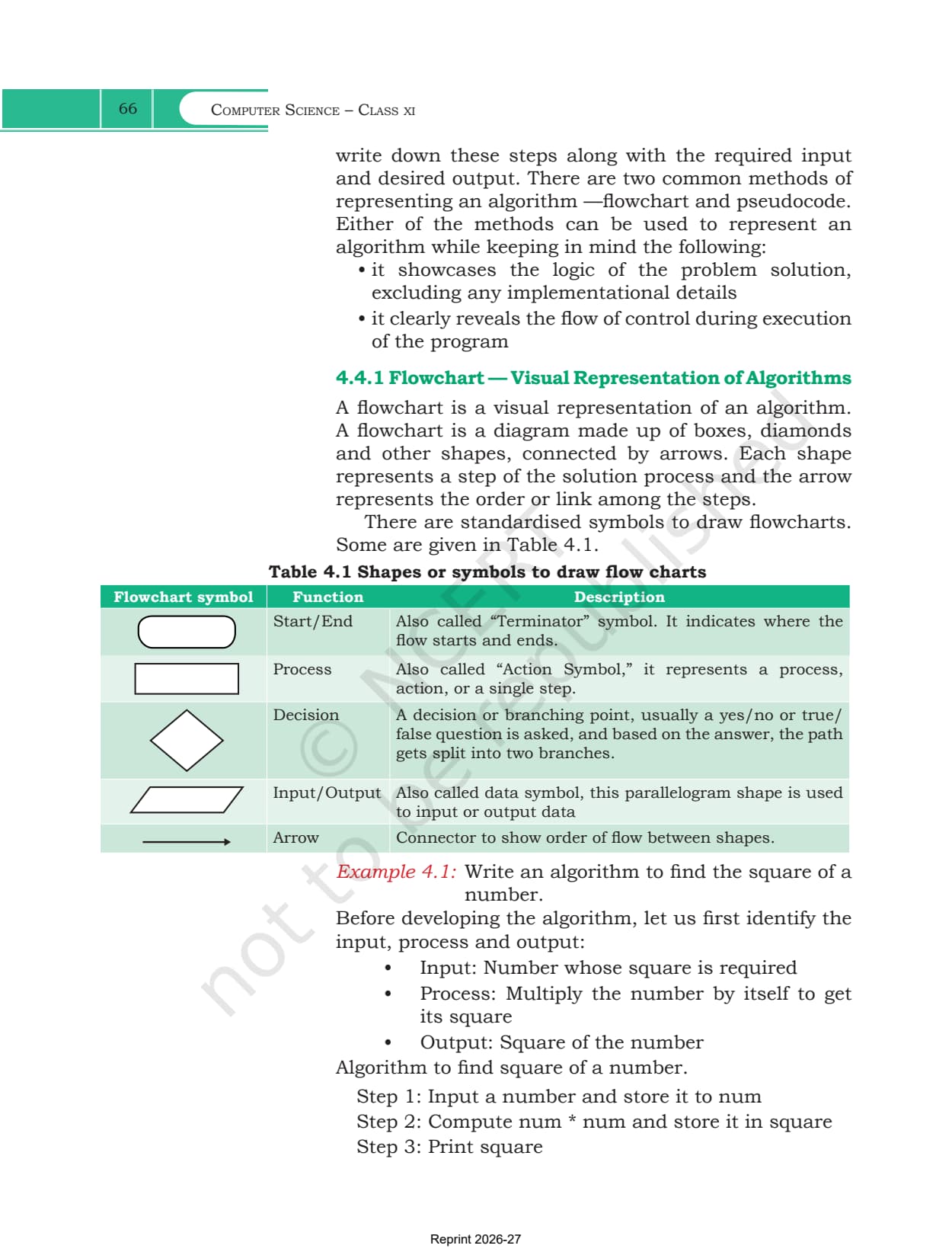
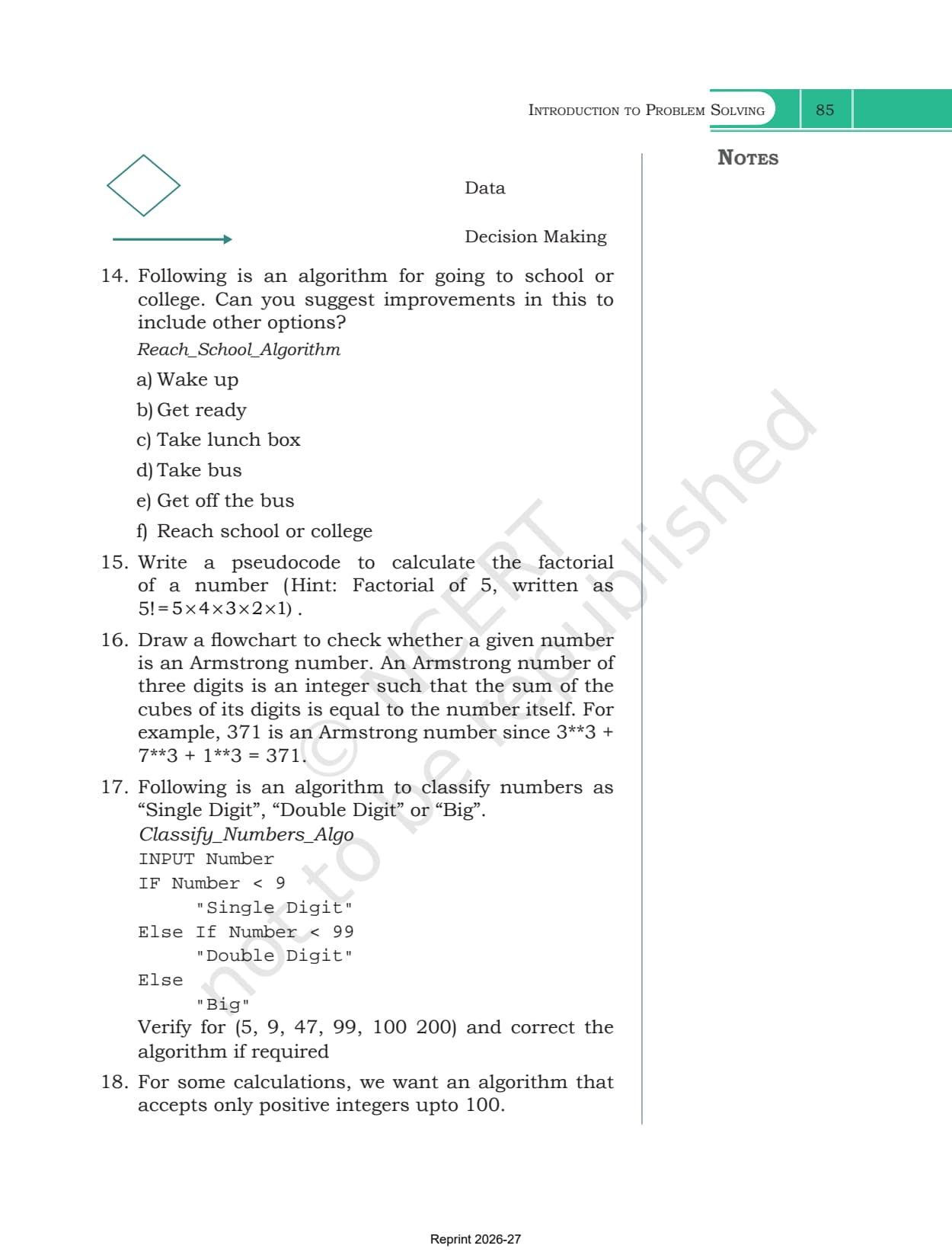
- Table 4.1, the flowchart symbol reference, with each shape beside its function
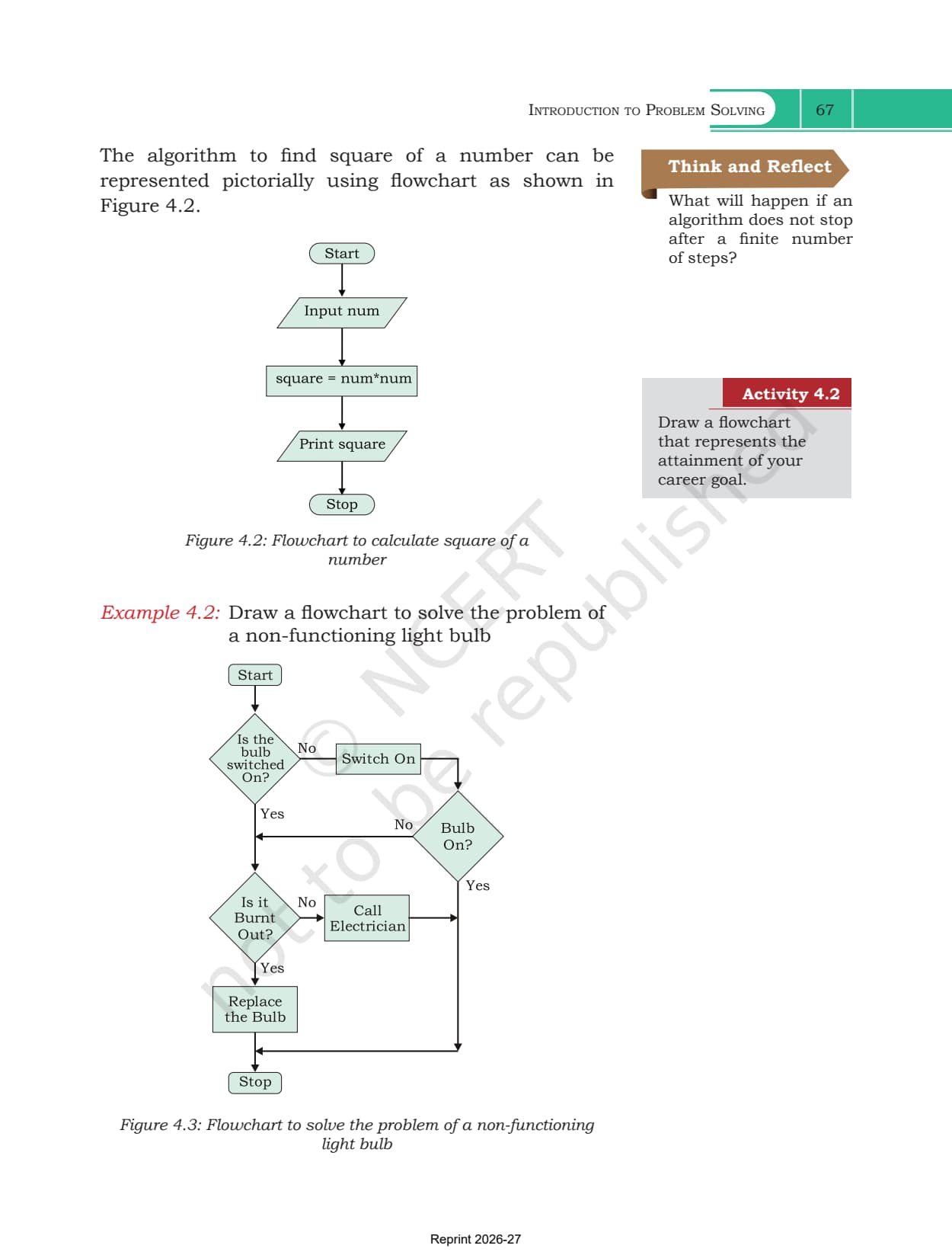
- Twelve numbered figures, including the flowcharts for a non-functioning light bulb and the average of five numbers
- The GIGO side box, and the note tracing the word algorithm to Al-Khwarizmi around 850 AD
- Activities 4.1 to 4.5 and the Think and Reflect prompts
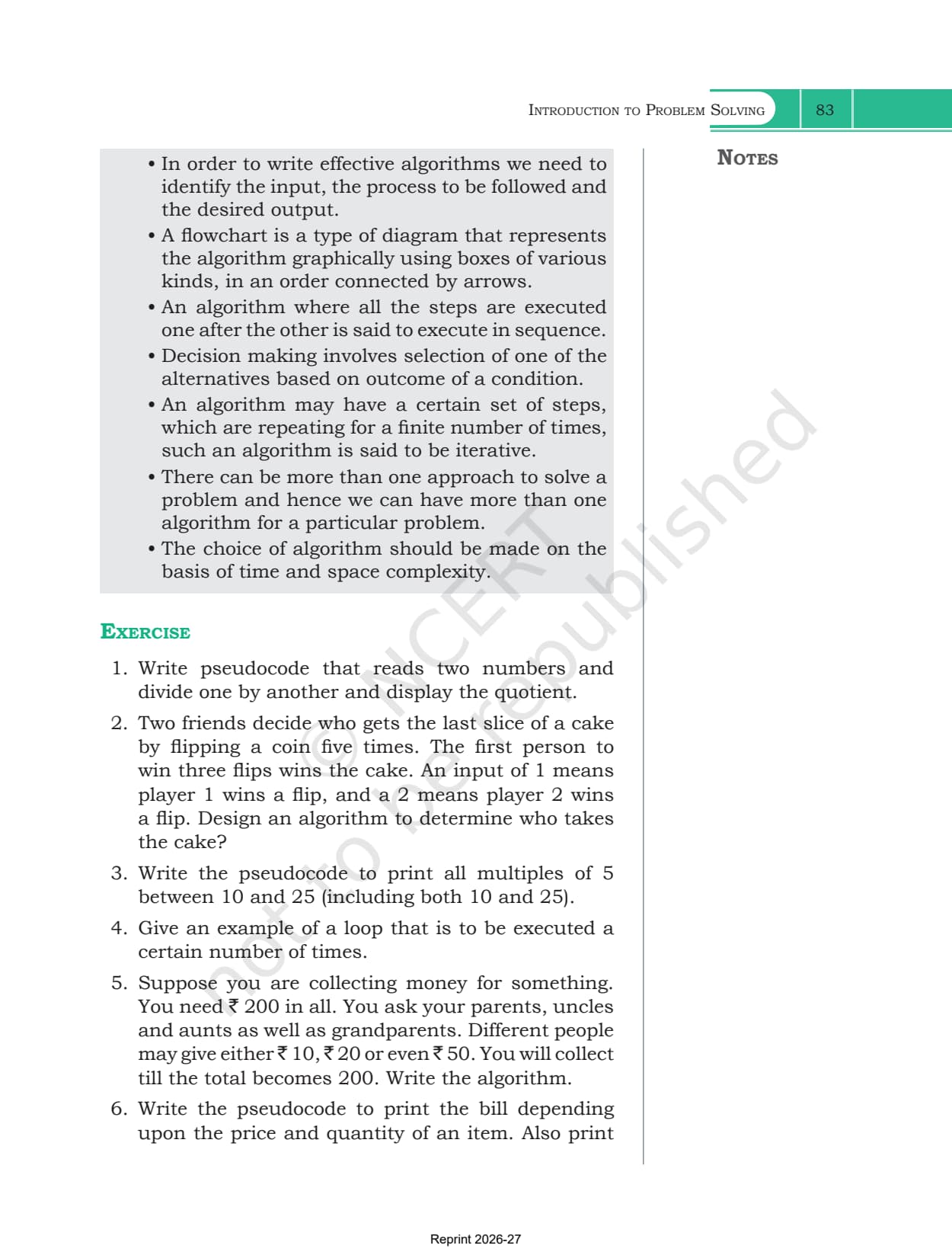
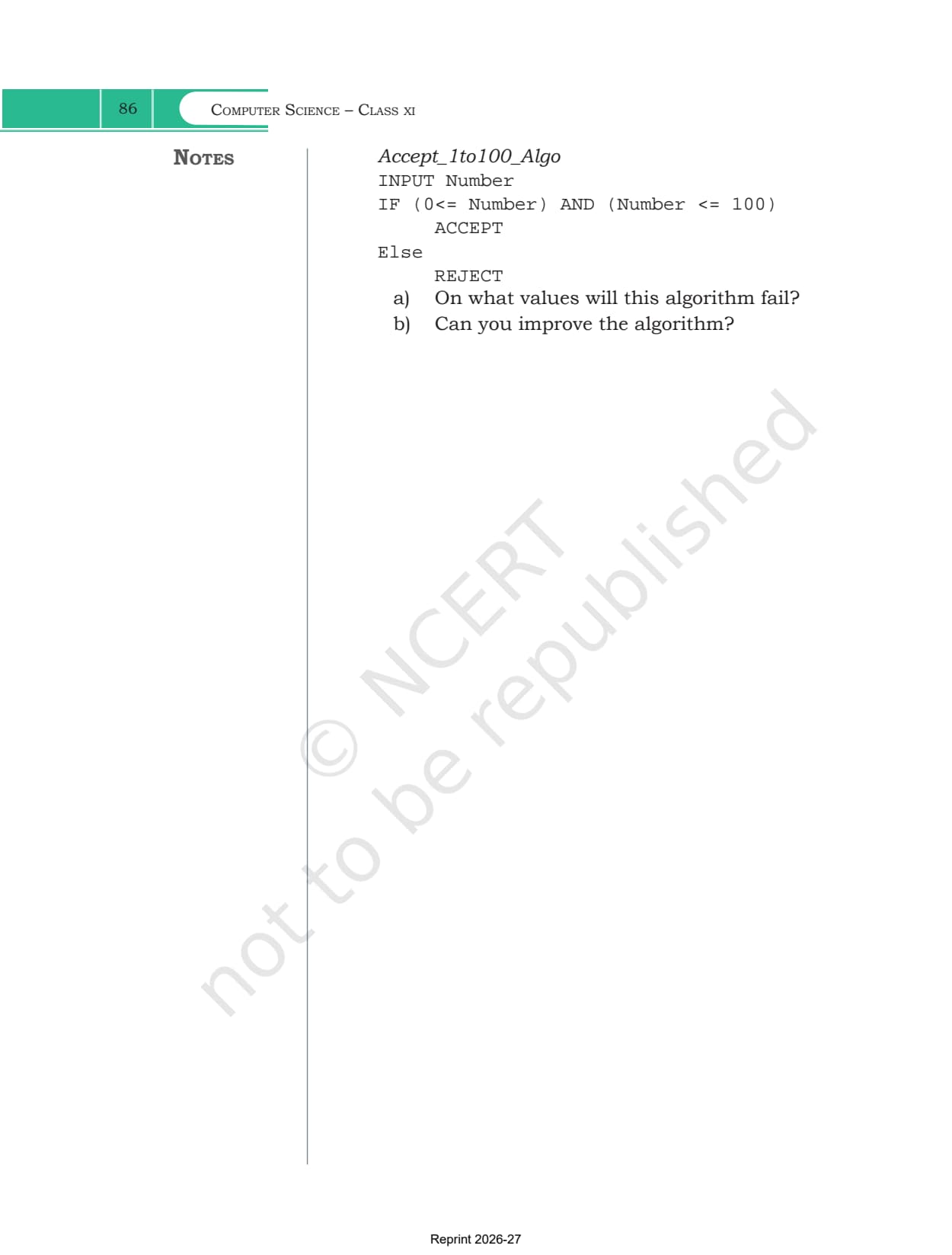
- The Summary page and all 18 exercise questions, including the Armstrong number flowchart
Introduction to Problem Solving Chapter Overview
Source: Magnet Brains on YouTube
The Four Steps of the Problem Solving Cycle
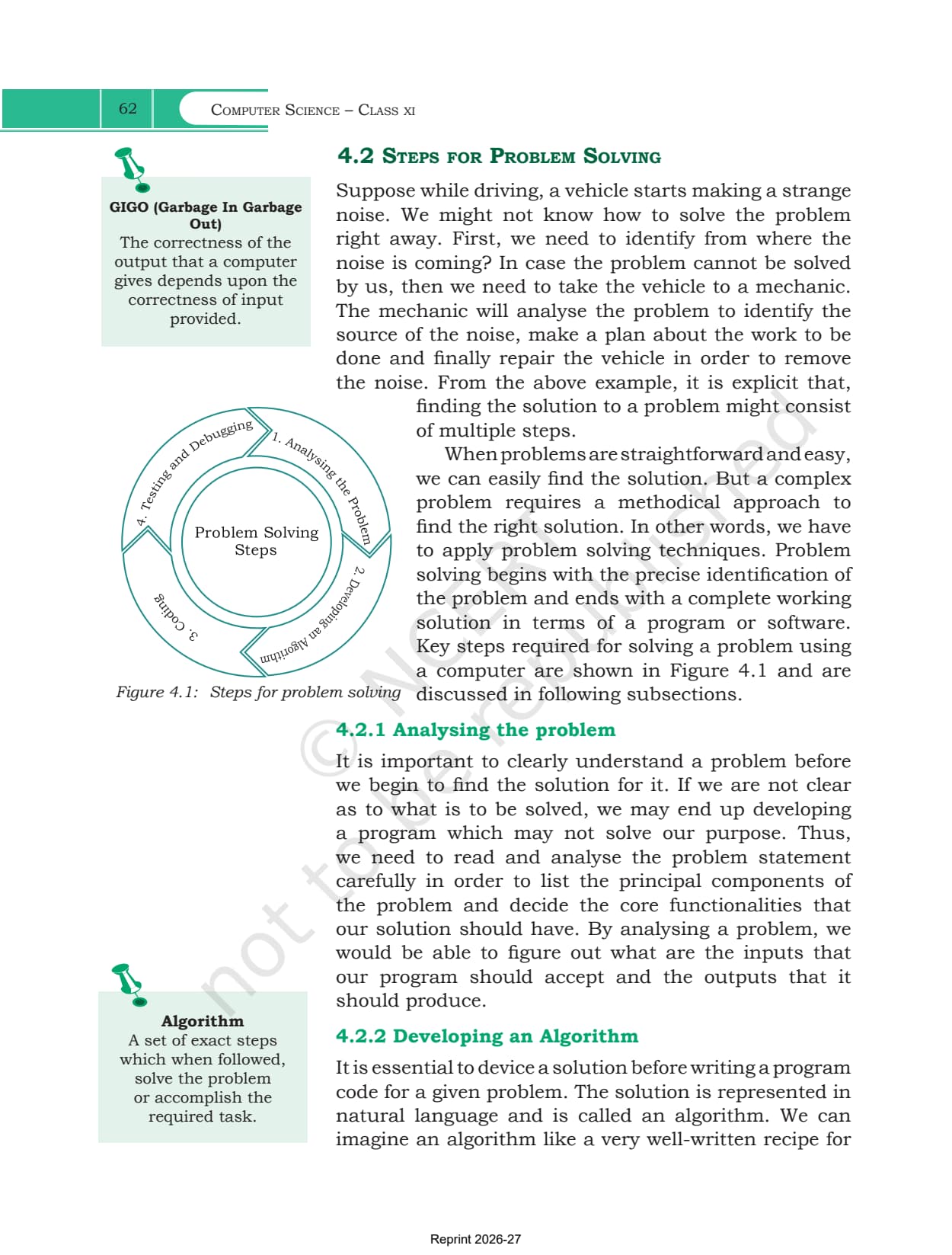
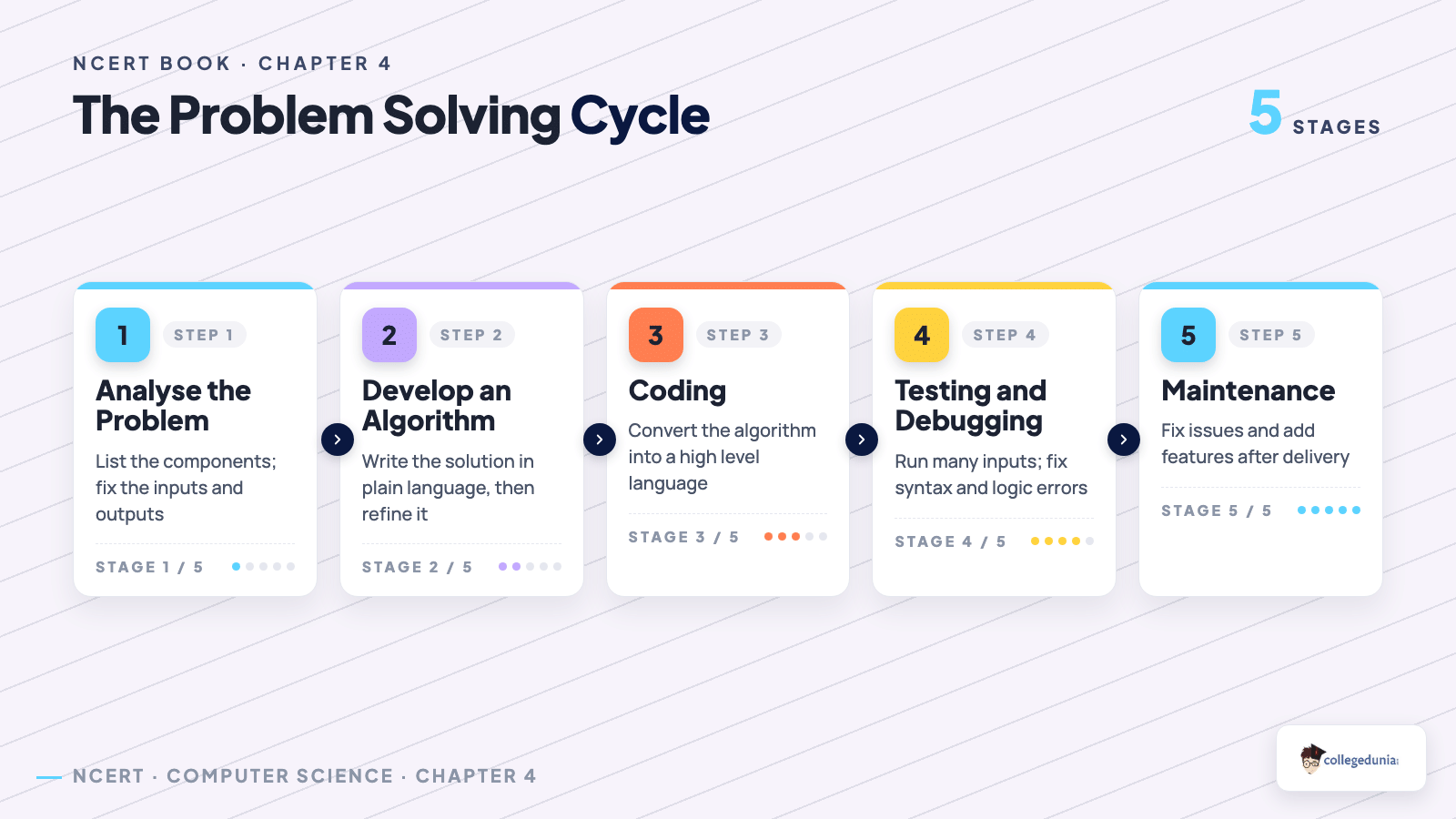
Section 4.2 is the spine of the chapter. Four steps run from a problem statement to a working program, and Figure 4.1 shows them as a cycle.
| Step | What you actually do |
|---|---|
| Analysing the problem | list the principal components, and settle what the inputs and outputs will be |
| Developing an algorithm | write the solution in natural language, then refine it until it covers the whole result |
| Coding | convert the algorithm into a high level language, following its syntax, and document it |
| Testing and debugging | run it on many inputs, fix syntactical and logical errors, then retest |
It names unit, integration, system and acceptance testing as the standard industry stages, and notes that maintenance continues after delivery.
Flowchart Symbols and Pseudocode Explained
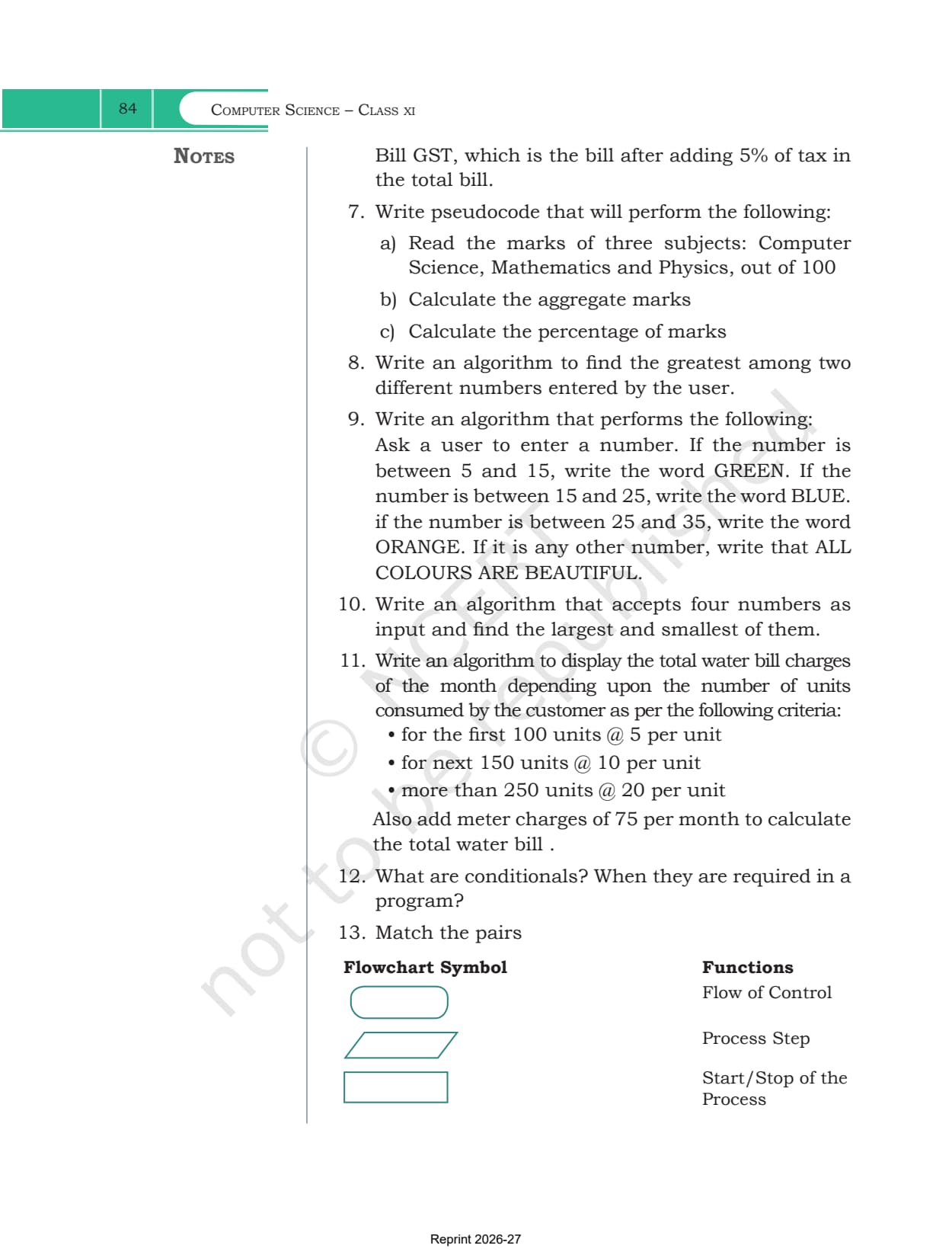
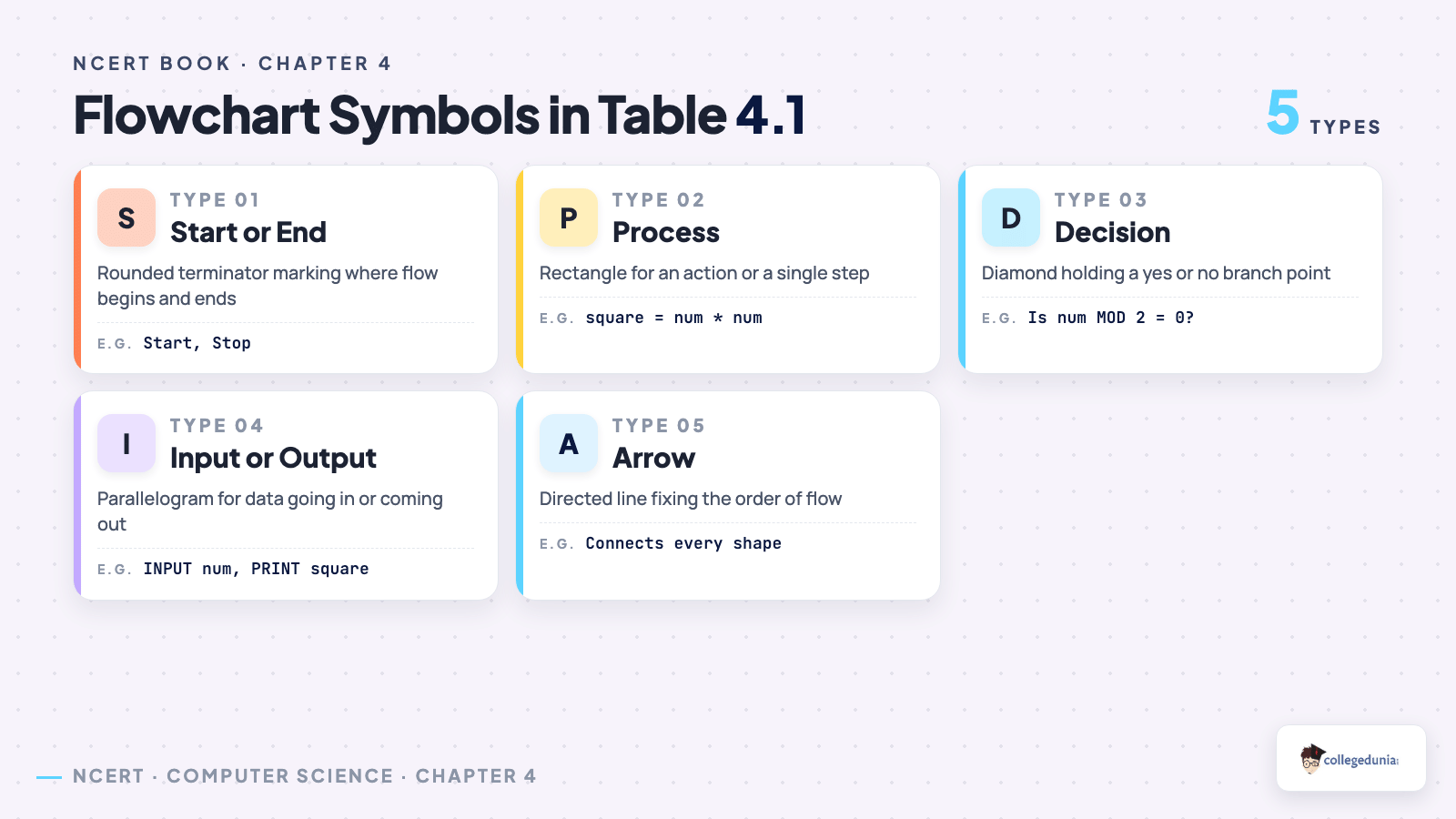
Section 4.4 gives two ways to write an algorithm down. Both show the logic and flow of control while leaving out implementation detail. Table 4.1 is the symbol reference the exercise asks you to reproduce.
| Symbol | Shape | What it marks |
|---|---|---|
| Start or End | rounded terminator | where the flow starts and ends |
| Process | rectangle | an action or single step, also called the action symbol |
| Decision | diamond | a yes or no branching point that splits the path in two |
| Input or Output | parallelogram | data going in or coming out, also called the data symbol |
| Arrow | directed line | the connector fixing the order of flow between shapes |
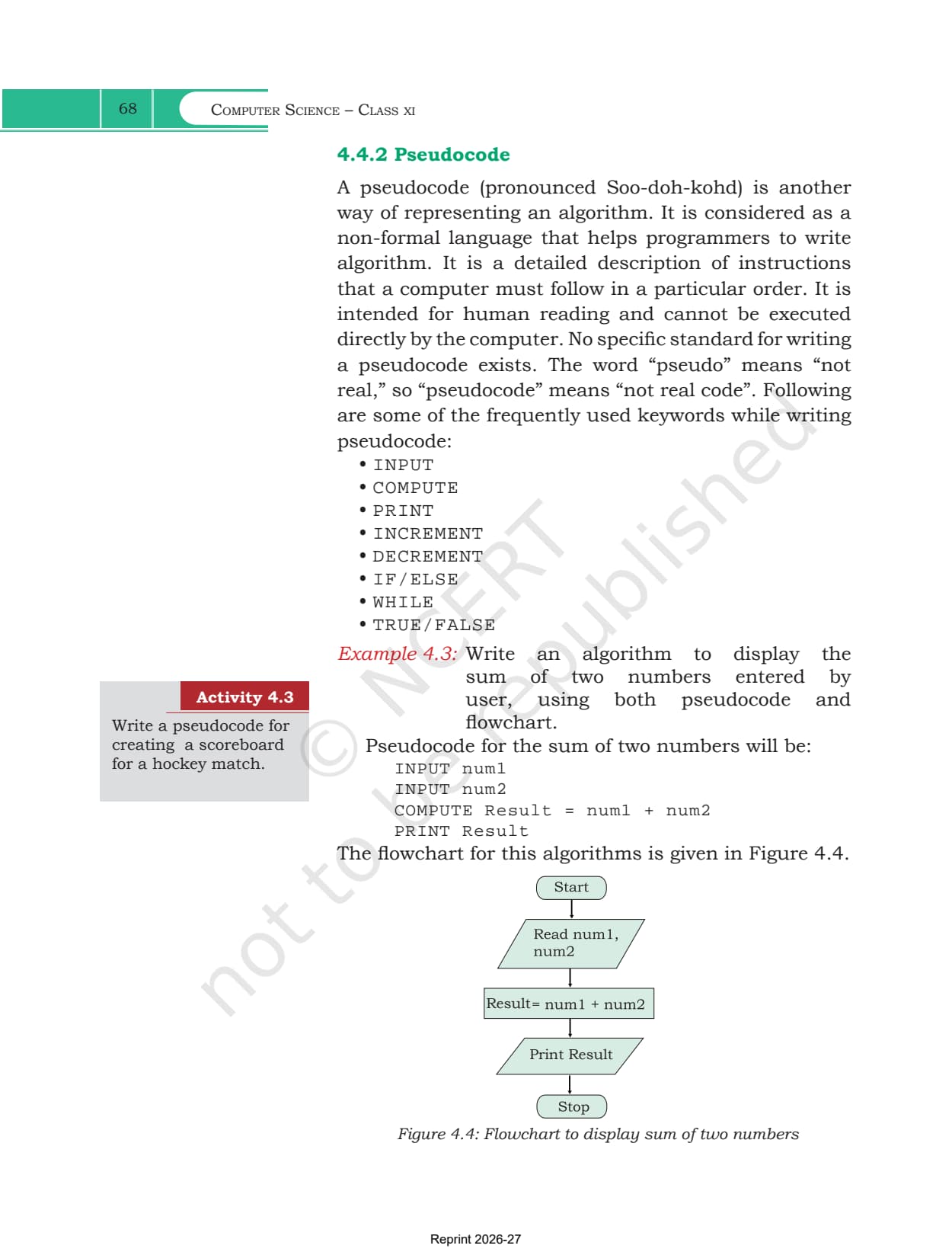
Pseudocode is the second route, a non-formal language meant for humans and not executable by a computer. No single standard exists for it, and the keywords used throughout are INPUT, COMPUTE, PRINT, INCREMENT, DECREMENT, IF/ELSE, WHILE and TRUE/FALSE.
Flow of Control: Sequence, Selection and Repetition
Section 4.5 holds the longest stretch of worked examples, and most exercise questions draw on it. Three patterns appear, each with pseudocode and a flowchart.
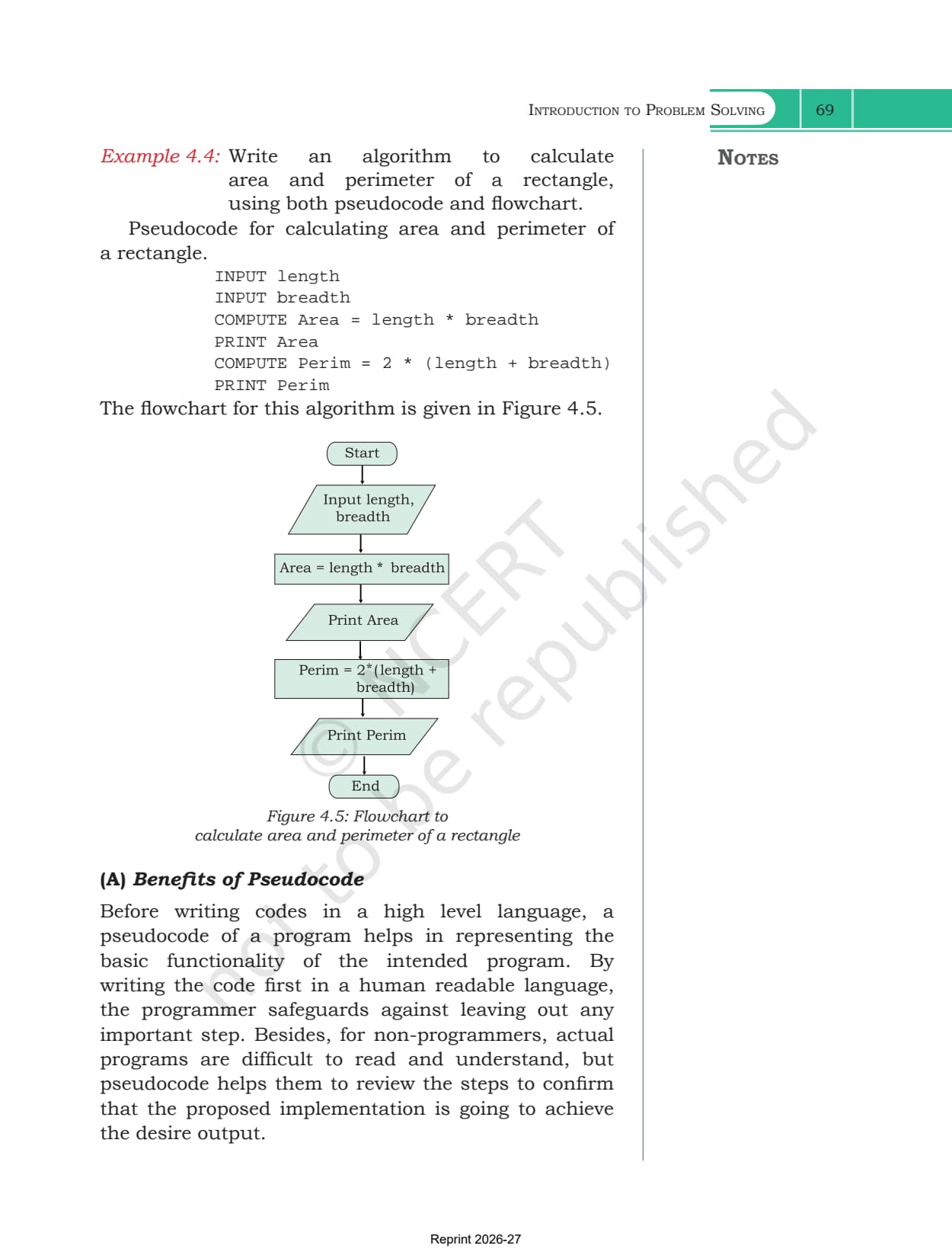
- Sequence: steps run one after another. Example 4.3 sums two numbers, Example 4.4 finds the area and perimeter of a rectangle
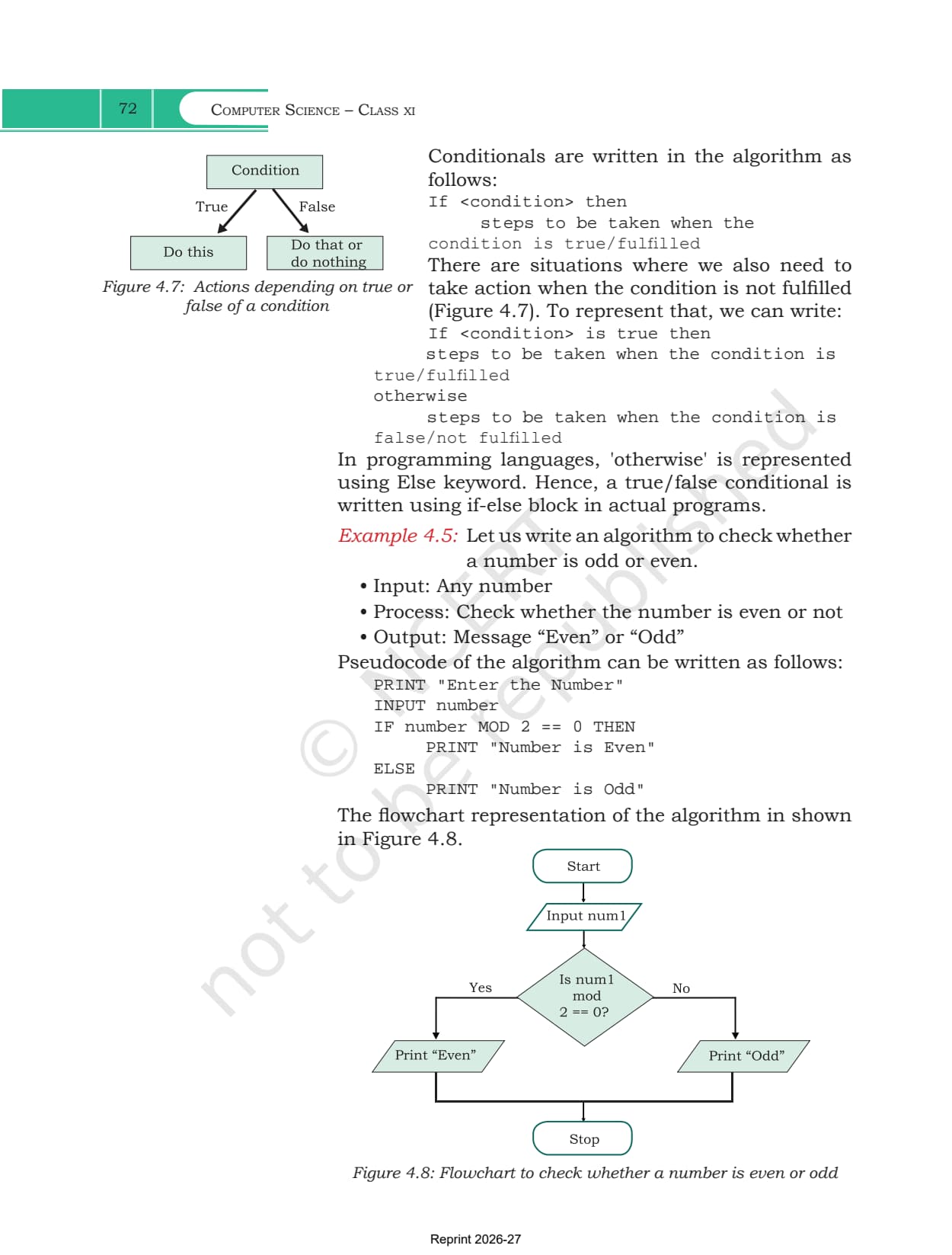
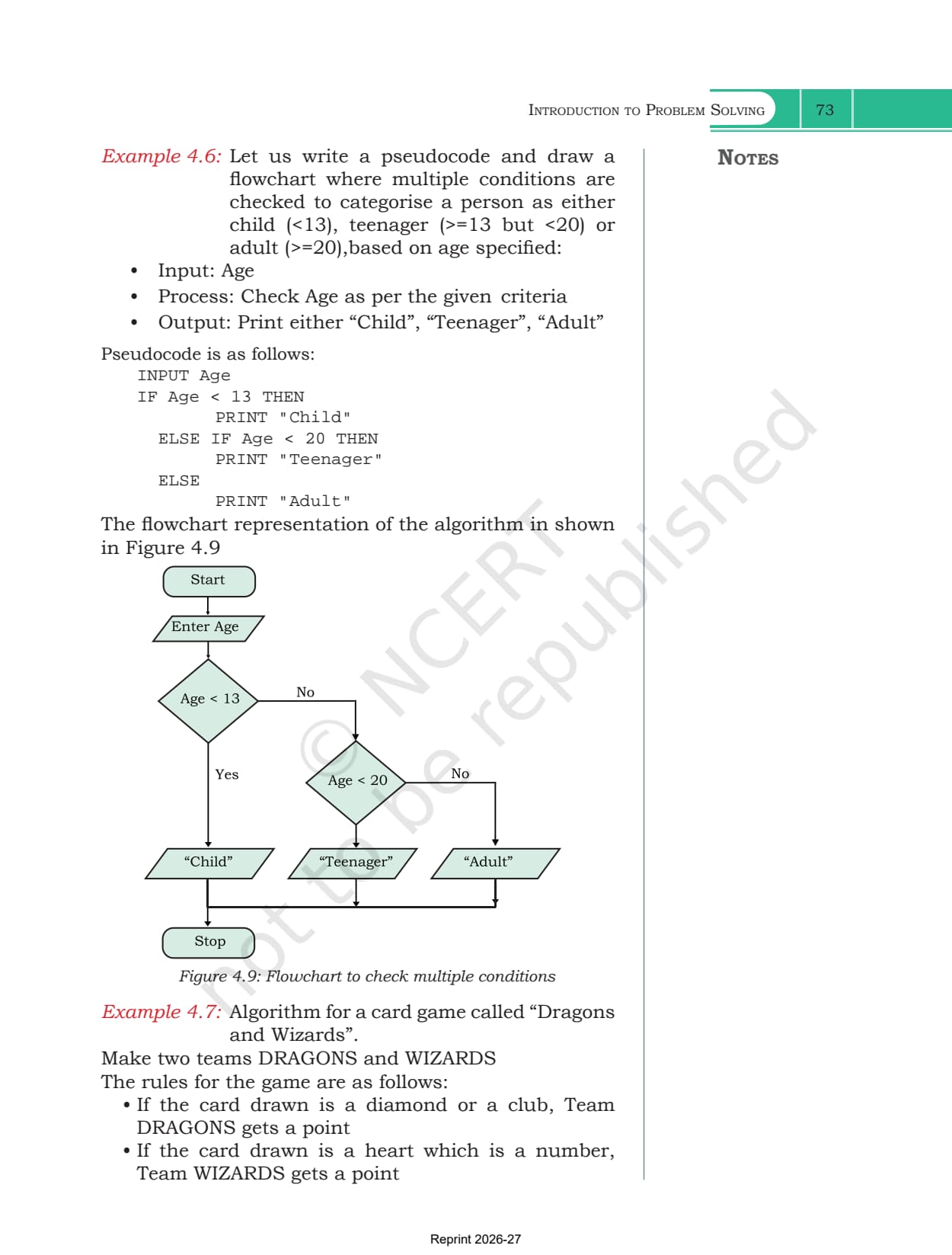
- Selection: a condition picks an alternative. Example 4.5 tests odd or even with number MOD 2, Example 4.6 sorts an age into child, teenager or adult with an ELSE IF ladder
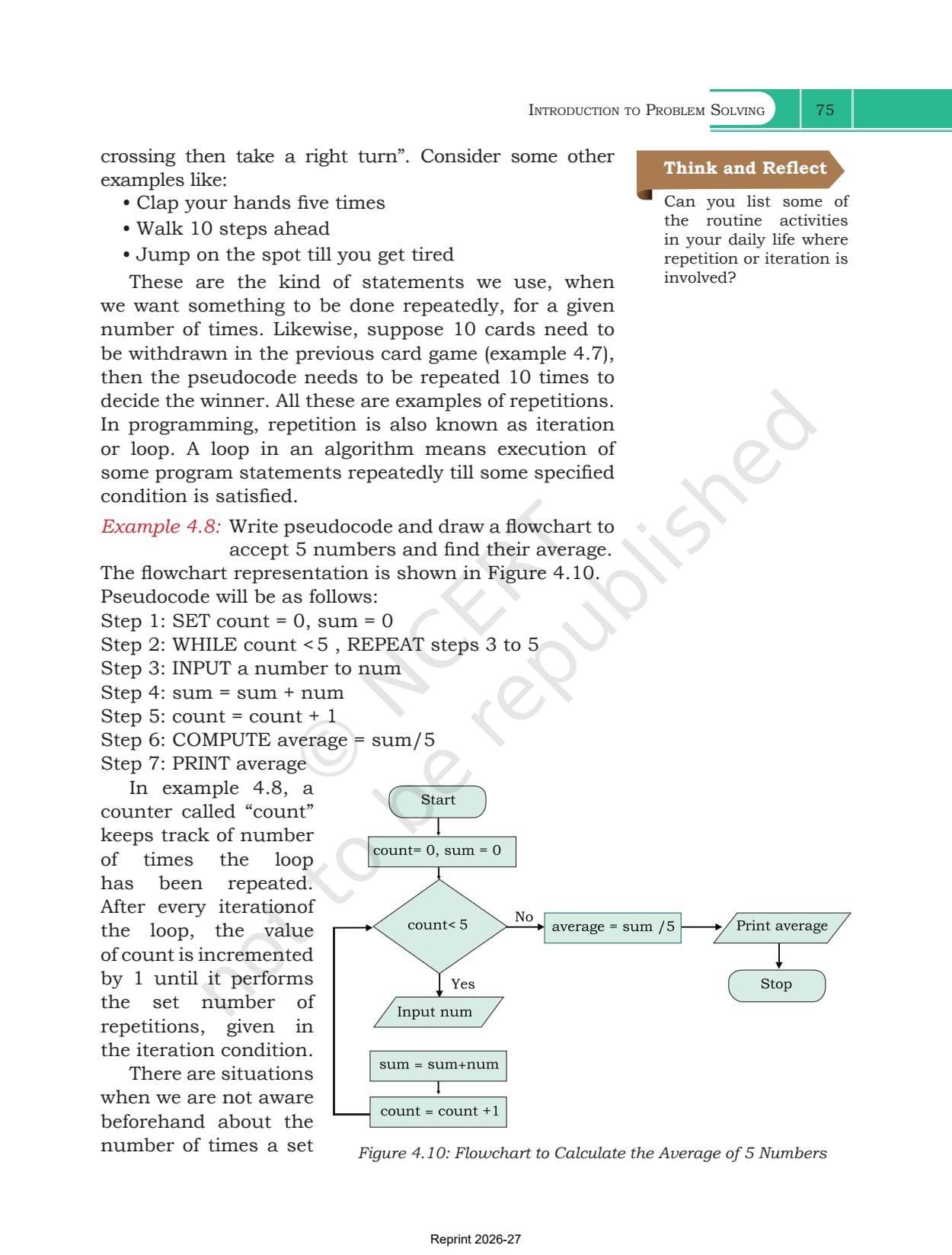
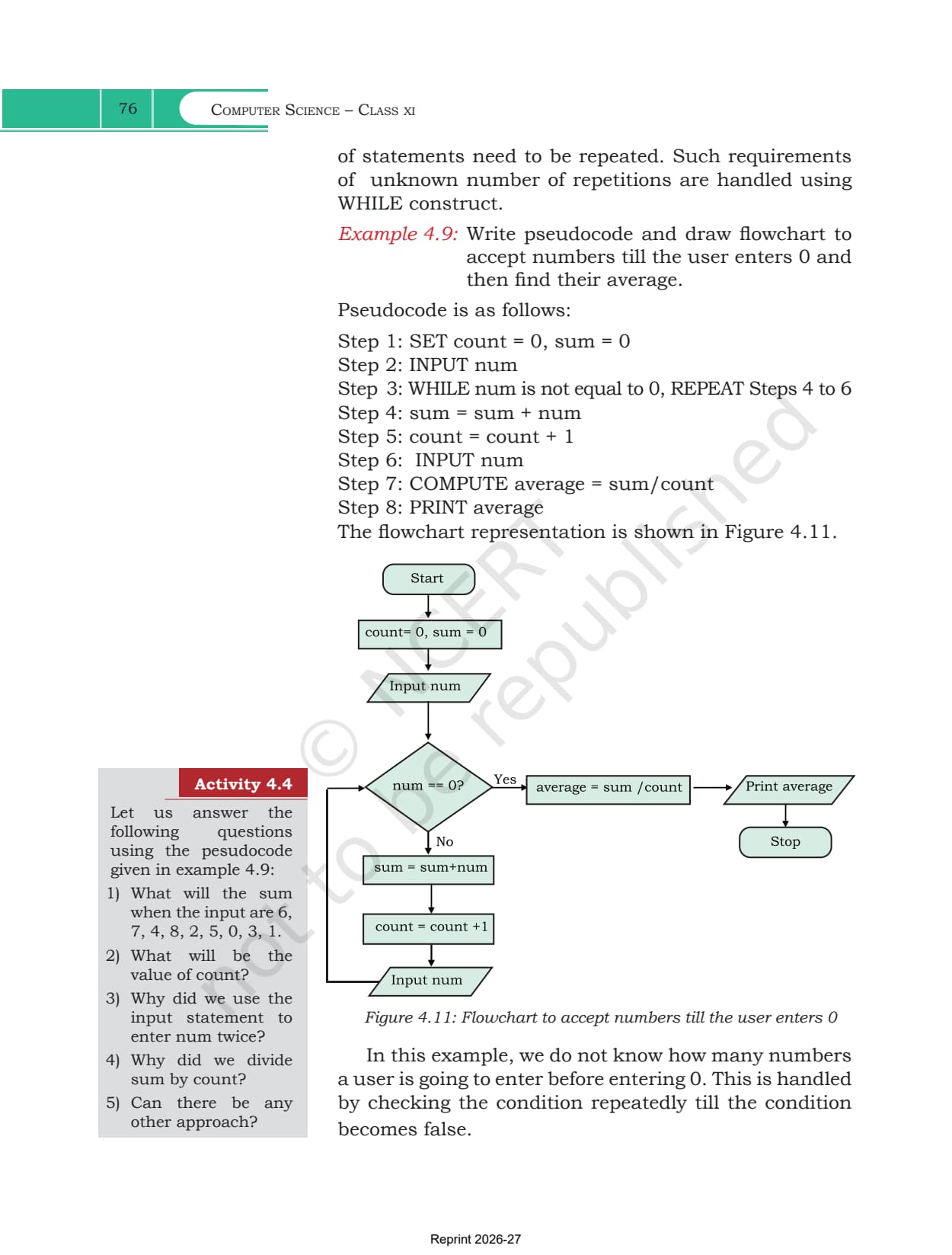
- Repetition: a block runs again until a condition holds. Example 4.8 counts to five, Example 4.9 uses WHILE until the user enters 0
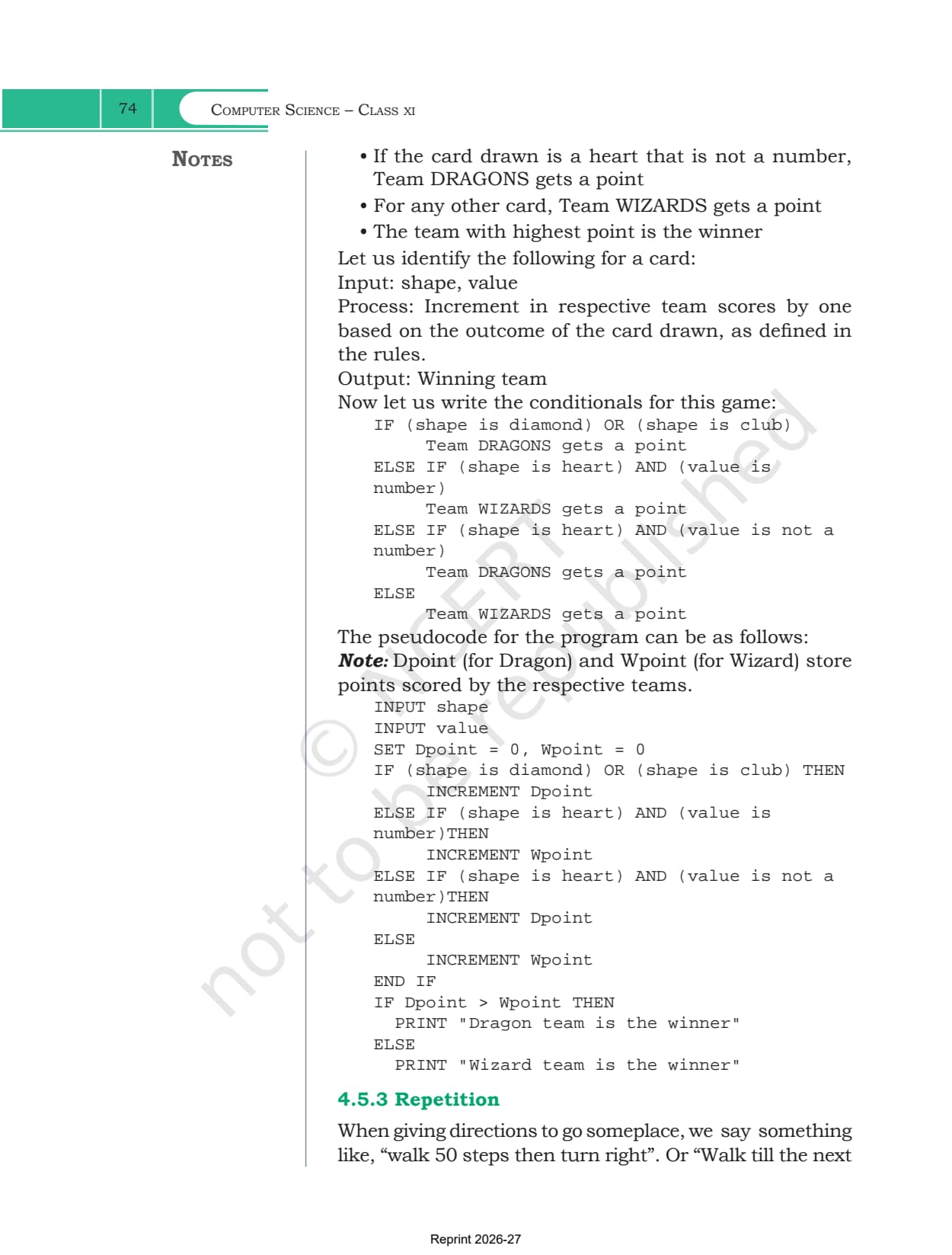
- The Dragons and Wizards card game in Example 4.7 is the one to study hardest, since it combines OR and AND in one conditional chain and compares two running scores
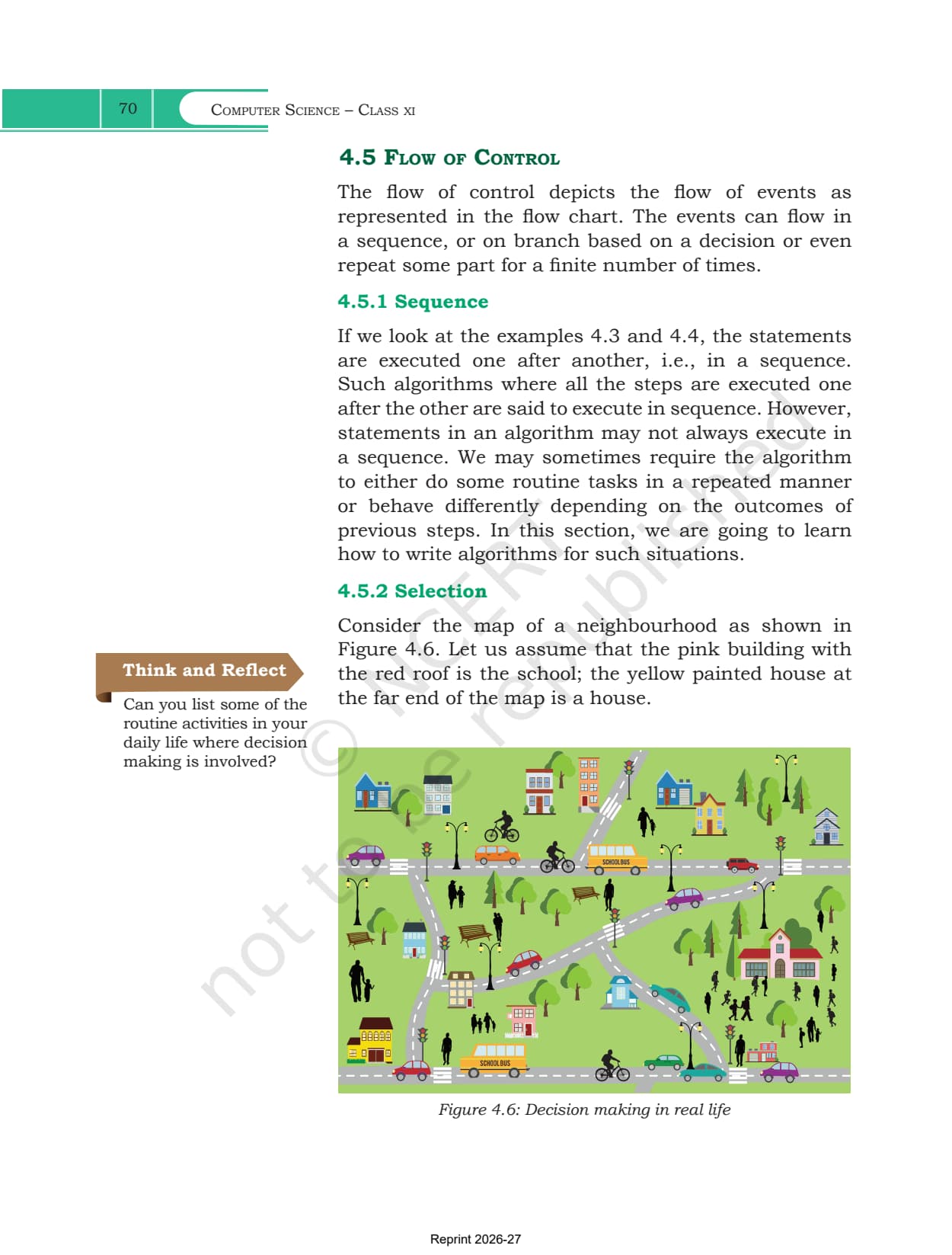
- The neighbourhood map in Figure 4.6 and the voting eligibility test set this up before any pseudocode appears
Verifying, Comparing and Decomposing
The last three sections are short but carry real exam weight, and are skipped most often.
- Verifying (4.6): a dry run walks one input through every step by hand. The chapter adds 4 hours 50 minutes to 2 hours 20 minutes, gets an impossible 6 hours 70 minutes, and fixes it with an IF that carries over at 60
- Comparing (4.7): four prime checks are ranked, testing up to the number, up to half of it, up to its square root, and against a stored list. The last needs fewer calculations but extra memory, which introduces time complexity and space complexity
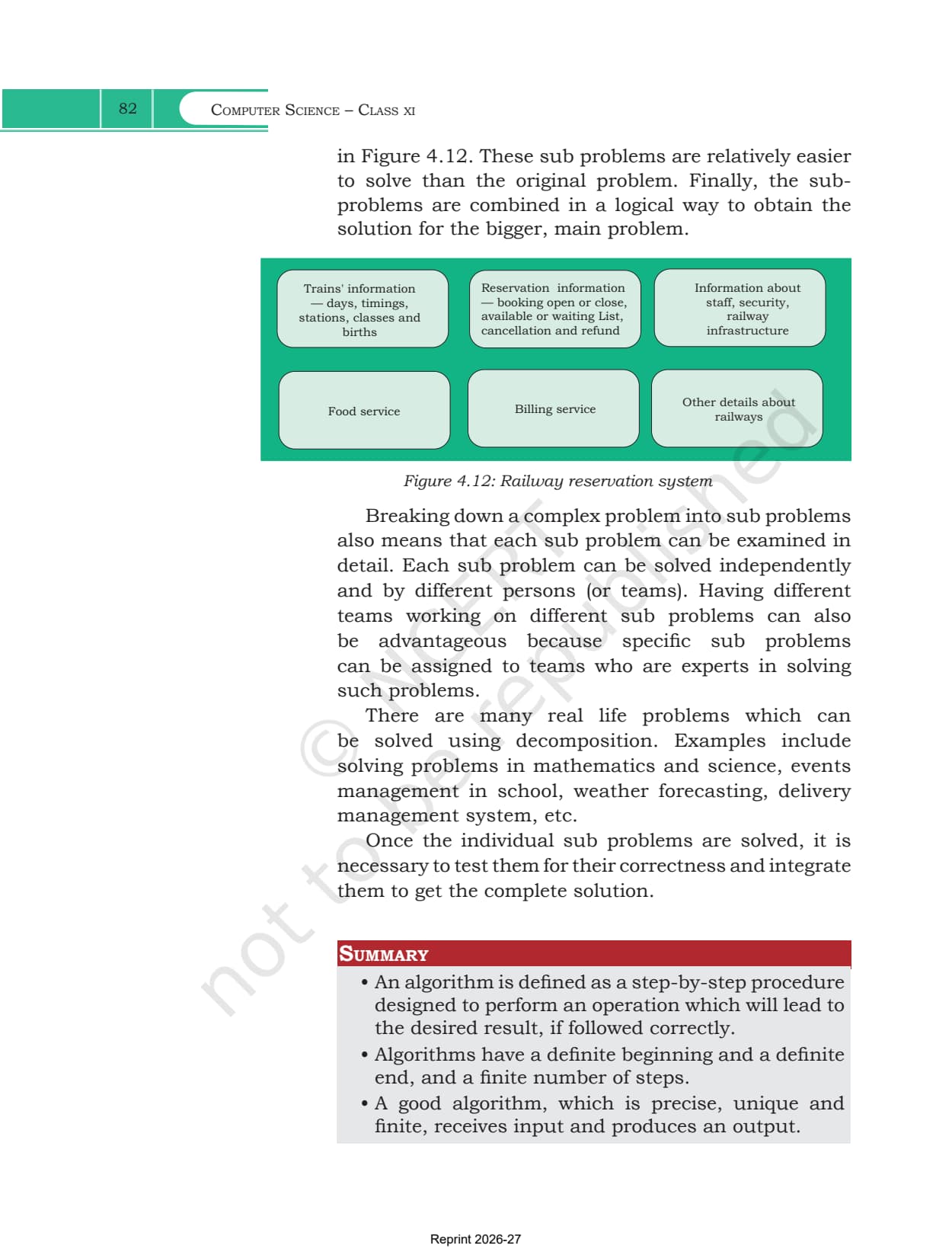
- Decomposition (4.9): the railway reservation system splits into train details, reservation details, billing, food service, staff and infrastructure, so separate teams solve separate sub problems
Section 4.8 sits between them, explaining why high level languages such as FORTRAN, C, C++, Java and Python exist, plus source code, compiler and interpreter.
What Collegedunia Adds to This Chapter PDF
Collegedunia gives students the file plus a way into it. The chapter PDF is the official NCERT file, untouched.
- Official file: the exact NCERT chapter PDF, with no pages removed
- Read in the browser: page through all 26 pages before downloading
- Chapter list: jump to any other chapter of the book from one table
- Study material: notes and solutions for the same chapter where available
Also Check: the other Class 11 Computer Science resources for this chapter.
| Resource | Link |
|---|---|
| Handwritten notes | Introduction to Problem Solving Class 11 Handwritten Notes |
| Chapter notes | Introduction to Problem Solving Class 11 Notes (coming soon) |
| Chapter solutions | Introduction to Problem Solving Class 11 NCERT Solutions (coming soon) |
| Previous chapter handwritten notes | Emerging Trends Class 11 Handwritten Notes |
| Next chapter handwritten notes | Getting Started with Python Class 11 Handwritten Notes |
Class 11 Computer Science NCERT Book PDF: All Chapters
Every chapter of the book is on its own page. The 2026-27 Class 11 Computer Science textbook has 11 chapters, moving from computer systems through problem solving into Python.
| Chapter | Download |
|---|---|
| Chapter 1 | Computer System NCERT Book PDF (coming soon) |
| Chapter 2 | Encoding Schemes and Number System NCERT Book PDF (coming soon) |
| Chapter 3 | Emerging Trends NCERT Book PDF (coming soon) |
| Chapter 4 | Introduction to Problem Solving NCERT Book PDF |
| Chapter 5 | Getting Started with Python NCERT Book PDF (coming soon) |
| Chapter 6 | Flow of Control NCERT Book PDF (coming soon) |
| Chapter 7 | Functions NCERT Book PDF (coming soon) |
| Chapter 8 | Strings NCERT Book PDF (coming soon) |
| Chapter 9 | Lists NCERT Book PDF (coming soon) |
| Chapter 10 | Tuples and Dictionaries NCERT Book PDF (coming soon) |
| Chapter 11 | Societal Impact NCERT Book PDF (coming soon) |
Introduction to Problem Solving Class 11 NCERT Book PDF FAQs
Common Student Questions on the Introduction to Problem Solving Chapter File
Ques. Where can I download the Class 11 Computer Science Chapter 4 NCERT Book PDF?
Ans. The official 26-page chapter file is on this page, free to download.
Ques. What are the four steps of problem solving in this chapter?
Ans. Analysing the problem, developing an algorithm, coding, and testing and debugging. Figure 4.1 shows them as a cycle.
Ques. How many pages is the Introduction to Problem Solving chapter?
Ans. 26 pages, printed pages 61 to 86 in the 2026-27 book, and this PDF is the complete chapter.
Ques. What is the difference between a flowchart and pseudocode?
Ans. A flowchart is visual, built from standard shapes joined by arrows. Pseudocode is written, using keywords like INPUT, COMPUTE, PRINT and WHILE. Both show the same logic, and neither runs directly on a computer.
Ques. What are the five characteristics of a good algorithm?
Ans. Precision, uniqueness, finiteness, input and output. Each result must depend only on the input and preceding steps, and the algorithm must stop after a finite number of steps.
Ques. What does a dry run mean in Section 4.6?
Ans. Taking a sample input through every step of the algorithm by hand to see whether it gives the expected output. It catches incorrect steps and missing details before any code is written.
Ques. Do I need to know Python before studying Chapter 4?
Ans. No. The chapter uses only pseudocode and flowcharts, so it is read before Chapter 5, Getting Started with Python.
Ques. Is this the official NCERT file?
Ans. Yes. It is the NCERT chapter PDF for 2026-27 hosted as published, with no pages removed or added.



Comments