




The NCERT Book for Class 10 Science Chapter 13 Our Environment is the official CBSE textbook chapter, free to read and download for the 2026-27 session. This chapter explains how an ecosystem works: its biotic and abiotic components, producers, consumers and decomposers, the food chain and food web, the flow of energy through trophic levels, and the two environmental problems of ozone layer depletion and waste management.
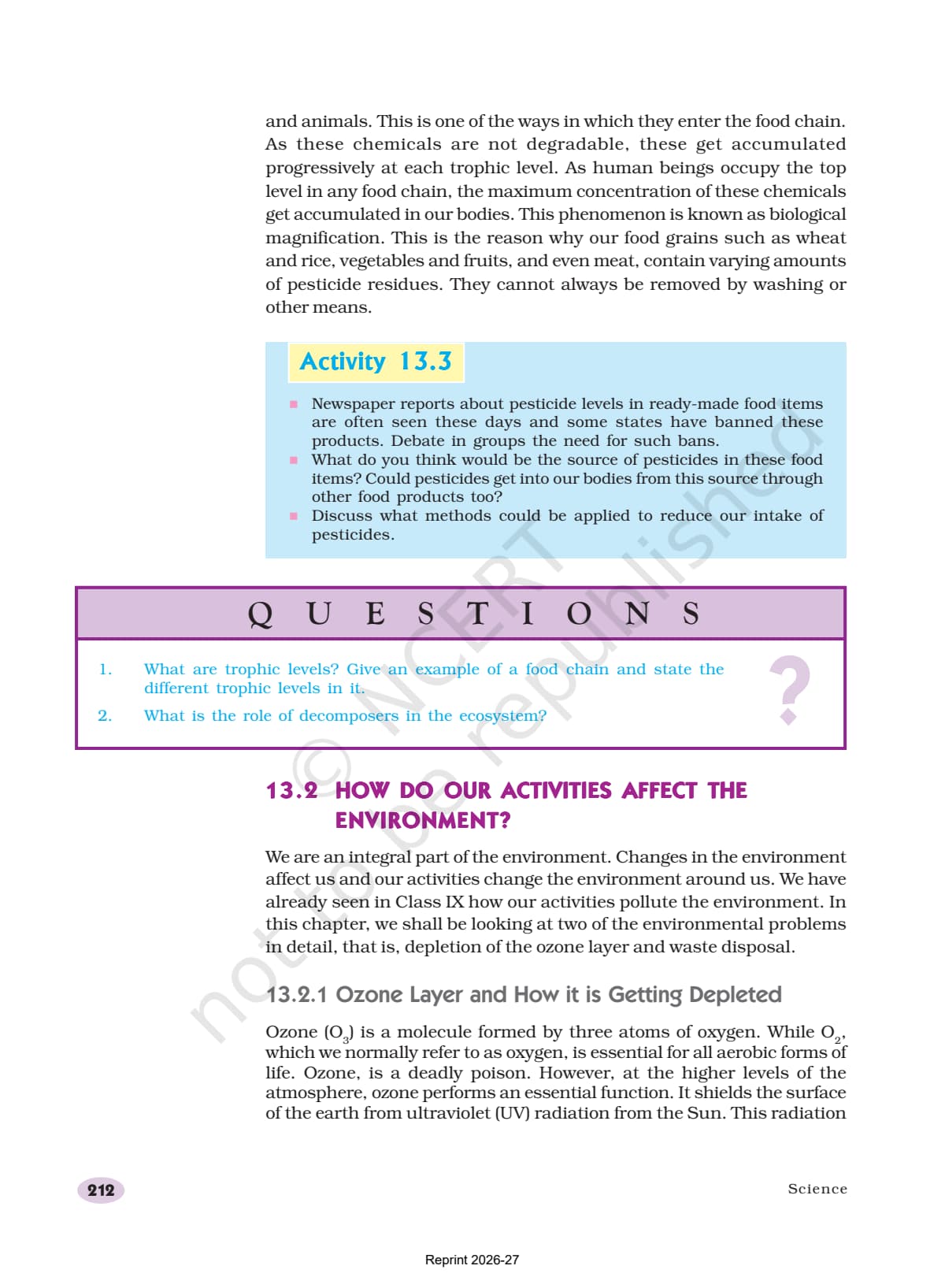
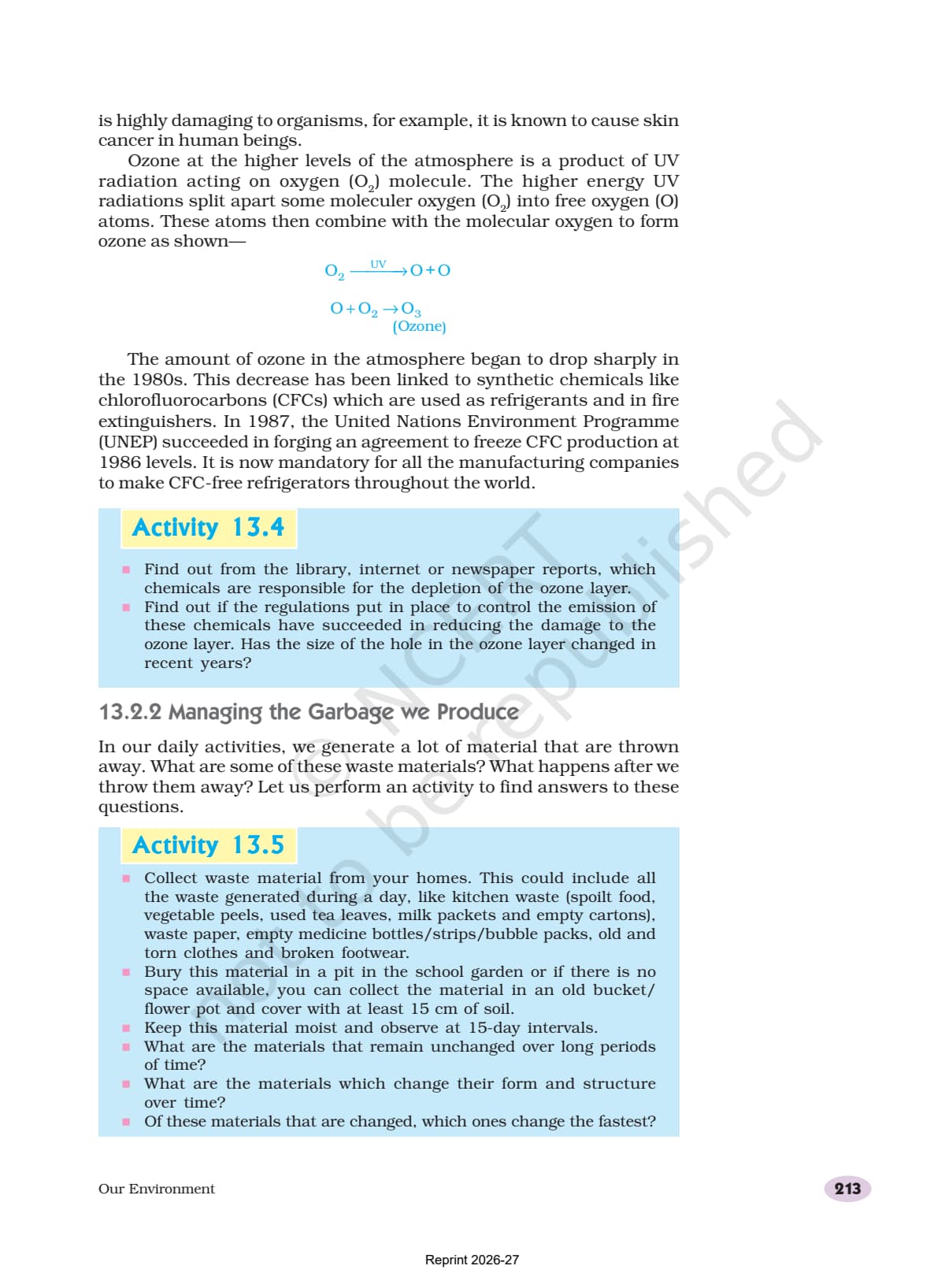
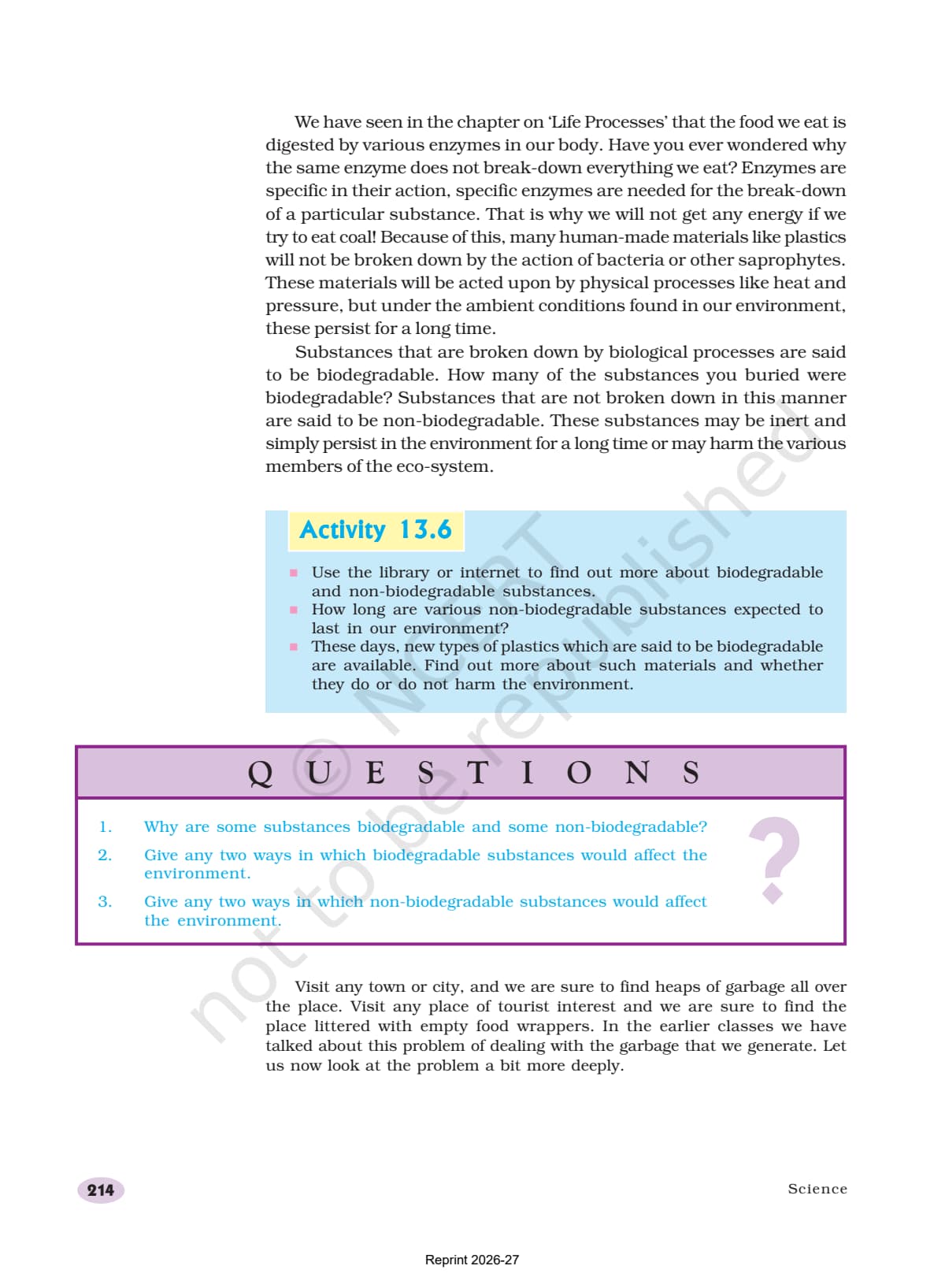
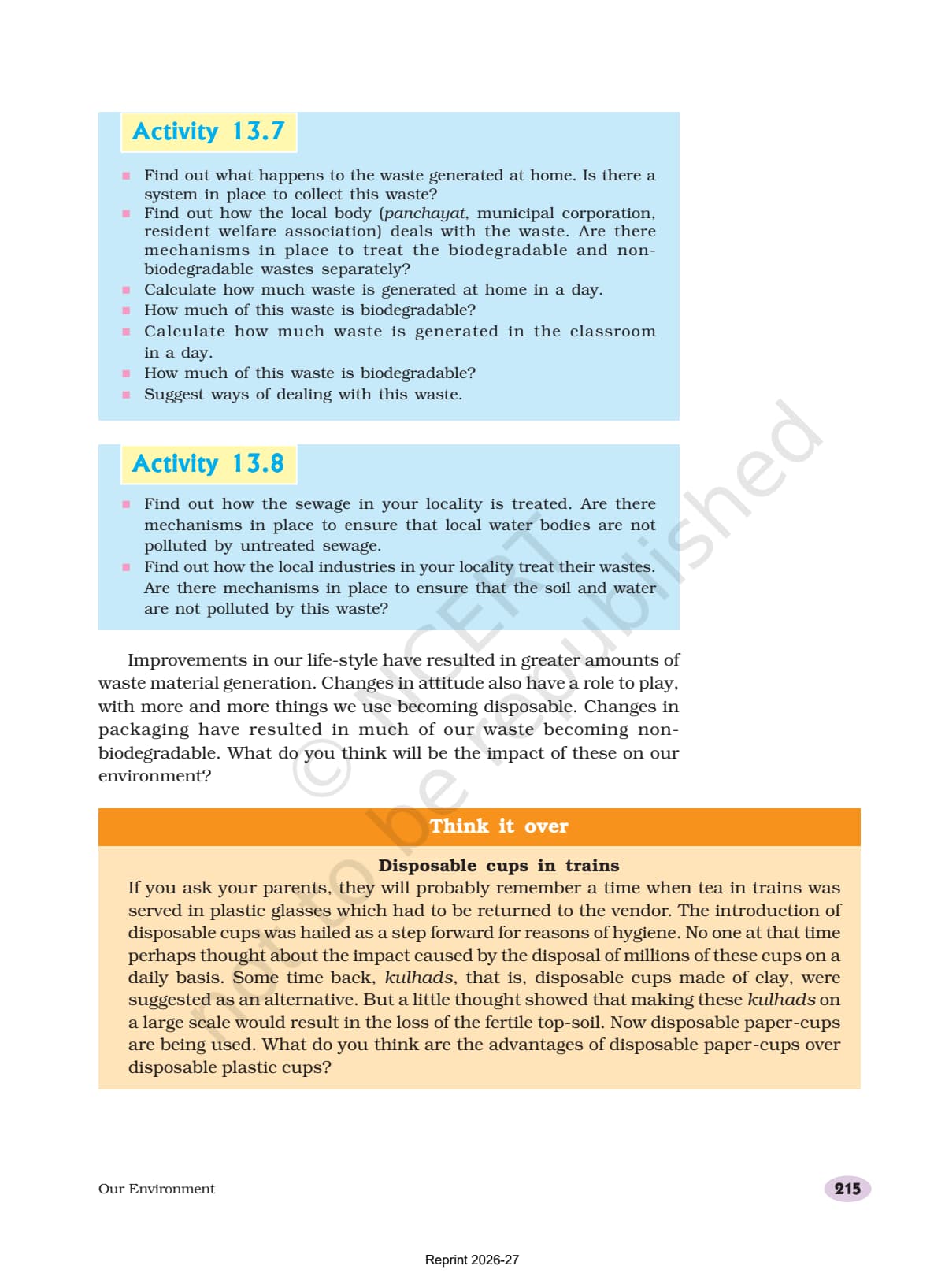
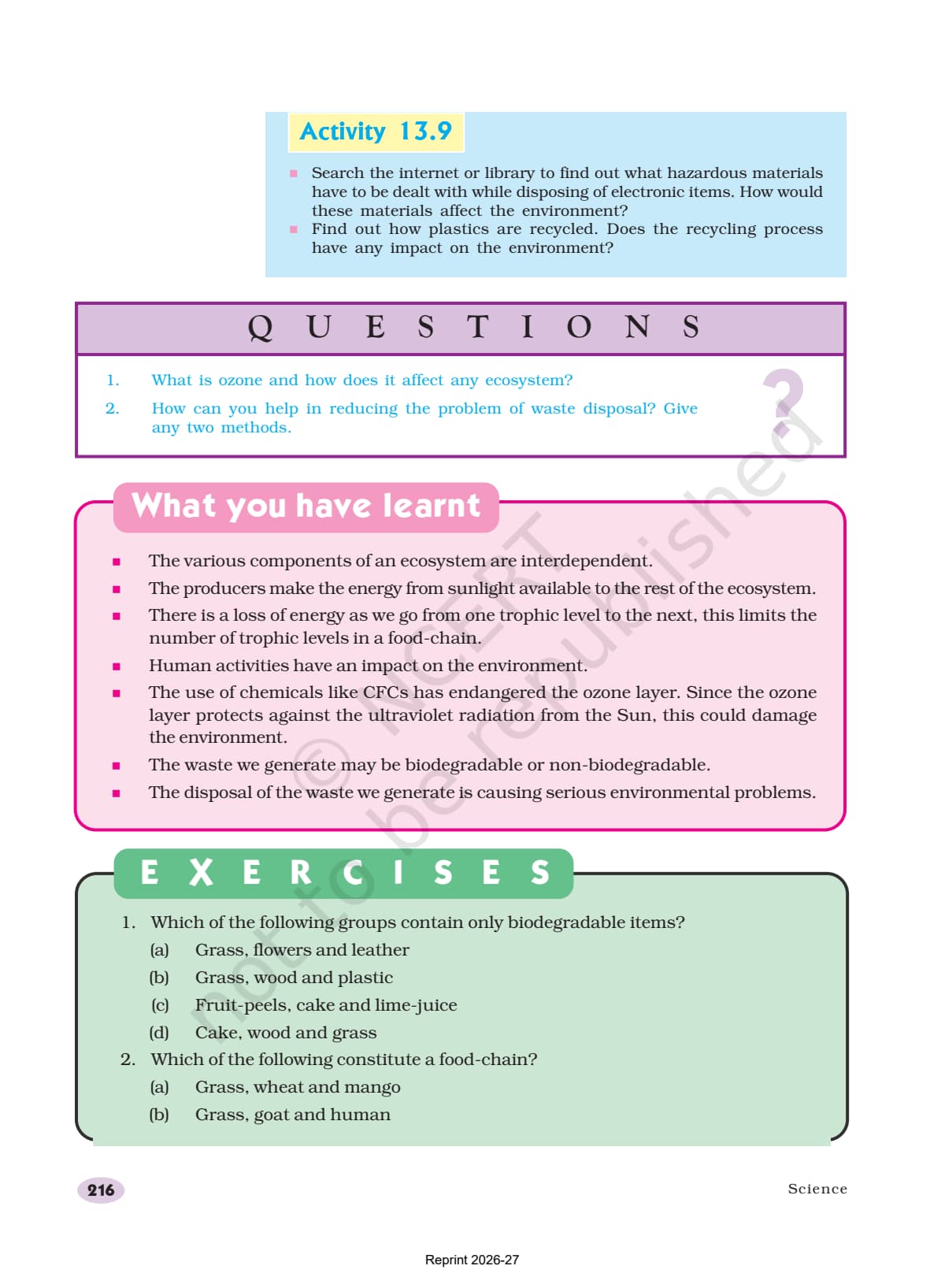
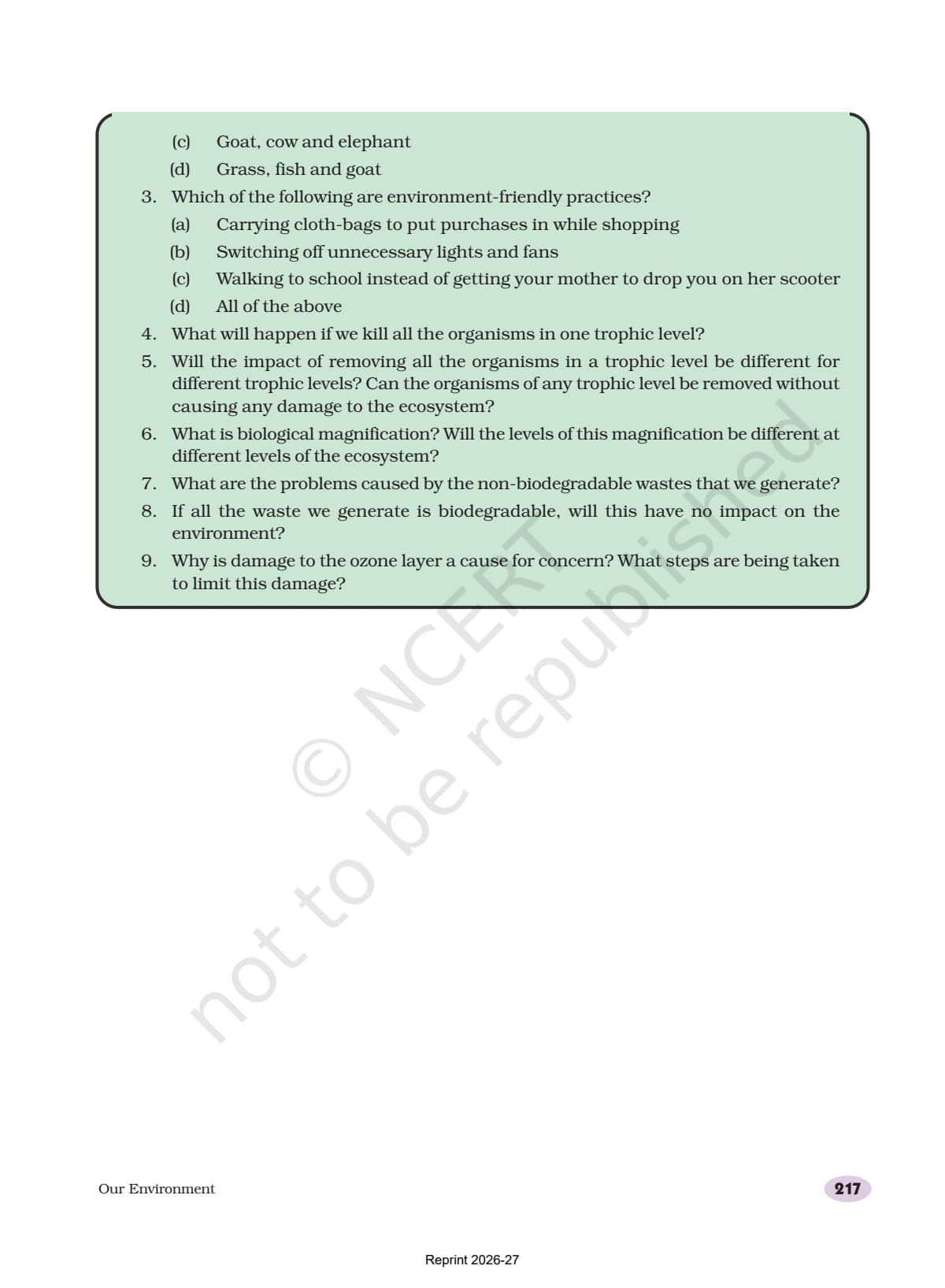
- Official NCERT textbook PDF of Chapter 13, with every activity, figure, in-text question and exercise exactly as printed.
- Covers ecosystem and its components, food chains and webs, trophic levels, the 10 per cent law of energy flow, biological magnification, biodegradable and non-biodegradable waste, ozone layer depletion and garbage management.
- Aligned with the 2026-27 CBSE Class 10 Science syllabus, useful for board exam revision and as the base text for the solutions and notes.
This page hosts the official NCERT Class 10 Science textbook chapter, mapped to the 2026-27 CBSE syllabus and checked page by page against the printed Our Environment chapter.
Student Feedback: What 12,800 students told us about this chapter
76% of Class 10 students said the parts they mixed up most were the trophic levels, the 10 per cent law of energy flow, and the difference between biodegradable and non-biodegradable waste. 3 out of 5 students told us that drawing a simple food chain first, then labelling each trophic level, was what finally made the chapter click.
Students reported spending on average 3 to 4 hours on the full chapter across the first read and revision, and toppers said writing the producer-consumer-decomposer roles with one example each stopped them from losing the easy definition marks in the board exam.
Source: 2026-27 Class 10 Science student poll. Sample of 12,800 students from CBSE schools across 13 states, taken before the 2026 board exams.
What the NCERT Book for Class 10 Science Chapter 13 Our Environment Covers
The downloadable PDF above is the complete official NCERT chapter, exactly as printed in the 2026-27 textbook. It begins with the ecosystem and its biotic and abiotic components, explains producers, consumers and decomposers, builds the food chain and food web, defines trophic levels, and uses the 10 per cent law. The second half covers biodegradable and non-biodegradable substances, biological magnification, ozone layer depletion, and garbage management.
- Ecosystem and components: biotic and abiotic parts, and natural versus artificial ecosystems.
- Food chain and trophic levels: feeding in a chain, food webs, and trophic levels.
- Energy flow: the 10 per cent law and why food chains are short.
- Environmental problems: biodegradable and non-biodegradable waste, biological magnification, ozone depletion, and garbage management.
Our Environment Class 10 Science Full Chapter Video
Source: Magnet Brains on YouTube
Ecosystem and Its Components in Class 10 Science Chapter 13
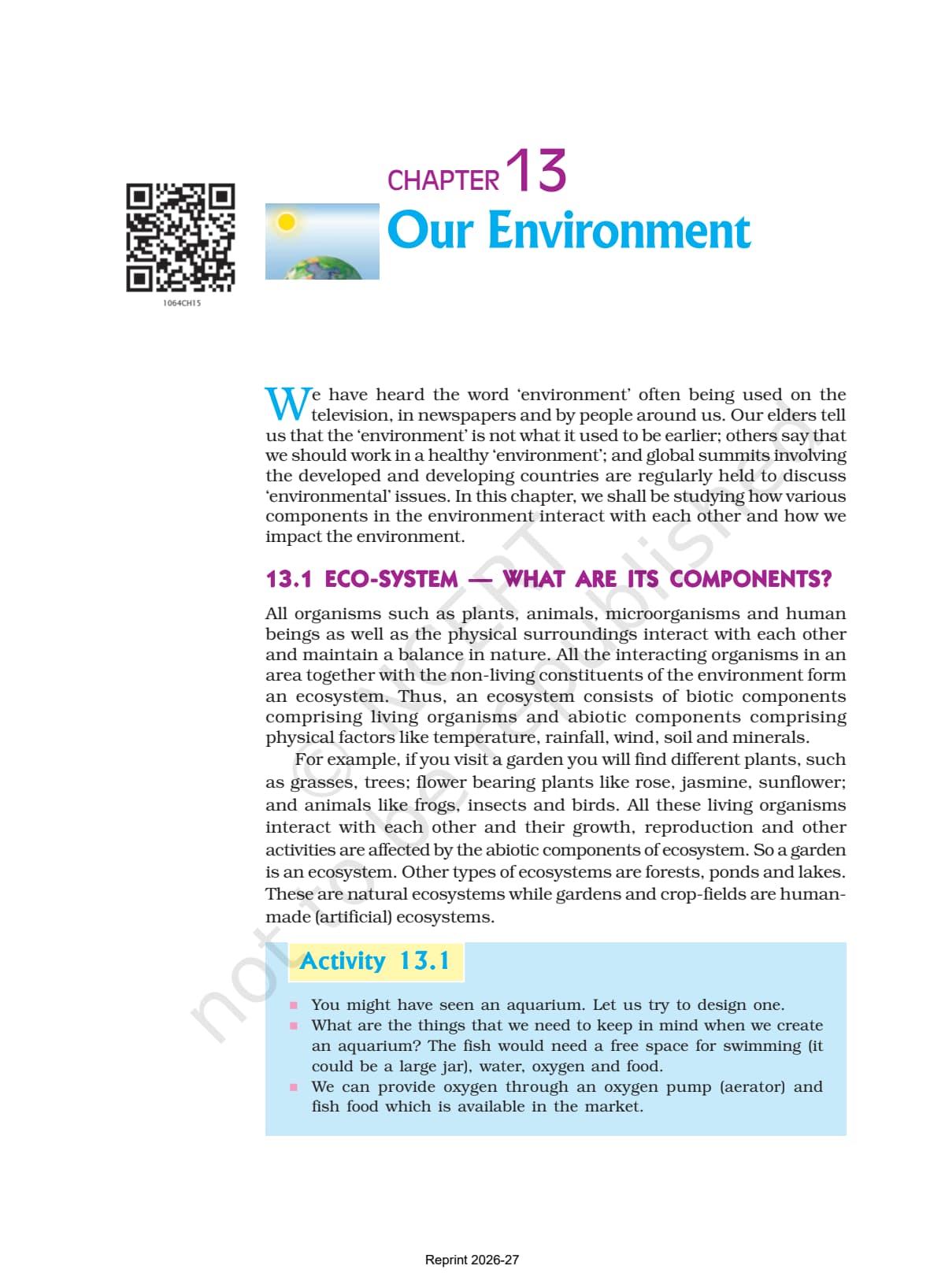
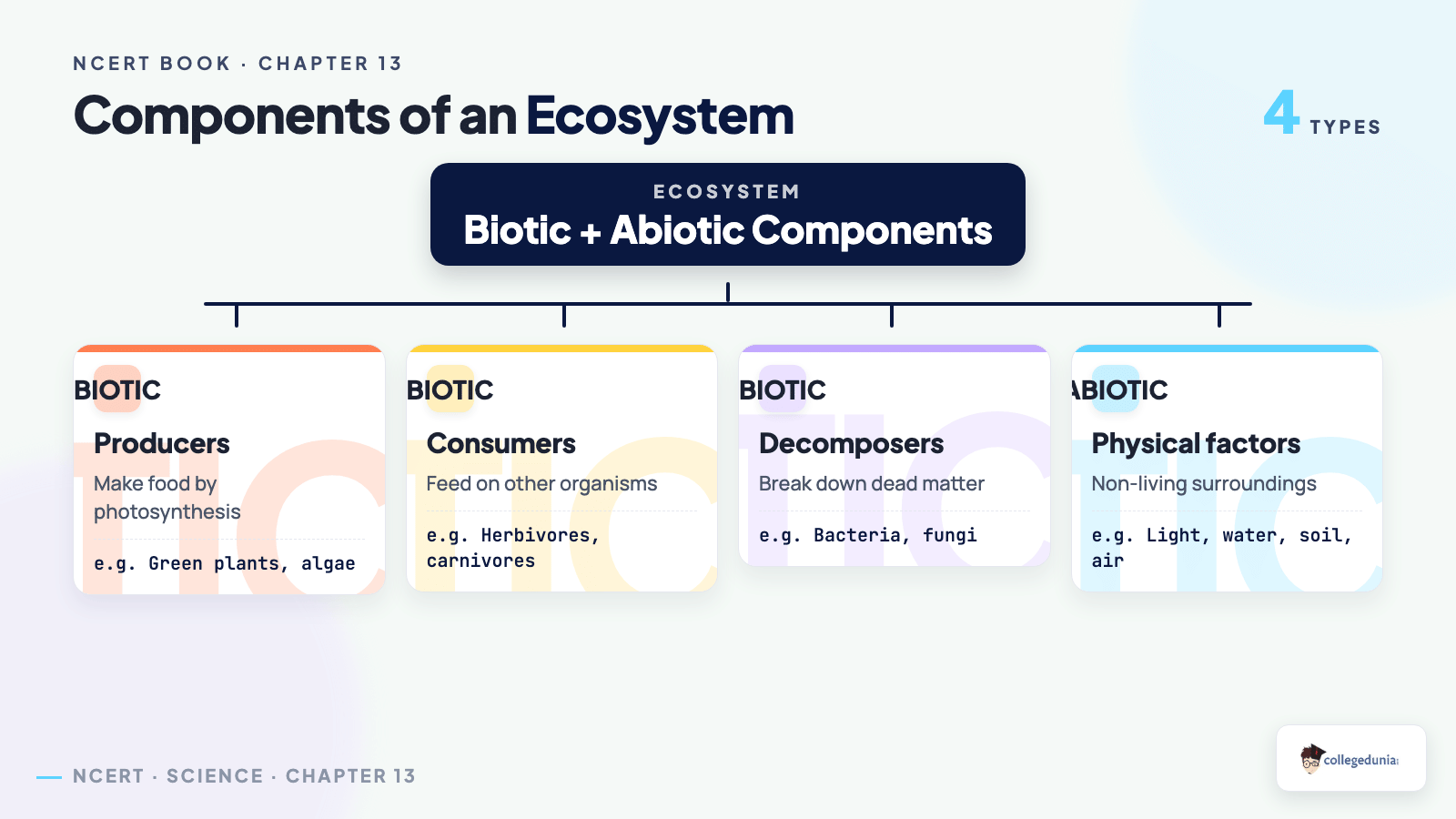
An ecosystem is all the living organisms of an area together with the non-living surroundings they interact with. It has two kinds of components: biotic (living organisms) and abiotic (non-living factors like temperature, light, soil, water and air).
| Component | What it includes | Examples |
|---|---|---|
| Biotic (living) | All living organisms in the ecosystem | Plants, animals, bacteria, fungi |
| Abiotic (non-living) | Physical and chemical factors | Temperature, light, water, soil, air |
Ecosystems are of two main types. Natural ecosystems such as forests, ponds and lakes form on their own, while artificial or human-made ecosystems such as gardens, aquariums and crop-fields are created and maintained by people. Naming a correct example of each type is a favourite one-mark board question.
Producers, Consumers and Decomposers in Class 10 Science Chapter 13
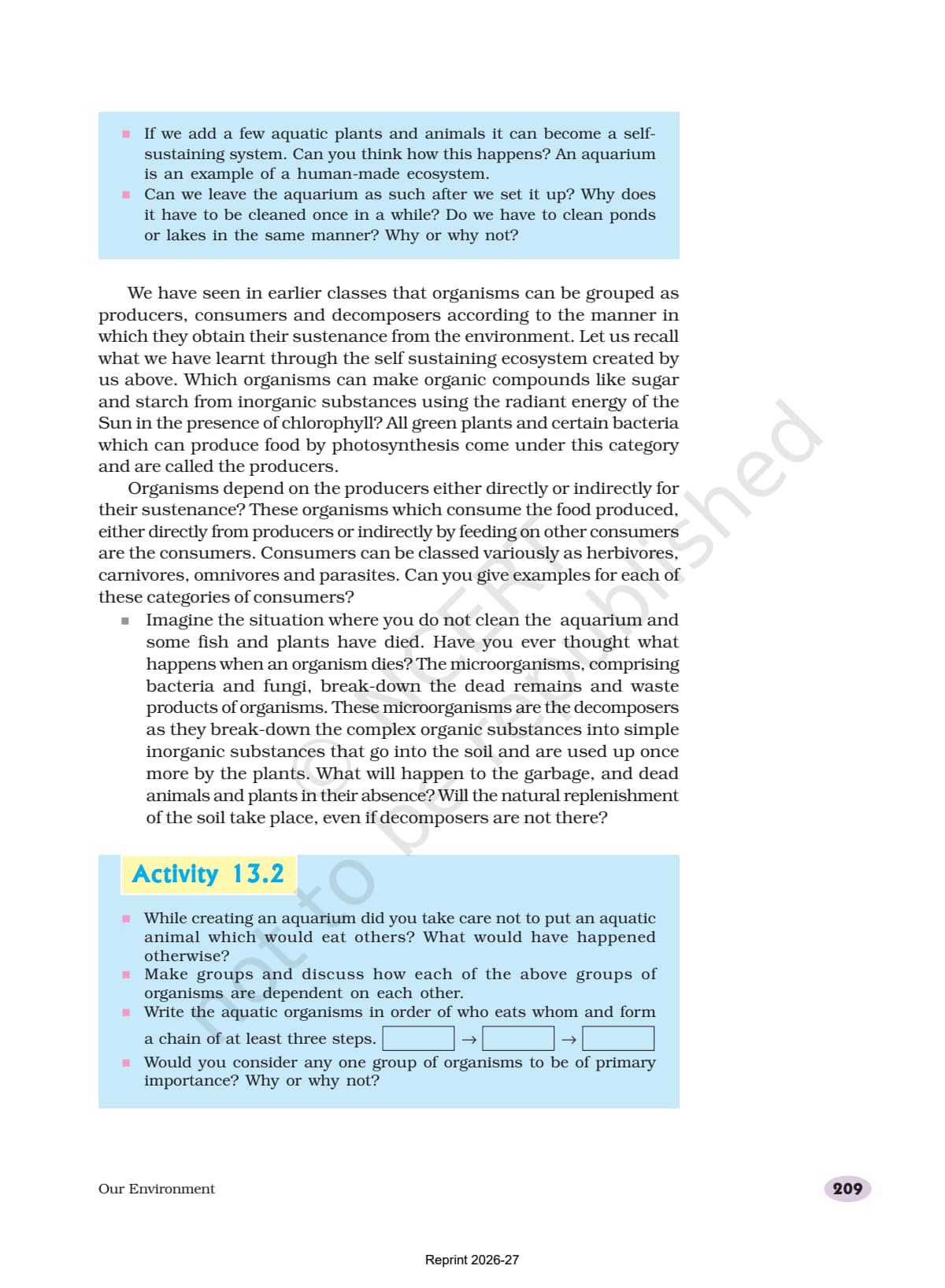
The living organisms fall into three functional groups by how they get food. Producers make their own food using sunlight, consumers depend on other organisms, and decomposers break down dead remains into simple substances.
| Group | How it gets food | Examples |
|---|---|---|
| Producers (autotrophs) | Make food by photosynthesis | Green plants, blue-green algae |
| Consumers (heterotrophs) | Feed on producers or other consumers | Herbivores, carnivores, omnivores |
| Decomposers | Break down dead matter and waste | Bacteria and fungi |
Herbivores eat only plants, carnivores eat other animals, omnivores eat both, and parasites take food from a host. Decomposers are vital: they break down dead bodies and waste and return simple nutrients to the soil for the producers to reuse, keeping the cycle of materials going.
Food Chain, Food Web and Trophic Levels in Class 10 Science
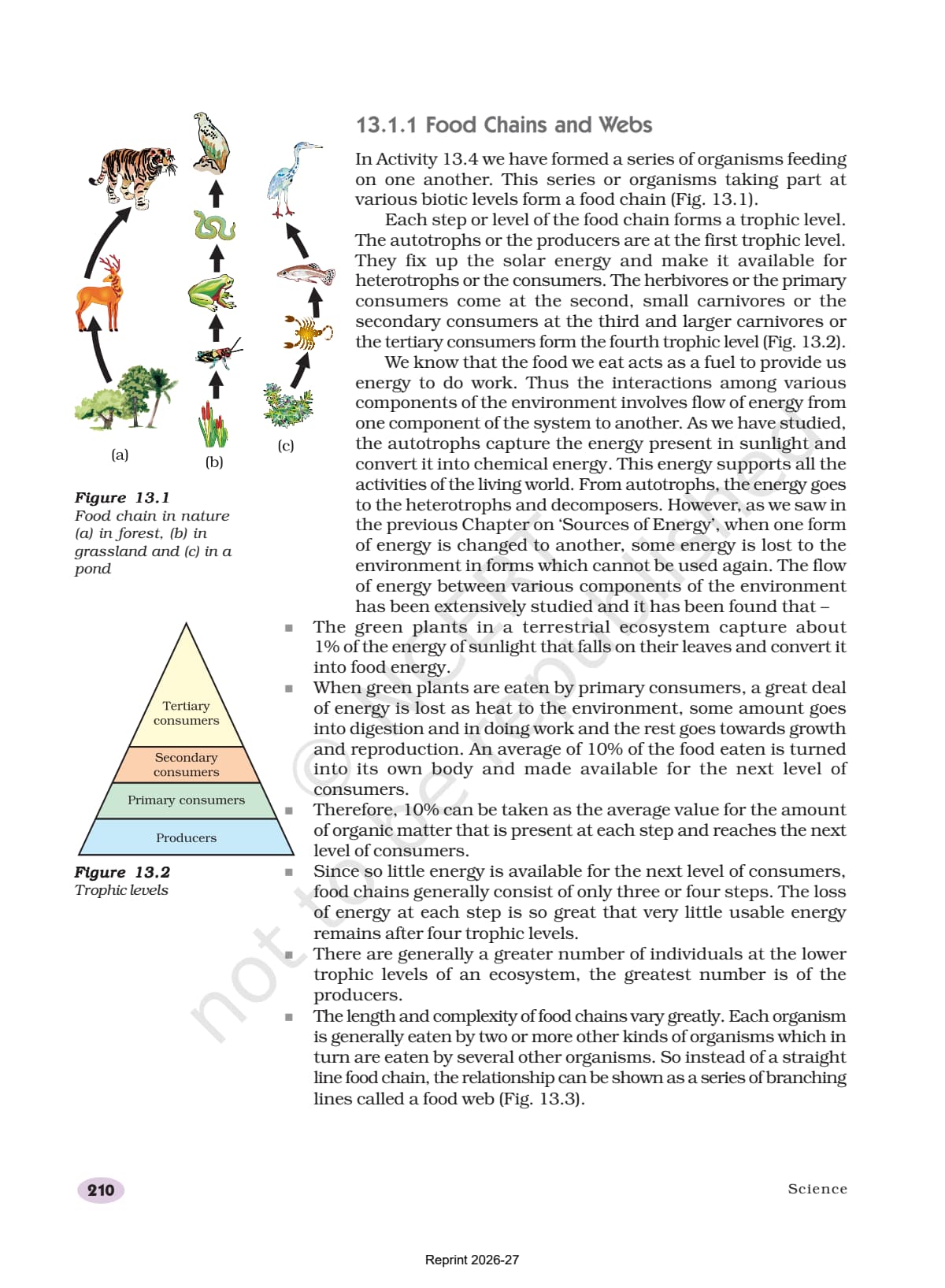
A food chain is a series of organisms in which each feeds on the one before it, so energy and nutrients pass along it. Each step is a trophic level: producers first, herbivores (primary consumers) second, small carnivores (secondary) third, and large carnivores (tertiary) fourth.
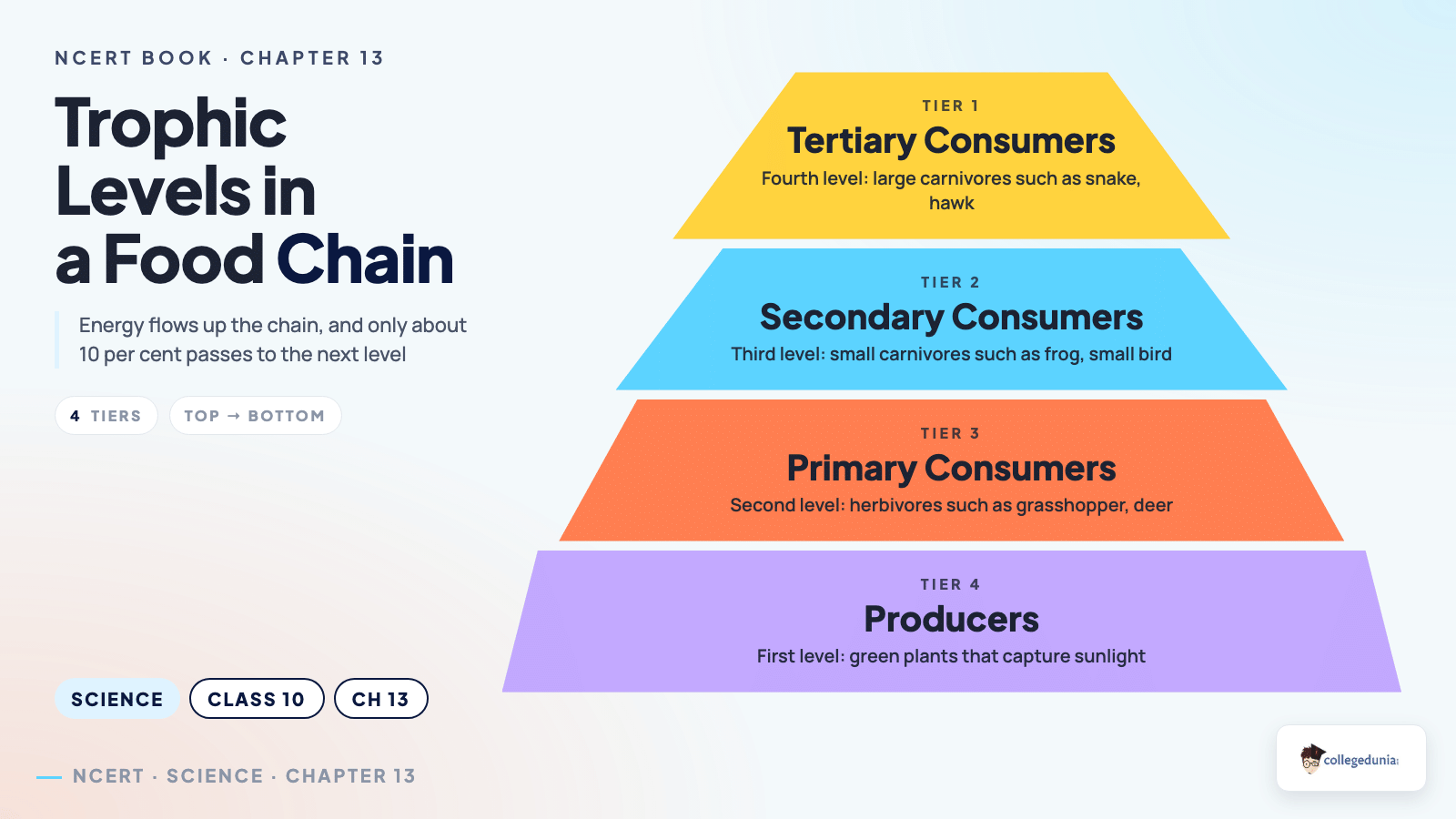
| Trophic level | Group | Example |
|---|---|---|
| First | Producers (autotrophs) | Grass, green plants |
| Second | Primary consumers (herbivores) | Grasshopper, deer |
| Third | Secondary consumers (small carnivores) | Frog, small bird |
| Fourth | Tertiary consumers (large carnivores) | Snake, hawk |
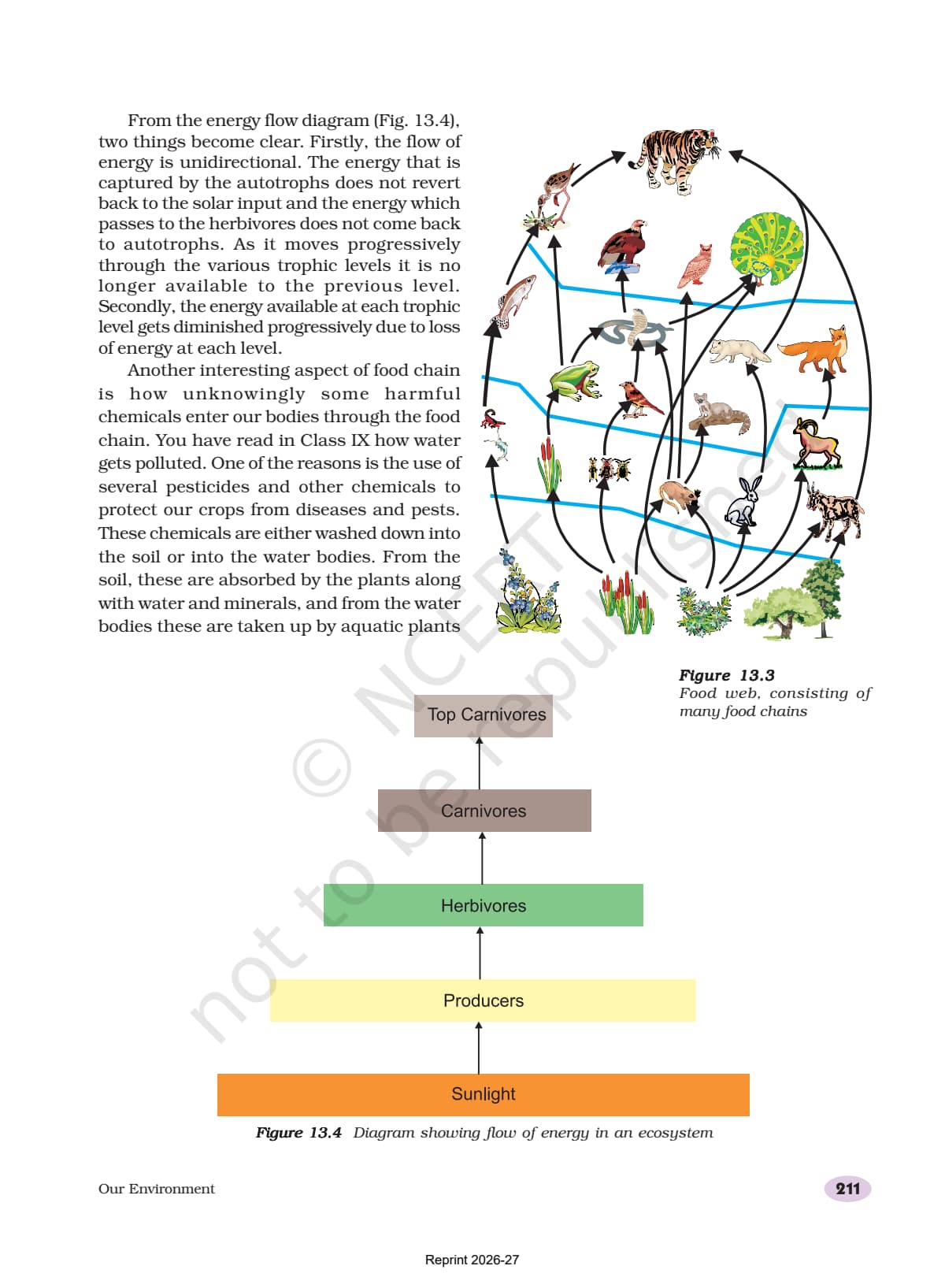
When many food chains link together so an organism can be eaten by more than one type of consumer, the network formed is a food web. A food web is more realistic than a single chain, since most animals have several food sources.
Flow of Energy and the 10 Per Cent Law in Class 10 Science Chapter 13
The original source of all energy is the Sun. Green plants capture only about 1 per cent of the sunlight on their leaves as food energy by photosynthesis, which is why producers start every food chain. From there energy passes up the chain, but only a small part transfers at each step.
| Stage | What happens to the energy |
|---|---|
| Producers | Capture about 1 per cent of incident sunlight as food |
| Each level to the next | Only about 10 per cent passes on; 90 per cent is used or lost as heat |
| Number of steps | Energy runs low, so a food chain has only three or four steps |
This is the 10 per cent law (Lindeman). Only about 10 per cent of the energy at one trophic level passes to the next, while the remaining 90 per cent is used in life processes and lost as heat. So little is left after each step that a food chain supports only three or four levels. Energy flow is always one-way, from the Sun to producers to consumers.
Biodegradable and Non-biodegradable Waste in Class 10 Science Chapter 13
Biodegradable substances can be broken down into simple harmless substances by microorganisms such as bacteria and fungi, while non-biodegradable substances cannot, and remain in the environment for a long time. Telling the two apart, with examples, is a steady board question.
| Type | Broken down by microbes? | Examples |
|---|---|---|
| Biodegradable | Yes, decomposed by bacteria and fungi | Paper, vegetable peels, cotton, cow dung |
| Non-biodegradable | No, persist in the environment | Plastic, glass, DDT, aluminium cans |
Non-biodegradable substances cause a second problem, biological magnification. This is the increase in the concentration of a harmful non-biodegradable chemical, such as a pesticide, as it passes up the food chain. Since such chemicals are not broken down or excreted, they build up, reaching their highest level in the top consumers, which often include humans. This is why DDT sprayed on crops ends up most concentrated in animals at the top of the chain.
Ozone Layer Depletion in Class 10 Science Chapter 13
Ozone (O₃) is a molecule of three oxygen atoms. At ground level it is a harmful pollutant, but high in the atmosphere it does an essential job. The ozone layer shields the Earth's surface from the Sun's harmful ultraviolet (UV) radiation, which can cause skin cancer and damage living cells. UV rays split oxygen molecules and the free atoms combine with oxygen to form ozone.
| Point | Detail |
|---|---|
| What ozone is | A molecule of three oxygen atoms, O₃ |
| Its function | Absorbs the Sun's harmful ultraviolet radiation |
| Main cause of damage | Chlorofluorocarbons (CFCs) from refrigerants and fire extinguishers |
| The response | UNEP agreement to freeze and cut CFC production |
Ozone began to drop sharply in the 1980s. The main cause is chlorofluorocarbons (CFCs), once used as refrigerants and in fire extinguishers, which release chlorine that destroys ozone. The United Nations Environment Programme (UNEP) agreed to freeze and then cut CFC production, one of the few global problems where countries acted together.
Managing the Garbage and Common Exam Traps in Class 10 Science Chapter 13
The second problem is the garbage we produce. Changing lifestyles and the rise of packaging, plastics and disposable products have hugely increased waste, much of which microorganisms cannot break down. The chapter covers how this waste is dealt with, including treating sewage before it reaches rivers.
| Idea | Why it matters |
|---|---|
| Separate the waste | Biodegradable waste can be composted; non-biodegradable should be recycled |
| Treat sewage | Untreated sewage pollutes water bodies and harms aquatic life |
| Reduce and recycle | Cuts the load of waste that cannot be broken down by nature |
The repeat-offender mistakes in board answers:
- Wrong trophic order: producers are first, not the consumers; herbivores come second.
- Misquoting the 10 per cent law: only 10 per cent passes on, so 90 per cent is lost.
- Equating non-biodegradable with plastic: DDT is also non-biodegradable, and biodegradable waste can still pollute.
- Confusing ground-level and upper ozone: harmful at ground level, protective in the upper atmosphere.
- Saying energy flows both ways: it is always one-way.
How to Use the NCERT Book PDF for Board Revision
The official textbook is the safest source because every figure, definition and example is exam-correct. Read it in two passes: first the definitions of ecosystem, producers, consumers, decomposers and trophic levels, then the 10 per cent law, biological magnification, ozone depletion and waste management. Drawing a simple food chain and food web yourself is the drill the board paper rewards most.
Other Resources for Class 10 Science Chapter 13 Our Environment
Read the official NCERT Book chapter above, then revise with the matching NCERT Solutions, revision notes, formula sheet and handwritten notes. All resources for Class 10 Science Chapter 13 Our Environment are linked in the table below.
| Resource | What it covers | Open |
|---|---|---|
| NCERT Book PDF | Official Class 10 Science Chapter 13 textbook, with every activity, figure and exercise. | You are here |
| NCERT Solutions | Step-by-step answers to all in-text and exercise questions of the chapter. | Class 10 Science Chapter 13 NCERT Solutions |
| Notes | Concept-first revision notes on ecosystem, food chain, energy flow, ozone and waste. | Class 10 Science Chapter 13 Notes |
| Formula Sheet | Quick reference of ecosystem terms, trophic levels and the 10 per cent law. | Class 10 Science Chapter 13 Formula Sheet |
| Handwritten Notes | Scanned-style handwritten pages for last-minute board revision. | Class 10 Science Chapter 13 Handwritten Notes |
NCERT Book for Class 10 Science: All Chapters
Related Links: Use the table below to open the official NCERT Book PDF for the other chapters of Class 10 Science. Every chapter ships with the same official textbook PDF, chapter overview, and board-ready FAQ.
| Chapter | NCERT Book PDF link |
|---|---|
| Chapter 1 | Chemical Reactions and Equations NCERT Book PDF |
| Chapter 2 | Acids, Bases and Salts NCERT Book PDF |
| Chapter 3 | Metals and Non-metals NCERT Book PDF |
| Chapter 4 | Carbon and its Compounds NCERT Book PDF |
| Chapter 5 | Life Processes NCERT Book PDF |
| Chapter 6 | Control and Coordination NCERT Book PDF |
| Chapter 7 | How do Organisms Reproduce NCERT Book PDF |
| Chapter 8 | Heredity NCERT Book PDF |
| Chapter 9 | Light Reflection and Refraction NCERT Book PDF |
| Chapter 10 | The Human Eye and the Colourful World NCERT Book PDF |
| Chapter 11 | Electricity NCERT Book PDF |
| Chapter 12 | Magnetic Effects of Electric Current NCERT Book PDF |
| Chapter 13 | Our Environment NCERT Book PDF (You are here) |
NCERT Book Class 10 Science Chapter 13 Our Environment FAQs
Ques. What does Chapter 13 Our Environment cover in the Class 10 Science NCERT Book?
Ans. Chapter 13 of the Class 10 Science NCERT Book covers how an ecosystem works and how human activity affects the environment. It begins with the ecosystem and its biotic and abiotic components, then explains the three functional groups of organisms, namely producers, consumers and decomposers. It builds the food chain, the food web and the idea of trophic levels, and uses the 10 per cent law to explain why energy flow makes food chains short. The second half covers biodegradable and non-biodegradable substances, biological magnification, the depletion of the ozone layer by chlorofluorocarbons, and how we manage the garbage we produce. It is aligned with the 2026-27 CBSE syllabus.
Ques. What is an ecosystem and what are its components in Class 10 Science Chapter 13?
Ans. An ecosystem is all the living organisms of an area together with the non-living physical factors of their surroundings, interacting as one unit. It has two kinds of components. The biotic components are the living organisms, namely the producers like green plants, the consumers like animals, and the decomposers like bacteria and fungi. The abiotic components are the non-living physical and chemical factors such as temperature, light, soil, water and air. A forest, a pond and a lake are natural ecosystems, while a garden, an aquarium and a crop-field are human-made or artificial ecosystems that people create and maintain.
Ques. What is the difference between a food chain and a food web?
Ans. A food chain is a single straight series of organisms in which each organism feeds on the one before it, so energy and nutrients pass from one trophic level to the next, for example grass to grasshopper to frog to snake. A food web is a network formed when many food chains are interconnected, so that one organism can be eaten by more than one type of consumer and one consumer can have several sources of food. A food web is more realistic than a single food chain because in nature most animals eat more than one kind of food and most plants are eaten by more than one herbivore.
Ques. What is the 10 per cent law of energy flow in Class 10 Science Chapter 13?
Ans. The 10 per cent law, given by Lindeman, states that only about 10 per cent of the energy available at one trophic level is passed on to the next trophic level, while the remaining 90 per cent is used up in the life processes of that level and lost as heat to the surroundings. Because so little energy is transferred at each step, the energy runs out quickly and a food chain can support only three or four trophic levels, not more. This is also why the flow of energy in an ecosystem is one-way, moving from the Sun to producers to consumers and never back.
Ques. What is biological magnification in Our Environment Class 10?
Ans. Biological magnification is the increase in the concentration of a harmful non-biodegradable chemical, such as a pesticide like DDT, as it moves up the food chain from one trophic level to the next. Because such chemicals cannot be broken down by the body or by microorganisms, they accumulate in the tissues of organisms instead of being removed. As consumers at each level eat many organisms from the level below, the chemical becomes more and more concentrated, so its highest concentration is found in the top consumers of the chain, which often include human beings. This is why pesticides sprayed on crops can end up most concentrated in top-level animals.
Ques. Why is the ozone layer important and how is it being depleted?
Ans. Ozone is a molecule made of three atoms of oxygen, O₃. High in the atmosphere the ozone layer is important because it absorbs most of the Sun's harmful ultraviolet radiation, which can cause skin cancer and damage living cells, so it acts as a protective shield for life on Earth. From the 1980s the amount of ozone began to fall sharply. The main cause of this depletion is chlorofluorocarbons, or CFCs, chemicals that were widely used as refrigerants and in fire extinguishers and that release chlorine which destroys ozone. To control the damage, the United Nations Environment Programme reached an agreement to freeze and then cut CFC production worldwide.
Ques. What is the difference between biodegradable and non-biodegradable substances?
Ans. Biodegradable substances are those that can be broken down into simple, harmless substances by the action of microorganisms such as bacteria and fungi, for example paper, vegetable peels, cotton and cow dung. Non-biodegradable substances are those that cannot be broken down by these microorganisms and therefore remain in the environment for a very long time, for example plastic, glass, aluminium cans and pesticides like DDT. Non-biodegradable substances are a bigger environmental problem because they pile up as waste and can also undergo biological magnification by building up in the bodies of organisms along a food chain.
Ques. Is the Class 10 Science Chapter 13 Our Environment NCERT Book PDF free to download for 2026-27?
Ans. Yes. The official NCERT Book PDF for Class 10 Science Chapter 13 Our Environment is free to read and download on this page for the 2026-27 session. It is the complete chapter as printed in the CBSE textbook, including every activity, figure, in-text question and end-of-chapter exercise. You can pair the book with the linked NCERT Solutions and revision notes for the same chapter so that you read the textbook and revise from one place before the board exam.



Comments