



The NCERT Book for Class 10 Science Chapter 1 Chemical Reactions and Equations is the official CBSE textbook chapter, free to read and download for the 2026-27 session. It sets up the language of chemistry: word-equations, balanced equations, and the five reaction types you will be tested on in the board exam.
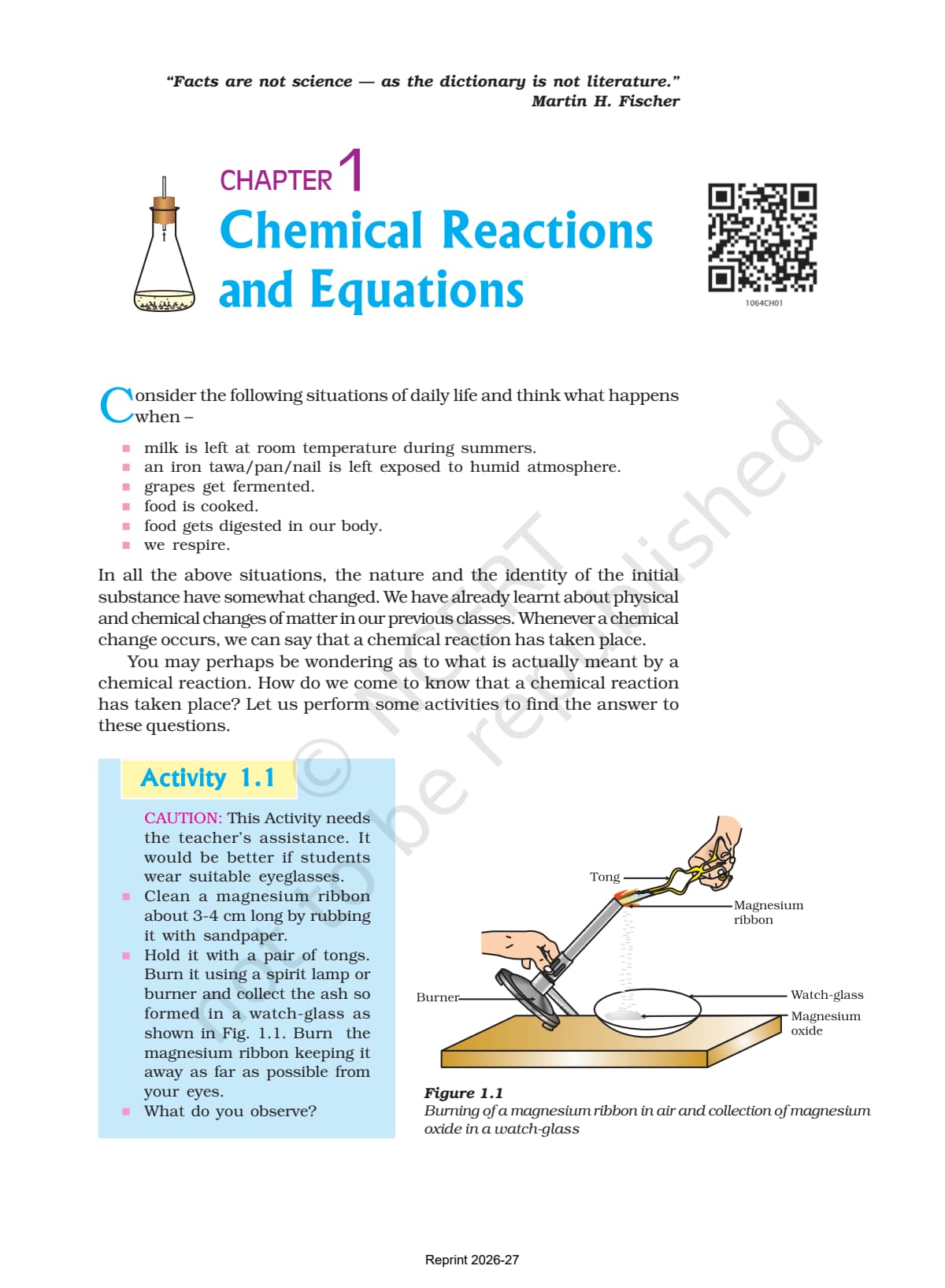
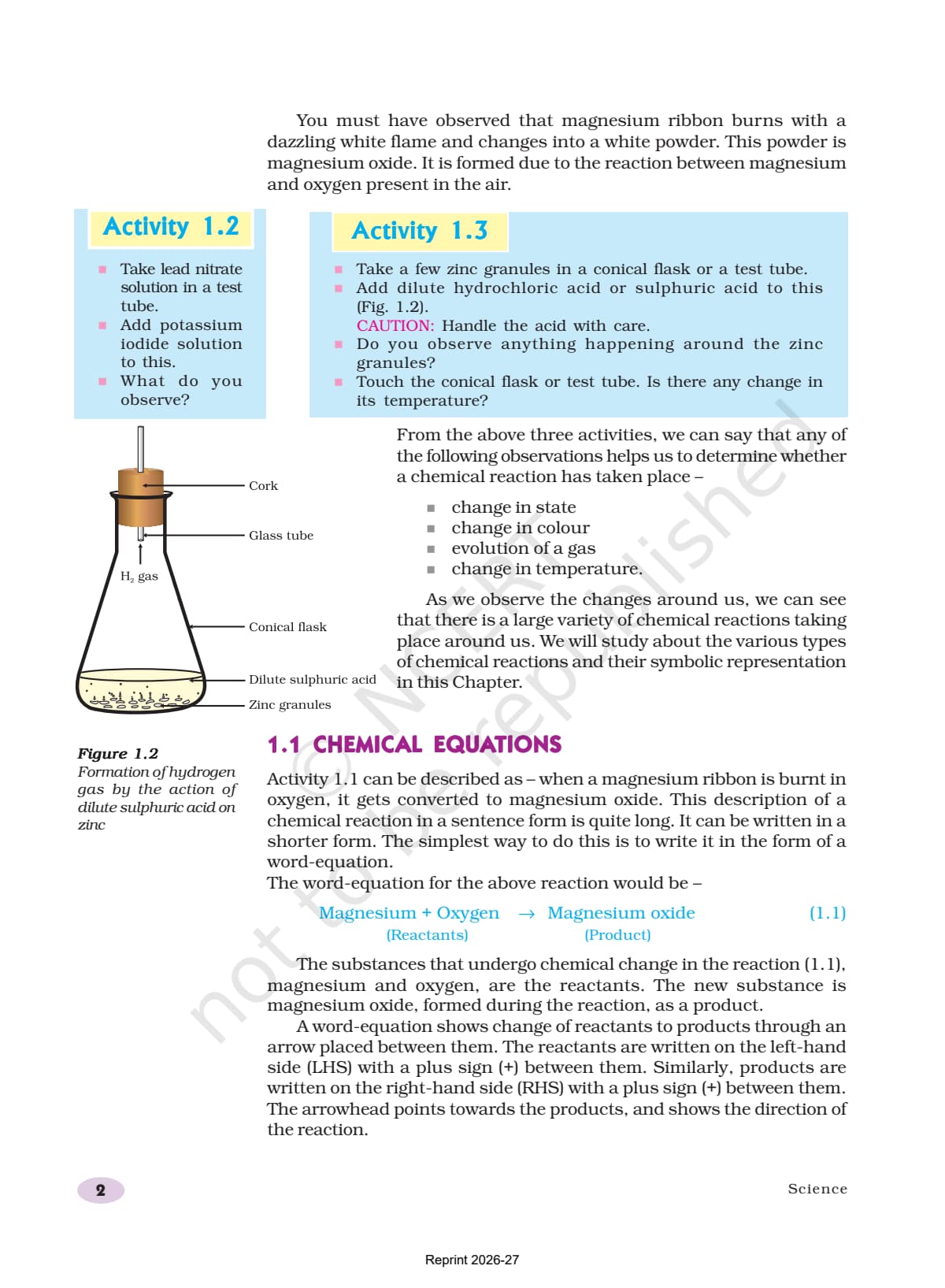
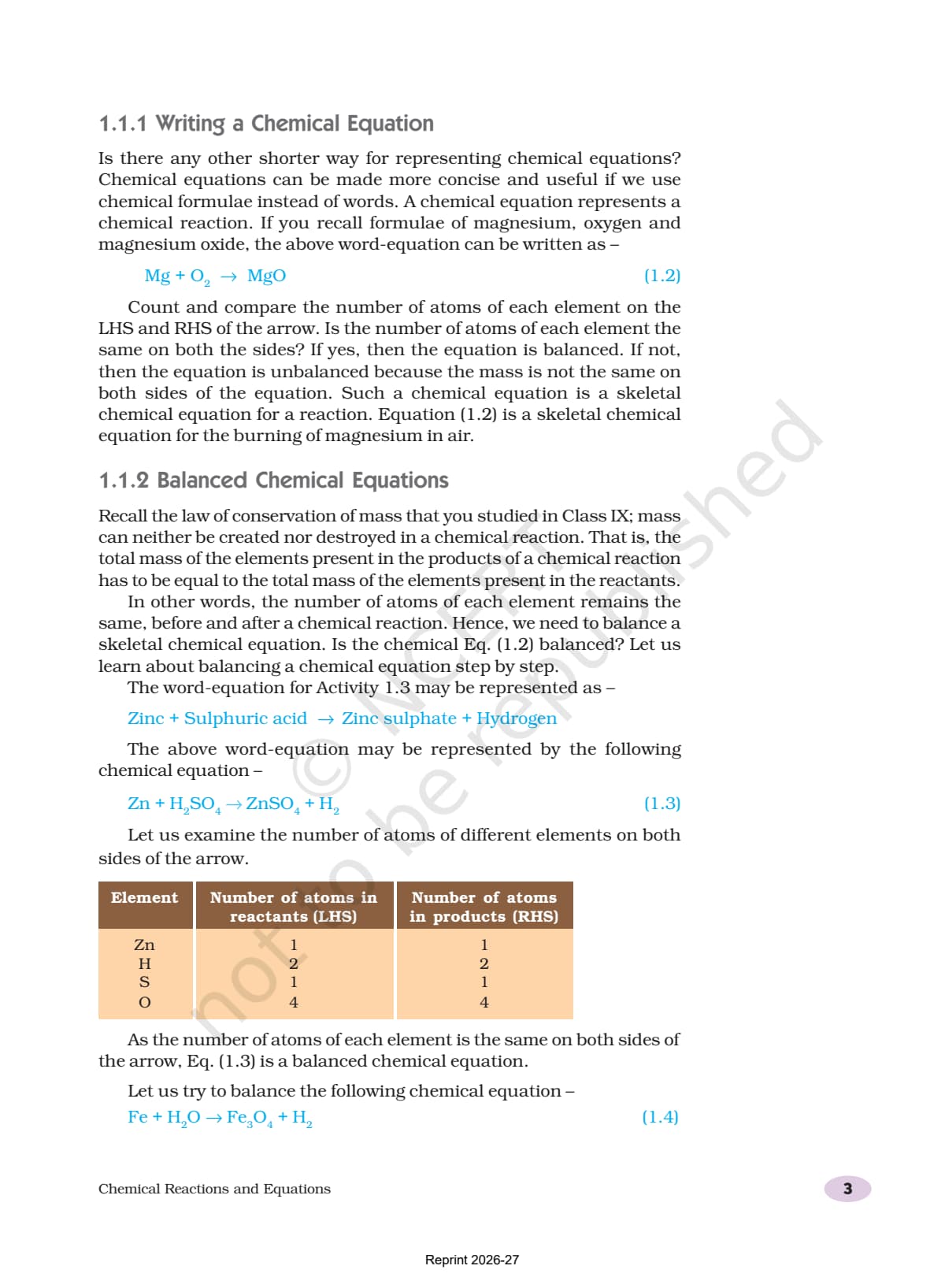
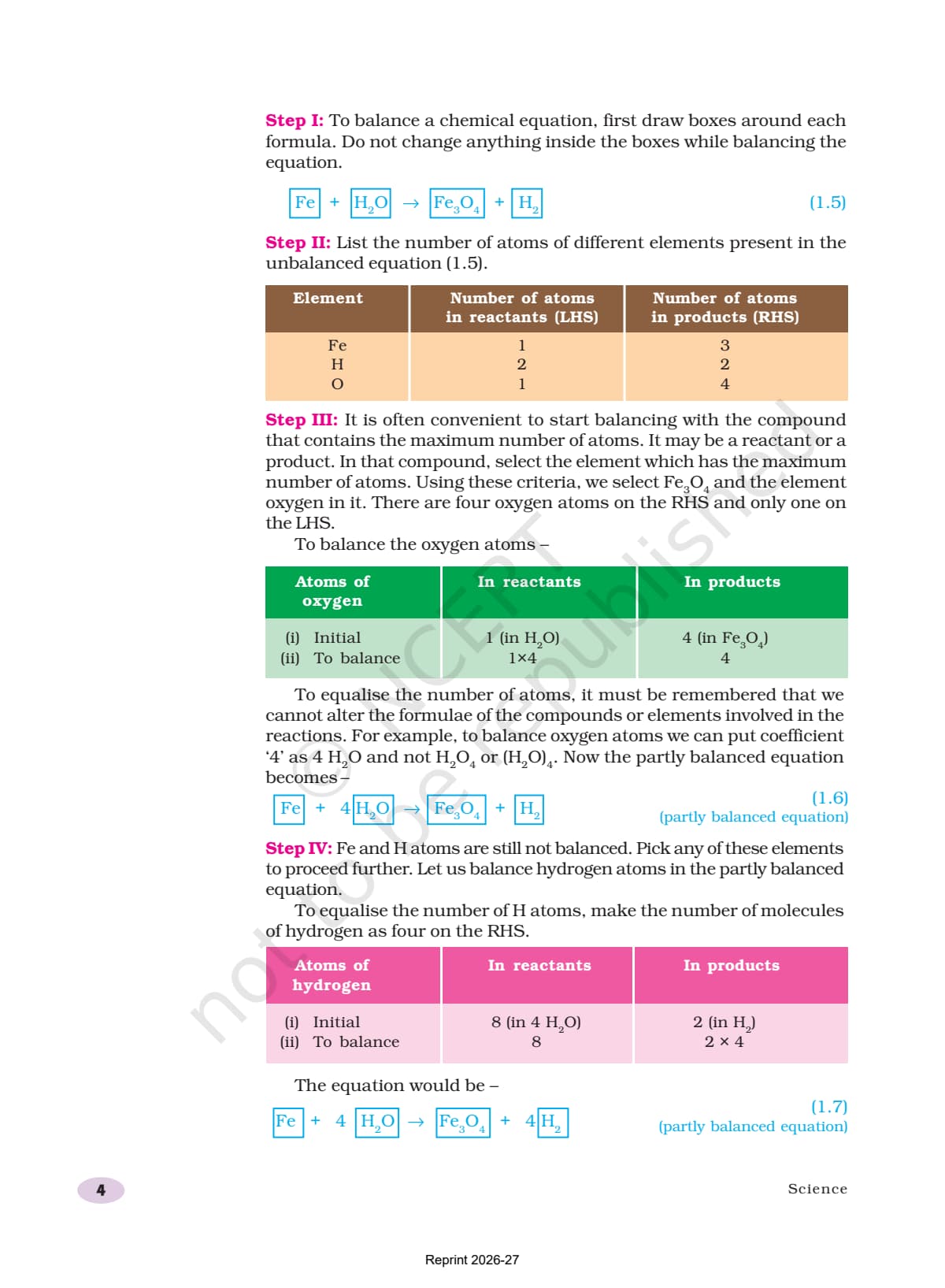
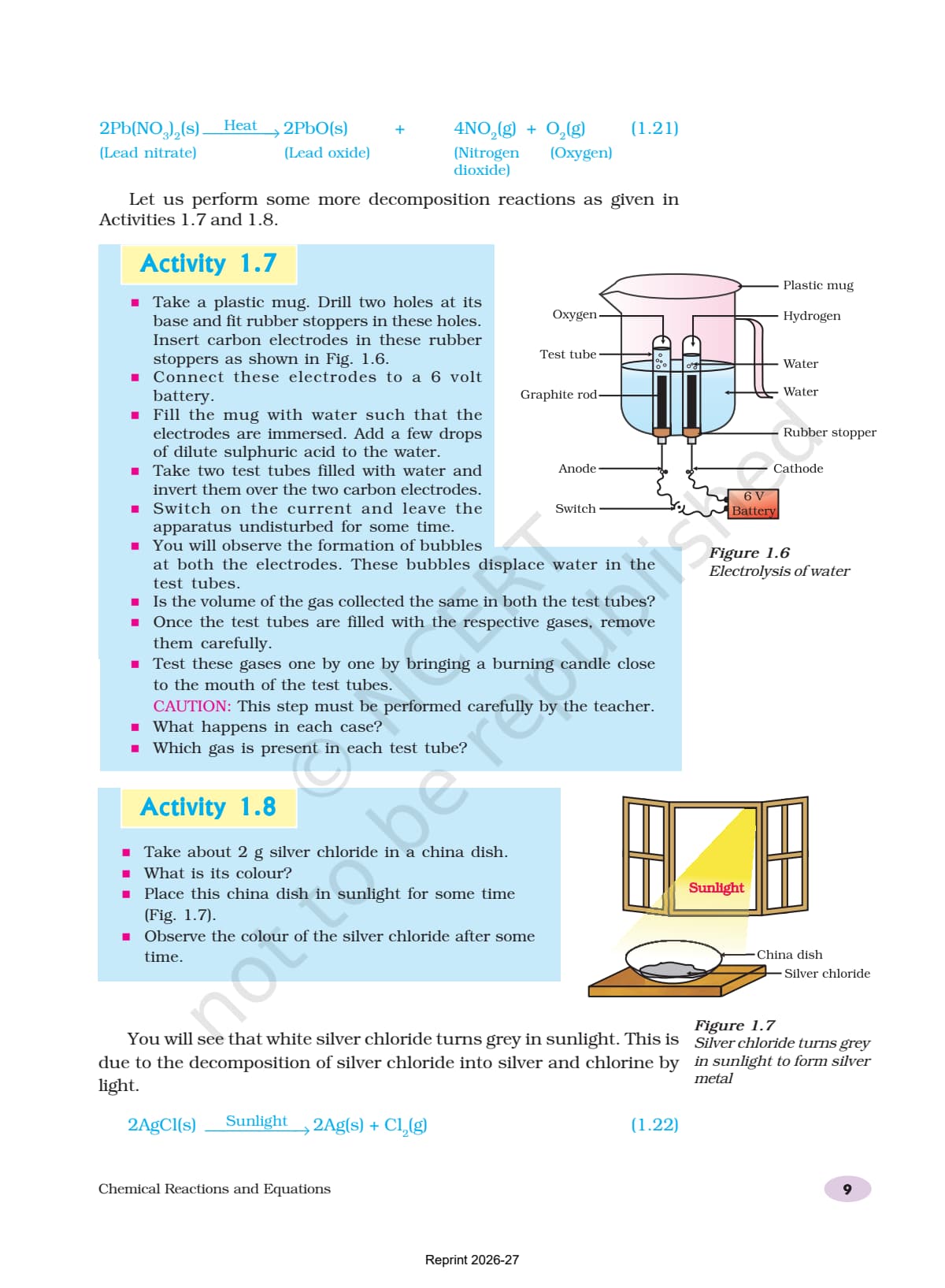
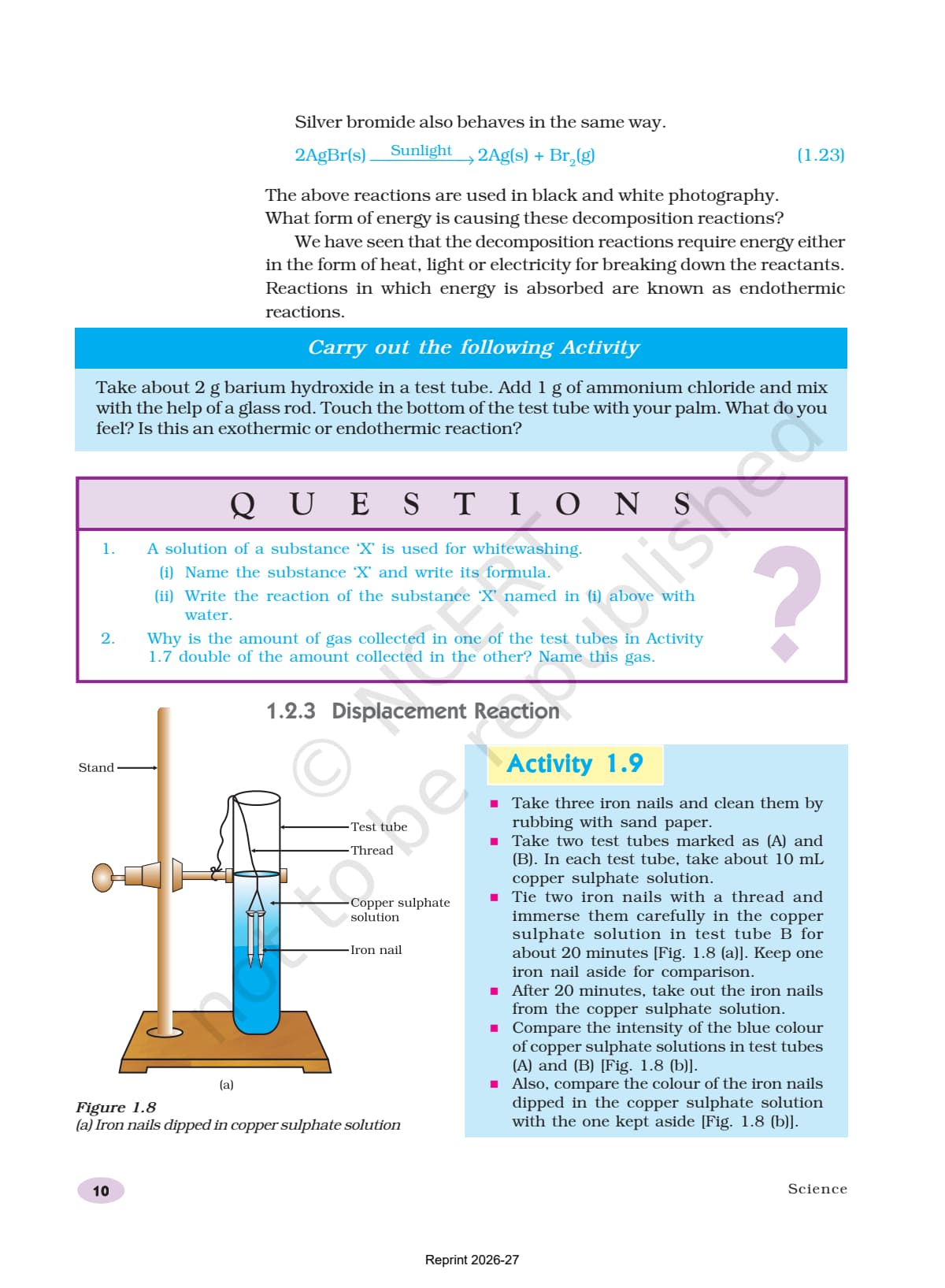
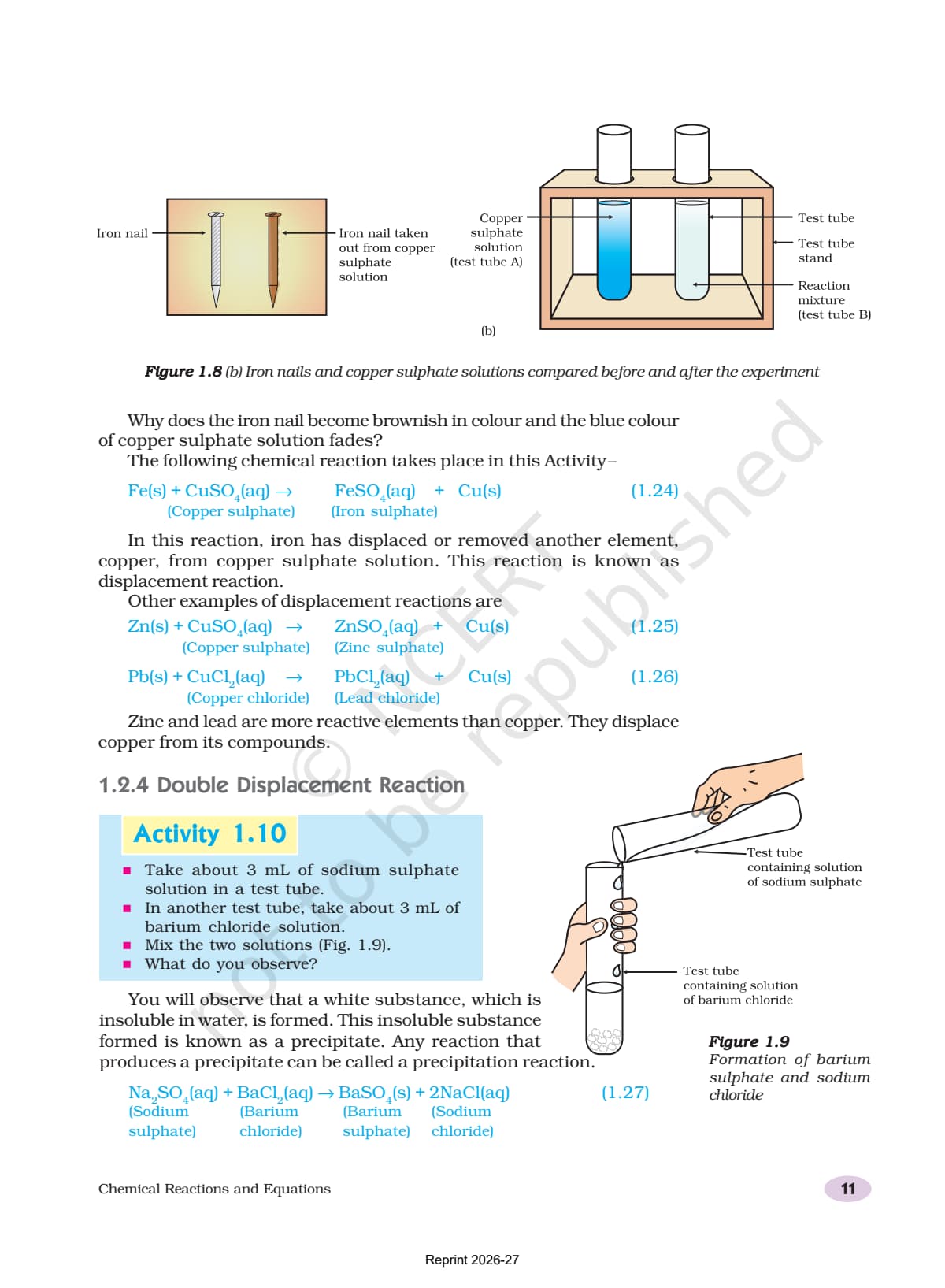
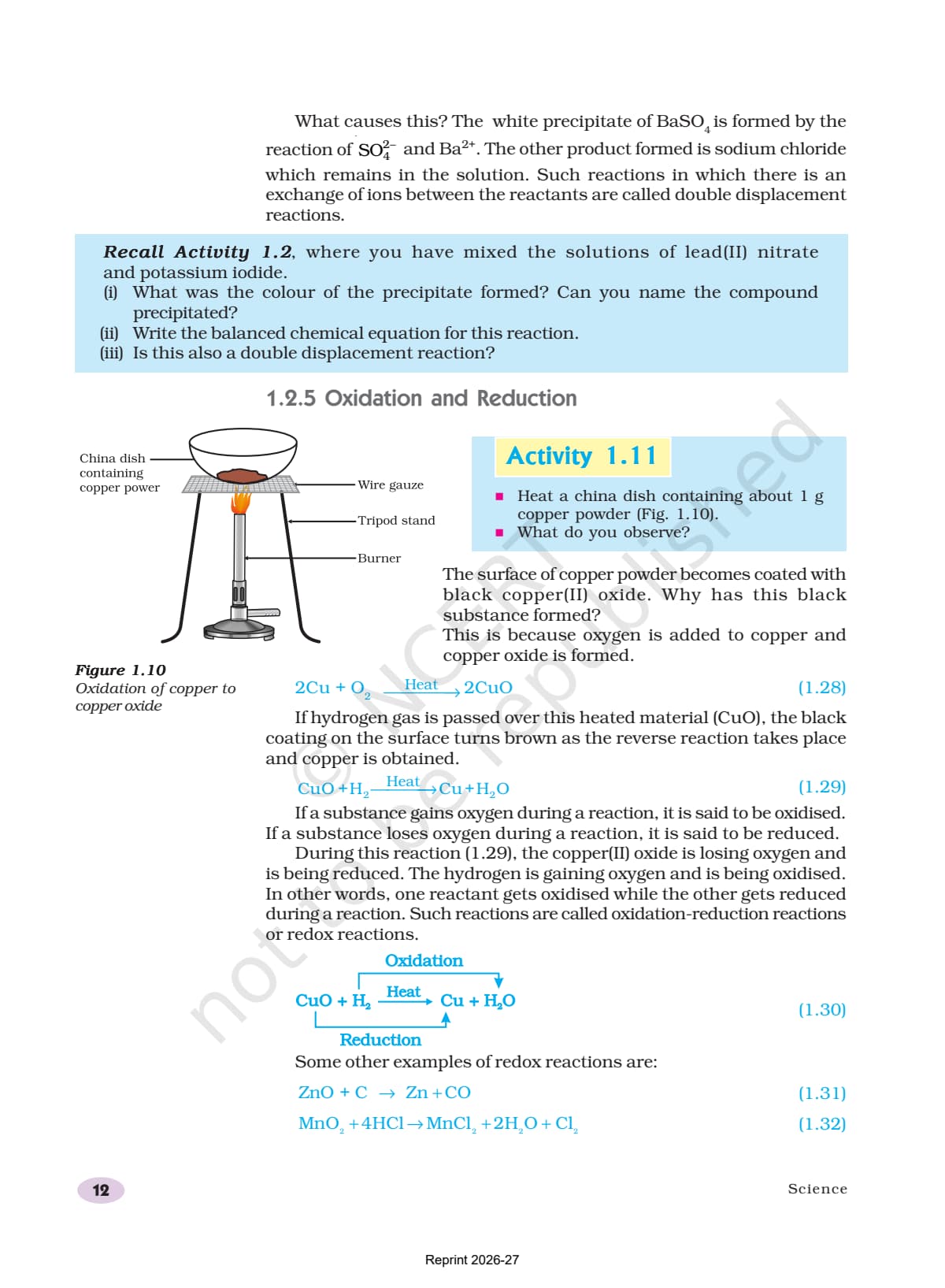
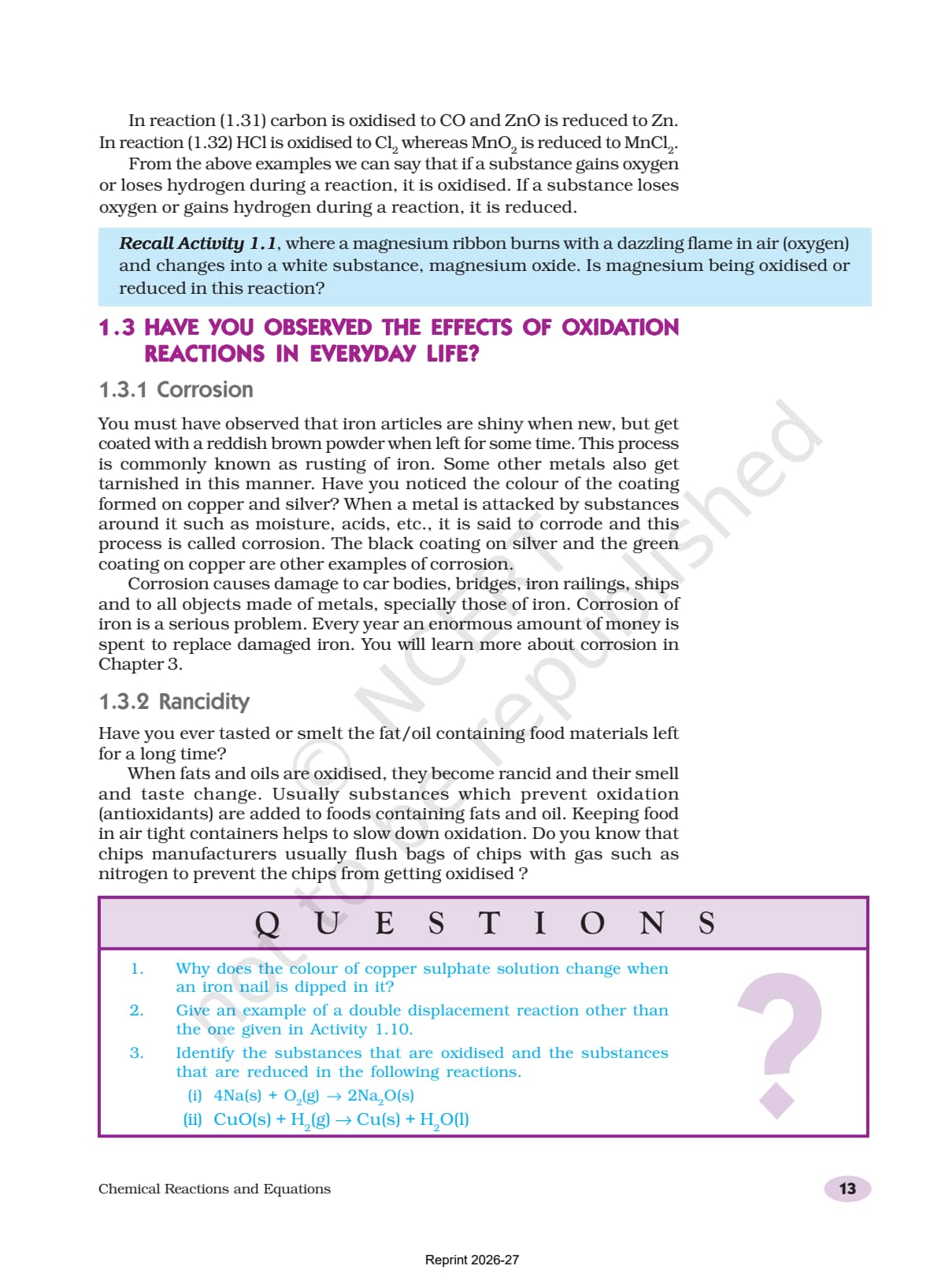
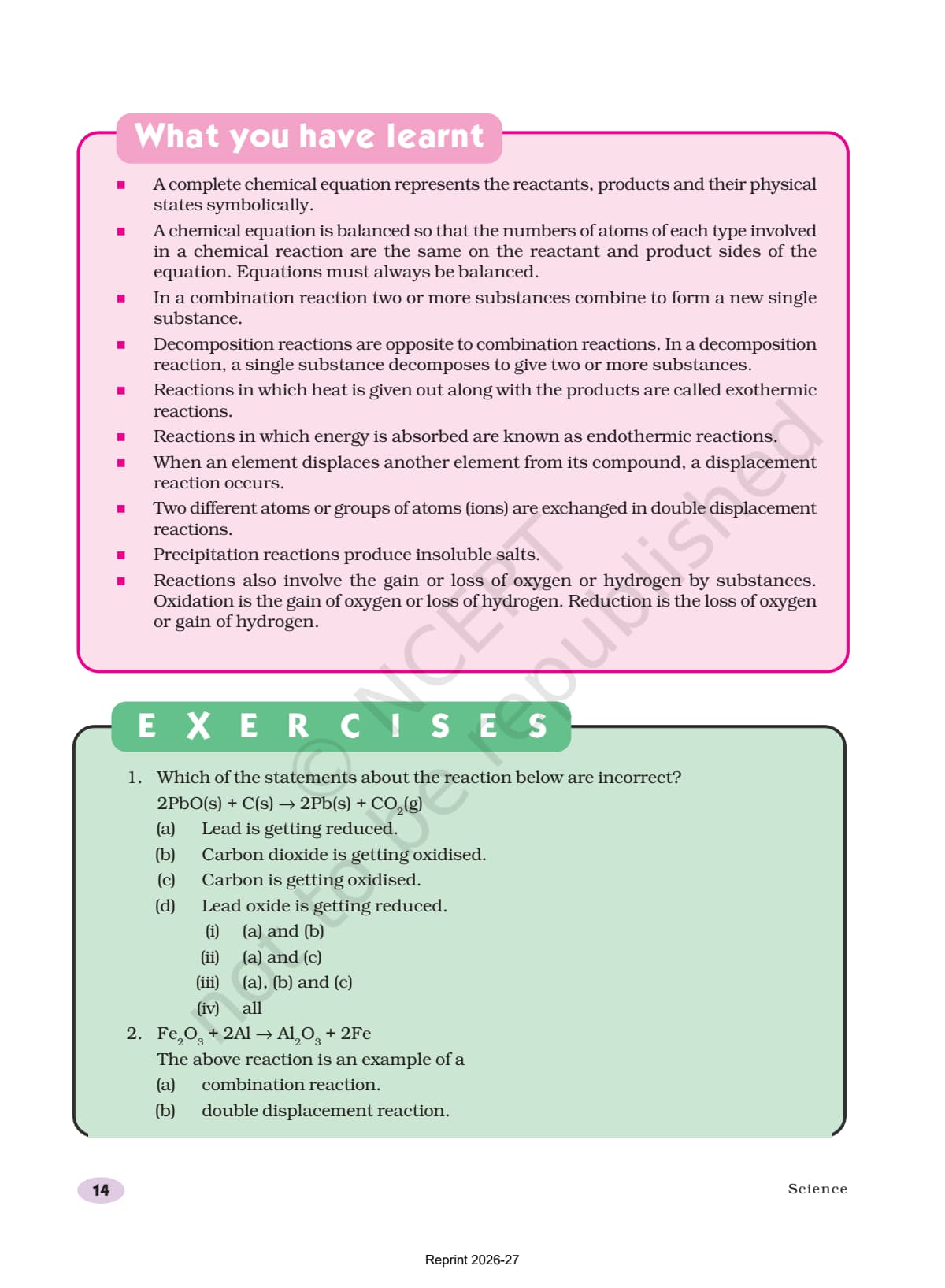
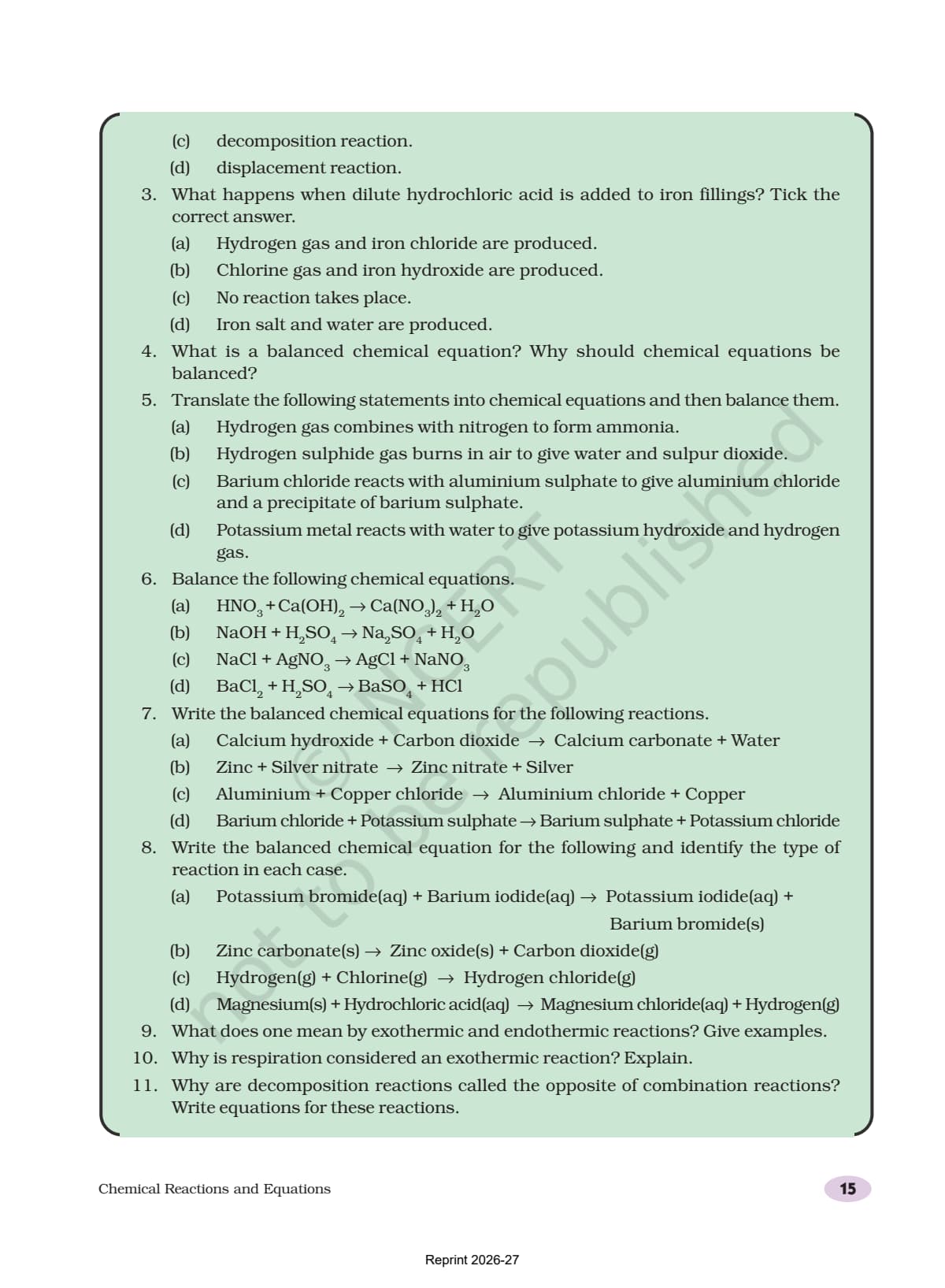
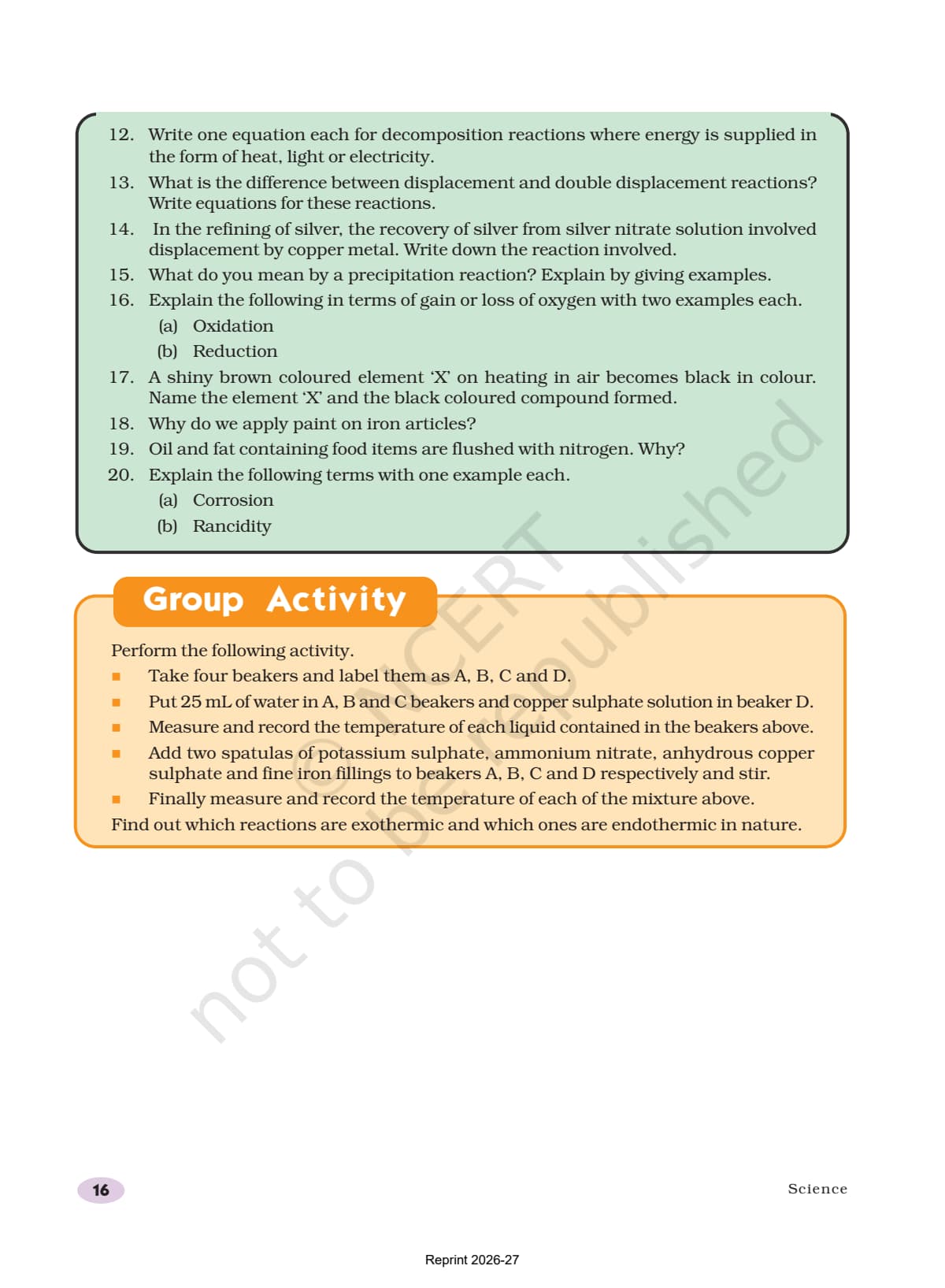
- Official NCERT textbook PDF of Chapter 1, with every activity, figure, in-text question, and exercise exactly as printed.
- Covers balancing chemical equations and all reaction types: combination, decomposition, displacement, double displacement, and oxidation-reduction.
- Aligned with the 2026-27 CBSE Class 10 Science syllabus, useful for board exam revision and as the base text for solutions and notes.
This page hosts the official NCERT Class 10 Science textbook chapter, mapped to the 2026-27 CBSE syllabus.
What the NCERT Book for Class 10 Science Chapter 1 Chemical Reactions and Equations Covers
The downloadable PDF above is the complete official NCERT chapter, exactly as printed in the 2026-27 textbook. It opens with everyday changes, like milk turning sour or iron rusting, then builds to the formal way chemists write and classify reactions. Reading it in order is the fastest way to fix the basics.
- Chemical equations: turning a sentence into a word-equation, then a symbol equation.
- Balanced equations: the law of conservation of mass and the hit-and-trial method.
- Five reaction types: combination, decomposition, displacement, double displacement, and redox.
- Effects of oxidation: corrosion of metals and rancidity of food.
Chemical Reactions and Equations Class 10 Science Full Chapter Video
Source: Magnet Brains on YouTube
Chemical Equations: Word and Symbol Form in Class 10 Science
A chemical equation is a short way of describing a chemical reaction. The chapter first writes a reaction in words, then replaces them with formulae. The reactants sit on the left (LHS) and the products on the right (RHS), with an arrow pointing from reactants to products.
Take the burning of magnesium from Activity 1.1: "Magnesium + Oxygen gives Magnesium oxide", written in formula form as a skeletal (unbalanced) equation:
Add physical states to make it clearer: (s) solid, (l) liquid, (g) gas, (aq) aqueous. Conditions like heat or a catalyst go above the arrow.
| Symbol | Meaning | Example use |
|---|---|---|
| (s) | Solid state | Fe(s), CaO(s) |
| (l) | Liquid state | H2O(l) |
| (g) | Gaseous state | O2(g), CO2(g) |
| (aq) | Dissolved in water (aqueous) | CuSO4(aq) |
| → | Arrow: yields / produces | points from reactants to products |
Balancing a Chemical Equation Step by Step
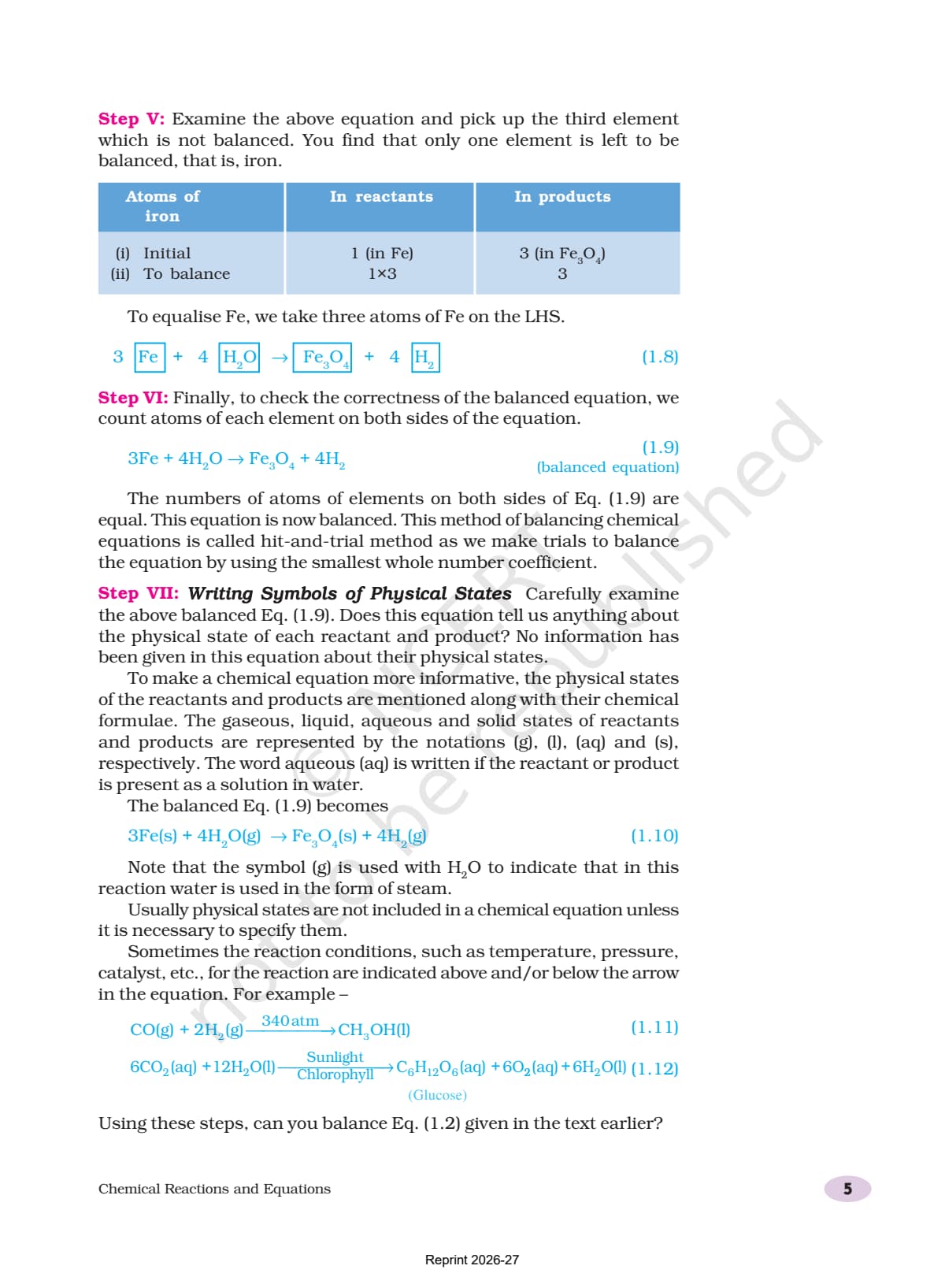
This is the most-tested skill in the chapter. A balanced chemical equation has the same number of atoms of each element on both sides, because the law of conservation of mass says mass cannot be created or destroyed. NCERT balances the iron-and-steam equation by a hit-and-trial method.
Starting from the skeletal equation, the book works through the steps below and reaches the balanced form:
- Step 1: write the skeletal equation and draw a box around each formula so you do not change anything inside it.
- Step 2: count the atoms of every element on the LHS and the RHS.
- Step 3: start with the compound that has the most atoms, balance that element first by adding coefficients.
- Step 4 to 6: balance the remaining elements one by one, then recount to confirm both sides match.
- Step 7: add the physical states once the atom counts are equal.
Types of Chemical Reactions in Class 10 Science Chapter 1
The largest part of the chapter sorts reactions into five types. Each has a simple rule and a standard example you should write from memory, since the board exam asks you to name the type and give a balanced example.
| Reaction type | What happens | Standard example |
|---|---|---|
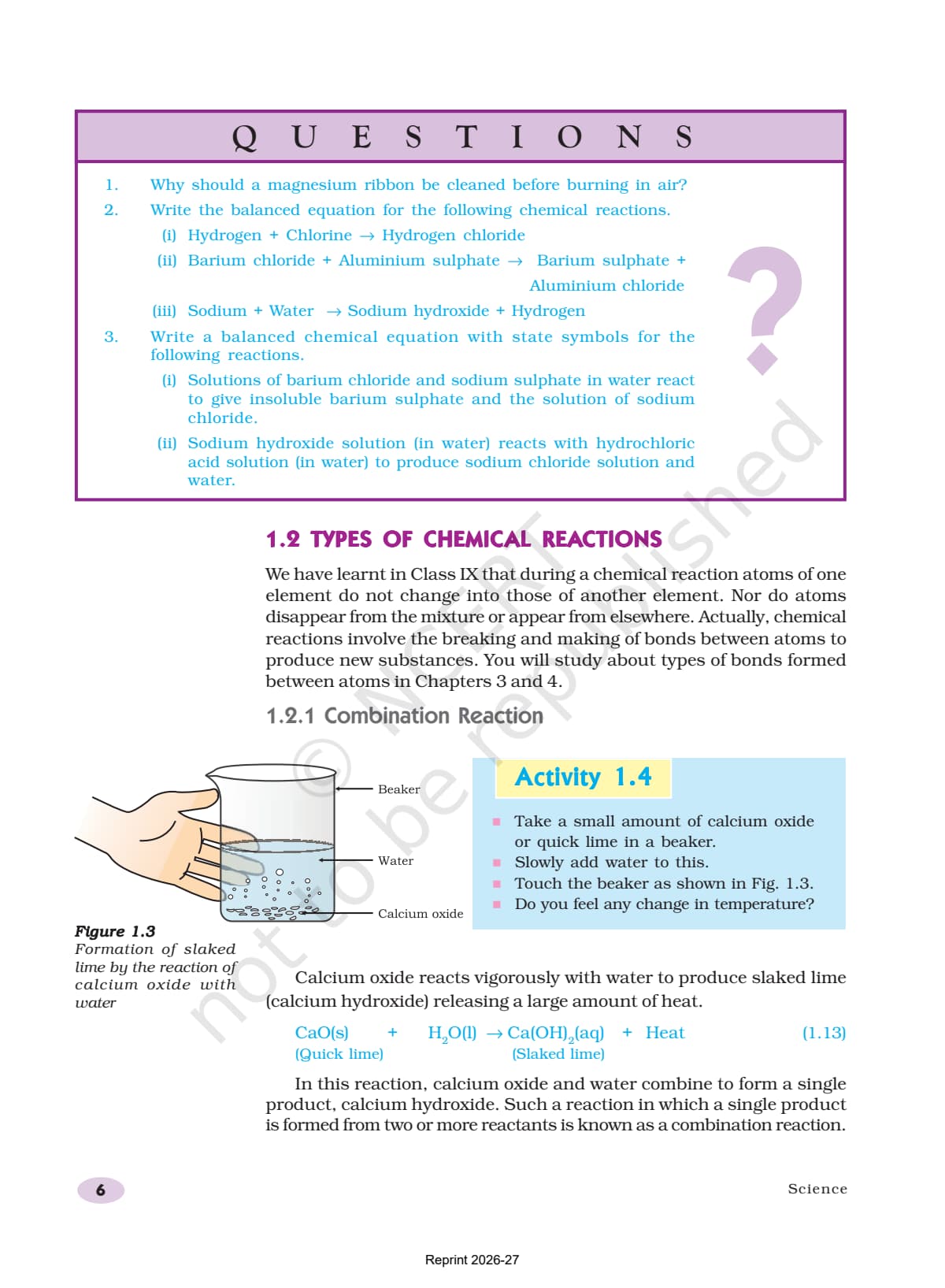
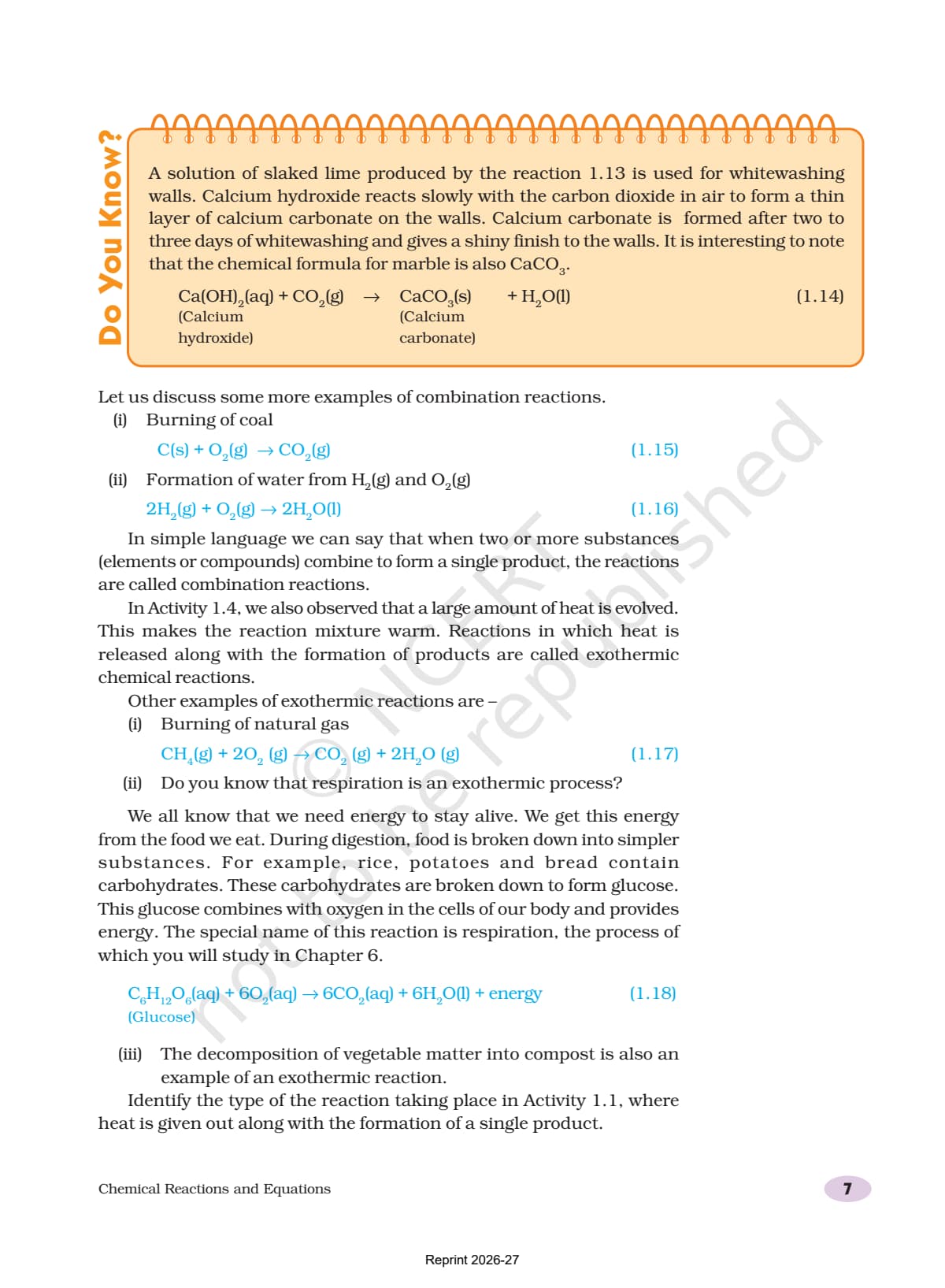
| Combination | Two or more substances join to form one product | CaO + H2O → Ca(OH)2 |
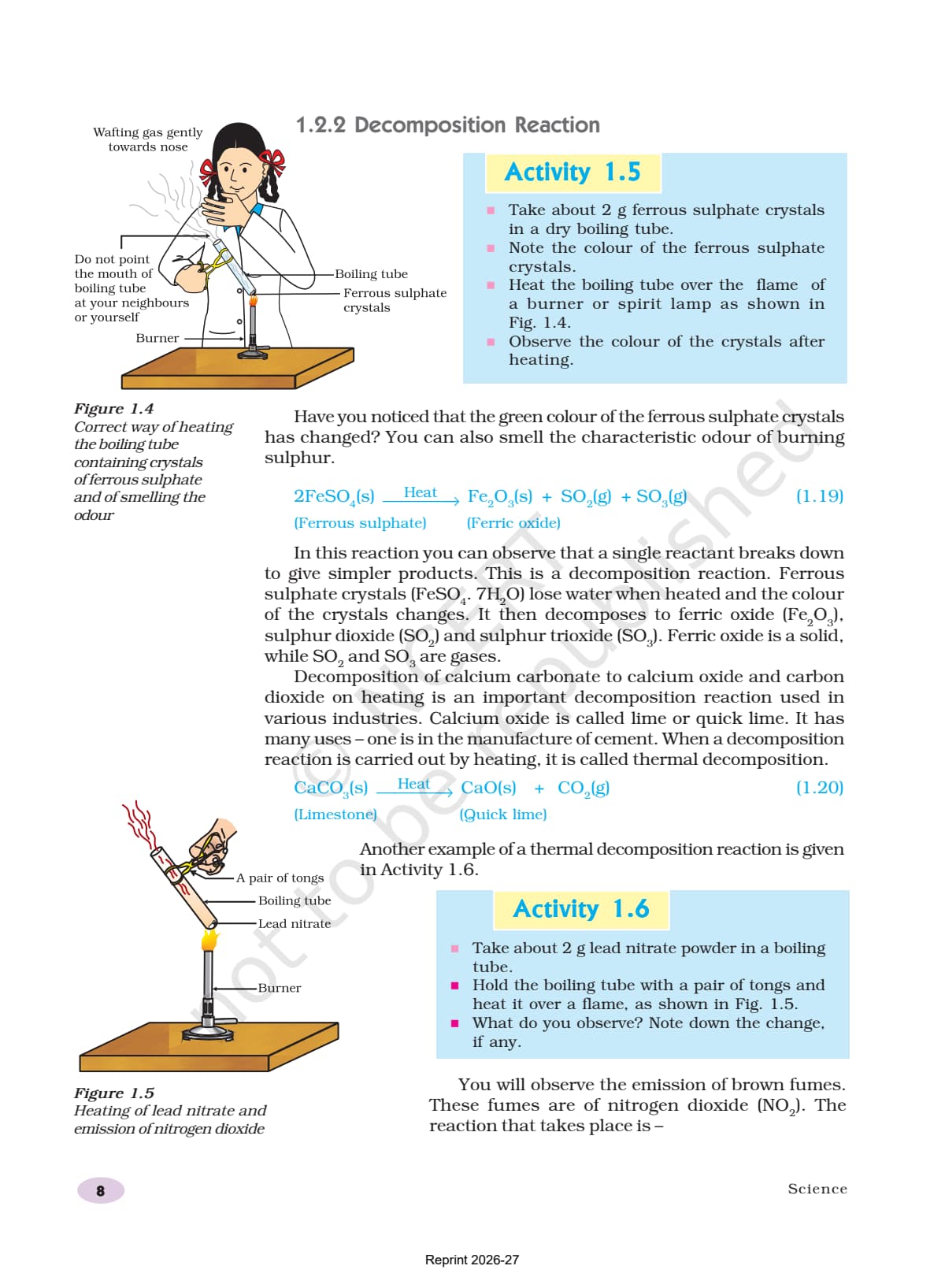
| Decomposition | One substance breaks into two or more substances | CaCO3 → CaO + CO2 (on heating) |
| Displacement | A more reactive element pushes out a less reactive one | Fe + CuSO4 → FeSO4 + Cu |
| Double displacement | Two compounds swap ions, often making a precipitate | Na2SO4 + BaCl2 → BaSO4 + 2NaCl |
| Oxidation-reduction | One reactant gains oxygen, the other loses it | CuO + H2 → Cu + H2O |
Reactions also split by energy. An exothermic reaction gives out heat, like respiration. An endothermic reaction takes in energy, like the decomposition of calcium carbonate. A precipitation reaction is a double displacement that makes an insoluble salt, such as barium sulphate.
Oxidation, Reduction and Everyday Effects of Oxidation
The last part explains redox reactions and everyday oxidation. Oxidation is the gain of oxygen or loss of hydrogen; reduction is the loss of oxygen or gain of hydrogen. In any redox reaction, one substance is oxidised and the other reduced at the same time.
Two everyday effects close the chapter, and both are favourite short-answer questions:
- Corrosion: air and moisture attack metals. Iron forms reddish-brown rust, silver turns black, copper gains a green coat.
- Rancidity: fats and oils in food oxidise over time, so the food smells and tastes bad. Antioxidants or nitrogen-flushed packets slow this down.
How to Use the NCERT Book PDF for Board Revision
The official textbook is the safest source, because every equation, figure and definition is exam-correct. Use it in two reading passes:
- First pass: read Sections 1.1 to 1.3 in order and do each Activity in your head. Note the colour change in Activity 1.5 and the precipitate in Activity 1.10.
- Second pass: cover the coefficients, balance every equation yourself, then name its reaction type.
This is a high-weight chapter in the board exam. Balancing, reaction types, and oxidation versus reduction appear almost every year.
Student Feedback
68% of Class 10 students said balancing chemical equations was the part of this chapter they got wrong most often in class tests. 3 out of 5 students told us reading the NCERT chapter directly, activity by activity, helped them name the reaction type faster than any guide.
Source: 2026-27 Class 10 Science student poll. Sample of 9,400 students from CBSE schools across 12 states, taken before the 2026 board exams.
Other Resources for Class 10 Science Chapter 1 Chemical Reactions and Equations
Pair this with the other Class 10 Science resources for this chapter, all linked below.
| Resource | What it covers | Open |
|---|---|---|
| NCERT Book PDF | Official Class 10 Science Chapter 1 textbook, with every activity, figure and exercise. | Class 10 Science Chapter 1 NCERT Book PDF |
| NCERT Solutions | Step-by-step answers to all in-text and exercise questions. | Class 10 Science Chapter 1 NCERT Solutions |
| Notes | Concept-first revision notes for the chapter. | Class 10 Science Chapter 1 Notes |
| Formula Sheet | Quick reference of key reactions and types. | Class 10 Science Chapter 1 Formula Sheet |
| Handwritten Notes | Scanned-style pages for last-minute revision. | Class 10 Science Chapter 1 Handwritten Notes |
NCERT Book for Class 10 Science: All Chapters
Related Links: Open the official NCERT Book PDF for the other chapters of Class 10 Science below.
| Chapter | NCERT Book PDF link |
|---|---|
| Chapter 1 | Chemical Reactions and Equations NCERT Book PDF |
| Chapter 2 | Acids, Bases and Salts NCERT Book PDF |
| Chapter 3 | Metals and Non-metals NCERT Book PDF |
| Chapter 4 | Carbon and its Compounds NCERT Book PDF |
| Chapter 5 | Life Processes NCERT Book PDF |
| Chapter 6 | Control and Coordination NCERT Book PDF |
| Chapter 7 | How do Organisms Reproduce NCERT Book PDF |
| Chapter 8 | Heredity NCERT Book PDF |
| Chapter 9 | Light Reflection and Refraction NCERT Book PDF |
| Chapter 10 | The Human Eye and the Colourful World NCERT Book PDF |
| Chapter 11 | Electricity NCERT Book PDF |
| Chapter 12 | Magnetic Effects of Electric Current NCERT Book PDF |
| Chapter 13 | Our Environment NCERT Book PDF |
NCERT Book Class 10 Science Chapter 1 Chemical Reactions and Equations FAQs
Ques. What does Chapter 1 Chemical Reactions and Equations cover in the Class 10 Science NCERT Book?
Ans. Chapter 1 of the Class 10 Science NCERT Book teaches how to describe chemical reactions in writing and how to classify them. It covers word-equations and symbol equations, how to balance a chemical equation using the law of conservation of mass, and physical state symbols such as (s), (l), (g) and (aq). It then explains the five main reaction types, which are combination, decomposition, displacement, double displacement, and oxidation-reduction, and ends with the everyday effects of oxidation, namely corrosion of metals and rancidity of food. The chapter is aligned with the 2026-27 CBSE syllabus.
Ques. How do you balance a chemical equation in Class 10 Science?
Ans. To balance a chemical equation you make the number of atoms of each element the same on both sides of the arrow, because the law of conservation of mass says mass is neither created nor destroyed. The NCERT method is hit-and-trial: write the skeletal equation, box each formula, count the atoms of every element, then start with the compound that has the most atoms and add coefficients in front of the formulae. You may change only the big coefficients, never the small subscripts inside a formula, and you recount at the end to confirm both sides match.
Ques. What are the five types of chemical reactions in Class 10 Science Chapter 1?
Ans. The five types are combination, decomposition, displacement, double displacement, and oxidation-reduction. A combination reaction joins two or more substances into one product. A decomposition reaction breaks one substance into two or more products. A displacement reaction has a more reactive element push out a less reactive one. A double displacement reaction has two compounds swap ions, often forming a precipitate. An oxidation-reduction or redox reaction has one substance gain oxygen while another loses it. The board exam often asks you to name the type and give a balanced example.
Ques. What is the difference between oxidation and reduction?
Ans. Oxidation is the gain of oxygen or the loss of hydrogen by a substance during a reaction. Reduction is the loss of oxygen or the gain of hydrogen. In any redox reaction both happen together: one reactant is oxidised while the other is reduced. For example, in CuO + H2 giving Cu + H2O, copper oxide loses oxygen so it is reduced, and hydrogen gains oxygen so it is oxidised. This pairing is why such reactions are called oxidation-reduction or redox reactions in the Class 10 Science chapter.
Ques. Is the Class 10 Science Chapter 1 NCERT Book PDF free to download for 2026-27?
Ans. Yes. The official NCERT Book PDF for Class 10 Science Chapter 1 Chemical Reactions and Equations is free to read and download on this page for the 2026-27 session. It is the complete chapter as printed in the CBSE textbook, including every activity, figure, in-text question and end-of-chapter exercise. You can pair the book with the linked NCERT Solutions and revision notes for the same chapter so that you read the textbook and revise from one place.
Ques. What are corrosion and rancidity in Chapter 1 Chemical Reactions and Equations?
Ans. Corrosion and rancidity are the two everyday effects of oxidation covered at the end of the chapter. Corrosion is the slow attack on a metal by air and moisture, such as iron forming reddish-brown rust, silver turning black, and copper gaining a green coat. Rancidity is the oxidation of fats and oils in food, which makes the food smell and taste bad over time. Rancidity is slowed by adding antioxidants to food or by flushing packets with an unreactive gas such as nitrogen, which is why chip packets are filled with nitrogen.
Ques. Are these NCERT Book contents aligned with the 2026-27 CBSE syllabus?
Ans. Yes. This page hosts the official NCERT Class 10 Science textbook chapter for the current 2026-27 CBSE syllabus. The Chemical Reactions and Equations chapter is unchanged for this cycle, so the equations, activities and definitions you read here are exam-correct. Because it is the official book, it is the safest base text for board preparation, and the linked solutions, notes and formula sheet for the same chapter all follow this textbook order.



Comments