




The NCERT Book for Class 10 Maths Chapter 12 Surface Areas and Volumes is the official CBSE textbook chapter, free to read and download for the 2026-27 session. It builds on earlier mensuration and shows how to find the surface area and volume of combinations of solids and the frustum of a cone.
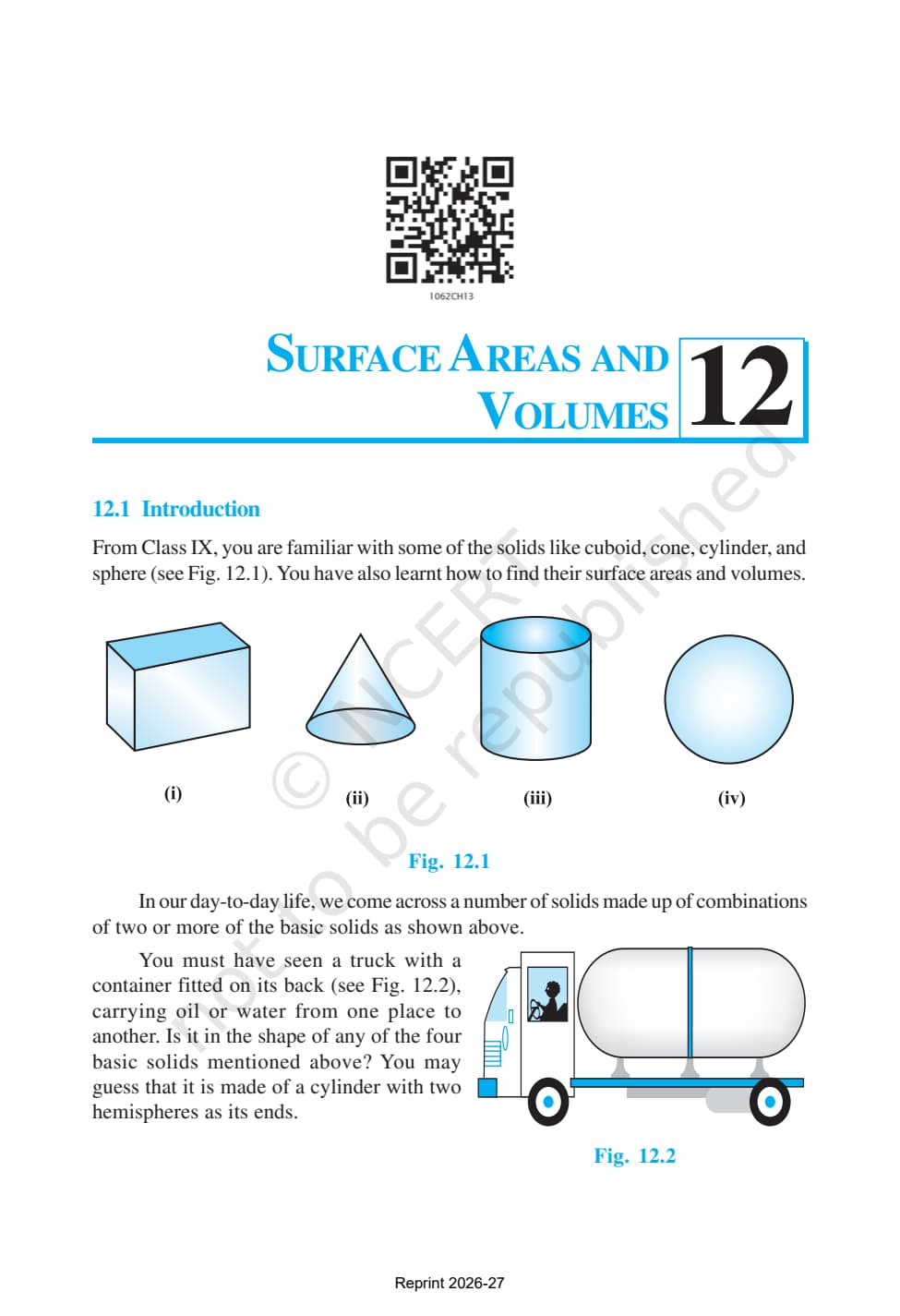
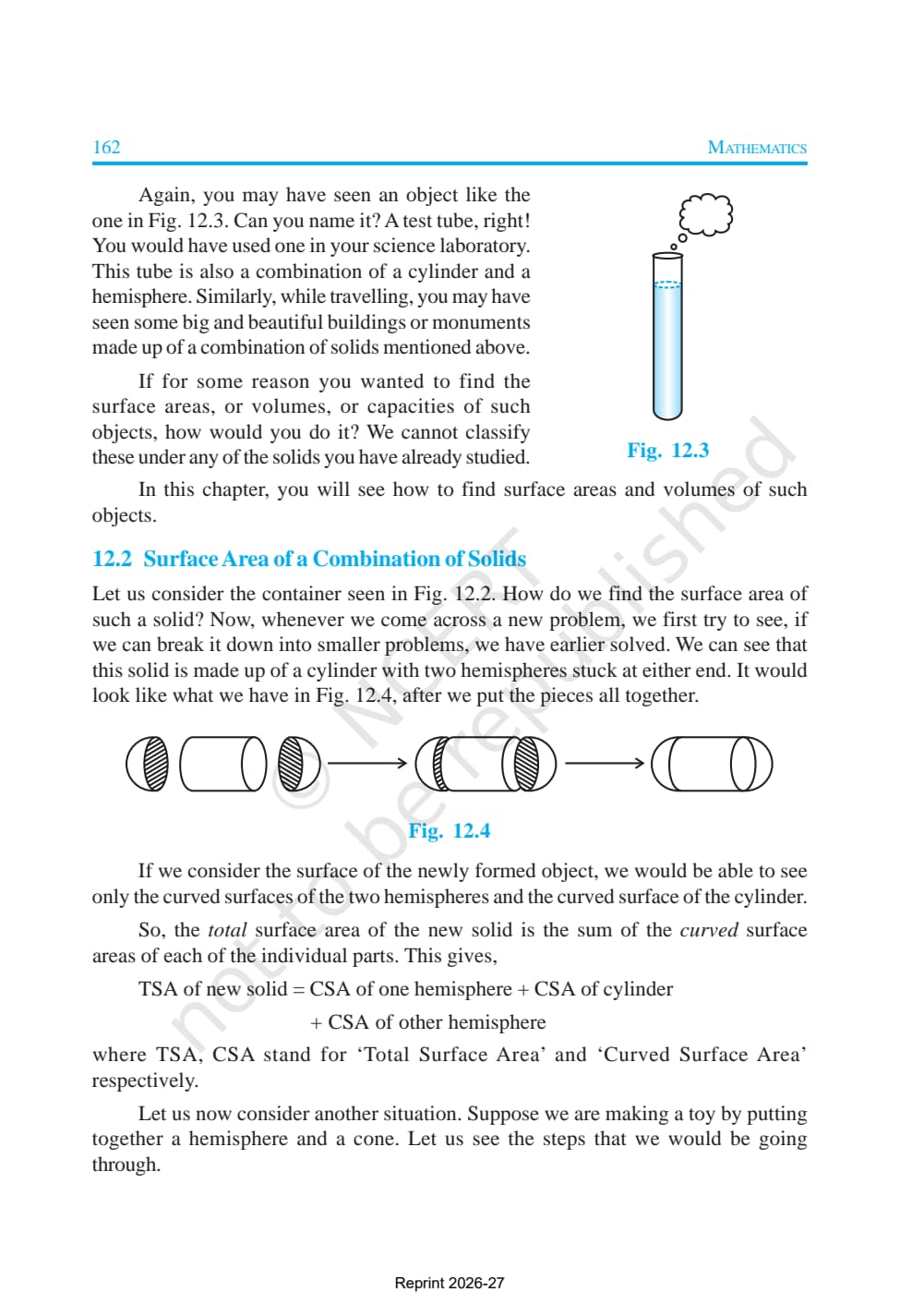
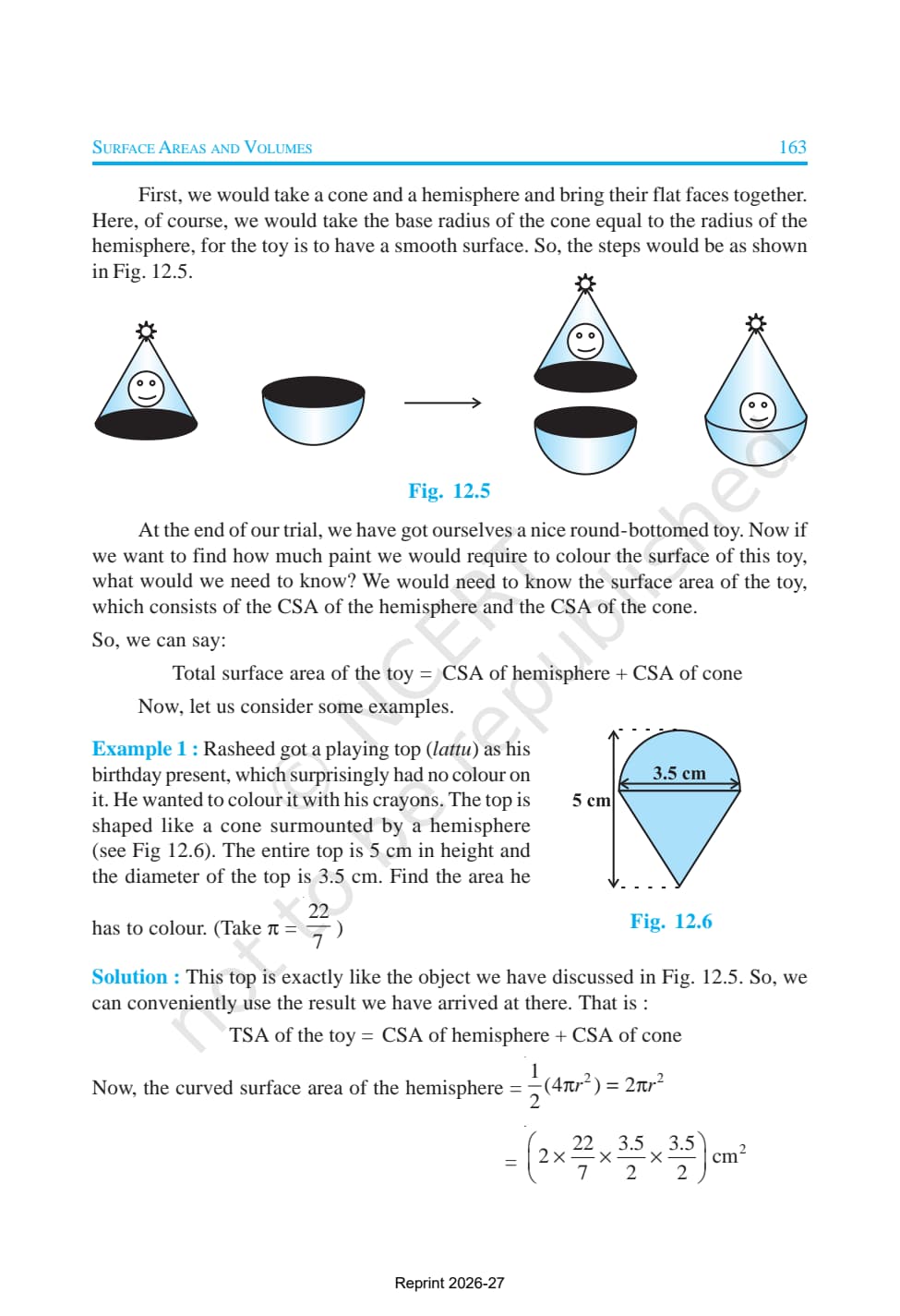
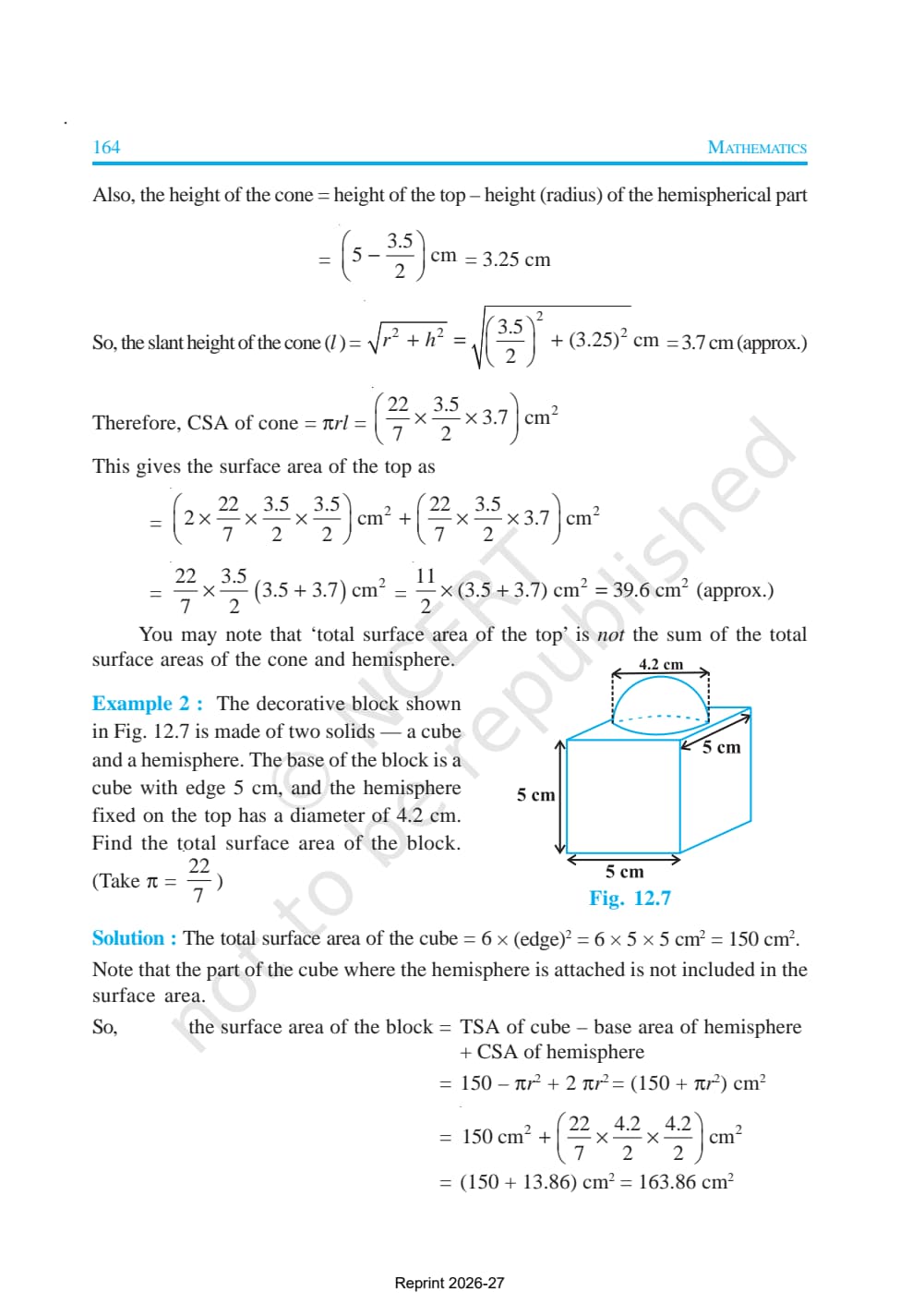
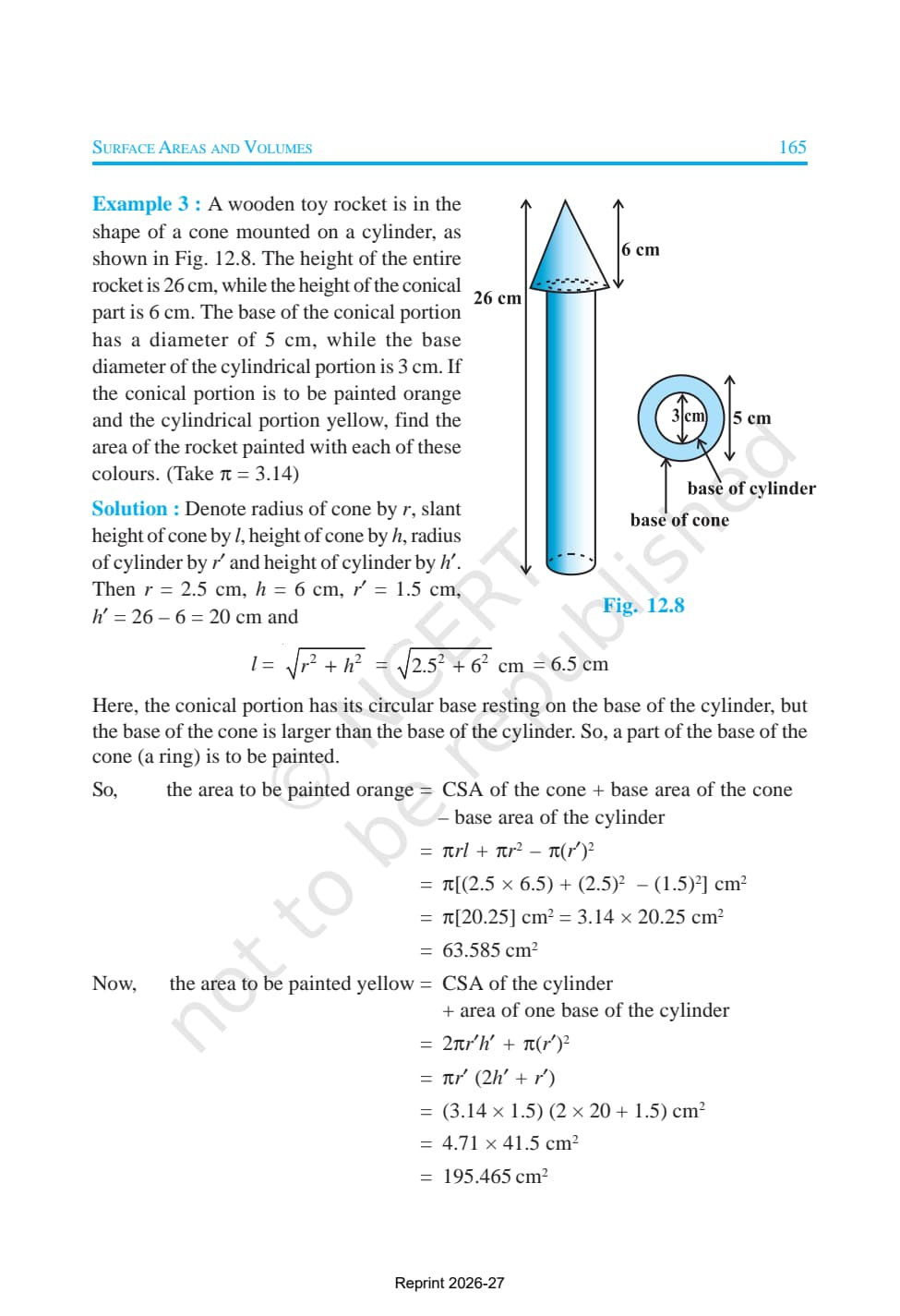
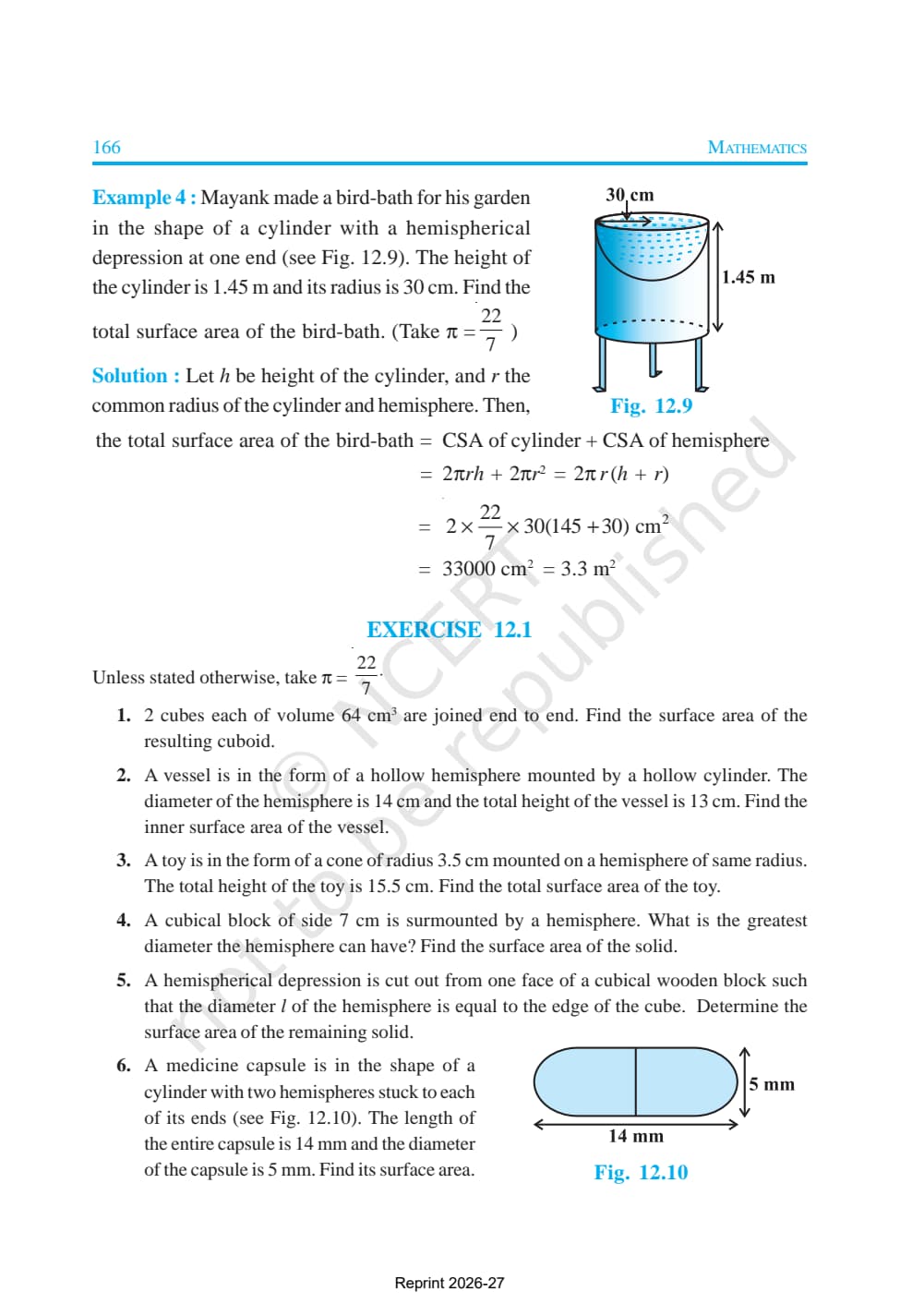
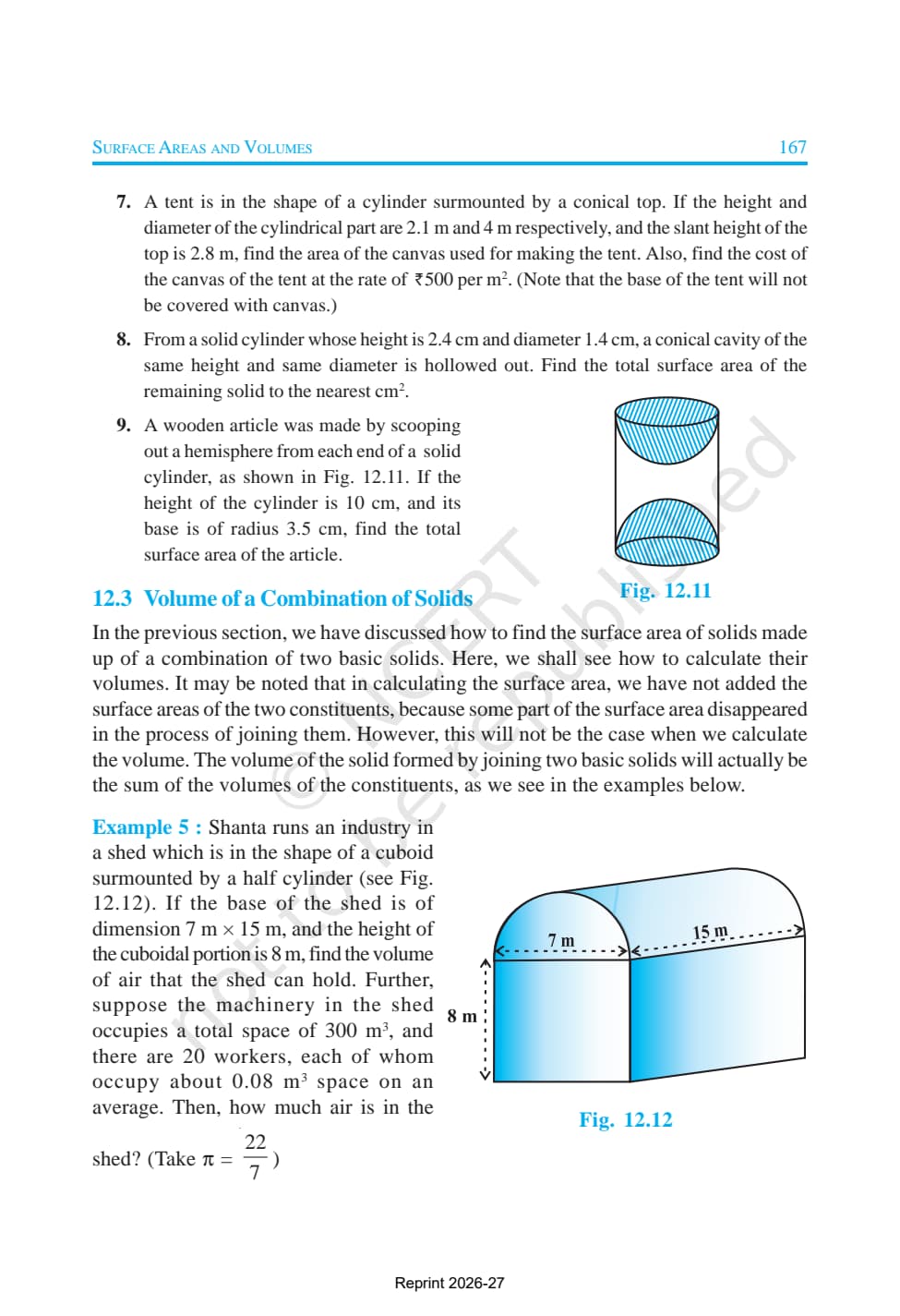
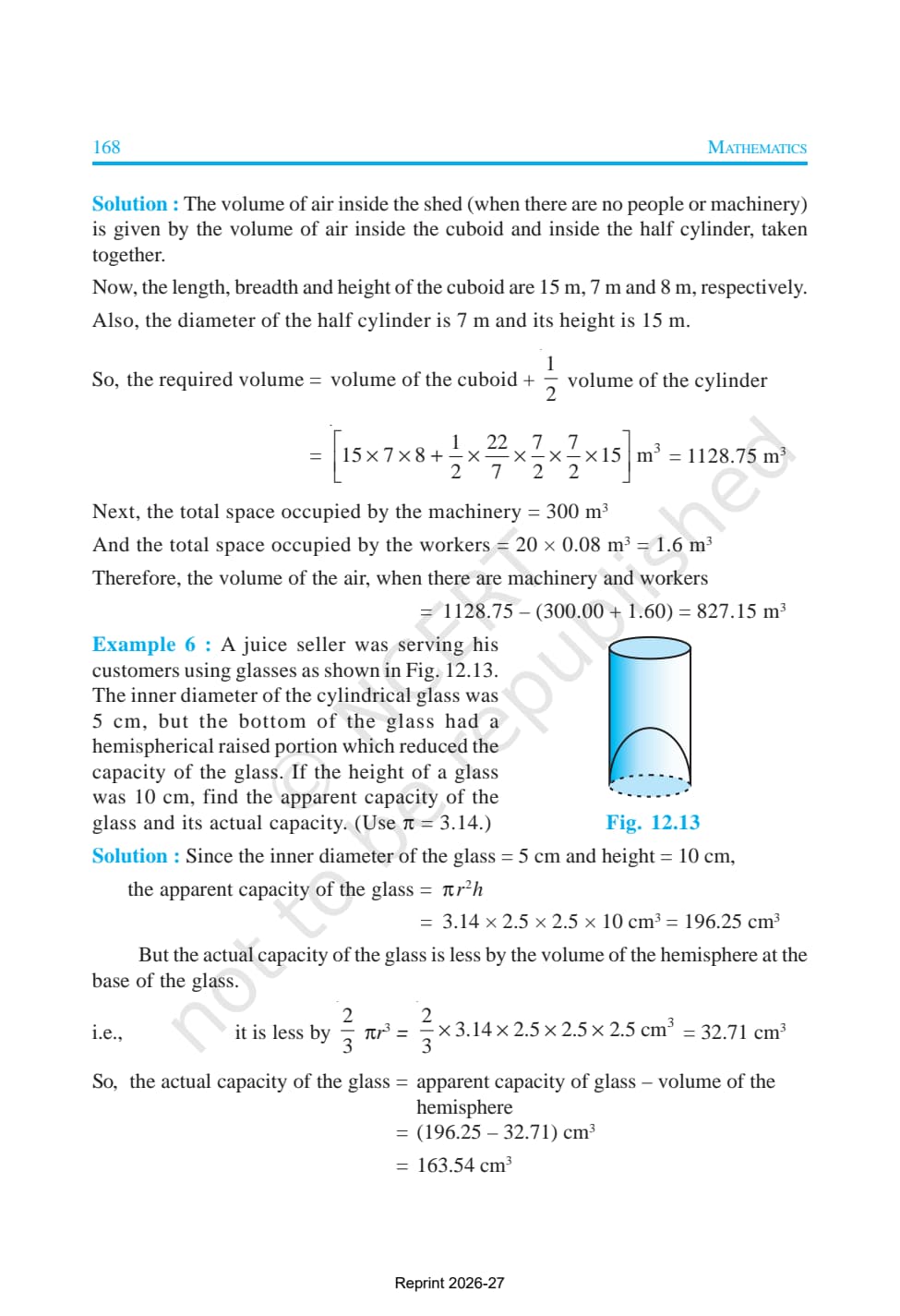
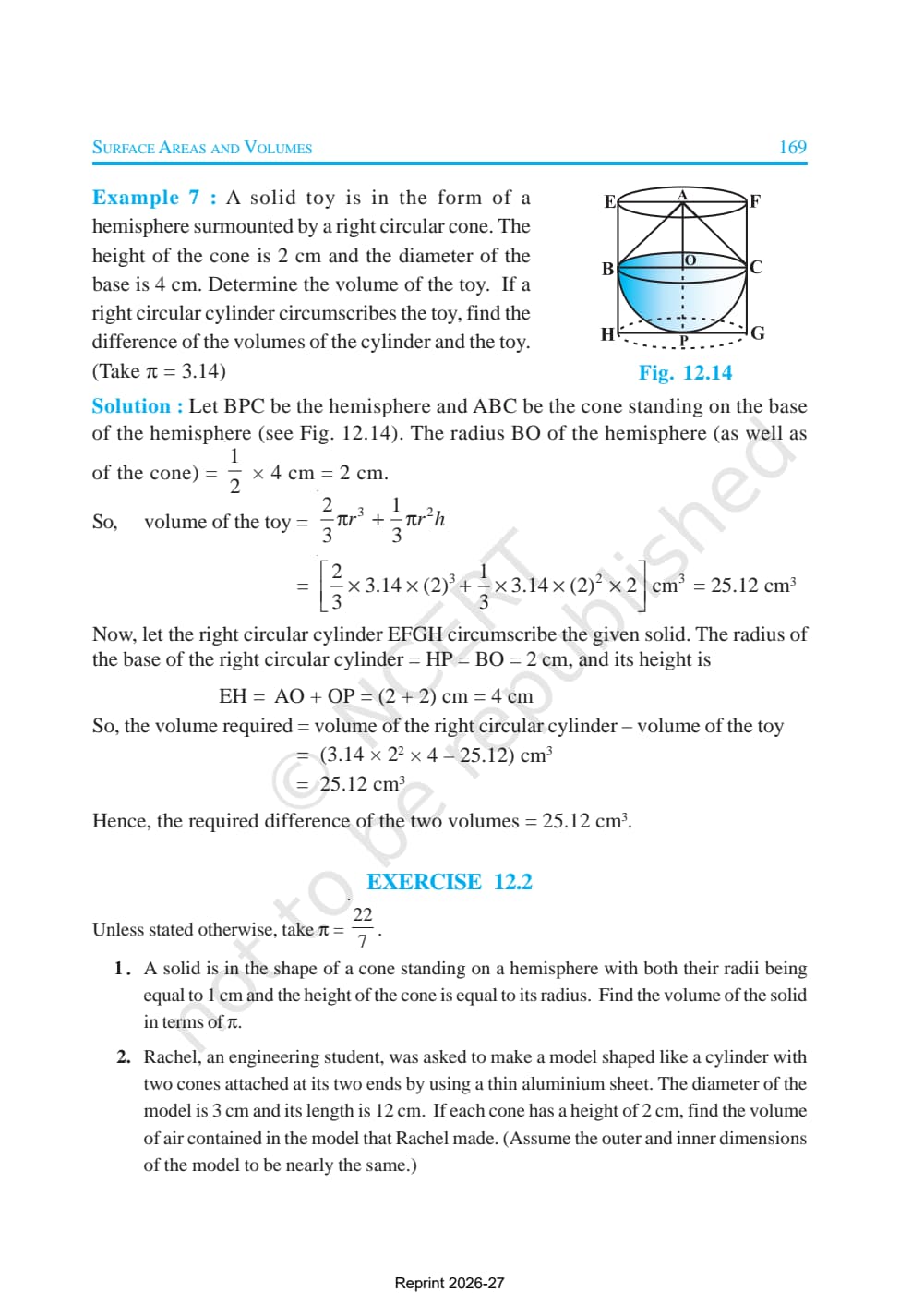
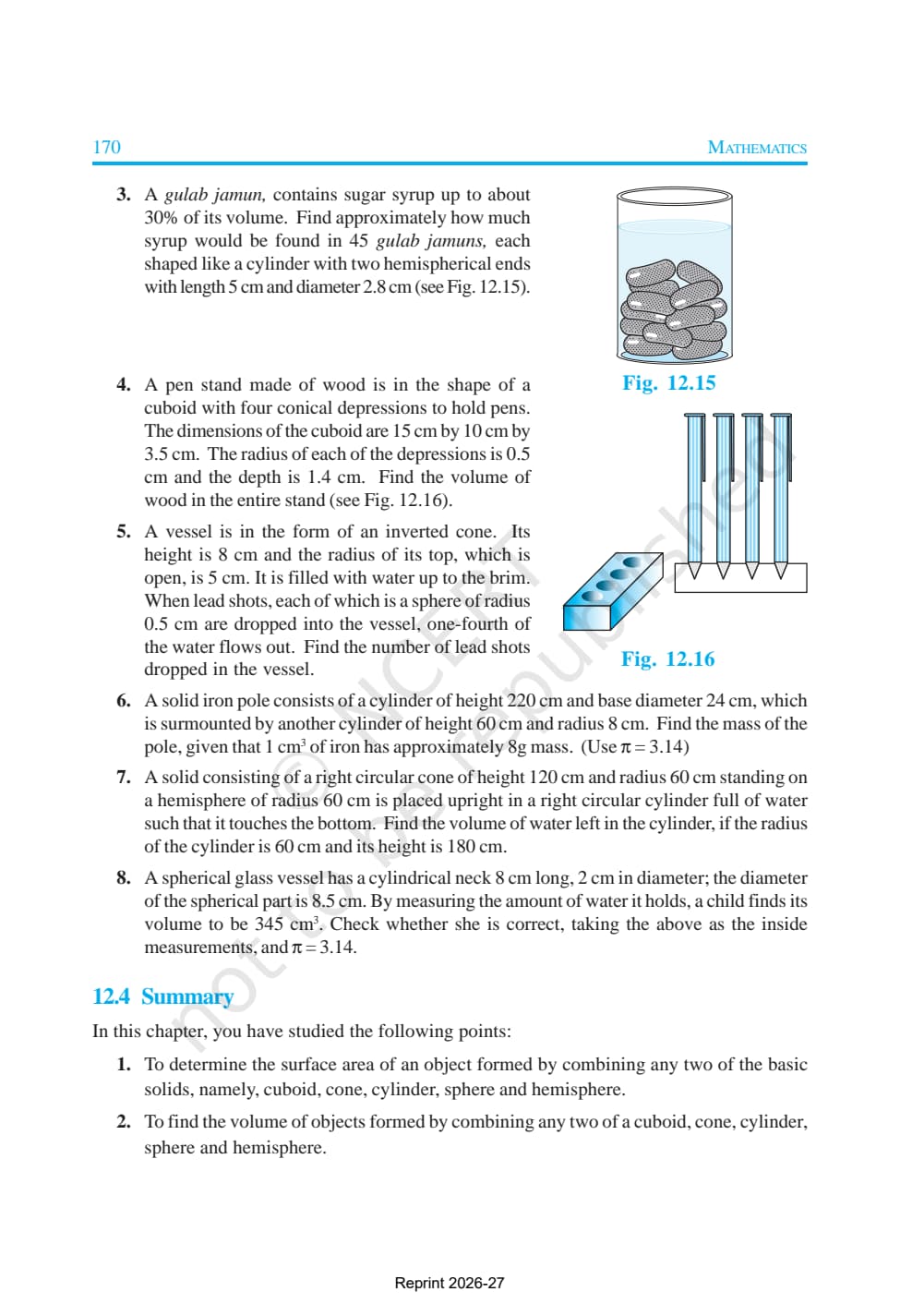
- Official NCERT textbook PDF, with every theorem, solved example, and exercise as printed.
- Covers combinations of solids (cylinder plus cone, hemisphere plus cylinder) and the frustum of a cone.
- Aligned with the 2026-27 CBSE syllabus; the base text for the NCERT Solutions and notes.
This page hosts the official NCERT textbook chapter, mapped to the 2026-27 CBSE syllabus and checked page by page against the printed book.
Watch Surface Areas and Volumes Class 10 Maths Explained
Source: Ritik Mishra - 9th & 10th on YouTube
What the NCERT Book Covers
The PDF above is the complete official chapter, as printed in the 2026-27 textbook. It builds on Class 9 mensuration: what happens when solids are joined, or a cone is sliced? Each solved example shows the reasoning the board expects.
- Surface area and volume of basic solids: a quick recall of the formulas for cuboids, cylinders, cones, spheres, and hemispheres.
- Combinations of solids: two or more solids fused together, such as a cylinder topped with a cone. You add or subtract areas and volumes with care.
- Frustum of a cone: the solid left when a small cone is sliced off the top of a bigger one. The chapter derives its curved surface area, total surface area, and volume.
Surface Area & Volume Formulas
The chapter recalls the basic formulas first. With radius r, height h, and slant height l, the book summarises:
| Solid | Curved / Lateral Surface Area | Total Surface Area | Volume |
|---|---|---|---|
| Cuboid (l × b × h) | 2(lb + bh + hl) − 2lb (top and bottom) | 2(lb + bh + hl) | l × b × h |
| Cylinder | 2πrh | 2πr(r + h) | πr²h |
| Cone | πrl | πr(r + l) | (1/3)πr²h |
| Sphere | 4πr² | 4πr² | (4/3)πr³ |
| Hemisphere | 2πr² | 3πr² | (2/3)πr³ |
Use π = 22/7 for most problems, or leave it as π when the answer is symbolic.
Combinations of Solids
This is the core section for board marks. The strategy stays the same: name each part, find its surface area and volume separately, then combine them correctly.
| Combination type | Surface area rule | Volume rule |
|---|---|---|
| Cylinder + Cone on top | Curved area of cylinder + curved area of cone + base circle (no top circle, since the cone sits on it) | Volume of cylinder + volume of cone |
| Cylinder + Hemisphere on top | Curved area of cylinder + curved area of hemisphere (the flat face of the hemisphere is inside) | Volume of cylinder + volume of hemisphere |
| Sphere embedded in cylinder | Curved area of cylinder + 2 × base circle (the sphere is entirely inside) | Volume of cylinder − volume of sphere |
| Cone + Hemisphere base | Curved area of cone + curved area of hemisphere | Volume of cone + volume of hemisphere |
The common mistake is counting a shared face twice. A shared circular face is internal and stays out of the total surface area. Sketch and mark the exposed faces first.
Frustum of a Cone
A frustum is the solid left when the small top cone is sliced off a bigger one, like a bucket or glass. Let R be the larger base radius, r the smaller, h the height, and l the slant height. Then:
Curved surface area = π(R + r)l
Total surface area = π(R + r)l + πR² + πr²
Volume = (1/3)πh(R² + Rr + r²)
The book derives these by subtracting the small cone from the large one, since the board sometimes asks you to prove the formula, not just apply it.
- Slant height l: found from h, R, and r. Work it out first.
- Curved surface area: the side face only, using (R + r) and l.
- Total surface area: adds the two circular ends (πR² and πr²).
- Volume: check (1/3)πh(R² + Rr + r²) by setting r = 0 to get the full cone.
Exercises & Solved Examples
The chapter places solved examples before each exercise. Study them before you try the exercises.
| Section | What it covers | Type of question |
|---|---|---|
| Solved examples (Combinations) | Surface area and volume of cylinder-plus-cone, cylinder-plus-hemisphere, and related shapes | Multi-step with a labelled diagram |
| Solved examples (Frustum) | Frustum slant height, curved surface area, total surface area, and volume | Formula derivation and application |
| Exercise 12.1 | Combinations of solids: surface area and volume problems | Short and long answer, CBSE-style |
| Exercise 12.2 | Frustum of a cone problems | Formula application and real-world shapes like buckets and earthen pots |
One popular example asks for the canvas of a tent shaped like a cylinder with a conical roof. Add the curved surface of the cylinder (walls) and cone (roof); the base is open. Choosing which faces to include shows up in board questions.
Also Check:
- Class 10 Maths Chapter 12 Surface Areas and Volumes NCERT Solutions
- Class 10 Maths Chapter 12 Surface Areas and Volumes Formula Sheet
How to Use This PDF for Board Revision
Use this PDF in two passes, paired with the linked solutions and notes.
- First pass: read the theory, then each solved example. Cover the answer and try it first.
- Second pass: solve Exercise 12.1 and 12.2 unaided. Draw a labelled 3D figure and mark R, r, h, and l before substituting.
- Board angle: this chapter sits in the Mensuration unit, worth about 10 marks. Long-answer questions on combinations and frustums appear most years.
Student Feedback
72% of Class 10 students found combination-of-solids problems the hardest part. 4 out of 5 said reading the chapter example by example helped them pick the right formula.
Source: 2026-27 Class 10 Maths student poll, 8,700 students from CBSE schools across 15 states.
Other Resources for This Chapter
Read the official chapter above, then revise with the matching NCERT Solutions, notes, formula sheet, and handwritten notes. All resources are linked below.
| Resource | What it covers | Open |
|---|---|---|
| NCERT Book PDF | Official Class 10 Maths Chapter 12 textbook, with every solved example and exercise. | NCERT Book PDF |
| NCERT Solutions | Step-by-step answers to all exercise questions of Chapter 12. | Class 10 Maths Chapter 12 NCERT Solutions |
| Notes | Concept-first revision notes on combinations of solids and frustum of a cone. | Class 10 Maths Chapter 12 Notes |
| Formula Sheet | Quick reference of all key formulas for fast revision before the board exam. | Class 10 Maths Chapter 12 Formula Sheet |
| Handwritten Notes | Scanned-style handwritten pages for last-minute board revision. | Class 10 Maths Chapter 12 Handwritten Notes |
| Exemplar Solutions | Worked solutions to NCERT Exemplar problems for deeper practice. | Class 10 Maths Chapter 12 Exemplar Solutions |
| Exemplar Book PDF | Official NCERT Exemplar chapter PDF for additional problem practice. | Class 10 Maths Chapter 12 Exemplar Book PDF |
NCERT Book for Class 10 Maths: All Chapters
Related Links: Open the official NCERT Book PDF for any other Class 10 Maths chapter below. Each one ships with the same textbook PDF, overview, and FAQ.
| Chapter | NCERT Book PDF link |
|---|---|
| Chapter 1 | Real Numbers NCERT Book PDF |
| Chapter 2 | Polynomials NCERT Book PDF |
| Chapter 3 | Pair of Linear Equations in Two Variables NCERT Book PDF |
| Chapter 4 | Quadratic Equations NCERT Book PDF |
| Chapter 5 | Arithmetic Progressions NCERT Book PDF |
| Chapter 6 | Triangles NCERT Book PDF |
| Chapter 7 | Coordinate Geometry NCERT Book PDF |
| Chapter 8 | Introduction to Trigonometry NCERT Book PDF |
| Chapter 9 | Some Applications of Trigonometry NCERT Book PDF |
| Chapter 10 | Circles NCERT Book PDF |
| Chapter 11 | Areas Related to Circles NCERT Book PDF |
| Chapter 12 | Surface Areas and Volumes NCERT Book PDF |
| Chapter 13 | Statistics NCERT Book PDF |
| Chapter 14 | Probability NCERT Book PDF |
Surface Areas and Volumes NCERT Book FAQs
Ques. What does Chapter 12 Surface Areas and Volumes cover in the Class 10 Maths NCERT Book?
Ans. Chapter 12 covers three topics. First, it recaps the surface area and volume formulas for the basic solids from Class 9: cuboid, cylinder, cone, sphere, and hemisphere. Second, it extends these to combinations of solids, where you identify which faces are exposed. Third, it introduces the frustum of a cone, with its slant height, curved surface area, total surface area, and volume. The chapter has two exercises and follows the 2026-27 CBSE syllabus.
Ques. What are the key formulas for the frustum of a cone in Class 10 Maths?
Ans. For a frustum with larger base radius R, smaller base radius r, vertical height h, and slant height l, the NCERT book gives four formulas. The slant height l equals the square root of (h squared plus (R minus r) squared). The curved surface area equals pi times (R plus r) times l. The total surface area equals the curved surface area plus pi R squared plus pi r squared. The volume equals one-third times pi times h times (R squared plus R times r plus r squared). The slant height formula is the starting point for all other frustum calculations and must be worked out first.
Ques. How is surface area calculated for a combination of solids?
Ans. For a combination of solids, the total surface area is found by adding the surface areas of the component solids, but subtracting the areas of any faces that are hidden at the junction. For example, when a cone is placed on top of a cylinder, the circular face where they meet is internal and is not counted. The exposed area is the curved surface of the cylinder plus the curved surface of the cone plus the base circle of the cylinder. Drawing a labelled sketch before writing any formula is the safest approach, since it makes the hidden faces easy to identify.
Ques. Is the Class 10 Maths Chapter 12 NCERT Book PDF free to download for 2026-27?
Ans. Yes. The official NCERT Book PDF for Class 10 Maths Chapter 12 Surface Areas and Volumes is free to read and download on this page for the 2026-27 session. It is the complete chapter exactly as printed in the CBSE textbook, including all the solved examples and Exercises 12.1 and 12.2. You can pair the book PDF with the NCERT Solutions and revision notes for the same chapter, both linked on this page, so you can read, practise, and revise from one place.
Ques. How many exercises are there in Class 10 Maths Chapter 12 Surface Areas and Volumes?
Ans. Chapter 12 has two exercises. Exercise 12.1 covers combinations of solids and asks students to find surface areas and volumes of figures formed by joining two or more basic solids. Exercise 12.2 focuses on the frustum of a cone, with problems ranging from direct formula application to real-world shapes such as buckets, earthen pots, and milk containers. Before each exercise, the NCERT book works through a series of solved examples that model the correct method, so students should study all the examples carefully before attempting the exercise questions on their own.
Ques. How is this chapter important for the CBSE Class 10 Maths board exam?
Ans. Surface Areas and Volumes is part of the Mensuration unit in CBSE Class 10 Maths, which typically carries around 10 marks in the board exam. Long answer questions on combination solids and frustum problems appear most years. Students who understand the shared-face rule for surface area, know when to add and when to subtract, and practise both exercises thoroughly are well prepared for the 3-mark and 5-mark board questions from this chapter. The NCERT solved examples are a direct model for the board question style.
Ques. Are the contents aligned with the 2026-27 CBSE syllabus?
Ans. Yes. This page hosts the official NCERT Class 10 Maths textbook chapter for the current 2026-27 CBSE syllabus. The chapter covers combinations of solids and the frustum of a cone, which are the topics prescribed in the Mensuration unit for Class 10. Because it is the official NCERT text, everything you read here is exam-correct for the 2026-27 board exam, and the linked solutions, notes, and formula sheet for Chapter 12 all follow this textbook order.



Comments