




The NCERT Notes Class 9 Science Chapter 7 Work, Energy, and Simple Machines give you a fast, clear revision of the full chapter from the new Exploration textbook. In one place you get every key idea: the scientific meaning of work, the joule, positive and negative work, kinetic and potential energy, the work-energy theorem, conservation of mechanical energy, power and the watt, and the three simple machines (the pulley, the inclined plane and the lever). The notes use short lines and simple words, so you can revise the whole chapter quickly before a class test or the 2026-27 exam.
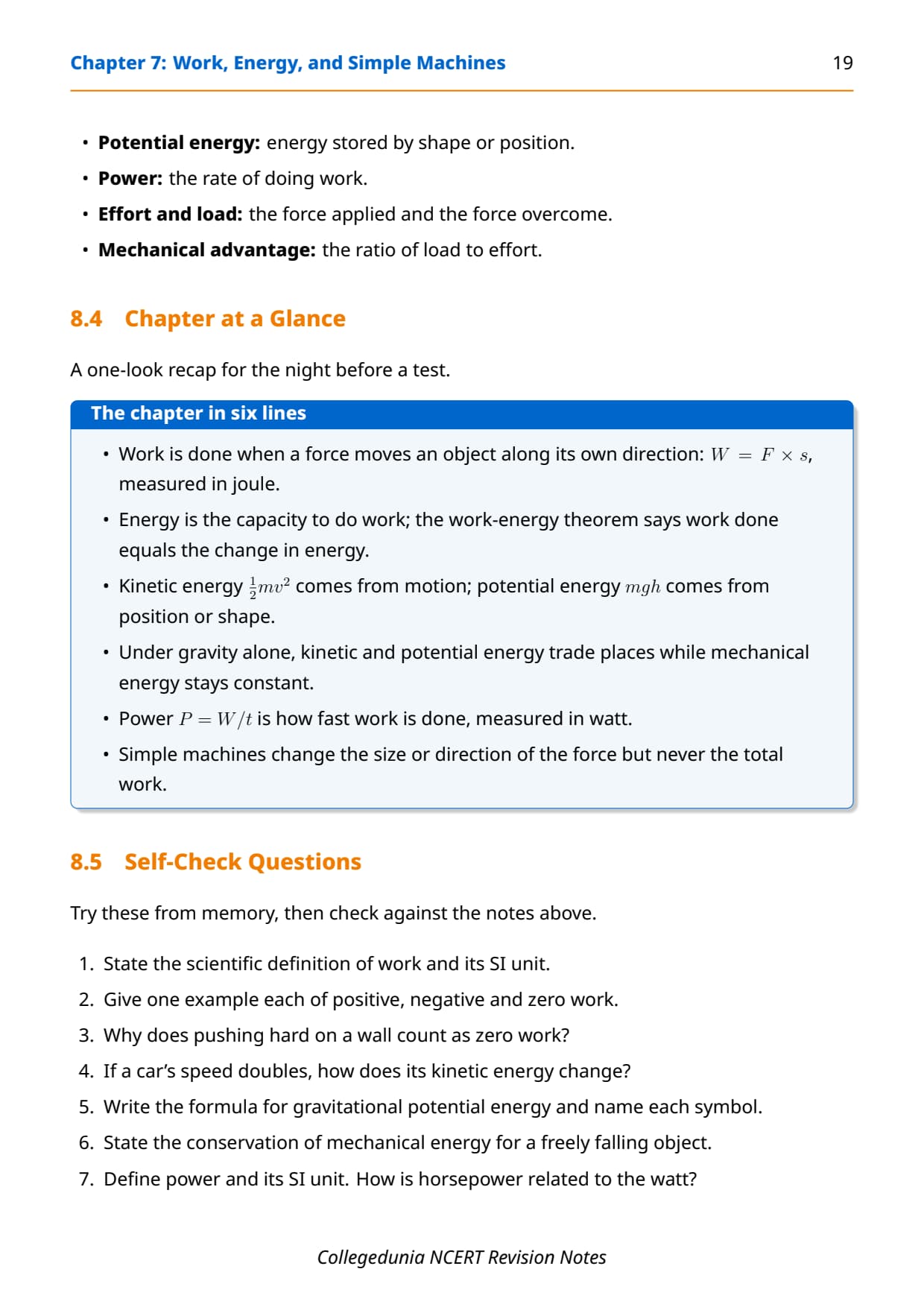
- Full concept revision: work and the joule, positive, negative and zero work, kinetic energy, potential energy, the work-energy theorem, conservation of energy, power, and simple machines in one set of notes.
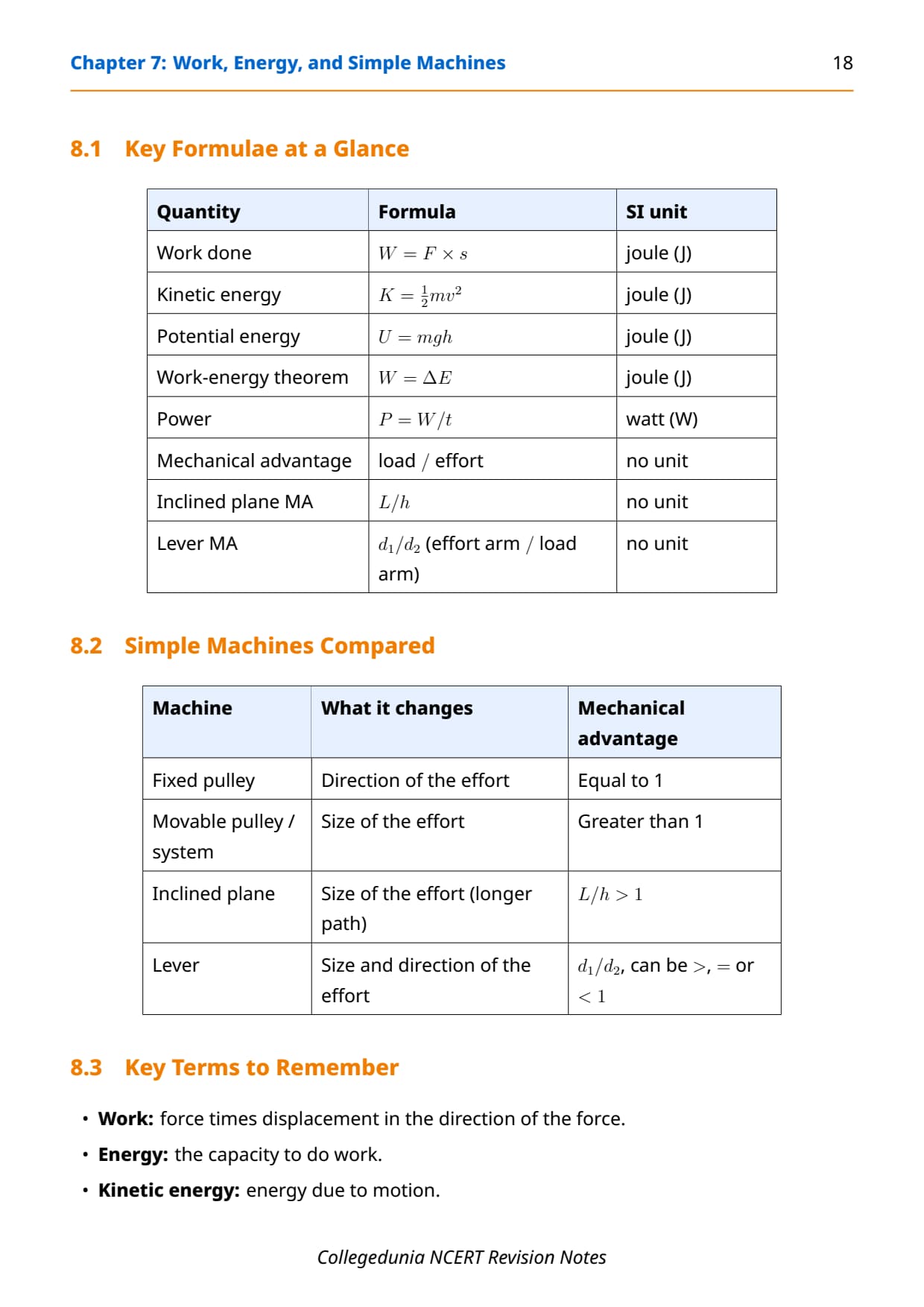
- Formula ready: W = F × s, K = ½mv2, U = mgh, P = W/t, and mechanical advantage = load / effort, with solved examples.
- Why it matters: Chapter 7 builds the base for machines, energy conservation and later CBSE, JEE and NEET physics numericals.
Student Feedback
In a Collegedunia study of 1,240 Class 9 students, 79% said a one-page revision of the work, kinetic energy and potential energy formulae helped them solve numericals without slips. About 4 out of 5 rated the simple machines table the clearest part, and many said the free-fall energy trade-off finally made conservation of energy easy to picture.
|
Table of Contents |
What You Revise in Class 9 Science Chapter 7 Work, Energy, and Simple Machines
Chapter 7 turns the everyday words work, energy and power into exact scientific ideas, and then shows how simple machines use them to make hard tasks easier. The NCERT Notes Class 9 Science Chapter 7 Work, Energy, and Simple Machines follow the same order as the Exploration book, so your revision matches the flow of the chapter and nothing feels out of place.
These notes help you recall the core points in minutes:
- Work and energy: the meaning of work, the joule, and how work done changes an object's energy.
- Two kinds of energy: kinetic energy from motion and potential energy from position or shape.
- Conservation and power: how mechanical energy stays constant under gravity, and how power measures the rate of doing work.
- Simple machines: the pulley, the inclined plane and the lever, and their mechanical advantage.
Work, Energy, and Simple Machines Class 9 Science in One Shot
Source: Alakh Pandey - Class 9th & 10th on YouTube
Work Done by a Force: Quick Revision Notes
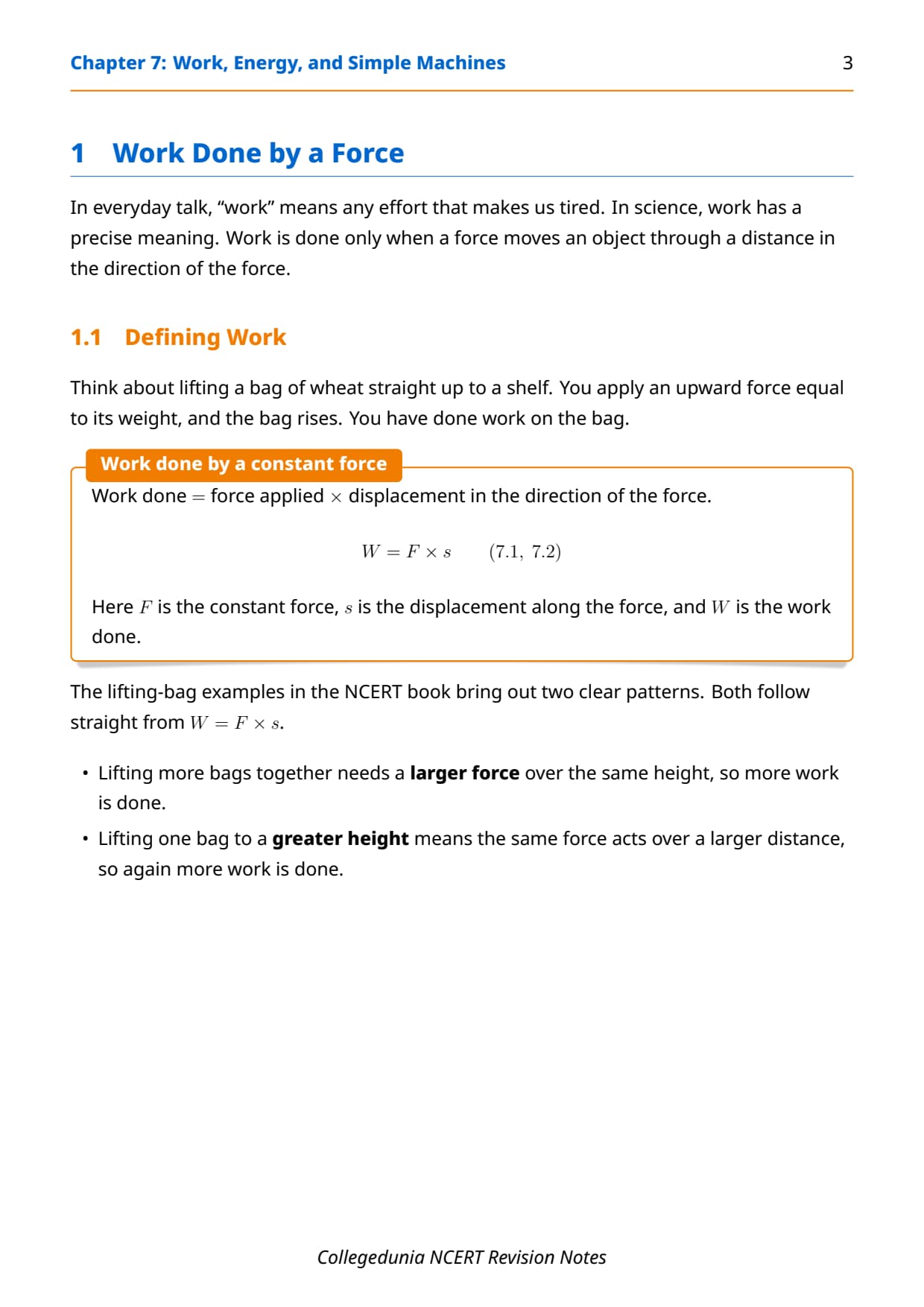
Start your revision with the meaning of work. In daily talk, work is any effort that makes you tired. In science, work is done only when a force moves an object through a distance in the direction of the force. If nothing moves, no work is done, however hard you push.
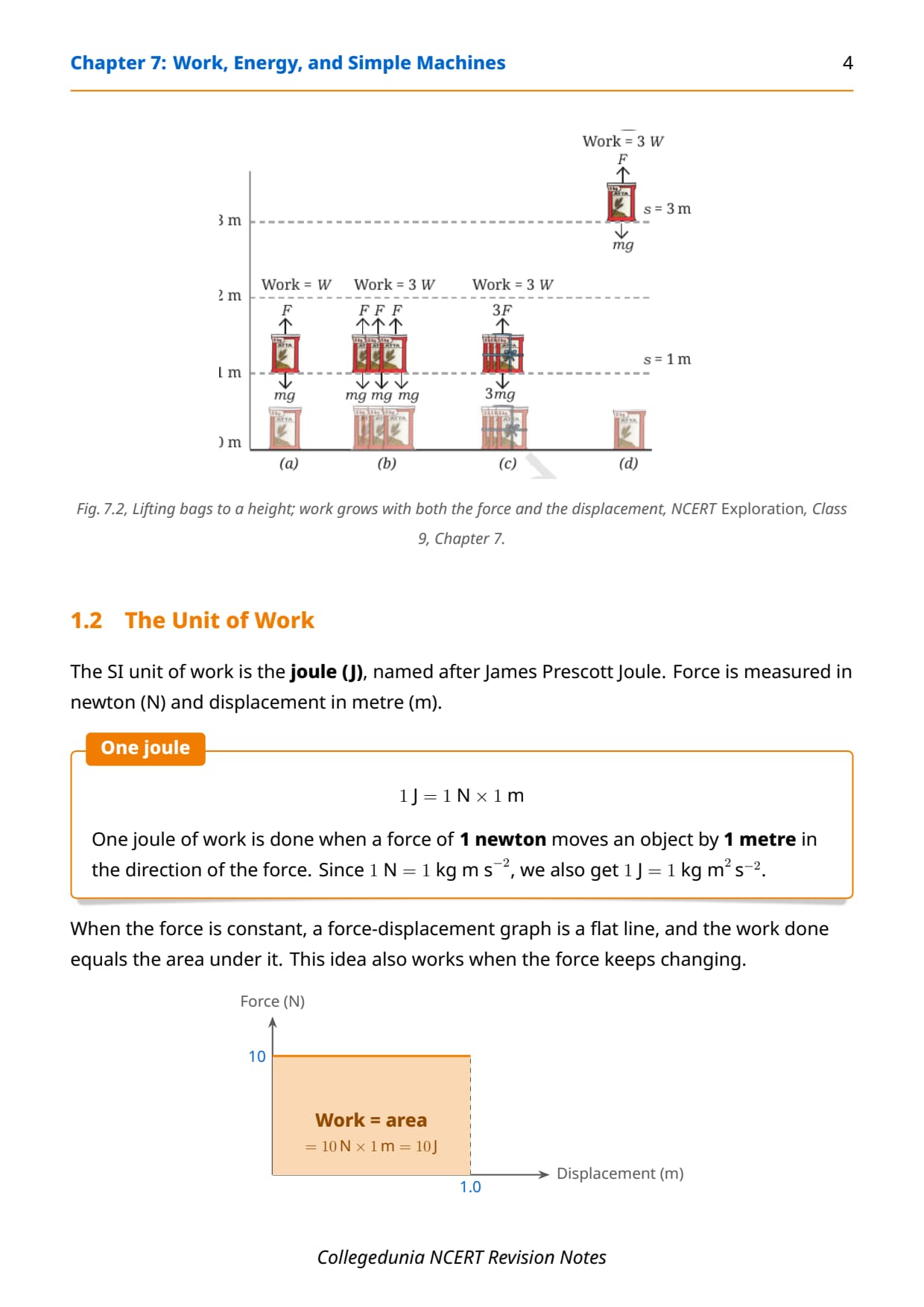
Here F is the constant force, s is the displacement along the force, and W is the work done. The SI unit of work is the joule (J), named after James Prescott Joule. One joule is the work done when a force of 1 newton moves an object by 1 metre in the direction of the force, so 1 J = 1 N × 1 m.
- More force, more work: lifting two bags of wheat together needs a larger force over the same height, so more work is done.
- More distance, more work: lifting one bag to a greater height means the same force acts over a longer distance, so again more work is done.
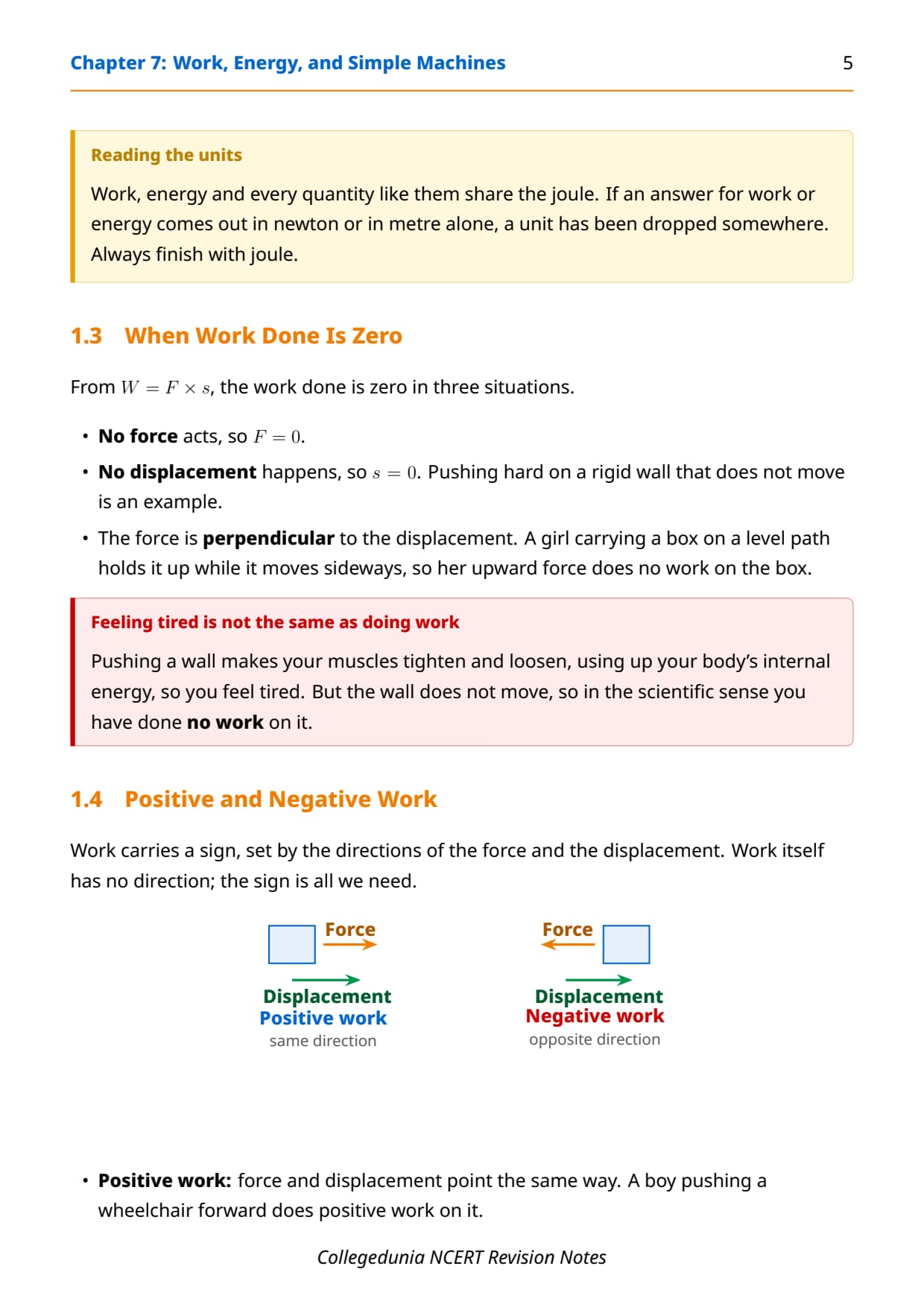
Work carries a sign, decided by the directions of the force and the displacement. Work itself has no direction; the sign is all you need.
- Positive work: force and displacement point the same way. A boy pushing a wheelchair forward does positive work on it.
- Negative work: force is opposite to the displacement. A goalkeeper stopping a ball pushes against its motion, so she does negative work on the ball.
- Zero work: when no force acts, when there is no displacement (pushing a rigid wall), or when the force is at right angles to the motion (carrying a box on a level path).
Solved example. A goalkeeper's hand moves back by 15 cm while applying 200 N to stop a ball. The force opposes the motion, so the displacement is taken as negative: W = 200 N × (−0.15 m) = −30 J.
Kinetic Energy and the Work-Energy Theorem in Class 9 Science
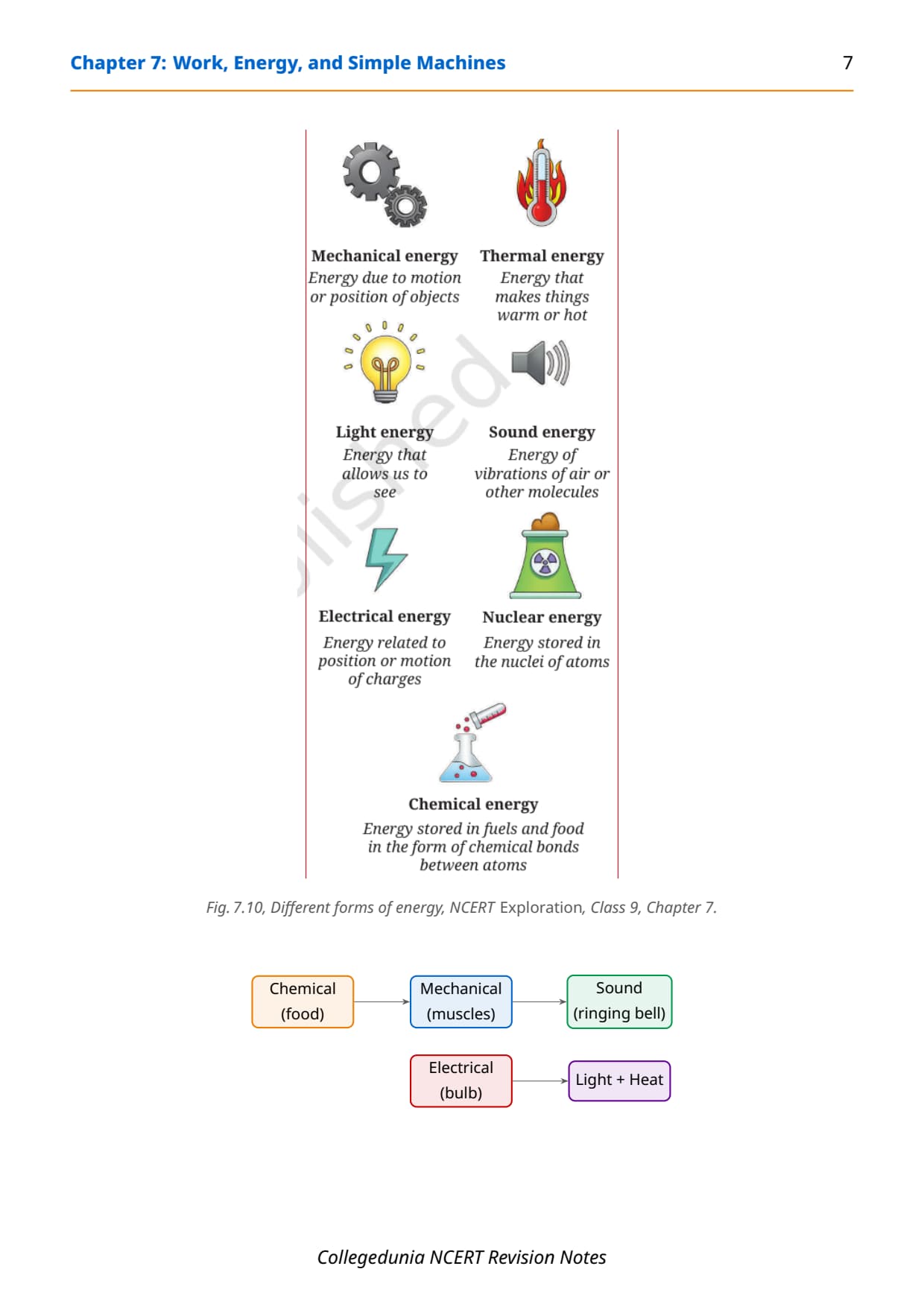
An object that can do work is said to have energy. A thrown ball can knock down a wicket; a raised pot can break something if it falls. Energy, like work, is measured in joule (J). Doing positive work on an object gives it energy, and the object can then pass that energy on. This link between work and energy is the work-energy theorem: the work done on an object equals the change in its energy.
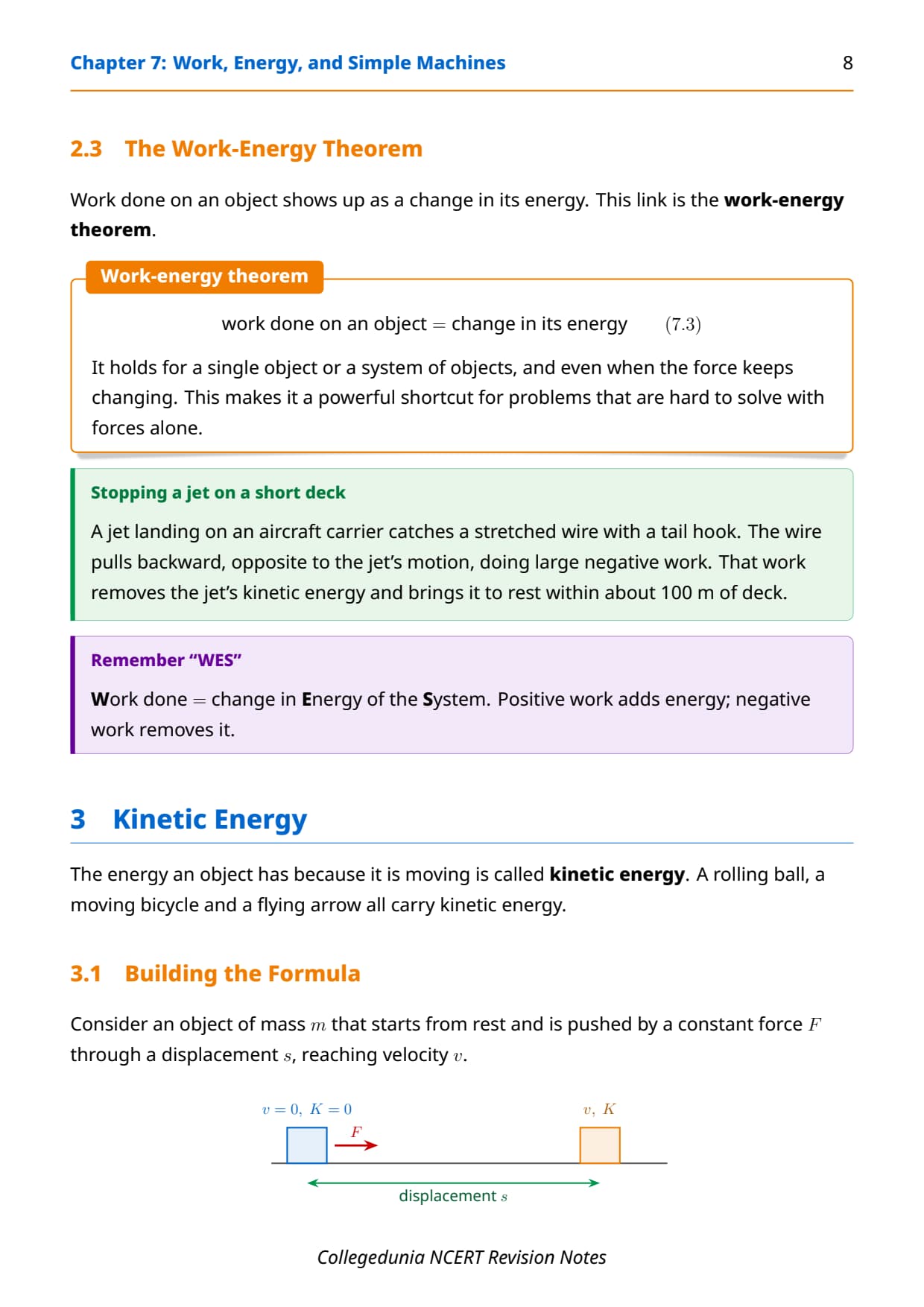
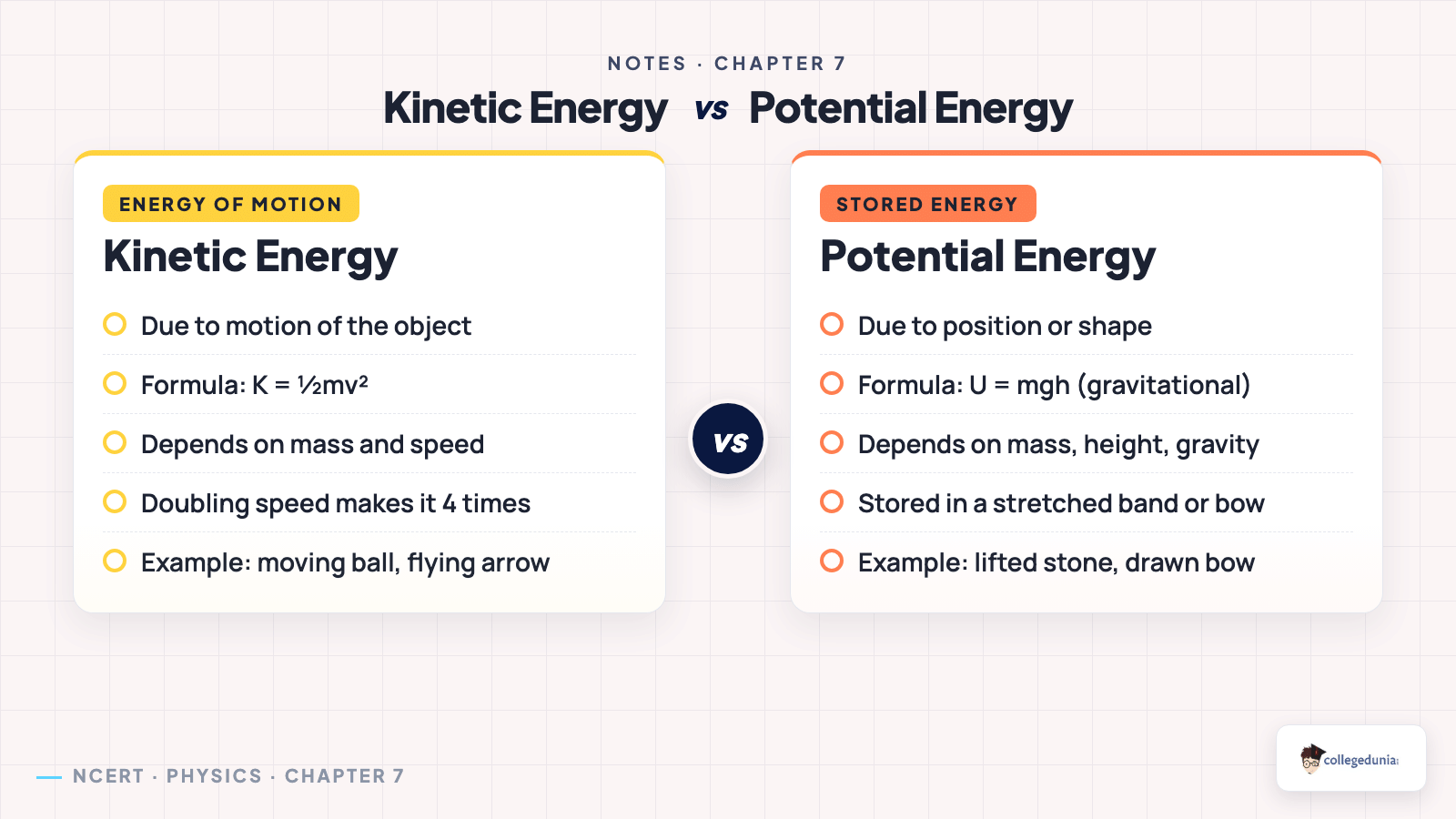
The energy an object has because it is moving is its kinetic energy. A rolling ball, a moving bicycle and a flying arrow all carry kinetic energy. Using the relation v2 = u2 + 2as with u = 0, along with F = ma and W = F × s, the work done comes out as the kinetic energy gained.
- Speed matters most: because K depends on v2, doubling the speed makes the kinetic energy four times as large, and tripling it makes the energy nine times as large.
- No direction: kinetic energy is measured in joule and, like all energy, has no direction.
- Why braking distance grows: a small rise in speed sharply increases the energy that the brakes must remove, so the stopping distance jumps.
Solved example. A cricket ball of mass 0.2 kg is bowled at 43 m s−1. Its kinetic energy is K = ½ × 0.2 × (43)2 = 184.9 J.
Potential Energy in Class 9 Science Chapter 7
Energy can also be stored without any motion. A stretched band or a lifted ball holds energy ready to do work. This stored energy is potential energy, and it is stored in two broad ways.
- By deforming an object: a stretched slingshot, a bent bow or a compressed spring stores energy and springs back when released.
- By changing relative positions: two separated magnets, two separated charges, or a ball lifted above the Earth all store energy because of their positions.
The most common case is the energy of the Earth-ball system, usually called the gravitational potential energy of the ball. To raise a mass m to a height h, you apply a force mg over the distance h, and by the work-energy theorem this work is stored as potential energy.
Here g is the acceleration due to gravity, and the form is valid near the Earth's surface, where g is nearly constant. An activity with a ball dropped into sand shows this clearly: a ball released from a greater height makes a deeper depression, because it stored more potential energy at that height.
Solved example. A ball of mass 0.2 kg is thrown to a height of 10 m, with g = 10 m s−2. Its potential energy is U = mgh = 0.2 × 10 × 10 = 20 J.
Conservation of Mechanical Energy in Work, Energy, and Simple Machines
The sum of an object's kinetic and potential energy is its mechanical energy. As an object moves under gravity alone, this sum stays constant. This is the law of conservation of mechanical energy, and it is one of the most useful ideas in the chapter.
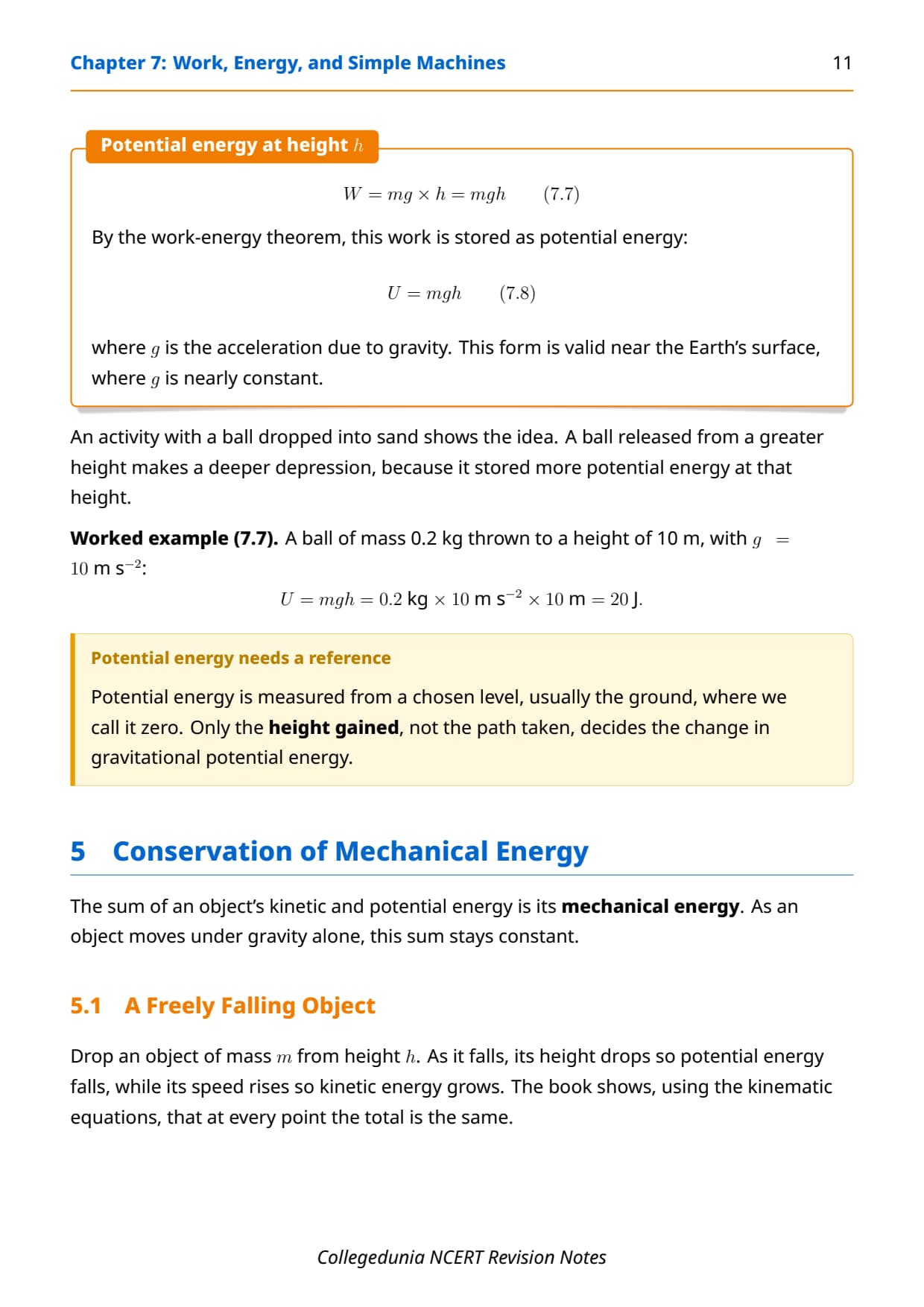
Drop an object of mass m from a height h. As it falls, its height drops, so potential energy falls, while its speed rises, so kinetic energy grows. At every point of the fall the potential energy lost equals the kinetic energy gained, so the total does not change when no other force acts. The three columns below show how the two shares trade places while the total stays the same.
| Point of fall | Kinetic energy | Potential energy | Total |
|---|---|---|---|
| Top (just released) | Zero | Maximum, mgh | mgh |
| Middle of the fall | Half | Half | mgh |
| Just before the ground | Maximum | Zero | mgh |
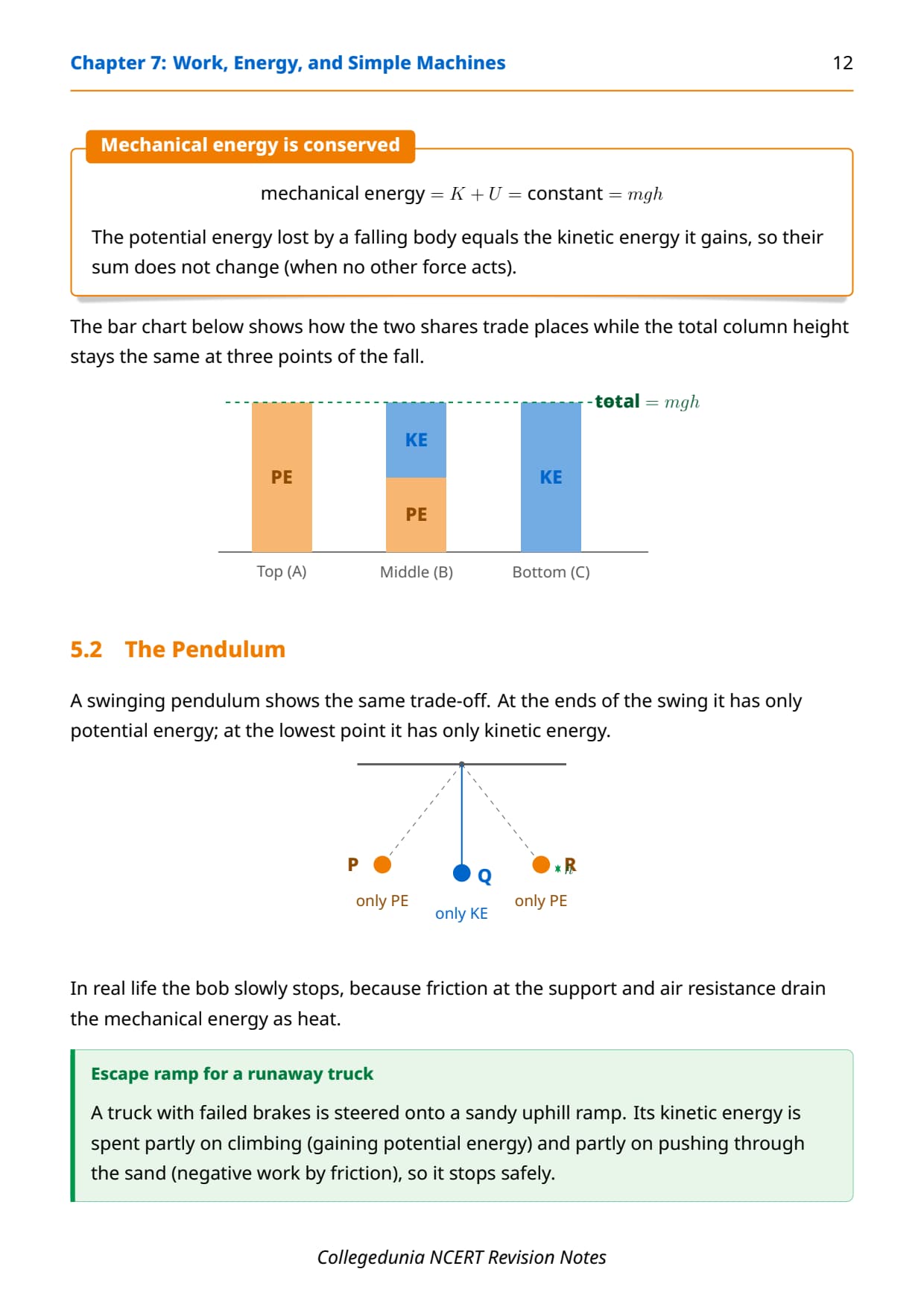
A swinging pendulum shows the same trade-off. At the two ends of the swing it has only potential energy; at the lowest point it has only kinetic energy. In real life the bob slowly stops, because friction at the support and air resistance drain the mechanical energy as heat and sound.
Power: Rate of Doing Work in Class 9 Science Chapter 7
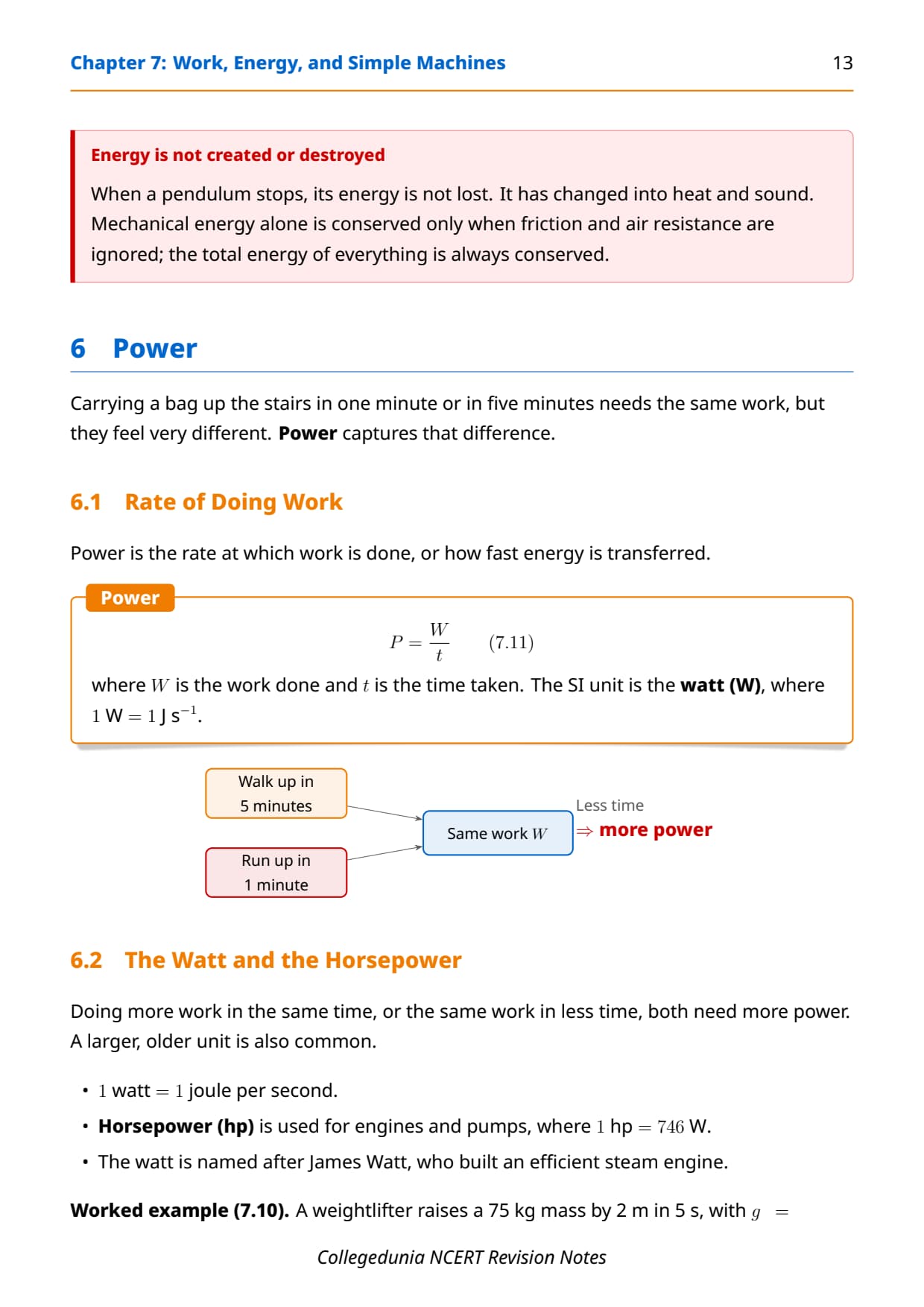
Carrying a bag up the stairs in one minute or in five minutes needs the same work, but the two feel very different. Power captures that difference. Power is the rate at which work is done, or how fast energy is transferred.
Here W is the work done and t is the time taken. The SI unit of power is the watt (W), where 1 W = 1 J s−1. The watt is named after James Watt, who built an efficient steam engine.
- Two ways to raise power: doing more work in the same time, or the same work in less time, both need more power.
- Horsepower: a larger, older unit used for engines and pumps, where 1 hp = 746 W. It compares an engine's power with the power of real horses.
Solved example. A weightlifter raises a 75 kg mass by 2 m in 5 s, with g = 10 m s−2. The work done is W = mgh = 75 × 10 × 2 = 1500 J, so the power is P = 1500 J / 5 s = 300 W.
Simple Machines: Pulley, Inclined Plane and Lever in Class 9
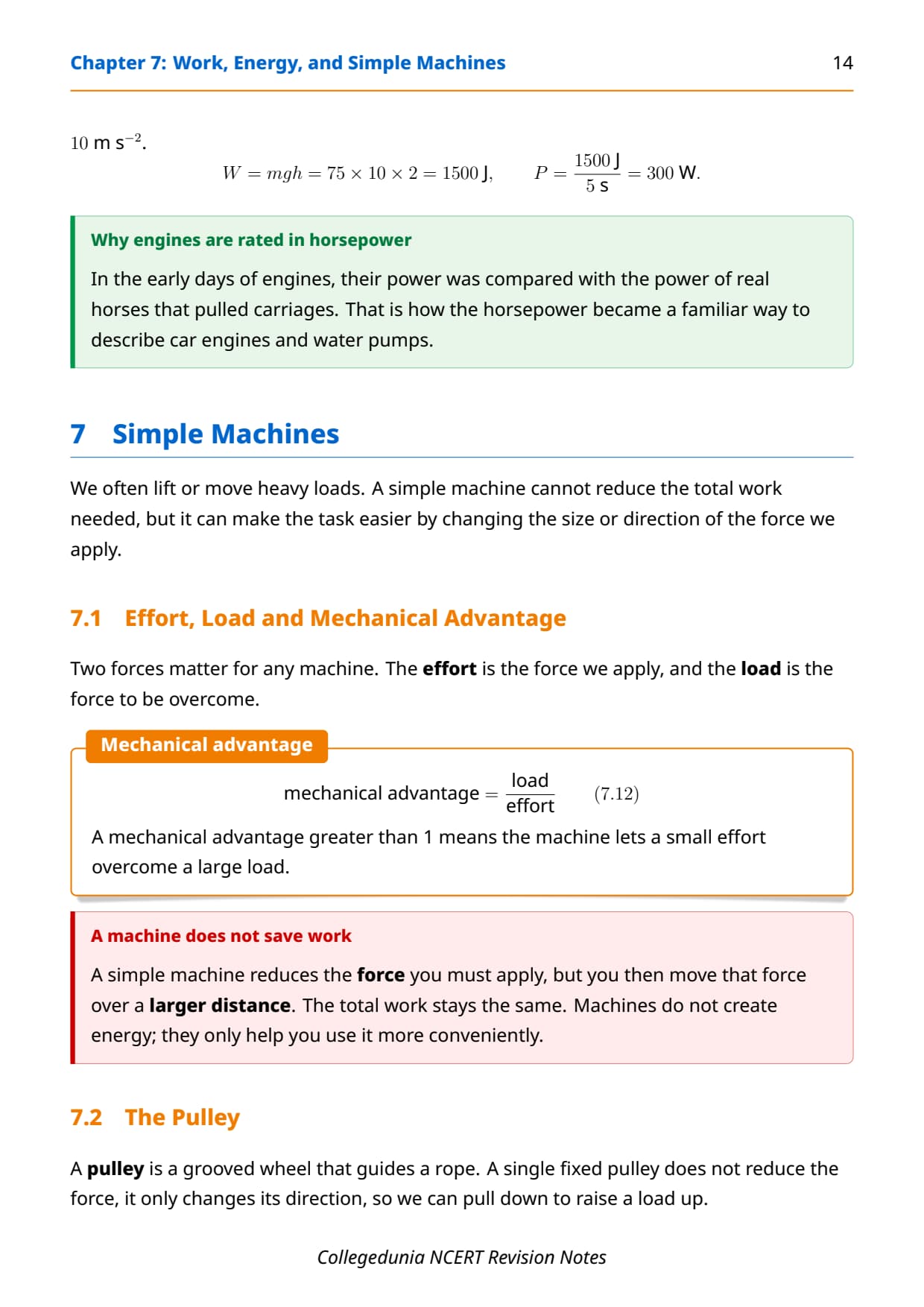
We often lift or move heavy loads. A simple machine cannot reduce the total work needed, but it can make the task easier by changing the size or direction of the force we apply. Two forces matter for any machine: the effort is the force we apply, and the load is the force to be overcome.
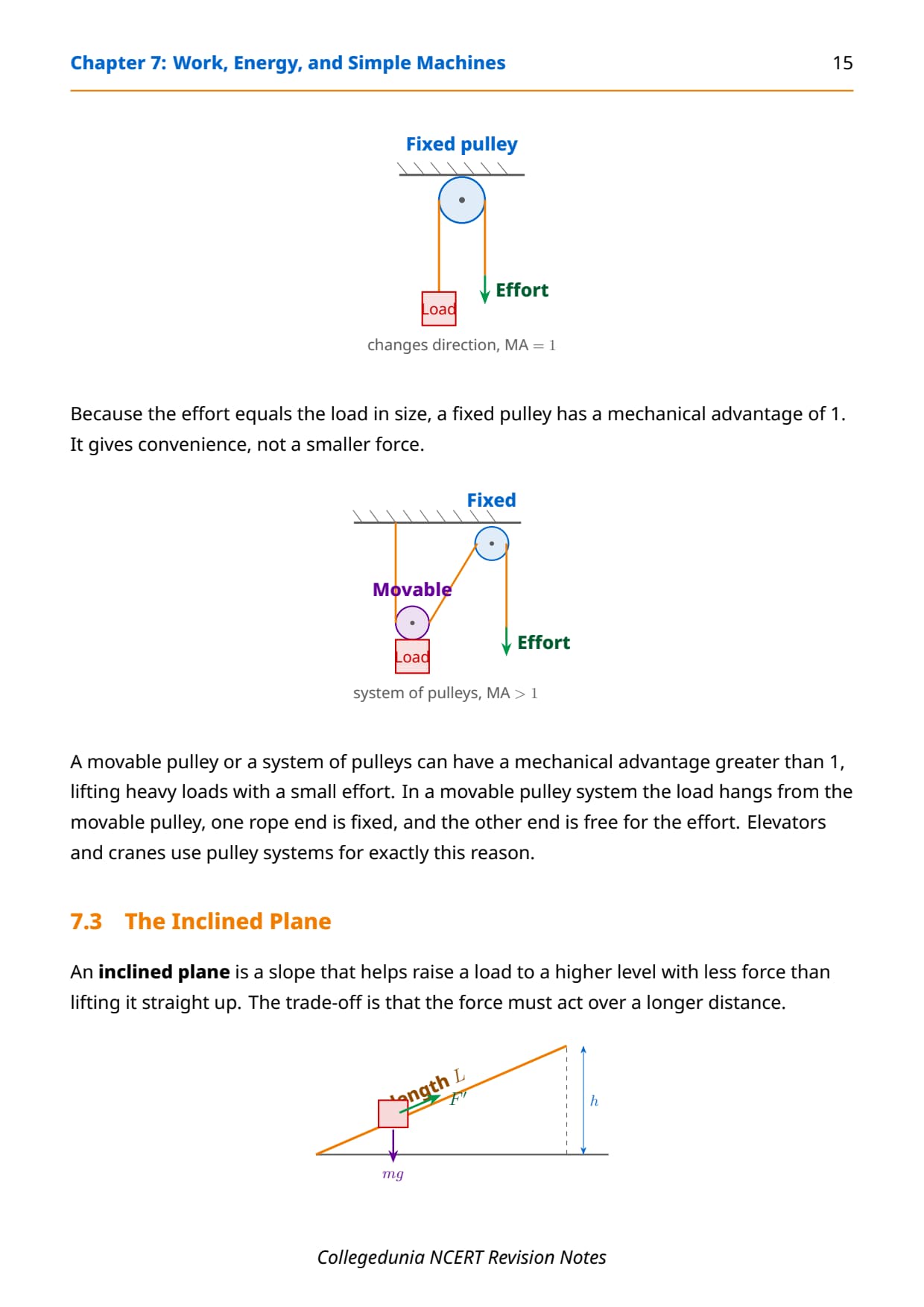
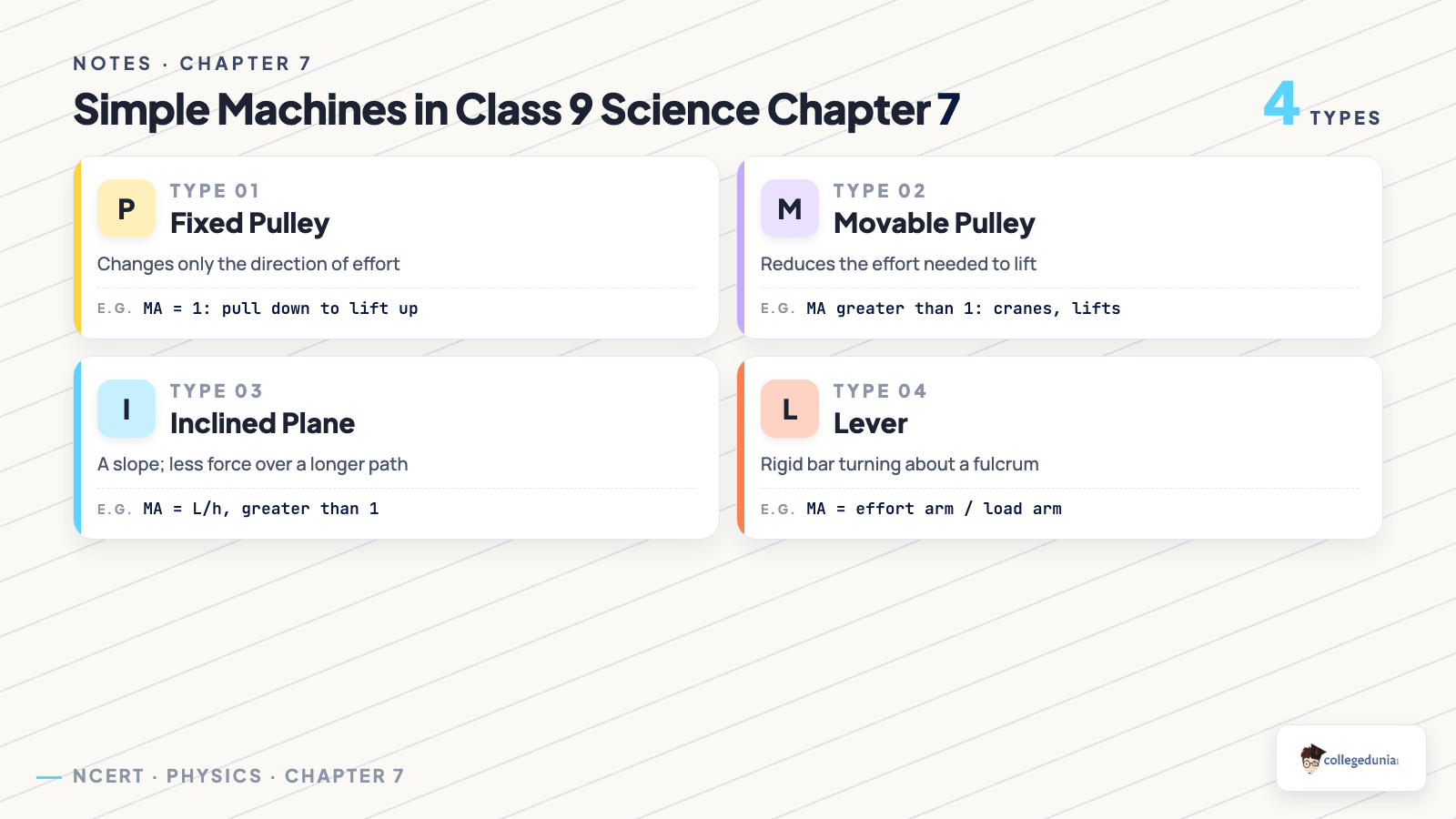
- Pulley: a grooved wheel that guides a rope. A single fixed pulley does not reduce the force, it only changes its direction, so you can pull down to raise a load up. A movable pulley or a system of pulleys can lift heavy loads with a small effort. Elevators and cranes use pulley systems.
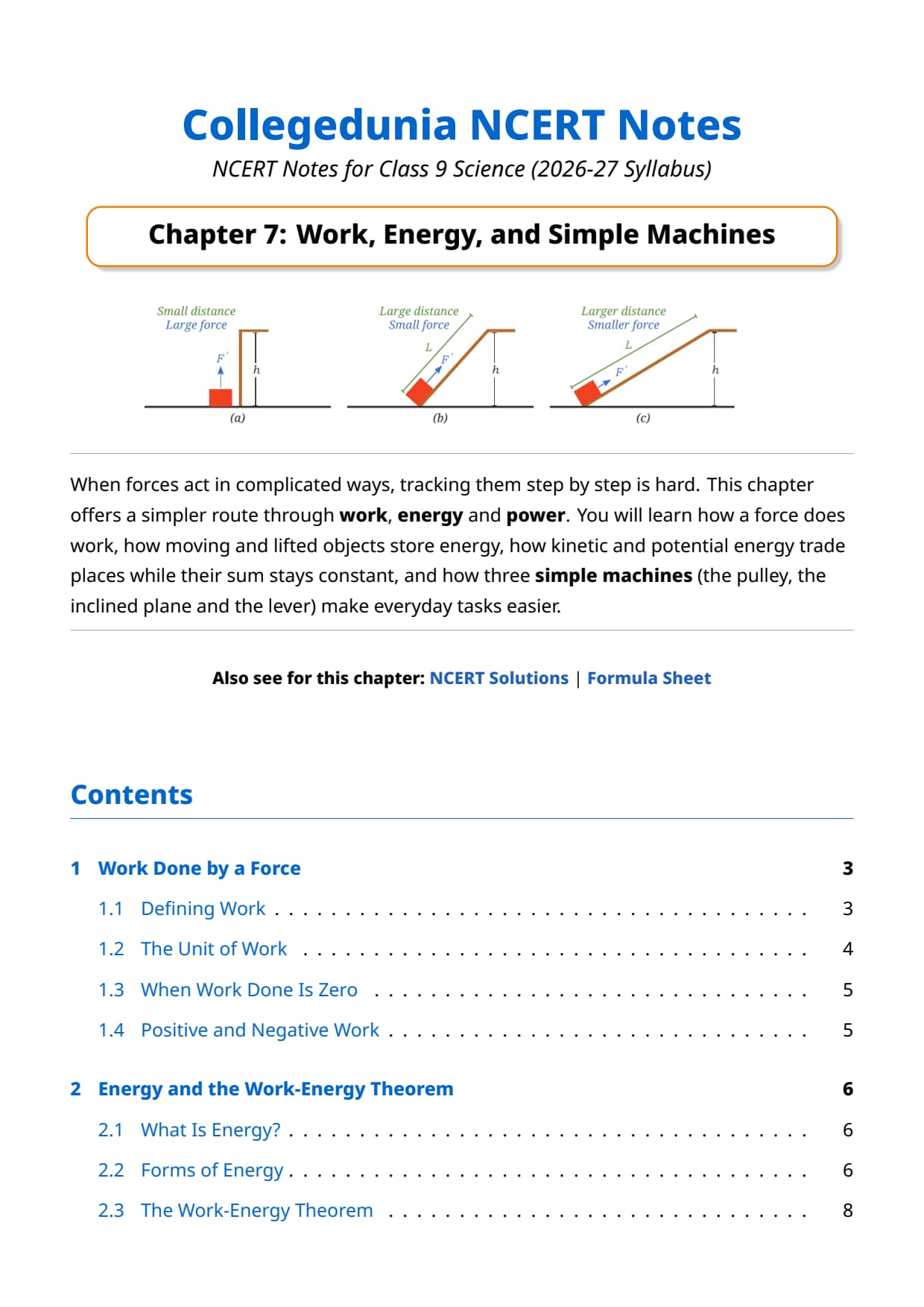
- Inclined plane: a slope that helps raise a load with less force than lifting it straight up. The trade-off is that the force must act over a longer distance. This is why hill roads wind up in long, gentle curves.
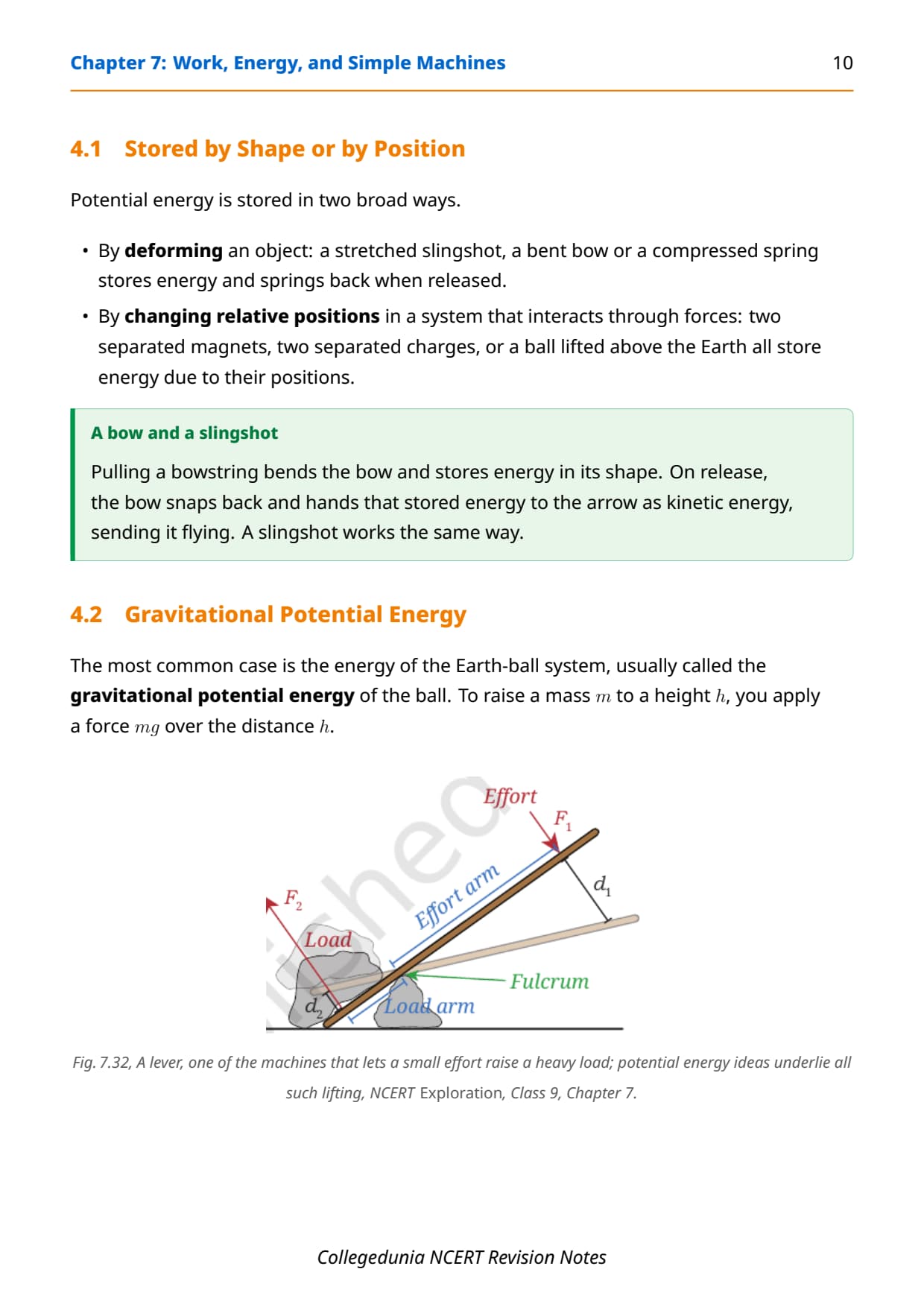
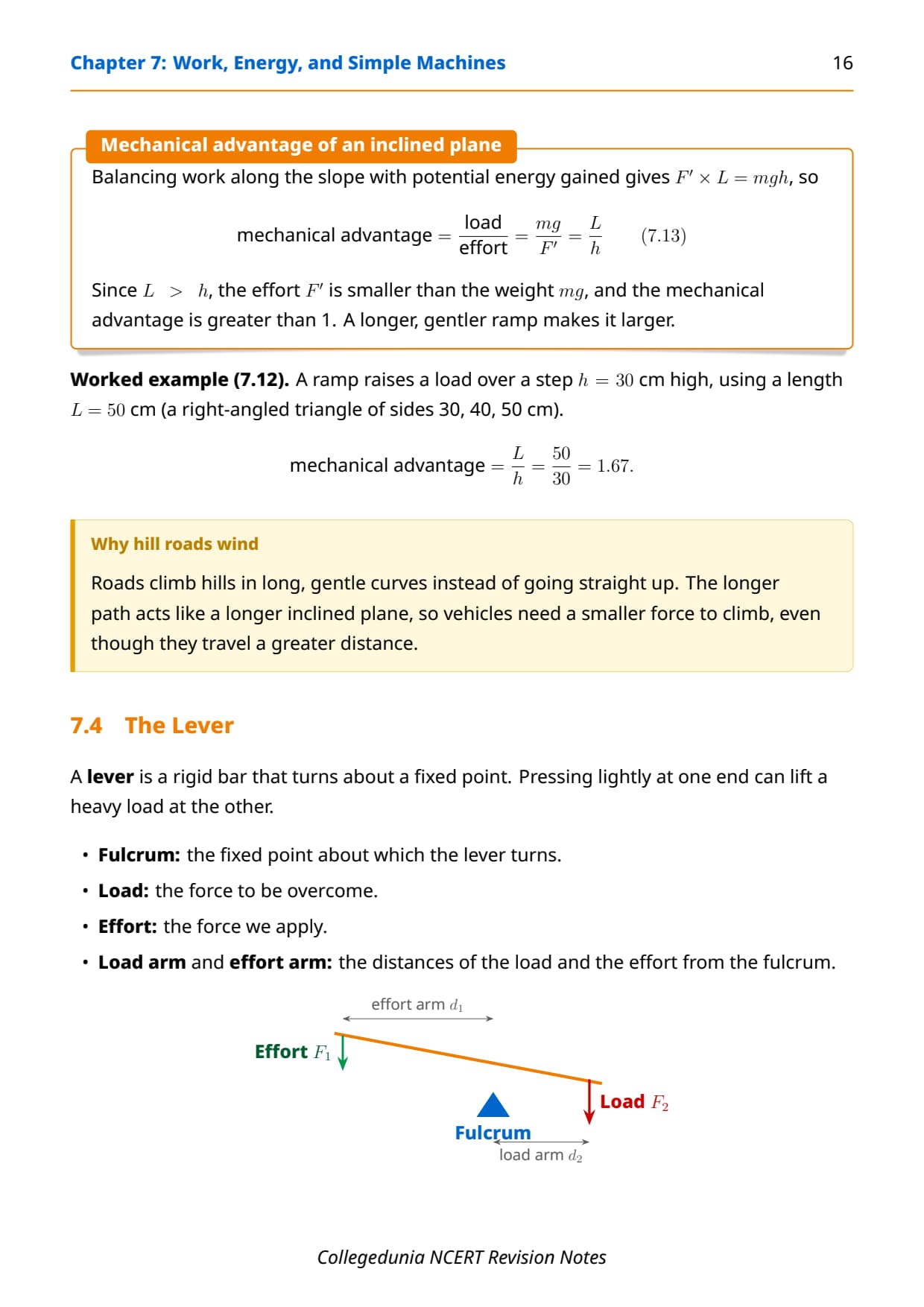
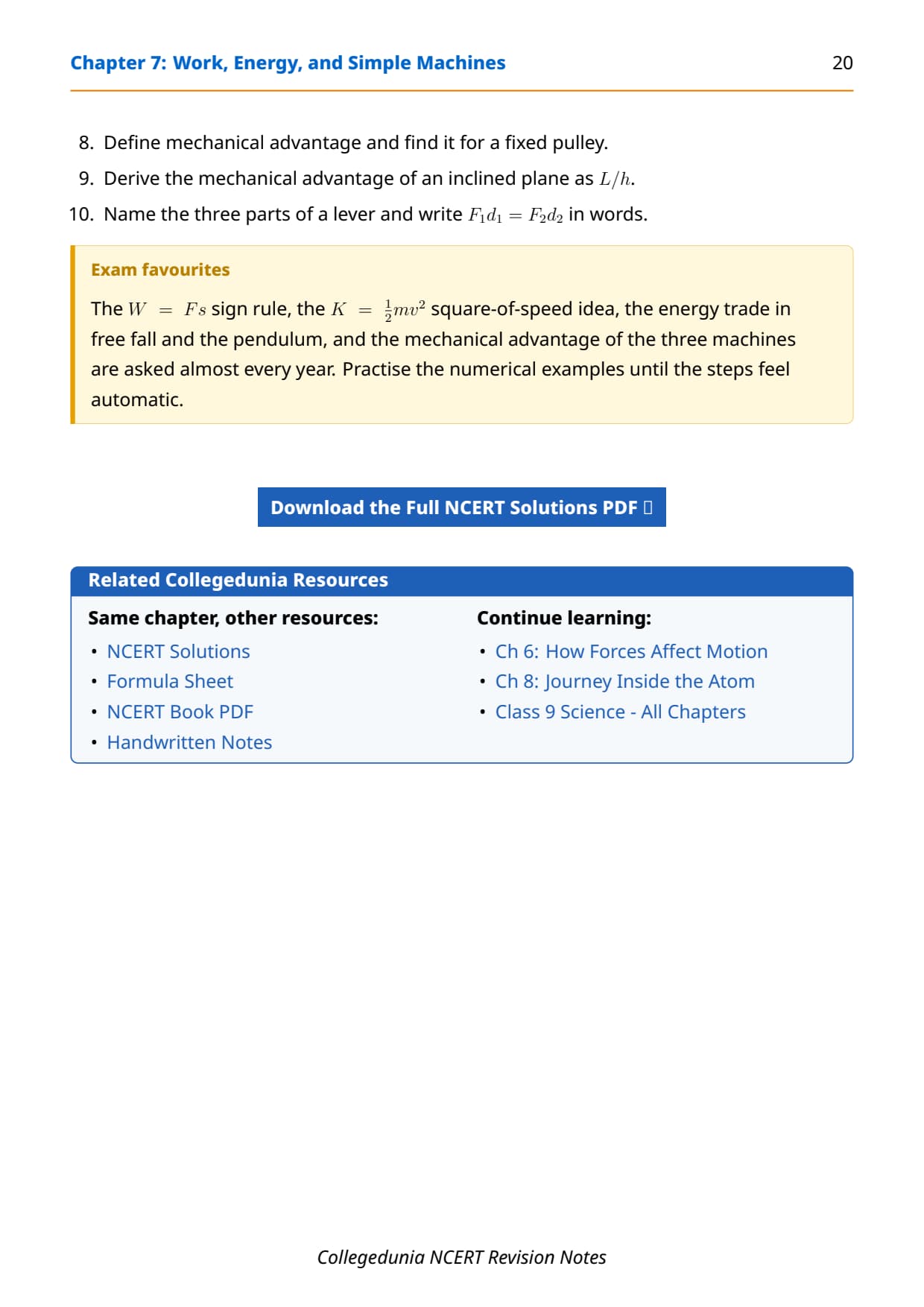
- Lever: a rigid bar that turns about a fixed point called the fulcrum. Pressing lightly at one end can lift a heavy load at the other. The distances of the load and the effort from the fulcrum are the load arm and the effort arm.
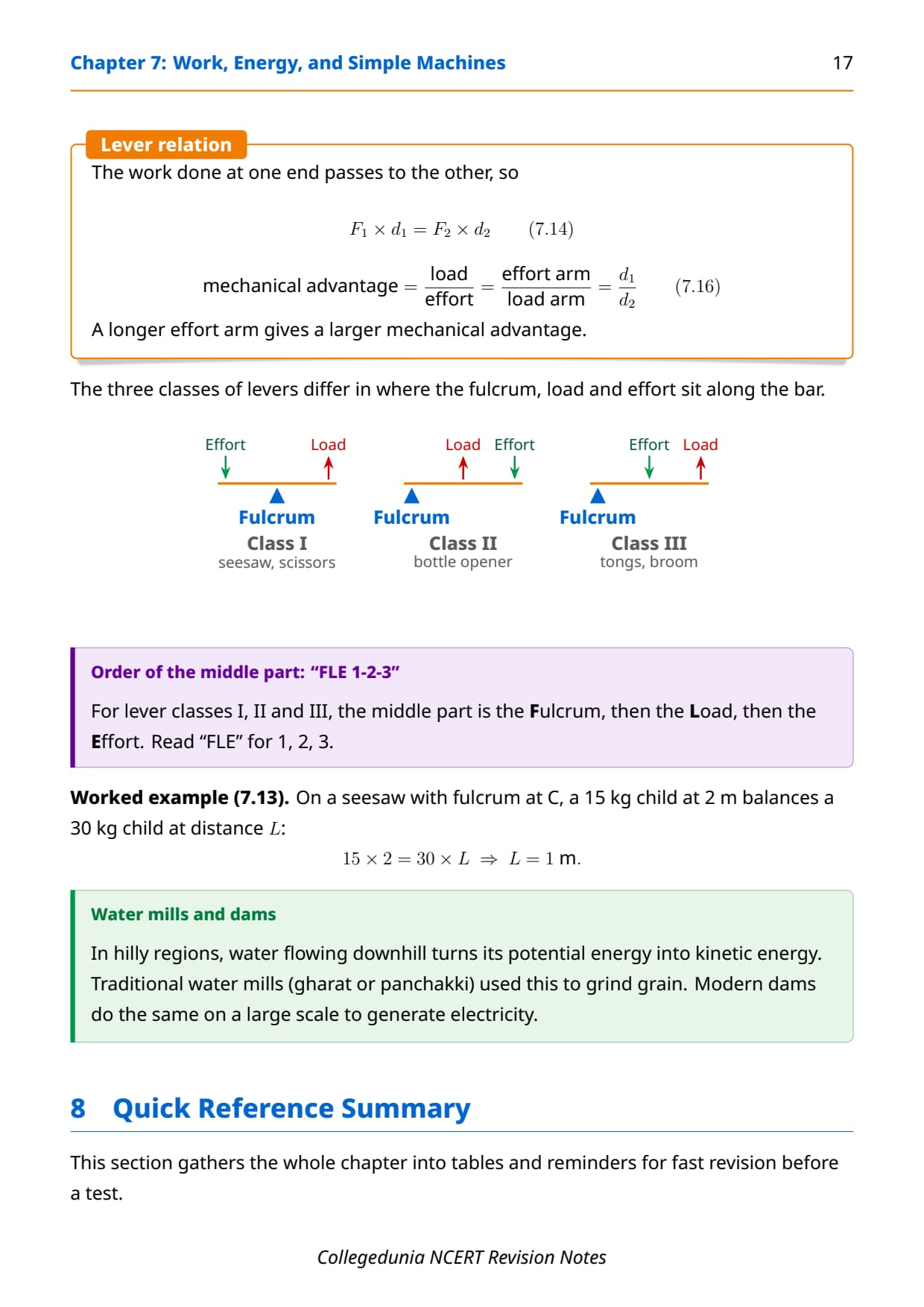
Levers come in three classes, set by which part sits in the middle of the bar. In a Class I lever the fulcrum is in the middle (a seesaw or scissors); in a Class II lever the load is in the middle (a bottle opener); in a Class III lever the effort is in the middle (a pair of tongs or a broom).
Mechanical Advantage of Simple Machines Notes
The mechanical advantage of a machine tells you how much it multiplies your effort. It is the ratio of the load to the effort.
A mechanical advantage greater than 1 means a small effort can overcome a large load. For an inclined plane of length L and height h, balancing work along the slope with the potential energy gained gives F′ × L = mgh, so the mechanical advantage is L/h. For a lever, the work at one end passes to the other, so F1 × d1 = F2 × d2, and the mechanical advantage is the effort arm divided by the load arm.
| Machine | What it changes | Mechanical advantage |
|---|---|---|
| Fixed pulley | Direction of the effort | Equal to 1 |
| Movable pulley or system | Size of the effort | Greater than 1 |
| Inclined plane | Size of the effort (longer path) | L/h, greater than 1 |
| Lever | Size and direction of the effort | d1/d2, can be more, equal or less than 1 |
Solved example. A ramp raises a load over a step 30 cm high using a length of 50 cm. Its mechanical advantage is L/h = 50/30 = 1.67. On a seesaw, a 15 kg child sitting 2 m from the fulcrum balances a 30 kg child at a distance L, so 15 × 2 = 30 × L gives L = 1 m.
Common Mistakes and Quick Revision Tips for Work, Energy, and Simple Machines
Most lost marks in this chapter come from small slips, not hard ideas. Fix these while you revise and your answers stay clean.
- Forgetting the sign of work: force opposite to motion gives negative work, not zero work.
- Writing kinetic energy as ½mv instead of ½mv2, and so missing the square of the speed.
- Mixing units: work and energy in joule, power in watt (joule per second). Always end with the right unit.
- Thinking a machine reduces the total work. It only reduces the force, over a longer distance.
- Assuming a fixed pulley multiplies force. It has a mechanical advantage of 1; it only changes direction.
How Collegedunia Notes Help You Revise Work, Energy, and Simple Machines
Collegedunia gives you the full NCERT Notes Class 9 Science Chapter 7 Work, Energy, and Simple Machines as clean, short, easy-to-read revision in one place.
- 2026-27 Exploration match: every note follows the new textbook and its Revise, Reflect, Refine flow.
- Simple English: short lines and everyday words, so a Class 9 student can revise without help.
- Formula and table ready: the work, kinetic energy, potential energy and power formulae, plus the simple machines table, in one view.
- Free PDF: download the notes and revise offline before your exam.
More Work, Energy, and Simple Machines Class 9 Science Resources
| Resource | Open |
|---|---|
| Revision Notes | Work, Energy, and Simple Machines Class 9 Science Notes |
| NCERT Solutions | Work, Energy, and Simple Machines Class 9 Science NCERT Solutions |
| Handwritten Notes | Work, Energy, and Simple Machines Class 9 Science Handwritten Notes |
| Formula Sheet | Work, Energy, and Simple Machines Class 9 Science Formula Sheet |
| NCERT Book PDF | Work, Energy, and Simple Machines Class 9 Science NCERT Book PDF |
NCERT Notes for Class 9 Science: All Chapters
Use the table below to open the NCERT Notes for any other chapter of the new Class 9 Science Exploration book.
| Chapter | NCERT Notes |
|---|---|
| Chapter 2 | Cell The Building Block of Life |
| Chapter 3 | Tissues in Action |
| Chapter 4 | Describing Motion Around Us |
| Chapter 5 | Exploring Mixtures and their Separation |
| Chapter 6 | How Forces Affect Motion |
| Chapter 7 | Work, Energy, and Simple Machines |
| Chapter 8 | Journey Inside the Atom |
| Chapter 9 | Atomic Foundations of Matter |
| Chapter 10 | Sound Waves Characteristics and Applications |
| Chapter 11 | Reproduction How Life Continues |
| Chapter 12 | Patterns in Life Diversity and Classification |
| Chapter 13 | Earth as a System Energy, Matter, and Life |
Work, Energy, and Simple Machines Class 9 Science Notes FAQs
Ques. Where can I download the NCERT Notes Class 9 Science Chapter 7 Work, Energy, and Simple Machines PDF?
Ans. You can download the Work, Energy, and Simple Machines Notes PDF free from this page. Both the Normal and HD versions match the 2026-27 Exploration book.
Ques. What topics do the Class 9 Science Chapter 7 notes cover?
Ans. The notes cover work and the joule, positive, negative and zero work, kinetic energy, potential energy, the work-energy theorem, conservation of mechanical energy, power and the watt, and the three simple machines with their mechanical advantage.
Ques. What is the difference between kinetic energy and potential energy?
Ans. Kinetic energy is the energy of a moving object and is found from K = ½mv2. Potential energy is stored energy due to position or shape, and gravitational potential energy is found from U = mgh.
Ques. Do simple machines reduce the total work done?
Ans. No. A simple machine reduces the force you must apply, but you move that force over a longer distance, so the total work stays the same. Machines only change the size or direction of the force.
Ques. Is Chapter 7 part of the new Class 9 Science book?
Ans. Yes. Work, Energy, and Simple Machines is Chapter 7 of the new Exploration textbook for the 2026-27 syllabus. It is a core physics chapter that connects motion, force and energy.



Comments