




The NCERT notes for Class 9 Science Chapter 2 Cell The Building Block of Life bring together every organelle, diagram and definition that the exam actually tests. Cell is the first biology chapter in the new 2026-27 Exploration book. These notes explain the cell, its parts, osmosis and cell division in plain English, with labelled tables you can revise in one sitting.
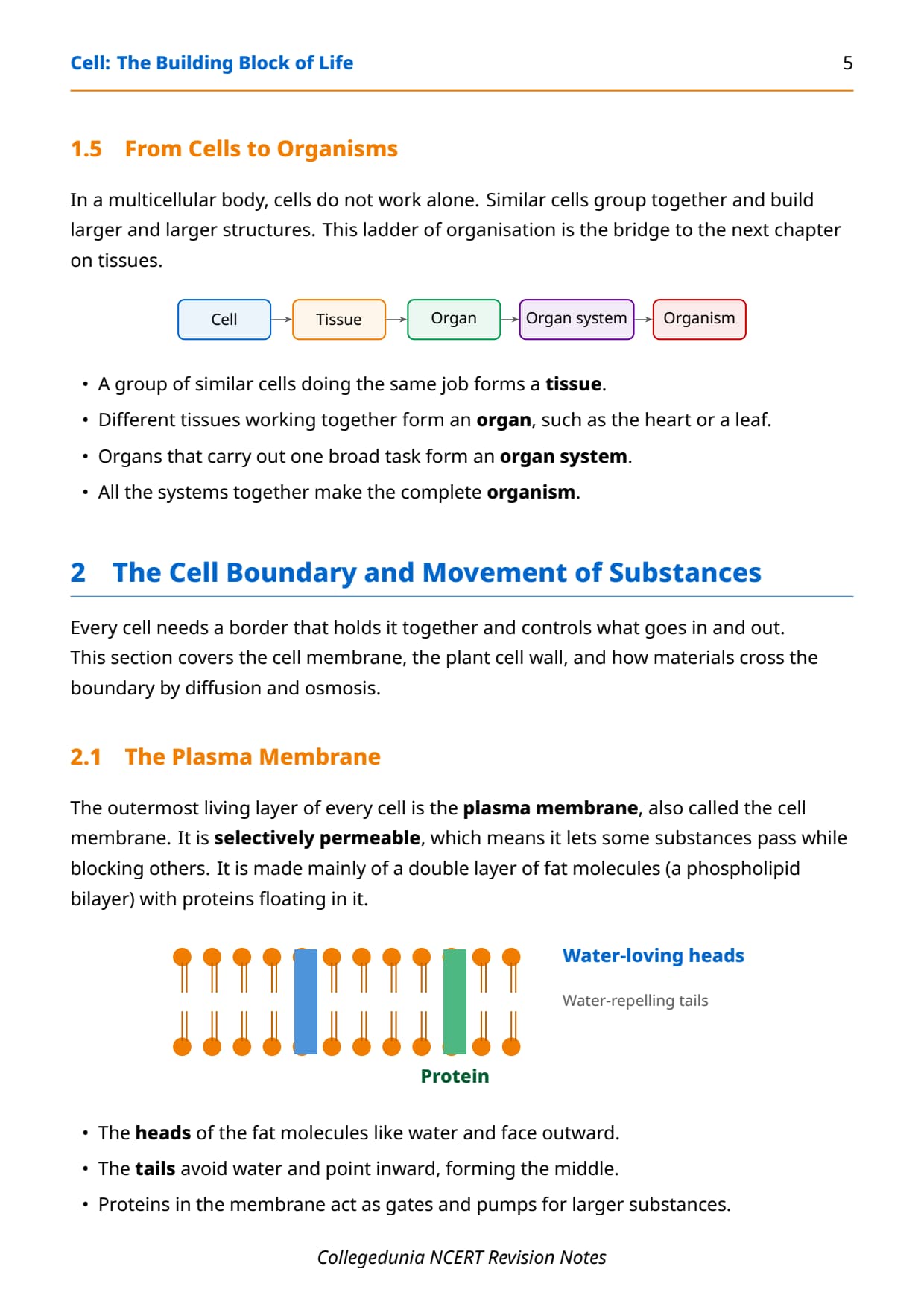
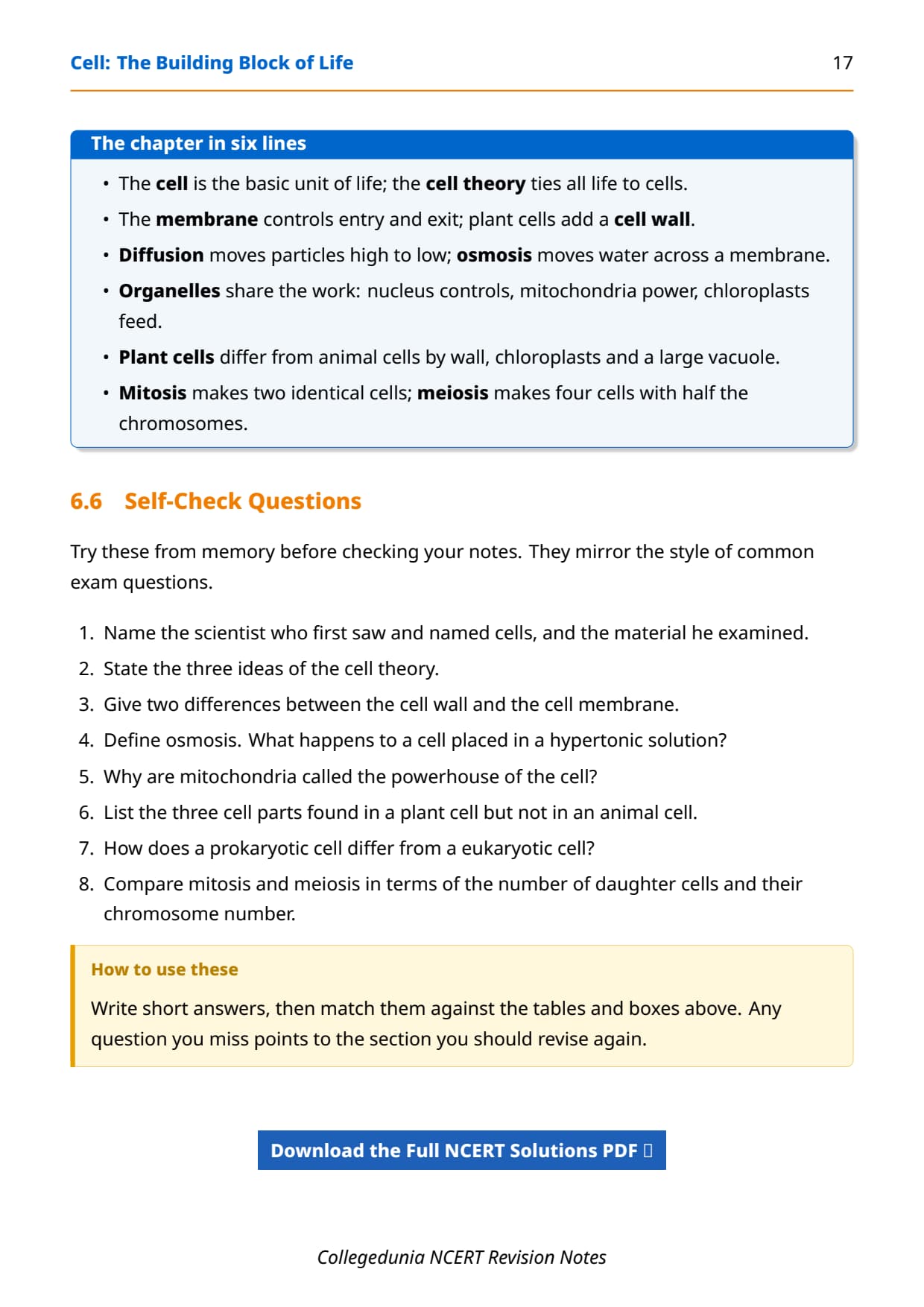
These class 9 science ncert notes chapter 2 Cell The Building Block of Life are written by Collegedunia subject experts, checked against the 2026-27 NCERT Exploration textbook, and refined using recent CBSE exam trends.
- Full concept cover: cell discovery, cell theory, every organelle, osmosis, and mitosis versus meiosis in one place.
- Cell is a steady source of 1, 3 and 5 mark questions in the Class 9 Science paper, so it is worth learning well.
- Free PDF download in Normal and HD, with labelled diagrams and quick revision tables.

What Cell the Building Block of Life Class 9 Notes Cover
These notes show that the cell is the basic unit of life. You learn how the cell was discovered, name each organelle and its job, and explain how water moves in and out of cells by osmosis. The cell the building block of life class 9 chapter ends with how cells multiply through division.
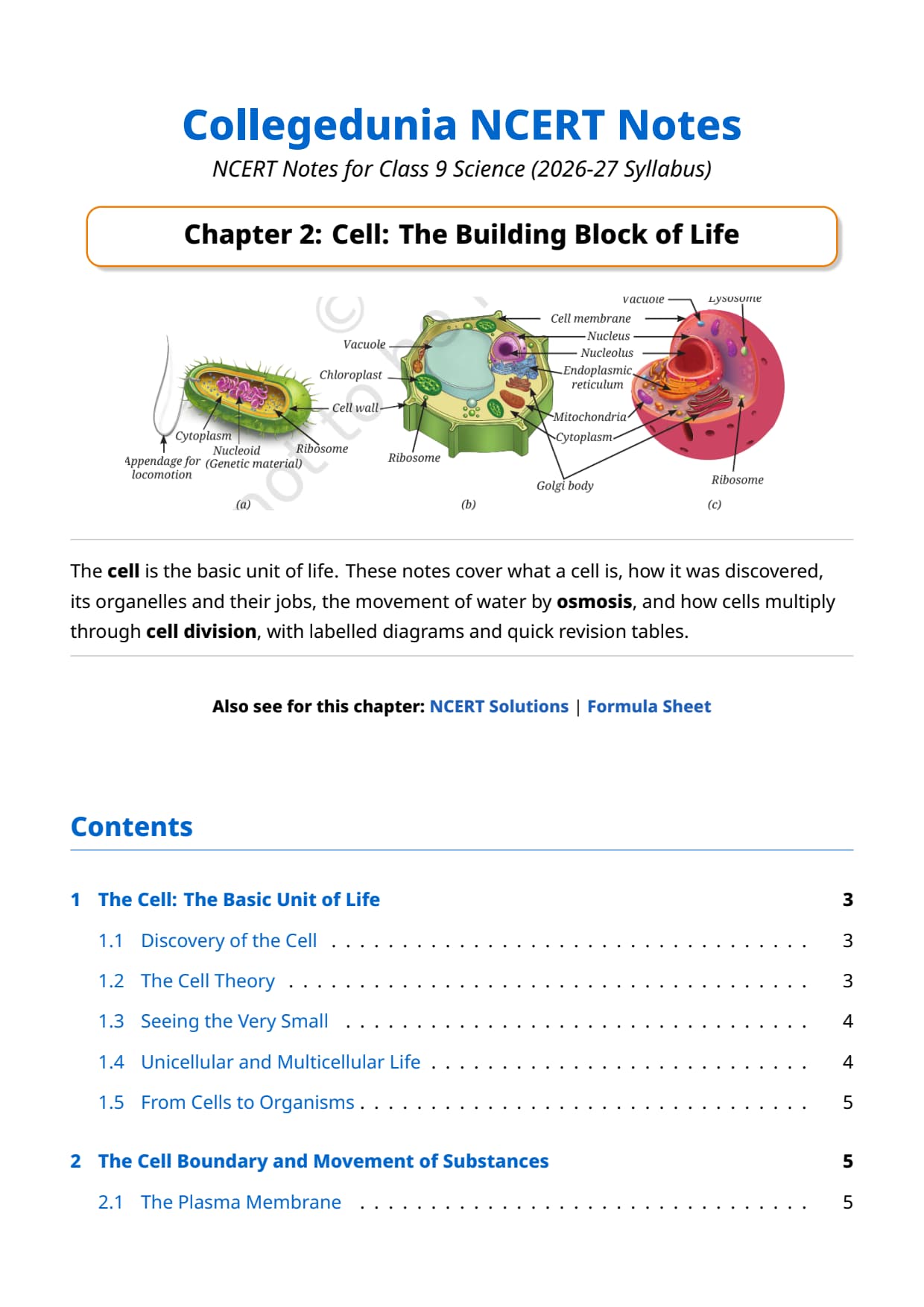
- Cell structure: cell membrane, cell wall, nucleus, mitochondria, chloroplasts, ER, Golgi and vacuole, with the job of each.
- Movement of substances: diffusion and osmosis, and why cells swell, shrink or stay firm.
- Cell division: why cells divide, and what mitosis versus meiosis means for chromosome number.
- DNA-bearing parts: the nucleus, mitochondria and chloroplasts, and why the last two are semi-autonomous.
Cell the Building Block of Life Class 9 Full Chapter Explained
Source: Magnet Brains on YouTube
Discovery of the Cell and the Cell Theory for Class 9
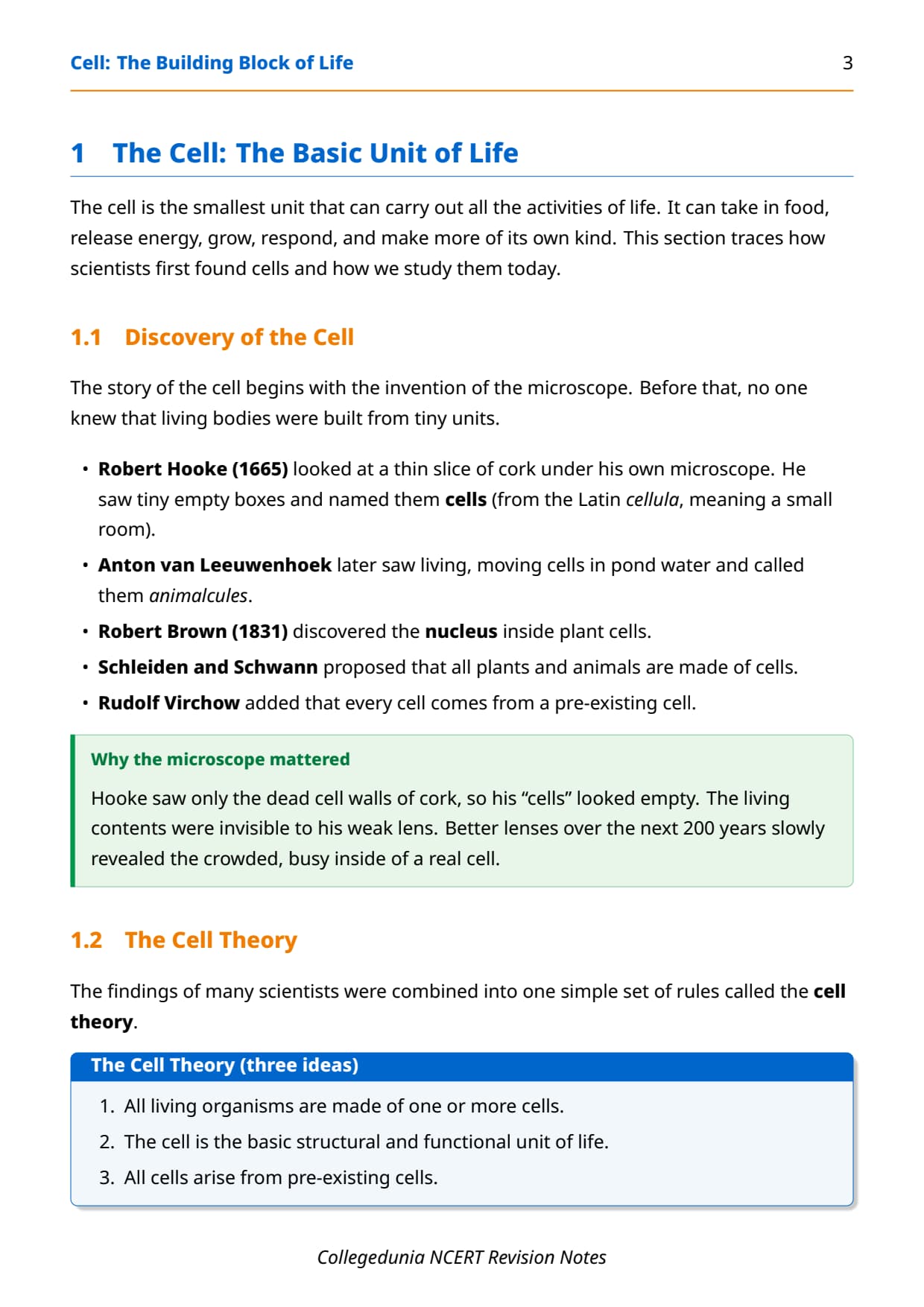
The story of the cell begins with the microscope. Before it, no one knew that living bodies were built from tiny units. A few scientists then built the idea step by step.
- Robert Hooke (1665) saw empty boxes in a slice of cork and named them cells.
- Anton van Leeuwenhoek saw living, moving cells in pond water.
- Robert Brown (1831) found the nucleus inside plant cells.
- Schleiden and Schwann said all plants and animals are made of cells.
- Rudolf Virchow added that every cell comes from a cell that already exists.
These findings were joined into one simple set of rules. The cell theory has three ideas: all organisms are made of cells, the cell is the basic unit of life, and all cells come from pre-existing cells.
Cell Organelles and Their Functions in Class 9 Science Chapter 2
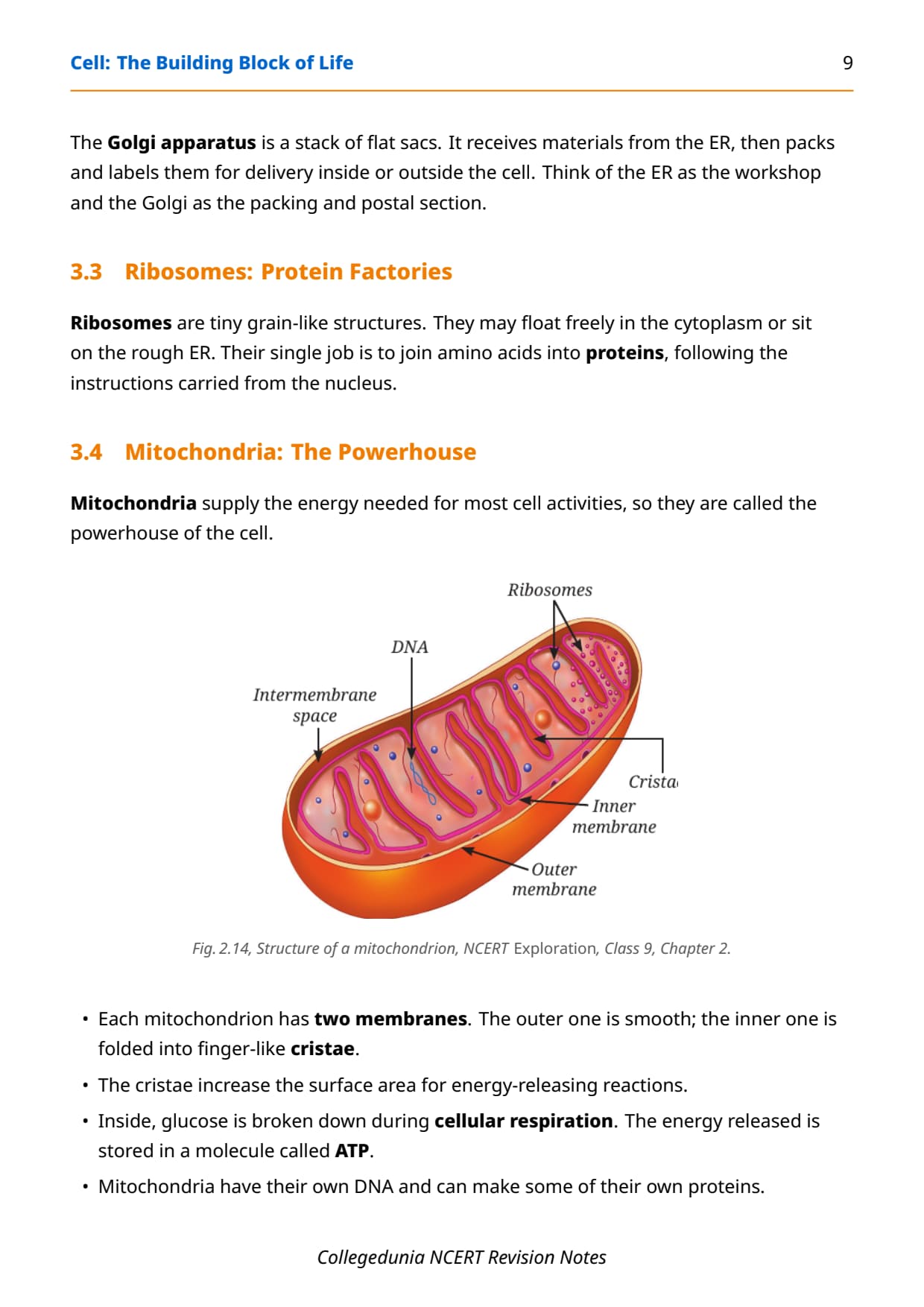
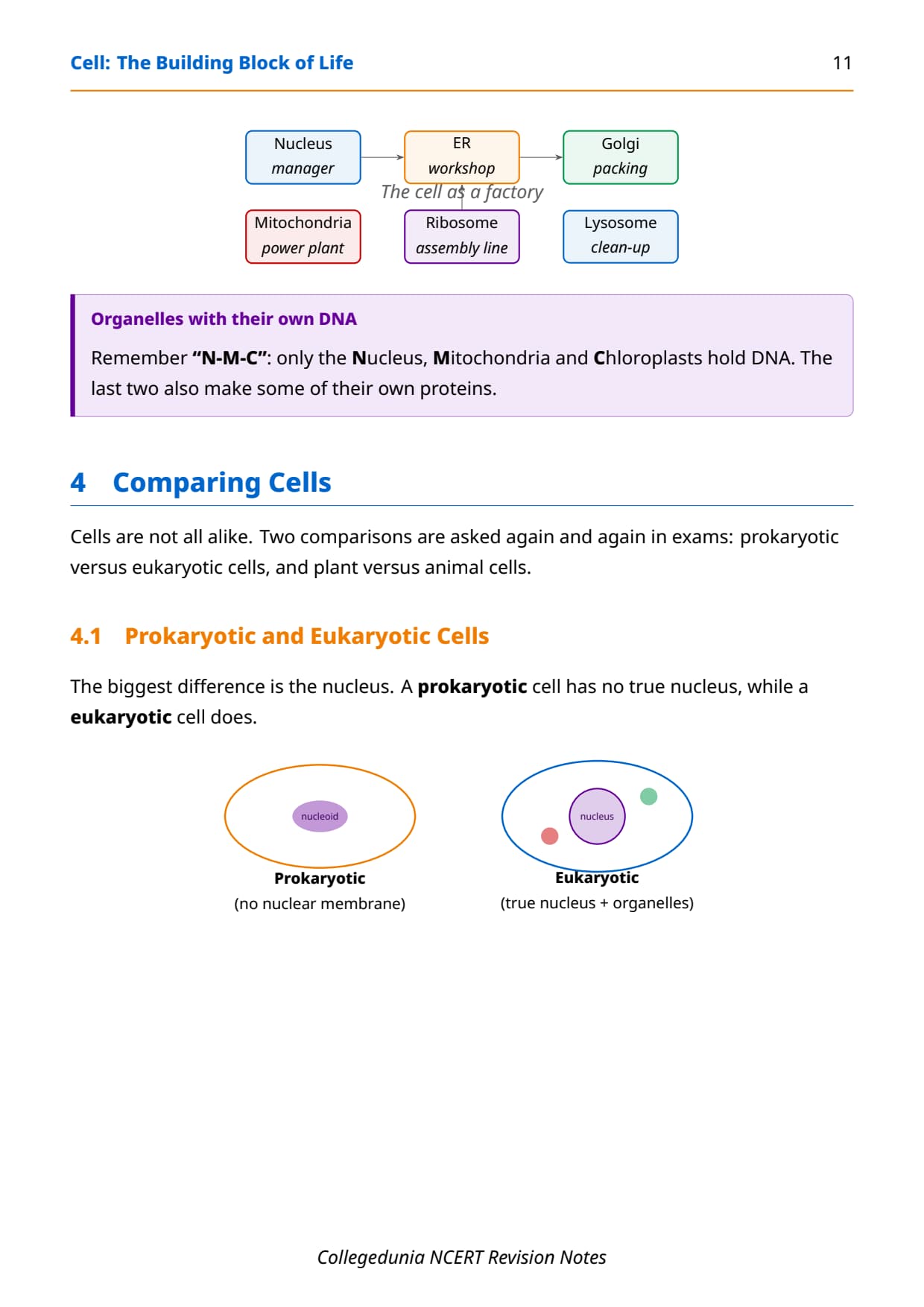
The space inside a cell is not empty. The jelly-like cytoplasm holds tiny structures called organelles, and each has its own job. A cell is often compared to a busy factory where every part helps run the whole.

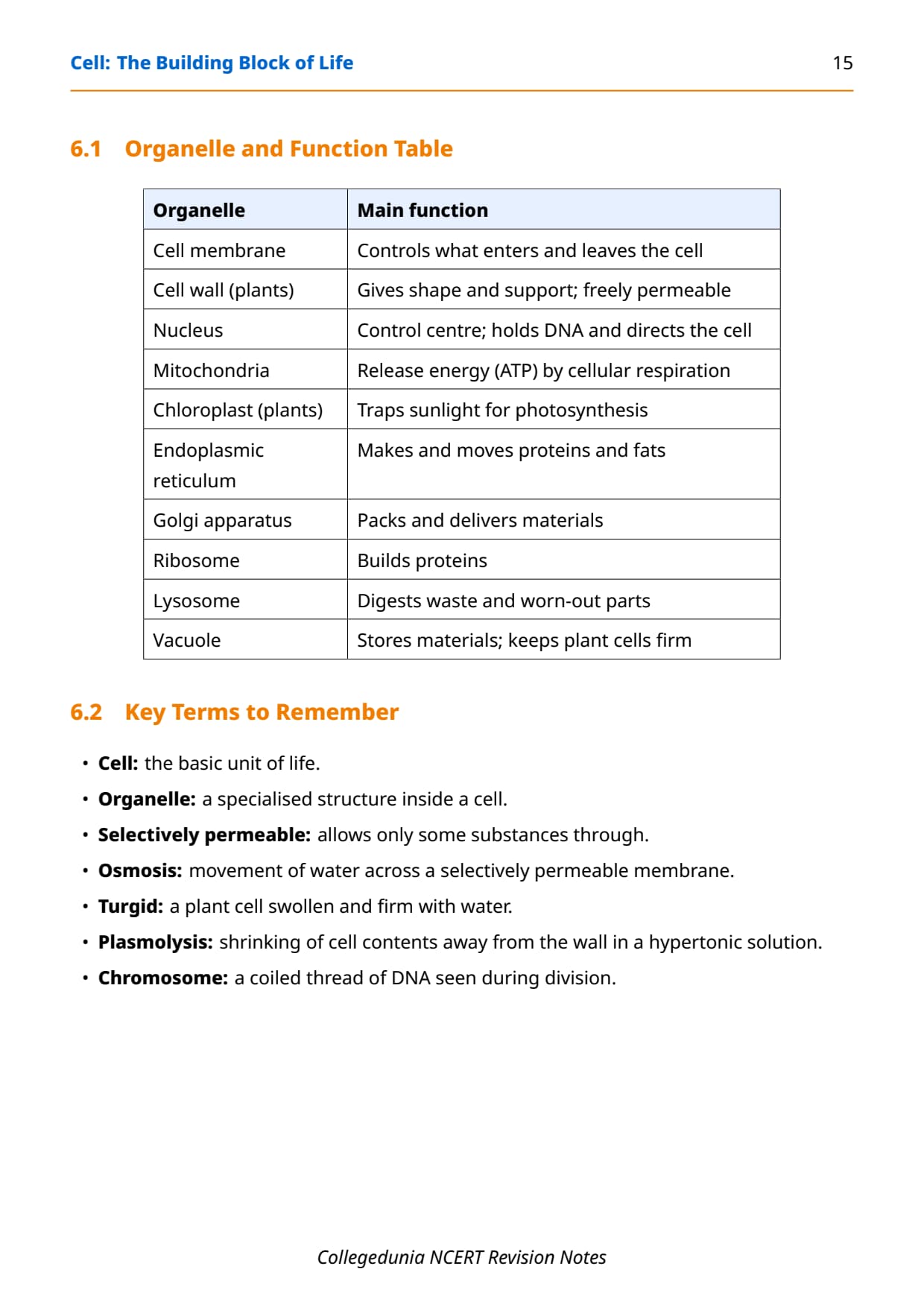
| Organelle | Main function |
|---|---|
| Cell membrane | Controls what enters and leaves the cell; selectively permeable |
| Cell wall (plants) | Gives shape and support; made of cellulose; freely permeable |
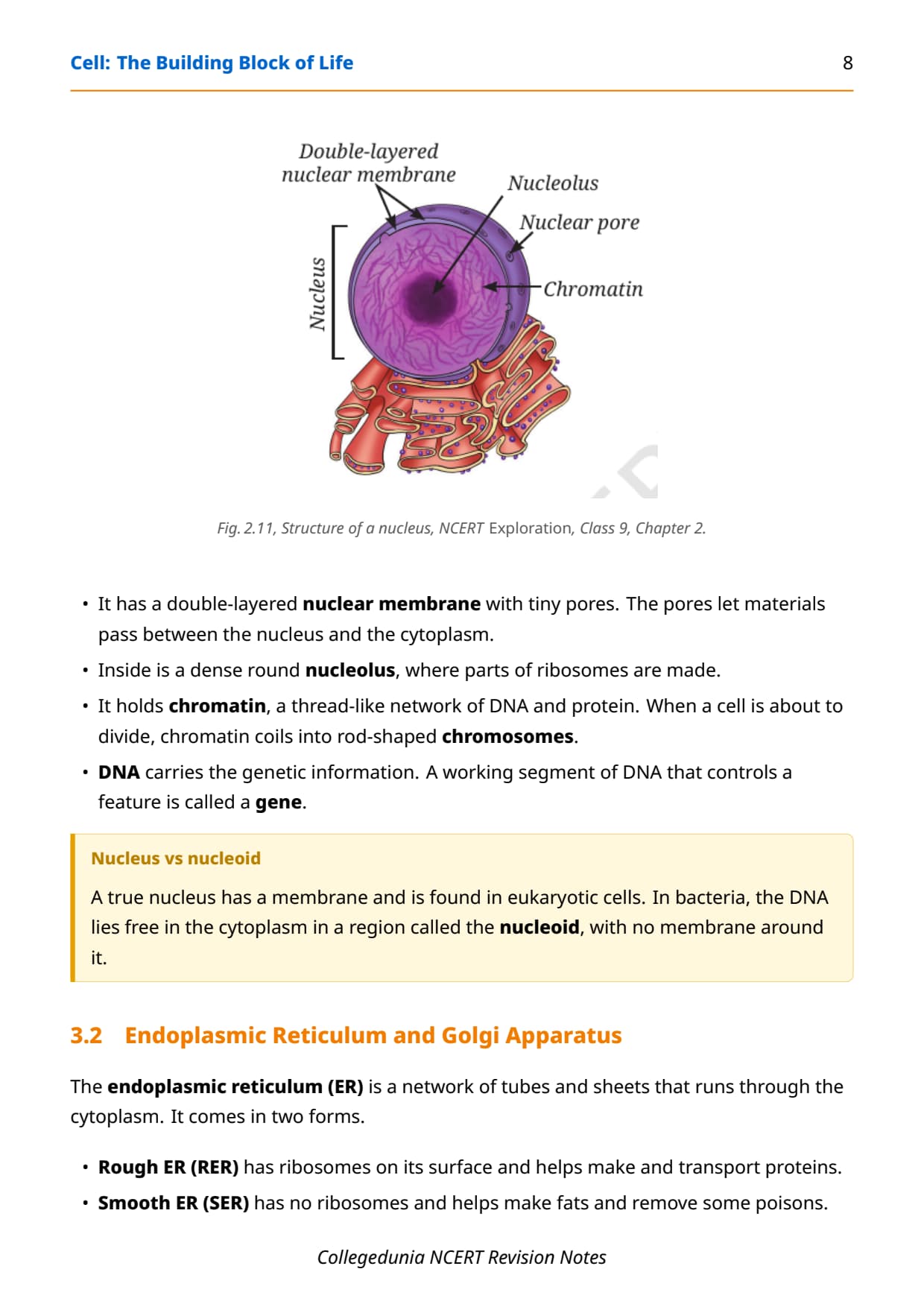
| Nucleus | Control centre; holds DNA and directs the cell |
| Mitochondria | Release energy as ATP by cellular respiration; the powerhouse |
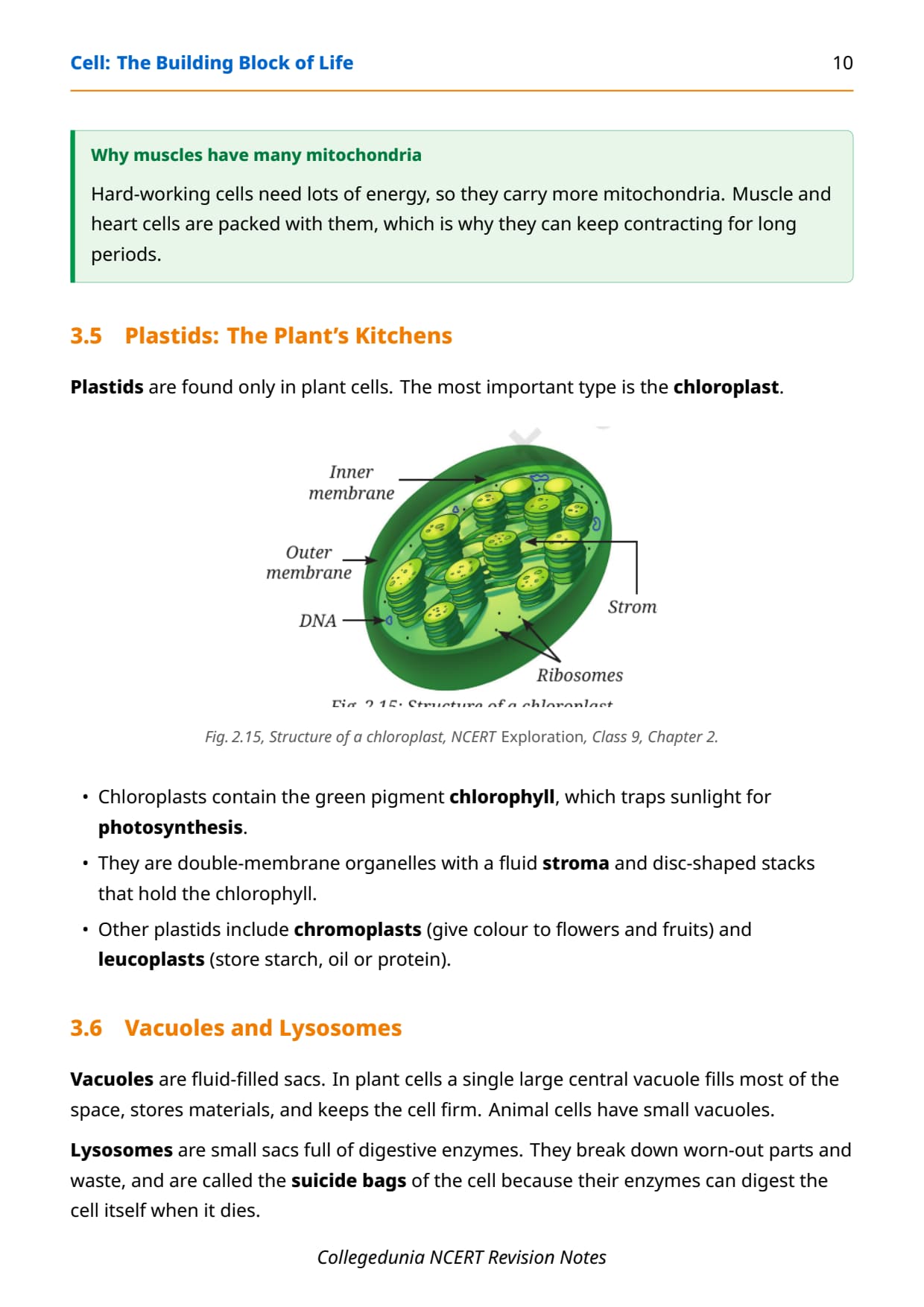
| Chloroplast (plants) | Traps sunlight for photosynthesis using chlorophyll |
| Endoplasmic reticulum | Makes and moves proteins (rough ER) and fats (smooth ER) |
| Golgi apparatus | Packs and delivers materials made by the ER |
| Ribosome | Builds proteins by joining amino acids |
| Lysosome | Digests waste and worn-out parts; the suicide bag |
| Vacuole | Stores materials; keeps plant cells firm |
Tip: only the nucleus, mitochondria and chloroplasts hold DNA. Remember the letters N-M-C. The last two also make some of their own proteins.
Plant Cell vs Animal Cell Differences Every Class 9 Student Must Know
Both plant and animal cells are eukaryotic, but three parts are plant-only at this level: the cell wall, the chloroplast and a large central vacuole. Fix on these first and the rest of the comparison follows.
| Feature | Plant cell | Animal cell |
|---|---|---|
| Cell wall | Present (cellulose) | Absent |
| Chloroplast | Present | Absent |
| Vacuole | One large central vacuole | Small, if any |
| Shape | Fixed, often box-like | Round or irregular, flexible |
A plant cell has both a cell wall and a cell membrane. The wall is the thick, non-living, freely permeable outer layer. The membrane is the thin, living, selectively permeable layer just inside it.
Diffusion and Osmosis in Cell the Building Block of Life Class 9
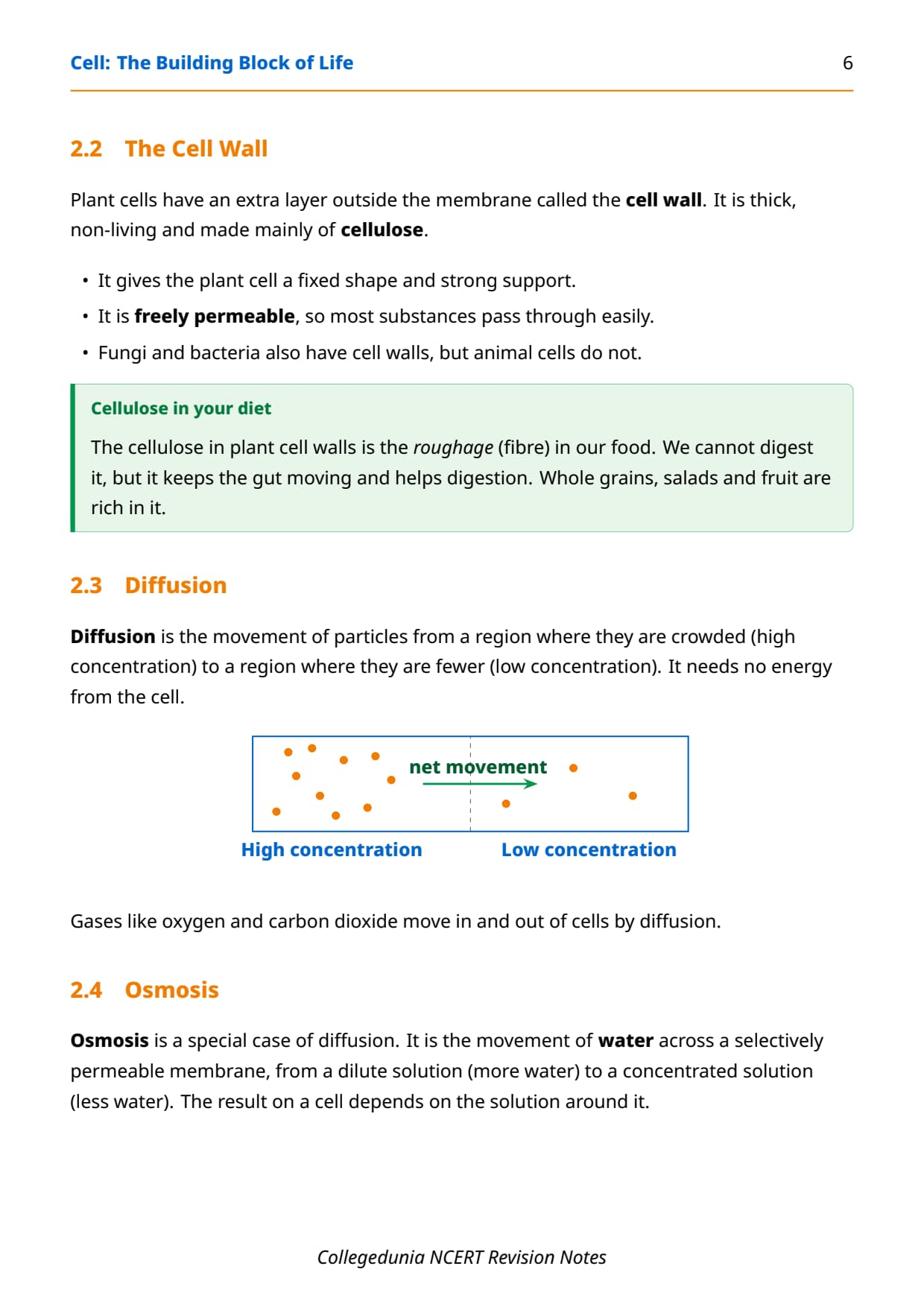
Diffusion is the movement of particles from a crowded region to a less crowded region. It needs no energy. Gases like oxygen and carbon dioxide move in and out of cells this way. Osmosis is a special case of diffusion, where only water crosses a selectively permeable membrane.
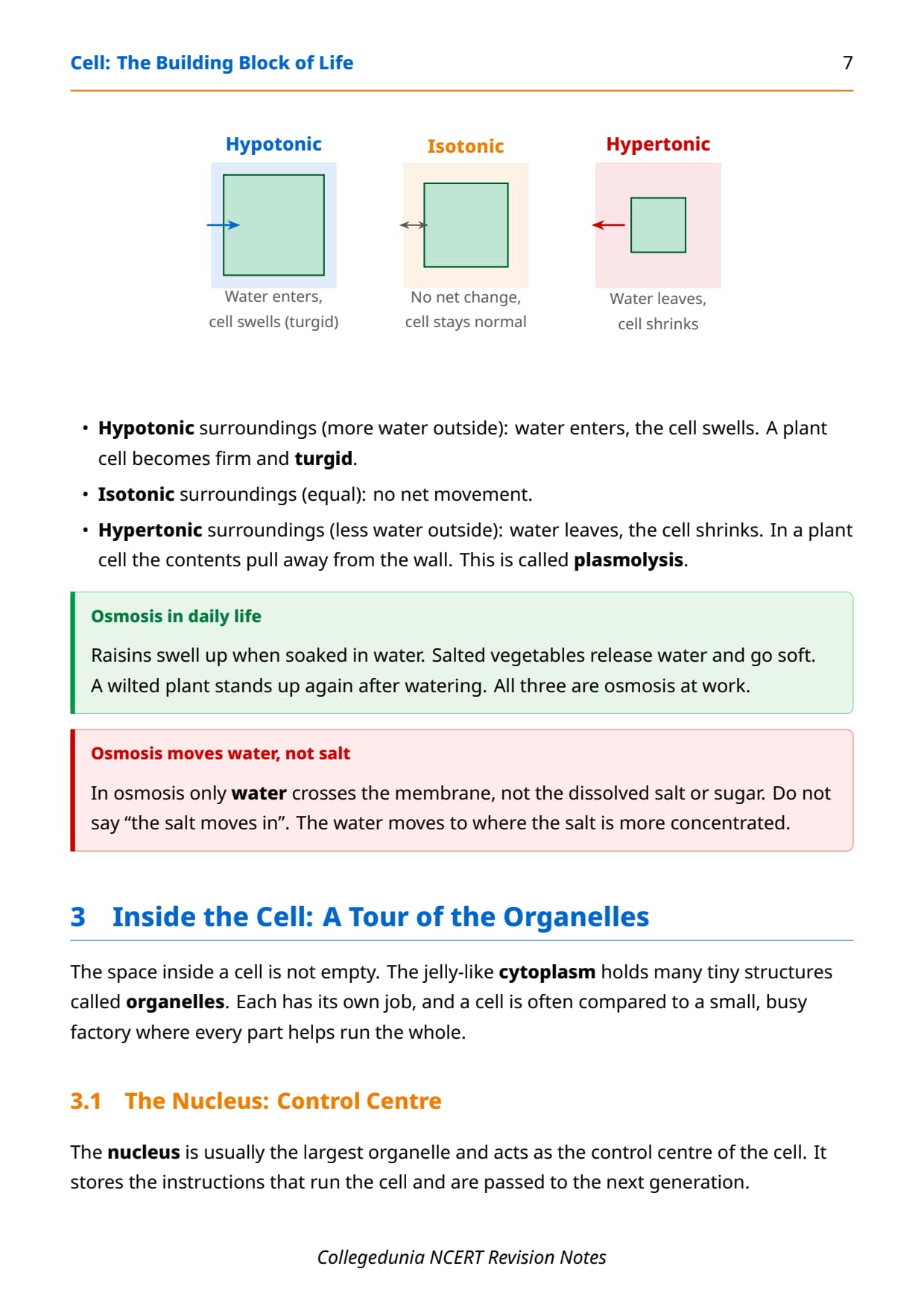
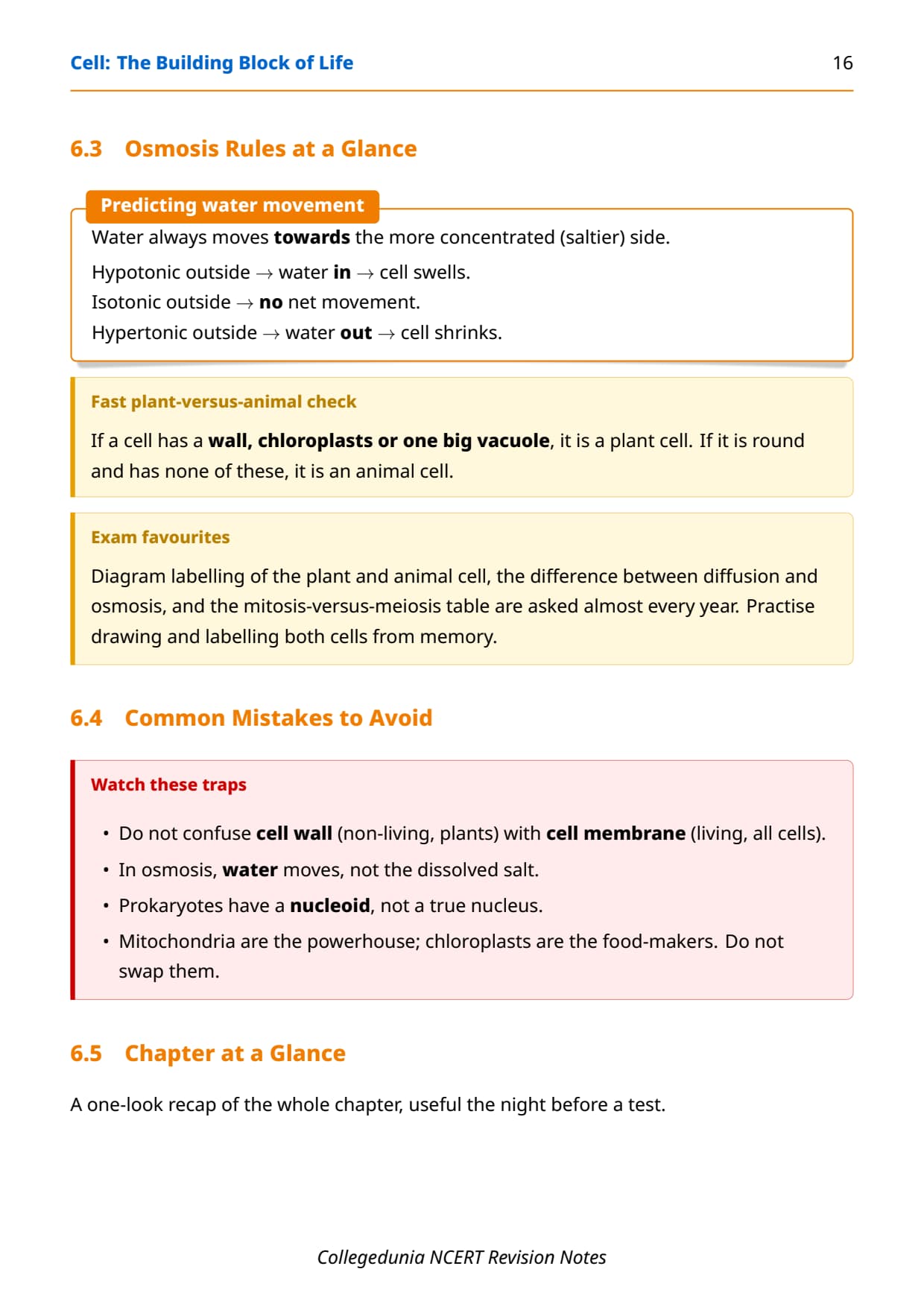
- Hypotonic surroundings (more water outside): water enters, the cell swells and a plant cell becomes turgid.
- Isotonic surroundings (equal water): no net movement, the cell stays normal.
- Hypertonic surroundings (less water outside): water leaves, the cell shrinks. In a plant cell this is called plasmolysis.
Water always moves towards the saltier side. Raisins swell in water and salted vegetables go soft. Both are osmosis at work. Remember: in osmosis the water moves, not the dissolved salt.
Prokaryotic and Eukaryotic Cells Compared for Class 9 Science
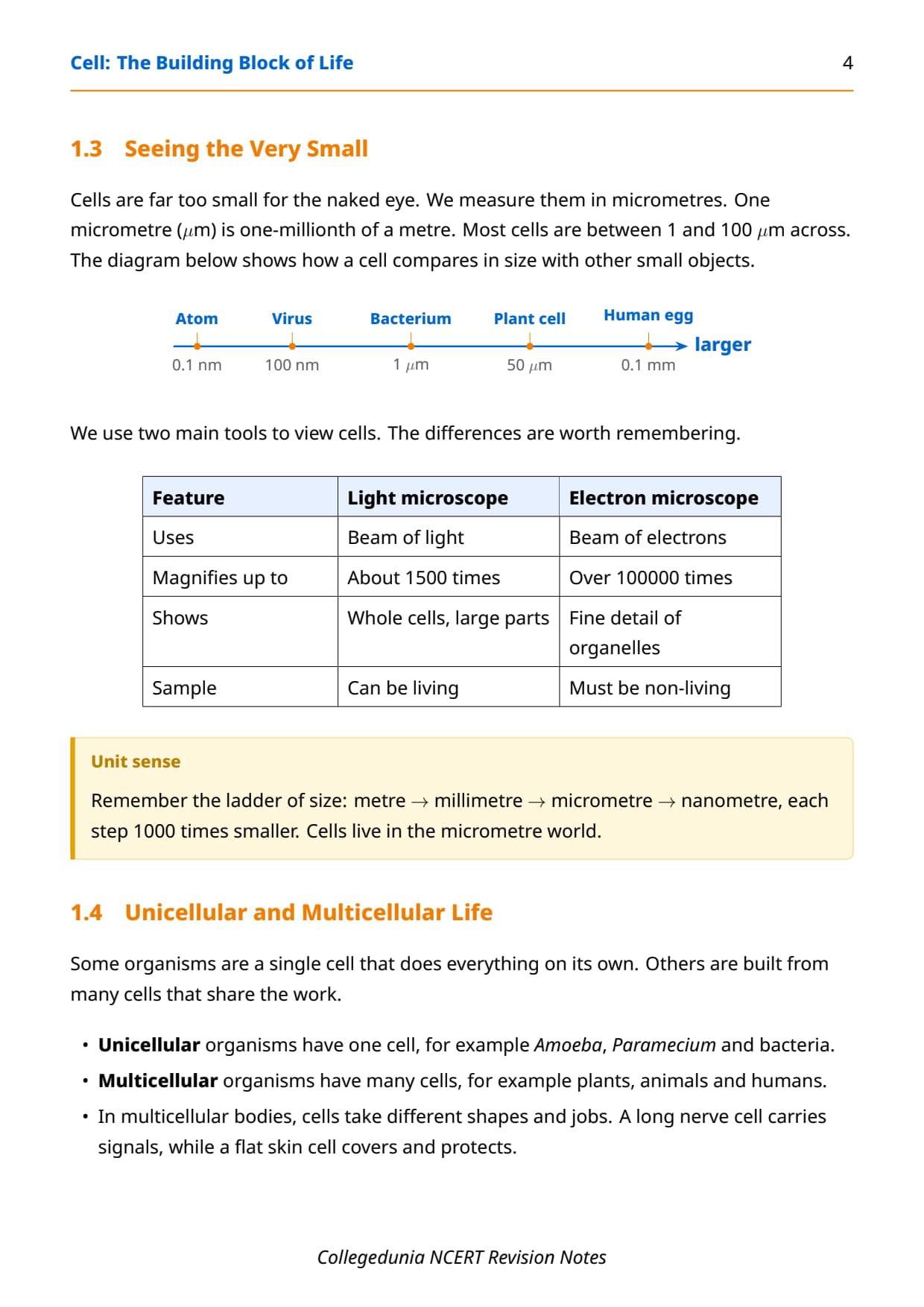
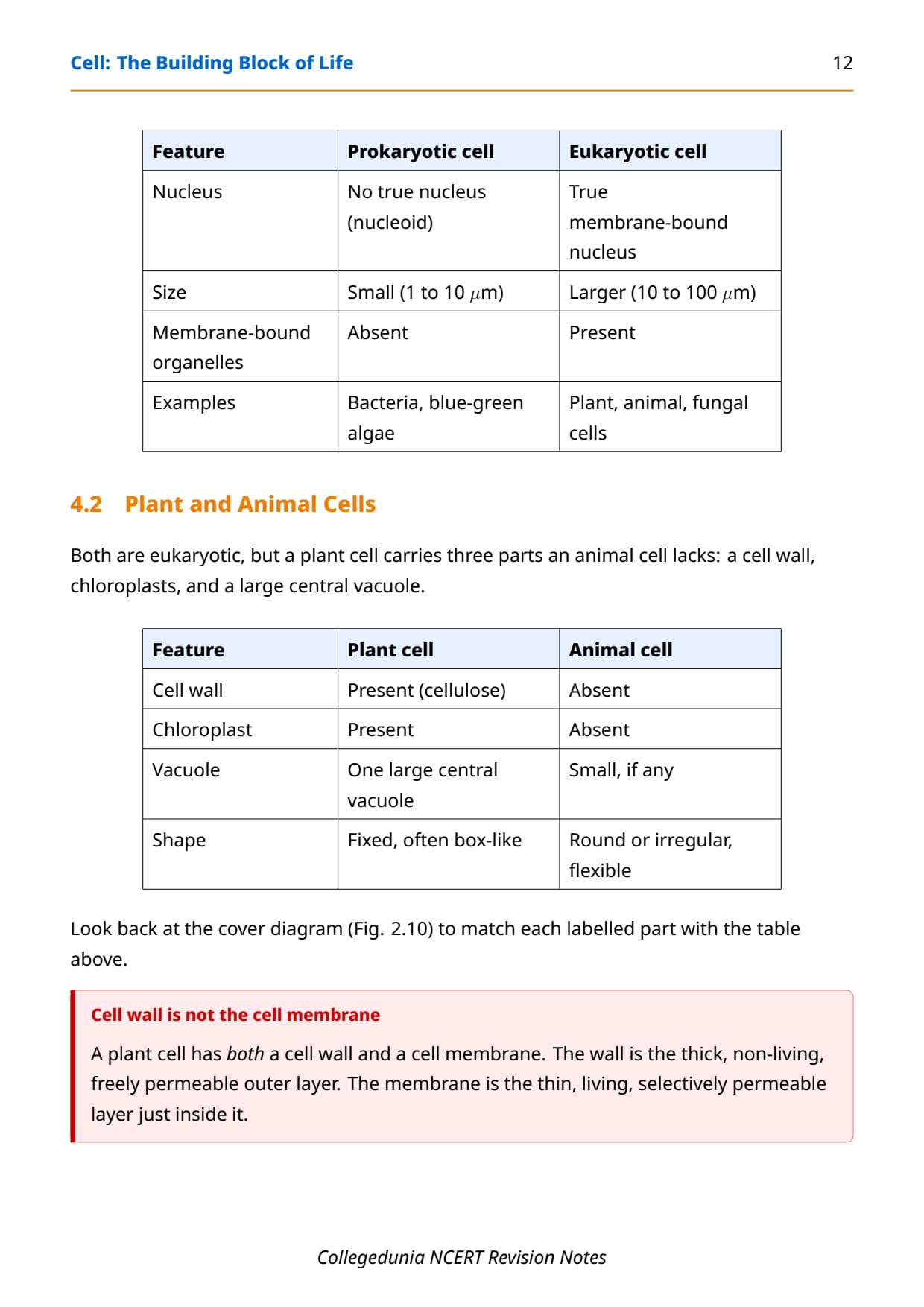
Cells are not all alike. The biggest difference is the nucleus. A prokaryotic cell has no true nucleus, while a eukaryotic cell has a real membrane-bound nucleus. This is a favourite one-mark comparison in the class 9 science chapter 2 notes.
| Feature | Prokaryotic cell | Eukaryotic cell |
|---|---|---|
| Nucleus | No true nucleus (nucleoid) | True membrane-bound nucleus |
| Size | Small (1 to 10 micrometre) | Larger (10 to 100 micrometre) |
| Membrane-bound organelles | Absent | Present |
| Examples | Bacteria, blue-green algae | Plant, animal, fungal cells |
In bacteria the DNA lies free in the cytoplasm in a region called the nucleoid, with no membrane around it. Do not call it a nucleus.
Cell Division: Mitosis and Meiosis in Class 9 Science Chapter 2
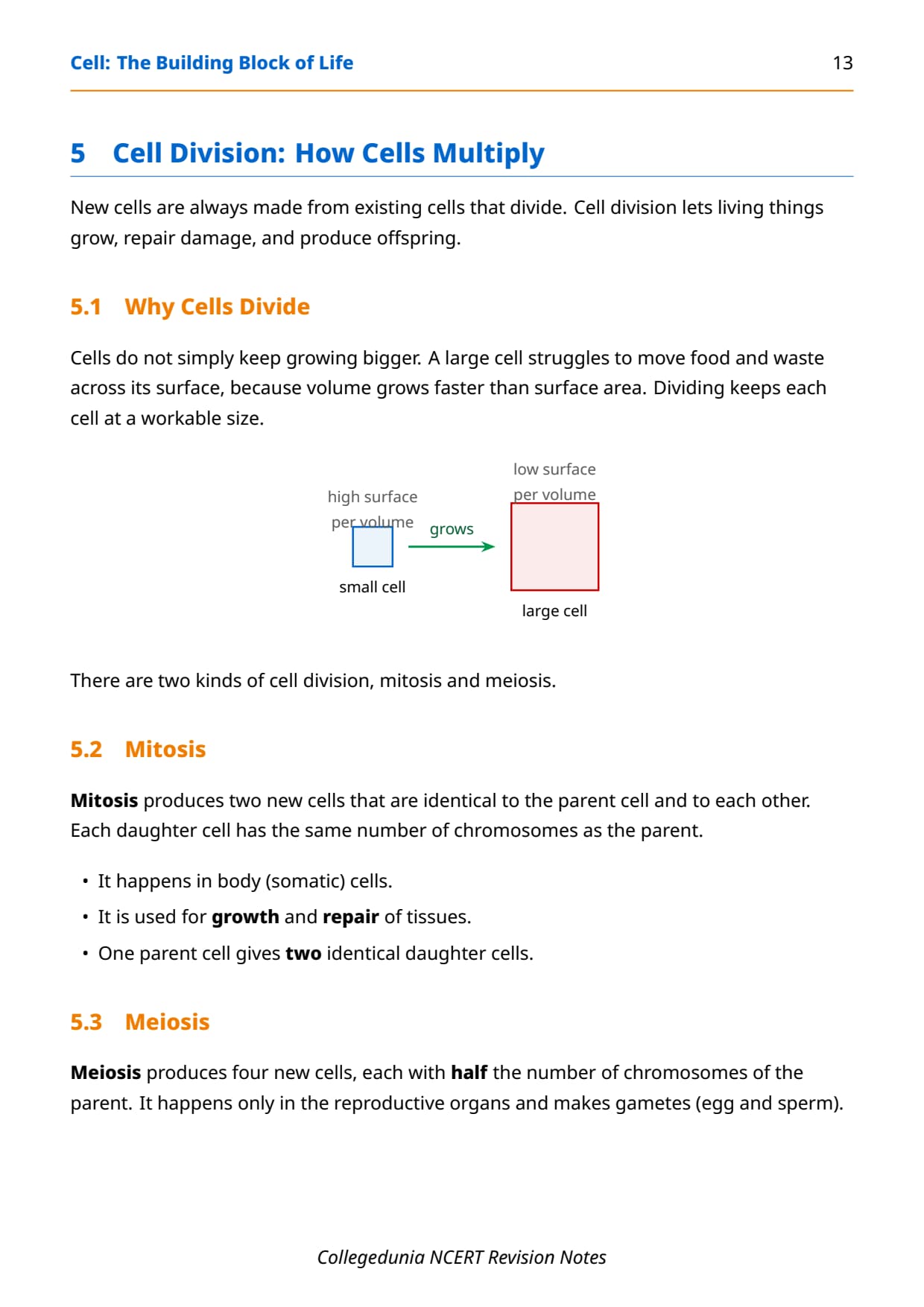
New cells are always made from existing cells that divide. Cell division lets living things grow, repair damage and make offspring. Cells do not simply grow bigger, because a large cell struggles to move food and waste across its surface. There are two kinds of division.
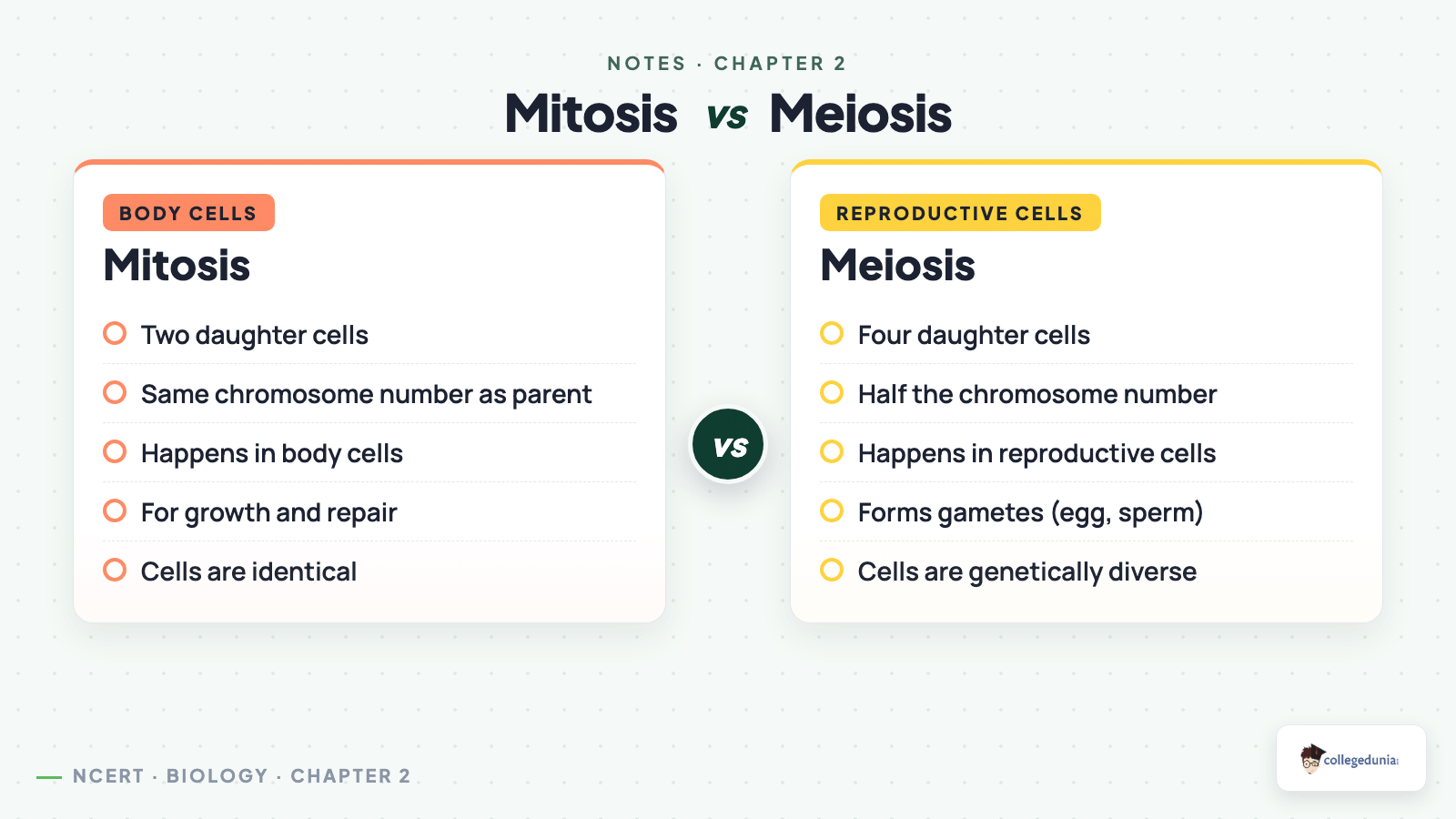
| Feature | Mitosis | Meiosis |
|---|---|---|
| Number of daughter cells | Two | Four |
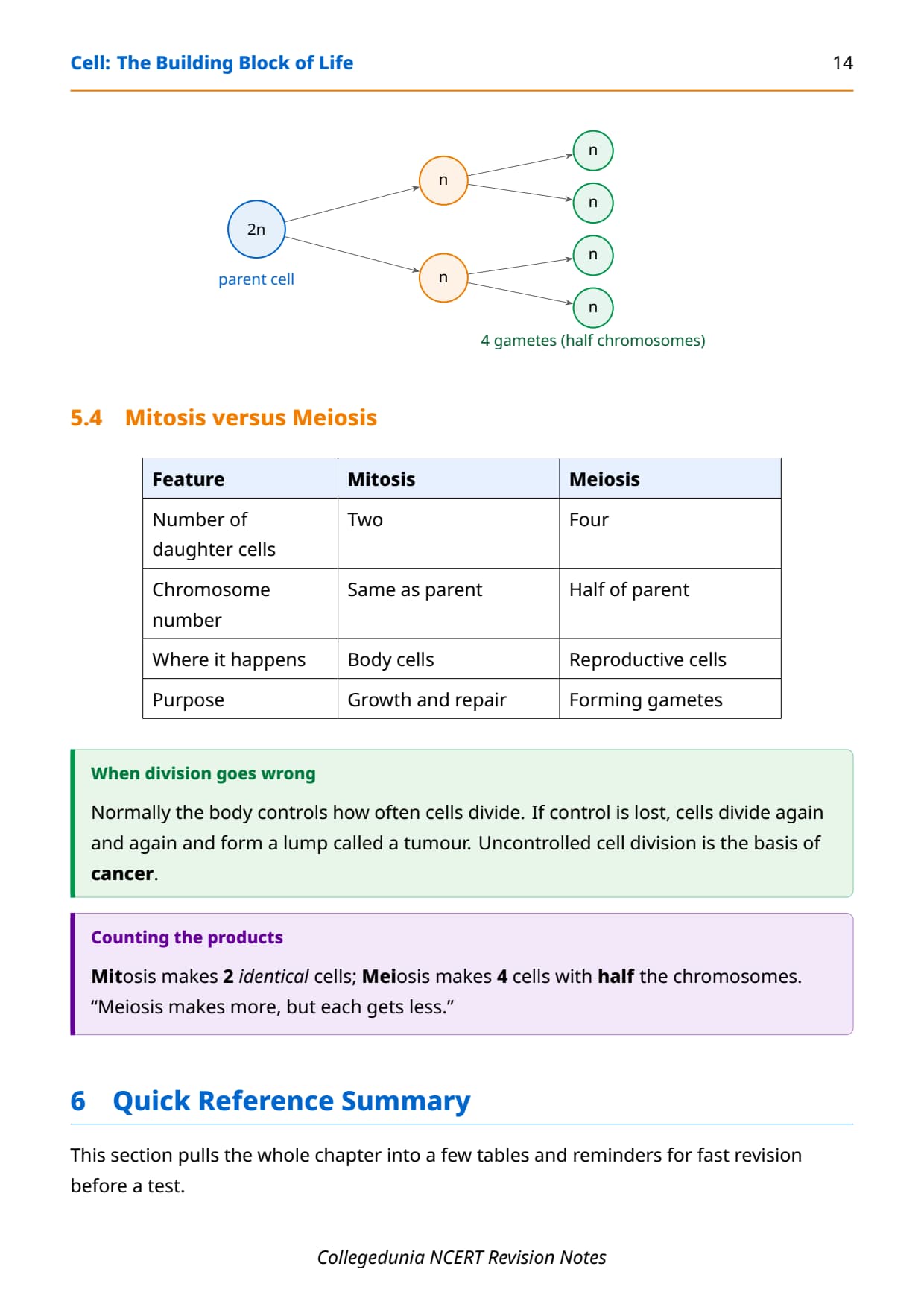
| Chromosome number | Same as parent | Half of parent |
| Where it happens | Body cells | Reproductive cells |
| Purpose | Growth and repair | Forming gametes |
Tip: a simple line to recall it: Mitosis makes 2 identical cells; meiosis makes 4 cells with half the chromosomes. If control over division is lost, cells divide again and again and form a lump, which is the basis of cancer.
Student Feedback on Cell the Building Block of Life Class 9 Notes
What 12,840 students told us about their cell the building block of life revision before the 2026 boards.
- 71% of students said the organelle-function table was the fastest part of the chapter to revise from these notes.
- 63% of students found the osmosis idea (hypotonic, isotonic, hypertonic) the easiest to forget under exam pressure.
- Most-skipped topic in revision: the difference between mitosis and meiosis, left for last by about 34% of students.
Source: 2026-27 Class 9 Science student poll. Sample of 12,840 students from CBSE schools across 14 states.
Common Mistakes Students Make in the Cell the Building Block of Life Chapter
A few slips lose easy marks in this chapter every year.
- Confusing the cell wall (non-living, plants only) with the cell membrane (living, all cells).
- Saying salt entered the cell in osmosis. Only water crosses the membrane, not the dissolved salt.
- Calling the bacterial DNA region a nucleus. Prokaryotes have a nucleoid, not a true nucleus.
- Swapping the jobs of mitochondria and chloroplasts. Mitochondria release energy; chloroplasts make food.
How to Use the Cell the Building Block of Life Class 9 Notes
Use these notes in three simple blocks. First read for meaning, then learn the tables, then test yourself with a blank diagram.
- Read the chapter once and match each organelle to its one main job.
- Learn the three comparison tables: plant versus animal, prokaryote versus eukaryote, and mitosis versus meiosis.
- Test yourself by labelling a blank plant cell and animal cell from memory.
Draw and label both cells at least once before the exam. Diagram labelling, the diffusion-versus-osmosis difference, and the mitosis-versus-meiosis table are asked almost every year.
How These Class 9 Science Chapter 2 Notes Pair with the Solutions and NCERT Book
These notes work best next to the other Class 9 Science resources for this chapter. Read the notes first, then solve, then read the original text for depth.
- Use the NCERT Solutions to attempt all 16 Revise, Reflect, Refine questions after you finish these notes.
- Use the Handwritten Notes for a quick one-shot recap on the night before a test.
- Use the NCERT Book PDF to read the full chapter text and study the original diagrams.
Cell the Building Block of Life Class 9 Other Resources for this Chapter
Pair these notes with the other Class 9 Science resources for this chapter, all linked below.
| Resource | Best used for |
|---|---|
| Cell the Building Block of Life Class 9 NCERT Solutions | Solving all 16 chapter questions step by step |
| Cell the Building Block of Life Class 9 Handwritten Notes | Last-minute one-shot revision |
| Cell the Building Block of Life Class 9 NCERT Book PDF | Reading the original chapter text |
All Chapters NCERT Notes for Class 9 Science
Browse the full set of ncert notes for class 9 science chapter by chapter.
| Chapter | NCERT Notes |
|---|---|
| Chapter 2 | Cell the Building Block of Life Class 9 Notes |
| Chapter 3 | Tissues in Action Class 9 Notes |
| Chapter 4 | Describing Motion Around Us Class 9 Notes |
| Chapter 5 | Exploring Mixtures and their Separation Class 9 Notes |
| Chapter 6 | How Forces Affect Motion Class 9 Notes |
| Chapter 7 | Work, Energy, and Simple Machines Class 9 Notes |
| Chapter 8 | Journey Inside the Atom Class 9 Notes |
| Chapter 9 | Atomic Foundations of Matter Class 9 Notes |
| Chapter 10 | Sound Waves Characteristics and Applications Class 9 Notes |
| Chapter 11 | Reproduction How Life Continues Class 9 Notes |
| Chapter 12 | Patterns in Life Diversity and Classification Class 9 Notes |
| Chapter 13 | Earth as a System Energy, Matter, and Life Class 9 Notes |
Cell the Building Block of Life Class 9 Notes FAQs
Ques. Where can I download the NCERT Notes Class 9 Science Chapter 2 Cell the Building Block of Life PDF?
Ans. You can download the class 9 science chapter 2 notes PDF directly from this page. Both the Normal and HD versions are free, and every topic is written in plain English for the 2026-27 session.
Ques. What topics do the cell the building block of life class 9 notes cover?
Ans. The notes cover the discovery of the cell, the cell theory, every organelle and its function, diffusion and osmosis, plant versus animal cells, prokaryotic versus eukaryotic cells, and cell division by mitosis and meiosis.
Ques. Are these ncert notes for class 9 science chapter 2 aligned with the 2026-27 syllabus?
Ans. Yes. These notes follow the new 2026-27 NCERT book Exploration, where Cell the Building Block of Life is Chapter 2. Every table and diagram is checked against that latest edition.
Ques. What is a cell?
Ans. A cell is the basic structural and functional unit of life. Every living thing is made of one or more cells, and each cell can carry out the activities needed to stay alive.
Ques. How is osmosis defined in Cell the Building Block of Life Class 9?
Ans. Osmosis is the movement of water across a selectively permeable membrane, from a dilute solution (more water) to a concentrated solution (less water). It explains why cells swell in pure water and shrink in salt solution.
Ques. What are the main organelles found in a cell?
Ans. The main organelles are the nucleus, mitochondria, chloroplasts (in plants), endoplasmic reticulum, Golgi apparatus, ribosomes, lysosomes and vacuoles. Each one has a fixed job, listed in the organelle-function table above.
Ques. What is the difference between mitosis and meiosis?
Ans. Mitosis makes two daughter cells with the same chromosome number as the parent and happens in body cells for growth and repair. Meiosis makes four cells with half the chromosome number and happens in reproductive cells to form gametes.



Comments