




The NCERT Notes Class 9 Science Chapter 13 Earth as a System Energy, Matter, and Life give you a clear, quick revision of the whole chapter from the new Exploration textbook. In one place you get every key idea: the five spheres of the Earth, uneven heating and the solar constant, albedo, the greenhouse effect, winds and ocean currents, the water, carbon, nitrogen and oxygen cycles, and how human activity upsets this balance. The notes use short lines and simple words, so you can revise the full chapter fast before a class test or the 2026-27 exam.
- Full concept revision: the five spheres, uneven heating, the greenhouse effect, winds, ocean currents, and the four biogeochemical cycles in one set of notes.
- Numbers ready: the solar constant (about 1.4 kW m-2), air is 78% nitrogen and 21% oxygen, and albedo values for snow and dark soil.
- Why it matters: Chapter 13 ties the whole book together and links to environment, climate, and later CBSE, JEE, and NEET questions on cycles and the atmosphere.
Student Feedback
In a Collegedunia study of 1,240 Class 9 students, 81% said a one-page recap of the four cycles helped them label the water, carbon, nitrogen and oxygen diagrams without slips. About 4 out of 5 rated the spheres classification the easiest way to start the chapter, and many said the greenhouse effect table made the reasoning questions feel simple.
What You Revise in Class 9 Science Chapter 13 Earth as a System
Chapter 13 shows that the Earth is not a set of separate parts. Its air, water, rocks and living things work together as one connected system. The NCERT Notes Class 9 Science Chapter 13 Earth as a System Energy, Matter, and Life cover every idea in the order the Exploration book uses, so your revision follows the same flow as the chapter.
These notes help you recall the core points in minutes:
- One system, five spheres: the geosphere, hydrosphere, cryosphere, atmosphere and biosphere, and how a change in one affects the rest.
- Energy and heating: uneven heating of the Earth, insolation, the solar constant, and albedo.
- The atmosphere: its layers, the greenhouse effect, and how it keeps the surface safe and warm.
- Movement and cycles: winds and ocean currents, plus the water, carbon, nitrogen and oxygen cycles, and the human impact on all of them.
Keep one big idea in mind while you revise: energy flows through the Earth and leaves as heat, while matter cycles and is used again and again.
Earth as a System Class 9 Science in One Shot
Source: Magnet Brains on YouTube
The Five Spheres of the Earth: Quick Revision Notes
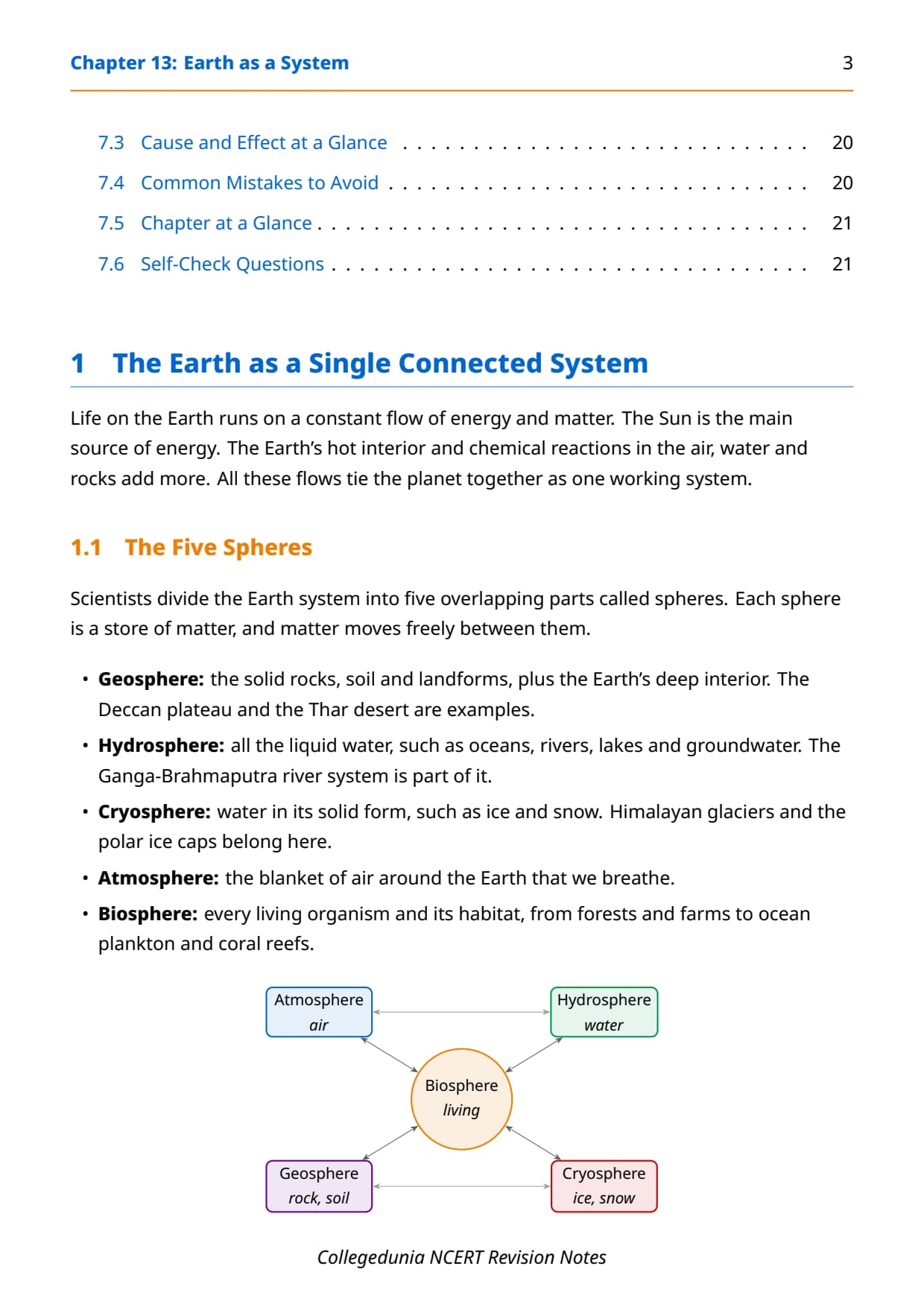
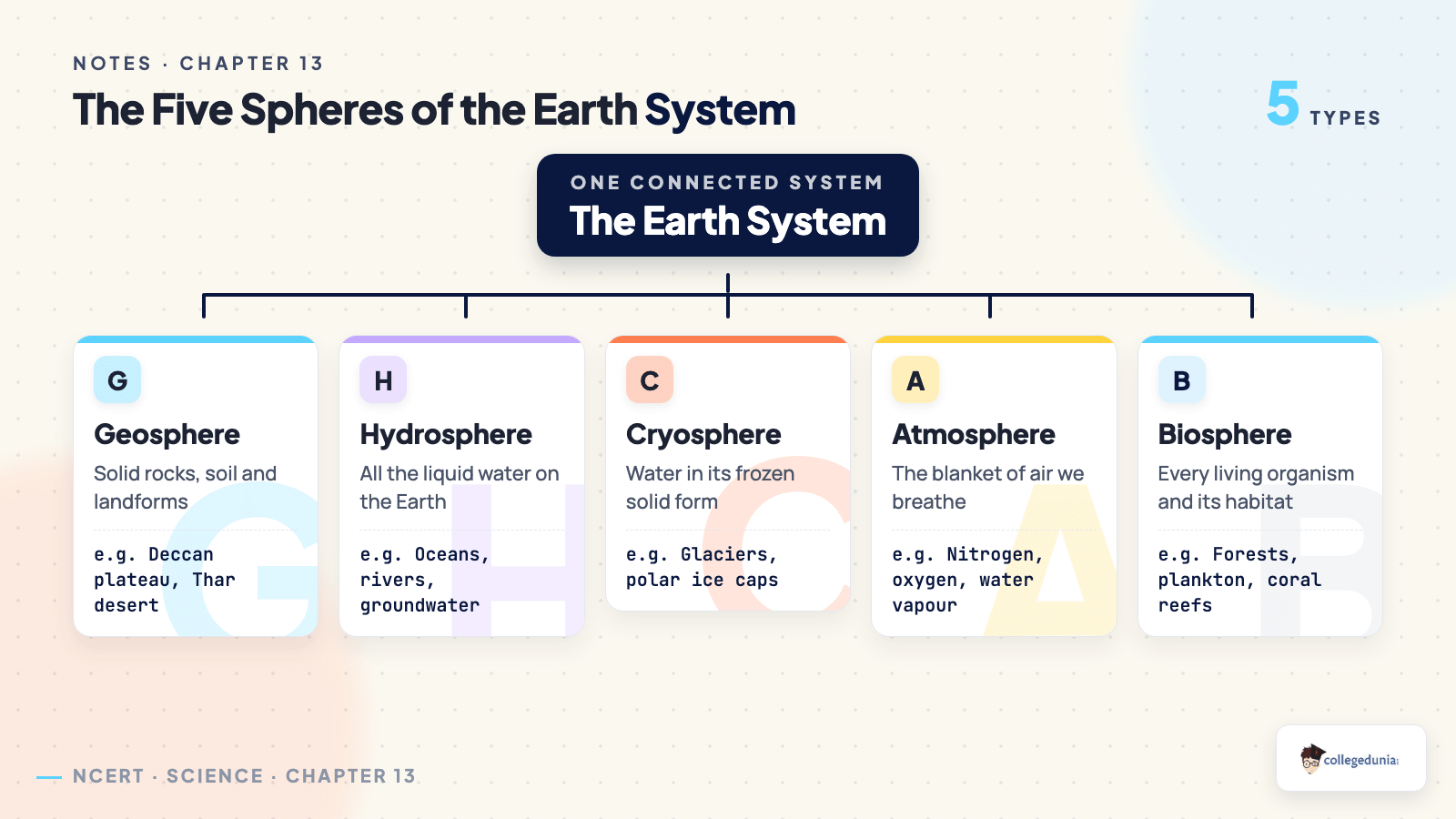
Start your revision with the big picture. Scientists divide the Earth system into five overlapping parts called spheres. Each sphere is a store of matter, and matter moves freely between them, which is why the whole planet works as one system.
| Sphere | What it holds | Example |
|---|---|---|
| Geosphere | Solid rocks, soil and landforms, plus the deep interior | Deccan plateau, Thar desert |
| Hydrosphere | All the liquid water | Ganga-Brahmaputra rivers, oceans |
| Cryosphere | Water in solid form, as ice and snow | Himalayan glaciers, polar ice caps |
| Atmosphere | The blanket of air we breathe | Nitrogen, oxygen, water vapour |
| Biosphere | Every living organism and its habitat | Forests, farms, ocean plankton |
Because the spheres are linked, a disturbance in one leads to changes in the rest:
- Less snowfall (cryosphere) means less meltwater in a summer lake (hydrosphere), so less grass grows for grazing animals (biosphere).
- Warmer Arabian Sea water raises evaporation, which shifts the southwest monsoon and brings floods to some regions and drought to others.
- A rise in air temperature speeds up the melting of glaciers and polar ice, which can raise sea levels and threaten coastal cities.
Uneven Heating, Insolation and the Solar Constant in Class 9 Science Chapter 13
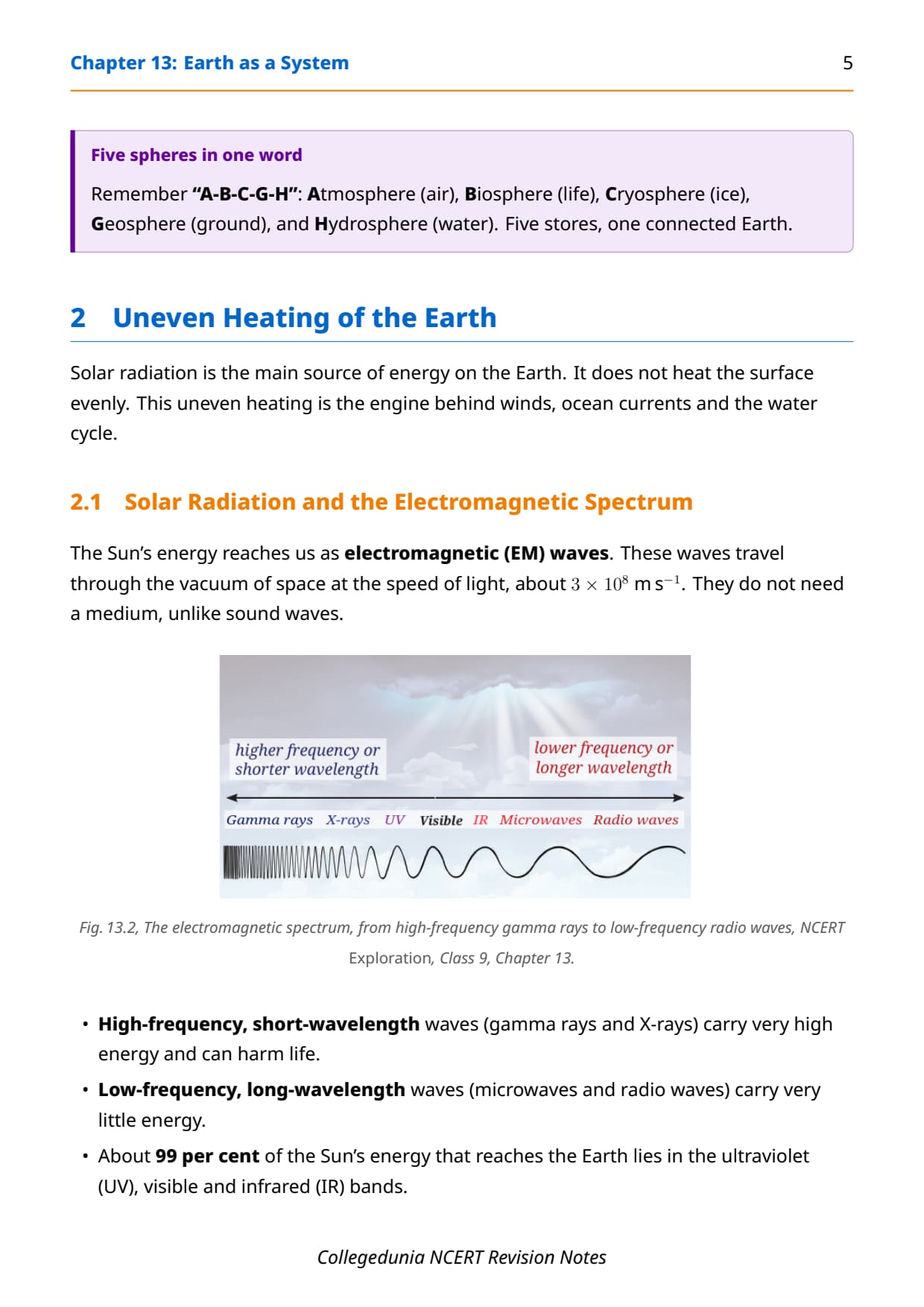
The Sun is the main source of energy on the Earth. Its energy reaches us as electromagnetic waves, which travel through the vacuum of space at the speed of light, about 3 × 10⁸ m s-1. Unlike sound, these waves do not need a medium. The Sun does not heat the surface evenly, and this uneven heating is the engine behind winds, ocean currents and the water cycle.
- High-energy rays: gamma rays and X-rays have short wavelength and can harm life, but the upper atmosphere filters most of them out.
- Useful band: about 99 per cent of the Sun's energy that reaches the Earth is ultraviolet (UV), visible light and infrared (IR). Most UV is soaked up by the ozone layer, visible light powers photosynthesis, and infrared warms the land and water.
The amount of the Sun's radiation reaching the Earth's surface is called insolation. A key value in this chapter is the solar constant.
Here is a solved example based on the book. If the insolation at the surface is 1 kW m-2, the energy falling on 1 m2 in one hour is:
- E = intensity × area × time
- E = 1000 J s-1 m-2 × 1 m2 × 3600 s
- E = 3,600,000 J = 3.6 × 10⁶ J
That is about one unit of household electricity, and enough to melt 5 kg of ice and heat the water. India lies in the tropical belt, so it receives strong sunlight all year, which is why solar farms are growing fast across the country.
Albedo and Latitude: Why Surfaces Heat Differently in Class 9
Two more ideas explain why some places on the Earth are warm and others cold. The first is albedo, and the second is latitude.
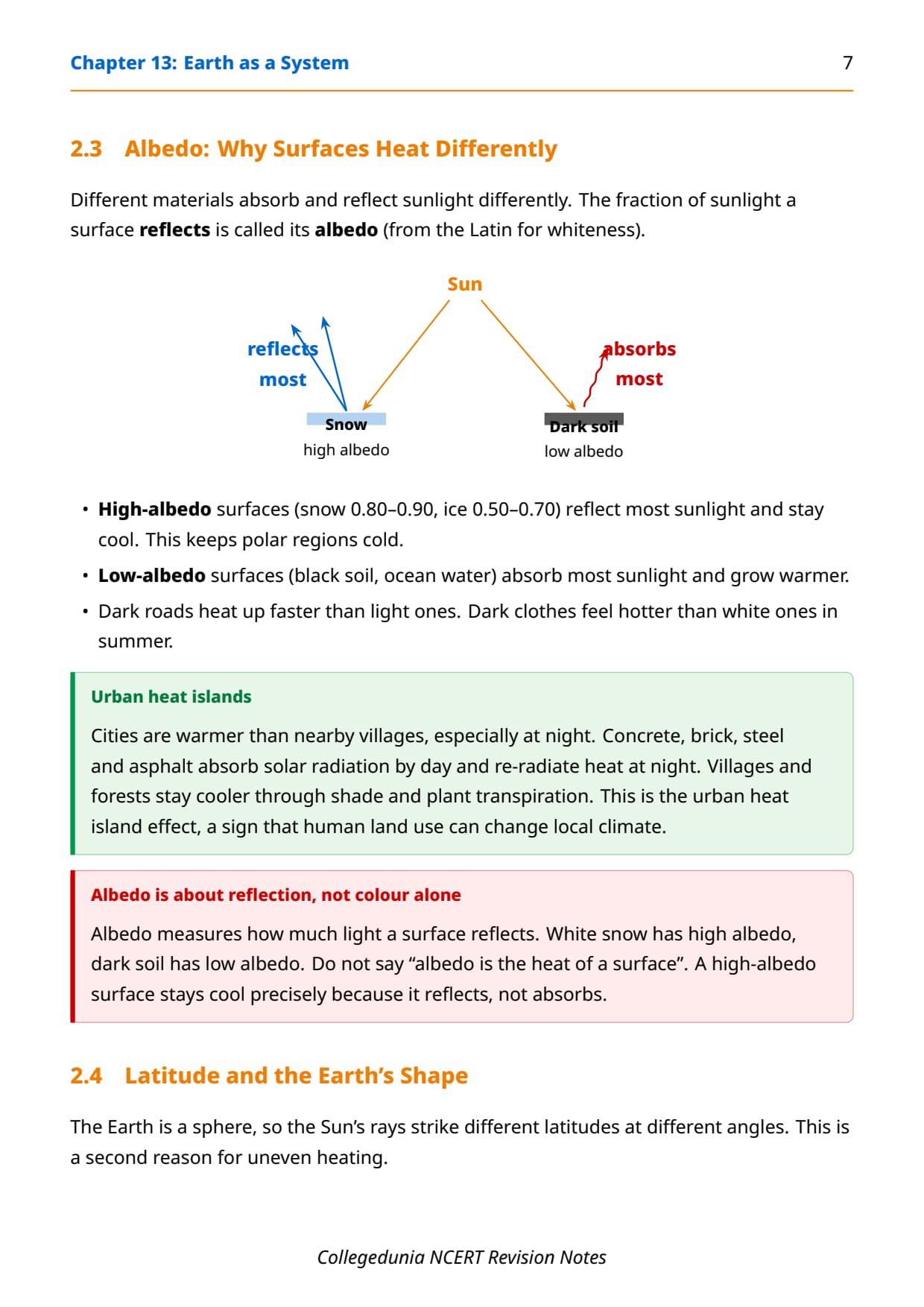
The fraction of sunlight a surface reflects is called its albedo, from the Latin word for whiteness.
- High-albedo surfaces (snow 0.80 to 0.90, ice 0.50 to 0.70) reflect most sunlight and stay cool. This keeps the polar regions cold.
- Low-albedo surfaces (black soil, ocean water) absorb most sunlight and grow warmer. Dark roads and dark clothes heat up faster than light ones.
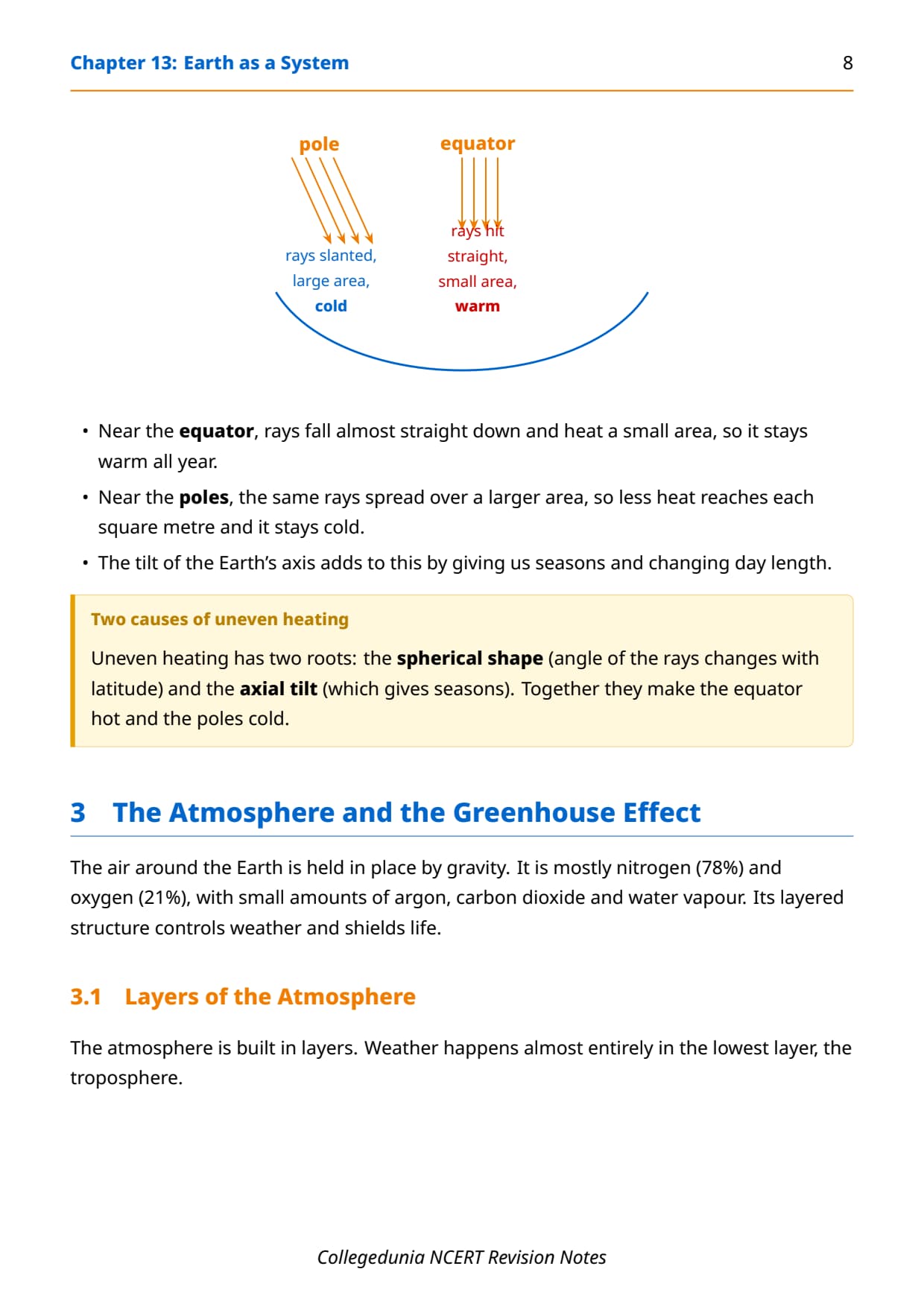
The second reason is the Earth's shape. Because the Earth is a sphere, the Sun's rays strike different latitudes at different angles.
- Near the equator, rays fall almost straight down and heat a small area, so it stays warm all year.
- Near the poles, the same rays spread over a larger area, so less heat reaches each square metre and it stays cold.
- The tilt of the Earth's axis adds to this by giving us seasons and changing day length.
A good real-world example is the urban heat island: cities are warmer than nearby villages, especially at night, because concrete and asphalt have low albedo, absorb heat by day and release it after dark.
The Atmosphere and the Greenhouse Effect in Class 9 Science Chapter 13
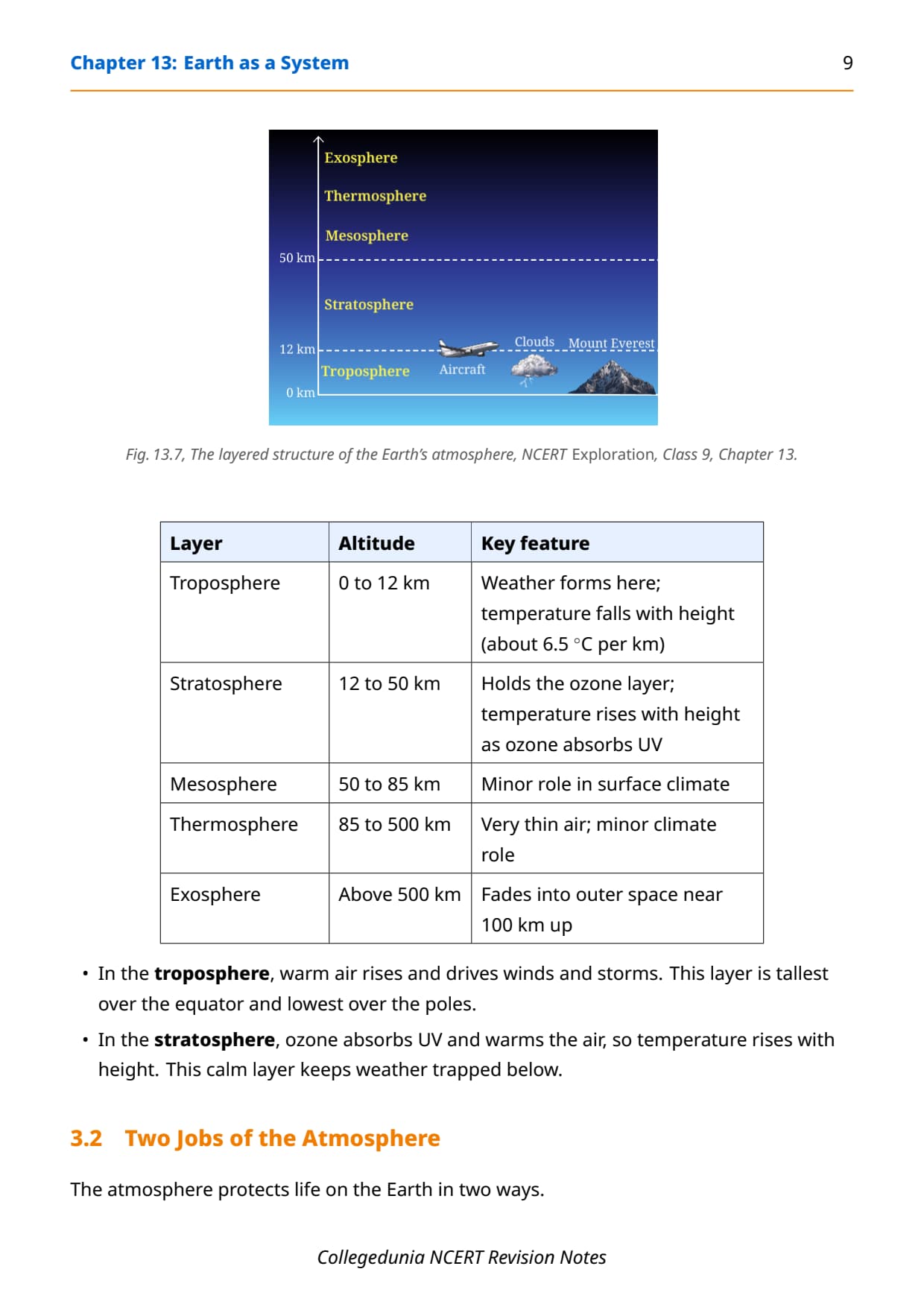
The air around the Earth is held in place by gravity. It is mostly nitrogen (78%) and oxygen (21%), with small amounts of argon, carbon dioxide and water vapour. The atmosphere is built in layers, and it does two big jobs: it absorbs harmful radiation and it traps heat.
| Layer | Altitude | Key feature |
|---|---|---|
| Troposphere | 0 to 12 km | Weather forms here; temperature falls with height |
| Stratosphere | 12 to 50 km | Holds the ozone layer; temperature rises as ozone absorbs UV |
| Mesosphere | 50 to 85 km | Minor role in surface climate |
| Thermosphere | 85 to 500 km | Very thin air; minor climate role |
| Exosphere | Above 500 km | Fades into outer space |
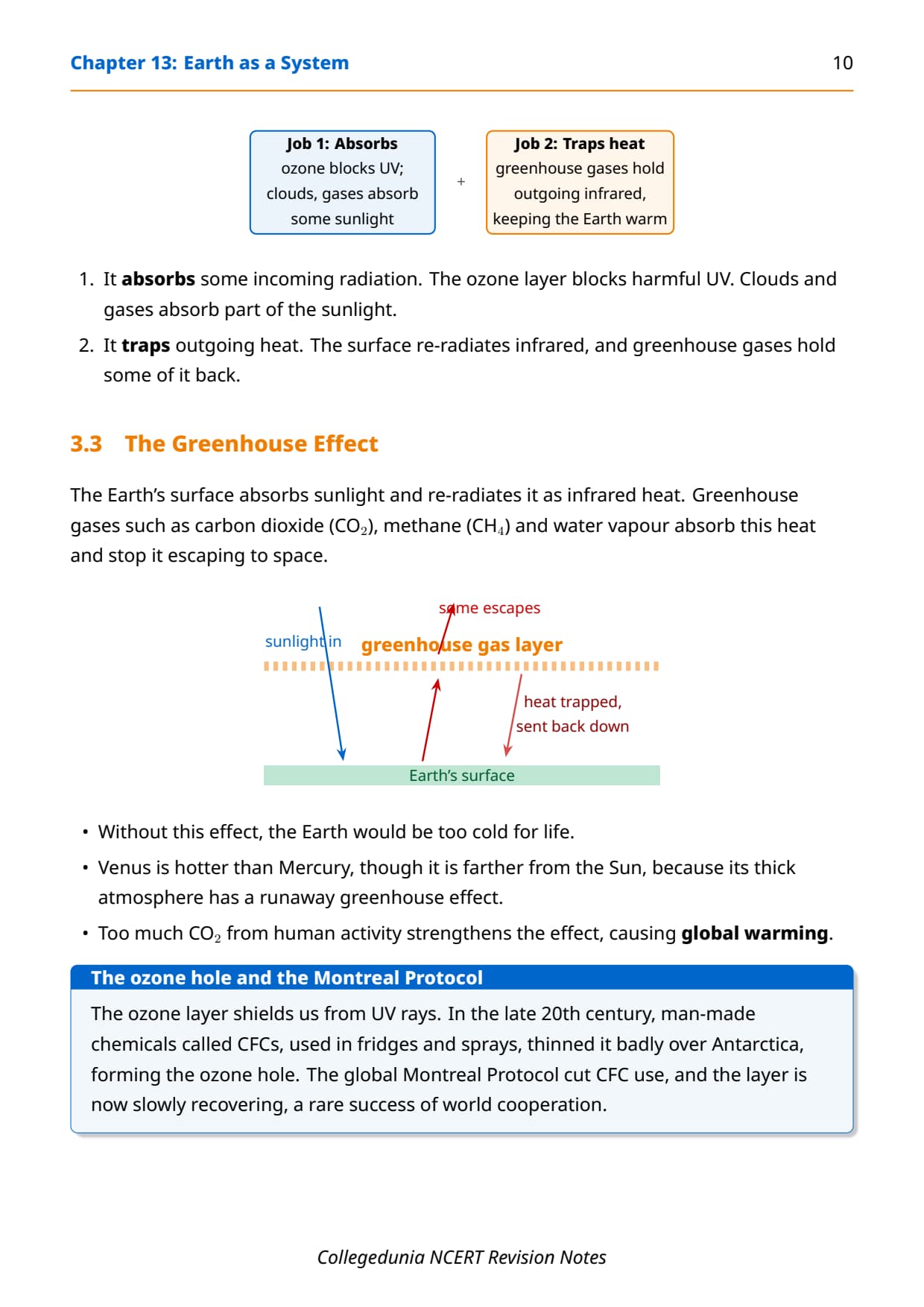
The greenhouse effect is one of the most tested ideas in the chapter. The Earth's surface absorbs sunlight and re-radiates it as infrared heat. Greenhouse gases such as carbon dioxide (CO2), methane (CH4) and water vapour absorb this heat and stop it escaping to space.
- Without this effect, the Earth would be too cold for life.
- Venus is hotter than Mercury, though it is farther from the Sun, because its thick atmosphere has a runaway greenhouse effect.
- Too much CO2 from human activity strengthens the effect, causing global warming.
Winds and Ocean Currents in Class 9 Science Chapter 13
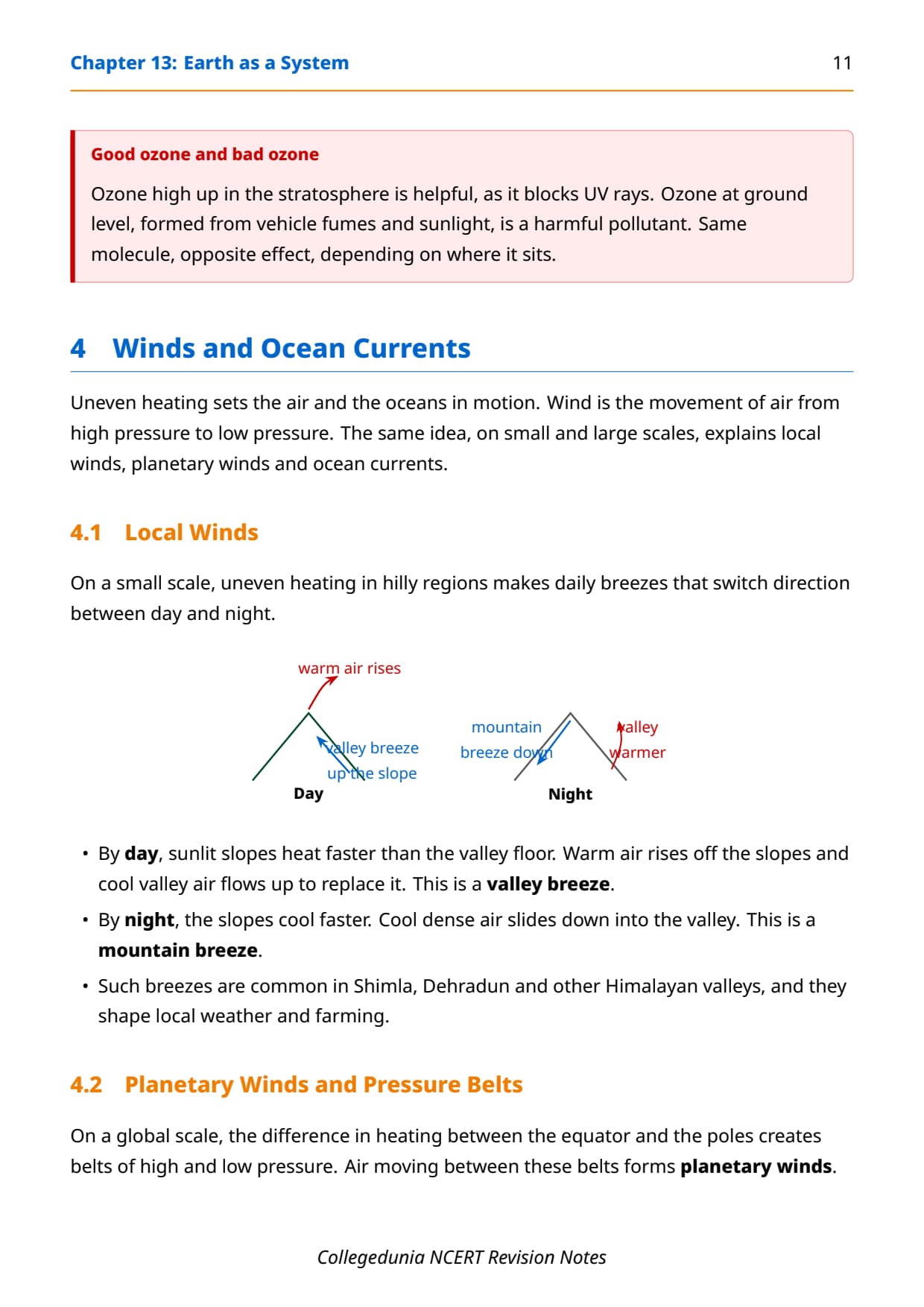
Uneven heating sets the air and the oceans in motion. Wind is the movement of air from high pressure to low pressure. The same idea, on small and large scales, explains local breezes, planetary winds and ocean currents.
- Valley breeze (day): sunlit slopes heat faster than the valley floor, so warm air rises off the slopes and cool valley air flows up to replace it.
- Mountain breeze (night): the slopes cool faster, so cool dense air slides down into the valley. Such breezes are common in Shimla and Dehradun.
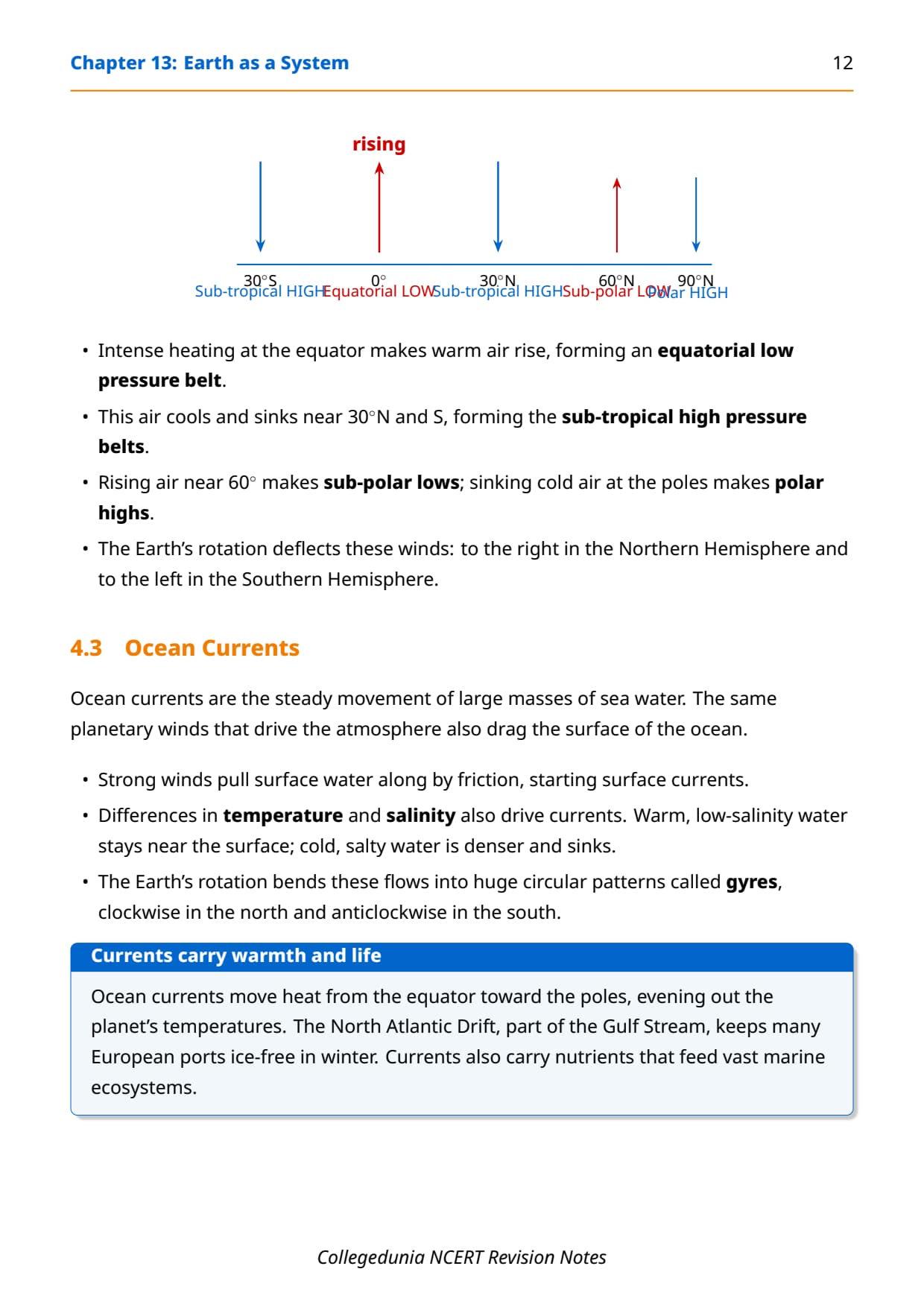
On a global scale, the difference in heating between the equator and the poles creates belts of high and low pressure, and air moving between them forms planetary winds:
- Intense heating at the equator makes warm air rise, forming an equatorial low pressure belt.
- This air cools and sinks near 30° N and S, forming the sub-tropical high pressure belts.
- The Earth's rotation deflects the winds: to the right in the Northern Hemisphere and to the left in the Southern Hemisphere.
Ocean currents are the steady movement of large masses of sea water. The same planetary winds that drive the air also drag the ocean surface by friction. Differences in temperature and salinity add to this: warm, low-salinity water stays near the surface, while cold, salty water is denser and sinks. The Earth's rotation bends these flows into huge circular patterns called gyres, clockwise in the north and anticlockwise in the south.
Biogeochemical Cycles: Water, Carbon, Nitrogen and Oxygen in Class 9 Science
Living things constantly swap matter with the air, water, soil and rocks. This cyclic movement of matter between the non-living (abiotic) and living (biotic) parts of the Earth is called a biogeochemical cycle. It keeps nutrients such as carbon, nitrogen and oxygen available for life. Four cycles are asked almost every year.
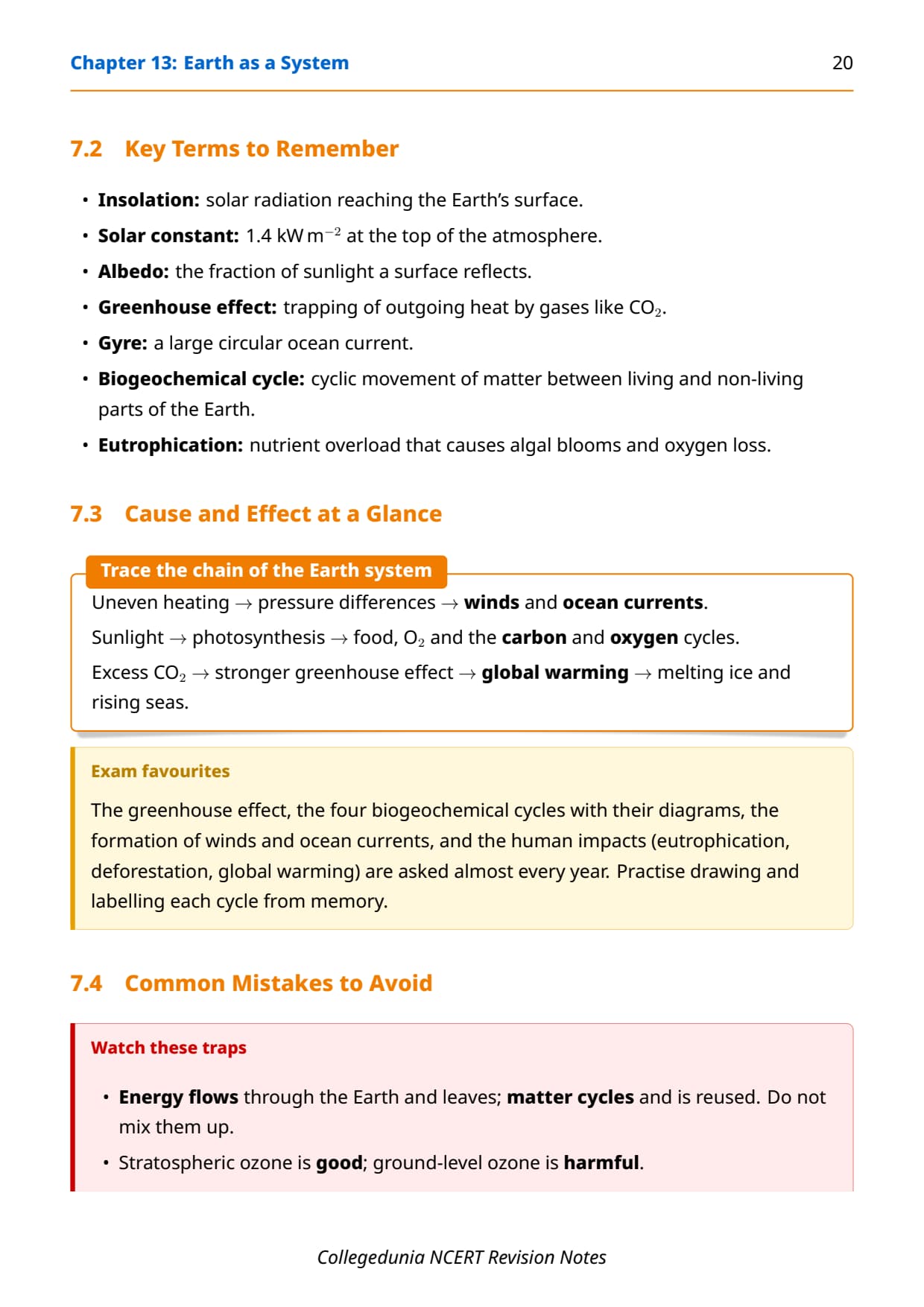
| Cycle | Main store | Key processes |
|---|---|---|
| Water | Oceans and ice | Evaporation, transpiration, condensation, precipitation |
| Carbon | Oceans, rocks, fossil fuels | Photosynthesis, respiration, combustion |
| Nitrogen | Atmosphere (N2) | Fixation, nitrification, denitrification |
| Oxygen | Atmosphere (O2) | Photosynthesis versus respiration |
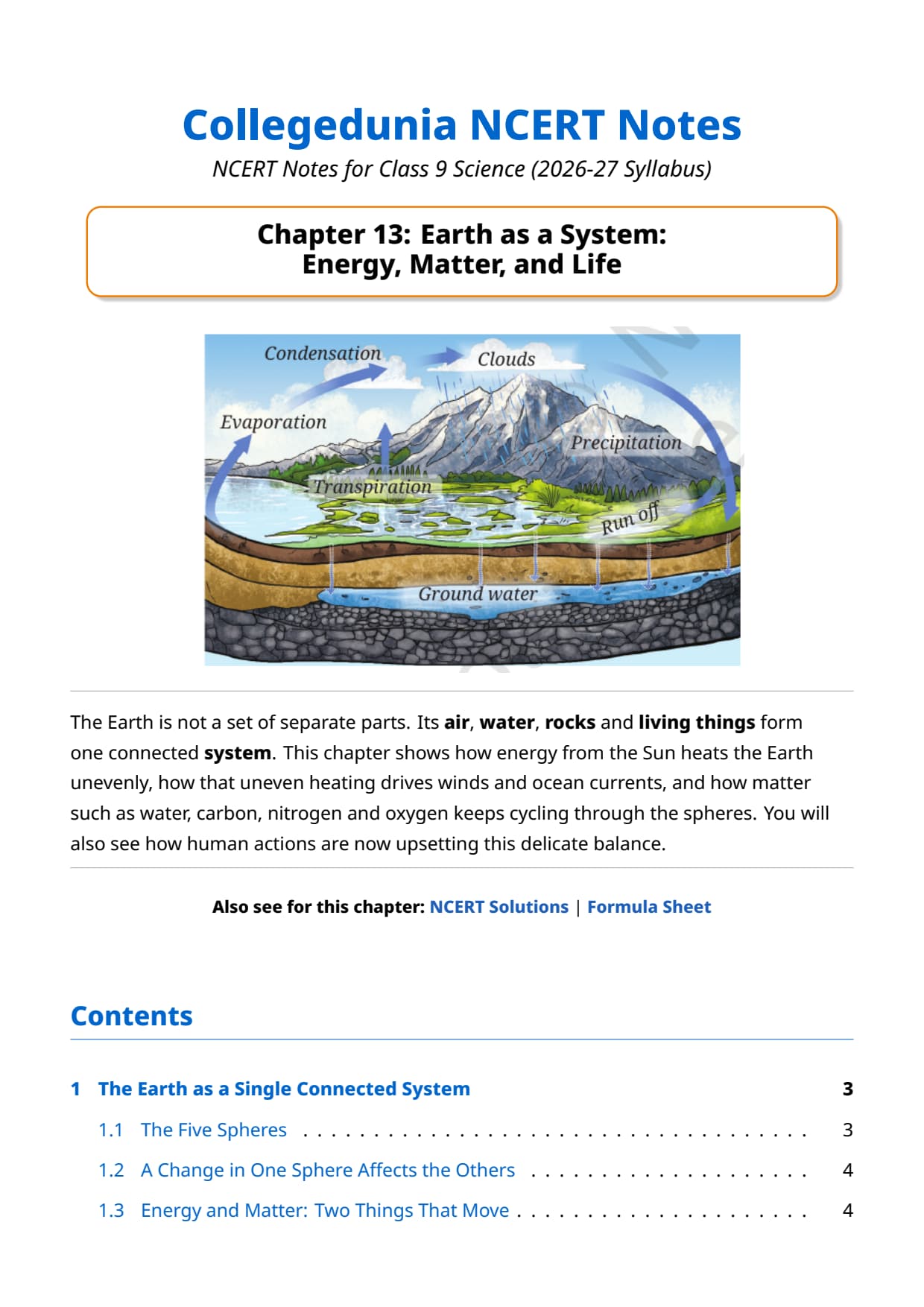
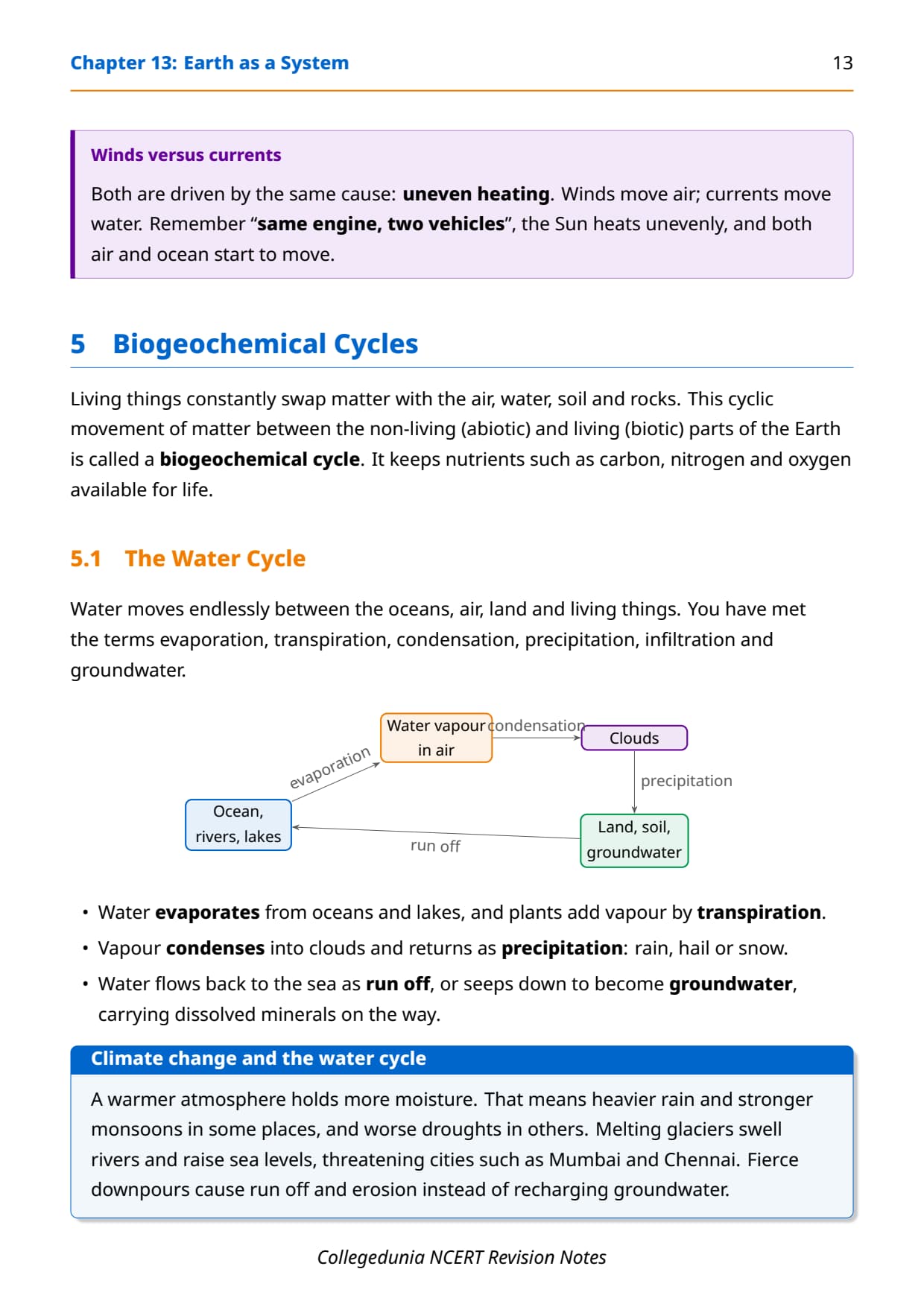
- Water cycle: water evaporates from oceans and lakes, plants add vapour by transpiration, the vapour condenses into clouds, and it returns as precipitation. It then flows back as run off or seeps down to become groundwater.
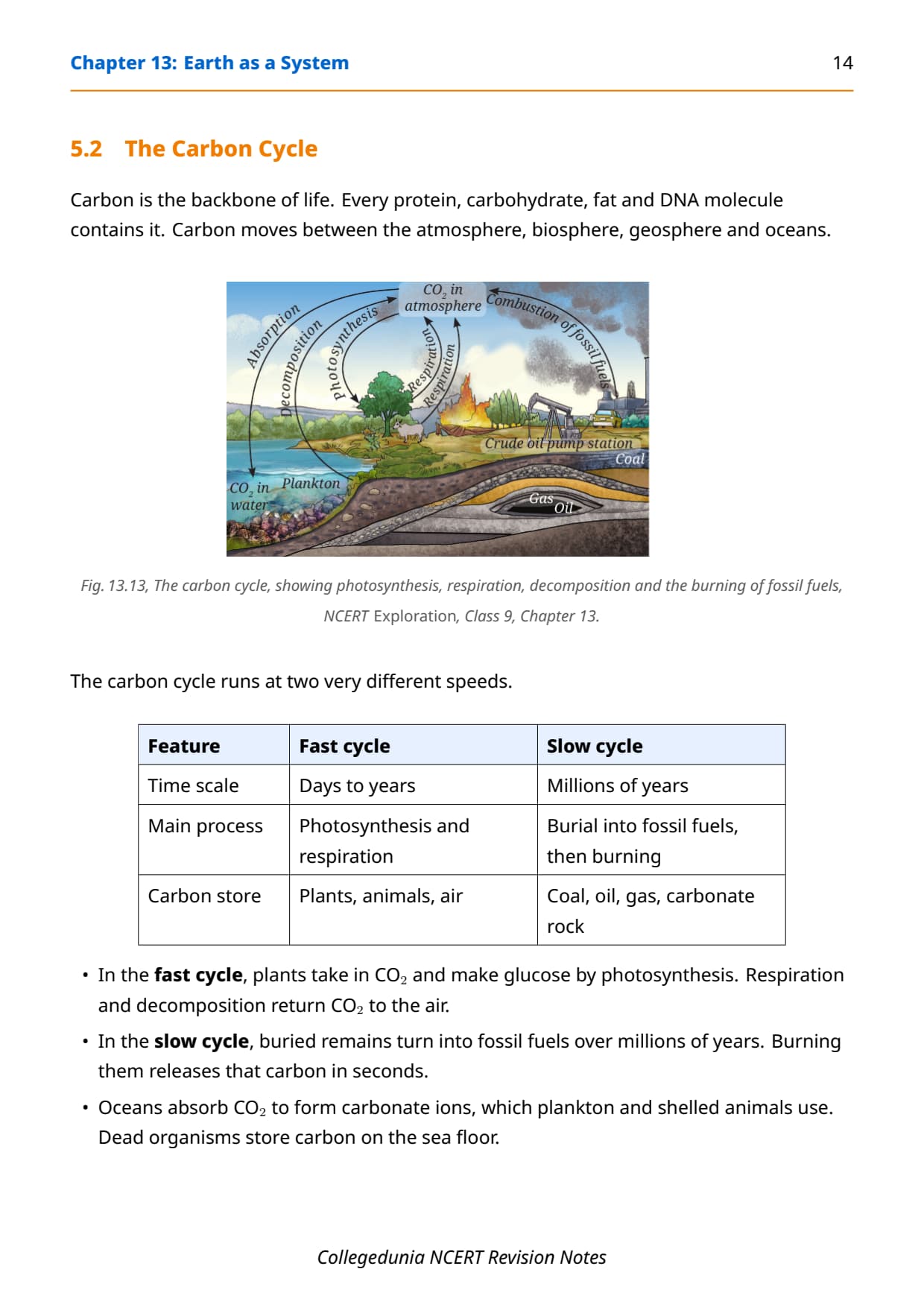
- Carbon cycle: in the fast cycle, plants take in CO2 and make glucose by photosynthesis, while respiration and decomposition return it. In the slow cycle, buried remains turn into fossil fuels over millions of years, and burning them releases that carbon in seconds.
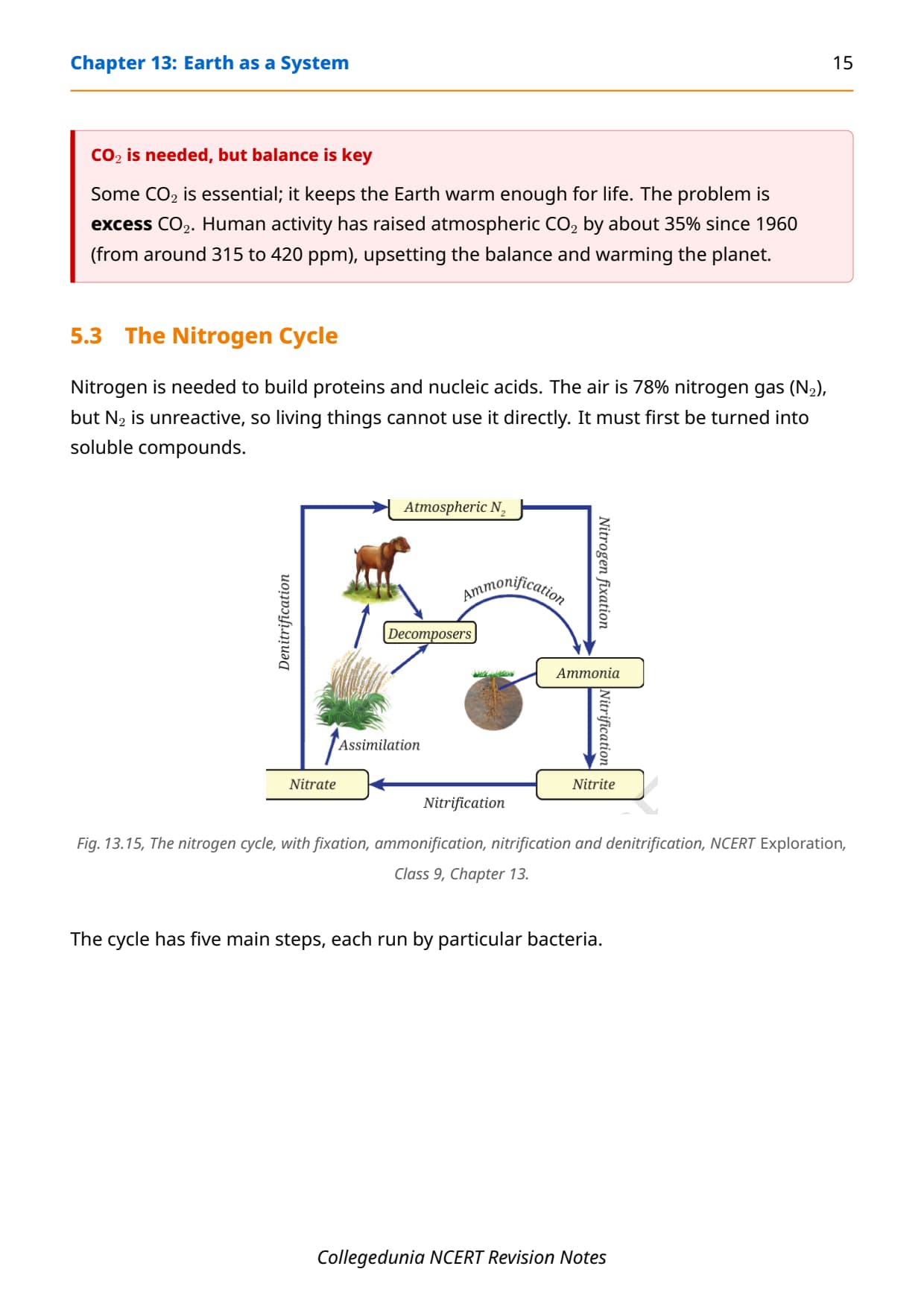
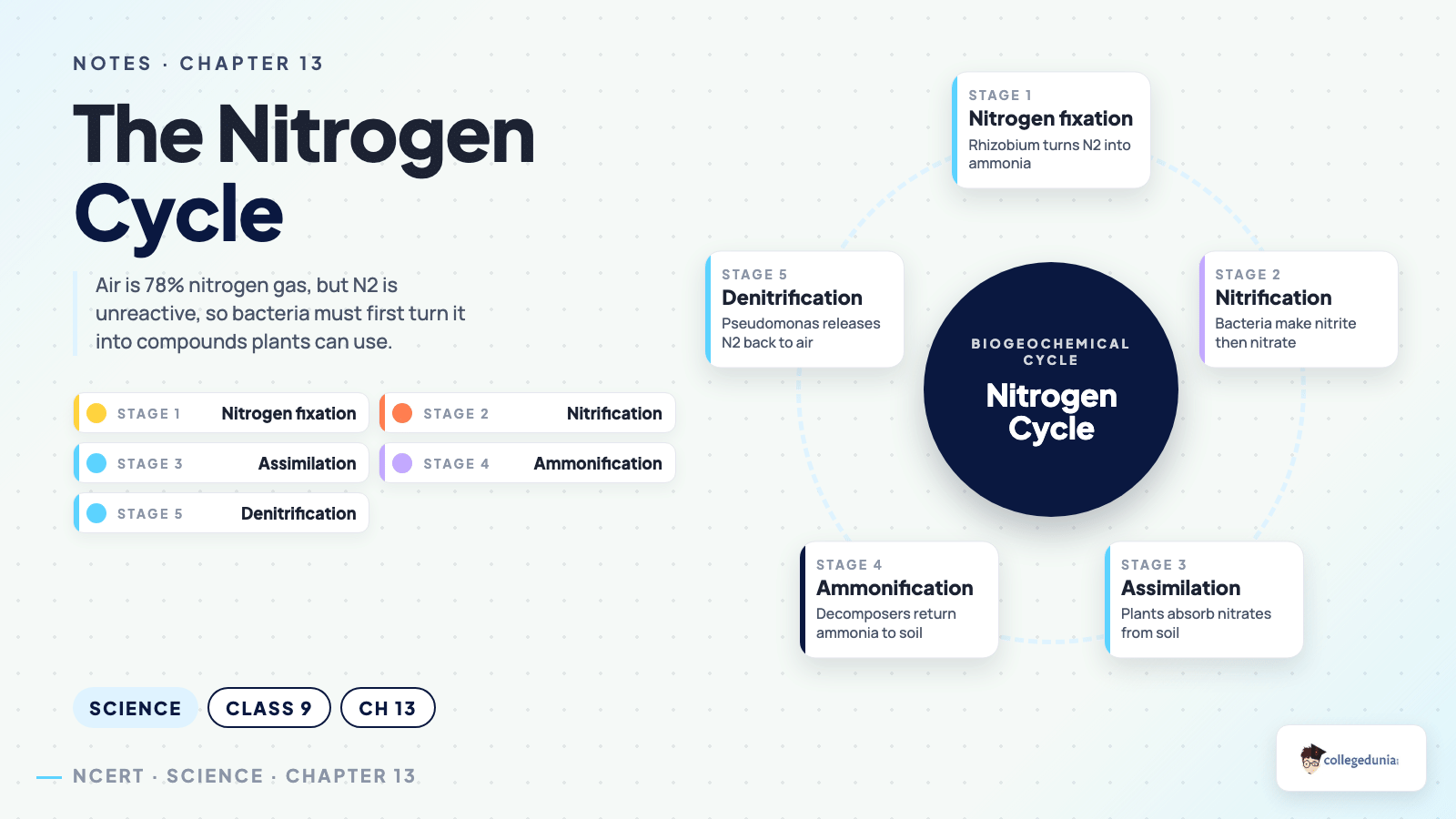
- Nitrogen cycle: air is 78% nitrogen gas, but N2 is unreactive, so bacteria such as Rhizobium fix it into ammonia, Nitrosomonas and Nitrobacter make nitrites and nitrates, plants absorb nitrates, decomposers return ammonia, and Pseudomonas releases N2 back to the air.
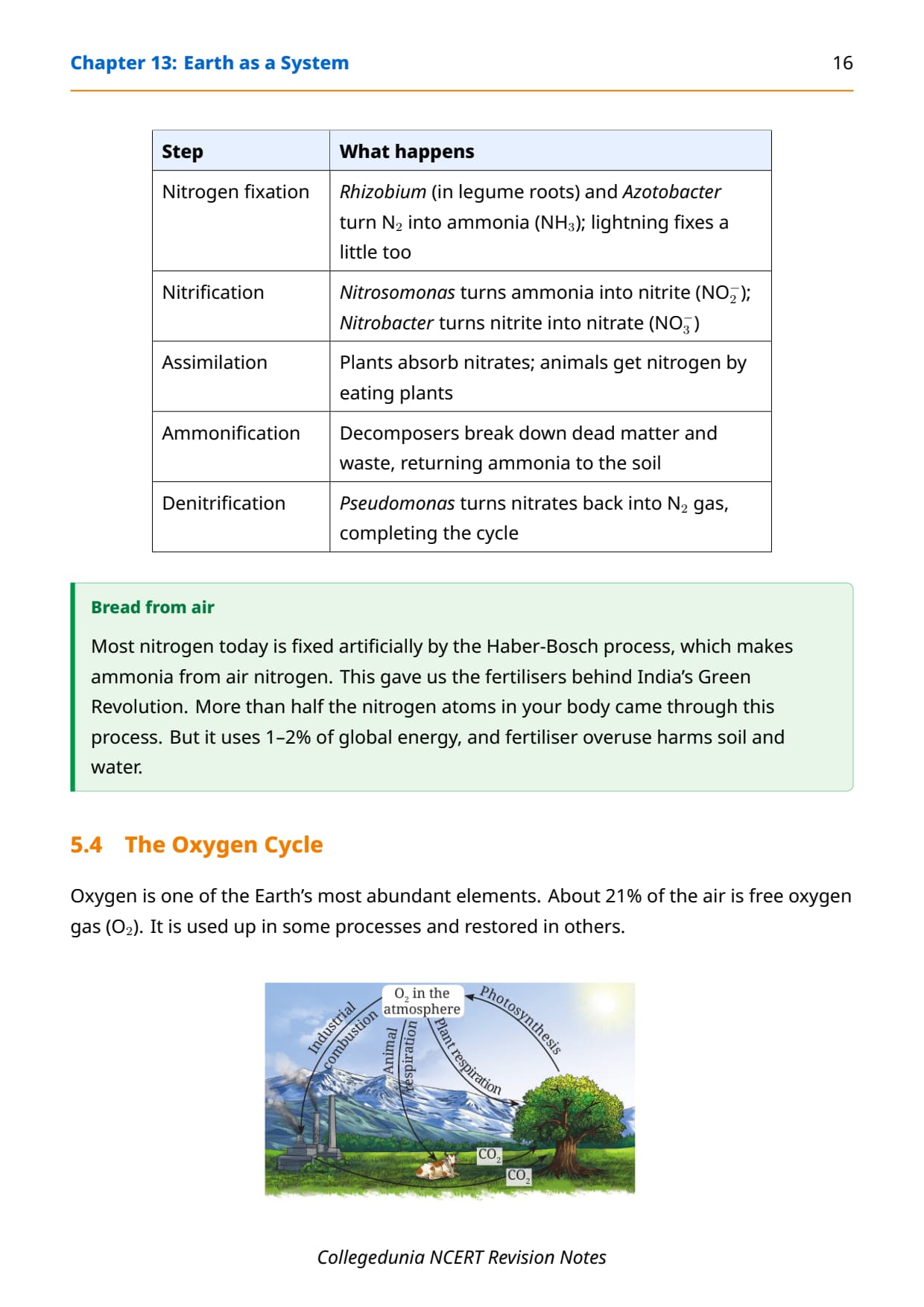
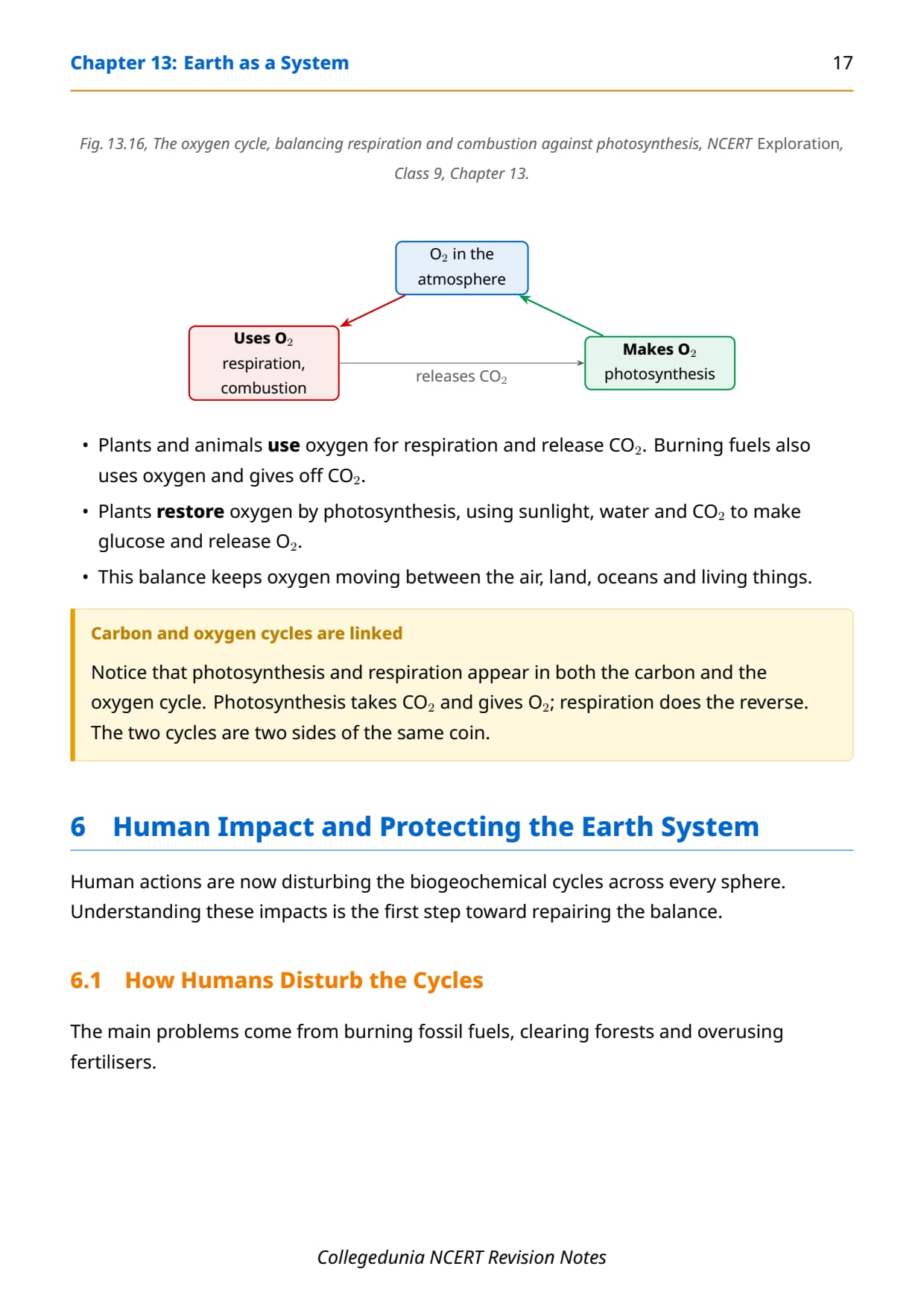
- Oxygen cycle: respiration and burning use up oxygen and release CO2, while photosynthesis restores oxygen, keeping the gas moving between air, land and life.
Human Impact on the Earth System: Class 9 Science Notes
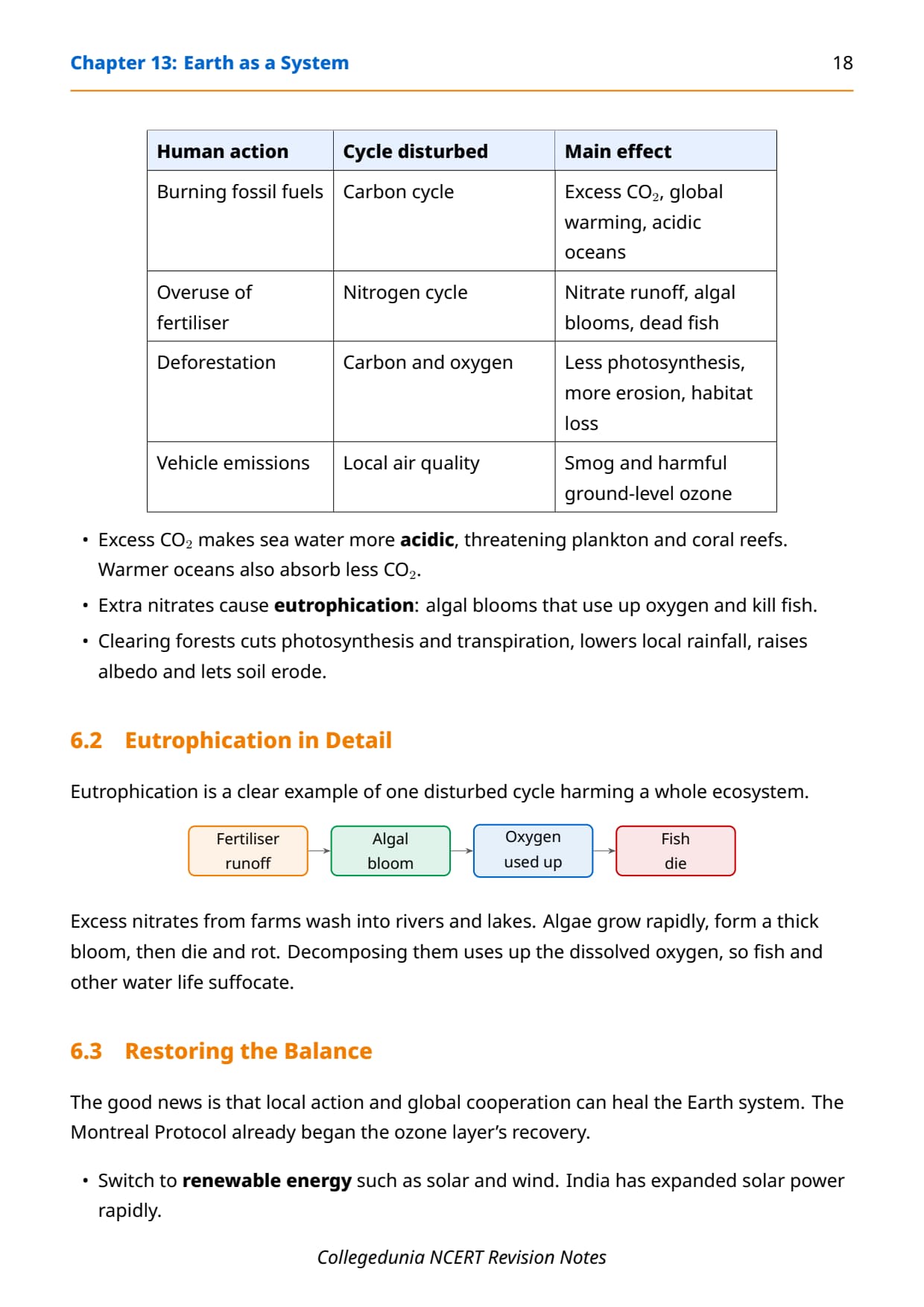
Human actions are now disturbing the biogeochemical cycles across every sphere. The main problems come from burning fossil fuels, clearing forests and overusing fertilisers.
| Human action | Cycle disturbed | Main effect |
|---|---|---|
| Burning fossil fuels | Carbon cycle | Excess CO2, global warming, acidic oceans |
| Overuse of fertiliser | Nitrogen cycle | Nitrate runoff, algal blooms, dead fish |
| Deforestation | Carbon and oxygen | Less photosynthesis, more erosion, habitat loss |
| Vehicle emissions | Local air quality | Smog and harmful ground-level ozone |
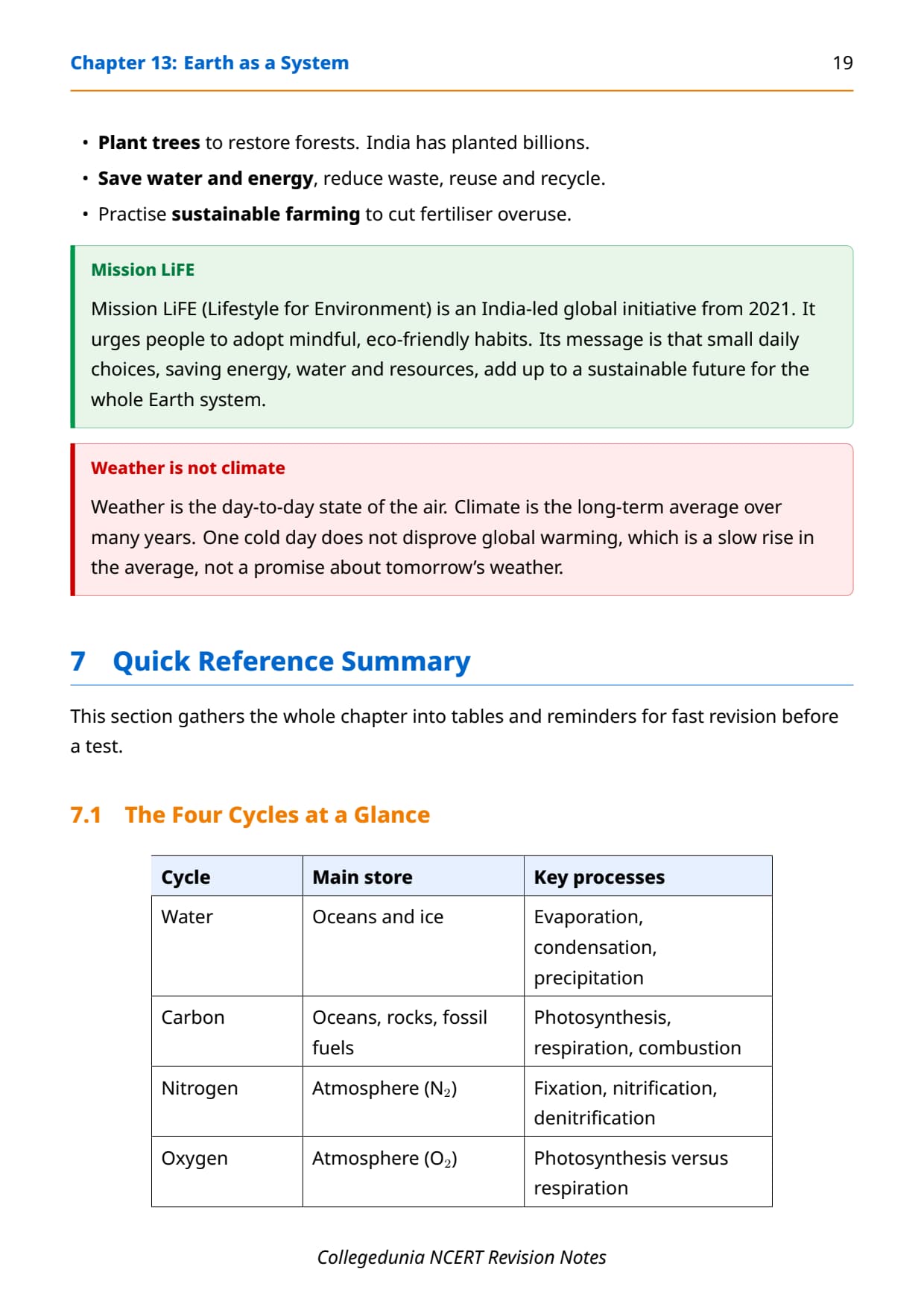
One clear example is eutrophication. Excess nitrates from farms wash into rivers and lakes, algae grow rapidly and form a thick bloom, then die and rot. Decomposing them uses up the dissolved oxygen, so fish and other water life suffocate. The chain is simple: fertiliser runoff, then algal bloom, then oxygen used up, then fish die.
The good news is that local action and global cooperation can heal the Earth system:
- Switch to renewable energy such as solar and wind.
- Plant trees to restore forests and lift photosynthesis.
- Save water and energy, and reduce, reuse and recycle waste.
- Practise sustainable farming to cut fertiliser overuse.
The Montreal Protocol already cut the CFCs that thinned the ozone layer, and the layer is now slowly recovering. India's Mission LiFE reminds us that small daily choices add up to a sustainable future for the whole Earth system.
Common Mistakes and Quick Revision Tips for Earth as a System
Most lost marks in this chapter come from small mix-ups, not hard ideas. Fix these while you revise and your answers stay clean.
- Saying stratospheric ozone is harmful. Ozone high up is good; only ground-level ozone is harmful.
- Writing that plants use nitrogen gas. In the nitrogen cycle, plants absorb nitrates, not N2.
- Calling the greenhouse effect entirely bad. The effect is natural and needed; only excess greenhouse gas is harmful.
- Mixing up weather and climate. Weather is the day-to-day state of the air; climate is the long-term average, so one cold day does not disprove global warming.
How Collegedunia Notes Help You Revise Earth as a System
Collegedunia gives you the full NCERT Notes Class 9 Science Chapter 13 Earth as a System Energy, Matter, and Life as clean, short, easy-to-read revision in one place.
- 2026-27 Exploration match: every note follows the new textbook and the Revise, Reflect, Refine flow.
- Simple English: short lines and everyday words, so a Class 9 student can revise without help.
- Table and diagram ready: the five spheres, the atmosphere layers, and the four cycles all in one view.
- Free PDF: download the notes and revise offline before your exam.
More Earth as a System Class 9 Science Resources
| Resource | Open |
|---|---|
| Revision Notes | Earth as a System Class 9 Science Notes |
| NCERT Solutions | Earth as a System Class 9 Science NCERT Solutions |
| Handwritten Notes | Earth as a System Class 9 Science Handwritten Notes |
| Formula Sheet | Earth as a System Class 9 Science Formula Sheet |
| NCERT Book PDF | Earth as a System Class 9 Science NCERT Book PDF |
NCERT Notes for Class 9 Science: All Chapters
Use the table below to open the NCERT Notes for any other chapter of the new Class 9 Science Exploration book.
| Chapter | NCERT Notes |
|---|---|
| Chapter 2 | Cell The Building Block of Life |
| Chapter 3 | Tissues in Action |
| Chapter 4 | Describing Motion Around Us |
| Chapter 5 | Exploring Mixtures and their Separation |
| Chapter 6 | How Forces Affect Motion |
| Chapter 7 | Work, Energy, and Simple Machines |
| Chapter 8 | Journey Inside the Atom |
| Chapter 9 | Atomic Foundations of Matter |
| Chapter 10 | Sound Waves Characteristics and Applications |
| Chapter 11 | Reproduction How Life Continues |
| Chapter 12 | Patterns in Life Diversity and Classification |
| Chapter 13 | Earth as a System Energy, Matter, and Life |
Earth as a System Class 9 Science Notes FAQs
Ques. Where can I download the NCERT Notes Class 9 Science Chapter 13 Earth as a System PDF?
Ans. You can download the Earth as a System Notes PDF free from this page. Both the Normal and HD versions match the 2026-27 Exploration book.
Ques. What are the five spheres of the Earth in Class 9 Science Chapter 13?
Ans. The five spheres are the geosphere (rocks and soil), hydrosphere (liquid water), cryosphere (ice and snow), atmosphere (air) and biosphere (all living things). A change in one sphere affects the others, which is why the Earth works as one system.
Ques. What is the greenhouse effect and why is it important?
Ans. The greenhouse effect is the trapping of the Earth's outgoing infrared heat by gases such as carbon dioxide, methane and water vapour. It keeps the planet warm enough for life. Only excess greenhouse gas from human activity is harmful, as it causes global warming.
Ques. What are the four biogeochemical cycles in Chapter 13?
Ans. They are the water cycle, the carbon cycle, the nitrogen cycle and the oxygen cycle. Each one moves matter between the living and non-living parts of the Earth so that nutrients stay available for life.
Ques. Is Chapter 13 part of the new Class 9 Science book?
Ans. Yes. Earth as a System: Energy, Matter, and Life is Chapter 13 of the new Exploration textbook for the 2026-27 syllabus. It ties the whole book together and links to environment and climate topics.



Comments