




Inside the NCERT notes for Class 8 Mathematics Part 1 Chapter 7 Proportional Reasoning-1, you will find ratios, equivalent ratios, proportions, and the Rule of Three. These notes follow the 2026-27 Ganita Prakash text and explain each method with short examples.
- Core idea: Proportional quantities change by the same factor.
- Main test: Simplify ratios or use cross multiplication.
- Daily use: Scale recipes, prices, distances, and drawings.
Chapter7ProportionalReasoning-1Notes.pdf?page=1&dpi=150)
Chapter7ProportionalReasoning-1Notes.pdf?page=2&dpi=150)
Chapter7ProportionalReasoning-1Notes.pdf?page=3&dpi=150)
Chapter7ProportionalReasoning-1Notes.pdf?page=4&dpi=150)
Chapter7ProportionalReasoning-1Notes.pdf?page=5&dpi=150)
Chapter7ProportionalReasoning-1Notes.pdf?page=6&dpi=150)
Chapter7ProportionalReasoning-1Notes.pdf?page=7&dpi=150)
Chapter7ProportionalReasoning-1Notes.pdf?page=8&dpi=150)
Chapter7ProportionalReasoning-1Notes.pdf?page=9&dpi=150)
Chapter7ProportionalReasoning-1Notes.pdf?page=10&dpi=150)
Chapter7ProportionalReasoning-1Notes.pdf?page=11&dpi=150)
Chapter7ProportionalReasoning-1Notes.pdf?page=12&dpi=150)
Chapter7ProportionalReasoning-1Notes.pdf?page=13&dpi=150)
Chapter7ProportionalReasoning-1Notes.pdf?page=14&dpi=150)
Chapter7ProportionalReasoning-1Notes.pdf?page=15&dpi=150)
Chapter7ProportionalReasoning-1Notes.pdf?page=16&dpi=150)
Chapter7ProportionalReasoning-1Notes.pdf?page=17&dpi=150)
Chapter7ProportionalReasoning-1Notes.pdf?page=18&dpi=150)
Chapter7ProportionalReasoning-1Notes.pdf?page=19&dpi=150)
Chapter7ProportionalReasoning-1Notes.pdf?page=20&dpi=150)
Chapter7ProportionalReasoning-1Notes.pdf?page=21&dpi=150)
Chapter7ProportionalReasoning-1Notes_flat_MobileCard.pdf?page=1&dpi=150)
Chapter7ProportionalReasoning-1Notes_flat_MobileCard.pdf?page=2&dpi=150)
Chapter7ProportionalReasoning-1Notes_flat_MobileCard.pdf?page=3&dpi=150)
Chapter7ProportionalReasoning-1Notes_flat_MobileCard.pdf?page=4&dpi=150)
Chapter7ProportionalReasoning-1Notes_flat_MobileCard.pdf?page=5&dpi=150)
Chapter7ProportionalReasoning-1Notes_flat_MobileCard.pdf?page=6&dpi=150)
Chapter7ProportionalReasoning-1Notes_flat_MobileCard.pdf?page=7&dpi=150)
Chapter7ProportionalReasoning-1Notes_flat_MobileCard.pdf?page=8&dpi=150)
Chapter7ProportionalReasoning-1Notes_flat_MobileCard.pdf?page=9&dpi=150)
Chapter7ProportionalReasoning-1Notes_flat_MobileCard.pdf?page=10&dpi=150)
Chapter7ProportionalReasoning-1Notes_flat_MobileCard.pdf?page=11&dpi=150)
Chapter7ProportionalReasoning-1Notes_flat_MobileCard.pdf?page=12&dpi=150)
Chapter7ProportionalReasoning-1Notes_flat_MobileCard.pdf?page=13&dpi=150)
Chapter7ProportionalReasoning-1Notes_flat_MobileCard.pdf?page=14&dpi=150)
Chapter7ProportionalReasoning-1Notes_flat_MobileCard.pdf?page=15&dpi=150)
Chapter7ProportionalReasoning-1Notes_flat_MobileCard.pdf?page=16&dpi=150)
Chapter7ProportionalReasoning-1Notes_flat_MobileCard.pdf?page=17&dpi=150)
Chapter7ProportionalReasoning-1Notes_flat_MobileCard.pdf?page=18&dpi=150)
Chapter7ProportionalReasoning-1Notes_flat_MobileCard.pdf?page=19&dpi=150)
Chapter7ProportionalReasoning-1Notes_flat_MobileCard.pdf?page=20&dpi=150)
Chapter7ProportionalReasoning-1Notes_flat_MobileCard.pdf?page=21&dpi=150)
Chapter7ProportionalReasoning-1Notes_flat_MobileCard.pdf?page=22&dpi=150)
Chapter7ProportionalReasoning-1Notes_flat_MobileCard.pdf?page=23&dpi=150)
Chapter7ProportionalReasoning-1Notes_flat_MobileCard.pdf?page=24&dpi=150)
Chapter7ProportionalReasoning-1Notes_flat_MobileCard.pdf?page=25&dpi=150)
Chapter7ProportionalReasoning-1Notes_flat_MobileCard.pdf?page=26&dpi=150)
Chapter7ProportionalReasoning-1Notes_flat_MobileCard.pdf?page=27&dpi=150)
Chapter7ProportionalReasoning-1Notes_flat_MobileCard.pdf?page=28&dpi=150)
Chapter7ProportionalReasoning-1Notes_flat_MobileCard.pdf?page=29&dpi=150)
Chapter7ProportionalReasoning-1Notes_flat_MobileCard.pdf?page=30&dpi=150)
Chapter7ProportionalReasoning-1Notes_flat_MobileCard.pdf?page=31&dpi=150)
Chapter7ProportionalReasoning-1Notes_flat_MobileCard.pdf?page=32&dpi=150)
Chapter7ProportionalReasoning-1Notes_flat_MobileCard.pdf?page=33&dpi=150)
Chapter7ProportionalReasoning-1Notes_flat_MobileCard.pdf?page=34&dpi=150)
Chapter7ProportionalReasoning-1Notes_flat_MobileCard.pdf?page=35&dpi=150)
Chapter7ProportionalReasoning-1Notes_flat_MobileCard.pdf?page=36&dpi=150)
Chapter7ProportionalReasoning-1Notes_flat_MobileCard.pdf?page=37&dpi=150)
These notes follow the 2026-27 Ganita Prakash chapter and check every proportion with clear numerical steps.
Proportional Reasoning-1 Topic Notes for Class 8
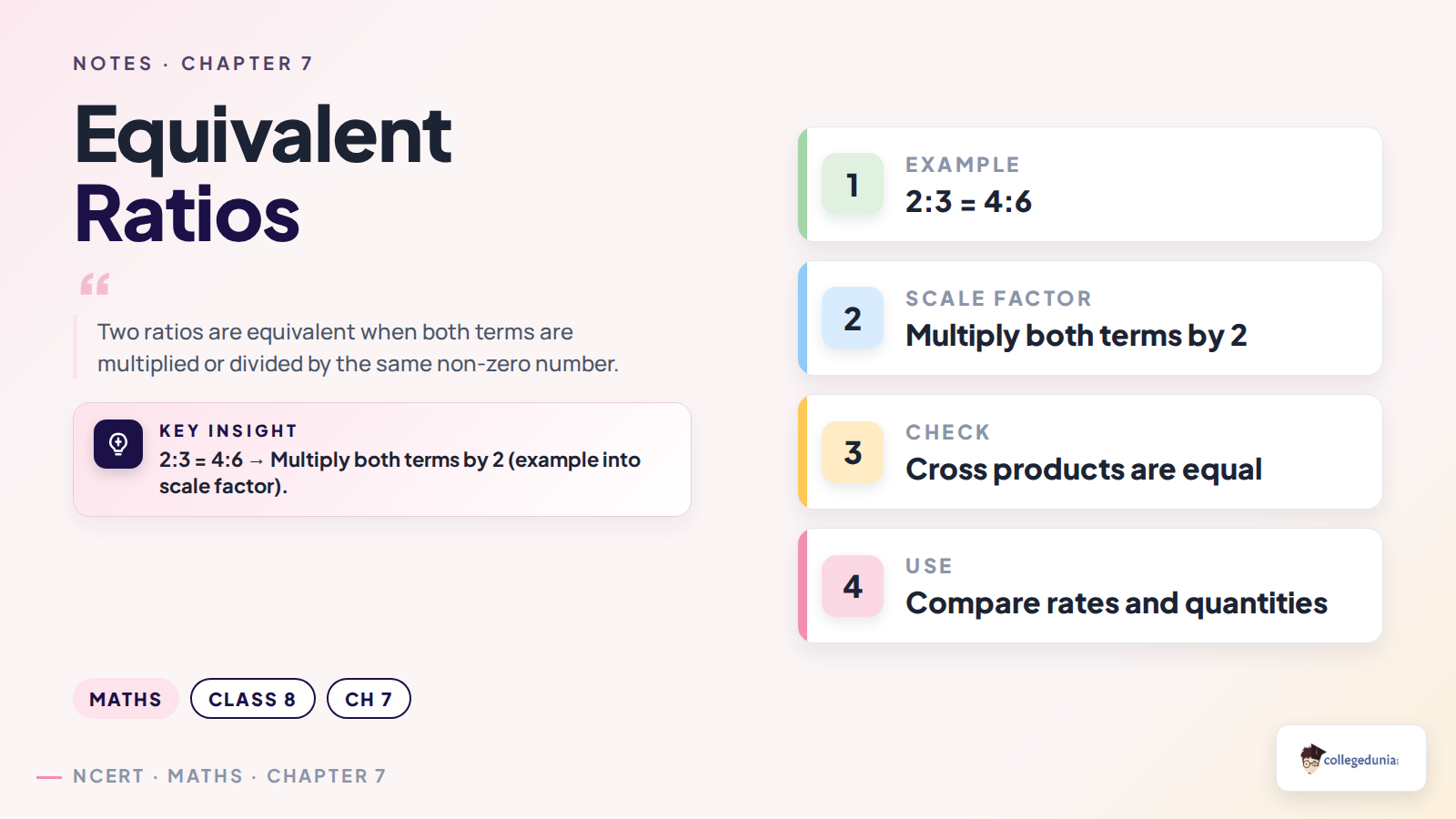
A proportion compares two ratios. If both ratios have the same simplest form, they are proportional. The order of quantities must stay the same in both ratios.
Ratios and Their Simplest Form
A ratio compares two quantities in a fixed order. In the ratio 60 : 40, 60 and 40 are its terms. Divide both terms by their highest common factor, or HCF, to simplify it.
| Ratio | Common factor | Simplest form |
|---|---|---|
| 60 : 40 | 20 | 3 : 2 |
| 90 : 60 | 30 | 3 : 2 |
| 40 : 20 | 20 | 2 : 1 |
60 : 40 and 90 : 60 are proportional because both simplify to 3 : 2. The ratio 40 : 20 is not proportional to them.
Similarity and Change by the Same Factor
A picture keeps its shape when its width and height change by the same factor. Multiplying 60 mm by 1/2 gives 30 mm. Multiplying 40 mm by 1/2 gives 20 mm.
- Same multiplication factor keeps the shape similar.
- Equal subtraction does not always keep the ratio.
- Adding the same number usually changes a ratio.
A proportional change is multiplicative, not additive. This explains why age ratios change even when both ages increase equally.
Proportional Reasoning Quick Revision
Source: Magnet Brains on YouTube
Testing Proportions and Finding a Missing Term
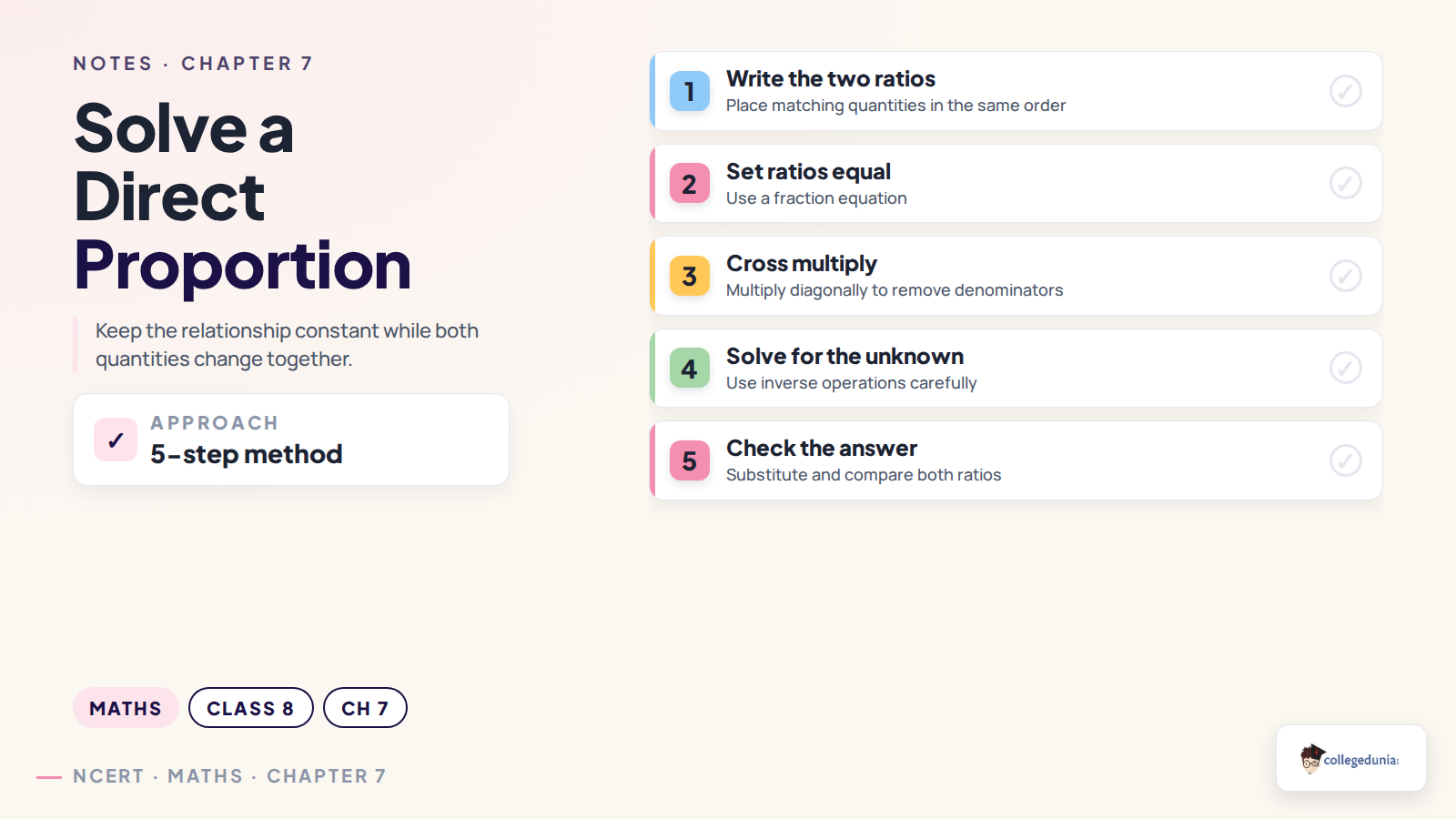
You can test a proportion in two ways. Simplify both ratios, or cross multiply their terms. Always keep matching quantities in matching positions.
| Method | Steps | Example |
|---|---|---|
| Simplest form | Divide each ratio by its HCF | 72 : 96 becomes 3 : 4 |
| Scale factor | Multiply both terms by one factor | 6 : 10 becomes 18 : 30 |
| Cross multiplication | For a : b :: c : d, check ad = bc | 3 : 4 :: 72 : 96 |
To solve 14 : 21 :: 6 : x, cross multiply. This gives 14x = 126, so x = 9. You may also multiply both terms of 14 : 21 by 3/7.
Trairasika or the Rule of Three
The chapter connects proportional reasoning with the ancient Indian Rule of Three. Three quantities are known, and one quantity is missing.
- Write the two ratios in the same order.
- Convert quantities to the same units.
- Cross multiply the two ratios.
- Divide to find the missing term.
If 120 students need 15 kg of rice, 80 students need 10 kg. The number of students falls by a factor of 2/3, so the rice amount uses the same factor.
Proportional Reasoning-1 Applications in Daily Life
Ratio problems become easier when you name the two quantities first. Recipes compare ingredients, travel compares time and distance, and shopping compares weight and price.
| Situation | Ratio to compare | Important check |
|---|---|---|
| Lemonade | Glasses : sugar spoons | Keep the taste unchanged |
| Travel | Time : distance | Convert hours and minutes first |
| Tea packets | Weight : price | Compare the same weight |
| Scale drawing | Width : height | Use one scale factor |
Units must match before you form a proportion. For example, convert 4 hours to 240 minutes before comparing it with 150 minutes.
Common Mistakes in the Proportional Reasoning-1 Chapter
Most errors come from changing the order of a ratio or comparing unlike units. Write labels beside the terms before calculating.
- Reversed order: Do not compare width : height with height : width.
- Different units: Convert kilograms to grams before comparing weights.
- Additive thinking: Equal increases do not guarantee equal ratios.
- Wrong scaling: Multiply both ratio terms by the same factor.
Write the units and labels before the numbers. This habit prevents many proportion errors.
A Quick Study Plan for Proportional Reasoning-1
Start with ratio simplification. Move to missing-term problems only after equivalent ratios are clear.
- Simplify five ratios using their HCF.
- Write three equivalent ratios for each result.
- Test four pairs by cross multiplication.
- Solve three Rule of Three questions.
- Check the order and units in every answer.
Proportional Reasoning-1 Student Feedback
What 10,720 students told Collegedunia about learning proportions
In a Collegedunia poll before the 2026 exams, most students found proportions easier after labelling both quantities.
Source: 2026-27 Class 8 Mathematics student poll. Sample of 10,720 students.
More Proportional Reasoning-1 Class 8 Resources
Use the matching resources for textbook answers, visual revision, and official chapter reading.
| Resource | What it helps with |
|---|---|
| Proportional Reasoning-1 NCERT Solutions | Step-by-step textbook answers |
| Proportional Reasoning-1 NCERT Book | Official chapter reading |
| Proportional Reasoning-1 Handwritten Notes | Fast visual revision |
NCERT Notes for Class 8 Mathematics Part 1: All Chapters
| Chapter | Notes |
|---|---|
| Chapter 4 | Quadrilaterals Notes |
| Chapter 5 | Number Play Notes |
| Chapter 6 | We Distribute, Yet Things Multiply Notes |
| Chapter 7 | Proportional Reasoning-1 Notes |
Proportional Reasoning-1 Class 8 Mathematics Notes FAQs
Ques. What is a ratio?
Ans. A ratio compares two quantities in a fixed order. The numbers in a ratio are called its terms.
Ques. When are two ratios proportional?
Ans. Two ratios are proportional when they have the same simplest form. Their cross products are also equal.
Ques. How do I simplify a ratio?
Ans. Divide both terms by their HCF. For example, 60 : 40 simplifies to 3 : 2.
Ques. What is cross multiplication?
Ans. For a : b :: c : d, cross multiplication checks whether a times d equals b times c.
Ques. What is the Rule of Three?
Ans. It is a method for finding a fourth quantity when three quantities in a proportion are known.
Ques. Why must units match in a proportion?
Ans. Matching units make the terms comparable. Convert hours to minutes or kilograms to grams before forming the ratios.
Ques. Are these notes based on the 2026-27 NCERT book?
Ans. Yes. The notes follow the Proportional Reasoning-1 chapter in the 2026-27 Ganita Prakash textbook.



Comments