




The NCERT Class 7 Social Science Chapter 7 notes for The Gupta Era: An Age of Tireless Creativity explain Gupta rulers, Samudragupta, Chandragupta II, Faxian, Prabhavati Gupta, trade, Nalanda, Aryabhata, Kalidasa, Ayurveda, Gupta art, Pallavas and Kamarupa for the 2026-27 NCERT textbook. The PDF helps students revise Chapter 7 through timelines, tables, source cues and activity answer frames.
Chapter7TheGuptaEraAnAgeofTirelessCreativityNotes.pdf?page=1&dpi=150)
Chapter7TheGuptaEraAnAgeofTirelessCreativityNotes.pdf?page=2&dpi=150)
Chapter7TheGuptaEraAnAgeofTirelessCreativityNotes.pdf?page=3&dpi=150)
Chapter7TheGuptaEraAnAgeofTirelessCreativityNotes.pdf?page=4&dpi=150)
Chapter7TheGuptaEraAnAgeofTirelessCreativityNotes.pdf?page=5&dpi=150)
Chapter7TheGuptaEraAnAgeofTirelessCreativityNotes.pdf?page=6&dpi=150)
Chapter7TheGuptaEraAnAgeofTirelessCreativityNotes.pdf?page=7&dpi=150)
Chapter7TheGuptaEraAnAgeofTirelessCreativityNotes.pdf?page=8&dpi=150)
Chapter7TheGuptaEraAnAgeofTirelessCreativityNotes.pdf?page=9&dpi=150)
Chapter7TheGuptaEraAnAgeofTirelessCreativityNotes.pdf?page=10&dpi=150)
Chapter7TheGuptaEraAnAgeofTirelessCreativityNotes.pdf?page=11&dpi=150)
Chapter7TheGuptaEraAnAgeofTirelessCreativityNotes.pdf?page=12&dpi=150)
Chapter7TheGuptaEraAnAgeofTirelessCreativityNotes.pdf?page=13&dpi=150)
Chapter7TheGuptaEraAnAgeofTirelessCreativityNotes.pdf?page=14&dpi=150)
Chapter7TheGuptaEraAnAgeofTirelessCreativityNotes.pdf?page=15&dpi=150)
Chapter7TheGuptaEraAnAgeofTirelessCreativityNotes.pdf?page=16&dpi=150)
Chapter7TheGuptaEraAnAgeofTirelessCreativityNotes.pdf?page=17&dpi=150)
Chapter7TheGuptaEraAnAgeofTirelessCreativityNotes.pdf?page=18&dpi=150)
Chapter7TheGuptaEraAnAgeofTirelessCreativityNotes.pdf?page=19&dpi=150)
Chapter7TheGuptaEraAnAgeofTirelessCreativityNotes.pdf?page=20&dpi=150)
Chapter7TheGuptaEraAnAgeofTirelessCreativityNotes.pdf?page=21&dpi=150)
Chapter7TheGuptaEraAnAgeofTirelessCreativityNotes.pdf?page=22&dpi=150)
Chapter7TheGuptaEraAnAgeofTirelessCreativityNotes.pdf?page=23&dpi=150)
Chapter7TheGuptaEraAnAgeofTirelessCreativityNotes.pdf?page=24&dpi=150)
Chapter7TheGuptaEraAnAgeofTirelessCreativityNotes.pdf?page=25&dpi=150)
Chapter7TheGuptaEraAnAgeofTirelessCreativityNotes.pdf?page=26&dpi=150)
Chapter7TheGuptaEraAnAgeofTirelessCreativityNotes_flat_MobileCard.pdf?page=1&dpi=150)
Chapter7TheGuptaEraAnAgeofTirelessCreativityNotes_flat_MobileCard.pdf?page=2&dpi=150)
Chapter7TheGuptaEraAnAgeofTirelessCreativityNotes_flat_MobileCard.pdf?page=3&dpi=150)
Chapter7TheGuptaEraAnAgeofTirelessCreativityNotes_flat_MobileCard.pdf?page=4&dpi=150)
Chapter7TheGuptaEraAnAgeofTirelessCreativityNotes_flat_MobileCard.pdf?page=5&dpi=150)
Chapter7TheGuptaEraAnAgeofTirelessCreativityNotes_flat_MobileCard.pdf?page=6&dpi=150)
Chapter7TheGuptaEraAnAgeofTirelessCreativityNotes_flat_MobileCard.pdf?page=7&dpi=150)
Chapter7TheGuptaEraAnAgeofTirelessCreativityNotes_flat_MobileCard.pdf?page=8&dpi=150)
Chapter7TheGuptaEraAnAgeofTirelessCreativityNotes_flat_MobileCard.pdf?page=9&dpi=150)
Chapter7TheGuptaEraAnAgeofTirelessCreativityNotes_flat_MobileCard.pdf?page=10&dpi=150)
Chapter7TheGuptaEraAnAgeofTirelessCreativityNotes_flat_MobileCard.pdf?page=11&dpi=150)
Chapter7TheGuptaEraAnAgeofTirelessCreativityNotes_flat_MobileCard.pdf?page=12&dpi=150)
Chapter7TheGuptaEraAnAgeofTirelessCreativityNotes_flat_MobileCard.pdf?page=13&dpi=150)
Chapter7TheGuptaEraAnAgeofTirelessCreativityNotes_flat_MobileCard.pdf?page=14&dpi=150)
Chapter7TheGuptaEraAnAgeofTirelessCreativityNotes_flat_MobileCard.pdf?page=15&dpi=150)
Chapter7TheGuptaEraAnAgeofTirelessCreativityNotes_flat_MobileCard.pdf?page=16&dpi=150)
Chapter7TheGuptaEraAnAgeofTirelessCreativityNotes_flat_MobileCard.pdf?page=17&dpi=150)
Chapter7TheGuptaEraAnAgeofTirelessCreativityNotes_flat_MobileCard.pdf?page=18&dpi=150)
Chapter7TheGuptaEraAnAgeofTirelessCreativityNotes_flat_MobileCard.pdf?page=19&dpi=150)
Chapter7TheGuptaEraAnAgeofTirelessCreativityNotes_flat_MobileCard.pdf?page=20&dpi=150)
Chapter7TheGuptaEraAnAgeofTirelessCreativityNotes_flat_MobileCard.pdf?page=21&dpi=150)
Chapter7TheGuptaEraAnAgeofTirelessCreativityNotes_flat_MobileCard.pdf?page=22&dpi=150)
Chapter7TheGuptaEraAnAgeofTirelessCreativityNotes_flat_MobileCard.pdf?page=23&dpi=150)
Chapter7TheGuptaEraAnAgeofTirelessCreativityNotes_flat_MobileCard.pdf?page=24&dpi=150)
Chapter7TheGuptaEraAnAgeofTirelessCreativityNotes_flat_MobileCard.pdf?page=25&dpi=150)
Chapter7TheGuptaEraAnAgeofTirelessCreativityNotes_flat_MobileCard.pdf?page=26&dpi=150)
Chapter7TheGuptaEraAnAgeofTirelessCreativityNotes_flat_MobileCard.pdf?page=27&dpi=150)
Chapter7TheGuptaEraAnAgeofTirelessCreativityNotes_flat_MobileCard.pdf?page=28&dpi=150)
Chapter7TheGuptaEraAnAgeofTirelessCreativityNotes_flat_MobileCard.pdf?page=29&dpi=150)
Chapter7TheGuptaEraAnAgeofTirelessCreativityNotes_flat_MobileCard.pdf?page=30&dpi=150)
Chapter7TheGuptaEraAnAgeofTirelessCreativityNotes_flat_MobileCard.pdf?page=31&dpi=150)
Chapter7TheGuptaEraAnAgeofTirelessCreativityNotes_flat_MobileCard.pdf?page=32&dpi=150)
Chapter7TheGuptaEraAnAgeofTirelessCreativityNotes_flat_MobileCard.pdf?page=33&dpi=150)
Chapter7TheGuptaEraAnAgeofTirelessCreativityNotes_flat_MobileCard.pdf?page=34&dpi=150)
Chapter7TheGuptaEraAnAgeofTirelessCreativityNotes_flat_MobileCard.pdf?page=35&dpi=150)
Chapter7TheGuptaEraAnAgeofTirelessCreativityNotes_flat_MobileCard.pdf?page=36&dpi=150)
Chapter7TheGuptaEraAnAgeofTirelessCreativityNotes_flat_MobileCard.pdf?page=37&dpi=150)
Chapter7TheGuptaEraAnAgeofTirelessCreativityNotes_flat_MobileCard.pdf?page=38&dpi=150)
Chapter7TheGuptaEraAnAgeofTirelessCreativityNotes_flat_MobileCard.pdf?page=39&dpi=150)
- Best for revision: Gupta Empire, classical age achievements, Faxian, art centres and regional powers.
- Use with the PDF: read the source table first, then revise the ruler and achievement sections.
- 2026-27 focus: follows Exploring Society: India and Beyond, Part 1, Chapter 7.
Student Feedback: In a Collegedunia revision poll of 5,720 Class 7 students, 76% said Chapter 7 became easier after they separated rulers, sources and achievements.
Chapter 7 The Gupta Era Notes Highlights
The Gupta Era explains how political stability can support art, trade, science and literature. The chapter begins with rulers and inscriptions, then moves to society, administration, learning centres, creative achievements and regional powers.
| Topic | What to remember | Exam cue |
|---|---|---|
| Gupta rulers | Chandragupta I, Samudragupta and Chandragupta II expanded power | Do not confuse with Mauryas |
| Sources | Coins, inscriptions, Faxian, literature and monuments | Use evidence in answers |
| Classical age | Science, literature, medicine, metallurgy and art flourished | Give examples, not labels |
| Other regions | Vakatakas, Pallavas and Kamarupa were active too | Empire was not the whole map |
Gupta Empire Map and Political Power
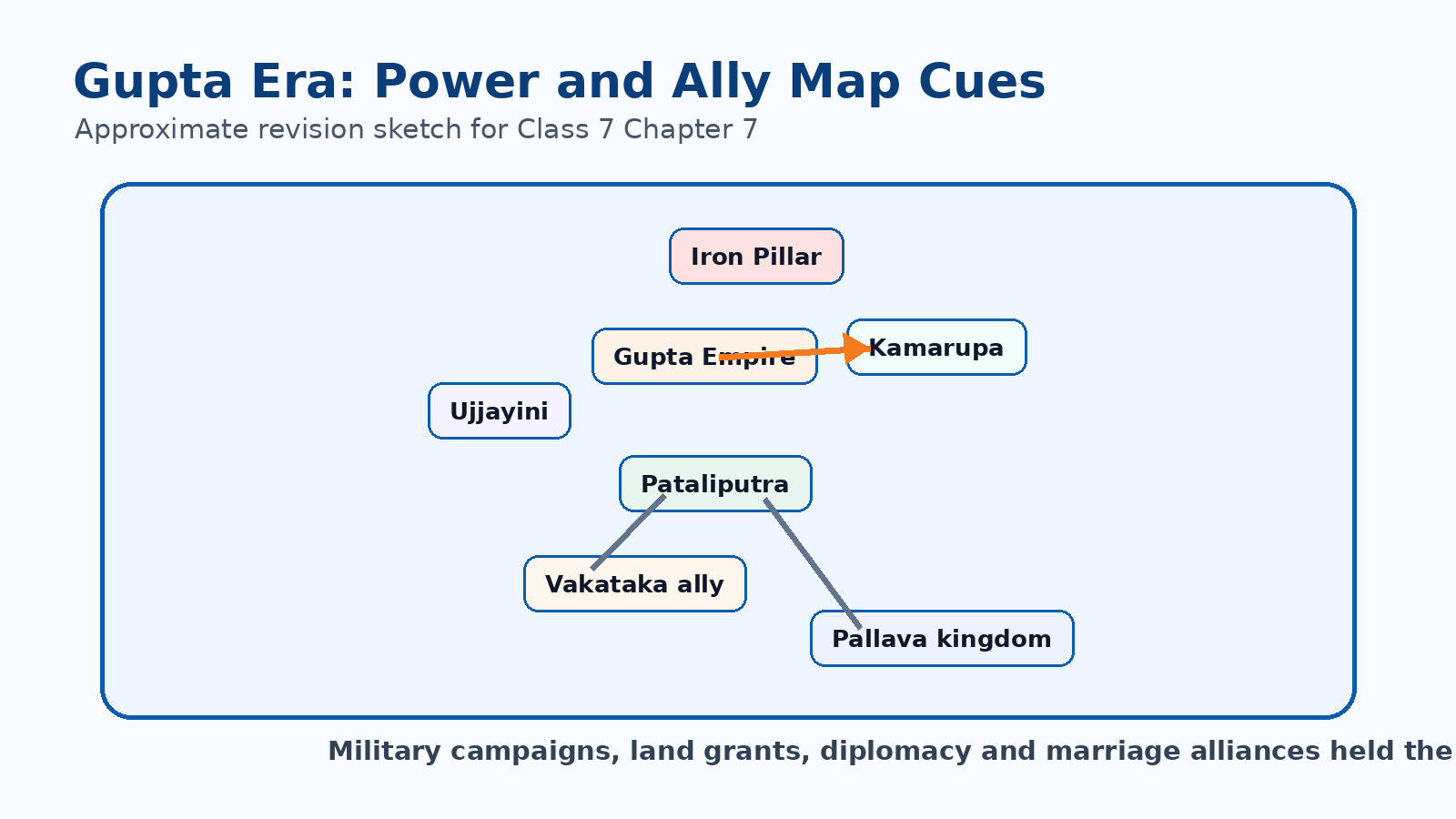
The Gupta Empire flourished from the 3rd to 6th century CE, with Pataliputra as an important capital. The Guptas expanded through campaigns, diplomacy, land grants and matrimonial alliances. The map also reminds students that Vakatakas, Pallavas and Kamarupa were important nearby powers.
- Samudragupta: praised in the Prayaga prashasti for campaigns and tribute networks.
- Chandragupta II: also known as Vikramaditya and linked with the Iron Pillar inscription.
- Prabhavati Gupta: shows how marriage alliances could keep Gupta-Vakataka ties strong.
Gupta Empire Class 7 Video
Source: Magnet Brains on YouTube
Samudragupta Faxian and Gupta Society
Samudragupta is presented through the Prayaga prashasti, a praise inscription by Harisena. Faxian, a Chinese traveller, gives another type of evidence. These sources help students see both royal claims and social observations.
| Source | What it says | How to use it |
|---|---|---|
| Prayaga prashasti | Samudragupta fought campaigns, defeated rulers and accepted tribute | Use for warrior king answers |
| Coins | Samudragupta as veena player and ashvamedha imagery | Use for ruler image and legitimacy |
| Faxian account | Prosperity, charity, medicine, merchants and harsh treatment of chandalas | Use for balanced society answers |
| Copper plates | Land grants and local control | Use for administration answers |
Why the Gupta Period is Called a Classical Age
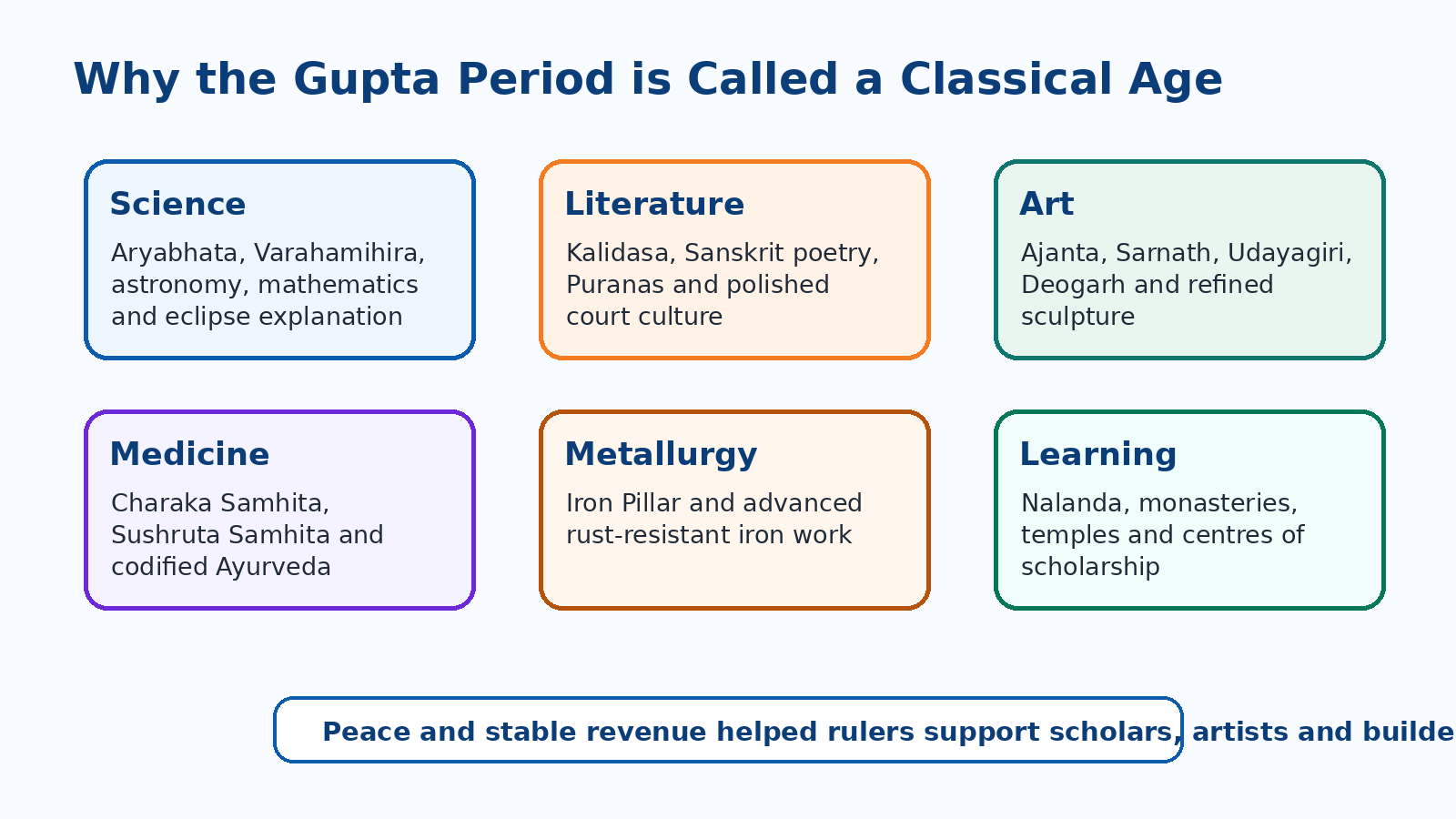
The Gupta period is called a classical age by some historians because many fields developed during a long phase of stability. Students should support this term with examples instead of writing it as a slogan.
- Science: Aryabhata and Varahamihira worked on mathematics, astronomy and observation.
- Literature: Kalidasa and Sanskrit works show refined poetry and court culture.
- Medicine: Ayurveda texts such as Charaka Samhita and Sushruta Samhita were codified.
- Art: Ajanta, Sarnath, Udayagiri and Deogarh show strong artistic production.
Gupta Art Nalanda Aryabhata and Kalidasa Revision
Chapter 7 links creative work with patronage. Gupta rulers supported many traditions and institutions, including Buddhist centres such as Nalanda. Art centres like Ajanta and Sarnath show the aesthetic standards of the age.
| Figure or place | Field | Revision point |
|---|---|---|
| Aryabhata | Mathematics and astronomy | Earth's rotation, eclipses and year length |
| Varahamihira | Astronomy, weather and town planning | Brihat Samhita covered many subjects |
| Kalidasa | Sanskrit literature | Meghadutam and refined poetry |
| Ajanta | Art and architecture | Caves, carvings and paintings |
| Nalanda | Learning | Famous Buddhist institution |
How to Use the Class 7 Chapter 7 Notes PDF
Start with the timeline and source table in the PDF. Then revise the ruler names, traveller account, classical age examples and regional powers. For long answers, combine source, example and impact.
- Use the ruler table for Chandragupta II and Samudragupta questions.
- Use the Faxian section for society and source-based questions.
- Use the classical age chart for science, literature and art answers.
More Class 7 Social Science Chapter 7 Resources
Use these related NCERT resources when you want Chapter 7 in another format. The official book PDF helps with images and source boxes, while handwritten notes are useful for quick recall.
| Resource | Best use | Link |
|---|---|---|
| NCERT Solutions | Practice textbook questions and activities | Open NCERT Solutions |
| NCERT Book PDF | Read the official chapter with figures and activities | Open Book PDF |
| Handwritten Notes | Revise names, places and examples quickly | Open Handwritten Notes |
All Class 7 Social Science Part 1 Notes
The table below keeps the same resource type together, so students can move chapter by chapter through Class 7 Social Science Part 1 notes.
| Chapter | NCERT chapter title | Notes link |
|---|---|---|
| Chapter 1 | Geographical Diversity of India | Open Notes |
| Chapter 2 | Understanding the Weather | Open Notes |
| Chapter 3 | Climates of India | Open Notes |
| Chapter 4 | New Beginnings: Cities and States | Open Notes |
| Chapter 5 | The Rise of Empires | Open Notes |
| Chapter 6 | The Age of Reorganisation | Open Notes |
| Chapter 7 | The Gupta Era: An Age of Tireless Creativity | You are here |
| Chapter 8 | How the Land Becomes Sacred | Open Notes |
| Chapter 9 | From the Rulers to the Ruled: Types of Governments | Open Notes |
| Chapter 10 | The Constitution of India: An Introduction | Open Notes |
| Chapter 11 | From Barter to Money | Open Notes |
| Chapter 12 | Understanding Markets | Open Notes |
Class 7 Social Science Chapter 7 The Gupta Era Notes FAQs
Ques. Which Gupta ruler was also known as Vikramaditya?
Ans. Chandragupta II was also known as Vikramaditya. He is linked with the Iron Pillar inscription and Gupta cultural achievements.
Ques. Why is the Gupta period called a classical age?
Ans. Some historians use this term because science, literature, medicine, metallurgy, art and architecture developed strongly during this period.
Ques. What did Faxian describe about Gupta society?
Ans. Faxian described prosperous cities, charity, medical support and merchants, but he also noted harsh treatment of chandalas.
Ques. Who were the Pallavas?
Ans. The Pallavas were a south Indian dynasty centred around Kanchipuram. They supported temples, rock-cut caves and learning centres.



Comments