



These Class 12 Sociology Chapter 1 Structural Change Notes give a clear, quick-revision summary of how colonialism reshaped India, why industrialisation and urbanisation are linked, and how to sort a village, town or city, set to the 2026-27 CBSE syllabus. The notes turn an idea-heavy opening chapter into short points, tables and definitions that students can revise in one sitting.
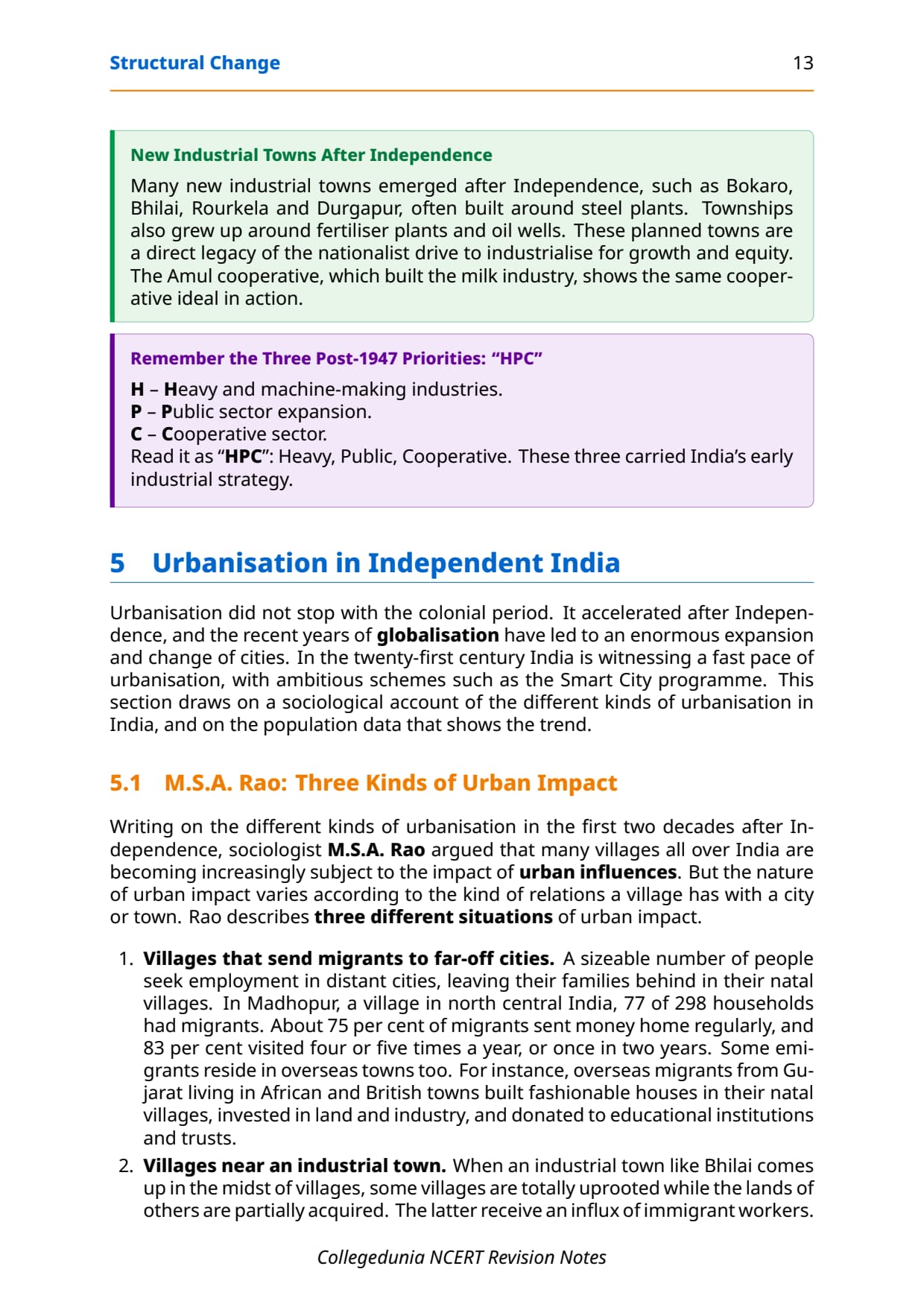
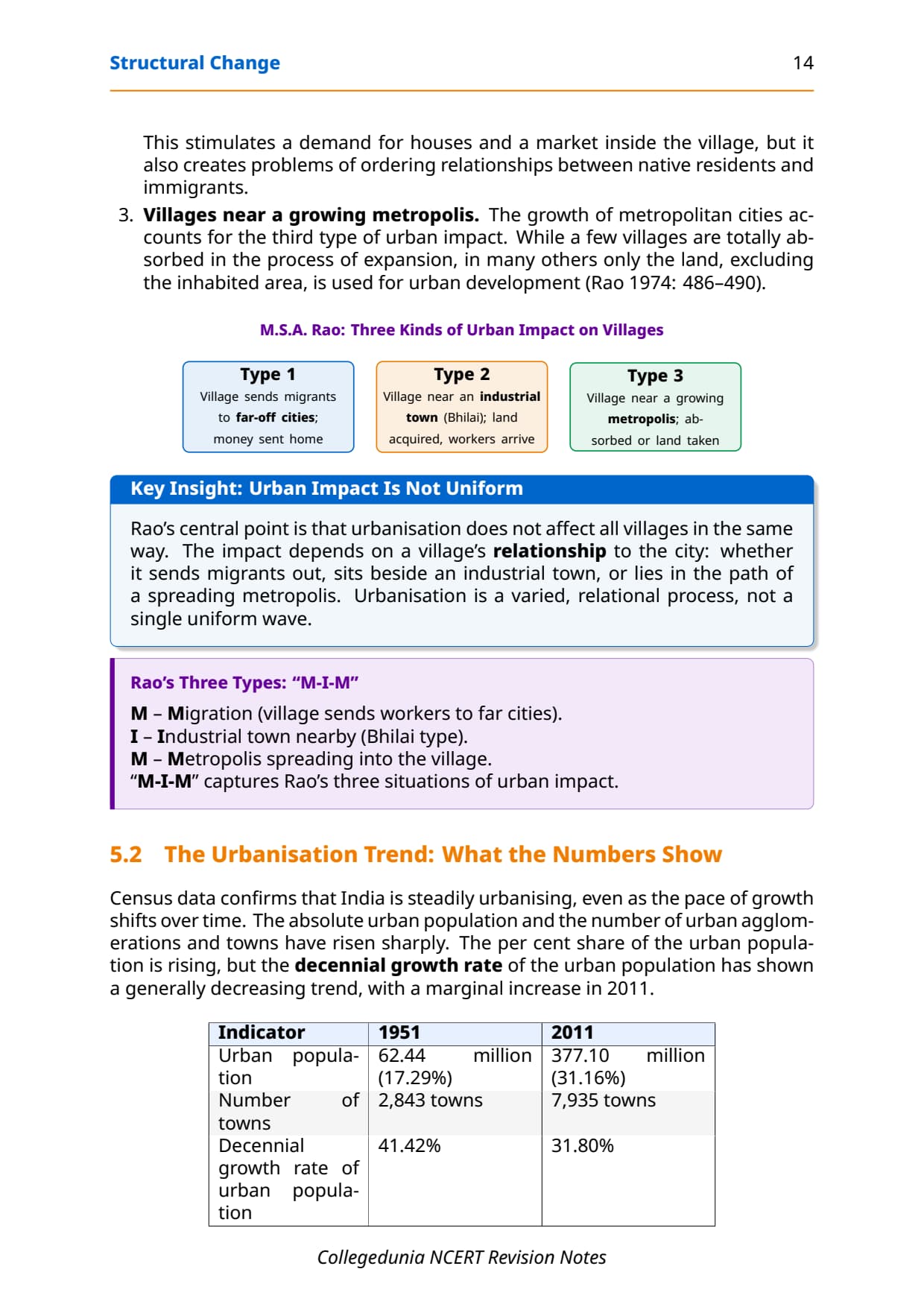
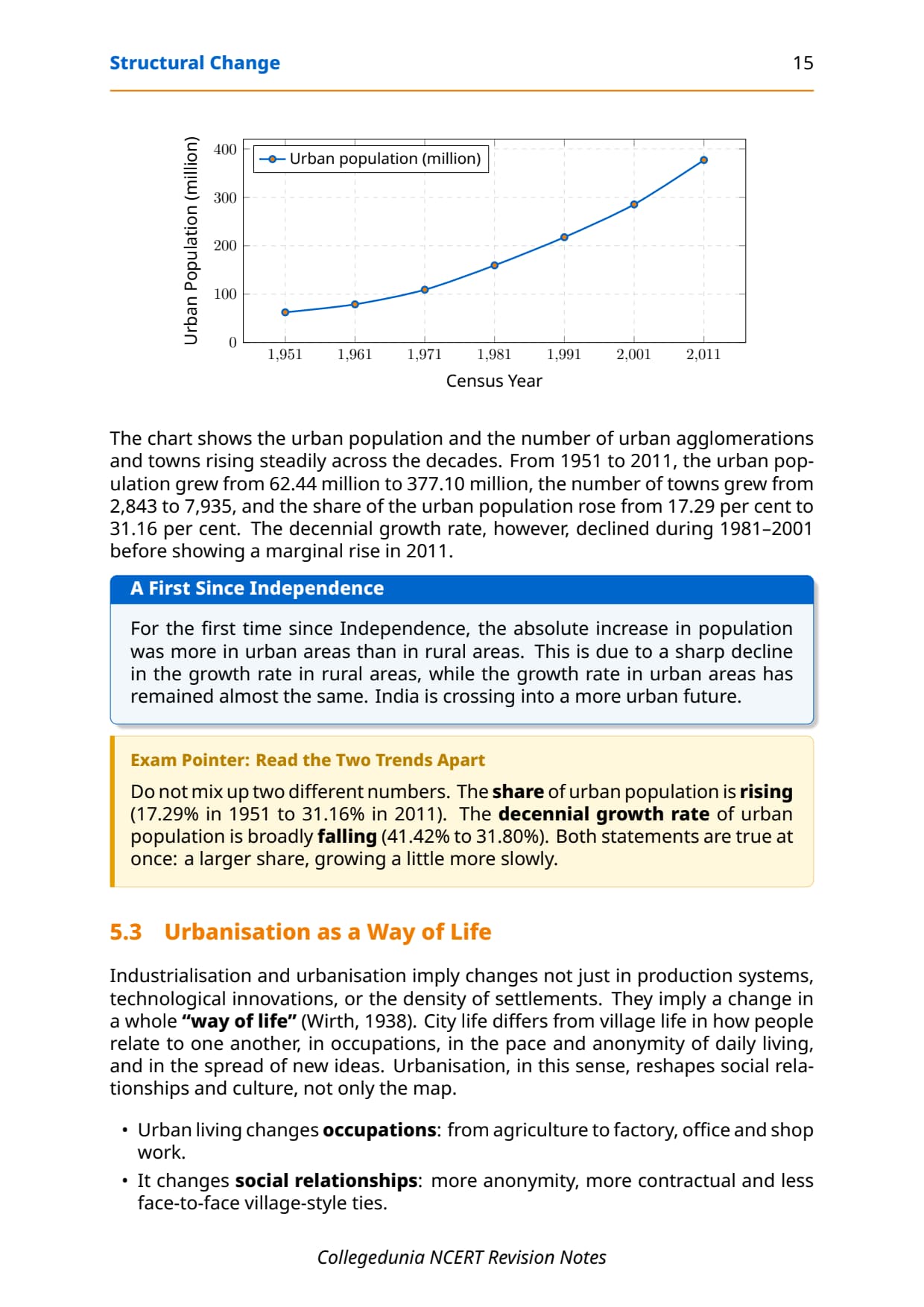
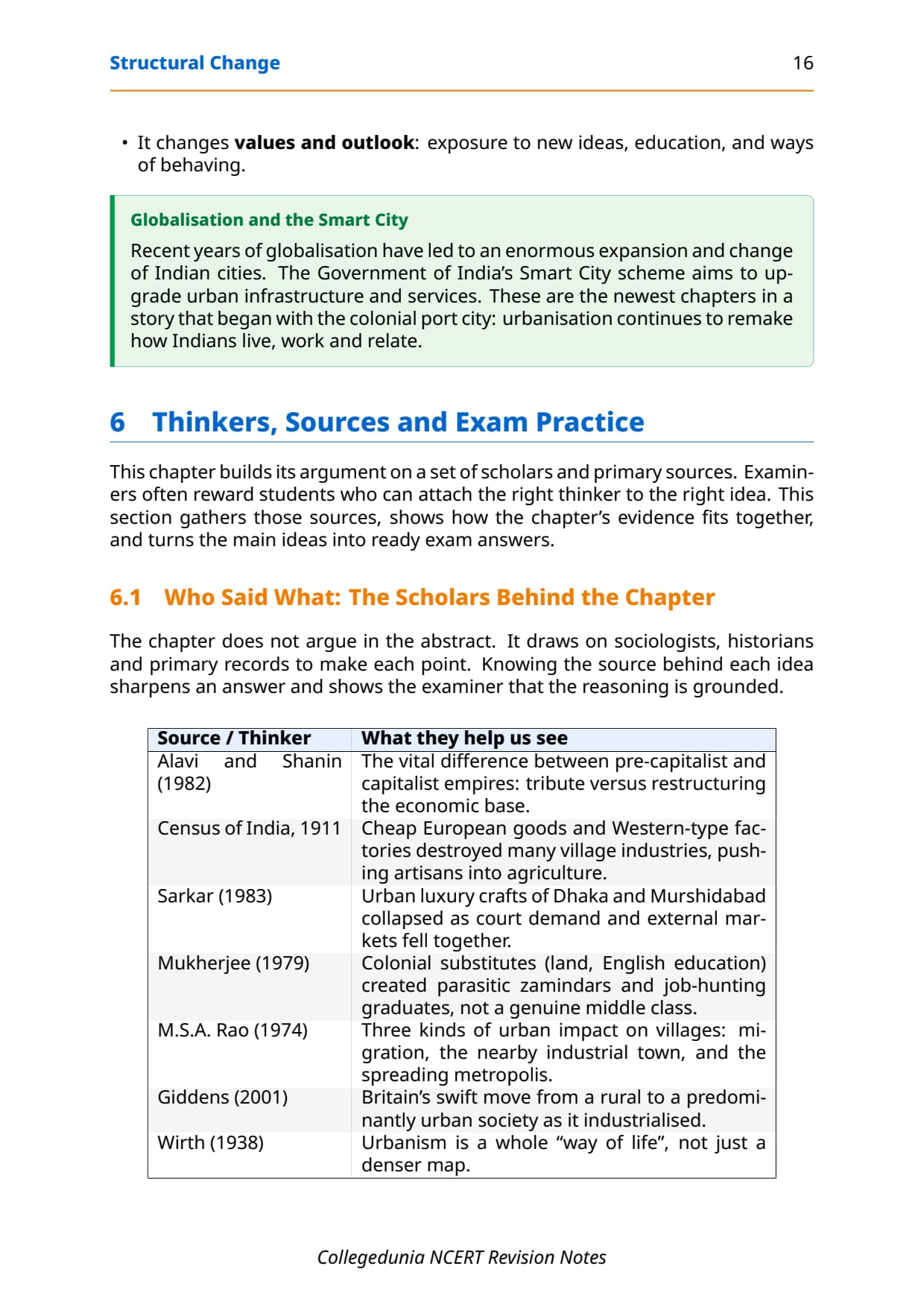
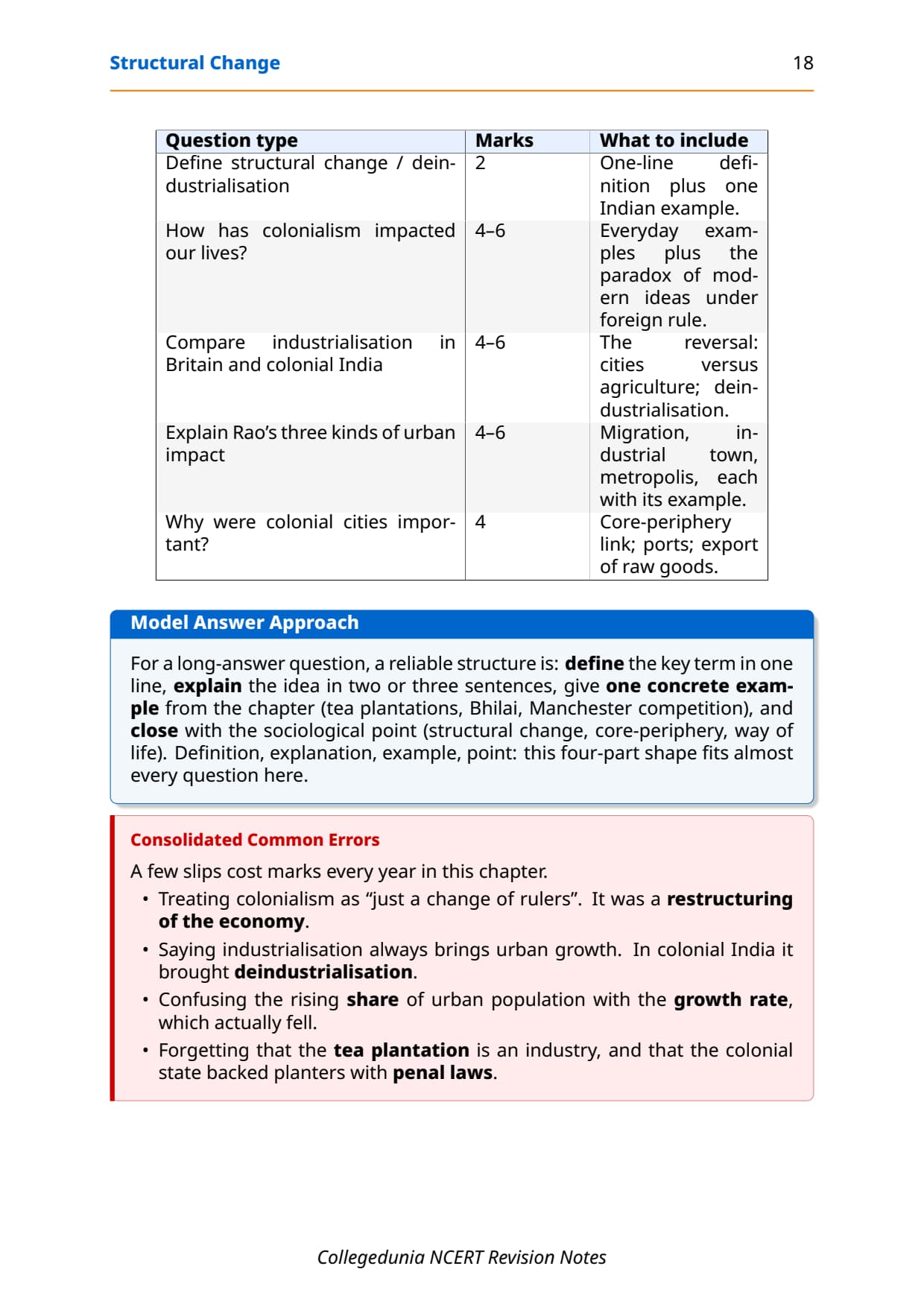
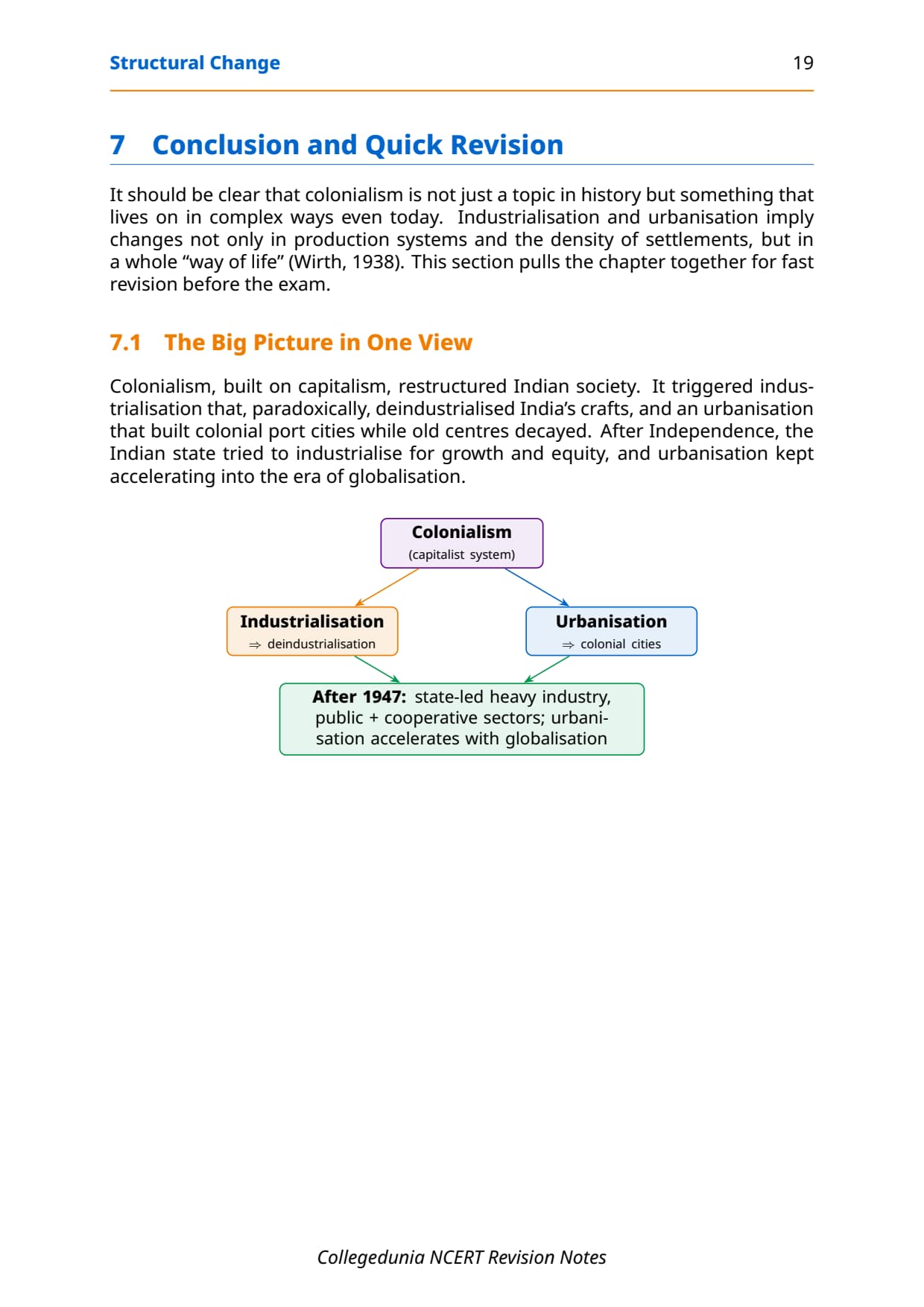
- One-page summary of structural change plus every key term you need to write full answers.
- A quick map of the chapter: colonialism, industrialisation and urbanisation and settlement types.
- Pairs with the NCERT Solutions, Handwritten Notes and Book PDF linked lower on this page.
These Class 12 Sociology Chapter 1 Structural Change revision notes are prepared by subject experts from the official NCERT Social Change and Development in India textbook and matched to the 2026-27 CBSE syllabus.
Student Feedback: In a Collegedunia poll of 7,640 Class 12 Sociology students, 72% of students said a one-page map of the chapter, colonialism, industrialisation and urbanisation, and settlement types, was the single most useful revision tool. Most students revised these notes the night before the exam.
Source: 2026-27 Class 12 Sociology student poll. Sample of 7,640 students from CBSE schools across 12 states.
Structural Change Class 12 Notes Overview
Structural Change is the first chapter of Social Change and Development in India, the second Class 12 Sociology book. It studies how the deep structure of Indian society was reshaped by big historical forces. These structural change class 12 notes break the chapter into the parts students must remember.
The chapter has three clear blocks, and your revision should follow the same order:
- Colonialism: how British rule, built on capitalism, reshaped politics, law, education and culture.
- Industrialisation and urbanisation: why the two are linked, and why the link is not automatic.
- Settlement types: how occupation and way of life sort a village from a town or city.
Keeping these three blocks separate makes the chapter feel small. A student who can name the blocks in order will rarely get lost in Structural Change class 12, because every exam question sits inside one of them.
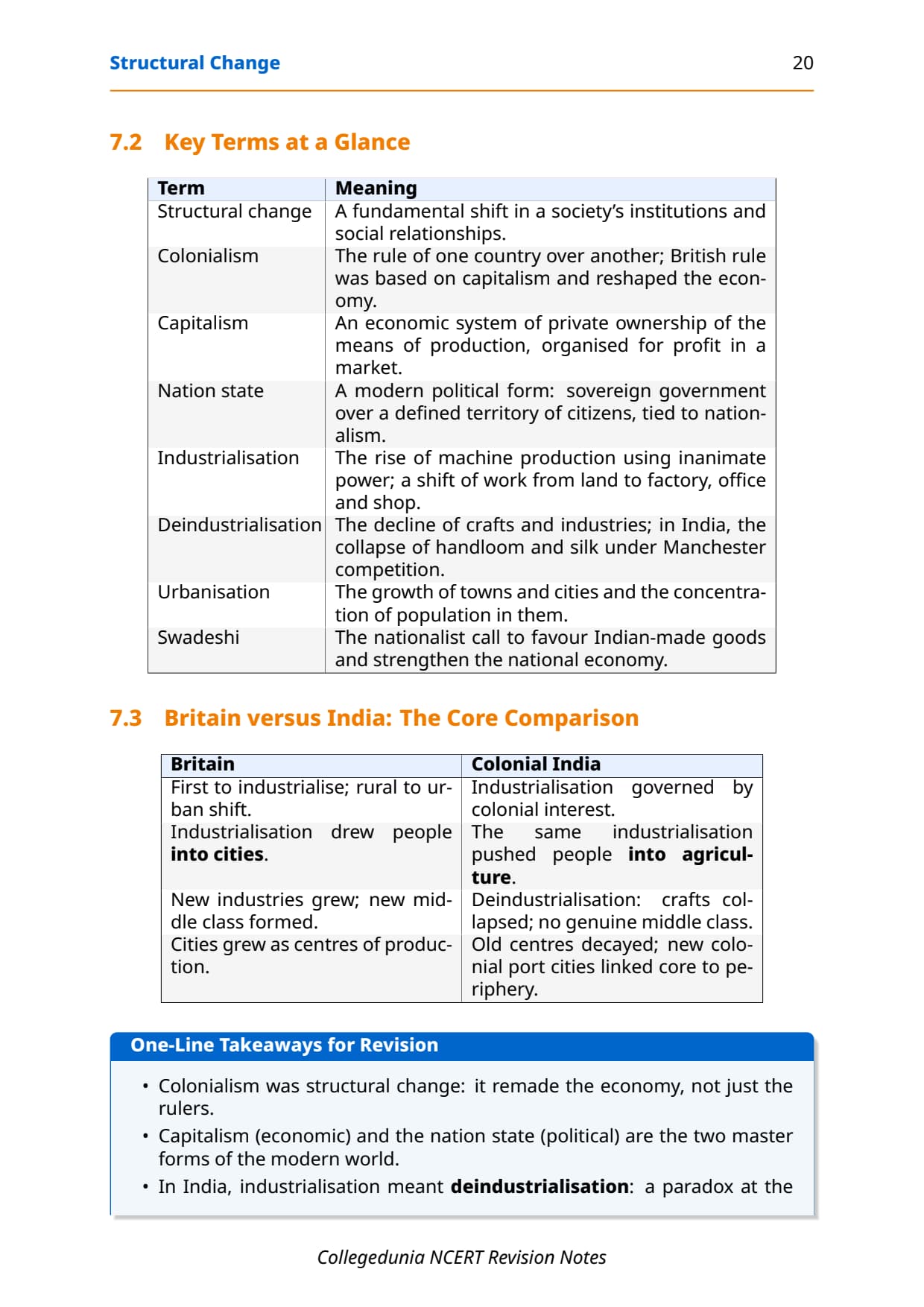
Key Terms and Definitions for Quick Revision
This chapter is built on a handful of ideas, and almost every mark in the exam rests on getting them right. The table below is the fastest way to lock them in before the paper. Read it twice and you can attempt any objective question.
| Term | Definition |
|---|---|
| Structural change | A lasting shift in how a society is organised, in economy, work and institutions. |
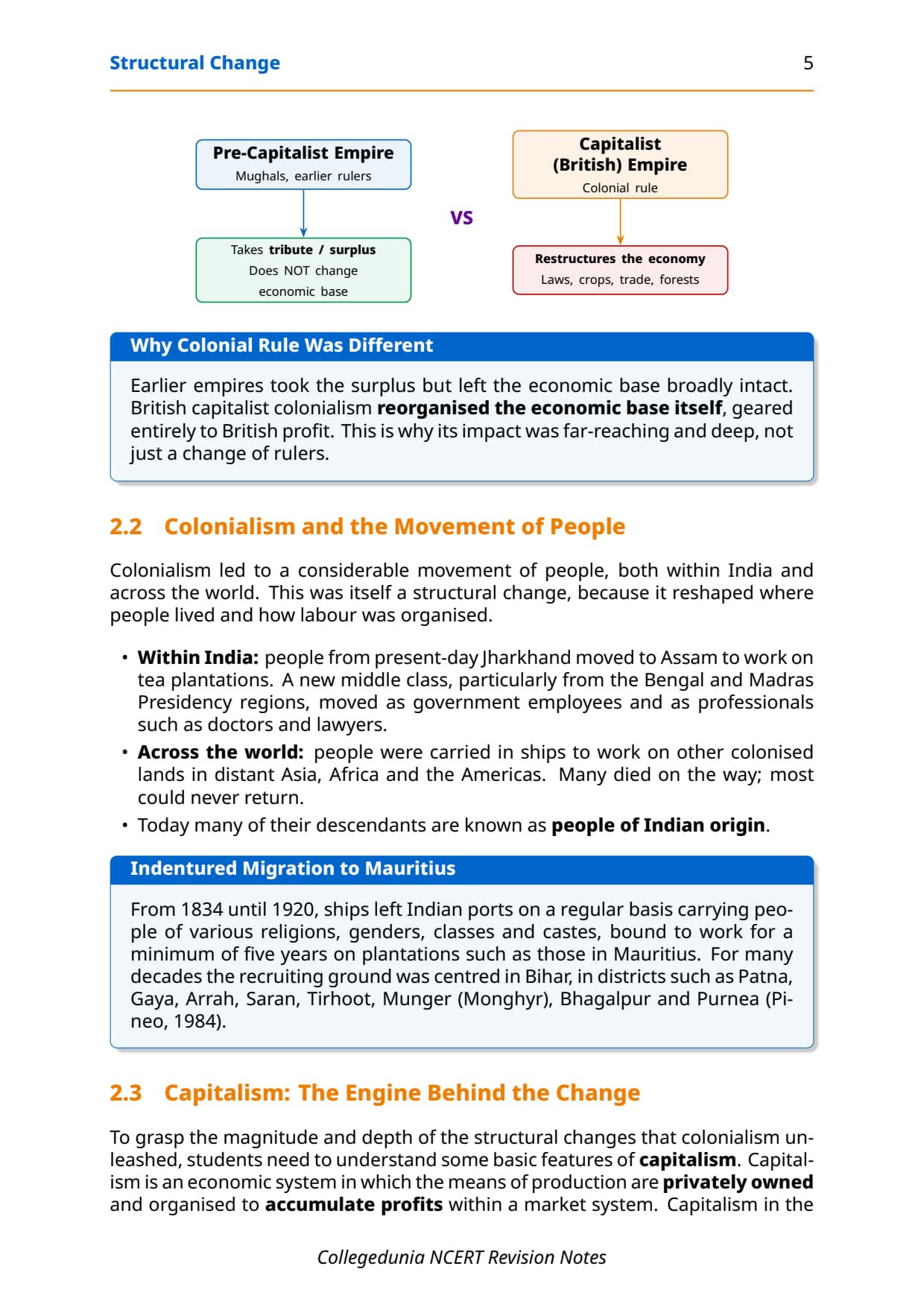
| Colonialism | Rule by one country over another; British rule in India rested on capitalism. |
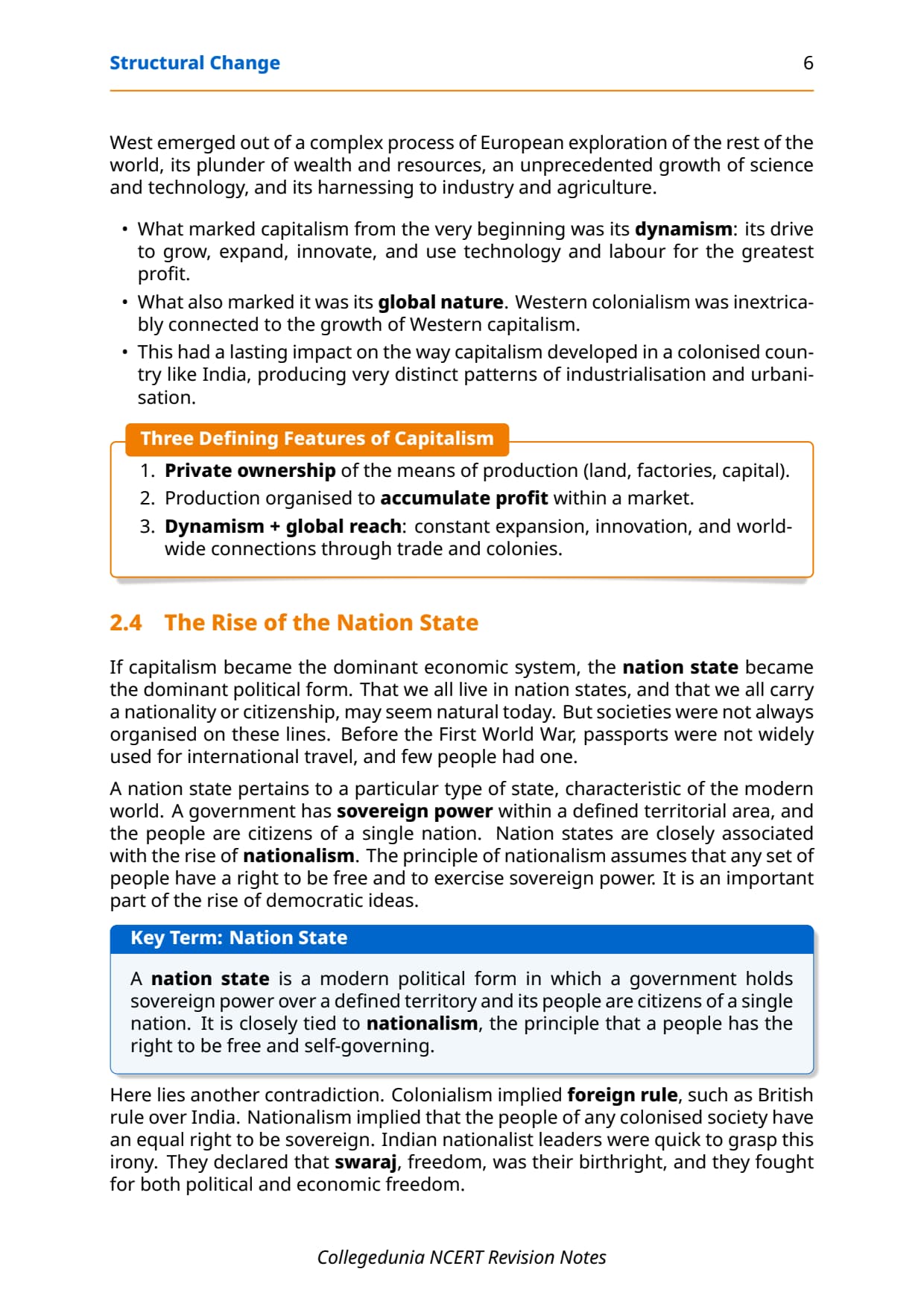
| Capitalism | An economy where the means of production are privately owned and run for profit. |
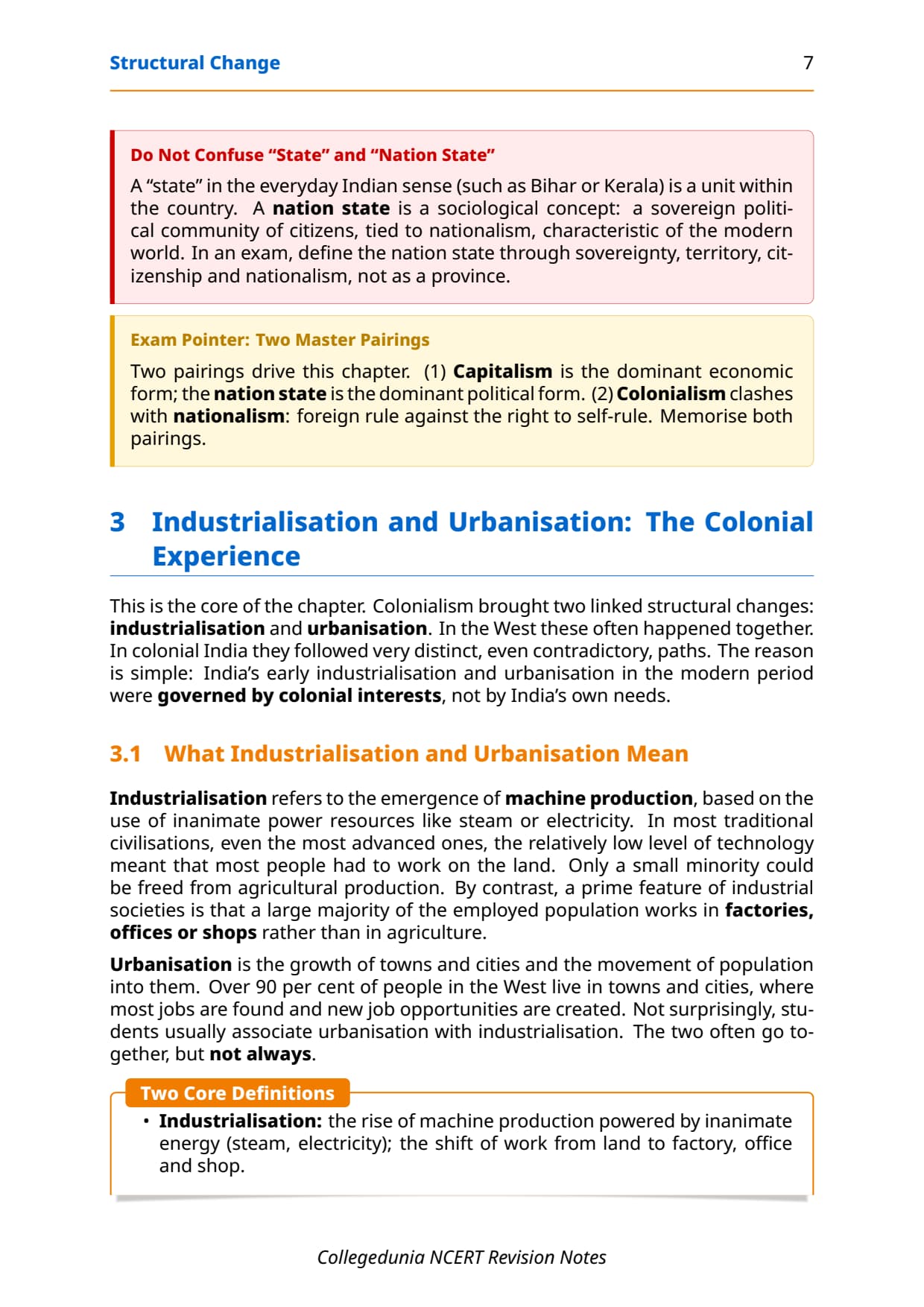
| Industrialisation | The rise of machine production using inanimate power like steam or electricity. |
| Urbanisation | The growing share of people living in towns and cities; also a way of life. |
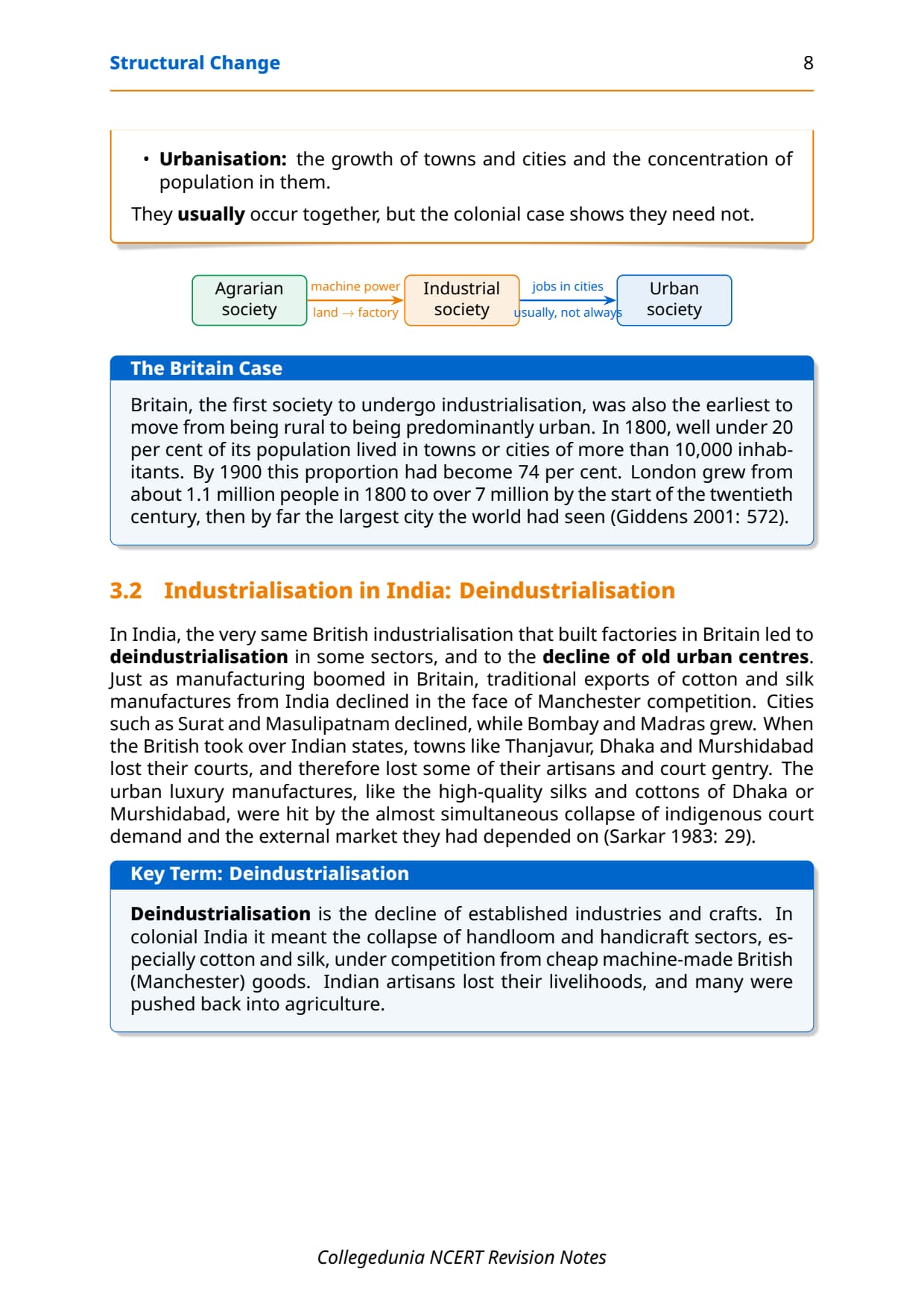
| Deindustrialisation | The decline of older crafts and industries, as Indian handlooms saw under British rule. |
| Swaraj | Self-rule or freedom, the goal Indian leaders set against colonial rule. |
A key revision tip: learn each force with its two-sided effect, not in isolation. Colonialism brought both privilege and resistance; English was both a gatekeeper and a door. Examiners reward an answer that shows this contradiction, so storing the terms with their double edge makes recall faster and your answers sharper.
Colonialism and Its Impact in Short
The heart of the chapter is how colonialism reshaped India. These notes set out the impact on both politics and culture, the split the board tests most. Learn the two sides and a third of the chapter is done.
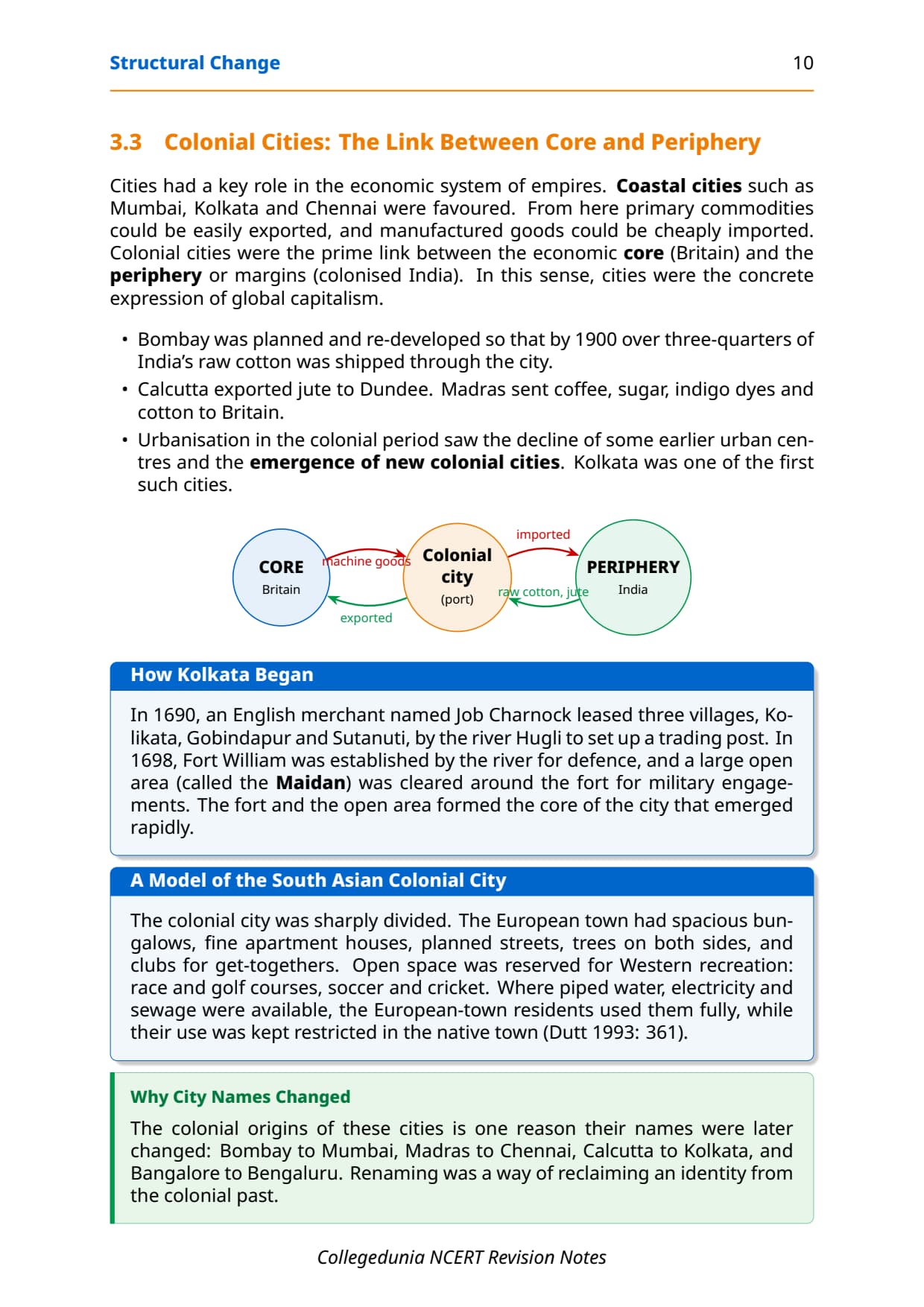
- On politics: it built our parliamentary, legal, police and education systems, which stayed on after 1947.
- A built-in contradiction: Indians read of western freedom yet lived under rule that denied it, which fed nationalism.
- On culture: the place of English is double-edged, a mark of privilege yet also a door for groups long denied education.
- An unintended result: western education, meant to serve British rule, grew an anti-colonial consciousness instead.
| Area | What colonialism changed |
|---|---|
| State and law | Parliamentary form, courts, police, modern education |
| Economy | Tied India to world markets; caused deindustrialisation of crafts |
| Culture | The mixed legacy of English and western education |
| Daily life | Driving on the left, school ties, roadside menus |
The honest exam point is that colonialism is not just history; it still shapes our daily life. Small leftovers sit alongside deep institutional change. This is why a good answer names both the parliamentary system and the small living traces.
Industrialisation and Urbanisation: The Core Link
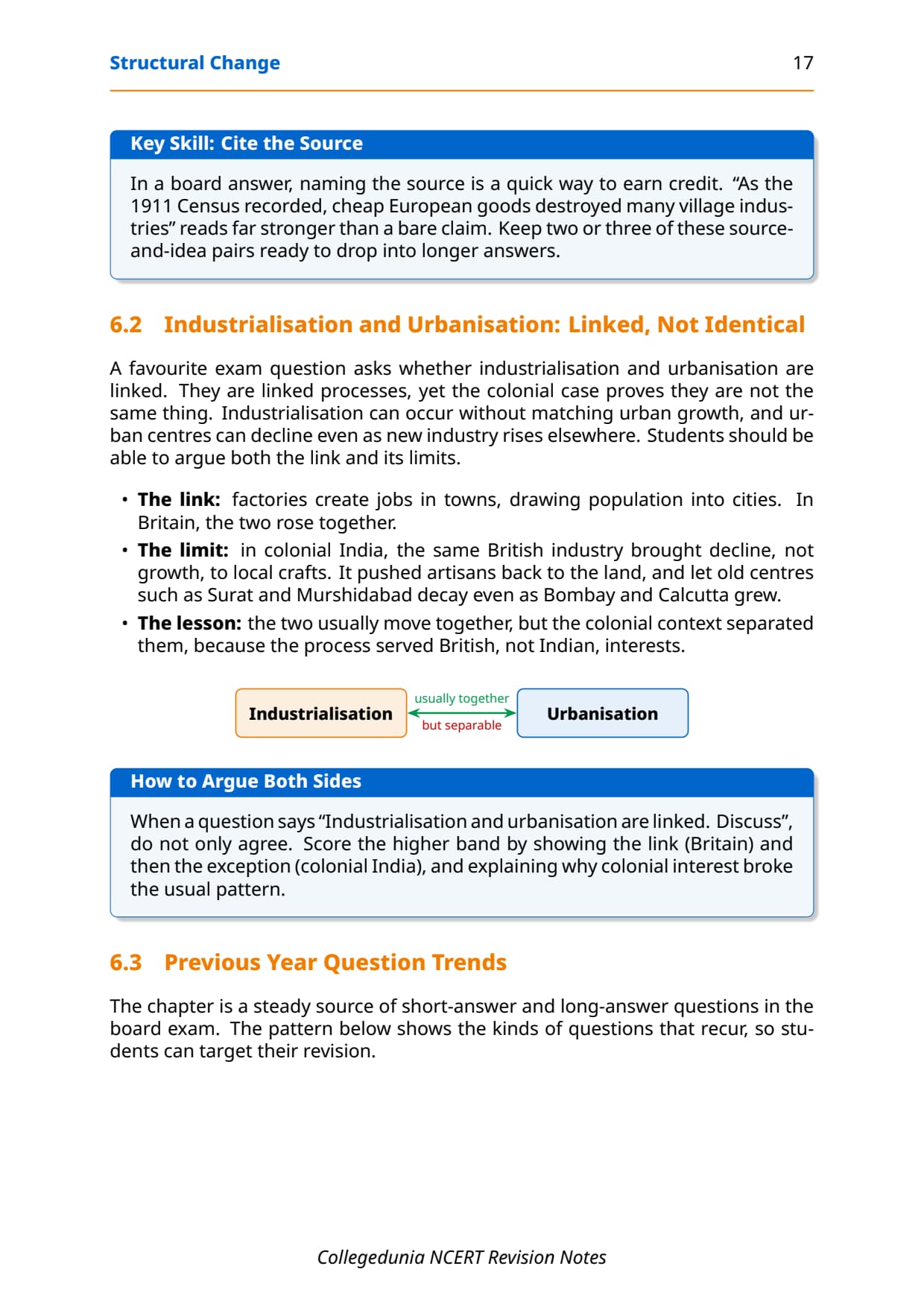
This is the single most-tested idea in the chapter, so the notes give it its own block. Machine production pulls workers into towns, so industrialisation and urbanisation usually move together. Picture a factory town and the link is clear.
- Why they go together: factories and offices cluster where people gather, so industrial jobs are usually urban.
- The British proof: Britain went from under 20% urban in 1800 to 74% by 1900 as industry grew.
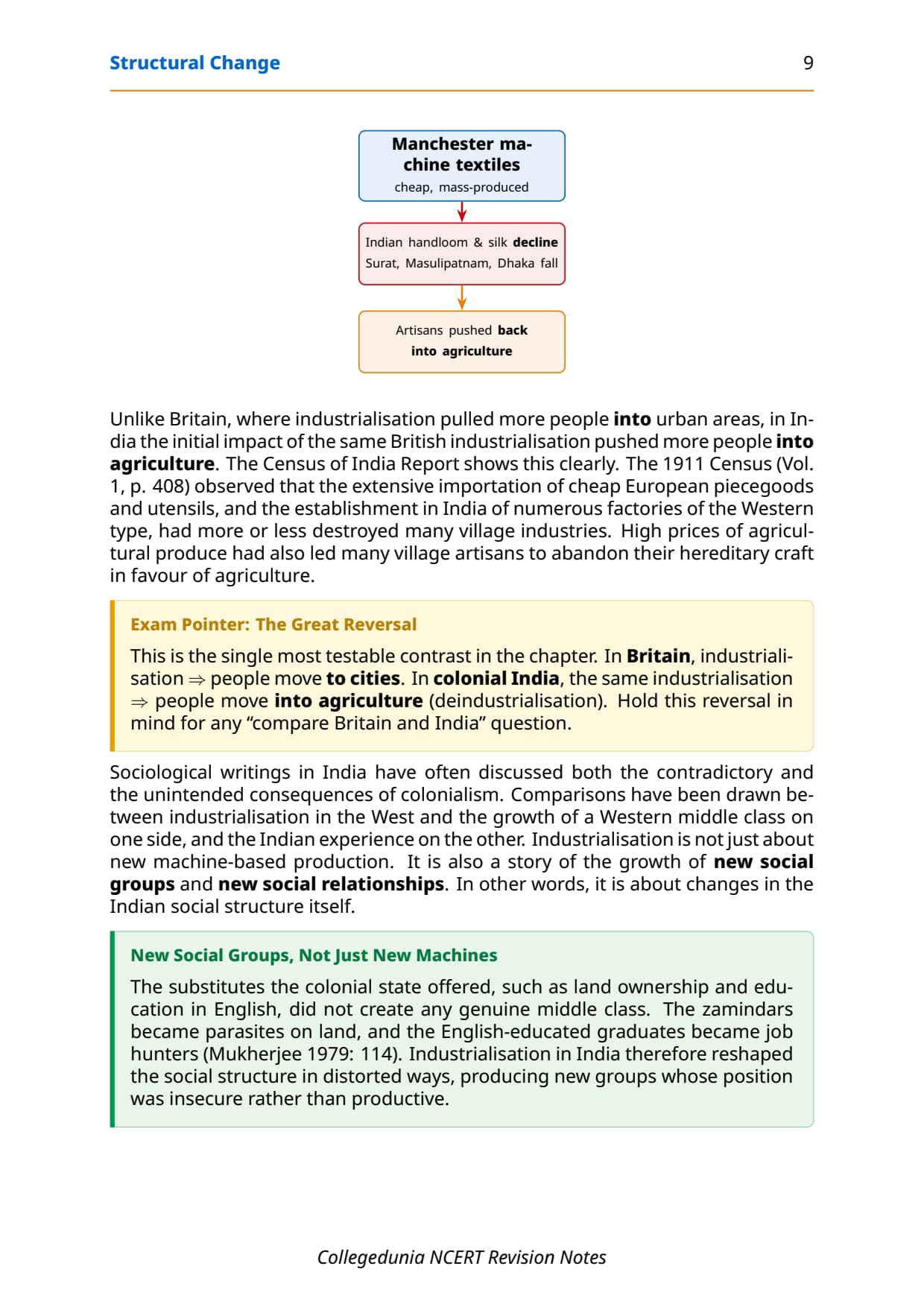
- The colonial exception: British industry caused deindustrialisation in India, so urban growth here did not follow.
The key revision line is that the two often occur together but not always so. Britain is the textbook proof; colonial India is the counter-example, where one country's industrial rise meant another's decline. That rule-and-exception pair is the move every long answer in this chapter rewards.
Village, Town and City: Sorting a Settlement
The last block of the chapter teaches how to classify where you live. These are the markers that turn an abstract idea into a real answer, so students should keep them ready. The points below sum up how to sort any place.
- Occupation is the anchor: farming-led leans village; non-farm work leans city.
- Buildings and density: scattered and low suggests a village; dense and tall suggests a city.
- Services: wide schools, colleges and offices point to a town or city.
- Way of life: close-knit and personal points to a village; varied and impersonal points to a city.
The big takeaway is that urbanisation is a way of life, not just a place (Wirth, 1938). It grows out of industrialisation, so the kind of work people do is the surest sorter. So modern settlements are best read by occupation first, then the other markers.
Structural Change Revision Table
For a last-minute scan, this table pulls the whole chapter into one place. Students can cover the right column and test themselves, then check their recall. It is the quickest way to confirm you are exam-ready.
| Topic | One-line recall |
|---|---|
| Structural change | A deep, lasting shift in how society is organised |
| Colonialism | Reshaped politics, economy and culture; still around us |
| Industrialisation | Machine production replaces older crafts and farm work |
| Urbanisation | People move to towns; a way of life, not just a place |
| The link | Usually together, but colonial India is the exception |
| Settlement marker | Occupation has the determining influence |
Run down this table once a day in the week before the exam. Active recall beats re-reading, so cover the answers and say them aloud before you check. This single habit lifts retention more than any amount of highlighting.
How These Notes Pair with the Solutions and Book PDF
These notes summarise the chapter. To finish your prep, use them with the other resources for the same chapter, all linked in the table below.
| Resource | Best used for |
|---|---|
| Structural Change Class 12 NCERT Solutions | Full point-wise answers to all 4 back-exercise questions |
| Structural Change Class 12 Handwritten Notes | One-shot revision in a scanned notebook style |
| Structural Change NCERT Book PDF | Reading the original NCERT chapter text from the textbook |
Tip: read these notes first to get the big picture, then attempt the NCERT Solutions on your own. The notes give the map; the solutions give the practice.
All NCERT Notes for Class 12 Sociology
The table links the Notes for every chapter in both Class 12 Sociology books, so students can revise across the course in one place. Structural Change is highlighted.
| Chapter | NCERT Notes |
|---|---|
| Indian Society | |
| Chapter 1 | Introducing Indian Society |
| Chapter 2 | The Demographic Structure of the Indian Society |
| Chapter 3 | Social Institutions - Continuity and Change |
| Chapter 4 | The Market as a Social Institution |
| Chapter 5 | Patterns of Social Inequality and Exclusion |
| Chapter 6 | The Challenges of Cultural Diversity |
| Social Change and Development in India | |
| Chapter 1 | Structural Change |
| Chapter 2 | Cultural Change |
| Chapter 3 | The Constitution and Social Change |
| Chapter 4 | Change and Development in Rural Society |
| Chapter 5 | Change and Development in Industrial Society |
| Chapter 6 | Globalisation and Social Change |
| Chapter 7 | Mass Media and Communications |
| Chapter 8 | Social Movements |
FAQs on Structural Change Class 12 Notes
Structural Change Class 12 Sociology Notes Common Questions
Ques. What are the most important topics in class 12 sociology chapter 1 Structural Change notes?
Ans. The most important topics are how colonialism reshaped politics, economy and culture, why industrialisation and urbanisation are linked, the colonial exception of deindustrialisation, and how occupation sorts a village, town or city. These notes cover each in short, exam-ready points.
Ques. What is structural change in simple words?
Ans. Structural change is a lasting shift in the way a society is organised, in its economy, its work and its institutions. In this chapter the three forces driving it are colonialism, industrialisation and urbanisation.
Ques. Why are industrialisation and urbanisation linked?
Ans. Machine production needs workers gathered in one place, so industrial jobs are usually created in towns and cities, which pulls people there. Britain proves the link, but the two do not always move together, as colonial India shows.
Ques. How did colonialism still affect our daily life?
Ans. Colonialism gave us our parliamentary, legal and education systems and tied our economy to world markets. Small leftovers also remain, like driving on the left and roadside menus, alongside the double-edged place of English.
Ques. Are these class 12 sociology chapter 1 notes enough for the board exam?
Ans. Yes, these notes cover the full NCERT chapter in revision form. For exam practice, pair them with the NCERT Solutions linked on this page so you can write out full answers to all 4 back-exercise questions.



Comments