



These Meeting Life Challenges Class 12 Notes give a quick, exam-ready summary of how stress works and how we stay healthy in spite of it, set to the 2026-27 CBSE syllabus. The notes pull together every key term, model and coping style from Chapter 3 of Class 12 Psychology. Students can use them for a fast revision the night before a test or to fix the main ideas before they attempt the back-exercise questions.
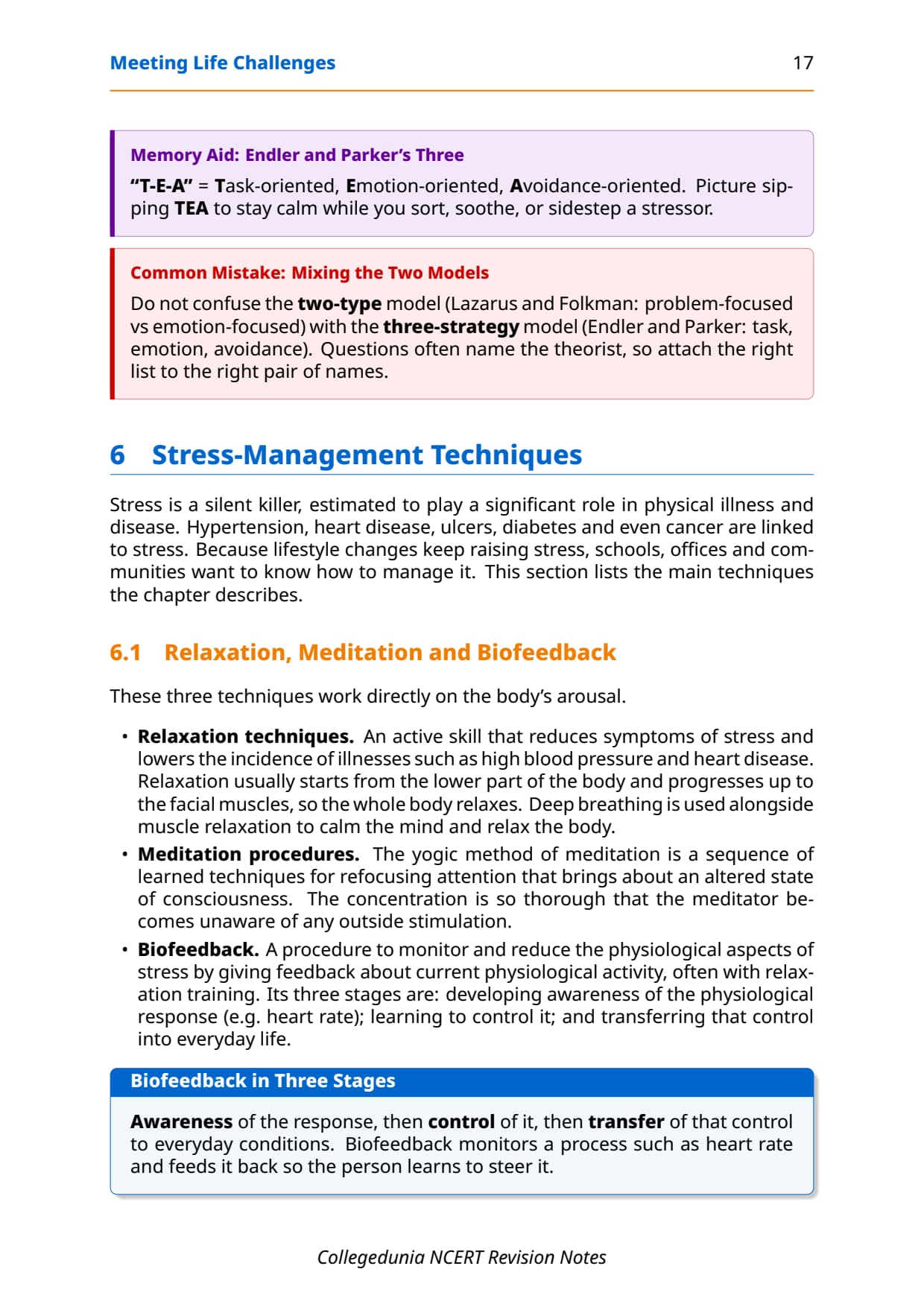
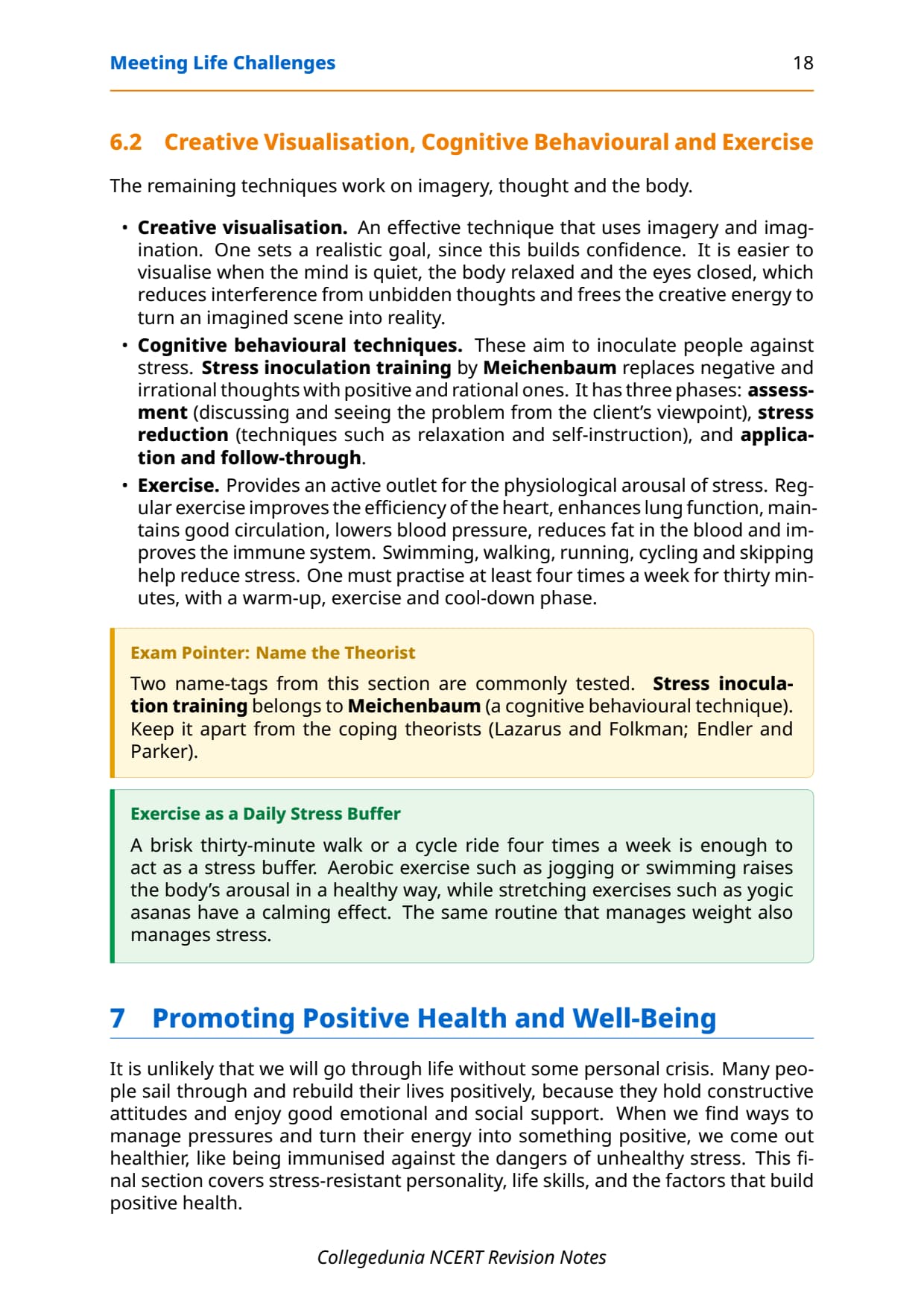
- Covers the nature of stress, the GAS model, the coping schemes and life skills in one place.
- This Class 12 Psychology chapter usually carries 6 to 7 marks in the board paper.
- Pairs with the NCERT Solutions, Handwritten Notes and Book PDF linked lower on this page.
These Meeting Life Challenges Class 12 notes are written from the official NCERT Psychology textbook and checked against the last five years of CBSE board papers.
Student Feedback: In a Collegedunia poll of 8,290 Class 12 Psychology students taken before the 2026 boards, 72% of students said short, point-wise notes on the GAS stages and the coping styles were the fastest way to revise this chapter. Most students kept the key models and terms on a single sheet for last-minute recall.
Source: 2026-27 Class 12 Psychology student poll. Sample of 8,290 students from CBSE schools across 12 states.
What the Meeting Life Challenges Notes Cover
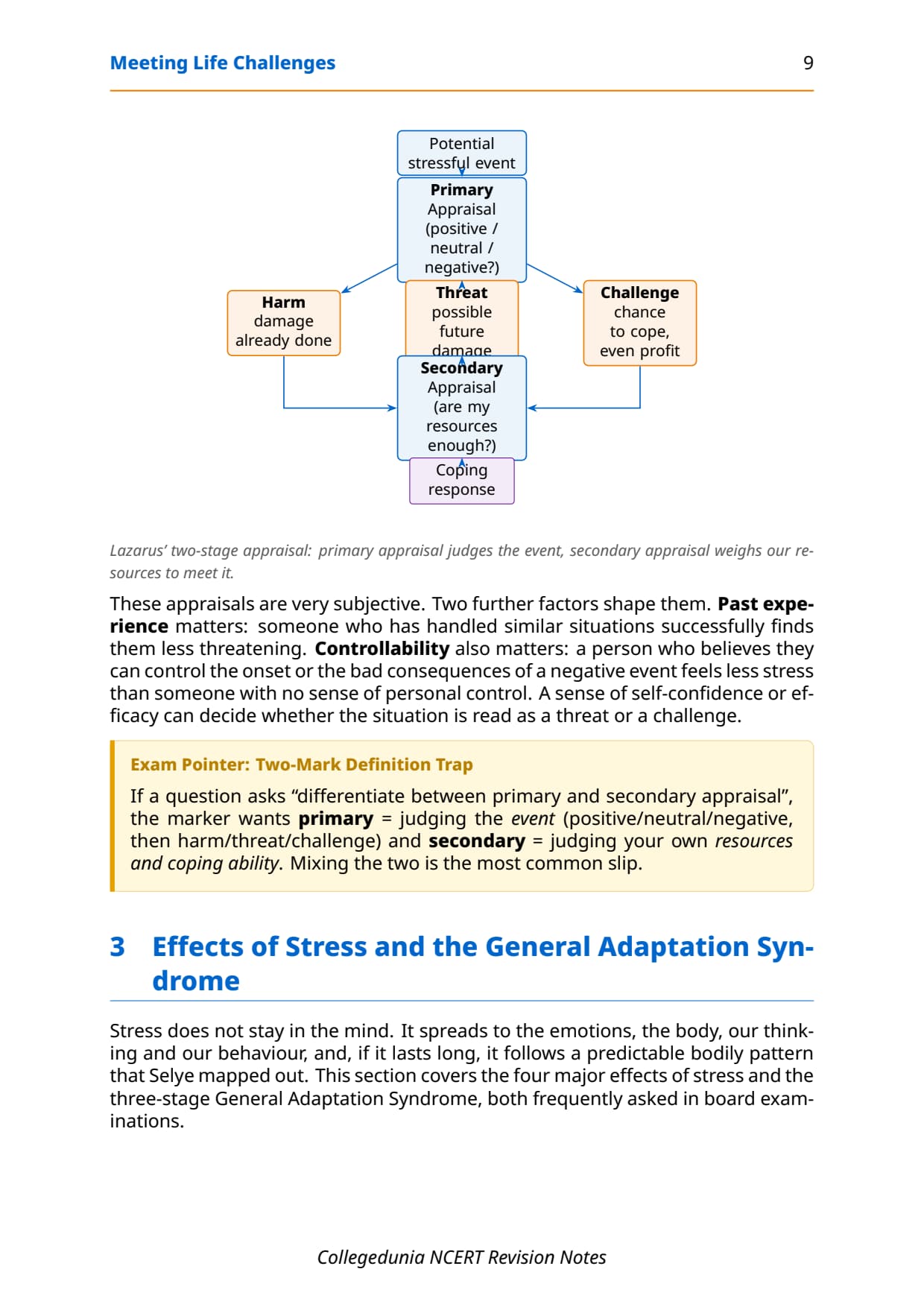
Meeting Life Challenges is the third chapter of Class 12 Psychology. It studies how stress shapes our lives and how we can stay healthy in spite of it. The central idea is that stress is a transaction between the person and the environment, shaped by how we appraise the demand, not just the event or the reaction alone.
The easiest way to organise your revision is to split the chapter into three threads:
- The nature: what stress is, its types and sources, and the role of appraisal.
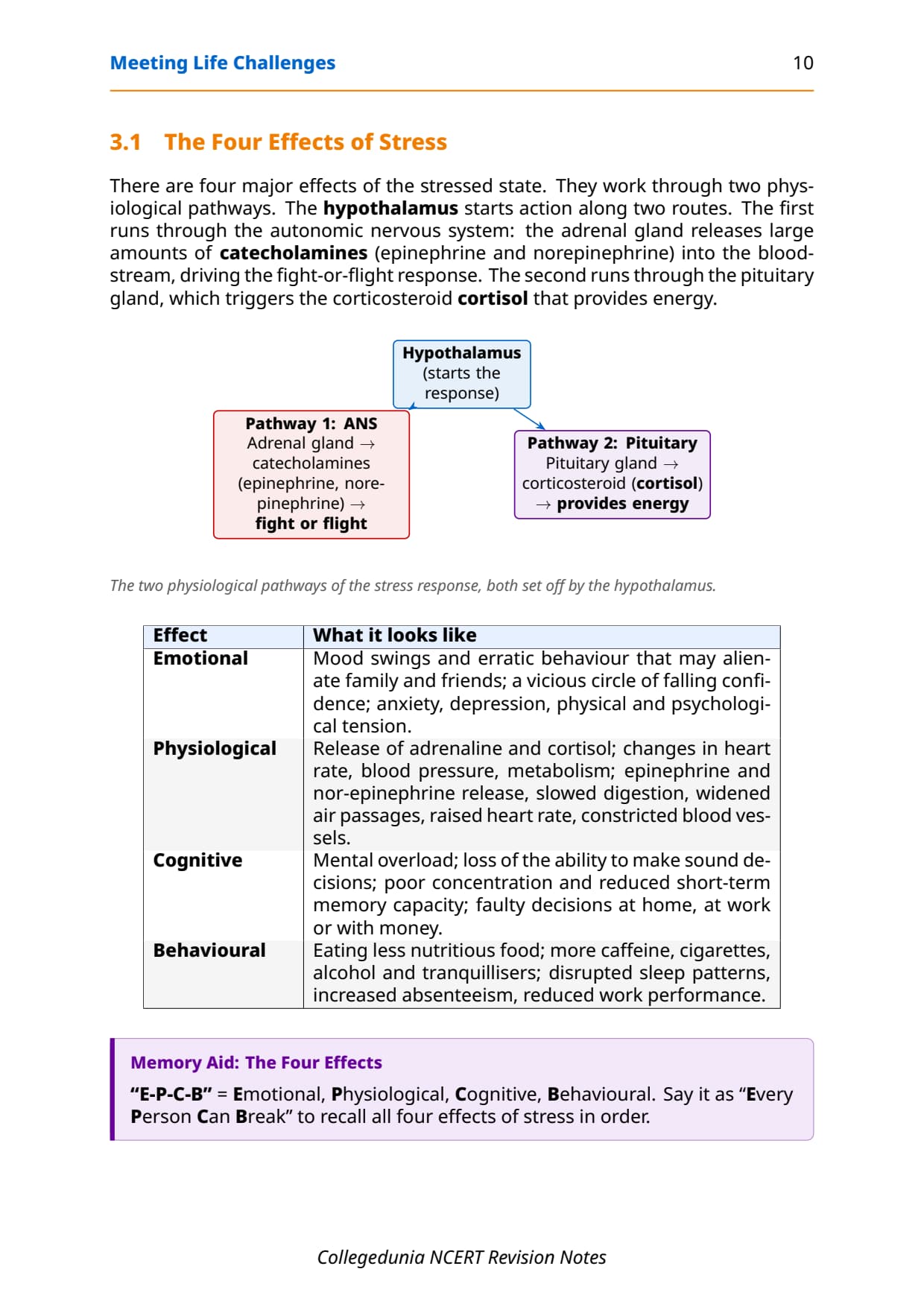
- The effects: the four effects of stress, the GAS model and the immune system.
- The management: coping styles, stress-management techniques, life skills and positive health.
So these notes are really about understanding stress and then managing it. If you sort each fact under nature, effects or management first, almost every question in meeting life challenges class 12 becomes easier to answer. Keep this three-part frame at the top of your revision sheet and slot each new detail into one of the boxes as you read.
The Nature, Types and Sources of Stress
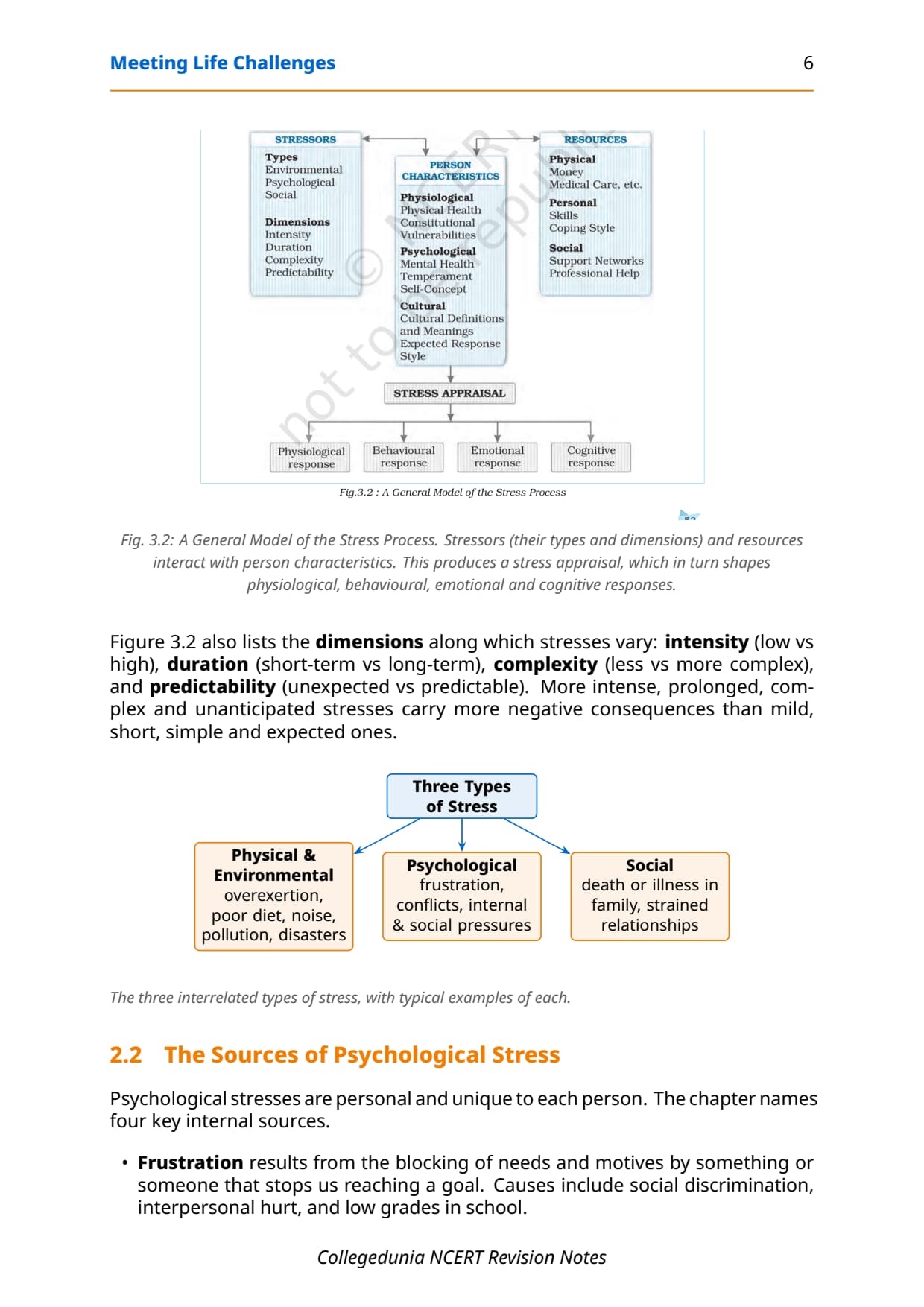
The first part of the chapter defines stress and lists where it comes from. These notes keep the symptoms and sources as clear lists, because the exam wants them in separate columns. Learn them as a comparison and you can answer any version of the question.
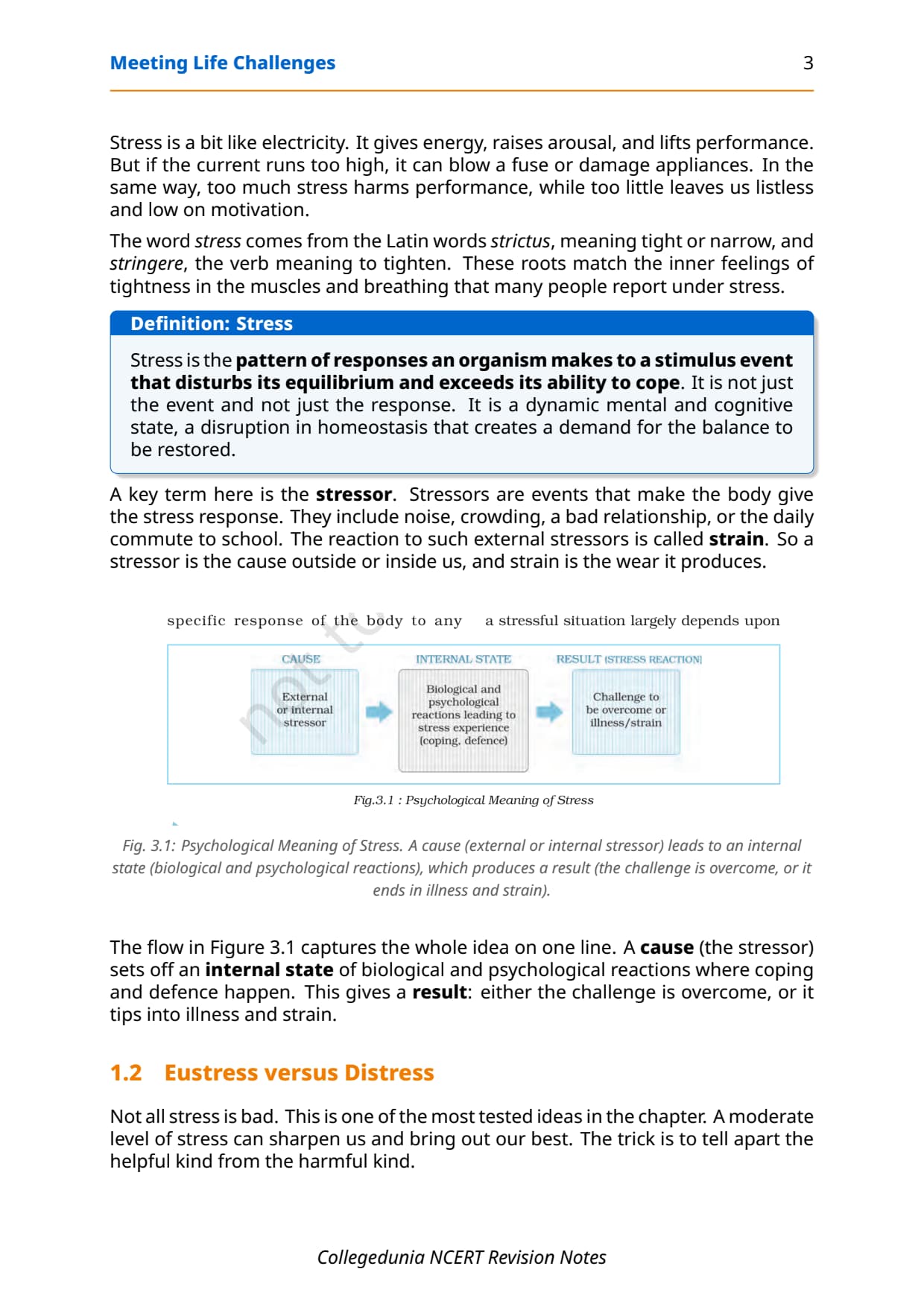
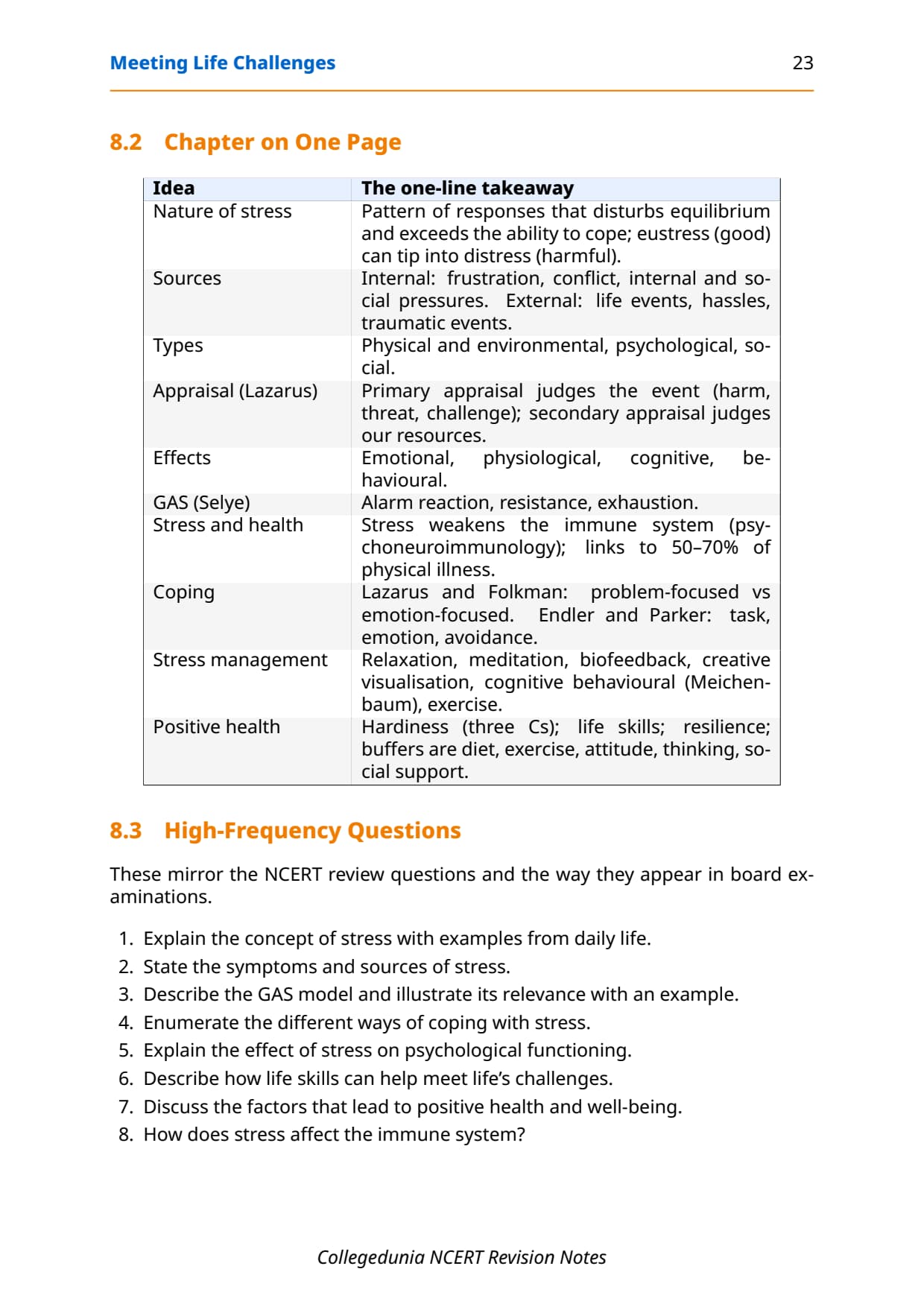
- Stress (Selye): the non-specific response of the body to any demand; the reaction is called strain.
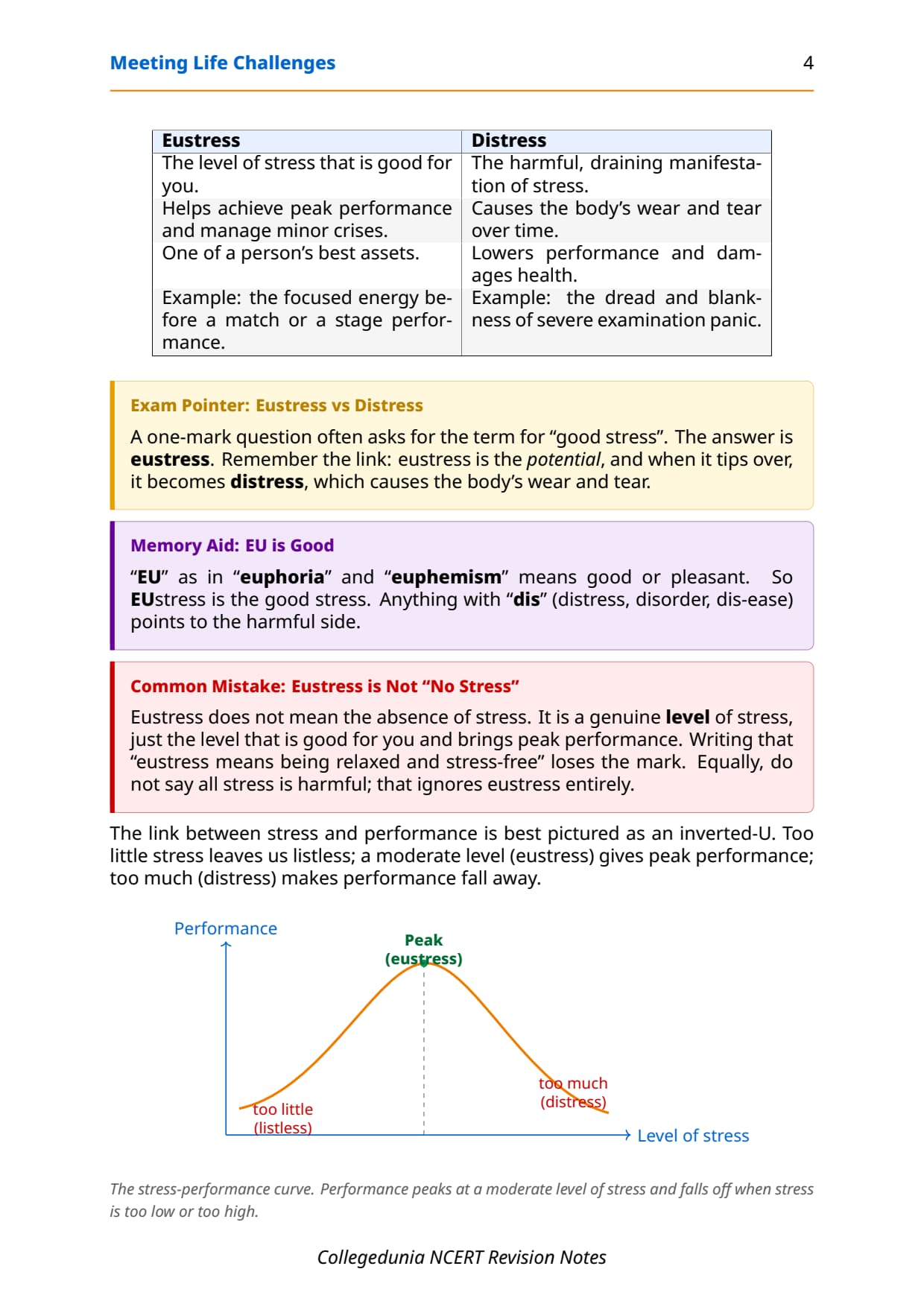
- Eustress and distress: good stress energises, harmful stress overwhelms.
- Symptoms: physical, emotional and behavioural signs that warn us we are under strain.
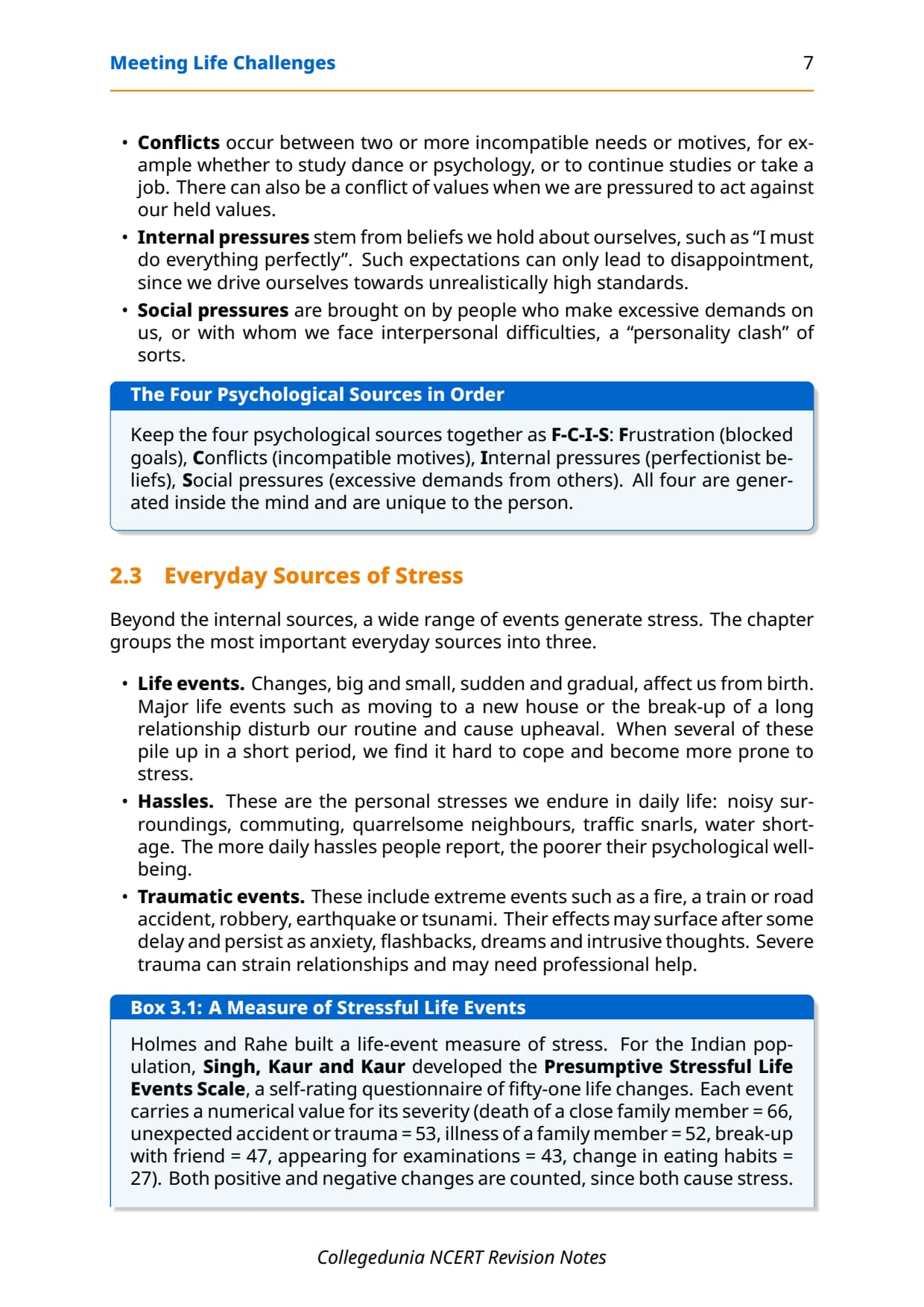
- Sources: life events (big changes), hassles (daily irritations) and traumatic events (extreme shocks).
The one-line takeaway for your sheet is that anxiety is a symptom, while the event that causes it is the source. A common slip is to write "anxiety" as a source of stress. Keep the symptom triad (physical, emotional, behavioural) and the source triad (life events, hassles, traumatic events) on separate lines, and the listing questions become quick marks.
The GAS Model and the Effects of Stress
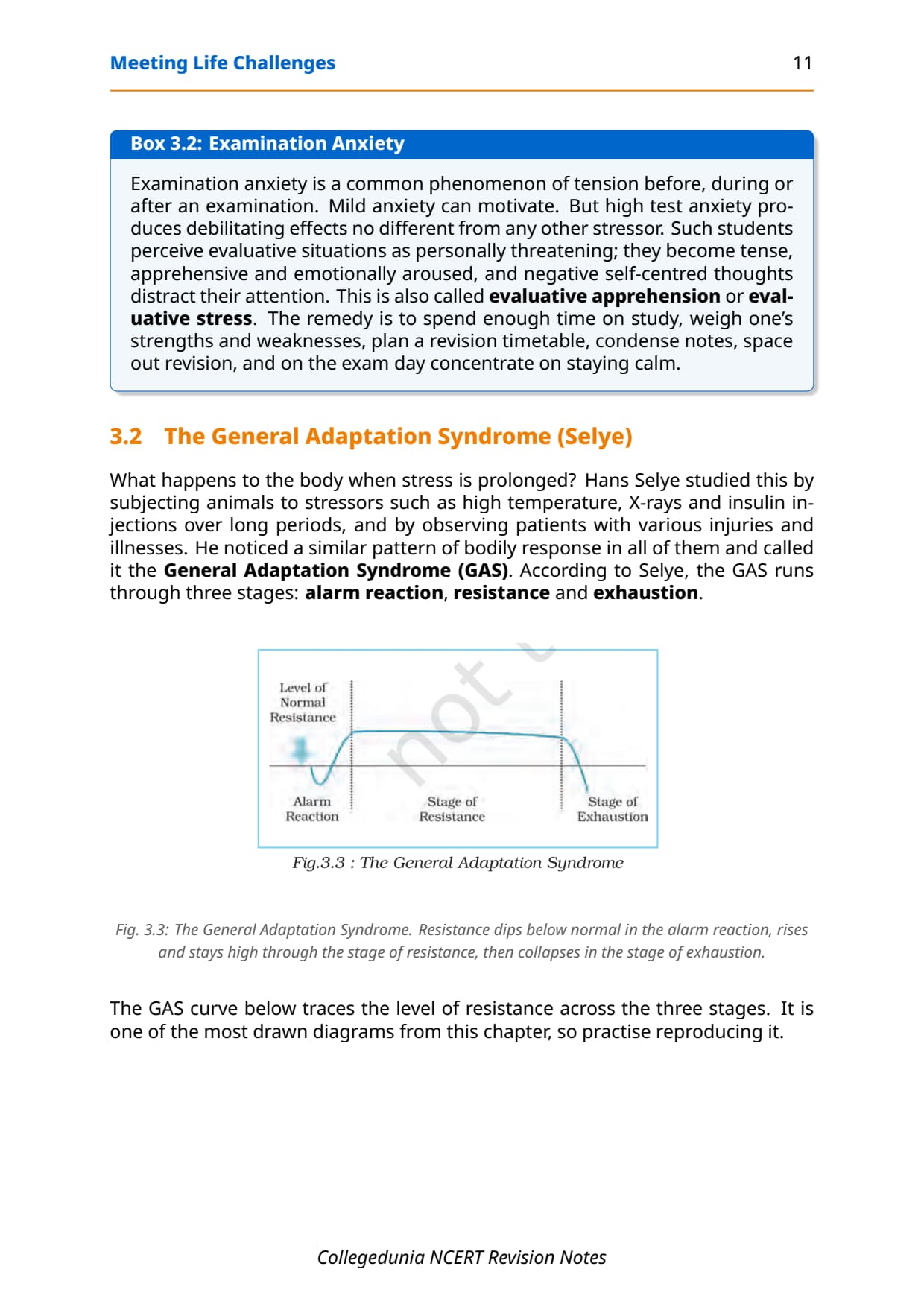
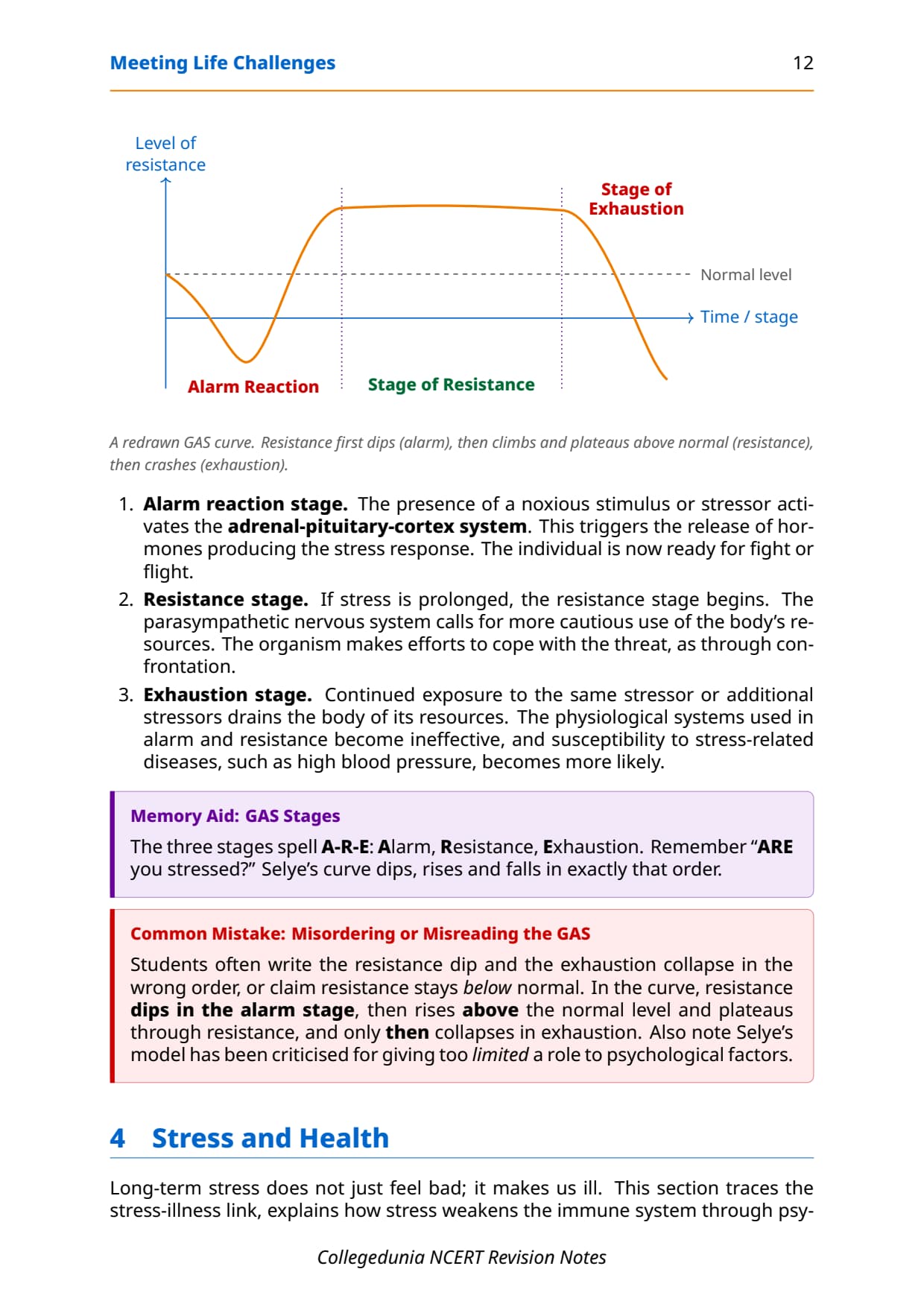
Selye's General Adaptation Syndrome and the four effects of stress are the heart of the "what stress does" section. These notes keep the GAS stages in order and the effects in a quick grid for fast revision.
| GAS stage | What to recall |
|---|---|
| Alarm reaction | Body readies for fight or flight; hormones released. |
| Resistance | Body settles in to cope; sustained, cautious effort. |
| Exhaustion | Resources drained; risk of stress-related disease rises. |
The sharp point for your notes is that long, unrelenting stress, not a single shock, wears the body down. The four effects of stress are emotional, physiological, cognitive and behavioural, and prolonged stress leads to burnout. Lead with the cognitive and emotional effects when a question asks about psychological functioning, since those answer it most directly.
Coping Styles, Stress Management and Life Skills
The management half of the chapter sets out two coping schemes, four stress-management techniques and six life skills. These notes keep the toolkit in one grid so students can pick the right label fast.
| Tool | What it means |
|---|---|
| Endler and Parker | Task-oriented, emotion-oriented and avoidance-oriented strategies. |
| Lazarus and Folkman | Problem-focused and emotion-focused styles. |
| Stress management | Relaxation, meditation, biofeedback and exercise. |
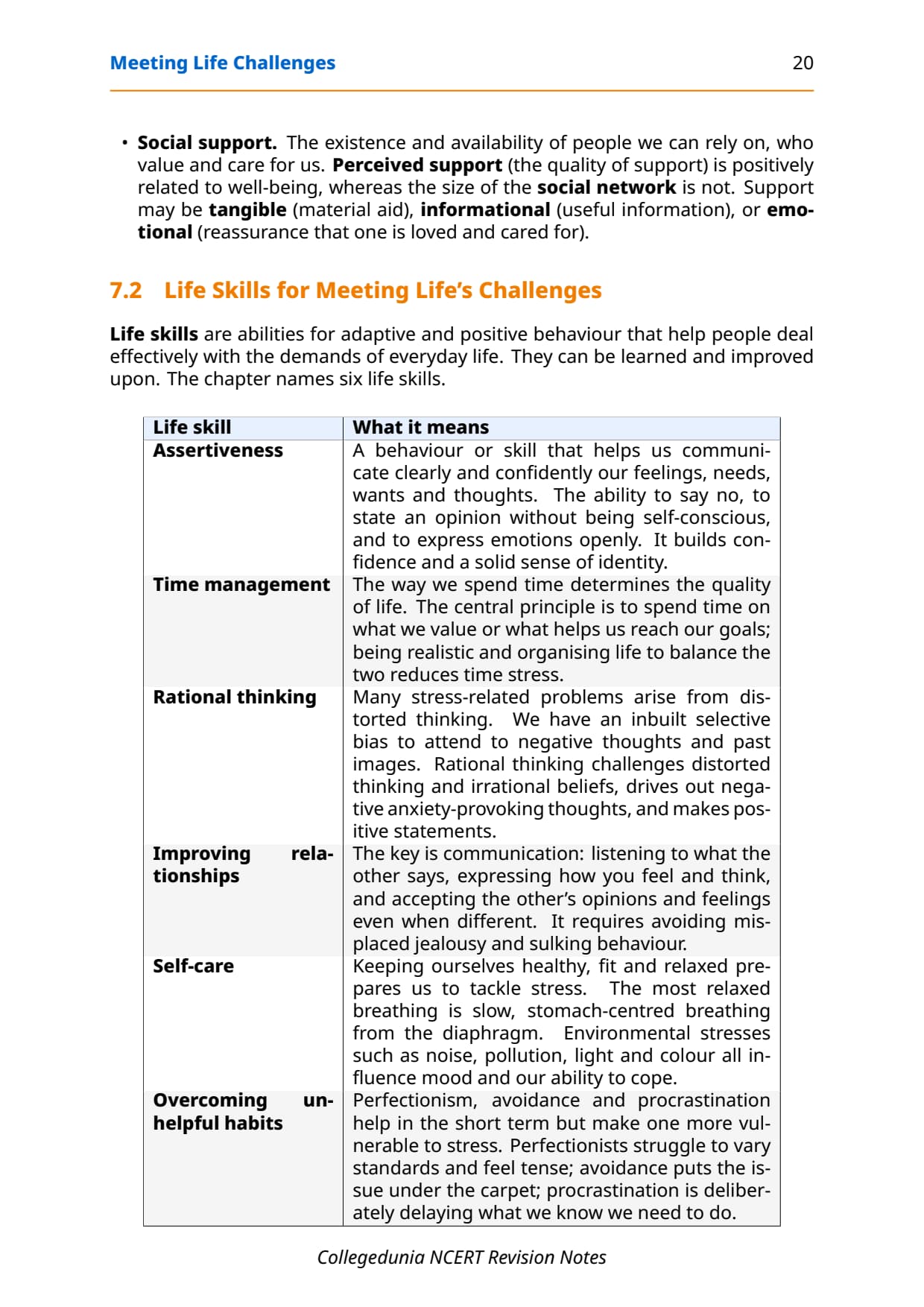
| Life skills | Assertiveness, time management, rational thinking, relationships, self-care, dropping unhelpful habits. |
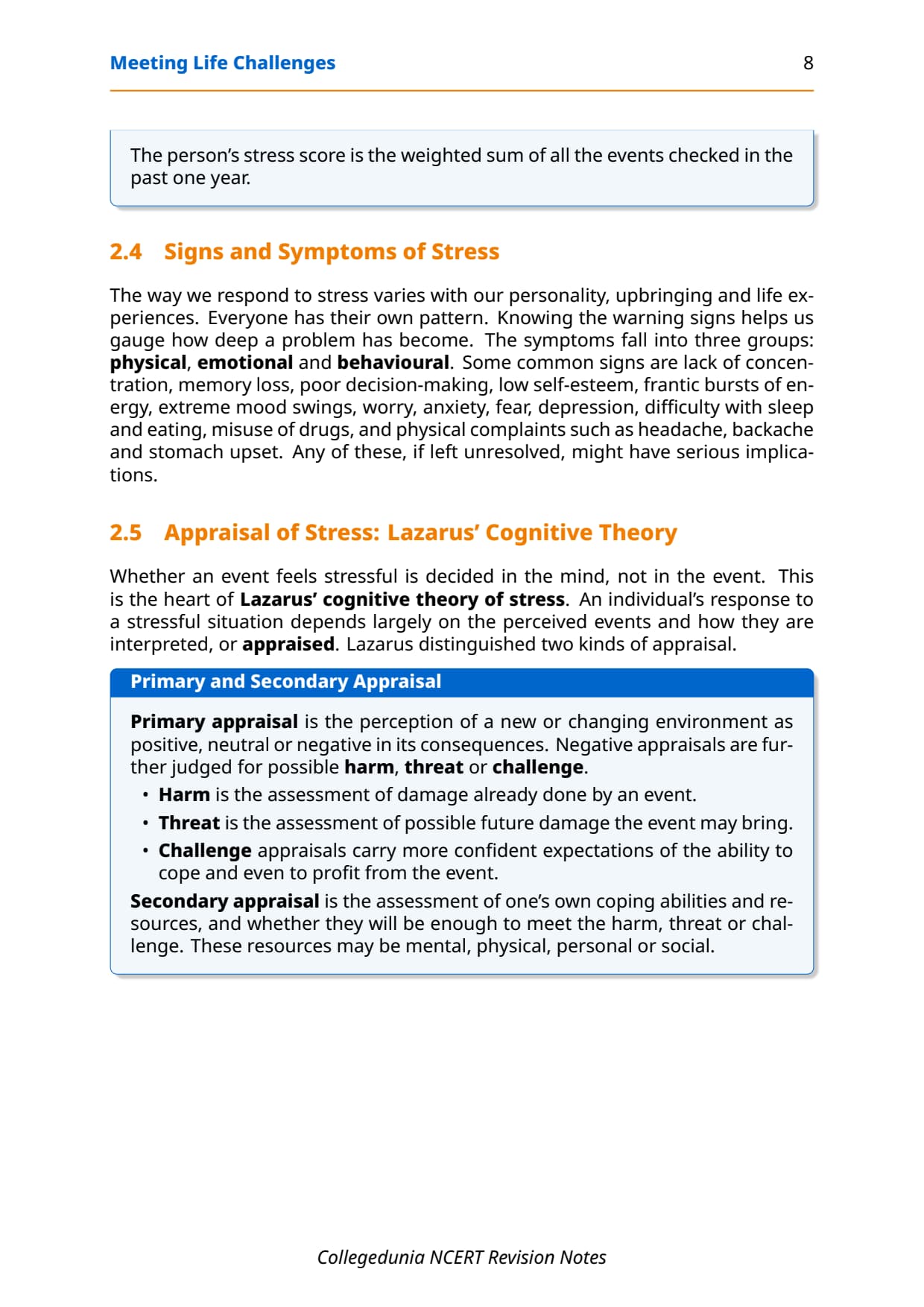
The takeaway here is that problem-focused, task-oriented coping is used more often and solves the problem, while avoidance gives only short-term relief. Life skills work because they act at the appraisal stage, turning a threat into a manageable challenge. The good news the chapter ends on is that life skills can be learned and improved with practice.
Positive Health, Hardiness and Resilience
The last part of the chapter explains what keeps us well in spite of stress. These notes list the five buffers plus the hardiness and resilience ideas, so students can write a complete "positive health" answer.
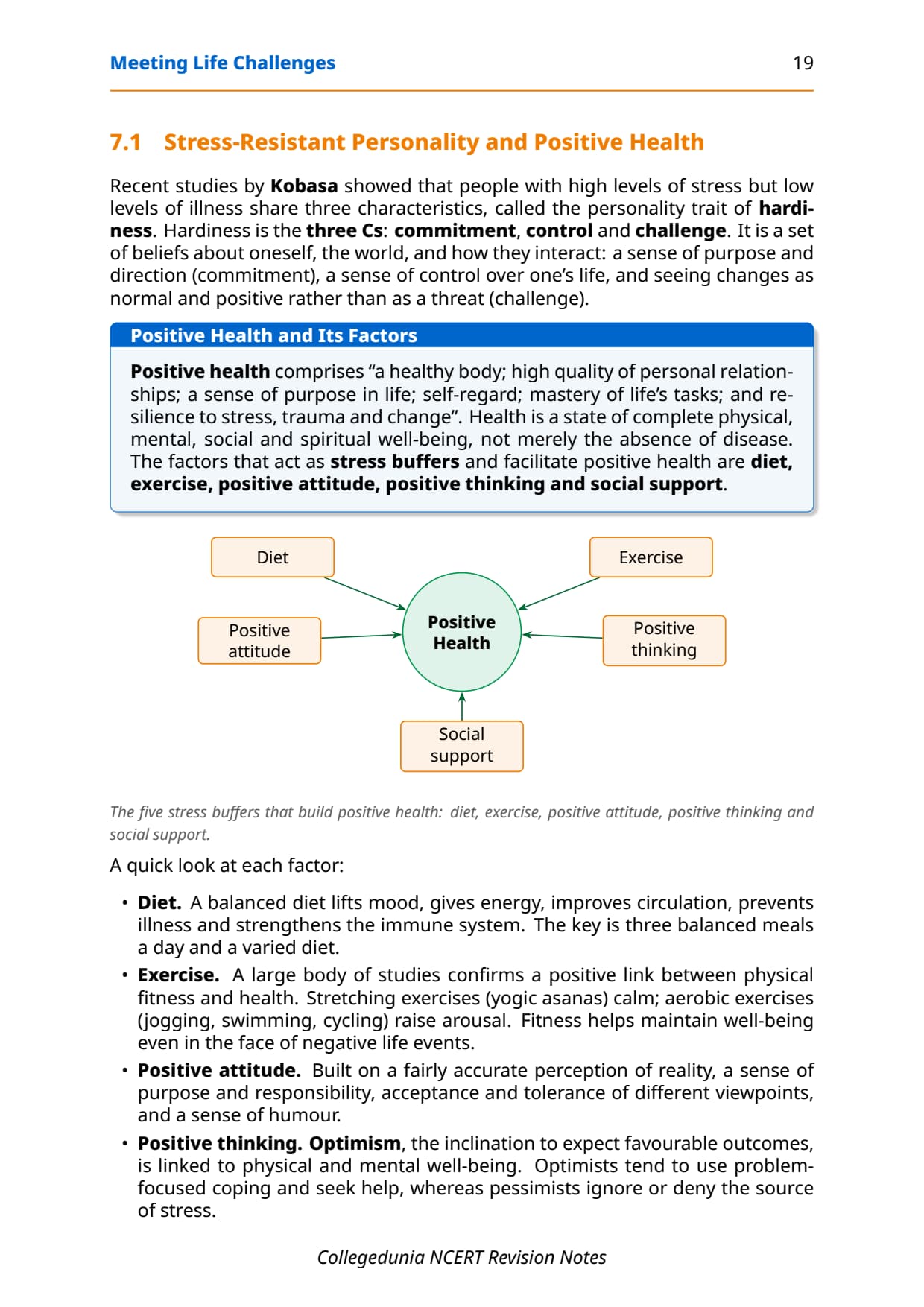
- Five stress buffers: balanced diet, regular exercise, a positive attitude, optimistic thinking and social support.
- Positive health: a healthy body, good relationships, a sense of purpose, self-regard and resilience.
- Hardiness (the three Cs): commitment, control and challenge (Kobasa).
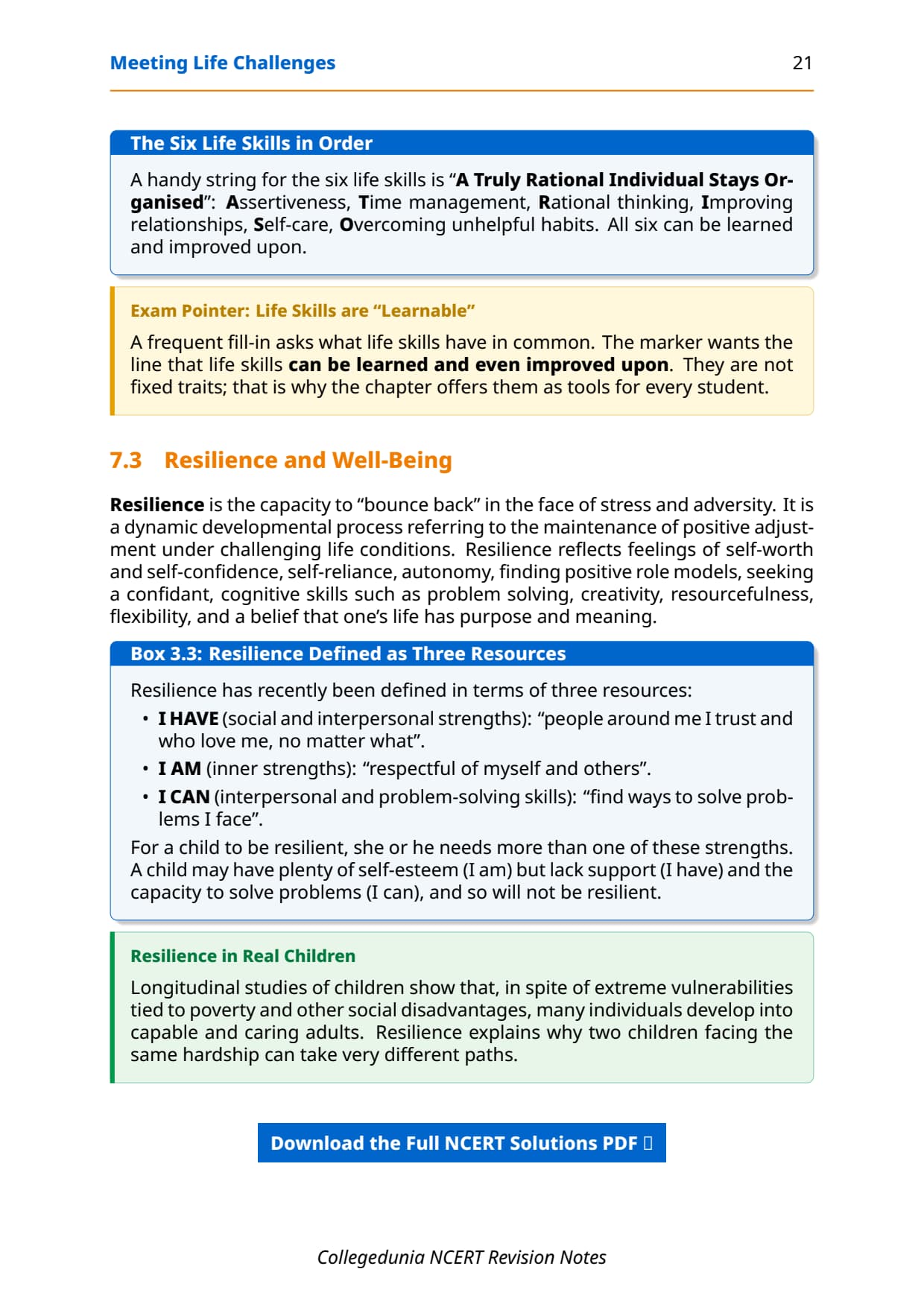
- Resilience: the capacity to bounce back, built on the resources I HAVE, I AM and I CAN.
The note to box is that it is the quality of social support (perceived support), not the sheer number of contacts, that protects health. Keep diet and exercise (body), positive attitude and optimism (mind-set), and social support (people) on one mental shelf, and the discussion answer writes itself.
Meeting Life Challenges Important Questions and Exam Pointers
CBSE sets a steady mix of short, long and case-based answers from this chapter. Knowing the pattern helps students decide how much to write and which topics to revise first. A focused list of meeting life challenges important questions saves a lot of time before the board exam.
- Long answer (6 marks): the GAS model with an example, the four effects of stress, or the life skills.
- Short answer (3 to 4 marks): coping strategies, sources of stress, or stress and the immune system.
- Case-based: a short scene where students label symptoms, sources or coping styles.
- Objective and recall: Selye, Lazarus, the three Cs of hardiness, and psychoneuroimmunology.
For quick recall, students often practise a short class 12 psychology chapter 3 mcq drill and a list of meeting life challenges class 12 important questions. The most repeated items are the GAS stages and the two coping schemes, so keep those answer points ready in your own words. Reading these notes once, then writing the key lists from memory, is the fastest way to lock the chapter in.
Common Mistakes Students Make in This Chapter
A few errors cost marks every year. Most come from mixing up symptoms with sources or giving the GAS model without an example. Fixing these five points is the quickest way to lift a score, so add them to the end of your revision sheet.
- Listing "anxiety" as a source of stress, when it is a symptom; the source is the event behind it.
- Describing the GAS model but forgetting to illustrate it with an example.
- Giving only one coping scheme, when the full answer needs both Endler and Parker and Lazarus and Folkman.
- Treating "psychological functioning" as emotion only, and skipping the cognitive effects.
- Reducing harmful lifestyle habits to "weak willpower", when the point is reward now versus distant risk.
Students who fix these five points usually move from average to high marks. The exam rewards precise vocabulary, so always use the chapter's own terms, such as psychoneuroimmunology, appraisal and burnout. These notes flag each soft point so you can phrase it safely in the answer sheet.
How These Notes Pair with the Solutions and Book PDF
These revision notes summarise the chapter. To prepare fully, students should use them alongside the other resources for the same chapter, all linked in the table below. Read the notes first, then test yourself with the solutions, and open the book PDF whenever you need the original text and figures.
| Resource | Best used for |
|---|---|
| Meeting Life Challenges NCERT Solutions | Step-by-step answers to all 12 review questions |
| Meeting Life Challenges Handwritten Notes | Last-minute, one-shot revision in a scanned notebook style |
| Meeting Life Challenges NCERT Book PDF | Reading the original NCERT chapter text and figures |
Tip: read these notes first, then attempt the solutions on your own, and only then check the model answers. That order builds memory faster than copying answers straight away.
All Class 12 Psychology Notes by Chapter
The table links the revision notes for every Class 12 Psychology chapter, so students can move across the course in one click. Meeting Life Challenges is highlighted.
| Chapter | Notes |
|---|---|
| Chapter 1 | Variations in Psychological Attributes |
| Chapter 2 | Self and Personality |
| Chapter 3 | Meeting Life Challenges |
| Chapter 4 | Psychological Disorders |
| Chapter 5 | Therapeutic Approaches |
| Chapter 6 | Attitude and Social Cognition |
| Chapter 7 | Social Influence and Group Processes |
FAQs on Meeting Life Challenges Class 12 Notes
Meeting Life Challenges Class 12 Psychology Notes Common Questions
Ques. Where can I download the Meeting Life Challenges Class 12 notes PDF?
Ans. You can download the Meeting Life Challenges Class 12 Psychology notes PDF directly from this page. It is free, follows the 2026-27 NCERT, and covers the nature of stress, the GAS model, the coping schemes and life skills in a short, point-wise format.
Ques. What does the Meeting Life Challenges chapter cover for Class 12?
Ans. It covers the nature, types and sources of stress, appraisal, the four effects of stress, Selye's General Adaptation Syndrome, stress and the immune system, coping styles, stress-management techniques, life skills and the factors behind positive health.
Ques. What are the three stages of the General Adaptation Syndrome?
Ans. The three stages are alarm reaction (the body readies for fight or flight), resistance (the body settles in to cope) and exhaustion (resources drain and disease risk rises). The notes box each stage so students write them in the right order.
Ques. Why is Meeting Life Challenges important for the board exam?
Ans. Because it is a high-scoring chapter where the GAS model, the four effects of stress and the life skills appear almost every year. Revising these notes well secures both short and long-answer marks, especially the GAS question that asks for an example.
Ques. How should I use these notes to revise quickly?
Ans. Read the notes once under the nature, effects and management frame, keep the GAS stages and the coping schemes on one sheet, then write the key lists from memory. Finish by attempting a short class 12 psychology chapter 3 mcq drill to test the small facts.



Comments