




These Recent Developments in Indian Politics Class 12 Notes give a quick, exam-ready summary of Indian politics after 1989, set to the 2026-27 CBSE syllabus. The notes pull together every key date, term and idea from Chapter 8 of Politics in India Since Independence. Students can use them for a fast revision the night before a test or to fix the main ideas before they attempt the back-exercise questions.
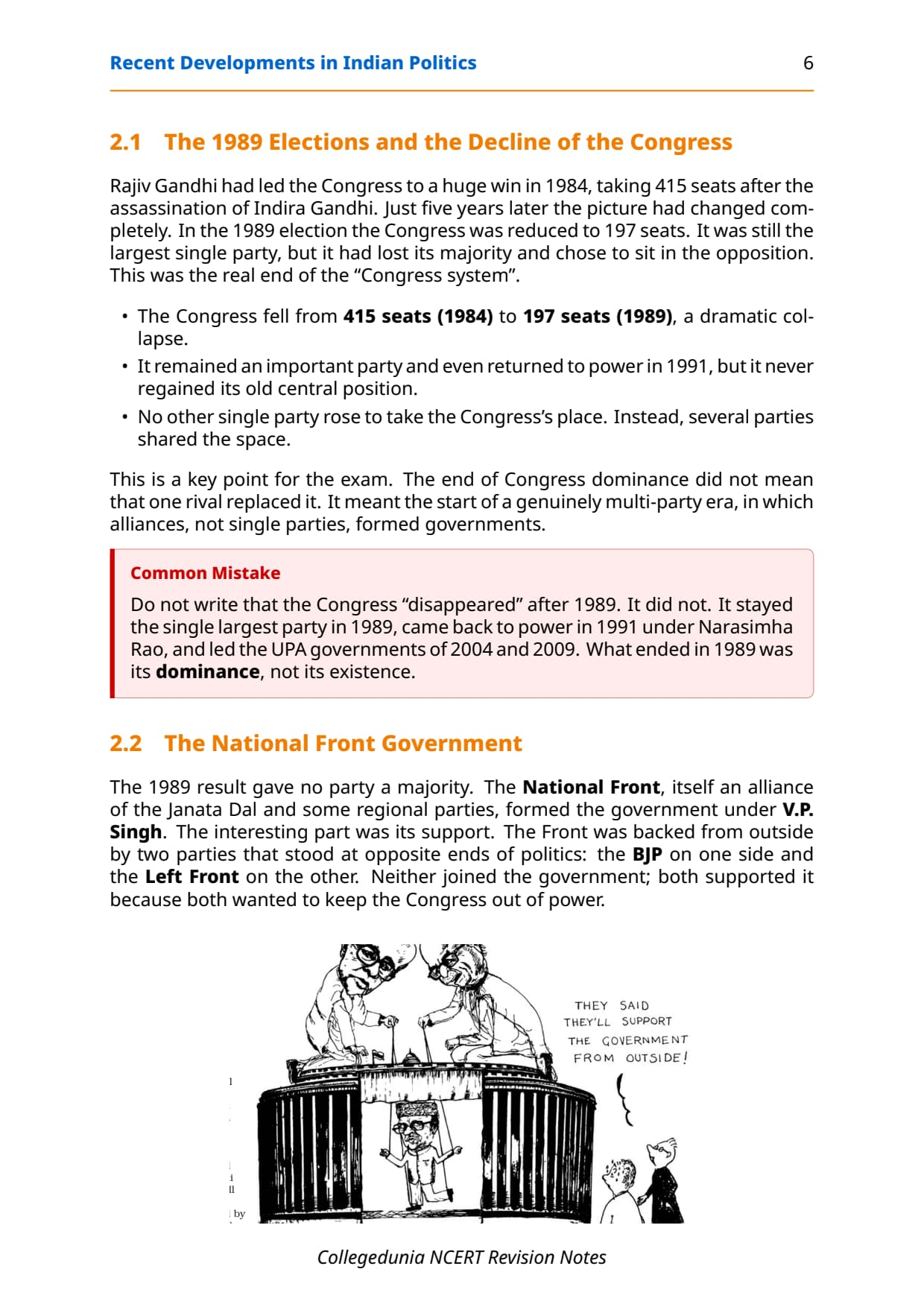
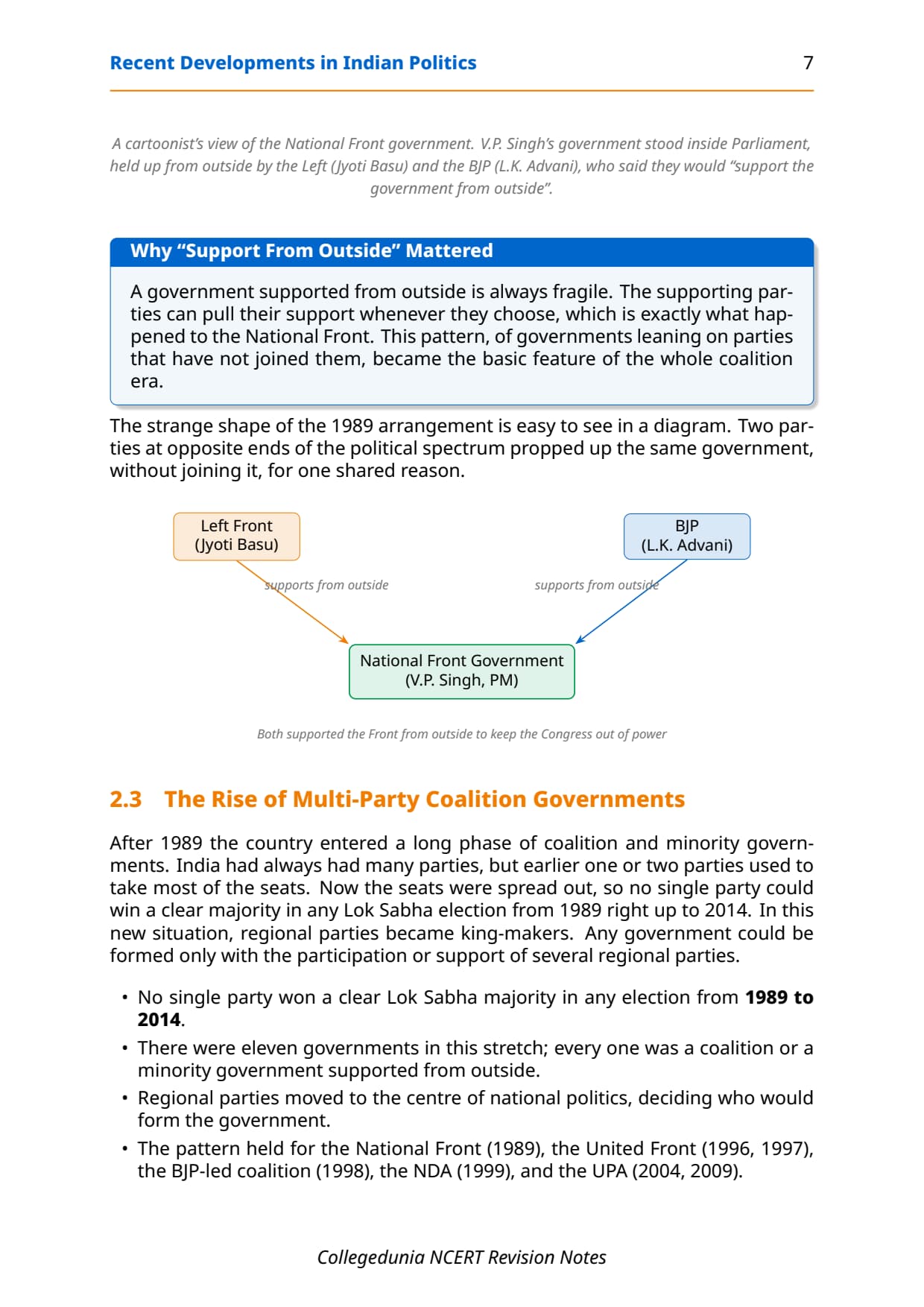
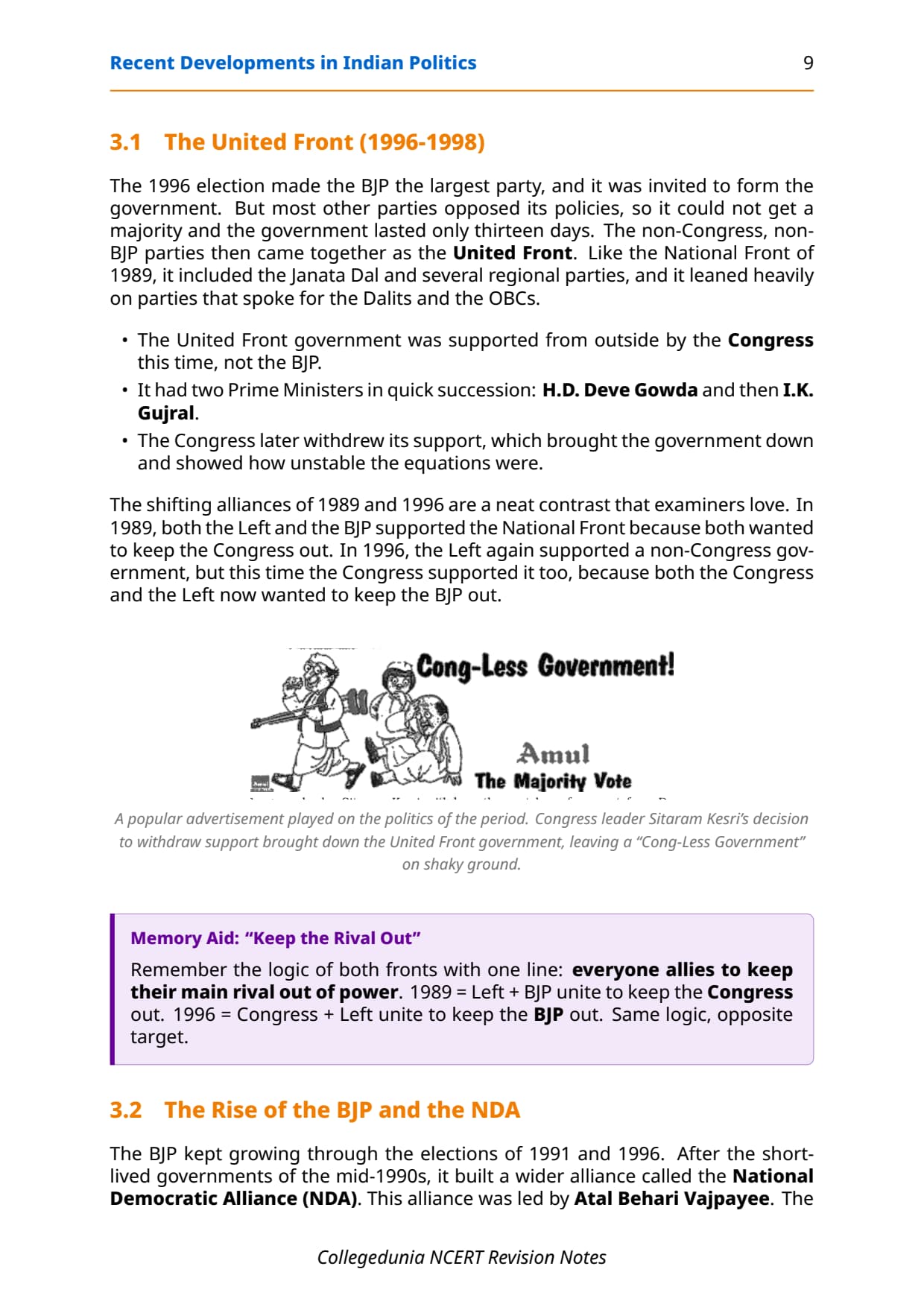
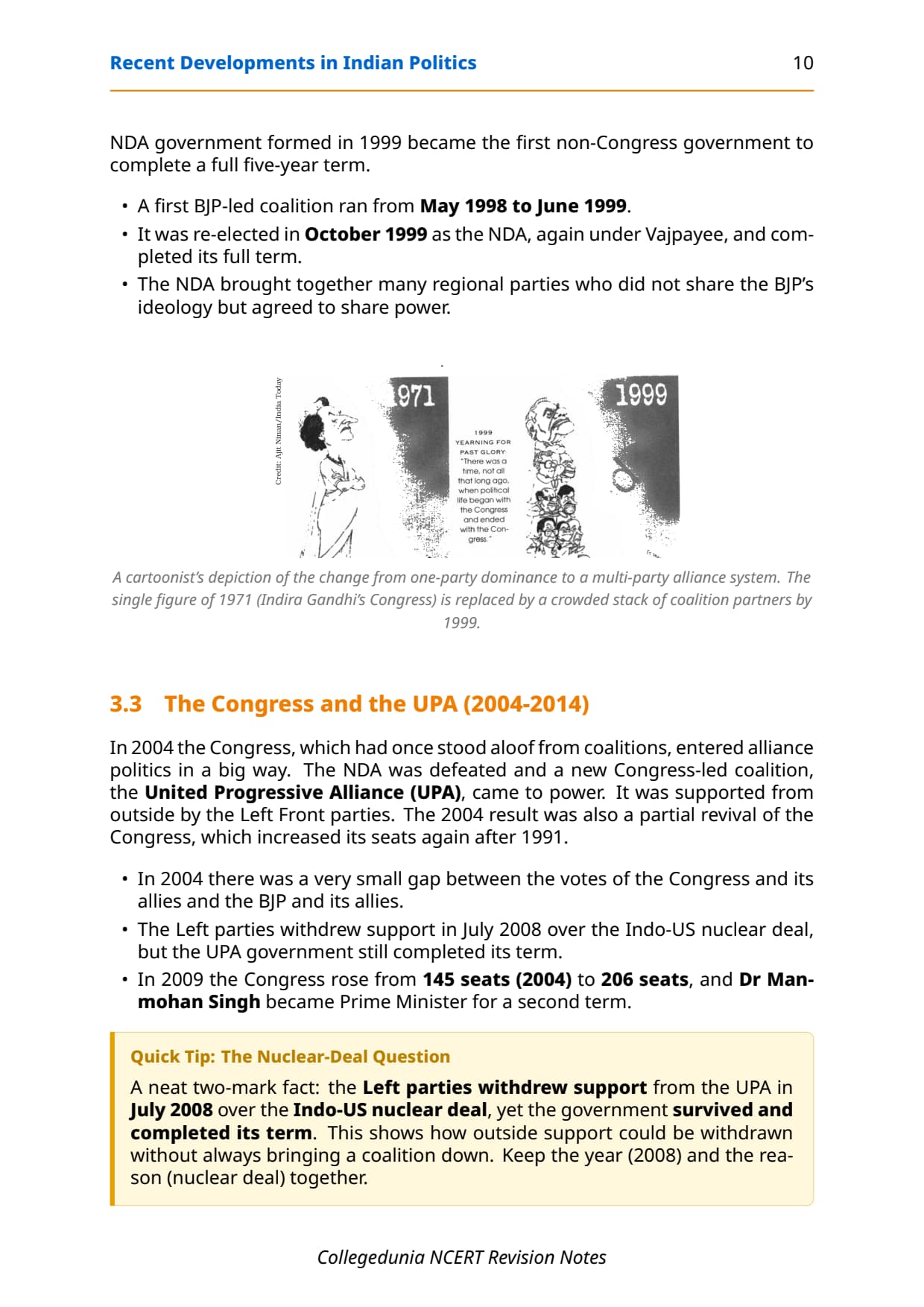
- Covers the end of Congress dominance, the coalition era, Mandal, Ayodhya and the new consensus in one place.
- This Class 12 Political Science chapter usually carries 5 to 6 marks in the board paper.
- Pairs with the NCERT Solutions, Handwritten Notes and Book PDF linked lower on this page.
These Recent Developments in Indian Politics Class 12 notes are written from the official NCERT Politics in India Since Independence textbook and checked against the last five years of CBSE board papers.
Student Feedback: In a Collegedunia poll of 8,470 Class 12 Political Science students taken before the 2026 boards, 72% of students said short, point-wise notes on the coalition timeline and the four-part consensus were the fastest way to revise this chapter. Most students kept the dates and key terms on a single sheet for last-minute recall.
Source: 2026-27 Class 12 Political Science student poll. Sample of 8,470 students from CBSE schools across 12 states.
What the Recent Developments Notes Cover
Recent Developments in Indian Politics is the last chapter of Politics in India Since Independence. It takes a wide view of Indian politics after 1989, the year the long "Congress system" ended. Before this, the Congress was the central party; after it, no single party could win a majority, so India entered a long era of coalitions.
The easiest way to organise your revision is to split the chapter into four threads:
- Decline: the end of Congress dominance after the 1989 election.
- Coalitions: the National Front, United Front, NDA and UPA governments.
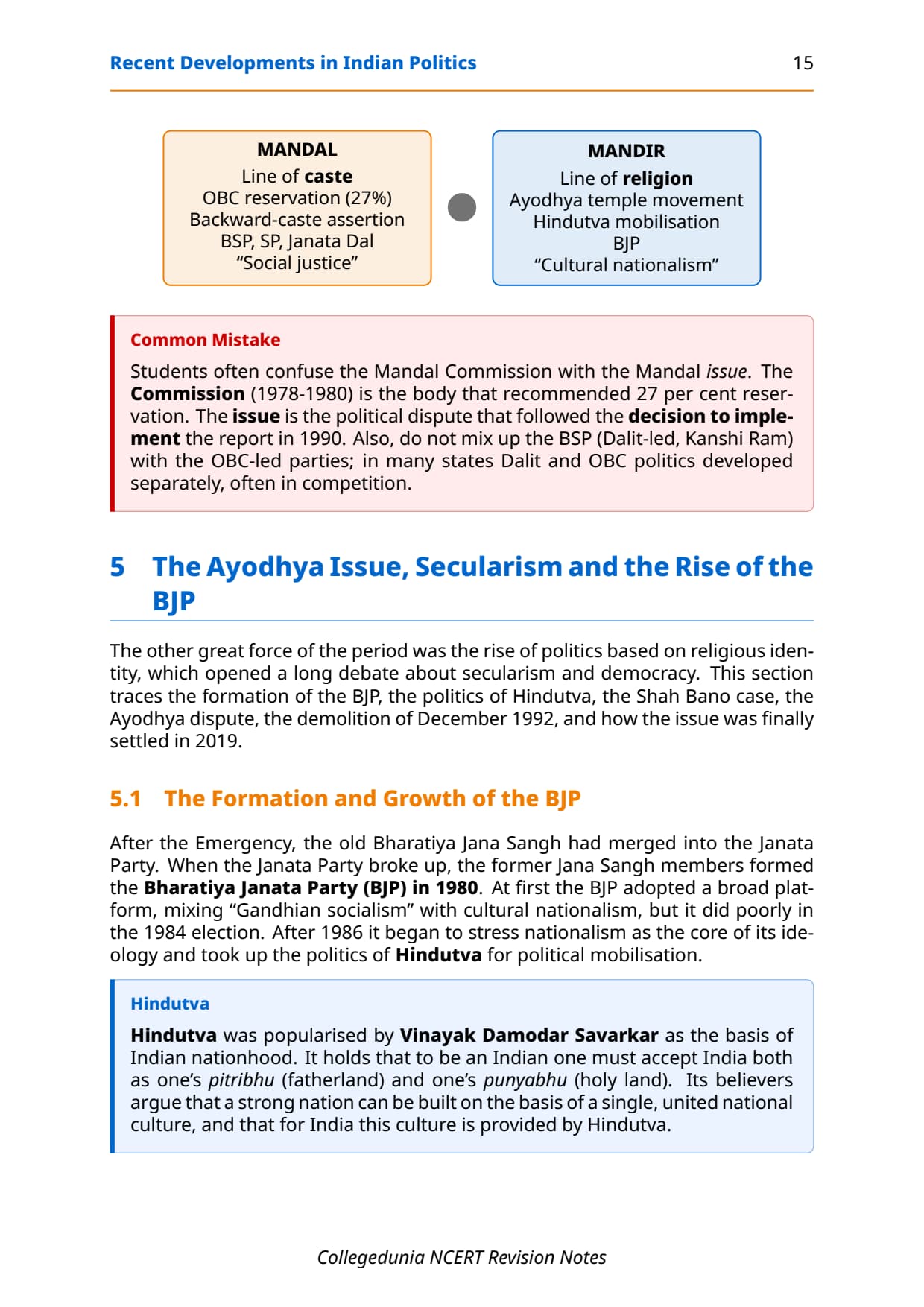
- Mandal and Mandir: the OBC reservation issue and the Ayodhya dispute.
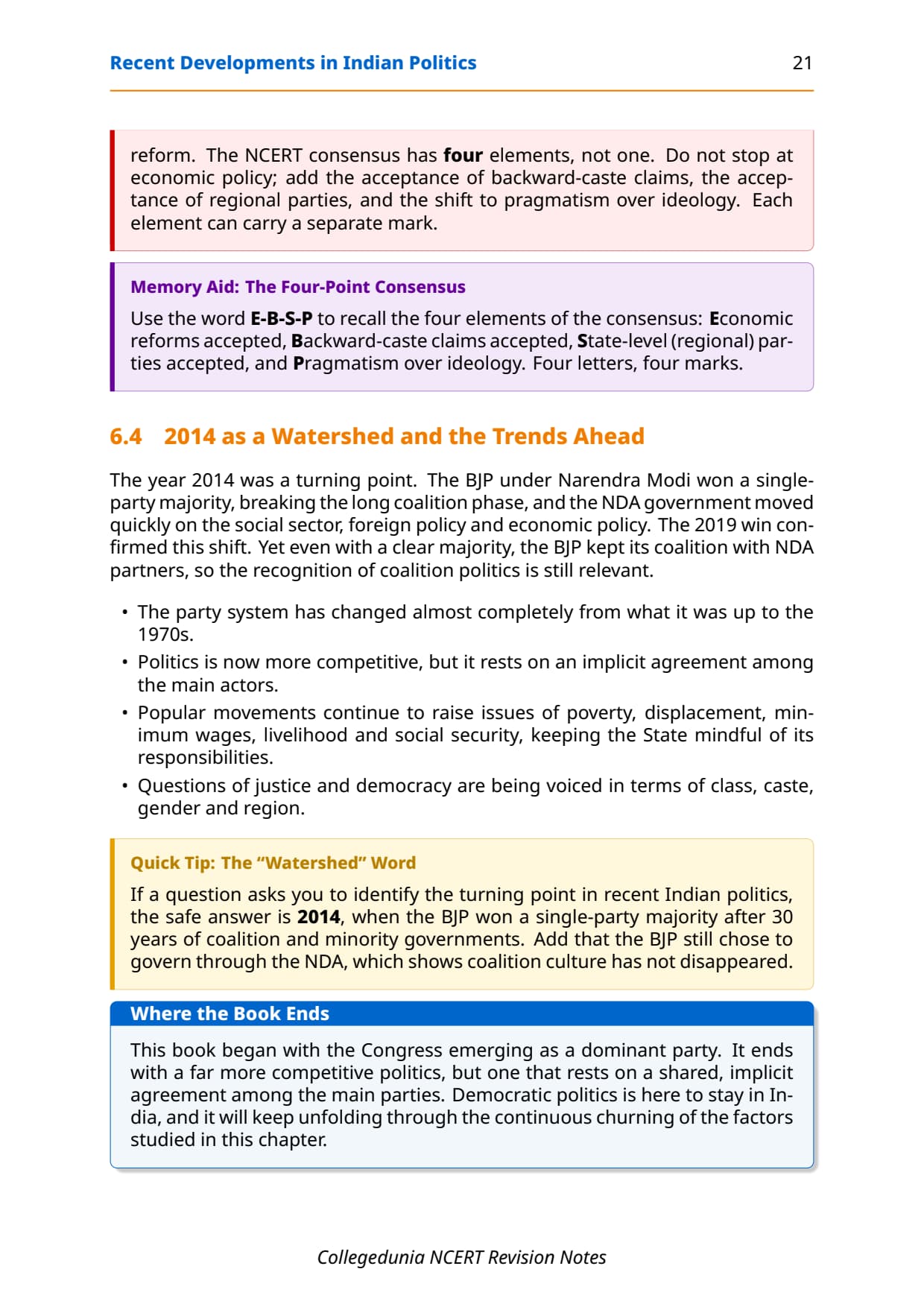
- Consensus: the four-part agreement most parties came to share.
So these notes are really about how India moved from one dominant party to a settled contest between two big coalitions. If you sort each fact under decline, coalitions, Mandal-Mandir or consensus first, almost every question in recent developments in Indian politics class 12 becomes easier to answer. Keep this four-part frame at the top of your revision sheet.
End of Congress Dominance and the 1989 Election
The chapter opens with the moment the Congress lost its central place. For quick revision, learn the key numbers and what they meant as a short, boxed list you can copy straight onto the answer sheet.
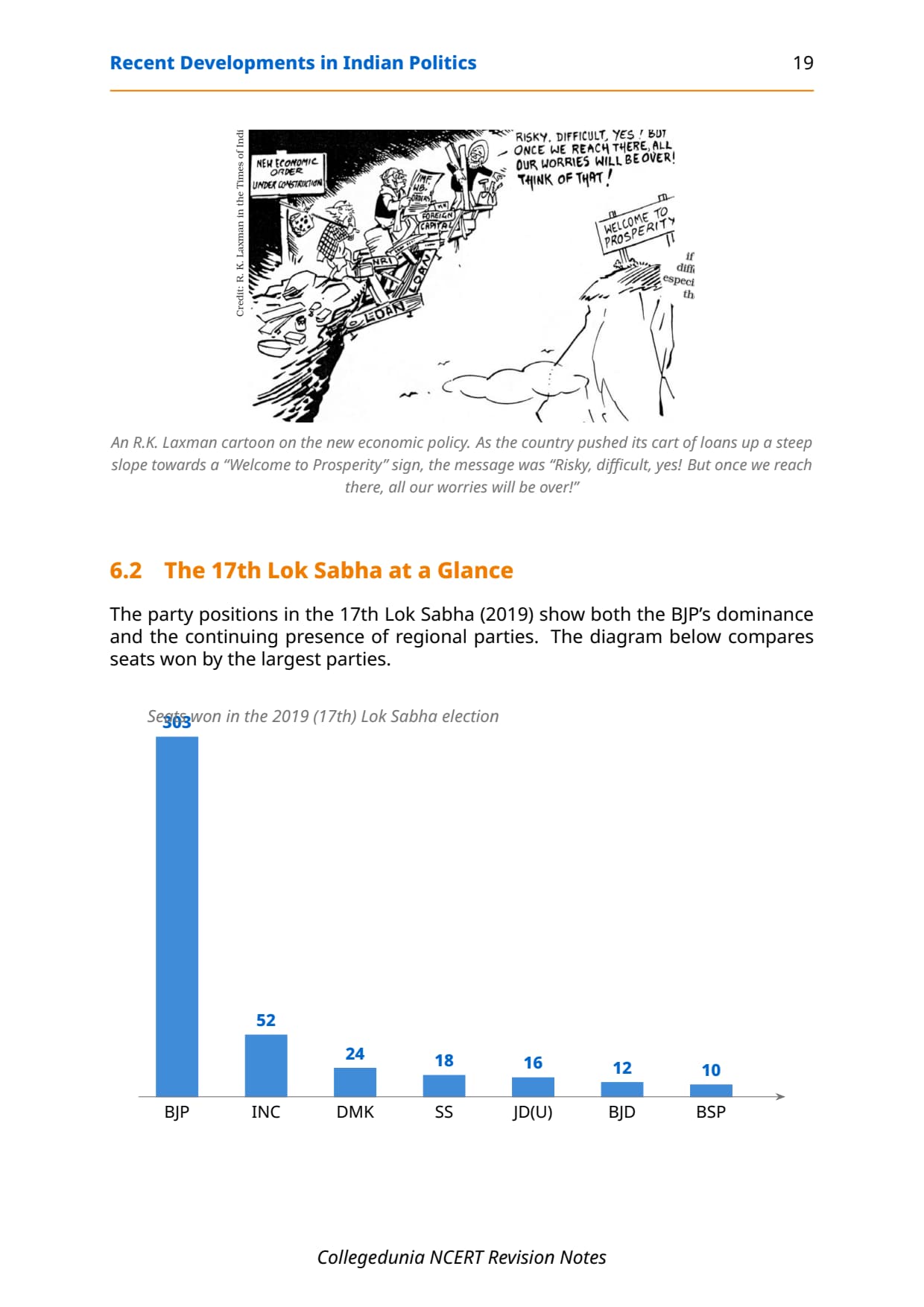
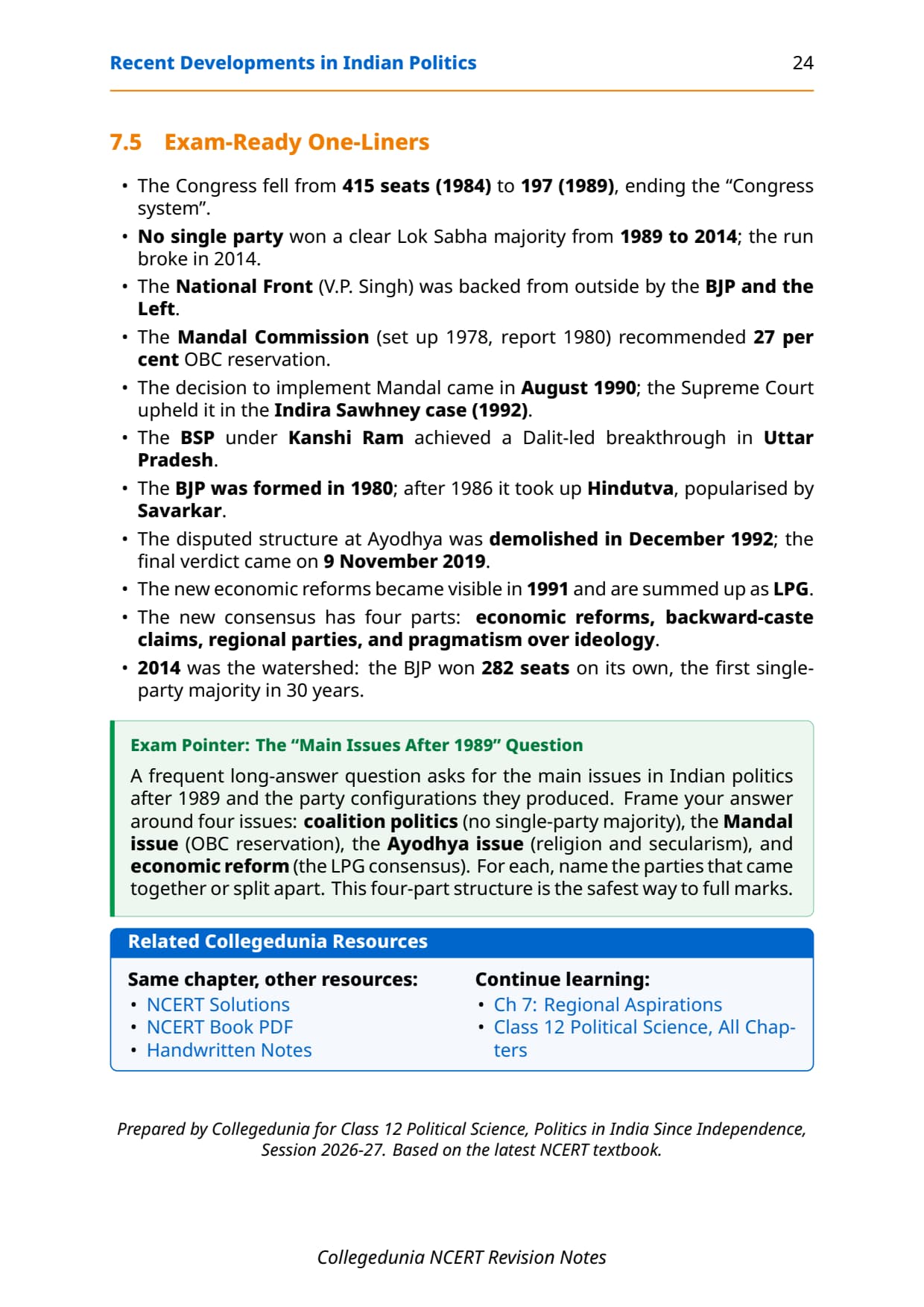
- The 1989 result: the Congress fell from 415 seats in 1984 to only 197, losing its majority.
- What ended: the centrality the party had held since Independence, the "Congress system".
- What did not end: the Congress stayed a major party and ruled the most across this period.
- The new shape: competition and coalitions replaced one-party dominance.
The point examiners test most is that decline of dominance is not the same as defeat. The Congress lost its all-powerful position but kept a large influence: it returned to power in 1991 and led the UPA in 2004 and 2009. Keep this distinction ready, because the "do you agree" question turns on it.
The Era of Coalitions: National Front to UPA
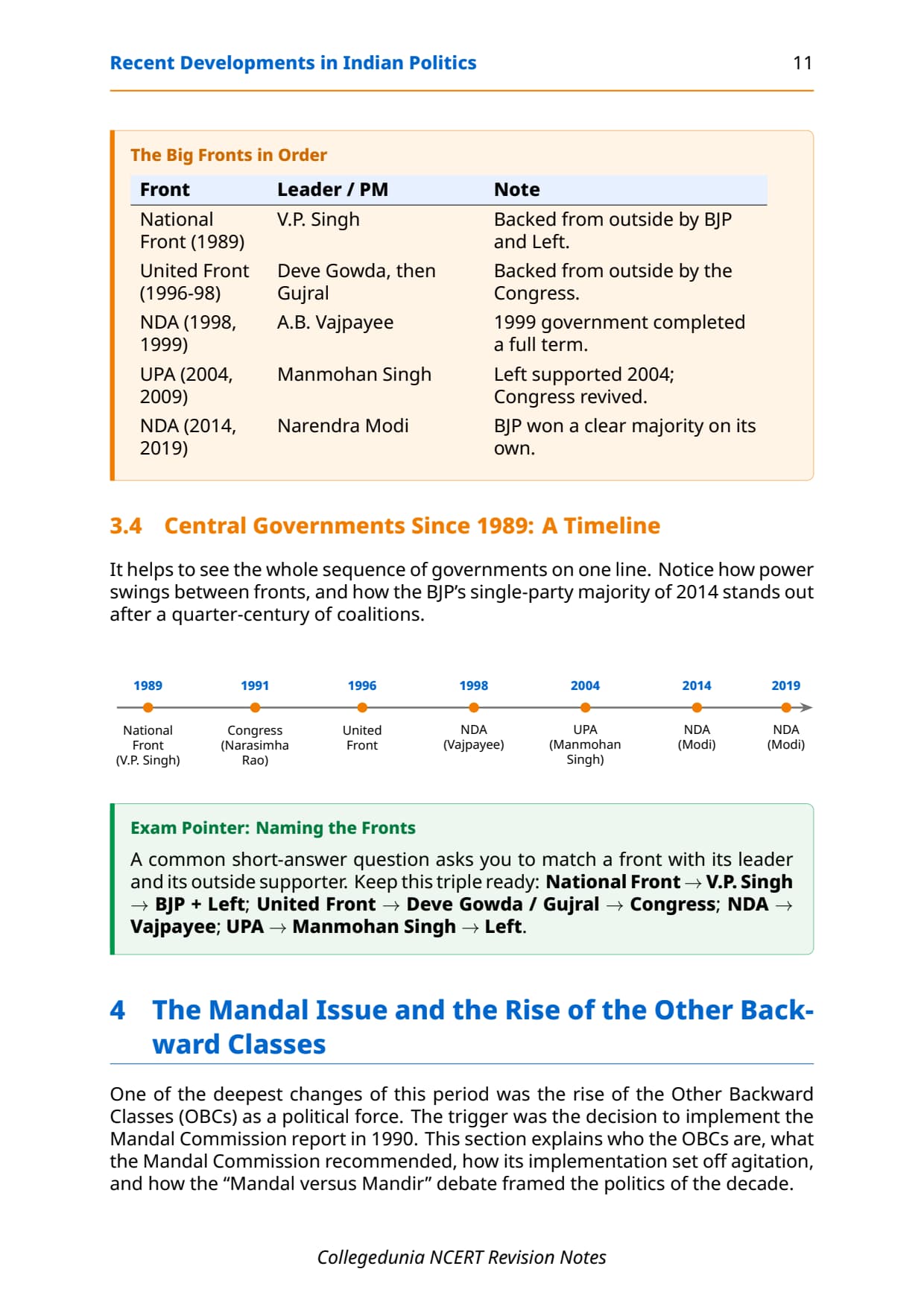
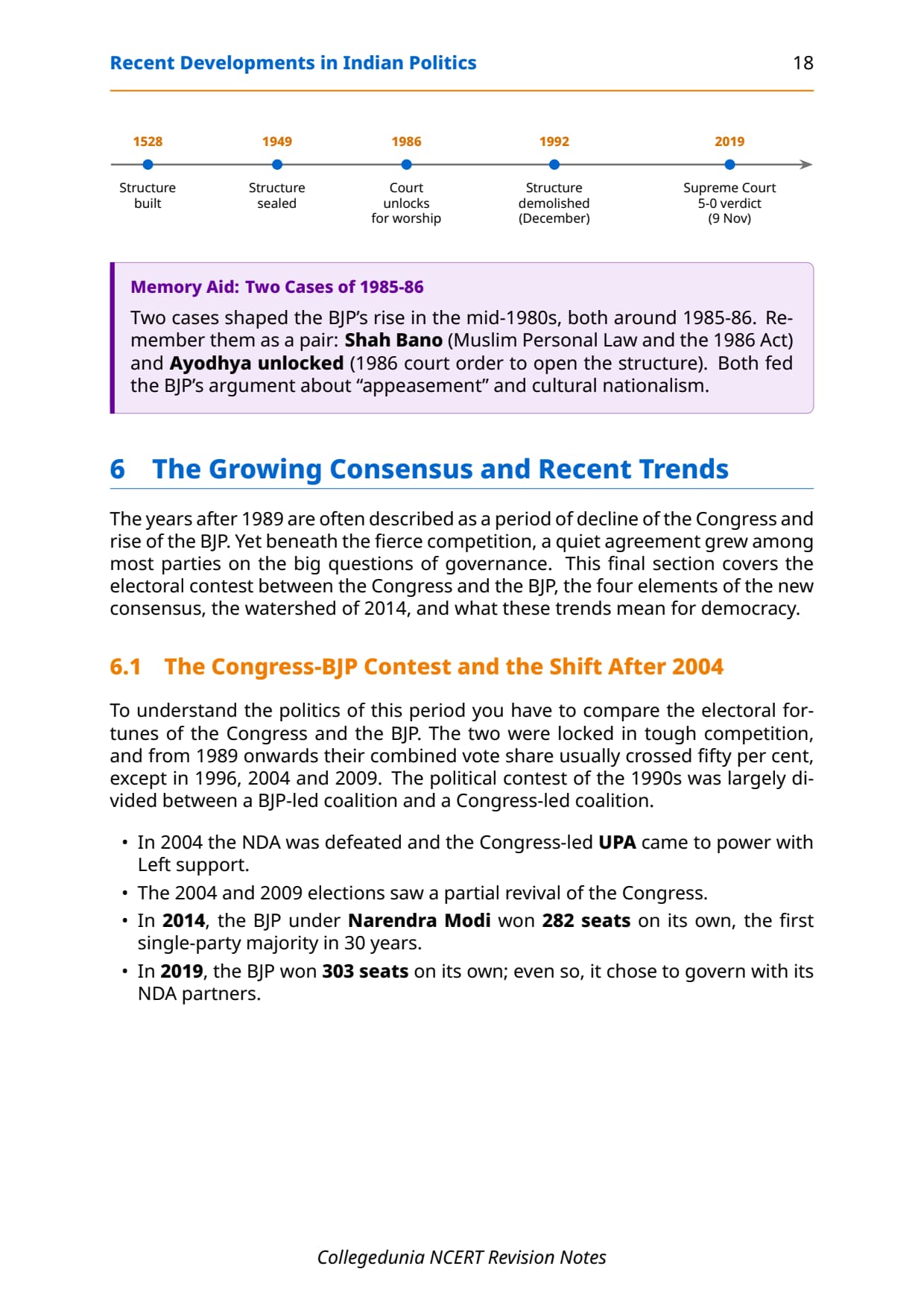
After 1989 no party won a majority in any Lok Sabha election right up to 2014. These notes keep the coalition governments as a clear table rather than a story, so students can recall the order and the logic in one glance.
| Coalition (year) | What to recall |
|---|---|
| National Front (1989) | Janata Dal plus regional parties, backed from outside by the BJP and the Left, both keen to keep the Congress out. |
| United Front (1996) | Janata Dal plus regional parties again, this time backed by the Congress to keep the BJP out. |
| NDA (1998, 1999) | The BJP-led alliance came to power in 1998 and was re-elected in 1999 under Vajpayee. |
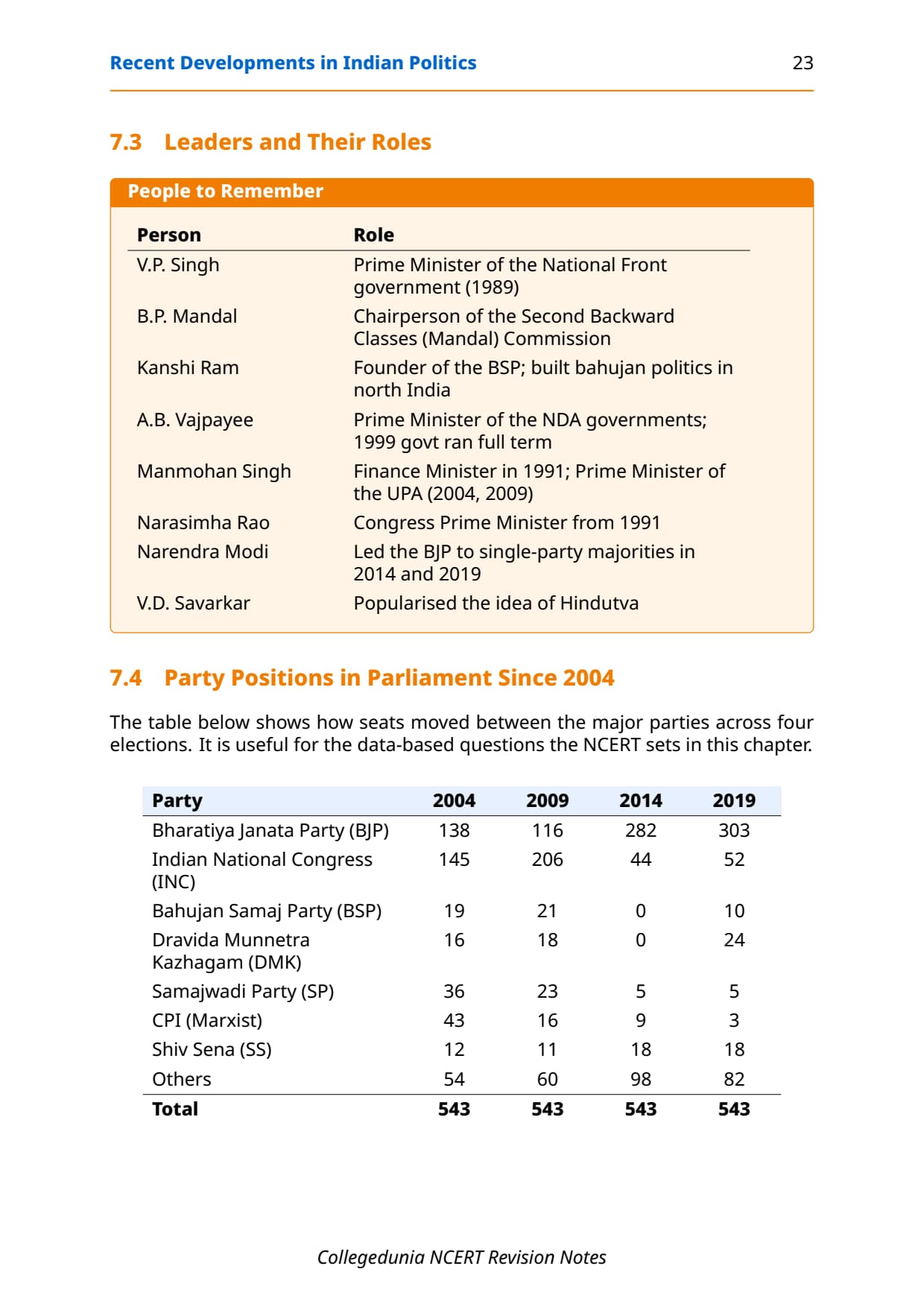
| UPA (2004, 2009) | The Congress-led alliance won in 2004 and 2009, with Manmohan Singh as Prime Minister. |
The one-line takeaway for your sheet is that these fronts rested on the "enemy of my enemy" logic, not shared ideology. In 1989 the BJP and the Left, two opposite groups, backed the same National Front. By 1996 the line-up reversed. Keep this switch clear, because it is the strongest evidence for the "alliances are pragmatic" argument.
Mandal Commission and the Rise of OBC Politics
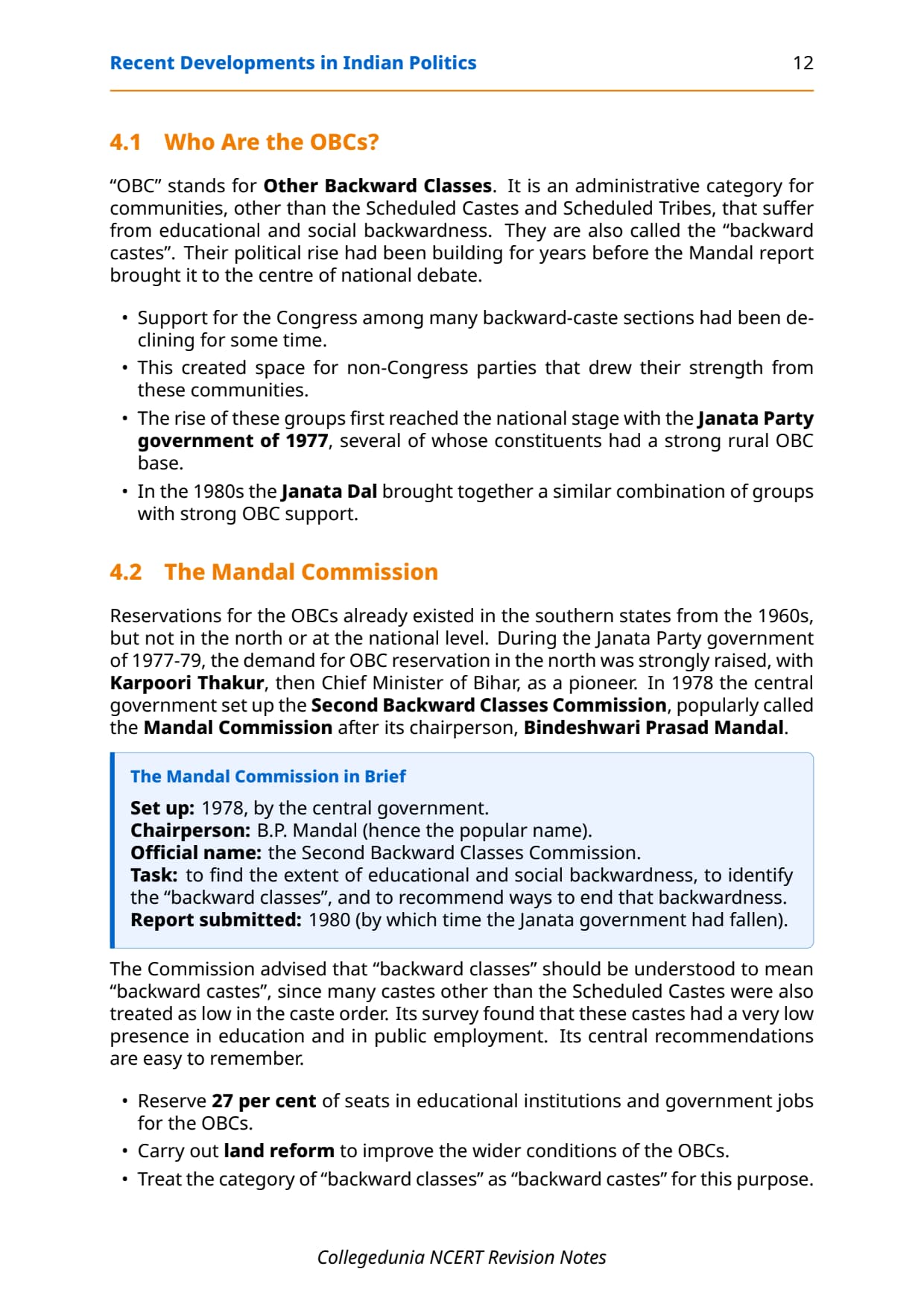
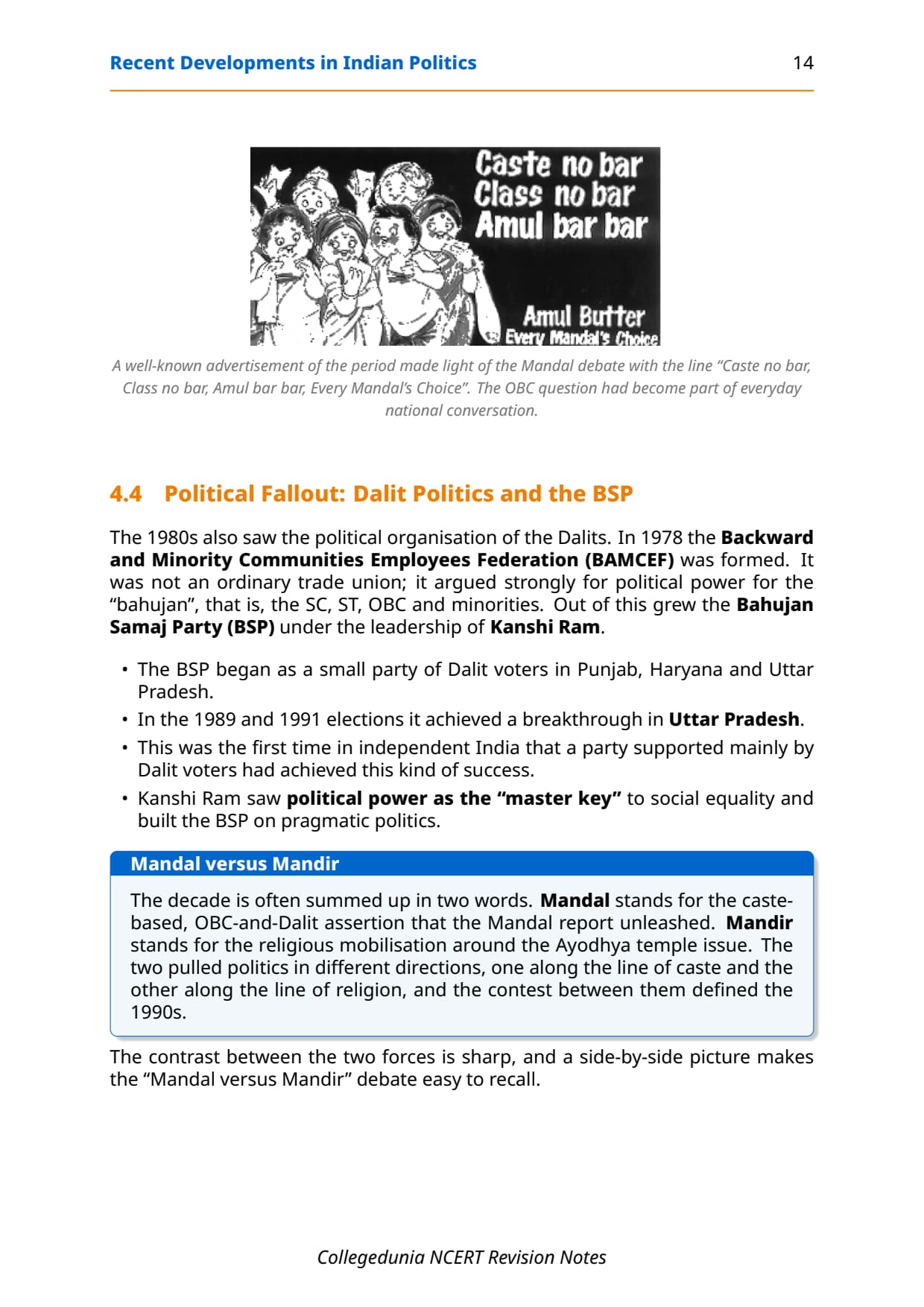
The Mandal issue is one of the most-asked topics, so these notes keep it as a tight set of facts. It marks the political rise of the Other Backward Classes (OBCs). Learn the date, the figure and the reaction together.
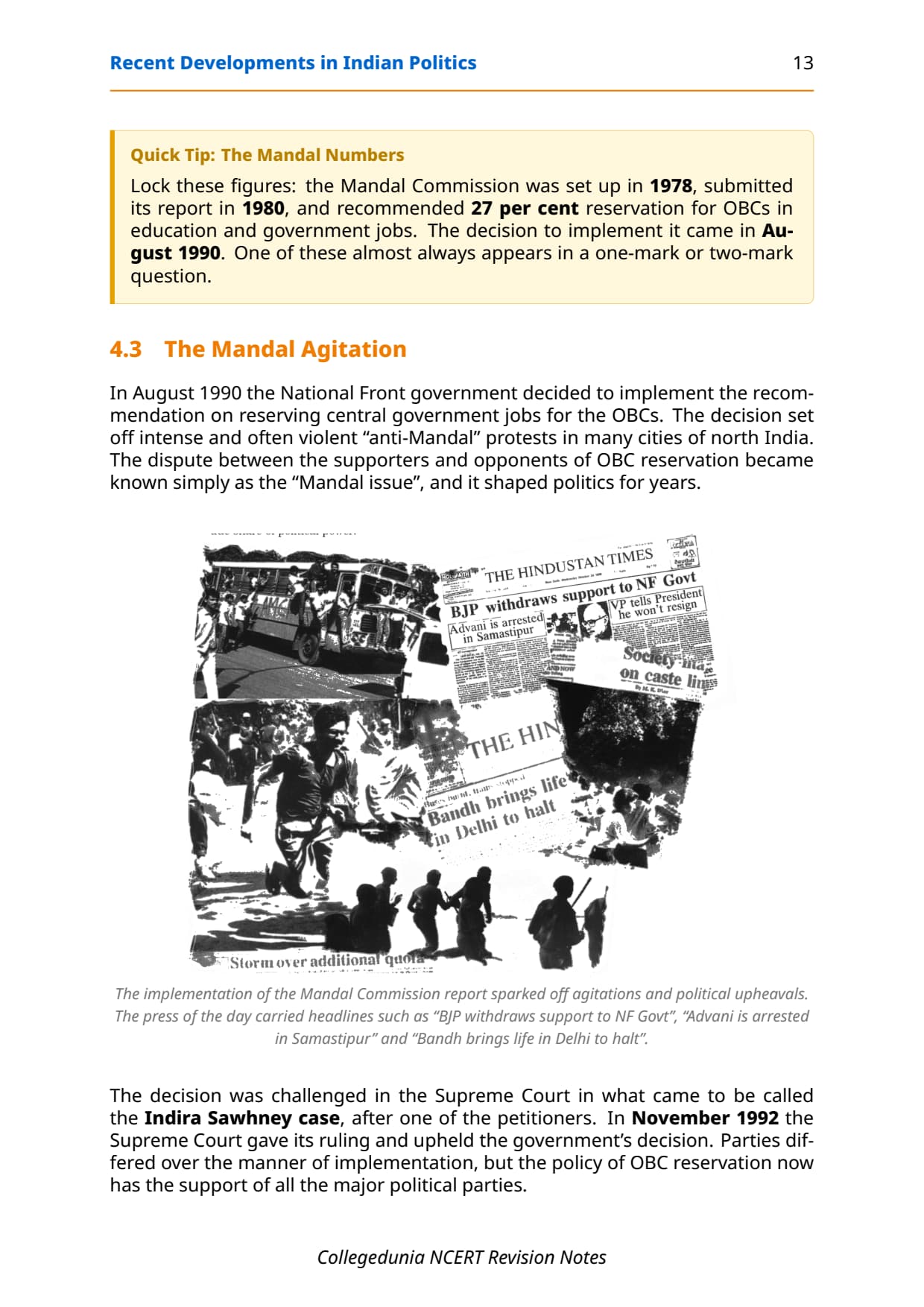
- What it was: the National Front government decided in August 1990 to implement the Mandal Commission report.
- The recommendation: 27 per cent reservation for OBCs in central government jobs.
- The reaction: violent anti-Mandal protests broke out across north India.
- The lasting effect: caste-based parties grew, and OBC politics became a permanent national force.
The deeper note to keep is that the anti-Mandal violence shows how hard the party system found it to accommodate opposed interests. The system had to hold together the OBCs' demand for a share of power and the worries of those who opposed reservation. This is the textbook's own example of a "lack of accommodation and aggregation".
Ayodhya, the BJP and the Secularism Debate
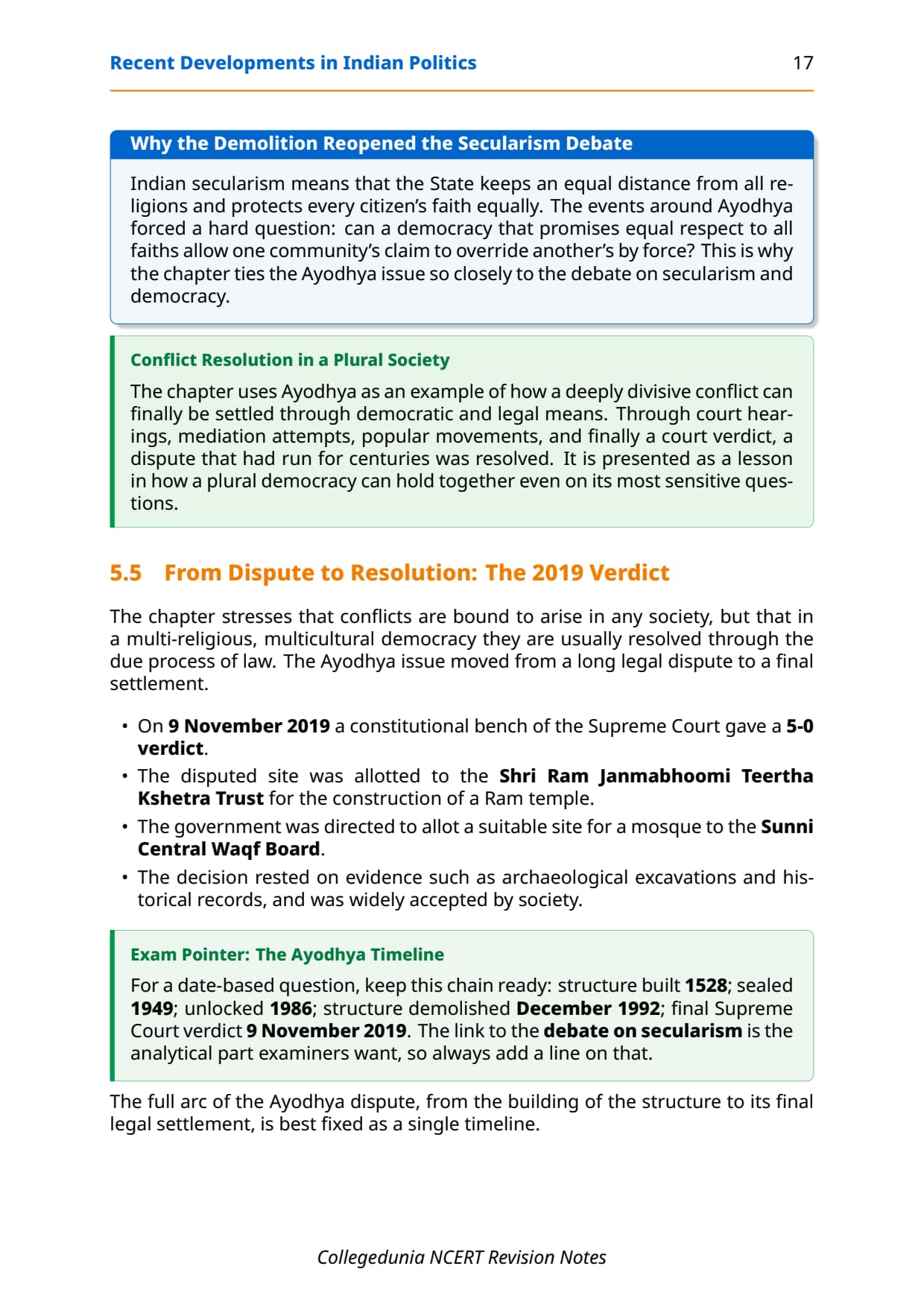
The Ayodhya issue and the rise of the BJP run together through the chapter. These notes keep the BJP's rise as a hand-friendly timeline, because a "trace" question scores more for a neat sequence than for scattered facts.
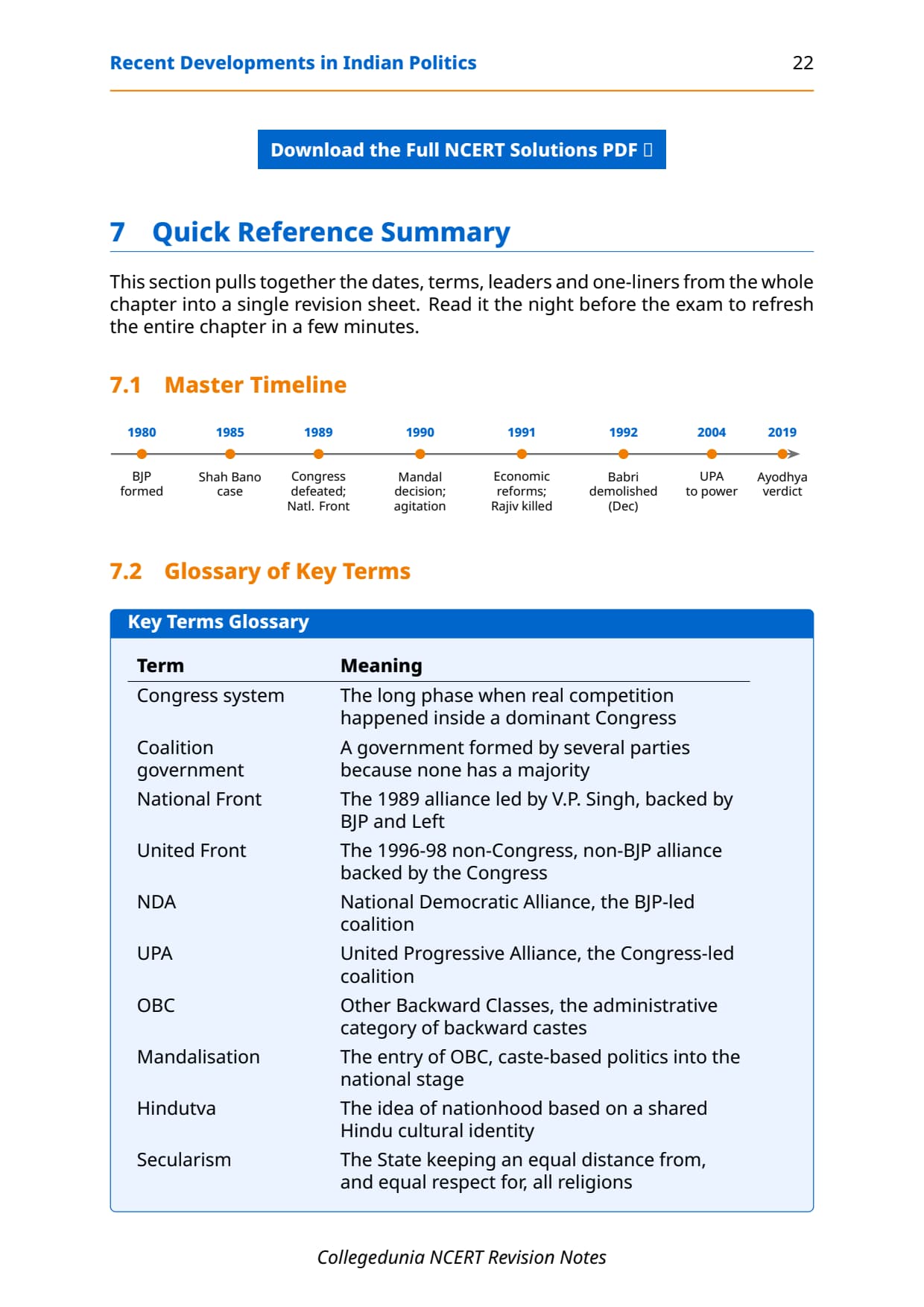
- 1980: the BJP is formed from the former Jana Sangh after the Janata Party split.
- 1984: a weak start, with only two Lok Sabha seats.
- After 1986: the party turns to Hindutva, using the Shah Bano case and the Ram Janmabhoomi movement.
- 1992: the Babri structure is demolished in December, sharpening the secularism debate.
- 1998-99: the BJP leads the NDA to power under Vajpayee and completes a full term.
The note to close this thread on is calm: the long Ayodhya dispute was finally settled by due process of law. A constitutional bench of the Supreme Court gave a 5-0 verdict on 9 November 2019. Tie this date to the start dates above and the whole timeline sticks.
The Four-Part Consensus and Recent Trends
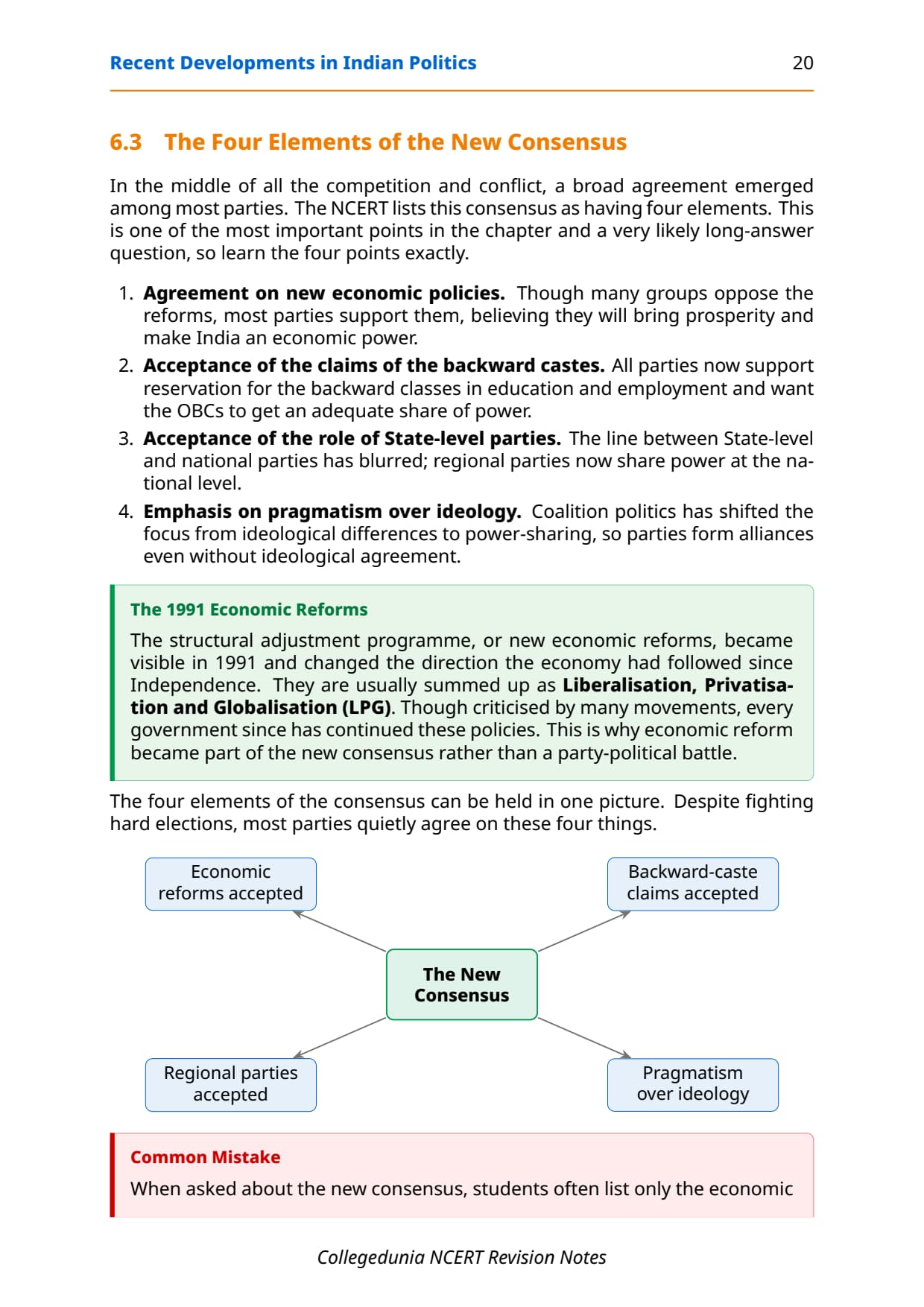
The chapter ends by arguing that, despite the turbulence, most parties came to share a broad agreement. These notes keep the four parts side by side, because they answer several short questions and the essay on India's party system.
| Part of the consensus | What most parties now agree on |
|---|---|
| Economic policy | Agreement on the new economic policies; most parties support liberalisation, whoever rules. |
| Backward castes | Acceptance of the political and social claims of the backward castes. |
| Regional parties | Acceptance of the role of state-level parties in governing the country. |
| Pragmatism | Emphasis on pragmatic considerations rather than ideological positions. |
The sharp point for your notes is that India's multi-party, coalition system suits its diversity better than a two-party system would. It voices many castes, religions, languages and regions, and still produced stable, full-term governments like the post-1999 NDA and the 2004-09 UPA. Keep the four parts and this verdict as clear, separate notes.
Recent Developments Important Questions and Exam Pointers
CBSE sets a steady mix of MCQ, short and long answers from this chapter. Knowing the pattern helps students decide how much to write and which topics to revise first. A focused list of recent developments in Indian politics important questions saves a lot of time before the board exam.
- Long answer (5 to 6 marks): trace the rise of the BJP, or the advantages of India's party system.
- Short answer (4 marks): main issues after 1989, or the four-part consensus.
- Source-based: a passage on coalition politics or the party system, with sub-parts.
- Objective and MCQ: dates of Mandal, the NDA and UPA, and the Shah Bano case.
For quick recall, students often practise a short class 12 political science chapter 8 mcq drill and a list of recent developments in Indian politics class 12 important questions. The most repeated items are the coalition timeline and the BJP "trace", so keep those answer points ready in your own words. Reading these notes once, then writing the key lists from memory, is the fastest way to lock the chapter in.
Common Mistakes Students Make in This Chapter
A few errors cost marks every year. Most come from muddling the coalition order or treating the Congress as finished after 1989. Fixing these five points is the quickest way to lift a score, so add them to the end of your revision sheet.
- Reading "decline of dominance" as the end of the Congress - it stayed a major party and led the UPA.
- Mixing up the coalition order - keep National Front (1989), United Front (1996), NDA (1998-99), UPA (2004-09) clear.
- Saying alliances were built on shared ideology - most were pragmatic power-sharing.
- Forgetting that NDA allies mostly rejected the BJP's Hindutva, yet still governed together.
- Giving only one side of an "argue" question - the exam wants both views before a verdict.
Students who fix these five points usually move from average to high marks. The exam rewards a balanced view, so always weigh both sides of an argument before you judge it. These notes flag each soft point so you can phrase it safely in the answer sheet.
How These Notes Pair with the Solutions and Book PDF
These revision notes summarise the chapter. To prepare fully, students should use them alongside the other resources for the same chapter, all linked in the table below. Read the notes first, then test yourself with the solutions, and open the book PDF whenever you need the original text and cartoons.
| Resource | Best used for |
|---|---|
| Recent Developments in Indian Politics NCERT Solutions | Step-by-step answers to all 8 back-exercise questions |
| Recent Developments in Indian Politics Handwritten Notes | Last-minute, one-shot revision in a scanned notebook style |
| Recent Developments in Indian Politics NCERT Book PDF | Reading the original NCERT chapter text and cartoons |
Tip: read these notes first, then attempt the solutions on your own, and only then check the model answers. That order builds memory faster than copying answers straight away.
All Class 12 Political Science Notes by Chapter
The table links the revision notes for every chapter in both Class 12 Political Science books, so students can move across the course in one click. Recent Developments in Indian Politics is highlighted.
| Chapter | Notes |
|---|---|
| Contemporary World Politics | |
| Chapter 1 | The End of Bipolarity |
| Chapter 2 | Contemporary Centres of Power |
| Chapter 3 | Contemporary South Asia |
| Chapter 4 | International Organisations |
| Chapter 5 | Security in the Contemporary World |
| Chapter 6 | Environment and Natural Resources |
| Chapter 7 | Globalisation |
| Politics in India Since Independence | |
| Chapter 1 | Challenges of Nation Building |
| Chapter 2 | Era of One-Party Dominance |
| Chapter 3 | Politics of Planned Development |
| Chapter 4 | India's External Relations |
| Chapter 5 | Challenges to and Restoration of the Congress System |
| Chapter 6 | The Crisis of Democratic Order |
| Chapter 7 | Regional Aspirations |
| Chapter 8 | Recent Developments in Indian Politics |
FAQs on Recent Developments in Indian Politics Class 12 Notes
Recent Developments in Indian Politics Class 12 Political Science Notes Common Questions
Ques. Where can I download the Recent Developments in Indian Politics Class 12 notes PDF?
Ans. You can download the Recent Developments in Indian Politics Class 12 Political Science notes PDF directly from this page. It is free, follows the 2026-27 NCERT, and covers the coalition era, Mandal, Ayodhya and the new consensus in a short, point-wise format.
Ques. What does Recent Developments in Indian Politics cover for Class 12?
Ans. It covers the end of Congress dominance after 1989, the era of coalitions (National Front, United Front, NDA, UPA), the Mandal Commission and OBC reservation, the Ayodhya issue and the rise of the BJP, and the four-part consensus most parties now share.
Ques. What is the four-part consensus in Indian politics?
Ans. It is the broad agreement most parties came to share after the 1990s: support for the new economic policies, acceptance of the claims of backward castes, acceptance of the role of regional parties, and a stress on pragmatism over ideology.
Ques. Why is Recent Developments in Indian Politics important for the board exam?
Ans. Because it is a high-scoring closing chapter that ties together the whole of Politics in India Since Independence. The coalition timeline, the Mandal and Ayodhya issues and the rise of the BJP appear almost every year, so revising these notes well secures both MCQ and long-answer marks.
Ques. How should I use these notes to revise quickly?
Ans. Read the notes once under the decline, coalitions, Mandal-Mandir and consensus frame, keep all dates and key terms on one sheet, then write the key lists from memory. Finish by attempting a short class 12 political science chapter 8 mcq drill to test the small facts.



Comments