




These International Organisations Class 12 Notes give a quick, exam-ready summary of the United Nations and why countries cooperate, set to the 2026-27 CBSE syllabus. The notes pull together every key organ, agency, date and term from Chapter 4 of Contemporary World Politics. Students can use them for a fast revision the night before a test or to fix the main ideas before they attempt the back-exercise questions.
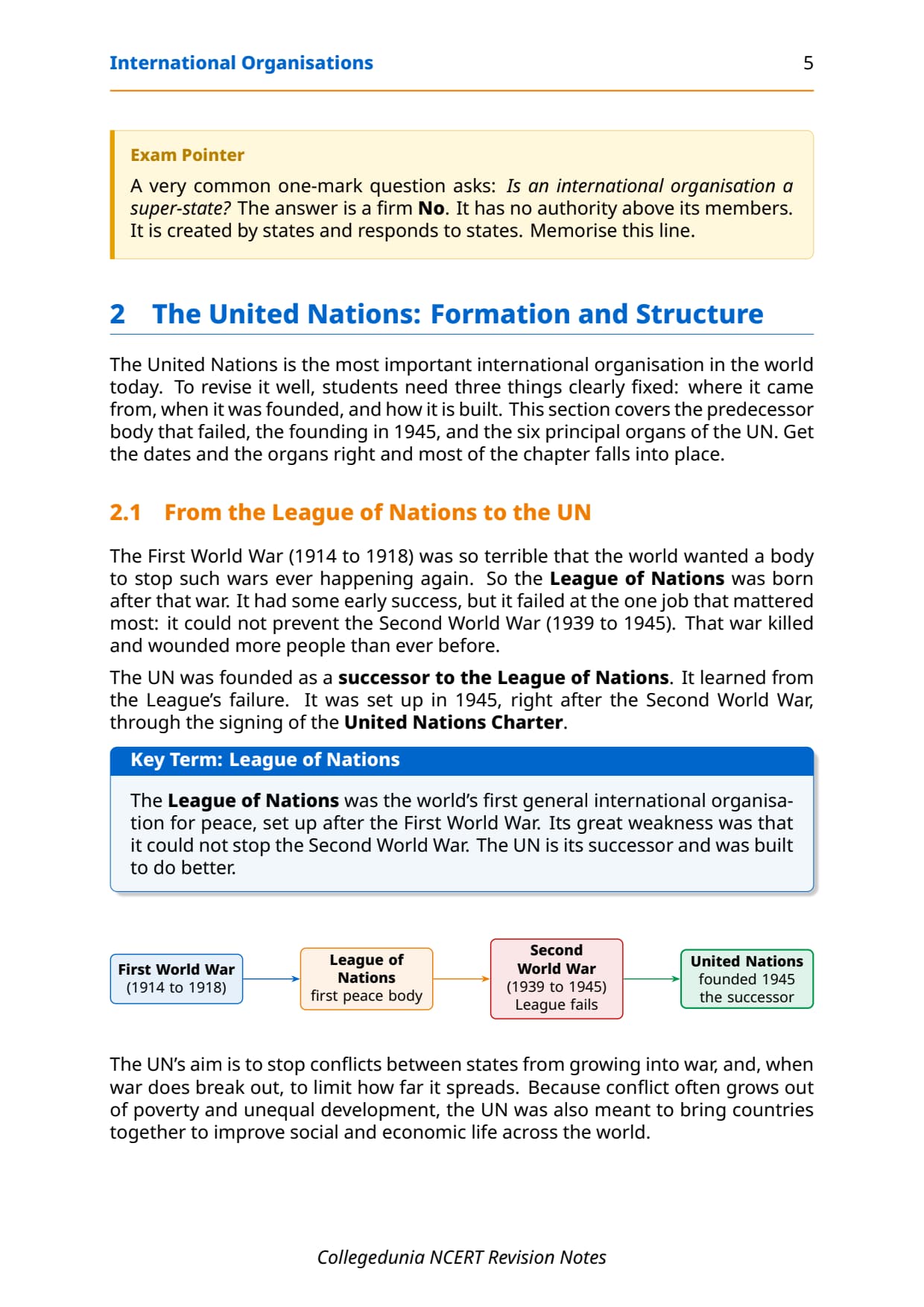
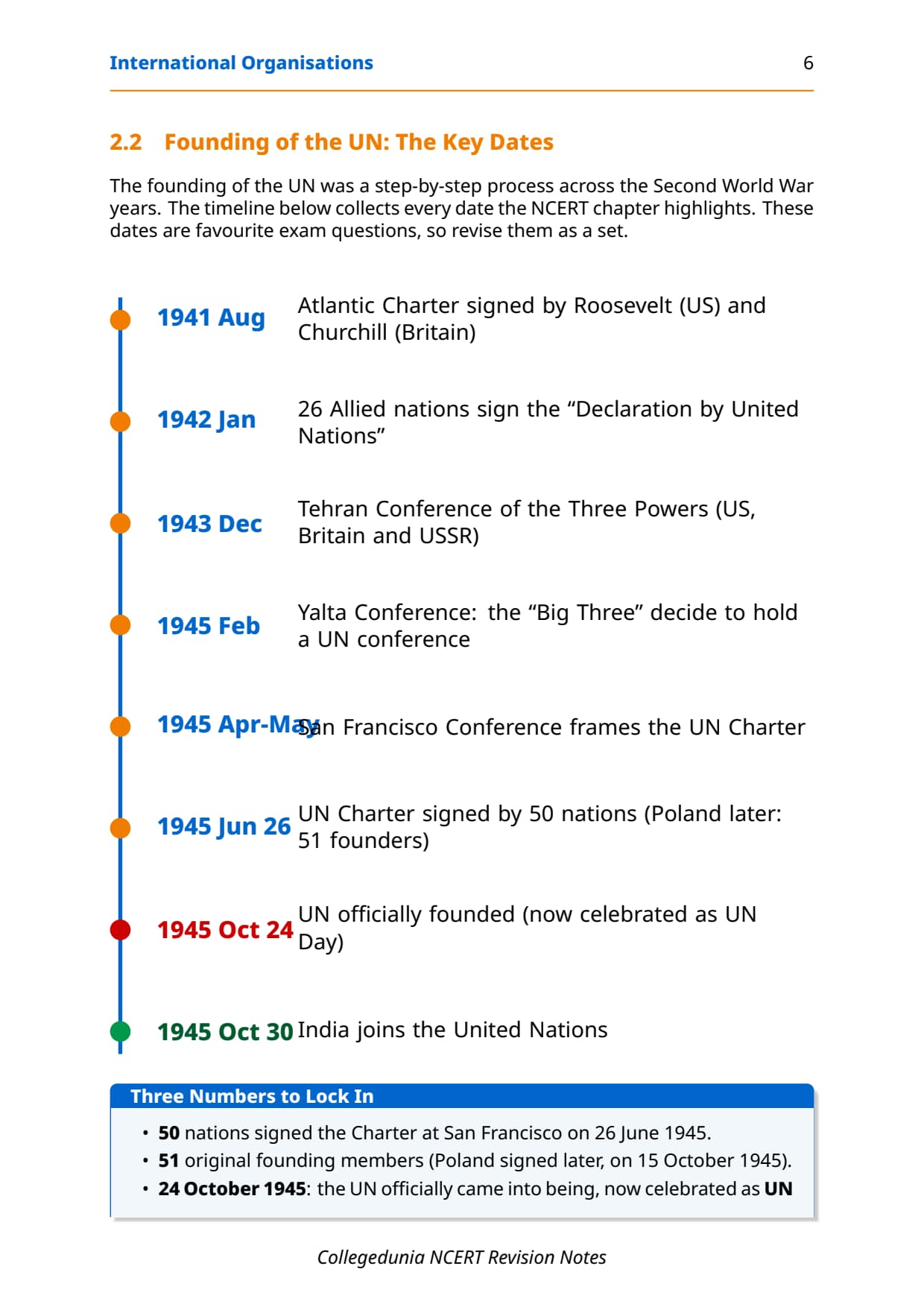
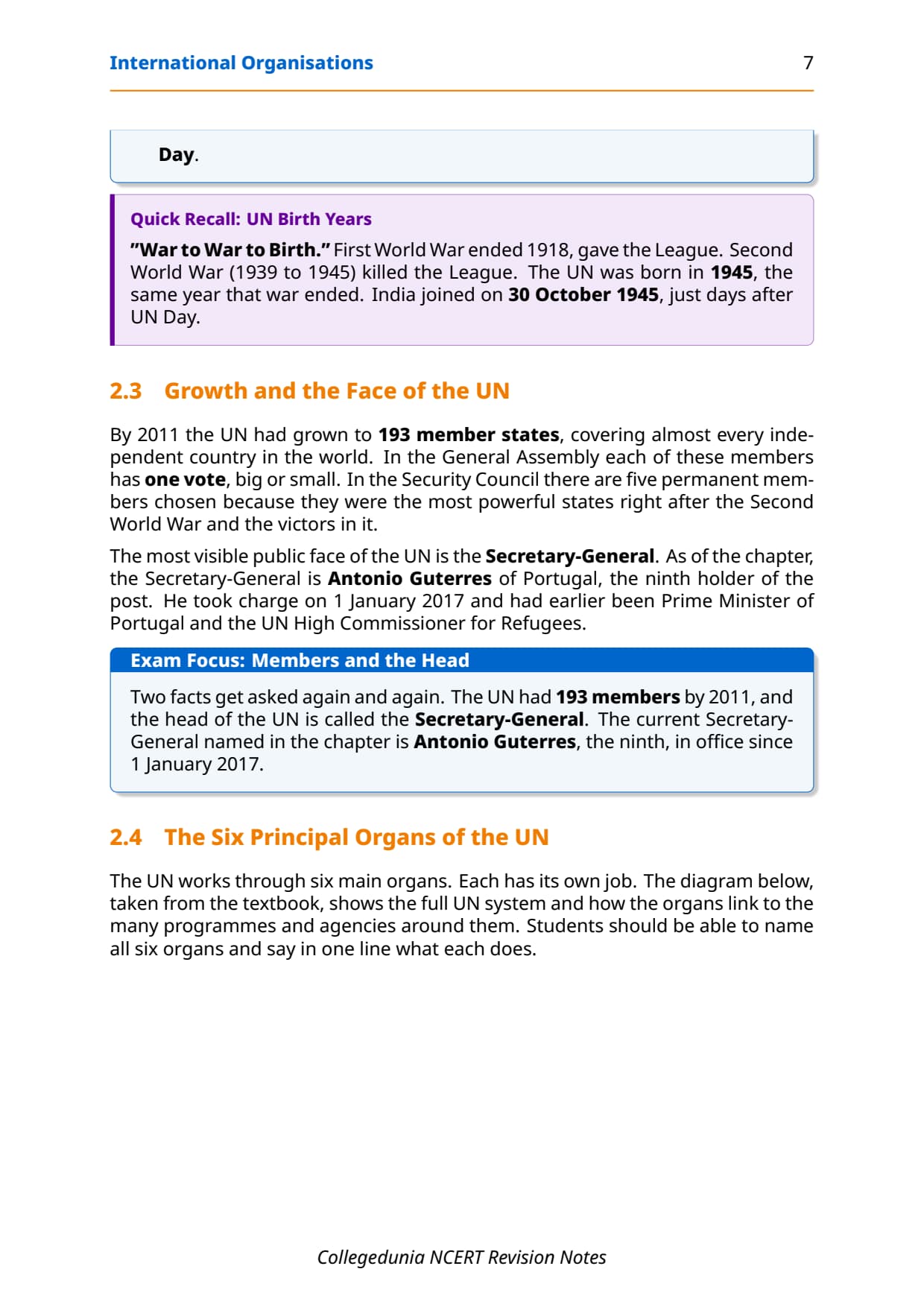
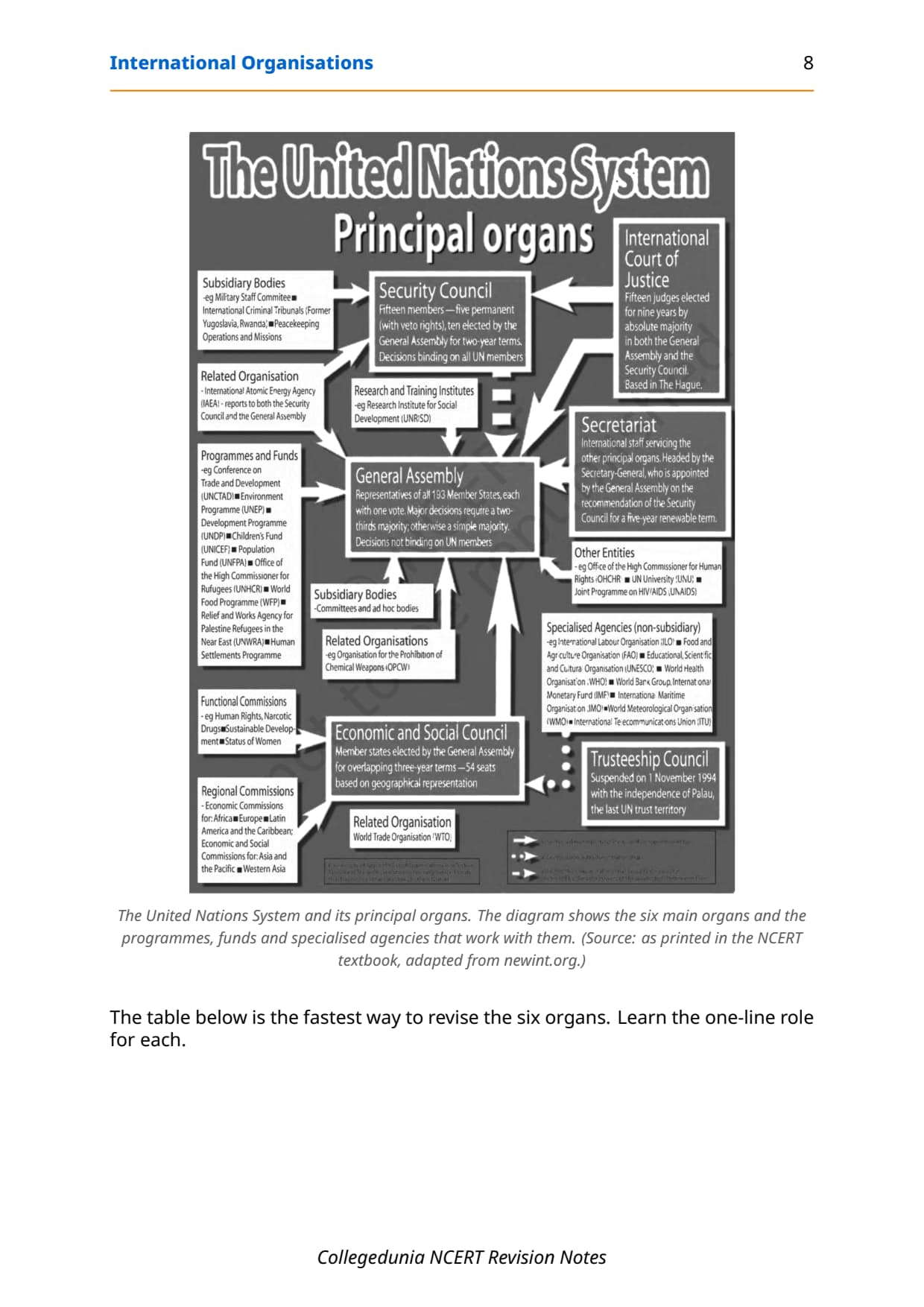
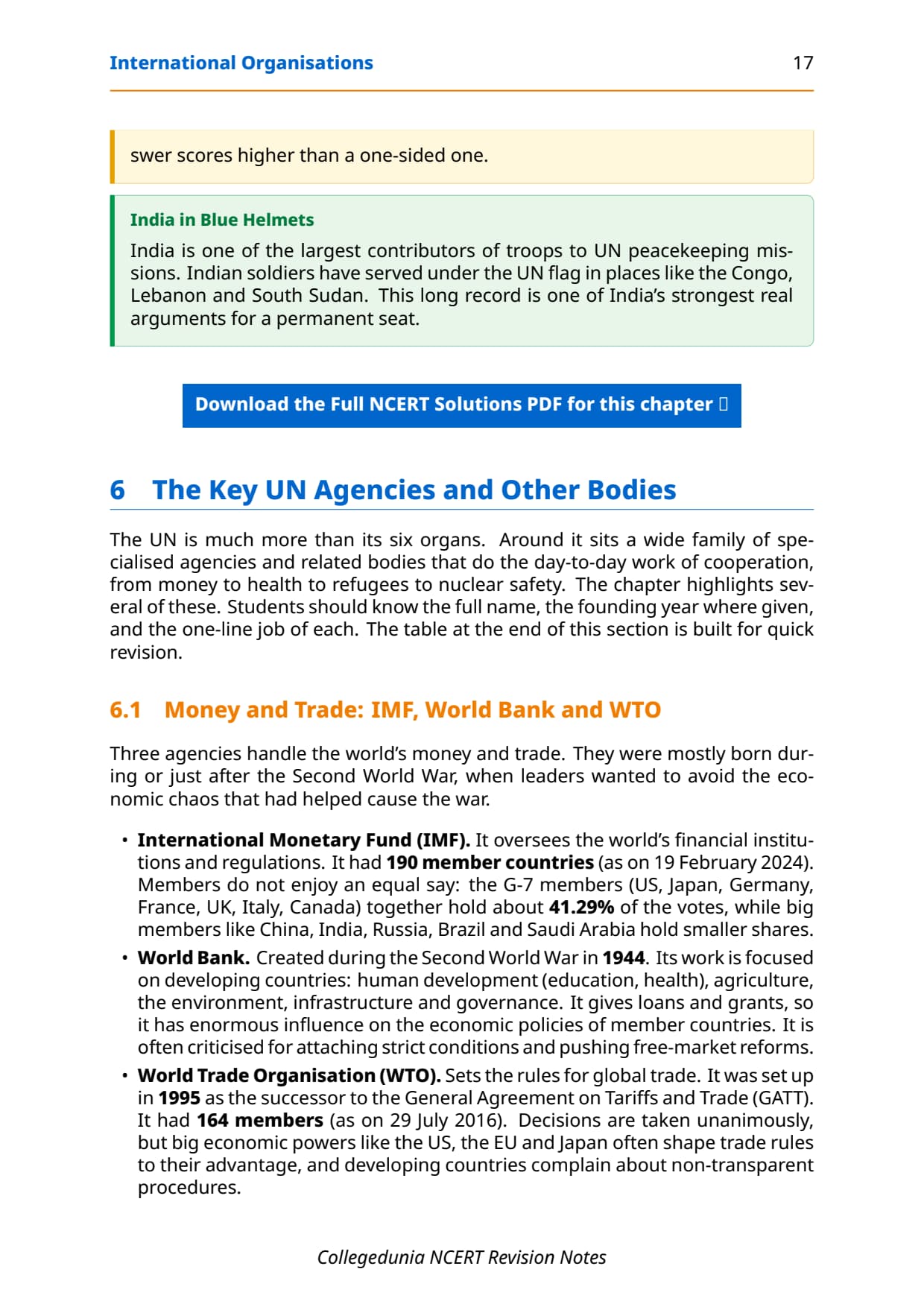
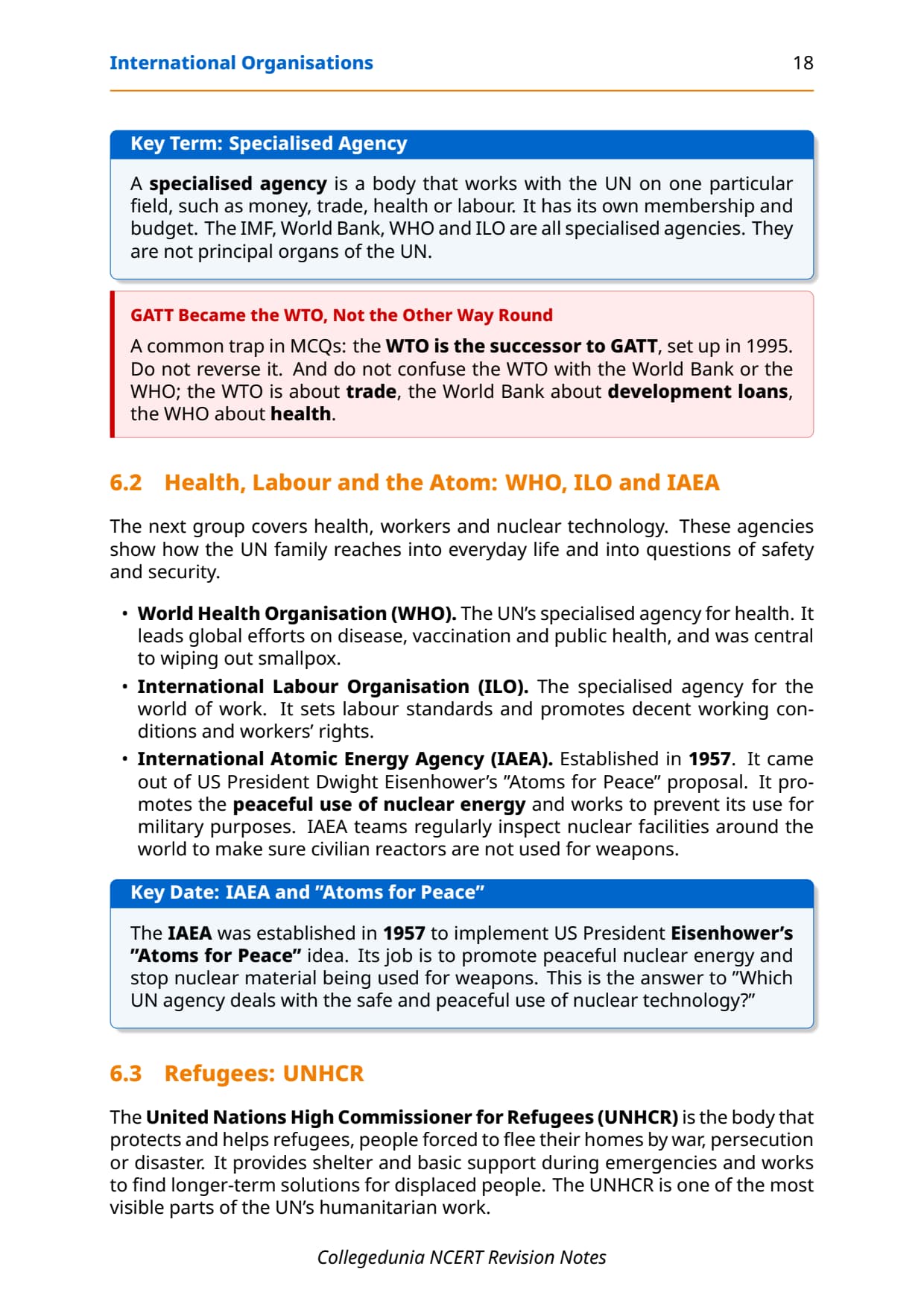
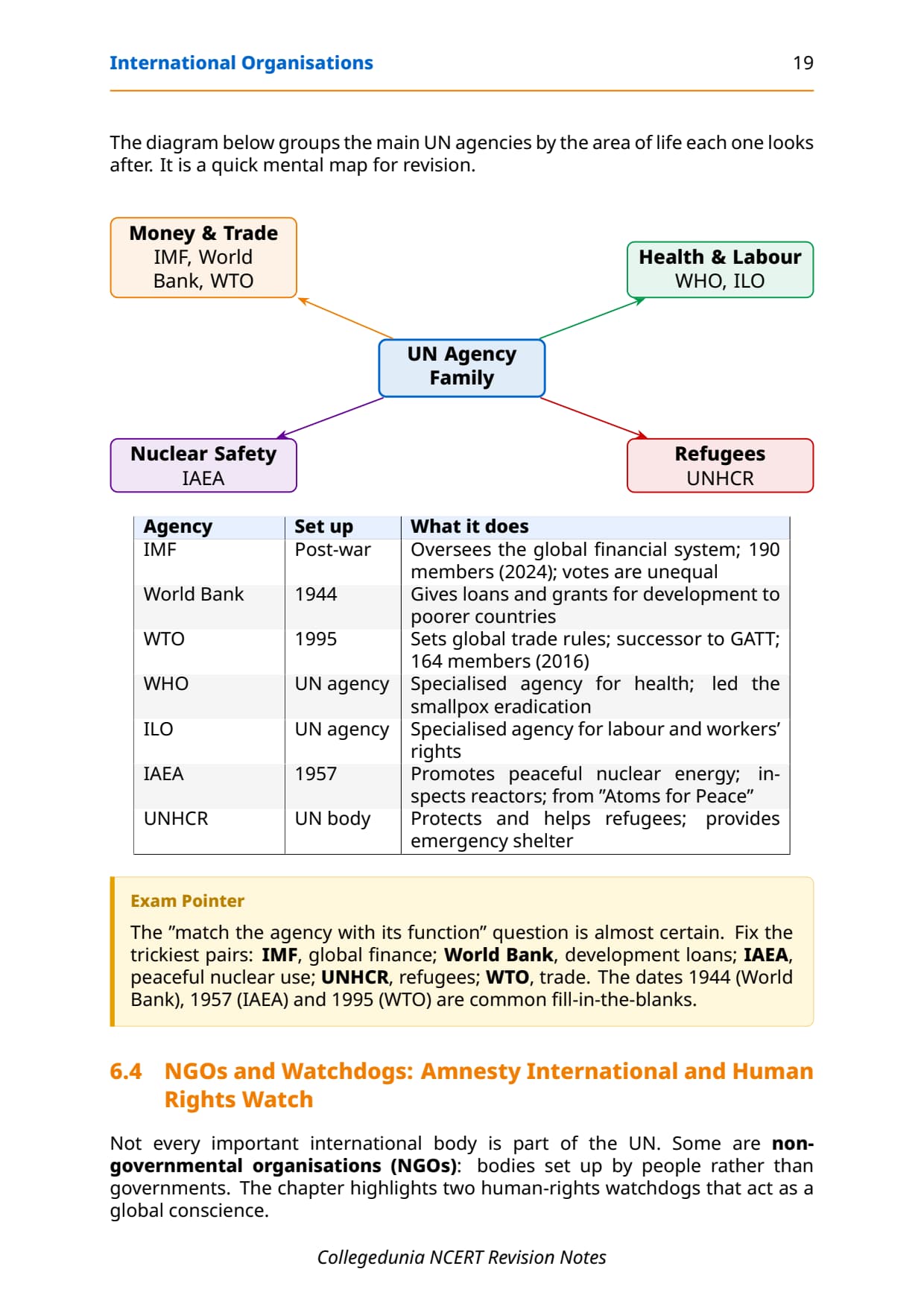
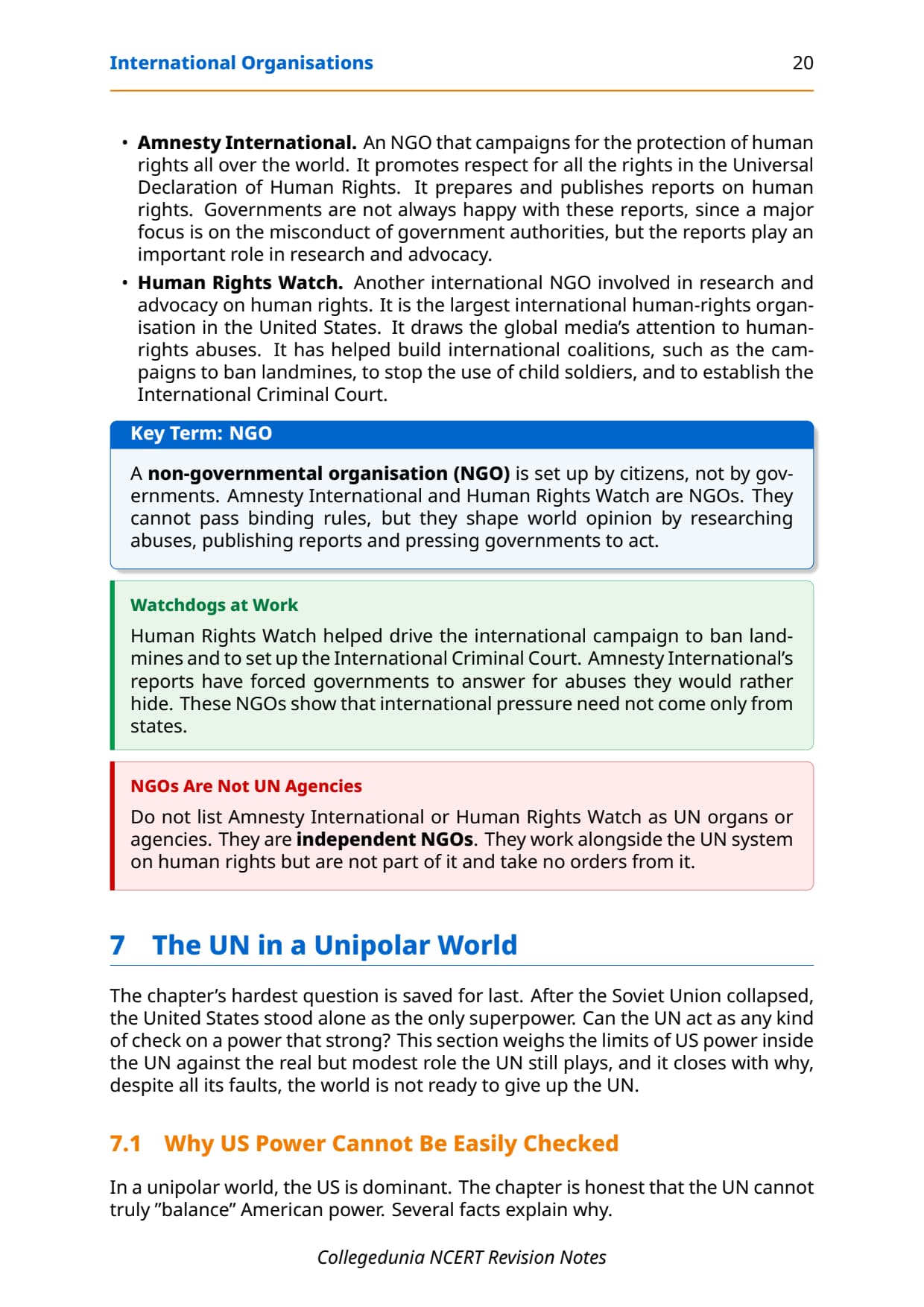
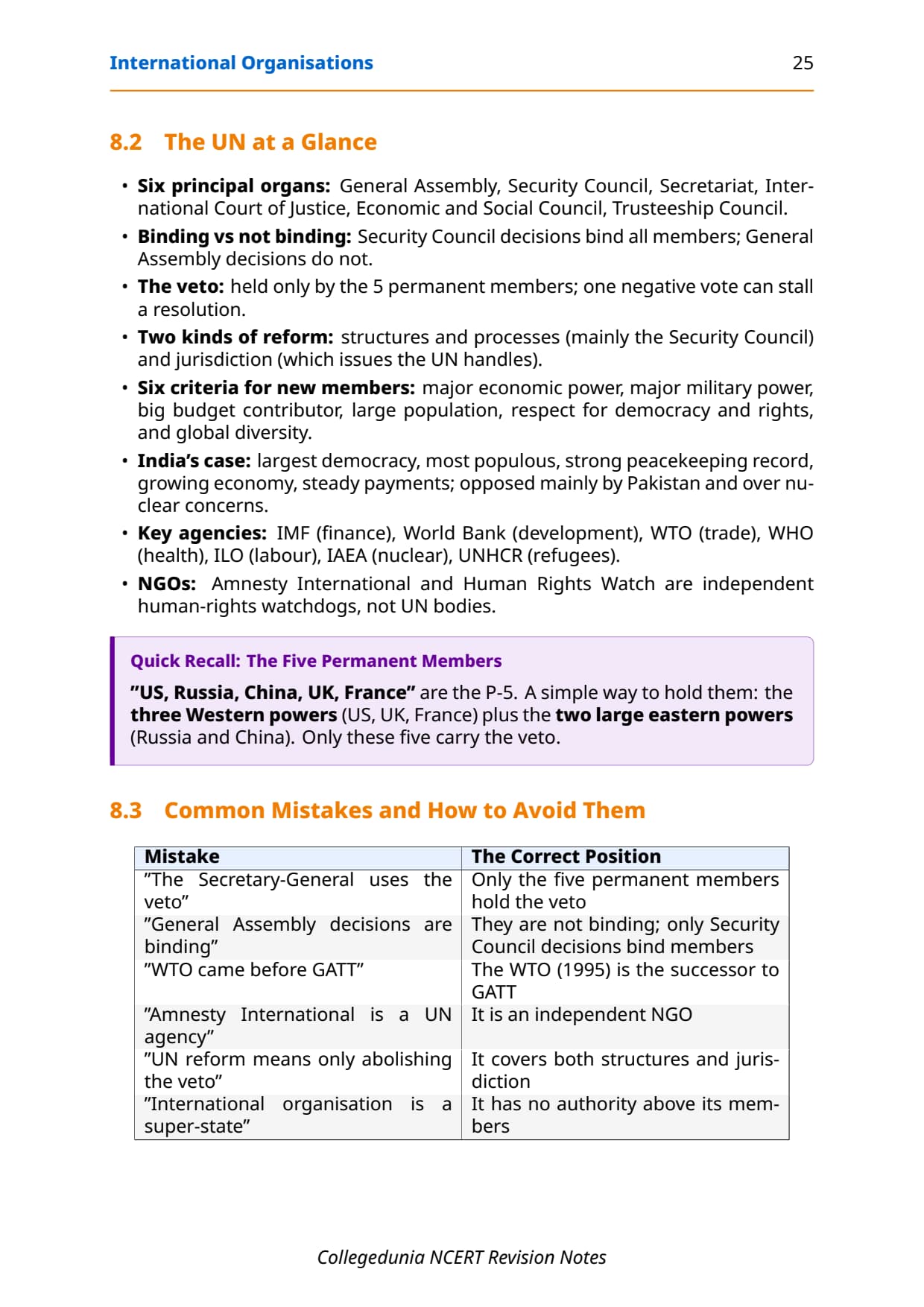
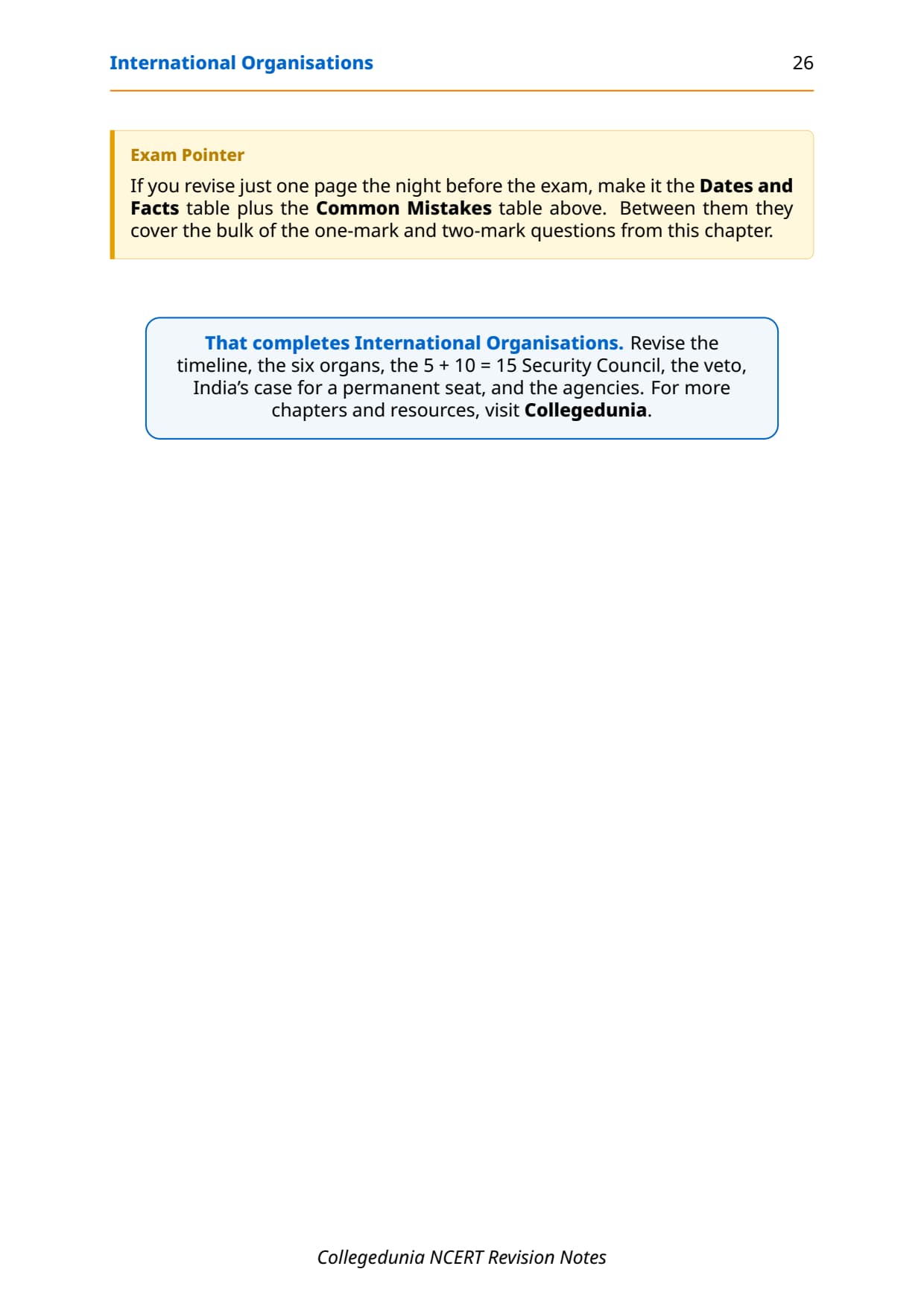
- Covers the UN's organs, the Security Council, the veto, reform and India's case in one place.
- This Class 12 Political Science chapter usually carries 5 to 6 marks in the board paper.
- Pairs with the NCERT Solutions, Handwritten Notes and Book PDF linked lower on this page.
These International Organisations Class 12 notes are written from the official NCERT Contemporary World Politics textbook and checked against the last five years of CBSE board papers.
Student Feedback: In a Collegedunia poll of 8,470 Class 12 Political Science students taken before the 2026 boards, 72% of students said short, point-wise notes on the UN organs and the reform debate were the fastest way to revise this chapter. Most students kept the organs, the veto and the reform points on a single sheet for last-minute recall.
Source: 2026-27 Class 12 Political Science student poll. Sample of 8,470 students from CBSE schools across 12 states.
What the International Organisations Notes Cover
International Organisations is the fourth chapter of Contemporary World Politics. It studies why countries set up bodies like the United Nations (UN) and how the UN tries to keep peace and solve shared problems. An international organisation is a group of states that work together on issues no single country can fix alone, such as war, disease or trade.
The easiest way to organise your revision is to split the chapter into three threads:
- The why: the reasons countries cooperate through these bodies.
- The how: the UN's main organs and specialised agencies.
- The reform: the demand to restructure the Security Council and India's case.
So these notes are really about cooperation between states and the body that runs it. If you sort each fact under why, how or reform first, almost every question in International Organisations class 12 becomes easier to answer. Keep this three-part frame at the top of your revision sheet and slot each new detail into one of the boxes as you read.
Why Countries Need International Organisations
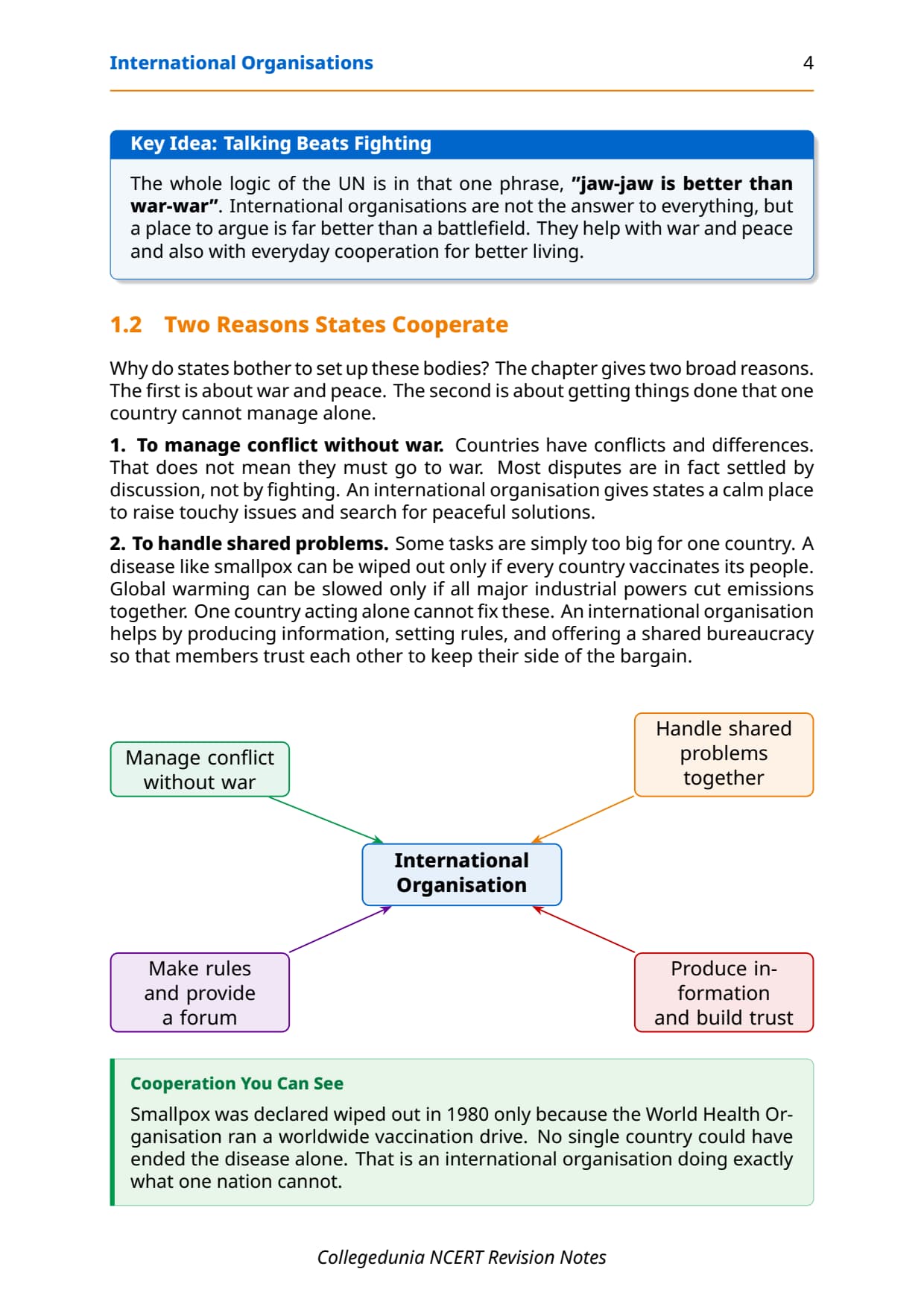
No country can solve a war, a disease or a financial crash on its own. International organisations give states a place to talk, set rules and act together. For quick revision, learn the reasons as four short, boxed points so you can copy them straight onto the answer sheet.
- Stop war: they give enemies a forum to talk instead of fight.
- Set rules: they help states agree on trade, health and human-rights rules.
- Share help: they pool money and aid for disease, disaster and poverty.
- Build trust: they let even rival states cooperate where their interests meet.
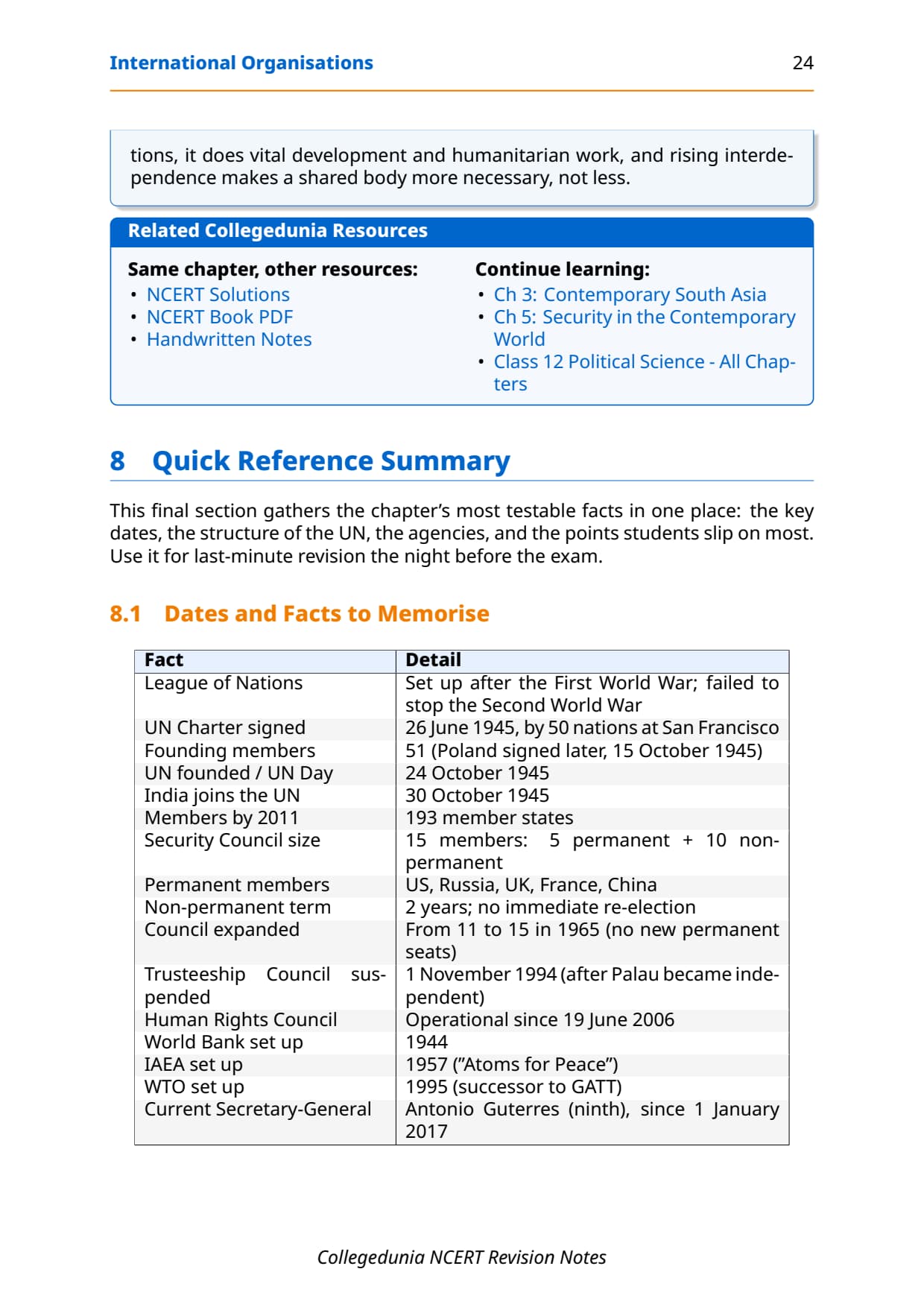
The point examiners test most is that an international organisation is not a world government. It cannot force a sovereign state to obey, and works only when members accept its decisions. Keep this limit ready, because the "why is the UN useful" question turns on it. The UN was founded on 24 October 1945 to replace the failed League of Nations.
The UN and Its Principal Organs
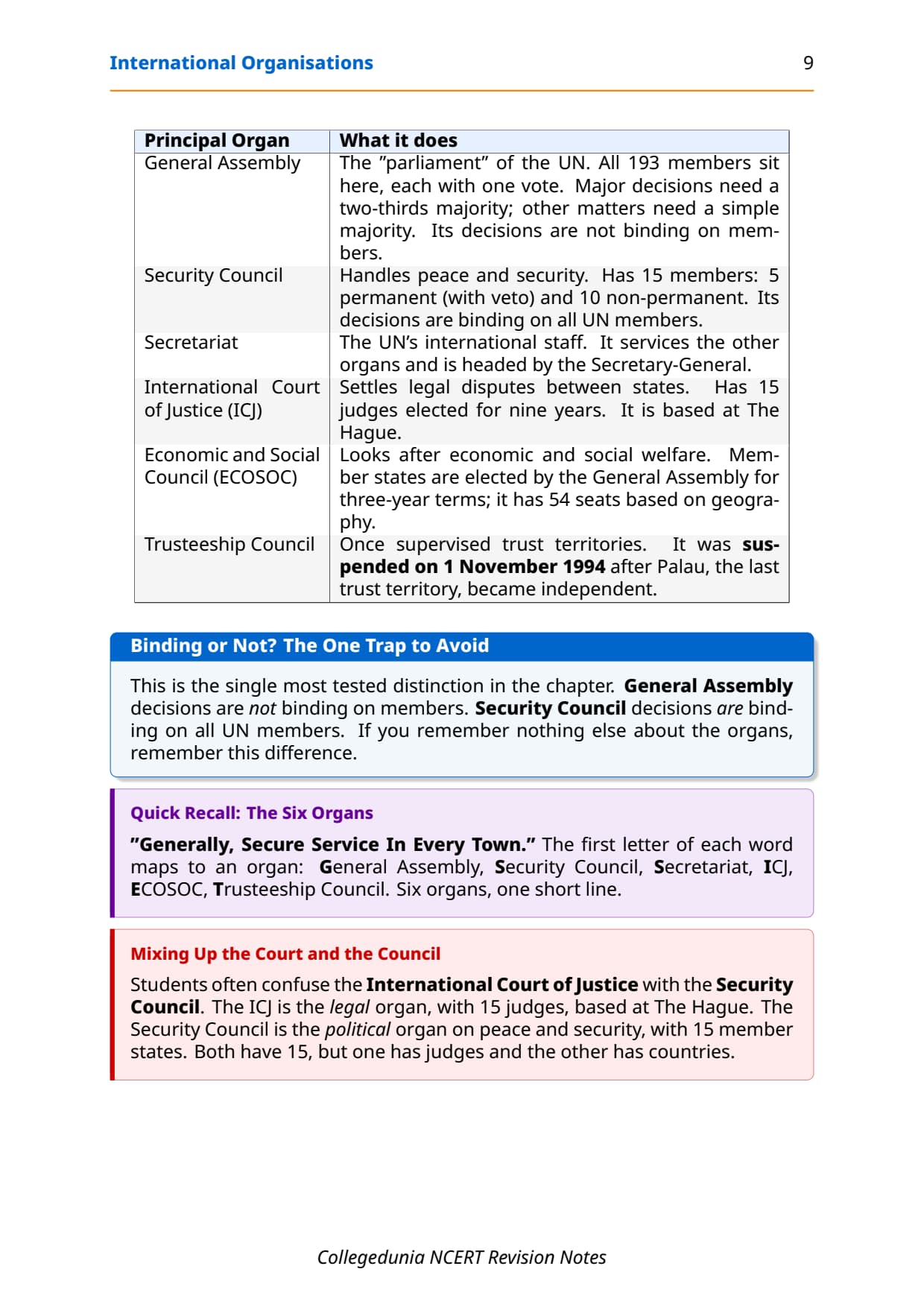
The UN now has 193 members and runs through six main organs. The causes of most exam errors are mixing these organs up, so these notes keep them as a clear table rather than a paragraph. Learn one job per organ and the match question becomes quick marks.
| Organ | What it does |
|---|---|
| Security Council | Keeps international peace and security; can take binding action. |
| General Assembly | The main debate body where all 193 members have a vote. |
| Economic and Social Council (ECOSOC) | Looks after the economic and social welfare of member countries. |
| International Court of Justice | Settles legal disputes between states. |
| Secretariat | Runs the day-to-day work, headed by the Secretary-General. |
The one-line takeaway for your sheet is that each organ has one clear job. The Security Council guards peace, the ICJ judges disputes, ECOSOC handles welfare, and the Secretariat runs the system under the Secretary-General. Keep this one-job-per-organ list clear in your notes and the matching question is easy marks.
The Security Council, Veto and Reform
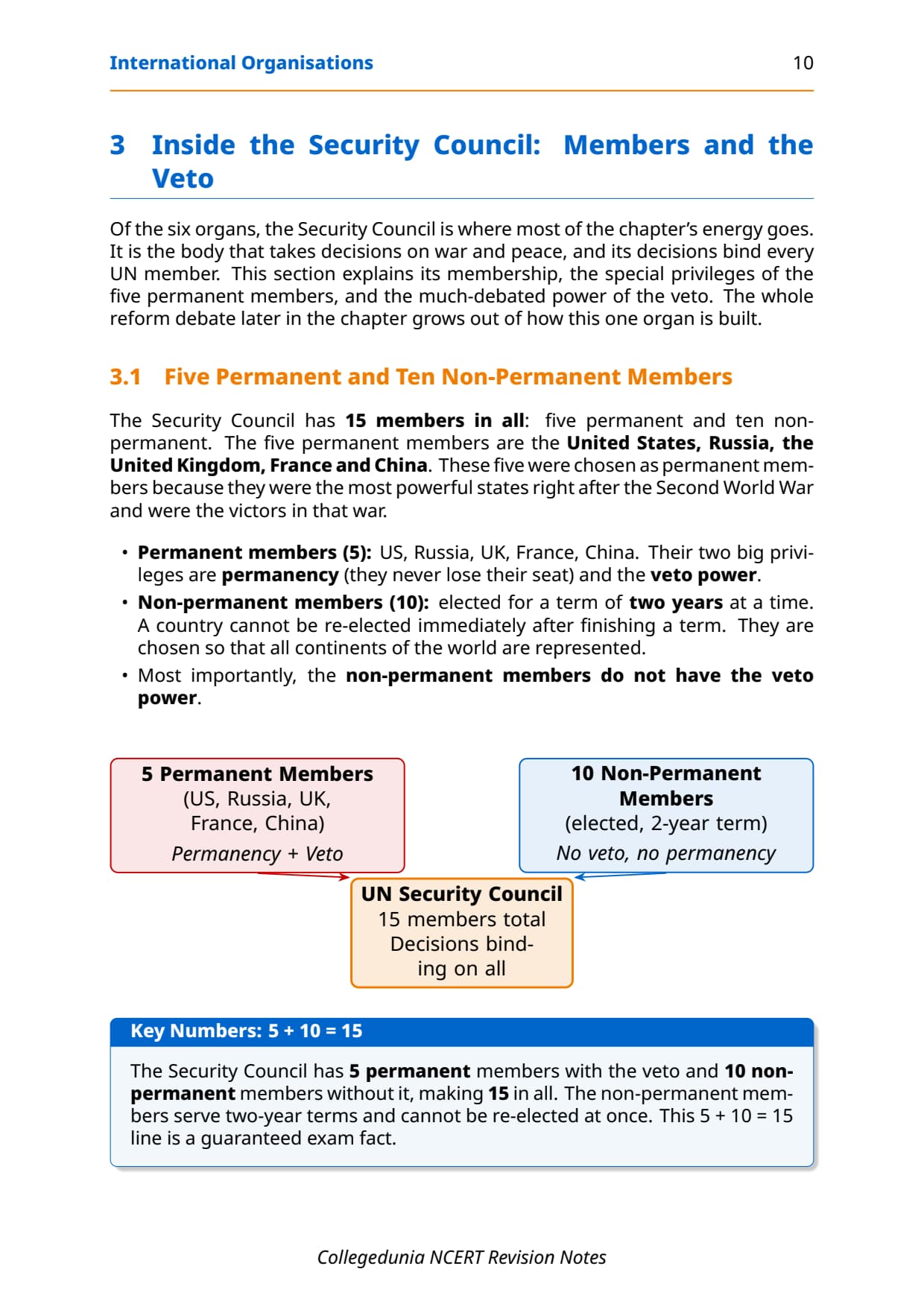
The Security Council is the most powerful UN organ and the focus of most exam questions. These notes keep its make-up, the veto and the reform debate side by side, because students often blur them. Learn each point as a short note so you never confuse them in the exam.
- Members: 5 permanent (US, Russia, UK, France, China) and 10 non-permanent for two years.
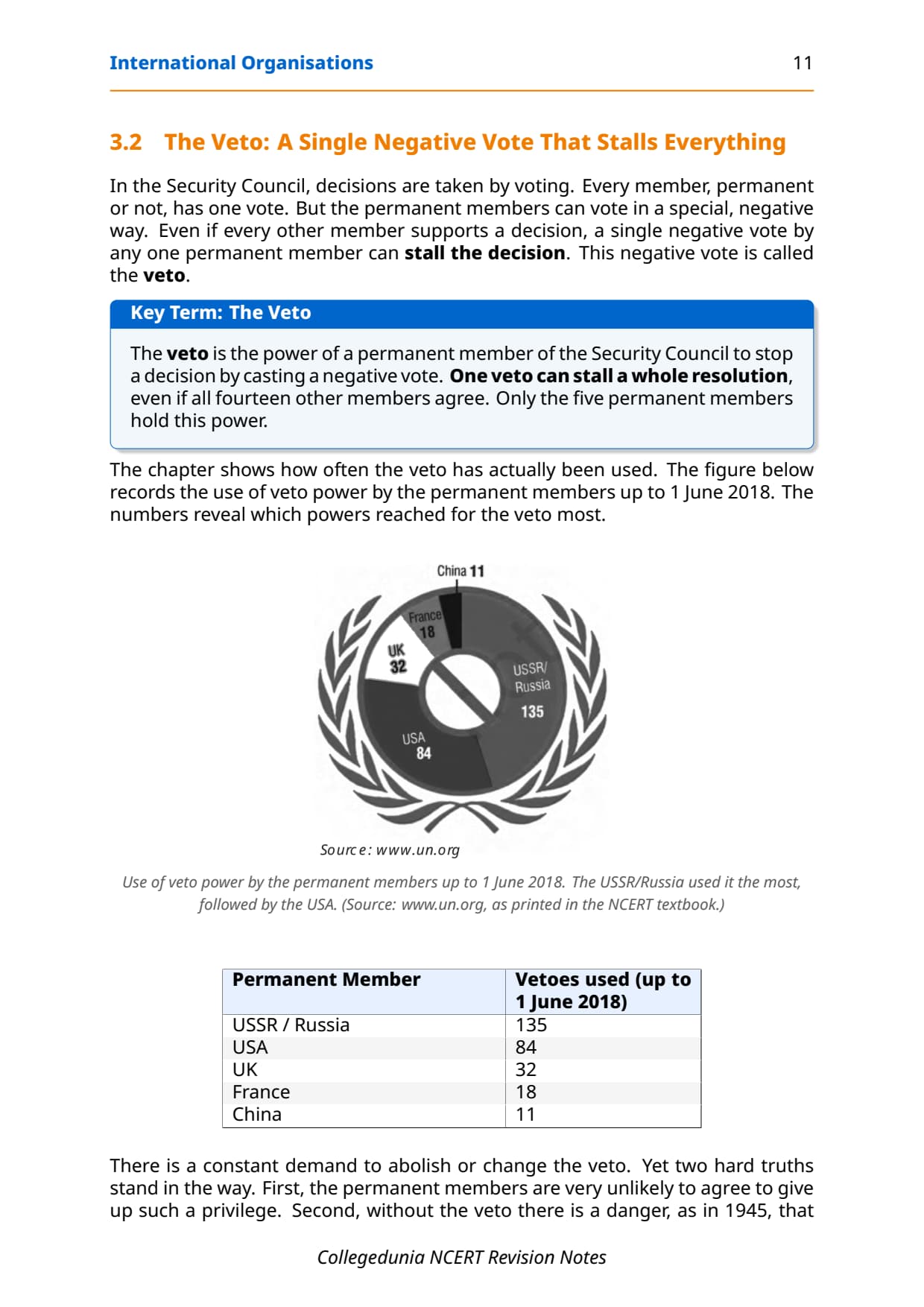
- The veto: only the five permanent members hold it; one veto stops any resolution.
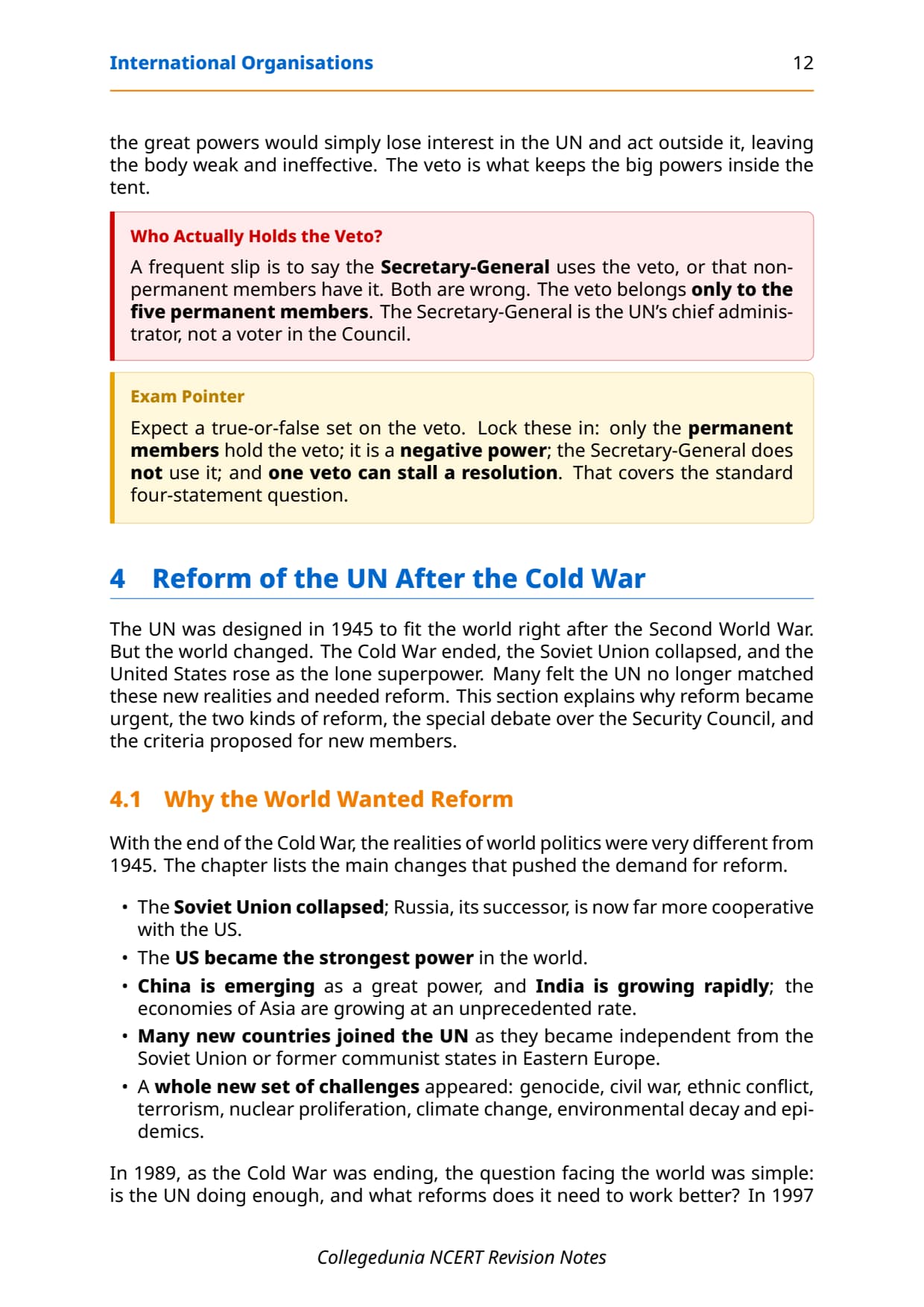
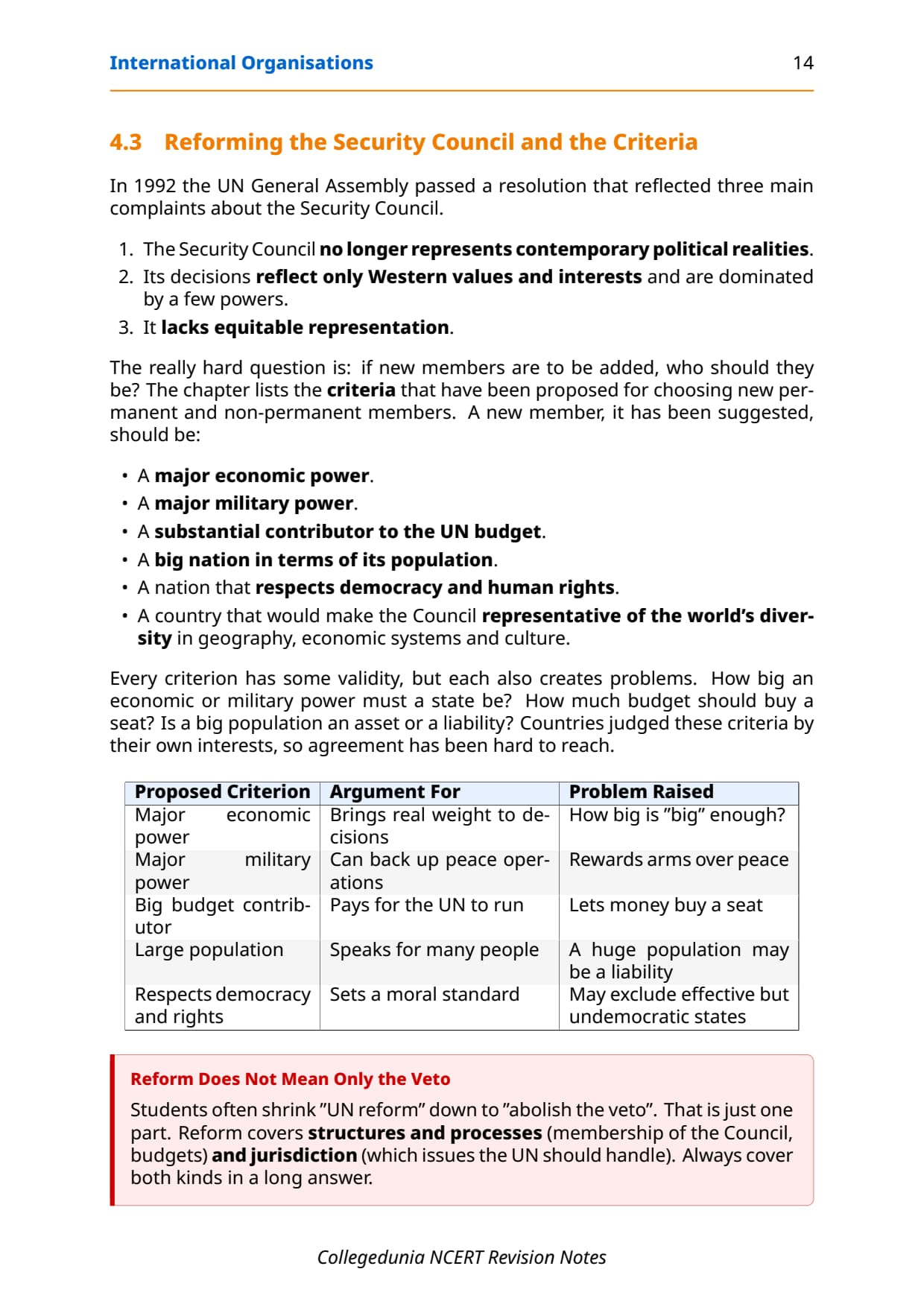
- Why reform: the Council still mirrors the power balance of 1945, not today's world.
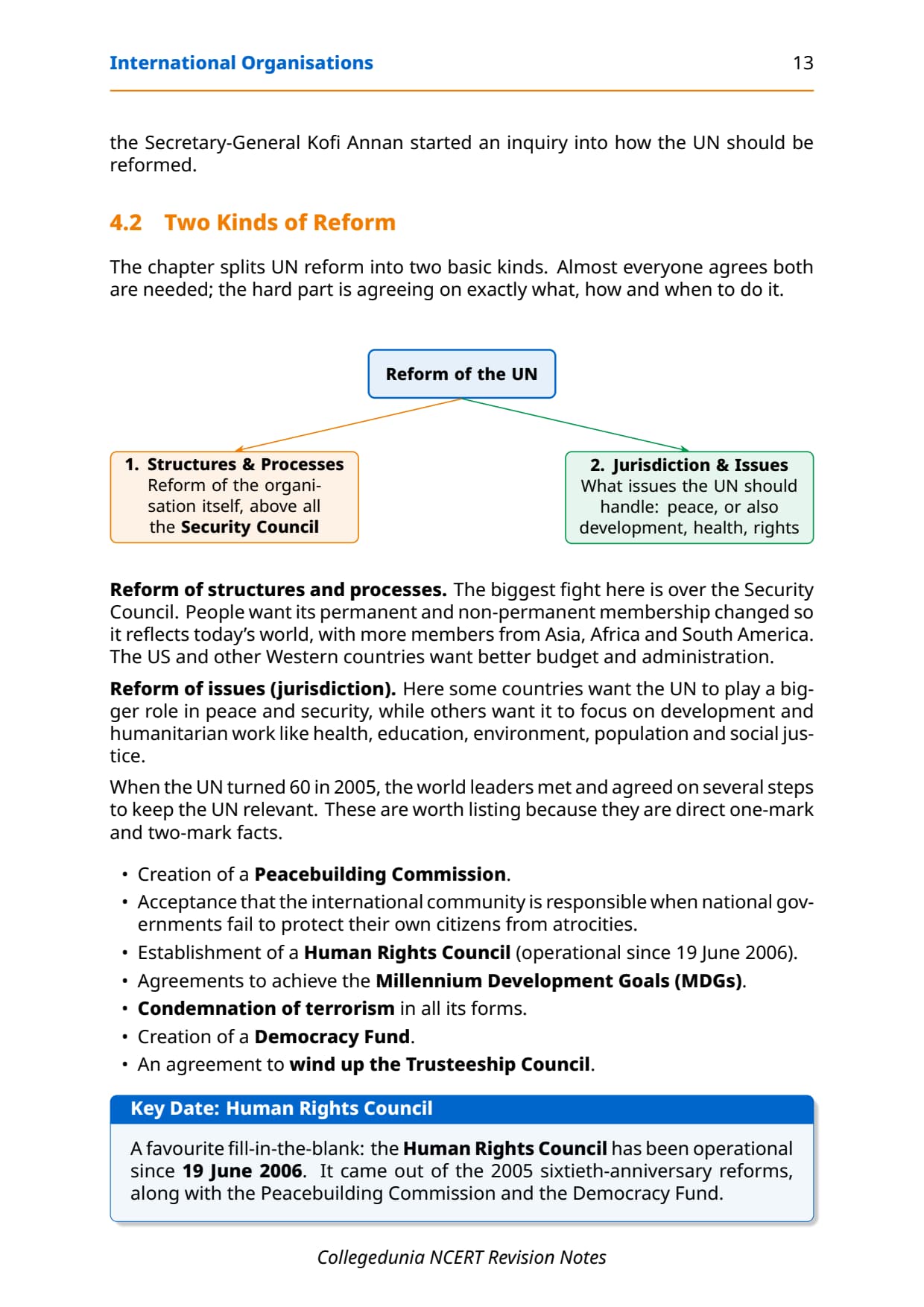
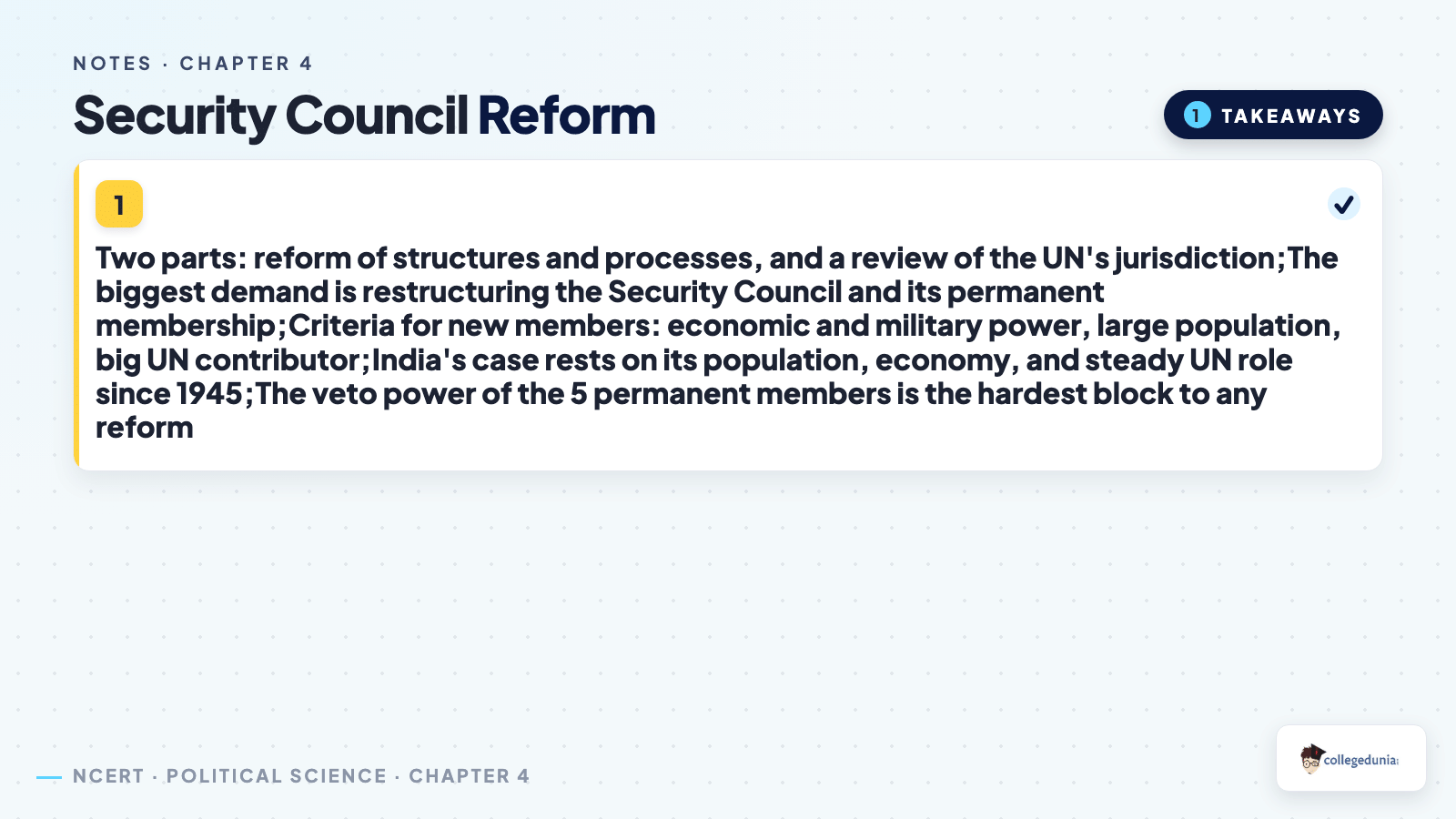
- Two parts of reform: changing structures and processes, and reviewing the UN's jurisdiction.
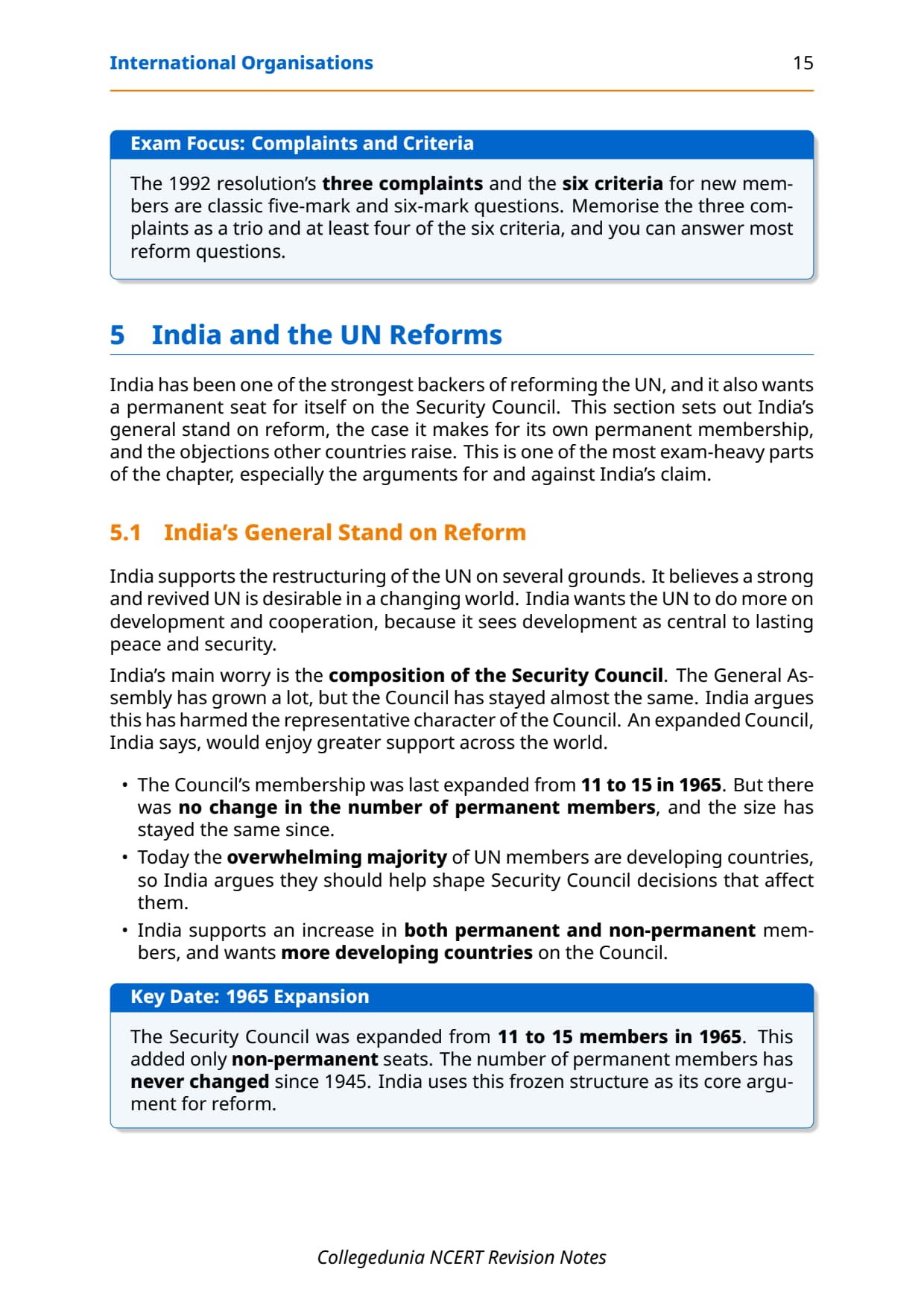
The honest revision line is that the veto is the biggest block to reform. The five permanent members will not give up their special power, and new claimants like India, Germany, Japan and Brazil cannot agree on who deserves a seat. So almost everyone wants reform, yet little changes. Keep this deadlock point at the heart of your reform answer.
Specialised Agencies and India's Case
Beyond its main organs, the UN works through specialised agencies, and India wants a permanent Security Council seat. These notes keep the agencies and India's criteria together for fast revision. The table sorts both for the MCQ and the justify question.
| Body or criterion | What to recall |
|---|---|
| IAEA | Oversees the safe and peaceful use of nuclear technology. |
| WHO | Leads global health and fights disease. |
| WTO | Successor to the GATT; sets the rules of world trade. |
| IMF and World Bank | Oversee the global financial system and fund development. |
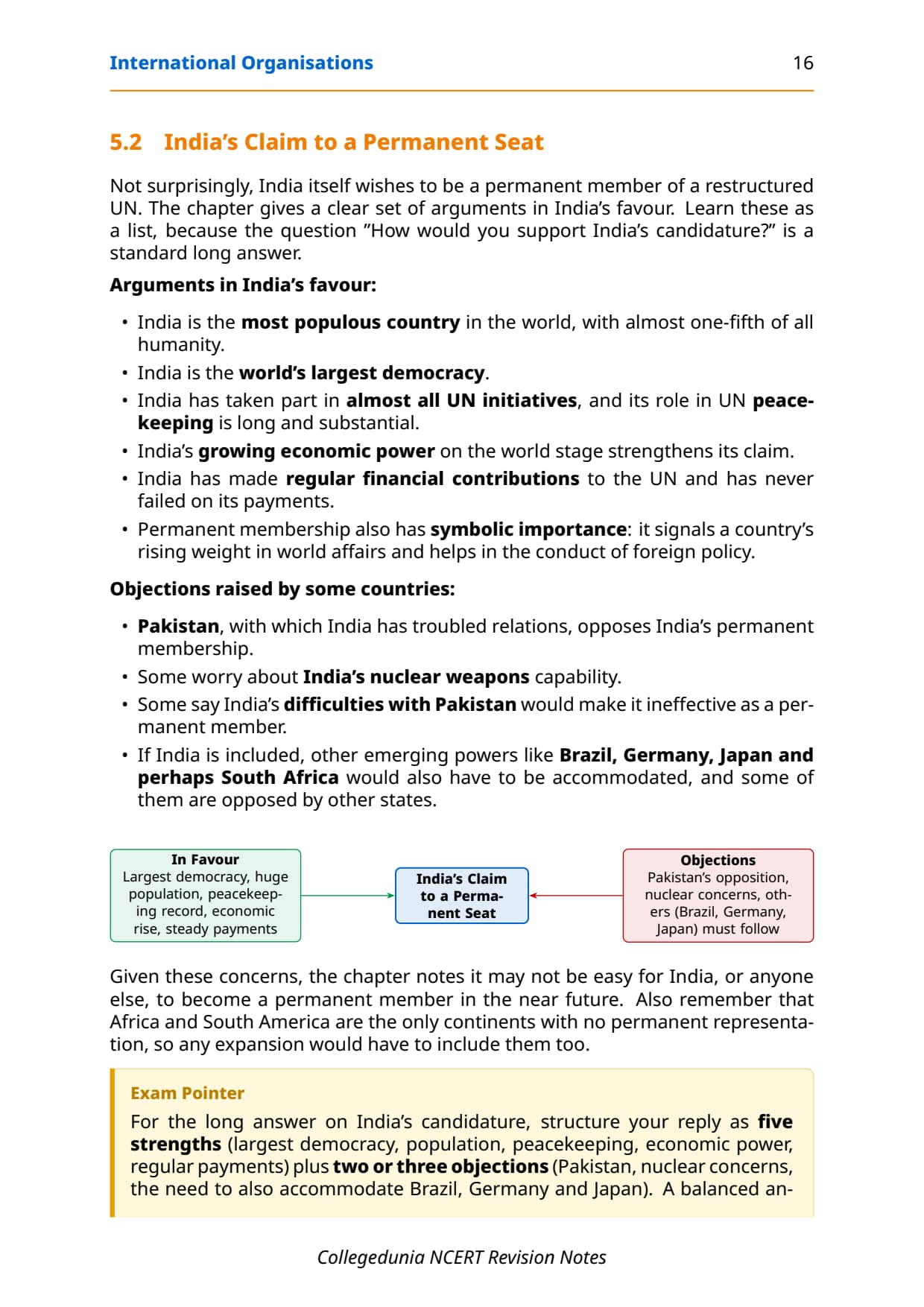
| India's claim | Large population, major economy, UN member since 1945, military strength, largest democracy. |
The sharp point for your notes is that India fits every proposed criterion, but the politics of the veto blocks it. Existing permanent members and rival claimants slow the process down. So the disintegration of the old order opened the reform debate, but the veto keeps India out of a permanent seat for now.
The UN in a Unipolar World
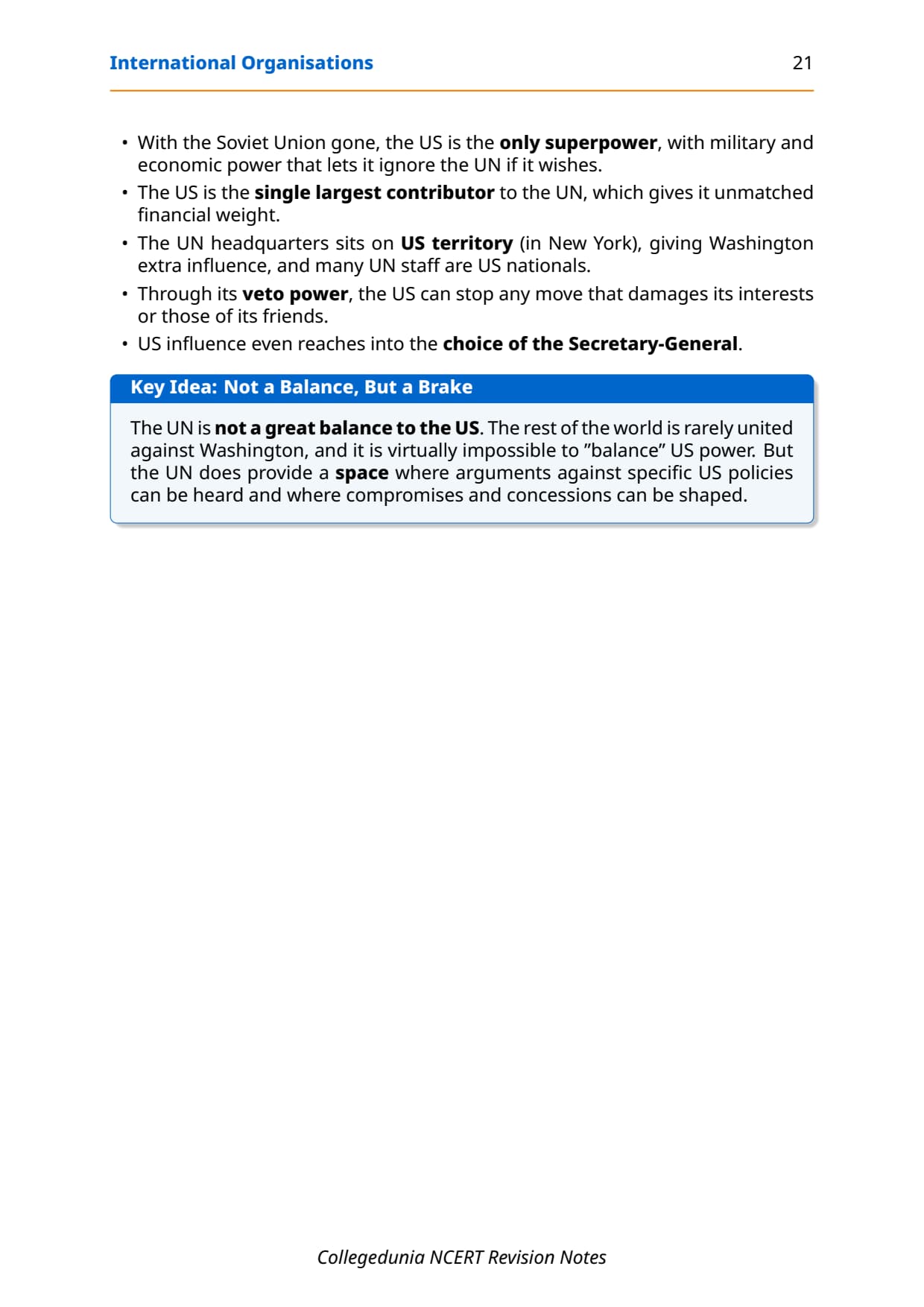
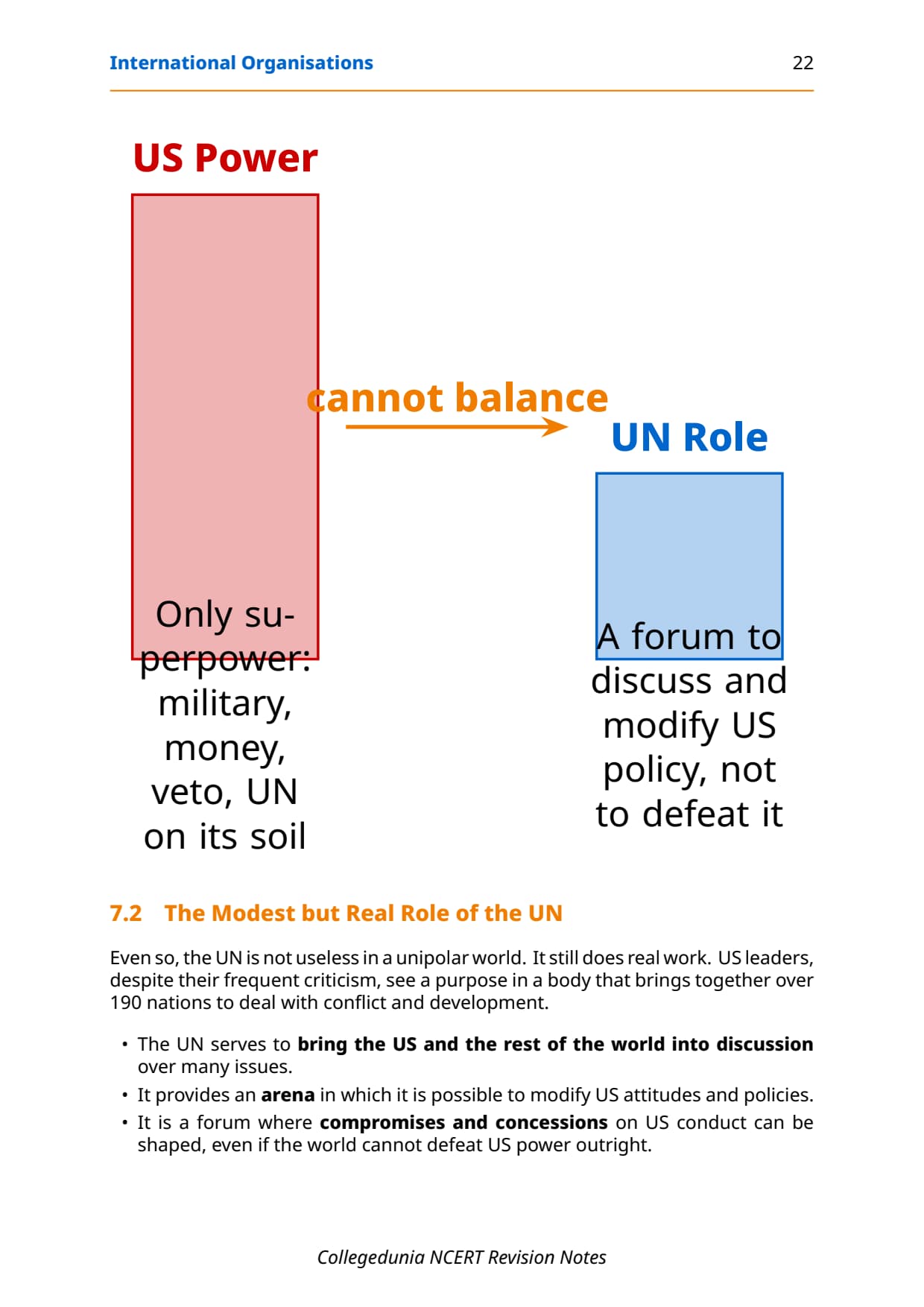
After the Cold War the US became the only superpower, and the UN now works in a unipolar world. This topic links the chapter to the wider course, so it is a regular short and long answer. The table keeps the UN's strengths and limits side by side for fast revision.
| Aspect | Key point to recall |
|---|---|
| Strength | The only global forum where even powerful states can be questioned. |
| Daily work | Agencies fight disease, manage money and protect rights every day. |
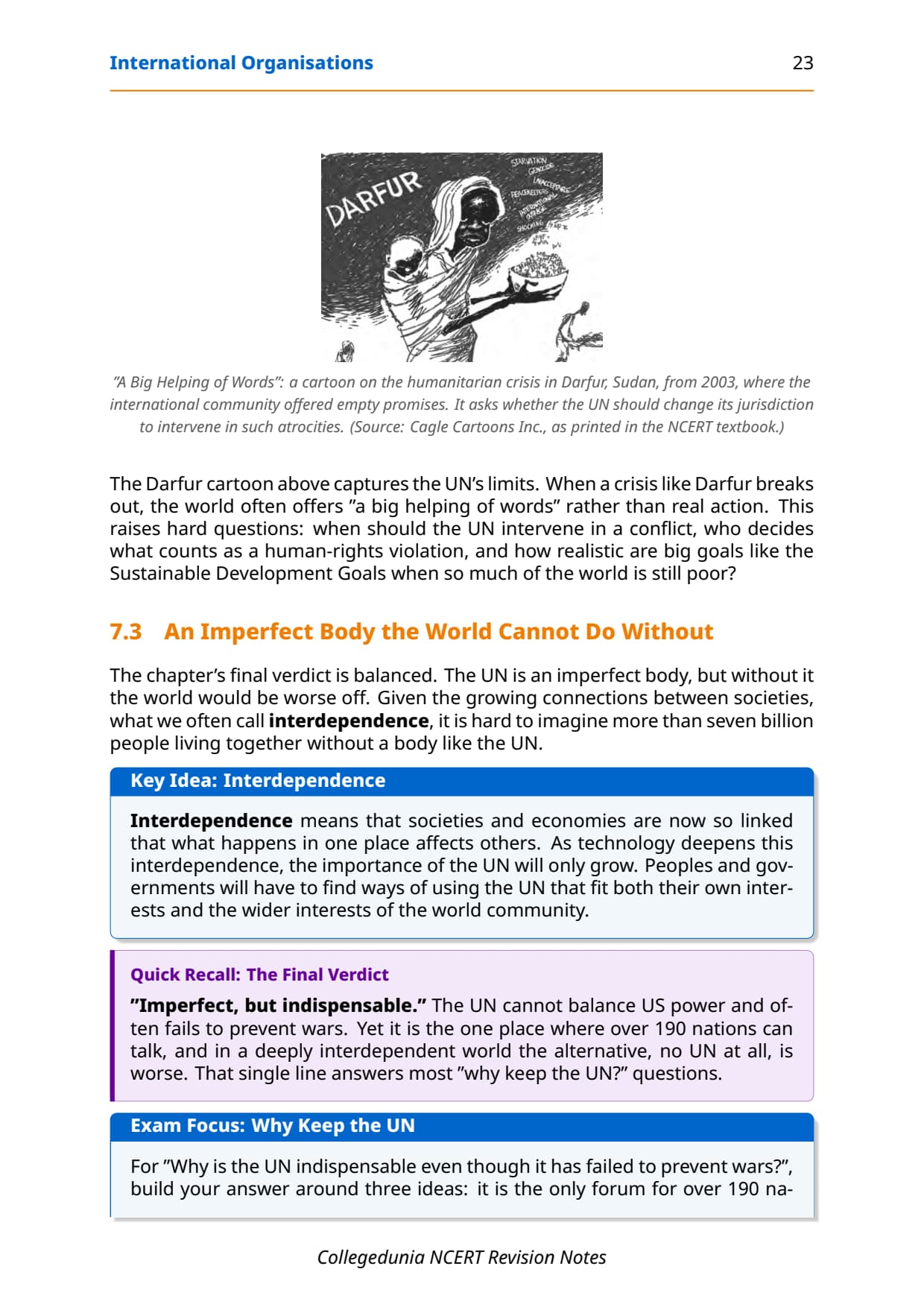
| Limit | It cannot stop every war, and a single veto can freeze the Security Council. |
The one-line takeaway is that the UN is imperfect, but over 190 nations choose to keep it going. In an interdependent world its everyday work outweighs its failures, which is why it stays indispensable. So a balanced answer admits the failures first, then names the wider work that makes the UN useful even in a unipolar world.
International Organisations Important Questions and Exam Pointers
CBSE sets a steady mix of MCQ, short and long answers from this chapter. Knowing the pattern helps students decide how much to write and which topics to revise first. A focused list of International Organisations important questions saves a lot of time before the board exam.
- Long answer (5 to 6 marks): functions of the Security Council, or the difficulties of UN reform.
- Short answer (4 marks): why the UN is indispensable, or India's case for a seat.
- Source-based: a passage on Security Council reform or the veto, with sub-parts.
- Objective and MCQ: the veto, the IAEA, the WTO and GATT, and the UN's founding year.
For quick recall, students often practise a short class 12 political science chapter 4 mcq drill and a list of International Organisations class 12 important questions. The most repeated items are the Security Council's functions and the reform debate, so keep those answer points ready in your own words. Reading these notes once, then writing the key lists from memory, is the fastest way to lock the chapter in.
Common Mistakes Students Make in This Chapter
A few errors cost marks every year. Most come from mixing up the organs or giving only one side of the reform debate. Fixing these five points is the quickest way to lift a score, so add them to the end of your revision sheet.
- Saying the Secretary-General holds the veto - only the five permanent members of the Security Council do.
- Confusing the General Assembly (all members debate) with the Security Council (peace and security).
- Calling for UN reform without naming the veto deadlock that blocks it.
- Forgetting the WTO is the successor to the GATT, not the WHO.
- Writing that the UN is a world government - it cannot force a sovereign state to obey.
Students who fix these five points usually move from average to high marks. The exam rewards a balanced view, so always give both the case for reform and the reasons it stalls before you judge it. These notes flag each soft point so you can phrase it safely in the answer sheet.
How These Notes Pair with the Solutions and Book PDF
These revision notes summarise the chapter. To prepare fully, students should use them alongside the other resources for the same chapter, all linked in the table below. Read the notes first, then test yourself with the solutions, and open the book PDF whenever you need the original text and figures.
| Resource | Best used for |
|---|---|
| International Organisations NCERT Solutions | Step-by-step answers to all 12 back-exercise questions |
| International Organisations Handwritten Notes | Last-minute, one-shot revision in a scanned notebook style |
| International Organisations NCERT Book PDF | Reading the original NCERT chapter text and figures |
Tip: read these notes first, then attempt the solutions on your own, and only then check the model answers. That order builds memory faster than copying answers straight away.
All Class 12 Political Science Notes by Chapter
The table links the revision notes for every chapter in both Class 12 Political Science books, so students can move across the course in one click. International Organisations is highlighted.
| Chapter | Notes |
|---|---|
| Contemporary World Politics | |
| Chapter 1 | The End of Bipolarity |
| Chapter 2 | Contemporary Centres of Power |
| Chapter 3 | Contemporary South Asia |
| Chapter 4 | International Organisations |
| Chapter 5 | Security in the Contemporary World |
| Chapter 6 | Environment and Natural Resources |
| Chapter 7 | Globalisation |
| Politics in India Since Independence | |
| Chapter 1 | Challenges of Nation Building |
| Chapter 2 | Era of One-Party Dominance |
| Chapter 3 | Politics of Planned Development |
| Chapter 4 | India's External Relations |
| Chapter 5 | Challenges to and Restoration of the Congress System |
| Chapter 6 | The Crisis of Democratic Order |
| Chapter 7 | Regional Aspirations |
| Chapter 8 | Recent Developments in Indian Politics |
FAQs on International Organisations Class 12 Notes
International Organisations Class 12 Political Science Notes Common Questions
Ques. Where can I download the International Organisations Class 12 notes PDF?
Ans. You can download the International Organisations Class 12 Political Science notes PDF directly from this page. It is free, follows the 2026-27 NCERT, and covers the UN's organs, the Security Council, the veto, reform and India's case in a short, point-wise format.
Ques. What does the International Organisations chapter cover for Class 12?
Ans. It covers why countries need international organisations, the founding and organs of the UN, the Security Council and the veto power, the demand for reform, India's case for a permanent seat, the specialised agencies, and the UN's role in a unipolar world.
Ques. What is the veto power in the Security Council?
Ans. The veto is a negative power held only by the five permanent members of the Security Council. One veto can stop any resolution, which is why it is the biggest block to UN reform. The notes box this point separately so students never assign it to the wrong body.
Ques. Why is International Organisations important for the board exam?
Ans. Because the UN organs, the Security Council reform debate and India's case appear almost every year. The match-the-organs question and the functions of the Security Council are regular scorers, so revising these notes well secures both MCQ and long-answer marks.
Ques. How should I use these notes to revise quickly?
Ans. Read the notes once under the why, how and reform frame, keep the organs, the veto and the reform points on one sheet, then write the key lists from memory. Finish by attempting a short class 12 political science chapter 4 mcq drill to test the small facts.



Comments