



These Class 12 Maths Chapter 9 Differential Equations notes cover order, degree, and the three main solving methods. Each result comes with the conditions under which it holds, in the exact NCERT order. You can download the full notes as a free PDF right here on this page, aligned to the 2026-27 syllabus.




- CBSE Boards: 5 to 7 marks (Calculus unit overall carries about 35 marks)
- JEE Main: 1 to 2 questions on order, degree, linear (integrating factor) and homogeneous DEs (about 3 to 5% of Maths)
- CUET (UG) Maths: 2 to 3 direct MCQs on order/degree, general/particular solution, and variable separable form every year
|
Table of Contents |
Class 12 Maths Chapter 9 Differential Equations: Topic-by-Topic Breakdown
Differential Equations is a classification-then-method chapter. Most marks come from first spotting whether a DE is variable-separable, homogeneous, or linear. The concepts below follow the NCERT order.
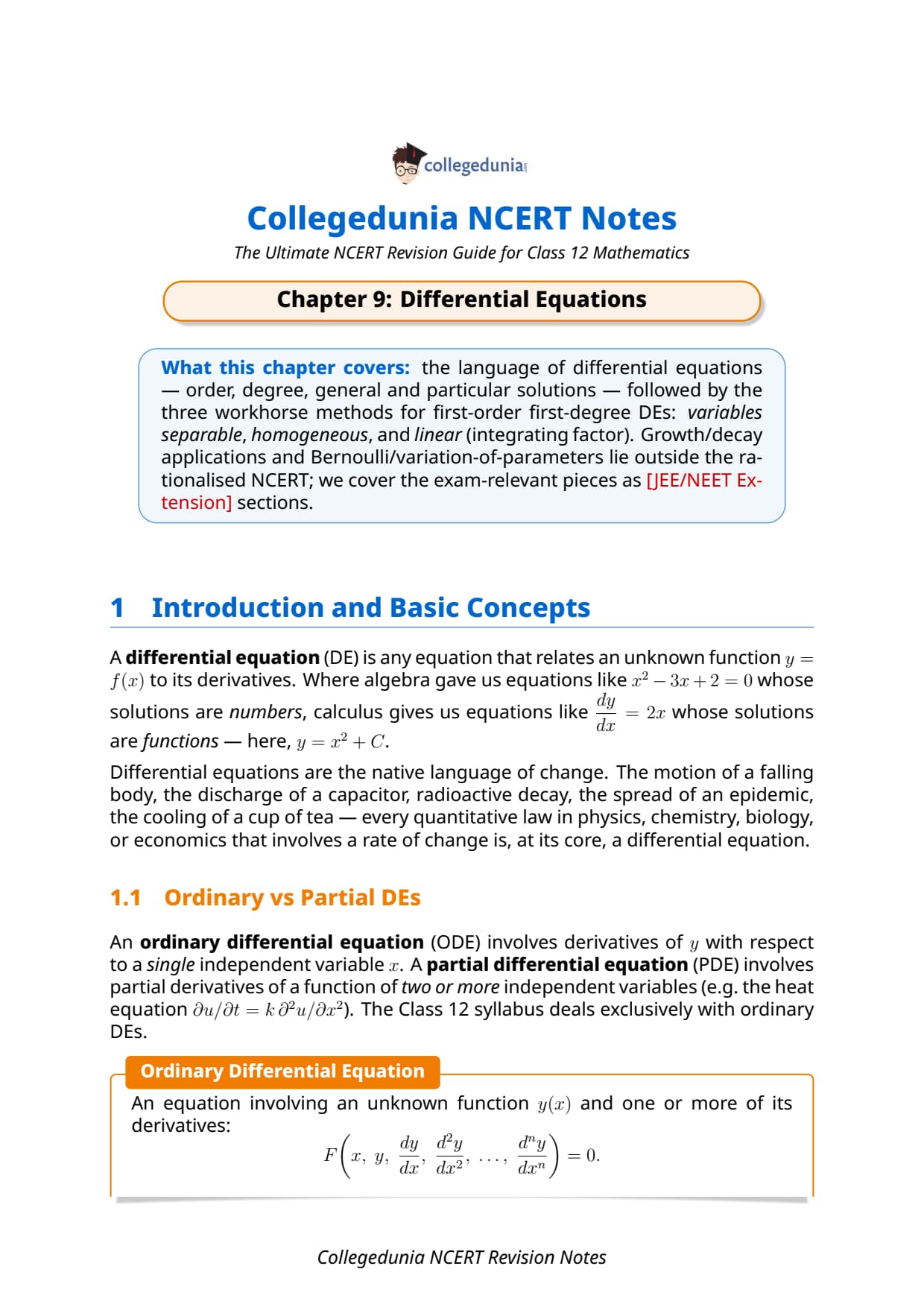
1. What is a differential equation? Order and degree
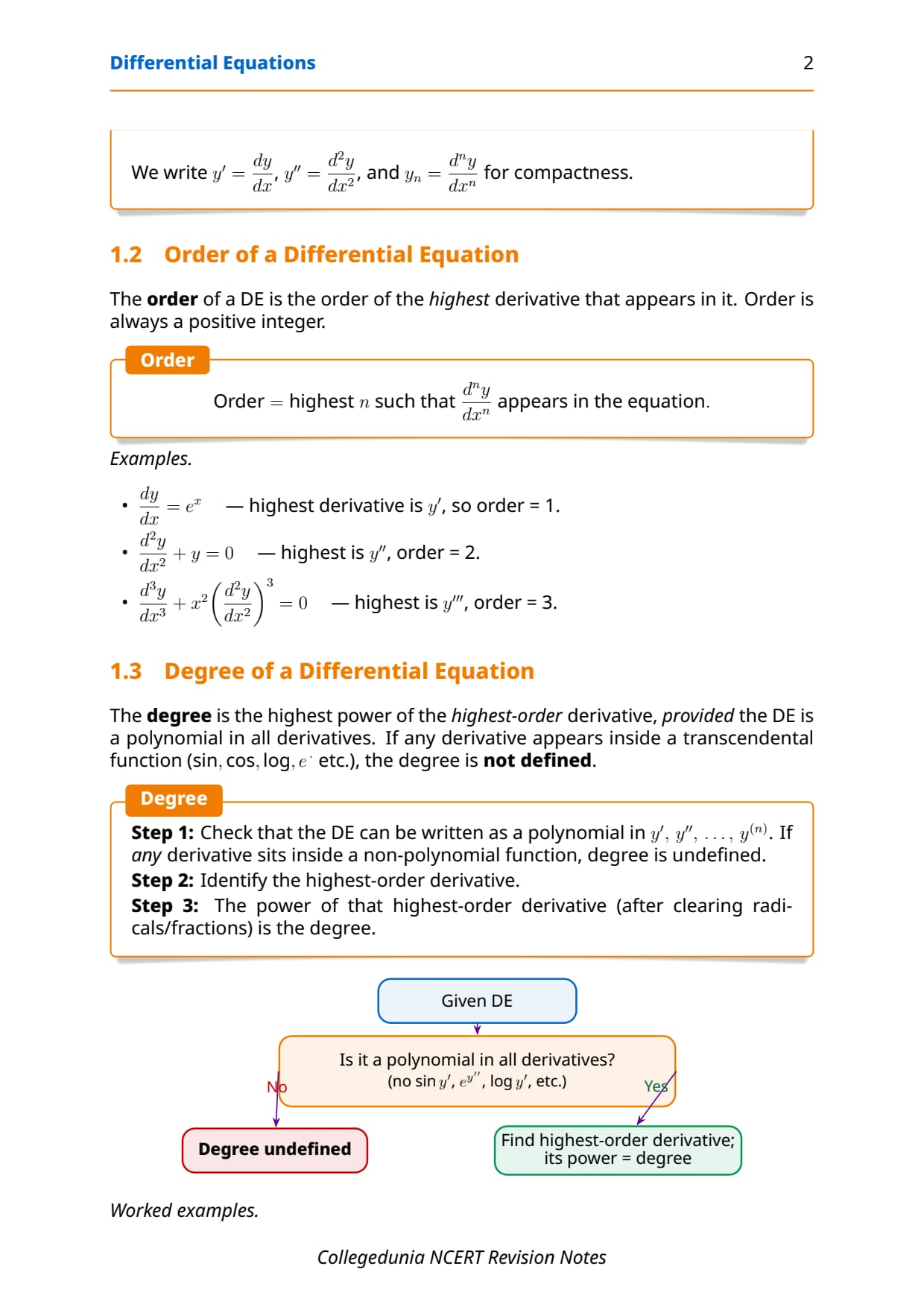
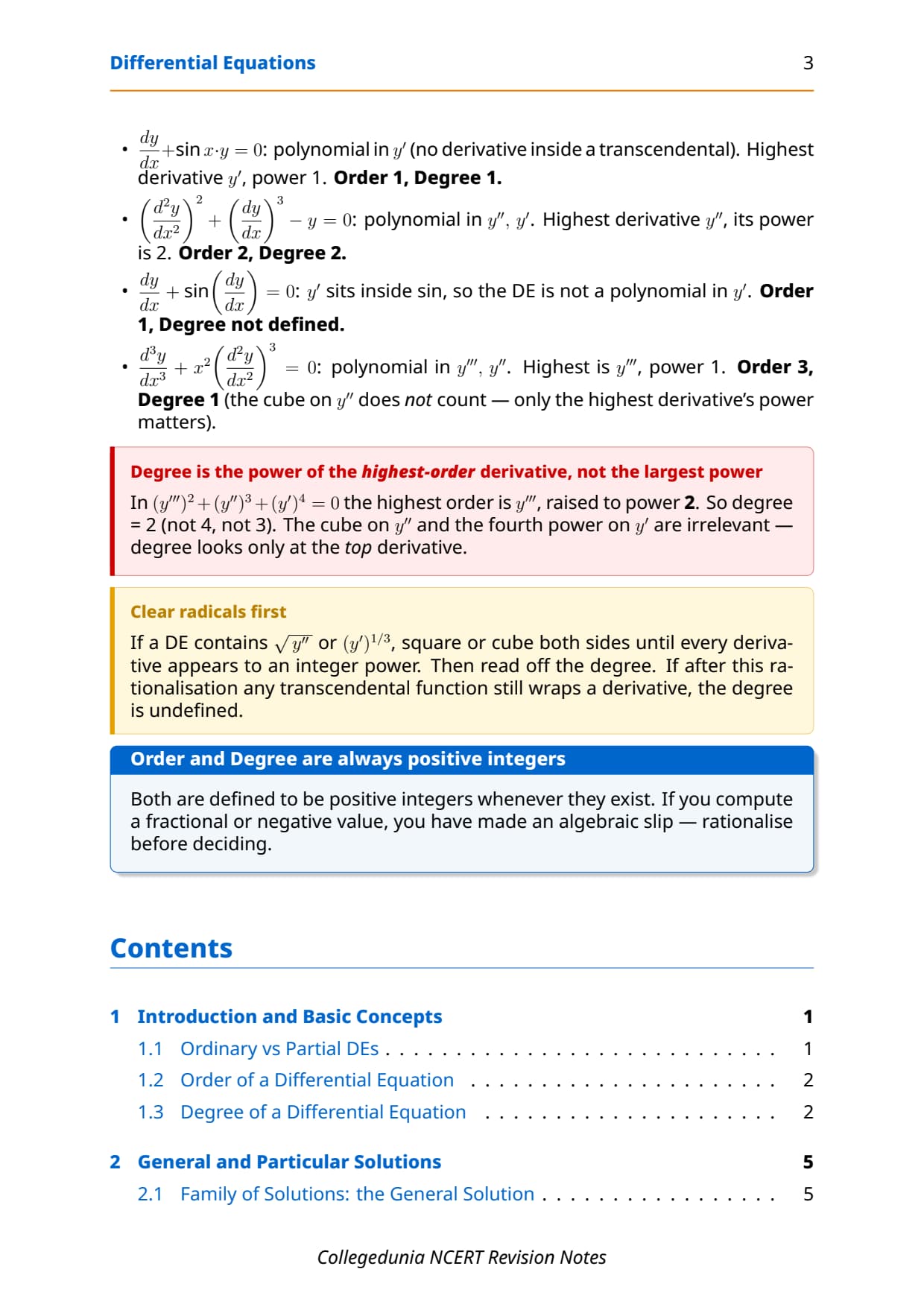
A differential equation involves an unknown function and its derivatives. The order is the highest derivative present. The degree is the power of that highest derivative once the equation is a polynomial in derivatives.
Quick Note: If the equation contains sin(dydx) or edy/dx , the degree is not defined, a recurring 1-mark MCQ trap.
2. General and particular solutions
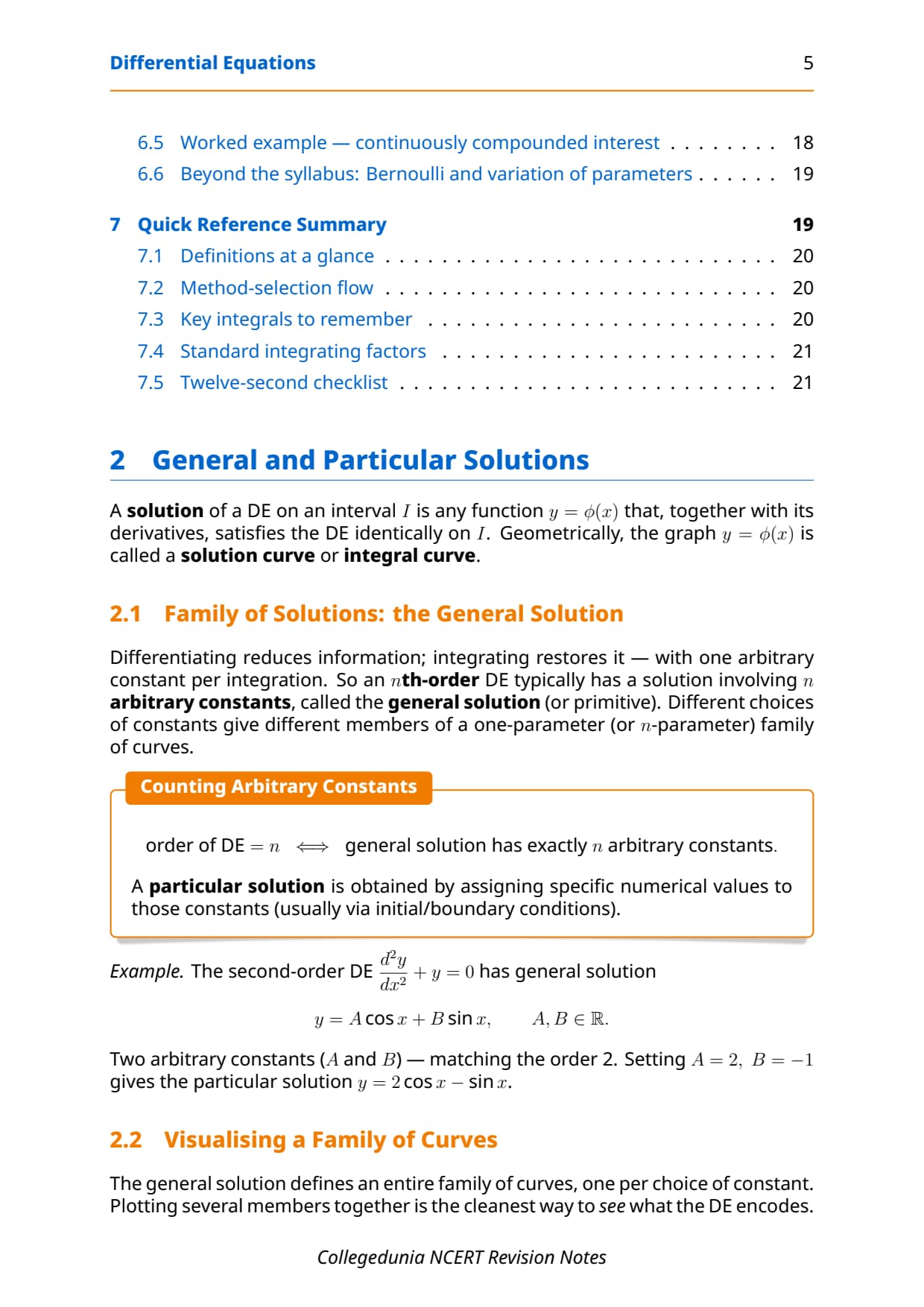
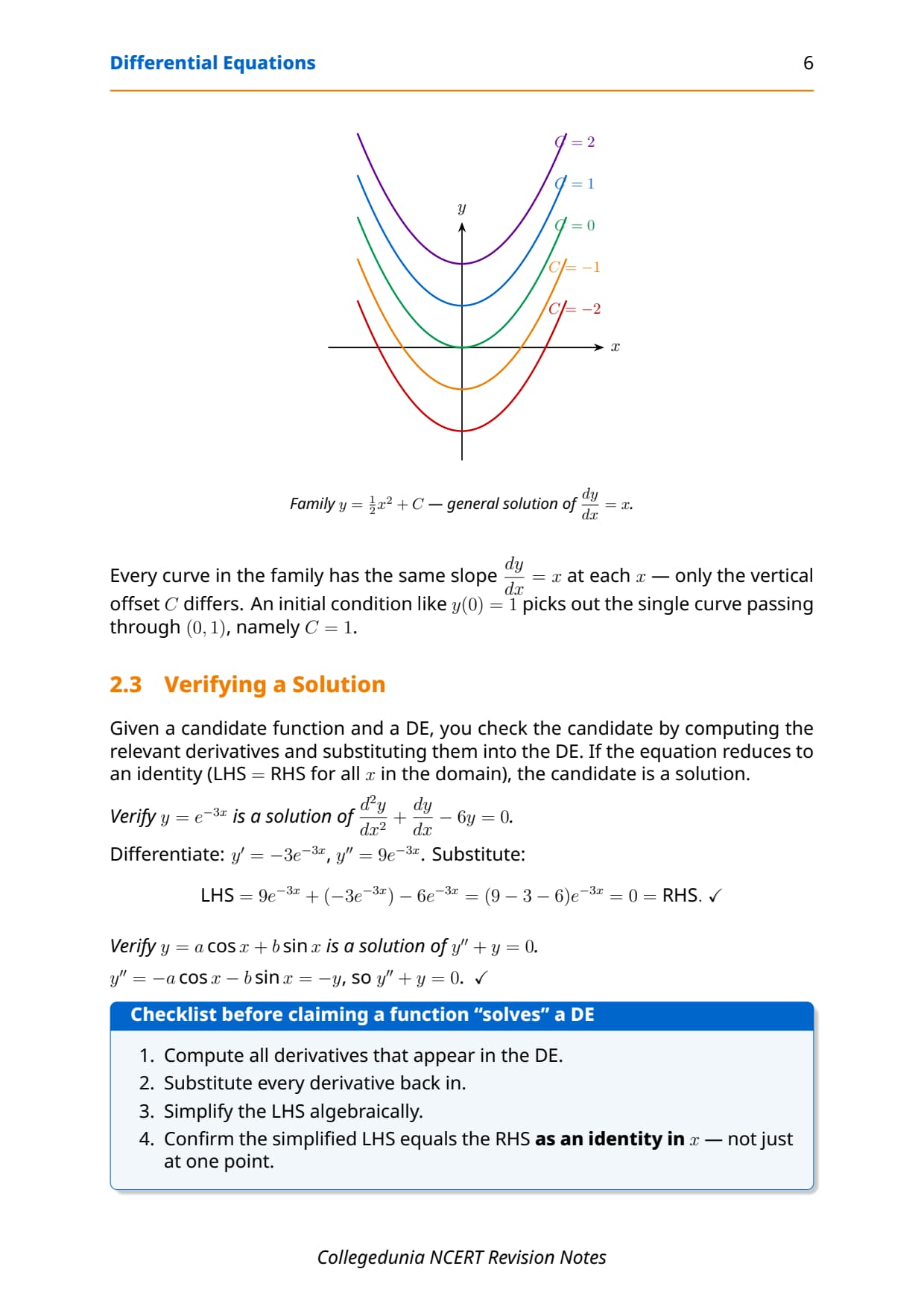
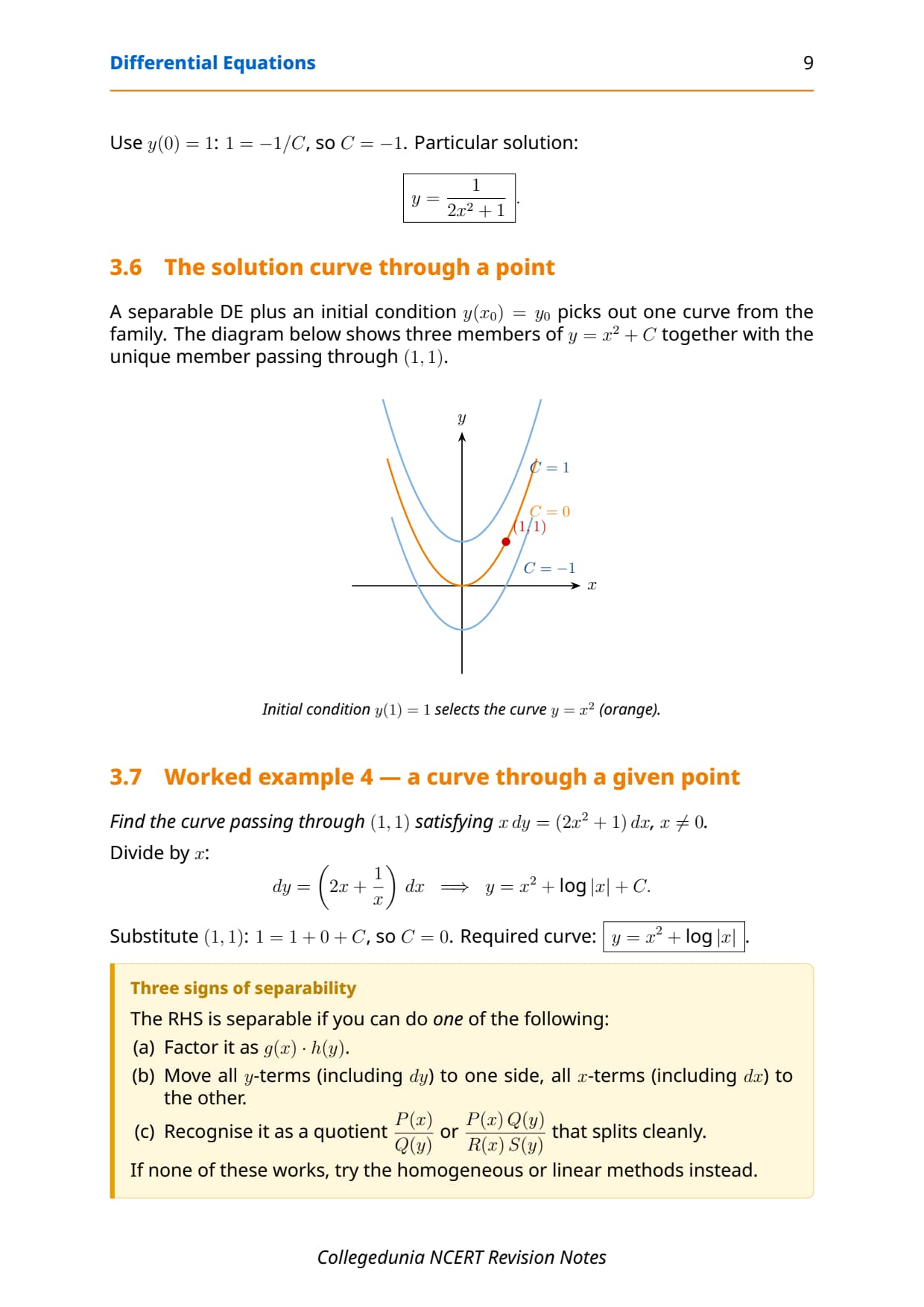
A general solution of an order-n DE has n arbitrary constants. A particular solution fixes those constants using initial conditions like y(0) = 1 .
Common Confusion: the number of arbitrary constants always equals the order. A first-order DE has one; a second-order DE has two.
3. Formation of a differential equation from a family of curves
If a family of curves has n arbitrary constants, differentiate n times and eliminate the constants. The resulting DE has order n.
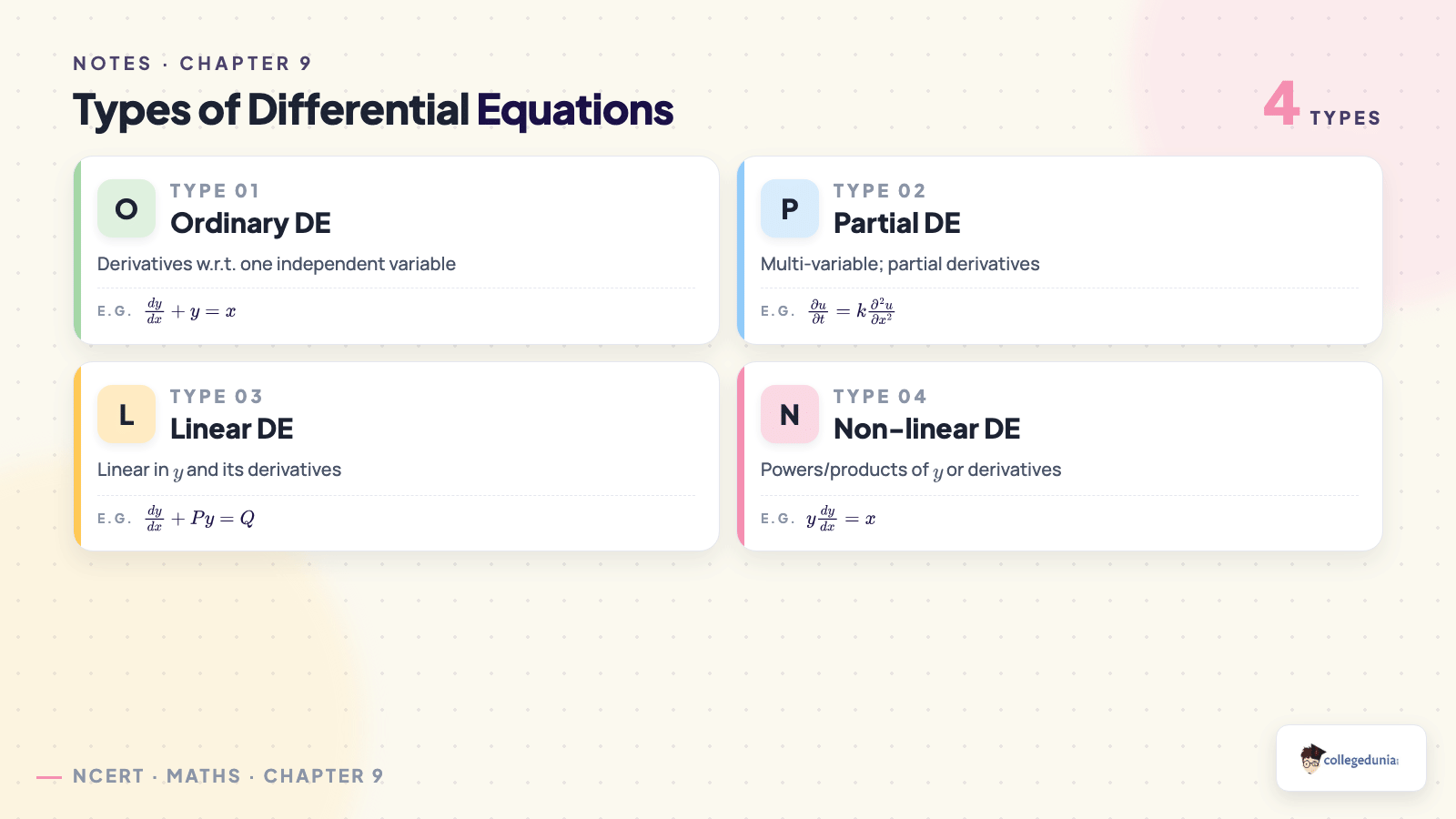
4. The three solving methods
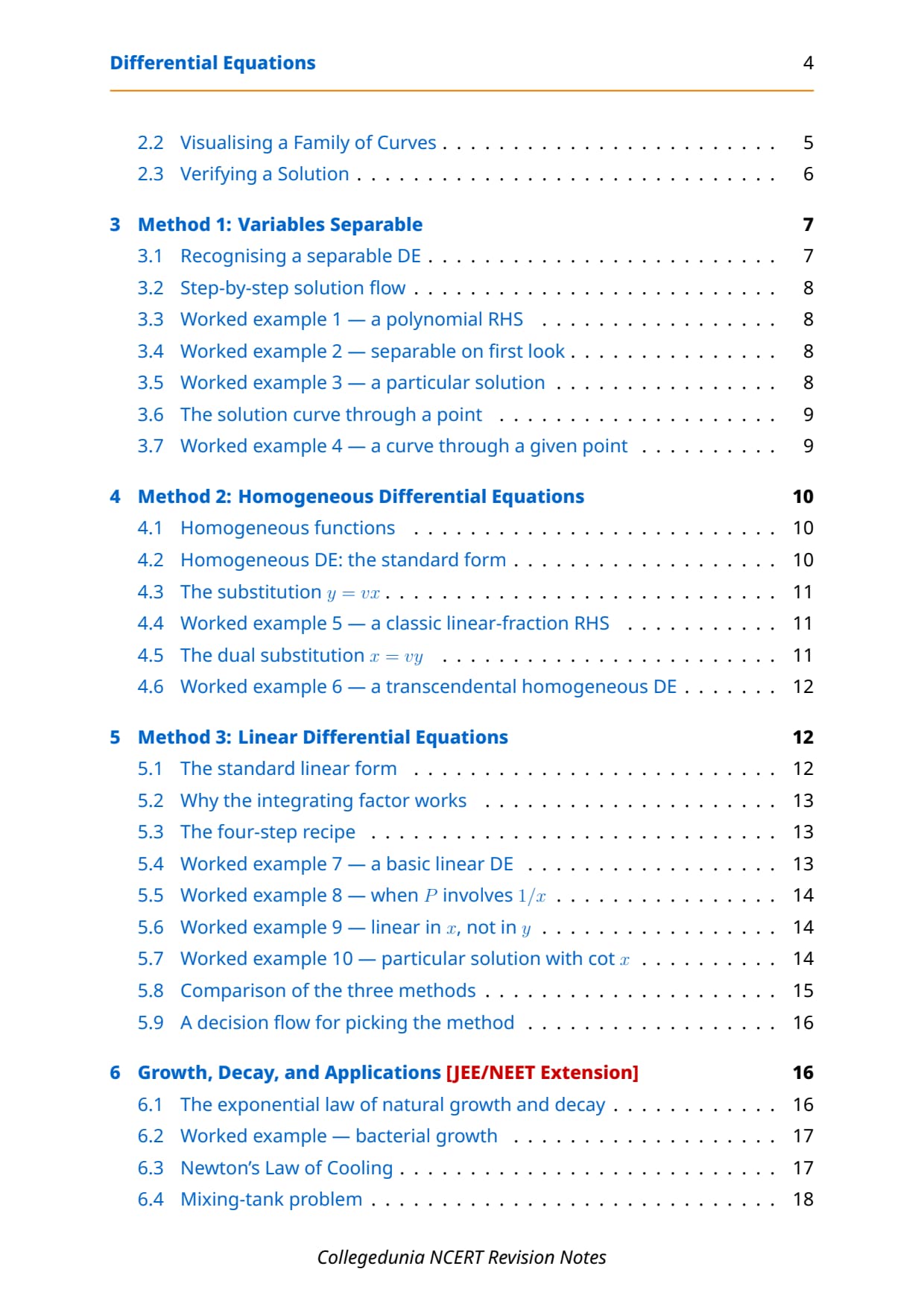
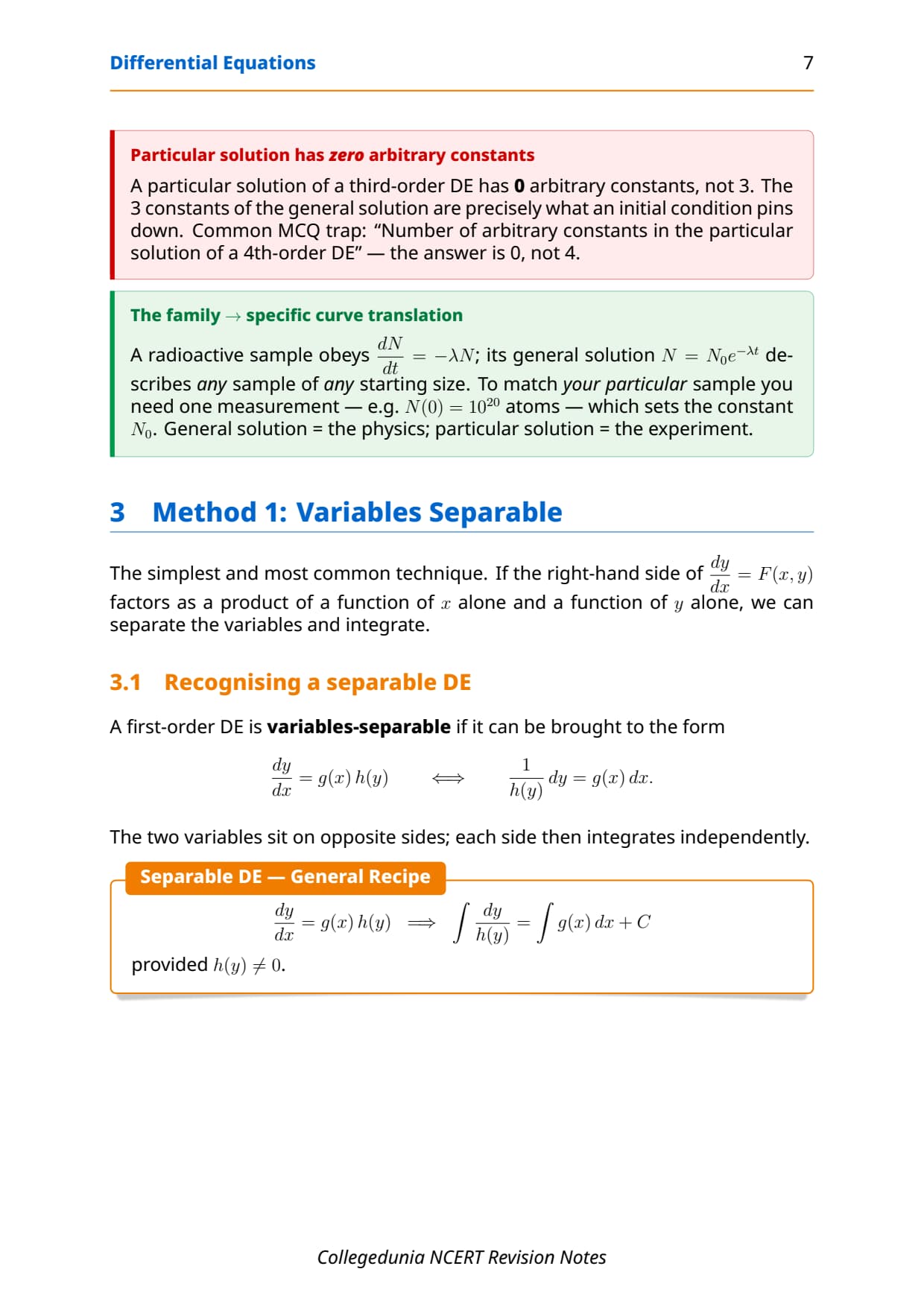
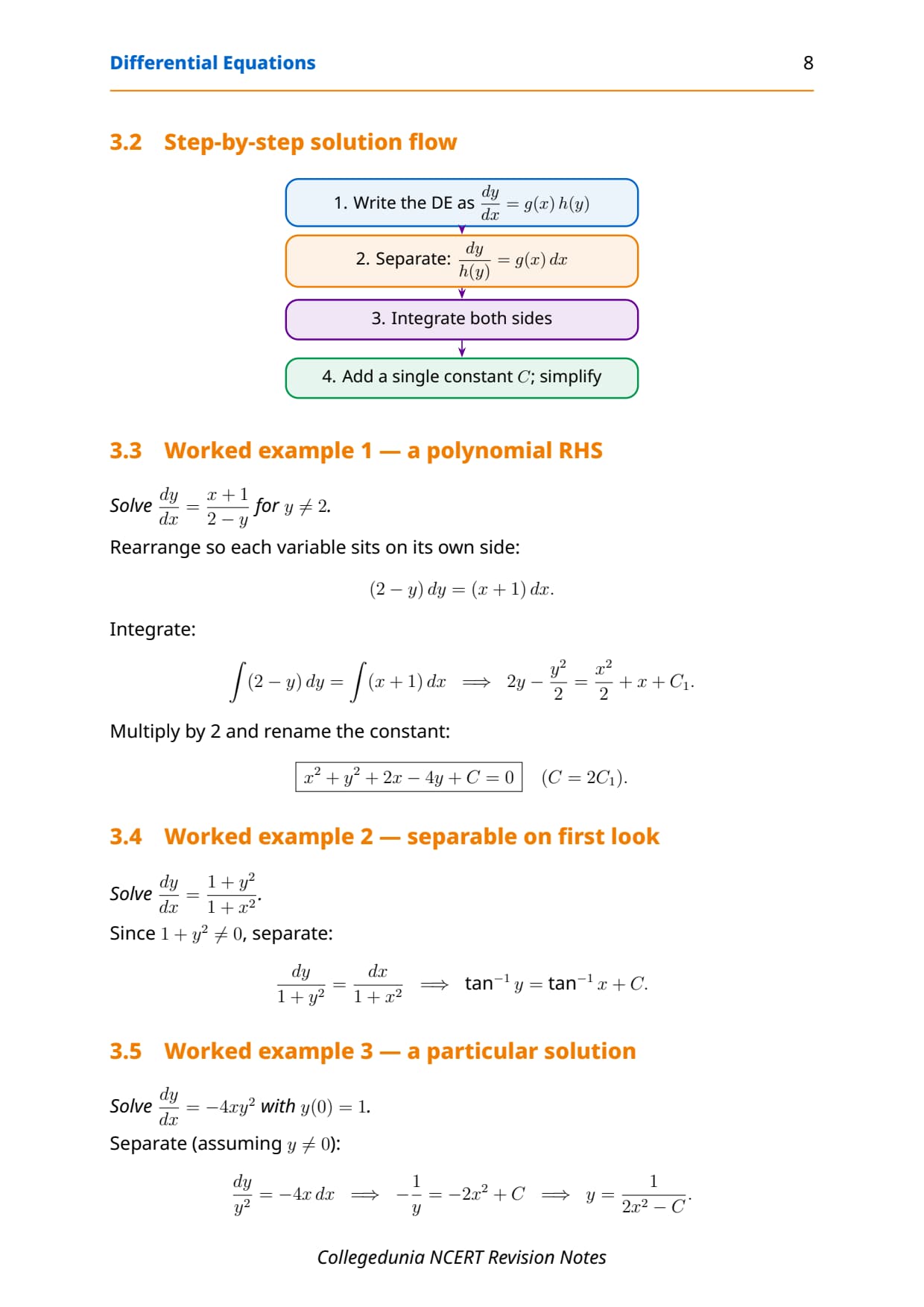
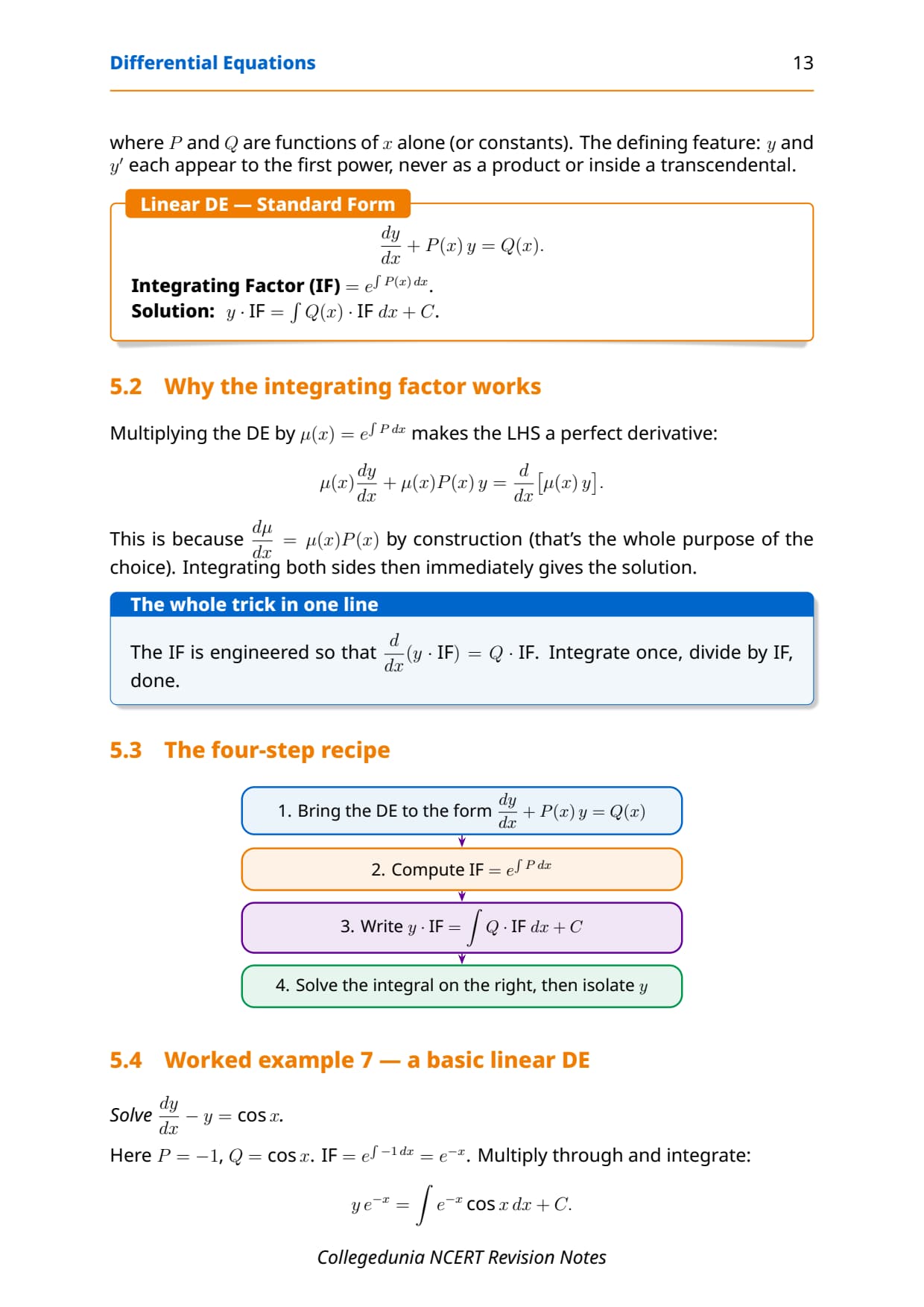
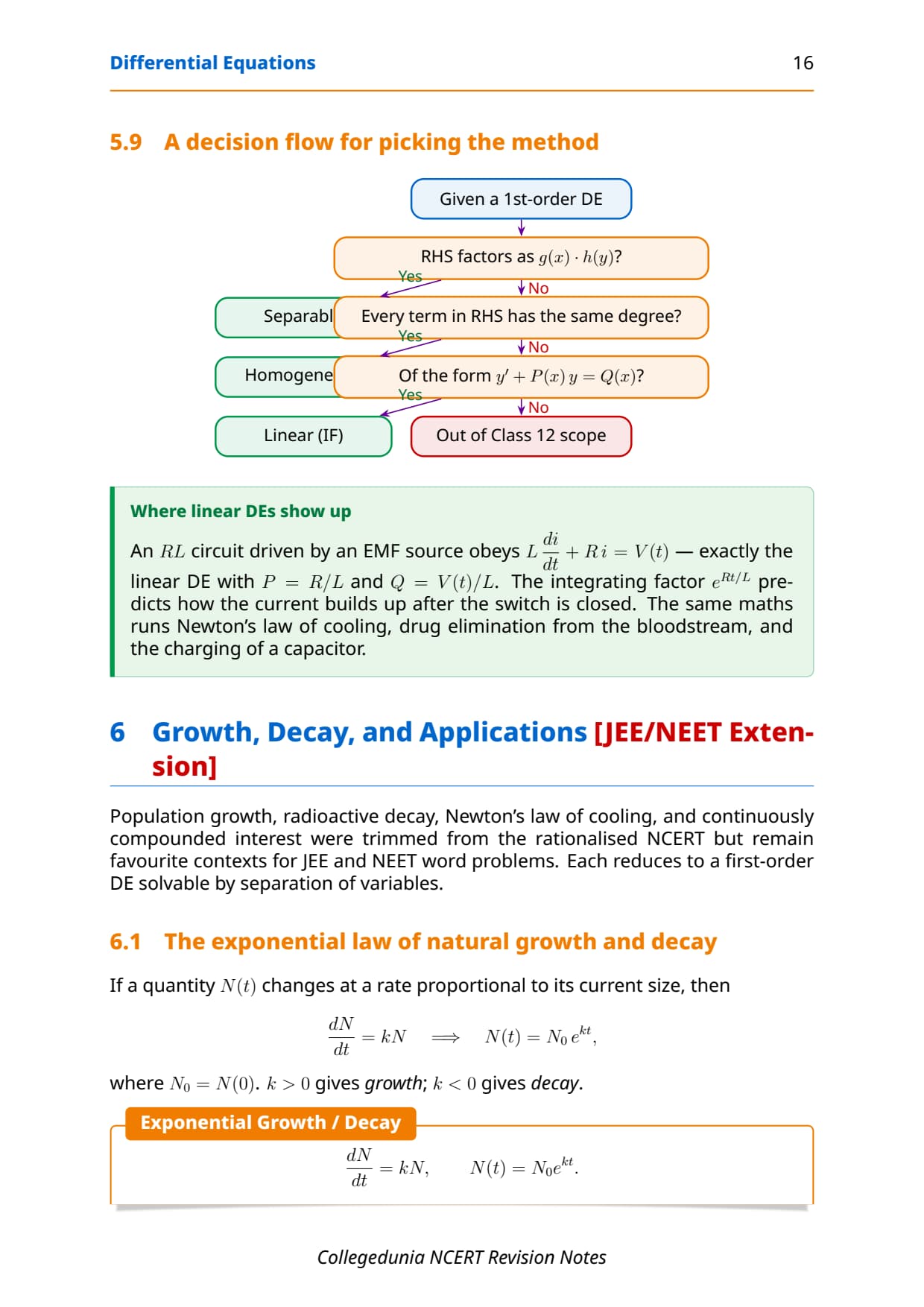
Variable-separable: write the DE as f(y) dy = g(x) dx, then integrate both sides.
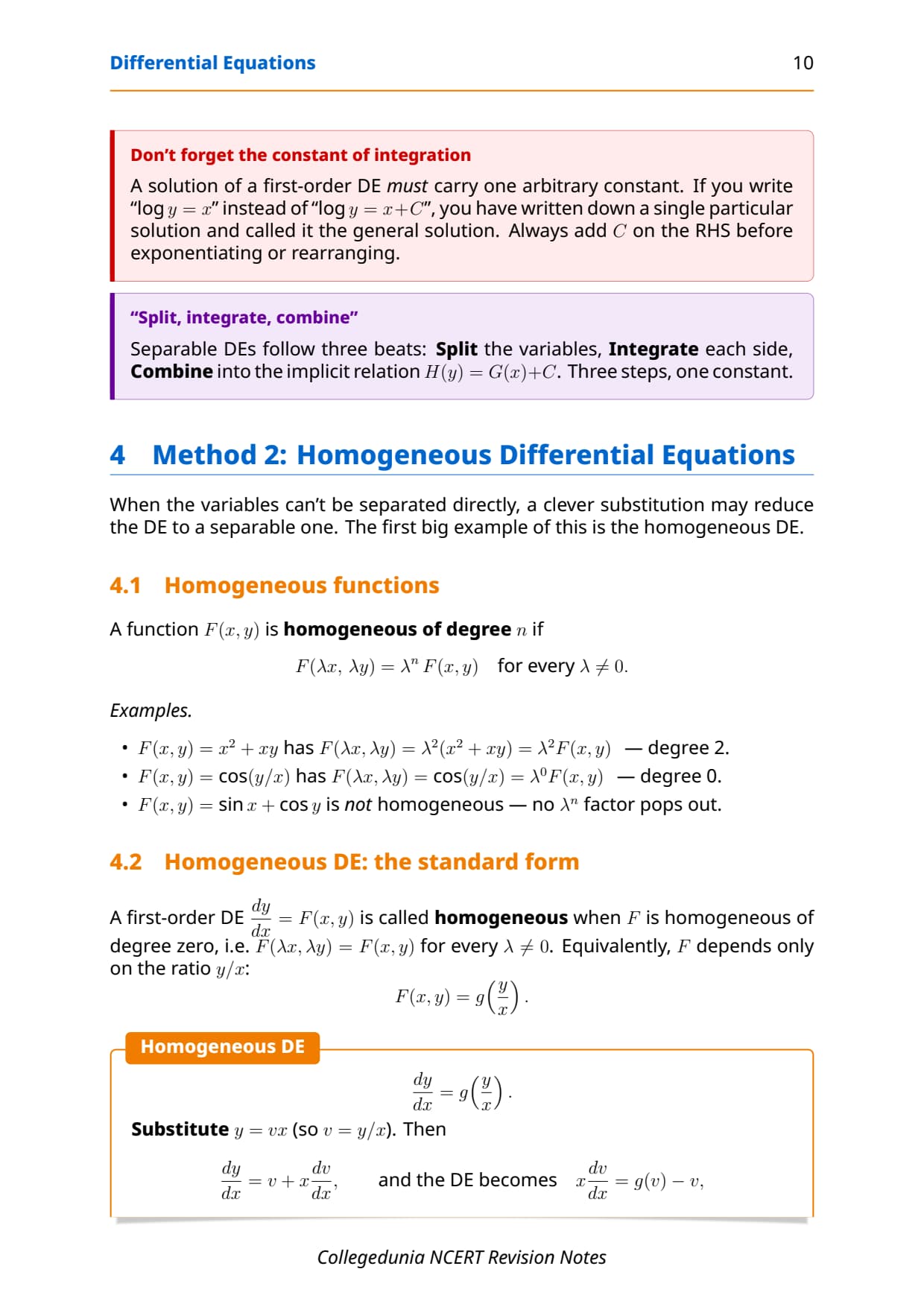
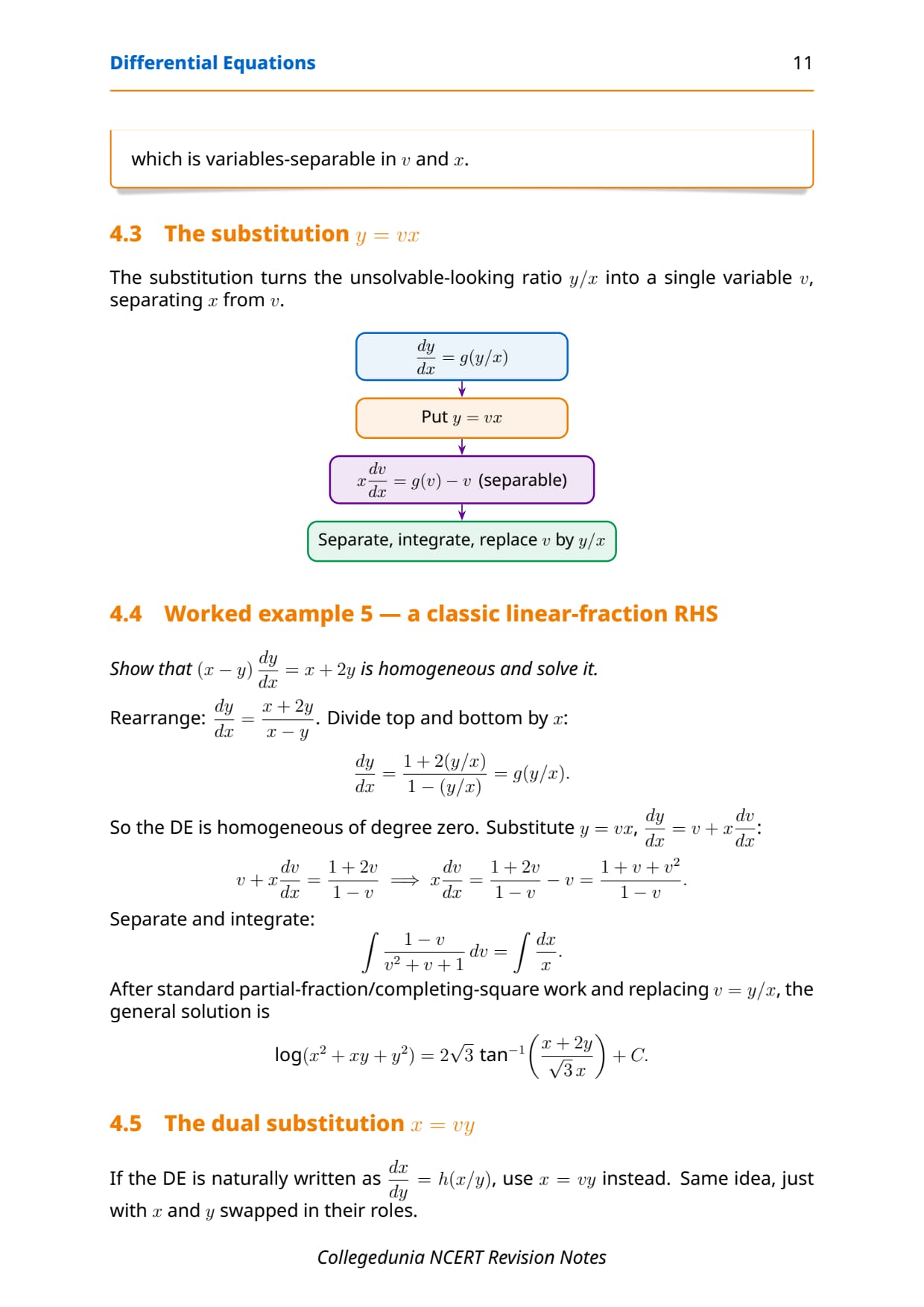
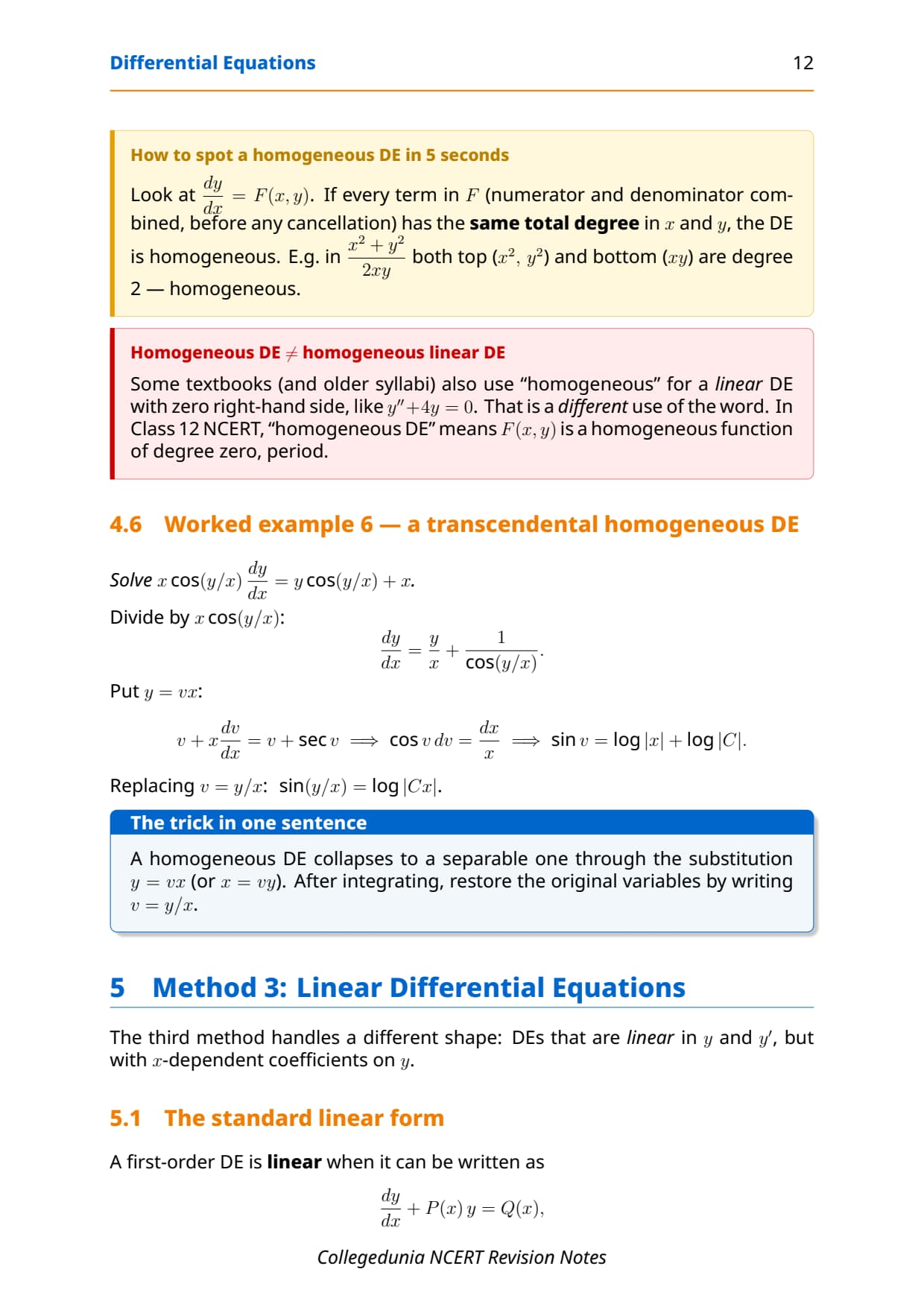
Homogeneous: if dydx is a function of y/x, substitute y = vx to make it separable.
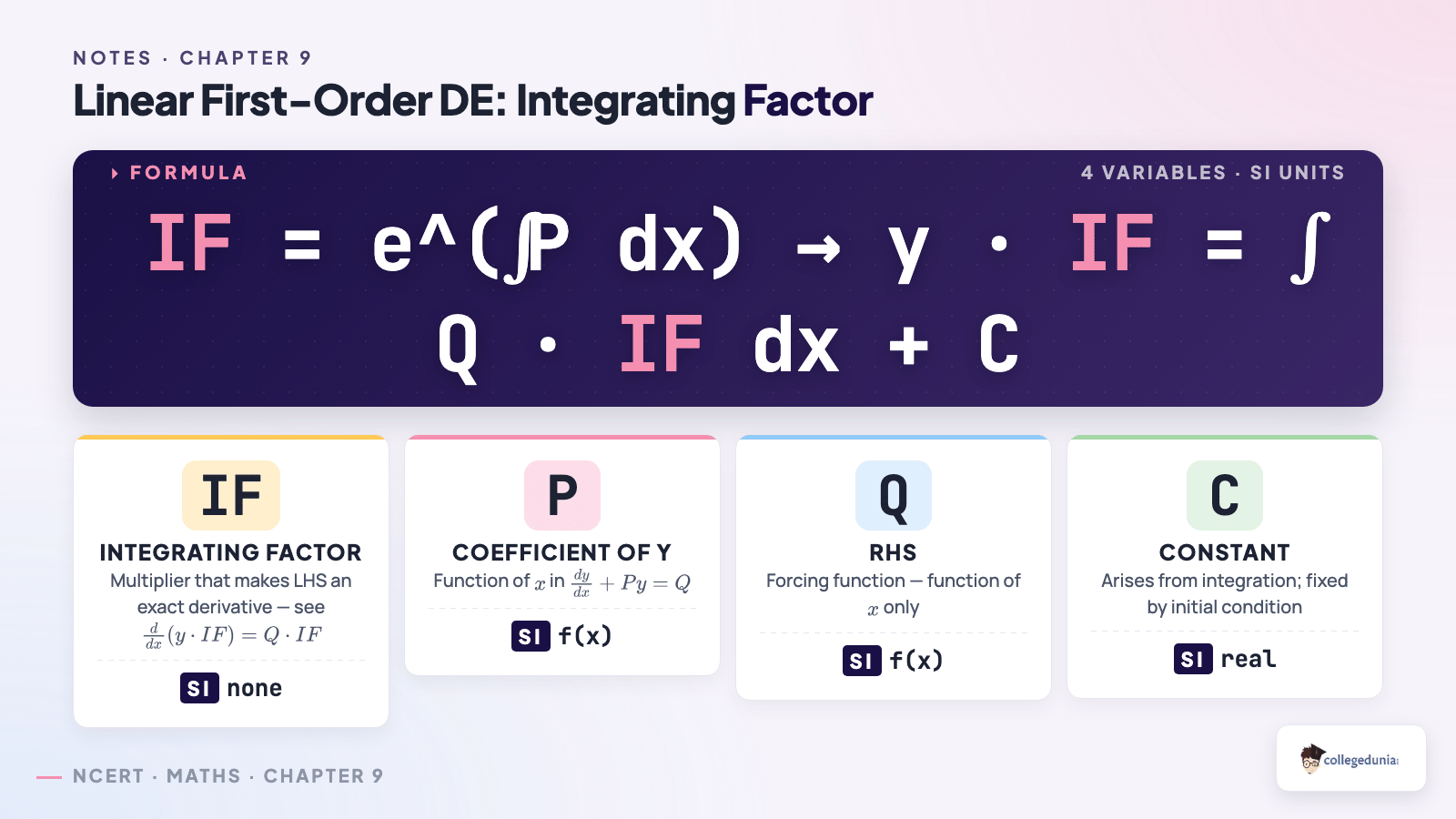
Linear first-order: for dydx + Py = Q, multiply by the integrating factor e∫ P dx, then integrate.
Differential Equations Class 12 Solved Step by Step (Video)
Source: Magnet Brains on YouTube
How will Collegedunia's NCERT Notes for Class 12 Maths Chapter 9 help you?
- Order and degree definitions include the edge cases, so the 1-mark MCQs become automatic.
- Each solving method is given as a short recipe with a board-style example.
- The "linear in y or in x?" check is flagged, the most-missed step in the 5-mark question.
Class 12 Maths Chapter 9 Differential Equations: Most Important Topics
| NCERT Class 12 Maths Chapter 9 Differential Equations Notes: Important Topics | |
|---|---|
| Definition of a differential equation | Order and degree of a DE |
| General and particular solutions | Initial-value problems |
| Formation of a DE from a family of curves | Verifying a given function is a solution |
| Variable-separable differential equations | Standard integrals appearing in DE solutions |
| Homogeneous functions of degree zero | Substitution y = vx for homogeneous DEs |
| Linear DEs dydx + Py = Q | Integrating factor e∫ P dx |
Differential Equations Class 12 Notes: Most Repeated Questions in Board Exams
Ques. Find the order and degree of (d3 ydx3)2 + (d2 ydx2)3 + dydx + 4 = 0 . (2024, 2022, 2019)
Ques. Solve dydx = x + yx . (2024, 2023, 2020)
Ques. Solve the linear DE dydx + 2y = e3x . (2024, 2021, 2018)
Ques. Form the differential equation representing the family y = a sin(x + b) where a, b are arbitrary constants. (2023, 2020)
Differential Equations Notes: Previous Year Paper Analysis
- Every paper carries at least one 1-mark MCQ on order, degree, or the number of arbitrary constants in a general solution.
- Linear DEs (integrating-factor method) have appeared as a 5-mark question in 4 of the last 5 papers, treat it as a guaranteed question.
- Homogeneous DEs ( y = vx ) appear roughly every alternate year for 3 or 5 marks.
Weightage of Differential Equations in JEE Main, CUET, and CBSE 2026
| Exam | Weightage | Important Topics |
|---|---|---|
| JEE Main 2025 | 1 to 2 questions (about 3 to 5%) | Order & degree, linear DE with integrating factor, homogeneous DE, formation of DE from curve family |
| CBSE Boards 2025 | 5 to 7 marks | Linear DE (integrating factor), homogeneous DE, variable separable with initial condition |
| CUET (UG) 2025 Maths | 2 to 3 MCQs | Order/degree, general vs particular solution, variable separable, integrating factor identification |
Other Resources for Class 12 Maths Chapter 9 Differential Equations
- NCERT Solutions for Class 12 Maths Chapter 9 Differential Equations
- Class 12 Maths Chapter 9 Differential Equations Formula Sheet
- Class 12 Maths Chapter 9 Differential Equations Handwritten Notes
Common Mistakes Students Make When Using the Differential Equations Class 12 Notes
- Confusing order with degree. Order is about which derivative is highest; degree is about the power of that highest derivative once the equation is polynomial in derivatives. Always state both separately.
- Forgetting that degree is not defined when the DE contains sin(dy/dx) , edy/dx , or log(dy/dx) . Writing "degree = 1" in such cases is automatic mark-loss.
- Skipping the integrating factor exponent. Writing IF = ∫ P dx instead of e∫ P dx . The exponential is mandatory.
- Missing the linear-in-x form. An equation may not be linear in y but linear in x. Switch the dependent variable before you solve. Missing this switch is the most costly 5-mark error.
NCERT Notes for Class 12 Maths: All Chapters
| Chapter | Chapter Notes |
|---|---|
| Chapter 1 | Relations and Functions Notes |
| Chapter 2 | Inverse Trigonometric Functions Notes |
| Chapter 3 | Matrices Notes |
| Chapter 4 | Determinants Notes |
| Chapter 5 | Continuity and Differentiability Notes |
| Chapter 6 | Application of Derivatives Notes |
| Chapter 7 | Integrals Notes |
| Chapter 8 | Application of Integrals Notes |
| Chapter 9 | Differential Equations Notes |
| Chapter 10 | Vector Algebra Notes |
| Chapter 11 | Three Dimensional Geometry Notes |
| Chapter 12 | Linear Programming Notes |
| Chapter 13 | Probability Notes |
Differential Equations Class 12 Notes - Quick Summary
- First identify the DE type, then apply the matching method.
- Order = highest derivative; degree = its power once the equation is a polynomial in derivatives.
- Three methods to master: variable-separable, homogeneous (y = vx), and linear (integrating factor).
- The integrating-factor method is a near-certain 5-mark board question.
Exercise-wise Breakdown of the Differential Equations Chapter
| Exercise | Topic Tested |
|---|---|
| Exercise 9.1 | Basic concepts; order and degree of a differential equation |
| Exercise 9.2 | General and particular solutions |
| Exercise 9.3 | Formation of differential equation from family of curves |
| Exercise 9.4 | Variable separable differential equations |
| Exercise 9.5 | Homogeneous and linear differential equations |
| Miscellaneous Exercise | Mixed differential equations problems |
PDF Download Formats and Languages for the Differential Equations Chapter
| Format | Best for | Approx. size |
|---|---|---|
| Normal-resolution PDF | Phone reading, quick revision between classes | 2-3 MB |
| HD PDF | Print-ready, desk study, board hall photocopy | 8-10 MB |
| Handwritten Notes PDF | Mirrors how a topper writes the chapter under Sunday-revision pace | 5-7 MB |
- NCERT-faithful: every definition and exercise matches the printed textbook.
- Hindi edition: the same PDF is available in Hindi, with matching page numbers.
How the Differential Equations Notes Pair with NCERT Solutions and the Formula Sheet
| Resource | Use it for | When |
|---|---|---|
| Differential Equations Notes (this page) | Theory, definitions, exam patterns | First pass, before practice |
| differential equations class 12 ncert solutions PDF | Step-by-step solved exercises | Second pass, during NCERT practice |
| Formula Sheet PDF | One-page identity recall | Third pass, alongside mock papers |
How to Use the Differential Equations Notes Page Most Effectively
| Sitting | Duration | What to do |
|---|---|---|
| Sitting 1: Theory | ~90 minutes | Read the NCERT chapter and mark every definition. Then read the formula recall on this page. |
| Sitting 2: Solved Examples | ~90 minutes | Re-solve each NCERT example on your own, then check against the printed working. |
| Sitting 3: Exercises | ~90 minutes | Attempt one exercise set per sitting and mark those needing a second pass. |
Student Feedback
In a poll of 1,100 Class 12 students, 78% said the type-first approach in these notes made linear DEs feel manageable. Most rated the integrating-factor walkthrough as the section they revisited before the board exam.
Differential Equations Class 12 Notes - Frequently Asked Questions
Ques. What is the weightage of Differential Equations in CBSE Class 12 Maths 2026?
The chapter carries about 5 to 7 marks. The 5-mark question almost always tests the integrating-factor method.
Ques. How do I find the order and degree of a differential equation?
Order is the highest derivative present. Degree is the power of that highest derivative once the equation is a polynomial in derivatives.
Ques. When is the degree of a differential equation not defined?
Degree is not defined when a derivative sits inside a function like sin, log, or an exponential, for example sin(dy/dx).
Ques. What are the three main methods to solve a first-order DE?
Variable-separable, homogeneous using the substitution y = vx, and linear using the integrating factor.
Ques. Are these Class 12 Differential Equations notes free to download?
Yes. The full notes PDF is free to download from the card at the top of this page.



Comments